Tenants on Ridge Boulevard asking for an intercom, a second bell for the upstairs apartment of a 72nd Street two-family, or a Shore Road co-op ready to retire its old handsets? Bay Ridge door buzzer installation line: (347) 934-8335
Old Riser Tested Before Anything Is Promised · Audio, Video or Phone Answering · City Mounting Heights Followed · Brooklyn Rate
Door buzzer installation in Bay Ridge, Brooklyn usually starts with one of two very different requests. The first comes from a house: a tapestry-brick or limestone two-family where the upstairs apartment has no bell of its own, or a row house where the owner wants to see who is on the stoop before walking down two flights. The second comes from an apartment building on Shore Road, Ridge Boulevard, Fourth Avenue, Ovington Avenue or Colonial Road, and almost every one of those buildings went up before 1968. That date matters, because the city rule that requires an intercom at the main entrance treats older buildings differently: in a pre-1968 building with eight or more apartments, the duty begins when a majority of tenants ask for it in writing. This page explains both kinds of job, what the city rule actually says about buttons, speakers and the release buzzer, when old intercom cable can carry a new system and when it cannot, what each building type here needs, and what it costs on our published Brooklyn door buzzer ranges, from $400 for a small audio system.
Prices come from our published Brooklyn door buzzer ranges, and the written quote is agreed before any work is booked
Rated 4.7★ across 201 Google Reviews
Reviewed and updated November 11, 2026, against the HPD rule on entrance doors, locks and intercommunication systems (28 RCNY §25-151) and the New York Multiple Dwelling Law; NYC Open Data records for ZIP 11209 (PLUTO building records, HPD intercom violations and 311 bell, buzzer and intercom complaints); NYC311's apartment maintenance complaint guidance; Habitat Magazine's February 2024 report on intercoms as an essential service; CooperatorNews on updating buzzer systems; Security Sales on the Park Vanderbilt co-op retrofit; Brick Underground's intercom repair guide; Brownstoner's reporting on 476 72nd Street and 9437 Shore Road and its owners' forum threads on strikes and smart buzzers; City & State on the Special Bay Ridge District; NYC Small Business Services' BID directory; Wikipedia's article on Bay Ridge; the 2010 ADA Standards; Allegion's fail-safe and fail-secure guide; and published cost guides from HomeAdvisor, Swiftlane and ButterflyMX.· Abstract Enterprises Security Systems, NYS license #12000287431 · crews dispatched from our Troy Avenue office in Brooklyn
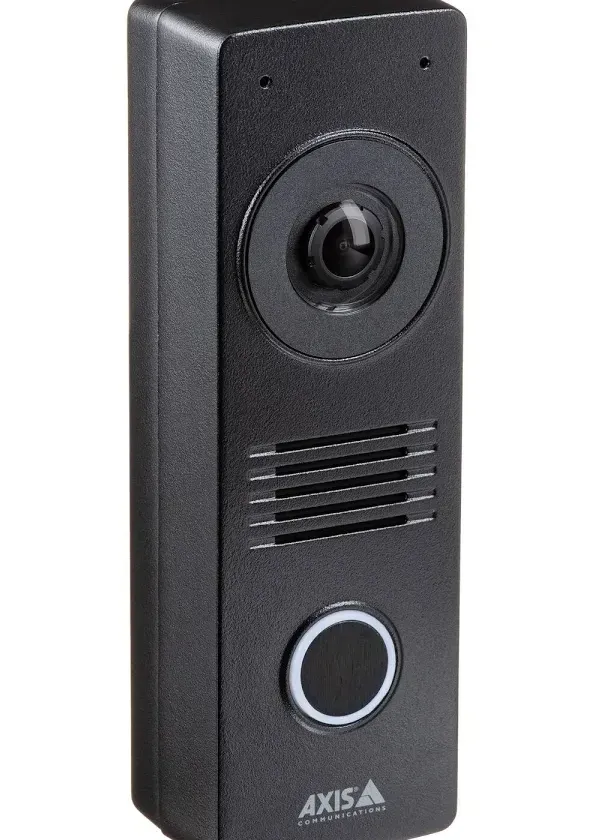
A photo from the AESS job library, not taken in Bay Ridge: a black video door station with a camera at the top, a speaker grille and a single round call button lit from behind. A one-button station like this is what most Bay Ridge two-family and row-house owners end up choosing for the street door, because it lets the person upstairs see and talk to the visitor on the stoop before deciding to release the lock.
Bay Ridge Door Buzzer Request
House, walk-up, co-op or storefront building: tell us how many apartments and doors, and a technician calls back with a price range
✅
Request Sent!
Thank you. A technician will call you about the Bay Ridge address, usually within two hours during working hours.
25+
Years Experience
✓
Same-Day Estimates
100%
Licensed & Insured
4.7★
201 Google Reviews
Owner-operated since 2002 · Thousands of jobs completed · Booked within 2 hours
Quick answer: a new door buzzer in Bay Ridge costs $400 to $900 for a small audio system, $700 to $1,800 for a video station on a house or small building, and $2,500 to $10,000 or more for a full apartment-building system, on our Brooklyn ranges. The low end is a two-family or one-family house where the cable from the door to the apartments is still sound and the door already has a working lock that can take an electric strike. The middle is a video station with phone answering on a row house or a small building. The top range is a directory panel wired to every apartment of a walk-up or elevator building, and on the larger Shore Road and Ridge Boulevard buildings the count of apartments and entrances decides where in that range a job lands. A request is usually booked within two hours, the first visit tests the old wiring before any price is fixed, and a visit booked and paid online is $250, applied toward the installation.
Looking at your photos and talking through the building costs nothing. The written quote names the system, the door hardware and what happens to the old equipment, and the price you agree is the price you pay unless the old cable fails its test, in which case we tell you before anything is ordered.
All work is done under New York State license #12000287431. A certificate of insurance for a managing agent, co-op board or condo office is sent before the visit.
Special-order panels are ordered only after the deposit, and the installation date is set once the equipment has arrived, so nobody is promised a date that depends on a shipment.
The Neighborhood
Why Bay Ridge Properties Need Door Buzzer Installation
Bay Ridge sits at the south-west corner of Brooklyn, with Sunset Park to the north, Dyker Heights to the east, the Narrows to the west and Fort Hamilton and the Verrazzano-Narrows Bridge at the southern end. Most of its housing went up in two waves. The row houses and two-family houses on the side streets came first, in the 1900s and 1910s, after the R line reached 59th Street in 1915 and 86th Street in January 1916. Then came the apartment buildings: the country houses that once lined Shore Road were replaced by apartment blocks before the Second World War, and Wikipedia's history of the neighborhood notes that the number of apartments grew roughly fivefold during the 1920s alone. Almost every front door in Bay Ridge that needs a buzzer today belongs to one of those two generations, and the two generations ask for completely different things.
The houses ask for a bell that reaches the right floor. City building records for ZIP 11209 list 2,057 two-family lots, more than any other kind of residential lot in the ZIP, and many of them share one street door between two households. A Brownstoner report from August 2024 on 476 72nd Street, a tapestry-brick row house built on a block front the builder Patrick J. Carley bought in 1915, describes the typical arrangement: "an apartment per floor," laundry and storage in the basement, and a front door that, judging by a 1940 tax photo, has already been changed once. In a house like that, the upstairs apartment often has a button on the door frame and a bell somewhere in the hall, and nothing else. There is no way to speak to the visitor, no way to see them, and no way to open the street door without walking down. Fixing that is not a legal requirement. It is the single most common reason a Bay Ridge homeowner calls us about a buzzer.
The apartment buildings ask a different question: who has to install it? The same city records list 167 elevator buildings in the ZIP, holding 12,380 apartments, and only eight of those buildings, with 715 apartments, were built in 1968 or later. The rest date from the 1920s, the 1930s and the post-war decades, and they line Shore Road (25 buildings, about 2,850 apartments), Fourth Avenue (25 buildings, about 1,674), Ridge Boulevard (22 buildings, about 1,269), Ovington Avenue (10 buildings) and Colonial Road (5 buildings). HPD's rule on entrance doors and intercoms, 28 RCNY §25-151, requires an intercom at the main entrance of any building with eight or more apartments put up or converted after January 1, 1968. For the older buildings it applies the same requirement only when a majority of the tenants request it or consent to it in writing. In a neighborhood where nearly every apartment building is older than that date, the written tenant request is not a footnote. It is how a large share of Bay Ridge intercoms are supposed to begin.
That is also why intercoms keep coming up in the city's own records here. HPD has issued 221 intercom violations to buildings in ZIP 11209, and 2026 was already the busiest year on record by late October, with 26, against 17 in all of 2025 and five in 2024. Calls to 311 about bells, buzzers and intercoms in the ZIP have risen from 28 in 2021 to 47 in 2026 before the year was out. And with about 64 percent of households renting, according to Census figures summarized by Lucid Rents, most of those complaints come from people who cannot simply hire an installer for the front door themselves. A tenant can call 311, and NYC311's own guidance lists "Doorbells, buzzers, or intercoms that are broken or missing" as a maintenance condition HPD investigates. An owner, a board or a managing agent is who actually orders the installation, and this page is written for both sides of that conversation.
The last thing that shapes buzzer work in Bay Ridge is time. A building that is close to a century old has often been through more than one entry system: perhaps a bell-and-buzzer board from the original construction, a later audio handset system, a video panel fixed over the old opening. Each one can leave cable behind. Some of that cable is excellent and can carry a modern system for years. Some of it has been spliced in the cellar by three different people, crossed at a junction box nobody can find, or cut by a renovation two floors up. The difference between a clean installation and an expensive surprise is almost always decided by testing that cable before the quote is final, which is why our first visit in an older Bay Ridge building is a test, not a sales pitch.
Six Bay Ridge facts that shape a buzzer installation before we choose a panel
Almost every apartment building predates 1968. Of the ZIP's 167 elevator buildings, 159 were built before 1968. Under §25-151(e), an intercom at the main entrance of a pre-1968 building of eight or more apartments becomes required when a majority of tenants request or consent to it in writing.
The two-family house is the most common lot. City records list 2,057 two-family lots in ZIP 11209, holding 4,114 homes. These houses sit below the eight-apartment threshold, so a buzzer here is the owner's choice, usually made for the upstairs tenant or an elderly parent.
Intercom violations are rising. HPD issued 26 intercom violations in the ZIP in 2026 by October 22, the most of any year, against 17 in 2025. Of 221 on file, 80 were still open, at 52 buildings.
311 hears about it more each year. Bell, buzzer and intercom complaints in the ZIP went from 37 in 2020 and 28 in 2021 to 39 in 2025 and 47 in 2026, according to NYC Open Data.
The big buildings cluster on a few streets. Shore Road, Fourth Avenue and Ridge Boulevard hold 72 of the 167 elevator buildings between them, so the same few streets account for a large share of the neighborhood's building-wide entry systems.
Most households rent. About 64 percent of Bay Ridge households are renters, which puts a landlord, a board or a managing agent between most residents and any change to the front door.
Where this page applies. It covers Bay Ridge from 65th Street, where the neighborhood meets Sunset Park, south toward 86th Street and the Fort Hamilton blocks, and from Shore Road and the Narrows east to the Seventh Avenue side where Dyker Heights begins: Shore Road, Narrows Avenue, Colonial Road, Ridge Boulevard, Third, Fourth and Fifth Avenues, Bay Ridge Parkway, Ovington Avenue, 72nd and 86th Streets and every side street between them. Some of the city figures above are for ZIP 11209 as a whole, which also takes in the Fort Hamilton blocks and a few blocks toward Dyker Heights. Everything is priced at the same Brooklyn rate, and the borough as a whole is covered on our Brooklyn door buzzer installation page.
Need Repair in Bay Ridge?
Need Repair in Bay Ridge? A Door That Will Not Release, a Dead Panel or One Floor That Cannot Hear
Not every call that starts as "we need a new buzzer" ends as an installation. Three problems in particular often look like a system at the end of its life and turn out to be one part. The first is a door that buzzes but will not open: the apartment station sends the signal, the strike in the door frame hums, and the latch stays put. That is usually the strike itself, its power supply, or a door that has dropped on its hinges so the latch is pressed hard against the strike lip. The second is a panel that has gone completely dark, which is very often a failed transformer or power supply in the cellar rather than the panel. The third is one line of apartments, or one floor, that can call the door but cannot hear the visitor, which points to a single damaged pair in the riser rather than a dead system.
If your door will not lock at all, that is the urgent one, because an unlocked street door in a building is a security problem for everyone in it. Call (347) 934-8335 and tell us what you see. When a part is the problem, we say so, and we price the repair before talking about replacement. When the testing shows the old system really has reached its end, the same visit becomes the survey for the new installation, so nothing you pay for is wasted. A visit booked and paid online is $250, and on an installation it is applied toward the work.
What We Install
Door Buzzer Installation Services in Bay Ridge
Each service below is priced from our Brooklyn door buzzer ranges. The number of apartments sets the range, the number of doors and the condition of the old cable set the point inside it, and video, phone answering and new door hardware are named separately in the quote so you can see what each one adds.
A bell and release for the upstairs apartment
The most common Bay Ridge house job: a second button at the street door, a station on the upper floor that talks to the visitor, and a release that opens the shared front door without walking down.
Video stations for row houses
A single-button or two-button camera station on the stoop of a limestone or brick row house, with an indoor monitor on each floor and optional answering from a phone.
Directory panels for walk-ups
Audio or video panels with one button or code per apartment for the four- to six-story walk-ups on the avenues and side streets, wired to a station in every unit.
Systems for pre-war elevator buildings
Lobby panels, apartment stations, door releases and a desk or super's station for the 1920s and 1930s buildings on Ridge Boulevard, Fourth Avenue and Ovington Avenue.
Upgrades for post-war co-ops
Panel and station replacement for the Shore Road and Colonial Road co-ops, reusing tested riser cable where it passes and rewiring only the lines that fail.
Electric strikes and door releases
Strikes matched to the lock already in the door, including older mortise locks and double doors, with the wiring carried through the frame neatly rather than across the face of it.
Phone and app answering
Answering the street door from a mobile phone for owners who work away from home or landlords who manage a building they do not live in, with or without indoor stations.
Second and rear entrances
A panel or a simple release at a courtyard door, a rear service door or a separate basement entrance, set up so each door rings the right people.
Storefront buildings on the avenues
Separate entry for the apartments above a shop on Third Avenue, Fifth Avenue or 86th Street, so residents' visitors and the business never share a button.
Building Specialists
Door Buzzer Installation for Bay Ridge's Architecture
Six kinds of building account for nearly every buzzer installation we quote in Bay Ridge. They differ in how many households share the street door, where the old cable runs, and who has the authority to say yes. Those three things decide the system long before anyone talks about cameras or apps.
The two-family house
Tapestry brick or limestone, one apartment per floor, one shared street door and often an owner on one floor and a tenant on the other. The most common lot in the ZIP.
The limestone row house
One- and two-family row houses from the 1900s and 1910s, including the 54 houses of the Doctors' Row historic district on Bay Ridge Parkway, where the facade itself needs care.
The three- and four-family house and small walk-up
Buildings below the city's eight-apartment line, often with an original bell board and a separate button at each floor, where owners choose the system rather than the rule.
The pre-war elevator building
Six-story buildings from the 1920s and 1930s on Ridge Boulevard, Fourth Avenue and Ovington Avenue, with a lobby, a riser in the shafts and usually a long history of earlier systems.
The post-war co-op
The larger buildings on Shore Road and Colonial Road, from mid-sized six-story blocks to 9201 Shore Road's 254 apartments, where a board decides and every shareholder has an apartment station.
The store with apartments above
Two- to four-story buildings on Third Avenue, Fifth Avenue and 86th Street, where the residential door sits beside the shop and must never depend on the shop's hours.
The two-family house: one street door, two households and a stair between them
In most Bay Ridge two-families the street door opens into a small vestibule, and a second door leads to the stair hall that serves both apartments. The ground-floor apartment has its own door off that hall, and the upper apartment is reached by the stair. When an owner asks us for a buzzer here, what they usually want is simple: a visitor presses the right button, the right floor hears it, someone on that floor can talk to them and, if they choose, release the street door. That takes three things the house often does not have. It needs a station outside with two clearly labeled buttons, a station on each floor, and an electric strike or a release in the street door's frame. The cable between them can usually follow the stair hall, either inside the wall where a hollow partition allows it or in a slim painted raceway along the stringer, and the power supply goes in the basement beside the house's panel, where it is protected and easy to reach.
Two details make the difference in a house like this. The first is which door gets released. If the vestibule's inner door is the one that locks, the strike belongs there, and the street door can stay on a simple latch; if the street door is the locking door, it gets the strike and the inner door stays free. We look at how the household actually uses the two doors before deciding, because releasing the wrong one leaves a visitor stuck in the vestibule. The second is who controls the system. In an owner-occupied two-family, the owner downstairs often wants the upstairs tenant to be able to release the door for their own visitors but not to change settings on the system. A simple audio or video kit does that naturally. A phone-app system can do it too, as long as the owner, not the tenant, holds the administrator account, and we set it up that way from the start so nothing has to be untangled when a tenant moves out.
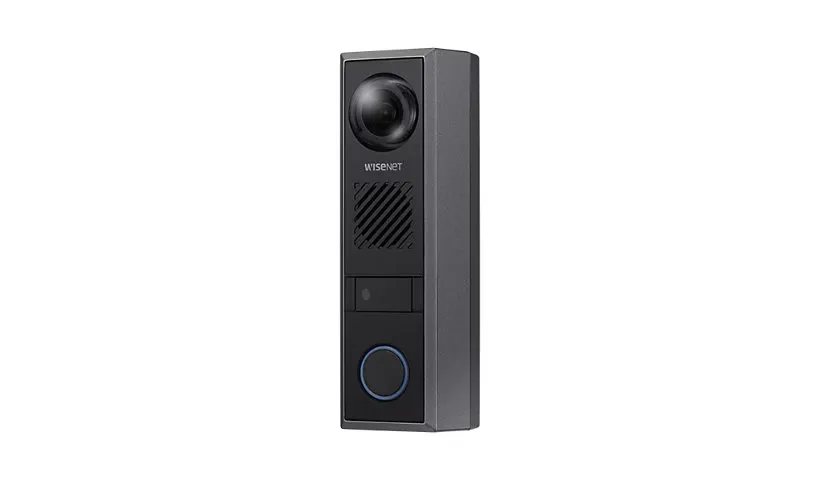
A photo from the AESS job library, not taken in Bay Ridge: a slim, dark grey wired doorbell with a camera lens, speaker slots and a round push button. A station this narrow fits the strip of door frame or limestone beside many Bay Ridge two-family doors, and because it is wired rather than battery-powered it can also be connected to the release for the shared street door.
The limestone row house: drilling stone that will still be there in another century
Bay Ridge's limestone row houses are why many people move here, and they are also where a careless installer does the most lasting damage. A limestone front is soft enough to drill easily and soft enough to spall around a badly placed anchor, and the stoop, the doorway surround and the carved details are exactly where a door station would be most convenient. We prefer to mount the station on the wooden door frame or inside the doorway reveal, where it is sheltered from rain and the fixings go into wood or into the brick backing behind the stone rather than into the face. Where a station must go on stone, we drill into the mortar joint only when the stone itself would be at risk, use stainless fixings, and seal every penetration so water cannot get behind the face and freeze. Cable comes through the door frame or through the existing hole left by the old bell wherever we can find one, rather than through a new hole in the stone.
The houses of the Bay Ridge Parkway–Doctors' Row Historic District, a block of 54 limestone-fronted row houses between Fourth and Fifth Avenues built between 1906 and 1913 and designated by the Landmarks Preservation Commission in 2019, add one more step. Work that changes the outside of a building in a historic district comes under the Commission, so before we fix anything to a facade there, we plan the smallest visible change, usually a station in the doorway reveal and wiring through the frame, and the owner checks with the Commission whether a permit application is needed. Several houses on the block have a separate basement entrance for a medical or dental practice, and that entrance gets its own button or its own small panel so the practice's patients never ring the family upstairs.
The three- and four-family house and the small walk-up: below the line, still worth doing well
Bay Ridge also has a layer of small buildings, three- and four-family houses and walk-ups of six or seven apartments, that sit under the city rule's eight-apartment threshold. Their owners are not required by §25-151(d) to install an intercom, which is why many of them still have an original bell board, a mixture of mismatched buttons, or one apartment that got a modern station when a tenant complained and three that did not. A Reddit post in r/AskNYC from January 2026 describes exactly that building from the tenant's side: one apartment with "only a doorbell," no way to "see or hear who is at the front of the building," and a button that "isn't even labeled on the outside." Every apartment in a building like that is getting a worse version of the same thing.
For owners of these buildings, the sensible installation is usually one matched system for every apartment, put in at once, with a directory panel at the street door and a station in each unit. A four-family with sound cable can often have that done as an audio system at the bottom of our multi-unit range, and a video system with phone answering costs more mostly because of the panel and the stations, not the labor. The owner gets a door every tenant can answer the same way, a directory that can be relabeled when people move, and one set of parts to keep. We also suggest putting the owner's own phone on the system, which lets a landlord who lives elsewhere let in a plumber without driving to Brooklyn.
The pre-war elevator building: a riser that has seen three systems
The six-story buildings from the 1920s and 1930s on Ridge Boulevard, Fourth Avenue and Ovington Avenue are where testing matters most. Their intercom cable usually runs up a riser in a shaft or a chase near the stair, branching at each floor to the apartments, and over ninety years it may have been extended, spliced, partly replaced and partly abandoned. Brick Underground's intercom repair guide quotes Daniel Vasquez of Paragon Security and Locksmith putting it plainly: "It's all in the wire connections." In our experience that is right, and it is the reason we test every pair from the lobby to every apartment before we tell a building whether its riser can carry a new system. A riser that tests clean can save a building a great deal; one that fails on a few lines can still be reused for most of the building, with new cable run only to the apartments that failed.
These buildings also have a lobby with an outer street door and an inner lobby door, and the city rule speaks to that directly: where the door from the vestibule into the lobby is self-closing and self-locking, the street door does not have to be. The new panel usually goes in the vestibule beside the inner door, which keeps it out of the weather and lets the inner door do the locking. Because so many of these buildings predate 1968, the decision to install a full intercom often starts with the tenants. If a tenants' association has collected a written majority request, the owner or managing agent can share it with us, and we design to the rule's requirements from the first drawing, rather than discovering at the end that a button is too high or the release cannot be reached in time.
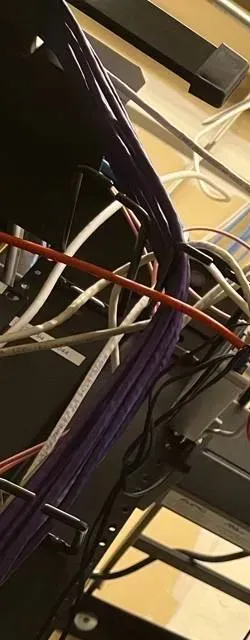
A photo from the AESS job library, not taken in Bay Ridge: bundles of purple, white and red cable dropping down beside a black equipment rack. In the cellar of a pre-war Bay Ridge elevator building, the intercom cable usually arrives at one place like this, and labeling every pair there, by apartment, is the first thing we do before testing whether the old riser can carry a new system.
The post-war co-op: a board, a vote and a station in every shareholder's apartment
The co-ops on Shore Road and Colonial Road include some of the largest buildings in the neighborhood. 9201 Shore Road, built in 1960 with 254 apartments, is often described as the largest of the co-op and condominium buildings on Shore Road, and 9323 Shore Road, from 1961, has 72 apartments on six stories. In buildings like these the board decides, the managing agent coordinates, and every shareholder has an apartment station that must be reached on installation day. That makes the project as much about scheduling as wiring. We give the board a written scope that separates the lobby equipment, the apartment stations and the door hardware, a plan for reaching apartments floor by floor, and a clear statement of which old cable we expect to reuse and what happens if a line fails.
Reuse is where post-war co-ops can save the most, and where they can be caught out. Security Sales reported on the Park Vanderbilt, a seven-story, 148-unit Park Slope co-op built in 1963, whose installer reused the old audio intercom cable for all but two apartments; the installer's vice president, Dan Arnold, said "By using the existing cable – with the exception of two units – we were able to save $20,000 on the job," and the work was finished in three weeks. CooperatorNews described the opposite outcome at a 56-unit 1938 co-op in Washington Heights: the new panel and monitors went in over the old wiring without rewiring from the front door to the apartments, calls to one apartment rang another, audio and video failed, and the building ended up rewiring the whole system at a much higher cost. Those two buildings are why we test before we quote, not after we install.
The store with apartments above: two entrances that must never be confused
Along Third Avenue, Fifth Avenue and 86th Street, a great many buildings have a shop on the ground floor and two or three apartments above, with the residential door squeezed in beside the storefront. The residents' door needs its own panel, its own lock and its own release, completely independent of the shop's alarm, its hours and its staff. Where the stair to the apartments also serves a back room of the shop, we look at whether the apartment door should be the locking door and the shop's door a separate one, so a delivery to the store never leaves the residents' stair unlocked.
These buildings are usually owned by one landlord, who may live elsewhere. That makes phone answering for the owner useful here too, along with a panel that is easy to relabel. Storefront buildings on busy avenues also take more knocks than a side-street house, so we choose panels with metal faces and recessed buttons and mount them where a hand truck will not catch them.
Field Notes
Field Notes: Reading an Old Bay Ridge Entry System Before Quoting a New One
These notes describe how our technicians work in buildings like Bay Ridge's. They are our practice, not a story about any one address.
Start in the cellar, not at the door. The panel at the door shows what the building looks like now. The cellar shows its history. The technician finds the power supply or transformer for the old system, the point where the riser cable arrives, and any junction boxes along the way. A building that has had two systems often still has both power supplies, one of them dead and one doing the work.
Count the pairs and label them. At the lobby end, every pair of conductors is counted and tagged with the apartment it is supposed to serve. If there are more pairs than apartments, the spares are noted, because spare pairs are what make a video upgrade possible without new cable.
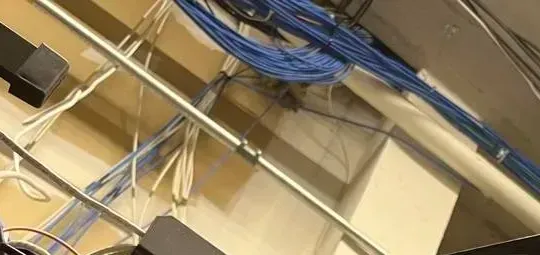
A photo from the AESS job library, not taken in Bay Ridge: bundles of blue low-voltage cable laid over a ceiling beam and a metal pipe in an open ceiling. In a Bay Ridge cellar we look for exactly this kind of run, because new cable to a rear door or a failed apartment line can often follow the path the old cable already uses, without opening a single finished wall.
Test every pair, one apartment at a time. Each pair is checked for continuity, for shorts between conductors and to ground, and for crossed lines that ring the wrong apartment. A pair that passes is marked for reuse. A pair that fails is marked for replacement, and the quote shows how many there are.
Watch the door close. Before anything electrical is planned, the technician watches the street door and the lobby door close on their own, several times. A door that drops on its hinges or does not latch fully will defeat any strike, and that is cheaper to find before installation than after.
Measure before marking. The city rule caps push buttons at six feet off the floor and puts the speaking device between four and five feet. The technician measures from the landing or the stoop step where a visitor actually stands, which on a Bay Ridge stoop is not always the sidewalk.
Photograph and write it down. Every finding goes into the written quote: the pairs that passed, the ones that failed, the door's condition, and where the panel and power supply will go. The owner keeps that record whether or not they hire us.
The Rulebook
The City Rules That Decide Who Installs a Bay Ridge Buzzer, and Where It Goes
We are installers, not lawyers, and nothing here is legal advice. These are the published rules we design to, written out plainly, so owners, boards and tenants can have the right conversation before a quote is signed.
Which buildings must have an intercom. New York City's rule is HPD's 28 RCNY §25-151, "Entrance Doors, Locks and Intercommunication Systems." Under subsection (d), a Class A multiple dwelling with eight or more apartments, erected or converted after January 1, 1968, must have automatic self-closing and self-locking entrance doors and an intercommunication system at the main entrance door. Under subsection (e), a building of the same kind erected or converted before that date must have the same doors and intercom if a majority of the tenants request or consent to it in writing. The state law behind the rule, the Multiple Dwelling Law, applies to cities with 325,000 or more people, which is why New York City buildings follow it rather than the Multiple Residence Law used in smaller cities and towns. Buildings with fewer than eight apartments, including two-families and most three- and four-family houses, are not covered by subsection (d) at all.
What counts as an intercom. Subsection (g) sets the minimum: a bell or buzzer system, or a voice speaking-and-listening device, together with a return buzzer that releases the lock. In other words, the city's floor is lower than many people expect. A button that rings the apartment and a button in the apartment that releases the door meets the minimum; talking, seeing the visitor and answering from a phone are improvements on top of it.
Where it goes. Subsection (h) requires the intercom to be at the main entrance door and placed so a person can reach the door while the unlocking buzzer is sounding. Subsection (i) says push buttons may be no more than six feet above the floor and the speaking-and-listening device must be between four and five feet above it. Subsection (j) requires the device in the apartment to be readily accessible to the occupant. For panels in public and commercial spaces, the 2010 ADA Standards also set a high forward reach of 48 inches maximum for operable parts, so in an office or practice entrance we keep the buttons within that reach as well.
Doors still open from inside. Subsection (f) requires self-locking doors to be readily openable from the inside without a key. Whatever strike or lock we install, a resident leaving the building must be able to walk out by turning a knob or lever or pushing the door, with no key, no code and no button that depends on power.
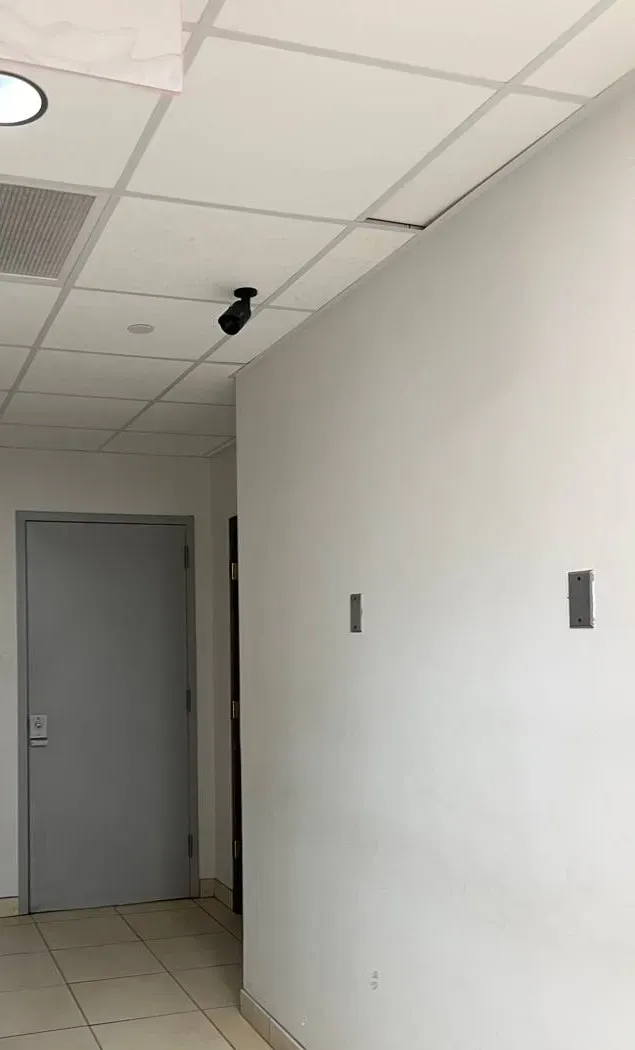
A photo from the AESS job library, not taken in Bay Ridge: a tiled corridor with small wall plates, ending at a grey steel door with a lever handle beneath a drop ceiling and a small camera. The lever is the point of the picture: on a Bay Ridge building's rear or service door, the city rule requires that the self-locking door still opens from inside without a key, so any release we add leaves that lever working on its own.
Vestibules. Subsection (c) says that where the door from the vestibule into the lobby is automatic self-closing and self-locking, the street-to-vestibule door does not have to be. That is why many Bay Ridge lobby panels belong beside the inner door rather than out on the street.
Approved equipment. Subsection (k) requires intercom devices to be approved by the Department of Buildings or previously approved by the Board of Standards and Appeals, and the rule allows devices already installed, in good condition and working adequately, to be accepted at the department's discretion. We install listed commercial intercom equipment and give the owner the product documentation for the file.
Once there is an intercom, it has to work. Habitat Magazine reported in February 2024 that courts have treated a working intercom as an essential service under the warranty of habitability. Nancy Kourland of Lasser Law Group, answering a shareholder whose intercom had been out for years, put it this way: "As a result, the co-op has a legal obligation to repair or replace the intercom." For tenants, NYC311's apartment maintenance complaint lists "Doorbells, buzzers, or intercoms that are broken or missing," and HPD inspects and issues violations. For owners and boards, the practical lesson is that the installation you choose today is a system you will be expected to keep working, which is one more reason to choose one that can be serviced and to keep a record of how it was wired.
Commercial Door Buzzer Installation
Business Door Buzzer Installation in Bay Ridge
Bay Ridge's businesses line a handful of long avenues. Community Board 10 names the commercial corridors of Third, Fourth and Fifth Avenues, Fort Hamilton Parkway and "the bustling 86th Street strip," and two of them have business improvement districts: NYC Small Business Services lists the Bay Ridge Fifth Avenue BID, founded in June 2006, with 40 block faces and 376 ground-floor retail businesses, and the 86th Street Bay Ridge BID, founded in October 2001, with 16 block faces and 145 ground-floor businesses. The cards below describe the kinds of door that need a buzzer along those streets; we do not name any business as a customer.
Third Avenue restaurants and bars
Rear and side doors for deliveries and staff, and the apartment doors beside them, where the restaurant's back door must lock behind every delivery without a wedge.
Fifth Avenue shops and offices
Second-floor offices, studios and salons above storefronts, reached by a stair door that needs a panel and a release so the tenant can let clients in from upstairs.
86th Street storefront buildings
Busy retail frontage with offices and apartments above, where an entry panel must survive foot traffic and the upstairs tenants need an entrance of their own.
Medical and dental practices
Ground-floor and basement practices, including those on and near Bay Ridge Parkway, where staff buzz patients in from the front desk and keep the door locked between appointments.
Fourth Avenue and Fort Hamilton Parkway offices
Professional offices, community organizations and small schools in older buildings, often with one public door and one staff door that need different rules.
Houses of worship and community rooms
Office and hall doors that are staffed only some hours, where a panel rings the office during the day and a phone or a keyholder after hours.
Business buzzer jobs in Bay Ridge are almost never in a building the business owns. A practice on a side street may lease the basement of a family's row house; an office above a Fifth Avenue store has a landlord who owns the stair door and the apartments above it; a restaurant's back door may open onto a yard the building shares. So before a business installation we confirm three things in writing: who has approved the work on the door, when the door can be out of service without customers or patients in the way, and who receives the certificate of insurance. We also ask how the door is used across a day. A practice that wants the door unlocked during morning hours and buzzer-only after lunch, or a restaurant that wants the rear door to ring the kitchen but never release from the street, gets a system set up for that schedule, rather than a home system stretched to cover a business.
Delivery doors are the other common request. A shop's rear door that has to be propped for a delivery and then forgotten is the weakest point in the building. A release button at the counter, a camera station at the rear door that rings the counter, and a closer adjusted so the door shuts and latches every time usually solve it, and the same arrangement keeps the apartments above from depending on whether the shop remembered to lock up.
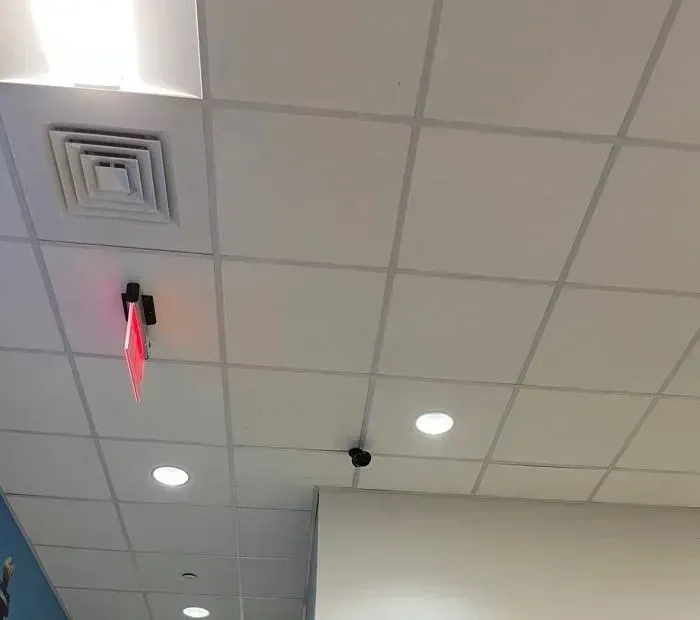
A photo from the AESS job library, not taken in Bay Ridge: a drop ceiling with a lit red exit sign, an air diffuser, recessed lights and a small black camera. In a Bay Ridge practice or office, the door under an exit sign like this is a way out first and an entry door second, so any lock we add to it has to release for anyone leaving, every time.
Compliance notes for Bay Ridge businesses and buildings
Exit doors open from inside. A door that people use to leave a business must open from the inside without a key or special knowledge. On a strike-equipped door the lever or knob still opens it mechanically; Allegion's guide notes that with an electric strike you can exit by turning the lever "regardless of whether the electric strike is fail safe or fail secure."
Magnetic locks need a proper release. Allegion notes that "Electromagnetic locks are only available fail safe," meaning they unlock when power is removed. Building codes modeled on the International Building Code set conditions for electrically locked egress doors released by a sensor, including a sensor on the egress side, a manual release device mounted 40 to 48 inches above the floor within five feet of the door and marked "PUSH TO EXIT," and unlocking when the fire alarm or sprinkler system activates. We install magnetic locks only where those conditions can be met and the building's fire alarm contractor is involved where a tie-in is needed.
Fire doors take fail-secure strikes. A fire-rated door must stay latched in a fire, so where a stair or corridor door is fire-rated we use a fail-secure strike, which stays locked when power is lost while the lever still lets people out.
Buttons within reach. The 2010 ADA Standards set a 48-inch maximum high forward reach for operable parts in public accommodations, and the city's intercom rule caps buttons at six feet for residential entrances. In a business entrance we mount to the lower of the two.
Insurance paperwork first. Commercial landlords and managing agents often require a certificate of insurance naming the owner and the agent before work starts. Ours is sent ahead of the visit.
Exit signs, sprinklers and alarm devices stay clear. We do not mount panels, cameras or cable where they would block an exit sign, a sprinkler head, a fire alarm device or the swing of a door.
A photo from the AESS job library, not taken in Bay Ridge: a dark recessed ceiling panel with round downlights and a small round device, framed by a lighter ceiling. Vestibule and lobby ceilings in Bay Ridge buildings already carry lights and devices like these, so before we place a camera or a sensor for a new entry system we map what is up there and keep the new work from crowding the fixtures the building already depends on.
Your Questions Answered
Door Buzzer Installation in Bay Ridge: Questions Answered
These are the situations Bay Ridge owners, boards and tenants describe when they call about a new buzzer: tenants who want one their building does not have, houses with no bell for the upstairs floor, old cable nobody trusts and new systems with costs nobody expected. Each is answered here in full and not repeated in the FAQ further down.
Who has to ask, and what the city expects
Our Ridge Boulevard building has thirty apartments and went up in the 1920s. The tenants want a working intercom. What does a written majority request actually change?
Under HPD's rule, 28 RCNY §25-151(e), a building of eight or more apartments erected or converted before January 1, 1968 must have self-closing, self-locking entrance doors and an intercom at the main entrance if a majority of the tenants request or consent to it in writing. So in a 1920s building of thirty apartments, a signed request from at least sixteen households is what turns an intercom from something the owner may choose to provide into something the rule expects. We are not lawyers and cannot advise a tenants' association on how to word or deliver its request, but we can help the other side of it: once an owner or managing agent asks us to quote, we design to the rule's requirements from the start, including the release buzzer, the mounting heights and doors that still open from inside without a key.
We own a six-apartment walk-up off Fifth Avenue. Does the eight-apartment threshold mean we can leave the old bell board alone?
The intercom requirement in §25-151(d) and (e) is written for buildings of eight or more apartments, and ButterflyMX's summary of the NYC rule makes the same point: buildings with fewer than eight units "are not generally treated the same way." But once a building has an intercom or buzzer system, the tenants can report it to 311 when it is broken, and NYC311 lists broken or missing doorbells, buzzers and intercoms as a condition HPD investigates. In practice, a six-apartment owner with a failing bell board is not choosing between an intercom and nothing; they are choosing between maintaining an old system piece by piece and replacing it with one that every apartment can use. We price both honestly, and in a building that size the full replacement often sits at the lower end of our multi-unit range.
Does the city accept a plain bell and buzzer, or does a new installation have to let tenants talk to the visitor?
The rule's minimum, in §25-151(g), is "a bell or buzzer system" or a voice speaking-and-listening device, together with a return buzzer that releases the lock. So a button that rings the apartment and a button that releases the door meets the city's floor. We rarely recommend stopping there in a building, because a tenant who cannot hear or see the visitor tends to release the door for anyone, which defeats the point of a locked entrance. A talk-back audio system costs little more than a plain buzzer once the cable and the strike are in, and video adds the panel and stations. The quote lists each level separately so the owner can see the difference.
How high do the buttons and the speaker go on a new lobby panel?
The city rule, §25-151(i), says push buttons may be no more than six feet above the floor and the speaking-and-listening device must be between four and five feet above the floor. Most modern panels put the speaker and microphone near the camera at the top, so a panel is mounted so its speaker lands inside that four-to-five-foot band and its top row of buttons stays under six feet. Where the panel also serves an office or practice open to the public, we keep operable parts within the 48-inch high reach set by the 2010 ADA Standards. On a Bay Ridge stoop or a raised vestibule, we measure from where the visitor actually stands, not from the sidewalk.
Old cable and the systems before yours
Before you promise our Shore Road co-op board that the old riser can carry a new system, what exactly do you test?
Every pair, from the lobby end to each apartment station, one apartment at a time. We check that each pair is continuous, that its conductors are not shorted to each other or to ground, and that it reaches the apartment it is labeled for rather than a neighbor's. We also count spare pairs, because some video systems need more conductors than an old audio system used. The result goes to the board as a written list: which apartments passed, which failed and what the failures were. The quote then prices the reuse and the replacement separately, so the board decides with the numbers in front of it. A riser that fails on a few lines is still usually worth reusing for the rest of the building.
A co-op near us put new monitors on the old wiring and calls started ringing the wrong apartments. How do you keep that from happening to our building?
That is close to what CooperatorNews described at a 1938 co-op in Washington Heights, where new equipment over old wiring left calls to one apartment ringing another and audio and video that did not work together, until the building rewired the whole system. Crossed calls almost always come from a riser whose labels do not match reality: a pair spliced to the wrong branch years ago, or a junction box where two lines were swapped. We prevent it in two ways. The testing before the quote catches crossed pairs and relabels them, and on installation day every apartment calls the door and receives a call from the door while the resident watches, so a crossed line is found and fixed before we leave, not after a visitor rings the wrong door.
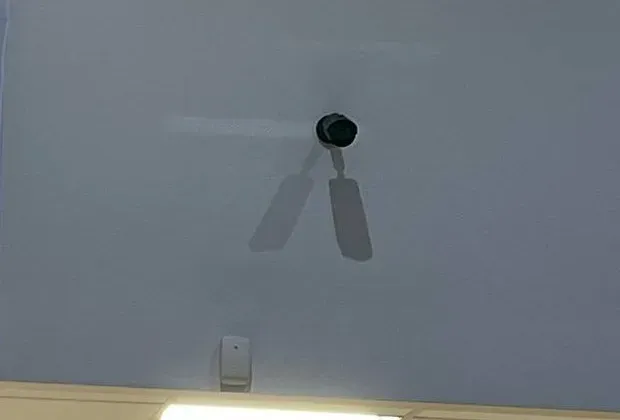
A photo from the AESS job library, not taken in Bay Ridge: a small black camera mounted high on a pale wall, with a small white wall device below it and a light fixture at the edge. In a Bay Ridge lobby where the panel itself has no camera, a separate camera like this above the inner door can give residents and the board a view of the entrance, and it is planned together with the buzzer so the two share power and cable.
Houses, doors and locks
We added a smart deadbolt to our two-family's street door last year. Will a buzzer release still open it, or will the deadbolt get in the way?
An electric strike releases the latch, not a deadbolt. If the deadbolt is thrown, the strike can buzz all it likes and the door stays shut, which is exactly the problem a Jersey City renter described on Reddit after a second lock made the building's buzzers "100% unusable." A Brownstoner owners' thread makes a related point: an older mortise lock opens at the latch side, while many modern smart locks work through the lock side. So the plan depends on how the house wants to use the door. If the street door is meant to be buzzed open, the strike works on the latch and the deadbolt is left unthrown during the day, or the smart lock is set to stay unlocked while someone is home. If the deadbolt must always be thrown, the release has to work through the smart lock itself, which only some smart locks support. We look at the lock before quoting.
Our row house has a pair of double doors at the street with glass panels. Can an electric strike go on double doors?
Yes, and it is a question Brownstoner readers have been asking since at least 2007. On a pair of doors, one leaf is usually held fixed with bolts at the top and bottom and the other is the active leaf that latches into it. The strike goes either in the fixed leaf's edge, where the active leaf's latch meets it, or the doors are fitted with hardware made for pairs. A reader who had done it in a brownstone warned that "You'll need to open up the walls, probably quite a bit," because the wiring has to reach the strike. On many Bay Ridge doors we can avoid most of that by bringing the cable through the frame head and down a door loop or a concealed channel, but the door's construction decides it, and with glass panels we will not cut into the stiles near the glass. We look before pricing.
The basement of our two-family is only laundry and storage now. If a basement unit is ever legalized, can a third button be added without redoing the system?
If we plan for it, yes. City & State reported in December 2024 that the City of Yes zoning package barred backyard accessory units in the Special Bay Ridge District but that "The Bay Ridge carveout does not apply to basement units." Whether a particular basement can ever become a legal apartment is a question for the city's own rules and an architect, not for us. What we can do is install a door station with room for a third button or a panel that takes an added call code, run one spare pair to the basement while the cable is being pulled anyway, and leave the power supply sized for one more station. That costs very little on the day and saves opening walls later.
Apartments, directories and fees
My apartment is the only one in the building with a plain doorbell instead of a talk-back station. Can a station be installed for just my unit?
Technically, often yes, if the building's system is a type that still has matching apartment stations and the cable to your apartment tests sound. But the front door and the system belong to the owner, so the installation has to be ordered or approved by the owner or managing agent, not by a tenant alone. If your landlord agrees, a matching station is one of the smallest installation jobs we do. If the building's system is so old that matching stations are not made any more, the honest answer is that adding a different brand for one apartment rarely works well, and the owner is better served by a building-wide replacement. If the landlord will not act on a missing intercom, NYC311 is where tenants report it.
We get rung all day for other apartments because the buttons outside have no names. How should a new directory be set up?
The fix is a directory the building can keep current. A button panel gets engraved or printed labels behind a clear cover, by apartment number, and a spare label sheet goes to the super or owner so a move-in can be relabeled in minutes. A digital panel shows a scrolling or searchable directory and a call code for each apartment, and the list is edited from the panel or an app. Residents who prefer not to show their names can be listed by apartment only; a visitor who knows where they are going does not need a surname. The redditor in r/AskNYC who was buzzed constantly for other apartments had an unlabeled button, and that alone is enough to send couriers to the wrong door.
Video intercom vendors quote a monthly fee per apartment. What would that add up to for a Bay Ridge co-op of fifty-five units?
Swiftlane's published guide says software subscriptions "commonly add $5 to $15 per unit per month." For a fifty-five-unit building, our arithmetic on that range comes to $275 to $825 a month, or $3,300 to $9,900 a year, every year, on top of the installation. Some cloud systems charge per door instead, and Swiftlane cites $30 to $100 per door per month for that model. Not every system works that way. Wired audio and video systems with indoor stations, and many phone-answering systems, have no monthly fee at all, and we can install a system with no subscription. The quote shows the installation price and any recurring cost separately, so a board can compare a ten-year cost, not just day one.
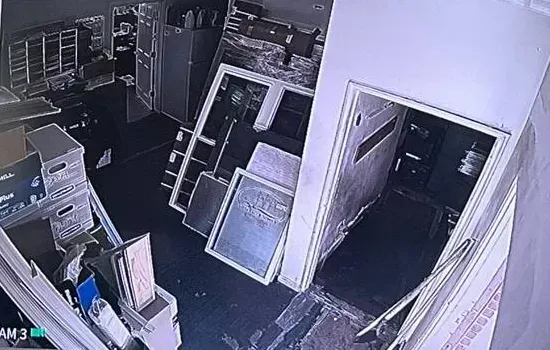
A photo from the AESS job library, not taken in Bay Ridge: a black-and-white night image from a camera looking across a cluttered room toward an open doorway into a dark back room. Video door stations switch to this kind of infrared picture after dark, which is what lets a resident on the top floor of a Bay Ridge walk-up see who is in an unlit vestibule before pressing release.
Our Fourth Avenue lobby has an outer street door and an inner lobby door. Which one should the new system lock and release?
In most buildings, the inner one. HPD's rule, §25-151(c), says that where the door from the vestibule into the lobby is automatic self-closing and self-locking, the street-to-vestibule door does not have to be. Putting the panel in the vestibule beside the inner door keeps it out of rain and salt, gives visitors a sheltered place to wait, and lets the inner door do the locking while mail carriers and couriers can still reach a vestibule mailbox where the building has one. In a few buildings the vestibule is too shallow, or packages are left there and the board wants the street door locked too, and then both doors can be released from the apartments, one after the other. We look at how your lobby is laid out and how packages are handled before choosing.
Equipment
Types of Door Buzzer Systems and Hardware We Install
We quote our own non-branded system by default, and install a named brand when a building asks for one, including Aiphone, 2N, Akuvox, Comelit, DoorBird and ButterflyMX. These are the kinds of equipment that go into Bay Ridge entrances, and where each one fits.
Audio door stations
A speaker, microphone and one or more call buttons at the door, with a talk-and-release station in each apartment. The most affordable system that lets a resident speak to a visitor.
Video door stations for houses
One- and two-button camera stations for two-families and row houses, with an indoor monitor on each floor and night vision for an unlit stoop or vestibule.
Directory and keypad panels
Button panels or digital directories with a call code for each apartment, for walk-ups and elevator buildings, with labels the super can change after a move.
Apartment stations
Audio handsets, hands-free stations and video monitors for each apartment, mounted at a height the resident can reach and labeled with the unit they belong to.
Phone and app answering
Systems that ring a resident's mobile phone, alone or alongside an indoor station, for owners who live elsewhere and residents who are often out.
Cellular entry panels
Panels that call residents over a cellular connection instead of building wiring to each apartment, for buildings where pulling new cable to every unit is not practical.
Electric strikes
Fail-secure strikes that stay locked if power is lost, and fail-safe strikes where a door must unlock without power, matched to the lock and frame already on the door.
Magnetic locks with proper releases
Used only where a strike will not work and the code's conditions can be met: an egress sensor, a push-to-exit release and unlocking on fire alarm.
Power supplies and protection
A dedicated power supply placed in the cellar or a utility closet, with battery backup where the building wants the door to keep working through an outage.
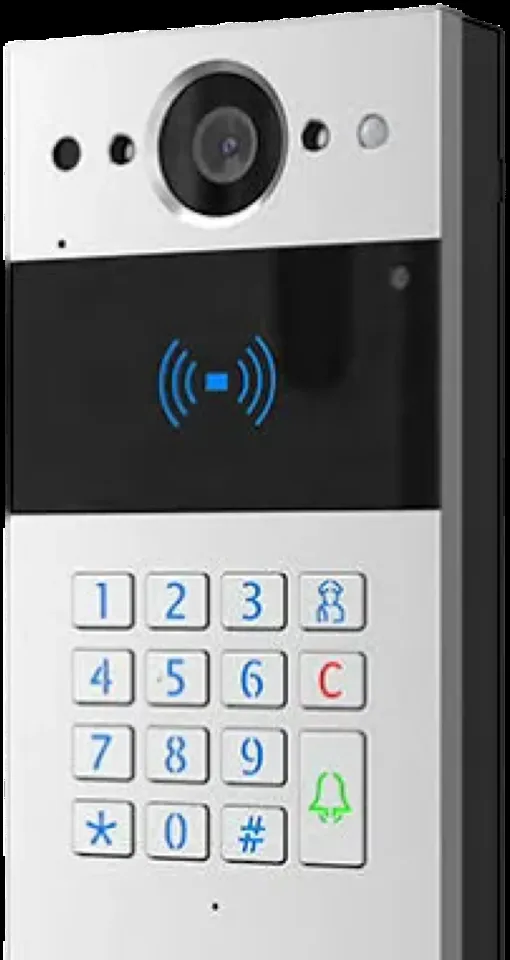
A photo from the AESS job library, not taken in Bay Ridge: a silver and black keypad door station with a camera at the top, a card-reader symbol, a numeric keypad and a green bell key. A panel like this suits a Bay Ridge walk-up or elevator building where a long row of buttons would not fit the door surround: visitors dial an apartment code, and residents can use a code or a card at the same panel.
How the main options compare for a Bay Ridge entrance
No single system is right for every door here. The table compares the main kinds of system on the points that decide most Bay Ridge jobs, not on brand.
What matters
Plain bell and buzzer
Wired audio or video intercom
Cloud or cellular panel
Meets the city's minimum
Yes, with a return buzzer
Yes
Depends on the setup and approvals
Resident can talk to the visitor
No
Yes; video adds a picture
Yes, usually on a phone
Cable to every apartment
Yes
Yes, often the old riser after testing
Not always; power and lock wiring still needed at the door
Monthly fee
None
None for most systems
Often per unit or per door
Works for residents without smartphones
Yes
Yes
Only if it can call a landline or an indoor station
Best fit in Bay Ridge
Rarely recommended now
Two-families, row houses, walk-ups, co-ops with a sound riser
Buildings whose riser has failed and cannot be rewired easily
Two notes on the table. Aiphone describes its GT multi-tenant series as built "for new builds and retrofit projects" and as offering "the advantage of using existing wire and infrastructure," and several other makers sell systems designed to run over old two-wire risers. That is why wired systems are usually the first choice in a Bay Ridge building whose riser tests well. And because many wired systems can also send calls to a phone, the choice is no longer between a handset on the wall and an app; a building can have both, with no subscription, if the system is chosen for it.
AI Overview Reality Check
What AI Gets Wrong About Door Buzzer Installation in Bay Ridge
These are claims that show up in generic online answers, vendor blogs and national cost guides such as HomeAdvisor, Angi and Fixr, paraphrased, each followed by what the rules and Bay Ridge's buildings actually show.
"Every New York City apartment building must have an intercom"
Generic answers often say flatly that New York law requires an intercom in every apartment building.
HPD's rule requires one automatically only in buildings of eight or more apartments erected or converted after January 1, 1968. Older buildings of that size must install one when a majority of tenants request or consent in writing. In Bay Ridge, 159 of the 167 elevator buildings in ZIP 11209 predate 1968, so the automatic version of the rule covers very few of them.
For tenants that means the written request matters; for owners it means the rule may already apply if tenants have asked. Either way, we design to the rule's specifications on every building installation.
"Small buildings and houses don't need to think about the rules"
The opposite claim also circulates: that a building under eight units can ignore intercom questions entirely.
The installation requirement does not reach two-families and most small buildings, but a buzzer system that is there can still be reported to 311 when it fails, and Habitat Magazine reported in 2024 that courts have treated a working intercom as an essential service under the warranty of habitability. A broken system in a small building is not invisible.
If you own a two-family or a small walk-up, the practical rule is simple: install something every apartment can use, and choose equipment you can get serviced.
"Installing an intercom costs about $2,500"
HomeAdvisor's cost guide says installing an intercom system "costs an average of $2,500," with a range of $1,500 to $15,000, and wireless systems from $150.
An average built from all kinds of homes across the country does not know whether you have a two-family with one door or a 1920s building with thirty apartments and a riser nobody has tested. In Bay Ridge, those two jobs sit in completely different ranges: $400 to $900 for a small audio system on our Brooklyn list, and $2,500 to $10,000 or more for a building.
The numbers that actually decide a Bay Ridge price are the count of apartments, the count of doors and how much of the old cable passes its test.
"A cloud intercom needs no wiring"
Vendor pages describe some panels as requiring "no building wiring," and answers repeat it as if no installer is needed.
A cellular or cloud panel can avoid cable to each apartment, but the door still needs power at the panel, wiring from the panel to an electric strike or lock, and a release that lets people out without a key. In a limestone or masonry entrance, getting that power and lock wiring to the door neatly is most of the installation work.
These panels are a real option for a building whose riser has failed, and we install them, but the door end of the job is the same.
"Old intercom wires can always be reused"
Retrofit guides often say existing wiring can carry a new system, and Aiphone's own upgrade guidance says that if the existing wires are in good condition, they can be reused.
The condition is the whole point. The Park Vanderbilt co-op in Park Slope reused its cable for all but two apartments and saved $20,000; a Washington Heights co-op that skipped rewiring ended up with calls ringing the wrong apartments and rewired the entire building. ButterflyMX's 2026 guide says the same thing in plainer terms: reuse cannot be confirmed from a photo or the building's age.
In a Bay Ridge building that is often close to a century old, we test every pair before the quote is fixed.
"A smart video doorbell is the same as a buzzer"
Many answers suggest a battery video doorbell as a cheap replacement for a building buzzer.
A doorbell rings a phone. It does not release a shared street door, and the city's minimum for an intercom includes a return buzzer that releases the lock. In a Bay Ridge two-family where two households share the street door, a doorbell on its own still leaves someone walking downstairs to let every visitor in.
A wired camera station connected to an electric strike gives the same picture on the phone and opens the door too.
"Magnetic locks are the modern way to lock any entrance"
Some guides present magnetic locks as the upgrade for every door.
Allegion's guide notes that "Electromagnetic locks are only available fail safe," so they unlock when power is lost, and building codes require an egress sensor, a push-to-exit release and fire alarm unlocking for electrically locked egress doors. Fire-rated doors need a fail-secure strike instead.
On most Bay Ridge street doors, a fail-secure electric strike in the existing frame is simpler, keeps the door locked in an outage and still lets everyone out with the lever or knob.
Not Sure Whether Your Building Needs a New System or One Part?
Give us the cross streets, the kind of building, the number of apartments and doors, and what the old system does or does not do. A technician will call back with a price range for the Bay Ridge address and the next step, or you can call (347) 934-8335 right now.
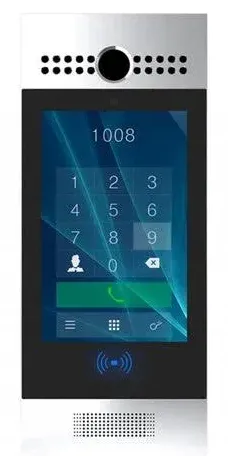
A photo from the AESS job library, not taken in Bay Ridge: a touchscreen entry panel with a four-digit apartment code entered on its dial pad, a camera above and a card-reader symbol below. If your Bay Ridge building wants call codes instead of a row of buttons, say so on the form, and tell us how many apartments the directory has to hold.
✅
Request Sent!
Thank you. A technician will call you about the Bay Ridge address, usually within two hours during working hours.
How It Works
Our Installation Process
1. Count the doors and the people
Apartments, entrances and who answers each one, from your photos and a short call, with a first price range from our Brooklyn list.
2. Settle who signs off
Owner, board, managing agent or tenants' request: we confirm who is ordering the work and send a certificate of insurance where the building wants one.
3. Test the old riser
Every existing pair is tested from the lobby to each apartment for continuity, shorts and crossed lines before any reuse is promised.
4. Choose the system and the door hardware
Audio or video, wired stations or phone answering, strike or magnetic lock, all written into one quote with any monthly cost shown separately.
5. Mount the door station
Buttons no higher than six feet, speaker between four and five feet, sealed against the weather and fixed into sound material, never the face of the stone.
6. Wire and power the system
Tested or new cable to each apartment, a protected power supply, and a release that still lets everyone out without a key.
7. Test every apartment with its resident
Each unit calls the door, talks, listens and releases the lock while the resident watches, and every directory label is checked.
8. Hand over the records
A written chart of which pair feeds which apartment, the panel settings and the equipment list, kept by the owner for the next repair.
Visits are booked on weekdays in a two-hour arrival window, and the installation goes on the schedule once the deposit is paid and any special-order equipment has arrived. Technicians arrive inside the window, never before it, and tech support by phone or text after the installation is free.
Coverage Area
Door Buzzer Installation Near Bay Ridge's Landmarks
Ovington Avenue row houses
The row of houses at 216 to 264 Ovington Avenue, listed on the National Register of Historic Places in 2007, among the side streets full of shared street doors.
Senator Street Historic District
A National Register district listed in 2002, one of the blocks where century-old doors and stoops set the limits on where a new station can go.
Bay Ridge Library
The Brooklyn Public Library branch at 7223 Ridge Boulevard, on the avenue with 22 of the ZIP's elevator buildings.
68th Precinct
The station house at 333 65th Street at the neighborhood's northern edge, the precinct for Bay Ridge and the blocks around it.
Leif Ericson Park
The park named for the Norse explorer, a reminder of the Norwegian-American community behind Bay Ridge's Syttende Mai parade.
86th Street station
The R train's 86th Street stop at Fourth Avenue, open since January 15, 1916, on the 86th Street shopping strip.
We also serve the neighborhoods around Bay Ridge, including Sunset Park to the north, Dyker Heights to the east, and Fort Hamilton and Bath Beach to the south, all at the same Brooklyn rate.
Pricing
Door Buzzer Installation Cost in Bay Ridge
Bay Ridge is billed at our Brooklyn rate, with no surcharge for being at the borough's south-west corner. These are the published ranges from our Brooklyn door buzzer pricing. Final pricing follows the first visit, because the count of apartments and the condition of the old cable decide where a job lands inside its range.
System
What it usually includes
Brooklyn price
Audio / small
Single audio buzzer or replacement, electric strike release, existing wiring reused, buildings of one or two units
$400–$900
Video / mid
HD video entry panel, smartphone door release, row house or small building, four-wire retrofit available
$700–$1,800
Multi-unit building
Directory panel, every unit wired, audio or video by unit count, optional fob integration, about 12 to 50 or more units
$2,500–$10,000+
Visit booked and paid online
First visit to test the old system and survey the doors, applied toward the installation
$250
Labor only, your own equipment
Installing a panel and stations you already bought
Quoted flat after we see the equipment and the doors
What moves a Bay Ridge price inside its range. Five things, in roughly this order. The number of apartments, because each one needs a station and a tested or new cable. The number of entrances, because a rear door, a courtyard door or a basement practice entrance each needs its own panel or release. The riser test, because every failed pair means new cable to that apartment. The door itself, because a sound frame with a working latch takes a strike easily while a pair of glass-paneled doors or a frame in limestone takes more care. And video, phone answering or both, which adds the cost of the panel and the stations rather than much labor. Each of those is written into the quote as its own line, so you can see what an added camera or a rewired line costs before you decide.
How Bay Ridge jobs usually fall. A two-family with one shared street door and sound cable to both floors is normally a small-range job, and adding video to both floors moves it into the middle range. A three- or four-family or a small walk-up replacing an old bell board with one matched system usually begins at the bottom of the multi-unit range. A thirty-apartment pre-war building on Ridge Boulevard or Fourth Avenue sits in the middle of the multi-unit range if most of its riser passes, and higher if many lines must be rewired. The largest post-war co-ops on Shore Road, with well over fifty apartments, are quoted building by building and can exceed the top of the range; the board gets the riser test, the lobby, the stations and the door hardware priced separately.
Published figures from elsewhere, for context. HomeAdvisor's national guide puts the average intercom installation at $2,500, in a range of $1,500 to $15,000. Swiftlane's guide puts modern IP or video systems at $1,000 to $5,000 or more per entry door, and ButterflyMX's 2026 guide cites its own figure of roughly $1,500 to $2,500 for a small apartment replacement. Those are useful for knowing a quote is in the right world, but none of them has seen your door or tested your cable. Brick Underground's intercom repair guide also found service-call rates of $195 an hour and $250 an hour plus parts among the New York companies its writer called.
What is never a surprise. Anything that might add cost, such as a line that could fail its test or a door that might need a new strike, is named in the quote before you order equipment, because once special-order equipment is ordered it cannot be returned. A job goes on the schedule once its deposit is paid.
Full terms — including 50% deposit, one-year parts-only warranty on AESS-supplied products, and the late-fee schedule — are set out in the service agreement.
Shop Our Systems
Door Buzzer Installation Packages & Pricing
Three typical Bay Ridge installations, placed in our Brooklyn ranges. The written quote after the first visit fixes the exact figure.
Starter — The two-family door: $400–$900
An audio station with two labeled buttons at the shared street door, a talk-and-release station on each floor, an electric strike on the locking door and a protected power supply, reusing sound cable where it tests well.
Standard — The row house or small building on video: $700–$1,800
An HD video panel at the stoop or vestibule, indoor monitors, release from a smartphone, night vision for the vestibule and a four-wire retrofit where the old cable allows it.
Premium — The apartment building: $2,500–$10,000+
A directory or code panel for the lobby, a station in every apartment, the riser tested and rewired where it fails, door releases for the main and rear entrances, and optional fob entry for residents.
Bring your own equipment. If you have already bought a door station or a kit, we install it for a flat labor price quoted after we see the equipment and the door, and we tell you before booking if anything in the box will not suit the building. If you are still choosing, send us the model you are considering first; some panels that look right online do not fit a narrow Bay Ridge door frame or cannot run on an old riser. Equipment you supply carries its manufacturer's warranty rather than ours.
Often installed together. Owners of Bay Ridge walk-ups and co-ops often add a camera over the lobby door or the rear entrance at the same time as the buzzer, because the cable and power for both can be run in one visit. We price that as a separate line so it is your choice.
Complete Services
Every Door Buzzer Installation Service in Bay Ridge
Houses and two-families
Bells, stations and releases for shared street doors. Request a quote
Which of your Brooklyn price ranges does a Bay Ridge two-family with one shared street door usually fall into?
+
Usually the audio and small range, $400 to $900, when the cable to both floors is sound and the door can take an electric strike. Adding video stations on both floors and answering from a phone moves it into the $700 to $1,800 range.
If we book the $250 visit online and then go ahead with the installation, what happens to that $250?
+
It is applied toward the installation. The visit is when we test the old system and look at the doors, so it is also the work that lets us fix the price in the written quote.
We close on a Bay Ridge two-family next month. Can the buzzer installation be booked before we own the house?
+
We can look at photos and quote it now, but the installation itself needs the owner's permission, so it is booked for a date after the closing. If the seller agrees to an earlier visit, we can test the old wiring then and have the quote ready for your first week.
Will a new lobby door lock have to be connected to our building's fire alarm?
+
A magnetic lock on an egress door has to unlock when the fire alarm or sprinkler system activates, so it is tied in through the fire alarm contractor. An electric strike in an ordinary street door usually does not need that, because the door always opens from inside with the lever or knob.
Can residents who do not have a smartphone still answer visitors on a new system?
+
Yes, if the system is chosen for it. Wired audio and video systems put a station in each apartment, and many phone-answering systems can also ring a landline. We ask the board or owner how many residents need a station before recommending a system.
Does an app-based intercom keep residents' phone numbers, and who controls that list?
+
App and cloud systems store a phone number or account for each resident so calls can reach them. We set the owner, board or managing agent as the administrator, so the building controls who is added and removed, and residents leaving the building are taken off the list.
Can the lobby panel ring the super or the management office as well as the apartments?
+
Yes. Most building panels can have a button or call code for the super's apartment, a desk station or the managing agent's phone, and some can send calls to the super during the day and to a different number at night. We set that up during installation.
What do you leave behind so the next technician knows how the system was wired?
+
A written chart of which cable pair feeds which apartment, where the power supply and any junction boxes are, the panel settings and the equipment list. Labels are also left at both ends of every pair, so the next repair starts from facts instead of guesswork.
Another contractor is replacing our building's front door this spring. When should the buzzer installation happen?
+
Plan them together. The new door and frame should be prepared for the strike before they are hung, and the cable path should be agreed with the door contractor so nobody drills a finished frame twice. We are glad to talk to the door contractor before either job is scheduled.
Do tenants have to have their names shown on the new directory?
+
No. A directory can list apartments by number only, by name only for those who want it, or by a call code. Many buildings mix the two, and the labels or digital list can be changed whenever someone moves in or out.
Does the warranty cover the old cable you reuse, or only the new parts?
+
The warranty covers the products we supply. Existing building wiring that we test and reuse is not covered, which is why we test every pair before reusing it and show you the results in the quote.
Can our practice's front door stay unlocked during morning hours and switch to buzzer-only in the afternoon?
+
Yes, with a system or controller that supports a schedule. The door releases at set times and locks again automatically, and the front desk still buzzes patients in outside those hours. We set the schedule with you and show staff how to override it for a holiday.
Ready to Give Every Bay Ridge Apartment Its Own Way to Answer the Door?
Send photos of the street door, the old panel and an apartment station, with your cross streets and the number of apartments, and we will tell you which range the job is likely to fall into and what the first visit will test. Call or text (347) 934-8335, message us on WhatsApp, or use the request form. Licensed under NYS license #12000287431, rated 4.7★ across 201 Google Reviews, with same-day estimates on most weekdays.