What are you looking for?
About Us Contact Us Careers Get a Free Quote (800) 486-0943
Pick a service
✅ Got Your Own System?
🎬 Home TheatreQuote 🎶 AV SoundQuote 🔑 Access ControlQuote
Now pick your area
Pick your area
Long Island
Hudson Valley
Services available
Pricing & Tools
Pick a service for pricing
🚪 Intercom Pricing 🔔 Buzzer Repair Pricing
Calculators
📹 Camera System Calculator 🚨 Alarm Calculator ⚡ Cabling Quote Builder ✅ Got Your Own System?
Select your area
Home › Cat6 Repair NYC › Brooklyn › Bay Ridge
Bay Ridge Cat6 Repair · 65th Street to the Narrows · Limestones, Shore Road Co-ops & Avenue Storefronts

Cat6
Repair in
Bay Ridge

Row Houses · Detached Houses Near Shore Road · Post-War Co-ops · Third, Fifth & 86th Street Shops · Ground-Floor Practices

Bay Ridge keeps its buildings. Zoning has protected the low-rise blocks here since 1978, so instead of being knocked down and rebuilt, houses, co-ops and shopfronts are renovated again and again — and each round of work adds a little more network cable, run by whoever was on site that year. When one of those Cat6 links stops working, we test it from the place the runs meet, work out which layer of past work it belongs to, and repair it in plaster, stone and brick with as little opened as possible.

Bay Ridge page last reviewed and updated October 17, 2026, under the NYS low-voltage licence (#12000287431) held by owner Anwar Timothy · book on (347) 934-8335

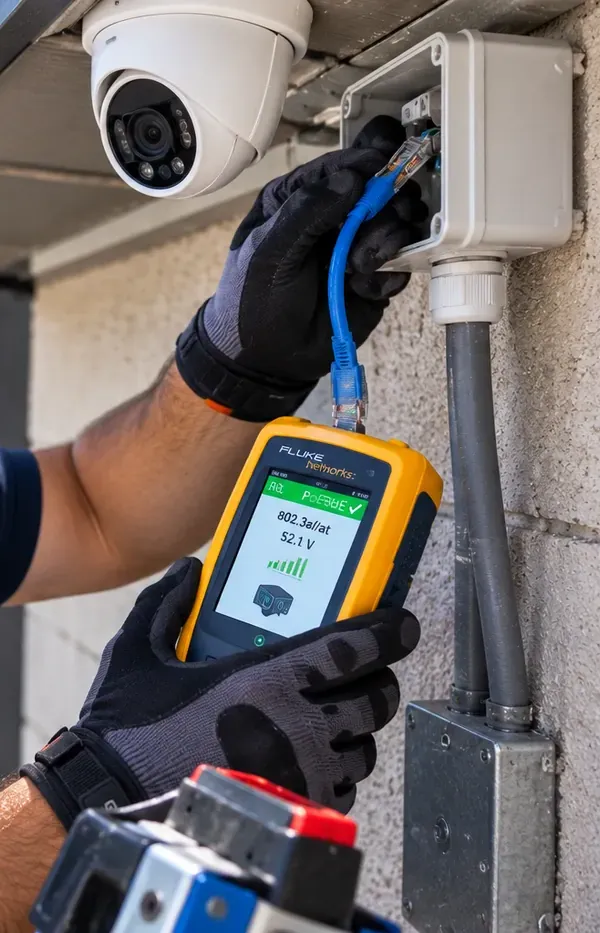
Gloved hand holding a yellow cable tester with a power-over-Ethernet reading under a white dome camera, the blue Cat6 lead coming out of a grey junction box on a block wall — PoE camera link check, Cat6 repair Bay Ridge, Brooklyn
A gloved hand holds a yellow tester showing a power-over-Ethernet reading; its blue cord runs up into an open grey junction box beside a white dome camera, with grey conduit running down the painted block wall.
Bay Ridge Cat6 Repair Quote
Say what kind of building it is and which jacks went dead — our Brooklyn desk calls back the same business day

✅
Request Received
Our Brooklyn desk will phone you today about the Bay Ridge repair.
25+
Years Experience
✓
Same-Day Estimates
100%
Licensed & Insured
4.7★
201 Google Reviews

A room, a floor or a shop counter lost its wired connection this week? Ring (347) 934-8335 or send the 60-second form. Tell us roughly when the house or shop was last worked on and who did it; in Bay Ridge that single detail usually tells us where the failed run starts and what it was built with.

  • Every reported link measured from where the runs meet — cellar cabinet, closet shelf or under-counter rack — before a wall or ceiling is touched
  • Repairs matched to what is already there: same category, same jack family, and openings kept small in plaster, block and stone
  • Licensed in New York State (#12000287431) and insured; you keep the saved readings, every repaired run carries a label at each end, and a short written explanation says what went wrong
How this page fits. This is the Bay Ridge page within our Brooklyn Cat6 repair service, which explains how building type decides where a link fails across the whole borough. Here we stay on the ridge itself — roughly from the railroad cut near 65th Street down to Fort Hamilton and the Narrows, and from Shore Road east toward Seventh Avenue — and on what its particular mix of buildings does to network cable. How certification failures are read in general is covered on the New York City Cat6 repair hub.
Hands re-terminating a keystone at an open white wall plate beside a power outlet, a blue cord running down to a yellow tester on the carpet — wall jack rework for Cat6 repair in Bay Ridge, Brooklyn
Two hands work a keystone out of an open double wall plate on a grey wall; a blue cord loops down to a yellow tester lying on the carpet beside a bag of spare jacks.
The Neighborhood

Why Bay Ridge Properties Need Cat6 Repair: Buildings Here Are Renovated, Not Replaced

Most of what stands in Bay Ridge today will still be standing in thirty years, and that is by design. In 1978, after residents objected to the twin 30-storey Bay Ridge Towers and the Shore Hill Apartments, the city wrapped the neighbourhood in the Special Bay Ridge District, whose stated purpose is “to preserve, protect and maintain the existing scale and character of the residential and commercial community.” In 2005 the City Council went further and contextually rezoned 249 blocks between 65th Street, Seventh Avenue and Shore Road, more than tripling the blocks limited to one- and two-family homes, from 33 to 101. The result is a place where a house is far more likely to get a new kitchen than a new building, and where the network inside it grows the same way: piecemeal.

That shapes almost every Cat6 call we take here. A limestone row house might have its oldest runs from an attic office set up years ago, a second batch from the cellar renovation, a camera line drilled through the front during a security scare and two newer jacks added for working from home. Each was put in by a different person with different parts, on a different route, often without a drawing. When one link fails, the question is rarely “is this cable broken” on its own. It is which of those layers the run belongs to, what that installer used, and which way the building lets us reach it today. Community Board 10 describes the district plainly: one- and two-family homes make up most of the housing, ageing multiple dwellings line Shore Road, Ridge Boulevard and Fourth Avenue, and small clusters of four- to six-storey buildings sit elsewhere. Every one of those types keeps its cable in a different place.

Ownership makes the layering deeper. The NYU Furman Center puts the homeownership rate for Bay Ridge and Dyker Heights at 41.0% in its latest figures, against roughly a third in 2000, and it counts only 452 new housing units added between 2010 and 2025. People stay, and they keep improving the place they already own. That is good for the neighbourhood and hard on cable: a run that was fine when it went in has since had a bathroom tiled over it, a boiler replaced beside it, a radiator moved in front of it and a picture rail nailed through it. The failures we see are usually injuries from later work on the building, not cable that wore out on its own.

There is a second Bay Ridge pattern behind many calls: buildings carrying more households than they were built for. In 2014 Community Board 10’s zoning chair reported, from 311 data, more than 1,000 illegal-conversion complaints since 2010 in the council district covering Bay Ridge, Dyker Heights and Fort Hamilton, and the council member’s office warned of “faulty wiring that can cause fires.” We do not judge anyone’s building, but we do see the network side of subdivision: a single internet service split across floors with consumer switches on shelves, extension runs stapled along stair stringers, and jacks fed from another household’s closet. Those are the links that fail first, and they need a careful hand because someone else’s home is usually on the same wire. Most Bay Ridge owners who call us about a dead jack also end up asking about camera coverage for the house on the same visit, because the camera line is often the newest and most exposed layer of all.

Bay Ridge facts that shape a Cat6 repair

  • Zoned to stay low: the Special Bay Ridge District dates from 1978, and the 2005 rezoning covered 249 blocks and raised one- and two-family-only blocks from 33 to 101 (CityLand, April 2005). Old buildings keep getting renovated, so their networks keep getting patched.
  • Owners who stay: a homeownership rate of 41.0% for Bay Ridge/Dyker Heights, and just 452 new units built from 2010 to 2025 (NYU Furman Center). Most Cat6 here lives in buildings far older than the cable.
  • A protected limestone block: the Bay Ridge Parkway–Doctors’ Row Historic District, the neighbourhood’s first, covers 54 two-storey-and-basement limestone-fronted row houses built between 1906 and 1913, still home to many medical offices (Landmarks Preservation Commission, 2019).
  • Busy avenues: the Bay Ridge 5th Avenue BID counts 376 ground-floor retail businesses on 40 block faces, and the 86th Street BID 145 on 16 block faces (NYC Small Business Services directory). Nearly all of them run registers, card terminals or cameras over copper.
  • Post-war co-ops on the water: 9201 Shore Road, built in 1960, holds 254 apartments, and its neighbour at 9323 Shore Road, from 1961, has 72; a local broker counts nine co-op and condo buildings along Shore Road.
  • Storms still find the low spots: after Hurricane Ida in September 2021, Brooklyn Paper photographed Parks staff shovelling mud in Owl’s Head Park and a large puddle blocking part of the Shore Road promenade; most of the borough took five to six inches of rain that night.
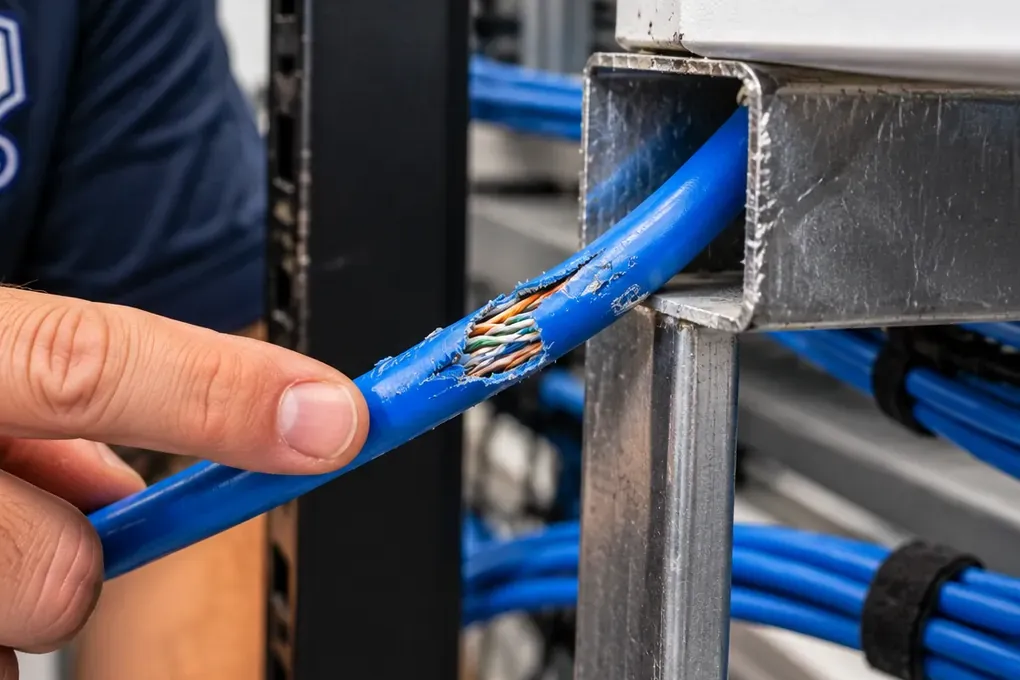
Finger pointing at a blue Cat6 cable whose jacket is torn open where it passes over the cut edge of a steel channel, exposing the twisted pairs — damaged cable of the kind found in Bay Ridge, Brooklyn Cat6 repair
A finger points to a split in a blue cable jacket where it bends over the raw edge of a steel channel; orange, green, blue and brown pairs show through the tear, with neatly strapped bundles behind.

Cat6 Link Down Somewhere Between Shore Road and Seventh Avenue?

Most faults at a jack, a cellar patch panel, a counter switch or a cord are found and repaired within one to two hours of a technician reaching the place where the runs come together. Call (347) 934-8335, tell us whether it is a house, an apartment, a shop or a practice, and which rooms or devices went quiet. If the house has had any work done since the cable last worked — a new floor, a radiator moved, a neighbour renovating — mention it; that is often the whole diagnosis.

What We Install

Cat6 Repair Services in Bay Ridge

Named after the jobs Bay Ridge buildings actually generate. Every one of them ends the same way: each repaired link tested against its category, the result saved, both ends labelled, and a short written note of the cause so the next person to work on the building knows the cable is there.

Layer-by-Layer Run Sorting

For houses networked across several renovations, we identify which runs belong to which round of work, test each one, and tell you which are sound, which are repairable and which were never properly finished in the first place.

Party-Wall and Neighbour-Work Checks

When the row house or semi-detached house next door is being gutted, we test the links that run along the shared wall, find any that were hit, and repair them from your side of the wall.

Stone and Brick Facade Re-Entries

Outdoor camera and doorbell runs that pass through limestone, brownstone, brick or rubble stone are replaced through a sleeved, sealed opening, reusing the existing hole wherever it can be made sound.

Floor-to-Floor Trunk Repairs

In detached and two-family houses with a switch on each floor, the single link joining them carries everything upstairs. We test it, repair it and, where the route allows, give it a partner so one fault no longer takes out a whole storey.

Co-op Apartment Re-Routes

Runs tucked under carpet, along door saddles or behind radiator covers in Shore Road and Ridge Boulevard apartments are replaced on routes that will survive the next floor polish, inside the building’s alteration rules.

Avenue Counter and Window Links

Registers, card terminals, kitchen printers and take-out windows on Third Avenue, Fifth Avenue and 86th Street: the link and the cord tested separately, and moving parts kept away from the cable.

Ground-Floor Practice Links

Dental, medical and professional offices on the garden or parlour floor of a row house: workstation, imaging and front-desk links tested and repaired around appointment hours.

Cellar Cabinet Clean-Up

The shelf in the cellar where an internet box, two switches and a tangle of cords collected over ten years: tidied, every run identified at both ends and labelled, failed terminations redone.

Camera and Doorbell PoE Faults

Cameras on the stoop, the side alley or the rear yard that lose power or picture: we read the power and the link at the device end, then decide whether it is the cable, the plug or the injector.

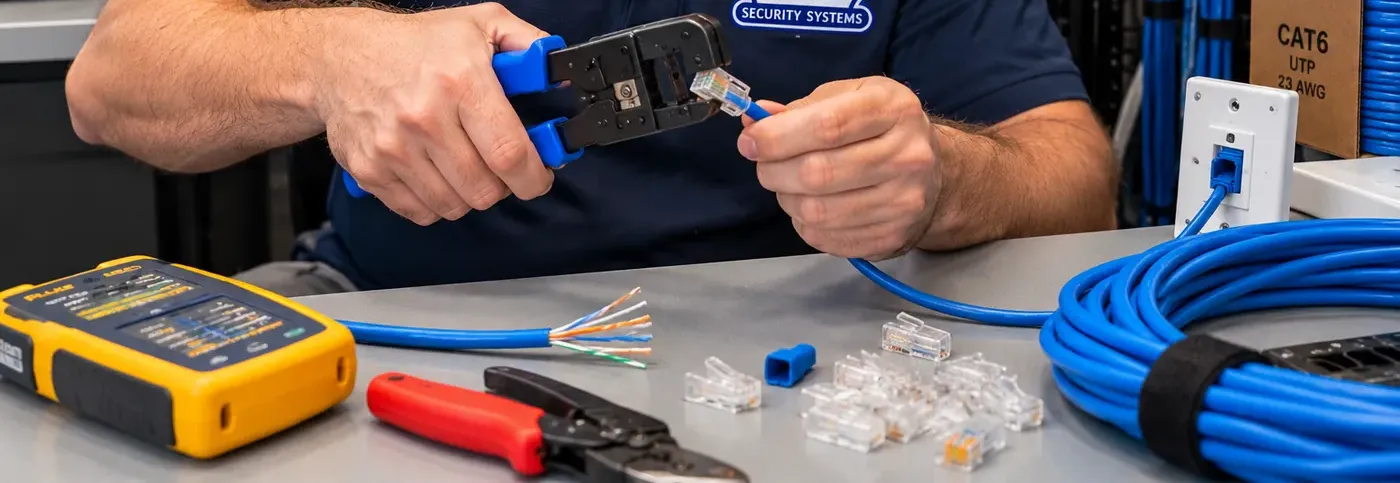
Hands fitting a clear RJ45 plug in a blue-handled crimper over a grey bench with a yellow tester, loose plugs, stripped pairs and a coil of blue Cat6 — plug re-termination, Cat6 repair Bay Ridge, Brooklyn
Seen from across the table: fingers squeezing a crimp tool around a see-through connector, while stripped orange and green pairs, spare connectors, cutters and a looped blue cable fill the foreground.
Building Specialists

Cat6 Repair for Bay Ridge's Architecture

Six kinds of Bay Ridge building, each with its own habits. The neighbourhood’s housing is unusually varied for a few square miles, and the cable inside follows the building, not the street.

Limestone and Brick Row Houses

Houses of two or more storeys over a basement or cellar, built in long matching rows; Doctors’ Row on Bay Ridge Parkway is the protected example. Masonry party walls on both sides, plaster on lath or block inside, and a cellar that usually holds the network.

Detached Houses Near Shore Road

Larger free-standing houses on the streets near the water, some of them landmarks, like the 1917 Arts and Crafts house at 8200 Narrows Avenue. Long internal distances, several floors and often a second switch upstairs.

Semi-Detached and Two-Family Houses

Brick pairs and two-family houses across the blocks rezoned in 2005. Two households, sometimes one internet service, and runs that cross from one unit’s space into the other’s.

Post-War Co-ops on Shore Road

Elevator buildings from around 1960, with board rules and a superintendent. Where partitions are plaster on masonry there is little hollow space to fish through, so owners often ran cable along floors, baseboards and door frames.

Pre-War and Mid-Rise Apartment Buildings

The ageing multiple dwellings along Ridge Boulevard and Fourth Avenue and the four- to six-storey clusters elsewhere. Landlord-installed camera and intercom cable shares hallways with tenants’ own runs.

Mixed-Use Avenue Buildings

Shop at street level, apartments above, cellar below, along Third Avenue, Fifth Avenue and 86th Street. The shop’s network usually lives in the cellar or under the counter, and the cable climbs through the shop floor.

How the repair changes with each building

Row houses. The cellar is the starting point: most runs leave a cabinet or shelf down there and climb through floor openings, stair walls or old pipe routes. Because both side walls are shared masonry, cable rarely runs inside them; it hugs interior partitions, which is where later bathroom and kitchen work catches it. We test from the cellar, measure the distance to each fault, and convert that distance into a room and a wall before anything is opened. Plaster on lath is cut small and neatly so it can be patched without a full skim coat.

Detached houses. The problem is reach, not masonry. Runs can be long enough that a marginal termination at each end adds up to a failure, and a house with switches on two floors depends on whichever single cable joins them. We test every segment separately and check the length of the longest runs against the 90-metre permanent-link limit before blaming connectors.

Semi-detached and two-family houses. We map whose cable is whose before working, because a repair in one unit can interrupt the other. Where one household’s run passes through the other’s ceiling or closet, we agree access first and look for a route that keeps each household’s cable on its own side.

Post-war co-ops. With little hollow wall to fish through, the route options are surface raceway, closets, door casings and the gap behind baseboards. A repair is normally planned so it fits the building’s alteration or decoration rules; we provide our licence and insurance details for the managing agent if the board asks for them.

Pre-war and mid-rise rentals. Hallway raceway, shared closets and a superintendent’s locked cellar are normal. We identify which runs serve the owner’s cameras or intercom and which serve tenants, and repair only what we were asked to touch.

Mixed-use buildings. The cable that matters most is short: cellar to counter, counter to card terminal, counter to the camera recorder. It is also the cable most exposed to deliveries, mops, heat and shutters, so the repair usually includes moving it out of harm’s way.

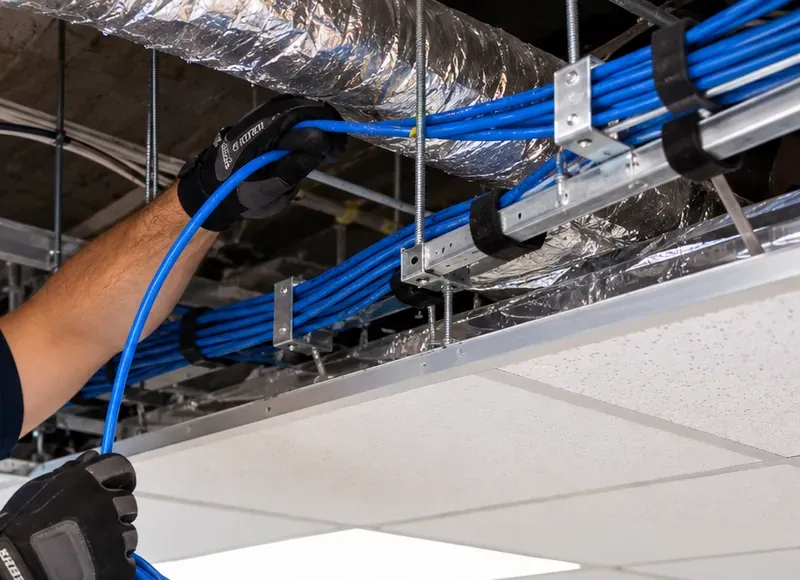
Gloved hands feeding a blue Cat6 cable from a coil up to a supported bundle of blue cables beside a foil-wrapped duct above an open ceiling grid — replacement run for Cat6 repair in Bay Ridge, Brooklyn
A gloved hand pushes a blue cable up toward a strapped bundle hung from steel supports beside a foil-wrapped duct, while the other hand holds the coil below an open ceiling grid.
Commercial Cat6 Repair

Business Cat6 Repair in Bay Ridge

Bay Ridge business runs along a handful of avenues and one busy cross street. Community Board 10 lists Third, Fourth and Fifth Avenues, Fort Hamilton Parkway, 11th and 13th Avenues and the 86th Street strip as the district’s commercial corridors. These are the ones we are called to most on the Bay Ridge side.

Third Avenue

The restaurant and bar avenue, its merchants’ group describing it as a 36-block strip. Cookline printers, card terminals, bar televisions and take-out windows, almost all in narrow shopfronts with cellars below.

Fifth Avenue BID

Established in 2006 and covering 40 block faces with 376 ground-floor retail businesses, per the city’s BID directory. Salons, groceries, bakeries, pharmacies and offices above the shops.

86th Street BID

Established in 2001 and covering 16 block faces with 145 ground-floor businesses, reached by the R train at Fourth Avenue. Larger stores with entrance counters, door sensors and camera systems.

Fourth Avenue

Apartment buildings with ground-floor offices, clinics and services along the R line. Landlord camera cable and tenant office cable often share a cellar.

Bay Ridge Parkway and the Side Streets

Doctors’ Row and the practices in row houses nearby: dental, medical and professional offices on the garden or parlour floor with a family or tenants upstairs.

Fort Hamilton Parkway and the Fort Hamilton Area

Shops and offices near the Army garrison at the south end of the district, plus the houses and small apartment buildings around them.

Shops, restaurants and practices: what fails and why

Avenue businesses in Bay Ridge are mostly small, which means their network is small too: a modem, one switch, a handful of runs. That makes each link more important, not less. When the only cable to the register fails on a Saturday, the shop is cash-only until it is fixed. The repairs we do most often on the avenues are re-terminations at the counter, replacement of cords crushed by drawers and stools, and short new runs from the cellar to a counter that was moved during a refit. Cameras over the door and in the cellar come next, usually after a power or picture loss traced to a corroded plug or a cable pinched by a roll-down gate housing or awning bracket.

Practices are different. A ground-floor dental or medical office in a row house can have more network points than the rest of the building put together: front desk, each operatory or exam room, a server cupboard and often imaging equipment. Downtime there is measured in cancelled appointments, so we plan around the schedule, test every link once at the start of the visit, and repair in the order the practice needs them back.

Compliance callouts for Cat6 repair in Bay Ridge buildings

  • Landmarks. Doctors’ Row and individual landmarks such as the 8200 Narrows Avenue house are regulated by the Landmarks Preservation Commission. LPC’s own guidance says no permit is needed for “ordinary repairs or maintenance chores,” while interior work needs one when it requires a Buildings Department permit or affects the exterior. Replacing cable through an existing opening is the first kind of job; a new hole through a designated facade is the kind of thing to raise with LPC before anyone drills.
  • Electrical code. The current New York City Electrical Code, based on the 2020 National Electrical Code with city amendments, took full effect on December 21, 2025. Communications cable must keep its separation from power wiring and be properly supported, and accessible abandoned cable is meant to come out rather than be left in place (NEC 800.25).
  • Older paint. Federal lead-safe rules apply to paid work that disturbs painted surfaces in homes built before 1978, with the main requirements triggered above six square feet of interior surface per room, and New York City’s Local Law 1 of 2004 has owners of buildings built before 1960 presume their paint is lead-based. Our access openings are normally far smaller; if a repair would need more, you hear it before work starts.
  • Co-op and condo rules. Shore Road and Ridge Boulevard boards set their own alteration rules. A small, like-for-like repair is often handled under a short decoration agreement through the managing agent, while bigger re-routes may need board review; we supply licence and insurance details on request.
  • Licence. AESS holds New York State low-voltage licence #12000287431, and every repair is done by our own technicians.
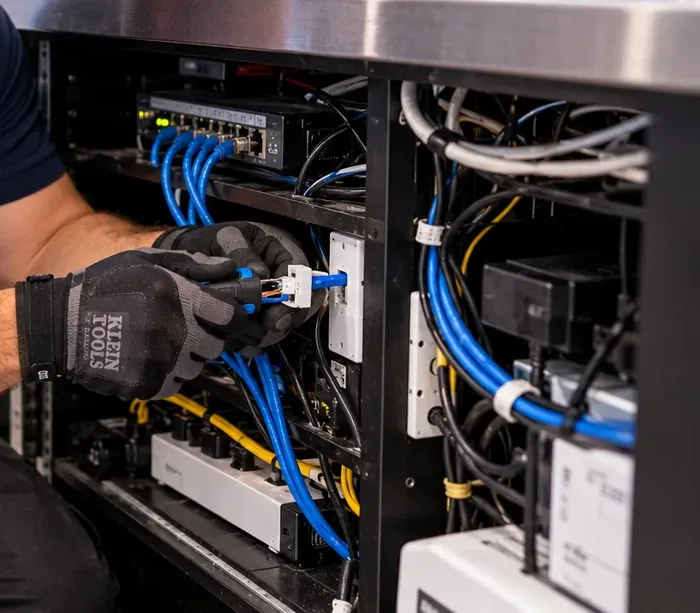
Gloved hands working on a keystone in a cabinet under a stainless-steel counter, with a small switch, blue Cat6 patch cords, power strips and other cabling inside — counter link repair, Cat6 repair Bay Ridge, Brooklyn
Gloved hands seat a cable in a keystone inside an open counter cabinet; above them a small switch carries blue patch cords, and white and blue cables run down past power strips below the stainless top.
Your Questions Answered

Cat6 Repair in Bay Ridge: Questions Answered

These are the situations Bay Ridge owners, tenants and shopkeepers describe when they call, grouped by the kind of building they happen in. Each answer comes first; the detail follows.

Row houses, shared walls and stone fronts

The house next door is being gutted. Can work on the far side of our shared party wall damage the Cat6 on our side?

Yes, and it usually happens in one of three ways, all of which we can test for and repair from your side. The first is drilling: anchors for new cabinets, shelving or steel brackets on the neighbour’s side can travel further into old masonry than the installer expects, especially where the wall has voids, and a bit that breaks through can catch a cable fished up a chase or a furred-out section on your side. The second is chasing: a neighbour’s electrician cutting a channel for new wiring can crack plaster on your side and pull on anything fastened to it. The third is plain vibration and dust from demolition shaking loose a termination that was already marginal, typically a jack screwed to a box that was never firmly fixed.

The fastest way to know is to test before the heavy work starts if you can, and again afterwards. If the work has already happened, a certification test from your cellar or cabinet tells us which links changed and at what distance the fault sits, so we can say whether it lines up with the party wall or with something inside your own house. A fault at the right distance, with fresh plaster damage or a new anchor visible behind a small opening, is about as clear as these things get, and we photograph it for you.

The repair itself stays on your side: a short new length spliced in properly is not an option for Cat6, so the damaged section is replaced with a new run or the link is re-terminated nearer the damage if there is enough slack. Where runs sit close to a shared wall that is going to be worked on again, we suggest moving them onto an interior partition so the next renovation next door cannot reach them.

Camera cable through a limestone, brick or stone front

An existing hole in the facade can usually carry the new cable, as long as it is lined, sealed and the cable never touches raw stone. Many front-of-house camera runs in Bay Ridge were put in quickly, with a bare hole through the stone or a mortar joint and the cable pushed straight through. Over a few winters the jacket rubs on the cut edge, water follows the cable inward, and the plug at the camera end corrodes. By the time the picture goes, the cable is often damaged right where it passes through the wall.

We pull the old cable out, check the hole with a light and a mirror, and fit a sleeve so the new run never touches raw stone or brick. Outdoor-rated Cat6 goes in with a drip loop outside, the opening is sealed, and the plug or jack at the camera is replaced rather than reused. If the old hole is too damaged to sleeve, a new entry may be needed; in a historic district or on an individual landmark that is the point to check with the Landmarks Preservation Commission before drilling, because a new opening through a designated facade is not the same as an ordinary repair. Exterior entries are priced from $185 each, sealed and bonded.

One more check is worth doing while we are at it. A camera that lost its picture may also have lost power, and power-over-Ethernet faults on a long or damaged run can look like a dead camera. We read the power and the link at the camera end before deciding what to replace, so a sound camera is not swapped for nothing.

Flat roofs, cocklofts and the top-floor run

Many Bay Ridge row houses and small apartment buildings have a flat roof with a shallow space under it, and owners sometimes ask whether a failed run to the top floor can be replaced across that space instead of up through finished rooms. Sometimes it can: if there is an access hatch and room to work, a new run can travel along the top and drop into a closet or a wall cavity. The catches are practical. These spaces can be cramped, hot in summer and hard to reach, they are no place for cable lying loose on insulation, and anything run there has to be supported and kept clear of roof drains and vents. If a roofer is about to open the roof anyway, a few minutes of coordination can make a top-floor repair much simpler.

Detached houses and two-floor networks

Detached houses where one cable carries the whole upper floor

When every upstairs room drops at once while downstairs carries on, the usual suspect is the single run joining an upstairs switch to the one below. Larger houses near Shore Road are often wired this way because it saves pulling every bedroom’s cable to the cellar. It works well until the one trunk link develops a fault: a termination loosened by a door slamming on the closet where the switch sits, a cable crushed where it turns through a floor, or a plug that has been unplugged and replugged so many times that it no longer seats firmly.

The symptom pattern is the giveaway. If every upstairs room drops together and comes back together, while downstairs carries on, we test that one trunk link first and look at the switch’s own logs if it keeps any. A link that passes on a basic tester can still fail a full certification under load, so we test it properly rather than just checking for continuity. We also check that the upstairs switch is not overheating in a closed cupboard, because that produces exactly the same symptom without the cable being at fault.

The repair is re-termination or replacement of that one run, and then a choice for you: leave it as a single point of failure, or have a second run pulled alongside while the route is open so the two switches can share the load and keep running if one cable is ever damaged again. In a detached house with a long internal route, the second cable is usually cheap compared with the cost of the access to install it.

Shore Road co-ops and apartment buildings

Runs under carpets and across door saddles in Shore Road co-ops

A cable laid under a rug or over a threshold strip is stepped on thousands of times a year, and that alone is enough to ruin it. Cat6 depends on the precise twist and spacing of its four pairs. Repeated pressure flattens the cable, changes that geometry and eventually breaks a conductor; long before that, the link starts failing the tests that matter for speed. A run that has been walked on for years cannot be repaired back into specification, so it is replaced.

The question is where the replacement goes. In post-war co-ops with plaster on masonry, the honest options are usually a slim surface raceway along the baseboard and around the door casing painted to match, a route through closets that back onto each other, or occasionally behind a baseboard that can be removed and refitted. Under the floor is rarely possible in a concrete building. We show you the options on the day with the measured run length, and the one you choose is installed so it never crosses a walking surface.

Because this is a co-op, the building’s rules apply. A small like-for-like repair inside your apartment is often treated as decoration rather than alteration, but boards differ, and new raceway or any opening in a wall may need the managing agent’s agreement first. We can send our licence and insurance details and a short description of the work in advance so the paperwork does not hold up the visit.

Hallway cameras and tenants’ own runs in Bay Ridge walk-ups

In the four- to six-storey buildings and the older multiple dwellings along Fourth Avenue and Ridge Boulevard, the landlord’s camera and intercom cable often shares a hallway raceway or a cellar ceiling with runs that tenants paid for themselves. When an owner calls us about a dead hallway camera, we identify the owner’s runs at both ends before touching anything, test those, and leave tenants’ cable exactly as we found it. If a tenant’s run turns out to be the problem, or to have been damaged by the same event, we tell the owner and leave the decision with them.

Avenue shops and ground-floor practices

The cable to the card terminal at our take-out window keeps failing where it passes through the window frame. What is going on?

The window is almost certainly pinching or bending the cable every time it opens and closes, and a stationary network cable is not built for that. Take-out and walk-up windows on Third Avenue and the side streets are often retrofits, and the terminal’s cable was simply run through the gap at the frame. Each slide of the sash squeezes it, the jacket splits, and the pairs inside are slowly flattened. Cold and rain at the opening make it worse, and grease from a kitchen nearby speeds up the damage to the jacket.

The repair is to stop the cable moving. We end the permanent run at a proper jack inside, beside the window, and connect the terminal with a short, flexible patch cord that can be replaced in seconds if it is ever damaged. Where the terminal sits outside the opening, the cable passes through a fixed, sleeved point in the frame or the wall beside it, never through the moving gap. The run back to the counter or the cellar is tested end to end, because years of flexing at the window can sometimes damage it further back as well.

If the shop is busy, we can usually put a temporary cord in place first so card payments keep working, then make the permanent repair once the window is quiet. The whole job is typically a couple of hours.

The imaging workstation in our ground-floor dental office keeps losing its connection in the middle of a patient visit. Is the cable likely to be the cause?

It can be, and it is quick to rule in or out: we test the link from the operatory to the cupboard where your switch and server sit, then the patch cords at both ends. Row-house practices on and around Bay Ridge Parkway are often networked room by room as the practice grows, so the operatory run may be newer or older than the rest, and it often passes through the busiest wall in the building. Chair movement, cart traffic and cleaning at the floor level are hard on the cord and the jack, while the run in the wall is more likely to have been damaged by later building work.

If the link passes full certification and the cords are sound, the cause is more likely the workstation, its network settings, the switch port or the imaging software, and we will say so plainly so your IT provider or equipment vendor can take it from there. If the link fails, we repair it with the same parts family as the rest of the practice and give you the test result, which is often exactly what an equipment vendor asks to see before they will look at their own hardware.

Because a practice cannot be offline during appointments, we test all the practice’s links early in the day or between sessions, and do the repairs in the order you need the rooms back.

Cellar cabinets that grew one switch at a time

The most common sight in a Bay Ridge cellar is not a rack. It is a shelf or a small cabinet holding the internet provider’s box, a router, one or two small switches, a camera recorder and a tangle of cords, each added by whoever was there at the time. Faults there are usually simple — a cord pulled half out, a power adapter failing, a switch that has run hot for years — but the tangle hides them. Tidying it is part of most repairs we do in a house: every run identified, labelled at both ends, cords replaced with ones of the right length, and a short list left showing which jack is which.
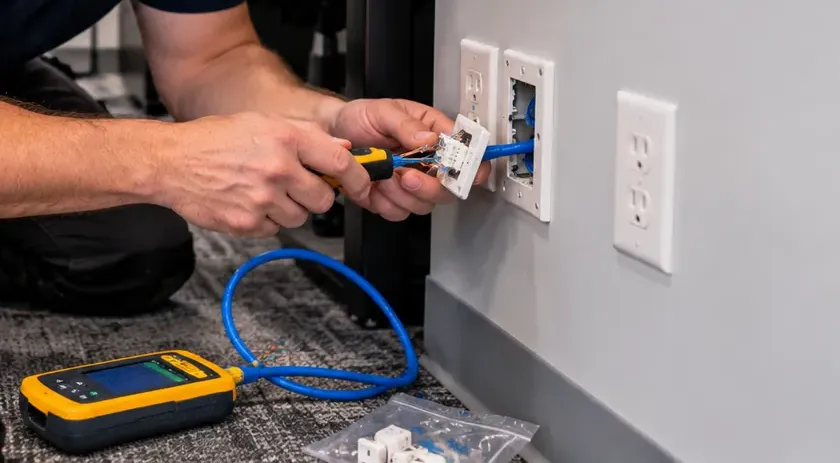
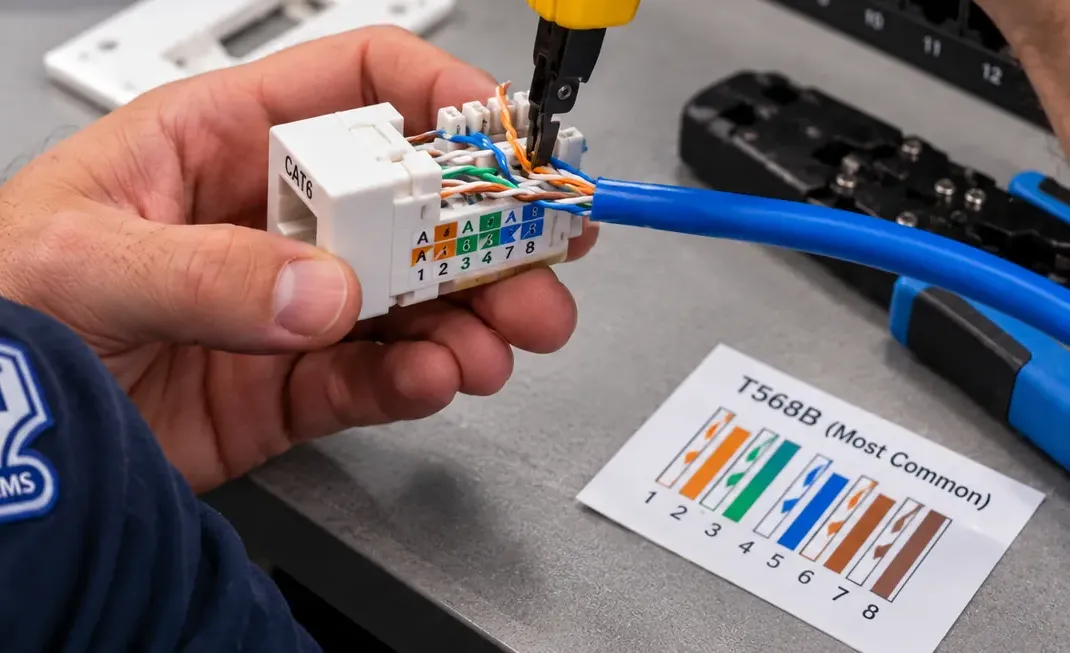
Hand holding a white CAT6 keystone with coloured pairs laid in its slots as a yellow punch-down tool seats them, next to a printed T568B colour chart on the bench — keystone re-termination, Bay Ridge, Brooklyn Cat6 repair
Close-up of a punch-down blade pressing an orange wire into a CAT6-marked keystone whose slot labels show A and B colour codes; beside the hand lie a T568B (Most Common) chart, a crimper and a blank plate.
Equipment

The Cat6 Repair Kit for Bay Ridge Houses, Co-ops and Shops

What arrives on a Bay Ridge job is chosen for old masonry houses and small businesses: tools that find a fault without opening walls, and parts that match what is already installed.

Certification Tester

Tests each link against its category limits and reports the distance to a fault, so a measurement in the cellar becomes a specific room and wall upstairs.

Power-over-Ethernet Reader

Reads the power reaching a camera, doorbell or access point at the device end, separating a cable fault from a failing injector or switch port.

Tone Generator and Probe

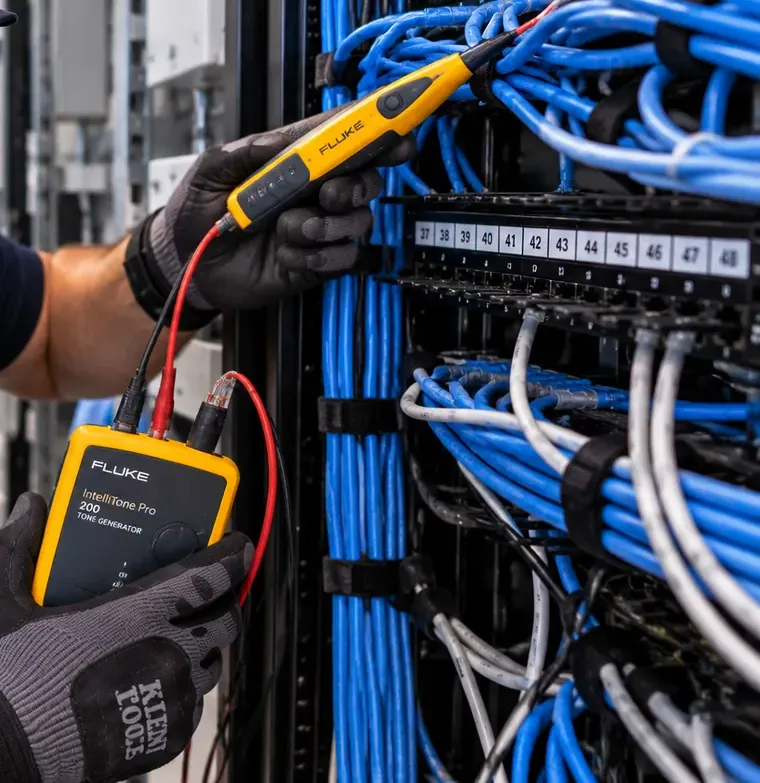
Identifies an unlabelled run among a cellar full of cable from different decades without disconnecting anyone else’s service.

Inspection Light, Mirror and Camera

For looking through a stone or brick entry hole, behind a baseboard or up a cavity before deciding where to open.

Small-Cut Plaster Kit

Multi-tool, dust shroud and old-work brackets for neat openings in plaster on lath or block, sized so they can be patched without refinishing a whole wall.

Matching Jacks and Plates

Cat6 and Cat6A keystones in the common families, plus plates in white and ivory, so a repaired jack looks like its neighbours.

Indoor and Outdoor Cat6

Standard and outdoor-rated cable, plus sleeves, sealant and drip-loop clips for runs that leave the building through stone or brick.

Low-Profile Raceway

Paintable surface raceway for co-op apartments and plaster rooms where a cable has to be visible but should not be noticed.

Factory-Made Patch Cords

Cords in several lengths so a counter, a desk or a cellar shelf gets the right one rather than a coil of spare cable.

Handyman, internet installer or cabling contractor? Comparing your options in Bay Ridge

Owners have several options when a wired connection fails. The table sets out what each one typically covers. It describes kinds of provider, not named companies, and your experience with any of them may differ.

Who you callWhat they usually doWhere it falls short for a failed Cat6 run
Internet provider’s technicianChecks the service to the modem or fiber terminal and the provider’s own equipmentInside wiring beyond their box is normally the owner’s responsibility, so a dead wall jack is outside their visit
General handymanCan replace a wall plate or a visible cordUsually no certification tester, so a link that “lights up” may still be failing; no way to locate a fault inside a wall
Marketplace booking (Angi, HomeAdvisor and similar)Matches you with whichever local installer is availableSkill and test equipment vary by who turns up; ask whether they will certify the repaired link and give you the result
National camera or alarm brand installer (ADT, Ring, SimpliSafe and similar)Installs and services that brand’s own devicesRepairs to the building’s general network cabling are generally not what they come for
AESSLicensed low-voltage contractor: tests, locates, repairs and certifies Cat6, Cat6A and the devices on itWe charge for time with a three-hour minimum, so a single replaced plate is cheaper elsewhere if you are sure that is all it needs
Gloved hands holding a yellow tone generator and an inductive probe against blue cables at a rack with numbered patch-panel ports — tracing a run for Cat6 repair in Bay Ridge, Brooklyn
One gloved hand holds a yellow tone generator with red and black leads while the other touches a yellow probe to a bundle of blue cables beside a patch panel numbered 37 to 48.
AI Overview Reality Check

What AI Gets Wrong About Cat6 Repair in Bay Ridge

We could not open Google’s AI Overview for these searches from our research environment, so the claims below are ones commonly repeated in cost guides, forums and automated answers about cabling. Each is set against what a Bay Ridge building actually does to network cable.

“Network cable is permanent: once installed, it can be forgotten”

Cable in a quiet wall can last a very long time; that part is true. The trouble is that very few walls in Bay Ridge stay quiet. In a neighbourhood where zoning keeps the buildings and owners keep renovating them, the cable inside is exposed to every later project: new floors, moved radiators, tiled bathrooms, re-hung kitchen cabinets and work in the house next door.

The faults we find are overwhelmingly injuries rather than old age. A nail through a run behind a new baseboard, a cable kinked when a radiator was swung out and back, a jack loosened by a demolition next door. None of that shows up as gradual ageing; it shows up as a link that worked on Friday and not on Monday.

So the useful question after a renovation is not whether Cat6 lasts but whether the work touched it. A short certification of the links nearest to where the work happened answers that in an hour, while the walls are still easy to open.

“A fast enough Wi-Fi system makes wall jacks unnecessary”

Modern Wi-Fi is good, and plenty of apartments do without wired jacks. But masonry party walls, plaster on metal lath and the long, narrow footprint of a row house all weaken wireless signals between floors, and the access points of a mesh system work best when they are themselves joined by cable.

In practice, the Bay Ridge houses with the most reliable wireless are the ones with a sound Cat6 run to an access point on each floor. When that run fails, the mesh quietly falls back to a wireless link between units and the whole house slows down without any obvious fault.

Shops are clearer still: a card terminal, a register or a camera recorder that drops off a busy wireless network on a Saturday afternoon costs real money. For fixed equipment, a working cable is still the dependable choice, which is why repairing the one that failed is usually worth it.

“If the computer shows it is connected, the cabling has passed”

A link light only means the two ends agreed to talk at some speed. Gigabit Ethernet needs all four pairs; a fault on one pair can drop a connection back to 100 Mbps while the light stays on, and a damaged run can pass a simple continuity check while failing the crosstalk and return-loss limits that decide real performance.

This matters in Bay Ridge because so much cable here was put in by owners, handymen and internet installers who checked it with exactly that light. Years later, the run that “always worked” turns out to have been marginal from the start, and one more disturbance pushes it over the edge.

A certification tester settles it. It tests each pair against the category limits and reports where along the run a problem sits, which is the difference between a confident repair and guesswork.

“A damaged section of Cat6 can be cut out and joined”

Joining two pieces of Cat6 with a coupler, a crimp connector or a twist of tape is common advice and a common sight in Bay Ridge cellars. It may carry a connection for a while, but every such joint breaks the pairs’ twist and adds connection points the link was never designed for.

Industry troubleshooting guidance treats poorly twisted terminations and in-line couplers as typical causes of crosstalk failures, and a hidden joint inside a wall is also a future fault that nobody will know is there.

The proper repairs are re-termination at a jack or panel where there is enough slack, or a replacement run between proper end points. Where a joint already exists, we tell you, test it, and recommend replacing it if it fails or sits somewhere it cannot be reached again.

“Old masonry houses can’t take new cable without major demolition”

This one puts people off repairs they could easily have. Bay Ridge row houses and detached houses are masonry outside, but most of their interior partitions, closets and floor openings give workable routes, and a measured fault distance lets us open in one place rather than many.

Typical access openings are small and patchable. Closets that stack floor above floor, old pipe routes, the stair wall and the cellar ceiling all carry cable well, and where nothing hollow is available, a neat surface raceway is a perfectly respectable answer.

What old houses do need is a careful hand: plaster cut cleanly so it can be patched, painted surfaces in pre-1978 homes handled lead-safe, and stone or brick entries sleeved and sealed. That is a matter of method, not demolition.

“Whoever set up the internet can fix the wall jacks too”

Many can make a connection work. Fewer can prove it meets its category, find a fault inside a wall by distance, or tell a cable problem from a failing switch or power injector. Those are different skills and different tools from power wiring or setting up an internet service.

Internet installers in particular are usually responsible for their own equipment up to the modem or terminal; the cable inside your walls is yours. That gap is exactly where many Bay Ridge repairs begin, after an install visit that moved the router and left half the house’s jacks on the wrong side of it.

Ask any contractor three questions: will you test with a certification tester, will you give me the result, and are you licensed for low-voltage work in New York State? AESS answers yes to all three, under licence #12000287431.

“A quick web search gives the real price of fixing a dead jack”

National cost guides such as Fixr’s January 2025 update quote $125–$250 per new Cat6 drop and $45–$75 an hour for labour. Those are national averages for new installation in typical buildings, and they get repeated as if they described a repair in a New York City row house. They are not AESS prices.

A repair is mostly time: testing, locating the fault, reaching it through plaster or around a co-op’s rules, and certifying the result. Cable is the smallest part of the bill. That is why our published price is an hourly rate with a minimum, plus a starting price for any run that has to be replaced.

The figures that apply here are on this page: $195 an hour with a three-hour minimum ($585), replacement runs from $175, exterior entries from $185. After testing you get a written estimate for anything beyond the first block of time.

Renovated Lately and Now a Jack Is Dead? We’ll Find What the Work Touched

Tell us what was done to the building and where the dead jacks are. We will tell you which links to test first and what the visit will cost before we arrive.

Get In Touch

Request a Free Quote

Send the type of building, which rooms or devices failed and any recent work on the property; we reply in writing the same business day. Rather talk it through? Our Brooklyn line is (347) 934-8335.

✅

Request Received

Got it. Our Brooklyn office will call you back later today to arrange the Bay Ridge visit. If a register or camera is down right now, ring (347) 934-8335.

How It Works

Our Bay Ridge Cat6 Repair Process

Seven steps shaped by one Bay Ridge fact: the cable was probably added during one renovation and damaged during another, so the repair starts by working out which is which.

1. Tell us the building’s history

You describe the building, the dead jacks or devices, and any recent work on the property or next door. From that we choose which links to test first and which parts to bring.

2. Sort out access and rules

A two-hour arrival window is booked; for a co-op, licence and insurance details go to the managing agent first, and for a shop or practice the visit is planned around opening hours.

3. Test from where the runs meet

We plug in at the cellar cabinet, closet shelf or counter switch and certify each reported link, so sound cable is ruled out before anything is opened.

4. Match each fault to a layer of work

Distance readings, labels and the building’s history tell us which renovation the failed run came from and where in the house the damage sits.

5. Repair through the smallest opening

Re-termination where there is slack, a replacement run where there is not, and a re-route away from floors, radiators, party walls and moving windows where the old route caused the damage.

6. Re-test and label both ends

Every repaired link is certified again, the results are saved, and the run is labelled at the jack and at the cabinet.

7. Leave a record for the next renovation

You get the results, photos of anything hidden in a wall and a simple port list, so whoever works on the building next knows where the cable runs.

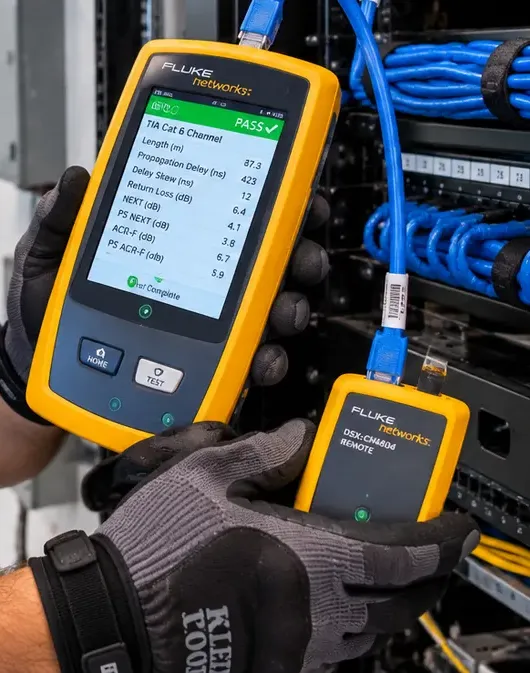
Handheld certifier showing PASS on a TIA Cat 6 channel test, linked by a blue cord to a rack, with the remote unit held just below — certification after a Bay Ridge, Brooklyn Cat6 repair
A yellow certifier lists length, delay, return loss and crosstalk values under a green PASS for a TIA Cat 6 channel test, with a blue cord to the rack and the remote unit held below it.
Coverage Area

Cat6 Repair Near Bay Ridge's Landmarks

Six places most people in the neighbourhood know, chosen because each one stands for a kind of building or street we are called to. Use them to place your block; none of them is offered as a job we have done.

Bay Ridge Parkway–Doctors’ Row Historic District

Designated in 2019 as the neighbourhood’s first historic district: 54 limestone-fronted row houses between Fourth and Fifth Avenues, built 1906–1913 and still home to many medical practices.

8200 Narrows Avenue

The “Gingerbread House,” a 1917 Arts and Crafts house by James Sarsfield Kennedy built of uncut, randomly laid stone, heard for landmark designation by LPC in 1987. The detached-house end of Bay Ridge.

Fort Hamilton

Its cornerstone set in 1825 and first garrison flag raised in 1831, Fort Hamilton is described by the military as the only active-duty installation in the greater New York City area. Shops and houses around it make up the south end of the district.

Verrazzano-Narrows Bridge

Opened on November 21, 1964, with its Brooklyn end at Fort Hamilton; when it opened it was the world’s longest suspension span. It frames the co-ops along Shore Road.

Owl’s Head Park

A 24-acre park on a glacial ridge at the north end of the neighbourhood, once the Murphy and later the Bliss estate, made a park in 1928. The old name of the area, Yellow Hook, was changed to Bay Ridge in 1853.

9201 Shore Road

A 1960 co-op of 254 apartments on the Narrows, the largest of the co-op and condo buildings along Shore Road, and a good picture of the post-war buildings we work in near the water.

We also serve the blocks next door from the same Brooklyn desk: Dyker Heights, Fort Hamilton, Sunset Park and Bath Beach, and the rest of the borough through our Brooklyn Cat6 repair page.

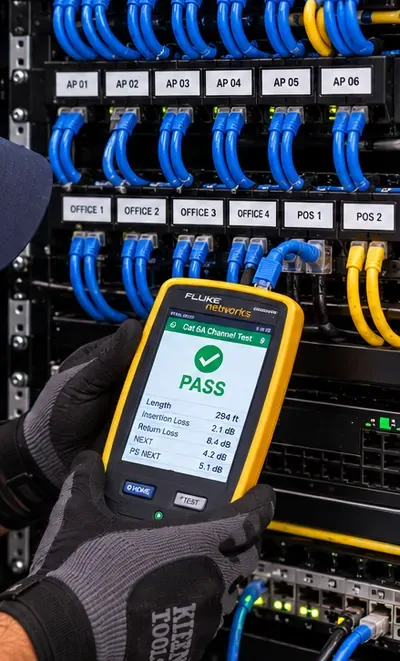
Blue patch cords in rack ports labelled CAM, AP, OFFICE and POS, with a gloved hand holding a tester that shows PASS on a Cat 6A channel test — labelled rack after Cat6 repair, Bay Ridge, Brooklyn
Rows of blue patch cords sit under printed labels reading CAM, AP, OFFICE and POS, and a gloved hand holds a yellow tester whose screen shows PASS for a Cat 6A channel test.
Pricing

Cat6 Repair Cost in Bay Ridge

Bay Ridge uses our published Brooklyn Cat6 repair figures exactly as they stand. Brooklyn is the base of our area pricing, so nothing is added for the neighbourhood. Anything that depends on the building — a long re-route in a co-op, a new opening in stone, work around a landmark — is priced in writing after testing.

ItemPriceWhat it covers
Technician time: testing, locating the fault, re-terminations, cords, tidying and a final certification$195/hr, 3-hour minimum ($585)Published on our Brooklyn Cat6 repair page; one booking can cover several dead jacks if time allows
Replacing a run that cannot be repairedFrom $175 per runStarting price for a new run with cable, jack and plate, termination at the panel or switch end, a test, labels at both ends and a cord
Outdoor run brought through stone, brick or block with a sleeve, seal and bondFrom $185 per penetrationFor camera, doorbell and yard runs through stone, brick or block; reusing an existing hole is often possible
Long re-routes, landmark-sensitive work, extensive patchingQuoted after testingPriced once the run is measured and the building’s rules are known

A three-hour booking in a Bay Ridge house, hour by hour

Arrival, floor protection and a quick tour of the rooms with failed jacks come first, along with a look at the cellar shelf or cabinet. Then each reported link is certified from there, faults are located by distance and matched to a room, and the cause is confirmed through the smallest opening possible. Re-terminations, cord replacements and any short re-routes follow, with a final test of every repaired link and labels at both ends. In a house where one renovation damaged one or two runs, that block often covers the whole job; any run that has to be replaced is priced before cable is pulled.

Why two Bay Ridge repairs rarely cost the same

  • Knowing what changed: “the bathroom was redone in March” points straight at the right wall.
  • Where the runs meet: one tidy cellar cabinet is quicker to test from than three switches on three floors.
  • The building’s fabric: hollow partitions are faster than plaster on block; stone entries take longer than wood frames.
  • Rules: co-op paperwork and landmark considerations add planning time, not usually labour.
  • Category of the existing run: matching Cat6A or a shielded system means slower terminations and dearer parts than plain Cat6.

About cheaper figures online: they are usually national averages for new drops, such as Fixr’s $125–$250 per drop and $45–$75 an hour. A repair inside an occupied Bay Ridge house or shop is a different job, and those ranges are not AESS prices.

Full terms — including 50% deposit, one-year parts-only warranty on AESS-supplied products, and the late-fee schedule — are set out in the service agreement.

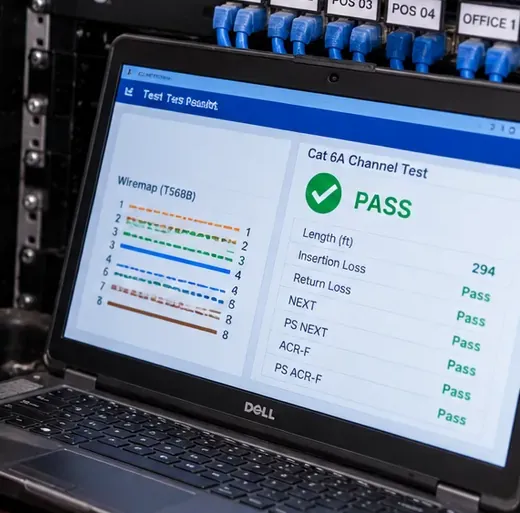
Laptop screen showing a T568B wire map and a Cat 6A channel test marked PASS in front of rack ports labelled POS and OFFICE — test report for a Cat6 repair in Bay Ridge, Brooklyn
An open laptop shows a T568B wire map on the left and a Cat 6A channel test with PASS against length, insertion loss, return loss and crosstalk on the right, below ports labelled POS and OFFICE.
Shop Our Systems

Cat6 Repair Packages & Pricing

Most Bay Ridge bookings fit one of these three shapes. Every number in them is already in the price table above.

Starter — One Room or One Counter

$585

Three hours at $195. The failed jack, camera or counter link tested from the cabinet, the fault found and repaired, re-tested and labelled. Leftover time goes on the next link on your list or on tidying the cellar shelf.

Standard — After the Renovation

$195/hr after the first 3 hours

For houses and shops that have just had work done, or have work next door: every link near the work area certified, damaged links repaired, and a full set of results so you know the rest are sound.

Premium — Repair, Replace and Reorganise

Repair time + from $175 per run

For buildings where some cable is past saving: hourly repair where possible, new runs from $175 each where not, exterior entries from $185, old abandoned lengths removed where reachable, and one labelled, documented cabinet at the end.

Bring Your Own Equipment — Labour-Only Repair

Plenty of Bay Ridge cellars hold a box of spare keystones or a part-roll of cable left by whoever wired the house. If it matches the link — same category, solid copper, the right rating for where it is going — we will use it and charge only repair time. We test the result either way. Parts you supply carry their maker’s warranty rather than ours, and if they will not produce a passing link we tell you before fitting them.

Work Starting Next Door or in Your Own House? Test the Cable First

A short test of the runs near a planned renovation gives you a record of what worked before, which makes any later damage quick to find and easy to show.

Renovation Layers

What Each Round of Work Leaves in a Bay Ridge Wall, and How We Test It

Because Bay Ridge buildings are improved in stages, the cable in them usually comes from several different jobs. Each kind of job leaves its own signature. This table is how we read them.

Round of workWhat it typically left behindWhat tends to failWhat we test and repair
Early home-office or attic wiringA few runs from the cellar to an upstairs room, often fished along the stair wallTerminations done without a punch-down tool; cable stapled tightFull certification; re-terminate on proper jacks; replace runs crushed by staples
Internet provider installsA modem or fiber terminal in a new spot and runs from it to a room or twoRuns left on the wrong side of a moved router; plugs crimped in a hurryIdentify every run at both ends; re-point to the new equipment location
Camera and doorbell additionsCable through the facade, along the stoop or out to the rear yardUnsleeved holes in stone or brick; corroded plugs; damaged jackets outdoorsPower and link read at the device; sleeve, seal and replace the outdoor length
Kitchen and bathroom remodelsNew cabinets, tile and plumbing on interior partitionsScrews and nails through runs; cable pinched behind new backing boardsLocate by distance; small access cut; replace the damaged run
Floor and radiator workNew flooring, sanded floors, radiators moved or replacedRuns under floors or behind radiators crushed, kinked or overheatedRe-route away from walking surfaces and heat sources
Subdividing or sharing a houseExtra switches on shelves; extension runs between householdsConsumer switches failing; runs in another household’s spaceMap whose run is whose; replace failing switches; keep each household’s cable on its own side
Shop refits on the avenuesA moved counter, new shelving, a new take-out window or awningCords crushed by fixtures; cable flexed by windows and shuttersNew jack at the counter or window; short replaceable cords; fixed, sleeved pass-throughs

Where more than one round of work touched the same run, the repair goes back to the soundest fixed point — usually a jack or the cabinet — and replaces everything between there and the damage, rather than adding another joint to an already patched cable.

Scheduling

Fitting a Bay Ridge Repair Around Home, Shop and Surgery Hours

Bay Ridge repairs happen in places people are living and working in, so timing matters as much as technique. This is how we usually arrange the day.

Houses and apartments

A two-hour arrival window is booked in advance. Someone over 18 needs to let us in and show us the cellar, the cabinet and the rooms with failed jacks; after that you do not need to stand over the work. If the repair will interrupt the internet for the whole house, we say so first and keep the interruption short. Where a co-op or a landlord sets contractor hours, the visit is booked inside them.

Shops and restaurants on the avenues

Testing and most counter work can be done quietly during trading, with registers moved to a temporary cord while the permanent repair is made. Anything noisy, dusty or likely to stop card payments for more than a few minutes is better done before opening or on a quieter weekday. Tell us your busiest hours and we will plan around them.

Practices and offices

We test every link at the start of the visit, before patients or clients arrive if possible, then work room by room in the order you need them back. A practice with a busy appointment book often prefers an early start or a day when one chair is free; we can work with either.

Complete Services

Every Cat6 Repair Service in Bay Ridge

Dead jacks are rarely the only thing a Bay Ridge owner wants looked at. Any of the following can be added to the visit or booked afterwards.

AESS Cat6 Repair Across Brooklyn

The borough page this Bay Ridge page belongs to, covering every building type from Greenpoint to Coney Island.

Network Cable Repair in Brooklyn

For Cat5e, older cable and any wired fault where the category is unknown.

New Cat6 Drops in Brooklyn

When a house or shop needs more jacks rather than repaired ones.

Structured Cabling in Bay Ridge

A proper cabinet, panel and labelled runs for a practice or a whole house.

Security Cameras in Bay Ridge

Front, alley and yard cameras for houses, and door and counter coverage for shops.

Intercoms in Bay Ridge

Entry systems for two-family houses, walk-ups and co-ops.

Access Control in Bay Ridge

Card and code entry for practices, offices and building doors.

Network Installation in Brooklyn

For the boxes at either end of the cable: new switches, a better router position and ceiling or wall Wi-Fi points.

Low-Voltage Work in Brooklyn

Everything else on the low-voltage side, from doorbells to speaker wire.

Field Notes

Field Notes: Reading a Bay Ridge Building Before Touching Its Cable

These are habits, not stories: how our technicians usually work in the neighbourhood’s houses, co-ops and shops

We ask about the building’s history before its symptoms. When was it last renovated, who put the cable in, has anything happened next door? In a neighbourhood of long-kept buildings, those answers usually narrow the search to one wall.

We start where the cable meets. In a row house that is normally the cellar; in a co-op, a closet; in a shop, under the counter. Testing from there tells us which links are sound before anyone in the house is disturbed.

We respect the plaster. Openings are measured, cut cleanly and kept small, painted surfaces in older homes are handled with dust kept down, and we tell you before cutting anywhere you might not expect.

We never add another joint to a patched cable. If a run has already been spliced, we go back to a sound fixed point and replace the length in between.

We leave a record. Results, photos of anything hidden in a wall, and a labelled cabinet mean the next person who renovates the house — and in Bay Ridge there will be one — knows the cable is there.

Full Service List

Every Cat6 Cable Repair Service We Handle in Bay Ridge, Brooklyn

Finding the Fault in an Older Building

Certification testing of each reported link from the cabinet, shelf or panel where the runs meet; distance-to-fault readings turned into a room and a wall; tone tracing of unlabelled runs among cable from several decades; inspection of cavities and entry holes with a light, mirror or camera before opening; separation of cable faults from failing switches, power adapters and injectors; testing of links near a planned or finished renovation so damage can be found and shown.

Repairing and Replacing Damaged Runs

Replacement of runs crushed under floors and carpets, pierced by screws or nails, kinked behind radiators or chafed on stone; re-routes onto interior partitions away from shared party walls; surface raceway routes in co-op apartments where walls are solid; top-floor routes across roof spaces where access allows; removal of reachable abandoned lengths; second runs pulled alongside a trunk link when the route is open.

Jacks, Plugs and Terminations

Re-termination of keystones and wall jacks to the standard already used in the building; replacement of crimped plugs hanging from walls with proper jacks and cords; repair of dual-jack plates and jacks loosened in crumbling plaster with old-work brackets; matching plates for older houses; patch-panel ports re-punched and cords replaced at the cellar cabinet.

Cabinets, Shelves and the Cellar Network

Identification and labelling of every run at both ends; replacement of failing small switches and adapters; cords cut to the right length; equipment lifted off the cellar floor and away from water and boiler heat; a written list of which jack goes to which port; tidy separation of two households’ equipment in shared houses.

Cameras, Doorbells and Access Points

Power and link readings at the device end for cameras, video doorbells and Wi-Fi access points; replacement of outdoor runs through sleeved, sealed entries in limestone, brownstone, brick and rubble stone; corroded outdoor plugs replaced with weather-protected connections; repaired runs to the access points that keep a mesh system on cable rather than falling back to wireless.

Shops, Restaurants and Practices

Register, card-terminal, kitchen-printer and take-out-window links on Third Avenue, Fifth Avenue and 86th Street; entrance sensors and counters; camera recorders in cellars; front-desk, operatory, exam-room and imaging workstation links in ground-floor practices; repairs scheduled around trading and appointment hours with temporary cords where needed.

Testing, Records and Keeping It Working

Final certification of every repaired link with saved results; photos of repairs that end up inside walls; labelled cabinets and a simple port list; advice on what to protect before the next renovation; retesting by arrangement after work next door or on your own building finishes.

FAQ

Bay Ridge Cat6 Repair FAQ

Third Avenue closes for parades and street events several times a year. Can a repair at our shop be booked around those days?
+

Yes. Third Avenue hosts several parades a year as well as its everyday trade, and on those days the street is closed to vehicles and the pavement is crowded, which makes it hard to bring in ladders and reels of cable. Give us the event dates when you book. Testing needs only a hand-held tester and can be done on almost any day, but a visit that may involve replacing a run is better booked on an ordinary weekday, or early enough to finish before the street closes.

The plaster around our wall jack has crumbled and the jack keeps falling back into the wall. Can that be fixed?
+

Yes. In older Bay Ridge houses the jack was often screwed to plaster or to a box that was never fixed firmly, and after years of plugging and unplugging the plaster gives way. We fit an old-work bracket or a new box that grips the wall from behind, re-terminate the cable if it was strained when the jack fell in, and fit a matching plate. If the plaster around the opening is badly broken, we tell you whether a small patch is needed first.

Can you compare your test results with the readings the original installer left us?
+

Yes, if you still have them. In a house networked over several renovations, the only record of how a run performed when new is often a printout or file from the installer who put it in. If those results came from a certification tester, we compare length, loss and crosstalk figures link by link with ours; a run that has grown longer, or lost margin since, points to damage rather than a poor original install. If the old results came from a simpler tester, we explain what can and cannot be compared.

Only one of the two jacks on our wall plate works. Is the dead one fed by a separate cable?
+

It may be, or both jacks may share one cable. Some installers ran two cables to every plate; others split the pairs of a single cable between two jacks, which halves what each jack can do and often leaves one of them unreliable. We test both jacks from the cabinet end and look behind the plate. If there are two cables, the dead one is repaired like any other link; if there is one split cable, we explain the options, from one full-speed jack to a second run.

The way into our row house's cellar is a low door under the front stoop. Can the technician still get the equipment down there?
+

Yes. Almost everything a repair needs is hand-carried: the tester, tools, a few jacks and plates, and cable in boxes or short coils, so a low door and a tight cellar stair are not a problem. What helps is a clear path from the stoop to the network shelf, a working light down there, and anything stored in front of the cabinet moved aside before we arrive. If the only way in is through a tenant's space, tell us when you book so access can be arranged first.

A previous owner split our house into extra units, and we are turning it back into one home. What happens to the separate switches and runs each unit had?
+

We test every run and work out which unit and which switch it used to serve. Sound runs are brought back to one cabinet beside the single internet service, the small switches each unit relied on are removed or replaced, and runs that now serve nothing are taken out where they can be reached, since accessible abandoned cable is meant to be removed rather than left in the walls. Everything that stays is labelled at both ends, so the house ends up with one network and one list of which jack goes where.

All Areas Served

Cat6 Repair Across Brooklyn, New York City and Beyond

Bay Ridge is one neighbourhood inside our Brooklyn Cat6 repair area; the borough pages all report to the NYC Cat6 repair hub. Every live page in the service is listed here, by region.

Looking for something other than cable? Start from the AESS home page for cameras, alarms, intercoms and door entry, or read who we are and how we are licensed.

Sources

Sources Behind the Bay Ridge Facts on This Page

Below is where each Bay Ridge number, date and rule on this page was taken from. Rules are summarised in plain words here; check the original text, or ask your board or managing agent, before acting on them.

Zoning, housing and the neighbourhood

  • NYC Zoning Resolution, Article XI Chapter 4, Special Bay Ridge District: general purposes, including “to preserve, protect and maintain the existing scale and character of the residential and commercial community.”
  • CityLand, “City increases zoning protection for Bay Ridge” (April 2005): March 23, 2005 approval of a 249-block rezoning bounded by 65th Street, Seventh Avenue and Shore Road; one- and two-family-only blocks raised from 33 to 101; background on the 1978 special district and the Bay Ridge Towers and Shore Hill Apartments.
  • NYU Furman Center, Bay Ridge/Dyker Heights neighbourhood profile: homeownership rate 33.6% in 2000 and 41.0% in the latest year shown; 452 new housing units from 2010 to 2025.
  • Brooklyn Community Board 10, “Neighborhoods”: district covers Bay Ridge, Dyker Heights and Fort Hamilton; commercial corridors; one- and two-family homes as the major part of the housing, with ageing multiple dwellings along Shore Road, Ridge Boulevard and Fourth Avenue.
  • CityLand, “Council Member Works to Combat Illegal Home Conversions” (October 2014): more than 1,000 illegal-conversion complaints since 2010 in the district covering Bay Ridge, Dyker Heights and Fort Hamilton, per Community Board 10’s zoning chair.

Landmarks, buildings and streets

  • Landmarks Preservation Commission press release (2019): Bay Ridge Parkway–Doctors’ Row Historic District, 54 row houses on Bay Ridge Parkway between Fourth and Fifth Avenues, built 1906–1913.
  • LPC designation report, 8200 Narrows Avenue House: built 1917 to designs by James Sarsfield Kennedy; uncut, randomly laid stone; public hearing May 15, 1987.
  • Military OneSource, Fort Hamilton overview: cornerstone 1825, first garrison flag 1831, the only active-duty installation in the greater New York City area.
  • Wikipedia and MTA Bridges and Tunnels, Verrazzano-Narrows Bridge: opened November 21, 1964; world’s longest suspension span when it opened.
  • NYC Parks, Owl’s Head Park history and park page: Yellow Hook renamed Bay Ridge in 1853; Murphy and Bliss estates; park designated 1928; 24.22 acres.
  • Soldano Realty building guides for 9201 and 9323 Shore Road: 9201 Shore Road built 1960 with 254 apartments; 9323 Shore Road built 1961 with 72; nine co-op and condo buildings on Shore Road (broker’s count).
  • NYC Small Business Services BID directory: Bay Ridge 5th Avenue BID, established 2006, 40 block faces, 376 ground-floor retail businesses; 86th Street Bay Ridge BID, established 2001, 16 block faces, 145 ground-floor businesses. Third Avenue’s “36-block strip” is the merchants’ own description on their public page.
  • Brooklyn Paper, September 2, 2021: Hurricane Ida aftermath, five to six inches of rain on most of Brooklyn, mud in Owl’s Head Park and a large puddle across part of the Shore Road promenade.

Codes, rules and technical sources

  • LPC guidance on permits (nyc.gov): ordinary repairs and maintenance chores need no Landmarks permit; interior work does when it also needs a Buildings permit or changes the outside of the building.
  • NYC Department of Buildings, Electrical Code page: current code based on the 2020 NEC with city amendments, in full effect from December 21, 2025. EC&M on NEC 800.25 removal of accessible abandoned communications cable.
  • US EPA, Renovation, Repair and Painting rule; NYC HPD, Local Law 1 of 2004: lead-safe requirements for pre-1978 homes and the presumption of lead paint in pre-1960 buildings.
  • Brick Underground, alteration agreements: the difference between alteration and decoration agreements in co-ops and condos.
  • Fluke Networks knowledge base on NEXT troubleshooting; computercablestore.com on 100 Mbps fallback: poorly twisted terminations and couplers as crosstalk causes; Gigabit needs all four pairs.

Prices and what could not be checked

  • AESS published Brooklyn figures: $195/hr with a three-hour minimum, replacement runs from $175, exterior entries from $185 — as on our Brooklyn Cat6 repair page. Fixr (January 2025): national $125–$250 per new drop and $45–$75 per hour, quoted as third-party figures only.
  • Not available to us: Google’s People Also Ask, AI Overview and related searches, Answer the Public, Bing and DuckDuckGo suggestions, Yelp reviews and Reddit threads about failing cable in Bay Ridge could not be opened from our research environment, so nothing on this page is quoted from them.

Bay Ridge Jack Still Dead After the Last Round of Work?

If a room, a camera, a counter or a practice workstation lost its wired connection, call (347) 934-8335. Tell us what kind of building it is and what was done to it recently, and we will plan the visit around that.

Cat6 Repair in Bay Ridge — Tested, Repaired, Labelled and Left on Record

Abstract Enterprises Security Systems · 1282 Troy Ave, Brooklyn, NY 11203 · Brooklyn line (347) 934-8335 · WhatsApp (718) 679-0359 via wa.me

NYS Low-Voltage Licence #12000287431 · 100% Licensed & Insured · Same-Day Estimates · Rated 4.7★ from 201 Google Reviews

If you hand us your own jacks or cable to fit, their maker stands behind them, not us; what AESS itself guarantees is set out on our warranty page.

Zoning, landmark, electrical-code and lead-paint points above are short summaries to help you plan, not legal advice; the sources list says where to read each one in full. Last reviewed October 17, 2026. Changelog: Bay Ridge Cat6 repair page first published.