New Fiber, Old Walls · Dead Jacks After a Sale · Plugs Where Jacks Should Be · Log Homes · Landmark Facades · Studio Networks
Fiber is finally reaching Kingston, Saugerties, Woodstock and the back roads of Ulster County. The speed now arrives at the terminal in your basement — and then has to cross Cat6 that someone else put in years ago: a previous owner, a weekend handyman, the tenant who had the unit before you. When that cable is the weak link, we find exactly where, repair it to its category, and prove every room gets what the fiber delivers.
Reviewed and updated October 17, 2026 · Written by Anwar Timothy, NYS licence #12000287431
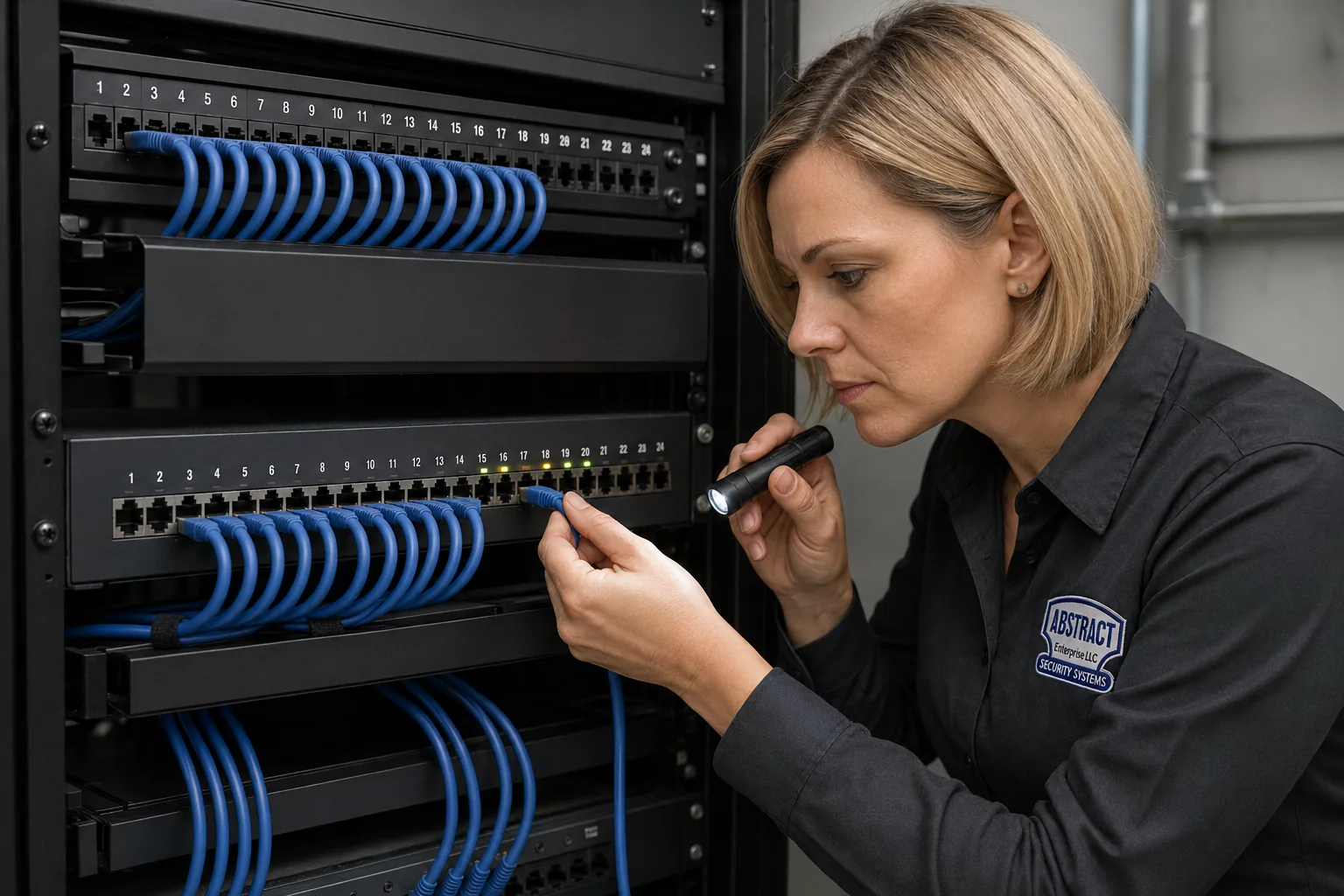
A technician with a shoulder-length bob holds a small flashlight up to a rack-mounted 24-port switch as she seats a blue patch cord near port 18; link lights glow on a few ports, with a patch panel of blue cords above.
Ulster County Cat6 Repair Quote
Tell us where the speed disappears — we reply the same business day
✅
Request Sent!
We'll get back to you the same business day.
25+
Years Experience
✓
Same-Day Estimates
100%
Licensed & Insured
4.7★
201 Google Reviews
Paying for gigabit fiber and getting a fraction of it in the office upstairs? Bought a house where none of the wall jacks do anything? Ring our Ulster line, (845) 640-3835, or use the 60-second form. A licensed technician reads it, asks where the fiber terminal and the router sit, and tells you whether the problem sounds like a cord, a termination or the cable inside the wall before anyone drives out.
Testing starts at the fiber hand-off and works room by room, so you see exactly where the speed is lost
A saved test result for each run we touch, plus a speed check from the television, desk or camera that relies on it
Our hourly rate is printed below; your Ulster quote arrives in writing first, from a New York licensee (#12000287431) carrying full insurance
Why Ulster County Properties Need Cat6 Repair Now That Fiber Is Here
For years the slowest part of an Ulster County network was the line coming in from the road. That is changing quickly. Archtop Fiber, which is headquartered in Kingston, has launched its all-fiber service in Kingston and Saugerties and began building a network in the Town of Woodstock in October 2024, according to the company. Kingston residents on local forums now compare Archtop with Planet Networks fiber, and the county has secured state ConnectALL funding and, in May 2026, federal approval to take fiber to the last 1,293 unserved homes, businesses and community buildings on its remote roads. Multi-gig service that once belonged to cities is arriving at farmhouses in Hurley and cabins off Route 28.
When the outside connection gets fast, the inside wiring is suddenly on trial. A fiber installer mounts a small terminal where the fiber enters — often a basement, a utility room or a garage wall — and connects it to a router with one Ethernet cable. From there, every wired room depends on Cat6 that was already in the house. If that cable was run well and terminated properly, the new speed reaches the desk. If a jack was punched down carelessly, a run was spliced in the attic, or the cable behind a “Cat6” plate is something older, the speed test beside the router looks wonderful and the one in the bedroom office does not. One Kingston resident noted online that their installer even “threw in a free extension router” — useful, but no help to a television, a desktop or a camera that depends on the wire.
Ulster’s housing makes that inside cable unusually hard to trust. A quarter of the county’s homes were built before 1940, and many have changed hands several times since anyone added network cable. Short-term rentals more than doubled in a decade according to the County Comptroller, and more than a third of their owners give mailing addresses outside the county — so a lot of the Cat6 in Woodstock, Shandaken and Gardiner was put in by someone who is no longer around to explain it. Add log homes and camps with no hollow walls, stone houses in the Kingston Stockade and Hurley, brick in the Rondout, spray-foamed renovations, and the subdivided buildings of the former IBM campus at iPark 87, and you have a county full of cable nobody fully documented.
So Cat6 repair in Ulster usually starts with a question about history rather than hardware: who ran this, where does it go, and what is it actually made of? We answer that with a certification tester at the fiber hand-off and at each jack, map what is really in the walls, repair or replace only the links that fail, and leave you with a record so the next owner, tenant or contractor does not have to start from scratch.
What the Ulster numbers say about its cabling
1,293 unserved locations: the homes, businesses and community buildings that will all receive fiber under the federal BEAD programme, with Verizon building, according to Ulster County’s May 1, 2026 announcement. That followed a $20.8 million state ConnectALL award in September 2025. The county had 87,657 housing units in 2025 and 92.4 percent of households already had a broadband subscription, per Census QuickFacts.
200 acres and over a million square feet: the former IBM Kingston manufacturing site along Enterprise Drive in the Town of Ulster, now iPark 87. Spectrum News reported in February 2026 that its East Campus hosts the Ulster BOCES Career and Technical Center and Archtop Fiber, while the county moved to foreclose on two West Campus parcels.
25.3 percent of homes built in 1939 or earlier: 21,829 homes, with a median build year of 1966, according to the Stacker analysis of Census data used in our county research. Every one of them has had network cable added after the fact.
942 to more than 2,000 short-term rentals: the growth the Ulster County Comptroller reported between 2015 and 2025, reaching 3.28 percent of the county’s housing in May 2025 and close to 10 percent in Shandaken, with 36 percent of owners using mailing addresses outside the county.
182,760 lightning pulses and 49 thunder days: Ulster’s 2020 total in the Earth Networks New York lightning report. When a September 2026 nor’easter hit, the Daily Freeman reported more than 14,000 Ulster outages at the peak among Central Hudson’s 93,209 county customers — the kind of event after which some wired links never come back.
More than six inches of rain across almost all of the county: Tropical Storm Irene in August 2011, with record floods on the Upper Esopus, the Stony Clove Creek in Phoenicia and the Rondout Creek in Rosendale, according to the Lower Esopus Watershed Partnership. Cable in cellars along those creeks has history too.
Read together, those facts describe the calls we get: a new fiber connection that should be fast, a house or a unit with cable from an unknown hand, and a building fabric — logs, stone, foam, landmark facades — that decides how a bad run can be reached.
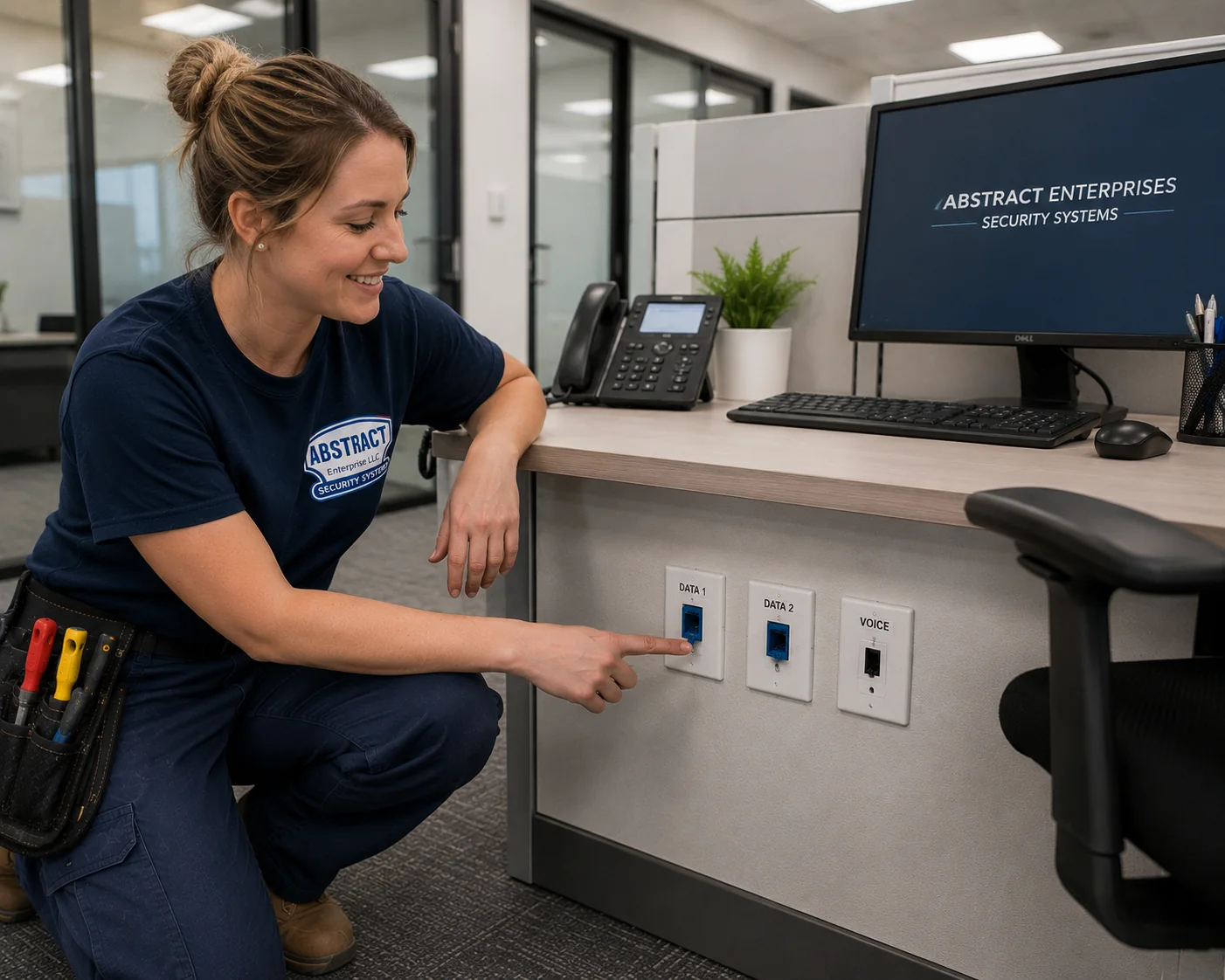
Three small wall plates are fixed to the side of a desk: DATA 1 and DATA 2 with blue jacks, VOICE with a black one. A woman with her hair in a bun, tools on her belt, rests an arm on the desk and points to the first.
Repair Capture
Ulster Link Down Since the Fiber Went In?
Since the fiber crew left, perhaps the upstairs office crawls, the smart TV buffers each night, the porch camera went dark when the router moved, or the studio’s audio network keeps dropping a device. Each of those is a single visit. Tell us what fails, who your provider is and where the terminal and router sit. We book the next open 2-hour window and arrive with the parts the symptom points to: Cat6 and Cat6A keystones and panel modules, field-termination plugs for devices that need one, replacement cord and cable in riser and plenum ratings, a tone kit for finding where undocumented runs go, and a certification tester that measures each link to its category. A single bad jack, cord or termination is usually found and fixed in one to two hours on site. Repair time is $195 an hour with a three-hour minimum ($585), the rate on our Ulster and Hudson Valley repair pages. Call (845) 640-3835 and say it is a Cat6 fault.
What We Install
Cat6 Repair Services in Ulster County
Nine jobs make up most of our Ulster Cat6 work. Whatever the job, the last step is the same: a certification reading on the repaired run, kept on file for you.
Fiber Hand-Off Repair
The cable between the provider’s terminal and your router, and from the router to the rooms that matter. We test the hand-off first, then each room, so the point where speed is lost is measured rather than guessed.
Router Relocation Over Existing Cat6
When the terminal lands in a basement corner, an existing run can often carry the internet to the middle of the house. We find a suitable run, certify it, re-terminate both ends and re-patch, so the router can live where the Wi-Fi works.
Inherited Cable Mapping
Houses and units bought with jacks nobody can explain. We tone each run to where it ends, identify what feeds it, label both ends and tell you which links pass, which fail and which go nowhere.
Plug-to-Jack Conversions
In-wall runs that end in crimped plugs, pass-through ends or taped joins replaced with proper keystones, surface boxes or panel ports, and factory-made patch cords where something has to plug in.
Category Mismatch Correction
Rooms where the plate says Cat6 but the cable, the jack or a hidden coupler is older or lower grade. We find the weak piece and replace that, or the run if the cable itself is the limit.
Log, Stone and Foam Repairs
Runs inside log walls, stone houses and spray-foamed cavities, reached through the paths the builder left — drilled log courses, chases, conduit, attic and cellar — rather than by opening finished surfaces we cannot put back.
Studio and Venue Networks
Cat6 that carries Dante and other audio-over-IP traffic, lighting control or streaming cameras in studios, barns and performance rooms, repaired around sessions and acoustic treatment and proved with the audio system running.
Camera, Solar and Device Runs
Links to PoE cameras, doorbells, solar inverters and battery gateways, smart-home hubs and televisions, repaired so the device is back online and reporting, with the power budget checked where PoE is involved.
Rental Turnover Checks
Short-term and long-term rentals tested and repaired between occupants, so locks, cameras, streaming boxes and guest Wi-Fi access points are on working wires when the next arrival checks in.
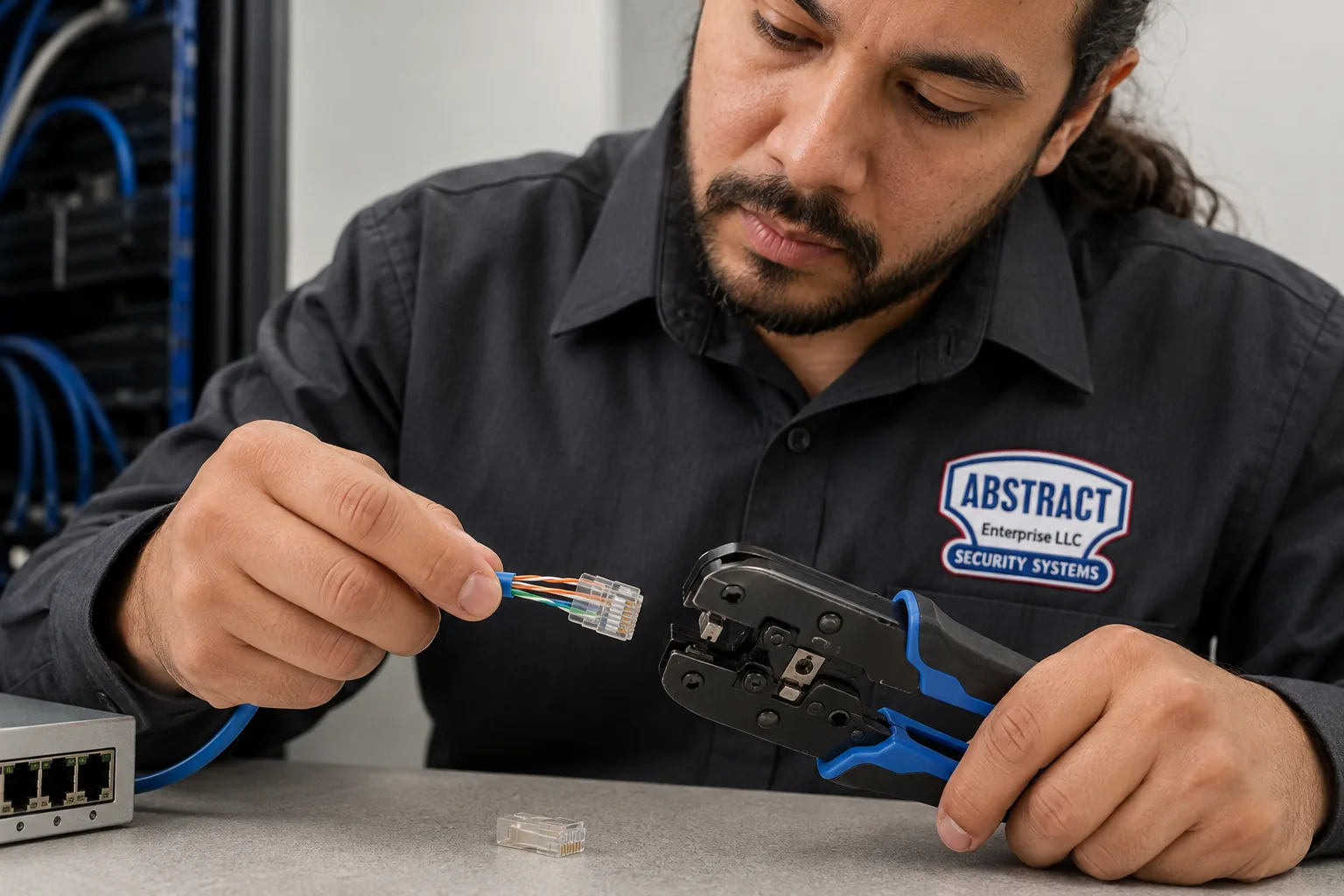
A technician with a long ponytail studies a clear RJ45 plug on the end of a blue cable, its orange, green and brown pairs visible, with a blue-handled crimp tool in his other hand and a spare plug on the bench beside a small switch.
Building Specialists
Cat6 Repair for Ulster County’s Architecture
In Ulster the wall decides the repair. A failed keystone is the same part everywhere; getting a replacement cable to it is not.
Dutch Stone Houses
The eighteenth-century stone houses at Kingston’s Four Corners of John and Crown Streets, along Hurley’s Main Street and on New Paltz’s Huguenot Street. Thick masonry, few cavities, later wood-frame wings, and cable that usually travels through cellars, attics and the newer additions.
Rondout and Midtown Brick
Brick commercial blocks and row houses from Kingston’s canal-and-coal years, many now flats over shops. Plaster on masonry, shared party walls and surface raceway added by successive owners.
Log Homes, Cabins and Camps
From Catskill camps off Route 28 to kit log homes in Olive and Shandaken. Solid walls where wiring was meant to go up through holes drilled as the logs were stacked, so a later Cat6 run is often stapled in a corner, under a floor or behind trim.
Village Victorians
Plaster-and-lath houses in Saugerties, Ellenville, Rosendale and Highland, frequently split into apartments. Balloon framing helps fishing; previous owners’ abandoned phone, coax and network cable crowds the same cavities.
Mid-Century and Newer Houses
Ranches and colonials in the Town of Ulster, Lloyd, Esopus and Marlboro, and newer builds with structured-wiring closets. Easier walls, but more home-run cable, more DIY terminations and more spray foam.
Reused Industrial Campuses
The former IBM buildings at iPark 87 on Enterprise Drive and other mills and plants re-let to small companies. Large ceilings, decades of layered cable, and units whose network arrived with a tenant who has since left.
Barns, Studios and Performance Rooms
Converted barns and purpose-built rooms around Woodstock, Bearsville and Saugerties used for recording, rehearsal and small concerts. Timber and bluestone, acoustic treatment on the walls and audio networks that cannot tolerate a flaky link.
Shops and Offices on Main Streets
Uptown Kingston’s Wall Street and North Front Street, Main Street in New Paltz, Tinker Street in Woodstock and the village centre of Saugerties. Small footprints, basements full of history and point-of-sale gear that must work on a Saturday.
How the building changes the method
Stone: we test and locate from both ends before touching masonry, use the routes the house already offers — cellar, attic, the frame addition — and only add a penetration when no existing path can carry a replacement.
Log: we look for the builder’s vertical holes, the chase behind a stair or chimney, and the floor and roof cavities first; an exposed run in a log home is dressed and protected rather than buried in a fresh cut.
Plaster: fishing uses existing openings and low-impact cuts at plates and baseboards, and every cut is sized to be patched, not to be convenient.
Spray foam: we follow the cable into the foam only as far as needed; when a run is lost in closed-cell foam, a new path is cheaper than excavating the old one.
Landmark facades: outside work on Kingston’s historic districts starts with the question of whether it changes what the street sees, because that decides whether a certificate of appropriateness is needed.
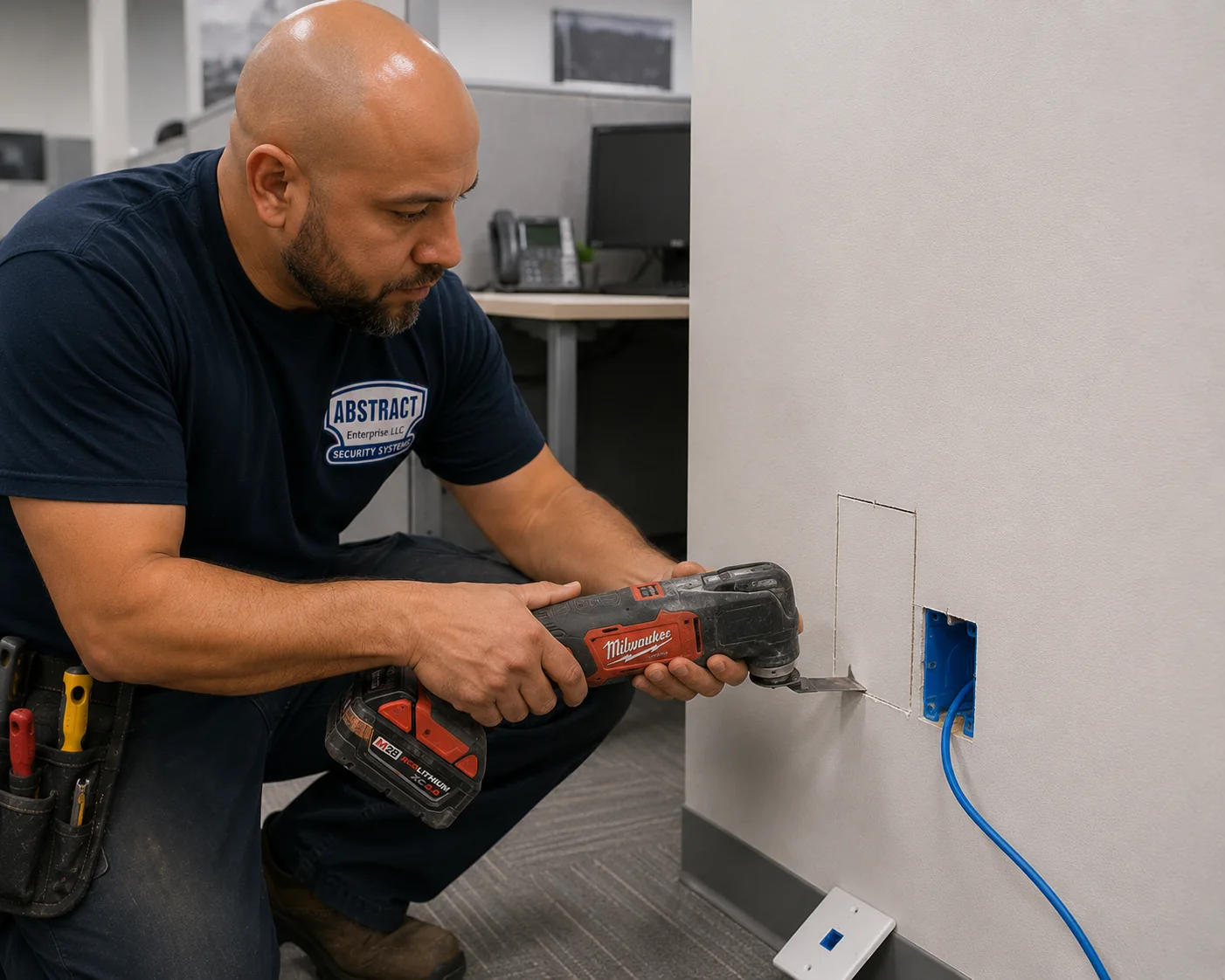
A bald, bearded technician kneels with a red Milwaukee oscillating tool, scoring a rectangle in the wall next to an open blue box where a blue cable emerges; a single-port plate lies on the floor below.
Commercial Cat6 Repair
Business Cat6 Repair in Ulster County
Ulster’s businesses are mostly small, which means one failed run can stop the whole shop. These are the corridors where we plan for it.
Uptown Kingston: Wall Street and North Front Street
Shops, restaurants and wine bars inside the Stockade District, many with flats above. Old stone and brick, deep cellars, landmark rules on anything visible outside, and checkout and camera runs that pass through more than one owner’s alterations.
Enterprise Drive and iPark 87, Town of Ulster
The former IBM Kingston campus, where the East Campus now hosts Ulster BOCES and Archtop Fiber. Subdivided space, long corridors, ceilings full of earlier tenants’ cable, and units that inherit networks from whoever left last.
Route 9W, Kingston to Saugerties
Plazas, offices, dealers and medical practices along 9W, including the Hudson Valley Mall property, which its owner describes as positioned for long-term redevelopment and repositioning. Tenant fit-outs change faster than anyone updates the cable records.
Main Street and Route 299, New Paltz
The village’s shops and restaurants and the businesses that serve SUNY New Paltz’s more than 7,000 undergraduate and graduate students. Compact buildings, high turnover of staff and devices, and point-of-sale links that must survive term-time crowds.
Route 28 and Tinker Street, Woodstock to Phoenicia
Galleries, studios, inns and cafés in Woodstock and the Catskill hamlets along Route 28, where cell signal is unreliable and a wired link is often the only dependable one for payments and cameras.
Route 209 and the Village of Ellenville
The village and hamlets of the Town of Wawarsing below the Shawangunk Ridge, from Spring Glen to Napanoch. Older commercial blocks, village storefronts and long runs to outbuildings.
Rules an Ulster business repair has to respect
Old runs left behind. Under section 800.25 of the National Electrical Code as EC&M explains it, the accessible portion of communications cable that is no longer in use has to be removed unless it is tagged for future use. In re-let industrial and office space, that decides whether a previous tenant’s cable stays as a labelled spare or comes out when we replace a run.
Kingston landmark districts. The City of Kingston’s Historic Landmarks Preservation Commission reviews exterior work on landmarks and in its historic districts that is visible from the public right of way, and the city code requires a certificate of appropriateness for any material change in appearance. The same code says ordinary maintenance and repair that does not change design, materials, colour or outward appearance is not prevented, and the Commission’s FAQ says desk-level reviews are generally turned around within a week.
Digging. Any repair that involves trenching across a yard or lot is preceded by an 811 Dig Safely notice to locate utility lines, as Central Hudson asks of everyone who excavates.
Electrical work stays electrical. Ulster County licenses master electricians for electrical work in the county. Our Cat6 repairs stay on the low-voltage side; where a device needs a new power outlet, that is a job for your electrician.
Ashokan country. West of Kingston, much of the land drains toward the Ashokan Reservoir, one of New York City’s Catskill supplies, and the city’s DEP regulations apply there. Swapping a cable indoors raises no issue; we only look into those rules if a repair would mean a new buried route across open ground.
Local permits. Building permits are issued by the City of Kingston and by each town and village. A like-for-like cable repair is normally maintenance; when it turns into new work through rated assemblies or the building’s exterior, we check with the building department for the address.
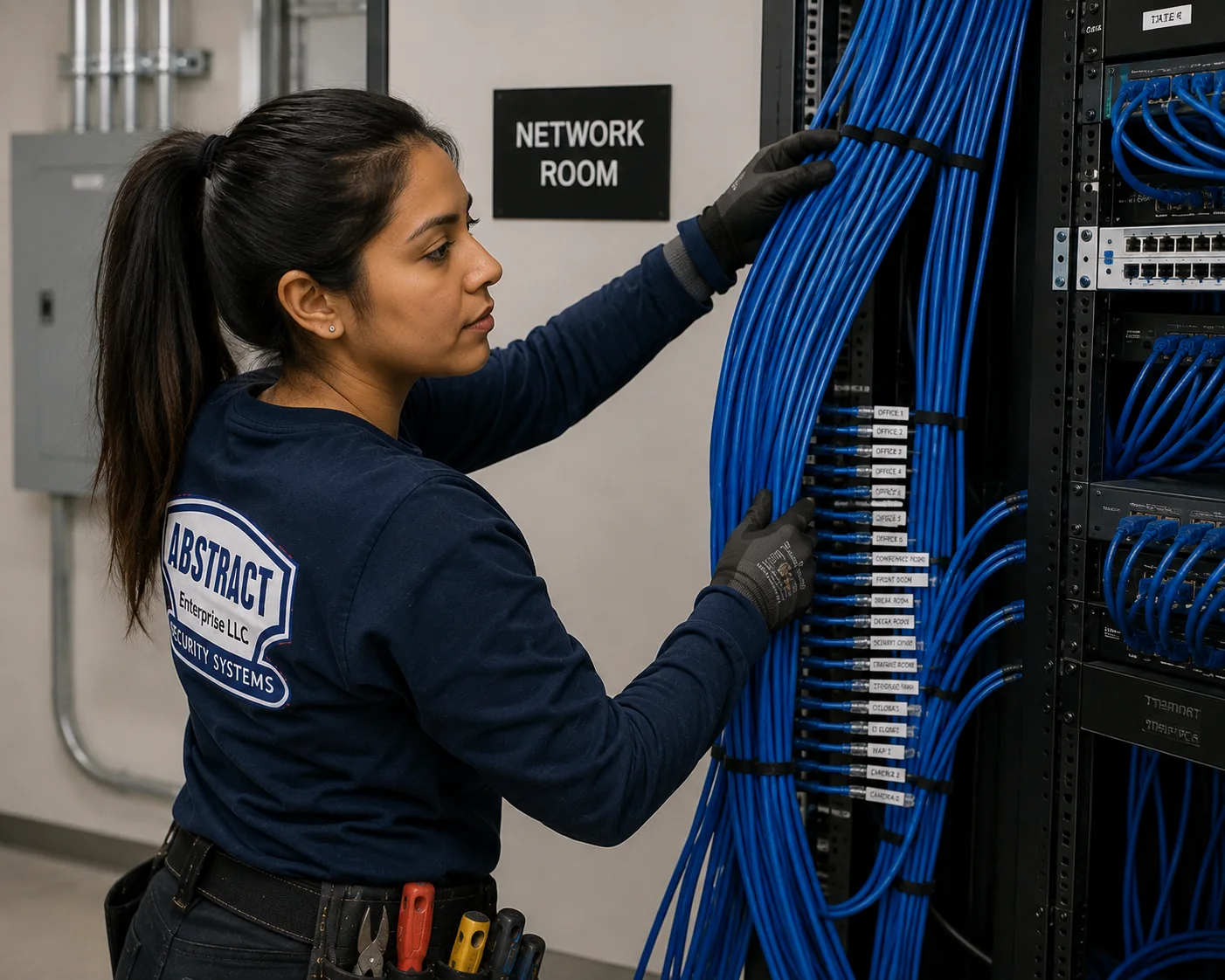
Under a NETWORK ROOM sign, a technician with a long ponytail lifts a heavy bundle of blue cables in an open rack; a column of white tags reading OFFICE 1, OFFICE 2 and onward runs down the cords beside a row of switches.
Your Questions Answered
Cat6 Repair in Ulster County: Questions Answered
These are the questions and situations Ulster homeowners, new buyers, rental hosts, studio owners and small-business tenants bring to us. They are grouped by where the trouble started: a new fiber connection, cable someone else left behind, the building itself, or the specialised rooms this county is known for.
When the fiber arrives
Our new fiber service tests at full speed beside the router but not at the desk upstairs — where does the Cat6 testing start?
At the hand-off, then outward one link at a time. We first confirm what the router actually receives from the fiber terminal, because if that cable or port is the problem nothing downstream can be fast. Then we plug a link-speed tester into the jack upstairs and read what it negotiates: a link that settles at 100 Mb/s instead of a gigabit usually has a broken or badly terminated conductor on one of the pairs that only gigabit uses, while a link that negotiates a gigabit but tests slow points back at the switch, the device or Wi-Fi rather than the cable.
If the jack is the culprit, we certify the run from the panel or router end to the wall plate, which tells us whether the fault is at either termination, in a cord, or somewhere in the cable itself and at what distance. Most of the time it is a termination or a patch cord, and the repair takes minutes. When the cable fails along its length, you get a choice between re-pulling that run and using a different one. Either way, we finish by running a speed test from the same desk so you can see the difference for yourself.
Moving the router away from a basement fiber terminal over an existing run
This is one of the most useful repairs we do in Ulster. Provider installers mount the terminal where the fiber enters, near a power outlet, and connect the router beside it with a short cable. In a stone house, a long ranch or a cabin with a loft, that leaves the Wi-Fi in the worst possible place. If an existing run already goes from near the terminal to a central room, we can use it as the link between the terminal and the router, so the router moves and the terminal stays put.
The run has to earn that job. We certify it first, because a marginal cable that was fine for a printer will drop the whole household’s internet. If it passes, we re-terminate both ends properly, label it as the internet feed so nobody unplugs it, and patch the router into place. If no existing run is good enough, a single new replacement run from the terminal to the router location is usually the simplest permanent fix.
Where the provider’s equipment ends and the building’s cabling begins
Ask your provider what it owns, because that depends on what they installed and what their terms say. In general, the fiber, the terminal and the cable they supplied between their terminal and their own router are theirs to fix, and if they lent you the router it is theirs as well. Everything beyond the router — the cables in your walls, the jacks, the switch in the closet — is part of your building, and that is where we work.
The grey area is a provider cable that was run through the house, stapled along a baseboard or pushed through a wall to reach where you wanted the router. If it fails, the provider may repair it or may simply run a new one. If you would rather that link be a properly terminated in-wall run with a jack at each end, we can install that, and the provider’s equipment simply plugs into it. We never alter the provider’s terminal or fiber.
Cable somebody else left behind
The previous owners took their network equipment when they sold — why are all the Cat6 jacks in our new house dead?
Usually because every jack is a home run to one spot, and the box that joined them all together left with the previous owners. In a house wired properly, each wall jack has its own cable back to a central point — a closet, a basement wall, a structured-wiring cabinet — where the runs end on a patch panel or on loose plugs, and a switch connects them to the router. Take the switch away and every jack goes quiet even though the cable is perfectly good.
We find that central point (sometimes behind a stored box or above a cellar beam), tone each run to its room, test it and label both ends. Then you have a choice of switch, and we patch it in, connect the router and confirm each room works. Runs that fail testing are repaired or listed for replacement; runs that go nowhere useful are labelled as spares. It is one of the quickest ways to bring a recently bought Ulster house back to life.
The wall plate says Cat6, but the cable behind it is printed Cat5e — does that explain our slow room?
It might, but a mismatch on its own is rarely the whole story. A short, properly terminated Cat5e run carries a gigabit comfortably, so a fiber plan at a gigabit or less should still reach the room at full speed. What the mismatch does tell us is that the plate, the jack or the cable was changed by someone at some point, and that is where the real fault usually hides: a jack punched to the wrong colour code, an inline coupler in the attic, a stretch of cheaper cable joined to a better one, or a run that is simply too long.
The certification test settles it. If the link passes at the category of its weakest part, the mismatch is cosmetic and we leave it, labelled honestly. If it fails, we replace the weakest part — often the jack or the joined section — or the run itself if the cable is the limit. Where you plan multi-gig service later, we will tell you which runs can carry it and which cannot.
Several of our Cat6 runs end in crimped plugs hanging out of the wall instead of jacks — is that why they keep failing?
Quite possibly. In-wall Cat6 has solid copper conductors, and the commercial cabling standard calls for each horizontal cable to end on a modular jack, with stranded cable reserved for patch cords. A cable maker’s own testing guide is blunt about it: plugs crimped onto solid copper should be the last termination option, a poor fit causes speed and power-over-Ethernet problems, pass-through plugs are less tolerant of fit, and solid conductors do not hold up to being plugged and unplugged. A plug that dangles from the wall gets moved every time something is cleaned or rearranged.
The repair is to put a proper keystone in a plate or surface box on the in-wall cable and use a factory-made patch cord to the device. Where a camera, access point or other device genuinely needs a plug on the end of the run, we use a field-termination plug designed for solid cable, with strain relief, and test it. Converting a house full of dangling plugs to jacks is quick work, and it usually ends a long run of “it worked yesterday”.
Flexible conduit from the original build: when it helps a replacement and when it does not
Conduit laid when the house was built can make replacing a failed run much easier, but not automatically. If the conduit is continuous, not too full and has no tight bends or crushed sections, we tie a pull string to the old cable at one end, draw it out, and pull the new cable in behind it with the string ready for next time. A run that would have meant opening walls becomes an hour or two of careful pulling.
What gets in the way is a conduit that stops inside a wall, one that has been packed with several cables, a pipe that was crushed or kinked during construction, or a run with water in it from a basement or outside entry. We test and inspect before pulling, because yanking a stuck cable can damage the conduit and the other cables inside it. If the conduit cannot be used, you know before any wall is opened, and the new run goes another way.
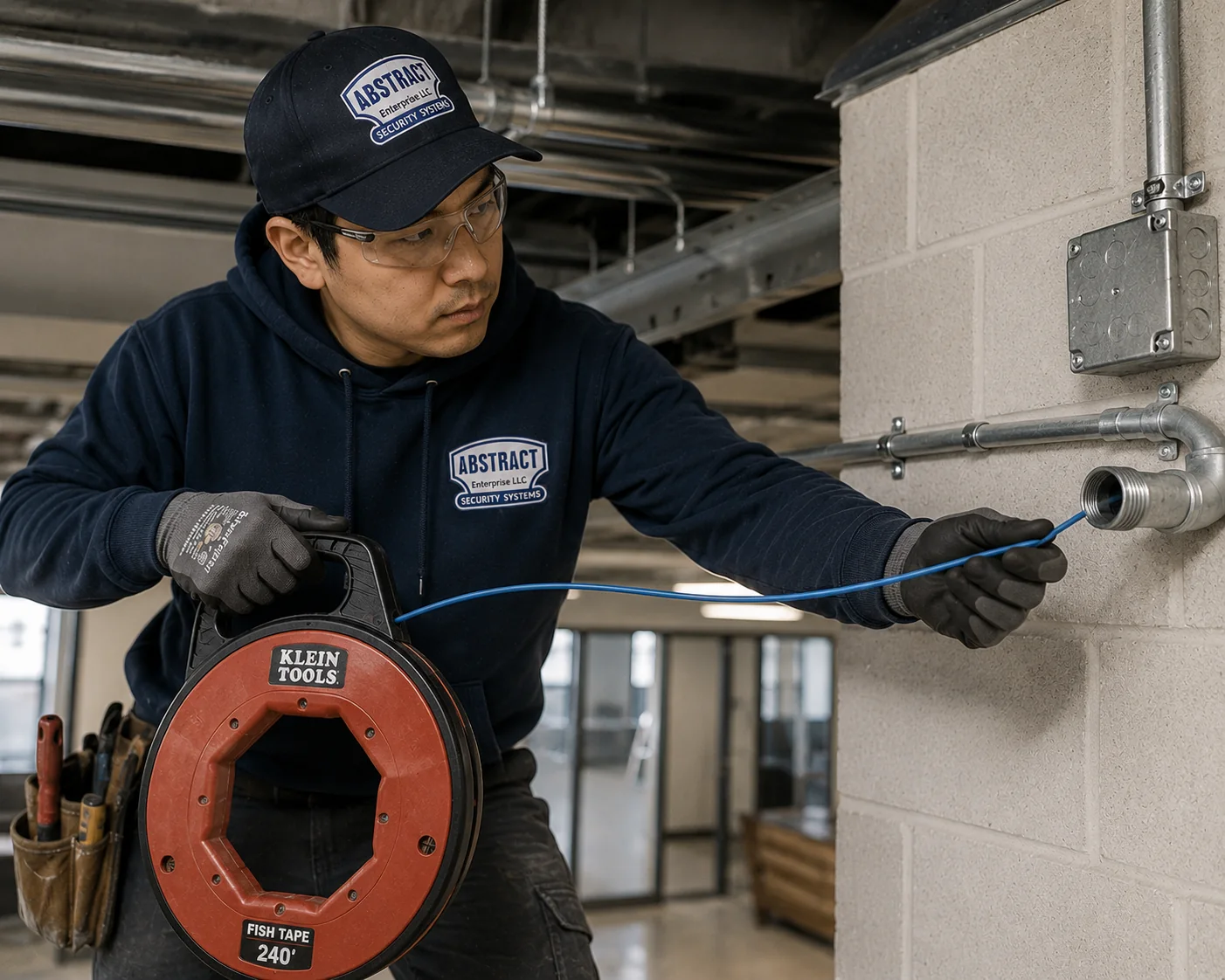
Blue cable coming out of the open end of a steel conduit elbow on a painted block wall, pulled by a technician in a cap and safety glasses who holds a red Klein Tools 240-foot fish tape reel in his other hand.
Log, stone, foam and landmark walls
Log homes: reaching a failed run without cutting into the logs
We work through the paths the builder left, not through the logs. Log-home builders plan electrical routes by drilling holes that line up vertically through the courses as the walls are stacked, and they bring wiring through floors, roof framing, interior partitions, stair chases and the space behind trim. Network cable added later usually follows the same routes or runs exposed in a corner. We locate the fault by distance from both ends, then work out which of those spaces the cable passes through.
If the fault is at a jack or in a stretch we can reach, the repair is ordinary. If it is inside a log course, we leave the logs alone and replace the run along an interior partition, a floor or ceiling cavity, or a neat surface raceway finished to suit the room. Fresh cuts into log walls are a last resort and only with your agreement, because they cannot be hidden afterwards.
Kingston’s historic districts and conduit on the outside of a building
A repair route on the outside of a landmark building is worth checking before work starts. Kingston’s Historic Landmarks Preservation Commission reviews exterior work on landmarks and within the city’s historic districts that is visible from the public right of way, and the city code requires a certificate of appropriateness before any material change in a property’s appearance from the street. The same code does not prevent ordinary maintenance and repair that leaves design, materials, colour and outward appearance unchanged.
So we design the repair to stay inside if we can — through the cellar, the attic or a rear wall that the street cannot see. If the only route is a visible conduit or penetration on a facade, we tell you before any work and you can ask the Commission; its FAQ says desk-level reviews are generally turned around within about a week. Replacing a failed cable inside an existing exterior conduit, with nothing new on the facade, is ordinary repair.
Cable sealed inside spray-foam insulation
Foam itself does not usually harm network cable, and both foam installers and low-voltage forums say standard cable can live inside it. The trouble is access. Once closed-cell foam has set around a cable, that cable cannot be pulled out or pushed along, and digging it out means cutting away insulation the house needs. Installers who plan ahead run a conduit or a pull string before the foam goes in; many renovations did not.
So we locate the fault first. If it is at either end — a jack, a box, the closet — the cable in the foam is fine and we simply repair the termination. If the fault is mid-run inside a foamed wall or roof, we leave the old cable where it is, label it as abandoned at both ends, and run a replacement through an interior wall, a chase or a conduit, telling you exactly where so the next contractor knows.
Studios, makers and reused campuses
One Cat6 run in our studio’s Dante audio network keeps dropping out — is the cable to blame?
It can be, and it is one of the first things we prove or rule out. Audinate, which makes Dante, says most Dante devices use gigabit Ethernet and recommends Cat5e or Cat6, noting that older Cat5 is only for legacy or 100 Mb/s networks. A run that has quietly fallen back to 100 Mb/s because of a damaged pair, or that throws errors under load, can make one device lose sync while everything else seems fine — and in a studio that sounds like clicks, dropouts or a device vanishing from the routing.
We test the suspect run to its category, check what speed the port actually negotiated and look at the switch’s error counters for that port. If the cable passes cleanly, the fault is more likely to be switch configuration or clocking, and we tell your audio engineer what we found. If it fails, we repair or replace it during a break between sessions and run the Dante system again before we leave.
An old tenant’s Cat6 above a leased unit on a reused campus
Certifying and reusing it, rather than pulling it out, often saves both money and ceiling disruption. We trace each run to both ends, check that it really serves your space rather than a neighbour’s, and certify it. Runs that pass are re-terminated to your layout and labelled; runs that fail are repaired or replaced; and runs that lead nowhere you need are tagged as spares or removed.
That last step matters. The electrical code treats accessible communications cable that is no longer in use as abandoned and expects it to come out unless it is tagged for future use, so a decades-old bundle above a suspended ceiling is not something to ignore. We agree with your landlord which cable belongs to the unit before cutting anything, and the record we leave shows what was kept, what was tagged and what came out.
Equipment
Types of Cat6 Repair Equipment We Bring to Ulster Properties
Repairing inherited cable is mostly a matter of measurement. This is what comes in the van.
Certification Tester
Tests each link against its category limit, shows wire map, length, crosstalk and loss, and locates a fault by its distance from the tester, so we open one wall instead of three.
Link-Speed and PoE Tester
Shows what speed a jack negotiates with a real switch and how much power-over-Ethernet it can deliver, which is how we separate a cable fault from a router, switch or device problem.
Tone Generator and Probe
Finds where an undocumented run ends — the cellar beam, the stored box, the abandoned closet — and which cable in a bundle belongs to which room.
Keystones, Plates and Surface Boxes
Cat6 and Cat6A jacks, plates in common finishes, surface-mount boxes for log and stone walls, and panel modules, so a plug-on-the-wall run becomes a proper jack.
Field-Termination Plugs and Factory Cords
Plugs designed for solid cable for devices that need them, and pre-made, tested patch cords for everything else.
Fish Tapes, Rods and Pull String
For drawing replacement cable through conduit, plaster cavities and the vertical holes in log walls, and leaving a pull string behind for the next time.
Riser and Plenum Cable
Replacement cable rated for the space it passes through, solid copper, so a repaired link is better than the one it replaced.
Inspection Camera and Lighting
For looking into cavities, conduits, log chases and cellars before cutting anything.
Labels and a Port Map
Both ends of every run we touch get the same label, and you get a list that says what each jack connects to.
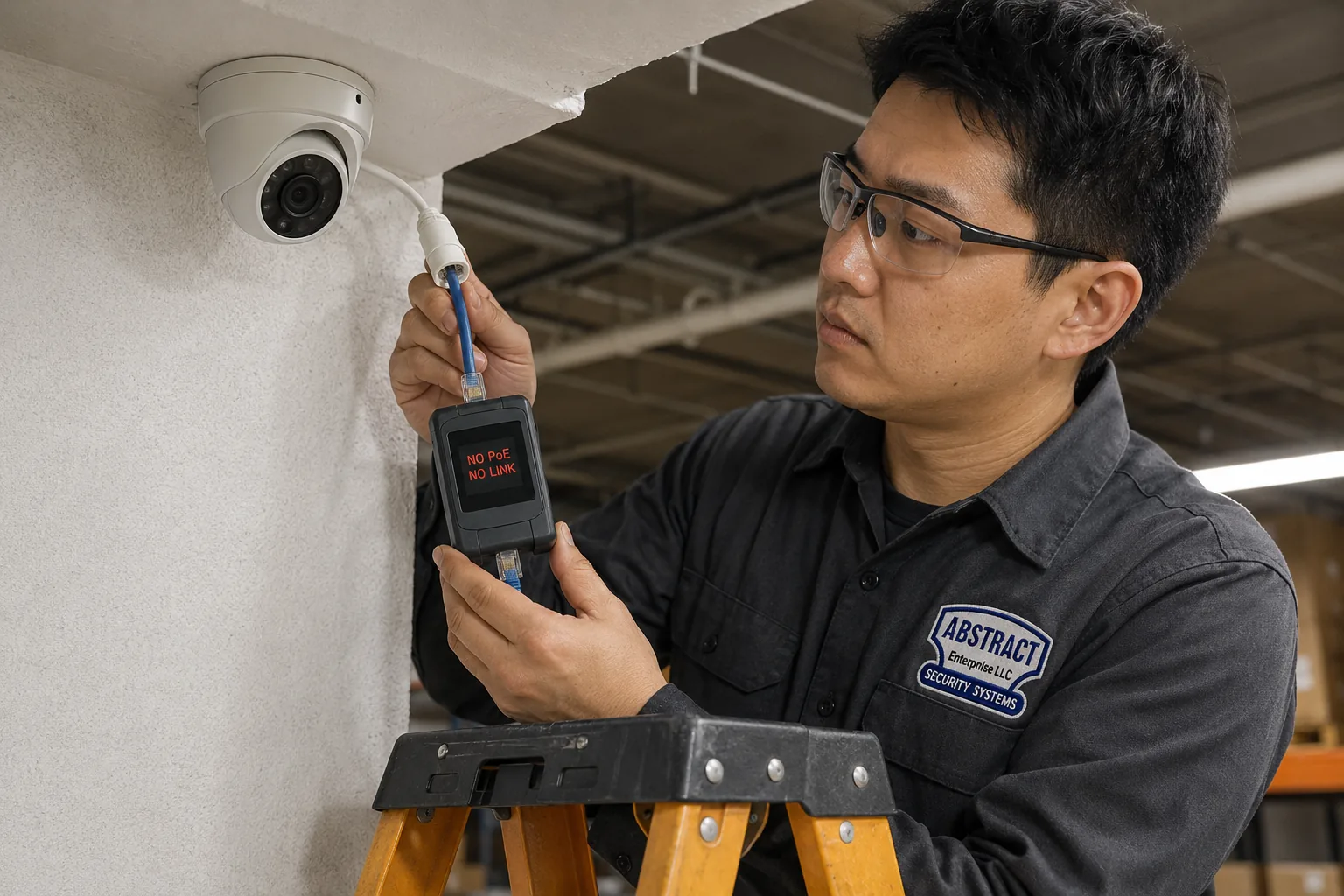
Red letters on a handheld meter read NO PoE and NO LINK. The man holding it, glasses on and one hand on the short blue lead, stands at a ladder top below a white dome camera on a rough plaster column, with warehouse shelving behind.
AI Overview Reality Check
What AI Gets Wrong About Cat6 Repair in Ulster County
Google’s AI Overview was not visible to us when this page was written, so nothing below is quoted from it. Instead, these seven statements turn up again and again in DIY guides, retailer pages and forum threads about slow or dead Ethernet. Next to each is what we find in Ulster houses, cabins and shops.
“Fiber internet fixes slow internet everywhere in the house”
Fiber makes the connection to the house faster. It does nothing for the copper and the radios inside. Ulster is getting fiber at a remarkable rate — Archtop in Kingston, Saugerties and Woodstock, Planet Networks in Kingston, and the county-backed build to more than 1,200 remote locations — and the first thing many new subscribers notice is how different the speed test looks beside the router compared with the far end of the house.
The reason is usually physical. The router sits where the terminal was mounted, often in a cellar or utility room, and the rest of the house reaches it either by Wi-Fi through stone, logs or plaster, or through Cat6 that was terminated years ago by someone else. A single poorly punched jack or a joined section of cheap cable will hold a room to a fraction of what the fiber delivers.
So the fix after a fiber upgrade is often inside, not outside: test the cable between the terminal and the router, move the router to the middle of the house over a good run, and repair the specific links that fail. That is a morning’s work in most houses and it is what turns a fiber subscription into fast internet in the rooms you use.
“Link light on means the run is good”
A link light means the two ends agreed to talk at some speed. It does not mean they agreed on the speed you are paying for. Gigabit Ethernet needs all four pairs, and a fault on the pairs only gigabit uses lets the link fall back to 100 Mb/s with the light still on — exactly the symptom of the “slow room” after a fiber upgrade.
In inherited Ulster wiring, the most common causes are terminations done to the wrong colour code at one end, a pair untwisted too far at a jack, a crushed spot where a cable was stapled hard to a log or a joist, and plugs crimped straight onto solid cable that have loosened with handling.
A link-speed tester shows the negotiated speed in seconds, and a certification tester tells us where on the run the fault sits. Lights are a starting point, not a diagnosis.
“Cat6 is Cat6 — if the plate says so, the run will do a gigabit or more”
A plate is a label, and labels in houses that have changed hands are not always honest. We regularly open plates marked Cat6 to find Cat5e cable, a mismatched jack, or a coupler hidden in the box. Sometimes the cable is Cat6 and the jack is not; sometimes it is the other way round.
The good news is that for most homes the category label matters less than the workmanship. A well-made Cat5e link handles a gigabit; a badly made Cat6 link may not. Where it matters is multi-gig: if you plan to use a plan above a gigabit, or multi-gig access points, the whole channel has to be capable of it.
The only reliable answer is to test the link as installed. That tells you what each run can actually carry, and it is the basis for deciding which ones to keep, which to repair and which to replace before a faster plan or new equipment arrives.
“You can crimp a plug on any Ethernet cable and plug it straight in”
You can crimp a plug on a cable, and on a patch cord made from stranded cable it is a normal job. In-wall cable is different. It has solid conductors, and the commercial cabling standard expects it to end on a jack, with stranded cable reserved for cords.
Cable makers say the same thing more bluntly. One manufacturer’s testing article calls plugs on solid copper a last resort, warns that a poorly fitting plug causes speed and power-over-Ethernet problems, and says pass-through plugs are less tolerant of fit than standard ones. A plug left hanging out of a wall in a rental or a busy family room gets pulled, bent and stepped on until it fails.
Converting those runs to jacks with a proper patch cord to the device is cheap and permanent. Where the device itself needs a plug on the run — a camera, an access point, a gate controller — a field-termination plug made for solid cable, with strain relief, does the job reliably.
“Old network cable in the ceiling is harmless — leave it”
Unused cable is not harmless in code terms. The electrical code expects the accessible portion of abandoned communications cable to be removed unless it is tagged for future use, and a ceiling crowded with dead runs makes every future repair slower because nobody can tell live cable from dead.
That is a real issue in Ulster’s reused buildings. The former IBM site at iPark 87 alone has more than a million square feet of buildings on about 200 acres, re-let to new occupants, and smaller mills, schools and offices around the county have changed tenants many times.
When we repair in that kind of space, we sort cable into three groups: live and passing, tagged as a usable spare, or abandoned and removed where it is accessible. The difference shows up the next time anyone has to find a fault.
“Any network cable is fine for a studio or audio network”
Audio over IP is tolerant of ordinary structured cabling, but it is not tolerant of faults. Audinate’s guidance for Dante is that most devices run at a gigabit on Cat5e or Cat6, with older Cat5 only for legacy 100 Mb/s networks. A run that has degraded to 100 Mb/s or is throwing errors may still pass a casual check while one device loses sync during a take.
Woodstock and Saugerties have a long relationship with recording and live music — Levon Helm’s Barn in Woodstock, built in 1975 of local hemlock, pine and bluestone and acoustically engineered by Helm himself, still hosts sessions and concerts. Rooms like that are full of acoustic treatment and gear that nobody wants disturbed for a cable job.
So in studios we test the run, the port’s negotiated speed and its error counters before touching anything, repair between sessions, and prove the fix with the audio system running.
“A bad run means opening walls”
Sometimes it does, but far less often than people fear. Most failed links in houses fail at a termination — the jack, the closet end, a cord — and those repairs never touch a wall.
When the fault really is in the cable, Ulster buildings usually offer an alternative: the conduit a builder left, the cellar under a stone house, the attic over a Victorian, the interior partitions of a log home, or another run that already reaches the same room. A certification tester that places the fault by distance lets us choose the least disruptive option before any cutting.
Opening finished surfaces is the last option, discussed with you first, and sized to be patched. In a log or stone wall we do not cut at all unless you decide it is worth it.
Get the Speed You Pay For Into Every Room
Name the provider, describe where its box and your router live, and list the slow or silent rooms. From that, a technician can usually predict the fault and the length of the visit.
House, cabin, rental, studio, shop or leased unit — list the rooms or devices that fail and what you know about who ran the cable. We answer in writing the same business day. Prefer to talk? Dial (845) 640-3835.
✅
We Got Your Request!
Thanks — a technician reads it and writes back before close of business. Whole house offline right now? Skip the wait and call (845) 640-3835.
How It Works
Our Cat6 Repair Process
Six steps on every Ulster job. The first two exist because so much of the county’s cable came with the building rather than with its current owner.
1. Describe the rooms and the cable's past
Which rooms or devices fail, who your internet provider is, where the fiber terminal and router sit, and whatever you know about who ran the cable and when.
2. Find the hub
We locate where the runs gather — panel, closet, cellar shelf or structured-wiring cabinet — and confirm the link between the fiber terminal and the router first.
3. Trace, test and label
Every relevant run is toned to its room, certified against its category and labelled at both ends, with faults placed by distance.
4. Choose run by run
Each run is listed as keep, re-terminate, convert from plug to jack, re-patch or replace. Nothing that costs extra goes ahead until you have the figure in writing.
5. Repair by the least disruptive route
Category-matched jacks and cords, replacement runs through conduit, cellars, attics or interior walls rather than logs, stone or foam, and abandoned cable tagged or removed.
6. Prove it room by room
Each repaired link is certified, speed-tested from the device that uses it, and recorded on a port map with saved results you keep.
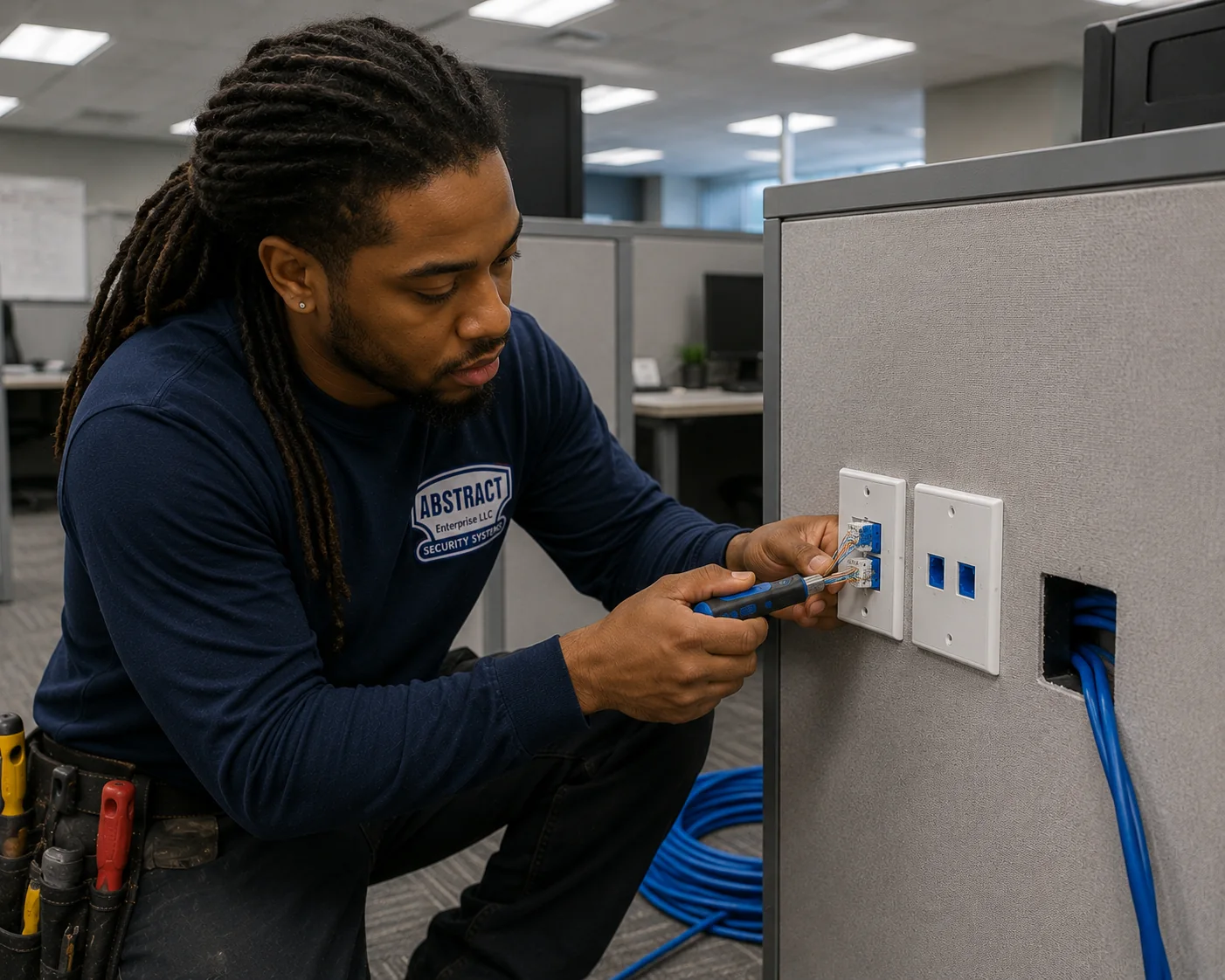
A technician with long locs kneels at a grey fabric cubicle panel, pressing a punch-down tool onto the back of a two-port white plate; a bundle of blue cables drops through a cut-out beside a second plate.
Coverage Area
Cat6 Repair Near Ulster County’s Landmarks
Six Ulster places, six kinds of building. Each card says what the cable inside that sort of building usually looks like when we arrive.
The Four Corners and the Senate House, Kingston
Crown and John Streets, the only intersection in the country with eighteenth-century stone houses on all four corners, and the Senate House on Fair Street, a 1676 Dutch stone dwelling where New York’s first Senate met in 1777. Uptown buildings like these keep their cable in cellars, attics and later additions.
iPark 87, Enterprise Drive, Town of Ulster
The former IBM Kingston plant: about 200 acres and more than a million square feet of buildings, now shared by Ulster BOCES, Archtop Fiber and other occupants on the East Campus. A textbook case of cable inherited from earlier tenants.
Historic Huguenot Street, New Paltz
A ten-acre National Historic Landmark District with 30 buildings and seven stone houses at the heart of the 1678 settlement. Nearby village houses and offices mix stone, frame and modern additions under one roof.
The Rondout, Kingston
The waterfront district that grew with the Delaware and Hudson Canal, opened in 1828 to bring coal 108 miles to the Hudson, and peaked around 1870. Its brick blocks now hold flats, restaurants and studios with surface raceway added by each owner in turn.
Levon Helm Studios, Woodstock
The Barn, built in 1975 from local hemlock, pine and bluestone and acoustically engineered by Levon Helm, on 18 acres used for concerts, sessions and rehearsals. Woodstock-area studios and performance rooms rely on network cable that has to be right every time.
Opus 40, Saugerties
Harvey Fite’s bluestone earthwork in a former quarry at the foot of Overlook Mountain, a reminder that by 1898 at least 10,000 people in Ulster made a living from bluestone — the same stone under many of the county’s walks, hearths and floors that cable has to go around.
We also repair Cat6 in the City of Kingston, Lake Katrine and the Town of Ulster, Saugerties and Malden, Woodstock, Bearsville and Shady, Hurley and West Hurley, Stone Ridge and Marbletown, Accord and Kerhonkson, Rosendale and Tillson, New Paltz and Gardiner, Highland, Clintondale, Milton and Marlboro, Esopus and Port Ewen, Phoenicia, Mount Tremper, Shokan, Boiceville and Pine Hill, Ellenville, Napanoch and Wawarsing, and Wallkill.
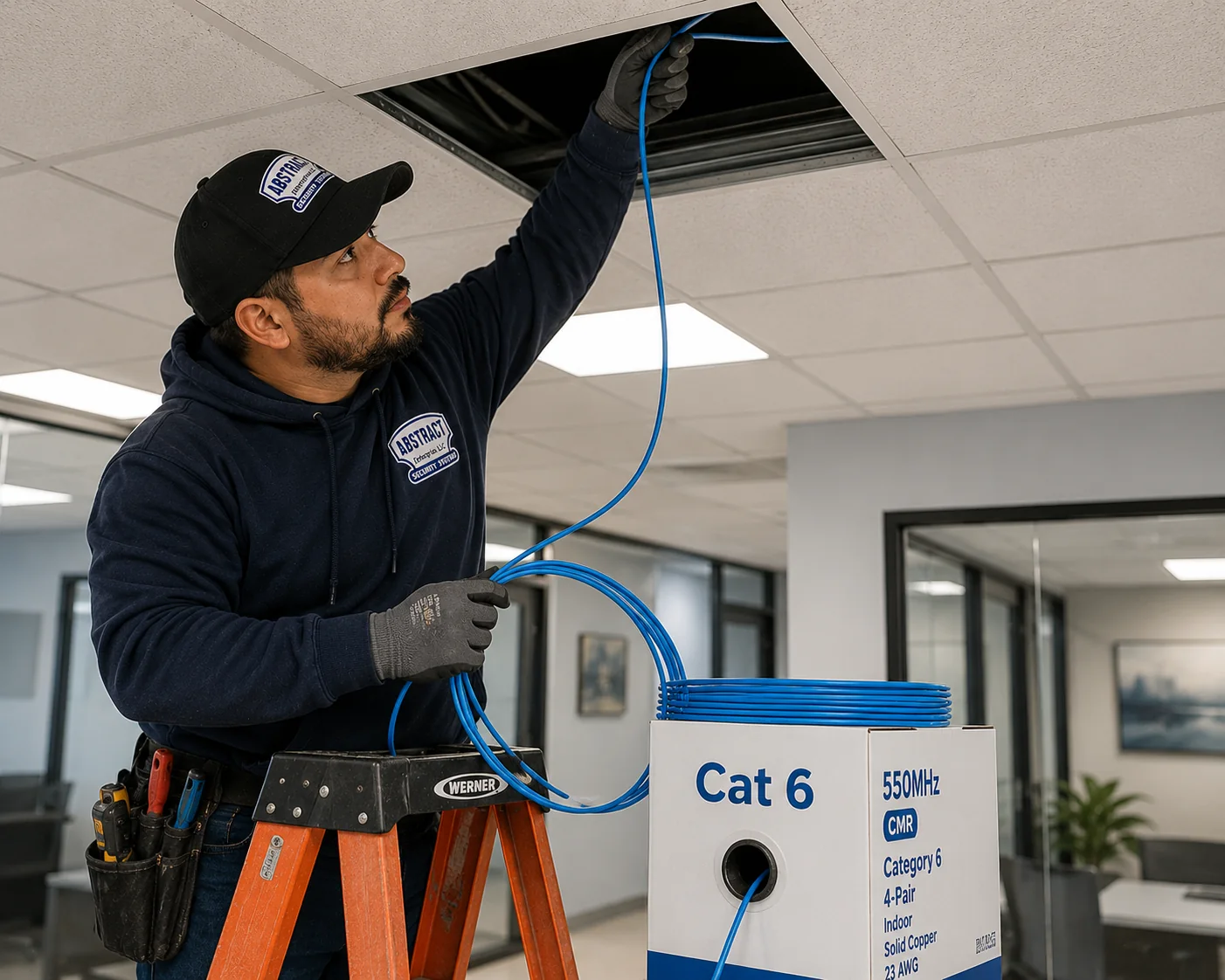
Gloved hands guide a loop of blue cable into the dark gap of a lifted ceiling tile; the bearded man feeding it wears a black cap and hoodie and stands on an orange ladder beside a white carton labelled Cat 6.
Pricing
Cat6 Repair Cost in Ulster County
No number in this table is new. Each comes from a page we already publish, named in the right-hand column; anything that hangs on test results, wall type or a landmark review is priced in your written quote.
Item
Price
Scope and source
Repair time on site: test from the fiber hand-off, locate, re-terminate, convert plugs to jacks, re-patch, retest
$195/hr, 3-hour minimum ($585)
Printed three times already: Ulster network cable repair, Ulster Cat6 installation (as the post-warranty service rate) and the Hudson Valley Cat6 repair hub
Each hour after the first three
$195/hr
Same published rate, charged for the time actually on site
Run replaced because it cannot be saved
From $175 per drop
Figure taken from Ulster network cable repair and the six-county hub. Buys a new solid-copper run with its jack and plate, the hub-end termination, a certification reading, labels and a cord
New-work benchmark (not a repair price): one Cat6 drop, 100 ft or less
$333 per drop
Published on our Ulster Cat6 installation page next to $286 for Cat5e and $477 for Cat6A; shown so you can compare repair with new work
Mapping a house or unit full of undocumented runs
Quoted by port count
Tone, test, label and list each run; the convention used on our Hudson Valley repair hub
Runs between buildings, or routes needing exterior conduit on a landmark facade
Quoted per run
Distance, path and any review decide the figure; recommendation given in writing after testing
Inside the minimum: a typical Ulster visit, start to finish
On most visits, the minimum is enough to test the fiber hand-off and the router link, test every jack you care about, find and fix the failing terminations, convert dangling plugs to proper jacks, re-patch a closet or move the router onto a good run, and prove the result room by room. Mapping a house where nobody knows what goes where takes longer, and we will say so when we quote.
Why we use the same Ulster figures as our other repair pages
We have not invented a separate price list for this page. The hourly rate and the replacement-drop figure are the ones already printed on our Ulster and Hudson Valley repair pages, and your written quote repeats them before anything is booked. What changes from one Ulster property to the next — the walls, the distance between buildings, an exterior route on a landmark — is measured on site and quoted for that property.
What moves an Ulster Cat6 repair bill
How much is undocumented: a house where every run has to be traced before anything can be fixed takes longer than one with a labelled panel.
The wall: drywall and conduit are quick; plaster, logs, stone and spray foam mean planning a route rather than pulling straight through.
Where the fault sits: a jack, a cord or a closet termination is minutes; a fault mid-run inside a finished wall becomes a replacement run.
The far end: a camera on a barn, a solar gateway in a garage or a studio rack each bring their own access.
What the cable turns out to be: good solid copper only needs new ends; a run that is crushed, joined or a lower grade than you need is swapped at the replacement-run figure.
About the national averages. Fixr’s cost guide (updated January 2025) quotes $125 to $250 for a new Cat6 drop and $45 to $75 an hour for installer labour. Those describe new cable in open framing somewhere in the country. They are not AESS prices and say nothing about finding where a former owner’s cable went in a stone cellar or a log home.
Full terms — including 50% deposit, one-year parts-only warranty on AESS-supplied products, and the late-fee schedule — are set out in the service agreement.
Shop Our Systems
Cat6 Repair Packages & Pricing
Most Ulster jobs land in one of the three bundles below; each price is one we already publish elsewhere.
Starter — Fiber Reaches the Room
$585
Three hours on site at $195 an hour. Suits a house where the new fiber is fast at the router and slow elsewhere: the hand-off tested, the slow rooms tested and fixed, the router moved onto a good run if that helps, and speed proved at the desk or television that matters.
Standard — Inherited House or Unit
$195/hr after the first 3 hours
For a newly bought house, a rental or a leased unit full of cable nobody can explain: every run toned, tested and labelled, plugs converted to jacks, failed terminations remade, a switch patched in, and a written port map handed over.
Premium — Repair Plus Replacement Runs
Repair time + from $175 per run
For properties where some cable cannot be saved — lost in foam, failing inside a log course, Cat5e joined to Cat6 in the attic, a dead run to the room that matters most. Salvageable links are billed as repair time; each replacement run starts at $175, goes in by the least disruptive route, and the old cable is labelled or removed.
Bring Your Own Parts — Labour Only
Left over from the last renovation: a bag of jacks, a spare switch, half a spool of cable? Hand them over and you pay repair time only. Our conditions are simple — the cable must be solid copper, not copper-clad aluminium; Cat6 runs get Cat6 parts; the switch has to keep up with your fiber plan. We certify the result as usual, the maker rather than AESS warrants what you supplied, and if your parts will not pass, you hear it from us before we pack up.
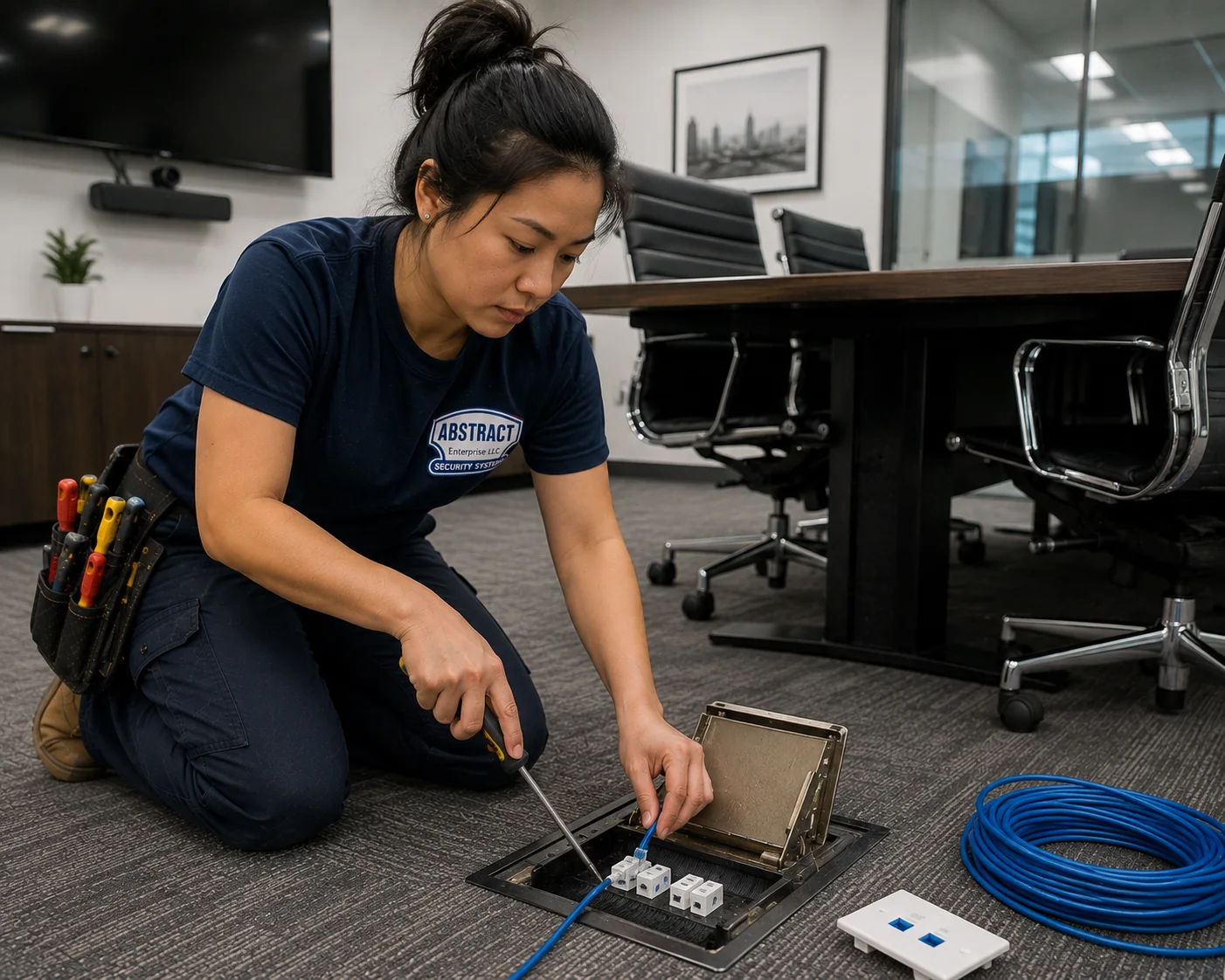
The lid of a recessed floor box stands open under a conference table. Four white keystones sit inside, and the woman kneeling over them holds a screwdriver in one hand and a blue lead in the other; spare cable lies coiled to her right.
Bought the House, Inherited the Wiring?
Send photos of the jacks, the closet or cellar where the cables gather, and the fiber terminal. We will tell you what we expect to find and how long the mapping should take.
From the Fiber Terminal to Every Room: Where Ulster Speed Gets Lost
A fiber installation ends at a small box and one Ethernet cable. Provider guides describe the same pattern: the optical network terminal is mounted inside or just outside the house near where the fiber enters, it needs a power outlet, and it is linked to the router by an Ethernet cable. Everything after that point is the building’s own network. In Ulster, that is where we find the losses, roughly in this order.
Point
What goes wrong
What we do
Terminal to router
A short cord kinked behind a shelf, a router plugged into the wrong port, or a long cable the installer pushed through a wall
Test the link and the negotiated speed; if the cable is ours to touch, replace it with a terminated run
Router position
Router stuck in a cellar or garage beside the terminal, so Wi-Fi has to cross stone, logs or plaster
Use a certified existing run to move the router to the centre of the house
Closet or cellar hub
Switch missing or too slow, loose plugs on a shelf, unlabelled panel
Patch in a suitable switch, put runs on a panel or jacks, label every port
Terminations
Wrong colour code at one end, long untwist, plugs on solid cable, paint in a jack
Re-terminate to the standard and certify
The cable itself
Crushed by staples, joined in an attic, lower category than labelled, damaged in a renovation
Locate by distance; repair at the fault if reachable, otherwise replace the run
The device
Old network card, a slow port on a television or console, an access point set to a lower speed
Tell you plainly that the cable is fine and what to change
Why bother with wires at all when the router can do Wi-Fi? Because in much of Ulster the house fights the radio. Stone walls in the Stockade and Hurley, log walls in the Catskills and foil-faced insulation in newer renovations all weaken Wi-Fi, and along Routes 28 and 212 mobile signal is unreliable enough that Hudson Valley One reported long-standing dead zones there. A wired link to the office, the television and the access points is what makes the new fiber feel fast everywhere.
Across Ulster
How Cat6 Repairs Differ Across Ulster Towns
The county runs from the Hudson to the high Catskills and down the Rondout valley to the Shawangunk Ridge. These are the patterns we expect in each part of it.
City of Kingston: Uptown, Midtown and the Rondout
Archtop launched its service here first, and Kingston residents now compare it with Planet Networks, so many calls are about getting new fiber speed past old wiring. Uptown and the Rondout add stone and brick, cellars, and the city’s landmark districts — the Stockade, Rondout-West Strand, Chestnut Street, Fair Street and Wilbur — where anything new on a visible facade is a conversation with the Historic Landmarks Preservation Commission. Midtown’s frame houses and converted commercial buildings are mostly about mapping cable left by earlier owners and tenants.
Town of Ulster and Lake Katrine
Enterprise Drive and the iPark 87 buildings, the Route 9W commercial strip including the Hudson Valley Mall property, and postwar neighbourhoods. Leased units with previous tenants’ cable, store fit-outs that changed more often than the records, and houses with structured-wiring closets from their builders.
Saugerties and Malden
One of Archtop’s first Ulster launches, with a village of nineteenth-century buildings, the Esopus Creek running through it, and bluestone country to the west around Opus 40. Older village buildings and creek-side cellars make termination corrosion and unknown cable routes common finds.
Woodstock, Bearsville and Shady
Archtop began building here in October 2024 under an agreement with the town. Woodstock has a high share of short-term rentals and second homes, a long tradition of studios and performance spaces, and houses ranging from arts-colony cottages to modern builds. Expect studio networks, rental turnover repairs and owners who are not always on site.
Route 28: Hurley, Olive, Phoenicia and Shandaken
Stone houses along Hurley’s Main Street, the Ashokan Reservoir towns, and the Catskill hamlets where Shandaken’s housing is nearly ten percent short-term rentals. Log homes and camps, weak mobile signal, and some of the remote locations now due for county-funded fiber. Irene’s record flood on the Stony Clove Creek in Phoenicia is a reminder to check cellar terminations after high water.
Marbletown, Rosendale and the Rondout valley
Stone Ridge, Accord, Kerhonkson, Rosendale and Tillson: older farmhouses, converted barns and village buildings along the Rondout Creek, which reached a record flood in Rosendale during Irene. Long runs between house, barn and studio sit with our network cable repair team; inside, we see plenty of inherited and DIY terminations.
New Paltz and Gardiner
The village around Main Street and Route 299, Historic Huguenot Street, and SUNY New Paltz, with more than 7,000 students between its undergraduate and graduate programmes. Student-heavy rentals, small shops with point-of-sale and camera links, and in Gardiner a high share of short-term rentals and houses spread across open land.
Highland, Lloyd, Marlboro, Milton and Esopus
The Route 9W towns opposite Poughkeepsie, linked to it by the Walkway Over the Hudson at Highland, with older farmhouses alongside newer subdivisions. More drywall and conduit, more DIY plug terminations, and more spray foam in recent renovations.
Ellenville, Napanoch and Wawarsing
Route 209 runs through Spring Glen, Ellenville, Napanoch and Wawarsing below the Shawangunk Ridge. Older commercial blocks in the village, village houses and long-held family properties. Repairs here usually mean tracing what several generations of owners added.
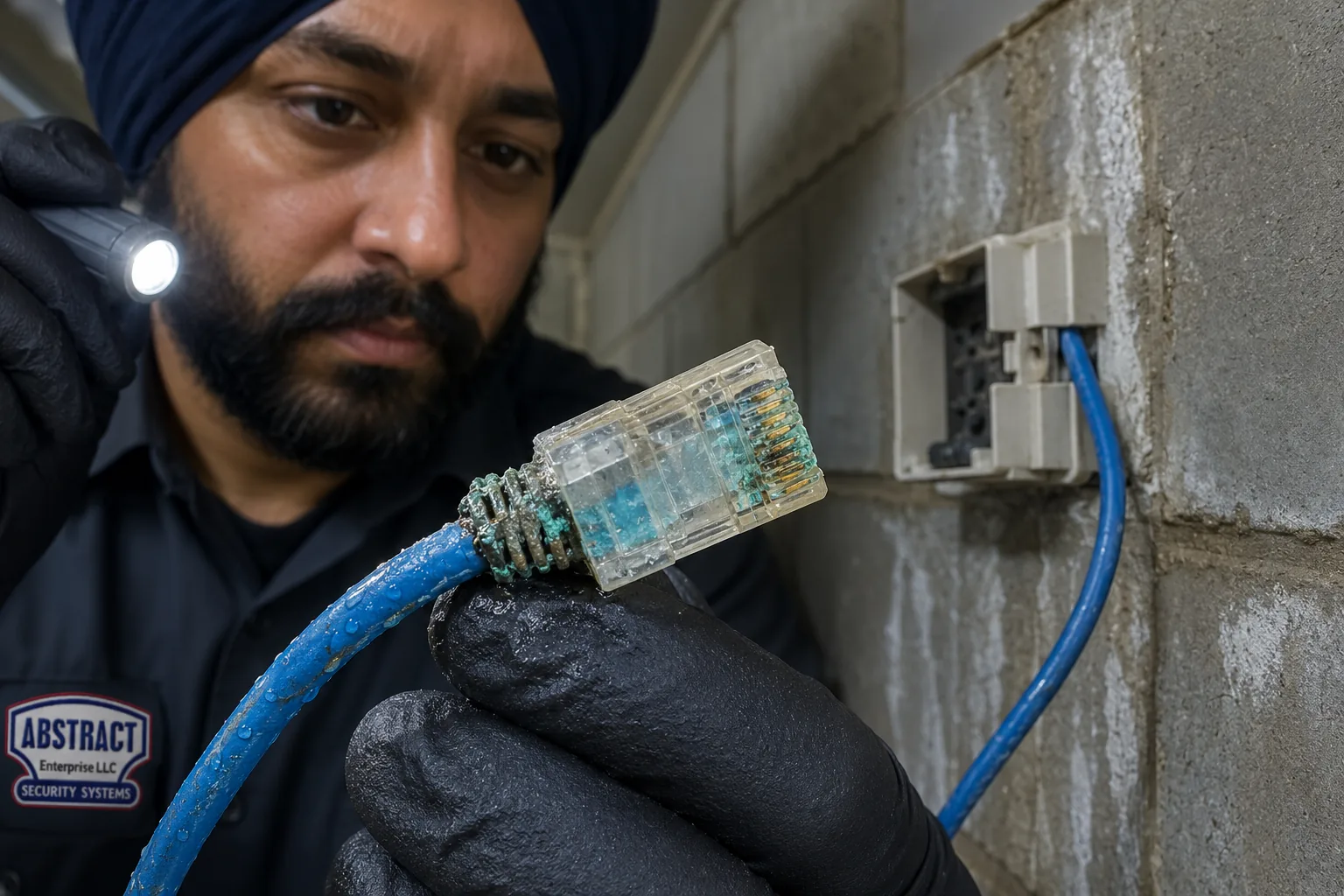
A technician in a dark turban shines a flashlight on a clear RJ45 plug whose contacts and boot are crusted green; the wet blue cable runs back to an open box on a stained concrete-block wall.
Inherited Wiring
Taking Over an Ulster Property? What to Check in Its Cat6
Whether you have just bought a house, taken a lease or inherited a family place, the cable came without a manual. These are the things we look at first, and you can check most of them yourself before calling.
Where the cables gather. Look in the cellar, utility room, closets and garage for a bundle of cables ending on a panel, a box of jacks or loose plugs. That is the hub; without it the jacks cannot work.
What is printed on the jacket. The cable usually says what it is — Cat5e, Cat6, Cat6A — and whether it is riser or plenum rated. Write it down for a few runs.
How the runs end. Jacks in plates are good; plugs hanging out of walls, taped joins and push-in couplers are the first suspects.
Whether anything was painted. Paint inside a jack is a common reason a perfectly good run fails after a sale or a repaint.
Where the fiber or cable modem enters. Note where the provider’s terminal is, and whether any wall runs go from there to the middle of the house.
What has been renovated. Spray foam, new drywall and new floors often bury or cut cable that used to work.
With that list and a few photos, we can usually estimate how long the mapping will take and which repairs are likely before we arrive. On site, every run gets traced, tested and labelled, and you receive a port map you can hand to the next contractor, tenant or buyer.
Decision Guide
Keep, Re-Terminate or Replace: How We Decide on Inherited Ulster Cable
After testing, each run falls into one of these rows. You get the result for every run in writing before anything beyond the agreed repair is done.
Test result
Likely cause
What we recommend
Passes to its category
Good cable, good terminations
Keep it; label both ends and add it to the port map
Links at 100 Mb/s, or fails wire map
Wrong colour code, a damaged or open pair, a loose plug on solid cable
Re-terminate on a jack at both ends and retest
Fails crosstalk near one end
Pairs opened out too far, or a low-grade jack, on the near side
Re-terminate that end with a new category-matched jack
Fails at a point mid-run
Crushed by a staple, nicked in a renovation, a hidden coupler or splice
Repair at the fault if reachable; otherwise replace the run by the least disruptive route
Passes, but at a lower category than the plate says
Cat5e cable or a lower-grade part in a “Cat6” run
Keep it for gigabit use; replace only if you need multi-gig on that run
No continuity at all
Cut, disconnected at a hub, or never connected
Trace both ends; reconnect if possible, otherwise label as abandoned or replace
Goes nowhere useful
A previous owner’s run to a room or device that no longer exists
Tag as a spare or remove the accessible portion
Field Notes
Field Notes on Repairing Cat6 Somebody Else Installed
These notes describe how we approach inherited cable as a matter of practice; they are not an account of any particular Ulster job.
The most useful tool on an inherited-wiring call is patience at the hub. It is tempting to start at the room that does not work and pull the jack off the wall, but in a house that has changed hands the answer is usually at the other end: a switch that left with the previous owner, a set of loose plugs on a cellar shelf, a panel punched by two different people in two different colour codes. We start there, tone and label every run, and only then go to the rooms.
The second habit is to believe the tester, not the plate. A plate marked Cat6 tells you what someone bought, not what is behind it. Testing every run against its category takes a little longer than plugging in a laptop, but it is the only way to tell a run that needs a new jack from one that needs replacing — and that difference is most of the cost of the job.
The third is to leave a record. Inherited cable became a problem because nobody wrote anything down. A port map, both-end labels and saved test results turn your network into one the next person can repair in an hour.
Complete Services
Every Cat6 Repair Service in Ulster County
Cat6 repair is one part of the cabling and security work we do across the county. Related services for Ulster properties:
Not sure which you need? Ask for a free quote and describe the problem; we will route it.
FAQ
Ulster County Cat6 Repair FAQ
The fiber terminal has a backup battery, so why do our wired rooms still go offline during a power cut?
+
Because a battery keeps running only what is plugged into it. A backup unit supplied with a provider’s terminal is there to keep the terminal itself going; it does not power your router or the switch your Cat6 runs land on. The cable needs no power of its own, so nothing is wrong with it. If the wired rooms matter during outages, put the router and switch on a small UPS sized for them. If rooms still fail once the power is back, that is when the links need testing.
While you are here for a repair, can you add a jack in another room?
+
Yes. A new jack means a new run, so it is installation work rather than repair, and we quote it separately before starting. If the route is straightforward it usually fits into the same visit, which saves a second trip. New drops are priced on our Ulster Cat6 installation page, and the new link is certified and labelled the same way as the repaired ones.
If a run has to be replaced, should the new cable be Cat6A rather than Cat6?
+
It depends on what the run feeds and how long it is. Cat6 carries a gigabit over the full 100 metres but carries 10 gigabits only over shorter runs; Cat6A carries 10 gigabits over the full distance. For a desk, a television or a camera, Cat6 is plenty. For a multi-gig access point, or the link from the fiber terminal on a multi-gig plan, Cat6A is worth the extra cost. It is a thicker cable, so we check that it fits the conduit, the box and the jack first, and both ends get Cat6A parts.
Can Cat6 behind acoustic panels or under a studio floor be repaired without damaging the room’s treatment?
+
In most rooms, yes. We locate the fault from the rack before touching anything, so only the panel or floor section at the fault is moved. Panels are lifted off their mounts rather than cut, floated floors are opened only where they were designed to be, and everything goes back the way it came. If reaching a fault would mean disturbing treatment that cannot be refitted, we route a replacement around the room instead.
We are selling our house — is it worth repairing dead Cat6 jacks before it goes on the market?
+
Usually, if the repairs are small. Dead jacks invite questions at a showing or a home inspection; a working, labelled set with test results answers them. We test every run, fix the terminations and cords that fail, and give you the certification results to pass to the buyer or their inspector. If a run needs replacing, we price it first so you can decide whether it is worth doing before the sale.
A pet chewed the cable where it comes out of the wall — what repair holds up?
+
If only the patch cord is damaged, a new factory-made cord fixes it. If the chewing reached the cable in the wall, we cut back to undamaged cable and terminate it on a new jack, provided there is enough slack; if there is not, the run is extended to a surface box or replaced. To stop it happening again, the cable stays inside the wall and the jack, and the cord is routed behind furniture or inside a cord cover rather than left loose at floor level.
Should a Cat6 repair be done before or after the fiber installation appointment?
+
Ideally just before, or on a visit soon after. If we can test the house’s runs before the fiber installer arrives, you can tell them exactly where the terminal should go and which run will carry the internet to the router. If the fiber is already in, we start at the terminal and work outward, and nothing the installer did needs to be undone.
Will you leave a list showing which wall jack goes to which switch port?
+
Yes. Every run we test or repair is labelled at both ends, and we leave a written port map: the room and jack, the panel or switch port it lands on, what it feeds and whether it passed. It comes with the test results by email and, if you like, taped inside the closet or cabinet door. The next time a room loses its connection, anyone can find the right port in minutes instead of tracing cables.
What warranty comes with a Cat6 repair?
+
Jacks, plates, panels, cords and cable we supply carry a one-year parts-only warranty. Parts you supply carry their maker’s warranty rather than ours. Every repaired link is certified before we leave, so the results show it passed on the day the work was done. The service agreement sets out the full terms.
All Areas Served
Cat6 Repair Across the Hudson Valley and Beyond
This Ulster page reports up to our Hudson Valley Cat6 repair hub. Across the river, Dutchess already has its own page; Westchester, Rockland, Orange and Putnam have theirs as well, linked below.
Whether it is one room that never sees the fiber speed or a whole house of silent jacks, the number is (845) 640-3835. The next free 2-hour arrival window is yours, testing begins at the provider’s box, and a bad jack, cord or termination is normally sorted within one to two hours of arriving.
Cat6 Repair Ulster County — Licensed, Insured, Tested to Category
Abstract Enterprises Security Systems · 460 E Fordham Rd, Bronx, NY 10458 · Ulster line (845) 640-3835 · WhatsApp (718) 679-0359 via wa.me
NYS Low-Voltage Licence #12000287431 · 100% Licensed & Insured · Same-Day Estimates · Rated 4.7★ from 201 Google Reviews
Owner-supplied keystones, switches or cable stay under their manufacturer’s cover. What AESS supplies is covered as described on the warranty page and in the service agreement.
References here to the electrical code, cabling standards, internet providers or Kingston’s landmark rules are summaries to help Ulster readers ask the right questions. They are not legal or engineering advice: the provider’s contract, the landlord and the city or town building department decide. Page reviewed and updated October 17, 2026. Changelog: first publication of the Ulster County Cat6 repair page.