St. George is where Staten Island goes to work: the courts on Central Avenue and Richmond Terrace, the county offices on Stuyvesant Place, a ring of 1960s office buildings full of law firms, and old houses climbing the hill from the ferry, some of them working as offices as well as homes. Most of the Cat6 in those rooms was put in for a tenant who has since left, then patched by the next one. We test each failing link to its category, find out which layer of somebody else’s work broke it, and repair it so the desk, the phone and the copier come back — ideally before the day’s first appointment.
Reviewed and updated October 17, 2026 · Written by Anwar Timothy, NYS licence #12000287431
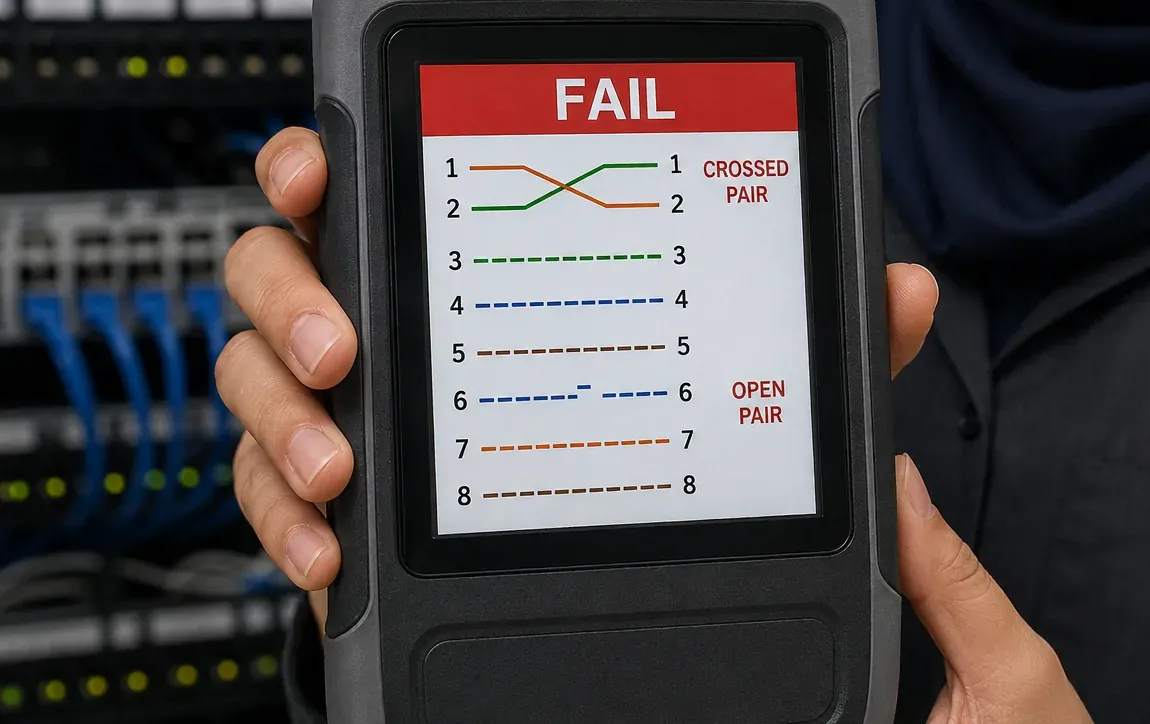
Close-up of a test result in someone’s hands: the red banner says FAIL, the diagram flags pins 1 and 2 as crossed and pin 6 as open, and a blue cord enters the top of the unit in front of a rack.
St. George Cat6 Repair Quote
Tell us the building and what stopped working — a technician answers the same business day
✅
Request Sent!
A technician will call you back the same business day.
25+
Years Experience
✓
Same-Day Estimates
100%
Licensed & Insured
4.7★
201 Google Reviews
Reception PC with no network, a row of desks that lost their connection after the weekend, or a panel nobody in the office can explain? Call (347) 934-8335 or send the 60-second form. A licensed technician reads it and tells you, before anything is booked, whether it sounds like a bad termination, a damaged run, the wrong cable in the wall, or a phone, switch or computer that no cabling work will fix.
Every suspect link certified from both ends, so the repair targets the actual fault instead of the nearest jack
Work planned around client meetings, filings and the first ferry crowd, with the downtime agreed in advance
Licensed in New York State (#12000287431) and insured; one written price for the visit and no bridge surcharge
Why St. George Properties Need Cat6 Repair That Reads the Previous Tenant’s Work
St. George is the only part of Staten Island that behaves like a downtown. The borough’s government sits here on a hill above the ferry: Borough Hall on Richmond Terrace, which also houses the borough offices of the Departments of Buildings and Transportation; the 1919 county courthouse a few doors along; the newer courthouse at 26 Central Avenue, opened in September 2015 to hold the Supreme Court’s civil and criminal parts and the lower Criminal Court; and the Judicial Center at 130 Stuyvesant Place, a 1961 building that houses the County Clerk and the District Attorney. Around that civic core, everything that serves it has grown up within walking distance — law firms, legal-services groups and other court-related offices, along with the coffee shops and restaurants on Bay Street and Stuyvesant Place that feed them.
That shapes the kind of Cat6 we are called to fix here. A large share of it lives in office suites, and those suites have changed hands many times. The ten-storey building at 60 Bay Street, completed in 1969 across from the ferry, is described by its owner as largely occupied by law offices and legal-related companies; the Judicial Center went through a city renovation in 1997. In buildings of that age the original telephone wiring has been replaced or supplemented by Cat5e and then Cat6 in several rounds, each round put in for one tenant’s floor plan. When that tenant moved out, the jacks stayed. The next firm moved desks, added a phone system, borrowed a run here and extended one there. By the time we open the ceiling, a single suite can hold three generations of cabling, only one of which is still doing anything.
Off the main streets, St. George is a neighbourhood of steep blocks and big old houses. The St. George/New Brighton Historic District, designated in 1994, covers about 78 buildings on the crescents that climb from Richmond Terrace, and on the streets climbing south of Richmond Terrace two- and three-family houses are common; any of them may also hold a home office or a small practice that wants an address near the courts. Their network cabling was never designed in. It was fished through plaster, run under porches, tucked behind baseboards and dropped from the attic by whoever was doing the work that year. Further down, Bay Street carries storefronts with offices and apartments above, and the waterfront has added Bay Street Landing’s converted warehouse lofts, the Castleton Park towers on St. Marks Place and, most recently, Lighthouse Point beside the terminal.
Put those together and the typical St. George Cat6 fault is not a mystery of physics. It is a repair made in the wrong way by somebody who is no longer around: grey patch cable pulled through a wall because it was what was in the van, computers chained through desk phones to save a run, a bundle laid straight across the light fixtures, a cable slid under the carpet to reach a new conference table. Each of those works on the day it is done and fails later, usually at the least convenient moment. The tester shows which links are genuinely Category 6 and which only look like it from the faceplate.
The other local factor is time. Offices near the courts keep mornings that start early and cannot slip; storefronts along Bay Street and the waterfront live on the rush from the boat; and parking near the terminal is famously tight. We plan St. George visits so that the network is down for the shortest possible window, agree that window with you in advance, and arrive with the parts that the photos and the phone call say we will need, so one trip finishes the job.
St. George facts behind a Cat6 repair
1994 and about 78 buildings: the year the St. George/New Brighton Historic District was designated and the approximate number of buildings it covers, according to the Landmarks Preservation Commission’s designation report — hillside houses whose cabling was always added after the fact.
184,000 square feet and fourteen courtrooms: the size and courtroom count Ennead Architects give for the courthouse at 26 Central Avenue, opened in 2015 on a hilltop overlooking the harbour.
1961: the construction date the city’s Department of Citywide Administrative Services gives for 130 Stuyvesant Place, the Judicial Center that houses the County Clerk and District Attorney.
10 floors, 114,590 square feet, built 1969: 60 Bay Street, which its owner, Muss Development, describes as one block from the courts and Borough Hall and largely occupied by law offices.
November 2020: the date of New York State’s Downtown Revitalization Initiative investment plan for Downtown Staten Island, whose project list includes upgrading the ground-level façade of the 60 Bay Street office building and renovating a Bay Street storefront.
60,000 square feet of commercial space: the first phase of Lighthouse Point at the ferry, alongside 115 apartments and 274 parking spaces, per the Governor’s office — the newest office-type space in the neighbourhood.
Read together, those numbers describe a small district with an unusual amount of office space for Staten Island, most of it in buildings old enough to have been re-cabled several times, and a residential hill where nothing was ever planned for data. That is the ground a St. George Cat6 repair is done on.
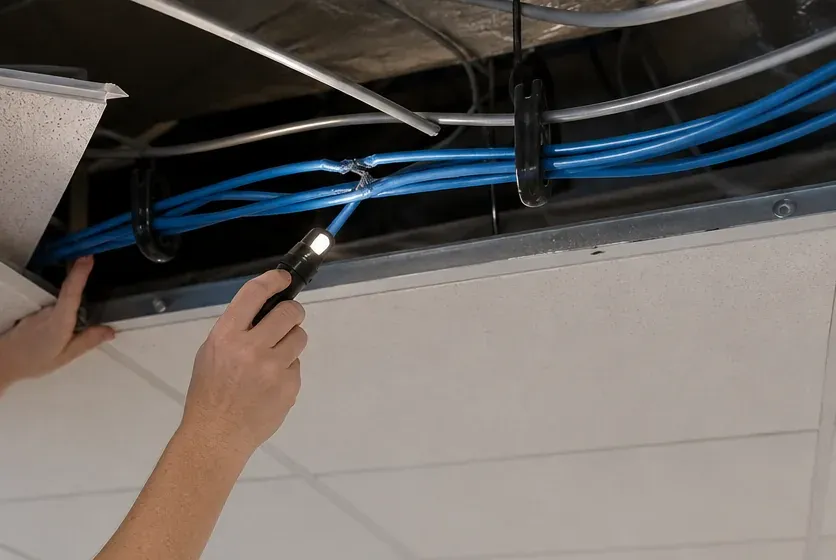
Looking up into an opened ceiling: an arm props the white tile aside and a pocket torch picks out a run of blue cables hung in supports, with grey duct and more cable in the void behind.
Repair Capture
Desk Offline Near Borough Hall Before the Day Starts?
When a paralegal’s computer cannot find the network, the front desk has lost its phone, a Bay Street card machine has stopped approving sales or the camera above a suite door has vanished from the recorder, treat it as a service call: ring us and you are offered the earliest free two-hour arrival slot. The van carries a certification tester, toner and probe, Cat6 and Cat6A keystones and panel modules, factory-made cords in several lengths, surface boxes and cable, and with that kit on board the usual jack, cord and panel faults take one to two hours from the moment we reach the closet. The clock runs at $195 an hour against a three-hour minimum of $585 — our published island repair rate — and crossing the bridge costs nothing extra. Call (347) 934-8335 and say it is a Cat6 fault in St. George, or see our camera repair service on Staten Island if the device itself is the suspect.
What We Repair
Cat6 Repair Services in St. George
Nine kinds of work cover almost every call we get from the neighbourhood. Each one ends the same way: the links we touched are certified against their own category, you get the results, and the invoice says in plain words what was wrong.
Inherited-Cabling Audit
Every jack in the suite tested and traced to its panel port, live runs separated from the ones a previous tenant abandoned, and a list showing what can be repaired, what should be retired and what is missing. Useful at move-in, before a renovation, or when nobody remembers what the last tenant left.
Desk Link Repair
Dead, slow or intermittent desk connections fixed at whichever point the tester names: the plug, the cord, the wall jack, the panel port or the cable itself. Phone-to-computer chains sorted out at the same time, so the desk does not drop again the next time the phone updates.
Wrong-Cable Replacement
Patch cord, Cat5e or unknown cable that someone pulled through a wall as a permanent run, replaced with solid-conductor Cat6 and terminated to standard so the link stops dragging down its desk. The old cable often serves as the pull line for its replacement.
Patch Panel and Rack Rescue
Loose punch-downs and dead ports remade, a sagging wall-mounted panel re-supported, cords shortened and dressed, and the whole panel re-labelled from port to room, with the old handwritten labels replaced by printed ones.
Floor-to-Floor and Backbone Links
The run that ties a two-floor office together tested, repaired or doubled, so one damaged cable no longer takes a whole floor offline. A spare run is pulled alongside wherever the route is opened anyway.
Internet Handoff and Backup Line
The Cat6 between each provider’s box and your firewall or router tested end to end, including the backup line that only matters on the day the main service fails. Both handoffs are labelled so they cannot be swapped by accident.
Ceiling and Lighting Reroutes
Bundles lifted off light fixtures and ceiling grid, re-hung on proper supports clear of the fixtures, and every link in the bundle retested after the move, because a bundle that has lain on the lights for years rarely has only one damaged run.
Camera, Card Reader and Kiosk Runs
Powered Cat6 to cameras, suite-door readers, time clocks and sign-in screens, tested for resistance as well as category and re-terminated where the far end has been knocked about. The device itself stays with whoever supplies it.
House and Apartment Links
Runs in the hillside houses and older apartment buildings: porches, crawlspaces, window walls and plaster, repaired with the least disturbance to finishes that cannot be replaced like for like. The tester finds the fault before anything is opened.
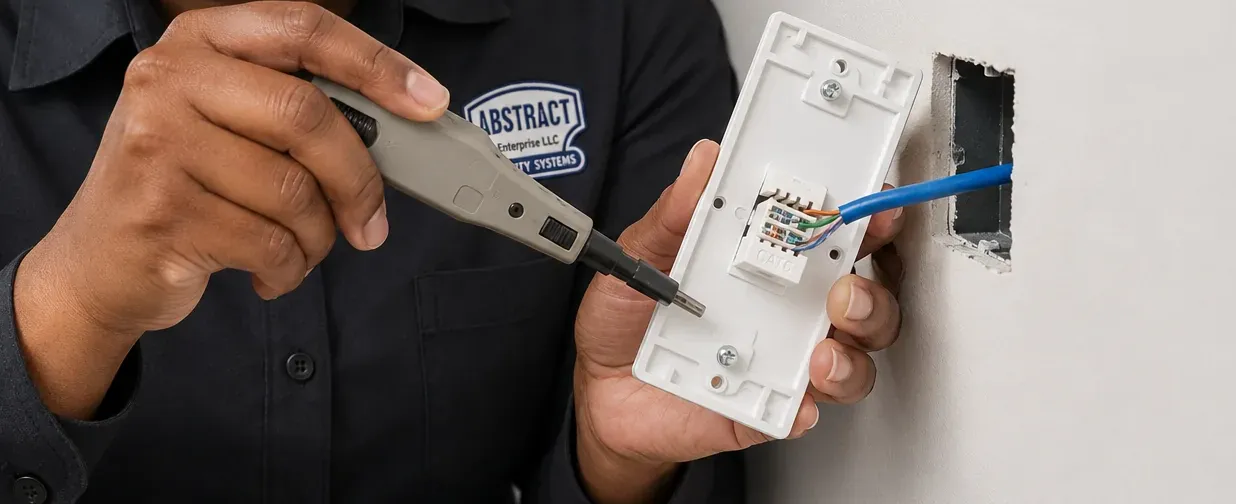
A technician in a dark work shirt presses a grey punch-down tool onto the back of a keystone held in a white single-gang plate; the blue cable runs from the plate into a rectangular opening in a white wall.
Building Specialists
Cat6 Repair for St. George’s Architecture
The neighbourhood packs six very different kinds of building into a few dozen blocks. Each hides its cabling in a different place and fails in a different way, so the first question on any call is which kind of building the failing link is in.
1960s Office Buildings by the Courts
Mid-century office blocks such as 130 Stuyvesant Place (1961) and 60 Bay Street (1969) have drop ceilings, telephone closets on each floor and suites that have been re-partitioned for tenant after tenant. Expect several generations of cable above one ceiling, panels with more ports than desks, and runs that still wander to rooms that no longer exist.
Hillside Houses in and Around the Historic District
Large frame houses from the 1880s to the 1920s on the crescents above Richmond Terrace, many now divided into two or three homes. Data cabling arrived decades after the plaster: fished down old cavities, run beneath porches, tacked along baseboards. The cellar is often at street level on the downhill side and buried on the uphill one.
Bay Street Storefront Buildings
Two- to four-storey buildings with a shop, café or office at street level and offices or apartments above. The ground-floor tenant’s network usually lives in the back room or the cellar, and cable for the upper floors often travels up a stair hall shared by everyone.
Pre-War Apartment Buildings and the Towers
Pre-war apartment buildings such as those on Daniel Low Terrace, and the two Castleton Park towers on St. Marks Place, with 454 homes between them. Inside each apartment the Cat6 is short and simple; the faults come from the building’s own wiring closets and from jacks wired years ago by a provider or a previous occupant.
Bay Street Landing Lofts
Waterfront warehouses converted to loft co-ops and condos in 1984, with raw concrete ceilings and exposed columns. There is no hollow wall to hide a cable in, so runs are surface-mounted, and a repair has to look as tidy as the space it sits in.
New Mixed-Use at the Ferry
Lighthouse Point’s first phase added 115 apartments and 60,000 square feet of commercial space beside the terminal, with tenants such as the College of Staten Island Tech Incubator. New buildings bring structured cabling to a standard, but fit-outs, moves and furniture still damage it.
Six buildings, six ways in: adjusting the repair to the structure
Office suites: we start at the patch panel, not the dead desk. Every port is tested and toned to its jack, so the repair plan covers the whole suite rather than one complaint, and abandoned runs can be identified for removal.
Hillside houses: the tester tells us where along the run the fault is before anything is opened. Plaster, picture rails and original trim are left alone; replacements follow existing cavities, closets and the cellar ceiling wherever the route allows.
Storefront buildings: we separate what belongs to the shop from what serves the floors above, so a repair downstairs never cuts off a tenant upstairs without warning.
Apartments and towers: we work only on the cabling inside the unit unless the building’s management asks us to look further, and we tell you plainly when the fault is in a closet you do not control.
Lofts: surface runs are replaced in matching raceway or neatly clipped cable, with the bend radius kept generous where a run turns around a column.
New buildings: fit-out damage is recorded with photos and test results before repair, so you can raise it with whoever caused it.
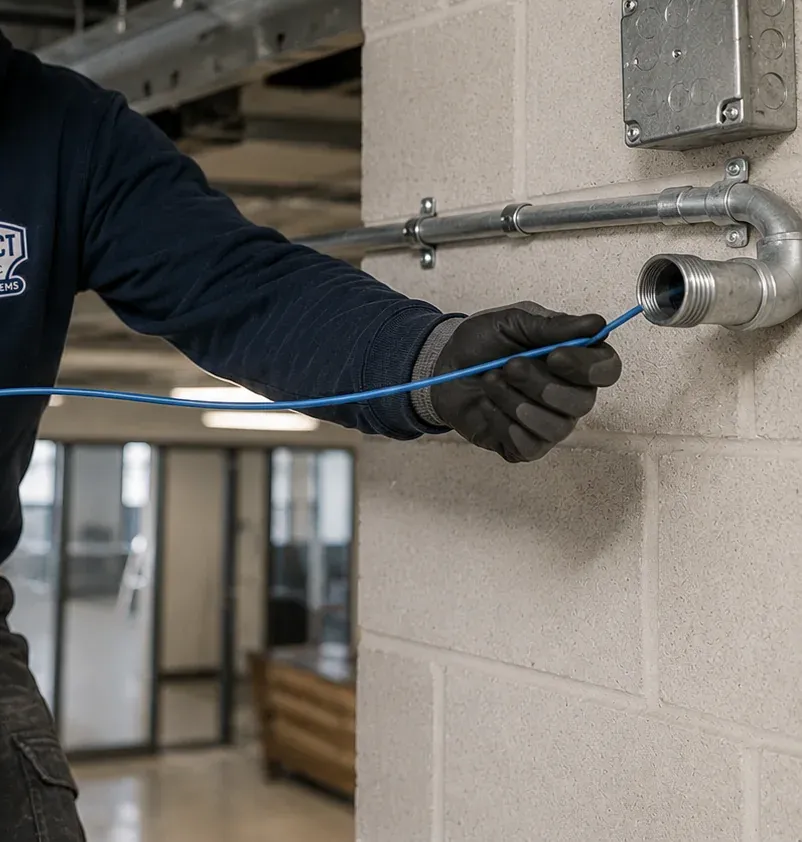
A gloved hand feeds a thin blue cable into the open end of a metal conduit elbow fixed to a pale concrete-block wall; a steel junction box sits higher on the wall and an office corridor is visible in the background.
Commercial Cat6 Repair
Business Cat6 Repair in St. George
Six streets and stretches account for most of the business addresses in the neighbourhood. Naming them describes where the work is; it does not mean we have worked inside any particular building on them.
Stuyvesant Place
The back door of the civic centre: the entrance to Borough Hall, the Judicial Center at 130 with the County Clerk and District Attorney, and smaller buildings along the rest of the block. Court-related offices here run on early mornings, which is when we try to finish.
Richmond Terrace
The harbour-facing civic row from Borough Hall past the 1919 courthouse and the landmark 120th Precinct station house, then on toward the ballpark and Empire Outlets. Offices along it share the waterfront’s wind and weather on their exposed sides.
Central Avenue
Home of the 2015 courthouse at 26 Central Avenue and the St. George Library Center at number 5, with offices and apartments climbing toward the hill. Suites near the courthouse tend to be small and to depend on two or three critical desks.
Bay Street, Ferry to Tompkinsville
From the terminal’s front door past 60 Bay Street — where Staten Island Legal Services lists its suite — toward Tompkinsville, a run of office buildings, storefronts, cafés and bars. Counter terminals, kitchen printers and upstairs offices all ride on Cat6 here.
Hyatt Street and Wall Street
Short streets near the rear steps of Borough Hall, with the St. George Theatre at 35 Hyatt Street and smaller office and mixed-use buildings. In buildings of that size an office is often a single floor, with its network on a wall-hung panel in a closet.
The Waterfront at the Terminal
Lighthouse Point’s commercial floors, Empire Outlets beside the terminal and the businesses that serve the ferry crowd. Newer cabling, heavy foot traffic, and fit-outs that change with every tenant.
Permits, code sections and building rules worth knowing first
No electrical permit for the low-voltage work itself: section 28-105.4.7 of the New York City Administrative Code says an electrical permit is not required to install, alter, maintain or repair wiring designed to operate below 50 volts for signalling, communication, alarm and data circuits, provided a licensed master electrician, special electrician or qualified person does the work. Cat6 repair falls in that group; any power outlet or circuit that has to move does not, and goes to a licensed electrician.
Abandoned cable: New York City’s Electrical Code builds on the national code, which says communications cable left disconnected and reachable must come out unless someone tags it as reserved. Where a ceiling holds three tenants’ worth of wiring, that rule settles which dead runs leave with each repair.
Separation from power: indoor communications cable has to be kept at least two inches from light and power conductors unless a listed barrier or raceway separates them — the reason a repaired run is never cable-tied to an extension cord or a lighting whip.
Distance from light fixtures: the pathway design tables built on TIA-569, as published by electrical distributors such as Elliott Electric, give twelve inches of separation between unshielded data cable and fluorescent lighting. It is a design guideline rather than a code requirement, and we use it when re-hanging bundles above an office ceiling.
Landmarked houses: the Landmarks Preservation Commission’s guidebook says interior work in a historic-district house needs an LPC permit only when it also needs a Buildings permit or changes the exterior. An inside Cat6 repair normally needs neither; a new cable or box on the outside of the house is a different conversation, and we raise it before anything is fixed to a facade.
Building rules: office landlords and co-op boards often require insurance certificates, sign-in and set working hours. Send us the building’s contractor rules with your request and we will work to them.
These are plain-language summaries for planning a repair, not legal advice.
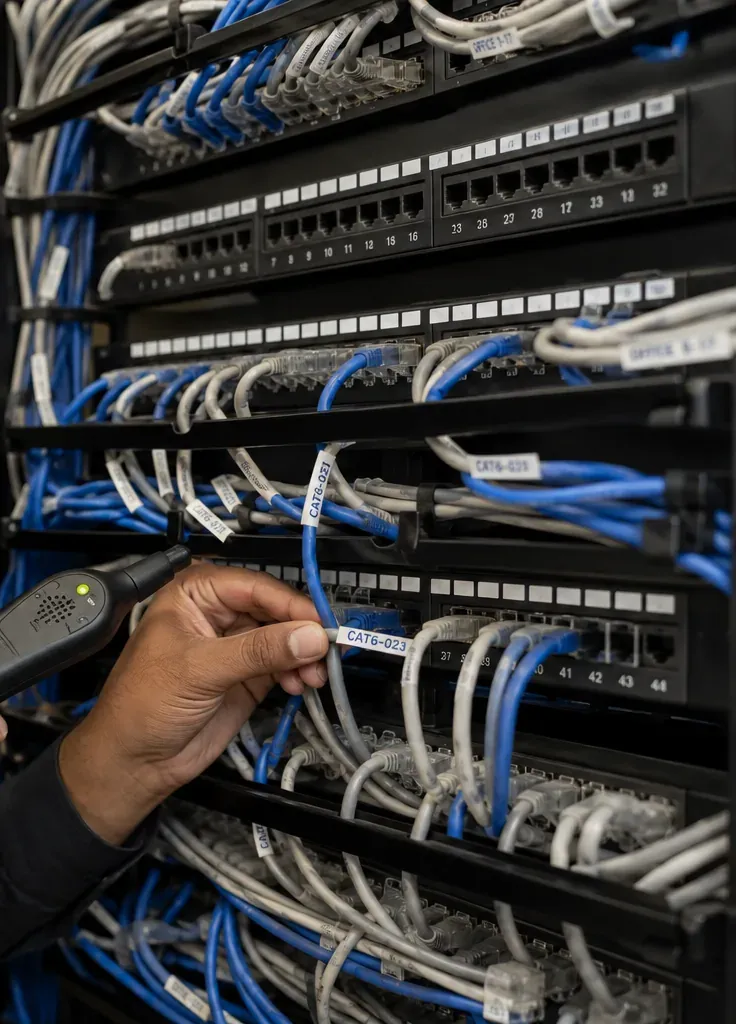
Tracing in a busy rack: the tip of a dark probe touches a single labelled blue cord among rows of numbered panels packed with white and blue patch leads.
Your Questions Answered
Cat6 Repair in St. George: Questions Answered
Nine problems we hear about again and again in this neighbourhood, sorted into office suites, converted buildings and hillside houses. The first sentence of every answer is the quick verdict; the rest explains it.
Suites in the civic-centre office buildings
Every computer in our office plugs into the back of a desk phone — why does the computer go offline whenever its phone does, and is one Cat6 run to blame?
Usually the cable is fine and the chain is the weak point. Most office IP phones have a second network port so a computer can share the phone’s single wall connection. The phone acts as a tiny switch, and when it reboots, updates its software or loses power, everything behind it goes dark with it. Cisco’s own community forum puts it plainly: when a phone reboots, the computer loses its connection because the phone’s PC port has no bypass. So a desk where both devices drop together is first a question about the phone, and only second about the Cat6.
That said, a chained desk does put more weight on one run. If the wall jack, the cord or the panel port is marginal, both devices suffer, and because the phone is usually powered over the same cable, a run with high resistance can let the phone brown out and restart under load. We test the run on its own first. If it certifies cleanly, the fix lies in the phone, its power or its settings; if it fails, we repair it and then decide with you whether the desk should keep sharing.
Where the suite has spare runs, the most robust answer is to give the computer its own Cat6 back to the panel. In older buildings around the courts, desks often have a second jack that was installed for a fax line or a previous tenant’s layout and never used; we test those, and if they pass, re-patching them costs a few minutes rather than a new cable.
Some of the “Cat6” in our office walls turns out to be the grey, floppy kind used for patch cords — does that explain the slow and flaky rooms?
Very often, yes. Patch cord is made from stranded conductors so it can bend thousands of times. The cable inside a wall is meant to be solid copper. Fluke Networks notes that stranded cable shows 20 to 50 percent more attenuation than solid conductors — 20 percent at 24 AWG, 50 percent at 26 AWG — and has higher DC resistance, and that TIA and ISO standards require solid conductors for the horizontal permanent link, limiting stranded cable to about ten metres of patch cords in a 100-metre channel.
A short run of patch cable through one wall may still pass. A long one, pulled from a box of cord because it was what was on hand, eats the link’s whole loss budget and often cannot be terminated properly on a wall jack, because punch-down contacts are designed to bite solid wire. The results are links that negotiate at the wrong speed, drop under heavy traffic, or overheat their plugs when they also carry power to a phone or camera.
The tester tells us quickly: the length, the insertion loss and the resistance of a stranded run look different from solid cable of the same length. The repair is to replace that run with proper Cat6 and terminate it on matched hardware. Where the stranded cable is in an accessible ceiling it is usually a single replacement; where it was fished through a wall, the old cable often serves as the pull line for the new one.
The Cat6 above our suspended ceiling lies right on top of the old fluorescent light fixtures — could the lights be what keeps knocking desks off?
It can contribute, and it should be moved regardless. Twisted-pair cabling rejects a good deal of electrical noise, which is why many bundles lying on fixtures still work. But the pathway tables derived from TIA-569, as published by distributors such as Elliott Electric, call for twelve inches of separation between unshielded data cable and fluorescent lighting, and forty inches from transformers and motors. Ballasts that are failing get noisier, and a bundle resting on a fixture also gets warm and is disturbed every time someone changes a tube.
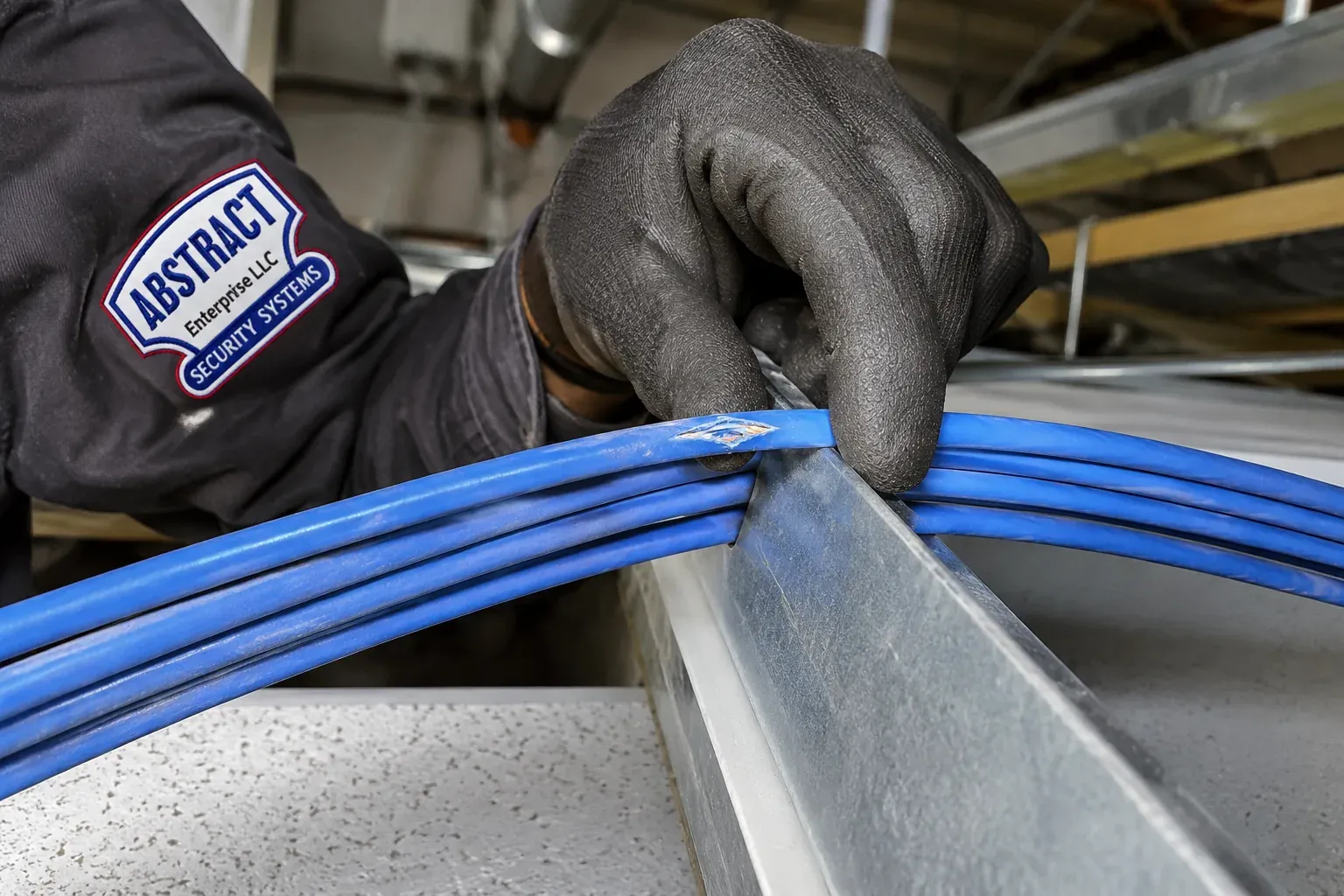
In practice, the light fixture is more often the scene of the crime than the cause. Cable laid across fixtures was usually installed without supports, so it sags across the grid, gets pinched where tiles are pushed back into place, and takes a kink wherever an electrician lifted it to reach a ballast. When we find a bundle on the lights, we test every link in it, because the damage is rarely limited to the desk that complained.
The repair is to lift the bundle onto proper supports fastened to the structure above the ceiling, route it clear of fixtures and power whips, replace any link that fails, and retest the rest after the move. If an LED retrofit is planned, it is worth doing the cable work at the same visit, before a lighting crew handles the bundle again.
One practical note for suites near the courts: after a bundle is lifted off the lights, some desks may come back faster or more reliably than they have in years, because cables that were barely passing have been replaced or relieved of strain. That is normal, and it is the reason we certify the whole bundle at the end rather than only the link that prompted the call. The saved results show you, link by link, the before and after.
The run to our conference table crosses a doorway under the carpet — can people walking over it be what keeps breaking that link?
Yes; foot traffic, chair casters and door saddles are hard on cable that was never meant to be walked on. Every step flexes the pairs and squeezes the jacket against the floor. Over months, the twist inside the cable loosens and the pairs shift, which shows up on a tester as poor return loss and crosstalk at the point where the run crosses the doorway. Eventually the conductors fracture, and the link drops whenever someone stands in the wrong place.
The tester places the damage by distance, so we can tell you whether it is under the threshold, under a chair mat or somewhere else entirely. A section that has been trodden flat cannot be restored; the run has to be replaced, and the real question is where the new one should go.
The better routes are usually overhead and down a wall, through the ceiling into a power pole or table grommet, or along the base of the wall in raceway. Where none of those works, low-profile floor cable cover rated for foot traffic is better than bare cable under carpet, but it is still a compromise and we will say so. We re-terminate at the table end on a proper box rather than leaving a loose plug in the carpet.
Our firm’s network gear hangs on a plywood board with the cables hanging off the patch panel by their own weight — can that cause ports to fail?
It can, and it is one of the most common causes of ports that fail one after another. A punch-down is a mechanical joint. When a few dozen cables hang off the back of a wall-mounted panel with nothing taking their weight, the terminations are under constant strain. Each time someone opens the closet, moves the shelf or pulls a cord, the strain changes. Conductors creep out of their contacts, and pairs untwist further than they should right at the back of the panel.
The pattern is easy to spot on test results: the failures cluster at the panel end, often on the outermost ports where the cable bends most sharply, while the same runs test cleanly from the desk end. Re-punching the ports without supporting the cables only buys a few months.
We re-support the bundle first — a cable manager, a wall-mount bracket or a small swing rack where the closet allows — then remake the failing terminations with service loops dressed so nothing pulls on the panel, shorten and replace the tangle of patch cords, and test every port, not only the ones that had failed. In small St. George offices where the closet doubles as storage, we add a simple label on the door explaining what not to hang on the panel.
If the closet has no room for a rack at all, a hinged wall bracket is often enough: it holds the panel and switch away from the wall, takes the cable weight on a proper support, and swings out so the back of the panel can be reached for future repairs without disturbing every termination on it. We will tell you which option the space allows before ordering anything.
Converted buildings on Bay Street and around the courts
Our office takes two floors of an old building and a single Cat6 run up the stairwell joins them — how do we stop one failure taking the upper floor offline?
Test the run, repair it properly, and then give it a partner. In older buildings along Bay Street and the side streets, a firm that expands upstairs is often connected by one cable run up the stair hall or through an old chase, feeding a small switch on the second floor. Everything upstairs then hangs on that one link and on the two connections at its ends.
We certify the link first. A riser run that has been pinched by a stair tread, stapled to a stringer or crushed behind a radiator cover will show where the damage lies. Where a short section is damaged in an accessible spot, the run can be replaced along the same path; where the old route is unsafe, we propose a new one, ideally through a closet stack, and price it before anything is pulled.
Because replacing a riser run is the same amount of work whether you pull one cable or two, we nearly always recommend pulling a second Cat6 alongside the first. It costs little extra and turns a future failure into a five-minute re-patch instead of a day without the upper floor. For longer or more exposed paths, fiber between floors may make sense; our St. George fiber installation team can price that alongside.
We pay for a backup internet line, but when the main service went down the backup never took over — could its Cat6 be the problem?
It is one of the first things to check, because nobody ever tests it. A second internet service only helps if the link between its box and your firewall or router works on the day it is needed. In many offices that cable was run when the backup service was installed, plugged in, and never looked at again. A run that is damaged, plugged into the wrong port or terminated badly will sit unnoticed for years and then fail the moment the main line drops.
We trace both handoff cables from each provider’s equipment to your network gear, label them, and certify the links. If the backup’s cable passes, the fault lies in how the firewall or router is configured to switch over, and that belongs to whoever manages your network; we hand over the test results so they can see the cabling is not the problem. If it fails, we repair it and leave the two lines clearly marked so nobody swaps them during a future clean-up.
If your IT person agrees, it is worth unplugging the main line for a minute after the repair, while we are still on site, to confirm the backup takes over. That one test is the only way to know.
Houses on the hill
Our practice is in a Victorian house on the hill, and the Cat6 to the front rooms runs through the crawlspace under the porch — what goes wrong under there?
Damp, animals and the porch itself. The space under an old porch is outside in everything but name. It is open to the weather through the lattice, it collects leaves and water running off the hill, and it is a favourite shelter for animals. Indoor-rated Cat6 run through it, often simply laid on the ground or stapled to a joist, picks up moisture, gets chewed and gets crushed when someone crawls in to fix the porch.
The faults show up as links that worsen in wet weather, plugs and jacks at the house end that corrode first, and occasionally a run that has been bitten through. The tester shows the distance to the damage, which tells us whether it is under the porch or inside the house walls.
When a run has to cross that space, we replace it with cable suited to damp locations, carry it in conduit or support it off the ground and away from the porch framing, and seal the hole where it re-enters the house. Where the house allows, a route through the cellar and up an interior wall avoids the porch entirely; we compare the two before recommending one.
The wall jack under one of our old wood windows keeps failing after storms — is rain getting to it, and what is the repair?
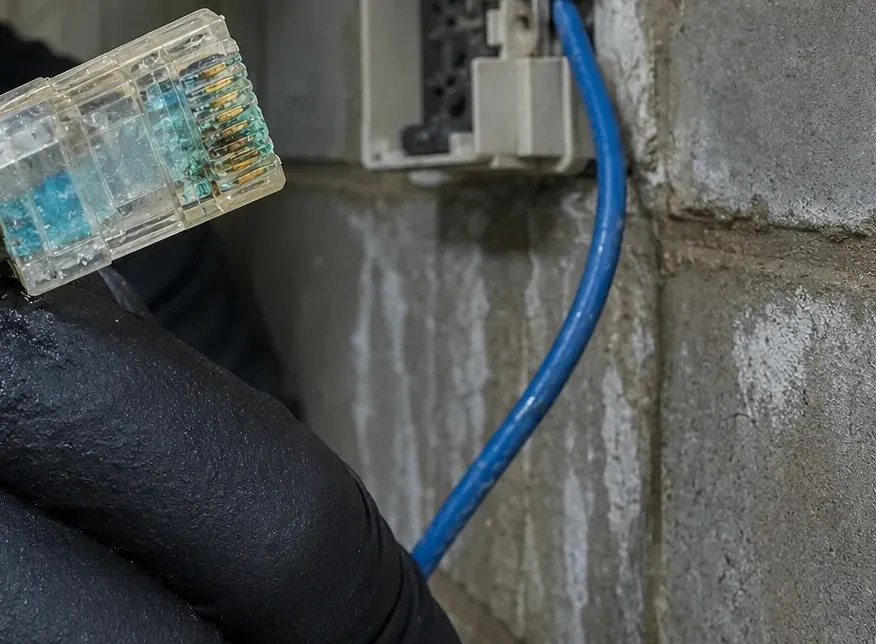
Quite possibly. Old double-hung windows on the harbour-facing side of a hillside house take wind-driven rain, and water that gets past a worn sill or failed caulk runs down inside the wall. A jack box mounted in the cavity directly below the window sits in its path. The first sign is often green or dark contacts on the jack, and a link that is fine in dry weeks and poor after a storm.
We open the jack, look at the contacts and the cable behind it, and test the run. If only the termination has corroded, we cut back to clean copper and re-terminate on new hardware. If water has wicked along the cable, the damaged length has to be replaced, and moving the jack to a stretch of wall away from the window is usually the better repair.
The cable work does not fix the window. We will tell you what we saw so a carpenter or window restorer can deal with the leak, especially in a historic-district house where window work has its own rules.
A gloved hand holds up a clear RJ45 plug whose contacts and nearby sheath are crusted green and blue, beside a surface-mounted jack on a stained grey block wall with a blue cable running down from it.
Layers of Old Work
What Each Previous Tenant Tends to Leave in a St. George Ceiling
When we lift the tiles in a suite near the courts, the cabling above usually reads like a timeline. Knowing what each layer looks like tells us quickly which runs are worth repairing and which are only taking up space. The table describes common patterns in office buildings of this age; it is a guide to what we look for, not a description of any particular building.
What you find
Where it usually came from
What it does to a Cat6 repair
Thick grey multi-pair telephone cable and old punch blocks
The original phone system, long before data networks
Not usable for data. Often still connected to nothing; candidates for removal where accessible, once confirmed dead.
Blue or grey Cat5 or Cat5e runs with faded labels
An early network fit-out for a previous tenant
May still carry a desk. Tested like anything else; a passing Cat5e link is kept if it serves its device, replaced if it limits it.
Cat6 runs that end in a coil above the ceiling
A fit-out for a layout that was later changed
Often perfectly good cable; can be re-terminated to serve a new desk position instead of pulling new cable.
Grey stranded patch cable used as a wall run
A quick fix by whoever was on hand
Fails certification on long runs; replaced with solid Cat6 (see the questions above).
Small switches hidden above tiles or under desks
Extra desks added without new runs
A common source of whole-area outages; we note them and recommend proper runs back to the panel.
Cable lying loose across fixtures and grid
Any of the above, installed without supports
Tested link by link; re-hung on proper supports clear of lighting.
Bundles cut off flush at a wall
A demolition crew during a renovation
Usually beyond saving; confirms which old jacks are now dead ends.
The National Electrical Code requires accessible abandoned communications cable to be removed unless it is tagged for future use. In a suite with this much history, that is not just tidiness: every dead bundle removed makes the next repair faster and the ceiling safer. We price removal separately so you can decide how far to go.
How we tell the live runs from the dead ones
Every port on the patch panel is tested and, where unlabelled, toned to the jack it serves. Every jack in the suite gets a matching test from the other end. A run that connects a used jack to a used port is live; a run that reaches a port but no jack, or a jack but no port, is abandoned or broken; and cable that reaches neither is a candidate for removal. The result is a single sheet listing each room, jack, port and test result, which most firms here have never had.
Damage you can see: blue cables forced over a hard galvanised edge above the ceiling, a gloved hand on top of them and a pale scuff where the outer cable’s jacket has worn.
Equipment
Tools and Parts on a St. George Cat6 Repair Visit
The van is stocked for office suites and older houses at once, because a single visit in the neighbourhood can involve both.
Certification Tester
Puts every link through the full Category 6 or 6A test suite, from pin-out and length to loss, crosstalk, echo and resistance, then tells us how many feet away the problem is. You keep the files.
Toner and Probe
Finds which unlabelled cable at a crowded panel belongs to which desk, and which bundle above the ceiling is still connected to anything.
Cat6 and Cat6A Termination Hardware
Keystones, panel modules and surface boxes in both categories, so a repaired link is never downgraded by the part used to fix it.
Solid-Conductor Cable
Riser and plenum Cat6, plus Cat6A where the existing link is 6A, for replacing patch-cord runs, trodden sections and runs that cannot be saved.
Factory-Made Patch Cords
Several lengths and colours, so a tangle of hand-made or overlong cords at the panel can be replaced on the spot.
Cable Supports and Managers
Hangers, hook-and-loop ties, horizontal managers and wall brackets to lift bundles off light fixtures and take the weight off a hanging panel.
Raceway and Floor Covers
Low-profile surface raceway for lofts and plaster walls, and traffic-rated floor cover where a run cannot avoid a walkway.
PoE Load and Link Checks
For phones, cameras, readers and access points: confirming the cable delivers power without dropping too much voltage before blaming the device.
Labels and Documentation
Printed labels for both ends of every link touched and a written room-to-port list, so the next problem is a phone call rather than an afternoon.
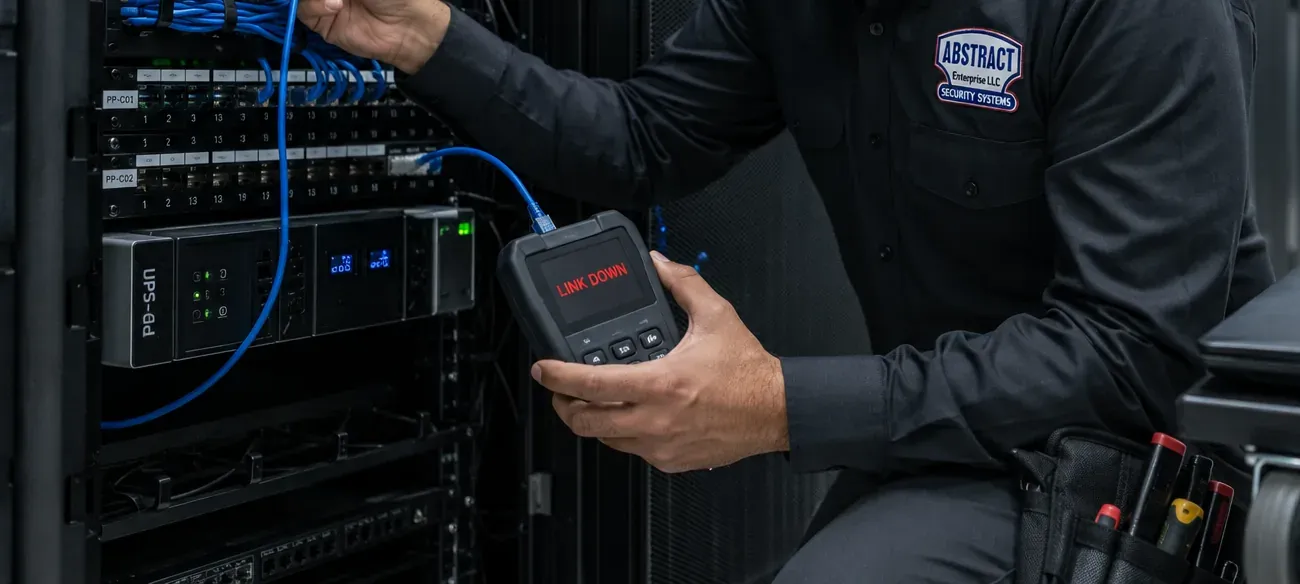
A technician in a dark work shirt holds a handheld tester with a red LINK DOWN message while a blue cord runs from it up into a switch in a black network rack; a rack-mounted UPS sits below the switch.
AI Overview Reality Check
What AI Gets Wrong About Cat6 Repair in St. George
A word on method first: our research tools could not load Google’s AI-generated answers, so we have not put words in its mouth. The seven claims below are ones that cost calculators, cable sellers and online forums publish over and over — exactly the material such summaries are built from — each followed by what a court-side office or a hillside house actually shows us.
“A Cat6 repair needs an electrician and a permit”
This claim turns up whenever cabling is described as “electrical work”. In New York City it is not quite right. Section 28-105.4.7 of the Administrative Code says an electrical permit is not required to install, alter, maintain or repair wiring that operates below 50 volts for signalling, communication, alarm and data transmission, provided the work is done by a licensed master electrician, special electrician or a qualified person under the Electrical Code.
Cat6 repair sits squarely inside that group. What does need an electrician is anything on the power side: moving an outlet so a desk can sit where the new jack is, fixing a lighting circuit, or work on a phone system’s power supply. We point those out when we find them rather than touching them.
Building rules are a separate matter. A co-op board, a landlord or the management of an office building can still ask for insurance certificates, a written scope or set working hours, and in a landmarked house anything fixed to the outside can need a Landmarks permit. Those are the real paperwork questions in St. George, not an electrical permit for the cable.
“A patch cord is a patch cord — any Ethernet cable will do in the wall”
Forum answers often treat all Ethernet cable as interchangeable. Fluke Networks’ guidance is clear that it is not: stranded cable shows 20 to 50 percent more attenuation than solid copper, has higher resistance, and the standards require solid conductors for the horizontal link, keeping stranded cable to about ten metres of cords in a channel.
Where it turns up in a wall, it is usually in a suite that was re-arranged quickly between tenants, with whatever cable was on hand. It is the right cable for the last few feet to a desk and the wrong one for the forty metres back to the panel.
The difference rarely shows on a simple continuity tester, which only checks that the wires connect. It shows clearly on a certification tester, and it is the reason a link can “test fine” with a cheap tool and still run badly.
“If the cable tester lights up 1 through 8, the cable is good”
Inexpensive testers that flash a light for each conductor are useful for catching a cut wire or a reversed pair. They are often described as if they prove a cable is good. They do not measure crosstalk, loss, return loss or length against Category 6 limits, and a run with split pairs or stranded cable can light every lamp and still fail at speed.
When a cable has already “passed” on one of these, a certification test can still turn up what it cannot see: a pair split at one end, a crushed section, or a stretch of the wrong cable.
That is why every St. George repair starts and ends with certification. The saved result is the only proof that a link is Category 6 in fact as well as on the faceplate.
“Just replace the cable — repair is a waste of money”
Some summaries suggest that any failing Ethernet link should simply be re-run. In a 1960s office building with an accessible ceiling and a nearby closet that can be true. In a suite where the run passes through a fire-rated wall, or in a hillside house where it was fished through finished plaster, a blanket re-run can cost far more than it needs to.
Most of the faults we find in St. George are at the ends: a bad punch-down, a strained panel port, a corroded jack, a worn cord. Those are repaired in minutes, and the cable between them is perfectly good. The tester tells us which case we are in before anyone decides.
Where replacement is the right answer — stranded cable, a trodden section, a run chewed under a porch — we price it per run before pulling anything, and often use the old cable as the pull line for the new one.
“Office Wi-Fi is good enough now; wired desks are outdated”
It is common to read that modern Wi-Fi makes office cabling unnecessary. Wi-Fi has improved enormously, but every access point still needs a cable back to the switch, and the desk phones, copiers, card terminals, cameras and door readers in a typical St. George suite still use one.
Office buildings also put many neighbouring suites’ networks within range of each other, and the desks that cannot afford a dropped call or a failed upload are the ones that benefit most from a tested wired link.
Our approach is practical: we repair the cabling that the office actually depends on, check the runs feeding its access points, and leave decisions about the Wi-Fi itself to whoever manages it, with the test results in hand.
“Expect to pay a national per-drop average for a fix”
Fixr’s January 2025 guide gives $125–$250 per new Cat6 drop and $45–$75 an hour for labour as national averages. Those figures are often quoted as if they were repair prices. They describe new installations around the country, not finding and fixing a fault in an occupied office in New York City.
Our published figures are on this page: $195 an hour with a three-hour minimum for repair time, from $175 for a run that has to be replaced, and from $185 for an exterior entry made good. They are the same figures we publish elsewhere on Staten Island.
The more useful number for a St. George office is the cost of a morning without its network. A repair visit scoped from photos and a phone call, done before the office opens, usually costs less than one lost morning.
“Keep data cable away from power and you will never have interference”
Separation from power is a real rule — indoor communications cable must be kept two inches from light and power conductors unless they are separated by a barrier or raceway. Summaries sometimes stop there, as if that were the only thing to avoid.
Pathway tables based on TIA-569 also call for twelve inches from fluorescent lighting and forty inches from transformers and motors. In St. George offices the lighting is the one we meet most: bundles laid straight across fixtures by a previous fit-out.
Equally important is everything that is not electrical: weight on a panel, foot traffic over a doorway, damp under a porch, a leaking window. Those cause more of the failures we repair here than interference does.
Get the Suite Back Online Before Your First Appointment
Give us three things — the desks that are dead, the closet or board where the switch sits, and whatever happened just before. Before anything is booked you will know what the visit includes and what it costs.
Whether it is two desks above a Hyatt Street shop or a hall jack in a St. Marks Place house, a few lines here get you a written answer the same working day. Would rather speak to someone? Dial (347) 934-8335.
✅
Thanks — Request Received
A technician will phone you back today or on the next working day; if a desk or a register is down right now, call (347) 934-8335.
How It Works
Our Cat6 Repair Process in St. George
Seven steps, whether the job is one desk on Central Avenue or a full panel in a Bay Street suite. The visit is planned to finish in one trip and to keep your downtime to an agreed window.
1. A call about the space and the schedule
Office, shop or home; which floor; how many desks or devices are affected; what changed before it failed; and when the network can be down without hurting anyone.
2. Photos of the panel and one bad jack
A picture of the closet or wall board and of a failing jack lets us bring the right hardware, cords and cable, and tells us whether we are looking at one fault or a suite-wide pattern.
3. Building rules sorted before the day
Insurance certificate, sign-in, working hours and access to locked closets arranged with the landlord or managing agent, so the technician is not kept waiting in the lobby.
4. Test from both ends
Every suspect link certified from the panel and from the jack, faults placed by distance, unlabelled runs toned, and live runs separated from abandoned ones.
5. Agree the fix, link by link
Link by link we choose between a new termination, a new cord, proper support, a different route or a new run, and you approve the price of any cable and the minutes of downtime before work starts.
6. Repair with matched parts
Solid Cat6 or Cat6A cable, hardware of the same category, bundles lifted clear of lighting and power, panels supported, and accessible abandoned cable removed where you agree.
7. Certify, label and hand over
Each repaired link is certified one last time; you get printed labels on both ends, a sheet matching rooms to ports, and the electronic test files to pass to your IT provider.
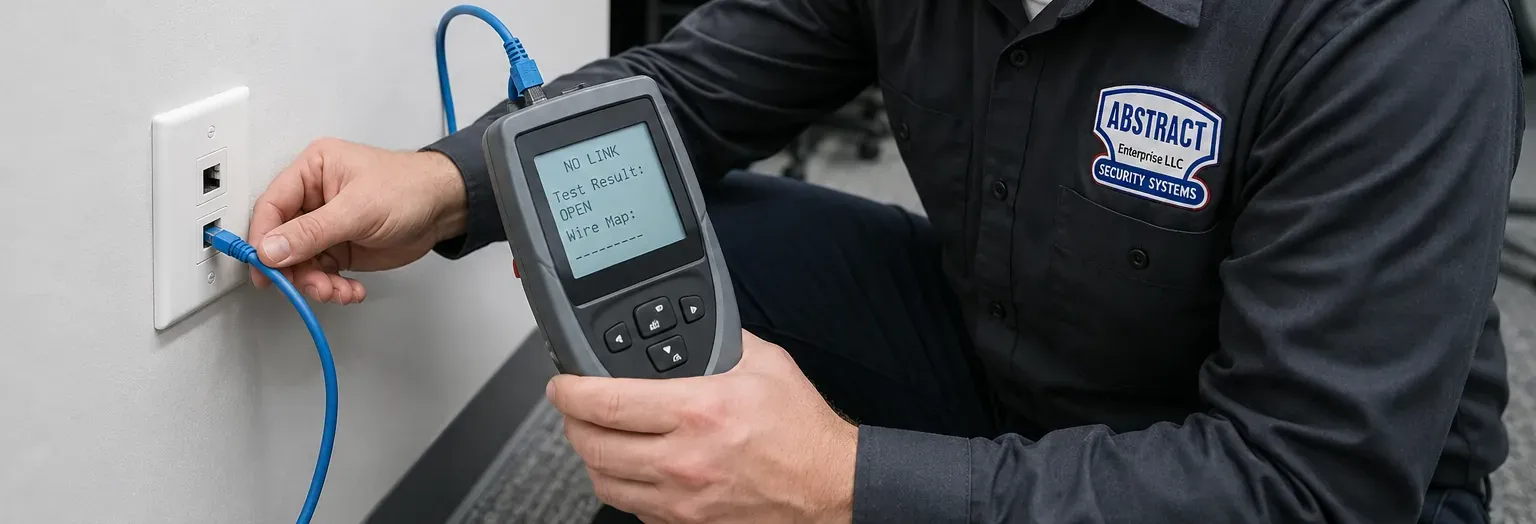
Testing at the wall: a blue lead is pushed into the bottom socket of a two-port faceplate, and the grey meter held below it displays NO LINK.
Coverage Area
Cat6 Repair Near St. George’s Landmarks
Six places everyone in the neighbourhood knows make it easy to say where a job is. They are reference points only; naming them says nothing about work inside them.
Staten Island Borough Hall
Completed in 1906 to designs by Carrère and Hastings at 10 Richmond Terrace, across from the ferry terminal, with its entrance on Stuyvesant Place. Besides the Borough President’s office it houses borough offices of the Departments of Buildings and Transportation.
Courthouse at 26 Central Avenue
Opened on September 28, 2015 on a hilltop overlooking the harbour: about 184,000 square feet and fourteen courtrooms for the Supreme Court’s civil and criminal parts and the lower Criminal Court, designed by Ennead Architects.
120th Precinct Station House
The neo-Renaissance station house at 78 Richmond Terrace, clad in terra cotta made to look like limestone so it matched the neighbouring 1919 courthouse, and designated an individual landmark in June 2000. The precinct serves the North Shore.
St. George Terminal
The city-built ferry terminal opened in 1951, with four bus ramps and the northern end of the Staten Island Railway. Everything in the neighbourhood, including our arrival times, is shaped by the boat.
St. George Theatre
The 1929 movie palace at 35 Hyatt Street, with about 1,900 seats today. Hyatt Street meets Stuyvesant Place at the rear steps of Borough Hall, a few minutes’ walk from the courts.
Lighthouse Point
The newest landmark on the waterfront: a first phase of 115 apartments and 60,000 square feet of commercial space on the old lighthouse depot site beside the terminal, with tenants including the College of Staten Island Tech Incubator.
We also repair Cat6 in Tompkinsville, New Brighton, Fort Hill, Randall Manor, Stapleton, Stapleton Heights, Grymes Hill, Livingston and West Brighton, and across the rest of the borough through our Cat6 repair page for all of Staten Island.
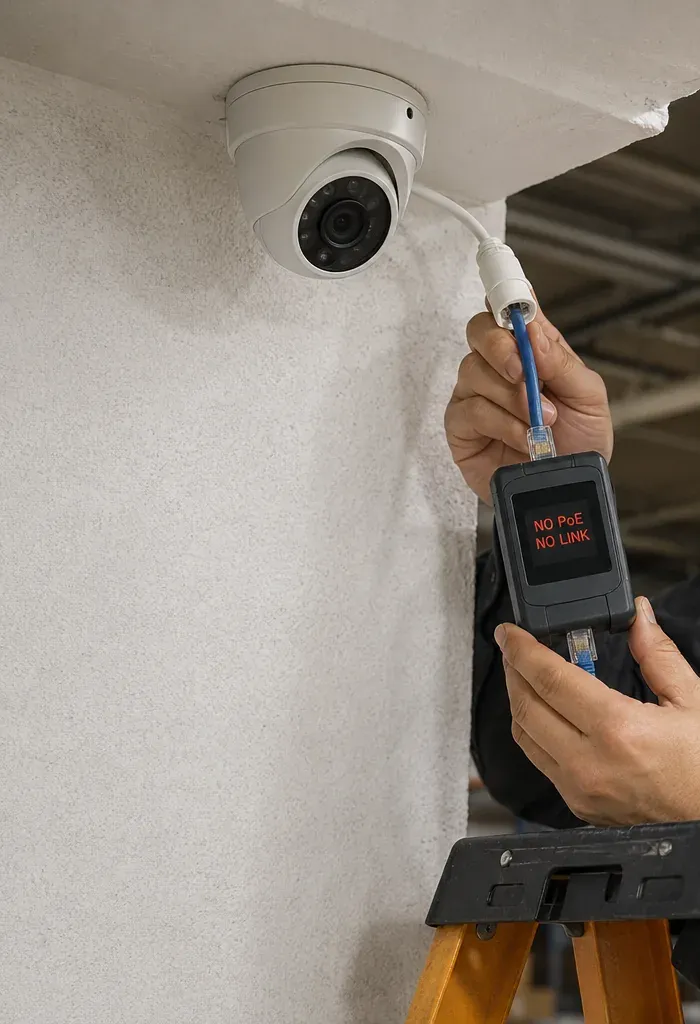
A white dome camera is fixed under a ledge on a textured white wall; its short cable runs down into a black handheld tester whose screen reads NO PoE and NO LINK, held by a technician standing on a step ladder.
Pricing
Cat6 Repair Cost in St. George
No neighbourhood surcharge and no new numbers: this table repeats what we already publish for the island. A St. George invoice has two moving parts — time on site and any cable we have to pull — and the quote keeps them apart.
Item
Price
What it covers and where it is published
Time on site for Cat6/Cat6A faults — certification, toning, new terminations and cords, panel support, final test
$195/hr, 3-hour minimum ($585)
Published island rate; as many links as fit into the hours booked
Hours after the first three
$195/hr
Charged by the hour at the same rate
New Cat6 pulled to take the place of a run that fails
From $175 per drop
Price includes the cable, the jack and plate, the panel termination, certification, two labels and one cord
Hole through a wall or floor sleeved, sealed and bonded, with a drip loop outside
From $185 per penetration
Island published price, counted per hole
Yardstick: what a fresh Cat6 install costs per outlet (runs to 100 ft)
$296 per drop
Taken from our island install pricing, where Cat5e is $254 and Cat6A $424 — listed here only so repair and new work can be weighed side by side
Getting to St. George
No separate charge
No bridge or travel line on the invoice; we plan to finish in a single visit
Removing abandoned cable, long reroutes, early-morning or after-hours starts
Quoted after testing
Depends on the suite, the building’s rules and how much old cable there is
Inside the $585 minimum: a morning in a small law office
Picture a five- or six-desk firm a block from the courthouse. The minimum block normally pays for a full sweep of the panel and the failing desks, toning of whatever is unmarked, new terminations where the old ones are poor, fresh cords where the old ones are tired, a bracket under a sagging panel and a certificate for each fixed link. Anything bigger — a patch-cord run to replace, a bundle to lift off the lights — is priced from the table and approved first, and spare minutes go on the next links on your list.
One price list for the whole island
A neighbourhood page is the wrong place to invent a new tariff, so St. George pays exactly what the rest of the island pays: the hourly repair rate and the per-run replacement price above. Where two jobs differ is in the cable count and the difficulty of the route, and that is what the written figure after testing spells out.
What moves a St. George bill up or down
How many generations of cable are in the ceiling: one clean layer is quick to test; three layers take longer to sort before any repair begins.
Whether the faults are at the ends: panel and jack faults are fast; a run of patch cable through a finished wall is not.
Building access: a landlord who needs a certificate, an escort or a booked freight lift adds time to the day, not to the materials.
When the work can happen: starting before an office opens is often possible; it has to be arranged in advance.
Powered devices on the run: links that feed phones, cameras, door readers or access points get an extra loaded-resistance check, which adds a few minutes each.
A note on numbers you may see elsewhere: the cost guide Fixr put out in January 2025 lists $125–$250 for a new Cat6 drop including materials and $45–$75 an hour in labour. Those are averages for new installs nationwide, compiled by someone else; they are neither our prices nor a measure of what fault-finding costs.
Full terms — including 50% deposit, one-year parts-only warranty on AESS-supplied products, and the late-fee schedule — are set out in the service agreement.
Shop Our Systems
Cat6 Repair Packages & Pricing
Most St. George calls end up looking like one of these three, and each one is built only from prices you can already find on our site.
Starter — Desks Back by Opening Time
$585
Three hours on site, billed at $195 an hour. We test the dead desks or devices from the panel and from the wall, remake poor ends, swap tired cords, untangle phone-to-computer chains and certify each link we fix; any time left is yours to point at other jacks.
Standard — Inherited Suite Audit and Repair
$195/hr after the first 3 hours
For a suite with a previous tenant’s cabling: every panel port and jack tested and mapped, live and abandoned runs separated, failing links repaired, the panel re-supported and re-labelled, and a written estimate for anything that needs new cable.
Premium — Replace the Weak Runs
Repair time + from $175 per run
Patch-cord runs, trodden sections and the floor-to-floor link replaced with solid Cat6 from $175 per drop, a second riser cable added where it makes sense, penetrations made good from $185 each, and everything certified and documented.
Bring Your Own Parts — Labour Only
If your IT company has already stocked the closet with jacks, a panel or a reel, we will install them and charge for time only — provided they are right for the work: solid cable inside walls, hardware matching the link’s category, supports that can carry the weight. Certification is identical. The maker, not AESS, warrants parts you provide, and if they cannot produce a pass we say so before starting.
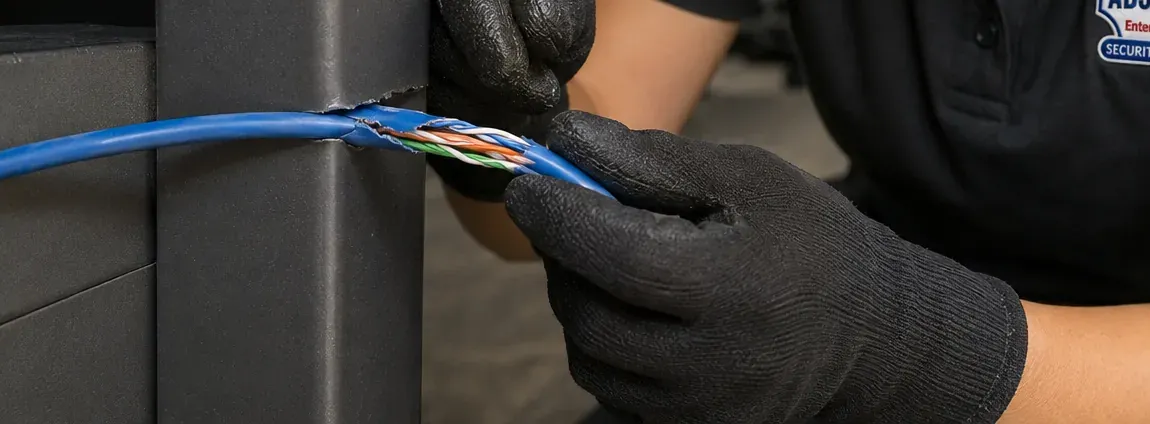
Two gloved hands hold a blue cable whose outer jacket has split open, exposing the twisted coloured pairs inside, right where it runs past the dark metal leg of a desk or table.
Moving Into a Suite Somebody Else Wired?
Send a photo of the panel and a rough sketch of where the desks will go. We will tell you what testing the existing cabling will involve, so you know what works before the furniture arrives.
Five-Minute Checks for a St. George Office Manager
None of these needs tools or opens anything. They often narrow the problem down, and sometimes they solve it before anyone is booked.
Check
What it tells you
What to tell us
Is the computer plugged into the back of a desk phone? Is the phone’s screen on?
A dark or rebooting phone takes its computer offline with it.
Whether the phone and computer fail together or separately.
Swap the desk’s patch cord for one from a working desk.
If the desk comes back, the cord was the fault and nothing else is needed.
Whether a cord swap changed anything.
Look at the panel or wall board: are cables hanging by their weight, or are cords pulled tight?
Strain at the panel causes ports to fail one after another.
A photo of the panel from the front and, if you can, the side.
Note what changed: new furniture, painters, a lighting job, a move, a storm.
Most failures follow a change; the timing points to the cause.
The date and what work was done nearby.
Check both internet boxes if you have a backup line: are their lights on, and is each cable plugged in?
A backup line that is unplugged or dark will never take over.
The make of each box and where its cable goes.
Look under the desk and at the doorway for cable crossing the floor.
Cable that is walked on fails in the places people step.
Where the cable crosses and whether it is covered.
If none of those changes anything, the fault is probably in the wall, the ceiling or the panel itself, and that is what the tester is for. Do not re-punch panel ports or move cables above the ceiling yourself; it tends to spread one fault into several.
Complete Services
Every Cat6 Repair Service in St. George
Cable faults rarely arrive alone. A suite may also need a camera swapped, a closet rebuilt, more jacks or a reader on the door, and these are the other AESS services that pick up where a Cat6 repair stops.
How our technicians tend to approach a suite near the courts (a description of routine, not an account of a particular customer)
We start at the panel even when only one desk is down. In a suite that has been re-fitted a few times, the failing desk is rarely the only weak link, and the panel is where the history of the space is written: which ports are labelled in which handwriting, which cables are a different colour, which ones hang loose.
We ask what changed. Painters, new carpet, a lighting retrofit, a weekend furniture move, a new phone system — almost every sudden failure follows a change, and knowing the date often points straight at the cause.
We test the phone separately from the cable. Desks chained through phones are common here, and separating the two saves a lot of wrong guesses on both sides.
And we leave the suite documented. A one-page list of jacks, ports and results turns the next problem into a phone call, and it is the first thing the next tenant, or your next IT provider, will thank you for.
Repair or Re-Cable
When a St. George Suite Should Be Repaired, and When It Should Be Re-Cabled
Most offices that call us want the failing desks back, not a project. Most of the time that is exactly the right answer. Now and then the test results say something different, and we would rather tell you before you spend money on a suite that will keep failing. These are the signals we weigh, and how each one usually points.
What the testing shows
Usually points to
Why
Faults only at the panel or the jacks; the cable between passes
Repair
Terminations and cords are quick to remake, and the copper in the ceiling is sound.
A handful of runs are stranded patch cable or trodden flat
Repair, replacing those runs
Priced per run; the rest of the suite stays as it is.
Most runs are Cat5e that certifies cleanly
Repair and keep
Passing Cat5e still serves desk phones, copiers and most computers; replace runs only where a device needs more.
More than half the runs fail, from many different causes
Discuss re-cabling
Repairing link by link can cost close to new cabling and leaves the suite’s weak layout in place.
The panel holds three generations of hardware with no labels
Audit first, then decide
The map tells you what is really there; sometimes the answer is a tidy repair, sometimes a new panel.
The layout is about to change for a new tenant or a renovation
Minimum repair now, re-cable with the fit-out
Spending on runs that will be moved in six months rarely makes sense.
When the answer is re-cabling, we hand the test results to you and, if you want, to our structured cabling crew on Staten Island to price the new layout. The audit is not wasted either way: it shows which existing runs can stay, and it is the document a landlord or the next tenant will ask for.
The one question we always ask before recommending a re-cable
How long you expect to stay. A firm that has just signed a long lease near the courts gets more value from a clean new layout than one that may move within the year. A homeowner who plans to stay on the hill for a decade gets more value from replacing a run under the porch properly than from a quick re-termination. We will give you the cost of both paths where there is a real choice, and the decision is yours.
Timing
Working Around the Court Calendar and the Ferry
Every neighbourhood has a rhythm, and in St. George it is set by two institutions: the courts on Central Avenue and Richmond Terrace, and the boat. Offices that serve the courts have mornings that cannot slip, shops and cafés on Bay Street and at the terminal are busiest when the ferry unloads, and the streets around the terminal are at their most crowded at the same times. We plan repairs to fit that rhythm rather than ask you to fit ours.
For offices, that usually means one of three windows. Some repairs can start before the office opens, so that desks are tested and repaired before anyone sits down. Others are better split: testing and tracing during the day, which disturbs nobody, followed by the few minutes of real downtime — re-punching a panel, swapping a riser run — at an agreed moment in the afternoon. And a few jobs are best done when the office is closed altogether, such as re-hanging a full ceiling bundle or replacing a panel. We will suggest the window that fits the work, and you choose.
For shops and restaurants, the order is reversed. The counter terminal and the kitchen printer have to work during service, so we test them first, repair anything critical before the busy period, and leave longer work for a quiet hour. In homes on the hill, the timing is simply whatever suits you; the only planning we ask for is access to the cellar, the panel or the attic.
Whatever the window, the downtime is agreed in advance and announced before it starts. If something during the repair means the network will be down longer than planned, the technician tells you before it happens, not after.
Full Service List
Every Cat6 Cable Repair Service We Handle in St. George
The same crew handles every kind of Cat6 fault in the neighbourhood, from a single dead jack in a house on the hill to a full panel in an office suite by the ferry. In the trade’s own words, this is what that covers.
Diagnostics, tracing and fault finding
Cat6 cable troubleshooting and network cable diagnostics begin at the device that has stopped working and move back toward the panel, so the repair targets the fault rather than a guess. Ethernet cable troubleshooting separates the cable from the phone, the switch port, the patch cord and the computer. In suites where a previous tenant left nothing labelled, network cable tracing and Cat6 cable tracing come first: tone generator tracing and toner-and-probe testing match each unlabelled cable to its desk. Cat6 cable fault detection with a certification tester then shows whether a run is open, shorted, split or crushed, and how far along it the damage lies.
Cable repair and replacement
Damaged Cat6 cable repair covers runs crushed by furniture, cut by other trades, trodden flat under carpet or kinked over ceiling grid. Damaged Ethernet cable repair and broken Cat6 cable repair are matched to what the tester finds; where a section cannot be trusted, Cat6 cable replacement and network cable replacement swap the run for solid-conductor cable. Patch cord pulled through a wall is replaced as standard. Above suspended ceilings, Cat6 cable repair includes re-hanging bundles on proper supports, clear of light fixtures and power.
Connectors, jacks and wiring faults
RJ45 connector repair and RJ45 connector replacement deal with snapped clips, worn plugs and bad crimps. Cat6 connector repair, Cat6 cable termination and Cat6 cable re-termination remake the ends on hardware of the same category. Cat6 wall jack repair, Ethernet wall jack repair, data jack repair and Cat6 keystone jack repair bring dead wall and desk ports back. Cat6 wiring repair corrects split, crossed and reversed pairs and makes both ends match the same T568A or T568B scheme, finished with a clean Cat6 punch-down.
Patch panels, racks and clean-up
Cat6 patch panel repair and network patch panel repair remake loose punch-downs and dead ports; Ethernet patch panel troubleshooting maps which port feeds which desk. Network rack cable repair goes together with network rack cable management: re-supporting hanging cables, patch cord replacement, shortening and dressing cords, and network cable labelling at both ends. Network cable clean-up includes removing accessible abandoned cable where you agree.
Phones, cameras, readers and Wi-Fi
VoIP desk links are tested with and without the phone in the chain. PoE camera cable repair and security camera Ethernet cable repair start with a PoE check at the device; outdoor Cat6 termination repair protects connectors that face the weather. Cat6 cable repair for Wi-Fi access points checks the run feeding each ceiling access point before the access point is blamed. Runs to card readers, time clocks and sign-in kiosks are tested under power.
Offices, shops and homes
Commercial office Cat6 repair covers workstation network repair, reception desks, copier and printer links and the internet handoff from each provider. Retail network cable repair and POS network cable repair keep Bay Street counters and kitchen printers online. Residential network cable repair covers the houses on the hill and apartments in the older buildings and towers.
Testing, certification and records
Every run we touch is Cat6 cable tested and certified: Cat6 cable certification, network cable certification and Ethernet cable certification against the link’s own category, with saved results for you, your landlord or your IT provider. Structured cabling repair, testing and maintenance keep a suite’s cabling healthy through tenant changes. As a licensed low-voltage contractor, every technician we send provides Cat6 cable repair services, network cabling repair services and Ethernet cable repair to the same standard.
FAQ
St. George Cat6 Repair FAQ
Our office holds confidential client files — how does a technician work around them?
+
Cable work rarely needs anything more than access to the jacks, the ceiling and the panel. We do not need to log into your computers or open files. Before we start, tell us which rooms, cabinets or screens are off limits, and clear or cover papers on desks where we need to reach a jack. If a wall jack sits inside a records room, someone from the office can stay with the technician while that jack is done. Test results we hand over list jacks, ports and measurements only; they never include anything from your computers, and we are happy to sign a simple confidentiality acknowledgement if your firm uses one for visiting contractors.
Is there anywhere for the technician to park near the courts and the ferry, or should we arrange something?
+
Street parking near the terminal and the courts fills up fast, so it helps to tell us if your building has a loading spot, a garage or a driveway we can use for a few minutes to unload. If not, we plan for it, allow extra time and carry everything in one trip. Parking is never added to the bill as a separate charge. If your building has a loading dock or a freight lift that has to be booked, tell us when you send the request so the booking can be made for the start of the visit rather than discovered on arrival.
If the repair turns out bigger than quoted, how do you get our approval when nobody from the office can be there?
+
We agree a contact and a limit before the visit. If testing shows more work than the quote covers, the technician stops, sends photos and test results by text or email to that contact with a price for the extra work, and continues only after a written yes. Anything that cannot wait is made safe and left for a follow-up booking. The approval, the photos and the revised price all end up on the same written record as the original quote, so there is never a question afterwards about what was agreed and by whom.
Do you repair the network cable to a staff time clock or a visitor sign-in kiosk?
+
Yes. Time clocks and sign-in screens usually connect over an ordinary Cat6 run, often powered over the same cable, and they tend to sit in high-traffic spots near entrances where the cable gets knocked. We test the run under power, re-terminate or replace it, and protect the last few feet so it is not pulled again. The device and its software stay with the company that supplies them. If the run tests cleanly and the device still will not connect, we tell you that with the results in hand, so the supplier can take it from there without arguing about the cable.
Do you take a deposit before a Cat6 repair?
+
The deposit and payment terms are set out in our service agreement, which you see before any work is booked; it includes a 50% deposit, with the balance due on completion. For a simple repair visit we confirm the amount when we book, and for larger jobs the written quote states exactly what is due and when. Nothing beyond the agreed scope is charged without the written approval described above.
Will our desk phones, printers and copiers need setting up again after the Cat6 is repaired?
+
Normally not. Repairing a cable or a jack does not change a device’s settings, and when we re-patch at the panel we keep each desk on the same switch port unless you ask otherwise. The exception is a device that was given a fixed address for one port or one network; we note anything like that during testing and tell your IT provider before we move it. The room-to-port list we leave behind also makes any future change of this kind easier for whoever looks after your network.
Can you repair the cable that feeds the card reader on our suite door?
+
Yes, where the reader or its door controller connects over Cat6. Those runs are short but take a beating from door frames and slammed doors, and the termination at the reader is often the weak spot. We test and repair the network cable; the reader, the lock and their power supply stay with your access-control provider, or with our access control team if you would like one company to look at both. Door hardware is never left disconnected at the end of a visit; if a reader has to come off its run during the repair, we agree with you how the door is secured in the meantime.
Can the work be kept quiet while we are meeting clients?
+
Mostly, yes. Testing, tracing and re-terminating are quiet. The noisy parts — drilling, lifting ceiling tiles over a room, moving furniture — can be scheduled for a time you choose, and we will check before starting anything loud near a conference room or an office with a closed door. Technicians keep phone calls out of client areas, and ladders, cable boxes and tools stay out of reception and corridors wherever the building allows.
All Areas Served
Cat6 Repair Across Staten Island and New York City
This neighbourhood page belongs to the Staten Island Cat6 repair page, the borough-wide guide, which in turn hangs from our citywide hub. Every borough, county and region we serve has its own page built around its own building stock.
A desk that will not connect, a phone that keeps restarting, a panel full of ports nobody can explain, a backup line that never takes over — call (347) 934-8335. We book the next open two-hour window, plan around your first appointment of the day, and most termination, cord and panel faults are found and fixed in one to two hours once we are at the panel.
Sources
Where the Facts on This Page Come From
Every local figure and code reference above comes from a published source. Prices come only from our own published pages.
Cat6 Repair St. George, Staten Island — Licensed, Insured, Tested to Category
Abstract Enterprises Security Systems · 1282 Troy Ave, Brooklyn, NY 11203 · (347) 934-8335 · WhatsApp (718) 679-0359 via wa.me
NYS Low-Voltage Licence #12000287431 · 100% Licensed & Insured · Same-Day Estimates · Rated 4.7★ from 201 Google Reviews
Parts you supply carry their manufacturer’s warranty. See our warranty page and the service agreement for full terms.
Where this page mentions the Administrative Code, the Electrical Code, cable-separation tables or Landmarks procedure, it paraphrases them so an office manager or owner can plan; treat it as orientation, not as legal or engineering advice. Landmarks and buildings are named to describe the neighbourhood, not as customers. Page reviewed and updated October 17, 2026. Changelog: first publication of the St. George Cat6 repair page.