Riser Paths Β· Fusion Splicing Β· OTDR-Tested Β· Staten Island's Ferry Neighbourhood
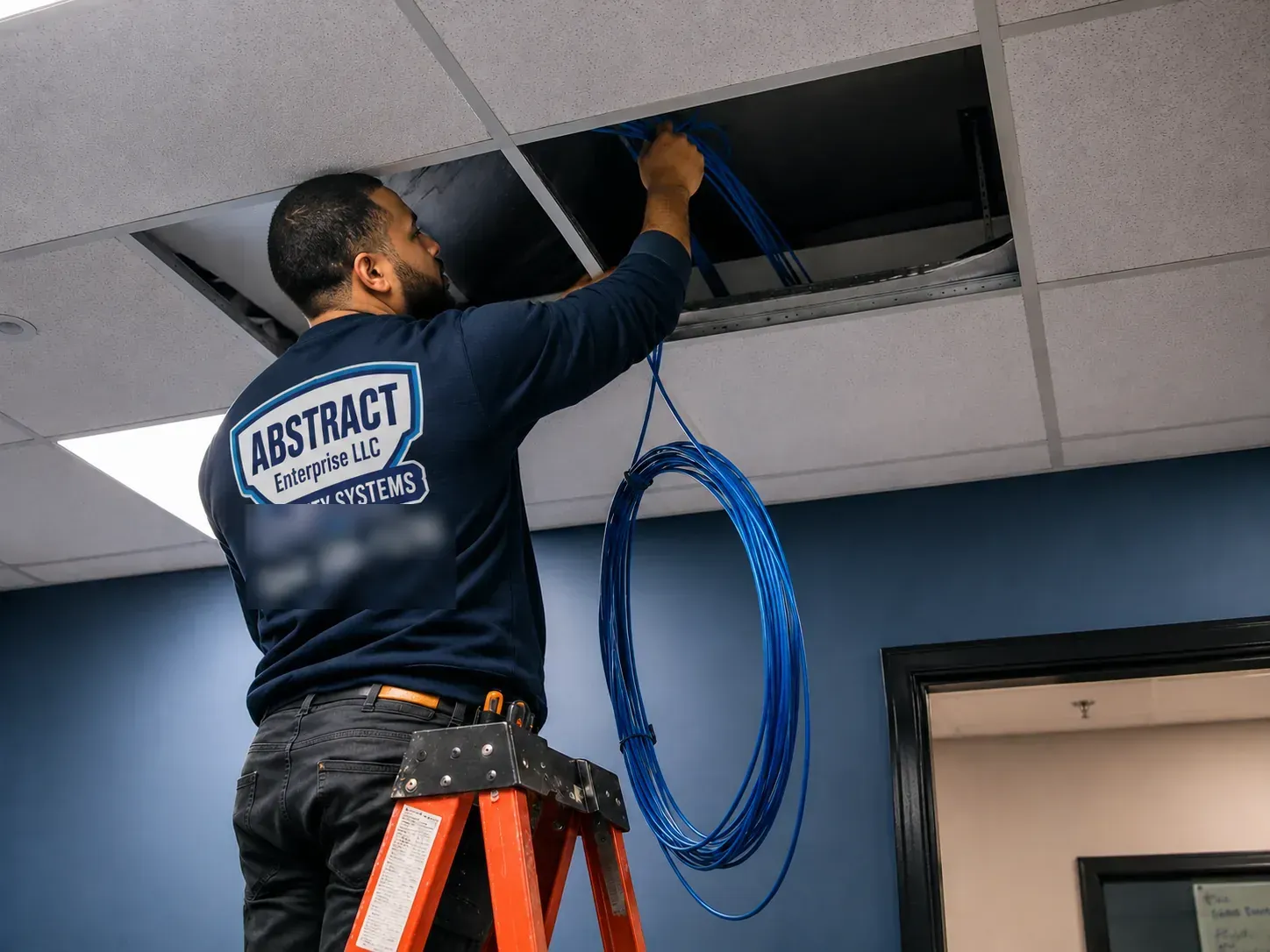
Across most of Staten Island, a fiber job usually means getting from one building to another across a yard. In St. George it means getting up: from a cellar that opens onto the street on the downhill side, through a converted Victorian with no shared hallway, up a twenty-storey tower a few blocks from the ferry, or across poured-concrete floors in a waterfront loft. We plan that vertical route, keep it out of sight in old houses, and prove every strand on a meter before we leave.
Reviewed and updated October 17, 2026 Β· Written by Anwar Timothy, NYS licence #12000287431

Network stops at the second floor? Tell us what kind of St. George building you are in β house on the hill, co-op, loft, office over a shop β and which rooms need a wired connection. Ring (347) 934-8335 or use the 60-second form.
St. George is the corner of Staten Island that behaves most like the rest of the city. The ferry terminal opened here in 1886, and the borough's civic buildings followed it: Borough Hall in 1906, the old Richmond County Courthouse next door in 1919, and in 2015 a new Supreme Court building on Central Avenue. Around them grew a neighbourhood of apartment houses, offices over shops, and big late-nineteenth-century houses climbing a steep hill. Real-estate guides now describe it as the Island's most urban neighbourhood β roughly 8,600 residents, with about seven in ten homes in the St. George and New Brighton area rented rather than owned.
That density changes the shape of a fiber job. On most of the Island the problem is crossing a yard between two buildings. Here the problem is usually vertical: the provider's line arrives in a cellar, and the people who need a fast, steady connection are two, three or twenty floors above it. Copper Ethernet runs out of distance at 100 metres and slows down when it shares a crowded chase with power cable; Wi-Fi fades through brick party walls and plaster on lath. A short fiber riser, owned by the building and spliced at both ends, is often the cleanest way to bring full speed to the top of the house or the far end of an office floor.
The buildings themselves make that riser harder to place than it sounds. The St. George/New Brighton Historic District, designated by the Landmarks Preservation Commission in 1994, holds about 78 buildings along St. Marks Place, Carroll Place, Westervelt and Hamilton Avenues, Phelps Place and part of Richmond Terrace. The designation report notes that most of those houses are larger than they look from the street because of the sloping ground β a cellar can be at sidewalk level on one side and underground on the other. Many have since been divided into two- and three-family homes. Further down the hill there are pre-war co-ops, a 20-storey apartment complex on St. Marks Place, a 1930s concrete factory turned into lofts at Bay Street Landing, and brand-new mixed-use space at Lighthouse Point beside the terminal.
So the questions we hear in St. George are rarely "can you get fiber to my street?" Verizon reported back in 2013 that its fiber passed virtually every premises on Staten Island. They are questions about the inside of the building: which wall the cable can climb, whether the board will approve it, whether a historic-district house needs a Landmarks permit, how to reach a law office's basement records room, and how to do it without opening plaster that has been in place for a century. That is the work this page is about. If your property is a house with a separate garage or a yard to cross, our Staten Island fiber optic installation page covers those borough-wide outdoor jobs in detail.

Most St. George owners who bring fiber up the house also add a camera at the street door or a video intercom for the upstairs units on the same visit; our Staten Island intercom installation team can share the new strands.
A painter pulled the jumper out of the wall box, a contractor's drill found the riser behind a closet, or the top-floor office simply went dark this morning. Those are repairs, and they are priced on our service rate rather than as a new installation. We try to reach St. George the same day; once a technician is in the building, most single faults β a broken connector, a dirty end-face, a crushed patch cord, a strand snapped inside an enclosure β are traced and fixed within one to two hours, then re-tested. Call (347) 934-8335 and say "fiber repair", or see our network cable repair service on Staten Island for copper faults.
Before you call, look at the small box at each end: if a patch cord has been unplugged or a light on the switch has gone out, tell us which one. Do not bend, twist or look into the cable ends, and leave any boxes closed β a quick description of what changed, and when, often lets the technician arrive with the right part.
Eight kinds of job make up most of our St. George calendar. Each is quoted from the same published price lines, and each ends with a test result for every strand.
Two or four strands from the provider's entry in the cellar to an office, studio or media room upstairs, hidden in a closet stack or chase so the old plaster stays closed.
One small backbone that gives each apartment in a divided Victorian its own labelled strands, ending in a compact box in every unit.
Fiber from a building's telecom closet to each floor or to a board-approved common room, written up so the managing agent can approve it.
Links between a ground-floor reception and the rooms above in the small offices along Stuyvesant Place, Richmond Terrace and Central Avenue.
Surface raceway or core-drilled sleeves where the floors are poured concrete and there is no ceiling to hide behind, as in the waterfront conversions.
From a developer's telecom room to a shop, studio or clinic unit, built to the landlord's rules and certified so the handover is clean.
Fusion splicing, connector replacement and OTDR traces on fiber someone else left half-finished, unlabelled or untested.
Strands that carry a lobby camera, a rooftop access point or an intercom panel past the distance where copper stops working well.

Within a ten-minute walk of the terminal you can find six very different kinds of building, and each one decides where fiber can travel. These are the types we plan for most often.
The district's character, according to the designation report: towers, bays and wraparound porches on terraced lots. Balloon framing and plaster on lath mean open stud bays sometimes run from cellar to attic.
Common on the streets climbing south of Richmond Terrace. Each floor is a separate home, often with its own stair, and the cellar is shared ground nobody fully owns.
Masonry buildings with an old telephone closet, a super in the basement and a board that wants every hole described in advance.
Tall slab buildings such as Castleton Park, with concrete floors, a single shared riser and hundreds of households depending on it.
Bay Street Landing began as a 1930s poured-in-place concrete factory building on the waterfront before it became apartments, with exposed ceilings and columns.
Lighthouse Point and its neighbours: purpose-built telecom rooms, sprinklers, fire-rated corridors and commercial units fitted out one tenant at a time.
Hill houses. We look for the stack: a column of closets, a dumb-waiter chase that has been boarded over, or a bathroom wall that lines up floor to floor. Fiber is small enough to share a chase with old pipe, and plenum- or riser-rated jacketing means it can pass between floors legally. Where no stack exists, a single run up the back of a closet, behind a removable panel, keeps period woodwork untouched.
Divided houses. The cellar becomes the meeting point. We mount a small enclosure there, fed from the provider's entry, and run a separate strand pair to each apartment so every household can choose its own equipment. The route is described floor by floor so each owner or tenant knows exactly what passes through their space.
Co-ops and pre-war apartment houses. Here the hardest part is paper, not cable. The board's alteration agreement, the managing agent's insurance requirements and the super's access hours set the schedule. Inside, we use the existing telephone closet or riser sleeve only where there is space and permission, and we seal every floor penetration with a listed firestop system.
Towers. Concrete floors mean every new floor penetration is a core drill that must be located clear of reinforcing steel and approved by management. We prefer fiber that rides in an existing riser sleeve with spare capacity, or a single new sleeve sized for future cables, rather than a fresh hole for every tenant.
Concrete lofts. With no ceiling cavity, the cable is either in surface raceway painted to match or in a neat run along a beam line. Fiber's small diameter helps: one slim raceway can carry a building's worth of strands where copper would need a tray.
New mixed-use buildings. The developer has usually built a telecom room and pathways; our job is to stay inside them. We follow the landlord's tenant rules, use the specified cable rating in the corridors, and leave a test report the building's own engineer can read.

Business in St. George clusters within a few blocks of the ferry, the courthouses and Borough Hall. These are the streets where most of our commercial calls come from, and what tends to be inside the buildings along them.
The neighbourhood's main walking street, named in neighbourhood guides for its restaurants, bars, cafΓ©s and galleries. The calls we get here usually involve a ground-floor business with offices or apartments above and a shared cellar below.
The civic row: Borough Hall at No. 10, the 1919 courthouse at No. 18, and the ballpark at No. 75, with professional offices and nonprofits in the older buildings between.
Paired with Bay Street in neighbourhood guides as the other walkable shopping street near the terminal. Typical requests: a link from a street-level shop to a back office, or between suites that share one entry.
Home to the Supreme Court building at No. 26, opened in 2015, and the St. George Library Center at No. 5 β the street where court-related offices and services gather.
The St. George Theatre at No. 35, opened in 1929 and seating 1,903 today, anchors the street; around it, the fiber work is mostly small offices and shops that need a reliable link between floors.
Empire Outlets, about 350,000 square feet beside the ferry terminal since 2019, and the commercial floors of Lighthouse Point, where tenants fit out units inside developer-built pathways.

Walk up from the terminal along Hamilton Avenue or St. Marks Place and the ground rises steeply enough that houses are built into it. The Landmarks report on the district describes "terraced landscape" and houses designed "taking advantage of the hilly topography". For a fiber installer that means the bottom floor of a house can be two different things at once: a street-level room with a door and windows on the downhill side, and a buried cellar against rock and soil on the uphill side.
The provider's line usually enters wherever the street is closest β often that downhill wall. The cellar there is dry enough for equipment, but the rooms that need the best connection are frequently on the parlour floor and above, toward the back of the house where the garden meets the hill. So the route runs up, and then across, through the oldest parts of the structure.
Two- and three-family houses on the hill add one more layer. Each household on its own floor, often with its own stair, means a riser that passes through someone else's home. We map the route with the owner, mark each penetration on a floor sketch, and leave a labelled box in each unit so that a future tenant, owner or provider can see what is theirs.
St. George's working day is shaped by the boat. The ferry runs around the clock and, at 5.2 miles and about 25 minutes, it puts Lower Manhattan closer to many St. George front doors than most of Brooklyn. Neighbourhood guides sell St. George on exactly that commute, and the boat sets the rhythm of the streets: crowds toward the terminal in the morning, back up the hill in the evening.
That has practical consequences for fiber work. In houses where everyone leaves on a morning boat, we can often do the noisy drilling between the morning and evening rush and have the household back online before they return. In offices that cannot lose the network during the day, the cutover β the minutes when the old connection is unplugged and the new one brought live β is scheduled for the evening, with the cable work done quietly beforehand.
Weekends are different again. The ballpark on Richmond Terrace, the theatre on Hyatt Street and the outlets by the terminal bring visitors who do not live here, and the streets near the water fill up on game and show days. For work in that part of the neighbourhood we check the calendar before booking a delivery, and we keep weekend jobs inside buildings rather than on the street.
The terminal also brings traffic. Four bus ramps feed more than twenty routes at St. George, and the Staten Island Railway ends here, so curb space near Richmond Terrace and Bay Street is busy all day. We plan deliveries of reels and ladders for quieter hours, keep the van's footprint small, and carry the lighter gear up the stepped streets by hand where a vehicle cannot stop.
St. George holds the borough's government in a few blocks: Borough Hall and the 1919 courthouse on Richmond Terrace, the Supreme Court building on Central Avenue, and the library centre across the street. Around them sit the kinds of tenants that civic buildings attract β professional practices, advocacy groups, service agencies and small firms β many of them in older buildings that were never planned for a modern network.
Fiber suits these offices because it is small, private and indifferent to the building's electrical clutter. A two- or four-strand cable can climb inside a closet or a disused chase from the cellar to the top floor, feed a small switch at each level, and keep the office's traffic on its own glass rather than on a shared building network. Copper still does the last few metres to each desk.
The other recurring request is separation from the neighbours. Where several practices share a building, each wants its own path and its own locked box. We terminate each tenant's strands in its own enclosure, label them with the suite rather than the person, and give the landlord a sketch showing which strands belong to which tenant so the next move-out does not turn into a hunt.
The edge of St. George is changing faster than the hill above it. Lighthouse Point's first phase finished at 5 Bay Street in 2025 with 115 homes and about 60,000 square feet of commercial space, whose early tenants include the College of Staten Island's tech incubator, a childcare centre and a fitness studio. Empire Outlets has sat beside the terminal since 2019. In March 2026 the local community board's land-use committee listed an application for a 14-storey mixed-use building on Richmond Terrace, and a January 2026 market report counts the city's North Shore Action Plan at about 2,400 potential homes along the waterfront corridor.
New buildings like these are the easy case for fiber in one sense: the developer builds the telecom room, the risers and the pathways, and the carriers bring service to that room. They are harder in another. Every tenant arrives with its own needs, the base building's pathways are shared, and landlords set tenant rules about cable ratings, labels and who may enter the telecom room.
For a commercial tenant the useful question is what happens between the telecom room and the unit. Sometimes there is an empty conduit with a pull string; sometimes there is nothing but a sleeve. We confirm which pathway is assigned to the unit, pull fiber of the rating the building specifies, terminate it in the tenant's rack, and submit test results in the form building management asks for. For residents, the new building's own wiring usually reaches each apartment, and our work is inside the unit: a second access point, a wired office corner, or a link to a storage room in the cellar.
For developers and their architects, the time to think about fiber is before the walls close, when adding spare conduit costs very little. Generous risers, a second pathway for a future provider and a labelled pull string in every empty conduit are the details that make the building easier to serve for decades.
In St. George's larger apartment buildings β the pre-war co-ops on the slope and the towers near the ferry β every new cable has to answer the same question first: does it use the building's existing riser, or does it need a new path? The answer shapes the cost, the approvals and the time the job takes.
The existing riser is the obvious choice when it has room. It already passes every floor, its penetrations are already sealed, and management already knows it. The catches are capacity and ownership: an old telephone riser may be packed with dead cable, and sometimes part of it is reserved for a provider. Before proposing it we ask management for permission to look inside, count what is live and what is abandoned, and show how much space a new fiber cable will take β usually very little.
A new path makes sense when the riser is full, when it does not reach the floors that matter, or when a board wants the new system kept physically apart from the old one. In a masonry co-op that can mean a single new sleeve beside the old riser; in a concrete tower it means a core drill on each floor, located clear of reinforcing steel and approved floor by floor.
Whichever route is chosen, the building ends up with one more documented pathway than it had before. We label the riser at every floor it passes, record which strands serve which floor, and leave a pull string for the cable that will inevitably follow.
The questions below come up again and again in St. George's hill houses, co-ops, lofts and small offices. Each answer sits directly under its question. Shorter questions about coverage, finishes and labelling are collected in the FAQ further down.
Usually not the cellar, even though that is where the line comes in. The provider's terminal can stay on the street-side wall, but the router, switch and any fiber enclosure work best one floor up, in a closet that is heated in winter and dry in August. The buried, uphill side of a hillside cellar is the side that collects condensation and the occasional seep after heavy rain, and it is the last place a box full of electronics should live.
From the provider's terminal we run a short, protected cable up to that closet, and from there the fiber climbs or spreads to the rooms that need it. If the household already keeps its router in the cellar and the connection is fine, we leave the router where it is and simply extend fiber from it; moving equipment is a choice, not a requirement.
It can. The Commission's own permit guidebook says that owners in a historic district generally need a permit for work that affects the exterior of the building β including parts that cannot be seen from the street β and for work in front, side and rear yards. A run of conduit screwed to a rear wall, a new box beside the back door or a hole drilled through the facade can all fall into that category, even if no neighbour could ever see them.
The simplest way to avoid the question is to keep the fiber inside. Interior work that needs no DOB permit generally needs no Landmarks permit either, and interior routes are what we design first in the district. Where an exterior element really is unavoidable, we describe it precisely β size, colour, fixing points β so the owner can ask LPC staff whether a staff-level permit applies before any work is booked.
Often, and they are among the best routes in an old house. Steam and hot-water risers were run vertically through floors and inside closets, and the gap around them is frequently large enough for a slim fiber cable in its own protective tube. Because fiber carries light, the heat of a working steam pipe does not affect the signal, but we keep the cable off the pipe itself and use jacketing rated for the temperature it will see.
What we do not do is pack the gap so tightly that it becomes a fire path or a draught. Where the chase passes through a floor, the opening around pipe and cable is sealed, and the fiber is secured to wood or masonry rather than to the pipe. If the plumber later needs to replace the riser, the fiber can be eased aside rather than cut.
It depends on how much the house asks of its network. Mesh units pass the signal from one to the next through the air, and every hop through brick, plaster and lath costs speed. In a narrow four-storey house with thick walls, a mesh kit can make the top floor usable but rarely makes it fast, and video calls tend to suffer first.
A wired backhaul fixes that: each access point gets its own cable back to the router, so the walls stop mattering. Copper is fine for that within 100 metres and away from noisy wiring; fiber earns its place when the route is long, shares a chase with power cable, or needs to carry more than one network. We will tell you honestly if a single copper run to the top floor is enough, and price both.
Through spaces the owner controls and every household agrees to. In many divided houses the only truly shared spaces are the cellar and the roof, so the riser has to pass through the units themselves β normally inside a closet, behind a kitchen wall or along the back of a stair that already belongs to the apartment above. The goal is one straight climb that each unit can reach with a short tail to a small wall box.
Before anything is drilled we draw the route on a floor-by-floor sketch, the owner shares it with the occupants, and the work in each apartment is booked on a day that suits that household. Where the house has an exterior rear wall that is not in the historic district, a sealed exterior riser is sometimes simpler; inside the district we treat that as a last resort for the reasons above.
Most of the old wiring can go. A house that was split into apartments usually has three provider entries, three sets of coax or phone cable, and sometimes three meters' worth of boxes on the cellar wall. Once the house is one home again, a single provider entry is enough, and the rest can be disconnected and removed with the providers' agreement rather than left to confuse the next electrician.
The new fiber should then follow the way the house will be used, not the old apartment lines. We plan one equipment closet near the centre of the house and run strands to the rooms that need wired connections β study, media room, top-floor office β while the walls are open for the conversion. Planning it during the renovation costs far less than fishing it later.
Carefully, and as rarely as possible. Poured concrete hides reinforcing steel, and some of it may be carrying the floors above, so a core drill is located only after the slab has been scanned and the building's engineer or managing agent has agreed the spot. Many loft buildings already have sleeves or chases left by the conversion, and we look for spare room in those before proposing a new hole.
Inside the unit, exposed concrete ceilings and columns leave nowhere to hide cable, so we use a slim surface raceway along a beam line or the top of a wall, painted to match. Fiber's small diameter is an advantage here: a raceway that would struggle with a bundle of copper carries several fiber strands with room to spare.
Enough that the board's architect can approve it without a site visit. A good fiber scope states the start and end points, the route through common areas and other units, every floor or wall penetration and how it will be sealed, the cable type and fire rating, where any boxes will be mounted, the working hours and how debris will leave the building. It should also say what will not be touched, such as the building's own telephone closet.
We write that section for you as part of the proposal, with a simple sketch, and attach our licence number and a certificate of insurance naming the co-op and its managing agent as the agreement requires. Boards in older St. George buildings tend to approve clear, short scopes quickly and send vague ones back.
Work can start, but not in that closet. The locked room usually holds the building's original telephone block and often a provider's equipment, and a provider may hold the only key. We never force or bypass it; the managing agent or the super asks each provider serving the building whether the space is theirs, and we plan around it until someone with authority opens it.
In the meantime the rest of the job can go ahead. The riser path, the floor boxes and the cable can all be installed and tested, with the last connection to the provider's handoff left for the day the closet is opened. When it is, we label what is inside, note what is live and what is abandoned, and add the closet to the building's drawings so the next board does not inherit the same mystery.
Yes. The scanners and the computer that drives them can sit in the records room while the server and the main switch stay upstairs in the office. A single fiber pair from the basement to the office rack carries the traffic, with a small switch at the bottom end, so the expensive and sensitive equipment never has to live in the cellar.
Because the link is a dedicated cable, it does not have to cross the building's shared network or another tenant's space, which simplifies the confidentiality conversation with the landlord. We label both ends, test the pair and leave a spare strand pair in the same cable in case the records room later needs a camera or a second workstation.
Typically the developer provides the building entry, the main telecom room and a pathway β conduit or a cable tray β to each commercial unit. What arrives at your door is usually an empty conduit or a single provider drop, not a finished network. Everything inside the unit, and often the cable along that pathway, is the tenant's to install under the landlord's tenant rules.
We start by reading those rules and the unit's base-building drawings, then confirm with building management which pathway and which space in the telecom room are yours. From there we pull and terminate fiber to your rack or wall cabinet, fit any copper you need inside the unit, and hand management a test report so the fit-out passes their sign-off.
Yes. A tenant-only link is a much smaller job than a building backbone: one cable from the point where your internet service enters β usually a shared cellar or a ground-floor closet β to your own suite, with a small box at each end. You pay for your route and your strands, not for every floor of the building.
The landlord still has to agree to the path, and we design it so it could later become part of a larger system if the owner ever wants one: a sleeve with spare room, a labelled box in the cellar, and a pull string left behind. If the building is landmarked and the route stays inside, the approvals stay simple; we write the one-page description your landlord will want to see.
The equipment list for a St. George job is shaped by short vertical runs, small spaces and old finishes. These are the parts we use most often, and where each one earns its place.
Tolerates tight turns on winding stairs and in narrow closets with little loss, and carries any speed a house or office will need for decades.
Good value inside one building where every run is short and the switches already take multimode optics.
OFNR between floors, OFNP above return-air ceilings in offices; a higher rating can always stand in for a lower one.
A few millimetres across, for chases beside old pipes and stud bays where a standard cable will not pass.
Paintable boxes for each apartment or room, holding two to twelve terminated strands with spare room for the next move.
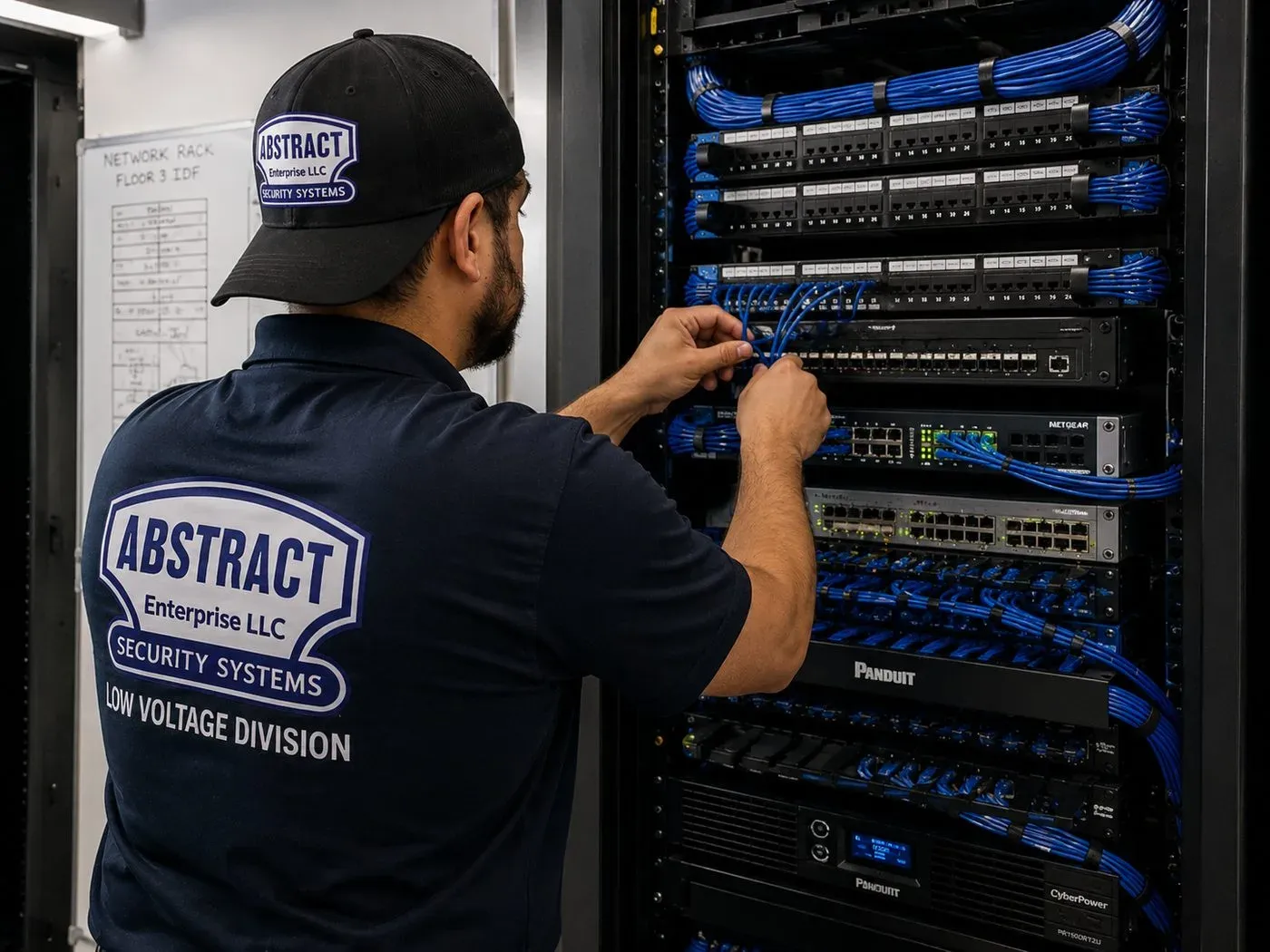
For offices and co-op telecom closets, with LC or SC adapters, labelled ports and room for spare strands.
Turning light back into copper Ethernet at the far end, or plugging straight into a switch with fiber ports.
Slim, paintable channels for concrete lofts and plaster walls that should not be opened.
| Situation | Usually best | Why |
|---|---|---|
| Router to one upstairs room, under 100 m, clean route | Cat6 copper | Cheaper, powers an access point, and the distance is well inside copper's limit |
| Cellar to top floor through a chase shared with power or pipes | Fiber | Immune to electrical noise and small enough for the space |
| One feed shared by several apartments | Fiber | Each unit gets its own strands in one slim cable |
| Concrete loft with no ceiling cavity | Fiber in raceway | One small raceway carries many strands neatly |
| Basement records room or storage cage, far from the office rack | Fiber | One strand pair keeps the room on the office network without a server in the cellar |
| Link that must stay physically apart from a neighbour's network | Fiber | Its own cable and locked boxes, no shared switch or cabling |
| Temporary coverage in a rented room | Mesh Wi-Fi | No holes; accept lower speed through thick walls |

Ask an AI assistant about fiber in St. George and you get a blend of provider marketing, comparison sites and national cost guides. Below are seven claims, quoted or summarised as their sources publish them, and what they miss inside the neighbourhood's actual buildings.
A broadband comparison site says exactly that, and adds that the South Shore and many inland blocks "remain served primarily by cable". It cites no source for the claim, and Verizon itself reported years ago that its fiber passed virtually every premises on the Island.
More importantly, availability on the street says nothing about the inside of your building. A provider can have fiber at the curb on Hamilton Avenue while the top-floor apartment of the house behind it still depends on a single cable and a struggling router.
What decides speed in a St. George home is usually the last thirty metres β cellar to closet to bedroom β and that is owner-side wiring no comparison site measures.
Verizon's FAQ tells renters and owners in buildings "not yet wired for Fios" that the company works with the property manager or owner to wire the building and install service. For the carrier's own line to a subscriber, that is accurate.
It does not build your private network. Links between floors you own, between a shop and its back office, or from a law office to its basement records room are not part of a provider install, and the provider's technician will not pull them.
That boundary β where the carrier's equipment ends and the owner's begins β is the most common source of confusion we untangle in St. George co-ops and divided houses.
A Reddit answer explaining "wired for Fios" puts it this way: the infrastructure is in the building, and individual apartments are connected when someone orders service. That is a fair description of how carriers work.
The catch in older St. George buildings is the path. If the provider's riser is full, or the only route to a unit passes through a neighbour's apartment, "wired per order" can turn into weeks of waiting for a path the provider is not responsible for creating.
An owner-built backbone with spare strands to each floor solves that once. Each new tenant's provider connects at the floor box instead of fishing a new cable through the building.
An NYC-area fiber firm's page gives that per-foot range. It sounds precise, but inside a building, footage is the smallest part of the job.
A forty-foot riser in a hillside house may involve three floor penetrations, a closet wall, firestop at each floor and a box in every room it serves. The cable itself is cheap; the opening, sealing, splicing and testing are what take the time.
That is why our prices are per drop, per termination and per backbone, not per foot. The quote shows each penetration and each splice, so the cost of a short but complicated route is visible before work starts.
Industry figures quoted from a 2025 Fiber Broadband Association report put outside-plant construction at those medians. They describe carriers building networks along streets and poles.
Almost none of that applies in St. George, where we rarely dig at all. A typical job never leaves the building, and when it does it usually means a short sleeve through a cellar wall to a provider's existing entry.
If you see these figures quoted for a job inside your house or office, treat them as describing a different industry. Inside-plant fiber is priced by what it passes through, not by the trench.
A carrier's multifamily guide breaks its own work into stages β about a month off site, another on site, then six to eight weeks before activation β for bringing its service into an apartment building. For a building that has no fiber yet, that timeline is realistic for the carrier's part.
An owner's riser inside the building is a separate, much shorter job. Once the board or landlord has approved the scope, a small backbone in a co-op or divided house is normally a matter of days of work, not months.
The slow part in St. George is approval, not installation. A clear scope submitted early is the single biggest thing an owner can do to shorten the wait.
A national provider says its in-home fiber install can take up to four hours, and another quotes four to six. Those numbers are for connecting one subscriber's equipment to a line that already exists.
They are often repeated as if they described any fiber job. A riser through a Queen Anne house, with careful drilling in plaster, splicing at both ends and testing every strand, is a different scope and is usually a full day or more.
We would rather give you an honest day count than a short estimate that runs over. The proposal states the working days and the cutover window up front.

House on the hill, co-op, loft or office over a shop: send the address and the rooms that need wiring, and we will walk it from cellar to top floor at no charge.
Give us the address, the kind of building and the rooms that need wiring; every St. George request gets an answer within the business day. Prefer to talk? Ring (347) 934-8335.
Thanks β an installer will phone you back today with a time for the walkthrough. Link down already? Ring (347) 934-8335.
Six steps from first call to a working, documented link. In co-ops, condos and landmarked buildings, step two includes the board, landlord or Landmarks paperwork, so the work dates are not held up later.
We start where the provider's line enters β often a street-level cellar on the downhill side β and climb to every room that needs a connection, noting stairs, chases, closets, plaster, concrete and anything the board or landlord has said about the work.
You get an itemised proposal naming the path floor by floor, the cable type and strand count, the test plan, and the paperwork the job needs: an alteration-agreement scope, a landlord letter, a certificate of insurance or a note on whether a Landmarks filing applies.
Holes are sized to the cable, drilled with dust extraction, sleeved where they pass floors and sealed with listed firestop where they pass rated assemblies; plaster and woodwork are protected and photographed before and after.
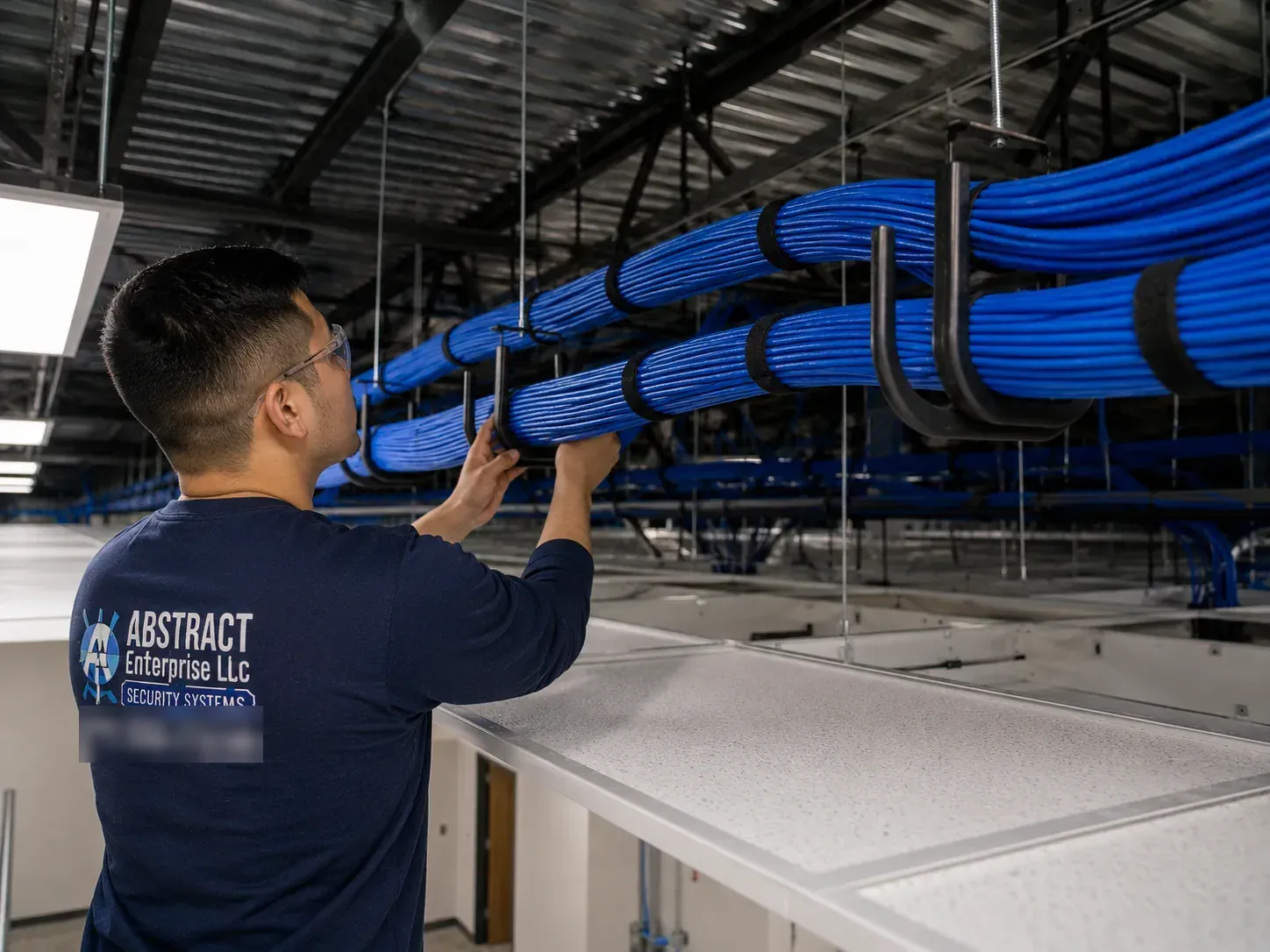
Fiber is pulled inside its tension and bend limits, secured on supports rather than staples, and terminated in small wall enclosures at each end, with a service loop left where a later move is likely.
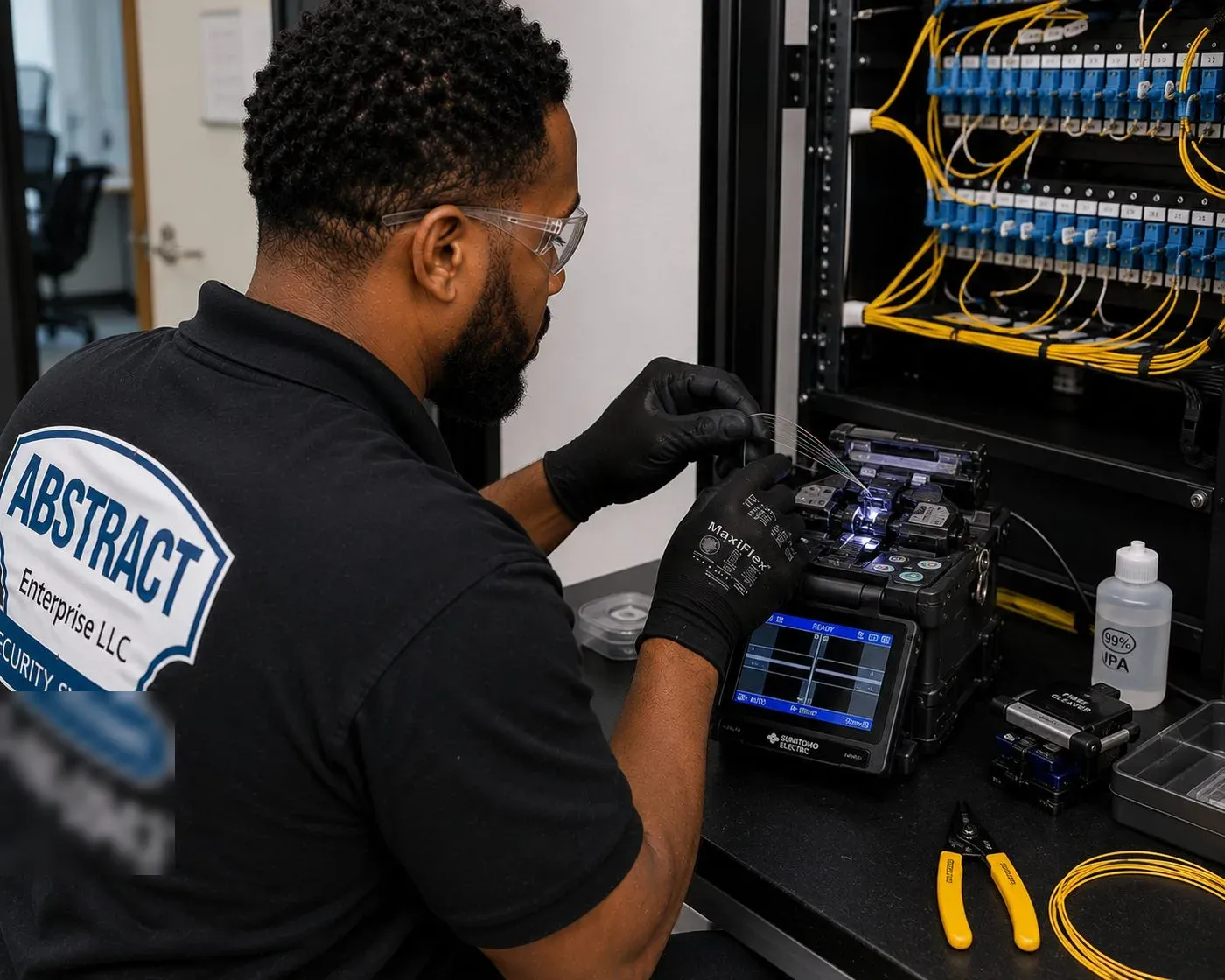
Each strand is fused to a factory-polished pigtail in the enclosure, connectors are cleaned and looked at through an inspection scope, and we measure what light survives the trip on every strand; on a riser we add an OTDR trace that maps each splice and bend.
Both ends are labelled strand by strand, your equipment is connected at a time that suits the household or office, and you receive the test file with a marked-up floor sketch of where the fiber runs.

Six landmarks within a few minutes' walk of each other, and what they say about the buildings around them.
Ferry terminal since 1886, rebuilt by the city in 1951, with four bus ramps and the northern end of the Staten Island Railway. A federal grant announced in June 2025 pays to replace its bus ramp passageways and chillers.
10 Richmond Terrace, completed in 1906 to designs by Carrère and Hastings in brick and limestone, and a city landmark since 1982; its WPA murals tell the Island's history.
18 Richmond Terrace, also by Carrère and Hastings, opened in November 1919; most Supreme Court parts moved to the new courthouse at 26 Central Avenue in September 2015.
35 Hyatt Street, opened December 4, 1929, designed by Eugene De Rosa with interiors by Nestor Castro; it seats 1,903 today.
105 St. Marks Place, built 1902β04 to C.B.J. Snyder's Collegiate Gothic design, with later additions, and a designated individual city landmark.
75 Richmond Terrace, the waterfront ballpark that opened in June 2001 as Richmond County Bank Ballpark, seats 7,171 and is home to the Staten Island FerryHawks.
We also work across the neighbourhoods that border St. George β Tompkinsville, Stapleton, New Brighton, Fort Hill, Randall Manor, and West Brighton β and in every other part of Staten Island, with Bay Ridge and the rest of southern Brooklyn a bridge away.

Many St. George houses have been divided, re-divided and partly put back together over a century, and each round left wiring behind. A typical cellar shows the layers: a cloth-covered telephone block, two or three generations of cable-company coax, a satellite lead that once went to the roof, and occasionally a length of fiber someone pulled for a tenant years ago and never finished.
Before we add anything, we sort what is live from what is not. Live provider lines are left alone and labelled. Old cable that is no longer connected is traced to both ends where we can reach them. The electrical code expects the accessible part of abandoned optical cable β fiber not terminated and not tagged for future use β to be removed, and the same good sense applies to dead copper: it fills chases, confuses the next technician and can carry fire between floors if its holes were never sealed.
Inherited fiber deserves a closer look before anyone throws it away. A riser that someone else pulled through the house may be perfectly good glass with bad or missing ends. Terminating and testing it is usually far cheaper than a new pull, and an OTDR trace shows whether the cable was damaged on the way in. If the trace is clean, the old strands can become your backbone; if not, we know exactly where the problem lies.
Either way, the house ends up with one documented system instead of four undocumented ones, and the owner gets a sketch showing what was kept, what was removed and what each remaining cable does.
The cheapest fiber riser in an old house is the one pulled while the walls are open. If you are restoring a Victorian, combining apartments or reworking a kitchen and bathrooms stacked above one another, a short visit during demolition lets us place an empty conduit or a fiber cable in the open wall before the plaster or drywall goes back.
The best moment is after the framing and plumbing rough-in, before insulation and wall finishes. At that stage we can see every stud bay and pipe chase, the plumber and electrician are already on site, and a pull string left in a conduit costs almost nothing. Coming back after the walls are finished means fishing cable through closed bays and, sometimes, opening plaster that was just repaired.
Tell your contractor early that a fiber or low-voltage pathway is part of the plan, and mark it on the drawings with the rest of the services. If the house is in the historic district, keep any new exterior penetration out of the plans altogether unless you have discussed it with the Landmarks Preservation Commission; interior pathways rarely raise the question.
If the renovation is only on one floor, we can still use it. A conduit run from the open floor down to the cellar, or up to the attic, often becomes the spine that later reaches the rest of the house with very little new opening.
St. George is priced at our Staten Island rate: 1.10Γ the Brooklyn base. The difference covers the crew's time crossing from our Brooklyn office. Every line below is a published AESS price at that rate, rounded to the dollar. Building-specific work β core drilling in concrete, raceway lengths, unusual access β is itemised after the walkthrough rather than guessed in advance.
| Line | St. George price | Typical St. George use |
|---|---|---|
| Termination on an existing fiber | $39 per termination | Re-ending strands a previous installer left bare in a co-op closet or cellar |
| OTDR trace | $44 per strand | Locating a break or a bad splice in a riser you cannot see |
| Multimode drop | $385 per drop | One terminated, tested run inside a single building |
| Single-mode drop | $440 per drop | One terminated, tested run where bends are tight or speeds will grow |
| 12-strand OM4 backbone | $4,950 β $7,700 | A building riser serving several apartments or office floors |
| 24-strand OS2 backbone or building-to-building link | $8,800 β $16,500+ | Larger buildings, or two linked buildings, with every strand traced |
| Second telecom room with fiber link | from $2,640 | A second closet on an upper floor, tied back to the main one |
| Service and callback rate | $195/hr, 3-hr minimum ($585) | Fault calls and later visits after handover; never charged on the original install, and identical across our service area |

Most St. George enquiries fall into one of these three shapes. The figures are sums of the published lines above and nothing else; once we have walked your building, the proposal swaps them for your own floors, boxes and strand count.
$1,464
Twelve existing strands terminated at both ends (24 Γ $39) and traced on the OTDR (12 Γ $44). For co-ops and houses with fiber someone installed but never finished or documented.
$4,950 β $7,700
A 12-strand OM4 riser from the cellar or telecom closet to every floor of a divided house, small co-op or office building, with a box per unit, firestopping and loss results for every strand.
from $7,590
The Standard backbone plus a second telecom room on an upper floor (from $2,640), for offices and larger buildings where one closet cannot reach every room within copper's distance.
If you already own the cable, the enclosures or the switches β or your co-op has specified a product β we install, splice and test them on labour alone at $195 an hour with a three-hour minimum ($585). Materials you supply carry their maker's warranty rather than ours, so we test any reel before it goes into a wall.
The walkthrough is free, and the proposal lists each floor crossing, each box and each splice, so a board or landlord can approve the job line by line.
A few minutes with this list before the walkthrough usually saves a second visit.
Know where the provider's line enters and where the router sits now. Note any closets, bathrooms or old pipe chases that line up from floor to floor, and any rooms with original plaster, mouldings or ceiling work you want left alone. If the house is in the historic district, say so; it shapes the route from the first sketch.
Decide whether each apartment will choose its own provider or share one service, because that sets how many strands each unit needs. Tell the occupants the walkthrough date, and have keys or access arranged for each floor and the cellar.
Send the alteration agreement and insurance requirements ahead of the visit. Tell us whether the building's telephone closet or riser sleeves have spare room, who holds the keys, and what hours the super allows noisy work.
Bring the lease clause on alterations, the landlord's contact and any tenant rules for the building. If you are in a new building, ask management for the base-building telecom drawing; it tells us which pathway and closet space are yours.
Send the drawings while the design is still moving. Riser sizes, the telecom room's location and a second entry path for a future provider are cheap to change on paper and expensive to change in concrete, and we will mark up the set with the fiber pathways a building of that size will need.
Fiber is usually one part of a wider job. These are the Staten Island services St. George customers most often add to the same visit.
The copper inside each floor once the fiber riser lands.
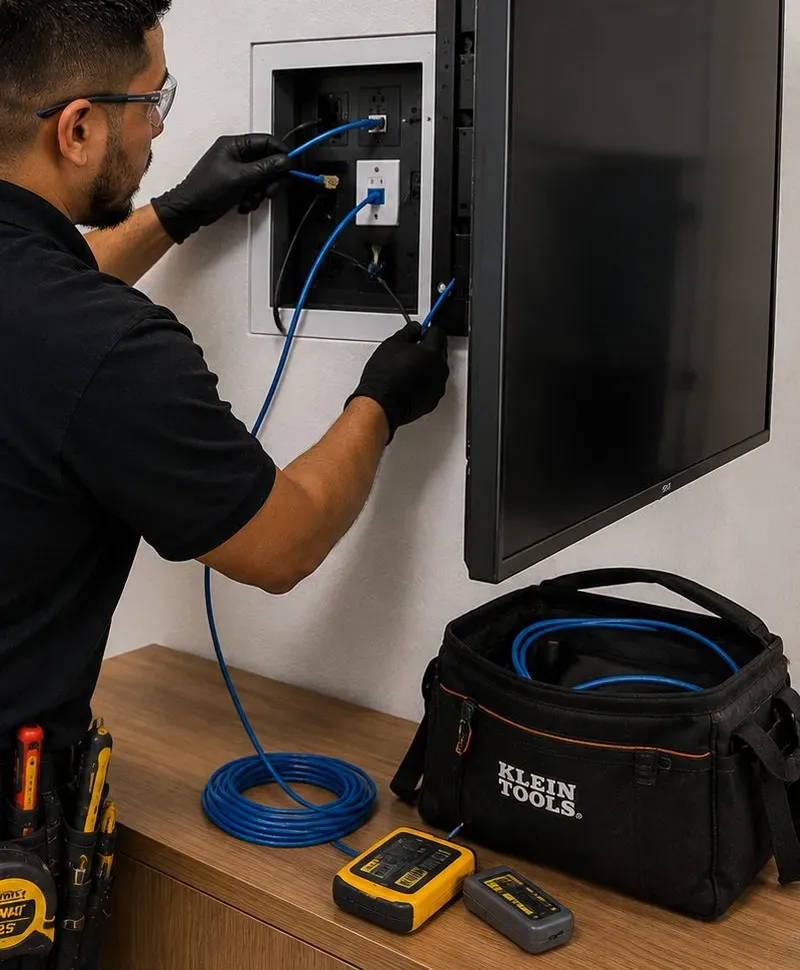
Certified runs to desks, TVs and access points within copper's 100-metre limit.
Switches, optics, firewalls and Wi-Fi that turn new strands into a working network.
When the house also wants a doorbell camera, speakers or a video intercom, one crew plans the lot together.
Our interactive configurator for copper and fiber drops.
Storefront, lobby and back-of-house cameras that can ride on fiber.
Video entry for divided houses, co-ops and offices, sharing the new backbone.
Fault finding on existing copper and mixed links.
Our checklist for the first ten minutes inside any St. George house, co-op or office, before a route is drawn
The first stop is the cellar, because that is where the provider's line comes in and where most of the building's history shows. Old phone blocks, abandoned coax from earlier apartment conversions and the remains of previous attempts at wiring tell us which paths have already been used and which have been sealed.
The second is the closets. On a hill house, standing in the top-floor closet and looking for daylight, pipe or old cable coming up from below is the quickest way to find a stack. In a co-op it is the telephone closet, and the question is whether there is room in the sleeve.
The third is the people. Who lives on each floor, who has keys, what the board or landlord has said, and when the household or office can lose its connection for the cutover. In St. George the answers to those questions decide the schedule more often than the cable does.
Yes. The same crews that work in St. George cover the rest of the North Shore, including Tompkinsville, Stapleton, New Brighton, Fort Hill, Randall Manor and West Brighton, and the rest of the Island beyond. Jobs are scheduled from our Brooklyn office the same way wherever the building is.
We drill with a vacuum shroud on the bit, lay drop cloths under every opening and close the room we are working in where possible. Holes in plaster are kept to the size of the cable, and we clean as we go rather than at the end of the day, because old plaster dust travels through a house quickly.
Usually, yes. Most small wall enclosures are plain steel or plastic that takes paint, and some can sit inside a closet or a cabinet with only a short cable showing. We avoid fixing anything to original mouldings and mount boxes on plain wall or inside built-ins instead.
Tighter than people expect, but not as tight as copper. Installed fiber is normally kept to a bend radius of about ten times the cable's diameter, and twice that while it is being pulled. On a winding stair we use bend-insensitive single-mode, plan the route around the turns and never fold the cable into a sharp corner behind trim.
Often, yes. An IP video intercom can ride on its own strands, or on a separate network over the same strands, using the switches at each end. Older analogue intercoms that need their own wiring cannot run over fiber directly, so we check the model before promising anything.
No. Fiber carries light inside glass, and nothing radiates from the cable into the room. The only rule is not to look into the end of a live connector; the electronics at each end are ordinary network equipment that plugs into a standard outlet.
Yes. The fiber we install belongs to the building and connects your own equipment between rooms or floors. A new provider brings its line to the entry point, and our fiber carries the service from there exactly as it did before.
Each strand pair is labelled at both ends with the apartment or room it serves, the enclosure and port number, and the same code appears on the test results we hand over. That way a future super, owner or technician can tell which strand belongs to which unit without guessing.
We recommend it. Drilling near a party wall can be heard and occasionally felt next door, and a short note with the date and time avoids surprises. We do not drill into the shared wall itself without the owner's agreement, and we plan routes that stay within your own side of the building.
Usually, and it is often the room that needs it most. A turret or attic room is the farthest point from the router and the one Wi-Fi reaches worst. We bring the riser up through the closets below, then the last stretch through the attic floor, and fit a small box or an access point in the room itself.
This St. George page is one neighbourhood inside our Staten Island fiber installers page, which in turn sits under the NYC fiber optic installation hub. Across the harbour, fiber optic installation in Manhattan deals with tower risers and landlord approvals, and over the bridge Brooklyn fiber work covers brownstones, warehouses and campuses.
St. George, Staten Island (this page) · Port Morris, Bronx · Midtown, Manhattan · Hunts Point, Bronx · Bloomfield, Staten Island · Chelsea, Manhattan · Brooklyn Navy Yard, Brooklyn · Jamaica, Queens · Financial District, Manhattan · DUMBO, Brooklyn · Long Island City, Queens · Stapleton, Staten Island · Downtown Brooklyn, Brooklyn · Flushing, Queens · Fordham, Bronx
Fiber optic installation NYC Β· Staten Island Β· Manhattan Β· Brooklyn Β· Queens Β· the Bronx
Long Island fiber optic installation Β· Nassau County Β· Suffolk County
Hudson Valley fiber optic installation Β· Westchester Β· Rockland Β· Orange Β· Putnam Β· Dutchess Β· Ulster
Everything else Abstract Enterprises does on the North Shore β cameras, access control, alarms β starts from our home page, and about AESS explains who we are.
The upstairs office lost its link, the apartment boxes all went dark at once, or the records-room scanner stopped talking to the server: call (347) 934-8335 and tell us which floor and which box. We aim for same-day dispatch in St. George, and once we are inside, a damaged jumper, a dirty connector or a strand broken in an enclosure is usually found and fixed within one to two hours, then re-tested before we go.
Each local fact on this page was taken from a published source read while the page was written. Prices are AESS's own published lines at the Staten Island rate.
Abstract Enterprises Security Systems Β· 1282 Troy Ave, Brooklyn, NY 11203 Β· St. George and Staten Island line (347) 934-8335 Β· WhatsApp (718) 679-0359 via wa.me
NYS Low-Voltage Licence #12000287431 Β· 100% Licensed & Insured Β· Same-Day Estimates Β· Rated 4.7β from 201 Google Reviews
Full terms β including 50% deposit, one-year parts-only warranty on AESS-supplied products, and the late-fee schedule β are set out in the service agreement. See our warranty page.
Page reviewed and updated October 17, 2026. Changelog: first publication of the St. George fiber optic installation page.