Licensed Low-Voltage Contractor · Sutphin Boulevard to 168th Street · Avenue Buildings, Station Towers & Liberty Avenue Shops
Fiber Optic Installation in Jamaica, Queens
Sealed Cellar Entrances · Floor-by-Floor Backbones · Tower & Podium Links · A Loss Reading for Every Strand
Downtown Jamaica is a railroad town that grew a skyline. Brick and limestone buildings from the age of the savings banks line Jamaica Avenue, courthouses fill the blocks off Sutphin Boulevard, a federal office building stands on the avenue, new towers rise beside the station, and under all of it the water table keeps climbing into the cellars. We install owner fiber built for that mix — entrances that keep water out, backbones that skip the soggy basement, and a record of every strand that the next tenant can read.
Reviewed and updated October 17, 2026 · Written by Anwar Timothy, NYS licence #12000287431
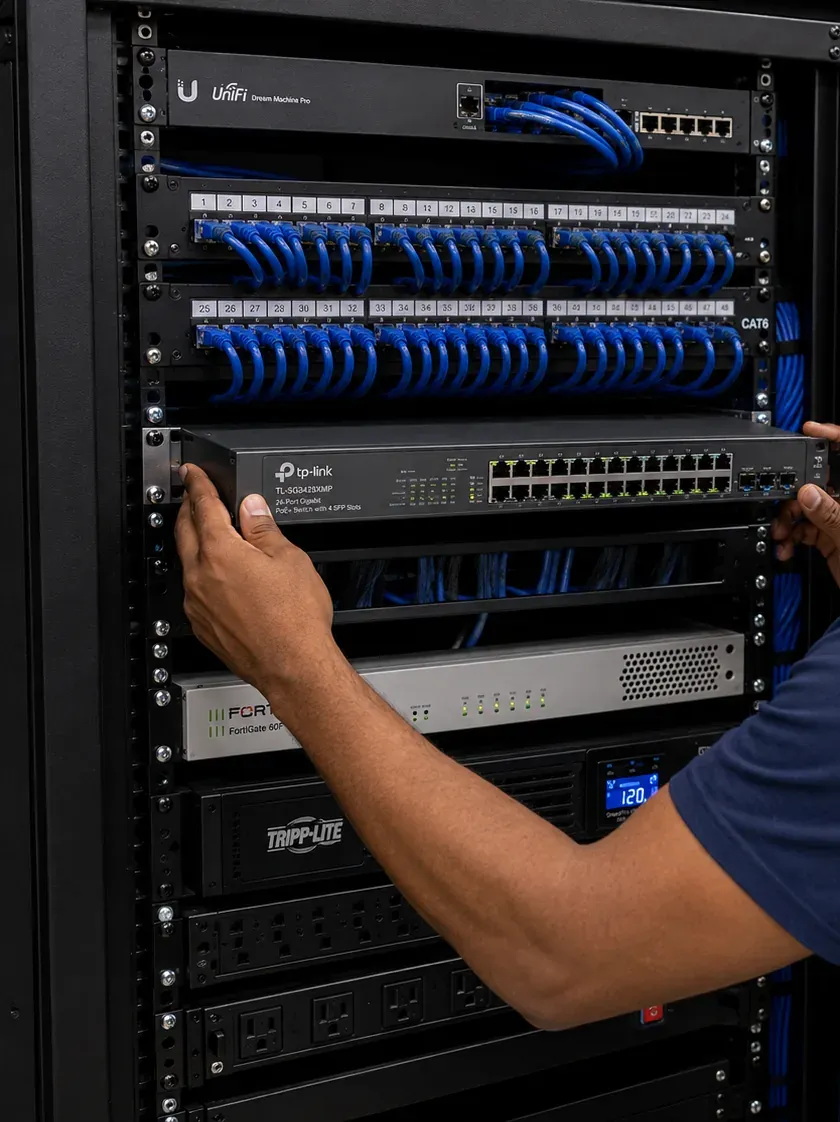
A technician's bare hands guide a 24-port switch with four SFP slots into a black rack, between rows of numbered patch panels with blue cords above and a firewall, power strips and a battery unit below.
Jamaica Fiber Quote
Cross streets, building age and whether the cellar takes water — a licensed installer calls back the same business day
✅
Request Sent!
A Jamaica installer will call you back the same business day.
25+
Years Experience
✓
Same-Day Estimates
100%
Licensed & Insured
4.7★
201 Google Reviews
Tell us the cross streets and how many floors the fiber has to climb. That is all we need to start. Ring the Queens line at (347) 434-6392 or send the 60-second form, and a licensed installer — the person who will actually walk your cellar — calls back with three short questions.
Entrances sealed against groundwater, and switches kept above the wet line
A measured light-loss figure for every strand, handed to the owner in writing
New York State low-voltage licence #12000287431, with Jamaica work scheduled out of our office at 460 East Fordham Road in the Bronx
Why Jamaica Properties Need Fiber Optic Installation Built for Damp Cellars and Busy Blocks
Jamaica has always been where Queens changes trains. The Long Island Rail Road's three trunk routes — the Main Line, the Atlantic Branch and the Montauk Branch — meet at the station on Sutphin Boulevard, the AirTrain leaves from the same building for JFK, and the E, J and Z trains end a few blocks east under Archer Avenue. Governor Hochul's office counted roughly 200,000 riders a day through that hub in April 2026, and 790 trains now stop there. A district built around that much movement filled up early with banks, department stores, courts, clinics and offices, and most of the buildings they left behind are still standing on Jamaica Avenue and the streets that cross it.
Those older buildings are the first half of the fiber story. A four-storey commercial block put up when the savings banks were young was wired for a telephone on each desk and a light on each ceiling, nothing more. Over the decades, every tenant who needed data brought in its own provider, and each provider found its own way from the cellar to the suite: through a stair corner, up an old dumbwaiter, along a hallway ceiling. In buildings with that history it is common to find a wall of abandoned drop cables in the cellar, a few live ones nobody can name, and holes through the floors above that were never sealed. A building-owned fiber backbone replaces that tangle with one documented route and a locked enclosure on each floor.
The second half is new construction. The city's 2007 rezoning of downtown Jamaica opened the blocks around the station to larger commercial and mixed-use buildings, and one of the first big projects to follow it — The Crossing at Jamaica Station, opposite the LIRR at Archer Avenue and Sutphin Boulevard — finished in 2021 with a 28-storey tower and a 14-storey companion building. Then, in October 2025, the City Council approved the Jamaica Neighborhood Plan, an approximately 230-block rezoning that the city says could produce about 11,800 homes and more than two million square feet of commercial and community-facility space. New towers come with real telecom rooms, but they also come with ground-floor shops, clinics, schools and offices whose owners need to know where their own fiber goes.
Running underneath both is water. Southeast Queens has a groundwater problem that has nothing to do with the sea: when the private Jamaica Water Supply Company's wells stopped pumping in the 1990s, the water table rose, and a former Department of Environmental Protection commissioner testified in 2007 that it had climbed 35 feet since 1996. Owners here talk about cellars that are damp every day of the year, not just after a storm. Fiber itself shrugs off moisture, but switches, power supplies, unsealed conduits and bare connectors do not — which is why the first decision on almost every Jamaica job is what stays below ground and what moves up a floor.
Jamaica facts that shape fiber work
About 200,000 daily riders use the LIRR, AirTrain JFK, subways and buses at Jamaica Station, which the Governor's office calls the fourth-busiest commuter rail station in North America; 790 trains stop there, up 54 percent from 481 before Grand Central Madison opened (Governor's press office, April 10, 2026).
Roughly 230 blocks were rezoned by the Jamaica Neighborhood Plan, approved by the City Council on October 29, 2025 — the city's largest neighbourhood rezoning in more than two decades, with $413 million in area-wide investments attached (Cozen O'Connor summary; NYC Council, October 9, 2025).
35 feet — the rise in Southeast Queens groundwater since 1996 that former DEP Commissioner Emily Lloyd described in 2007 testimony, after the Jamaica Water Supply wells stopped pumping (Southeast Queens Residents Environmental Justice Coalition, January 2024).
Over 400 businesses line Jamaica Avenue, the district's main commercial corridor, according to the Jamaica Center Business Improvement District.
41 percent — the share of households in Community District 12, which covers Jamaica, St. Albans and Hollis, with no broadband subscription of any kind, according to the NYC Council's internet-access data.
$153 million was committed under the city's Jamaica NOW Action Plan, announced in 2015, to draw investment into the downtown (NYCEDC; NYC DOT).
Owners who rebuild a Jamaica Avenue building's network usually rethink its doors and cameras at the same moment. If that is on your list, the access control installers for Queens and our Queens commercial camera team can plan from the same riser drawing, so readers, cameras and tenant networks share one tested backbone instead of three separate cables.
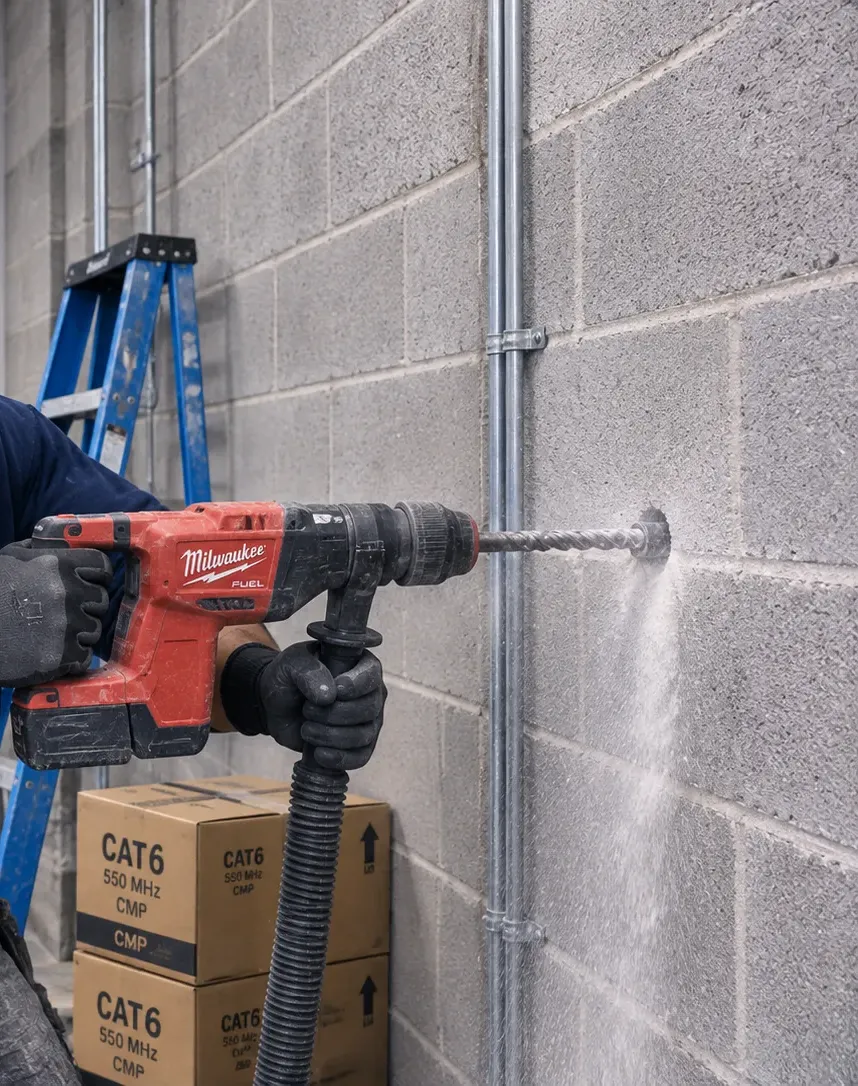
A gloved hand steadies a red cordless hammer drill fitted with a dust-extraction hose as it bores into a grey concrete-block wall next to a run of metal conduit, with boxes of Cat6 cable and a blue stepladder behind.
Repair Capture
Fiber Down Between Sutphin and 168th Street?
Links rarely fail on their own. In Jamaica the usual culprits are a contractor working in a hung ceiling, stock stacked against a cellar enclosure, or seepage that finally reaches a patch panel. That calls for a repair visit, not a new project: we dispatch the same day whenever the schedule allows, and most single-point faults — a kinked jumper, a pigtail pulled out of its tray, a connector that went in dirty or wet — are found and fixed within one to two hours of a technician reaching the room. Call (347) 434-6392 and say "fiber repair," or go to our network cable repair service in Queens if copper runs are part of the trouble.
What We Install
Fiber Optic Installation Services in Jamaica
Our work starts where the provider's ends. Verizon, Spectrum, Astound or a business carrier brings service to the building; we decide with the owner how that service climbs the building, crosses into the next one and reaches every tenant — and we measure each strand before we call it done.
Avenue Building Backbones
For the three- to six-storey commercial buildings on Jamaica Avenue between Sutphin Boulevard and 168th Place: one riser from the provider room to a keyed enclosure on every floor, sized for the offices, clinics, schools and salons that rent upstairs over the shops.
Sealed Building Entrances
A single, properly sleeved and sealed way for every provider into the cellar, with plugs in each spare duct, so the next carrier connects at a panel instead of drilling another hole through a wall that already lets water in.
Equipment Lifted Out of the Cellar
Passive splice enclosure below, active switches and battery backup in a small cabinet on the ground floor or above, joined by owner fiber — the layout we recommend for most Southeast Queens buildings with a damp or seeping basement.
Tower, Podium and Condo Links
Fiber from a new building's main telecom room to a commercial condominium, community facility, garage office or rooftop room, built to the developer's labelling and handed over with results the managing agent can file.
Professional Office Floors
Law practices and other professional offices that want to be within walking distance of the Sutphin Boulevard courthouses: a clean fiber uplink from the building's entry room to the suite, with the office's strands kept physically apart from neighbours'.
Schools, Training Centres and Clinics
Upper floors leased to charter schools, trade schools, tutoring centres and medical practices, where a dozen classrooms or exam rooms need to reach one network room without a copper run longer than the standard allows.
Liberty Avenue Industrial Fiber
Shops, garages and distribution buildings in the industrial strip along Liberty Avenue, where an office at the front and a work floor or yard at the back need to stay on one network across a long, dusty building.
Splicing, Tracing and Records
Fusion splices into factory pigtails, old cable traced end to end with a toner or an OTDR, and a strand map plus labels that a new owner, tenant or provider can understand without calling us.
Tests and Closeout Files
Insertion-loss readings on every strand, OTDR traces on risers and between buildings, scope images of connectors, and photographs of every sealed penetration, delivered as a file the owner keeps.
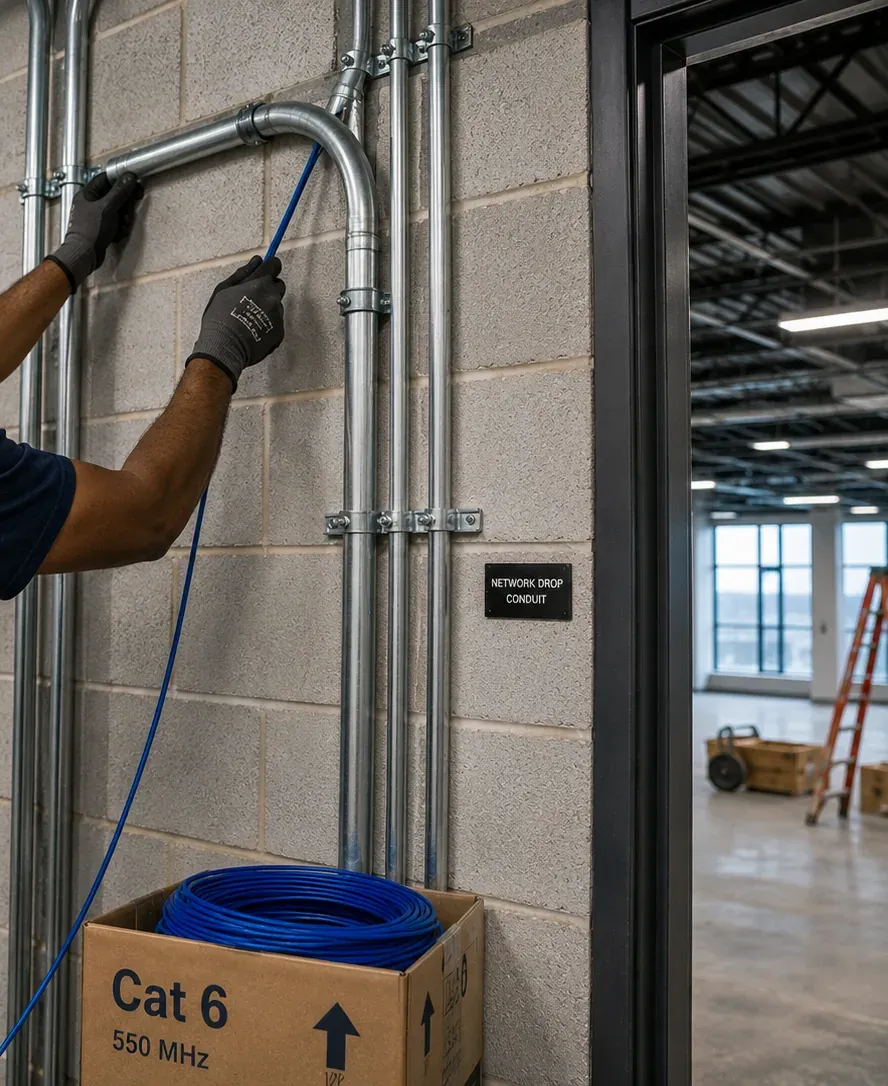
Two gloved hands push a blue cable into the bend of a galvanised conduit sweep mounted on a grey block wall beside other vertical conduits and a small "network drop conduit" sign, with an open warehouse floor visible through the doorway.
Building Specialists
Fiber Optic Installation for Jamaica's Architecture
Downtown Jamaica was built in layers. A colonial-era manor sits in a park on the avenue; banks and civic buildings from around 1900 stand a few doors from Art Deco branches of the 1930s; the courts and federal offices of the late twentieth century fill whole blocks near Sutphin Boulevard; and in the last few years the towers have arrived. Each layer hides its cable routes in a different place.
Turn-of-the-Century Masonry Buildings
Typically load-bearing brick and stone, deep cellars and very little spare vertical space. The 1898 Beaux-Arts Jamaica Savings Bank at 161-02 Jamaica Avenue is the best-known survivor; plenty of plainer neighbours share its bones. Routes follow old stair halls, light wells and abandoned chimneys.
Art Deco and Inter-War Commercial
Limestone-clad banks and stores of the late 1920s and 1930s, such as the 1939 Jamaica Savings Bank branch at Sutphin Boulevard and Jamaica Avenue. Finishes are fine and often protected; cable stays in the cellar, the service core and above replaced ceilings.
Civic and Government Blocks
Large buildings built for courts, agencies and federal offices, like the 1997 Queens Civil Courthouse. Their own networks belong to their own IT departments; our work is in the private offices, shops and services that surround them.
Post-Rezoning Towers
Residential and mixed-use towers on parking and retail podiums near the station and along Archer Avenue, Sutphin Boulevard and the North Core. Purpose-built telecom rooms on each floor; separate routes needed for the podium's commercial owners.
Campus and Institutional Buildings
York College's academic, science and performing-arts buildings off Guy R. Brewer Boulevard and Liberty Avenue, the FDA laboratory on the campus, hospitals and schools. Large owners with their own standards; we work to them when invited.
Low Industrial and Garage Buildings
Workshops, garages and storage buildings in the industrial areas along Liberty Avenue, which the 2025 plan kept industrial but at higher density. Long floors, roll-up doors, forklifts and dust.
Methods and materials, layer by layer
Masonry buildings: small-diameter riser-rated cable in innerduct up a stair hall or chase, wall enclosures on landings where the owner agrees, scanned cores only where an old floor has been confirmed safe to drill, and listed firestop at every floor crossing.
Inter-war commercial: nothing fixed to protected interior finishes; cable kept in the cellar, service rooms and new ceilings, and any exterior work left to the owner's architect where the building is a designated landmark.
Offices near the courts: fiber from the building's entry room to a locked enclosure inside the tenant suite, so client data never crosses a shared patch panel, plus a tidy copper fan-out to desks.
Towers and podiums: the developer's specified jacket, colours and labels; a dedicated pathway from the main telecom room to each commercial unit; MPO trunks only where the main room is dense enough to need them.
Campus buildings: the institution's own cabling standard, its approved enclosures and its labelling scheme, with test results in the format its IT department asks for.
Industrial buildings: cable climbs a steel column in conduit or armour, crosses under the roof deck and lands in cabinets well above forklift height, with sealed glands wherever it enters a dusty or washed-down area.
Most Jamaica building owners who add a fiber backbone also want the front door to report over it. Our intercom installers for Queens buildings can connect a video entry panel to the same enclosure, so the lobby, the cameras and the tenants share one documented plant.
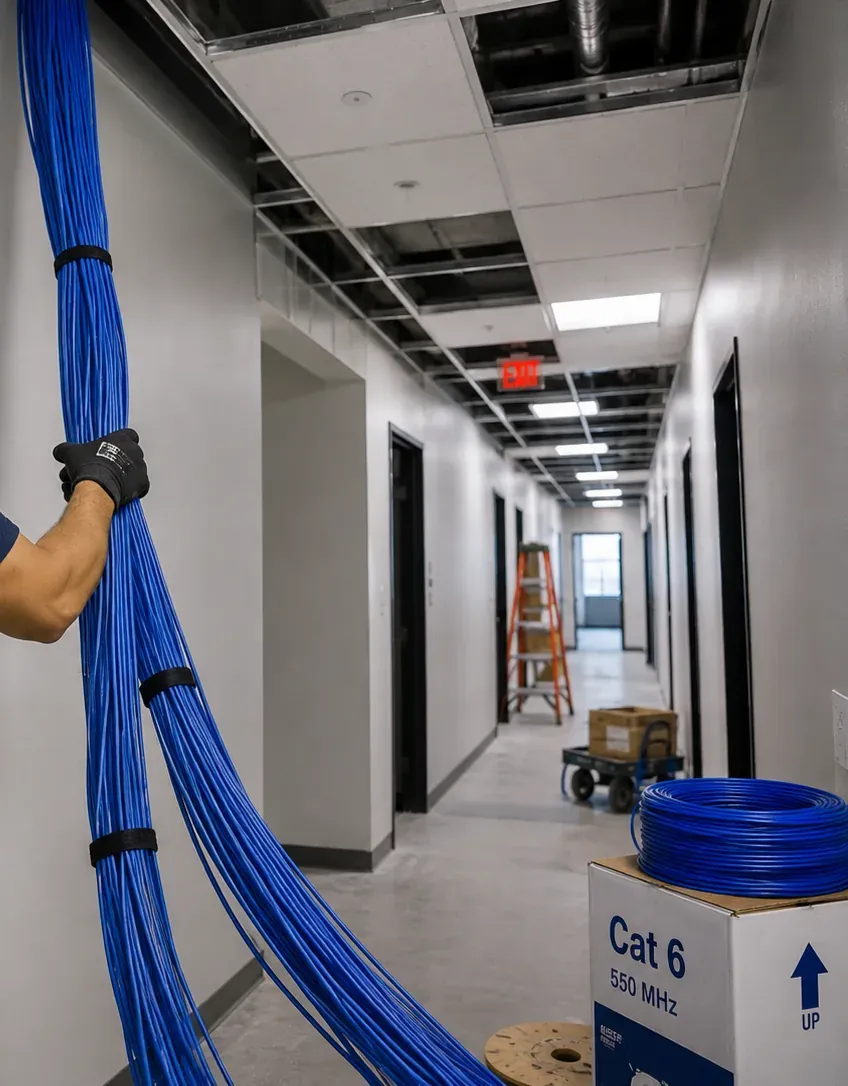
A gloved hand raises a long bundle of blue cable, held together with black hook-and-loop straps, toward an open ceiling grid in a white corridor, with an exit sign, a ladder, a hand truck and a box of cable further down the hall.
Commercial Fiber Optic Installation
Business Fiber Optic Installation in Jamaica
Downtown Jamaica's business streets each have a character of their own, and the character tells us a lot about a fiber job before we see the building. These are the corridors where we expect most of the work.
Jamaica Avenue, Sutphin Boulevard to 168th Place
The retail spine, with more than 400 businesses by the Jamaica Center BID's count and the stretch the City Council has funded for a $78 million reconstruction. Ground-floor stores with offices, studios and classrooms above; one cellar shared by everyone.
The Sutphin Boulevard Courthouse Blocks
The Queens Supreme Court civil term at 88-11 Sutphin Boulevard and the Civil Court at 89-17 sit across a public plaza from each other. Offices that need to be near a courthouse look for space in the older walk-ups and small office buildings on the surrounding blocks.
Archer Avenue and the Station Area
The LIRR and AirTrain station at 93-02 Sutphin Boulevard, the Sutphin–Archer subway entrance, the bus terminal and the new towers facing them. The Council has funded a new plaza at the western end of the Archer Avenue bus terminal and a wider Station Plaza programme.
The Federal and Civic Core
The Joseph P. Addabbo Federal Building at 155-10 Jamaica Avenue, home of the Social Security Administration's Northeastern Program Service Center, sits a few blocks from the city health department building on Parsons Boulevard and the services that cluster around both.
165th Street and the Jamaica Center Blocks
The pedestrian 165th Street, which the Council has funded for rebuilding as a shared street for pedestrians and deliveries, and the blocks around the Jamaica Center–Parsons/Archer station that opened in 1988. Dense small retail and upstairs offices.
Liberty Avenue and York College
York College's campus and the FDA's New York Human and Animal Food Laboratory at 158-15 Liberty Avenue on one side; the industrial areas that the 2025 plan kept industrial on the other. Long buildings, yards and institutions with standards of their own.
Compliance callouts for Jamaica fiber work
Every hole sealed. Cabling under 50 volts generally needs no Department of Buildings permit, yet each penetration through a rated floor or wall is sealed with a listed firestop system and photographed. In buildings where generations of providers have drilled freely, we often find more open holes than we make.
Cable ratings follow the space. Riser-rated (OFNR) cable for vertical shafts, plenum-rated (OFNP) where a ceiling carries return air — common in tower podiums and refitted avenue offices. A higher rating may replace a lower one, never the reverse.
Landmarks and protected finishes. Downtown Jamaica has designated landmarks along and near Jamaica Avenue, including King Manor, the former Register building that now houses the Jamaica Center for Arts and Learning, and both Jamaica Savings Bank buildings. Interior cable routes in a working building rarely concern the Landmarks Preservation Commission; anything on a facade or roof stays with the owner's architect.
Water is a design input. Groundwater in Southeast Queens is a documented, long-running condition, not a once-a-decade event. Entrance ducts are plugged and sealed, enclosures sit high on walls, and active equipment goes upstairs wherever the building allows.
Street work belongs to others. Sidewalks, curbs and the street in front of the building are city property and franchise territory. Our work begins at the inside face of the foundation wall; when the city rebuilds a corridor, we coordinate with the owner and the providers rather than touching the street.
Paperwork first. Larger Jamaica buildings rarely release cellar keys to a contractor without a certificate of insurance naming the owner and managing agent; ours is issued ahead of the survey.
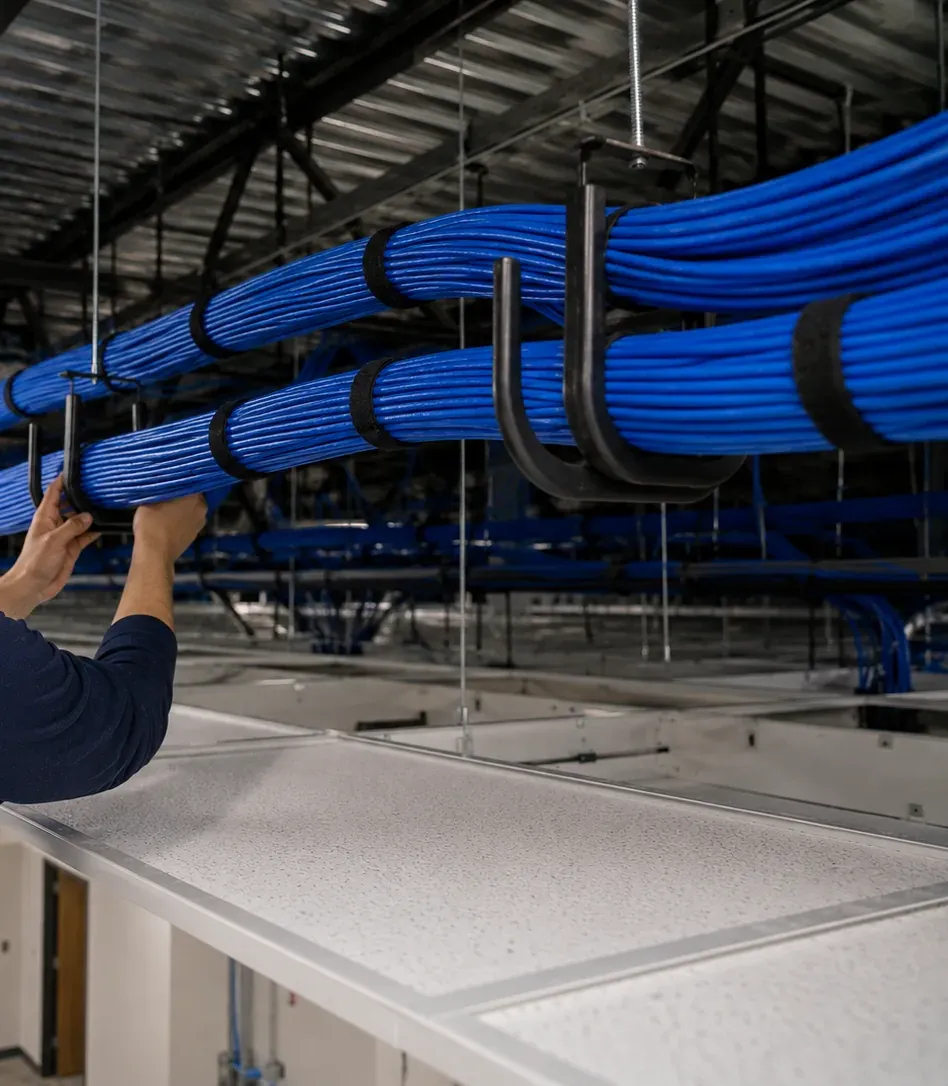
Above a white suspended ceiling grid, a technician's gloved hands lay two thick, strapped bundles of blue cable into large black J-hooks hanging from threaded rods under exposed roof steel.
Groundwater
The Water Under Downtown Jamaica, and What It Means for Network Rooms
Most flooding stories in New York are about rain or the sea. Southeast Queens has a third kind. For more than a century, a private utility, the Jamaica Water Supply Company, drew water for southern Queens from its own wells — about 60 million gallons a day through 69 wells, according to the Southeast Queens Residents Environmental Justice Coalition. After the city's Department of Environmental Protection bought the company and connected the area to the upstate reservoir system, the pumping wound down and the water table began to rise. In 2007, a former DEP commissioner testified that it had risen 35 feet since 1996.
For a building owner that means water arriving from below rather than from the street: slow seepage through cellar floors and the joints of foundation walls, damp air that never quite dries out, and sump pumps that run in dry weather. York College has lived with it for years — the Queens Chronicle reported in 2019 that visitors to the boiler room in the Academic Core's sub-basement had to "trek around puddles," and the Council's 2025 Jamaica package set aside $16 million in CUNY funds to tackle the college's groundwater intrusion, plus $7 million for basement reconstruction at local community facilities.
Network equipment does not like that environment, and neither does the way most cables enter buildings. Three things go wrong again and again in damp cellars:
Conduits become pipes. An entrance duct that runs below the water table, with no plug at the inside end, can carry water straight into the cellar along the cable. We seal every entrance duct, occupied or spare, at the inside face of the wall.
Connectors corrode and collect grime. An open patch panel in humid air slowly fouls the polished end faces that light has to pass through. Enclosures go high on the wall, closed, gasketed where needed, with dust caps on every unused port.
Electronics fail first. The glass will survive a damp room for decades; the switch, its power supply and the battery backup beside it will not. Where the building allows, the active equipment goes up a floor and only passive fiber stays below.
None of this replaces drainage, waterproofing or the city's sewer work — the Council's package includes $315 million for sewer upgrades over the coming decades. It simply means the building's network stops being the first casualty every time the water table has a good year.
A simple routine for the week after the water comes up
Owners in Southeast Queens learn to watch the cellar after heavy rain or a long wet spell. A few checks on the network side take ten minutes and catch problems before tenants call:
Look at the entrance enclosure. Is the door closed and dry inside? Any droplets on the inside of the lid, rust on the hinges or a damp tray is worth a photograph and a call.
Check the duct plugs. A damp ring or a silt trail on the wall below an entrance duct means a plug has loosened or a new duct was left open by someone else's crew.
Listen to the sump and the dehumidifier. If either has stopped, the room will get wetter quickly; the building's own maintenance comes first.
Walk up to the dry cabinet. Confirm the switches and battery unit show normal lights. If the active equipment lives upstairs, it should not have noticed the water at all — which is the point of putting it there.
Write it down. A dated note and a couple of photographs build the record that later helps an engineer, an insurer or a buyer understand the building.
If anything on that list looks wrong, a service visit can clean and re-seal the enclosure, re-test the strands that pass through it and replace any patch cord that sat in damp air. That is a small job when it is done early and a much larger one after a season of neglect.
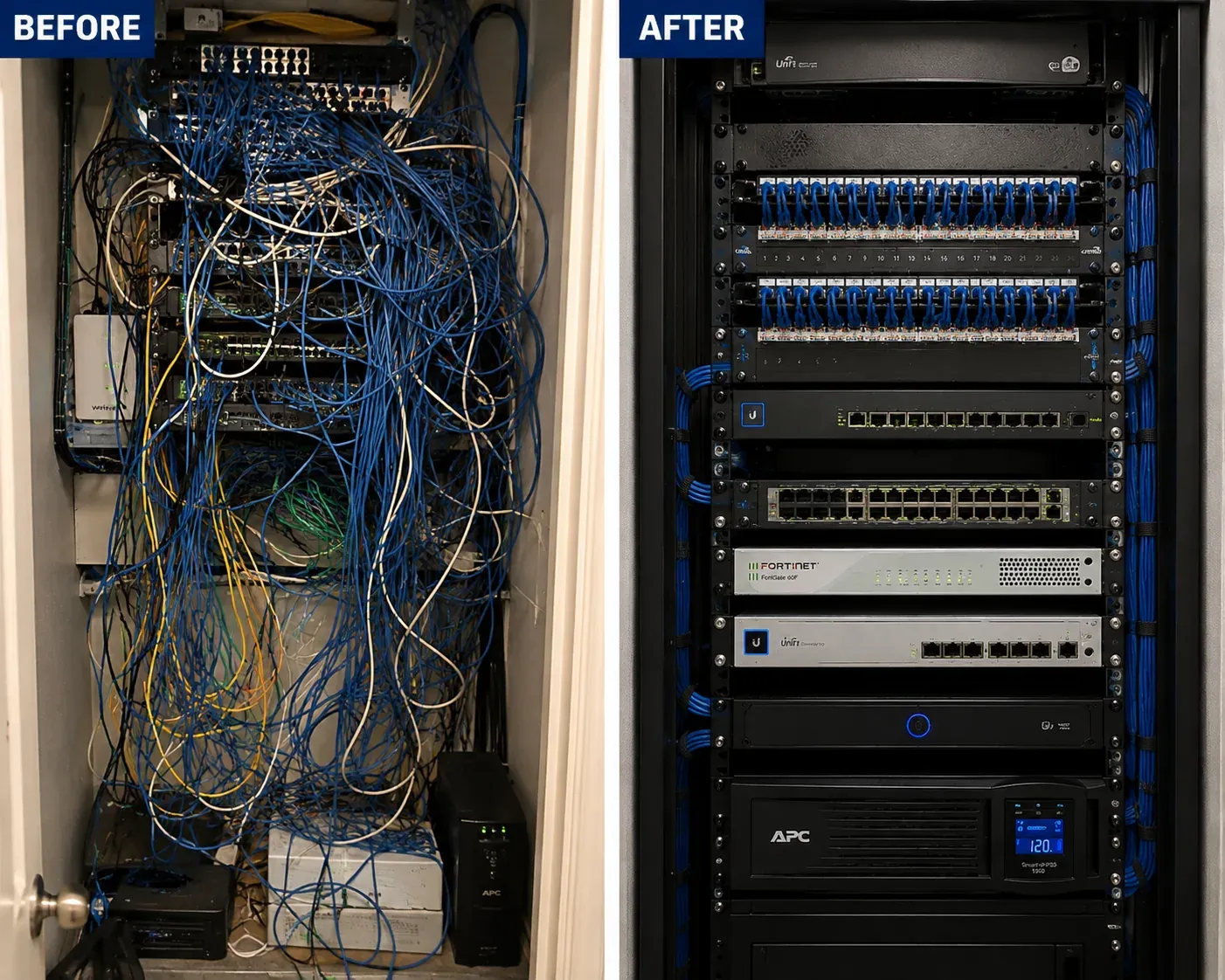
Two side-by-side panels labelled BEFORE and AFTER: on the left, a closet choked with loose blue, white and yellow cables hanging over equipment on the floor; on the right, the same space as a black rack with patch panels, switches, a firewall and a battery unit in neat rows.
Your Questions Answered
Fiber Optic Installation in Jamaica: Questions Answered
These are the questions Jamaica owners, developers and tenants raise before they commit — about water, about a district that is being rebuilt around them, and about buildings that are changing use. Each answer leads with the short version; the quick practical points sit in the FAQ further down.
Groundwater and the cellar entrance
Groundwater keeps rising through our cellar floor — can it follow the provider's conduit into the building, and how is that stopped?
Yes, it can, and it is one of the most common hidden leaks in Southeast Queens. An entrance duct is simply a pipe through the foundation wall. If the outside end sits below the water table and the inside end is open, water and silt travel along it and arrive in the cellar beside the cable, often right next to the provider's equipment. Spare ducts that nobody ever used are just as bad, because they are usually open at both ends.
The fix is mechanical and inexpensive. Every duct that enters the building gets a plug at the inside face of the wall: a split sealing plug around an occupied duct, so the cable passes through a tight, compressible seal, and a solid plug in each empty one. Where a cable came in through a loose hole in the masonry rather than a duct, we sleeve and seal it, or move it to a sealed sleeve if the provider agrees. We photograph each plug for the owner's file. If the wall has a waterproof coating or membrane on the inside, we tell the owner before drilling anything, because a new hole through it needs the waterproofer's approved detail, not just our seal.
What we do not do is work in the street or the sidewalk vault; the outside of the duct belongs to the provider or the city. What an owner controls is the inside face, and sealing it is usually the single cheapest improvement a damp Jamaica cellar can get.
Our cellar is damp every day of the year rather than flooding now and then — which cable, enclosures and patch cords stand up to that?
Constant humidity calls for a different shopping list from an occasional flood. For the cable itself we use jackets rated for indoor/outdoor service, which are built with water-blocking materials and tolerate damp spaces far better than an ordinary indoor jacket; where the run crosses a storage area or a boiler room we add armour. Inside the building the same cable continues up to the first dry floor, so there is no splice sitting in the wettest room.
The enclosure in the cellar is a closed, gasketed wall box mounted as high as the incoming cables allow, with every unused port capped and every cable entering through a sealed grommet rather than an open knockout. We avoid leaving patch cords coiled on the floor or hanging below the enclosure, since humid air and grime work into the connector end faces over months. Where a provider's equipment must stay in the cellar, we leave the owner's side as passive as possible — splices and connectors, no electronics — and take the fiber up to a dry cabinet for the switches.
If the room has a dehumidifier or sump pump, its outlet and discharge hose decide where the enclosure can sensibly go. We plan the layout with the super so nothing ends up under a drip line or beside a pump that cycles all day.
A district being rebuilt around you
The city is rebuilding Jamaica Avenue in front of our building — should we use the moment to prepare a better way in for providers' fiber?
It is a good moment to think about it, provided the work on the street side is done by the people entitled to do it. The City Council's 2025 package includes $78 million to renovate Jamaica Avenue between Sutphin Boulevard and 168th Place and $13 million to rebuild 165th Street as a shared street. When a sidewalk is open, providers sometimes take the chance to replace an old lateral into a building, and an owner who already has a clear, sealed entrance and a plan for where fiber should land inside is far easier to serve.
Our part is everything on the inside of the foundation wall. Before the street work reaches your block, we can locate where each provider's cable currently enters, seal the entrances, install a sleeve at the location you would prefer future providers to use, and mount a passive entrance enclosure from which an owner backbone climbs the building. We then write a one-page note for the owner to share with the providers' account teams: where the entrance is, what is inside, and who to call. Whether a provider rebuilds its own lateral during the street project is its decision, and any work in the sidewalk or street needs the city's permits, which we do not hold.
If your building has no plan at all today, start with the cellar survey. It costs little, it tells you what is live and what is dead, and it gives you something concrete to hand the providers while the street is open.
A neighbouring lot is about to be cleared for a new building, and our internet arrives through it — how do we protect the service before demolition starts?
Find out exactly how the service reaches you, and do it before the fences go up. In older city blocks a provider's cable sometimes crosses a neighbour's rear yard, run along a party wall or pass through a shared cellar before it reaches the building it serves. When that neighbour's lot is cleared for one of the developments the rezonings allow, the cable is in the way, and a demolition crew has no reason to know it feeds you.
We trace the route from your side — enclosure, cable, wall penetration — and photograph and measure it, so the owner can raise it with the provider and the neighbouring developer in writing. Usually the provider has to re-feed the building from the street through a new entrance; if that entrance can be in place before the old route is cut, the switch-over is a short planned outage rather than a surprise. We prepare the inside of the new entrance, extend the owner's backbone to it, and re-test every strand once the provider has moved its service across.
The same exercise is worth doing for building systems that cross a lot line — a camera on a shared alley, a door reader on a rear gate — because those cables are just as invisible to a demolition crew.
Our hotel near the AirTrain is going back to welcoming travellers after years of other use — what should be checked in its network before guests return?
Assume nothing about what is behind the ceiling tiles, and test it. The City Council's 2025 Jamaica agreement includes a commitment from the Department of Homeless Services to review whether contracts for Jamaica-area commercial hotels can be returned to tourism use, so some owners near the airport corridor may face exactly this question. A building that has served a different purpose for several years has usually seen rooms reconfigured, access points moved or removed, and equipment rooms used for storage.
We start at the main equipment room and work outward: inspect and test the fiber between the main room and each floor's closet, trace any unlabelled cable, check that floor closets are still closed, ventilated and powered, and record what has been cut or abandoned. The output is a list the owner can act on — strands that pass, strands that need re-termination, closets that need cleaning and locks, and any floor where the backbone is missing altogether. Guest Wi-Fi, door locks and front-desk systems all depend on that backbone, so it is the right place to begin before the vendors for those systems arrive.
If the inspection shows the riser is sound, the remaining work is often modest; if it is not, replacing a riser floor by floor can be phased so rooms come back into service in blocks.
Many of our tenants have no home internet — can the building's backbone feed a free Wi-Fi spot in a lobby or community room?
Yes, technically it is straightforward, and in Community District 12, where the Council's data showed 41 percent of households without a broadband subscription, it is a practical thing for an owner, a church or a community organisation to consider. A strand from the building's entrance enclosure to the community room, a small switch and one or two access points are all it takes on the wiring side. The service itself comes from whichever provider the owner contracts, on a business account intended for public or shared use.
The design point that matters is separation. The public Wi-Fi should sit on its own strands or its own network, entirely apart from the building's cameras, door system and management office, so a visitor's laptop can never see the super's computer. We also place the access points so the signal covers the room and not the street, and we leave the owner with a simple way to switch the service off out of hours.
Content filtering, usage terms and any grant reporting are matters for the owner and the provider; our job is a clean, documented connection that does not compromise the rest of the building.
New towers, condos and growing industrial buildings
We bought a commercial condominium at the base of a new Jamaica tower — does our fiber have to come through the residential building's telecom room?
Usually it does, and the condominium documents decide the details. In a mixed-use tower the commercial units, the residential condominium or rental and sometimes a community facility each own or lease part of the building, while the main telecom room, the risers and the entrance ducts are often common elements controlled by the board or the managing agent. The declaration and bylaws normally say whether a unit owner may run cable through common spaces, who approves it and who pays.
Practically, we read what the managing agent sends, then propose the shortest route from the main telecom room — where the providers already terminate — to a small locked enclosure inside your unit, using the developer's labelling so the result looks like part of the building. If the documents give the commercial units their own entrance or their own telecom room, we use that instead. Either way, you end up with strands that are physically yours, clearly labelled at both ends, and a drawing the board can file.
Bring us in before your fit-out drawings are final. A conduit stubbed into the unit during the build-out costs a fraction of one cut into a finished ceiling a year later.
Our Liberty Avenue industrial building is adding a floor of offices above the shop — how should fiber reach the new floor while the work floor keeps running?
Plan the vertical route with the architect before the new floor is framed, and keep the shop's existing network alive on its own until the day you switch. The 2025 plan kept the industrial areas along Liberty Avenue industrial but allowed more floor area, so some owners there may now add space upward. The easy mistake is to wait until the new floor is finished and then look for a way up through a working shop.
The better sequence is to set a sleeve or a short conduit run through the new floor structure while it is open, landing in a small network closet on the new level, with a matching location on the ground floor that stays out of forklift paths and away from the dustiest work. When the floor is ready, the fiber goes up through that ready-made path in a few hours, the new offices are tested, and the shop's network moves onto the new backbone during a short agreed window, typically outside working hours.
In a building with a mezzanine, a crane rail or roll-up doors at both ends, we also look at whether a second route — along the roof steel to the far end — is worth adding at the same time, so cameras and scanners at the back of the shop get fiber instead of an overlong copper run.
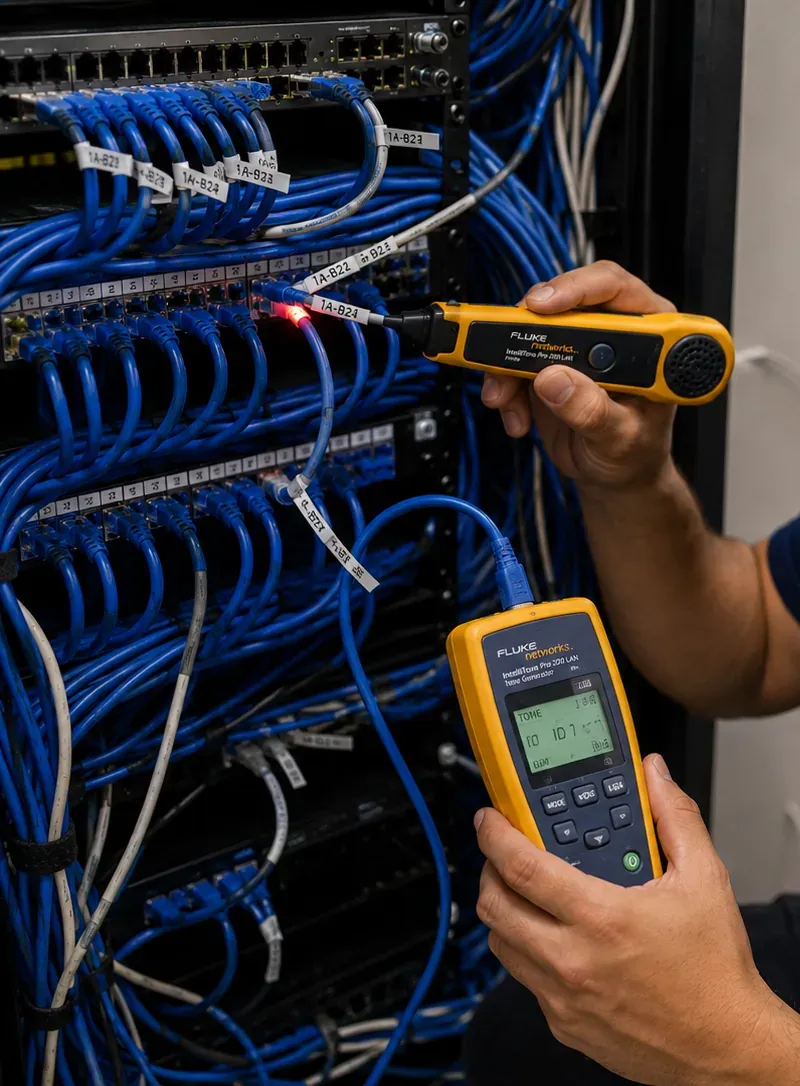
One hand holds a yellow tone probe with a red tip against a dense patch panel of blue cables with white labels while the other holds a yellow handheld toner with a small screen, tracing which run belongs to which port.
Equipment
Types of Fiber Optic Cabling We Install
The parts list for a Jamaica job is short, but the choices inside it matter more here than in a dry building. Each item below is chosen for where it will live — a cellar that sweats, a stair hall in a century-old building, a podium ceiling full of return air or a shop floor full of forklifts.
OS2 Single-Mode Riser Cable
The default for a building backbone and for anything a provider might one day ride. Reach is no concern inside a Jamaica property, and the cable outlives several generations of switches.
Indoor/Outdoor Water-Blocked Cable
A jacket and core built to tolerate damp, used from the cellar entrance up to the first dry floor, so no splice has to sit in the wettest room of the building.
Interlocking Armoured Fiber
Metal armour wherever a cable crosses a storage cage, boiler room, loading area or shop floor — places where boxes, carts and forklifts lean on whatever is on the wall.
Plenum-Rated Cable
OFNP cable above ceilings that carry return air, common in tower podiums and in avenue offices refitted with new mechanical systems; riser-rated OFNR in shafts and chases.
Gasketed Wall Enclosures
Closed, lockable boxes with sealed cable entries for the cellar and each floor, mounted high and away from pumps, drains and dehumidifier outlets.
Duct Sealing Plugs
Split plugs that seal around a live cable in an entrance duct, and solid plugs for spare ducts, so groundwater cannot ride the conduit into the building.
Rack Panels: LC, SC and MPO
Most Jamaica backbones terminate on LC duplex ports; SC appears where a carrier's handoff is built that way, and high-density MPO trunks only make sense in a big tower's main room. Each port carries its label from the strand map.
SFP Optics and Fiber-Ready Switches
Transceivers matched to the switch already in the rack, or a switch with fiber slots where the old one has none, so the backbone lands directly in the network rather than through a stack of converters.
Small Media Converters
For the occasional device with only a copper port at the far end of a long building — a camera over a rear gate, a reader at a loading door, a kiosk in a lobby.
Where each piece belongs in a damp-cellar building
Item
Cellar
Ground floor or above
Why
Provider's entrance and handoff
Usually, where the street cable arrives
Only if the provider agrees to relocate
The provider decides where its own cable enters and terminates
Owner's splice enclosure
Yes — sealed, high on the wall
A second one at the network cabinet
Passive glass and splices tolerate damp far better than electronics
Switches, firewall, battery backup
Avoid
Yes — in a ventilated cabinet or closet
Active equipment is what fails first when water or humidity arrives
Spare strands and slack loops
A short service loop only
Most of the spare length
Slack is used during repairs; keep it where it can be reached dry
Strand map and test results
A laminated copy in the enclosure
The master copy, plus one off-site
After a water event the record tells everyone what to check first
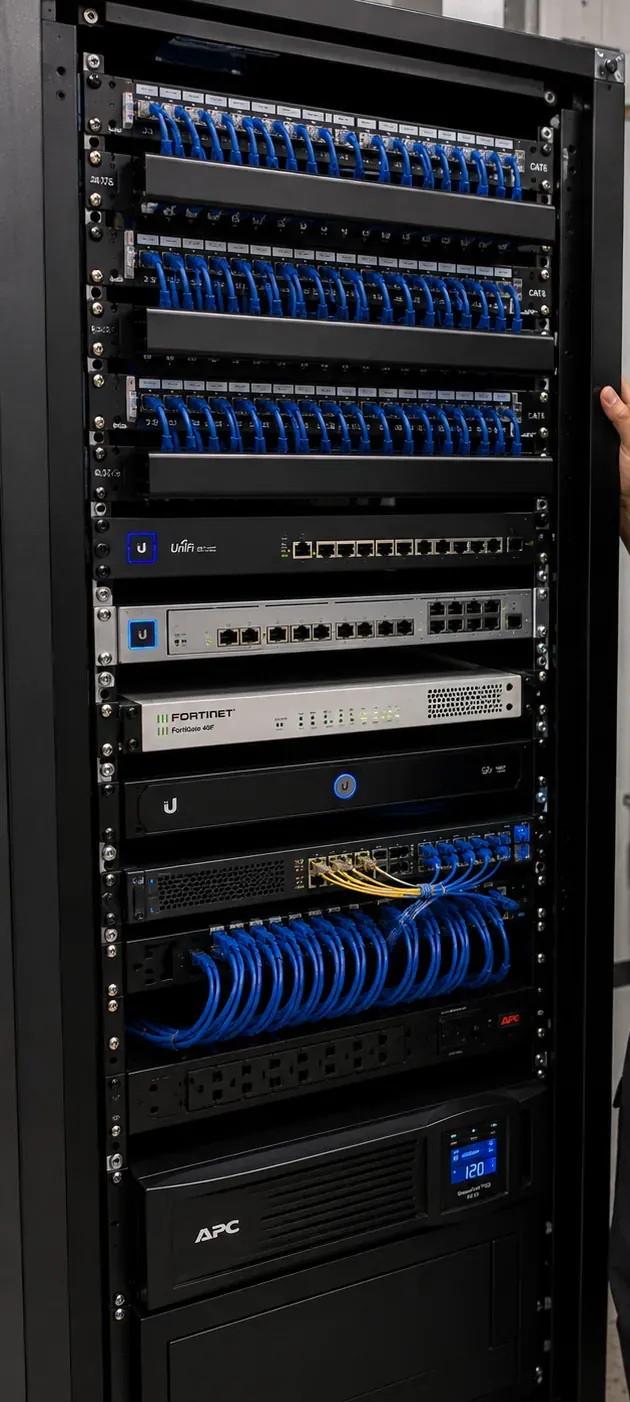
A tall black rack holds three patch panels of blue cords, a row of switches and a firewall, a switch whose ports are fed by a short run of yellow fiber jumpers, a power strip and a battery backup unit at the bottom.
AI Overview Reality Check
What AI Gets Wrong About Fiber Optic Installation in Jamaica
AI assistants answer questions about fiber in Jamaica by blending availability maps, provider forum posts and national cost guides. Google's AI Overview could not be opened from our build environment, so instead we quote the published sources those answers lean on — BroadbandSearch, Reddit threads, The Network Installers' cost guide and the studies it cites, and Atlantech — and test each claim against conditions inside Jamaica buildings. Angi, HomeAdvisor and Fixr returned no fiber-installation cost page when we searched, so none of them is quoted.
"Yes, fiber internet is available in Jamaica"
That is how the BroadbandSearch listing for Jamaica answers its own question, and at the level of the neighbourhood it is true: fiber runs under the avenues and the carriers advertise it here.
It says nothing about any particular building. Whether fiber reaches a third-floor suite above a Jamaica Avenue shop depends on whether a provider has a path from the street into that cellar, whether the owner has signed for it, and whether there is any route from the cellar to the suite that does not cross another tenant's space. In older buildings, the honest answer is often "the street has it; your floor does not."
An owner backbone turns the neighbourhood answer into a building answer. Once there is a sealed entrance and a riser with spare strands, "available in Jamaica" can become "available on every floor of this address."
"Equipping your building with Fios may take up to 6-12…"
That line comes from a reply in r/verizon to a New Yorker asking how to get fiber in their building, which also notes that service can be "available in your neighborhood just not in your building right now." AI summaries tend to treat the carrier's timeline as the only timeline.
The carrier's schedule covers the carrier's work. Inside the building, much of the delay is the owner's side: no agreed entrance, no route between floors, no record of what is already in the walls. Those are things an owner can fix on their own schedule, before or while the carrier plans its part.
A Jamaica owner who has a sealed entrance, a riser and a strand map ready gives every provider less to build and fewer reasons to put the building at the back of the queue.
"FIOS is in the streets"
An r/AskNYC commenter explained the gap this way: "FIOS is in the streets - it's individual landlords/building owners which are not giving permission to Verizon to wire the building." It is a fair description of how many tenants experience the problem.
In downtown Jamaica the picture is often less about refusal than about fragmentation. A single block can include a landmark bank, a condominium tower, a building owned by a family for decades and a lot about to be redeveloped. Owners are frequently willing; what is missing is someone to work out where a provider's cable could enter and climb without damaging the building or crossing a neighbour's property.
Giving the owner a concrete, priced plan for the inside of the building — entrance, riser, enclosures — is often what turns a vague "yes, someday" into a signed access agreement.
"Underground fiber runs about $18 a foot"
The Network Installers' cost guide cites a 2025 Fiber Broadband Association report putting the median underground construction cost at $18.00 per foot, with aerial construction at about $8.00 per foot. Those are reasonable figures for what they measure.
They measure outside-plant construction — trenching, boring and poles along streets and roads. Almost none of that applies to an owner backbone inside a Jamaica building, where the cable never leaves private property and the cost is driven by floors, enclosures, penetrations and seals, not by feet of trench.
If someone quotes a building riser by multiplying the height by a street-construction rate, ask what the price includes. Our quotes list the cable, each enclosure, each sealed penetration, the splicing and the testing as separate lines.
"Mechanical splices cost less than fusion splices"
The same guide, citing Ring and Ping, puts a fusion splice at $30–$75 and a mechanical splice at $15–$40. On price alone the mechanical option looks attractive.
In a building that is damp all year, the cheaper joint is the wrong one to economise on. A fusion splice welds the two glass ends into one continuous strand inside a protective sleeve; a mechanical splice holds them together with a gel-filled alignment device. Both work in a controlled room, but for a permanent backbone that passes through a humid cellar we fuse, and keep the splice trays in sealed enclosures.
Mechanical splices still have a place — a quick temporary repair to get a building back online before a scheduled permanent fix. Used that way, the price difference is not the point.
"Testing adds about 5 percent to the project"
The Network Installers' guide, citing Automation World, puts testing and documentation at roughly 5 percent of a fiber project's cost. AI answers often present this as an optional extra.
On a Jamaica job the records are part of what the owner is buying. Strand-by-strand loss readings, OTDR traces on the riser and photographs of every sealed entrance and firestopped hole are what let the next provider connect in an hour, the insurer understand a water claim, and a future buyer see what the building has.
Ask any bidder exactly what the closeout file will contain. "Tested OK" without numbers, traces and photos is not documentation.
"It depends on how far you are from the nearest fiber"
Atlantech's answer to "how long does it take to install fiber in my commercial building?" leads with distance to the nearest fiber and building access, and mentions a customer who waited 15 months and still could not get service. That is a real risk for carrier service.
In downtown Jamaica, distance to carrier fiber is rarely the problem — the avenues are well served. Building access is the problem, and access is exactly what an owner backbone addresses. The work inside a typical avenue building, from walkthrough to test report, is measured in weeks, and it can run in parallel with the carrier's own planning.
So split the question in two: how long until a provider lights the building, and how long until the building is ready for any provider. Only the second is fully in the owner's hands.
Show Us the Cellar. We'll Show You Where the Water Can't Reach.
We come out at no cost, mark up where the entrance seal, the enclosures and the switches belong, and price it line by line. You decide only after you have seen all of it.
Give us the address or cross streets and what has to be joined to what — cellar to roof, podium to tower, shop to new floor. A Jamaica installer replies the same business day, or call (347) 434-6392.
✅
Request Received
Thank you — expect a call from one of our installers before the business day ends. Something urgent? Ring (347) 434-6392.
How It Works
Our Installation Process
Seven steps. In Jamaica the order matters: we deal with the water and the entrance first, then the climb, then the floors — so nothing new is installed in a room that is about to be wet.
1. Walk the cellar first
With the owner, super or managing agent, starting where the providers enter: every duct and hole in the foundation wall, signs of groundwater, the existing equipment and the route up through the building.
2. Decide what stays below
Agree which passive splice enclosure stays at the entrance, where the dry network cabinet goes on an upper floor, and how many strands each floor, unit or tenant receives.
3. Price, insurance and approvals
We send a priced proposal line by line, issue the insurance certificate your managing agent asks for, prepare any condominium, board or landlord package, and give written notice to tenants whose space we have to enter.
4. Seal the entrance
Plugs in every entrance duct, occupied or spare, sleeves for loose penetrations, and the entrance enclosure mounted high and away from pumps and drains.
5. Build the climb
Innerduct or conduit up the agreed riser, scanned cores where a slab has to be crossed, listed firestop at every floor and an enclosure on each landing or in each telecom room.
6. Pull, splice and test
We pull without exceeding the cable maker's tension or bend-radius limits, fuse each strand into its tray, check every connector end face under a scope, record loss strand by strand and take OTDR traces along the riser.
7. Label, move over and hand over
Labels at both ends, services moved onto the new backbone in short agreed windows, and the strand map, test results and photographs of every seal given to the owner.
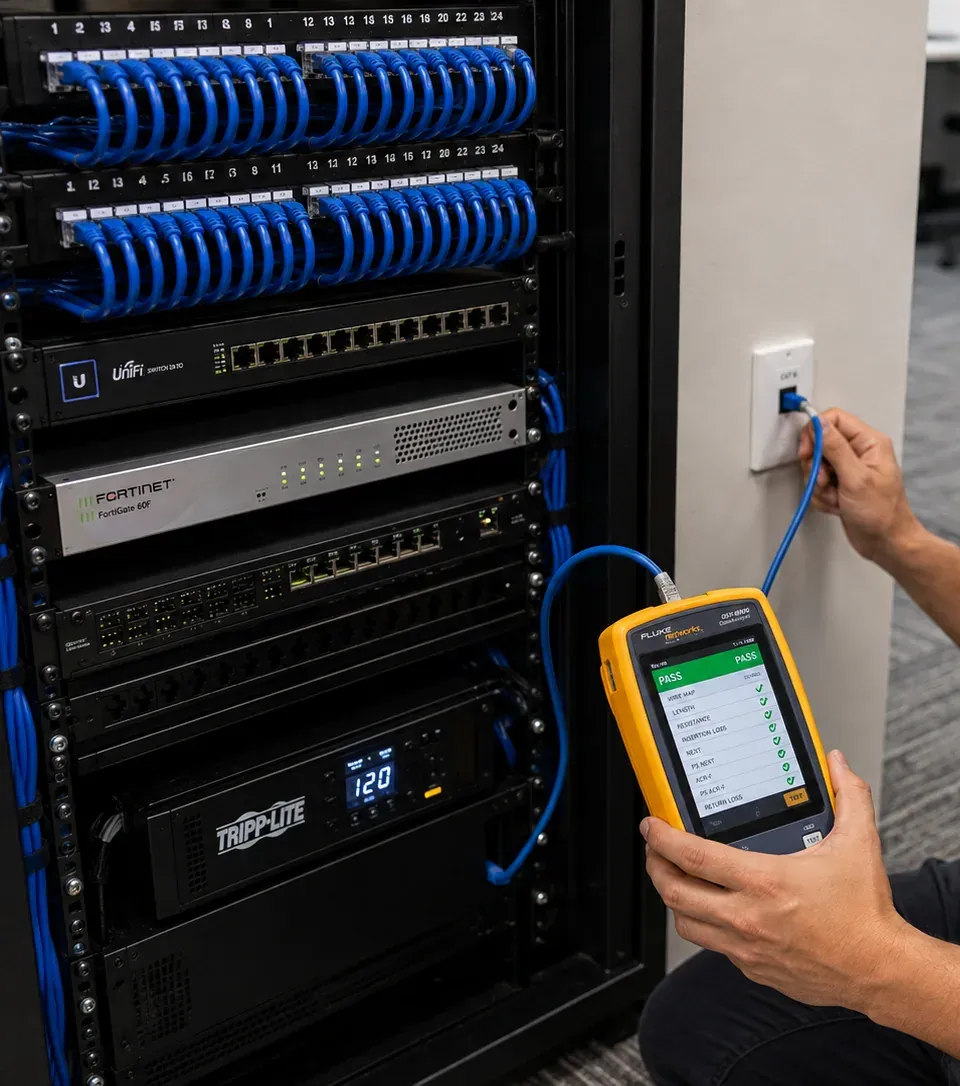
One hand plugs a blue patch cord into a white wall outlet while the other holds a yellow handheld certification tester whose screen shows a green PASS banner and a column of ticked results, next to a rack of patch panels, a firewall and a battery unit.
Coverage Area
Fiber Optic Installation Near Jamaica's Landmarks
Downtown Jamaica's landmarks are spread along a mile of avenue and boulevard, from the station in the west to the federal building and the college in the east. Every one of them anchors blocks of working buildings that need the kind of fiber described on this page.
Jamaica Station, 93-02 Sutphin Boulevard
Built in 1912–1913 where the LIRR's Main Line, Atlantic Branch and Montauk Branch meet, with six LIRR platforms, ten tracks and the AirTrain JFK terminal alongside. The state committed $50 million in 2026 to plan its redesign.
King Manor and Rufus King Park
The house at 150-03 Jamaica Avenue that Rufus King expanded into a 17-room mansion after 1805, in an 11.5-acre park. A National Historic Landmark and city landmark; the 2025 package funds its restoration.
Jamaica Center for Arts and Learning
The former Office of the Register at 161-04 Jamaica Avenue, a Neo-Italian Renaissance civic building that now holds galleries, studios and a 99-seat theatre. The Council has funded $9.4 million for new elevators there.
Jamaica Savings Bank, Sutphin Branch
The Art Deco branch at 146-21 Jamaica Avenue, opened on April 22, 1939 and designated a New York City landmark in 2010, with its carved eagle above the bronze entrance.
Queens Civil Courthouse, 89-17 Sutphin Boulevard
Completed in 1997 to a Perkins Eastman design in limestone, granite and glass, with two wings, a glass lobby and a plaza linking it to the older Supreme Courthouse across the street.
York College and the Addabbo Federal Building
CUNY's York College campus off Guy R. Brewer Boulevard, with the FDA laboratory at 158-15 Liberty Avenue, and the Joseph P. Addabbo Federal Building at 155-10 Jamaica Avenue, home to Social Security's Northeastern Program Service Center.
From a Jamaica base we also cover Jamaica Estates, Jamaica Hills, Briarwood, Hollis, St. Albans, South Jamaica, Rochdale Village, Springfield Gardens, Richmond Hill and Kew Gardens, along with the rest of the borough on the Queens fiber optic installation page.
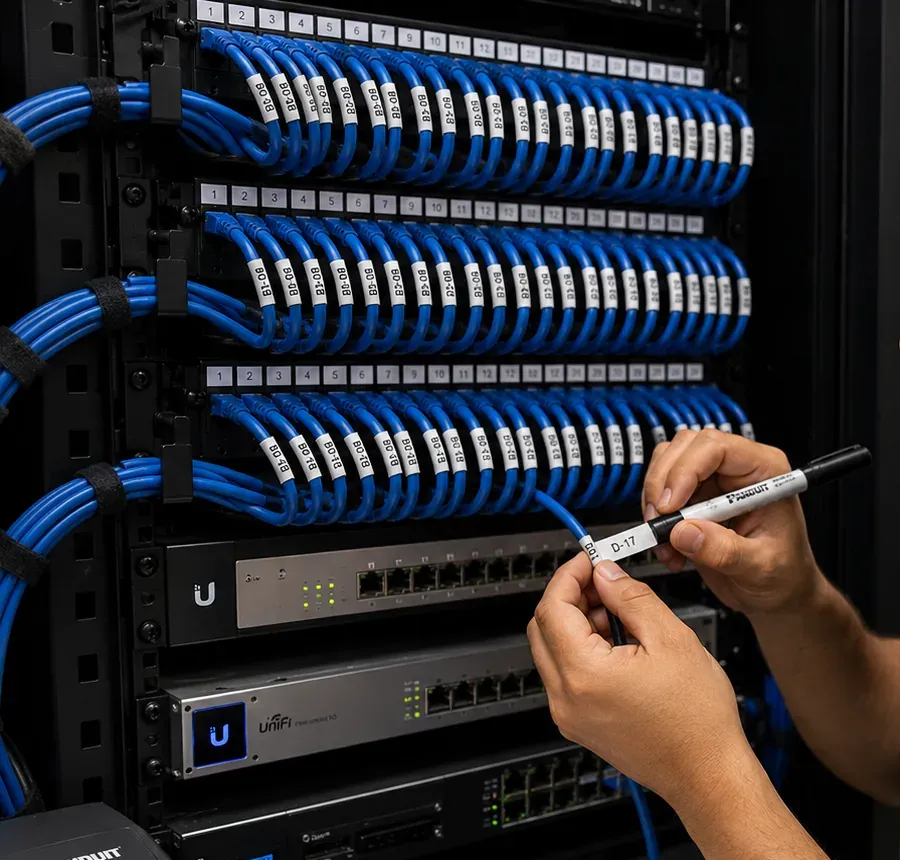
Two hands wrap a printed white label onto a blue patch cord in front of three rows of patch panels with numbered labels on every cord, while a marker pen rests between the fingers and a switch sits on the shelf below.
Pricing
Fiber Optic Installation Cost in Jamaica
Jamaica is priced on our Queens rates — nothing extra for being downtown. The unit prices below are the ones published for the borough on our Queens fiber page: termination, testing, backbone and second-room figures at the 1.05× Queens area rate, and the two drop prices taken from our Queens structured cabling configurator. Every job still gets a walkthrough before a final number.
Item
Jamaica price (Queens rate)
What it covers
Fiber termination on an existing cable
$37 per termination
Fitting one connector to one strand, by fusion or mechanically, in LC, SC, ST or MPO
OTDR test
$42 per strand
A reflectometer trace that locates each splice, connector and fault by distance, in addition to the loss reading
Multimode fiber drop
$391 per drop
One short multimode run, connectorised at both ends and tested
Single-mode fiber drop
$447 per drop
One short single-mode run, connectorised at both ends and tested
12-strand OM4 floor-to-floor backbone
$4,725 – $7,350
Twelve OM4 strands between floors, fused into enclosures, each slab penetration firestopped, loss reported strand by strand
24-strand OS2 between buildings on one property
$8,400 – $15,750+
Twenty-four single-mode strands joining two buildings on one lot, every strand traced with the OTDR
Second telecom room with fiber link
from $2,520
Fit-out of an additional network room, linked back to the main one over fiber
Service and callback rate
$195/hr, 3-hr minimum ($585)
Return visits, fault-finding and moves or changes after handover; not used to price the original installation
What moves a Jamaica fiber quote
The cellar. Sealing several old entrance ducts, clearing abandoned cable and moving active equipment upstairs adds labour that a dry, tidy building does not need.
The climb. A tower with a telecom room on every floor is quick; a 1900s masonry building with no chase means finding, preparing and firestopping a route floor by floor.
Protected finishes. Landmark interiors and decorative lobbies mean slower, more careful routing and no fixings where they would show.
Keeping parties apart. A commercial condo, a clinic or day-care, or a public Wi-Fi room each warrants its own strands and sometimes its own tray or enclosure — modest extra hardware that prevents arguments later.
Access windows. Courthouse-adjacent offices, avenue shops and hotels often need work before opening or after closing; scheduling around them takes time.
Why not ADT, Ring or SimpliSafe? Those companies sell alarm monitoring and cameras; building fiber plants are not their business. In practice a Jamaica owner weighs three paths: let every carrier find its own way up the building, bring in a large integrator who may subcontract the crew, or use a licensed local installer that brings its own splicer and OTDR, understands what groundwater does to a cellar, and answers the phone when a strand acts up.
Shop Our Systems
Fiber Optic Installation Packages & Pricing
Below are three worked examples for jobs we expect to see in Jamaica. Each figure is simply the published unit prices added together, with no hidden lines; a real proposal follows the walkthrough and reflects your building's own route.
Starter — Lift the Network Out of the Cellar
$1,062
Two single-mode fiber drops (2 × $447 = $894) from the provider's handoff in the cellar to a dry network cabinet on the ground floor, plus OTDR traces on all four strands (4 × $42 = $168). Entrance duct plugs and any cabinet you need are quoted separately at the walkthrough.
Standard — Riser Plus a Dry Equipment Room
$7,245 – $9,870+
A 12-strand OM4 floor-to-floor backbone ($4,725–$7,350) for an avenue building or a podium, plus a second telecom room joined by fiber (from $2,520), so the switches live above the water line and every floor gets its own enclosure.
Premium — Two Buildings or a Building and Its Annex
$9,294 – $16,644+
A 24-strand OS2 link between buildings on one property with OTDR on every strand ($8,400–$15,750+), plus two single-mode drops at the far end ($894) for a gate, a reader or a rear office.
Bring Your Own Equipment — Labour Only
Some boards, schools and IT firms buy the cable and hardware themselves. Then our crew supplies only the skill and the tools — pulling, fusing, sealing and testing — at the $195 hourly service rate with a three-hour minimum ($585). Materials you bought stay under their maker's warranty, and we check any supplied reel for continuity before it goes into a wall.
Want the Entrance Sealed and the Riser Drawn Before You Sign a Lease?
We walk the building at no charge and leave you with three things: a marked-up drawing, the strand allocation for every unit or tenant, and a price an owner, board or lender can review.
Three Plans in Eighteen Years: How Downtown Jamaica's Rezonings Shape a Building's Fiber
Downtown Jamaica has been replanned three times since 2007, and each plan left a mark on the kind of buildings we are asked to wire. Knowing which one shaped your block tells you a lot about what the building needs.
2007: the Downtown Jamaica Plan
The City Council approved the Department of City Planning's Downtown Jamaica rezoning in 2007, upzoning the downtown core and the shopping district and encouraging development near the AirTrain and LIRR station. Its most visible result is the tower opposite the station: The Crossing at Jamaica Station, described by its architects as one of the first major projects after the rezoning, with a 600,000-square-foot, 28-storey building of 539 apartments on a three-storey retail and parking podium, and a 14-storey, 130-apartment companion building with community-facility space, completed in 2021. Buildings of this generation have proper telecom rooms; the fiber questions are about the podium, the commercial units and the community space.
2015: Jamaica NOW
In 2015 the city announced the Jamaica NOW Action Plan, a $153 million neighbourhood revitalisation plan of 21 strategic actions rather than a rezoning in its own right. For owners of older avenue buildings, the lesson of that period is about upper floors: whenever one is re-let to an office, a clinic, a school or a training programme, the new tenant needs data on a floor that was wired for a telephone and a ceiling light.
2025: the Jamaica Neighborhood Plan
Approved on October 29, 2025, the latest plan rezones about 230 blocks in five sub-areas. Summaries of the plan describe the Downtown Core as high-density commercial districts where towers are permitted; the North Core between Jamaica Avenue and Hillside Avenue as medium-density mixed use with community facilities on lower floors; the Southern Corridors along parts of Merrick Boulevard, Guy R. Brewer Boulevard and Sutphin Boulevard as mid-rise residential with commercial overlays; the South Core below the LIRR as a mix of housing and light industry; and the industrial areas along Liberty Avenue as industrial at a higher density. It also expands the Special Downtown Jamaica District and maps the city's largest Mandatory Inclusionary Housing area.
For fiber, the 2025 plan means three things. Developers in the core will deliver towers with ground-floor uses that need their own clean links. Owners in the North Core and the corridors will be mixing apartments with clinics, day-care centres and schools in the same building, which calls for separate strands from day one. And industrial owners along Liberty Avenue will be building up, not just out — which is when a vertical fiber path is cheapest to provide.
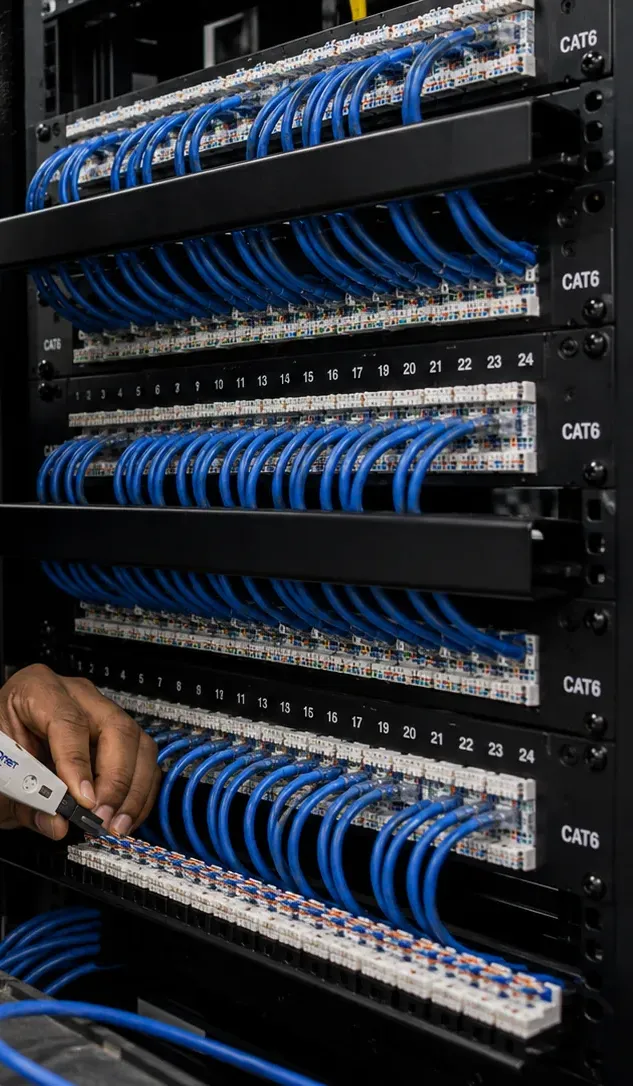
Five Cat6 patch panels filled with blue cords run down a black rack; at the bottom left a hand holds a white punch-down tool against the rear terminations of the lowest panel.
Station Area
Working Beside the Fourth-Busiest Commuter Rail Hub in North America
The station shapes every job within a few blocks of it. More than 1,000 subway and LIRR trains pass through Jamaica every weekday, according to the Governor's office, and the AirTrain adds its own stream of airport passengers. The station building at 93-02 Sutphin Boulevard dates from 1912–1913; it gained its AirTrain terminal when that service opened in 2003, and since February 2023 most Brooklyn service has run as a shuttle to a new Platform F built south of the existing platforms. In April 2026 the Port Authority and the MTA began a customer survey to plan a full redesign.
For building owners nearby, the practical effects are about logistics rather than physics. Fiber is immune to the electrical noise of trains, so we do not worry about the rails; we worry about getting reels, ladders and a splicing bench into a building on a block where curb space is scarce, footfall is heavy from dawn and the sidewalk is shared with bus queues. That is why station-area jobs are often scheduled early in the morning, materials are staged in the cellar the day before, and splicing happens in one session rather than across several visits.
There is a planning effect too. The Council's 2025 commitments include a new public plaza at the western end of the Archer Avenue bus terminal, the removal of the bus-terminal canopy, and a wider Station Plaza programme along Archer Avenue. Owners whose buildings face those works should expect street and sidewalk activity over the next few years and should plan any new provider entrance with that in mind — ideally from the side of the building least likely to be disturbed.
Stage materials the day before. A reel, a box of enclosures and the splicing kit wait in the cellar overnight, so the work day does not start with double-parking.
Splice in one session. Each return trip near the station costs time; we plan splicing and testing so they finish in a single visit wherever possible.
Agree the curb plan. Before the work day, the owner and our crew settle where a vehicle may stop briefly to unload and who on site signs for deliveries.
Terms Explained
Jamaica Building and Fiber Terms, in Plain English
Owners, brokers and boards in downtown Jamaica hear a mix of zoning and cabling vocabulary when a building changes. These are the terms that come up most when fiber is on the table.
Special Downtown Jamaica District. A special zoning district covering much of the downtown, expanded by the 2025 plan, which added floor-area and height bonuses for public schools and public open space. It does not regulate low-voltage cabling, but it decides what kinds of tenants a new building will have, and therefore what fiber it needs.
Mandatory Inclusionary Housing (MIH). A zoning rule requiring permanently affordable apartments in new residential buildings in mapped areas. The 2025 plan created the city's largest MIH area here. For fiber, it means many new buildings will have a mix of affordable and market-rate units sharing one telecom design.
Community facility space. Floor area used for schools, clinics, houses of worship, day-care and similar uses. In a mixed building it is usually a separate tenant with its own network, and it should have its own strands from the main telecom room.
Entrance duct and duct plug. The pipe through the foundation wall that a provider's cable uses to enter, and the seal fitted at its inside end. In Southeast Queens, an unplugged duct can let groundwater into the cellar.
Owner backbone. Fiber that belongs to the building rather than to a provider, running from the entrance to an enclosure on each floor. Providers connect to it; tenants receive strands from it.
Strand map. The document that records what every fiber strand is used for, where it ends and how it tested. It is the single most useful thing a fiber installer leaves behind.
Passive and active equipment. Passive equipment — cable, splices, enclosures, connectors — has no power and tolerates harsh rooms. Active equipment — switches, firewalls, media converters, batteries — needs power and a dry, ventilated space.
Firestop. A tested sealant or device that restores the fire rating of a wall or floor after a cable passes through it. Every hole we make is firestopped and photographed.
Complete Services
Every Fiber Optic Installation Service in Jamaica
Fiber is rarely the only job in a Jamaica building. These services usually ride along on the same enclosure, the same riser and the same strand map, and each is handled by our Queens teams.
Who we are: a licensed New York low-voltage contractor whose same crew pulls the fiber and certifies the copper, so a building has one point of contact.
Field Notes
Field Notes From Southeast Queens Cellars
Habits rather than a story: what our installers look for first in a downtown Jamaica building
The first thing our crews do in a Southeast Queens cellar is look at the floor and the bottom of the walls before they look at any cable. Tide lines, white mineral crust on the block, rust on the feet of old shelving and a sump pump that runs while the sun is out all tell the same story: this room is wet more often than the owner may admit. Where the evidence is there, nothing active stays at that level.
The second is to count the holes. Older avenue buildings have usually been served by several providers over the decades, and each one left its own entrance. Our installers note every penetration in the foundation wall, live or dead, and photograph it, because the cheapest way to keep water out is to close the ones nobody is using.
The third is to find the driest straight line up. In a building with no chase, the best riser is usually beside the stair, in an old dumbwaiter or in a corner of a rear room that every floor shares. Once that line is found and agreed with the owner, the rest of the job tends to fall into place: enclosure at each landing, firestop at each slab, and a cabinet on the first dry floor.
Before You Sign
A Fiber Checklist for Leasing or Buying in Downtown Jamaica
Many of our first conversations in Jamaica happen before a lease or a contract is signed, when a business owner, school or buyer is looking at a building and wants to know what the network will take. A few minutes in the cellar with a flashlight answers most of it. These are the things worth checking, whether or not you hire us.
Where the providers come in. Ask to see the room where the internet and phone cables enter. Count the cables and the holes. One tidy entrance is a good sign; a wall of abandoned drops and open holes means work to budget for.
Whether the cellar takes water. Look for tide lines on the walls, crusted mineral deposits, rusted shelf feet, a sump pump, a dehumidifier running, or equipment sitting on bricks or pallets. Any of these means the network should not live down there.
How cable reaches your floor today. Follow a live cable from the cellar to the space you are considering. If it climbs through another tenant's suite or an apartment, you will want a different route.
What the lease says about risers and telecom rooms. Many leases control who may work in shared spaces, who approves it and who owns the cable at the end of the term. Read those clauses before the walkthrough, not after.
Whether a closet on your floor can hold a small cabinet. A ventilated closet with a power outlet, ideally near the stair or service core, is what the fiber will feed. A storage room with no outlet and no air will need work.
What is planned next door. With the 2025 rezoning, neighbouring lots may be redeveloped. If your service arrives across one of them, find out before you depend on it.
Whether the building is a landmark. A designated building, or one with a protected interior, will limit where cable can be fixed. That rarely stops a project but it affects time and cost.
If you would like a second pair of eyes, our walkthrough is free, and we put what we find in writing so it can go into the lease negotiation or the purchase file. Prospective tenants often use that note to ask the landlord to seal the entrance or provide a riser as part of the fit-out.
Who Owns What
Provider, Owner, Board or Tenant: Who Controls Each Piece in a Jamaica Building
Most delays on fiber jobs in Jamaica come from one question nobody answered at the start: whose permission is needed for which part of the route. The answer changes with the type of building, so here is how it usually breaks down. Your lease, condominium documents or provider agreement are what actually decide it.
Piece of the route
Older avenue building
New tower with commercial units
Industrial building
Street cable and lateral
The provider, under city permits
The provider, under city permits
The provider, under city permits
Entrance duct and cellar handoff
Provider's equipment; owner's wall and seals
Building's main telecom room, run by the managing agent
Usually the owner, sometimes a single tenant
Riser between floors
The owner
Common element controlled by the board or managing agent
The owner, if there is more than one storey
Floor enclosure or telecom room
The owner, with keys held by the super
Common element on residential floors; unit owner inside a commercial unit
The owner or the main tenant
Cable inside the suite or unit
The tenant, subject to the lease
The unit owner
The tenant
Strand map and test results
Kept by the owner; copy to tenants for their strands
Kept by the managing agent; copy to each unit owner
Kept by the owner
Getting this on paper before the first cable is pulled saves weeks. We prepare a short route description listing each space the fiber passes through and who controls it, so the right people sign once instead of being discovered one at a time.
Beyond the Downtown
Houses, Small Buildings and Places of Worship Around Downtown Jamaica
Walk ten minutes in any direction from Jamaica Avenue and the towers give way to the neighbourhoods the downtown serves: the hillside streets of Jamaica Estates and Jamaica Hills to the north, Hollis and St. Albans to the east, South Jamaica and Rochdale Village to the south, Briarwood and Richmond Hill to the west. The fiber work there is smaller in scale but follows the same logic.
Small apartment buildings and two-family houses. The owner usually wants a provider to be able to serve every unit without drilling through each floor, and a short owner riser with a small enclosure on each landing does that. Because groundwater is a concern across Southeast Queens rather than only downtown, the same rule applies: seal the entrance, keep any active equipment above the cellar, and leave a written record.
Houses of worship and community organisations. Congregations in Southeast Queens often run more than worship — the Council's 2025 package, for example, provides for relocating the Allen AME Theodora Jackson Older Adult Center — and their programmes can spread across a sanctuary, a hall and neighbouring buildings. For them a fiber link between buildings on the same property often replaces a patchwork of separate internet accounts, and the Council's 2025 package even includes technical assistance for faith-based organisations developing affordable housing — a reminder that some of these campuses are about to grow.
Medical and professional offices in converted houses. Where a practice occupies a house or a small building converted to offices along one of the boulevards into downtown, a single strand pair from the provider's handoff to a dry closet upstairs, plus tidy copper to each room, is usually all it needs.
Wherever the property is, the walkthrough is the same: find the entrance, check for water, agree the dry route, and write it down.
Civic Neighbours
Fiber Work on the Blocks Around the Courts and Federal Offices
Downtown Jamaica is a civic centre as well as a shopping street, and that changes how private buildings nearby are worked on. The Queens Civil Courthouse at 89-17 Sutphin Boulevard houses the Civil Court, Small Claims Court and Landlord/Tenant Court, with an auditorium that seats 230 people for jury selection; the Supreme Court's civil term sits across the plaza at 88-11. A few blocks east, the Joseph P. Addabbo Federal Building is home to the Social Security Administration's Northeastern Program Service Center, which the agency says serves about 9.4 million beneficiaries and processed roughly 1.5 million actions in fiscal year 2021.
We do not work inside those buildings; courts and federal agencies run their own networks through their own contractors. Our work is in the private buildings that surround them, and it is shaped by them in three practical ways.
Timing. We schedule deliveries, ladder work in shared lobbies and anything noisy away from the start of the court day, when people are arriving for hearings, and we keep corridors clear for anyone who needs to get to court on time.
Deliveries. Reels, enclosures and the splicing kit come in through the building's own service or cellar entrance wherever one exists, never staged on a courthouse plaza or a shared public walkway.
Separation. In a building shared by a law office, a tax preparer and a clinic, each tenant should have strands that end inside its own locked space, not on a shared panel in the hallway. That is cheap to do at installation and expensive to retrofit.
Small office buildings see tenants come and go as practices grow, merge or move. A labelled backbone with spare strands on each floor lets a new tenant be connected in an afternoon rather than waiting for a provider to find a new way up the building.
FAQ
Jamaica Fiber Optic Installation FAQ
Do you cover Jamaica Estates, Hollis, St. Albans and South Jamaica as well as the downtown blocks?
+
Yes. Our Queens crews work across Southeast Queens, from Jamaica Estates and Jamaica Hills north of Hillside Avenue to Hollis, St. Albans, South Jamaica, Rochdale Village and Springfield Gardens, as well as Briarwood and Richmond Hill to the west. Jobs are scheduled from our Bronx office on East Fordham Road.
Will you leave spare innerduct so a second provider can come in later without new drilling?
+
Yes, and in a building with a damp cellar we recommend it. We pull an extra length of innerduct alongside the backbone from the entrance enclosure to the dry cabinet, cap both ends and label it, so a future provider can pull its cable through an existing, sealed path instead of making a new hole through the foundation.
Can you move the provider's terminal out of our wet cellar, or does the provider have to do that?
+
The provider's terminal and the cable feeding it belong to the provider, so only the provider can move them. What we can do is install the owner's side so that relocating them is easy: a sealed entrance enclosure, fiber to a dry room upstairs and a written note the owner can send the provider asking for its equipment to be moved there.
Does the room that holds the fiber enclosure need a dehumidifier or a fan?
+
The passive enclosure itself does not, as long as it is closed, sealed and mounted high. The room upstairs that holds the switches and battery backup does need airflow and, in a muggy space, a way to keep humidity down. We point out the problem on the walkthrough; the owner's HVAC contractor sizes any equipment.
Should our building's backbone be finished before or after the provider turns on its service?
+
Before, if you can. When the owner's entrance, riser and floor enclosures are already in place, the provider only has to bring its cable to the entrance and connect at a panel, and each tenant can be served the same day. If the provider is already live, we build the backbone alongside and move each service across in a short planned window.
What size of conduit should a developer leave between floors for future fiber?
+
For a typical mid-rise in Jamaica we suggest at least two empty conduits or sleeves between each floor's telecom space, each with a pull string, sized so they are no more than about 40 percent full once the planned cables are in. The architect or engineer of record has the final say, but leaving the space empty is far cheaper than coring later.
How long does a walkthrough of a Jamaica building take, and who should be there?
+
Most avenue buildings take about an hour, towers and multi-building properties longer. The most useful person to have with us is whoever holds the keys and knows the cellar, usually the super. The owner or managing agent can join at the end, when we talk through the options and the next step.
Do you keep a copy of our strand map and test results after the job?
+
Yes. The owner receives the full closeout file, and we keep our own copy so that if the binder is lost or a new managing agent needs the records, we can send them again. Many owners also store a copy off site, which is wise in any building with a history of water in the cellar.
Will your crew sign a confidentiality agreement before working in an office that holds client files?
+
Yes. Law, accounting and medical offices near the courthouses and hospitals often ask for one, and we are glad to sign it before the walkthrough. Our installers work on cable, enclosures and network equipment only; they do not open client files or sign in to your computers, and we can schedule work while a member of your staff is present.
How is the shop on the ground floor protected while the riser goes in above it?
+
We plan the route so cable comes up from the cellar through common space rather than through the store, protect any floor or counter we have to pass, and keep noisy work such as coring outside the shop's busiest hours. Any ceiling tile or access panel we lift in the shop goes back the same day.
All Areas Served
Fiber Optic Installation Across Queens, New York City and Beyond
Jamaica is one neighbourhood inside our Queens coverage, which is one of sixteen areas our fiber crews work from the Rockaways to Ulster County. For the whole borough — Long Island City towers, Flushing's subdivided buildings, co-op courtyards and the JFK cargo corridor — see the Queens fiber optic installation page; the fiber optic installation hub for New York City explains how the five boroughs differ.
Upstairs offices on the avenue dropped off the network, a tower's retail unit can't reach the telecom room, or water found the cellar enclosure overnight? Call (347) 434-6392. We aim to have a technician there that day; most single faults, from a crushed jumper to a damp connector or a pigtail pulled out of its tray, are cleared within an hour or two of arrival, and we measure the repaired strand again before we go.
Fiber Optic Installation in Jamaica, Queens — Dry Equipment, Sealed Entrances, Every Strand on Record
Abstract Enterprises Security Systems · 460 E Fordham Rd, Bronx, NY 10458 · Queens line (347) 434-6392 · WhatsApp (718) 679-0359 via wa.me
NYS Low-Voltage Licence #12000287431 · 100% Licensed & Insured · Same-Day Estimates · Rated 4.7★ from 201 Google Reviews
Full terms — including 50% deposit, one-year parts-only warranty on AESS-supplied products, and the late-fee schedule — are set out in the service agreement. See our warranty page.
Page reviewed and updated October 17, 2026. Changelog: first publication of the Jamaica, Queens fiber optic installation page.