What are you looking for?
About Us Contact Us Careers Get a Free Quote (800) 486-0943
Pick a service
✅ Got Your Own System?
🎬 Home TheatreQuote 🎶 AV SoundQuote 🔑 Access ControlQuote
Now pick your area
Pick your area
Long Island
Hudson Valley
Services available
Pricing & Tools
Pick a service for pricing
🚪 Intercom Pricing 🔔 Buzzer Repair Pricing
Calculators
📹 Camera System Calculator 🚨 Alarm Calculator ⚡ Cabling Quote Builder ✅ Got Your Own System?
Select your area
Home › Fiber Optic Installation NYC › Fiber Optic Installation Bronx › Hunts Point
Licensed Low-Voltage Contractor · Food Center Drive to Garrison Avenue · Markets, Cold Rooms & Converted Factories

Fiber Optic
Installation in
Hunts Point

Dock Rows · Washdown Rooms · Cooler Wi-Fi · Truck-Lane Crossings · Landmark Lofts · Fusion Splicing · OTDR Proof

Hunts Point is a peninsula that feeds the city. Nearly 80,000 trucks a day travel to and from it, many market businesses work through the night, and much of the floor space is refrigerated behind insulated panels that stop radio signals cold. A network here has to survive washdowns, forklifts, diesel grime and a highway rebuild next door — and still be glass a food-safety auditor is happy to see near the product. We plan and install that fiber from our Bronx office on East Fordham Road, with our own splicers, our own test sets and paperwork you keep.

Reviewed and updated October 17, 2026 · Written by Anwar Timothy, NYS license #12000287431

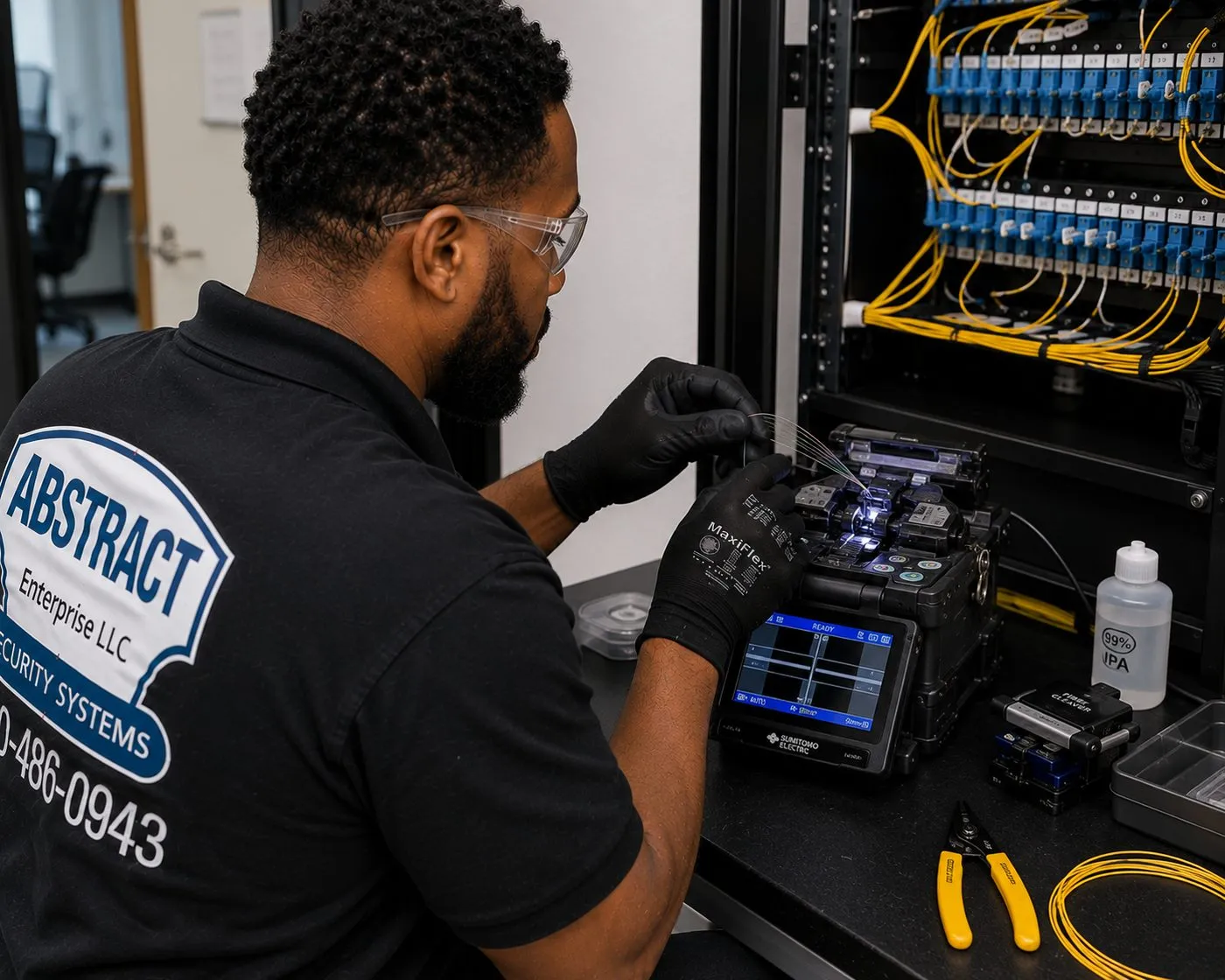
Technician in safety glasses feeding fiber into a fusion splicer below a rack of blue fiber adapters and yellow jumpers, Hunts Point Bronx fiber optic installation
A gloved technician leans over a fusion splicer whose screen reads READY, under rows of blue adapters patched with yellow cords; a fiber cleaver, yellow strippers, a coil of yellow cord and a bottle of IPA sit on the bench.
Hunts Point Fiber Quote
Tell us the building, the shift you can't interrupt and what the glass must reach — a Bronx tech calls back the same business day

✅
Request Sent!
A Bronx tech will call you back the same business day.
25+
Years Experience
✓
Same-Day Estimates
100%
Licensed & Insured
4.7★
201 Google Reviews

Tell us your quiet hour first. On the peninsula the deciding fact on a fiber job is rarely the distance — it is the window when the dock, the cooler or the sales floor can spare a ladder and a crew. Call the Bronx line at (646) 490-0629 or use the 60-second form and give us that window, the building and what has to be connected.

  • No charge for the first walk of your dock, coolers and yard, usually booked inside a week
  • Glass fused, scoped and tested by our own installers, never handed to a subcontractor
  • NYS license #12000287431 · Bronx office at 460 E Fordham Rd
The Neighborhood

Why Hunts Point Properties Need Fiber Optic Installation

Hunts Point is two places sharing one peninsula. South and east of Lafayette Avenue sits the Food Distribution Center, which City Limits describes as 329 acres handling about 4.5 billion pounds of food a year, with NYCEDC estimating that about 25 percent of the city's produce, 35 percent of its meat and 45 percent of its fish pass through its markets. North and west, around Hunts Point Avenue, Garrison Avenue and the side streets off them, is a residential neighbourhood of walk-ups, attached houses and new affordable buildings. The Bruckner Expressway, built along the railroad between 1956 and 1961, runs across the top and cuts both off from the rest of the Bronx. That geography shapes every fiber job we do here: the businesses are large, refrigerated and running around the clock, and the homes are packed right up against them.

The networks in the market buildings carry the whole working day. Order entry, card terminals and handheld scanners on the sales floors, label printers at the docks, temperature loggers in the coolers, cameras on every door and yard, and the office systems that bill it all. Most of those were added one at a time over decades, on whatever copper or wireless link was cheapest that week. The typical result is familiar to anyone who works in these buildings: a switch on a shelf above a dock door, a run of patch cable taped to a column, a wireless bridge pointed through a gap in the racking, and Wi-Fi that simply stops at the cooler door. When the cooler door shuts, the scanner loses its signal, and somebody has to walk the order back to the office on paper.

Fiber is the right answer to several of those problems at once, and the wrong answer to a few. Glass does not care about the electrical noise from compressors and conveyor motors, it carries a signal far past copper's 100-metre limit along a long dock, and it has no metal for a thief to sell. But it has to be installed for this environment: protected from forklifts and trailers, sealed against washdown spray and condensation, kept out of food-handling areas while it is being cut and spliced, and documented so the next contractor understands it. That is the work this page describes, and it is work we do with our own crew rather than through a subcontractor.

The peninsula is also changing faster than at any time in decades. New highway ramps were built to move trucks off local streets, the Produce Market has a $405 million redevelopment agreement with construction expected to start in late 2026, Metro-North is building a station behind Cass Gilbert's old railroad station on Hunts Point Avenue, and the former Spofford juvenile centre has become The Peninsula, a mixed-use site with affordable homes and a light-industrial building for small food producers. Every one of those projects either brings new buildings that need a fiber plan from day one or disturbs the routes existing businesses depend on. When cameras are part of the plan, see our page on security cameras in Hunts Point; on a weak link they are usually the first thing to fail.

Hunts Point at a glance — the facts that shape a fiber job

Repair & Emergency

Hunts Point Link Down Mid-Shift?

If the overnight pickers have lost their scanners, the recorder shows black tiles for the cooler doors, or a backing trailer has torn the line to your second building, call (646) 490-0629 and tell us which link failed and when the floor is quietest. We aim for same-day dispatch on the peninsula. Once on site, a technician usually has a crushed patch cord, a contaminated connector or a broken pigtail found and fixed in one to two hours, then re-tests the strand and writes down what happened so it can be prevented.

What We Install

Fiber Optic Installation Services in Hunts Point

Every job below is designed around three Hunts Point facts: the floor never fully stops, the air near the product is cold and wet, and vehicles are always moving.

Dock-Row Fiber Spines

One armored cable run high along a row of dock doors, with small hardened switches every few bays, instead of a separate copper home-run from each door back to an office that may be a football field away. Scanners, dock cameras, door controls and label printers all hang off the nearest switch.

Cooler and Freezer Coverage

Sealed entries through insulated panels so a cold-rated access point or a temperature logger inside the room has a wired feed. Insulated walls stop Wi-Fi at the door; a wired access point on the inside is what keeps handheld scanners connected while the door is shut.

Washdown-Rated Enclosures

Gasketed, corrosion-resistant splice and patch enclosures for processing and cutting rooms that are hosed down and sanitised every shift, mounted where spray cannot hit them directly and with cable entering from below so water cannot run in along the jacket.

Building-to-Building and Yard Links

Single-mode links between two buildings on one lot or across a truck lane, carried overhead on a messenger at full trailer clearance or underground in conduit, with OTDR traces on every strand so a later fault can be located from the office.

Suites in Converted Factories

Exposed, surface-run fiber pathways for tenants of Hunts Point's brick-and-concrete industrial buildings and the BankNote, designed to look intentional against bare concrete and steel instead of disappearing into a drop ceiling that does not exist.

New Units and Fit-Outs

Telecom rooms, sleeves and backbone fiber for new light-industrial and mixed-use buildings on the peninsula, planned with the architect before the slab is poured so tenants and providers have somewhere to land.

Charger and Yard-Equipment Networks

A data feed for electric truck chargers, gate equipment, yard cameras and dock-power pedestals, run on separate strands so the charging network does not share a link with the office or the point-of-sale system.

Fault Finding and Carrier Hand-Offs

Tests that show whether an outage sits on the provider's side of the demarcation point or on yours, so a ticket with the carrier is opened with evidence instead of a guess.

Splicing, Testing and Records

Fusion splicing, connector inspection, loss testing and OTDR traces with a labelled as-built drawing at the end, written for the people who will look after the network, not just for the next contractor.

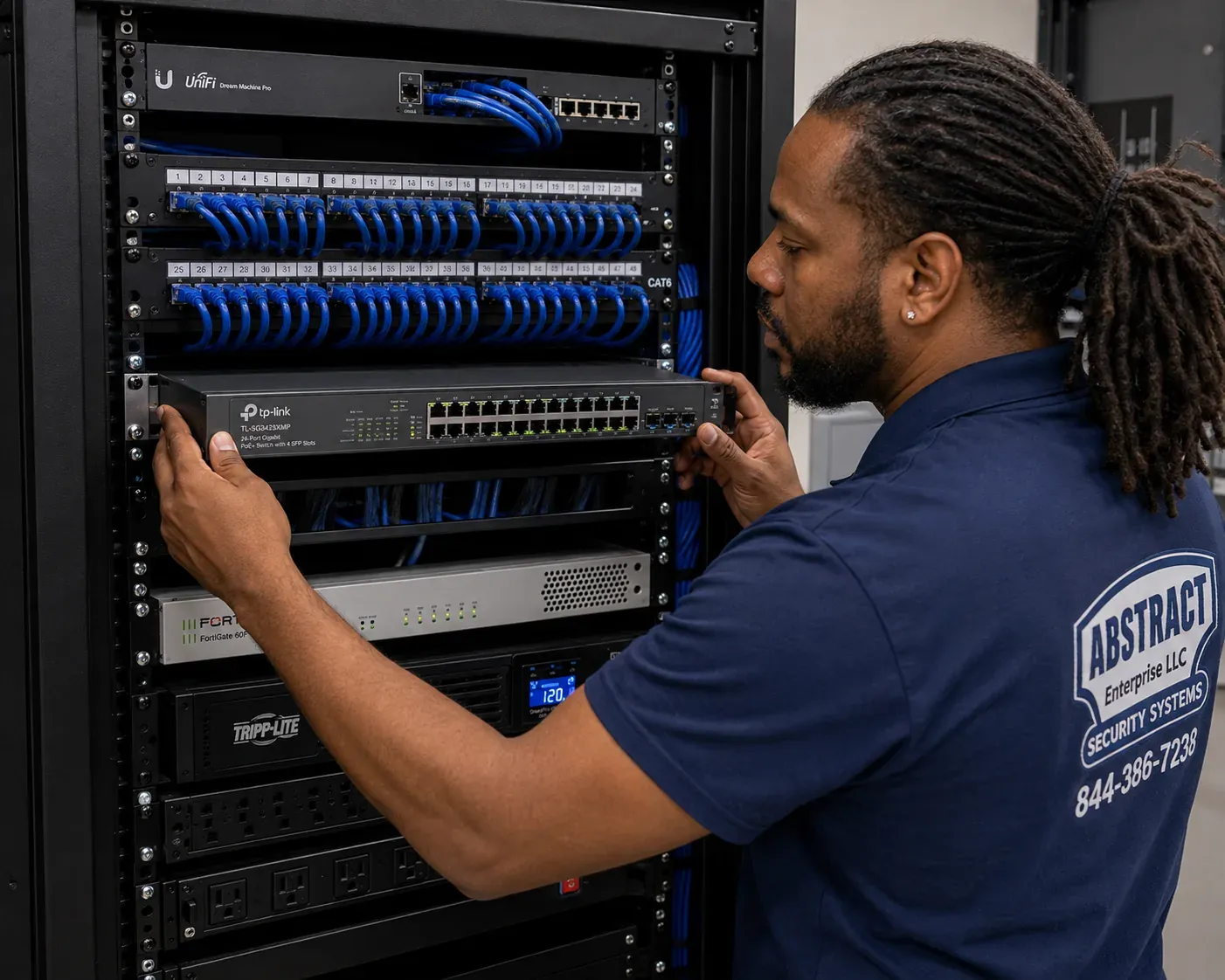
Technician seating a 24-port switch in a floor rack below rows of blue patch cords, Hunts Point Bronx fiber network closet
A technician slides a switch into a black floor rack under two rows of blue patch cords, above a firewall, power strips and a UPS with a lit display.
Building Specialists

Fiber Optic Installation for Hunts Point's Architecture

The peninsula has a short list of building types, and each one sends fiber along a different path. These are the ones we plan around, described the way we see them on a walkthrough.

Refrigerated Market Halls

Long, low buildings from the 1960s and 1970s with a sales or office strip on one face and dock doors on the other, split into units leased to separate wholesalers. The Cooperative Market's Building C, built in 1972, is one of the earliest. Pathways run along the dock canopy line or inside the roof structure; the cooler walls themselves are off limits except at sealed entries.

Recladded Market Buildings

Older market buildings are being re-skinned. The Cooperative Market began an $18 million recladding of Building C in 2025, replacing deteriorating masonry with a sealed, insulated metal façade. Any fiber that leaves or enters such a building has to pass through panels whose seal is the whole point of the project.

Single-Building Distribution Warehouses

High-bay warehouses with an office at one end, often on a mezzanine, and racking across the floor. Distances from the office to the far wall routinely beat copper's limit, so a fiber spine to a switch at the far end is the normal design.

Early-1900s Industrial Brick

Factories and warehouses of one to several storeys along Oak Point Avenue, Barry Street and the streets near Tiffany Street, with heavy masonry walls, timber or concrete floors and few original chases. The brick factory on Barry Street that Forgotten New York dates to around 1900–1910 is typical of the stock.

The BankNote and Converted Plants

The American Bank Note Company's printing plant at Lafayette Avenue and Tiffany Street, with a nine-storey central tower on the Lafayette wing, concrete floors and wide glazed arches, now divided among a charter school, a city agency and other tenants. Wherever a suite has no suspended ceiling, every cable is on show.

Residential Blocks and New Mixed-Use

Attached houses with bowed fronts on streets like Gilbert Place, larger apartment buildings at the busy corners, and new affordable construction such as The Peninsula on the former Spofford site. Here fiber is a riser and a telecom room, not a dock spine, and the work is done with residents at home.

Method by building type

Building typeWhere the fiber usually runsTypical cableWhat we watch for
Refrigerated market hallHigh along the dock wall or on the roof steel above the dock canopy line, dropping to small switches between baysInterlocking-armored indoor/outdoor single-mode or OM4Trailer roofs and pallet loads at the doors, condensation at cooler entries, spray from dock wash-downs
Recladded or re-roofed buildingThrough a single planned, sleeved and sealed entry agreed with the façade contractor, then insideIndoor/outdoor cable through a sealed conduit stubPuncturing a new insulated panel without the manufacturer's flashing method; voiding the envelope warranty
High-bay distribution warehouseBasket tray or messenger on the building steel well above the racking, to an enclosure on a column at the far endSingle-mode for length; armored where it descendsRacking moves, lift access over live aisles, sprinkler heads and lights in the same zone
Early-1900s industrial brickSurface conduit on masonry, cored floor penetrations, old freight or stair shafts where the owner approvesOM4 or single-mode in EMT or innerductThick walls, embedded steel in concrete floors, unknown old penetrations to firestop
Converted printing plantExposed surface raceway along beams and column lines, with a tidy vertical path in a shared shaftPlenum- or riser-rated cable in painted racewayLandmark exterior, shared building systems, other tenants' schedules
Residential and mixed-useCellar entrance room, riser in a closet or chase, floor boxes in the corridorsOFNR riser-rated single-modeOccupied apartments, resident notices, keeping the commercial ground floor separate

In almost every one of these buildings nobody has a reliable drawing of the existing low-voltage cable, so our walkthrough starts by tracing what is already there.

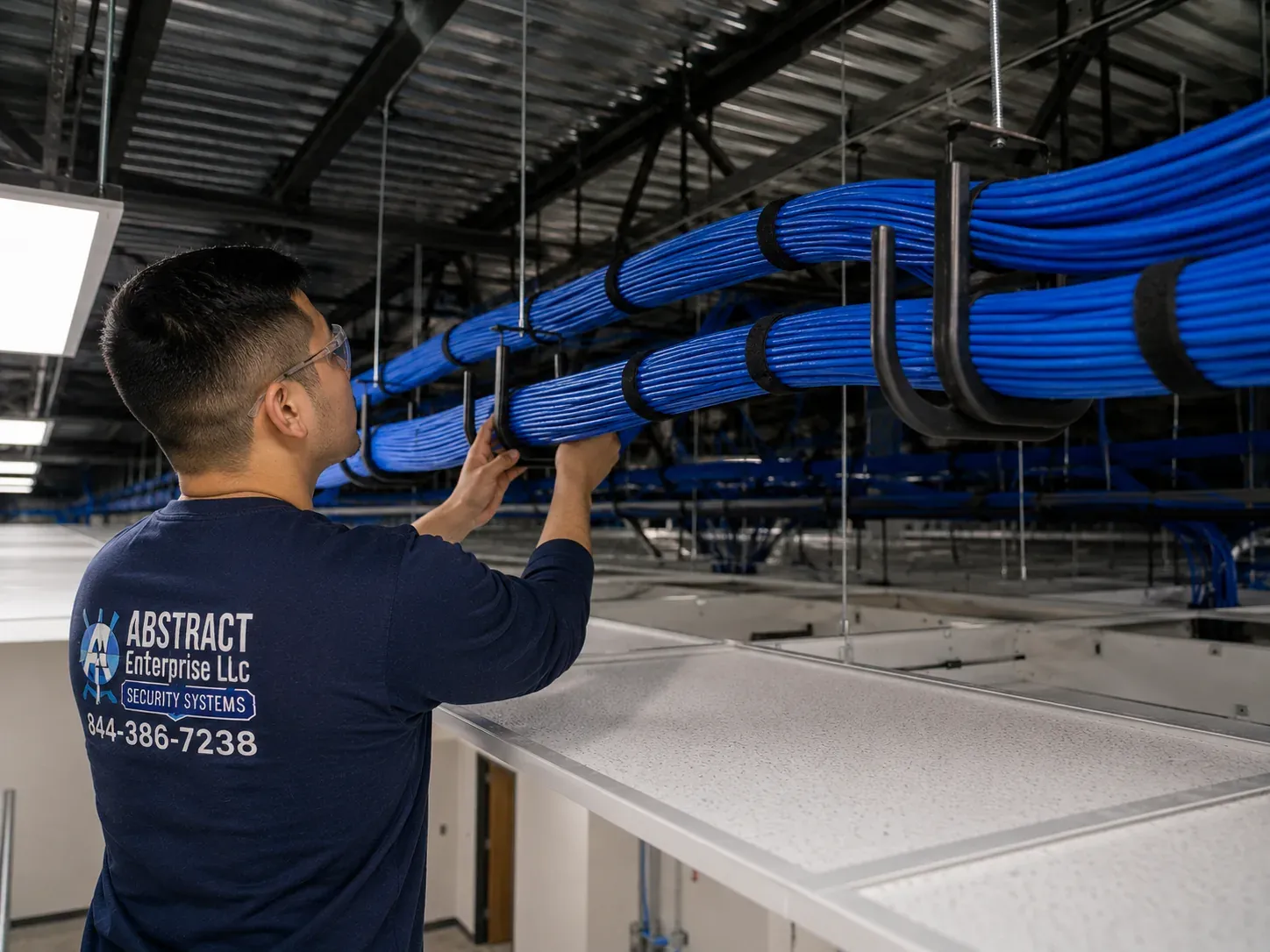
Installer checking large bundles of blue cable resting in J-hooks above an open ceiling grid, Hunts Point Bronx cable pathway
Standing below an open ceiling grid, an installer checks thick bundles of blue cable resting in black J-hooks hung on rods under the roof deck.
Commercial Fiber Optic Installation

Business Fiber Optic Installation in Hunts Point

Almost all of our peninsula fiber work is commercial, and it concentrates along these corridors.

Food Center Drive and Halleck Street

The heart of the Food Distribution Center: the produce, meat and fish markets and the wholesalers and distributors around them. Overnight trading, constant truck movement, refrigerated floor space and dock rows hundreds of feet long.

Oak Point Avenue and Barry Street

Industrial and warehouse buildings beside the Oak Point rail yard, including, as Forgotten New York recorded, the Midland Steel warehouse at Worthen Street and the transit authority's Tiffany Street shops. Long buildings, heavy floors and yards shared with trucks.

Lafayette Avenue and Tiffany Street

The BankNote, the Corpus Christi Monastery across the avenue and the road down to Barretto Point. Offices, a school, a city agency and smaller commercial tenants in converted industrial space.

Hunts Point Avenue

The neighbourhood's main street, running from Southern Boulevard past the old railroad station to East Bay Avenue and Halleck Street. Shops, offices in the station building, the 40,000-square-foot retail centre at 925 Hunts Point Avenue and apartments above stores.

Garrison Avenue and the Residential Grid

The POINT CDC at 940 Garrison Avenue, the cluster of auto-glass shops that Forgotten New York found where Garrison meets Hunts Point Avenue, and blocks of homes and community spaces where commercial work happens next door to bedrooms.

Bruckner Boulevard and Edgewater Road

The highway edge, rebuilt by the State's access project, with businesses facing the service road and the new Edgewater Road ramp beside Hunts Point Riverside Park on the Bronx River.

Compliance callouts for peninsula jobs

  • Buildings Department paperwork. City permits are not required for cabling that stays under 50 volts — the same statement our structured cabling pricing pages make. A market cooperative or landlord will still have its own contractor approval, insurance certificate and firestop expectations, and those apply in full.
  • Firestopping. Every hole we make or reuse through a rated wall or floor is sealed with a listed firestop system and photographed. In market buildings that means cooler and freezer walls too wherever they are part of a rated assembly.
  • Cable listings. NEC Article 770 ratings decide where a fiber cable may run: OFNR (riser) between floors, OFNP (plenum) in air-handling spaces, general-purpose OFN within a floor. A higher listing may always replace a lower one.
  • Construction hours. The DEP Noise Code fact sheet sets approved construction hours at weekdays from 7:00 a.m. to 6:00 p.m.; after-hours work is allowed with the appropriate permit for listed reasons, and a noise mitigation plan must be in place. That matters on blocks where warehouses back onto homes.
  • Food areas. Fiber cutting and cleaving happens away from any food or open product, scraps go into a sealed container, and the area is cleaned before we leave, following the Fiber Optic Association's safety guidance.
  • Power is a separate trade. Our licence covers the glass, the cabinets and the racks. Any new receptacle for a switch, any charger circuit and any dock pedestal feed belongs to a licensed electrician; when a walkthrough shows one is needed, that line appears in the proposal as the electrician's scope.
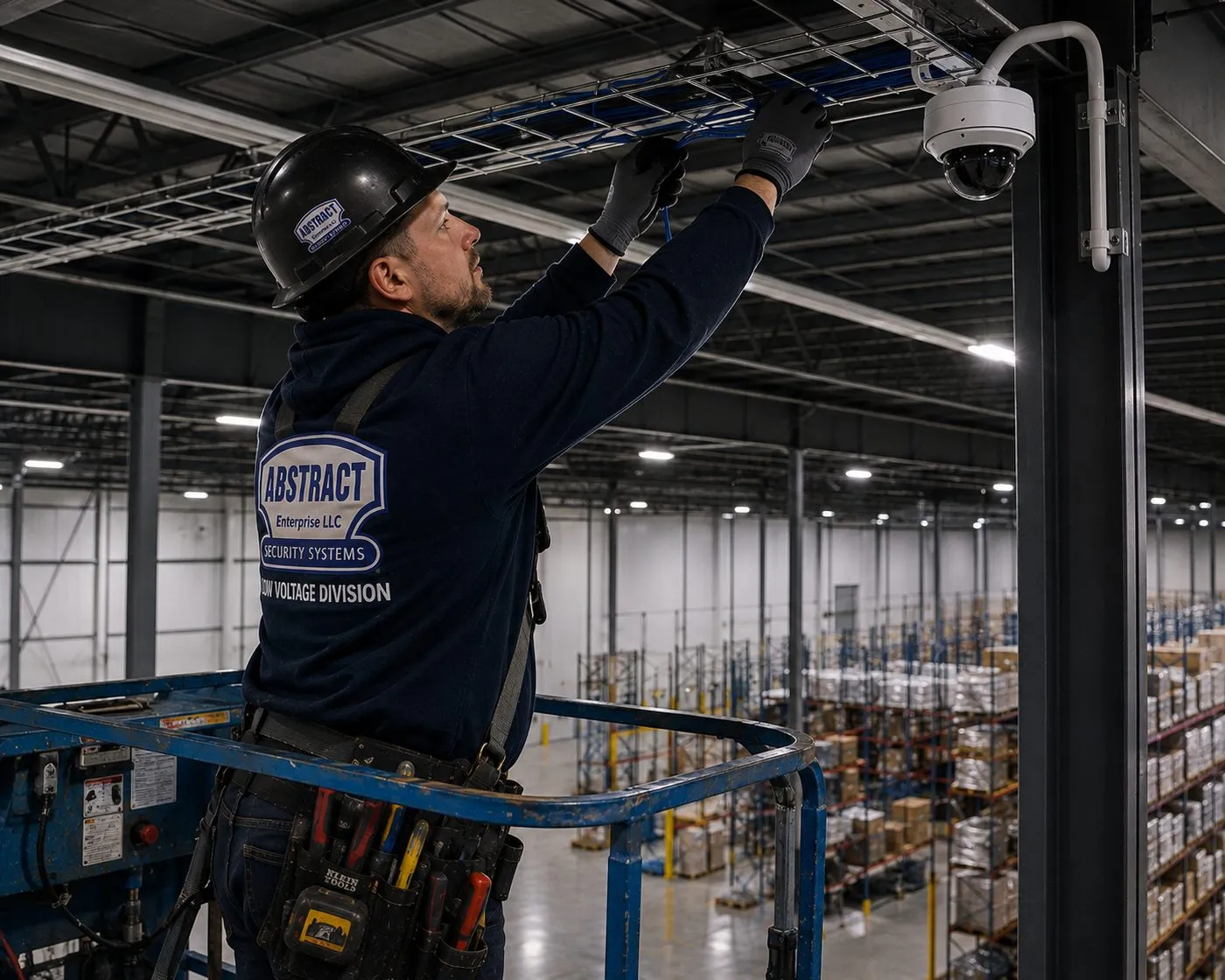
Technician on a scissor lift laying cable into wire basket tray beside a dome camera in a high-bay warehouse, Hunts Point Bronx distribution building
From a blue scissor lift, a technician in a hard hat lays blue cable into a wire basket tray near a ceiling-mounted dome camera, with pallet racking stretching across the warehouse floor below.
Cold Rooms & Washdown

Glass Near the Product: Coolers, Freezers and Washdown Rooms

In refrigerated buildings the network problem people notice first is often not speed at all. It is the handheld scanner that loses its connection the moment the operator walks into the cooler. That is physics, not bad luck: an industry guide on warehouse Wi-Fi notes that freezer panels and insulated walls block the signal, and that coverage outside the freezer says nothing about coverage inside it. The steel skins on either side of the insulation behave like a shield. Turning up the access point in the aisle does not fix it. Putting an access point inside the room does.

An access point inside a cooler needs a wired feed, and the feed has to cross the insulated wall. That crossing is where most of the damage is done in older installations: a hole punched through a panel, a cable pushed through it, and a smear of foam that cracks the first winter. Warm, damp air then follows the gap into the cold side, condenses and freezes around the cable and the panel core. We treat every cold-room entry as a small engineering job. The penetration is located with the refrigeration contractor or the building's maintenance lead, sleeved, sealed on the warm side with a material suited to the panel, and the cable is formed into a drip loop so water runs away from the entry instead of into it.

Washdown rooms add water under pressure and chemistry. Meat cutting rooms and processing areas are hosed down and sanitised, and ordinary plastic enclosures with snap lids do not last. Schneider Electric's guide to NEMA ratings describes Type 4 enclosures as gasketed with clamped doors for hose-directed water and periodic washdowns, and Type 4X as the same seal in corrosion-resistant metal or plastic for sites such as food processing where caustic cleaners are used. That is the class of hardware we specify near wash zones, mounted where the spray does not strike it directly, with cable glands on the underside so water cannot travel in along the jacket.

Finally, there is the glass itself. Fiber is cut and cleaved during splicing, and the Fiber Optic Association warns that the scraps are dangerous: sharp enough to pierce skin, hard to see and hard to remove, and never to be left near food or drink. In a building where food is handled, that rule is not a courtesy. We splice on a bench in an office, a mechanical room or our own van, never on a surface that touches product; offcuts go straight into a sealed container; and we clean the work zone before handing it back. Where the business follows a written food-safety programme, we will walk the route with whoever owns that programme first.

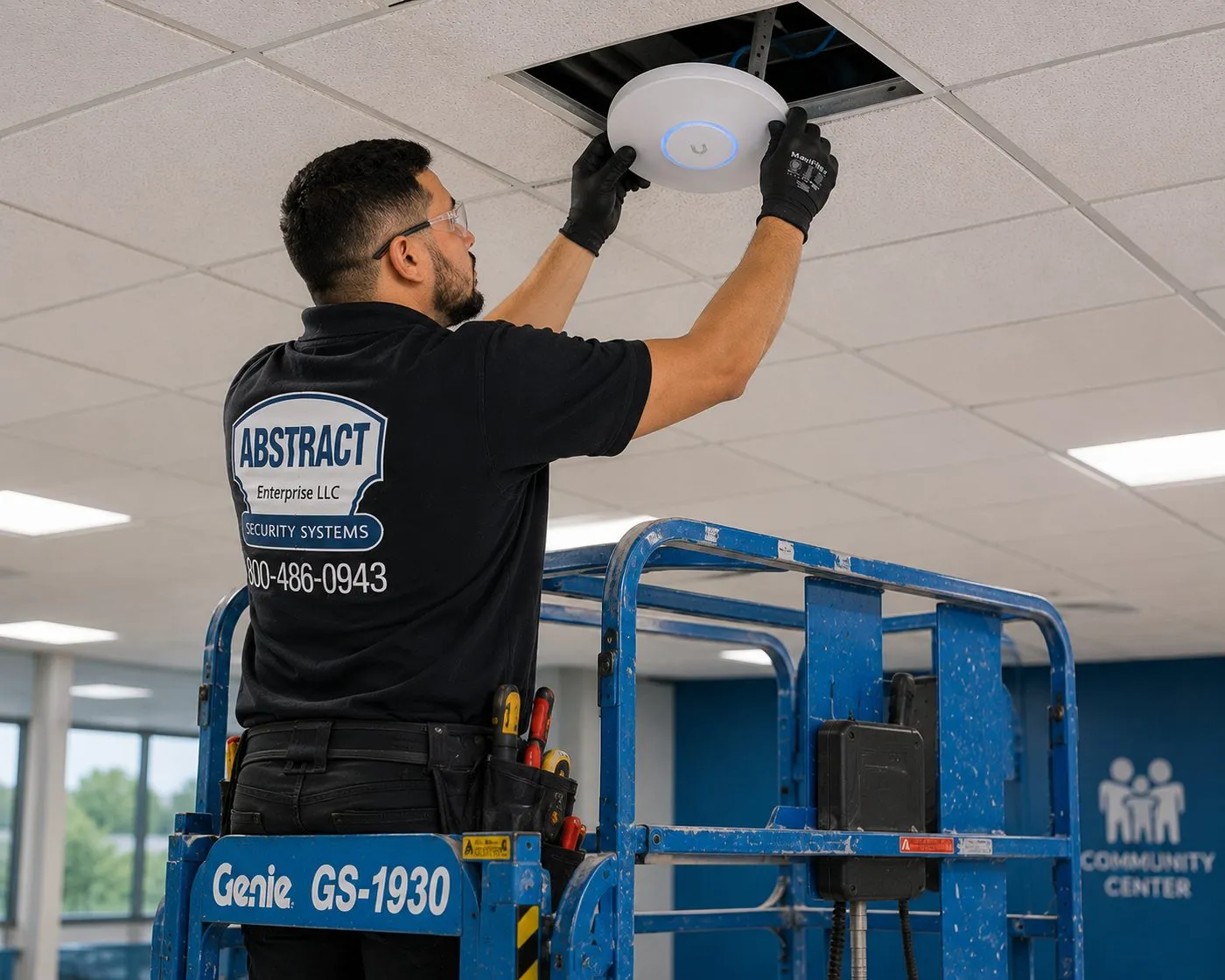
Technician on a scissor lift fitting a wireless access point into an open ceiling tile, Hunts Point Bronx Wi-Fi coverage work
Seen from behind on a scissor lift, a technician in gloves and safety glasses presses a round white access point with a blue ring light into an opening in the ceiling.
Trucks, Yards & the Highway

Designing Fiber for a Peninsula Built Around Trucks

The number that explains Hunts Point traffic was reported by amNY when Governor Hochul announced the Bruckner expansion in August 2023: nearly 80,000 trucks travelling to and from the peninsula every day. A good share of them back into a dock, idle in a yard or wait on a service road for a door to open. Anything a fiber installer leaves within reach of a trailer roof, a reefer unit, a pallet mast or a yard tractor will be found by one of them. So we design from the trailer up. Overhead crossings sit above the highest box that uses the lane, not merely above a car; conduit coming down a wall at a dock is steel and is protected by a bollard or the dock's own bumper line; and cable on the dock wall stays above the door header rather than beside the opening.

Yards on the peninsula are also places where several systems share the same poles and walls. Gate equipment, yard lighting, cameras, dock-power pedestals for refrigerated trailers and, more and more, electric truck chargers all want power and a network connection. Diesel transport refrigeration units at the Produce Market are already being replaced under a congestion-pricing-funded programme: the Governor's office reported in April 2026 that 20 had been swapped for cleaner models with 75 more in the pipeline, and the same announcement lists $20 million for electric truck charging infrastructure, without naming where it will go. When that kind of equipment arrives, the data side is usually an afterthought on the electrician's drawing. We would rather it was planned: separate strands for the charging and yard systems, enclosures sized for the extra switch, and a route that does not share a trench with the high-voltage feed unless the electrical design calls for a separated duct.

The highway itself shapes the work in a quieter way. The State's Hunts Point Interstate Access Improvement Project, $1.7 billion across three design-build contracts, added a two-way ramp between Edgewater Road and Sheridan Boulevard and a ramp from the Bruckner to Edgewater Road, widened about 1.25 miles of the Bruckner between East 141st Street and Barretto Street with new ramps at Leggett Avenue, and moved on to rebuilding the Bruckner–Sheridan interchange. Projects of that size relocate utilities, change curb lines and reroute trucks for years. For a business on the service road, that is a reason to keep its private fiber inside its own property line wherever possible and to document exactly where any outside run sits, so the next utility mark-out has something to work from.

Flood & Power

Water on Three Sides: Flood Risk and Power on the Peninsula

Hunts Point is bounded by the East River, the Bronx River and, at Barretto Point, open water with Manhattan in view. City Limits reported in 2022 that nearly a third of the Food Distribution Center sits in the current FEMA 100-year floodplain and that future floodplain projections cover nearly the entire food hub. Superstorm Sandy struck at low tide in 2012 and largely spared the peninsula; water came over the East River bank into the New Fulton Fish Market's parking lot and then receded. Market operators quoted in the same reporting were blunt that the next storm may not be so kind.

For fiber, flood planning comes down to three decisions. Where the provider's service enters and where it is handed off to the owner's network; where splice enclosures and the main switch sit relative to the ground floor; and whether the network electronics are on circuits that come back when power does. Glass cable tolerates being wet far better than the electronics and connectors at its ends, so the expensive part of a flood is the enclosure that was mounted at knee height in a cellar, not the cable in the conduit. On waterfront lots we put enclosures and racks on upper walls or upper floors, bring cable up out of any below-grade entry as soon as practical, and seal conduits so a surge cannot use them as a pipe into the building.

Power is the bigger threat in practice. The City's 2016 feasibility study, as reported by City Limits, found that power outages, not storm surge, were the main risk to the produce and fish markets, and the produce market's ground-level power stations remain exposed to surge from the Bronx River. A network that runs on a dock switch with no battery behind it fails the moment the lights flicker, even when the fiber is perfect. We therefore record, on the as-built drawing, which outlet and which circuit feeds every powered device on the link, and we recommend a small battery backup at each end. Whether those circuits are on the building's generator is a question for the electrician and the owner; our job is to make the answer easy to find.

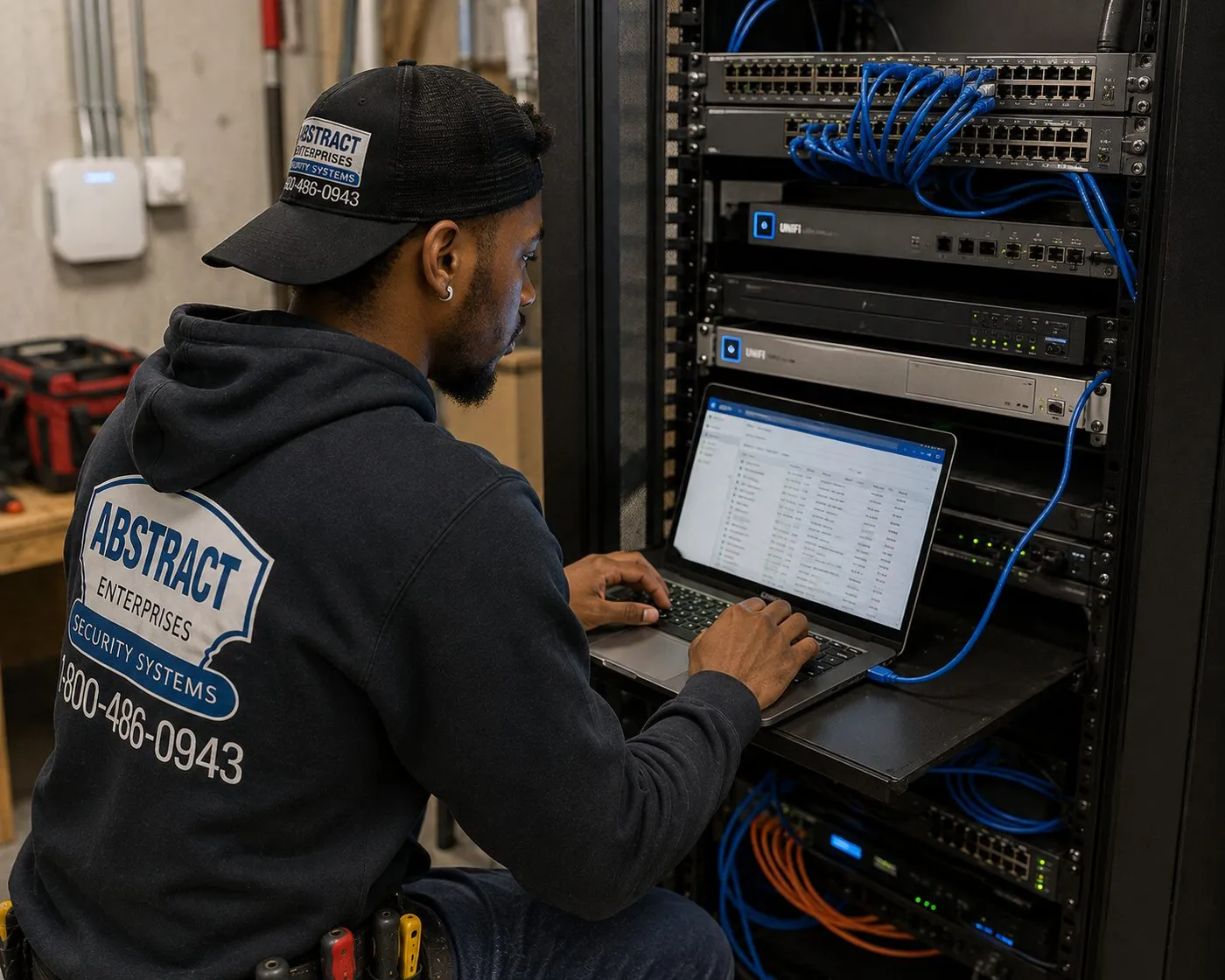
Technician configuring rack switches from a laptop on a pull-out rack shelf, Hunts Point Bronx network equipment room
Kneeling at an open rack, a technician types on a laptop resting on a pull-out shelf beneath switches patched with blue cords, with orange and blue cables below and a tool case on the bench behind.
Converted Factories

Fiber in the BankNote and Hunts Point's Old Industrial Buildings

The American Bank Note Company built its printing plant on Lafayette Avenue between 1909 and 1911 to designs by Kirby, Petit & Green. It is brick over a structural steel frame, with concrete floors and wide arches filled with glass, and the Landmarks Preservation Commission designated it in 2008. Today it is subdivided and marketed as The BankNote; the John V. Lindsay Wildcat Academy Charter School occupies upper floors of the Lafayette wing and the city's Human Resources Administration signed a 20-year lease there in 2013. It is the clearest example on the peninsula of a building type we see repeatedly: an industrial shell now shared by tenants with very different networks and schedules.

Buildings like this have two features that drive fiber design. The first is exposure. Suites carved out of buildings like this often have no suspended ceiling, just painted concrete and steel, so every cable is seen. The answer is not to hide the network but to give it a deliberate route: painted surface raceway or a slim tray following beam lines and column grids, consistent mounting heights, and a single neat vertical through a shared shaft rather than a different hole for every tenant. The second is shared control. The landlord or managing agent owns the shafts, the roof and the exterior; each tenant owns its suite; and the providers own their own equipment in between. We map those boundaries on the first walk so that the proposal says plainly who has to approve each part of the route.

The older brick buildings off Oak Point Avenue and Barry Street are simpler but harder. Walls are thick masonry, floors are heavy concrete and often carry embedded steel, and drawings are rare. Before we core a floor in a building of that age, we want to know what is inside it, which means scanning the slab and checking below. Where an old freight shaft, chute or stair offers a vertical path, it can save several new penetrations, but only with the owner's approval and with every floor opening firestopped. A landmarked exterior, where one applies, is handled the same way it is everywhere: the fiber enters through an existing opening or a discreet sleeve, never through the decorative face of the building.

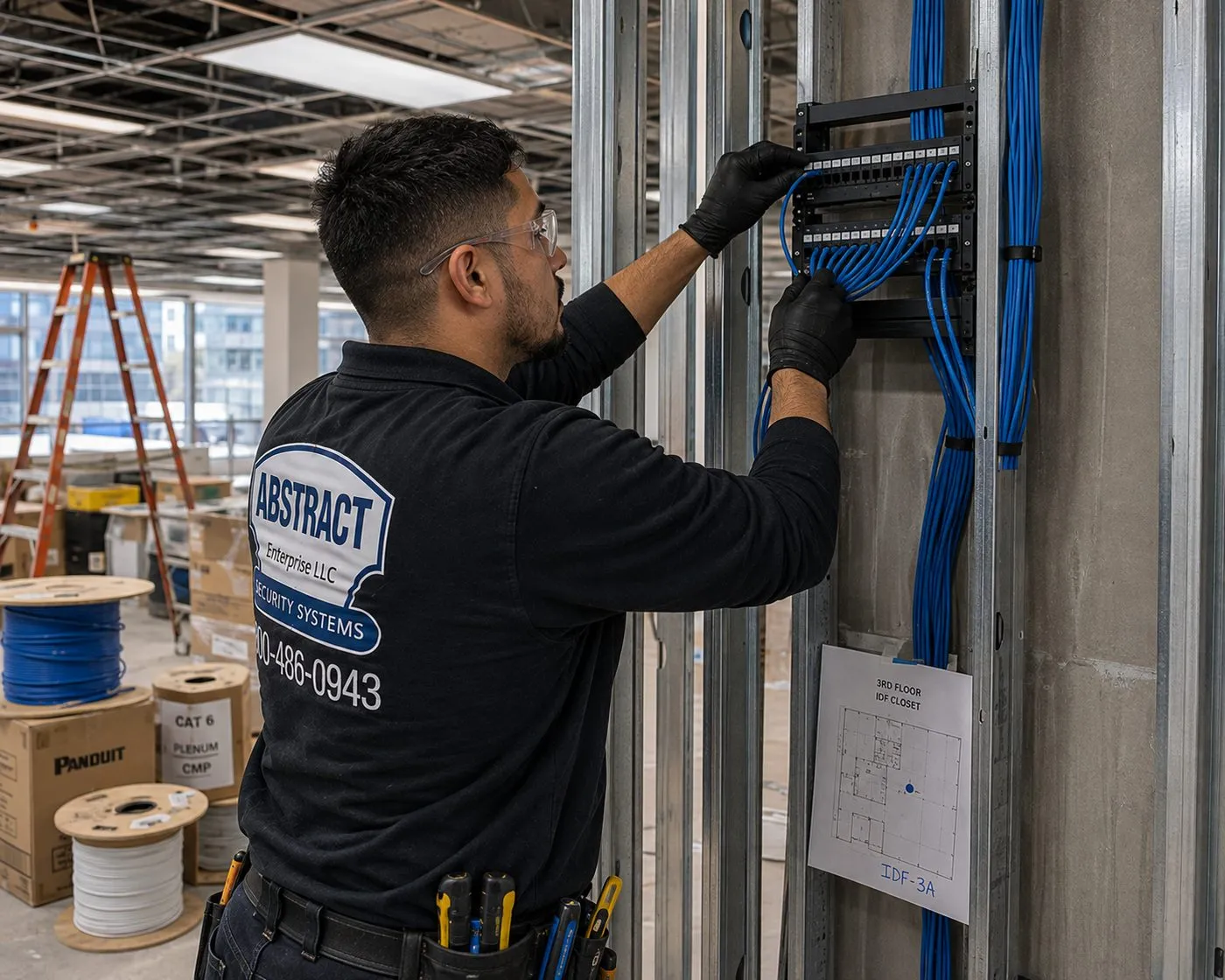
Installer terminating blue cable bundles at a wall-mounted patch panel on a metal stud wall during a fit-out, Hunts Point Bronx
On an open fit-out floor with cable reels and boxes behind him, an installer works at a small wall-mounted patch panel fed by bundles of blue cable running down a metal stud wall, above a taped-up closet floor plan.
New Construction

New Buildings on the Peninsula: The Peninsula, the Produce Market and the New Station

Three projects will put new buildings on Hunts Point over the next several years, and each is a lesson in when fiber planning should start. The Peninsula, on the five-acre former Spofford Juvenile Detention Center site, is planned for about 740 affordable homes; its first residential building opened in 2022 with 183 homes, after a light-industrial building offering affordable space to small producers such as bakers, coffee roasters and food makers was completed the year before. The Produce Market's $405 million redevelopment, led by the Aurora-Primus joint venture, is planned as an all-electric intermodal food distribution facility with more refrigerated warehouse space, with construction expected to begin in late 2026. And Metro-North's new Hunts Point station, north of Hunts Point Avenue behind the old station building, is part of the Penn Station Access project, which published project timelines put at 2027, although City & State reported in 2025 that it would not be complete until at least 2028.

Every one of those is a building or campus where the cheapest moment to provide for fiber is before concrete is placed. Sleeves through foundation walls and slabs, a dedicated telecom room with power and ventilation, conduit from the property line to that room, and a vertical pathway sized for several providers cost very little when they appear on the architect's drawings and a great deal when someone has to core them later. For light-industrial tenants in particular, each unit needs a defined landing point for its own service and a pathway back to the building's entrance room, so a small food business can order a line without its landlord having to drill a new hole every time.

Your Questions Answered

Fiber Optic Installation in Hunts Point: Questions Answered

These are the questions merchants, warehouse managers, facilities staff and building owners on the peninsula ask us on site walks. They are grouped by where the question comes from: the market floor, the yard, or the building itself.

Market floors, coolers and processing rooms

Fiber is glass — how do you keep cleaved fiber scraps out of a food-handling area?

By never producing them there. Every cable is pulled into place with its ends sealed, and all stripping, cleaving and splicing happens at a bench in an office, a mechanical room or our van, well away from product, packaging or food-contact surfaces. Offcuts go directly into a lidded scrap container that leaves with us, as the Fiber Optic Association recommends, and the bench is wiped down and checked under a light before we pack up. Where a connector must be fitted on the floor itself, we use pre-terminated cable or a factory pigtail so no bare glass is exposed in the room. If your business keeps a glass-and-brittle-plastics register or a foreign-material policy, send it before the job and we will follow it, including logging the tools and materials we bring in.

Our processing room is hosed down and sanitised every shift — what fiber hardware survives that?

Gasketed, corrosion-resistant enclosures of the kind sold for washdown duty — the NEMA Type 4X class, in stainless steel or a suitable non-metallic body — with sealed cable glands entering from the underside. Inside the room we keep hardware to a minimum: usually just the enclosure that feeds a device, with the patching and switching in a dry room next door. Cable in the wash zone runs in sealed conduit or a jacket rated for the environment, never loose along a wall where a hose will strip it. We also ask what chemicals the sanitation crew uses, because some cleaners attack certain plastics and gaskets, and we choose the enclosure material to match.

Handheld scanners lose Wi-Fi inside our coolers — how do we get reliable coverage in there?

Put the access point inside the cold room and feed it with a cable. Insulated metal panels block radio signals, so an access point in the aisle outside will never fill a cooler, however powerful it is. A cold-rated access point mounted inside, away from the evaporator fans and the door's swing, fixes the problem; its feed comes through one sealed entry in the panel from a switch on the warm side. On a long dock row with many rooms, that switch is often one of the small hardened switches on a fiber spine, so each cooler gets a short copper drop from a nearby fiber node rather than a long run from the office. We test coverage with the doors closed and the racks loaded, because that is when the scanners are actually used.

We have a long row of dock doors — is one fiber run with small switches along the dock better than a cable from every door back to the office?

On most Hunts Point docks, yes. A home-run from every door means dozens of copper cables, many of them beyond the 100-metre Ethernet limit, all converging on one closet. A fiber spine means one armored cable along the dock wall, high above the door headers, feeding a small switch every few bays; each scanner, camera, printer or door controller then needs only a short copper drop. It is cheaper to extend, easier to fault-find and far less vulnerable, because one damaged drop affects one door rather than a bundle. Where downtime on the dock would be expensive, the spine can be built as a loop back to the office from both ends, so a single cut does not stop the whole row.

Our building is being reclad in insulated metal panels — how should new fiber come through the new wall?

Through one entry that is designed into the recladding, not punched afterwards. The best time is while the façade contractor is on site: we agree a location with them, they or the panel manufacturer's method provide the opening and flashing, and we install a sleeve or conduit stub sized for today's fiber plus spare capacity, sealed on both faces. Every later cable then uses that sleeve. Punching a fresh hole through a new panel later risks letting water and warm air into the insulation and can affect the envelope warranty the owner has just paid for, so we coordinate with the owner and the façade contractor rather than cut on our own.

Yards, trucks, power and security

If fiber has to cross a truck lane overhead between two of our buildings, how high must it be and what holds it up?

High enough to clear the tallest vehicle that uses the lane with a margin for sag in summer heat and ice in winter, and supported by a steel messenger strand between solid anchor points on the two buildings or on dedicated poles. Tractor-trailers set the minimum, and the lane's actual use matters: a lane that sees cranes, boom lifts or high-cube boxes needs more. We measure the attachment points and the sag on site, use cable designed for aerial lashing or self-support, and put the crossing where trucks travel straight rather than where they swing. If a safe height cannot be reached, we price an underground crossing instead and explain the difference. Where a utility or a landlord owns the poles or walls, their written approval comes first.

Our new electric truck chargers need a network connection — can that come off our fiber?

Yes. Most commercial chargers need a data link for billing, load management and remote support, and a cellular modem in a yard full of steel trailers is often unreliable. We run a pair of strands from your backbone to an outdoor enclosure near the chargers, put a small switch there, and give the charging network its own isolated connection so it never shares traffic with the office or the payment terminals. The charger installer and the electrician handle the power side; we coordinate pathways with them so the data cable does not end up in the same raceway as the high-voltage feed. Tell us the charger make if you know it, because some vendors specify how their network must be set up.

Is fiber a target for cable thieves the way copper is?

It has nothing a scrap dealer will pay for — police in Kansas City, investigating repeated cuts in 2023, put it plainly that fiber lines contain no copper and have no scrap-metal resale value. The problem is that thieves cannot always tell the difference in the dark, so fiber still gets cut by people looking for copper. On the peninsula we reduce that risk by keeping outdoor runs high or underground, using locked enclosures, avoiding exposed spans along fences and alleys, and marking outdoor cable and enclosures as fiber optic. Inside a building, the bigger risk is not theft but someone unplugging or reusing a cable they do not recognise, which labelling and locked enclosures also address.

Which parts of a fiber installation can we take with us when our market unit moves to a new building?

More than most people expect, but not the cable. Switches, media converters and optics, wall-mount enclosures and patch panels, cold-rated access points, battery backups and spare patch cords can all be removed, tested and reinstalled in a new unit. The installed cable itself is cut to the old building's routes and usually stays behind for the landlord, along with any sleeves and firestopping. If a move is a year or two away, we design the current job with that in mind: standard rack-mount hardware, connectors rather than direct splices at the equipment end, and a materials list showing which items are portable. That keeps the investment useful when the new building opens.

Converted factories, new buildings and neighbours

Our suite in a converted printing plant has bare concrete ceilings — how is fiber run so it looks deliberate?

By treating the cable route as part of the interior. We follow the building's own lines — beam edges, column grids, the junction of wall and ceiling — with painted surface raceway or a slim cable tray, keep every drop at a consistent height, and gather vertical runs into one tidy path instead of several. Fittings are chosen to match the exposed conduit already in the space, and the colour of raceway can match the ceiling. Before we start, we mark the route on the ceiling with tape so the tenant and the managing agent can see it and agree it, because once anchors go into concrete they are there for good.

The floors in our old industrial building are thick reinforced concrete — do you scan before coring?

Yes, wherever a core passes through a structural slab or a wall that might carry steel, conduit or post-tensioning. We arrange a ground-penetrating radar or similar scan of the spot, mark the reinforcement and any embedded services, and shift the core to a clear location. We also check the space below for what a core could fall on or damage. In older Hunts Point buildings that is not over-caution: drawings are scarce, previous tenants have embedded all kinds of conduit, and cutting a live cable or a reinforcing bar is far more expensive than the scan.

Our warehouse backs onto apartment houses — can the noisy drilling be done at night while the market is quiet?

Usually not. New York City's Noise Code sets approved construction hours as weekdays from 7:00 a.m. to 6:00 p.m., and after-hours work needs the appropriate permit for a listed reason, so core drilling and hammer work next to homes is scheduled in the daytime. The good news is that most of a fiber job is quiet: pulling cable, mounting enclosures, splicing and testing make very little noise. We plan the job so the short noisy tasks happen in the day, when they disturb the fewest residents, and the quiet work fits the business's own slow hours. Your neighbours notice, and so does the community board.

Can a business host a node of the neighbourhood's free Wi-Fi network on its roof and feed it from our fiber?

Possibly, and it is a good use of spare capacity. Free Hunts Point Community WiFi, run by The POINT CDC since 2015, grew from routers placed by volunteer businesses and residents. If your building has a good roof position and the programme wants a node there, we can run a cable from your network room to a weatherproof mount on the roof, and give the node its own isolated connection so community traffic never touches your business network. The programme decides what equipment goes up and how it is configured; we provide the pathway, the cable and the separation, and we document both so nobody confuses them later.
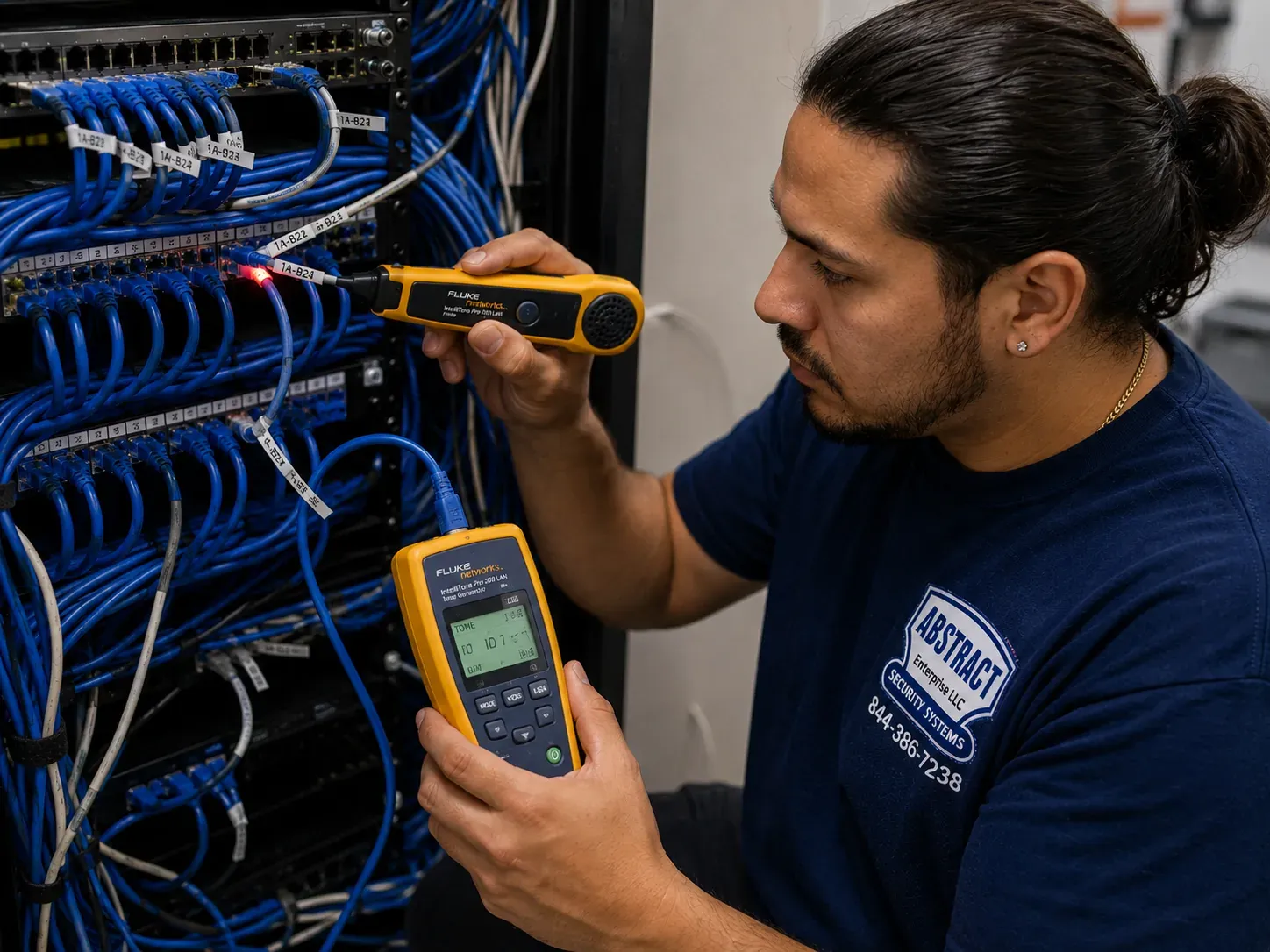
Technician tracing a labelled patch cord at a crowded patch panel with a probe and handheld tester, Hunts Point Bronx cable tracing
Holding a yellow probe against a labelled blue patch cord, a technician reads a handheld tester plugged into a dense panel of blue cables.

Most peninsula businesses also ask about doors. Once the dock and office are on fiber, card readers on the employee entrance and the cooler corridor are a short step; see access control installation in Hunts Point.

Equipment

Types of Fiber Optic Cabling We Install

Cable and hardware are chosen for the room they end up in — on the peninsula, usually cold, wet or busy.

OS2 Single-Mode

The default for anything long: dock spines, yard crossings and links between buildings. Single-mode carries 10-gigabit and faster traffic over kilometres, so length is never the limit on a Hunts Point lot, and the same glass will carry tomorrow's optics.

OM4 Multimode

For shorter in-building links where the owner already runs multimode optics, such as a mezzanine office to a warehouse rack. Fine for typical warehouse distances; we steer new long runs to single-mode.

Interlocking-Armored Cable

A spiral steel or aluminium armour over the fiber cable, used where a run descends a wall at a dock, passes a door or crosses any space where carts and lifts move. It turns a crushing accident into a dented jacket.

Indoor/Outdoor and Aerial Cable

Water-blocked cable rated to run from inside a building to outside without a transition splice, plus cable designed for lashing to a messenger across a yard. UV-resistant jackets for anything in sunlight.

Washdown and Cold-Rated Enclosures

Gasketed Type 4X boxes for wash zones, heated or sealed enclosures for unheated docks, and splice enclosures that keep condensation off the trays near cooler walls.

Hardened Switches and Media Converters

Compact switches rated for wide temperature ranges at the far end of a dock or in a yard enclosure, and simple media converters where a single camera or controller needs a fiber feed. Supplied by us or by your IT provider.

Cold-Rated Wireless Access Points

Access points specified for refrigerated rooms, fed by a cable through a sealed panel entry so handheld scanners stay connected behind a closed cooler door.

Sealed Sleeves, Innerduct and Firestop

Sleeves through insulated panels and masonry, innerduct to keep fiber separate inside shared conduit, and listed firestop for every rated penetration, all photographed for the closeout file.

Test and Splice Equipment

Our own fusion splicers, cleavers, inspection scopes, light sources and power meters, and an OTDR for every long or between-building link. The results come back to you, not to a subcontractor's laptop.

Which cable goes where on a Hunts Point property

LocationCable we normally useEnclosure or protectionWhy
Office to the far end of a high-bay warehouseOS2 single-mode, 12 strandsBasket tray or messenger on building steel; armored where it dropsDistance beyond copper's limit; spare strands for later systems
Along a dock rowArmored single-mode spineAbove door headers; steel conduit on descents; hardened switch every few baysTrailers, pallet masts and wash-downs at the doors
Into a cooler or freezerShort copper drop from a nearby fiber node, or fiber to a cold-rated deviceSleeved, sealed panel entry with a drip loop on the warm sideKeeps condensation and ice out of the panel and the connector
Washdown or cutting roomSealed conduit or jacket suited to the environmentType 4X enclosure with bottom glandsPressurised water and caustic cleaners
Across a truck laneAerial-rated single-mode on a messenger, or underground in conduitAnchors on structure or dedicated poles; clearance above the tallest vehicleTractor-trailers, cranes and lifts in the lane
Between floors in a converted factoryOFNR riser-rated single-mode or OM4Painted raceway in exposed areas; firestopped coresExposed ceilings, shared shafts, rated floors
Yard equipment and chargersOutdoor single-mode, separate strandsLocked outdoor enclosure with a small switchIsolates charging and yard systems from the office network

Wireless bridge or fiber? A wireless bridge across a Hunts Point yard is cheap and quick, and it works until a parked trailer, a stack of pallets or a new reefer unit sits in its path. Fiber across the same yard costs more on day one and carries no line-of-sight risk at all. Where a business needs both cheap now and certain later, we sometimes install the conduit or messenger with the first job so the fiber can follow without disturbing the yard twice.

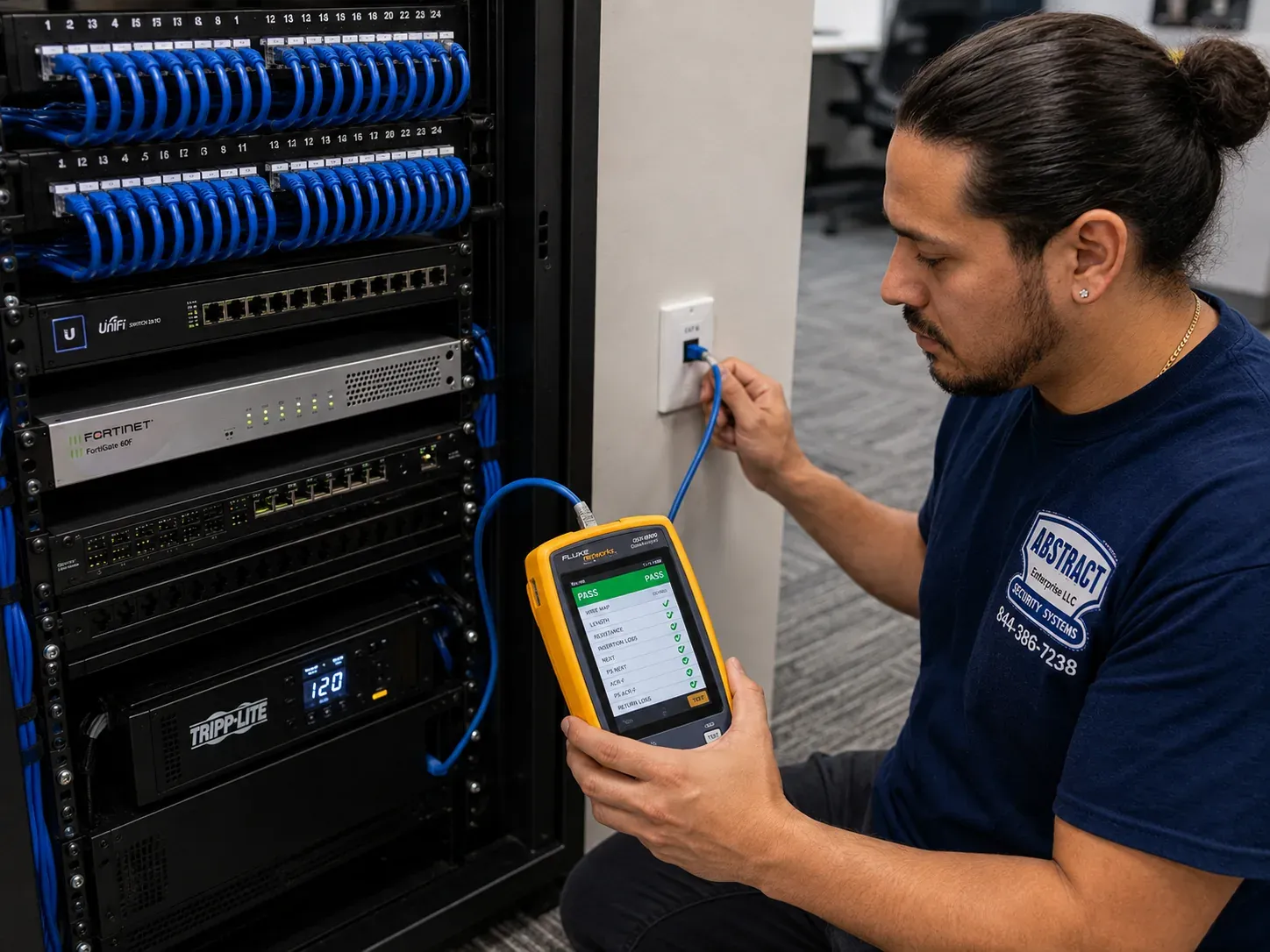
Technician holding a cable certification tester showing a pass result at a wall outlet beside a network rack, Hunts Point Bronx link testing
A technician kneels beside a rack and holds a yellow handheld tester whose screen shows a green PASS, its cord plugged into a wall outlet.
AI Overview Reality Check

What AI Gets Wrong About Fiber Optic Installation in Hunts Point

Ask a search assistant about fiber installation and it will repeat what cost guides, carriers and forum posts say. Below are seven claims taken from published sources. None is false where it was written; each goes wrong when it is applied to a refrigerated, truck-heavy, 24-hour peninsula without the context.

A one-to-six-dollar-a-foot price for fiber

A New York metro fiber contractor's service page says fiber-optic cable "costs anywhere from $1-6 per linear foot to install." As a description of cable laid in an ordinary indoor pathway it is reasonable. It is a per-foot rate for the easy part of the job: cable going into tray or conduit that already exists.

On a Hunts Point market floor, the cost of a link is mostly not in the feet. It is in the sealed entry through a cooler panel, the washdown enclosure, the armoured drop protected behind a dock bumper, the lift time above live aisles and the shift window that limits how many hours a crew can work. A 300-foot dock spine with ten switch locations has ten enclosures and ten sets of terminations, and those dominate the price.

That is why our proposals list items rather than a single per-foot figure: terminations, enclosures, tests and links, each with its own published price. Feet matter, but you should be able to see what else you are paying for.

An $18-a-foot median for buried fiber

A widely cited 2025 industry survey of outside-plant construction put the median cost of underground fiber at about $18 per foot and aerial at about $8, according to a cost article that reports the Fiber Broadband Association's figures. Those are numbers for carriers building networks along roads.

A Hunts Point business that needs fiber across its own yard is not building a carrier route. Its decision is between a short aerial crossing on a messenger, a trench across asphalt that trucks use around the clock, or conduit that may already exist under the lot. The trench option is often the most expensive per foot here, because of saw-cutting, traffic control inside the yard and restoration to a surface that carries loaded trailers.

So a carrier median tells you little. What tells you something is a site walk that finds out whether there is an empty conduit, a building face to anchor to, or a lane that can be closed for an afternoon.

"Four to six hours"

AT&T's support pages tell residential customers that a fiber installation takes about four to six hours, and T-Mobile says up to four. For a home connection from a street terminal to a single router, that is accurate.

It describes the provider's job, not the one on your side of the demarcation point. A provider can bring a circuit to a Hunts Point building in an afternoon and still leave the docks, coolers, yard cameras and a second building unconnected. That internal network is a separate project, usually measured in days of work spread across several shift windows.

When you plan a move-in or a system changeover, put both dates in the plan: when the carrier's service will be live, and when the owner's fiber that carries it around the property will be finished and tested.

Thirty days off site, thirty on site, forty to sixty to activate

Those stages come from a carrier's guide to bringing fiber into multifamily buildings, and they describe a carrier's construction programme: permits and street work first, then building work, then activation.

They are often quoted as if they applied to all fiber work. A private link between a warehouse office and its far wall, or between two buildings on one lot, involves none of the street work and none of the carrier's activation queue. Once materials are ordered, most of that work is a matter of days, limited mainly by the business's shift windows and the lift or yard access it can provide.

Where the two do overlap is the entrance: if a carrier is bringing new service into the building, the owner's backbone should be ready to meet it at the same room, so the two timelines finish together.

"Its on the ISP to wire your building/apartment"

That is a typical answer on a New York forum thread about badly wired building internet, and for a single apartment's service it is broadly right: the provider runs its own drop to its own equipment.

In a Hunts Point warehouse it is the source of most of the mess we find. The provider's job ends at its device, often a box near the front office. Everything past it — the dock, the coolers, the second building, the cameras and the chargers — is the business's network, and no provider is going to design or maintain it. Waiting for the ISP to wire the dock is how a building ends up with patch cords taped to columns.

The useful version of the rule is: the provider owns the circuit to its box; the owner or tenant owns, and should document, everything beyond it.

The business that waited 15 months for fiber

A commercial carrier's blog explains that the time to install fiber internet in a business building depends on the distance to the nearest fiber and on building access, and mentions a customer who waited 15 months and still could not get service. That is a real risk when a carrier has to extend its network.

It is not a reason to delay the private network. On the peninsula, businesses sometimes put off the internal fiber until the carrier's date is fixed, then discover the carrier's delay has become their own. The owner's backbone, the dock spine and the cooler coverage can all be built and tested while the carrier works through its queue, running on existing service in the meantime.

When the new circuit finally arrives, it lands on a network that is already finished, and the changeover is an hour rather than a project.

A borough that is almost completely wired

"Nearly 99.8 percent of the Bronx is now wired for high-speed internet," the Center for an Urban Future reported in its 2025 study of the Bronx digital divide, while also noting that individual buildings are still not wired and that competition is limited in some areas. A summary that keeps only the headline number makes the borough sound finished.

"Wired" in that sense means a provider can reach the address. It says nothing about the inside of a market building, where the problem is getting a signal from the front office to a scanner inside a freezer three hundred feet away. Coverage maps do not show insulated panels, steel racking or a yard full of trailers.

For a Hunts Point business, the more honest test is to walk the floor with a scanner and see where it drops. That walk, not a borough-wide percentage, is where a fiber plan starts.

Which Docks? Which Coolers? What Hours? That's All We Need to Start.

Send the building, the doors and rooms that need coverage and the window the floor can spare. A Bronx installer calls back the same business day with the next step.

Get In Touch

Request a Free Quote

Describe the unit or lot, list the doors, cold rooms or second building that need a connection, and say when the floor is quiet. Expect a call from our Bronx office the same business day — or ring (646) 490-0629.

✅

Request Received

A Bronx installer will call you back the same business day. If it can't wait, call (646) 490-0629.

How It Works

Our Installation Process

Eight steps, the same on every peninsula job, adjusted to the shifts the business runs.

1. Walk the floor at working pace

We walk the dock, the coolers, the office and the yard with the person who runs them, while the business is operating, measuring real routes and noting trailer heights, forklift paths and wash zones.

2. Trace what is already there

Existing cable is identified and traced so nothing live is cut, dead cable is marked for removal, and the provider's hand-off point is located and tested.

3. Agree the route with whoever controls each surface

Roof, walls, dock canopy and shafts with the landlord or cooperative; cold-room entries with the refrigeration contractor; power needs with the electrician.

4. Draw, price and schedule by shift window

A drawing of every link and node, priced line by line from our published rates, with the work split into visits that fit the hours the floor can spare.

5. Prepare pathways and sealed entries

Supports, tray, messenger or conduit installed, slabs scanned before coring, cooler entries sleeved and sealed, and every rated penetration firestopped and photographed.

6. Pull, protect and fuse

Cable drawn in within its pulling and bending limits, armored or guarded wherever vehicles move, and fusion-spliced at a bench away from any food-handling area.

7. Test every strand with the doors shut

Connector inspection and loss tests on each strand, OTDR traces on long and between-building links, and wireless checks inside closed, loaded cold rooms.

8. Label, hand over and brief the night crew

Each strand tagged to match the as-built sheet, traffic moved over during the slowest hour the floor offers while the previous link stays connected as a fallback, then a test-results binder and a ten-minute walk-through for the shift supervisors.

Coverage Area

Fiber Optic Installation Near Hunts Point's Landmarks

We work on every street of the peninsula, from the market gates to the residential blocks. These six places are the reference points our crews use to describe where a job sits.

Hunts Point Food Distribution Center

The produce, meat and fish markets and the wholesalers around them, reported at 329 acres. The New Fulton Fish Market moved here from the South Street Seaport in the mid-2000s into a climate-controlled building more than four football fields long.

The BankNote, 1201 Lafayette Avenue

The American Bank Note Company printing plant of 1909–1911, a city landmark since 2008, now a multi-tenant building with a charter school and a city agency among its occupants.

Barretto Point Park

An East River waterfront park at Viele Avenue and Tiffany Street, opened in 2006 on the site of a former sand and gravel operation and asphalt plant. The Floating Pool Lady barge has moored here since 2008.

Hunts Point Riverside Park

On Lafayette Avenue between Edgewater Road and the Bronx River, a former illegal dumping ground turned into a waterfront park with a fishing pier and a kayak and canoe launch, linked to the Bronx River Greenway.

Hunts Point Station

Cass Gilbert's 1908 station for the New York, New Haven and Hartford Railroad on Hunts Point Avenue, now home to small businesses. Metro-North's new Hunts Point station is being built below street level behind it.

Longwood Historic District

Just north and west of the peninsula, designated in 1980 and extended in 1983: turn-of-the-century two- and three-family houses, most designed by Warren C. Dickerson, many as bay-fronted pairs joined at the roof.

We also serve the neighbourhoods around the peninsula, including Longwood, Foxhurst, Soundview, Port Morris and Mott Haven, and the rest of the borough through our Bronx fiber optic installation team.

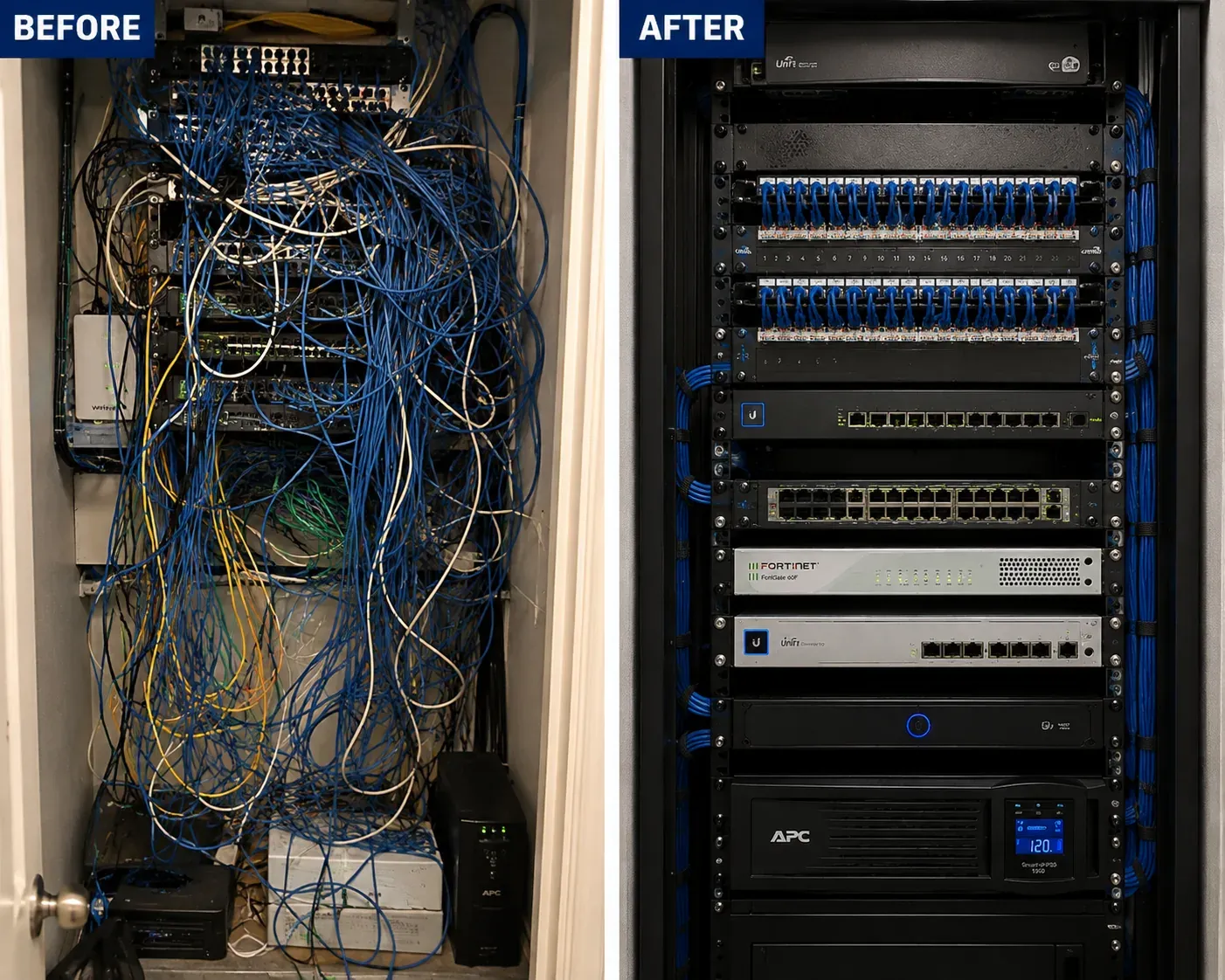
Before-and-after comparison of a tangled network closet and a rebuilt dressed rack, Hunts Point Bronx network cleanup
Left, a closet choked with loose blue, white and yellow cables; right, a rebuilt black rack with dressed patch panels, switches, a firewall and a UPS.
Pricing

Fiber Optic Installation Cost in Hunts Point

A market address does not change the rate card. Peninsula jobs use the same Bronx prices as anywhere else in the borough, which match our Brooklyn base (1.00×). Drop prices come straight from the Bronx structured cabling price builder; links between buildings and backbones fall inside the published ranges once we have walked the route, and each line of a proposal can be checked against this table.

ItemHunts Point priceWhere it shows up on the peninsula
Termination on an existing fiber$35 per terminationRe-terminating a damaged end at a dock switch, or adding connectors to a fiber a previous tenant left bare
OTDR test$40 per strandEvery strand of a yard crossing or building-to-building link, so a later fault can be located by distance
Multimode fiber drop$391 per dropA shorter in-building run where the owner already uses multimode optics
Single-mode fiber drop$447 per dropOffice to a far-wall switch, or to a node on a dock row
12-strand OM4 backbone between floors$4,500 – $7,000Ground-floor dock office to upper floors in a converted factory or mixed-use building
24-strand OS2 backbone or building-to-building link$8,000 – $15,000+Two buildings on one lot, or a long armored spine with many nodes
Second telecom room with fiber link backfrom $2,400A second network room at the far end of a large warehouse or in a second building
Service and callback rate$195/hr, 3-hr minimum ($585)Call-outs after handover: a cut link, a dead port, a revisit — never charged on the install itself

What moves the number on a Hunts Point proposal

  • Shift windows. A job that can only run in a few hours a day takes more visits than the same job done straight through. We price the schedule you can actually give us.
  • Height and lifts. Work above live aisles or dock doors needs a lift and often a spotter. Whether we supply the lift or you already have one makes a real difference.
  • Cold and wet entries. Each sealed cooler entry and each washdown enclosure is its own line item, because each takes its own time and materials.
  • Protection. Armored cable, steel conduit on descents and bollard-protected drops cost more than plain indoor runs and are the reason the link survives.
  • Yard crossings. An overhead crossing on existing anchor points is far cheaper than a trench across truck-bearing asphalt; existing empty conduit is cheaper still.
  • Nodes along the spine. Every cabinet on a dock run carries its own box, splices and test result, so ten bays served cost more than four. Spare glass in the same sheath, by contrast, adds very little.

Why not ADT, Ring or SimpliSafe? People sometimes ask whether a big security brand could handle this. Those companies package alarms and cameras for homes and small shops; private glass along a dock or over a truck lane is outside what they offer. On the peninsula the realistic options are the carrier's technician, whose responsibility ends at the carrier's own box; a national integrator that may hand the cabling to a subcontractor; or a Bronx-licensed crew with its own splicer and OTDR on the truck. AESS is that third option, with every rate printed above.

Shop Our Systems

Fiber Optic Installation Packages & Pricing

These are illustrations, not quotes: each one is assembled from nothing but the line prices in the table above, using situations we meet on the peninsula week in, week out. After a site walk, your proposal swaps them for the real route, node count and strand plan.

Starter — Office to the Far Wall

$894

A pair of $447 single-mode drops. Picture a mezzanine office in a distribution building: one drop reaches a new switch on the back wall where Wi-Fi never worked, the other reaches the first cabinet of a future dock spine. Both come connectorised, labelled and loss-tested.

Standard — Dock Office to Upper Floors

$4,500 – $7,000

Twelve strands of OM4 climbing a converted factory or mixed-use building from the entrance room to enclosures on the floors that need them, with every floor penetration firestopped and photographed and loss figures for each strand.

Premium — Building to Building

$8,000 – $15,000+

The tier for the jobs that decide whether a site works as one place: a second building across the yard, or a long armored run serving many dock nodes. Twenty-four OS2 strands, carried on a messenger above the trucks or in buried conduit, each one traced end to end on the OTDR before handover.

Bring Your Own Equipment — Labor Only

If your company already buys network hardware through its own distributor, or still has switches and enclosures from an earlier unit, you can hand us the parts. In that case we bill the labor only at $195 an hour with a three-hour minimum ($585) for routing, splicing and testing. Owner-supplied parts are covered by their own manufacturers, so we test any cable reel before it goes in to confirm the glass is sound.

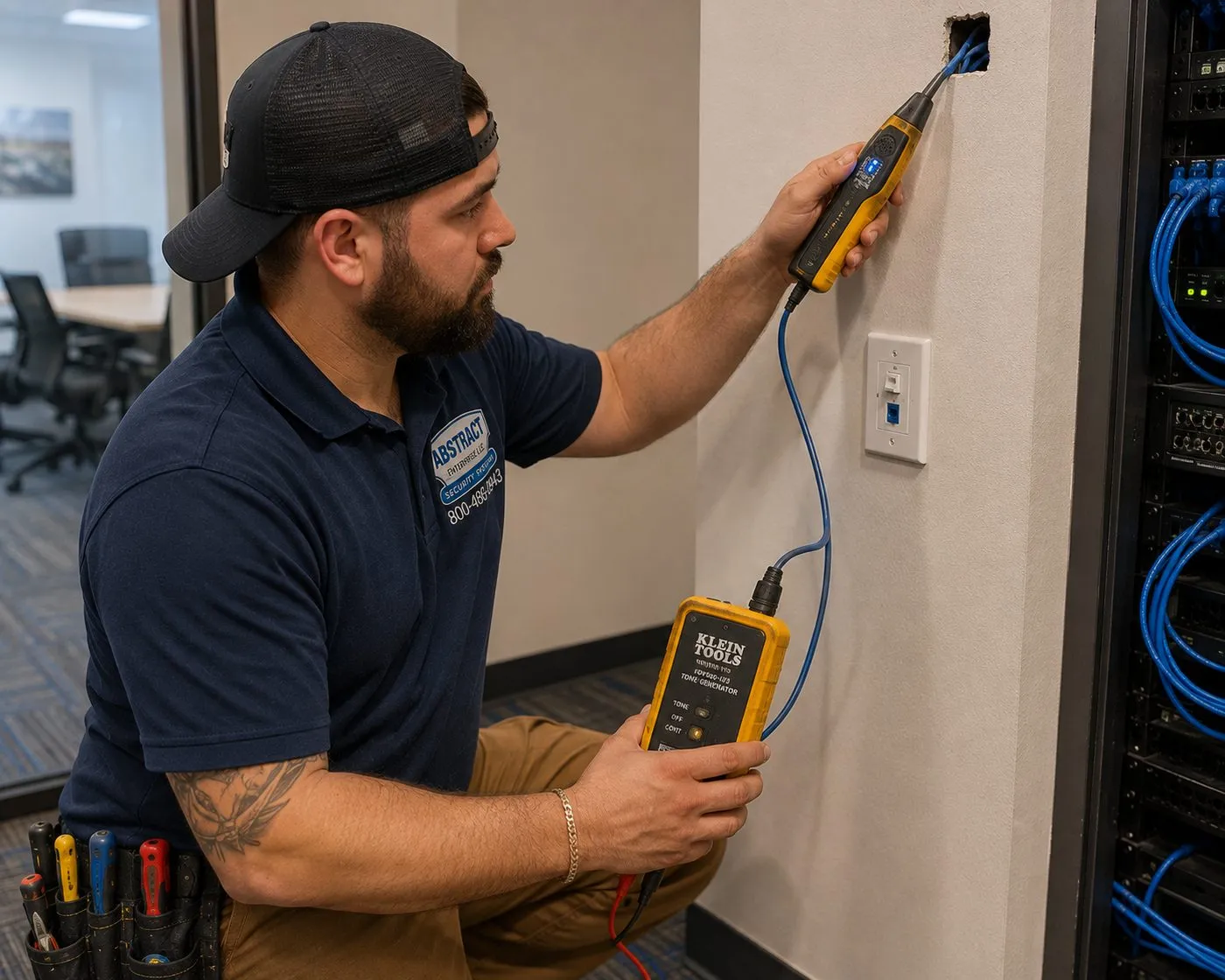
Technician using a tone generator and probe to identify a cable at an open wall box beside a rack, Hunts Point Bronx
Kneeling by an open wall box, a technician holds a tone probe to a blue cable while a yellow tone generator hangs from his other hand, next to a rack of blue patch cords.
Responsibilities

Who Looks After What in a Hunts Point Unit

Most network arguments on the peninsula are really arguments about boundaries. A merchant leases a unit from a cooperative or a landlord, a provider brings service to a box, an IT company configures the switches, and a refrigeration contractor owns the cold rooms. Writing the boundaries down before work starts saves a great deal of finger-pointing after the first outage.

Part of the systemUsually looked after byWhat we do with it
Service into the building and the provider's boxThe internet providerMeet it at the hand-off, test our side, and give you evidence if the fault is theirs
Roof, outside walls, dock canopy and shared shaftsThe landlord, cooperative or managing agentAsk for written approval of any route that crosses them and follow their contractor rules
Cooler and freezer panels, doors and evaporatorsThe refrigeration contractor or the building's maintenance teamAgree each sealed entry with them before cutting and keep cable clear of their equipment
Fiber, enclosures and patching inside the unitThe merchant or tenant (installed by us)Design, install, splice, test, label and document it
Switch, firewall and Wi-Fi settingsThe tenant's IT provider, or us if askedLeave a clean, labelled physical network ready for their configuration
Power to network equipment, chargers and dock pedestalsA licensed electricianSpecify what is needed and record which circuit feeds each device
Scheduling

Fitting Fiber Work Around a 24-Hour Floor

Every Hunts Point business has a busy period and a slower one, and they rarely match ordinary office hours. Rather than assume, we ask, and then sort the tasks by how much they disturb the floor and the neighbours. The table below is how we think about it.

TaskNoiseDisturbance to the floorWhen we usually schedule it
Site walk and tracing existing cableQuietOne or two people walking with a supervisorAny time the supervisor is free; seeing the floor busy is useful
Core drilling and hammer-drilling masonryLoudSmall area cordoned off; dust controlledWeekday daytime hours under the Noise Code, during the slower part of the business's day
Lift work above aisles or dock doorsQuietAisle or door closed while the lift is upThe business's slowest hours, with a spotter
Sealed entries into coolers and freezersModerateCold room door managed with the refrigeration leadWhen product movement in that room is lowest
Pulling and dressing cableQuietMinimal once lifts are downFlexible
Splicing and testingQuietBench work away from the floorFlexible; never on a food-contact surface
Cutover to the new linkQuietA brief interruption to the devices being movedThe quietest window the business can give, with the old link left in place until the new one is proven
Before the Site Walk

What to Have Ready When We Walk Your Hunts Point Building

A site walk on the peninsula usually takes under an hour for a single unit and longer for a whole building or lot. These items make it faster and the proposal more accurate.

  1. The list of things that must be connected. Docks, coolers, offices, yard cameras, chargers, a second building — whatever is failing or planned.
  2. Where the internet provider's equipment sits and, if you know it, which company provides each circuit.
  3. Your busy and quiet hours, and any days the floor is closed.
  4. Contacts for the landlord or cooperative, and for the refrigeration contractor if cold rooms are involved.
  5. Any written rules for contractors: insurance requirements, gate or badge procedures, food-safety or glass-and-brittle-plastics policies.
  6. Old drawings or invoices from earlier network work, even rough ones.
  7. Plans for the next few years, such as a move, a recladding, new chargers or expansion into the next unit, so the design does not have to be redone.
Field Notes

Field Notes From Peninsula Docks and Cold Rooms

Three habits our crews bring to every first visit on the peninsula. They describe how we work in general; no single client or job is being described.

We start on the dock, not in the office. The dock tells us how tall the trailers are, how close the reefer units come to the wall, where the forklifts turn and where water runs when the floor is washed. Most of the design decisions for a market unit are made in the first ten minutes standing there.

Next we walk into a cooler with a handheld scanner or a phone and close the door behind us. If the signal drops, the business already knows why its orders stall. If it holds, the problem is somewhere else, and that saves everyone money.

Then we find the person who knows the building's history: a facilities lead, a long-serving supervisor, the cooperative's maintenance staff. They know which conduit is dead, which hole leaks and which wall was rebuilt after a truck hit it. No drawing on the peninsula is as good as that conversation, and we write down what they tell us so the next contractor has it too.

Complete Services

Every Fiber Optic Installation Service in Hunts Point

Fiber is usually the backbone under something else. These are the related services our crews install on the peninsula and across the borough, so one contractor can answer for the whole system.

Structured Cabling in Hunts Point

The copper drops, patch panels and racks that hang off a fiber spine, for offices, sales floors and dock rows on the peninsula.

Hunts Point Security Cameras

Dock, yard and cooler-door cameras recording over the fiber to a recorder in the office, where nobody has to walk out to check it.

Access Control in Hunts Point

Card and fob readers on staff entrances, cooler corridors and offices, with door controllers networked back to one place.

Alarm Installation Hunts Point

Intrusion alarms for units, offices and yards that stand empty between shifts or over a weekend.

Intercoms in Hunts Point

Entry intercoms for residential buildings on the peninsula and for receiving doors at commercial units.

Fire Alarm Installation Hunts Point

Fire alarm work by our fire alarm team, coordinated so network and alarm cabling are kept properly apart.

Network Installation Bronx

Once the glass is in, this team sets up the firewall, the managed switches and the wireless, and can build out an extra equipment room tied back over fiber.

Network Cable Repair Bronx

Same-day help when a truck, a forklift or a renovation has damaged copper or fiber anywhere in the borough.

Structured Cabling Pricing Bronx

Check any drop price quoted here against the borough calculator, which prices copper and fiber runs line by line.

Borough-wide pages for the same trades include Cat6 installation in the Bronx, Bronx low-voltage installation, structured cabling across the Bronx, commercial camera systems in the Bronx and Bronx access control.

Sources

Where the Hunts Point Facts on This Page Come From

Every local figure, date and place name above was taken from a published source, listed here so you can check it.

  1. amNY (2023) — Hochul announces Bruckner Expressway expansion (truck volumes, project phases)
  2. Dewberry — Hunts Point Interstate Access Improvement (scope and $1.7 billion cost)
  3. City Limits (2022) — Spared by Sandy, Hunts Point food market slow to address flood risk
  4. Wikipedia — Hunts Point Cooperative Market
  5. New York YIMBY (2025) — Renovations begin on Building C at Hunts Point Cooperative Market
  6. Wikipedia — American Bank Note Company Printing Plant
  7. NYCEDC (2022) — Affordable homes open on the former Spofford Juvenile Detention Center site (The Peninsula)
  8. NYCEDC (2025) — Historic agreement to advance redevelopment of the Hunts Point Produce Market
  9. Wikipedia — Hunts Point station (Metro-North, Penn Station Access)
  10. City & State New York (2025) — Metro-North Penn Station Access project snags another delay
  11. New York State Governor's Office (2026) — Congestion-pricing-funded air quality improvements (Hunts Point refrigeration units)
  12. Untapped New York (2019) — A green roof atop The POINT is providing free internet to Hunts Point
  13. Wikipedia — The POINT Community Development Corporation
  14. Forgotten New York (2009) — Hunt's Point, Bronx (streets, buildings and history)
  15. Wikipedia — Barretto Point Park
  16. NYC Parks — Hunts Point Riverside Park
  17. New York Preservation Archive Project — Longwood Historic District
  18. NBC News (2005) — Storied New York City landmark on the move (New Fulton Fish Market)
  19. New York YIMBY (2015) — Construction begins on Hunts Point mall, 925 Hunts Point Avenue
  20. NYC Department of Environmental Protection — NYC Noise Code fact sheet (construction hours)
  21. The Fiber Optic Association — Fiber optic safety (scrap disposal, food and drink)
  22. Schneider Electric — Differences in NEMA enclosure ratings (Type 4 and 4X)
  23. UniFi Nerds — Top 10 Wi-Fi dead zones in warehouse environments
  24. FOX4 Kansas City (2023) — Thieves suspected of cutting fiber cables looking for copper
  25. Center for an Urban Future (2025) — Understanding and overcoming the Bronx digital divide
FAQ

Hunts Point Fiber Optic Installation FAQ

Do you cover the rest of the peninsula and the blocks north of the Bruckner — Longwood, Foxhurst and Soundview?
+

Yes. We work on every street of the Hunts Point peninsula, from the Food Distribution Center to Barretto Point, and in the neighbourhoods across the expressway including Longwood, Foxhurst, Soundview, Port Morris and Mott Haven. All of it is handled from our Bronx office on East Fordham Road, with the same crew and the same test equipment.

Is there an industrial or market surcharge on Hunts Point fiber work?
+

No. Hunts Point is priced like the rest of the Bronx, at parity with our Brooklyn base rate, and the line prices on this page apply. What changes the total on a market job is the work itself: sealed cooler entries, washdown enclosures, armored cable, lift time and the number of visits needed to fit your shift windows, all of which appear as separate lines in the proposal.

How will our warehouse staff recognise the fiber so nobody cuts or reroutes it?
+

Every cable is labelled at both ends and at regular points along exposed runs, enclosures carry a fiber optic warning label and a reference to the drawing, and outdoor runs are marked as fiber. Where your team prefers it we use a distinct jacket colour for the backbone. We also give supervisors a one-page sheet showing which switch feeds which doors and rooms, so the night crew knows what not to unplug.

Our camera company is separate — can you install the fiber their system rides on?
+

Yes. Many peninsula businesses have a camera vendor they are happy with and only need the backbone fixed. We agree with the vendor where each camera switch or recorder sits, run and test the fiber to those points, and hand over a strand list so their technicians patch the right ports. If their equipment needs a particular type of optic or connector, we build the fiber to match.

Do we need our refrigeration contractor on site when cable goes into a cold room?
+

Not for the whole job, but we do want their agreement on each entry. Before cutting into an insulated panel we confirm the location with the refrigeration contractor or your maintenance lead so the opening avoids structural members, refrigeration lines, heater wiring and the evaporator. Some businesses prefer the refrigeration contractor to make the opening and seal it; others leave it to us under their guidance. Either way the method is agreed before the first hole.

Can you run fiber for card terminals and order-entry stations on a wholesale sales floor?
+

Yes. On a busy sales floor the payment terminals and order screens are often on Wi-Fi that struggles when trading peaks. We bring the backbone to a switch near the floor and run short wired drops to each counter or terminal position, kept on their own network segment so payment traffic is separated from everything else. Your payment provider or IT company sets up the terminals; we make sure the cable to them is solid and tested.

How is drilling dust kept off product and packaging?
+

Before any core or hammer drilling we agree with the floor supervisor what has to be moved or covered, sheet off the work area, and use drills fitted with dust extraction so most of the dust is captured at the bit. Nothing is drilled above open product. When the hole is finished we vacuum and wipe the area down and let the supervisor inspect it before the space goes back into use.

Our provider says its circuit is fine but our far building is still offline — can you find which side the fault is on?
+

Yes. We test from the provider's hand-off point onward: the patch cord into your equipment, the switch, the fiber to the far building and the equipment at the other end. If our tests show your side is healthy, you get the readings to give the provider so their ticket is taken seriously. If the fault is on your side, we usually find and repair it on the same visit at the service rate.

Can you give us a written scope and quote to attach to a grant, loan or insurance claim?
+

Yes. Our proposals are itemised with quantities, unit prices and a description of the work, which is the format lenders, grant programmes and insurers usually ask for. After a damage event we can also write up what we found, what we repaired and the test results afterwards. We do not prepare the application itself, and we never inflate a scope to fit a funding amount.

Do you bring your own lift for high warehouse ceilings, or should we rent one?
+

Either works. If your building already has a scissor or boom lift that our crew is allowed to use, we plan around it and the proposal shows the saving. If not, we arrange a lift sized for the ceiling height and the floor loading and include it as a line item. We tell you which lift we need at the walkthrough, because aisle width and floor capacity decide what will fit.

What does a fiber repair visit to a Hunts Point business cost?
+

Repairs, fault finding and return visits are charged at $195 an hour with a three-hour minimum ($585). Replacement parts such as a new pigtail or patch cord are added at our listed prices, and a termination on an existing fiber is $35. Most single-link faults are found and fixed within that minimum; if a repair turns out to need new cable, we stop and quote the extra work before doing it.

How does your crew stay safe and out of the way on a floor where forklifts are running?
+

We agree the work zone with the floor supervisor before starting, cordon it with cones or barriers, and use a spotter whenever a lift is raised in or near a travel aisle. Crew members wear high-visibility vests and follow your site's traffic rules, and we never leave tools, reels or cable on the floor outside the cordon. If the floor gets too busy for the zone to stay safe, we pause and return in the next agreed window.

All Areas Served

Fiber Optic Installation Across the Bronx and New York City

This Hunts Point page sits under our Bronx fiber optic installation page, which covers the borough's complexes, courtyard buildings and campuses, and under the New York City fiber optic installation hub. Our other area pages are listed below; every one of them is served by the same crews and the same test equipment.

If your peninsula building needs work beyond fiber, our full list of trades lives on the Abstract Enterprises Security Systems home page; who we are and how long we have done this is covered under about Abstract Enterprises.

Peninsula Network Down Right Now?

Scanners dead at the dock, a cooler's cameras missing from the recorder, a yard link cut by a trailer or the second building offline: call (646) 490-0629 with the building and the link that failed. We aim for same-day dispatch to Hunts Point, and once on site a technician usually has the fault found and fixed within one to two hours, re-tests the strand and tells you what caused it.

Fiber Optic Installation Hunts Point — Built for Docks, Coolers and Trucks

Abstract Enterprises Security Systems · 460 E Fordham Rd, Bronx, NY 10458 · Bronx line (646) 490-0629 · WhatsApp (718) 679-0359 via wa.me

NYS Low-Voltage License #12000287431 · 100% Licensed & Insured · Same-Day Estimates · Rated 4.7★ from 201 Google Reviews

Full terms — including 50% deposit, one-year parts-only warranty on AESS-supplied products, and the late-fee schedule — are set out in the service agreement. See our warranty page.

Page reviewed and updated October 17, 2026. Changelog: first publication of the Hunts Point fiber optic installation page.