Docks That Never Close · Yards Watched to the Fence · Homes Covered Without Watching Neighbors
Security camera installation in Hunts Point means two very different kinds of property sitting side by side on one peninsula. To the south, food wholesalers, cold-storage buildings and truck yards run around the clock, with refrigerated trailers lined up at docks and chained gates that matter most at three in the morning. To the north, a small residential core of pre-war walk-ups and 1908 row houses on Manida Street holds families who mostly rent. We plan each one on its own terms: dock and gate cameras that stay clear where cold air meets warm, yard cameras that reach the far fence, and entry cameras on homes that show faces without looking into anyone else's window. Every line is priced in writing before anything is ordered.
Reviewed and updated November 3, 2026 by Anwar Timothy, NYS license #12000287431 · Sources: the NYC Food Policy Center on the Hunts Point Food Distribution Center, Wikipedia entries for Hunts Point, the Hunts Point Cooperative Market, the 41st Precinct, the Longwood Historic District and Barretto Point Park, the Historic Districts Council, 6sqft, CityLand and the Bronx Times on the Manida Street Historic District, Ephemeral New York on the Manida Street facades, the Landmarks Preservation Commission Permit Guidebook (Rules Section 2-20), NYC Parks on Hunts Point Playground, Hunts Point Riverside Park and Concrete Plant Park, Forgotten NY, NY1, The POINT CDC history, CBS New York reports on a Hunts Point equipment burglar, a pizzeria robbery on Hunts Point Avenue and a robbery at Bryant and Lafayette Avenues, Shore News Network on an NYPD Crime Stoppers alert, Gothamist and NYC EDC on the produce market redevelopment, City Limits on flood risk at the food hub, amNY on truck traffic, New York YIMBY on Building C and The Crossings, Impera Security and RecordingLaw on New York camera rules, and the NYS Department of State on installer licensing · Dispatched from 460 E Fordham Rd

Owner-operated since 2002 · Thousands of jobs completed · Booked within 2 hours
Security camera installation in Hunts Point usually falls into one of three jobs: a wired system for a warehouse, cold-storage building or wholesale unit that covers dock doors, cold-room doors, trailer rows, the yard gate and the fence line; a smaller system for a row house, walk-up or rental building that covers the front door, vestibule, halls, the rear yard and the street edge; or a storefront system on Hunts Point Avenue, Southern Boulevard or Lafayette Avenue that covers the door, counter and back room. Every job is priced on our Bronx rate and quoted in writing after photos or a visit, with each camera, housing, mount, cable run and setup task on its own line, because a camera at a freezer door and a camera above a row-house stoop are not the same amount of work. Estimates are free, requests are booked within 2 hours, and the work is done under NYS license #12000287431. Call (646) 490-0629 or use the form.
Hunts Point is a peninsula that never fully goes to sleep, and that changes what a camera system has to do. According to the NYC Food Policy Center, the Food Distribution Center covers 329 acres, nearly half of the entire peninsula, and it runs 24 hours a day, seven days a week, still relying on infrastructure first put in place in the 1960s. Wikipedia counts more than 800 businesses in the Hunts Point Industrial Park. Around that hub are produce, meat and fish wholesalers, cold-storage operators, food producers, auto shops, recyclers and trucking yards. A camera plan written for a store that closes at nine does not fit a dock that is busiest at two in the morning. Here the question is rarely "what happens after we lock up." It is "what happens at door 14 while everyone is working at door 3."
The working side of the peninsula leans on equipment that cameras have to see around. Gothamist reported that roughly two dozen market operators use refrigerated trailers because the 1960s-era warehouses do not have enough refrigeration capacity. That means rows of trailers that move every night, block yard views, and hold product worth stealing. amNY reported that nearly 80,000 trucks a day travel to and from the peninsula, about 13,000 of them on residential side streets. Trucks bring headlights that wash out night pictures, diesel grime that coats lenses, and constant motion that sets off badly tuned alerts. A Hunts Point camera job begins with those conditions, not with a camera catalog.
The history explains why industry and homes sit so close together. NYC Parks traces the name to Thomas Hunt, an early settler in the 1670s. The area joined the city in 1874 and grew quickly after the IRT subway line reached it in 1904. Forgotten NY describes Hunts Point Avenue being rebuilt and widened in 1908, with coal yards and cement factories rising along the East River and houses and apartment buildings filling the high ground in the northern half. Between the 1890s and the 1920s, according to The POINT CDC, it was a working-class Jewish neighborhood, later home to Puerto Rican, Dominican and Jamaican families. The Produce Market opened in 1967 and the Meat Market in 1974, and the city designated an industrial park in 1980. NY1 notes that the Bruckner Expressway, completed in the early 1970s, cut the peninsula off from the rest of the borough. The decades of arson and abandonment that followed left many lots empty and many buildings rebuilt inside old shells.
The homes that remain are mostly rented. Wikipedia reports that 91.7 percent of occupied housing units in Hunts Point are renter-occupied. That single number shapes residential camera work more than any other. In most buildings, the owner or managing agent decides what goes in the lobby, the halls, the rear yard and on the facade, while a tenant's own plan stays inside the apartment. Impera Security, summarizing New York practice, notes that tenants generally cannot install cameras in shared hallways or lobbies without the landlord's permission. RecordingLaw notes that landlords cannot put cameras inside apartments, aim them at tenants' windows, or place them anywhere people reasonably expect privacy. We follow both rules on every job.
Local reporting shows where cameras do their work. CBS New York reported a burglar who targeted at least three Hunts Point businesses after April 21, cutting chains and slipping through metal gates, and in one case driving out with a forklift. CBS also reported an armed robbery at Fratilli's Pizza on Hunts Point Avenue near East Bay Avenue around 7:45 one evening, where surveillance video showed the man walking in with a gun and a worker said the shop's cameras may have spooked him. In another report, a street robbery around 11 a.m. near Bryant and Lafayette Avenues was caught on camera, and a resident told CBS that robberies were becoming more common. More recently, NYPD Crime Stoppers circulated surveillance images in a robbery case involving the 41st Precinct, which serves Hunts Point and Longwood from its station house at 1035 Longwood Avenue. We do not rank any block from these reports. They show that gates, store doors and street corners are where clear video decides what anyone can prove.
Two more facts change where we put equipment. The first is water. City Limits reported in 2022 that nearly a third of the Food Distribution Center sits in the current 100-year floodplain, that storm water during Sandy reached the New Fulton Fish Market parking lot, and that a city study named power outages as the main threat to the produce and fish markets. Recorders, switches and battery backups therefore go up high, off the floor and away from loading-level doors. The second is landmarks. The Manida Street Historic District, designated in 2020 as the city's 150th, covers 42 semi-detached row houses between Lafayette and Garrison Avenues, and the Landmarks Preservation Commission reviews security cameras on those facades under its rules. A camera on a Manida Street front is planned with that review in mind before a ladder goes up.
What Hunts Point owners often add next. Warehouse managers who start with dock and gate cameras usually come back asking about fob readers on the office door or the cold-room corridor, so the camera footage and the door log can be matched. Row-house owners on Manida Street often want the camera at the stoop shown on a video intercom inside. We leave a spare cable and a labeled port at the recorder for that next step, so walls and ceilings only have to be opened once.

Two urgent calls are typical here. On the industrial side, a camera on a dock door, a yard pole or the main gate has gone dark, fogged over or been knocked off aim by a trailer or a forklift, and nobody noticed until a load went missing. On the residential and retail side, something has happened at a store counter or a building entrance and the recorder will start writing over that day once the drive fills. For the dark camera, write down which one it is and when it was last seen working, check that the recorder still shows power and network lights, and do not reset the recorder to factory settings, because that can erase passwords and remote access together. For the clip, leave the recorder running, note the exact time you need, and export that stretch to a USB stick if you know how. Then call (646) 490-0629. Every request is booked within 2 hours. We talk you through what can be done over the phone and send a technician when the fix needs hands on the equipment.
The CBS report of a burglar cutting chains, slipping through metal gates and leaving with a forklift describes the weak points of a working yard better than any checklist. Thieves on an industrial site do not come through the front office. They look for the gate that is chained rather than locked, the stretch of fence behind a parked trailer, the dock door that stays cracked for ventilation, and the equipment that can be driven out. Before we suggest a camera for a Hunts Point warehouse, yard or market unit, we walk the site as someone looking for those gaps would, and we ask the same three questions at each point: what can move through here, who is supposed to move it, and who would see it happen. The table shows how that works at the places we expect to cover most.
| Point on the site | What moves through it | Who is watching | What the camera is set to do |
|---|---|---|---|
| Main vehicle gate | Trucks, staff cars, forklifts leaving after hours | A guard or nobody, depending on the hour | Show each vehicle head-on as it enters or leaves, with a second view of the chain or lock |
| Dock doors | Pallets, drivers, receivers, forklifts | Whoever is working that door | One view per pair of doors showing the trailer opening and the dock plate |
| Cold-room and freezer doors | Product, pickers, pallet jacks | Supervisors, when they are on the floor | A view from the warm side, set so the lens does not fog when the door opens |
| Refrigerated trailer rows | Product stored overnight, drivers coming and going | Often nobody between loads | High overviews down each row, aimed along the trailer doors |
| Far fence line | Should see no one | Nobody | Long-view cameras along the fence, with alerts tuned to the inside of the line |
| Equipment parking | Forklifts, yard tractors, tools | Nobody after the shift | A view of the parked equipment and the route out to the gate |
| Office and dispatch door | Staff, drivers with paperwork, visitors | Office staff during the day | A face at the door as people walk in |
| Street frontage | Trucks waiting, passers-by | No one inside the building | Framed on the site's own frontage and curb, not across the street |
Most owners ask first for a camera on the front door or the office. On a Hunts Point site, the more useful question is how stolen goods or equipment would leave. A forklift can only go out a gate wide enough for it. A pallet can only leave through a dock door or over a fence where a vehicle can pull up. So we trace every exit route a vehicle could take, then put the clearest cameras where those routes narrow: the gate opening, the end of a trailer row, the ramp up to the street. A camera that shows a vehicle head-on as it passes through a gate, at a height that sees the driver and the front of the truck, is often worth more than three cameras scattered across the yard. Once the exits are covered, we fill in the docks and the fence.
A recorder that shows "Channel 9" is no help when a receiver says a pallet went missing from door 11 between two and four in the morning. We name every camera exactly as the people on the floor talk about the site: "Door 11-12," "Freezer A door," "Halleck gate," "Trailer row east," "Fence behind lot C." The same names go on the printed cable labels at the recorder and in the written camera map we leave behind. When a new night supervisor starts, or the tenant changes, the next person can read the system the way the building and yard are actually used, which also makes it far faster to pull the right clip for a driver, an insurer or the police.
On a 24-hour site, alerts on every camera would buzz phones all night and soon be ignored. We set them by zone instead. The far fence line, the equipment parking and the inside of a closed gate send alerts whenever someone is there, because those places should be empty. The working docks and the trailer rows record continuously without alerts while a shift is running. The owner or general manager holds the main administrator account, the only one that can change settings or delete footage. A night supervisor sees the docks, the gate and the cold rooms; office staff may see only the office door and the parking area. Where a guard company or the market's own public safety officers need to view a camera, they get view-only access to that camera alone. We write down who has what before we leave.
These are the camera jobs we expect most often from Hunts Point wholesalers, warehouse and yard operators, food producers, landlords, managing agents, row-house owners, shopkeepers and renters. Each is priced in writing after photos or a visit, with every item on its own line.
One clear view per pair of doors on loading docks along Food Center Drive, Halleck Street and East Bay Avenue, showing the trailer opening and the dock plate.
Cameras on the warm side of cooler and freezer doors, in heated or sealed housings where needed, placed so the picture stays clear when the door opens.
Head-on gate cameras that show vehicles and drivers, plus long views down the fence, with alerts tuned to the inside of the line.
High-mounted overviews aimed along rows of parked trailers, so the doors of every trailer show even as the rows change shape through the night.
Sealed cameras for food production rooms that are hosed down, with every cable entry sealed and nothing mounted over open product.
Stoop, side and rear-yard cameras on the 1908 semi-detached houses, placed off the ornament and planned for Landmarks review.
Street door, vestibule, mailbox, hall and rear-yard cameras for pre-war walk-ups on Hunts Point Avenue, Bryant Avenue and nearby blocks.
Door, counter and back-room cameras for stores on Hunts Point Avenue, Southern Boulevard and Lafayette Avenue, with the recorder out of reach.
Old recorders and cameras left by a previous tenant traced, tested, moved into your accounts and reused where they still work.

Forgotten NY sums up the layout plainly: homes and apartment buildings on the higher ground in the northern half, industry and rail yards along the water to the south. In between are converted factories and a growing number of newer buildings. These are the building types the sources describe, and what each one means for the camera work.
Long, low buildings from the 1960s and 1970s with rows of dock doors, refrigerated rooms and, at the Cooperative Market, seven refrigerated and freezer buildings on about 60 acres.
Older market buildings getting new insulated metal walls, such as Building C at the Cooperative Market, where New York YIMBY reported an $18 million recladding in 2025.
Heavy brick-and-concrete plants now holding offices, schools and agencies, like the former American Bank Note plant at 1201 Lafayette Avenue.
Five- and six-story apartment buildings along Hunts Point Avenue and the side streets, such as the 1928 six-story building at 760 Hunts Point Avenue.
Forty-two semi-detached brick houses built in 1908 and 1909, with mirror-image fronts, rounded bays and low stone stoops.
Buildings with elevators and entry systems, such as the senior housing at 887 Bryant Avenue, which advertises a 24-hour surveillance system and access control.
| Building | What the camera mounts on | How the cable reaches the recorder | What we protect from view |
|---|---|---|---|
| Market or cold-storage building | Concrete block, steel columns, dock canopies, the warm side of cold-room walls | Along the dock in conduit or on supports above forklift height, to a raised office or mezzanine | Restrooms, break rooms, drivers' lounges |
| Reclad metal-panel building | Structural framing behind the panel, through sealed panel mounts | Through planned, sealed panel penetrations, then inside to the office | Neighboring sites across the fence |
| Converted factory | Brick piers, concrete beams, exposed ceilings | Through the building's telecom room and approved pathways to the tenant's suite | Other tenants' suites and shared corridors the landlord controls |
| Pre-war walk-up | Plaster over brick in halls; brick outside | Down to the cellar, then up a shaft, closet or slim raceway, with rated firestop at each floor | Apartment doors, rear windows facing the yard |
| Manida Street row house | Plain brick away from carved door and window surrounds | Through the basement or a short attic run, entering the wall at a hidden point | The neighbor's mirror-image entrance and windows |
| Newer affordable building | Finished walls and ceilings, often with pathways in place | Through the telecom riser to the building's network room | Residents' doors, service offices |
The Food Policy Center notes that the market still runs on infrastructure built in the 1960s, and many of these buildings were designed long before anyone thought about cameras. Their walls are usually concrete block or insulated panel, their docks are long, and their cold rooms swing between near-freezing and the outdoor temperature every time a door opens. That swing is the main enemy of a camera. A lens moved from cold air to warm, humid air fogs, and moisture creeping into a housing can ruin a camera in a season. So we keep cameras on the warm side of cold-room doors wherever possible, looking through the opening rather than living inside it. Where a camera must sit in the cold, we choose a housing rated for it, often with a built-in heater, and seal every cable entry. Cable runs along the dock in conduit or on supports above the reach of forklift masts, and the recorder goes to a raised office or mezzanine, out of the cold and above the floor.
New York YIMBY reported that Building C at the Hunts Point Cooperative Market, built in 1972, is getting an $18 million recladding with a sealed insulated metal facade. Projects like that change camera work. A camera bolted straight through an insulated panel without a plan can let in water and break the seal the owner just paid for. On a reclad building, the best time to plan cameras is before or during the new skin, so that mounting points land on the structure behind the panel and cable enters through planned, sealed openings. Where the panel is already up, we use mounts designed for metal panels, find the framing, and seal every opening so the wall still keeps out weather and keeps in cold. We also check with the owner or the panel contractor whether drilling affects any warranty on the new wall before we begin.
Wikipedia describes the former American Bank Note Company plant at 1201 Lafayette Avenue as a 1909 to 1911 brick building on a steel frame with concrete floors, about 405,000 square feet, now known as The BankNote and home to offices, a charter school on several floors and a city agency. Buildings like that are really many tenants under one roof. A business renting a suite controls its own space, but the corridors, elevators, telecom room and every hole through a concrete floor belong to the landlord. So the first step is the building's rules: where tenant cable may run, which pathways are approved, and who signs off. Inside the suite, the camera job is usually simple, with cameras on the entry door, the reception area and any storage room. The care goes into routing cable through approved pathways and keeping every camera aimed inside the tenant's own space.
The residential blocks around Hunts Point Avenue, Bryant Avenue, Faile Street and Barretto Street hold many five- and six-story walk-ups from the 1920s, such as the 49-unit building at 760 Hunts Point Avenue built in 1928. In these buildings, the cellar is usually the camera hub. It holds the meters and the internet provider's equipment, and it is the best place for a locked recorder, set high and away from the boiler and any spot that takes water. The camera for the street door goes inside the inner vestibule door, framed so residents and visitors walk toward it. Hall cameras on each landing are aimed down the stair, stopping short of apartment doors. At the back, a camera at the cellar or yard door covers the rear yard at ground level, aimed at the ground and the gate, not up at the windows. Cable rises through a shaft, a stacked closet or slim painted raceway, and every floor it passes through is sealed with rated firestop.
The Historic Districts Council describes the Manida Street houses as modest Renaissance Revival row houses, and Ephemeral New York points to the details that matter for cameras: mirror-image facades, rounded projecting bays, low stone stoops, simple cornices with steep parapets, and ornament gathered around the doors and windows. Each building is really two houses sharing one front, so a camera on one half sits a few feet from the neighbor's door. We keep cameras off the carved surrounds and the cornice, mounting on plain brick beside or above the entrance and aimed down the owner's own stoop and walk. Cable enters through a mortar joint rather than the brick face, where the joint can be repointed later, and runs inside to the basement. Because the district is designated, exterior positions are written up for the Landmarks Preservation Commission before drilling, and rear-yard cameras are planned the same careful way.

Hunts Point's businesses sit along a handful of corridors the sources describe. We list the kinds of businesses named in those sources, not our customers, and we do not claim any named business as a client.
The produce, meat and fish markets inside the Food Distribution Center, open around the clock, with docks, cold rooms and trailer rows.
The approach to the produce markets, where Hunts Point Avenue ends at East Bay Avenue and Halleck Street, lined with warehouses and yards.
The main street from Southern Boulevard to the markets, with shops, takeout spots and the 40,000-square-foot Crossings center at 925 Hunts Point Avenue.
Industrial blocks toward the water with laundries, bottlers, salvage and pallet yards, and other working plants named in local reports.
Converted factory space such as 1201 Lafayette Avenue, auto shops near Garrison Avenue, and the edge of the Manida Street district.
Stores and services on the northern edge, near the Hunts Point Library and the Bruckner Expressway corridor.
A wholesale unit in one of the market buildings is a long room with a dock on one side, cold rooms behind, a sales floor or office at one end, and trucks backing in at every hour. The camera plan follows the product. First the dock doors, one view for each pair, mounted high and aimed so the trailer opening, the dock plate and the pallet crossing it all show. Then the cold-room doors, from the warm side. Then the sales counter or order window, where buyers pick up and pay, with a camera above and in front showing faces and paperwork. Then the office door, the equipment parking and the route to the gate. Gothamist's reporting on trailers used as extra cold storage means many units also need trailer-row coverage, mounted high on the building or on a pole, looking down the row so each trailer door shows. All of this records continuously, because on a 24-hour site there is no quiet period to rely on, and the recorder keeps enough days to cover the time it usually takes a buyer or driver to raise a dispute.
Hunts Point has many open yards, from truck parking to pallet and salvage operations. The CBS report of a burglar cutting chains and leaving with a forklift shows exactly where they are weak. For a yard, the gate camera comes first: mounted inside the fence, at a height and angle that shows each vehicle head-on as it passes through, with a second, tighter view of the chain or lock so a cut shows clearly. Then long views down each fence line, with alerts tuned so only movement inside the fence counts. Then the equipment parking. Yards are often far larger than the 100 meters a standard network camera cable can carry, so far cameras connect through outdoor-rated switches in sealed enclosures, or by fiber where cameras sit on another building or across a truck lane. Power for distant poles is planned on the quote, not discovered on the day.
The CBS report from Fratilli's Pizza, where surveillance video showed an armed man walking in, shows what a storefront camera system is for. Most shops on Hunts Point Avenue and Southern Boulevard are small rooms on the ground floor of apartment buildings, often staffed by one or two people. They need three views above everything else: the front door, framed for faces as people walk in; the counter, close enough to show hands, the register and the customer; and the back door or stock room. A store without a back office needs a locked cabinet for the recorder, mounted high and away from the counter, so anyone who takes the register cannot take the footage too. Any camera on the outside wall or a sign box needs the building owner's written agreement, and the store's system stays separate from the residential system upstairs.


We do not publish stories about particular sites or customers, so this is the routine rather than an anecdote: how we look at a Hunts Point warehouse or yard before recommending a single camera.
We try to arrive close to a shift change, when the site shows both faces at once: the last trucks of one shift pulling out and the first of the next backing in. We start at the street, watching where trucks wait, where drivers walk, and how long the gate stays open. Then we go in through the gate and stand where a gate camera would go, checking whether headlights shine straight into that spot as vehicles turn in. Next comes the yard: where the trailers are parked tonight, where they were parked last week according to the supervisor, and which stretches of fence disappear behind them. We look at the chains and locks on every gate, because a camera's tight view of a chain tells you a lot more than a wide view of a dark fence. On the dock we watch forklift paths, note the height of the masts, and look for a route for cable that no load will ever touch. At the cold rooms we open a door and watch the air roll out, which shows where a lens would fog. Inside, we find the office or mezzanine, check whether it sits above the level the site has flooded to, and look for power and the internet equipment. Only then do we write the plan, gate by gate and door by door.
Docks, cold rooms and trailers
Usually the inside of the dock, a few feet back from the door, high on the wall or a column, looking out through the opening. That keeps the camera in one steady temperature instead of swinging between cold and warm air each time a trailer is opened, which is what fogs lenses and drives moisture into housings. From that spot the camera sees the trailer opening, the dock plate and every pallet crossing it. If the dock area itself is refrigerated, we use a housing rated for the cold, often heated, and seal the cable entry so the warm air outside never condenses inside the camera.
Go high and aim along the rows, not across them. A camera mounted near the roofline of the building or on a sturdy pole, looking down the length of a trailer row, sees every trailer door in that row no matter which trailers are parked there tonight. A camera aimed across the yard at a fixed spot loses its view the moment a trailer stops in front of it. Where the rows are long, we put one camera at each end looking toward the middle. The trailer doors are what matter, because that is where product leaves, so we frame for the doors and the ground behind them.
Often, yes, if the cameras are set up for it. Each dock camera needs an accurate clock synced to the network, so the time on the recording matches the time on the paperwork. The view needs to show the trailer opening and the dock plate clearly enough that a broken pallet or a short count is visible as the load comes off. We name each camera by door number so a supervisor can find the right clip fast, and we size the recorder to keep footage long enough to cover the window in which your buyers or carriers usually raise a claim. A clip exported with its time stamp is then something both sides can look at.
Cameras with a high water-ingress rating, mounted high and out of the direct line of the hoses, with every cable connection inside a sealed box rather than hanging in the open. The bigger risk is usually the connections and the mount, not the camera body, so we seal cable entries, avoid open connectors on the wall, and use stainless or coated hardware that stands up to cleaning chemicals. Nothing is mounted directly over open product. We ask your sanitation lead which chemicals and pressures are used, because that decides which housings and mounts are suitable.
Yards, gates and fences
Three. A head-on camera at each vehicle gate, mounted inside the fence at a height that shows the driver and the front of the vehicle as it passes, because anything large that is stolen has to go out that way. A second, tighter camera on the chain or lock itself, so the moment it is cut shows clearly with a time stamp. And a view of the equipment parking area, so you can see a forklift start up and roll toward the gate. Together those show the break-in, the vehicle and the exit, which is far more useful than a wide shot of a dark yard.
A standard network camera cable is good for about 100 meters, and many Hunts Point yards are bigger than that. For far cameras, we place an outdoor-rated switch in a sealed, locked enclosure partway out, powered and protected by a battery backup, and run short cables from there to each camera. Where the distance is longer still, or the cameras sit on a separate building, we link back to the office with fiber, which carries the picture over long distances and does not conduct electricity between buildings. Power for those far points is planned and priced on the quote.
It depends on what is already there and what the lane carries. Overhead, the cable must be supported on a proper messenger wire well above the tallest trucks that use the lane, and anchored securely at both buildings. Underground, it needs a conduit under the pavement, which may already exist from an old service or may require saw-cutting and trenching. We look for existing conduit first, because reusing it is usually simplest. Either way, a fiber link is the better choice between separate buildings, and we write the route, the support and any paving work on the quote so you can compare.
Row houses and rental buildings
It often looks best and reviews best that way, but it only works if both owners agree. A matching pair of small cameras on the plain brick beside each door keeps the facade symmetrical, which suits a district designated for its uniform fronts. Each camera is aimed down its own owner's stoop and walk, so neither house records the other's entrance. If only one owner wants a camera, we place it on that owner's half, set back from the shared center line, and black out any part of the picture that reaches the neighbor's door.
We avoid the bay. Its curved brick and window surrounds are among the features that give these houses their character, and a camera there would sit right against window glass, which causes glare at night. A better spot is usually the plain brick beside or just above the main door, or under the edge of the entrance where the stoop is covered from rain. From there, the camera looks out along the stoop and the sidewalk in front of the house. The cable enters through a mortar joint, and the plan is written up for Landmarks review before work starts.
At the front door from the inside, in the entry hall, on the stair and at the rear door, all aimed so they never look into a tenant's room when its door opens. Shared bathrooms are never recorded. A shared kitchen is a sensitive space where people spend private time, so we advise against a camera there unless the tenants agree and the owner has a clear reason, and even then it should cover only the doorway. A short written notice at the entrance saying which shared areas are recorded helps tenants trust the system, which matters in a building where many households share one front door.
Yes. The camera goes at ground level on the rear wall or the yard door, aimed at the bottom of the drop ladder, the yard and the gate, with the top of the picture stopping below the first-floor windows. Most cameras also allow parts of the picture to be permanently blacked out, which we use for any window that still shows at the edge. The point is to see anyone reaching the yard by the fire escape or the fence, not to record the windows above. Nothing is ever fixed to the fire escape itself.
Offices in converted buildings
No, not by itself. A right to inspect the premises is not a right to your recordings or your accounts. Your system, installed in your suite and paid for by you, can stay entirely in your name, on your own network, with the landlord having no login unless you decide to give one. If the lease does say something about cameras or data, read that clause, or have your lawyer read it. Where a camera of yours looks at a shared corridor the landlord controls, the landlord's written agreement is needed for that position.
Keep every camera inside your own suite, aimed at your own door, reception and storage, and keep shared elevator lobbies and stairs to the landlord's system. With children using the building, a tenant camera that reaches into a shared hall the school uses will draw questions quickly, and the landlord is the right party to decide those spaces. In practice, a camera inside your door looking in, rather than out into the corridor, shows everyone who enters your space without recording anyone passing by.
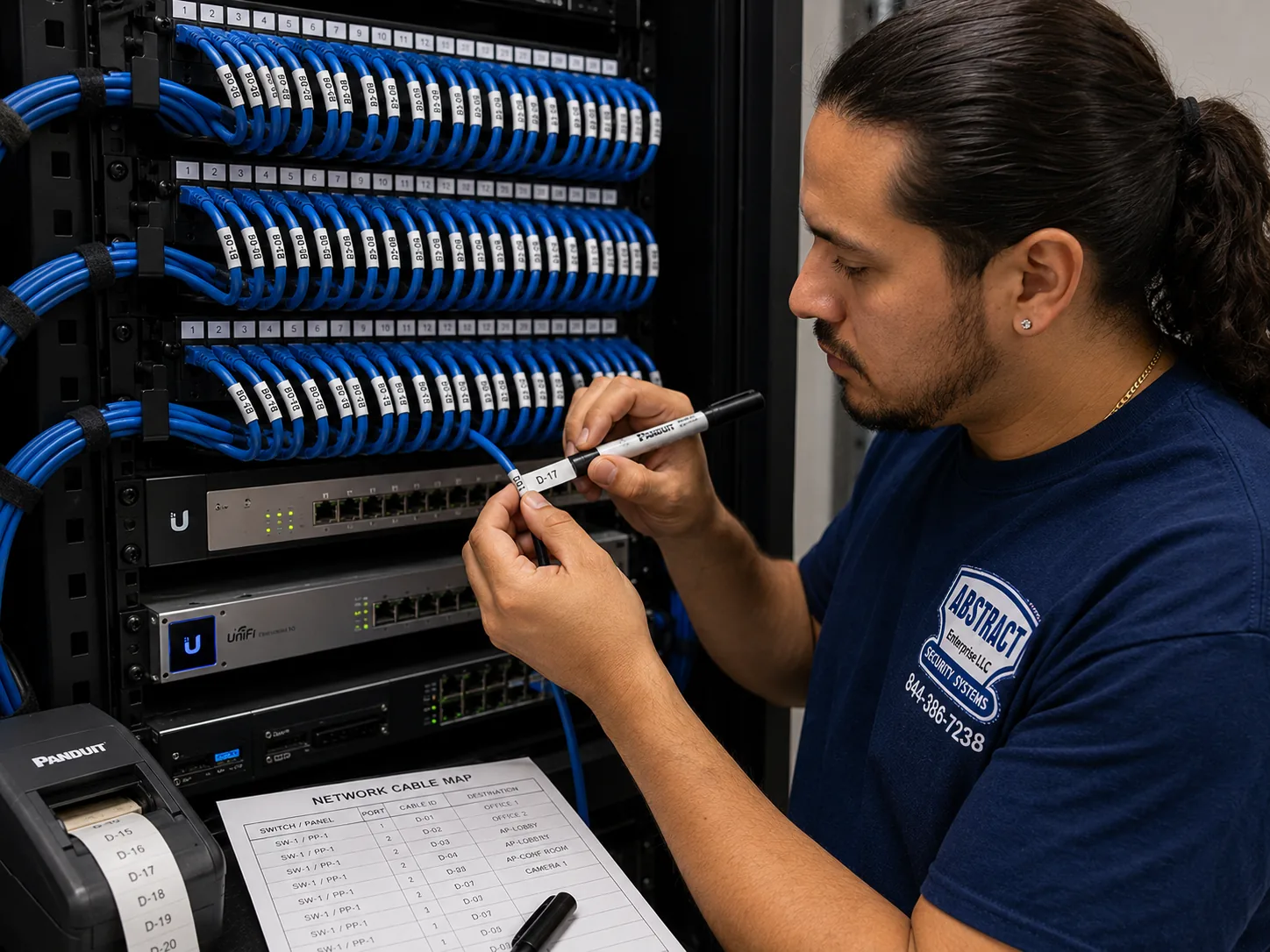
These are the cameras and parts we expect to fit on Hunts Point docks, yards, cold rooms, row houses, walk-ups and shops. For wired systems we install brands including Lorex, Hikvision, Dahua and Uniview, and every item is named on the written quote before anything is ordered.
Fixed cameras at vehicle gates and building doors, set so vehicles and people move toward them and show clearly.
Housings for cameras that must live in cold rooms, freezers or washdown areas, keeping moisture out of the lens.
Adjustable lenses for long fence lines, trailer rows and deep docks, zoomed so the far end shows at a useful size.
Hard-cased domes for walk-up halls, cellar doors and store ceilings, hard to knock off aim.
Small cameras over registers and order windows in shops and wholesale sales floors, showing hands, cash and paperwork.
Plug-in cameras for renters, with a privacy shutter and nothing fixed to walls or doors.
Sized for the cameras and the days you want kept, locked in a raised office, a mezzanine or a store cabinet.
Sending power and picture over one cable, including sealed outdoor enclosures that extend reach across large yards.
Keep the recorder, switches and internet equipment running through a short outage, which matters on a peninsula where power loss is a known risk.
Many Hunts Point owners and shopkeepers look first at a store kit or a nationally advertised plan. Each has a place. The table compares how they fit the properties here, without putting anyone's prices side by side.
| Question | Self-install kit (Ring, SimpliSafe and similar) | National monitored plan (ADT and similar) | AESS as a local installer |
|---|---|---|---|
| A gate 150 meters from the office | Wi-Fi rarely reaches through metal and trailers | Depends on the plan | Wired camera, outdoor switch or fiber link |
| A camera at a freezer door | Not built for cold or condensation | Varies | Cold-rated or heated housing, placed on the warm side where possible |
| A dozen dock doors running all night | Hard to manage many cameras and alerts in one app | Varies | One recorder, cameras named by door, alerts by zone |
| A Manida Street facade | Owner handles Landmarks review alone | Varies | Positions written up for review before drilling |
| Owner, manager, supervisors and guards | Varies by app | Varies by plan | Separate accounts with set limits before we leave |
| Ongoing fees | Optional cloud plans | Usually a monitoring contract | No monthly fee for a recorder system you own |
| Best fit in Hunts Point | A renter's indoor camera | Owners who want professional alarm monitoring | Docks, yards, cold rooms, row houses and building takeovers |


Our build environment could not display Google's AI Overview or People Also Ask results for Hunts Point, so we will not invent quotes from them. These are claims that turn up repeatedly in quick online answers, vendor blogs and cost guides about cameras in the Bronx, checked against what the sources say about Hunts Point. Cost pages on Angi, HomeAdvisor and Fixr feed many of those answers; they give a rough sense of scale, but none of them has stood at a freezer door while a trailer was unloaded.
Quick summaries often describe Hunts Point only as the food market. The market is huge, covering nearly half the peninsula, so the shortcut is understandable.
But the northern half is residential, with walk-ups along Hunts Point Avenue and the side streets, newer affordable and senior buildings, and the 42 row houses of the Manida Street Historic District. Wikipedia reports that 91.7 percent of those homes are rented.
That means a large share of Hunts Point camera work is about lobbies, halls, stoops and rear yards, and about who has permission to cover them. We plan those jobs as carefully as the docks.
Product listings stress weather ratings, and quick answers repeat that an outdoor camera handles cold and wet. Weather ratings describe rain and dust, not the jump from freezing to warm air many times an hour.
At a Hunts Point cold-room door, each opening rolls cold air out and warm, damp air in. A lens caught in that swing fogs, and moisture that gets inside a housing can kill a camera in a season.
So placement matters more than the rating. We keep cameras on the steady side of the door where we can, and where one has to live in the cold, we use a cold-rated, often heated housing with every cable entry sealed.
Answers aimed at homeowners often recommend wireless cameras to avoid running cable. On a small house, that can be fair.
A Hunts Point yard is a different place. Metal buildings, steel racking, refrigerated trailers and long distances all weaken Wi-Fi, and trailers that move every night change the signal from one shift to the next. A camera that drops off at three in the morning records nothing.
For yards, we wire cameras back to the recorder, using outdoor switches or fiber for the far points. Wireless still has a place for a renter's indoor camera or a short link we can test, and we will say when it fits.
The Hunts Point Cooperative Market has a privately run Department of Public Safety, formed in 1985, which Wikipedia says employs about 45 special patrolmen. Some answers treat that as covering every business on the site.
Officers patrol a large market and respond to calls. They cannot watch the inside of every unit, every dock door and every trailer at once, and they are not there for businesses outside the market's own grounds.
Cameras do a different job: they record what happened at a specific door at a specific minute. Where a business wants the market's officers or a guard company to see a camera, we can give view-only access to that one camera, but the system and the footage stay with the business.
Some answers suggest landmark rules forbid cameras on designated houses, which would rule out Manida Street entirely. That is not what the rules say.
The Landmarks Preservation Commission's permit guidebook groups security cameras with window bars, lighting and intercom panels, which have their own staff-level rules under Rules Section 2-20, and LPC permits show cameras reviewed under that section.
In practice, small cameras on plain masonry, away from ornament, with cable through a mortar joint, are the kind of work those rules are written around. We plan Manida Street positions that way and prepare the paperwork before drilling.
At least one installer's blog says New York City requires a posted notice under "Local Law 50" for common-area cameras. We could not confirm that law from any second source.
So we do not tell Hunts Point owners that a particular sign is legally required. We do recommend a short notice at the entrance saying the common areas and yard are recorded and who can view the footage, because it helps tenants, drivers and staff trust the system.
Businesses that use face-matching software have separate city rules and should speak to a lawyer. Ordinary recording at a dock or a lobby does not involve that.
Cost guides quote a range per camera for labor, and one vendor gives $80 to $200 per camera in New York City. AI answers often repeat a number like that as if every camera were the same job.
In Hunts Point the gap is enormous. A camera above a row-house stoop is a short visit. A camera at the far end of a truck yard may need an outdoor switch, a sealed enclosure, power and a long run in conduit; a freezer-door camera may need a heated housing and a sealed wall entry.
So we do not print one camera price for the neighborhood. Every Hunts Point job is priced on our Bronx rate, quoted line by line after photos or a visit, and booked within 2 hours.
Send photos of your gates, dock doors, cold-room doors, trailer rows and fence line, or of your row house's stoop and rear yard, or your store's door, counter and back room, along with the address. A technician will tell you which views will do the most good, how cable and power are likely to reach them, who needs to sign off and what the quote will cover, before anyone comes out. Call (646) 490-0629, message us on WhatsApp, or use the quick form.
Every Hunts Point camera job follows the same eight steps, whether it is one indoor camera for a renter, a Manida Street row house, a walk-up, or a warehouse with a truck yard. On the industrial side, steps three and six carry the most weight, because docks, trailers and shifts decide the plan and the schedule long before the camera brand does.
The site, who owns the building and the yard, the hours it runs, and photos of every gate, dock, door and fence line. Requests are booked within 2 hours.
Owner, landlord, market management, co-op board or the Landmarks Preservation Commission: whoever must approve each position, in writing.
Docks, yards, gates, cold rooms and the street edge during working hours, to see where trailers sit and where light and fog change through the night.
Gates and doors set so vehicles and people move toward the camera, overviews for yards and docks, every view kept out of homes and private rooms.
Every camera, housing, mount, cable run, opening, switch, recorder, battery backup and setup task listed before anything is ordered.
Work fitted around truck schedules and residents, dust kept off food, every opening sealed, and cable kept clear of forklift paths.
Each view checked in daylight, after dark and at cold-room doors, each cable certified, unique passwords, two-step sign-in and current firmware.
Owner, manager, supervisor and staff accounts with the right limits, clip export shown on your phone, and a written map naming every camera by door and gate.

People on the peninsula give directions by the library, the parks along the water, the playground and the markets. These are the reference points we plan visits around, and what each means for camera work on the blocks nearby.
877 Southern Boulevard, a Carnegie library that opened in 1929 and was designated a city landmark in 2009, near the shops and walk-ups of the northern edge.
704 Hunts Point Avenue, in the middle of the residential blocks, surrounded by walk-ups and small stores.
The 40,000-square-foot retail center at 925 Hunts Point Avenue, where Hunts Point Avenue meets Bruckner Boulevard.
Opened in 2009 on the Bronx River, on the site of a former concrete plant, along the western edge of the peninsula.
Opened in 2006 at Viele Avenue and Tiffany Street on a former industrial site, home to the Floating Pool Lady barge since 2008.
The fish market building inside the Food Distribution Center, more than four football fields long, that moved to Hunts Point in the mid-2000s.
Next to Hunts Point we also serve Bruckner, Bronx River, Crotona Park East and, across the Bronx River, Clason Point. For every Bronx neighborhood, see our main page for security camera installation in the Bronx.
Every Hunts Point address is priced on our Bronx rate, from a row house on Manida Street to a cold-storage building off Food Center Drive. We do not publish one camera price for Hunts Point, because the jobs differ too much for a single number to help: a renter's indoor camera is a short visit, a stoop and rear-yard camera on a row house is a modest job, a walk-up with halls and a rear yard is a planned installation with firestop at every floor, and a warehouse with dock doors, cold rooms, trailer rows and a yard gate far from the office is a larger project with sealed housings, conduit and outdoor switches. Each job is quoted in writing after photos or a visit, with every camera, housing, mount, cable run and setup task on its own line. Estimates are free. This table shows what moves the total, so you know what to send.
| What moves the quote | Why it matters in Hunts Point | What to send us |
|---|---|---|
| Number of gates, docks and doors | Each vehicle gate, pair of dock doors and cold-room door usually needs its own view | Photos of every gate, dock and door |
| Distance to the far points | Yards longer than one cable run need outdoor switches or fiber | A rough sketch with distances, or a satellite screenshot |
| Cold and wet locations | Freezer doors and washdown rooms need sealed or heated housings | Which rooms are cold, wet or hosed down |
| Power at far poles | Cameras on a fence or pole need power planned from the start | Where outlets and panels are near the yard |
| Wall type | Block, insulated panel, brick, plaster and concrete each need different methods | Close photos at each camera spot |
| Storage and users | Continuous recording on many cameras needs a bigger drive; owners, managers and supervisors need their own access | Days to keep and who should see which views |
| Approvals and timing | Landmarks review, landlord or market sign-off, and work fitted between truck arrivals | Any approval rules you know, and your busiest hours |
Some owners want a TV put up while we are there, often in a dispatch office, a supervisor's booth, a building office or a store's back corner, to show the cameras. These lines come from our verified Bronx TV price list, which is the only set of prices printed on this page, and they are added to a camera quote only if you ask.
| TV item, Bronx rate | Price |
|---|---|
| TV wall mounting, drywall on wood studs, up to 55 inches (starting price; bracket sold separately) | $209.99 |
| TV placed on its stand, no wall mount | $137.99 |
| Setup-only visit, first hour (then 30-minute blocks) | $225 |
| In-wall concealment with code-compliant in-wall power and cable kit | $169 |
| Paintable cord cover | $59 |
| Soundbar wall-mounted | $129 |
| Soundbar placed | $79 |
| Above-fireplace mounting add | $130 |
| Brick or stone wall add | $65 |
| Plaster wall add | $45 |
| Take down old TV | $85 |
For a cold-storage warehouse, the quote might list a head-on camera at the vehicle gate and a tight view of its chain, a camera for each pair of dock doors, warm-side cameras at the cooler and freezer doors with one heated housing where a camera must sit in the cold, two high overviews down the trailer row, long views along the fence with alerts tuned to the inside of the line, an equipment-parking view, an office-door camera, cable in conduit along the dock, an outdoor switch in a sealed enclosure for the far yard, a recorder in the raised office on battery backup, and accounts for the owner, the manager and each shift supervisor. For a Manida Street row house it would list a camera beside the door aimed down the stoop, a rear-yard camera, cable through a mortar joint to the basement, a small recorder and the Landmarks paperwork. For a shop on Hunts Point Avenue it would list the door, counter and back-room cameras and a locked recorder cabinet. You see every line before agreeing, and nothing appears on the day that was not on the quote.
Full terms — including 50% deposit, the 30-day warranty and optional paid extended warranty, and the late-fee schedule — are set out in the service agreement.Three common Hunts Point jobs, described by what they include. Each is quoted in writing for your property after photos or a visit, because the number of gates, docks, doors, cold rooms and cable paths sets the total.
For a Manida Street row house, a small two-family or a single shop. A camera at the front door framed for faces, a rear-yard or back-door camera, cable run neatly inside, a small recorder in a locked spot, a battery backup, and phone setup for the owner with strong passwords and two-step sign-in. Landmarks paperwork prepared where the house is in the district. Spare capacity left for more cameras later.
For pre-war apartment buildings on Hunts Point Avenue and the side streets. A vestibule camera framed for faces, a lobby and mailbox view, domes on each landing that stop short of apartment doors, a cellar-door camera and a rear-yard view, cable up a shaft or raceway with rated firestop at every floor, a recorder sized for the days you want kept, cameras named by floor and door, and separate accounts for the owner, the agent and the super.
For warehouses, wholesale units, cold storage and truck or salvage yards. Gate cameras with a tight view of each chain or lock, dock-door views, warm-side or heated cold-room cameras, trailer-row overviews, fence-line views with zone alerts, equipment parking, outdoor switches or fiber for far points, conduit along the dock, a raised recorder on battery backup, a separate camera network, and accounts by shift and role.
If you already bought cameras or a recorder, or a previous tenant left a system that still works, we install or reuse it as a labor-only job, quoted in writing like everything else. Before anything goes up, we check that the cameras and recorder work together, that the recorder can still be updated and has enough storage, that nothing is still tied to the old tenant's account, and that each camera can do the job you need, such as surviving at a cold-room door or reading a vehicle at a dim gate. If something is not suitable, we say so before work starts and show you what would work instead. Equipment you supply is not covered by our product warranty.
Our borough page, with every Bronx neighborhood priced on the Bronx rate. Security camera installation in the Bronx
The same gate-first, door-by-door planning in every borough. AESS security camera installation in NYC
Stores, lots and buildings along the Bruckner corridor just north of the peninsula. Bruckner security cameras
Houses, towers and repair shops along the river to the north. Bronx River security cameras
Apartment buildings and shops near Southern Boulevard and Boston Road. Crotona Park East security cameras
Send photos of your gates, docks and doors, and the address. Request a free quote
Set alerts by place instead of by time. Areas that should always be empty, such as the far fence line, the inside of a closed gate, the roof or the equipment parking between shifts, alert whenever someone appears there. Working areas such as the docks, the sales floor and the trailer rows record continuously without sending alerts, because on a 24-hour site they would go off every minute and soon be ignored. Each alert goes to the supervisor on duty who can actually walk over, not to an owner who is asleep across town.
It needs a room that stays at ordinary office temperature and humidity, such as the main office, a mezzanine or a closed electrical or network closet. Recorders and switches are built for that kind of space, and cold, damp air shortens the life of their drives and connections. On the peninsula we also keep them well above the floor and away from loading-level doors, because parts of the food center sit in the floodplain. A battery backup sits with the recorder so a short outage does not leave a gap in the footage.
Usually not, but we want their input before we drill. A cold-room wall or ceiling may hide refrigerant lines, heater wires or sensors, and the insulated panels need to stay sealed afterward. We ask the owner to check with the refrigeration contractor where it is safe to penetrate, and we seal every opening so the room holds its temperature. If a camera needs new power near a cold room, that is electrical work, and our quote names it as a separate line for an electrician.
We plan the work with your floor manager. Product near each camera spot is moved or covered first, drilling is done with dust collection, and work above open product is scheduled when that area is empty. Cable ends, clips and scraps are bagged as we go rather than swept up later. In food production rooms, we follow your site's hygiene rules on clothing and access, and we leave each area clean enough for your own sanitation team to sign off before product returns.
We locate the structural framing behind the panel and mount to it with hardware made for metal panel walls, rather than hanging a camera on the thin outer skin. Cable goes through a single small opening at each camera, sealed against water and air, so the wall still keeps weather out and cold in. Before starting, we ask whether the new cladding carries a warranty that limits drilling, because some do. If a recladding is still being planned, the cleanest result comes from agreeing camera points with the panel contractor beforehand.
Not if the cameras are wired and kept on their own network. We run camera cable to a dedicated switch and recorder, separate from the network the scanners and order system use, so video never competes with your pickers for wireless bandwidth. Wireless cameras, by contrast, would share the air with the scanners, which is one reason we avoid them inside busy warehouses. If you want to view cameras from the office computers, we connect the two networks in a controlled way that keeps the camera traffic contained.
A security camera is not a fire alarm and should not be treated as one. Ordinary cameras can show smoke or flames on a recording, and some specialized thermal cameras can flag heat, but none of that replaces proper fire detection and a sprinkler or alarm system designed for your site. What our cameras do well is show who was in the yard and when, which matters after a suspicious fire like the 2020 pallet yard fire on Drake Street. For detection, speak to a fire alarm contractor about what your yard needs.
Yes. A camera on your own facade, mounted high near the door and aimed along your frontage, can show your curb, your car and the sidewalk in front of your house. We frame it so it covers your stretch of street rather than the whole block or the windows across the way. Expect headlights and parked trucks to change the picture through the night, so we test the view after dark and adjust the angle and exposure. The camera records what happens at your curb; it will not stop trucks from parking there.
A business can generally record what is openly visible from its own property, such as its frontage, gate and the sidewalk in front, as long as cameras are not aimed into homes or other private spaces and do not record audio. We frame street-facing views on your own gate and curb, which is also what makes them useful, and we black out any edge that reaches a neighbor's windows. Fixing anything to city lampposts or signposts is not allowed. If you have a specific legal concern, ask a lawyer; this is general guidance, not legal advice.
The city's redevelopment plan for the produce market said it would prioritize safety and security, but Gothamist has since reported the deal falling apart, so nobody can say when a new building will exist. We plan for that uncertainty. Cameras, recorders and switches are standard network equipment that can be moved to a new space, and we keep the system documented so it can be taken down and reinstalled. Cable inside the walls stays with the building, which is why we keep it simple and well labeled.
Usually up from the basement, which in these two-story houses is the easiest place for a recorder and holds the internet equipment. For a camera beside the front door, the cable enters through a mortar joint near the base of the wall or just above the stoop and drops straight into the basement. For a camera higher on the facade, a short run through the attic or the roof space above the top floor can work. We pick the route that keeps cable out of sight on the street side and avoids the carved door and window surrounds.
Yes, if the camera looks along the row of trailer doors rather than at a single parking spot. Trailers at the dock are covered by the dock-door cameras, which show each trailer opening. Trailers parked in the yard are covered by high overviews aimed down each row, which keep every door in view even when the order of trailers changes. Alerts can be set for that area during hours when nobody should be at the trailers, so an unexpected visitor reaches the supervisor's phone while it is still happening.
Tell us the address and cross street, whether you own, lease or rent, the hours your site runs, and how many gates, dock doors, cold rooms and entrances there are. Photos of each gate, dock, door and fence line, or of a row house's stoop and rear yard, or a store's door, counter and back room, make the quote exact. Prefer to talk? Call (646) 490-0629.

Security Camera Installation Bronx | No Monthly Fees · Security Camera Installation NYC | Licensed Installer · Security Cameras Installed in Manhattan · Brooklyn Security Camera Installation · Security Camera Installation Queens NY · Staten Island Security Camera Installation · Long Island Security Camera Installation NY · Hudson Valley Security Cameras · Security Camera Installation Nassau County NY · Security Camera Installation Suffolk County NY · Westchester Security Camera Installation · Rockland County Camera Installation · Orange County NY Security Cameras · Putnam County Camera Installation · Dutchess County Security Cameras · Ulster County Security Camera Installation | Kingston NY
Security Camera Installation Allerton Bronx NY · Security Camera Installation Bathgate, Bronx NY | AESS · Security Camera Installation Baychester Bronx NY · Security Camera Installation Bedford Park Bronx NY · Security Camera Installation Belmont Bronx NY · Security Camera Installation Bronx | No Monthly Fees · Security Camera Installation Bronx River, Bronx NY · Security Camera Installation Bronxdale Bronx NY · Security Camera Installation Bronxwood Bronx NY | AESS · Security Camera Installation Bruckner Bronx NY · Security Camera Installation Castle Hill, Bronx NY | AESS · Security Camera Installation City Island Bronx NY · Security Camera Installation Claremont Bronx NY | AESS · Security Camera Installation Clason Point Bronx NY | AESS · Security Camera Installation Co Op City Bronx NY · Security Camera Installation Concourse Bronx NY | AESS · Security Camera Installation Country Club Bronx NY · Security Camera Installation Crotona Park East Bronx NY · Security Camera Installation East Tremont Bronx NY · Security Camera Installation Eastchester Bronx NY · Security Camera Installation Edenwald Bronx NY · Security Camera Installation Edgewater Park Bronx NY · Security Camera Installation Fairmount Bronx NY | AESS · Security Camera Installation Fieldston Bronx NY | AESS
Intercom Installation Hunts Point Bronx NY · Door Buzzer Repair Hunts Point Bronx | Same-Day NYCHA · Access Control Hunts Point Bronx | Drake + Bank Note · Fire Alarm Installation Hunts Point Bronx NY | AESS · TV Installation Hunts Point Bronx NY · Alarm Installation Hunts Point Bronx NY · Fiber Optic Installation Hunts Point Bronx | Docks & Coolers · Structured Cabling Hunts Point Bronx NY
From one indoor camera for a renter near Hunts Point Avenue, to a Manida Street row house, a walk-up with a rear yard and a fire escape, or a cold-storage building with a dozen dock doors and a yard gate far from the office, the work starts the same way: find every way in and out, settle who has to sign off, and write a plan that puts each camera where it does real work. Call (646) 490-0629, message us on WhatsApp, or send the quote form, and we will book you within 2 hours.