The Landmarks Question Answered First · Every View Checked After Dark · A Written Price Before Anything Is Drilled
Security camera installation in Fieldston is planned around the house, the land and the rules, in that order. Most of the neighborhood is the Fieldston Historic District: roughly 250 detached houses in Tudor, Colonial, Georgian, Arts and Crafts and Mediterranean styles, on winding private streets owned by the Fieldston Property Owners' Association, with lots that often run a quarter-acre or more, mature trees, long driveways and detached garages. Anything that shows on the outside answers to the Landmarks Preservation Commission, whose staff can approve cameras that are finished to match the building and do not call undue attention to themselves. Digging near rock outcrops and old trees answers to City Planning's Special Natural Area rules. Along Broadway, Cayuga Avenue and Post Road, the co-op buildings answer to their boards. We work out which of those applies to your address, test every view after dark, and put the plan and the price in writing.
Reviewed and updated November 3, 2026 by Abstract Enterprises Security Systems, NYS license #12000287431 · Sources: Wikipedia entries for Fieldston and Riverdale, the Fieldston Historic District site's account of the Fieldston Property Owners' Association, the Landmarks Preservation Commission's Permit Guidebook chapter on security cameras, LPC Rule 2-20 and its 2018 amendments, the LPC Fieldston Historic District master plan, the LPC's August 5, 2025 Fieldston presentation, City Planning documents on the Special Natural Area District, Bronx Community Board 8 transportation minutes, Riverdale Press reporting on Fieldston's street closures, car break-ins on Fieldston Road, a Fieldston stabbing, a Riverdale Avenue restaurant burglary and Horace Mann's Landmarks violations, CBS News, NY1, the NYU Furman Center, Brownstoner, Google Arts & Culture, Brick Underground, Forgotten New York, Homes.com, reinventny, NYC Open Data building records, the NYPD 50th Precinct page, NYS General Business Law §69-m, recordinglaw.com on Penal Law 250.45, and Yelp listings for Bronx installers · Dispatched from 460 E Fordham Rd

Owner-operated since 2002 · Thousands of jobs completed · Booked within 2 hours
Security camera installation in Fieldston usually means a wired system on a large detached house: cameras on the entrances, the driveway, the garage, the terraces and the edge of the private road, cabled inside the house to a recorder kept out of sight, with exterior mounts chosen so they can pass Landmarks staff review. Rear and interior cameras rarely raise questions. Cameras that can be seen from the street are planned to the Landmarks Preservation Commission's criteria for security equipment, which ask that it be finished to match the building or otherwise not draw attention, and we prepare the product sheets, mounting details and photos the owner needs for that application. Where a camera has to reach a detached garage or a gate across rock or old tree roots, we plan the cable route around City Planning's Special Natural Area protections rather than trenching through them. Co-op apartments and buildings on the Broadway edge are planned with the board. Every Fieldston address is priced on our Bronx rate, quoted line by line in writing after photos or a visit, and booked within 2 hours, under NYS license #12000287431. Call (646) 490-0629 or use the form.
Fieldston was laid out to ignore the city grid, and that one decision shapes nearly every camera plan we draw here. Joseph Delafield bought the land in 1829. In 1909 his estate sold part of it to Manhattan Teachers College, the start of today's Horace Mann School, and developed the rest as a private residential park. The first lots sold in 1910. Instead of straight blocks, the engineer Albert Wheeler set the streets to follow the contours of the ridge, keeping woodland and natural rock outcrops in place. The result, a century later, is a neighborhood of curving roads where houses sit at angles to the street, driveways bend out of sight, front doors face gardens rather than sidewalks, and the view from one corner of a house to the road can be blocked by a hill, a ledge of stone or a hundred-year-old tree. A camera plan that works on a Bronx block of attached houses, where every door faces the same sidewalk, does not translate. Each Fieldston lot has to be walked on its own terms.
The streets themselves are not city streets. Residents formed the Fieldston Property Owners' Association in August 1923, and the deeds to the streets passed to the Association in 1948. Today the Association owns the streets and common areas, plows them, maintains the sewers, cares for the trees and runs a security patrol around the clock. Its physical security is handled by Excel, whose van patrols the streets day and night and also deals with illegally parked cars, traffic, fallen trees and downed power lines. Once a year the streets are closed to outsiders to keep them legally private, and parking is limited to residents and their guests. Since a 1938 petition for a special zoning district barred apartment buildings, the core of the neighborhood has stayed almost entirely detached houses; city building records show about 256 residential lots inside the historic district, every one of them a one- or two-family house. That is the customer here: an owner of a large, old, single house, often with a separate garage, sometimes with a terrace or balcony on an upper floor, on land that may adjoin strips owned by the Association.
The houses are also landmarks. The Landmarks Preservation Commission designated the Fieldston Historic District in 2006, and most of the neighborhood sits inside it. The Commission's permit guidebook has a section titled "Installing Security Cameras," and it says staff can approve security cameras when the installation meets the stated criteria. The rule behind it, LPC Rule 2-20, covers health, safety and utility equipment, cameras among them, and asks that the equipment be finished to match the building or otherwise not call undue attention to itself. Fieldston also has its own master plan, adopted as an LPC rule in 2014, which lets staff approve things like fences, gates, driveways and lighting within set limits; cameras are not named in it, so the general rule governs them. This is not paperwork for its own sake. A 2020 op-ed in the Riverdale Press described a long list of Landmarks violations at Horace Mann's Tibbett Avenue properties, and one application was meant to clear outstanding violations that included security cameras installed without a permit. A camera put up first and approved later is a camera that may have to come down.
The record shows why owners still want cameras despite the patrol. The Riverdale Press reported that some cars smashed on Fieldston Road on January 9 were still missing windows the next day, that much of that stretch of Fieldston Road is poorly lit, and that one resident's outdoor cameras were placed badly for the street and caught only the driveway. CBS2 aired surveillance video of a thief walking up to a truck on Fieldston Road, trying the unlocked door and getting in; another resident's van was entered in her driveway, behind a closed gate. An Association letter reported in the Riverdale Press described a series of thefts from unlocked cars and an attempted break-in at a home on Delafield Avenue. NY1 reported a 2019 burglary at a house on Grosvenor Street just after 5 p.m. on a Saturday, where the burglars got in through a balcony window and took jewelry and luggage worth more than $140,000. And after a stabbing near Fieldston Terrace and West 252nd Street, police used surveillance video from nearby homes to describe the suspect. A patrol van passes; a camera stays. When something happens on these streets, the useful picture almost always comes from a private house.
The land adds its own constraints. The Special Natural Area District covers the Riverdale Ridge, including parts of Fieldston, with its steep slopes, rock outcrops, ponds, brooks, marshes and mature trees. Rock outcrops inside it cannot be altered without City Planning Commission authorization, and a designated area of no disturbance must be protected from excavation, tunneling for utilities and tree removal. That matters the moment a camera has to reach a detached garage, a gate pier or a far corner of the lot, because the obvious answer, a trench across the lawn, may not be available. The size of the lots matters too. On a quarter-acre or more, with a stone house between the router and the drive, Wi-Fi cameras that work fine in a city apartment struggle, and cable runs grow long enough that the route needs real planning.
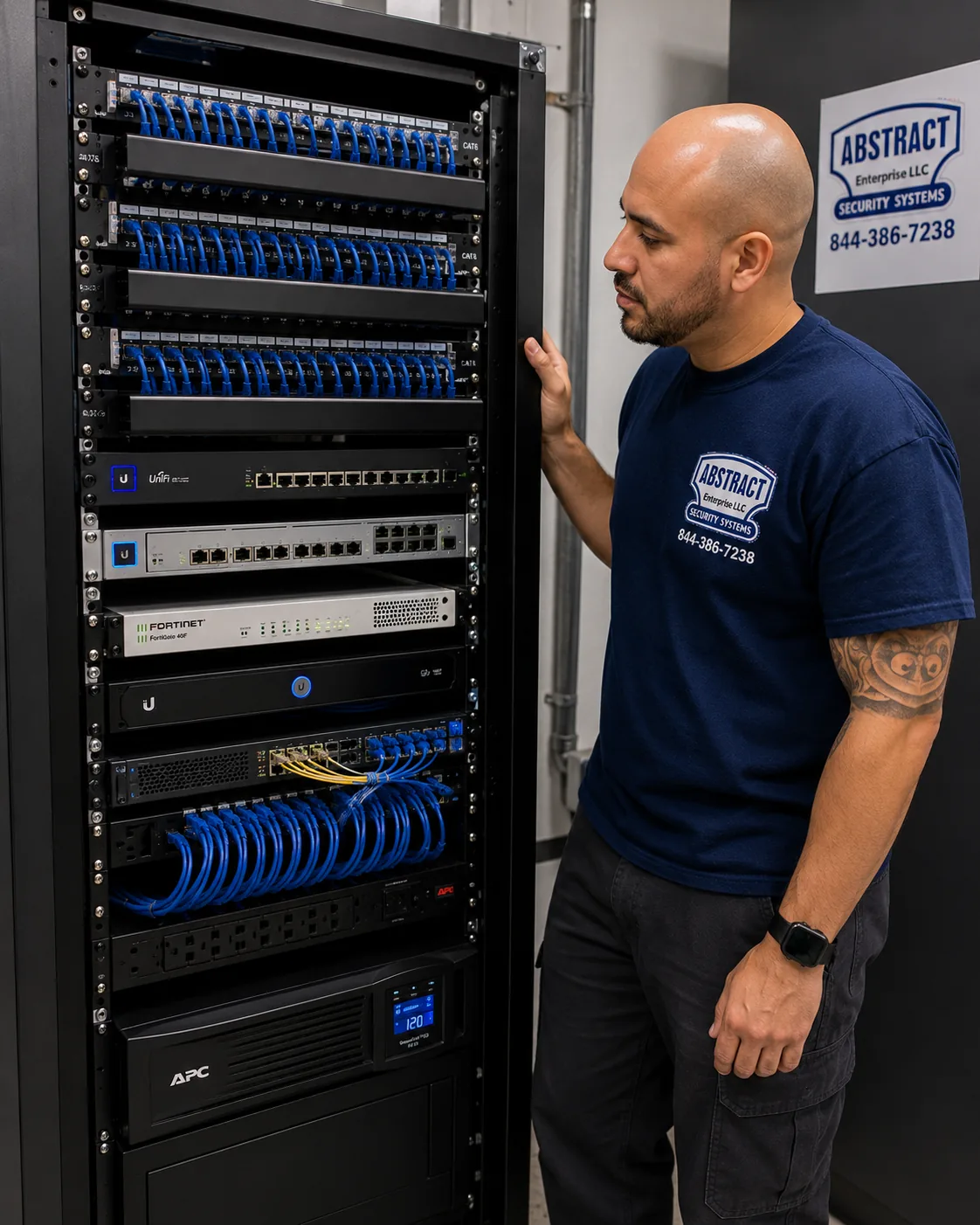
One more lesson comes from just outside the neighborhood. Fieldston has no shops of its own; the nearest commercial strip is Riverdale Avenue, where the Riverdale Press reported that burglars at one restaurant even took the box that recorded the security cameras. A recorder sitting on a shelf by the front door can leave with the jewelry. So in a Fieldston house we put the recorder somewhere hidden and dry, often in the cellar or a closet far from the entry, keep it on battery backup, and give the owner a way to keep important clips off the house as well. Along the eastern edge, the picture is different again: roughly eight apartment buildings on the Broadway, Cayuga Avenue and Post Road strip, among them the 1961 co-op at 6035 Broadway with 103 apartments and a doorman, and the 1930 to 1931 co-op at 4410 and 4414 Cayuga Avenue. Those are board decisions, planned as buildings, not houses.
What owners often add alongside cameras. Fieldston owners who start with cameras often move on to the doors and the drive: whether a camera view and an alert can arrive together when the garage or a terrace door opens late at night, or whether the doorbell picture can ring through to several floors of a big house. We plan cable routes and recorder space so either can be added later without opening the walls a second time.

Two kinds of urgent call come from houses like these. In the first, a camera on the drive, the garage or a far corner of the lot has stopped showing a picture, often after a storm, a power cut, a fallen branch on an outdoor cable, or an internet change. Before you call, note which camera went out and when, check whether the recorder is still powered, and do not reset the recorder or the cameras to factory settings, because a reset can erase the app connection and the passwords along with it. In the second, something has happened, a car entered in the drive or someone at a terrace door, and you need the clip before the recorder writes over it. Do not unplug or restart the recorder. Write down the time window, export the clip to your phone or a USB stick if you can, and keep the original on the recorder. Then call (646) 490-0629. Requests are booked within 2 hours; we talk you through what can be done by phone, and send a technician when the equipment needs hands on it.
Before anyone talks about camera models, we sort out what kind of job it is, because in Fieldston that decides who has to agree and how long the planning takes. A camera inside a garage on your own lot is a simple decision. A camera on a stucco facade facing a private street needs a Landmarks application. A cable to a gate across exposed rock may need a different route altogether. A camera in a co-op lobby on Broadway needs the board. The table covers the situations we expect most often.
| Your situation | Who has a say | What cameras can usually cover | Our part |
|---|---|---|---|
| You own a house inside the Fieldston Historic District | You; LPC staff for equipment visible on the exterior; the Association where land is theirs; City Planning for digging in protected areas | Entrances, drive, garage, terraces, grounds and indoors, with visible mounts kept within LPC criteria | Survey the lot, plan concealed and rear positions first, prepare the material for any staff application |
| You are buying a house or about to renovate one | You, with the same rules for anything visible outside | Everything above, with cable run inside walls and ceilings while they are open | Plan camera cable alongside the renovation so nothing has to be fished through finished plaster later |
| You own one of the district's few two-family houses | You, with fair notice to the other household about shared areas | The exterior and shared entry; never inside the other unit | Separate logins so each household sees only what it should |
| You rent a house | The owner, for anything fixed to the building | Indoor cameras freely; outside only with the owner's written agreement and any approvals the owner needs | Indoor cameras on shelves, and a written description of anything outside for the owner to approve |
| You own a co-op apartment on Broadway, Cayuga Avenue or Post Road | The board and managing agent for common areas; you for your apartment within the house rules | Inside your apartment; anything on a door or hallway only as the building allows | Indoor cameras, and an honest answer about what the building's rules permit |
| You sit on a co-op board or manage one of those buildings | The board | Entrances, lobby, mailroom, garage, laundry and grounds; never inside apartments | Plan a building system with the board, phase it if the budget needs, set access by role |
| You are responsible for a renovation site in the district | The owner and the contractor | Temporary views of open doors, stored materials and the drive while the house is empty | Temporary cameras that come down cleanly and leave nothing on the facade |
On a Fieldston house we sort every proposed camera into one of three groups before anything else. The first group is inside: a camera in the garage, in the cellar near the recorder, or looking at the inside of a terrace door. These do not change the exterior at all. The second group is on the outside but out of view from the street: under a rear porch ceiling, on the garden side of a wing, inside a recessed entry where the camera sits within the shadow of the opening. These are usually the easiest exterior positions to justify, though on Fieldston's curving streets and corner lots "the back" is sometimes visible from another road, so we look from every street edge, not just the front. The third group is anything plainly visible from the street: a camera at the corner of the front facade, over the garage doors facing the road, or on a gate pier. Those are the ones that need the most care with size, finish and cable, and the ones that need to go to LPC staff before they go up.
The LPC's Fieldston master plan notes that the Association owns the streets and, in many cases, areas of yards beside them, including sidewalks. For cameras, that matters in two ways. First, a camera post, a junction box or a cable trench near the road should sit on land you actually own, so we ask for a survey or the Association's answer before planning anything near the street edge. Second, it affects what a camera is aimed at. A camera that watches your own drive as it meets the road is doing its job; one framed down the length of the street, across other people's frontages, is a different matter, and we keep views to your own property and its approaches. Most cameras never come near the line at all, because they are mounted on the house. But for the drive and gate positions that owners care about most after the Fieldston Road break-ins, we check the line first.
The apartment buildings on Fieldston's eastern edge are a separate kind of job. A board decides where common-area cameras go, who can see the footage and who can export it. The managing agent usually wants after-hours alerts; the super or doorman wants a desk view of the entrances and the package area; shareholders want to know that no camera looks at their apartment doors from closer than it should. We plan these buildings the way we plan any co-op: one recorder in a locked room, cameras at the entrances, the lobby, the mailroom, any garage or laundry, and the grounds, cable routed through the cellar and existing chases, rated fire-stopping wherever cable passes between floors, and a written access policy the board can adopt. A shareholder who wants a camera inside their own apartment gets a small indoor camera and our advice to check the house rules before fixing anything to the door.
These are the camera jobs we expect from Fieldston homeowners, co-op boards and the people renovating houses here. Every one is quoted in writing after photos or a visit, with each camera, mount, finish, cable route and setup task on its own line.
Cameras on each entrance, the drive, the garage and the grounds of a large detached house, cabled inside to a hidden recorder and viewable on each household member's phone.
Zoom-lens cameras framed on the point where the drive meets the private road, with light planned for stretches like the dark part of Fieldston Road.
A camera on and inside a separate garage, connected by a route that respects protected rock and roots, or by a point-to-point wireless link where cable cannot go.
Views of second-floor balconies, terrace doors and flat roofs that can be reached from outside, the kind of entry used in the 2019 Grosvenor Street burglary.
Video doorbells and entry cameras for arched stone doorways, deep porches and paneled door surrounds, positioned to see faces in shade.
Small, finish-matched housings, concealed cable and product sheets, mounting details and photos assembled for an owner's application to LPC staff.
Camera cable pulled through open walls and ceilings while a house is being restored, ready for cameras now or later.
Entrance, lobby, mailroom, garage and grounds cameras for the elevator co-ops on Broadway, Cayuga Avenue and Post Road, planned with the board.
Cameras and recorders left by a previous owner traced, tested, moved to your accounts or removed, with old mounts taken down and holes repaired.

Fieldston's houses were designed by named architects, Dwight James Baum, Julius Gregory, Delano & Aldrich and Van Vleck & Goldsmith among them, over roughly half a century, and the walls a camera crew meets change from one house to the next: dressed stone and rough fieldstone, stucco, half-timbering, brick, clapboard, slate and tile roofs, and, on the modern infill, glass and flat overhangs. These are the house types the sources describe, and what each means for where a camera can sit and how its cable gets inside without marking the house.
Steep roofs, deep eaves, leaded windows and mixed materials, such as the 1911 to 1912 Tudor at 355 West 246th Street. Cameras belong on stone or under eaves, never on the timbers.
Colonial, Georgian and Dutch Colonial houses with symmetrical fronts and center entries. A camera on the front has nowhere to hide, so most go to porches, side wings and the rear.
Smooth or textured stucco, tile roofs and walls like the schist stone fence at 4621 Waldo Avenue. Stucco needs careful drilling and color-matched housings.
Early houses like the 1911 to 1912 Craftsman at 4418 Waldo Avenue, with stone bases and fieldstone chimneys. Irregular stone takes anchors only in its joints.
Houses like the 1963 Julius Panero design at 4540 Fieldston Road. Long glass walls and flat overhangs change both mounting and night glare.
Prewar and postwar co-ops on Broadway, Cayuga Avenue and Post Road, with lobbies, cellars and shared systems planned with the board.
| House type | Where a camera mounts | How the cable gets inside | What draws Landmarks attention |
|---|---|---|---|
| Tudor and Medieval Revival | Stone or stucco panels, the underside of deep eaves, recessed entries | Through the eave into the attic, or one sealed hole into the cellar at the base | Anything on the half-timbering, the leaded glass or the front gable |
| Colonial, Georgian, Dutch Colonial | Porch ceilings, side wings, rear walls, trim boards | Attic runs down an interior closet, or along the cellar ceiling | A camera on a symmetrical front, especially beside the entry surround |
| Mediterranean Revival | Stucco on a backed mounting block, loggia ceilings, garden walls on your own land | Through a sleeved, sealed hole into the cellar or a closet | White or black housings on colored stucco, and surface cable |
| Arts and Crafts | Mortar joints in the stone base, porch beams, rafter tails' sheltered side | Into the cellar through the stone base, below the first floor | Anything on the fieldstone chimneys or the stone base facing the street |
| Mid-century modern | The underside of flat overhangs, solid wall sections between glass | Through the overhang into the roof structure or down a solid wall | Bulky housings on clean, flat lines |
| Broadway strip co-op | Lobby ceilings, entrance canopies as the board allows, cellar and garage walls | Through the cellar and existing risers, fire-stopped between floors | Building exteriors here are generally outside the house district, but the board still decides |
Much of Fieldston is built of stone, and stone does not forgive a careless drill. Dressed stone can crack or spall from an anchor set too close to its edge; rough fieldstone and schist are irregular, so a camera bracket screwed to one face sits crooked against the next. The rule we follow is simple: anchors go into mortar joints, never through the face of a stone, and the mount sits on a junction box shaped or shimmed to the wall so the camera is level and the cable never shows at the camera. Mortar can be repointed when a camera is moved; a drilled stone stays drilled. Where a stone wall is too irregular for any neat mount, we look for a better position nearby, a sheltered soffit or a porch ceiling, rather than forcing a bracket onto the stone. The single hole that carries cable inside goes through the stone base below the first floor where possible, sloped slightly toward the outside, sleeved and sealed with an exterior-grade sealant, so water follows gravity out rather than following the cable in.
Stucco looks solid and is not. It is a thin hard skin over lath or masonry, and a camera screwed straight into it can crack the skin, let water behind it and leave a patch that never matches. On the Mediterranean houses and the stucco panels of the Tudors, we find what is behind the stucco before choosing a spot, drill with a masonry bit at low speed to avoid shattering the surface, set the anchor into the solid backing rather than the stucco alone, and seal the edge of the mount. The housing color matters as much as the fixing. A bright white or black camera on ochre or cream stucco is exactly what Rule 2-20 is trying to avoid, so for visible positions we choose housings that can be finished to match the wall, or small enough to read as a shadow under an eave.
Fieldston's steep slate and tile roofs and their deep eaves are both a gift and a hazard for cameras. The gift is shelter: a camera tucked under a deep eave stays dry, sits out of easy reach and is often barely visible from the street. The underside of the eave usually leads straight into the attic, where cable can travel across the house and down an interior closet to the cellar without a single run on the outside wall. The hazard is winter. Snow and ice slide off a steep slate roof in sheets, and anything mounted at the drip edge can be knocked off or buried. So we keep eave cameras back from the edge, under the soffit rather than on the fascia, and we never mount anything on the roof surface itself. In the attic we check the condition of old wiring and insulation before anyone crawls across it, keep camera cable away from hot fixtures and never leave it loose in insulation.
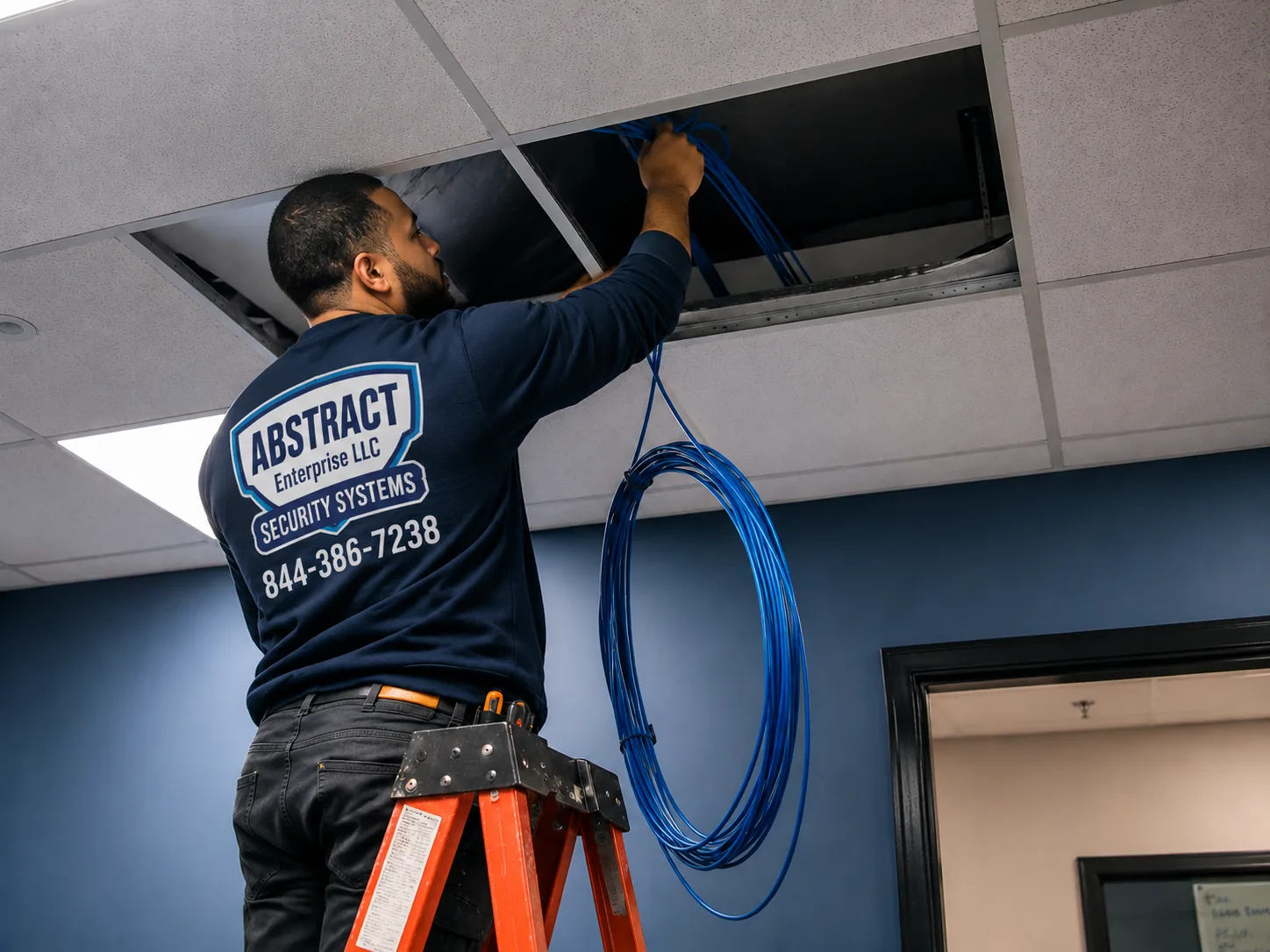
The inside of most Fieldston houses is plaster, often original, and fishing cable through it takes patience. A cable that has to get from an attic to a cellar three floors down needs a path: an old chase beside a chimney, a closet stacked above a closet, a back stair, the space behind built-in cabinets, or a laundry chute. We find that path on the survey rather than cutting the plaster, and where there is truly no path, we say so and suggest a different camera position before anyone opens a wall. In houses being renovated, this whole problem disappears for a season: with the walls open, camera cable can go exactly where it is needed, labeled and tested, before the plasterers return. That is the cheapest moment in a house's life to wire it, and it is one reason we ask every buyer of a Fieldston house about their renovation plans.
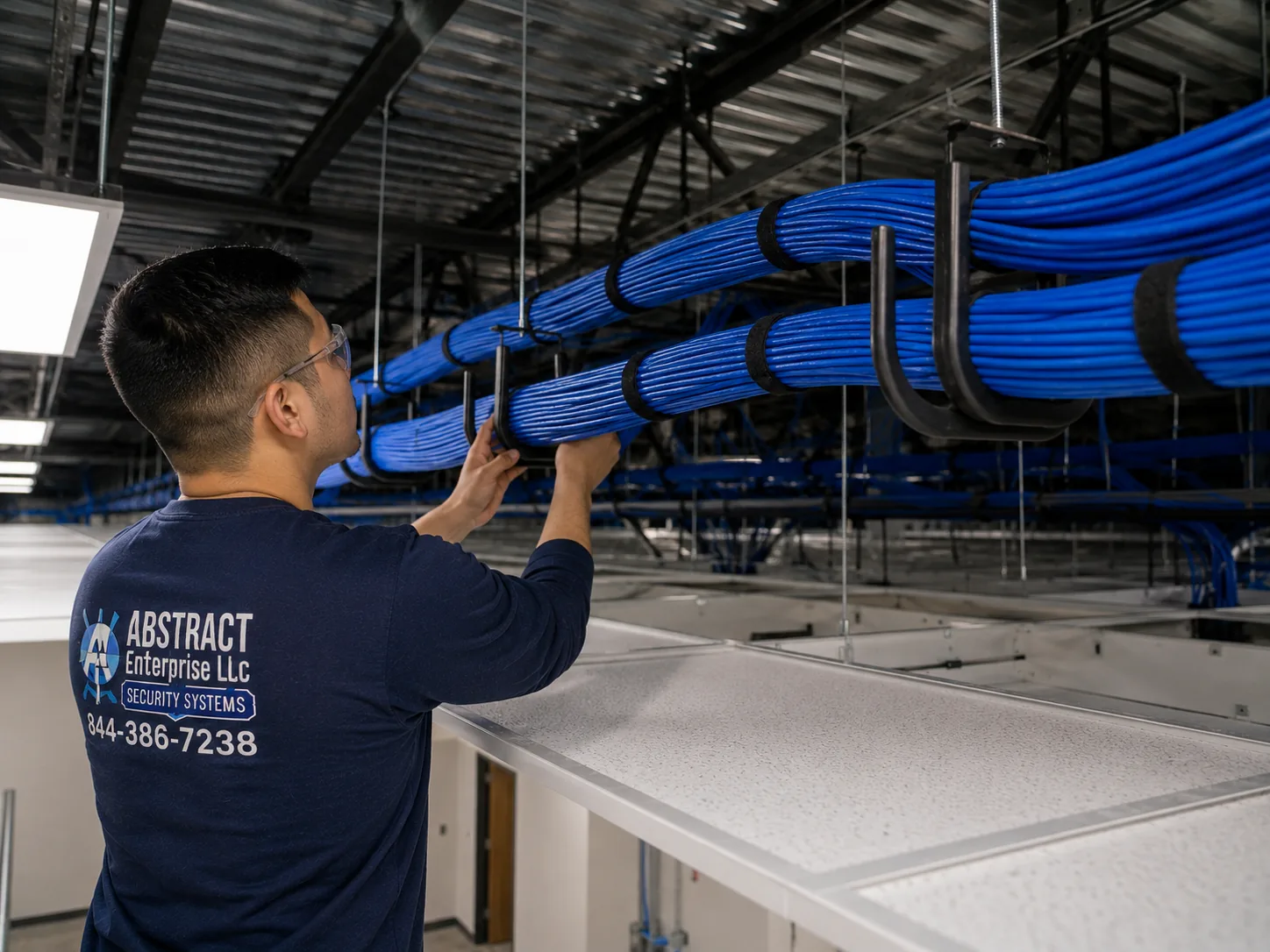
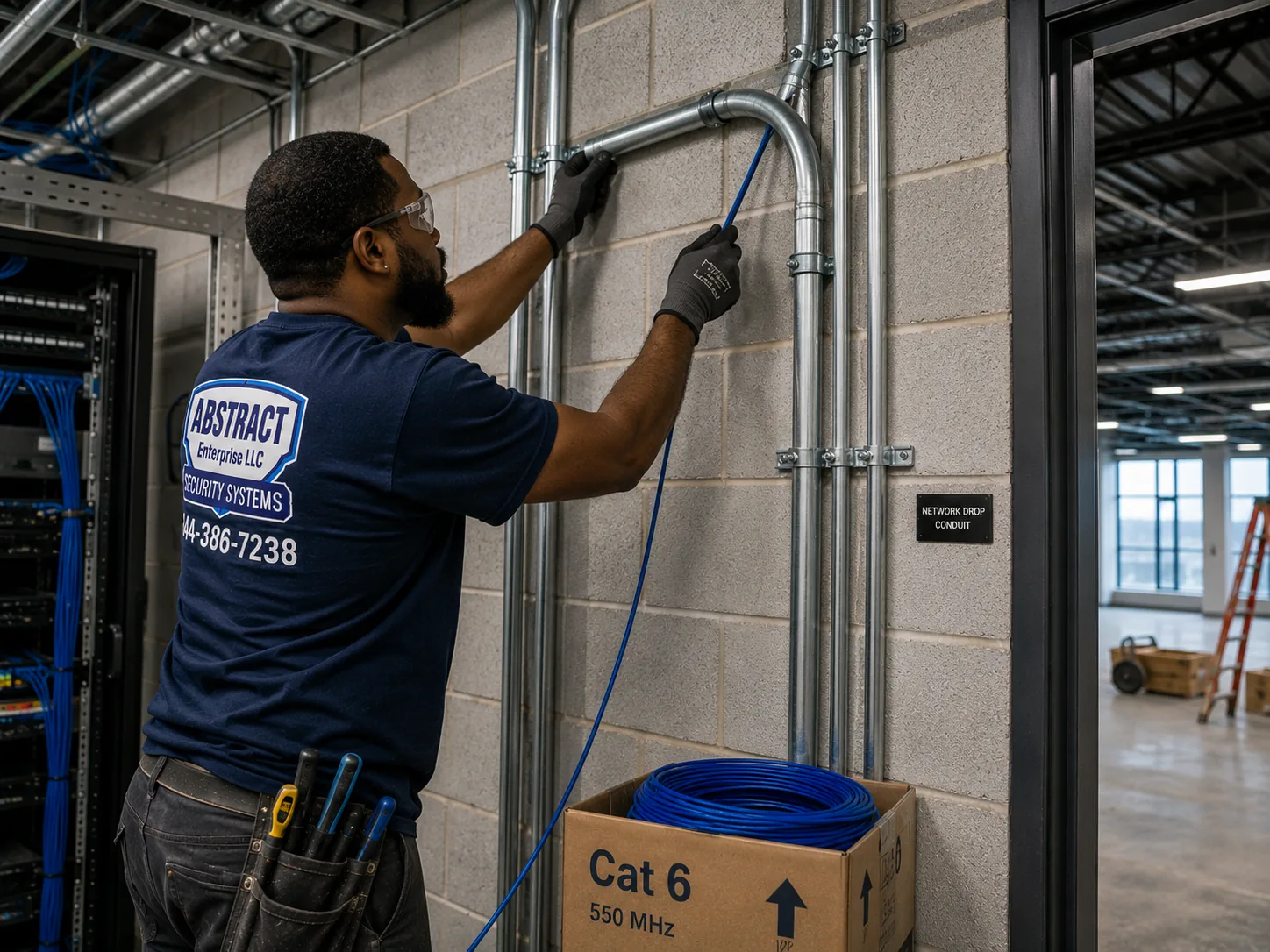
On a big lot, some cameras sit a long way from the recorder. Network camera cable carries power and picture together for about 100 meters, roughly 328 feet, and beyond that a camera needs a switch or extender part-way along. Where a cable has to run outside, from the house to a detached garage or along a wall toward the drive, it goes in protective conduit rather than lying on the ground or stapled to a fence, and it enters each building through a sealed, sleeved opening. Where the shortest route crosses exposed rock or the roots of a protected tree, we do not trench through it. We look instead for a route along an existing path or driveway edge on the owner's own land, a route through the house and garage that avoids the ground altogether, or a point-to-point wireless link between two buildings that each have their own cabled cameras.

The nearest commercial corridor, where the Riverdale Press reported a restaurant burglary in which the burglars took the camera recorder itself.
Shops along Broadway on the eastern boundary, near the Van Cortlandt Park–242nd Street station on the 1 train, facing the park.
Elevator buildings managed by boards and agents, such as the 1930 to 1931 co-op at 4410 and 4414 Cayuga Avenue and 4445 Post Road.
Houses that Brick Underground notes usually need renovation, left empty with materials, tools and open doors while the work goes on.
The stores residents use for everyday shopping, which Brick Underground places in North Riverdale and Riverdale rather than Fieldston.
Horace Mann, Ethical Culture Fieldston School and Manhattan University run their own facilities; we do not pitch campus work on this page.


Landmarks and the historic district
In most cases it can be approved at staff level. The LPC's permit guidebook has a section on installing security cameras and says staff can approve them when the installation meets the stated criteria, which come from Rule 2-20: the equipment should be finished to match the building or otherwise not call undue attention to itself. In practice that means small housings, colors that blend with the wall, positions under eaves or within recessed openings, and cable concealed inside the house rather than run across the facade. Cameras inside the house, and many on rear walls that cannot be seen from any street, do not change the street face of the house at all. Anything plainly visible should go to staff before it goes up. We assemble the product sheets, mounting details and photographs an owner needs for the application, and we plan the rear and interior cameras so they can be installed while it is reviewed.
The Horace Mann case shows what tends to happen: unpermitted work becomes a violation, and the owner then has to apply to legalize or correct it. A 2020 Riverdale Press op-ed described a long list of Landmarks violations at those properties, and one application was meant to clear outstanding violations including security cameras installed without a permit. For a homeowner, the cost of going first and asking later is not just a fine risk; it is the chance that a camera, its mount and its cable have to come down and the wall be repaired, and that a sale or a later renovation application gets tangled up in an open violation. Applying first costs a little time. That is why our plan separates the cameras that need review from the ones that do not, and why we do not mount a visible camera on a district house without the owner confirming it is approved.
Stucco, half-timber, stone and glass
By not relying on the stucco to hold anything. Stucco is a hard, thin coat over lath or masonry, and it cracks if it is drilled fast or asked to carry a load on its own. We locate what is behind it first, drill slowly with a masonry bit, set the anchors into the solid backing, and seat the camera on a mounting block or junction box sealed around its edge so water cannot get behind the stucco. If the backing is hollow or crumbling at the chosen spot, we move the camera rather than force it. For positions visible from the street, the housing is chosen to be painted or finished to the stucco color, or small enough to read as a shadow under the eave or a loggia ceiling. The cable goes straight into the house through the back of the mount, so nothing runs across the stucco face.
Usually under the eave, or on stone, not on the timbering. The timbers are the most recognizable part of a Tudor front, they are often old and decorative rather than structural, and screw holes in them are visible from the street and invite rot. A camera tucked under a deep eave or the overhang of a gable is sheltered, out of reach and much less visible, and its cable can go straight up into the attic. A recessed front entry often has a stone or plaster soffit where a small dome or turret sits almost out of sight while still seeing faces at the door. Where the house has a stone base or a stone wing, joints in that stone are a better anchor than anything on the timber. We avoid the leaded windows entirely, both for the glass and because a camera behind leaded glass sees mostly its own reflection at night.
The flat overhang is usually the answer. On a mid-century house with walls of glass, there is little solid wall to mount on, and a camera inside looking out through the glass sees its own infrared glow and the room's reflections at night. The underside of a flat roof overhang gives a clean, sheltered surface; a low-profile dome or small turret there looks down on the doors and the terrace without breaking the house's lines. Cable goes up into the roof structure and across to an interior wall. Solid wall sections between glass panels, often at the corners or the entry, take a camera where an overhang does not reach. Because these houses depend on clean lines, we keep housings small and match their color to the trim or soffit. We also check the glass from outside after dark, because large lit windows can blind a camera aimed toward the house.
We advise against it. A chimney is one of the most visible features on an early Fieldston house, and a camera on it is hard to justify under Landmarks criteria. It is also a poor technical choice: a working flue runs hot, smoke and soot foul a lens, the flashing where the chimney meets the roof is easily damaged by a ladder or a drill, and old fieldstone chimneys often have soft or failing mortar. A camera on the chimney is also hard to service safely. Better positions are almost always nearby: the stone base of the house, where joints take anchors well and cable can go straight into the cellar, the sheltered side of a porch beam, or under the eave. If the chimney seems to offer the only view of an approach, we usually solve it with a second camera from a less prominent spot instead.
Big lots, long drives and the rock between buildings
Often not well, and that is what the Riverdale Press found after the January car break-ins, when one resident's outdoor cameras covered only the driveway. A camera on the house, far back from the road, sees the road as a small, dark strip, and at night its built-in infrared does not reach that far. Two changes usually help. First, frame the place that matters, the point where the drive meets the road and where cars park, using a zoom-lens camera that makes that spot large in the picture, rather than a wide view of the whole lot. Second, bring that camera closer: a mount on the garage, a porch near the drive, or a post on your own land near the drive's end, with light planned for it. A camera with its own light, or a motion light on your property aimed at your own drive, gives a usable color picture without lighting up the neighbors.
Not by cutting through the rock. Rock outcrops in the Special Natural Area District cannot be altered without City Planning Commission authorization, and areas of no disturbance are protected from excavation and tunneling for utilities, so the trench most installers would dig first may simply not be allowed. We look for other routes: along the edge of the existing driveway on your own land, through a garage that already has power and conduit from the house, or along an existing path in protective conduit without disturbing the ground. Where no route works, the garage gets its own small cabled cameras and a switch, connected to the house by a point-to-point wireless link aimed between the two buildings. That link needs a clear line of sight and a steady mount, which we test before relying on it. The quote names the route and why it was chosen.
By watching the approach to the balcony and the balcony itself, not just the doors at ground level. NY1 reported that the burglary on Grosvenor Street happened just after 5 p.m. on a Saturday and that the burglars broke a balcony window. On Fieldston's big houses, balconies, sleeping porches, flat roofs over a porch or garage, and terraces with French doors are all possible ways in, and many are reached from a garden that cannot be seen from the street. We map them on the survey: what someone could climb, a porch roof, a trellis, a garden wall, and where they would stand. A camera under the eave above the balcony looks down at it and at the climbing route; a second on the ground floor sees the person arriving. Alerts from those cameras can be set for the hours the upstairs is empty. An early-evening break-in is a reminder that the schedule should cover dusk, not just the middle of the night.
The patrol and your own footage
Only if you choose to share, and only in the way you choose. Your camera system and its accounts belong to you; nobody else, including the Association's security contractor, has any access unless you grant it. We do not know the patrol's policy on viewing residents' cameras, and the sources do not describe one, so ask the Association before assuming anything. In practice, most owners keep live access to their own household and share clips on request: if the patrol or the 50th Precinct asks about an incident, you export the relevant clip and send a copy, keeping the original on the recorder. Some recorders and apps allow a guest login limited to one or two cameras, which an owner can give and later revoke. We set up whatever you decide, and show you how to export a clip quickly so a request does not turn into a search.
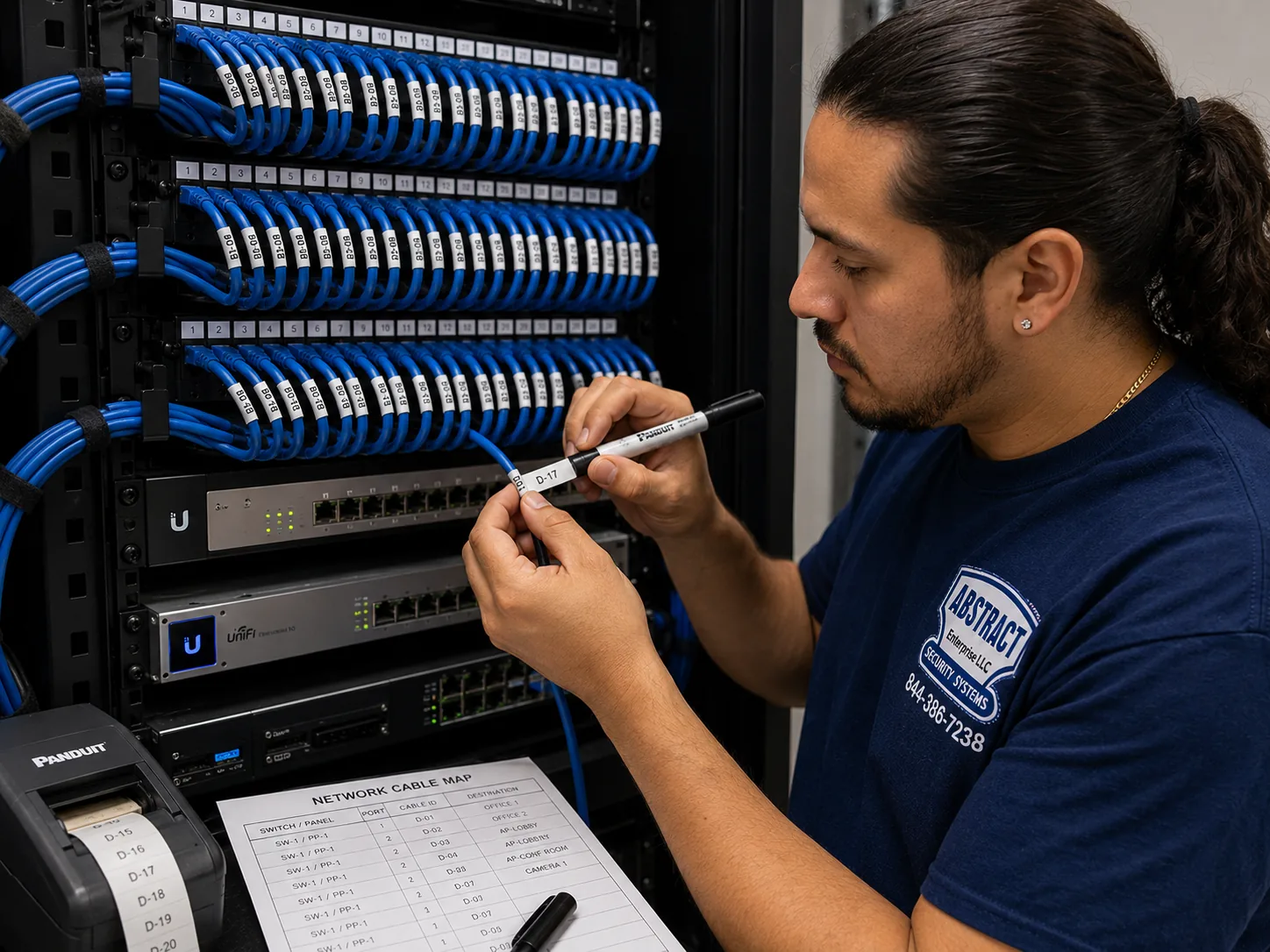
These are the cameras and parts we fit on Fieldston houses and the co-op buildings on its edge. For wired systems we install brands including Lorex, Hikvision, Dahua and Uniview, and we choose housings by size and finish as much as by picture, because on a district house the camera has to pass the street as well as the night. Every item is named on the written quote before anything is ordered.
Small, easy to aim and easy to finish to match, for eaves, porch ceilings and recessed entries where a camera should read as a shadow.
Zoom lenses set to frame the foot of a long drive or a garage door at a useful size from a camera far back on the house.
For dark drives and gardens, a camera with its own light gives a color picture at night and makes anyone on the drive obvious.
For porch and loggia ceilings and co-op lobbies, a dome that sits nearly flat, resists being knocked out of aim and looks like a fixture.
For period front doors, powered from a tested transformer, with wide-dynamic-range sensors for faces in a deep, shaded entry.
A pair of aimed radios joining a detached garage or gate to the house where protected rock or roots rule out a cable trench.
Sized for the number of cameras and days of footage you want, kept hidden, dry and locked, never on a shelf by the door.
One cable for power and picture to each camera, with switches part-way along very long runs and the cameras kept on their own network.
Keeps the recorder, switch and router running through a short outage, the kind that follows a fallen limb on a power line.
Many Fieldston owners look first at a self-install kit or a nationally advertised monitored plan, and each has a place. The table sets out the trade-offs as they apply to large, landmarked houses on big lots, without comparing anyone's prices. The Association's patrol contractor also offers alarm installation and monitoring, according to the Riverdale Press; that is a separate choice from who installs your cameras.
| Question | Self-install kit (Ring, SimpliSafe and similar) | National monitored plan (ADT and similar) | AESS as local installer |
|---|---|---|---|
| Who decides what is visible to Landmarks | You, with no help on finishes or applications | Their technician, within the plan's standard equipment | Planned with you, with finish-matched housings and material for a staff application |
| Reaching a far drive or a detached garage | Battery and Wi-Fi, which struggle through stone walls and across a big lot | Depends on the plan | Cabled cameras, with switches or a wireless link where cable cannot go |
| Drilling stone, stucco and timber | You | Their technician | Anchors in joints and solid backing, sealed entries, nothing on timbers or chimneys |
| Ongoing fees | Optional cloud plans for recording history | Usually a monitoring contract | No monthly fees for the recorder system you own |
| Best fit in Fieldston | A renter's indoor camera or a single doorbell | Owners who want professional monitoring tied to an alarm | Whole-house coverage of a large house and its grounds, or a co-op building |


Send photos of the front of your house as seen from the street, the drive, the garage, any balconies or terraces, and the rear, and tell us the street. A technician will tell you which positions are likely to need a Landmarks application, what the walls will need, how the far cameras can be reached, and what the quote will cover, before anyone visits. Call (646) 490-0629, message us on WhatsApp, or use the quick form.
Every Fieldston camera job runs through the same eight steps, whether it is one indoor camera in a Broadway co-op apartment or a whole-house system with a garage link on Goodridge Avenue. On district houses, the second and fifth steps carry the most weight, because what Landmarks will see and how cable crosses the land decide the plan long before the camera brand does.
The street, whether the house is in the historic district or you are in a co-op, and photos of the front from the road, the drive, the garage and the rear. Requests are booked within 2 hours.
What will be visible to Landmarks, where the Association's land begins, whether digging touches Natural Area protections, and whether a board must approve.
Doors, drive, garage, balconies and the road edge, with notes on walls, trees, rock, light, the attic and cellar paths and a hidden recorder spot.
Views framed on your own doors, drive, garage and grounds, off neighbors' homes, with the visible positions marked for review.
Every camera, mount, finish, cable route, recorder and setup task listed, plus product sheets, mounting details and photos for a staff application.
Rear and interior cameras first, anchors in joints and solid backing, cable concealed inside, every entry sealed, no trenching through protected ground.
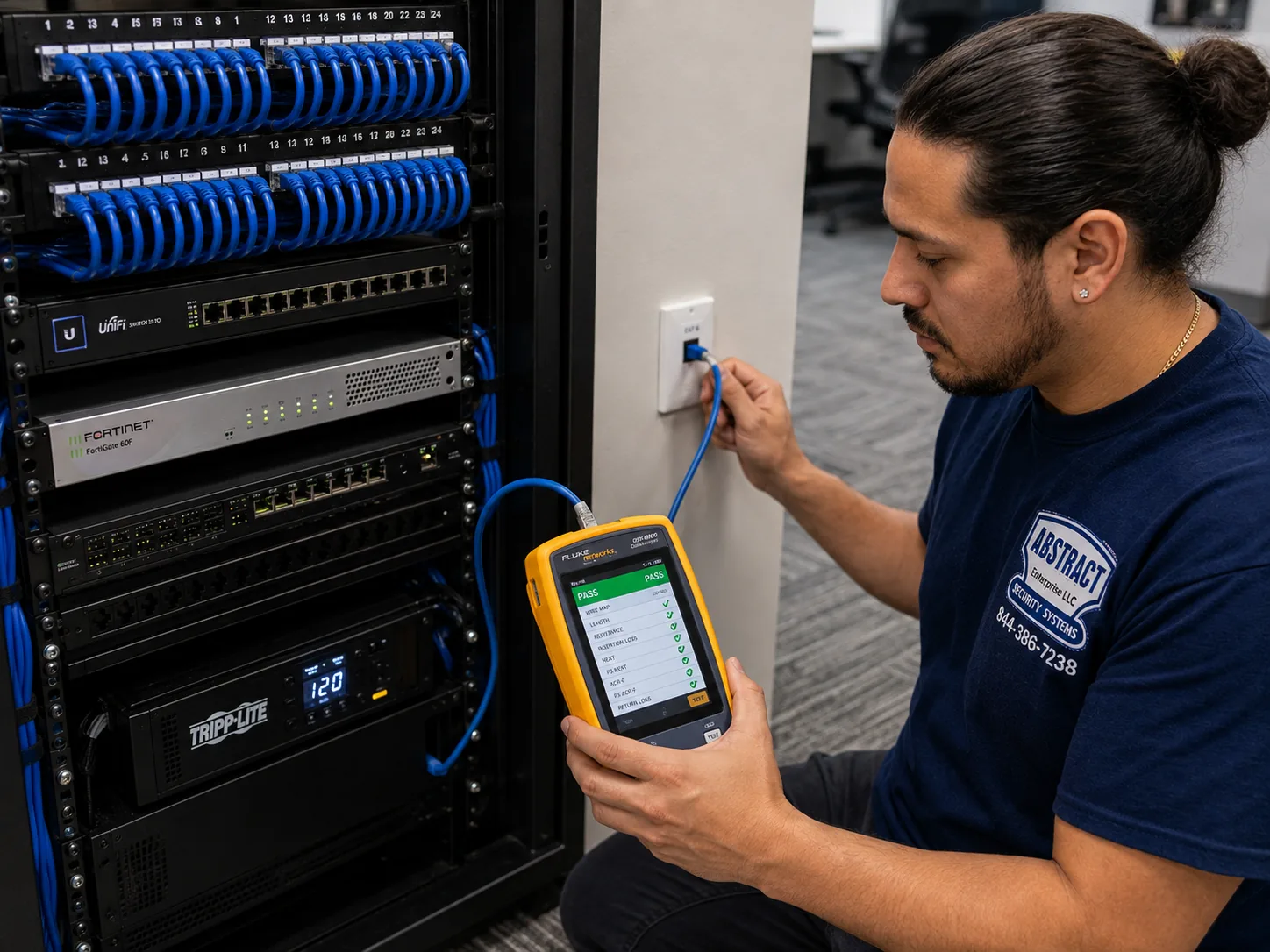
Every view checked in daylight and after dark, every cable certified, unique passwords, two-step sign-in, clock sync and current firmware.
Household logins set, clip export shown on your phone, and a record of devices, labels, settings and the recorder's location left with you.
Parking is the one practical detail that differs here. Fieldston's streets are private and parking is limited to residents and their guests, so on the day of the work we ask to use your drive or a spot you arrange, and we keep ladders and cable off the Association's roadway.

Fieldston has no grid to give directions by, so people navigate by its ponds, parks, historic houses and the park across Broadway. These are the reference points we use to plan visits. Several are private homes, seen only from the street, and we mention them for what they say about the building stock nearby.
A private spot for residents, one of the reminders that Fieldston's landscape of water, rock and trees is part of what the rules protect.
A small park with walkways and play areas, where houses close by need cameras framed on their own lots rather than the paths beyond.
At 4401 to 4403 Waldo Avenue, built in 1913 with later additions, an early example of the stone-and-stucco houses that need joint-only anchors.
The 1963 modern house at 4540 Fieldston Road, a sign that Fieldston's stock includes glass walls and flat overhangs as well as revival styles.
The city's third-largest park at 1,146 acres, across Broadway from the neighborhood's eastern edge and the co-ops that face it.
The 1 train's northern terminal, about a block from 6035 Broadway; the arrival of the subway at 242nd Street prompted Fieldston's development.
The schools on Fieldston's ground, Horace Mann at 231 West 246th Street and Ethical Culture Fieldston School at 3901 Fieldston Road, and Manhattan University on Manhattan College Parkway, are reference points too, though their security is their own. Incidents in the neighborhood are handled by the NYPD's 50th Precinct on Kingsbridge Avenue. Around Fieldston we also work in Riverdale, North Riverdale, Kingsbridge, Van Cortlandt Village and Spuyten Duyvil, and elsewhere in the Bronx in neighborhoods such as Bedford Park and Fordham. For every Bronx neighborhood, see our main page for security camera installation in the Bronx.
Every Fieldston address is priced on our Bronx rate, from a house on Delafield Avenue to a co-op on Broadway. We do not print a camera price for Fieldston, because the jobs here are too different for one number to mean anything: an indoor camera in a co-op apartment is a short visit, a doorbell in a stone entry is a little more, and a whole-house system on a three-story Tudor with a detached garage across a rock ledge is a planned installation with attic and cellar routes, finish-matched housings and a wireless link. Each job is quoted in writing after photos or a visit, with every camera, mount, finish, cable route and setup task on its own line. Estimates are free. The table shows what moves the total, so you know what to send.
| What moves the quote | Why it matters in Fieldston | What to send us |
|---|---|---|
| Number of views | A large house with several entrances, balconies, a drive and a garage needs more cameras than a front door alone | Photos of every side of the house and the drive |
| Wall material | Stone, stucco, timber, brick and clapboard each need different anchors and care | Close photos of the walls where cameras would go |
| Visibility from the street | Visible positions need small, finish-matched housings and material for a Landmarks staff application | Photos of the house taken from the road, and from any other street that can see it |
| Inside cable path | Plaster walls need existing chases; open walls during renovation make it much simpler | Whether the attic and cellar are accessible, and any renovation plans |
| Distance and outbuildings | Long runs need switches; a garage across protected rock may need a wireless link | Rough distances from the house to the garage and the foot of the drive |
| Darkness at the drive and garden | Unlit drives and gardens may need cameras with built-in light or a motion light on your own land | A photo of the drive taken after dark |
| Recorder storage and backup | More cameras and more days kept need more storage; a hidden location and battery backup protect it | How many days of footage you want, and where a recorder could hide |
| Household access | Several family members, and sometimes a two-family arrangement, need separate logins | Who should see which cameras |
| Co-op scope | Board rules, risers and fire-stopping shape a building system | The board's goals and any existing system |
Some owners want a screen in a study, a kitchen or a co-op desk to watch the cameras on, mounted while we are there. These lines come from our verified Bronx TV price list, the only prices printed on this page, and are added to a camera quote only if you ask. Note the brick or stone and plaster adds, which apply to many Fieldston interiors.
| TV item, Bronx rate | Price |
|---|---|
| TV wall mounting, drywall on wood studs, up to 55 inches (starting price; bracket sold separately) | $209.99 |
| TV placed on its stand, no wall mount | $137.99 |
| Setup-only visit, first hour (then 30-minute blocks) | $225 |
| In-wall concealment with code-compliant in-wall power and cable kit | $169 |
| Paintable cord cover | $59 |
| Soundbar wall-mounted | $129 |
| Soundbar placed | $79 |
| Above-fireplace mounting add | $130 |
| Brick or stone wall add | $65 |
| Plaster wall add | $45 |
| Take down old TV | $85 |
For a stucco-and-stone house with a detached garage, the quote might list a mini dome in the recessed front entry, a wired video doorbell on a tested transformer, a low-profile turret under the eave at each side of the house, a camera under the eave above each balcony, a camera on the rear terrace doors, a varifocal camera on the garage framed on the foot of the drive, a camera inside the garage, a point-to-point wireless link to the garage where the ledge rules out a trench, the attic and closet cable routes, one sealed entry through the stone base into the cellar, a recorder with a set number of days of storage in a hidden closet, a switch, a battery backup, finish-matched housings for the street-visible positions, the Landmarks application material, and logins for each household member. For a Broadway co-op apartment, the quote is a line or two: an indoor camera facing the inside of the door, set up on your phone. For a co-op board, it lists each common-area camera and run so the board can phase the work. You see every line before you agree, and nothing else appears on the day.
Full terms — including 50% deposit, the 30-day warranty and optional paid extended warranty, and the late-fee schedule — are set out in the service agreement.Three common Fieldston camera jobs, described by what they include. Each is quoted in writing for your house or building after photos or a visit, because the walls, the distances, the visibility and the number of views decide the total.
For owners whose first concern is who comes to the door and the cars in the drive. A wired video doorbell or entry camera in the front doorway, sized and finished for the entry, a varifocal camera framed on the foot of the drive from the garage or a porch, cable through the attic or one sealed entry into the cellar, a recorder hidden in the cellar or a closet, and phone setup with unique passwords and two-step sign-in. Planned so rear and garage cameras can be added later on the same recorder.
Everything in the starter, plus cameras under the eaves at each side, on every balcony and terrace, on the rear doors and in the garden, a camera on and inside the garage with a route or wireless link that respects protected ground, cameras with built-in light where the drive and garden are darkest, a recorder sized for the days you want, a switch, a battery backup, finish-matched housings for visible positions, the Landmarks application material, and a login for each household member. Quoted after a daytime walk and an after-dark check.
For the co-ops on Broadway, Cayuga Avenue and Post Road, entrance, lobby, mailroom, garage, laundry and grounds cameras on one locked recorder with fire-stopped risers, a separate camera network, scheduled after-hours alerts and role-based logins for the board, agent and staff. For a house under renovation, camera cable to every planned position pulled, labeled and certified while the walls are open, with temporary cameras on the site during the work and final cameras fitted when the house is finished.
If you already own cameras, a recorder or a video doorbell, we install them as a labor-only job, quoted in writing like everything else. Before anything goes on the house we check that the cameras work with the recorder, that the recorder has enough storage and can be updated, that a doorbell's power needs match the transformer, that the housings suit a Landmarks application if they will be visible, and that nothing is still linked to a previous owner's account. If something is not suitable, we say so before we start and show you what would work instead. Equipment you supply is not covered by our product warranty.
Our borough page, with every Bronx neighborhood priced on the Bronx rate. Security camera installation in the Bronx
The same street-first, after-dark-tested approach in every borough. AESS security camera installation in NYC
Large houses and long drives in the county beyond the Bronx. Westchester County security cameras
Apartment buildings and houses near the Botanical Garden and the Grand Concourse. Bedford Park security cameras
Storefronts and buildings around our Bronx base on Fordham Road. Fordham security cameras
Send photos of the house from the street, the drive, the garage and the rear. Request a free quote
They can if the camera sits at the drip edge or on the fascia board, where sliding snow and ice hit hardest. We mount eave cameras back under the soffit, out of the path of anything coming off the roof, and never on the roof surface itself. The housing is sealed and the cable enters through the back of the mount into the attic, so there is no exposed loop for ice to pull on. We also check gutters and snow guards on the survey, because an overflowing gutter can sheet water and ice across a lens below it.
It can, with the right camera and position. A deep stone entry is dark inside while the garden behind the visitor is bright, which turns faces into silhouettes on an ordinary camera. We use doorbells and entry cameras with wide dynamic range, which balance bright and dark areas, and place them so the visitor faces the lens rather than standing beside it. A small dome in the soffit of the arch can add a downward view. A modest light inside the entry, on your own property, often does as much as a better camera.
Yes, and that is how we usually plan it. Cameras inside the house and on parts of the exterior that cannot be seen from any street do not change the street face of the house, so they can be installed first, along with the recorder, the cable routes and the network. The street-visible positions are cabled to just inside the wall and left ready, so once LPC staff approve them, fitting the cameras is a short second visit. If staff ask for a change in size, finish or position, nothing already installed has to come out.
No. The Riverdale Press reported that alarm installation and monitoring were available from Excel, the company the Association uses for its patrol and street closures, but nothing requires residents to use the same company for anything. Your cameras can be a separate system you own outright. If you already have an alarm with Excel or another company, ask them what their system can connect to, and we will plan the cameras so an alarm event and a camera clip can be matched by time, or linked where the equipment allows it.
It depends on how often the house is empty and who will respond. Self-monitoring means alerts come to your phones and you decide what to do, with no monthly fee for the camera system itself. Professional monitoring means a central station watches alarm signals and calls you or the police, usually under a contract. Many Fieldston owners keep cameras self-monitored for evidence and peace of mind, and rely on an alarm with professional monitoring for break-ins. The patrol watches the streets, not your alerts. We set up whichever arrangement suits the household.
No. PoE, power over Ethernet, sends power and picture down the same network cable from the recorder or a PoE switch, so each camera needs only one cable and no outlet beside it. That is a real advantage on a Fieldston house, where adding outdoor outlets under eaves or on stone walls is both an electrician's job and something Landmarks may notice. The limit is distance: a single run reaches about 100 meters, so very far cameras get a switch or extender part-way, which itself needs power at that point.
It changes whose land things sit on more than where a camera points. The Association owns the streets and, according to the LPC's master plan, often strips of yard and sidewalk beside them, so posts, boxes or trenches near the road need the line confirmed first. For the view itself, we frame cameras on your own house, drive and grounds and the point where your drive meets the road, not down the length of the street or across neighbors' frontages. Keeping views to your own property is good practice on any street, private or public.
We aim at the places a vehicle or person has to pass slowly, not at the curve where they flash by. On Fieldston's contour-following streets, that usually means the mouth of your drive, where a car must turn in and slow down, and the spot where cars park near the house. A narrow, zoomed view of the drive entrance captures a car and its occupants at a useful size; a wide view of the bend captures a blur. A second camera on the house picks people up as they walk toward the door.
We plan for it to be hidden, because exposed cable is the kind of thing Rule 2-20's concern about undue attention points at. On most Fieldston houses it can be: cable goes straight through the back of the camera mount into an attic, a soffit or the cellar, and travels inside the house. Where a short exterior run cannot be avoided, it goes in a small conduit or raceway finished to match the wall, in a corner or along trim, and that detail is shown in the application material so staff see exactly what is proposed.
Not if the cameras are set up for it. Many current cameras and recorders can tell people and vehicles from animals and send alerts only for the first two, and we turn that on wherever the equipment offers it. Motion zones can also leave out the lawn where the dogs roam and cover the doors, the drive and the garden gate. The cameras still record everything, so you can check the footage later; it is only the alerts that are filtered, which keeps the phone quiet without leaving the house unwatched.
Tell us the street, whether the house is in the Fieldston Historic District, a co-op apartment or a building, and what you want the cameras to see. Photos of the house from the street, the drive, the garage, any balconies and the rear make the quote exact, and a photo of the drive after dark helps even more. Prefer to talk? Call (646) 490-0629.

Security Camera Installation Bronx | No Monthly Fees · Security Camera Installation NYC | Licensed Installer · Security Cameras Installed in Manhattan · Brooklyn Security Camera Installation · Security Camera Installation Queens NY · Staten Island Security Camera Installation · Long Island Security Camera Installation NY · Hudson Valley Security Cameras · Security Camera Installation Nassau County NY · Security Camera Installation Suffolk County NY · Westchester Security Camera Installation · Rockland County Camera Installation · Orange County NY Security Cameras · Putnam County Camera Installation · Dutchess County Security Cameras · Ulster County Security Camera Installation | Kingston NY
Security Camera Installation Allerton Bronx NY · Security Camera Installation Bathgate, Bronx NY | AESS · Security Camera Installation Baychester Bronx NY · Security Camera Installation Bedford Park Bronx NY · Security Camera Installation Belmont Bronx NY · Security Camera Installation Bronx | No Monthly Fees · Security Camera Installation Bronx River, Bronx NY · Security Camera Installation Bronxdale Bronx NY · Security Camera Installation Bronxwood Bronx NY | AESS · Security Camera Installation Bruckner Bronx NY · Security Camera Installation Castle Hill, Bronx NY | AESS · Security Camera Installation City Island Bronx NY · Security Camera Installation Claremont Bronx NY | AESS · Security Camera Installation Clason Point Bronx NY | AESS · Security Camera Installation Co Op City Bronx NY · Security Camera Installation Concourse Bronx NY | AESS · Security Camera Installation Country Club Bronx NY · Security Camera Installation Crotona Park East Bronx NY · Security Camera Installation East Tremont Bronx NY · Security Camera Installation Eastchester Bronx NY · Security Camera Installation Edenwald Bronx NY · Security Camera Installation Edgewater Park Bronx NY · Security Camera Installation Fairmount Bronx NY · Security Camera Installation Fordham, Bronx NY | AESS
TV Installation Fieldston Bronx NY · Fire Alarm Installation Fieldston Bronx NY | Landmark Homes · Alarm Installation Fieldston Bronx NY · Access Control Installation Fieldston Bronx NY · Intercom Installation Fieldston Bronx NY · Structured Cabling Fieldston Bronx NY · Door Buzzer Repair Fieldston Bronx NY
From an indoor camera in a co-op apartment on Broadway, to a whole-house system on a landmarked Tudor with a garage across a ledge of rock, the job starts the same way: how the house looks from the street, what each spot looks like after dark, and a written plan that keeps every camera on what is yours and every visible mount within what Landmarks can approve. Call (646) 490-0629, message us on WhatsApp, or send the quote form, and we will book you within 2 hours.