What are you looking for?
About Us Contact Us Careers Get a Free Quote (800) 486-0943
Pick a service
✅ Got Your Own System?
🎬 Home TheatreQuote 🎶 AV SoundQuote 🔑 Access ControlQuote
Now pick your area
Pick your area
Long Island
Hudson Valley
Services available
Pricing & Tools
Pick a service for pricing
🚪 Intercom Pricing 🔔 Buzzer Repair Pricing
Calculators
📹 Camera System Calculator 🚨 Alarm Calculator ⚡ Cabling Quote Builder ✅ Got Your Own System?
Select your area
Lobby camera gone black, the recorder in the cellar beeping, or a clip you need kept after something happened outside your building on Webster Avenue, Clay Avenue or Claremont Parkway? Call the Bronx line: (646) 490-0629
Home › Security Camera Installation Bronx › Claremont
Prewar Walk-Ups on Clay, Fulton and Webster · Elevator Buildings Toward the Concourse · Shops and Storefront Congregations on Webster Avenue · Licensed Low-Voltage

Security Camera
Installation in
Claremont

Light Checked Before Lenses · Mailboxes, Doors and Roof Hatches First · Every View Kept Out of Apartments

Claremont is a neighborhood of big buildings around a 38-acre park: NYCHA's Claremont Village towers along Webster and Park Avenues, five- and six-story prewar walk-ups on Clay, Fulton and Findlay, elevator buildings climbing toward the Grand Concourse, newer affordable and supportive housing on Claremont Parkway, and a short run of old frame houses and 1990s two-family homes in between. A camera job here is usually a building job, not a single doorbell: the street door, the vestibule, the mailboxes, the stair, the cellar and the roof door, all cabled back to one recorder that has to survive the building it lives in. We walk your property in daylight and again after dark, plan each view so it watches the building and never the inside of a home, and give you the plan and the price in writing before any drilling.

Reviewed and updated November 3, 2026 by Anwar Timothy, NYS license #12000287431 · Sources: Wikipedia entries for Webster Houses, Butler Houses, Morris Houses, Morrisania (where "Claremont, Bronx" redirects), Claremont Park and the Claremont Park station, including the New York Times archive headline on Claremont Village it cites; the Bronx Times reports on the 2017 Butler Houses security upgrade and the reopened Little Claremont Playground; the NYCHA Journal on security funding for Teller Avenue-166th Street/Claremont Consolidated; NYCHA's Claremont Rehab (Group 2) development map; News 12 Bronx on the Butler Houses mailbox (June 2025) and Claremont House; CBS News New York and Rolling Out (October 2026); ABC7 New York on the February 2026 four-alarm fire and Bronx crime figures; AOL's 2012 report on a Parkside Houses tenant's cameras; NYC Business and the Kirschenbaum law firm on New York's security installer license; Impera Security on Penal Law §250.45 and tenant rules; Brick Underground on landlords and broken cameras; NYC Parks histories of Claremont Park and Little Claremont Park; the Kermit Project on the 1940 WPA rebuild; Rob Stephenson's The Neighborhoods newsletter; CityNeighborhoods.nyc; NeighborhoodScout; Forgotten New York; New York YIMBY (November 2025); Affordable Housing Hub; The NYHC on 3500 Park Avenue; NYC PLUTO lot data; the Landmarks Preservation Commission's designation list; and Yelp listings for Claremont Village · Dispatched from 460 E Fordham Rd

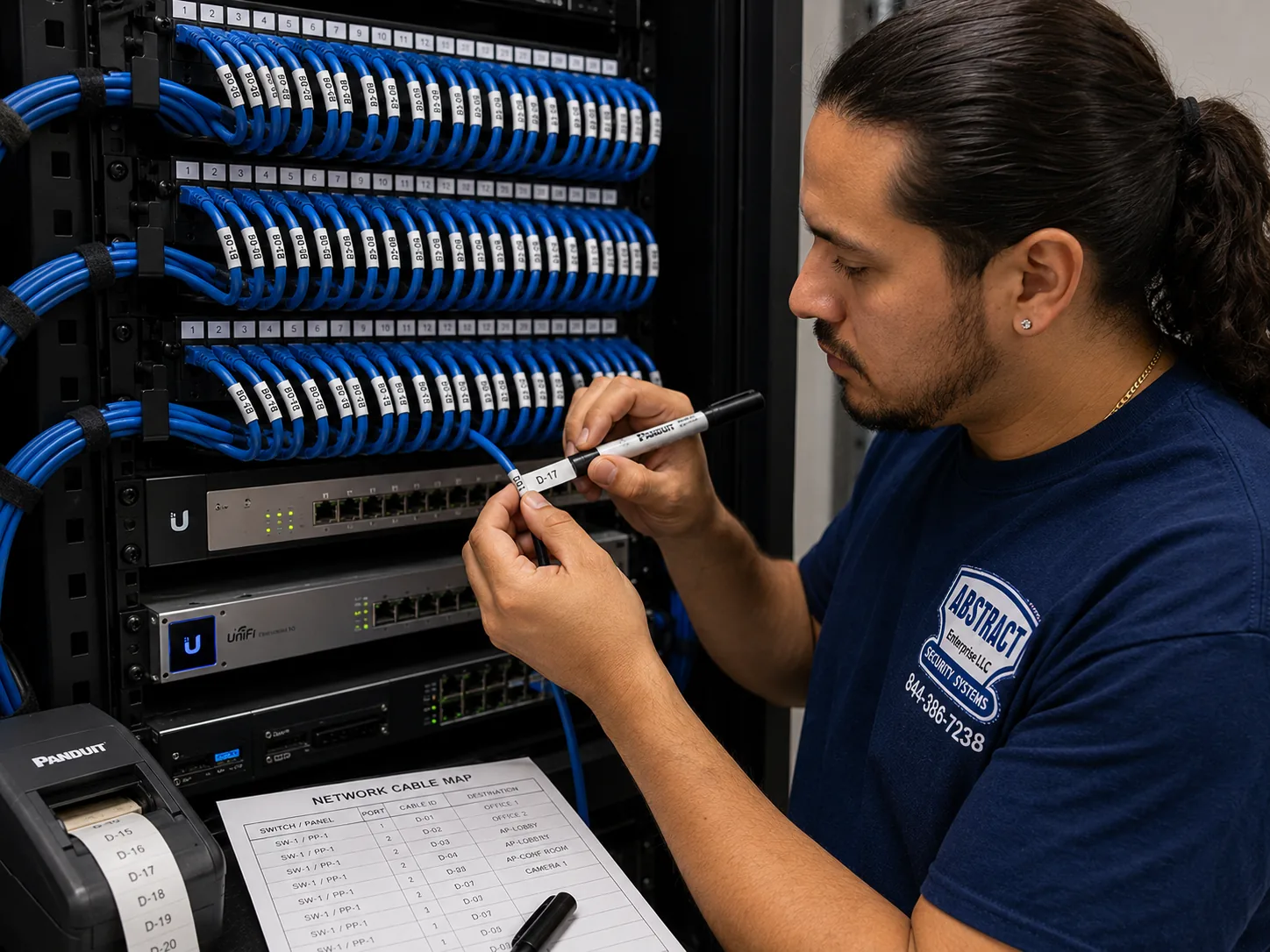
Claremont, Bronx security camera installation job-library photo: a technician printing cable labels at a patch panel next to a printed port map
Photo from the AESS job library, not taken in Claremont: a technician printing cable labels at a patch panel, with the printed port map beside the work. In a six-story Claremont walk-up, where one recorder in the cellar may take cables from the street door, the vestibule, the mailboxes, each stair landing and the roof door, a label at the recorder end is what lets a super tell the roof camera from the mailbox camera years later.
Claremont Camera Quote
Tell us the building, who manages it and which doors you want covered

✅
Request Sent!
We'll call about your Claremont cameras the same business day.
25+
Years Experience
✓
Same-Day Estimates
100%
Licensed & Insured
4.7★
201 Google Reviews

Owner-operated since 2002 · Thousands of jobs completed · Booked within 2 hours

Security camera installation in Claremont is mostly building work: a wired system that covers the street door, the vestibule, the mailboxes, the stair, the cellar and the roof door of a walk-up or elevator building, recorded on a box the owner controls. We survey the building by day and by night, because a camera only records what is lit, then quote every camera, cable run, mount, recorder and setup task in writing before you agree to anything. Shops on Webster Avenue and Third Avenue get the same written plan, built around the door and the counter. If you live in NYCHA's Claremont Village, the lobby and hallway cameras belong to NYCHA, and we will tell you plainly what that means for you. Estimates are free, requests are booked within 2 hours, and the work is done under NYS license #12000287431. Call (646) 490-0629 or use the form.

  • No camera price is printed for the neighborhood: your building is quoted line by line, in writing, after photos or a walk-through
  • Lighting is checked at every camera position after dark, and any dark spot that needs a fixture is named on the quote before the camera
  • The recorder stays in the building, on battery backup, with logins the owner or board hands out and can take away
The Neighborhood

Why Claremont Properties Need Security Camera Installation

Claremont is easier to stand in than to find on paper. Type its name into Wikipedia and you land on the Morrisania article, which mentions Claremont inside its own pages. CityNeighborhoods.nyc draws Claremont from East 167th Street in the south to the Cross Bronx Expressway in the north, with the Grand Concourse on the west and a line down Fulton Avenue, along Claremont Parkway and over to Webster Avenue on the east. Rob Stephenson's neighborhood newsletter describes it simply as the area that grew up around the park at its center, wedged between Morrisania, Tremont, Crotona and the Concourse. For a camera installer the boundaries matter less than what stands inside them, and what stands inside them is mostly large, old, heavily used apartment buildings with a lot of doors and a lot of people passing through each one.

The land has a long history before any of those buildings. NYC Parks traces it to the Morris family estate, established in 1679. Gouverneur Morris II auctioned much of it off in 1848, as the railroad made suburban building possible. A mansion rose on the ridge in 1859; Parks credits the Zborowski family, while a neighborhood history gives a different builder and year, and we leave that dispute where it is. Parks says the mansion's lawns ran down to the Mill Brook, which is now Webster Avenue, so the slope from the Concourse ridge to the avenue is old and real. The city bought the land for a park in 1888 to 1890 under the New Parks Act. The mansion served as the Bronx Parks Department's headquarters until it was torn down in 1938, and the WPA rebuilt the park, which reopened on December 7, 1940.

The apartment buildings came with transit. Webster Avenue became a commercial strip with groceries, delis and movie theaters, streetcars ran up Third Avenue toward Fordham, and the Third Avenue El stopped at Claremont Parkway until the station was lost in 1973. NeighborhoodScout reports that many of Claremont's homes were built in 1939 or earlier. City lot data from the PLUTO file, for the census tracts our team uses to define Claremont, counts about 677 residential lots with roughly 14,750 homes, and about 64 percent of those homes, 9,492 of them, sit in 66 buildings of fifty or more apartments. Another 4,783 homes are in 299 walk-up buildings. Only around 524 homes are in one- and two-family houses. That is the shape of the camera work here: entrances, lobbies and stairs that dozens or hundreds of households share.

The largest buildings belong to NYCHA. Wikipedia describes four contiguous developments, Butler, Morris, Morrisania and Webster Houses, as collectively named Claremont Village, and cites a New York Times archive headline about the project housing 4,191 families. Butler Houses is six 21-story buildings between East 169th and East 171st Streets, from Park Avenue to Webster Avenue, completed in December 1964. Webster Houses is five 21-story buildings between Webster and Park Avenues and East 168th and 169th Streets, right beside the Metro-North tracks, completed in September 1965. Population figures vary from source to source, from the 4,191 families in that headline to more than ten thousand residents in other accounts, so we do not rely on a single number. NYCHA also manages walk-ups on Clay Avenue, from 1115 to 1195 Clay Avenue, as Claremont Rehab (Group 2), under its Claremont Consolidated management office.

Those developments are also the clearest public example of how cameras actually get added to a Claremont building. The Bronx Times reported in 2017 that Butler Houses was the first NYCHA property to receive the full set of security upgrades under the Mayor's Action Plan for Neighborhood Safety. The six buildings, 1,476 apartments in total, each got two new entrance doors and one new exit door. The development got 30 new cameras and upgrades to its 58 existing ones. And the grounds got 245 new exterior light fixtures. More recently, the NYCHA Journal reported that Bronx Borough President Vanessa Gibson's office presented a check for 294,000 dollars for security upgrades, including new cameras, at NYCHA's Teller Avenue-166th Street/Claremont Consolidated development. None of that work can be hired by a resident; it comes through NYCHA and the officials who fund it. What it shows is the pattern: when the city upgraded a Claremont campus, it treated doors, lights and cameras as one job.

The everyday pressures in the private buildings are the familiar ones of any large Bronx neighborhood, and some of them have been in the news. News 12 Bronx reported in June 2025 that a broken mailbox at Butler Houses had been causing tenants months of trouble, with management and the post office sending residents back and forth until NYCHA said it was hiring a vendor to repair it. Mail and packages are a constant theme in building camera calls everywhere in the borough. On the street, ABC7 reported that city officials put major crime in the Bronx down nearly 12 percent through September 30, 2026, compared with the year before. Days earlier, on October 29, 2026, a 15-year-old student, Javits Frimpong, was shot and killed near East 171st Street and Crotona Place; CBS News New York reported that police said the suspects were caught on surveillance video jumping a turnstile and taking the 5 train after running into Crotona Park. We mention it only because it is the most recent public example of how camera footage is used after a crime on these blocks, and our thoughts are with his family and school.

The buildings themselves set limits on the work. ABC7 reported that on February 2, 2026, a four-alarm fire in a five-story building off the Grand Concourse burned through the top floor and the cockloft and left at least 82 people without homes. In a walk-up of that type, the cockloft and the roof are tempting routes for camera cable, and how a contractor passes cable through floors, ceilings and that roof space matters. Our own Bronx pages note two other conditions we meet in prewar buildings across the borough: thick masonry walls that make Wi-Fi cameras unreliable from one floor to the next, and recorders tucked into a locked cellar room near the boiler or the meters. Each of those shapes a plan for a Claremont building, and we cover them below.

We also want to be clear about what we could not find. We found no Reddit threads, Patch posts or community forum discussions about security cameras in Claremont, and we could not pull HPD, 311 or Department of Buildings records for camera work at Claremont addresses. We could not find AI search summaries or People Also Ask results for this neighborhood from our build environment. We found no landmark district within Claremont itself; the nearest on the Landmarks Preservation Commission's Bronx list are the Clay Avenue Historic District in Concourse Village and the Morris High School Historic District in Morrisania. Where this page describes how buildings are built, it is drawing on the sources above and on what we find in buildings of the same type. The reliable way to know your building is to walk it, which is how every job starts.

Claremont facts that shape a camera plan

  • A neighborhood of large buildings: about 64 percent of Claremont's homes are in buildings of fifty or more apartments, per city PLUTO data for the tracts we use, so most camera jobs involve shared entrances, mailrooms and stairs.
  • A public precedent for doors, lights and cameras together: Butler Houses' 2017 upgrade added 30 cameras, upgraded 58 more, replaced entrance and exit doors and installed 245 exterior lights, per the Bronx Times.
  • Fresh public funding next door: a 294,000-dollar Borough President allocation for security upgrades, including cameras, at Teller Avenue-166th Street/Claremont Consolidated, per the NYCHA Journal.
  • Mail as a sore point: a broken mailbox at Butler Houses that took months to fix, per News 12 Bronx in June 2025.
  • Old buildings with roof spaces: many homes built in 1939 or earlier, and a February 2026 fire that ran through a top floor and cockloft off the Concourse.
  • New buildings arriving: an eight-unit building with a roof terrace planned at 404 Claremont Parkway, the 66-home Claremont House, and supportive housing at 415 Claremont Parkway and 3500 Park Avenue, each needing camera and entry systems of its own.

What building owners often pair with cameras. A camera over a street door shows who came in; it does not stop the door from being left open. When a Claremont owner asks us to cover the entrance, the next conversation is usually about the door itself, the intercom and the lock, the same pairing Butler Houses' upgrade made. Those are separate systems, but they share the doorway and often the cable route back to the cellar, so tell us about the intercom and the lock when you book, and we will place the entrance camera so it works alongside them rather than competing for the same spot on the frame.

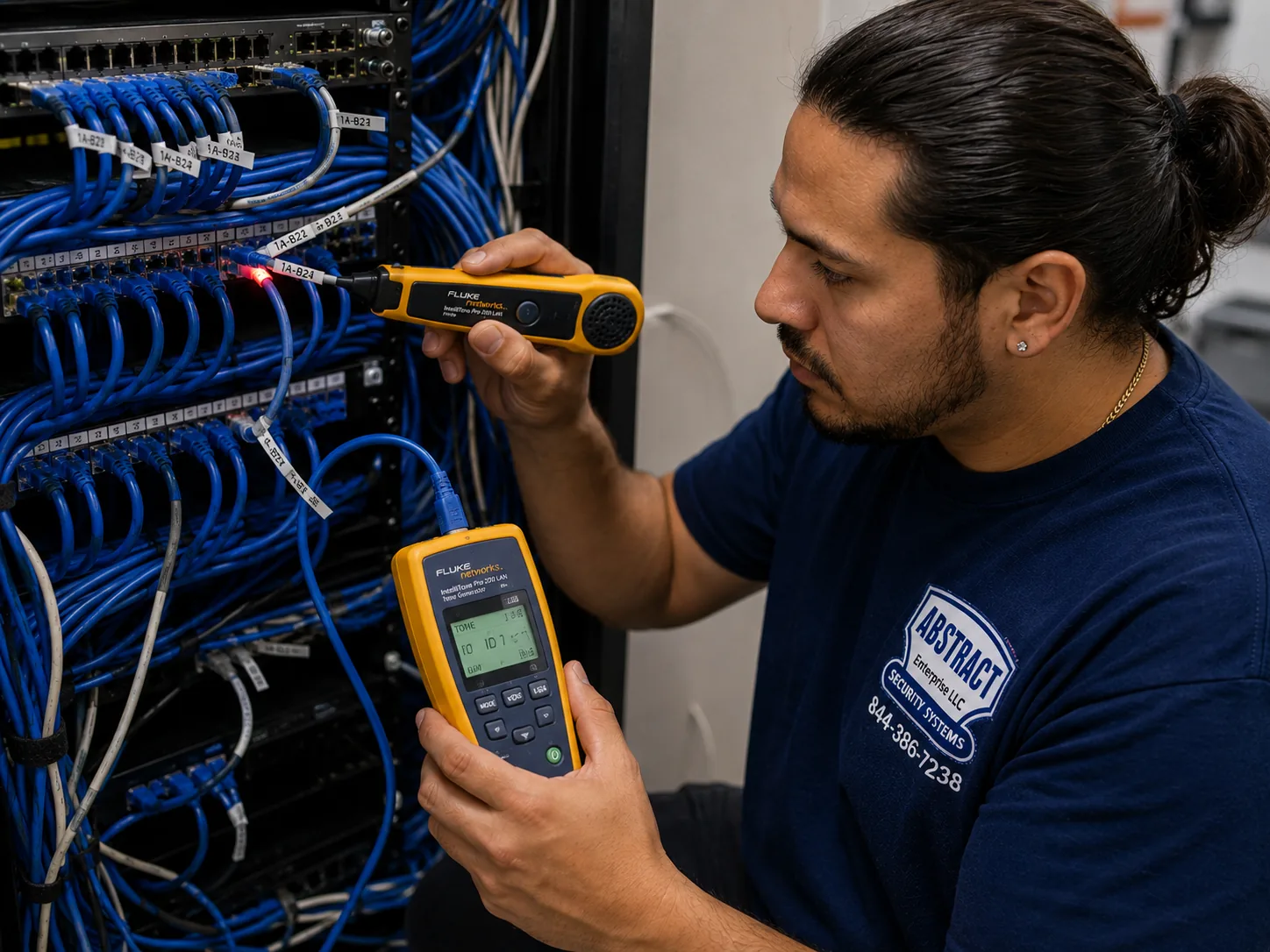
Claremont, Bronx security camera installation job-library photo: a technician tracing an unidentified cable run at a patch panel using a tone generator and probe
Photo from the AESS job library, not taken in Claremont: a technician tracing an unidentified cable run at a patch panel with a tone generator and probe. Claremont's prewar buildings have been through decades of owners, managers and contractors, and the cellar often holds a bundle of old camera, intercom and cable-company wires nobody can name; tracing each one like this tells us which can carry a new camera and which should come out.

Lobby Camera Dead, Recorder Beeping or a Clip You Need Saved? Fast Help in Claremont

In a large building, the camera call that cannot wait is the one after something has happened: a mailbox pried open overnight, a package gone from the vestibule, a stranger on the roof, an incident on the sidewalk the entrance camera may have caught. Most recorders write over their oldest footage once the drive is full, and in a building with many cameras that can happen within days. Do not unplug or restart the recorder. Note the date and the time window you need. If the app opens, save the clip to your phone now. If the screen is black, a camera has dropped off, or the box in the cellar is beeping, call (646) 490-0629 and tell us the make of the recorder and what changed. We book requests within 2 hours, talk you through saving footage over the phone where we can, and send a technician when the problem needs hands on the equipment.

Door, Light, Lens

Door, Light, Lens: What the Butler Houses Upgrade Teaches a Claremont Building Owner

The most useful thing a private owner in Claremont can borrow from the city is not a camera model. It is the order of the work. When Butler Houses got its 2017 upgrade, the Bronx Times listed three things side by side: new entrance and exit doors, new and upgraded cameras, and 245 new exterior lights. A camera over a door that does not close records people walking in. A camera over a dark path records nothing worth keeping. A camera that is bright, sharp and well aimed, over a door that closes and locks, records the few people who should not be there. We plan every Claremont building the same way, even when the budget is small, and the table below is how we explain it on the walk-through.

Question we askWhy it comes before the cameraWhat we do about it
Does the street door close and latch every time?A door that hangs open turns an entrance camera into a record of traffic, not a deterrentFlag it on the quote so the owner can have the closer or lock fixed by whoever maintains the door
Is there light on the face of every person at the door after dark?Night video of a backlit or unlit doorway shows shapes, not peopleCheck at night and name any fixture that needs fixing or adding before the camera
Where do people stop and face one direction?Mailboxes, the intercom panel and the elevator call button are where faces turn toward a wallPut the identifying cameras at those stopping points, not just over the door
Which doors are not the front door?Rear yard doors, cellar doors and roof bulkheads are how many buildings are actually enteredCover each secondary door with its own camera, aimed along the approach
Who will look at the footage, and when?A system nobody checks is only useful after the fact, and only if the clip survivesSet retention, logins and clip export to fit the super, the manager or the board
Where will the recorder be safe?A recorder in the lobby can be carried out with the evidence on itPlace it in a locked, ventilated room on battery backup, away from water

The door first: a camera cannot close it

Butler Houses got new entrance and exit doors in the same upgrade as its cameras, and that is not an accident. In a walk-up on Clay Avenue or an elevator building near the Concourse, the street door is the single most important thing the camera watches, and its condition decides what the camera is worth. If the closer is weak, the latch misses, or tenants have learned to wedge it open, the entrance camera will mostly show a stream of people who did not need a key. We are a camera company on this job, and we do not pretend to be your locksmith, but we will tell you honestly if the door is the weak point, write it on the quote, and place the camera where it will be most useful once the door works.

The light second: 245 fixtures for a reason

The Butler upgrade put up 245 exterior light fixtures across its grounds. A private building does not need anything like that number, but it needs the same thing at every place a camera has to identify someone: steady light falling on the face, not behind it. The common failures in Claremont buildings are a vestibule lit from a single bulb behind the door, so everyone entering is a silhouette; a rear yard lit only by kitchen windows that are off at three in the morning; and a stair landing where the fixture is dead. We do our first survey in daylight and come back after dark, stand at each camera position with a phone, and write down where light is missing. Some cameras carry their own light, and we will use them where they fit, but the cheapest fix for a dark doorway is usually a working fixture.

The lens third: aimed at where people stop

Only after the door and the light do we pick cameras. The overview camera over the street door shows who came and went and when. The identifying cameras go where people stand still and face one way: at the mailboxes, at the intercom panel, at the elevator call button, at the inner vestibule door. A face that fills a good share of the picture at close range is worth more to a building owner, and to the police, than a wide view of the whole lobby with everyone the size of a thumbnail. In a fifty-apartment building that usually means fewer cameras than people expect, in better places, and that is what we put on the quote.

What We Install

Security Camera Installation Services in Claremont

These are the camera jobs Claremont owners, managing agents, boards, shopkeepers and residents call us for. Each one is quoted in writing after photos or a walk-through, and the quote names every camera, cable run, mount and setup task, so nothing appears on the day unless you ask for it.

🚪

Street Door and Vestibule Cameras

An overview camera on the entrance plus an identifying camera inside the vestibule, lit from the front, so every person who comes through the door of a Clay Avenue or Fulton Avenue walk-up shows up clearly.

📬

Mailbox and Package Area Coverage

A camera mounted to look outward from the mailbox bank or package shelf, so the person reaching in faces the lens, with retention set long enough to cover a late-noticed theft.

🏢

Whole-Building Systems for Walk-Ups

Entrance, mailboxes, stair, cellar door, rear yard and roof bulkhead, cabled down the building to one recorder in a locked cellar room on battery backup.

🛗

Elevator Buildings Toward the Concourse

Lobby, mailroom, elevator lobby, side and rear doors and garage or service entrances for the larger prewar and postwar elevator buildings, with a PoE switch where the camera count grows.

🖥️

Front Desk and Super's Monitors

A monitor for a staffed desk or a super's office showing the entrances, set up so visitors cannot see it and staff log in with view-only access.

🏪

Shops and Offices on Webster and Third

Door, counter, register and back-door cameras for groceries, delis, travel agencies and service offices, installed before opening or after closing.

🕌

Storefront Congregations

Entrance and shoe-area cameras for storefront mosques and churches, planned with the congregation's leadership and kept out of any space where people wash or change.

♻️

Old System Takeovers and Clean-Ups

Inherited recorders, dead cameras and unlabeled cable traced, tested and either returned to service or removed, with the facade and lobby left tidy.

💾

Footage Search and Export

Finding a clip on a recorder before it is overwritten, exporting it to a USB drive or phone, and showing the super how to do it next time.

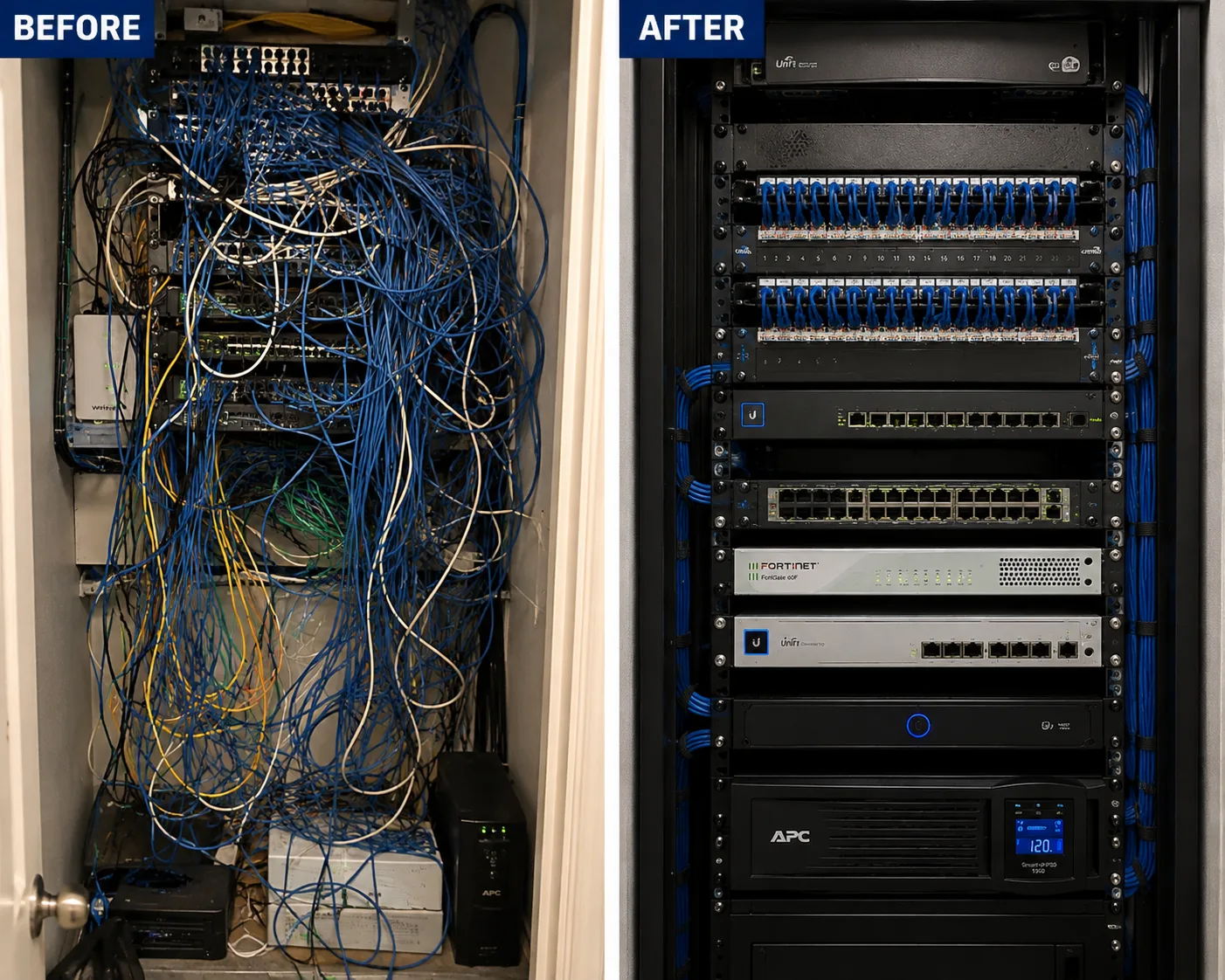
Claremont, Bronx security camera installation job-library photo: a network rack shown before and after, an unlabeled tangle rebuilt into dressed, identified cabling
Photo from the AESS job library, not taken in Claremont: before and after views of a network rack, first an unlabeled tangle, then the same rack rebuilt with dressed, identified cabling. When a Claremont building changes managing agents, the new manager often inherits a cellar corner like the first picture; the takeover job is to turn it into the second before a single camera is added.
Building Specialists

Security Camera Installation for Claremont's Architecture

Claremont packs early twentieth-century walk-ups, elevator buildings of several eras, public housing towers, new affordable buildings and a small number of houses into a few dozen blocks. Each type changes three things about a camera job: what the camera mounts on, how the cable gets back to the recorder, and who has to agree before anything goes up. These are the building types the city's lot data and the neighborhood sources describe, and how we handle each one.

Prewar Walk-Ups

Five- and six-story apartment houses of the 1910s and 1920s on Clay, Fulton and Webster, the most common building in the neighborhood by count. One street door, a vestibule, a stair, a cellar and a roof bulkhead.

Elevator Buildings Near the Concourse

Larger buildings from the 1920s through the postwar decades, including a 17-story tower of the 1960s. Lobbies, mailrooms, elevator lobbies, side doors and long cable distances.

HDFC and Co-op Buildings

Around 56 lots with HDFC owners in our tract count, many in 1920s buildings. Boards decide, budgets are tight, and the work often comes in phases.

New Affordable and Supportive Housing

Buildings like 3500 Park Avenue, 415 Claremont Parkway and the planned 404 Claremont Parkway and Claremont House. Staffed desks, operator policies and new construction to work around.

NYCHA Towers and Rehab Walk-Ups

Claremont Village's 21-story towers and the Claremont Rehab walk-ups on Clay Avenue. Common-area cameras are NYCHA's; residents work within NYCHA's rules for their own door.

Frame Houses and 1990s Two-Families

Old houses on College, Teller, Clay and Findlay, and newer two-family homes on Claremont Parkway, Third Avenue, Crotona Place, Washington Avenue and East 171st Street.

How the building type changes the job

BuildingWhat the camera mounts onHow cable reaches the recorderWho has to agree
Prewar walk-upBrick at the entrance, plaster ceilings in the vestibule and stairDown the stair hall in surface raceway, or through the cellar to a locked roomThe owner or managing agent
Elevator buildingLobby ceilings, mailroom walls, masonry at side and rear doorsAlong cellar corridors and up through existing sleeves, with fire-stopping where floors are crossedThe owner or managing agent, with the super kept informed
HDFC or co-opSame as the building's typeSame as the building's type, sometimes pulled in stagesThe board, in writing
Supportive or new affordable buildingFinished drywall and newer masonry, often with existing conduitInto the building's own network room or a dedicated cabinetThe operator or developer, under their own policies
NYCHA tower or rehab walk-upOnly a resident's own door, within NYCHA's rulesNo cable: a wireless, battery device if anythingNYCHA
Frame house or two-familyWood trim, siding or brick on the owner's houseInto the basement, where the recorder usually livesThe owner, with neighbors' privacy in mind

Prewar walk-ups: brick at the door, plaster inside, a roof space above

The typical Claremont walk-up has a brick front, a vestibule between two doors, a plaster stair hall that climbs five or six floors, a cellar under it and a bulkhead at the top. The entrance camera goes into sound brick, not the mortar joint, with sleeve anchors sized for the bracket, and any hole through the facade is drilled once, sloped slightly toward the outside and sealed. Inside, cable can travel up the stair hall in a painted surface raceway that a super can follow later, or down into the cellar where it is out of reach. We avoid the cockloft and roof space as a cable route unless there is no better path; the February 2026 fire off the Concourse ran through exactly that space, and any cable that crosses a floor, ceiling or fire-rated wall in a building like this is sealed with a rated fire-stopping material where it passes through.

Elevator buildings: distance, mailrooms and the elevator lobby

The bigger buildings toward the Grand Concourse change the problem from height to distance. A lobby camera may be a long way from the recorder room, a rear service door further still, and the side entrance on a corner building may be around the block from the front. Over long runs we bring cable to a PoE switch in a locked cabinet, which powers the cameras and carries their picture on one cable each. The mailroom, the elevator lobby and the package area are where faces turn toward a wall, so they get the identifying cameras. Elevator cabs are a separate question with their own equipment and access rules, and we discuss them only with the owner and the elevator contractor together. In occupied buildings we work floor by floor, keep the lobby open, and save drilling for agreed hours.

HDFC and co-op buildings: the board decides, and the money comes in stages

In the HDFC and co-op buildings, which our tract count puts at about 56 lots and 2,257 homes, many of them in 1920s buildings, the people who live there also own and govern it. A camera plan has to pass the board, who sees what has to be agreed before any lens goes up in a hallway, and who holds the main login afterward. We write the plan in a form a board can vote on: each camera, its view, why it is there and what it costs, with a first phase that covers the doors and the mailboxes and later phases for the stair and the roof. Where a later phase is likely, we pull spare cable while the walls are open the first time, so the second phase does not repeat the disruption.

New and supportive buildings: someone else's policy comes first

The newer buildings on and near Claremont Parkway are run under operator rules. The NYHC describes 3500 Park Avenue as a 115-unit building with 69 apartments for formerly homeless residents, a live-in super and about 20 on-site workers. Affordable Housing Hub lists 415 Claremont Parkway with 18 low-income units serving homeless populations. In buildings like these, the operator sets who watches the cameras and when, and staff need access without tenants feeling watched in their own halls. We work to the operator's written policy, keep monitors out of visitors' sight, and set staff logins to view only. New construction, like the eight-unit building with a roof terrace that New York YIMBY reported for 404 Claremont Parkway, often arrives with conduit and a network room already built, which we use rather than adding new surface cable.

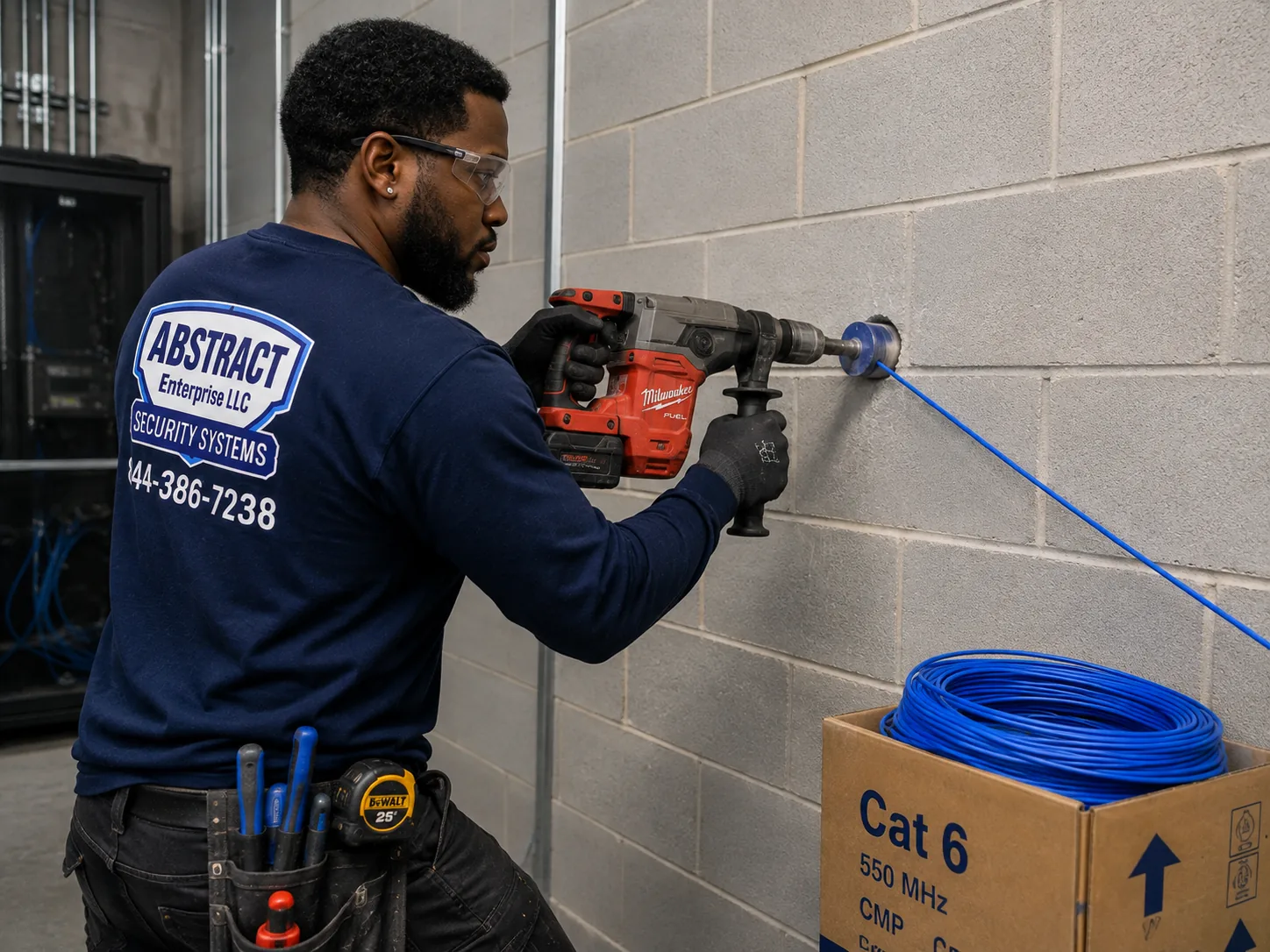
Claremont, Bronx security camera installation job-library photo: a technician core drilling through a concrete block wall to pass cable into a network room
Photo from the AESS job library, not taken in Claremont: a technician core drilling a block wall so cable can pass through into a network room. Many Claremont cellars have a block partition between the boiler and meter area and a storage room; one planned core like this takes every camera cable into the locked recorder room in a single sealed opening, instead of cables threaded around a door frame.
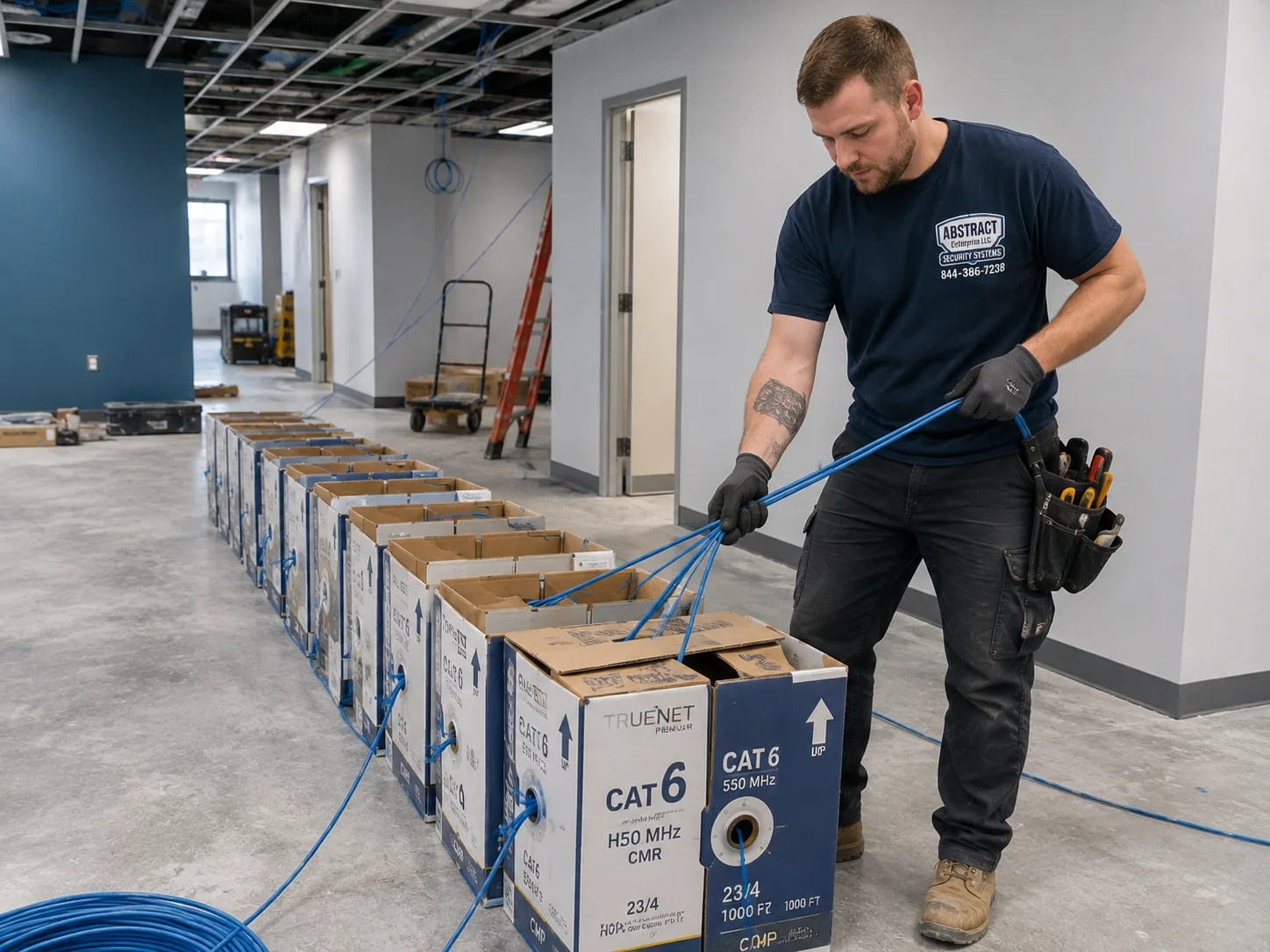
Claremont, Bronx security camera installation job-library photo: boxes of cable staged together for a multi-drop pull at an occupied site
Photo from the AESS job library, not taken in Claremont: boxes of cable staged together for a multi-drop pull on a working premises. For a six-story walk-up on Fulton Avenue with cameras at the street door, the mailboxes, three landings and the roof door, the runs are pulled together from staged boxes like these, so tenants see the stair hall disturbed once rather than six times.
Commercial Security Camera Installation

Business Security Camera Installation in Claremont

Claremont's businesses sit on the ground floors of its apartment buildings and along the avenues that frame it. The corridors below are the ones the neighborhood sources name. We describe the kinds of premises those sources mention and do not claim any business as a client.

Webster Avenue

The historic commercial strip, now home, per Rob Stephenson's newsletter, to storefront mosques and travel agencies serving immigrants from Guinea, Mali and Senegal. Doors, counters and back rooms are the camera targets.

East 170th Street and Webster

Described by CityNeighborhoods.nyc as a local hub. Groceries, service shops and busy sidewalks where an entrance camera has to cope with constant foot traffic.

Third Avenue

The old streetcar route toward Fordham, with churches in former commercial buildings; Forgotten New York notes the Seven Light Baptist Church at Third and Claremont in what looks like a repurposed bank.

Claremont Parkway

Mixed-use buildings with storefronts under apartments, like the five-story building at 538 Claremont Parkway that Hoodline described with ground-floor shops.

Findlay Avenue and the Side Streets

Corner delis and groceries in mixed-use walk-ups, such as the building at 1365 Findlay Avenue with four ground-floor commercial spaces under 32 apartments.

Nonprofit and Program Spaces

Offices and programs like the Claremont Neighborhood Center, founded in 1956, and supportive housing operators. Cameras there follow the operator's own policies.

A shop under apartments is two jobs in one building

Most Claremont shops are tenants on the ground floor of an apartment building, and that splits the camera work. The shopkeeper decides about the inside of the store: the door, the counter, the register and the stockroom. The building owner decides about the facade, the shared entrance to the apartments upstairs, the cellar and any rear yard. If you lease the store, read the lease and ask the owner before we mount anything outside, and send us the answer in writing. Inside, we put the door camera where it sees faces as people walk in, not their backs as they leave; the counter camera above and slightly behind the staff side so it sees hands, cash and the customer's face; and the recorder in a locked back room rather than under the counter, where it would be the first thing grabbed.

Night on a busy avenue, morning after a quiet one

Webster and Third Avenues stay busy into the evening, and many shops close behind roll-down gates. A storefront camera behind a closed gate sees the inside of the gate; one mounted outside sees the sidewalk, the gate's lock and anyone working at it, but it needs the building owner's agreement and protection from being knocked out of aim. Headlights and shop signs across the street can wash out a camera aimed straight at the avenue, so we angle storefront cameras along the frontage rather than across it. Inside, a camera covering the back door and the stockroom matters more after closing than any view of the sales floor, because that is where an overnight entry usually happens.

Rules and practical limits for business cameras in Claremont

  • Licensed installer. NYC Business describes a New York State Department of State license as required to install or maintain security or fire alarm systems, and the Kirschenbaum law firm notes the license covers CCTV used to detect or monitor intrusion, theft or movement. AESS works under NYS license #12000287431.
  • Private places stay private. New York Penal Law §250.45 makes it a crime to put a camera where people have a reasonable expectation of privacy without their consent. No cameras in restrooms, changing areas or any room where people wash, and we will say so plainly if a requested view crosses that line.
  • The landlord controls shared space. As Impera Security's guidance puts it, tenants generally cannot install cameras in common areas without the landlord's permission, and that applies to a tenant business as much as to a tenant household.
  • Sealed openings. Where camera cable passes through a fire-rated wall, floor or ceiling in a mixed-use building, the opening is sealed with rated fire-stopping material. We seal what we open.
  • New power is an electrician's job. Our cameras run on low-voltage cable, usually powered from the recorder or a PoE switch. A new outlet or circuit is work for a licensed electrician, and the quote says so.
  • No landmark district here, but check the edges. We found no designated historic district within Claremont. The Clay Avenue Historic District is close by in Concourse Village, and on any designated building the Landmarks Preservation Commission must approve alterations in advance, so we check the LPC map for edge blocks.
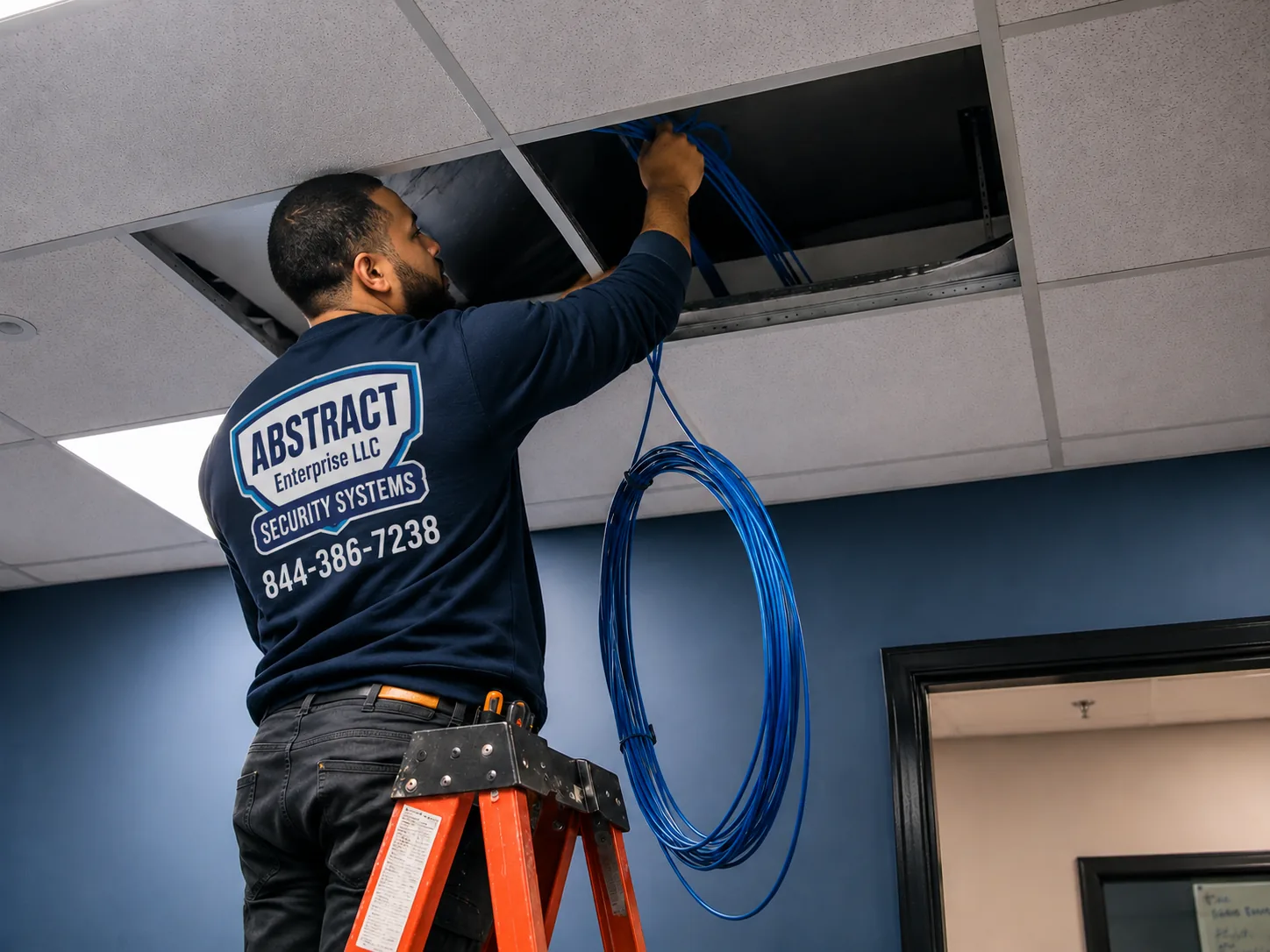
Claremont, Bronx security camera installation job-library photo: a technician feeding cable up through a ceiling opening in an occupied commercial space
Photo from the AESS job library, not taken in Claremont: a technician feeding cable through a ceiling in an occupied commercial space. A grocery or travel agency on Webster Avenue usually stays open while cable goes in overhead like this, and the loud drilling at the front door and the counter is done before the gate goes up.
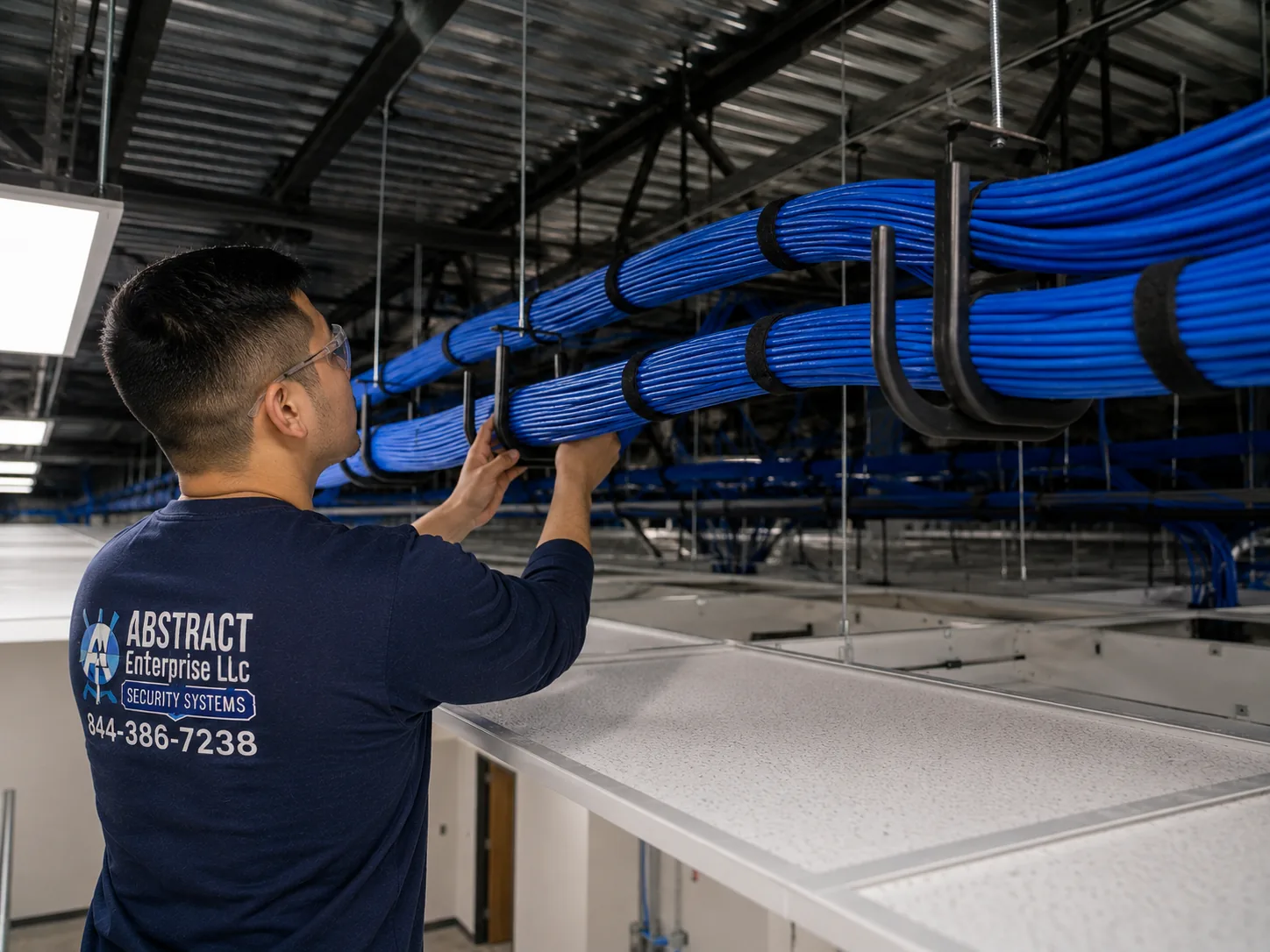
Claremont, Bronx security camera installation job-library photo: J-hooks carrying neat, dressed cable bundles across a commercial ceiling
Photo from the AESS job library, not taken in Claremont: J-hooks carrying dressed cable bundles across a commercial ceiling. In the long cellar corridors of the larger elevator buildings near the Concourse, camera cable rides on hooks like these instead of lying on steam pipes and ducts, where heat and later repairs would damage it.
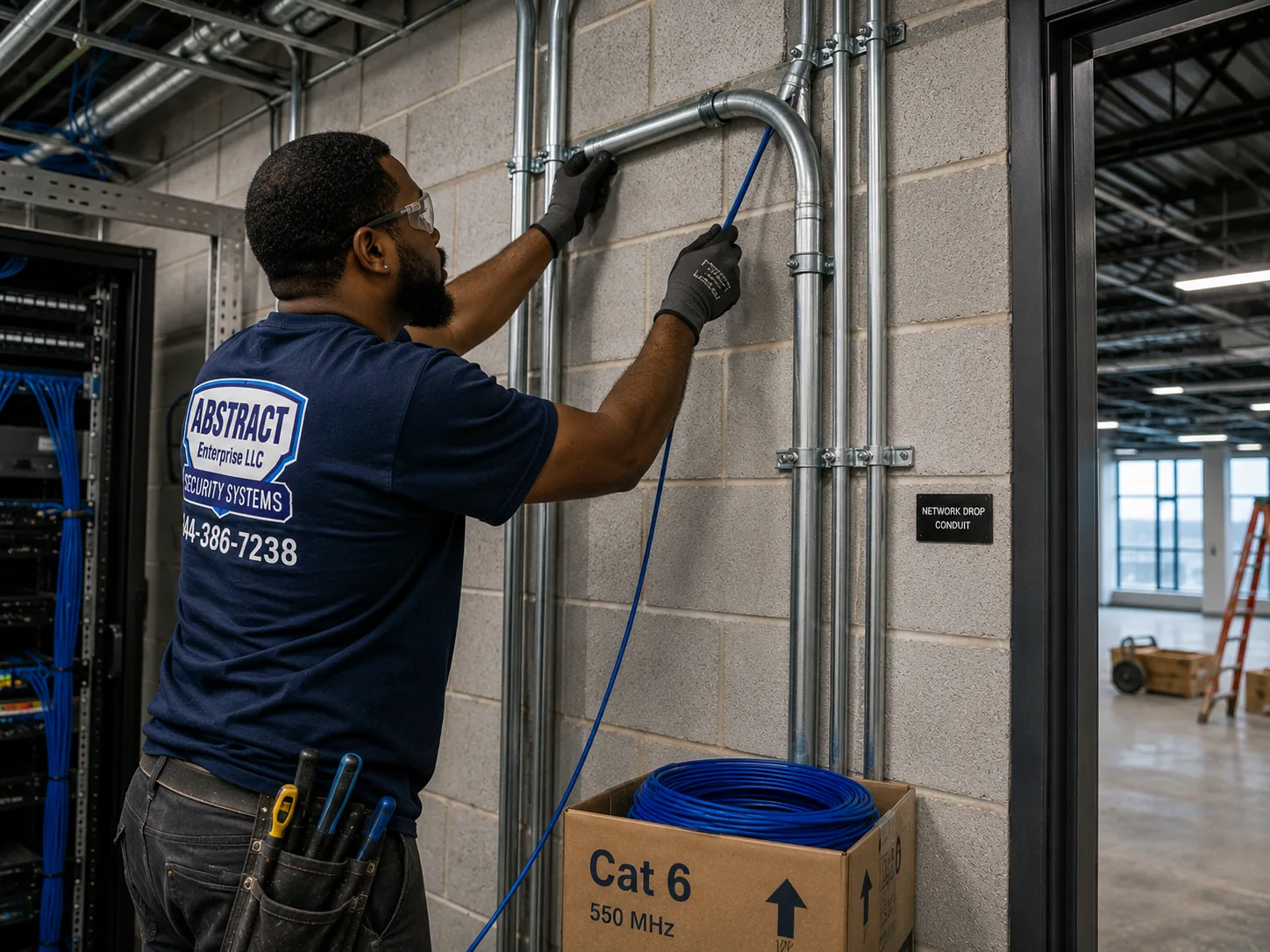
Claremont, Bronx security camera installation job-library photo: a technician pulling cable into EMT conduit next to a telecom room in an industrial building
Photo from the AESS job library, not taken in Claremont: a technician running cable into EMT conduit beside a telecom room in an industrial building. On a Claremont building, the cable from a rear-yard or alley camera goes into metal conduit like this wherever someone standing on the ground could reach it, because a cut wire blinds the camera that was meant to record the cutting.
Field Notes

Field Notes: Why We Walk a Claremont Building Twice

We do not publish stories about a particular customer's building unless we can document them, so this is not a tale about one address. It is the routine we follow at a prewar walk-up of the kind that lines Clay and Fulton Avenues, and the reason the first visit is really two.

The daytime walk starts in the cellar, not the lobby, because that is where the recorder will live and where every cable has to end. We look for a room that locks, stays dry when it rains hard and is not right against the boiler. Then we climb: street door, vestibule, mailboxes, every landing, the bulkhead and the roof door, noting what each wall and ceiling is made of. The night walk is shorter and tells us more. The vestibule that looked bright at noon is lit by one bulb behind the door, so every face comes out black. A landing fixture is dead. The rear yard is dark except for whatever kitchens are lit. We stand at each spot with a phone camera, look at what a lens would see, and write down the light that is missing. Those notes go on the written quote first, ahead of the cameras.

Your Questions Answered

Security Camera Installation in Claremont: Questions Answered

Large buildings and the Claremont Village edge

Butler Houses got 30 new cameras and 245 lights. Does any of that coverage reach the sidewalk in front of our private building across Webster Avenue?

Possibly, but you should not plan around it. Those cameras and lights belong to NYCHA, were placed for NYCHA's grounds and entrances, and their footage is not something a neighboring owner can log into or ask for directly. If something happens outside your building, the police can request footage from NYCHA and from anyone else nearby. Your own entrance needs its own camera, aimed at your door, your vestibule and your stretch of sidewalk, recorded on a box you control, so you are not depending on another owner's equipment, angle or retention time.

Our tenant association heard about the Borough President's camera money for Claremont Consolidated. How do residents find out where those cameras will go?

Ask the people running the project. The NYCHA Journal reported that Borough President Vanessa Gibson's office presented a 294,000-dollar check for security upgrades, including new cameras, at the Teller Avenue-166th Street/Claremont Consolidated development, but the report does not list camera locations or a schedule. Your tenant association, the development's management office and the Borough President's office are the right places to ask. AESS is not part of that work, and we would rather say so than imply otherwise. What a resident can control is their own apartment door, within NYCHA's rules.

If the budget covers only a few cameras in a fifty-apartment elevator building, which spots come first?

Every entrance first, then the place people stop. In practice that means the street door, any side or rear door, and the cellar door, each with a camera aimed along the approach, then one identifying camera at the mailboxes or the inner vestibule door where faces turn toward the lens. If there is budget left, the elevator lobby on the ground floor and the roof door come next, and stair landings last. A plan that covers every way in at a few good points beats one that films the lobby from four angles and leaves the back door unwatched. We write the priorities on the quote so the owner can approve them in order.

The mailboxes in our lobby keep getting pried open. Where does a mailroom camera go so it shows a face, not the back of a head?

Above or beside the mailbox bank, looking outward into the room, so anyone reaching into a box is facing it. A camera on the opposite wall, which is where many old systems put it, sees backs and elbows. We mount it high enough to be out of easy reach, with a vandal-resistant housing, and check that the light falls on the faces of people standing at the boxes rather than coming from behind them. Mail theft is often noticed days later, so we also set the recorder to keep that camera's footage long enough to go back and find it.

Our recorder sits in the cellar next to the boiler. Is that heat a problem for it?

It can be. A recorder is a small computer with a hard drive, and every model has an operating temperature range printed in its specifications. Right against a boiler, in a closed corner with no air moving, it can run hot all winter, and hard drives wear faster in heat. Cellars also flood. We look for a spot in the same locked area that is a few feet away from the boiler, has some air circulation and is raised off the floor, usually on a wall shelf or in a ventilated cabinet, with the battery backup beside it. Moving the recorder ten feet often costs far less than replacing a cooked drive.

People get onto our roof through the bulkhead door. Is a camera at the top of the stair worth it?

Usually, yes, because the roof door is one of the least watched ways into a walk-up, and people who come down from the roof are already past the street door. The camera goes inside the bulkhead or on the top landing, aimed at the door so it sees anyone coming in from the roof or going out to it. We do not touch the door's hardware; roof doors have their own rules about how they must open, and that is for the owner and their door contractor. A roof camera needs light at night too, and the top landing is often the darkest place in the building.

Walk-ups, light courts and houses

Our 1920s building wraps around a light court that tenants' kitchen windows face. Can a camera watch the court without looking into apartments?

Sometimes, with care, and often the better answer is to watch the way into the court rather than the court itself. A camera high on a court wall looking down sees the ground, but it also sees straight into the windows opposite, which is exactly what tenants should not have to live with. We prefer a camera on the court door or the gate where people actually enter, aimed along the ground. If the court must be covered, we mount the camera low, aim it at the floor and add privacy masks over every window in the frame, and then check the picture with the owner before we leave.

Our wood-frame house on Teller Avenue dates from the 1890s. Is it too old for wired cameras?

No. City lot data shows a handful of houses from the 1890s and 1900s on College, Teller, Clay and Findlay, and frame houses like these are often easier to wire than masonry ones. Cable can drop through a wood wall into the basement and run along the joists to the recorder, and cameras mount on trim boards or on a mounting block fixed to the framing. The care goes into the old materials: lath and plaster that cracks if you drill carelessly, old clapboard or siding that has to be sealed where it is opened, and knob-and-tube or other early wiring we keep well clear of. We look before we quote.

Our 1990s two-family off Crotona Place has a parking pad behind a front gate. Can one camera handle both the gate and the car?

One wide camera can see both, but it will see neither very well. A gate is where you want a face, close and lit; a car is where you want to see someone at the door or the window and which way they went. Two modest cameras usually do better than one expensive one: a camera near the front door aimed at the gate, set so a person coming through fills a good part of the picture, and a second camera on the corner of the house looking along the car. Many of the 1990s two-family houses on these blocks have a basement, which makes both runs short.

Can I mount a camera on the fire escape outside my window?

We will not. A fire escape is an escape route and part of the building's structure, and anything fixed to it, from a bracket to a cable tied along the rail, can snag someone climbing out in smoke. It also belongs to the owner, not the tenant. If you want to see the fire escape or the yard below, the options are a small camera inside your own window, looking out, or a camera the owner installs on the building wall with the cable out of the way. Either keeps the escape clear, which is the one thing that matters most on that ironwork.

Why does a Wi-Fi camera that works fine in the shop downstairs drop out on the third floor of the same building?

Because prewar Bronx walls and floors are thick masonry and plaster, and Wi-Fi signals weaken every time they pass through one. A camera near the router works; the same camera two floors up, behind a brick party wall and a tiled bathroom, keeps losing its connection, and a camera that is offline records nothing. For a building's common areas we run cable to each camera, which carries both power and picture and does not care how thick the walls are. Wi-Fi still has a place for a single device close to its router, but not as the backbone of a building system.

The park, the slope and the street

Our building faces Claremont Park and the edge of the park is dark at night. Will a camera see anything past the fence?

Not much, and it should not try. A camera's night vision reaches as far as its own infrared light or the light already on the scene, and a dark stretch of park beyond the street is out of range for most building cameras. Aim it at the park and you get a black frame and motion alerts from leaves. Aim it at your entrance, your stoop and your stretch of sidewalk, where your building's light falls, and you get clear pictures of everyone who comes to your door, including anyone who came from the park. If your front is dark, the fix is a light on your own facade, not a stronger camera.

Our block runs downhill from the Concourse toward Webster Avenue. Does the slope change how a door camera is aimed?

Yes. NYC Parks notes that the old mansion's lawns ran down to the Mill Brook, which is now Webster Avenue, and the land still falls that way. A camera mounted high over a door on the downhill side of a stoop looks down on the tops of heads as people climb toward it; on the uphill side, people walking down the sidewalk come toward it face first. We set the mounting height and tilt for the slope at each door, sometimes mounting lower than usual or moving to the side of the entrance, and check with a person walking the approach while we watch the picture.

Shops, worship and supportive housing

Our storefront mosque on Webster Avenue wants a camera at the door. What is different about cameras in a place of worship?

Mostly who decides and where cameras must never go. The congregation's leadership should agree the plan, including who can view footage and for how long it is kept. The entrance, the shoe area and the street door are sensible places for cameras; the prayer space is a decision for the congregation, and any area where people wash, including ablution facilities, is off limits under the same privacy law that covers restrooms. We mount discreet, visible cameras, keep the recorder in a locked office, and give view access only to the people the leadership names. The same approach applies to the storefront churches nearby.

A travel agency on Webster Avenue handles cash and passports at the counter. Where does the counter camera go?

Above and slightly behind the staff side of the counter, looking at the counter top and the customer, so it sees hands, cash and faces together. A second camera at the door catches each person arriving. One caution: a high-resolution camera close over the counter can record passport pages and other documents in readable detail, which means your recorder then holds sensitive customer information. We set the angle and zoom with you so the camera sees what you need and no more, and keep the recorder and its logins locked down accordingly.

Our building has a staffed front desk for formerly homeless tenants. How should the desk monitor be set up?

Facing the staff, out of sight of anyone in the lobby, and showing the doors rather than the residents' lives. In a supportive building like 3500 Park Avenue or 415 Claremont Parkway, the operator's policy decides which cameras the desk sees and who can play back footage. We usually give the desk a live view of the entrances, the package area and the elevator lobby, with view-only logins for staff and playback reserved for managers. Hallway cameras, if the operator wants them, are aimed along the corridors and masked where apartment doors open, so the desk is watching the building and not each tenant's comings and goings.

Our building is empty under a vacate order after a fire. Can cameras watch it until tenants return?

Sometimes, and it depends first on power and safe access. News 12 Bronx has reported on buildings in Claremont left under vacate orders after fires, and an empty building can attract people looking for copper or shelter. A wired system needs working power, and after a fire the building's power may be off until repairs are inspected. We talk to the owner and their contractor about what is live, whether a temporary arrangement is possible, and whether we can work safely inside. If the building cannot be powered or entered safely yet, we will tell you so rather than install something that cannot record.

Our HDFC co-op works from a small reserve. Can cameras be added in stages?

Yes, and it is often the sensible way. The first stage covers the street door, the vestibule and the mailboxes, with a recorder big enough for the whole future system and battery backup from day one. While the stair hall is open for that first run, we pull extra cable to the landings, the cellar door and the roof door and leave it labeled and capped. Later stages then become a camera and a connection at each point, without new drilling through the building. The board gets a written plan showing each stage separately, so it can approve one and budget for the next.
Equipment

Types of Security Camera Installation We Install

These are the cameras and components we fit in Claremont buildings, shops and houses. We install Lorex, Hikvision, Dahua and Uniview systems among others, and we pick each camera by the job it has to do at its position, not by brand. Every item is on your written quote before anything is ordered.

🛡️

Vandal-Resistant Domes

Hard-shelled domes for vestibules, mailrooms and stair landings within reach of passers-by, harder to knock out of aim or spray-paint than an exposed lens.

🎯

Turret Cameras

Compact cameras for entrances and roof doors. Their open lens avoids the reflections a dome can pick up when a bright light sits near the frame at night.

📏

Bullet Cameras

Longer cameras for rear yards, alleys and the sides of corner buildings, mounted high and aimed along the approach rather than across it.

💡

Cameras With Their Own Light

Cameras with built-in white light for the dark spots a building cannot easily light, such as the back of a yard, so night pictures keep color and detail.

🚪

Wireless Door Cameras

Battery devices for a single apartment door where nothing can be wired, including NYCHA residents working within NYCHA's rules. Short range, one doorway.

💾

Network Video Recorders

The box that stores the footage, sized for the camera count and the number of days the owner wants kept, installed in a locked, ventilated spot.

🔌

PoE Switches and Cabinets

For elevator buildings and larger walk-ups, a switch that powers each camera and carries its picture on one cable, in a locked wall cabinet with labeled ports.

🔋

Battery Backup Units

A backup unit that keeps the recorder and cameras running through a short outage and lets the recorder shut down cleanly in a long one.

🖥️

Desk and Office Monitors

A screen for a front desk, super's office or shop back room, showing chosen cameras live, mounted where visitors cannot read it.

National security brands vs a local camera installer

Claremont owners and residents often ask whether a big-name kit would do the same job. ADT is best known for monitored alarm service, and Ring and SimpliSafe for doorbells, cameras and kits people install themselves. For one apartment door, a self-install doorbell or camera of the kind those brands sell can be the right device, and we are glad to set up one you already own. For a walk-up, an elevator building or a shop, the job is the building: cameras wired through brick and plaster, cable sealed where it crosses floors, a recorder the owner controls in a room that will not flood, light checked at every lens, and every view kept out of apartments. That is installation work, not a box on a shelf. On Yelp, the praise we found for camera installers listed around Claremont Village was for the work itself, such as a customer writing that an installer put up four cameras and "got it done in a couple of hours."

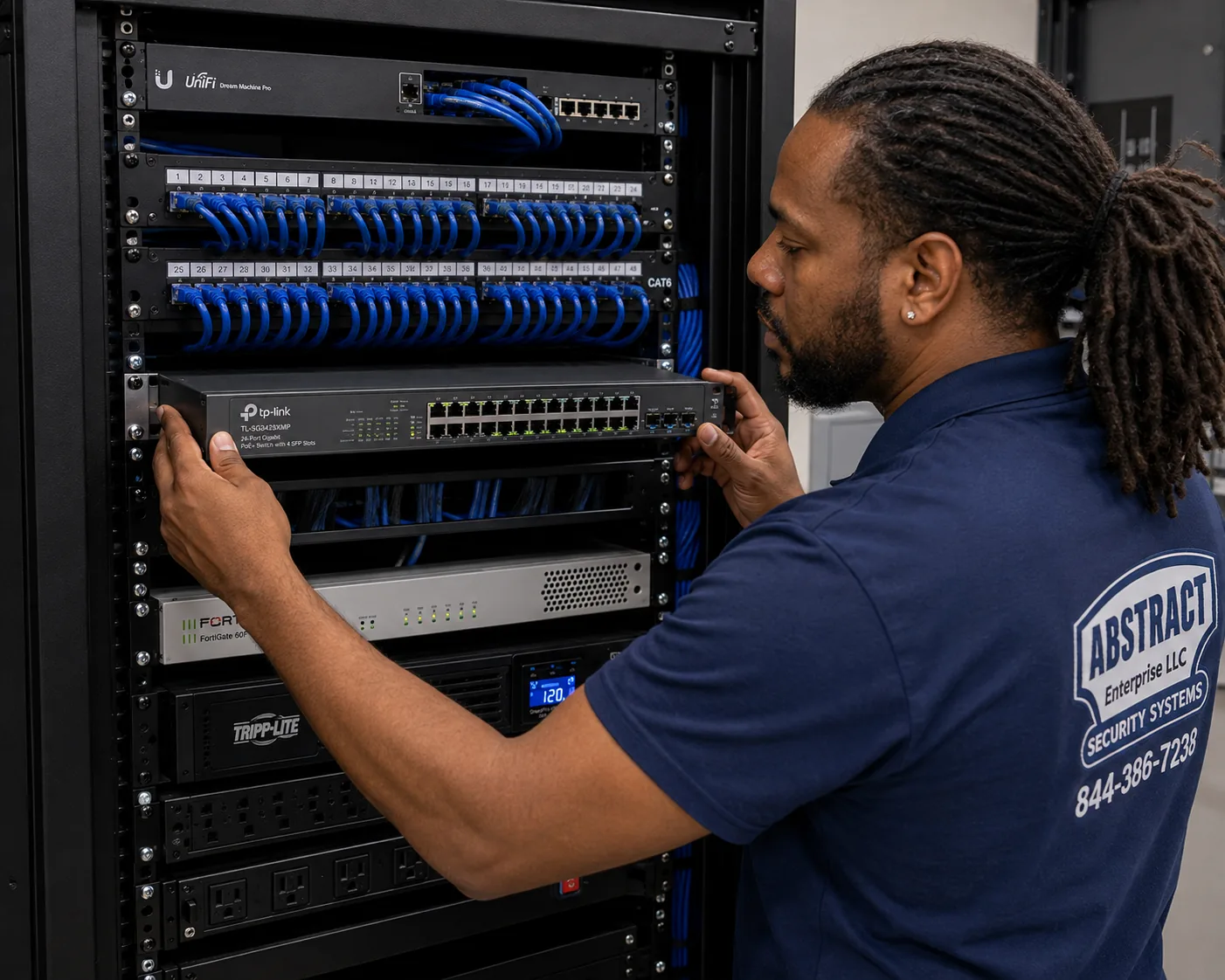
Claremont, Bronx security camera installation job-library photo: a technician mounting a managed PoE switch below patch panels in a commercial network rack
Photo from the AESS job library, not taken in Claremont: a technician mounting a managed PoE switch below patch panels in a commercial network rack. In an elevator building near the Concourse with cameras at the lobby, mailroom, elevator lobby and several side doors, a switch like this powers every camera from one locked cabinet instead of a scatter of plug-in adapters.
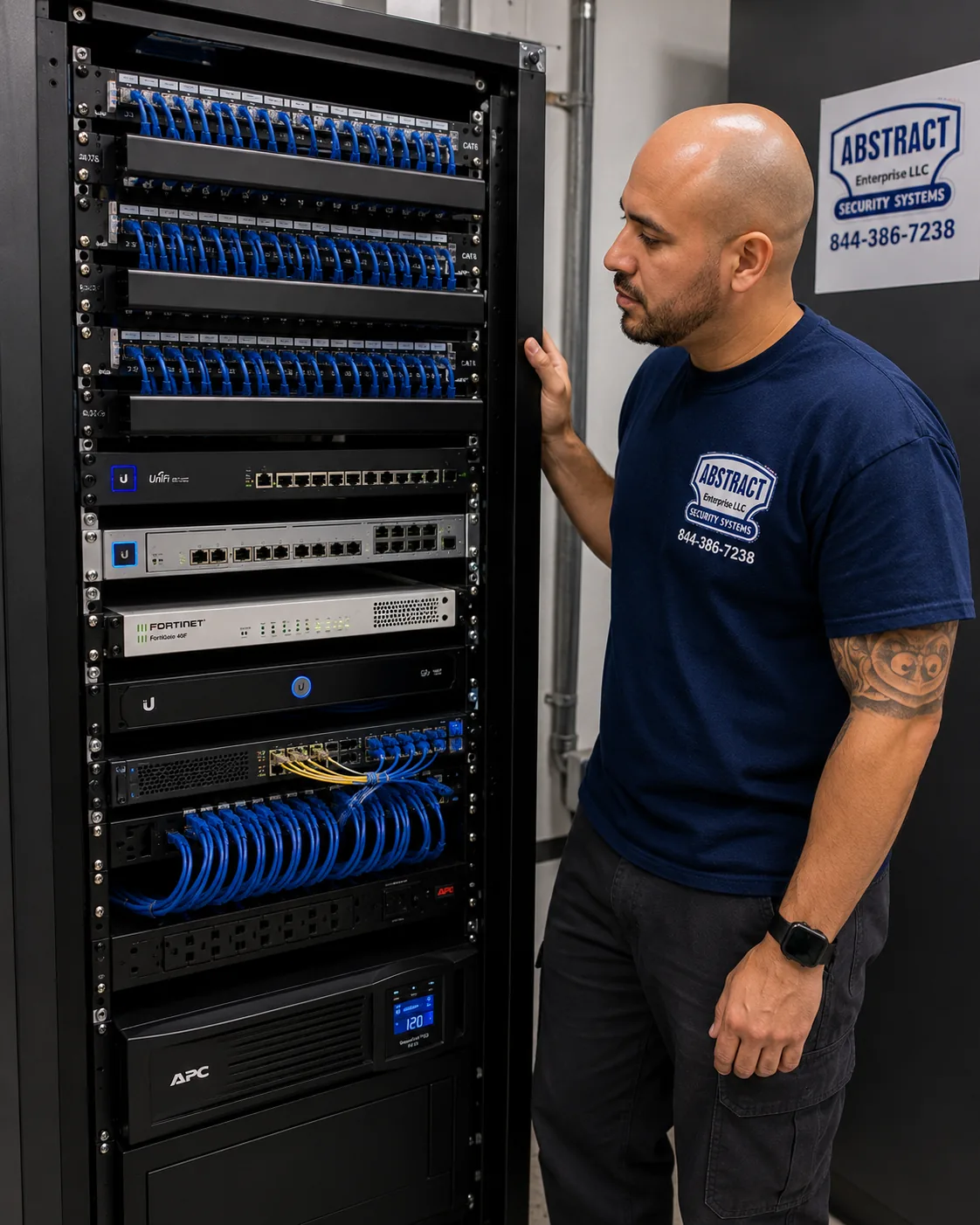
Claremont, Bronx security camera installation job-library photo: a finished network rack with patch panels, switching, a firewall and battery backup, all dressed and labeled
Photo from the AESS job library, not taken in Claremont: a finished network rack with patch panels, switching, a firewall and battery backup, all dressed and identified. A supportive housing building on Claremont Parkway with a staffed desk and many cameras keeps its system in a locked room like this, with the battery backup at the bottom so recording continues through a short power cut.
AI Overview Reality Check

What AI Gets Wrong About Security Camera Installation in Claremont

We could not capture Google's AI Overview or People Also Ask results for Claremont from our build environment, so we are not going to pretend to quote them. Below are claims we see repeated in quick online answers about cameras in the Bronx, including one from our own website, set against the public record and what we find in the buildings. Marketplace cost guides from Angi, HomeAdvisor and Fixr feed many of these answers; they are useful as a rough starting point, but none of them has walked your cellar.

"For NYCHA tenants, wireless is the only legal option, full stop."

This line appears on one of our own Bronx pages, and we could not verify it as written, so we are correcting ourselves here. NYCHA has published guidance on what residents may attach to their own apartment doors, and it points toward wireless, no-hole devices, but a short slogan is not the rule.

The rule that matters is NYCHA's own, and its lease. AOL reported in 2012 that a resident at Parkside Houses, elsewhere in the Bronx, was told she had breached her lease by installing cameras. That is the risk of guessing.

If you live in Butler, Webster, Morris or Morrisania Houses or the Clay Avenue walk-ups, ask your management office what is allowed on your door before you buy anything. We will work only within what NYCHA permits, and we do not touch common areas.

"Anyone can put up security cameras in New York; no license is needed."

Not for a business doing it for you. NYC Business describes a New York State Department of State license as required to install, service or maintain security or fire alarm systems, and the Kirschenbaum law firm writes that the license covers CCTV used to detect or monitor intrusion, theft or movement.

A homeowner fixing a camera to their own wall is a different matter from a company or a handyman taking money to wire a building. Quick answers tend to blur that line.

If a board, an insurer or a managing agent asks who put up your building's cameras, the answer should be a licensed company. AESS works under NYS license #12000287431 and carries insurance.

"Your landlord has to keep the lobby cameras working."

Many tenants assume so, and many quick answers repeat it. Brick Underground has reported that no city law requires rental buildings to have working security cameras. A landlord who installed them is not obliged by that fact alone to repair them.

That does not leave tenants with nothing. Doors, locks and intercoms are covered by other rules, and a tenant association can press an owner to fix a dead system, especially when mail and packages are disappearing.

For owners, the practical point is the reverse: a camera that has been dead for months still tells everyone in the building it is there, and gives a false sense that something is being recorded. Fix it or take it down.

"Wi-Fi cameras are the easy answer for any apartment building."

They are easy to buy and easy to stick up. They are not easy to keep online in a prewar Claremont walk-up, where brick party walls and plaster floors weaken the signal at every level, as our own Bronx residential page notes.

A Wi-Fi camera also needs power, which usually means a battery to change or a plug and a cord running across a hallway. In a shared building, neither lasts long.

For common areas we run cable, which carries power and picture together and records whether or not the internet is up. Wi-Fi still makes sense for one device near its router, such as a single apartment door.

"Claremont is just another name for Morrisania, or for the park."

Wikipedia's "Claremont, Bronx" entry redirects to its Morrisania article, and quick answers sometimes follow that and treat the two as one place, or treat Claremont as nothing but Claremont Park.

The neighborhood sources disagree on details. CityNeighborhoods.nyc draws boundaries from East 167th Street to the Cross Bronx Expressway; it also says the old mansion still stands, which NYC Parks contradicts, recording that it was razed in 1938. We rely on Parks for park history.

For booking, the street address is what matters. Every Claremont address is in the Bronx, in the 10456 and 10457 ZIP codes, and is priced on our Bronx rate, whatever name a map puts on the block.

"More cameras make a building safer."

More cameras make a building better recorded, which is not the same thing. A dozen cameras on a lobby with a door that does not latch will show a dozen angles of strangers walking in.

The public example in this neighborhood points the other way. When Butler Houses was upgraded, the Bronx Times reported new doors and 245 exterior lights alongside the 30 new cameras and 58 upgraded ones.

A private building gets more from four well-placed cameras over doors that close, in light that shows faces, than from twelve cameras placed to fill a quote. That is how we plan, and how we explain the quote.

"A statewide cost average tells you what your building will cost."

Marketplace guides publish New York averages, and AI answers repeat them as if every building were the same. A one-camera storefront door and a six-story walk-up with cameras on every landing are not the same job.

What moves the cost in Claremont is specific: the number of entrances, how far the recorder room is from each camera, how many floors the cable crosses and what it passes through, how many days of footage you want kept, and whether lighting has to be fixed first.

That is why we do not print a neighborhood camera price. We look at your building, list every line in writing, and quote before you commit, with free estimates and booking within 2 hours.

Not Sure Where the First Camera Should Go? Talk to a Technician

Send photos of your street door, vestibule, mailboxes and any back or roof door, and tell us how many floors and apartments the building has and who manages it. A technician will tell you which spots matter most, whether the light is good enough, and what the written quote will cover, before anyone visits. Call (646) 490-0629, message us on WhatsApp, or use the quick form.

How It Works

Our Installation Process

Every Claremont camera job follows the same eight steps, whether it is one camera over a shop door on Webster Avenue or a full system for an elevator building near the Concourse. Two of the eight are about permission and light, because in buildings shared by many households, those are where camera plans go wrong.

1. Send the address and the building type

Street and cross street, walk-up, elevator building, house, shop or supportive building, and photos of the doors, mailboxes and yards. We book within 2 hours.

2. Confirm who controls each space

Owner or managing agent for halls and lobbies, the board for an HDFC or co-op, the landlord for a leased shop, NYCHA for anything in Claremont Village.

3. Walk the building in daylight

Cellar, street door, vestibule, mailboxes, every landing, roof door and yard, with the wall and ceiling materials noted at each spot.

4. Come back after dark

Each camera position checked at night, with any missing or dead light written down before a camera is chosen for it.

5. Put the plan and price in writing

Every camera, view, cable run, mount, recorder and setup task listed line by line, with privacy masks marked near any window or apartment door.

6. Run cable and mount the cameras

Shortest protected route, sealed openings through brick, block and rated walls, conduit outdoors within reach, mounts set in sound masonry.

7. Set the recorder, test and label

Recorder locked, ventilated and on battery backup, every cable tested and labeled at both ends, every view checked by day and by night.

8. Hand over the system and the record

Logins for each person with only the cameras they need, clip export shown to the owner or super, and a written map of the whole system.

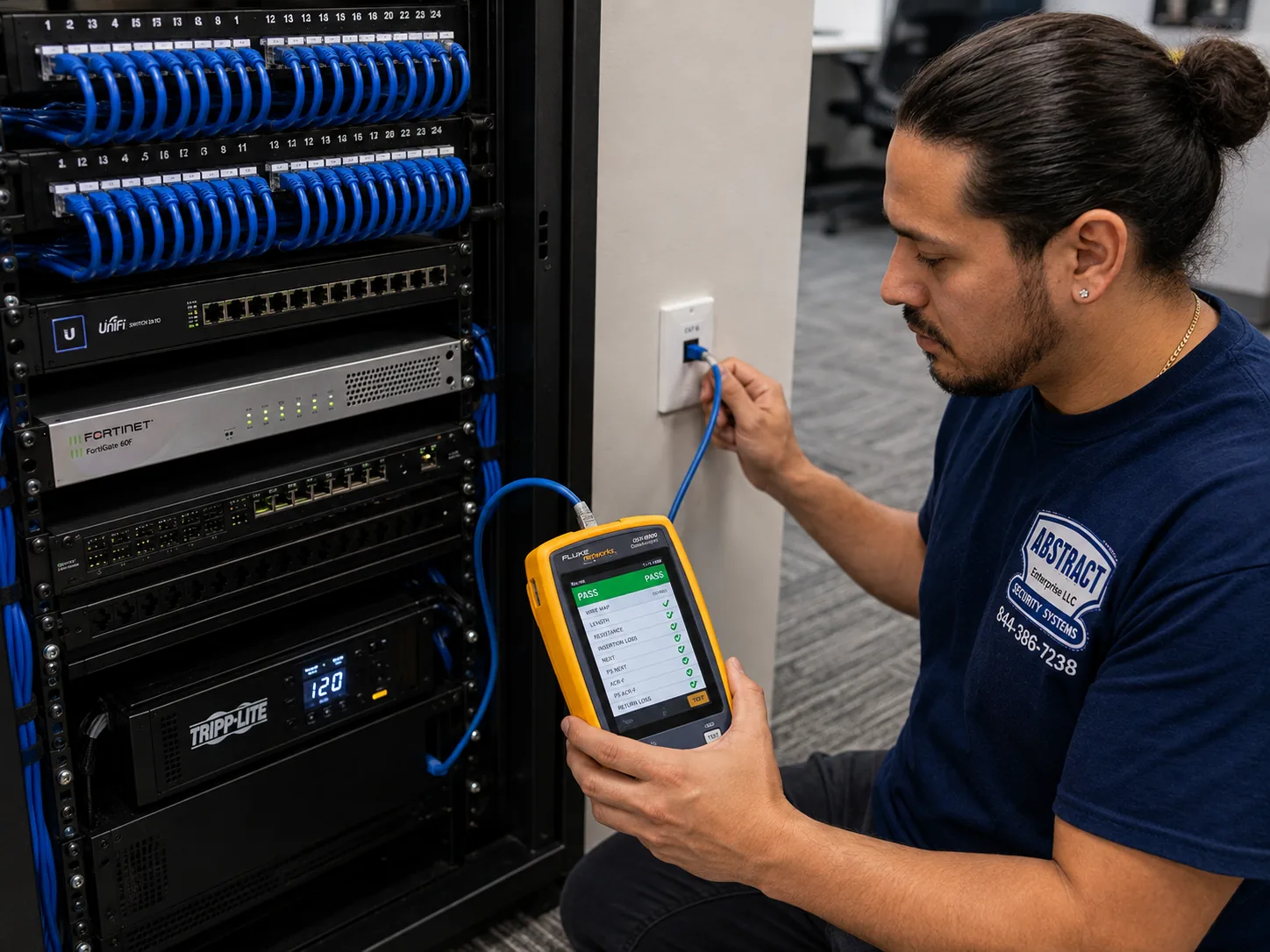
Claremont, Bronx security camera installation job-library photo: a technician certifying a data drop with a cable analyzer that shows a PASS result
Photo from the AESS job library, not taken in Claremont: a technician certifying a data drop with a cable analyzer showing a PASS result. On a walk-up on Clay Avenue, every camera cable that climbs the stair hall is tested like this before the cameras are aimed, so a landing camera that drops out in January is never traced to a bad run sealed inside a plaster wall.
Coverage Area

Security Camera Installation Near Claremont's Landmarks

People in Claremont give directions by the park, the towers and the parkway. These are the places we use to plan visits, and what each one means for camera work around it.

Claremont Park

About 38 acres between East Mount Eden Avenue, Morris and Teller Avenues, East 170th Street and Clay Avenue, rebuilt by the WPA and reopened in December 1940. Buildings facing it need light on their own fronts, since the park edge is dark at night.

Little Claremont Playground

A 0.55-acre Community Parks Initiative site that NYC Parks rebuilt for 3.7 million dollars and reopened in 2019, per the Bronx Times. Nearby entrances see families coming and going into the evening.

Butler Houses and Claremont Village

Six 21-story towers between East 169th and 171st Streets, addressed on Webster Avenue, and the first NYCHA property to get the full 2017 package of new doors, cameras and lights.

Webster Houses and the Metro-North Line

Five 21-story buildings between Webster and Park Avenues and East 168th and 169th Streets, beside the Metro-North tracks. Private buildings across the avenue rely on their own cameras.

Claremont Parkway

Bathgate Place in 1850, Wendover Place in 1890 and Claremont Parkway since 1913, per Forgotten New York, with mixed-use buildings and the new affordable housing at 404 and 415 Claremont Parkway.

Claremont Neighborhood Center

A community anchor founded in 1956, per CityNeighborhoods.nyc. Program and community spaces like it decide their own camera policies.

Around Claremont we also serve Concourse, Bathgate, East Tremont and Crotona Park East, as well as Morrisania and Mount Eden. For the whole borough, see our security camera installation in the Bronx page.

Pricing

Security Camera Installation Cost in Claremont

Every Claremont address is priced on our Bronx rate. We do not print a camera price for the neighborhood, because the jobs here range too widely for one number to be honest: a single camera over a shop door is a short visit, while a six-story walk-up with cameras on every landing, or an elevator building with a PoE cabinet and long cellar runs, is a planned installation over one or more days. What we do instead is quote every job in writing after photos or a walk-through, with each camera, cable run, mount, recorder and setup task listed separately. Estimates are free. The table shows what moves the total, so you know what to send us.

What moves the quoteWhy it matters in ClaremontWhat to send us
Number of entrances and stopping pointsStreet, side, rear, cellar and roof doors each need a camera; mailboxes and the vestibule need identifying viewsA list or photos of every door and the mailbox area
Floors the cable must crossA walk-up stair hall or an elevator building riser means more cable, more openings and more fire-stoppingNumber of floors and where the recorder could live
Distance to the recorder roomLong cellar corridors and corner buildings with separate entrances may need a PoE switchA photo of the cellar and any locked room
Wall and ceiling materialsBrick fronts, plaster halls, block cellar partitions and finished drywall in new buildings all mount differentlyClose photos of the walls where cameras would go
Lighting at nightDark vestibules, landings and yards may need a fixture before a camera is worth mountingA photo of the entrance after dark, if you can
Days of footage to keepMail theft and building incidents are often noticed days later, so retention drives drive sizeHow far back you want to be able to look
Approvals and timingBoards, operators and shop landlords may set conditions and hours for the workWho approves, and any rules on noise or hours
Existing equipmentOld cameras and cable may be reused or need removingPhotos of the old recorder and cameras, with the make if known

Adding a TV to the same visit

Some owners and supers want the camera picture on a wall-mounted screen in an office, or a TV mounted while we are already in the building. Those items come from our verified Bronx TV price list, the only prices printed on this page, and are added to a camera quote only if you ask.

TV item, Bronx ratePrice
TV wall mounting, drywall on wood studs, up to 55 inches (bracket sold separately)$209.99
TV placed on its stand, no wall mount$137.99
Setup-only visit, first hour (then 30-minute blocks)$225
In-wall concealment with code-compliant in-wall power and cable kit$169
Paintable cord cover$59
Soundbar wall-mounted / soundbar placed$129 / $79
Above-fireplace mounting add$130
Brick or stone wall add / plaster wall add$65 / $45
Take down old TV$85

How a Claremont camera quote reads

Picture a six-story prewar walk-up on Fulton Avenue with a cellar and a roof bulkhead. The quote lists an overview camera over the street door and an identifying camera in the vestibule; a camera above the mailbox bank looking outward; cameras on the second, fourth and top landings; one on the cellar door and one inside the bulkhead; the recorder and battery backup in the locked cellar room; each cable run and the surface raceway in the stair hall; the fire-stopping where cable crosses floors; and the logins for owner and super. It also lists, separately, the two dark spots the night walk found. Move the plan to a shop on Webster Avenue and the lines change to a door camera, a counter camera, a back-door camera and a recorder in a locked office, installed before opening. Either way, you see every line before you agree.

Full terms — including 50% deposit, the 30-day warranty and optional paid extended warranty, and the late-fee schedule — are set out in the service agreement.
Shop Our Systems

Security Camera Installation Packages & Pricing

Three common Claremont camera jobs, described by what is included. Each is quoted in writing for your building after photos or a walk-through, because the number of doors, floors and dark spots decides the total.

Starter: Entrance and Mailboxes

For a walk-up, a small mixed-use building or a shop. An overview camera on the street door, an identifying camera in the vestibule or at the counter, and a camera at the mailboxes or back door, cabled to a recorder in a locked spot on battery backup, with the night lighting checked and noted. Quoted in writing.

Standard: Whole Walk-Up

Everything in the starter, plus cameras on chosen stair landings, the cellar door, the rear yard and the roof bulkhead, surface raceway and fire-stopping through the building, labeled cables, and logins for the owner, the super and any board members. Quoted in writing after a day and night walk.

Premium: Elevator or Supportive Building

Lobby, mailroom, elevator lobby, side, rear and service doors, a PoE switch in a locked cabinet, a recorder sized for long retention, a front desk or office monitor with view-only staff access, and work scheduled around tenants. Quoted in writing after a walk-through with the owner or operator.

Bring your own equipment

If your building already owns cameras, a recorder or a monitor, or a board has bought equipment it wants used, we install it as a labor-only job, quoted in writing like everything else. Before anything goes up we check that each outdoor camera is rated for outdoor use, that the recorder supports the cameras and has enough storage for the days you want kept, and that the power and cable plan works for the building. If something is not suitable for where it is meant to go, we say so before we start and show you what would work instead.

Complete Services

Every Security Camera Installation Service in Claremont

Bronx Security Cameras

Our borough page, covering every Bronx neighborhood at the Bronx rate. Security camera installation in the Bronx

Across New York City

The same day-and-night survey in every borough. AESS security camera installation in NYC

West of the Park, Along the Concourse

Elevator buildings on the ridge above Claremont. Concourse security cameras

North and East Toward Tremont

Walk-ups and shops above Claremont Parkway. East Tremont security cameras and Bathgate security cameras

Across Crotona Park

Apartment buildings and houses east of the park. Crotona Park East security cameras

Get a Quote

Send photos of your doors and mailboxes and tell us who manages the building. Request a free quote

FAQ

Claremont Security Camera Installation FAQ

Does whoever installs our building's cameras need a state license, or can the super put them up?
+

NYC Business describes a New York State Department of State license as required to install, service or maintain security or fire alarm systems, and the Kirschenbaum law firm writes that it covers CCTV used to detect or monitor intrusion, theft or movement. A super who is an employee doing small jobs is a question for your attorney, but a company or handyman paid to install a camera system should be licensed. AESS works under NYS license #12000287431.

Our lobby camera has been dead for months and packages keep vanishing. Can tenants make the landlord repair it?
+

Not on the strength of the camera alone. Brick Underground has reported that no city law requires rental buildings to have working security cameras. Tenants can still ask in writing, raise it through a tenant association, and push on the door, lock and mailbox problems that other rules do cover. If the owner agrees to fix the system, we can trace the fault and quote the repair in writing.

Where is a camera in a New York building actually against the law, not just bad manners?
+

New York Penal Law section 250.45 makes it a crime to install a camera where people have a reasonable expectation of privacy without their consent, such as a bathroom, a changing area or inside someone's home. That is why we never put cameras in restrooms or washing areas, and why hallway and light court cameras are aimed and masked so they cannot see into apartments. Anything near that line, we refuse.

My lease says nothing about cameras. Can my landlord still make me take down a doorbell camera I stuck on my apartment door?
+

Possibly. The hallway is a common area the landlord controls, and guidance on NYC rentals describes doorbell cameras as a gray area that many landlords tolerate but can object to. A lease that is silent is not the same as permission. The safest route is to ask the landlord in writing and keep the answer, and to make sure the camera sees only your own doorway.

Is the camera built into our video intercom panel treated as security equipment under the state license rules?
+

The Kirschenbaum law firm has written about exactly this question, whether a video access or intercom system counts as security equipment that needs an alarm license, and its answer turns on what the system does and whether it is used to monitor for intrusion. Because the answer depends on the system, the simplest course for a building is to use a licensed company for any work that includes cameras.

A Parkside Houses tenant was told her cameras broke her lease. Could the same thing happen in Claremont Village?
+

It could if a camera goes beyond what NYCHA allows. AOL reported in 2012 that a Parkside Houses resident was told she had breached her lease by installing cameras. Butler, Webster, Morris and Morrisania Houses are NYCHA developments under the same authority. Before buying anything, ask your management office what may go on your own door, and never mount anything in a hallway, stair or lobby.

Will the work leave holes in the original tile and marble of our 1920s lobby?
+

We plan to avoid it. Lobby cameras usually go on the plaster ceiling or the plain wall above the tile line, and cable is fed from the cellar below or run in a painted raceway along a plain surface. Where a mount has to touch stone or tile, we show you the spot first, drill slowly with the right bit, and keep the number of holes to the minimum the bracket needs.

Can you work in an occupied building without shutting down the intercom or the elevator?
+

Yes. Camera work runs on its own low-voltage cable and does not need the intercom or elevator turned off. We keep the lobby passable, work floor by floor in the stair hall, clean up as we go, and agree noisy drilling hours with the owner or super in advance. If a camera needs to share a box or pathway with the intercom, we tell you beforehand.

Can the picture from our intercom's door panel be saved on the camera recorder?
+

Some newer video intercom panels can send their video to a network recorder, and many older ones cannot. We check the make and model of your panel on the survey. If it cannot be recorded, a separate camera inside the vestibule aimed at the same doorway usually gives a better picture anyway, and it keeps recording even when nobody presses a button.

If the building decides later that it does not want a particular camera, can it come down cleanly?
+

Yes. We take the camera and bracket down, pull the cable back if it is reachable or cut and cap it neatly if it is sealed inside a wall, and fill and seal the mounting holes. Because every cable is labeled at the recorder end, the super can see which port went with that camera and reuse it later if the building changes its mind.

Can a stairwell camera go up without blocking the exit sign or a sprinkler head?
+

Yes, and we place it that way on purpose. Stair cameras go on the wall or ceiling clear of exit signs, emergency lights, smoke detectors and any sprinkler heads, so nothing they need is covered or shaded. We note each of those devices on the survey before choosing the mounting spot, and keep the camera and its cable out of the walking path on every landing.

Get In Touch

Request a Free Quote

Tell us the address, the type of building, who manages it and which doors you want covered. Photos of the street door, vestibule, mailboxes and any rear or roof door make the quote exact. Prefer to talk? Call (646) 490-0629.

✅
Request Sent!
We'll call about your Claremont cameras the same business day.

More Security Camera Installation near Claremont

Security Camera Installation Bronx | No Monthly Fees · Security Camera Installation NYC | Licensed Installer · Security Cameras Installed in Manhattan · Brooklyn Security Camera Installation · Security Camera Installation Queens NY · Staten Island Security Camera Installation · Long Island Security Camera Installation NY · Hudson Valley Security Cameras · Security Camera Installation Nassau County NY · Security Camera Installation Suffolk County NY · Westchester Security Camera Installation · Rockland County Camera Installation · Orange County NY Security Cameras · Putnam County Camera Installation · Dutchess County Security Cameras · Ulster County Security Camera Installation | Kingston NY

Security Camera Installation Allerton Bronx NY · Security Camera Installation Bathgate, Bronx NY | AESS · Security Camera Installation Baychester Bronx NY · Security Camera Installation Bedford Park Bronx NY · Security Camera Installation Belmont Bronx NY · Security Camera Installation Bronx | No Monthly Fees · Security Camera Installation Bronx River, Bronx NY · Security Camera Installation Bronxdale Bronx NY · Security Camera Installation Bronxwood Bronx NY · Security Camera Installation Bruckner Bronx NY · Security Camera Installation Castle Hill Bronx NY · Security Camera Installation City Island Bronx NY · Security Camera Installation Clason Point Bronx NY · Security Camera Installation Co Op City Bronx NY · Security Camera Installation Concourse Bronx NY · Security Camera Installation Country Club Bronx NY · Security Camera Installation Crotona Park East Bronx NY · Security Camera Installation East Tremont Bronx NY · Security Camera Installation Eastchester Bronx NY · Security Camera Installation Edenwald Bronx NY · Security Camera Installation Edgewater Park Bronx NY · Security Camera Installation Fairmount Bronx NY · Security Camera Installation Fieldston Bronx NY · Security Camera Installation Fordham Bronx NY

Other services in Claremont

Door Buzzer Repair Claremont Bronx NY | Repeat-Fault Fixes · TV Installation Claremont Bronx NY · Fire Alarm Installation Claremont Bronx NY · Structured Cabling Claremont Bronx NY · Intercom Installation Claremont Bronx NY · Alarm Installation Claremont Bronx NY · Access Control Installation Claremont Bronx NY

Book Your Claremont Security Camera Installation

From one camera over a shop door on Webster Avenue to a full system for a six-story walk-up on Clay Avenue or an elevator building near the Concourse, the job starts the same way: who controls the building, which doors and stopping points matter, whether the light is there, and a written plan that keeps every lens on the building and out of people's homes. Call (646) 490-0629, message us on WhatsApp, or send the quote form, and we will book you within 2 hours.