What are you looking for?
About Us Contact Us Careers Get a Free Quote (800) 486-0943
Pick a service
✅ Got Your Own System?
🎬 Home TheatreQuote 🎶 AV SoundQuote 🔑 Access ControlQuote
Now pick your area
Pick your area
Long Island
Hudson Valley
Services available
Pricing & Tools
Pick a service for pricing
🚪 Intercom Pricing 🔔 Buzzer Repair Pricing
Calculators
📹 Camera System Calculator 🚨 Alarm Calculator ⚡ Cabling Quote Builder ✅ Got Your Own System?
Select your area
Home › Fiber Optic Installation NYC › Brooklyn › DUMBO
Licensed Low-Voltage Contractor · Water Street to Sands Street · Concrete Factories, Timber Warehouses & Lofts

Fiber Optic
Installation in
DUMBO

Loft & Office Backbones · Slab Coring With Scanning · Bridge-Side Rack Planning · Flood-Aware Entries · OTDR Certification

In DUMBO the glass is the easy part. The hard part is the building around it: a century-old reinforced-concrete Gair factory, a Civil War–era brick-and-timber warehouse on Water Street, a landmarked block under the Manhattan Bridge where the trains shake the floor, a waterfront cellar that flooded in 2012. We plan owner-side fiber for DUMBO offices, studios and loft buildings around those facts, splice and test every strand ourselves, and work from our Brooklyn office in East Flatbush.

Reviewed and updated October 17, 2026 · Written by Anwar Timothy, NYS licence #12000287431

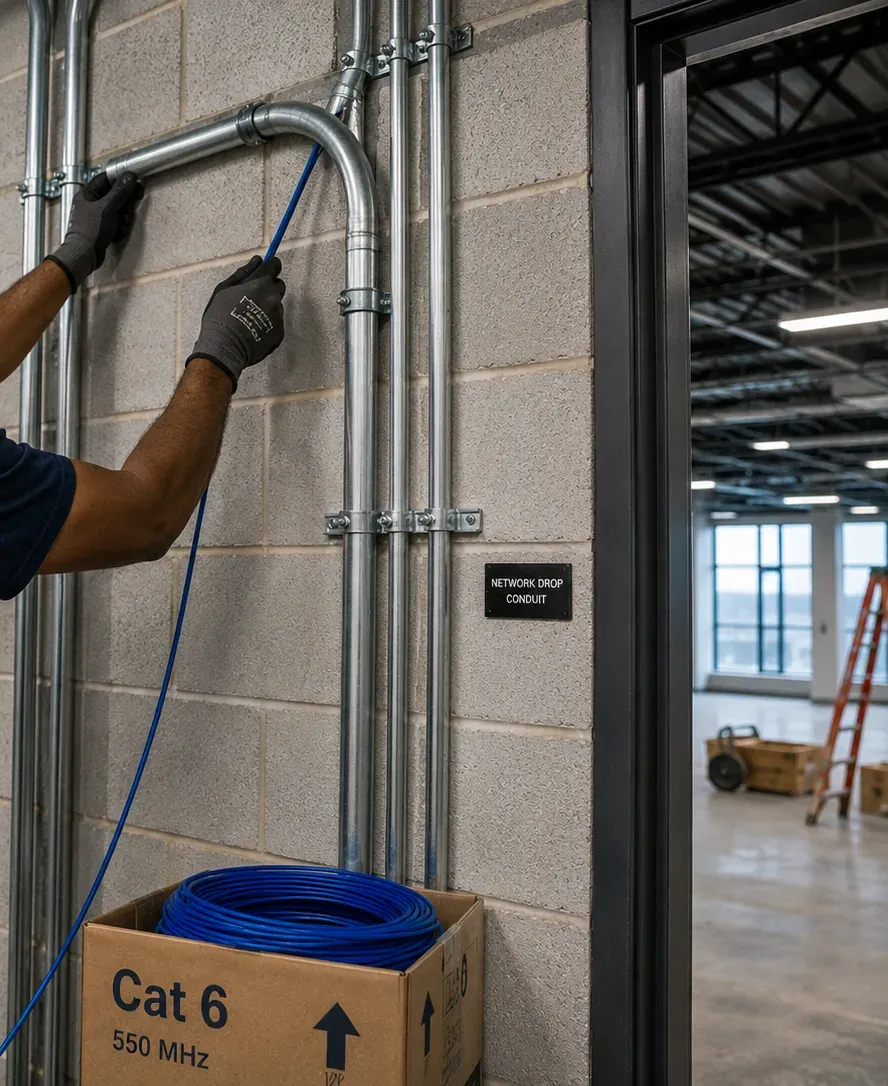
Technician feeding blue cable into the bend of a wall-mounted EMT conduit sweep labelled network drop conduit, a DUMBO, Brooklyn fiber pathway example
Two gloved hands guide a blue cable into a bend of galvanised conduit on a block wall marked with a small “Network Drop Conduit” plate; an open, unfinished floor with steel roof framing shows through the doorway.
DUMBO Fiber Quote
Building, floor and what sits at each end — a Brooklyn tech calls back the same business day

✅
Request Sent!
A Brooklyn tech will call you back the same business day.
25+
Years Experience
✓
Same-Day Estimates
100%
Licensed & Insured
4.7★
201 Google Reviews

Tell us the building and the floor. In DUMBO that one fact tells an installer half of what the job involves — concrete or timber, landmarked or not, river-level cellar or a carrier room upstairs. Call the Brooklyn line at (347) 934-8335 or use the 60-second form.

  • Free walkthrough of the real route, from the carrier's entry to your far wall
  • Our own technicians splice every strand, inspect each end face and hand you the measured numbers
  • NYS licence #12000287431 · Brooklyn office at 1282 Troy Ave
The Neighborhood

Why DUMBO Properties Need Fiber Optic Installation

DUMBO was built to make and store things. The Landmarks Preservation Commission's designation report describes a waterfront district of warehouses and factories put up between the mid-nineteenth and early twentieth centuries, in three main ways of building: brick walls around "slow-burning mill construction" of massive wooden columns and beams, brick with steel frames, and early reinforced concrete. Robert Gair, the paper-box manufacturer, built so much of it that the area was once known as Gairville. Today those same buildings hold more than a thousand creative and technology companies, according to the DUMBO Improvement District, and the networks those companies run have nothing in common with the freight the floors were designed for.

That gap is where fiber comes in. A design studio on the fourth floor of a concrete factory wants its server room, its edit suites and its second floor joined at full speed; a residential loft building wants one tidy path from the carrier's entry in the cellar to every unit; a company that takes floors in two of the former Watchtower buildings wants them to behave like one office. Copper can do some of that, but in buildings with long floor plates, thick slabs and few vertical shafts, a small fiber cable is usually the only thing that can make the trip without a fight.

The fight is with the building itself. Concrete floors poured more than a century ago carry reinforcing that has to be found before anyone cores a hole. Timber beams and brick walls are the reason people lease these spaces, so landlords guard them. Since December 2007 most of the neighbourhood has sat inside the DUMBO Historic District, which puts anything fixed to the outside of roughly 91 buildings under Landmarks review. The Manhattan Bridge carries subway trains over the middle of the district, and the MTA's own measurements inside nearby homes show what that means for anything mounted to a wall. And the blocks nearest the river flooded when Sandy came in.

None of this makes fiber hard to justify in DUMBO. It makes it worth planning properly. We start every job by identifying the building type and what it allows, then design the route, the enclosures and the entry around it. Many DUMBO clients bring us in alongside their DUMBO structured cabling scope, so the fiber backbone and the copper to each desk are designed as one system rather than two contractors' guesses.

DUMBO facts that shape a fiber job

  • December 18, 2007: the Landmarks Preservation Commission designated the DUMBO Historic District, with approximately 91 buildings between John, Adams, Plymouth, Main, Water, Front, York, Washington, Pearl, Jay and Bridge Streets.
  • 1,000+ creative and tech companies and 11,266 employees (2022) in what the DUMBO Improvement District calls the Tech Triangle, across about 6 million square feet of commercial space and 15 office buildings.
  • 1914: Gair's building at 1 Main Street, the Clocktower Building, was the tallest reinforced-concrete building in the world when it went up, according to the Improvement District's building history.
  • 94.76 dB(A): the loudest train pass the MTA recorded inside a home at 135 Plymouth Street during its DUMBO noise measurements, transmitted in January 2024.
  • $108 million and 26 blocks: the city's Belgian block, sewer and water-main reconstruction across DUMBO, begun in 2019 and finished in December 2025.
  • 5 feet of water in the basement that housed the electronics for Jane's Carousel in Brooklyn Bridge Park during Sandy, as CBS New York reported.
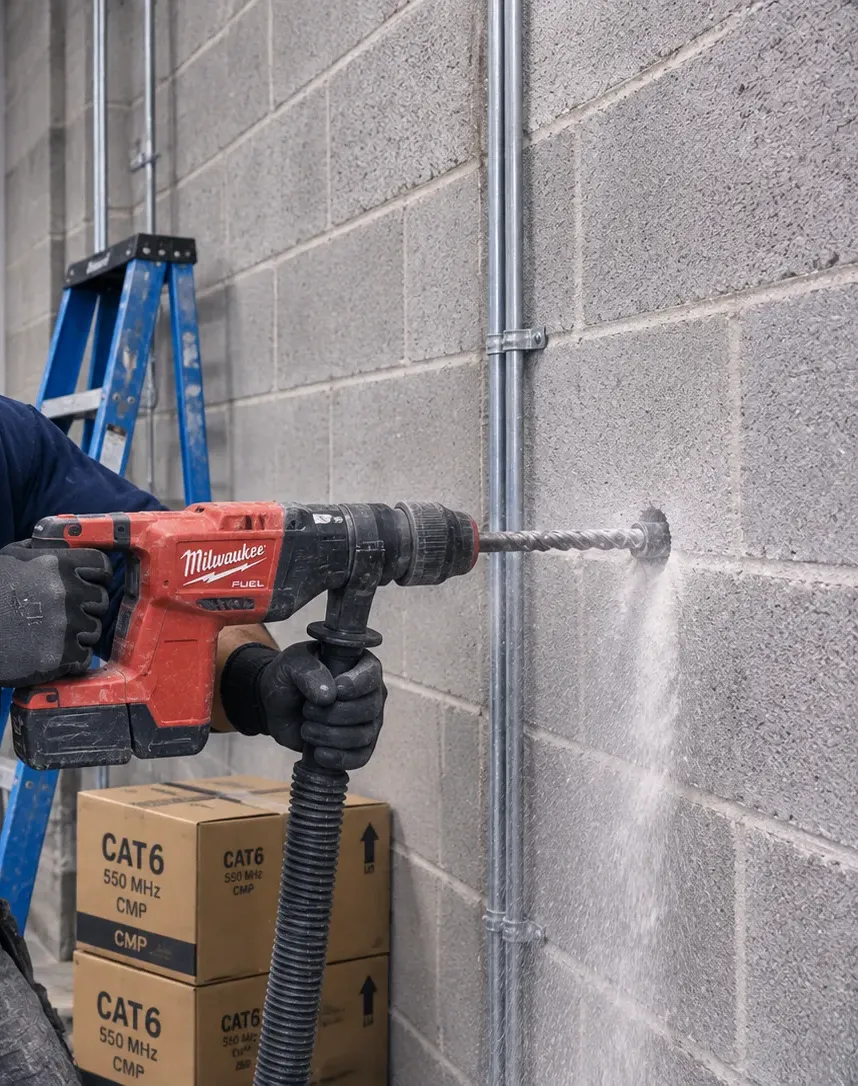
Gloved hands drilling a concrete block wall with a hammer drill and vacuum hose beside wall-mounted conduit for a DUMBO, Brooklyn fiber optic installation
A gloved technician drives a red hammer drill into a grey block wall, a dust-extraction hose hanging from the tool, with a run of EMT conduit beside the bit and boxes of cable stacked under a blue ladder.
Repair Capture

DUMBO Fiber Link Dropped Today

Studios here rearrange constantly, and things get broken: a neighbour's contractor drills into a ceiling run, a desk on castors pinches a cord, a rack clean-up leaves one link dark. We handle that as a separate repair call, not as a new install. We aim to dispatch the same day across DUMBO, and most single faults — a broken pigtail inside an enclosure, a connector mated dirty, a cord pinched under a rack door — are found and fixed in one to two hours once a technician is in the room. Call (347) 934-8335 and say "fiber repair," or see our Brooklyn network cable repair service for faults on copper.

What We Install

Fiber Optic Installation Services in DUMBO

Owner-side and tenant-side fiber only. The carrier brings service to its handoff in your building; we carry it to where your network actually lives, inside the rules of a landmarked, river-edge neighbourhood.

Studio and Office Backbones

A small multi-strand cable from the carrier handoff to your server or network room, and on to a second room or floor, for the design, media and software companies that fill DUMBO's converted factories.

Floor-to-Floor Links in Concrete Buildings

Links between floors of a Gair-era factory, through an existing sleeve where one exists or a scanned, cored and firestopped penetration where it does not.

Suite-to-Suite Connections

Fiber between two suites a company holds on different floors or wings of one building, so a growing tenant runs one network rather than two internet services.

Loft Building Backbones

When a converted factory becomes homes, the board can own the path: glass from the entry room up through each landing, so whichever internet company a resident picks plugs in rather than drills.

Carrier Entry Extensions

Carrying a provider's service from a low entry room to a telecom room or suite higher in the building, with nothing sensitive left at cellar level.

Bridge-Side Rack Planning

Choosing where racks and enclosures go in buildings near the Manhattan Bridge, and how they are fixed, so that constant vibration does not work connectors or cords loose.

Fusion Splicing and Termination

Pigtails spliced into wall and rack enclosures, unfinished cable from an earlier fit-out terminated, and mid-span repairs after a cut.

Flood-Aware Relocation

For buildings near the river: the first enclosure and the switches move up a floor, the pipes through the foundation get sealed, and the whole link is measured again.

Testing and Records

A file that outlives your lease: measured loss per strand, traces where the run is long, end-face checks, matching labels at each end and a drawing of where the cable goes.

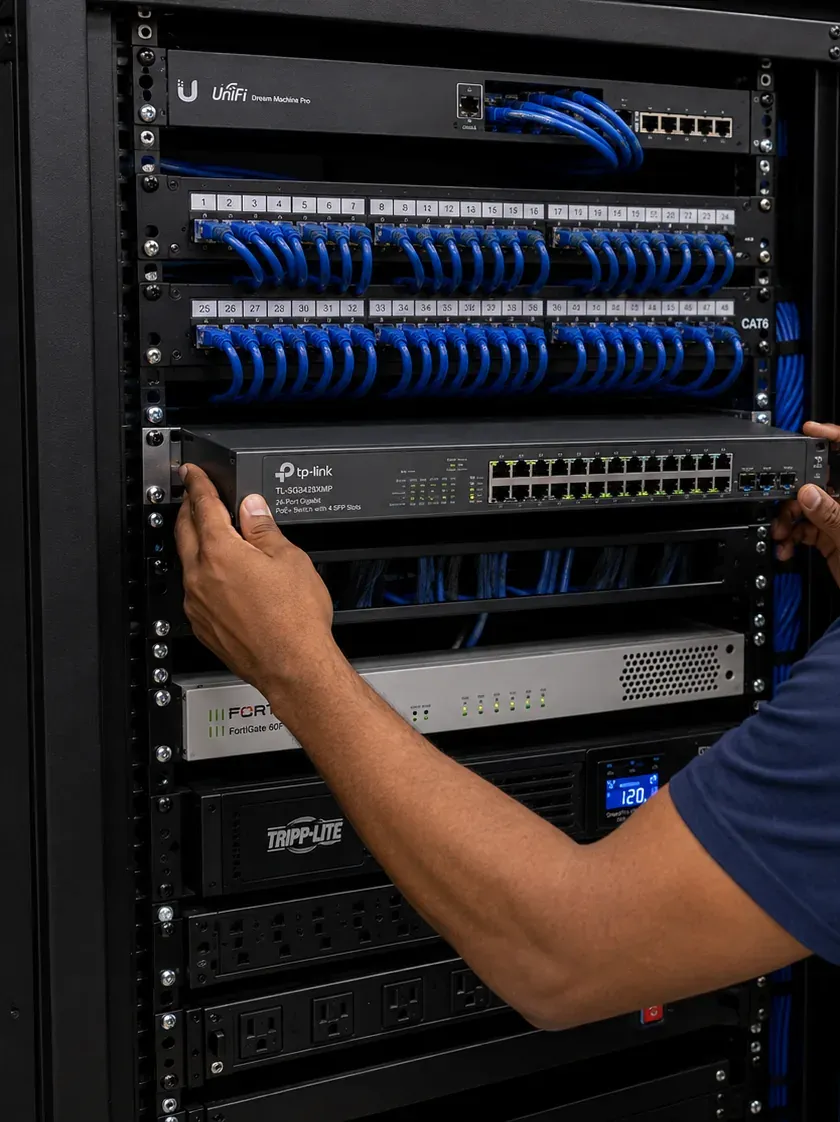
Hands sliding a rack-mount PoE switch with SFP slots into place below numbered patch panels in a DUMBO, Brooklyn network rack
A technician’s arms slide a rack-mount switch into place under two rows of numbered patch panels, with a firewall, a UPS and power strips below — the kind of switch whose SFP slots take a fiber uplink.
Building Specialists

Fiber Optic Installation for DUMBO's Architecture

DUMBO's building stock is narrow in age and wide in method. Six types cover almost every job we see between the bridges and up the hill to Sands Street.

Gair Reinforced-Concrete Factories

Robert Gair's factories along Washington, Main and Front Streets, built with the Turner Construction Company from 1904 on: 55 Washington Street (1905), 1 Main Street (1914), 45 Main Street (1919). Heavy concrete floors and columns, big windows, few shafts. Fiber goes through existing sleeves or carefully scanned cores.

Brick and Timber Warehouses

The oldest stock, near the water: Empire Stores at 53–83 Water Street, seven brick warehouses built in 1870 and 1885, and 45 Water Street, a brick-and-timber tobacco inspection warehouse of 1870 now home to St. Ann's Warehouse. Exposed beams and masonry everyone wants left untouched.

Steel Frame With Concrete Floors

Transitional buildings such as 68 Jay Street, a 1915 brick building with a steel frame and reinforced-concrete floors, first a warehouse for tea. Vertical paths often follow old freight and service openings.

Dumbo Heights Office Buildings

The former Jehovah's Witnesses buildings on Sands, Adams, Prospect and Pearl Streets, redeveloped as an office campus whose base-building redevelopment its contractor puts at 1.2 million square feet. Modern risers, management rules, several tenants per building.

Residential Loft Conversions

Factories turned into condominiums and rentals, where a board or managing agent decides how carriers reach the units and the cellar is often the only entry point.

Newer Towers at the Edge

Taller residential buildings on the district's edges, such as the 33-storey J and 23-storey Beacon Tower named in local reporting, with dedicated telecom rooms and riser paperwork closer to a Downtown tower than to a loft.

How the method changes with the building

Concrete factories. The first question is always whether a hole already exists. Old pipe sleeves, abandoned freight-elevator and dumbwaiter openings, and the paths earlier tenants used for their own cable are reused wherever the landlord allows, because a slab poured in 1905 or 1914 is not something to core casually. Where a new penetration is unavoidable we scan the slab first to find reinforcing and anything else inside it, core the smallest hole that will take a sleeve, and firestop it before we leave. The landlord sees the location in writing before the drill arrives.

Timber warehouses. Here the beams and brick are the selling point of the space. Cable is carried on supports clamped to existing hangers, strut or pipe rather than screwed into the timber, and kept in a neat raceway or innerduct so it reads as deliberate rather than as clutter. Where cable has to cross rough brick or stone, it goes in a sleeve or protective conduit, because a jacket rubbing on an old masonry edge for years eventually wears through.

Office conversions on the hill. The Dumbo Heights buildings run more like a Downtown office campus: risers, telecom rooms, a management office with contractor rules, insurance certificates and set working hours. The fiber design follows the building's book, and the planning is about getting approvals in place at the same time as the proposal.

Residential lofts. The board or managing agent is the client even when a resident made the call. The design is usually one backbone with spare strands, enclosures on each floor in a common area, and a clear record of who owns what, so the next provider or the next board can work with it. Buildings that are wiring a new entry often pair it with DUMBO intercom installation on the same visit.

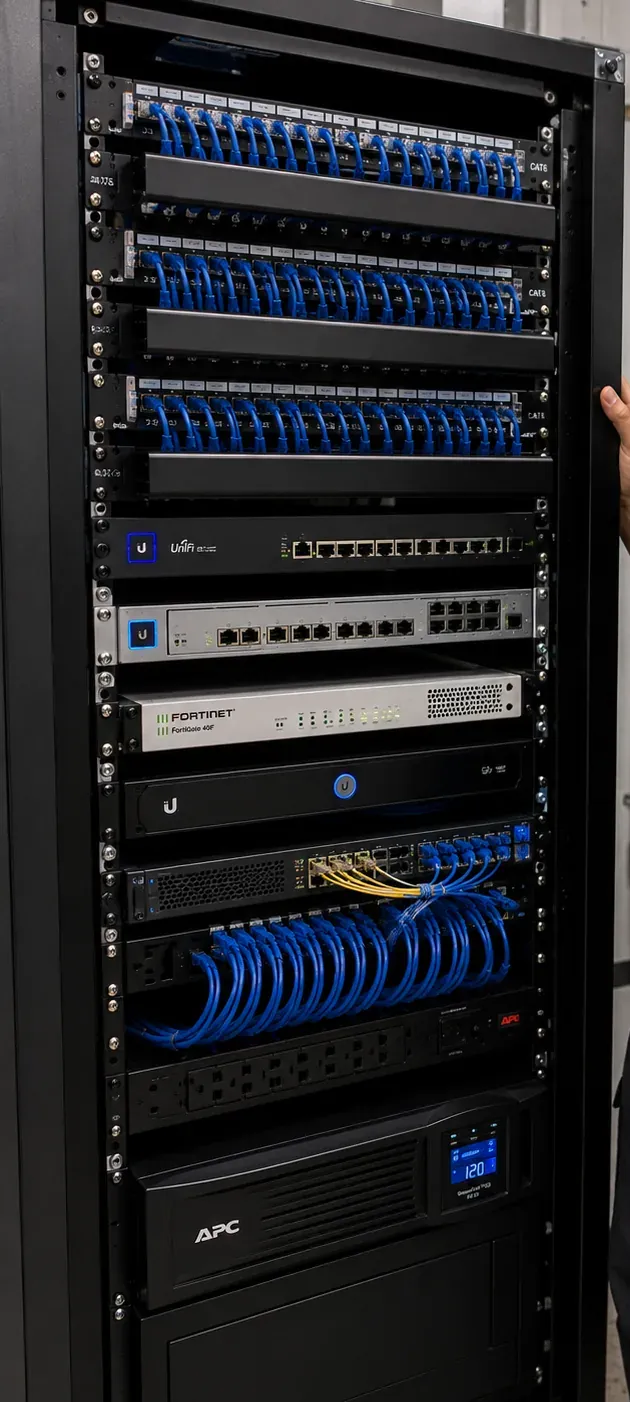
Tall finished network rack with patch panels, switches, a small bundle of yellow jumpers and a UPS at the base in a DUMBO, Brooklyn equipment room
A full-height rack: three patched panels at the top, switches and a firewall in the middle, a short run of yellow jumper cords on one panel and a battery backup unit at the bottom.
Commercial Fiber Optic Installation

Business Fiber Optic Installation in DUMBO

Commercial fiber in DUMBO clusters on a handful of streets. Each has its own building type, landlord habits and reason for wanting glass.

Water Street and the River Edge

Empire Stores, St. Ann's Warehouse and the warehouses facing Brooklyn Bridge Park. Thick brick, timber interiors, offices and venues sharing old buildings, and the lowest ground in the neighbourhood — flood planning comes first here.

Washington and Main Streets

The heart of Gairville, with 55 Washington Street, 1 Main Street and 45 Main Street. Large concrete floor plates filled with design, media and technology tenants who lease, grow and move on within a few years.

Front and York Under the Bridge

Ground-floor shops, galleries and offices in the shadow of the Manhattan Bridge, where the York Street F station recorded 3.47 million riders in 2024. Racks and enclosures here are planned for vibration.

Jay, Adams and Plymouth Streets

The eastern blocks, with buildings such as 68 Jay Street and the converted factories along Plymouth, where the Landmarks survey noted rail tracks in the roadbed and long freight-scale floors favour fiber over copper.

Dumbo Heights: Sands, Prospect, Adams and Pearl

The former Watchtower buildings at 55 and 81 Prospect, 77 Sands, 117 Adams and 175 Pearl Streets, now offices and coworking. Etsy moved its headquarters into 117 Adams Street in 2016, according to business press at the time.

Old Fulton Street and Fulton Ferry

The western edge by the Brooklyn Bridge, with older warehouses at 11 and 15 Old Fulton Street and 1 Front Street, which was brought back to life in the late 2000s, plus small offices and hospitality businesses serving the park's busiest entrance.

Compliance callouts for DUMBO fiber

  • Landmarks. Inside the DUMBO Historic District, and in the neighbouring Vinegar Hill Historic District, work that affects a building's exterior falls under the Landmarks Preservation Commission. We design fiber routes to stay entirely indoors.
  • Firestopping. Old DUMBO slabs are full of holes earlier tenants never closed; any opening our cable uses, new or inherited, leaves sealed with a listed product and a photo on file — which near the bridge also helps keep train noise out.
  • Cable rating. Riser-rated cable in vertical paths, plenum-rated cable wherever a ceiling cavity is used as an air return, and indoor/outdoor cable for any section exposed to the cellar's damp or the weather.
  • Permits. Cabling below 50 volts is not generally something the Department of Buildings permits, which leaves a DUMBO landlord's alteration rules and the duty to firestop exactly where they were.
  • Coring. Holes through old concrete slabs are located by scanning, agreed with the owner in writing and kept as small as the sleeve allows.
  • Accessibility. Anything we fix in a shared hallway sits where it cannot reduce the clear width people with wheelchairs or strollers rely on.
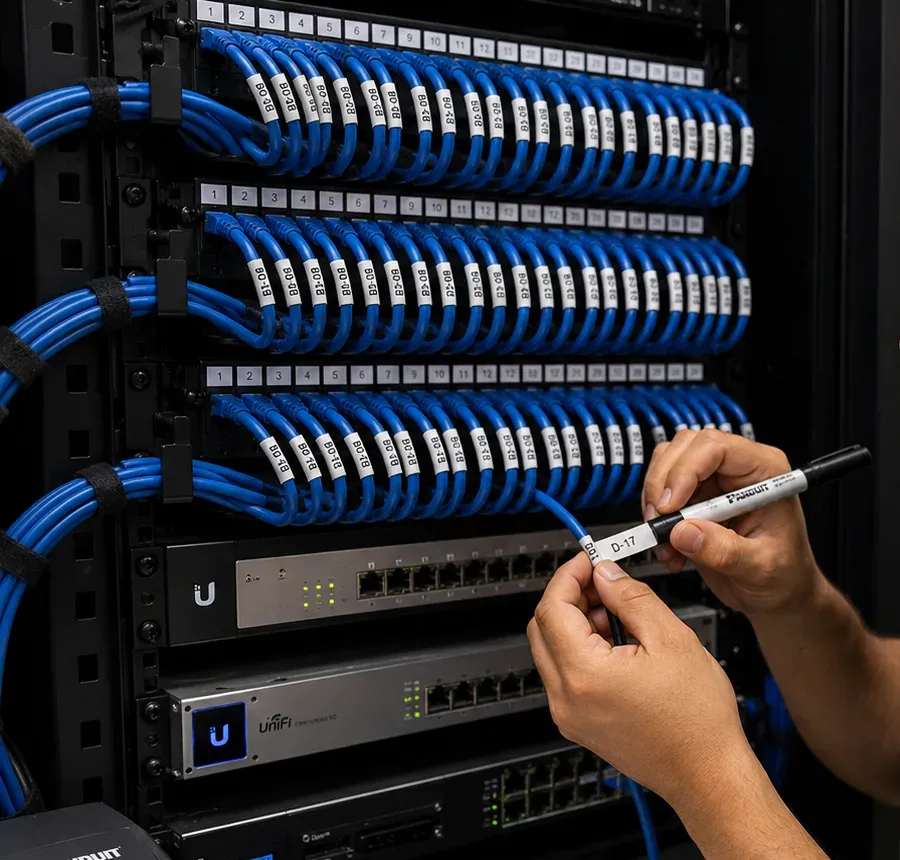
Technician wrapping a printed label onto a patch cord in front of fully labelled patch panels for a DUMBO, Brooklyn cabling closeout
Two hands wrap a printed label around a single patch cord, in front of three panels where every cord already carries its own label.
The Historic District

Fiber in a Landmark District Without Touching the Facade

When the Landmarks Preservation Commission designated the DUMBO Historic District in December 2007, it was protecting exactly what makes these buildings hard to wire: brick facades, the Gair name incised on the buildings, the granite Belgian block streets and the network of rail tracks the Jay Street Connecting Railroad laid along the roadways and, in places, into the buildings themselves. The designation report describes a landscape of industrial architecture with the Manhattan Bridge soaring overhead. It does not describe conduit.

For a fiber installer the practical rule is short. Anything fixed to the outside of a building in the district, such as exterior conduit, a new box on a wall or a sleeve through a visible facade, is a Landmarks question. Work entirely inside the building generally is not, unless the interior itself is designated. So the route always starts indoors: from the carrier's existing entry, through the building's own risers, sleeves and shafts, to the suite. We look for that route first and would rather spend an extra hour finding an interior path than send a client into a Landmarks application for a cable.

The same thinking applies to the streets. Between 2019 and December 2025 the city rebuilt 26 blocks of DUMBO's cobblestone streets, with new storm sewers, water mains and granite curbs, in a project the Landmarks Commission approved for both the DUMBO and Vinegar Hill historic districts. Private utilities helped fund it. For a building owner that means the streets are newly finished, carefully restored and unlikely to be opened lightly. A carrier extending service to a building will work through its own existing conduit and entries; our job begins where their cable enters, and we plan so that the building never needs a second hole in its foundation wall for a provider that could share the first.

Inside, the district's character still shapes the work. Exposed brick, painted Gair concrete and original timber are what tenants pay for. Cable that is visible is run straight, supported neatly and finished to look intentional, or hidden above the ceiling where there is one. And where an old opening exists — a disused chute, a capped pipe sleeve, the gap beside a rail-era freight door — we use it before proposing anything new.

One practical consequence is that the paperwork on a DUMBO job is usually about the landlord rather than the city. A management office or condo board wants to know where each opening will be, how it will be sealed, who is insured and when the noisy work happens. We put all of that in the proposal, with photographs of the proposed locations, so the approval is a single reply rather than a week of questions. When the work is done, the same photographs show each opening sealed, which is the record a landlord keeps for its insurer and for the next tenant.

Under the Bridge

The Manhattan Bridge Overhead: Vibration, Noise and Fiber

Every DUMBO resident knows the sound. The Manhattan Bridge carries subway trains across the middle of the neighbourhood, and the complaints are old: in 2008 the Brooklyn Paper reported that the president of the DUMBO Neighborhood Association had moved away because of the noise from the bridge's trains and traffic. In 2024 the MTA transmitted a memo on noise measurements it had taken inside homes and at public spots across DUMBO. A resident posting in the neighbourhood's own Reddit forum recently put it another way: their triple-paned windows make the trains crossing sound like "a mild, relaxing sigh" compared with the street construction they were complaining about.

Noise does not bother glass. Fiber carries light, so it is not affected by the electrical noise of trains or the power systems around them. But the sound people hear is the audible half of something physical: the structure carrying the trains moves, and buildings close to the bridge and its anchorage feel it. For a fiber link the weak points are mechanical — connectors that can be worked slowly loose, patch cords hanging in a loop that swings, enclosures fixed to a wall that transmits every passing train, and equipment perched on a shelf rather than bolted into a rack.

Location measured (MTA, DUMBO memo transmitted January 18, 2024) Trains measured Loudest train pass
135 Plymouth Street (home) 357 94.76 dB(A)
56 Adams Street (home) 520 94.66 dB(A)
68 Jay Street (home) 503 90.37 dB(A)
98 Front Street (home) 323 83.93 dB(A)
133 Water Street (home) 472 80.36 dB(A)
Front Street and Pine Street, at the anchorage 30-minute sample 94.4 dB(A) against a 68.2 dB(A) background

Those are sound levels, not vibration readings, and we do not pretend they measure how much a given floor moves. They do show which blocks live closest to the bridge. In buildings there we plan the hardware accordingly: switches and media converters bolted into a four-post or wall-mount rack rather than resting on shelves, patch cords cut to length and dressed into managers so nothing hangs free, splice trays fully seated and enclosure doors latched, and service loops coiled and secured rather than left loose. Where a rack is going in fresh, we prefer an interior wall or a floor-standing position over a shared wall with the bridge side of the building.

The MTA memo also records that one suggested fix, changing the joints between the rails, was judged infeasible. In other words, the trains are not going anywhere. A link installed with that in mind will run for years without anyone thinking about it; one installed as if it were in a quiet suburban office may start dropping intermittently for reasons nobody can find. When we are called to an unexplained intermittent fault near the bridge, a loose connector or a cord rubbing on a rack edge is one of the first things we check.

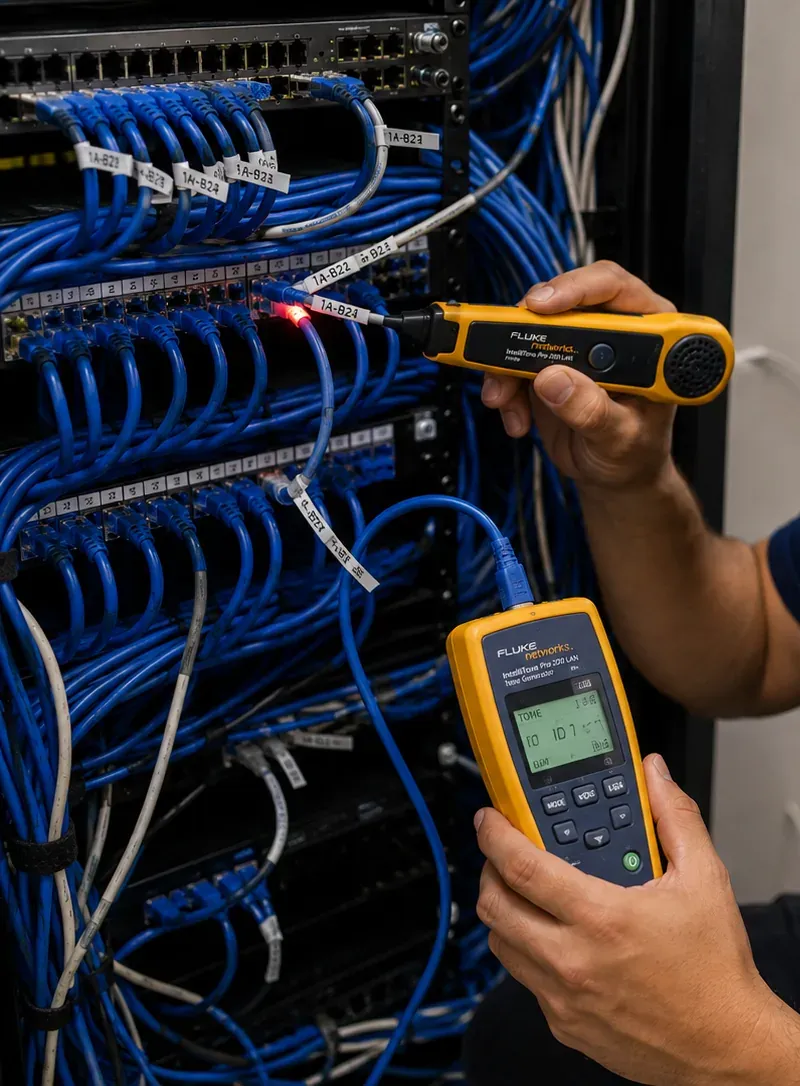
Technician holding a tone probe to a labelled cable at a crowded patch panel while a handheld tester is connected, during DUMBO, Brooklyn network work
One hand holds a yellow tone probe against a labelled cable at a dense panel, the other holds a handheld tester plugged into the same run — finding out what is live before anything is moved.
Your Questions Answered

Fiber Optic Installation in DUMBO: Questions Answered

Walk a DUMBO building with its tenants, landlord or board and the same questions keep coming back. They are sorted here by what prompts them — the concrete, the bridge, the river, the streets and the people who share the floors — and answered directly underneath. Quick questions on price, coverage and timing sit in the FAQ near the end of the page.

Concrete floors and timber warehouses

Our Gair-era factory floor still has openings left by old freight lifts, chutes and pipes — can new fiber use those instead of fresh cores through the slab?

Usually, and it is the first thing we look for. Gair's buildings were among the earliest large reinforced-concrete factories in the city — the Improvement District's history calls 55 Washington Street, of 1905, his first and the largest of its kind at the time — and a century of tenants has left them full of openings: sleeves from removed plumbing, squares where a dumbwaiter or chute once ran, and paths an earlier company cut for its own cable. A fiber cable is a fraction of the size of the pipes those openings were made for, so one of them can often carry it with room to spare, once the landlord agrees.

Reusing an opening is not the same as ignoring it. We check what else already passes through, whether it lines up floor to floor, and whether it was ever sealed. Then the cable goes in a sleeve where the edges are rough, and the whole opening is closed with a listed firestop system and photographed. Only when no usable opening exists do we propose a new penetration, scanned first and agreed in writing.

Can fiber follow the heavy timber beams of a Water Street warehouse without being fastened into the wood?

Usually, yes. The brick-and-timber warehouses near the river — Empire Stores and 45 Water Street among them — were built with massive wooden beams and columns that today's tenants and landlords treat as the best feature of the space. Screwing cable supports into them is the quickest way to get a request refused. Instead we hang the cable from what is already there: beam clamps on existing steel, the sprinkler contractor's hanger rods where the building permits it, strut fixed at the walls, or a slim raceway along the line of a beam rather than across its face.

Where the run has to be visible, it is laid straight and parallel to the timber, in a raceway or innerduct colour the landlord approves, with supports at an even spacing. Fiber's light weight helps here: a small cable needs far less support than a bundle of copper, so the pathway can stay discreet.

How is cable protected where it has to cross rough brick and stone in a Civil War–era warehouse?

With a sleeve, a bushing or a short length of conduit at every edge it touches. Old masonry is hard and uneven, and the openings in it were often cut by hand. A cable jacket pulled tight across a sharp brick or stone edge will be fine on the day of installation and worn through years later, especially where something nearby moves — a door, an air handler, or the building itself under a passing train.

So every place the cable passes through or around masonry gets a smooth, protected bearing surface, and runs along walls are held off the brick by their supports rather than lying against it. For links that leave a conditioned space for a damp cellar or a shared alley wall, the section is armored or indoor/outdoor rated as well. It is a small detail that separates a link that lasts from one that fails without warning.

Living under the bridge

Where should the rack and splice enclosures go in a loft that shakes every time a train crosses the Manhattan Bridge?

Somewhere solid, and fixed properly. The glass itself does not care about vibration or electrical noise from the trains; the risk is mechanical. Equipment resting loose on a shelf creeps, a patch cord hanging in a long loop swings and works at its connector, and an enclosure screwed to a thin partition shares every tremor the partition picks up. In buildings close to the bridge we put racks on an interior wall or floor-standing frame rather than against the bridge-side wall where there is a choice, bolt every switch and converter into the rack, and use enclosures with latched doors and fully seated splice trays.

Cords are cut to length and dressed through managers so nothing hangs free, service loops are coiled and secured, and connectors are inspected and cleaned before mating so they seat cleanly. None of this is expensive. It is the difference between a link that runs untouched for years and one that drops intermittently for reasons nobody can trace.

After the water: where equipment lives

After Sandy our building moved its generator and mechanical gear up high — should the network equipment go up to the roof with it?

Up, yes; onto the roof, usually not. Several DUMBO buildings rethought where critical equipment lives after 2012; Empire Stores, for example, placed a generator on its fifth floor, according to an Urban Land Institute case study. The network should follow that logic and leave the cellar, but switches and media converters are indoor electronics, and a rooftop bulkhead or mechanical room brings summer heat, condensation and weather of its own.

The better home is a dry, ventilated interior room on an upper floor, close to the riser, on a circuit that the building's backup power can reach if the landlord allows it. The fiber from the carrier's low entry is armored through the cellar, sealed where it passes the foundation and carried up without splices, so the only things left near the water are cable and conduit. If the roof is the only option, we specify an outdoor-rated, ventilated enclosure and industrial-temperature equipment rather than an ordinary rack.

What should we do with our fiber equipment when a coastal storm warning goes up for the DUMBO waterfront?

Much less than people expect, if the installation was planned for it. Fiber cable can come through a flood still working; what fails is the equipment and connectors that were sitting low. If the switches, media converters and battery backup are above the flood level and the splice points are upstairs, the storm plan for the network is mostly about power: shut equipment down cleanly if the building expects to lose power, make sure the battery backup is charged, and confirm that someone has a copy of the route map and test results off site.

If anything still sits in the cellar — an old patch panel, a carrier's box the building never moved, a media converter on a shelf by the water heater — that is the thing to ask about before the next warning, not during it. After any flood, we re-test every strand against the baseline taken at installation, so the decision about what to replace is made on numbers.

Streets, landlords and the spaces inside

The cobblestone streets around our building were just rebuilt — can a new carrier still bring fiber in?

In most cases, yes, and the reconstruction does not change who does that work. The city's $108 million project restored 26 blocks of Belgian block streets and replaced sewers and water mains below them between 2019 and December 2025. A carrier extending service to a building normally uses its own existing underground conduit and the building's existing entry, and only the carrier and the city can say whether a particular block needs new street work. Ask the carrier first; that is their side of the line.

What the building controls is everything after the entry. The easiest building for any new carrier to serve is one with a clear, shared path from the existing entry to a telecom room, spare space in a sleeve or innerduct, and an owner-installed backbone that a second or third provider can use without drilling another hole in the foundation. That is the part we build, and it means the building's newly restored street frontage never has to be the bottleneck.

We own a DUMBO loft building and are leasing floors to tech tenants — what should we be able to show prospective tenants about the building's fiber?

A short, factual sheet, and the test results behind it. Tenants' IT people want to know which carriers are already in the building and where they hand off, whether there is an owner-installed backbone to each floor and how many spare strands it has, where the floor enclosure sits relative to the space on offer, and what the rules are for a tenant's own contractor. If you can answer those in one page, with loss and OTDR results for the backbone attached, the conversation moves from "will this building work for us" to "when can we move in."

If you cannot answer them yet, that is the job to do before the next showing. We can survey and test what the building already has, label it, and tell you what it would take to put an enclosure with spare strands on every floor. In a neighbourhood where the Improvement District counts more than a thousand creative and technology companies, a building that is visibly ready is easier to let.

Our gallery wants a video work on a far wall with no visible cable — can fiber carry the signal from a back room?

Yes. Video, audio and control signals can travel over fiber from a media player or computer in a back room to a small receiver hidden behind the screen, projector or wall, using converters chosen for the equipment the artist or technician specifies. The cable itself is small enough to run above a ceiling, behind a false wall or along a skirting route that visitors never notice, and it is not disturbed by lighting dimmers or amplifiers nearby.

Two things decide whether it works cleanly: the receiving end needs power and somewhere ventilated to sit, and the converter pair has to match the resolution and connection the work uses. We install and certify the fiber, terminate it in the connector the AV supplier wants, and coordinate with whoever installs the work so the hardware matches the glass. Between shows the same strands can serve the next installation.

Residents and community networks

Can our DUMBO loft building connect to a community network such as NYC Mesh, and what wiring would that take?

It can, if the building and the network agree terms. NYC Mesh says it works with management companies, helps with the lease and insurance paperwork, and that its fiber connections require a fiber lease. Whichever network a building chooses, the building-side need is the same: a protected path from wherever the network's equipment lands to a room the building controls, and from there to the floors and units that want service.

That is ordinary owner-side backbone work, and it is worth designing once for every provider. A board that installs one backbone with spare strands can let a community network, a commercial carrier and a future provider all use the same riser, instead of adding a new cable for each one. We install and certify that backbone and leave the network's own equipment and configuration to them.
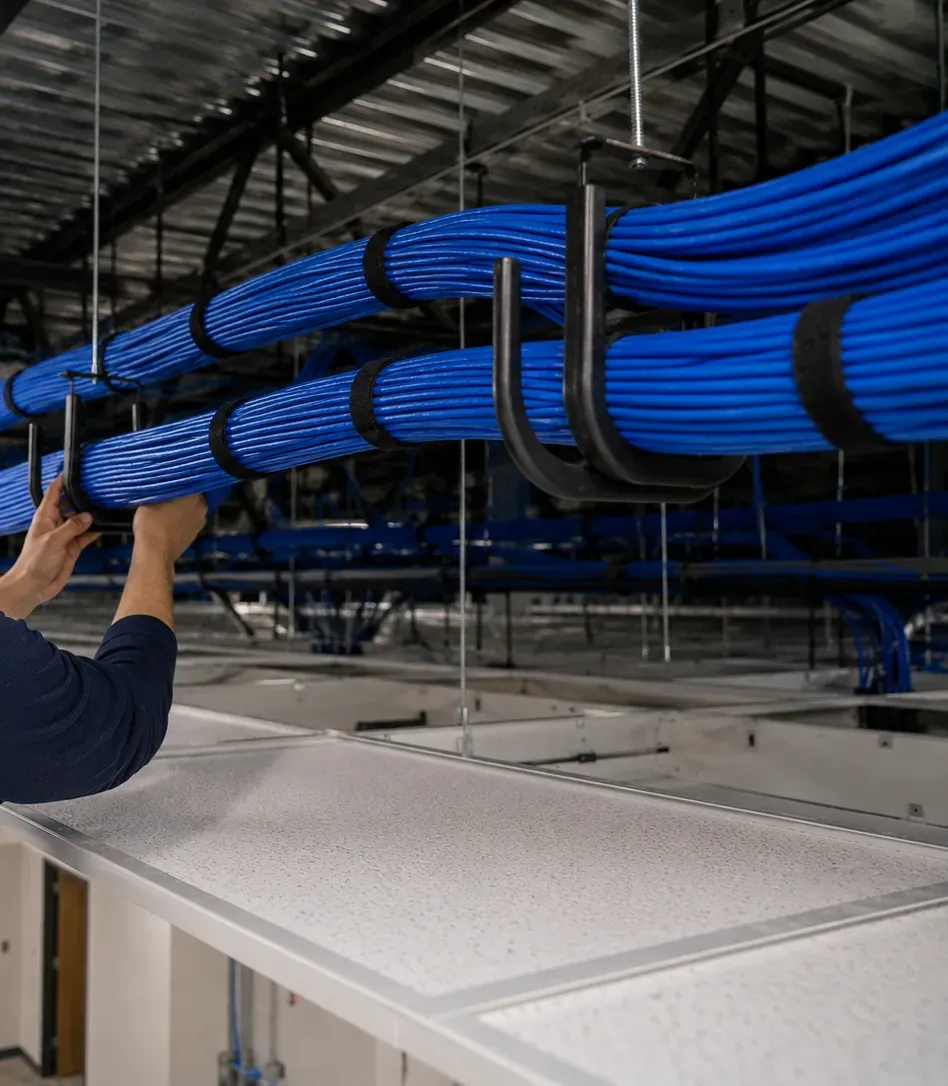
Bundles of blue cable resting in black J-hooks on threaded rod beneath a steel deck above a ceiling grid, a DUMBO, Brooklyn cabling pathway example
Two thick bundles of blue cable sit in black J-hooks hung on threaded rod under a corrugated steel deck, while a technician’s hands settle the nearer bundle above the ceiling grid.
Equipment

Types of Fiber Optic Cabling We Install

DUMBO jobs are short in distance and demanding in detail: a few floors, a few hundred feet, but through old concrete, timber and brick and close to a bridge that never stops moving. This is the kit we specify most, and why.

OS2 Single-Mode Fiber

Our default for building backbones and anything between buildings or out of the cellar. In a loft building it costs little more than multimode and carries any speed a tenant will want later.

OM4 Multimode Fiber

Sensible for a short link between two rooms on one floor where the client's switches already take multimode optics.

Small-Diameter Riser Cable

Riser-rated (OFNR) cable thin enough to share old pipe sleeves and narrow openings in concrete slabs with existing services.

Plenum-Rated Cable

OFNP where a ceiling cavity is used as an air return, which in open-ceiling lofts is the exception rather than the rule.

Armored Indoor/Outdoor Cable

For cellar sections in waterfront buildings, shared alleys and anywhere the cable could be crushed, wet or chewed.

Latched Wall and Rack Enclosures

Enclosures with secure doors and fully seated splice trays, chosen for buildings near the bridge where everything that can rattle eventually does.

Sleeves, Bushings and Firestop

Protection at every masonry edge and listed firestop at every penetration, which also keeps sound and smoke where they belong.

Raceway and Innerduct

Neat, landlord-approved pathways along brick and timber, so a visible cable reads as part of the space rather than as an afterthought.

Test Equipment

A splicer and cleaver for the joins, a scope for every end face, a meter and light source for loss, and an OTDR wherever a trace is worth keeping as a baseline.

Choosing the cable for a DUMBO job

Job Typical cable DUMBO reason
Carrier entry in a waterfront cellar up to a telecom room Armored indoor/outdoor single-mode, sealed conduit No splices or connectors left at flood level
Floor-to-floor link in a Gair concrete building Small riser-rated single-mode, 12 strands Fits existing sleeves or one small scanned core
Across a timber-ceilinged warehouse floor Single-mode in raceway or innerduct Supported without fixing into the beams
Two rooms on one office floor OM4 multimode or OS2, plenum where required Match the optics already in the switches
Loft condo backbone, cellar to every floor Riser-rated single-mode with spare strands One path for every present and future provider
Subtenant's own link from the handoff Small riser or plenum single-mode, clearly labelled Independent of the main tenant's equipment
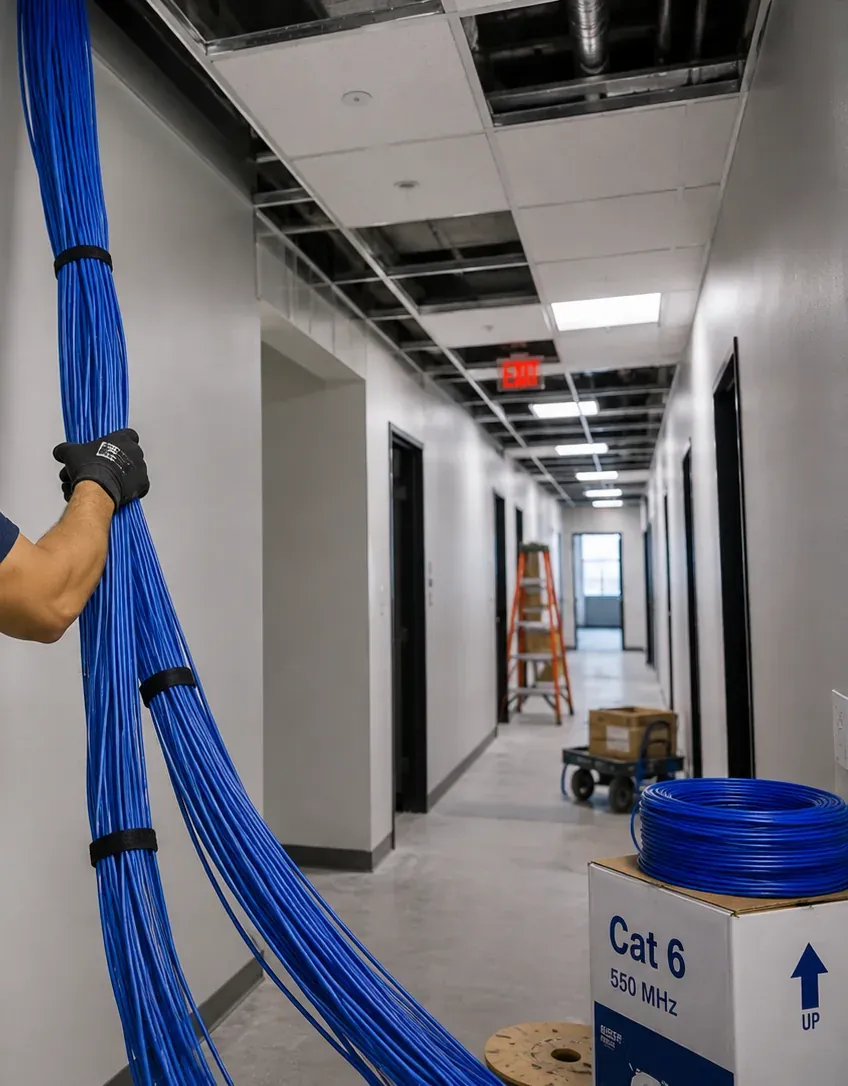
Gloved hand holding a long bundle of blue cable beside an unfinished corridor with open ceiling tiles during a DUMBO, Brooklyn office fit-out
A gloved hand steadies a long, strapped bundle of blue cable; behind it an unfinished corridor runs past open ceiling tiles to an orange ladder and a hand truck.
AI Overview Reality Check

What AI Gets Wrong About Fiber Optic Installation in DUMBO

AI summaries of fiber installation are stitched together from contractor cost guides and provider pages written for generic offices. DUMBO is not a generic office district. Here are seven claims those sources publish, stated as they put them, and what they miss in a landmarked, river-edge neighbourhood of concrete and timber.

Claim: a per-foot rate tells you what a fiber job costs

A New York metro fiber firm's page states that "fiber-optic cable costs anywhere from $1-6 per linear foot to install." As an average across open office ceilings, that may be fair.

In DUMBO the footage is rarely what costs money. A floor-to-floor link in a Gair building might be 60 feet of cable and one scanned, cored and firestopped hole through a century-old slab; the hole is most of the job. A run along timber beams is short but needs supports that do not touch the wood.

That is why our pricing is built from published line items and a walked route rather than a per-foot figure. The footage is measured, but the obstacles are what we price.

Claim: converted warehouse lofts mostly already have Fios

An internet-provider comparison site writing about DUMBO says that "many converted warehouse lofts have Fios where the landlord granted Verizon access for fiber installation, though coverage is patchier here" than in newer buildings. That is a reasonable description of residential service.

It answers a different question from the one most DUMBO businesses have. A carrier's service reaching the building, or even one unit, says nothing about whether there is a path from that handoff to a studio on the sixth floor, a second suite across the building or a server room two floors down.

The carrier brings service to its point of entry. The owner-side path from there is what we install, whichever provider a tenant chooses.

Claim: fusion splicing runs $30 to $75 per splice

A national cabling firm's cost guide, citing another vendor, puts fusion splices at $30 to $75 each. Our own published termination price, $35 per termination on existing cable, sits inside that range.

What a per-splice figure leaves out is where the splice lives. In a waterfront cellar a perfect splice placed at floor level is a liability; in a building near the bridge a splice tray that is not fully seated in its enclosure will eventually move.

So the price of a splice is the easy part. The decision that matters is putting it in the right enclosure at the right height, which is free to get right at installation and expensive to fix later.

Claim: nobody publishes a flat per-strand OTDR rate

A New York cabling cost guide says OTDR testing runs "$75–$150/hour; nobody publishes a flat per-strand rate." For much of the market that is true.

We do publish one: $40 per strand for an OTDR test on top of loss testing, at our Brooklyn base rate, which applies in DUMBO. On a twelve-strand link that is a number you can work out before anyone visits.

In a building near the bridge or above a flooded cellar, that trace is also your baseline. If something changes later, a new trace compared with the original tells you where along the cable to look.

Claim: a plenum jacket is a fixed surcharge on every job

The same guide notes that "plenum rating adds 15–25%" to cable cost. Where a plenum rating is required, it is required, and the premium is real.

Many DUMBO lofts have no plenum at all. An open timber or concrete ceiling with ducted air has no air-return cavity for cable to sit in, so riser-rated cable may be all that the space calls for; an office floor with a lay-in ceiling used as a return is a different matter.

We confirm how each space moves its air before choosing the rating. Where there is doubt we use the higher rating, but we do not charge every loft for plenum cable by default.

Claim: single-mode glass is now cheaper than OM4

Per the same guide, "singlemode glass is now cheaper than OM4," yet the optics for single-mode can cost "roughly 1.5–5×" as much as multimode ones. One sentence flatters single-mode, the other multimode.

In DUMBO the cable runs are short enough that either type will reach, so the decision usually comes down to the switches already in the rack and what the link has to do in five years. A backbone in a loft building, which several providers and tenants may use, is single-mode almost every time.

A short hop between two racks of a single tenant whose switches already hold multimode optics can sensibly stay multimode. We look in the rack before recommending either.

Claim: long tower risers set the benchmark for backbone pricing

The guide gives a worked example: "a 2,000-foot OM4 riser run between IDFs, terminated and tested," landing "around $3,000–$5,000." That describes a tall office tower with an established riser.

DUMBO buildings are mostly low and wide, and few of them have a riser of that kind. The cost of a backbone here is set by how the cable gets between floors — existing sleeves or new cores — and by the enclosures, firestopping and documentation at each level, not by length.

Our published range for a 12-strand OM4 floor-to-floor backbone is $4,500 to $7,000, fusion-spliced, with enclosures at both ends, firestopped and loss-tested. Where in that range a DUMBO building lands depends almost entirely on the vertical path.

Name the Building. We'll Find the Route Through It.

Concrete, timber or a converted office; landmarked or not; river-level cellar or upstairs telecom room. Send the address and we will walk it free.

Get In Touch

Request a Free Quote

Which building, which floor, and what should connect to what? Send it here and our Brooklyn office gets back to you that business day — or phone (347) 934-8335.

✅

Request Received

Your DUMBO request is with our team. Someone from Troy Avenue will ring before close of business; anything urgent, dial (347) 934-8335.

How It Works

Our Installation Process

Seven stages from first call to handover. In DUMBO the first three matter most, because they decide whether the building says yes.

1. Read the building first

Before a quote, we find out which DUMBO building type you are in, who manages it, whether it sits inside the historic district and where the carriers already enter.

2. Walk both ends and the route

With the super, landlord or your office manager we walk from the service entrance to every far end, open ceilings, look for existing sleeves and measure the real cable length.

3. Scan, plan and get sign-off

Any slab we may core is scanned for reinforcing first; the route, penetrations and enclosure locations go to the landlord in writing with our proposal and insurance certificate.

4. Protect finishes and set the pathway

Floors, brick and timber are covered, sleeves and supports are installed, and enclosures are fixed to walls or racks rather than to anything the bridge can shake loose.

5. Pull, dress and seal

The pull stays inside the cable's rated tension and bend radius; masonry edges get sleeves, nothing is hung from the building's fixtures, and each opening is sealed with firestop and photographed.

6. Splice, terminate and test

Strands are fusion-spliced into enclosures at both ends and each one is scoped and loss-tested; longer and building-to-building runs also get an OTDR trace.

7. Label, hand over and leave a map

Both ends labelled, results and photographs in one file, and a simple route map that a future tenant, landlord or IT person can follow.

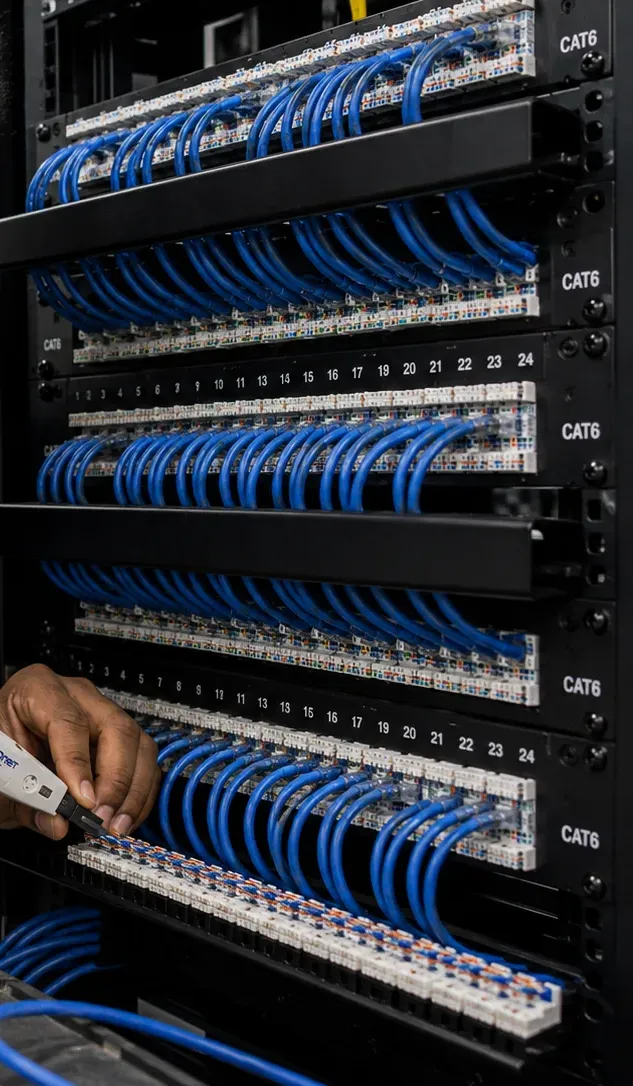
Hand using a punch-down tool on the rear of a patch panel in a dense rack of copper cabling in a DUMBO, Brooklyn telecom room
A hand works a punch-down tool along the back of a patch panel, with five more panels of terminated blue cable stacked above it.
Coverage Area

Fiber Optic Installation Near DUMBO's Landmarks

DUMBO's landmarks are its buildings, its streets and the two bridges over them. These six places mark the conditions we plan for on almost every job in the neighbourhood.

The Clocktower Building, 1 Main Street

Gair's most prominent building and, when it was finished in 1914, the tallest reinforced-concrete building in the world. By the 1920s it was leased to the Charles William Stores, a mail-order business.

Empire Stores, 53–83 Water Street

Seven brick warehouses built in two sections in 1870 and 1885, redeveloped from about 400,000 square feet of raw space with a retractable flood wall and a generator tucked out of sight on the fifth floor.

St. Ann's Warehouse, 45 Water Street

A five-storey brick-and-timber tobacco inspection warehouse of 1870, truncated when New Dock Street was cut through, and now a city landmark housing the theatre company.

Manhattan Bridge Archway and Pearl Street Plaza

The restored archway under the bridge and the new granite plaza beside it, completed with the city's 26-block street reconstruction, and one of the public spots where the MTA measured train noise in 2024.

Jane's Carousel, Brooklyn Bridge Park

The restored carousel in the 85-acre park at the river's edge, whose basement electronics sat in five feet of water during Sandy — the clearest local lesson about where equipment should not live.

Dumbo Heights, Sands and Prospect Streets

The former Watchtower buildings at 55 and 81 Prospect, 77 Sands, 117 Adams and 175 Pearl Streets, now an office campus for technology and creative tenants.

We also serve Vinegar Hill, Fulton Ferry, Brooklyn Heights, Downtown Brooklyn and MetroTech, the Brooklyn Navy Yard, Boerum Hill and Fort Greene, and across the river the Financial District and the Civic Center around the Brooklyn Bridge.

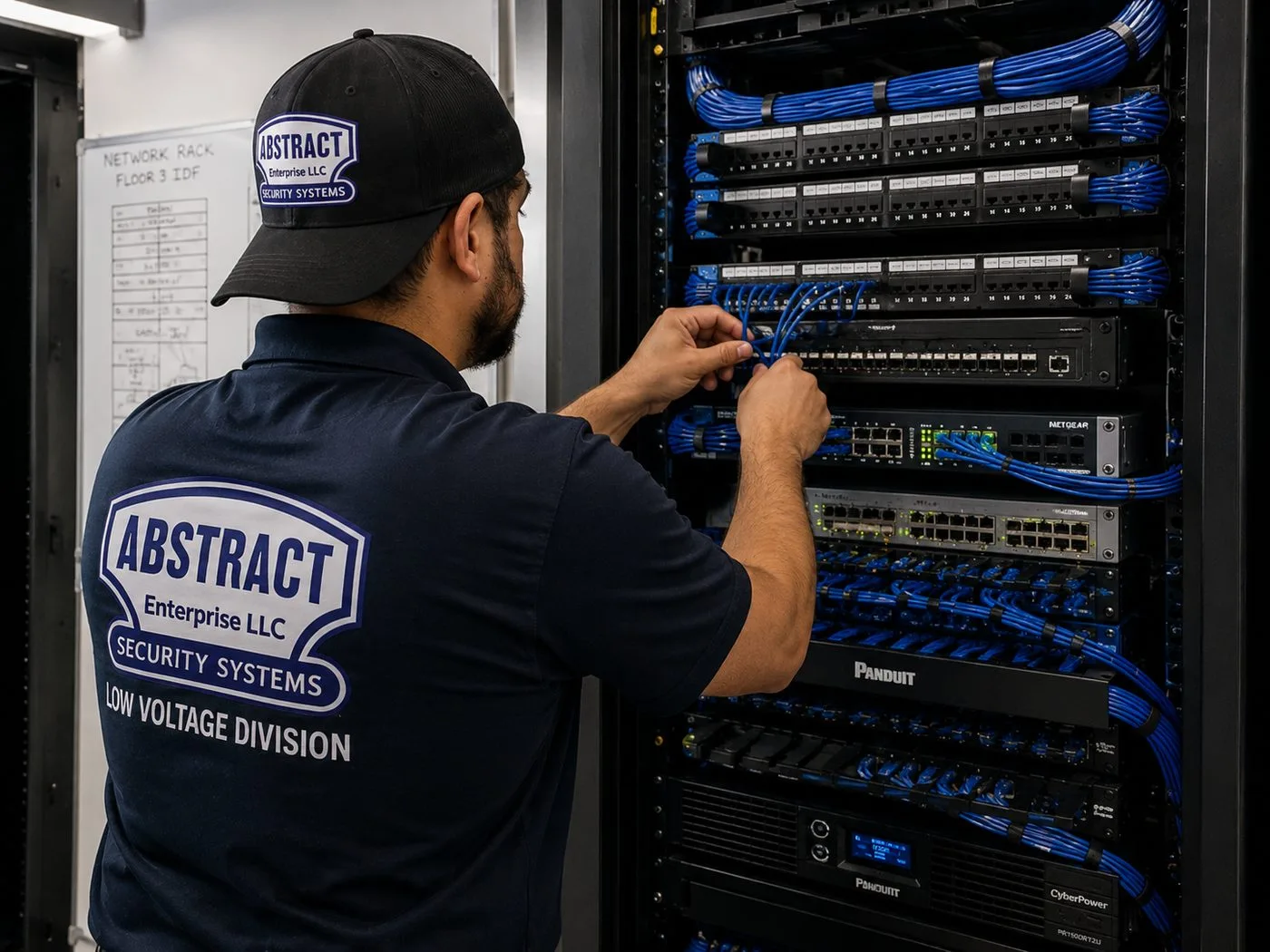
Technician seen from behind patching cords into a switch in a floor IDF rack with a hand-drawn rack plan on the whiteboard, typical of DUMBO, Brooklyn office closets
Seen from behind, a technician in a cap seats patch cords into a switch in a tall rack; a whiteboard to the left carries a hand-drawn plan of the rack.
Building Reference

DUMBO Buildings We Plan Fiber Around

The buildings named on this page, with the facts that matter to a cable route and where each fact comes from. We list them because they define the neighbourhood's building types, not because each is a past AESS job.

Building Built Construction and use What it means for fiber Source
45 Water Street (St. Ann's Warehouse) 1870 Five-storey brick and timber tobacco inspection warehouse, now a theatre Timber and masonry left untouched; supports clamped, edges sleeved DUMBO Improvement District building history
Empire Stores, 53–83 Water Street 1870 and 1885 Seven brick warehouses, redeveloped from about 400,000 sq ft of raw space Riverfront flood planning; entries sealed, splices upstairs Improvement District; Urban Land Institute case study
10 Jay Street 1897–98 Factory built as a sugar refinery Industrial floors; reuse existing openings first Improvement District building history
55 Washington Street 1905 Gair's first reinforced-concrete building Scan before any new core through the slab Improvement District building history
16 Main Street (The Stable Building) 1906 Built as a stable for the Gair Company Small-building backbone; carrier entry often at street level Improvement District building history
1 Main Street (Clocktower Building) 1914 Reinforced concrete; tallest of its kind in the world when built Concrete slabs; sleeves and shafts reused where available Improvement District building history; Brownstoner
68 Jay Street 1915 Brick, steel frame with reinforced-concrete floors, built as a tea warehouse Close to the bridge; racks fixed for vibration Improvement District; MTA noise memo (measured location)
45 Main Street 1919 Gair's last factory, designed by William Higginson, built by Turner Large concrete floors for office tenants Improvement District building history
77 Sands Street and the Dumbo Heights buildings Described by its coworking operator as a 1962 industrial landmark Former Watchtower buildings redeveloped as an office campus Management rules, risers and approvals run like a Downtown office WeWork listing; Gothamist; JRM Construction

The common thread is that every one of these buildings predates the networks that now run in it. None was designed with a telecom room, and most have had several generations of tenants add cable as they went. A fiber job in any of them starts by finding the paths those earlier tenants used, deciding which are sound, and leaving behind a route the next tenant can understand.

Arts and Venues

Fiber for DUMBO's Galleries, Studios and Performance Spaces

DUMBO's cultural side is not a footnote to its offices. The Improvement District counts more than 20 art galleries and 152 artist studios in the neighbourhood, more than a hundred video art works projected onto the Manhattan Bridge over the years, and annual events such as the Photoville festival, which held its thirteenth edition in 2024. St. Ann's Warehouse fills a nineteenth-century tobacco warehouse on Water Street with performances.

These spaces use networks differently from an office. A gallery may need a quiet, invisible connection for a video installation, a ticketing desk and a security camera, and nothing else. A studio building may house a dozen small tenants who each want their own service. A performance space may move lighting, sound and video control signals over its network on show nights and almost nothing in between. What they share is a dislike of visible clutter and a need for work to happen outside opening hours.

Fiber suits them because a single small cable can carry everything from a back-of-house equipment room to a gallery wall, a control booth or a box office, and it does not pick up interference from lighting dimmers, amplifiers or the bridge's electrical systems. In practice we run the cable above a ceiling or along a back-of-house route, terminate it in a small enclosure where the equipment lives, and keep the exhibition or audience side of the room free of anything new.

Scheduling matters as much as the route. Installs are planned around hangs, openings and performances, with drop cloths down, works on the walls agreed as off limits and nothing left in a corridor visitors use. For a studio building, the same backbone approach that serves a residential loft — one cable up the building, an enclosure on each floor — lets each studio choose its own provider without new holes through the brick.

Common Mistakes

Fiber Mistakes We Find in DUMBO Lofts and Offices

Part of our DUMBO work is putting right earlier installations. The same few problems recur, each tied to something particular about the neighbourhood's buildings.

Supports screwed into the timber. A quick installer fixes cable clips straight into an exposed beam. The landlord notices at the end of the lease, and the tenant pays to have the holes treated. Clamped supports and raceway avoid the argument entirely.

Long cord loops in bridge-side racks. Patch cords left long and hanging swing every time a train passes. Over months the connectors at each end loosen or wear, and the link starts to drop for seconds at a time. Cutting cords to length and dressing them through managers is a small job that ends a frustrating fault.

Splices and panels left in the cellar. The carrier's entry is low, so an earlier installer put the first enclosure next to it. In a waterfront building that enclosure is the part a flood destroys. We move it upstairs and replace whatever sat in the water.

Spare conduits left open. An empty conduit through a foundation wall is a path for water as well as for cable. Sealing the building end, and plugging the spares, is easily forgotten and quickly regretted.

Unsealed holes through old slabs. Generations of tenants have punched openings through DUMBO's floors and left them open. They are a fire-safety finding, a route for sound between floors and a sign that nobody was keeping records. Every opening we use is firestopped and photographed.

Unlabelled strands on shared floors. Where a main tenant, a subtenant and a coworking operator all use the same backbone, unlabelled strands get unplugged by the wrong person. Every strand we touch is labelled at both ends with its owner and use.

Indoor cable in the damp. Plain indoor cable run through a damp cellar or along an alley wall degrades over a few years. Indoor/outdoor or armored cable belongs in those sections from the start.

Before You Hire

What to Ask Any Installer Before They Work in a DUMBO Building

Whoever you hire, these are the questions that separate an installer who understands DUMBO's buildings from one who will learn on your floor. Ask them before comparing prices.

  1. How will the cable get between floors? A good answer names an existing sleeve or opening, or explains how a new core would be located by scanning and sealed afterwards.
  2. How will it be supported along timber or brick? Listen for clamps, strut, raceway and sleeves at masonry edges, not screws into the beams.
  3. Where will the first splice and the electronics sit? In a building near the water, the answer should be above the flood level the building plans for.
  4. How will equipment be fixed near the bridge? Bolted into a rack, cords cut to length and dressed, enclosure doors latched.
  5. Will anything be fixed to the outside of the building? Inside the historic district the right answer is almost always no.
  6. What test results will you hand over? Loss results for every strand at minimum, with OTDR traces where the link is long, leaves the building or needs a baseline.
  7. Who prepares the landlord's paperwork? Insurance certificates, coring requests and working-hour approvals should be part of the job, not left to you.
  8. Whose licence covers the work? Ask for the number and look it up with New York State; ours is #12000287431, held by the owner who signs the proposal.

You will find each of these eight answered in writing in an AESS proposal. When a rival bid skips a few, those gaps tend to be exactly where the change orders come from once a slab or a timber ceiling is opened.

On the Day

Working Around DUMBO's Streets, Plazas and Crowds

DUMBO is a busy place to bring in a reel of cable and a splicing kit. The Improvement District reports an average of more than 600,000 visitors a week in Brooklyn Bridge Park, two pedestrian plazas, thousands of hours of open streets and more than 150,000 square feet of Belgian block streets. Deliveries and equipment have to fit around all of it.

We plan the logistics before the day rather than on it. Equipment comes in through the building's freight or service entrance at the time the management office sets, usually early, and goes straight up so nothing sits on a sidewalk or in a lobby. Reels and tool cases are wheeled on carts that suit cobblestones, and anything heavy moves before visitors arrive. On streets that are closed to traffic for events or open-street hours, we schedule the delivery outside those times.

Shared Floors

Coworking Floors and Shared Offices in DUMBO

A good share of DUMBO's smaller companies work on shared floors. WeWork, for example, lists three floors of workspace at 77 Sands Street in Dumbo Heights, and smaller operators run shared studios in the converted factories closer to the water. On those floors the operator normally owns the network, and members plug into it.

That arrangement works until a member needs something the shared network cannot give: its own service for security or compliance reasons, a dedicated link to equipment elsewhere in the building, or more capacity than the operator's plan offers. At that point the question becomes whether the operator and the landlord will allow a member's own fiber into a private office on the floor.

Many will, on conditions. The usual ones are a route that uses the building's existing pathways, work scheduled outside members' busiest hours, clear labelling so the operator's staff never mistake the member's link for their own, and removal or hand-back terms written down in advance. We prepare that proposal for the operator and the landlord together, because both normally have to agree.

Staying Online

Two Carriers, One Cellar Wall: Redundancy in a Small Neighbourhood

DUMBO's software and media tenants often ask for a second internet service so that one outage does not stop the company. It is a sensible request, and a second contract is easy to sign. Making the second service genuinely independent inside an old loft building is the harder part.

Most of the neighbourhood's buildings have one way in for telecom cable, usually through a cellar wall on one side of the building. Two carriers arriving through the same opening, sharing the same cellar shelf and the same path upstairs, will both be cut by the same contractor's saw or the same flood. A commenter on a systems administrators' forum made the general point about New York buildings bluntly: the building's own fiber "remains a single point of failure" whichever provider you buy from.

What the building controls is the part we install. Where a second entry exists or can be arranged, we keep the two carriers' cables in separate sleeves and separate routes all the way to the rack, so one cut or one wet cellar does not take both down. Where only one entry is possible, the two routes are still separated inside the building, and many tenants add a wireless or cellular backup that does not depend on the cellar at all.

Pricing

Fiber Optic Installation Cost in DUMBO

No waterfront premium: DUMBO jobs use the Brooklyn base (1.00×). Every figure below is copied from the published lines on our Brooklyn fiber optic installation page, and the per-drop numbers are the ones in the Brooklyn structured cabling price builder. Where a line shows a range, the walkthrough decides where your building falls in it.

Item DUMBO price (Brooklyn base) What it covers
Fiber termination on an existing cable $35 per termination LC, SC, ST or MPO, fusion-spliced pigtail or mechanical connector
OTDR test $40 per strand Trace and event table per strand, on top of loss testing
Multimode fiber drop $350 per drop Shorter in-building run, terminated and tested
Single-mode fiber drop $400 per drop Shorter in-building run, terminated and tested
12-strand OM4 floor-to-floor backbone $4,500 – $7,000 Fusion-spliced, enclosures both ends, firestopped, loss-tested
24-strand OS2 single-mode backbone or building-to-building link $8,000 – $15,000+ Single-mode with OTDR on every strand
Second telecom room with fiber link from $2,400 Room build-out and the fiber tie back to the main room
Service and callback rate $195/hr, 3-hr minimum ($585) Repairs, troubleshooting and return visits — not the initial install

What moves a DUMBO fiber quote

  • The vertical path. An existing sleeve or opening through a concrete slab keeps a floor-to-floor link at the low end of its range; scanning and coring a new penetration moves it up.
  • Visible routes. Raceway or innerduct finished to the landlord's standard along brick and timber takes longer than cable hidden above a ceiling.
  • Where the carrier enters. A handoff in a waterfront cellar that has to be carried up to a dry room adds armored cable, sealed conduit and an upstairs enclosure.
  • Building rules. Insurance certificates, set working hours, freight elevator windows and escorts in managed office buildings add time, not materials.
  • Time of day. Coring and other loud work in occupied loft buildings is usually booked early or after hours, which the proposal shows rather than hides.
  • Strands and tests. Every strand means its own splice, connector and measured result, and an OTDR trace adds $40 a strand where you want one.

National brand versus local contractor. People sometimes ask how we compare with ADT, Ring or SimpliSafe. Those brands are about alarms and cameras; private glass inside a converted factory is not something they offer. In DUMBO the realistic alternatives are the carrier, whose technicians finish at the handoff, or a large integrator whose subcontracted crew may never have cored a Gair slab or worked inside a historic district. A licensed Brooklyn contractor that owns its splicer and OTDR is the third option, and it is the one we are, with each figure written down.

Shop Our Systems

Fiber Optic Installation Packages & Pricing

Three worked examples for the DUMBO jobs we are asked about most. Each total is simply the sum of lines from the price table above, shown so you can check the arithmetic; your proposal will reflect your building's actual route.

Starter — Two Rooms, One Floor

$960

Two single-mode fiber drops ($400 + $400 = $800) joining a network room to a studio or server room on the same floor, plus an OTDR trace on all four strands (4 × $40 = $160). $800 + $160 = $960.

Standard — Up Through the Slab

$4,980 – $7,480

A 12-strand OM4 floor-to-floor backbone ($4,500 – $7,000) between floors of a concrete factory building, plus an OTDR trace on all twelve strands (12 × $40 = $480) as a vibration and flood baseline. $4,500 + $480 = $4,980; $7,000 + $480 = $7,480.

Premium — Cellar Entry to a Dry Telecom Room

$10,400 – $17,400+

A 24-strand OS2 single-mode backbone from a waterfront cellar entry ($8,000 – $15,000+, OTDR on every strand included) to a second telecom room built above the flood line (from $2,400). $8,000 + $2,400 = $10,400; $15,000 + $2,400 = $17,400, plus anything above the base of either range.

Bring Your Own Equipment — Labour Only

A Dumbo Heights management office may insist on its own approved cable and boxes; a studio moving from Williamsburg may still have a half reel in storage. Either way, we can work with what you hand us and charge only for our time: $195 an hour, three hours minimum ($585), covering the pull, the splices and the certification. Your materials stay under their maker's warranty, not ours, which is why a reel gets a meter on it before it disappears into a slab sleeve that may never be opened again.

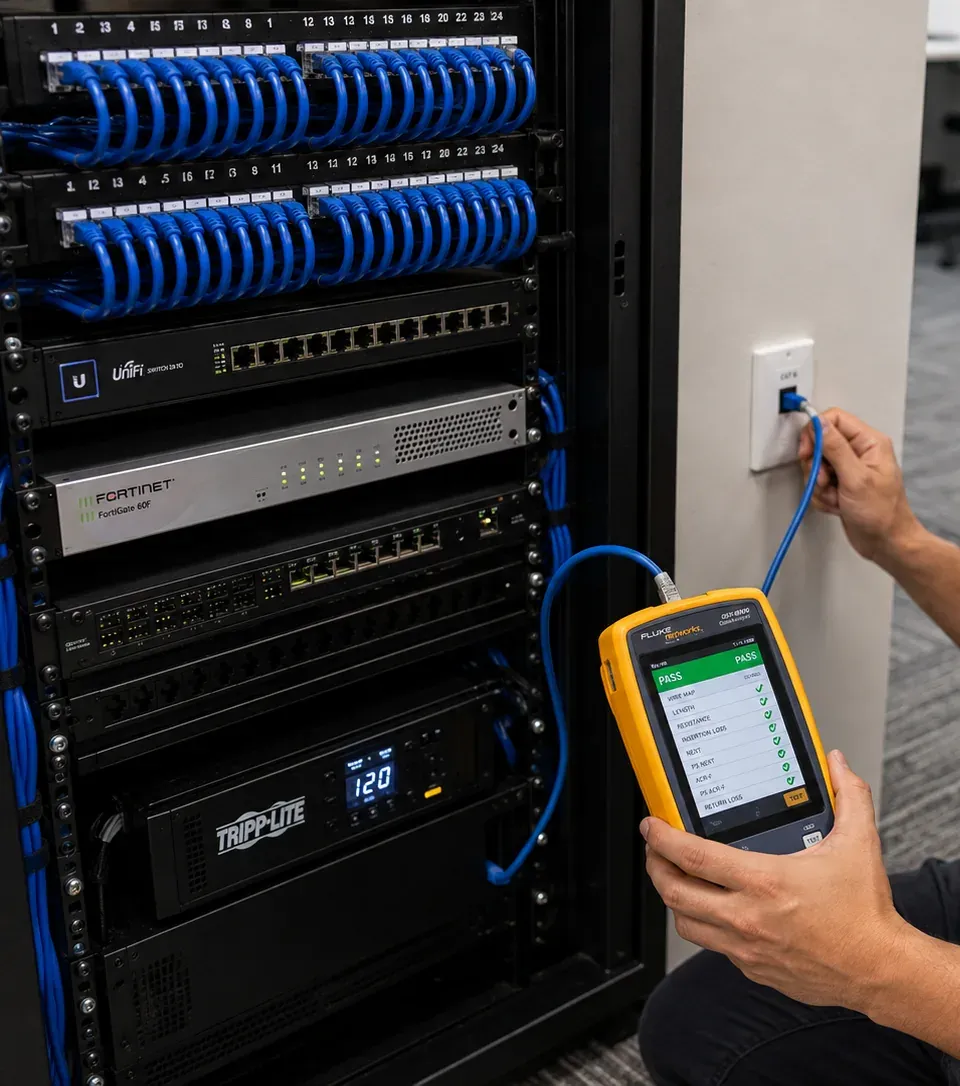
Handheld certification tester showing a pass result while connected between a rack and a wall jack in a DUMBO, Brooklyn office
A hand holds a yellow certification tester whose screen shows a column of passed checks, its cord running to a wall jack beside the rack — numbers recorded before anyone calls the job finished.

Want the Route Checked Before You Sign the Lease?

A free walkthrough tells you what fiber to your floor will take and cost, at the Brooklyn base rate published above.

The Tech Triangle

Fiber That Outlasts the Tenant in DUMBO's Office Lofts

The DUMBO Improvement District counts more than a thousand creative and technology companies and about 11,000 employees in the neighbourhood, in roughly 6 million square feet of commercial space. Many of them are young companies on short leases. They take part of a floor, grow into the rest, sublet what they cannot use, and move on. Every one of those moves used to leave cable behind in the ceiling.

Fiber changes that pattern when it is planned as part of the building rather than of one tenant. A backbone from the carrier handoff to an enclosure on each floor, owned by the landlord and documented strand by strand, outlives every lease. A new tenant patches into it in an afternoon, a departing tenant leaves nothing in the ceiling, and the landlord can show prospective tenants that their floor is ready. For a building owner in DUMBO's leasing market that readiness is a quiet selling point.

Tenants benefit even when they do not own the building. A company that pays for its own link from the handoff to its suite should insist on three things: labels at both ends that name the company and the strands it uses, test results on file, and a clear note in the lease of what stays and what goes at the end of the term. Those three things make the link an asset rather than a dispute when the company moves.

Flood Planning

What Sandy Taught DUMBO About Where Equipment Lives

On October 29, 2012, news photographs showed streets under the Manhattan Bridge in DUMBO under water. In Brooklyn Bridge Park, Jane's Carousel came through with its horses intact, but CBS New York reported that "the basement that houses all the electronics was totally flooded – 5 feet of water." Across the city, the official post-storm report found that the area of Brooklyn that flooded was more than twice the size of the mapped floodplain.

The lesson for a network is the carousel's lesson: the structure can survive while everything electronic in the basement does not. Glass fiber itself tolerates water far better than copper. Connectors, splice enclosures, switches, converters and battery backup do not. In a DUMBO building near the water the design rules follow from that.

  • Carry the carrier up. Nobody moves where the provider comes through the foundation, so the job is to cross the cellar quickly: tough jacketed cable inside sealed pipe, and not one connector or joint down there.
  • Splice and switch upstairs. The first enclosure and the electronics belong in a room above the level the building is planning for, not on a shelf beside the boiler.
  • Seal every opening below the line. Conduits and sleeves through foundation walls are water-sealed and spare ducts plugged, so a flood barrier at the door is not bypassed through the wall beside it.
  • Park the spare cable high. Coil the service loop on a dry floor, so if the cellar run is ever damaged the bad length can be cut away and rejoined without pulling new cable through the building.
  • Keep the day-one numbers. After the water goes down, the readings we took when the link was new are what tell you which strands changed and which did not.
  • Follow the building's own plan. Where a building has raised its generator or mechanicals, as Empire Stores did with a generator placed on its fifth floor, the telecom room should follow them up.

Designed in at the start, these steps cost little. Moving an enclosure, a rack and a carrier handoff out of a cellar after a flood costs a great deal more, and usually happens in a hurry.

Lofts and Boards

Fiber for DUMBO's Residential Loft Buildings

DUMBO is a place people live as well as work. The Improvement District counts about 10,200 residents and 3,338 residential units, most of them in converted factories and warehouses and in the newer towers on the district's edges. In the converted buildings, the network question usually lands with a condominium board or a managing agent rather than with an individual resident.

Converted factories were not built with telecom rooms, and their apartments are often arranged around wide floor plates rather than stacked neatly above one another. The practical answer is one owner-installed backbone: a cable from the cellar or ground-floor entry to an enclosure on each floor in a common area, with enough spare strands for every provider the building might approve. Short runs from those enclosures reach the units. A new provider then connects at the enclosure instead of drilling a fresh path through the building, and the hallways stop collecting abandoned cable.

Boards ask us about three things in particular. First, ownership: the backbone belongs to the building, documented and labelled, so it can be offered to any provider on the same terms. Second, disruption: most of the work happens in common areas, cellars and closets, and work inside a unit is scheduled with the resident. Third, the facade: in the historic district every part of the route stays indoors, so the board is not filing anything with the Landmarks Commission for a cable.

Buildings doing this work often update the front door at the same time. A new backbone gives an IP video intercom, cameras on the lobby and the package room, and the door readers a reliable path; our DUMBO teams for access control in DUMBO and DUMBO security cameras can plan on the same walkthrough.

The Walkthrough

A DUMBO Fiber Walkthrough, From Cellar to Top Floor

A walkthrough in a DUMBO building usually takes an hour or two and decides most of what the job will cost. It follows the cable's path rather than a checklist, so this is the order we usually go in.

  1. The carrier's entry. Where each provider comes in, how high above the floor, how close to the water line the building remembers from 2012, and whether anything sensitive sits down there today.
  2. The way up. Existing sleeves, risers, chutes and old freight or dumbwaiter openings, and whether they are full, blocked or available with the landlord's consent.
  3. The slabs. If a new penetration might be needed, where it could go, what is above and below it, and whether the landlord will allow scanning and coring.
  4. The finish. Exposed brick, timber, painted concrete or a hung ceiling along the route, which decides whether cable hides or has to look deliberate.
  5. The far end. Where the rack or enclosure will sit, how it can be fixed solidly, which wall faces the bridge, and whether there is power for a switch or converter.
  6. The rules. Insurance certificates, working hours, freight elevator windows, coring approvals and anything the management office needs in writing.

Afterwards the proposal arrives line by line: each run's measured length, the cable and enclosures, every proposed opening marked on a photo, how the strands will be tested, and the documents we will draft for the landlord. Sometimes the honest finding is that copper is enough, or that the link is cheaper to install once a fit-out has the ceiling open; then that is what the proposal recommends.

Reading the Building

Building Terms That Come Up on DUMBO Fiber Jobs

A DUMBO fiber proposal mentions the building as often as the cable. These are the terms you will hear from us on site, each in a sentence or two.

  • Slow-burning mill construction. The nineteenth-century method of heavy timber columns and beams inside brick walls, described in the district's designation report. Cable is supported without fixing into the timber.
  • Reinforced concrete. Concrete with steel bars cast inside it, used by Gair from 1904 on. Any new hole is located by scanning first.
  • Sleeve. A short tube set through a wall or floor so cable can pass without touching the structure, later firestopped.
  • Core. A clean round hole cut through concrete with a water-cooled or dust-extracted drill, kept as small as the sleeve allows.
  • Firestop. A listed sealant or device that restores a wall or floor's fire rating around a penetration, and blocks sound and smoke too.
  • Handoff or demarcation. The line where the provider's equipment stops and the wiring a building or tenant pays for takes over.
  • Backbone. The building's own cable between the entry, telecom rooms and floors, as opposed to the short runs to each desk or unit.
  • Enclosure and splice tray. The box where strands are joined and end in connectors, latched shut and fixed solidly in bridge-side buildings.
  • Duct seal. A water-resistant plug at the building end of a conduit through a foundation wall.
  • OTDR trace. A test that shows where along a strand any loss occurs, kept as a baseline for later comparison.

A term on a quote that nobody will explain is a warning sign. Ask us, or anyone else bidding, until each one makes sense.

Complete Services

Every Fiber Optic Installation Service in DUMBO

A loft that is getting new glass is usually getting new doors, cameras or desks too. The pages below cover the neighbouring trades we plan alongside it.

Structured Cabling Installation DUMBO

The copper to every desk and access point that takes over where the fiber lands.

Access Control Installation DUMBO

Door readers for lofts and offices, reporting over the same backbone.

Intercom Installation DUMBO

IP video intercoms for converted loft buildings.

Security Camera Installation DUMBO

Lobby, package room and street-front cameras on one recorder.

Network Installation Brooklyn

Once the glass is in, this team sets up the gear at each end so your people actually see the speed.

Cat6 Installation in Brooklyn

Where the last few metres to a workstation stay copper, this is the page for it.

Low-Voltage Installation Brooklyn

Data, door, camera and audio wiring planned as one building scope.

Fire Alarm Installation DUMBO

Kept on its own pathway, coordinated with the fiber route and firestopping.

Alarm Installation DUMBO

Intrusion alarms for lofts, studios and shops, sharing the building backbone where it helps.

Field Notes

Field Notes From DUMBO Lofts and Warehouses

What our crews do first in a DUMBO building — how we always work, not an account of a single job

In DUMBO the first thing our installers look at is not the rack. It is the ceiling and the floor: timber or concrete, and whether something already passes through. An old sleeve beside a column, a patched square where a chute used to be, a neat hole an earlier tenant left behind — any of them can save a core through a slab poured a century ago, and the landlord is always happier to hear that.

The second habit is listening. Near the bridge, our crews stand still for a minute and wait for a train, then look at what moved: a shelf, a loose cord, a partition. That tells them where the rack should not go.

The third is asking about 2012. Supers and long-time tenants near the water usually know how high it came. That height sets where the first enclosure goes, and in this neighbourhood nobody has to be persuaded why.

FAQ

DUMBO Fiber Optic Installation FAQ

Do you need to go through other tenants' spaces to run our fiber?
+

Sometimes, and we find out before quoting. In DUMBO's converted factories the only path from the carrier's entry to an upper suite may pass through a ceiling or closet another tenant leases. Where that is the case we show the landlord exactly where the cable would go, arrange access through the management office and work around the other tenant's hours, and look first for a route through common areas so nobody else is disturbed.

Do you also cover Vinegar Hill, Fulton Ferry and the Dumbo Heights buildings up on Sands Street?
+

Yes. We work across the whole waterfront pocket between the two bridges and up the hill: Fulton Ferry and Old Fulton Street, the blocks around the Manhattan Bridge, the former Watchtower buildings on Sands, Prospect, Adams and Pearl Streets, and the Vinegar Hill blocks to the east toward the Navy Yard.

Will trains crossing the Manhattan Bridge affect when you can splice or test?
+

No. Fusion splicing happens in a protected tray on a steady surface, and loss and OTDR tests are not disturbed by the trains overhead, so work goes ahead at any hour the building allows. What the bridge does change is how the finished hardware is fixed, which we plan for at the walkthrough.

Is there any extra charge for working inside the DUMBO Historic District?
+

No. There is no historic-district surcharge. What can add cost is the route itself, such as coring a thick concrete slab or protecting cable along rough masonry, and those items are priced line by line from our published rates. Keeping the work indoors is what keeps the landmark question simple.

Will new cable holes weaken the soundproofing our bridge-side office paid for?
+

They should not, if they are sealed properly. Every penetration we make or reuse through a wall or floor is closed with a listed firestop sealant or device, and that same seal also blocks the open air path sound would otherwise follow. We avoid drilling through acoustic window frames or the sealed perimeter of a soundproofed room and use existing openings where they are available.

Can you work inside a gallery or showroom without putting the pieces on the walls at risk?
+

Yes. Before tools come out we agree with you which walls, plinths and pieces are off limits, cover floors along the work path, and keep ladders and reels away from hung work. Where possible the cable goes above the ceiling or along a back wall, so the exhibition side of the room is barely touched.

Can one backbone in our loft building carry the lobby cameras, door readers and intercom as well as residents' internet?
+

Yes. Strands are cheap to add at installation, so we size the backbone with spares and assign some to building systems such as the camera recorder, the door controllers and an IP intercom. Those systems then run on their own strands, separate from any provider's service to residents, and each assignment is recorded in the handover file.

Can fiber let a recording or podcast studio move noisy computers and storage out of the live room?
+

Yes, and it is a common reason DUMBO studios call us. A fiber link lets the computers, storage and their fans sit in a machine room down the hall or on another floor while the live room keeps only quiet screens and interfaces. Fiber is not affected by the electrical noise of amplifiers or lighting, and the penetrations between rooms are sealed so the move does not open a new path for sound.

If our internet plan is the bottleneck, will new fiber inside the office make any difference?
+

Not to the plan itself. Fiber inside the building cannot make a slow service faster. What it fixes is everything between the provider's box and your people: slow transfers between floors or rooms, a server room that has outgrown copper, or a second suite that needs the same network. We will tell you honestly which side of that line your problem sits on.

How much noise and dust does coring a concrete floor make in an occupied loft building?
+

A core drill is loud while it runs, typically for a short period per hole, and it is water-cooled or used with dust extraction so very little dust escapes. We agree a time with the building, warn neighbours below where needed and protect the floor on both sides of the slab. Most fiber jobs need only one or two cores.

All Areas Served

Fiber Optic Installation Across Brooklyn and New York

Up one level is the borough page for Brooklyn fiber optic installation; above that is the New York City fiber optic installation hub. Our other neighbourhood fiber pages cover the towers of the Financial District in Manhattan and the warehouses and towers of Long Island City in Queens.

Our Abstract Enterprises Security Systems home page lists the rest of our trades, from cameras to door buzzers, and the about us page explains how the company started.

Studio Offline Between Water Street and Sands Street

An office floor without a network, a server room cut off from the team upstairs, a building link that went dark after another trade's work: ring (347) 934-8335 and tell us which link dropped and in which building. Same-day dispatch is our aim across DUMBO. On site, a damaged cord, dirty connector or broken pigtail is usually found and fixed within one to two hours, and the strand is tested again before we leave.

Fiber Optic Installation DUMBO — Routed, Spliced, Proven

Abstract Enterprises Security Systems · 1282 Troy Ave, Brooklyn, NY 11203 · Brooklyn line (347) 934-8335 · WhatsApp (718) 679-0359 via wa.me

NYS Low-Voltage Licence #12000287431 · 100% Licensed & Insured · Same-Day Estimates · Rated 4.7★ from 201 Google Reviews

Full terms — including 50% deposit, one-year parts-only warranty on AESS-supplied products, and the late-fee schedule — are set out in the service agreement. See our warranty page.

Page reviewed and updated October 17, 2026. Changelog: first publication of the DUMBO, Brooklyn fiber optic installation page.