What are you looking for?
About Us Contact Us Careers Get a Free Quote (800) 486-0943
Pick a service
✅ Got Your Own System?
🎬 Home TheatreQuote 🎶 AV SoundQuote 🔑 Access ControlQuote
Now pick your area
Pick your area
Long Island
Hudson Valley
Services available
Pricing & Tools
Pick a service for pricing
🚪 Intercom Pricing 🔔 Buzzer Repair Pricing
Calculators
📹 Camera System Calculator 🚨 Alarm Calculator ⚡ Cabling Quote Builder ✅ Got Your Own System?
Select your area
Licensed Low-Voltage Contractor · Our Bronx Office Is on East Fordham Road · Storefronts, Upper-Floor Offices, Clinics & Student Rooms

Cat6
Repair in
Fordham

Fordham, Bronx · Inherited Runs Sorted · Register, Camera & Door Links · Teller-Counter & X-Ray-Room Routes · Student-Room Switch Chains · Retested to Category

In Fordham, Cat6 seldom fails of old age. It fails at changeover: a Fordham Road shop closes and the next one fits out over its cable, an office floor near Fordham Plaza turns into a clinic or an agency, a house of student rooms empties in May and fills again in August. Every occupant cuts some runs, abandons others and adds a few of their own. Our Bronx office sits on the same stretch of East Fordham Road, so we can usually be standing at the counter quickly; we sort the live cable from what was left behind, find the fault on the run that matters, repair it and prove it with a Category 6 test.

Reviewed and updated October 17, 2026 · Written by Anwar Timothy, NYS licence #12000287431

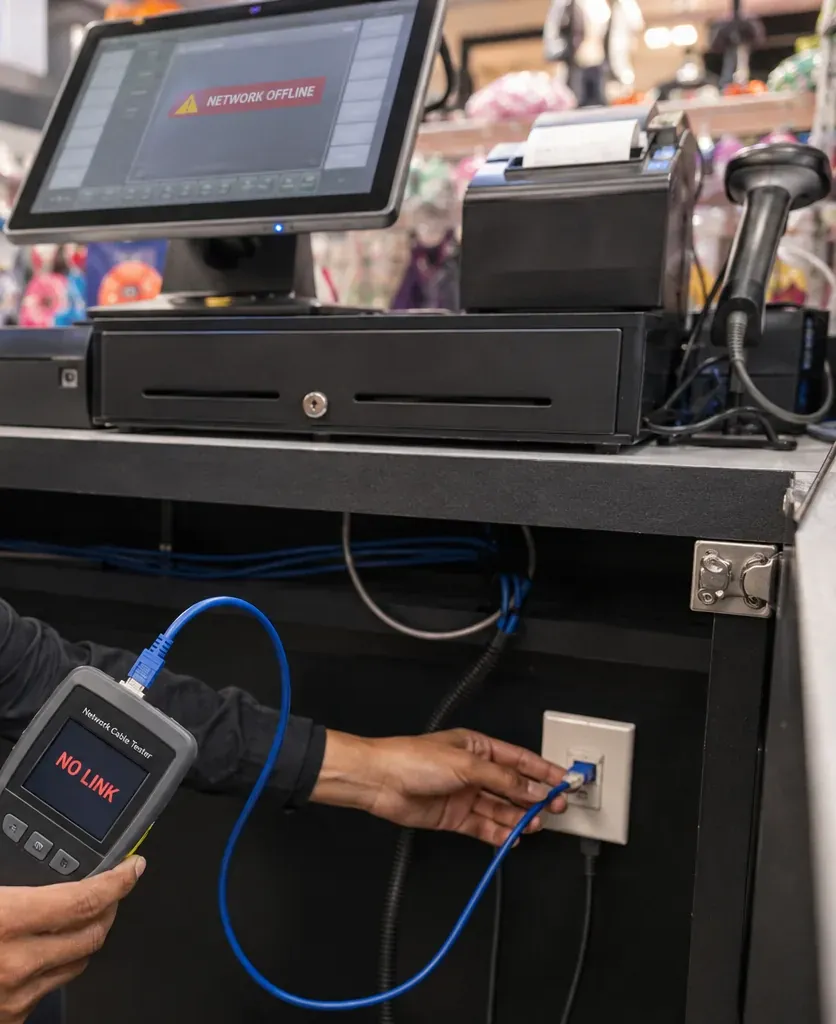
Tester reading NO LINK on the jack under a checkout counter while the register screen shows Network Offline, Cat6 repair in Fordham, Bronx
Under a checkout counter, a blue cord runs from a hand-held tester showing NO LINK to a wall plate; above, the register screen reads Network Offline beside a receipt printer, cash drawer and scanner.
Free Fordham Cat6 Repair Quote
Tell us where the dead link is and what used to be in the space — a technician replies the same business day

✅
Got it — thank you.
A technician from our Fordham Road office will call you back the same business day.
25+
Years Experience
✓
Same-Day Estimates
100%
Licensed & Insured
4.7★
201 Google Reviews

Took over a space with somebody else's cable in the ceiling? Start with a phone call or a photo. Ring (646) 490-0629 or use the 60-second form, and a licensed technician will tell you, before anything is booked, whether the dead link sounds like a cut run from the last fit-out, a bad termination, a cord, or a device that has nothing to do with cabling.

  • Live runs labelled and dead ones marked before anything is cut
  • Visits planned around opening hours, clinic sessions and move-in weeks
  • NYS licence #12000287431 · insured · office at 460 East Fordham Road
The Neighborhood

Why Fordham Properties Need Cat6 Repair That Begins With the Last Occupant

Fordham is where much of the Bronx comes to shop, change trains and see a doctor. The Commercial District Needs Assessment that NYC Small Business Services produced with the Fordham Road BID calls it one of the busiest commercial corridors in New York City, home to roughly 118,000 residents and served by the 4, B and D lines and the fourth-busiest Metro-North station. Its storefront inventory covered Fordham Road from Andrews Avenue to Southern Boulevard and the stretches of the Grand Concourse, Jerome Avenue and Webster Avenue that feed it — and at the time of the count, 80 of those storefronts stood empty.

To a cabling technician, an empty shop is never a blank one. Above its ceiling tiles are the runs that once fed a register, a card terminal, a camera recorder, a phone and perhaps a window screen, mostly unlabelled, some cut short when the fixtures were ripped out, none tested since the last tenant handed back the keys. The street shows how often that happens. The Bronx Times reported in October 2022 that Target was opening at the north-east corner of East Fordham Road and Valentine Avenue, in the space Dr. Jay's had left in February 2020; Norwood News reported in February 2025 that the Best Buy at Fordham Plaza, at Fordham Road and Webster Avenue, was due to close on March 1. Each of those changes leaves the building's low-voltage wiring in a state the next occupant never sees until something stops working.

Above the shops the same churn is quieter but just as constant. The same assessment found that 46 percent of the jobs located in Fordham are in education, health care and social assistance, and its storefront count alone included 40 doctors', dentists' and medical offices, 26 pharmacies and optical shops, 20 schools and training centres, and 26 government offices, social-service agencies, nonprofits and houses of worship. Office buildings such as One Fordham Plaza — 557,000 square feet of offices and retail, as the New York Times described it when the building began drawing office tenants — are re-partitioned when a practice moves in and again when an agency replaces it. Each fit-out pulls some new cable, reuses some old, and leaves the old to fail first.

Fordham also handles a great deal of cash and a great deal of jewellery. The district counted 12 banks and credit unions, 11 check-cashing and money-transfer shops and 27 jewellery, watch-repair and pawn businesses. Counters in those trades are often built with bullet-resistant panels, and the dental and medical suites upstairs include X-ray rooms with lead in the walls. In both, the quickest way to replace a failed run — drill a fresh hole — is precisely the one that must not be taken.

And Fordham houses students. Fordham University's Rose Hill campus dates from 1841; Monroe University's Bronx buildings line Jerome Avenue and East Fordham Road; and in August 2026 Lehman College opened The Lehman Grand, its first residence hall, with more than 180 beds inside the landmarked Dollar Savings Bank building at the Grand Concourse and Fordham Road. Off campus, rooms in houses and apartments are let by the semester, and a chain of small switches often does the job a planned network should. Move-out and move-in are the third kind of changeover that breaks Cat6 here.

So a Fordham repair begins with a question the borough-wide approach does not ask first: who was here before, and what did they leave in the ceiling? Only then do we turn to the failed link itself, and to the rooms — teller lines, imaging suites, student houses, shop floors that barely close — where the usual method has to bend. Owners planning a full re-wire rather than a repair are better served by our structured cabling installation team in Fordham, and shops replacing a camera system outright can talk to the Fordham security camera installation service.

Fordham facts that shape a Cat6 repair

  • 80 vacant storefronts in the district inventory the Fordham Road BID compiled for the SBS needs assessment — each one a ceiling of unlabelled cable waiting for the next tenant.
  • 46 phone and electronics stores, 40 medical and dental offices, 27 jewellery and pawn shops, 12 banks and 11 check cashers in the same count: trades that live on registers, cameras and secure counters.
  • 43 percent of merchants surveyed by the BID in winter and spring 2022 had two or fewer full-time employees. When the register link drops, the person fixing it is usually the owner.
  • 46 percent of local jobs are in education, health care and social assistance, per the assessment — which is why so many repairs here are in exam rooms, classrooms and agency offices rather than shops.
  • 130,000 daily bus riders use the Fordham Road corridor, where the city broke ground in July 2026 on offset bus lanes from Sedgwick Avenue to Boston Road, with parking and loading spaces for businesses, according to NY1. A van at the curb is planned, not assumed.
  • 47.8 percent of households in the Fordham, Bedford Park and Norwood area had no broadband subscription and 33.2 percent relied on cellular data alone, as the State Comptroller defined it in a 2025 report. The wired jacks in libraries, schools and community offices matter more here than the averages suggest.

Put together, Fordham is a neighbourhood of short tenancies, busy counters and specialised rooms. That combination, more than the age of any one building, decides how its Cat6 fails and how it should be repaired.

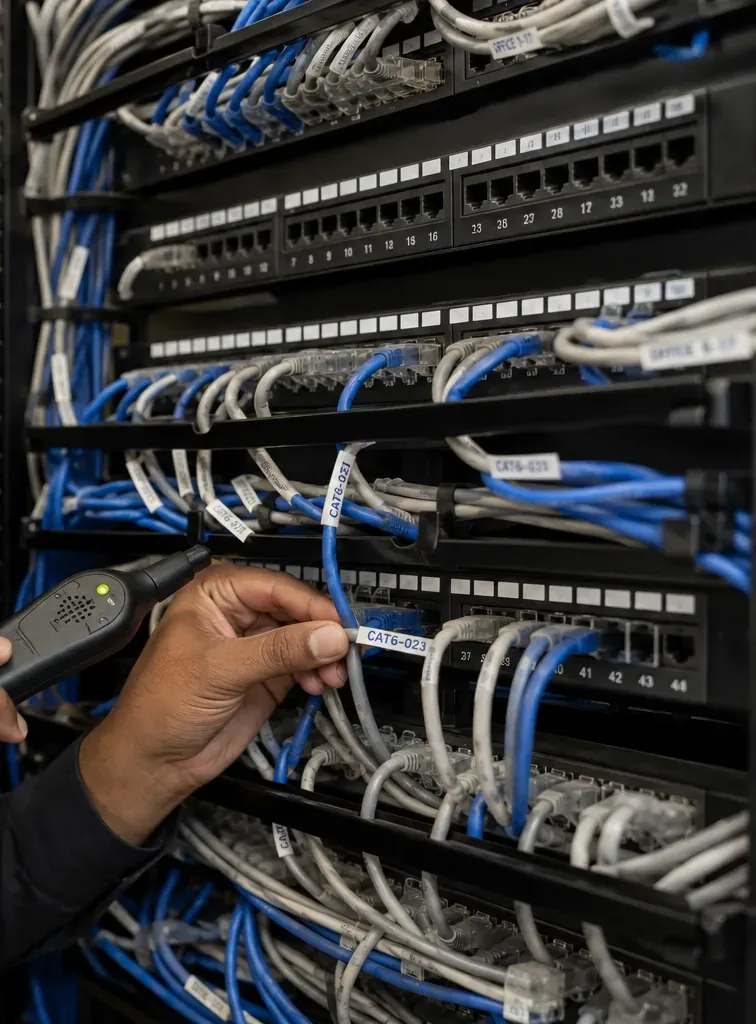
Tone probe held against a labelled Cat6 patch cord in a crowded patch field, sorting live from dead runs in Fordham, Bronx
A hand holds a tone probe beside a patch cord tagged CAT6-023 in a dense field of blue and grey cords, with numbered ports and more labels on the panels above.
Repair Capture

Register or Teller Line Offline on Fordham Road?

A card reader that will not connect at two in the afternoon, a camera missing from the recorder the day after a break-in attempt, an exam room on the Concourse with no network at the start of clinic: those are service calls and we run them as such. From our office at 460 East Fordham Road we book the next open two-hour window and arrive with a certification tester, a toner, Cat6 and Cat6A keystones and panel modules, lock-in devices, raceway and cable. Once a technician is standing at the fault, most single-link problems at a termination, a cord or a jack are found and put right within one to two hours. Repair time is $195 an hour with a three-hour minimum ($585). Call (646) 490-0629 and say it is a Cat6 fault in Fordham; if it turns out to be older Cat5e or the switch itself, our Bronx network cable repair service picks it up.

What We Repair

Cat6 Repair Services in Fordham

Nine kinds of job make up nearly every Fordham call we take. They are listed by the situation you are in rather than by the part that failed, and each one finishes the same way: the link is retested against its category limit, labelled, and the result goes to whoever is paying for the visit.

Live-or-Dead Survey of Inherited Cable

You have the keys to a space and a ceiling full of someone else's runs. We tone each one to its end, test the ones you need, label the live runs, and mark the abandoned ones so they can come out rather than confuse the next technician.

Register, Card-Terminal and Printer Links

Counter runs crushed by cash drawers and stock boxes, jacks kicked loose at knee height, plugs crimped in a hurry on the morning of an opening. Repaired before trading where we can, and retested with the register on.

Storefront Camera Runs

Runs from the recorder in the back office or the cellar to cameras over the door, the stockroom and the counter. We check the power reaching each camera as well as the data, because a camera that boots and then drops usually has a cable that cannot carry its load.

Entrance and Door-Hardware Runs

Cable to anti-theft pedestals, door counters, door controllers and the camera that watches the entrance. The doorway is the hardest-used square metre of a Fordham shop, and cable laid across it rarely lasts a season.

Teller-Line and Secure-Counter Links

Banks, check cashers, money-transfer and pawn counters with bullet-resistant panels below the glass. Replacement runs follow the counter's existing chases and access panels; the armour itself is not drilled.

Clinic, Exam-Room and Imaging Links

Medical and dental suites above the shops: dead exam-room jacks, front-desk links, and the run to the imaging computer in a room with lead in its walls. Routes through shielding are agreed with whoever is responsible for the room's shielding before anything is opened.

Office-Floor Re-Partition Repairs

Agencies, schools and practices that moved a wall and lost the jacks behind it. We find where each run was cut or buried, extend or replace it to category, and update the port map so the new layout is recorded.

Student-Room and Rooming-House Networks

Houses and apartments let by the room, where small switches are chained from one bedroom to the next and a single loose cord or loop takes everyone offline. We test the runs, straighten the chain and label each room's jack.

Certification After a Fit-Out

A contractor has finished, the tenant is moving in, and nobody has tested the data cable. We certify every link against Cat6 or Cat6A permanent-link limits, repair what fails and hand over the saved results with the keys.

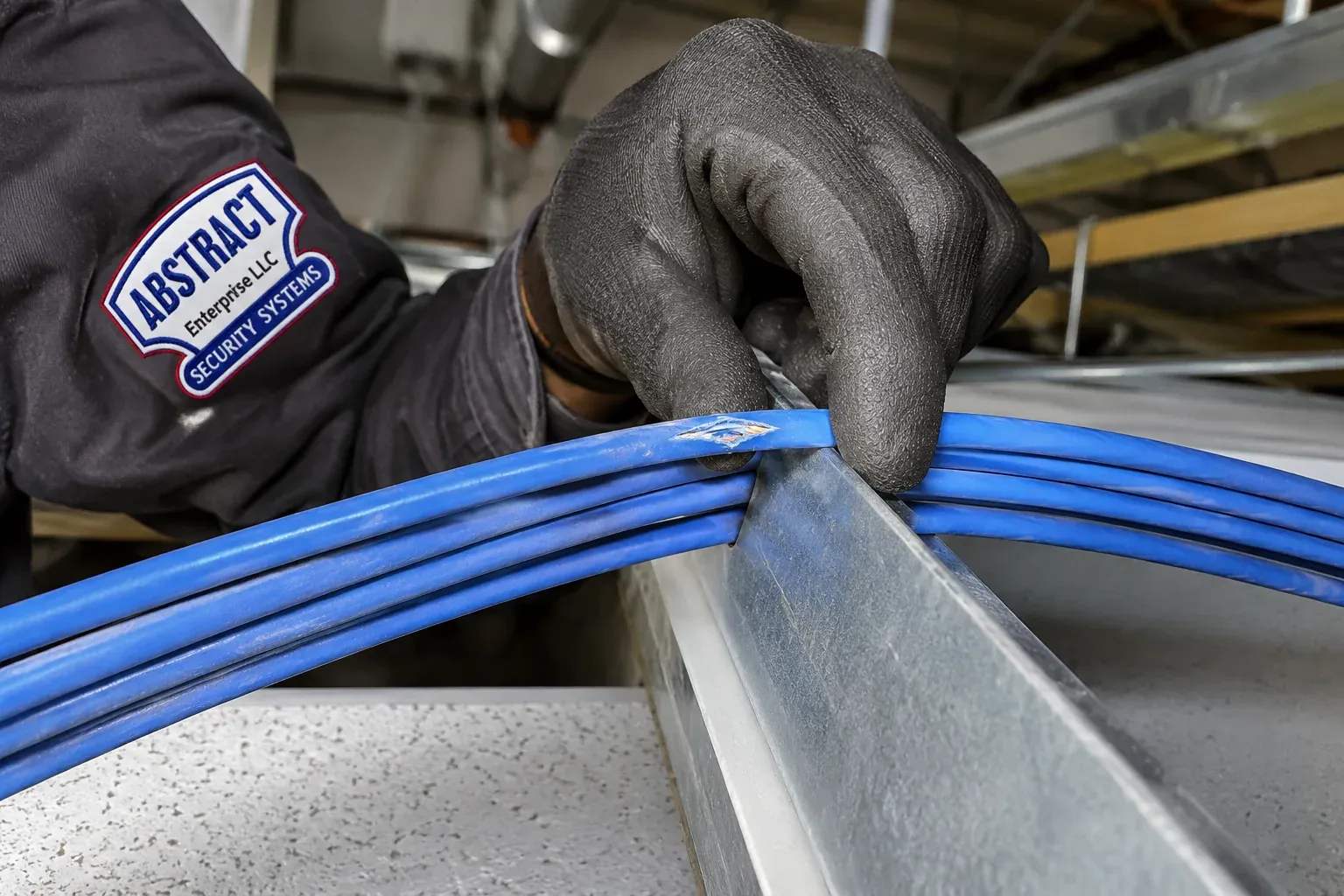
Gloved hand lifting a bundle of blue Cat6 off a galvanized ceiling-grid edge where one jacket is worn through, Fordham, Bronx repair
Four blue runs lifted clear of a galvanized channel by a gloved hand show the damage the metal edge did: the uppermost jacket is rubbed through to the pairs.
Building Specialists

Cat6 Repair for Fordham's Architecture

Fordham's buildings were mostly put up for one purpose and now serve another. How the Cat6 got in depends on which conversion the building has been through, and that is the best guide to where a fault will be.

Low Commercial Buildings on Fordham Road

One- to three-storey blocks with shops at street level, offices or storage above and deep cellars below. Cable for each tenant runs through a shared cellar and up through whatever opening the last fit-out made, so several tenants' runs cross in one ceiling.

Office Blocks Around Fordham Plaza

Larger office and retail buildings beside the plaza and the Metro-North station, with floors leased to practices, agencies and schools. Floor-by-floor telecom closets, suspended ceilings, and partitions that have moved several times since the original cabling went in.

Converted Landmarks

The Dollar Savings Bank building, now The Lehman Grand residence hall with a supermarket in the old banking hall, and the Paradise Theater on the Grand Concourse, being reopened as a performing arts centre. Interiors with protected finishes, where cable has to use the paths the conversion created.

Apartment Houses Above and Behind the Shops

Pre-war walk-ups and elevator buildings on the Concourse and the side streets towards Webster Avenue, many with a storefront at street level. The building's own camera and intercom runs often share a cellar, and sometimes a hole in the floor, with the shop's network.

Campus and Campus-Edge Buildings

Monroe University's buildings along Jerome Avenue and East Fordham Road, the streets around Fordham University's Rose Hill gates, and the 12-storey residence planned for 2740 Webster Avenue. Classrooms, offices and rooms let to students, each with its own owner and its own rules.

Post-War Co-op Towers

Fordham Hill's nine towers at the western end of Fordham Road, built in 1950 and a co-op since 1982, with 1,130 apartments. Concrete construction, management offices with their own vendors, and lobby systems that depend on a handful of long runs.

Where the method bends, building by building

Low commercial buildings. The trick is ownership, not distance. A run from the shop's back office to a camera over the door may be thirty metres long and pass through a cellar shared with a neighbour, the landlord's meters and another tenant's stock. We tone it from the shop end before touching anything, because cutting the wrong cable in a shared cellar can take down the store next door. Where several tenants' runs share one ceiling, every cable we repair leaves with a label naming the tenant and the outlet.

Office blocks. Here the cable is usually proper Cat6 in a proper pathway, and the faults come from the walls that moved. A partition installed across an old run will have either buried the outlet behind new board or left the cable coiled above the ceiling with its jack cut off. A time-domain reading from the closet tells us how far along the run the break is, which in an office floor usually points straight at the line of the new wall.

Converted landmarks. We do not create new routes through protected interiors on our own initiative. A repair either re-uses the pathway the conversion built, or the owner's architect and the Landmarks Preservation Commission permit say where a new one may go. In practice most repairs in these buildings are at the ends — a termination in a closet, a jack in a room — and never need to touch the protected fabric at all.

Apartment houses with a shop below. The two networks need separating before either can be trusted. We trace which runs belong to the building and which to the shop, repair the failed one, and, where they share a penetration, sleeve and seal it so that a future fit-out downstairs cannot cut the building's camera cable by accident.

Campus-edge and student buildings. The cable is often fine and the topology is not. Before replacing anything we draw what connects to what, because a chain of small switches will make a perfectly good run look faulty whenever one link in the chain misbehaves.

Co-op towers. Runs are long and the building is concrete, so length and insertion loss come first, and the management office expects a written result naming the link and the fault. Many co-ops pair a camera-cable repair with an upgrade of the lobby door hardware; our access control installation service in Fordham works in the same buildings.

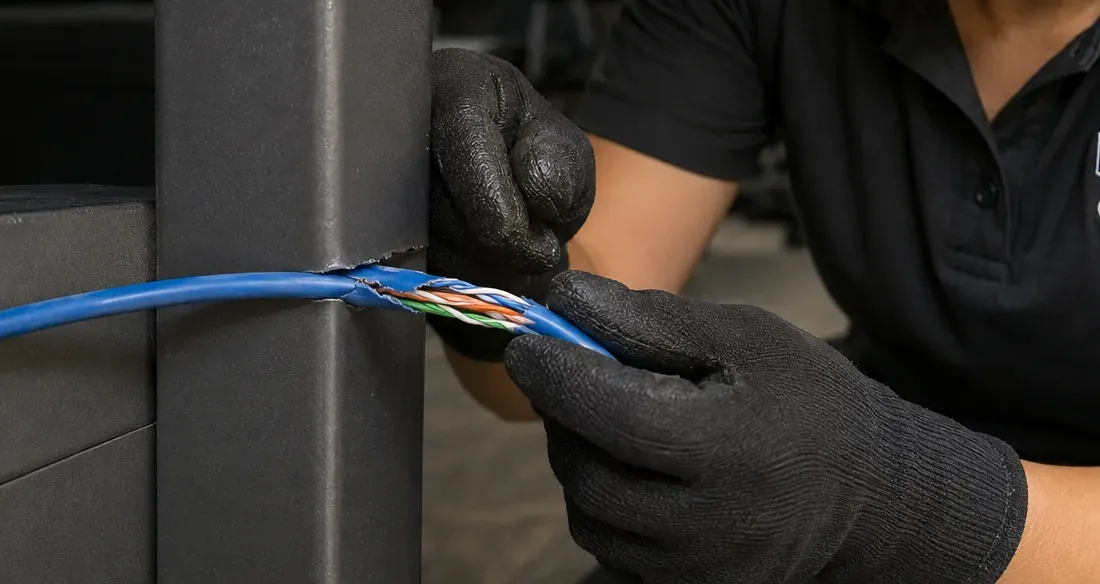
Gloved hands opening a blue Cat6 jacket split where it was pinched against a steel desk leg, Fordham, Bronx office repair
Where the steel leg of a desk has bitten into it, a blue jacket gapes open and the orange, green and white pairs show through between two gloved hands.
Commercial Cat6 Repair

Business Cat6 Repair in Fordham

Six stretches of street produce most of our Fordham business calls. Each has its own mix of tenants, and each tends to break cable in its own way.

East Fordham Road, Jerome Avenue to Webster Avenue

The core of the shopping district: national chains, clothing and shoe stores, phone and electronics shops, jewellers and fast food. Registers, door hardware and cameras on runs that change hands with every tenant, and a holiday season when no counter can be down.

Fordham Plaza and Webster Avenue

The bus-and-rail hub beside the Metro-North station, rebuilt in a reconstruction completed in 2016, with office floors above the shops in the buildings around it. Agency and practice fit-outs, plus the retail turnover the plaza is known for.

Grand Concourse, East 184th Street to Kingsbridge Road

Medical and dental suites, professional offices, the Paradise Theater and, at Fordham Road, The Lehman Grand. Exam-room and imaging links, front-desk networks and landmark interiors.

Jerome Avenue Under the Elevated Line

Monroe University buildings and a run of shops beneath the elevated 4 line. Classroom and office runs, cameras watching the sidewalk, and counters close to the street.

East 187th and 188th Streets toward Belmont

The restaurant blocks running toward Arthur Avenue. Kitchen screens, card terminals and cameras in narrow buildings, and owners who have watched the Fordham Road redesign closely.

Third Avenue near St. Barnabas Hospital

The hospital at 4422 Third Avenue and the clinics and offices around it. Medical tenants with strict hours, records systems that cannot drop, and facilities rules for ceiling access.

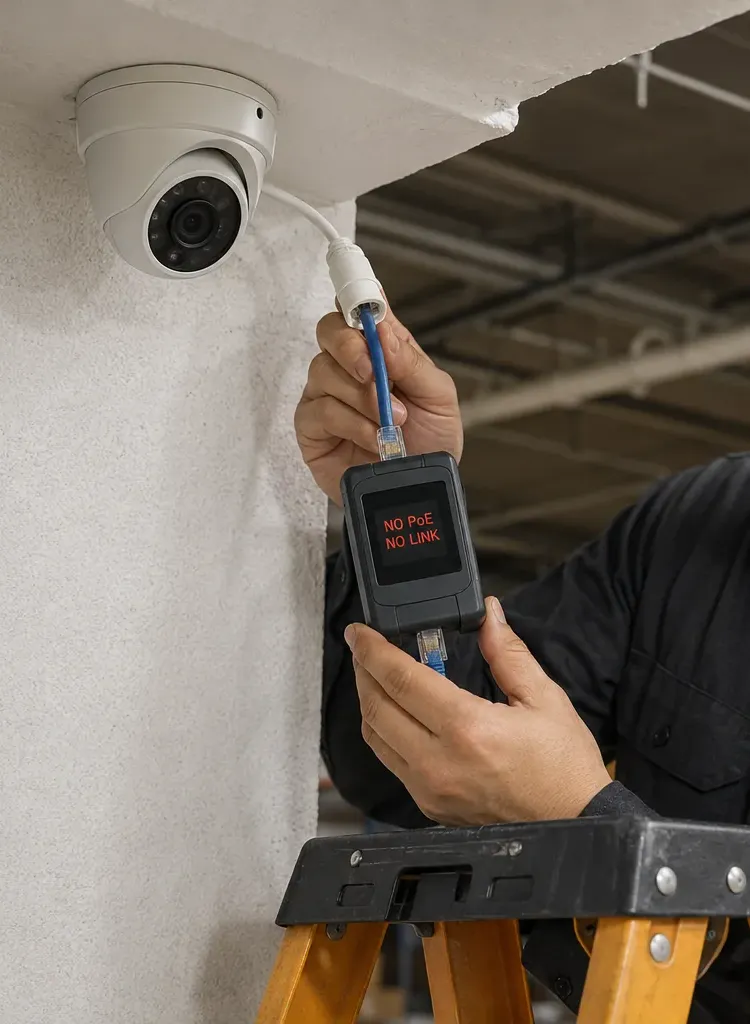
PoE tester between a dome camera and its blue Cat6 lead reading NO PoE, NO LINK, storefront camera repair in Fordham, Bronx
Standing on a stepladder, a technician holds a small inline tester reading NO PoE / NO LINK between a white dome camera and the blue cable feeding it, in a room with exposed ceiling pipes.

Rules that touch a Fordham Cat6 repair

  • Cable listings under the city's electrical code. The New York City Electrical Code is now the city's amendments to the 2020 National Electrical Code and took full effect on December 21, 2025, according to the Department of Buildings. A replacement run has to carry the listing its location requires — riser-rated in a vertical shaft, plenum-rated in an air-handling ceiling — just as a new one would.
  • Abandoned cable. Under NEC Article 800, the accessible portion of communications cable that has been abandoned must be removed unless it is tagged for future use. In a shop that has had three tenants, removing the dead runs is often the first useful thing a repair visit does.
  • Landmarked interiors. The Landmarks Preservation Commission requires a permit for interior work where the interior itself is a designated landmark, as the Dollar Savings Bank banking hall is. Repairs that stay at existing terminations do not need to touch the protected finishes; anything more starts with the owner's approvals.
  • Firestopping. Any new penetration through a fire-rated floor or wall is sealed with a listed firestop system, and old penetrations found stuffed with paper or foam are noted on the repair record for the owner.
  • Shielded and armoured rooms. X-ray rooms and bullet-resistant counters were designed by someone, and their protection depends on there being no unplanned gaps. We route around them or through existing openings, and anything else is agreed with the shielding designer or the barrier's installer first.
  • Health-care privacy. HHS guidance treats contractors whose work does not involve patient information, and whose access to it is incidental, as outside the business-associate rules; we keep it that way by not touching your systems.

This section summarises rules as they apply to typical Cat6 repairs in Fordham buildings; it is not legal advice. Building-specific requirements come from the owner, the Department of Buildings, the Landmarks Preservation Commission and, for shielded rooms, the facility's radiation-safety adviser.

Your Questions Answered

Cat6 Repair in Fordham: Questions Answered

These come from shop owners on Fordham Road, practice managers above them, landlords who let rooms to students and the people who run teller lines. Each answer is what we would tell you on the phone.

Shop floors that hardly ever close

The Cat6 to the anti-theft pedestals and the door counter crosses our entrance under the threshold strip. Why does it keep failing, and where should it go instead?

Because a shop doorway on Fordham Road takes more feet, hand trucks and pallet jacks in a week than most office floors see in a year. A cable laid under a metal or rubber threshold is flexed every time a wheel rolls over it; the jacket survives longer than the conductors inside, so the link usually degrades for weeks — a counter that loses its count, a pedestal that alarms at random — before it dies. The repair is to get the cable out of the walking surface altogether. Depending on the frontage, that means going up the door frame and across the header, coming down inside the pedestal's own mounting, or, where the pedestals need a floor feed, using a proper cored floor channel that the cable sits below rather than in. We test the replacement with the doors open and shut, because a run that clears the frame can still be pinched by a closer arm.

Our store switch's cloud dashboard says one cable has a fault "at 9 metres." How far can that reading be trusted?

Far enough to know where to start, not far enough to cut a wall. Many business switches can run a time-domain reflectometer test on a port: Cisco's documentation, for instance, describes it as estimating the type of fault and its approximate distance, reports open and short conditions, notes that results can differ between switch models because of differences in resolution, and advises using an offline cable diagnosis tool once a faulty cable is found. That matches what we see. The switch's figure is often within a few metres and can't tell you about crosstalk or return loss at all. We put a certification tester on the run, compare its distance-to-fault reading with the dashboard, and only then open the ceiling at the spot both agree on. Note that the test can briefly interrupt the link, so do not run it on the register port during a sale.

The last tenant ran shop-bought patch cords through the ceiling to the cameras. Are they worth repairing, or do they get replaced as proper runs?

They get replaced, but not always all at once. A moulded patch cord is stranded cable built to be flexed at a desk; laid across a ceiling for thirty metres it has more loss than solid building cable, it is not usually listed for use above a ceiling, and its factory plugs were never meant to be pushed through holes and stapled at the end of a run. Some of them work for years. The ones we are called about are the ones that do not: a camera that drops at night when its infrared comes on, or a run that tested fine until a fixture was moved. We test each cord-run as a link, replace the failures with solid Cat6 terminated on jacks at both ends, and give you a short list of the rest in order of risk so that the remaining runs can be replaced when the ceiling is next open.

We only find out the backup internet line's Cat6 is dead when the main line fails. How is a run that sits idle most of the year kept honest?

By testing it on a calendar instead of in an emergency. A failover link from a second provider's modem to the router or firewall carries almost nothing until the main line drops, so a crushed or unplugged cable can sit unnoticed for months. Fordham shops that cannot take cards without the network — which is most of them — are the ones that feel it. When we repair or certify the primary run we test the standby one too, label both ends as the backup path, and route it apart from the primary so that one ladder or one fit-out cannot cut both. After that, the useful habit is a deliberate failover test, done by whoever manages the router, every few months and before the holiday season; if it fails, the saved certification result tells you straight away whether to look at the cable or the equipment.

Rooms with armour or lead in the walls

Our check-cashing counter is lined with bullet-resistant panels. How is a failed Cat6 run to a teller station replaced without drilling through the armour?

By finding the way the original installer got in, and using it again. Bullet-resistant counters and walls are built with fiberglass or steel panels whose protection depends on there being no unplanned holes; suppliers advise covering cut-outs for things like electrical boxes with an extra piece of ballistic material, and detailing every penetration so that it leaves no gap. Most teller counters therefore have a cable chase, a grommeted pass-through or an access panel on the staff side that already carries the power and data for each station. We open that, test the failed run, and either re-terminate it or pull a new one along the same chase. If there is truly no path, we stop and bring the counter's installer or manufacturer into the decision before any hole is made. A repaired link that weakens the counter it serves is not a repair.

The X-ray room in our dental office has lead in the walls. How is a failed Cat6 run to the imaging computer replaced without opening a gap in the shielding?

With the shielding design in hand before anyone drills. Lead-lined walls are specified so that no radiation finds a straight path through a penetration, and the standard shielding guidance calls for penetrations to be baffled with supplementary shielding at least equivalent to the material removed. A certified health physicist answering exactly this question for the Health Physics Society described shielding the far side of the wall over an area wide enough to cover the gap, and avoiding straight-through conduit in floors. In practice we first test whether the run can be saved by re-terminating at the existing outlet, which is often the case. If it must be replaced, we use the existing sleeve or conduit wherever possible, and where a new opening is unavoidable we agree its position and its shielding with the practice's radiation-safety adviser or shielding designer, then leave them a note and photographs of what was done.

Houses and halls full of students

In our house of student rooms near the university, each room's switch feeds the next one. Why does one room's problem take out the rooms after it?

Because every room downstream depends on every room upstream. Chaining small switches from bedroom to bedroom is a common way to share one internet line around a house that was never wired for it, and the arrangement has an obvious weakness: if one switch is unplugged, loses power or has its cord kicked loose, everything after it goes dark, and a marginal cable between two rooms slows everyone beyond it. Equipment makers point out the same single point of failure. The repair is usually a mix of cable work and rearrangement: test every run, replace the weak ones, and, where the existing cables allow it, bring each room back to one switch in a closet or the cellar so that rooms sit side by side rather than in a line. Each jack gets a room label, and the landlord gets the map.

Every time one tenant plugs in, the whole house's network slows to a crawl. Can a cable cause that?

A cable can, but usually not by being faulty. The classic cause is a loop: a cord plugged into two wall jacks at once, or two ports of the same small switch joined together, so that traffic circulates endlessly and swamps every device on the network. Inexpensive unmanaged switches cannot detect or block it, which is why network administrators list mis-patched unmanaged switches among the common causes of broadcast storms. We find it by testing and toning from the closet until we know which jack is joined to which, remove the loop, and test the runs involved to make sure nothing else is wrong. For the future, the landlord's network provider can fit a switch with loop protection, and we can label the jacks so that tenants know which one is theirs.

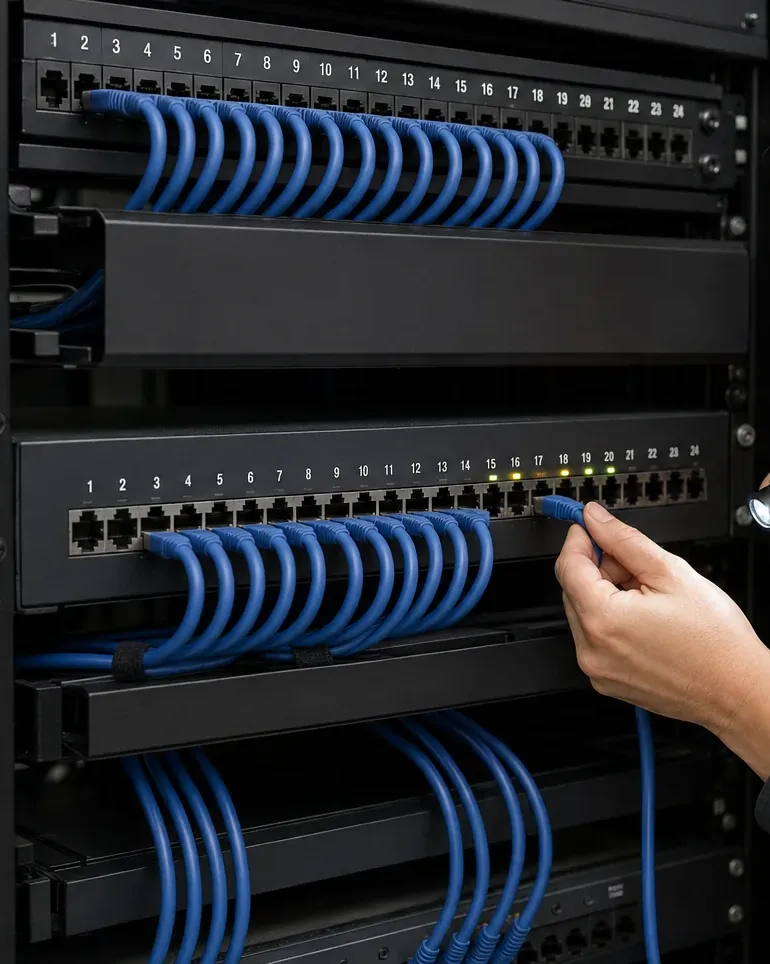
Hand seating a blue patch cord in a 24-port switch with lit and dark port lights, link check in Fordham, Bronx
A hand pushes a blue cord into port 18 of a 24-port switch where only a few port lights glow, under a patch panel with a neat row of blue cords.
Inherited Cable

What the Last Occupant Leaves in the Ceiling

Most Fordham repairs begin with a sort. Before we decide whether a failed link can be saved, we need to know which of the cables above the tiles still go anywhere. These are the leftovers we find most often when a storefront, an office suite or a student house changes hands, and what each one usually means.

What we findWhat it usually meansWhat we do
A bundle of unlabelled runs ending where the old counter stoodThe previous tenant's register, terminal and phone runs, cut when the counter came outTone each to the closet; reuse the sound ones for the new counter, mark the rest as abandoned
Cables cut flush with the ceiling gridFixtures, signage or display lighting removed in a hurryTest from the closet end to see how much good cable remains; extend to category or replace
Long moulded patch cords lying on the tilesA camera or Wi-Fi installer who used cords instead of building cableReplace with solid Cat6 on jacks, worst first
A small switch or power strip hidden above a tileAn improvised extension of the network, often still feeding somethingFind what depends on it before unplugging; move it somewhere ventilated and labelled, or eliminate it
Cables from a camera recorder that no longer existsAn old system removed, its cameras left on the wall or taken downTest for reuse with the new system; remove what cannot certify
Phone-grade cable ending on plates marked Cat6A cheap job that only ever ran a phone or a slow linkReplace it outright — re-terminating phone-grade cable never yields a Category 6 pass
Couplers or taped joints above the ceilingSomeone extended a run to reach a moved desk or cameraCut the joint out, then either splice with a rated in-line connector or re-pull the whole length
Several carriers' boxes and modems in one closetSuccessive tenants each bringing their own internet serviceIdentify which is live for you; label it; leave the carriers' equipment to them

Two things follow from a sort like this. First, a repair visit in a newly leased space often fixes more than the one link you called about, because the runs that test clean become the ones you use and the doubtful ones are retired before they fail. Second, the abandoned runs should go. The electrical code expects the accessible portion of abandoned communications cable to be removed, and in practice a ceiling with half its cable dead is a ceiling where the next technician cuts the wrong one.

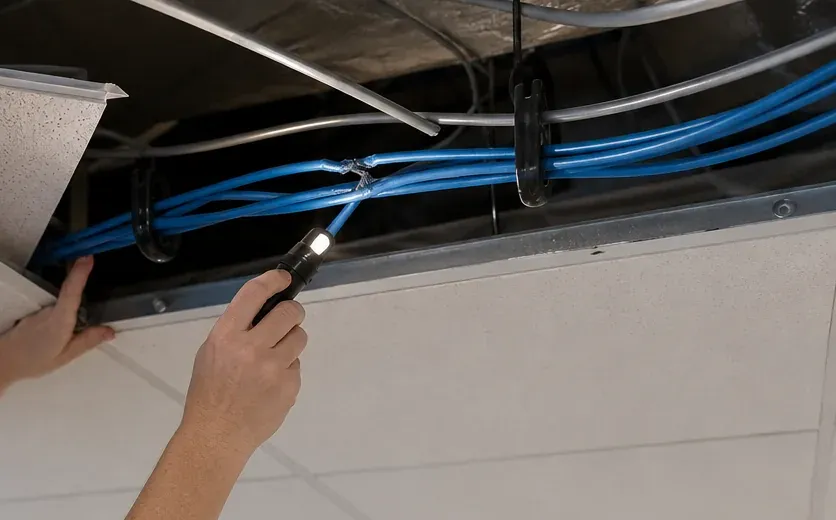
Flashlight inspection of blue Cat6 bundles in J-hooks above a lifted ceiling tile, Fordham, Bronx Cat6 repair
With a tile pushed up out of the grid, a pocket flashlight picks out blue bundles hanging in black J-hooks above the open bay.
Above the Shops

Clinics, Agencies and Classrooms on Fordham's Upper Floors

Nearly half the jobs located in Fordham are in education, health care and social assistance, and a good share of them are upstairs. A suite that was a lawyer's office ten years ago is a dental practice now; a floor that held a training school is a city-contracted agency. Each tenant arrived with a fit-out budget, and the cable is a record of every one of them.

Practices and clinics

A medical or dental office depends on a handful of links that cannot drop during a session: the front-desk computer that checks insurance, the exam-room workstations, the imaging computer and, increasingly, a phone system that runs over the same cable. When one fails, it is usually at a jack behind an exam chair or a desk that is moved for cleaning, or at a termination in a small closet that was added during the last fit-out and never tested. We book these visits before the first patient or after the last, keep the work inside the room we are fixing, and test the repaired link with the practice's own equipment connected so that the front desk knows it works before anyone leaves.

Agencies and nonprofits

Government offices, social-service agencies and nonprofits — 26 of them at street level alone in the district count, and more upstairs — tend to fit out quickly on tight budgets, and tend to inherit cubicle layouts and cabling from the tenant before. Their usual problem is a floor where some desks work and some do not, and nobody knows which jack goes to which port. A repair visit there is half testing and half mapping: we fix the dead links, but the lasting value is a port map the office's IT contractor can use the next time a desk moves.

Schools, training centres and libraries

Classrooms and computer labs in commercial buildings take a beating at floor level: chairs on castors, backpacks, chargers and cords pulled from wall jacks at the end of every class. The district count included 20 schools and training centres in storefronts, and there are more above them. Repairs focus on the jacks themselves — heavier-duty plates, cords dressed out of the way, lock-in devices where students should not be unplugging anything — and on the closet, where an extra switch added mid-term is often the real culprit. Schools and libraries that use E-Rate should involve their coordinator early, because maintenance funding depends on what was requested and approved, not on the repair itself.

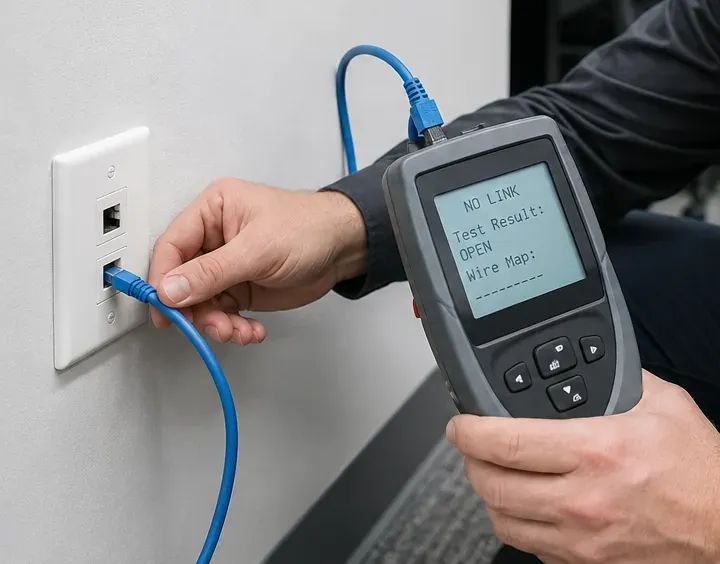
Tester plugged into a two-port wall plate reading NO LINK, OPEN on the wire map, Cat6 jack repair in Fordham, Bronx
Lower port of a white double plate, one blue cord in it, and a grey tester whose screen spells out NO LINK and OPEN with an empty wire map underneath.
For Shop Staff

Shop-Floor Checks Before You Call

On a busy Fordham Road afternoon, a few minutes of checking can save an hour of a technician's time. None of these involves opening a ceiling, a wall or the landlord's cellar, and each tells us something we would otherwise have to find out on site.

CheckSafe for staff?What it tells us
Write down which device stopped, and the timeYesOne register suggests one run; every register and camera at once suggests the switch, the router or the internet line
Look at the switch for the port's lightYesNo light at all points to the cable or the far-end device; a light with no service points elsewhere
Swap the short cord at the device for a known-good factory cordYesCords at counters are crushed and kicked constantly; this alone fixes a fair share of calls
Check whether anything changed overnight — a delivery, a display moved, a contractor in the ceilingYesMost sudden failures follow a physical event, and knowing which one tells us where to look
Restart the device that droppedYes, if you normally doTells a hung terminal or camera apart from a wiring problem
Look under the entrance mat and threshold for cableYesA cable in the walking surface is a likely fault and an easy one to find
Run the switch's own cable test on a portOnly if whoever manages the switch agreesGives a rough distance to an open or short; it may briefly drop the link while it runs
Re-crimp a plug or re-punch a jackNot recommendedA connection that lights up after a home repair can still fail Category 6 badly, and the next fault is harder to find

Text us the results with a photo of the switch and the jack. If the cord swap fixed it, you have saved a visit; if it did not, the technician arrives knowing which end to start at and with the right parts in the van.

New Tenants

Taking Over a Fordham Space: What to Collect Before You Open

Many of the repairs we do in newly leased Fordham spaces would have been shorter, or unnecessary, if the incoming tenant had collected a few things before the old one disappeared. If you are signing for a storefront, a suite or a floor, these are worth asking the landlord, the managing agent and, where you can reach them, the outgoing tenant for.

  • Which cable stays and which goes. A written note of whether the data cabling is the landlord's, the outgoing tenant's, or abandoned — it decides who pays to repair or remove it.
  • Any port map or label scheme. Even a handwritten list of which jack fed which register or camera saves hours of tracing.
  • Test results, if any exist. Saved certification results from the original installation tell us whether a link was ever good.
  • The closet and cellar keys, and who else uses them. Shared cellars on Fordham Road often hold several tenants' equipment and the landlord's meters.
  • The internet provider's demarcation point. Where the carrier's line ends and the building's cable begins, so a fault can be sent to the right company.
  • Any landmark, shielding or armour drawings. For spaces in designated buildings, X-ray suites and secure counters, the drawings show where cable is allowed to pass.

If none of that exists — which is common — a live-or-dead survey and certification of the runs you intend to keep gives you the same baseline. It is cheaper to do it once before opening day than to rediscover it one dead register at a time. Spaces being re-planned from scratch are better handled by our Bronx Cat6 installation team, who build testing into new work.

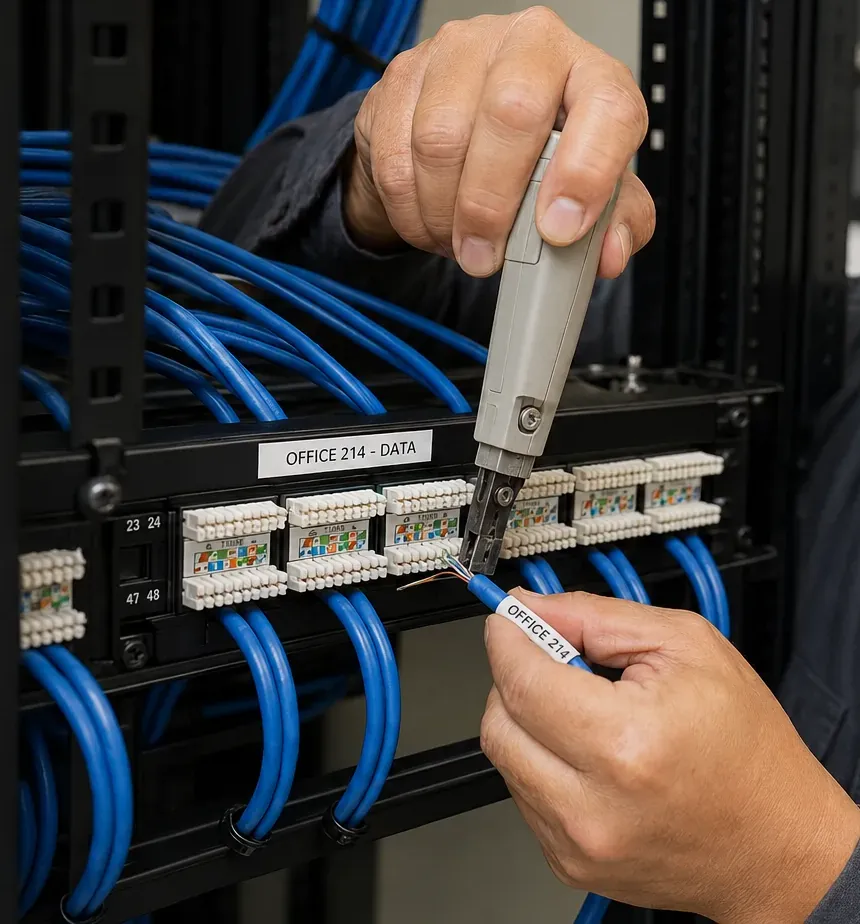
Punch-down tool re-seating a conductor on a patch panel marked Office 214 Data, with a labelled cable, Fordham, Bronx Cat6 repair
Beneath a strip reading OFFICE 214 – DATA, the blade of a punch-down tool seats one conductor while the matching cable, already tagged OFFICE 214, is held steady below.
Equipment

Types of Cat6 Repair Work We Carry Out in Fordham

What we bring to a Fordham repair, and what each item is for.

Certification Tester

The instrument that decides whether a repaired run really meets Category 6 or 6A under the TIA limits, stores that verdict, and measures the distance to a crosstalk or reflection problem. It is also our cross-check on any distance a switch reports.

Toner and Probe

The tool for the live-or-dead sort: it tells us which cable in an unlabelled bundle goes to which jack without disconnecting anything that is still in use.

Matched Keystones, Plates and Panel Modules

Jacks and modules in both categories and the usual plate styles, so the repaired port looks and performs like its neighbours.

Lock-In and Blockout Devices

Clips that stop a cord being pulled from a jack, and inserts that fill unused openings, for sales floors, waiting rooms, classrooms and student houses.

Solid-Copper Riser and Plenum Cable

Replacement runs in the listing the location needs, never stranded cord used as building cable and never copper-clad aluminium.

Raceway, Door-Frame Fittings and Floor Channel

For getting cable out of doorways and walking surfaces and keeping it out of reach of carts, chairs and customers.

Fish Tapes and Small Access Tools

For pulling replacements through existing chases, sleeves and counter pass-throughs, and for making the smallest possible access cut when one is needed.

Firestop Materials

Sealant and sleeves carrying the right listing, used wherever a new run crosses a fire-rated floor or partition.

Factory Cords and a PoE Load Check

Moulded Cat6 and Cat6A cords for the device and closet ends, and a way to confirm a camera or phone is drawing the power it needs over the repaired link.

Who else may be the right call

Your POS or register company is the first call when the terminal or its software is in doubt. Many will tell you the problem is "in the wall" and that they do not touch wiring; a saved test from us settles which side it is on.

The landlord's own contractor may be required for anything in the shared cellar or the building's risers. We are happy to work alongside them or to hand them a clear result.

Your school's or practice's IT provider owns the switch, the firewall and the configuration. Cable work and network settings are different jobs, and the best visits are the ones where both sides know what the other is doing.

The shielding designer or the barrier installer has to agree any new opening in an X-ray room wall or a bullet-resistant counter. We will bring them in rather than guess.

Directories and lead sites will pass your number to several firms. Ask whoever comes whether they bring a certification tester and leave a saved result; that question sorts the field quickly, including us.

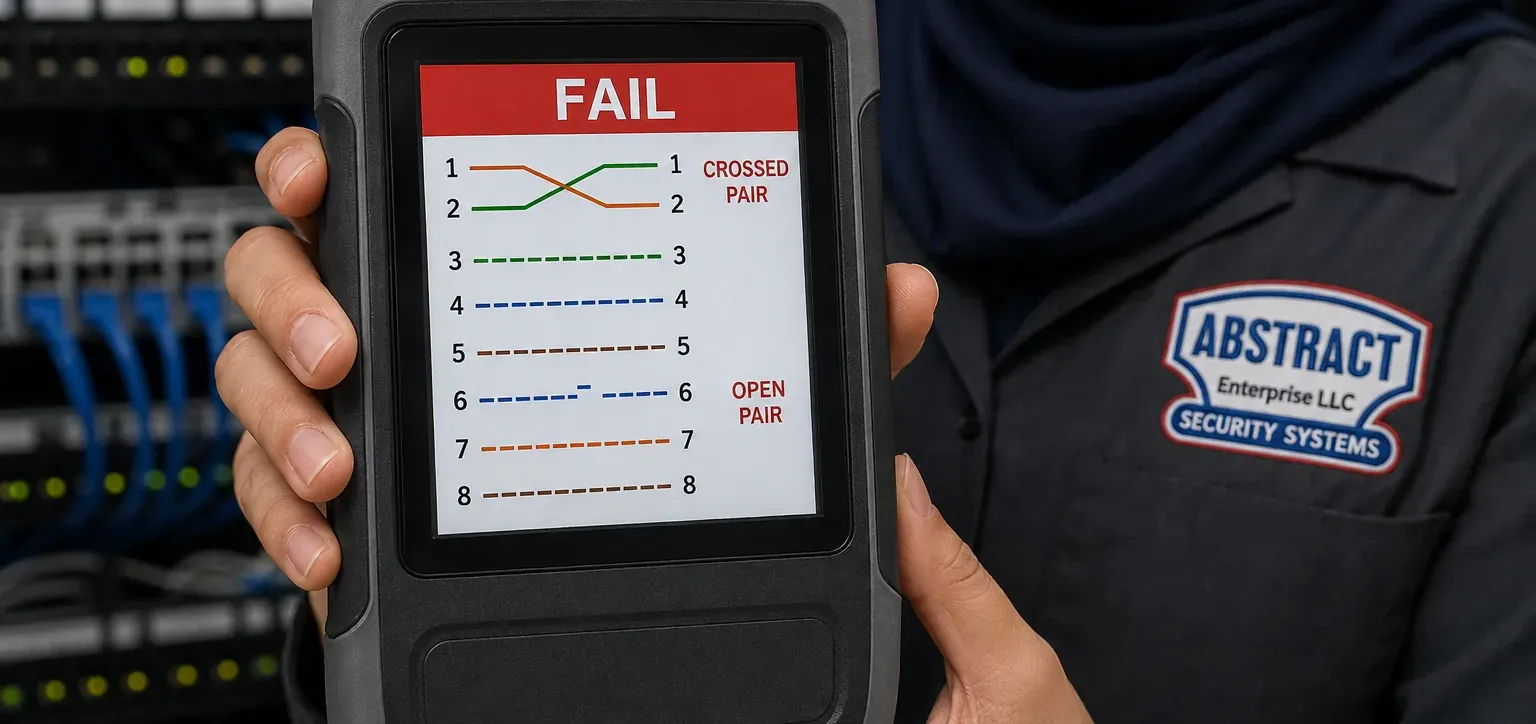
Cable tester screen showing FAIL with a crossed pair on 1 and 2 and an open pair on 6, Cat6 diagnosis in Fordham, Bronx
A hand-held tester connected by a blue cord shows a red FAIL banner, a crossed pair between pins 1 and 2 and an open conductor on pin 6, with a patch panel behind.
AI Overview Reality Check

What AI Gets Wrong About Cat6 Repair in Fordham

We could not see Google's AI-generated summary for Fordham Cat6 repair searches when this page was written, so nothing below pretends to quote it. Each heading is instead an assumption that turns up repeatedly in general advice, forum threads and vendor material — the kind of text such summaries draw on — set against what Fordham buildings actually show.

1. "The space is wired, so the network will just work"

Listings and leases say "wired for data," and general advice treats the cable in the walls as part of the building, like the plumbing. It is reasonable to expect that a storefront or a suite advertised that way will connect on the first day.

In a district where 80 storefronts stood empty at the last count and tenants turn over steadily, "wired" usually means "has cable in it." Whether any of that cable still reaches a working outlet, and whether the outlets it reaches are where your counter and cameras are going, are separate questions. Runs are cut when counters come out, and the closet end is often left hanging after the previous tenant's switch leaves with them.

So we treat inherited cable as unproven until it has been tested. A live-or-dead survey before opening day turns "wired" into a list of links that work, links that can be repaired and links that should be removed.

2. "Your switch can test the cable for you"

Business switches increasingly offer a built-in cable test, and online advice sometimes presents it as all you need to diagnose a run. For a quick check, it is genuinely useful.

Its limits are written into the manufacturers' own documentation. Cisco describes the result as an estimate of the fault type and an approximate distance, lists open and short conditions, warns that results vary with the resolution of different switch models, and recommends an offline cable diagnosis tool once a fault is found. A switch cannot measure crosstalk, return loss or whether a link meets Category 6 at all.

We use the switch's figure as a clue and the certification tester as the answer. Opening a Fordham shop ceiling, or a wall in an occupied office, on the strength of the switch alone is how the wrong tile comes down.

3. "Slow internet in the Bronx is always the provider"

Forum threads are full of it. In one r/bronx thread asking about alternatives to Optimum, a commenter wrote that their internet "goes down and is extremely slow almost every morning until around 11:30." Provider problems are real, and that comment may well describe one.

But a damaged run between the router and a desk, or a loop in a house full of chained switches, produces exactly the same complaint — slow, dropping, worse at busy times — and no amount of calling the provider will fix it. In student houses and small shops, we find wiring and topology faults behind "the internet is slow" often enough that it is worth ruling them out.

The quickest way is to test the speed at the router with a cable, then at the device that is struggling. If the two differ widely, the problem is inside the building, and that is our side of the line.

4. "A small shop can run everything on Wi-Fi"

For a laptop and a phone, often true, and general small-business advice increasingly says so. Fewer cables, fewer things to break.

A Fordham Road shop is not a laptop and a phone. Its cameras are mostly powered over Cat6; its registers and card terminals are frequently on cable; and the frontage is crowded with other shops' Wi-Fi, the street's devices and the steel of the building. When the wired link drops, the business stops taking cards and stops recording, which in a district that has seen smash-and-grab thefts is not a small thing.

Wireless is a good addition. The wired runs are what we repair so that the counter and the cameras do not depend on it.

5. "Any hole can be patched afterwards"

Do-it-yourself advice on replacing a cable usually ends the same way: drill a new hole, pull the cable, patch the wall. In an ordinary partition that is fine.

Some Fordham rooms are not ordinary. A teller counter's protection relies on panels with no unplanned openings; an X-ray room's relies on its lead being continuous or properly baffled; the banking hall of the old Dollar Savings Bank is a designated interior landmark. A patch over a new hole in any of them leaves the room looking repaired and performing worse.

That is why we look for the original route first, and why the plan for any new opening in those rooms names the person responsible for the protection before work starts.

6. "A patch cord is just a short Ethernet cable, so a long one will do"

Online shops sell moulded cords at almost any length, and plenty of advice treats them as interchangeable with installed cable. For a temporary connection across a room, that is harmless.

Run through a ceiling as a permanent link, a stranded cord loses more signal over distance than solid building cable, is often not listed for the space above a ceiling, and has plugs that were never meant to be pushed through holes and left under tension. Fordham ceilings are full of them, left by camera and Wi-Fi installers on short deadlines.

We replace them with solid Cat6 terminated on jacks, starting with the runs that feed cameras and payment equipment, and we tell you which of the rest can wait.

7. "A lit port means a healthy cable"

Plenty of troubleshooting guides start and finish with the link light: lit means connected, connected means good. It is a sensible first glance.

A link light only says that two devices agreed on some speed. A run with a split pair, a kinked section behind a counter or an untwisted termination can light up and still fail Category 6 by a wide margin, showing up as a register that hangs at busy times or a camera that drops when its infrared switches on.

The certification test is the difference between "it lights up" and "it meets the standard," and it is the result we leave with you.
Send a Photo of the Ceiling Before You Open It

A picture of the closet, the counter or the bundle above the tiles, plus a line on what used to be in the space, is usually enough for us to tell you what a visit will involve and what it will cost.

Get In Touch

Request a Free Quote

Shop owners, practice managers, landlords and building staff all use this form. Say which device is down and what the space was before, and we reply in writing within the business day. Prefer to talk? Call (646) 490-0629.

✅

Request received.

A technician at our East Fordham Road office has it now. If the register or the cameras cannot wait, call (646) 490-0629.

How It Works

Our Cat6 Repair Process in Fordham

The same seven stages apply to a lone card reader at street level and to a whole suite of exam rooms two floors up.

1. Phone or photo triage

You tell us what went dark and when, and send a photo of the counter, the ceiling or the closet. We tell you what it most likely is and whether a visit is needed at all.

2. A plan around your hours

We agree a window before the shutters go up, after close or between patients, and confirm who holds the keys to the cellar, the office or the student house.

3. Live-or-dead sort

Before testing the failed link, we tone out what is in the ceiling or the closet and mark which runs are live, which are spare and which were abandoned by an earlier occupant.

4. Test from both ends

Both ends of the doubtful run go on the certifier, which grades it against its own category and says whether the trouble sits at the counter end, the closet end or so many metres along.

5. Agree the fix

You hear what failed, why, and what we propose. Where the route crosses an armoured counter, a shielded wall or a landmarked interior, the plan names who else has to agree before work starts.

6. Repair and protect

Bad ends are cut back and terminated again on parts of the same category, ruined lengths give way to solid-copper cable, routes are moved clear of doorways, sharp edges and feet, and new openings are sealed.

7. Retest, label and hand over

Everything we touched is certified again, labelled at both ends and written into a port map, and the saved results go to the owner, the manager or the landlord's agent.

Coverage Area

Cat6 Repair Near Fordham's Landmarks

Six places that explain the neighbourhood, and the Cat6 work that goes on around each.

Fordham Plaza and the Metro-North Station

The fourth-busiest Metro-North station, a bus hub and a plaza rebuilt in a reconstruction completed in 2016, home to the Bronx Night Market. Offices above the shops around it, and a steady churn of retail tenants.

The Lehman Grand

The landmarked Dollar Savings Bank building at the Grand Concourse and Fordham Road, opened in August 2026 as Lehman College's first residence hall with more than 180 beds. Its exterior and banking-hall interior were designated in 1994.

Paradise Theater

The 1929 movie palace at 2403 Grand Concourse, reported in September 2026 to be reopening as a 4,000-seat performing arts centre. Converted venues bring new low-voltage work into old fabric.

Fordham University, Rose Hill

An 85-acre campus founded in 1841, whose gates face Fordham Road. Off-campus rooms let to students fill the surrounding blocks of Fordham and Belmont.

Bronx Library Center

The New York Public Library's 78,000-square-foot branch on East Kingsbridge Road, opened in January 2006. Libraries and the schools around them are where many residents without home broadband get online.

Poe Park and Poe Cottage

The park on the Grand Concourse at Kingsbridge Road, with Edgar Allan Poe's cottage and a visitor centre. The northern edge of the medical and office blocks along the Concourse.

We also repair Cat6 in Belmont and along Arthur Avenue, in Bedford Park, University Heights, Kingsbridge Heights, Fordham Manor, Fordham Heights, Norwood and Tremont, and right across the borough from the same office. Repairs in other parts of the Bronx are covered on our Bronx Cat6 repair page.

Hands holding a stripped Cat6 cable at an RJ45 plug beside a crimping tool and a small switch, Fordham, Bronx cord repair
Hands line the coloured conductors of a blue cable up to a clear RJ45 plug next to an open crimping tool, with a spare plug on the bench and a small switch at the left.
Pricing

Cat6 Repair Cost in Fordham

Fordham is billed at our Bronx rates, which sit at parity with our Brooklyn base. Nothing below is new: every figure is taken from a live AESS Bronx page, named in the right-hand column. A repair invoice keeps two things apart — the time spent finding and fixing faults, and any run that has to be replaced outright.

ItemPriceScope and source
Hours on site — the sort, two-ended testing, new terminations, certification and the written result$195/hr, 3-hour minimum ($585)Rate shown on our Bronx network cable repair page; the block frequently stretches to more than one link in the same shop or suite
Time beyond the first three hours$195/hrSame page, billed by the hour
A new run, when the existing cable is beyond savingFrom $175 per dropLowest figure on our published Bronx network cable repair list, covering the cable, both terminations, labels, a test and the patch cord
Outside entry sealed and bonded, for a run to a facade camera or signFrom $185 per penetrationOur Bronx network cable repair page
Reference only — what a brand-new Cat6 outlet costs on a run of 100 ft or less$272 per dropTaken from AESS's published Bronx installation rates, which list Cat5e at $233 and Cat6A at $388 a drop
Door-frame or floor-channel re-routes, counter chases, shielded or landmarked rooms, out-of-hours workQuoted after testing and a walkthroughDepends on the route, the building's rules and who else has to approve the work

How a Fordham visit is usually spent

In a shop, the three-hour block typically covers the sort — toning out what is in the ceiling and the closet — plus testing and fixing the failed counter or camera link and certifying the result, often with time left for the next doubtful run. In a practice or an office, more of it goes on the floor: finding which jack a moved desk now hides and mapping the ports. In a student house, it goes on drawing the chain of switches. If testing shows a run must be replaced, you get a price for that run before any cable is pulled.

What changes the total

  • How much was left behind. A ceiling with one previous tenant is quicker to sort than one with three.
  • Where the fault is. A jack or a closet port is short work; a cut above a new partition or under a threshold takes longer to reach and close up.
  • What the room is. Armoured counters, shielded rooms and landmarked interiors add coordination time, not cable cost.
  • When we can work. Before opening, after close or between clinic sessions is normal; we will tell you if a window adds time.
  • What the cable really is. Moulded cords used as runs, phone-grade cable and copper-clad aluminium are replaced rather than repaired.

Seen lower figures online? They are usually national averages for new cable. Fixr's January 2025 guide lists $125–$250 per new Cat6 drop and $45–$75 an hour for labour across the United States. Those are a third party's numbers for new installations and do not describe repairing a Fordham run.

Full terms — including 50% deposit, one-year parts-only warranty on AESS-supplied products, and the late-fee schedule — are set out in the service agreement.

Shop Our Systems

Cat6 Repair Packages & Pricing

Most Fordham bookings fall into one of these. The cards introduce no new prices; each figure appears in the table above.

Starter — One Counter Back Online

$585

A single three-hour block for one register, terminal, camera or exam-room link that has stopped. We trace it, test it, fix what the tester points to and certify it, and use any time left on the next link you are worried about.

Standard — Move-In Sort and Certify

$585 + $195/hr after 3 hours

For a newly leased storefront, suite or student house: every run in the ceiling and closet toned and labelled, the ones you need tested and repaired, the abandoned ones marked for removal, and a port map with saved results. Time estimated in writing after the first hour of sorting.

Premium — Repair Plus Replacement Runs

Repair time + from $175 per run

Where testing shows that some runs are past saving — cords used as cable, phone-grade runs, cuts in the wrong place. Those are replaced from $175 each, the rest repaired at the hourly rate, and any outside entry sealed from $185.

Bring your own parts — labour only. Fit-outs often leave spare keystones, plates or a panel in the stockroom. If they match the run's category, we fit them and charge only for our time; they stay under their maker's warranty rather than ours, and we still certify the result. If the spares will not give a passing link, we say so before fitting them.

Get the Counter and the Cameras Back Before Close

Name the block and the device that went dark; you get our best guess at the cause, and the cost of a visit, before a van leaves East Fordham Road.

Complete Services

Every Cat6 Repair Service in Fordham

Cable repairs here tend to sit next to other work: a camera to replace, a door to secure, a closet to rebuild. These Fordham and Bronx services are the ones most often booked alongside.

Structured Cabling in Fordham

Closets, panels and complete re-wires for spaces being re-planned.

Fordham Security Camera Installation

New camera systems for shops, offices and residential buildings.

Access Control Installation, Fordham

Readers, door controllers and lobby entry hardware.

Intercom Installation in Fordham

Door panels and in-unit stations for the apartment houses over Fordham storefronts.

Fordham Alarm Installation

Intrusion alarms for storefronts and offices.

Fiber Optic Installation, Fordham

For links between floors or buildings that copper cannot span.

Network Cable Repair, Bronx

Cat5e and other copper faults anywhere in the borough.

Security Camera Repair in the Bronx

Recorders and cameras, once the cable has been cleared.

Bronx Intercom Repair

When the cable tests clean but the entry panel or a station still will not work.

Field Notes

Field Notes on Fordham Cat6

Habits rather than stories: the way our technicians work a Fordham call, not a report on any one customer.

We ask what the space used to be before we ask what is broken. A former phone shop, a former clinic and a former restaurant leave very different cable behind, and the answer tells us whether to expect a tidy closet or a ceiling of cords.

We ask who else has a key. On Fordham Road the closet, the cellar and the roof hatch are often in three different hands, and the visit goes faster when we know before we arrive.

We look at the doorway and the counter first. They are where Fordham cable takes the most punishment, and a surprising number of "network problems" end at a crushed cord under a cash drawer or a cable under the mat.

Armour, lead and landmark plaster are never drilled to save half an hour. Before leaving, each link we handled gets a label at both ends, a line on the port map and a saved test, and the file goes to whoever pays for the space — so the tenant after you inherits a record, not a puzzle.

Full Service List

The Full Cat6 Repair Service List for Fordham

Fordham calls come from Fordham Road shop counters, upstairs practices and agencies, secure counters, classrooms and houses of student rooms. This is the full list of what a visit can include.

Finding the fault

Every visit starts with Cat6 cable troubleshooting and Cat6 cable diagnostics at the device that went dark, working back to the closet. Ethernet cable troubleshooting and network connection diagnostics tell us whether the trouble is the cord, the jack, the run in the ceiling or the switch port. Where a space has changed hands, network cable tracing comes first: Cat6 cable tracing with a tone generator and probe separates the live runs from the ones the last tenant abandoned. Cat6 cable fault detection with a certification tester, plus Cat6 cable continuity testing, shows where a run is open, shorted, split or simply too long.

Repairing and replacing cable

Damaged Cat6 cable repair covers runs crushed under counters and cash drawers, cut during a fit-out, flexed to death under a threshold or chafed on a ceiling grid. Cut Ethernet cable repair and broken Cat6 cable repair are matched to what the tester finds; when a section cannot be trusted, Cat6 cable replacement swaps it for solid-copper cable in the right listing. Overhead, Cat6 cable repair above drop ceiling tiles includes proper support with J-hooks so the new run does not rest on the grid, and moulded patch cords found doing the job of building cable are replaced with real runs.

Jacks, plugs and terminations

Many dead links end at the outlet. Cat6 wall jack repair, data jack replacement and Cat6 keystone jack termination bring back counter, desk and exam-room ports; RJ45 connector replacement deals with crushed or snapped plugs on camera leads. Cat6 cable retermination and Cat6 punch down repair remake connections that were untwisted or forced, and T568A/T568B wiring correction puts both ends of a mixed-up run on the same standard. Where a jack sits within reach of the public, lock-in and blockout devices go on at the end.

Closets and patch panels

Cat6 patch panel repair fixes loose punch-downs and dead ports, and patch cord replacement swaps the cords that have been bent at the panel for years. Network cable labelling and port mapping mark both ends of every link we touch, which in a shared Fordham closet is often worth as much as the repair itself.

Cameras, doors and Wi-Fi

Cat6 cable repair for security cameras is among our most common Fordham calls, with PoE camera cable repair checked at the camera rather than only at the switch. Entrance runs to pedestals, door counters and controllers are re-routed out of the walking surface, and Cat6 cable repair for Wi-Fi access points checks the cable feeding a ceiling access point before anyone blames the access point.

Counters, offices and clinics

POS network cable repair and checkout counter Ethernet repair keep registers, terminals and receipt printers online; office workstation network repair and exam-room jack repair restore desks and clinical rooms; teller-line and secure-counter links are repaired through the counter's own chases. Commercial network cable repair and residential network cable repair alike end with Cat6 cable testing and Cat6 cable certification, so a landlord, a head office or a school IT team gets a report rather than a promise.

As a licensed low-voltage contractor, every Cat6 repair technician we send works the same way, from a single storefront jack to a whole floor of an office block.

FAQ

Fordham Cat6 Repair FAQ

Does a Cat6 repair in our medical or dental office need a HIPAA business associate agreement?
+

Usually not. HHS guidance says a business associate agreement is not required with a person, such as an electrician, whose services do not involve using or disclosing protected health information, where any access would be incidental and reasonable safeguards are in place. A cable repair fits that description: we test and fix the wiring and do not log in to your systems. If your practice's own policy asks contractors to sign a confidentiality form anyway, send it before the visit and we will read it. Screens facing away or locked during the work is the simplest safeguard.

Can a school or library put a Cat6 repair through its E-Rate maintenance funding?
+

Possibly. USAC lists Basic Maintenance of Internal Connections as a Category Two service covering the repair and upkeep of eligible internal connections, including wiring and cable maintenance. Whether a particular repair is funded depends on what the school or library requested, the competitive bidding it ran and its approved funding, so the person to ask is your E-Rate coordinator or consultant. What we can supply is an itemised quote and, after the visit, a description of the work and the test results for their file.

Can jacks in a waiting room or on the sales floor be locked so the public cannot unplug or use them?
+

Yes. Manufacturers make lock-in devices that clip over a plug so a cord cannot be pulled out without a key tool, and blockout inserts that fill an unused RJ45 opening so nobody can plug a laptop into it. We fit them at the end of a repair where a jack sits within reach of customers or patients, and leave the removal tool with the manager. They are a physical deterrent, not a substitute for switch-port security, which is for whoever manages your network.

Do you repair the Cat6 that feeds an ATM inside a shop?
+

We repair the building cable up to the jack or connection point the ATM uses, test it, and show the result to the shop and the ATM operator. The machine itself, its modem and anything inside the cabinet belong to the operator or its service company, so we do not open it. If the cable tests clean from end to end, that result is what the operator's technician needs to look at the machine instead of the wiring.

Our store is part of a national chain. Can you work to head office's ticket, check-in and close-out rules?
+

Yes. Give us the work-order or ticket number, the help-desk number and any check-in rule, and we will call in on arrival and before leaving. Most chains want photographs of the repaired jack or panel and the test result attached to the ticket, and some have their own labelling scheme; send it with the booking and we follow it. Prices stay as published on this page unless the chain has its own written rate with us.

The cable from our cash drawer looks like a network cable. Is that part of a Cat6 repair?
+

Usually not. Most cash drawers are opened by the receipt printer through a short drawer-kick cable with a telephone-style RJ11 or RJ12 plug, and some drawers have an RJ45-shaped socket at their end, which is why it is easy to mistake for network cable. It is not on the network and a Cat6 tester will not tell you much about it. We will check whether the drawer, the printer's drawer port or the cable is at fault while we are at the counter, but the repair is a cable swap, not a Cat6 job.

All Areas Served

Cat6 Repair Across the Bronx, New York City and Beyond

This Fordham page sits under our Bronx Cat6 repair page, which covers the borough's new towers and pre-war apartment houses, and above that the AESS New York City Cat6 repair hub. Every area and neighbourhood page in the silo is written for its own buildings.

For other cabling and security work see the full services list, read about the company and its licence, or start from the Abstract Enterprises Security Systems home page.

Sources

Where the Fordham Facts Come From

Neighbourhood figures, news and technical guidance on this page come from the sources below. Every price comes from AESS's own published Bronx pages and nowhere else.

Counter or Exam Room Still Offline at Closing Time?

A register that will not take cards, a camera gone from the recorder, an exam room with no network for tomorrow's first patient: call (646) 490-0629. We are on East Fordham Road, the next open two-hour window is yours, and a fault at a jack, a cord or a closet port is usually put right within an hour or two once a technician is beside it.

Fordham Cat6 Repair from East Fordham Road — Licensed and Insured

Abstract Enterprises Security Systems · 460 E Fordham Rd, Bronx, NY 10458 · (646) 490-0629 · WhatsApp (718) 679-0359 via wa.me

NYS Low-Voltage Licence #12000287431 · 100% Licensed & Insured · Same-Day Estimates · Rated 4.7★ from 201 Google Reviews

Owner-supplied parts are covered by their maker, not by us; details are on our warranty page and in the service agreement.

Written for Fordham shop owners, practice and office managers, landlords and building staff. Where this page refers to codes, guidance or published figures it paraphrases the named source and is not legal, radiation-safety or engineering advice. Page reviewed and updated October 17, 2026. Changelog: October 2026 — Fordham launched as a neighbourhood child of the Bronx Cat6 repair page, covering inherited cable in turned-over spaces, entrance and counter runs, secure counters, X-ray rooms and student-room networks.