Astoria Cat6 Repair · Ditmars to 36th Avenue · Two-Families, Walk-Ups, Storefronts & Studio Blocks
Cat6 Repair in Astoria
Cocklofts & Party Walls · Fire-Escape Cameras · Outdoor Dining Terminals · Stage Floors · Bar Cellars
Astoria’s wired links rarely die in the middle of a room. They fail where the cable was pushed across an edge it was never meant to cross: out through a window frame to a camera on the fire escape, over the cockloft to the back bedroom, along a party wall, past an air-conditioner sleeve, out to a curbside dining setup that comes down every winter, or across a stage floor that carts roll over all day. We find which edge broke the link, repair it with matched Cat6 parts, and route it so the same edge cannot break it again.
Astoria page researched by our team and signed off by Anwar Timothy, NYS licence #12000287431 · reviewed and updated October 17, 2026
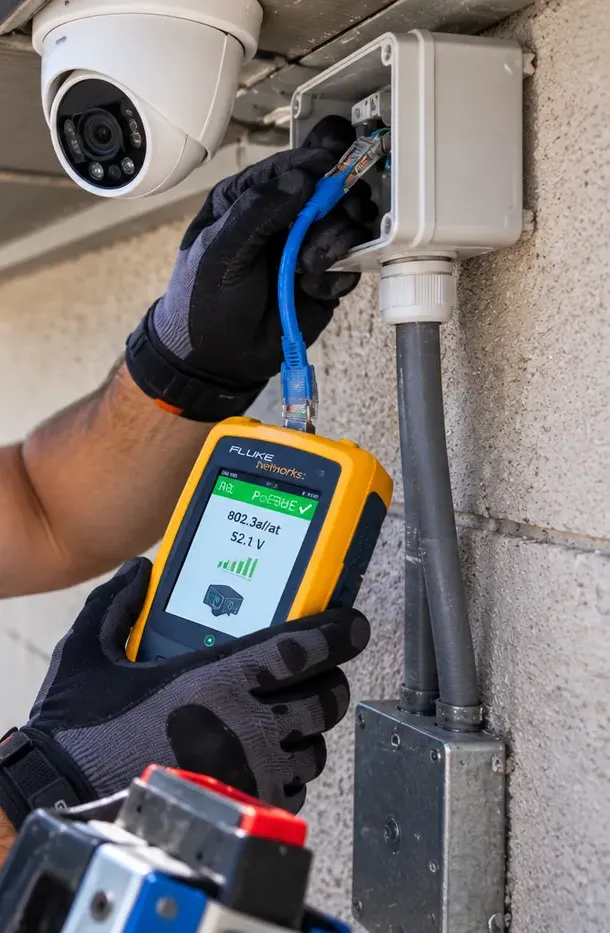
A gloved hand holds a blue lead into an open grey junction box on a block wall beside a white dome camera, while the other hand holds a yellow tester showing a PoE reading of 52.1 volts; grey conduit drops from the box to a metal box below.
Astoria Cat6 Repair Quote
Tell us the block, the kind of building and where the cable stops working — the Queens desk replies the same business day
✅
Request Received
Our Queens desk will call you today about the Astoria repair.
25+
Years Experience
✓
Same-Day Estimates
100%
Licensed & Insured
4.7★
201 Google Reviews
Camera on the fire escape gone dark, back bedroom dead since the roofer left, or the curbside terminal offline again? Ring (347) 434-6392 or send the 60-second form. Say where the cable leaves the room it starts in; in Astoria that one detail usually tells us where the fault sits before we arrive.
The link is tested from both ends before any wall, ceiling or window frame is touched
Repairs on matching Cat6 or Cat6A parts, with outdoor-rated cable and sealed entries wherever the run leaves the building
NYS licence #12000287431 · insured · every repaired link tested, labelled at both ends and written up
How this page fits. It is the Astoria branch of our Queens Cat6 repair page, which covers the whole borough from Long Island City to the Rockaways and deals with kitchens, basements and new towers. Here we stay north of roughly 36th Avenue and west of the Grand Central Parkway — Ditmars–Steinway, the 30th Avenue and Broadway strips, Steinway Street, the studio blocks, Old Astoria and the Halletts Point waterfront — and concentrate on the places an Astoria cable crosses out of its own room. How certification failures are read in general is explained on our New York City Cat6 repair hub.
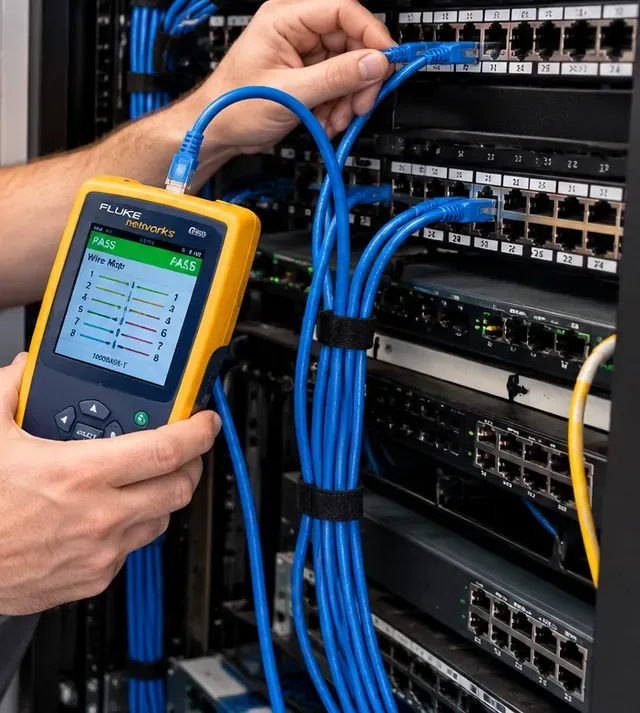
A hand pushes a blue patch cord into a panel port while the other holds a yellow tester whose screen shows eight conductors mapped straight through and PASS along the top.
The Neighborhood
Why Astoria Properties Need Cat6 Repair: Every Run Has to Leave Its Room Somewhere
In an Astoria building, the network cable almost never stays in one room. The router sits wherever the provider’s installer left the box, and every wired thing the household or business cares about — the camera watching the yard, the office in the back bedroom, the terminal at the curbside tables, the editing desk on the third floor — is somewhere else. To get there the Cat6 has to leave the room through something: a window frame, a gap in a floor, a roof space, a party wall, the hole around an air-conditioner sleeve, or a cellar ceiling. Those crossings are where we find nearly every fault on an Astoria job, because each one has a sharp edge, a moving part, weather, heat or water waiting for the cable.
The building stock explains why. NYU’s Furman Center, profiling the Astoria community district (which also takes in part of Long Island City), counted 99,819 housing units and a homeownership rate of 18.5% in 2024, against 32.7% for the city. In 2025 it recorded 204 sales of two-to-four-family buildings and only 47 of one-family homes. In other words, most Astoria households live on one floor of a small building that somebody else owns, and the cabling in it has been added one tenant and one provider visit at a time. Nobody planned a pathway; each new run took the shortest gap available on the day.
The houses themselves push the cable outward. Much of Ditmars–Steinway was built as attached brick houses — a promotional broadsheet for one development advertised a hundred 20-foot brick houses on Ditmars Avenue — and narrow attached houses leave no spare chase for a data cable. Flat roofs mean a shallow roof space over the top floor rather than an attic. Party walls close off one side. Prewar walk-ups add fire escapes and window units to the list of things a cable is tempted to go around. Every one of those features is an edge a run can be cut, pinched or soaked on.
The street adds its own edges. Wherever a restaurant on Ditmars Boulevard, 30th Avenue or Broadway takes card payments at roadway or sidewalk tables, a cable or a base station has to reach outside; under the city’s Dining Out NYC rules a roadway café may operate only from April 1 to November 29 and must be stored by the restaurant in the off-season, so whatever cable feeds it is disconnected and reconnected every year. Around 35th Avenue sit the Kaufman Astoria Studios lot, which grew to twelve stages by 2019, and the production spaces around it, where cable is often laid across floors that carts and dollies use. Bars with cellar coolers run beer lines up to the taps, often through openings a data cable may also be using. And the waterfront towers at Halletts Point, the first of which began leasing in 2019, bring a newer kind of building with its own pathways and its own rules next to the 1951 Astoria Houses campus.
Astoria facts that shape a Cat6 repair
18.5% homeownership: the Furman Center’s 2024 figure for the Astoria community district, against 32.7% citywide — most people calling us rent, so the building owner has a say in any route that leaves the apartment.
204 versus 47: two-to-four-family building sales against one-family sales in the district in 2025, per the same profile — a measure of how much of Astoria is small multi-unit houses with shared walls, roofs and cellars.
15,142 new units since 2010: the Furman Center’s count of new apartments in buildings of four or more units completed in the district from 2010 to 2025, the newer half of Astoria’s cabling.
April 1 to November 29: the only dates a roadway café may operate under Dining Out NYC; it may be set up from March 25 and must be stored by the restaurant in the off-season.
1917: the year the elevated Astoria Line opened along 31st Street to its Ditmars Boulevard terminal, the corridor many Astoria storefronts and walk-ups still face.
Eight days in July 2006: the length of the northwest Queens blackout recorded by Baruch College’s NYCdata (July 17 to 25), during which Con Edison lost twelve of the twenty-two feeders in its Long Island City network — a reminder of why Astoria businesses ask us to test links after power events.
None of this means Astoria buildings are badly wired. It means the faults are predictable. A link that dies at the start of summer is often the one that passes an air-conditioner sleeve; a link that dies after a roofing job is usually the one that crosses the cockloft; a link that dies every spring belongs to the outdoor dining terminal. We start every Astoria call by asking what the cable passes on its way, and the answer usually points straight to the edge that failed.
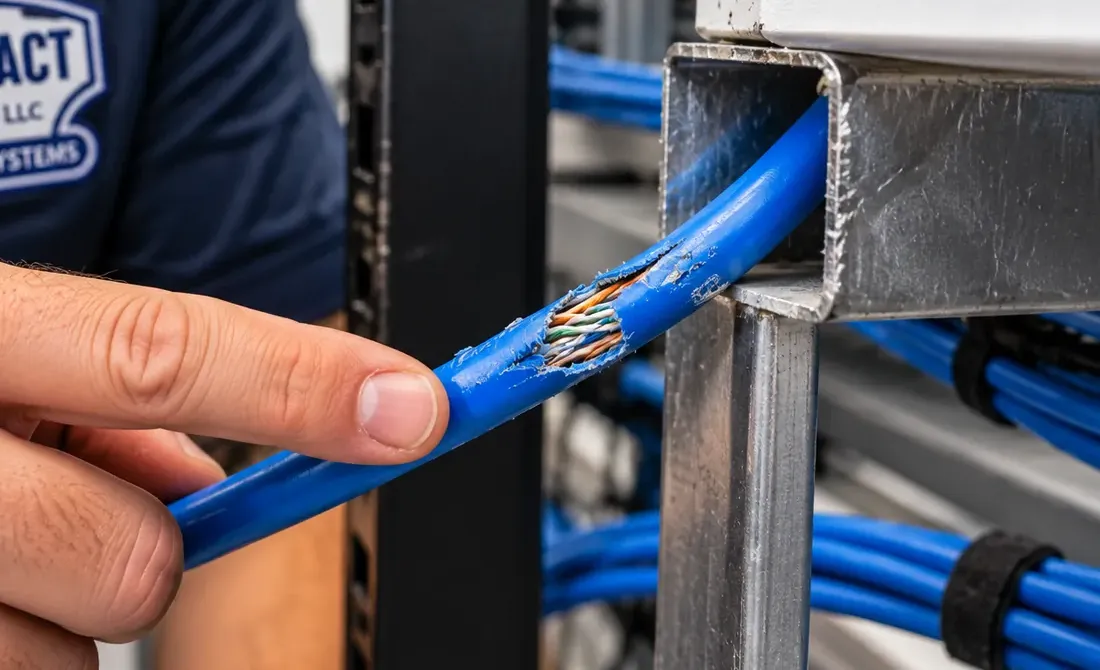
A blue cable bends around the open end of a square steel tube; at the bend the jacket is torn and the twisted orange, green and blue pairs show through, with dressed blue bundles out of focus behind.
Repair Capture
Wired Link Down Somewhere in Astoria Right Now?
A Ditmars taverna’s curbside terminal will not connect, the camera over a two-family’s yard shows no picture, a production office near 35th Avenue lost half its edit desks after a load-in, or the back bedroom office on the top floor went dark after rain. Those are repair calls. We book the first 2-hour arrival window on the schedule and come with a certification tester, a toner, outdoor-rated and standard Cat6 and Cat6A, matched keystones and plugs, sealed entry fittings, cord protectors and factory-made leads. A fault at a jack, a plug or a crossing point is usually found and fixed within one to two hours on site. Repair time is $195 an hour against a three-hour minimum ($585), the same rate we publish for Queens. Call (347) 434-6392 with the address and where the cable goes.
What We Install
Cat6 Repair Services in Astoria
Each service is named after the edge that tends to break the cable. Whatever the starting point, the visit ends the same way: the repaired link tested against its category, the result saved, both ends labelled and a short written note of what failed and why.
Window and Fire-Escape Runs
Camera and access-point cables that leave through a window frame or along a fire escape are re-routed through a sealed entry in the wall, out of the egress path, with outdoor-rated cable from the entry to the device.
Cockloft Crossings
Top-floor rooms fed through the shallow roof space of a flat-roofed house: we locate the fault by distance, open the nearest access point and replace or re-support only the length in the cockloft.
Air-Conditioner Sleeve Rescues
Runs squeezed through the gap around a through-wall or window unit sit in condensation and summer heat. We move them to their own penetration and seal the sleeve gap they were using.
Party-Wall and Neighbour Links
Where a cable crosses into the attached house next door, we test from both sides, agree access with both owners and rebuild the crossing so each household can disconnect its own end.
Outdoor Dining Terminal Feeds
Seasonal roadway and sidewalk café links are rebuilt with a weatherproof disconnect point at the building line, so the setup can be stored each winter without cutting or yanking the run.
Stage-Floor and Production Office Links
Cables crossing working floors near the studios are tested, the crushed lengths replaced and the crossings moved overhead or into protectors, with the run labelled for the next load-in crew.
Bar and Cellar Pathways
Register and kitchen-printer runs that share a chase with beer lines, cooler piping or drain lines are separated, re-supported above any drip point and re-terminated on sealed parts.
Walk-Up Stairwell and Hallway Runs
Surface runs climbing a stairwell or crossing a landing are tested, damaged lengths replaced in raceway, and the route kept clear of doors, treads and anything that counts as an exit path.
Camera, Access-Point and Jukebox Leads
PoE cameras over yards and storefronts, ceiling access points and bar devices that rely on a wired connection are checked for power as well as data, and the plug or jack at fault rebuilt.
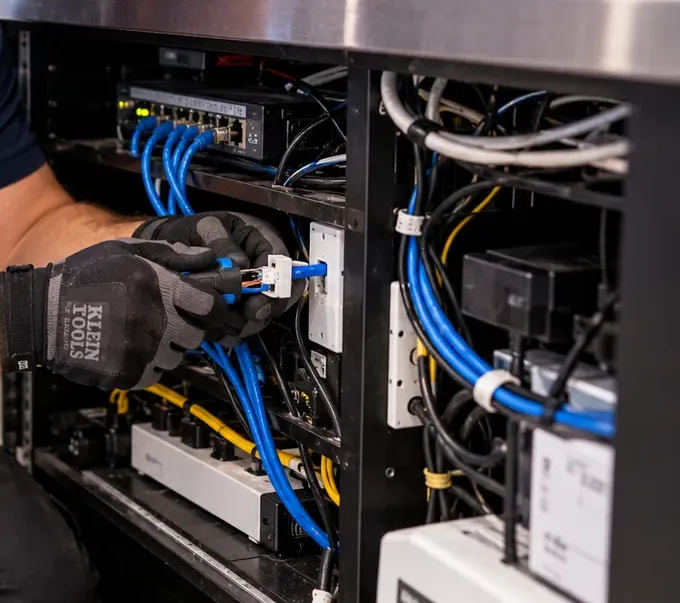
Inside the open base of a stainless counter, a small switch with blue patch leads sits on a shelf while gloved hands seat a plug in a wall jack; white, yellow and blue cords run down to a power strip.
Building Specialists
Cat6 Repair for Astoria's Architecture
Six kinds of Astoria building, six different edges. These are the structures we are called into most north of 36th Avenue, and the crossing in each one that usually gives out first.
Attached Brick Houses of Ditmars–Steinway
Two- and three-family houses built in rows, often around 20 feet wide, with flat roofs and shared side walls. The weak points are the cockloft over the top floor, the party wall and the cellar ceiling where the provider’s line comes in.
Old Astoria’s Historic Houses
The older houses near the park — the Old Astoria Neighborhood Association points to a cluster on 12th and 14th Streets between 27th Avenue and Astoria Park South — and other early houses that have gained rear extensions. Irregular framing and later additions mean runs that cross from the original house into newer construction.
Prewar Walk-Ups and Corner Apartment Buildings
Four- to six-storey buildings along the avenues and side streets, many with fire escapes on the front or rear. Cables leave apartments through window frames, climb stairwells and pass window or sleeve air conditioners.
Mixed Storefront Buildings on the Avenues
One or two shops at street level with apartments above, on Ditmars, 30th Avenue, Broadway, Steinway Street and along 31st Street under the el. The cable crosses from the store to its cellar, to an awning camera and, in season, out to the curb.
Halletts Point and the Newer Waterfront
The Durst towers on the peninsula and other mid-rise rentals near the East River, next to the 1951 Astoria Houses campus. Concrete construction, managed pathways and in-unit enclosures; the crossings that fail are the ones residents add themselves.
Studio, Industrial and Workshop Buildings
The Kaufman Astoria Studios blocks around 35th Avenue and the industrial blocks around the Steinway & Sons factory near the northern waterfront. Big floors, heavy equipment on wheels and cable laid across walkways between temporary positions.
How the repair changes with each building
Attached brick houses: work from the roof space and the cellar, not the plaster. In a row house the fastest way to a failed top-floor run is usually through the cockloft hatch or a ceiling access panel, and the fastest way to a failed ground-floor run is from the cellar ceiling below it. We measure the distance to the fault from the router end, compare it with the house’s width and depth, and decide which space to open before touching any finished wall. Party walls are masonry; we do not drill them for a repair without the owner’s agreement and a clear understanding of who is on the other side.
Older houses: expect a change of construction at the extension. A rear kitchen or sunroom added decades after the house was built has different framing, different insulation and often a step in the floor level. Cables that pass from one to the other are bent around that change, and the bend is where the jacket fails. We repair at the junction, give the cable a gentler radius and fix it so the old and new structures can move slightly without pulling on it.
Walk-ups: keep everything inside and out of the exit path. In a walk-up, the shortcut is always out of the window and along the building. We bring those runs back indoors to a proper penetration, keep cable away from fire-escape access, stair treads and door swings, and use surface raceway on hallway walls only with the building owner’s approval.
Storefront buildings: separate the store’s cable from the building’s. The shop’s register, camera and outdoor terminal runs often share the cellar with the building’s gas, water and electrical service and with the apartments’ provider lines. We label what belongs to the store before repairing anything, so a fix in the cellar never cuts a tenant upstairs.
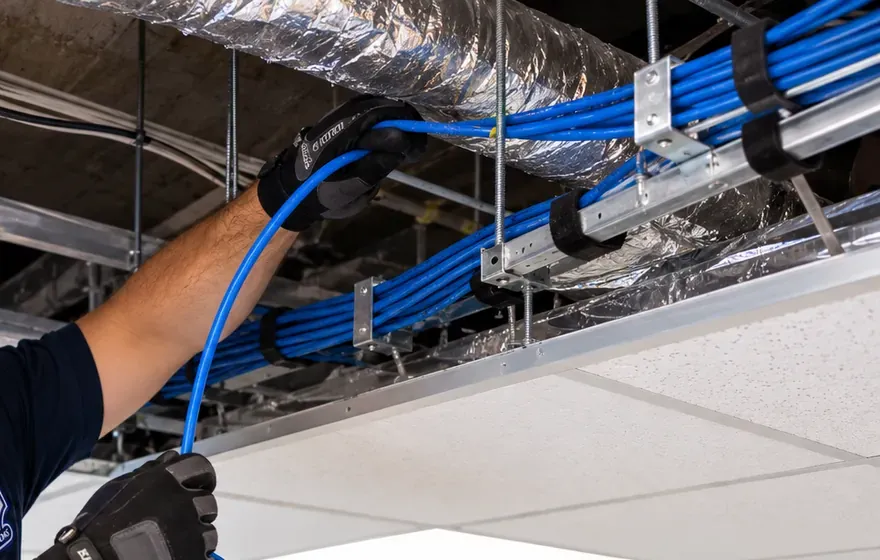
One gloved hand guides a single blue cable up past the ceiling grid towards a row of strapped blue bundles held in metal brackets, with insulated foil duct and threaded hanger rods above.
Commercial Cat6 Repair
Business Cat6 Repair in Astoria
Astoria’s business streets are short walks apart, but each one breaks cable differently. These are the corridors we work along and what tends to fail on each.
Ditmars Boulevard
The northern strip near the last stop of the elevated line, lined with restaurants, cafés and bakeries. Where a business runs outdoor seating in season, curbside terminals join awning cameras and cellar-fed kitchen printers on the list of usual calls.
30th Avenue
Cafés, groceries, bars and services around Athens Square Park at 30th Street. Narrow storefronts with deep back rooms mean long runs from the router at the front to an office or stockroom at the rear, often through a dropped ceiling added over an older one.
Broadway
A mixed run of restaurants, salons, offices and medical practices between the el and the studio blocks. Upstairs offices in storefront buildings reach the network through the stair hall, and that hall run is the one we replace most.
Steinway Street
The retail spine served by the Steinway Street business improvement district, including the stretch long called Little Egypt after the Arab immigrants whose restaurants and bakeries line it. Street-level cameras and counter terminals are the links we see most here.
31st Street Under the El
Shops, gyms and offices that face the elevated Astoria Line, open since 1917. The fault is rarely the trains themselves; it is the runs pushed out through window frames and facade openings to reach cameras and signs on the busy side of the building.
35th Avenue and the Studio Blocks
Kaufman Astoria Studios, the Museum of the Moving Image and the production offices, suppliers and post-production rooms around them. Cable laid across floors, temporary positions that became permanent, and links that must come back before the next call time.
Restaurants, bars and the outdoor season
Astoria’s food and drink businesses produce our most time-sensitive calls, and most of them start somewhere other than the kitchen. A card terminal at a curbside table depends on a cable that left the building through a door frame or a window; a register on the bar depends on a run that came up from the cellar beside the beer lines; a host stand tablet depends on an access point that someone moved for a holiday display. Toast, a widely used point-of-sale vendor, tells its customers that repairs to in-wall cabling may need an outside resource because it does not provide intensive cable work, and that is exactly the gap we fill: the vendor supports the terminal, and we repair the wire behind it.
Bars bring a hazard that offices never see. A long-draw draft system moves beer from a cellar cooler to the taps through an insulated trunk line, and a homebrewing guide from Brew Your Own puts it plainly: in a basement or any humid area, cold draft lines produce a lot of sweat. When a data cable shares the hole, the sleeve or the cable tie with that trunk, it sits in the drip. We separate the two, keep the data run above the trunk rather than below it, and terminate on sealed parts where any moisture is possible.
Compliance callouts for Cat6 repair in Astoria buildings
Fire escapes. The New York City Fire Code requires fire escapes and the access to them to be “continuously maintained free from obstructions and impediments” (FC 1027.7), limits air conditioners in fire-escape windows (FC 1027.7.3) and bars anything that obstructs the operation of a drop ladder (FC 1027.7.4). We will not repair a cable in a way that runs through a fire-escape window or along the escape’s path, and we re-route existing runs that do.
Outdoor dining. Dining Out NYC limits roadway cafés to April 1 – November 29, makes the restaurant responsible for off-season storage, and requires furnishings secured after hours not to block access to utility infrastructure. Any cable feeding the setup is designed to be disconnected cleanly at the building line rather than left in the roadway.
Permits. NYC Administrative Code §28-105.4.7 exempts wiring under 50 volts for data and communication from an electrical permit when it is done by a licensed master electrician, special electrician or other qualified person. Coring through a structural or fire-rated element, or any work that grows into construction, is a different matter and is planned with the building owner. The city’s Electrical Code — the 2020 National Electrical Code with New York City amendments — took full effect on December 21, 2025.
Old cable. The National Electrical Code requires the accessible portion of abandoned communications cable to be removed (NEC 800.25). When we replace an Astoria run we take out the reachable old length, including dead lines left hanging on facades, unless the owner tags it for future use.
Quiet hours. DOB requires an after-hours variance for construction activity before 7 a.m., after 6 p.m. or at weekends. A Cat6 repair is not normally construction, but in attached houses and walk-ups we keep drilling and coring to daytime hours anyway, out of courtesy to the neighbours on the other side of the wall.
Gas re-piping and open walls. When a building’s gas is shut off, NYC Buildings and Con Edison require a licensed plumber to repair the piping and file with both before service returns. Plumbers opening walls and ceilings for that work often meet tenant Cat6 on the way; we coordinate with the owner so damaged runs are repaired while the openings are still there, never by working on or near the gas piping ourselves.
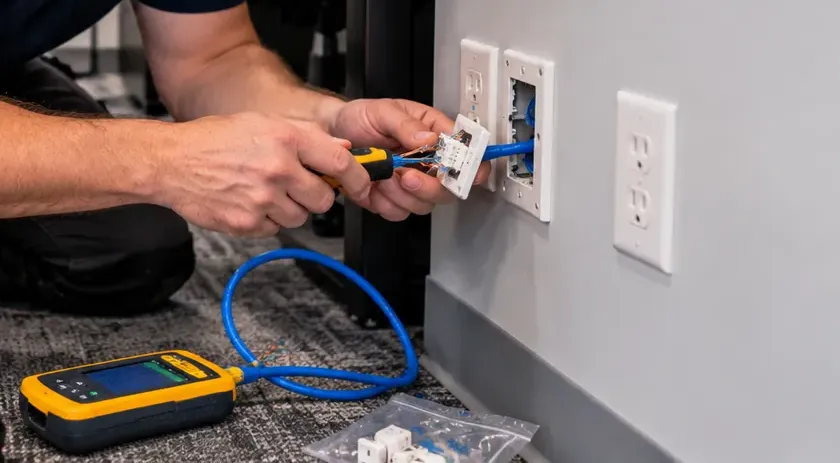
A white wall plate is held out from its box with a blue cable attached while a screwdriver works the jack; a yellow tester sits on the carpet below, connected by a looped blue lead.
Your Questions Answered
Cat6 Repair in Astoria: Questions Answered
These are the questions Astoria owners, tenants and managers bring us that are not answered on our borough or city pages. They are grouped by the edge the cable crosses, and each answer comes first, with the reasoning after it.
Where the cable leaves the building
Outdoor dining terminals: a link built to be unplugged every November
Give the outdoor part of the run its own, short, replaceable length that ends at a weatherproof connection on the building line. The permanent cable from your switch stops at a sealed outdoor jack or box on the facade or in the door frame; from there a separate outdoor-rated patch lead, sized to the setup, runs to the terminal or the tablet stand. In November the lead is unplugged, capped and stored with the furniture; in late March it comes back out and plugs in. Nothing is cut, and nothing is pulled through a window frame or left lying in the roadbed.
The rules make this design sensible. Dining Out NYC allows a roadway café to operate only from April 1 to November 29, lets it be set up from March 25, and leaves storage to the restaurant. A run that was simply fed out of the door when the setup first went up is usually the one that fails in spring: it has been coiled, kinked and stepped on in storage, or someone cut it in a hurry on the last night of the season. When we repair one we test the indoor part first, because it is often still good, and only replace the length that went outside.
Cat6 that runs out of a window and along a fire escape has to come off it
A cable on a fire escape is never repaired where it lies; the repair is the moment to move it. New York City’s Fire Code requires fire escapes and the access to them to be kept free of obstructions at all times, limits air conditioners in fire-escape windows and bars anything that obstructs a drop ladder. A cable taped to the railing, run across the landing or held by the window sash is something a person escaping a fire could trip on or have to clear, and it usually stops the window closing properly too.
The fix is a route that never touches the escape. We make a small sealed penetration through the wall beside the window, take the cable out to a junction box mounted where a person on the escape cannot reach or catch it, and carry outdoor-rated cable from there to the camera. The window then closes, the landing is clear, and the camera has a connection that weather and foot traffic cannot get at. If the camera itself sits on the fire escape we recommend moving it to the wall beside or above it for the same reason.
In a rented apartment the wall penetration needs the owner’s agreement first, and we will put the plan in writing so you can ask. The usual cause of the fault is visible at once: a jacket flattened in the window track or split where it bends over the sill. Testing tells us whether the indoor length is still good enough to keep.
The Cat6 to the camera over our shop sign was threaded through the hollow metal frame of the shop window — can it be repaired inside the frame?
Sometimes, but the better repair usually takes the cable out of the frame altogether. Storefront framing is made of hollow metal sections, and installers occasionally use one as a ready-made conduit up to the sign band. Inside, the cable rubs on cut ends and screw tips, sits where condensation runs down the cold metal in winter, and gets pinched every time a panel or a gasket is refitted. The link that results tends to pass on a mild day and fail after a cold night or a window repair.
We test first to find out how far up the run the damage is. If it is at the bottom, where the cable enters the frame, a new termination below the frame may be all that is needed. If it is inside the section, we draw the old cable out and decide with you whether a new one goes back through the frame — with grommets at every cut edge and a drip loop at the bottom — or, more often, up the inside face of the wall in slim raceway and out through a sealed entry at the sign band.
Storefront frames belong to the building as much as to the shop, and sign bands sometimes carry the landlord’s lighting circuits, so we confirm with the owner before drilling anything and keep the data run well away from the sign’s power wiring. The outdoor length to the camera is replaced in outdoor-rated cable and the old holes are sealed.
Attached houses and the spaces they share
The only way to our top-floor rooms is through the cockloft under the flat roof — can a failed run be replaced through that space?
Usually yes, and it is often the least disruptive route in an attached Astoria house. A cockloft is the void between the top-floor ceiling and the roof deck, common in the ordinary brick-and-joist construction of row houses. It is low, hot in summer and sometimes reachable only through a small hatch or by opening a ceiling, but it runs the depth of the house without passing through any finished room.
Before anyone climbs in, we measure the distance to the fault from the router end. If it falls inside the roof-space length, we open the closest access point, find the damage — often where the cable was crushed under a roofer’s board, chewed, or stapled tight over a joist — and pull a replacement along the same path, supported off the joists rather than lying on the ceiling below. If the fault is at the room end, the cockloft never needs opening at all.
Two cautions. Cocklofts in attached buildings can connect to the neighbouring houses, which is why fire engineers treat them as a route for fire to spread along a row; we do not pass cable into the next house’s space, and any hole we make between floors is closed again. And because the space captures heat, we keep the run away from flues and roof equipment and use cable rated for the space it is in.
We share one internet connection with the attached house next door through a Cat6 run that crosses the party wall — who can repair it, and how?
We can, as long as both owners agree to the visit and to where the crossing ends up. A cable through a party wall is part of two properties at once. We test it from each side, find which side the fault is on, and repair it so that each household has a clearly marked point where it can disconnect its own end without touching the other house.
In practice that means a jack or a small sealed box on each side of the wall, labelled with the address it serves, and a short tested link between them. If the original crossing was a loose cable pushed through a mortar joint or a gap at the joists, we close it properly. We do not make a new hole through a shared masonry wall without both owners’ agreement, and if either owner is a landlord with tenants, the tenants’ access to their own network is protected during the work.
Arrangements like this often outlast the neighbours who set them up. When one house changes hands, a labelled, documented crossing means the new owner can keep it or have it cleanly disconnected; an unlabelled cable in the wall usually gets cut by a contractor who does not know what it is. We leave both sides with a copy of the test result and a short note of what the link is for.
Stages, bars and production spaces
Cable that crosses a stage or workshop floor has to come off the floor
Replace the crushed section and then take the crossing off the floor, or put it in a protector built for wheels. Twisted-pair cable depends on the geometry of its pairs; a wheel that flattens the jacket deforms the pairs inside, and the damage shows up on a tester as reflections and crosstalk at that distance even when the link still lights up. Re-terminating the ends does nothing for a crushed middle.
We locate the crushed points by distance, replace the damaged length with a continuous cable rather than a string of couplers, and then choose the route by how the floor is used. Where a ceiling grid, a lighting rail or a wall is available, the cable goes up and over. Where it must cross at floor level, it goes through a rated cable protector with ramps, laid where the carts already turn rather than in the middle of a load-in path.
Labelling matters on a floor that changes with every production. We mark permanent runs at both ends and at the crossing so the next crew knows not to re-lay them, and we leave a simple map showing which floor positions are live. Near the Kaufman Astoria Studios blocks, where stages and supplier spaces are reconfigured constantly, that map is often what prevents the next call.
Register runs that share a cellar chase with beer lines need separating from them
It can be, through water rather than anything electrical. A long-draw beer system carries cold lines from the cellar cooler to the taps inside an insulated trunk, often with glycol lines to keep it cold. Where that insulation is damaged or poorly sealed, the cold surface sweats, and the water runs down the trunk to the lowest point — frequently the same hole in the floor or the same cable tie the data cable uses.
Over months, that moisture reaches the jacks and plugs at the bottom of the run and corrodes the contacts, or seeps into a damaged jacket. The symptom is a register that drops off intermittently, especially in humid weather or after a busy night when the system has run hard. A tester shows a link that passes one day and fails the next, with the fault at the cellar end.
The repair separates the two systems. The data cable gets its own support above the beer trunk, not tied to it, and its own penetration where possible; damaged lengths and corroded terminations are replaced on sealed parts; and we point out any wet insulation on the trunk so whoever maintains the draft system can reseal it. We do not touch the beer or glycol lines themselves.
Our apartment in one of the Halletts Point towers has a terrace — can a wired camera out there be fed without drilling through the building’s outside wall?
Usually, yes, and drilling the outside wall is the option we would least recommend. Listings for the Halletts Point buildings advertise terraces, and in a new managed tower the exterior wall, the window system and its waterproofing belong to the building, not to the apartment. A hole through them for a camera cable is the kind of alteration a lease normally forbids without written consent, and a badly sealed one can let water into the unit below.
There are better routes. If the terrace already has a weatherproof outlet or a low-voltage sleeve, which some new buildings provide, management can tell you where it lands inside and we can test and use it. If it has neither, the simplest answer is often a camera mounted indoors behind the terrace glass, wired to a jack inside the apartment, or a wireless camera powered from an existing outdoor outlet. We will not run a cable through a door or window seal, because it stops the door closing and breaks the seal it crosses.
If you still want a wired outdoor camera, we write a one-page proposal for the building — route, penetration size, sealing method and who restores what — so management can say yes or no quickly. Their decision stands; we do not drill without it.
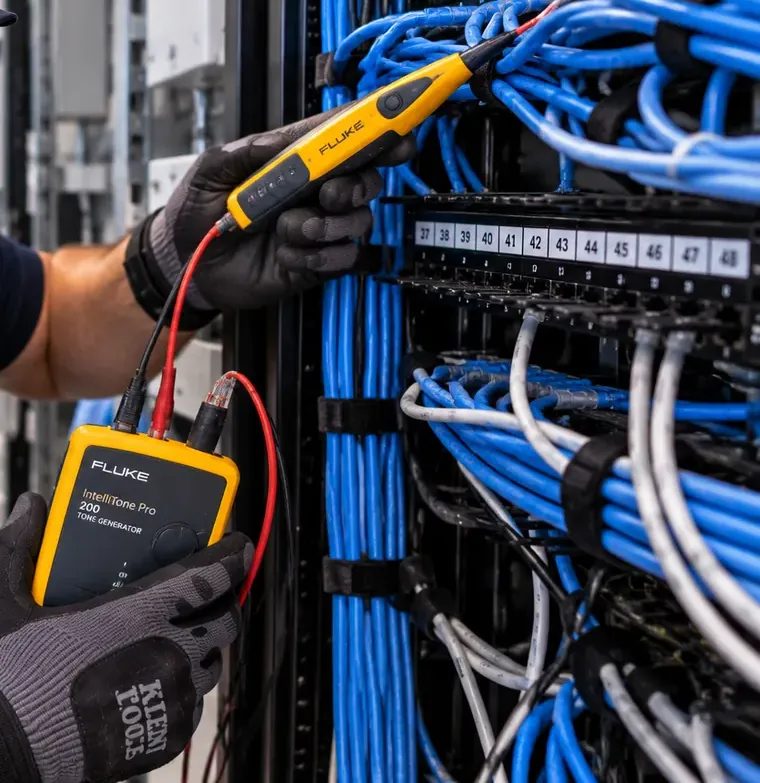
Red and black clip leads trail from a yellow Fluke tone generator held low in one glove while the other glove touches a yellow probe to the blue cables feeding a rack.
Equipment
Types of Cat6 Repair Gear Packed for Astoria Roof Spaces, Cellars and Facades
An Astoria visit can move from a cellar to a roof space to a facade in one hour. The kit is chosen for crossings rather than closets, so that whichever edge failed, the right part is on the van.
Certification Tester With Fault Distance
Tests each link to its category and reports how far along the run a crush, split or bad termination sits, so we can tell whether the fault is in the cockloft, the wall or the cellar before opening anything.
PoE Load Checker
Confirms the power a camera, access point or terminal actually receives at the far end, which separates a cable fault from a device or switch problem on outdoor runs.
Tone Generator and Probe
Finds one cable among a building’s worth of provider lines, old phone wire and tenants’ runs in a shared cellar without disconnecting anybody.
Outdoor-Rated Cat6 and Cat6A
Sunlight- and moisture-resistant jacketed cable for the length from a sealed entry to a camera, an awning or a curbside connection point, plus standard cable for indoor lengths.
Sealed Entries and Weatherproof Boxes
Wall sleeves, sealant, gaskets and outdoor jacks or junction boxes, so a run that leaves the building does it through its own closed penetration instead of a window frame.
Floor Cable Protectors
Ramped protectors for crossings that must stay at floor level on stages and workshop floors, and adhesive or screw-fixed raceway for stairwell and hallway walls.
Matched Keystones, Plugs and Modules
Cat6 and Cat6A, shielded and unshielded, including sealed and field-terminable parts for cellar and outdoor ends.
Roof-Space and Cellar Access Kit
Low-profile lights, knee boards, fish rods and supports for working in a cockloft or across cellar joists without loading the ceiling below.
Labels and Crossing Maps
A label printer and a simple floor or building sketch on which every crossing, entry and junction is marked, for the owner, the tenant and the next contractor.
Provider installer, handyman or cabling contractor: who fixes an Astoria crossing properly
What the repair needs
Internet provider’s installer
General handyman
Licensed cabling contractor
Testing the link end to end
Tests the service to the box they installed; your in-wall cable is generally outside the job
May check for light at the jack; rarely carries a tester that measures distance to a fault
Certifies the link and locates the fault by distance before opening anything
Making a sealed exit through the wall
Makes entries for its own line
Can drill, but may not know cable bend and sealing needs
Sealed, bonded entry with outdoor-rated cable from the wall to the device
Keeping fire escapes and exits clear
Not usually in scope
Varies
Routes are planned around fire-escape access and stair paths from the start
Working in a cockloft or shared cellar
Rarely
Sometimes, without measuring first
Measured access to the exact spot; nothing passed into a neighbour’s space
Written results you can keep
Service ticket for the provider’s equipment
Usually none
Saved test result for every repaired link, labels at both ends and a short report
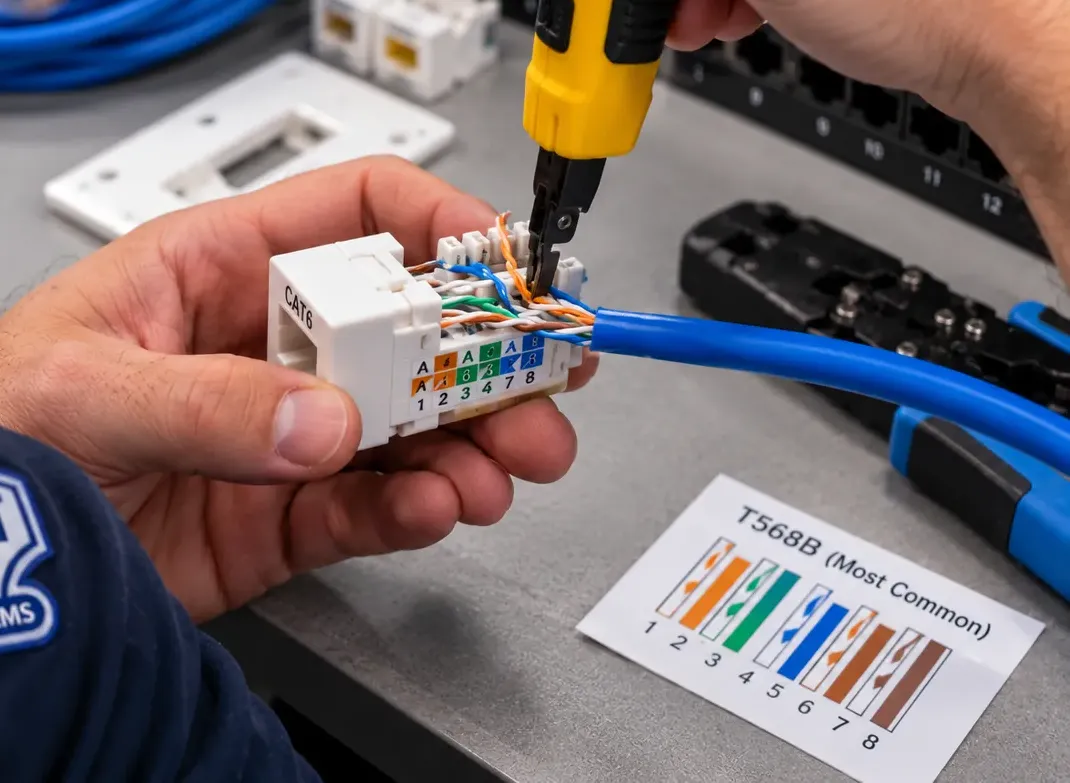
Orange, green, blue and brown pairs are laid into the slots of a white CAT6 keystone and pressed home with a yellow tool; a printed T568B card, a blank wall plate and spare keystones lie on the grey bench.
AI Overview Reality Check
What AI Gets Wrong About Cat6 Repair in Astoria
We could not open Google’s AI Overview from the environment this page was built in, so the claims below are ones that cost guides, forums and vendor pages commonly repeat. Each is set against what we actually find when an Astoria link fails.
“Ethernet cable is just cable — any Cat6 will do anywhere”
Advice like this is everywhere, and it is not entirely wrong indoors: in one r/astoria thread about extending a cable, a commenter says that for residential use above the wall almost any Cat6 or Cat5e cable with RJ45 ends will do. For a run that stays in one room, that is close to true.
The trouble is that Astoria runs rarely stay in one room. Indoor jacket material is not made for sunlight, standing water or the temperature swing on a south-facing facade, and cable that leaves through a window frame or along a cellar wall is exposed to exactly that. The indoor-rated cable we remove from outdoor routes is often cracked, faded or soft where it crossed the window sill.
So the right cable depends on where each part of the run goes. Indoors, standard Cat6 is fine; from a sealed entry to an outdoor device, outdoor-rated cable; through spaces used for air handling in a commercial building, cable listed for that space. The repair changes the cable where the route changes, rather than using one reel for everything.
“A lit-up jack means the wiring behind it is healthy”
A link light only means the two ends agreed on some connection. A Cat6 run with a damaged pair can still light up and connect at 100 Mbps, because that speed uses two pairs while gigabit needs all four.
The edges Astoria cables cross produce exactly that kind of partial damage. A window track flattens one side of the jacket; a sleeve edge cuts through one pair; a cart wheel crushes the geometry without breaking a conductor. The port light stays on, the speed drops, and the camera or terminal behaves erratically.
That is why we test with a certification tester rather than a light. It shows whether all four pairs are intact, whether crosstalk and reflections are within limits, and, most usefully, how far along the run the problem is. In a narrow attached house that distance often points to one specific crossing.
“The landlord has to fix any wiring in your apartment”
This one is stated with great confidence online and is true only some of the time. Whether a particular Cat6 run is the landlord’s responsibility depends on who installed it, the lease and what the run serves; a cable a previous tenant ran to a camera is not usually part of anybody’s obligations.
In Astoria, where most households rent a floor of a small building, the practical question is not who must pay but who must agree. Repairs that stay inside the apartment and use the existing route seldom need more than the tenant’s go-ahead. Anything that adds a hole through an exterior wall, a party wall or a shared floor needs the owner’s agreement first.
We do not give legal advice on leases. What we do is write the repair plan clearly enough — what is inside the unit, what crosses the building, what will be drilled — that the tenant and owner can decide quickly who authorises and who pays.
“Mesh Wi-Fi makes cable repair unnecessary”
Wireless is a good answer for many rooms, and we say so when it is. The claim goes wrong where the devices are the reason for the cable: a camera powered over Ethernet, a terminal at the curb, a production desk moving large files, an access point that is itself the mesh node.
Astoria’s buildings also work against wireless in particular directions. Brick party walls, masonry between floors and the depth of a long narrow house all weaken the signal toward the back rooms and the yard, which are exactly where the cable usually goes. A mesh node at the back often needs a wired link to its neighbour to perform well.
Where a repair is the better option, it is usually because the device needs power over the cable or a steady connection. Where wireless would genuinely do, we would rather tell you than sell a repair.
“Outdoor cable runs only fail in storms”
Storms do damage outdoor runs, but most of the outdoor faults we find in Astoria are made by people and routines rather than weather: a dining setup packed away each November, a window closed on a cable every night, a camera lead pulled when someone used the fire escape, an awning rolled over a run.
Slow processes matter too. A seal that was never made around an entry lets water follow the cable inside; summer heat on a dark facade softens a jacket that was never meant for it; and condensation from air conditioners and beer lines keeps a termination damp for months.
“A power outage can’t damage network cable”
Strictly, an outage does not damage cable; the cable is passive. But the events around an outage can damage what is attached to it — a concern that is not abstract in a part of Queens that went without power for eight days in July 2006.
When power returns unevenly, or when a generator or a surge is involved, switch ports and PoE power supplies can fail, and devices that were never properly grounded can take a port with them. The cable then looks guilty because the camera on the end of it is dark.
After a power event we test the runs themselves before replacing anything. If the cabling passes and the switch port or injector does not, the repair is on the equipment side, and our Queens network installation team can replace it.
“Expect to pay a couple of hundred dollars a drop”
National cost guides such as Fixr’s give $125 to $250 per new Cat6 drop and $45 to $75 an hour for labour, and AI summaries tend to repeat those figures as if they described repairs. They describe new drops in open, ordinary spaces across the country.
An Astoria repair is a different job: finding the fault in a building with no drawings, getting into a cockloft or a shared cellar, making a sealed exit through brick, and protecting neighbours and exits along the way. Our Queens repair time is published at $195 an hour with a three-hour minimum, and a run that has to be replaced is priced from $175 per drop.
Those numbers are higher than the national averages because the work is different, not because the cable is. The pricing section below shows where each figure is published and what it covers.
Cable Crossing a Window, a Roof or a Wall? Let’s Find the Break
Tell us what the cable passes on its way to the dead device. We will tell you where we expect the fault and what the repair should cost.
Send the street, the kind of building, the device that stopped working and what the cable passes to get there; we reply in writing the same business day. Rather talk? The Queens line is (347) 434-6392.
✅
Request Received
Got it. Expect a call from our Queens desk later today with questions about the route the cable takes. If a till or a camera is down right now, dial (347) 434-6392 instead of waiting.
How It Works
Our Astoria Cat6 Repair Process
Seven steps built around one Astoria habit of cable: it fails where it crosses out of its room, so the process is about finding that crossing, fixing it and closing it properly.
1. Trace the route on the phone
You tell us where the router is, where the dead device is and what the cable passes between them. That tells us which crossing to suspect and which parts to load.
2. Agree access with whoever owns the edge
If the route crosses an exterior wall, a party wall, a shared cellar or the roof space, we confirm the owner’s agreement and book a 2-hour arrival window that suits the household or the business.
3. Test from both ends
One tester at the router or switch, a check at the dead device, and a distance reading that says which crossing to open.
4. Open only the crossing at fault
We open the one window frame, hatch, cellar bay or wall box the measurement points to, photograph the damage and agree the repair with you before starting it.
5. Repair and re-route the edge
Damaged lengths are replaced in the right cable for each space, terminations rebuilt on matched parts, and the crossing moved to its own sealed entry, support or protector.
6. Re-test, label and seal
Every link we touched is certified again and labelled at both ends; entries are sealed, openings closed and reachable dead cable removed.
7. Leave a crossing map
You receive the saved results, photos and a sketch of where each run leaves its room, so the owner, the next tenant or the next contractor knows what is there.
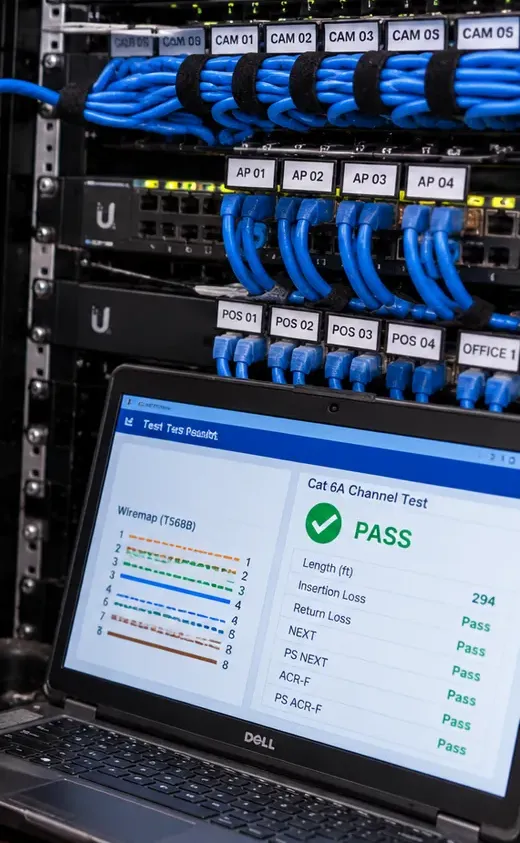
A laptop screen shows a channel test marked PASS with a T568B wire map beside it; above, strapped blue patch cords run into ports labelled CAM, AP, POS and OFFICE on a black rack.
Coverage Area
Cat6 Repair Near Astoria's Landmarks
Use these six places to place yourself on the map. We list them as orientation for the streets nearby — none is presented as a client or a job of ours.
Kaufman Astoria Studios
Opened in 1920 by Famous Players-Lasky, later Paramount, at what is now 35th Avenue and 35th Street; run as Kaufman Astoria Studios since 1982, home to Sesame Street from 1993, and grown to twelve stages by 2019.
Museum of the Moving Image
Opened in 1988 in a former studio building beside the lot and reopened on January 15, 2011 after a $67 million expansion, with a 267-seat theatre; the Frank Sinatra School of the Arts stands across the street.
Astoria Park and the Hell Gate Bridge
More than 56 acres acquired by the city in 1913, with the pool — 330 by 165 feet, the largest of the eleven WPA pools — opened on July 2, 1936. The 1,017-foot steel arch of the Hell Gate Bridge, dedicated in 1917, crosses above it.
Steinway Mansion and Steinway & Sons
The mansion built in 1857–1858 and designated a city landmark in 1967, and the piano company that employed about 400 people in Queens by the mid-1870s and gave Steinway Street its name.
Bohemian Hall and Beer Garden
Built for the Bohemian Citizens’ Benevolent Society, formed in 1892; the cornerstone was laid on October 1, 1910, the outdoor bar and garden were finished in 1919, and the hall was listed on the National Register of Historic Places in 2001.
Astoria Houses and Halletts Point
The NYCHA campus of 1,103 apartments in 22 buildings on a 27-acre site, completed in 1951 on the Halletts Point peninsula, now joined by Durst’s waterfront towers, planned as three buildings with more than 1,000 rentals.
We also repair Cat6 across Ditmars–Steinway, Astoria Heights, the blocks along 21st Street and Crescent Street, Old Astoria and the Ravenswood edge, and in the neighbourhoods next door: Long Island City, Sunnyside, Woodside, Jackson Heights and East Elmhurst. For everywhere else in the borough, start from our AESS Cat6 repair service in Queens.
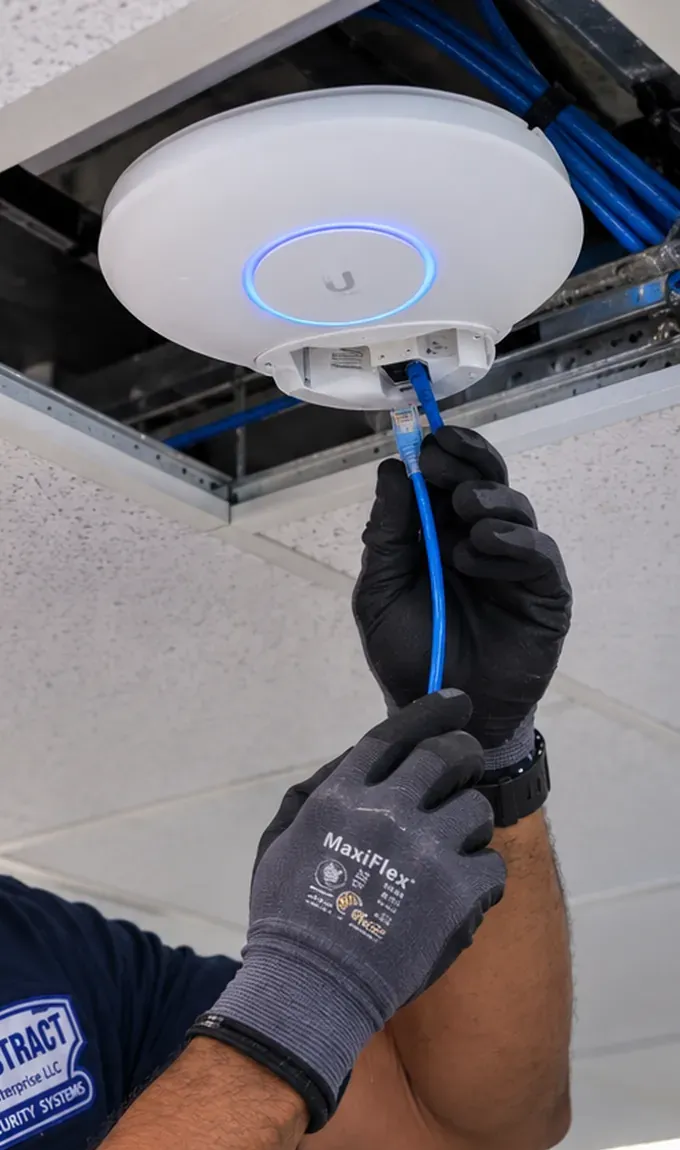
Gloved fingers grip a blue lead plugged into the base of a round white unit, its blue ring glowing, which has been eased down out of the ceiling; bundles of blue cable show in the open void beside it.
Pricing
Cat6 Repair Cost in Astoria
Astoria uses the Queens figures we already publish, without a further neighbourhood adjustment. Each line below says where the number comes from. Work that depends on the building — coring through masonry, long re-routes, outdoor junction boxes on tall facades — is priced in writing once the run has been tested.
Item
Price
What it covers, and the published source
Hourly labour on site — tester, toner, opening the crossing, new ends and a closing certification
$195/hr, 3-hour minimum ($585)
Published for Queens on both our Cat6 repair and network cable repair pages; time after the third hour is billed only as it is used
Cable too damaged to keep: a new run pulled in its place
From $175 per drop
Queens figure as published; the price already includes the new cable, jack, faceplate, panel end, test, two labels and a cord
Sealed, bonded entry where a run leaves the building (window, fire-escape, awning or curbside routes)
From $194 per penetration
The figure on our Queens Cat6 repair page: the Bronx-published $185 with the Queens area rate applied
Not a repair price: what one new Cat6 outlet costs to install from scratch, up to 100 feet of cable
$272 per drop
From the borough’s Cat6 installation page, which sets Cat5e at $233 and Cat6A at $388 beside it
National guide, for context
$125–$250 per drop; $45–$75/hr labour
Fixr’s cost guide (January 2025 update): country-wide figures for installing new outlets, quoted only to explain the gap
Why Astoria has no separate surcharge
Our pricing rules set area rates by borough and county, and the figures above are the Queens numbers already live on our site. Astoria uses them as published. When an Astoria job costs more than the minimum, it is because of the crossing — a cockloft that needs a ceiling opened, a wall that needs a sealed entry, an outdoor box on a facade — and each of those appears as its own line on the written quote.
Where three hours usually go on an Astoria crossing repair
The first part goes on testing from both ends and placing the fault. The second goes on opening the one crossing the tester points to, replacing the damaged length and moving it to a proper route — a sealed entry, a support in the cockloft, a protector on a floor. The last part goes on re-testing, labelling, closing up and sketching the route. Single-crossing faults such as a sleeve gap or a window track often fit comfortably inside three hours, with time left for a second link.
Five details that decide the size of an Astoria repair bill
Knowing the route: if you can tell us where the cable leaves the room, we start in the right place.
Access agreed in advance: a visit where the owner has already approved the wall entry or the cockloft hatch moves faster than one that waits for a phone call.
The crossing type: a re-terminated jack is quick; a new sealed exit through brick takes longer and carries the per-penetration line.
Season and setup: outdoor dining and facade work are easier on a dry day with the setup out of the way.
Category and shielding: a shielded or Cat6A link needs dearer parts and more careful termination, so it takes longer than plain Cat6.
Full terms — including 50% deposit, one-year parts-only warranty on AESS-supplied products, and the late-fee schedule — are set out in the service agreement.
Shop Our Systems
Cat6 Repair Packages & Pricing
Three common Astoria jobs, each priced by adding together lines we already publish for the borough.
Starter — One Broken Crossing
$585
Three hours at $195 for one dead device and the edge that killed it: we test, open the crossing, fix it, certify and label. If that takes ninety minutes, the rest of the booking goes on whatever you point us at next.
Standard — Bring It Back Indoors
$585 + from $194 per new entry
For runs that leave through a window, a sleeve gap or a door frame: the outdoor length replaced in outdoor-rated cable, a sealed entry made through the wall, and the window, sleeve or frame closed and sealed again.
Premium — Repair, Replace and Map
Repair time + from $175 per run
For houses, bars and production spaces with several failed runs: hourly repair where cable can be saved, replacement runs from $175 each where it cannot, reachable dead cable removed and a crossing map for the whole building.
Bring Your Own Equipment — Labour-Only Repair
If you already have the outdoor jack, the camera junction box or a reel of the cable used elsewhere in the building, we can fit it and charge only repair time, provided it suits the space: outdoor-rated cable outside, the right category and shielding, and sealed parts where moisture is possible. We test the result either way. Parts you supply carry their maker’s warranty rather than ours, and if a part will not give a passing link we tell you before fitting it.
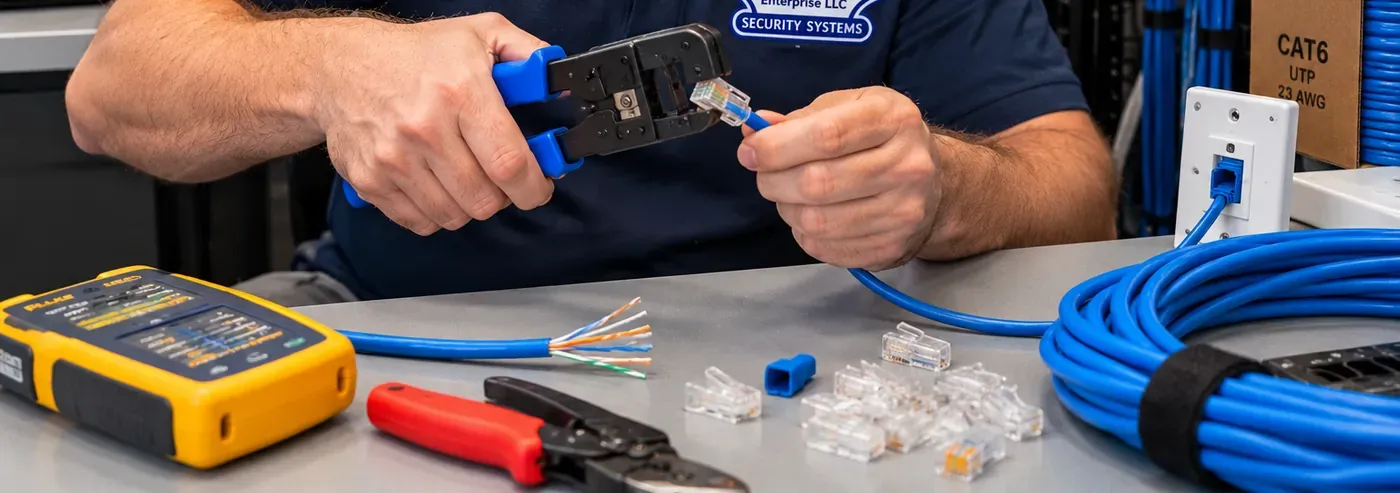
A blue-handled crimper closes on a clear RJ45 plug; on the grey bench lie a yellow cable tester, a stripped cable end with its pairs fanned out, loose plugs and a boot, a red-handled cutter and a strapped coil of blue cable.
Opening for the Season or Packing Up for Winter? Test the Outdoor Link First
A tested, labelled disconnect point at the building line turns the outdoor terminal into a plug-in job every spring instead of a repair.
Each Astoria Crossing, What Breaks It and What We Test
A quick reference for owners and tenants. Find the edge your cable crosses, and you will know roughly what has happened to it and what the repair involves.
Crossing
What usually breaks the cable
What we test and how we fix it
Window frame or sash
Flattened in the track each time the window closes; jacket split on the sill; sunlight on indoor cable
Distance to fault from inside; outdoor length replaced and moved to a sealed wall entry beside the window
Fire escape
Pulled or stepped on; tied to railings; obstructs a path that must stay clear
Whole outdoor length replaced and re-routed off the escape to a box out of reach of the landing
Air-conditioner sleeve gap
Condensation, rain and heat; the sleeve’s thin metal edge
Fault located near the wall; run given its own penetration and the sleeve gap resealed
Cockloft
Crushed by roofers’ boards, stapled tight over joists, summer heat, pests
Fault placed against the house depth; nearest hatch or ceiling access opened; length replaced and supported
Party wall
Loose cable through a joint, cut by a neighbour’s contractor, no disconnect point
Tested from both houses; labelled jacks on each side; crossing closed properly with both owners’ agreement
Cellar ceiling and chases
Water from beer lines, pipes and drains; tied to other services; cut during plumbing work
Separated onto its own supports above any drip point; sealed terminations; store and tenant runs labelled
Curbside and sidewalk dining
Coiled and kinked in storage, cut at the end of the season, water at the door frame
Indoor length tested and kept; outdoor lead replaced; weatherproof disconnect fitted at the building line
Stage and workshop floors
Wheels of carts, cases and lifts; re-laid by each new crew
Crushed sections replaced in one length; crossing moved overhead or into a ramped protector; positions mapped
Stairwells and landings
Doors, treads, painting and tenants moving furniture
Damaged lengths replaced in raceway with owner approval, clear of door swings and exit paths
Scheduling
Fitting a Repair Around Astoria’s Calendar
Astoria’s buildings run on several clocks at once: the outdoor dining season, restaurant service, production call times and the households on the other side of a shared wall. We plan the visit around whichever applies.
Restaurants, cafés and bars
Counter and kitchen links are best repaired before service starts, when the floor is empty and the registers can be offline. Outdoor terminal work is best done in late March, before the setup goes out from March 25 under the city’s rules, or in the week after November 29, when it comes in for the winter.
Production offices and studio suppliers
Repairs are booked around call times and load-ins. Testing and re-terminating can happen with crews present; replacing a floor crossing needs the floor clear for an hour or two. If a shoot day cannot move, we can bring a failed position back on a temporary tested lead and finish the permanent route on a dark day.
Attached houses and walk-ups
Drilling and any coring are kept to daytime hours, and we tell you how long the noisy part will take so neighbours can be warned. Cockloft work in midsummer is planned for the morning, before the roof space heats up. Where a repair needs the owner or the neighbour to be present, we fit the visit to their availability first.
Complete Services
Every Cat6 Repair Service in Astoria
A broken crossing is often one part of a bigger job. These Queens services can be booked on the same visit.
One message covering the cable, cameras and anything else on your list.
Field Notes
Notes From Our Technicians on Astoria Cable Calls
How our crew tends to work in Astoria houses, shops and studios, written as practice rather than as the story of one visit
We ask what the cable passes before we ask what broke. “It goes out the bedroom window to the camera” or “it runs up from the cellar next to the beer lines” is usually worth more than any description of the symptom.
We test before we open. In a narrow house the distance reading tells us whether to go to the window, the roof space or the cellar, and it saves opening the wrong one.
We bring outdoor runs back inside. A cable that leaves through a window or along a fire escape is never repaired in place; it gets a sealed exit and a route that does not depend on how the window is used.
We respect the other side of the wall. Party walls, shared cellars and cocklofts belong to more than one household, so we confirm access, keep to daytime for noisy work and never pass cable into a neighbour’s space.
We write down every crossing. A sketch of where each run leaves its room is the most useful thing we leave behind in a building that has been wired one tenant at a time.
Full Service List
Every Cat6 Cable Repair Service We Handle in Astoria, Queens
The list below names every repair we carry out north of 36th Avenue, sorted by the symptom an Astoria caller usually describes rather than by the part we end up replacing.
“Something out past the window stopped working”
A yard camera, an awning camera or a curbside terminal is the classic Astoria call. We begin with PoE connection troubleshooting at the device and work inward: PoE camera cable repair, security camera Ethernet cable repair, Cat6 cable repair for security cameras and offline security camera network repair on the camera side; weatherproof Ethernet connector repair and outdoor Cat6 termination repair at the wall; and, for a terminal at the tables, POS network cable repair and retail POS connectivity troubleshooting from the counter outward.
If the jacket has been chewed by a window sash or split on a sill, the job becomes damaged Cat6 cable repair, cut Ethernet cable repair or broken Cat6 cable repair for short damage, and Cat6 cable replacement in outdoor-rated cable where the outdoor length is beyond saving. Ethernet cable jacket damage near a frame is our most common single finding.
“The top floor, the back room or the yard has no network”
Narrow houses send cable a long way round. Cat6 cable diagnostics, Ethernet connection diagnostics and Cat6 cable tester diagnostics tell us whether the run is open, shorted or split, and Ethernet cable fault detection gives the distance that points to a cockloft, a party wall or a cellar. Cat6 cable damage from roofers’ boards and Cat6 cable damage from metal edges in a sleeve gap are then handled as damaged Ethernet cable repair, crimped Ethernet cable repair, Ethernet cable replacement or network cable replacement.
Where the route runs overhead, ceiling network cable repair, Cat6 cable repair above drop ceiling tiles and Cat6 cable replacement above ceiling grids or across joists come with overhead Cat6 cable routing and Cat6 cable support installation. When a room really needs a fresh cable rather than a mended one, Cat6 cable installation is part of the same visit.
“Nobody knows which cable is ours”
Shared cellars and stairwells in two-families and walk-ups hold every provider’s line plus several generations of tenants’ runs. Network cable tracing, Ethernet cable tracing and Cat6 cable tracing with tone generator cable tracing and network toner and probe testing pick out the right one while the neighbours stay online, and Cat6 cable continuity testing and Cat6 cable fault detection confirm it before anything is cut. Network cable diagnostics, network cable troubleshooting, Ethernet cable troubleshooting, Cat6 cable troubleshooting, network connectivity troubleshooting and low voltage network troubleshooting cover the rest of the detective work.
“The jack is loose, cracked or wet”
Cellar and outdoor ends corrode; counter and skirting jacks get kicked. Cat6 wall jack repair, Ethernet wall jack repair, network wall jack repair, data jack repair and data jack replacement fix the outlet, with Ethernet outlet repair and network outlet repair for outlets built into counters and bars. Behind each faceplate, Cat6 keystone jack repair, Cat6 keystone jack termination and Cat6 keystone jack installation rebuild the module, finished by a careful Cat6 punch down repair.
Plugs fail in window tracks and behind jukeboxes. RJ45 connector repair, RJ45 connector replacement and broken RJ45 connector repair cover the damage, with RJ45 connector installation and RJ45 cable termination checked on a tester; the matching Cat6 jobs are Cat6 connector repair, Cat6 connector replacement, Cat6 cable termination and Cat6 cable retermination. In houses wired by several people over the years, Cat6 wiring repair, Cat6 wiring troubleshooting, incorrect Cat6 wiring repair and Cat6 wiring correction — T568A wiring repair or T568B wiring repair — put both ends on one standard.
“The little rack in the back is a mess”
Shops, production offices and bars often keep a wall rack or a shelf of equipment. Cat6 patch panel repair, network patch panel repair, Ethernet patch panel troubleshooting and Cat6 patch panel termination deal with the panel; network rack cable repair, network rack cable management and network cable organization deal with what hangs off it; patch cable replacement and network patch cord replacement swap tired leads; and network cable labeling with Cat6 cable labeling marks each end. That is network cable cleanup, and the before and after network cable repair and before and after Cat6 cable repair photos we leave show the change.
“The Wi-Fi point, the desk or the till keeps dropping”
Cat6 cable repair for WiFi access points, wireless access point cable repair, ceiling mounted access point repair and PoE access point troubleshooting check the wire before the access point is replaced. At desks, desktop computer Ethernet troubleshooting, office workstation network repair, office Ethernet connection repair, disconnected Ethernet connection repair and network connection restoration bring a home office or a production desk back; commercial office Cat6 repair covers the offices above avenue storefronts. At the till, checkout counter Ethernet repair and retail store network cable repair keep Astoria shops trading, alongside commercial network cable repair, residential network cable repair and low voltage cable repair for the rest of the building.
“We need proof it works now”
Landlords, production managers and owners selling a house often want a record. Cat6 cable testing, network cable testing, Cat6 cable signal testing and Cat6 performance testing show the link works; Cat6 cable certification, Cat6 cable certification testing, network cable certification and Ethernet cable certification produce a saved file per link. Together that is certified Cat6 cable repair — every run Cat6 cable repaired and tested — and it is the network cable testing and certification we suggest before each outdoor season.
Two-families change tenants and storefronts change owners, so the cabling needs looking after between emergencies too: structured cabling maintenance, structured cabling testing, structured cabling troubleshooting and, when something gives, structured cabling repair. The person at your door is a Cat6 repair technician (some customers say Ethernet repair technician) from a licensed low-voltage Cat6 cable repair contractor; Ethernet cable repair, network cable repair, network cabling repair services and Cat6 cable repair services are all the same promise — professional Cat6 cable repair services, done to one standard.
FAQ
Astoria Cat6 Repair FAQ
Can you take down the dead cables an old provider left hanging on the front of our building while you repair our Cat6?
+
Usually, yes, as long as we can confirm the cable is dead and belongs to nobody who still uses it. Old provider lines, abandoned camera leads and cut Ethernet cables often stay clipped to Astoria facades for years after the service ended. We test and trace each one, check with you that no tenant is still served by it, and remove the reachable lengths and fixings, sealing any old holes we can reach from the ground or a ladder. Live provider lines stay where they are; those belong to the provider, and only they move them.
Do you repair the Cat6 that connects the card readers on the washers and dryers in our laundromat?
+
Yes, the cabling part. Card-payment readers on laundry machines generally connect either over a cellular link or over Ethernet; the wired kind needs a cable to every machine, and in a working laundromat those runs pass behind machines that vibrate, sit near water and are pulled out for service. When a reader shows offline, we test its run, replace damaged lengths and plugs, and re-route the cable so a machine can be slid out without dragging it. The readers, the payment account and the vendor's software stay with the payment provider.
All Areas Served
Cat6 Repair Across Queens, New York City and Beyond
Astoria is one neighbourhood of our Queens Cat6 repair page; the borough pages report to the NYC Cat6 repair hub, and Long Island and the Hudson Valley have hubs of their own. Use the links to reach any area or neighbourhood we serve.
Owners who want the cameras, the buzzer or the alarm looked at during the same trip can start from the AESS home page; who we are, and the licence our technicians work under, is set out on our about page.
Sources
Sources Behind the Astoria Facts on This Page
Below are the documents behind each Astoria number, date and rule quoted above. They are summarised briefly; for any legal point, the original text or the building owner has the final word.
Housing and the neighbourhood
NYU Furman Center, Astoria neighbourhood profile: Queens Community District 1, which includes part of Long Island City; 99,819 housing units and 18.5% homeownership (32.7% citywide) in 2024; 204 two-to-four-family and 47 one-family sales in 2025; 15,142 new units in buildings of four or more units, 2010–2025.
Raremaps, “One Hundred Houses on Ditmars Avenue, Astoria”: promotional broadsheet advertising 20-foot brick houses on Ditmars Avenue.
Old Astoria Neighborhood Association, “Places and Landmarks”: a cluster of historic homes on 12th and 14th Streets between 27th Avenue and Astoria Park South.
NYC Department of City Planning, Halletts Point FEIS: Astoria Houses, 1,103 units in 22 buildings on a 27-acre site, completed in 1951. The Durst Organization, “Halletts Point”: three residential towers with more than 1,000 rental units; The New York Times, February 15, 2019: the first building available for rent.
Wikipedia and nycsubway.org, Astoria Line: elevated line opened in 1917 with its terminal at Ditmars Boulevard.
Baruch College NYCdata, “Queens Blackout – 2006”: outage from July 17 to July 25; Pace Environmental Law Review: Con Edison lost twelve of the twenty-two feeders in its Long Island City network on the worst days.
Landmarks and corridors
Museum of the Moving Image, “The Astoria Studio” and “Museum History”: the studio opened in 1920 by Famous Players-Lasky; Kaufman Astoria Studios since 1982; Sesame Street from 1993; twelve stages by 2019; museum opened 1988, reopened January 15, 2011 after a $67 million expansion, 267-seat theatre; Frank Sinatra School of the Arts across the street.
NYC Parks, Astoria Park history and pool highlights: more than 56 acres acquired in 1913; pool 330 by 165 feet, largest of eleven WPA pools, opened July 2, 1936. Wikipedia, Hell Gate Bridge: dedicated 1917; 1,017-foot steel arch.
Wikipedia and the Municipal Art Society, Steinway Mansion: built 1857–1858; city landmark 1967. Steinway & Sons, “Company Town”: about 400 workers in Queens by the mid-1870s; Steinway Street named for the company.
Bohemian Hall, “About”, and The Clio: society formed 1892; cornerstone October 1, 1910; outdoor bar and garden finished 1919; National Register listing 2001.
NYC Small Business Services, BID directory: the Steinway Street business improvement district. Baruch College Astoria blog: part of Steinway Street known as Little Egypt. NYC Parks, Athens Square: park on 30th Avenue.
Codes and rules
NYC Fire Code FC 1027.7, 1027.7.3 and 1027.7.4 (American Legal Publishing): fire escapes kept free of obstructions; air conditioners in fire-escape windows; drop ladders not obstructed.
NYC DOT, Dining Out NYC, “Roadway Cafe: How to Operate”: operation April 1 – November 29; set-up from March 25; off-season storage by the restaurant; furnishings secured without blocking utility access.
NYC Administrative Code §28-105.4.7: no electrical permit for data and communication wiring under 50 volts by a licensed or qualified person. NYC Department of Buildings, “Electrical Code”: 2020 NEC with city amendments, in full effect December 21, 2025. EC&M on NEC 800.25: accessible abandoned cable removed.
NYC Department of Buildings, “After Hour Variances”: construction before 7 a.m., after 6 p.m. or at weekends needs a variance. NYC Department of Buildings, “Gas Cut Off”, and Con Edison, “How to Get Your Gas Back”: a licensed plumber repairs and files before service is restored.
Technical, prices and forum context
Fire Engineering, “Firefighters and Construction: The Cockloft” (Salvatore Ancona, 2021): the void between the top-floor ceiling and the roof deck, common in ordinary construction, used as a utility passageway, able to spread fire across attached buildings.
Brew Your Own, “DIY Draft Trunk Lines”: trunk lines bundle beer and glycol lines in insulation; in a basement or humid area cold draft lines “will produce lots of sweat.”
Through-the-wall air-conditioner sleeve installation guide (HD Supply): weatherproof every gap between the sleeve and the wall surfaces with a waterproof filler.
Toast support, “Network Cable Troubleshooting”: in-wall cable repairs may need an outside resource. TouchTunes installation guide: broadband connection by straight-wired Ethernet cable with RJ45 ends. Computer Cable Store: 100 Mbps runs on two pairs; gigabit needs all four.
Our own rate cards: the Queens Cat6 repair and Queens network cable repair pages carry the hourly rate, the minimum, the replacement-run price and the sealed-entry price used here; the new-drop comparison comes from the Queens Cat6 installation page. Fixr, January 2025: national $125–$250 per drop and $45–$75 an hour, for comparison only.
Reddit, r/astoria: two threads, one on extending an Ethernet cable and one on a fiber terminal installed in a closet, read for background; a comment from the first is paraphrased in the reality check.
Still Dead on the Far Side of the Window, the Roof or the Wall?
If a camera, a back room, a register or an outdoor terminal lost its connection, call (347) 434-6392. Tell us what the cable crosses and when the owner can let us in, and we will plan the repair around that.
Astoria Cat6 Links Brought Back Inside, Sealed and Written Down
Abstract Enterprises Security Systems · 460 E Fordham Rd, Bronx, NY 10458 · Queens line (347) 434-6392 · WhatsApp (718) 679-0359 via wa.me
NYS Low-Voltage Licence #12000287431 · 100% Licensed & Insured · Same-Day Estimates · Rated 4.7★ from 201 Google Reviews
Parts you supply are covered by whoever made them; what we commit to is explained on the AESS warranty page.
Fire Code sections, outdoor dining rules, the permit exemption, variances and the gas restoration process are summarised here to help you plan a visit, not as legal advice. Page reviewed October 17, 2026; changelog: first version of the Astoria page published.