Retrofitted Runs · Home Offices · Shallow Prewar Boxes · Brownstone Floors · Practice Suites · Broadway Counters
Outside the newest towers, very little of the Cat6 between Columbus Circle and Cathedral Parkway was part of the original building. Most of it was added later — by a renovation crew, an internet installer, an AV firm, a previous tenant or a helpful super — and threaded through apartments, row houses and shops that were laid out for steam heat and household staff. When one of those links fails, the repair starts by working out who put the cable where, then fixing it with as little disturbance as possible to the people who live and work around it.
Written for the West Side and reviewed on October 17, 2026 by Anwar Timothy (licence #12000287431, New York State low-voltage) · Calls from 59th to 110th Street reach us on (929) 560-0737

Working from home and the desk jack just died? Ring (929) 560-0737 or send the 60-second form with a photo of the wall plate and of wherever the cables end — a closet, a kitchen cabinet, a box in the old staff room. Those two pictures usually tell us who installed the run and which parts to bring.

On the West Side, the data cable is nearly always an addition. The apartment houses along Broadway, West End Avenue and Central Park West, the row houses on the side streets and the walk-ups over the avenue shops were finished decades before anyone imagined a network jack. Wikipedia’s history of the Ansonia notes that the subway station at Broadway and 72nd Street opened in 1904 and set off a wave of high-rise apartment building along Broadway, much of it on land that had never been built on. Those buildings were planned around light courts, galleries, servants’ rooms and radiators. Every Cat6 run inside them was fitted afterwards, around what was already there.
That is the thing that shapes a repair here. A cable added to a finished building follows whatever path was cheapest on the day: along a picture rail, under a door saddle, through the back of a kitchen cabinet, up a disused flue, out of a window, into a shallow box cut into plaster over block. The people who did the work were rarely the same people twice. A renovation contractor wired the study in one decade, the internet provider moved the router in the next, an AV firm added a run behind the television, a previous tenant strung a cable along the fire escape, and the super patched what he could. Each of them left a different kind of weak point, and none of them left a drawing.
The buildings themselves add their own rules. The Landmarks Preservation Commission says the Upper West Side has nine historic districts, from the cul-de-sac row houses of West 71st Street to the West End–Collegiate district, which the Historic Districts Council describes as holding the most elaborate and eclectic collection of row houses in the city. Co-op and condo boards add house rules on top: Brick Underground notes that most buildings limit work to weekdays from nine to five and that some allow renovation only in the summer. A network repair has to fit inside all of that while someone is trying to work at the kitchen table.
And the people are at home. The NYU Furman Center counts about 230,000 residents in roughly 130,000 homes in the district, with 43.6% of households made up of one person and 22.9% of residents aged 65 or over. Census Reporter’s summary of the 2024 American Community Survey shows about 23% of working residents in the district working at home, an estimate it marks as carrying a wide margin of error. For many of those households the wired link at a desk is the job, the doctor’s appointment and the call with family. Office-floor thinking — take it down tonight, fix it in the morning — does not translate.
The commercial side of the neighbourhood is small and personal. Metro Manhattan’s July 2026 market page describes Upper West Side office space as small buildings and smaller floors, filled mostly by doctors, dentists and therapists, nonprofits and the arts world around Lincoln Center, with many practices in professional suites on the low floors of apartment buildings. West Side Rag’s October 2025 survey counted 80 empty storefronts on Broadway between 59th and 110th Streets, so the shops that are open change hands often, and each new tenant inherits whatever cable the last one left behind. Schools, congregations, museums and Lincoln Center’s campus sit among all of it.
When the problem might be bigger than one link, our Manhattan network cable repair team also looks at switches and older Cat5e, and where a home or practice needs new outlets rather than repairs, Abstract Enterprises’ Manhattan Cat6 installation service prices new drops. If the dead jack feeds a television or soundbar, our Upper West Side soundbar installation page covers the room side.

A translator on West End Avenue cannot get her desk online, a dental practice on Amsterdam has lost the link to its front desk, a Columbus Avenue café’s card terminal is offline, a school office on a side street has no printers, or a retired couple off Riverside Drive has lost the wired television they rely on. Those are repair calls. We book the earliest two-hour arrival window that suits the building and come with a certifier, a toner, low-profile and standard Cat6 and Cat6A keystones, factory-made cords, paintable raceway and replacement cable. A fault at a jack, a cord or a closet port is usually located and fixed within one to two hours. Repair time is $195 an hour against a three-hour minimum ($585), the rate on our Manhattan network cable repair page. Call (929) 560-0737 with the cross street and the room.
Grouped by the kind of retrofit that failed, because that decides the fix. Each service ends with the repaired link certified to its category, the result saved, both ends labelled and a short written note of what we found and where.
Runs added by several hands over the years are toned, tested and followed from the router or switch to the jack, so we know which installer’s work failed and whether any splice or hidden joint sits in between.
The wired desk in a bedroom, study or old staff room is tested link, cord and port in turn, repaired, and confirmed with the computer that actually sits there, so the next video call holds.
Jacks crammed into thin boxes cut into plaster over block are re-terminated on low-profile or angled parts that leave the cable room to bend, and the plate goes back flush with the wall.
Cable tucked behind crown molding, picture rails, baseboards or door saddles is opened only where the fault measures, repaired, and re-hidden in a channel that suits the room.
Brownstone runs between parlour, upper and garden floors — through closets, stair walls and the occasional flue — are traced, repaired or rerouted so each floor keeps its own reliable link.
Exam rooms, therapy offices, front desks and imaging rooms in professional suites are repaired room by room around appointments, with links to scheduling, phones and printers checked as we go.
Registers, kitchen printers and back-office links in Broadway, Amsterdam and Columbus shops are restored first, then the run down to the cellar or up from the counter is repaired or replaced.
Office, classroom and streaming links in buildings that serve the public are repaired in the order the people running them choose, with floor-level jacks moved where they take a beating.
Apartments on Riverside Boulevard and in the newer Lincoln Square buildings often end every run in a small panel; we repair its terminations and the room links without disturbing the building’s own system.

Six families of West Side building, each with its own favourite place for a retrofit to give out. These are the structures between Columbus Circle and 110th Street we are called into most, and what each means for cable added after the fact.
The courtyard and light-court buildings that followed the 1904 subway up Broadway and out to West End Avenue and Riverside Drive: the Ansonia, the Apthorp and the Belnord among the grandest, hundreds more behind them. Plaster on block partitions, long galleries, staff rooms off the kitchen, and through-wall air conditioners added later.
Brownstone and limestone rows across the West 70s, 80s and 90s, many inside historic districts such as West End–Collegiate and West 71st Street. Single families, duplex-plus-rental arrangements and offices, all with networks fitted floor by floor through closets, stairs and chimney breasts.
Four- and five-storey buildings over the Amsterdam and Columbus shops: narrow rooms in a line, fire escapes front and back, and cable that often leaves the apartment through a window because there was no other way out.
Concrete-framed apartment and office buildings from the 1950s onward, including 1995 Broadway, an 18-storey 1973 office building with column-free floors of about 5,000 square feet. Hung ceilings in the commercial parts, solid slabs in the residential ones.
The 19 buildings raised on the old rail yard between about 59th and 72nd Streets from the late 1990s on. Developer-installed cable to small panels in each apartment, now old enough for jacks, cords and panel terminations to start failing.
Lincoln Center’s 16.3-acre campus, Fordham’s eight-acre Lincoln Center campus, LaGuardia High School on Amsterdam, the museums on Central Park West, schools and houses of worship on the side streets: mixed-age buildings joined together over a century.
Prewar apartment houses: respect the plaster. Interior walls in many of these buildings are plaster over gypsum or terracotta block rather than hollow stud walls, so a cable cannot simply be fished down a cavity. The original installer therefore ran it along the surface, behind molding or through closets, and the faults sit where that route is stressed — at a saddle, a hinge side, a cabinet back. We test from the equipment end, open only the section that measures bad, and where a new path is needed we use closets, existing chases or a slim painted raceway rather than cutting long chases into plaster.
Row houses: think floor by floor. A brownstone network is usually one router on one floor feeding the others through whatever vertical path the renovator found: a closet stack, a stair wall, a dumbwaiter or a chimney breast. Each floor link has its own failure point where it turns from vertical to horizontal. We trace each floor separately, repair or replace the vertical section where it is damaged, and label the result so the next person knows which run serves the garden floor and which the top.
Walk-ups: get the cable back indoors. Where a run leaves through a window frame or follows a fire escape, the failure is usually weather, pinching in the sash or someone stepping on it. The repair brings the route inside through closets or along the hall, in a channel, so it no longer depends on a window staying shut.
Postwar and Lincoln Square buildings: different above and below. Commercial floors here have hung ceilings and behave like small office floors; residential floors have solid concrete ceilings and finished walls. We read which one we are in before planning a route, and in office suites we treat the ceiling as an air space, using plenum-listed replacement cable.
Riverside Boulevard towers: start at the panel. When every room jack runs back to a small panel in a hall closet, the panel’s terminations and the short cords inside it fail more often than the cable in the wall. We test each room from the panel first, re-terminate or replace parts inside it, and leave the building’s own system — intercom, building Wi-Fi, provider equipment — exactly as it was.
Campuses and institutions: follow the joins. Where an old building has been joined to a newer one, cable often crosses the join through a sleeve or a shared closet that belongs to a facilities department. We agree the route with the people who run the building before work starts, and repair inside their rules on access, hours and firestopping.
Many West Side homes that call about a dead jack also have an intercom handset or a door camera on the same wiring path. If the failing run serves one of those, our Manhattan intercom repair service can look at the device itself, and AESS camera repair in Manhattan handles the camera side in the same visit.

West Side business happens in small rooms close to where the customers live. Metro Manhattan estimates that all of Uptown holds only three to four million square feet of office space, so most of our commercial calls here come from practices, shops, schools and nonprofits rather than corporate floors. These are the six settings we work in most.
The West 59th to 66th Street blocks around Lincoln Center, where the area’s few true office buildings sit alongside Fordham’s campus, LaGuardia High School and the institutions of the Lincoln Square Business Improvement District, founded in 1996. Hung ceilings, small suites and arts organisations.
Chain stores, pharmacies, banks and restaurants at street level, with offices and practices in the floors above. Storefronts change hands often, so the cable under a counter or in a cellar has frequently outlived two or three tenants.
Boutiques, cafés and services within the Columbus Avenue BID’s blocks near the American Museum of Natural History and Central Park, mostly in ground floors of walk-ups and prewar buildings with shallow cellars and tight back rooms.
The blocks covered by the Columbus Amsterdam BID, with groceries, restaurants, laundromats and neighbourhood services under older apartment buildings, and the edge of Manhattan Valley beyond.
Medical, dental and therapy practices on the ground and low floors of buildings along Central Park West, West End Avenue and the side streets, typically 500 to 2,500 square feet by Metro Manhattan’s description, often with their own street door.
Private and public schools, houses of worship, community centres and cultural institutions, many in landmark-era buildings with newer wings and with offices, classrooms and streaming equipment depending on a few key links.
West Side Rag’s storefront surveys have counted between 75 and 85 empty storefronts along Broadway in each of the last three years. When a space is re-let, the new tenant usually finds network cable already in the ceiling and down to the cellar, installed for a pharmacy, a bank or a restaurant that has gone. Some of it is perfectly good. Some has been cut at the counter, spliced in the cellar or left hanging where a display wall used to be.
The practical approach is to restore the links the business needs to open — register, card terminal, kitchen or order printer, office computer — on runs that test clean, and repair or replace the rest in a second visit once the layout is settled. We label what we keep and tag or remove what nobody uses, so the next fit-out does not inherit a mystery.
Metro Manhattan’s July 2026 page calls healthcare the largest user of office space on the Upper West Side and points to Mount Sinai moving its West Side obstetrics and gynaecology practices into about 7,000 renovated square feet at 348 Amsterdam Avenue in 2026, citing Commercial Observer. Many smaller practices sit in professional suites inside residential co-ops, where the network room may be a closet behind reception and the building’s managing agent still decides when contractors come and go.
We repair those suites around the appointment book: front desk and scheduling first, then exam or therapy rooms when they are empty, then imaging or records links. Nothing on a computer is opened, and the cabinet or closet is closed and labelled before we leave.

These come from residents, practice managers, shop owners and school and congregation staff between 59th and 110th Street. They are grouped by the kind of building and the kind of retrofit involved. How certification results are read in general is on our five-borough page, building-window and riser questions are on the Manhattan page, and practical booking questions are in the FAQ further down.
Carefully, and with the alert company kept in the loop. The Furman Center counts 22.9% of Upper West Side residents as 65 or older, and many live in long prewar apartments where the base unit for a personal alert service sits in a bedroom or by a favourite chair, connected by Cat6 to a router at the other end of the gallery. Some of these services work over the home network; others use a cellular connection and only need power. The first thing we check, with you on the phone if you like, is which kind your parent has, because that decides whether the dead jack matters to the alert at all.
If the base unit does depend on the wired link, we keep the outage short. The run is tested from the router end before anything is disturbed; where it helps, a factory-made cord is laid neatly along the baseboard from the router to the unit so it is back online while the wall jack is repaired; and the permanent fix — a re-terminated jack, a replaced cord or a short new run — is certified before the temporary cord comes up. We do not open, reset or reconfigure the alert device itself; that belongs to the company that supplies it.
Before we leave, we ask you or your parent to make the alert company’s own test call, or to confirm on its app that the unit shows as connected, and we note the result with our test report. If the link failed because the cable was pulled by a chair or a vacuum, the new outlet goes where the unit can sit without a cord across the walking path.
It is one of the most common reasons. Many prewar interior walls are plaster over solid gypsum or terracotta block, which is hard to cut deeply, so the box installed for a retrofitted data outlet is often a thin ring or a very shallow box. A Cat6 keystone is long, and the cable behind it needs room to curve. Cabling guidance based on TIA-568 sets the minimum bend radius for this kind of cable at four times its outside diameter; squeezed into a shallow box, the cable is bent much tighter than that, right behind the termination.
The result is a jack that works when first installed and degrades: the pairs behind the keystone are crushed or kinked, the termination is pulled sideways every time the plate is pushed back, and some conductors eventually loosen in their slots. The test usually shows crosstalk or an open pair at the very end of the run. People often replace the jack, push it back into the same box, and get the same result a few months later.
The repair is to give the cable room. We re-terminate on a low-profile or angled keystone that sits shallower and turns the cable sideways, use a deeper surface-mounted box where the wall allows nothing else, or move the outlet a short distance to a closet side or a baseboard where there is space. The plate goes back flush and the link is certified with the plate screwed home, not dangling, so the test reflects how it will actually be used.
No. The city’s fire code requires fire escapes and access to them to be kept free of obstructions and impediments, and the FDNY tells residents to keep them clear at all times. A cable fastened along the railings or across the landing is exactly the sort of thing that snags a foot in an emergency, and it is not a route we will repair or re-fasten. It is also usually why the link failed: indoor cable left outside goes brittle in sun and cold, and the window sash pinches it every time it closes.
The typical story is a back bedroom or a rear room in a walk-up that the router could not reach through the walls, so someone took the cable out of one window, along the fire escape and in through another. It worked for a while. Now it drops when it rains, or the window has been replaced and the cable was cut.
The repair brings the run back indoors: along the hall in a slim painted channel, through closets that line up, behind a baseboard or, where the building allows, through a small hole in an interior partition. If an indoor route is genuinely impossible, we will say so and talk through alternatives such as a wired access point closer to the room, rather than put cable back on the fire escape.
Usually most of it. Brick Underground notes that some co-op and condo buildings allow renovation only in the summer and that most limit work to weekdays from nine to five. Those rules are written for alterations — moving walls, kitchens, bathrooms — and a repair to an existing data outlet is normally treated as maintenance. But the building’s own wording decides, so ask the managing agent before booking if you are unsure.
In practice we divide the job. Testing, tracing, re-terminating jacks, replacing cords and repairing terminations inside a closet or cabinet do not open walls or make noise, and are the kind of work most buildings accept at any time of year within normal hours. Replacing a run along an existing raceway or through an existing closet route is usually similar. What may wait for the summer window is anything that cuts plaster, drills through a partition into another room, or creates a new route that a board would see as an alteration.
If a full fix needs that kind of work, we can often restore the connection in winter on a temporary, tidy route — a factory cord in a paintable channel, for instance — and schedule the permanent repair for the season the building allows, with the plan written down for the managing agent.
Rarely all of it. Renovators on the West Side like to tuck data cable into the gap behind crown molding or a picture rail, because it carries the run around a room without opening plaster. The weak points are predictable: the corners, where the cable is pulled tight around a mitre; the spot where it drops from the molding down the wall to the outlet; and any nail or pin that was driven through the molding into the plaster after the cable was there.
A certifier measures how far along the run the fault sits, and with the room in front of us we can usually place that to within a short stretch of molding. Often the problem is at the drop or at a corner, which can be reached by easing out a short section or working from the outlet end. A small inspection camera along the gap confirms what is there before anything is pried loose.
Where the run has been pinned through in several places, replacing it along a new path — inside a closet, or in a slim channel painted to match the wall just below the molding — is often better than trying to rebuild the hidden route. We photograph the original route either way so a future painter or carpenter knows the cable is there.
It depends on the flue, and we will want to look before deciding. Running cable up an unused flue is a shortcut some renovators have taken in row houses, because the flue is a clear vertical path from the garden floor to the top. It can work for years. The problems are that flues collect soot and moisture, their inner faces can be rough and abrasive, and some row houses share or connect flues with neighbouring chimneys. If any fireplace on that stack is ever used, a cable in the flue is in the wrong place altogether.
So the first questions are about the chimney rather than the network. Is every fireplace on the stack sealed and out of use? Is the flue dry? Is the cable sleeved, or bare against the masonry? An inspection camera through the opening where the cable enters each floor shows its condition, and the certifier tells us where along the run the fault is.
If the flue is sealed and dry and the cable is sleeved, the damaged section can sometimes be replaced in the same path with new cable inside a protective sleeve. If not, the right repair is a new vertical route — a closet stack, the stair wall or a raceway in a back corner — with the old cable pulled out of the flue. We photograph the chimney route and tell you what we found, so whoever next works on the chimney knows there was cable in it.
We plan around the appointment book and stay away from screens. Metro Manhattan’s description of the West Side office market puts therapists, psychiatrists and other practitioners in exactly this kind of space: small professional suites on the low floors of residential buildings along Central Park West, West End Avenue and the side streets. The network usually ends in a closet or a cabinet behind the waiting area, and the links run to two or three consulting rooms.
We test from the closet or cabinet first, which needs no access to any consulting room. Work inside a room happens only when it is empty — before the first session, at lunch or after the last — and nothing in it is moved without your say. We do not need to log in to any computer, open any records system or see any screen to repair the cable; at the end we simply confirm that the port is live and the device shows a connection.
If your practice has its own rules for visitors — signing in, being accompanied, keeping certain doors closed — tell us when you book and the technician will follow them. Results and photos go to you, not to the building, unless you ask us to share them with the managing agent.
Raising the outlet is often the best fix. Many West Side early-childhood programmes run in the ground floors and lower levels of congregations, community buildings and converted row houses, in rooms first wired for an office or a meeting hall. Data jacks were put at skirting height beside the power outlets, and in a classroom that means small fingers, toy trucks, chairs dragged across them and plugs pulled out by their cords.
The faults we find are broken latches on the plugs, jacks pushed back into the wall box, cords cut by furniture and, now and then, something posted into the port. The cable in the wall is usually fine; the damage is all at the outlet and the first foot of cord.
The repair re-terminates the run at a new outlet higher on the wall or on the side of a fixed cabinet, where the device it serves can sit on a shelf; a short length of protective raceway covers the new section; and covered plates are used where an outlet has to stay low. We check that the classroom computer, display or phone works from the new position, and leave the room tidy before the children come back.
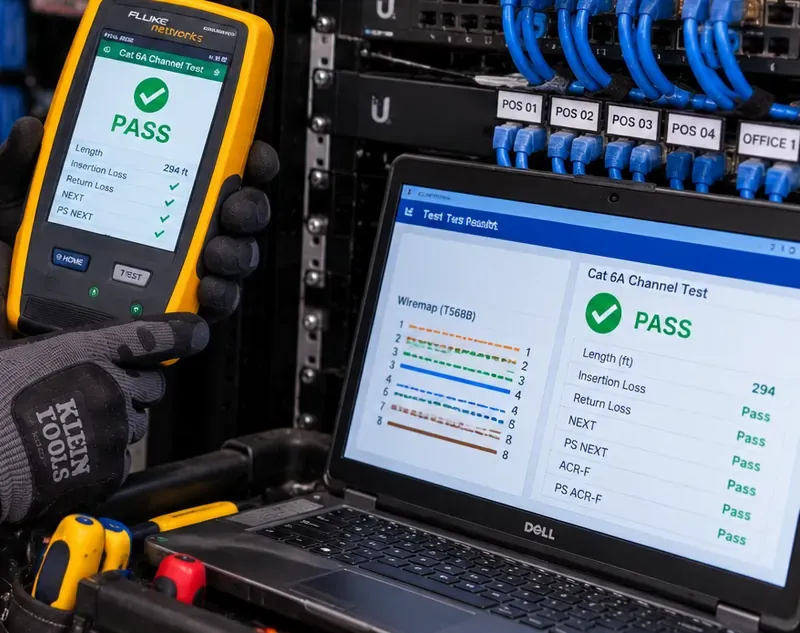
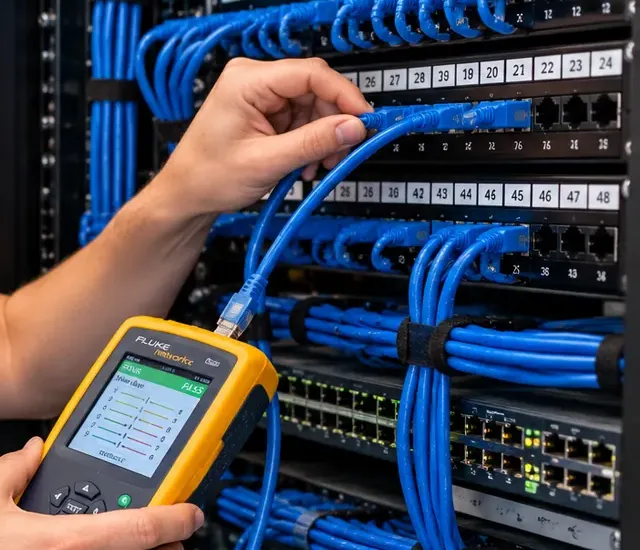
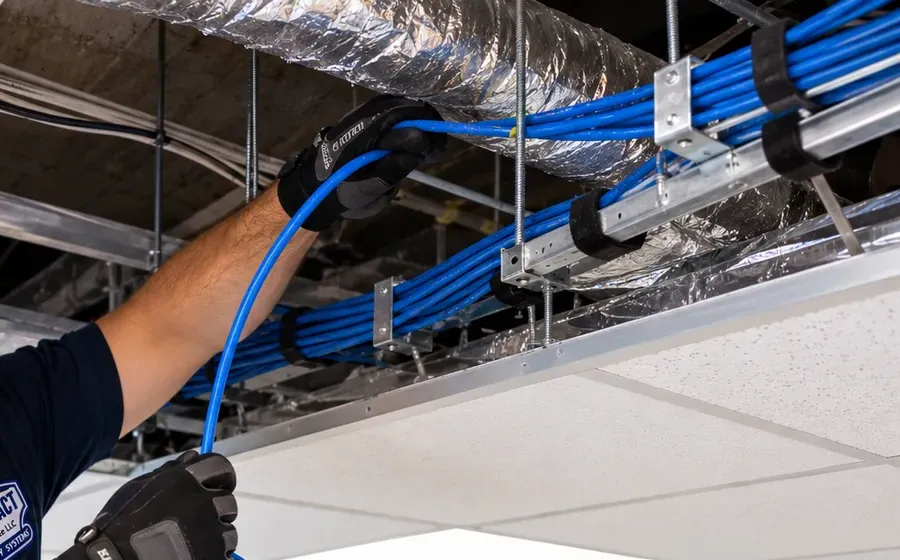
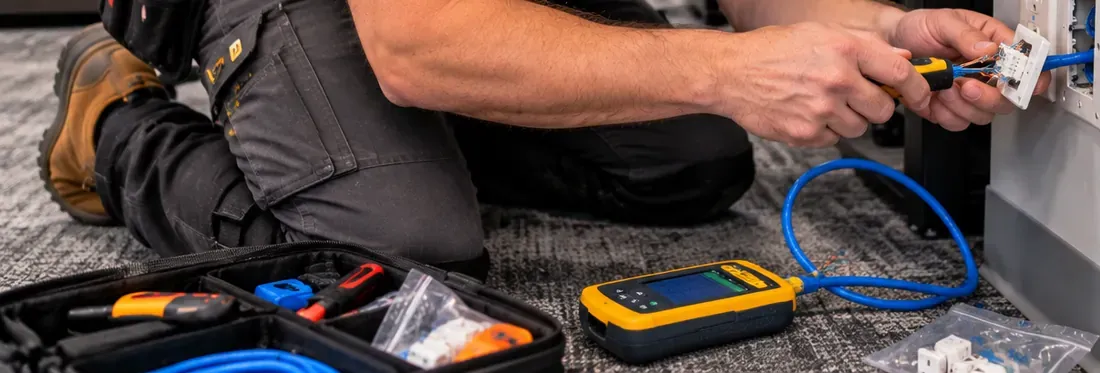
Most West Side repairs happen in a finished, lived-in room, often up a walk-up stair or in a service elevator with a time limit. The kit is chosen so the fault can be found without opening anything, and so the repair looks as if it belongs in a prewar apartment.
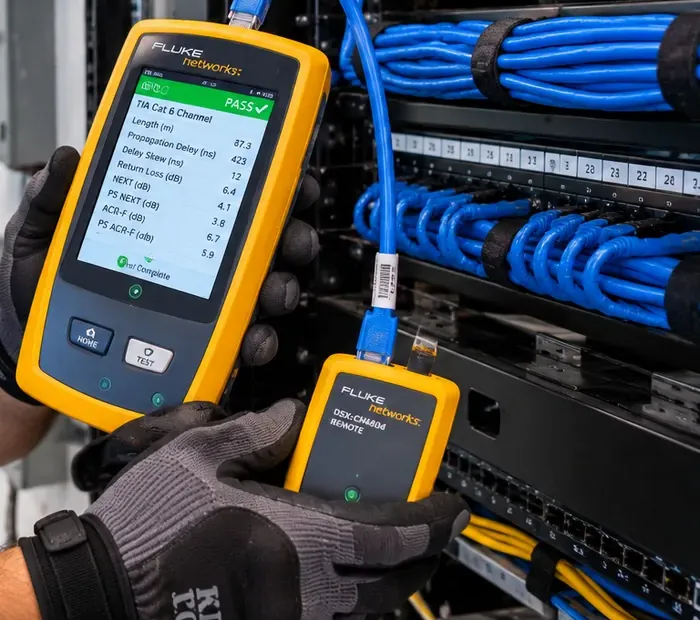
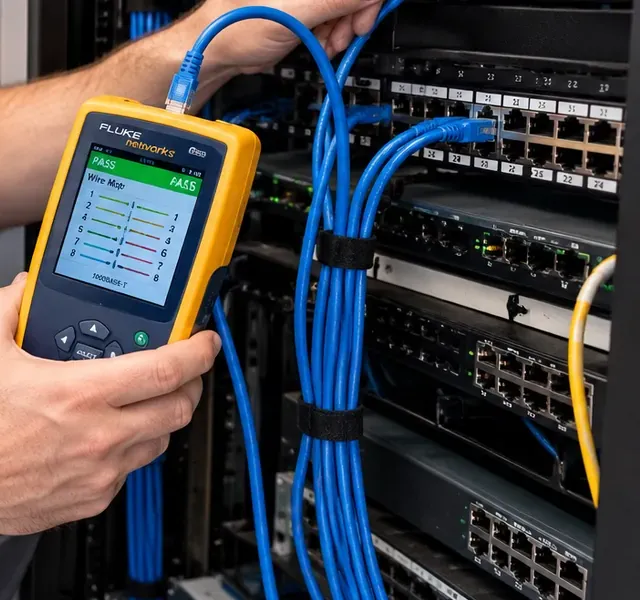
Certifies each link to Cat6 or Cat6A and says how far along it a fault lies, which is how we pick the one length of molding or the one closet to open.
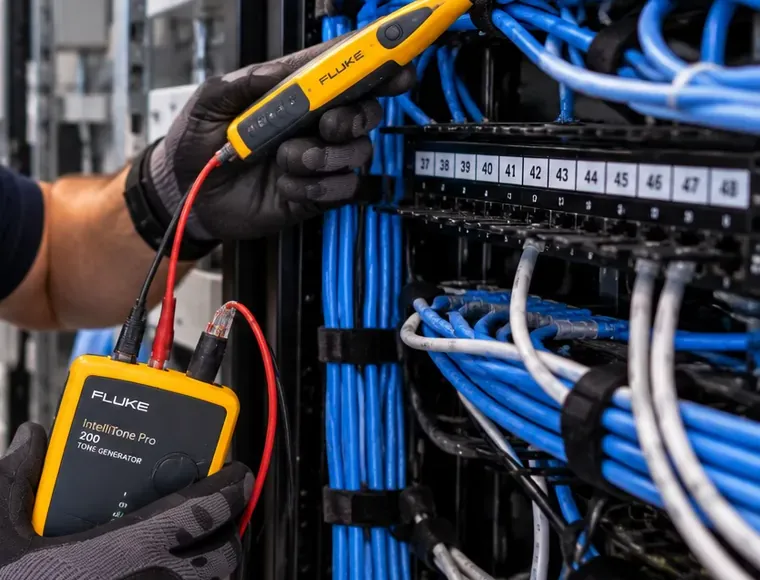
Picks out one cable among a bundle in a closet or cabinet without unplugging anything, essential where three installers have each added their own runs.
A small camera on a flexible lead for looking along molding gaps, into flues, behind cabinets and down closet chases before anything is pried loose.
Shallower jacks that turn the cable sideways, for thin prewar wall boxes, in Cat6 and Cat6A, plus covered plates for classrooms and damp corners.
Narrow channel that takes paint, for new routes along a baseboard, up a closet corner or under a crown molding where opening plaster is not an option.
Bits, guides and dust collection for small holes through plaster and block partitions, used only where the building allows and the route has been agreed.
Solid-copper Cat6 and Cat6A for apartments, plenum-listed reels for office and shop ceilings, and protective sleeving for vertical runs in old buildings.
Slim and standard cords in several lengths for home-office desks, practice front desks, classroom displays and crowded media cabinets.
Floor protection for parquet and rugs, a vacuum for plaster dust, and a label printer so each jack and port leaves with a name.
| What the job needs | Building super or handyman | Internet provider’s installer | Licensed cabling contractor |
|---|---|---|---|
| Covered by the city’s low-voltage permit exemption | Permit exemption covers licensed electricians and qualified persons only | Their own equipment and drop, usually not your in-wall runs | NYS low-voltage licence #12000287431 |
| Evidence the link now performs at its category | Usually a light on the router | A speed test at the router | Certification with saved results for each link |
| Finding a fault behind molding or in a flue | Tends to pull molding or cut plaster to look | Outside their scope | Measures the distance first, opens one spot |
| A repair that suits a finished prewar room | Varies widely | Not their job | Low-profile jacks, painted channel, photos of hidden routes |
| Fitting the board’s hours, insurance and entry rules | Knows the building well | Works to their own appointment | Name, insurance and scope sent ahead; hours respected |
What about the big consumer names? ADT, Ring and SimpliSafe will help with their own cameras, doorbells and hubs, but a broken cable inside a West Side wall falls outside their service. When the dead run happens to feed one of their devices, we repair the run and leave the device to them.

A word on sources first. Google’s AI Overview was not viewable from the tools we used to research this page, so no heading below is a quotation of it. Each heading is instead a belief that turns up again and again in cost guides, on marketplaces like Angi and HomeAdvisor, in product listings and on forums — the material answer engines learn from — followed by what West Side apartments, row houses and shops actually show.
Router makers and many how-to articles treat mesh systems as the cure for every awkward floor plan, and answer engines often suggest abandoning a dead wall jack in favour of more wireless points.
Prewar West Side apartments are long, with thick block partitions and rooms strung along galleries; wireless signals fade from room to room, and many mesh units work best when they themselves are wired back to the router. The dead jack is frequently the very cable the mesh system needs.
Repair the link first. A single working run to the far end of the apartment often makes the Wi-Fi better as well, because the access point there is wired instead of relaying through the walls.
Searches that combine “landmark” with any home project tend to produce warnings that everything needs approval, and answer engines repeat them for the West Side’s historic districts.
What the Commission actually publishes is far more limited. Upkeep and repair are exempt; indoors, its approval comes into play only alongside a Buildings Department permit, a change visible from outside, or a room that is itself a designated interior. Fixing a jack or swapping a cable inside a flat along the path it already takes involves none of these.
What does need care is anything that would pass through a facade, a window frame or a stoop. We keep repairs inside and discuss any exterior route before it is planned.
Renter guides and provider support pages often say the building or the provider looks after the wiring, and answer engines pass that on to anyone with a dead jack.
On the West Side the in-apartment cable was installed by many different people: a renovating owner, a previous tenant, an AV firm, the provider for its own equipment. Who is responsible depends on who installed it and on your lease or proprietary lease, not on a general rule.
Testing settles the facts. We show where the run starts and ends, where it failed and who most likely installed it; the lease and the managing agent decide who pays.
Articles about prewar homes sometimes suggest that thick walls and old construction make piecemeal repair pointless, and answer engines repeat that a full rewire is the only real fix.
Most failures in West Side retrofits are local: a shallow box, a pinched corner behind molding, a jack in an air conditioner’s drip path, a cable trapped under a door saddle. The rest of the run is often sound, and certification shows it.
Repair what measures bad, certify the whole link, and decide on wider work only if the results across the apartment point that way.
Marketplace listings put jack replacement alongside picture hanging and furniture assembly, and answer engines echo that it is a simple job.
Swapping the plate is easy. Making the link perform to Cat6 in a shallow prewar box, without kinking the cable, and proving it with a test, is not. In the city the permit exemption for low-voltage data work applies when a licensed electrician or a qualified person does it.
Ask anyone who repairs the jack for a test result afterwards. A link light on the router shows that something connects, not that the run will hold a video call at full speed.
Forum threads and quick-fix videos show cable passed out of one window and in through another, and answer engines sometimes repeat it as a workaround for rooms the router cannot reach.
On the West Side that usually means the fire escape, which the city’s fire code requires to be kept free of obstructions. It also exposes indoor cable to sun, ice and window sashes, which is why these runs fail.
An indoor route through closets or along the hall in a painted channel takes a little longer and lasts. If no indoor route exists, a wired access point nearer the room is the better compromise.
Cost guides publish national numbers for new work: Fixr’s guide, updated in January 2025, gives $125–$250 per Cat6 drop and $45–$75 an hour for labour, and marketplaces invite people to compare on those figures.
Those describe new drops in typical American buildings. A West Side repair includes clearing the visit with a building, finding a fault behind finished plaster or molding, and leaving the room looking untouched; the time goes into locating and proving the fault, not the material.
Compare quotes on what they deliver: saved results for every link touched, both ends labelled, a repair that suits the room, and photos of anything hidden.
Send a photo of the dead jack and of wherever the cables end. We will tell you who probably installed it, what to expect and what it will cost.
Tell us the cross streets, the kind of building, which room or device went offline and when the building lets contractors in; we reply in writing the same business day. Rather talk it through? The Manhattan line is (929) 560-0737.
Got it. One of our technicians will phone you later today; if a desk or register is down this minute, call (929) 560-0737.
Seven steps built for homes and small practices: find the fault without opening anything, work out whose retrofit failed, and leave a finished room looking finished.
You describe the room, the device and the building, and send a photo of the wall plate and the closet or cabinet where the cables end. From that we pick the parts and the likely route.
We confirm the technician's name, the arrival window and any certificate or description the managing agent, super or doorman needs, inside the building's contractor hours.
Each reported link is tested from the router, switch or panel end before anything is opened, and the fault is placed by its distance along the run.
Plate type, cable printing, splices and routing show whether a renovator, provider, integrator or earlier tenant put the cable in, which tells us where its weak points are.
Terminations are remade, low-profile jacks fitted where boxes are shallow, and damaged lengths replaced along the same route or a raceway that suits the room.
Every link we touched is certified, labelled at both ends and added to a simple map of which jack lands on which port.
Furniture goes back, dust is vacuumed, and you receive the results, photos of anything hidden in a wall or flue, and a note of what was found.

These six places are markers for the streets around them and for the building types we meet there. Naming them is not a claim that we have done work inside any of them.
The 17-storey Beaux-Arts building at 2109 Broadway between 73rd and 74th Streets, opened as a residential hotel on April 16, 1904, made a city landmark in 1972 and converted to a condominium in 1992, with light courts along each side.
Henry J. Hardenbergh’s apartment house on Central Park West at 72nd Street, built from 1880 to 1884, with apartments laid out individually from four to twenty rooms; its residents bought the building and made it a co-op in 1961.
Two courtyard buildings of 1908: the Apthorp at 390 West End Avenue, filling the block between 78th and 79th Streets, and the Belnord at 225 West 86th Street, whose arches lead into an internal courtyard.
A campus of 16.3 acres and 11 resident arts organisations, which broke ground in May 2026 on a $335 million rebuild of its Amsterdam Avenue side due in the summer of 2028, by Metro Manhattan’s account; Fordham’s eight-acre campus and LaGuardia High School are its neighbours.
Designated on January 3, 1984 and extended in 2015, described by the Historic Districts Council as the most elaborate and eclectic collection of row houses in the city — the side-street housing behind many of our brownstone calls.
The towers built on the former 60th Street rail yard along the Hudson, 19 buildings in all according to NYC Parks, from 180 Riverside Boulevard in 1999 to the 38-storey Aldyn at No. 60 in 2011.
We also repair Cat6 across Lincoln Square, the Columbus Circle edge, the blocks around the American Museum of Natural History and the New York Historical, Central Park West, West End Avenue, Riverside Drive, the West 80s and 90s, Manhattan Valley up to Cathedral Parkway, and the edge of Morningside Heights. For everywhere else on the island, our Manhattan Cat6 repair page covers the Financial District to Inwood.

The Upper West Side is billed at the figures we already publish for Manhattan, with nothing added, and each row says where its number appears. Anything that depends on the building or the route — a new path through a partition, a chimney inspection, a repair split across two seasons — is priced in writing once the run has been tested.
| Item | Price | Scope, and where the figure is published |
|---|---|---|
| Repair time: testing and tracing, new jacks or terminations, cords, rerouting short sections, final certification | $195/hr, 3-hour minimum ($585) | The hourly rate on our Manhattan network cable repair page; the booked hours go on as many failed links in the home, suite or shop as they cover |
| Swapping out a cable the certifier condemns | From $175 per drop | Entry price on our Manhattan network cable repair page; it covers new cable with a jack and plate at the room end, the termination at the equipment end, a certification, two labels and a cord |
| Benchmark only — what a new Cat6 outlet costs when nothing existed before (up to 100 ft) | $296 per drop | Our Manhattan Cat6 installation list; on the same list Cat5e is $254 a drop and Cat6A $424 |
| Evening or weekend access where a building requires it | Named premium line, quoted beforehand | Listed on its own line, never folded into the $195, so the cost of the building’s schedule is visible |
| New routes through partitions, chimney or flue work, multi-visit seasonal plans | Quoted after testing | Priced only after the certifier, the room and the house rules have all been looked at |
Manhattan already has its own uplift built into our published borough rates, so a West Side job simply uses those live figures; adding a neighbourhood premium on top would mean charging the same factor twice. When a visit here does cost more, the reason is specific — a doorman building that only allows evening trades, say, or a new route through a closet stack — and it is written on the quote as a separate line.
Arrival through the building’s preferred entrance, floor protection and a look at the jack and the equipment end come first. Each reported link is then tested from the router, switch or panel, and the faults are placed by distance. The common West Side causes — a shallow box, a corroded jack below an air conditioner, a pinched corner behind molding, a cord crushed under a door — are usually repaired inside the first block, with every link certified before we pack up. If a run has to be replaced, that is priced and agreed before any new cable goes in.
Seen cheaper numbers on a cost website? Those ranges, Fixr’s among them, describe putting brand-new cable into ordinary buildings across the country. Locating a dead retrofit behind finished plaster in a prewar flat is another kind of work, and none of those figures is an AESS price.
Full terms — including 50% deposit, one-year parts-only warranty on AESS-supplied products, and the late-fee schedule — are set out in the service agreement.
Three ways people on the West Side usually book us. None of them uses a figure that is not already on our Manhattan price lists.
$585
Three hours at $195. A home-office desk, a bedroom jack, a practice front desk or a shop register: tested, traced, repaired, certified and labelled. Any time left goes on the next jack on your list.
$195/hr after the first 3 hours
For apartments and row houses with several retrofitted runs: every jack tested from the equipment end, the failed ones repaired, and a simple map left showing which wall jack lands on which port.
Repair time + from $175 per run
For homes, suites or shops where some cable cannot be saved: hourly repair where it can be, new runs from $175 each where it cannot, routes moved indoors or out of drip paths, and old lengths removed.
Many West Side renovations leave a bag of the original keystones, spare plates in the right finish or part of a box of cable in a closet. Give them to us and we will use them, charged as repair time only, as long as they suit the link: the same category, the same shielding, solid copper, and plenum-listed cable where the run passes through an office or shop ceiling. Everything is certified either way. Parts you supply carry their maker’s warranty rather than ours, and if they will not produce a passing link we tell you before fitting them.

Most single-jack faults in West Side apartments are found and fixed inside one visit, without opening a wall.
Every installer leaves a recognisable signature, and each signature has its own weak point. On the West Side a single apartment can carry the work of three or four of them. Recognising whose work failed tells us where to look first and how far the same problem is likely to repeat elsewhere in the home.
| Who usually installed it | What it tends to look like | Where it tends to fail | What we leave behind |
|---|---|---|---|
| Renovation contractor (kitchen, bath or study remodel) | Neat plates matching the light switches; runs hidden behind molding or inside new soffits; no labels | Shallow boxes, corners behind molding, nails or pins driven later | Low-profile jacks, photos of the hidden route, labels at both ends |
| Internet provider | Cable clipped along baseboards from the entry point to the router; sometimes run through a window frame | Clips crushing the jacket, door saddles, window sashes | Run moved into a channel or closet route; provider equipment left untouched |
| AV or smart-home firm | Several runs gathered into a media cabinet or behind the television; mixed Cat6 and HDMI | Crowded cabinets, tight bends, heat behind equipment | Cabinet re-dressed with factory cords and room for the cable to turn |
| Previous tenant or owner | Field-made plugs on cables through walls or windows; couplers; cable out to a fire escape | Crimped ends, couplers, anything exposed to weather | Proper terminations on jacks, route brought indoors, couplers removed |
| Building staff | Tape or connector repairs in a closet; runs sharing an old phone or intercom path | The patch itself, and cable pulled tight past old hardware | Patch removed, link re-terminated and certified, a note for the super |
| Developer (newer towers) | Every room jack to a small panel in a hall closet; printed cable; building system nearby | Panel terminations and the short cords inside the panel | Panel terminations remade, rooms certified, building system untouched |
The common thread is that none of these installers expected anyone to follow their work years later. So the most useful thing a repair can leave is a record: which jack goes where, what kind of route each run takes, and photos of anything that is now hidden in a wall, behind a molding or up a flue. We leave that with every West Side repair.
The second habit is not to assume one failure means a bad installation everywhere. A renovator who used shallow boxes in one room probably used them throughout, so we test the other jacks from the same era; a provider’s clipped baseboard run in one room says nothing about the AV firm’s cabinet in another. Testing every link from the equipment end shows which pattern is real.
A repair in a home has different priorities from a repair on an office floor. Someone is usually there, the room is furnished and decorated, and the building has neighbours on the other side of the wall. These are the habits that keep a West Side visit easy for everyone.
A dead jack in a West Side home often comes with a second job. These Manhattan services can join the same visit.
Island-wide repairs, Battery to Inwood, under one borough page.
For switches, older Cat5e and mixed home networks.
Priced per drop when a room needs a new run.
For the wired television wall in a prewar living room.
Apartment handsets and building door stations.
Switches and wired access points for long prewar apartments.
Closets, panels and cable plans for practices and schools.
One licensed crew for door intercoms, cameras, audio and wiring.
List every job in the home or suite on a single form.
How our technicians tend to work in West Side apartments and suites — a description of method, not a story about one customer
We ask what changed in the room before we ask what broke. A new air conditioner, a fresh coat of paint, a moved bookcase or a new tenant downstairs is often the whole story.
We test from the equipment end. Whether the cables end in a closet, a kitchen cabinet or a panel in the hall, starting there tells us which jacks are really dead and how far along each run the problem sits.
We read the installer’s signature. Matching plates and hidden routes mean a renovator; baseboard clips mean a provider; a crowded cabinet means an AV firm; a cable out of a window means somebody in a hurry. Each points to a different weak spot.
We open as little as possible. One length of molding, one box, one closet panel — chosen by measurement — and everything put back as it was.
We leave a record. Results, a jack-to-port map and photos of anything hidden, so whoever works in that room next does not have to start from nothing.
Here is the whole list of what we repair between Lincoln Square and Manhattan Valley, from Riverside Boulevard to Central Park West, arranged the way West Side calls tend to come in.
In a home wired by several installers, nothing is labelled and the first task is to find out which run is which. Cat6 cable diagnostics and Cat6 cable troubleshooting start at the router, switch or panel; network cable diagnostics and Ethernet connection diagnostics then separate the cable from the cord, the port and the device. That is the same method we use for network cable troubleshooting, Ethernet cable troubleshooting, network connectivity troubleshooting and low voltage network troubleshooting in apartments, practices and shops.
Closets on the West Side rarely hold one installer’s work, so identifying the right cable comes next. A tone sent down the run and picked up with a probe — tone generator cable tracing, or network toner and probe testing — lets us do Cat6 cable tracing, Ethernet cable tracing and general network cable tracing while the rest of the home stays online. The certifier then handles Ethernet cable fault detection and Cat6 cable fault detection, with Cat6 cable continuity testing and Cat6 cable tester diagnostics telling us whether a pair is open, shorted or split and roughly how many feet from the closet the trouble begins.
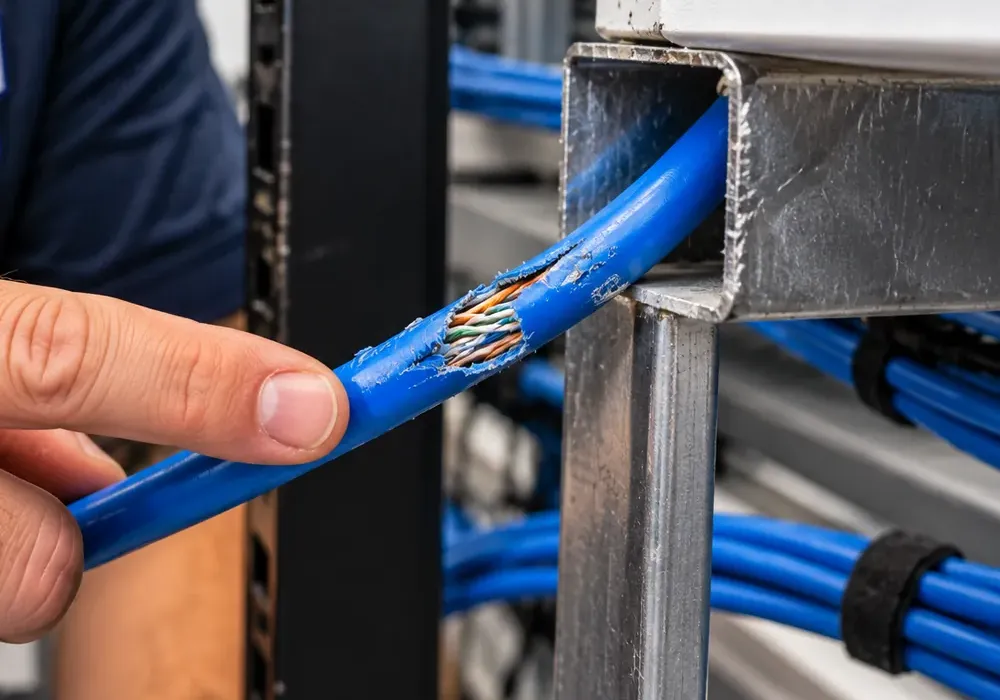
West Side damage usually comes from the way the cable was added: clips, door saddles, window sashes, sharp edges and air-conditioner drips. Cat6 cable damage from furniture moves and Cat6 cable damage from metal edges show up as Ethernet cable jacket damage or pinched pairs. Where the run can be saved we carry out damaged Cat6 cable repair, damaged Ethernet cable repair, cut Ethernet cable repair, crimped Ethernet cable repair and broken Cat6 cable repair; where it cannot, Cat6 cable replacement, Ethernet cable replacement and network cable replacement along a better route.
A few West Side jobs do happen above a grid — in Lincoln Square office suites and in the dropped ceilings of avenue shops. There we offer Cat6 cable repair above drop ceiling tiles, Cat6 cable replacement above ceiling grids and the broader commercial ceiling network cable repair, re-hanging runs through overhead Cat6 cable routing and adding Cat6 cable support installation where cable was left lying on the tiles. When a room simply never had an outlet, Cat6 cable installation is on the list as well.
Field-made plugs on cables left by previous tenants fail often, so RJ45 connector repair, RJ45 connector replacement and broken RJ45 connector repair are routine, with new ends fitted by RJ45 connector installation and RJ45 cable termination checked on the tester. The Cat6 equivalents are Cat6 connector repair, Cat6 connector replacement, Cat6 cable termination and Cat6 cable retermination.
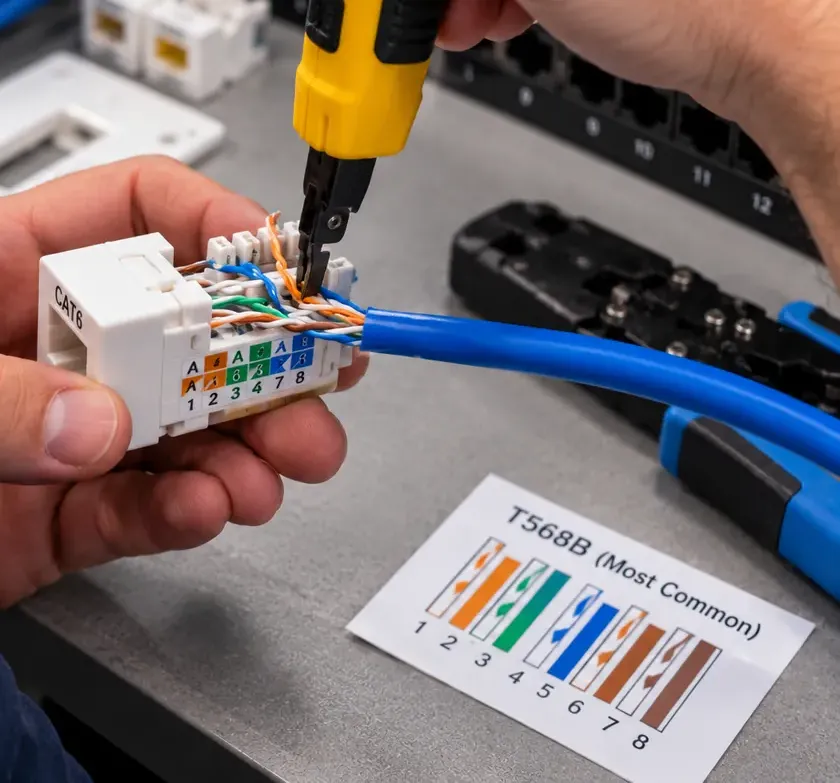
Most West Side calls end at a wall plate. Data jack repair and data jack replacement deal with the shallow-box and air-conditioner cases described above, under the names Cat6 wall jack repair, Ethernet wall jack repair and network wall jack repair; jacks set into built-ins or cabinets fall under network outlet repair and Ethernet outlet repair. Inside every plate sits a module, which brings in Cat6 keystone jack repair, Cat6 keystone jack termination and, when a module is cracked, Cat6 keystone jack installation. Homes wired by two installers often have one end on T568A and the other on T568B, which calls for Cat6 wiring troubleshooting and Cat6 wiring correction — T568A wiring repair or T568B wiring repair, incorrect Cat6 wiring repair, general Cat6 wiring repair — and a careful Cat6 punch down repair to finish.
Many West Side networks end in a hall closet, a media cabinet or a small panel rather than a rack. Cat6 patch panel repair, network patch panel repair and Ethernet patch panel troubleshooting fix loose terminations and dead ports there, with Cat6 patch panel termination redone where a port fails, and network rack cable repair, network rack cable management and network cable organization for the practices and schools that do have a rack.
Cords in media cabinets get crushed behind equipment, so network patch cord replacement and patch cable replacement come up constantly. Every jack and port then gets a printed name through Cat6 cable labeling and network cable labeling. The clearest results are in network cable cleanup: before and after Cat6 cable repair, and before and after network cable repair, a cabinet stuffed by three different firms turns into a handful of short, named, tested cords.
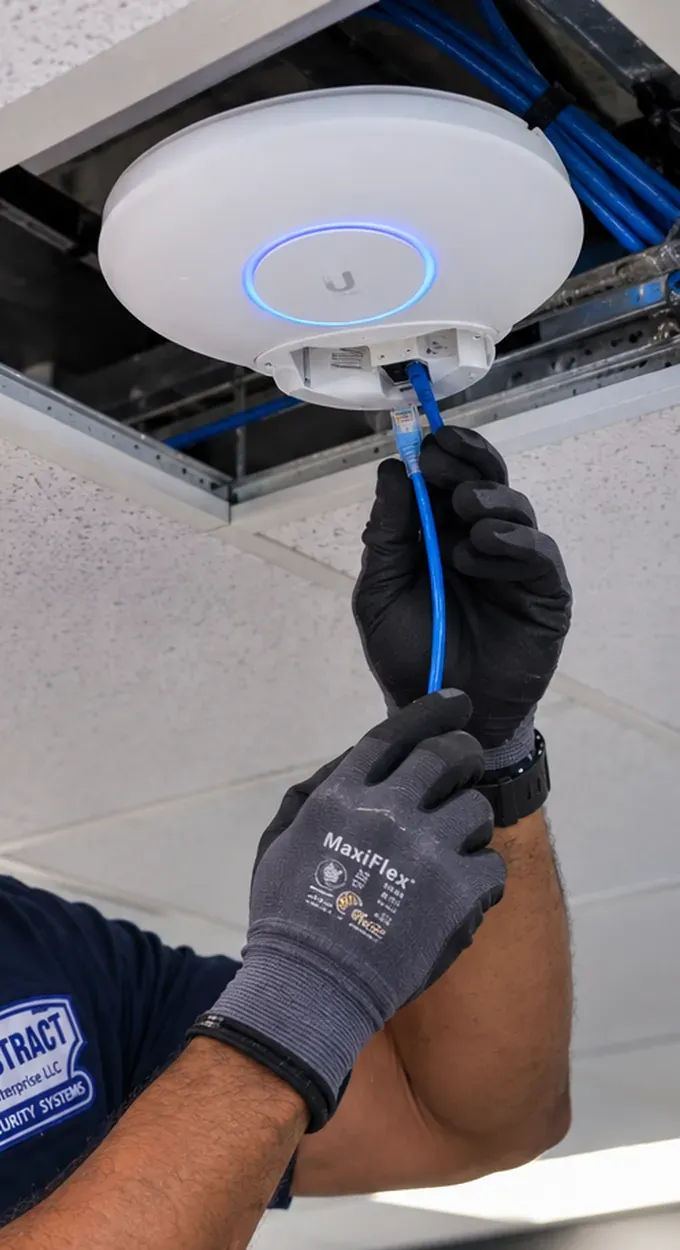
In a long prewar layout the access point at the far end only performs if its cable does, so wireless access point cable repair, Cat6 cable repair for WiFi access points, ceiling mounted access point repair and PoE access point troubleshooting are regular West Side work. Door and lobby cameras on the same wiring bring offline security camera network repair, Cat6 cable repair for security cameras, security camera Ethernet cable repair and PoE camera cable repair, each starting with PoE connection troubleshooting at the device. Stoops, areaways and roof bulkheads add outdoor Cat6 termination repair and weatherproof Ethernet connector repair.
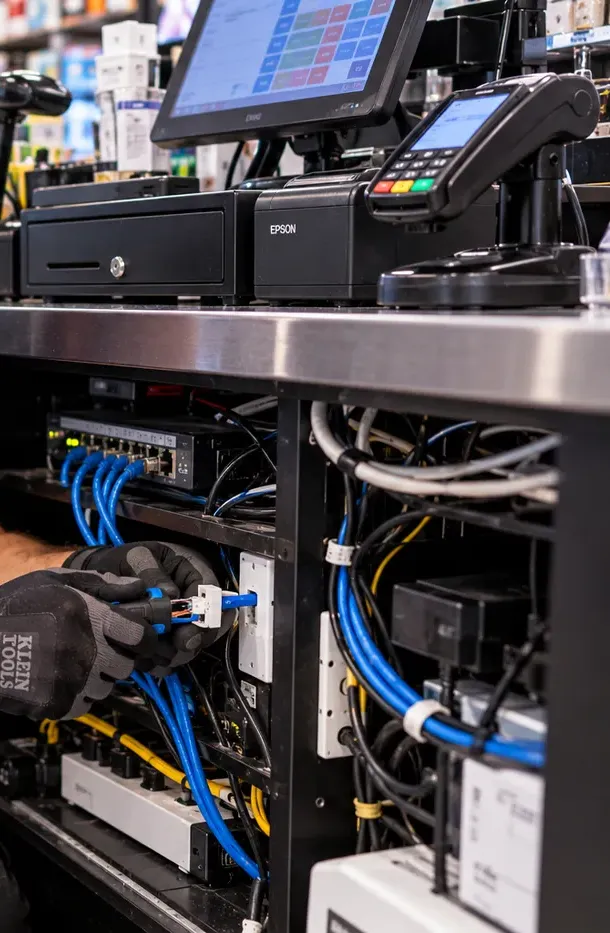
For residents the point is the desk that works again: desktop computer Ethernet troubleshooting at the seat, then disconnected Ethernet connection repair and network connection restoration until the room is back online, which is the core of our residential network cable repair. For practices, nonprofits and schools, commercial office Cat6 repair, office workstation network repair and office Ethernet connection repair cover front desks, consulting rooms and classrooms. For Broadway, Amsterdam and Columbus shops, retail store network cable repair, POS network cable repair, checkout counter Ethernet repair and retail POS connectivity troubleshooting keep registers and card terminals online, alongside commercial network cable repair and low voltage cable repair for the rest of the building.
Every job ends with the link Cat6 cable repaired and tested. That means Cat6 cable testing, network cable testing, Cat6 cable signal testing and Cat6 performance testing on every visit, and Cat6 cable certification, Cat6 cable certification testing, network cable certification and Ethernet cable certification with saved results when a practice, school or building wants a file. Together that is certified Cat6 cable repair and network cable testing and certification you can hand to whoever comes next.
Where an institution runs a real rack, we look after it as a system: structured cabling troubleshooting and structured cabling repair when something fails, and structured cabling maintenance with scheduled structured cabling testing so it keeps passing. Whoever arrives — your Cat6 repair technician or Ethernet repair technician — works for a licensed low-voltage Cat6 cable repair contractor, and the Cat6 cable repair services, network cabling repair services, Ethernet cable repair and network cable repair we deliver follow one standard in a studio apartment and a school alike, which is what professional Cat6 cable repair services ought to mean.
Book around it if you can. The Macy's balloon inflation takes place outside the American Museum of Natural History, on the blocks from West 77th to 81st Street between Columbus Avenue and Central Park West, and in 2025 it ran on the Wednesday afternoon before the parade. Streets close, crowds build and parking near the museum disappears, so a technician carrying a ladder and a case of parts loses time getting to the door. If the link is down and cannot wait, we will still come, usually in the morning before the closures start; otherwise we suggest the Monday or Tuesday of that week, or the following Monday.
When the visit is booked we confirm the technician's name, the arrival window and the apartment or suite number, and we can send that by email or text the day before so you can pass it to the desk or the managing agent. If your building also wants an insurance certificate or a short description of the work before it adds a name to the list, tell us when you book and we will send those at the same time. The aim is that the technician is expected at the door, goes up without a phone call to you, and uses the entrance and elevator the building prefers for trades.
Yes. The Furman Center counts 12 Mitchell-Lama properties with about 2,075 homes in the Upper West Side district, and those buildings are supervised by the city's housing department or the state housing agency. Repairing the network cable inside your own apartment is the same job there as anywhere else; what differs is who the management office wants to hear from first and what paperwork it asks for. Ask the management office what it needs before a contractor visits, and we will provide it. If the failed cable turns out to belong to the building rather than to you, we stop at that point and give management the test result.
Yes, and many families on the West Side do exactly that. You can book the visit yourself, give us your number as the contact, and ask the technician to call you on arrival and before leaving. During the repair we explain each step in plain terms, keep the work area tidy, and do not change passwords, accounts or settings on the computer, router or television. At the end we test that the device your parent actually uses is back online, show them which wall jack it plugs into, and send you the results and a short note of what was repaired.
You are on the West Side branch. Step up a level to the Cat6 repair page for Manhattan, or two levels to the New York City Cat6 repair hub covering all five boroughs; the links below reach every other area and neighbourhood where the service is live.
NYC Cat6 repair · Manhattan · Brooklyn · Cat6 repair in Queens · the Bronx · Staten Island
Midtown, Manhattan · Williamsburg, Brooklyn · Long Island City, Queens · Fordham, Bronx · St. George, Staten Island · Financial District, Manhattan · Park Slope, Brooklyn · Upper West Side, Manhattan (this page) · Bay Ridge, Brooklyn · Astoria, Queens
AESS Hudson Valley Cat6 repair · Westchester County · Rockland County · Orange County · Putnam County · Dutchess County · Ulster County
Beyond cabling, the same team installs and repairs door entry, cameras, access control and alarms — start from the Abstract Enterprises home page for those, or read who we are and how we are licensed on our about page.
Below is where every West Side number and date on this page was found. For laws and house rules, go back to the original text, or to your managing agent, before acting on our summary.
If a desk, a consulting room, a classroom or a register lost its wired connection and restarting the router did not help, call (929) 560-0737. Tell us the cross streets, the room and what changed there recently, and we will plan the repair around your building and your day.
Abstract Enterprises Security Systems · 460 E Fordham Rd, Bronx, NY 10458 · Manhattan line (929) 560-0737 · WhatsApp (718) 679-0359 via wa.me
NYS Low-Voltage Licence #12000287431 · 100% Licensed & Insured · Same-Day Estimates · Rated 4.7★ from 201 Google Reviews
If you hand us your own keystones, plates or cable, any guarantee on them comes from their manufacturer; what we stand behind is explained on the AESS warranty page.
Fire-code, Landmarks, electrical-code and co-op rules are summarised on this page in plain language to help you plan, not as legal advice; the source list above points to each original so that you or your managing agent can check the exact wording. Last reviewed October 17, 2026. Changelog: Upper West Side Cat6 repair page first published.