Most of the Cat6 in Williamsburg was never built into the building. It was strung across a timber ceiling by a loft tenant, dropped through a pressed-metal ceiling by a restaurant fit-out crew, pulled behind a bar for a register, or run out to a stage for the sound desk — and every new occupant, sprinkler fitter and outdoor-dining season since has had a chance to knock it about. We find the exact fault with a tester, fix it with parts that match the run, and put the repaired cable somewhere the next change to the space will not reach.
Written by Anwar Timothy, NYS low-voltage licence #12000287431 · Reviewed and updated October 17, 2026 · Technicians for Williamsburg Cat6 calls leave from the Troy Avenue office, 1282 Troy Ave, Brooklyn
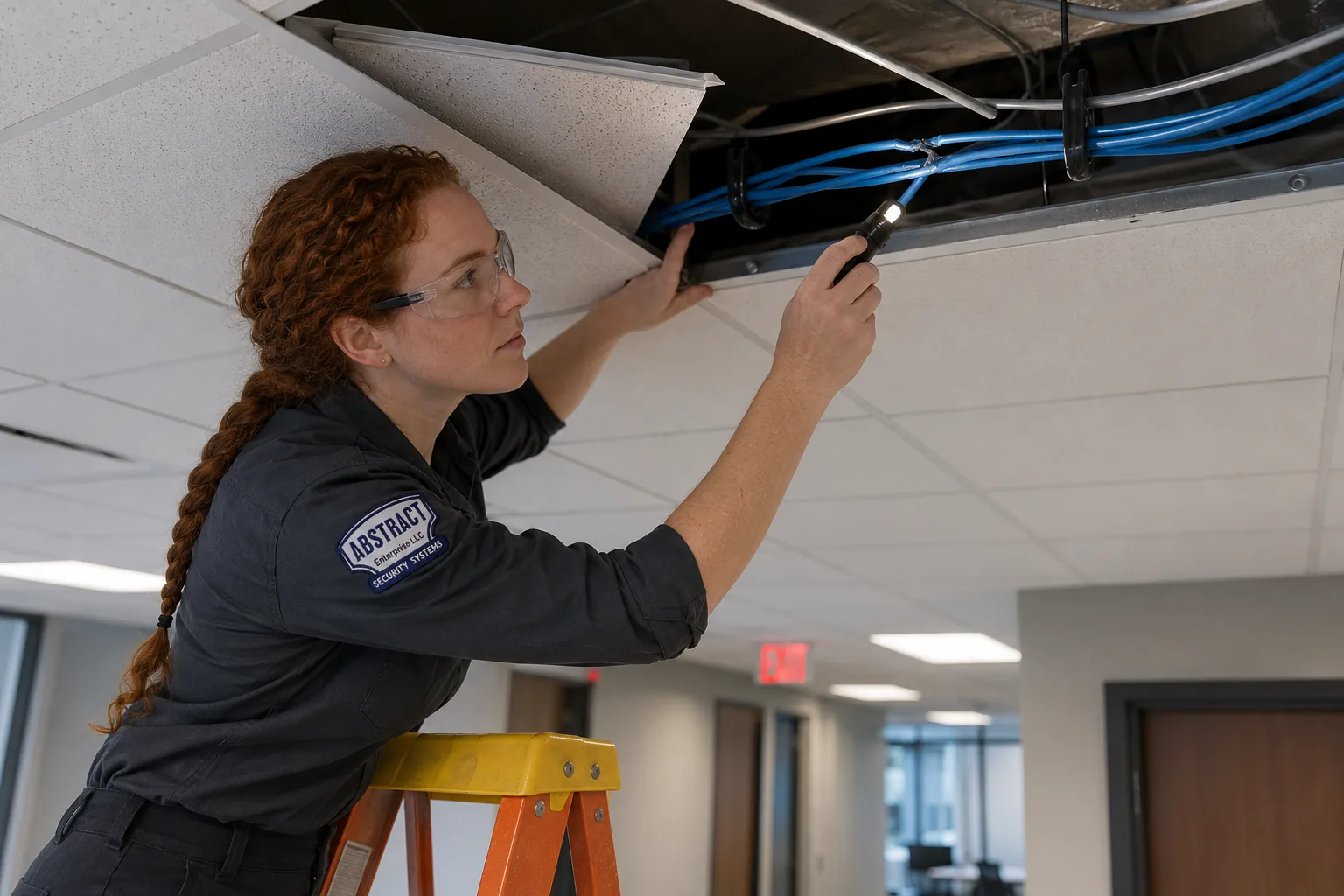
A ceiling tile pushed up, a flashlight on the blue bundle and the J-hooks carrying it: the first look along a run before anything is cut.
Free Williamsburg Cat6 Repair Quote
Tell us which jacks are dead and what sort of space it is — a written plan comes back the same business day
✅
Request Sent!
A technician will call you back today about the Williamsburg link.
25+
Years Experience
✓
Same-Day Estimates
100%
Licensed & Insured
4.7★
201 Google Reviews
Loft, storefront, bar, venue or tower — say which, and say what stopped working. The Brooklyn line, (347) 934-8335, reaches the Brooklyn technicians who cover the blocks between the Williamsburg Bridge and McCarren Park, or send the form and get the plan in writing.
Repair time is the published Brooklyn rate, $195 an hour with a three-hour minimum, with nothing added for a Williamsburg address
Every repaired link goes back on the tester and you keep the result, so the next landlord, IT person or sound engineer can see it passed
Work carried out under NYS low-voltage licence #12000287431, with our insurance certificate sent to any managing agent or landlord who asks for one
Williamsburg's network cable lives out in the open far more than it does in most of Brooklyn, and cable that lives in the open gets hit. The neighbourhood's working buildings were sugar houses, cooperages, textile mills, warehouses and machine shops long before anyone thought of an Ethernet jack. When people moved in — first artists in the empty factories, then offices, restaurants, bars, studios and hotels — nobody opened the brick walls or the plank-and-timber floors to bury data cable inside them. They strung it across beams, ran it along pipes, fed it through holes in old partitions and dropped it down walls in plastic raceway. That approach is cheap and quick on the day. Its weakness is that every later change to the space happens around that cable, and quite often to it.
The loft buildings are the clearest example. In 1982 the State legislature passed Article 7-C of the Multiple Dwelling Law, the Loft Law, which created a class of buildings called interim multiple dwellings: former commercial and manufacturing buildings where at least three families had been living, to be converted under the Loft Board into legal, rent-stabilised homes. The law was widened in 2010, 2013, 2015 and 2019, and while units inside most industrial business zones are excluded, the law makes an exception for the Greenpoint and Williamsburg zones and parts of North Brooklyn and Long Island City. In those buildings the Cat6 was often put in by occupants, one unit at a time, often decades apart, and it shares the ceiling with sprinkler mains, heating pipes and electrical conduit that legalisation work keeps moving. A run that has hung on a sprinkler pipe for ten years tends to fail the week the sprinkler contractor arrives.
The waterfront is the other half of the story. On May 11, 2005 the City Council approved the Greenpoint–Williamsburg rezoning, which covered 175 blocks along the northern Brooklyn shoreline and opened former industrial land to towers and parks. The 2020 census, as CBS New York reported on the rezoning's twentieth anniversary, showed Williamsburg's population up 41 percent over the previous decade. The newer buildings have proper cable in their walls and closets, but they also have high tenant turnover, ground-floor shops that are fitted out again every few years, amenity floors with cameras and access points, and management offices with rules about who may open a ceiling. The Domino Sugar site shows how quickly that change arrived: the refinery ran from 1856 until 2004, its main building became a city landmark in 2007, and since then the site has gained 325 Kent in 2017, Domino Park in 2018, One South First and Ten Grand in 2019 and One Domino Square in 2024, while the landmarked Refinery itself reopened as offices.
Between the factories and the towers sit the streets most people actually walk: Bedford Avenue, Grand Street and Metropolitan Avenue — which Forgotten New York calls Williamsburg's two major commercial strips — Broadway under the elevated J, M and Z, and the cross streets off Wythe and Kent. Those blocks are full of restaurants, bars, cafés and small shops, many of them in older buildings with apartments above, and almost every one of them now runs its registers, kitchen printers, cameras and Wi-Fi over Cat6. Hospitality cabling has its own enemies: cold beer lines that sweat, mop water, grease, staff who move furniture against wall plates, and the city's outdoor-dining rules, which require roadway seating to come down every winter and go back up every spring.
East of the BQE the neighbourhood turns industrial again. The Department of City Planning's North Brooklyn Industry and Innovation Plan studied a 1,066-acre industrial area across Greenpoint, East Williamsburg and Bushwick that held 19,500 jobs in 2016, 77 percent of them in sectors such as manufacturing, wholesale, transportation, construction and motion picture recording. Warehouses, film stages, fabrication shops and food businesses along streets like Morgan Avenue use Cat6 for cameras, scanners, access points and office links, usually on exposed runs over working floors. The result is a neighbourhood where the same technician may be above a loft ceiling near the river in the morning and behind a bar on one of the commercial strips in the afternoon, and where the right repair depends far more on how the cable was hung than on the cable itself.
Williamsburg facts that shape a Cat6 repair
1982, then 2010, 2013, 2015 and 2019: the Loft Law and its amendments, which brought former factory and warehouse lofts under the Loft Board for legal conversion (NYC Loft Board). Occupant-installed cable and moving pipework are the usual repair background in these buildings.
May 11, 2005 — 175 blocks: the date the City Council approved the Greenpoint–Williamsburg rezoning and the size of the area it covered (Department of City Planning; CBS New York).
41 percent: Williamsburg's population growth over the decade to the 2020 census, as reported by CBS New York in 2025. More people, more tenants, more fit-outs, and more chances for a run to be disturbed.
460,000 square feet: the office space Two Trees began leasing inside the landmarked Domino Refinery building, a nineteenth-century sugar house now carrying modern office networks.
1,066 acres and 19,500 jobs: the North Brooklyn industrial study area and its 2016 employment, 77 percent in industrial sectors including motion picture recording (Department of City Planning).
April 1 to November 29: the only dates a roadway café may operate under Dining Out NYC, after which the structure has to be removed and stored — along with whatever network connection was feeding it.
A Cat6 call in Williamsburg often turns out to be part of a bigger network or camera problem. If the fault is in older Cat5e or mixed cabling, the Williamsburg network cable repair team takes it on, and where a loft or shop needs new runs rather than repaired ones, structured cabling in Williamsburg covers the installation side. Most bars and shops that call about a register link also have cameras on the same switch, which our Williamsburg security camera technicians can check on the same visit.
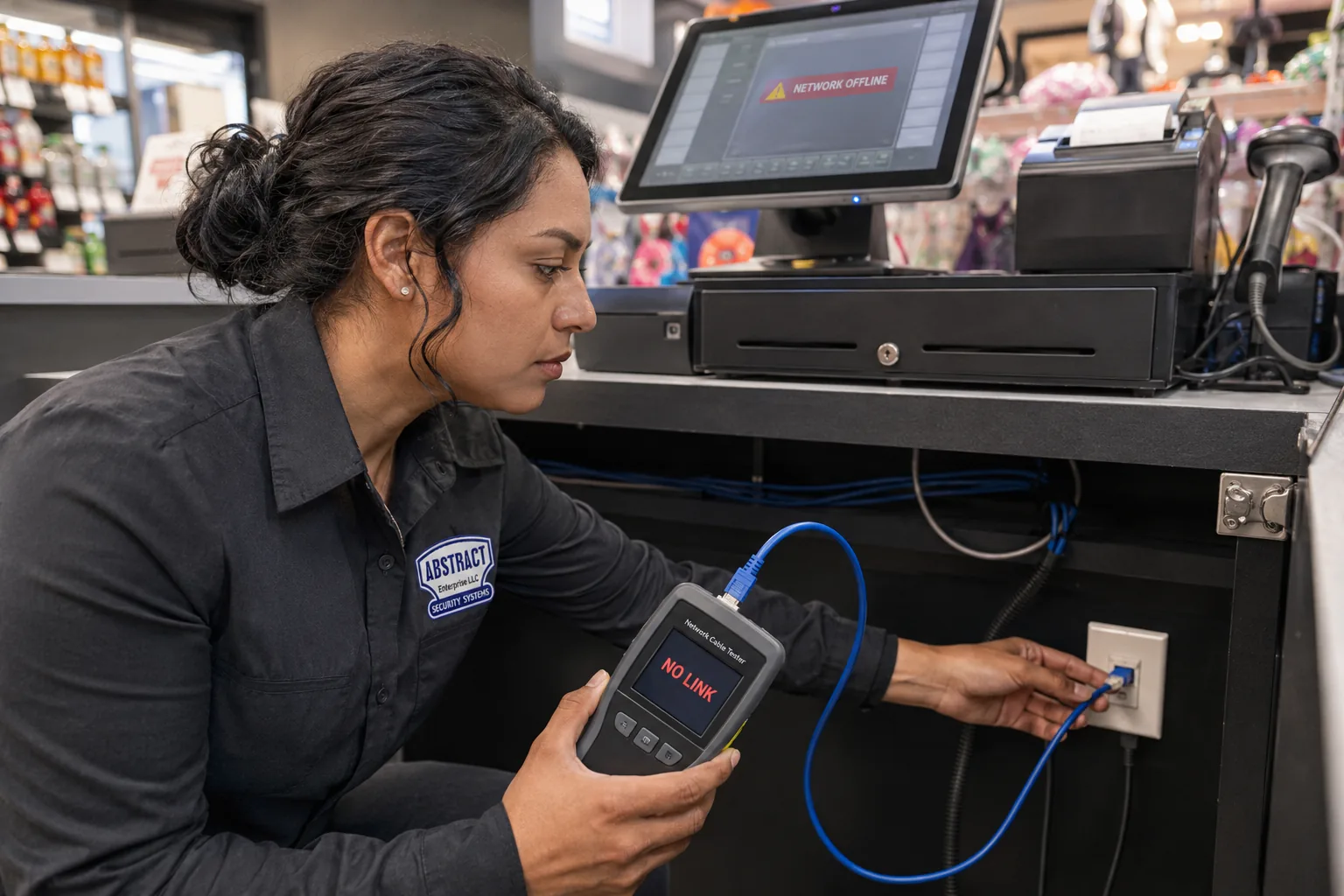
A register screen reading Network Offline above, and below the counter a tester on the wall jack showing No Link — the first split between a cable fault and a device fault.
Repair Capture
Cat6 Down on a Williamsburg Block Today
A card reader on Bedford Avenue that stopped talking to the payment processor at lunchtime, a loft office off Kent Avenue with no wired link an hour before a client call, a camera over a loading door near Morgan Avenue that dropped off the recorder overnight, a sound desk that cannot see the stage box with doors at seven — those are service calls, and we treat them as service calls. We offer the next open two-hour arrival window, every day of the week, and the van carries a certification tester, a toner and probe, Cat6 and Cat6A keystones, shielded jacks, factory-made cords in several lengths, J-hooks, beam clamps and cable.
Once the technician is standing at the rack or the ceiling, most faults at a jack, a panel port, a cord or a single damaged section are found and fixed within one to two hours. If the cable itself is ruined along a length that cannot be reached that day, you get a temporary link to keep the register, the camera or the desk working and a written price for the proper replacement. Time is billed at $195 an hour with a three-hour minimum ($585); anything left in the block after the urgent fault goes on the next suspect link on your list. Call (347) 934-8335 or send a photo of the rack, the ceiling or the jack on WhatsApp.
What We Repair
Cat6 Repair Services in Williamsburg
Nine kinds of job account for almost every Cat6 call this neighbourhood sends us. Each one ends the same way: the link goes back on the tester and passes, you keep the result, and you get a plain note of what failed and why.
🏭
Exposed Loft-Ceiling Runs
Cable strung across timber beams, steel or concrete ceilings by past occupants: tested end to end, damaged sections replaced, and the run moved onto its own supports so it no longer hangs from pipes, conduit or sprinkler hangers.
🍺
Bar, Kitchen and Register Links
Registers, card terminals, kitchen printers and order screens that drop out during service. We find whether condensation, grease, mop water, a pinched cord or a failing jack is to blame, and move the termination out of harm's way.
🎤
Stage, Studio and Venue Cable
The permanent run from a stage plate to a mixing position, and the rugged cords that plug into it. Fixed runs are re-terminated or replaced and certified; damaged portable cords are swapped for factory-made rugged ones.
🔍
Fault Location by Distance
Time-domain readings put a break, a crush or a bad splice at a measured distance from the jack. Laid against a loft ceiling or a storefront's cellar route, that usually pins the fault to one beam, one pipe crossing or one fixing.
🔌
Jack and Patch-Panel Re-Termination
Keystones punched with the pairs untwisted, couplers used as joins, crimped plugs on solid cable: rebuilt on matching Cat6 or Cat6A hardware, then certified, with the panel ports labelled to the desks and devices they serve.
📹
PoE Camera and Access-Point Runs
Cameras over loading doors and access points on high ceilings that reboot, lose video or vanish. We test the run, the power budget at the switch and the termination at the device, then fix whichever link in that chain failed.
🧱
Brick, Tin and Plaster Routes
Replacement runs in spaces where the wall or ceiling itself is the problem — exposed brick that cannot be drilled, original pressed-metal ceilings, old plaster — routed through cellars, along beams or in surface paths that leave the finish alone.
🍽️
Outdoor-Dining and Shopfront Links
The connection that feeds a terminal or printer at a sidewalk or roadway café. We bring the permanent link to a protected point inside the building and set up a seasonal cord that can be unplugged and stored each winter.
📋
Certification After Disturbance
After a sprinkler upgrade, a ceiling demolition, an electrical retrofit or a new tenant's fit-out, every run in the area is retested so you know which links the work touched before they start failing one by one.
If the job turns out to be a doorbell, buzzer or video entry station rather than a data link, the Williamsburg intercom team handles those, and the full borough picture of this service sits on our Brooklyn Cat6 repair page.
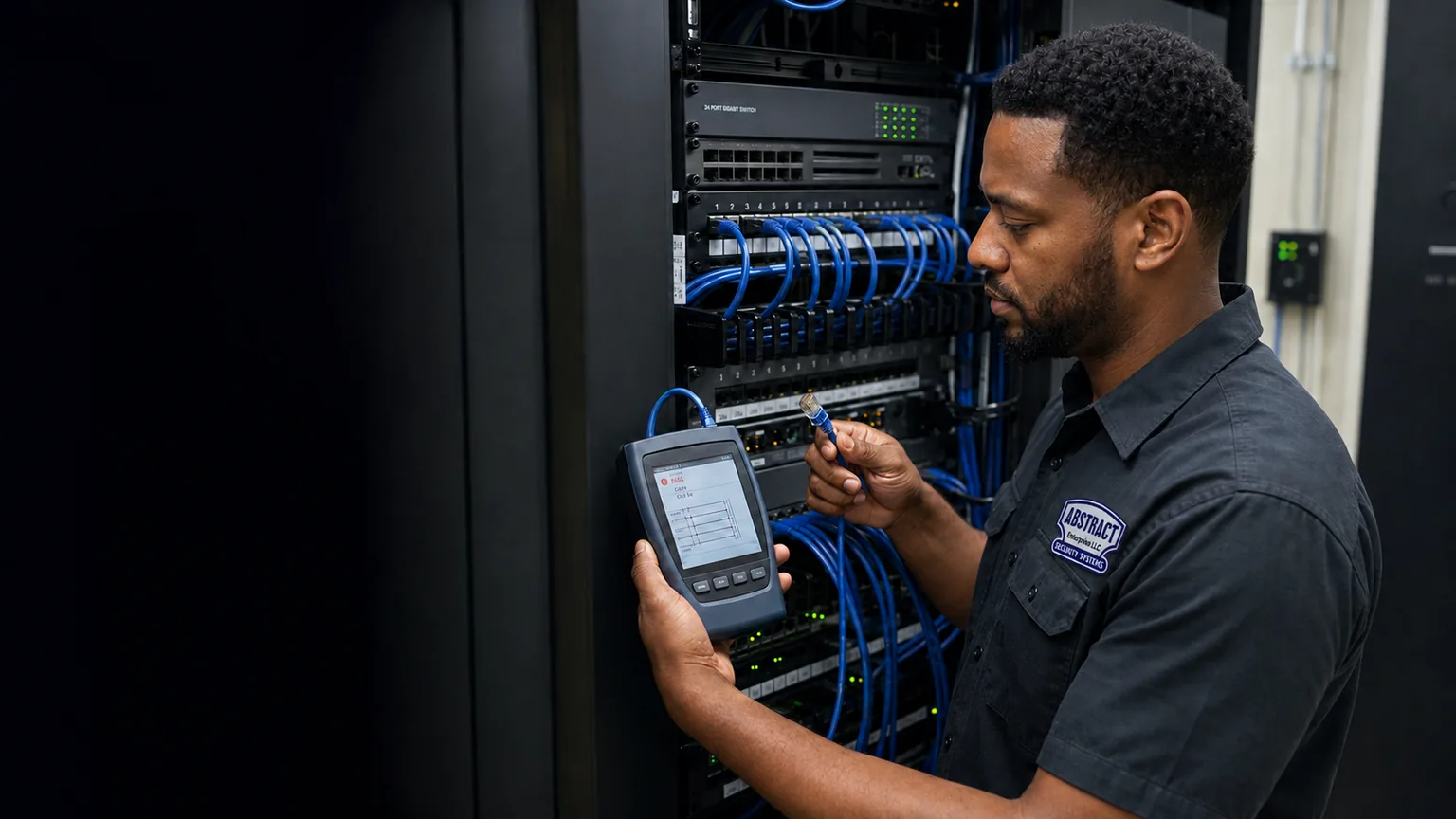
A handheld tester plugged into the rack while the next patch cord waits in the technician's hand, the blue cords dressed in rows beneath the switch.
Building Specialists
Cat6 Repair for Williamsburg's Architecture
Six building families cover nearly every Williamsburg address we visit. Each one fails in its own way, and each one limits how a repaired or replacement run can travel.
Factory and Warehouse Lofts
Brick bearing walls, heavy timber or steel framing, plank or concrete floors and high ceilings, with Cat6 added by whoever occupied each floor. Runs are long, exposed and often supported by whatever was nearby — a pipe, a conduit, a sprinkler line. Faults come from later trades, from sagging spans and from cable pulled tight around beam edges.
Interim Multiple Dwellings Under the Loft Law
Lofts going through legal conversion have fire-safety and building work moving around occupied units for years. Each unit's cable may belong to a different tenant, and the shared ceilings are where sprinkler, heating and electrical work happens. We test before and after that work and keep each household's runs separate.
Tenement Walk-Ups With Shops Below
Four- and five-storey brick buildings on Bedford, Grand, Metropolitan and the side streets, with a shop or bar at street level and apartments above. Data cable for the shop runs through the cellar and up the front wall; the apartments' runs share narrow chases. Floors and walls have been reworked many times.
Post-2005 Waterfront Towers
Concrete frames, metal-stud partitions and media closets in each apartment, with management that controls the telecom rooms and the ceilings. The cable is usually sound; the trouble is in crowded media boxes, moved routers and fit-outs in ground-floor retail and amenity spaces.
Adaptive-Reuse Offices and Hotels
Landmarked or historic industrial shells — a sugar refinery, a 1901 cooperage, a savings bank — turned into offices, hotels and event spaces. New cable runs inside old structure, often in visible pathways that the design wants kept tidy, with building rules about where holes may go.
East Williamsburg Industrial Units
Single-storey and multi-storey industrial buildings near Morgan Avenue and the creek, used by fabricators, film and photo stages, food producers and warehouses. Cat6 crosses working floors overhead, feeding cameras, scanners and access points, and suffers from lifts, ladders, dust and heat near the roof deck.
Six building types, six repair routines
Building
Where faults usually sit
How the repair is usually done
Timber-and-brick loft
Where cable is tied to pipes or conduit, pulled over beam edges, or crushed where a partition was later built against it
Cut the run free, re-support it on J-hooks or beam clamps fixed to the structure, replace the damaged section or the whole run, certify
Loft under legalisation work
At ceilings opened for sprinklers, fire-rated walls or new risers
Retest every run in the work zone, re-terminate or replace what failed, label each household's runs so the next trade can avoid them
Walk-up over a shop
In the cellar, at the point where the run turns up the front wall, and at wall plates behind counters
Locate by distance, replace the cellar or wall section, move terminations above floor-wash and spill height
Waterfront tower
Inside the media closet, at the router position, and at punctures from picture hooks or fixture work
Re-terminate in the closet, re-patch to the new router position, replace the punctured run through the metal-stud cavity
Adaptive-reuse office or hotel
At tight bends inside designed pathways, and where finishes were added after the cable
Replace inside the existing pathway or a matching one, with the building's approval for any new opening
Industrial unit
Mid-span over the floor, where lifts, racks or doors strike the run, and at camera and AP ends near the roof deck
Raise and re-route away from the strike zone, replace the struck section, re-terminate the device end, check the PoE budget
Two habits apply everywhere. We never re-use a support that caused the damage in the first place, and we never splice a mid-run join into a cable that has to stay in a ceiling for years if a single new run is possible. A join hidden above a loft ceiling becomes the next fault, and the next technician will spend an hour looking for it.
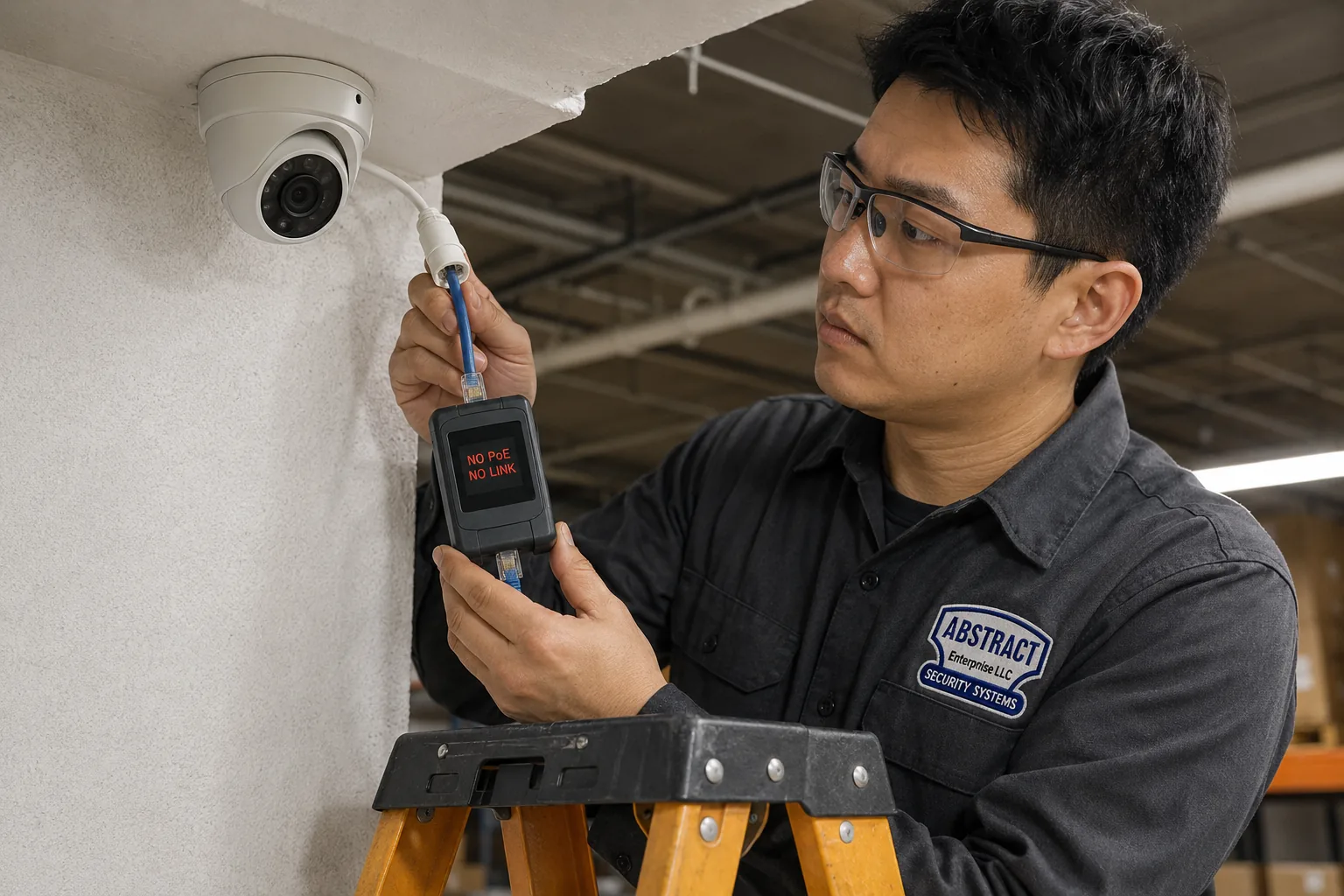
A dome camera on a painted pillar, an exposed ceiling behind, and a pocket tester on its lead reading No PoE and No Link: the run, the switch port or the plug, to be settled one at a time.
Commercial Cat6 Repair
Business Cat6 Repair in Williamsburg
Williamsburg's commercial streets are short on offices and long on hospitality, retail and making. That mix sets what a Cat6 failure costs a business, and how fast it has to be fixed.
Bedford Avenue
The neighbourhood's best-known shopping street, running north–south past the L train, lined with shops, cafés and restaurants. Shops here are often deep and narrow, with the network cabinet at the back, the register at the front and the run between them along a wall that has been repainted, re-shelved and redecorated several times. Registers and card terminals that drop out when shelving is moved are the typical call.
Grand Street and Metropolitan Avenue
Forgotten New York describes these two as Williamsburg's major commercial strips, running from the East River toward the industrial east, mixing old Brooklyn businesses with newer bars and restaurants. Many of the buildings are walk-ups with a shop below, and many have changed tenants several times. Inherited cabling from a previous business, kitchen and bar links, and outdoor-dining connections make up most of the work here.
Broadway Under the J, M and Z
Broadway runs beneath the elevated line toward the Williamsburg Bridge, which opened in December 1903. The Williamsburgh Savings Bank at 175 Broadway, built between 1870 and 1875 and now an event space, sits at Driggs Avenue, and Baby's All Right, a 5,000-square-foot bar and music venue, is at 146 Broadway just off Bedford. Venues, restaurants and event spaces along this stretch need their network to hold up through long nights of heavy use, and stage and bar links are the usual repairs.
Kent and Wythe Avenues on the Waterfront
Hotels, venues and offices in converted factories line the waterfront avenues: the Wythe Hotel occupies a cooperage designed by Theobald Engelhardt and standing since 1901, and the Domino site holds the Refinery offices and several towers. Here the cabling is newer but the structure is old, and repairs are mostly about working inside designed pathways, building rules and tight schedules around guests and events.
North 6th Street and the Northside
Music Hall of Williamsburg at 66 North 6th Street anchors a cluster of bars, restaurants and venues on the Northside blocks. These businesses run ticketing, point-of-sale, cameras and sound over the same network, often in buildings where the cable was added piece by piece as the business grew. Stage cable and the links behind long bars are the repairs we see most.
Morgan Avenue and East Williamsburg
The industrial streets east of the BQE, around the L train's Morgan Avenue stop, hold warehouses, fabricators, food producers, film and photo stages and, increasingly, galleries and venues in former industrial space. Long exposed runs to cameras and access points over working floors, and links between an office mezzanine and the floor, are the common jobs.
Rules that shape a commercial repair here
Cable must be supported by the building, not by other systems. The National Electrical Code requires exposed communications cable to be supported by the building structure so that normal use of the building does not damage it, and it may not be strapped, taped or attached to the outside of a raceway as its means of support. New York City's Electrical Code, based on the 2020 NEC with local amendments, took full effect on December 21, 2025.
Nothing hangs from sprinkler pipe. NFPA 13 says sprinkler piping or hangers shall not be used to support non-system components, and NFPA 25's inspection rules say the piping shall not carry loads resting on it or hung from it. In a loft, cable tied to a sprinkler line is a code problem as well as a repair problem.
Dead runs do not stay up. Once a replacement is in, the electrical code expects any reachable length of the retired cable to be taken out of the ceiling, unless it is clearly tagged as reserved for later use — and in an open loft almost all of it is reachable.
Outdoor dining is seasonal and freestanding. Dining Out NYC allows roadway cafés only from April 1 to November 29, requires the structure to be removed and stored off-season, does not allow café features to be permanently fixed to the roadway or sidewalk, and requires DOB or Landmarks approval for anything attached to the building. Electrical connections for sidewalk cafés must come from the building, never from city property such as a street light.
Landmarks. The Domino Refinery's main building and the Williamsburgh Savings Bank are designated landmarks, and the bank's banking hall is also an interior landmark. Work in designated spaces follows the Landmarks Preservation Commission's rules; we plan routes that use existing pathways.
None of this is legal advice; it is what we plan around before a repair starts. Where a building has its own rules, the building's rules win.
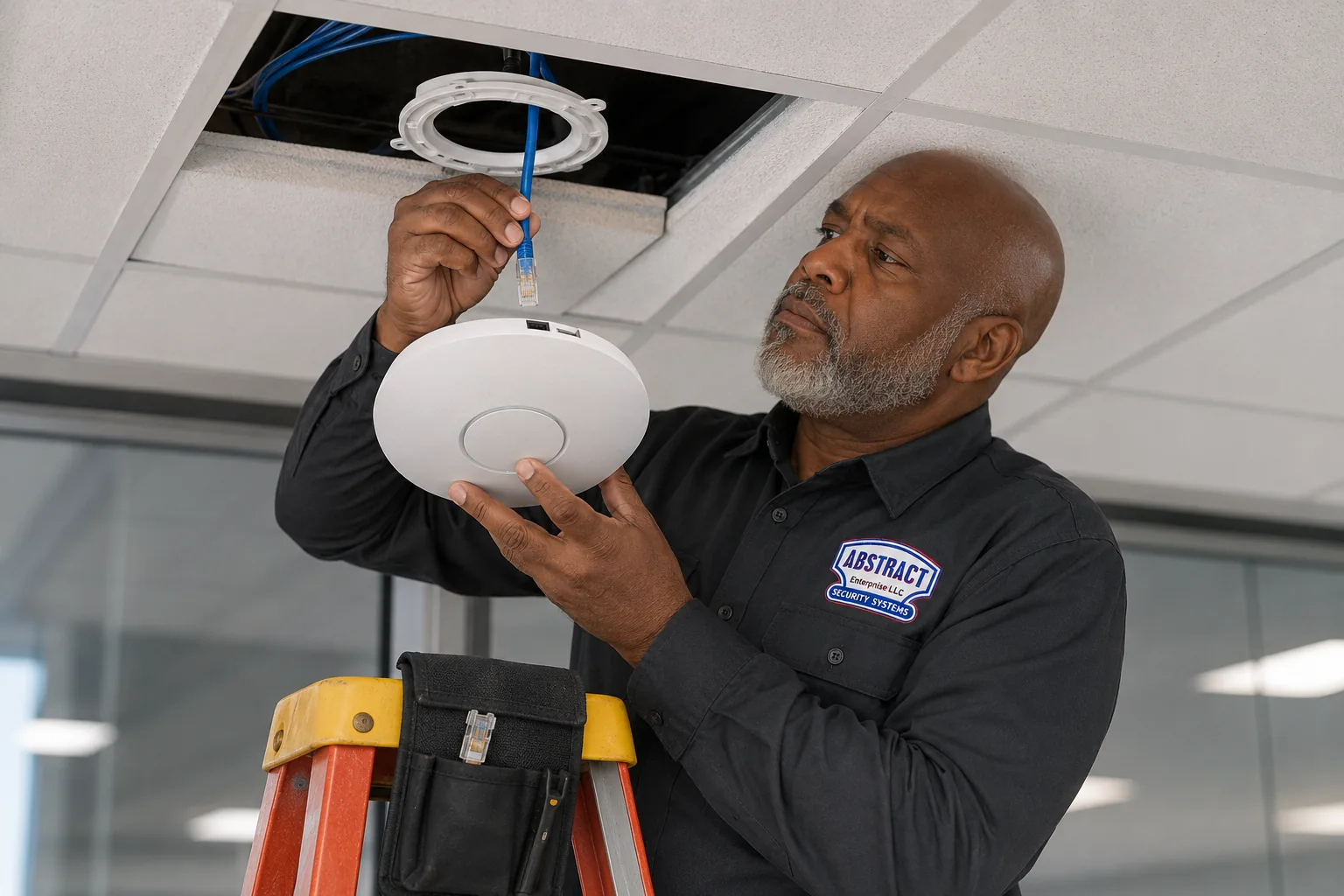
A ceiling access point lowered from its mounting ring while the blue lead with its plug is fed back down through the opening in the tile.
After Building Work
Which Williamsburg Cat6 Runs to Retest After Other Trades Have Been In
In a neighbourhood that is always being refitted, the most useful Cat6 test is often the one done straight after someone else's work. Many faults do not show up on day one. A run nicked by a saw, squeezed under a new hanger or pinned behind fresh drywall may keep working for weeks, then start dropping as the weather or the load changes. Testing the right runs as soon as the other trade leaves turns a slow trickle of mystery failures into one short repair visit, and it puts the damage on record while the people who caused it can still be asked about it.
Work that just happened
Runs worth testing
What usually goes wrong
Sprinkler upgrade or relocation in a loft
Every run that crossed, touched or was tied to the sprinkler mains and branch lines
Ties cut, cable dropped onto hangers, crushed against new fittings, kinked where it fell
Electrical or lighting retrofit
Runs near new fixtures, conduit and junction boxes, and anything in the same ceiling bay
Cable pushed aside and pinched, nicked by fasteners, strapped to new conduit
New partitions or a fit-out
Runs that pass through or end in the new walls, and the jacks on them
Screws through cable, junctions buried behind drywall, runs shortened with couplers
Ceiling or floor demolition
Everything in the opened area, including runs that only pass through it
Cut runs, stretched cable, jacks pulled out of boxes
Painting or plastering
Exposed runs and wall plates in the painted area
Paint inside jacks, plates caulked shut, cable glued to supports
Draft-line or refrigeration service
Jacks and boxes under the bar and along the trunk route
Insulation left open, condensation onto terminations, cords disturbed
Outdoor-dining set-up or removal
The front-of-shop jack and the seasonal cord
Cords crushed, cut or left in the street, jacks pulled from the wall
Internet provider visit or router move
All patching in the cabinet or media box, and the room the router used to be in
Runs left unpatched, wrong ports, couplers left in the wall
The test itself is quick once the runs are labelled: a certification pass on each link from the panel, with the results saved. If everything passes, you have a clean baseline to compare against if something fails later. If a run fails, the time-domain reading usually shows that the fault sits right where the other trade was working, which makes the conversation with that contractor short and factual.
We do not decide who pays. What we provide is the evidence: before-and-after results where we have them, photographs of what we found, and the distance from the jack to each fault. Landlords, insurers, general contractors and tenants can work out the rest from there. In loft buildings going through legal conversion, where work can carry on around occupied units for a long time, a baseline test before each phase of work is the simplest protection a tenant can have.
Planning the Visit
Fitting a Cat6 Repair Around Service, Shows and Tenants
A Williamsburg repair has to fit around the way the space is used. A bar on Grand Street cannot lose its registers on a Friday night; a venue on the Northside cannot have someone on a ladder over the stage during soundcheck; a loft tenant may work from home and need the link back before a meeting. Most of the planning happens on the first call, so the visit itself is short and quiet.
Restaurants and bars. We prefer the hours before opening. Working links stay live while the dead one is tested, and if a repair needs a run replaced, a temporary cord keeps the register or printer going through service until the proper fix is booked. Kitchens and bars are tested with the equipment running where possible, because some faults only appear when the dishwasher, the glycol chiller or the hood fans are on.
Venues and studios. We work around load-in, soundcheck and doors. The permanent stage run can usually be tested from the plates without touching the stage, and the portable cords can be checked at the desk. Where a repair needs ceiling access over the stage or the floor, it goes in a dark day or a morning slot.
Loft homes and offices. We agree which rooms need to be clear, cover furniture under any ceiling work, and keep the rest of the network running. If the landlord or the building's managing agent needs notice, an insurance certificate or a description of the work, we send it before the visit.
Towers and managed buildings. We book through the management office, follow its rules for freight elevators, work hours and ceiling access, and keep the repair inside the unit or suite unless the building asks us to look at its own equipment. If the fault turns out to be in the building's riser or telecom room, you get a written note of what the test showed so the building's vendor can act on it.
Whatever the space, the visit ends the same way: every repaired link tested, a copy of the results, labels at both ends and a short explanation of what failed. If something on your list could not be finished, you leave with a written price and a time to come back.
Your Questions Answered
Cat6 Repair in Williamsburg: Questions Answered
Loft tenants, bar managers, shopkeepers and sound engineers here ask things that a brownstone owner in Park Slope never would. The answers below are the ones we give on the phone, grouped by the kind of space.
Loft Ceilings and Exposed Brick
The Cat6 across our loft ceiling was cable-tied to the sprinkler pipe, and after the sprinkler contractor's visit two runs are dead. Where should the replacement hang?
On its own supports, fixed to the building, and clear of the sprinkler system altogether. The fire codes are blunt about it: NFPA 13 says sprinkler piping or hangers shall not be used to support non-system components, and the inspection standard, NFPA 25, says the piping must not carry materials resting on it or hung from it. A sprinkler fitter who finds data cable tied to the main is entitled to cut it free, and when pipe is replaced or re-hung the ties often go with it. The cable that survives usually ends up crushed against a hanger, stretched over a fitting or kinked where it dropped. That is why two runs die at once after this kind of visit, and why others that still work may already be damaged.
The repair starts with the tester. Every run that shared the pipe gets checked, not only the two that are dead, because a crushed section can still pass a basic continuity check and fail under load. Time-domain readings show where along each run the damage sits, which in a loft usually matches a hanger or a fitting. Runs with damage are replaced rather than spliced, because a join above a twelve-foot ceiling is a fault waiting to happen. The new cable goes on J-hooks or beam clamps attached to the timber or steel structure, spaced so it does not sag onto anything, and away from pipes, heads and hangers so the next sprinkler visit does not touch it.
The National Electrical Code points the same way. It requires exposed communications cable to be supported by the building structure so that ordinary use of the building does not damage it, and it does not allow cable to be strapped to the outside of a raceway as its support. When we finish, each new run is certified, labelled at both ends, and the old cable that is no longer in use is taken down where it can be reached, which the code also expects.
Our landlord will not allow any new holes in the exposed brick. How is a replacement Cat6 run fixed along it?
Usually by not fixing it to the brick at all. In most Williamsburg lofts the brick wall is only one of several possible routes: the underside of a timber beam or joist, the top of an existing partition, the line of an old pipe chase, or a path along the ceiling to the far side of the room before dropping down at a column or a partition. Timber takes a screw-in hook or a beam clamp without leaving a mark anyone will notice, and a run that follows the structure looks deliberate rather than added on. We walk the room with you and the landlord's rule in mind before suggesting anything.
Where the cable genuinely has to cross brick, there are still choices. Existing holes and anchors left by earlier tenants can often be re-used, and mortar joints are a far better fixing point than brick faces, because a small hole in a joint can be pointed afterwards and disappears, while a chipped brick stays chipped. Some landlords accept fixings in mortar but not in brick, so it is worth asking the question in those words. For short crossings, a run can sometimes drop inside the frame of a door or window opening rather than across the open wall.
What we do not recommend is adhesive clips on old brick. Dust, efflorescence and paint layers make them let go within weeks, and a run that falls off a wall gets stepped on, caught in a door or pulled by someone tidying up. If the only no-hole route is a long way round, the extra cable costs less than a repeat visit. The written estimate shows the route, the fixings and what, if anything, touches the brick, so the landlord can approve it before we start.
Storefronts, Bars and Outdoor Dining
The failed run is above our shop's original pressed-tin ceiling. Can it be replaced without taking the tin down?
Often, yes, because the tin is the one part of the room we try hardest not to touch. Old pressed-metal panels are nailed to wooden strips, overlap each other and carry many coats of paint; lifting one usually bends its edges and cracks the paint along every seam, and the panels on either side tend to come with it. Williamsburg still has dining rooms where these ceilings survive — Bamonte's on Withers Street, open since 1900, is one of the best known — and in a room like that, a scarred panel is a bigger loss than a few extra hours of work.
So the first step is finding out where the fault actually is. A time-domain test from the jack gives the distance to the break, and that often shows the damage is not above the tin at all but at an end: in the cellar, inside the wall box behind the counter, or at the panel in the back office. If the run has to be replaced, the usual alternatives are to bring the new cable up from the cellar beneath the shop and into the wall at the point where it is needed, to run it in a slim painted raceway along the line of an existing cornice or picture rail, or, where the floor above belongs to the same owner, to drop it through from above.
If none of those works and the old cable is the only practical path, it can sometimes be used to pull the new one through, provided it is not stapled along the way. Only as a last resort do we lift a single panel, and then we agree it with you first, cut the paint seam rather than tearing it, and set the panel back on the same nail holes. Either way, the old run that stays above the tin is labelled as dead so nobody tries to use it again.
Our roadway dining setup has to come down every winter. How should the network link to the outdoor card terminal and printer be built so it survives the seasons?
Treat the outdoor part as a removable cord and keep everything permanent inside the building. The city's rules make that the only sensible approach anyway. Under Dining Out NYC a roadway café may operate only from April 1 to November 29, it must be removed and stored for the off-season, its features cannot be permanently fixed to the roadway or sidewalk, and nothing in it may block the pedestrian clear path. Anything attached to the building needs DOB or Landmarks approval, and for sidewalk cafés the city says electrical connections must come from the building, never from city property such as a street light.
In practice that means the permanent Cat6 run ends at a protected jack inside the shop, near the front window or door, or in a weather-rated box on the inside face of the shopfront. For the season, a rugged, outdoor-rated cord runs from there to the terminal or printer and is coiled away when the structure comes down. A cable strung across the sidewalk, taped to the curb or buried under café flooring will be cut, crushed or soaked long before November, and indoor cable left in a roadway structure all summer goes brittle in the sun.
Many restaurants find that the outdoor devices do not need a cable at all: a handheld card terminal or printer on the shop's own Wi-Fi or cellular service can be more practical out in the street. Where a wired link is still the best option — a printer that must never miss a ticket, say — we fit the indoor end properly, test it, and label the cord so staff know which socket it goes back into each April. If last season's cord has already been chewed by a door or a tow truck, that is a twenty-minute fix, not a new run.
The Cat6 jacks under our bar sit beside the beer and glycol lines, and they keep corroding. Is the draft system doing that?
Very likely. Draft systems that carry beer some distance from the cooler bundle the beer lines with glycol coolant lines inside an insulated trunk, and that trunk is cold. Brewing and draft guides warn that any warm air reaching the cold lines makes them sweat, and that in a basement or other humid space the water collects at the low points of the run. If the insulation has been cut, compressed or left open where the trunk enters the bar, the condensation drips out right there — often onto the wall box, the floor box or the bundle of Cat6 that feeds the register and the printer.
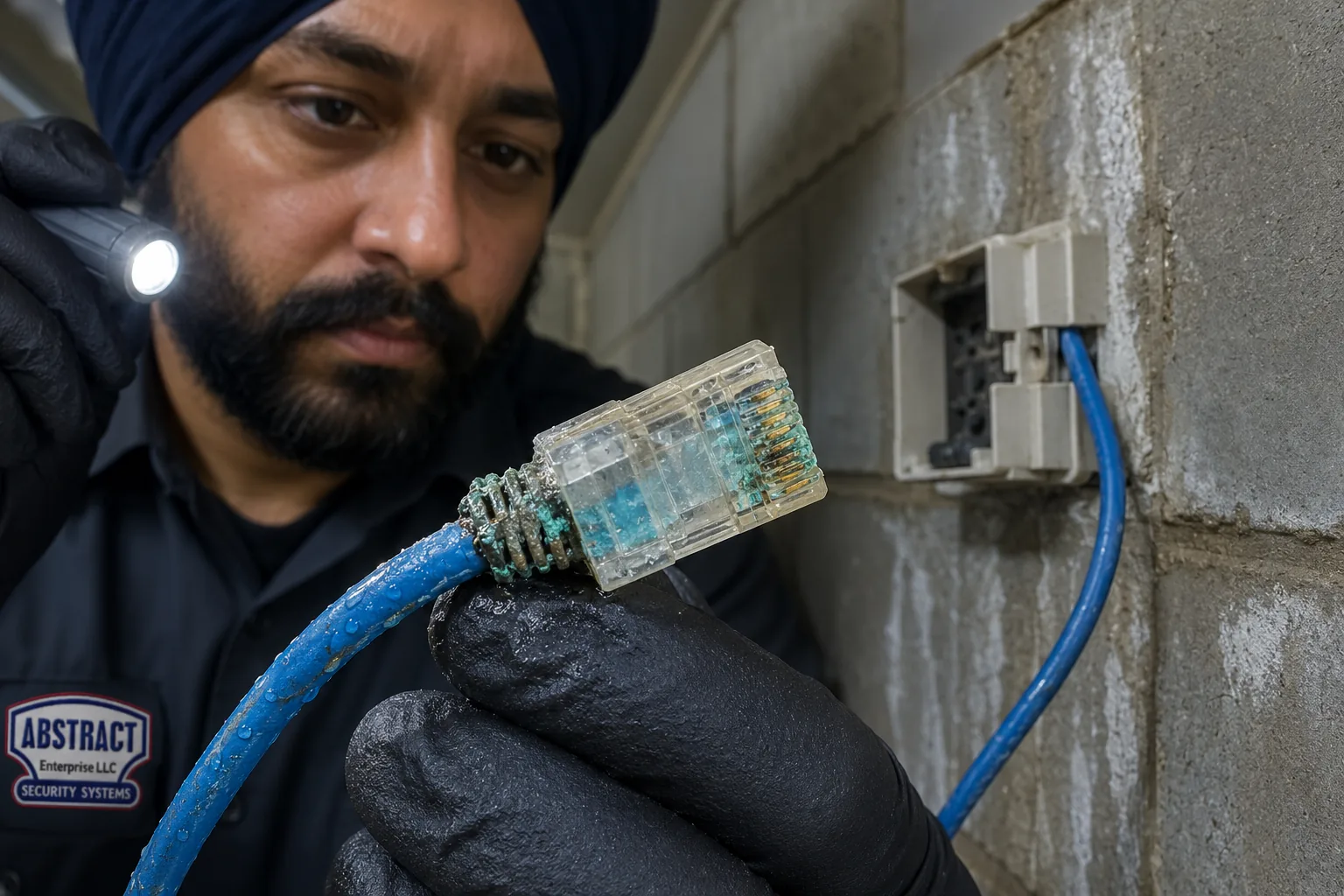
Water does its damage at the terminations. The cable jacket keeps the conductors dry, but the contacts inside a keystone jack or a plug corrode once moisture gets in, and a corroded contact makes an intermittent link that drops when the bar is busiest and recovers overnight. Our tester shows the pattern clearly, and the green or white deposits on the contacts confirm it once the plate is off.
The repair has two halves. We cut back to clean cable, re-terminate on new jacks, and move the terminations up and away from the trunk's low points, with a drip loop so any water runs off the cable before it reaches a jack. The other half belongs to your draft technician: the trunk needs re-insulating and sealing where it was opened, or the new jacks will corrode in the same way. We will point to exactly where the trunk is sweating so that call is a short one.
Stages, Studios and Venues
The Cat6 between our stage box and the mixing desk gets coiled, stepped on and rolled under cases every night. Should it be repaired or replaced, and with what?
It depends which part of the link has failed, so the first thing we do is split it in two. Most venues have a permanent run, inside the walls or across the ceiling, from a plate near the stage to a plate at the mixing position, and a portable cord at each end. The permanent run should never move, and if it fails it is repaired and certified like any other Cat6 link. The portable cords are a different matter: they are coiled, walked on, pinched under road cases and yanked out at the end of the night, and they are where almost all of the damage happens.
Ordinary patch cord is not made for that life. Cable sold for stage and broadcast use — often called tactical or snake cable — has a tougher jacket and is built to stay flexible; Belden, for example, describes its Ethernet snake cable as rugged and flexible for portable professional AV use and rated to pass a cold-bend test at minus 40 degrees Celsius. It is usually fitted with locking metal-shelled connectors that survive being trodden on and cannot be pulled out by accident. Re-crimping a crushed stage cord in the field can get a show through the night, but it rarely lasts; a factory-made rugged cord is the proper replacement.
If the permanent run tests clean and only the cords were damaged, the bill is small. If the plates at either end were built for office use and keep getting kicked loose, we can replace them with locking panel connectors so the stage cords latch in. Either way, both halves of the link are tested together at the end, because the audio or lighting system only cares whether the whole path works, not which part was replaced.
Green deposits on the contacts and boot of a wet plug drawn from a box on a block wall: the kind of termination damage that moisture leaves behind.
Equipment
Tools and Parts We Bring to a Williamsburg Cat6 Repair
A repair is only as good as the evidence that it worked, and the parts that went into it. This is what is on the van for a Williamsburg call.
Certification Tester
The instrument that decides pass or fail. It holds a repaired link up to the full limits of its category and keeps a saved record you can hand to anyone who later doubts the network.
Time-Domain Fault Locator
Shows how far from the jack a break, crush or bad join sits. In a loft or a storefront cellar, distance is what tells us which beam or which wall to look at.
Toner and Probe
Finds which cable in a bundle or which port on an unlabelled panel belongs to the dead jack, without unplugging the rest of the business.
PoE Tester
Checks whether a camera or access point is getting power and link from the switch, so a failed device, a tired switch port and a damaged run can be told apart.
Matching Keystones and Panels
Cat6 and Cat6A keystones, shielded jacks for shielded runs, panel inserts and plates, so a repaired link is built on parts of its own category.
Supports for Exposed Runs
J-hooks, beam clamps, screw-in hooks for timber and hook-and-loop ties, so a repaired loft run hangs from the structure and not from pipes, conduit or sprinklers.
Factory-Made and Rugged Cords
Patch cords in several lengths and rugged cords for stages and outdoor seasonal use, because a hand-crimped cord is the most common weak point in a busy space.
Moisture and Corrosion Checks
Inspection light, contact cleaner for assessment, replacement plates and drip-loop hardware for bars, kitchens and cellars where condensation reaches the terminations.
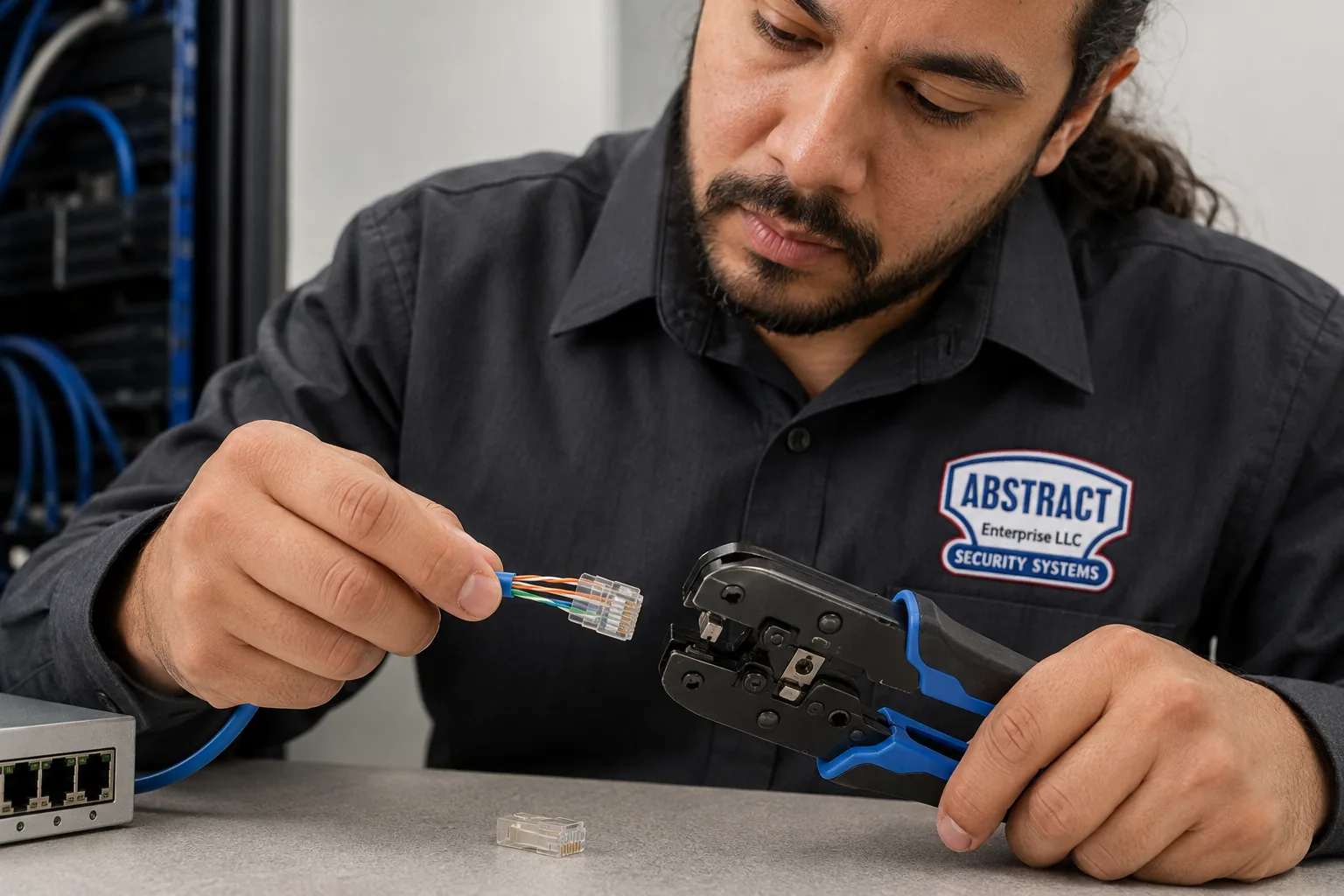
The pairs pushed into a fresh plug with the crimper ready, a spare plug on the bench and a small switch at the edge of the frame.
Matching the Repair
Matching a Williamsburg Repair to the Cable Already There
A repaired link is only as good as its weakest part, so the parts we fit follow the cable already in place, not whatever happens to be in the van. Williamsburg's buildings hold every kind of network cable, put in by different people at different times, and a single loft ceiling can carry three generations of it side by side. Before anything is re-terminated, we read the printing on the jacket, check the conductors and look at how the far end was finished.
Cat6 on Cat6, Cat6A on Cat6A. Newer offices, hotels and venues along the waterfront often have Cat6A for access points and high-speed links. A Cat6A run repaired with Cat6 jacks will usually still connect, but it will no longer test as Cat6A, and the speed it was installed for may be lost. We carry both, and the certification report states which standard the repaired link was tested against.
Shielded runs keep their shield. Studios, stages and some industrial units use shielded cable to keep electrical noise out of audio, lighting and machine links. A shielded run finished on an ordinary unshielded jack loses the protection it was bought for. We fit shielded jacks and connectors on shielded cable and keep the shield continuous through the repair.
Solid cable in the walls, stranded cable in the cords. Permanent runs should be solid-copper cable; patch cords and stage cords are stranded so they can flex. Lofts are full of the opposite: long lengths of patch cord pushed through holes and stapled to beams as if they were permanent runs. That cable has higher losses over distance and fails sooner where it is bent, and we tell you so before re-terminating it.
Real copper, not just a printed label. Some cheap cable sold as Cat6 has aluminium conductors coated in copper. It has higher resistance, struggles with power over Ethernet and cannot form part of a certified channel, because the standard calls for solid copper conductors. If a run fails for no obvious reason, we check the conductors before spending your money on new jacks.
Labels that survive the next tenant. Williamsburg spaces change hands often, and the commonest reason a simple repair takes an hour is that nobody knows which cable is which. Every link we repair is labelled at both ends with a printed tag that matches the panel port and the wall plate, and the labels follow one scheme throughout the space, so the next person can read it without a key. Where an existing scheme already works, we keep it rather than inventing a second one alongside it.
The certification report you receive lists every repaired link with the standard it was tested to, its length and the margin by which it passed. Keep it with the building's paperwork: the next time a contractor, an IT provider or a sound engineer asks whether the network is sound, that report answers the question without anyone needing to climb a ladder.
AI Overview Reality Check
What AI Gets Wrong About Cat6 Repair in Williamsburg
Search summaries, cost guides and forum answers give confident general advice about network cable. Some of it fits a suburban office. Much of it does not fit a Williamsburg loft, bar or venue. These are the claims we hear most often, and what we find in the field.
Claim: a cost-guide average is what a loft or bar repair costs
Summaries love a single number, and the one they usually reach for is Fixr’s: a range for each new Cat6 drop including materials, and an hourly labour band, both averaged across the whole country. Landlords and managers repeat those ranges, and they reappear in automated answers, but they were built from new installations in typical American buildings, not from fault-finding in this city.
A repair in a Williamsburg loft is mostly time spent finding the fault and reaching it: a twelve-foot ceiling, a sprinkler main to work around, a landlord's no-drilling rule, a bar that cannot lose its register at seven o'clock. The cable is the cheap part. The licensed hourly rate in this city is not a national average either.
What we charge is printed in the pricing section further down, and the written estimate after testing is the figure that counts. Comparing it with a countrywide average tells you very little; comparing it with the cost of a bar without card payments on a Saturday tells you a lot more.
Claim: a lit port on the switch proves the run is healthy
A link light means two devices agreed to talk at some speed. It does not mean the cable is healthy. A Cat6 run with one damaged pair can still light up and quietly fall back to 100 megabits, and a run crushed under a hanger or a road case can pass a simple continuity test while failing every measurement that matters at gigabit speed.
Training material for cabling installers makes the same point: a wire-map pass only proves the conductors are connected end to end, not that the link can carry its rated speed. Return loss, crosstalk and insertion loss are what reveal kinks, crushes, bad terminations and water.
That matters in Williamsburg because so many faults here are partial ones — a bar register that drops only at busy times, a loft desk that is slow rather than dead. Those are found with a certification tester, not by looking at the lights on the switch.
Claim: above a ceiling, cable can be supported by whatever is there
Online advice about running Ethernet often suggests tying it to the nearest pipe or conduit. In an exposed loft ceiling that is exactly what causes the next failure, and in many cases it is against the rules as well.
The National Electrical Code requires exposed communications cable to be supported by the building structure and does not allow it to be strapped to the outside of a raceway as its support. NFPA 13 does not allow sprinkler piping or hangers to support anything that is not part of the sprinkler system.
The practical result in a loft is simple. Cable tied to a sprinkler line or a conduit will be disturbed whenever that system is worked on, and the people working on it are allowed to cut it free. Cable on its own hooks, fixed to beams, stays put.
Claim: new buildings do not have cable problems
Newer Williamsburg buildings are better wired than the old factories, but they are not trouble-free. The cable inside the walls is usually fine; the problems start at the ends and in the spaces around it.
Media closets get crowded as tenants add routers, mesh units and switches. Internet installers move the router to a new room and leave half the jacks unpatched. Ground-floor shops and amenity spaces are fitted out, refitted and fitted out again, and every refit is a chance to put a screw through a run or bury a junction behind new drywall.
So in a tower the first question is not how old the cable is, but what has changed since it last worked. The tester tells us whether the run itself has a fault or whether the trouble is at the panel or the device.
Claim: outdoor cable is outdoor cable
Plenty of cable sold as suitable for outdoor use is meant for a run buried in conduit or fixed to a wall out of the sun, not for a cord that lives on the floor of a roadway café from April to November.
Ordinary indoor patch cord left in the sun goes stiff and cracks, and any cord left across a walkway or under flooring is crushed and soaked. The city's outdoor-dining rules add another constraint: the structure must come down each winter and cannot be permanently fixed to the street.
The right build is a permanent run ending inside the building and a rugged removable cord for the season. That cord is a consumable. Replacing it costs very little; repairing a permanent run that was dragged outside costs a great deal more.
Claim: re-crimping the end always fixes a failed run
Re-terminating is the right fix when the fault is at the end — a badly punched jack, a cracked plug, corrosion from a sweating draft line. It is the wrong fix when the cable is damaged somewhere along its length.
Installer training material is clear on the pattern: return-loss failures near one end point to the cord or jack at that end, while damage partway along the run means the cable itself needs replacing. Cutting off the end and crimping a new plug only shortens a damaged cable.
The time-domain reading tells us which case we are in before anything is cut. In a loft, that reading often lands on a hanger or a beam edge twenty or thirty feet from either end, and no amount of re-crimping will help.
Claim: old cable can stay in the ceiling once it is replaced
It is tempting to leave the dead run where it is — it is out of the way and costs nothing to ignore. In an exposed loft ceiling, though, the code expects otherwise.
Under the electrical code, retired data cable that can be reached has to come out unless someone has tagged it as kept for later. Above an open loft ceiling, nearly every metre can be reached, so in practice the retired run is coiled up and carried away the same day its replacement is certified.
It also helps the next person. A ceiling with one live, labelled run is quick to work on; a ceiling with five unlabelled runs, three of them dead, costs the next technician an hour of tracing before any repair can start.
A Williamsburg Link Repaired on Evidence, Not Guesswork
One photo of the rack or the ceiling, a list of what is down and a word about the space are enough for a written plan: what we expect to find, how we will reach it and what it should cost.
Tell us the kind of space — loft, bar, shop, venue, tower or industrial unit — which jacks or devices are down and anything that changed just before they failed, and a written Williamsburg plan comes back before the end of the business day. Prefer to talk? Call (347) 934-8335.
✅
We Got Your Request!
Received. A Brooklyn technician will read your Williamsburg details and reply today; for anything urgent, ring (347) 934-8335.
How It Works
Our Cat6 Repair Process in Williamsburg
Six steps, the same for a one-jack bar repair and a whole loft floor. The order matters: nothing is cut until the tester has said where the fault is.
1. Photos and the Story
Send a photo of the rack or cabinet, the dead jack and, for a loft, the ceiling. Tell us what changed just before it failed — sprinkler work, a new tenant, a moved router, the dining shed going up. That history usually points to the cause before we arrive.
2. Building Rules and Access
We send an insurance certificate to the landlord, managing agent or hotel engineering office if they ask for one, confirm any no-drilling or landmark rules, and book a time that suits service hours or a venue's load-in.
3. A Two-Hour Window
Arrival slots are two hours long, run from 8 AM to 8 PM and are offered every day, sometimes the same day. Bars and venues can choose a slot before opening; offices can choose one before staff arrive.
4. Test Before Touching Anything
Every reported link is certified from the panel, and the failing ones are measured by distance to the fault. Toner and probe confirm which cable is which. You hear what we found and what it will cost before any cable is cut or replaced.
5. Repair and Re-Route
Ends are re-terminated on matching parts, damaged sections or whole runs replaced, and any cable that was hanging from pipes, conduit or sprinklers moved onto its own supports. Terminations near bars, sinks or draft lines are raised out of harm's way.
6. Certify, Label and Hand Over
The tester runs one last time on every link we touched. Tags go on both ends, the panel map is updated, and you get the saved results plus a few plain lines on the cause — while the retired lengths leave with us.
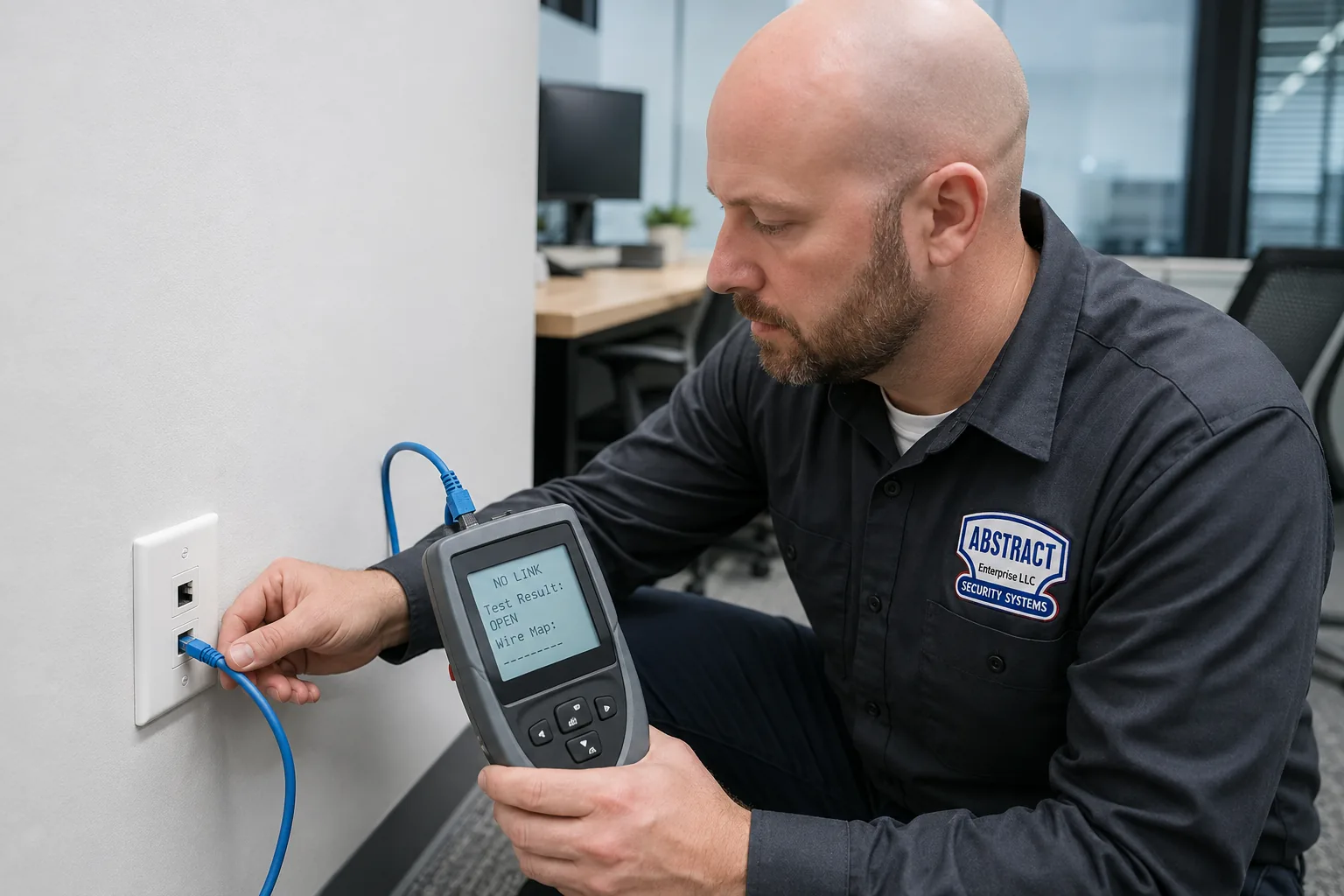
A handheld tester on a two-port wall plate reading No Link and Open on its wire-map screen — step four, before anything is cut.
Coverage Area
Cat6 Repair Near Williamsburg's Landmarks
Six places that show the range of buildings our Williamsburg repairs take place in — and the range of ways cable has been added to them.
The Refinery at Domino
The Domino refinery ran on Kent Avenue from 1856 to 2004; its filter, pan and finishing house became a city landmark in 2007 and has reopened as offices. Old masonry, new office networks and strict rules about openings.
Wythe Hotel
A cooperage designed by Theobald Engelhardt and standing since 1901, later a textile factory, converted into a hotel with a new addition on the roof in 2012. The pattern for Williamsburg's factory-to-hospitality conversions.
Williamsburgh Savings Bank, 175 Broadway
Built between 1870 and 1875 at Broadway and Driggs Avenue, designated a landmark in 1966 and with its banking hall also an interior landmark. Now an event space, where any cable must respect a protected interior.
Music Hall of Williamsburg
The concert venue at 66 North 6th Street, at the heart of the Northside's bars and restaurants. Venues like it depend on stage, ticketing and bar links that are used hard every night.
Williamsburg Houses
One of the city's first public housing projects, completed in 1938 across twelve blocks and about 23 acres between Leonard Street and Bushwick Avenue and made a city landmark in 2003. A reminder that much of the neighbourhood is masonry housing with little room for new pathways.
Morgan Avenue and the North Brooklyn IBZ
The industrial heart of East Williamsburg, part of the 1,066-acre area the Department of City Planning studied in its North Brooklyn plan. Warehouses, stages and fabricators with long exposed runs over working floors.
We also repair Cat6 in Greenpoint, East Williamsburg, South Williamsburg, Bushwick, Bedford-Stuyvesant, Clinton Hill, Fort Greene and the Brooklyn Navy Yard, and across the creek in Long Island City — and throughout the rest of the borough from our Cat6 repair Brooklyn page. For new cabling rather than repair in the neighbouring districts, see structured cabling in East Williamsburg and South Williamsburg cabling installation.
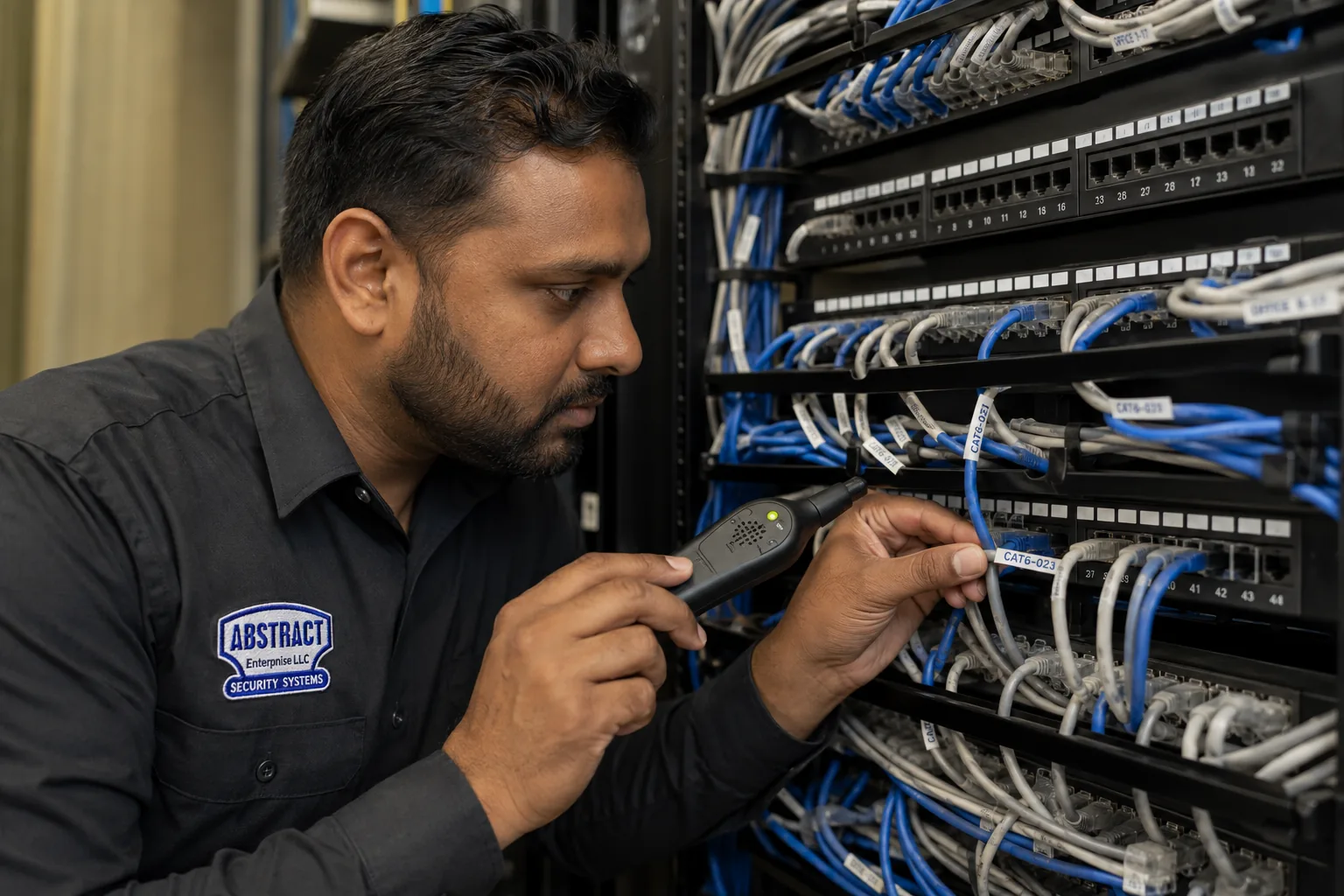
A toner probe held to a crowded rack of blue and grey cords, one of them tagged CAT6-023: finding which cable belongs to which jack before any is moved.
Pricing
Cat6 Repair Cost in Williamsburg
Williamsburg is priced exactly as the rest of Brooklyn, which is the base area for our published rates, so the figures below carry no neighbourhood adjustment. They are the same numbers shown on our Brooklyn Cat6 repair page. Repair time and any cable that has to be replaced are listed separately and invoiced separately.
Item
Price
What it covers
Hours on site — certifying links, measuring distance to faults, rebuilding ends, swapping cords, re-hanging loft runs
$195/hr, 3-hour minimum ($585)
AESS’s published hourly figure for low-voltage specialty work. Any hours left after the first fault go on the next link you named.
Replacement run, used only when testing condemns the old one
From $175 per run
Entry price per replacement: cable, jack and faceplate, panel termination, certification, printed tags at both ends and a factory patch cord.
Hole through an outside wall, sealed and bonded
From $185 per penetration
Needed when a camera on a roof, a yard or a rear extension is fed from inside.
Lift hire for tall loft ceilings, very long routes, finish repair, overnight work
Quoted after testing
Set once we know the height, the distance and what the landlord or venue allows; you approve the figure in writing first.
The first block of hours on a loft floor
Under a timber or concrete loft ceiling, three hours is normally enough for certifying the runs that share the damaged pathway, locating each fault by distance, re-terminating the ends that failed, and moving the surviving runs off pipes or sprinkler hangers onto their own supports. Where a run is damaged mid-span, you get a per-run price for replacement before any new cable is pulled.
The first block of hours behind a bar or counter
At a bar, shop or venue those same hours are usually spent on testing the register, printer and camera links, replacing corroded or crushed terminations, raising them away from water and draft lines, swapping hand-made cords for factory ones and certifying the result. At a venue it typically includes the stage-to-desk run and its plates, with any rugged cords supplied at cost.
What pushes one Williamsburg bill above another
Where the fault is: a bad jack or a cord is quick; a crush thirty feet along a loft ceiling, or above a pressed-tin ceiling, takes longer to reach.
How the cable was hung: runs on proper supports are quick to repair; runs tied to pipes, buried under other trades' work or joined mid-span need tracing and re-routing.
Ceiling height and access: a twelve- or fourteen-foot loft ceiling, a crowded bar back, a cellar reached by a sidewalk hatch.
Rules: no-drilling clauses, landmark interiors, hotel and venue schedules, a managing agent's hours.
The cable itself: sound copper Cat6 gets new ends and stays in service; stranded cord stapled up as a permanent run, or copper-clad aluminium with a Cat6 label, is cheaper to replace now than to keep patching.
For comparison only: Fixr’s cost guide, updated January 2025, puts a new Cat6 drop nationally at $125–$250 and installer labour at $45–$75 an hour. Those are countrywide figures for new work, which is why they rarely match a repair bill from a Brooklyn loft or bar — and they are not AESS prices.
Full terms — including 50% deposit, one-year parts-only warranty on AESS-supplied products, and the late-fee schedule — are set out in the service agreement.
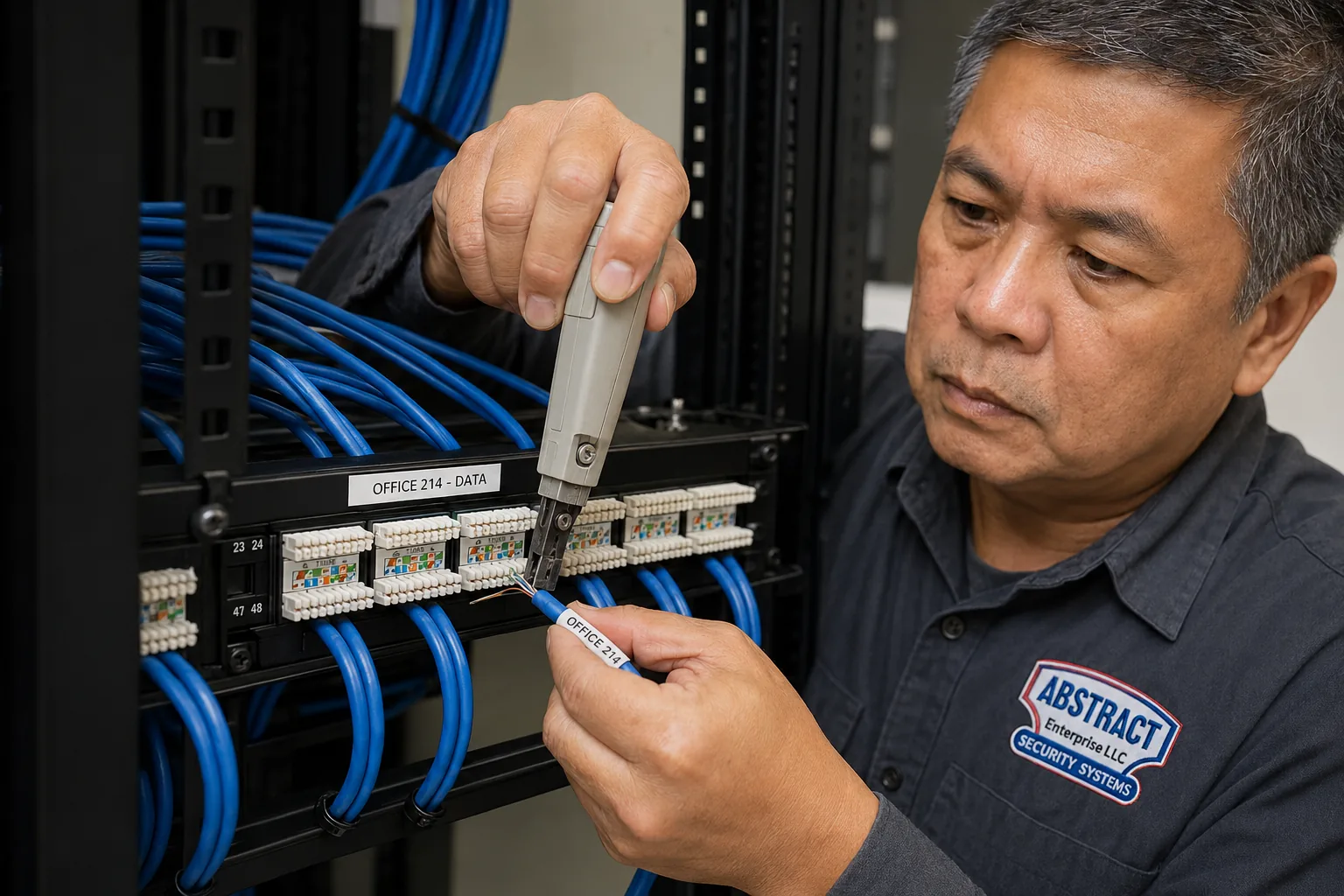
A punch-down tool on the back of a panel labelled Office 214 – Data, the matching tag on the cable in the technician's other hand.
Shop Our Systems
Cat6 Repair Packages & Pricing
Most Williamsburg jobs fall into one of these shapes. The figures are built only from the table above, with no neighbourhood surcharge.
Starter — Bar, Shop or Desk Link Fix
$585
Three hours at $195. Aimed at a handful of dead or flaky links — a register, a kitchen printer, a camera, two desks: each certified from the panel, its fault pinned down, its ends rebuilt or its cord swapped, then passed. Spare hours go on whatever else is on your list.
Standard — Loft Ceiling Repair and Re-Support
$195/hr after the first 3 hours
For a loft or industrial floor where runs share a ceiling with pipes and sprinklers. Every run in the area is certified, failures are sorted by cause, ends are rebuilt on matching parts and surviving runs are moved onto their own supports. You get a written time estimate after the first tests.
Premium — Repair Plus Replacement Runs
Repair time + from $175 per run
When certain runs are finished — flattened by a hanger, soaked under a bar, sawn through in a fit-out — the hours cover all the cable worth keeping, each fresh run is priced from $175, and the dead lengths we can reach are taken out of the ceiling.
Bring Your Own Parts — Labour Only
Got spare stage cords, locking panel connectors or a bag of jacks the fit-out crew left behind? Use them, and the bill is labour only — as long as they match the run: 6A hardware on 6A cable, shielded on shielded, solid copper wherever the cable is permanent. The tester treats your parts the same as ours. Any cover on them comes from whoever made them, and a part we expect to fail is flagged before it is fitted.
Get Your Williamsburg Repair Price in Writing
A photo of the rack, a list of what is down and the kind of space are enough to price the visit. The tester decides the rest, and you approve any replacement run before it is pulled.
Five Checks a Williamsburg Business Can Make in Ten Minutes
None of these needs tools, and none of them risks making anything worse. They do not replace a tester, but they often tell us whether we are looking at a cable, a cord, a port or a device — and they make the first hour of the visit far more productive.
Swap the cord at the device end. Plug the register, printer or desk into its wall jack with a different cord that you know works. Short, hand-made or stepped-on cords are the most common single cause of a dead link in a busy room.
Look at the switch port. Find the port the jack feeds and note whether its light is off, amber or blinking erratically. Write down the port number; it saves tracing time later.
Note what changed. Sprinkler or electrical work, a new tenant next door, a moved router, a refit, the dining structure going up or coming down, a draft-line service. A failure that follows a change usually sits where the change happened.
Look up. In a loft, follow the run with your eyes from the jack to the ceiling. Cable tied to a pipe, pulled tight over a beam, pinched behind a new partition or hanging loose is worth a photo.
Look under the bar. Behind counters and bars, check for water on the wall box, green or white deposits on a plug, or a bundle sitting in a drip path. Do not unplug anything that is still working.
Two things to avoid while you wait. Do not open wall plates or panels that carry mains power nearby, and do not pull on a ceiling run to see where it goes: an exposed loft cable that is already damaged will often break completely when tugged, turning an intermittent fault into a dead one and making it harder to locate. If a device is critical — the only register, the camera over the door — leave it on whatever cord is keeping it alive until we arrive, even if that cord trails across the floor for a few hours. A temporary fix you can see is better than a permanent fault you cannot.
Send the photos and notes with the form or on WhatsApp. If one of these checks fixes the problem — a new cord is the most common winner — you have saved a visit. If it does not, we arrive knowing more than we would have.
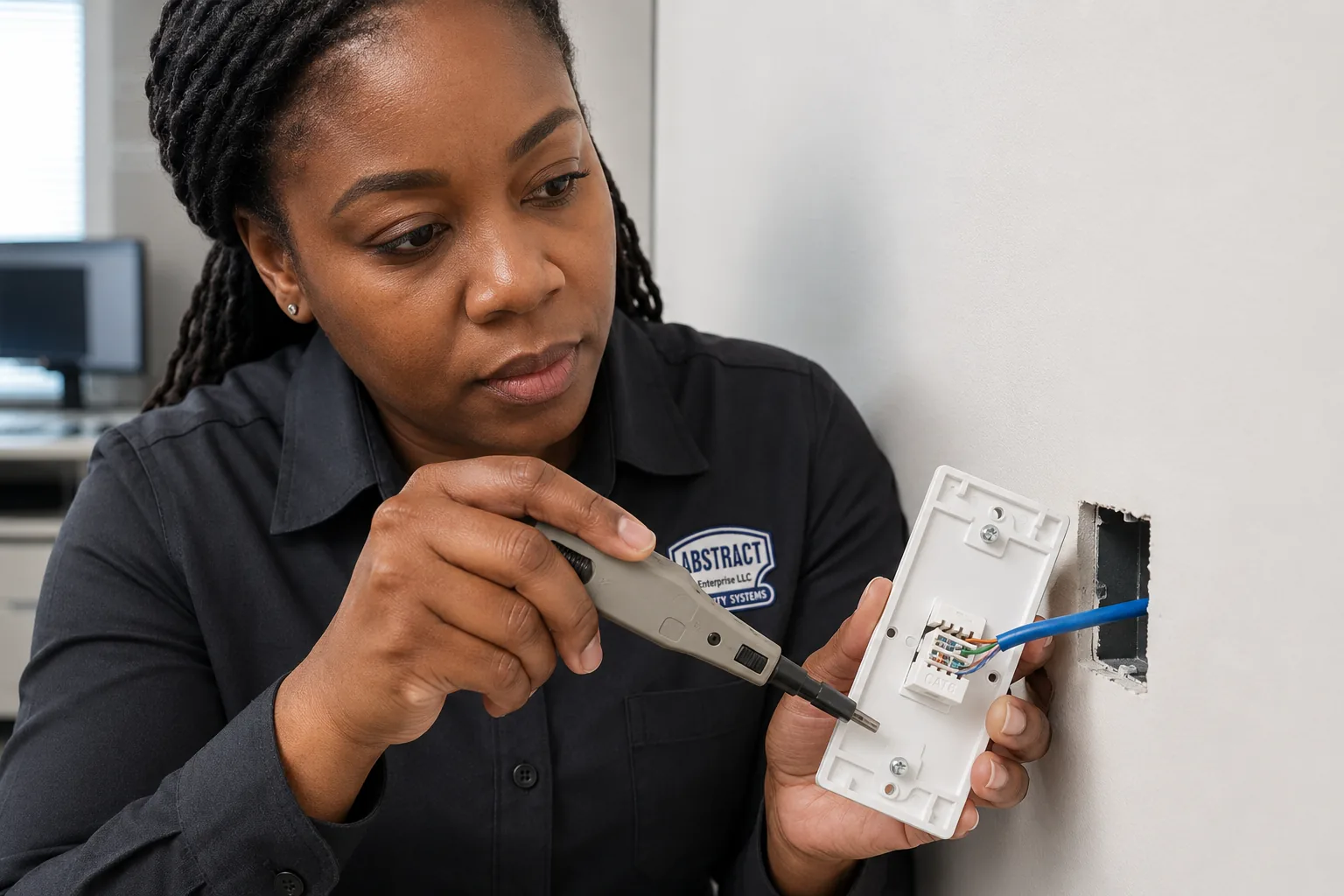
A keystone seated in a white wall plate, the punch-down tool on its contacts and the blue cable leading back into the box behind.
Complete Services
Every Cat6 Repair Service in Williamsburg
Related work that Williamsburg customers often add to a Cat6 repair, each with its own page.
One form for the repair, the cameras and anything else the space needs.
Field Notes
Field Notes on Loft Ceilings, Bar Backs and Stage Plates
Our general working habits in Williamsburg's lofts, bars and venues — a method, not a story about a particular job
On the phone we ask two questions before anything else: what changed just before it failed, and how is the cable hung? The first usually points at the cause; the second tells us whether to bring the tall ladder, the beam clamps or the rugged cords.
In a loft we follow the run from the jack to the panel with our eyes before the tester comes out, and photograph every point where it touches something it should not — a sprinkler hanger, a conduit, a beam edge. Those photos go into the hand-over with the test results.
Behind a bar we work before opening, keep every working link live while we test the dead one, and leave the terminations higher and drier than we found them. At a venue we test the permanent run and the stage cords as one link at the end, because that is how the sound desk will use them.
FAQ
Williamsburg Cat6 Repair FAQ
Do you repair the Cat6 that carries lighting control at a venue or photo studio?
+
Yes. Stage and studio lighting often runs over the same Cat6 as the computers, either as network lighting protocols through a switch or as DMX carried on two pairs of the cable from console to fixtures. Both use ordinary Cat6 runs and jacks, so the tester finds breaks, crushed sections and bad ends on them just as it does on a data link. We label lighting runs clearly, because a DMX line plugged into a network switch, or the reverse, will not work and can confuse both systems.
Do you repair the Cat6 feeding ticket scanners or a digital jukebox at a bar or venue?
+
Yes. Those devices sit at entrances, on walls and at the end of the bar, exactly where cables get kicked, pinched and pulled loose. We test the run from the switch to the device, replace a damaged cord or termination, and fix the plate and cord where staff and crowds will not catch them. If the scanner or jukebox itself has failed, we tell you so its supplier can take over.
All Areas Served
Cat6 Repair Across Brooklyn and New York
Williamsburg’s parent is the Brooklyn Cat6 repair page, and above that sits the New York City Cat6 repair hub; the boroughs, counties, regions and other neighbourhoods we cover for this service follow.
Beyond cable repair, the firm fits cameras, door entry, card access and new network wiring; the AESS home page lists every service, and our company story introduces the licensed team.
A Williamsburg Register, Camera or Desk Still Offline Tonight
When a link dies at the worst moment, look for what else changed: a contractor in the ceiling, a moved router, a new cord, the dining structure going up, a draft-line service. Ring (347) 934-8335 and we will book the next open two-hour window; once we are on site, most of these faults are found and fixed within an hour or two.
Cat6 Repair Williamsburg — Licensed, Insured, Careful With Old Buildings
Abstract Enterprises Security Systems · 1282 Troy Ave, Brooklyn, NY 11203 · (347) 934-8335 · WhatsApp (718) 679-0359 via wa.me
NYS Low-Voltage Licence #12000287431 · 100% Licensed & Insured · Same-Day Estimates · Rated 4.7★ from 201 Google Reviews
Cords, keystones or connectors handed to us by the customer stay under their own maker's cover. The AESS warranty page explains how parts we supply are handled.
Page reviewed and updated October 17, 2026. Changelog: Williamsburg page launched under Brooklyn Cat6 repair, with guidance for factory lofts, storefronts and bars, venues, waterfront towers and East Williamsburg industrial units.