Licensed Low-Voltage Contractor · Brownstones, Limestones, Prospect Park West Co-ops, Fourth Avenue Condos & Fifth/Seventh Avenue Shops
Cat6 Repair in Park Slope
Front-to-Back Runs · Cellar Cable on Old Pipes · Facade Camera Entries · Parquet & Plaster Routes · Storefront Cellars · Recertification
A Park Slope rowhouse is typically about twenty feet wide, three or four stories over a cellar, and built around two brick party walls that carry every joist in the house. That geometry decides where a failed Cat6 run can be reached and where it cannot. We put the link on a certification tester, read how far along the cable the fault sits, lay that distance over your floors, and repair it from the cellar ceiling, a stacked closet or the stair hall before anyone thinks about lifting an inlaid floor or opening a cornice. Then the link is tested back to Category 6 and you get the record.
Reviewed and updated October 17, 2026 · Written by Anwar Timothy, NYS license #12000287431 · Park Slope calls go to the Brooklyn line, (347) 934-8335
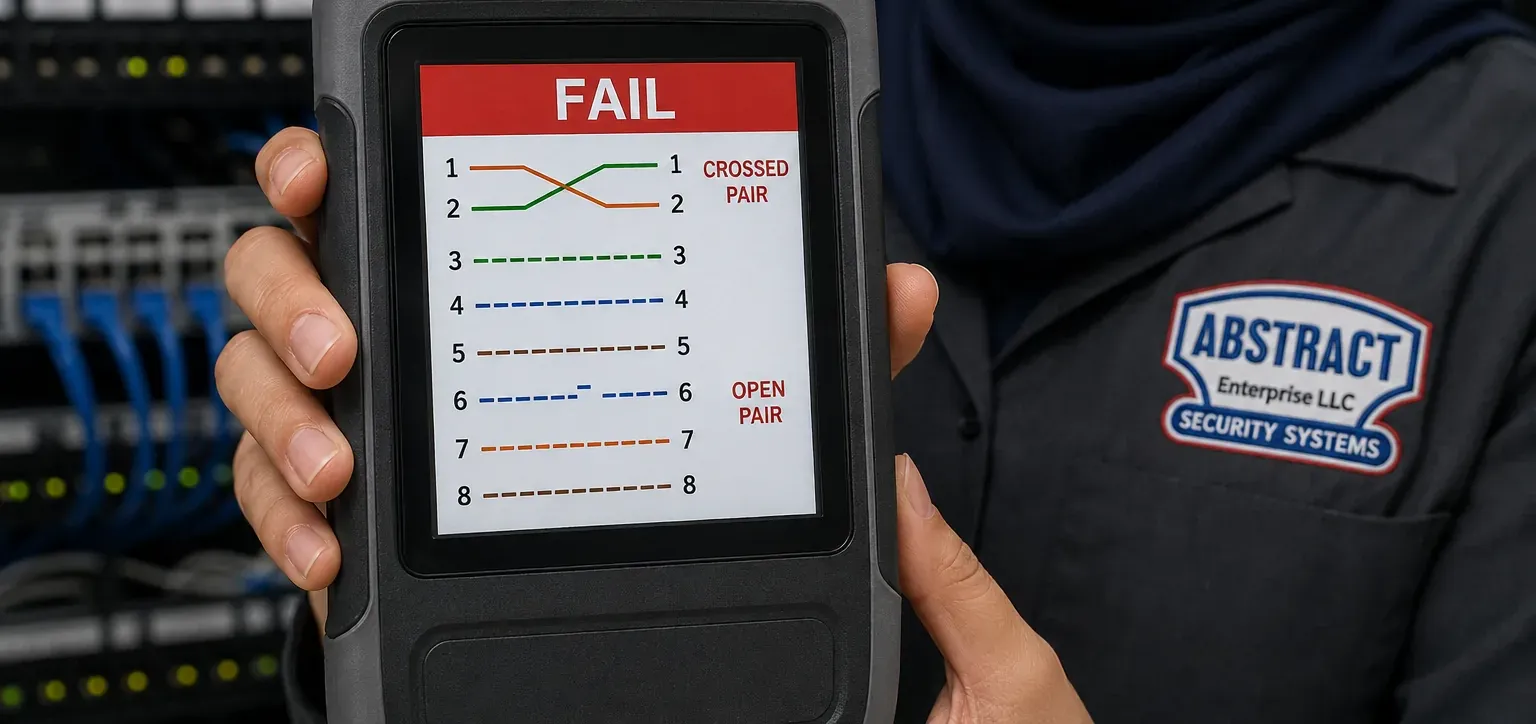
Close-up of a rugged grey tester held at chest height, rack lights blurred behind it. Under a red FAIL header the wire map draws conductors 1 and 2 swapped, labeled CROSSED PAIR, and a gap in conductor 6, labeled OPEN PAIR.
Park Slope Cat6 Repair — Free Quote
Name the floor, the jack and what it feeds — we answer the same business day
✅
Request Received
Got it. Someone who does this work will read your Park Slope note and get back to you today.
25+
Years Experience
✓
Same-Day Estimates
100%
Licensed & Insured
4.7★
201 Google Reviews
Top-floor office offline, a garden-level jack that never came back after the floors were refinished, a camera over the stoop showing nothing? Phone (347) 934-8335 or use the short form. A licensed technician picks up, asks which floor and which end of the house the dead jack is on, and tells you whether it sounds like a termination, a damaged length of cable, a cellar problem or not cabling at all — before a visit is booked.
The tester gives the fault as a distance, so plaster, parquet and the facade stay untouched everywhere except the one spot that matters
Each link that leaves our hands has passed a full category test, and the printout goes in your file
NYS license #12000287431 · insured · Brooklyn crew based at 1282 Troy Avenue
Why Park Slope Properties Need Cat6 Repair That Respects the Rowhouse
Park Slope is, by building count, the largest landmarked neighborhood in New York. The Landmarks Preservation Commission drew the first Park Slope Historic District in 1973 around some 1,800 contributing buildings put up between the 1860s and roughly 1920, then widened it in 2012 and again in 2016. Walk from Union Street down to Ninth Street between Seventh Avenue and Prospect Park West and most lots hold the same thing: a brownstone, limestone or brick rowhouse on a narrow lot, standing shoulder to shoulder with its neighbors and sharing a masonry party wall on each side.
Those houses were never planned for data cable, so nearly every run inside them was added later — during a gut renovation, when a parlor floor became a home office, or when an owner tired of the Wi-Fi dying on the top floor. On r/parkslope, residents of multi-level brownstones trade notes about exactly that, describing extenders that do little for the floors furthest from the router. The answer most renovators reached was Cat6 from a cellar or closet cabinet to every floor. Ten or fifteen years on, those runs are what we are called to: jacks that link at 100 Mbps, a top-floor access point that drops, a run that died when a neighbor's contractor drilled into the shared wall.
What makes a Park Slope repair different from the same fault in a Fourth Avenue condo or a Midtown office is access. Floor joists in a Brooklyn rowhouse usually run side to side, resting in the two party walls, so a cable can climb between floors in a stud bay with relative ease but has to cross every joist to get from the front parlor to the back. The cellar ceiling, often crowded with century-old gas and water pipes, is where most horizontal runs end up. Above it sit original floors, plaster cornices and woodwork that owners have spent real money restoring. And the front of the house sits under the Landmarks Commission's rules, down to how a camera cable may pass through the stone.
The Slope is not only rowhouses. Prospect Park West is lined with pre-war elevator co-ops; Fourth Avenue was upzoned in 2003 and has filled with mid-rise condos and rentals whose developer-installed Cat6 is now old enough to fail; Fifth and Seventh Avenues run shops, cafés and restaurants on ground floors above cellars that flooded badly in the September 2023 storm. Each of those has its own failure points, and this page walks through them with the same rule we apply on site: find the fault first, then choose the route that does the least harm to the building.
Park Slope facts that shape how we repair Cat6
Landmark scale: the original 1973 district covered about 1,802 contributing buildings; the 2012 extension brought the total to roughly 2,575, and a second extension in 2016 added 292 more, mostly between St. Marks Avenue and Sterling Place. Exterior work on any of them follows LPC rules.
Rowhouse framing: owners on the Brownstoner forum have long been told that "in most cases, the joists run from side to side, using the masonry side walls as supports" — the single biggest reason front-to-back Cat6 is hard to replace.
The 2003 rezoning: the City Council adopted the Park Slope rezoning on April 30, 2003, covering 110 blocks, protecting the brownstone midblocks and allowing larger buildings along Fourth Avenue. Many of those buildings went up with Cat6 already in the walls.
New housing since 2010: NYU's Furman Center counts 6,563 new units added from 2010 to 2025 in buildings of four or more units across Park Slope and Carroll Gardens (its Community District 6 geography), and a 2024 homeownership rate of 37.1% against 32.7% citywide.
Fifth Avenue's shops and their cellars: the Park Slope Fifth Avenue BID, established in June 2008, covers 62 block faces and 521 ground-floor businesses. After the September 2023 rain its director told the Brooklyn Paper that over 30 businesses were directly affected and "up to 6 feet of water flooded basements."
Vertical shafts spread trouble: in October 2019 a fire that started on the ground floor of a rowhouse near Eighth Street and Seventh Avenue spread "through a dumbwaiter to the upper floors," the Brooklyn Paper reported. Old shafts are tempting cable paths; they are also open routes between floors.
Most Park Slope owners who call about a dead jack end up asking about the camera over the stoop or the buzzer as well. If the same visit should look at those, say so; our Park Slope security camera and intercom teams work from the same van.
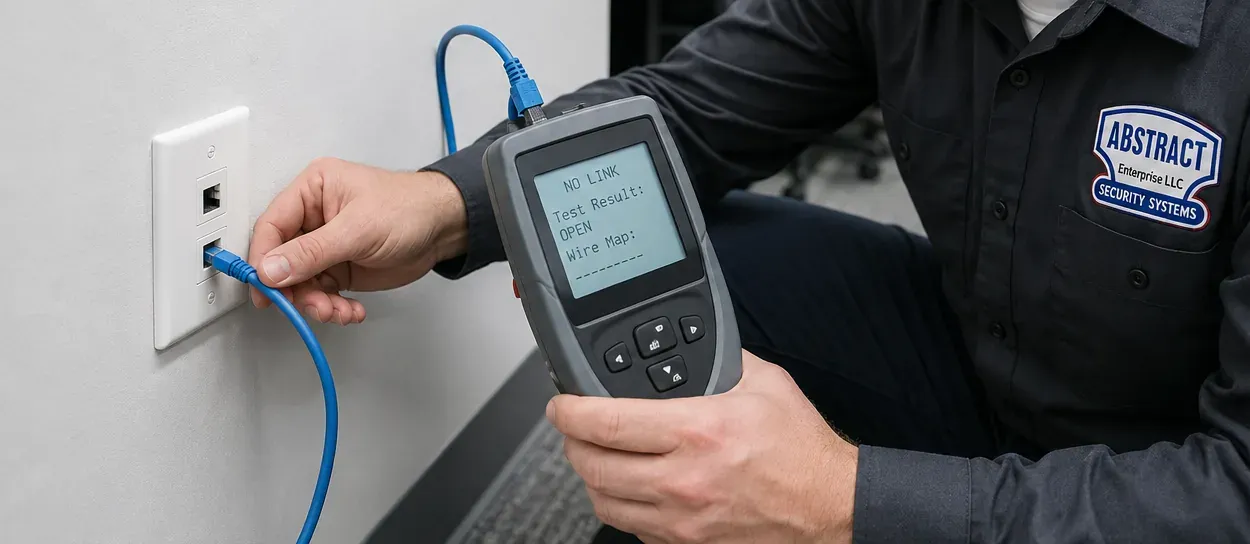
Kneeling at a white wall plate, a technician holds a meter whose small grey screen spells out NO LINK and OPEN; the blue cord from the lower port loops down to the floor and back up to the meter.
Lost the Wired Link on One Floor of the House?
When a home office on the top floor or a register on Seventh Avenue loses its wired link, the fastest fix is usually not the cable at all but the cord, the jack or the punch-down at the cabinet. We check those first, on the phone if you can send a photo, and most visits that turn out to be a termination are finished in an hour or two of arriving. Ring the Brooklyn line and say which floor and which end of the house.
"What we install" on a repair page means what we put back. Each of these is a repair we do in Slope houses, flats and storefronts; the card says where in the neighborhood we meet it most.
📏
Distance-to-Fault Testing
Each run tested from the cabinet so the fault arrives as a measurement in meters. Laid against a 20-foot-wide house, that number usually tells us which floor and which side of the stair it is on.
🔌
Jack and Keystone Re-Termination
Renovation-era jacks punched down with too much untwist, or wired to the wrong color code, remade on fresh Cat6 or Cat6A keystones and tested. The most common single repair in Slope houses.
🧱
Cellar Cable Re-Hanging
Runs zip-tied to gas lines, hot-water pipes and old conduit taken off and carried on proper supports fastened to the joists, with any length that was crushed or overheated replaced.
↕️
Vertical Run Replacement
A dead run between floors replaced through a stacked closet, a stud bay beside the stair or the path the original cable took, so the parlor and bedroom walls are not opened along their length.
🏛️
Facade and Rear-Wall Entries
Camera and yard runs re-entered through plain masonry or a mortar joint, sealed, and set up so the stone around the hole is not made worse. Front-facade work follows LPC criteria.
📶
Top-Floor Access Point Links
The run that feeds the Wi-Fi point on the fourth or fifth floor — the longest, hottest and most often damaged link in the house — tested for both data and power and repaired.
🏪
Storefront and Cellar Network Repair
Fifth and Seventh Avenue shops where the router and switch live in a cellar under the sales floor: terminations, flood-damaged lengths and links to registers, printers and kitchen screens.
🏢
Condo Media-Panel Repair
Fourth Avenue buildings from the post-2003 wave with every unit run ending in a closet enclosure: bad modules, crowded patching and cords that were never meant to stay in place.
✅
Certification After the Fix
Every link we touch re-certified to its category, labeled at both ends and listed by floor, so the next person in the cellar knows which cable serves the back bedroom.
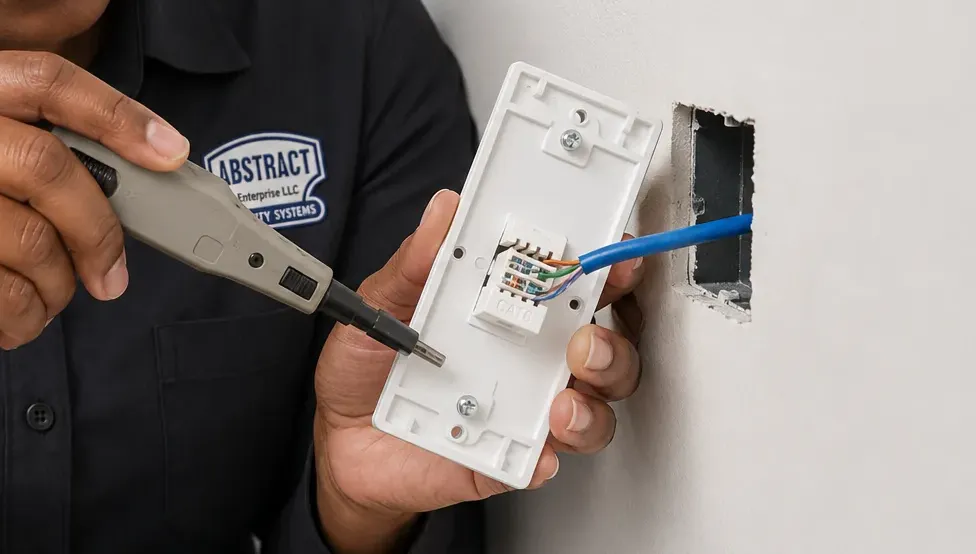
A punch-down tool is pressed against a keystone mounted on the back of a white single-gang plate. Blue cable leads from the keystone back into an open metal box set in the wall.
Building Specialists
Cat6 Repair for Park Slope's Architecture
Six kinds of building account for almost every Cat6 call we get from the Slope. They fail in different places and they give us different ways in.
Single-Family Brownstones and Limestones
Three or four floors over a garden level and a cellar, built between the 1880s and early 1900s in Italianate, Romanesque Revival and Queen Anne fronts. Cable usually starts at a cellar or under-stair cabinet. Faults gather at renovation-era jacks, in the cellar, and wherever a run had to cross joists to reach the back rooms.
Rowhouses Split Into Units
An owner's duplex over a garden rental, or three floor-through flats. Each unit may have its own provider and cabinet, but the runs share the same cellar ceiling and stair hall. Repairs have to keep each household's link separate and keep us out of the units we do not need to enter.
Prospect Park West Pre-War Co-ops
Elevator buildings from the 1920s, some by Emery Roth, with plaster walls, original parquet and a building superintendent. Cable inside the apartment is the shareholder's; anything in the hall, riser or basement is the building's, and the managing agent decides how work there happens.
Fourth Avenue Condos and Rentals
Mid-rise buildings from after the 2003 rezoning, with concrete slabs, metal-stud partitions and a structured-media enclosure in a closet of every unit. Developer Cat6 from 2005 to 2015 is reaching the age when terminations and cords start to go.
Mixed-Use Avenue Buildings
Three- and four-story buildings on Fifth and Seventh Avenues with a shop at grade, apartments above and a shared cellar. The shop's network often lives below the sales floor; the apartments' cable crosses the same cellar.
Conversions and Institutions
Former factories such as the Ansonia Clock Company works on 12th Street, now co-op homes, plus schools, congregations and clinics in buildings never designed for networks. Long runs, thick masonry and many hands on the cabling.
Materials and methods by building type
Building
Where Cat6 usually fails
How we normally reach it
Brownstone or limestone rowhouse
Jacks from the renovation, cellar runs hung on pipes, lengths that cross joists to reach the rear rooms, the top-floor access point run
Cellar ceiling for horizontal moves, stacked closets or the bay beside the stair for vertical ones, small cuts in plain plaster only where testing points
Rowhouse split into units
Shared cellar runs, patching at the cabinet that serves two households, runs passing through another unit's ceiling
Work from common areas the owner controls; enter a tenant's unit only with the owner's and occupant's agreement
Prospect Park West co-op
Jacks fished through plaster during an apartment renovation; cords and small switches in closets
Inside the apartment under the co-op's house rules; anything in a building space through the managing agent
Fourth Avenue condo or rental
Modules and patching inside the closet media enclosure; cable in conduit within the slab
At the enclosure first; slab conduit re-pulled where it allows, never cored on a guess
Mixed-use avenue building
Cellar equipment and terminations exposed to water; runs up through the shop floor to the counter
From the cellar; terminations raised and the counter link rebuilt with strain relief
Conversion, school or congregation
Long runs near the 90-meter limit, cable through thick masonry, many earlier installers
Test to find which links are near the limit; re-route or add a closer switch rather than re-terminate a run that is simply too long
One rule runs through all six: we do not remove or disturb original detail to save time. Where a repair would touch decorative plaster, an inlaid floor or a carved facade element, you hear that first, along with the other routes and what each would cost.
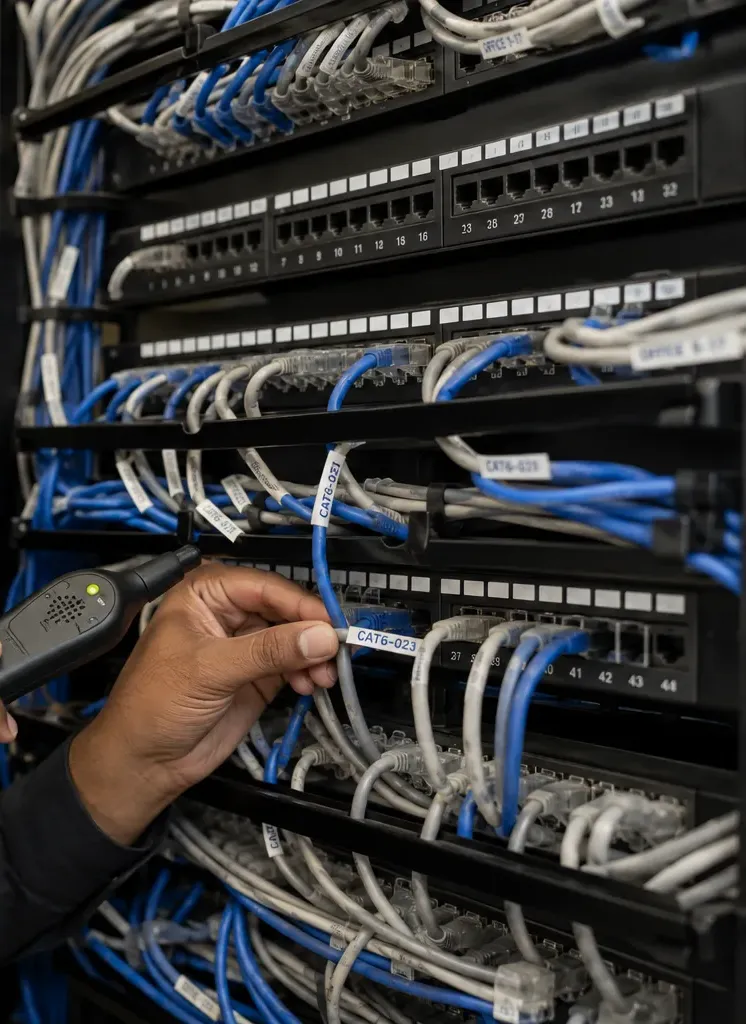
Picking one cable out of many: a black probe with a speaker grille is touched to a tagged blue cord among rows of panels packed with blue and grey patching.
Commercial Cat6 Repair
Business Cat6 Repair in Park Slope
Park Slope's businesses are small, numerous and mostly on the ground floor of older buildings. That means short runs, but runs that pass through cellars, under shop floors and past kitchens, and businesses that cannot close for a day while someone hunts for a fault.
Fifth Avenue
The longer and busier of the two shopping streets, lined with restaurants, bars, salons and independent shops. The BID counts 521 ground-floor businesses. Network gear often sits in a cellar that took water in 2023; we check terminations there before anything upstairs.
Seventh Avenue
The commercial street running through the historic district, described in one local realtor's 2026 guide as leaning toward upscale dining, boutique shopping and specialty food stores. Narrow shops with registers at the front window and printers at the back, both fed from one small switch.
Fourth Avenue
Ground-floor retail, gyms, clinics and offices in the newer buildings that followed the 2003 rezoning. Ceilings are open or drop-tile and cable is easier to reach, but tenant fit-outs sometimes reuse developer cabling nobody tested.
Union Street and the Food Coop block
The Park Slope Food Coop, founded in 1973 and based at 782 Union Street, has a membership of more than 16,000, alongside neighboring shops and offices in older mixed-use buildings. We mention it as a local landmark only; it is not a client we can name.
Seventh Avenue Medical Blocks
NewYork-Presbyterian Brooklyn Methodist Hospital stands on Sixth Street between Seventh and Eighth Avenues, and private practices fill brownstone garden levels nearby. Exam-room and front-desk links in converted houses carry the same rowhouse problems as homes.
Congregations, Schools and Studios
Nineteenth- and early twentieth-century churches and synagogues, schools, music and dance studios: high ceilings, long runs to a balcony camera or a back room, and cable added over many years by many hands.
Rules that shape a Park Slope Cat6 repair
Landmarks
LPC says an owner does not need its permit "to perform ordinary repairs or maintenance chores." Interior work needs an LPC permit only when it needs a Buildings Department permit, affects the exterior, or touches a designated interior. Re-terminating a jack or replacing a run inside the walls normally does neither. Changing how a cable enters through the front facade can.
Electrical code
New York City's Electrical Code, built on the 2020 NEC with city amendments, took full effect on December 21, 2025. For communications cable it expects exposed runs to be carried by supports fastened to the structure, forbids using raceways as a means of support, and requires the accessible part of abandoned cable to be removed.
Lead-safe work
Almost every Slope rowhouse predates 1960. City Local Law 1 has owners of those buildings presume their paint is lead-based, and federal rules apply lead-safe practices to paid work disturbing more than six square feet of painted interior surface in a room. Our access cuts are a fraction of that, made with dust kept down.
Co-op and condo house rules
Prospect Park West co-ops and Fourth Avenue condos set their own contractor hours, insurance certificates and rules about building spaces. Inside your unit, the work is yours to arrange; in the cellar, hall or riser, the managing agent decides. We send the paperwork ahead so nothing waits on the day.
None of this is legal advice. It is a plain summary of the published rules as we work with them, so you can plan; your building's own documents and the agencies' current text govern.
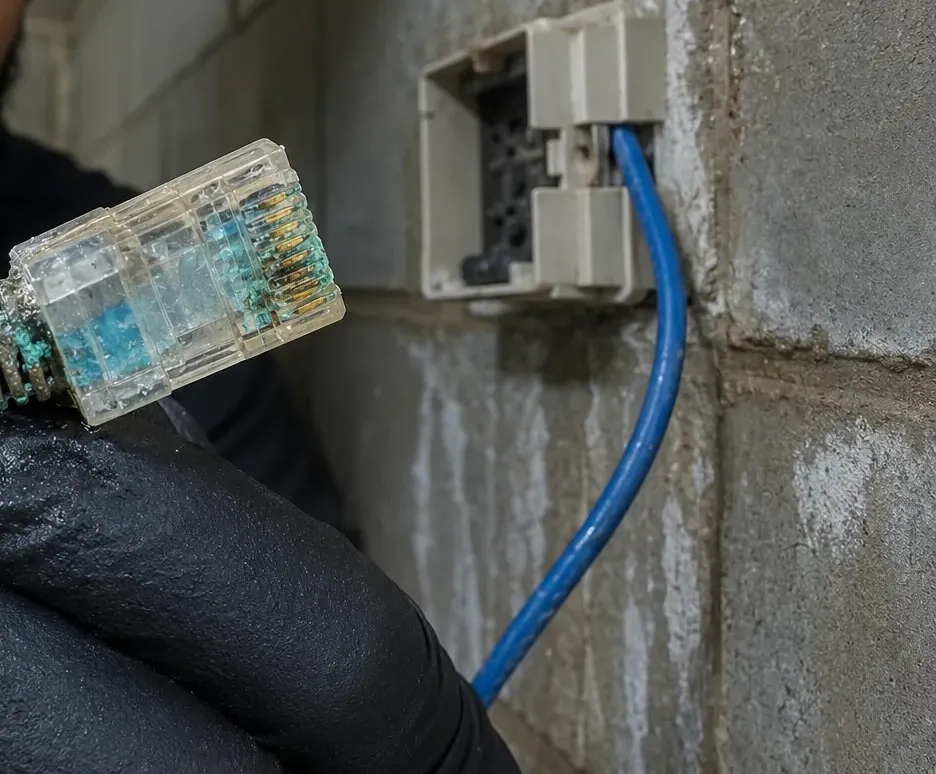
A gloved hand holds the clear plug of a blue cable up to the camera; its contacts and boot are crusted green and white. Behind it, the same cable runs into an open surface box on a concrete block wall with water stains running down the blocks.
Your Questions Answered
Cat6 Repair in Park Slope: Questions Answered
These are the questions Park Slope owners, tenants and shopkeepers actually put to us, grouped by the part of the building they concern. The answers are written for the Slope's rowhouses, co-ops and avenue buildings, not for buildings in general.
Rowhouse geometry: joists, cellars and the path between floors
Why is replacing a front-to-back Cat6 run in a Park Slope rowhouse so much harder than replacing one that goes straight up between floors?
Because of the way the house is framed. In a typical Brooklyn rowhouse the floor joists span from one party wall to the other, side to side across the width of the house, and rest in pockets in the brick. A cable going up from the cellar to the top floor can travel inside a single bay between two joists, or inside a stud wall, without crossing anything structural. A cable going from the front parlor to the back parlor, or from the street-side bedroom to the garden-side one, has to cross every joist in between — and in a forty- or fifty-foot-deep house that is a lot of joists.
When the house was gutted, the renovator drilled those joists while the ceilings were open and the original run went in easily. Replacing it with the ceilings closed is a different job. Fishing a new cable across a dozen closed joist bays, each with a hole that may or may not line up, is slow and often impossible without opening the ceiling at every joist. So the first thing we do is establish exactly where the fault is. If the tester puts it within a meter or two of the jack, the cable crossing the joists is fine and only the termination needs remaking.
If the damaged length really is in the middle of a front-to-back crossing, we look for a route that goes with the joists rather than across them: down into the cellar, along the cellar ceiling where the joists are exposed, and back up in the right bay; or along a run of stacked closets; or up beside the stair, where many houses already have a chase. That route may be longer, but it is almost always kinder to the plaster than opening a ceiling along its whole length, and it keeps well within Cat6's 90-meter permanent-link limit in a house this size.
Diagram 1 — one floor in plan. In a typical Brooklyn rowhouse the joists span from party wall to party wall, so a run that goes straight from the front room to the back room has to cross every one of them. The detour through the cellar is longer but follows open framing. Schematic only; real houses vary.
Our cellar Cat6 is cable-tied to the old gas and water pipes. Does the repair have to take it off them?
If we are repairing those runs, yes, and it is worth doing even when only one of them has failed. The code's expectation for exposed communications cable is that it is carried by supports — straps, hangers, J-hooks and similar fittings — fastened to the building's frame members, installed so they do not damage the cable. It specifically forbids strapping or taping cable to the outside of a raceway as a means of support, and pipes are no better: they are not part of the structure, and they belong to other trades.
The practical problems are as real as the code ones. Plumbers and gas fitters cut and replace pipe in Slope cellars all the time, and cable tied to a pipe is cut or yanked along with it. Hot-water and steam lines run warm for months, which is hard on a cable jacket and raises its insertion loss. Bundles tied tightly to a pipe are squeezed at every tie, which is one of the classic causes of a return-loss failure. When we find a dead run in a cellar like this, the damage is very often at a tie point.
The repair is to cut the ties, test each run, replace the lengths that are crushed or cooked, and re-hang everything on supports screwed into the joists, away from the hot lines and clear of the gas piping. Where runs leave the cellar through the floor, we sleeve the hole. It is a modest amount of extra time on top of the actual fault, and it means the next plumber cannot take your network down by accident.
Diagram 2 — the house in section. Going up is the easy direction in a rowhouse: a closet stack or the bay beside the stair carries a run from the cellar cabinet to the top floor. In the cellar, cable tied to gas and water pipes is the most common cause of failure; carried on supports fastened to the joists, it is out of the way of the next plumber. Schematic only.
Dumbwaiter shafts, closets and the holes between floors
Old service shafts are the obvious path for a vertical cable in a brownstone, and plenty of renovators used them. They come with a warning. In October 2019 a fire on the ground floor of a rowhouse near Eighth Street and Seventh Avenue spread "through a dumbwaiter to the upper floors," according to the Brooklyn Paper's report. A shaft that carries cable is an open path between floors unless the openings are sealed.
So when we replace a run that uses a shaft, a stacked closet or holes drilled through floor plates, we close the penetrations around the new cable with fire-rated sealant rather than leaving the drilled holes open, and we remove the accessible part of the cable we take out. If we find that an earlier installer left large open holes between floors, we point them out even if they are not on the failed run's path.
Original floors, plaster and woodwork
The failed run lies under the original parquet and inlaid border of our parlor floor. Can it be replaced without lifting the floor?
Usually, yes, because the parlor floor has a ceiling below it. Brownstoner's coverage of old Brooklyn floors notes that the patterned parquet and inlaid borders owners treasure are typically laid over the original pine subflooring. Neither is something to cut through for a data cable, and the people who repair inlay often have to salvage matching pieces from elsewhere. Fortunately, a cable that runs "under" the parlor floor is really in the joist bays between that floor and the ceiling of the garden level below.
That ceiling is where we work from. If the garden level has a plain plaster or drywall ceiling, a small opening there, at the point the tester identifies, gives access to the damaged length and is patched flat afterwards — far easier to make good than any patterned floor. If the run follows a single joist bay, a new cable can often be pulled through that bay from one end to the other without opening anything in the middle. If the garden-level ceiling is itself decorative, we look at the cellar-and-closet route described above before suggesting any opening at all.
What we will not do is lift original boards to save time. If the only practical route goes through the floor, you hear that plainly, with the other options and their cost, and a floor restorer — not a cabling crew — should do that part.
Plaster, cornices and when a small cut is the right call
Most of the walls in a Slope rowhouse are plaster on wood or metal lath, and the principal rooms often have molded cornices and ceiling medallions. A cut in plain plaster, sized to reach a junction or a damaged length and set away from the moldings, is a reasonable trade for an hour of fishing blind; we make it with a fine blade, keep the dust down and leave it ready for a plasterer or patch it ourselves where you prefer. A cut in a cornice or a medallion is not a reasonable trade, and we do not make one. There is almost always a closet wall, a cellar ceiling or a stair-side bay that reaches the same cable.
The landmarked front and the back of the house
The Cat6 to our front-door camera comes through the brownstone face, and the stone is flaking around the hole. What is the right repair?
Two repairs, by two trades, in the right order. Brownstone is a sandstone that the Landmarks Commission itself describes as very susceptible to deterioration, and the flaking or sheeting you are seeing is the delamination LPC's guidebook illustrates. A cable hole drilled through the face of the stone gives water another way in. Patching or resurfacing brownstone is skilled masonry work and, on a landmarked facade, is done under an LPC permit by a qualified restoration contractor. That part is not ours.
The cable part is. LPC's published criteria for security cameras on landmarked buildings say that conduit should be concealed by going through plain masonry or wall cladding behind the installation; that, where that is impossible, staff may approve about ten inches of visible conduit; and that surface-mounted conduit is painted to match the background and "secured into mortar joints where possible — not installed on any decorative surfaces." They also limit small residential and commercial buildings to two cameras for every 25 feet of street frontage. A repair that keeps the existing hole in the face of the stone is the wrong repair.
In practice we test the run to confirm that the cable, not the camera, has failed, then plan a new entry through a mortar joint or plain masonry directly behind the camera, close to what the criteria describe, with a drip loop and a sealed sleeve. Because that changes the facade, it is the kind of work for which an LPC permit may be needed; we tell you before we drill, and coordinate with whoever is restoring the stone so the old hole is filled properly rather than plugged with sealant. Repairs that are entirely inside the house — the run from the cellar to the back of the camera's entry — can go ahead in the meantime.
Diagram 3 — a facade entry, right and wrong. LPC criteria for cameras on landmarked buildings ask for conduit to be concealed through plain masonry behind the device, allow roughly ten inches of visible conduit where that is impossible, and want surface conduit painted to match and secured into mortar joints rather than decorative surfaces. A hole through the face of soft brownstone is the opposite. Schematic only.
Could a replacement run go down the back wall of the house instead of through the floors?
Sometimes, and on some Slope blocks it is the cleanest option for reaching a top-floor rear room or a garden studio. The back walls of many brownstone rows already carry provider cable — a thread on r/Fios titled "Verizon needs access to backyards to install Fios" mentions brownstones from Park Slope among those served that way. A replacement run can come out of the cellar through a sealed entry, rise in a painted raceway or conduit tight to the rear wall, and enter the room it serves, avoiding every joist crossing inside.
It has to be the right cable. Indoor riser or plenum Cat6 is not made for sunlight; trueCABLE's guidance is blunt that a CMR or CMP jacket installed outdoors "will begin to degrade immediately and will fail in a matter of months." Outside runs need an outdoor-rated, UV-resistant jacket, and each wall entry is sealed and protected; our exterior entry is priced from $185 per penetration. Rear facades in the historic district are not exempt from LPC review simply because they face the yard, so we check whether the work needs a permit before planning it. LPC's own guidebook tells owners who are unsure to contact the Commission, and we are happy to help you do that.
Where the rear wall is not suitable — a decorative rear facade, a neighbor's objection, no sensible entry point — the inside routes are still there. The back-wall option is one tool, not a default.
Shops on the avenues and the newer buildings
Our shop has its original pressed-tin ceiling. Can a failed run above it be replaced without taking the tin down?
Often, yes. Pressed-tin ceilings survive in a number of older storefronts along the avenues; one neighborhood history group fondly remembers the "classic tin ceiling" of the diner at Seventh Street and Seventh Avenue. Tin panels are nailed to wood furring and overlap at the seams, so taking one down usually means bending it, and matching replacements are not always easy to find. We treat the tin like an original floor: the last way in, not the first.
Most storefront runs above a tin ceiling started in the cellar and came up through the shop floor or a wall cavity before turning across the ceiling to a printer, a camera or a ceiling access point. The tester tells us whether the fault is in the horizontal stretch above the tin or in the vertical stretch from the cellar. If it is vertical, the tin never comes into it. If it is above the tin, we look for a light fixture, a vent or an existing access panel that can be removed and refitted without damage, and for a route along the wall where a painted raceway at the cornice line would be acceptable to you.
Only if none of that works would we suggest taking down a single panel at the edge of the field, where the seams allow it to be lifted and refitted, and we would show you exactly which panel before touching it.
Fifth Avenue cellars after the 2023 flood
When the Brooklyn Paper spoke to the Fifth Avenue BID after the storm of late September 2023, the director described up to six feet of water in basements and equipment "knocked over and destroyed" in restaurants and bars. Many of those cellars hold the shop's router, switch and patch panel. Equipment that was replaced after the flood may be fine; the terminations it plugs into, and the lengths of cable that sat in the water, may not be.
Our approach in a flood-exposed cellar is to test every run from the cellar end, open the cellar jacks and panel ports to look for the green and white corrosion that water leaves on copper, and replace the terminations and lengths that show it. Where the shop is willing, we raise the patching and the switch off the floor and onto the wall so that the next storm reaches cable, not connections. On r/parkslope, residents describe storm water that overwhelms the sewers and "comes up in the lower parts of some buildings"; the high ground of Prospect Park West does not protect a cellar on the lower avenues.
What the Fourth Avenue buildings share with every newer tower
The buildings that followed the 2003 rezoning were wired by developers, usually to a structured-media enclosure in each unit's closet, with conduit in the slab to the rooms. Their typical faults are the enclosure's modules and patching, cords left in place for a decade, and occasionally a damaged length in slab conduit. The difference from a rowhouse is that the walls are metal stud and drywall and the routes are fixed; the difference from a Manhattan tower is that most of these are small enough for the super to know where the telecom room key is. We start at the enclosure, and only consider the conduit once the panel side is proven good.
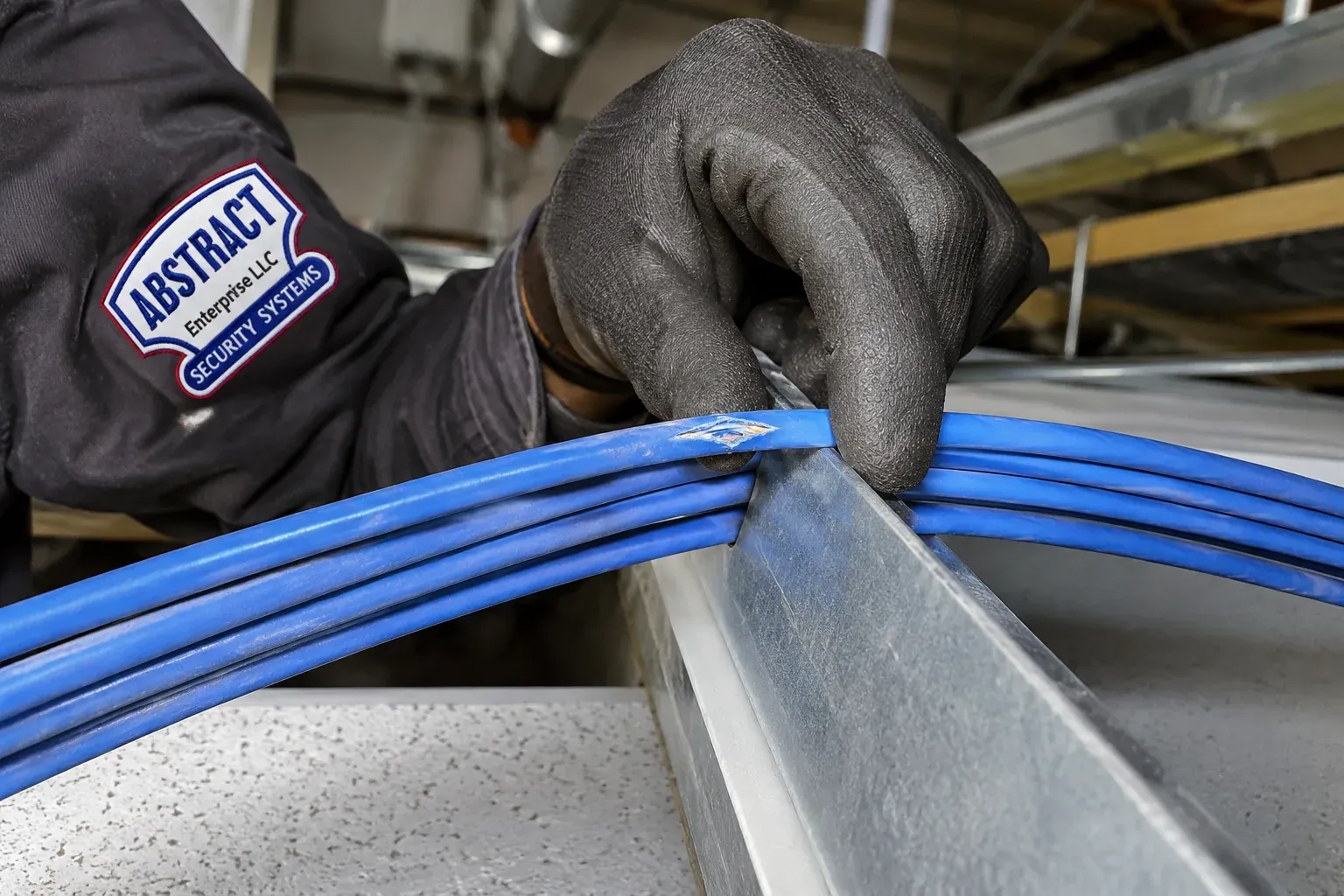
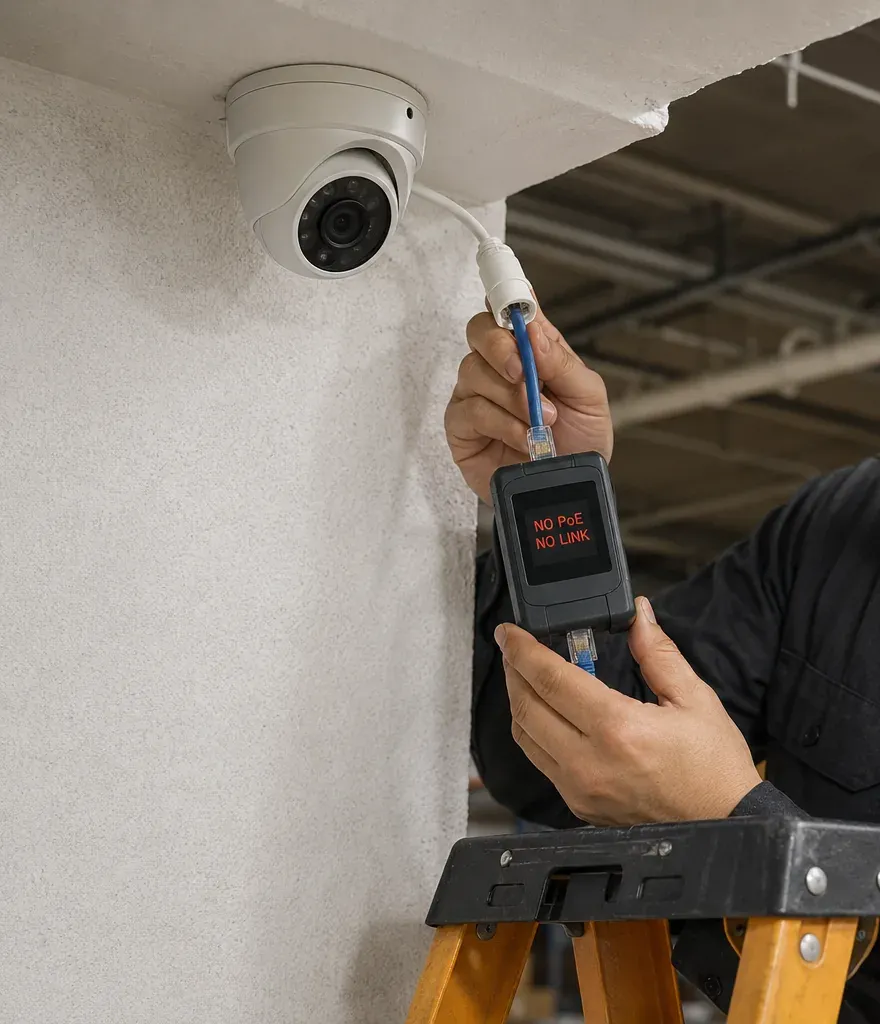
Above a ceiling, a black work glove raises five blue cables off the corner of a galvanized duct they had been resting on; a pale scuff marks the top jacket exactly where it met the metal.From a stepladder, a technician holds a small tester connected to the blue cable that drops from a white dome camera on a textured wall. The tester's screen reads NO PoE and NO LINK in red.
Equipment
Tools and Parts We Bring to a Park Slope Cat6 Repair
A rowhouse repair needs a different kit from an office floor: less ladder, more inspection camera; fewer spools of cable, more ways to get a short length into a closed bay without opening plaster.
Certification Tester
Measures each link against its Cat6 or Cat6A limits and reports where along the cable a crosstalk, return-loss or open fault sits, in meters from the jack. In a 20-foot-wide house that is usually enough to name the floor and the side.
Wire-Map and PoE Tester
A smaller handheld for quick checks at a camera or access point: is the cable wired straight through, and is power arriving? It separates a dead camera from a dead cable before anyone climbs to the cornice.
Tone Generator and Inductive Probe
For the unlabeled bundle in the cellar. A tone on the cable at the jack, a probe along the bundle, and the right run is found without cutting anything.
Inspection Camera and Fiberglass Rods
A camera on a flexible lead looks into a joist bay or behind a baseboard through a hole the size of a coin; the rods carry a pull line along the bay once the path is clear.
Fine-Blade Oscillating Saw
For the occasional cut in plain plaster or drywall: a clean, small rectangle that can be put back or patched flat, made with dust collection running.
Cat6 and Cat6A Keystones
Matching jacks for both categories, in common faceplate formats, so a repaired outlet matches the others in the room and a Cat6A run is not downgraded with Cat6 parts.
Riser, Plenum and Outdoor Cable
Solid-copper Cat6 and Cat6A in the ratings the route needs: riser for walls and floors, plenum where the space calls for it, outdoor UV-resistant jacket for rear-wall and yard runs.
Supports and Sleeves
J-hooks, straps and hangers that screw into cellar joists, sleeves for floor penetrations and fire-rated sealant for the holes between floors.
Factory Patch Cords
Molded cords in the lengths a closet cabinet or a shop's under-counter switch actually needs, to replace hand-crimped cords that pass a light test and fail a real one.
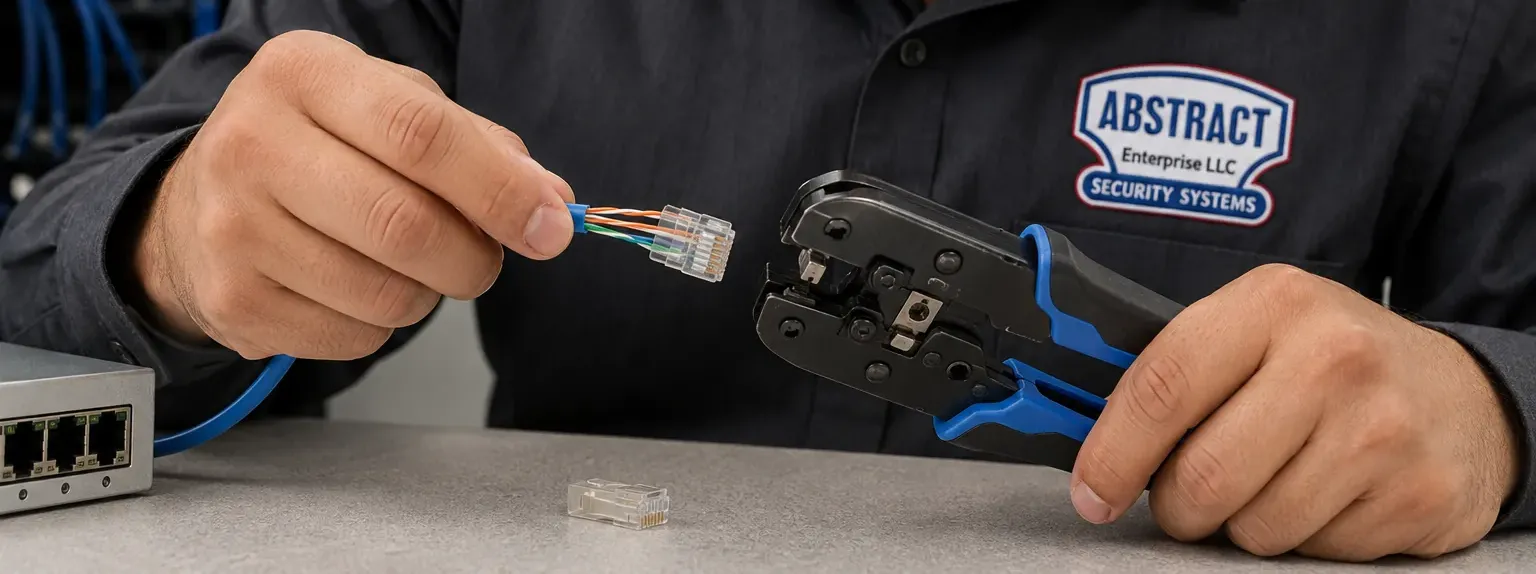
Bench work: eight colored conductors pushed into a clear plug in one hand, a black-and-blue ratchet crimper ready in the other, a spare plug on the counter and a little four-port switch just in frame.
AI Overview Reality Check
What AI Gets Wrong About Cat6 Repair in Park Slope
Google's AI Overview was not visible to us when this page was written, and we will not invent its wording. What follows are claims that appear again and again in how-to articles, cost guides and forum advice — the material such summaries are drawn from — set against what we find in Park Slope buildings.
"Old houses have hollow walls, so cable just drops from floor to floor"
Some walls in a brownstone are hollow; the two that matter most are not. The party walls on either side are solid masonry, shared with the neighbors, and they carry the floors. Interior partitions are plaster on lath, often with fire blocking or old horizontal framing that stops a fish tape cold.
Vertical routes do exist — closets stacked above each other, the bay beside the stair, the path the original cable used — but they have to be found, not assumed. And because the joists run side to side, the hard part of most rowhouse repairs is not going up; it is going front to back.
The practical consequence is that a repair price based on "drop it down the wall" tends to be wrong in both directions: too low when the fault is in a front-to-back crossing, too high when the fault turns out to be a termination that never needed the wall at all.
"A mesh Wi-Fi system will do the same job as fixing the cable"
Mesh systems help, and r/parkslope threads about multi-level brownstones are full of people trying them, along with complaints that extenders made little difference. The reason is the building: four floors of plaster and masonry between the router in the cellar and the bedroom at the top.
A mesh unit on the top floor works best when it has a wired backhaul — a Cat6 run from the cabinet — and that is very often the run that has failed. Without it, the top-floor unit relays everything over the air through the same floors that caused the problem in the first place.
So the mesh and the cable are not alternatives. Repairing the run gives the mesh the wired link it was designed to use, and usually does more for the top floor than any extra unit would.
"In a landmark district you need permission for any wiring work"
This one scares owners into delay. LPC's own guidance is that no Landmarks permit is needed "to perform ordinary repairs or maintenance chores," and that interior work needs a permit only when it also needs a Buildings Department permit, when it affects the exterior, or when the interior itself is designated.
Re-terminating a jack, replacing a run inside the walls or re-hanging cable in the cellar is ordinary interior work. It does not change the facade, and it does not normally need anything from LPC.
The facade is a different matter. Moving where a camera cable enters the front of the house, adding conduit to the stone, or putting a raceway on a visible wall are exterior changes, and LPC has published criteria for them. We tell you which side of that line your repair falls on before we start.
"Clip the camera cable along the front of the house and you're done"
On a lot of houses elsewhere, perhaps. On a landmarked Park Slope facade, LPC's criteria ask for conduit to be concealed through plain masonry behind the device, allow only about ten inches of visible conduit where that cannot be done, and want surface conduit painted to match and fixed into mortar joints rather than decorative stone.
Brownstone also punishes fasteners. It is soft and layered, and every screw into the face is a new place for water to start delamination. A cable clipped along a cornice or a carved lintel is both a code problem and a maintenance problem.
A correct repair puts the entry behind the camera, through a joint or plain masonry, and runs the cable inside. It takes a little more planning and saves the stone.
"Any Ethernet cable works outdoors if it's tucked against the wall"
Indoor cable is not designed for sun, frost or wet. Cable maker trueCABLE warns that riser or plenum jackets used outdoors "will begin to degrade immediately and will fail in a matter of months," which matches what we find on rear walls and garden fences: cracked, chalky jackets and water in the conductors.
A run to a garden studio or a rear-yard camera needs an outdoor-rated jacket for the outside length, a sealed entry where it passes through the wall and a drip loop so water runs off rather than into the building.
Where an outside run has already failed, repairing just the dead end usually buys a few months. Replacing the outdoor length with the right cable is the repair that lasts.
"Whatever is in the cellar can hold the cable up"
It is the most common shortcut we find in Slope cellars: dozens of cables tied to gas pipe, water pipe and old conduit, because those were already there. The electrical code takes the opposite view — supports fastened to the building's frame, and never cable strapped to a raceway as its means of support.
It matters because pipes are serviced. A plumber replacing a section of water line, or a gas fitter re-piping a boiler, cuts the ties or the cable along with the pipe. Warm pipes age the jacket. Tight ties squeeze the pairs and spoil return loss.
Re-hanging cable properly while we are already in the cellar costs little and removes the most common cause of the next failure.
"Price the job from a national average"
Fixr's January 2025 guide puts new Cat6 drops at $125–$250 each and labor at $45–$75 an hour nationally. Those are averages for fresh installation across the country, not for repair in a nineteenth-century rowhouse with finished plaster and a landmarked front.
A repair is mostly diagnosis and access: finding the fault, then reaching it without damaging what owners have restored. That is why we publish an hourly rate for repair time and a separate starting price for any run that genuinely has to be replaced.
Our figures for Park Slope are the Brooklyn base figures — $195 an hour with a three-hour minimum, replacement runs from $175 each — and they are set out in full in the pricing section below.
Find the Fault, Spare the Plaster
Tell us which floor, which end of the house and what the jack feeds. A technician will say what the fault most likely is and what reaching it will involve.
Whether it is a garden-level jack on Berkeley Place or a register link on Seventh Avenue, the details below let us answer in writing before the end of the business day. Prefer to talk? The Brooklyn line is (347) 934-8335.
✅
Request Received
Your Park Slope details are with the Brooklyn crew, and you will get a call today. If the link is down this minute, ring (347) 934-8335.
How It Works
Our Park Slope Cat6 Repair Process
1
1. The house described on the phone
How many floors, where the cabinet or router sits, which jacks fail, front or back of the house, and what changed lately. A photo of the cabinet tells us a great deal before we arrive.
2
2. Landmark, building and access check
Whether any part of the likely repair touches the facade, whether a co-op or condo needs paperwork, who holds the cellar key and which units we may need to enter. Then a two-hour arrival window is booked.
3
3. Every run tested from the cabinet
Each link goes on the certification tester where the runs meet. The results say which links pass, which fail and how many meters out each fault lies.
4
4. The fault placed on your floors
That distance is measured out against the house: which floor, which side of the stair, whether it is at a jack, in the cellar or in a front-to-back crossing. You see the finding before anything is opened.
5
5. A route that goes with the joists
Termination faults are remade on the spot. Damaged lengths are reached from the cellar ceiling, a stacked closet, the stair-side bay or, where it is suitable, the rear wall — and original detail is left alone.
6
6. Repair, re-hang and seal
New cable and terminations, cellar runs taken off pipes and carried on proper supports, holes between floors sealed, small openings closed flush, accessible abandoned cable removed.
7
7. Certify and leave a floor-by-floor sheet
Every repaired link is certified again. Both ends are labeled, the results are saved for you, and a sheet listing each floor's jacks and their cabinet ports goes in the cabinet.
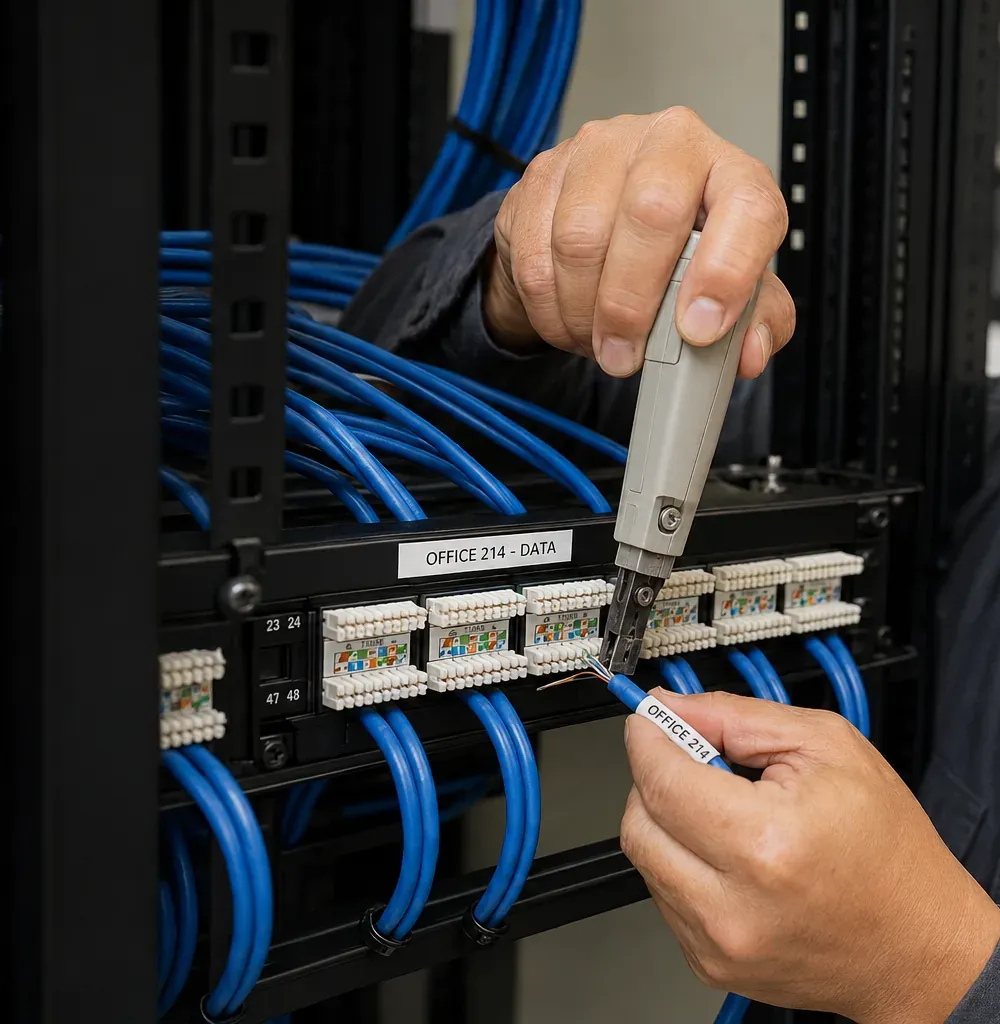
At a rack, the tip of a grey impact tool goes into one port of a panel whose strip reads OFFICE 214 - DATA; the cable being seated carries its own printed tag, and loops of blue cord hang in a row beneath.
Coverage Area
Cat6 Repair Near Park Slope's Landmarks
Six buildings that help explain the Slope — its ages, its materials and the kinds of places that need wired networks. They are reference points for where we work, not clients; we do not name customers.
Central Library, Grand Army Plaza
Brooklyn Public Library's Central Library opened to the public on February 1, 1941, at the north end of the neighborhood. A reminder that the Slope's edge on Flatbush Avenue is as much civic as residential.
Old First Reformed Church
At Seventh Avenue and Carroll Street, where a chapel was completed in 1886 and the present church dedicated in 1891 — one of the large masonry buildings in the district with long runs and high ceilings.
Congregation Beth Elohim
The Classical Revival synagogue at Garfield Place and Eighth Avenue, built 1909–1910, and the six-story Temple House of 1928–1929 opposite, both contributing buildings in the Park Slope Historic District.
Brooklyn Methodist Hospital
Incorporated in 1881 and opened in 1887 at Sixth Street and Seventh Avenue, now NewYork-Presbyterian Brooklyn Methodist. The reason so many brownstone garden levels nearby are medical offices.
Ansonia Clock Factory, 12th Street
The Ansonia Clock Company's 1880–1881 factory in the South Slope, residential since 1982 and now about seventy co-op homes — a reminder that not every Slope home is a rowhouse.
Park Slope Food Coop, Union Street
The member-run grocery at 782 Union Street, founded in 1973 and now counting more than 16,000 members. A fixture of the North Slope's mixed residential and commercial blocks.
We also repair Cat6 in the neighborhoods around the Slope — Prospect Heights, Windsor Terrace, Gowanus, Carroll Gardens and Sunset Park — from the same Brooklyn crew. For the borough-wide picture, see our Cat6 repair page for Brooklyn.
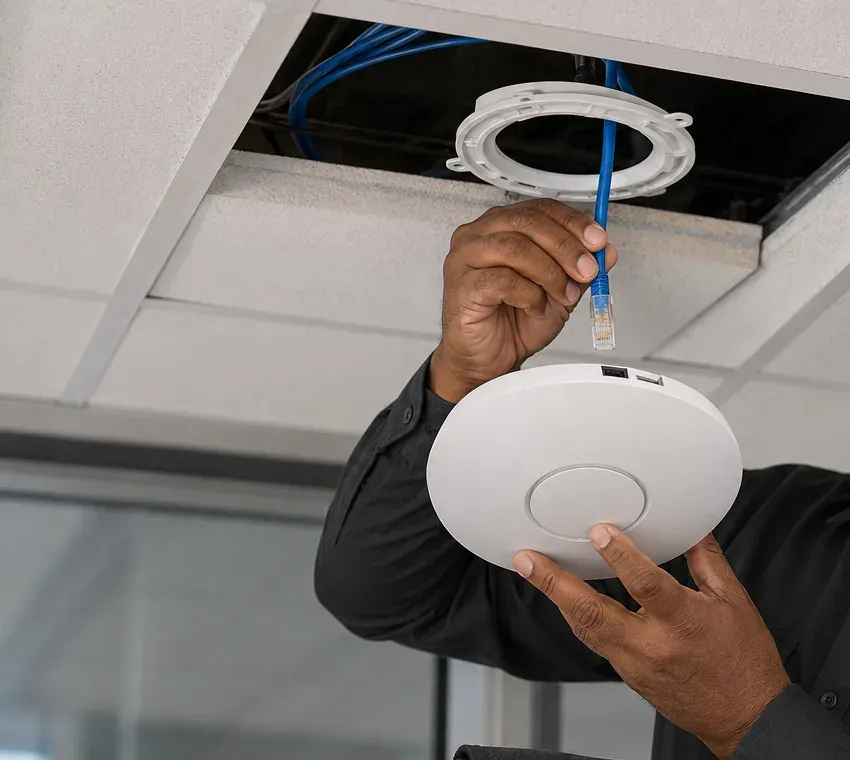
With one ceiling tile lifted, a disc-shaped white access point is held up to its mounting ring while the blue lead, already fitted with its plug, hangs down through the ring ready to connect.
Before You Call
Five Minutes of Checking in a Park Slope House
None of this replaces a tester, but it saves time on the phone and sometimes saves the visit. Each step is something an owner or tenant can do without tools.
Find where the runs meet. In most renovated Slope houses that is a cabinet or shelf in the cellar, under the main stair or in a hall closet on the garden level. In a Fourth Avenue unit it is the white enclosure in a closet. A phone photo of it, door open, is the most useful thing you can send us.
Note the floor and the end of the house. "Third floor, back bedroom" tells us more than "the bedroom jack," because it tells us whether the cable had to cross the joists to get there.
Swap the cord at the jack. A cord trodden on behind a desk or pinched by a radiator cover fails more often than the cable in the wall. If a known-good cord fixes it, you have saved a visit.
Look at the lights at the cabinet. If the switch port for the dead jack shows no light at all with a device plugged in upstairs, the fault is somewhere between the two. If it lights but the device is slow, the link may be running at 100 Mbps on a damaged pair.
Think back a few weeks. New floors, a plumber in the cellar, work on the facade, a provider visit, a renovation next door or water in the cellar after a storm. Most Slope Cat6 failures have a recent cause, and knowing it points the tester in the right direction.
If none of that helps, ring (347) 934-8335 with what you found. Please do not open walls or pull on cables in the cellar to "see where they go"; a cable yanked loose at a tie point is a second fault on top of the first.
Renovating?
Keeping Your Cat6 Alive Through a Park Slope Renovation
Renovation is the single most common cause of the Cat6 failures we see in the Slope, our own neighbors' renovations included. A few steps before the work starts prevent most of them.
Mark the runs before the walls open
If you have a sheet listing which jack goes to which cabinet port, give a copy to your contractor. If you do not, have the runs tested and labeled first. A crew that knows the back-bedroom run crosses the ceiling it is about to open can protect it; a crew that does not will cut it.
Photograph every open wall and ceiling
Once plaster is off, take photographs of each bay with a tape measure in the frame before it closes. Years later, those photographs tell whoever repairs a run exactly where it goes and where a junction or slack loop sits, and they turn a day of searching into an hour of work.
Keep cable off the pipes from the start
A renovation is the cheapest moment to give the cellar proper cable supports screwed into the joists, before the plumber and the electrician fill the ceiling. Ask for it in the scope; it is a small line item that avoids the most common Slope cellar failure.
Tell us when the house next door starts work
Party walls are shared. If the house on either side begins a gut renovation, a quick test of the runs along that wall before and after gives you a clear record if anything changes, and a clean starting point if something does fail.
Test before the final coat of paint
The best time to find a damaged run is after the walls are closed and before they are painted, when a small access opening costs nothing in finish work. We can certify every link at that stage so that any damage from the renovation is found while the crew is still on the job.
Pricing
Cat6 Repair Cost in Park Slope
Park Slope is priced at our Brooklyn base rates, with no neighborhood adjustment. They are the same figures published on our Brooklyn and New York City Cat6 repair pages and our Brooklyn network cable repair page. Repair time and replacement cable are listed, and invoiced, separately, because in a rowhouse the two can be very different sizes: a morning of diagnosis may end in a five-minute termination, or a short test may end in a run that has to be replaced.
Item
Price
What it covers
Hours on site — diagnosis, finding the fault, remade ends, new cords, cellar supports and the final certification
$195/hr, 3-hour minimum ($585)
Our published specialty rate. Within the block we work down your list of jacks, floors and links until the time is used.
A brand-new cable, for a run the tester shows cannot be saved
From $175 per run
Entry price for one new cable through the house, finished as a working link: jack and faceplate at the room, terminated at the cabinet, tested, tagged at each end, with a cord.
Hole through an outside wall for a garden, yard-camera or rear-wall route — sealed and bonded
From $185 per penetration
Charged per hole in the outside wall, wherever a route has to leave or re-enter the house.
Detours around joist crossings, cuts in restored plaster, co-op time windows, evenings
Quoted after testing
We measure first, then send a written figure; nothing in this row starts on a verbal guess.
A typical opening block in a renovated brownstone
In a renovated single-family house, the first block normally covers testing every run from the cabinet, remaking the jacks and cabinet ports that fail, replacing any suspect cords and certifying the results. If one cellar run is damaged, re-hanging the cellar bundle off the pipes and replacing that length often fits inside the block too. Where the fault is in a front-to-back crossing, the first block ends with the fault located, a route agreed and a written price for the replacement run.
A typical opening block behind an avenue counter
On Fifth or Seventh Avenue, the block typically covers the cellar end first — the switch, the patching and the terminations — then the links to the counter, the kitchen and the back office, with each one certified. If water has reached cellar connections, replacing the corroded terminations and lifting them off the floor usually fits; replacing long submerged lengths is priced per run after testing.
Why two Park Slope repairs rarely cost the same
Where the fault is: a termination at the jack or cabinet is quick; a damaged length inside a front-to-back joist crossing takes longer to reach.
What the route passes through: plain plaster, a closet and an open cellar ceiling are easy; parquet, cornices and pressed tin are worked around, which takes planning time.
How the cellar was done: runs carried on proper supports are fast to test and trace; a knot of cable tied to pipes needs untangling first.
Who else is involved: a co-op's hours, a tenant's access, a masonry contractor for the facade or an LPC permit for an exterior change.
The quality of what was installed: genuine solid-copper cable rewards a new termination; stranded cord hidden in plaster, indoor jackets left outdoors and aluminum-cored cable marketed as Cat6 are cheaper to replace now than to nurse along.
For comparison only: a cost guide published by Fixr in January 2025 quotes $125–$250 for each new Cat6 drop and $45–$75 an hour for labor, averaged over the whole country. That describes new wiring in typical American houses. It is neither our rate card nor a fair picture of tracing a fault through a nineteenth-century Brooklyn rowhouse.
Full terms — including 50% deposit, one-year parts-only warranty on AESS-supplied products, and the late-fee schedule — are set out in the service agreement.
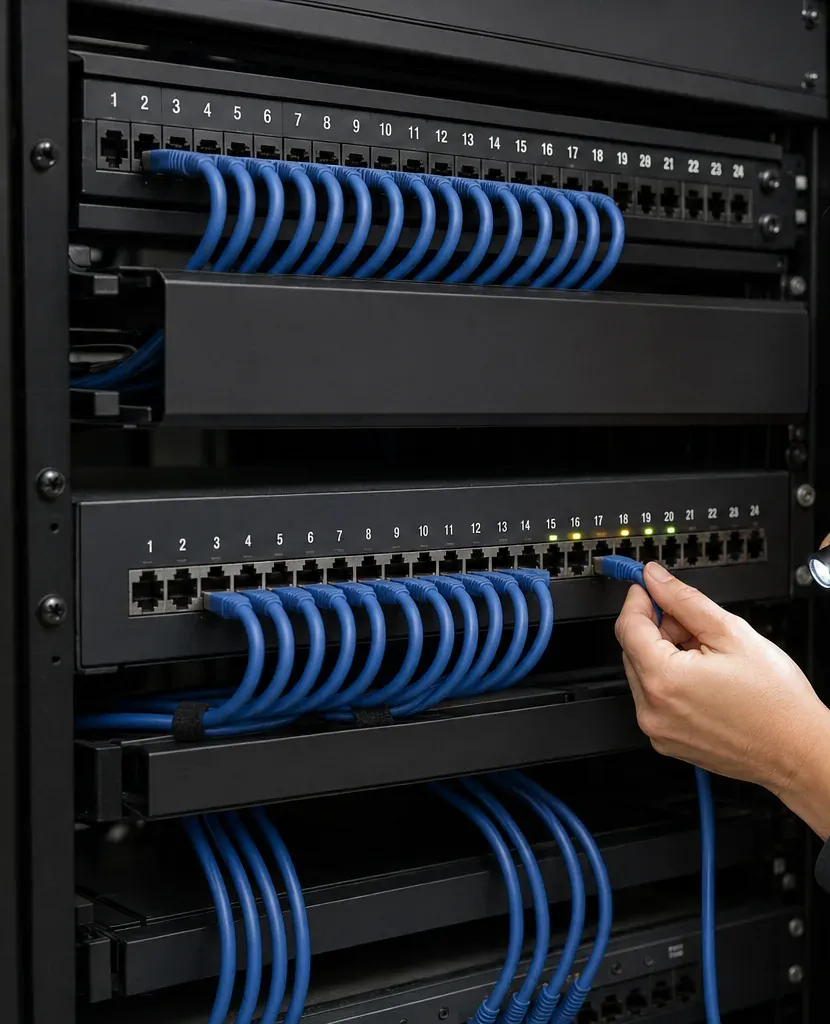
Two numbered 24-port panels in a black rack, each filled with short blue patch cords looped beneath. A hand at the right shines a small flashlight on the lower panel, where a few port lights glow green and amber.
Shop Our Systems
Cat6 Repair Packages & Pricing
Three ways Park Slope repairs usually come together, built only from the prices in the table above. There is no Park Slope surcharge.
Starter — One-Floor or One-Shop Fix
$585
Three hours at $195. Enough, in most Slope houses and shops, to put every suspect link on the tester, pin down the faults, remake the bad ends and cords, and certify what was fixed — with any spare minutes spent checking the floors or counters nobody complained about.
Standard — Whole-House Test and Repair
$195/hr after the first 3 hours
For a renovated brownstone, a house split into units or a shop with a cellar full of cable. Every run certified, failures sorted by cause, terminations rebuilt, the cellar bundle re-hung on proper supports and a floor-by-floor sheet left in the cabinet. After the first tests you get a written time estimate for the rest.
Premium — Repair Plus Replacement Runs
Repair time + from $175 per run
For houses where some cable is beyond saving: cooked on a hot pipe, crushed at a tie, cut by a neighbor's drill or simply routed outdoors in indoor cable. Hourly time for everything that can be kept, each new run from $175, exterior entries from $185, and the accessible old cable removed.
Bring Your Own Parts — Labor Only
Have leftover materials from your renovation? A bag of jacks, matching faceplates or a partial reel are worth using. If they suit the job — Cat6A parts for Cat6A runs, solid-copper cable for the walls, outdoor-rated cable for the outside — we fit them and you pay only for time. Links built with your parts get the same certification as ours. The warranty on your parts is the manufacturer's, and if a part cannot pass, you hear so before it goes in.
Every Floor Tested in One Visit
Text or email one photo of wherever your runs come together, plus a note of which rooms are dead. A technician replies with a likely cause, the probable route in and a cost range.
Park Slope runs from Flatbush Avenue and Grand Army Plaza down to the Prospect Expressway, and from Prospect Park West down the hill to Fourth Avenue. The building stock changes along both directions, and so do the repairs.
North Slope: Flatbush Avenue to Union Street
The grandest houses in the neighborhood and the 2016 extension of the historic district, which added 292 buildings mostly between St. Marks Avenue and Sterling Place. Large brownstones and limestones, many gut-renovated, often with cabinets in the cellar and runs to five levels. Faults we meet most: the top-floor access point run, front-to-back crossings to rear bedrooms, and cellar bundles tied to pipes.
Center Slope: Union Street to Ninth Street
Much of this stretch between Seventh Avenue and the park lies inside the historic district. Long runs of brownstone rows, many split into an owner's duplex and rentals, many with original floors and plaster restored. Repairs here are about route choice: what can be reached from the garden-level ceiling, the stair bay or a closet stack without disturbing the parlor. Seventh Avenue's shops and the hospital's neighborhood bring storefront and medical-office links into the mix.
South Slope: below Ninth Street
Rowhouses mixed with more apartment buildings, mixed-use corners and conversions such as the Ansonia Clock Factory on 12th Street. Shared cellars and shared cabinets are typical, so the work is often about separating one household's fault from another's. Residents on r/parkslope have complained about the internet options in the South Slope, and owners here often run their own wired links between floors to make the most of the service they have.
Prospect Park West
Pre-war elevator co-ops facing the park, some of them sixteen stories, with mansions and rowhouses between. Inside an apartment, the problems are those of any plaster-walled pre-war flat: jacks fished during a renovation, cords crushed behind furniture, small switches in closets. Anything beyond the apartment is the building's, and we work through the managing agent.
Fourth Avenue
The corridor rezoned in 2003 for larger buildings, now lined with condos and rentals of the last two decades over shops, gyms and clinics. Developer Cat6 to closet enclosures, conduit in concrete, metal-stud walls. Repairs start at the enclosure; the slab is the last resort.
Fifth and Seventh Avenues
The two shopping streets. Fifth Avenue's cellars took the worst of the 2023 flood; Seventh Avenue's narrower shops pack a register, a printer and Wi-Fi onto one small switch. In both, the cellar is where we start and the counter is where the customer notices.
Repair Decisions
Where the Fault Sits Decides the Park Slope Repair
Once the tester has put a number on the fault, the repair almost chooses itself. This is how the distance maps onto a typical Slope house.
Diagram 4 — reading the distance. A certification tester reports a fault as a distance from where it is plugged in. Laid against the route the run takes through the house, that one number usually says whether the problem is a termination, the cellar, the rise between floors or the front-to-back crossing — and therefore which repair route to plan. The bands here are an illustration for one typical house, not a rule.
Where the tester puts the fault
What it usually is
The repair
At or within a meter or two of the wall jack
Untwisted or mis-wired termination, a jack damaged when furniture or a radiator cover was moved, a kinked tail in the box
Re-terminate on a new keystone, re-seat the box, certify. No wall opened.
At the cabinet end
Loose punch-down, a hand-made cord, crowded patching in a closet cabinet or condo enclosure
Re-punch, replace cords, tidy the patching, certify.
In the first few meters out of the cabinet, in the cellar
Crushed at a cable tie, cooked beside a hot pipe, cut during plumbing work, corroded after water
Replace the damaged length or the run, re-hang the bundle on supports fastened to the joists.
Partway up, between floors
A nail or screw from a renovation, a run pinched where it turns up out of the floor
Reach it from a closet or the stair-side bay, or replace the vertical length along the original path.
Partway across, front to back
Damage inside a joist crossing
Route around it through the cellar ceiling, a stacked closet or, where suitable, the rear wall; open the ceiling only as a last resort.
In an outdoor length
Indoor cable degraded by sun and water on a rear wall, fence or facade
Replace the outside length in outdoor-rated cable with a sealed entry.
Nowhere in particular — the whole link is marginal
Run too long, aluminum-cored cable sold as Cat6, or patch cord buried in a wall
Replace the run; re-terminating a cable that cannot pass would only buy time.
Words We Use
A Short Glossary for Park Slope Cat6 Repairs
When a technician explains a repair, two vocabularies get mixed together: the old words for parts of a Brooklyn rowhouse and the newer words printed on a cable tester's screen. Here is what we mean by each.
Parts of the house
Term
What it means on a repair
Cellar
The lowest level, usually unfinished, below the garden level. Where the gas, water and electric services come in, and where most Slope network cabinets and horizontal cable runs end up.
Garden level
The floor partly below the sidewalk, entered under the stoop, opening to the back garden. Often a separate rental apartment, often with a plain ceiling that gives access to the parlor floor's joists.
Parlor floor
The main floor at the top of the stoop, with the tallest ceilings, the best plaster and frequently the original inlaid floors. The floor we work hardest not to disturb.
Party wall
The solid brick wall shared with the house next door. It carries the ends of the joists and is not a route for cable.
Joist bay
The space between two neighboring joists. A cable can travel along a bay easily; crossing from one bay to the next needs a hole through a joist.
Stoop and areaway
The front steps and the small paved space below them at the street. Camera and intercom cable often passes here on its way into the house.
Cornice and medallion
The molded plaster at the top of a wall and the round ornament in the middle of a ceiling. Never cut for cable.
Lath
The strips of wood, or metal mesh, that hold the plaster on the wall. It is what a fish tape catches on and why plaster walls are slow to fish.
Dumbwaiter shaft
An old service shaft between floors. A tempting cable path that has to be sealed at each floor when it is used.
Media enclosure
The metal box in a closet of a newer condo or rental where every room's cable ends. The first place we test in a Fourth Avenue unit.
Words on the tester's screen
Result
What it usually means in a Slope house
Wire map fail — open
A conductor is broken or not connected. At the jack, a termination pulled loose; partway along, a cut, often from a drill, saw or plumber's work.
Wire map fail — short
Two conductors touching. Typically a staple or nail through the cable, or a crushed jacket at a tie point.
Crossed or reversed pair
The two ends were wired to different color codes, or a pair was swapped on a keystone. A termination fault, fixed by remaking one end.
Split pair
Conductors from two different pairs used together. It can pass a simple continuity test and still fail at gigabit speed; the cure is a correct termination.
NEXT fail (near-end crosstalk)
Signal leaking between pairs, most often because too much of the twist was undone at a jack or panel, or because a lower-grade cord or coupler is in the link.
Return loss fail
Signal reflecting back from a change in the cable: a kink, a crushed spot at a tie, water, or a poor connector. The distance reading says where.
Insertion loss fail
Too much signal lost along the run: too long, too hot (a run beside a warm pipe loses more), or a cable that is not solid copper.
Length over limit
The permanent link is over 90 meters. Rare in a single house, possible in a school, congregation or converted factory.
Linked at 100 Mbps
Not a tester result but a common symptom: gigabit needs all four pairs, so a damaged brown or blue pair drops the link to 100 Mbps while it still appears to work.
Complete Services
Every Cat6 Repair Service in Park Slope
Repair is one part of what AESS does in the Slope. These pages cover the rest, matched to Park Slope or to Brooklyn where there is no Park Slope page yet.
Brooklyn Cat6 Repair
The borough page this one sits under, covering every building type from Bay Ridge to Greenpoint. Cat6 repair across Brooklyn.
What we look at first in a Slope house, and why. Before the tester comes out, we walk the cellar. It tells us how the house was wired better than any drawing: whether the runs leave the cabinet on proper supports or hang from the gas line, whether they go up through sleeved holes or ragged ones, whether there is a bundle heading for the front of the house and another for the back. Then we stand in the room with the dead jack and look at which way the floorboards run, where the closets stack and where the stair is, because that is where the cable most likely went.
Only then does each run go on the tester. Most of the time the result confirms what the cellar suggested — a termination, a tie point, a hot pipe — and the fix is quick. When it does not, the distance reading is what keeps us from opening plaster on a hunch.
One more habit: when a neighbor on either side is renovating, we ask about it. Rowhouses share their side walls, and a run fixed along the party wall that died the same week the house next door was gutted is worth testing at the party-wall side first, before anyone looks elsewhere.
Written by Anwar Timothy · NYS license #12000287431 · Brooklyn line (347) 934-8335
FAQ
Park Slope Cat6 Repair FAQ
Can the outside part of a facade or rear-wall repair be done in winter?
+
The cable work can, with care; the masonry may have to wait. Testing, and everything inside the house, goes ahead in any season, and a new cable can be run and terminated on a cold day. What is weather-sensitive is the sealing and any stone or mortar patching around the entry. LPC's own guidebook notes that for samples of temperature-sensitive patching materials the temperature must stay at 45 degrees or above for 72 hours after installation, so on a landmarked front the restoration contractor may hold that part until spring. In that case we leave the entry temporarily sealed and come back to finish it.
While a run is being repaired, can its wall jack be moved a few feet along the wall?
+
Often, and a repair is the best moment to do it. If the cable has slack in the wall or the cellar, a jack can usually move along the same wall within reach of that slack, into a new box, and be tested like any other repair. If the new position needs more cable than the run has spare, the move becomes a short new run, priced from $175. Moving a jack inside the house is ordinary interior work and does not involve the Landmarks Commission.
Will a repaired run be able to power a camera or access point we add later?
+
If it certifies to Cat6, yes, for the cameras, access points and phones people normally add. Power over Ethernet travels on the same pairs as the data, so a link that passes certification is a sound base for it. Two things in Slope houses work against PoE: a run tied to a hot pipe in the cellar, because heat raises resistance, and an inline coupler hidden in a wall, which is a weak joint for power as well as data. Our repair removes both, so tell us what you plan to add and we will test with that in mind.
Do we have to tell the neighbors if the work is on our side of the party wall?
+
For a normal Cat6 repair, no. Re-terminating a jack, replacing a run in a stud bay or re-hanging cable along the cellar ceiling stays inside your house, and we do not drill into or through a party wall to route data cable. If the only workable route would mean fixing anything to the face of the shared wall, we stop and discuss it with you first, and a friendly word to the neighbors before any noisy work is simple courtesy on a rowhouse block. This is practical guidance, not legal advice.
How can we check whether our house is inside the Park Slope Historic District before the visit?
+
The Landmarks Preservation Commission publishes maps of designated buildings and districts, and in 2025 it announced new and updated mapping tools alongside its permit guidebook, so an address search on LPC's site is the quickest check. Remember that the district was widened in 2012 and again in 2016, so a house outside the original 1973 lines may be inside now. For a repair entirely inside the walls it changes nothing; it matters if the work would alter how a cable enters through the facade.
All Areas Served
Cat6 Repair Across Brooklyn, New York City and Beyond
This page covers the Slope only. For the rest of the borough, head up to Cat6 repair in Brooklyn or to the New York City Cat6 repair hub, or pick another region below; wherever the job is, the testers and the rate card are the ones described here.
Beyond cabling we put in cameras, intercoms and alarms; browse them from the home page or read who AESS is.
Park Slope Jack Still Dead?
Dial (347) 934-8335 and you are talking to someone who repairs cable, not a call center. Booking is by two-hour window, and when the culprit is a jack, a cabinet port or a cord, the room is normally back online the same morning or afternoon.
Last reviewed: October 17, 2026 · Next scheduled review: January 2027 Changelog: Oct 2026 — page published. Park Slope thesis: rowhouse framing (joists between party walls) and the landmarked facade decide the repair route; six rowhouse, co-op, condo, avenue and conversion building types; questions on front-to-back runs, cellar cable on pipes, parquet floors, facade entries, rear-wall routes and pressed-tin ceilings; prices at the Brooklyn base rates published on our Brooklyn and NYC Cat6 repair pages.
Sources
Where the Park Slope Facts on This Page Come From
Every local fact, date and figure above comes from a published source we read while writing this page. Prices are AESS's own published rates. Where we could not reach a source, we left the claim out rather than guess.
How big the landmark district is: the Park Slope Historic District entry on Wikipedia, with counts for 1973, 2012 and 2016; the 2016 extension as reported by New York YIMBY in April of that year; the 2012 extension as reported by CityLand; and the Historic Districts Council page on the expansions.
Rowhouse framing: Brownstoner forum archive, "Floor Joist Question" (May 2005).
The 2003 rezoning: NYC Department of City Planning, Park Slope rezoning summary (adopted April 30, 2003).
Housing and ownership: NYU Furman Center, Park Slope/Carroll Gardens neighborhood profile (updated 2026).
Fifth Avenue businesses and the 2023 flood: NYC Small Business Services BID directory; Brooklyn Paper, "Local businesses struggling to recover after record-breaking rains and flooding" (October 4, 2023).
The 2019 rowhouse fire: Brooklyn Paper, "Massive fire devastates Park Slope brownstone" (October 24, 2019).
Landmarks rules: LPC, "Permits and Making Alterations"; LPC Permit Guidebook, Chapter 1 (Restoration) and Chapter 11 (Health, Safety and Utility Equipment); LPC announcement of new mapping tools (June 2025).
Electrical code: NYC Department of Buildings, Electrical Code page; EC&M, "The NEC and Communications Circuits" by Mike Holt.
Lead paint: NYC HPD, Local Law 1 of 2004; US EPA, Renovation, Repair and Painting program.
Floors and outdoor cable: Brownstoner, "Old Wood Floors: Refinish or Replace?" (December 2017); trueCABLE, "Facts About Ethernet Cable Jacket Ratings."
Landmarks and institutions: Brooklyn Public Library, Central Library; Old First Reformed Church history; Wikipedia, "Congregation Beth Elohim"; NYU finding aid for Methodist Episcopal Hospital records; Brownstoner, "Building of the Day: 420 12th Street"; National Co+op Grocers and Park Slope Food Coop.
Resident discussion: r/parkslope threads on Wi-Fi in multi-level brownstones, South Slope internet options and storm-water flooding; an r/Fios thread on backyard access for Fios in Brooklyn brownstone blocks; a neighborhood history group's post on the tin ceiling at Seventh Street and Seventh Avenue. Quoted from search excerpts only.
Cost comparison: Fixr, "Cost to Upgrade to Cat6 Cabling" (updated January 2025).
Cat6 Repair Park Slope — Licensed, Insured, Certified to Category
Abstract Enterprises Security Systems · 1282 Troy Ave, Brooklyn, NY 11203 · (347) 934-8335 · WhatsApp (718) 679-0359 via wa.me
NYS Low-Voltage License #12000287431 · 100% Licensed & Insured · Same-Day Estimates · Rated 4.7★ from 201 Google Reviews
Questions about cover? Read the warranty page; items you provide yourself stay under their own maker's terms.
Landmark, code, lead-paint and co-op points on this page are our working summary of published rules, offered to help you plan. Check them against your own building documents and the agencies’ current text; they are not legal or engineering advice. Page reviewed and updated October 17, 2026.