What are you looking for?
About Us Contact Us Careers Get a Free Quote (800) 486-0943
Pick a service
✅ Got Your Own System?
🎬 Home TheatreQuote 🎶 AV SoundQuote 🔑 Access ControlQuote
Now pick your area
Pick your area
Long Island
Hudson Valley
Services available
Pricing & Tools
Pick a service for pricing
🚪 Intercom Pricing 🔔 Buzzer Repair Pricing
Calculators
📹 Camera System Calculator 🚨 Alarm Calculator ⚡ Cabling Quote Builder ✅ Got Your Own System?
Select your area
Licensed Low-Voltage Contractor · Long Island City, Queens · Lofts, Studios, Offices & Towers

Cat6
Repair in
Long Island City

Exposed-Ceiling Runs · Crushed J-Hook Bundles · Conduit Pulls · Metal-Stud Damage · Concrete Floor Crossings · Failed Certification

In a converted factory on Northern Boulevard or a creative-office floor off Thomson Avenue, your Cat6 is not hidden inside the building. It hangs from hooks under a concrete ceiling, rides in steel conduit along block and brick, and threads through the metal studs of partitions that get rebuilt every time a tenant changes. That is why it fails the way it does here — and why the repair has to deal with the hook, the pipe, the stud or the slab as well as the cable. We find which one hurt your link, fix it and certify it to Category 6 again, from Hunters Point and Court Square to Dutch Kills, Queens Plaza and Ravenswood.

Reviewed and updated October 17, 2026 · Written by Anwar Timothy, NYS licence #12000287431

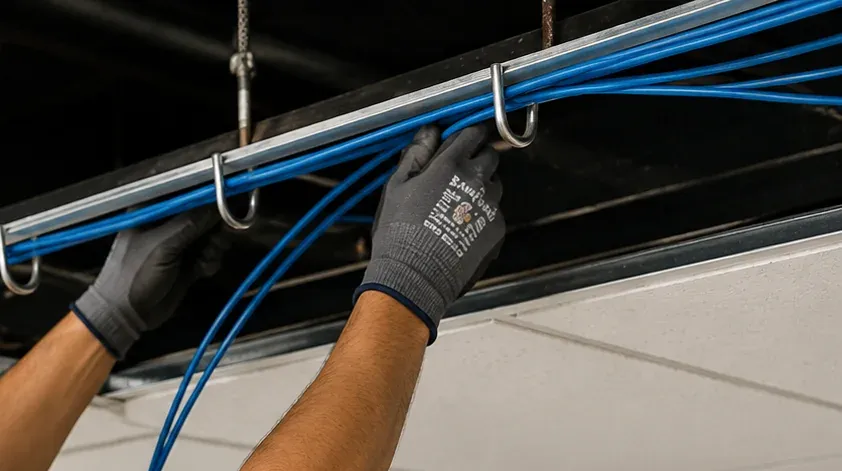
Two gloved hands seating blue Cat6 cables into metal J-hooks hung from rods under a dark open ceiling, Long Island City Queens Cat6 repair
Two gloved hands press a bundle of blue cables into a row of open metal hooks hanging from a support rail; the ceiling above is unfinished and dark, with the edge of a white ceiling tile below.
Long Island City Cat6 Repair Quote
Say which links died and what kind of space they are in — a technician replies the same business day

✅
Request Sent!
A technician covering Long Island City will phone you back today during business hours.
25+
Years Experience
✓
Same-Day Estimates
100%
Licensed & Insured
4.7★
201 Google Reviews

Half the desks in a loft office dark since Monday, a studio's edit bay dropping off the server, a lab instrument that lost its link after the partition crew left? Ring our Queens line, (347) 434-6392, or use the 60-second form. A licensed technician reads it and tells you whether it sounds like a cord, a termination, a damaged run on the ceiling or nothing to do with the cabling, before any visit is booked.

  • Each link we repair is certified against the Category 6 limits, so you get a result, not just a blinking light
  • We look at the hook, conduit, stud or slab the cable lives on, because in Long Island City that is usually what failed first
  • Insured, licensed work under New York State low-voltage licence #12000287431, booked through a Queens line that our dispatcher picks up
The Neighborhood

Why Long Island City Properties Need Cat6 Repair That Starts at the Structure

Long Island City was built to make things, not to hide cable. In 1907 the Degnon Terminal Company bought 362 building lots in the low meadows south of Jackson Avenue, and within a decade the district was full of reinforced-concrete plants served by their own rail sidings; by 1918, according to local historian Jason D. Antos writing in Give Me Astoria, more than 70 of them were turning out war material. Many of those frames are still standing. The Loose-Wiles “Thousand Window Bakery” of 1909 is now LaGuardia Community College. The Standard Motor Products Building at 37-18 Northern Boulevard, built in 1919, now rents office, flex and light-industrial space to creative tenants. Buildings like these have heavy concrete floors, tall ceilings with no plaster under them, and wide column bays — the listing for the SMP lofts advertises concrete floors and ceilings of twelve to fourteen feet. When an office moves in, nobody builds a ceiling to hide the network. The Cat6 goes up on hooks, into conduit or onto tray, in plain sight.

That changes how cable fails. In a Manhattan tower or a Queens rowhouse, a Cat6 run spends its life in the dark behind drywall or above ceiling tiles, and it fails at the terminations or where somebody drills. In a Long Island City loft, the same cable is exposed for most of its length, and its health depends on its supports. Hooks get overloaded as each new tenant adds runs on top of the last tenant's. Conduit along a block wall gets packed until the next pull scrapes the cables already inside. Painters spray the whole ceiling, cable included, to get the black industrial look. And every partition built for a new tenant is metal stud, punched with holes whose edges will cut a jacket that is pulled carelessly across them. A link that tests badly here is usually telling you about one of those things.

The second force is turnover. The Long Island City Partnership counts some 25 million square feet of commercial and industrial space, a daily workforce of more than 100,000 and more than 40,000 residents in the area it serves. Offices, studios, showrooms, labs and workshops come and go in that space constantly, and each fit-out leaves cable behind — some still in use, some abandoned on the hooks, some cut short where a wall moved. The city's 2001 rezoning of 37 blocks started the shift to towers around Court Square and Queens Plaza; the OneLIC plan approved by the City Council on November 12, 2025 rezones roughly 54 more blocks, projects about 14,700 new homes and more than 3.5 million square feet of commercial and industrial space, and keeps an industrial subarea south of the Queensboro Bridge where new loft-like manufacturing buildings are expected. More construction around occupied buildings means more trades in more ceilings, and more Cat6 that gets moved, nicked or cut.

The third is water. Hunters Point, Dutch Kills and the streets along Newtown Creek sit low. During Sandy in 2012, the Newtown Creek Alliance recorded that some companies' bulkheads were underwater before the storm made landfall and that basement and ground-floor electrical systems were destroyed. The federal coastal plan discussed for the area includes floodwalls along Hunters Point and a storm gate across Newtown Creek. For Cat6 that means cellar demarcation rooms, ground-floor network closets and floor boxes on slab that have been wet before and may be wet again. And the towers that grew up after 2001 add a fourth pattern of their own: residents asking on r/longislandcity how good the in-unit Ethernet wiring is and whether the apartment's cables go to a switch of their own — a question that matters when a jack dies and nobody knows where it lands.

So a Cat6 repair in Long Island City starts with the structure. We test the link, find the fault by distance, and then go and look at what the cable is sitting on or running through at that distance: a hook, a sleeve through a slab, a stud, a conduit elbow, a column, a wet floor. Fixing the cable without fixing that is how the same link fails again three months later. Most businesses here also pair a Cat6 repair with commercial security cameras in Queens or a check of their door hardware, because the cameras and readers ride the same exposed pathways and suffer the same damage.

Long Island City at a glance — what shapes a Cat6 repair here

  • Industrial bones: the Degnon Terminal began with 362 lots bought in 1907; its first plant, the 1909 Sunshine Biscuit bakery, closed in 1965 and now houses LaGuardia Community College (Give Me Astoria, April 13, 2025).
  • Converted lofts in use: the Standard Motor Products Building at 37-18 Northern Boulevard dates from 1919 and now mixes office, flex and light-industrial tenants (CoStar report on its sale by RXR).
  • Scale of the workplace: about 25 million square feet of commercial and industrial space, a 100,000-plus daily workforce and 40,000-plus residents (Long Island City Partnership).
  • Industry protected by zoning: the Long Island City Industrial Business Zone, managed by the Partnership, is an area where the city's IBZ policy keeps residential rezoning out (Long Island City Partnership).
  • Rezoning under way: OneLIC, approved November 12, 2025, covers about 54 blocks, roughly 14,700 projected homes and over 3.5 million square feet of projected commercial and industrial space (NYC Council; Cozen O'Connor summary, November 17, 2025).
  • Labs arriving in old frames: a seven-storey building at 43-10 23rd Street has been gut-renovated into more than 200,000 square feet of lab and research space (New York YIMBY, January 2022; Construction Dive).
  • Public housing on the river: Queensbridge Houses, opened in 1939 between Vernon Boulevard and 21st Street, has 96 buildings and 3,142 apartments — the largest public housing development in North America (LIC Post via Wikipedia).
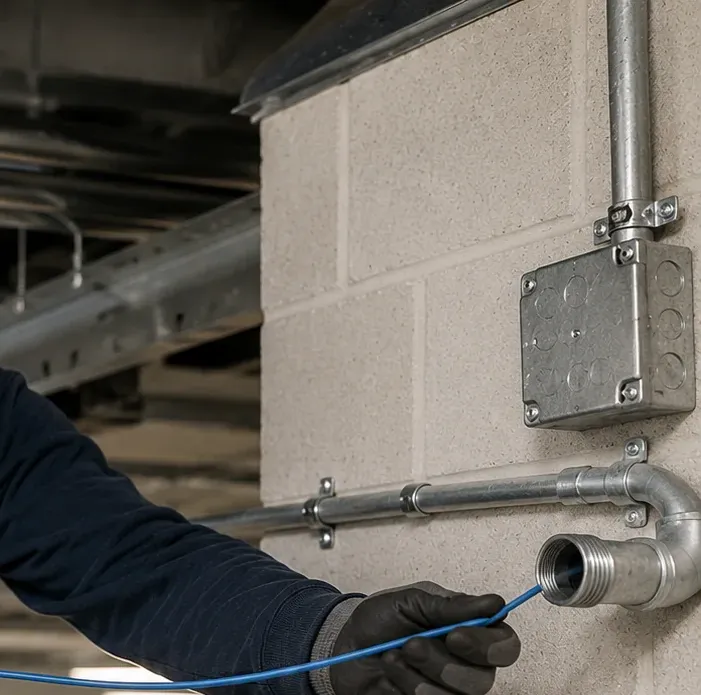
Gloved hand feeding a blue cable into the open end of a steel conduit elbow on a painted concrete block wall, Long Island City Queens loft Cat6 repair
A black-gloved hand pushes a thin blue line into the mouth of a steel conduit elbow fixed to a light grey block wall; a steel junction box sits higher up the same pipe, and ductwork runs across the open ceiling behind.
Repair Capture

Lost Link in a Long Island City Loft or Studio Today?

A row of desks offline after the weekend, a shared drive that edit suites can no longer see, a camera on the loading door that went black, a lab bench whose instrument PC dropped off the network: our dispatcher treats any of these as an outage and books the earliest open 2-hour arrival window, which on weekdays is often the same afternoon. The van carries a certification tester with distance-to-fault, a toner, Cat6 and Cat6A keystones and panel modules, factory-made cords, spare J-hooks and bridle rings, snap-in stud grommets and a fish tape for conduit, because in this neighbourhood the failure is as likely to be on the pathway as at the jack. Once a technician is on site, most single-link faults at a termination, a cord or one damaged section are found and fixed within one to two hours. Repair time is $195 an hour with a three-hour minimum ($585), the same rate published on our Queens network cable repair page. Call (347) 434-6392.

What We Repair

Cat6 Repair Services in Long Island City

Grouped by where the cable lives in a Long Island City building, these are the repairs we are called for. Every job ends the same way: the link passes a certification test for its category, and you get a short written note of what failed, why, and what was changed so it is less likely to happen again.

Exposed-Ceiling Run Repair

Cat6 hanging under concrete or open steel, where one run has been crushed in an overfilled hook, kinked at a beam edge or nicked by another trade's lift. We find the damaged span by distance, replace or re-route it and fix the support that caused it.

J-Hook and Support Rework

Hooks spaced too far apart, loaded far beyond their rated fill, or holding three generations of tenants' cable. We add supports, split bundles, take abandoned runs off the hooks and re-dress the live ones so nothing sags or bears on an edge.

Single-Cable Conduit Replacement

One failed run inside steel conduit along block, brick or a column. We work out whether the bad cable can come out on its own, pull its replacement with lubricant and a controlled pull, and test the neighbours afterwards to prove they were not harmed.

Metal-Stud Partition Damage

Jackets sliced where a run was dragged through stud knockouts without bushings, or crushed in a track when the board went on. We open the smallest section we can, replace the damaged length and fit grommets wherever the new cable crosses steel.

Floor-to-Floor Crossings

Runs between levels of a former factory through old sleeves or new core holes. We reuse sleeves where they are clear, arrange scanning before any new hole is cored, and firestop every penetration we make or reopen.

Painted and Coated Cable

Runs caught in a spray-painted ceiling or coated by a fireproofing or sealant crew. We test them, tell you which ones still pass and which have been compromised, and replace the ones that need it with cable that can stay exposed.

PoE Bundle Problems

Cameras, access points and phones that reboot or drop when many powered runs share one tight bundle on a hot ceiling. We test under load, split oversized bundles and move the worst runs, following the cabling industry's PoE bundling guidance.

Jack, Keystone and Panel Re-Termination

Most single-link faults still end at a termination. We cut back past any damage, re-seat the cable on a new keystone or panel module of the same category, and keep each pair's twist close to the contacts so crosstalk stays within limits.

Move-Out and Hand-Back Surveys

Testing and labelling the cable in a loft before a lease ends, so you know which runs are live and worth leaving, which are abandoned and must come out, and what your landlord is likely to ask about at hand-back.

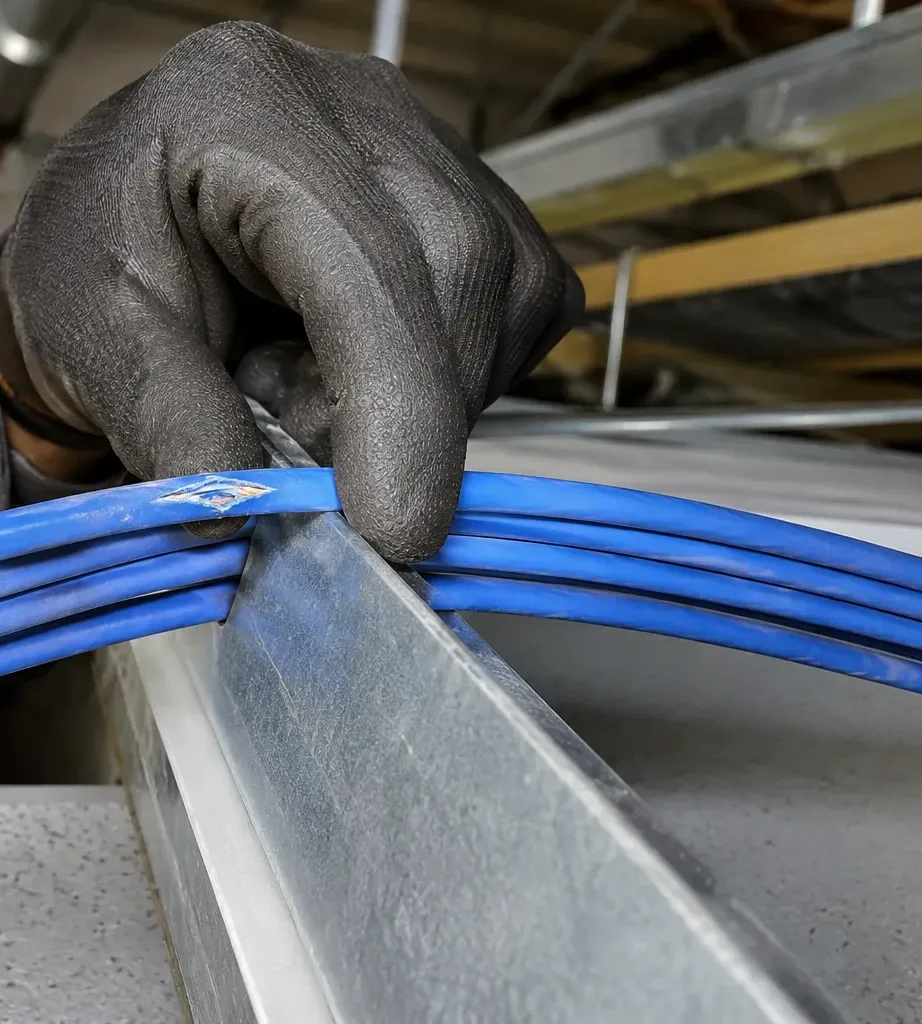
Gloved hand lifting a bundle of blue Cat6 cables off a galvanised metal rail where one jacket is scuffed, Long Island City Queens Cat6 damage check
Close-up of a dark glove raising a handful of blue cables off a zinc-coloured metal edge; one cable carries a whitish worn mark on its jacket, with unfinished ceiling structure out of focus beyond.
Building Specialists

Cat6 Repair for Long Island City's Architecture

Five kinds of building make up most of the Cat6 we are asked to repair here. Each one hides its faults in a different place, which is why the first question on the phone is usually what the ceiling looks like.

Concrete Factory Lofts

The Degnon-era plants and their neighbours along Thomson Avenue, Skillman Avenue, 47th Avenue and Northern Boulevard: flat concrete slabs or mushroom columns, steel windows, brick or block walls and ceilings left open. Cable rides on hooks, tray or conduit, and the slab between floors is thick enough that every crossing matters.

Older Brick Warehouses

Two- to four-storey brick and timber or brick and steel buildings in Dutch Kills, Ravenswood and along the creek, many now studios, showrooms, workshops or offices. Runs are surface-mounted on masonry or hung from wood joists, often added piecemeal by each tenant without a plan.

Court Square and Queens Plaza Office Towers

One Court Square, completed in 1989 at 673 feet, and the newer office buildings around the Queens Plaza transit hub. Here Cat6 does live above hung ceilings in tenant suites, and the issues are the familiar ones: furniture moves, riser access and building rules.

Waterfront and Transit-Area Residential Towers

The post-2001 high-rises of Hunters Point, Court Square and Queens Plaza, including the Hunters Point South rentals. In-unit jacks run to a structured-media enclosure, ground floors hold shops and amenity rooms, and the cellar may house the building's demarcation room below the flood line.

Labs, Studios and Special Rooms

Film and television stages such as Silvercup in its former bakery, photo and post-production studios, and lab conversions like 43-10 23rd Street. Cable runs into rooms with their own rules — acoustic treatment, clean benches, lighting grids — and the repair has to respect the room as much as the link.

Five structures, five different repair approaches

Open ceilings. On an exposed ceiling we walk the run with a light and a ladder at the distance the tester gave us. The usual finds are a hook loaded past its capacity, a gap of eight or ten feet between supports where the cable has sagged onto a sprinkler pipe or a duct flange, a bend pulled tight round the edge of a beam, or a scuffed jacket where a lift basket brushed the bundle. The repair is the damaged span plus the support: new hooks at sensible spacing, a split bundle, a bend eased out. Because everything is visible, the finished work also has to look tidy; we dress replacements to follow the existing lines and match the jacket colour where we can.

Conduit on masonry. Older lofts often have Cat6 in steel conduit run along block or brick walls and down columns to wall boxes. If the conduit is lightly filled, one cable can be withdrawn and a new one pulled in. If it is packed, pulling one out can drag the jackets of the others across the threads and edges of each fitting, so we test the neighbours before and after and, where the fill is too high, run the replacement in a new pathway instead.

Metal-stud partitions. Every new suite inside an old loft is framed in steel studs. The punched holes in those studs have sharp edges, and the track at floor and head can pinch a cable when board is screwed on. Damage tends to sit at the first or second stud from a box. We open a small section, replace the length and fit snap-in grommets at each crossing.

Slabs and sleeves. Between floors, the cable usually passes through a sleeve cast or cored into the slab. A clear sleeve with space is the cheapest route for a replacement. A full or blocked one, or no sleeve at all where the run needs to go, means a new hole, and in an old concrete building that means scanning the slab first and firestopping afterwards.

Towers and suites. Above hung ceilings in office towers and in apartment media enclosures, repairs look much like anywhere else in New York; the difference in Long Island City is usually the building's process — freight-elevator bookings, insurance certificates and hours — which we sort out before the visit.

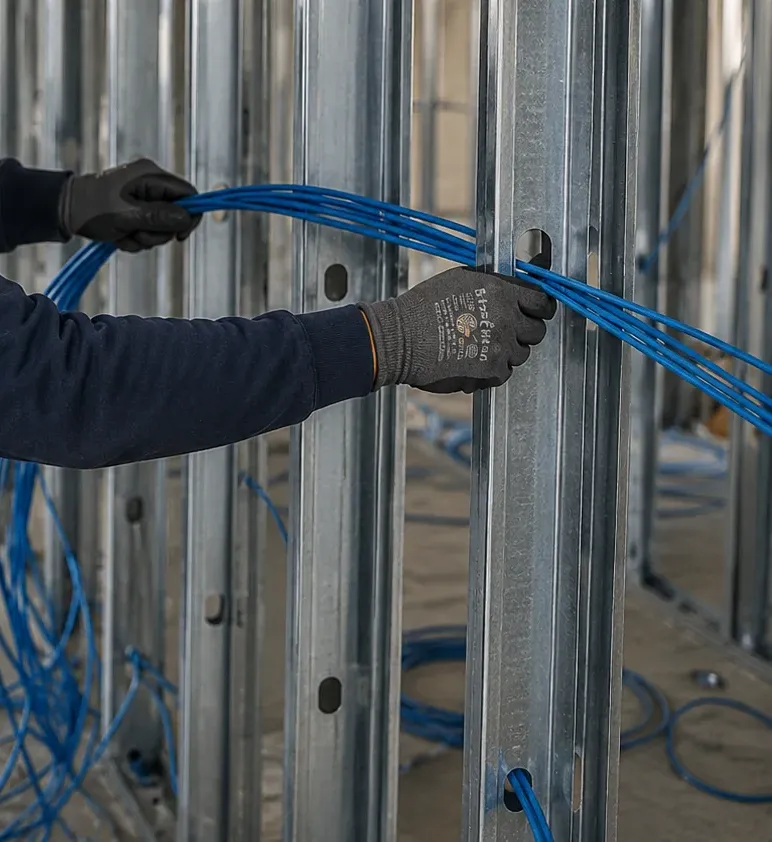
Gloved hands guiding a bundle of blue Cat6 cables through punched openings in galvanised metal studs of an open partition, Long Island City Queens Cat6 repair
An unfinished partition: a worker's gloved hands feed blue cables sideways through punched holes in vertical steel framing members, with further framing and loose blue coils visible on the concrete floor.
Commercial Cat6 Repair

Business Cat6 Repair in Long Island City

Long Island City's business districts are close together but very different underneath. These are the corridors we think of when a call comes in, and what tends to be going on with the cable in each.

Court Square and Jackson Avenue

Office towers, the courthouse area, ground-floor restaurants and the cultural buildings along Jackson Avenue. Suites above hung ceilings, plenty of furniture moves, and building managers who want paperwork before any ceiling tile comes down.

Queens Plaza and the Bridge Approach

A transit hub ringed by newer office and residential towers and older commercial buildings in the shadow of the Queensboro Bridge. Mixed buildings, ground-floor retail with long runs to cellar closets, and a lot of recent construction around occupied space.

Thomson Avenue, Skillman Avenue and the Degnon Blocks

The old terminal district around LaGuardia Community College: big concrete lofts holding offices, design showrooms, schools and studios. Exposed ceilings, conduit on columns and long horizontal runs across wide floors.

Northern Boulevard

The SMP Building and the former auto and parts buildings along the boulevard, now creative offices, flex space and light industry. Concrete floors, high ceilings and tenants who build out their own partitions inside a shared shell.

Dutch Kills and the IBZ

Working industrial and distribution businesses, studios and trades inside the Industrial Business Zone, much of it in low brick and block buildings near the creek. Surface-run cable, cameras on loading doors, damp floors and forklifts.

Vernon Boulevard and Hunters Point

Neighbourhood shops, restaurants and offices on Vernon and the side streets, with towers and the waterfront parks a block or two west. Ground-floor tenants whose network closet sits low, close to the water table and the flood zone.

Who calls us here

Architecture and design studios with racks of workstations on a single open floor. Post-production and photography studios whose edit bays and storage live on one switch. Showrooms and fashion businesses in the old Degnon plants. Start-ups and agencies on short leases who inherit whatever the last tenant left. Lab tenants in converted buildings who need one instrument link to be dependable. Restaurants and bars on Vernon Boulevard and Jackson Avenue. Property managers of the converted lofts who look after base-building cabling for many tenants. And residents of the towers whose in-unit jacks have stopped working. Each needs something slightly different from a repair, but all of them need the link to pass and to stay passing.

Codes and building rules that come into a Long Island City Cat6 repair

  • NYC Electrical Code: the city's code is now the 2020 National Electrical Code with New York City amendments, in full effect since December 21, 2025 (NYC Department of Buildings). Its communications-cable rules govern how cable is supported, separated and passed through rated walls and floors.
  • Abandoned cable: the NEC requires the accessible portion of abandoned communications cable to be removed, while cable tagged for future use may stay (article 800.25, as explained by EC&M). In lofts with layers of old tenants' cable, this decides what comes off the hooks when we rework a pathway.
  • Firestopping: where a replacement run passes through a fire-rated floor or wall, the opening is sealed with a listed firestop system. In multi-storey concrete lofts that means most floor crossings.
  • Concrete penetrations: new holes through a slab or bearing wall are the building owner's call. Most managers want the slab scanned and the location approved before coring, and some require their own engineer's sign-off.
  • Fire alarm devices: drilling and coring raise dust that can set off smoke detectors. Covering detectors or placing a system on test is arranged with the building's fire-alarm company or management, not decided by us on the day.
  • Licensing: AESS holds New York State low-voltage licence #12000287431 and carries full insurance; certificates of insurance naming the building and managing agent are sent before the visit when a building asks for them.
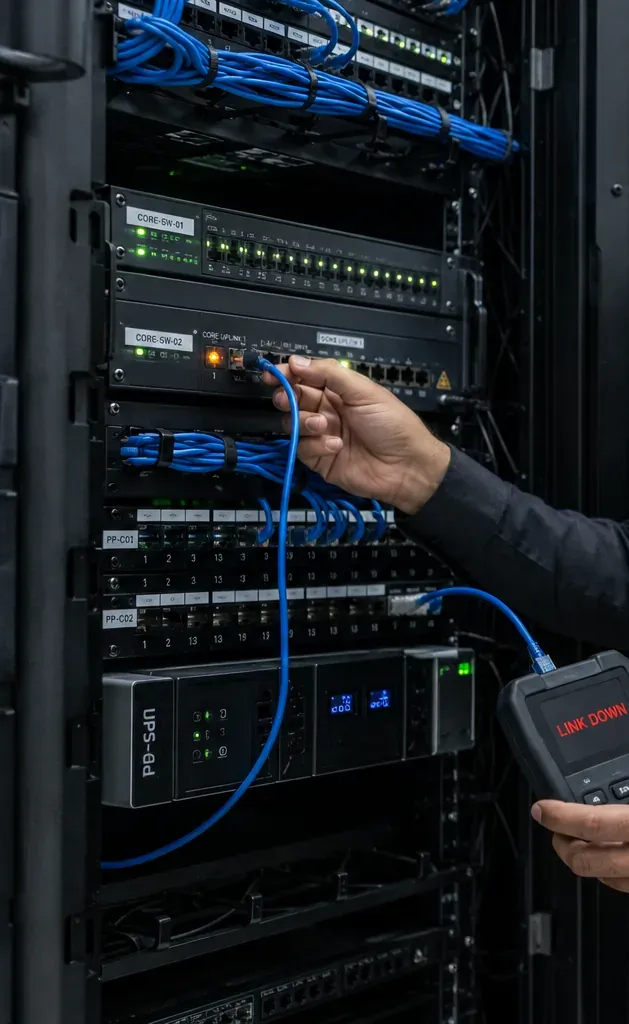
Hand plugging a blue patch cord into a rack switch while a handheld tester below reads Link Down, Long Island City Queens business Cat6 repair
One hand holds a blue patch cord at a port on a rack-mounted switch with green lights; lower down another hand holds a handheld tester whose red screen reads Link Down, beside a rack power unit.
Your Questions Answered

Cat6 Repair in Long Island City: Questions Answered

These are the questions office managers, studio owners, lab tenants and loft landlords in Long Island City ask once a Cat6 link has started failing. They follow the cable: across the open ceiling, through the conduit, studs and concrete, and finally out of the building at the end of a lease. Booking and practical points are in the FAQ further down.

Open ceilings and the hooks that hold the cable

The Cat6 across our loft's open ceiling hangs in J-hooks that are packed full — can overloaded hooks be what is failing the links?

Yes, and it is one of the most common causes we find in converted lofts. A J-hook is a non-continuous support: the cable rests on a small curved saddle every few feet and hangs free in between. The pathway standard, ANSI/TIA-569, puts those supports no more than five feet (1.5 metres) apart, and manufacturers rate each hook for a fill — nVent, for example, calculates its hook capacities at a 70 percent fill. Belden notes that when hooks are too far apart the cable sags, which leads to abrasion and stress. In a loft that has had three or four tenants, each one tends to have added runs to the same hooks without adding hooks. The bottom cables in an overfilled saddle carry the weight of everything above them, and over months their pairs are pressed out of shape right at the support. That kind of deformation shows up as return-loss and crosstalk failures at a repeating distance — the distance to the hooks.

The tester tells us where to look; the ladder confirms it. Typical signs are cables bulging over the lip of the hook, a flattened jacket when a bottom cable is lifted out, and long sagging spans where a hook has been removed or never installed. The repair is in two parts. First the damaged runs: if the jacket is flattened but the run still certifies once the load is taken off, it can stay; if it does not, the damaged span is replaced or the whole run is re-pulled, depending on length and access. Second the support: extra hooks to bring spacing down, bigger or additional hooks so no saddle is overfilled, and abandoned cable taken off entirely so the live runs have room. We then re-certify every link that shared the overloaded hooks, not only the ones that were reported.

Painters sprayed our open ceiling black, cables and all — do painted Cat6 runs need replacing?

Not automatically, but they need testing, and some will. The cable makers are clear that cable is not meant to be painted: Belden's guidance on altering communications cable says plainly not to paint it, because paint can damage the jacket, shorten its life and void the product warranty, and Legrand's support pages say the same for Cat5e and Cat6. There is also a fire-rating point: a cable is listed with the jacket it left the factory with, and a coat of paint is something its listing never considered. On an exposed loft ceiling, where the black spray finish is part of the look, it happens all the time.

What we do is practical. We certify every painted link to see whether performance has changed — a thin latex overspray on a sound cable often makes no measurable difference, while heavy coats, solvent-based paints and paint that has run into a jack or a patch panel can. We check terminations, faceplates and patch cords for paint inside the contacts, which causes intermittent connections far more often than paint on a jacket does. Then you get a list: links that pass and can stay, terminations and cords that need replacing because paint got into them, and runs that should be replaced because they fail or because the building's insurer or engineer wants unaltered listed cable in that space. Where runs are replaced, we can supply cable whose jacket colour suits the ceiling, so the next paint job does not need to cover it.

Can a big bundle of PoE-powered Cat6 on our exposed tray run hot enough to cause faults?

It can, particularly in a bundle of dozens of cables feeding cameras, access points, phones and door readers on the top floor of an uninsulated loft. When power is sent over the pairs, each cable warms a little; packed together, the cables in the middle of the bundle cannot shed that heat. The industry bulletin on the subject, TIA TSB-184-A, approved in March 2017, covers currents up to 1,000 mA per pair and power up to 100 W, warns that the temperature rise can push cables past their rated temperatures, and recommends limiting bundle sizes. Warmer copper also loses more signal, so a long run that only just passes in winter can fail on a July afternoon under a sun-baked roof.

We test the affected runs under load and, where we can, at the time of day the faults occur. If heat is the problem, the repair is to break the bundle up: split it across two or three pathways, spread it on wider supports, move the highest-power devices onto separate runs, and keep powered bundles away from heating units and skylights. If a run has been cooked long enough to fail outright, it is replaced. For new powered runs in a hot space we will suggest Cat6A, which handles heat better, but most existing Cat6 can be kept once the bundle is no longer an oven.

Conduit, studs and concrete

One Cat6 in the steel conduit along our brick wall has failed — can it be pulled out without damaging the cables that still work?

Usually, if the conduit is not packed. Steel conduit on masonry and down columns is common in Long Island City lofts, where there is no hollow wall to hide cable in. The risk in pulling one cable out of a shared pipe is friction: the cable you are removing drags against the others at every elbow and fitting, and the replacement does the same on the way in. In a lightly filled conduit with gentle bends that is not a problem. In a pipe that has been filled to the brim, or one with tight elbows and set-screw fittings whose edges have never been reamed, it can scuff jackets or deform pairs on cables that were working fine.

So before anything is pulled, we certify every cable in that conduit and save the results. If the fill and the bends allow it, we remove the failed run, attach the replacement to a pull line, lubricate it and pull it in by hand with steady tension. Then we certify the neighbours again and compare. If the conduit is too full, or the run has failed because the pipe itself damaged it, we leave it in place, tag it as abandoned or remove it when the run is quiet, and route the replacement in a new pathway — a fresh conduit or a surface raceway beside the old one. Either way you see the before-and-after results for every cable in the pipe.

Our office partitions are built on metal studs — could the stud openings be what is cutting into the Cat6 jacket?

Very possibly. Every suite carved out of a Long Island City loft is framed in galvanised steel studs and track, and each stud has punched openings through which cable is run. Those openings have sharp edges. Snap-in plastic bushings or grommets exist precisely to stop cable being cut or frayed where it passes through, but on low-voltage runs they are often skipped; electricians on the Mike Holt forum point out that a damaged data cable will not cause a fire or a shock, which is why inspectors seldom chase it, but that the cable will fail. A run pulled tight around a corner of a knockout, or pulled through quickly with a tug at the end, can be sliced down to the pairs, and the same happens where the track at the floor or head pinches a cable when the board is screwed on.

The tester's distance-to-fault reading usually lands within a stud bay or two of a box, which is where the cable turns and is most likely to have been dragged. We cut a small, neat opening in the board at that spot, inspect the cable, and replace the damaged length or the whole run if the damage is close to the jack. Every steel crossing on the replacement gets a grommet, and the wall is closed up and ready for the painter. If several runs in the same partition were pulled the same way, we test them all, because a cable that has been nicked but not yet cut through is often the next one to fail.

A replacement run has to go between floors of our old factory building — does the concrete have to be scanned before anyone drills?

If a new hole is needed, yes, and in most managed Long Island City buildings the landlord will insist on it. Concrete floors and walls in these buildings can carry reinforcing steel, embedded electrical conduit and, in some later structures, post-tensioned cables. Scanning firms such as GPRS explain that ground-penetrating radar shows rebar, post-tension cables and conduit from one side of the slab and lets the operator mark the safe spots on the surface; their concern is that striking a conduit is a shock risk and cutting a tensioned cable is a structural one. X-ray needs access to both sides and clears the area, so radar is the usual choice in an occupied building.

Before arranging any of that, we look for a route that avoids new holes: an existing sleeve with space in it, a shaft or chase that already runs between the two floors, or a path down an exterior or column face. Many repairs between floors can reuse what is there. Where a new penetration really is needed, we agree the location with the building, the slab is scanned and marked, the hole is cored, and the opening is firestopped after the cable goes through. Scanning, coring and firestop are listed separately on the written estimate, and nothing is drilled until you and the building have approved it.

Will drilling for a replacement run set off our building's smoke detectors?

It can if nobody plans for it, so we plan for it. Drilling block or brick and coring concrete both throw fine dust, and smoke detectors in the area are designed to react to exactly that kind of airborne particle. Fire departments advise covering detectors during construction to keep dust out of the chamber and removing the covers when the work is done. In New York City, though, a building's fire-alarm system is not something a cabling contractor switches off on its own: if a system is impaired or out of service, FDNY rules can require a fire guard, and owners can face violations for an alarm that is not working as it should.

So when a repair involves drilling, we tell the building in advance where and when, and management or its fire-alarm vendor decides how the nearby detectors are handled — covered for the duration, the zone put on test, or the work scheduled when the vendor is on site. We drill with dust extraction, keep the work area small and clean up as we go. Most repairs never get this far: re-terminating, replacing a span on a hook or swapping a cable in a conduit makes no dust at all.

When the lease ends

When we move out of our loft, which of our Cat6 has to come out and which can stay for the next tenant?

That depends on two documents and one rule. The documents are your lease, which may require you to remove your cabling or to leave it, and any work letter or alteration agreement from your fit-out. The rule is the electrical code's treatment of abandoned cable: under the NEC, the accessible portion of communications cable that is no longer used and not tagged for future use has to be removed, while cable that is tagged for future use may stay. In Long Island City lofts, where most of the cable is accessible because it hangs on an open ceiling, that rule bites harder than in a building with closed walls.

What we do before a hand-back is test and label every run, mark which ones are live, which are dead, and which are worth keeping for the next tenant, and give you a list you can send to the landlord. Runs the landlord wants to keep are certified, labelled and tagged; runs that must go are cut back and taken off the hooks; and any jacks or panels left behind are tidied so the space looks cared for. If your lease is silent, the landlord's building manager usually has a view, and it is cheaper to ask before the last month than to be billed for removal after you leave. We are not lawyers, so we do not interpret the lease; we give you the facts about the cable so whoever does can decide.
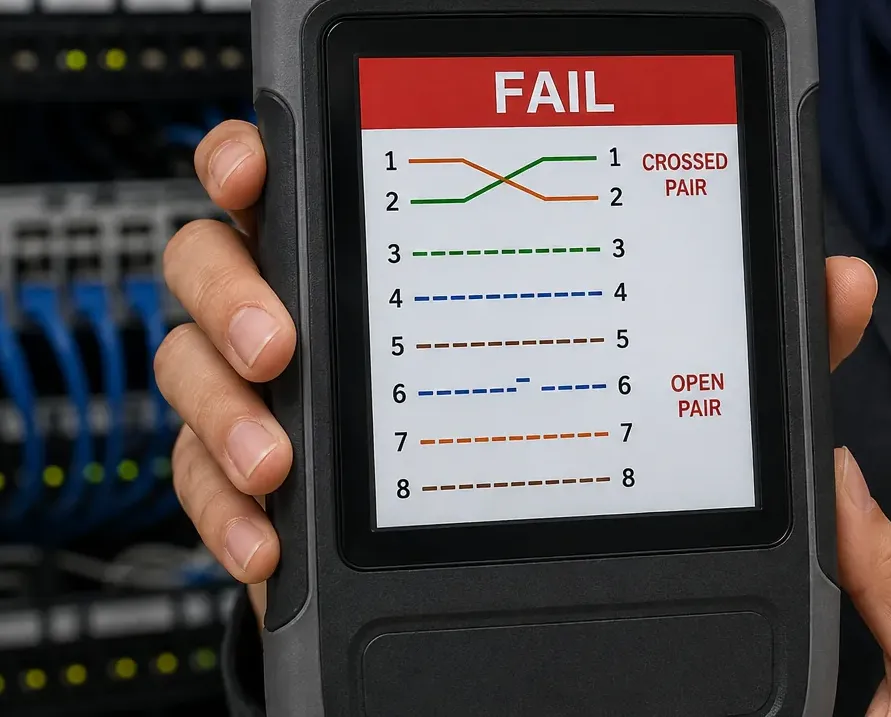
Handheld cable tester screen reading Fail with a wire map showing pairs 1 and 2 crossed and pair 6 open, held in front of a network rack, Long Island City Queens Cat6 certification
A hand holds a grey tester whose screen is headed Fail in red; the wire map shows wires 1 and 2 crossed and a break on wire 6, labelled Crossed Pair and Open Pair, with blurred racks of blue cables behind.
Equipment

Test Gear, Supports and Parts for a Long Island City Cat6 Repair

The van for a Long Island City job carries more pathway hardware than it would for a job in a closed-wall building, because so many of the repairs here include fixing what the cable hangs on.

Certification Tester

A field tester that runs the full Category 6 or 6A test against the permanent-link or channel limits and saves the result, with time-domain views that place a crosstalk or return-loss fault at a distance along the cable. On exposed ceilings, that distance is often the exact hook or beam to look at.

Toner, Probe and Labeller

For tracing runs through layers of previous tenants' cable on the same hooks, and for labelling both ends as we go so the next person does not have to trace them again.

PoE Load Tester

To check that a powered run still delivers usable power under load, which matters for cameras, access points and readers fed through hot, tightly bundled pathways.

J-Hooks, Bridle Rings and Beam Clamps

Supports that fasten to concrete, steel beams, threaded rod or wood joists, sized for the cable they will carry, so a repaired run does not go back onto an overloaded hook.

Stud Grommets and Bushings

Snap-in protection for every place a replacement crosses steel studs or track in a partition, and smooth bushings for conduit ends that were never reamed.

Fish Tape, Pull Line and Lubricant

For pulling a single replacement through existing conduit or a sleeve with controlled tension, instead of yanking it past the cables that stay.

Keystones, Panel Modules and Cords

Cat6 and Cat6A jacks and panel modules, factory-made patch cords in several colours and lengths, and surface boxes for columns and masonry where there is no wall cavity to mount into.

Firestop and Sleeve Kits

Listed firestop products and short sleeves for re-sealing slab and wall crossings that a repair opens or adds, so a rated floor stays rated.

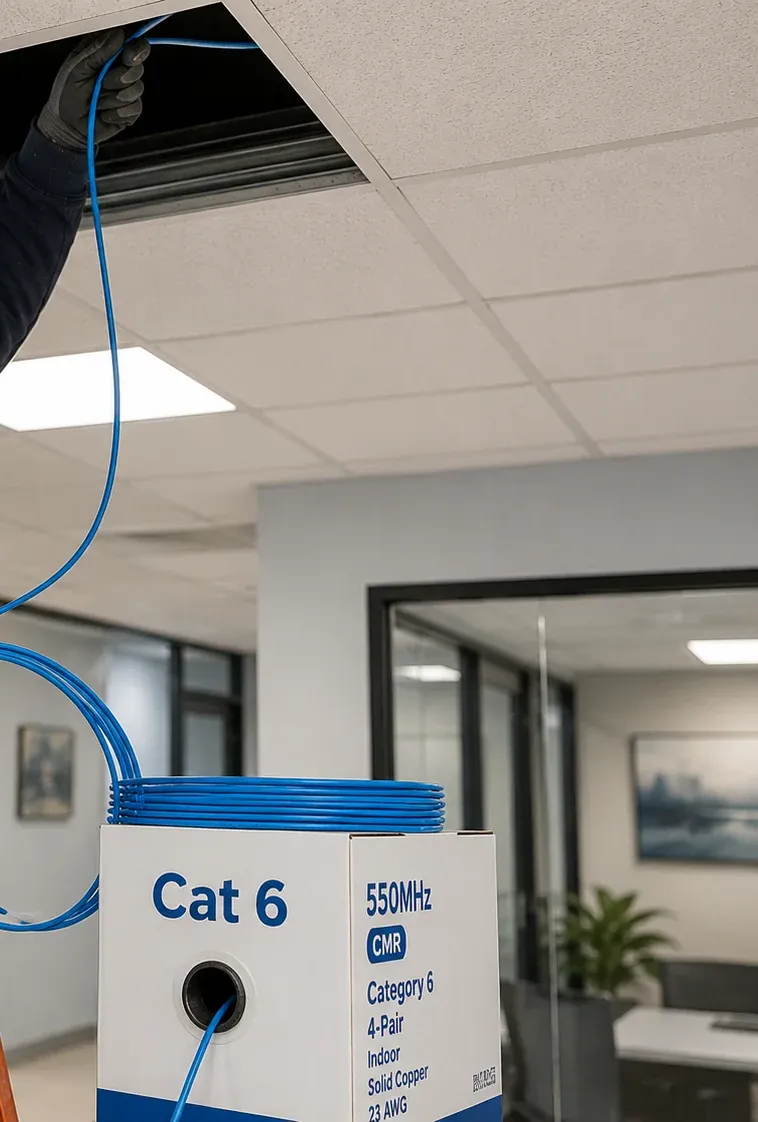
Blue cable fed from a box marked Cat 6 550MHz CMR solid copper 23 AWG up to a gloved hand at an open ceiling tile, Long Island City Queens Cat6 replacement run
Reel-in-a-box cable feeding upward: the carton's printing lists 550MHz, CMR and 23 AWG solid copper, and the blue line climbs to a gloved hand working through a lifted ceiling panel above a glass-walled office.
AI Overview Reality Check

What AI Gets Wrong About Cat6 Repair in Long Island City

We could not view Google's AI Overview for these searches from our build environment, so we do not quote it. Instead, each heading below is a claim that turns up again and again in AI answers, cost guides and forums about Cat6 repair, and each is followed by what we actually find in Long Island City buildings.

“Cat6 doesn't really wear out — if it worked once, the problem is your equipment”

The cable itself is durable, and plenty of faults are in switches, cords or settings. But the claim assumes the cable has been left alone inside a wall since the day it was installed. That is not how an exposed loft works. Runs on open ceilings live through repainting, new sprinkler branches, HVAC work, scissor lifts, tenants adding cable to the same hooks, and a summer roof that bakes the top floor.

So we never assume. The first step on any visit is to certify the link and look at the margin. If it passes with room to spare, we tell you to look at the device and show you how. If it fails, the tester shows where along the run, and in a Long Island City building that point usually lines up with something physical you can see from a ladder.

The practical lesson is that a cable that “worked once” is evidence about the past. A saved certification result from the day of repair is evidence about now, and it is what lets you separate a cable fault from an equipment fault next time.

“A Cat6 repair is just a new jack on the end”

Re-termination fixes a lot, and it is where we start when the fault is at the end of the cable. Cost guides that quote a flat “jack replacement” price are describing that kind of fault.

In this neighbourhood, though, many faults sit in the middle of the run: under a crushed hook, at a stud opening, at a conduit elbow, at the edge of a beam. Putting a new jack on a cable that is damaged twenty metres away does nothing except use up slack. The tester's distance reading decides whether the end or the middle is the problem.

When the middle is the problem, the repair is a replaced span or a new run, plus a fix to whatever damaged it. That is why our written estimates list the support or pathway work separately from the cable work.

“Just splice the damaged section with a coupler”

Inline couplers and splice kits are sold for exactly this, and forum answers suggest them because they are quick. On an exposed ceiling it is tempting: the damaged section is right there.

The trouble is that each extra connection adds loss and crosstalk, field-made splices are rarely as good as the link they interrupt, and Fluke Networks' own troubleshooting guidance warns that couplers should not be used in a data installation. A coupler hanging in an open ceiling also becomes the weak point the next time somebody brushes the bundle.

Where a short replacement span is the right answer, we bring both ends back to a proper termination point — a surface box or a consolidation point — and certify the whole link. More often, on runs of normal office length, a new continuous run is cleaner and costs little more.

“Wireless is good enough now, so why repair cable at all?”

For laptops and phones, often it is. In Long Island City the counter-argument is the building: thick concrete floors and brick walls absorb radio, and towers packed with neighbours' networks crowd the airwaves. Brick Underground, writing about New York apartments, quoted a technician saying the city's walls are full of piping, plumbing, cement and brick, and that running Ethernet is the most effective fix.

The bigger point is that the wireless itself rides on cable. Every ceiling access point in a loft office is fed by a Cat6 run, usually hanging on the same hooks as everything else, and when that run degrades, the Wi-Fi in that part of the floor degrades with it.

So for workstations, storage, studio gear, lab instruments, cameras and the access points themselves, the cable is the foundation. Repairing it is usually quicker and cheaper than redesigning the wireless around a broken run.

“Fixing Cat6 is a cheap per-drop job anywhere”

National guides do publish numbers in that range. Fixr's guide, updated in January 2025, gives $125 to $250 per drop for new Cat6 and labour of $45 to $75 an hour. Those are national figures for new installation, not New York City repair.

A repair here is billed differently: time to diagnose and fix, plus any replacement cable. Our published figures are $195 an hour with a three-hour minimum, and replacement runs from $175 per drop. In a loft, extras such as new supports, scanning before coring, or firestopping are quoted line by line, because they depend on the building rather than the cable.

The useful comparison is not per-drop price but outcome: a certified link, a fixed cause, and saved results. A cheap visit that re-terminates a cable crushed in the middle will be repeated.

“Any electrician can fix a network cable”

Electricians are skilled people, and many pull data cable well. The claim misses what makes a Cat6 repair a Cat6 repair: proving the link meets its category afterwards, which takes a certification tester and the knowledge to read it.

It also misses the scale. In Long Island City, licensing for low-voltage work and the building's insurance and approval process apply just as they do for electrical work, and building managers ask for both.

The fair version of the claim is that whoever fixes the cable should test it to category and hand you the results. If they cannot, you do not know whether the repair worked.

“Dead runs on the hooks do no damage, so leave them”

Out of sight, out of mind, the argument goes, and an extra cable cannot hurt anything. In closed buildings, it is easy to believe.

On an open loft ceiling the dead cable is the reason hooks are overloaded, the reason live runs are hard to trace, and the reason a repair takes longer than it should. The electrical code also requires the accessible portion of abandoned communications cable to be removed unless it is tagged for future use.

When we rework a pathway, we take dead cable off the hooks as part of the job where it can be reached, label what is kept for future use, and leave the ceiling lighter than we found it.

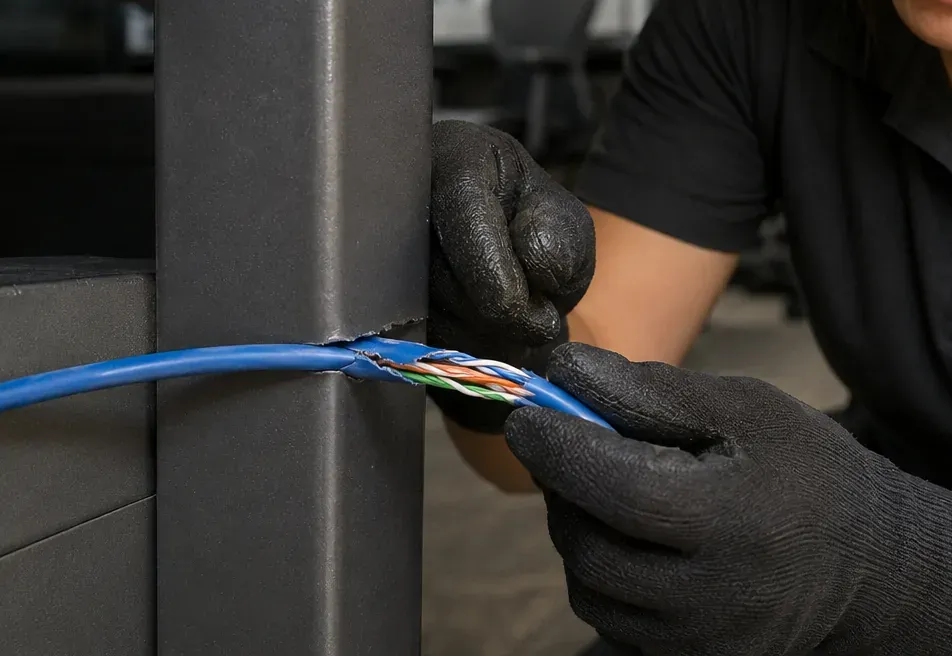
Gloved hands holding a blue Cat6 cable with its jacket split open beside a dark steel frame, coloured pairs exposed, Long Island City Queens Cat6 damage
Torn blue jacket at a metal corner: gloved fingers pinch the cable open where it crosses a charcoal-coloured upright, revealing the coloured twisted pairs inside.

Find Out Whether It Is the Cable or the Hook It Hangs On

One visit certifies the failing links, places the fault by distance and walks the pathway at that spot. You get the answer, the fix and the results.

Get In Touch

Request a Free Quote

From one dead jack in a Hunters Point apartment to a whole floor of desks in a Northern Boulevard loft, this form reaches a technician rather than a call centre. Tell us what failed, where, and what the ceiling looks like, and you will have a written reply the same business day. Would rather talk it through? Call (347) 434-6392.

✅

We Got Your Request!

Your details are in. Expect a call today from whoever is covering the Long Island City side of Queens. Something offline this very minute? Phone (347) 434-6392.

How It Works

Our Long Island City Cat6 Repair Process

Six steps, whether the job is one jack in a Queens Plaza apartment or a ceiling full of hooks in a Skillman Avenue loft.

1. Phone triage and building check

We ask what the link feeds, when it started failing, what changed recently — painters, a new partition, a move, hot weather — and whether the ceiling is open or hung. We also ask about the building's rules for contractors so the visit is not held up at the door.

2. Access arranged

We book a 2-hour arrival window, send the insurance certificate to the managing agent if one is needed, and confirm the freight elevator, loading entrance and any after-hours requirement with whoever controls them.

3. Certify and locate

Each affected link is certified from the panel to the outlet, and the fault is placed by distance. We save the failing results so you can see the before and after.

4. Walk the pathway

At the fault distance we inspect what the cable is resting on or passing through — hook, beam edge, stud opening, conduit fitting, sleeve or floor box — and decide with you whether that support or pathway needs work too.

5. Repair cable and pathway

We re-terminate, replace the damaged span or pull a new run, and fix the cause: more or larger supports, grommets at steel, a split bundle, a new pathway beside a full conduit, firestop at every crossing we open. Anything beyond the agreed list waits for your approval.

6. Re-certify, label and report

Every link we touched, and every neighbour that shared its hooks or conduit, gets a final certification. Labels go on at both ends, abandoned cable we removed is listed, and the results and a short cause-and-fix note are emailed to you.

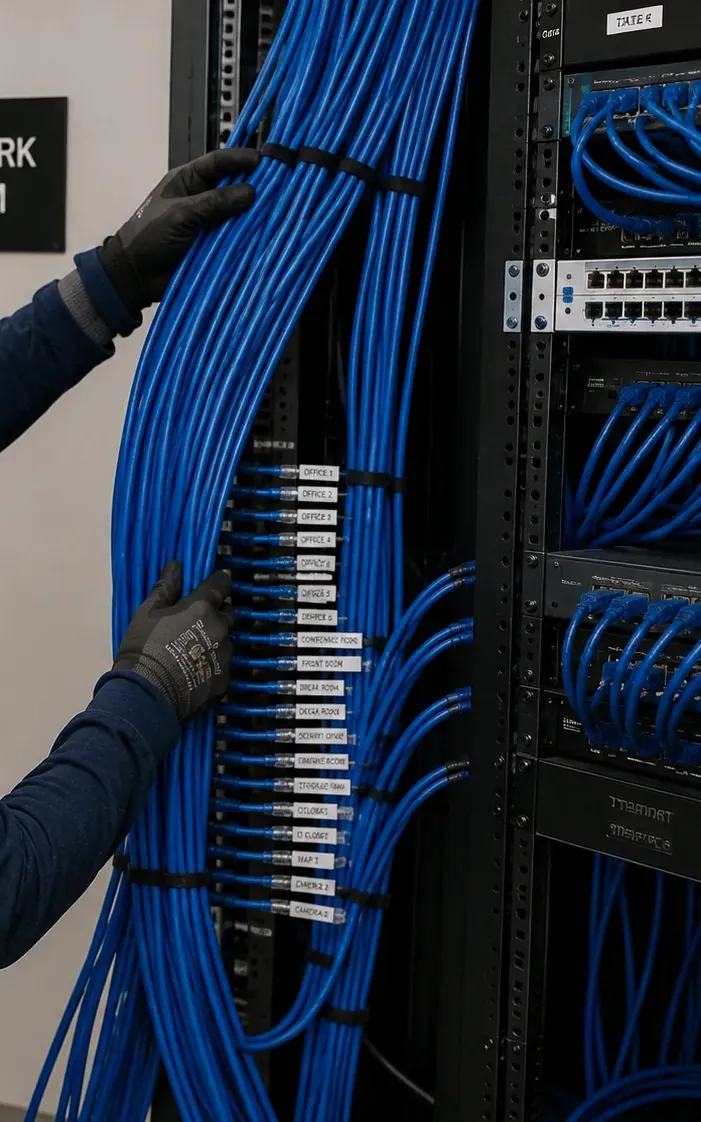
Gloved hands dressing a thick vertical bundle of blue Cat6 cables beside a rack with rows of labelled patch cords, Long Island City Queens Cat6 repair
Two gloved hands hold a thick column of blue cables against the side of a black equipment rack; the cables fan into the rack, where a vertical row of white labels runs down the cords, and patch panels sit to the right.
Coverage Area

Cat6 Repair Near Long Island City's Landmarks

These six spots map the neighbourhood's building types, from 1909 concrete to a 1989 glass tower. Treat them as orientation for the streets nearby; we are not claiming jobs inside any of them.

LaGuardia Community College, Thomson Avenue

The former Loose-Wiles “Thousand Window Bakery”, the first plant in the Degnon Terminal in 1909 and a bakery until 1965. It stands for the big concrete lofts around it that now hold offices, showrooms and studios with open ceilings.

The SMP Building, 37-18 Northern Boulevard

Built in 1919 for Standard Motor Products and now a mix of office, flex and light-industrial space. The model for loft offices on the boulevard: concrete floors, tall ceilings and tenant-built partitions inside a shared shell.

One Court Square

The 50-storey glass tower that rose over Court Square in 1989 and held the title of tallest in the borough for three decades. Around it, office suites keep their cable above hung ceilings, unlike the lofts a few blocks east.

Silvercup Studios

A film and television studio since 1983 in the former Silvercup Bakery of 1929–30 by the Queensboro Bridge. A reminder that a lot of Long Island City's cable runs to production rooms, stages and edit suites.

Queensbridge Houses

Opened in 1939 between Vernon Boulevard and 21st Street, with 96 buildings and 3,142 apartments — the largest public housing development in North America — and the edge of the Ravenswood and Dutch Kills blocks beside it.

Gantry Plaza State Park and the Pepsi-Cola Sign

The Hunters Point waterfront park, with the neon sign designated a city landmark in 2016. Behind it rise the towers built since the 2001 rezoning, on the low ground that flooded in 2012.

We also repair Cat6 in Hunters Point, Court Square, Queens Plaza, Dutch Kills, Ravenswood, Blissville, Sunnyside, Sunnyside Gardens, Woodside, Astoria, Ditmars, Steinway, Maspeth and the rest of Queens, as well as the other four boroughs, Long Island and the Hudson Valley. Neighbouring Cat6 repair pages in this series cover Williamsburg, Brooklyn across Newtown Creek and Fordham in the Bronx.

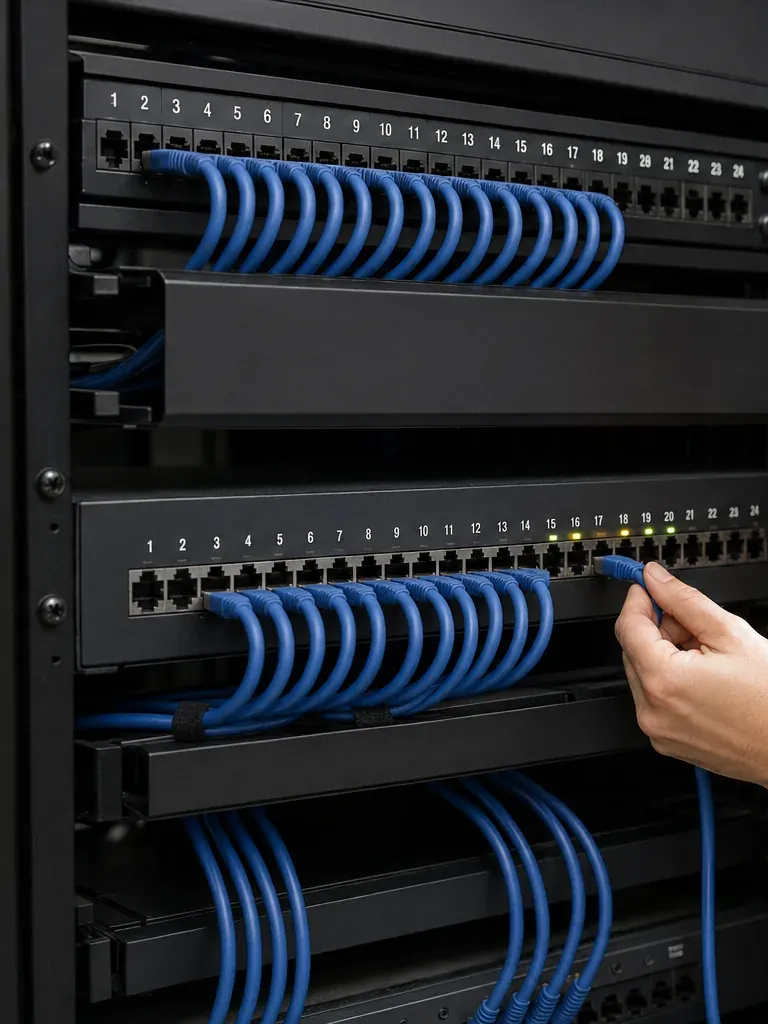
Hand holding a blue patch cord at a lit port on a numbered network switch below a patch panel, Long Island City Queens Cat6 repair
A hand holds a blue patch cord at a port on a black 24-port switch whose ports are numbered along the top; looped blue cords connect it to a patch panel above, with more cords and a cable manager below.
Pricing

Cat6 Repair Cost in Long Island City

Every figure below is already published on one of our Queens pages; the right-hand column says which. Long Island City is billed as part of Queens. A repair invoice has two kinds of line — time spent finding and fixing, and any new cable — and in lofts a third: pathway work, which is quoted item by item because it depends on the building.

ItemPriceScope and source
Technician time on Cat6 or Cat6A — testing, toning out, finding the fault, new ends, re-hanging supports and the closing test$195/hr, 3-hour minimum ($585)Same hourly figure our Queens borough pages publish; after the first three hours you pay only for the time actually spent
Fresh cable pulled where the old run is beyond recoveryFrom $175 per dropFigure from our Queens network cable repair page, where it already includes the cable, the outlet and its plate, the punch-down at the panel, a test, two labels and a patch cord
Where a run leaves the building for a dock camera, yard or roof: hole sealed, bonded and finishedFrom $194 per penetrationAs published on our Queens Cat6 repair page
Extra supports, stud grommets, raceway, firestopping, slab scanning and coringQuoted with the repairItemised on your written estimate; none of it starts until you sign off
Scale check only: installing one new Cat6 outlet with up to 100 feet of cable$272 per dropFrom our Queens Cat6 installation table, where Cat5e is $233 and Cat6A $388 per drop
National guide, for context$125 to $250 a drop, with labour at $45 to $75 an hourFixr cost guide (January 2025 update); nationwide averages for installing, which say nothing about repair in a New York loft

Where the $585 minimum goes on a loft visit

The minimum is a block of a licensed technician's time with certification gear on site, not a charge for a single fix. In a Long Island City office it typically covers certifying the reported links and their neighbours on the same hooks, locating the faults, re-terminating where the fault is at the end, re-hanging or adding supports along a short stretch of ceiling and re-certifying. On a residential tower visit it usually covers tracing and testing every jack in the unit and sorting out the media enclosure. Replacement runs, conduit pulls and anything involving the slab are written up and priced before they start.

What makes a Long Island City repair cost more or less

  • Height and reach: a twelve- to fourteen-foot open ceiling takes longer to work along than a hung ceiling at nine feet, and very high areas may need a lift.
  • How crowded the hooks are: tracing one live run among several tenants' dead ones takes time; removing the dead ones once makes every later repair quicker.
  • Conduit fill: a lightly filled pipe lets us swap a cable in minutes; a packed one means a new pathway.
  • Concrete: reusing a sleeve is cheap; a new core hole brings scanning, coring and firestop with it.
  • Building process: freight bookings, after-hours rules and escort requirements can shape how much can be done in one visit.

On area pricing. Our hourly rate is the same $195 across New York, and the replacement run is the same $175 figure published for Queens; we do not add a separate Long Island City surcharge. The outside-entry figure is the Queens number already on our borough page.

Full terms — including 50% deposit, one-year parts-only warranty on AESS-supplied products, and the late-fee schedule — are set out in the service agreement.

Shop Our Systems

Cat6 Repair Packages & Pricing

Most jobs we see in Long Island City lofts and towers land in one of three bands. Nothing here is a new price; it is the table above, bundled the way the work is usually booked.

Starter — One Failing Link

$585

Three hours at $195. We certify the link that is causing trouble — a desk, an edit bay, an access point, a camera, an apartment jack — find whether the cause is the termination, the cord or a damaged span, fix it and re-certify. Spare time goes on whatever else you want checked, often the neighbouring runs on the same hooks.

Standard — A Floor or a Suite

$195/hr after the first 3 hours

Every link in the suite certified and labelled, failed terminations remade, overloaded hooks relieved and supports added, dead cable taken down where reachable, and a written list of any runs to replace. Time is estimated in writing after the first round of tests.

Premium — Repair Plus New Runs and Pathway

Repair time + from $175 per run

For lofts where some runs are beyond saving: hourly repair for what can be recovered, replacement runs from $175 per drop on new or reworked supports, single-cable conduit replacements, grommets at every stud crossing, firestop at floor crossings, and an updated port map.

Bring Your Own Parts — Labour Only

If your IT provider shipped panels and jacks, or the landlord left a box of hooks and keystones, we will install them and charge labour only, as long as they match the link's category, use solid-copper conductors and, for exposed ceilings, carry a suitable rating. Their makers warrant them, not us, and if testing says they will not pass, we tell you before they go in.

Get the Loft Repaired Before the Next Tenant Adds More Cable

The cheapest moment to fix overloaded hooks and dead runs is before somebody hangs another bundle on them. Call us, book a visit, and we will certify what you have and tell you what it needs.

Reading the Ceiling

What We Look For on an Open Long Island City Ceiling

When a building has no ceiling tiles, the whole pathway is in view, and a trained eye can read a lot about a failing link before the tester is even unpacked. This is the walk a technician does along an exposed run in a Long Island City loft once the fault has been placed by distance.

Spacing between supports

We pace the run and note every support. Gaps longer than the five-foot maximum in the pathway standard show up as sag: a loop of cable drooping between hooks, sometimes resting on a sprinkler branch, a duct seam or the flange of a steel beam. Where the sagging cable touches something hard, the jacket wears, and where it hangs heavy, the pairs at the next hook take the strain. These spots get extra supports even when the cable on them still passes.

Fill in each hook

An overloaded hook is easy to spot: cables spilling over the lip, cables wedged in so tight they cannot be lifted, or a single hook carrying two bundles that clearly came from different tenants. We count, compare to the hook's rating and plan to split the load across new supports, taking off any cable that is no longer used.

Bends at beams and columns

Old factory ceilings are full of edges: beam flanges, column capitals, the lips of concrete drop panels and the corners of steel angle bracing. A run pulled tight around one of these edges takes a sharp bend and a pressure point at the same place. Category cable has a minimum bend radius for a reason; bend it tighter and the geometry of the pairs changes, which is exactly what return-loss and crosstalk tests detect. Easing the bend with an extra support or a short detour is often enough.

Neighbouring trades

Open ceilings are shared space. We look for new sprinkler heads and branches, recently moved ducts, fresh conduit from an electrician, new light fixtures on chains and lift tyre marks on the floor below. Damage almost always lines up with the newest work in the ceiling, which also helps when a landlord or contractor asks who caused it.

Paint, coatings and water marks

Overspray on the jackets, paint in the open faces of jacks, sealant or fireproofing on bundles near the slab, and tide marks on the walls of ground-floor or cellar rooms. Each one tells us which links to test with extra care and whether a termination or a run needs replacing rather than cleaning.

What the cable says about itself

The printing on the jacket tells us the category, the fire rating and often the maker and the date. Mixed categories on one link, uncertified bargain cable, and riser-rated cable used where something else was specified all show up on the jacket before they show up on the tester. Where the print does not match the plate, we say so in the report.

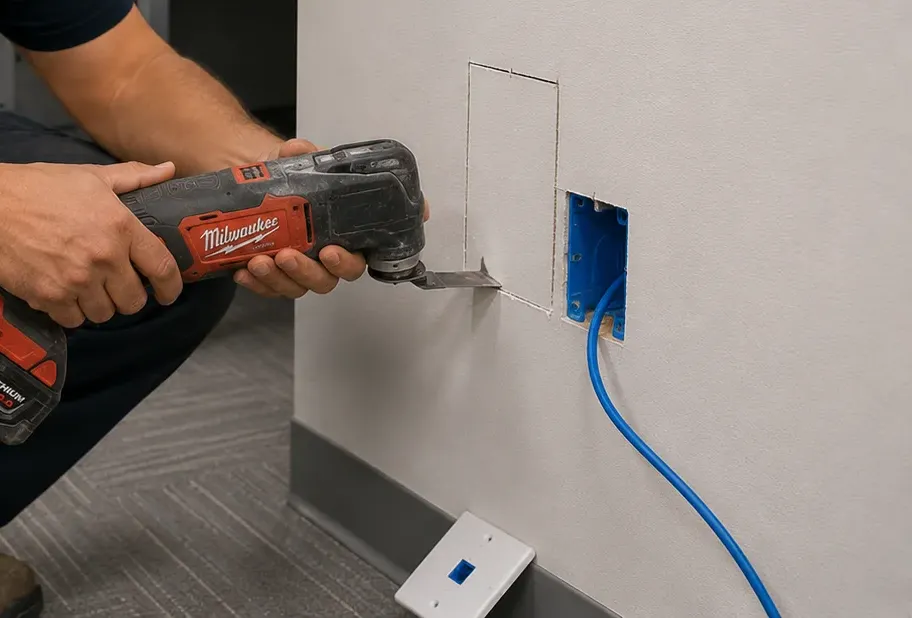
Hands cutting a rectangle in drywall with an oscillating multi-tool beside a blue low-voltage box with a blue cable leaving it, Long Island City Queens partition Cat6 repair
A cordless oscillating saw with a red battery cuts the outline of a small access panel in light grey board; beside the cut, a blue electrical box trails a blue cable to the floor, where a loose faceplate rests on carpet.
Street by Street

How Cat6 Fails Across Long Island City

Long Island City is small on a map but changes every few blocks. The same failing link means different things in each part of it.

Hunters Point and the waterfront

Towers along Center Boulevard, the Hunters Point South buildings and the older blocks of Vernon Boulevard and 47th and 48th Avenues. In the towers, most calls are about in-unit jacks and media enclosures, ground-floor shop and restaurant links, and amenity-room cameras. On the older blocks, it is shops and offices on low ground. Sandy showed what water can do here, so a ground-floor or cellar network closet gets checked for corrosion at the terminations and the lowest jacks get raised when they are repaired.

Court Square and Jackson Avenue

Office towers, the courthouse blocks and a run of conversions and new residential buildings. Suites with hung ceilings, frequent furniture and team moves, and building managers with firm rules. Repairs here are the most like Manhattan's, and the work that saves the most time is often the paperwork done before the visit.

Queens Plaza and the bridge blocks

A busy transit node with new towers around older commercial buildings and constant construction nearby. Expect Cat6 in mixed buildings where shops on the ground floor run long cables to cellar closets, and damage from other trades working in occupied space. Firestop at floor crossings matters a lot in these taller buildings.

The Degnon blocks: Thomson Avenue, Skillman Avenue, 47th Avenue

The heart of the old terminal district, around LaGuardia Community College and the big concrete lofts. Exposed ceilings, steel conduit on columns, and floor plates wide enough that horizontal runs are long. This is where overloaded hooks, packed conduit and slab crossings make up most of the work.

Northern Boulevard

The SMP Building and the former auto and industrial buildings along the boulevard, now creative offices, flex space and light industry. Shared shells with tenant-built partitions, so metal-stud damage and inherited cable are common, along with links between a tenant's suite and a building-wide closet that someone else manages.

Dutch Kills and the Industrial Business Zone

Low brick and block buildings, active industry, distribution and trades along the creek and the rail lines. Cable is surface-run on masonry and wood, loading-door and yard cameras sit on long runs, and floors can be wet. Surface boxes, protective raceway and outdoor-rated cable where it leaves the building are standard parts of a repair.

Ravenswood, Queensbridge and the northern edge

Residential blocks, Queensbridge Houses, the power-plant waterfront and workshops along Vernon Boulevard and 21st Street. Calls range from apartment jacks to small businesses in older buildings, and the work is usually at a termination or a short run rather than a whole pathway.

After the Repair

Keeping an Exposed Cat6 Pathway Healthy After It Is Fixed

A repaired link on an open ceiling only stays repaired if the pathway around it stays in good shape. These habits save Long Island City tenants and landlords the most repeat visits.

  • Add a hook when you add a cable. Whoever pulls the next run should add supports rather than load the existing ones. If the hooks are already at their rated fill, a new pathway beside them is the answer.
  • Take dead cable down. When a run is retired, cut it back and remove it from the hooks, or tag it clearly if it is being kept for future use. Every dead cable makes the next trace slower and the next hook heavier.
  • Brief the painters. If the ceiling is going to be sprayed, ask the painting contractor to mask jacks, panels and cable bundles, or schedule the network work afterwards. Masking costs very little compared with replacing runs.
  • Tell other trades where the cable is. Sprinkler fitters, HVAC crews and electricians working on the same ceiling should know which bundles are live. A simple marked-up floor plan taped inside the network closet helps.
  • Keep powered bundles loose. As cameras, access points and readers are added, do not keep packing the same bundle. Split powered runs across pathways, especially near the roof.
  • Protect the bottom of the building. In Hunters Point and near the creek, keep closet equipment and terminations off the floor, and look at the cellar or ground-floor closet after any heavy rain.
  • Keep the results. The saved certification results from the repair are your baseline. When something fails again, comparing a new test to the old one shows immediately whether the cable has changed.
Complete Services

Every Cat6 Repair Service in Long Island City

A failing Cat6 link is often the start of a bigger conversation about the building's network. These are the related services Long Island City customers most often book alongside a repair.

Cat6 Repair Across Queens

Our borough page for Cat6 repair, covering kitchens, basements, rowhouses and towers from Astoria to the Rockaways.

Queens Network Cable Repair

For Cat5e, unidentified cable and faults in shared risers that are not Category 6 at all.

AESS Cat6 Installation in Queens

When a growing team takes over the neighbouring bay, or a bench needs extra ports, new runs are an installation job rather than a repair.

Structured Cabling Installation

Re-planning a whole loft's pathways, closets and patch fields so the next tenant inherits something tidy.

Fiber Optic Installation in Long Island City

Backbones between floors and buildings where copper runs are too long or too exposed.

Low-Voltage Installation

Supports, raceway and low-voltage wiring for the systems that share a loft's ceiling.

Security Camera Repair

Cameras on loading doors, lobbies and roofs that drop out because of the cable feeding them, or for other reasons.

Commercial Camera Systems

New or expanded camera coverage for lofts, studios and ground-floor businesses.

Field Notes

Field Notes From Under Long Island City's Concrete Ceilings

From Anwar Timothy, licensed low-voltage contractor: The first thing I tell a technician going into a converted loft is to look up before plugging anything in. In a closed building you trust the tester and go straight to the end of the cable. In a loft the tester gives you a distance, and then you count hooks. More often than not, the number lands on a support that has been asked to carry too much, a bend round a beam that someone pulled tight to save a few feet, or a spot where a lift or another trade has been working. Fix the cable there and leave the hook as it was, and you will be back.

The second thing is to be honest about the old cable. In buildings that have had several tenants, there can be more dead cable on the ceiling than live. Nobody enjoys paying to remove somebody else's leftovers, but it is the thing that makes every future repair cheaper and the ceiling safer to work on, and the code expects accessible abandoned cable to come out. I would rather explain that at the start than leave a ceiling that will cost the next person twice as much.

And the third: in a neighbourhood that changes as fast as this one, write everything down. Labels at both ends, saved results, a note of what was removed. The person who reads it next might be your own IT provider, a new tenant or us.

FAQ

Long Island City Cat6 Repair FAQ

Our building only lets contractors use the freight elevator by reservation — who books it?
+

Usually you do, because the booking has to come from a tenant, but we tell you exactly what to ask for. When the visit is scheduled we give you the arrival window, how long we expect to need the elevator and the loading entrance, and roughly how much equipment is coming up, such as a ladder, a tester case and a few boxes of cable. If the building requires a certificate of insurance before the booking is confirmed, we send it to the managing agent the same day. If the freight car is only available at set hours, we plan the visit around those hours rather than the other way round.

Do you also cover Sunnyside, Astoria and Woodside, next door to Long Island City?
+

Yes. The same Queens team and the same Queens number cover Sunnyside, Sunnyside Gardens, Woodside, Astoria, Ditmars, Steinway and Maspeth, as well as Hunters Point, Court Square, Queens Plaza, Dutch Kills, Ravenswood and Blissville. Prices are the same Queens figures across all of them. If your business has sites in more than one of these neighbourhoods, tell us when you book and we will try to schedule them back to back.

Can the replacement cable on an exposed ceiling be a colour that blends in?
+

Often, yes. Category cable is made in a range of jacket colours, and on an open ceiling we can usually match the existing runs or choose black or white to suit the finish, so the repair does not stand out. What we will not do is paint the cable afterwards, because the manufacturers advise against painting it. If the colour you want is not one we carry on the van, we tell you before ordering, and we keep the category, rating and solid-copper conductors the same whatever the colour.

Do you repair Cat6 in live-work lofts and artist studios as well as offices?
+

Yes. Live-work lofts, artists' and makers' studios, photography and post-production spaces and small galleries are all part of how Long Island City's older buildings are used, and the cable in them fails for the same reasons as in an office. We work around equipment, artwork and sets, keep the work area small, and agree with you beforehand where we can put a ladder and what must not be moved or touched.

Do desks and equipment under an exposed-ceiling run have to be cleared before you work overhead?
+

Only directly beneath the stretch we are working on, and we tell you which stretch when we book. We need room for a ladder or a small lift and a little space around it, and we cover anything that cannot be moved. Monitors, keyboards and paperwork right under the work are best moved aside for an hour; whole desks rarely need to move. In occupied offices we can work section by section so most of the floor keeps working while we are there.

Do new supports drilled into our concrete ceiling need the landlord's approval?
+

In most managed buildings, yes, and it is worth asking even where the lease is vague. New hooks are usually fixed with small anchors into the slab, or with clamps onto steel beams, which avoids drilling. Many landlords are content as long as anchors are small and kept clear of anything embedded, while some want to approve locations or use their own engineer's rules. We can provide a short description of the supports and fixings we plan to use for you to send to the building before the visit.

All Areas Served

Cat6 Repair Across Queens, New York City and Beyond

This page reports up to Cat6 repair in Queens, which in turn reports to the NYC Cat6 repair hub. Every other page in the Cat6 repair series is listed below, by region.

Cat6 is one of many systems we look after in western Queens. The AESS home page lists cameras, intercoms and door access, and our about page introduces the licensed people doing the work.

A Dead Court Square or Hunters Point Link Before Monday Morning?

Desks dark after a weekend fit-out, an edit suite cut off from storage, an apartment jack that stopped after the painters left: call (347) 434-6392. You get the first open 2-hour arrival window, and a bad termination, cord or single damaged span is normally fixed within an hour or two of the technician arriving.

Cat6 Repair Long Island City — Licensed, Insured, Tested to Category

Abstract Enterprises Security Systems · 460 E Fordham Rd, Bronx, NY 10458 · serving Long Island City and all of Queens · (347) 434-6392 · WhatsApp (718) 679-0359 via wa.me

NYS Low-Voltage Licence #12000287431 · 100% Licensed & Insured · Same-Day Estimates · Rated 4.7★ from 201 Google Reviews

Customer-supplied jacks, panels and cable are warranted by whoever made them; our warranty page explains what we cover.

This page describes how Cat6 fails and is repaired in the kinds of Long Island City buildings we work in. Mentions of the NYC Electrical Code, the National Electrical Code, cabling and pathway standards, zoning plans and building or fire-alarm procedures are plain-language summaries for orientation, not legal, engineering or fire-safety advice. Page reviewed and updated October 17, 2026. Changelog: Long Island City Cat6 repair page first published.