What are you looking for?
About Us Contact Us Careers Get a Free Quote (800) 486-0943
Pick a service
✅ Got Your Own System?
🎬 Home TheatreQuote 🎶 AV SoundQuote 🔑 Access ControlQuote
Now pick your area
Pick your area
Long Island
Hudson Valley
Services available
Pricing & Tools
Pick a service for pricing
🚪 Intercom Pricing 🔔 Buzzer Repair Pricing
Calculators
📹 Camera System Calculator 🚨 Alarm Calculator ⚡ Cabling Quote Builder ✅ Got Your Own System?
Select your area
Financial District Cat6 Repair · Wall St to the Battery · Towers, Conversions & Old Blocks

Cat6
Repair in the
Financial District

Conversions Next Door · Underfloor Duct · Worn Hot-Desk Jacks · Arcade Shops · Post-Sandy Cellars · Lease Hand-Backs

Below Chambers Street the buildings change faster than the cable inside them. Floors that held one trading firm now hold six small tenants, towers are emptied and rebuilt as apartments a few storeys at a time, and the cellars that flooded in 2012 have been re-plumbed, re-sealed and re-planned. Your Cat6 was pulled for a building that no longer quite exists. We work out which of those changes reached your links, repair what is worth repairing, prove it with a certification test and tell you plainly about the runs that are not worth saving.

Reviewed and updated October 17, 2026 · Written by Anwar Timothy, NYS licence #12000287431 · Financial District line (929) 560-0737

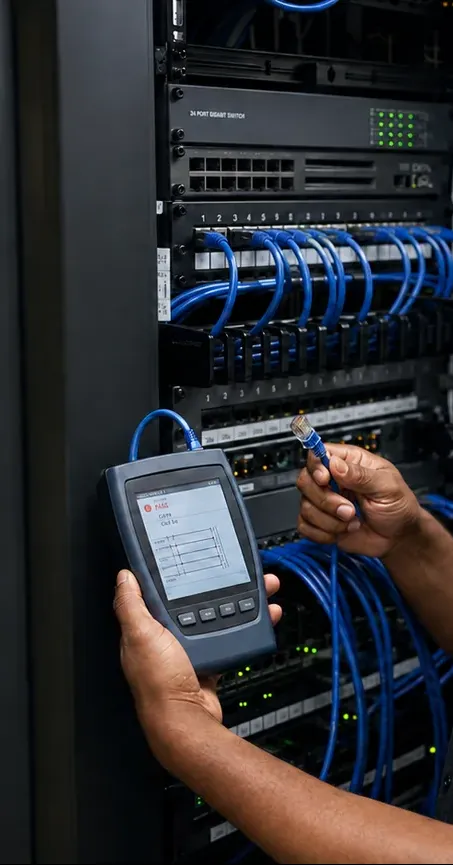
Hands holding a grey cable tester showing a red FAIL result and a wire-map diagram beside a patch panel and gigabit switch — Cat6 repair diagnosis, Financial District, Manhattan
A handheld tester reads FAIL above a wire-map diagram while the other hand holds a blue patch cord at the rack, below a 24-port gigabit switch.
Financial District Cat6 Repair Quote
Tell us the street, the floor and what stopped working — a technician who works downtown calls back the same business day

✅
Request Received
Expect a call from our downtown desk today.
25+
Years Experience
✓
Same-Day Estimates
100%
Licensed & Insured
4.7★
201 Google Reviews

Desks dark since the contractors started upstairs? Call the Financial District line, (929) 560-0737, or use the 60-second form. Tell us what changed in the building recently — a conversion, a re-stack, a new landlord, a flooded room — because that one detail usually narrows the search more than any symptom.

  • We ask what the building has been through before we ask what the screen says, so the first hour on site is spent where the fault probably is
  • Nothing is called fixed until it passes a certification test, and you keep both the PDF and the raw tester data
  • NYS licence #12000287431 · insured · repair time billed by the hour, with any replacement run priced in writing before it is pulled
The Neighborhood

Why Financial District Properties Need Cat6 Repair: The Building Keeps Changing Around the Cable

Most horizontal Cat6 is designed for a fixed world: a closet on each floor, desks in rows, a ceiling that stays shut. The Financial District has not offered that kind of stability for a long time. Since the mid-1990s the neighbourhood has been turning offices into homes in waves. The first wave, under the city's 421-g tax incentive, converted nearly 13 million square feet — about 13 percent of the lower Manhattan office market — between 1995 and 2006, according to the Citizens Budget Commission. The second wave is under way now: Water Street, Broadway and Broad Street all have towers emptying and being rebuilt as apartments while neighbouring floors and neighbouring buildings stay at work.

Every one of those changes touches copper. A conversion two floors up sends dust, vibration and new trades through shared shafts. A landlord who splits a former trading floor into pre-built suites cuts some runs short and re-homes others. A firm that shrinks from three floors to one leaves cable behind in ceilings it no longer controls. And the cellars on the east side of the district, where many buildings kept their main telecom rooms, were reshaped after Hurricane Sandy filled them with brackish water in October 2012. None of this breaks a link in an obvious way. It shows up as a desk that drops at lunchtime, a panel port that passes one day and fails the next, a shop terminal that goes offline in cold weather.

The occupants have changed too. The Downtown Alliance counted more than 70,000 residents in Lower Manhattan for the first time in 2025, alongside 4.75 million square feet of office leasing — the busiest year since 2019 — and 90 new retail openings. That mix matters for a repair: the same tower can hold a law firm on one floor, rental apartments on the next and a restaurant at street level, each with its own cable, its own closet and its own idea of when a contractor may make noise. A repair that ignores the building's history tends to fix the symptom and leave the cause in place.

So our Financial District repairs start with a short conversation about the building rather than the network: what has been built, demolished, flooded, combined or handed back near your space in the last few years. Then we test. Most of the time the answer is a set of terminations to remake and a few cords to replace. Sometimes it is a run that a renovation crew crushed above a ceiling we cannot reach today. Either way you get a certified result for every link we touch and a plain statement of what is left. Firms that are also adding fibre between floors often pair this work with our Financial District fiber optic installation team, since both trades use the same ceilings and the same building approvals.

Financial District facts that shape a Cat6 repair

  • Two conversion waves. 421-g conversions turned 98 office buildings with 12.8 million square feet of commercial space into 12,865 apartments (Citizens Budget Commission). Current projects include 25 Water Street (about 1,300 apartments), 222 Broadway (798 rentals, completion expected May 2027) and 80 Broad Street (326 units filed in January 2026).
  • Older than the standard. Category 6 was added to the TIA-568 standard in June 2002. Many first-wave conversions were wired before it existed, so the cable behind a downtown apartment jack may be an earlier category.
  • The flood of 2012. Days after Sandy, The Real Deal found at least 17.3 million square feet of downtown office space shut with flooded basements in at least 15 east-side buildings, including 55 Water Street, 1 New York Plaza, 2 Broadway and 4 New York Plaza.
  • The carrier side went to glass. Verizon told local officials that 95 percent of the copper infrastructure feeding back to its Broad Street office had been destroyed, and chose to replace it with fibre (amNY, January 2013). The copper inside your suite was not part of that replacement.
  • Vacancy and re-letting. Overall Lower Manhattan vacancy was 22.2 percent at the end of 2025 (Downtown Alliance), down for eight straight quarters — which means many floors are being re-let, re-divided and re-cabled at once.
  • Protection still years away. The Financial District and Seaport coastal resilience plan released in 2021 is estimated at $5–7 billion and 15–20 years, and its funding had not been secured as of late 2025.
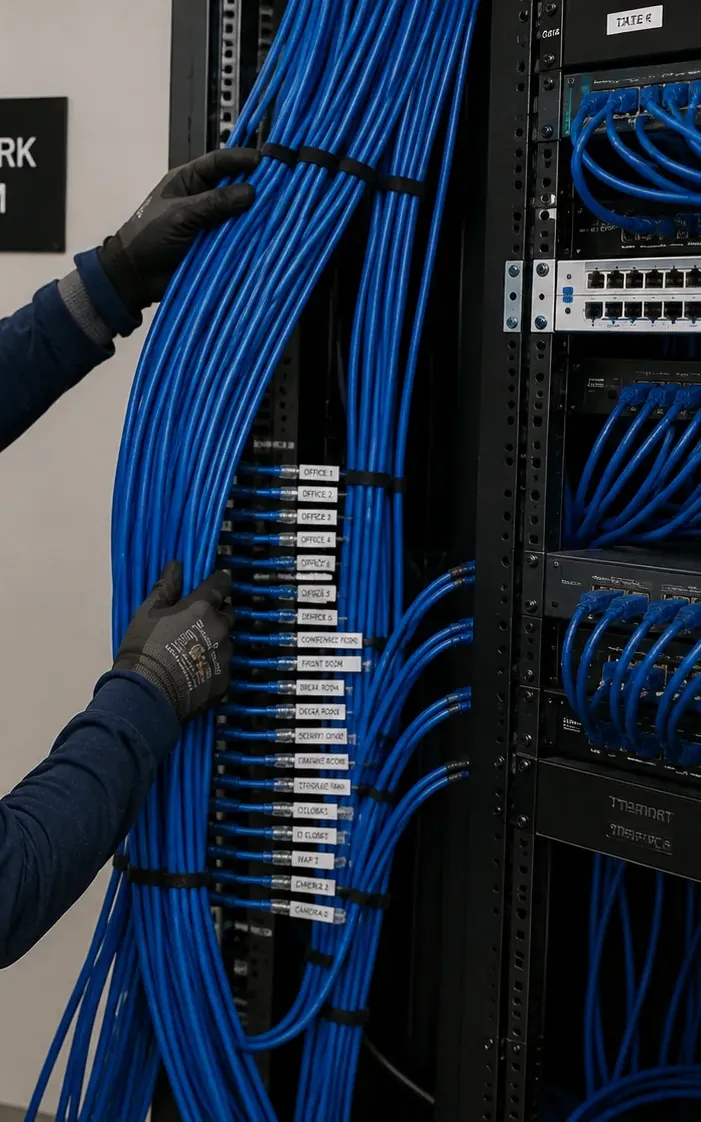
Gloved hands dressing a large bundle of labelled blue Cat6 cables into a network rack — Cat6 repair in the Financial District, Manhattan
Gloved hands work a dense bundle of blue cables, each with a white label, into the side of a rack beside a partly visible Network Room sign.

Cat6 Link Down Somewhere Between Fulton Street and the Battery?

If a desk, a register, a camera or a whole row of ports went dark this morning, ring (929) 560-0737. Most single-link faults downtown are terminations or cords and are fixed within one to two hours of arrival; we tell you on the phone whether yours sounds like one of those or like a damaged run that needs a second visit and a building approval.

What We Install

Cat6 Repair Services in the Financial District

Each service below grew out of a pattern we keep meeting south of Chambers Street. They can be booked alone or combined into one visit.

🏗

Conversion-Adjacent Link Recovery

For tenants staying put while floors above or below are gutted for apartments. We test the links that share shafts and ceilings with the work, clean and remake contaminated terminations, and protect what is left until the demolition moves on.

🧱

Underfloor Duct Outlet Repair

Post-war towers along Water Street and the plazas often feed desks from ducts cast into the floor. We service the outlets, re-terminate at the fittings and replace runs through the duct where the cell is clear.

🪑

Hot-Desk and Shared-Desk Jacks

Desks that are plugged and unplugged by different people every day wear their jacks and cords faster than assigned desks. We replace worn jacks with parts made to the plating standard and fit cords that survive daily handling.

🛍

Arcade and Street-Level Shop Links

Shops built into enclosed former arcades and plazas reach the tower's closets through routes that were added later. We find those routes, repair the weak points and certify the run end to end.

📦

Lease Hand-Back Cable Work

When floors go back to the landlord, the lease decides what stays. We test what you are leaving, label it as working or abandoned, remove what the lease requires and document both.

🪜

Two-Floor Tenant Links

Firms on stacked floors joined by an internal stair often run Cat6 between them outside the building riser. We test those links, correct the cable type where it crosses the slab and restore the firestopping.

🌊

Cellar and Water-History Checks

Links that pass through rooms flooded in 2012, or wet since, can corrode slowly. We open the terminations, look for the green and white residue that brackish water leaves, and cut back to clean copper.

🏛

Old-Block and Designated-Interior Work

Stone Street lofts, Greek Revival counting houses and protected banking halls take repairs that leave no new marks. We work from existing paths and surface-free routes, and flag anything that would need Landmarks review.

📋

Certification and Hand-Over Records

Every link we repair is tested against its category limit. You receive a PDF summary, the tester's native files for your IT team and a port map that matches the labels on the wall and the panel.

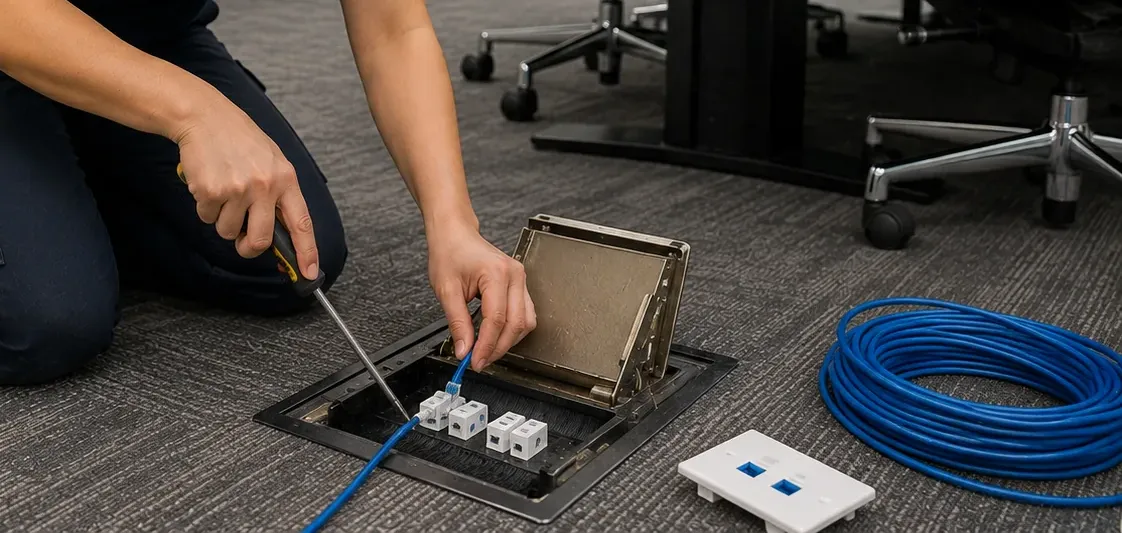
Open floor box set into office carpet with three white keystone jacks being worked with a screwdriver — Cat6 floor outlet repair, Financial District, Manhattan
An open floor box in carpet holds three white keystone jacks; a hand works one with a screwdriver beside a coil of blue cable and a loose wall plate.
Building Specialists

Cat6 Repair for the Financial District's Architecture

Few neighbourhoods pack so many building eras into so few blocks. The same Cat6 fault — a split pair, a crushed jacket, a corroded contact — is reached and repaired differently in each.

Counting Houses and Dry-Goods Lofts

After the Great Fire of December 1835, more than 600 buildings went up in the First Ward in 1836, including the four-storey Greek Revival stores that still line Stone Street. Cable here runs in surface raceway, old chases and timber floors. Repairs follow existing paths; new openings are a last resort.

Bank and Exchange Buildings

Granite and marble halls such as 55 Wall Street, built as the Merchants' Exchange from 1836 and enlarged for National City Bank from 1907 to 1910, now hold event spaces and apartments. Cable reaches their great rooms through floors, plinths and service spaces, not through decorative walls.

Setback Towers of the 1920s and 1930s

Masonry-clad steel towers like 80 Broad Street (1935, 37 storeys) have small floor plates, deep cores and narrow ceiling voids crowded with pipe. Fault-finding relies on distance-to-fault readings because there is little room to open things up speculatively.

Post-War Plaza Towers

Big-floor towers along Water Street and around the plazas were built with ducts in the floor and arcades at the base. Their Cat6 often reaches desks from below, and their ground floors have been re-planned since the 2016 Water Street zoning change.

First-Wave Conversions

Apartment buildings created from offices between 1995 and 2006 under 421-g. Many were wired before Category 6 was published in 2002, and their in-unit cabling was often fitted around office-era shafts that were never meant to serve kitchens and bedrooms.

Conversions Under Way

25 Water Street, 222 Broadway and the filing for 80 Broad Street show the current wave. Until a building is fully residential, offices and construction share it, and tenants who stay have to live with the dust, the shutdowns and the new trades.

Mixed Towers With Shops at the Base

Restaurants on Stone Street and Pearl Street, banks on Broad Street and shops in former arcades all hang from towers whose closets were planned for offices. Their Cat6 crosses kitchens, vestibules and lobbies that were never in the original cable plan.

How each downtown building type changes the repair

Building typeWhere Cat6 usually runsHow we reach and repair it
1830s lofts and counting housesSurface raceway, old chases, under timber floors, along cellar joistsRe-terminate in place where the cable is sound; replace inside existing raceway; no new channels cut into old masonry without the owner's written approval
Bank and exchange buildingsService floors, plinths, cellar routes, behind panelling installed for the purposeRepairs made from service spaces; surfaces in protected rooms are not opened; any change that would need Landmarks review is identified before work starts
1920s–30s setback towersTight ceiling voids, core closets, occasional floor boxesDistance-to-fault testing first so openings are targeted; riser-rated cable where a run changes floors
Post-war plaza towersUnderfloor duct cells and header ducts; ceiling zones on re-fitted floorsOutlet fittings serviced from above the floor; runs replaced through clear cells; power compartments left alone
First-wave conversionsIn-unit chases, closet panels, office-era risersIdentify the cable category printed on the jacket before promising a speed; repair or replace per unit without entering neighbours' apartments
Towers mid-conversionShared shafts, ceilings beneath demolition floorsProtect closets and open ports; clean and remake contaminated terminations; schedule around the general contractor's shutdowns
Street-level shopsFormer arcade soffits, cellar crossings, behind counters and in kitchensTrace the route to the tower closet; move terminations out of wet and hot zones; certify the full length
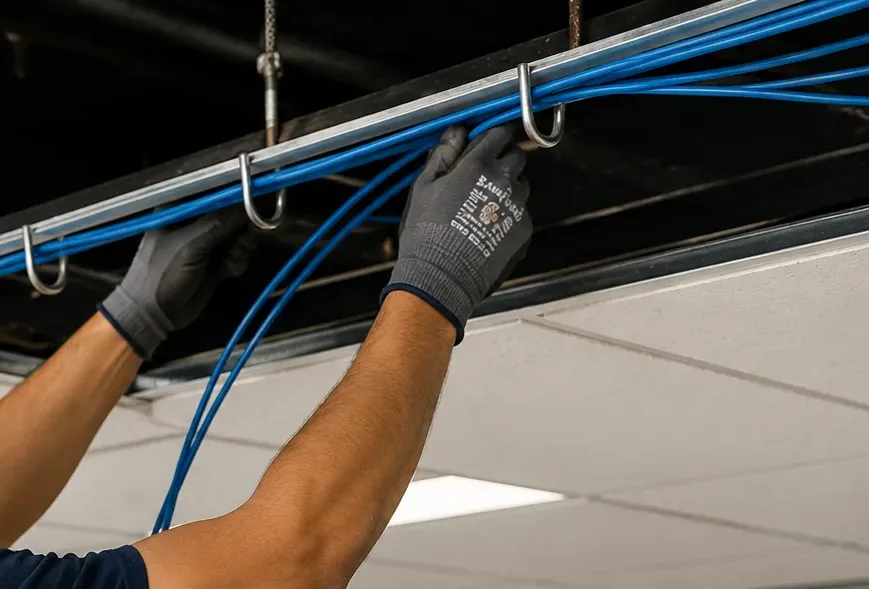
Gloved hands laying blue Cat6 cables into J-hooks hung above an open suspended ceiling grid — replacement run in the Financial District, Manhattan
Blue Cat6 is being laid, a few cables at a time, into hooks suspended over the open grid of a drop ceiling; only gloved hands are in frame.
Commercial Cat6 Repair

Business Cat6 Repair in the Financial District

The district is small enough to walk end to end in twenty minutes, but its streets behave like separate markets. These are the corridors we work in most, and what tends to fail on each.

Wall Street and Broad Street

Exchange-era banks, law and advisory firms and the residential floors now stacked above them. Many sit in the Wall Street Historic District on the National Register, which 55 Wall Street joined as a contributing building in 2007. Cable faults here are mostly in older suites re-let several times, where each tenant added a layer and nobody removed the last one.

Water Street and Old Slip

Post-war towers with big floor plates, underfloor ducts and the plazas and arcades that the 2016 zoning change opened to retail. Several of these towers took water in their cellars in 2012. Typical calls: desk outlets in the floor, shops in enclosed arcades, links through rebuilt cellar rooms.

Maiden Lane, William Street and John Street

Mid-size pre-war and mid-century office buildings, many now split into small suites for smaller firms. Short leases mean frequent move-outs and pre-built suites, so we meet a lot of half-documented cable and worn jacks.

Pearl Street, Hanover Square and Stone Street

The oldest street pattern in the city, with restaurants filling the restored ground floors. Stone Street's eastern blocks go pedestrian in summer for outdoor dining. Point-of-sale and kitchen-screen links fail here from grease, heat and mop water as much as from age.

Broadway, Fulton Street and Trinity Place

Large office buildings on the west side of the district, some mid-conversion: 222 Broadway is being turned into 798 rentals with 40,000 square feet of commercial space. Tenants nearby ask about dust, shutdowns and links that cross into floors under construction.

Whitehall, South Ferry and the Battery

Towers at the southern tip such as 1 and 4 New York Plaza and 2 Broadway, all named in the post-Sandy flooding survey, plus ferry-side retail. Cellar and ground-floor links get the closest look for water history.

Compliance callouts for Cat6 repair downtown

Permits. NYC Administrative Code §28-105.4.7 says an electrical permit is not required for installing, altering, maintaining or repairing wiring that operates at under 50 volts for signalling, communication, alarm and data circuits, provided the work is done by a licensed master electrician, special electrician or qualified person as the electrical code defines them. Ordinary Cat6 repair falls in that category; work on life-safety systems does not.
Abandoned cable. The electrical code's communications article requires the accessible portions of abandoned cable to be removed, and allows cable to remain where it is tagged for future use. The current NYC Electrical Code, based on the 2020 NEC with city amendments, took full effect on December 21, 2025. We tag or remove; we do not simply cut and leave.
Designated interiors. The Landmarks Preservation Commission does not require a permit for ordinary repairs, but interior work needs one where it requires a Buildings permit, affects the exterior or takes place in a designated interior landmark — as the former banking hall at 55 Wall Street has been since 1999.
Firestopping and floor crossings. Where a replacement run passes between floors, through a rated wall or into a shaft, the penetration is sealed again with a listed system and photographed before it is covered. On two-floor tenancies we check that cable crossing the slab is rated for that use.
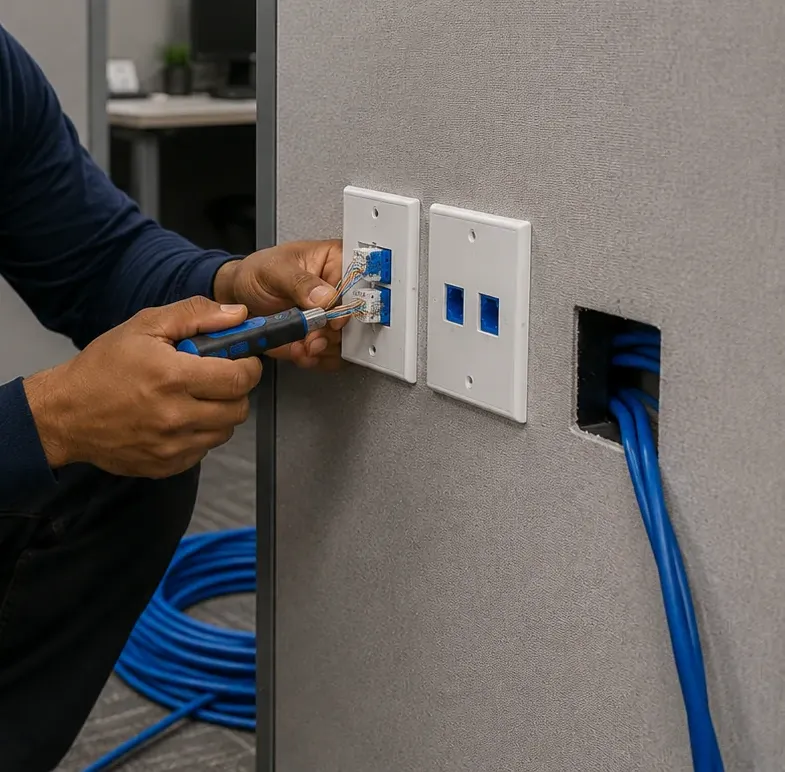
Hands re-terminating a jack at a two-port wall plate on a grey office partition, blue cable entering a cut opening — Cat6 repair, Financial District, Manhattan
A technician’s hands work at a two-port plate on a grey partition; a second plate sits beside it and blue cable runs down into a rectangular opening.
After the Water

Downtown Cellars Since 2012: What Sandy Left in the Copper

On the night of October 29, 2012 the storm surge came over the east side of the district and down into the cellars. At Verizon's 140 West Street building, reporters saw the surge had "breached the protective plugs" around incoming cables and flooded the basement cable vault, with three and a half floors of the five-level basement still under brackish water days later. Under Pearl Street, crews were pumping out two levels of tunnels where communications lines had flooded. The Real Deal's survey on November 1 found at least 15 east-side office buildings closed with water in their basements and sub-basements.

The carriers' response is well documented. Verizon reported that 95 percent of the copper cable feeding back to its Broad Street office — hubs, manholes, conduits and building connection points — had been destroyed, and decided to replace it with fibre. Its 104 Broad Street office came back in ten days. That rebuild stopped at the building's front door. The Cat6 inside office suites, shops and cellar rooms was the owners' and tenants' problem, and much of it was dried, tested for continuity and put back into service.

Continuity is a low bar. A pair can carry a link light and still have contacts that are slowly corroding where salt and silt dried inside the plug or the jack. We see the result years later as links that pass in the morning and fail in the humid afternoon, or that drop when someone touches the cord. When a downtown link with a cellar route keeps misbehaving, we open the terminations rather than trusting the test, look for the green and white residue that brackish water leaves on copper and on the plating, and cut back until the conductors are bright.

Many buildings also re-planned their cellars after the storm: equipment raised, rooms sealed, flood barriers stored on site. Each of those projects moved or re-routed some Cat6, and the records of what moved did not always reach the tenants. If your link passes through a cellar, tell us when the room was last rebuilt. We will test the run, check where it crosses any new seals, and leave those seals as tight as we found them. The city's long-term protection for the district — the 2021 Financial District and Seaport plan with buried walls and deployable gates — is still unfunded and years from completion, so the cellar remains part of the cable route to plan around.

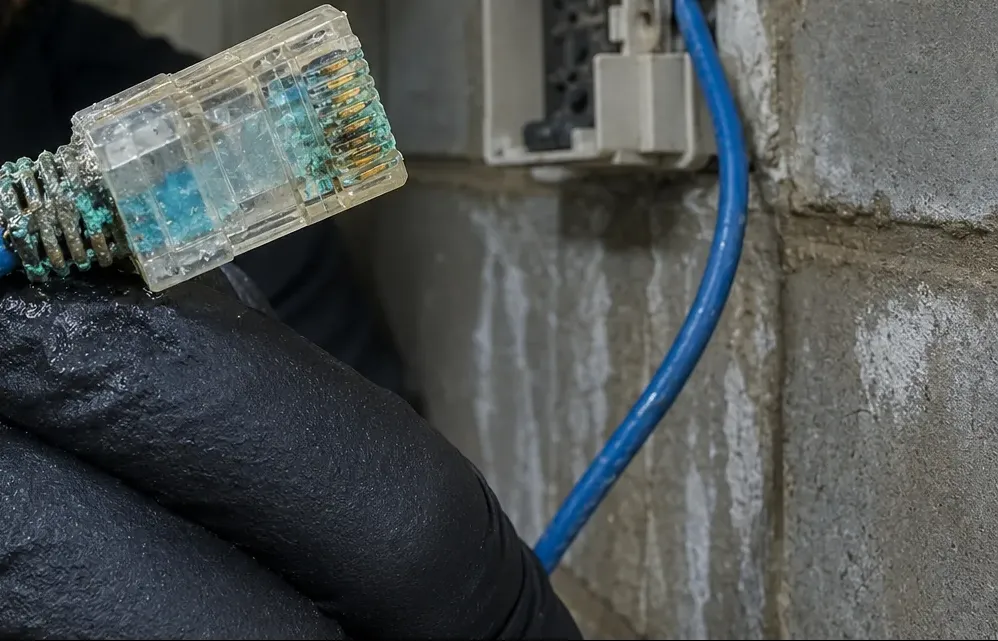
RJ45 plug with green corrosion on its contacts and boot held in a black glove beside a box on a stained concrete block wall — Cat6 water damage, Financial District, Manhattan
A gloved hand holds a clear RJ45 plug with green and white crust on the contacts and boot; behind it, blue cable leaves an opened box on a block wall streaked with white residue.
Your Questions Answered

Cat6 Repair in the Financial District: Questions Answered

These are the questions downtown tenants, owners and building staff bring us that are specific to how the district's buildings are made and how they are changing. General repair questions are answered on our Manhattan Cat6 repair page.

Floors that keep changing hands

Why do the Cat6 runs in our post-war tower's underfloor duct keep failing right at the floor outlets?

Because the outlet is where the cable is handled most and protected least. In a cellular underfloor system the cable travels along a steel cell cast into the floor, turns up through a fitting and ends in a box at carpet level. Manufacturers' descriptions show why it is crowded down there: a typical header duct has four compartments — one for power, two for voice, one for data — and the cells themselves carry power alongside communications. Over decades of furniture moves, fittings are opened, closed, abandoned and re-used. The Cat6 gets pinched under a lid, pulled tight around the sharp edge of an old insert, or re-terminated so many times that there is no slack left to make a clean jack.

Our repair starts above the floor. We test each failing link, read the distance to the fault, and if it sits within the first metre or two of the outlet — as it usually does — we open only that fitting. A damaged tail is cut back, the jack is remade with the pair twist held to the termination, the cable is dressed so the lid cannot bite it and the link is certified. When the damage is further along the cell, we check whether the cell is clear enough to pull a replacement through. We never share a power compartment, and if the only route is through one, we say so and offer a ceiling or surface alternative.

Our building is being converted to apartments — is any of the office Cat6 worth repairing for the new units?

Usually very little of the cable, and quite a lot of the pathway. Office Cat6 runs from desks to a closet on the same floor in a layout that matches open-plan rows, not bedrooms and kitchens. Once walls move, most of those runs end in the wrong place, at the wrong length and in a closet that will become part of somebody's apartment. Repairing them to certification standard and then abandoning them a few months later is money spent twice.

What is often worth keeping is the route: sleeves through the core, cable tray in corridors that will remain corridors, and conduit from the cellar to upper floors. We can survey an office floor before demolition, mark which Cat6 runs could plausibly serve a common area, an amenity room or a management office in the new layout, test only those, and recommend removing the rest so it does not end up as abandoned cable behind new drywall. For apartments themselves, the developer's own residential cabling design usually wins — each unit with its own panel — and we would rather tell you that than sell you a repair.

Demolition started on the floors above us and our patch panel now throws intermittent errors — can dust and vibration do that?

Yes, though usually by making an existing weakness visible rather than creating a new one. RJ45 contacts rely on a thin gold surface meeting gold. The connectivity standards call for at least 50 micro-inches of hard gold over a nickel barrier, and a jack built to them is rated for hundreds or thousands of matings. Fine gypsum and concrete dust settling into open ports and on plug contacts adds resistance at that interface, and vibration from jack-hammering and coring a few floors away can work a marginal plug back and forth. A port that was barely passing before the conversion started will be the first to complain.

The repair is mostly housekeeping done properly. We test the ports that log errors, replace contaminated cords rather than cleaning them, inspect jack contacts and remake any termination that has loosened, fit dust caps to unused ports and, where the closet door or ceiling has become a dust path, ask the general contractor to seal it. Then we re-certify the affected links so you have a before-and-after record. If construction damaged cable directly — a cut, a crushed bundle — that record is what the building and its contractor will want to see.

Our firm has two floors joined by an internal staircase — can the Cat6 between them go through the stair opening instead of the building riser?

Sometimes, and it is often how the original fit-out did it. Tenants who take two stacked floors downtown commonly cut a convenience stair between them, and their fit-out contractor may have run Cat6 through the same floor opening or a sleeve beside it rather than asking the landlord for riser space. That is fine as long as two things are true: the cable is listed for running between floors, and the penetration around it is properly firestopped. Office-grade cable lying loose along a stair stringer meets neither condition.

When those links fail, we test them first; often the fault is at a termination in the upper or lower closet, not in the crossing. If the run itself needs replacing, we put in riser-rated cable through a sleeve, seal the sleeve with a listed firestop system and photograph it. If the building engineer prefers the work to move into the riser, we can do that instead, with the building's approval. Either way the result is recorded so the next person does not have to guess which route your inter-floor links take.

Desks, shops and how they are used

Our hot desks are plugged and unplugged all day — can that wear out a Cat6 jack?

It can, and much faster when the jack was cheap. The international connector standard rates RJ45 parts for 750 mating cycles at one performance level and 2,500 at a higher one, with only a small rise in contact resistance allowed. On a shared desk where three or four people dock a laptop each day, a jack can see a thousand matings in a year or two. A trade association that tests connectors reports that poorly plated parts can lose their gold after as few as 10 to 15 insertions. Floors that were fitted out quickly with unbranded keystones are where we see this most.

The signs are links that work only when the cord is held at a certain angle, intermittent drops when someone bumps the desk, and ports that test fine with a new cord but fail with the one that lives there. We replace worn jacks with parts made to the plating standard, swap docking cords for factory-made ones of the right length so they are not strained, and add strain relief where furniture lets the cord hang. On hot-desk floors we also suggest a spare cord in each desk drawer: it costs little and keeps users from forcing a bent plug into a good jack.

Our shop opened in an enclosed former arcade along Water Street — where does its Cat6 run, and why does it give trouble?

The 2016 Water Street zoning change let owners of the street's privately owned public spaces fill in their arcades, mostly to bring in retail, with the larger arcades needing a special permit. A shop built into an arcade sits in space that was outdoors when the tower's closets and risers were designed. Its Cat6 therefore takes whatever route the fit-out contractor could find back to a closet: up into the soffit that used to be the arcade ceiling, across the tower's lobby or cellar, or through a new sleeve in the original exterior wall.

Those routes have predictable weak points. A soffit that was once outside may still be poorly insulated, so the cable sees larger temperature swings than it would indoors. The crossing from the shop into the tower often passes through a wall that was never meant to be penetrated, and its sleeve may not be sealed. And the run may be long enough to approach the length limit once it reaches a closet several floors up. We trace the route with a tone and the tester's length reading, repair the failure point, seal any open sleeve and certify the full link so you know how much margin it has.

Leases, records and older wiring

We are handing back two floors when our lease ends — does the Cat6 we leave behind have to come out?

Two documents decide it: your lease and the electrical code. Many commercial leases include a surrender or restoration clause; one published sample requires removal of "all electronic, fiber, phone and data cabling and related equipment" installed for the tenant, unless the landlord says in writing that it can stay. Others leave cabling in place for the next tenant. Separately, the code's communications article requires the accessible parts of abandoned cable to be removed unless the cable is tagged for future use. If the landlord wants it left, it needs to be identified as such; if not, it needs to come out.

We can help on either path. If the cable stays, we test it, label working links clearly, tag the runs for future use and give the landlord a test summary they can show the next tenant. If it goes, we remove what is accessible above ceilings and from closets, leave plates blanked, and give you photographs and a short written record for the surrender inspection. What we will not do is cut the cable at the panel and leave it in the ceiling, because that leaves the landlord with an abandoned-cable problem and can leave you with a dispute over the security deposit.

Wiring older than the Cat6 standard

Category 6 was ratified as an addition to the TIA-568 standard in June 2002. The first downtown conversion wave ran from 1995 to 2006, so a good share of the apartments it created were wired with whatever was current at the time. Plates in those buildings may say "data" and still be fed by an earlier category, and some were wired for telephone and television only. Before quoting, we read the printing on the cable jacket behind the jack. If it is not Cat6, we tell you what speed the link can realistically carry after repair, and whether a replacement run is the better use of your money.

Designated interiors on Wall Street

A handful of downtown rooms are protected inside as well as out. The former National City Bank banking hall at 55 Wall Street became a New York City interior landmark in 1999 and has operated as an event venue since 2006. Repairs to existing cable in spaces like that are ordinary maintenance, but anything that changes a protected surface — a new opening, a new surface raceway, a new device on a wall — may need Landmarks Preservation Commission approval. We check the designation before quoting and keep repairs to service spaces and existing paths wherever we can.
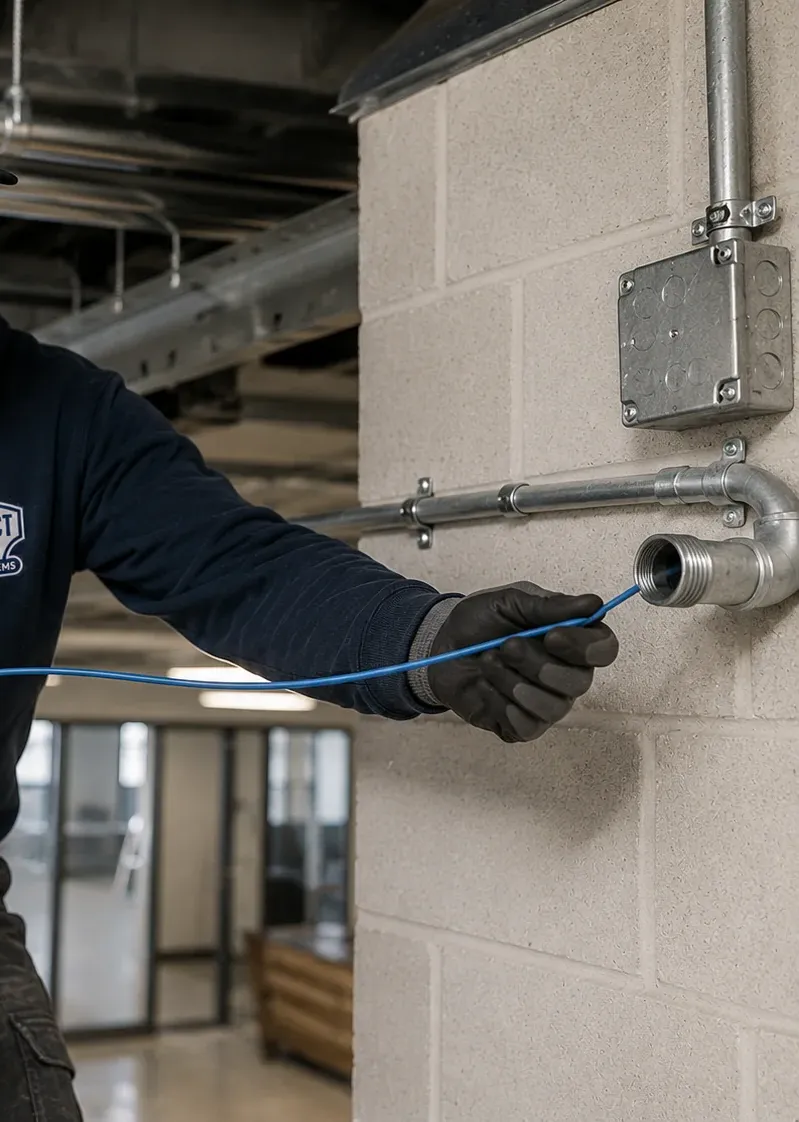
Gloved hand feeding a blue line into a steel conduit elbow on a block wall below a junction box — Cat6 replacement pull, Financial District, Manhattan
Steel conduit climbs a painted block wall to a junction box; at its lower bend a gloved hand pushes a blue line inside, with a glazed office corridor in the background.
Equipment

Types of Cat6 Repair Equipment We Bring Downtown

Downtown buildings limit how long we can keep a ceiling open and how much we can carry through a lobby, so the kit is chosen to find the fault quickly and fix it with parts that match.

📏

Certification Tester

Tests each link against its category limit and reports the distance to the fault, so an underfloor fitting or a soffit is opened only where the problem is.

🔊

Tone Generator and Probe

Follows undocumented runs from an arcade shop or a stair crossing back to the closet without opening every ceiling tile on the way.

🔌

Standard-Plated Jacks and Modules

Keystones and panel modules made to the plating and mating-cycle standards, for desks that are handled all day.

🧵

Factory-Made Cords

Patch and docking cords in several lengths, so worn or contaminated cords are replaced rather than cleaned and returned.

🧰

Riser-Rated and Plenum Cable

The right listing for runs that cross floors at an internal stair, pass through a shaft or travel through an air-handling ceiling.

🧯

Listed Firestop Kit

Sleeves and sealants to close every penetration we open or reuse, photographed before the ceiling goes back.

🧹

Dust Control

Port caps, closet-door seals and protective sheeting for floors that sit below active demolition.

🔍

Inspection Light and Magnifier

For reading the jacket print on old cable and spotting corrosion on contacts in rooms with a water history.

Local licensed repair versus the national alternatives

National marketplaces such as Angi and HomeAdvisor connect you with whoever is free, and cost guides such as Fixr publish national averages. That works for many household jobs. Downtown Cat6 repair is different in three ways that matter. The building wants a certificate of insurance and a named, licensed contractor before anyone touches its ceilings. The fault is often connected to something happening in the building — a conversion, a re-let, a flooded room — that a technician from outside the area has no reason to ask about. And the deliverable is not just a working desk but a certified link and a record the building, the landlord or your IT provider can rely on. We are licensed in New York State, insured, and we price every repair from figures we publish.

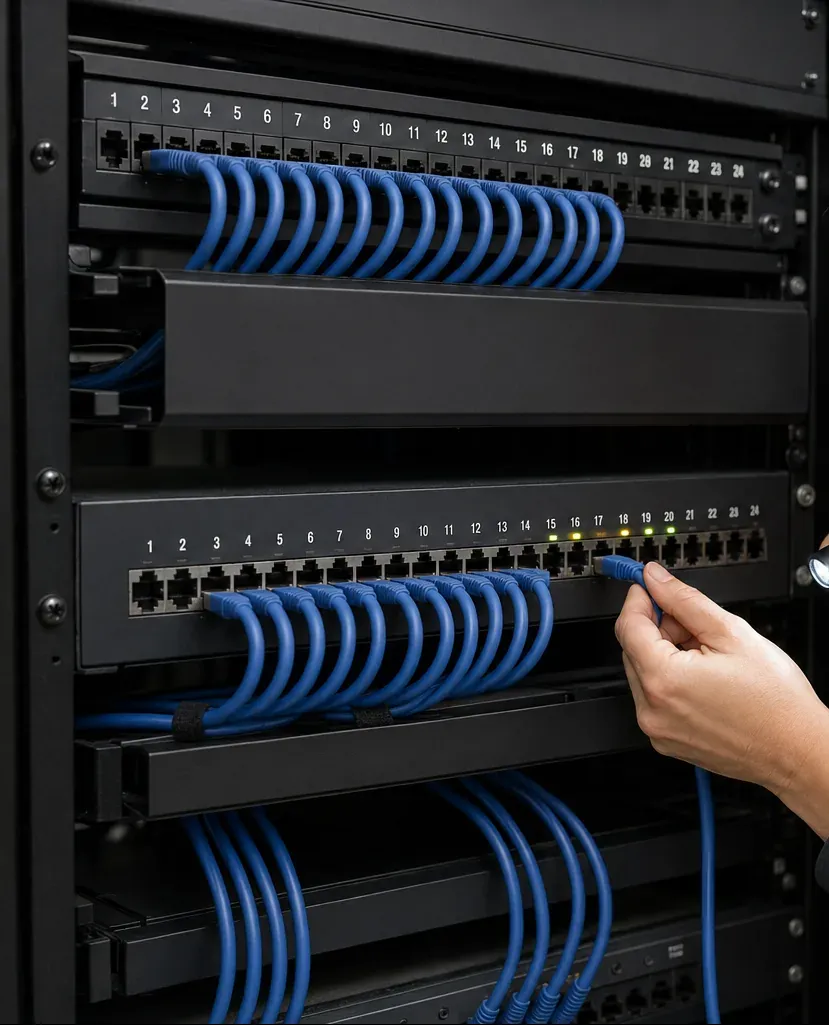
Hand holding a blue patch cord at a numbered 24-port patch panel with lit ports in a rack — Cat6 port check, Financial District, Manhattan
Two numbered 24-port patch panels with rows of blue cords; a hand holds one cord at a port near a group of green-lit ports.
AI Overview Reality Check

What AI Gets Wrong About Cat6 Repair in the Financial District

We could not view Google's AI Overview from our build environment, so we cannot quote it. The claims below are ones repeated widely in search summaries, forums and cost guides; each is corrected with what we know about downtown buildings and the sources listed in our research.

“Once flooded cable has dried out, it is fine”

Drying removes water; it does not remove what the water carried. The surge that filled downtown cellars in 2012 was brackish, and reporters described it as such in the Verizon cable vault on West Street. Salt and silt left inside a plug or a jack keep attracting moisture and corroding contacts long after the room looks normal again.

Continuity testers do not see this well. A pair with partly corroded contacts can still show as connected, and a link can still come up, while its resistance and return loss drift. The first sign is usually a link that fails only on humid days or only when the cord is moved.

For any link with a cellar route in a building that flooded, we open the terminations, inspect the copper and the plating, cut back to clean conductor and re-terminate with new parts, then certify. If the cable itself is discoloured inside the jacket, we recommend replacement rather than another termination.

“The carrier rewired downtown after Sandy, so the cabling is new”

Verizon did replace most of its damaged copper in Lower Manhattan with fibre, after reporting that 95 percent of the copper infrastructure feeding its Broad Street office had been destroyed. That work covered the carrier's network up to the building connection point.

Everything after that point — the building's own risers, the tenant's Cat6 from closet to desk, the cords and jacks — belonged to owners and tenants. Much of it was dried and reused rather than replaced, because it appeared to work.

So a new fibre service in the street tells you nothing about the copper in your suite. If your links pass through rooms that took water, treat them as cable at least fourteen years old with a water history, and test accordingly.

“Office cabling can simply be reused when a building becomes apartments”

This sounds efficient and rarely works. Office Cat6 was laid out for open-plan rows and a closet on each floor. Apartments need cable to rooms that did not exist, terminating in a panel inside each unit, at lengths that suit the new plan.

Reusing office runs usually means jacks in the wrong places, runs that are too long or too short, and closets that become private space. Some of the cable will also be older than the Category 6 standard if the floors were fitted out before 2002.

The reusable part is the pathway: sleeves, trays and conduit that keep their purpose in the new layout. We survey with that in mind and recommend removing the rest before the walls close, so it does not become abandoned cable.

“A keystone is a keystone; the cheap ones work the same”

They work the same on the first day. The difference is in plating and durability. The relevant standards call for at least 50 micro-inches of hard gold over a nickel barrier, and rate connectors for 750 or 2,500 mating cycles depending on performance level.

A connector trade association reports that defective plating can wear through after as few as 10 to 15 insertions. On a downtown hot-desk floor that is a matter of days.

The cost difference per jack is small compared with the cost of a technician returning to the same desk. We fit parts made to the standards and certify the link so you can see it passes with margin.

“Cable left by the last tenant is free spare capacity”

Sometimes it is. Often it is a mix of working runs, cut runs and runs that end somewhere nobody remembers. Downtown floors that have been re-let several times can carry two or three generations of cable above the same ceiling.

The electrical code treats untagged, abandoned cable as something to remove where it is accessible. Cable that is kept has to be identified as kept, which in practice means tested and labelled.

Before you plan on using it, have it tested. Runs that pass can be labelled and documented as spares; runs that fail or cannot be traced should come out, which also frees ceiling space for the cable you actually need.

“Any network repair in a New York building needs a DOB permit” — or “needs no qualifications at all”

Both are wrong. The city's Administrative Code exempts work on wiring under 50 volts for data and communication circuits from the electrical permit requirement, so a routine Cat6 repair does not need a permit filing.

The same section limits that exemption to work done by a licensed master electrician, a special electrician or a qualified person as the electrical code defines them. It also excludes life-safety systems and connections that control light, heat or power.

Downtown managing agents add their own layer: insurance certificates, approved hours and sometimes approved-vendor lists. A licensed, insured contractor with a written scope gets through that process far faster than a handyman.

“A cost guide’s figure is what you should expect to pay below Fulton Street”

Cost guides publish national figures. Fixr, for example, listed Cat6 projects at $125–$250 per drop and labour at $45–$75 an hour in January 2025. Those are national averages for new installation, not repair, and not New York.

Our published rate for repair time is $195 an hour with a three-hour minimum, and replacement runs start at $175. Those figures cover a licensed, insured technician, a certification tester, matched parts and a written record.

What changes a downtown invoice is the building: how long the window is, whether the freight elevator is available, whether the run crosses a floor or a rated wall. We put those in the quote as named lines rather than leaving them to surprise you.

Tell Us What Changed in the Building. We Will Tell You What Changed in the Cable.

A conversion upstairs, a re-let floor, a rebuilt cellar or a lease ending — give us the history and the failing ports and we will plan the visit around both.

Get In Touch

Request a Free Quote

Give us the address, the floor, the failing links and anything that has changed in the building lately; a written reply follows the same business day. To talk it through, call the Financial District line, (929) 560-0737.

✅

Request Received

Thanks — the request is with the technicians who cover the district, and a reply is on its way before close of business. For a dead link that cannot wait, phone (929) 560-0737.

How It Works

Our Financial District Cat6 Repair Process

Seven steps. The first two happen before anyone arrives, because downtown the history of the building is usually the fastest route to the fault.

1. Ask what changed

We ask about conversion work nearby, recent re-lets, cellar rebuilds, water events and lease dates, then look at your photos of the panel and one failing jack.

2. Clear it with the building

We send the managing agent a certificate naming the building and a one-page description of the job, then fix the time, the elevator booking and which ceilings or fittings may be opened.

3. Test before touching

Every suspect link is certified first, so we know the category, the length and the distance to each fault before a single tile, lid or plate comes off.

4. Agree the fix on the spot

You see the results and our recommendation for each link — remake, replace a cord, replace the run or retire it — with the cost of anything beyond repair time.

5. Repair with matching parts

Terminations are remade with standard-plated parts of the same category, cords replaced, damaged sections cut back and any opened penetration sealed again.

6. Certify and label

Each repaired link is tested again against its category limit and labelled at both ends to match the port map.

7. Hand over the record

You receive the PDF summary, the tester's native files, photographs of anything now hidden and a list of links that still need attention.

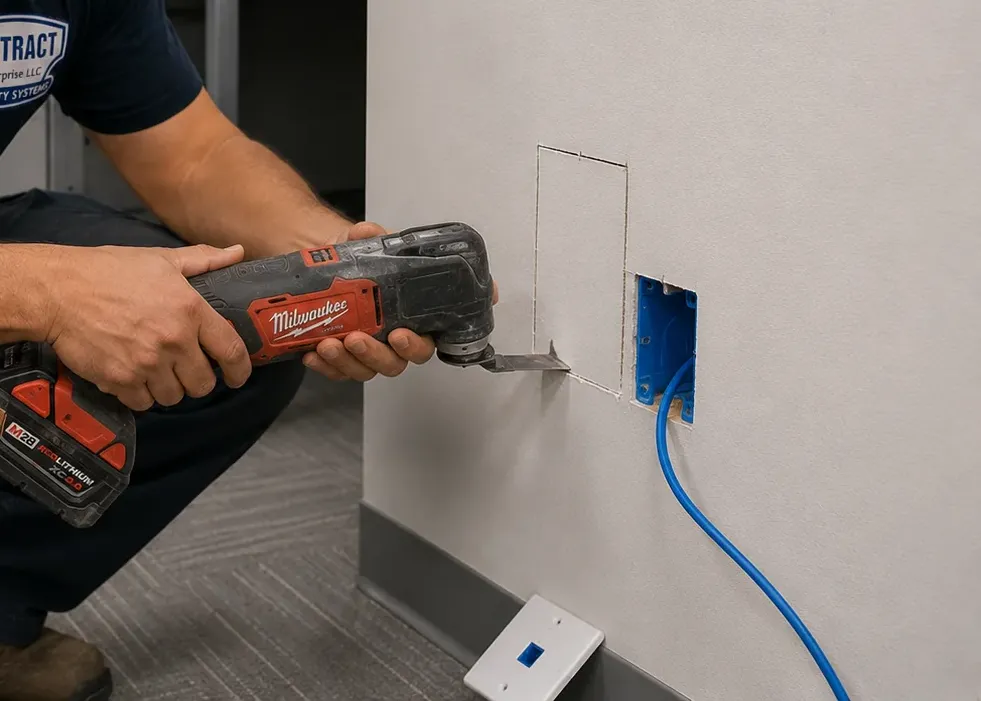
Hands cutting a small rectangular access opening in a wall with a red cordless oscillating tool next to a blue box and cable — Cat6 repair access, Financial District, Manhattan
Pencil-marked access hole being cut with a red battery multi-tool next to a blue box with a blue cable; the cover plate waits on the floor below.
Coverage Area

Cat6 Repair Near the Financial District's Landmarks

Six downtown addresses that explain the conditions we repair in. We name them for orientation; none of them is presented as a customer.

55 Wall Street

Built as the Merchants' Exchange from 1836, enlarged for National City Bank from 1907 to 1910; exterior landmark since 1965, banking hall an interior landmark since 1999, upper floors now condominiums. The clearest local case of offices, events and homes sharing one protected building.

Stone Street Historic District

First cobbled street in New Amsterdam in 1658, rebuilt with Greek Revival stores after the 1835 fire, designated by the Landmarks Commission in 1996. Its eastern blocks are pedestrian in summer, and its ground floors are restaurants with kitchen and register links to keep alive.

222 Broadway

A 31-storey office tower between Ann and Fulton Streets being converted to 798 rental apartments with 40,000 square feet of commercial space, with completion expected in May 2027 — a working example of a conversion beside busy offices.

80 Broad Street

A 1935 tower of 37 storeys for which a conversion to 326 apartments was filed with the Buildings Department in January 2026, with homes planned from the second to the thirty-fourth floors.

1 New York Plaza

A 2.5-million-square-foot tower at the southern tip, listed in the November 2012 survey of downtown office buildings closed with flooded basements after Sandy.

75 Broad Street

Once ITT's communications building, now home to colocation suites: listings show NYI's Broad Street Connect, opened with the owner in late 2023, and a Verizon footprint on the seventh floor — a reminder that some downtown Cat6 lives inside data rooms rather than offices.

We also serve the neighbourhoods around the district: Cat6 repair across Manhattan covers Battery Park City, Tribeca, the Civic Center, the Seaport and Two Bridges on the same terms and through the same line.

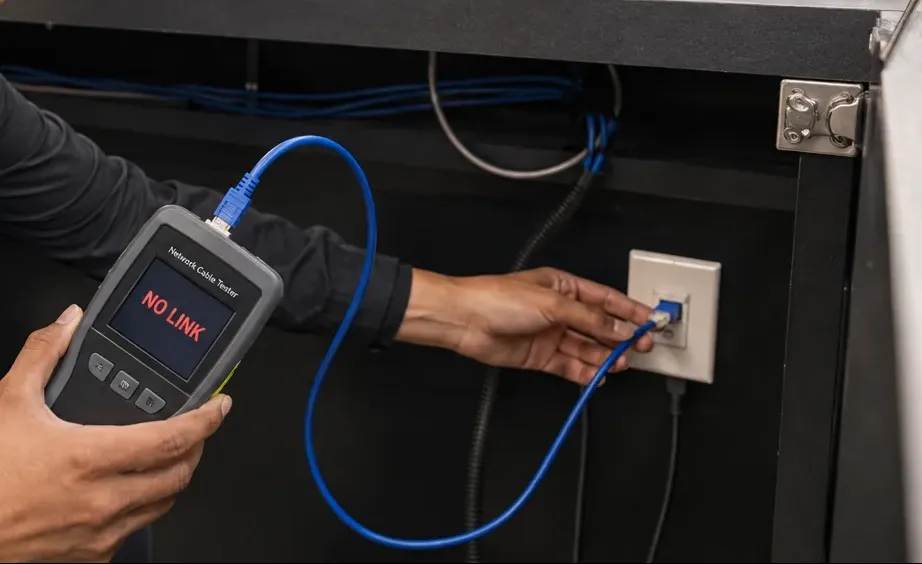
Handheld tester reading NO LINK on a blue cord plugged into a wall jack under a shop counter — point-of-sale Cat6 repair, Financial District, Manhattan
A handheld tester shows NO LINK in red; its blue cord runs to a wall jack mounted under a dark counter.
Pricing

Cat6 Repair Cost in the Financial District

Downtown repair is priced exactly as the rest of Manhattan, from figures we already publish. The building can add time — a short window, a busy freight elevator, a rated wall to reseal — and when it does, that appears as a named line in a written quote after testing.

ItemPriceWhat it covers and where the figure comes from
Hourly repair labour — certify the suspect links, find each fault, remake jacks and panel ports, swap cords, prove the result$195/hr, 3-hour minimum ($585)The rate on our Manhattan repair pages; as many links as the booked hours allow
A run too damaged to repair, replaced end to endFrom $175 per dropEntry price we list for Manhattan replacement runs — fresh cable, faceplate and jack, panel port, certification, labelling and one cord
What a brand-new 100-foot-or-shorter Cat6 drop costs us to install, as a yardstick$296 per dropFrom our Manhattan installation prices (Cat5e $254, Cat6A $424) — shown so repair can be compared with starting over
Evening or weekend freight-elevator windowsNamed premium line, quoted in advanceShown separately, never folded into the hourly rate
Lease hand-back removal, long re-routes, firestopping several penetrationsQuoted after testingSet after a walk-through of the ceilings and closets involved

How the Manhattan factor is applied

Our pricing guidance gives Manhattan a 1.25 factor against our base boroughs, and the figures in the table are the ones already published for Manhattan, so they are used as they stand rather than adjusted a second time. The Financial District has no separate surcharge. Where downtown work genuinely takes longer — a building that allows contractors only after six, a freight car shared with a conversion crew — the extra time is visible in the quote and agreed before it is spent.

What a three-hour downtown block usually covers

The first half hour goes on checking in with the building, confirming the scope and certifying the suspect links. With results in hand, most of the next two hours are repairs: terminations remade, cords replaced, a damaged tail cut back at a floor fitting, an arcade sleeve sealed. The last half hour is re-certification, labels and the hand-over. Floors with many failing links, or with runs that need replacing, are scheduled over more than one block once the first round of testing shows the size of the job.

What makes one downtown repair longer than another

  • The building window. A two-hour slot after hours means more visits for the same work than a full weekday.
  • Construction nearby. Dust protection, shared elevators and contractor shutdowns add time on floors next to a conversion.
  • Where the fault is. A termination at the panel is quick; a crushed run under a floor fitting or in an arcade soffit takes longer.
  • Penetrations. Every rated wall, slab or sleeve we open is sealed again with a listed system, and that is part of the job.
  • Removal. Lease hand-backs that require cable to come out are priced by how much is accessible, after a walk-through.

Full terms — including 50% deposit, one-year parts-only warranty on AESS-supplied products, and the late-fee schedule — are set out in the service agreement.

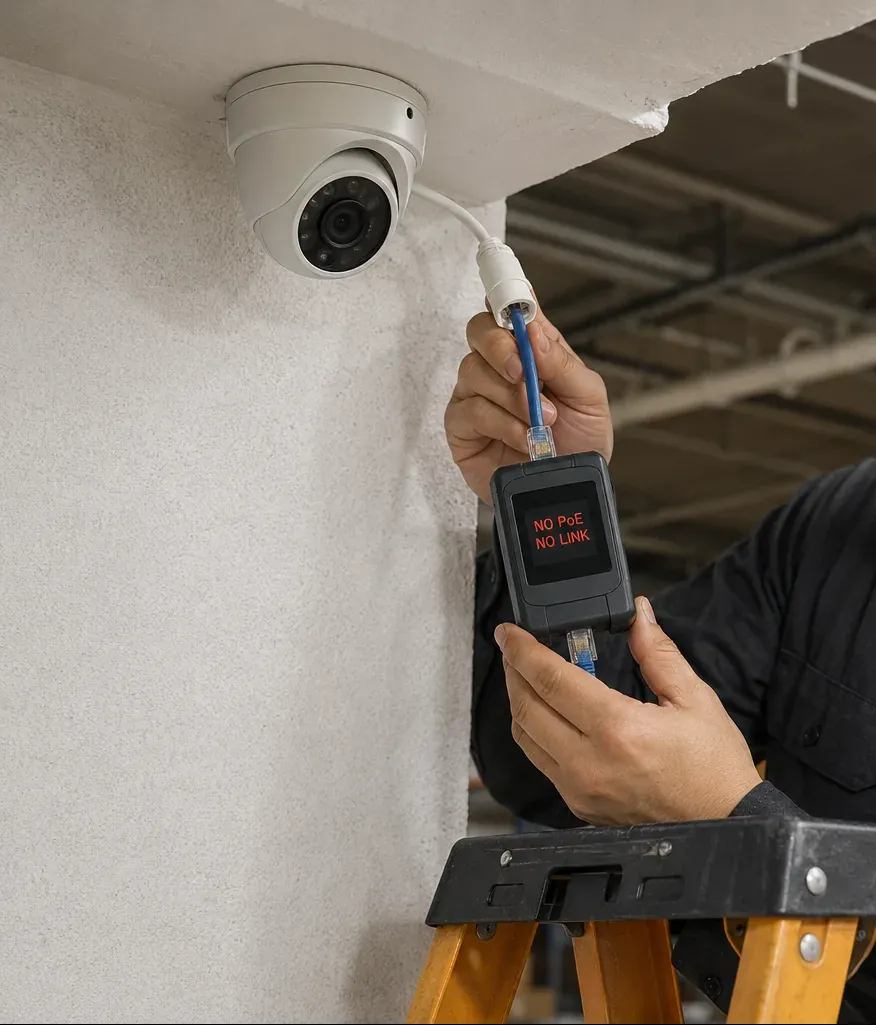
Hands holding a small tester reading NO PoE NO LINK on the cable to a white dome camera on a textured wall, top of an orange stepladder — Cat6 camera link repair, Financial District, Manhattan
Red text on a pocket tester — NO PoE, NO LINK — for the cable to a white dome camera on a rough plaster wall, with an orange stepladder top below the hands.
Shop Our Systems

Cat6 Repair Packages & Pricing

Downtown repair work tends to arrive in one of three shapes. Each is priced from the table above and nothing else.

Starter — One Desk, One Floor Fitting, One Shop Link

$585

Three hours at $195. One failing link or a small cluster — a hot desk, an underfloor outlet, a register in an arcade shop — certified, located, repaired and re-certified. Time left over goes to the next item on your list.

Standard — Floor Beside a Conversion

$195/hr after the first 3 hours

For tenants staying while floors nearby are rebuilt: every link that shares a shaft or ceiling with the work tested, contaminated cords and jacks replaced, ports capped, and a dated record you can show the building if damage appears later.

Premium — Lease Hand-Back or Recovery

Repair time + from $175 per run

For floors being returned or taken over: working links tested, tagged and mapped, failed runs replaced from $175 each where they are needed, the rest removed where accessible, penetrations sealed and a written record for the landlord.

Bring Your Own Equipment — Labour-Only Repair

Fit-out contractors downtown often leave a box of spare jacks and a part-reel of the original cable in the closet. If they match the link — same category, same shielding, solid copper for permanent links — we will use them and charge repair time only. If they would not produce a passing link, we tell you before fitting them. Parts you supply carry their manufacturer's terms rather than ours.

Conversions Next Door

Staying Put While the Building Becomes Apartments

The current conversion wave rarely empties a whole building at once. Developers buy towers with tenants still in them, demolish vacant floors first and work around the leases that remain. For the firms that stay, the network has to survive months of construction in the same shafts and ceilings.

Three things put Cat6 at risk during that time. The first is dust: demolition spreads fine particles through shafts and stairwells, and they settle in closets and on unused ports. The second is shared pathways: tray and sleeves that carry your cable between floors may also carry the cable being stripped out above, and a crew removing abandoned cable can pull or cut a live run by mistake. The third is power and HVAC shutdowns, which can leave a closet hot, or restart switches in an order that hides a cable fault until Monday.

The best defence is a baseline. Before demolition reaches the floors around you, have the links that share paths with the work certified and labelled. Keep the report. If links fail later, a second test shows exactly what changed and where, and that comparison is what the developer's general contractor will ask for before accepting that their crew caused the damage.

During the work, cap unused ports, keep closet doors shut and sealed at the bottom, and ask the building to tell you before any shutdown that affects your floor. After it, re-test. Most of the time the result is a few contaminated cords and a loosened termination or two. Occasionally it is a run cut in a shared tray, and then the baseline report turns an argument into a work order.

A short checklist for tenants in a converting tower

  • Ask the managing agent for the demolition schedule by floor, and which shafts and trays the crews will use.
  • Have the links that share those paths certified before work reaches them, and keep the dated results.
  • Label your own cable where it passes through shared spaces, so a removal crew can tell it is live.
  • Cap unused ports and seal the closet door against dust.
  • Re-test after each phase that works near your paths, not only when something stops.
Leaving Cleanly

Moving Out of a Downtown Floor Without Leaving a Cable Problem Behind

Downtown re-letting has been busy: the Downtown Alliance recorded 4.75 million square feet of leasing in 2025, and every new lease is matched by a floor somebody else is leaving. Moving out is when cable most often turns into a dispute, because the departing tenant, the landlord and the next tenant all have different interests in what is above the ceiling.

Start with the lease. If it requires removal, find out exactly what — all cabling, cabling installed by the tenant, or only what the landlord does not want — and whether the landlord can elect to keep some of it. Ask in writing, early. A landlord re-letting the floor as a pre-built suite may prefer working Cat6 left in place, labelled and tested, rather than a bare ceiling.

Then find out what is actually there. Floors that have been re-let several times often hold cable from earlier tenants as well as yours. A test-and-tag survey separates working runs, failed runs and runs that cannot be traced, which tells everyone what can be offered to the next tenant and what has to come out under the code's abandoned-cable rule.

Finally, document the outcome. A short report with test results for anything left, photographs of ceilings and closets after removal, and a list of blanked plates is usually enough for a surrender inspection. It also protects the next tenant, who otherwise inherits a ceiling full of unknowns and a repair bill to find out what works.

The First Wave

Apartments Made From Offices Before Cat6 Existed

The downtown conversion programme of 1995 to 2006 created 12,865 homes in 98 former office buildings, according to the Citizens Budget Commission, and helped turn a business district into a place where people live. Those buildings are now twenty to thirty years into their residential lives. Their in-unit wiring was installed by developers working to the standards and budgets of the late 1990s and early 2000s, and much of it predates Category 6, which was only added to the cabling standard in June 2002.

That history explains a lot of what residents and managing agents run into. Plates marked "data" turn out to be fed by an earlier category; some were never connected to anything beyond a telephone block; others run to a closet that was re-planned when a new internet provider took over the building. When a resident works from home on a fast fibre plan, the limits of that cable become visible in a way they never were when the building opened.

Repairing that wiring is still worthwhile when the fault is a termination or a cord and the cable is a category that can carry the speed you need. When it is not, we say so before quoting. A tested replacement run to the room that matters most — usually a home office — often makes more sense than repairing every old jack in the apartment. In a co-op or condo, any work outside your unit needs the managing agent, and we will provide the scope and insurance details they ask for.

For the buildings themselves, the more useful job is a survey: a sample of units tested, the cable category confirmed, closets and risers inspected and a plain report on what the existing wiring can and cannot support. Boards and owners weighing a building-wide upgrade can then decide from evidence rather than from complaints.

The Oldest Blocks

Stone Street, Pearl Street and Hanover Square: Cable in the City's First Grid

The streets around Hanover Square follow paths laid out in the Dutch colony; Stone Street became New Amsterdam's first cobbled street in 1658, and the remaining parts of the old street plan are themselves protected as a city landmark. Most of what stands there now dates from after the Great Fire of 1835, when the First Ward was rebuilt in a single burst of four-storey brick and stone stores. The Landmarks Preservation Commission designated the Stone Street Historic District in 1996.

Those buildings were not designed for networks of any kind. Cable reaches upper-floor offices through old chases, along the undersides of timber floors, and in surface raceway added during restorations. Ground floors are mostly restaurants, so the links that fail most are the ones behind counters and in kitchens, where heat, grease and nightly mopping work on jacks and cords.

Our approach on these blocks is conservative. We repair cable in its existing path wherever the cable is sound, replace inside existing raceway rather than adding new runs on old walls, and move terminations up and away from floors that are washed every night. We will not cut into historic masonry or decorative surfaces to make a repair easier. If a better route genuinely needs new work on a protected building, we describe it and leave the owner to decide whether to seek approval.

Restaurants here also live with seasonal change: the eastern blocks of Stone Street turn pedestrian in summer, with tables in the street. Equipment that moves outdoors for the season, and back inside when it ends, is a common source of strained and broken cords. Repairs are scheduled before service, and we leave spare cords where staff can reach them.

Shared Desks

Hybrid Floors and the Jacks That Take the Wear

Some downtown floors now have fewer assigned desks and more shared ones. A shared desk changes the life of its cabling. Instead of one cord plugged in for years, the jack and the docking cord are handled by several people a day, each pulling a laptop free at a different angle. Cords get trapped in drawers and under monitor arms. Plugs are forced in upside down.

Connector standards anticipate some of this: jacks are rated for 750 or 2,500 matings depending on their performance level, provided the gold plating is what the standard calls for. Cheaply plated parts are another matter; a connector trade association reports that defective plating can wear off after as few as 10 to 15 insertions. On a busy hot-desk floor, both numbers can be reached quickly.

The repair is straightforward and inexpensive per desk: replace the worn jacks with parts made to the standard, use factory-made docking cords of a length that does not hang or stretch, fix strain relief where furniture leaves the cord loose, and certify each link. What makes it worth doing properly is the record. Once every shared desk has a known-good result, a future complaint can be checked against it in minutes rather than chased around the floor.

If you are re-planning a floor for hybrid working, tell us before the furniture arrives. Jacks can be positioned where docking cords will reach without strain, and spare ports labelled so that facilities staff can switch a desk to a good port without calling anyone.

Reading the Results

What a Downtown Certification Report Tells You

A certification tester does more than say pass or fail. For each link it records the length, the wire map, and a set of transmission measurements compared with the limits for the category: crosstalk between pairs at each end, insertion loss along the cable, return loss from reflections. It also records how far below or above each limit the link sits, which is called the margin.

Margin is the number to watch in a building that is changing. A link that passes with a comfortable margin can absorb some dust, some handling and some age. A link that passes by a whisker is the one that will fail when demolition starts upstairs, or on the first humid day after a cellar has been re-sealed. When we hand over a report, we point out the marginal links as well as the failures, so you can decide whether to deal with them now or watch them.

Distance-to-fault readings are the other valuable part. They tell us whether a problem sits at the jack, at the panel or somewhere along the cable, and how far along. In a post-war tower with underfloor ducts, that distance tells us which fitting to open. In an arcade shop, it tells us whether the trouble is in the soffit or back at the tower closet. In a converted building, it tells us whether a fault is inside your apartment or beyond its wall.

Keep the report and the native files together with your floor plan. If the building changes again — and downtown it will — the next test can be compared with this one, and the difference shows what changed.

Two Floors, One Firm

Links Between Stacked Floors Outside the Building Riser

Firms that lease two or more stacked floors downtown often connect them with a convenience stair and keep their network equipment on one of them. The cable between floors may then run through the stair opening, through a sleeve cut for the purpose, or through a small shaft the fit-out created. Those routes are convenient, but they are also where cable listings and firestopping are most often wrong.

Cable that passes between floors is expected to carry a listing for that use, and the opening around it has to be sealed with a listed firestop system. A fit-out that ran ordinary horizontal cable through an unsealed hole may have worked for years; it becomes a problem when a link fails and the repair has to be made properly, or when the landlord's engineer inspects the stair before a lease ends.

When we repair inter-floor links we test from closet to closet, identify the route and the cable type, and replace any run that is not suitable for the crossing. The sleeve is sealed again and photographed. If the landlord prefers the links to move into the building riser, we can do that with the building's approval, and your inter-floor connection then sits with every other tenant's in the managed space.

Water Street

Plazas, Arcades and the Cable Added Afterwards

Water Street is lined with large post-war office towers set back behind privately owned public plazas and arcades. In 2016 the City Council approved the Water Street zoning change covering 17 buildings, which let owners infill arcades — with a special permit required for arcades larger than 7,500 square feet — and committed the Downtown Alliance to programming and annual checks on the plazas.

For cable, the result is a set of shops, cafés and lobbies built into space the original designers treated as outdoors. Their network links were added years after the tower's closets, risers and floor ducts were laid out, and they follow whatever route was available when the shop was fitted: through former exterior walls, over arcade soffits, under lobby floors or down into the cellar and back up.

Those routes cross more transitions than an ordinary office link: indoor to former outdoor space, one fire zone to another, one owner's space to the landlord's. Each transition is a place where cable gets pinched, where a sleeve is left open, or where temperature and moisture change. They are also the places where nobody is sure who is responsible.

When a shop link fails, we begin by tracing and recording the full route back to the closet, because that record is usually missing. Then we test, repair at the failure point, seal any penetration we find open and certify the link end to end. The route record goes to the shop and, if they want it, to the building, so the next fault starts from a map rather than a guess.

Before We Arrive

Getting a Downtown Building Ready for a Cat6 Repair

Downtown managing agents vary widely in what they need from a contractor and how long they take to provide it. A little preparation on your side usually turns a two-visit job into one.

  • Book the access. Ask the managing agent which hours contractors may work, whether the freight elevator must be reserved, and whether the telecom room needs an engineer to open it.
  • Send our insurance request early. Many buildings want their own entity named on the certificate; we issue it once we have the exact wording.
  • Tell us about the building's projects. Demolition on nearby floors, cellar work, a flood barrier drill or a lobby refit all change where we look first and what we bring.
  • Photograph the panel and one failing jack. Two photos tell us the cable category, the parts family and often the likely fault.
  • Find the old records. Any earlier test report, port map or fit-out drawing shortens the search, even if it is out of date.
  • Clear the floor fittings and closets. Furniture over floor outlets and boxes stacked in front of panels cost time inside a short window.

None of this is required for us to come out. It simply means that more of the hours you pay for are spent repairing rather than waiting for a door to be opened.

Finance, Law and Advisory Floors

Repairing Cat6 on Floors That Cannot Stop Working

The district still houses trading desks, advisory firms, law practices and the back offices that support them. Their floors combine dense desking, strict access rules and very little tolerance for an afternoon without a network. That changes how a repair is planned rather than how the cable is fixed.

We test first and touch second. Suspect links are certified while users keep working on the rest of the floor, and repairs are grouped so that each desk is offline only for the minutes it takes to remake its jack and re-test. Where a whole row shares a damaged path, we agree the timing with the office manager — early morning, after the close or on a weekend day the building allows.

Confidentiality is treated as part of the scope: agreements reviewed before the visit, escorts accepted, screens left alone. And because these firms are often asked to show that their infrastructure is documented, the hand-over always includes the certification results, the native tester files and a port map that matches the labels on the wall.

Complete Services

Every Cat6 Repair Service in the Financial District

A downtown cable fault often sits next to another job. These pages cover the work most often added to a repair visit.

Cat6 Repair Manhattan

Borough-wide Cat6 repair, from Battery Park City to Inwood.

Fiber Optic Installation, Financial District

Riser and inter-floor fibre in the same towers.

Network Cable Repair Manhattan

Mixed-category copper and the cable-or-switch question.

AESS Cat6 Installation in Manhattan

New drops when replacing is better than repairing.

Structured Cabling

Closets, panels and backbones planned for a new layout.

Network Installation

When the cable is sound but the switch or access points are not.

Abstract Enterprises Low-Voltage Services

Cameras, door entry, audio and data from a single licensed firm.

Commercial Cameras

PoE cameras for lobbies, shops and cellars.

Access Control Installation Manhattan

Door readers wired back to the closet.

Cabling Price Builder

Price new runs yourself before you call.

Field Notes

Field Notes: What We Check First South of Chambers Street

These are habits rather than stories — the order in which we look at a downtown fault, written by Anwar Timothy for the technicians who work there.

Ask about the floors above and below. If anything is being demolished, start at the closet: dust on the ports, cords that have been knocked, a door that no longer closes. Half the time the fix is there.

Look at the floor before the ceiling. In the big post-war towers, desks may be fed from below. A lid that will not sit flat over an outlet is a clue worth more than an hour above the tiles.

Read the jacket. In converted buildings, check the printing on the cable before promising a speed. Older categories turn up behind new-looking plates.

Smell and look in cellars. Damp rooms and white or green crust on metal mean the terminations get opened, not just tested.

Leave a record. Downtown floors change hands. Whatever we repair should be understandable to the next person without us.

FAQ

Financial District Cat6 Repair FAQ

Can you repair the Cat6 inside our cage at a downtown colocation facility?
+

Yes, within the facility's rules. Colocation sites such as the carrier hotel at 75 Broad Street control who enters, when and with what, so you add our technician to your access list, and we supply whatever the operator asks for — typically insurance details and a description of the work and its duration. Inside your cage we test and repair your own patch cords, panels and horizontal Cat6. Cross-connects and anything belonging to the facility stay with the operator; if testing points to their side, we give you the result to pass on.

Our firm asks every contractor to sign a confidentiality agreement before entering the trading floor — is that a problem?
+

No. Send the agreement with the booking and we will review and return it before the visit. Our technicians work only on the cable and the ports named in the scope, do not touch user equipment beyond unplugging and re-plugging cords, and can work with an escort from your firm if your policy requires one. If screens or documents need to be covered while we work at a desk, tell us and we will wait until they are.

Can our IT team have the tester's native result files as well as the PDF report?
+

Yes. Along with the summary PDF, we provide the certification tester's own result files for every link we test, so your IT team or your next cabling contractor can open them in the tester maker's software, compare them with older results and keep them with the rest of your network records. Ask for them when you book and we will name the links the same way your port map does.

Our building's freight elevator is out of service for modernization — can a repair still go ahead?
+

Usually, yes. A repair visit needs a tester, a tool bag, a ladder and a modest box of parts, which most buildings allow in a passenger car outside busy hours or via the stairs for a few floors. What has to wait is anything involving cable reels or long ladders for high ceilings. Tell us when you book, and we will check the building's rules for carrying equipment while the freight car is down and plan the visit around them.

If a coastal storm warning is issued while a repair is booked, what happens to the appointment?
+

We call you. Downtown buildings with flood barriers often close cellars and loading docks and restrict contractors while those are being put up and taken down, and there is little point repairing a cellar link that may be under water within a day. We move cellar and ground-floor work until after the event and the building's all-clear; upper-floor repairs can usually go ahead if the building is open. Once the building reopens after a storm, we can re-test any link with a cellar route before you rely on it.

All Areas Served

Cat6 Repair Across Manhattan, New York City and Beyond

Up one level is our Manhattan Cat6 repair page; above that, the New York City Cat6 repair hub. The cards below link to each of our Cat6 repair pages outside the district.

Manhattan

Borough page: Cat6 repair in Manhattan, covering every neighbourhood from the Battery to Inwood.

The other boroughs

Hub: NYC Cat6 repair. Borough pages: Brooklyn, Queens, the Bronx and Staten Island.

Long Island

East of the city: the Long Island Cat6 repair overview, plus separate Nassau and Suffolk pages.

Hudson Valley

North along the river we keep an overview page, Cat6 repair in the Hudson Valley, and a separate page for Westchester, Rockland, Orange, Putnam, Dutchess and Ulster.

Our full range of security and low-voltage work starts at the home page; who we are and how long we have done it is on the about us page.

Downtown Link Still Down After the Contractors Leave Tonight?

If construction, a move or a water event has left desks, a shop terminal or a cellar camera without a link, call (929) 560-0737. Send a photo of the panel, tell us what happened in the building, and we will plan the visit around the hours your building allows.

Cat6 Repair, Financial District — Tested, Repaired, Recorded

Abstract Enterprises Security Systems · 460 E Fordham Rd, Bronx, NY 10458 · Financial District line (929) 560-0737 · WhatsApp (718) 679-0359 via wa.me

NYS Low-Voltage Licence #12000287431 · 100% Licensed & Insured · Same-Day Estimates · Rated 4.7★ from 201 Google Reviews

Customer-supplied jacks, cords and cable are covered only by whoever made them. Our own cover is explained on the warranty page.

Where this page mentions city codes, Landmarks rules, the Water Street zoning change or lease wording, it does so in simplified form for planning only; it is not legal advice, so confirm with the original text, your building or your lawyer. Page reviewed and updated October 17, 2026. Changelog: first publication of the Financial District Cat6 repair page.