Licensed Low-Voltage Contractor · Newburgh to Port Jervis · New Builds, Main Streets, Warehouses, Medical Offices & Farms
Cat6 Repair in Orange County
Dead Jacks in New Buildings · Runs Damaged by Other Trades · Never-Certified Cable · Old Main-Street Wiring · PoE Drops · Lightning & Flood Damage
Orange County added more than 28,000 residents between the last two censuses, and a great deal of its Cat6 was pulled in a hurry — through framing that was about to disappear behind drywall, insulation and flooring installed by the next trade on the schedule. Some of it was never tested before the walls closed. The rest sits in 19th-century brick on Broadway in Newburgh, above storefronts in Middletown and Port Jervis, and in barns across the Black Dirt, under more lightning than any other county in New York. We find the exact fault, repair it to category, prove it with a saved result and tell you who or what damaged it.
Reviewed and updated October 17, 2026 · Written by Anwar Timothy, NYS licence #12000287431
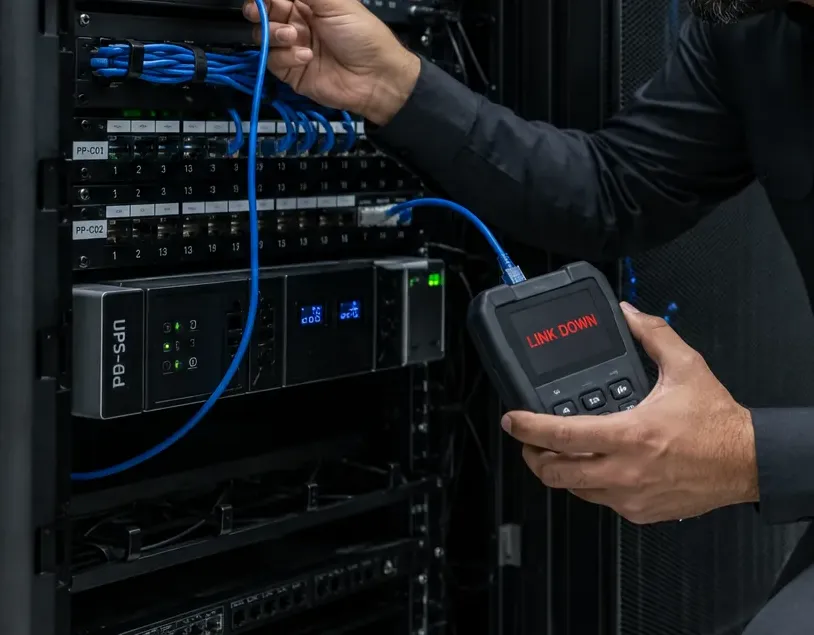
A technician’s hand holds a small black tester whose red screen reads LINK DOWN; a blue cord runs from it up to a port on a rack-mounted switch, with labelled patch panels above and a rack power unit below.
Orange County Cat6 Repair Quote
Tell us which jacks or devices fail and how old the building is — we reply the same business day
✅
Request Sent!
A technician will reply the same business day.
25+
Years Experience
✓
Same-Day Estimates
100%
Licensed & Insured
4.7★
201 Google Reviews
Moved into a new building and half the jacks are dead, or a shop on a village main street that drops off the network every afternoon? Call our Orange County line, (845) 640-3835, or use the 60-second form. A licensed technician reads every request, asks what was built or changed recently, and tells you the most likely cause before anything is booked.
Faults placed by distance, so walls are opened only where the damage actually is
A written note of what caused each fault — useful when a builder or another trade is responsible
NYS licence #12000287431 · fully insured · rates confirmed in writing before the visit
Why Orange County Properties Need Cat6 Repair That Starts With Who Built It, When and in What
Most Cat6 that fails in Orange County did not wear out. It was damaged, compromised or never finished. That is the pattern behind the service calls this page is written for, and it follows directly from how the county has been built. Between the 2010 and 2020 censuses Orange added more than 28,000 residents, and the village of Kiryas Joel alone accounted for almost half of that, growing 63 percent to become the most populous municipality in the county. Distribution buildings of a million square feet and more went up along Route 17K, new medical office buildings opened on Crystal Run Road and in Newburgh and Monroe, and families moving out from Kiryas Joel and from Brooklyn have filled new homes in Monroe, Woodbury and Blooming Grove. Every one of those projects pulled Cat6 on a schedule set by the trades that came after it.
That schedule is the first thing we ask about. Low-voltage cable usually goes in while studs are open, and then four or five other trades arrive in quick succession: insulation, drywall, tapers, painters, flooring, millwork, sometimes a second electrician for the fixtures. Each of them works close to a cable they cannot see. A drywall screw driven a little off the stud, a staple from an insulation crew, a flooring nailer along the baseboard, a box cut a few inches wider than it should have been — any one of those can leave a Cat6 run with a short, an open pair or a crushed section that still shows a link light on the first day. When the cabling was not certified before the walls closed, nobody finds out until the occupant plugs in a phone, a camera or an access point months later.
The second pattern is the opposite of new. Newburgh’s East End Historic District alone has more than 2,200 buildings on 445 acres, most of them two- and three-storey brick from the 19th century, and the commercial blocks of Broadway and Liberty Street, Middletown’s North Street and Port Jervis’s Front Street are much the same vintage. Cat6 in those buildings was added decades after construction, by whoever was available, and it lives where it could be fitted: stapled along baseboards, fed up old chases, tucked behind plaster, run through cellars that take water. Faults there come from the route rather than the cable — and the cable is often not Cat6 for its whole length.
The third is weather. Orange recorded more lightning pulses than any other county in New York in Earth Networks’ 2020 count, and its rivers flood: the Delaware at Port Jervis crested at 21.47 feet in June 2006, and the July 9, 2023 storm put what Governor Hochul described as nine inches of rain on Highland Falls in a single day. Lightning damages Cat6 indirectly, through surges on long runs and on links between buildings; floods damage it slowly, through corrosion that turns up months later in terminations nobody thought were wet.
Put together, an Orange County Cat6 repair almost always involves a question that a tester alone cannot answer: what happened to this run? A screw needs the wall opened at one point and the cable spliced or replaced; a crushed bundle under a staple line may need a short reroute; a never-finished run needs terminating and certifying; a mixed old run needs replacing from the point where the real Cat6 stops. We locate the fault by distance, look at it, fix it, and write down the cause — because in a county where so much cable is new, the cause often decides who pays.
Orange County facts behind the faults we repair
32,954 residents: Kiryas Joel’s 2020 census count, up 63 percent in ten years and ahead of Warwick (32,027), the town of Newburgh (31,985), Wallkill (30,486), Middletown (30,345) and the city of Newburgh (28,856), according to the Times Herald-Record. More than 3,500 condominiums were being built or planned in the village at the time.
About 401,000 people: in the county on April 1, 2020, after growth of 7.6 percent over the decade — new floor space, new cabling and new tenants on a short timetable.
1,015,740 square feet: the Amazon distribution centre at Route 17K and Route 747 in the town of Montgomery, which started construction in 2020 alongside a 1.2-million-square-foot Medline building, per the Hudson Gateway Association of Realtors. An Orange Environment compilation in November 2024 listed 37 warehouse projects in the county totalling roughly 15 million square feet.
275,059 lightning pulses: detected over Orange County in 2020, the highest of any county in New York, in Earth Networks’ state lightning report.
21.47 feet: the Delaware River crest at Matamoras and Port Jervis on June 28, 2006. The National Weather Service impact table notes that from 18 feet the river can back up storm drains into parts of Port Jervis between Railroad Avenue and Water Street, and the 1981 ice-jam record of 26.6 feet damaged 950 structures.
613 farms on 65,706 acres: in Orange County in the USDA’s 2022 Census of Agriculture — barns, packing sheds and farm stores that rely on Cat6 runs between buildings, many of them in the Black Dirt Region around Pine Island in the town of Warwick.
The result is a repair practice that leans on three things more than it would in the city: fault location precise enough to open one small patch of new drywall rather than a whole wall, a written record of cause that a builder, landlord or insurer can act on, and a realistic view of which old runs are worth saving. Where a run leaves the building or feeds a camera on a pole, protection and weather-rated ends are part of the same visit.
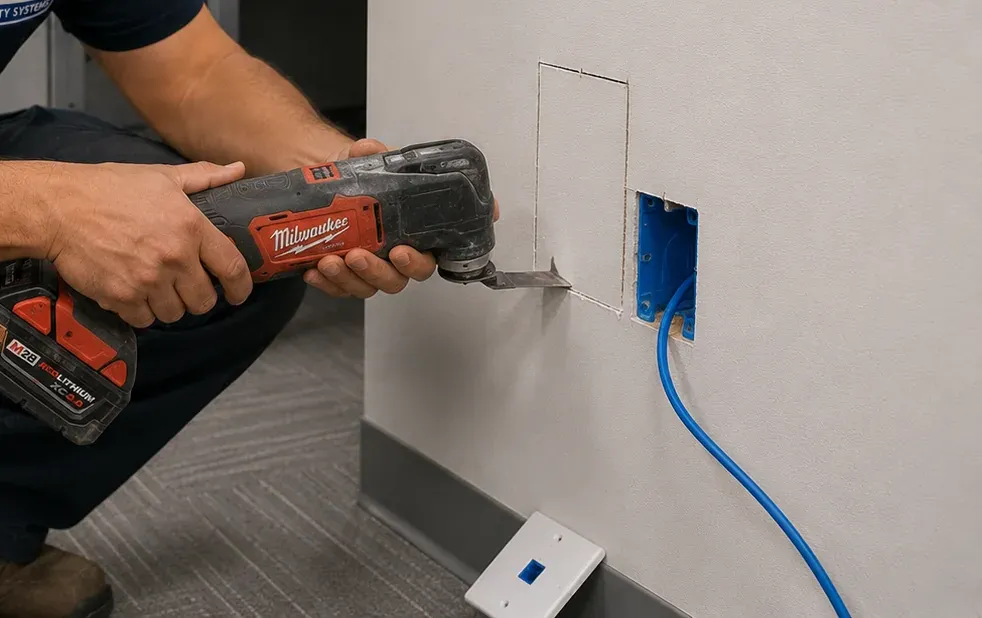
Hands guide a red cordless oscillating tool along a scored rectangle in a white wall, next to a blue low-voltage box with a blue cable running down to the floor, where a removed single-port wall plate lies.
Repair Capture
Cat6 Down Somewhere Between Port Jervis and the Hudson?
A tenant in a new Monroe building who cannot get a wired connection in the back bedroom, a Montgomery office where the conference room went dead after the carpet was laid, a Newburgh restaurant whose register drops every lunchtime, a camera on a Warwick barn that stopped after Tuesday’s storm — those are service calls. Tell us what failed and what work has been done nearby, send a photo of the jack or the switch if you can, and we book the next open 2-hour window with Cat6 and Cat6A keystones, splice and repair kits rated for the category, replacement cable, wall-repair access tools and a certification tester on board. A single fault at a jack, a panel port or a cord is usually found and fixed within one to two hours on site. Repair time is $195 an hour with a three-hour minimum ($585), the same rate published on our Orange County network cable repair page. Call (845) 640-3835 and say it is a Cat6 fault.
What We Repair
Cat6 Repair Services in Orange County
These are the Cat6 repairs Orange County owners, builders, property managers and IT providers ask us for most often. Every one ends the same way: the link is tested against the limit for its category, the result is saved, and you get a plain note of what was wrong and why.
Construction-Damage Location
Runs shorted by drywall screws, pierced by staples or nails, or crushed under flooring and trim, located by distance from the jack so a single small access hole is cut at the damage, then repaired and recertified.
Unfinished and Never-Terminated Runs
Cable left coiled behind blank plates or in the ceiling by a wiring crew that never came back: traced to the panel, terminated on matched hardware, labelled and certified so you know which outlets work.
Handover and Punch-List Testing
Every run in a new or renovated building tested before occupancy or before a warranty deadline, with failures repaired and a full set of saved results for the owner, the builder and the IT provider.
Jack and Panel Re-Termination
Keystones, faceplates and patch-panel ports remade where untwist, a loose punch-down or a damaged contact is failing the link, with the pair twist held to the contact.
Mixed and Mislabelled Runs
In older main-street buildings: finding where genuine Cat6 gives way to older cable, couplers or phone wire, and replacing the run from that point so the whole channel meets category.
Damaged-Section Repair
A single reachable stretch of chewed, kinked or cut cable repaired with a category-rated repair or replaced between two boxes, rather than pulling the whole run out of finished walls.
PoE Device Link Repair
Cameras, access points, door stations and phones that drop or reboot: marginal terminations, high-resistance or copper-clad aluminium cable and wet outdoor ends separated from switch power problems.
Lightning, Surge and Flood Follow-Up
Runs between buildings and to outdoor devices tested after storms; corroded terminations from flooded cellars and ground floors replaced; data-line protection added at building entries where agreed.
Certification and Records
Every repaired link tested against TIA permanent-link or channel limits, with saved results, distance to each repaired point and a cause note you can hand to a builder, landlord or insurer.
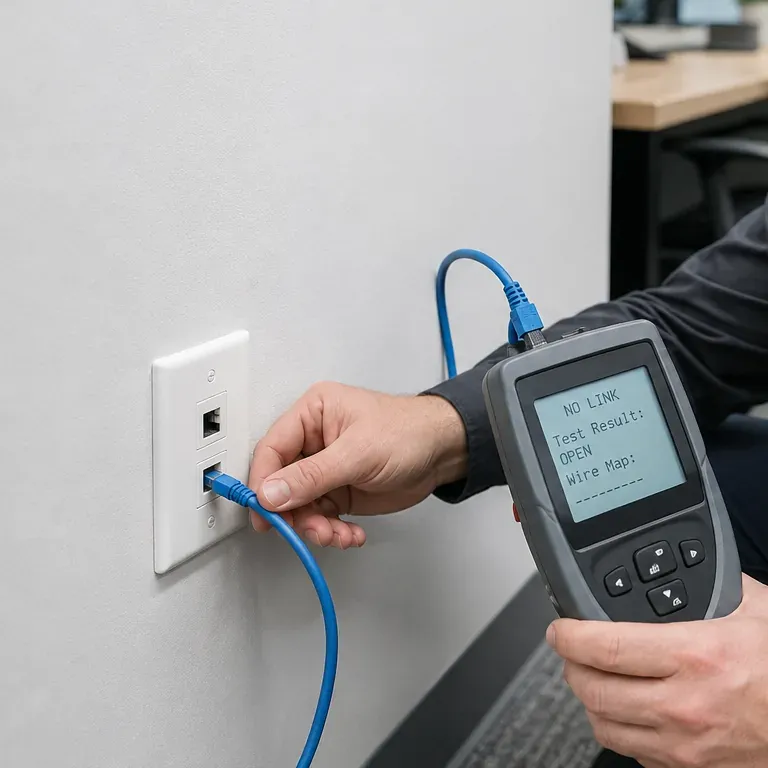
A hand pushes a blue patch cord into the lower port of a two-port white wall plate; the grey handheld tester beside it displays NO LINK, Test Result: OPEN and a wire map line.
Building Specialists
Cat6 Repair for Orange County’s Architecture
In Orange County, the age of the building predicts the fault better than anything else. These are the property types that make up most of our Cat6 repair work between the Hudson and the Delaware, and what each one tends to do to a link.
New Multi-Family and Condominium Buildings
Kiryas Joel, Monroe, Woodbury and Blooming Grove. Dozens of apartments fed from one or two small telecom rooms, built fast and occupied in phases. Faults cluster at the shared room, in risers and in units finished last.
New Single-Family Houses
Subdivisions sold with “Cat6 in every room”. Typical problems: runs never terminated, plates fitted over bare cable, a damaged run behind a kitchen or a bathroom, and a structured-media can that nobody finished.
Distribution and Fulfilment Buildings
Montgomery, Wallkill, New Windsor and the Stewart area. Hundreds of runs to cameras, access points, scanners and dock stations, installed in phases and often accepted without full certification.
Medical Office Buildings
The Crystal Run Road buildings in the town of Wallkill, and newer practices in Newburgh, Monroe and Goshen. High drop density, imaging and practice systems that refuse a marginal link, and frequent reconfiguration.
19th-Century Brick Main Streets
Newburgh’s East End and Broadway, Middletown’s North Street, Port Jervis’s Front Street, the villages of Goshen, Warwick and Florida. Surface runs, old chases, cellars that take water and cable of every vintage.
Converted Institutional Buildings
Former hospitals, schools and civic buildings put to new uses — such as Touro’s Horton campus in Middletown in the former Horton Hospital. Heavy masonry, long corridors and layers of older cabling left by previous occupants.
Farms, Packing Sheds and Farm Stores
The Black Dirt around Pine Island, orchards and farm markets around Warwick, Chester and Goshen. Runs between barns, sheds and stores, exposed to lightning, cold, damp and rodents.
Hotels, Attractions and Outlet Retail
Along Route 17 and Route 32: guest-room and back-of-house Cat6, point-of-sale and camera runs, and tenant fit-outs that are reworked every season.
Material and method checks we make on every Orange County repair
New drywall and finished trim: fault distance measured from both ends before anything is cut, so the access opening is small and lands on the damage; openings sized for a standard old-work box where possible so the patch can become a junction box if needed.
Insulation and spray foam: we check whether the cavity is filled before planning a pull; a foamed cavity usually means a reroute rather than a replacement in place.
Brick, stone and plaster: existing chases, sleeves and surface routes are reused where sound; new openings are planned with the owner, and exterior changes in Newburgh’s historic districts are left until the City’s Architectural Review Commission requirements are known.
Cable identity: jacket print, conductor material and the category of every jack and coupler on the route are checked, because a mixed or copper-clad aluminium run cannot be repaired into a Cat6 channel.
Moisture: in cellars and ground floors in the flood-prone parts of Port Jervis and Highland Falls, terminations are opened and inspected for corrosion even when the link passes.
Outdoor and between-building runs: cable rating, entry protection and grounding are checked on any run that leaves a structure, especially on farms and estates.
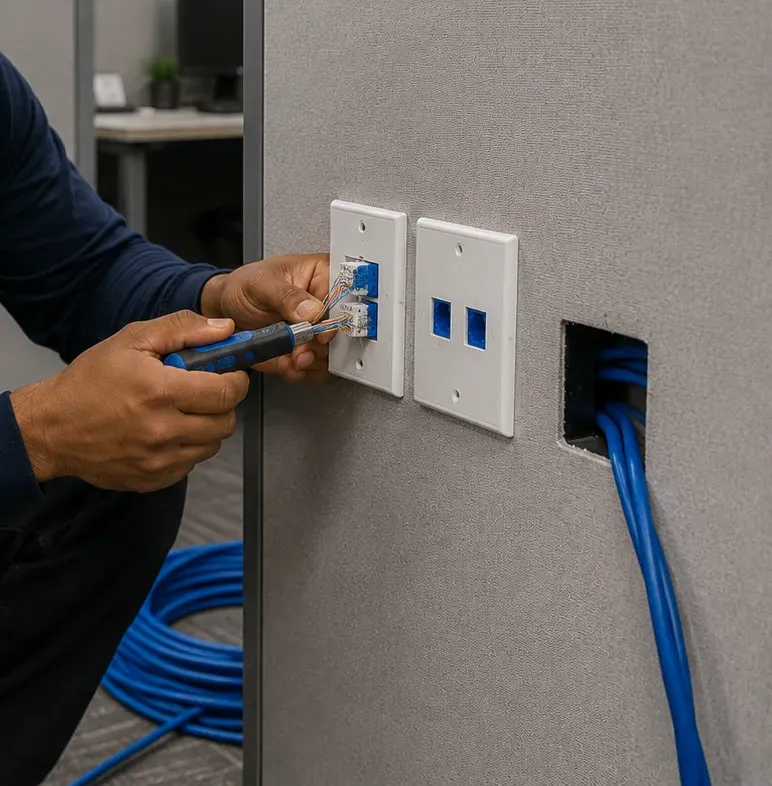
On a grey fabric cubicle panel, a hand holds a blue-handled tool against the back of a keystone in a single-port white plate; a two-port plate sits beside it and a blue cable feeds out of a square opening, with a coil of cable on the carpet.
Commercial Cat6 Repair
Business Cat6 Repair in Orange County
Orange County’s business districts are spread along its highways, and each corridor produces its own kind of Cat6 fault. The places below are real and are named for the building stock and the faults that come with it, not as a list of our clients or jobs.
Route 17K and the Stewart Belt, Montgomery and New Windsor
Where construction began in 2020 on the 1,015,740-square-foot Amazon building at Route 747 and Medline’s 1.2-million-square-foot site, around Stewart International Airport’s 1,552 acres. Long runs, cameras at height, dock and scanner drops, phased acceptance.
Crystal Run Road and Route 211, Town of Wallkill
Crystal Run Healthcare opened 155 Crystal Run Road in 2002 and 95 Crystal Run Road, with the area’s first 3T MRI and an ambulatory surgery centre, in 2009, and the Galleria at Crystal Run anchors the retail side. Medical drop density, imaging links and frequent suite changes.
Route 32 and Woodbury Common, Central Valley
Woodbury Common Premium Outlets opened in 1985 and now holds about 220 stores in 845,000 square feet. Tenant fit-outs reworked by season, point-of-sale and camera runs, and back-of-house links between buildings.
Route 17 Exit 125 and Goshen
The county seat, with the Orange County Government Center — Paul Rudolph’s 1967 building, damaged in Tropical Storm Irene and reopened after renovation in 2017 — and LEGOLAND New York, opened in 2021 with a 250-room hotel. Civic offices, hospitality and seasonal operations.
Broadway and Liberty Street, City of Newburgh
The commercial spine of the East End Historic District, listed on the National Register in 1985. Restaurants, offices, studios and apartments in brick buildings where Cat6 runs through cellars, old chases and surface raceway.
Front Street and Pike Street, Port Jervis
A former Erie Railroad division town of about 8,800 people at the Delaware and Neversink, beside I-84 and the Tri-States Monument. Small businesses in older buildings, some in areas that take water when the river is high.
Compliance callouts for business Cat6 repairs in Orange County
Written contracts for residential work. Orange County’s Consumer Affairs guidance on home improvements summarises New York law: a home improvement contract over $500 must be in writing, in plain English and signed, and must name the contractor, the work, the materials (including makes and model numbers) and the payments. Our written quote and service agreement follow that pattern even on a small repair.
Electricians are licensed by the county. Under Orange County Local Law No. 8 of 2007, anyone working as an electrician in the county must hold a county-issued licence, and the county updated its electrical licensing law in 2024. We do not touch power wiring; data cabling is low-voltage work carried out under our NYS licence #12000287431, and anything that needs a new outlet or circuit goes to a licensed electrician.
Historic districts. The City of Newburgh requires a certificate of appropriateness from its Architectural Review Commission before exterior alterations to a designated landmark or a building in a designated historic district. Most Cat6 repairs are entirely inside, but a new wall entry or exterior box on Broadway, Liberty Street or the East End should be checked first.
Protection at building entry. The National Electrical Code requires the primary protector for communications circuits to be as close as practicable to the point where the cable enters the building (800.90(B)). Runs between barns, sheds and second buildings on Orange County farms are exactly the case that rule was written for.
Abandoned cable. Accessible portions of abandoned communications cable must be removed unless tagged for future use (section 800.25 in the edition EC&M discussed). In buildings that have had several tenants, that is usually part of a proper repair.
Digging. Any repair that means excavating a buried run starts with the free one-call notice to have utility lines marked, given at least two and no more than ten working days ahead.
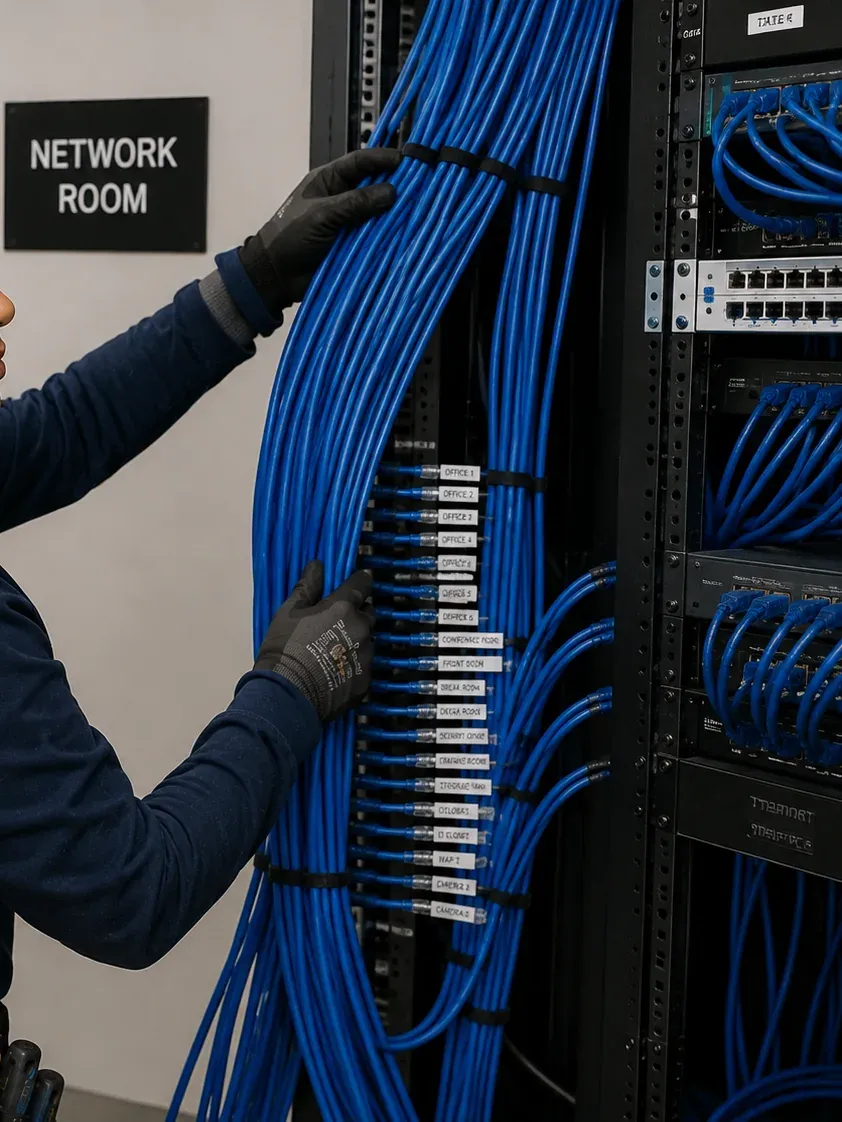
Gloved hands hold a tall bundle of blue cables running down the side of a black rack, each cable carrying a small white label; a sign on the wall behind reads NETWORK ROOM and switches sit higher in the rack.
Your Questions Answered
Cat6 Repair in Orange County: Questions Answered
These are the questions we hear from property managers in new buildings, builders and their customers, distribution-centre facility teams, practice managers, main-street landlords and farm owners once a Cat6 link has started failing in Orange County. They are grouped by where the cable lives: new construction, older main-street buildings, weather-exposed sites, and businesses that reconfigure often. Shorter practical questions are in the FAQ further down.
New buildings and young cable
The jacks in several apartments of a new multi-family building in Kiryas Joel or Monroe lost link at the same time — where does the fault usually sit?
When several units fail together, the cause is almost never in each apartment. It is at something they share: the switch or patch panel in the building’s telecom room, a feed between that room and a floor, a power supply for the switch, or a bundle that runs through a common corridor ceiling. In new multi-family buildings in this part of the county, those shared rooms are often small closets that were finished last, where the electrician, the alarm installer and the internet provider all worked in the same few square feet. A panel knocked loose, a bundle pinched by a door frame or a switch that lost power on a circuit shared with something else will take out several units at once.
So we start in the telecom room, not the apartments. We check the switch and its power, then test each failing unit’s run from the panel to see whether the fault is at the panel end, along the shared pathway or at the units themselves. If the results show the same distance-to-fault on several runs, the damage is in a shared bundle and the repair is one location rather than ten. If each unit tests clean to the jack, the problem is in the active equipment and goes to whoever manages the building network — usually with test results that save them a day of guessing.
Buildings that are occupied in phases add one more cause: units finished after the first tenants moved in are sometimes connected to the panel in a hurry, with ports reused or swapped. A port map checked against the actual runs often explains why one apartment’s jack now lands on another apartment’s port.
Our new Montgomery office failed its Cat6 test after the drywall and flooring crews finished — how do you show the general contractor which trade damaged the runs?
With evidence gathered in a set order, before anything is repaired. The general contractor will want three things: proof that the runs were sound before the later trades arrived, proof of where each fault is now, and proof of what caused it. If the cabling crew saved test results before the walls closed, those are the first page of the file. If they did not, the case rests on the physical evidence, which is still usually clear.
We certify every failing run and record the fault type and the distance to the fault from both ends. Those distances are marked on the wall and checked against the framing and the finished work: a short at the height of a drywall screw line, an open pair under the edge of new flooring, a crushed section right where baseboard was nailed on. One small opening is cut at each measured point and the cause is photographed in place — the screw through the jacket, the staple across it, the nail beside it — before the cable is repaired.
The record you receive lists each run, its fault, its location, a photograph and the repair, with the final certification. That is normally enough for the general contractor to settle the cost with the responsible trade, and it keeps the conversation about facts rather than opinions.
Our new-build house in Chester was sold with Cat6 in every room, but half the wall jacks are dead and the wiring subcontractor is gone — can the runs be found and finished?
In most cases, yes. The usual story in new houses is that cable was pulled to every room during rough-in, but the finishing visit to terminate jacks, fit the panel or structured-media can and test everything either never happened or was done in a rush. Dead jacks then turn out to be a mix of runs that were never terminated, runs terminated at the wall but not at the other end, runs terminated to the wrong standard, and a smaller number that were genuinely damaged during construction.
We start where the cables come together — a media can in a closet or basement, a bundle coming out of a wall in the utility room — and identify each run with a tone and a tester. Unterminated cables get keystones or a patch panel, both ends follow the same wiring standard, and every run is certified. Runs that do not reach where they should, or that test as damaged, are located and repaired. You end up with a labelled list of every outlet in the house and the result for each one.
If your purchase came with a builder’s warranty, it is worth sending the builder the results before any repair starts. We can hold the repair until they have responded.
A distribution building near Stewart opened with hundreds of Cat6 runs that were never certified — how do you find the bad ones without stopping the operation?
By testing in the order the business cares about and by working where the operation is not. In a building near Stewart or along Route 17K, that usually means scanners and dock stations first, then cameras and access points, then office drops. Each run is tested from the closet end with the device unplugged for a minute or two, so most of the building keeps running while we work through it. Runs that fail are logged with the fault type and distance; runs that pass are saved as a baseline.
Uncertified buildings tend to show the same few problems in batches: one crew’s terminations failing near-end crosstalk across a whole panel, a pathway where cable was over-pulled or over-tied, runs that went past the length limit because the racking moved, and a handful of jacks or plugs that were never finished properly. Once the pattern is clear, the repair can be planned as a batch — re-terminating a panel in one shift, for example — instead of chasing faults one complaint at a time.
Where runs are at deck height, we confirm lift access at booking, and the testing is planned around shifts so equipment is not standing in the aisles at the busiest hours.
Our new Orange County building passed its electrical inspection — why didn’t anyone catch the Cat6 faults?
Because an electrical inspection is not a test of data performance. Inspections of new work look at safety: power wiring, devices, grounding, the way cables are supported and the way fire-rated walls and floors are penetrated. A building inspector does not usually connect a certification tester to each data jack, and a Cat6 run with a split pair or a crushed section is not a safety defect.
That leaves a gap between the inspection and the first day a tenant plugs something in. Unless the owner or the general contractor required certification of the cabling before acceptance, nobody may have tested the runs at all. We fill that gap with a full test of the building’s Cat6 before occupancy — or as soon as possible after — and repair what fails while the trades are still around to answer for it. For future projects, the cheapest step is to write certification into the cabling contract and ask for the saved results at handover.
Older main-street buildings
The Cat6 between our ground-floor shop and the upstairs office on Front Street in Port Jervis runs through an old stair chase — can it be repaired without opening the finished ceiling?
Often it can. In older buildings the Cat6 between floors usually follows whatever vertical path already existed — a stair chase, a pipe space, an old dumbwaiter or a closet stacked above another closet. Those paths are rough inside, and cable dragged through them gets abraded on edges and nails, pinched where floors meet and sometimes stapled where someone could reach. The fault is usually at one of those points, not in the middle of the ceiling.
We locate the fault by distance from each end and compare that with the route. If the damage is at a point we can reach from the chase, the stairwell or a closet, the cable is repaired or replaced there. If a replacement is needed, a new cable can often be pulled through the same chase using the old one as a pull line, or run up the inside of a closet in raceway, without touching the finished ceiling at all. Only if the fault sits squarely inside a finished ceiling with no access do we discuss opening it — and then with a small opening at the measured point.
We found an inline coupler hidden inside the wall behind a Middletown storefront jack — how many more could there be, and how are they found?
In an older commercial building that has had several tenants, there may well be more. Couplers and taped joints are the usual way a previous tenant or handyman extended a run to a new desk position, and they are then buried behind drywall, above a ceiling or inside a counter. The jack in front says Cat6; the link behaves like its weakest joint.
They can be found without opening walls blindly. A certification test of each run shows which links fail or carry little margin, and a fault-location reading usually shows a distinct reflection at a joint, at a measurable distance from the jack. We mark those distances on the route, open the wall or ceiling only where a joint is indicated, and replace the joined section with continuous cable terminated at proper boxes. Every link is then certified end to end, so you know the building no longer has hidden joints on the runs that matter.
Our Newburgh building has a shop downstairs and apartments above, and every tenant’s provider ran its own Cat6 — how do you work out which runs are whose before repairing one?
By tracing every cable at the point where they come together and labelling them before anything is cut. In mixed-use buildings along Broadway and Liberty Street, each new tenant tends to order internet service separately, and each installer adds a cable from wherever the service enters to wherever the tenant wants it. Over the years that leaves a bundle of similar-looking cables in the cellar or the stairwell, some live, some abandoned, and none labelled.
We start where the cables enter the building and work outwards with a tone generator and a tester, identifying each cable’s far end — the shop’s register, an upstairs router, a long-gone tenant’s office. Live runs are labelled at both ends with the unit they serve; dead ones are confirmed dead and, where accessible, removed as the electrical code expects for abandoned cable. Only then is the failing run repaired, so the repair does not cut a neighbour’s connection by mistake.
The landlord ends up with a simple map of who uses which cable, which makes the next tenant change a much shorter job.
Weather-exposed sites
After the July 2023 flash flood our building in Highland Falls was cleaned up and the network seemed fine — why are Cat6 links failing now?
Because water does its damage to network cabling slowly. When the cable and jacks in a cellar or ground floor are wetted by floodwater, the copper contacts and the exposed conductor ends at terminations begin to corrode. Links can keep working for months, then start dropping, running slowly or failing outright as the corrosion builds. Floodwater also carries silt and contaminants into boxes and panels that ordinary drying does not remove.
The July 9, 2023 storm put what the Governor described as nine inches of rain on Highland Falls, flooded West Point’s garrison headquarters and closed Route 9W, Route 218 and Route 293 among others. Buildings that took water then and seemed fine afterwards are now a common source of these late failures. We open the terminations on every run that passed through the wet area, look for green or white corrosion on contacts and conductors, and certify each link. Corroded jacks and panel ports are replaced; cable that sat under water for any length of time is replaced rather than trusted.
Our Warwick farm’s Cat6 to the barn has died in a thunderstorm three summers running — should it be rebuilt in copper again or replaced with fiber?
Three failures in three summers is a strong argument against copper for that link. Orange County had the most lightning pulses of any county in New York in Earth Networks’ 2020 count, and a run between two buildings on a farm — each with its own electrical service and grounding — is exactly the path a nearby strike uses to push a surge into both ends. Rebuilding the same copper run in the same way tends to buy one season.
There are two honest options. One is fiber for that link, which carries no current between the buildings; it needs a small switch or media converter and power at the barn, which most barns already have. The other is copper with listed protectors at both building entries, bonded to each building’s grounding, plus outdoor-rated or direct-burial cable in place of whatever indoor cable is there now. We price both after testing what is in the ground. Cameras or access points in the barn can then be fed locally by a small PoE switch, so the long link does not carry power at all.
Our store near Woodbury Common is refitted for every season, and Cat6 jacks fail after each refit — how do we stop it?
By giving the shop-fitters something they cannot damage. In retail fit-outs, Cat6 is usually brought to fixtures, counters and displays through floor boxes, grommets or loose cable behind millwork. Every time those fixtures are moved, cable is pulled, kinked, cut short and re-crimped, and plugs are put on solid wall cable where a jack should be. After a few seasons, most of the links in the store are a patchwork of repairs.
The repair we suggest is structural. Permanent runs end in jacks at fixed points — wall boxes, floor boxes or a consolidation point under the sales floor — and anything that moves connects to them with a patch cord. That way a refit changes cords, not cable. We certify the fixed runs, replace the worst of the patched lengths and label everything so the next fitting crew knows what not to touch. Once that is in place, a seasonal refit should not need a cabling visit at all.
Our practice in one of the medical buildings off Crystal Run Road was renovated, and the imaging vendor wants the Cat6 recertified before connecting — what will they want to see?
Usually a saved certification report for each link that will carry their equipment, showing a pass against the correct category limit, the length of the run, and enough margin that the link will not drift out of specification. Some vendors also ask for the test standard used (permanent link or channel), the identity of each link so they can match it to their equipment, and confirmation that the patch cords are of the same category.
After a renovation, the most common failures we find are jacks reused from the old layout that were remade by the general contractor, runs that were extended through a coupler to reach a new room, and cable damaged when walls were moved. We repair those, certify every link the vendor needs, and give you a report in a format they can read. If the vendor requires a specific test or limit, send us their requirement before the visit and we will test to it.
Guest rooms at our hotel near the Route 17 Goshen exit are losing their wired connection one room at a time — is it the cable or the in-room hardware?
Usually a bit of both, and the pattern tells you which. Guest-room Cat6 is often terminated on a jack behind the television or the desk and then connected to a small device — a TV interface, a phone or a wall-plate access point. Furniture moves, cleaning and guests unplugging things put a lot of wear on the cord and the jack, while the cable in the wall rarely changes. One room at a time, in no particular order, points to wear at the room end; a block of rooms at once points to the floor switch or a shared pathway.
We test the in-wall run from the room jack to the panel with the device disconnected. If the run passes, the problem is the cord, the jack’s face or the device, and we replace the cord and jack and hand the device question to whoever supports it. If the run fails, we locate the fault — often at a staple or a pinch behind the headboard wall — and repair it. A survey of all rooms in one visit costs less per room than chasing them one by one as guests complain.
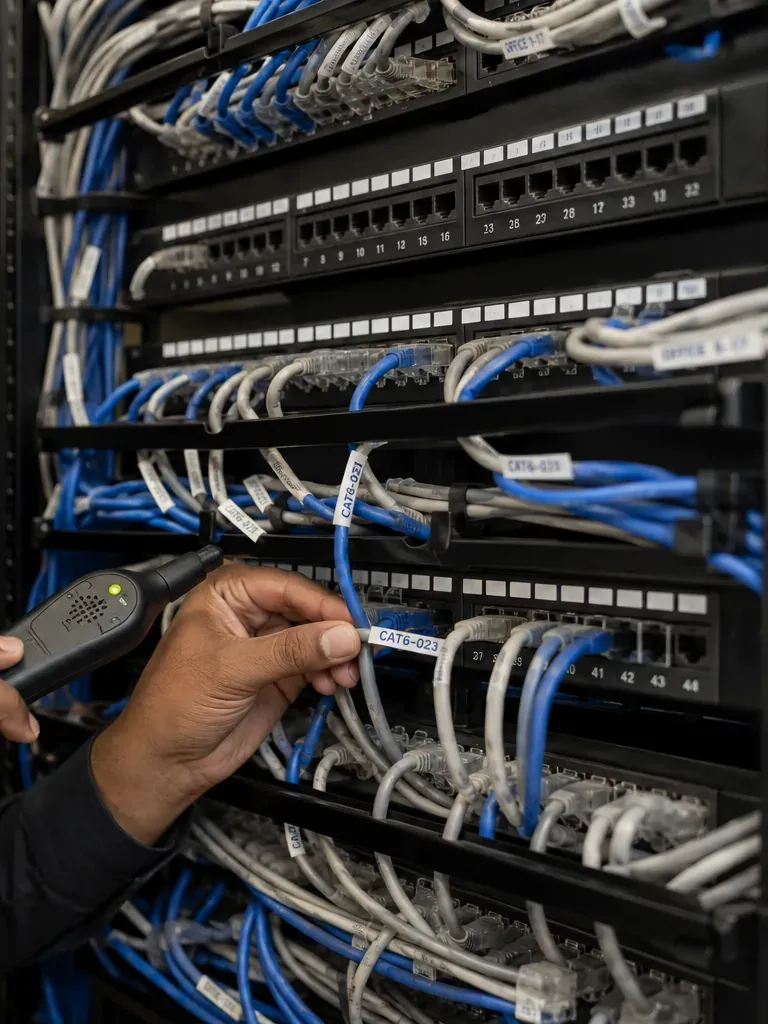
A hand holds a black tone probe against a row of blue and white patch cords at a dense rack of patch panels; small printed labels are visible on several cords and along the panel edges.
Equipment
Test Gear and Parts for Orange County Cat6 Repairs
What is on the van decides whether a repair finishes on the first visit. In a county where the typical fault is hidden behind new drywall or inside an old building, location tools and the right repair parts matter more than spare cable.
Certification Tester
Tests each link against TIA Cat6 or Cat6A permanent-link or channel limits — wire map, length, insertion loss, crosstalk and return loss — and saves the result for the record and the builder or vendor.
Distance-to-Fault Readings
Shows how far along the run a short, open or impedance change sits, which is what lets us cut one small opening in finished drywall instead of guessing.
Tone Generator and Probe
Identifies unlabelled runs in new buildings and old closets alike, and finds where a cable goes when the drawings and the labels disagree.
PoE and Link Qualification Tester
Checks what a camera, phone or access point actually receives at the far end, separating a weak cable from a switch port that has lost power.
Category-Rated Repair Kits
Splice modules and boxes rated for Cat6 and Cat6A, for a single damaged section in a wall where pulling the whole run would mean opening finished rooms.
Cat6 and Cat6A Keystones and Panel Modules
Matched to the existing hardware where possible, so a repaired jack sits in the same plate and the channel stays one category from end to end.
Old-Work Boxes and Access Tools
Low-voltage rings, blank plates and oscillating cutters for neat, small access openings in new drywall and old plaster.
Wet-Location and Outdoor Cable
For flood-prone cellars, runs between farm buildings and anything that leaves the building, with sealed connectors and enclosures for the outdoor end.
Data-Line Protectors and Labels
Listed protectors for building entries on exposed runs, and durable labels so every repaired link is identified at both ends.
We repair what is installed rather than replacing it with a different system, and we match hardware where we can: a Cat5e jack on a Cat6 run lowers the whole link, and on a long run there may be no margin left to lose. If you know the brand of the jacks in your building, tell us when you book.
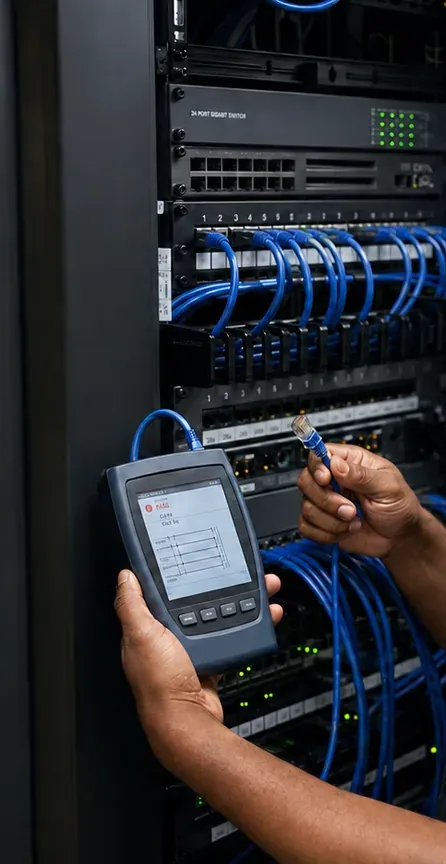
In front of a black rack of patch panels and a switch, one hand holds a grey handheld tester with a lit screen while the other holds a blue cord with an RJ45 plug near the panel ports.
AI Overview Reality Check
What AI Gets Wrong About Cat6 Repair in Orange County
We could not view Google’s AI Overview from our build environment, so the claims below are ones commonly published by cost guides, how-to sites and forums when people search for Cat6 repair. Each is set against what we find in Orange County buildings.
“Orange County Cat6 repair costs about the same as everywhere else in Orange County”
Search results, cost pages and AI summaries regularly blend Orange County, New York with Orange County, California, and with the Orange Counties in Florida, Texas, North Carolina, Virginia and Indiana. A figure that appears under “Orange County” may describe a market thousands of miles away, with different labour rates and building stock.
This page covers Orange County in New York State: Newburgh, Middletown, Port Jervis, Goshen, Monroe, Warwick, Montgomery, Cornwall and the towns around them. Our repair rate here is $195 an hour with a three-hour minimum, published on our own Orange County pages and confirmed in writing before any visit.
If a number you have seen does not name a state, treat it as unrelated. Ask any contractor for a written quote that names your town.
“New cable doesn’t fail — if a new building has network problems, it’s the equipment”
New cable fails all the time; it just fails for different reasons from old cable. In a fast-built county the leading causes are damage by the trades that followed the cabling crew — screws, staples, nails, saw cuts and crushing under floors and trim — and terminations that were rushed or never finished at all.
Equipment does fail, and we separate the two by testing each run on its own with the equipment disconnected. In new buildings in Orange County, a surprising share of “switch problems” turn out to be two or three damaged runs and a panel that was punched down in a hurry.
The lesson is to certify new cabling before the walls are closed, or at least before the building is accepted. A saved result from handover is the only proof of which trade damaged a run later.
“A continuity tester is enough to accept a building’s cabling”
A continuity or wire-map tester shows that eight conductors reach the right pins. It does not show length, crosstalk, insertion loss or return loss, and it will pass a run with a split pair, a crushed section or a coupler in the wall.
Gigabit Ethernet needs all four pairs working well. A fault on one pair can leave a link that connects, but only at 100 Mbps, or that drops under load — the very complaint new occupants make first. Only a certification test against the category limit shows whether the link will carry what it was sold to carry.
For a building owner or a buyer, the useful document is a saved certification report for every run, not a sheet of ticks from a pin tester.
“Two RJ45 plugs and a coupler make a permanent repair”
This is the most common quick fix we find in Orange County walls and ceilings. A cut or damaged run is joined by putting plugs on both ends and pushing them into an inline coupler, and the whole thing is buried behind drywall or above a ceiling.
Fluke Networks’ troubleshooting guidance is blunt that female couplers should not be used in a data installation, and plugs crimped onto solid-conductor wall cable are a frequent source of intermittent faults. The joint adds loss and crosstalk at one point, and it is invisible to the next person who works on the run.
A proper repair either replaces the run between two accessible points or uses a splice module rated for the category inside a box that stays accessible. Either way, the link is certified afterwards.
“Staples and cable ties are fine as long as they don’t pierce the jacket”
Over-driven staples and over-tightened ties do not need to pierce anything to damage Cat6. They deform the cable, change the spacing between pairs and disturb the twist, which shows up as near-end crosstalk or return loss failures at that point.
Industry study material for cabling installers lists cables crushed by ties or staples among the standard causes of crosstalk failures, alongside excessive pull tension and tight bends. On new houses and offices we find runs stapled every foot along a plate, each staple a small defect, and in older main-street buildings we find cable stapled along baseboards and door casings.
Where a run fails for this reason, the cure is to free or replace the damaged length and support it properly — hooks, loose ties or a raceway — not to add more staples.
“Any licensed electrician in Orange County can fix data cabling”
Orange County licenses electricians under its own local law, and an electrician is the right trade for power, circuits and anything energised. Many are also skilled at pulling cable. But terminating and certifying Cat6 is a separate discipline with much tighter tolerances, and it needs a certification tester that most electrical contractors do not carry.
On many Orange County jobs the two trades work side by side: the electrician adds an outlet for a switch or an access point, and we repair, terminate and certify the data runs. What matters is that whoever touches the Cat6 can prove the result with a saved test.
When you hire for a Cat6 repair, ask which tester will be used and whether you will receive the results. Our New York State low-voltage licence number is 12000287431.
“A Cat6 drop costs $125 to $250, so a repair should cost less”
Fixr’s January 2025 cost guide lists $125–$250 per new Cat6 drop including materials, and $45–$75 an hour for installer labour, as national averages. Those figures describe new cable pulled through open spaces; they are not our prices and they do not describe repair.
A repair in a finished building is mostly diagnosis and access: testing, locating the fault, opening a wall or a ceiling at the right point, repairing, certifying and recording. In new construction, the work is often cheaper than a new drop because the access hole is small; in an old building, it can cost more because the route is hard to reach.
For comparison, our own Orange County installation price for a new Cat6 drop inside 100 feet is $321, and a replacement Cat6 run where a cable cannot be saved starts at $175 per drop when it is added to repair time. Both are set out in the pricing section below.
Find the Damaged Run Before You Open the Wall
Tell us which jacks or devices fail, how old the building is and which trades have worked there recently. We will tell you the most likely cause and what the first visit should cover.
New building, main-street shop, warehouse, medical office, farm or house — describe the failing links and what has been built or changed nearby, and a written answer comes back the same business day. Prefer to talk? Dial (845) 640-3835.
✅
We Got Your Request!
A technician will reply the same business day. If a link is down right now, call (845) 640-3835.
How It Works
Our Cat6 Repair Process
Six steps, built around one idea: in Orange County the cause of the fault matters as much as the fix, whether it is a dead jack in a new Monroe apartment or a run through a cellar in Port Jervis.
1. Tell us what failed and what changed
Which jacks or devices fail, when it started, how old the building is and which trades, tenants or storms have been through it since the cable was installed.
2. Plan access and parts
We confirm access to the closet and the failing rooms, any lift or ladder height, shift or tenant restrictions, and load matching keystones, repair kits and replacement cable.
3. Test and locate
Each failing link is certified against its category limit, and distance-to-fault readings from both ends place the damage at a termination or at a measured point in the wall or ceiling.
4. Open, photograph and agree
A small access opening is made only at the measured point, the cause is photographed, and you approve the repair — re-terminate, repair a section, reroute or replace — before work continues.
5. Repair to category
Terminations are remade on matched hardware, damaged sections repaired with category-rated parts or replaced, couplers removed, and wet or outdoor ends rebuilt for their conditions.
6. Certify, label and record the cause
Every repaired link is tested again and labelled at both ends. You receive saved results, the location of each repair and a note of what caused it, ready for a builder, landlord or insurer.
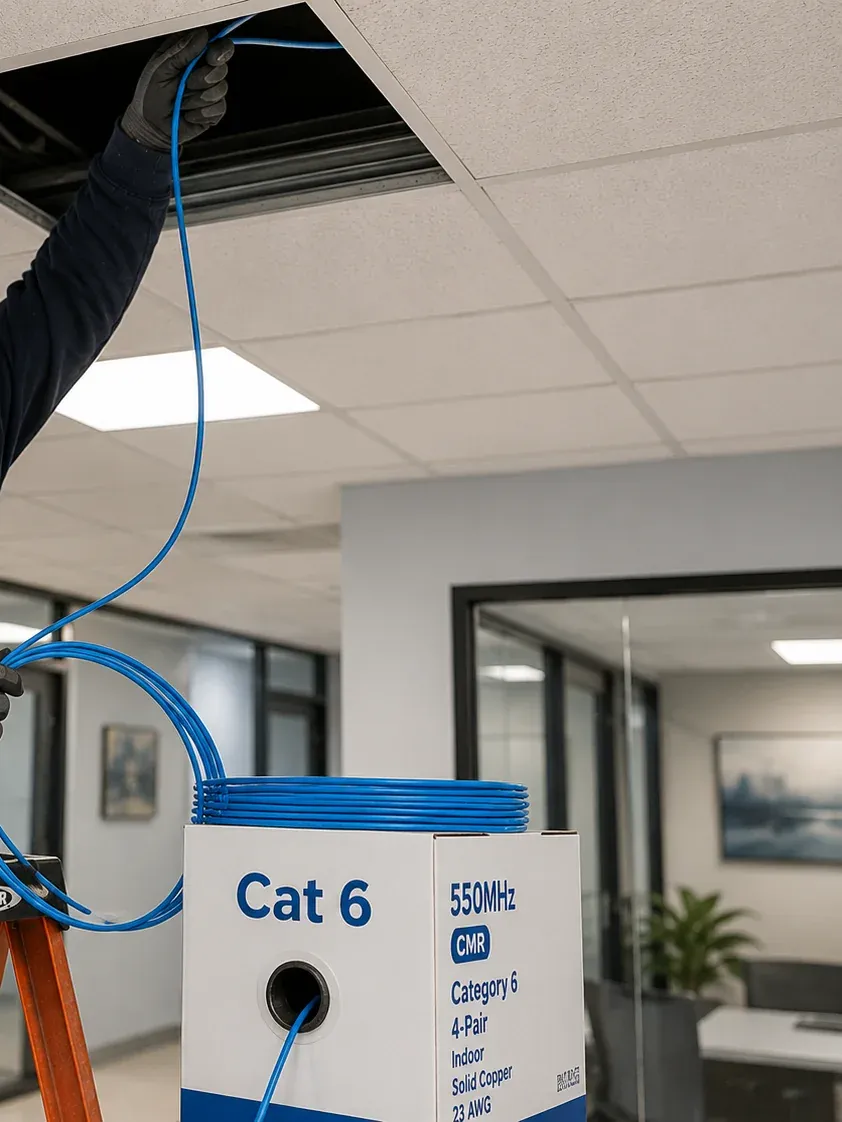
A gloved hand reaches into a gap left by a lifted ceiling tile, feeding blue cable up from a white carton marked Cat 6, 550MHz, CMR, Category 6, 4-Pair, Indoor, Solid Copper, 23 AWG; the top of an orange stepladder is just visible.
Coverage Area
Cat6 Repair Near Orange County’s Landmarks
These six places describe the building stock that Orange County’s Cat6 runs through — new and old, civic and commercial. Each is a reference point for the properties around it, not a claim of work inside it.
East End Historic District, Newburgh
445 acres and more than 2,200 buildings, listed on the National Register in 1985 and dominated by two- and three-storey Italianate brick townhouses, with commercial blocks on Broadway and Liberty Street. Masonry, old chases and cellars.
Orange County Government Center, Goshen
Paul Rudolph’s civic building, completed in 1967, closed after Tropical Storm Irene damaged it in 2011 and reopened in 2017 after a partial demolition and renovation. A reminder of how storms reshape the county’s buildings.
Touro’s Horton Campus, Middletown
The former Horton Hospital, a complex of about 375,000 square feet, opened as Touro College of Osteopathic Medicine’s campus in 2014. Institutional buildings like it carry decades of cabling from previous uses.
Woodbury Common Premium Outlets, Central Valley
Opened in 1985, with about 220 stores in 845,000 square feet — one of the largest contiguous outlet centres anywhere. Retail fit-outs, point-of-sale lanes and constant tenant change.
LEGOLAND New York, Goshen
Opened in 2021 with about 150 themed acres on a 500-acre property and a 250-room hotel, beside a rebuilt Route 17 Exit 125. New-build hospitality and attraction cabling at the centre of the county.
Tri-States Monument, Port Jervis
The 1882 marker under the I-84 viaduct where New York, New Jersey and Pennsylvania meet, near the confluence of the Delaware and the Neversink. Orange is the only New York county that borders both of those states.
We also repair Cat6 in the City of Newburgh and the town of Newburgh, New Windsor, Vails Gate, Cornwall, Cornwall-on-Hudson, Highland Falls and Fort Montgomery; Middletown, Wallkill, Circleville, Mechanicstown and Scotchtown; Goshen, Chester, Florida, Warwick, Pine Island, Greenwood Lake and Sugar Loaf; Monroe, Kiryas Joel, Harriman, Woodbury, Central Valley, Blooming Grove and Washingtonville; Montgomery, Walden, Maybrook and Hamptonburgh; Wawayanda, Otisville, Port Jervis and Deerpark — and the hamlets between them.
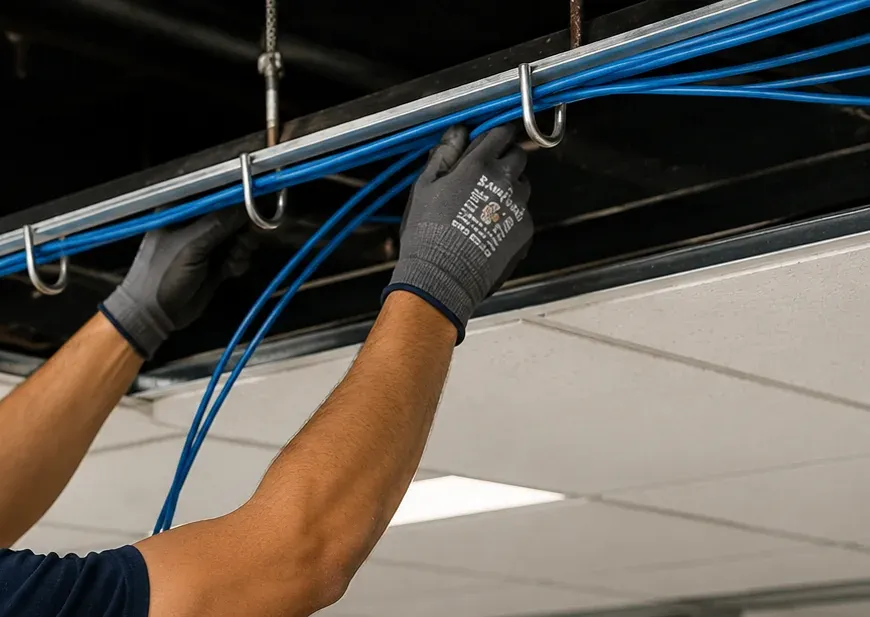
Two gloved hands spread a bundle of blue cables along a line of metal J-hooks suspended on rods below a dark open ceiling, above a white tile ceiling and office lights.
Pricing
Cat6 Repair Cost in Orange County
Every figure in this table is already published on one of our own Orange County pages, and the right-hand column says which. Anything that depends on what testing finds — a reroute, a lift, a long replacement — is quoted in writing before work starts, and repair time and replacement cable appear as separate lines.
Item
Price
Scope and source
Repair time on site: certify, locate, open at the fault, re-terminate or repair, recertify, record the cause
$195/hr, 3-hour minimum ($585)
The specialty rate on our Orange County network cable repair page; the block covers as many failing links as the technician can bring back
Additional time beyond the minimum
$195/hr
Billed in hourly increments, as published on the same page
Replacement Cat6 run where the cable cannot be saved
From $175 per drop
Cable, keystone, wall plate, panel punch-down, testing, labels at both ends and a patch cord, per our Orange County repair pricing
Lift hire where the site has none
At cost, quoted per day
Shown as its own line for high-bay and atrium work, as on our Orange County repair pricing
Closet audit, mapping and labelling
Quoted by port count
Jack-to-port map, live-versus-abandoned identification, durable labels and a printed legend
Plenum (CMP) cable on replacement runs
Add per drop
Only where a ceiling space is used for return air
After-hours or weekend window
Premium applies
For buildings that restrict cabling work to off-hours
New Cat6 drop inside 100 ft (installation, for comparison)
$321 per drop
From our Orange County Cat6 installation price table, which lists $276 for Cat5e and $459 for Cat6A on the same terms
What the three-hour block usually covers here
On a new building with construction damage, three hours typically covers certifying the failing runs, locating two or three faults by distance, cutting small access openings, repairing the damaged sections and recertifying, with photographs of each cause. On an older main-street building it usually covers testing, tracing and re-terminating the worst links and identifying any hidden joints. When testing shows more work — many runs, a reroute through a finished ceiling, a run replaced in a flood-prone cellar — you receive a written price for it before any cable is pulled.
Where these figures come from
The repair rate, replacement-run figure, lift line and audit line are the ones printed on our Orange County network cable repair page, and the installation figures come from our Orange County Cat6 installation page. This page uses them rather than inventing a second set. Your written quote confirms the figures for your site before anything is booked.
What moves an Orange County Cat6 repair bill
Where the damage is: faults at jacks and panels are quick; damage inside a finished wall, a foamed cavity or a stone cellar takes access work.
How many runs share the cause: one screw is one repair; a whole panel terminated badly, or a bundle crushed by flooring, affects many runs at once and is cheaper per run.
The cable itself: genuine solid-copper Cat6 can be repaired; copper-clad aluminium, older cable extended with couplers and indoor cable used outdoors usually has to be replaced.
Access and timing: lifts, shift patterns, occupied apartments, restaurant hours and tenant approvals all shape the visit.
Who pays: in new buildings, a clear record of cause often means the cost ends up with the trade that damaged the run rather than with you.
Full terms — including 50% deposit, one-year parts-only warranty on AESS-supplied products, and the late-fee schedule — are set out in the service agreement.
Shop Our Systems
Cat6 Repair Packages & Pricing
Most Orange County Cat6 repairs fit one of these three. Each is built only from figures we already publish.
Starter — Dead Jack or Damaged Run
$585
Three hours on site at $195 an hour. Suits one or two dead jacks, a run hit by a screw or a nail, or a link that dropped to 100 Mbps: we certify it, locate the fault, open one small access point, repair, recertify and photograph the cause. Spare time in the block goes on any other runs you point us to.
Standard — New-Building Punch List
$195/hr after the first 3 hours
For a new or renovated building before or soon after occupancy: every run certified, failures located and repaired, unfinished runs terminated, a labelled port map and a full set of saved results with a cause note for each fault, ready for the builder or general contractor.
Premium — Repair Plus Replacement Runs
Repair time + from $175 per run
Where testing finds runs that cannot be saved — flood-soaked cellar cable, mixed old runs, copper-clad aluminium — repair time for everything that can be fixed, plus replacement runs from $175 per drop, abandoned cable removed where accessible and an updated map.
Bring Your Own Parts — Labour Only
Have leftover keystones, plates or a box of cable from the original job? We can use them, billed as repair time only, provided they match the link: Cat6A parts on Cat6A runs, solid-copper cable for permanent links, wet-location or outdoor-rated cable for anything in a cellar or between buildings. Everything installed is certified either way. Parts you supply carry their maker’s warranty rather than ours, and if they cannot produce a passing link we tell you before the work is finished.
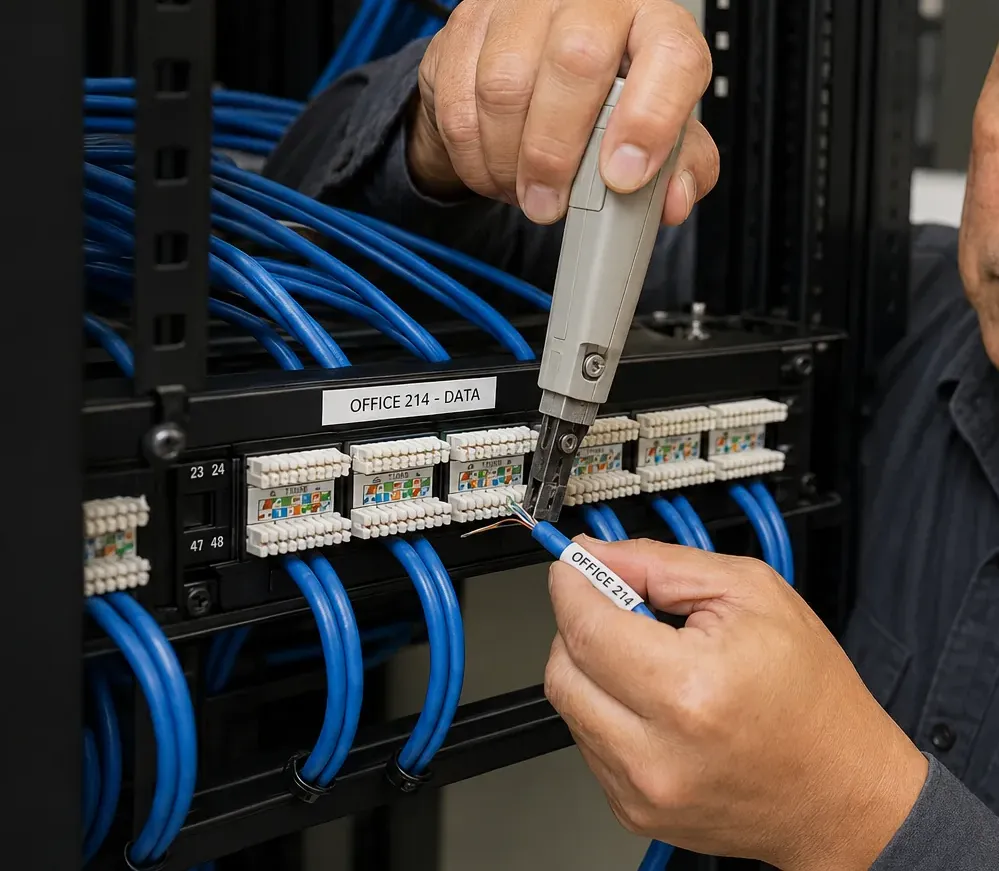
A hand presses a grey punch-down tool into one of a row of white keystone modules on a black patch panel labelled OFFICE 214 – DATA, while the other hand holds a blue cable marked OFFICE 214; bundles of blue cable fill the rack behind.
Repair It While the Builder Still Answers the Phone
If your building is new or newly renovated, test the cabling before warranty deadlines pass. Send the list of dead jacks and the handover date, and we will tell you what a visit should cover.
Who Touched the Cable Last? How Each Trade Damages Cat6
In a new or renovated Orange County building, the fault usually carries the fingerprint of the trade that caused it. This is the pattern we work from when we read a test result and decide where to open the wall. It is general practice, not a judgement on any particular contractor.
Trade
Typical damage
How it shows on the tester
Usual repair
Insulation
Staples across cable, cable pulled tight against studs, foam filling boxes
Crosstalk or return-loss failure at a stud line; jack hard to remake
Free or replace the stapled length; clear the box
Drywall
Screw through cable at a stud or plate; box cut too large
Short or open at a measurable distance; loose jack
Small access opening, section repair or replacement; ring for the box
Tapers and painters
Paint and compound in jacks; plates painted over
Intermittent contact; link fails only with a cord plugged in
Replace jack face or keystone
Flooring and trim
Nails through cable along baseboards; cable crushed under thresholds
Short or open near the floor line, close to the jack
Section repair behind the baseboard
Electricians (finish)
Data cable pinched beside power in a shared box; cable cut when boxes are moved
Open pair; noise errors where cable runs alongside power
Separate and repair; new box location where needed
HVAC and plumbing
Cable pushed aside or cut for ducts and pipes; cable laid on hot pipes
A saved certification from the day the cabling crew finished turns this table from a likely story into proof. Without it, the photographs taken when we open the wall do most of the same work.
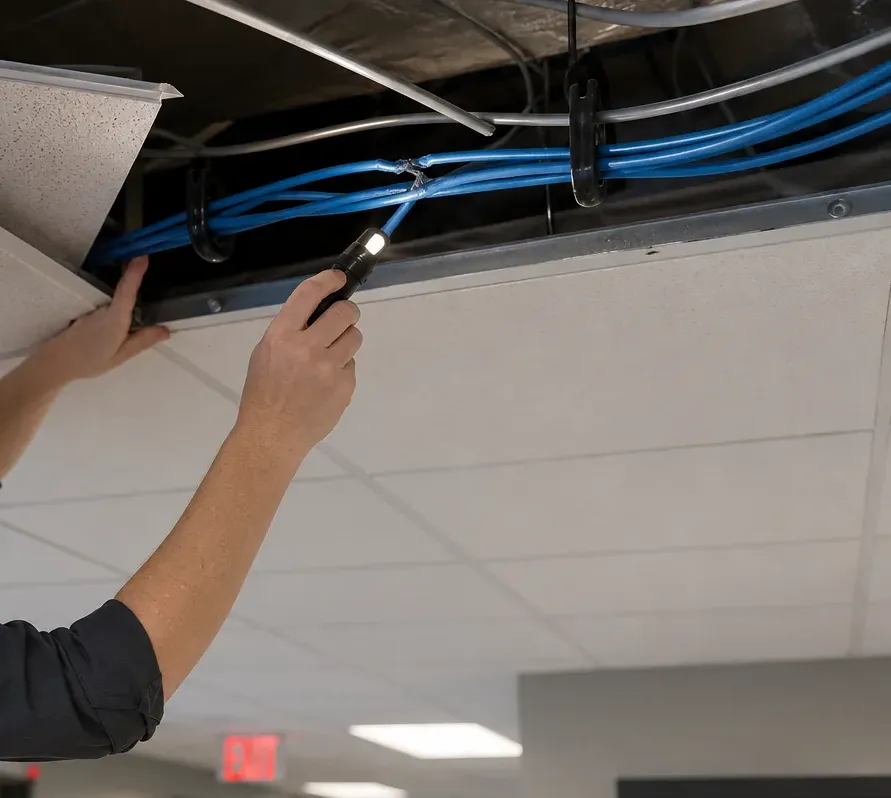
One hand holds up the edge of a white ceiling tile while the other shines a small flashlight on bundles of blue and grey cable lying on supports in the space above; office lights and an exit sign are visible below.
Weather Record
Orange County Storms and Floods That Still Show Up in Cat6
Weather damage to network cabling often appears long after the event. These are recorded events in or around the county, what each kind of event tends to do to Cat6, and what is worth checking if your building was affected.
Event
What was recorded
What it does to Cat6
Worth checking
1981 ice-jam flood, Port Jervis
Delaware record crest of 26.6 ft; damage to 950 structures (NWS impact table)
Long-term: buildings rebuilt after floods often have cellar runs and closets at risk
Closet height; cable routes through cellars
June 2006 Delaware flood
Crest of 21.47 ft at Matamoras/Port Jervis; serious backwater near the Neversink
Corroded terminations in cellars and ground floors
Terminations in low areas; runs that pass through cellars
2020 lightning season
275,059 pulses over Orange County, the most in New York (Earth Networks)
Surges on runs between buildings and to outdoor devices
Nine inches of rain on Highland Falls by the Governor’s account; roads and a bridge on Route 9W damaged
Delayed corrosion in buildings that took water
Open and inspect terminations, even on links that pass
June 27, 2024 thunderstorms
About 13,000 Orange County customers lost power, with winds near 60 mph (Times Union)
Links and PoE devices that fail to recover when power returns
Switch PoE budgets; marginal runs to cameras
July 2026 outages
More than 47,000 Orange and Rockland Utilities customers affected from July 1 (O&R update)
As above, plus surge damage where power returned unevenly
Saved results compared with a fresh test
If your building was affected by any of these and you have not had the cabling tested since, a single visit to certify the exposed runs is a reasonable precaution. A clean result is worth keeping on file as a baseline for the next storm.
Complete Services
Every Cat6 Repair Service in Orange County
A failed Cat6 run often brings a camera, a switch or a new link into the same conversation. These are the related services we provide across the county.
How we approach a failed run behind fresh drywall — general practice rather than one particular call
We test from both ends before we touch a tool. Two distance readings that agree give a point on the wall; two that disagree usually mean two faults, or a joint nobody mentioned. Either way, the readings decide where we cut.
Then we look at the wall the way the drywall crew did. Screws land on studs, plates and the edges of boxes, so a fault at stud height on a measured line is almost always a fastener. A fault right at the floor usually means trim or flooring. A fault at the box means the box was cut or the cable was pulled too tight when the jack went on.
We cut the smallest opening that lets us repair the cable properly, photograph what we find before we change it, and leave the opening clean for the taper. The photograph and the test result go into the record together. In a county with this much new building, that record is often the most valuable thing we leave behind.
FAQ
Orange County Cat6 Repair FAQ
Can repair visits in Kiryas Joel, Monroe and nearby communities be scheduled around Shabbat and Jewish holidays?
+
Yes. Tell us which days and hours the building or household is unavailable when you book, and we schedule the visit inside the windows that work, including finishing well before Friday afternoon where that matters. For multi-family buildings we can also plan around times when residents are home or away, so access to apartments is arranged in advance.
Can you repair Cat6 in an Orange County building that is still under construction, before the certificate of occupancy?
+
Yes, and it is the cheapest time to do it. While ceilings are open and trades are still on site, damaged runs can be located, repaired or replaced with far less patching, and the trade responsible is still around. We coordinate with the general contractor’s schedule and leave a set of saved results for the handover file.
Can you work under a school-district or municipal purchase order in Orange County?
+
Yes. Send us the purchasing requirements — vendor registration, insurance certificates, prevailing-wage terms if they apply, and the purchase order format — and we will provide a written quote that matches them. Work in schools and municipal buildings is scheduled around the calendar the district or town sets.
Do you repair Cat6 at Orange County wedding barns and event venues ahead of a booked date?
+
Yes. Venues often depend on Cat6 for Wi-Fi access points, point-of-sale, cameras and audio-visual links, sometimes across several buildings. Tell us the date of the next event and we will schedule the repair and a full test with enough time to spare, and point out any runs that are likely to fail in the next storm.
Can you work at a distribution centre near Stewart Airport that requires gate badges and a site safety induction?
+
Yes. We supply certificates of insurance, technician details and any paperwork the site needs in advance, attend the induction, and follow the site’s rules on high-visibility clothing, lifts and working zones. Booking a few days ahead usually gives security and safety teams time to clear us before the visit.
Greenlight’s installer left the fiber terminal in our garage — can the Cat6 already in our Orange County walls carry the service to other rooms?
+
Often it can. If the house has Cat6 runs that meet near the garage or a utility room, we test them, terminate any that were never finished, and connect the provider’s router or a small switch so the existing jacks carry the service. If no run reaches the right place, we repair or add the missing link. The provider’s own equipment stays with the provider.
Can you repair Cat6 in a log or post-and-beam home in Orange County where there are no hollow walls?
+
Yes, though the route matters more than usual. In solid-wall homes, Cat6 usually runs through floors, under the roof, inside built-in cabinetry or in raceway. We locate the fault first, then repair it where the cable can be reached, and where a run must be replaced we plan a route that keeps the cable protected and out of sight as far as the structure allows.
What happens if the fault turns out to be outside our building, on the utility pole or the provider’s line?
+
We tell you, with the test results that show it. Our work covers the cabling inside your property from the provider’s handoff point onward. If the inside wiring tests clean and the problem is on the provider’s side, you can pass our results to them, which usually shortens the conversation and the wait for their technician.
Can one visit cover Cat6 faults at two of our Orange County sites — say Newburgh and Middletown — on the same day?
+
Often, yes, if the faults are well described in advance. We plan the order of the visits, carry parts for both sites and agree how the three-hour minimum applies across them. Larger faults at either site may need their own visit, and we tell you that when we review the details.
Can a Cat6 repair at a Newburgh or Middletown restaurant be finished before opening so the registers are ready for service?
+
Usually. We book an early-morning window, test and repair the links to the registers, kitchen printers and payment terminals first, and leave the less urgent runs for the end of the visit or a later one. If a run cannot be repaired before opening, we set up a temporary tested cord so service can go ahead while the permanent repair is planned.
All Areas Served
Cat6 Repair Across the Hudson Valley and Beyond
You are on the Orange County Cat6 repair page, part of our Hudson Valley Cat6 repair hub. Neighbouring county pages cover Rockland and Putnam, and our New York City and Long Island hubs cover the rest of the region.
Orange County Jacks Still Dead After Move-In Week?
If the jacks in a new building never worked, a run stopped after the last trade left, or a storm took out the link to the barn, call (845) 640-3835. We book the next open 2-hour window, bring the parts the symptom points to, and most single faults at a jack, a panel or a measured point in a wall are found and fixed in one to two hours on site.
Cat6 Repair Orange County — Licensed, Insured, Tested to Category
Abstract Enterprises Security Systems · 460 E Fordham Rd, Bronx, NY 10458 · Orange County line (845) 640-3835 · WhatsApp (718) 679-0359 via wa.me
NYS Low-Voltage Licence #12000287431 · 100% Licensed & Insured · Same-Day Estimates · Rated 4.7★ from 201 Google Reviews
Customer-supplied parts are covered by their maker, not by AESS. Our warranty page and the service agreement hold the full terms.
Code, standard and regulation references on this page are short summaries written for property owners in Orange County, New York; they are not legal or engineering advice. Page reviewed and updated October 17, 2026. Changelog: first publication of the Orange County Cat6 repair page.