What are you looking for?
About Us Contact Us Careers Get a Free Quote (800) 486-0943
Pick a service
✅ Got Your Own System?
🎬 Home TheatreQuote 🎶 AV SoundQuote 🔑 Access ControlQuote
Now pick your area
Pick your area
Long Island
Hudson Valley
Services available
Pricing & Tools
Pick a service for pricing
🚪 Intercom Pricing 🔔 Buzzer Repair Pricing
Calculators
📹 Camera System Calculator 🚨 Alarm Calculator ⚡ Cabling Quote Builder ✅ Got Your Own System?
Select your area

Home › Smart Lock Installation NYC › Brooklyn › Bay Ridge

Licensed Low-Voltage Contractor · Southwest Brooklyn · Houses, Co-ops, Avenue Businesses

Smart Lock
Installation in
Bay Ridge

Schedules · Auto-Relock · Curfews for Staff Codes · Readable Entry Logs · Two-Family & Co-op Doors

A Bay Ridge front door keeps hours. Commuters leave before seven and ride a long way home from the end of the R line. One resident in five is 65 or older, often with an aide or a grown child coming and going on a timetable. Two-family houses hold two households on two different clocks, and Third Avenue kitchens stay open long after the rest of the block is asleep. We install smart locks around that timetable: who may open which door, during which hours, what the lock does by itself at 11 p.m. or 4 a.m., and a history you can actually read the morning after.

Reviewed and updated October 17, 2026 · Written by Anwar Timothy, NYS licence #12000287431

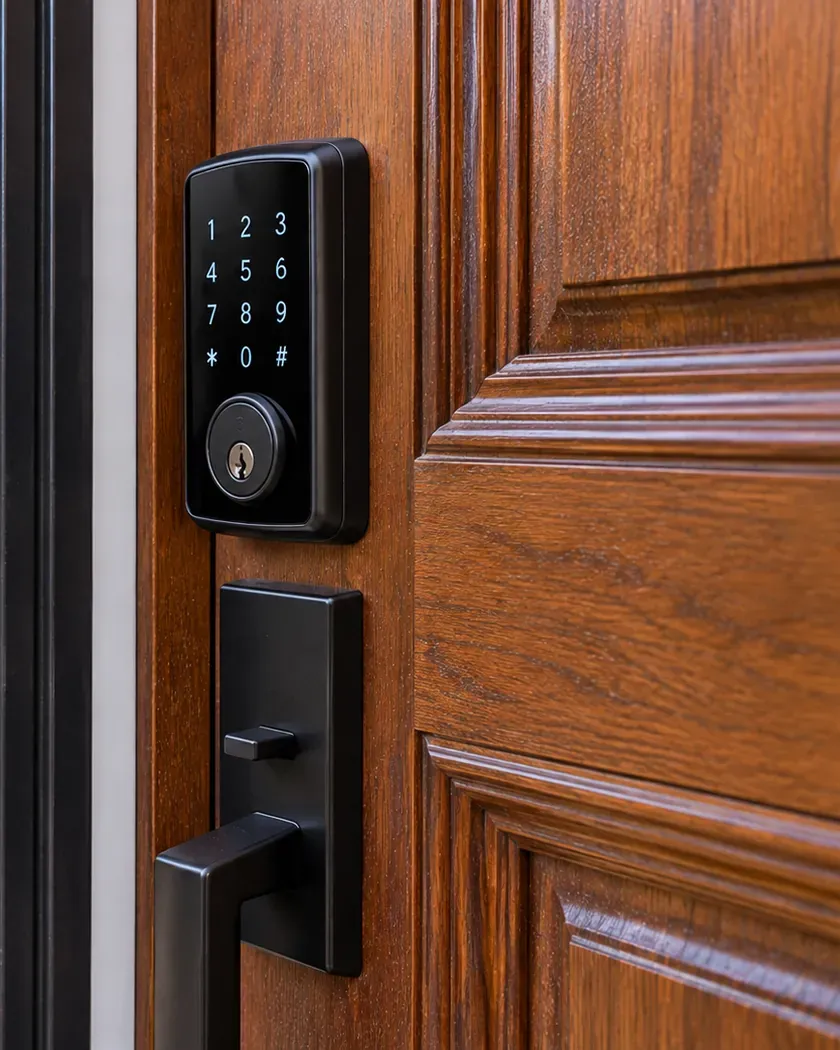
Smart lock installation in Bay Ridge, Brooklyn: matte black keypad deadbolt with a key cylinder above a black lever handle on a stained wood front door
A black keypad deadbolt, its backup keyway below the number pad, mounted above a lever handle on a stained wood door with raised mouldings.
Free Bay Ridge Smart Lock Quote
Tell us the doors, the people and the hours they keep — a licensed installer calls back the same business day

✅
Request Sent!
We'll call you back the same business day.
25+
Years Experience
✓
Same-Day Estimates
100%
Licensed & Insured
$0
Monthly Fees

4.7★ average across 201 Google Reviews · NYS Low-Voltage Licence #12000287431

Out of the house from early morning, or looking after someone who stays home all day? Ring (347) 934-8335 or fill in the 60-second form with a rough timetable — who leaves when, who arrives when, which door they use. A licensed installer will tell you which kind of lock can keep that timetable before anyone visits.

  • A code for every person, each with its own days and hours, named so the history makes sense
  • Auto-relock and a nightly lock-up time set to how your household actually moves through the door
  • A plain inside thumb-turn or lever on every door, so getting out never depends on a battery
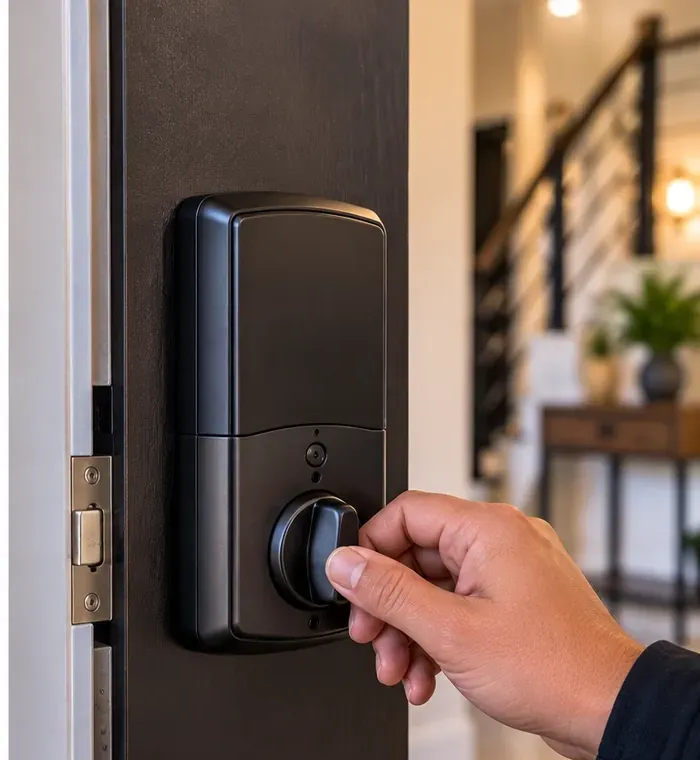
Hand turning the inside thumb-turn of a black smart deadbolt, Bay Ridge Brooklyn smart lock installation
The inside half of a smart deadbolt: a battery housing with a round thumb-turn that a hand can work in one motion, whatever the schedule or the app says.
The Neighborhood

Why Bay Ridge Properties Need Smart Lock Installation Built Around a Timetable

Bay Ridge chose, decades ago, to stay the way it was built. In 1978, after neighbours fought the twin 30-storey Bay Ridge Towers and the 13-storey Shore Hill Apartments, the city created the Special Bay Ridge District, whose zoning text sets out to preserve the existing scale and character of the community. In March 2005 the City Council went further and rezoned 249 blocks inside the district, between 65th Street, Seventh Avenue and Shore Road, raising the number of blocks limited to one- and two-family homes from 33 to 101. The NYU Furman Center counts only 452 housing units added in Bay Ridge and Dyker Heights between 2010 and 2025. So the doors here are, overwhelmingly, the doors of old buildings: limestone and brick rows, tapestry-brick semi-detached houses, detached houses near the water, and the apartment blocks that line Shore Road, Ridge Boulevard and Fourth Avenue.

The people behind those doors stay too, and that is what makes a smart lock job here less about the hardware and more about the calendar. The Furman Center puts homeownership in the district at 41.0 percent in 2024 — well above the Brooklyn norm — and the share of residents aged 65 and over at 20.2 percent, up from 13.1 percent in 2010. A long-settled household is rarely one person with one key. It is a retired owner on the parlour floor, an adult child upstairs who commutes, an aide who arrives at eight, a grandchild who lets herself in after school, a cleaner every other week and a plumber once a year. Each of them needs the door at a different time, and a lock that only knows “open” and “closed” serves none of them as well as one that knows who and when.

The commute stretches that timetable at both ends. Bay Ridge–95th Street has been the end of the R line since 1925, and the Furman Center's mean travel time to work for the district is 46.4 minutes, with close to two-thirds of commuters getting there without a car. A household that leaves at 6:45 and walks back in at 7:30 at night has a house that sits empty, or nearly so, for twelve hours a day. Deliveries, dog walkers and service visits happen in that gap. A smart lock earns its place by letting the right person in during that gap, locking behind them on its own, and leaving a record that says so.

Then there are the houses that hold two households. Community Board 10 describes one- and two-family homes as the major part of its housing, and a two-family in Bay Ridge very often means an owner on one floor and a tenant on the other, sharing a street door and a hallway while keeping completely different hours. The tenant who works nights comes in at two in the morning; the owner wants the street door locked by eleven. Both are reasonable, and both can be built into the same lock if the codes, the schedules and the auto-relock are planned together. Where a house has crept past two households — and the council member for the area reported more than a thousand illegal-conversion complaints from Bay Ridge, Dyker Heights and Fort Hamilton in the four years after 2010 — the rules change, which we cover further down.

Finally, the avenues keep the latest hours of all. The State Liquor Authority lets Kings County bars and restaurants serve until 4 a.m., and Third Avenue has the restaurants and bars to use those hours. In the early morning of Friday, August 28, 2026, three Third Avenue restaurants between 87th and 94th streets were burglarised between 3 and 4:30 a.m., according to PIX11's report of the NYPD account. A Bay Ridge restaurant door therefore has a working day that ends at four, a dead zone until the prep cook arrives, and a strong reason for every staff code to stop working in between. Fifth Avenue and 86th Street, with hundreds of ground-floor businesses between their two business improvement districts, have their own opening and closing rhythms, and the medical offices on and around Bay Ridge Parkway have theirs.

Bay Ridge is not a high-crime neighbourhood — the Furman Center's serious-crime rate for the district was 5.2 per 1,000 residents in 2025, down from 11.4 in 2006. The lessons local news keeps repeating are about habits more than hardware. In August 2019 police connected two suspects to as many as 15 burglaries of Dyker Heights and Bay Ridge homes, which the Brooklyn Home Reporter said were committed “largely” through unlocked windows and doors. A door that locks itself, at a time the household chooses, closes that particular gap without asking anyone to remember anything.

Bay Ridge facts that shape a smart lock plan

  • 20.2 percent of residents of Bay Ridge and Dyker Heights were 65 or older in 2024 (NYU Furman Center) — households where aides, relatives and visiting services need their own timed access.
  • 46.4 minutes was the mean travel time to work in 2024, and 63.6 percent of commuters went by something other than a car (Furman Center) — long empty days at the door.
  • 41.0 percent homeownership in 2024 and a rental vacancy rate of 2.5 percent (Furman Center) — owners who stay for decades and tenants who rarely move, often under the same roof.
  • 101 of the 249 rezoned blocks now permit only one- or two-family houses, following the City Council's March 2005 vote (CityLand) — so one street door shared by two households is the everyday arrangement.
  • 8 a.m. to 4 a.m. are the State Liquor Authority's on-premises hours for Kings County on weekdays (10 a.m. to 4 a.m. on Sundays) — the avenues' restaurant doors keep a near-24-hour day.
  • 5.2 serious crimes per 1,000 residents in 2025, against 11.4 in 2006 (Furman Center) — so the case for a smart lock here rests on schedules and records more than on fear.

Most Bay Ridge households who plan their door this carefully also want to see who is standing at it. A video doorbell is the usual partner for a smart lock on a two-family's street door, and for co-op buildings and walk-ups the conversation often turns to the Bay Ridge intercom installation that lets each apartment answer and release the street door.

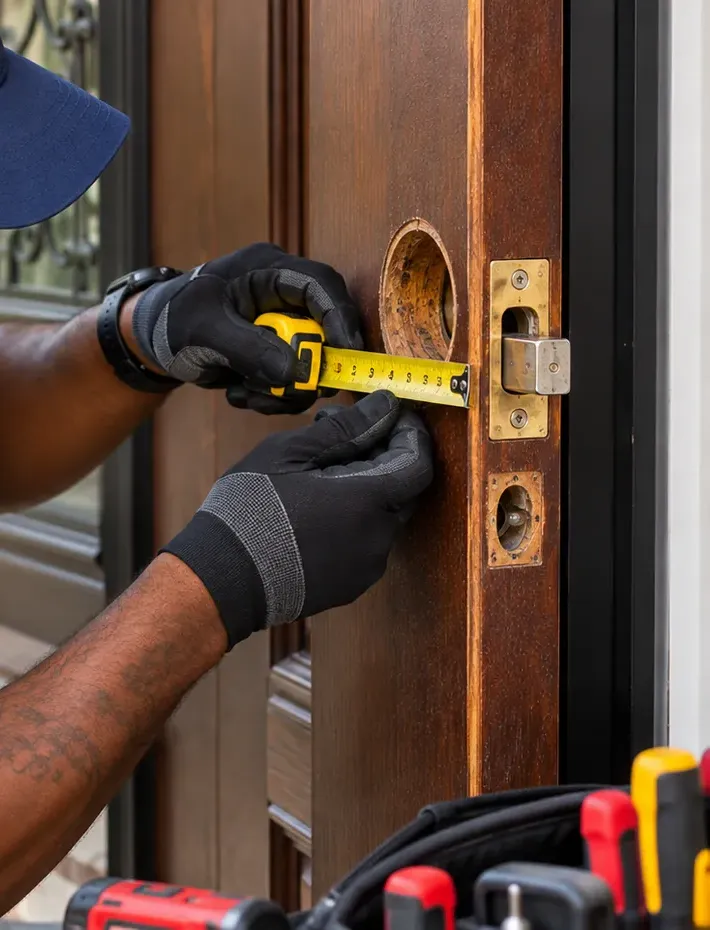
Gloved hands measuring from the edge of a wood door to an empty deadbolt bore beside a brass latch plate, Bay Ridge Brooklyn smart lock survey
An empty bore, worn at the rim, with a brass latch plate in the edge below it: the measurement from edge to bore centre is taken before any lock is chosen.
Repair Capture

Bay Ridge Lock Ignoring Its Schedule, or Not Answering at All?

The aide's code stopped working on Monday. The street door didn't relock at eleven. The keypad went blank on a cold morning on the stoop. Phone (347) 934-8335 and we'll give you the next open two-hour arrival window; most clock, battery, pairing and strike-alignment faults are put right within one to two hours of the technician reaching the door. When the visit turns out to need no hardware at all — only the app, the bridge, the schedules or the codes — it is billed at the Brooklyn setup-only rate of $195 for the first hour, then 30-minute blocks.

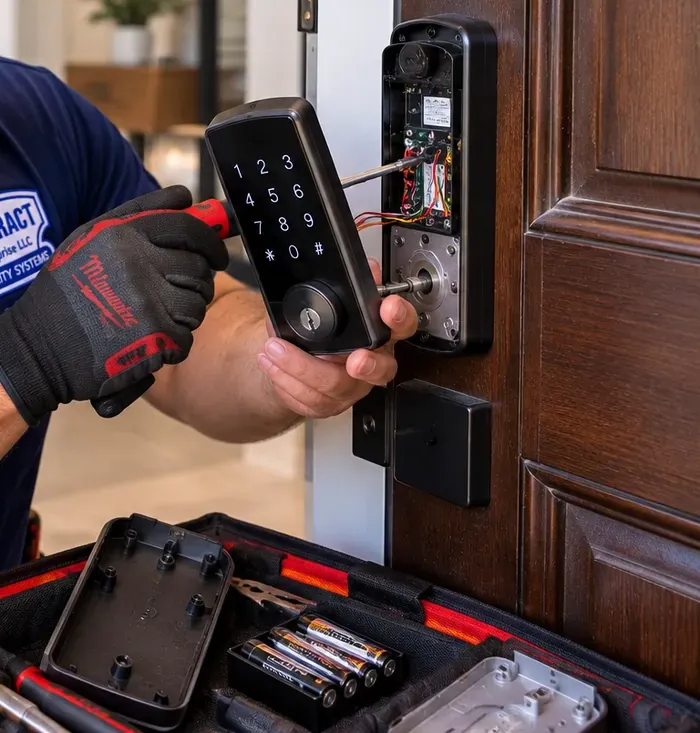
Smart lock repair in Bay Ridge, Brooklyn: keypad unit held away from a wood door with its connector exposed and spare batteries in an open case below
The outside keypad unscrewed and held clear of the door so the connector behind it can be checked, with spare AA batteries and the battery cover in the case on the floor.
What We Install

Smart Lock Installation Services in Bay Ridge

Every job below starts with the same two questions: which doors, and who needs them when. These are the ones Bay Ridge's houses, co-ops and avenues ask for most.

Timed Codes for Every Person

A separate code for each family member, aide, cleaner and walker, each limited to the days and hours that person actually comes, and each named so the history reads “Aide, 8:02 a.m.” rather than “User 6”.

Two-Family Street Doors

One shared front door, two households: separate codes per floor, a nightly lock-up time both agree on, auto-relock so the door is never left on the latch, and admin rights that belong to the owner without exposing the tenant's own door.

Doors for a Parent Living Alone

A lock a parent can work without a phone, codes for the people who help, an alert to a son or daughter if the door hasn't opened by a set hour, and a plan for how emergency services get in without breaking the door.

Co-op and Condo Unit Doors

Shore Road, Fourth Avenue and Ridge Boulevard buildings: retrofit or replacement locks fitted within the building's alteration rules and contractor hours, with the duplicate key or code the proprietary lease usually expects.

Restaurant and Bar Doors

Front, back and cellar doors on Third Avenue and Fifth Avenue premises: staff codes that stop working after closing, an alert if any door opens in the small hours, and wired readers with electric strikes where traffic is heavy.

Practice and Office Entrances

Dental and medical suites in limestone rows and avenue buildings: a waiting-room door that opens when the first staff member arrives, inner doors that stay locked, and a record of who opened which door and when.

Shop Doors on Fifth Avenue and 86th Street

Opening and closing schedules with holiday exceptions, per-employee codes that come and go with staff, and a lock that suits the door behind the roll-down gate rather than fighting it.

Household Changes Over the Years

Re-planning codes when a tenant moves out, a grandchild starts high school, a parent needs help at home or a household member deploys — including passing admin control from one person to another cleanly.

Repairs, Re-Pairing and Clock Faults

Schedules running an hour out, codes ignored after a battery change, locks orphaned by a new router, keypads that took winter salt on the stoop — diagnosed at the door and fixed at the cause.

Building Specialists

Smart Lock Installation for Bay Ridge's Architecture

Because the 1978 district and the 2005 rezoning kept so much of the older stock, a Bay Ridge job usually means fitting new electronics to a door that was hung long before anyone thought of them. These are the building families we meet most, and what each one means for a lock.

Limestone Row Houses

Two storeys over a basement, stone fronts, heavy wood doors with glass and sometimes ornamental iron over the glass. The 54 houses on Bay Ridge Parkway between Fourth and Fifth avenues, built between 1906 and 1913, became Bay Ridge's first historic district in 2019. Doors are thick and old; measure first, and keep anything mounted on the stone itself to a minimum.

Tapestry-Brick Semi-Detached and Two-Family Houses

Built in the 1910s and 1920s, many later split into an apartment per floor. The front door is often a shared street door into a small hall, with each unit's own door beyond it, and a side or rear door onto a driveway or yard. These houses are where shared codes, separate schedules and nightly lock-up times matter most.

Detached Houses Near Shore Road and the Narrows

Larger houses on the blocks toward the water, some of them a century old, with front, side, rear and garage-to-basement doors. More doors means more decisions about which ones go smart and which keep a good mechanical deadbolt, and a longer walk from the router to the farthest lock.

Shore Road Co-op Buildings

From pre-war buildings like the Art Moderne Normandy at 9437 Shore Road, which opened as a rental in 1940, to post-war towers like 9201 Shore Road, completed in 1960 with 254 apartments. Unit doors are usually steel or steel-clad in steel frames, and the board and managing agent have a say before anything is drilled.

Walk-Ups and Mid-Rise Rentals

Four- to six-storey buildings scattered through the side streets and lining Fourth Avenue and Ridge Boulevard. A tenant may add a lock of their own under state law; the owner is responsible for the street door. The two are different jobs with different rules, and we keep them apart.

Mixed-Use Avenue Buildings

Third-, Fourth- and Fifth-Avenue buildings with a business on the ground floor and flats above, reached by a separate street door beside the shopfront. The shop, the stair door and each apartment need three separate code plans that never overlap.

Materials and methods, door by door

  • Thick old wood doors. Many residential smart deadbolts are made for doors between 1⅜ and about 2 inches thick — Allegion lists 1⅜″ to 2″ for Schlage's Arrive deadbolt — so a heavy row-house door is measured before a lock is ordered, and a thickness kit or a different model is chosen where needed.
  • Backset and old bores. Standard smart deadbolts expect the bore centre 2⅓″ or 2¾″ from the edge. Older doors drilled for earlier hardware are plugged with glued hardwood and re-bored, rather than having a new lock perched over a hole that doesn't match.
  • Glass and ironwork. On doors with a glazed panel and decorative iron, the keypad has to clear the grille and the glass rail. Where glass sits within arm's reach of the inside thumb-turn, we say so plainly at the walkthrough.
  • Steel co-op doors. Steel-clad unit doors in steel frames call for the right drill bits, sleeves and fasteners, and for confirming with the managing agent whether the door is fire-rated before any change to it.
  • Strikes in old frames. A motorised bolt needs to throw cleanly every time or it drains batteries and reports faults. On frames that have shifted, the strike is moved or rebuilt so the bolt runs without rubbing — especially important when the lock relocks by itself on a timer.
  • Weather on the stoop. A keypad facing the street on an exposed stoop takes rain, sun and winter salt. A gasket, a model rated for outdoor exposure and sometimes a sheltered inner door are part of the choice.
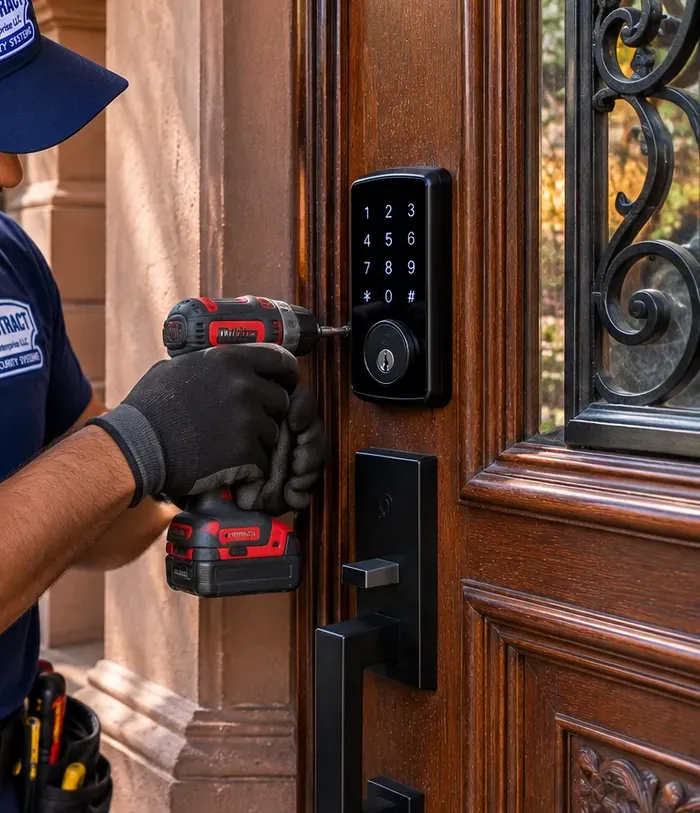
Gloved hand fastening a keypad smart lock with a cordless drill on a carved wood door beside a glass panel with decorative ironwork, Bay Ridge Brooklyn
A cordless drill driving the keypad's mounting screws on a carved wood door, with ornamental ironwork over the glass panel only inches from the lock.
A Day at the Door

Twenty-Four Hours at a Bay Ridge Front Door

The easiest way to plan a smart lock here is to walk through one day at one door. The example below is a two-family house — owner downstairs, tenant upstairs, a shared street door — because it is the most common arrangement in Bay Ridge and the one with the most moving parts. It is a planning illustration, not an account of a particular household. Your own version of this table is what we build at the walkthrough.

TimeWho is at the doorWhat the lock should do
6:40 a.m.Owner's son leaves for the R trainUnlocks from inside with one turn; relocks itself a short delay after the door closes, so nobody has to check
7:15 a.m.Tenant leaves for workSame: free exit, automatic relock. No notification needed for routine household exits
8:00 a.m.Home aide arrives for the owner's motherAide's code works on the street door and the downstairs unit door, weekdays 7:30 to 9:00 a.m. only; the son gets a quiet notification that it was used
11:00 a.m.Midday check: has the downstairs door opened?If nothing has opened by late morning on a day the aide isn't due, an alert goes to the family — an absence of activity is itself information
1:30 p.m.Dog walker, Tuesdays and ThursdaysWalker's code works 12:30 to 2:30 on those days; outside that window it is refused and the attempt is logged
3:20 p.m.Grandchild home from schoolHer own code, school days only; the arrival shows by name in the history
Every other ThursdayCleanerCode enabled for the cleaning days only — set by date where the app can't do a fortnightly repeat
7:30 p.m.Son and tenant returnCodes or phones; the door relocks behind each of them
11:00 p.m.Nightly lock-upIf anyone has left the street door unlocked or on hold-open, the lock throws itself at eleven; household codes still work all night
2:10 a.m.Tenant back from a late shiftCode works; the keypad's sound is turned down so the house stays asleep; arrival logged
3:00–5:00 a.m.Nobody expectedEvery non-household code is outside its window and refused; any opening triggers an alert to the owner

Notice what the plan does not require: nobody has to remember to lock up, nobody has to hand over or collect a key, and nobody's code works at hours they have no reason to be there. Notice also what it cannot do. It cannot judge the person standing on the stoop. In October 2019 a man posing as a FedEx courier talked his way into a Bay Ridge home and, with a partner, tied up an 81-year-old man, his 75-year-old wife and their 36-year-old daughter before robbing them, as NBC New York reported at the time of the arrest. No lock setting prevents a door being opened from inside to a convincing stranger. A video doorbell that lets the family see and speak to a caller without opening up, and a household rule that deliveries are left, not handed over, belong in the same plan.

The same exercise works for a single-family row house, a co-op apartment or a shop. For a restaurant it becomes a closing-to-opening table instead; for a medical practice it becomes a first-arrival rule. The point is always the same: decide who needs the door and when, and only then pick the lock that can carry that decision.

Commercial Smart Locks

Business Smart Lock Installation in Bay Ridge

Community Board 10 lists Third Avenue, Fourth Avenue, Fifth Avenue, Fort Hamilton Parkway and the “bustling 86th Street strip” among its commercial corridors. Each keeps different hours, and the lock plan follows the hours.

Third Avenue Restaurants and Bars

The merchants' association describes Third Avenue as a 36-block strip of independent businesses, and it carries much of the neighbourhood's late-night trade. Kings County allows on-premises service until 4 a.m. The lock plan here is a closing-to-opening curfew for staff codes, a cellar and rear door that report any opening after hours, and an owner who can see from home that every door latched.

Fifth Avenue Shops

The Bay Ridge 5th Avenue BID, founded in June 2006, spans 40 block faces with 376 ground-floor businesses according to the city's BID directory. Shop doors here usually sit behind roll-down gates, open on a fixed schedule and change staff often: per-employee codes, schedules with holiday exceptions and a hardened rear door are the usual brief.

86th Street

The 86th Street Bay Ridge BID, established in October 2001, covers 16 block faces and 145 ground-floor businesses, with the R train at 86th Street and Fourth Avenue. Larger stores mean wired readers with electric strikes on staff entrances, and stockroom doors with their own codes.

Bay Ridge Parkway and Medical Offices

The LPC notes that the limestone row on Bay Ridge Parkway has been a hub for people in the medical profession historically and currently, which gave Doctors' Row its name. Practices in row houses and avenue buildings want a waiting-room door that opens when staff arrive and records rooms that stay locked to everyone but authorised staff.

Fourth Avenue and Ridge Boulevard Buildings

Mid-rise rentals and co-ops with ground-floor offices and a few storefronts. The owner's street door and lobby fall under building rules; ground-floor tenants need their own entrance planned so it never opens the residential lobby.

Fort Hamilton Parkway and the Southern Blocks

Smaller shops, services and offices toward Fort Hamilton and Dyker Heights, many with flats above. Straightforward keypad deadbolts or reader-and-strike doors, planned so the shop's codes and the residents' codes never cross.

Compliance callouts for Bay Ridge business doors

  • Free way out. A door people leave through must open from the inside without a key, tool or special knowledge. A keypad on the outside is fine; a lock that traps staff or customers inside is not. Electrified locks are planned so they release on the egress side.
  • Roll-down gates. The city's long-standing requirement for more transparent gates on replacement was the subject of a 2026 Council vote to repeal its July 1, 2026 deadline (reported by NY1); DOB permit rules for gates did not change. We fit the door's lock to work with whatever gate is there and leave gate work to gate specialists.
  • Historic district. On Bay Ridge Parkway between Fourth and Fifth avenues, anything new on the facade may need the Landmarks Preservation Commission. The LPC's guidebook says replacing hardware such as locks and handles generally needs no permit, but readers, intercom panels and wiring on the facade are a different matter.
  • Staff data. A code log names employees and times. Keep it to the people who need it, and decide in advance how long you keep it.
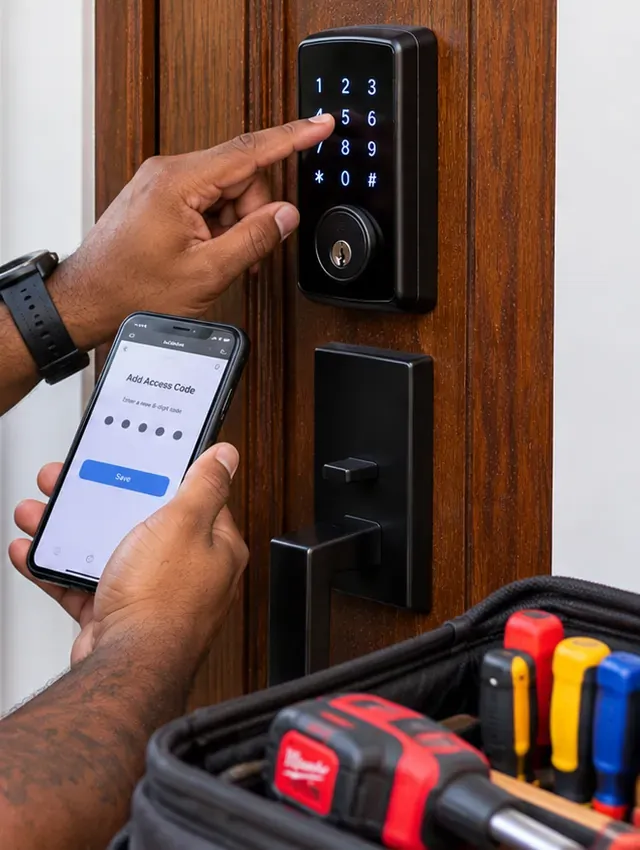
Adding an access code in a phone app while pressing the keypad of a smart deadbolt on a wood door, Bay Ridge Brooklyn business smart lock setup
One hand holds a phone showing an “Add Access Code” screen while the other enters the code on the lock's keypad, a tool case open on the floor.
Your Questions Answered

Smart Lock Installation in Bay Ridge: Questions Answered

Most of what Bay Ridge households ask us comes down to time: when a code works, when the door locks itself, what the lock should say when nothing happens, and how to read what it recorded. The questions are grouped that way.

Clocks, calendars and schedules

The clocks go back an hour in November — do the timed codes on our lock move with them, and what keeps the lock's own clock right?

On a lock that is connected to the internet, usually yes. The lock or its bridge takes the time from the manufacturer's servers, which know the local time zone and the daylight-saving dates, so a code set for 7:30 to 9:00 a.m. keeps meaning 7:30 to 9:00 local time on the Monday after the change. In the United States daylight saving time ends on the first Sunday in November and starts on the second Sunday in March, and a connected lock should cross both without anyone touching it.

The weak spot is a lock that has lost its connection, or one that never had it. A Bluetooth-only lock keeps time with its own internal clock and only resets it when a phone with the app comes close enough to sync. If it has been out of contact for weeks, or if its batteries ran flat and it restarted, its clock can be wrong, and every schedule moves with it. That is how an aide's code ends up working an hour late, or a curfew starting at midnight instead of eleven.

Our habit is simple. We set the lock's time zone explicitly during setup rather than trusting a default, we check the lock's reported time against a phone before we leave, and we show you where the app displays it. After every battery change, and on the Monday after each clock change, open the app near the door once and look at the time. If it's right, every schedule is right.

Our cleaner comes every other Thursday — can a lock schedule follow a fortnightly pattern?

It depends on the app, and many can't. Most residential lock apps build recurring codes from days of the week and a time window: every Thursday, 9 a.m. to 1 p.m. Far fewer offer “every second week” or a custom repeat. If yours doesn't, a weekly Thursday code gives the cleaner access on the off-weeks too, which is exactly the slack you were trying to remove.

There are three practical workarounds. The tidiest is a code with a start and end date for each visit, scheduled a few weeks ahead — tedious to set up, but exact. Some apps allow a code to be switched on and off with a tap, so you leave it disabled and enable it on the morning of a cleaning day; that only works if someone remembers. And some smart-home platforms that a lock can join through Matter, Z-Wave or a hub let you write a fortnightly rule that enables and disables the code automatically.

At the walkthrough, tell us the patterns you actually need — fortnightly cleaners, alternate-weekend custody, a relative who visits on the first Sunday of the month — and we'll choose a lock and platform that can express them, or set up the dated codes for you and show you how to extend them.

Can the street door of our two-family lock itself at 11 every night, whoever left it on the latch?

Yes, on many smart locks, and it's one of the most useful settings for a shared front door. There are two features to know apart. Auto-relock throws the bolt a set time after the door closes or is unlocked; it handles the everyday case of someone coming in and forgetting. A scheduled lock-up, where the lock or a smart-home rule locks the door at a fixed time each night, handles the cases auto-relock doesn't — a hold-open or “passage” mode someone switched on to bring in shopping, or a door unlocked from the app for a visitor who has since left.

For a two-family, we usually set both. Auto-relock with a delay long enough to get a stroller or a bag of groceries through, and a nightly lock-up time agreed by both households, so that whatever happened during the day the street door is bolted by eleven. Household codes still open it at any hour; the schedule only makes sure it doesn't stay open.

One condition: the bolt must line up cleanly with the strike every time, or a lock that relocks itself on a timer will jam, buzz and drain its batteries. That's why we adjust the strike and the door before we switch automatic locking on, and why we test it several times with the door closed gently, the way a tired person closes it at night.

Relatives fly in from abroad for six weeks every summer — can their code start the day they land and stop the day they fly home?

Yes. Most lock apps can create a code that is valid between two dates, sometimes called a temporary or date-range code. Set it to begin on the arrival day and expire the evening of the departure, and it switches itself on and off without anyone remembering. During those six weeks it works like a household code, at any hour; you can add a daily time window as well if you'd rather it didn't work in the small hours.

It is worth giving a long-stay visitor a code rather than a spare key, for the same reason as everyone else: a code can't be copied at a hardware counter, it ends on its own, and it leaves a record. If your visitors don't use smartphones, that's fine — a keypad code needs no app on their side at all.

Two practical points for visitors from overseas. Write the code and the lock's quirks (press the logo to wake the keypad, wait for the green light) on a card, because an unfamiliar keypad in the dark after a long flight is harder than it sounds. And make sure the code's dates are entered in New York time; an app opened on a phone set to another country's time zone can shift the window by hours.

Older parents, carers and the empty middle of the day

Can the lock tell us if Mom's front door hasn't opened at all by midday?

Some systems can, though few locks offer it as a single switch. Most lock apps notify you when something happens — a code used, the door unlocked, a wrong code entered. An alert when nothing happens by a certain time is a different kind of rule, and it usually lives in a smart-home platform that the lock reports to, or in a door sensor paired with the lock, where you can write “if the door has not opened by noon on a weekday, notify me”.

For an older parent living alone, especially one who goes out every morning — to church, to the shops on Third Avenue, to the Bay Ridge Center, which Healthbeat reported had tripled its membership to more than 2,000 — that silence is meaningful. It isn't a medical alarm and shouldn't be treated as one: a parent may simply be staying in with a cold. But it prompts a phone call hours earlier than anyone would otherwise make one.

We set it up only with the parent's agreement, explain exactly what the family can and can't see, and keep it to the information that matters — whether the door opened, not a minute-by-minute diary. Where a parent's health makes a fall a real worry, a proper personal emergency response device does that job far better than any lock, and we'll say so.

I'm deploying from Fort Hamilton for nine months — how should control of our lock pass to my spouse or a relative while I'm away?

Fort Hamilton, whose cornerstone was laid in 1825, is described by Military OneSource as the only active-duty military installation in the greater New York City area, so plenty of service households rent or own in Bay Ridge. If the lock's owner account is on your phone and your email, a deployment is the time to fix that, before you go rather than from overseas. Whoever stays behind should hold full administrator rights in their own name, on their own phone, with the ability to add and delete codes and remove users — not just a code of their own.

Most lock apps allow a second owner or administrator; we add it, confirm it works by having them change a test code while you watch, and record the account details somewhere safe. If nobody is staying in the home, the person who will look in on it needs admin rights too, and the lock's notifications should go to them, since you may not see an alert for days.

Two things beyond the lock. If you rent, tell the landlord who will be holding access while you're away, and keep the duplicate key or code arrangement the lease requires. And anything about legal authority to act for you — a power of attorney, a lease change — is a question for your installation's legal assistance office, not for us. We make sure the door does what the paperwork says.

Our ornate wood door has an iron grille bolted over its glass panel — does that change where the smart lock can go?

Often it does. Many older Bay Ridge doors, on limestone rows and on the 1920s semi-detached houses alike, have a glazed upper panel protected by decorative ironwork. The grille's frame and mounting bolts can come down close to the existing lock, leaving less clear wood than a smart deadbolt's outside keypad needs. A keypad squeezed against a grille is hard to press, catches rain running off the ironwork, and can't be removed for service without loosening the grille.

So we measure three things on these doors: the clear wood between the grille's lowest point and the bore, the width of the stile beside the glass, and the door's thickness, since these doors are often heavier than the 1⅜- to 2-inch range many smart deadbolts list. If the standard position doesn't clear, the choices are a compact keypad model, a retrofit lock that changes only the inside of an existing deadbolt and leaves the outside as it is, or moving the lock a short distance lower with the old hole properly plugged.

The grille does help in one way: it makes reaching through broken glass to the inside thumb-turn much harder than on an unprotected pane. We check that it is fixed from the inside or with security fasteners, because a grille held on by four ordinary screws on the outside protects less than it looks.

Reading the record

The app shows our front door unlocked at 3:12 a.m. and nobody remembers doing it — how do we work out what happened?

Start with how the lock says it was opened, because most apps record the method as well as the time. An entry tagged with a person's code or phone points to that person. An entry tagged “manual” or “thumb-turn” means someone turned it by hand — usually from inside, which is reassuring, though some locks record a key in the cylinder the same way. An entry tagged “auto-unlock” or “geofence” means a phone's location feature decided someone was arriving, which can misfire when a household member's phone briefly loses and regains its location nearby at night.

Then look at what came either side of it. A door that unlocked and relocked a few seconds later with no door-open event between suggests a glitch or a hand on the thumb-turn, not an entry. A door-position sensor, if the lock has one, tells you whether the door actually swung open. And a video doorbell or camera at the door settles the question in a way a log alone can't.

If you still can't explain it, change the codes that could have been used, switch off location-based auto-unlock until you've worked out whose phone is responsible, and tell us — we'll go through the history with you. Many locks don't record use of the mechanical key at all, which is one more reason to know exactly who still holds one.

Can each code carry a name, so the history reads “cleaner” rather than a slot number?

On nearly every current lock with an app, yes, and it's the single change that makes the history worth reading. Codes are stored in numbered slots inside the lock, but the app lets you give each one a label. A history that says “Upstairs tenant, 2:10 a.m.” and “Aide, 8:02 a.m.” can be scanned in seconds; one that says “User 4” and “User 7” needs a separate list nobody keeps up to date.

We name every code at setup and keep the names to roles rather than full names where privacy matters — “dog walker” rather than the walker's name, which also means you don't rename anything when the walking company sends someone new. We also give each person their own code instead of a shared one, because a shared code makes every name in the history meaningless.

Keypad-only locks without an app usually have no names at all, just slot numbers. If the history matters to you, that alone is a reason to choose a connected model.

Restaurants, practices and the avenues

Burglars hit Third Avenue restaurants between 3 and 4:30 a.m. in August 2026 — can our staff codes simply stop working between closing and opening?

Yes, and for a late-closing kitchen it's one of the best settings available. Give every employee their own code and attach a schedule to it that covers their shifts plus a margin. Outside that window the code is refused and the attempt is logged. A code that a former dishwasher shared with a friend, or one read over a shoulder at the back door, is then useless at 3 a.m., which is exactly when PIX11 reported three Third Avenue restaurants were burglarised on August 28, 2026.

The owner and one or two managers keep round-the-clock codes for emergencies. Every door — front, back, cellar hatch where there is one — should report any opening during the closed hours to the owner's phone. A smart lock can't stop a door being broken, and the 2026 reports don't say how the doors were opened; what it can do is make sure no code opens it after hours, record the exact time something happened, and get that information to you in the night instead of when the prep cook arrives.

For doors that see constant traffic during service, a wired reader with an electric strike is more durable than a battery deadbolt and keeps a better log; it's priced from our published single-door figure further down. Either way, the door must still let people out freely from inside, curfew or not.

Our practice opens at 8, but on a snow day nobody comes in — can the front door wait for the first employee instead of unlocking by the clock?

Yes, on systems that support it. A plain schedule unlocks the waiting-room door at 8:00 whether or not anyone is there — on a snow day, on a holiday nobody programmed, or on the morning the office manager is stuck on the R train. A “first person in” rule waits until an authorised staff member opens the door with their own credential during the opening window, and only then holds it unlocked for the rest of the day's hours.

This rule is more common on commercial access-control systems than on consumer smart locks, so a practice that wants it usually ends up with a wired reader and electric strike on the main entrance, controlled by software that understands schedules, holidays and first-in logic. Inner doors — records rooms, medication storage, staff areas — stay locked to everyone except the staff who need them, on their own codes or fobs.

If you'd rather keep a battery smart lock on a small practice, the simpler alternative is to have the first person in unlock it from the app or switch on a hold-open mode, with a scheduled lock-up at closing time so it can't be left open overnight.
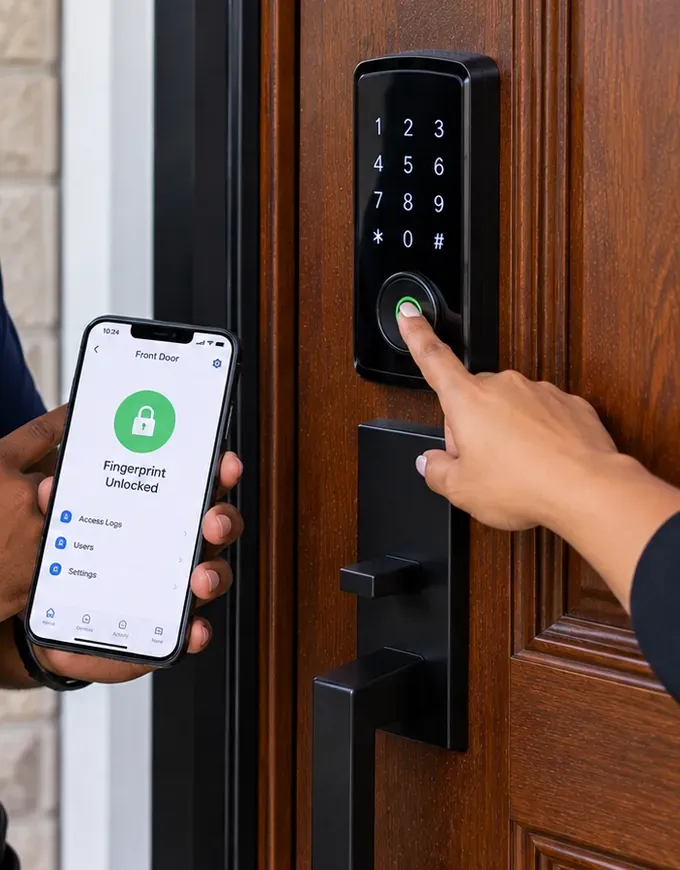
Finger on the fingerprint reader of a keypad smart lock while a phone shows a Fingerprint Unlocked screen, Bay Ridge Brooklyn smart lock demonstration
A fingertip on the reader below the keypad, and the phone beside the door showing “Fingerprint Unlocked” with the access log and user list underneath.
Equipment

Types of Smart Locks We Install

Choosing a lock for a Bay Ridge door is mostly choosing how well it keeps time and how much it tells you. The hardware categories below are sorted with that in mind.

Wi-Fi Keypad Deadbolts

Connect straight to the home network: schedules, alerts and remote changes with nothing else to buy, at the cost of shorter battery life. A good fit for a house whose router reaches the front door.

Bluetooth Locks with a Bridge

Longer battery life, with a small plug-in bridge near the door for remote access. August, for example, advises placing its Connect bridge within 10 to 15 feet of the lock. Without the bridge, schedules depend on the lock's own clock.

Matter and Thread Locks

Join a smart-home platform for richer rules — fortnightly codes, nightly lock-ups, inactivity alerts. Matter over Thread needs a Thread border router; Yale notes the router must match the app's ecosystem.

Z-Wave Locks with a Hub

A long-standing choice for houses with an alarm or automation hub already on the wall, letting the lock's schedule tie into lights, alarm arming and the rest of the house.

Retrofit Smart Locks

Fit over the inside of an existing single-cylinder deadbolt and leave the outside, and your keys, unchanged. August says its retrofit works only with single-cylinder deadbolts. Useful on historic-looking doors and for renters.

Keypad and Fingerprint Combinations

A reader alongside the keypad for people who find codes hard to remember. Best on doors sheltered from rain, and always with a code as a fallback.

Door-Position Sensors

Built into some locks or added separately, they report whether the door is actually shut, not just whether the bolt moved — the piece that turns a log into a reliable record.

Wired Readers with Electric Strikes

Keypads or fob readers on a power supply, releasing a strike in the frame, controlled by software with schedules, holidays and first-in rules. The right tool for restaurants, practices and busy shared entrances.

Video Doorbells

Not a lock, but the other half of a Bay Ridge door plan: see and speak to a caller from the train or from upstairs before deciding whether anyone needs to be let in at all.

ADT, Ring or SimpliSafe, or a local installer? The national brands sell good equipment and monitoring plans, and their locks can be a sensible choice. What they don't do is stand at your Bay Ridge door, measure a 1920s slab, re-cut a strike in a shifted frame, or sit down with three generations to work out who needs which hours. We install the lock that suits the door and the household — including a national brand's lock if that's what you already use — with $0 monthly fees from us and no contract tying the lock to a monitoring plan.
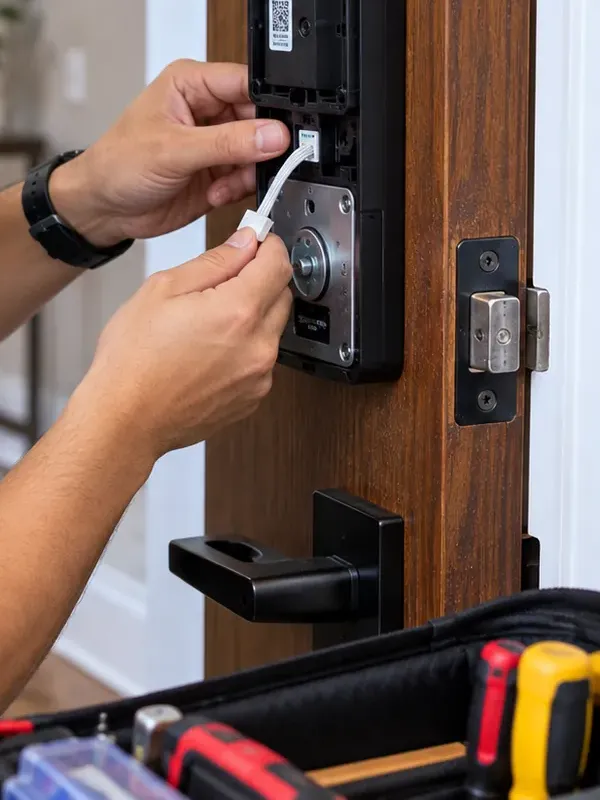
Connecting the ribbon cable between the outside keypad and the interior assembly of a smart deadbolt on a wood door, Bay Ridge Brooklyn installation
The thin cable from the outside keypad being plugged into the interior mounting plate before the battery housing goes on, with the latch and lever already in place.
AI Overview Reality Check

What AI Gets Wrong About Smart Lock Installation in Bay Ridge

Google's AI Overview couldn't be captured from our build environment, so these are the claims that recur in national cost guides from Angi, HomeAdvisor and Fixr, in product marketing and in general advice online. None is simply false. Each needs a Bay Ridge correction.

“Budget about three hundred dollars for an installed smart lock”

That is Fixr's national range, updated in January 2025, with an average of $300 for a Wi-Fi lock and one accessory. As a benchmark for one lock on one modern door, it's reasonable, and worth knowing before anyone quotes you.

It leaves out the parts of a Bay Ridge job that take the time: a thick row-house door that needs a different model or a thickness kit, a strike reset in a frame that has moved over a century, and above all the setup — a dozen named codes with their own schedules, a nightly lock-up, alerts routed to the right people. On a two-family or a restaurant, the programming is the job.

That's why our residential smart lock work is quoted flat after a free walkthrough. Use the national figure to check that a quote is in a sensible world; don't treat it as the price of a door nobody has looked at.

“Set it and forget it”

Marketing loves this line. A smart lock does remove a lot of remembering — it locks itself, it tells you who came in. It does not maintain itself.

Batteries run down, and a flat lock restarts with its clock possibly wrong. Phones get replaced and the admin account goes with the old one. Aides, cleaners and tenants change, and their codes need deleting on the day they leave, not next spring. The twice-yearly clock change is a good moment to check the lock's time and run through the code list.

We leave every household with a short written list: who holds which code and when it works, who has admin rights, and the three or four things to check twice a year. Forgetting it entirely is how old codes stay live for years.

“Turn on auto-lock and the unlocked-door problem is gone”

Auto-relock is excellent, and on a Bay Ridge street door it closes the gap local news keeps pointing at — the 2019 Dyker Heights and Bay Ridge burglaries that the Brooklyn Home Reporter said went largely through unlocked windows and doors.

But auto-lock can be switched off, paused or overridden. Hold-open and “passage” modes exist precisely to stop the lock relocking while someone carries things in, and they stay on until someone switches them off. A door that doesn't quite close leaves the bolt with nowhere to go. And windows, which the 2019 burglaries also used, are untouched by any lock.

So we pair auto-relock with a nightly scheduled lock-up that overrides any forgotten hold-open, a strike adjusted so the bolt throws every time, and a door-position sensor where it's worth having. For windows, we point you to alarm sensors rather than pretending a lock covers them.

“A code for the walker solves everything”

Giving a walker a code instead of a key is the right instinct. Giving them a code that works around the clock, every day, for as long as you employ them and after, is not.

The difference between a good and a careless code plan is the schedule attached to each code. A walker who comes Tuesdays and Thursdays at lunchtime needs a code that works then. A cleaner every other Thursday needs one that works on those Thursdays. Outside those windows the code should be refused — and the refusal should be logged, because an attempt at the wrong time is information.

In a long-settled Bay Ridge household with several helpers, that discipline is the whole value of the lock. Without it, a smart lock is just a key that can't be lost.

“Any smart lock fits any standard door”

The word doing the work is “standard”. Manufacturers design around modern doors: Allegion lists door thicknesses of 1⅜ to 2 inches and backsets of 2⅓ or 2¾ inches for Schlage's Arrive deadbolt, for example.

Bay Ridge's protected housing stock is full of doors that predate those standards — heavy row-house doors, glazed panels with ornamental ironwork close to the lock, frames that have been drilled for three generations of hardware, and steel co-op unit doors in steel frames that the board controls.

Most of them can take a smart lock. Some need a particular model, a retrofit instead of a replacement, or proper wood repair first. A tape measure at the walkthrough is cheaper than a returned lock and a door with a new hole in the wrong place.

“A smart lock stops burglars”

A good smart deadbolt is as strong as a good ordinary deadbolt; the electronics add control and a record, not armour. Bay Ridge's own crime pattern shows where the real risks lie.

The serious-crime rate here, 5.2 per 1,000 residents in 2025 according to the Furman Center, is less than half what it was in 2006. The incidents that make the local papers are more often an unlocked window — in June 2020, three men entered a home near 83rd Street and Third Avenue through one, the Brooklyn Paper reported — or a door opened from inside to someone posing as a courier, as in the 2019 robbery NBC New York covered.

A smart lock addresses the unlocked door and the lost or copied key, and its history helps afterwards. A video doorbell addresses the caller. Window sensors address the windows. We sell the lock for what it does, and tell you plainly what it doesn't.

“Renters can't have smart locks”

In New York City this is usually wrong. Multiple Dwelling Law §51-c allows a tenant in a multiple dwelling to install and keep a lock of their own in addition to the owner's, provided the owner is given a duplicate key on request; the law excludes municipal housing-authority buildings, hotels and dormitories.

In a Bay Ridge two-family, which is not a multiple dwelling under the law's three-family line, the tenant's rights come from the lease and the owner's goodwill rather than from §51-c, so asking first is the sensible route. In a co-op, the proprietary lease and house rules come first.

Retrofit locks that change only the inside of an existing deadbolt are often the cleanest answer for renters, because the outside and the keys stay as they were and the lock comes off without a trace when you move. None of this is legal advice; it's how the rules bear on choosing a lock.

Sketch Your Household's Timetable With a Tech

Ten minutes on the phone: who comes and goes, on which days, through which door. We'll tell you which locks can carry that schedule and which can't, before you buy anything.

Get In Touch

Request a Free Quote

A limestone row, a two-family with a tenant upstairs, a Shore Road co-op or a Third Avenue kitchen: tell us the doors and the hours, and a licensed installer phones back that business day.

✅

We Got Your Request!

Expect a call from a licensed installer the same business day. For anything urgent, ring (347) 934-8335.

How It Works

Our Installation Process

Six steps, from a single row-house door to a restaurant with three entrances. The schedule is designed before the drill comes out.

1. Map the week

On the phone we list everyone who uses the door — household, tenants, aides, cleaners, staff — with the days and hours each one needs, and anyone who should never get in after a certain time.

2. Walk the doors

At a free visit we measure each door's thickness, backset and clearance from glass or ironwork, check the strike and frame, and test the signal where each lock will sit.

3. Choose and quote

We pick locks that can express your schedules — including fortnightly or first-in rules where you need them — and put a flat price in writing, door by door.

4. Fit and align

Old holes are plugged, strikes moved until the bolt throws without rubbing, and each lock mounted and sealed; we check one motion opens every door from inside.

5. Program the calendar

Time zone set and verified, every code named and scheduled, auto-relock and nightly lock-up tuned, alerts routed to the right phones, admin rights given to the right people.

6. Test and hand over

Each person tries their own code at the door, we show you how to read the history and change a schedule, and you keep a written list of codes, windows and admins.

Coverage Area

Smart Lock Installation Near Bay Ridge's Landmarks

Doctors' Row, Bay Ridge Parkway

Fifty-four limestone-fronted row houses between Fourth and Fifth avenues, built from 1906 to 1913, all two storeys over a basement, designated in 2019 as Bay Ridge's first historic district. Heavy doors, a facade the LPC watches, and practices that keep office hours — a block that sums up this page.

The Gingerbread House, Narrows Avenue

The LPC's designation report describes the house at 8200 Narrows Avenue, built in 1917 to designs by James Sarsfield Kennedy, as a rare Arts and Crafts example built of uncut, randomly laid stone. The detached houses on the surrounding blocks are some of the largest in the neighbourhood, with many doors per job.

Owl's Head Park

NYC Parks traces the 24.22-acre park to the Henry C. Murphy estate, bought by Eliphalet W. Bliss in 1866 and designated a park in 1928; the area itself was renamed from Yellow Hook to Bay Ridge in 1853. The Shore Road co-op buildings near its western edge are prime territory for unit-door work.

Shore Road Park and the 69th Street Pier

Fifty-eight acres along the Narrows with views of the Statue of Liberty, Fort Wadsworth and Coney Island, per NYC Parks. At its northern end the 600-foot American Veterans Memorial Pier, once the Bay Ridge–St. George ferry pier, is where NYC Ferry lists its Bay Ridge landing. The co-op buildings facing the park are among our most frequent addresses.

Fort Hamilton

Its cornerstone set in 1825 and its first garrison flag raised in 1831, Fort Hamilton is the only active-duty military installation in the greater New York area according to Military OneSource — which is why deployments and short-notice moves show up in our code planning here.

Verrazzano-Narrows Bridge and the R Terminal

The bridge opened on November 21, 1964, then the world's longest suspension span, with its Brooklyn end at Fort Hamilton. A few blocks north, Bay Ridge–95th Street has been the terminal of the R line since October 31, 1925 — the start of the long commute that empties so many Bay Ridge houses by day.

We also work in the neighbourhoods around Bay Ridge: Dyker Heights and Bath Beach to the east and south, Sunset Park beyond 65th Street to the north, and Fort Hamilton at the foot of the bridge — and across the borough through our Brooklyn smart lock installation service.

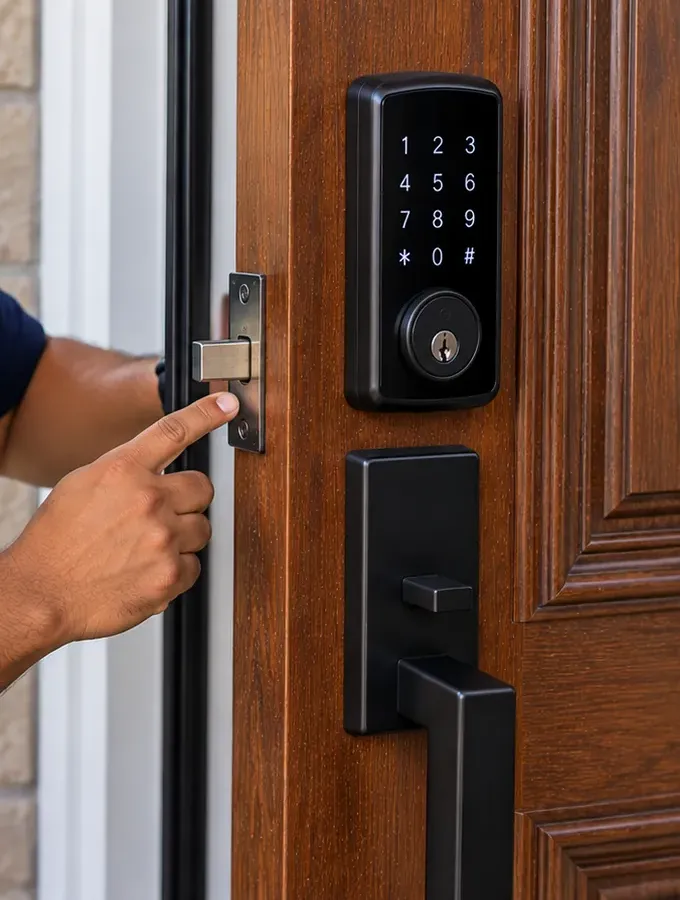
Finger pointing at the latch where it meets the strike on the edge of a wood door fitted with a keypad smart deadbolt, Bay Ridge Brooklyn installation check
A finger on the latch at the door edge, keypad deadbolt and lever handle above and below it: the alignment check that decides whether a self-relocking bolt will throw cleanly every time.
Pricing

Smart Lock Installation Cost in Bay Ridge

Bay Ridge is priced at the Brooklyn base — a 1.00 multiplier, the reference point for every other area AESS serves — with no neighbourhood surcharge. Smart locks on house, co-op and apartment doors have no published AESS figure, because the door and the schedule work vary too much; they are quoted flat after a free walkthrough, door by door. The items that do have a published figure are below, exactly as they appear on our Brooklyn pages.

ItemBay Ridge (Brooklyn base) priceWhat it covers
Smart locks on house, co-op or apartment doorsQuoted flat at free walkthroughThe lock or locks, any door and strike work, the signal plan, and full programming: named codes, schedules, auto-relock, nightly lock-up and alerts
Single-door keypad or fob reader with electric strike$1,500–$2,500 installedA wired reader or keypad releasing a strike, for a restaurant, shop, practice or busy shared entrance, with power supply and free-exit device
New electric strike on an entry door$250–$450A new strike in the frame of a building or business entrance that already has, or is getting, a reader
Failed electric strike repair$295–$485An entrance where the buzzer or reader sounds but the door won't release
Programming visit with no new parts — re-pairing, codes, timetables, clock fixes$195 first hour, then 30-minute blocksRe-pairing after a router change, fixing a lock's clock or time zone, rebuilding a code plan
Service and callback rate$195/hr, 3-hour minimum ($585)Return visits once a job is finished; the original installation never carries this charge

Worked examples, using only the published lines

  • Front and back doors of a Third Avenue restaurant, each with its own reader and strike: twice the single-door figure of $1,500–$2,500, which comes to $3,000–$5,000, with any door-specific work on top.
  • An avenue building whose reader works but whose strike has failed: the strike repair line, $295–$485; if the strike needs replacing outright, the new-strike line, $250–$450.
  • A lock whose schedules started running an hour out after its batteries died, no new hardware: the setup-only rate, $195 for the first hour.

What moves a Bay Ridge quote

  • The schedule. One household with two codes is quick. A two-family with a dozen named, scheduled codes, a nightly lock-up and alerts to several phones takes real setup time, and it is time well spent.
  • The platform. Fortnightly codes, first-in rules or inactivity alerts may need a hub, a Thread border router or a commercial controller rather than the lock's own app.
  • The door. A thick row-house door, a glazed panel with ironwork close to the lock, or a frame that has shifted adds door work; a sound modern door adds none.
  • The building. Co-op alteration paperwork, contractor hours and elevator bookings affect scheduling more than price, but they're part of the plan.
  • Battery deadbolt versus wired entry. Battery-powered smart locks fall under the residential walkthrough quote, while a reader-and-strike entrance is priced from the published single-door access-control range.

As a yardstick only, Fixr's national figure for having a smart lock installed is $250 to $400, averaging $300 (updated January 2025), and keypad units themselves commonly cost $100 to $250 before labour. Those are third-party national figures, not AESS prices.

Full terms — including 50% deposit, one-year parts-only warranty on AESS-supplied products, and the late-fee schedule — are set out in the service agreement.

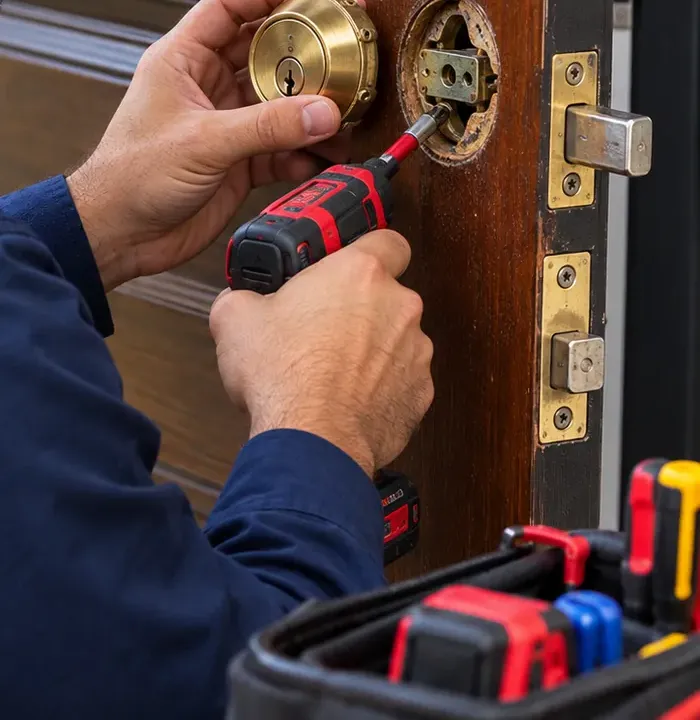
Unscrewing an old brass deadbolt from a wood door with a cordless screwdriver before a smart lock goes in, Bay Ridge Brooklyn
An old brass deadbolt coming off: one hand holds the cylinder while a red cordless screwdriver backs out the screws, with two brass latch plates in the door edge.
Shop Our Systems

Smart Lock Installation Packages & Pricing

Starter — One Door, One Household

Quoted flat at walkthrough

A smart deadbolt on the door you use most, the door and strike work it needs, auto-relock tuned to your household, named codes with schedules for up to a handful of people, and a written code list.

Standard — The Two-Family Timetable

Quoted flat at walkthrough

The shared street door and each unit door, codes per household and per helper with their own windows, a nightly lock-up, alerts routed to owner and tenant separately, admin rights split properly, and a free inside release on every door.

Premium — Restaurant, Practice or Shop Entrance

$1,500–$2,500

A hard-wired keypad or fob reader with an electric strike, power supply and free-exit device, programmed with staff schedules, after-hours curfews, holidays and first-in rules. Brooklyn base pricing, per door.

Bring Your Own Lock — Labour Only

Have a lock already? Bring it. We prepare the door and strike, mount the lock, connect it and write its timetable, with the labour quoted flat at the walkthrough. We check your model against the door's thickness, backset and clearance first, and tell you honestly if its app can't express the schedule you need. If the job is setup only — app, bridge, codes, schedules — it's the $195 first-hour setup-only rate.

Speak to a Tech About After-Hours Control

Restaurant, bar, shop or practice: tell us your opening and closing times and how many staff hold access. We'll explain how a curfew for staff codes and an after-hours alert would work on your doors.

Setting Up the Calendar

The Settings That Make a Bay Ridge Lock Keep Good Time

The difference between a smart lock that helps and one that annoys is almost entirely in a dozen settings most people never open. These are the ones we go through at every Bay Ridge installation, in the order we set them.

Time and connection

  • Time zone, set explicitly. Eastern time, chosen in the app rather than inherited from whichever phone first paired the lock.
  • A connection that stays up. Wi-Fi strength checked at the door, a bridge placed within the maker's range where one is used, or a Thread border router of the right ecosystem. A lock that loses its connection loses its clock eventually.
  • Clock check after batteries. Every battery change ends with opening the app beside the door and confirming the lock's time.

Locking behaviour

  • Auto-relock delay. Long enough for groceries, a stroller or a walker frame to get through; short enough that a door doesn't sit unlocked while everyone is upstairs. Usually somewhere between thirty seconds and a few minutes, tested at the real door.
  • Nightly lock-up. A fixed time, agreed by everyone who shares the door, at which the lock bolts itself regardless of any hold-open mode.
  • Hold-open or passage mode. Who may switch it on, and whether it should expire by itself after an hour. On shared doors we often restrict it to the owner.
  • Location-based auto-unlock. Off by default on street doors in dense blocks, where a phone wandering in and out of range can unlock a door nobody is standing at.

Codes and people

  • One code per person, named by role. Never a shared “helpers” code; the history is only as good as the names.
  • A window for every non-household code. Days of the week and hours, or start and end dates, matched to what that person actually does.
  • Two administrators. The owner and one trusted person, each on their own phone and account, so a lost phone or a deployment doesn't lock the household out of its own lock.
  • A leaving-day rule. When an aide, cleaner, tenant or employee stops coming, their code is deleted that day. We show you how, and we put it on the written list.

What the lock tells you

  • Quiet by default. Routine household comings and goings shouldn't buzz anyone's phone. Notifications are for helpers' arrivals, refused codes, after-hours openings and low batteries.
  • Silence as a signal. Where the household wants it and the platform supports it, an alert if a door hasn't opened by a chosen hour.
  • A history you keep. How long the log is stored, who can see it, and how to export a stretch of it if you ever need it for a landlord, an insurer or the police.

None of these settings is exotic. Together they turn a lock into the timetable the household was already keeping in its head.

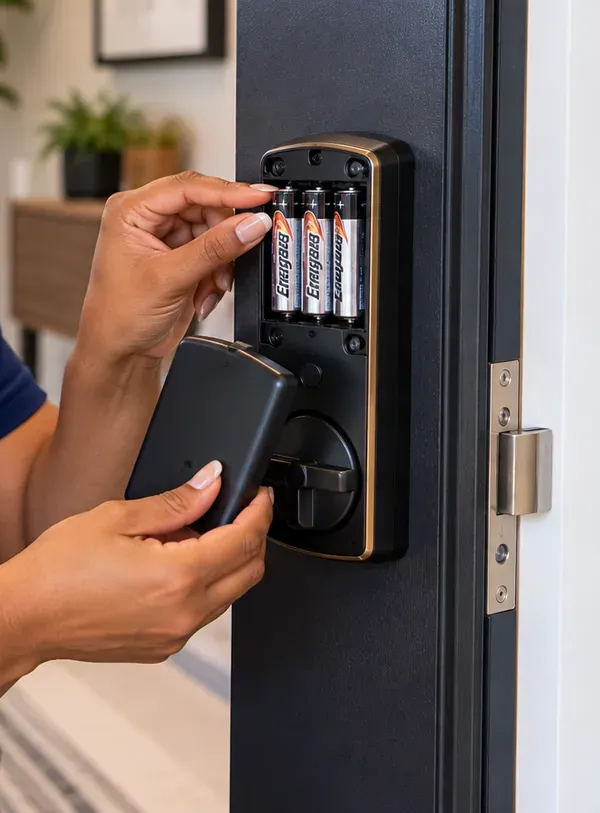
Hands removing the cover from the interior battery pack of a smart deadbolt holding four AA batteries, Bay Ridge Brooklyn smart lock maintenance
The inside cover lifted away to show four AA batteries in the lock's interior housing — after every change like this, the lock's clock is worth a quick check.
Co-op Owners and Renters

For Shore Road Co-op Owners and Bay Ridge Renters

Not every Bay Ridge door belongs to a house. A large share of the neighbourhood lives in apartments — in the co-op and condo buildings along Shore Road, the pre-war and post-war blocks on Ridge Boulevard and Fourth Avenue, the walk-ups on the side streets and the flats over the avenue shops. The rules for the door depend on which of those you're in.

Co-op and condo owners

Shore Road has a high concentration of co-op buildings, from the 1940 Normandy at 9437 Shore Road to the 254-apartment building at 9201 Shore Road completed in 1960. In a co-op, the proprietary lease and the house rules decide what may be done to a unit door, and many leases require that the corporation hold a duplicate of any new key so staff can get in during an emergency such as a leak. Expect the managing agent to want a certificate of insurance before the visit and the work done within contractor hours; we provide the paperwork and work within the building's times.

Unit doors in these buildings are usually steel or steel-clad in steel frames, sometimes fire-rated. Before anything is drilled we confirm with the managing agent what the door is, and where a change to the door itself isn't allowed, a retrofit that works the existing deadbolt from the inside is often the answer. The board's duplicate key keeps working; you gain codes, schedules and a history on your own side.

Renters in walk-ups and larger buildings

In a building with three or more apartments, Multiple Dwelling Law §51-c lets a tenant add a lock of their own alongside the owner's, as long as it is no more than three inches in circumference and the owner gets a duplicate key on request; lease terms charging for this are void. The owner's own lock must stay, and city fire-safety guidance from HPD says apartment doors must open from inside without a key — so no double-cylinder deadbolt that needs a key on the inside.

If your building uses an app or fob system at its entrance, the city's Tenant Data Privacy Act, Local Law 63 of 2021, says owners can't make a smart access system the only way into your apartment and limits what entry data they may collect and keep. A lock you add to your own door is yours: its codes, schedules and history are on your account, not the landlord's.

Tenants in two-family houses

A two-family house is not a multiple dwelling under the state's definition, which starts at three families living independently. That means §51-c doesn't apply, and a tenant upstairs should agree any lock change with the owner first. In practice, most Bay Ridge owners are glad of a shared street-door plan that gives the tenant their own code, their own hours (all of them), and alerts about their own door that go to them, not to the owner. When a tenancy ends, the owner deletes the tenant's codes on the day the keys come back; while it lasts, the city's lockout law makes it unlawful to change or disable an occupant's entrance lock without giving them a key.

This section explains how the rules bear on locks. It isn't legal advice; for a dispute, talk to a lawyer or the city's tenant resources.

Complete Services

Every Smart Lock Installation Service in Bay Ridge

Most Bay Ridge two-families pair the street-door smart lock with a doorbell camera; most avenue businesses pair it with access control. These are the related services we provide in and around Bay Ridge.

Access Control in Bay Ridge

Readers, strikes and scheduling software for Third Avenue kitchens, Fifth Avenue shops and Bay Ridge Parkway practices.

Bay Ridge Intercom Installation

A button and a release per apartment at the street door of a walk-up or a co-op building.

Door Buzzer Repair, Bay Ridge

For street doors whose buzzer sounds upstairs but no longer lets anyone in.

Doorbell Cameras in Brooklyn

See and speak to whoever is on the stoop from the train or from upstairs, before anyone is let in.

Alarm Installation

Window and door sensors for the openings a lock can't protect, armed on the same schedule as the doors.

Security Cameras, Bay Ridge

Cameras on rear yards, driveways and restaurant back doors, so an after-hours alert comes with a picture.

Structured Cabling

Network runs for practices and shops that need wired readers, controllers and reliable Wi-Fi at the door.

Network and Wi-Fi Coverage

Mesh nodes and wired access points placed so the hall by the front door gets a usable signal through stone and plaster.

Low-Voltage Wiring

Power for strikes, low-voltage transformers and new cable through plaster and brick, all under our NYS low-voltage licence.

Field Notes

Field Notes on Doors That Keep Hours

Written from the way our crews work in general; it does not describe any one household, customer or job.

Before we take a lock out of its box, we ask for the week. Not the people, at first — the week. Who leaves first in the morning, who is last home, which days are different, who comes in while the house is empty. People are often surprised how much of it they've never said aloud, and how many keys turn out to be in circulation once they start counting.

Then we make the door behave before we make it clever. A bolt that has to be nudged, a strike that catches, a door that only latches if you pull it: all of that has to be fixed first, because a lock that relocks itself on a timer will find every one of those faults at two in the morning.

Last, we hand the phone back and ask each person to use their own code at their own hour while we watch the history fill in with their names. If the history reads like the week they described, the job is done. Through all of it, the inside of the door stays the same: one turn, and you're out.

FAQ

Bay Ridge Smart Lock Installation FAQ

How is a Bay Ridge job priced when one visit covers a house door, a co-op unit door and a shop door?
+

Each door is priced on its own line in one written quote. House and co-op unit locks are quoted flat after the walkthrough; a shop door on a wired reader follows the published $1,500–$2,500 single-door figure at Brooklyn base pricing. Doing them on one visit saves you a second trip, and the quote shows exactly which door costs what.

Do you also cover Dyker Heights, Fort Hamilton and the Sunset Park blocks just north of 65th Street?
+

Yes. We work throughout Bay Ridge from 65th Street to the Verrazzano-Narrows Bridge and from Shore Road to Seventh Avenue, and in Dyker Heights, Fort Hamilton, Bath Beach and Sunset Park, all at the same Brooklyn pricing with no travel surcharge.

Can the installer arrive at 7 a.m. so we can still make the R train or the express bus?
+

Ask for an early window when you book and we'll offer the first available one. A single smart deadbolt can often be fitted and programmed before a commuter has to leave; a larger job may need someone home for longer, or a second person to let us in. Co-op buildings set their own contractor hours, which we follow.

Can a shop or practice door schedule be told about public holidays?
+

Commercial access-control software usually has a holiday calendar, so the door stays locked on days the business is closed even though the weekly schedule says otherwise. Many consumer smart lock apps don't, in which case we set the schedule to lock by default and show you how to suspend it for a holiday, or move you to a reader-based system if holidays matter to your business.

Can we get one daily summary of the door instead of a notification every time it opens?
+

Some apps and smart-home platforms offer a digest or let you limit notifications to particular events, so you only hear about helpers' arrivals, refused codes and after-hours openings. Where a lock can't summarise, we turn off routine notifications and show you where to read the full history when you want it.

If a code only works on weekday mornings, does the physical key still open the door at any hour?
+

Yes. Schedules apply to codes, phones and fingerprints; a mechanical key in the cylinder turns the bolt whenever it is used, and many locks don't log it. That is why keys should stay with the household only, and why we recommend rekeying the cylinder if you can't account for every old key.

If our upstairs tenant uses the app for the shared street door, can she see when we come and go?
+

Not if the accounts are set up properly. Most lock apps separate administrators, who see the full history, from ordinary users, who can open the door but see little or nothing of other people's entries. We make the owner the administrator, give the tenant a user role on the shared door, and give the tenant full control of any lock on her own apartment door, so each household sees only what is theirs.

All Areas Served

Smart Lock Installation Across Brooklyn and New York

Bay Ridge is one neighbourhood inside our Brooklyn smart lock installation coverage, which in turn sits under the NYC smart lock installation hub for the five boroughs. Every area and neighbourhood page we publish is linked from here.

Start again from the Abstract Enterprises Security Systems home page, or learn who we are on the about us page.

Sources

Sources for the Neighbourhood Facts Above

  • NYU Furman Center, Bay Ridge/Dyker Heights neighbourhood profile (updated 2026): population, residents 65+, homeownership, rental vacancy, commute time and mode, serious-crime rate, units added 2010–2025.
  • NYC Zoning Resolution, Article XI Chapter 4 (Special Bay Ridge District), and CityLand, “City increases zoning protection for Bay Ridge” (April 2005).
  • Brooklyn Community Board 10, “Neighborhoods” page: commercial corridors and housing composition.
  • Landmarks Preservation Commission: 2019 designation of the Bay Ridge Parkway Doctors' Row Historic District; designation report for the 8200 Narrows Avenue House; Permit Guidebook on hardware replacement.
  • NYC Department of Small Business Services BID directory (Bay Ridge 5th Avenue and 86th Street Bay Ridge BIDs).
  • New York State Liquor Authority, county closing hours for Kings County.
  • PIX11, “Three Brooklyn restaurants burglarized overnight: NYPD” (August 31, 2026); the Brooklyn Home Reporter (September 2019); NBC New York (October 8, 2019); the Brooklyn Paper (September 29, 2020); CityLand (October 2014) on illegal-conversion complaints.
  • NYC Parks (Owl's Head Park history, Shore Road Park, American Veterans Memorial Pier); NYC Ferry Bay Ridge landing; Military OneSource (Fort Hamilton); MTA and NYC Parks (Verrazzano-Narrows Bridge); Bay Ridge–95th Street station opening date.
  • Healthbeat (June 2025) on the Bay Ridge Center; Brownstoner and broker listings for Shore Road co-op building dates and sizes.
  • New York State Multiple Dwelling Law §§4 and 51-c; NYC Administrative Code §26-521; HPD fire-safety and Tenant Data Privacy Act pages; Fixr (January 2025); Allegion, August and Yale product documentation.

Shut Out Somewhere Between Shore Road and Seventh Avenue?

Keypad rejecting you, a motor whirring with no bolt movement, or an app that says the lock can't be reached? Call (347) 934-8335 and ask for the first open arrival window. Most of these nights come down to a flat battery, a lock whose clock has wandered outside your code's window, a lost pairing, or a strike that has shifted, and they are normally sorted within an hour or two of the technician arriving. Until then, if your lock has a keyway, the backup key is the fastest way in — that's what it's for.

Smart Lock Installation Bay Ridge, Brooklyn — Licensed and Insured

Abstract Enterprises Security Systems · 1282 Troy Ave, Brooklyn, NY 11203 · (347) 934-8335 · WhatsApp (718) 679-0359 via wa.me

NYS Low-Voltage Licence #12000287431 · 100% Licensed & Insured · Same-Day Estimates · 4.7★ from 201 Google Reviews

A lock you bought yourself is covered by its maker's warranty rather than ours; how we cover the products we supply is set out on the warranty page.

Laws and building rules are mentioned only where they change which lock fits a Bay Ridge door or how it should be set up; for advice on your own situation, speak to a lawyer. Page reviewed and updated October 17, 2026. Changelog: first publication of the Bay Ridge smart lock installation page.