Most front doors in Tribeca were never designed as front doors. They began as the stair and freight doors of dry-goods warehouses, butter-and-egg stores and printing lofts, and when those buildings became homes the doors that survived — or the steel ones that replaced them — became part of the building’s fire protection. That changes how a keyless lock should be chosen. Before we talk about apps, we read the label on the hinge edge, look at the closer, the frame and the stair beyond it, ask whether the elevator opens straight into the loft, and find out whether a condo board, a managing agent, the Loft Board’s history or the Landmarks Preservation Commission has a say. Then we fit a smart lock that keeps the door rated, self-closing and openable from inside in one motion — and gives you codes, phone keys and a clean record of who came in.
Reviewed and updated October 17, 2026 · Written by Anwar Timothy, NYS licence #12000287431
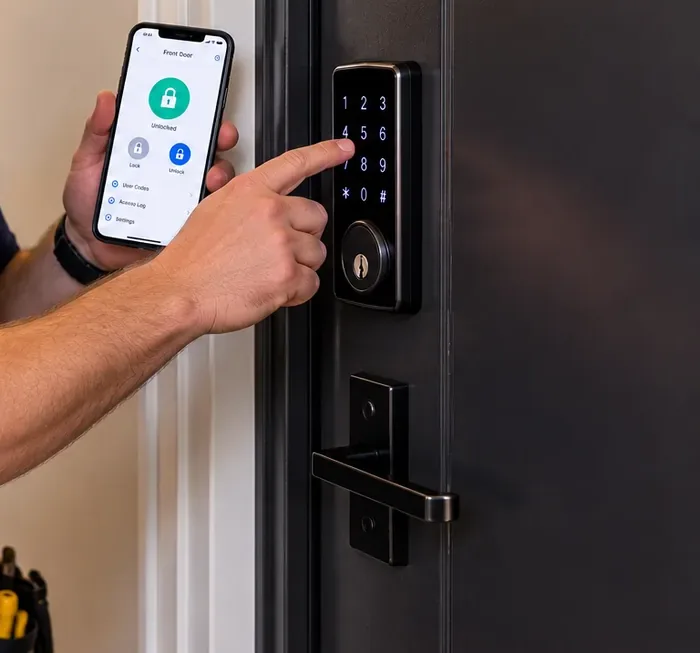
A hand presses the lit keypad of a black smart deadbolt on a charcoal unit door while the other hand holds a phone showing the lock’s unlocked status; a lever handle sits below and a lit corridor wall runs alongside.
Free Tribeca Smart Lock Quote
Name the street, the kind of building and the door — a licensed installer answers the same business day
✅
Request Sent!
An installer who works below Canal Street will ring you back the same business day.
25+
Years Experience
✓
Same-Day Estimates
100%
Licensed & Insured
4.7★
201 Google Reviews
Living below Canal and tired of carrying a loft key the size of a spoon? Ring (929) 560-0737 or use the one-minute form. Tell us the street, whether the building is a converted warehouse, a newer condo tower or a mixed-use building with a shop downstairs, and send one photo of the edge of your door with the hinge side visible. From that photo we can usually tell you whether the door carries a fire label, which families of smart lock suit it, and who in the building is likely to want paperwork before we arrive.
One fixed figure in writing once we have seen the door, its label and its frame, honoured on the day
Galleries, kitchens and shared street doors are billed from AESS’s published strike-and-reader list, multiplied by 1.25 for Manhattan
NYS licence #12000287431 · insured · certificates sent to the managing agent before the visit
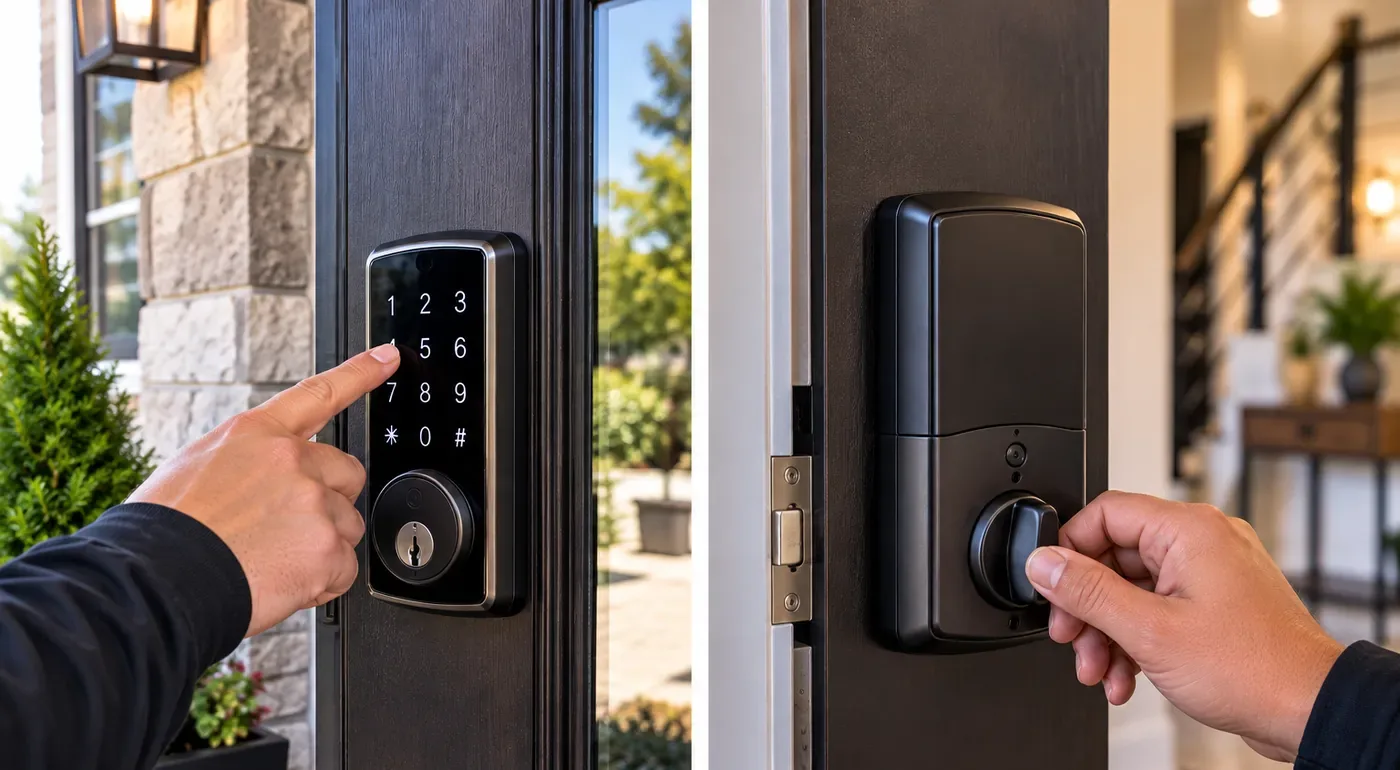
The same deadbolt seen from both faces of a dark door — outdoors, a fingertip on the numbered pad beside a lantern and stone wall; indoors, a hand gripping the thumb-turn on the bulky inside housing next to the edge latch.
The Neighborhood
The Fire Label Comes First: Smart Lock Installation for Tribeca Lofts and Condos
Tribeca is a warehouse district that people moved into. Wikipedia’s account of the neighbourhood describes the “Triangle Below Canal” as the quadrilateral bounded by Canal Street, West Street, Broadway and Chambers Street, inside Manhattan Community District 1 and patrolled by the NYPD’s 1st Precinct from 16 Ericsson Place. Through the nineteenth century the area was the city’s centre for produce, dry goods and textiles; the Washington Market spread from its original sheds into houses and warehouses around it, and store-and-loft buildings went up along Broadway in the 1850s and 1860s. When the market left for Hunts Point in the 1960s and the industrial base vanished, artists moved into empty lofts, and by the early twenty-first century Tribeca had become one of Manhattan’s most sought-after addresses. The doors people now use to get home are, in many buildings, the doors that used to let porters and freight onto a sales floor.
That history is still visible in the streets. The Historic Districts Council’s survey notes that the street grid was laid out at right angles off Greenwich Street and on a diagonal off Broadway, giving blocks of different lengths and irregular open spaces, and that the store, loft and warehouse buildings put up between roughly 1860 and 1910 “still dominate the character of the neighborhood today.” The Landmarks Preservation Commission protected the centre of the neighbourhood in four separate districts: Tribeca West on May 7, 1991, Tribeca East on December 2, 1992, Tribeca North and Tribeca South on December 8, 1992, and the Tribeca South Extension on November 19, 2002. Its designation report for Tribeca West calls the loading platform — usually a turn-of-the-century addition erected over stepped vaults — “one of the most common warehouse-associated features” in the district, alongside folding iron shutters and the wood doors that once filled the loading bays.
Inside those facades, a typical Tribeca home sits behind one of a handful of door types. In converted warehouses it is a heavy steel or metal-clad door at the top of a stair or off an elevator landing, often with a fire-rating label on its hinge edge, a strong closer above and a steel frame set into masonry. In buildings where the elevator opens straight into each floor, there may be no conventional front door at all: the elevator key is the lock, and the “other” door is the one to the fire stair. In the boutique condos that filled gaps and topped old warehouses, unit doors are newer, solid and usually rated, and there is a front desk downstairs. And at street level there are maisonettes with private entrances, galleries, design showrooms, restaurants and offices, each with its own door to the sidewalk and, often, another to the cellar.
The common thread is that a Tribeca front door is usually part of somebody else’s fire plan. New York’s Housing Maintenance Code, as HPD explains it, requires apartment doors and hallway doors to “swing closed and latch by themselves” after being opened, so that a fire is held in one place; HPD inspectors check every self-closing door they pass and, under a proactive programme, select buildings for inspection of all of them. The NYC Building Code requires dwelling-unit doors to carry a heavy-duty latch set and a heavy-duty deadbolt “operable by a key from the outside and a thumb-turn from the inside”, plus a chain guard and a viewer. And the national standard for fire doors, NFPA 80, expects the labels that prove a door’s rating to stay legible. A smart lock chosen without reading the door first can quietly break all three: a motor that strains against a hard-closing door, a keypad that removes the key the code expects, or a new hole that a labelled door was never listed to have.
The neighbourhood’s own crime reports point to the same weak spots. In March 2019 ABC7 reported that police charged a man who climbed a ladder and used a brick to break the second-floor patio door of a Franklin Street townhouse that was empty and under renovation — his third break-in at the same building. CBS New York reported a burglar working through Tribeca penthouses on Reade Street, entering through terrace doors that had apparently been left unlocked, with nearby homes on Duane, Leonard and Warren Streets also hit. In October 2021 Tribeca Citizen described at least nine cases in which thieves pried open or stripped the mail carriers’ lockboxes on building facades on Chambers, Warren and Murray Streets — boxes holding a key that opens the building as well as the mailboxes — and one Murray Street building had to replace every cylinder. And in March 2022 the Tribeca Trib published NYPD images of a man who walked into the lobby of 40 Harrison Street, in Independence Plaza, approached the security desk and left with two delivered packages. None of those stories is about a front door being kicked in. They are about doors left unlocked, keys that can be stolen and copied, and lobbies that a stranger can walk into.
Tribeca figures behind a smart lock plan
160,189 residents (2024) in Community District 1, which takes in Tribeca, the Financial District and Battery Park City, on NYU Furman Center figures — and the highest median household income of the city’s 59 districts, $208,970.
47.3 percent single-person households and 15.5 percent with children in the same district: a lot of people living alone who want someone trusted able to open the door remotely, and a growing number of families who want a code for the nanny and a log of when the children got home.
34.0 percent homeownership against 32.7 percent citywide, with 677 condominium sales in 2025 and 4,428 new homes added between 2010 and 2025 — many unit doors here belong to owners who can choose their own hardware within condo rules.
15.8 serious crimes per 1,000 residents in 2025, 11.4 of them property crimes, against 12.3 per 1,000 citywide, on the Furman Center’s measure — partly a reflection of how few people live among the offices and shops, but a reason to take building entry seriously.
Four historic districts and an extension, designated between 1991 and 2002, covering the centre of the neighbourhood — storefronts, loading bays and facades where readers and keypads need a careful location.
So the Tribeca job is rarely “swap the deadbolt for a keypad.” It is: identify what the door is rated for and keep it that way; make sure it still closes and latches on its own with a motor in it; keep a key working where the code and the building expect one; plan the second door — to the stair, the terrace or the cellar — with the same care as the first; and decide who in a staffed building gets to see the lock’s records. The sections below take those questions one door type at a time.
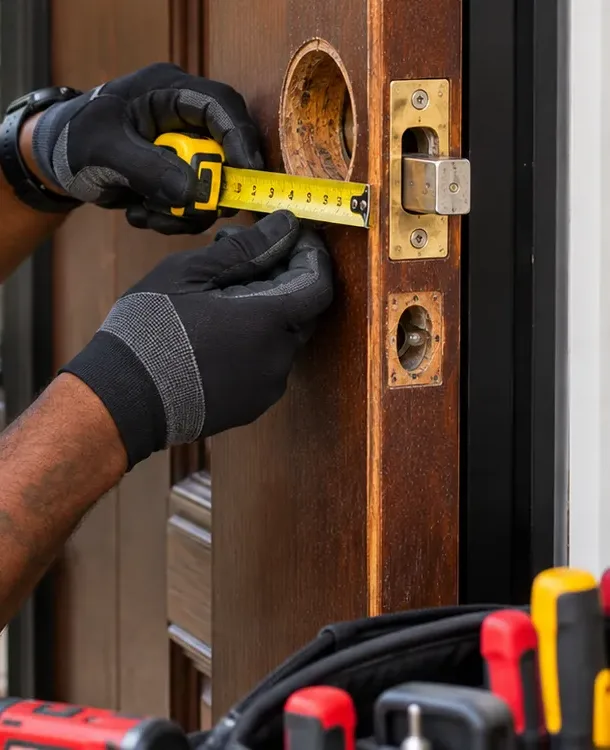
Backset check before any lock is chosen: a yellow tape runs from the door edge to the middle of a worn, empty deadbolt hole, with a brass latch faceplate in the edge and a second, smaller hole lower down.
Repair Capture
Smart Lock Jammed Somewhere Between Canal and Chambers?
A keypad on a heavy steel loft door that whirs but leaves the bolt short of the strike because the closer slams the door half an inch off line; a Wi-Fi lock that loses its connection whenever the router at the far end of a hundred-foot loft restarts; a dog walker’s code that works on the street door but not upstairs; a restaurant’s back-door keypad clouded by kitchen grease until half the buttons stop registering. Once a technician is at the door, most power, pairing, alignment and closer faults are fixed in one to two hours, and we book them into the next free 2-hour window your building allows. If the problem is the building’s own electric strike rather than your lock, a failed strike repair is $369–$606 at the Manhattan rate. Call (929) 560-0737 and say it is a lock fault, or see our Manhattan intercom repair service if the street panel is what has stopped releasing.
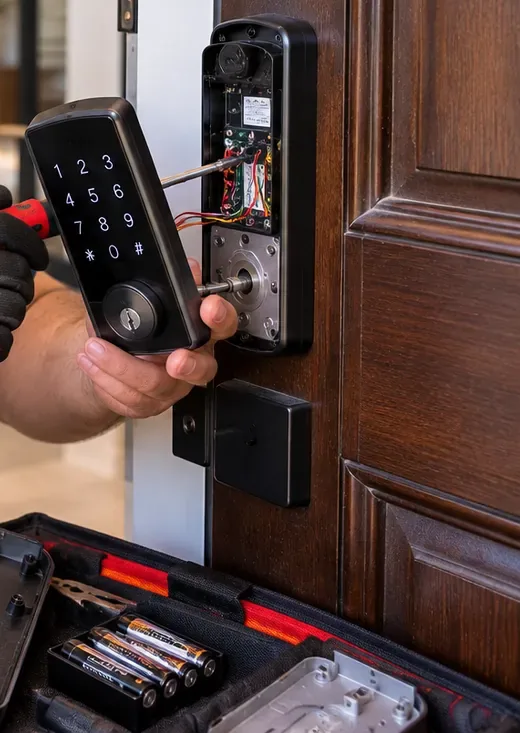
The outside keypad of a smart deadbolt is held away from a dark wood door while a screwdriver works at its back; the opened interior housing shows a small circuit board and coloured wires, with a tool case of batteries and spare covers below.
What We Install
Smart Lock Installation Services in Tribeca
The work below is what Tribeca households and businesses actually book us for, from the Holland Tunnel blocks down to Chambers Street. Whatever the door, the handover test is identical: it closes and latches unaided from any angle, a single movement opens it from inside, and each person who will use it tries their own code, card or phone before we pack up.
Rated Steel Loft Doors
Smart locks matched to the label on the door and frame, fitted using the preparation the door already has wherever possible, with the closer tuned so a motorised bolt meets its strike cleanly every time the door swings shut.
Full-Floor Lofts With Keyed Elevators
A plan for the loft whose elevator opens directly inside: which door carries the smart lock, how the stair door is handled, and what happens on the day the elevator is out of service for its inspection.
Unit Doors in Staffed Condos
Keypad, fingerprint and phone-key deadbolts for boutique condominium doors, coordinated with the managing agent’s alteration rules and set up so the household, not the lobby, decides who sees the entry log.
Maisonette and Private Street Doors
For duplexes with their own entrance on the sidewalk as well as a door into the condo lobby — two doors, two sets of rules, one set of credentials for the family.
Loft Renovation Door Specification
Working with your architect before the new entry door is ordered, so the door arrives prepared for the lock you want and the rating label never has to be argued with on site.
Gallery and Showroom Entrances
Keypads, card readers and electric strikes for the galleries on Walker Street and lower Broadway and the design showrooms on White and Franklin, with time-limited access for art handlers and couriers.
Restaurant Back, Kitchen and Cellar Doors
Hardware chosen for steam, grease and constant use, staff codes that end when a shift pattern changes, and a schedule for the cellar that follows deliveries rather than memory.
Terrace, Roof and Stair Doors
The doors Tribeca burglars have actually used — terrace and roof doors on upper floors — locked properly, alerting when left open, and never turned into a door that traps someone inside.
Service, Re-Pairing and Takeover
Diagnosis of locks other installers fitted as well as our own, reconnection after a router swap, transfer of administrator rights from a seller or sponsor, and strikes moved to meet heavy doors that have dropped.
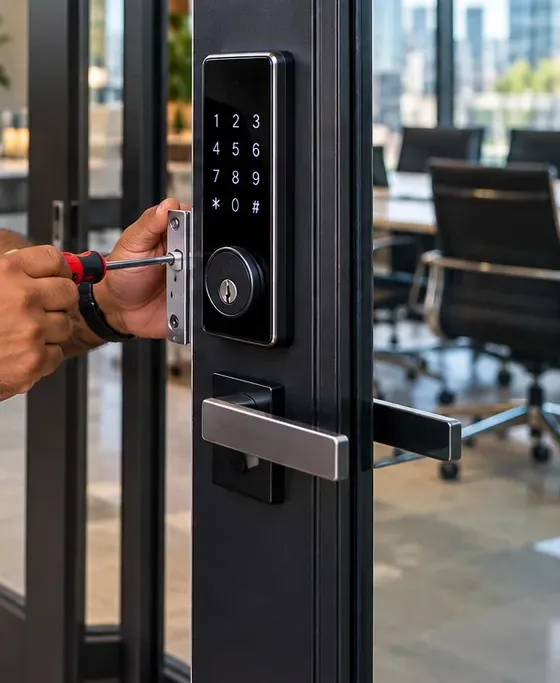
Through the glass, a conference table and skyline windows; in front, a red screwdriver seats the edge latch of a keypad deadbolt mounted on a slim black door stile with a lever below.
Building Specialists
Smart Lock Installation for Tribeca’s Architecture
Tribeca buildings fall into a few families, and naming the family comes before naming a product: it tells us where the hardware may sit, which key has to stay in service, what fire rating is in play and who must sign off.
Converted Store-and-Loft Buildings
Mid-rise cast-iron, brick and stone buildings put up between the 1850s and the 1910s, now loft condos and co-ops. One or two homes per floor, steel or metal-clad entry doors off a stair or elevator landing, and frames set into masonry that do not forgive a misplaced strike.
Full-Floor Keyed-Elevator Lofts
Smaller warehouse conversions where a key-locked elevator opens straight into each full-floor home — a feature buyers’ guides associate with converted warehouses in this part of Manhattan. The lock plan covers the elevator, the stair door and the day the elevator is down.
Boutique Condos and Tower Conversions
Newer buildings and conversions of landmark office towers — the 1920s Verizon Building on West Street became condominiums in 2016 — with front desks, package rooms, solid rated unit doors and managing agents who expect a certificate of insurance.
Loft Law Buildings
Former commercial buildings whose residents were protected under Article 7-C of the Multiple Dwelling Law as interim multiple dwellings while the owner legalised them under the Loft Board. Door work here can touch a legalisation record as well as the tenant’s own rights.
Federal Houses and Small Rows
A handful of early houses survive, most famously the nine Federal houses at 23–41 Harrison Street, dated 1796 to 1828 and designated individual landmarks in 1969. Wooden doors, old mortise locks and exteriors that must not change.
Mixed-Use Buildings With Ground-Floor Tenants
A restaurant, gallery or showroom on the ground floor, homes above, a cellar below reached through a sidewalk door, and sometimes a shared vestibule. Commercial doors and residential doors that have to be planned together without sharing codes.
How we approach each type of door
Steel loft entry doors. We start at the hinge edge. The door’s label — usually on the edge just below the top hinge or on the top of the door — tells us the manufacturer, the testing laboratory and the rating; a matching label on the frame does the same for the frame. NFPA’s own guidance says labels should not be removed, defaced or made illegible while the door is in service, and that where a label has been lost the rating can be verified “through other means acceptable to the AHJ”, such as an inspection or certification service. Once we know what the door is, we choose a lock that uses the bore and edge preparation already in it, or a hardware family listed for that kind of door, rather than drilling a new pattern into a labelled leaf. Many of these doors are older metal-clad “kalamein” types; Fire Engineering notes that such doors were made with gypsum cores and that older ones sometimes had asbestos-cement cores, which is another reason not to cut into them casually.
Closers and heavy leaves. A steel loft door can weigh far more than a hollow apartment door, and the closer that brings it home is set to overcome stair-shaft air pressure as well. That is exactly what the self-closing rule wants, but it is hard on a motorised bolt: if the door arrives a fraction off line, the bolt hits the strike lip, reports a jam and runs the batteries flat. We adjust the closer’s latch speed so the door settles rather than slams, re-align the strike, and test the bolt throw dozens of times from different opening angles before the lock is handed over.
Full-floor lofts. When the elevator opens directly into the home, the elevator’s key switch is doing the job a front-door lock does elsewhere, and it belongs to the building. The household’s smart lock usually goes on the door to the fire stair, which is the other way in. That door is governed by stair rules, so we treat it with care: free exit into the stair in one motion, no keyed thumb-turn on the inside, and any credential on the stair side planned with the building’s managing agent and its fire-safety arrangements in mind.
Condo unit doors. These are the most straightforward doors in Tribeca to fit and the most procedural to schedule. Solid or steel doors with standard bored holes take a smart deadbolt cleanly; the work is in the alteration agreement, the insurance certificate, the building’s contractor hours and the freight elevator booking, and in deciding whether the lock should be enrolled in anything the building runs. We keep the building’s key working on the lock if the condo’s rules require it.
Historic houses. On the Harrison Street houses and similar early buildings, the exterior of the door is the protected part. Smart hardware goes on the inside face, on an interior retrofit that turns an existing single-cylinder deadbolt, or on a secondary door, so that nothing visible from the street changes. Old mortise locks get a mortise-format solution rather than a bored deadbolt forced into a door that was never drilled for one.
Door
Where the smart part goes
What must survive
Who usually has a say
Labelled steel loft entry door
Existing bore and edge prep, or listed hardware
The rating label, self-closing and self-latching
Owner, condo or co-op board, managing agent
Full-floor loft, keyed elevator
Door to the fire stair
Free exit into the stair, building fire arrangements
Managing agent, board
Staffed condo unit door
Smart deadbolt in existing holes
Building key if required, closer, label
Managing agent
Maisonette street door
Inside face or vestibule if in a historic district
Facade, free exit, building key on lobby side
Owner, board, LPC for exterior change
Federal house front door
Interior retrofit or secondary door
Every exterior feature of the door
Owner, LPC
Gallery, showroom or restaurant entrance
Reader inside the glass, strike or electrified lever
Storefront facade, one-motion exit for the public
Tenant, landlord, LPC where exterior changes
Loft owners often add a view of the landing. Our doorbell camera installation in Manhattan can put a discreet camera at the stair door or the maisonette entrance, so you can see who is there before unlocking from your phone.
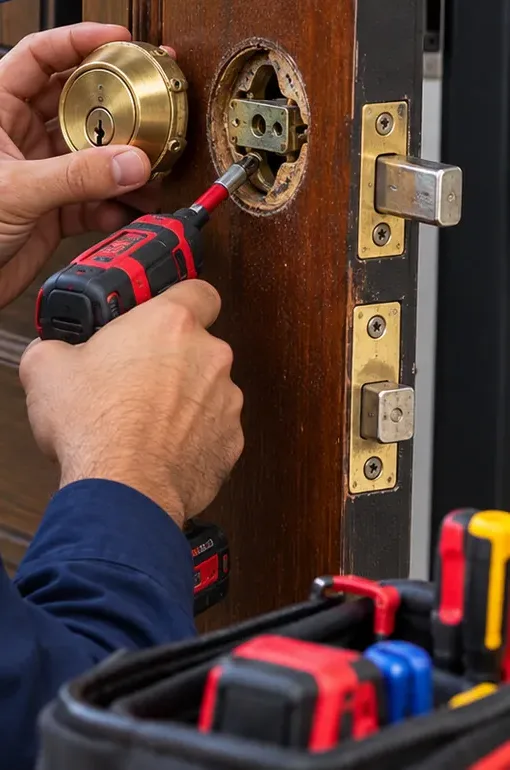
One hand lifts a round brass deadbolt cylinder away from a dark wood door while the other drives out a screw from the open bore with a red cordless driver; two brass faceplates are set in the door edge and a tool bag sits below.
Commercial Smart Locks
Business Smart Lock Installation in Tribeca
Commerce in Tribeca lives in the ground floors of loft buildings. There are office towers at the edges — Citigroup’s corporate and investment bank headquarters at 388 Greenwich Street in the north-west corner, for one — but most of the doors we fit for businesses here belong to a gallery, a showroom, a restaurant or a small office with homes above it.
Walker Street and Lower Broadway Galleries
The Tribeca Arts District describes galleries clustering on Broadway and Walker Street. Galleries announce new spaces here regularly — Cristin Tierney opened a ground-floor gallery at 49 Walker Street, James Cohan expanded into a second floor at 52 Walker beside its 48 Walker space in October 2021, and Marian Goodman announced a move to 54 Franklin Street, in an 1891 building in the historic district, for late autumn 2023.
White and Franklin Street Showrooms
The same arts-district guide places design houses on White and Franklin Streets. Showrooms want a staff entrance with its own codes, a loading door that can be opened for a delivery window and a log of who was in after hours.
West Broadway and Hudson Street Restaurants
Dining rooms in the ground floors of nineteenth-century buildings — The Odeon at 145 West Broadway is the one the Historic Districts Council photographs — with back doors onto service passages, cellars reached from the sidewalk and staff who start before dawn.
Greenwich Street Offices and Studios
Architecture, production and design studios in upper-floor lofts, sharing a street door and an elevator with residents. Suite doors that need staff codes and visitor windows without touching the residential side.
Schools and Institutions
New York Law School’s buildings along Worth Street, the Borough of Manhattan Community College campus between Chambers and North Moore Streets and the New York Academy of Art bring offices, studios and storerooms whose interior doors benefit from logged, scheduled access.
Duane, Reade and Chambers Street Shops
Smaller retail and service businesses in the southern blocks, often in buildings with a residential lobby next door, where the shop’s back door, the cellar and the shared hallway each need a different credential.
Codes and rules that bear on commercial doors here
Stair doors. The NYC Building Code says interior stairway doors “shall be openable from both sides without the use of a key or special knowledge or effort”, with exceptions — including stairs serving not more than four stories, where doors may lock from the stair side if they can be unlocked simultaneously from the fire command centre or a single location inside the main entrance. A studio or office on an upper floor cannot simply put a keypad on its stair door and lock it.
Fire-rated doors and frames. Many corridor and stair doors in loft buildings are labelled assemblies. NFPA 80 and its guidance expect the labels to stay legible and hardware to suit the listing, so strikes and electrified locks are chosen for the frame’s label rather than cut to fit.
Landmarks. Storefronts, loading bays and entrances in the four historic districts are part of the designated buildings. The Commission’s storefront rules govern infill, doors and security gates, and its rules list Tribeca East, North and West among districts with continued sidewalk regulation. We look for a reader location inside the glass, in the vestibule or on a non-historic door before anything touches a protected facade.
Sidewalk cellar doors. NYC 311 explains that the Department of Transportation investigates sidewalk cellar doors left open and unprotected, and that they may be open during a delivery as long as someone is there to guard the opening. An electronic lock can control who opens them; it cannot replace the person standing beside them.
Businesses that want cameras, an alarm or panic buttons alongside the new lock can have all of it surveyed in one visit by our Manhattan commercial security systems team, so readers and cameras share cable routes and a single plan.
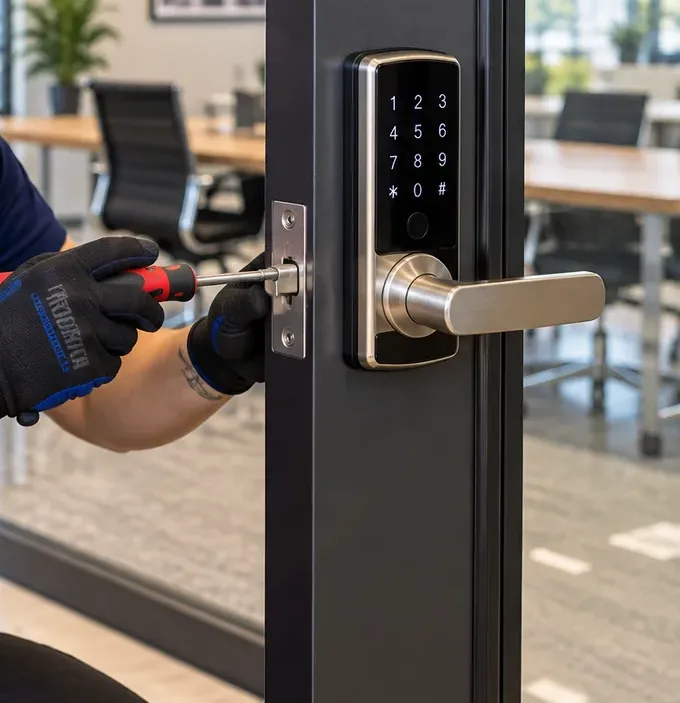
Seen from inside an office: a gloved installer secures the latch plate of a satin-finish keypad lever set on a narrow dark frame, with desks, chairs and a framed print beyond the glass.
Your Questions Answered
Smart Lock Installation in Tribeca: Questions Answered
Each question below began at a real Tribeca door type — a labelled steel loft door, a full floor reached by keyed elevator, a staffed condo, a renovation, or a gallery, showroom or kitchen at street level. Questions every borough shares, such as renters’ rights, co-op key rules, building entry apps and office suites, live on our Manhattan smart lock installation page and the citywide guide beyond it. Booking, coverage and cost sit in the FAQ further down. None of this is legal advice.
Labelled steel loft doors
The label on our loft door’s edge is buried under paint — how do you find out what rating the door carries before choosing a lock?
We look for it first, carefully. Door labels are usually metal plates or embossed marks on the hinge edge just below the top hinge or on the top edge of the leaf, and frame labels are in the frame’s hinge jamb. A single thin coat often leaves the raised lettering readable with a raking light; decades of coats do not. NFPA’s guidance is that labels should not be removed, defaced or made illegible while the door is in service, that a painted label can be acceptable if it is still readily visible, and that where a label is gone or unreadable the rating can be verified “through other means acceptable to the AHJ”, such as an inspection or certification service that provides documentation.
In practice that gives three outcomes. If the label is legible, we record the manufacturer, laboratory and rating and choose hardware to suit. If it is buried, we ask the managing agent whether the building holds door schedules or certification records from the conversion, which many loft condos do. If nobody can say, we treat the door as rated, choose a lock that uses the existing preparation and is suitable for rated doors, and tell you plainly that confirming the rating is a job for a door-certification service, not a lock installer. What we will not do is strip a label to read it or drill a new pattern into a door whose rating nobody knows.
Our building’s architect says the new loft entry door must stay “labelled” — does that narrow which smart locks we can buy?
Yes, and it is better to know before buying than after. A labelled door is tested and listed as an assembly with particular hardware preparations, and the latching hardware on it is expected to be suitable for fire-door use. Many consumer smart deadbolts are designed for ordinary residential doors and do not advertise any fire listing; makers also publish narrow door-thickness ranges — Schlage lists 1-3/8 to 1-3/4 inches for its Encode deadbolts and Yale lists 1-3/8 to 2-1/4 inches for the Assure Lock 2 — which a heavy loft door may not meet. So the box on the shelf is not automatically the right lock for the door.
What usually works is one of three routes. A smart lock or retrofit that turns an existing deadbolt already fitted in the door’s factory preparation, so no new holes are cut. An electrified mortise or cylindrical lock from a commercial range whose fire-door suitability the architect can check against the door’s listing, controlled by a keypad or reader. Or, for a new door still being ordered, a door and frame specified from the start with the lock’s preparation done at the factory. We send the architect the exact model, its cut sheet and the preparation it needs, so the decision is made on paper rather than with a drill.
Our building was legalised under the Loft Law — does its interim multiple dwelling past change who decides what goes on our door?
It can. The city’s Loft Board explains that Article 7-C of the Multiple Dwelling Law created a class of buildings called interim multiple dwellings and required their owners to bring former commercial lofts up to the Building Code’s standards for homes; the Board tracks the conversion, registers the buildings and settles disputes between landlords and tenants along the way. Once legalised, covered units generally become rent-stabilised apartments.
For a lock, that history matters in two ways. If you are a protected loft tenant, your door is a rental apartment door like any other: you can add a lock of your own, the owner is entitled to a key, and the owner cannot make an app the only way in. If you own or manage the building, a lock project that changes doors, frames or fire-rated assemblies can intersect with legalisation work and the building’s certificate of occupancy, so it is worth checking the building’s Loft Board file and its architect’s drawings before replacing a door. Where the work is just a smart deadbolt in existing holes, the history rarely changes anything; where it is a new door or a new frame, we ask first.
Full floors, keyed elevators and the fire stair
The fire stair doors in our loft building lock behind us on every floor — is that allowed, and could a keypad let residents back in?
Sometimes it is allowed, and the rules are specific. The NYC Building Code’s section on stairway doors starts from the principle that interior stair doors “shall be openable from both sides without the use of a key or special knowledge or effort.” Among its exceptions, in stairways serving not more than four stories the doors may be locked from the stair side, provided they open from the egress side and can be unlocked all at once, without unlatching, by a signal from the fire command centre or from a single location just inside the main entrance; another exception refers to the separate high-rise provisions. A stair door that simply locks behind you, in a building that does not fit an exception, is a question for the building’s managing agent and its fire-safety consultant, not for a keypad.
Where the building qualifies and the board wants residents to be able to re-enter floors from the stair, an electrified lock with a keypad or reader on the stair side can do it — but it has to be part of the building’s system, wired so the doors release together on the required signal, and approved by whoever is responsible for the building’s fire protection. That is a building project, not a unit upgrade, and we would quote it with the board. For your own floor, what we can do immediately is make sure your loft’s door to the stair opens freely in one motion from inside, so you are never trapped on your own landing.
When the keyed elevator is shut for inspection, how do we get into our full-floor loft — and should the smart lock plan cover that day?
It should, because that is the day the plan is tested. In a full-floor loft the elevator key usually does the work of a front-door lock, so when the elevator is taken out of service for its periodic inspection, a modernisation or a repair, the door from the fire stair becomes your only entrance. If that door has a key nobody has used in years, a sticky cylinder or a deadbolt that is only operable from inside, you find out on the landing with shopping bags.
We plan for it at the walkthrough. The stair door gets a lock you can open from the stair side — a keypad or fingerprint deadbolt, or a retrofit with a working key — so long as it remains openable from inside in one motion. Codes for the cleaner, the dog walker and family go on that lock as well as on any elevator arrangement the building offers, so nobody depends on the elevator key alone. And we ask the managing agent to tell residents the inspection dates, so you can check the stair door’s batteries the week before.
Diagram: in a keyed-elevator loft the stair door, the terrace door and any interior lock are planned together with the elevator.
Staffed boutique condos
We’d prefer the front desk can’t see when we come and go — who actually reads a smart lock’s entry log in a staffed condo?
Whoever holds administrator rights on the lock’s account, and nobody else. A standalone smart lock keeps its own history of which code, phone or fingerprint opened the door and when, and that history lives in the household’s app and the maker’s cloud. The building’s front desk sees its own records — the lobby door, the package log, the visitor book — but it does not see inside your lock unless you enrol the lock in a building platform or give staff an account.
That gives you choices. If you want staff to be able to let in a plumber when you are away, you can give the building a single, named code that you can see being used and can cancel at any time, rather than administrator rights. If privacy matters more, keep every administrator inside the household and use time-limited codes for visitors, generated from your phone. We set up the account in the owner’s name, add a second administrator you trust, turn off any sharing you did not ask for, and write down on the handover sheet exactly who can see what.
Our condo’s ground-floor maisonette has its own street door and a door into the lobby — which should be smart, and whose rules cover each?
Usually both, under different rules. The street door is your private entrance but part of the building’s facade, so its exterior falls under the condo declaration and, if the building is in one of the historic districts, the Landmarks Preservation Commission; the inside face is generally yours to change. The lobby door is a unit door like any other in the building: it must close and latch on its own, it may carry a fire label, and the managing agent will want to approve hardware on the corridor side.
The practical plan is to keep the street side of the maisonette door looking exactly as it does, fit the smart part inside or choose a discreet keypad deadbolt only where the board and, if relevant, the Commission accept it, and put a matching lock on the lobby door so one set of family codes works on both. Deliveries can then be told to use the lobby, with the street door kept for the household. We give each door its own auto-lock delay — shorter on the street door — and an alert if either is left unlocked overnight.
Renovations and new doors
Our architect is specifying a new entry door for the loft renovation — what should the door order include so a smart lock fits without cutting on site?
Three things, decided before the order goes in. First, the lock itself, named by model, so the door and frame can be prepared at the factory for exactly that body — bored for a smart deadbolt, mortised for an electrified mortise lock, or both. Second, the door thickness and backset that lock supports, because a handsome 2-1/4-inch door is no use if the lock you want is listed for 1-3/4. Third, if the lock is powered rather than battery-run, a path for the low-voltage cable through the hinge side — an electrified hinge or a concealed transfer — so wires never have to be run across a labelled door after it is hung.
The renovation also decides the closer, the strike and the threshold, and each affects the lock. A closer specified for the door’s weight and the stair pressure, a strike prepared for the deadbolt’s throw, and a threshold that does not drag will let a motorised bolt work for years on its first set of settings. We are happy to join a call with the architect and contractor, send the lock’s cut sheet and preparation drawing, and come back after the door is hung to fit and programme the lock, so the door never has to be taken down again.
Our loft door is far thicker than a standard apartment door — will an off-the-shelf smart lock fit it?
Possibly not, and the published ranges are the place to start. Lock makers state the door thicknesses their products support: Schlage gives 1-3/8 to 1-3/4 inches for its Encode deadbolts and 1-3/8 to 2 inches for its Arrive line’s preparation, and Yale gives 1-3/8 to 2-1/4 inches for the Assure Lock 2. Some makers sell thick-door kits with longer spindles and screws for a modest extra stretch; beyond that, a bored residential deadbolt is the wrong tool.
For genuinely thick or non-standard loft doors there are better routes than forcing it. An interior retrofit that turns an existing deadbolt does not care about door thickness, because it sits on the inside thumb-turn. A commercial electrified mortise lock comes in versions made for heavy doors and is driven by a separate keypad or reader. And where the existing lock is an old mortise body, a mortise-format smart conversion can work within the pocket already cut. We measure thickness, backset, bolt throw and the condition of the existing preparation at the walkthrough, then recommend the option that fits without new cuts.
Galleries, showrooms and kitchens on the ground floor
Our restaurant’s cellar is reached through steel doors in the sidewalk — can they be locked electronically on a schedule?
The cellar can be, but usually not at the sidewalk doors themselves. Sidewalk cellar doors are heavy steel leaves set in the pavement, and the city’s rules are about safety: NYC 311 explains that the Department of Transportation investigates cellar doors left open and unprotected, and that they may be open during a delivery as long as someone is in the area to guard against a fall. They are normally secured from below with a bar or hasp, and an electronic lock on the leaves themselves would have to survive foot traffic, water and salt in a place that is hard to service.
What works better is to lock what lies beneath. The door from the cellar into the kitchen or the interior stair can take a keypad or reader with a schedule — open during the morning delivery window, locked otherwise — and a log that shows which staff code opened it. The sidewalk doors stay secured from inside with their bar, and a door contact can tell the manager’s phone if they are opened outside delivery hours. That keeps the expensive stock locked on a schedule while leaving the sidewalk doors as simple and safe as the city expects.
Steam and grease coat our kitchen’s back door — which kinds of lock hardware hold up there?
Hardware built for commercial doors, mounted where the worst of it does not land. Consumer keypads with glossy touch surfaces cloud over with grease film and stop reading taps reliably, and fingerprint readers struggle with wet or floury hands; battery compartments on the inside face collect condensation if the door sits next to a dishwasher or a steam table. On a busy kitchen door, those small failures turn into a door propped open with a bucket.
We favour a reader or keypad with physical buttons or a sealed face, mounted on the wall or frame beside the door rather than on the leaf, controlling an electric strike or electrified lever that is rated for commercial use. Staff use cards, fobs or codes, each person with their own credential so access ends the day someone leaves. Inside, a push bar or lever gives instant exit. The strike and reader can be wiped down with the rest of the kitchen, and nothing important depends on a battery cover that someone has to open with greasy fingers.
Our showroom takes deliveries through a loading bay behind historic iron shutters — where does an electronic lock belong?
Behind the shutters, on a door of its own. The Landmarks Preservation Commission’s Tribeca West designation report describes folding iron shutters and the wood doors that historically filled loading bays as part of what gives the district its character, and loading platforms over stepped vaults as one of its most common warehouse features. If your bay still has those elements, they are part of the protected facade, and a reader screwed into a cast-iron pier or a strike cut into an old shutter is the wrong answer.
In most showrooms the bay already has an inner door or a modern infill behind the historic shutters, and that is where the electronic lock goes: an electric strike or electrified lever on the inner door, a reader just inside the shutters or on the interior wall, and a delivery code that works only during the booked window. The shutters themselves are opened and closed by staff as they always were. If an exterior change is genuinely needed, we prepare the product details and photographs for your architect’s application to the Commission before anything is drilled.
Art handlers deliver to our Walker Street gallery after hours — can they open the door without learning the staff code?
Yes, and they should never be given the staff code. Most smart locks and readers can issue a credential that works only on one date or within a set window — Tuesday from 7 p.m. to 10 p.m., say — and that expires on its own. The registrar sends it to the shipping company’s crew lead that afternoon; the crew opens the door; the gallery sees exactly when it was used; the code stops working at ten. The staff code, which opens the gallery every morning, never leaves the gallery.
We usually set galleries up with three tiers: staff credentials that follow working hours, an administrator tier for the director and registrar, and one-off windows for shippers, installers and couriers. The storage or viewing room gets its own lock with a shorter user list. If the front door is glass with nothing to cut, the reader sits inside the glass and the lock is chosen for the frame; if the door is a heavy steel delivery door off a side street, the lock is chosen for its label. Either way, the handlers’ visit leaves a record your insurer or lender can read.
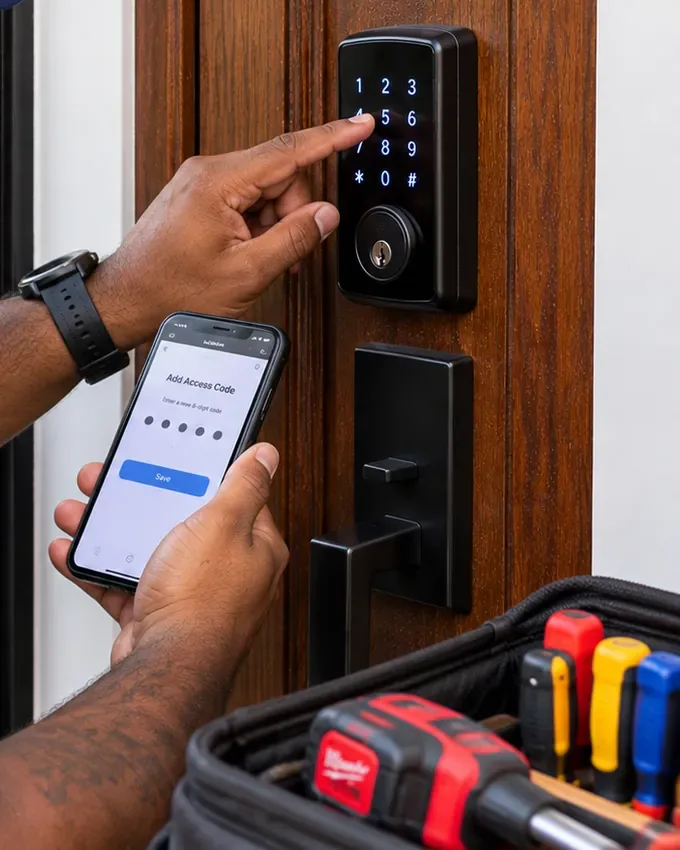
Close-up at a wooden door: one hand keys digits into the illuminated pad of a smart deadbolt, the other shows a phone screen titled “Add Access Code” with five dots and a blue Save button, above an open case of screwdrivers.
Equipment
Types of Smart Locks We Install
In Tribeca the deciding facts are the label, the thickness and the second door. You can buy your own lock or let us specify one; these are the families we fit below Canal Street, and what each is good at.
Interior Retrofit Units
A motor housing that fits over the inside of an existing single-cylinder deadbolt and turns it, leaving the door’s preparation, cylinder and exterior exactly as they were. The least invasive choice for a labelled or historic door, as long as the existing deadbolt is sound.
Keypad and Fingerprint Deadbolts
Smart deadbolts with a keypad or fingerprint reader outside and a thumb-turn inside, for condo unit doors and stair doors with standard bored holes — checked against the maker’s stated door-thickness range before anything is ordered.
Electrified Mortise Locks
Commercial mortise locks with a powered release, driven by a separate keypad or reader, for heavy steel loft doors and doors that need a lock body suitable for rated assemblies. Wired through an electrified hinge or transfer, not across the face of the door.
Thread and Matter Locks
Locks on a Thread mesh connect outward via a border router, typically a smart speaker, hub or streaming box already in the loft. They earn their place where the entry sits far from the router, so long as the border router belongs to the same ecosystem as the household’s app.
Electric Strikes and Electrified Levers
The workhorses of shared street doors, galleries, showrooms and kitchens. A valid credential releases the keeper in the frame or the lever on the door; leaving takes one push from inside. Labelled frames get strike models rated for fire doors.
Wall Readers and Sealed Keypads
Card, fob and phone readers and sealed-face keypads mounted beside the door, where grease, weather and constant hands do the least harm — the right companion for kitchen doors and busy staff entrances.
Door Contacts and Request-to-Exit Devices
Small sensors that report a door left open or propped, and exit buttons or motion sensors that release a powered lock for someone leaving, so a locked door never traps anybody inside.
Diagram: the label, the existing deadbolt and the door’s thickness narrow the choice before any brand is discussed.
Matching the lock to the Tribeca door
Door
First choice
Main reason
Labelled steel loft door with an existing deadbolt
Interior retrofit
No new cuts in a rated leaf
Heavy loft door, no usable deadbolt, rating known
Electrified mortise lock with keypad or reader
Lock body suited to the door and its weight
Full-floor loft, door to the fire stair
Keypad or fingerprint deadbolt with free inside exit
Second entrance on elevator-outage days
Boutique condo unit door
Keypad smart deadbolt in existing holes
Clean fit, building key kept if required
Maisonette street door in a historic district
Interior retrofit; discreet keypad only if approved
Facade unchanged
Gallery or showroom entrance
Reader inside the glass with strike or electrified lever
Staff tiers and time-window access
Restaurant kitchen or cellar stair door
Sealed wall reader with commercial strike
Grease, steam and shift changes
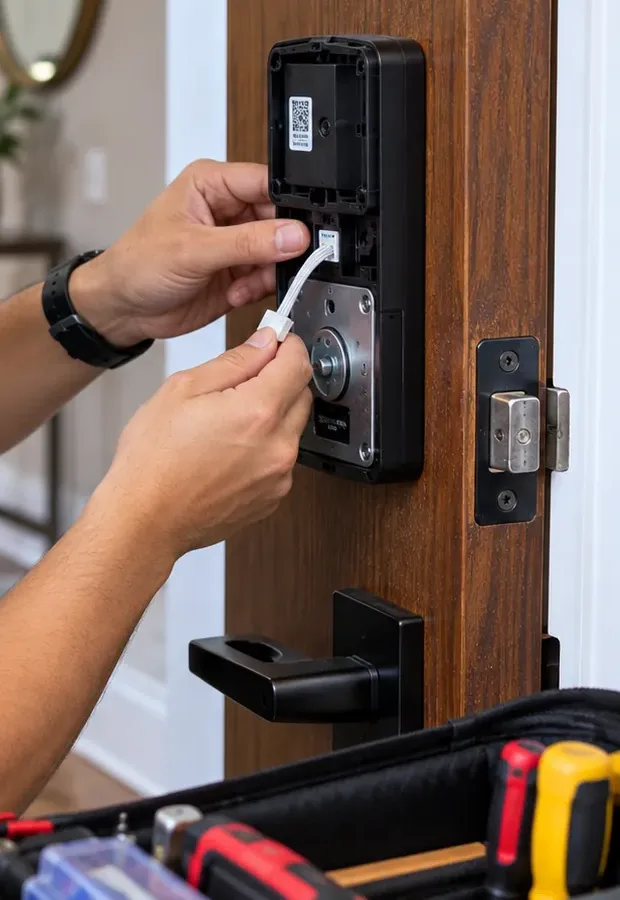
Close view of a lock’s inside unit with its cover off: fingers press a slim white ribbon connector into its socket above the round drive spindle, on a wood-grain door that also carries a black lever and an edge latch.
AI Overview Reality Check
What AI Gets Wrong About Smart Lock Installation in Tribeca
A note on sources. Google’s AI Overview could not be displayed by the tools used to research this page, so none of the headings below is copied from it. Instead each one paraphrases a line that a national cost guide, a manufacturer or a reviewer has published — the sort of statement answer engines pick up — and names that source before explaining how a Tribeca door changes the picture.
“A smart lock costs $250 to $400 to have installed”
That range comes from Fixr’s national cost guide, updated in January 2025, which puts the average around $300 with handyman labour at $50 to $100 an hour. It is a fair national figure for one bored deadbolt on a wooden house door, installed in a single visit with nobody else to consult.
A Tribeca loft door is rarely that job. Before a lock goes on, someone has to establish what the door is rated for, whether the closer will let a motor work, whether the managing agent needs a certificate and an alteration form, and whether the stair door needs the same treatment as the front. On a ground-floor gallery or restaurant the work is usually a reader and electric strike, which AESS publishes at $1,875 to $3,125 at the Manhattan rate.
The national number is not wrong; it describes a different door. If a quote for a labelled steel loft door starts from it, ask what it assumes about the label, the closer and the paperwork.
“Smart deadbolts fit standard doors”
Lock makers do say their deadbolts fit standard residential preparations, and they publish the details: backsets of 2-3/8 or 2-3/4 inches, a cross bore of 2-1/8 inches and door thicknesses such as 1-3/8 to 1-3/4 inches for Schlage’s Encode or 1-3/8 to 2-1/4 inches for Yale’s Assure Lock 2.
Tribeca loft doors are frequently not standard residential doors. They may be thicker, metal-clad, mortised for a commercial lock body rather than bored, or labelled assemblies that should not be given a new pattern of holes. A keypad deadbolt that fits a townhouse door perfectly can be the wrong lock for a 1920s kalamein door at the top of a warehouse stair.
“Standard” is a set of measurements, not a promise. We measure thickness, backset, bore and bolt throw and read the label before naming a product.
“Your Wi-Fi lock talks straight to your home network”
Many locks do connect over Wi-Fi, and others reach it through a bridge. August’s support pages ask for its Connect bridge to sit within 10 to 15 feet of the lock and to see full Wi-Fi bars where it is plugged in; Schlage notes that its Wi-Fi deadbolts require a 2.4 GHz network.
A Tribeca loft can be a hundred feet from the elevator to the windows, with the router at the far end, brick party walls on two sides and a steel door at the entry. In a full-floor loft the door that matters may be the one to the stair, round a corner from everything. The signal at the door is often the weakest in the home.
We test signal strength at the door itself, place a bridge, access point or Thread border router where it is strong, and prove remote unlocking over mobile data before we leave.
“Going keyless means you never need a key again”
Product marketing often says exactly this, and for everyday use it is close to true: codes, phones and fingerprints replace the key on most days.
The NYC Building Code, though, describes the dwelling-unit door as having a heavy-duty deadbolt “operable by a key from the outside and a thumb-turn from the inside,” and condo and co-op rules frequently require the building’s key system to keep working. A key is also the fallback when batteries die during a long trip or a lock loses its pairing. On a stair door in a full-floor loft, the key may be the only thing that gets you home on elevator-inspection day.
So we keep a working key on every residential lock we fit, store it with a neighbour or the household’s second administrator, and treat “keyless” as the daily routine rather than the only way in.
“A smart lock works on any front door, including a fire door”
Reviewers rarely mention fire ratings at all, and some installation guides treat every door as a blank slate for a drill.
NFPA guidance on fire doors expects labels to remain legible and hardware to suit the listed assembly, and HPD inspects apartment and hallway doors for self-closing operation. In Tribeca’s converted lofts and newer condos, unit doors and stair doors are often rated. Cutting a new bore, removing a closer because it fights the motor, or fitting hardware that holds the door open would all undo what the door is there to do.
On a rated door we use the existing preparation or hardware suited to the assembly, keep the closer and adjust it, and tell you when a question belongs to a door-certification service rather than to us.
“Expect about six months from a set of batteries”
Schlage’s product pages promise up to six months from four AA cells in normal use for its Encode Wi-Fi deadbolts, and rival makers publish comparable or longer figures. For a household door opened a handful of times a day, that is a fair expectation.
A heavy loft door with a strong closer and a slightly misaligned strike makes the motor work harder on every throw. So does a stair door used by a dog walker, a cleaner and every delivery on elevator-outage week, and so does a lock fighting for a weak Wi-Fi signal at the far end of a long loft.
We align the strike so the bolt runs free, choose a radio that suits the distance, send low-battery alerts to two people, and suggest a calendar battery change on the busiest doors rather than waiting for the warning.
“Pair your lock with an alarm subscription for complete security”
Alarm companies sell the lock as part of a package, and ADT, Ring and SimpliSafe each advertise it. The fine print matters: Ring’s help article on arming its alarm from a smart lock says the feature needs a subscription, works with compatible Z-Wave locks, and responds only to codes that were created inside the Ring app.
That suits some single-family homes. In a staffed condo, it can mean your door codes live in an alarm company’s app and depend on its plan, and the installer they send will not be dealing with your door’s fire label, your managing agent’s alteration rules or a gallery’s art-handler schedule. The Tribeca terrace and roof burglaries in the news also show that the front door is only one of the doors that matter.
If you want the lock and an alarm to work together, we choose hardware that keeps codes under your control first and link it second — and look at the terrace and roof doors at the same visit.
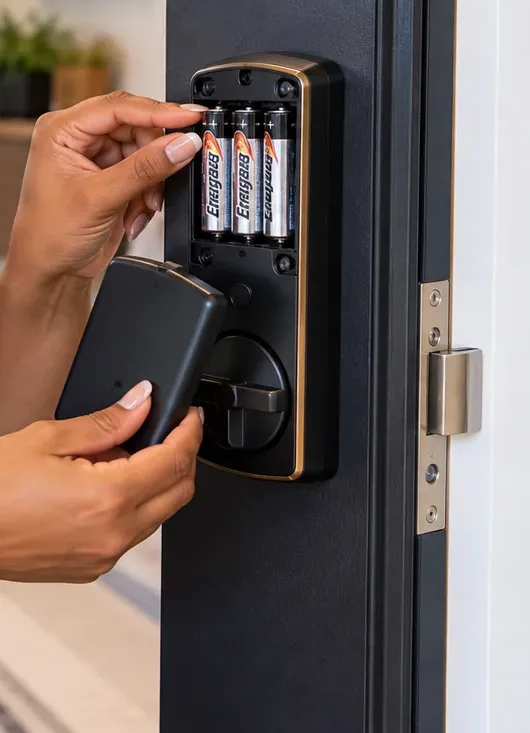
Battery day on a black door: the cover of a dark smart deadbolt's inside unit is off, one hand seats a row of AA cells and the other holds the cover, and the latch shows in the door edge.
Read the Label First — Then Lose the Loft Key
Send a photo of your door’s hinge edge and the inside face. Our reply names the locks that suit its rating and thickness, who in the building may want paperwork, and a price.
Steel loft door on Greenwich Street, full floor off a keyed elevator, condo near Duane Park or a kitchen door on West Broadway — describe it and you will have a written answer the same business day. Prefer to talk? Call (929) 560-0737.
✅
Thanks — Request Received
Received. A licensed installer who works Tribeca will read the details and phone you today, usually within a few hours. If a door has failed outright, call (929) 560-0737 rather than waiting.
How It Works
Our Installation Process
The same six stages apply to an interior retrofit on a rated loft door and to a reader-and-strike conversion of a gallery entrance.
1. Hinge-edge photo and a first answer
A picture of the hinge edge, another of the inside face and a word about who uses the door is enough for a first reply. It names the lock families that could work and flags any board, managing agent or Landmarks involvement we expect.
2. Label survey and flat price
On site the technician records both labels, takes thickness, backset and bolt-throw measurements, watches the closer bring the door home, checks signal strength at the entry and walks to the stair, terrace and cellar doors. The written price follows; reader and strike work uses AESS’s published Manhattan figures.
3. Paperwork and booking
We send the managing agent our insurance certificate, licence number and the lock’s cut sheet, give an architect the preparation drawing for a new door, and book a 2-hour arrival window inside the building’s contractor hours and freight elevator schedule.
4. Door and closer preparation
The labels are photographed and protected, the closer’s speed set so the door settles rather than slams, the strike aligned to the bolt and any paint or debris cleared from the strike pocket so the motor never strains.
5. Fit, connect and test
The lock goes on using the door’s existing preparation or the factory preparation of a new door; the bridge or border router is placed where the signal is strong; remote unlocking is proved over mobile data; one-motion exit from inside is tested on every door touched.
6. Credentials, privacy settings and handover
Everyone who uses the door is enrolled by name with the hours that suit them, dated credentials for visitors are demonstrated, a backup administrator joins the account, outside sharing stays off unless requested, and a single page records which person can open which door.
Coverage Area
Smart Lock Installation Near Tribeca’s Landmarks
Six places that explain the doors we work on below Canal Street — from a park set aside in 1797 to a hospital skybridge over an alley.
Duane Park
The Friends of Duane Park describe it as the city’s second-oldest public park after Bowling Green, set aside in 1797 where Duane Street widens to meet Hudson Street. The Friends’ history recounts how the butter, egg and pickle warehouses around it were closing by the mid-1990s; the buildings that ring it now are the kind of converted lofts this page is about.
Staple Street Skybridge
The bridge over Staple Street once carried patients between two New York Hospital buildings, the 1893 House of Relief at 67 Hudson Street and the 1907–08 Ambulance Annex at 9 Jay Street, both in the Tribeca West Historic District. Institutional buildings turned into homes, with doors to match.
Harrison Street Federal Houses
Nine Federal houses dated 1796 to 1828 at 23–41 Harrison Street, three of them moved from a vanished stretch of Washington Street in the late 1960s, all designated individual landmarks in 1969. The oldest front doors in the neighbourhood, where nothing outside may change.
Washington Market Park
A 1.61-acre park on Greenwich Street opened in 1981 and named for the produce market that once filled the area, popular with families for its large playground — and a reminder that many Tribeca lock plans include children’s codes and a schedule for the nanny.
Hook & Ladder Company 8
The still-active FDNY firehouse at 14 North Moore Street, known from the Ghostbusters films. A reminder that the people who may need to get through a Tribeca door in a hurry are firefighters, and that every lock we fit has to open from inside in one motion.
Pier 26, Hudson River Park
A 2.5-acre ecologically themed pier that opened in 2020 off the Tribeca waterfront, part of the Hudson River Park that grew out of the West Side Highway replacement after the Westway plan was abandoned. Riverside blocks mean wind-driven rain on exposed doors, one more reason we favour sealed keypads outdoors.
We also work across the rest of Tribeca — from the Holland Tunnel blocks around the former St. John’s Park to the streets south of Chambers — and next door in SoHo, Hudson Square, the Civic Center, the Financial District and Battery Park City. The AESS smart lock page for Manhattan covers the whole borough.
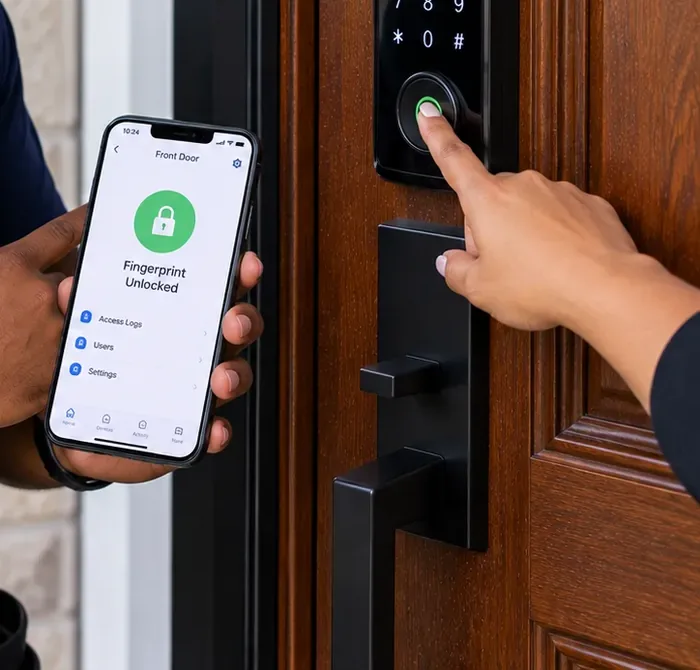
Handover check: someone holds a finger to the green-lit sensor below a black keypad lock on a wooden door, and the phone held beside it confirms the event with a padlock icon reading “Fingerprint Unlocked”.
Pricing
Smart Lock Installation Cost in Tribeca
A Tribeca address does not add a premium. Our published building and storefront work — reader or keypad doors with an electric strike, new strikes, strike repairs and programming visits — carries the same Manhattan figures as anywhere else in the borough: the Brooklyn base multiplied by 1.25, with both numbers shown below. Locks for a single home door are not on that list. An interior retrofit on a condo door and an electrified mortise lock on a labelled steel loft door share little beyond the word “lock”, so they are priced after a free walkthrough as a flat written figure that does not move on the day.
Work
Tribeca price
What it covers
Home door lock — loft, condo, maisonette or house; retrofit, smart deadbolt, electrified mortise or stair-door keypad
Quoted flat at free walkthrough
Varies with the rating, door thickness, closer, extra doors and building approvals, so AESS publishes no fixed figure for it
Keypad or fob reader with electric strike on one door
$1,875–$3,125 installed
Gallery, showroom, restaurant and shared street doors — published $1,500–$2,500 base × 1.25
New electric strike in an existing frame
$313–$563
Replacing the keeper during a keyless upgrade, fire-rated versions for labelled frames — $250–$450 base × 1.25
Repair of a failed electric strike
$369–$606
A street or delivery door that buzzes but stays shut — $295–$485 base × 1.25
Programming visit for a lock that is already fitted
Applies to later call-outs once a finished job has been handed over, never to the original installation
What changes a Tribeca quote
The label. A legible label and an existing deadbolt make a retrofit quick; an unknown rating or a door with no usable preparation points to a commercial lock body and more time.
Thickness and weight. A door outside a lock’s stated thickness range needs a different product, and a heavy leaf needs its closer and strike set up before any motor goes on.
The second door. A full-floor loft’s stair door, a maisonette’s lobby door or a restaurant’s cellar door is a second lock and a second set of decisions, more efficient done on the same visit.
Credentials. A couple’s codes take minutes; a gallery’s staff tiers, a restaurant’s shift patterns or a household with a nanny, a cleaner and a dog walker take longer and are worth getting right.
National guides and national brands
For comparison, Fixr’s national cost guide (January 2025) puts a smart lock installation at $250–$400, averaging about $300, with handyman labour at $50–$100 an hour. That is third-party data for an ordinary house door, not an AESS price. If you are weighing ADT, Ring or SimpliSafe against a local installer, ask whose app holds your lock codes, whether a monitoring plan is needed for the lock to work with the alarm, and whether their technician will read your door’s label, deal with your managing agent and look at the stair and terrace doors as well as the front.
You sign a written service agreement before any work starts; its payment and warranty terms are quoted word for word in the licence block at the foot of this page.
Shop Our Systems
Smart Lock Installation Packages & Pricing
Three cards cover nearly everything people below Canal Street ask us for. Two carry prices because they are storefront and building work from AESS’s published list, adjusted for Manhattan; the third, for a home door, is priced at the door, since a condo unit and a full-floor loft with a stair entrance cannot share one number.
Starter — One Loft or Condo Door
Quoted flat at walkthrough
Label read and recorded; a retrofit, smart deadbolt or electrified mortise lock chosen for the door’s rating and thickness; closer and strike set so the bolt runs free; one-motion exit checked; codes or phone keys for the household and regular visitors; second administrator; privacy settings agreed; remote access proved; written handover sheet.
Standard — New Strike on a Storefront or Street Door
$313–$563
The first step in converting a gallery, showroom, kitchen or shared street door: the old keeper comes out of the frame and a powered strike suited to its label goes in, at Manhattan pricing. A strike that already exists but no longer releases is billed as a repair, $369–$606.
Premium — Keyless Gallery, Showroom or Kitchen Door
$1,875–$3,125
A complete keyless commercial entrance at Manhattan pricing: reader or keypad, electric strike, a personal credential for every employee, dated windows for couriers or art handlers, an inside exit device, a closer adjusted until the door latches unaided, and a walkthrough for the manager on enrolling and removing people.
Bring Your Own Lock — Labour Only
If the lock is already in your hall cupboard, we can install it for a flat labour-only figure agreed at the walkthrough. First we compare it with the door — supported thickness, backset, bored or mortise preparation and suitability for a labelled leaf. Your own lock is covered by its manufacturer rather than by AESS. Should it not suit a rated or unusually thick loft door, you hear that before any drilling, along with an alternative that will.
One Plan for the Front Door, the Stair Door and the Cellar
Full-floor loft with a stair door, maisonette with two entrances, or a gallery with a delivery door round the side — tell us which, and we will send a plan and a price.
Reading a Tribeca Loft Door Before Anything Is Ordered
Every loft door in this neighbourhood has a history — freight door, replacement after a conversion, upgrade after a Loft Board inspection, new door in a renovation — and the lock has to fit that history. This is the survey we work through at the door.
Check
What we look at
Why it matters for a smart lock
Door label
Hinge edge below the top hinge, top edge of the leaf
Rating, laboratory and maker decide which hardware suits the assembly
Frame label
Hinge jamb of the frame
Whether an electric strike or new keeper must be a rated version
Construction
Steel, metal-clad wood or gypsum core, solid wood
Older metal-clad cores are not for casual cutting; drilling method changes with the core
Thickness and backset
Measured at the lock location
Must fall inside the chosen lock’s published range
Existing preparation
Bored deadbolt, mortise pocket, old cylinder holes
Re-using factory preparation keeps the door as listed
Closer and swing
Closing and latching speed, arm condition, hinge wear
A slamming or sagging door jams motorised bolts and drains batteries
Strike and frame
Alignment, depth of the strike pocket, fixings into steel or masonry
The bolt must enter freely on every closing
Radio at the door
Wi-Fi strength, nearest outlet, distance to router
Decides Wi-Fi, bridge, or Thread with a border router
Second doors
Fire stair, terrace, roof, cellar, lobby side of a maisonette
The weakest door sets the level of the whole home
Whose approval
Condo or co-op board, managing agent, architect, Landmarks
Paperwork prepared before the visit, not after
Diagram: the labels, the closer, the bolt and strike, and the door’s thickness decide which smart lock a labelled loft door can take.
The second doors people forget
Terrace and roof doors. The Tribeca burglaries reported by CBS New York came through terrace doors on penthouses, apparently left unlocked, and the 2019 Franklin Street case involved a second-floor patio door reached by ladder. A smart lock or a door contact on those doors does two useful things: it locks automatically after the door closes, and it tells you when it has been left open. It must still open from inside in one motion — a terrace door is somebody’s way out.
The stair door in a full-floor loft. Planned in the questions above: free exit into the stair, a credential on the stair side that works on elevator-inspection days, and nothing that conflicts with the building’s stair rules.
Ground-Floor Schedules
A Day of Doors at a Tribeca Restaurant or Gallery
Commercial doors in Tribeca work to a timetable that a residential lock app is not designed for. Mapping the day first, door by door, is what lets a lock system run itself instead of relying on whoever remembered to lock up.
Time
Door
Who opens it
Setting
Early morning
Cellar stair door from the kitchen
Prep cooks, delivery receiver
Open during the delivery window only; log every opening
Morning
Staff entrance
Opening manager, then staff
Personal codes or cards; door relocks on closing
Midday
Gallery or showroom front door
Public, during posted hours
Unlocked on schedule only after a staff member has opened up
Afternoon
Loading or delivery door
Couriers, art handlers
Time-window code issued that day; expires on its own
Evening
Office or storage room
Director, registrar, chef
Separate user list; alert if held open
After close
Every door
Closing manager
Lock-down check from the app; alert if any door is ajar
Overnight
Staff entrance
Cleaners
Code valid only for the cleaning shift
Diagram: each door gets its own hours and its own people, with one exit-from-inside rule that never changes.
What the schedule must never do
Lock anyone in. Every powered door keeps a one-motion exit from inside, and a request-to-exit device where the lock is electrified.
Lock out the residents. Where the business shares an entrance or vestibule with homes above, the residential route stays on its own lock and intercom, independent of opening hours.
Leave the sidewalk doors to the lock. Cellar doors in the pavement are opened by a person who stays with them while they are open.
Labelled door: a door tested and listed as fire-resistant, identified by a label from the testing laboratory on its hinge or top edge; the frame carries its own label.
Kalamein door: a metal-clad door, common in older New York buildings, made with a core such as gypsum; older examples sometimes had asbestos-cement cores.
Self-closing door: a door that swings shut and latches by itself after being opened, which HPD requires of apartment and hallway doors.
Interim multiple dwelling (IMD): a former commercial loft building occupied as homes and brought under the Loft Law, Article 7-C of the Multiple Dwelling Law, while it is legalised.
Keyed elevator: an elevator that stops at a floor, or opens into a home, only when a key or credential for that floor is used.
Maisonette: a ground-floor or duplex unit in an apartment building with its own street entrance as well as access to the lobby.
Loading platform: the raised platform in front of a warehouse loading bay, often built over vaults; the Tribeca West designation report calls it one of the district’s most common warehouse features.
Sidewalk cellar door: a pair of steel doors set into the pavement over a stair or chute to the cellar, used for deliveries.
Certificate of No Effect: a Landmarks Preservation Commission permit for work that needs a Buildings Department permit but does not change a building’s protected features.
Complete Services
Every Smart Lock Installation Service in Tribeca
Smart locks in Tribeca often arrive alongside something bigger: a loft gut renovation, a condo purchase, a gallery fitting out a new space. Any of the services below can be quoted at the same walkthrough by our Manhattan crews.
One request covering the lock and anything else on this list.
Field Notes
Field Notes From Tribeca Landings
General practice at Tribeca loft doors, written down by our installers — it describes how we work rather than any single visit
We open the door and look at its edge before we open the lock’s box. If there is a label, we read it and photograph it; if paint has buried it, we say so and ask the managing agent for the building’s door records before deciding anything.
Then we let the door close on its own, several times, from wide open and from a few inches. Heavy loft doors on strong closers tell you quickly whether a motorised bolt will have an easy life or a short one, and the closer and strike get attention first.
In full-floor lofts we walk to the stair door and try it from both sides. It is the door that matters on the day the elevator is down, and too often it is the one nobody has opened in years.
The last half hour belongs to the person who will actually manage the lock, whether that is the owner, a house manager or a gallery registrar. Credentials and privacy choices are made together at the door, so nothing about the set-up is a mystery after we go.
FAQ
Tribeca Smart Lock Installation FAQ
Do you also work in SoHo, Hudson Square, the Financial District and Battery Park City, around Tribeca?
+
Yes. The same Manhattan crews cover SoHo and Hudson Square to the north, the Civic Center to the east and the Financial District and Battery Park City to the south, at the same Manhattan prices and with the same written flat quote after a free walkthrough.
What do you hand the managing agent after fitting a smart lock to a rated loft door?
+
A short completion note listing the lock model and its cut sheet, the door and frame labels as we found them with photographs, confirmation that no new holes were cut or which existing preparation was used, and our insurance certificate and NYS low-voltage licence #12000287431. Confirming a door’s fire rating itself remains a job for a door-certification service.
Do Tribeca’s historic district rules reach the door inside my loft?
+
Usually not for a lock alone. The Landmarks Preservation Commission’s permits concern a building’s protected features and work that needs a Buildings Department permit, so a battery smart lock on an interior unit door normally involves neither. Street doors, storefronts and anything visible on a facade in the historic districts are different, and a renovation with a Buildings permit will already have its own Commission paperwork.
If the building loses power, does a battery smart lock on our loft door keep working?
+
Yes. A battery-powered smart deadbolt keeps locking and unlocking with codes, fingerprints and the key during a power cut; what may stop is remote access, if your router and bridge are off. Powered locks on building or storefront doors behave according to whether they were set fail-safe or fail-secure, which we agree with you and the building before installation.
Can the lock on our loft and the lock on our shop downstairs live in one app without sharing codes?
+
Often, yes. Many lock apps let one owner administer several locks and give each user access to some locks and not others, so your family codes open the loft and your staff codes open the shop. We set the two up as separate groups, name every user, and confirm on the handover sheet that no staff credential opens your home.
Do you fit locks in Tribeca’s big rental towers as well as in converted lofts?
+
Yes. In rental towers we usually fit an interior retrofit or a smart deadbolt that keeps the landlord’s key working, follow the building’s contractor rules and leave the door able to take back its original hardware when you move out. Renters’ rights for added locks are explained on our citywide smart lock page.
What does a return visit to add, remove or reschedule codes cost?
+
Most code changes can be made from your own phone without a visit. If you would like a technician on site to reorganise users, schedules or time-window credentials, set up a new bridge or border router, or hand administration to someone new, that is a programming visit at $265 for the first hour and 30-minute blocks after that.
Our loft is being rented as a film location for a few days — how should the crew get in?
+
Give the production’s location manager a time-window code that works only for the shoot dates and hours, rather than a key or a household code. You can watch each opening in the app, cut the code early if needed and let it expire on its own. Tell the building’s managing agent too, since crews usually need the freight elevator.
All Areas Served
Smart Lock Installation Across Manhattan, New York City and Beyond
Tribeca is one neighbourhood page among many. Above it sits the Manhattan smart lock installation page for borough-wide topics such as doorman buildings, office suites and landmark storefronts, and above that the NYC smart lock installation hub for rules common to all five boroughs, from renters’ rights to co-op key policies and building entry platforms. Each county and region we serve has its own page too.
If the keypad on your loft’s stair door is dark, the bolt stops short of the strike, the app cannot find the lock or a gallery assistant’s code has stopped working, phone (929) 560-0737. We book the first free 2-hour arrival window your building allows, and flat batteries, lost pairings and bolts rubbing their strikes are normally put right within an hour or two of arrival. Before anyone drills, try the mechanical key, the emergency power contact if your lock has one, or the phone of your second administrator.
Smart Lock Installation in Tribeca — Licensed, Insured, Careful With Rated Doors
Abstract Enterprises Security Systems · 460 E Fordham Rd, Bronx, NY 10458 · Tribeca and Manhattan line (929) 560-0737 · WhatsApp (718) 679-0359 via wa.me
NYS Low-Voltage Licence #12000287431 · 100% Licensed & Insured · Same-Day Estimates · Rated 4.7★ from 201 Google Reviews
Locks you supply carry their manufacturer’s warranty. Full terms — including 50% deposit, one-year parts-only warranty on AESS-supplied products, and the late-fee schedule — are set out in the service agreement. See our warranty page.
This page describes common practice and published rules; it is not legal or fire-safety certification advice, and a board, an architect, a door-certification service or the Commission has the last word on any particular door. Last reviewed October 17, 2026. Changelog: Tribeca smart lock page published for the first time.