Doorman Co-op Towers · Fieldston’s Private Streets · Sycamore Avenue Estates · Spuyten Duyvil High-Rises · Riverdale Avenue Shops
In Riverdale, somebody else usually gets a say over your front door before you do. In the doorman towers along the Henry Hudson Parkway it is a co-op board, a managing agent and the front desk. In Fieldston it is the Landmarks Preservation Commission, on streets owned by a property owners association. On Sycamore and Independence Avenues it is a Landmarks rulebook written for the Riverdale Historic District alone. So every Riverdale smart lock we fit starts as a permission map: who has to agree, in what order, and what they will want to see in writing. The lock comes after that, and it goes in once.
Reviewed and updated October 17, 2026 · Author: Anwar Timothy, owner and NYS low-voltage licensee #12000287431 · Riverdale visits leave from our 460 E Fordham Rd base

Not sure whose permission you need first? Call (646) 490-0629 or send the 60-second form with the building’s name or street and a photo of the inside of your door. We tell you whether the next step is a letter to your managing agent, a call to Landmarks or simply a booking, before anyone comes up in the elevator.

Riverdale is the part of the Bronx where the door usually belongs to a system bigger than the household behind it. The neighborhood runs from the Yonkers line south toward Spuyten Duyvil, and from the Hudson River east to Van Cortlandt Park and Broadway, with Riverdale Avenue as its spine and ZIP codes 10463 and 10471. Wikipedia’s history of its housing explains the pattern we see at almost every address. Six-story brick buildings went up in the 1950s. Larger brick towers of ten to twenty stories followed in the early and mid-1960s, many of them full-service doorman buildings designed by Philip Birnbaum, whose Riverdale work includes Skyview, the Windsors and the Whitehall. By the 1980s most of the rental buildings had been converted into cooperatives, and the same source notes that, unlike most of the Bronx, Riverdale is mostly owner-occupied.
Owner-occupied does not mean owner-controlled. A shareholder in one of those towers owns shares, not the door, and lives under a proprietary lease, house rules and an alteration process run by a board and a managing agent. Their apartment door also sits behind a doorman, a package room and often an indoor garage, so the question we hear most is not “which lock?” but “what will the board say, and how does the desk fit in?” Spuyten Duyvil, at the southern end, has the greatest concentration of high-rises in the area according to the same history, with the Century, 555 Kappock and the Winston Churchill standing side by side.
The houses have their own gatekeepers. Fieldston, east of the Henry Hudson Parkway and south of West 250th Street, is one of the few neighborhoods in the city whose streets are privately owned. The Fieldston Property Owners Association owns the roads and common areas, plows them, looks after roughly a thousand trees and runs a security patrol, paid for by dues from about 250 homeowners. On January 10, 2006 the Landmarks Preservation Commission designated most of it as the Fieldston Historic District, which the preservation archive NYPAP describes as 257 houses and related structures on 140 acres. A few blocks west, the Riverdale Historic District, designated on October 16, 1990, covers seven 1850s estates once linked by a carriage alley that is now Sycamore Avenue. Landmarks wrote a chapter of its rules for that district alone.
Underneath both sits the land itself. The city’s Zoning Resolution maps the Riverdale Ridge, covering parts of Riverdale, Spuyten Duyvil and Fieldston, as Special Natural Area District-2, a ridge of “steep slopes, rock outcrops, ponds, brooks, swampy areas and mature trees.” A smart lock on a door is not something that district regulates. A trench for a gate keypad cable across a wooded slope may well be. Knowing which of those lines a job crosses is most of what a Riverdale walkthrough is for.
The good news is that the neighborhood does not need fear to sell a lock. Riverdale is patrolled by the 50th Precinct on Kingsbridge Avenue, and the NYU Furman Center put the serious property crime rate for Riverdale/Fieldston at 7.6 per 1,000 residents in 2024, down from 10.6 the year before. What people here want from a smart lock is control: knowing that the housekeeper, the dog walker and the contractor can come in on their schedule without anyone copying a key, that the desk is not holding a key it should not have, and that a door forgotten on the way to the Metro-North platform locked itself anyway.
Most Riverdale buildings that add keyless apartment doors also look again at the doors downstairs. Our Riverdale access control installers handle fob readers on lobby, garage and service doors, and the Abstract Enterprises intercom team in Riverdale keeps the desk and the apartments talking to each other.

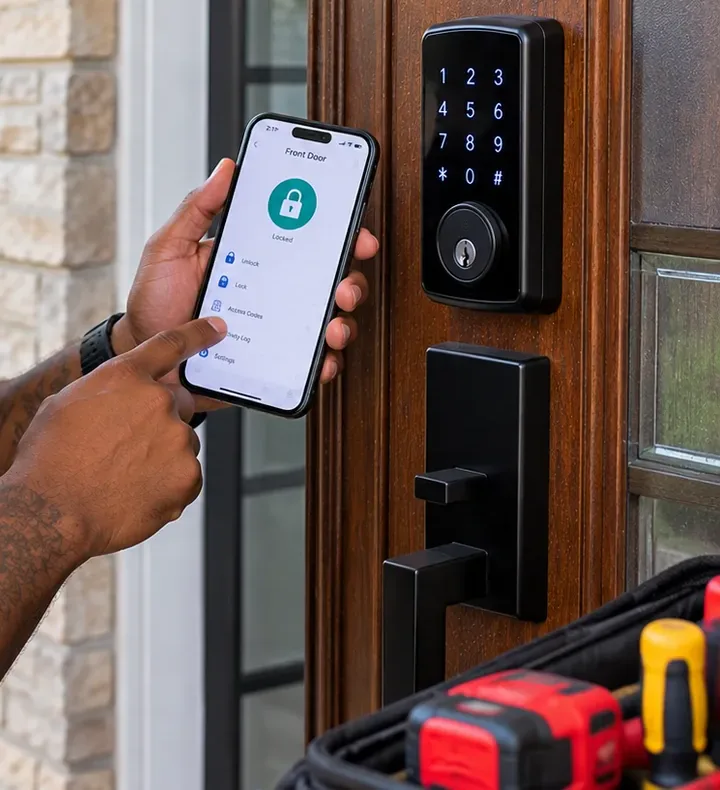
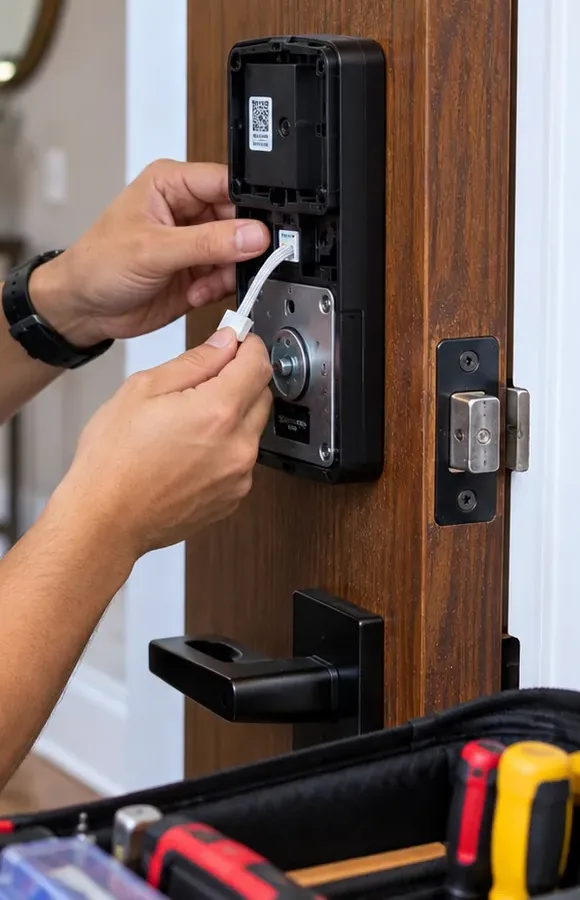
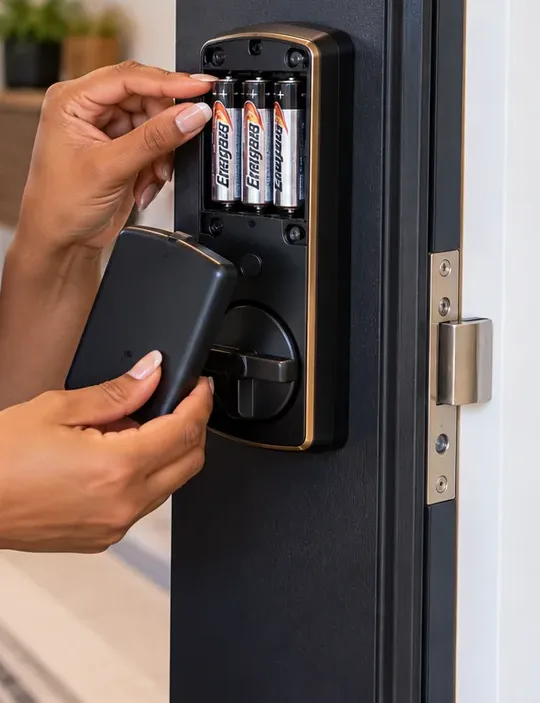
If the batteries quit while you were at the summer house, the bolt has dragged since the building put a new closer on your door, the app lost the lock when the building’s internet provider changed, or a former housekeeper’s code still opens it, book a service call. We take the next free two-hour slot, and most battery, alignment and pairing problems are sorted within one to two hours of arriving. When the culprit is the building’s strike on a lobby or garage door rather than your lock, our published Bronx figure to repair a failed electric strike is $295–$485, and the Riverdale door buzzer repair page covers the rest of that entrance. Call (646) 490-0629; we can let the desk know we are on the way.

Each Riverdale job is one or more of the services below, and each ends the same way. The person who lives there opens the door three ways while we watch, the inside release works with one motion and no key, the people the rules name still hold a key, and anyone who had to approve the work has what they asked for in writing.
For shareholders in the doorman co-ops along the Henry Hudson Parkway and Johnson Avenue: we prepare the cut sheet, photos and insurance certificate the alteration process asks for, then fit a keyed smart deadbolt or retrofit the board has agreed to.
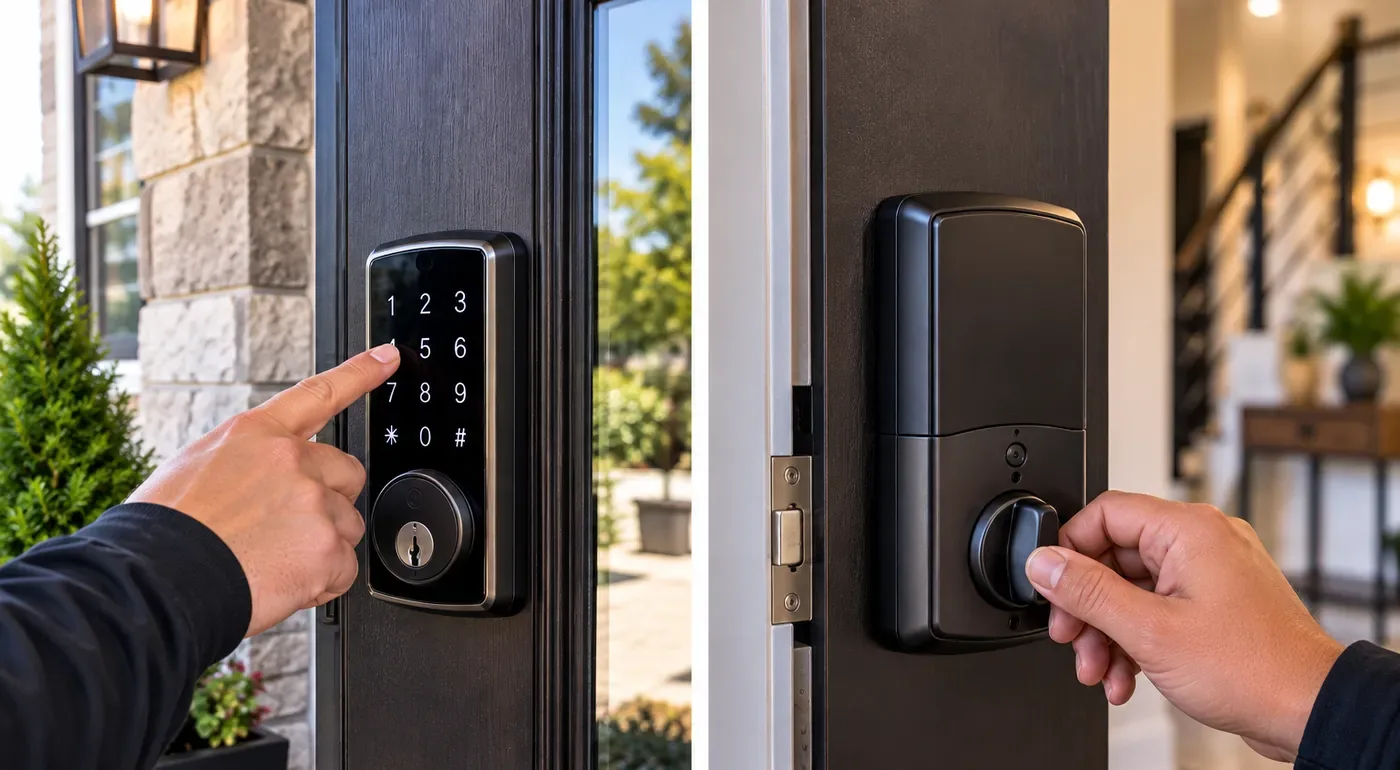
Where the house rules want every corridor door to look the same: a retrofit that replaces only the inside thumb-turn of a deadbolt you control, so the hallway face, the cylinder and the key the desk holds stay exactly as they were.
For owners of the Tudor, Colonial Revival, Mediterranean and modernist houses on Fieldston Road, Waldo Avenue and the streets around them: hardware chosen and placed so the street face of the house changes as little as possible, with the Landmarks question settled before we bore anything.
For houses in the Riverdale Historic District and on Hudson Hill: keypads at a gate or a side door planned around the Landmarks rules for gates, walls and steps, and around the natural-area rules for any digging on the slope.
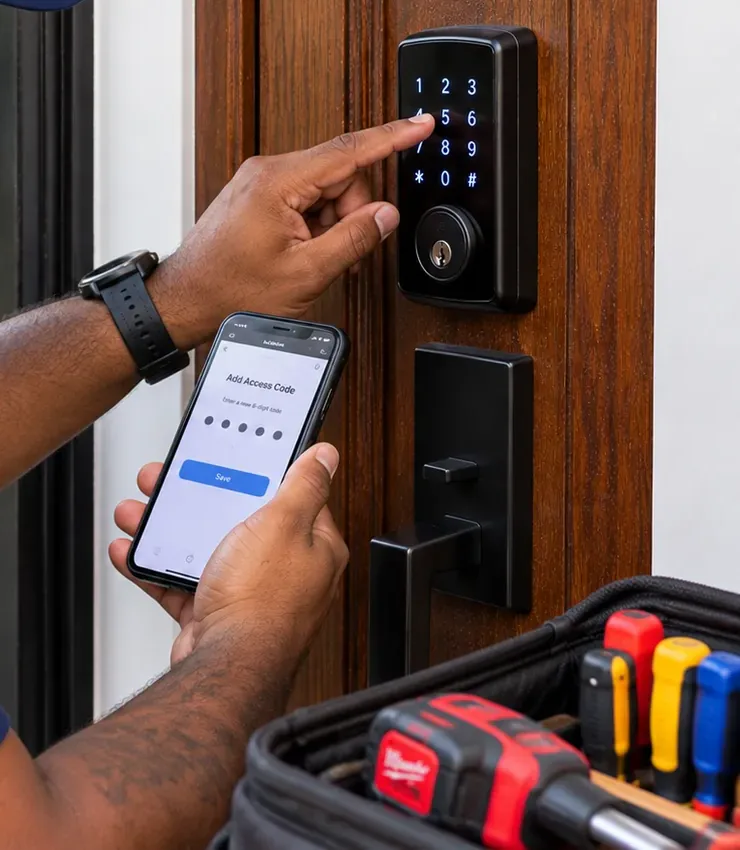
For families with a housekeeper, a nanny, a dog walker and a weekly cleaner: one named code each, set to that person’s hours, alerts to the parents’ phones, and a plan that agrees with how the front desk announces and admits people.
For boards and owners: a keypad or fob reader with an electric strike on the door between a building’s indoor garage and its lobby, or on a service entrance, at our published Bronx single-door figure of $1,500–$2,500.
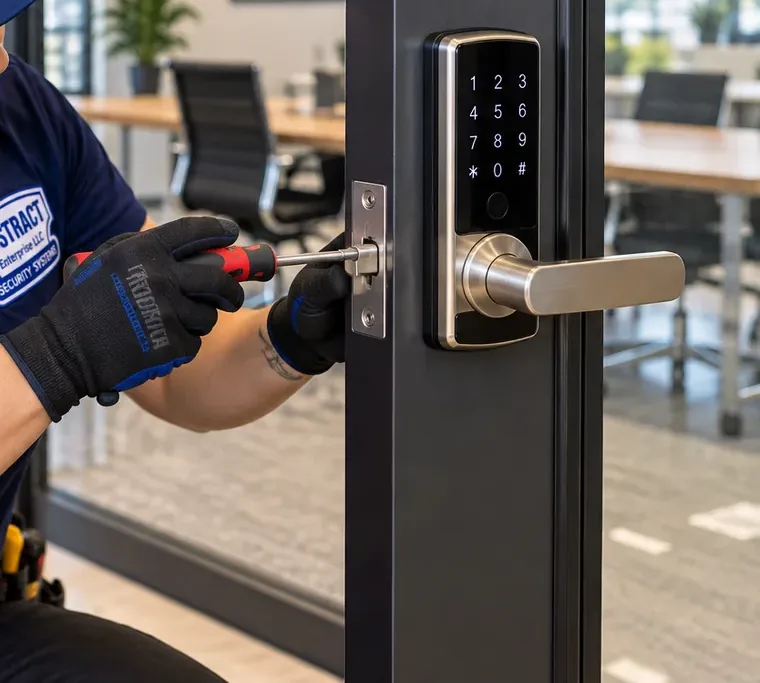
For storefronts and upstairs offices along Riverdale Avenue, Johnson Avenue and Knolls Crescent: keypad deadbolts or lever locks with staff codes, reader-and-strike sets on back doors, and an exit that never needs a key.
The fixes we do most in Riverdale: a lock re-joined to the app after a building-wide internet change, admin rights handed from a seller to a buyer at closing, a bolt realigned after a new closer was fitted, and old staff codes swept out after a household change.
Riverdale’s buildings come in a handful of clear families, and each family brings its own door, its own rulebook and its own way of getting a technician to the door. These are the six we meet most often between the Yonkers line and the Spuyten Duyvil Creek.
Ten to twenty-five stories of brick and concrete, many by Philip Birnbaum, with a staffed lobby, a package room and, in buildings such as the Tangiers, indoor parking. Apartment doors are usually steel, hung on steel frames, and carry a building-standard lock and a peephole the house rules expect to stay.
The low-rise brick buildings that went up in the 1950s, many of them converted to co-ops and some without a doorman. A self-managed board or a small managing agent decides, a super holds the spares, and the street door matters as much as the apartment door.
Houses laid out on the Delafield Estate’s plan, finalized in 1914, in Colonial Revival, Craftsman, Tudor, Mediterranean and modernist styles. Opponents of designation counted 76 architects and 23 styles. Front doors are often heavy, original and the most visible feature of the facade.
The Riverdale Historic District’s 1850s estate houses, stables and carriage houses later converted to homes, and the Hudson Hill mansions such as Greyston, Alderbrook, Stonehurst and Oaklawn. Gates, stone walls and long drives come with them.
Large 1960s and 1970s co-ops west of the Parkway, such as the 20-story Winston Churchill at 2500 Johnson Avenue (1967) and the 25-story 555 Kappock Street, alongside small prewar gems such as the 17-unit Villa Charlotte Brontë from the 1920s.
The mid- and high-rise condominiums of Central Riverdale’s post-2005 boom and new rentals such as The Henry, a six-story, 55-unit building finished in 2022. These usually arrive with a developer’s entry system and, sometimes, a sponsor-fitted lock on every door.
The tower apartment door is a different object from the wood door in a house. It is usually a hollow-metal door in a hollow-metal frame, heavy, often fire-labeled, and already carrying the building’s own lock low on the door. That has two consequences. First, any new hole has to land in the door where the internal stiffeners allow it, clear of the building lock’s trim, and drilling through the label is a question for the board, not for us. Second, a steel door in a steel frame inside a concrete building is hard on radio signals, so a lock that will be run from a phone needs its bridge or border router placed with care. We look at both before we suggest a model, and very often the answer is a retrofit that drills nothing at all.
In the smaller co-ops the people are fewer and the rules are often less formal, but the stakes are the same. The super usually holds a key to every apartment for leaks and emergencies, the board may meet monthly, and the street door is shared by everyone. We fit the apartment lock so the super’s emergency access still works by key, and if the board wants to talk about the street door at the same visit, we price that separately from the published Bronx figures.
The front doors of Fieldston and the Riverdale Historic District are frequently original or old enough to be treated as if they were: thick, solid wood, sometimes arched, with period hardware the Landmarks rules describe as part of a building’s significant architectural features. Our first instinct on these doors is to keep the outside exactly as it is, putting the intelligence on the inside face with a retrofit or an interior-only motor, or moving the keyless entry to a less prominent side or garden door. When a keypad has to go on the street face, we plan its finish and position to suit the door and leave the permit question to be settled before work begins.
The natural-area district describes the Riverdale Ridge as steep slopes and rock outcrops, and plenty of Riverdale houses meet the street at the top or the bottom of a flight of stone steps. A keypad facing the river takes weather straight off the Palisades, an entrance below the street gathers water, and a long drive puts the gate a long way from the house’s Wi-Fi. We site keypads under overhangs, choose models rated for outdoor exposure, and measure the signal at the gate before anyone promises remote unlocking there.
Seeing the visitor before you unlock is the natural next step for many Riverdale homes, and our security camera installation in Riverdale puts the stoop, the gate or the drive on the phone that already runs the lock.

This is the table we work from on the phone, before any visit is booked. It sets out, for each common kind of Riverdale address, who decides about the door you live behind, who decides about the doors around it, and what usually has to be in hand before work starts. It reflects the published rules and laws we have read. It is a guide to which questions to ask, not legal advice about your own lease or deed.
| Where you live | Your own door | Doors around it | Usually needed before work |
|---|---|---|---|
| Doorman co-op tower | Your proprietary lease, the house rules and the board’s alteration process. Many buildings expect a key to be filed with the management office or the desk. | The board and managing agent: lobby, garage, package room, service entrance. | A written yes from the managing agent, our certificate of insurance naming the corporation and agent, and a cut sheet of the lock. |
| Smaller co-op, no doorman | As above, often with a self-managed board. | The board; the super usually keeps the spares and runs the street door. | The board’s answer in writing and a note of where the super’s emergency key will live. |
| Condominium | The condo declaration and bylaws; unit owners own their units but the board governs the common elements, which often include the corridor face of the door. | The condo board. | The board’s alteration rules, and the sponsor’s admin rights handed over if the lock came with the unit. |
| Rental apartment | The landlord’s duty under Housing Maintenance Code §27-2043 is a working key lock and at least one key per apartment; on top of that, Multiple Dwelling Law §51-c lets you add your own lock, up to three inches around, as long as the landlord gets a duplicate key on request. | The owner. | Nothing from the landlord for a lock you add under §51-c, beyond a duplicate key if asked. |
| House in the Fieldston Historic District | You, subject to Landmarks for any exterior change; the Fieldston Property Owners Association owns the streets, not your door. | Landmarks for gates, walls and anything visible from the street. | A conversation with Landmarks staff if anything on the street face changes; an LPC permit where they say one is needed. |
| House in the Riverdale Historic District | You, subject to 63 RCNY Chapter 6, which treats pre-1940 buildings as the district’s significant architecture. | Landmarks regulates walls, steps, gates and gate posts; the district sits wholly inside the Special Natural Area District. | An LPC permit before any regulated work; natural-area review if ground is disturbed on a slope. |
| Other Riverdale house or two-family | You. You. If you rent out part of the house, the tenant’s door must still have a key lock and the tenant a key. | You, with your tenant’s access planned at a shared entry. | Nothing formal for a lock alone. |
| Shop or office | Your lease and the building owner. | The building owner for shared halls and stairs. | The landlord’s consent where the lease requires it, and an exit that opens without a key. |
Most of the disappointment we see in Riverdale comes from doing things in the wrong order: a handsome keypad deadbolt bought online, then a board that wants a retrofit only, or a Fieldston owner who bores the door and then learns that the street face of the house was the one thing that needed a permit. Neither is a disaster, but both cost a second visit and sometimes a second lock. Settling the permission first costs a phone call or a short letter. We write the letter for you, in plain language, describing exactly what will change on the door and what will not.

Riverdale’s business doors are fewer than in most of the Bronx, and more varied: neighborhood shops on Riverdale Avenue, a small commercial corner in Spuyten Duyvil, professional suites, schools, houses of worship and cultural institutions on the hill. What they share is a front door that faces the public and a back or side door that faces staff, deliveries and, often, a residential building next door. These are the places we fit business smart locks, and what each tends to need.
The stretch around West 259th and 260th Streets, where shops sit under apartments. In 2016 the Riverdale Press reported two weekend burglaries a block apart there, each through a front window broken with a rock. Glass, not locks, was the weak point, so we plan these doors alongside the glazing and the gate.
Central Riverdale’s shops, restaurants and offices, and the corner of Riverdale Avenue and West 238th Street, where Columbia’s Riverdale commuter shuttle ends its run. Upstairs suites share a street door with other tenants and need their own code-controlled door at the top of the stairs.
The tiny commercial corner Brick Underground describes, with a couple of take-out restaurants, close to the big Johnson Avenue co-ops. Early deliveries and late closing make a back-door code that can be switched off in a minute worth more than another key.
Fieldston, Riverdale Country School and Horace Mann, known together as the hill schools on the high ground above Van Cortlandt Park. Schools write their own security plans; the work we see around them is on the faculty houses, offices and small programs nearby.
Riverdale’s large Jewish community, which Wikipedia puts at 16,000 adults and 4,000 children in 10,000 households, supports congregations such as the Hebrew Institute of Riverdale, the Riverdale Jewish Center and Riverdale Temple. Side and office doors suit named, scheduled codes better than a ring of keys handed between volunteers.
Doctors, therapists and accountants with ground-floor or lobby-level space in residential co-ops. Their door is commercial, their building is residential, and the board’s rules and the lease both apply, so we start with the managing agent.
A keypad on a shop door tells you who came in; an alarm tells the neighborhood someone broke in. Owners who want both pair the lock with an alarm from our Riverdale alarm installers, so a smashed pane or a forced frame is answered by a siren as well as a notification.

Shareholders, board members, house owners and parents in Riverdale send us these questions most. We have sorted them by the door involved and by who has to approve the work. Borough-wide questions are answered on our Bronx smart lock installation page.
It changes how much you should rely on the lobby. A doorman watches the front entrance, but residents and, at times, valet or garage staff come up from the garage without passing the desk, and a door propped at the garage level brings anyone in the same way. Your apartment door becomes the first barrier for that route, so we treat it as one: a lock that throws its bolt automatically a short time after the door closes, alerts to your phone for every unlock, a long-screw strike into the steel frame, and a key cylinder so the building’s emergency access still works. Separately, if you sit on the board, the door from the garage into the building is worth a look of its own; we cover that further down.
A key, in almost every case, and not a code. A sealed key that is signed out and signed back in is something a building already knows how to manage; a code written on a card is easy to copy, never shows up as tampered with, and lets in anyone who reads it for as long as it stays active. That is why we fit keyed smart locks in co-ops and put the new lock’s key in the envelope beside the building lock’s key. If the house rules require a code as well, we create a separate, named code for the building, switched off by default, that you can turn on from your phone when the super needs to get in, and you will see it used in the log. Tell management in writing which key or code they hold.
The code and the rule govern different doors. The announcement rule covers the lobby: who the desk lets into the building and when. A code on your apartment door governs only your door, so the housekeeper still signs in downstairs the way the building asks, and the desk can still announce her, or keep her on a standing list if your rules allow that. What the code replaces is the copied key that used to live in her bag. Give each regular helper a separate code limited to their days and hours, and ask the managing agent whether your building wants a written list of everyone who holds one. Some boards do.
Mostly control over people you invite rather than protection from strangers. A doorman decides who reaches your floor; a smart lock decides who opens your door, and keeps a record of it. In a staffed building that means scheduled codes for regular help instead of copied keys, a guest code that expires when a visiting relative flies home, an alert if the door is opened while you are away, and the end of lending keys to anyone. It also covers the routes a doorman does not see, such as the garage, the service elevator and neighbors already inside. If none of that matters to your household, a good mechanical deadbolt you lock every time is a perfectly sound choice, and we will say so.
Keep them apart. The board package is about whether you are approved as a shareholder, and adding an alteration request to it gives the board one more thing to question at a moment when you want the file simple. After closing, the lock is an ordinary alteration request to the managing agent, and you will have the proprietary lease and house rules in hand to see exactly what is allowed. What you can do before closing is read the alteration rules in the documents your lawyer receives, photograph the door at the final walk-through, and ask us which lock types fit. On move-in day, a retrofit on a deadbolt you control can often go in the same week.
It depends on your proprietary lease, and leases differ on this. Many divide repair responsibility between the inside of the apartment, which is usually the shareholder’s, and the building’s structure and common areas, which are usually the corporation’s, and an entry door can fall on either side of that line or be split between its two faces. Read the repair and alterations clauses, and if they are unclear, ask the managing agent before work starts. Either way, we carry insurance for our work, we send a certificate naming the corporation and agent if asked, and we hand back every part we remove so the original hardware can go back on if the building ever requires it.
We have not found a published Fieldston Property Owners Association rule on door hardware. The association owns and maintains the streets and common areas, runs the security patrol and is paid for by homeowners’ dues; the regulator for the outside of your house since the 2006 designation is the Landmarks Preservation Commission. So the order we suggest is: check any deed restrictions or association guidance you received when you bought, ask the association office if you are unsure, and take the Landmarks question seriously for anything visible from the street. We can supply the cut sheet and photos for both conversations. The city’s guidance for historic-district owners is to get Landmarks’ permit before work and to treat any job that needs a Buildings permit as needing Landmarks approval too; a battery retrofit on the inside face of a deadbolt needs no Buildings permit and leaves the facade untouched, which is why it is our usual starting point on Fieldston doors, confirmed by a short email to Landmarks staff.
Yes, the district’s own rules draw that line. Chapter 6 of the Landmarks rules, written for the Riverdale Historic District, says the buildings that make the district’s significant architectural contribution are those built, in whole or in part, before 1940. For a post-1939 building, a modification qualifies for staff-level approval when it does not damage a significant landscape feature and its materials and finish suit the district. For a pre-1940 building the test is stricter: the change must not harm a significant architectural feature, a term the rules define to include the type and style of a door, light or fixture. Either way an application comes first, and work waits for the permit.
It does. The Riverdale Historic District rules list modification of walls, steps, paths, drives, railings, fences, gates and gate posts among the landscape work Landmarks regulates, along with excavation or fill on slopes steeper than 15 percent. Drilling a stone post for a keypad, or running a cable to it under the drive, therefore needs an application. The rules also note that the district lies entirely within the Riverdale Special Natural Area District, so digging near mature trees or across a slope can raise a second set of questions. We often suggest a wireless keypad on a discreet freestanding post or on the house itself, and we describe the options in the application.
It fixes the key problem at once. A keypad or fob reader with an electric strike on that door gives each resident and each garage attendant their own credential, lets the managing agent cancel one without re-keying anything, and records who came through. Our published Bronx figure is $1,500–$2,500 for a single door. What must stay is free exit from the lobby side: people leaving toward the garage must be able to open the door without a key, code or card, and if the door is a fire door, its label, closer and latching hardware have to be respected. We also keep the door working with the fire alarm where your building’s system calls for it.
Not by making the door harder to open from inside, which is exactly what the egress rules forbid and what you would regret in an emergency. Apartment and house entrance doors should open from inside with one motion and no key or code. What a smart lock can do is tell you the moment it happens: set an alert for every unlock from the inside, and some models can sound a chime on the interior unit when the bolt retracts. Pair that with a door contact on the frame so the app shows when the door opens. Many families also add a battery chime or a high-mounted latch on an interior door, so the toddler meets that one first.

No manufacturer pays us to push its locks. We settle on a type first, from the door, what has been approved and who will use it, and only then name models in that type that we have fitted without trouble. On Riverdale doors, these types come up again and again.
A motor that replaces only the inside thumb-turn of a single-cylinder deadbolt. Nothing changes in the corridor or on the facade, and the existing key still works. Our first suggestion for co-op towers with uniform hallway hardware and for landmarked front doors.
Keypad outside, motorized bolt, standard key cylinder. The usual choice where a board has approved a visible change and a key must still exist for the desk or the super.
A small keypad mounted beside the door, or on a post, that talks to an interior retrofit. It gives code entry without boring the door itself, which suits historic facades and co-op doors where only the inside may change.
Smart bodies made to fit the mortise pocket of heavier doors, for houses and older buildings whose doors were built for a mortise lock rather than a bored deadbolt.
The credential reader is mounted beside the door and an electric strike is set into the jamb, both fed by a power supply and a small controller. This is the set we fit on garage-to-lobby doors, service entrances and back doors of shops that should lock again the moment they close.
The small devices that give a lock remote access. In a concrete tower with a steel door, where the bridge sits decides whether remote unlocking works on day thirty as well as on day one.
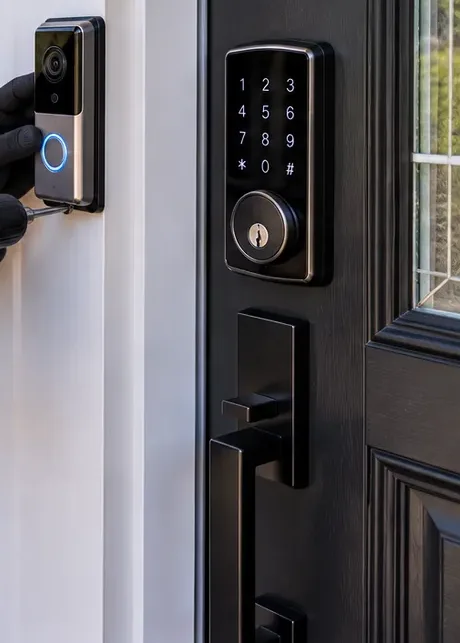
For houses, a doorbell camera at the entrance or a camera on the gate, so you see who is there before unlocking. On landmarked houses we plan its position with the same care as the keypad.
Long-screw strike kits that anchor the bolt into the frame, and small door contacts that tell the lock whether the door is really shut before it locks.
People tend to arrive at our door having already priced one of three other routes. The table sets those routes against the questions that come up in Riverdale buildings and houses; it says nothing about whose hardware is better.
| Question | Monitored-alarm package (ADT-style) | Retail DIY kit (Ring, SimpliSafe and similar ecosystems) | AESS, licensed local installer |
|---|---|---|---|
| Prepares what the co-op board asks for | Not usually | You do | Cut sheet, photos, scope letter and insurance certificate |
| Checks the Landmarks position on a historic house | Not usually | You do | Before we quote, and in writing before work |
| Steel door in a steel frame, twenty floors up | Depends on the technician sent | Your drill, your template | Mapped first; retrofit where drilling is unwelcome |
| Keeps a key for the desk or super | Depends on the model | Depends on the model you buy | Always offered; standard in co-ops |
| Monthly fee | Usually part of a monitoring contract | Optional subscriptions vary | No monthly fee from us |

Before the claims, the method. This page was written on a machine that could not display Google’s AI Overview, so we have not quoted it. What follows are seven assertions repeated across national cost guides, retailer pages and marketplaces like Angi, HomeAdvisor and Fixr, each held up against the doors we actually meet in Riverdale.
National guides are written for a homeowner with a wood door, a standard bore and nobody to ask. In that setting the advice is fair, and the job really can be a screwdriver and an hour.
Very few Riverdale front doors sit in that setting. A shareholder in a Parkway tower answers to a proprietary lease and an alteration process. A Fieldston owner answers to Landmarks for the street face of the house. An owner on Sycamore Avenue answers to a chapter of Landmarks rules written for that district alone.
So our answer begins with the permission map, not the toolbox. In most cases the approval is quick and the work is simple. Skipping the approval is what turns a simple job into a second visit.
The January 2025 revision of Fixr’s cost guide puts installation between $250 and $400, about $300 on average; LawnStarter’s nationwide figure is $330, with the bulk of jobs from $200 to $460. Each assumes a single lock on a single plain door, hardware already in hand.
Those figures leave out the parts of a Riverdale job that take time: the cut sheet and photos for the board, the insurance certificate for the managing agent, the conversation with Landmarks, the map of a steel door’s stiffeners before a hole is drilled, and the bridge placement in a concrete tower.
Your own door is quoted flat once we have seen it. Building, garage and gate doors are priced from figures we already publish for the Bronx: $1,500–$2,500 for a single-door keypad or fob reader with an electric strike, $250–$450 for a new strike, and $295–$485 to repair a failed one.
Fit matters, but in Riverdale the more common deciding factor is what may be seen. Many co-op house rules want every corridor door to match, and a historic-district house has a street face that Landmarks reviews.
That pushes the choice toward retrofits that change only the inside, separate keypads that can be placed discreetly, and finishes chosen to suit original hardware. A lock that fits perfectly but changes the hallway face may be the one lock the board will not approve.
So we pick the type from the approval first and the door second, and only then suggest models.
Marketing suggests a key ring is obsolete. In a Riverdale co-op, the building usually wants a key for its emergency cabinet. In a rental, the law expects the owner’s key lock to stay, and a tenant-added lock to come with a duplicate key on request.
There are practical reasons too. Batteries run down while people are away for weeks, phones break, and lobby Wi-Fi changes when a building switches providers. A key cylinder is the backup that depends on none of those.
Unless you give us a particular reason to leave the cylinder out, the lock we fit has one, and the last thing we do on site is note on paper every person, desk or envelope holding a key.
Plenty of smart locks never talk to your router directly; they hop through a small bridge plugged into an outlet nearby, and August, to take one maker, tells owners to keep its bridge within 10 to 15 feet of the lock. Locks built on Matter over Thread need a Thread border router running before they can be reached remotely.
In a 1960s tower, the apartment door is steel in a steel frame inside a concrete corridor, and the router is often in a far room facing the river. A lock that shows online at setup can drop off a week later. In a Fieldston house, the gate may be a long walk from any access point.
Our habit is to check reception at the door itself and at any gate, put the bridge or border router where the link stays steady, then switch the phone to mobile data and work the lock from the corridor or the drive. If the link will not hold, we tell you, and steer you to a model that does everything you need without the internet.
It can make a door harder to defeat and gives you a record of every opening. But in Riverdale the weak points we read about are often elsewhere: the Fieldston burglary the Riverdale Press reported came through a broken rear window frame, and the North Riverdale shop break-ins in 2016 came through front windows.
The same newspaper has also reported an apartment on Kappock Street burglarized when police said its door may have been unlocked, and a Fieldston Property Owners Association letter warning of thefts from cars left unlocked in driveways. A lock that locks itself helps with the first; it does nothing for the second.
So we are plain about what a lock does: it makes the door you forgot lock itself and tells you who used it. Windows, cars and garages need their own answers, and we will tell you which ones belong to someone else.
Many can, on the right door. Retail testers routinely report a smart lock going in with a screwdriver on a wood door with a standard bore.
The building is another matter. Riverdale managing agents commonly ask for a certificate of insurance naming the corporation and agent before any contractor goes upstairs, and a board reviewing an alteration may ask who is doing the work and what licence they hold.
We are licensed under NYS #12000287431 and insured, we send the certificate before the visit, and we put our name to the scope letter, which is often what turns a slow approval into a quick one.
Tell us the building and who approves door work. We will tell you what to send, to whom, and what the lock and any building doors will cost before anyone comes up in the elevator.
Whether the door is twenty floors up off the Parkway, on a Fieldston lane, on the old Sycamore Avenue estates, in a Spuyten Duyvil tower or behind a Riverdale Avenue counter, name the building and whoever signs off, and we reply in writing the same business day. Prefer to talk? Call (646) 490-0629.
Got it. Someone from our Fordham Road office will ring you today, or first thing next business day if your message arrived after hours. Stuck outside a door this minute? Call (646) 490-0629 rather than waiting.
Six steps, whether the job is one apartment door in a Parkway tower, a front door in Fieldston or a gate on the estates.

Riverdale in six stops, each one tied to a point this page makes about doors: a riverside garden, two historic districts, a tower complex, a row of river co-ops and the Hudson Line station.
A 20-acre botanical garden and outdoor gallery on Hudson Hill overlooking the river, developed in the 1840s by William Lewis Morris and used by Theodore Roosevelt and Mark Twain. Around it, the large houses of Hudson Hill set the pattern for gates, drives and side doors.
Riverdale cameras →257 houses and related structures on 140 acres of winding private streets and rock outcrops, laid out for the Delafield Estate and designated by Landmarks in 2006. The property owners association owns the streets; Landmarks reviews the facades.
Fieldston access control →Seven estates of the 1850s served by a shared carriage alley that became Sycamore Avenue, now 34 buildings including converted stables and carriage houses. One of very few districts with a chapter of the Landmarks rules written for it alone.
Fieldston intercoms →The Philip Birnbaum towers at 5700–5900 Arlington Avenue in North Riverdale; StreetEasy lists 437 units at number 5700 alone. A good example of a single board and front desk making door decisions for hundreds of households.
Riverdale buzzer repair →Spuyten Duyvil’s tower row: the Winston Churchill at 2500 Johnson Avenue, the 13-story Blue Building at 2400, and 555 Kappock Street, with Knolls Crescent’s small shops nearby and the Henry Hudson Parkway dividing the neighborhood east from west.
Spuyten Duyvil access control →The Hudson Line stop between West 254th and 255th Streets, with Spuyten Duyvil station at the south end of the neighborhood. Early trains and express buses mean many households leave before the day doorman arrives, which shapes how we schedule codes.
Riverdale alarms →Our crews also cover the neighbors on every side: Fieldston, Hudson Hill, North Riverdale and Spuyten Duyvil within Riverdale, then Kingsbridge, Van Cortlandt Village, Marble Hill, Norwood and Bedford Park, and on across the Bronx, Manhattan, Queens, Brooklyn, Staten Island, Long Island and the Hudson Valley.

Living on the hill costs nothing extra: Riverdale is priced as the Bronx, and the Bronx carries the same 1.00 multiplier as our Brooklyn base. Each figure below is copied from a scope already published on our Bronx pages, and none was created for this page. What we cannot print is a single price for the door you live behind, because the work turns on that door and on what your board or Landmarks has agreed to. A retrofit on a deadbolt you already have is a short job; a new keyed lock bored through a steel door is a long one. Either way you get a flat written quote after a free walkthrough, and that quote is what you pay.
| Item | Riverdale price | Scope and source |
|---|---|---|
| Your apartment or house entry: co-op, condo, rental or freestanding home; retrofit, keyed smart deadbolt or mortise body | Quoted flat at free walkthrough | We publish no set figure here, because the same lock can mean an hour on one door and most of a day on another; the material, the old holes, the approval and the signal are all different, so the price is set at the door |
| Single-door keypad or fob reader with electric strike | $1,500–$2,500 installed | Garage-to-lobby, service, rear-of-shop or suite door; taken unchanged from our Bronx access-control page, where Bronx equals the Brooklyn base |
| New electric strike on a building door | $250–$450 | Fitted when a lobby, garage or service entrance is being upgraded; same line as on our Bronx buzzer pages |
| Failed electric strike repair | $295–$485 | From our Bronx buzzer-repair pages, for a building entrance whose strike has quit, whether it stays locked when buzzed or no longer holds the door |
| Setup-only visit (app, bridge, codes, no hardware change) | $225 first hour, then 30-minute blocks | Bronx rate for visits that touch only apps, bridges and codes |
| Service and callback rate | $195/hr, 3-hour minimum ($585) | Applies to later service calls, never to the original installation visit |
Some charges you may meet are not ours. A co-op may charge an alteration or review fee set by the board or managing agent. Landmarks lists no fee for a permit for minor work, according to the city’s business portal, but an architect or expediter you hire for a larger application will bill separately. We mention them so you can plan for the whole cost. None of them appear on our invoice.
Outside benchmarks, for context: Fixr’s guide centres on roughly $300 within a $250–$400 band, and LawnStarter reports $330 with most jobs falling between $200 and $460. Those are countrywide averages for a single lock on an unremarkable door, and neither is an AESS price.
Full terms — including 50% deposit, one-year parts-only warranty on AESS-supplied products, and the late-fee schedule — are set out in the service agreement. Locks you buy yourself carry their manufacturer’s warranty.
Most Riverdale work falls into three shapes: the door you live behind, a door the building or the estate shares, or one of each. Shared-door prices below come straight from our Bronx pages; your own door gets a price after we have seen it and read the approval.
The name of your building or your street, and a photo of the inside of your door. We will tell you who needs to agree, what to send them, and what the visit will cover.
Most of the smart lock work we do in Riverdale happens twelve or eighteen floors above Riverdale Avenue, in the brick towers that turned from rentals into cooperatives in the 1970s and 1980s. The buildings run smoothly because they run on rules, and a lock project goes best when it follows them from the start. This is how we approach one, from the first call to the day the desk gets its new key.
The proprietary lease, the house rules and the alteration agreement or alteration policy, if the building has one. Between them they usually say whether hardware on the entry door is a shareholder’s choice or a board decision, whether the corridor face of the door must match the rest of the floor, whether a key must be filed with management, and what a contractor needs before working in the building. If you cannot find them, the managing agent can send copies. Ten minutes with these papers saves most of the back-and-forth we see later.
Boards answer short, specific requests faster than open ones. “May I install a smart lock?” invites a debate. “May I replace the inside thumb-turn of my existing deadbolt with a battery retrofit unit that changes nothing in the corridor, keeps the current key and leaves a copy in the key cabinet?” usually gets a yes. If you want a keypad on the corridor side, say so plainly, attach the cut sheet and a photo of the door, and offer to match the finish to the existing hardware. We draft the request in that form for every shareholder who asks.
Before a contractor goes upstairs, managing agents commonly want a certificate of insurance naming the corporation and the agent, the contractor’s license, and a date and time inside the building’s permitted working hours. Some ask for a deposit against damage to common areas, and some want the super to see the door before and after. We send the certificate as soon as the agent tells us how it should be worded, give our license number, 12000287431, and book inside whatever hours the building allows. On the day we sign in at the desk like any other contractor and use the elevator the staff direct us to.
Doorman buildings already have a routine for keys: an envelope or tag per apartment, a log of who signs keys out, and staff who know which residents want to be called before anyone goes in. A keyed smart lock slips into that routine without changing it. The new key goes into the envelope next to the building lock’s key, the log works as it always has, and the codes stay in your hands. Where a household prefers that staff never hold a key to the new lock, we explain the trade-off: in a leak or emergency the building can still open its own lock, but not yours, which may mean a forced door. Most families keep the key with the desk and use the activity log to see when it was used.
Signal is the technical question that surprises tower residents most. A steel door in a steel frame, a concrete corridor and a router in the far corner of an apartment facing the river are a hard path for Bluetooth and Wi-Fi. We stand in the corridor with a phone on mobile data and test before we choose between a lock that is happy on Bluetooth alone, one with a plug-in bridge near the entry, or one on Thread with a border router in the apartment. The bridge goes inside the apartment, never on the corridor wall, and we test again from the elevator landing before we leave.
Not every Riverdale co-op is a tower. Brick Underground singles out the Villa Charlotte Brontë in Spuyten Duyvil, a 1920s building of only 17 apartments on a hill above the Hudson, and there are other small prewar and 1950s co-ops tucked between the big buildings. With so few households, the board is often a handful of neighbors, there may be no doorman at all, and the person holding the spare keys is a part-time super or a board member down the hall. The lock request is shorter, but the conversation is more personal, and agreeing in advance who keeps an emergency key matters even more when nobody sits at a desk.
Smart locks complicate a sale only when nobody planned for it. Before closing, the seller should delete every code except one, note the lock model and how admin rights pass, and decide with the buyer whether the lock stays. On closing day the seller transfers ownership in the app or factory-resets the lock, and the buyer sets new codes that evening. If the board required the lock to come off on sale, the original hardware we handed back at installation goes on again. We do handovers as setup-only visits at the published Bronx rate.
Riverdale has two historic districts made of houses rather than rowhouse blocks, and they are not run the same way. Fieldston was laid out as a private park of country homes on the Delafield Estate, with a plan finalized in 1914 by the engineer Albert Wheeler, a 1928 handbook of approved architects, and streets still owned by the property owners association. The Riverdale Historic District grew out of seven estates of the 1850s whose parcels began to be subdivided in 1935, and its Landmarks rules pay as much attention to stone walls, hedges, trees and gate posts as to the houses. In both, the front door is often the part of the house people notice first.
| At a glance | Fieldston Historic District | Riverdale Historic District |
|---|---|---|
| Designated | January 10, 2006 | October 16, 1990 |
| Size | 257 houses and related structures on about 140 acres | 34 buildings on the old estates around Sycamore Avenue |
| Streets | Private, owned by the Fieldston Property Owners Association | City streets and the former carriage alley |
| Landmarks rules | The general Landmarks rules and permit types | Its own chapter, 63 RCNY Chapter 6, with a pre-1940 test |
| Ground rules | Parts lie in the Special Natural Area District | Entirely inside the Special Natural Area District |
The simplest landmarked-house lock is the one nobody can see from the sidewalk. An interior retrofit on an existing single-cylinder deadbolt, or a mortise-format smart body behind original trim, leaves the outside of the door as Landmarks last saw it. Entry by code then comes from a small wireless keypad placed on a side wall, inside a vestibule or porch, or on a garden or kitchen door rather than the main entrance. Family members use the code at the side door; guests still ring at the front.
Some households want code entry at the front door itself. In that case we choose the smallest keypad that does the job, in a finish that suits the existing hardware, place it where it reads as part of the door rather than an addition, and prepare drawings and photographs that show exactly what will be visible. That package goes to Landmarks staff before any work. For pre-1940 houses in the Riverdale Historic District the rules ask whether a change harms a significant architectural feature, and doors and fixtures are named in that definition, so the more of the original you keep, the simpler the answer.
On the estates, the gate is often where owners want keyless entry most. The Riverdale Historic District rules treat gates, gate posts, walls, steps and drives as regulated landscape work, and the district sits entirely within the Riverdale Special Natural Area District, whose rules protect steep slopes, rock outcrops and mature trees. In practice that steers us toward wireless gate keypads, mounting on existing structures with as little drilling as possible, and avoiding trenching across a wooded slope. Where a cable is unavoidable, we describe its route in the application and leave the decision to the people who regulate it.
Fieldston’s private streets are patrolled by a security company engaged by the property owners association, and many Riverdale houses rely on long-serving gardeners, housekeepers and contractors. We set those people up with named codes that work only on their days, and we keep the main entrance for the family. If anyone outside the household is to be called in an emergency, decide who in advance and give them a code that is switched off until needed.
In a lot of Riverdale homes, the people who open the front door most often on a weekday are not the people who live there. A housekeeper three mornings a week, a nanny on school days, a dog walker at noon, a cleaner every other Friday, a physical therapist for a parent recovering from surgery. Before smart locks, each of them carried a copied key, and nobody could say for certain how many copies existed. A code plan replaces that uncertainty with a list.
Every regular helper gets their own code, named in the app, active only on their days and between their hours. The nanny’s code works from 7:30 a.m. on school days; the walker’s from 11:30 to 1:30; the cleaner’s on alternate Fridays. When someone stops working for you, their code goes, and nothing else changes. If a code ever turns up in the log at a strange hour, you know exactly whose it was.
In a doorman building, the code plan sits alongside the desk’s own list. Some buildings keep a standing list of household staff who may go up unannounced; others announce everyone every time. Tell the desk the names on your list, ask how they want it handled, and let the code decide only who opens your own door. The two systems work best when they agree.
Not every Riverdale house is landmarked. Spuyten Duyvil’s east side has single-family houses from the 1900s to the 1920s and townhouses from the 1960s, 1970s and early 2000s, according to a Brick Underground neighborhood guide, and North Riverdale, Hudson Hill and the blocks off Riverdale Avenue hold detached houses, semi-detached pairs and small multi-family buildings with an owner downstairs. These owners control their own doors, which makes the work simpler and the planning more personal.
Usually a solid wood or fiberglass door, sometimes behind a storm door, often at the top or bottom of a flight of stone steps because of the slope. We fit a keyed smart deadbolt, check that a storm door clears the keypad, and put the keypad on the side an overhang protects. On doors facing west toward the river, where weather comes in hard, we choose models rated for outdoor exposure and look at the seal where the lock meets the door.
Plenty of ridge houses have a garage or basement door a level below the main entry, cut into the slope. That door is less visible and less often checked, which is exactly why it benefits from auto-lock. If it opens into the house, it should still open from inside with one motion, and any fire separation between garage and house stays intact.
Renting out a floor changes the tenant’s door, not yours: it needs a key lock and the tenant needs a key. If the tenant would like a smart lock on that door, we fit it with the tenant as administrator. At a front door both households share, each gets separate codes and keys, and neither reads the other’s log without consent.
Locks bought first and checked later account for nearly every return and repeat visit we see in Riverdale. Fifteen minutes with this list prevents most of them.
Before spending anything, email or WhatsApp us the photos. We will reply with the lock types that suit the door and the approval you have, free and with no booking expected.
Door work rarely stops at one lock. Boards ask about fobs for the garage door, house owners want eyes on the gate, shops want a siren behind the glass. These Riverdale, Fieldston, Spuyten Duyvil and Bronx services are often booked for the same day.
Fob and keypad entry for lobby, garage and service doors in co-op and condo buildings.
Entry panels and desk stations for the river co-ops along Johnson Avenue and Kappock Street.
Cameras for entrances, drives and gates on houses where the facade matters.
When the panel by the Johnson Avenue door stops buzzing people in, we trace the fault and repair it.
Detection planned so locked building doors release when the alarm calls for it.
Data runs that put a router or access point where a lock’s bridge can reach it.
A camera at the entrance so the person on the stoop is on your screen first, whether you are upstairs or at the office.
The complete list of trades our licensed crew handles across the five boroughs.
Describe the door and anything else you need, and get one written quote back.
The order we work in at a Riverdale doorman building, written as a routine we follow rather than a story about a particular customer
The visit starts at the desk, not the door. We give the doorman our names and the apartment, show the paperwork the managing agent asked for, and ask which elevator contractors use. While we wait, we look at the key cabinet and the package room, because they tell us how the building thinks about access: tags or envelopes, a sign-out log or none, a standing list of household staff on the counter.
Upstairs, before touching anything, we look along the corridor. Do the doors match? Is there a building lock on every one at the same height? Is there a fire-rated label on the hinge edge? That tells us how much freedom this door has, and it usually confirms what the approval letter said.
At the apartment door we open it to its widest and let it go, listen for the latch, and check that the bolt clears the strike in the steel frame. Then we stand in the corridor with a phone on mobile data, away from the apartment’s Wi-Fi, and see what the door can hear. That decides between Bluetooth alone, a bridge in the entry hall or a border router in the living room.
Before we leave, the person who lives there opens the door three ways, the new key goes into the envelope we bring down to the desk, and the card inside the door lists every code and every key. The last thing we do is tell the doorman the job is finished.
Yes. All of them are reached from our Fordham Road office, along with Kingsbridge, Van Cortlandt Village and Marble Hill next door. Pricing is the same Bronx pricing throughout, with nothing added for the hill or for a doorman building.
If we are supplying the lock, we do not order it until the approval is in writing, so there is nothing to lose. If you bought it yourself, keep it sealed in its box until the board answers, so it can still be returned. We look at the product with you before the request goes in and suggest a retrofit alternative if the board is likely to refuse a visible change.
Not over the lock itself. The district protects the Riverdale Ridge’s steep slopes, rock outcrops and mature trees, so it becomes relevant only if a job disturbs the ground, such as trenching a cable to a gate across a slope or near a protected tree. A lock on a door, or a wireless keypad on an existing wall or post, does not touch those features.
You are on the Riverdale page of our smart lock service. Borough-wide topics, from NYCHA bottom locks to Co-op City move-outs and Parkchester key filing, live on the Bronx smart lock installation page, and the citywide and state rules sit on the NYC smart lock installation hub. Long Island and the Hudson Valley each have a hub and county pages.
Abstract Enterprises smart lock installation, NYC · the Bronx · Manhattan smart locks · Brooklyn · smart lock installation in Queens · Staten Island
Riverdale, Bronx (this page) · Kingsbridge, Bronx · Morris Park, Bronx · Throgs Neck, Bronx · Upper East Side, Manhattan · Chelsea, Manhattan · Washington Heights, Manhattan · Brooklyn Heights, Brooklyn · Bedford-Stuyvesant, Brooklyn · Greenpoint, Brooklyn · Flushing, Queens · Jackson Heights, Queens · Bayside, Queens · Todt Hill, Staten Island · New Dorp, Staten Island · West Brighton, Staten Island · St. George, Staten Island · Tribeca, Manhattan · Upper West Side, Manhattan · Park Slope, Brooklyn · Astoria, Queens
Smart lock installation in the Hudson Valley · Westchester · Rockland · Orange · Putnam · Dutchess · Ulster
Beyond door hardware, the same Fordham Road crew mounts screens and sound in Riverdale apartments; see TV installation in Riverdale, or browse the full service directory. Read our warranty terms before you book, learn who we are, or head back to the Abstract Enterprises Security Systems home page.
Home from a long trip to a blank keypad, a bolt that refuses to move, an app that cannot see the lock, or a code that died when the building changed internet providers? Call (646) 490-0629. We send someone in the next free two-hour slot from Fordham Road, and most battery, pairing and alignment faults are cleared within an hour or two of arrival. Use the mechanical key first, and in a doorman building ask the desk for your envelope; that is exactly why it is there.
Abstract Enterprises Security Systems · 460 E Fordham Rd, Bronx, NY 10458 · (646) 490-0629 · WhatsApp (718) 679-0359 via wa.me
Rated 4.7★ from 201 Google Reviews · Same-Day Estimates · 100% Licensed & Insured under NYS Low-Voltage License #12000287431
Full terms — including 50% deposit, one-year parts-only warranty on AESS-supplied products, and the late-fee schedule — are set out in the service agreement. See our warranty page.
This page is general information, not legal advice. Laws, Landmarks rules and building customs are cited so that you can ask your board, managing agent or Landmarks staff the right thing; how they bear on your own lease or deed is a question for a lawyer. Sources for local facts: The Riverdale Press, the NYU Furman Center, the Landmarks Preservation Commission and its Riverdale rules (63 RCNY Chapter 6), the NYC Zoning Resolution, NYPAP, Brick Underground, StreetEasy and Wikipedia. Reviewed and updated October 17, 2026. Changelog: first version of the Riverdale smart lock page published.