What are you looking for?
About Us Contact Us Careers Get a Free Quote (800) 486-0943
Pick a service
✅ Got Your Own System?
🎬 Home TheatreQuote 🎶 AV SoundQuote 🔑 Access ControlQuote
Now pick your area
Pick your area
Long Island
Hudson Valley
Services available
Pricing & Tools
Pick a service for pricing
🚪 Intercom Pricing 🔔 Buzzer Repair Pricing
Calculators
📹 Camera System Calculator 🚨 Alarm Calculator ⚡ Cabling Quote Builder ✅ Got Your Own System?
Select your area

Home › Smart Lock Installation NYC › Staten Island › St. George

Licensed Low-Voltage Contractor · North Shore Hillside · Landmark Houses, Ferry Apartments, Civic-Center Offices

Smart Lock
Installation in
St. George

Doors on Two Levels · Historic-District Facades · Commuter Timetables · Waterfront Rentals · Offices Near Borough Hall

St. George climbs straight up from the ferry slips. Its houses step down a steep hillside, so many have a front door on one street and a garden or service door a full storey lower at the back; dozens of them sit inside a landmark district; the apartment buildings were put up for people who walk down to the boat; and the offices below the hill work in the shadow of Borough Hall and the courthouses. We plan smart locks around all of that — which level each door is on, what can be seen from the street, who has to get in while the household is on the water, and who must never see the files behind an office door.

Reviewed and updated October 17, 2026 · Written by Anwar Timothy, NYS licence #12000287431

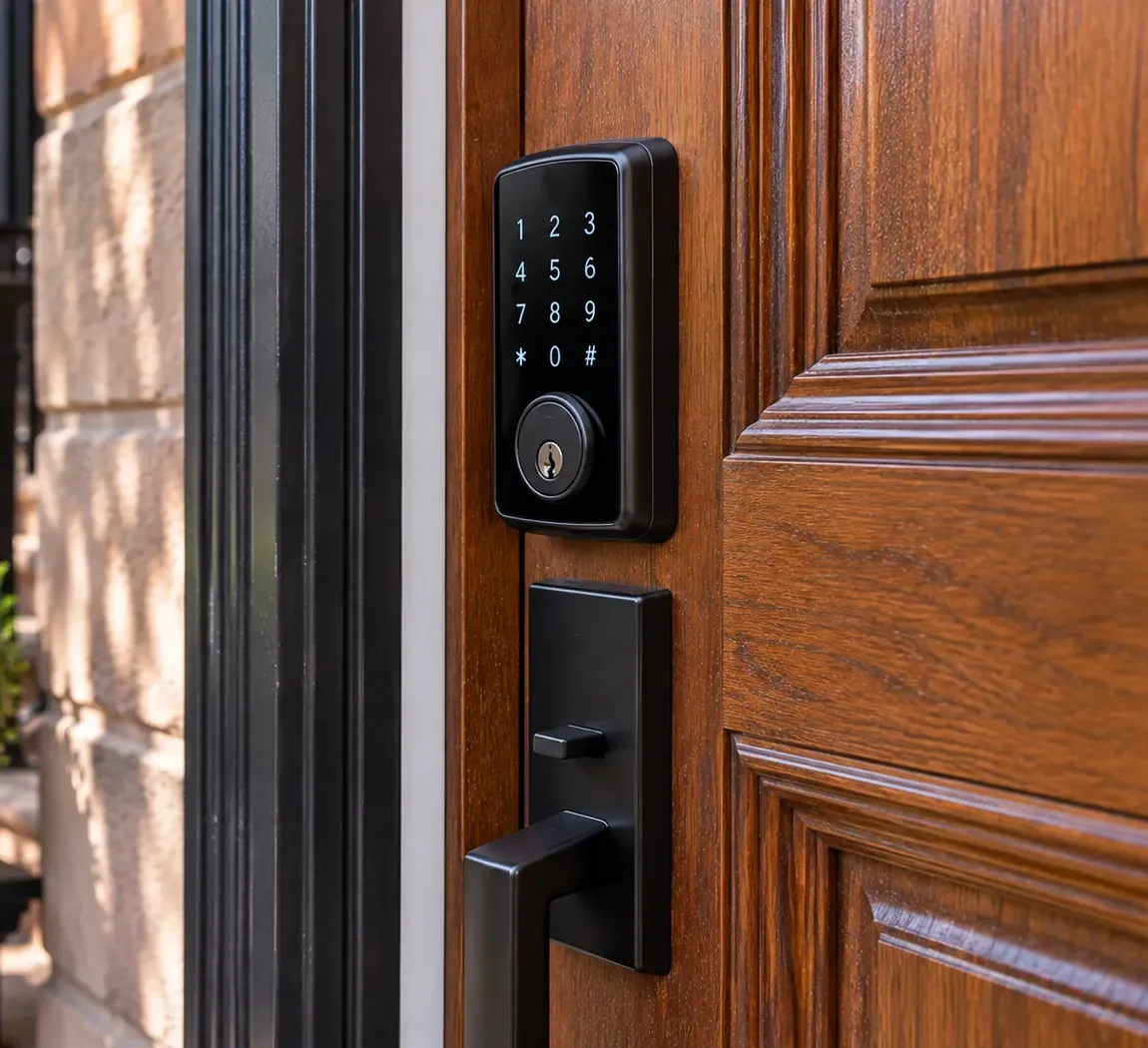
Smart lock installation in St. George, Staten Island: black keypad smart deadbolt and lever handle on a stained, panelled wood front door beside a stone wall
A black keypad deadbolt with a key cylinder above a matching lever, on a deep-panelled stained wood door set against stone. It is the look most owners of older hillside houses ask for: modern entry, nothing that fights the door.
Free St. George Smart Lock Quote
Tell us the building, which doors you use on which level, and who needs to get in — a licensed installer calls back the same business day

✅
Request Sent!
We'll call you back the same business day.
25+
Years Experience
✓
Same-Day Estimates
100%
Licensed & Insured
$0
Monthly Fees

Rated 4.7★ from 201 Google Reviews · NYS Low-Voltage Licence #12000287431

House on the hill, apartment by the terminal or an office near the courts? Call (347) 934-8335 or send the 60-second form. Tell us the street, which doors you actually use and on which level, and whether the house is in the historic district. A licensed installer will tell you what is likely to work before anyone climbs the hill.

  • Every door on every level walked and measured on the free visit, front and back
  • Codes timed to the way your household really comes and goes, boat delays included
  • Nothing new on a landmark facade until the question of approval has been settled
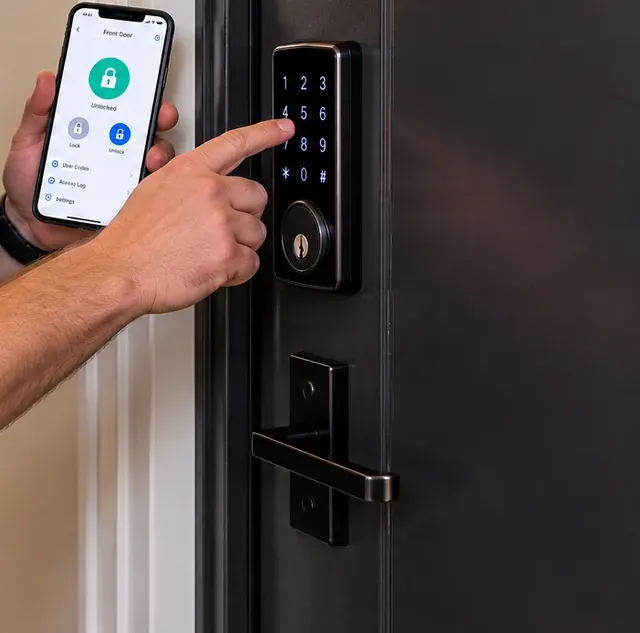
Checking a keypad smart lock's locked status on a phone app at a wood door, St. George, Staten Island smart lock setup
A phone held up beside the keypad, its screen showing the green locked icon. For a household that has already left for the boat, this screen is the whole point of the lock.
The Neighborhood

Why St. George Properties Need Smart Lock Installation Planned for a Hillside

St. George exists because of a boat. The terminal at the northeastern tip of Staten Island opened in 1886, chosen partly because it was the nearest point on the island to Manhattan, about five miles across the harbour. The developer Erastus Wiman named the surrounding hill St. George in the 1880s, reportedly after George Law gave up land rights for the ferry-rail terminal, and once the island joined the city in 1898 the borough's government settled here too. Borough Hall went up in 1906. A century later the ferry is free, runs around the clock, and still sets the rhythm of the neighbourhood: on an average weekday in 2019 it carried about 70,000 passengers on a crossing of roughly 25 minutes.

The land is the first thing that makes a smart lock job here different. St. George is not a grid of flat blocks; it is a steep hill above the harbour, historically known as Signal Hill or Fort Hill. The streets of the original New Brighton plan of the 1830s were laid out as crescents climbing that slope, and the houses on them were built to match it. On the north side of St. Marks Place, for example, the houses sit on narrow, deep lots that run downhill to Carroll Place, with extra storeys at the rear. In practice that means a front door at street level and a garden, kitchen or service door a whole floor below it at the back — two doors that are both everyday entrances, on different levels, often with a long way between them and the router.

The second thing is landmark status. The St. George/New Brighton Historic District, designated on July 19, 1994, covers about 78 buildings on parts of St. Marks Place, Carroll Place, Westervelt Avenue and Hamilton Avenue, the Phelps Place cul-de-sac and short stretches of Richmond Terrace. Its houses run from Greek Revival through Italianate and Second Empire to the Queen Anne, Shingle and Colonial Revival houses that make up most of it, several by the Staten Island architect Edward Alfred Sargent. Owners there have to think about what the Landmarks Preservation Commission says before anything visible changes — and on a hillside, a rear door that would be hidden on a flat lot can be in plain view from the street below.

The third is who lives here and how. Census figures for the St. George–New Brighton area show a neighbourhood that is growing and mostly renting: 20,549 residents in 2020, up 9.5 percent in ten years, in 7,732 households, with 70.2 percent of occupied homes rented. Many of them live in apartment buildings built for ferry commuters — the Art Deco Ambassador Apartments of 1932 on Daniel Low Terrace, the 20-storey Castleton Park towers on St. Marks Place, older houses that were divided into small apartment buildings in the 1930s — and now in new waterfront rentals such as the Residences at Lighthouse Point beside the terminal. Residents who walk to the boat talk about the climb back up: one Staten Island commenter on Reddit put it as walking “uphill both ways”. A household that leaves on foot, crosses the harbour and climbs home again needs its locks to work without anyone being there.

And the bottom of the hill is the island's civic centre. Borough Hall, the former Richmond County Courthouse of 1919, the Family Court at 100 Richmond Terrace, the state Supreme Court building that opened at 26 Central Avenue in 2015, the 120th Precinct station house, the library and the district attorney's office are all within a few minutes' walk of each other. Around them sit the law offices, agencies and professional practices that serve them, many in older buildings on Bay Street, Richmond Terrace and the lower slopes. For those doors, the smart lock question is less about convenience than about who can reach the files behind them.

St. George facts that shape a smart lock job

  • 78 buildings in the St. George/New Brighton Historic District, designated July 19, 1994 — houses whose visible door hardware is a landmark question, not only a security one.
  • 70.2 percent of occupied homes in the St. George–New Brighton tabulation area were renter-occupied at the 2020 Census, among 7,732 households and 20,549 residents — a population up 9.5 percent from 18,774 in 2010.
  • About 70,000 weekday ferry passengers in 2019, on a free crossing of about 25 minutes that, as of the 2021 restoration of full service, runs every 15 minutes at the morning and evening peaks and every half hour overnight.
  • 115 apartments in the 12-storey Residences at Lighthouse Point at 5 Bay Street, a quarter of them affordable, with leasing expected to start early in 2025 — and 454 apartments at Castleton Park, renovated after a 2015 sale.
  • 124 burglaries were recorded in 2022 in the 120th Precinct, which is headquartered at 78 Richmond Terrace and covers St. George; overall crime in the precinct fell 83.3 percent between 1990 and 2022.
  • 0.412 square miles: St. George's area, which Wikipedia describes as the most densely developed neighbourhood on Staten Island — many doors, close together, on a steep slope.

Most households on the hill who call us about a lock end up pairing it with a video doorbell at whichever door visitors actually reach, so the person on the boat can see who is at the step. Where an older house has been split into apartments, the conversation usually widens to an intercom with a release for each unit.

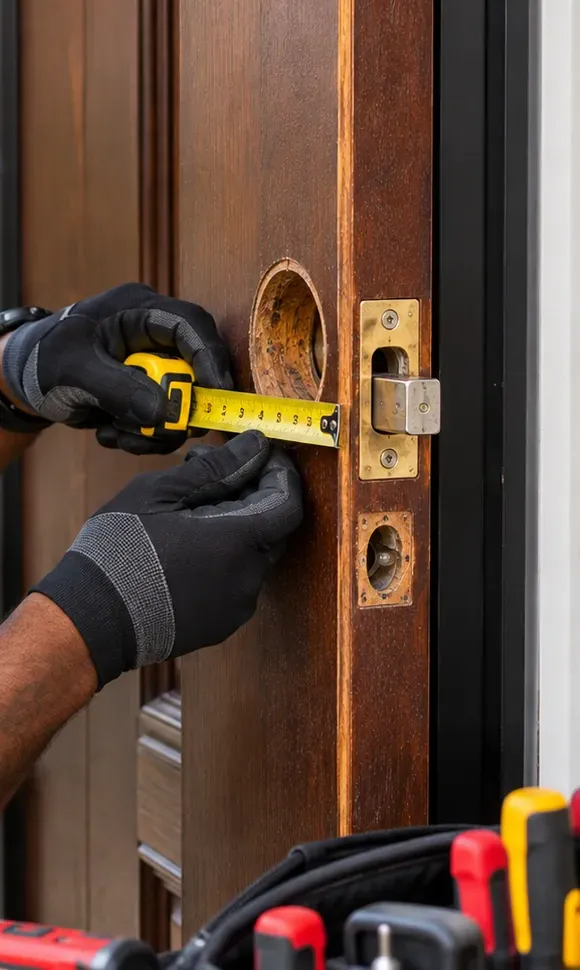
Gloved hands measuring across an empty deadbolt bore on a wood door edge before a St. George, Staten Island smart lock is chosen
A tape measure stretched across the empty bore, with the latch plate still in the door edge. Every door on every level gets this before a lock is recommended.
Repair Capture

Lock Jammed or Keypad Blank in St. George?

Since the router was moved to the top floor, the app can no longer see the garden door downstairs. Out on the harbour-facing porch, the keypad shows nothing at all. Somewhere else on the slope, a nineteenth-century frame has crept again and the motor now labours to push the bolt home. Call (347) 934-8335; we book the next open 2-hour window, and most battery, pairing and alignment faults are put right in one to two hours once we are at the door. If the visit turns out to be only app, bridge or code setup with no hardware change, it is billed at the Staten Island setup-only rate of $225 for the first hour.

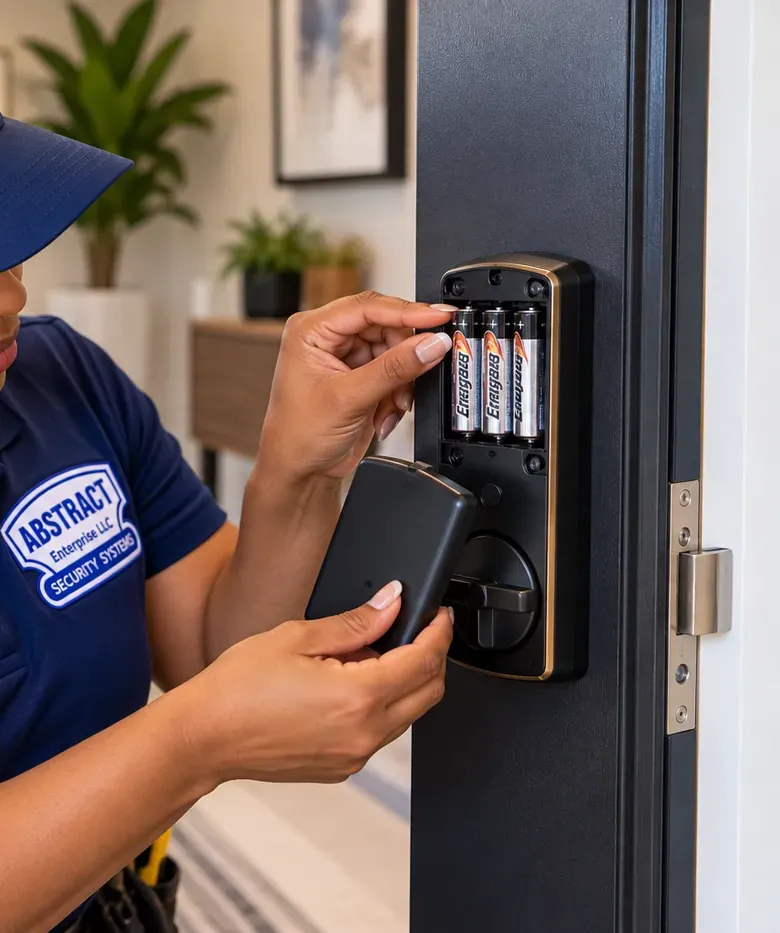
Smart lock repair in St. George, Staten Island: technician lifting the cover off the interior unit to change a four-battery pack on a dark door
The interior cover lifted away and a pack of four AA cells being swapped. Fresh batteries fix a lot, but a lock that drains them fast is usually telling us the bolt is binding.
What We Install

Smart Lock Installation Services in St. George

The jobs we are asked for on the hill follow the shape of the neighbourhood: houses with more than one everyday door, apartments emptied every morning by the boat, and offices with something to protect.

Two-Level House Plans

A front door on the upper street and a garden or service door a storey below, set up as one system: matching codes or separate ones, both doors on the same app, and a connection plan that reaches the lower level as reliably as the upper.

Locks for Historic-District Houses

Hardware chosen and placed so the visible change is as small as possible, with the approval question answered before work starts on anything that shows. Interior-mounted retrofits are often the first option we look at on a facade door.

Commuter Code Schedules

Codes for the dog walker, the cleaner, the sitter and the parcel neighbour that work only in their window, and can be stretched from a phone when the boat runs late. Every code named, so the history means something.

Apartment and Co-op Doors

A smart deadbolt or retrofit on a unit door in the 1930s buildings and the newer towers, set up within the lease, the house rules and the city's apartment-door requirements, with the key the owner is entitled to.

Office and File-Room Access

Law offices, agencies and practices near the civic centre: separate codes per person, a log the partner or manager can read, and a second controlled door between the reception area and the files where the office needs one.

Shop and Restaurant Entrances

Bay Street and the waterfront: keypad deadbolts on smaller shops, or a reader with an electric strike on a busy entrance, priced from our published single-door figure, with a free exit on every door.

Connection Planning Across Floors

Bridges, Thread border routers and mesh points placed so the lock on the lower level doesn't drop off while the one upstairs works. Tested at each door with the phone off Wi-Fi before we leave.

Repair, Re-Pairing and Re-Alignment

Locks orphaned by a new router, keypads that took the weather on an exposed porch, and old doors that have shifted on a settling hillside — put right at the strike and hinge, not just with new batteries.

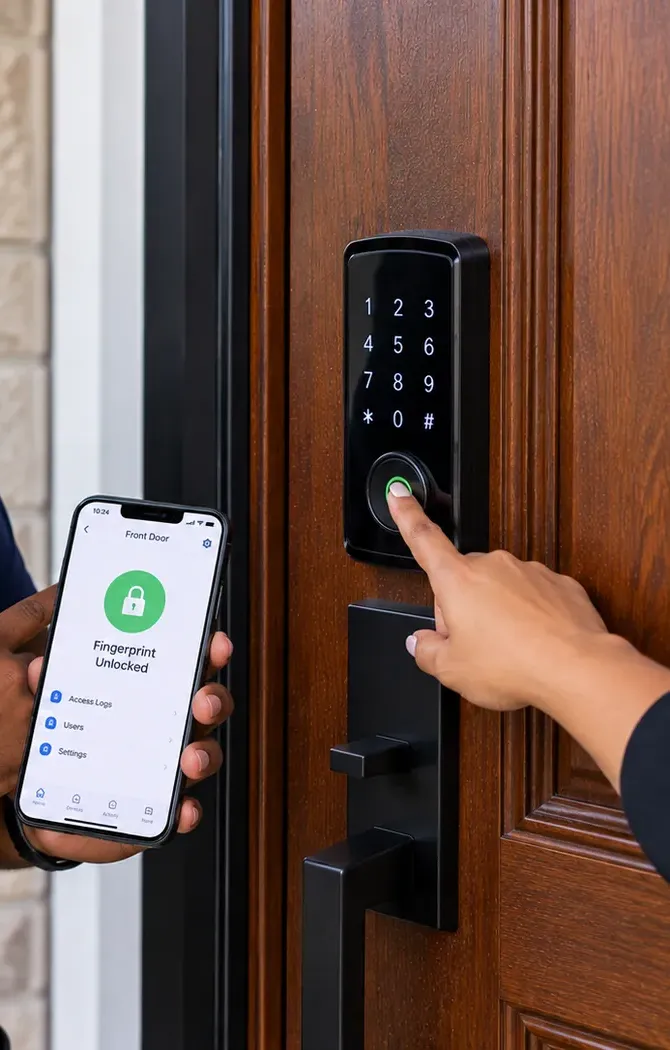
Fingerprint smart lock check for a St. George, Staten Island household: a finger on the keypad sensor while a phone shows the unlock
One hand on the sensor, the other holding a phone that shows the fingerprint unlock. Each enrolled print is tested at the door before handover.
Building Specialists

Smart Lock Installation for St. George's Architecture

Few neighbourhoods on the island hold so many building eras on so little ground. Each left its own kind of door behind, and each asks something different of a smart lock.

Greek Revival and Italianate Survivors

The oldest houses on the hill, such as the c. 1835 house at 404 Richmond Terrace and the Italianate house at 97 St. Marks Place. Heavy wood doors, often with old mortise hardware, where the aim is to change as little of the original as possible.

Second Empire Houses

Mansard-roofed houses of the 1860s and early 1870s on Westervelt Avenue and the north side of St. Marks Place, many with the downhill extra storeys at the rear. Two everyday doors on two levels is the norm here.

Queen Anne, Shingle and Colonial Revival Houses

The 1880s and 1890s houses that make up most of the historic district, with porches, towers and projecting bays. Porch doors are sheltered; side and rear doors on the slope often are not.

Houses Divided Into Apartments

Many older houses on the hill were converted into small apartment buildings in the 1930s. A shared street door, unit doors inside, and sometimes a lower-level apartment with its own entrance off the garden.

Commuter Apartment Buildings

From the 1932 Art Deco Ambassador Apartments on Daniel Low Terrace to the 20-storey Castleton Park towers. Building-owned lobbies and corridors, unit doors that answer to the lease, house rules and the city's apartment-door code.

New Waterfront Buildings

The Residences at Lighthouse Point and other recent mid-rise buildings near the water. Doors and entry systems are usually chosen by the developer; residents' choices start with what the lease allows.

How the work changes from door to door on the hill

  • Lower-level doors take the weather. A garden or kitchen door a storey below the street often opens onto an exposed yard or a stair down the slope, with no porch above it. We favour locks whose electronics sit inside the door and fit the maker's gasket, and we look at where rain runs down the door before deciding where the keypad sits.
  • Distance between levels. In a house that is taller at the back, the router is often on the upper floor and the lower door is two floors and several walls away. That is a connection problem before it is a lock problem, and it is solved with placement rather than a stronger lock.
  • Facade doors in the district. On a front door that faces the street inside the historic district, an interior retrofit that leaves the outside untouched, or a smart deadbolt that reuses the existing bore and finish, keeps the visible change smallest. Anything that changes the look of the door is discussed against the LPC's permit categories first.
  • Old mortise hardware. Many original doors carry a mortise lock body in the edge. A new bore that would cut into that pocket needs the pocket filled and reinforced first, so the bolt has solid wood around it.
  • Thickness and backset. Schlage lists its Arrive smart deadbolt for doors 1⅜ to 2 inches thick, with a backset of 2⅓ or 2¾ inches. Heavy nineteenth-century doors can fall outside a lock's listed range; we confirm before ordering rather than after drilling.
  • Frames on a settling slope. Hillside houses move. Strikes are realigned and hinge screws run into framing so the motorised bolt throws without rubbing, which matters for battery life as much as for security.
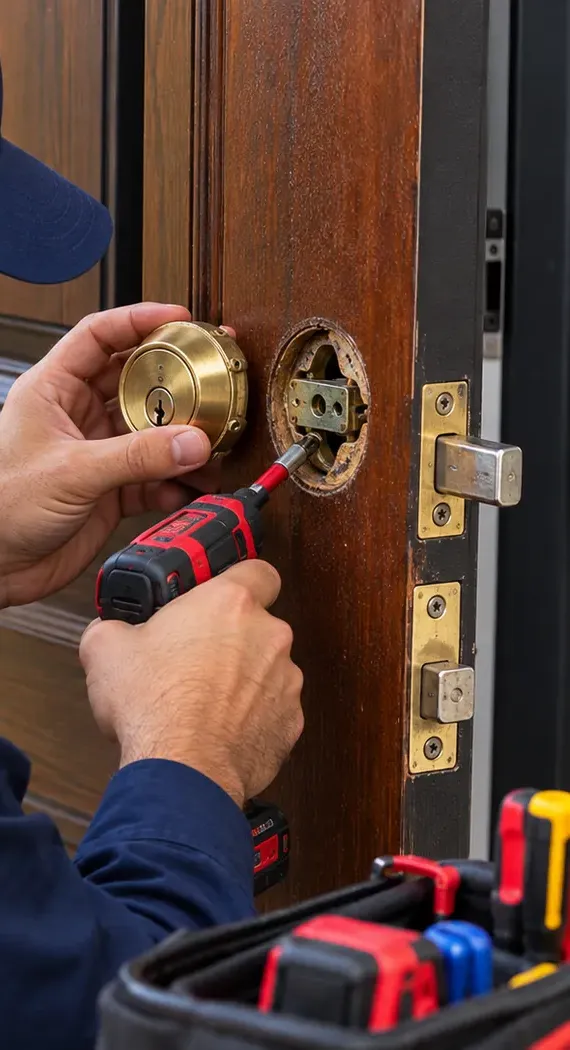
Unscrewing an old brass deadbolt from a wood door with a cordless driver before a smart lock installation in St. George, Staten Island
The old brass deadbolt coming out, the brass strike plates still in the frame beside it. Whatever is hidden under the old hardware decides how much door work comes next.
Two Levels

Front Door Above, Garden Door Below: Planning a Hillside House in St. George

On a flat lot, the front door is the main door and the back door is the occasional one. On the St. George hillside that order often breaks down. The door at the top, on the street, is where guests and couriers arrive. The door at the bottom, opening onto the garden or a lane below, may be the one the family actually uses — because it is nearer the stair down to the bus, because the kitchen is on that level, or because the house was divided long ago and the lower floor has its own entrance. A good plan starts by asking which door does which job, not by putting the best lock on the front.

Decide what each door is for

We walk the house with you and name the doors by use: the arrival door, the family door, the service door, the tenant's door. The arrival door usually wants a keypad and a video doorbell, so visitors can be seen and let in. The family door wants the quickest everyday entry, often a fingerprint or a phone tap. The service door, if there is one, wants codes that work only in set hours. Once the jobs are clear, the hardware for each door follows naturally, and two doors that look alike can end up with quite different settings.

One system, not two

Wherever possible, both levels go on one app and one account, so the household sees every door in one place and one code can be removed from every door at once. That sounds obvious, but a house where the front door was done one year and the garden door another often ends up with two brands, two apps and two lists of codes that drift apart. If you already have a lock on one door, we start from it and match the second where it makes sense.

Getting a signal down a floor

The connection is where two-level houses most often go wrong. A lock's Wi-Fi bridge typically has to sit near the lock — August, for example, says its Connect bridge should be within 10 to 15 feet and have good Wi-Fi itself. In a house where the router is upstairs at the front and the garden door is downstairs at the back, the bridge for the lower door needs its own outlet near that door and a usable signal there. Where the lower floor is a dead spot, a mesh point or a wired access point on that level fixes it for the lock and for everything else. Locks that use Matter over Thread need a Thread border router; a second Thread device on the lower floor can help the mesh reach down.

The way out, on both levels

On a hillside, the lower door is often a second way out of the house, especially for anyone sleeping on that floor. Both doors keep a plain thumb-turn or lever inside, with no key, code or phone needed to leave, and neither gets a double-cylinder deadbolt. The New York City Building Code's egress chapter puts the principle simply: doors people leave by must be readily openable from the egress side without a key or special knowledge or effort.

Stairs, light and weather

Lower doors are often reached by an outside stair down the slope. A keypad that lights when touched helps; a light on the stair helps more. We place the keypad so it can be used without leaning over a railing, and on doors with no overhang we choose locks rated for the exposure and fit their gaskets properly. If a door is too lightweight to hold a deadbolt securely, we say so, and replacing or reinforcing it becomes part of the conversation.

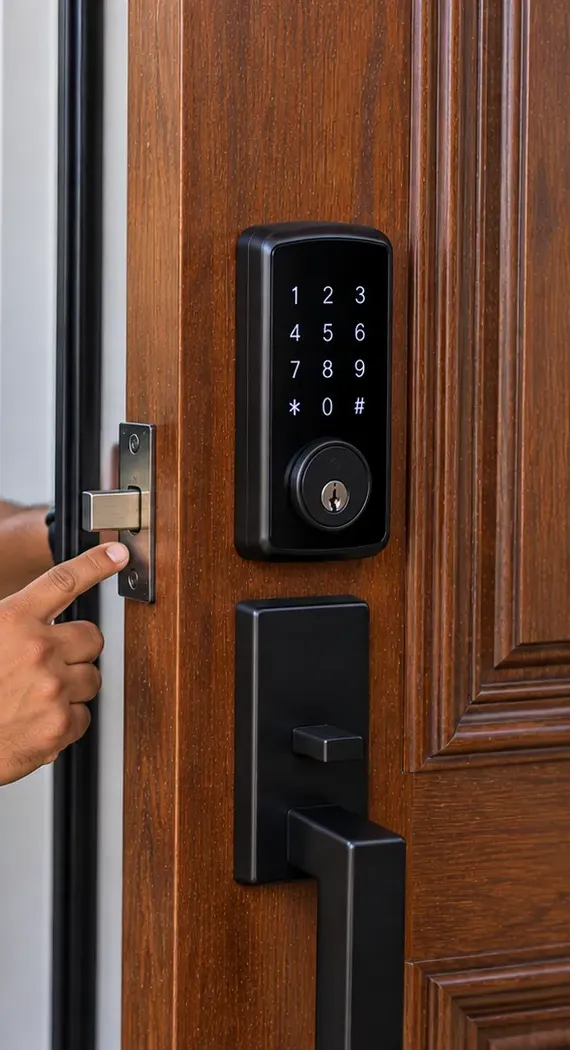
Finger testing the latch at the edge of a stained wood door fitted with a keypad smart deadbolt, St. George, Staten Island
A finger pressing the latch at the door edge, keypad deadbolt above and lever below. On a frame that has moved with the hill, this is where a few millimetres of adjustment happen.
Commercial Smart Locks

Business Smart Lock Installation in St. George

St. George's business doors cluster around the terminal and the civic buildings at the foot of the hill. They range from law offices in older buildings to brand-new commercial space on the waterfront, and the right lock depends as much on what is behind the door as on the door itself.

Richmond Terrace Civic Strip

Borough Hall of 1906, the former Richmond County Courthouse of 1919, the Family Court of 1931 at 100 Richmond Terrace and the 120th Precinct station house. The offices that serve them — law firms, agencies, advocates — occupy the older buildings nearby and up the slope.

Central Avenue and Hyatt Street

The state Supreme Court building at 26 Central Avenue, opened in 2015, the St. George Library Center at 5 Central Avenue and the 1929 St. George Theatre on Hyatt Street. Small offices, venues and food businesses whose doors open and close around court days and show nights.

Bay Street

The corridor running south from the terminal, lined with restaurants, bars, shops and offices in buildings of every age. Storefront doors here range from aluminium-and-glass to old wood doors on converted houses, often with apartments above.

Lighthouse Point, 5 Bay Street

About 60,000 square feet of new commercial space beside the terminal, with tenants including a College of Staten Island technology space, an early-childhood centre and a fitness studio. New doors, but fit-out access still has to be planned.

The Waterfront Retail Strip

The Empire Outlets complex and the North Shore Esplanade, part of the waterfront's twenty-first-century redevelopment. Tenant doors here answer to the landlord's systems and rules, so any lock change starts with the lease.

Westervelt Avenue and the Lower Slopes

Terra-cotta commercial buildings from the 1920s and 1930s on Westervelt Avenue, inside the historic district, and practices working from converted houses on the streets above the terminal. Residential-style doors that take smart locks well.

Compliance points on business doors

  • Leaving needs nothing. Anyone walking out of an office or shop must be able to do it without a key, code, card or know-how, which is how the 2022 city Building Code words its egress rule (with narrow exceptions). Put the keypad on the street side only.
  • One motion to unlatch. The same code generally limits egress doors to one releasing operation, so a smart deadbolt added above an existing latch on an office door has to be checked against that first.
  • Confidential records. For a law office, New York's Rule of Professional Conduct 1.6(c) requires reasonable efforts to prevent unauthorised access to client information. A lock is one part of that; who holds codes, and what the log shows, are the other parts.
  • Readers and strikes. Busy entrances and shared commercial doors are often better on a wired reader with an electric strike, a power supply and a free-exit device than on a battery lock. Those are priced from our published single-door figure.
  • Landmark facades. A business in a historic-district building, such as the terra-cotta buildings on Westervelt Avenue, should treat a visible reader or keypad as an LPC question before installation.
  • The lease. Tenants in new and managed buildings should check what the lease says about changing locks and the landlord's right of access before anything is ordered.

Offices that grow past a door or two usually move on to access control on Staten Island, which gives each person a credential and keeps one log for every door.

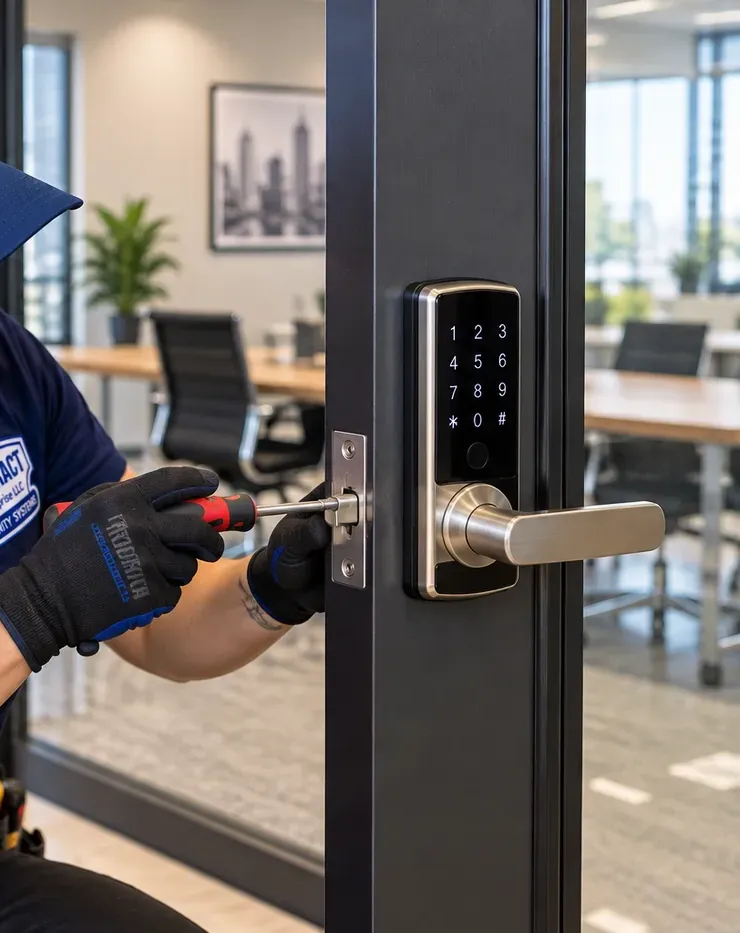
Gloved hands fastening a keypad lever lock on a narrow office door frame with a glass-walled office behind, St. George, Staten Island business smart lock
A keypad lever lock being tightened on a slim office door frame, with desks and glass partitions behind. On an inner office or file-room door, a lever lock like this keeps its own list of who has a code.
Your Questions Answered

Smart Lock Installation in St. George: Questions Answered

These are the questions we hear on the hill, from landmark-house owners, from people who live by the ferry timetable and from offices near the courts. They are grouped by what they are really about.

Hillside houses and the historic district

Our house is in the St. George/New Brighton Historic District and we only want to change the lock, not the door — does that need a Landmarks permit?

Possibly not, but it is a question to put to the Landmarks Preservation Commission rather than to guess at. The LPC issues three kinds of approval. A Permit for Minor Work covers work that affects significant protected features without needing a Buildings permit, and door replacement is one of the examples it is used for. A Certificate of No Effect covers work that needs a Buildings permit but doesn't affect protected features. A Certificate of Appropriateness, with a public hearing, is for bigger changes such as new storeys or removing a stoop. City guidance says simple repairs are generally exempt, but it does not spell out door hardware, which is why we suggest asking the LPC, through 311 or its online portal, before anything visible changes.

What we can do is keep the change small enough that the answer is easy. An interior retrofit that fits over an existing single-cylinder deadbolt leaves the outside of the door exactly as it was — August's own guidance is that its retrofit locks work only with single-cylinder deadbolts. A replacement smart deadbolt that reuses the existing bore, in a finish close to the existing hardware, changes the outside a little. A new keypad in a new position, or a wired reader beside the door, changes it more. We can give you photographs of the door and the manufacturer's cut sheet for each option, which is what any LPC conversation will start from.

If the door itself has to be replaced — because it is too damaged to take a lock, for instance — that is clearly a permit matter, and the replacement has to suit the house. In that case we coordinate the lock with whoever is handling the door, so the new door arrives prepared for the lock you have chosen.

The back of our St. Marks Place house looks down on Carroll Place — does a keypad on the rear door need approval if people can see it from that street?

It may well do. The usual assumption is that landmark rules are about the front facade, but the LPC looks at what can be seen from public streets, and on this hillside the backs of houses on the north side of St. Marks Place face Carroll Place below. Commentary on the LPC process notes that work which is not on the front facade can still require a permit if it is visible from a side street, and that some interior work can need one because it can be seen from outside. A rear garden door that looks down on another street is exactly the kind of door where that applies.

That doesn't mean the rear door can't go keyless. It means the choice of hardware matters more. A lock with a slim, dark exterior that sits where the old deadbolt was is a smaller change than a large lit keypad in a new spot. A keypad on the inside face of a gate, or a reader set into an existing opening, may avoid a visible change to the house at all. We bring the options to the walkthrough, and if any of them changes the visible face of the house, the LPC question comes first.

There is a practical upside to being careful. A rear door that is visible from the street below is also a door that passers-by can see you using. A keypad positioned so the code can't be read from the lane, and a camera that covers the stair, help with privacy as well as with appearance.

Our house is a storey taller at the back than at the front — where should the hub go so locks on both levels stay connected?

Usually not in one place. Most lock bridges and hubs have to be fairly close to the lock they serve, and in a hillside house the front door and the lower rear door can be two floors and the depth of the house apart. One bridge in the middle often reaches neither door reliably. The common answer is one bridge or connection point per level, each plugged in near its own door, with the router's signal checked at both spots.

The type of lock changes the plan. A Bluetooth lock with a Wi-Fi bridge needs the bridge near the lock and good Wi-Fi at the bridge. A Wi-Fi lock needs good Wi-Fi at the door itself and uses batteries faster. A lock on Matter over Thread can relay through other mains-powered Thread devices, so a Thread-capable speaker, plug or border router on the lower floor can carry the signal down; Yale notes that its Matter locks need a Thread border router from the same ecosystem as the app you use. A Z-Wave lock reaches its hub through other powered Z-Wave devices on the way.

We test at both doors with a phone set to cellular data only, so we know the lock is reachable from outside the house, not just from the kitchen. If the lower floor is a dead spot for everything, a mesh point or wired access point down there is a better fix than a lock that only works when you are standing next to it, and it helps every other device on that floor too.

Commuter apartments and new waterfront rentals

We're about to sign a lease in one of the new buildings by the ferry terminal — what should we ask about the apartment door before signing?

Ask before you sign, because afterwards your choices are whatever the lease says. In a new building the developer usually chooses the entry system and the unit locks, and some buildings run unit doors on an app or credential tied to the building's own platform. Four questions cover most of it: what lock is on the unit door and who controls it; whether residents may add their own lock, and on what terms; whether you will have a physical key as well as any app or fob; and how guests, cleaners and dog walkers are let in.

The law gives you some baseline answers. In a building with three or more apartments, state law lets a tenant add their own lock to the apartment door, provided the owner gets a duplicate key on request, and lease clauses that charge for this are void. The city's Tenant Data Privacy Act also limits how owners of multiple dwellings may use smart access systems, including that a tenant can't be required to use one to get into their own apartment, and sets rules on what data is collected and kept. A building's own app may still be the most convenient way in; the point is to know what your alternatives are.

If the building allows residents to add a lock, we fit a second smart deadbolt or a retrofit that keeps an inside thumb-turn, doesn't interfere with the door's self-closer, and leaves the owner the key they're entitled to. If it doesn't, ask whether the building's own system can issue time-limited guest credentials, because that is often what new residents actually want from a smart lock.

Our sitter's code only works until 6 p.m. — if we're stuck on a late boat, can we stretch it from the terminal?

Usually, yes, as long as the lock is online. A scheduled code lives in the lock, but on a lock that is connected through Wi-Fi, a bridge or a hub, the schedule can be edited from the app wherever you are, and the change reaches the lock within moments. So if the 5:30 boat is missed, you can open the app on the Whitehall side or on the boat itself, extend the sitter's window to 8 p.m., and change it back tomorrow. On a Bluetooth-only lock with no bridge, the app has to be near the lock to make changes, so remote editing isn't possible.

Two habits make this easier. First, build some slack into recurring codes from the start — a window that ends an hour after you normally get home covers most delays without anyone touching the app. Second, give every person their own named code rather than one shared “helper” code, so stretching the sitter's time doesn't also stretch the cleaner's.

The same applies the other way. If you are home early and want a dog walker's code switched off for the afternoon, or a weekly cleaner's code paused while you travel, the app does it. At handover we show you where the schedule screens are and walk through extending and pausing a code, so the first time you need it isn't on a crowded boat.

Offices near Borough Hall and the courts

Our law office near the courthouse keeps client files on site — does a keypad with an access log help with our duty to protect client confidences?

It helps, as one part of a wider set of reasonable measures. New York's Rule of Professional Conduct 1.6(c) says a lawyer shall make reasonable efforts to prevent the inadvertent or unauthorised disclosure or use of, or unauthorised access to, protected client information. Ethics guidance on that rule has mostly focused on digital information, but paper files in an office are covered by the same duty, and who can walk into the room where they are kept is part of reasonable efforts. This is a description of the rule, not legal advice; your own ethics counsel decides what is reasonable for your practice.

In practice, offices near the civic centre usually do best with two controlled doors rather than one. The street or suite door lets staff and expected visitors in. The file room, or the corridor behind reception, has its own lock with a code for each person who needs it and no one else — not the cleaning contractor, not the building staff, not a visiting client. Each code is named, so the log shows which person opened the file room and when, and a departing employee's code is deleted the day they leave.

The log is only useful if someone looks at it, so we set up alerts for openings outside office hours and show the office manager how to export the history. A keypad lever on an interior door is often enough for a small practice; where there are several rooms or more than a handful of staff, a small access control system gives one log across every door. Either way, the inside of each door still opens freely for anyone leaving.

Living with the lock day to day

Can the keypad be shut off at night while we're home, so no code works from outside?

On many locks, yes. Manufacturers give the feature different names. On the Google Nest × Yale lock it is called Privacy Mode, which disables the keypad so the lock can't be opened with a passcode, and it can be turned on from the app or by holding a button on the lock; turning the inside thumb-turn to unlock turns it off again. Schlage's keypad locks have a Vacation Mode, set with the lock's six-digit programming code, during which user codes won't open the lock. Google is careful to say its Privacy Mode doesn't add an extra layer of security; it simply stops codes working for a while.

It is useful for a household that hands codes to several outside people — a walker, a cleaner, a relative — and wants none of them usable overnight or while the family is away. It is also a sensible setting on a lower garden door that nobody uses after dark. The trade-off is that anyone without app access is locked out while it's on, so a teenager coming home late needs the app or a key, not a code.

If a lock you are considering doesn't have this feature, schedules can do a similar job: each outside code set to work only in daytime hours. We set whichever approach suits the lock at handover and show you how to switch it on and off.

Will the lock's history show whether the door was opened from inside or by someone coming in?

Often, but not always in the same words. Many smart locks record how each lock or unlock happened, not only when. Depending on the brand, the history may list an unlock by a named code, by the app, by a fingerprint, by a key, or manually from the inside thumb-turn; owners of August locks connected to SmartThings, for example, have reported the unlock method coming through as entries such as “Unlocked with keypad”. Auto-lock events are usually shown separately.

Reading it takes a little practice. A manual unlock from inside usually means someone already in the house opened the door, which is the normal way out. A keypad unlock with a named code tells you who came in. An unlock with no name attached may be a key, a shared code, or a lock that hasn't been set to label its events, so we name every code and check how the chosen lock reports each method before we leave.

What the history can't tell you is whether the person who opened the door was the person the code belonged to. Codes get shared. That is why we give each person their own code and suggest a doorbell camera at the arrival door, so a log entry and a face can be matched when it matters.

My partner has an iPhone and I have an Android phone — can we both manage the same lock?

Yes, in two different ways. The simplest is the lock maker's own app, which most brands offer on both iPhone and Android; one person creates the account and invites the other as a second owner or administrator. That works regardless of which phones you have, and it is how most mixed households run a lock.

If you want the lock inside your smart-home apps as well, Matter is designed for this. Google describes Matter's Multi-Admin feature as letting a Matter-enabled device be used in different Matter-certified apps at the same time, so a Matter lock can sit in both Apple Home and Google Home. Each app needs its own compatible hub, and Google notes that only one platform actively controls the device at any given moment, though status changes show up in both. On a Thread lock, the hub on each side also acts as the border router.

Before buying, check that the lock supports what you want: some models work with Apple Home, some with Google, some with both through Matter, and some only through their own app. We confirm compatibility with both your phones and your existing hubs at the walkthrough, and set up the second administrator before we leave.
Equipment

Types of Smart Locks We Install

The hill has nineteenth-century facade doors, exposed lower doors, apartment doors in buildings run by managers and boards, and office doors with files behind them. These are the categories we choose between, and where each one tends to fit in St. George.

Interior Retrofit Locks

Mounted on the inside face only, gripping the thumb-turn of a single-cylinder deadbolt already in the door; from the street the door looks as it always did and old keys keep working. Our first look on a historic-district facade door, and on many rental doors where the lease limits changes.

Keypad Smart Deadbolts

A replacement deadbolt with a keypad outside and a thumb-turn inside. The everyday choice for side, rear and lower-level doors, and for front doors outside the district or where a small visible change is acceptable.

Weather-Sealed Models for Exposed Doors

Locks with their electronics inside the door and a gasketed outside face, for garden doors at the foot of an outside stair and porches that face the harbour wind with no roof over them.

Fingerprint and Phone-Tap Locks

For the family door that gets used ten times a day, where a finger or a tap of a phone is quicker than a code after a climb up from the terminal. Best on sheltered doors.

Matter, Thread and Z-Wave Locks

For households that want the lock inside Apple Home, Google Home or an existing hub, or that need a mesh to carry the signal down a floor. Matter over Thread needs a Thread border router on each platform used.

Keypad Levers for Offices and File Rooms

Lever locks with a built-in keypad and their own code list, for interior office doors, file rooms and staff areas. Not a deadbolt, so not a substitute for one on an outside door.

Readers With Electric Strikes

Wired keypads or fob readers releasing an electric strike, with a power supply and a free-exit device, for busy shop entrances and shared commercial doors. Priced from our published single-door figure.

Mechanical Code Locks

Push-button locks that need no batteries and no app, for a garden gate, a bin store or a lower door where weather is hard on electronics and nobody needs a log.

Video Doorbells Paired With the Lock

Not a lock, but the companion for the arrival door: see who is on the step, speak to them from the boat, then decide whether to let them in.

National alarm brands compared with a local installer on the hill

ADT, Ring and SimpliSafe each sell or support smart locks as part of a wider security system, and for plenty of households that is a good fit. On a St. George hillside house the differences usually show up in the planning rather than the lock.

QuestionADT / Ring / SimpliSafe routeAESS local installation
Who decides which door gets which lock?Often the buyer, from a product page, or an installer arriving with a set packageWe walk every door on every level first and assign hardware by what each door is used for
Landmark-district facade doorsTypically outside the standard install conversationOptions ranked by how much they change the visible door, with photos and cut sheets for any LPC question
Signal to a lower-level doorDepends on the brand's own hub or base station placementTested at each door on cellular data; bridge, border router or mesh point per level where needed
Commuter schedules and named codesAvailable in most apps, usually left for the owner to set upSet up with you at handover, including how to stretch or pause a code remotely
Monthly feesOften tied to a monitoring planNothing monthly is owed to us; if the lock's maker sells an optional app plan, that is between you and them
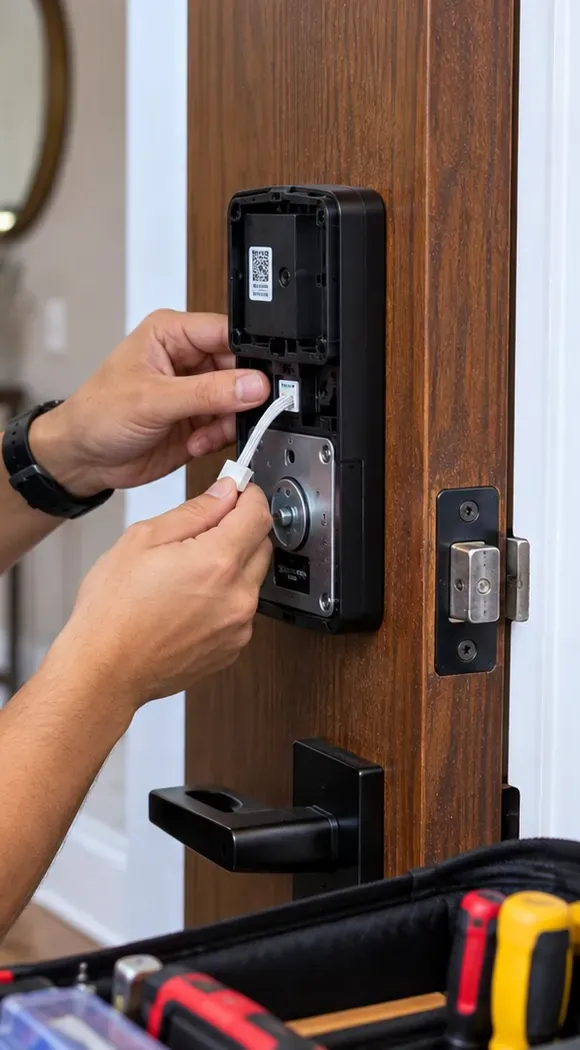
Threading the keypad's flat cable through the interior mounting plate of a smart deadbolt on a wood door, St. George, Staten Island installation
The flat cable from the outside keypad being threaded through the inside mounting plate. Seated wrong, it is the commonest reason a brand-new keypad stays dark.
AI Overview Reality Check

What AI Gets Wrong About Smart Lock Installation in St. George

Google's AI Overview text could not be captured from our build environment, so the claims below are the ones that keep appearing in national cost guides from Angi, HomeAdvisor and Fixr, in manufacturer marketing and in general advice. Each is true somewhere. Here is how each holds up on a hillside of landmark houses, commuter apartments and court-district offices.

“A smart lock installation costs $250 to $400”

Fixr's national figure, updated in January 2025, is $250 to $400 for installing a smart lock, with an average around $300. For one lock on one ready door, that is a fair yardstick, and it is worth knowing.

It doesn't describe a St. George house with two everyday doors on two levels, a lower floor that needs its own bridge or mesh point, and a facade door where the hardware choice has to wait on a landmark question. Nor does it cover a law office that needs a second controlled door in front of its files.

That is why residential smart locks here are quoted flat after a free walkthrough. The national average is a reasonable comparison; it is not a price for a house nobody has looked at.

“You only need a screwdriver and about thirty minutes”

Product reviewers, Bob Vila's among them, report getting a smart lock on with little more than a Phillips screwdriver inside half an hour. Where the door was bored for a standard deadbolt recently, that matches what many owners find.

The half-hour job assumes a standard door, a standard bore and a frame that is square. A heavy nineteenth-century door with an old mortise pocket in its edge, on a frame that has moved with the hillside, fails at least one of those assumptions. So does a lower door where the real work is getting a signal down a floor.

If your door passes every test, fit it yourself and call us only if the connection is the sticking point. If it doesn't, the screwdriver is the smallest part of the job.

“Changing a lock is never a landmarks issue”

General advice often treats hardware as too small to matter to a preservation agency, and plenty of lock changes on landmark buildings do go ahead without fuss.

But the LPC's permit categories turn on whether protected features are affected and what can be seen, and city guidance on landmarked properties doesn't spell out door hardware. In a district on a hillside, a rear door that looks onto the street below can be as visible as a front door.

Our approach is to choose the least visible option that does the job and, where anything visible changes, to raise it with the LPC first. Asking takes a phone call; undoing an unapproved change on a landmark facade takes much longer.

“Put the hub in the middle of the house and every lock will connect”

Box copy and quick-start guides often make connection sound like a matter of plugging in a bridge somewhere central.

Read the installation manual and the promise narrows. August, for example, says its Connect bridge should be within 10 to 15 feet of the lock and needs good Wi-Fi where it is plugged in. In a house that drops a storey from front to back, there may be no single central spot within range of both doors.

We test each door separately and plan one connection point per level where needed. A lock that answers from the kitchen but not from the boat isn't doing the job it was bought for.

“Renters can install whatever smart lock they like”

Renters are often told that a retrofit lock is the easy answer: no new holes, original keys still work, and it comes off when you move.

In New York, whether you may add a lock depends on the building as well as the hardware. State law lets tenants in buildings of three or more apartments add their own lock with a duplicate key to the owner on request, but leases, house rules and building-run entry systems in new waterfront buildings vary, and retrofits only work on single-cylinder deadbolts in the first place.

So the right order for a renter by the terminal is: read the lease, ask the building, then choose the lock. A retrofit is often the answer, at the end of that process rather than the start.

“Once you go keyless you can forget about keys”

Day to day, codes, phones and fingerprints do replace keys for most comings and goings, and that is the appeal.

But batteries run down, phones are left on a boat, and privacy or vacation modes switch codes off by design. In apartment buildings, the city's Housing Maintenance Code calls for a deadbolt operable by key from outside and a key for the tenant. A key override is the backup that works when the electronics don't.

We almost always keep a key option and agree where the keys live, ideally with someone nearby on the island rather than in a desk in Manhattan.

“A smart lock makes your home secure”

Smart locks improve some things: they lock themselves, report a door left open and record who came in.

They don't strengthen a door, a frame or a window. When police searched St. George from the ground and the air after a reported attempted burglary near Fort Place one weekday morning in 2019, it was a reminder that houses on the hill are empty in daylight while their owners are at work across the harbour; a lock tells you what happened at its own door, not at the window beside it.

So we treat the lock as one layer: strikes screwed into framing, glass within reach of a thumb-turn dealt with, and alarm sensors on Staten Island doors and windows where the house needs them.

Walk Every Level Before Choosing a Lock

Send photos of each door you use, front and back, and tell us which floor each one is on. We will say whether one connection point can serve them or whether each level needs its own.

Get In Touch

Request a Free Quote

A hillside house with doors on two levels, an apartment by the terminal, a practice near the courts or a shop on Bay Street: tell us what you have and a licensed installer phones you back that business day.

✅

We Got Your Request!

We'll call you back the same business day. If it's urgent, call us now at (347) 934-8335.

How It Works

Our Installation Process

Six steps, whether it is one apartment door by the terminal or a hillside house with a door on every level.

1. Map the doors and the day

On the phone we note which doors you use on which level, whether the house is in the historic district, and who comes in while the household is out, and when.

2. Free walkthrough, top to bottom

We start at the lowest door and work up, measuring thickness and backset, checking the strike and the weather on each door, and testing the phone's signal on every floor.

3. Written flat quote

One figure in writing that names each door, the lock chosen for it and why, any door preparation, and the connection plan per level, with Staten Island rates applied to anything published.

4. Settle the visible questions

For facade doors in the district, or any door visible from a street, we agree the least visible option and supply photos and product sheets for any LPC question before installation day.

5. Fit, align and connect

Each lock is mounted and gasketed, strikes are aligned so auto-lock works every time, the inside release is tested by hand, and every door is checked from outside the house on cellular data.

6. Codes, schedules and handover

Each person gets a named code with their own hours, alerts are set, and you extend and pause a code yourself on your own phone before we leave, with a written list of what opens what.

Coverage Area

Smart Lock Installation Near St. George's Landmarks

St. George Ferry Terminal

Opened in 1886 at the point of the island nearest Manhattan and most recently renovated in 2005, it is served by the Staten Island Ferry, the Staten Island Railway, NYC Ferry and nearly every island bus route. Half the neighbourhood's locks are set around its timetable.

Staten Island Borough Hall

The French Renaissance building by Carrère and Hastings at 2–10 Richmond Terrace, completed in 1906, a few doors from the former county courthouse of 1919. The offices around it are the core of our commercial work on the hill.

St. George Theatre, Hyatt Street

A 2,800-seat theatre that opened in 1929, designed by Eugene De Rosa and reopened as a cultural venue in 2004 after a community campaign saved it. Show nights bring crowds up the side streets where many of our customers live.

Curtis High School, Hamilton Avenue

Opened in 1904 as Staten Island's first high school and now a city landmark, at the edge of the historic district. The houses on the slopes around it are the two-level hillside houses this page is mostly about.

SIUH Community Park

The 7,171-seat waterfront ballpark, opened in 2001 as Richmond County Bank Ballpark and now home of the Staten Island FerryHawks. Its neighbours are the newer waterfront buildings and the Bay Street apartments.

National Lighthouse Museum and Lighthouse Point

The museum opened in 2015 on the grounds of the former U.S. Lighthouse Service depot, which operated here from 1863 to 1966; the new Residences at Lighthouse Point at 5 Bay Street rise beside it.

We also serve the neighbourhoods around St. George: Tompkinsville and Stapleton along Bay Street to the south, New Brighton and Livingston to the west, and Grymes Hill and Silver Lake up the slope — and the rest of smart lock installation across Staten Island, from the North Shore to Tottenville.

Pricing

Smart Lock Installation Cost in St. George

Nothing about the hill changes the rate card: St. George jobs use the Staten Island figures, which AESS sets at its Brooklyn base multiplied by 1.10. Residential smart locks have no published AESS figure, because a two-level house in the historic district and an apartment door by the terminal are different jobs; they are quoted flat after a free walkthrough, with every door named. Lines that do have published figures are listed below with the Staten Island adjustment already applied.

ItemSt. George (Staten Island) priceWhat it covers
Smart locks on house, apartment or office doorsQuoted flat at free walkthroughPer property after we have seen every door on every level: door preparation, the locks, the connection plan per floor, and every code and schedule
Single-door keypad or fob reader with electric strike$1,650–$2,750 installedWired reader or keypad for a shop entrance, a busy office door or a shared commercial entrance; published at $1,500–$2,500 in Brooklyn, times 1.10
New electric strike on an entry door$275–$495New strike in an existing frame; published at $250–$450 before the Staten Island factor
Failed electric strike repair$325–$534An entrance where the release buzzes but the door stays shut; published at $295–$485, multiplied by 1.10 and rounded half-up
Setup-only visit (app, bridge, codes; no hardware change)$225 first hour, then 30-minute blocksStaten Island setup-only rate
Service and callback rate$195/hr, 3-hour minimum ($585)After-install service calls; not charged on the initial installation

Worked examples from the published lines

  • A practice with a reader-controlled street door and a reader on its file room: two single-door systems at $1,650–$2,750 each, so $3,300–$5,500 before anything specific to the building.
  • An office entrance whose reader works but whose strike has failed: the strike repair line, $325–$534.
  • A garden-door lock that dropped off the app when the router moved, no new hardware: the setup-only rate, $225 for the first hour.

What moves a St. George quote up or down

  • Levels. A house with everyday doors on two floors may need a connection point per level; a single-level apartment rarely does.
  • The landmark question. Where a facade door calls for a less visible lock or a retrofit, the hardware choice changes; any LPC paperwork itself is the owner's, though we supply photos and cut sheets.
  • Door condition. Old mortise pockets, plugged bores and frames that have moved add preparation time; a sound modern door adds none.
  • Codes and schedules. A household with walkers, cleaners and sitters on separate windows, or an office with codes per person and alerts, takes longer to set up properly.
  • Battery lock or wired reader. A battery smart lock is a residential quote; a wired reader with a strike is priced from the published access-control line.

If you want an outside benchmark, Fixr's guide (last updated January 2025) puts smart lock installation nationally at $250 to $400, around $300 on average. That number describes one lock on an ordinary door anywhere in the country; it isn't something AESS charges.

Full terms — including 50% deposit, one-year parts-only warranty on AESS-supplied products, and the late-fee schedule — are set out in the service agreement.

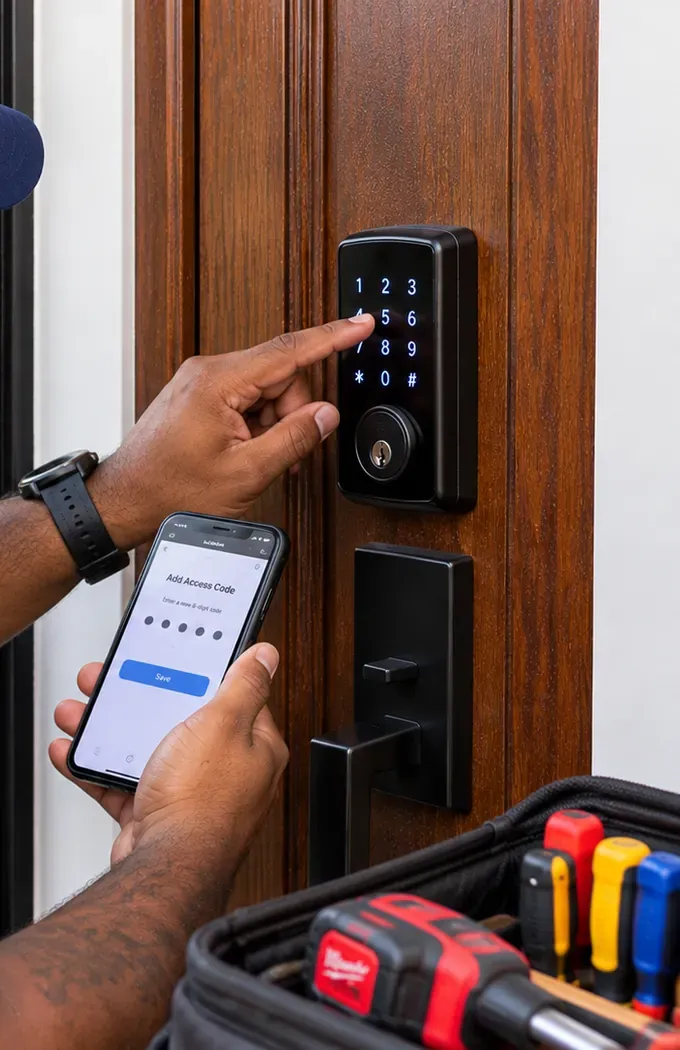
Adding a new user code on a phone app while pressing the keypad of a smart deadbolt, St. George, Staten Island code setup
A finger on the keypad and a phone open on the code screen: the step where the walker, the cleaner and the sitter each get a named code with its own hours.
Shop Our Systems

Smart Lock Installation Packages & Pricing

Starter — The Commuter's Door

Quoted flat at walkthrough

One smart lock on an apartment or house door, set up for a household that leaves on foot: auto-lock, named codes for helpers with their own hours, remote schedule changes, and a tested connection.

Standard — The Hillside House

Quoted flat at walkthrough

The street door and the lower-level door on one app, with a connection point per floor where needed, the least visible option on any facade door in the district, a doorbell camera at the arrival door, and a written list of every code.

Premium — Office or Busy Entrance

$1,650–$2,750

Per controlled door on a practice, office or Bay Street shop: wired reader or keypad, electric strike, power supply with battery backup, request-to-exit hardware. Staten Island rates; a file-room door is a second unit at the same figure.

Bring Your Own Lock — Labour Only

Have a lock in its box? Labour alone is quoted flat after the walkthrough, covering door preparation, fitting, the connection on its floor and every code. We check the lock against the door's thickness and backset before drilling, and against the building's rules if it is a rental. App, bridge or code setup with no hardware is the $225 first-hour setup-only rate.

Speak to a Tech About Your Household's Timetable

Tell us who leaves when, who comes in while you're across the harbour, and which door they use. We'll sketch the code schedule on the phone.

The Ferry Clock

Setting Up a Smart Lock for a Household That Lives by the Boat

A great many St. George households have the same shape to their day. Someone walks down the hill to a boat in the morning, spends the day across the harbour, and climbs back up in the evening, while the home sits empty or is visited by people the household trusts but doesn't see: a dog walker at noon, a cleaner on Thursdays, a neighbour taking in a parcel, a sitter for the hours between school and the boat home. The lock's job is to let each of those people in at the right time and nobody else at any time, and to tell the household what happened without anyone being there.

Auto-lock you can trust

The single most useful setting for a commuter is auto-lock: the bolt throws itself a set time after the door closes. It answers the question everyone on the boat has asked themselves at least once. The setting only works well if the bolt lines up perfectly with the strike, because a bolt that catches will either fail to lock or drain the batteries trying, which is why strike alignment is part of every installation rather than an extra. Where a lock offers a door-position sensor, we fit and calibrate it, so the lock knows the door is actually shut before it tries.

Codes with hours, and a name on each

Each regular visitor gets their own code, named for the person, with hours that match their job. The walker's code works at midday on weekdays; the cleaner's works on Thursdays; the sitter's works from mid-afternoon until an hour after the usual boat home. Named codes turn the lock's history into something you can read: not just that the door opened at 12:14, but that it was the walker, and that the door locked again at 12:52. When someone stops working for you, their code is deleted and nothing else changes.

Notifications that matter, not noise

Most apps can send an alert for every event. That is too many for most people, and alerts that are always ignored are worse than none. We usually suggest three: a door left unlocked longer than a set time, any opening outside a code's normal hours, and repeated wrong codes at the keypad. Everything else stays in the history for when you want to look.

The late boat and the early return

Schedules need to bend. When the household is delayed, a connected lock lets you extend a helper's window from your phone; when you are home early, you can pause a code for the afternoon. Both are covered at handover, with you doing it yourself on your own phone while we watch, because the moment you need it will be on a crowded deck, not at the kitchen table.

A key on the island

Keep at least one physical key with someone on Staten Island — a neighbour up the street, a relative in another part of the island — rather than in a drawer at work in Manhattan. If the batteries die or the phone is left on the boat, a key twenty-five minutes and a ferry ride away is not much use at eleven at night.

Historic District

Smart Locks and the St. George/New Brighton Historic District, in Plain Terms

The district was designated in 1994 to protect what survives of New Brighton, one of the earliest planned suburban communities in New York City, begun by Thomas E. Davis in 1834–35. Its curving streets still follow the 1835 plan, and its houses are a catalogue of nineteenth-century styles. None of that rules out a smart lock. It does mean thinking about visibility first and hardware second.

Start with what can be seen

The question that matters is what the change looks like from the street. A lock that lives entirely inside the door, such as a retrofit over an existing deadbolt, changes nothing outside. A smart deadbolt in the existing bore changes the outside escutcheon. A new keypad in a new position, a reader beside the doorway or a doorbell camera on the facade changes the look of the entrance more. On this hillside, "the street" can mean the street behind as well as the street in front.

Know the three approvals

The LPC issues a Certificate of No Effect, a Permit for Minor Work, or a Certificate of Appropriateness, depending on whether a Buildings permit is needed and whether protected features are affected. Door replacement is an example of work covered by a Permit for Minor Work. Hardware alone isn't spelled out in the city's general guidance, so where anything visible changes we suggest confirming with the LPC before the work, and we provide photographs and product sheets to support that conversation.

Choose finishes that belong

Where a visible part of the lock does change, matching its finish to the hardware already on the door — dark bronze beside old iron, polished brass beside brass — and keeping its profile slim makes it read as a lock rather than a gadget. Matte black, the default on many smart locks, can be right on a painted door and wrong on a stained one.

Keep the original

If original hardware comes off, we hand it back to you labelled rather than taking it away. It belongs to the house, and a future owner may want to restore it.

Nothing in this section is legal advice; it is how the published permit categories bear on choosing a lock for a landmark-district door.

Apartment Residents

For Residents of St. George's Apartment Buildings

With seven in ten St. George homes rented, a lot of the doors on the hill belong to someone other than the person who uses them. Whether you live in a 1930s building near the terminal, one of the large complexes on St. Marks Place, a house divided into apartments, or a brand-new waterfront rental, the order of work is the same.

Find out what kind of building it is

In a building of three or more apartments, state law lets a tenant add their own lock to the apartment door, provided it is no more than three inches in circumference and the owner gets a duplicate key on request. That right does not apply in a one- or two-family house, where the lease decides, and it doesn't extend to buildings run by a municipal housing authority. Co-ops add their own house rules and alteration procedures on top.

Add rather than replace

The smart lock normally goes alongside the owner's lock, not instead of it, unless the owner agrees. A retrofit over an existing single-cylinder deadbolt, or a second smart deadbolt above the original, are the usual answers, and the owner keeps whatever key the law or lease gives them.

Keep the door doing its fire job

Apartment entrance doors in buildings with three or more units must be self-closing under city rules, and HPD's fire-safety guidance says double-cylinder locks are illegal on apartment doors. We fit thumb-turns inside, never double-cylinder deadbolts, and nothing that stops the closer pulling the door shut.

Building apps and your own lock

Newer buildings sometimes run lobby and unit entry on their own app. Under the city's Tenant Data Privacy Act, a tenant can't be required to use a smart access system to get into their own apartment, and owners must follow rules on what data is collected and how long it is kept. A lock of your own on the unit door is separate from the building's system, and its history is yours.

Moving on

When you leave, a lock that was your addition can come with you; we remove it and patch the door, or leave it for the next resident by arrangement with the owner. Either way, delete your account and every code before handing back the keys.

Pressing the keypad of a smart lock on a dark apartment door while a phone app shows it unlocked, for St. George, Staten Island apartment residents
A finger on the keypad of a dark apartment door and a phone in the other hand showing the lock open — the final check that the door and the app agree before we leave.
Before You Buy

A St. George Checklist Before Ordering a Smart Lock

Ten minutes with a tape measure and a phone, door by door and floor by floor, will save a returned lock.

  • Every everyday door, on every level. List the doors your household actually uses, front and back, upper and lower, and who uses each.
  • District status. Check whether the house is inside the St. George/New Brighton Historic District, and whether any door you plan to change can be seen from a street, including the one behind.
  • Door thickness and backset. Measure the door edge and the distance from the edge to the centre of the current deadbolt; compare them with the lock's listed range, such as 1⅜–2 inches thick and a 2⅓ or 2¾ inch backset for Schlage's Arrive.
  • Existing deadbolt type. A thumb-turn inside means single-cylinder, which retrofit locks need. A key on both sides means double-cylinder, which should come off an apartment door anyway.
  • Signal at each door. Stand at each door with your phone on Wi-Fi only and load a page. If the lower floor struggles, plan a connection point there.
  • Outlets near each door. Find the nearest outlet to each lock, on either side of the wall, for a bridge or border router.
  • Your phones and hubs. Note whose phone is iPhone and whose is Android, and any hub you already have, so the lock suits all of them.
  • Helpers and their hours. Write down who comes in while you are away, which days and between which times.
  • Whose door it is. If you rent, read the lease and ask the building; if it is a co-op, check the alteration rules.
  • Office doors. If the door protects client files, decide who should have a code and who never should.
Complete Services

Every Smart Lock Installation Service in St. George

A lock is rarely the only thing a hillside house or a court-district office needs at its doors. Most St. George households pair the lock with a doorbell camera at the arrival door; most offices pair it with access control. These are the related services we provide here.

Doorbell Camera Installation Staten Island

See and speak to whoever is at the step while you are on the boat.

AESS Access Control on Staten Island

Readers and a single log for offices with several doors and a file room.

Intercoms for Divided Houses

A button and a release for each apartment in a house split into units.

Door Buzzer Repair

Old buzzer and strike systems on shared street doors that ring but no longer release.

Alarm Installation

Door and window sensors for a house that sits empty while everyone is at work.

Home Security Cameras

Coverage for the lower garden door and the stair down the slope.

Home Automation

One controller on each floor so a door unlocking can switch on the stair light below.

Network and Wi-Fi Coverage

Access points that carry the signal down to the lower floor of a hillside house.

Low-Voltage Wiring

Strike power, reader cable and transformer work under our state licence.

Field Notes

Field Notes on Hillside Doors

Written as our usual routine on sloping lots; it describes habits, not a specific address or client.

On a hillside house we start at the bottom, not the top. The lower door is the one most likely to be exposed to weather, furthest from the router and least looked at, so it tells us most about how the job will go. We open and close it a few times, watch the bolt meet the strike, look at where rain runs down its face, and check the phone's signal on that floor before we have said a word about locks.

Then we climb to the street door and ask what can be seen from outside, and from which street. On a house in the district, that answer narrows the hardware before anything else does. We photograph the door from the pavement as a neighbour or an inspector would see it.

Last, we sit down with whoever runs the household's timetable and write out who comes in, when, through which door. On the hill, that list is usually the real job; the drilling is the easy part. On every door we touch, on every level, the way out stays a single movement from the inside, whatever the batteries are doing.

FAQ

St. George Smart Lock Installation FAQ

Do you work all over St. George, from Richmond Terrace up to Fort Hill and across to Tompkinsville and New Brighton?
+

Yes. We work across St. George from the waterfront along Richmond Terrace and Bay Street up through the historic district on St. Marks Place, Carroll Place, Westervelt and Hamilton avenues to Fort Hill and Victory Boulevard, and in the neighbouring areas of Tompkinsville, Stapleton, New Brighton and Grymes Hill. Pricing is the same Staten Island pricing throughout, with no extra charge for the hill.

Does fitting a smart lock need a Department of Buildings permit?
+

For an ordinary battery smart lock on an existing door, generally not. The Buildings Department lists minor alterations and ordinary repairs among the work that can be done without a permit, under section 28-105.4.2 of the Administrative Code. Larger jobs are different: new door openings, structural changes or significant new wiring can bring in permits, and on a landmarked house the Landmarks Preservation Commission has its own approvals regardless of the Buildings question. We tell you at the walkthrough if anything in the plan goes beyond ordinary work.

Can we use rechargeable batteries in a smart lock?
+

Check the maker's guidance first. Kwikset, for example, says rechargeable batteries will not harm its smart locks but does not recommend them, because rechargeables discharge on a flatter curve than alkalines, so the lock's battery percentage may be inaccurate and the low-battery warning may not arrive in time. Most makers recommend good-quality alkaline batteries, and some lock models come with their own rechargeable pack instead.

Our keypad lock has no app — does it come with a factory programming code we should know about?
+

Many standalone keypad locks do. Schlage's keypad locks, for instance, ship with default codes, including a six-digit programming code used to add codes and change settings, printed in the documentation in the box and on a sticker on the back of the outside keypad assembly, which can only be seen once the keypad is taken off the door. Keep that paperwork somewhere safe, and if you take over a house with a keypad lock already fitted, ask us to check and reset it.

How far back does a smart lock's history go, and can we keep a copy?
+

It depends on the brand and the plan. Some apps keep a rolling record of recent weeks or months, some keep longer histories, and some keep more only with an optional subscription; a lock with no app may store only a short list of events in the lock itself. If you need a lasting record, for an office or for a house you let out, check the retention period before choosing the lock, and get in the habit of exporting or screenshotting the history you want to keep. We show you where the export is, if the app has one, at handover.

Does a smart lock use much internet data or slow down our home Wi-Fi?
+

No. A smart lock sends small status messages, such as locked, unlocked or low battery, and occasional firmware updates, which is a tiny amount of data next to streaming or video calls. What matters is not bandwidth but a steady signal where the lock or its bridge sits, which is why we test each door rather than the speed of the connection.

All Areas Served

Smart Lock Installation Across Staten Island and New York

Up one level is the island-wide Staten Island smart lock installation page; above that, the five-borough NYC smart lock installation hub. Our crews also cover Long Island and the Hudson Valley, and the neighbourhood pages listed here each deal with one part of the city in depth. Curious who we are? Read about AESS.

Shut Out Somewhere Between the Ferry Terminal and Fort Hill?

Back from the boat and the keypad won't wake, the bolt hums without moving, or the app says the lower door is offline? Ring (347) 934-8335 and ask for the first free arrival window. Most of these come down to flat batteries, a lost pairing or a strike that has crept out of line on a settling frame, and they are usually sorted within an hour or two of the technician reaching the door. In the meantime, if your lock has a keyway, the backup key with your neighbour up the street is the quickest way in.

Smart Lock Installation St. George, Staten Island — Licensed and Insured

Abstract Enterprises Security Systems · 1282 Troy Ave, Brooklyn, NY 11203 · (347) 934-8335 · WhatsApp (718) 679-0359 via wa.me

NYS Low-Voltage Licence #12000287431 · 100% Licensed & Insured · Same-Day Estimates · Rated 4.7★ from 201 Google Reviews

Locks you supply carry their manufacturer's warranty; see our warranty page for how AESS-supplied products are covered.

Landmark permits, the lawyers' confidentiality rule and tenants' lock rights come up here only because they change which lock suits which door on the hill. For a ruling on your own building or firm, a lawyer or the agency itself is the right source. Page reviewed and updated October 17, 2026. Changelog: first publication of the St. George smart lock installation page.