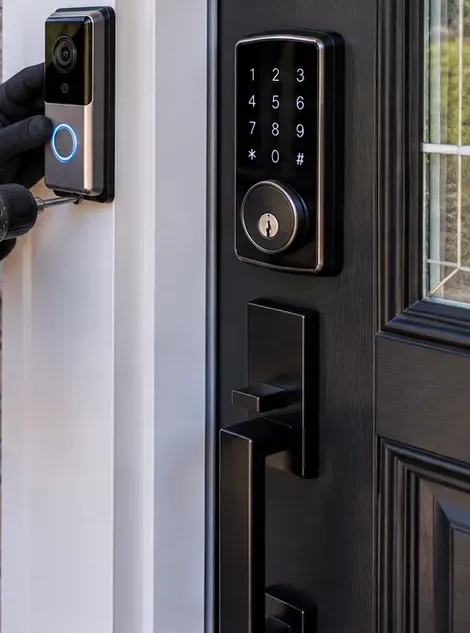
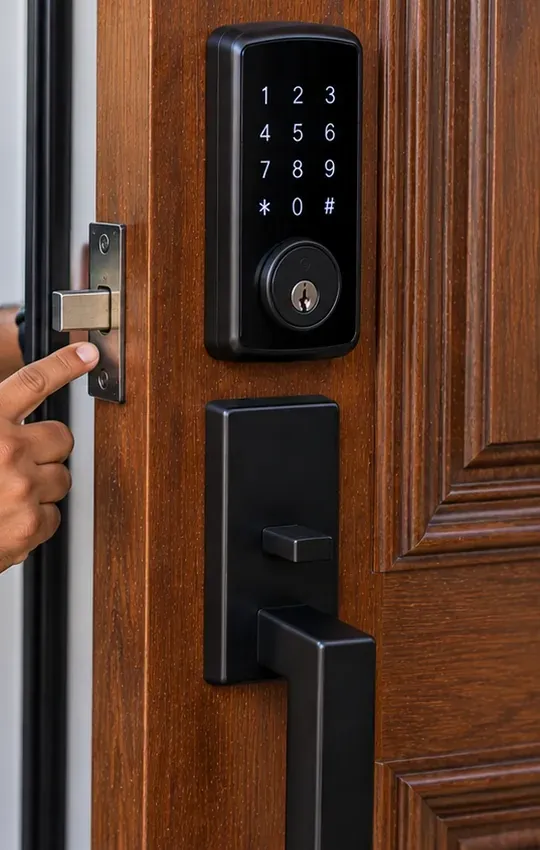
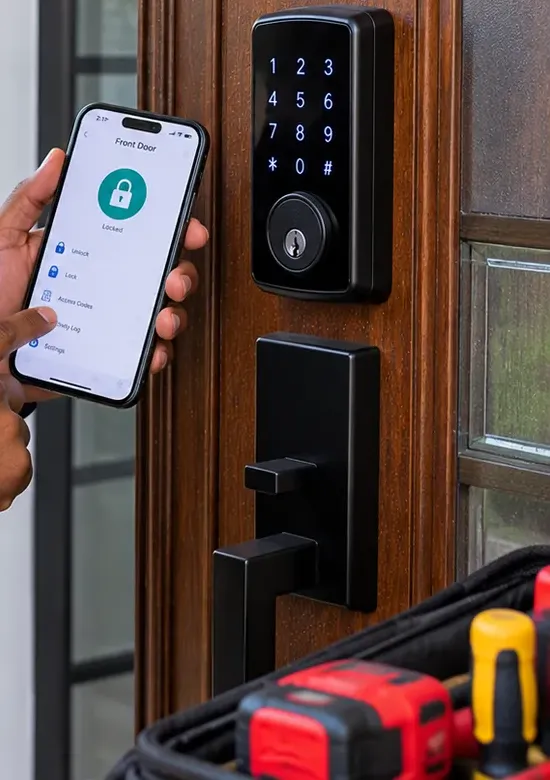
Attached Townhouses · Detached Family Houses · Boating Households · Amboy Road Storefronts
Great Kills is a neighbourhood of owners. More than three households in four own the home they live in, many of them in the attached townhouse rows put up between the 1970s and the 1990s, where the front door sits at garage level and the family lives on the floors above. Add a harbour full of moorings, a beach and a long commute to Manhattan, and the lock on the door ends up serving a busy household calendar: school runs, boat weekends, grandparents, pets, the painter the association sends round. We plan the lock around that calendar, one person and one door at a time, and every door we fit still opens from inside with a single turn.
Reviewed and updated October 17, 2026 · Written by Anwar Timothy, NYS licence #12000287431 · One of our Staten Island smart lock installation neighbourhood guides

A front door that four people, a dog walker and a grandmother all need, a townhouse row where three neighbours want the same upgrade, or a lock that has stopped answering the app? Ring (347) 934-8335 or fill in the 60-second form. A licensed installer reads every request personally and calls back with a first view of what the door needs, so the visit starts with the right parts on the van.

Great Kills is where the South Shore starts. Local geographers usually count it as the northernmost South Shore community, with Richmondtown to the north, Bay Terrace to the east, Eltingville to the west and Great Kills Harbor along its southern edge. It covers about 3.25 square miles in Community District 3, and its main streets are the ones residents use every day: Amboy Road as the long commercial spine, Hylan Boulevard and Arthur Kill Road as the other shopping streets, Giffords Lane leading to the library and the railway station, and Nelson Avenue with the post office at number 1 and the firehouse of Engine 162, Ladder 82 and Battalion 23 at number 256.
The neighbourhood's shape comes from two very different eras. Until the 1950s it was largely rural, with resorts along the shore; one local history describes early twentieth-century bungalows, colonials and craftsman-style houses on streets such as Hillside Terrace, Giffords Lane and Greaves Avenue. Then the Verrazzano–Narrows Bridge opened the island to Brooklyn, and decades of building followed. For the Great Kills South area, NeighborhoodScout's housing profile describes mostly small to medium single-family homes and townhomes, with 33.2 percent of homes classed as rowhouses or other attached homes — a share it says only 2.8 percent of American neighbourhoods exceed — and many homes built between 1970 and 1999. That is the stock we see most: attached, multi-level townhouses in short rows, alongside detached houses on the older streets.
Those townhouses change how a lock gets used. A 1987 Great Kills townhouse on the market in recent years is a fair example of the layout: a one-car garage and an entry foyer on the first level, the kitchen and living room upstairs, the bedrooms on the top floor, a lower level of extra living space and sliding doors from the family room to the yard. The front door is a few steps from the garage door, and the people who use it most are a floor or two away when someone knocks. Next door is a mirror-image house whose front door may be only a few feet from yours. Locks, keypads, alerts and codes all have to make sense in that arrangement.
The people behind the doors matter just as much. The 2020 Census counted 54,699 residents in Great Kills in 19,994 households, and 22.9 percent of occupied homes were rented — so roughly 77 percent are lived in by their owners, which means the person asking for the lock is usually the person who decides about the door. Nearly three households in ten have children, 72.9 percent include at least one family, and 29 percent of residents are aged 45 to 64. Commuters leave early for the Staten Island Railway at Giffords Lane or for the express buses to Manhattan. Others leave early for the water: Great Kills Harbor holds marinas, two yacht clubs that administer the moorings in its centre, and Nichols Marina on the western side of Great Kills Park.
Crime, by city standards, is low. A 2010 study ranked the 122nd and 123rd Precincts as the two safest of 69 by per-capita crime, and Great Kills has been in the 122nd since the precinct maps were redrawn in July 2013. The precinct still recorded 91 burglaries in 2022, and the island has had its warnings: in February 2026 Borough President Vito Fossella and police told residents about a group using crowbars to force windows and steal cars in Todt Hill and Dongan Hills. In Great Kills itself, a May 2012 home invasion on Elverton Avenue began with a knock: a woman in scrubs said she was a home health aide, and when the resident opened the door an accomplice pushed in. No lock stops a door that is opened by hand, which is why we talk about seeing the visitor first as often as we talk about bolts.
So the question in Great Kills is rarely “is this door strong enough?” on its own. It is “who in this household needs this door, when, and what should happen when they stop needing it?” We answer that on paper first, then choose the lock.
Most Great Kills owners who add a smart lock also want to see who is at the door before they open it, which is why we usually pair the lock with a doorbell camera on Staten Island. We plan both on the same visit so the camera, the lock and the app make sense together.

Kids at the step after school and the keypad stays black. Every August the townhouse door swells and the deadbolt groans its way home. Since the new modem arrived, the app shows the lock as unavailable. Call (347) 934-8335; the earliest two-hour window on the schedule is yours, and dead cells, lost pairings and a misaligned strike are normally sorted in an hour or two once someone is standing at the door. Jobs that need only account or code work, no parts, go on the $225 first-hour setup-only rate for Staten Island.

In an attached townhouse the front door is part of a pattern. Each house in the row is often a mirror of the next, so your door may be hinged on the left while your neighbour's is hinged on the right, and the two entrances can sit side by side under a shared roofline or a pair of matching porches. That affects more than looks. It decides which way the lock's interior unit has to face, how close the keypad is to someone else's front step, and whether anything you mount by the door ends up pointing at the neighbour's entrance. When we survey a row we look at the house next door as well as yours, because a keypad that lights up a neighbour's window at midnight, or a camera that records their visitors, is the kind of thing that sours a row quickly.
The garage-level entry also changes the routine. Many owners in these rows rarely use the front door themselves; they drive into the garage and climb the inside stair. The front door becomes the visitors' door, the delivery door and the children's door after school. That is the reverse of what most lock advice assumes, and it means the most important features are often the ones that let you manage the front door from upstairs: knowing whether it is locked, letting a known visitor in, and setting codes that only work at the times they should.
Great Kills Harbor has been a boating harbour for a long time; one neighbourhood history says private marinas and yacht clubs were on its shores by the 1920s. Boating households tend to leave early, come back late and leave the house empty for whole weekends in season. Their doors also face a different set of temptations: club gate codes that get reused at home, marine gear in the garage or on a trailer in the driveway, and keys for the boat, car and house all hanging on the same float. A good lock plan keeps the house's credentials separate from everything else and makes it easy to check the house from the dock.
With roughly three households in ten raising children and many more with older parents nearby, the real list of people at a Great Kills front door is long. Children coming home from P.S. 8, the Gifford School or I.S. 24; a parent who shares custody; grandparents who come for the week at Christmas; a dog walker; the cleaner; a babysitter on Friday nights. Each one should have their own code or credential, with a schedule if that helps, and each should be removable without changing anyone else's. Equally important is what the lock must never do: trap a toddler or a visitor inside, or leave a household member who cannot hear the doorbell unaware that someone is at the door.
None of this needs a complicated system. It needs a plan written down before the box is opened, so that the lock is set up for the house you actually live in rather than the one in the advertisement.

A smart deadbolt or keypad lock on the visitors' door at garage level, handed to suit the house, with the interior unit clear of the foyer wall and alerts that reach the floors above.
Two, three or more households in the same row surveyed and fitted on one booking, each with a separate quote, a separate account and its own codes. Nothing shared unless the neighbours ask for it.
Front, side and rear doors on the older detached houses toward Giffords Lane and Amboy Road, fitted after the door latches cleanly, with a keyed override on every exterior lock.
One code or fingerprint per person, schedules for helpers, temporary codes for visiting relatives, and two administrators, all written on a one-page plan you keep in the kitchen drawer.
Advice and fitting for households with toddlers or a member who wanders, keeping a one-movement exit for everyone else and fire safety intact, with alerts when the door opens.
Lock events, doorbell presses and door-open alerts routed to flashing lights, a smartwatch or a phone vibration for household members who are deaf or hard of hearing.
Bluetooth or keypad padlocks for the backyard shed, the trailer hitch or a gear locker, kept on their own credentials so a lost padlock code never opens the house.
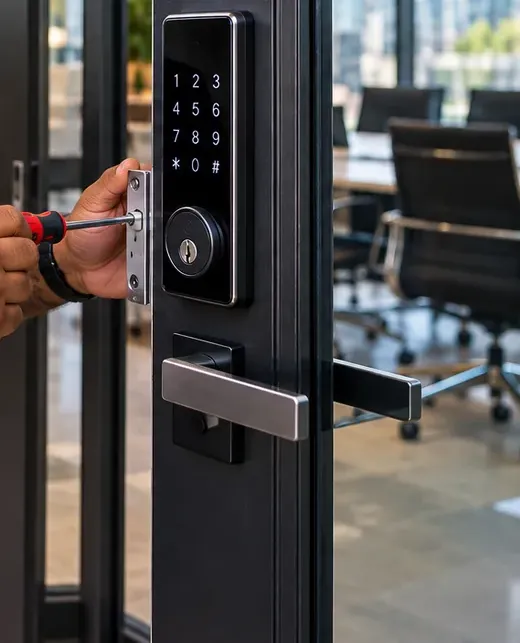
Keypads and electric strikes for small businesses along Amboy Road and Hylan Boulevard, with staff codes, opening-hours schedules and a free exit on the inside.
Getting a lock back into the app after a phone or modem change, easing a bolt that catches, and wiping everything clean for a new owner or after someone in the household moves on.

The rows built from the 1970s to the 1990s: garage and foyer at grade, living floor above, bedrooms on top, often a lower level behind. The front door is usually a pre-hung steel or fibreglass unit; the inside stair from the garage is where the household really comes and goes.
Two townhouses built as reflections of each other, with entrances side by side. Locks are handed to each door, keypads are placed so they do not face the neighbour's step, and any camera is aimed at your own path only.
Capes, high-ranches and split-levels from the decades after the bridge, with a front door, a side door by the driveway and a rear door to the yard. Three doors, three different uses, often three different old keys.
Bungalows, colonials and craftsman houses on streets such as Hillside Terrace, Giffords Lane and Greaves Avenue. Original wood doors are often thicker or older than modern locks expect, and some have been bored more than once.
An owner on one floor and a tenant or relative on the other, sometimes with a shared side door. Each household gets its own credentials, and the shared door's exit is never made to depend on either household's lock.
Garden and townhouse-style condominium units where the association or board sets rules on exterior appearance and on who holds a means of entry. We work within those rules and confirm them before drilling.
Houses on the streets that run down toward the harbour and the marinas, where doors take wind and spray. Finishes and fasteners are chosen for the exposure, and batteries checked more often.
A shop or office on the ground floor with an apartment above, along the neighbourhood's main commercial corridor. The shop's codes and the apartment's codes are kept apart, and the street door's exit stays free.
Households with two or more doors on a townhouse or detached house often go on to add alarm installation on Staten Island so that door contacts, the lock and the alarm keypad all report to one place. We lay out the lock plan so that step needs no rework.

The neighbourhood's commercial and transit corridor, a road whose name has held since at least 1873. Mostly two lanes with parking, lined with small shops, offices and services; owners mainly ask for staff codes on rear doors and a front door that follows opening hours.
The Staten Island Railway stop at Giffords Lane and Brower Court, with a city park-and-ride lot nearby. Businesses here see commuter peaks early and late, so schedules and a quick lock-up at closing matter.
One of Great Kills' other major commercial streets, with stand-alone stores and small strip centres where the tenant controls the back door and the landlord's lease decides what can be cut into the storefront.
The third commercial street named for the neighbourhood, with service businesses and offices that often have one customer door and one staff door to manage.
Offices, workshops and gear rooms near the harbour, where staff come and go through the season. Keypads and padlocks with per-person codes suit staff who change from one summer to the next. Club and marina gates belong to their operators.
Lower-level rooms in townhouses used for a small practice or a studio with clients at the door. A keypad with appointment-only codes keeps the family's floors separate from the business.

These are the questions Great Kills owners actually put to us, grouped by where they come from — the townhouse rows, the boating households, the family house — and answered the way we would answer them standing at the door.
Yes, and it is one of the more efficient ways to do it. We survey each house in turn on the same day, because mirror-image doors are rarely identical in practice: one may have been replaced, one may have a storm door, one may have a warped jamb. Each household gets its own written quote and pays for its own door, so nobody is subsidising a neighbour's extra work. On installation day we work through the row in one visit where the parts allow.
What we do not do is put the houses on one shared account. Each household creates its own app account, with two of its own administrators, and its own codes. If neighbours want to exchange emergency codes, that is their choice, and we would suggest a temporary code each side can delete rather than permanent access. We also note each door's handing, the lock model and the battery type on a sheet for each house, which makes later service quicker for everyone.
A whole-row booking also helps with appearance. If the row looks better with matching finishes, we can supply the same model in the same finish to each house, while still keeping the accounts completely separate.
Yes, it should come off. Painters working around a smart lock tend to tape over the keypad, paint up to the edge of the escutcheon or get paint into the bolt opening, and the inside unit's cable can be damaged if someone tries to loosen it without knowing how it connects. Paint built up on the door edge or the strike also makes a motorised bolt work harder, which shortens battery life and can cause jam alerts.
Before the painters arrive, either take the lock off yourself following the manufacturer's instructions or book a short visit for us to remove it, bag the parts and label the screws. Leave the deadbolt hole and latch bore clean and masked. Once the paint has cured, the lock goes back on, the bolt and strike are checked for alignment, and the codes are tested. Most locks keep their codes in memory without batteries; a few need re-enrolling, and we will tell you which yours is.
If your association is organising the painting, it is worth asking whether it can schedule the doors in a block so that one visit removes and refits the locks for several houses at once.
It can. Exterior smart locks are built to cope with rain, but a pressure washer drives water at a force and angle no weather does, and it can push water past the keypad gasket, into the key cylinder or behind the outside escutcheon. The result may not show at once; corrosion on the contacts or a keypad that fails a few weeks later is more typical.
Keep the nozzle well away from the door hardware and use a low-pressure rinse around the door itself. Cover the keypad with a plastic bag and painter's tape while the rest of the front is washed, and remove it afterwards so trapped moisture can dry. If the door surround must be cleaned close up, use a cloth and a bucket. The same goes for anyone you hire to do the job: tell them the lock is electronic.
If water does get in and the keypad misbehaves, take the batteries out, let the lock dry for a day and try again before assuming it has failed. If it still does not respond, call us before you order a replacement.
We advise against it. A club gate code is, by its nature, known to many people: other members, staff, and anyone who has watched it being entered at the gate. It is usually changed only when the club decides to, and you have no say over who learns it. Using the same digits at home turns a widely shared number into the key to your house.
The same principle applies to any code you use elsewhere: the garage-door keypad, an alarm panel, a gym locker or a bank card PIN. Give the front door its own code, at least six digits long, and do not use a date or a sequence someone could guess. Most locks let each household member have a different code, which is better still, because the entry history then shows who came in.
We also never install, change or programme a club or marina gate on a member's request. Those systems belong to the club or the operator, and any change goes through them.
Smart padlocks, opened by a phone over Bluetooth or by a code on the body, work well on sheds, gear lockers and storage boxes, and some are made for outdoor use. A padlock on a trailer hitch takes more punishment from road spray and salt, and is a better job for a heavy, purpose-made hitch lock; we will tell you where the smart version makes sense and where a plain, solid lock is better.
Keeping the padlock in the same app as the house is convenient, but keep its credentials separate. Do not give the shed or the trailer the same code as the front door, and if a friend or a mechanic needs the shed for a weekend, give them a padlock-only code or a temporary phone key that cannot open the house.
Bear in mind that a padlock is only as strong as the hasp and the shed door it is fixed to. If a shed hasp is held on with short wood screws, the padlock is the strongest part of a weak arrangement, and we will suggest carriage bolts through the door.
Start by deciding together whether the other parent needs to come inside at all. In many families the handover happens at the door, and the other parent needs no code. If they do need entry — to collect a child from a nap, or to wait inside on cold days — give them their own code, not a shared family one, and set it to work only on their days and hours. Most locks support recurring schedules, so a Wednesday-and-alternate-weekends pattern can be built in once.
Their code should not come with administrator rights, and they should not be the second administrator on the account. Keep the entry history in mind as well: it records when each code is used, which can be helpful but which both parents should know about in advance. If a court order or a written agreement deals with access to the home, follow it; a lock setting is not a substitute for that agreement.
Children's own codes should be separate from either parent's. If the arrangement changes, the other parent's code can be suspended or deleted from the app in seconds without anyone else's code changing.
This is one of the hardest balances at any front door, because the feature that lets a two-year-old out is the same one that lets everyone else out quickly in a fire. The city's building code expects exit doors to open from the inside without a key or special knowledge, and we will not fit a lock that needs a code, key or app to leave. So the answer is not to lock people in.
What works is a combination of measures that slow a small child but not an adult. A door-open alert or chime that sounds through the house the moment the door opens tells you at once; a door contact paired with the lock's app can do the same on your phone. A childproof cover over the thumb turn, or a secondary latch fitted high up out of a child's reach, adds a step that an adult can undo with one hand. Auto-lock also helps: if the door shuts behind a child, it relocks, and the history tells you exactly when it opened.
Talk to your paediatrician or a child-safety specialist about your particular child, and remove any high latch once the need has passed. Whatever you add, every adult in the house should be able to open the door in the dark in one or two movements.
A lock and a doorbell camera can both send events to places other than a ringing speaker. Most apps send notifications to a phone or a smartwatch, which vibrate, and a smartwatch on the wrist is often the most reliable signal in the house. Many smart-home systems can also flash a lamp or a coloured light when the doorbell is pressed, when the door unlocks or when it is left open, and a light in each main room means the signal is seen wherever the person is.
When we plan these, we check which events matter: a visitor at the door, a family member arriving, the door left unlocked at night, a wrong code entered repeatedly. Too many alerts and people stop noticing them; we set up the few that count. A video doorbell lets the person see who is there before deciding whether to open, which matters to everyone in a neighbourhood where a 2012 home invasion began with a knock and a false story.
If a household member uses a dedicated alerting system already, tell us at the walkthrough. Some can take a signal from a doorbell or smart-home hub directly, and we will check compatibility before recommending a lock.
Usually, yes, as long as the deadbolt is thrown. On most front doors the lever or handleset works only the latch, while the deadbolt is separate. A dog that pulls the lever retracts the latch, but if the deadbolt is out, the door stays shut. Setting auto-lock so the bolt throws a short time after the door closes means the deadbolt is out far more often than when people had to remember to turn a key.
There are two catches. Some handlesets and mortise locks have the deadbolt and latch linked, so pulling the inside lever retracts both — a safety feature for people that also lets a clever dog out. We check which type your door has. And a dog that learns to paw at the thumb turn can sometimes turn it, so we look at the shape of the inside unit as well.
Where a dog regularly tries the door, a round knob or a lever turned upward on an inside door can help, but on the main exit door we keep a hardware arrangement that every person in the house can open at once.
Low crime is real here. A 2010 study ranked the 122nd and 123rd Precincts the two safest of 69 on per-capita crime, and crime across all categories in the 122nd fell 88 percent between 1990 and 2022. But the same precinct still recorded 91 burglaries in 2022, and the island-wide warnings in February 2026 show that patterns move from one neighbourhood to the next.
For most Great Kills households, though, the case for a smart lock is not mainly about burglars. It is about keys: the copies given to babysitters and relatives over the years that nobody can account for, the teenager who loses one every school year, the dog walker who moved away. A code can be deleted in seconds; a key can only be replaced by changing the lock. Auto-lock deals with the door left unlocked when the family rushes out for the express bus. The entry history settles arguments about who came home when.
If none of that applies — one or two people, keys always accounted for, no visitors who need to get in — a good mechanical deadbolt with a reinforced strike may be all you need, and we will say so. The lock should solve a problem you actually have.
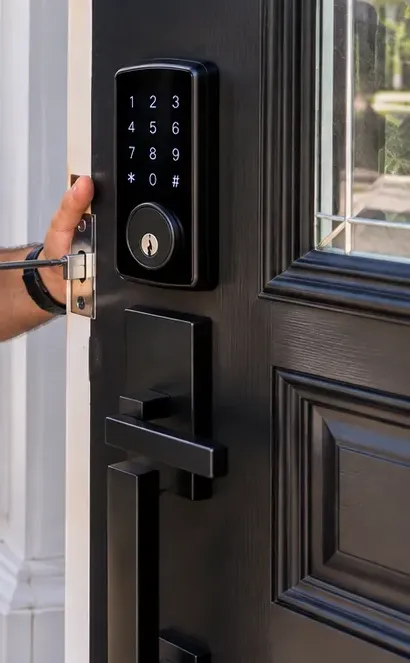
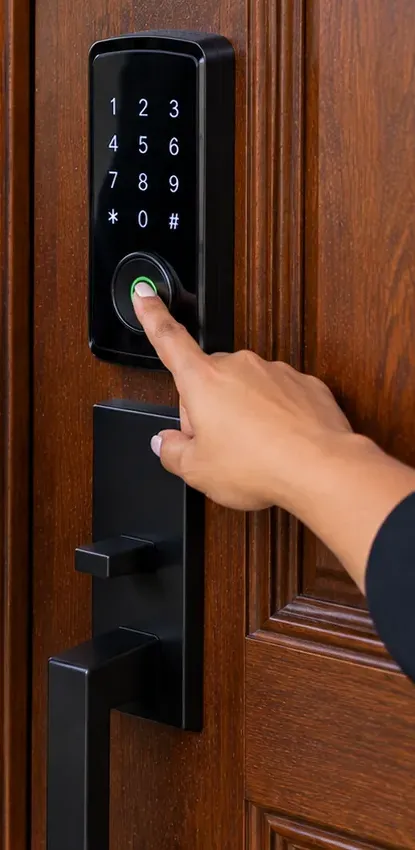
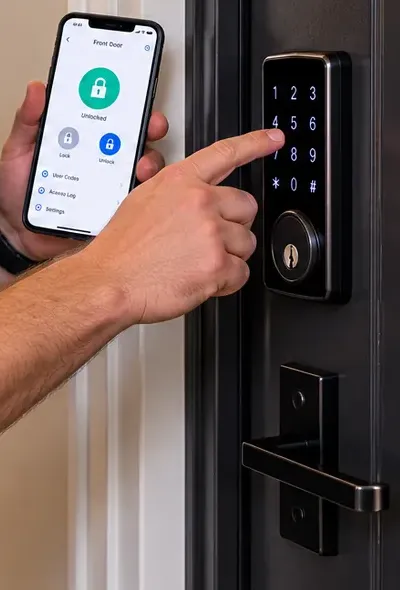
The most common choice for a townhouse or detached front door: a keypad outside, a thumb turn inside, auto-lock, individual codes and a key cylinder for emergencies. Battery powered, so it keeps working in a power cut.
A sensor on the outside escutcheon for household members who forget codes, with a keypad as backup. Children and older relatives often find a fingerprint easier than six digits.
Fit over an existing single-cylinder deadbolt on the inside and leave the outside unchanged. Useful where an association controls the look of the front door, since nothing outside changes.
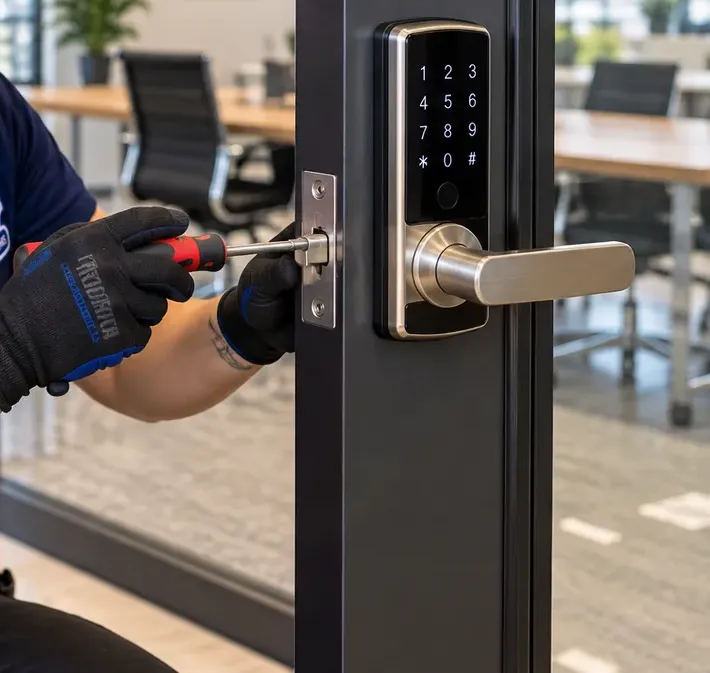
A lever with a built-in keypad for a door from the garage, a side door, a home office or a business back door where a deadbolt is awkward.
For sheds, gear lockers and storage boxes. Separate codes and temporary phone keys for anyone who needs the shed but not the house.
Not a lock, but the part that lets you see who is at the door before you open it or unlock it remotely. Planned with the lock so both live in apps that work together.
A magnet and switch on the frame that report open or closed, so a door left ajar or opened by a small child triggers an alert on the phone or a chime in the house.
For locks that do not connect on their own. In a multi-level townhouse, placed on the floor that gives the door a reliable signal, not wherever the router happens to be.
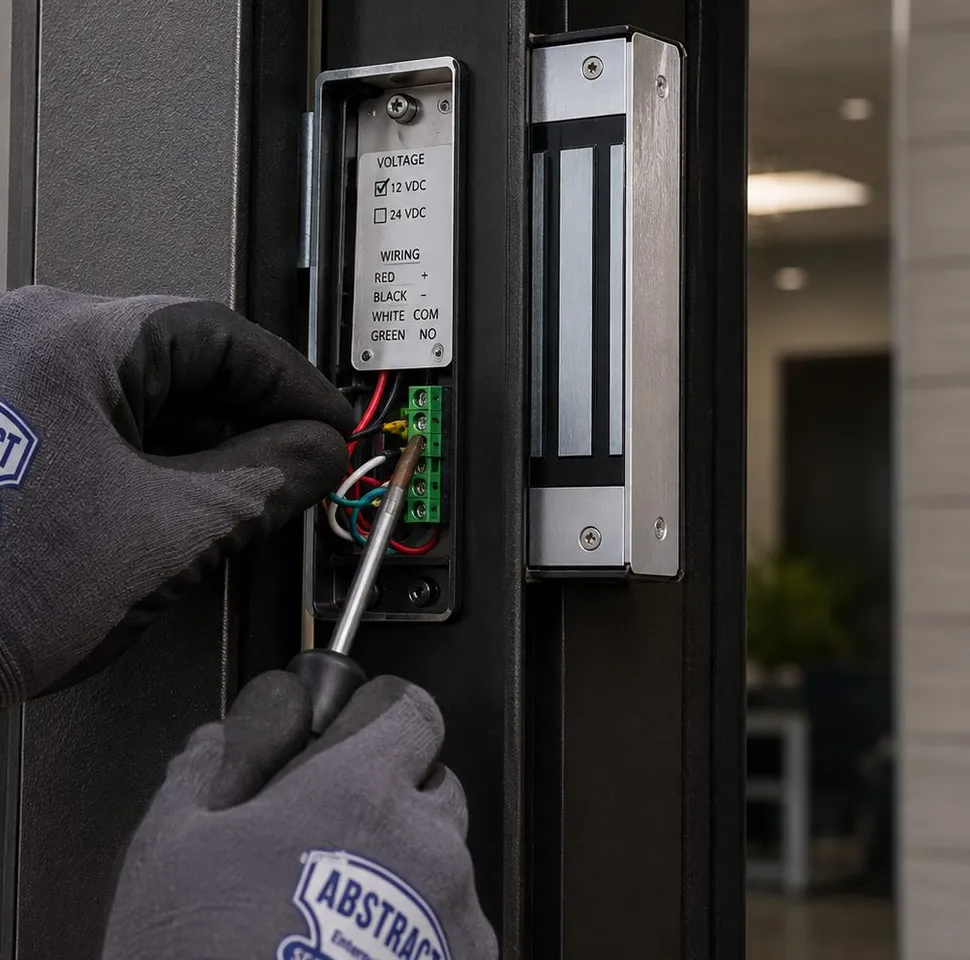
For shop and office doors on Amboy Road and Hylan Boulevard: a strike in the frame, a keypad or fob reader on the wall, a power supply and a free exit inside.
| Route | What you get | Where it falls short in Great Kills |
|---|---|---|
| Buy a lock online and fit it yourself | Lowest outlay; fine on a standard, well-aligned door with one or two users | Nobody checks the strike screws, the handing on a mirror-image door, foyer clearance, or whether the inside exit still works in one movement; code plans are often left as one shared code |
| A lock added to a national alarm or camera plan (the ADT, Ring or SimpliSafe kind) | The lock appears in the same app as the alarm or cameras; convenient if you already use that system | The brand follows the plan rather than your door; installation scope varies; children's schedules, padlocks and household alerts are rarely set up in detail |
| AESS walkthrough and installation | Each door checked and handed correctly, the lock chosen for the door, a written code plan with schedules, two administrators, alerts set for the people who need them | Costs more than doing it yourself; worth it when the household, the door or the row is not simple |

We could not capture Google's AI Overview wording while preparing this page, so below are the claims it typically draws on, as published by cost guides, shops and reviewers. Each one is right for some door in America. Here is how they look from a townhouse foyer or a family hallway in Great Kills.
The number most often repeated online is $250 to $400, average $300, from Fixr's national guide (January 2025 update). It is based on one Wi-Fi lock plus an accessory going onto an ordinary door, and for that job across the whole country it is fair enough.
The figure does not include what makes a Great Kills job take longer: a strike held by short screws in a townhouse jamb, a mirror-image door that needs a differently handed lever, a code plan for five people and a dog walker, or a doorbell and a door contact planned alongside the lock. Nor is it an AESS price.
We quote house locks as one flat figure after the free walkthrough, with the door work listed separately, and we publish our island-wide figures for commercial keypad and strike work in the pricing section below. Where we mention the national figure, we label it as national and third-party.
Retail listings tend to promise a fit for “most standard doors”. For a modern pre-hung door bored for a standard deadbolt, that is usually right, and many townhouse doors fall into that category.
The exceptions are common here, though. The older houses on streets such as Hillside Terrace and Greaves Avenue can have thicker or thinner doors, odd backsets and old bores. Some keypad levers are handed and will not simply flip for the mirror-image house next door. Some townhouse foyers are too tight for a bulky inside unit.
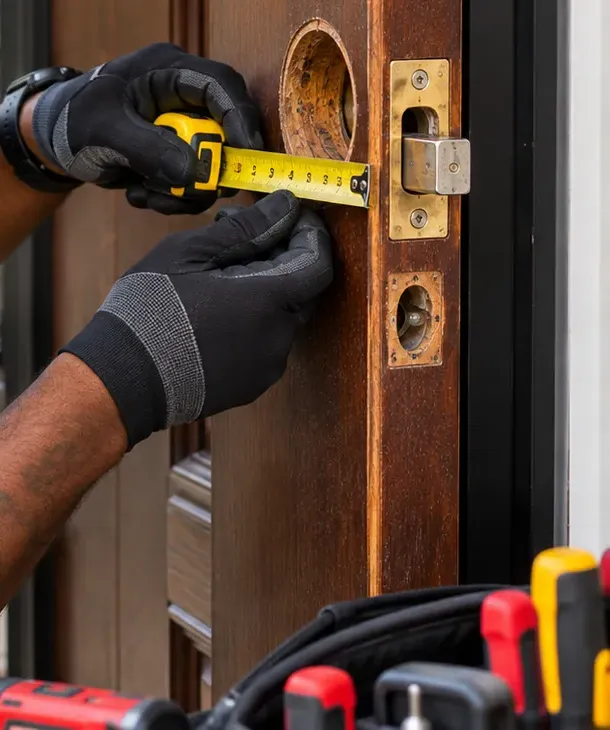
So we measure every door: thickness, backset, bore size, handing and the clear space inside. Only then do we recommend a model, and if a lock you already own will not fit properly, we tell you before drilling rather than after.
Smart-lock marketing leans on the end of lost keys. Codes, fingerprints and phones do make lockouts rarer, because there is nothing to leave on the kitchen counter.
But lockouts still happen, just for different reasons: batteries ignored after weeks of low-battery warnings, a phone that is the only credential and has gone flat, an app account whose only administrator moved out or forgot the password, a keypad damaged by water from a hose or a pressure washer.
That is why every exterior lock we fit has a mechanical key kept somewhere sensible, why we set up two administrators, and why each household member has at least one way in that does not depend on a phone. The lock reduces lockouts; planning removes most of the rest.
Quick-start guides often show a single code being set at the door. For a person who lives alone, one code is fine.
For a Great Kills family it throws away most of what a smart lock is good at. With one shared code, the history cannot tell you which child came home, a babysitter who leaves cannot be removed without changing everyone's code, and a code that has spread to friends and neighbours cannot be traced.
We set one credential per person, add schedules where they help, and give visitors temporary codes. It takes a little longer at installation, and it is the reason the lock is still useful two years later.
Some locks offer an auto-unlock feature that uses the phone's location to unlock the door as you approach. Lock makers promote it as a hands-free convenience for arriving with full arms, and on a detached house with a long driveway it can work well.
In a townhouse row it needs more care. The houses are close together, and a phone that thinks it has arrived home may unlock your door while you are standing at a neighbour's front step, or while you are unloading the car in the shared parking area with your back to the house.
We show owners how the feature behaves on their own door, suggest a tighter trigger where the app allows, and leave it switched off for anyone who would rather unlock with a deliberate tap or code. Convenience is worth having only if the door stays shut when you are not at it.
Opinion pieces regularly warn that connected locks can be hacked. Some older models had genuine flaws, and it would be wrong to say a connected device has no risk.
In practice the weak points we see are human rather than technical: a code reused from a club gate or a bank card, a shared administrator password, old codes never deleted, a phone with no screen lock that holds the house key. These are far easier to exploit than the radio protocol.
We use reputable brands that issue firmware updates, turn on automatic updates, set unique codes and two administrators with strong passwords, and show you how to remove codes. A plain mechanical lock can be picked or bumped too; the question is which risks you can manage.
Product pages, naturally, are about the product. The incidents that reach the news on Staten Island are mostly about something else: in February 2026, officials warned of crowbars used to force windows and steal cars in Todt Hill and Dongan Hills; in May 2012, a Great Kills resident on Elverton Avenue opened his door to a stranger with a false story.
Against a window, the door lock does nothing. Against a door opened by hand, the lock does nothing either. Against a pry bar, the strike plate and the screws matter more than the electronics. What a smart lock does very well is control and record who has a way in.
So every Great Kills quote we write covers the door and frame alongside the lock, and we suggest a video doorbell or viewer wherever someone in the house answers the door to strangers. We will not pretend a lock covers what it does not.

Front door, garage door, side door, shed: list them, and list the people. The free visit covers the hardware check, the code plan and a written price in one go.
A townhouse in a row, a detached family house or a shop on Amboy Road — describe the doors and the people who use them, and we call back the same business day.
We'll call you back the same business day. If it's urgent, call us now at (347) 934-8335.
Six steps, whether it is one townhouse front door or every door on a detached house and a shed out back.
On the phone we ask about the house — townhouse, detached house, two-family or shop — every door you use, and every person who needs a way in.
We measure thickness, backset and handing, check strike screws, latch alignment and foyer clearance, test the signal at each door and note anything next door that matters.
Together we fill in the one-page plan of people, credentials and schedules, and you get one flat written quote listing the lock and door work for each door.
Strike screws upgraded into the framing, latch and bolt aligned, old bores filled and paint cleared from the edge, so each door closes and latches before a lock goes on.
Locks fitted and handed to each door, the bridge or border router placed where the door gets a steady signal, and the inside exit checked for one movement.
Each person's code, fingerprint or phone key enrolled and tested at the door, schedules and alerts set, two administrators confirmed, and the written record left with you.
A natural inlet off Raritan Bay, about six miles southwest of the Verrazzano Narrows. A harbour guide lists six marinas inside it, two of them yacht clubs that administer the moorings in its centre. Boating households on the streets around it are some of our earliest-rising customers.
About 523 acres of Gateway National Recreation Area, built up mostly with fill between 1944 and 1948 and run by the National Park Service since 1972. Radium contamination was found there in 2005 and about 282 acres are closed and fenced, but the beach, Buffalo Road path, fishing areas and Nichols Marina stay open.
The Staten Island Railway stop at Giffords Lane and Brower Court, opened on April 23, 1860 and rebuilt by 1933 to remove grade crossings, with a city park-and-ride lot nearby. Commuters leaving here early are the reason auto-lock matters.
The NYPL branch at 56 Giffords Lane, first opened in 1927, replaced by a new building in 1954 and renovated in 2005. Giffords Lane links the library, the station and Amboy Road.
Home to the Great Kills post office at 1 Nelson Avenue and the firehouse of Engine 162, Ladder 82 and Battalion 23 at 256 Nelson Avenue — worth remembering when you plan how emergency crews would get through your door.
On the western side of Great Kills Park, with a boat launch ramp into the harbour. Sandy damaged its bulkhead, pilings and docks in 2012, and the Park Service set out a plan in April 2013 to rebuild it for the following season.
Same crew, same price list for Eltingville, Bay Terrace, Richmondtown, Arden Heights and Annadale, and for New Dorp, with the rest of the island covered from our Staten Island smart lock page.
Great Kills uses the same rate card as the rest of Staten Island: AESS takes its Brooklyn base figures and multiplies them by 1.10. There is no neighbourhood surcharge. Smart locks on house doors carry no published figure, because the time goes into strikes, jambs, handing and code plans that differ on every house; those are written up as one flat price after we have seen the doors. Where a published figure exists, the table shows it already adjusted.
| Item | Staten Island price | What it covers |
|---|---|---|
| Smart locks on house, townhouse or condo doors | Quoted flat at free walkthrough | Door adjustment, strike and frame work, handing, fitting, connection and the household code plan for each door on the quote |
| Single-door keypad or fob reader with electric strike | $1,650–$2,750 installed | Shop or office entrance on Amboy Road or Hylan Boulevard; based on the AESS access-control figure of $1,500–$2,500 (Brooklyn base) ×1.10 |
| New electric strike on an entry door | $275–$495 | Strike supplied and fitted as part of an entry upgrade; AESS figure $250–$450 at base, ×1.10 |
| Failed electric strike repair | $325–$534 | A strike that buzzes but does not release; AESS figure $295–$485 at base, ×1.10, rounded half-up |
| Setup-only visit (app, accounts, codes, schedules, alerts; no hardware) | $225 first hour, then 30-minute blocks | Staten Island setup-only rate |
| Service and callback rate | $195/hr, 3-hour minimum ($585) | Service calls after the installation; not charged on the initial installation |
If you have seen a lower number online, it is probably the national one: Fixr's guide, last updated in January 2025, gives $250 to $400 for one smart lock fitted, $300 on average. That is a third-party figure across the whole country, not something AESS charges or publishes.
Full terms — including 50% deposit, one-year parts-only warranty on AESS-supplied products, and the late-fee schedule — are set out in the service agreement.
Quoted flat at walkthrough
One keypad or fingerprint smart deadbolt on the door that matters most, handed and fitted to the door, strike screws upgraded, auto-lock set, one credential per household member and a written code plan.
Quoted flat at walkthrough
Every door the family uses, on one app with two administrators: front, side or rear and the shed. Schedules for helpers, temporary codes for visitors, and the alerts your household needs, including chimes or visual signals.
$1,650–$2,750
A shop or office door on Amboy Road or Hylan Boulevard made keyless: strike in the frame, reader on the wall, backed-up power, a free exit inside, then staff codes and opening hours programmed. Island-wide pricing.
A lock still in its box from a holiday sale is welcome. Show it to us at the walkthrough; if its handing, door-thickness range and backset suit your door, we fit it for a flat labour price agreed there and then, with the strike given long screws just as we would for our own stock. If it will not suit the door, we say so before anything is drilled. Pure programming — codes, schedules, a bridge, alerts — with no hardware is billed at the $225 first-hour setup-only rate.
A photo from outside, one from inside and one of the door edge with the bolt out is usually enough for us to tell you what will fit. Add the foyer if it is narrow, and the house next door if you are in a row.
The attached rows that went up across Great Kills from the 1970s into the 1990s were built for families who drove. The garage is the front of the house, the entry foyer is squeezed in beside it, and the stairs take you straight up to the kitchen. Thirty or forty years on, those houses are being bought by second and third owners who want the same things from a front door as anyone else, but who have to fit them into a layout designed around the car.
In most rows there are three ways in: the front door at garage level, the overhead garage door itself and the inside door from the garage into the house, plus a rear slider or door from the lower level to the yard. The front door is usually the right first choice, even though the family rarely uses it, because it is the door that visitors, children, helpers and deliveries use. It is also the one where losing track of keys matters most. The inside door from the garage comes next for households that leave the overhead door open while they unload or work in the garage.
The rear slider is the awkward one. Sliding patio doors do not take a normal deadbolt, so for most rows we recommend a secondary security bar or pin lock and a contact sensor that reports when the slider opens, rather than an electronic lock. That keeps the yard door secure and visible in the app without pretending it is something it is not.
Townhouse routers are usually on the living floor or in a bedroom, one or two storeys above the front door, with a concrete slab or a garage between them. A lock that connects directly by Wi-Fi may hold on, or may drop out every evening when the house is busy. Locks that use a bridge or a Thread border router need that bridge within a sensible distance of the door. We test the signal at the door during the walkthrough with the household's own network, and if it is weak we place the bridge in the foyer, on the stair or in the garage where the door can reach it.
Screws for a reinforced strike go into the framing around the door, and in an end-of-row or mid-row house that framing is near the party wall. We use screws long enough to reach solid framing but check what is behind the jamb before driving them, so nothing breaks through into the neighbour's foyer. We also think about what the neighbour sees and hears: a keypad's backlight at night, an entry chime that sounds outside, a doorbell camera that records their path. Most can be adjusted, and a two-minute conversation over the fence avoids a lot of trouble.
Some townhouse developments have a homeowners' or condominium association that sets rules about the outside of each house, and some do not. If yours does, check its rules on door hardware, colours and anything mounted on the facade before choosing a model. A retrofit unit that changes only the inside of the door can avoid the question altogether. Where the association is happy with keypads, matching the finish of the row's existing handlesets usually keeps everyone content.
An end-of-row townhouse often has a side wall open to a path or a driveway, and sometimes a side window close to the front door. A mid-row house has neighbours on both sides and only its front and back exposed. That changes where a keypad is visible from, which windows a passer-by could reach through, and where a doorbell camera should point. On an end-of-row house we look at the side as well as the front before deciding where everything goes.
When a house in a row changes hands, the lock should be handed over with it, not with the seller's account still attached. Before closing, the seller removes their codes and transfers or deletes the admin account; after closing, the buyer resets the lock to factory settings, sets up their own account and changes the mechanical key cylinder or has it rekeyed. We can do both halves at the setup-only rate, and leave a short written record for each side.
From spring launch to autumn haul-out, a good share of Great Kills spends its weekends on the water. Some households keep a boat on a mooring administered by one of the two yacht clubs; some use a marina slip; some trailer a small boat down to the ramp at Nichols Marina on the western side of Great Kills Park. All of them leave home early, often before light, and come back hours later with sunburn, wet gear and no free hands. That routine shapes what they need from a door.
The most useful feature for a boating household is often the simplest: auto-lock that throws the bolt a short time after the door closes, and a notification if it does not. When the car is loaded in the dark and the last person out is carrying a cooler, nobody checks the front door. The lock does, and the app confirms it from the dock. We test auto-lock with the door slightly ajar so that the lock reports a failed throw rather than silently showing “locked”.
The return trip is the opposite problem. Fingerprints may not read through wet, salty fingers, and a phone in a dry bag is no help at the door. A keypad code is usually the fastest way in for a returning boater, and we position the keypad so it can be reached without putting gear down on the step. Where the garage is the usual way in, the garage's own keypad and the inside door's lock should work together so the house is not left open while the boat gear is unloaded.
Many boaters keep the boat key, car key and house key together on a floating keychain, which means that a keychain lost overboard, or left in the car at the marina car park, takes the house key with it. Once the house is keyless for daily use, the mechanical override key can come off that ring and live somewhere safer: with a trusted neighbour, or in a key safe whose code you change regularly. Car key fobs are worth keeping well away from the front door inside the house, too; island-wide warnings in early 2026 were about thieves after cars.
Outboard motors, fishing gear, life jackets and tools are expensive, portable and often stored in the garage, a shed or on a trailer in the driveway. They are also the things a casual thief would take. Smart padlocks and keypad padlocks let a household give the shed its own codes, separate from the house, and see when it was opened. We look at the hasp and the shed door as well as the lock, because the cheapest part of the arrangement is usually what fails.
Gates, docks and clubhouse doors at the clubs and marinas belong to their operators, who set their own access rules for members and staff. We will gladly talk to a club or marina about keypads or readers if it asks, but we do not change those doors for individual members. If your club's gate code is the same as your house code, change the house code, not the gate.
At every installation we fill in a short plan with the household and leave a copy behind. It takes ten minutes and saves hours later. Here is what goes on it, so you can start before we arrive.
| Person | Credential | When it works | Notes |
|---|---|---|---|
| Each adult in the house | Own code, fingerprint and phone key; two of them administrators | Always | Administrators can add and remove others; keep their passwords separate |
| Each child old enough to come home alone | Own code or fingerprint | Always, or school days only if you prefer | Arrival alerts to a parent's phone if wanted |
| A parent who shares custody | Own code, no admin rights | Their days and hours only | Agree in advance what the history will show |
| Grandparents and regular relatives | Own code or fingerprint | Always, or for the length of a visit | A fingerprint is often easier than a code |
| Dog walker, cleaner, babysitter | Own code | Their regular days and hours | Removed the day they stop working for you |
| Contractors, painters, a mechanic for the shed | Temporary code | Set dates only | Shed and padlock codes separate from the house |
| Trusted neighbour | Mechanical override key or emergency code | Emergencies | Neighbour keeps it; you know where |
Adding and deleting codes, changing schedules, switching alerts on and off and replacing batteries are all jobs a household can do in the app or at the door, and we show the administrators how before we leave. Call us when the bolt starts to drag or the lock reports jams, when the lock drops off the app and will not come back after a restart, when an administrator account is lost, or when the household changes enough that the whole plan needs rewriting. Those visits are usually short, and most are billed at the setup-only rate.
Look at the plan twice a year — many families tie it to the clocks changing. Delete anyone who no longer needs access, check the batteries, confirm both administrators can still log in, and make sure the override key is where the plan says it is. A lock that is reviewed stays useful; one that is never looked at slowly fills up with codes nobody remembers handing out.
Locks are bought on one day and lived with for years. In Great Kills the year has a rhythm — the boating season, the beach, the school calendar, the holidays — and each part of it asks something slightly different of the front door. Here is what we suggest households keep an eye on, season by season.
Spring is when boats go back in the water and when houses get their outside jobs done. If the association or a contractor is painting front doors, take the lock off first, as described above, and put it back once the paint has cured. If the front of the house or the driveway is being pressure-washed, cover the keypad and keep the spray away from the door. It is also a good moment to look at the strike: winter can shift a door slightly, and a bolt that scrapes in April will jam in August.
Boating households should check the codes on any shed or trailer padlock before the gear goes back out, delete codes given to a mechanic over the winter, and make sure the override key for the house is not still on the boat keychain from last season.
Great Kills Park's lifeguarded beach is open from Memorial Day to Labor Day, and summer brings children in and out of the house all day, often with sand on their hands and feet. Keypads cope with that better than fingerprint sensors, so make sure every child old enough to come home alone has a code as well as a fingerprint. Wipe the keypad with a damp cloth now and then; grit in the gap around the buttons wears them faster.
Humid weeks make wood and some fibreglass doors swell. If the bolt starts to drag or the lock reports a jam, do not keep forcing it: the motor works harder, batteries drain and eventually the lock gives up. A quarter-turn adjustment of the strike usually fixes it, and it is a quick visit if you would rather we did it. Summer is also the season of house guests, so set temporary codes with an end date rather than handing out the family code.
September brings the school year, and with it new routines. Children who have moved up from P.S. 8 or the Gifford School to I.S. 24 may start coming home alone for the first time. Set their codes, decide whether you want an arrival notification, and walk through what they should do if the keypad does not respond: go to the neighbour with the override key, not try the back door. Babysitters and after-school helpers change in the autumn, too, so tidy the code list.
Autumn is also haul-out, when boating gear comes back to the garage or the shed. Check that the shed's padlock and hasp are up to the job before the outboard goes in. When the clocks go back in November, do the twice-yearly review: delete old codes, change batteries if they are low, and confirm both administrators can still log in.
Cold weather shortens battery life, especially on a door that faces open ground or the harbour wind. Replace batteries at the first low-battery warning rather than waiting for the last one, and use the type the manufacturer recommends; cheap batteries tend to fail first in the cold. If a door is exposed to driving rain or snow, check that the keypad's gasket is seated properly after any battery change.
The holidays bring grandparents for a week, cousins for a night and a long list of deliveries. Give visiting relatives their own temporary code or enrol a fingerprint for the length of their stay, and remove it when they leave. If you travel over the holidays, switch off helpers' codes you will not need, leave the override key with a neighbour, and check from your phone that the bolt has thrown after you leave.
Some events do not follow the calendar: a new baby, a grandparent moving in, a separation, a teenager learning to drive, a household member losing their hearing, a new dog. Each of these is a reason to look at the lock plan again. Most changes take minutes in the app; a few, such as visual alerts or a child-safety latch, are worth a short visit. The point of a smart lock is that it can change as the household does, but only if someone remembers to change it.
Most Great Kills households end up wanting the lock to work with something else in the house. These are the Abstract Enterprises services that most often go alongside it.
See who is at the door before you open it or unlock it from upstairs.
Door contacts, slider sensors and chimes that work alongside the lock.
Driveways, yards and sheds where boat gear and bikes are kept.
Lights that flash for a doorbell, scenes that lock the house at night.
Wi-Fi that reaches a garage-level door through two floors.
Readers and controllers for Amboy Road businesses with several doors or staff.
Storefronts, rear doors and parking areas on the commercial streets.
For two-family houses and apartments above shops with a shared street door.
Old buzzers and strikes that release slowly or not at all.
General working practice from our installers — not a story about any particular customer or address.
At a townhouse we stand in the foyer first and open the front door as far as it will go. If the door hits a coat hook, a radiator or the first stair, we know a bulky inside unit may not fit, and we pick a slimmer model before anything is drilled. Then we look at the house next door: which way its door swings, where its step is, where a keypad of ours would shine at night.
On every door we take the strike plate off. Factory screws three-quarters of an inch long into a thin jamb tell us more about the door's real strength than any rating on a box. We swap them for long screws into the framing, checking first what is behind the jamb when the party wall is close.
If the household includes a toddler, a dog that tries the handles or someone who cannot hear the bell, we note it on the plan and set up the chime, cover or light before testing anything else.
Before we leave, each person in the house tries their own code or fingerprint at the door, the two administrators log in on their own phones, and someone who was not part of the setup opens the door from inside in the dark with one hand. If that last test is not easy, the job is not finished.
Some smart-home systems can link a connected smoke alarm to the lock so the door unlocks when the alarm sounds, which can help firefighters or a neighbour get in. It also means the door unlocks on every false alarm from the toaster, so we only set it up when the household understands that trade-off. Either way, the inside thumb turn already lets everyone out with one movement, and that does not depend on any automation.
Most locks take their time from the app or the hub when they connect, so wrong times usually mean the lock has been offline, the time zone in the account is wrong, or the batteries were changed and the clock reset. Open the app beside the door to let it resync, and check the account's time zone. If times drift again, the connection to the bridge or router is the real problem, and we can look at that on a setup-only visit.
That depends on the brand. Many lock apps require account holders to be adults or teenagers above a minimum age set in their terms, so younger children usually get a code or a fingerprint rather than an app login. A code also suits children better: there is no phone to lose or let run flat. We check the terms of the brand you choose and set each child up in the way it allows.
A few models offer a two-step mode that asks for two credentials, but most consumer smart deadbolts accept any one valid credential. Where extra protection at night matters, a schedule that switches off helpers' codes after a set hour, plus an alert for any entry overnight, gives most of the benefit without making the door harder for the family. We will tell you which approach your chosen lock supports.
Yes. A single front door is one of the most common jobs we do in Great Kills, and it gets the same free walkthrough, strike check and code setup as a whole-house job. If you think you may add a second door or a padlock later, mention it, so we can choose a lock family that keeps everything in one app.
Usually, yes. A swing-bar or chain guard on the inside of the door is separate from the deadbolt, and most smart locks fit around it. We check that the inside unit of the new lock does not collide with the guard's arm or its catch, and move the guard a little if needed. Remember that a guard only works when someone is home to set it, and it must be released before anyone can come in with a code.
Many smart locks have a privacy or vacation mode, or a setting that disables the keypad or particular codes for a period, usually from the inside unit or the app. It is useful at night or when the house is full and nobody else needs to come in. We show you where the setting is and how to switch it back, so a helper is not left outside the next morning.
Yes. Each installation ends with a short written sheet for the house: the lock model and finish, its handing, the battery type, where the override key is kept, which two people are administrators and which credentials exist, without the codes themselves. It makes later service quicker and helps if you sell the house or hand the property to a relative.
Every local figure above comes from a source we could open while writing. Where a source we tried could not be reached — neighbourhood forums, search-engine question boxes, review sites — we left the gap rather than fill it.
| Source | What we took from it | Where it is used |
|---|---|---|
| Wikipedia: Great Kills, Staten Island | Boundaries, 3.25 sq mi, 2020 Census population and households, 22.9% renter-occupied, 122nd Precinct history and 2022 figures, streets, library, firehouse, schools | Neighbourhood, facts list, landmarks, questions |
| NeighborhoodScout: Great Kills South | 33.2% rowhouses or other attached homes; many homes built 1970–1999; mostly small to medium single-family homes and townhomes | Neighbourhood, townhouse sections |
| A 1987 Great Kills townhouse listing | Typical layout: garage and entry foyer on the first level, kitchen above, bedrooms on top, lower level, sliding doors to the yard | Neighbourhood, townhouse sections |
| Marinas.com: Great Kills Harbor | Six marinas inside the harbour, two of them yacht clubs administering the central moorings; location off Raritan Bay | Neighbourhood, harbour section, landmarks |
| National Park Service: Great Kills Park cleanup | About 523 acres; fill placed 1944–1948; NPS since 1972; radium found 2005; about 282 acres closed; beach and Nichols Marina open | Landmarks, seasonal section |
| National Park Service: Nichols Marina rebuild plan | April 2013 plan after Sandy damaged the bulkhead, pilings and docks | Landmarks |
| Wikipedia: Great Kills station | Giffords Lane and Brower Court; opened April 23, 1860; rebuilt by 1933; park-and-ride lot | Commercial cards, landmarks |
| Forgotten New York: Amboy Road | Name in use since at least 1873; mostly two lanes with parking | Commercial cards |
| CityNeighborhoods.nyc: Great Kills | Early-1900s bungalows, colonials and craftsman houses on Hillside Terrace, Giffords Lane and Greaves Avenue; marinas and yacht clubs by the 1920s | Neighbourhood, architecture, harbour section |
| Staten Island Borough President, February 12, 2026 | Warning about crowbars used to force windows and steal cars in Todt Hill and Dongan Hills; advice on car keys | Neighbourhood, AI reality check, harbour section |
| NBC New York, May 2012 | Elverton Avenue home invasion that began when a resident opened the door to a woman claiming to be a home health aide | Neighbourhood, questions, AI reality check |
| 2022 NYC Building Code, Chapter 10 | Section 1010.1.9: egress doors readily openable from the egress side without a key, special knowledge or effort | Commercial compliance, toddler question |
| Fixr: smart lock installation cost | National third-party range $250–$400, average $300 (January 2025) | Pricing, AI reality check |
| AESS published rate card (Staten Island page) | $1,650–$2,750 keypad or reader with strike; $275–$495 strike; $325–$534 strike repair; $225 setup-only first hour; $195/hr callback, 3-hour minimum | Pricing, packages, repair sections |
| Reddit, search question boxes, Answer the Public, AI Overview, Bing and DuckDuckGo, Yelp reviews | Not accessible when this page was researched; nothing from them is quoted or summarised here | — |
Return to the borough guide, smart lock installation on Staten Island, for every other part of the island from St. George to Tottenville.
The citywide Abstract Enterprises smart lock installation in NYC page covers tenant rules, co-op boards and multi-unit entrances.
Brooklyn smart lock installation · Manhattan · Queens · the Bronx
Astoria, Queens · Bay Ridge, Brooklyn · Bayside, Queens · Bedford-Stuyvesant, Brooklyn · Brooklyn Heights, Brooklyn · Chelsea, Manhattan · Flushing, Queens · Forest Hills, Queens · Greenpoint, Brooklyn · Harlem, Manhattan · Jackson Heights, Queens · Kingsbridge, Bronx · Long Island City, Queens · Morris Park, Bronx · Mott Haven, Bronx · New Dorp, Staten Island · Park Slope, Brooklyn · Pelham Bay, Bronx · Riverdale, Bronx · St. George, Staten Island · Throgs Neck, Bronx · Todt Hill, Staten Island · Tottenville, Staten Island · Tribeca, Manhattan · Upper East Side, Manhattan · Upper West Side, Manhattan · Washington Heights, Manhattan · West Brighton, Staten Island · Williamsburg, Brooklyn
Long Island smart lock installation — with pages for Nassau County and Suffolk County.
Hudson Valley smart lock installation — Westchester, Rockland, Orange, Putnam, Dutchess and Ulster counties.
For cameras, alarms, cabling and everything else we install, start at the Abstract Enterprises Security Systems home page; the people behind the work are on our about page.
Back from the harbour with a keypad that will not wake, a child home from school with a code that suddenly fails, a townhouse door whose bolt will not throw after the painters left — call (347) 934-8335 and tell us which. You get the first free two-hour arrival slot, and flat batteries, lost pairings, account problems and a bolt catching on its strike are usually fixed within an hour or two of our arrival. Meanwhile, the mechanical override key held by your neighbour is the way in.
Abstract Enterprises Security Systems · 1282 Troy Ave, Brooklyn, NY 11203 · (347) 934-8335 · WhatsApp (718) 679-0359 via wa.me
NYS Low-Voltage Licence #12000287431 · 100% Licensed & Insured · Same-Day Estimates · Rated 4.7★ from 201 Google Reviews
Locks you supply carry their manufacturer's warranty; our warranty page explains how AESS-supplied products are covered.
This page is general information, not legal or child-safety advice; for a specific door, household or court arrangement, check with the right professional. Reviewed and updated October 17, 2026. Changelog: Great Kills smart lock installation page first published.