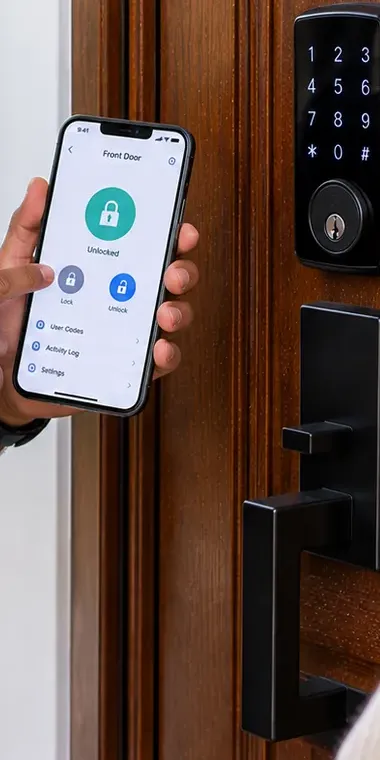
Loft Law Unit Doors · Factory & Warehouse Doors · South Side Walk-Ups · Shabbat-Aware Door Plans · Bar, Venue & Shop Entrances · Waterfront Tower Units
Very few doors in Williamsburg are still doing the job they were made for. A steel door that once opened onto a cooperage floor is now the front door of a Loft Law apartment. A tenement street door from the years after the bridge opened is shared by tenants who change every lease cycle. A Bedford Avenue shopfront becomes a bar entrance at night, and in South Williamsburg a family's door has to work from Friday evening to Saturday night without anyone touching a screen. We fit smart locks and keyless entry to the door as it is used today — sized to its real weight and preparation, legal for the way out, and set up so the right people hold the right credentials.
Reviewed and updated October 17, 2026 · Written by Anwar Timothy, NYS licence #12000287431 · Crews leave from our Brooklyn office at 1282 Troy Ave

A loft door with a padlock hasp and no proper lock, a South Side street door that stopped catching, a shop on Bedford that wants staff codes instead of a key ring? Call the Brooklyn line on (347) 934-8335 or send the short form. The installer who reads it will ask what the door is made of, how heavy it is and who needs to get through it, and will say plainly whether a battery smart deadbolt, a wired keypad with a strike, or plain carpentry comes first.
Ask what a Williamsburg door was originally for and the answer is usually something other than "an apartment." The neighbourhood's first great building boom came after the Williamsburg Bridge opened in December 1903, when families leaving the crowded Lower East Side filled new walk-ups so quickly that Williamsburg became the most densely populated neighbourhood in the city. Its second came from industry along the river — the Domino sugar refinery ran from 1856 until 2004, cooperages and textile mills lined the waterfront, and the Gretsch musical-instrument factory at 60 Broadway went up in 1916. Its third began in the 1970s, when artists moved into empty factory floors for the space and the low rent, and by the mid-1990s an estimated 3,000 artists lived here. Its fourth was the May 2005 rezoning of roughly 175 blocks of the Greenpoint and Williamsburg waterfront for high-density housing.
Each wave left doors behind, and almost none of them was replaced when the use changed. The Loft Law — Article 7-C of the state Multiple Dwelling Law, passed in 1982 — created a legal class of "interim multiple dwellings" for former commercial and manufacturing buildings where three or more families had made homes, and the city's Loft Board still oversees their legalisation. Units inside the city's industrial business zones are generally left out of it, but the Greenpoint and Williamsburg zones are named exceptions. In practice that means apartments whose entry door is a steel factory door hung for forklifts and fire separation, sometimes with a surface bolt and a padlock hasp where a deadbolt should be. The Gretsch building alone became 130 apartments in a 2003–2005 conversion; the Wythe Hotel occupies a cooperage built in 1901; the Austin, Nichols warehouse on Kent Avenue was turned into apartments in the 2010s.
South of Grand Street, which divides the North Side from the South Side, the stock changes again. Los Sures — the largely Puerto Rican and Dominican South Side between Grand Street and the bridge — is tenement and walk-up country, with Graham Avenue's "Avenue of Puerto Rico" and the shops of Havemeyer Street at its heart. Southside United HDFC, known as Los Sures, was founded there in 1972 and in 1975 became the first community-based organisation in Brooklyn to take on management of city-owned buildings. Further south, below Division Avenue and centred on Lee and Bedford Avenues, is South Williamsburg's Hasidic community, largely Satmar, which settled from the late 1940s and rebuilt abandoned housing in the 1950s and 1960s. A 2023 UJA-Federation study counted about 21,000 Jewish households across Williamsburg, with roughly 36,000 adults and 32,000 children. Those are big households, in multi-family buildings, where the door has to serve a family's religious week as well as its working week.
Then there are the people who come and go. Williamsburg is one of Brooklyn's busiest nightlife districts — the North Side–South Side area logged 3,746 noise complaints between March 1 and June 14, 2021, more than any other neighbourhood area in the borough, according to a RentHop analysis of 311 data — and its venues, bars and shops keep hours that a residential lock was never designed around. The Census Bureau's 2024 survey counts about 218,800 residents in Brooklyn Community District 1, which covers Williamsburg and Greenpoint together, and NYU's Furman Center puts the district's homeownership rate at 16.6 percent in 2024. Most doors here, in other words, have a renter, a roommate, an employee or a delivery rider on one side and an absent owner on the other.
Package theft shows how the pieces fit together. In late 2023, police said, a woman on an e-bike walked into a Bedford Avenue building through its main entrance and took parcels from the mail room, then hit a Kent Avenue building in December. A resident on r/williamsburg summed up a common experience in four words: the packages went "because our front door lock is broken." And early in January 2023, burglars hit several businesses along and near Kent Avenue in one night, cutting through the metal locks on one shop's front door and taking a sledgehammer to another's. None of those is fixed by buying a smart lock off a shelf. Each is fixed by a door that closes and holds, hardware that suits the door it is on, a credential for each person who should have one, and a record of who came in — which is the subject of this page.
A Williamsburg keyless door often brings the rest of the entrance with it. Buildings that also need a new call panel go to our Williamsburg intercom installation crew, and owners who want fob readers on several doors, staff schedules and reports should read the AESS access control page for Williamsburg.

A deadbolt motor grinding because a heavy loft door has sagged a quarter inch, a keypad that went blank after the stairwell froze, a South Side street door whose strike clicks but never lets go, a former bartender whose code still works, an app that shows the lock "offline" since the building changed its Wi-Fi — those are repair calls, and they are handled as repairs. They go into the next open two-hour arrival window, and most alignment, power, pairing and credential faults are cleared within an hour or two of a technician reaching the door. Where the fault is a burnt-out electric strike on a building entrance, the published Brooklyn repair figure is $295–$485. Phone (347) 934-8335 and tell us whether the door won't lock or won't open; if the problem is upstream in the buzzer system, our Williamsburg door buzzer repair team deals with that side.

These are the requests that come from Williamsburg lofts, walk-ups, shops and towers, often two or three on the same building. Every one ends the same way: the door shuts and holds on its own, it opens from the inside in one motion without a key, and each code, fob or phone is tried in front of whoever will be managing it.
Smart deadbolts and wired keypads for unit doors in converted factories and interim multiple dwellings, after the surface bolts, hasps and old padlock hardware have been dealt with and the door has been checked for weight, sag and fire labelling.
Steel and wood doors that were never prepared for a residential lock: we measure what is there, prepare the door properly or fit a surface-mounted solution, and leave the frame stronger than we found it.
Apartment doors and shared street doors in tenement-era buildings off Grand Street, Havemeyer Street and Graham Avenue, with a credential per household and the old buzzer kept working.
For observant households and buildings in South Williamsburg: which door stays purely mechanical, how electronic doors behave from Friday evening to Saturday night, and what the family decides with its own rabbi — we fit to that decision.
Front, stage and back doors for late-hour businesses on Bedford Avenue, North 6th Street, Wythe and Kent: staff and crew codes per person, schedules, and exits that stay free whatever the lock is doing.
Keyless entry for boutiques, galleries, rehearsal rooms and short-lease retail, sized to how long the tenancy will last and removable without wrecking the door at the end of it.
Entrance and stockroom locks for licensed dispensaries and other businesses whose regulator expects controlled codes, regular testing and records kept for years.
Smart locks on unit doors in post-2005 towers along Kent Avenue and around Domino, fitted within the building's alteration rules and set up to sit alongside the lobby system rather than fight it.
Dead keypads, motors straining against a dropped door, admin accounts lost with an old phone, bridges that fell off a new network and strikes that no longer release.

Williamsburg's housing was built in bursts, by very different builders, for very different purposes. Seven building types cover nearly every door we are called to here, and each one changes what a lock has to cope with.
Four- and five-storey brick walk-ups from the decades after 1903, across the South Side and the blocks off Broadway, Grand Street and Graham Avenue. Narrow wood or kalamein unit doors, many bored and re-bored by generations of tenants, and a street door with a buzzer strike that the whole building leans on.
Former mills, warehouses and workshops where people made homes before the zoning allowed it, now legalising under the Loft Board as interim multiple dwellings. Unit doors are often steel or heavy timber, hung for industry, and the corridors were designed for freight rather than for neighbours.
Industrial buildings converted under developers, such as the 1916 Gretsch factory at 60 Broadway, which became 130 apartments with ceilings of twelve to thirteen feet. Uniform unit doors, a board or sponsor with rules about hardware, and long, echoing corridors.
Three- to six-storey multi-family buildings south of Division Avenue, many built or rebuilt for large families, with stroller traffic through the street door all day and a household rhythm that changes completely on Shabbat and festivals.
Twenty four-storey buildings on 23.3 acres, finished in 1938 as Brooklyn's first large-scale public housing and landmarked in 2003. Housing-authority rules on locks are different from private buildings, so tenants there should check with NYCHA before adding anything.
Two- to five-storey buildings on Bedford Avenue, Grand Street, Metropolitan Avenue, Broadway and Lee Avenue with a shop or bar at street level and flats above, reached through a side door the business does not control.
The rental and condo towers along Kent Avenue and the Domino site — 325 Kent in 2017, One South First and Ten Grand in 2019, One Domino Square in 2024 — with developer-chosen lobby entry, matching unit doors and house rules about what residents may change.
| Building | Typical unit or entry door | What decides the lock | Usual answer |
|---|---|---|---|
| Tenement walk-up | Thin wood or kalamein door, several old bores | Whether there is sound wood left for a strike and a new bore | Smart deadbolt reusing the best bore; reinforced strike; wired keypad only on the street door |
| Loft Law building | Steel or heavy timber door, surface bolts, sometimes a hasp | Door weight, sag, fire labelling and the egress rules the Loft Board applies | Hinge and frame work first; then a smart deadbolt suited to the thickness, or a wired lock with a strike |
| Converted landmark factory | Uniform sponsor-chosen solid-core doors | Building hardware rules and the corridor face | Inside-mounted retrofit or a model approved by the board |
| Hasidic multi-family | Wood or steel apartment doors; busy shared street door | How the family and building treat electronics on Shabbat | A purely mechanical door kept available; electronics on the doors the household chooses |
| Storefront with flats above | Aluminium-and-glass shopfront, steel back door, side door to stairs | Who controls which door, and late-hour use | Wired keypad and strike, latch guard on the rear, separate credentials for tenants |
| Riverfront tower | Labelled fire-rated unit door in a metal frame | Fire rating, building approval and lobby system | Retrofit on the existing deadbolt, or an approved replacement fitted without altering the label |

Williamsburg's commercial doors keep odd hours, change hands often and are tested regularly. In January 2023 police investigated a run of overnight break-ins at businesses on and near Kent Avenue, where the locks on one shop's front door were cut and another door was struck with a sledgehammer; that August, News 12 reported break-ins at stores on Bedford Avenue, including a cannabis shop. These are the corridors we work on and what each one asks of a door.
The spine of the North Side, from the L train at North 7th Street down past Grand Street. Boutiques, cafés and bars in older buildings with deep recessed entries and side doors to the flats above — and, after 2023, a strip that knows what a closed shop door is up against overnight.
Music venues such as Music Hall of Williamsburg at 66 North 6th Street, plus bars and event spaces nearby, where a stage or loading door has to let crews in at five o'clock, stay shut through the show and release instantly for anyone leaving.
Long described as Williamsburg's two main commercial streets; Grand Street has its own business improvement district. Family businesses, restaurants and newer shops in mixed-use buildings, many with a roll-down gate in front of a glass door.
The "Avenue of Puerto Rico" between Grand Street and Broadway, with the Italian stretch known as Via Vespucci and its own business improvement district. Small shops, bakeries and salons whose owners often live upstairs and share the building's side door.
The elevated line runs along Broadway past the Williamsburgh Savings Bank dome and venues such as Baby's All Right at 146 Broadway. Ground-floor shops with offices and studios above, and doors that face a busy, noisy sidewalk day and night.
Converted warehouses holding hotels, restaurants, offices and showrooms — the Wythe Hotel in its 1901 cooperage, the Refinery at Domino as offices — with service doors, loading docks and staff entrances that run on schedules.
The commercial heart of South Williamsburg: shops, bakeries and offices that close before Shabbat and reopen after it, so their door schedules move with the season and the calendar.
The North Brooklyn industrial business zone, studied by City Planning at 1,066 acres and about 19,500 jobs across Greenpoint, East Williamsburg and Bushwick. Roll-up bays, steel man doors and workshops where the keypad lives next to forklifts. For larger sites see our East Williamsburg access control page.
A Williamsburg bar or venue door usually has three lives in a day. In the afternoon it is a delivery and staff door, used by people who need to get in quickly with their hands full. During service it is a public entrance and an exit for a crowd, and its only job is to let people out instantly. After closing it is the most attacked opening on the block. One lock cannot be configured perfectly for all three, so we separate the jobs: an electric strike or electrified lock under a schedule for the daytime and closing roles, free mechanical egress at all times, a latch guard and a reinforced frame for the overnight role, and a door-position contact that tells the owner the door is actually shut when the last person leaves.
Businesses that want cameras on the same doors can add them through our Williamsburg security camera installation service, and forced-door alerts come from alarm installation in Williamsburg.

Loft tenants, South Williamsburg families, venue managers and walk-up residents ask us different things, so the answers below are sorted by door. Anything that applies citywide is answered once on the NYC smart lock hub, and stoop-and-vestibule matters for rowhouses are on the Brooklyn smart lock page, so they are not repeated here.
Usually yes, and they should come off before anything electronic goes on. A hasp and padlock on the outside of a dwelling door is a warehouse habit, not an apartment lock: it can be cut in seconds, it shows the whole street when you are away, and a padlock on the inside of an occupied apartment can delay someone leaving in an emergency. Surface slide bolts are the same story — useful on a freight door that is locked from the inside at night, a problem on a door people live behind. We take them off, fill and patch the bolt holes in the steel or timber, and then look at the door with fresh eyes: thickness, whether it has ever been bored for a cylinder, how much it sags, and whether the frame is solid where a strike will go. On many loft doors the answer is a heavy-duty smart deadbolt in a new bore with a reinforced strike plate screwed deep into the frame; on very thick or hollow-metal doors it may be a surface-mounted or wired lock instead. If the hardware is original and you want to keep it for its look, it can stay on the door as decoration, but it should be disabled so it can never be used.
It depends on what the owner's legalisation plans say about your door. The Loft Law requires interim multiple dwellings to be brought up to residential fire and safety standards in stages, and the work often includes unit entrance doors, frames and stair doors. If your door or frame is due to be replaced, a lock fitted now may have to come off again, and drilling a door that is about to be swapped is money wasted. Ask the owner or the tenants' association for the scope of the next phase; if the unit door is in it, we can fit a retrofit unit that mounts on your existing deadbolt and moves to the new door later, or wait. If the door is staying, there is no reason to wait. Either way we do not alter fire-rated doors or labelled frames in ways that would undo the legalisation work, and we tell you in writing what we did to the door so you can show it to the owner's architect. This page is not legal advice about the Loft Law; your tenants' association or a housing lawyer is the right source on that.
Not the lock itself, but it is worth knowing about. The Loft Board's fire-egress rule for interim multiple dwellings says lithium battery charging devices may not be stored in or near the front door of an IMD unit — a rule aimed squarely at e-bike and scooter batteries, which have caused serious fires in New York. A typical smart deadbolt runs on ordinary AA cells inside the lock and is not a charging device. Where the rule matters is the gear around the lock: a rechargeable lock battery pack being topped up on a shelf by the door, a docking station for a video doorbell, or the habit of parking an e-bike on charge in the entry because that is where the outlet is. We place hubs and bridges away from the door where we can, we recommend charging any rechargeable lock pack somewhere else in the unit, and if the only outlet near the entry is the one the e-bike has been using, we will say so. The point of the rule is to keep the way out clear of the thing most likely to catch fire.
The lock copes with the weight; the problem is what the weight does to the hinges over time. A wide, heavy door slowly drops on its hinges, and a door that has dropped even a few millimetres makes the bolt rub against the top or bottom of the strike. A manual deadbolt hides that because people push or lift the door while turning the key. A motorised smart deadbolt cannot, so it strains, drains its batteries, reports a jam, or stops halfway. Before we fit anything to a big loft door we check the hinges and the gap at the top of the frame. If the door has dropped we tighten or replace the hinges, add a fourth hinge or a heavier-duty one where the frame allows, and only then set the strike so the bolt slides in without touching. Smart locks are also rated for door thickness — common models list 1-3/8 to 1-3/4 or 2 inches, a few up to 2-1/4 — and a heavy timber loft door can be thicker than that, in which case the plan changes to a lock designed for the thickness rather than one forced onto it.
Yes, and that is exactly how it must be set up. The Loft Board rule says the door to an indoor stair has to be self-closing, and city fire-safety guidance is clear that an apartment door must open from the inside without a key — double-cylinder deadbolts, which need a key on both sides, are illegal on apartment doors. So a keypad or smart deadbolt can secure the stair door from the outside, but on the inside you need a thumb-turn or lever that opens it in one simple movement, with no code, no phone and no key. We also look at whether that door is a second exit for the unit: if it is, it cannot be chained, barred or blocked with furniture, and the lock we fit cannot have an "inside lockout" mode. Where the stair door has a closer, we check that the closer and the new bolt work together so the door latches every time it swings shut behind you.
It has, in Queens. In 2015 Orthodox Jewish residents of LeFrak City, a complex of rental high-rises in Corona, sued the management company in federal court after lobby doors were changed to open with an electronic key, saying that using it on Shabbat would break their religious law and left them waiting outside for someone to let them in. They asked for one door per building with an ordinary lock. We do not know how that case ended and it is not a ruling on your building, but it shows the problem clearly. For an owner in South Williamsburg the practical answer is to keep one entrance with a mechanical key or a mechanical push-button lock alongside the fob or keypad, so nobody's access depends on electronics. We can fit an electronic reader and strike that leaves the mechanical cylinder fully working, so residents who keep Shabbat use a key or a push-button code and everyone else uses the fob. If you are a tenant facing this change, raise it with the owner in writing; whether the fair-housing rules require it in your case is a question for a lawyer, not for us.
Possibly, but read the law before you rely on it. Section 51-c of the Multiple Dwelling Law lets a tenant in most multiple dwellings install a lock of their own in addition to the owner's, as long as it is no more than three inches in circumference, and requires the tenant to give the landlord a duplicate key on request. A mechanical push-button deadlock fits the spirit of that well — it needs no power, keeps no log and works the same on Saturday as on Tuesday — but it has no key to hand over, so most tenants give the landlord the code in writing or choose a push-button model with a key override. The law does not cover buildings run by a public housing authority, hotels or dormitories. We fit push-button locks as well as electronic ones, check that the inside opens without a code, and leave you the paperwork describing what was installed. Whether a particular model meets 51-c in your lease is a question for a housing lawyer; whether it is right for Shabbat is a question for your rabbi.
Yes, with a credential that only works during the load-in window and only on the doors the crew needs. A wired keypad or reader on the stage or loading door, controlled from the venue's own system, can issue a code that becomes valid at, say, two in the afternoon, stops working once doors open to the public, and only releases the loading door — not the office, the bar store or the box office. Every use is logged, so if gear goes missing you know when the door opened. The production manager can create or cancel those codes from a phone. What we do not do is set the loading door to stand open by itself for hours: a door left on a schedule to stay unlocked becomes a public entrance, and venues are exactly where uninvited people try the side door. During the show the same door must open from inside instantly for anyone leaving, so it keeps its push bar and its exit signage, and the lock never interferes with either. If the venue has a fire alarm, our Williamsburg fire alarm team can check how the door hardware and the alarm interact.
For a short lease the answer is usually a lock that fits the existing preparation and comes off cleanly. Cutting an electric strike into an aluminium shopfront frame makes sense for a long tenant and very little sense for a summer pop-up. Instead we look at what the door already has — often a mortise cylinder or an existing deadbolt bore — and fit a keypad or smart lock that uses those holes, so staff get individual codes and you can see who opened up in the morning. When the lease ends we take it off and reinstall the landlord's original cylinder or lock, which we keep labelled for you. Agree this with the landlord before we start, because some leases say any change to the doors belongs to the building at the end. If you are likely to renew, tell us; it may be cheaper to do the job properly once than to fit a temporary lock now and a permanent one later.
Very possibly, if the door rattles in its frame. Many smart deadbolts use a small magnetic sensor to know whether the door is shut before they auto-lock, and a door that moves in a loose frame can make the sensor read "open" for a moment and the lock refuse to throw, or report the door ajar at three in the morning. The fix is not in the lock: it is a door that sits firmly closed. We adjust the strike so the latch holds the door snug against its stop, add weatherstrip that cushions the door rather than letting it chatter, and set the sensor magnet where the gap is most stable. We also use thread-locking compound on the lock's mounting screws on doors that get a lot of vibration, so they do not walk loose over months. If the lock still reports false openings after that, most apps let the sensor be switched off and auto-lock run on a timer instead, which is a reasonable trade on a street-facing door in an old building.
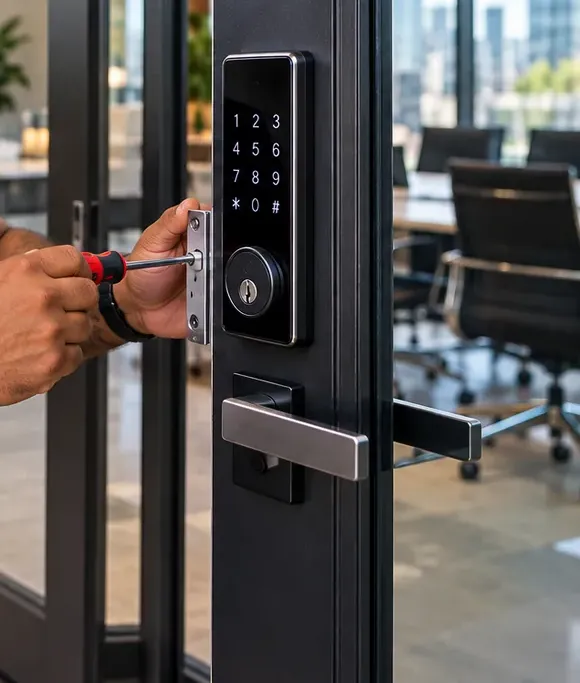
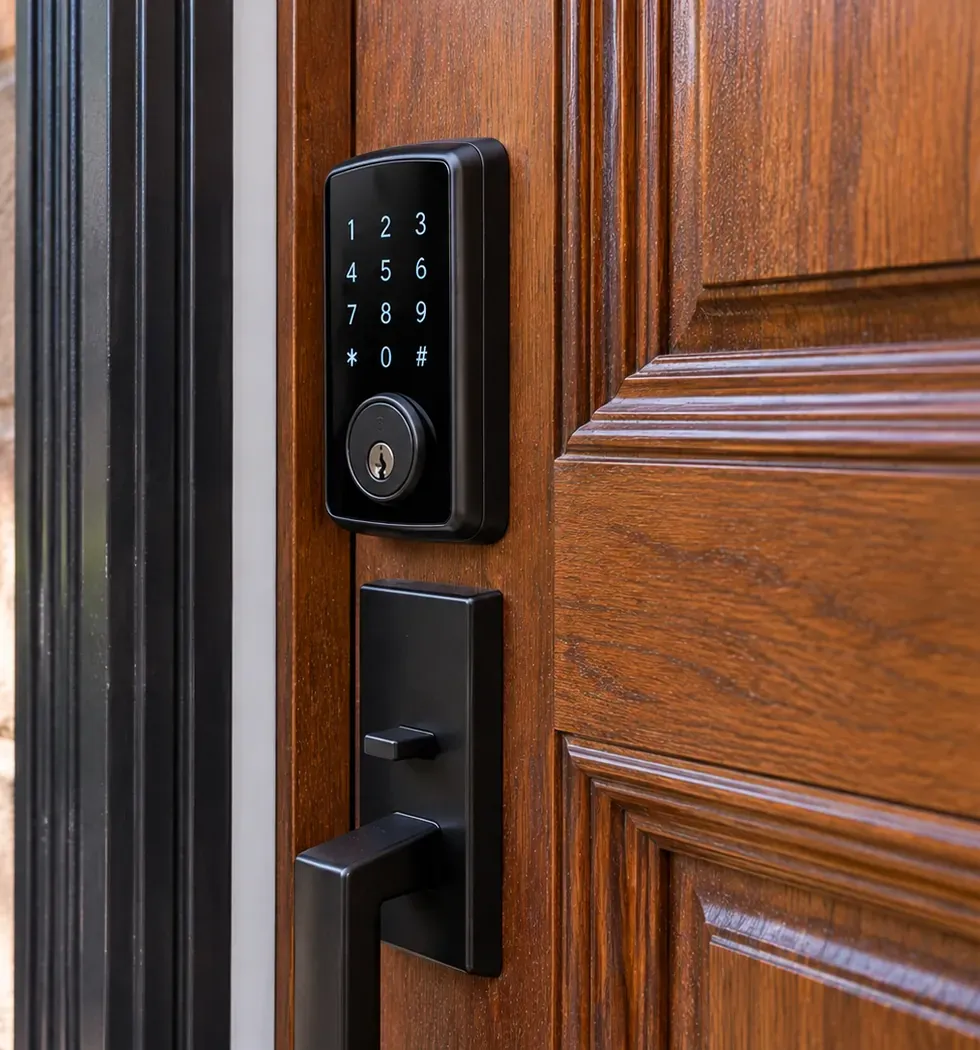
The right hardware in Williamsburg depends less on the brand than on what the door was built to be. A product designed for a suburban front door can be exactly right for a tower unit and quite wrong for a factory door, a shopfront or a family that keeps Shabbat. This is how we match the categories to the neighbourhood.
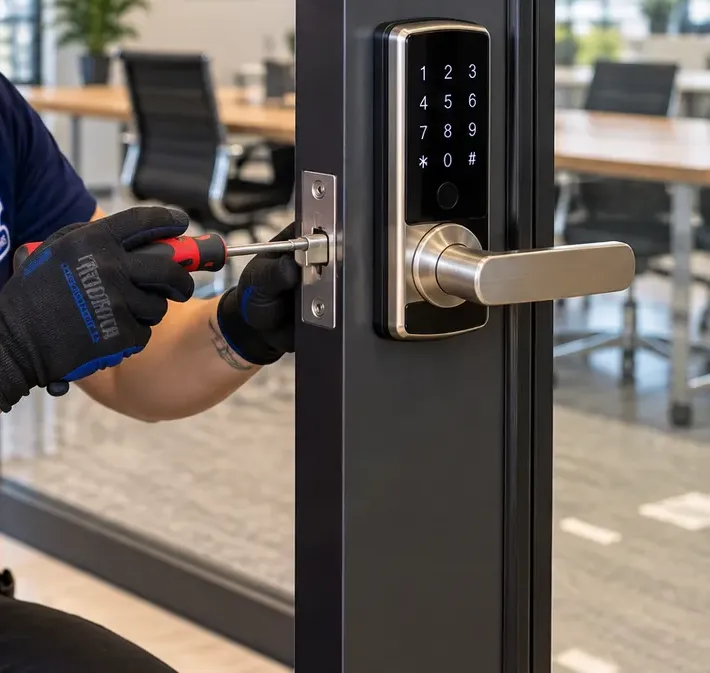
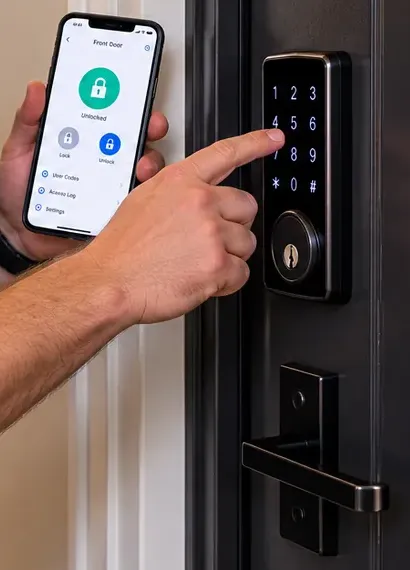
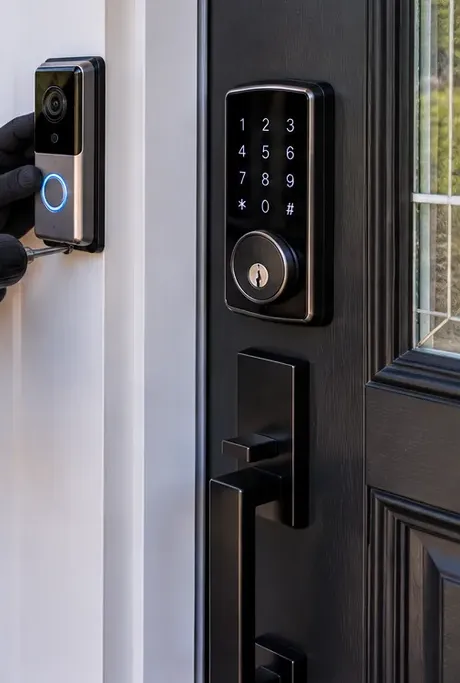
Motorised deadbolts with a keypad outside and a thumb-turn inside, chosen for a door thickness and backset that suit the door in front of us — for walk-up apartment doors, loft unit doors once the hinges are sound, and studio doors.
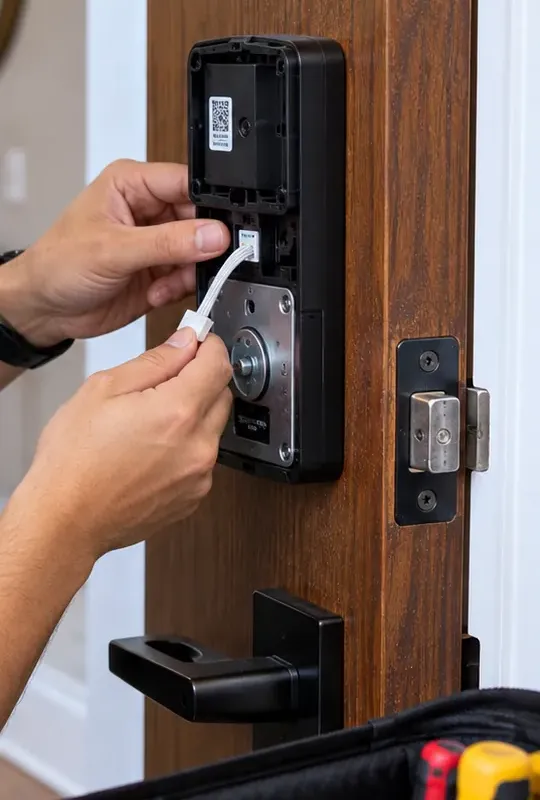
Smart units that sit over an existing single-cylinder deadbolt on the inside and leave the outside, keyway and corridor face untouched. Right for tower units where the hallway must match, for renters, and for doors that are about to be replaced.
Keyless locks with no battery, no radio and no log. The door a Shabbat-keeping household relies on from Friday evening, a back-up door in a building where some residents won't use electronics, or a stockroom where power can't be guaranteed.
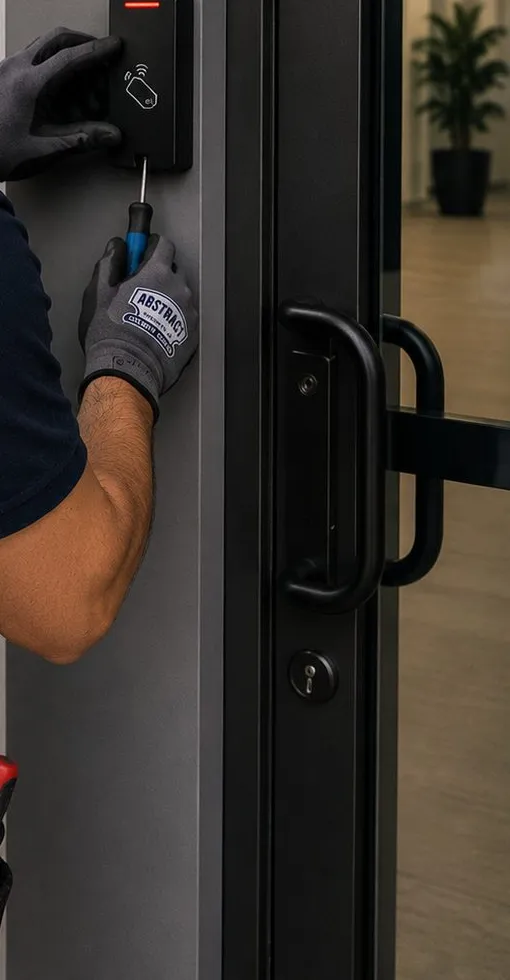
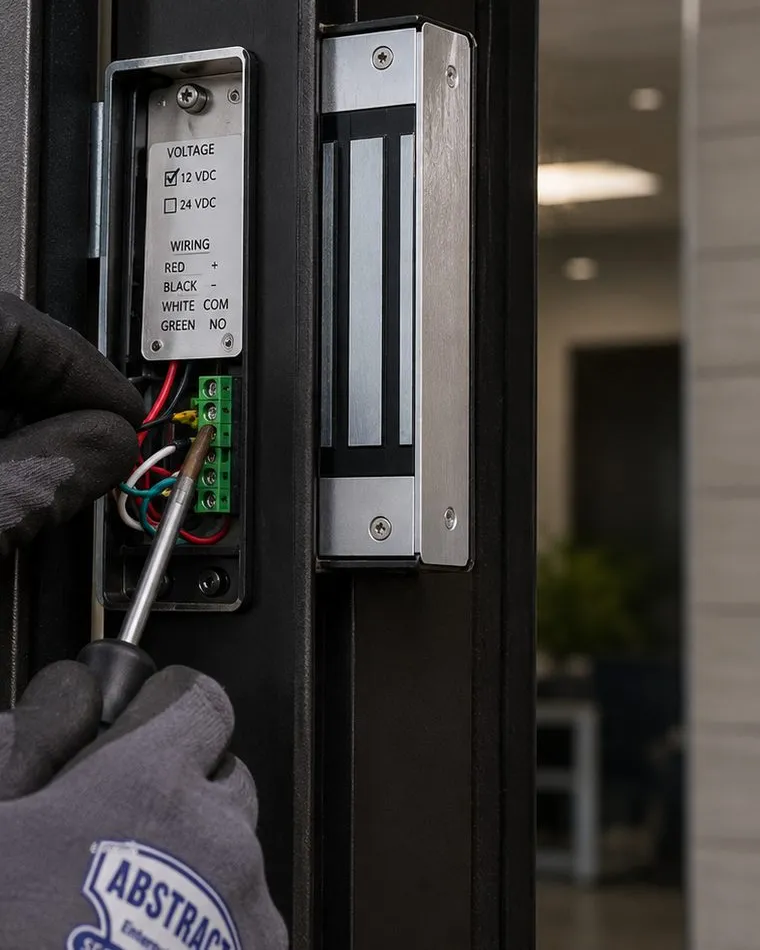
A keypad, card or phone reader outside, an electric strike in the frame and a power supply indoors. The standard for shared street doors, venue loading doors and shopfronts that see heavy traffic.
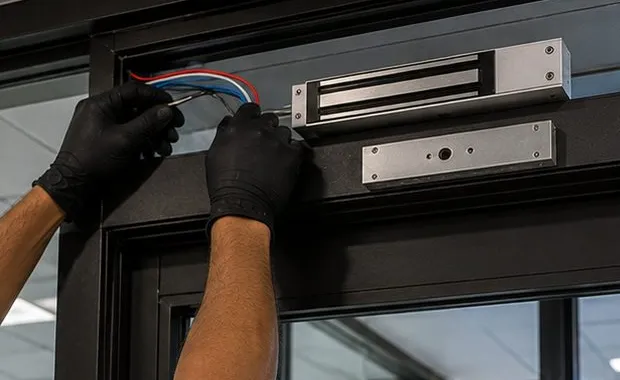
For glass and aluminium storefronts and some double doors, a magnetic lock on the header with a request-to-exit sensor, push button and mechanical exit inside; fitted only where the codes and the building allow it.
Heavier hinges for sagging loft doors, long-screw reinforced strikes for tenement frames, and steel latch guards for back doors on Kent, Wythe and Bedford — the parts that decide whether a lock is any use at all.
Contacts that tell the owner a door is actually shut. They make auto-lock reliable, warn when a venue door is propped, and let a regulated shop prove its doors were closed overnight.
The small devices that put a battery lock online. Siting them so the signal survives brick party walls, steel doors and concrete tower slabs is part of the installation, not an afterthought.
| Door | Retrofit unit | Smart deadbolt | Push-button mechanical | Wired keypad + strike |
|---|---|---|---|---|
| Tower unit door | Best fit | If the building approves | Rarely needed | No |
| Tenement apartment door | Good if the deadbolt is sound | Good, using the best bore | Good | No |
| Loft unit door (steel or timber) | Only on an existing deadbolt | After hinge and thickness checks | Good | For very heavy doors |
| Shared street door | No | No — too much traffic | As a Shabbat back-up | Best fit |
| Shop or venue entrance | No | Rear staff door only | Stockroom | Best fit |
| Regulated retail stockroom | No | Possible | Possible | Best fit, with logs |
Families who keep Shabbat often ask whether there is one smart lock that solves everything. In our experience a household is better served by two kinds of door than by one compromise. A writer in The Jewish Link, looking at smart locks for Shabbat in 2017, noted that a typical keypad lock records an entry in its log even when it is opened with the code on its own keypad, and suggested pairing an inside-mounted smart unit with a mechanical push-button lock on the outside so that the door can be used without electronics. He was careful to say he was not a halachic authority, and neither are we. What we can offer is hardware that lets the family follow whatever its rabbi decides: a door that works without any electronics, electronic convenience on the doors that are allowed it, and features such as auto-lock, logs and notifications that can be turned off or scheduled.

We could not open Google's AI Overview, People Also Ask or similar tools from our build environment, so the claims below are taken from the national cost guides, manufacturer pages and DIY articles those summaries tend to repeat. Each is reasonable for a modern suburban front door. Each needs correcting for a loft, a walk-up, a shopfront or a South Williamsburg home.
Fixr's guide, updated in January 2025, gives a national range of $250 to $400 for smart lock installation, with $300 as the average. That describes one battery deadbolt fitted to a door that was already bored for it. Many Williamsburg jobs start somewhere else: a loft door with a hasp instead of a lock, a door that has dropped on its hinges, a tenement door with three old bores, or a shared street door that needs a wired keypad and an electric strike. The building-door work has a published Brooklyn figure of $1,500 to $2,500 installed. A straightforward apartment door can come close to the national number; we quote those flat after a free look.
Product reviewers have described fitting a retrofit lock with only a Phillips screwdriver in about half an hour, and on the right door that is true. It assumes a standard bored deadbolt in a door of standard thickness, square in its frame. A steel factory door with no preparation needs drilling, tapping or a surface-mount solution; a heavy timber door may be thicker than the lock is listed for; a sagging door will make a motorised bolt jam however carefully the screws are tightened. Doing the carpentry first is what makes a smart lock last.
A smart lock on your own apartment door does nothing for parcels left in the lobby or mail room, which is where most building package theft happens. In the 2023 Williamsburg cases police described, the thief walked in through a building's main entrance and went to the mail room. The New York Times has noted that landlords are not legally required to provide delivery lockers or a concierge where a building has not offered them. What helps is a street door that latches, a camera that sees the vestibule, a parcel room with its own controlled door, and a delivery arrangement that does not leave boxes in the hall.
Manufacturers publish the door thicknesses and backsets their locks fit — common residential models list doors from 1-3/8 inches to 1-3/4 or 2 inches, and a few go to 2-1/4 — and many retrofit units work only over a single-cylinder deadbolt. Williamsburg is full of doors outside those ranges: steel doors with no bore at all, heavy timber doors, aluminium shopfront stiles too narrow for a deadbolt, and fire-rated tower doors that must not be modified in the field. The right question is not "which smart lock is best" but "which locks are made for this door."
Security comes from the door, the frame and the strike more than the electronics. The Kent Avenue break-ins of January 2023 involved cut locks and a sledgehammer, and no keypad helps a door whose frame splits. A smart lock's real advantages are different: no keys to copy, a credential per person that can be removed, a log of who opened the door, and an alert when it is left open. Those are worth having, on a door that is already strong.
August's own support pages say its Connect bridge should be within about 10 to 15 feet of the lock and in a spot with good Wi-Fi. In a Williamsburg loft the router can be eighty feet away across an open floor, behind a steel door and a brick wall; in a tower unit the door sits deep in a concrete corridor. The bridge has to be placed for both distances at once, which sometimes means a mesh node by the door or a lock that uses Thread with a border router in the right room. We test it from mobile data outside before we leave.
Send a photo of the door from both sides and its edge, and tell us who needs to use it. We will tell you whether it needs hinges, a strike, a new bore or just a lock — before anyone books a visit.
Give us the block, the kind of building and what the door is made of. An installer writes back the same business day, usually with a question about the hinges or the thickness. Rather talk it through? The Brooklyn office is on (347) 934-8335.
Thanks — your details are with a licensed installer, who will phone before the end of the business day. A door that is jammed shut or will not lock tonight is better handled by phone: (347) 934-8335.
The same seven steps whether the job is one tower unit on Kent Avenue, a steel loft door off Metropolitan Avenue or the street door and stage door of a North 6th Street venue.
Send photos of the door from outside, inside and along the lock edge, plus a word on who uses it. We reply with what it is likely to need, and whether a visit is worth booking.
At the free walkthrough we lift the door to check the hinges, watch it close, measure its thickness, test it with a magnet and look for a fire label.
Hasps, surface bolts, dead cylinders and unused rim locks are listed for removal, with a plan for filling every hole they leave.
You get a written scope naming the lock, the strike, any hinge or frame work, who gets which credential and the flat price.
Hinges and frame are put right and old holes filled first; then the lock, strike or reader goes in and any cable is run neatly.
Each code, fob and phone is tried from outside, auto-lock and the door sensor are checked, and the door is opened from inside in one motion without power.
Two administrators are set up, every credential is written into a register, schedules and Shabbat settings are set, and you are shown how to add and remove people.
Six places that explain the doors of 11211, 11249 and 11206 — a bank turned event hall, a refinery turned offices, a guitar factory turned apartments, the city's early public housing, a covered market and a library.
George B. Post's domed bank at the corner of Broadway and Driggs Avenue, opened in 1875. Its exterior was designated a city landmark on May 17, 1966 and its banking hall an interior landmark in 1996; since 2014 the hall has been the Weylin event space — a reminder that the doors of designated buildings carry rules of their own.
The refinery ran from 1856 to 2004 and its filter, pan and finishing house was landmarked in 2007; it now holds offices as the Refinery at Domino. Around it rose 325 Kent, One South First, Ten Grand and One Domino Square, and the riverside park opened in June 2018.
Built in 1916 as the Gretsch musical-instrument factory and converted between 2003 and 2005 into 130 apartments with ceilings of twelve to thirteen feet — the pattern for many factory-to-home conversions in the neighbourhood.
Twenty four-storey buildings on 23.3 acres between Maujer, Scholes and Leonard Streets and Bushwick Avenue, completed in 1938 as one of the earliest public housing developments in the country and designated a landmark in 2003. Still NYCHA housing.
La Marqueta de Williamsburg, opened in 1941 at 110 Moore Street and still a cultural anchor for the Latino South Side — surrounded by the walk-ups and family shops whose doors make up much of our work south of Grand Street.
The first Carnegie library built in Brooklyn, its cornerstone laid in 1903, a Classical Revival building of about 26,000 square feet at 240 Division Avenue, where the North Side, South Side and South Williamsburg meet.
We also work across the rest of Brooklyn Community District 1 and its neighbours — Greenpoint to the north, East Williamsburg and Bushwick to the east, Bedford-Stuyvesant to the south — and every Brooklyn neighbourhood around our Troy Avenue office. For the entrance systems behind many of these doors, see intercom installation in South Williamsburg and structured cabling in Williamsburg.
Williamsburg is priced at Brooklyn's base rate, the 1.00 multiplier every AESS area price is worked out from. The building-door figures below are the ones already published on our Brooklyn pages, repeated here with a note on what each covers in this neighbourhood. A smart lock on one private door — a walk-up apartment, a loft unit, a tower unit — has no published AESS price because the door decides the work: a bored tower door and an unprepared steel factory door are not the same job. We quote those flat in writing after a free walkthrough, and the written figure is what you pay.
| Item | Williamsburg price | What it covers here |
|---|---|---|
| Smart lock on an apartment, loft, studio or tower unit door | Quoted flat at free walkthrough | No published figure; the written quote follows a check of thickness, preparation, hinges and who uses the door |
| Single-door keypad or fob reader with electric strike | $1,500–$2,500 installed | Shared street door, venue loading door, shopfront, studio-building entrance or regulated-retail door; the Brooklyn access-control figure |
| New electric strike on a building door | $250–$450 | A strike cut into the frame of a walk-up street door or shop door that never had one, or a worn strike replaced during an upgrade |
| Failed electric strike repair | $295–$485 | A building door where the buzzer or keypad clicks but the latch never lets go |
| Programming visit for a lock already fitted | $195 first hour, then 30-minute blocks | Codes, app accounts, schedules, bridge and administrator handover only |
| Service and callback rate | $195/hr, 3-hour minimum ($585) | Return visits after a completed job; not charged on the original installation |
What the national guides say. If you have seen a figure of around $300 online, it probably comes from a guide like Fixr's, which in January 2025 put a typical installation between $250 and $400 across the country. That number assumes one ordinary residential door already drilled for a deadbolt. It is a useful sanity check for a tower unit, it is not an AESS quote, and it has nothing to say about a factory door or a street door shared by a whole building.
A lock you bought yourself remains covered by whoever made it, and we will help you register it with them on the day; hinge, strike and frame work we carry out on a loft or factory door is listed separately on your invoice so you can see exactly what was done. Full terms — including 50% deposit, one-year parts-only warranty on AESS-supplied products, and the late-fee schedule — are set out in the service agreement. We go through the agreement with you at the walkthrough, before any deposit is taken.

Three ways to buy, depending on which door you are dealing with. Building and business doors come with published borough figures attached. A single private door is priced after the visit, since a light tower-unit door, a battered tenement door and an unprepared steel loft door can take very different amounts of work.
Quoted flat at walkthrough
A smart deadbolt, retrofit unit or push-button lock on a walk-up apartment, loft unit, studio or tower door. Old hardware removed and holes patched, hinges checked, thickness and backset confirmed, strike reinforced, inside exit tested, codes set up and the bridge tested from outside on mobile data.
$250–$450
For a street door or shop door whose buzzer or button works but whose strike is missing, worn or unsuitable: a new strike cut into the frame so the door can be released remotely now and by a keypad later. Where an existing strike has simply failed, the repair is listed at $295–$485.
$1,500–$2,500
One building or business door made keyless: keypad or fob reader, electric strike, power supply and cable, all installed. Each tenant, bartender or crew member gets a credential of their own, time limits are set where the owner wants them, the lever or push bar inside still opens the door with no power, and any buzzer already wired to the door carries on working.
Already bought a smart lock? We fit it for labour only, quoted flat at the walkthrough. Before drilling we check it suits the door you have in mind: listed thickness and backset, single or double cylinder, whether it needs an existing deadbolt, and whether it opens from inside without a key. A lock bought for a standard front door may not suit a loft or factory door, and we will tell you before anything is cut. Customer-supplied locks stay under their manufacturer's warranty rather than ours.
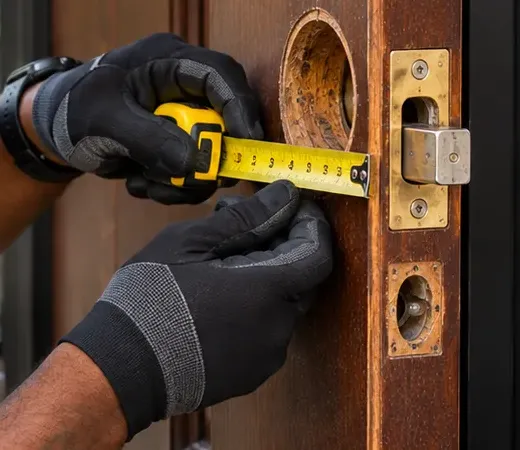
Photograph the edge of the door with a tape measure held across it, then send it with the form or by text to the Brooklyn number. Most Williamsburg doors can be sized up from that one picture, and you hear back before the end of the working day.
The most distinctive Williamsburg job is the loft door that has never had a proper residential lock. It might be a steel door in a steel frame from a 1920s warehouse, a timber door that once closed off a workshop, or a door some earlier tenant hung themselves from a salvage yard. People who moved into these buildings in the 1980s and 1990s often secured them with whatever was at hand: a padlock on a hasp, a slide bolt on the inside, a cheap rim lock screwed to the surface. Decades later those doors are still in service, now in buildings that are legalising under the Loft Board or have been sold as condos.
We start by finding out what the door actually is. A magnet tells us whether it is steel, and a tap and a look at the edge tell us whether it is solid, hollow-metal with a reinforced core, or a timber door clad in sheet metal. We measure the thickness at the lock height, because doors built for industry are often outside the range residential smart locks are made for. We look at the hinges: how many, what size, whether the screws are holding, and how far the door has dropped. We check the frame where the strike would go — some old steel frames are hollow, some are filled with grout, and some timber frames are split from years of a padlock being yanked. And we look for a fire label on the hinge edge or the frame, because a labelled fire door cannot be drilled and cut freely without affecting its rating.
Then there is the question of what to remove. Surface bolts, hasps and padlock eyes come off; the holes are filled with plugs or welded and ground on steel, or doweled and filled on timber. Old rim locks that might still be relied on in an emergency are removed rather than left as a second lock that someone could engage from inside. If the owner wants the industrial look, the original hardware can be refitted as decoration once it can no longer be locked. Only after that do we choose a lock. On a sound door within the listed thickness, a heavy-duty smart deadbolt in a new bore, with a long-screw reinforced strike, is usually the answer. On a door that is too thick, or a heavy steel door where drilling is impractical, we look at mortise or surface-mounted electrified locks wired back to a small power supply. On a labelled fire door, the change is limited to what the door's listing allows, and anything more is a question for the building's architect.
The finish matters too. A loft door often faces a long corridor where every neighbour sees it, and a keypad that looks like a suburban front door can be out of place. We show owners the darker, flatter keypads and inside-only options, and for buildings with a board or sponsor we send the product sheets before anything is drilled.
In South Williamsburg a door plan starts with the calendar. Many households and buildings south of Division Avenue keep Shabbat and the festivals, and for those days the question is not which app to use but how a family gets in and out without any electronics at all. What is and is not permitted is a matter for each family and its rabbi; our job is to make sure the hardware can follow that decision rather than force a different one.
In practice that means three things. First, at least one way into the home or the building that is purely mechanical — a keyed lock, or a mechanical push-button lock that needs no battery and records nothing. Whether a family can carry a key on Shabbat is itself a question with religious answers; as a writer in The Jewish Link put it in 2017, a key "is only a viable solution, of course, for those living in an area with an eruv," which is why many households prefer a push-button code. Second, electronic convenience on the doors the household is comfortable with on weekdays: keypads for children coming home from school, codes for a babysitter or cleaner, alerts when the door is left open. Third, settings that can be changed: auto-lock, logs, chimes and notifications that can be turned off or scheduled, bridges on a timer, and keypads that do not light up when someone walks past.
Building-wide, the same thinking applies to the street door. A fob-only lobby is simple for a landlord and unworkable for residents who will not use a fob on Shabbat, which is what the LeFrak City residents in Queens told a federal court in 2015 when their lobby doors went electronic. The workable design is an electronic reader for everyday use with a mechanical cylinder or push-button lock on the same door, so no resident's access depends on power or a phone.
Large households bring their own requirements. A family with many children, grandparents nearby and regular helpers needs more codes than a couple does, and needs them named so the right one can be removed. Stroller traffic means the street door is propped more often than elsewhere, so a door-position contact and a closer that actually finishes the swing are worth more here than an extra feature on the lock. And businesses on Lee Avenue that close for Shabbat need door schedules that move with sunset through the year, set by someone at the shop rather than fixed once by us.
On the North Side especially, a walk-up can have more former occupants than current ones. Apartments are shared, roommates rotate, sublets come and go, and every one of those people may have had a key cut or been told the street-door code. In a building with a mechanical lock, the only real fix after a few years is to re-key everything, which landlords rarely do. A keyless street door changes the arithmetic: every resident gets their own code or fob, and when someone moves out their credential is switched off without anyone else noticing.
That only works if somebody keeps the list. At handover we set up two administrators — usually the owner and a managing agent or a trusted long-term tenant — and give them a written register of every credential: who it belongs to, which doors it opens, and when it should end. Courier and delivery access is handled as its own credential rather than a resident's code passed around, so it can be changed when it leaks. For buildings with a super who lives elsewhere, we set the super's credential to work at the street door, the cellar and the roof, and nowhere else.
The apartment doors are the tenants' own business, within the law. City rules require the owner to provide a key lock on each apartment door, and a tenant may add a lock of their own under the Multiple Dwelling Law; neither may make an apartment door that needs a key to open from the inside. Inside those limits a retrofit unit on the existing deadbolt is often the simplest choice for a renter, because the landlord's key still works and nothing changes when the tenant leaves except that the retrofit goes with them.
The waterfront that the 2005 rezoning opened up now holds thousands of apartments in new towers and converted warehouses. At Domino alone, 6sqft reported in 2019, the plan called for about 2,800 rentals across four buildings, and One South First rose to 435 feet with 330 of them. These buildings come with their own entry systems, uniform unit doors and alteration rules, and the smart lock question there is narrower but still worth getting right.
Tower unit doors are usually fire-rated doors in hollow-metal frames, and the label on the edge matters: it describes an assembly that was tested a certain way, and cutting new holes or swapping hardware without regard for it can affect the rating. That is why our default in a tower is a retrofit unit that mounts on the inside over the existing deadbolt, leaving the outside, the cylinder and the corridor face exactly as the building installed them. Where a resident wants a keypad on the outside, we work from the building's approved hardware list or ask management for one, and we fit it using the existing preparation.
The other tower-specific problem is radio. A unit door at the end of a concrete corridor, behind a heavy rated door, can be a long way in signal terms from the router in the living room by the window. We site the bridge or Thread border router for both the lock and the network, test from outside the building on mobile data, and if the signal is marginal we say so rather than leave a lock that works on the day and drops off a week later.
Converted warehouses along Kent and Wythe, such as the Austin, Nichols building, sit somewhere between a tower and a loft: uniform condo doors in an industrial shell, sometimes with original freight elevators and loading doors still in use. There we plan both sets of doors together — the residents' unit doors and the building's service doors — so contractors and movers do not end up holding codes meant for residents.

A Williamsburg hospitality business can have more people with door access than a small office. Bartenders, barbacks, kitchen staff, managers, cleaners, promoters, sound engineers and delivery drivers all need to get in at different times, and staff turnover is high. A shared key or a single code that "everyone knows" means that after a year nobody can say who can open the door.
The answer is the same discipline that works for a residential building, applied more strictly. Every person gets their own code or credential. Credentials are tied to roles — opening manager, closing manager, kitchen, cleaning crew, deliveries — and each role works only on the doors and at the hours it needs. When someone leaves, their credential is removed the same day by the manager on duty, not when the owner gets round to it. And the log is actually read: a door opened at four in the morning by a code that should only work at noon is a conversation to have the next day.
The physical side matters just as much. Rear and side doors are the ones forced overnight, so they get latch guards, long-screw strikes and, where the frame is weak, a reinforced jamb. Front doors behind roll-down gates need a plan for which is locked first and which unlocked last. And every door the public uses during service keeps its push bar or lever so that the lock is irrelevant to anyone leaving. If the venue uses an electrified lock on any exit route, it has to release on loss of power or fire alarm as the code requires, and we check that before we leave.
A new lock in Williamsburg often leads to other work on the same entrance. These are the Williamsburg and Brooklyn services most often booked alongside it.
Readers, controllers and schedules for buildings and businesses with many doors.
Video entry panels that let residents see who is calling before they release the door.
Strikes that hum and stay shut, dead buttons and buzzer transformers that have given up.
Cameras on the street door, the mail room and the shop entrance.
Door contacts and forced-entry alerts for shops and lofts.
Making sure electrified doors and fire alarms work together on exit routes.
The cable runs behind wired keypads, readers and cameras.
A camera at the door, fitted in the same visit as the lock.
Ask about the lock and anything else on one form.
How our technicians survey an old industrial door before quoting — a working routine, not an account of a particular job
We lift the door. With the door half open, a hand under the latch edge and a gentle upward push shows straight away whether the hinges have worn: if the door rises, the bolt will rub. Then we close it slowly and watch the gap along the top of the frame, which tells us which way it has dropped.
We hold a magnet to it, measure it at lock height with calipers, and look along the hinge edge and the frame for a fire label. We count the old holes — padlock eyes, slide bolts, rim locks, abandoned cylinders — and decide which come out and how they get filled.
We ask who uses the door, and when. A loft shared by three people, a studio where clients come by appointment and a family that keeps Shabbat are three different setups on the same kind of door. We check the inside: one motion to get out, no key, no code. Only then do we pick a lock, and we write down why, so the owner, the board or the Loft Board's inspector can see what was done.

Usually, yes. A door with no bore or cut-out is a blank, which can be easier than a door already riddled with old holes. On a steel door we drill and tap for a smart deadbolt where the thickness suits one, or fit a surface-mounted or mortise electrified lock with a strike when it does not. Before cutting we check the door is solid where the lock will sit and that the frame can take a strike, and we agree the position with you so it suits the door's design.
Yes. Tell us the operator's hours when you book and we will plan the visit inside them, carry tools up the stairs if the elevator is out of service, and finish the noisy drilling early in the window. Most single-door jobs need only a toolbag and a small parts case, so the elevator is a convenience rather than a necessity. For larger jobs with a power supply or long cable, we arrange the elevator time with the building in advance.
On most smart locks, yes. Auto-lock is a setting rather than a fixed feature, and the delay can usually be set from a few seconds up to several minutes, or switched off. For doors people come through with their hands full we often pair a longer delay with a door-position sensor, so the lock waits until the door is actually closed before throwing the bolt. We set it up with you at handover and show you where the setting lives in the app.
It needs locks that can be shown to be under control. New York's cannabis regulations require licensees to secure entrances, lock perimeter doors, keep codes and passwords away from anyone not authorised, keep locks in full working order with tests at least every 30 days and records kept for five years, and log non-employee visitors. A keypad or reader with individual credentials and an audit log makes most of that easier. Your compliance plan and the Office of Cannabis Management decide what is required; we fit hardware that supports it.
Sometimes, but rarely on the isolation door itself. Those doors close against heavy seals using cam or compression latches, and cutting into them can let sound through. The usual answer is to secure the studio at its outer entrance with a keypad or reader and leave the isolation doors with their own latches. If an isolation door has to lock, we look at hardware that fits its existing preparation and check that it still seals and still opens from inside in one motion.
It often helps. A recessed entry gives the keypad shelter from rain and keeps it out of the line of sight of people walking past, but it also gives someone a hidden place to work on the door at night. We usually mount the keypad on the door or the frame inside the recess, angled so the person entering shields it, and add lighting or a camera that covers the recess. If a roll-down gate closes the recess, the keypad goes behind the gate.
Yes, if the lock is set up for it. Most smart locks talk to a phone directly over Bluetooth at the door, so opening it does not need mobile data or the internet; the internet only matters for remote access and alerts when you are away. In buildings with heavy masonry or steel, the lock's bridge or hub is connected to your Wi-Fi rather than the mobile network, and the keypad code works whatever the phone is doing. We test both at handover, standing outside the door with the phone's mobile data on and off.
Usually, and it is a fair thing to ask for on a busy block. A slamming door is a closer problem: adjusting the latch speed so the door finishes its swing gently, or replacing a worn closer, stops most of the bang. A loud buzz comes from older AC strikes; a modern DC strike on a proper power supply releases with a click rather than a hum. A rubber door stop and fresh weatherstrip deaden what is left. We can do all three during a keypad installation or as a separate repair.
Williamsburg is one of a growing set of neighbourhood guides. For borough-wide brownstone, vestibule and two-family advice go up a level to Brooklyn smart lock installation; for the law that applies in every borough — tenant locks, co-op boards, data privacy — the New York City smart lock hub is the place to start.
Back to Brooklyn · Bayside, Queens · Bedford-Stuyvesant, Brooklyn · Brooklyn Heights, Brooklyn · Chelsea, Manhattan · Flushing, Queens · Forest Hills, Queens · Greenpoint, Brooklyn · Jackson Heights, Queens · Kingsbridge, Bronx · Morris Park, Bronx · New Dorp, Staten Island · Pelham Bay, Bronx · Throgs Neck, Bronx · Todt Hill, Staten Island · Upper East Side, Manhattan · Washington Heights, Manhattan · West Brighton, Staten Island · Upper West Side, Manhattan · Park Slope, Brooklyn · Astoria, Queens · Riverdale, Bronx · St. George, Staten Island · Tribeca, Manhattan · Tottenville, Staten Island · Harlem, Manhattan · Bay Ridge, Brooklyn
NYC smart lock installation · Brooklyn · Manhattan · Queens · the Bronx · Staten Island
Hudson Valley smart lock installation · Westchester · Rockland · Orange · Putnam · Dutchess · Ulster
Locks are one part of what we do. The same licensed crews put in camera systems, building intercoms, card access and office networks from Staten Island to the Bronx and out to Suffolk and Ulster; the AESS home page lists every service, and our company page explains who we are.
A keypad gone dark on a steel loft door, a motor that stalls halfway because the door has dropped, a street-door strike that will not release, a bar's back door that refuses to lock at closing — call (347) 934-8335. We give you the next open two-hour window, and most alignment, power, pairing and credential faults are sorted within an hour or two of reaching the door.
Every local figure, landmark, rule and incident on this page is taken from a published source listed below. Prices come only from the published AESS Brooklyn figures.
Abstract Enterprises Security Systems · 1282 Troy Ave, Brooklyn, NY 11203 · (347) 934-8335 · WhatsApp (718) 679-0359 via wa.me
Rated 4.7★ from 201 Google Reviews · NYS Low-Voltage Licence #12000287431 · 100% Licensed & Insured · Same-Day Estimates
Payment and cover are written down before work begins rather than explained afterwards. Full terms — including 50% deposit, one-year parts-only warranty on AESS-supplied products, and the late-fee schedule — are set out in the service agreement. The warranty page explains what the parts cover includes, how to report a fault on a lock we supplied, and how long a Williamsburg callback usually takes to schedule.
This page describes how Williamsburg's buildings, households and businesses, and New York's rules, shape a smart lock installation. It is not legal or religious advice. Reviewed and updated October 17, 2026. Changelog: Williamsburg page launched as a neighbourhood page under Brooklyn smart lock installation, covering Loft Law and factory doors, South Side walk-ups, Shabbat-aware door plans, venues and shops, regulated retail and riverfront tower units.