Home › Smart Lock Installation NYC › Queens › Forest Hills
Gardens Houses Under the Declaration · Pre-War Co-op Unit Doors · Concert-Night Door Plans · Austin Street Shop Entrances
Two things are true of almost every door in Forest Hills. Its outside face answers to somebody besides the owner — the Forest Hills Gardens Corporation’s Architecture Committee, or a co-op board that owns the corridor — and the space in front of it is shared with strangers: a lobby anyone can follow a resident into, or private streets that fill with concertgoers on summer evenings. We fit keypad, fingerprint and app locks that pass the first test from the outside and act as the last barrier from the inside.
Reviewed and updated October 17, 2026 · Written by Anwar Timothy, NYS licence #12000287431 · One of the neighbourhood pages under our Queens smart lock installation service

Planning a keyless door in the Gardens, along the Boulevard or on Austin Street? Ring our Queens line, (347) 434-6392, or send the one-minute form. Before anyone books a visit, a licensed installer will tell you whether the door needs a Gardens application, a board’s sign-off or nothing at all, and which kind of lock will sit comfortably on it.
Forest Hills was planned twice before most of it was built, and both plans still govern its front doors. In 1906 the Cord Meyer Development Company bought farmland here and renamed it after nearby Forest Park, laying out the detached-house blocks north of what became Queens Boulevard. Two years later Margaret Olivia Sage’s foundation bought 142 acres south of the railroad from Cord Meyer, and Frederick Law Olmsted Jr. and the architect Grosvenor Atterbury designed Forest Hills Gardens around it: curving private streets meant to discourage through traffic, a town square at the station, and Tudor-style houses with stucco walls and red clay tile roofs, most of them put up between 1910 and 1917. A third layer arrived with the subway: a late-1920s zoning change allowed tall apartment buildings ahead of the line, and the Queens Boulevard stations opened in 1936. Almost everything a lock installer meets in Forest Hills belongs to one of those three plans.
The Gardens plan reached further than street layout. A Declaration of Restrictions, quoted as Declaration No. 3 in the Gardens Corporation’s own guidelines, says that no building, fence or wall may be put up and no “change or alteration made therein” until plans showing its “nature, kind, shape, height, material, color-scheme and location” have been approved in writing. More than a century later the Forest Hills Gardens Corporation still runs that review through an Architecture Committee, and its published guidelines are specific about doors: entry doors of panel type, usually wood; replacement doors that replicate the original; consistency across row and attached houses; and exterior hardware “of a type appropriate to the style of the building” with finishes that match the rest of the house. A smart lock is a small object, but on a Gardens door it is exterior hardware, and owners who skip that thought are the ones who end up taking a keypad off again.
North of the tracks the rules come from a different place. The apartment belt along Queens Boulevard, 108th Street, Yellowstone Boulevard and the streets between them is overwhelmingly co-op: one reply on r/ForestHills put it plainly, observing that most apartment buildings in the neighbourhood, especially above Yellowstone and Queens Boulevard, are co-ops. In a co-op the unit door sits on the corporation’s corridor, the proprietary lease usually requires a duplicate of any new key, and the city’s fire rules expect the door to close and latch on its own. The owner chooses the lock; the board, the house rules and the building code decide what the hallway sees and what must keep working. Our job on those doors is to make the corridor side unremarkable and the inside side do the real work.
Then there is what stands in front of those doors. QNS reported in October 2025 that a man walked in through the front door of an apartment building near 112th Street and 73rd Avenue at about a quarter past four on a Tuesday afternoon, was caught on camera sitting on a couch in the lobby, walked toward an apartment and left with a $600 phone, escaping through a courtyard toward Queens Boulevard. The same report said the 112th Precinct had recorded 114 burglaries through October 5, 2025, up 44.3 percent on the same point a year earlier. In the Gardens the shared space is the street itself: the Corporation’s nearly 4,000 members own their roads, and on more than 30 concert days in 2025 those roads carried the crowds walking to and from Forest Hills Stadium. A door in Forest Hills has to assume that the first barrier — the lobby, the courtyard, the quiet private street — is already behind whoever is standing at it.
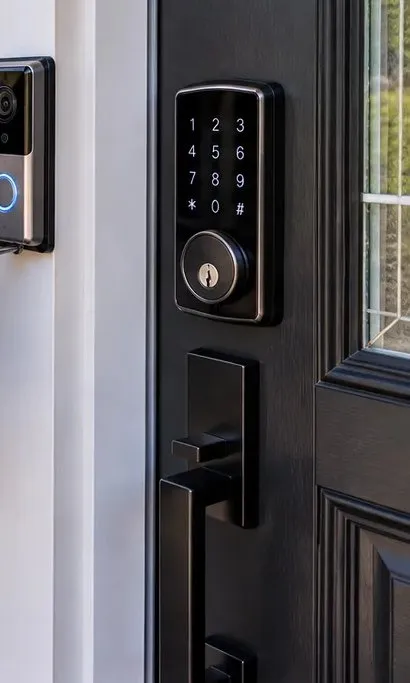
Most Forest Hills owners who call us about a front door end up adding a video doorbell from our Queens doorbell camera service on the same visit, so that the person at the door can be seen and answered before anything is unlocked.

Nine kinds of work make up nearly every Forest Hills smart lock order. Each one starts by asking who else has a say in the door, and what the person standing outside it can already reach.
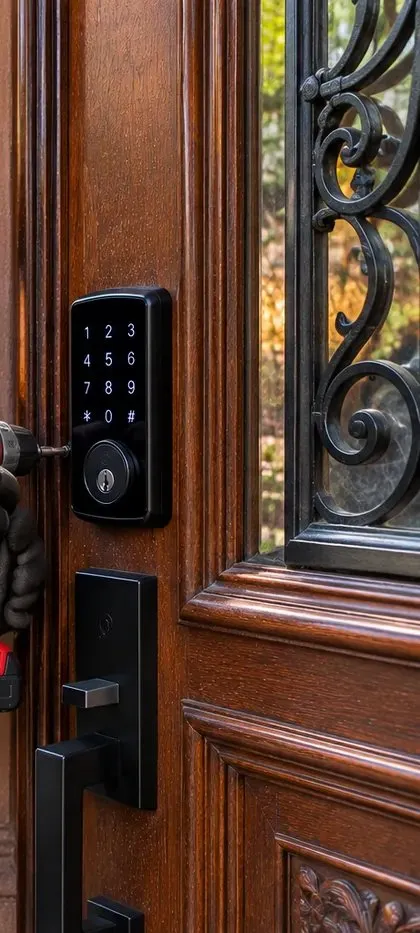
Panel and divided-light wood doors on Tudor and Arts and Crafts houses, fitted with locks whose outside trim and finish suit the facade, and documented with photos and cut sheets for the Architecture Committee file.
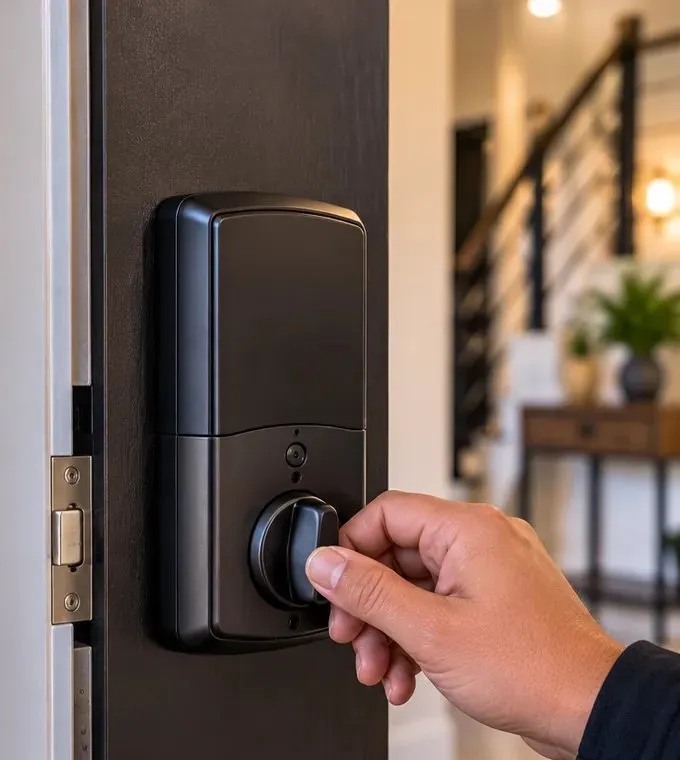
Motorised units that mount over the inside of an existing single-cylinder deadbolt and leave the key side untouched — the least visible change to a house or corridor, and often no new holes at all.
Pre-war and post-war apartment doors along Queens Boulevard, 108th Street and Yellowstone Boulevard, with the corridor side kept plain, the self-closer left working and the board’s key arrangement respected.
Front, side and garage-passage doors on the Cord Meyer blocks, where older houses stand beside large rebuilds and each door can take a different lock.
Strike plates and reinforcement for doors hung in concrete-panel, brick or block openings, where the usual long screws into a wood stud are not an option.
Auto-lock timing, door-left-open alerts and schedule changes for houses on the stadium walking routes, set up so that summer evenings need no thought.
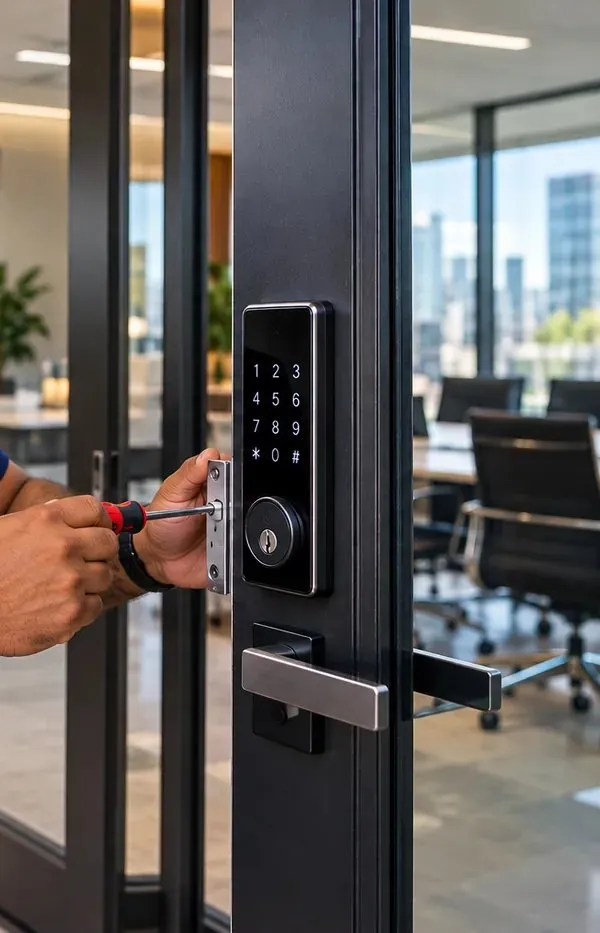
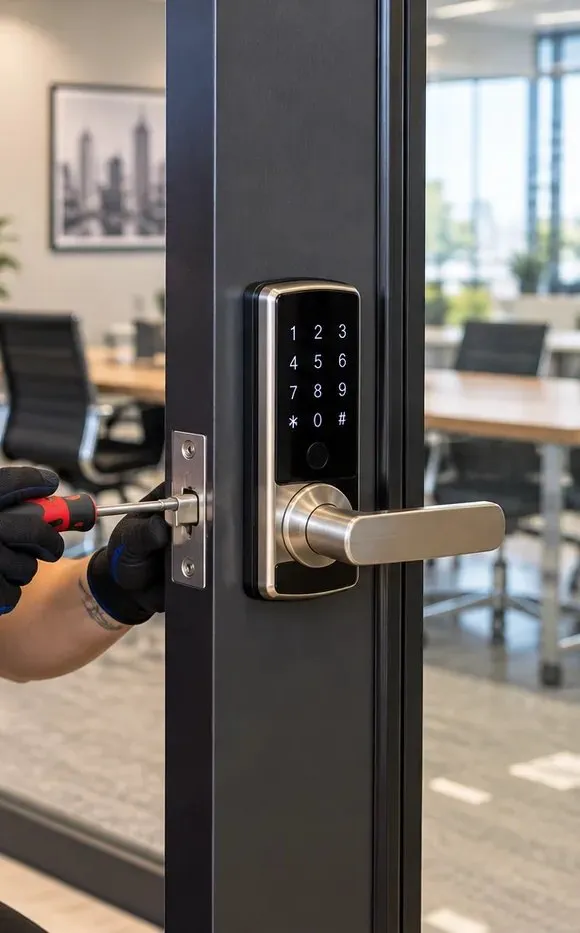
Keypad or fob readers with electric strikes on Austin Street, Queens Boulevard and Metropolitan Avenue storefronts, upstairs offices and practices, at our published Queens rates.
A video doorbell beside the lock so that a delivery, a contractor or an unexpected caller is seen and spoken to before a remote unlock, and so that an empty house still answers its door.
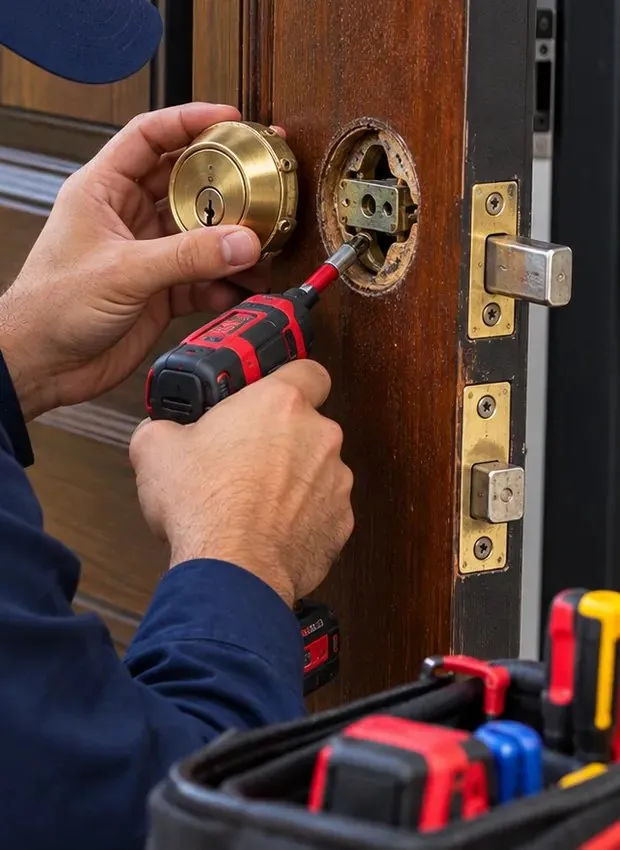
Resets, re-registration, re-keying and repair for smart locks that came with a co-op purchase or a house, or that have started to drop offline, jam or drain batteries.

The same lock behaves differently in each of the neighbourhood’s building types, because the wall around the door, the people who share the space in front of it and the rules on its outside face all change from one block to the next.
The early Gardens houses were built from precast panels set by crane. A doorway in that wall is framed by concrete, so strike reinforcement, bridge placement and any doorbell mounting are planned around concrete rather than timber.
Later Gardens houses in brick and stucco, often with leaded or divided-light glass. The Brownstoner listing for a 1928 Tudor on Greenway North describes leaded glass windows throughout — a reminder that glass is everywhere near the lock.
Groups of houses in the Gardens whose entry doors were designed to match. The guidelines call that consistency “a significant architectural feature” that “must be preserved”, so a lock on one door is judged against its neighbours.
The co-op apartment houses around Station Square and Continental Avenue, including the Forest Hills Inn, which opened on May 1, 1912. Unit doors on old corridors, under house rules and a board.
Six-storey buildings of the early 1930s along 108th Street and the side streets — CityRealty lists 68-10 108th Street, built in 1931, with 50 apartments on 6 floors. Steel-clad or heavy wood unit doors, mortise pockets and self-closers.
Large rental and co-op towers such as Parker Towers at 104-20 Queens Boulevard, which The Real Deal described in 2018 as 1,327 units in three 20-storey buildings. Hollow-metal doors, long corridors and a building-run lobby system.
The three towers at 108th Street and 62nd Drive whose 1972 plan was cut from 840 to 432 apartments under Mario Cuomo’s compromise, as the Queens Daily Eagle has recounted. The development’s own management rules come before any unit door change.
Single-family houses on the north side, where Wikipedia notes many older homes have been torn down and replaced by larger ones. One block can hold a 1920s wood door and a new oversized fibreglass entry.
Low-rise buildings with shops on the ground floor and offices or flats above, along the mile of Austin Street between Yellowstone Boulevard and Ascan Avenue. Glass shop doors, narrow stair doors and rear service doors.
On a frame house, a strike is made strong by driving long screws through the jamb into the wall stud behind it. In an Atterbury house the “stud” is a cast panel. A 1996 paper in the ACSA international proceedings on Atterbury’s system describes the wall panels as hollow, with a skin of concrete on each face separated by an air space, and ribbed for strength. That changes three things. The jamb is usually fixed to the concrete with anchors rather than nails, so we check how firmly it is held before trusting any strike to it. Reinforcement goes into the jamb and, where the opening allows, into the solid edge of the panel with masonry anchors sized for hollow material — never by drilling blind into the panel face. And because the cavity is concrete, not air and drywall, radio signal from the lock to a bridge or router drops faster than owners expect, so the bridge is placed and tested before the lock is paired.
The Gardens Corporation’s own guidelines note that many original entry doors in the Gardens are all glass with divided lights. On a door like that the lock rail is a narrow strip of wood between the hinges and the panes, and a thumb-turn sits within arm’s reach of anyone willing to break a small pane. We do not solve that with an inside key: on a dwelling, a lock that needs a key or a code to get out is a way to trap people in a fire, and we decline to fit one. What we do instead is choose a lock body narrow enough for the rail, consider whether the most exposed pane can be glazed with laminated glass (a glazier’s job, and a Committee question if it changes the look), set auto-lock so the bolt is thrown every time, and make the door report its state so that nobody has to wonder whether it was left on the latch.
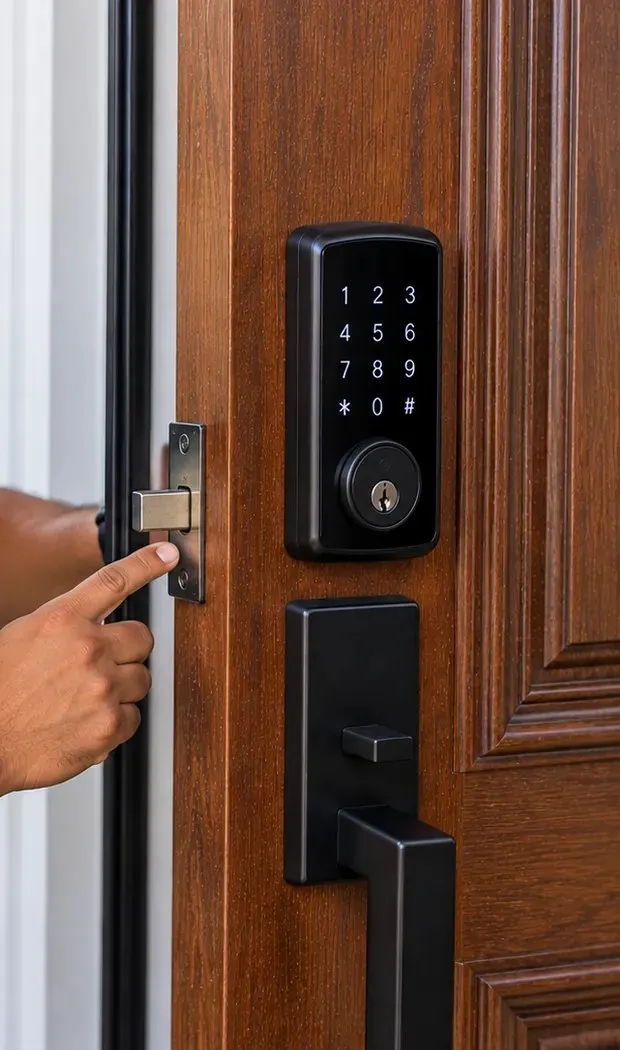
An apartment door on a shared corridor in a building of three or more apartments is meant to be self-closing under the city’s rules, and HPD’s fire-safety guidance says plainly that double-cylinder locks are illegal on apartment doors and that apartment doors should open from inside without a key. The corridor side is the building’s face, so a board may care what a keypad looks like even when the lock itself is the shareholder’s. A motorised bolt on a door pulled shut by a strong closer has to throw against a door that is already pressed against its stop; we adjust the closer and the strike so that the bolt never fights the door, and we confirm the door still latches on its own from fully open after the lock is fitted.
Owners of Gardens houses who are planning exterior lighting or cameras at the same time should know that the guidelines treat security lighting as exterior work too; we price those alongside the lock through our Queens security camera installation team so that a single application can cover everything that will touch the facade.

Forest Hills’s businesses sit in a handful of corridors, each with its own kind of door and its own way of being got into. The police reports for the neighbourhood are a useful reminder that the front glass is rarely where it happens: Patch reported in April 2021 that a burglar cut a metal bar and came through the back window of Forest Hills Fishery at 71-64 Austin Street, a shop then more than fifty years in the neighbourhood, and took $2,500 in cash; ABC7 reported in March 2015 that thieves had got into a store called Rainbow on Austin Street through its skylight during a run of break-ins at businesses on Queens Boulevard and 63rd Drive.
The neighbourhood’s main shopping street, about a mile from Yellowstone Boulevard to Ascan Avenue. Shop entrances with glass doors and aluminium frames, upstairs offices reached by narrow street doors, and rear doors and windows onto service areas that matter as much as the front.
The brick square beside the Long Island Rail Road station, which the Gardens Corporation treats as a no-parking, no-tolerance zone, and the shops and offices on Continental Avenue between the station and the Boulevard.
Restaurants, banks, clinics and offices in the ground floors of the apartment belt. Many share a building entrance with residents, so a business’s staff codes must stay separate from the co-op’s own door system.
The long commercial street running north from Queens Boulevard toward East Elmhurst, lined with shops and offices on the ground floors of apartment buildings; small premises where the owner is often the one opening and closing every day.
The southern edge of the neighbourhood, which Wikipedia notes was long known for antique shops; small storefronts with rear storage rooms where an audit trail on the back door is worth more than a new front lock.
Doctors, dentists, therapists and accountants in converted apartments and ground-floor suites along the Boulevard and around 71st Avenue, where a records room or a medication cupboard needs its own credential.
When a Forest Hills business outgrows one or two keypads — a practice with several rooms, a shop with a stock room and an office — we move it to a small controller-based system through our access control installation service in Queens, so every door shares one schedule and one log.

These are the questions Forest Hills owners and shareholders raise that are particular to the neighbourhood — the Gardens’ rules, concrete walls, concert evenings and co-op ownership. General questions about prices, coverage and visits are in the FAQ further down.
Treat it as exterior work unless the Corporation tells you otherwise. Its website reminds residents that all exterior work, new or restoration, requires an application, and its guidelines put door hardware in the same paragraph as mailboxes and light fixtures: it must be “of a type appropriate to the style of the building”, with finishes that match or suit the rest of the house. A keypad on the outside of a front door is visible from the street, so it falls squarely inside that language. We are not the Corporation and cannot tell you how the Committee will rule on a particular house; what we can do is make the application easy to judge.
For a Gardens job we photograph the door as it is, mark where the outside unit would sit, and give you the manufacturer’s drawing and finish name for the lock we propose, plus a second option that leaves the outside of the door exactly as it is — an inside-only retrofit over your existing deadbolt. The guidelines ask for applications to be lodged ahead of the Committee’s scheduled meeting, so it pays to start that conversation before you buy anything. If the retrofit route is chosen, the outside of the house does not change at all, which is the simplest application there is.
Usually yes, but the matching is the point to plan around. The Corporation’s guidelines say that in row and attached houses and groups of homes, consistency in the design of entry doors is a significant architectural feature that must be preserved. A lock is not the door, yet a large black keypad on one door of a matched row changes how the group reads from the street far more than the same keypad on a detached house would.
Three approaches tend to work on attached Gardens houses. The first is the inside-only retrofit, which keeps the existing key cylinder and outside trim, so your door still matches its neighbours. The second is a keyed smart deadbolt with a small outside escutcheon in a finish close to the hardware already on the row. The third is to keep the matched front door mechanical and put the keypad on a rear or side door that the street does not see. Whichever you choose, we show the Committee the whole row in the photographs, not only your door, so the question it has to answer is plain.
In most Gardens houses the money does more behind the existing door. The guidelines ask homeowners not to propose heavily ornamented security doors and to choose simple designs compatible with the architecture, so an outer steel door is an application in its own right, and on a glass-panel entry it hides the very door the Committee is trying to protect. What a security door mainly adds is resistance to someone breaking glass to reach the lock.
A cheaper and less visible order of work is: make the jamb and strike hold (on a concrete-panel or masonry opening that means checking how the jamb is anchored), fit a lock whose bolt is thrown automatically every time the door closes, add a door-position sensor so the house reports an open or unlatched door, and talk to a glazier about laminated glass in the pane nearest the lock. If, after that, you still want an outer door, it can be added later without undoing anything we fitted. We will not fit an inside-keyed lock in place of any of this.
By treating the frame and the wall as two separate jobs. First we find out how the wooden jamb is held to the concrete: on old Gardens houses it may be screwed to wood blocking cast into the opening, fixed with masonry anchors, or simply wedged and nailed to whatever was there in 1912. If the jamb moves when the door is shut hard, no strike screw will hold, so the jamb is secured to the concrete first with anchors made for the material.
Then the strike. We use a reinforced strike box and the longest screws the jamb itself will take, and, where the opening has solid concrete behind the strike rather than the hollow middle of a panel, sleeve anchors through the jamb into that solid edge. Where it is hollow, we rely on the secured jamb and a longer strike plate that spreads the load. What we never do is drill blind into the face of a hollow precast panel hoping to hit something solid. The result is checked the same way on every door: the motor has to throw the bolt fully, the bolt has to sit centred in the strike, and the door must not rattle once it is locked.
Treat a show night like a night away, even if you are home. The 2025 lawsuit coverage described crowds of around 13,000 people on more than 30 concert days, private Gardens streets closed to cars, and residents who spent concert nights elsewhere; QNS reported 20 events planned for the 2026 season, from June 6 to September 29. Most of those visitors are simply going to a concert. The issue is that for a few hours the street is full of people nobody on the block knows, and a door left on the latch by someone carrying in shopping is easy to miss.
On houses near the walking routes we usually set auto-lock to a short delay so the bolt is thrown within a minute of the door closing, turn on alerts for any door left open or unlatched, and pause service codes — cleaners, dog walkers, contractors — for show evenings using the season’s published show dates. A video doorbell lets you answer anyone who comes up the path without opening the door. None of this needs a separate “concert mode”; it is a schedule you set once in the spring and switch off after the last show.
That is decided by your contract of sale, your proprietary lease and the building’s house rules, not by us, and boards differ. In practice, most sellers treat a lock that has been fitted to the door as something that stays, in the same way a door handle stays, and say so in the contract; others take an inside-only retrofit with them and refit the original thumb-turn. If your board asked for its own key or code when the lock went in, it will expect that arrangement to continue for the next owner.
Whatever you decide, the lock has to change hands cleanly. Before closing we can remove every code, fingerprint and phone key, take the lock out of your app account so the buyer can register it in theirs, re-key the cylinder so your old keys stop working, and leave the manual and the factory-reset steps for the buyer. If you are taking the lock with you, we put back a plain deadbolt or thumb-turn that matches the corridor, so the door you hand over is complete. Either visit is a setup-only appointment unless new hardware is needed.
Not unless you give them access. A smart lock you own reports to the account you register it to, and the entry history lives in that account and on the manufacturer’s service. Nothing in the way we set up a unit lock sends that history to the building. If the board holds a key or a code for emergencies, its use of that code will appear in your log like anyone else’s, which is one reason some shareholders prefer to give the building a code rather than a key.
Building-run systems are different. Where a co-op or a rental owner runs a lobby or unit system of its own, the building operates the account, and in New York City the Tenant Data Privacy Act limits what an owner of a multiple dwelling may collect through a smart access system and how long authentication data may be kept. That law is written about rental buildings’ systems, so if a board asks to see a log from a lock you own, read your proprietary lease and house rules, and take advice if there is a dispute behind the request. We can show you how to export or delete your own history.
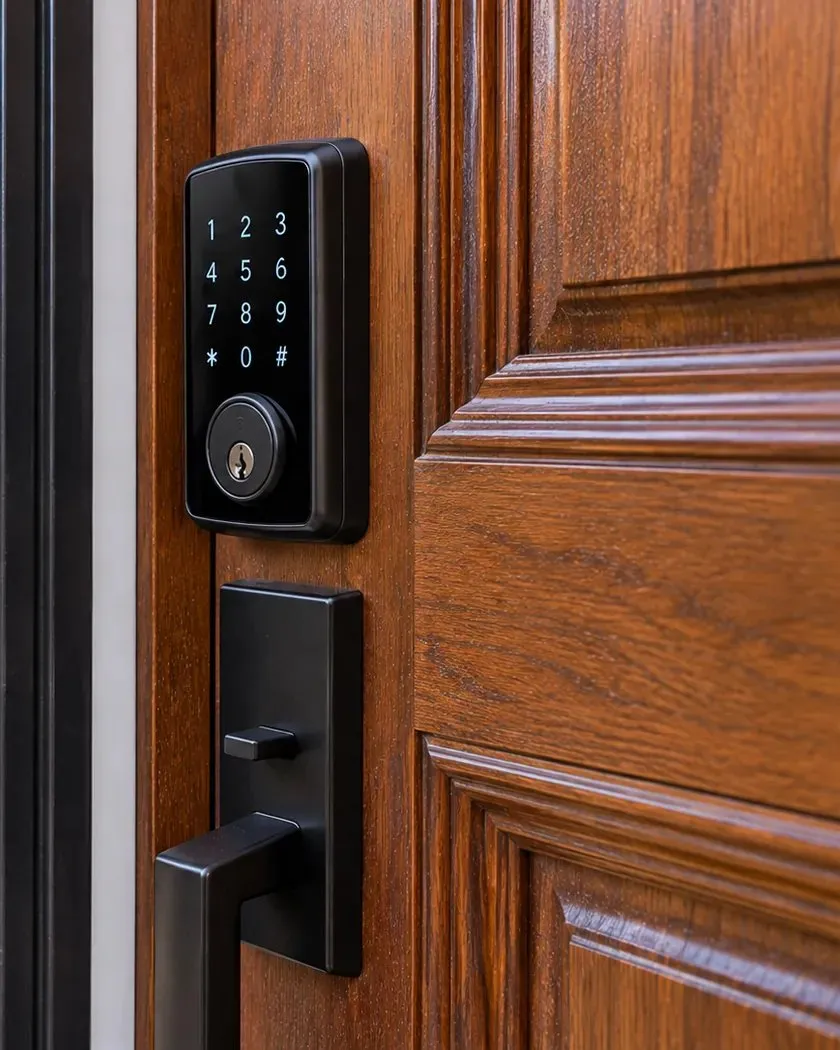
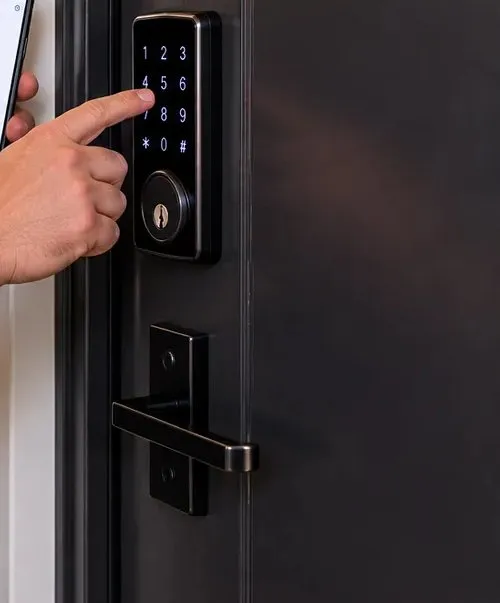
The right lock for a Forest Hills door is usually decided by what the outside of the door is allowed to show and what the wall around it is made of. These are the categories we fit, with the doors in the neighbourhood that each one suits.
Mount over the inside of an existing single-cylinder deadbolt and leave the outside untouched; August describes its retrofit as “leaving the outside untouched” and lists it as compatible only with single-cylinder deadbolts. The first option for matched Gardens rows and strict corridors.
A number pad with a key cylinder as backup. For side and rear doors of Gardens and north-side houses, and co-op doors where the board accepts a keypad on the corridor face.
A reader on the outside unit, with a code and a key as fallbacks. Useful for households where several generations share one door and nobody wants to remember another number.
Locks with slim outside and inside housings for divided-light doors where the wood rail between hinges and glass is narrow. Fit is measured on the door, not taken from the box.
For pre-war co-op doors with a mortise lock in the edge: a separate smart deadbolt where the door allows it, or a cylinder or trim change. No drop-in smart mortise fits every old body.
Locks that join a Thread mesh through a border router of the same ecosystem as the app, per Yale’s set-up guidance. Helpful in concrete houses, where a mesh of plugged-in devices carries signal better than a single Wi-Fi bridge.
Small plug-in units that link Bluetooth locks to the internet. August advises keeping its bridge within 10 to 15 feet of the lock — a short distance in a house with concrete-panel walls.
Small magnetic contacts, built into some locks and separate on others, that tell the app the door is actually shut rather than just that the bolt moved. The key to trustworthy concert-night alerts.
Reader or keypad, electric strike and exit button for Austin Street and Boulevard shops and offices, priced from our published Queens access-control lines.

Many Forest Hills shareholders tell us their building is safe because the lobby door locks and a neighbour is usually around. The daylight burglary QNS described in October 2025 — a man who came through a building’s front door, sat on the lobby couch and then walked toward an apartment — is the reason we plan every unit door as if the lobby were open. In practice that means a lock that throws its bolt on its own every time the door closes, an alert when it does not, and an override key that is not hanging on a hook by the door.
Concrete-panel houses, brick co-ops with plaster on masonry, and concrete towers all eat radio signal. Before pairing anything we stand at the door with a phone and check what it sees; if the bridge cannot sit within the maker’s recommended distance of the lock with a clear line, we move it, add a plug-in repeater or a Thread device, or choose a lock that does not need the internet for its everyday work. The lock’s own keypad and fingerprint reader keep working without any network at all.
Many older houses in the Gardens wear dark, aged metal hardware. Few smart locks are sold in those exact finishes, so we show owners the nearest real finishes on the actual door, in daylight, before ordering. Rounded, compact outside units generally sit better on a Tudor door than tall rectangular touchscreens.
Old wood doors in masonry openings are often thicker than the range a lock is listed for, and the reveal around the door can be deep enough that a bulky inside housing hits the trim when the door swings. We measure thickness, backset and the clearance through the full swing with a paper template taped to the door, and change the model rather than shave the door.
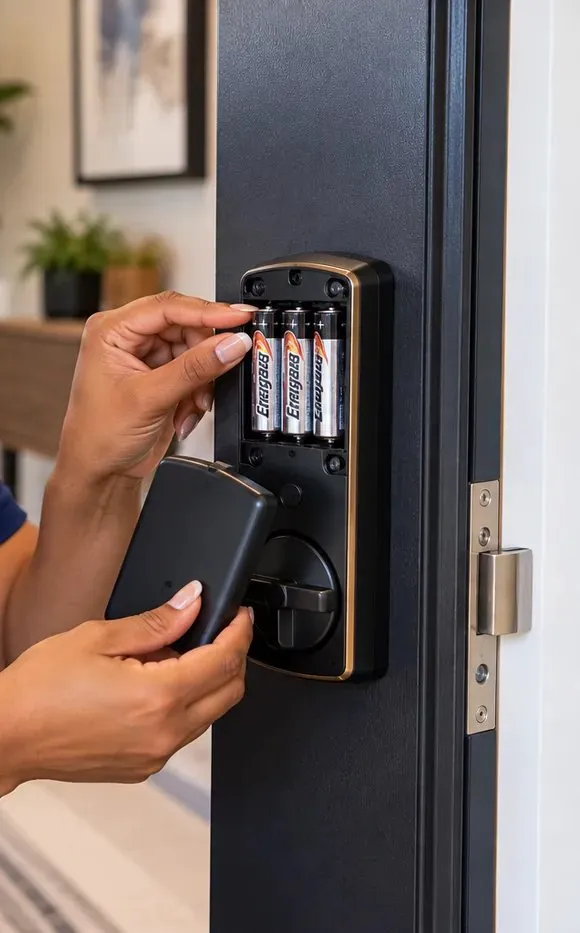
Some Forest Hills houses and older apartment buildings have unheated porches or vestibules, and batteries lose capacity in the cold. Schlage, for example, lists a narrower operating range for the inside part of its Encode Plus than for the outside lock body. We place inside housings in heated space where possible, set low-battery alerts to go to two phones, and leave the household with a note of which batteries the lock takes.

A door that is mostly glass is the hardest Forest Hills door to make both approvable and secure, so we lay the choices side by side. None of them involves a lock that needs a key or a code to get out; that option is off the table on any home we work in.
| Approach | What changes outside | What it does well | What to weigh |
|---|---|---|---|
| Inside-only retrofit over the existing deadbolt | Nothing | Keeps the door and its hardware exactly as the Committee and the neighbours know them; phone, schedule and auto-lock control | No keypad outside, so entry is by phone, fob accessory or the existing key; needs a working single-cylinder deadbolt to sit on |
| Slim keyed keypad deadbolt | A compact outside unit in the closest available finish | Codes for family and visitors; key backup; fits narrow rails better than wide touchscreens | Needs Committee review; rail width beside the glass must be measured, not assumed |
| Keypad on another door | Nothing at the front; a lock on a rear or side door | Front door stays fully original while day-to-day coming and going moves to a less visible door | That door must itself be solid and well anchored, and the household has to change habits |
| Laminated glass in the nearest panes, plus any of the above | Little or nothing visible, depending on the glass | Makes a quick break-and-reach much slower without trapping anyone inside | A glazier’s job rather than ours; check with the Committee if the glass would look different |
Whichever route is chosen, two settings matter most on a glass door: auto-lock, so that the bolt is never left withdrawn after someone comes in with their hands full, and a door-position alert, so that a door resting against its stop without latching is reported rather than discovered. On many of these doors the inside thumb-turn is the only thing within reach of a broken pane; a lock that is always thrown and always reporting makes that reach far less useful, while the person inside still leaves with one turn.
We are often asked whether a deadbolt that can only be opened from inside with a key would solve the glass problem. It would create a worse one. HPD’s fire-safety guidance treats double-cylinder locks on apartment doors as illegal precisely because people must be able to get out without hunting for a key, and we apply the same principle to every house we work in.
We could not read Google’s AI Overview directly from our research tools, so the claims below are the ones that cost guides, retailers and lock makers publish and that AI summaries tend to repeat. Each is set against what a Forest Hills door actually involves.
Fixr’s January 2025 guide puts a single smart lock installed at $250 to $400 nationally, with $300 as the average, and that is a fair figure for one ordinary bored door in a timber-framed house with nothing to fix and nobody to ask.
Forest Hills adds steps the national figure leaves out: a Gardens application with photos and product sheets, a jamb anchored to concrete rather than a stud, a narrow rail between glass panes, or a co-op’s contractor paperwork and permitted hours.
That is why we quote house and apartment doors flat after a free walkthrough instead of publishing a single number, and why the business-door prices we do publish are for complete keypad-and-strike entrances at the Queens rate.
Product reviews often say a retrofit or a keypad deadbolt goes on with a single screwdriver in about thirty minutes, and on a modern pre-bored door that is often true.
On a ninety-year-old door in a masonry opening, the half hour starts after the door has been made to close sweetly, the strike has been moved to meet the bolt, and the jamb has been fixed to the wall it has worked loose from.
The screwdriver part is quick. Deciding whether the door is fit for a motor, and fixing it if not, is the work that makes the lock reliable a year later.
Retail listings stress universal fit, and most locks do fit the common American bore and backset. Forest Hills has many doors that are not common: divided-light Gardens doors with a slender lock rail, thick old slabs, and pre-war co-op doors with mortise locks in the edge.
A home-automation forum thread that has run since 2014 shows owners of metal doors with mortise locks still looking for a true drop-in smart replacement; the answers are a separate deadbolt, a cylinder change or a commercial mortise lock.
We measure first and recommend a model second. Where nothing fits well, we say so rather than cut a door to suit a box.
Marketing copy implies a lock talks to the router from any room. Lock makers’ own support pages are more careful: August asks for its Wi-Fi bridge to be within 10 to 15 feet of the lock and to have full Wi-Fi bars where it is plugged in.
Atterbury’s concrete panels, brick co-op walls and tower slabs all shorten that range. A bridge that works on the kitchen counter can fail two rooms away from a Gardens front door.
We test signal at the door and at the bridge location before pairing, and use Thread devices or a repeater where the walls demand it.
That is close to true for a detached house on the north side. It is not the whole story in the Gardens, where the Declaration and the Corporation’s guidelines reach exterior hardware, or in a co-op, where the proprietary lease and house rules govern the unit door.
In a rental, New York’s Multiple Dwelling Law lets a tenant add a lock of their own beside the owner’s lock, but requires a duplicate key on request; it does not let a tenant remove the owner’s lock.
We ask who else has a say in the door before we quote, and we put the answer in writing.
Summaries often present a smart lock as building security. A unit lock secures one door; it does nothing about a lobby door that a stranger can follow a resident through, a courtyard gate, or a basement package room.
One r/ForestHills post described two people coming into a building’s basement at 3:30 in the morning and taking everyone’s packages a few days before Christmas. That is a building-entrance problem, owned by the building.
Where we are asked by a board or owner, we price the shared door separately from the unit doors so that each problem is solved by the party that owns it.
Some reviews recommend key-free models with no cylinder. In a Forest Hills co-op the board usually expects a key or a working code for emergencies, and in a house a dead battery or jammed motor still needs a way in that does not depend on electronics.
We generally fit keyed models, keep one override key in a safe place away from the door, and give the household a short written note of how to get in if the lock ever goes dark.
Key-free models are possible on some doors where the owner understands the trade-off; we explain it before fitting one, and never on a door that is the only way out.
A photo of the outside of the door, one of the edge with the door open, and a line about whether it is in the Gardens, a co-op or a shop is enough for us to tell you which approvals apply and which locks will fit.
A keypad that has gone dark, a bolt that stops short against a concrete-set strike, or a lock the app can no longer find: call (347) 434-6392. We book the next 2-hour window, and most battery, pairing, alignment and programming faults are fixed in one to two hours once a technician is at the door.
Tell us which doors, what kind of building, and whether the Gardens Corporation or a board will want to see the plan. A licensed installer answers in writing the same business day. Prefer to talk? Our Queens line is (347) 434-6392.
Thank you — a licensed installer will call before the end of the business day. If it can’t wait, ring (347) 434-6392.
Six steps for every Forest Hills job, whether it is one keypad on a north-side kitchen door or a matched Gardens entry, a co-op unit and a shop entrance for the same family.
You send photos of each door inside and out and tell us whether it is in the Gardens, a co-op, a rental or a shop. We tell you which approvals apply before anything is booked.
At the free visit we measure thickness, backset and rail width, run a paper template through the full swing, check how the jamb is held to the wall and test signal at the door.
You get a flat written figure per door, plus photos, product drawings and finish names for the Gardens Committee or your board where one is needed.
The jamb is secured to its wall, the strike reinforced and aligned, and any self-closer adjusted so the bolt never fights the door, all before a motor goes on.
With the frame sound, the lock, any bridge and the door sensor go on and are paired; then, lights off, someone opens each door from the inside by feel to prove that getting out needs no battery, code or phone.
Household members set up their own credentials at the door, a second adult is made administrator, show-night and away schedules are entered, spare metal keys are counted, and a one-page sheet for the door stays in a kitchen drawer.
Six places that explain why Forest Hills doors are planned the way they are — a private planned suburb, its station square, a tennis stadium, a shopping street, a public co-op and a tower complex.
The Russell Sage Foundation’s planned community, laid out from 1909 by Frederick Law Olmsted Jr. and Grosvenor Atterbury on 142 acres, according to the National Park Service. Still privately owned and governed by the Forest Hills Gardens Corporation and its Architecture Committee.
The square beside the Long Island Rail Road station, which opened in 1906, with the Forest Hills Inn of 1912 and a clock tower over the square. The Queens Ledger reported in 2022 that the tower’s chimes were being revived after a 2018 restoration of the square.
The club’s stadium, built in 1923, hosted the national tennis championships until 1977 and now stages summer concerts with a 10 p.m. curfew. Its show nights fill the Gardens’ private streets with visitors.
The main shopping street, running about a mile between Yellowstone Boulevard and Ascan Avenue, which Frederick Backus named for his father in 1909, as Wikipedia records. Shop doors, upstairs offices and back service doors.
Three towers at 108th Street and 62nd Drive, built after the 1972 controversy over a much larger public-housing plan was settled by halving it to 432 apartments, as the Queens Daily Eagle has told the story.
Three 20-storey towers with 1,327 apartments at 104-20 Queens Boulevard, which The Real Deal reported Blackstone bought in 2018. One of the largest groups of corridor doors in the neighbourhood.
We also serve the neighbourhoods around Forest Hills: Kew Gardens and Richmond Hill to the south, Rego Park and Elmhurst to the west and north, Middle Village and Glendale across Metropolitan Avenue, and Kew Gardens Hills and Briarwood to the east, plus the rest of the borough through our smart lock installation service for Queens.

Forest Hills is priced at our Queens rate — the Brooklyn base multiplied by 1.05 — with no extra charge for the Gardens or for any building. Business entrances have published prices, shown below. A smart lock on a house or apartment door has no published AESS figure, because the work around the lock varies so much here: a north-side kitchen door may be simple, while a divided-light Gardens door set in a concrete opening with an application to prepare is not. Those doors are quoted flat, in writing, after a free walkthrough.
| Item | Forest Hills (Queens rate) | What it covers |
|---|---|---|
| Smart lock on a Gardens house, north-side house, co-op or condo door | Quoted flat at the free walkthrough | No published AESS figure; depends on the door, the wall, approvals and the number of people |
| Single-door keypad or fob reader with electric strike | $1,575–$2,625 installed | Shop, office or practice door, or a small building’s entrance; published $1,500–$2,500 base × 1.05 |
| New electric strike on an entrance door | $263–$473 | Fitted as part of entrance work; $250–$450 × 1.05, rounded half-up |
| Failed electric strike repair | $310–$509 | An entrance door that buzzes but will not release; $295–$485 × 1.05, rounded half-up |
| Setup-only visit (codes, app, schedules, bridge, reset; no hardware) | $195 first hour, then 30-minute blocks | Our published Queens setup-only rate |
| Service and callback rate | $195/hr, 3-hour minimum ($585) | Service calls after an installation; never charged on the initial install |
National averages, for comparison only. Fixr’s January 2025 figure for one smart lock installed is $250–$400 nationally. That is third-party national data, not an AESS price.
Orders here tend to fall into one of three shapes. The two business ones have fixed Queens figures; the home one waits for the walkthrough, since a Gardens entry, a co-op corridor door and a north-side kitchen door each raise different work.
Quoted flat at walkthrough
Smart locks on the house or apartment doors that earn them, chosen around the facade or corridor and the wall they sit in; jambs and strikes made solid; an application pack for the Gardens or the board where needed; codes, fingerprints and phone keys for each person; concert-season and away schedules; a printed door sheet.
$263–$473
Replaces the worn release in the frame of an Austin Street shop entrance or a small co-op’s street door whose buzzer wiring is already there. Where the existing strike only needs bringing back to life rather than replacing, the repair line applies: $310–$509.
$1,575–$2,625
One shop, office or practice door made keyless from end to end: reader or keypad beside it, strike in the frame, exit button by the handle, staff codes or fobs with hours attached, and a log of every opening.
If you have a lock already, keep it boxed with the receipt until we have seen the door. We check thickness, backset, the rail beside any glass, swing clearance in a deep reveal and the signal at the door, then quote the fitting flat. If the lock will not suit the door, or needs a key or code to get out, we tell you before anything is drilled. A lock you supply carries its maker’s warranty rather than ours.

Book the free walkthrough: we measure every door, check how each frame is held, prepare what the Gardens or your board will want to see, and give you a flat, written figure.
The national security brands sell monitored systems, and most of them can add a smart lock to their app. That can be the right answer for a household that wants professional monitoring above everything else. What a national package is not built around is a particular door: a glass-panel Gardens entry, a jamb set in concrete, or a co-op corridor with a board’s preferences.
| Question | Typical national package | AESS in Forest Hills |
|---|---|---|
| Who chooses the lock? | Usually from the brand’s own list, so it works with its app and hub | Chosen after measuring the door, the wall and the approvals it needs |
| Is the frame fixed? | The lock is fitted to the door as found | Jamb anchored and strike reinforced before the motor goes on |
| Gardens or board paperwork | Left to the homeowner | Photos, drawings and finish names prepared for the application |
| Ongoing fees | Often tied to a monitoring plan | No AESS subscription needed for the lock to work |
| Who comes back? | A national service queue | Our Queens team, on the line printed on this page |
Neither route is wrong. If you already pay for monitoring, we can often fit a lock that works with your existing system, so long as the brand supports it; if you do not want monitoring at all, the lock’s own app, alerts and log cover the door on their own.
One ZIP code, 11375, and one police precinct, the 112th, cover very different kinds of door. These are the parts of the neighbourhood as a lock installer meets them.
South of the railroad, the curving private streets the Corporation maintains, with roughly 1,600 homes between houses and apartment buildings. Every visible change goes through the Architecture Committee, the streets are patrolled for parking under the Corporation’s own rules, and a contractor’s van needs a properly worded note on the dashboard or risks a boot. Entry doors are wood, panelled or glazed in small panes; walls are concrete panel, brick or stucco. Jobs here begin with photographs and an application, and many end with an inside-only retrofit that leaves the street side exactly as the Committee last saw it.
The co-op apartment houses gathered around the station — the Forest Hills Gardens Foundation’s history notes that the multi-unit buildings in the Gardens are all co-ops except one, and that the Inn Apartments at 20 Continental Avenue date from 1931. Unit doors on long-established corridors, under house rules, with a board that may hold a key. The lock work is quiet, inside, and planned around the building’s contractor hours.
Detached single-family houses on the original Cord Meyer streets, a mix of early houses and much larger rebuilds. No private covenant governs these doors, so the owner decides; the questions are practical. Which of the front, side and garage-passage doors is used most, does the new oversized entry door take a standard deadbolt at all, and can the bridge reach a door at the far end of a deep house. Owners here usually want every door on one app and one “all locked” check at bedtime.
Pre-war elevator co-ops, post-war co-op and rental towers, and newer condominiums. This is where the lobby is shared with the whole building and, as the 2025 case near 112th Street and 73rd Avenue showed, can be passed by someone who does not live there. Unit doors are steel-clad or hollow metal with self-closers; the board or management decides the corridor face; and the city’s fire rules decide that the door must open from inside without a key. Retrofits and slim keyed keypad deadbolts do most of the work.
Shops, restaurants and small offices, with apartments above many of them. Business entrances get keypad or reader entry with an electric strike at the published Queens rate; back doors and roof hatches get door contacts and closing-time checks; and where a shop shares a street door with the flats upstairs, the building owner keeps control of that door while the business gets its own code.

For about twenty evenings a summer the Gardens’ quiet streets become a walking route. The Corporation sued the city in October 2025 over police control of its private streets on concert days, and settled in April 2026 for $150,000 with an undertaking that the NYPD and the 112th Precinct would work with residents on security planning, as QNS reported. Whatever happens on the street, the door is the owner’s part. This is how we set locks for houses along the routes.
| Setting | Ordinary evening | Show evening |
|---|---|---|
| Auto-lock delay after the door closes | Whatever the household prefers | Short — about a minute — so the bolt is never left back |
| Door left open or unlatched | Alert after a few minutes | Alert at once, to two phones |
| Cleaner, walker and contractor codes | Active on their usual days | Paused from late afternoon until morning |
| Garage-passage and rear doors | Locked with the house | Checked on the “all locked” screen before leaving or at the interval |
| Video doorbell | Motion alerts as usual | Answer from the phone; never unlock remotely for someone you have not seen |
| Override key | Kept away from the door | Still away from the door, not under a mat or planter |
Households that leave for the evening, as some residents told reporters they do, get the same plan with one change: the lock’s away schedule runs all night, and the first unlock in the morning sends a notification so that you know the house was opened by someone with a code, and when.
The Committee reviews; the homeowner applies; we supply what makes the application easy to read. We do not file on anyone’s behalf, and we do not predict outcomes. What we hand over is listed below.
If the Committee asks for changes, we revise the pack. The physical work waits until you tell us the application has been approved, or until you decide on the retrofit route that changes nothing outside.
On the north side the owner sets the rules, and the doors are newer and larger. Wikipedia’s history of the neighbourhood notes that many of the original detached houses on the Cord Meyer streets have been torn down and replaced by bigger ones. The doors that come with those rebuilds raise their own questions, none of them about approvals.
Owners on these streets often want the locks to work with an alarm panel, lights and cameras. That is a job for our home automation team in Queens, and we plan the lock choice so that it joins whichever system the house already runs.
Most of the neighbourhood’s apartment doors are co-op doors. These are the points we confirm with the shareholder, and where needed the managing agent, before a co-op unit door is touched.
None of this is legal advice; it is the order in which we ask the questions so that a lock goes onto a co-op door once, and stays.
A Forest Hills door order often brings other Queens work with it. These are the services that most often join a smart lock.
See and answer the path before unlocking, and let an empty house still respond on a show night.
Contacts on back doors and windows, where local reports say break-ins actually start.
Yards, service doors and shop fronts, planned with any Gardens application in mind.
When an Austin Street business or a practice needs several doors on one controller.
Lobby and street-door intercoms for co-ops and small buildings.
Dead stations, failed releases and old wiring on existing systems.
Strikes that hum without releasing and buzzers that went silent.
One tap that locks the doors, sets lights and arms sensors.
Access points and wiring that carry signal through concrete and masonry.
One request for any mix of the services above.
The routine our installers follow on a door hung in a concrete or masonry opening — how we work on doors like these, not an account of a particular house
We start with the door closed and a hand flat on the jamb beside the strike, while someone pulls and pushes the door from the other side. If the jamb moves, that is the job; the lock comes later.
Next we take the strike off and look at what the old screws were biting into. Short screws in crumbling wood blocking tell us the jamb has been held by habit for decades. We find solid concrete with a small pilot hole at the edge of the opening, never in the middle of a panel, and anchor the jamb before the new strike goes back.
Then the signal. A phone at the door, a phone at the nearest outlet, and the maker’s app open on both. If the bridge cannot see the lock from where it would live, we move it before we pair anything, because a lock that pairs on day one and drops in week two is the call nobody wants.
Last, the dark test: lights off, door locked, and someone who has never seen the lock opens it from inside by feel. If that takes more than one movement, we change something.
Because the work around the lock varies more than the lock itself. A Gardens door may need its jamb anchored to a concrete opening, a narrow-bodied lock for a glazed rail and an application pack for the Architecture Committee, while the next door needs none of that. We quote each house door flat, in writing, after a free walkthrough, at our Queens rate. Business entrances are standardised, so they carry published Queens prices: $1,575 to $2,625 for a keypad or reader with an electric strike.
Yes. We work across Forest Hills, the Gardens and the north-side Cord Meyer blocks, and in Kew Gardens, Rego Park, Middle Village, Glendale, Kew Gardens Hills and Briarwood, all at the same Queens prices with no neighbourhood surcharge. Visits are booked in 2-hour arrival windows between 8 AM and 8 PM, seven days a week.
Rarely. A smart deadbolt's motor runs for a second or two and is quieter than a door closing; most locks also let you turn off or lower their beeps and voice prompts. What carries through a party wall is the door itself, so we adjust the strike and closer so the door shuts without a bang and the bolt slides in without grinding.
Usually a different outside unit or finish, or a move to an inside-only retrofit. If the replacement is a lock we supplied, we fit it and re-enrol the household's codes in one visit; if no new hardware is needed and only programming changes, it is a setup-only visit at $195 for the first hour, then 30-minute blocks. The way to avoid the swap is to get approval before anything is drilled, which is why we prepare the application pack first.
Forest Hills is one neighbourhood inside a larger map. Borough-wide detail — basements, multi-door houses, garden co-ops, BID corridors — is on the AESS smart lock installation page for Queens, and the city-wide rules on tenants, boards and apartment doors are gathered at our smart lock installation hub for New York City.
One level up: NYC smart lock installation. Borough pages for Queens keyless entry, Brooklyn, Manhattan, the Bronx and Staten Island.
East of Queens: the Long Island smart lock hub, with county pages for Nassau and Suffolk.
North of the city: the Hudson Valley smart lock installation hub and pages for Westchester, Rockland, Orange, Putnam, Dutchess and Ulster.
Bayside, Queens · Bedford-Stuyvesant, Brooklyn · Brooklyn Heights, Brooklyn · Chelsea, Manhattan · Flushing, Queens · Greenpoint, Brooklyn · Jackson Heights, Queens · Kingsbridge, Bronx · Morris Park, Bronx · New Dorp, Staten Island · Pelham Bay, Bronx · Throgs Neck, Bronx · Todt Hill, Staten Island · Upper East Side, Manhattan · Washington Heights, Manhattan · West Brighton, Staten Island · Williamsburg, Brooklyn · Upper West Side, Manhattan · Park Slope, Brooklyn · Astoria, Queens · Riverdale, Bronx · St. George, Staten Island · Tribeca, Manhattan · Tottenville, Staten Island · Harlem, Manhattan · Bay Ridge, Brooklyn · Long Island City, Queens
Cameras, intercoms, cabling and alarms are on the Abstract Enterprises home page; the people behind the vans are introduced on about us; and a request for any of it can begin on the free quote page.
Standing at a Gardens door, a co-op landing or a shop entrance that will not open? Ring (347) 434-6392 and describe what the lock is doing — dark screen, no app connection, a bolt that stalls halfway. The next free 2-hour slot is yours, and a technician on site usually clears battery, pairing, code and strike-alignment trouble within an hour or two. Meanwhile use the override key, or on a key-free model the emergency battery terminal its maker builds in.
The Queens desk for the Gardens, the Boulevard and Austin Street answers on (347) 434-6392; written messages can go by WhatsApp (718) 679-0359, opened through wa.me. Every Queens crew is dispatched by Abstract Enterprises Security Systems from its licensed office at 460 E Fordham Rd, Bronx, NY 10458.
NYS Low-Voltage Licence #12000287431 · 100% Licensed & Insured · Same-Day Estimates · Rated 4.7★ from 201 Google Reviews
Hardware we supply and fit on a Forest Hills door is covered as follows, while a lock you bought yourself stays under its own manufacturer’s cover. Full terms — including 50% deposit, one-year parts-only warranty on AESS-supplied products, and the late-fee schedule — are set out in the service agreement. How to raise a claim is explained on our warranty page.
This page is not legal advice and does not speak for the Forest Hills Gardens Corporation, its Architecture Committee or any co-op board. Owners should check the current guidelines and house rules themselves; we describe them only to explain our working method. Page reviewed and updated October 17, 2026. Changelog: first publication of the Forest Hills, Queens smart lock installation page.