Licensed Low-Voltage Contractor · Long Island City, Queens · Tower Apartments, Hunters Point Rows, Court Square Offices & Dutch Kills Lofts
Smart Lock Installation in Long Island City
Your Door Inside the Building’s System · Labelled Fire Doors Handled Properly · Stair, Studio & Suite Doors · Hunters Point to Queensbridge
In Long Island City the building usually owns every door between the sidewalk and your hallway: the street entrance, the lobby turnstile or fob reader, the elevator, the amenity floors, the package room. What is left for you is one door — and in a new tower it is often a labelled fire door on a self-closer, in a corridor the building treats as a fire separation. We fit smart locks that respect that: we read the label before we drill, we work alongside the building’s entry platform instead of fighting it, and in the older Long Island City of rowhouses, lofts and walk-up offices we plan the whole door, frame and stair included.
Reviewed and updated October 17, 2026 · Written by Anwar Timothy, NYS licence #12000287431
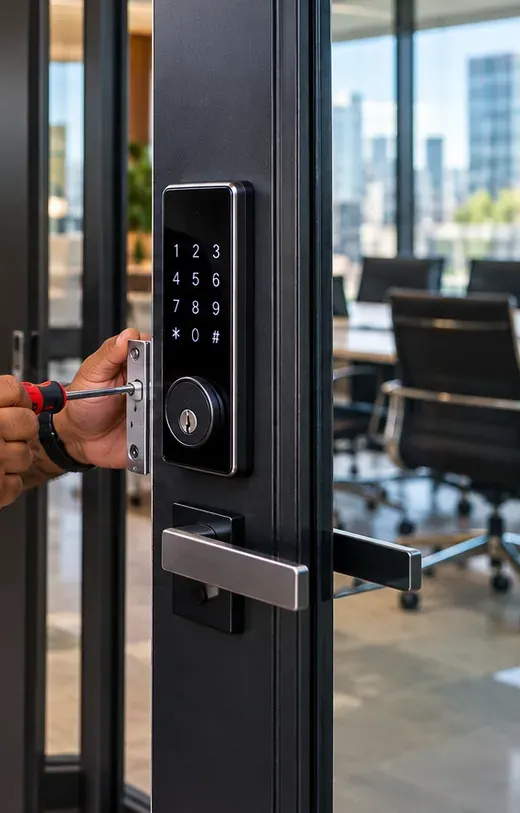
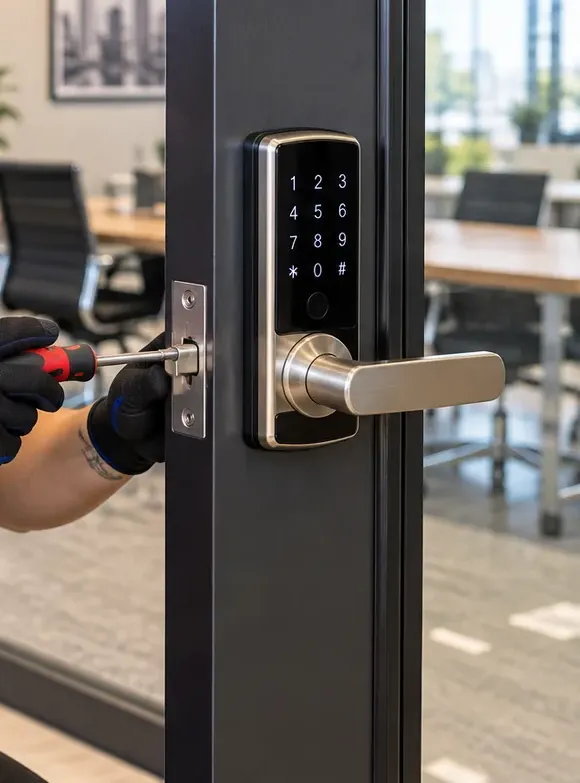
A keypad deadbolt and a black lever sit on the narrow metal stile of a glass door while a gloved hand works a screwdriver at the latch edge; an open office is visible through the glass.
Free Long Island City Smart Lock Quote
Tell us the door, the building and who manages it — we call back the same business day
✅
Request Sent!
We’ll call you back the same business day.
25+
Years Experience
✓
Same-Day Estimates
100%
Licensed & Insured
4.7★
201 Google Reviews
New lease starting in a Hunters Point tower, a condo closing at Court Square, or an office floor whose keys went home with a departed tenant? Call our Queens line at (347) 434-6392 or use the 60-second form. A licensed installer reads every request and tells you, before anyone travels, whether your door can take the lock you have in mind and what the building’s management will want to see first.
We read the fire label on a tower unit door and choose hardware that uses the door’s existing preparation wherever possible
Your lock is planned around the building’s own fob, app or intercom, so neither one breaks the other
Licensed under NYS #12000287431 and insured, with two-hour arrival windows from 8 in the morning to 8 at night, seven days a week
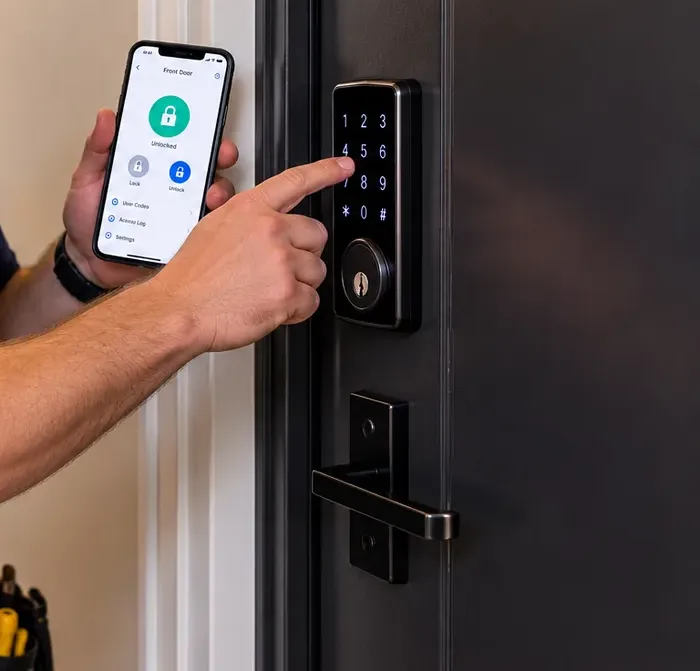
Blue digits glow on the deadbolt’s number pad as a fingertip touches it; to the left a phone shows the app’s green unlocked icon, and a matte lever sits lower on the dark door.
The Neighborhood
Why Long Island City Properties Need Smart Lock Installation That Starts With the One Door You Control
No part of New York has been rebuilt as fast as this one, and the doors show it. The State Comptroller’s economic snapshot of Long Island City, Sunnyside and Woodside, published in September 2025, counts 26,177 housing units in the Long Island City–Hunters Point neighbourhood at the end of 2024 — an increase of 308.1 percent since 2010. Queens West alone added 4,757 units in eleven buildings, and Hunters Point South another 5,255 between 2013 and 2024. Most of those homes are apartments in towers, most are rented, and almost every one of them sits behind a stack of doors that someone else controls before you reach your own.
That stack is the first thing we draw when a Long Island City customer calls. There is the street entrance, often with a fob reader or a resident app. There is a lobby desk or a virtual concierge. There is an elevator that may need a credential to reach your floor, a corridor the fire code treats as an escape route, a package room that may open with a QR code, and amenity floors on the same fob. Only then is there the apartment door — and in many new buildings even that arrives with the building’s own electronic lock on it. The lock you are allowed to change, and the way it has to behave, depend on where in that stack your door sits.
The older Long Island City asks different questions. On 45th Avenue between 21st and 23rd Streets, the Hunters Point Historic District protects rowhouses built between 1871 and 1890, some still with the double doors their builders hung. Dutch Kills, named for a tributary of Newtown Creek, mixes lumber yards, converted printing plants and old rowhouses with hotels and new towers. Court Square has office floors in a tower finished in 1989 beside a courthouse built in 1876. Queensbridge Houses, opened in 1939, is the largest public-housing development in North America. Each of those has its own owner, its own rules and its own idea of who should hold a key.
The burglary picture is steady rather than alarming, and it points at doors rather than at technology. The 108th Precinct’s CompStat report for the week ending October 11, 2026 shows 175 burglaries so far this year against 183 at the same point in 2025, and 237 for the whole of 2025 — against 2,062 in 1990. When things do go wrong here, the local reports describe unlocked back doors in office buildings, keys stolen in a street robbery and then used to walk into a condo, and a burglar who came over the rooftops. A better lock helps with some of that. A lock that someone thought about — who has a credential, what happens to a stolen key, which door locks itself — helps with more.
And more is coming. In November 2025 the City Council approved the OneLIC neighbourhood plan, rezoning 54 largely industrial blocks for about 14,700 new homes, 4,350 of them permanently affordable, with a continuous waterfront from Gantry Plaza State Park to Queensbridge Park. Every one of those homes will need a door that somebody decides how to lock.
Long Island City facts that shape a smart lock job
308.1 percent: growth in housing units in Long Island City–Hunters Point from 2010 to the end of 2024, to 26,177 units, per the State Comptroller’s September 2025 snapshot. Most doors we see were hung in the last fifteen years.
Three in four: the share of occupied homes in the wider Long Island City, Sunnyside and Woodside area that were rented in 2023, by the same report. Most unit doors belong to a landlord, a sponsor or a condo association before they belong to the person using them.
85 percent: the share of the 5,052 residential units in active permits across that area that are planned for Long Island City–Hunters Point itself. The tower stock is still growing.
175 versus 183: burglaries reported in the 108th Precinct through October 11, 2026, against the same point in 2025, from the NYPD’s CompStat report; the precinct recorded 237 for all of 2025.
May 15, 1968: the date the Landmarks Preservation Commission designated the Hunters Point Historic District; the State and National Registers followed in 1973. Its fronts are reviewed by the Commission before anything new is mounted on them.
3,142 apartments: in the 96 six-storey buildings of Queensbridge Houses, home to roughly 7,000 people; residents reach their buildings by key or intercom, and the apartment doors belong to the Housing Authority.
Most tower residents who sort out their own door end up asking about the one at the street. If you manage or own a smaller building, the AESS access control installers in Queens fit fob readers and controllers for entrances, and our intercom installation team for Queens replaces lobby panels with video entry.
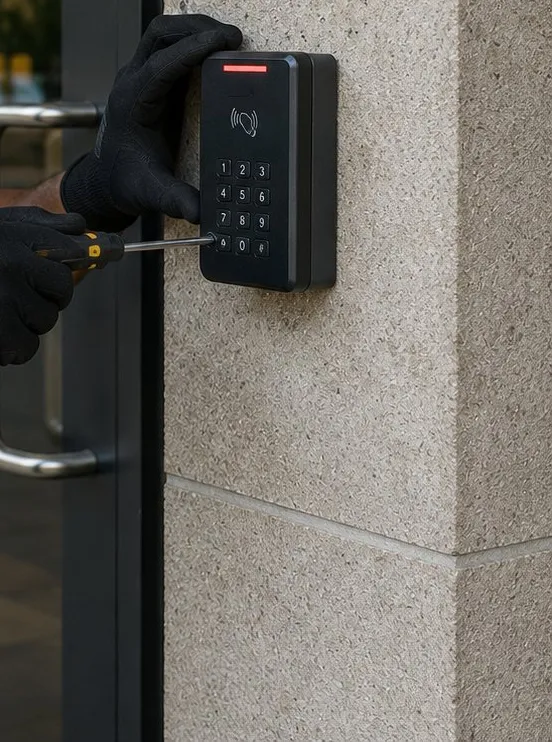
A black keypad reader with a red status light is held against a pale textured wall while a screwdriver tightens it; the steel pull of a glass entrance door shows at the left.
Repair Capture
Need Smart Lock Repair in Long Island City Today
A keypad that died on the 30th floor while the building’s app still opens the lobby, a bolt that catches because the corridor’s air pressure stops the door a few millimetres short, an office suite whose only administrator left the company, a studio lock whose code works but whose motor only half-throws, a stair-side keypad that stopped releasing on a re-entry floor — each one is a service call, booked into the next free two-hour window. Once a technician is at the door, most battery, pairing, administrator and alignment faults are fixed in one to two hours. Where the fault is in an electric strike on a building or office door, a failed strike repair is $310–$509 at our Queens rate. Call (347) 434-6392 and say it’s a smart lock fault in Long Island City; for the panel at the street, see the intercom repair service for Queens buildings. If you rent, tell management a technician is coming; most towers log every contractor at the desk.
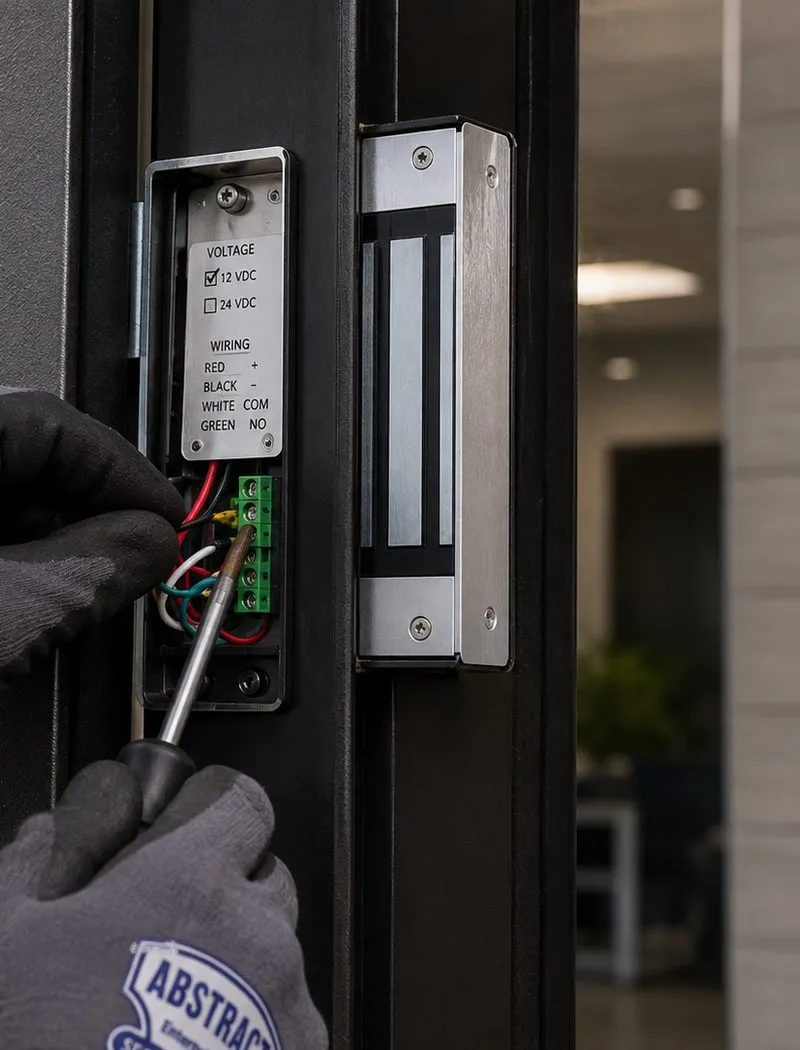
The cover of a door-frame lock is off, showing its voltage and wiring label and a green terminal block, while one gloved hand steadies the wires and the other turns a screwdriver.
What We Install
Smart Lock Installation Services in Long Island City
Long Island City work divides by who owns the door, not by how new it is. A renter in a tower, a condo owner in the same tower, a family in a Hunters Point row, a start-up on a Court Square office floor and a furniture maker in a Dutch Kills loft all want much the same thing — fewer keys, a record of who came in — but the paperwork, the door and the permitted hardware differ every time.
Tower Unit Door Locks
Smart deadbolts and retrofit units for apartments in elevator buildings, chosen to suit the door’s fire label, its existing bore and the building’s rules, and set up so the building’s fob or app still works where it is supposed to.
Condo Owner Upgrades
For owners who control their unit door but not the corridor face: hardware that matches the building’s finish on the hallway side, and a written description for the managing agent or board before installation day.
Rowhouse Front Doors
Locks for the nineteenth-century houses of the Hunters Point Historic District and the older rows around Vernon Boulevard and Dutch Kills, mounted to keep original woodwork intact and new devices off the front of the house where possible.
Office Suites and Floors
Keypad levers, keypad deadbolts and reader-and-strike doors for suites in Court Square and Queens Plaza buildings, with staff codes that end the day someone leaves and stair doors handled to the building’s fire plan.
Studios, Lofts and Workshops
Locks for individual studios in converted factory buildings, compatible with the landlord’s master key where the lease demands it, and with a code list that changes as assistants and collaborators come and go.
Shop and Restaurant Doors
Front and staff doors for businesses on Vernon Boulevard, Jackson Avenue and around Queens Plaza, including those in the base of residential towers where the landlord’s frame and the building’s rules both apply.
Small-Building Entrances
Street doors of four- and six-family walk-ups and mixed buildings fitted with a code pad or card reader, a powered strike, an exit device that needs no power, and an entry history the owner can read.
Credential Clean-Ups
A setup-only visit for a lock already on the door: departed tenants, staff or assistants removed, a second administrator added, schedules rebuilt and everything written down.
Repairs and Lock Recovery
Keypads that have gone dark, motors that stop mid-throw, strikes that miss because a closer leaves the door ajar, and accounts nobody can log into any more — with a maker’s reset when its instructions permit one.
A brushed-steel keypad lever is mounted on the stile of a glass office door; a gloved hand drives a screwdriver into the latch faceplate, with desks and chairs beyond the glass.
Building Specialists
Smart Lock Installation for Long Island City’s Architecture
Long Island City has some of the newest doors in the city and some of the oldest in Queens, often a few blocks apart. Tell us which kind of building you are in and we already know who will want to approve the work, what the door is probably made of, and whether the hallway side is yours to change.
Waterfront Rental Towers
Queens West and Hunters Point South, the two waterfront programmes the Comptroller counts at 4,757 and 5,255 new units. Unit doors on closers, opening onto rated corridors, frequently already carrying the building’s electronic lock; management sets the rules.
Court Square and Queens Plaza Towers
High-density towers allowed after the 2001 zoning change that made much of the area mixed-use. Condos and rentals side by side, often with fob-controlled elevators and a resident app for the lobby, gym and package room.
Hunters Point Historic District Rows
Around 47 houses on 45th Avenue between 21st and 23rd Streets and a short row on 23rd Street, built 1871–1890. Some of Westchester stone with original double doors, others brick, and a few of wood later covered in shingles.
Converted Industrial Lofts
Former printing plants, warehouses and factories in Dutch Kills and along the old rail lines, now apartments, studios and offices. Heavy steel doors, freight landings, odd frames and landlords who keep master keys.
Court Square Office Floors
Suites and full floors in office buildings, including the tower completed in 1989 that long stood as the area’s tallest. Building card systems in the lobby, suite doors that are yours to fit out, and stairwells with their own rules.
Queensbridge and Ravenswood
Two large NYCHA developments: Queensbridge’s 96 six-storey buildings and 3,142 apartments between Vernon Boulevard and 21st Street, and Ravenswood, whose building list numbers 31. The Housing Authority owns every unit door, so residents ask NYCHA before anything changes.
Small Walk-Ups and Frame Houses
Three- and four-storey buildings and older houses scattered through Dutch Kills, Ravenswood and the blocks off Vernon Boulevard, with a street door, a stair and a handful of apartments.
Shops in the Base of Towers
Cafés, gyms, clinics and shops in ground-floor retail under new residential buildings, where the storefront belongs to the landlord and the building’s rules reach down to the sidewalk.
What we look at on a Long Island City door before we quote
The label on the hinge edge. Doors between an apartment and a tower corridor are commonly fire-rated assemblies, and a rated door carries a label — usually a small metal plate or an embossed mark on the hinge edge — showing its rating and listing. NFPA 80, the national standard for fire door assemblies, limits what may be done to a rated door in the field; its 2016 edition, as door-hardware consultants read it, permits holes larger than an inch for surface-applied hardware only where both the door manufacturer’s and the hardware manufacturer’s listings allow them. So before anything is drilled we photograph the label, check the lock’s own listing, and prefer hardware that uses the bore and strike already in the door. Where a model would need a new or enlarged hole that neither listing covers, we say no and suggest one that doesn’t.
Who decides about the corridor face. In a rental tower the landlord owns the door and the lease almost always restricts alterations; in a condo the owner usually controls the unit, but the declaration, bylaws or house rules often govern what can be seen from the shared hallway. Either way the answer is in writing somewhere, and we would rather read it with you than guess. A retrofit unit that works the existing deadbolt from inside changes nothing in the corridor and is often the first thing a management office will accept.
The closer and the air in the corridor. Tower unit doors are self-closing, as the city requires for doors onto interior corridors and stairs in multiple dwellings, and in a tall building the air moving through corridors and shafts can lean on a door as it closes. A door that swings shut but stops a whisker short of latching will defeat a motorised bolt: the lock throws, hits the strike and reports a jam. We watch the door close on its own a dozen times before we fit anything, and adjust the closer, the strike or both until it latches every time.
What is already electronic. Plenty of Long Island City apartments come with the building’s own keyless lock already on the unit door, run from the same app as the lobby. That lock belongs to the building. We never remove or re-program it without management’s written say-so; what we can do is explain your options alongside it, which are usually narrower than people hope and wider than management first suggests.
Leaving needs nothing but a hand. Whatever the outside looks like, the inside of a home door we fit has a plain thumb-turn or lever that works in one motion. HPD’s fire-safety guidance says double-cylinder locks are illegal on apartment doors, and on a twentieth-floor corridor in smoke nobody should be hunting for a code.
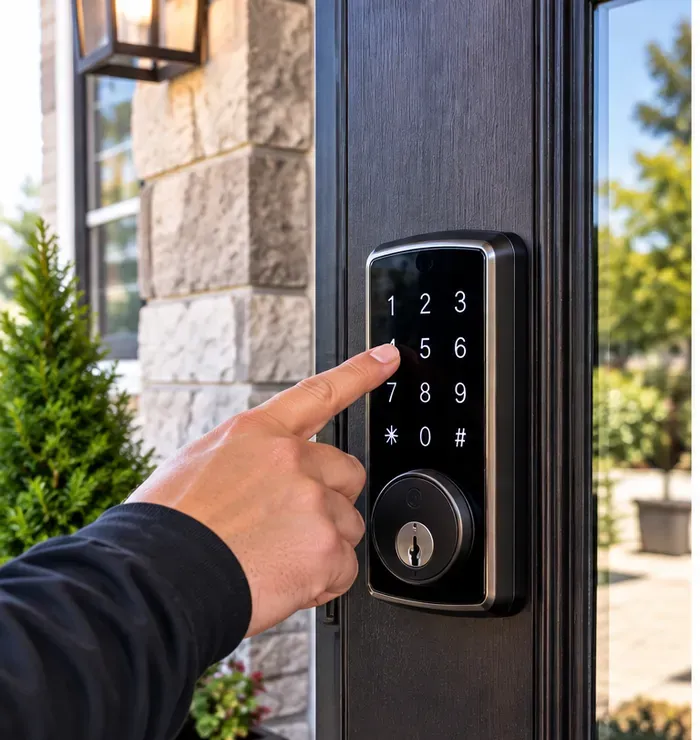
A finger presses a number on the glowing keypad of a black deadbolt set in a dark door, with a stone-faced wall, a wall lantern and shrubs beside the doorway.
Commercial Smart Locks
Business Smart Lock Installation in Long Island City
Long Island City is still a place where things are made, filmed and run, not only lived in. The Comptroller’s snapshot counts 4,909 businesses across Long Island City, Sunnyside and Woodside in 2023, up 19.5 percent in a decade, with firms in Long Island City–Hunters Point making up 36.2 percent of them and providing 40.6 percent of the area’s jobs. Those businesses sit in office floors, lofts, studios, ground-floor shops and industrial buildings, and the doors they need differ as much as the buildings. What they share is a staff list that changes faster than anyone re-keys, and a back or side door that someone forgets.
Court Square and Jackson Avenue
Office towers, the Queens County Courthouse of 1876 and the restaurants and services around them. Suite doors behind a building card system, and owners who want staff credentials they can cancel the afternoon someone resigns.
Queens Plaza and Northern Boulevard
The junction at the foot of the Queensboro Bridge, where offices, hotels and new residential towers have replaced much of the old industrial edge. Ground-floor businesses with landlord-owned storefront frames.
Vernon Boulevard and Hunters Point
The neighbourhood’s older main street of cafés, bars and small shops near the waterfront, now joined by retail in the base of the towers. Front doors on busy sidewalks, staff doors at the back.
Dutch Kills’ Working Blocks
Lumber yards, supply houses, workshops and converted factory buildings either side of Queens Plaza; one lumber dealer there traces itself to 1909. Heavy steel doors, roll-up bays and studios behind shared corridors.
The Studio Lots
Silvercup Studios, founded in 1983 in the former Silvercup bakery, and the production companies, prop shops and post-production suites that orbit it. Space taken for a project and given back when it wraps.
The Long Island City Partnership District
The Long Island City Partnership is one of eleven business improvement districts on the city’s list for Queens. Its members include shops, offices and hospitality businesses whose opening and closing routines run on a few trusted keyholders.
Compliance callouts for Long Island City business doors
Stair doors in tall buildings are not ordinary doors. In buildings 100 feet or taller, a 1992 Department of Buildings notice issued under the code of that era allows stair doors to be locked from the stair side except on re-entry floors, spaced no more than four storeys apart, and allows fail-safe locks on re-entry floors that release when the fire alarm operates. The current code and the building’s fire safety plan govern your floor; we confirm with the building before touching any stair door.
Leaving is never conditional. Anyone inside an office, studio or shop walks out by pressing a bar, turning a handle or hitting an exit button. Credentials are asked only of people coming in, and powered hardware keeps a manual release for the day the supply dies.
Fail-safe or fail-secure is a decision, not a default. A fail-safe strike or magnetic lock lets the door open when power fails; a fail-secure strike stays locked and relies on the key. Doors on an escape route and stock-room doors usually want opposite answers, and we write the choice for each door on the drawing.
The frame is the landlord’s. A strike pocket is cut into metal the landlord owns, in a storefront or a suite entrance alike, so written consent comes before any cutting, and we choose hardware that can come out cleanly when the lease ends.
Residents’ doors follow housing law. Where offices or shops share a building with homes, the residential entrance answers to housing rules, and an owner who hands tenants fobs or app access must follow Local Law 63 of 2021, the Tenant Data Privacy Act. Business credentials belong on business doors, preferably on a separate platform.
A suite with two doors does fine on stand-alone smart locks. When a floor has grown to several entrances, people with different permissions and a need for camera footage next to each door, a networked access control system is cheaper over its life; the Queens access control installers on our team design those, and commercial camera installation for Queens businesses adds the picture.
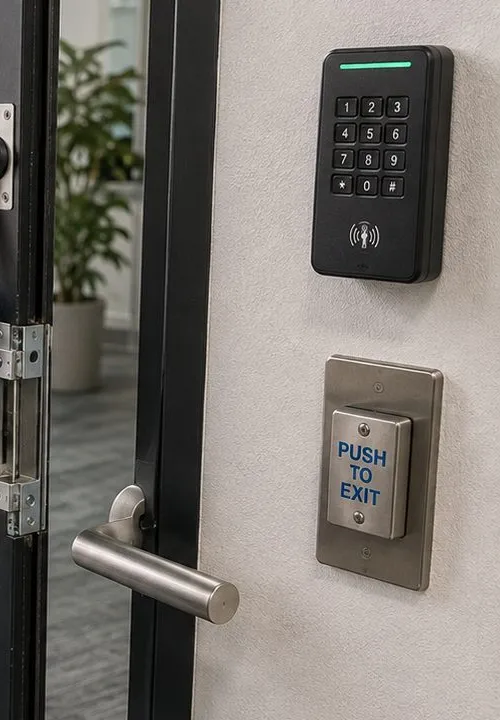
A keypad reader with a green status bar is mounted on a pale wall above a stainless push-to-exit plate, next to the steel lever and hinge side of a glass door.
Your Questions Answered
Smart Lock Installation in Long Island City: Questions Answered
These are the questions tower residents, rowhouse owners, office managers and studio tenants in Long Island City bring us, grouped by the kind of building behind the door. Prices, timing and coverage sit in the FAQ further down. None of this is legal advice: where a rule is mentioned, we name it so you can read it yourself or take it to your building’s management, a lawyer or the agency that wrote it.
Living in a tower
The fire notice on our tower apartment door says to close the door without locking it if we escape a fire — what should auto-lock do then?
The notice is the FDNY fire safety notice that buildings post, and the instruction you are reading is for a fire inside your own apartment: get everyone out, close the door to the room that is burning, take your keys, and “close, but do not lock, the apartment door.” Closing the door holds smoke and fire inside the unit and out of the corridor and stairs everyone else will use. Leaving it unlocked saves firefighters from forcing it. A smart lock set to bolt itself thirty seconds after the door shuts will undo the second half of that instruction without anyone noticing.
There are three sensible ways to handle it, and the household should pick one deliberately. One is to leave auto-lock off and lock the door by habit, which keeps the notice’s advice intact and loses some convenience. Another is to keep auto-lock but give it a longer delay and teach everyone that, in a fire, the door gets closed and the lock gets thumbed back open from the hall with a code or the key on the way out — workable for adults, unrealistic with small children in the dark. The third is to keep auto-lock and accept that a locked door may be forced; that is a decision some people make, but it should be made, not discovered.
The same notice tells residents of fireproof buildings whose apartment is not on fire to stay inside unless conditions become dangerous, and to keep smoke out with wet towels at the door. That is another reason the inside of every door we fit opens with one turn of the hand and never asks for a code: the people inside must be able to make the call to leave instantly. Take your mechanical key or your phone with you either way — the notice says to take your keys for a reason.
Can we ask our building what its entry app keeps about us, and for how long?
Yes, and in a multiple dwelling the city has already set limits on the answer. Local Law 63 of 2021, the Tenant Data Privacy Act, applies to owners of multiple dwellings who use smart access systems — fobs, key cards, apps, biometrics — to control entry to the building, its common areas or the apartments. It requires express consent before the owner collects reference data such as a face template, limits the data the owner may gather, bars selling it, requires authentication data to be destroyed within 90 days unless it has been anonymised, and requires robust security for whatever is kept. It also gives tenants a private right of action.
So a written question to management is reasonable: which system runs the doors, what it records each time you badge or tap in, who at the company and the vendor can see it, how long it is held, and whether there is a non-app way into your own apartment. The law separately says an owner may not require a tenant to use a smart access system to get into their dwelling unit, so the last question has a definite answer. Keep the reply; it is useful if the building changes vendors later.
Your own smart lock is a different matter. The Tenant Data Privacy Act governs owners, not tenants, and a lock you install on your own door keeps its records in your account with the lock maker. Read that company’s privacy terms before you choose one, turn off any feature you do not need, and remember that the lobby system will still record you on the way up, whatever your door does.
Standing in the corridor, our phones take ages to connect to the lock through the steel door — what’s going on?
Usually radio, not the lock. Most smart deadbolts talk to phones over Bluetooth, which is short-range and weakened by metal and concrete — and a tower corridor is mostly both. A steel or steel-skinned unit door between your phone and the lock’s radio, which sits in the interior housing on the room side, is about the worst arrangement possible. Add dozens of neighbours’ devices on every floor and the handshake that takes a second on a wooden house door can take ten.
The fixes are simple once the cause is clear. For everyday entry, use the keypad or a fingerprint reader on the outside face; neither needs the phone at all. If you like phone unlocking, choose a lock whose outside unit carries its own radio or supports tap-to-unlock at the outside face, and test it in the corridor before you commit. For remote features, a Wi-Fi bridge on the room side of the door does the long-distance work; August, for one, asks for its bridge within 10 to 15 feet of the lock, which in most tower layouts means an outlet in the entry hall.
What we avoid is mounting extra radio equipment on the corridor side of a rated door or in the hallway itself, which management will usually refuse and which adds nothing a keypad does not already do. We test the connection standing where you will stand, before anyone leaves.
When stolen keys opened a Court Square condo in 2025
QNS reported in June 2025 on a robbery pattern in the 108th Precinct. On the evening of Saturday, May 31, armed men robbed a man on Crane Street in the Court Square section, taking his phone and his keys. According to the report, they then went to a condo building at the corner of Jackson Avenue, “entered the residence of their second victim using the stolen keys” and took two French bulldogs. The article does not say how they got past the building entrance.
The lesson for a tower resident is about what a key means once it leaves your hand. A mechanical key works for whoever holds it, for as long as the cylinder stays the same, and re-keying takes a locksmith visit. A code can be deleted from a phone in the back of a taxi; a phone credential can be removed by a second administrator; a fob can be cancelled by management in minutes. When residents use codes or fingerprints day to day, the mechanical key can stay in a drawer at home or with someone you trust, rather than on a ring that can be taken with your wallet.
If your keys are ever taken, call the building first so the fob on that ring is cancelled, then deal with your own door: remove any phone access for the stolen handset, change your codes, and have the cylinder in your smart lock re-keyed or replaced. Make sure two people can do the first three steps, so it does not wait for one person to get home.
Packages between the double doors
One r/longislandcity thread about a large rental building mentioned, in passing, that packages are often left between the double doors at the main entrance. Another, about Skyline Tower, warned that residents who forget their fob should expect “a glare and an interrogation” while staff buzz them in, and a third described a building whose new smart package room sends a QR code once a parcel is stored. Between them they describe the reality of tower entry: layered, mostly well run, and least secure at the moments of handover.
A smart lock on your apartment door does not touch any of that, and it should not try to. Deliveries to the inside of an apartment in a tower mean a stranger passing the desk, the elevator and the corridor on your say-so, which most management offices will not allow and most residents should not want. Use the building’s package room or lockers, and keep your own door for people you have chosen to let in.
Where the lock earns its keep is with the people who do come upstairs: a cleaner on a schedule, a dog walker for an hour at lunchtime, a parent visiting for a week. Each gets their own code that works only when expected, and the building’s visitor procedure gets them as far as your door.
Offices, studios and lofts
Our company takes a whole floor in a Court Square office tower — can the stair door on our floor get a keypad on the stair side?
Possibly, but it is the building’s decision before it is yours, and the answer depends on which floor you are on. In tall buildings, stairs are part of the escape route and also the way firefighters move through the building, so the codes treat stair doors differently from office doors. A 1992 Department of Buildings notice, written under the code then in force for buildings of 100 feet or more, allowed stair doors to be locked on the stair side except on re-entry floors no more than four storeys apart, required re-entry floors to open from the stair side without a key, and allowed a fail-safe lock there only if it released when the fire alarm operated. Signs on the stair side tell people which floors they can re-enter.
The code has been rewritten since, and the building’s fire safety plan and its fire safety director are the authority on your floor today. Ask them three things: whether your floor is a designated re-entry floor; whether the stair doors are already on the building’s fire-alarm release; and whether a tenant is allowed to add anything at all to a stair door. In many towers the answer to the last question is no, and the right move is to secure the office’s own suite door instead.
Never fit a stair-side keypad that keeps people in the stair from getting back onto a re-entry floor, and never let a tenant’s lock override the building’s alarm release. We will fit hardware on a stair door only to a plan the building has approved in writing.
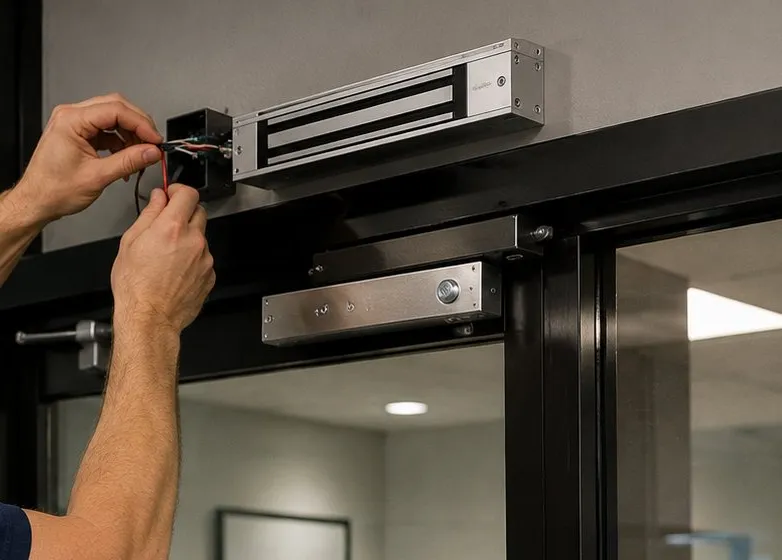
Two hands connect wires in a small box at the end of a magnetic lock mounted on the header above black-framed glass doors; the armature plate is fixed to the top of the door below.
Our studio is one of many in a converted factory, and the landlord’s master key opens every door — can a keypad lock still take that key?
Often, yes, and it is the arrangement most loft landlords will accept. Many smart deadbolts and keypad levers are built around a replaceable key cylinder, and some accept interchangeable cores or standard cylinders that a locksmith can pin to an existing master-key system. Your studio then keeps its keypad and its code list, while the landlord’s master key — and the fire department’s access, if the building keeps keys for that — still turns the cylinder.
The practical steps are to ask the landlord which keying system the building uses and who maintains it, then choose a lock whose cylinder that locksmith can work with, and have the cylinder pinned before installation day. If the building uses a high-security or restricted keyway, the landlord’s locksmith may need to supply the cylinder; we fit the lock around it. If the lease says nothing and the landlord does not care, a stand-alone cylinder is fine, but leave the landlord a key or a code as the lease requires.
Two cautions. Taking a studio off the master system without telling anyone leaves the landlord unable to reach a leaking pipe or a fire; that is the kind of thing that turns a lock into a lease dispute. And a master key opens your door without leaving any trace in the lock’s app on most models — a keypad gives you a record of codes used, not of keys.
The 2026 office break-ins through unlocked doors
In a release dated July 27, 2026, the Queens District Attorney described charges against a man accused of a string of burglaries over about five weeks. On May 26 he allegedly entered an unoccupied office building on 44th Avenue in Long Island City through an unlocked back door and wandered for about twenty minutes. On June 1 he allegedly went into an NBC News satellite office in Long Island City through an unlocked door and took foreign currency. On June 16 he allegedly went through three more Long Island City office buildings in the early morning, taking two credit cards and a flashlight from one office. Elsewhere in the borough the release describes doors pried with a screwdriver.
Most of those Long Island City entries did not involve defeating a lock; the doors were simply unlocked. That is the problem a lock that relocks itself solves best. A back door with a keypad lever or a strike that latches every time it closes, and a door-position contact that reports when it is propped, closes the gap a busy office leaves without meaning to.
The inside half of the job matters just as much: a suite door that locks behind the last person out, a schedule that unlocks the front only during reception hours, and a nightly check on the manager’s phone that every door reports closed. None of that needs a full access control system for a small office.
Older Long Island City
Hunters Point’s original doors and the Landmarks rules
The Landmarks Preservation Commission’s designation report for the Hunters Point Historic District describes the houses at 21-21 to 21-29 45th Avenue as built of Westchester stone throughout, with round-headed doorways and double doors whose woodwork was then largely original; on the south side it noted that all the doors from 21-14 to 21-20 were original. Doors like those are the reason the district exists, and the reason we treat a smart lock there as a job for the inside of the door first.
The Commission’s rules on health, safety and utility equipment — the closest category to an exterior keypad — say light fixtures and intercom panels must sit within or next to the door opening, allow at most two light fixtures and one intercom panel per opening, prefer secondary facades, and limit visible conduit to about ten inches painted to match. Its permits page says ordinary repairs need no permit and that interior work needs one only when it requires a Buildings permit, affects the exterior, or sits in a designated interior landmark.
In practice that points to a lock whose outside face is small and quiet, mounted through the existing bore, with any new device kept off the stoop face. If the house already has an intercom panel at the doorway, a new keypad box beside it is exactly the kind of addition to ask the Commission’s staff about first; we provide photographs and product sheets for that conversation.
When the river came into the lobbies in 2012
DNAinfo’s report from Hunters Point two days after Hurricane Sandy described flooding up to 11th Street. A tenant said the lobby of the PowerHouse at 2-17 51st Avenue filled with five feet of water; the basement of the Foundry at 2-40 51st Avenue was still flooded and a first-floor apartment there had about six inches; the lobby of Avalon Riverview at 2-01 50th Avenue flooded; and water rushed into the lobby of the CityLights co-op at 4-74 48th Avenue. A News 12 report years later quoted the Long Island City Partnership calling the sewer system outdated for the area’s growth, and the city’s environmental agency saying engineers were designing upgrades with $95 million budgeted.
For locks, the waterfront lesson is about the ground floor. Battery smart deadbolts upstairs carry on through an outage. Lobby readers, door controllers, power supplies and the electric strikes on street doors are another matter: salt water and electronics do not mix, and a controller in a basement closet can be lost in an hour. On ground-floor and street doors near the river we keep controllers and batteries above the likely water line, choose strikes deliberately as fail-safe or fail-secure, and leave a mechanical way in that works when everything electrical is dark.
Residents of ground-floor and duplex units near the water should also keep their smart lock’s batteries fresh before storm season and know where the physical key is. A storm is the wrong time to discover that the only key went to a former roommate.
Over the rooftops on 47th Avenue
CBS New York reported in November 2013 that police were hunting a serial burglar in Long Island City who had struck five times since mid-October, most recently at 30-30 47th Avenue, and who, police said, got in from adjoining rooftops before taking jewellery and watches. It is an old report, but the pattern it describes — low buildings in a continuous row, roofs at similar heights, doors and hatches that lead down into homes — still fits plenty of the older blocks between the rail yards and the towers.
A smart lock on the front door does nothing about a roof hatch or a door from a roof landing into a top-floor apartment. Those doors need their own plan, and in a multiple dwelling the rules on roof doors and egress come first; a roof door that people may need to use to escape cannot simply be padlocked. What we can do is fit the top-floor apartment door with a deadbolt that is always thrown when the household is out, and a contact that reports when the roof-side door opens.
If your building’s roof is shared, raise it with the owner or managing agent; the street door is not the only way into a row.
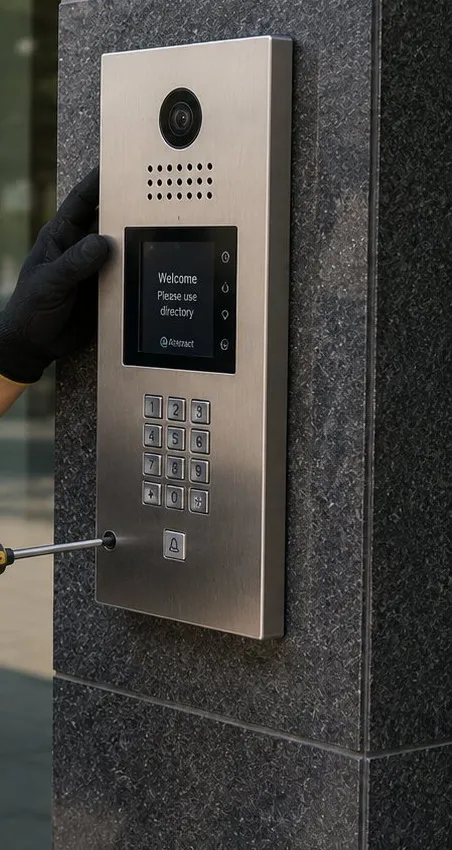
A brushed-steel entry panel with a camera lens, speaker grille, small screen and numeric keypad is fixed to a polished dark stone pillar, with a gloved hand and screwdriver at its edge.
The Door Stack
Who Controls Each Door Between the Sidewalk and a Long Island City Apartment
Before choosing a lock, it helps to see the whole route from the street to the sofa. This is the table we fill in with tower residents and condo owners at the first conversation. The right-hand column is the part that decides what we may do.
Door or layer
Usually controlled by
What a resident can change
Street entrance
Building owner or condo board, run by management
Nothing on the door; you can ask management how guests, carers and cleaners are admitted
Lobby desk or virtual concierge
Management and its vendor
Your visitor list and standing instructions for regular helpers
Elevator to your floor
Building, often on the same fob or app
Whether extra fobs can be issued to household members
Amenity floors and package room
Building platform
Your notification settings in the building’s app
Corridor and stairs
Building, under the fire code and its fire safety plan
Nothing; do not mount devices in the hallway or on stair doors
Corridor face of your unit door
Landlord in a rental; condo rules in a condo
Only what the lease, the bylaws or written approval allow
Room side of your unit door
You, within the lease and the fire label
Most smart-lock choices, from retrofit units to full smart deadbolts using the existing bore
Your codes, fingerprints and app users
You
Everything: who, when, for how long, and who else administers it
Read top to bottom, the table explains why so many Long Island City customers are surprised: the lock is the smallest part of their entry system and the only part they own. Read bottom to top, it explains why a smart lock is still worth having. The building decides who reaches your corridor; you decide who gets through your door, for how long, and with what record. That last decision is the one that changes most often — a new cleaner, a parent staying for a month, a partner moving in — and it is the one a code list handles far better than a ring of copied keys.
Equipment
Types of Smart Locks We Install
In Long Island City the right lock is usually the one that asks least of the door. These are the families we fit, from tower units to loft studios and suite entrances. If you already own a lock, bring it; if not, we suggest a model once we have seen the door’s label, the bore and the building’s rules.
Interior Retrofit Units
Mounted on the room side over the existing deadbolt’s thumb-turn, leaving the corridor face, the building’s key and the fire label untouched. The first thing most tower managements approve; no help against keys already in circulation.
Bore-Reusing Smart Deadbolts
Keypad or fingerprint deadbolts chosen to drop into the door’s existing bore and strike, with a replaceable key cylinder. Where the label and listings allow it, the best all-round answer for an owner-occupied unit.
Keypad Levers
Keypad and lever in one body for office suites, studios and back rooms, where people arrive with their hands full and the door should lock behind them every time.
Locks That Take a Building Cylinder
Models whose cylinder can be pinned to a landlord’s master-key system or accept an interchangeable core, so a studio or suite keeps its keypad while the owner keeps a working key.
Matter and Thread Locks
For households that want the lock in Apple Home, Google Home or Alexa: Matter locks can join more than one system, and Thread versions need a border router of a compatible brand in the apartment.
Wi-Fi Bridges
Plug-in bridges on the room side that give a Bluetooth lock remote access and alerts. In a tower they sit in the entry hall, never in the corridor; August asks for 10 to 15 feet from the lock.
Readers and Strikes for Suites and Small Buildings
Keypads or card readers with electric strikes or magnetic locks for suite entrances and small-building street doors, with a release inside that works without power and a choice of fail-safe or fail-secure written down.
Door-Position Contacts
Small magnetic switches that report whether a door is actually shut, for office back doors, studio corridors and roof-side doors that people prop or forget.
National brands versus a Long Island City installer
ADT bundles locks into monitored packages, and Ring and SimpliSafe sell locks and keypads that join their own systems. Any of them can be a perfectly good product. None of them will read the label on your tower door, ask your managing agent what the corridor face may look like, pin a cylinder to your landlord’s master key, or check with the fire safety director before going near a stair door. In Long Island City that is most of the work, and it is what a licensed local installer is for.
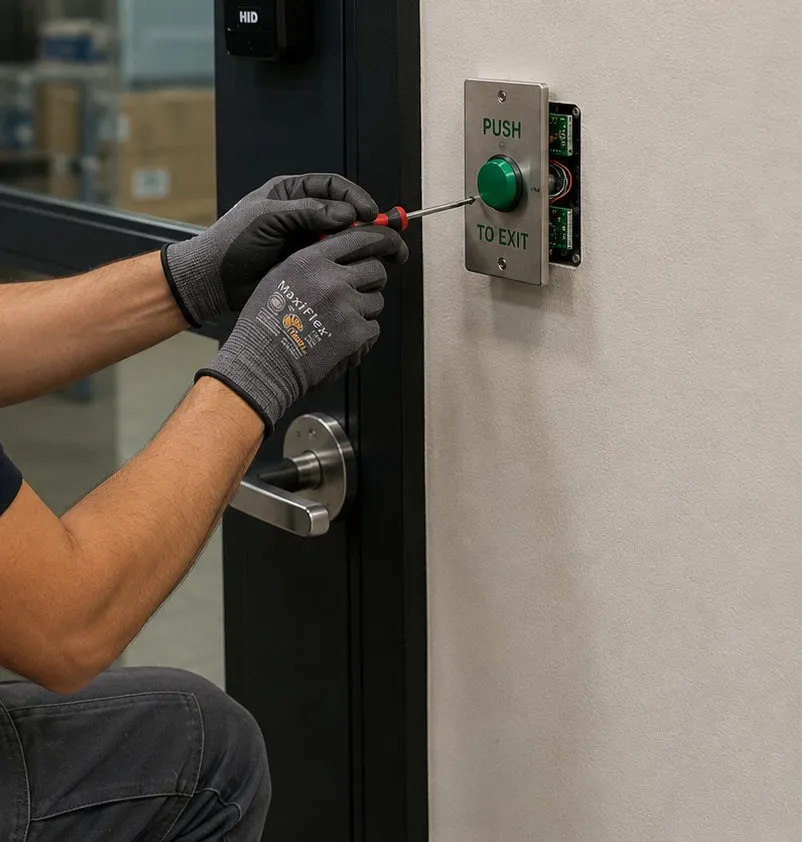
Gloved hands hold a small screwdriver at the terminal strip of a stainless plate with a green push-to-exit button, mounted on a pale wall beside a door lever.
AI Overview Reality Check
What AI Gets Wrong About Smart Lock Installation in Long Island City
A note on method: the research tools behind this page could not open Google’s AI Overview, so nothing here is quoted from it. Each heading below is a claim that turns up again and again in lock makers’ marketing, DIY videos, locksmith pages and cost guides such as Angi, HomeAdvisor and Fixr — the material answer engines summarise — set against what we see on Long Island City doors.
“Any smart deadbolt fits any front door in about thirty minutes”
Retail how-to videos say a smart deadbolt goes in “in under 30 minutes with just a screwdriver,” and on a standard residential door with a standard bore that is fair. Plenty of Long Island City doors are not standard. Tower unit doors are often rated fire doors with their own hardware preparations, office suites use mortise locks or electrified hardware, and loft doors can be heavy steel in frames that have moved.
On a rated door, the national standard for fire door assemblies limits field preparation to what the door and hardware listings allow, so the quick job becomes reading a label and a listing before choosing a model at all.
The installation itself can still be quick. Getting to the point where it is allowed to be quick — the right model, management’s agreement, the closer adjusted so the door latches — is where the time goes.
“Renters can swap in a smart lock without drilling and nobody will know”
Social videos promote cylinder-swap and retrofit locks that need “no drilling, no wiring,” pitched at apartments. Retrofit units genuinely leave the corridor face unchanged, and they are often the right answer in a rental tower.
But “nobody will know” is the wrong frame in a building where management issues the keys, logs contractors at the desk and may already run an electronic lock on your door. Leases in new buildings commonly restrict alterations, and removing or bypassing the building’s own lock can breach the lease even if nothing is drilled.
Ask first, in writing. Most managements say yes to a retrofit on the room side; a surprising number say yes to more once they see exactly what is proposed.
“A smart lock makes your apartment secure”
It makes one door better at being locked and better at recording who opened it. Long Island City’s own reports show what else matters: the Court Square robbers in 2025 used stolen keys, the 2013 burglar came over the rooftops, and the 2026 office entries were through doors that were simply left unlocked.
Two of those three were problems a smart lock helps with — a cancellable credential, a door that relocks itself — and one was not. A roof hatch or a window is not protected by anything on the front door.
Treat the lock as one layer. The building’s entrance, your habits with keys and phones, and the other ways into your home are the rest.
“Auto-lock is always the safer setting”
Auto-lock is sold as the feature that makes forgetting impossible, and for an office back door that is exactly what you want. For a tower apartment, the FDNY’s posted fire safety notice tells residents escaping a fire in their own unit to close the door but not lock it, and to take their keys.
A short auto-lock delay quietly reverses that instruction. Nobody will think about it until the night it matters.
The safer setting is the one the household has chosen knowingly: auto-lock off with a locking habit, or auto-lock on with everyone understanding what it means for firefighters. We set it up whichever way you decide and write the choice on the handover sheet.
“Your smart lock will work with your building’s app”
Marketing for building platforms and for consumer locks both talk about integration, and some combinations do work together. Many do not: a building’s entry platform is configured by the owner and its vendor, and whether a resident’s own lock can join it is their decision, not yours.
In practice most Long Island City residents live with two systems — the building’s app or fob for the lobby, elevator and amenities, and their own lock’s app or keypad for the apartment.
That is less elegant than one app and much less fragile. When the building changes vendors, which happens, your own door keeps working.
“Historic homes can’t have smart locks”
Some articles warn owners in landmark districts away from smart locks altogether. In the Hunters Point Historic District the Commission’s concern is the exterior: its permits page says ordinary repairs need no permit and interior work needs one only if it requires a Buildings permit, affects the exterior, or is in a designated interior landmark.
A lock that changes the inside of an original door and uses the existing bore outside is a very different proposition from a new keypad box beside a stoop.
The sensible order is to plan the quietest possible outside face, then ask the Commission’s staff whether anything you are changing needs their review. We supply photographs and product sheets for that conversation.
“Smart lock installation costs $250 to $400”
Fixr’s January 2025 national figure is $250 to $400, averaging $300, for one Wi-Fi lock and an accessory, and a locksmith advertising from 29th Street quotes $275 to $500. Those are third-party numbers for a single residential door, not AESS prices.
They do not cover a suite or small-building entrance, where a keypad or reader with an electric strike is $1,575 to $2,625 at our Queens rate, or the time spent with a management office, a master-key system or a fire label.
Unit doors in towers and condos, and rowhouse front doors, are priced as a single number once we have walked them for free; the invoice repeats that number.
Lease Start or Closing Date Coming Up? Plan the Door Around It
Send us the building’s name, the floor, a photo of the hinge edge of the door and your management’s contractor rules. We will tell you which lock fits, what management needs to see, and when we can fit it.
Tell us which building, which floor and who signs off on work there, and a licensed installer writes back before the business day ends. Prefer the phone? Ring the Queens line on (347) 434-6392.
✅
Request Received
Thank you — a licensed installer will call before the end of the business day. If you are shut out right now, ring (347) 434-6392.
How It Works
Our Installation Process
Seven steps, whether the door is on the 40th floor of a waterfront tower, at the top of a Hunters Point stoop or at the end of a Dutch Kills loft corridor.
1. Map the doors you pass through
Before the visit we note every door between the street and yours, who controls each one, and what the building already uses — fob, app, intercom or desk — so your lock fits into it.
2. Read the door and its label
At the free walkthrough we photograph the hinge-edge label, measure the bore, backset and thickness, watch the closer latch the door, and check the radio signal from the corridor side.
3. Clear it with whoever must agree
You get a written scope and a flat price that can go straight to the management office, condo board, studio landlord or fire safety director, with product sheets attached.
4. Fit within the door’s limits
The lock goes in through the existing preparation wherever possible, the original hardware is bagged and labelled, and any master-keyed or new cylinder is installed and tested.
5. Prove the latch and the way out
We let the door close on its own repeatedly until the bolt throws cleanly every time, and open it from inside with one motion, with and without power to any bridge.
6. Enrol people and choose the settings
Everyone who should have access enrols their own code, fingerprint or phone; two administrators are set; and auto-lock, alerts and schedules are chosen deliberately, including what happens in a fire.
7. Hand over the record
We leave a one-page sheet listing the model, the label details, each credential and its end date, the auto-lock choice, and how to remove a person, plus a copy for management if they asked for one.
Coverage Area
Smart Lock Installation Near Long Island City’s Landmarks
Six places that mark out the Long Island City we work in, from the river to Court Square and up to the bridge.
Gantry Plaza State Park and the Pepsi-Cola Sign
A 12-acre state park on the Hunters Point waterfront, opened in 1998 and expanded in 2009, built around restored 1925 transfer bridges that loaded rail car floats. The Pepsi-Cola sign, first put up in 1940 and rebuilt after a 1992 storm, stands in the park and became a city landmark in 2016.
Hunters Point Historic District
45th Avenue between 21st and 23rd Streets: Italianate, Second Empire and Neo-Grec houses built from 1871 by the partnership of Spencer B. Root and John P. Rust on land bought from Union College, designated in May 1968.
MoMA PS1, 22-01 Jackson Avenue
A Romanesque Revival public school of 1892 that served as the First Ward school until 1963, reopened as the P.S. 1 Contemporary Art Center in 1976 and affiliated with the Museum of Modern Art since January 2000.
Silvercup Studios
Founded in 1983 by Alan and Stuart Suna in the former Silvercup bakery, built in 1929–30 for the Gordon Baking Company. The Sopranos, Sex and the City and 30 Rock were shot there, under a rooftop sign dating from the early 1960s.
Queensbridge Houses
Opened in 1939 between Vernon Boulevard and 21st Street, north of the Queensboro Bridge: 96 six-storey buildings and 3,142 apartments, described as the largest housing project in North America.
Court Square
The Queens County Courthouse on Jackson Avenue, built in 1876 and remodelled in 1908 after a fire, and the office tower completed beside it in 1989, for decades the tallest building in the area.
Our Queens crews also take in the neighbouring parts of the borough’s west side — Astoria to the north, Sunnyside and Woodside to the east, Maspeth to the south-east. Anywhere else in Queens, begin at the Queens smart lock installation page.
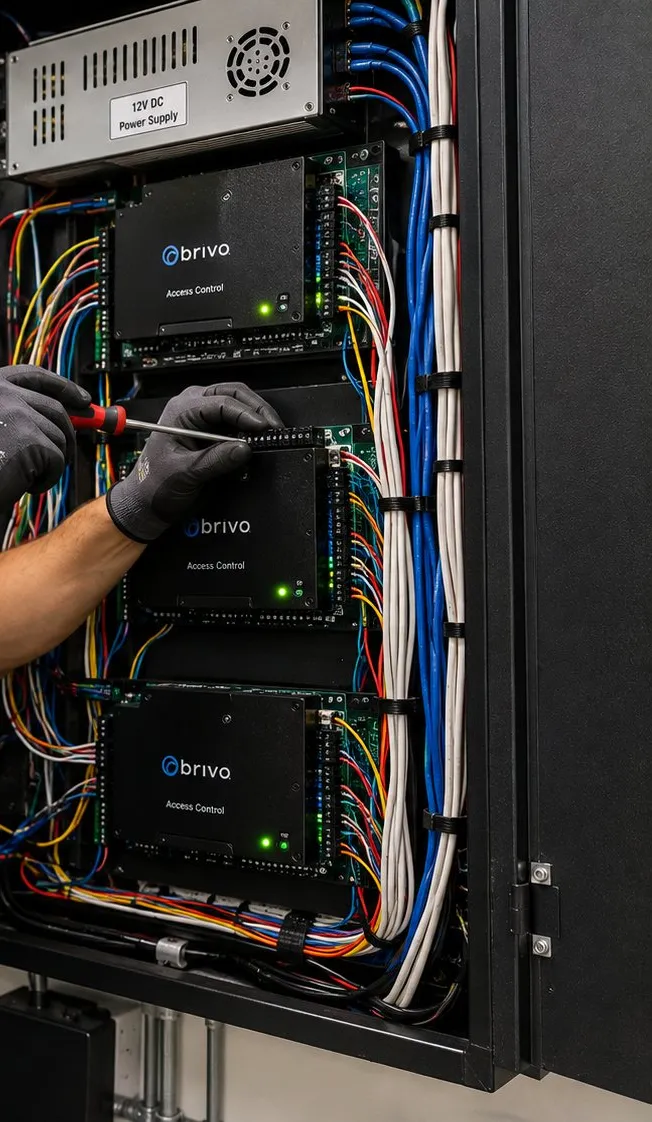
An open metal enclosure holds a power supply at the top and three stacked access control boards, with bundles of coloured cable running down both sides and gloved hands at the middle board.
Pricing
Smart Lock Installation Cost in Long Island City
Long Island City is priced at our Queens rate, with no neighbourhood surcharge for a tower, a waterfront address or a high floor. The fixed figures below are the ones AESS already publishes for building and business doors: our Brooklyn base multiplied by the Queens factor of 1.05, with halves rounded up. A smart lock on your own apartment, condo or house door has no published AESS price yet, because a retrofit unit on a tower door approved by management and a new smart deadbolt on an 1870s double door are different jobs; for those we walk the door free and then give you one flat figure, which is what you pay.
Item
Long Island City price (Queens rate)
Scope and source
Apartment, condo or rowhouse smart lock, including any cylinder work
Flat quote after the free walkthrough
Priced once we have read the door’s label, measured the bore and seen what management or the Commission will accept
Setup-only visit: users, schedules, auto-lock choice and bridge, no hardware change
$195 first hour, then 30-minute blocks
The published Queens setup-only rate; what most households book when people change
One suite, studio or small-building entrance: keypad or reader plus electric strike
$1,575–$2,625 installed
A suite entrance, studio corridor door or walk-up street door; the $1,500–$2,500 Brooklyn base times 1.05
Electric strike supplied and fitted to an entrance frame
$263–$473
Fitted while entrance work is under way; the published $250–$450 multiplied by 1.05
Repair of a failed electric strike
$310–$509
An entrance that buzzes or beeps but will not release; $295–$485 times 1.05, halves rounded up
Return service calls
$195/hr, 3-hour minimum ($585)
For later service visits; never charged on the first installation
A worked example using only those lines: a small office that wants a keypad and strike on its suite entrance and then, a few weeks later, a setup visit to enrol a new team and set reception-hours schedules would be looking at $1,575–$2,625 for the door plus $195 for the first hour of the setup visit, at the Queens rate.
What moves a Long Island City quote
The label and the listing: a rated door narrows the choice of lock to models whose listing fits the door’s preparation; finding and confirming one takes a little time and saves a door.
The building’s paperwork: certificates of insurance, contractor registration with management and booking a service elevator are routine in towers and included; waiting for approval can move the date.
The closer: adjusting a closer or strike so a heavy tower door latches every time is quick work and essential to a motorised bolt.
Master keys and cylinders: pinning a cylinder to a landlord’s system, or fitting a core the landlord supplies, adds a step and sometimes a locksmith.
Original doors: nineteenth-century doors in the historic district need slower, more careful work and sometimes a preliminary conversation with the Commission’s staff.
Wired entrances: suite and small-building doors with strikes need cable, a power supply and an inside release; a concealed run through an old frame takes longer than a surface one.
For comparison only. The cost guide Fixr gave a national range of $250 to $400 per lock in January 2025, with $300 as its average and handyman time at $50 to $100 an hour. Those numbers belong to another company and picture a single door on an ordinary house, with no management office, board or landmark rule involved; they are not AESS prices.
Shop Our Systems
Long Island City Smart Lock Packages & Pricing
Three ways Long Island City customers usually buy keyless entry, from tidying up a lock already on the door to a wired suite entrance.
Starter — Settings and People Visit
$195 first hour
For a lock you already have: departed people removed, new ones enrolled, a second administrator added, the auto-lock choice made deliberately with the fire notice in mind, the bridge placed sensibly, and a fresh handover sheet. Then 30-minute blocks at the published Queens setup-only rate.
Standard — Unit Door Smart Lock
Quoted flat at walkthrough
A retrofit unit or bore-reusing smart deadbolt on your apartment, condo or rowhouse door, matched to the door’s label and the building’s rules, with the original hardware bagged and labelled, everyone enrolled, and a scope letter for management or the board.
Premium — Keyless Suite or Studio Entrance
$1,575–$2,625
For offices, studios and small-building owners: a keypad or reader outside, an electric strike in the frame, an inside release that works with the power off and a written fail-safe or fail-secure choice, at the Queens rate — plus a door-position contact if you want to know when it is propped.
Bring Your Own Lock — Labour Only
Already own the lock? Customer-supplied hardware is fitted for a labour-only price agreed at the walkthrough. Four checks come first, while the box is still sealed: thickness, bore and backset against the door; the lock’s listing against any fire label; an inside release that asks for nothing; and, in a rental or condo, a match with the model management approved. The maker’s warranty stays with the lock rather than with us, and a lock that will not suit the door goes back to the shop undrilled.
Get the Long Island City Price in Writing
Tower unit, condo, rowhouse, suite or studio — send a photo of each side of the door and one of its hinge edge. We reply with a flat figure and a scope your management office or landlord can approve as written.
How Smart Lock Jobs Differ Across Long Island City
Long Island City runs from Newtown Creek to the Queensboro Bridge and beyond, and from the East River to the rail yards. The doors change block by block; these are the patterns we see.
The Hunters Point waterfront
Queens West and Hunters Point South: tall rental and condo towers, many with the building’s own electronic lock already on each unit door, and the parks along the river. Requests here are mostly about the room side of a rated door, living alongside a building app, and auto-lock settings. The blocks nearest the water flooded in 2012, so ground-floor and duplex units ask about batteries, keys and storm season.
45th Avenue and the historic district
The rows between 21st and 23rd Streets, some still with original double doors and woodwork, and their neighbours just outside the district boundary. Quiet outside faces, inside work first, and photographs for the Commission’s staff where anything outside changes.
Court Square
Office towers, the courthouse and a growing cluster of residential towers, some of them condos. Suite doors and stair doors for businesses, condo unit doors for owners, and the stolen-key robbery of 2025 as a reminder of what a cancellable credential is worth.
Queens Plaza and Dutch Kills
Hotels, offices, new towers and the working blocks of lumber yards, supply houses and converted factories. Studio doors on master-key systems, heavy steel workshop doors, and owners of small buildings who want a keypad on the street door.
Queensbridge and Ravenswood
The two NYCHA developments north of the bridge. The Housing Authority owns the unit doors and the building entrances, and the state’s add-a-lock right excludes housing-authority buildings, so residents start with NYCHA. We are happy to talk through what the Authority might approve.
Vernon Boulevard and the old rows north of the bridge
Small walk-ups, frame houses and shops along and off Vernon Boulevard, where the street door of a four- or six-family building decides how safe everyone upstairs is. Classic small-building work: keypads or fob readers with strikes, and apartment smart deadbolts with fresh cylinders.
The blocks being rezoned
The 54 largely industrial blocks covered by the OneLIC plan approved in November 2025 will turn into thousands of new homes over the coming years. Until they do, they are workshops, warehouses and studios whose leases may be short; we keep the work reversible for tenants who expect to move.
For New Residents
A First-Month Checklist for a Long Island City Tower Apartment
Tower moves happen to a timetable the building sets. One r/longislandcity review noted that a large building would not release keys until the day the lease began; others mention elevator bookings and contractor rules. This is the list we work through with new residents in their first few weeks, so the lock decision fits around everything else.
Find out what is already on the door. Is the unit lock the building’s electronic one, a plain deadbolt, or both? Who holds keys or override codes today?
Read the lease or house rules on alterations. Note exactly what they say about locks, hardware and the corridor face of the door, and who must approve a change.
Photograph the hinge edge. The fire label, if there is one, decides which locks are even possible.
Ask management three questions in writing. What the entry system records about you and for how long; how a cleaner, carer or visiting parent is admitted; and whether a retrofit or a bore-reusing smart deadbolt would be approved.
Decide on auto-lock before installation day. Read the FDNY fire safety notice on your door and agree as a household how the lock should behave.
Choose two administrators. Two phones, two people, so a lost phone or a business trip never leaves the door unmanaged.
Agree what happens at lease end. Whether the building’s original hardware goes back on, who keeps the smart lock, and that everything is reset and every user removed before you hand back the keys.
If you are moving into a condo you have bought rather than rented, add one more line: ask the board or managing agent for the building’s written rules on unit-door hardware, and keep a copy with your closing papers.
Complete Services
Every Smart Lock Installation Service in Long Island City
Door work rarely stops at the door. Entry panels, cameras and the cabling behind them are the usual next questions, so here are the related AESS services in Queens and in Long Island City itself.
How we approach a door in a managed building — written as our method, not as a story about a particular customer
The first look is not at the lock but at the hinge edge. If there is a label, we photograph it before anything else happens, because it decides which locks are on the table. Then we close the door from wide open and let the closer do the work, ten or twelve times, watching whether the latch drops into the strike every time or hangs a hair short.
Next comes the list of what is already electronic: the building’s lock on the door, if any; the fob that opens the lobby; the app that runs the package room. We write down which of those the resident controls, which management controls, and who to call when each one fails.
Only then do we talk about hardware, and usually the conversation is short. On a rated tower door the choice narrows to a retrofit unit or a model that uses the existing preparation; in a loft it narrows to locks that take the landlord’s cylinder; on an old row-house door it narrows to whatever leaves the outside quiet.
Last, we ask the question nobody expects: what should this door do if there is a fire in the apartment? The answer goes on the handover sheet, beside the list of people who can open it.
FAQ
Long Island City Smart Lock Installation FAQ
What does a keyless entrance cost for a Long Island City office suite, studio or small building?
+
One entrance with a keypad or card reader and an electric strike costs $1,575 to $2,625 installed. That is the Queens rate — the Brooklyn base we publish, times 1.05 — and Long Island City pays it with no surcharge. A strike supplied on its own is $263 to $473; bringing a dead strike back to life is $310 to $509. Unit doors in towers, condos and rowhouses get a flat quote once we have walked them.
Do your technicians cover Hunters Point, Court Square, Dutch Kills, Queens Plaza and Ravenswood?
+
Yes, all of them, along with Queensbridge, the waterfront towers of Queens West and Hunters Point South, and the blocks along Vernon Boulevard and Jackson Avenue. The same Queens crews continue into Astoria, Sunnyside, Woodside and Maspeth, arriving in two-hour windows between 8 in the morning and 8 at night, every day of the week.
Our building only hands over keys on the morning the lease begins — can the smart lock still go in that same day?
+
Usually, if the groundwork is done beforehand. Send us photos of the door and its hinge-edge label from the listing or a pre-move-in visit, get management's written approval for the model in advance, and book us for the afternoon once you have collected the keys and the elevator is free. We bring the approved lock, fit it and enrol the household before the evening.
Will the lock show us if someone opened our door with the mechanical key while we were out?
+
Not on most models. Smart locks record codes, fingerprints and app unlocks by user, but a key turned in the cylinder usually shows up, if at all, only as an unlock without a name. If you need to know when the door was opened by any means, a door-position contact or a lock that reports every bolt movement tells you when, though not who; keeping the mechanical key out of circulation does the rest.
Our Hunters Point house is in the historic district — do we need the Landmarks Commission for a lock that changes only the inside of the door?
+
The Commission's permits page says interior work needs its permit only when the work requires a Department of Buildings permit, affects the exterior, or is in a designated interior landmark, and that ordinary repairs need no permit. A lock that alters only the inside of the door usually falls outside all three, but anything visible from the street can bring it back in, so ask the Commission's staff to confirm before work starts.
All Areas Served
Smart Lock Installation Across New York
This page sits under our smart lock installation service for Queens, which in turn sits under the New York City smart lock hub, where the citywide rules on tenants’ locks, co-ops and building doors are set out. Every other borough, county and neighbourhood page in the series is listed here.
Shut Out on a Tower Landing or a Hunters Point Stoop Tonight
Keypad blank, bolt half-thrown against a strike that never quite met it, an office lock whose administrator left last month, a studio code that stopped working after the landlord changed something — ring (347) 434-6392 and we book the first free two-hour slot. With someone at the door, dead batteries, lost pairings, account lock-outs and misaligned strikes are usually cleared in an hour or two. Until we arrive, the building’s front desk or your landlord’s key is the way in; never let anyone drill a rated door without asking first.
Long Island City Smart Locks From a Licensed, Insured Installer
Long Island City customers call (347) 434-6392 or message WhatsApp (718) 679-0359 through wa.me. Abstract Enterprises Security Systems, 460 E Fordham Rd, Bronx, NY 10458.
NYS Low-Voltage Licence #12000287431 · 100% Licensed & Insured · Same-Day Estimates · Rated 4.7★ from 201 Google Reviews
Locks you supply keep their manufacturer’s warranty. Full terms — including 50% deposit, one-year parts-only warranty on AESS-supplied products, and the late-fee schedule — are set out in the service agreement. See our warranty page.
This page explains how building ownership, fire-rated doors, landmark rules and Long Island City’s housing stock affect smart lock installation; it is not legal advice. Page reviewed and updated October 17, 2026. Changelog: first publication of the Long Island City smart lock installation page.