What are you looking for?
About Us Contact Us Careers Get a Free Quote (800) 486-0943
Pick a service
✅ Got Your Own System?
🎬 Home TheatreQuote 🎶 AV SoundQuote 🔑 Access ControlQuote
Now pick your area
Pick your area
Long Island
Hudson Valley
Services available
Pricing & Tools
Pick a service for pricing
🚪 Intercom Pricing 🔔 Buzzer Repair Pricing
Calculators
📹 Camera System Calculator 🚨 Alarm Calculator ⚡ Cabling Quote Builder ✅ Got Your Own System?
Select your area
A two-family below Pitkin Avenue with one bell for both floors, a walk-up whose street door buzzes but never opens, or a Belmont Avenue shop nobody can find from the sidewalk? Brownsville door buzzer installation line: (347) 934-8335
Home › Door Buzzer Installation Brooklyn › Brownsville
Nehemiah Rowhouses · Two- and Three-Family Houses Below Pitkin Avenue · Older Walk-Ups · New Affordable Buildings · Shops on Pitkin, Belmont, Rockaway and Livonia Avenues

Door Buzzer
Installation in
Brownsville

Audio and Video Buzzers · Door Releases That Actually Latch · Owner-Approved Building Work · Brooklyn Rate

Door buzzer installation in Brownsville starts with a question most neighborhoods never have to ask: who owns the front door? Roughly a third of the homes here are NYCHA apartments whose lobby doors are NYCHA's job, and a growing share of those developments are now run by private PACT partners. The rest is a mix we work on every week across Brooklyn: two-story Nehemiah rowhouses built from 1984 on, semi-detached two- and three-family houses south of Pitkin Avenue, older walk-ups, brand-new affordable buildings on Rockaway, Livonia and Glenmore Avenues, and storefronts with apartments or offices above. This page explains what each of those needs from a buzzer, why the door, the closer and the strike matter as much as the button, what the city requires of building owners, and what each kind of job costs on our published Brooklyn list.

Reviewed and updated November 11, 2026, against the NYC Comptroller's September 2022 report on building doors in NYCHA developments (FK23-069S); NYCHA's November 2023 announcement of security upgrades and its Entryways pilot; NYCHA's October 15, 2026 release on the completed Reid & Park Rock PACT renovation and its PACT page for Howard Houses; the City Council Committee on Public Housing hearing of April 15, 2025; City Limits reporting from October 2024 and October 2025 on housing violations and NYCHA violation records; Habitat Magazine's February 2024 article on intercom law; Brick Underground's guide to broken buzzers; the NYU Furman Center's Brownsville profile; Urban Omnibus on the Nehemiah houses; Brownstoner and New York YIMBY reporting on 326 Rockaway Avenue, 76 Christopher Avenue, 350 Livonia Avenue and 366 Rockaway Avenue; the NYC Small Business Services directory entry for the Pitkin Avenue BID; News 12 Brooklyn's 2018 report from Brownsville Houses; New York's Multiple Dwelling Law §50-a; Allegion's fail-safe and fail-secure guide; the HomeAdvisor and Swiftlane cost guides; and the 2010 ADA Standards. · Abstract Enterprises Security Systems, NYS license #12000287431 · crews dispatched from our Troy Avenue office in Brooklyn

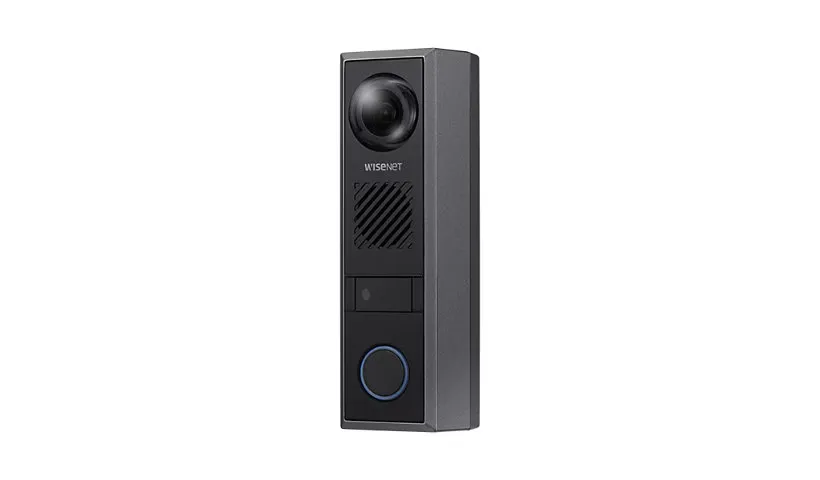
Brownsville, Brooklyn door buzzer installation: black rectangular video door station with a camera, speaker grille and round lit call button
A photo from the AESS job library, not taken in Brownsville: a black rectangular video door station with a camera at the top, a speaker grille and one round lit call button. A single-button station of this kind is what most Nehemiah rowhouse owners end up with, because the house has one household and one front door, and the lit button is easy to find under the aluminum awnings many of those doors still have.
Brownsville Buzzer & Door Request
Rowhouse, two- or three-family, walk-up, new building or storefront: tell us the street, how many households or apartments share the door and who owns the building, and a technician calls back with the range

✅
Request Sent!
Thank you. A technician will call you about the Brownsville address, usually within two hours during working hours.
25+
Years Experience
✓
Same-Day Estimates
100%
Licensed & Insured
4.7★
201 Google Reviews

Owner-operated since 2002 · Thousands of jobs completed · Booked within 2 hours

Quick answer: door buzzer installation in Brownsville costs $400 to $900 installed on our Brooklyn list for an audio buzzer with talk-back on a one- to three-household house, $700 to $1,800 for a video door station or wired video doorbell with indoor or phone answering, and from about $2,500 to past $10,000 for a multi-apartment walk-up or elevator building. Every price covers the door station, the household or apartment stations, the power supply, any strike or release on the door, the cable and the labor, and it is set in writing after a walkthrough and before anything is ordered. Brownsville is billed at the Brooklyn rate with no travel premium. Most private houses here fall in the first two ranges. What moves a job up is a door that has to be repaired before it can latch, a new cable route because the old wire is gone, video for every household instead of one, and in a building, how many apartments the riser has to reach. Send photos of the door and the old panel to (347) 934-8335 or on WhatsApp, and we reply with the range that fits, usually within two hours of your message during working hours.

  • Looking at your photos and quoting a new buzzer costs nothing. If an existing system is dead and has to be diagnosed first, that is the $250 service call booked online, and the $250 is applied toward the work.
  • All work falls under New York State license #12000287431. We install low-voltage entry equipment only; if a door or building needs a new 120-volt circuit for a power supply, a licensed electrician does that part, and we say so before the job is priced.
  • We work for whoever owns the door: the homeowner, the building owner or its managing agent. NYCHA lobby doors and the entry systems in PACT-converted developments are maintained by NYCHA or the development's partner, and the section below explains what residents of those buildings can do.
The Neighborhood

Why Brownsville Properties Need Door Buzzer Installation

Brownsville is small on a map, about 1.16 square miles between East New York Avenue, Ralph Avenue, Linden Boulevard and Van Sinderen Avenue, but it holds an unusually wide range of front doors. NYCHA owns roughly 10,000 apartments in 18 developments and more than 100 buildings here, about a third of all the housing, from the six- and seven-story Brownsville Houses to the 22-story towers of the Hughes Apartments. Around and between them sit the two-story brick Nehemiah rowhouses on long blocks in the western half, older semi-detached two- and three-family houses south of Pitkin Avenue, limestone and brownstone townhouses toward Ocean Hill, four-story walk-ups, and a new generation of affordable buildings that has gone up since the city's Brownsville Plan in 2017. Each of those has a different door, a different owner and a different reason the buzzer matters.

The NYU Furman Center's profile puts the homeownership rate in the community district at 15.8 percent in 2024, against 32.7 percent citywide, and counts 21.3 percent of rental units as public housing in 2025. In plain terms, most people in Brownsville do not own the front door they walk through. That shapes buzzer work here more than any architectural detail. A homeowner on a Nehemiah block can call us and decide everything on the spot. A tenant in a private walk-up whose buzzer has been dead for a year needs the owner to act, and the law gives the tenant some leverage to make that happen. A NYCHA resident deals with NYCHA's own repair system, and a resident of a development that has converted under PACT deals with the new private manager. We set this out plainly because the most useful thing we can do for a caller is tell them, in the first two minutes, who can actually fix their door.

Where the buzzer does belong to a private owner, the stakes are practical. In a two- or three-family house with one street door, a single bell that rings on every floor sends someone downstairs for a visitor who is not theirs. In a walk-up, a release button that no longer opens the door means tenants walk down four flights to let in a delivery, or prop the door so they don't have to. The city's own auditors found exactly that pattern in public housing: in its September 2022 report, the Comptroller's Office said residents and staff described intercoms, locks and release buttons that often do not work, and that this contributes to doors being propped open. One resident told auditors "the building's intercoms have been broken for 10 years." Private buildings are not immune to the same chain of failures, and the fix is the same: a door that closes and locks on its own, a release that opens it, and a station in every apartment that lets a resident see or hear who is asking to come in.

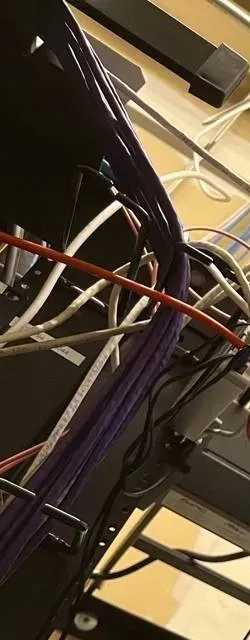
Brownsville, Brooklyn door buzzer installation: purple, white and red cable bundles dropping down beside a black equipment rack
A photo from the AESS job library, not taken in Brownsville: purple, white and red cable bundles dropping down beside a black equipment rack. The newer affordable buildings on Rockaway Avenue and Glenmore Avenue have a telecom room much like this one, where the entry system's controller and power supply sit next to the building's network gear, while a four-story walk-up keeps the same parts in a labeled box in the cellar.

The newer buildings bring a different job. The 14-story building at 326 Rockaway Avenue, with 215 apartments, Glenmore Manor at 76 Christopher Avenue with 233, and the Gail P. Duke Senior Residence at 350 Livonia Avenue with 142 apartments for seniors all opened with modern entry systems chosen by their developers. The work there is not a first installation but everything that comes after it: adding a door that was left off the system, adding an apartment station for a resident who cannot use an app, tying in a community space with its own street door, or replacing a lobby panel that has been damaged. The Brownsville Arts Center and Apartments, which broke ground at 366 Rockaway Avenue in September 2025 with 283 apartments planned, will add another such building when it opens.

Then there are the shops. The Pitkin Avenue Business Improvement District, set up in October 1993, covers 32 block faces with 212 ground-floor businesses, and Belmont, Rockaway and Livonia Avenues each carry their own strips of stores, many with apartments or offices above. A store needs a buzzer at the rear or side door for deliveries; an upstairs office or program needs a street-door station visitors can find between two storefronts; the apartments above need their own panel that never rings the shop. Those are three separate systems even when they share a cellar, and we price them that way.

Brownsville facts that change how a buzzer is installed

  • A third of the housing is NYCHA. About 10,000 apartments in 18 developments and more than 100 buildings. Their lobby entry systems are NYCHA's to maintain, so the job for a private installer is in the other two-thirds of the neighborhood.
  • Most residents rent. The Furman Center puts homeownership at 15.8 percent in 2024, less than half the citywide 32.7 percent. On most doors, the person who uses the buzzer is not the person who decides to replace it.
  • Doors fail before buzzers do. The Comptroller's 2022 audit of 262 NYCHA developments found 40.1 percent of building entrance door locks broken, and the share of entrance doors open or with broken locks rising from 23.5 percent in 2018 to 57.9 percent in 2022. A new panel on a door that does not latch fixes nothing.
  • Nehemiah houses are one household, one door. Urban Omnibus describes the first Nehemiah homes, occupied from June 1984, as two-story brick houses 18 feet wide and 32 feet deep, with a front parking pad and the kitchen at the front so residents could watch the street. A single-button station near that kitchen covers most of them.
  • Thousands of new apartments. Between 2010 and 2025 the district added 5,559 housing units, 4,142 of them income-restricted, according to the Furman Center. New buildings arrive with an entry system; the work there is extending and maintaining it.
  • Developments are changing hands. NYCHA's PACT program finished a $636 million renovation of 15 East Brooklyn developments, including Ocean Hill-Brownsville and the Tapscott Street rehabs, in October 2026, with "enhanced security infrastructure and access control" in the scope. Howard Houses began its own PACT engagement in November 2024.

Where this page applies. It covers Brownsville from East New York Avenue south to Linden Boulevard and from Ralph Avenue east to Van Sinderen Avenue, the area most people mean by ZIP code 11212, including the Nehemiah blocks, the houses south of Pitkin Avenue and the shopping streets. For the rest of the borough see our door buzzer installation in Brooklyn page, and for the whole city our NYC door buzzer installation page.

Repair or Replace in Brownsville

Need Repair in Brownsville? A Dead Bell, a Release That Clicks but Doesn't Open, or One Apartment That Never Rings

Many calls that start as "we need a new buzzer" end as a repair. A house bell that stopped ringing is often a broken splice behind the button, a corroded contact or a transformer that has burned out, all of which cost far less than a new system. A street door that buzzes but stays shut is usually a strike that has lost its adjustment, a door that has dropped on its hinges so the latch binds, or a closer that slams the door too hard for the strike to hold. One apartment that never rings in an otherwise working building is most often a single failed station or a broken pair on one floor. We test what is there first, and if a repair solves it, that is what we recommend.

If your street door is stuck open or cannot be locked right now, say so when you call (347) 934-8335. A diagnosis is the $250 service call booked online, and the $250 goes toward the repair or toward a new system if replacing turns out to be better value. You get both numbers and a plain recommendation. If a part has to be ordered, we make sure the door can be locked and opened with a key before we leave. For a building where the buzzer is part of an open HPD violation, we give the owner a dated record of what was found and what was done, which is what the owner needs when certifying the correction.

What We Install

Door Buzzer Installation Services in Brownsville

Each service below comes from the same Brooklyn door buzzer list. The number of households or apartments sets the size of the system, the door and frame set what release can go on it, and the building sets how long the cable work takes.

First buzzers for rowhouses

A lit button or video station at the front door of a Nehemiah or older rowhouse, with a talk-back station or monitor in the front kitchen and a chime upstairs in the bedrooms.

One button per household

A two- or three-button station at the shared street door of a two- or three-family house, each button wired only to its own floor, so nobody answers for a neighbor.

Video for the households that want it

Video door stations with indoor monitors or phone answering, with audio stations kept for any household that prefers them on the same system.

Strikes, closers and door repair

Fail-secure electric strikes on wood and steel frames, closers set so the door latches every time, and the door work needed before any release is wired.

Walk-up systems

Lobby panels, risers tested pair by pair or replaced, apartment stations on every floor, and battery-backed power for four- to six-story walk-ups.

Add-ons for new buildings

Extra doors, accessible apartment stations, community-space entrances and replacement panels for buildings that came with a developer-installed system.

Storefront and delivery doors

Buzzers and video stations for shops on Pitkin, Belmont, Rockaway and Livonia Avenues, answered at the counter or on a phone, kept separate from the apartments.

Upstairs office entries

Street-door stations with clear directories for offices, clinics and programs above stores, with a release at the front desk and a closer that pulls the door shut.

Door-open alerts for owners

Door position switches that tell an owner or an off-site super when the street door has been left open, so a propped door is found the same day.

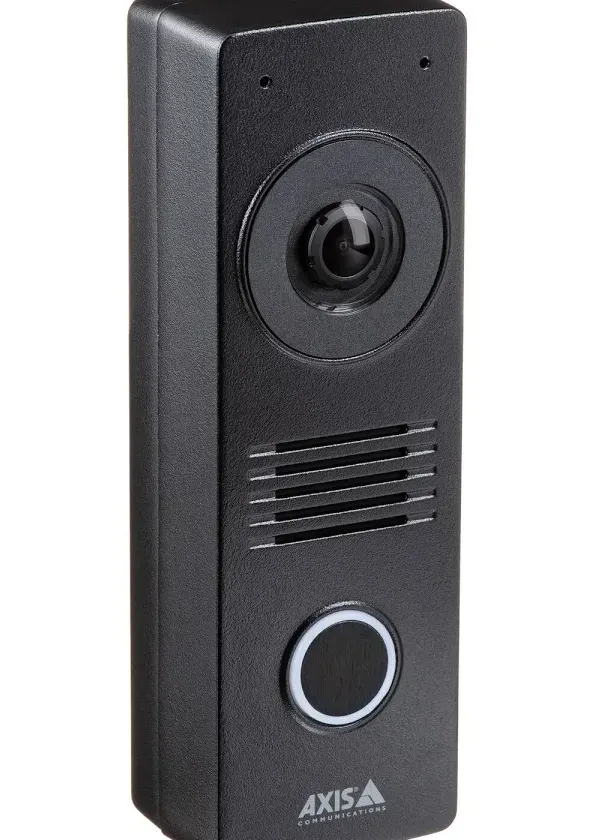
Brownsville, Brooklyn door buzzer installation: slim dark grey wired doorbell with a camera lens, speaker slots and a round push button
A photo from the AESS job library, not taken in Brownsville: a slim dark grey wired doorbell with a camera lens, speaker slots and a round push button. A doorbell this narrow fits on the strip of frame beside a Brownsville rowhouse door, where there can be only a few inches between the door and the brick, and a dark finish sits quietly against the red brick of the Nehemiah houses.
Building Specialists

Door Buzzer Installation for Brownsville's Architecture

Six kinds of privately owned property make up nearly every buzzer job we would quote in Brownsville. Each puts the door station, the cable route and the indoor stations somewhere different, and each has its own most common mistake.

Nehemiah rowhouses

Two-story brick houses on long, uniform blocks, one household each, with the kitchen at the front and a parking pad before the door.

Two- and three-family houses south of Pitkin

Semi-detached multi-unit rowhouses where two or three households share one street door and, often, one old bell.

Infill houses from the 1990s and 2000s

Newer two-family houses on lots between older buildings, some of them built with low-voltage cable that nobody ever connected.

Older walk-ups

Four- to six-story apartment buildings with a vestibule, a stair hall and a riser to every floor, many with systems decades old.

New affordable buildings

Mid- and high-rise buildings from the Brownsville Plan era, with developer-installed entry systems that need extending and upkeep.

Store-and-apartment buildings

Shops on Pitkin, Belmont, Rockaway and Livonia Avenues with apartments or offices above and a separate residential door.

Nehemiah rowhouses: a short trip from the kitchen to the door

The Nehemiah houses are the most uniform housing in the neighborhood. Urban Omnibus describes the first phase as 700 houses on 20 blocks, built as two-story brick boxes 18 feet wide and 32 feet deep, set in a row along each long block face, with a concrete parking pad and a strip of grass in front, a yard behind and the kitchen at the front of the house so residents could keep an eye on the street. Architect James T. Martino kept them plain on purpose, and owners have spent forty years adding fences, plantings and their own touches. Many still have the red or green aluminum awnings over the front door that went up with the houses.

That layout makes the doorbell simpler than in almost any other Brooklyn house. Someone in the kitchen is a few steps from the front door and can usually hear a plain bell. The people who cannot hear it are upstairs, in the bedrooms over the kitchen and at the back. So the usual Nehemiah job is a single-button station at the door, a talk-back station or small monitor on the kitchen wall where the household already looks out at the street, and a second chime or station at the top of the stairs. Owners who want to see who is there before opening choose a video station, and the kitchen monitor shows the parking pad and the walk at the same time as the face at the door.

The awning is the detail to plan around. It shades the door, which is good for the station's finish, but it also puts the visitor's face in shadow against a bright street, and rain runs off its edge just in front of the door. We mount the station under the awning but back from the drip line, close to the latch side of the door, and check the picture with someone standing on the pad before anything is fixed. Where the awning makes the picture too dark, a porch light on a sensor or a station with good backlight handling solves it. Because Nehemiah houses were sold with a mandatory homeowners' association, owners sometimes ask whether they need permission for a doorbell; that depends on the association's own rules, which the owner can check before we order.

Two- and three-family houses south of Pitkin Avenue: one door, two or three households

Below Pitkin Avenue, much of the private housing is semi-detached multi-unit rowhouses, often with an owner on one floor and a tenant on another, or a family spread across all three. Typically there is one street door into a shared hall, a door to the first-floor apartment and a stair to the upper ones. The bell, if there is one, often rings everywhere at once, so every visitor brings every household to a window or down the stairs.

The fix is a multi-button station at the street door with each button wired only to its own household's station, labeled by floor or apartment rather than by name. Each household gets a talk-back station, a video monitor or phone answering, and each can release the street door for its own visitors. In a semi-detached house the stoop and the front wall are sometimes shared with the house next door, so the station and cable are kept on the owner's side of the line and the power supply goes in the owner's own cellar. The power supply is sized for every station on the system, so adding video for one household later does not starve the others.

Ownership is worth deciding on day one. In an owner-occupied two- or three-family, the owner normally holds the admin access and sets up the tenants' answering. When a tenant moves out, the owner removes their access and adds the next household without a service call. We set that up and show the owner how before we leave.

Older walk-ups: risers, vestibules and fifty-year-old stations

Brownsville's private walk-ups range from turn-of-the-century tenements to mid-century buildings, typically four to six stories with a street door, a small vestibule, an inner door and a stair. The entry system is a lobby panel, a cable riser to every floor and a station in each apartment, all of which may date from different decades. In buildings this age, the riser pair is often the most valuable thing in the system: if it tests sound, a modern two-wire system can reuse it, and nobody has to fish new cable through occupied apartments.

Buildings with eight or more apartments fall under the Multiple Dwelling Law's intercom rules, explained in the compliance section below, and the city's housing code requires an installed intercom to be kept working. The jobs that go well start with a riser test, apartment by apartment, so the owner knows before signing what can be reused and what has to be replaced. We also check the street door's closer and lock, because a building that passes the intercom test and fails the door is not finished.

New affordable buildings: extending a system you did not choose

The buildings that opened under the Brownsville Plan and since are large and modern. 326 Rockaway Avenue is 14 stories with 215 apartments; Glenmore Manor at 76 Christopher Avenue is 11 stories with 233 apartments and a two-story, 20,000-square-foot commercial space called the B'Ville Hub; the Gail P. Duke Senior Residence at 350 Livonia Avenue is 13 stories with 142 apartments for seniors and received its certificate of occupancy in April 2026. Each came with an entry system specified by its developer.

Managers of buildings like these call us for the work the original contract did not cover: a side or rear door that was never put on the system, an accessible apartment station for a resident who cannot use a phone app, a separate entrance for a community or retail space, a panel replaced after damage, or a second panel inside the vestibule. We work with the existing system where the manufacturer allows it, and tell the manager plainly when it does not.

Store-and-apartment buildings: never one panel for both

Mixed-use buildings line Pitkin Avenue and parts of Belmont, Rockaway and Livonia Avenues. Many are older, but not all: one Pitkin Avenue building listed for sale was built in 2002 with three ground-floor commercial spaces and two three-bedroom apartments above. In buildings like that the apartments have their own street door, usually beside or between the shops, and the stores have front and rear doors of their own.

The apartments get a small multi-button panel at their own door, wired up the stair. The stores get a buzzer or video station at the delivery door, answered at the counter or on the owner's phone. Mixing them on one panel invites shoppers to ring tenants and tenants to buzz strangers into the store's back hall, so we keep them on separate systems even when the wires share a cellar ceiling.

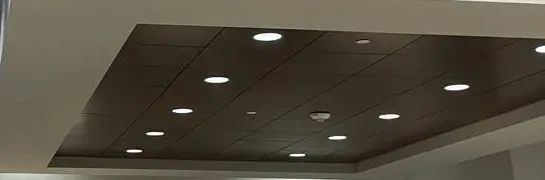
Brownsville, Brooklyn door buzzer installation: dark recessed ceiling panel with round downlights and a small round device framed by a lighter ceiling
A photo from the AESS job library, not taken in Brownsville: a dark recessed ceiling panel with round downlights and a small round device, framed by a lighter ceiling. Lobby ceilings like this are what residents of the newer Rockaway Avenue and Livonia Avenue buildings walk under, and the lighting overhead decides how well the entry panel's camera sees a visitor's face at the door.
Field Notes

Field Notes: The Three Things We Check at a Brownsville Door Before Talking Equipment

These notes describe how our technicians approach a door in a neighborhood like Brownsville. They are our standard practice, not a story about one address.

First, whose door is it? Before anything else, the technician confirms who owns the building and who is asking. A homeowner can approve the job on the spot. A tenant in a private building can show us the problem, and we will give them a range in writing to pass on, but the order has to come from the owner or managing agent. A resident of a NYCHA or PACT building is pointed to the right channel, because a private contractor cannot touch that building's lobby door without the authority's or partner's contract. Getting this wrong wastes everyone's time, so it comes first.

Second, does the door close by itself? The technician opens the street door, lets go and watches. Does the closer bring it all the way shut? Does the latch catch without a push? Is there a gap at the strike side where a credit card or a knife could slip the latch? Has the frame been pried before? In walk-ups and older houses, a large share of "buzzer" complaints turn out to be door complaints. A door that drifts open, slams too hard or binds at the top cannot be made to work with any panel, and fixing it is the first line on the price.

Third, what wire is already here? The technician finds the old panel or button, follows its cable to the cellar or the riser, reads the transformer or power supply, and tests each pair. In a Nehemiah house that might be a single doorbell pair. In a walk-up it is the riser to every apartment. In a 2000s infill house it might be an unused cable nobody knew was there. The result goes straight into the plan: sound wire is reused and saves money, damaged wire is replaced, and the written price says which.

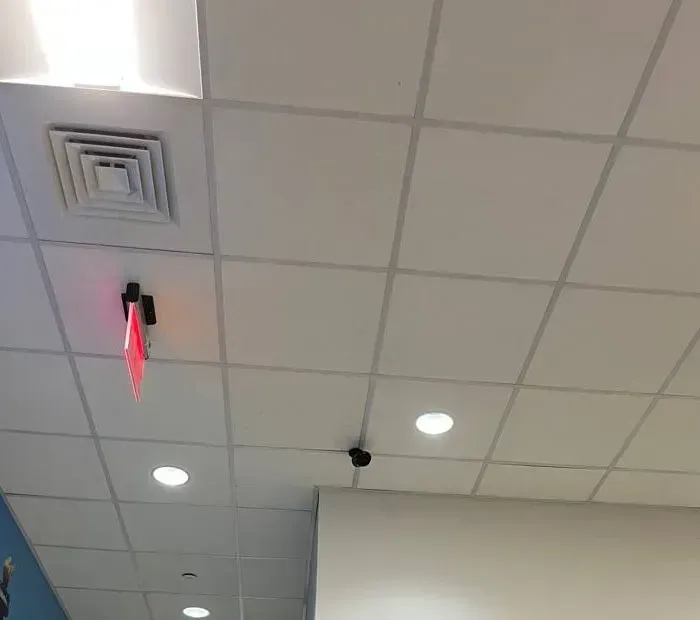
Brownsville, Brooklyn door buzzer installation: drop ceiling with a lit red exit sign, an air diffuser, round recessed lights and a small black camera
A photo from the AESS job library, not taken in Brownsville: a drop ceiling with a lit red exit sign, an air diffuser, round recessed lights and a small black camera. A ceiling like this is typical of an upstairs office or clinic over a Pitkin Avenue store, where the exit sign marks the same door the street buzzer releases and the egress rules for that door have to be checked before any lock goes on it.
Who Owns the Door

NYCHA, PACT, Private Owners and Homeowners: Who Can Change a Brownsville Front Door

In most Brooklyn neighborhoods, a page like this one can assume the reader owns the door or can call whoever does. In Brownsville that assumption leaves out most of the neighborhood, so here is how responsibility actually splits, and what a resident in each kind of building can do about a dead buzzer.

NYCHA buildings. The lobby doors, locks and intercoms in NYCHA developments are maintained by NYCHA. Residents report a broken door or intercom through NYCHA's own repair system; at a City Council hearing in April 2025, a NYCHA official said residents can call the Customer Contact Center to open a work order, and that property management staff check doors daily during building cleanup. The problems are long-standing. News 12 Brooklyn reported tenants at Brownsville Houses worried about a broken buzzer in November 2018, and the Comptroller's 2022 audit of 262 developments found entrance doors open or with broken locks at 57.9 percent of the doors observed, up from 23.5 percent four years earlier. Auditors wrote that "exterior doors that are not securely locked enable intruders and unauthorized persons to gain access to buildings." Since 2025, under a court-approved settlement, HPD has also begun publishing violations it issues in NYCHA apartments, which City Limits reported in October 2025.

NYCHA has been replacing entry equipment at some campuses. In November 2023 it announced more than $24 million of completed security work at 23 campuses, including intercoms, new entrance doors and what it calls layered access control, which lets access permissions be changed remotely without replacing fobs or locks. The same announcement said work had started at Seth Low Houses under a separate Entryways pilot. A private company like ours does not install or repair common-area entry systems in NYCHA buildings unless it is working under NYCHA's own contract, and we will not pretend otherwise. What a NYCHA resident can do privately is limited to their own apartment door: NYCHA's 2024 resident handbook allows a wireless video doorbell or camera attached to the apartment door with adhesive only, with no holes or alterations.

PACT developments. Under the PACT program, NYCHA leases developments to private partners who renovate and manage them. In October 2026 NYCHA and its partners marked the completion of the $636 million Reid & Park Rock renovation, covering 1,696 apartments in 87 buildings across 15 East Brooklyn developments, among them Ocean Hill-Brownsville, Tapscott Street Rehab, 104-14 Tapscott Street, Sutter Avenue-Union Street, Ralph Avenue Rehab and Lenox Road-Rockaway Parkway. NYCHA's release lists "enhanced security infrastructure and access control" among the work. Howard Houses is earlier in the process, with resident engagement that ran from November 2024 to November 2025 and an existing-conditions meeting on November 5, 2025. In these developments the partner chooses and maintains the entry system, and residents raise problems with the partner's management office.

Private rental buildings. In a privately owned walk-up or elevator building, the owner is responsible. The Multiple Dwelling Law requires an intercom in buildings with eight or more apartments built or converted after 1968, and in older buildings when a majority of tenants ask for one in writing. Habitat Magazine's February 2024 article on intercom law notes that the city's housing code also requires an installed intercom to be kept working and that courts have treated it as an essential service; as one attorney quoted there put it about a building with a dead system, "As a result, the co-op has a legal obligation to repair or replace the intercom." Tenants have the usual tools: written notice to the owner, a 311 complaint for an HPD inspection, a reduction-of-services complaint with the state's housing agency in rent-stabilized buildings, and an HP proceeding in housing court. Brick Underground's guide adds a practical step we agree with: get a written repair estimate and send it to the landlord. We give tenants that estimate from photos. The order itself has to come from the owner.

New affordable buildings. The newer buildings are privately owned and professionally managed, often by the nonprofit or developer that built them. Residents go to the management office; managers call installers like us for additions and repairs.

Houses. A homeowner decides everything about their own door, subject only to any homeowners' association rules on the Nehemiah blocks. A tenant in a two- or three-family house asks the owner, and in our experience owners of small houses are usually glad to fix a buzzer once someone hands them a clear plan and a price.

The Door Itself

Doors, Closers and Strikes: Why a Brownsville Buzzer Is Only as Good as the Door It Releases

An entry system has three parts that people see, the panel outside, the stations inside and the button that opens the door, and three that they don't: the strike or lock in the frame, the closer that pulls the door shut, and the door itself. When residents say the buzzer is broken, the failure is often in the second group. The Comptroller's NYCHA audit described the cycle bluntly: when locks, keys and release buttons do not work, people prop doors open, and some doors that were repaired broke again soon after. The same cycle runs in private buildings. It ends only when the hidden parts are put right.

The door and frame. Older walk-ups in Brownsville tend to have heavy wood or steel street doors in frames that have seen decades of use, and some have been pried. Before any strike goes in, we check that the door hangs square, that the hinges are tight, that the frame is solid where the strike will sit and that the gap at the latch is small enough that the latch cannot be slipped. A strike in a split frame will not hold. Repairing or reinforcing the frame is part of the written scope when it is needed, not a surprise on installation day.

The closer. A street door has to close and latch on its own, every time, in summer heat and in winter wind. The closer's speed and latch settings decide whether the door slams hard enough to bounce off the strike, drifts shut so slowly that someone walks in behind a tenant, or stops an inch short. Every installation includes adjusting or replacing the closer, because a building that has a new buzzer and a door that hangs open still has a broken entrance. The city takes this seriously: City Limits, citing the Mayor's Management Report, counted 73,325 self-closing door violations citywide in fiscal 2024, up from 49,897 the year before.

The strike. Most street doors we install on get an electric strike, a small powered device in the frame that lets the latch push through when someone presses release. Strikes come in two kinds. Allegion's guide puts it simply: "Fail safe products are unlocked when power is removed," and "fail secure products are locked when power is removed." With a strike, a person inside can still leave by turning the lever whichever kind it is. For an apartment building's street door we normally fit fail-secure strikes, so the door stays locked during a power cut and opens with a key, which Allegion notes is the more common choice for security reasons.

Magnetic locks. Some owners ask for a magnetic lock because it is easy to mount on a damaged frame. Allegion notes that electromagnetic locks are only available fail safe, so the door unlocks when power drops, and the building code's sensor-release rules for electrically locked egress doors call for a sensor on the inside, a push-to-exit button within reach, unlocking on loss of power and on fire alarm activation. We fit a magnetic lock only with that full set of releases, and we tell the owner what it adds to the price compared with repairing the frame for a strike.

Iron gates and second doors. Some Brownsville houses have an iron security gate or a second door in front of the main door. The release goes on whichever door visitors are meant to pass through first; often that means a release on the gate and the main door left on its key, or the gate kept on a key and the release on the inner door. A gate that swings freely and closes on a spring takes a release far better than one that has to be pulled shut. We look at both and recommend one.

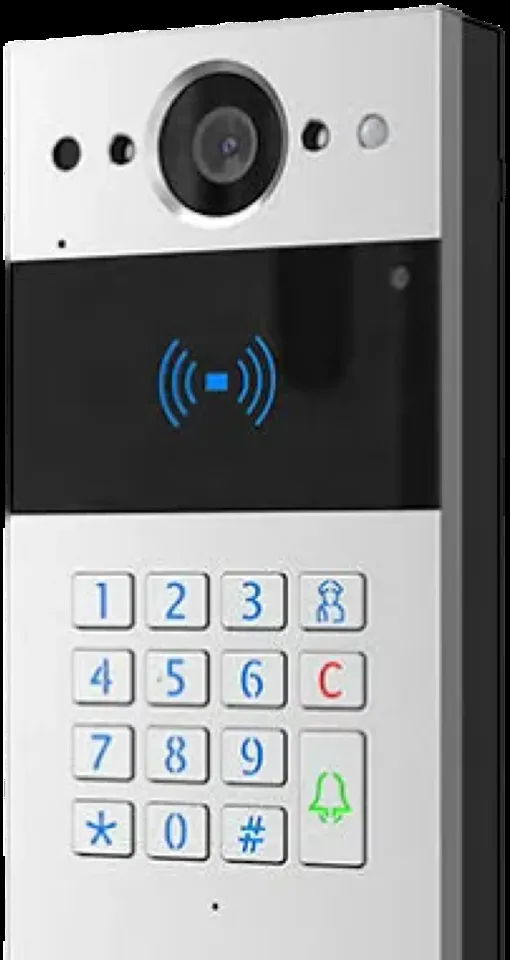
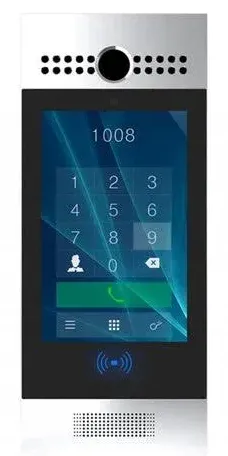
Brownsville, Brooklyn door buzzer installation: silver and black keypad door station with a camera lens at the top, a blue card-reader symbol, a numeric keypad and a green bell key
A photo from the AESS job library, not taken in Brownsville: a silver and black keypad door station with a camera lens at the top, a blue card-reader symbol, a numeric keypad and a green bell key. On a Brownsville walk-up, a station like this lets tenants enter with a code or card instead of a street-door key, and the owner can remove a departing tenant's code the same day instead of changing the lock.
Commercial Door Buzzer Installation

Business Door Buzzer Installation in Brownsville

Brownsville's businesses sit on a handful of corridors, and the buzzer jobs on each have a recognizable shape. Stores mostly need a way to answer a delivery door; offices, clinics, daycares and programs upstairs need a street door that admits people one at a time; churches and community spaces need entry during their own hours.

Pitkin Avenue

The main shopping street and home of the Pitkin Avenue BID, with 212 ground-floor businesses on 32 block faces, many with apartments or offices above and a separate residential door between shops.

Belmont Avenue

A narrower strip of small stores and food businesses near the Osborn Street Plaza, where rear and side delivery doors open onto tight sidewalks.

Rockaway Avenue

A north-south spine served by the B60 bus, mixing older storefronts with the ground floors of new buildings such as 326 Rockaway Avenue and the Brownsville Arts Center site at 366.

Livonia Avenue

The avenue under the elevated 3 train, with storefronts below the tracks and new affordable buildings like the Gail P. Duke Senior Residence at 350 Livonia.

Glenmore Avenue

Home to Glenmore Manor and its two-story B'Ville Hub commercial space, where a public-facing ground floor sits under 233 apartments.

Mother Gaston Boulevard and East New York Avenue

Churches, the Stone Avenue Library and community organizations on Mother Gaston, and the commercial edge along East New York Avenue at the northern boundary.

For a store, the request is usually a buzzer or video station at the rear or side door so drivers and suppliers can ring, answered at the register or on a phone, with the door kept locked between deliveries. On blocks under the Livonia Avenue el, we choose a station with a loud enough speaker and a call tone that can be heard over the train, and we test it with a train passing. For an upstairs office, clinic or program, it is a street-door station with a clear directory, a release button at the front desk, and a closer that pulls the door shut behind each visitor so the stair is never left open. For a daycare or senior program, owners often want video so staff see who is at the door before releasing it.

For the apartments above a store, the scope is the same as a small walk-up: a panel at the residential door, stations in each apartment, release hardware and a power supply, all on a system separate from the shop. For the newer mixed-use buildings, where a community space or retail tenant has its own street door, we add that door to the building's system or give it a separate system, depending on what the building's manager wants the tenant to control.

Rules that apply to Brownsville entry installations

  • Multiple Dwelling Law §50-a. Class A multiple dwellings with eight or more apartments, built or converted after January 1, 1968, must have a self-locking main door with an intercommunication system allowing voice contact with the apartments and remote release. In older buildings, the owner must install the door and intercom when tenants of a majority of apartments request or consent in writing, with work started within 90 days and finished within six months.
  • What counts as a multiple dwelling. The Multiple Dwelling Law treats a building occupied by three or more families living independently as a multiple dwelling. A one-family Nehemiah house or a two-family house is outside it; a three-family house is inside it.
  • Keeping it working. The city's Housing Maintenance Code requires owners to keep installed equipment in good repair, and Habitat Magazine notes that courts have treated a working intercom as an essential service under the warranty of habitability.
  • Self-closing doors. HPD writes violations for public-hall doors that do not close on their own; the Mayor's Management Report counted 73,325 of them citywide in fiscal 2024. Every building installation includes setting the closer and checking the latch.
  • Electrically locked egress doors. Where a magnetic lock is used instead of a strike, the building code's sensor-release provisions call for a sensor on the egress side, a manual push-to-exit device near the door, and unlocking on loss of power and on fire alarm activation. Strikes avoid most of this because the door can always be opened from inside by its lever.
  • Accessible reach. The 2010 ADA Standards put the high forward reach at 48 inches maximum and the low reach at 15 inches minimum. We use that range for buttons and keypads on business doors, community spaces and lobby panels, and it matters most at a senior building like 350 Livonia Avenue.
  • Smart access data. Where a building uses fobs, apps or other smart access, the city's Tenant Data Privacy Law sets rules on consent and on how long authentication data may be kept, and a tenant cannot be required to use smart access to enter their own apartment. We set systems up so that a key or code still works for anyone who declines the app.

If a business or building also wants cameras on the entrance, they can go in on the same visit and be priced together with the buzzer; customers who combine the two typically save $200 to $400 in labor.

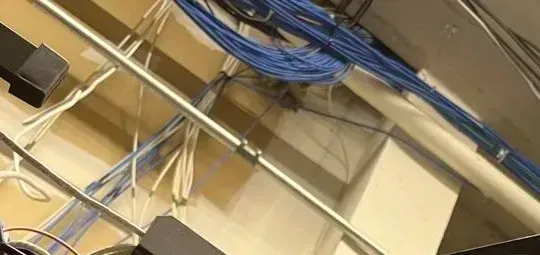
Brownsville, Brooklyn door buzzer installation: bundles of blue low-voltage cable laid over a ceiling beam and a metal pipe in an open ceiling
A photo from the AESS job library, not taken in Brownsville: bundles of blue low-voltage cable laid over a ceiling beam and a metal pipe in an open ceiling. The cellar under a Pitkin Avenue store-and-apartment building usually looks like this, and it is where the shop's delivery buzzer and the apartments' entry system can share a route while staying on separate systems.
Your Questions Answered

Door Buzzer Installation in Brownsville: Questions Answered

These are the questions Brownsville homeowners, small landlords, tenants and business owners bring to us, along with ones raised in Brownstoner's forums, Brick Underground's and Habitat Magazine's guides, and city hearings and audits, answered for the houses and buildings here.

Nehemiah and other one-family houses

Our Nehemiah house has the kitchen right behind the front door. Is a buzzer worth adding, and where should we answer it?

Yes, mainly for the people who are not in the kitchen. In a Nehemiah house the kitchen is at the front, a few steps from the door, so whoever is cooking hears a knock. The bedrooms are upstairs and toward the back, and that is where a plain bell gets missed, especially with a television or a fan running. A single-button station at the door with a talk-back station or small video monitor on the kitchen wall, plus a chime or second station at the top of the stairs, covers the whole house.

The kitchen is also the natural place to see the door. Because the house was designed so the family could watch the street from the kitchen, a monitor there puts the visitor's face next to the window view of the parking pad and walk. Households that prefer phones can answer on an app instead, but most owners who spend their day in the kitchen like a screen on the wall better than reaching for a phone with wet hands.

Our house has an iron security gate in front of the wooden front door. Which one should get the electric release?

Usually the one a visitor reaches first, which is the gate, provided it closes and latches on its own. A gate on a good spring hinge with a solid latch post takes a release well, and once a visitor is through it they are at the main door, which stays on its normal key lock. If the gate has to be pulled shut by hand or rattles in its frame, it will not hold a release reliably, and the better plan is to keep the gate on a key and put the release on the inner door.

We decide on the walkthrough by opening and letting go of each one. The station goes where a visitor can reach it from outside the gate, on the frame or the wall beside it, and the cable runs through the wall rather than along the gate so it is not flexed every time the gate swings.

Our two-family went up in the early 2000s. Is there a chance intercom cable is already in the walls?

A fair chance, and it is worth checking before buying anything. Houses of that age were often built with at least a doorbell pair, and some with a cable from the front door to each apartment, even when the builder never installed a working intercom. Signs to look for are a blank cover plate or capped wire beside the front door and inside each apartment near the entry, and a small transformer or unused cable in the cellar or utility closet.

If that cable is there and tests sound end to end, a two-wire system can often run over it, which keeps the job toward the lower end of the range. If it is not, these houses usually have wood framing and drywall, which makes fishing new cable much easier than in an older brick house.

Two- and three-family houses

Our semi-detached house shares its stoop with the house next door. Can the buzzer and its cable stay entirely on our side?

Yes, and they should. On a shared stoop we mount the station on your half of the front, on your door frame or the wall beside it, and route the cable straight into your own house rather than along the stoop or the shared wall. The power supply goes in your own cellar or closet. Nothing is fixed to the neighbor's side or drilled through the party wall.

If the only workable spot for the station is on something both houses share, such as a common gate post, it is worth a quick word with the neighbor before we mount it. Most of the time it never comes to that, because the station fits on your own frame.

The tenant on our top floor works nights and sleeps during the day. Can their apartment's ringer be silenced without disabling the door for everyone else?

Yes. Each household's station is separate, so turning one off or down does not affect the others. Many apartment stations have a volume control or a privacy setting that silences the call tone, and app-based answering usually lets the tenant set quiet hours on their own phone. The other households keep ringing and releasing as normal.

The one thing to agree on is how the tenant's own visitors and deliveries reach them while the ringer is off. Some tenants leave the app to show a missed call with a picture, so they can see who came; others ask couriers to leave parcels in the shared hall. We set it up the way the tenant wants on installation day.

Walk-ups and apartment buildings

The super for our walk-up lives off-site. Can the system warn him when the street door is left open?

Yes. A door position switch fitted in the frame tells the system whether the door is closed. If the door stays open past a set time, whether propped, jammed or held by a closer that has failed, the system can send an alert to the super's or owner's phone. That turns a propped door from something found days later into something fixed the same afternoon.

The switch also helps diagnose the door itself. If alerts keep coming at the same time of day, the closer may be too weak for the wind at that hour, or a tenant may be propping it for deliveries. We set the delay so normal comings and goings do not trigger alerts, and price the switch with the rest of the system.

Our walk-up's back door to the yard is always left unlatched. Does it need to be on the entry system too?

It does not need a call station, but it needs to close and lock. A rear door that people use to take out trash or reach the yard is a way into the building that bypasses the front door entirely. The Comptroller's NYCHA audit found 37.5 percent of rear or side doors open and 28.5 percent of their locks broken, and private buildings with the same habits have the same problem.

The usual fix is a self-closing door with a latch that locks from outside and opens freely from inside, plus a door position switch on the entry system so the owner is alerted when it is left open. Never chain or padlock a door that people use to get out of the building. If residents need to come back in through it, a keypad or fob reader on the yard side does that without leaving it unlocked.

Tenants in our rent-stabilized building filed a reduction-of-services complaint over the dead intercom. What paperwork shows it has been fixed?

Keep everything that shows when the system was restored and that every apartment works. Brick Underground's guide notes that rent-stabilized tenants can file a reduction-of-services complaint with the state's housing agency, and the owner's response to that complaint is a matter between the owner and the agency, often with an attorney's help.

What we provide is the evidence: the dated invoice and scope of work, the list of equipment installed, and a dated test record showing each apartment's station ringing, talking and releasing the door, signed by the technician. Owners also keep photos of the panel and of the door closing and latching. That record is useful for an HPD reinspection as well.

Our tenant association wants to give the landlord a real price for a new intercom. Will you quote a building none of us own?

We will give you a written range. From photos of the panel, the street door, a typical apartment station and the cellar where the cable runs, plus the number of apartments, we can say which part of our Brooklyn list the building falls in and what the job would typically include. Brick Underground's advice for tenants with a broken buzzer includes getting a repair estimate and sending it to the landlord, and a written range from a licensed contractor is what that step needs.

The firm price and the order have to come from the owner or managing agent, because the walkthrough involves the cellar, the riser and access to apartments, and the contract is with whoever owns the building. We are happy to talk to the owner directly once the association has passed on the range.

Our development is going through PACT. Who chooses the new entry system, and when can residents weigh in?

NYCHA and the development's private partner choose it, as part of the renovation scope. Residents weigh in during the engagement period before conversion. At Howard Houses, NYCHA's PACT page shows an introduction meeting in November 2024, a visioning workshop in March 2025 and an existing-conditions meeting in November 2025. Those meetings, and the tenant association, are where to say that the lobby intercom does not work, that seniors need stations they can use without a smartphone, or that rear doors are always open.

Completed PACT projects nearby give a sense of what to ask for: the Reid & Park Rock renovation that finished in October 2026 listed enhanced security infrastructure and access control among its work. Once a development has converted, the partner's management office is responsible for the entry system, and repairs go through them, not through NYCHA or an outside contractor.

Stores and upstairs offices

Our Pitkin Avenue store pulls down a roll gate at closing. Where can a buzzer go so it works by day and is protected at night?

Usually on the storefront frame or wall just inside the gate line, so the gate covers it after closing and it is within reach when the gate is up. A station mounted outside the gate path is exposed all night and is the first thing to get damaged; one mounted inside is only needed during business hours anyway, when the gate is open.

The exception is a rear or side delivery door that drivers use when the front gate is down. That door gets its own vandal-resistant station on the outside, answered at the register or on the owner's phone. We keep the cable out of the gate's housing and its motor box, so servicing the gate never damages the buzzer.

Our program is on the second floor above a Belmont Avenue storefront, and visitors walk past our door. How do we make the entrance easy to find and still controlled?

Start with the station itself. A door station with a lit name strip or a short directory, mounted at a reachable height on your street door rather than on the shop's frame, tells visitors they are in the right place. A clear sign above or beside the door does the rest. Inside, a release button at the front desk lets staff admit each visitor, and a properly set closer pulls the door shut behind them so the stair is never left open to the street.

If your visitors include older people or people using wheelchairs, keep the button and speaker within the 2010 ADA reach range of 15 to 48 inches and choose a station with a loud, clear speaker.
Equipment

Types of Door Buzzer Systems We Install

We quote a reliable non-branded system by default and install a named brand when an owner asks for one; the intercom brands we work with include Aiphone, ButterflyMX, 2N, Akuvox, Comelit and DoorBird. These are the kinds of equipment that fit Brownsville's houses, walk-ups, new buildings and storefronts.

Audio buzzers with talk-back

A lit button and speaker at the door with a talk-back station in each household or apartment. No camera and no internet needed, and the lowest-cost option on the list for houses and small buildings.

Video door stations and monitors

A camera station with one to three buttons for houses, or a directory panel for buildings, wired to video monitors in each household, with phone answering available on many models.

Two-wire multi-tenant systems

Systems that carry power, voice, video and the release over one pair, so a sound old riser or doorbell pair can be reused instead of fishing new cable through occupied apartments.

Keypad, code and card entry

Door stations with a keypad or card reader so residents enter without a street-door key, and an owner removes a departing tenant's access the same day.

Phone and cellular answering

Panels that call residents' phones or an app, including cellular models for doors with no network cable, with a fallback so residents without smartphones can still answer.

Strikes, closers and door switches

Fail-secure electric strikes for wood and steel frames, closers set so the door latches every time, and door position switches that report a propped door.

Audio buzzer, video station or phone-based panel: which suits a Brownsville door?

The table compares the three set-ups we are asked about most often on Brownsville houses and small buildings. Which one is right depends on how many households or apartments share the door and how residents want to answer.

What mattersAudio buzzer with talk-backVideo station with monitorsPhone or app-based panel
Typical Brownsville fitTwo- and three-family houses, small walk-ups on a budgetNehemiah houses, owner-occupied multi-family housesLarger walk-ups and managed buildings
How residents answerWall station in each homeWall monitor, optional phonePhone or app, landline on some systems
See the visitorNoYesYes, on most models
Cable insideDoor to each homeDoor to each homeDoor to panel power and network only
Works without internetYesYes, except phone answeringNeeds network or cellular service
Possible monthly feeNoneUsually noneOften, per apartment or per door
Brooklyn list range$400–$900 for houses$700–$1,800 for housesFrom about $2,500 for buildings

ADT, Ring and SimpliSafe compared with a local installer for a Brownsville door

Many Brownsville homeowners already have a Ring doorbell or an alarm plan from ADT or SimpliSafe and ask whether that is enough. On a one-family Nehemiah house, a consumer video doorbell often is, and we will install and properly power the one you already own. Where those products fall short here is the shared door: a consumer doorbell rings one account's phones and one chime, it cannot give the second- and third-floor households their own button and station, and most cannot release a street door without added hardware. National alarm companies sell doorbells inside a monitoring plan; the buzzer systems we install are owned outright, with no plan required. For a walk-up, none of the consumer products is designed to be a multi-apartment entry system, and the Multiple Dwelling Law expects one that every apartment can use.

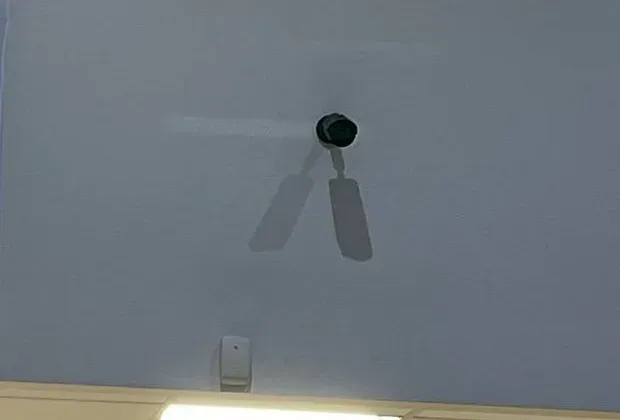
Brownsville, Brooklyn door buzzer installation: small black camera mounted high on a pale wall casting two shadows, with a small white wall device below
A photo from the AESS job library, not taken in Brownsville: a small black camera mounted high on a pale wall, casting two shadows, with a small white wall device below it. In a Brownsville walk-up vestibule, a camera placed this way watches the inner door and the mailboxes while the entry panel's own camera handles faces at the street door.
AI Overview Reality Check

What AI Gets Wrong About Door Buzzer Installation in Brownsville

These claims turn up in generic online answers, in national cost guides such as HomeAdvisor and Angi, and on vendor blogs. Each one is paraphrased or quoted, then checked against Brownsville's buildings, the manufacturers' own guidance and the city's rules.

"A building intercom runs anywhere from $1,500 to $15,000"

HomeAdvisor's cost guide gives an average of $2,500 for an intercom system and a range of $1,500 to $15,000, with wireless systems at $150 to $1,500 and hard-wired ones at $1,000 to $15,000.

The range is real, but it is so wide it tells a Brownsville owner almost nothing. A Nehemiah rowhouse with one household and a short cable run is a completely different job from a six-story walk-up with a riser to every floor, and both are different from adding a door to a new building's existing system. On our Brooklyn list the houses fall between $400 and $1,800, and buildings start at about $2,500.

The honest answer is a number for your door, after someone has looked at it. That takes a set of photos and a short walkthrough, and the written price does not change unless the scope does.

"Wireless systems are the best option if you want to DIY"

HomeAdvisor says exactly this, and for a single household adding a doorbell to its own door, it can be true.

In Brownsville, most people asking about a buzzer do not own the door. A tenant cannot replace a walk-up's entry system, a NYCHA resident cannot alter the lobby, and NYCHA's handbook limits apartment-door devices to wireless cameras fixed with adhesive. Even for owners, the hard part of a working entrance is rarely the button: it is the strike, the closer and the frame, which no wireless kit addresses.

Wireless is a fine choice for one household's chime. For a shared street door, the job is a wired system with a release, and the door work that makes the release hold.

"Modern entry systems cost $1,000 to $5,000 or more per door"

Swiftlane's guide puts modern IP or video systems at $1,000 to $5,000 or more per entry door, and adds that software subscriptions commonly run $5 to $15 per unit per month, or $30 to $100 per door per month.

That pricing describes cloud-managed systems for large buildings. For a 20-apartment Brownsville walk-up, a $5 to $15 per-unit fee is $100 to $300 every month, every year, on top of the installation, which matters in a neighborhood where so many buildings are small and owner-run. A wired system that reuses a sound riser can carry no monthly fee at all.

We price both kinds side by side when an owner asks, so the monthly cost over five or ten years is on the table alongside the installed price.

"Cellular intercoms need no building wiring"

Vendors of cellular call boxes describe panels that need no internet at the door and, in ButterflyMX's words about its own unit, "no building wiring."

A cellular panel removes the cable to each apartment, because it calls residents' phones. It does not remove the power at the door, the strike or lock that releases it, or the closer that shuts it, and those still have to be wired and set up. It also assumes every resident has a working phone and the app or number registered, which is not true of every household in a senior building or a walk-up.

Cellular is a good answer for a door with no practical cable route. It is not a reason to skip the door hardware or to leave residents without a way to answer.

"A smart doorbell on each apartment door does the same job"

Online answers often suggest that tenants in an apartment building simply add their own video doorbell.

A doorbell on an apartment door only works once the visitor is already inside the building. It cannot answer the street door or release it, which is the whole point of a buzzer in a walk-up. In NYCHA buildings, the resident handbook allows such a camera only if it is wireless and attached with adhesive, with no holes or alterations.

An apartment-door camera can be a useful extra for a resident. It is not a substitute for a working entry system at the street door, and the law places that system on the building's owner.

"A magnetic lock is the simple, cheap fix for a bad door"

Magnetic locks are often recommended online because they mount on almost any frame and hold firmly.

Allegion notes that electromagnetic locks are only available fail safe, so the door unlocks whenever power drops, and the building code's sensor-release rules call for an inside sensor, a push-to-exit device, unlocking on power loss and on fire alarm activation. By the time those are added, a magnetic lock is rarely the cheap option, and a power cut leaves the street door open.

For most Brownsville street doors, repairing the frame and fitting a fail-secure strike is cheaper over the life of the door and keeps the building locked during an outage.

"Once the buzzer works, the entrance is secure"

Generic answers treat a working intercom as the end of the job.

The Comptroller's 2022 audit of NYCHA doors shows how wrong that is in practice: 36.8 percent of residential entrance doors were found open and 40.1 percent of entrance door locks broken, and residents tied the open doors partly to intercoms and release buttons that did not work. A buzzer only secures a door that closes and locks on its own after every release.

That is why every installation we do ends with the same test: press release, let the door go, and watch it close and latch, from every apartment.

Not Sure Whether Your Door Needs a Buzzer, a Strike or a New Closer? Ask a Tech

If you cannot tell whether the problem is the panel, the wiring or the door, send a photo of each and ask. Call now at (347) 934-8335, send a fast quote request, or speak to a tech on WhatsApp. Estimates are booked within two hours of your request during working hours.

Get In Touch

Request a Free Quote

Tell us the street, the kind of building, how many households or apartments share the door, whether you own it, and what is by the door now. A technician calls back with the range for the Brownsville address, or you can call (347) 934-8335 right now.

✅
Request Sent!
Thank you. A technician will call you about the Brownsville address, usually within two hours during working hours.
How It Works

Our Installation Process

1. Photos and who owns the door

Send the door, the frame, any old panel or button and where its wire ends, with the street, the number of households or apartments and who owns the building.

2. Weekday walkthrough

A technician checks how the door closes and latches, tests the old wire and power, looks at any gate or awning, and traces a cable route to every household or apartment.

3. Written scope and price

Equipment, mounting spot, cable route, door and release work and the total price, in writing, before anything is ordered.

4. Door, frame and power first

The door is made to close and latch on its own, the strike or release goes into a sound frame, and the power supply is sized for the system, with an electrician for any 120-volt work.

5. Cable and stations

Low-voltage cable runs through cellars, closets, risers and chases to the door station and every household or apartment station, kept off the face of the building.

6. Test from the street

Every button is rung, every station talks and releases, and the door is watched closing and latching after each release, with a dated test record.

7. Hand-over

The owner or manager gets the wiring note, admin logins and test record, and each household or the super is shown how to answer, open and add or remove users.

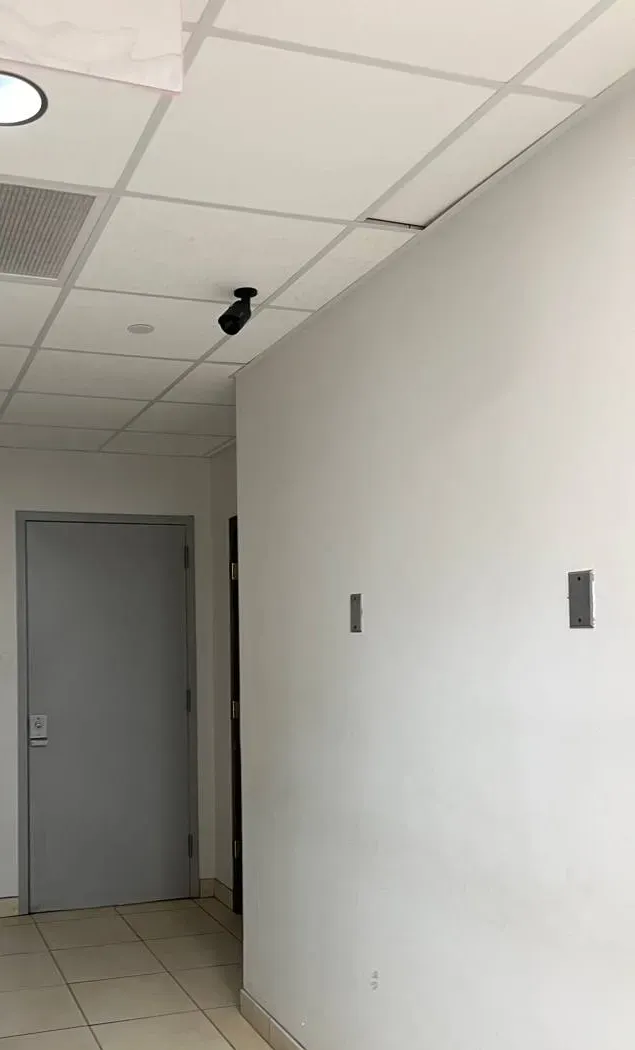
Brownsville, Brooklyn door buzzer installation: tiled corridor with white walls and small wall plates ending at a grey steel door with a lever handle under a drop ceiling with a small camera
A photo from the AESS job library, not taken in Brownsville: a tiled corridor with white walls and small wall plates ending at a grey steel door with a lever handle, under a drop ceiling with a small camera. Rear and cellar doors in Brownsville walk-ups and newer buildings are often steel like this, and step four applies to them too: the door has to close and latch on its own before any release or door switch is wired to it.
Coverage Area

Door Buzzer Installation Near Brownsville's Landmarks

Brownsville Library

The Brooklyn Public Library branch at 61 Glenmore Avenue, opened in 1908, near the walk-ups and houses of the neighborhood's northern blocks.

Livonia Park

The park beside the Tilden Houses, opened in 1969, on the Livonia Avenue corridor under the elevated 3 train.

"Soul in the Hole" court

The famous basketball court at the Brownsville Houses on Rockaway Avenue between Riverdale and Livonia Avenues.

Brownsville Arts Center and Apartments

The nine-story building that broke ground at 366 Rockaway Avenue in September 2025, with 283 affordable apartments and a cultural arts center planned for late 2027.

Glenmore Manor and the B'Ville Hub

The 11-story, 233-apartment building at 76 Christopher Avenue, with a two-story commercial space along Glenmore Avenue.

Gail P. Duke Senior Residence

The 13-story building for seniors at 350 Livonia Avenue, with 142 apartments and a certificate of occupancy issued in April 2026.

We also serve Ocean Hill, East New York, Crown Heights, East Flatbush, Canarsie and Cypress Hills, all at the same Brooklyn rate. See our door buzzer installation in Brooklyn page for the whole borough, or nearby neighborhood pages such as Bedford-Stuyvesant door buzzer installation.

Pricing

Door Buzzer Installation Cost in Brownsville

Brownsville is billed at our Brooklyn rate, with no travel premium. The ranges below are installed prices covering equipment, power, any strike or release, cable and labor. Where a property lands inside a range depends on the door's condition, the cable route, the number of households or apartments, and the choice of audio, video or phone answering. The figure for your door is set in writing after the walkthrough and does not change unless you change the scope.

ItemBrooklyn priceTypical Brownsville job
Audio / small system$400–$900Lit button and speaker at the street door, talk-back station per household, release on the door, one to three households
Video / mid-size system$700–$1,800Video station at a Nehemiah or multi-family house door with monitors or phone answering
Multi-unit building$2,500–$10k+Lobby panel, tested or new riser, apartment stations, strike, closer and battery-backed power for a walk-up or elevator building
Service call booked online$250Diagnosis of an existing system; applied toward the work

What usually pushes a job toward the top of its range: a door or frame that needs repair before a strike can hold, a new cable route because the old wire is missing or damaged, video for every household instead of one, a building riser that has to be replaced floor by floor, and extra doors such as a rear yard door or a second vestibule door. What keeps a job toward the bottom: wire that tests sound and can be reused, a door that already closes and latches well, a single household, and audio stations or phone answering instead of monitors.

For comparison, HomeAdvisor puts the average intercom system at $2,500 with a range of $1,500 to $15,000, and Swiftlane puts modern video systems at $1,000 to $5,000 or more per door before subscriptions. Brownsville's houses usually sit well below those figures because they are one door and a few households, and its walk-ups sit inside them.

Full terms — including 50% deposit, one-year parts-only warranty on AESS-supplied products, and the late-fee schedule — are set out in the service agreement.
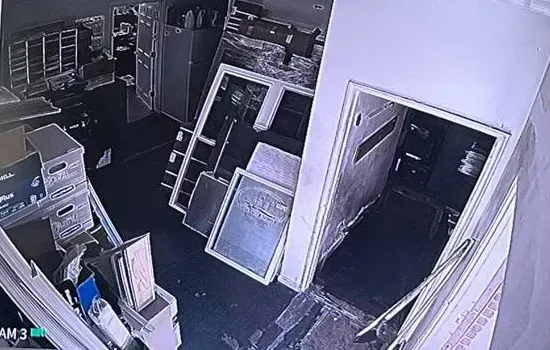
Brownsville, Brooklyn door buzzer installation: black-and-white night camera view of a cluttered room with an open doorway into a dark back room
A photo from the AESS job library, not taken in Brownsville: a black-and-white night camera view of a cluttered room with an open doorway into a dark back room. A back room like this behind a Livonia Avenue or Belmont Avenue store is where the delivery door usually is, and it is why many shop owners pair the rear-door buzzer with a camera that shows the door at night.

Find Out Which Range Your Brownsville Door Falls In

Send three photos, the door from the sidewalk, the frame and latch close up, and the old panel or button, and we tell you which range fits and what would move it. Call (347) 934-8335, speak to a tech on WhatsApp, or use the fast quote form.

Shop Our Systems

Door Buzzer Installation Packages & Pricing

Three typical Brownsville jobs, each priced inside the matching range on our Brooklyn list. The exact figure comes from the walkthrough.

Two- or three-family audio buzzer: $400–$900

A lit multi-button station at the shared street door, a talk-back station for each household, a fail-secure strike on the door if the frame is sound, the closer adjusted, and a power supply in the owner's cellar.

Rowhouse video station: $700–$1,800

A video door station for a Nehemiah or older rowhouse, a monitor on the kitchen wall, a second station or chime upstairs, phone answering set up and a release on the door or gate if wanted.

Walk-up entry system: from about $2,500

A lobby panel for a four- to six-story building, a riser tested pair by pair or replaced, audio or video stations in every apartment, strike, closer, door switch and battery-backed power.

Bring your own equipment. If you have already bought a door station, video doorbell or intercom kit, we can install it as long as it suits the door, the household count and the building's power. Labor for customer-supplied equipment is quoted flat at the walkthrough, and any strike, closer, power supply and cable are priced from the same list. Customer-supplied equipment carries the manufacturer's warranty rather than ours, so we check the model with you before you book.

Brownsville, Brooklyn door buzzer installation: touchscreen entry panel showing a dial pad with a four-digit apartment code entered, a camera above and a card-reader symbol below
A photo from the AESS job library, not taken in Brownsville: a touchscreen entry panel showing a dial pad with a four-digit apartment code entered, a camera above and a card-reader symbol below. A panel like this suits the larger walk-ups and the newer buildings on Rockaway and Livonia Avenues, where visitors dial an apartment code instead of searching a long column of buttons, and residents can enter with a card.
Complete Services

Every Door Buzzer Service in Brownsville

Houses

First buzzers, video stations and a button per household. Request a quote

Walk-ups and buildings

Lobby panels, risers, strikes and closers. Call (347) 934-8335

Across Brooklyn

The same list in every neighborhood. Brooklyn door buzzer installation

Citywide

Houses and buildings in every borough. NYC door buzzer installation

FAQ

Brownsville Door Buzzer Installation FAQ

How soon after the walkthrough do we get the written price?
+

For a house, usually the same day or the next working day, because the walkthrough answers almost every question on the spot. For a walk-up, the riser test results go into the price, so it can take a little longer if several apartments have to be tested. Equipment is ordered only once you have approved the written price and paid the deposit.

Can an electric strike go into the steel door frame our walk-up has?
+

Yes. Strikes are made for hollow metal frames as well as wood, and a steel frame in good shape is a solid place for one. The frame is cut to fit the strike body, and the cable is run inside the frame to the power supply. If the frame has been bent or pried, it is straightened or reinforced first, and that work is listed in the written price.

Does someone need to be home for the whole installation?
+

For a house, someone needs to let the crew in at the start and be there at the end to test their own station and learn how to use it. In a building, the owner or super needs to give access to the cellar, the riser and each apartment, and every household should be home at some point that day so their station can be installed and tested. We give the owner a notice to post for tenants.

Are plain audio buzzers still made, or is everything video now?
+

Audio systems are still made and supported, and they remain the lowest-cost option on our list. They suit households that only want to hear and talk to a visitor and release the door. Many audio systems share a family with video models, so an owner can start with audio and change the door station to video later without replacing every station inside.

Will the electricity in the house or building be shut off while you work?
+

Normally not. Buzzer systems run on low voltage from their own power supply, and we connect the supply to an existing outlet or circuit at the end of the job. If a new 120-volt circuit is needed, the licensed electrician doing that part may switch off one circuit briefly, and we tell you beforehand which one and for how long.

Can a door station be installed in the middle of winter?
+

Yes. Door stations are built for outdoor use, and the installation is mostly inside work: cable, power supply and stations. The outdoor part, mounting and sealing the station, takes a short time at the door. On very cold days we use sealants rated for low temperatures and keep the street door closed as much as possible while we work.

Will you take out the old wiring that is no longer used?
+

We remove old cable that is exposed and no longer used, such as wire stapled along a hallway or cellar ceiling, and label anything we leave in the walls. Old cable hidden inside walls is usually left in place and disconnected, because pulling it out would mean opening the walls. The wiring note we leave says which cables are live and which are abandoned.

How do you protect hallways and floors during a building installation?
+

Drilling is done with dust control, floors at each work spot are covered, and every apartment is cleaned up before the crew moves on. Common halls and stairs are kept clear of tools and cable so tenants can pass at all times. The street door is never left unlocked and unattended while the old system is out and the new one is going in.

Can we see the actual door station before it is ordered?
+

Yes. The written price comes with a cut sheet showing a real photo of the station and the apartment or household stations, their sizes and finishes, so you can see what will go on your door. If you want a different finish or button count, it is changed before ordering, because equipment cannot be returned once it has been ordered.

Which intercom brands can you install if we ask for one by name?
+

We quote a non-branded system by default because it is reliable and keeps the price down. If you want a specific brand, we install Aiphone, ButterflyMX, 2N, Akuvox, Comelit and DoorBird, among others, and price the brand you choose. If your building already has one of those, we can usually add to it rather than replace it.

What arrival times do you offer for a walkthrough or installation?
+

Visits are booked on weekdays in two-hour arrival windows, and installations are scheduled early in the day so the work finishes in daylight. Estimates are booked within two hours of your request during working hours. If none of the windows on offer suits you, we book another day rather than squeeze in a time we cannot keep.

More Door Buzzer Installation near Brownsville

Door Buzzer Installation Brooklyn NY | Brownstones & Condos · Door Buzzer Installation NYC | Apartment & Building Entry · Door Buzzer Installation Manhattan NY | Apartments & Co-ops · Door Buzzer Installation Queens NY | Co-ops & Apartments · Door Buzzer Installation Bronx NY | Co-ops & Apartments · Door Buzzer Installation Staten Island NY | Homes & Apts · Door Buzzer Installation Long Island NY | Nassau & Suffolk · Door Buzzer Installation Hudson Valley NY | Apartments · Door Buzzer Installation Nassau County NY | Homes & Co-ops · Door Buzzer Installation Suffolk County NY | Homes · Door Buzzer Installation Westchester County NY | Co-ops · Door Buzzer Installation Rockland County NY | Homes & Apts · Door Buzzer Installation Orange County NY | Homes & Farms · Door Buzzer Installation Putnam County NY | Lake Homes · Door Buzzer Installation Dutchess County NY | Homes · Door Buzzer Installation Ulster County NY | Kingston

Door Buzzer Installation Bath Beach Brooklyn NY · Door Buzzer Installation Bay Ridge Brooklyn NY · Door Buzzer Installation Bedford-Stuyvesant Brooklyn NY · Door Buzzer Installation Bensonhurst Brooklyn NY · Door Buzzer Installation Bergen Beach Brooklyn NY · Door Buzzer Installation Beverley Square Brooklyn NY · Door Buzzer Installation Brooklyn Navy Yard, Brooklyn NY · Door Buzzer Installation Brooklyn NY | Brownstones & Condos

Other services in Brownsville

Structured Cabling Installation Brownsville Brooklyn NY · Alarm Installation Brownsville Brooklyn NY · Intercom Installation Brownsville Brooklyn NY · Door Buzzer Repair Brownsville Brooklyn NY · Fire Alarm Installation Brownsville Brooklyn NY · TV Installation Brownsville Brooklyn · Security Camera Installation Brownsville Brooklyn NY · Access Control Installation Brownsville Brooklyn NY

Ready for a Brownsville Front Door That Rings the Right Floor and Opens When You Press Release?

Send a photo of the door from the sidewalk, the frame and latch, and any old panel or button, with your street, the number of households or apartments and who owns the building, and we will tell you what the door needs and where it sits on the Brooklyn list. Call or text (347) 934-8335, message us on WhatsApp, or use the request form. Licensed under NYS license #12000287431, rated 4.7★ across 201 Google Reviews, owner-operated since 2002.