Door buzzer repair in Brownsville: a Bristol Street walk-up whose release only clicks, a stoop panel in a courtyard complex that calls nobody, or a 311 complaint that keeps coming back? Book a visit: (347) 934-8335
Fix the Fault · Close the Complaint · Keep the Proof
Door buzzer repair in Brownsville has become paperwork as much as wiring. Through November 12, 2026, residents of ZIP 11212 filed 227 complaints about bells, buzzers and intercoms with 311 this year, almost three times the 80 filed in all of 2020, and HPD's records show 434 intercom violations written in the Brownsville neighborhood area, 112 of them still open. Behind those numbers are three kinds of entrance: the brick walk-ups and store buildings from before 1931 on and around Pitkin Avenue, Bristol Street, Chester Street and Thomas S. Boyland Street; the low-rise courtyard complexes of the 1970s, where every stoop has its own panel; and the one-, two- and three-family houses built from the 1980s on, from the Nehemiah rowhouses to the infill houses of the 2000s. We test the door, the ringing, the talking and the release for every household on the line, repair the system that is already there whenever it can be repaired, price the work in writing before a part goes in, and leave the owner a dated record that answers the complaint.
Reviewed and updated November 12, 2026 by Abstract Enterprises Security Systems, NYS license #12000287431 · Sources: NYC Open Data 311 service requests (dataset erm2-nwe9) and HPD housing maintenance code violations (wvxf-dwi5), queried November 12, 2026, with street and building-era breakdowns from our October 22, 2026 pass and MapPLUTO (64uk-42ks); the NYC Comptroller's September 2022 report on building doors in NYCHA developments; HPD's notice on court-ordered NYCHA inspections (October 2025) and its self-closing door guidance; HPD's Brownsville Plan page; NYC HDC (July 2018) on the Brownsville Plan sites; New York YIMBY (September 2025) on 366 Rockaway Avenue; the Gotham Center (2019) and Nehemiah Rising on the Nehemiah houses; Wikipedia's Brownsville and Marcus Garvey Village articles; NYC SBS on the Pitkin Avenue BID; News 12 Brooklyn (2018); Brick Underground (2014 and 2019); Habitat Magazine (2024); ButterflyMX (2026) on NYC intercom repair; the NY Attorney General's Tenants' Rights Guide · Dispatched from 1282 Troy Ave, Brooklyn
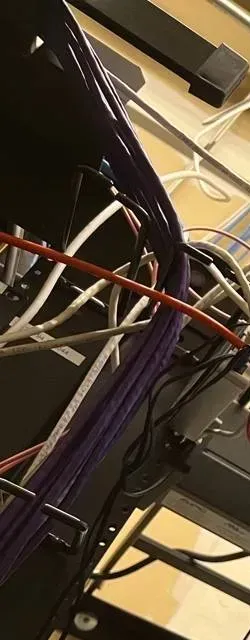
Photo from our job library, not taken in Brownsville: purple, white and red cable bundles dropping down beside a black equipment rack. In Brownsville's newer elevator buildings, the entry panel's power and network cable often share a closet like this with internet and camera wiring, and the first hour of a dead-lobby call can be spent proving which bundle is the intercom's.
Brownsville Buzzer Help
Tell us the street, how many households share the door, and whether ringing, talking or opening stopped
✅
Request Sent!
We'll call about your Brownsville door the same business day.
25+
Years Experience
✓
Same-Day Estimates
100%
Licensed & Insured
4.7★
201 Google Reviews
Owner-operated since 2002 · Thousands of jobs completed · Booked within 2 hours
Door buzzer repair in Brownsville starts with a $250 service call that includes on-site diagnosis, and any repair past that is priced in writing from our Brooklyn list, from $250 for a station or button to $2,400 for a full riser, before parts work begins. In the neighborhood's older walk-ups the faults we expect are a strike that a sagging steel door no longer lets go of, a cellar transformer or supply that drops out when the strike pulls, and a riser pair broken on one floor so a whole column of apartments goes quiet. In the courtyard complexes it is more often one shared supply feeding several stoop panels, and in the houses it is the doorbell circuit, not an intercom at all. Most single faults are fixed on the first visit. We book within 2 hours of your request into a 2-hour arrival window, and we don't promise same-day repairs.
Why Brownsville Properties Need Door Buzzer Repair
Brownsville is filing more buzzer complaints than it ever has, and most of them come back to a small number of older buildings. When we queried NYC Open Data on November 12, 2026, 311 had logged 227 "bell, buzzer or intercom" complaints from ZIP 11212 since January 1. The yearly count was 80 in 2020, 92 in 2021, 108 in 2022, 140 in 2023, 113 in 2024 and 138 in 2025, so 2026 passed every earlier year before the end of September. September alone brought 42 complaints, the highest month of the year so far. A complaint is a resident telling the city that the door can't be answered or opened from home, and in a building where the street door is the only thing between the sidewalk and the stairs, that is not a small thing.
HPD's side of the record is steadier but just as specific. Its housing maintenance code violations list 434 intercom violations written in the Brownsville neighborhood area: 72 class A and 362 class B, with 19 class A and 93 class B still shown as open. When we joined those violations to the city's tax-lot data in October, about two-thirds of them sat at buildings put up before 1931, and the streets with the most were Pitkin Avenue, Bristol Street, Chester Street, Thomas S. Boyland Street, New Lots Avenue and Lott Avenue. Not one was written at a one-family house. The same records show 3,892 violations for self-closing doors in the area, 2,863 of them class C, which HPD treats as immediately hazardous. In Brownsville, the door and the buzzer usually fail together, and a repair that fixes one and ignores the other tends to bring the inspector back.
The third thing to know is who owns the doors. Wikipedia counts about 10,000 NYCHA apartments in 18 developments in and around Brownsville, roughly a third of the housing stock, and their entry systems belong to NYCHA. News 12 reported tenants afraid over a broken buzzer at Brownsville Houses in 2018, and the city Comptroller's 2022 resident-led audit found broken locks on 40.1% of the NYCHA entrance doors it checked citywide. Those repairs go through NYCHA's own maintenance system, not a private contractor hired by a tenant, and we say so on the phone. What we repair are the buildings around them: the private walk-ups and store buildings, the nonprofit and HDFC buildings, the houses, the newer affordable buildings from the Brownsville Plan, and developments that have converted to private management under PACT when that manager engages us. The Furman Center puts Brownsville's homeownership rate at 15.8% in 2024, against 32.7% citywide, so most of the people who call us are tenants, small landlords and the managers who answer to both.
That mix decides how a Brownsville buzzer repair has to be done. The technician has to fix the fault, but also find out whether a 311 complaint or an HPD order is attached, check the door that the buzzer releases, and leave behind a record that shows what was wrong and what now works. Brownsville owners need that proof more than most, because the complaints keep arriving whether or not the last repair held. Many Brownsville owners pair the repair with Brooklyn door buzzer repair at their other buildings so every door is tested the same way.
Brownsville numbers a buzzer technician works from
227 buzzer complaints in 2026: 311 bell, buzzer and intercom complaints from ZIP 11212 through November 12, 2026, up from 80 in all of 2020. The ZIP also takes in a few blocks west of Ralph Avenue.
42 in one month: September 2026 was the busiest month on record for the category in 11212; January and February brought 18 each, May only 13.
434 HPD intercom violations, 112 open: 72 class A and 362 class B in HPD's Brownsville neighborhood area, with none of them class C.
About two-thirds at pre-1931 buildings: our October 2026 join of 429 of those violations to MapPLUTO put 284 at 131 buildings built before 1931, 67 at 11 buildings from 1968 to 1989, 38 at 14 buildings from 1990 to 2009, and 26 at 10 buildings from 2010 on.
Zero at one-family houses: HPD's intercom rules apply to apartment buildings, so the Nehemiah rowhouses and other one-family homes don't appear in the violation record at all.
52% of lots built in 1968 or later: in the 11212 part of Community District 16, 1,875 of 3,608 residential lots date from 1968 on, which is why so many Brownsville entrances are newer than their surroundings suggest.
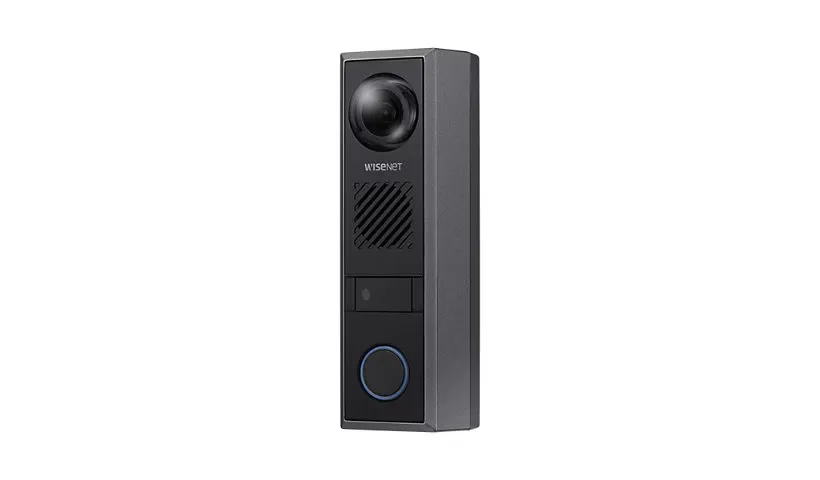
Photo from our job library, not taken in Brownsville: a slim dark grey wired doorbell with a camera lens, speaker slots and a round push button. Many owners of Brownsville's 1980s Nehemiah rowhouses have put a doorbell like this on the original bell wires, and when it starts rebooting or the chime stops, the fix is usually in the doorbell circuit and its transformer rather than in the camera.
Door Won't Open From Upstairs, a Stoop Panel Went Dark, or the Complaint Came Back? Book a Brownsville Buzzer Repair
We put a street door that no longer locks at the front of the queue, then a door that nobody inside can release, then apartments that have stopped ringing. Call (347) 934-8335 and tell us four things: which apartments fail and which still work, what the visitor and the person inside each hear when the button is pressed, which door the strike is on, and whether a 311 complaint or HPD violation is attached and when its deadline falls. We book within 2 hours of your request into a 2-hour arrival window, early in the day where we can. We don't promise same-day or emergency door buzzer repair, because a walk-up needs someone to open the cellar and the failing apartments, but a clear description means the technician arrives with the likely parts, and anything past the $250 service call is written down and approved before work begins.
227 Complaints and Counting: Breaking the Repeat-311 Cycle in a Brownsville Walk-Up
The pattern behind Brownsville's 311 numbers is repetition. In our October 2026 pass, the 216 complaints filed in ZIP 11212 up to that point came from just 81 addresses, which means the average address had complained more than twice in under ten months, and some far more often. That is what a building looks like when the buzzer is fixed just enough to stop the immediate call, then fails again before the next rent day. Each round costs the owner a service call, costs the tenants weeks of going downstairs to let in visitors and deliveries, and leaves one more entry on a public record that a buyer, a lender or a housing court can read.
Repeat failures in a walk-up almost always have a cause the first repair didn't reach. The most common we see in buildings of this age is a door problem dressed up as a buzzer problem: a heavy steel or wood street door that has dropped on its hinges, so the latch drags against the strike's keeper and the strike can't let go however good the electrical side is. Replace the strike without fixing the door and the new one wears out the same way. The second is a supply that is too weak for everything now on it. A building that started with a 16-volt bell transformer may since have gained a heavier strike, a lit panel or a camera on the same circuit, and the supply that tests fine at rest sags the moment someone presses release. The third is a damaged riser pair on one floor, often where a past renovation or a plumber opened a wall, so the apartments above that point fail together and the ones below keep working.
The way out of the cycle is to test the three halves of the system separately, ringing, talking and releasing, from the street door to every apartment on the line, and then to fix the cause rather than the symptom. On a Brownsville walk-up with a complaint history, we also read the complaint and any violation before we start, because the wording often says which apartment called and what they could not do. When we leave, the owner gets a written record of what failed, which part replaced it, the readings at the supply and the strike, and which apartments were tested and passed. If the same complaint is filed again, that record is the starting point for the next visit instead of a guess.
What a 311 buzzer complaint sets in motion
A 311 complaint about a broken buzzer goes to HPD, the city's housing agency. HPD contacts the owner and the tenant, and HPD's own maintenance-issue guidance says that if the condition was not corrected or HPD cannot reach the tenant, a uniformed Code Enforcement inspector will be sent. If the inspector finds the intercom defective, the result is a violation with a class and a correction period. In Brownsville the intercom violations on record are class A and class B; HPD guidance cited by ButterflyMX's 2026 NYC repair guide gives general correction periods of 90 days for class A and 30 days for class B. Self-closing door violations are a different matter, class C with 14 days to correct according to HPD, and they are often written on the same inspection.
An owner who acts at the complaint stage, before an inspector comes, usually has an easier time than one who waits for the violation. Brick Underground's advice to tenants, from back in 2014, is still how many Brownsville buildings work: "Formal written requests tend to get more efficient responses than texts or phone calls." Tenants who write to the landlord, enlist neighbors and call 311 tend to get a technician sent. We can't tell a tenant what to file or advise anyone on a court case, but we can give the owner a written diagnosis and a written price that show the repair is under way.
When HPD's deadline and the parts don't line up
Most parts for the older audio systems in Brownsville walk-ups, buttons, handsets, relays, transformers and standard strikes, come from stock. A lobby panel from a maker that no longer exists, or a networked panel that has to be ordered for a newer building, can take longer than a violation's correction period. In that case we say so on the visit, put the order date and the expected arrival in writing, and leave the door closing and locking in the meantime, so the building is secure while the part is on its way. What the owner then files with HPD is the owner's decision, but the paperwork we give is dated and specific.
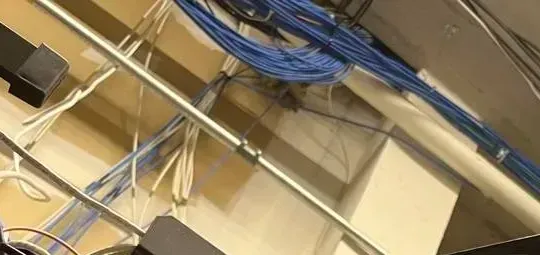
Photo from our job library, not taken in Brownsville: bundles of blue low-voltage cable laid over a ceiling beam and a metal pipe in an open ceiling. In a pre-1931 Brownsville walk-up the intercom pair often crosses the cellar ceiling beside the water and heating pipes, and when a plumbing or boiler job disturbs it, every apartment past that point can fail at once.
The Old Walk-Ups
Pitkin, Bristol, Chester and Boyland: Repairing Brownsville's Pre-1931 Walk-Ups and Store Buildings
Brownsville's oldest apartment buildings are the ones that fill the intercom record. In our October pass, Pitkin Avenue carried 43 intercom violations across 12 buildings, Bristol Street 35 across 16, Chester Street 25 across 7, Thomas S. Boyland Street 25 across 13, New Lots Avenue 21 across 3, Lott Avenue 21 across 10, Riverdale Avenue 19 across 7, Sutter Avenue 18 across 7 and Tapscott Street 18 across 5. We don't print building addresses from those records, but the streets tell the story. These are the blocks of the Jewish factory town that Brownsville was from the 1880s to the 1950s, with brick tenements, two-story four-family brick houses and store buildings, many of them now nearly a century old.
The entry systems in these buildings have usually been replaced at least once, often more than once, by different owners and different installers. A technician can open the vestibule panel and find a modern faceplate on a decades-old backbox, two makers' handsets on the same riser, splices from three eras in the cellar and a transformer that was swapped for whatever was on the truck. None of that means the system has to be replaced. Brick Underground's 2019 repair guide quotes Daniel Vasquez of Paragon Security and Locksmith putting it simply: "It's all in the wire connections." The work is to map what is actually there, test it pair by pair, and fix the connections, the supply and the parts that have failed.
Store buildings with apartments above
On Pitkin Avenue, Belmont Avenue, Rockaway Avenue and Sutter Avenue, many buildings have a shop on the ground floor and apartments above, with the residents' door squeezed beside the store front. That layout causes its own faults. The residents' panel shares a wall with the shop's signs, gates and lighting, and installers working for the store can cut or crush the intercom cable without anyone noticing until the apartments stop ringing. The intercom supply may sit in the store's cellar, behind a locked door that the residents' landlord does not control. And the residents' door takes the same all-night traffic and weather as the sidewalk. For those buildings we arrange access to the store's side before the visit and keep the residents' door separate from anything the store owns.
The street door and its closer
The single biggest difference between a repair that lasts in a Brownsville walk-up and one that doesn't is the door. A buzzer releases a strike, and the strike only works if the latch lines up with it and the closer brings the door back with the right speed and force. Too weak and the door stops short of the latch, so it stands unlocked; too strong and it slams the latch into the keeper hard enough to loosen the strike within months. HPD's self-closing door rules mean the closer matters legally as well as practically, so on every street-door repair we check the hinges, the closer, the latch and the keeper with the power off before we touch the buzzer. When the door itself needs a carpenter, a welder or a locksmith, the written quote says so and names it as someone else's work.
Courtyard Complexes
One Supply, Many Stoops: Buzzer Repair in Brownsville's 1970s Low-Rise Complexes
Brownsville also has a kind of building most of Brooklyn doesn't: the low-rise courtyard complexes built in the 1970s to look like rows of houses rather than towers. The best known is Marcus Garvey Village, which Wikipedia describes as 625 units in four-story buildings across nine blocks, designed in 1973 and completed in 1976, with stoops, private backyards and semi-public courtyards, renovated in 2016. In our October analysis, the 1974 to 1978 preservation lots of this kind, three and four floors with 32 to 155 units each, accounted for about 33 intercom violations between them.
These complexes split one building's worth of apartments across many separate entrances. Each stoop or door has its own panel, but several panels can share one power supply and one cable route back to it. When six entrances go dark at once, that is rarely six failures; it is the shared supply, a breaker, or the run between the supply and the first panel. When one entrance fails and the rest keep working, the fault is local to that stoop. A technician who knows the layout tests the shared parts first, then works outward, and a repair that might sound like six visits often turns out to be one.
The panels themselves take more abuse than an indoor vestibule panel. They face the street or the courtyard, get pressed and pried at all night, and sit through every winter. Where a panel keeps failing, the answer may be a vandal-resistant faceplate and buttons, a sealed back box and drip-proof cable entry, rather than another identical panel. When only one panel in a complex is replaced, the owner usually wants it to match the others, so we confirm the model and finish with the manager before ordering.
Houses and New Buildings
Nehemiah Doorbells, 2000s Infill Intercoms and the New Brownsville Plan Lobbies
The rest of Brownsville's front doors are newer, and they break in different ways. The Nehemiah houses came first. The Gotham Center's history of the program records the October 1982 groundbreaking in Brownsville, single-family homes of about 1,000 to 1,200 square feet, and the detail that the kitchen was placed at the front of the house at residents' request so they could watch the yard, the parking pad and the street. Nehemiah Rising says the first 1,100 Nehemiah homes were built in Brownsville beginning in 1983. A Nehemiah house has a doorbell, not an intercom: a button, a transformer and a chime, sometimes with a camera doorbell added. HPD's intercom rules don't reach it, and the owner decides what it needs.
The two- and three-family infill houses of the 1990s and 2000s often came with a builder's audio intercom, a door station and a handset on each floor, from a range of makers. Those systems are usually repairable: the stations are standard, the wiring is short, and the faults are mostly the release relay, the supply or the strike. Under the Multiple Dwelling Law, a three-family built after 1968 is a multiple dwelling with self-closing, self-locking entrance doors, so the door matters here too.
The newest group is the subsidized elevator buildings, many of them from the Brownsville Plan. HPD describes the plan as more than 2,500 new affordable homes and over $1 billion of investment, with sites designated in July 2018, and NYC HDC named the Brownsville Arts Center and Apartments at Rockaway Avenue and Chester Street, Glenmore Manor and Livonia 4 among them. New York YIMBY reported the September 2025 groundbreaking at 366 Rockaway Avenue for a nine-story building with 283 affordable rentals, due in December 2027. Buildings like these use networked entry panels with fob readers, phone calling and an online management account, and they fail at the relay, the network or the account as often as at the hardware. In our October count, the buildings from 2010 on had few intercom violations in total but a higher share of their lots cited than any other era, about 11%.
What We Install
Door Buzzer Repair Services in Brownsville
These are the repairs Brownsville landlords, managing agents, nonprofit and HDFC managers, homeowners and shop owners call us for. Nearly all of them are repairs to a system that is already in the building. When the right fix changes the system, such as a separate supply for a heavier strike, a new run where the old riser pair tests bad end to end, or a replacement panel because the old maker's parts are gone, the written quote says so before anyone approves it.
Walk-Up Intercom Repair
Apartment intercom repair in the brick walk-ups on Bristol, Chester, Lott and Riverdale: dead handsets, one-way audio, static, a single apartment that never rings, or a column of apartments that went quiet together.
Electric Strike Repair
Electric strike repair on heavy street doors that only click, open only when pushed, or stopped after a new door or a slam too many, with the keeper and latch set so the repair holds.
Door Release and Relay Repair
Door release repair for buttons that do nothing, relays welded shut after a surge that leave the door unlocked all day, and release modules that work from some apartments but not others.
Transformer and Power Supply Repair
Intercom transformer and power supply repair where the supply hums, runs hot, trips a breaker, or drops out under the strike's load, including door buzzer repair after a power outage.
Stoop and Lobby Panel Repair
Panel, button and faceplate repair at courtyard stoops and walk-up vestibules, from a pried button to a dark directory, with vandal-resistant parts where the old ones keep failing.
Riser and Cellar Wiring Repair
Low-voltage wiring repair from the cellar junction up the chase, finding the floor where the run broke and remaking every splice in sealed connectors with each pair labeled.
House Doorbell Repair
Doorbell repair for Nehemiah rowhouses and other one-family homes: chimes that stopped, buttons that stick, transformers too small for a camera doorbell, and bell wire broken at the frame.
Networked Panel Troubleshooting
Video intercom repair and troubleshooting for the app-based panels in newer elevator buildings: the release relay, the fob reader, the network path and the management account, checked one by one.
Closer, Latch and Keeper Adjustment
Street and vestibule doors that slam, stop short, or won't latch, adjusted so they close and lock on their own and the buzzer can release them every time.
Complaint and Violation Close-Out
Repairs tied to a 311 complaint or an HPD intercom violation, with the apartments named in the record tested first and a dated closing record for the owner's file.
Building Specialists
Door Buzzer Repair for Brownsville's Architecture
Brownsville was rebuilt in waves, so its front doors come from every decade of the last hundred years. A buzzer technician sorts them by three things: how many households share the door, how far that door is from the power supply, and who has the authority to approve the repair.
Pre-1931 Walk-Up
Four to twenty-odd apartments over a vestibule, a cellar supply, a riser up the chase and a heavy street door, often with an intercom that has been rebuilt by several owners.
Four-Family Brick House
The two-story brick houses with two apartments per floor, a short run from the stoop to a cellar transformer, and four households sharing one street door.
Store Building
A shop on the avenue with apartments above, the residents' door beside the store front and the supply sometimes in the store's cellar.
Courtyard Low-Rise
Three- and four-story buildings from the 1970s with a panel at every stoop and shared supplies and cable routes between them.
Nehemiah or One-Family House
A doorbell circuit with a button, a transformer and a chime, often with a camera doorbell added, and the kitchen right behind the front door.
Two- or Three-Family Infill
1990s and 2000s houses with a builder's audio intercom, a station at the door and a handset on each floor.
New Elevator Building
2008-and-later affordable buildings with networked lobby panels, fob readers, maglocks or strikes, and an online management account.
Church, School or Program Space
Side and front doors at community buildings where staff buzz visitors in through a locked door during the day.
How each building type changes the repair
The pre-1931 walk-up is a long run with many households on it and a long repair history. The work is mapping: which pair goes to which apartment, which splices are original and which were added, and whether the supply was ever sized for the strike now on the door. We tag every pair we touch and leave the map with the owner, so the next repair starts from a drawing rather than a guess. Access to the cellar and to every failing apartment on the visit is what makes a one-visit repair possible.
The four-family brick house is shorter and simpler, but its four households often have four different complaints. One apartment's handset may have been replaced with a different maker's, another may have a doorbell camera wired onto the old pair, and the cellar transformer carries all of it. We test each household on its own before changing anything shared.
The store building needs two parties at once, the residents' landlord and whoever controls the store's cellar or back room. Faults often trace to the store side: a sign installer's drill, a gate motor's wiring, or a cellar renovation. We keep the residents' entrance on its own supply and its own cable route wherever we can, and we say so in the quote if it isn't now.
The courtyard low-rise rewards starting at the center. The shared supply and the first run are tested before any single stoop, because they explain group failures. Single-stoop failures are then local: the panel, its buttons, its back box and the short run to it.
The Nehemiah house is a doorbell job. The button, the transformer and the chime are tested, and if a camera doorbell has been added we check whether the transformer can carry it. There is no HPD paperwork, and the owner sets the scope.
The two- or three-family infill house usually has a repairable builder's intercom. The station at the door, the relay and the supply are the usual faults, and the handsets are often standard enough to match. A three-family's street door also has to close and lock on its own.
The new elevator building needs the manager's login as much as a ladder. Many faults that look like hardware are a lapsed subscription, a changed network setting or a relay configuration, and we check those before ordering parts. If the system is still under the original installer's warranty, the manager should call that installer first, and we say so.
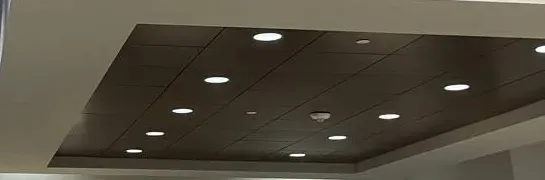
Photo from our job library, not taken in Brownsville: a dark recessed ceiling panel with round downlights and a small round device, framed by a lighter ceiling. Lobbies in Brownsville's newer affordable buildings are finished like this, and the cable from the entry panel to its relay and supply usually runs above a ceiling of this kind, so access panels matter on a repair.
Commercial Door Buzzer Repair
Business Door Buzzer Repair in Brownsville
Brownsville's businesses are concentrated on a handful of avenues, and most of them share a building with apartments. NYC Small Business Services lists the Pitkin Avenue Business Improvement District, established in October 1993, with 32 block faces and 212 ground-floor retail businesses. Wikipedia records that Pitkin Avenue had 372 stores in 1942. Commercial door buzzer repair here is mostly about two doors in one building: the store's own door and the residents' door beside it.
Pitkin Avenue Storefronts
Shops, clinics and offices in the BID's blocks whose upstairs apartments, offices or programs are reached through a buzzed door beside the store front, often with roll gates pulled down at night.
Belmont Avenue Businesses
The small stores along Belmont Avenue near Osborn Street Plaza, where a back or side door is buzzed open for deliveries and staff.
Rockaway Avenue Offices
Upstairs offices and community programs along Rockaway Avenue, including the blocks near the new arts center site at Chester Street, that buzz clients through a locked street door.
Livonia Avenue Under the El
Shops and building entrances beneath the elevated 3 train, where vibration, grime and weather work on strikes, closers and plates faster than on a quiet side street.
Sutter Avenue and Mother Gaston Boulevard
Corner stores, churches and offices whose street doors are buzzed open from a counter or front desk during the day.
Nonprofit and Program Buildings
Housing nonprofits, senior programs and service providers that buzz visitors through a street door and a second interior door from one desk.
Rules and practical limits on Brownsville business doors
Free exit comes first: a door with an electric strike can always be opened from inside by the lever or the push bar. Maglocks are different, and building code rules on electrically locked egress doors require a release on the inside; we don't leave a maglock without one.
Line voltage belongs to an electrician: the Department of Buildings requires a licensed electrician and a permit for line-voltage work. When a transformer needs its own circuit or a new outlet, that part is quoted as the electrician's and we do the low-voltage side.
Reach and use: where a new button or release is mounted, we keep it within the 48-inch high forward reach the 2010 ADA Standards give, so staff and visitors can use it.
Self-closing doors in apartment buildings: in a building with apartments upstairs, the residents' entrance door has to close and lock on its own, and HPD treats a defective self-closing door as a class C violation with 14 days to correct.
Not a historic district: Brownsville isn't a historic district, so ordinary panel and button repairs on most Brownsville buildings don't go through the Landmarks Preservation Commission. Betsy Head Park's play center is an individual landmark, not a residential block.
Two parties, two doors: when a store and the apartments share a building, we confirm in writing whose door, whose supply and whose bill each part of the repair belongs to.
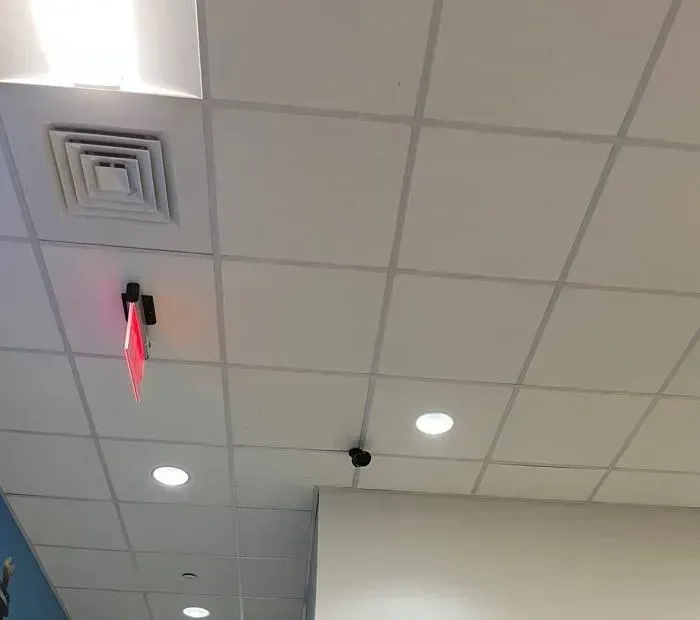
Photo from our job library, not taken in Brownsville: a drop ceiling with a lit red exit sign, an air diffuser, round recessed lights and a small black camera. An upstairs office or program space off Pitkin or Rockaway Avenue often looks like this inside the buzzed door, and the release wiring runs above the tiles from the front desk to the strike.
Field Notes
Field Notes: The Order of Work on a Brownsville Walk-Up With an Open Complaint
We don't publish stories about particular Brownsville addresses, because we only print what we can stand behind, and our customers' buildings are their business. What we can describe is the order a technician works in when a walk-up calls with a buzzer complaint already on file, because that order is the same every time and it is the reason the repairs last.
First, the paperwork. Before any tools come out, the technician reads the 311 complaint or HPD violation with the owner or super, notes which apartment it names and what that apartment said it couldn't do, and checks the date the owner has to meet. Second, the door. The street door is opened, closed, pushed and pulled with the power off, and the hinges, closer, latch and keeper are checked, because a binding door will defeat any buzzer. Third, the supply. The transformer or power supply is read at rest and again while someone holds the release, and the strike is read at the door at the same moment. Fourth, the apartments. Ringing, talking and releasing are tested separately from the panel to every apartment on the line, starting with the one named in the complaint.
Only then does the technician write the price. The repair is made, every splice touched is remade in a sealed connector and every pair is labeled at both ends. Then the whole line is tested again from the street, and the owner gets the record: what failed, what replaced it, the readings before and after, and which apartments passed. On a building whose complaints come back every few months, that sequence, door before wiring and every apartment before leaving, is the difference between closing the complaint and starting the next one.
Your Questions Answered
Door Buzzer Repair in Brownsville: Questions Answered
Walk-ups and store buildings
The buzzer in our walk-up starts working again every time the super kicks the street door shut. What does that tell a technician?
It tells us the electrical side is probably fine and the door is the problem. A strike releases by letting its keeper swing out of the latch's way. If the door has dropped on its hinges, if the frame has shifted, or if the closer is holding the door hard against the stop, the latch presses into the keeper with more force than the strike can overcome. A kick changes the pressure for a moment, the keeper is free, and the next press of the release works. Then the door settles back and the buzzer seems to fail again.
The repair starts with the power off. We check the hinges and the gap around the door, watch the latch as the door closes, and look at the keeper for the polished wear marks that show where the latch has been dragging. Often the fix is a closer adjustment and a shim or a re-set keeper. Sometimes the door needs a carpenter or a welder to rehang it, and we say so in writing. Only after the door closes into the strike without binding do we test the strike's voltage under load, and if the strike itself has been damaged by months of back pressure, it gets replaced and aligned.
This is one of the most common reasons a Brownsville walk-up's buzzer complaint comes back. A new strike on a door that still drags wears out the same way, so we fix the door first.
Our March complaint and our September complaint name different apartments. Could one fault be behind both?
Yes, and in an older walk-up it is common. Two apartments on different floors can share a riser pair, a junction in the cellar, a common return wire or the same supply. A fault at a shared point can show up as one apartment's problem in spring, when the joint is dry, and another's in autumn, after a summer of humidity or a round of work in the cellar. Each complaint was real, but the repairs that answered them may have treated each apartment as its own job.
We read both complaints before we start and test both apartments, plus the others on the same line, in the same visit. If they share a fault, we find it at the shared point and fix it there, so both complaints are answered by one repair. If they turn out to be separate faults, the written quote lists each one, and the closing record shows each apartment's test.
For owners, the takeaway is to send us every open complaint and violation number for the building, not just the newest one. The pattern across them is often the quickest way to the cause.
The store on our ground floor had a new roll-gate motor wired last month, and our apartments have had no buzzer since. How do we find out whose work caused it?
We trace the intercom's cable from the residents' panel to the supply and look at every point where it passes near the store's new work. Roll-gate motors are line-voltage equipment wired by electricians, and their conduit and boxes often run along the same wall or ceiling as the intercom pair. A staple through the cable, a pair cut and left loose behind a new box, or a supply unplugged to free an outlet are the usual findings. Our closing record photographs what we find and where, with the date.
Who pays is between the building owner and the store, and if the store's contractor caused it, the owner may want that contractor to answer for it. We don't take sides in that, but a clear, photographed record of the damage and the repair gives the owner something specific to send. Habitat Magazine's 2024 piece on intercom law notes that when a neighbor's renovation caused the problem, the neighbor may be responsible, depending on the lease or alteration agreement.
While the question of payment gets settled, the repair itself shouldn't wait. A residents' door that can't be released from upstairs leaves every household going down to let in visitors, and a complaint will follow.
Our intercom supply sits in the store's cellar, behind the store's lock. Should it be moved?
Often it should, but not always on the same visit. A supply the landlord can't reach means every buzzer repair depends on the store opening its cellar, and a store that is closed, sold or in dispute can leave the apartments without a working door for days. Where the residents' side has a space of its own, a hall closet, a vestibule cabinet or the residents' half of the cellar, moving the supply and running a short new pair to it can be a sensible part of the repair.
Whether it is worth doing depends on what's available. A new location needs a power outlet, and if there isn't one, the outlet is an electrician's job with a permit, quoted separately. We look at the options on the diagnostic visit, and the written quote shows the move as its own line, so the owner can do the repair now and the move later if that suits the budget.
For this visit, the practical step is to arrange the store's cellar access before we arrive. Tell us who holds the key and when the store opens.
Five of our twelve apartments can buzz the door open and seven can't. Is that one fault or seven?
Usually one, or a small number. Seven separate handsets rarely fail at the same time. When a group of apartments fails together, the cause is normally something they share: a riser pair that broke between two floors, a cellar junction where several pairs meet, a release relay that serves some stations and not others, or a supply that can power a few release circuits but not all of them at once. The pattern helps. If the seven are all above a certain floor, we look at the riser at that floor. If they are scattered, we look at the junction and the common wires.
We test every apartment's ring, talk and release separately, mark which work and which don't, and trace from there. The written quote then names the shared fault and its price. If, along the way, one or two individual stations turn out to be faulty as well, they are listed separately so the owner knows exactly what is being paid for.
What makes this a one-visit job is access. Plan for someone to open the cellar and as many of the failing apartments as possible, since testing at each station is how the break is located.
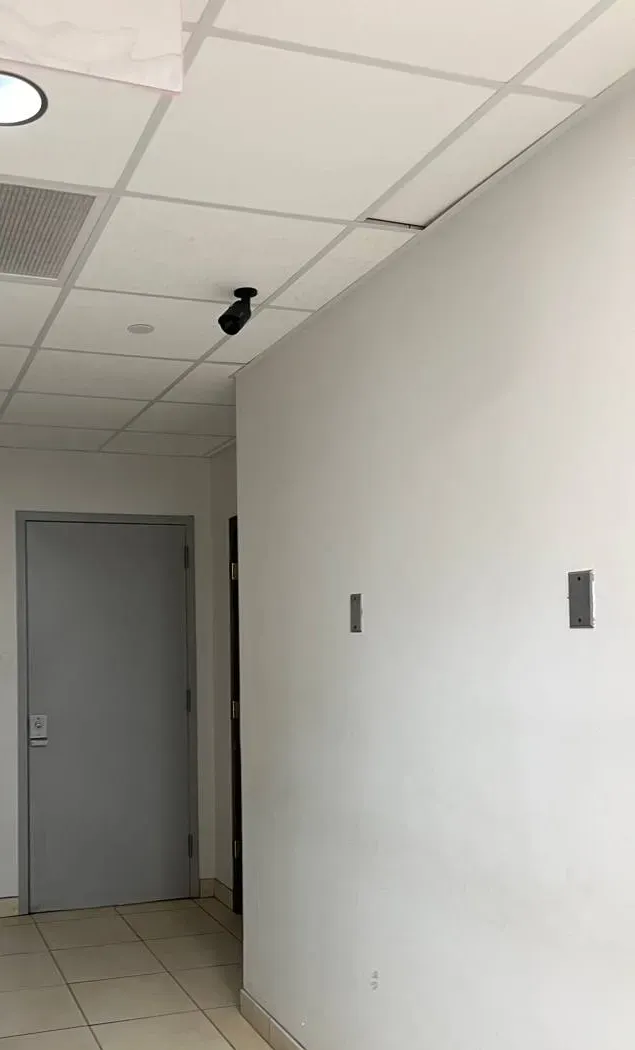
Photo from our job library, not taken in Brownsville: a tiled corridor with white walls and small wall plates, ending at a grey steel door with a lever handle under a drop ceiling with a small camera. The rear and cellar doors of many Brownsville walk-ups are heavy steel doors like this one, and when a strike is fitted to one, the closer and hinges decide whether it keeps releasing.
Courtyard complexes
At one stoop in our courtyard complex, the buttons for the ground-floor apartments work but the buttons for the upper floors don't. Is that the panel?
It might be, but the floor-by-floor split points first to the wiring behind it. In these complexes the buttons on a stoop panel each run to an apartment, and the pairs for the upper floors often travel farther, up through the building, while the ground-floor pairs stay short. A split at a junction box between the panel and the upper floors, or a pair damaged where it enters the building, would leave exactly that pattern. A failing panel more often shows a scattered pattern, or a dead row on its circuit board.
We test at the panel, at any junction we can reach, and at an upper-floor station, which tells us quickly which side of the panel the break is on. If it is in the run, the repair is a splice or a short new pair. If it is the panel's own board or buttons, we look at whether the board or the buttons can be replaced on their own before quoting a whole new panel.
If the complex has several stoops on one supply, we also check that the others still work while we are there, since a weak shared supply can make one stoop fail first.
One stoop in our complex goes dead every winter after the first freeze and comes back in spring. What survives that?
That is water, almost every time. Water gets into the panel's back box or the cable entry, sits there, and when it freezes it pushes contacts apart or cracks a joint. When it thaws and dries, the connection may come back. Outdoor stoop panels in Brownsville's low-rise complexes face the street and the courtyard with no vestibule to protect them, so the gasket, the seal at the cable entry and the way the cable enters the box matter more than the brand of the panel.
A lasting repair dries out and cleans the contacts, replaces any corroded terminals or splices with sealed connectors, reseals the faceplate gasket, and changes the cable entry so water runs away from it rather than into it, with a drip loop where there is room. If the panel's board has corroded, we replace the board or the panel. This is door entry repair after water damage, and it is cheaper done in October than in January.
If more than one stoop in the complex has the same history, we look at all of them on one visit and price them together.
Houses
The chime in our Nehemiah house rings only when the button is held down hard. Is it the button or the wire?
Most often it is the button, sometimes the wire right behind it. A button that has been pressed thousands of times, outdoors, beside a front door that faces the street and the parking pad, wears its contacts and lets in grime. Pressing hard forces a contact that no longer meets on a light press. The other common cause is the wire at the button: short, exposed to weather where it comes through the frame, and sometimes nicked when a storm door or a security gate was added.
We test the circuit at the transformer, at the chime and at the button, which separates the three in a few minutes. A worn button is a simple replacement. A damaged wire at the frame is remade. If the transformer is weak, especially if a camera doorbell has been added at some point, it may be replaced with one sized for what is now on the circuit. In a Nehemiah house the kitchen is at the front, so the chime can usually stay where the family already hears it.
There is no HPD involvement in a one-family doorbell, so the scope is entirely the owner's call, and the quote is written before work begins.
We rent the top floor of a 2000s three-family, and ours is the only handset that can't open the door. Who arranges the repair, us or the owner?
The owner. The intercom and the street door belong to the building, and in a three-family, which is a multiple dwelling under New York law, the owner is responsible for maintaining them. Tenants can report the problem and should do it in writing; Brick Underground's long-standing advice is that written requests get better results than texts or calls. A 311 complaint is also an option. We take bookings from the owner or the owner's manager, because the owner approves and pays for the repair and has to give access to the cellar and the door.
What a tenant can usefully do is describe the fault precisely: whether the bell rings in the apartment, whether the visitor can be heard, and whether pressing release makes any sound at the door. That information, passed to the owner and on to us, often means the technician arrives with the right station or relay.
In a builder's intercom from the 1990s or 2000s, a single apartment that can talk but not release usually has a faulty station or a broken release wire to that one station. Those are among the quicker repairs we do.
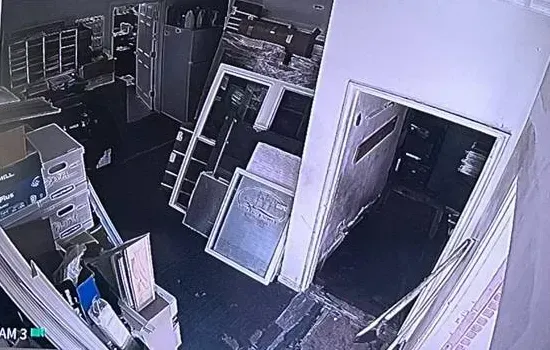
Photo from our job library, not taken in Brownsville: a black-and-white night camera view of a cluttered room with an open doorway into a dark back room. Behind many of the shops on Pitkin and Belmont Avenues is a back room like this one, and when the apartments' intercom supply ends up in it, every buzzer repair upstairs depends on getting through the store.
Newer buildings, churches and nonprofits
Our nonprofit manages a Brownsville Plan building, and the company that installed the entry panel no longer answers. Can another company service a panel it didn't install?
In most cases, yes. Networked entry panels from the major makers are serviced by many technicians, and the hardware, the relay, the reader and the cabling are standard work. What we need from the manager is access to the system's management account or the installer's handover documents, since many settings live in the account rather than on the panel. If the login has been lost, the maker's support process can usually restore access to the property owner, and we can help the manager work through it.
Before we start, it is worth checking whether the panel is still under the original installer's or the maker's warranty, and whether a service contract is in force. If the original installer has simply gone silent, the manager should put the request in writing so the record shows it was asked. Then we can diagnose, and the written quote states whether each fault is hardware, configuration or account.
We repair the brands commonly found in Brooklyn's newer buildings, including Akuvox, ButterflyMX, DoorBird, Comelit and Aiphone systems, without claiming to be the maker's dealer.
Our church on Mother Gaston Boulevard buzzes visitors in through the side door from the office. Since the office moved upstairs, nobody hears the bell. Can the bell follow the office?
Yes. Moving the answering point is usually a matter of running a new pair from the existing door station or bell circuit to the new office, mounting a chime or a station there, and moving or adding the release button so staff can let the visitor in from where they now sit. If the side door has a strike, the release circuit is extended to the new office as well. Where the old office is still used some of the time, the bell can sound in both places.
Church and community buildings in Brownsville are often older masonry buildings, so the route matters. We look for an existing chase, a closet stack or a path along a stairwell before opening anything, and the quote says where the cable will run and whether any of it will be visible in surface raceway. We don't patch or paint walls, so where an old station comes off, we cover the box with a blank plate.
If the door has a maglock rather than a strike, we also check that free exit still works from inside after the change, because building code requires it.
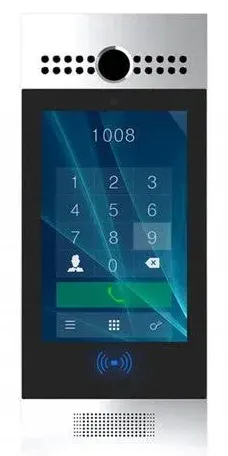
Photo from our job library, not taken in Brownsville: a touchscreen entry panel showing a dial pad with a four-digit apartment code entered, a camera above and a card-reader symbol below. Panels like this one serve many of Brownsville's newer affordable buildings, and a repair can be as much about the directory and the account as about the screen.
Paperwork and NYCHA
How long does a Brownsville landlord have to fix an intercom once HPD writes a class B violation?
HPD guidance, as summarized in ButterflyMX's 2026 NYC intercom repair guide, gives a general correction period of 30 days for class B violations and 90 days for class A, subject to the terms of the violation as issued. The violation itself states the date, and the owner then certifies the correction to HPD. In the Brownsville neighborhood area, all 434 intercom violations on HPD's record are class A or class B, and 93 class B violations are still shown as open.
A self-closing door violation written on the same inspection has a shorter clock. HPD treats a defective self-closing door as a class C immediately hazardous condition with 14 days to correct after the notice. That is why, when a Brownsville building calls with both, we usually make the door close and lock correctly first, and then repair the intercom.
We don't give legal advice and can't certify anything to HPD on an owner's behalf. What we provide is the dated, photographed repair record, with the apartments tested, that the owner can keep with the certification.
The lock on our NYCHA building's lobby door has been broken for months. Who actually fixes it, and what helps residents get it done?
NYCHA does. Entrance doors, locks and intercoms in NYCHA developments are NYCHA's property and are repaired through NYCHA's own maintenance system, so a private contractor hired by a resident can't work on them. The problem is widespread: the city Comptroller's 2022 resident-led audit of 262 developments found broken locks on 40.1% of entrance doors citywide, and residents told the auditors that "intercoms, locks, keys, and door release buttons do not work."
What helps is documentation. A work-order number, the dates the door was found broken, and photos give residents and their tenant association something specific to raise with property management, elected officials or, where it comes to that, Housing Court. HPD announced in October 2025 that violations issued during court-ordered inspections of NYCHA buildings now appear on HPD Online for inspections after September 15, 2025, so those orders are now part of the public record.
Where a development has converted to private management under PACT, the new manager handles entry repairs and may hire contractors, and if that manager engages us, we can do the work.
Equipment
Types of Door Buzzer Repair We Install
These are the parts we repair and replace at Brownsville street doors, vestibules, stoops, cellars and lobbies. Every replacement is matched to the system already in the building, so a new part works with the stations, the wiring and the door that stay.
Transformers and Power Supplies
16- and 24-volt bell transformers and intercom power supplies sized for everything now on the circuit, including heavier strikes, lit panels and camera doorbells.
Electric Strikes and Keepers
Fail-secure and fail-safe strikes for steel walk-up doors and wood house frames, with keepers, shims and latch adjustments so the door releases without binding.
Door Closers
Closer adjustment and replacement so street and vestibule doors close and latch on their own, at a speed and force the strike can work with.
Buttons and Faceplates
Replacement call buttons, label windows, gaskets and vandal-resistant faceplates for vestibule plates and outdoor stoop panels.
Handsets and Apartment Stations
Talk-listen-door handsets and video indoor stations matched to the system, for the single dead apartment or the whole line.
Relays and Release Modules
Door release relays and interface modules that let a station, a panel or a phone call open the strike, replaced when contacts weld or wear.
Riser Pairs and Junctions
Sealed splices, labeled terminal blocks and replacement pairs for walk-up risers, cellar junctions and the runs between courtyard stoops.
Networked Panels, Readers and Recorders
Entry panels, fob and card readers, keypads and the recorders a video panel feeds, checked so access, calling and recording all work after a repair.
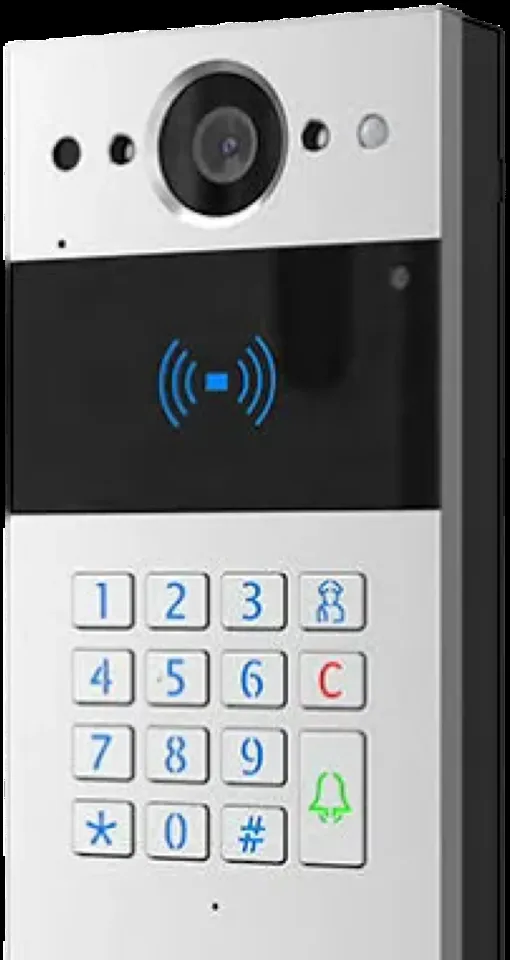
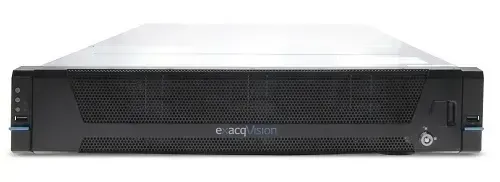
Photo from our job library, not taken in Brownsville: a silver and black keypad door station with a camera lens at the top, a blue card-reader symbol, a numeric keypad and a green bell key. Where a station like this has replaced a button plate at a Brownsville stoop or walk-up, a later repair is usually the keypad, the reader or the relay behind it, not the whole unit.Manufacturer product photo from our job library, not taken in Brownsville: a black 2U rack-mount video server with a vented front panel. In some of Brownsville's newer elevator buildings, the entry panel's video goes to a recorder or server like this in a telecom room, and a panel repair includes checking that the picture still reaches it.
Repair or replace? How the choice usually falls in Brownsville
Situation
Usually repair
Usually replace
Pre-1931 walk-up, one apartment or one line dead
Station, relay, riser pair or splice
Only if the riser tests bad floor to floor
Door releases weakly or only when pushed
Door, closer and keeper first, then the strike
Strike, when back pressure has damaged it
Courtyard stoop panel dead after a freeze
Contacts, splices, gasket and cable entry
Panel board, when corroded through
Lobby panel from a maker no longer in business
Buttons and supply, while parts exist
Panel, matched to the existing wiring
Nehemiah house chime or button
Button, wire at the frame, transformer
Rarely the whole circuit
Networked panel in a newer building
Relay, reader, network or account settings
Panel, when the hardware itself has failed
Ring, ADT or SimpliSafe vs a local buzzer technician
Brownsville owners sometimes ask whether the company behind their doorbell camera or alarm can fix the building's buzzer. Ring sells doorbells and cameras, and ADT and SimpliSafe sell alarm systems with monitoring. None of them repairs a building's intercom, its riser, its strike or its street door. A camera doorbell can be added to a one-family house's bell circuit, and we fix the transformers and wiring those doorbells depend on, but in a walk-up or a courtyard complex the system that rings the apartments and releases the door is a separate thing. A local low-voltage technician repairs that system, tests every apartment on it and leaves the records an owner needs for 311 and HPD.
AI Overview Reality Check
What AI Gets Wrong About Door Buzzer Repair in Brownsville
Many owners and tenants start with an AI summary or a cost guide. Those answers draw on national cost sites like Angi, HomeAdvisor and Fixr and on intercom vendors' blogs, and they get some things right. These are the claims we hear most often, and what the work in Brownsville actually looks like.
"A broken intercom usually means the whole system needs replacing."
Vendors sell replacements, so replacement is often the first answer an AI summary gives. In Brownsville's older walk-ups, the faults we find are usually a strike, a closer, a supply, a station or a broken pair, each of which can be fixed on its own.
Brick Underground's 2019 guide quoted Pete Carmello of Lock and Tech saying, "A lot of times it's user error," and reported that the core wiring in older systems is typically sound. That matches what we see when a system is tested pair by pair rather than judged by its age.
Replacement makes sense when the riser tests bad end to end, the panel's maker is gone and no parts remain, or the owner wants features the old system can't give. The written quote says which case applies before anyone decides.
"Intercom repairs cost $500 to $1,500."
ButterflyMX's 2026 NYC guide cites one integrator's estimates of $100 to $300 for diagnostics, $500 to $1,500 for component replacement and $1,000 to $3,000 for limited wiring repairs, and calls them directional, not average NYC costs. That caveat is the right one.
Our Brooklyn list, which Brownsville is billed from, starts at a $250 service call with diagnosis included. An apartment station runs $250 to $525, a release relay or button $250 to $475, a transformer $325 to $650, a strike with alignment $450 to $950, and a riser $850 to $2,400.
The price depends on which part failed and how hard it is to reach, not on a national average. That's why we name the part before we name the price.
"Every apartment building must have an intercom."
New York's Multiple Dwelling Law requires a two-way voice intercom with buzz-open for buildings of eight or more apartments built or converted after January 1, 1968. Older multiple dwellings must have one if a majority of the apartments ask for it, according to the Attorney General's Tenants' Rights Guide.
In practice, most Brownsville walk-ups already have an intercom, and HPD writes violations under the housing maintenance code when an existing system isn't kept in working order. That is where the 434 violations on HPD's Brownsville record come from.
One-family houses, including the Nehemiah rowhouses, aren't covered by these rules at all, which is why none of the violations are at one-family homes.
"Call the landlord, and if nothing happens, any contractor can fix it."
That works for a private building, where the owner can hire us. It doesn't work in NYCHA developments, where entrance doors, locks and intercoms are NYCHA's equipment and are repaired by NYCHA.
With about 10,000 NYCHA apartments in and around Brownsville, this matters. Residents should go through NYCHA's work orders and, where needed, their tenant association or Housing Court; since September 15, 2025, violations from court-ordered HPD inspections of NYCHA buildings appear on HPD Online.
PACT conversions are the exception. Once a development is privately managed, its manager handles entry repairs and can hire a contractor.
"A stuck buzzer is a five-minute DIY fix."
Cleaning a sticky button can help, and Brick Underground mentions it. But tenants shouldn't open wiring, and in a multi-apartment building the building has to authorize the work.
A buzzer that sounds nonstop or a door that stays unlocked is often a welded relay or a shorted pair, and a door that won't release is often the door itself. None of those is a button problem.
The quick fix also leaves no record. In a Brownsville building with a complaint on file, the record of a proper repair is part of what the owner needs.
"Newer buildings don't have intercom problems."
It is true that Brownsville's buildings from 2010 on have few intercom violations in total. In our October count they had 26.
But those 26 were spread across 10 buildings, and as a share of the era's lots, the newest buildings were cited more often than any other group, at about 11%. Networked panels fail at the relay, the reader, the network and the account as well as at the hardware.
A new building's entry system needs a manager who holds the login and a technician who checks configuration before ordering parts.
"Brownsville's complaints show its buzzers are wearing out."
The 311 count did rise from 80 in 2020 to 227 so far in 2026. Some of that may be wear, but complaints measure how many residents report problems, not how many systems failed.
Our October pass found the complaints concentrated at a limited number of addresses, many repeating within the year. That pattern points to repairs that didn't reach the cause as much as to systems at the end of their life.
The answer, building by building, is the same: test every apartment, fix the door and the supply as well as the station, and keep the record.
Not sure whether it's the door, the supply, one station or the riser? Tell us how many apartments share the street door, which ones fail, whether a complaint or violation is open, and what the door does when someone inside presses release, and a technician will tell you what kind of visit your Brownsville building needs.
Describe the building, which apartments or households fail, and anything that happened just before. Include every open 311 complaint or HPD violation number, and say who will open the cellar and the failing apartments. Prefer to talk? Call (347) 934-8335.
✅
We Got Your Request!
We'll call about your Brownsville building the same business day.
How It Works
Our Installation Process
Every Brownsville buzzer job, from a Nehemiah chime to a dead line in a walk-up with an open complaint, follows the same eight steps.
1
Send the address, the paperwork and the symptom
Street and cross street, building type, how many households share the door, any 311 or HPD number, and what the visitor and the resident each hear.
2
Confirm who can approve the work
The owner, agent, board or nonprofit manager who approves and pays, and who opens the cellar, the supply and the failing apartments.
3
Book a two-hour arrival window
Booked within two hours of the request into a two-hour window, early in the day where we can.
4
Check the door before the wiring
Hinges, closer, latch, keeper and strike worked by hand with the power off, so a binding door is found first.
5
Test ringing, talking and releasing separately
Each function tested on its own from the plate or panel to every household, starting with the apartment named in any complaint.
6
Measure the power at rest and under load
The supply read with nothing pressed and with the strike energized, and the strike read at the door at the same moment.
7
Price in writing, then repair and label
The failed part and its Brooklyn list price approved in writing, then the repair made, every splice sealed and every pair labeled.
8
Retest every household and send the closing record
The whole line retested from the street, and a dated, photographed record sent for the owner's 311 or HPD file.
Coverage Area
Door Buzzer Repair Near Brownsville's Landmarks
Wikipedia places Brownsville between East New York Avenue to the north, Ralph Avenue and East 98th Street to the west, the Bay Ridge Branch and Linden Boulevard to the south, and Van Sinderen Avenue to the east, about 1.16 square miles in Community District 16. These are reference points our technicians use when they confirm an address.
Betsy Head Park
Opened in 1915, with a 1936 WPA pool; its play center became Brownsville's first individual city landmark in 2008.
Loews Pitkin Theatre
The 1929 movie palace on Pitkin Avenue, built with 2,827 seats and later redeveloped for a school and retail.
Pitkin Avenue BID
The shopping street's business district, set up in 1993, covering 32 block faces and 212 ground-floor businesses.
Marcus Garvey Village
The 625-unit low-rise complex completed in 1976, four-story buildings with stoops and courtyards across nine blocks.
Stone Avenue Library
The 1914 branch at 581 Mother Gaston Boulevard, opened as the Brownsville Children's Library and renovated in 2014.
Livonia Avenue and the 3 Train
The elevated New Lots Line running over Livonia Avenue, with shops and building entrances beneath it.
Brownsville is billed from our Brooklyn price list, the same list we use across the borough. Every visit starts with a $250 service call that includes on-site diagnosis, $272.19 with sales tax. The technician names the failed part and gives the repair price in writing before any parts work begins, and most single-fault repairs are finished on that visit. The current list is on our door buzzer repair pricing page. Sales tax of 8.875% applies.
Repair
Brooklyn price
Where it comes up in Brownsville
Service call with on-site diagnosis
$250
Every visit: the door, the plate or panel, the supply and every failing household tested
Apartment station replacement
$250 – $525
The one dead handset in a four-family, or one station on a walk-up riser
Door release relay or button
$250 – $475
A relay welded shut after a surge, or a pried stoop button
24V transformer replacement
$325 – $650
A cellar supply that sags when the strike pulls, or a house transformer feeding a camera doorbell
Electric strike replacement and alignment
$450 – $950
A strike damaged by a steel street door that dragged on it for months
Lobby panel repair or faceplate
$650 – $1,800
A vestibule panel in a pre-1931 walk-up, or a water-damaged courtyard stoop panel
Riser pair repair or re-termination
$850 – $2,400
A column of apartments that went quiet together above one floor
What moves a price within its range. In Brownsville it is mostly access and history. A supply on an open cellar wall is quick; one behind the store's lock or above a finished lobby ceiling takes longer. A walk-up whose intercom has been rebuilt by several owners takes longer to map than a single-maker system with labeled pairs. All of it is in the written quote before you approve it.
What we never add quietly. Line-voltage work, such as a new circuit for a transformer, is named as the electrician's. Carpentry, welding or locksmith work on a door is named as someone else's. We don't patch or paint walls. Moving a supply, adding a station or running a new pair is its own line, so you can approve or decline it. A 50% deposit applies to scheduled repair work beyond the diagnostic visit, and card payments carry a 3% card fee shown as its own line.
Full terms — including 50% deposit, one-year parts-only warranty on Abstract Enterprises Security Systems-supplied products, and the late-fee schedule — are set out in the service agreement.
Shop Our Systems
Door Buzzer Repair Packages & Pricing
Most Brownsville calls fall into one of three shapes. The figures come from the Brooklyn list above, and the written quote names the exact parts.
Diagnostic Visit
$250
The door, the supply and every failing household tested, with the failed part named and priced in writing. A loose terminal or a keeper adjustment is often fixed on this visit.
House or Small-Building Single-Part Repair
$250 – $950
One failed part replaced and tested for every household: a handset, a button or relay, a transformer, or a strike fitted and aligned.
Walk-Up Panel or Riser Repair
$650 – $2,400
A vestibule or stoop panel repaired, or a riser traced and remade so every apartment on the line rings, talks and releases again, each pair labeled.
Supplying your own equipment
If you already have a replacement handset, strike, button or station, we can fit it as labor-only work. First we check that it suits the system and the door: the right voltage, the right wires, a strike that fits the frame, and a station the system can call. Labor-only work is quoted after the diagnosis, and customer-supplied parts are covered by their maker, not by us. If a part doesn't match, we say so before it goes in.
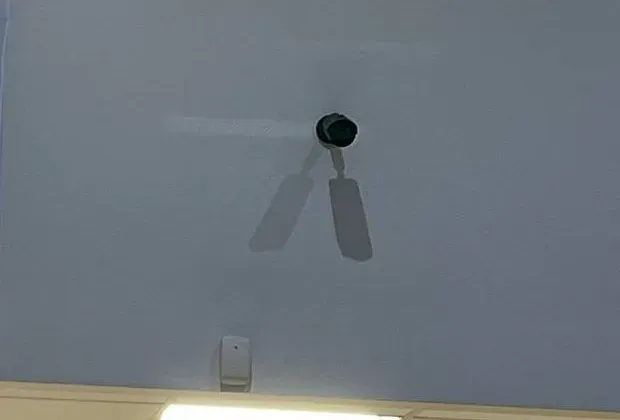
Photo from our job library, not taken in Brownsville: a small black camera mounted high on a pale wall, casting two shadows, with a small white wall device below and a light fixture at the bottom edge. Brownsville vestibules often gain devices like these over the years, and each one added to the same supply is something a repair has to account for.
What should a Brownsville owner send with the booking so the technician brings the right parts?
+
Send the street and cross street, the number of apartments, which ones fail and which work, what the visitor and the resident each hear, which door the strike is on, and every open 311 or HPD number. A photo of the panel and of any handset that has failed tells us the maker and often the part.
If both the street door and the intercom need work, is that one service call?
+
Yes. The $250 service call covers diagnosis of the entrance as a whole, the door, closer, strike, supply and stations. Each repair is then priced in writing as its own line, so the door and the intercom can be approved together or separately.
Can tenants get a copy of the closing record, or does it go only to the owner?
+
The record goes to whoever booked and paid, usually the owner or managing agent. Many Brownsville owners share it with the tenants or the tenant association, since it shows which apartments were tested and passed. That choice is the owner's.
Can you test the intercom and street door of a Brownsville building before we buy it?
+
Yes, with the seller's permission and access. We test every apartment's ring, talk and release, the door and the supply, and write up what works, what doesn't and what it would cost to fix from the Brooklyn list. Reading the building's open 311 and HPD records beforehand is a good idea too.
Will the street door stay locked while you work on the intercom?
+
For most of the visit, yes. When the strike or its supply is disconnected, the door is locked and residents use their keys, and we tell the super before we start. A strike replacement takes the door out of service briefly, and we finish with the door closing and locking on its own.
Some apartments on the failing line are vacant and locked. Can the repair still be finished?
+
Often, but testing at each station is how a break is found and confirmed, so the owner should bring keys to vacant units on the line. Without access, we repair what we can reach and the record notes which apartments could not be tested.
Do you cover Ocean Hill as well as Brownsville?
+
Yes. Ocean Hill shares Community District 16 with Brownsville, and HPD's records show 512 intercom violations in its neighborhood area, more than Brownsville's. We serve both from the same Brooklyn office on the same price list.
Can a tenant who is hard of hearing get a handset with a louder ringer or a light?
+
Usually, if the system's maker offers a compatible station with a louder ringer or a visual signal, or if a signal device can be added to that apartment's line. The owner books the change, and we confirm compatibility before ordering.
Can the stoop panels in a courtyard complex be split onto separate supplies?
+
Yes, where there is space and power for more than one supply. Splitting means one failed supply takes out fewer entrances. Any new outlet is an electrician's job with a permit, quoted separately, and we price the low-voltage side as its own line.
What happens to our door if the part has to be ordered?
+
We leave the door closing and locking, put the order date and expected arrival in writing, and book the return visit once the part is in hand. Special-order parts ship on the maker's schedule, so we don't promise a date before the part is confirmed.
Do you only fix buzzers, or also the camera built into a video door station?
+
Both. We repair the camera, the screen and the recording side of video door stations as well as the call and release functions, and we check that video still reaches any recorder after the repair.
Is your door buzzer work in Brownsville licensed and insured?
+
Yes. Every Brownsville buzzer, intercom and strike repair is low-voltage work done by Abstract Enterprises Security Systems under NYS license #12000287431, and we carry insurance. Line-voltage work goes to a licensed electrician with a permit.
A Release That Only Clicks, a Stoop Gone Dark, or a Complaint That Keeps Coming Back? Call the Brownsville Line
Whether it is a Bristol Street walk-up where half the apartments can't open the door, a courtyard stoop that dies every winter, a store building where the supply sits behind the shop's lock, or a Nehemiah house whose chime only rings on a hard press, the first step is the same. Tell us how many households share the door, which ones fail, and whether a complaint or violation is open. We book within 2 hours of your request, check the door before the wiring, test every household on the line, put the repair price in writing before any part goes in, and leave you the record. Abstract Enterprises Security Systems door buzzer repair is licensed under NYS license #12000287431 and rated 4.7★ across 201 Google Reviews.