What are you looking for?
About Us Contact Us Careers Get a Free Quote (800) 486-0943
Pick a service
✅ Got Your Own System?
🎬 Home TheatreQuote 🎶 AV SoundQuote 🔑 Access ControlQuote
Now pick your area
Pick your area
Long Island
Hudson Valley
Services available
Pricing & Tools
Pick a service for pricing
🚪 Intercom Pricing 🔔 Buzzer Repair Pricing
Calculators
📹 Camera System Calculator 🚨 Alarm Calculator ⚡ Cabling Quote Builder ✅ Got Your Own System?
Select your area
Lobby camera gone grey, a rowhouse recorder that never came back after the lights went out, or a Pitkin Avenue store that can't pull last night's clip? Brownsville camera repair line, booked within 2 hours: (347) 934-8335
Home › Security Camera Repair Brooklyn › Brownsville
Private Walk-Ups · Converted PACT Developments · Nehemiah Rowhouses · New Affordable Buildings · Pitkin and Belmont Avenue Stores

Security Camera
Repair in
Brownsville

Any Brand, Any Installer · Footage Saved Before Anything Is Touched · Cause and Written Price First · Brooklyn Rate

Security camera repair in Brownsville starts with our $150 Brooklyn service call, which pays for the on-site diagnosis and is credited to the repair if you go ahead. On our published Brooklyn list most single faults cost $150 to $700, and a new recorder or a rebuild of several cameras costs $700 to $1,500. We fix systems other companies put in, from three cameras on a Nehemiah rowhouse with a driveway to a system spread across the buildings of a privately managed development, and we work for homeowners, landlords, property managers, tenant-run nonprofits and store owners. Requests are booked within 2 hours, visits come in two-hour arrival windows, and you hear what failed and get a written price before any part is replaced.

Reviewed and updated November 12, 2026, against the New York City Department of Investigation's March 2025 report on security at NYCHA senior buildings; City Council testimony from NYCHA's Office of Safety and Security in April 2025; Brooklyn Eagle reporting on cameras at the Woodson Houses (2019) and on Rep. Hakeem Jeffries' April 2026 funding for Woodson Houses CCTV; NY1's 2009 report on cameras for the Tilden and Brownsville Houses; New York Focus reporting on NYPD access to NYCHA camera feeds; amNY and City Limits coverage of the Atlantic Plaza Towers facial recognition dispute; the Brooklyn Eagle on Operation Safe Shopper camera funding for the Pitkin Avenue BID; the NYC Department of Small Business Services BID directory; NYU Furman Center's Brownsville profile; BK Reader and News 12 Brooklyn on recent Brooklyn power failures; the Security Industry Association on the FCC's 2022 equipment order; Backblaze drive statistics for 2025; HomeAdvisor's Brooklyn cost data; and the NYCHA resident handbook. · Abstract Enterprises Security Systems, NYS license #12000287431 · crews dispatched from our Troy Avenue office in Brooklyn

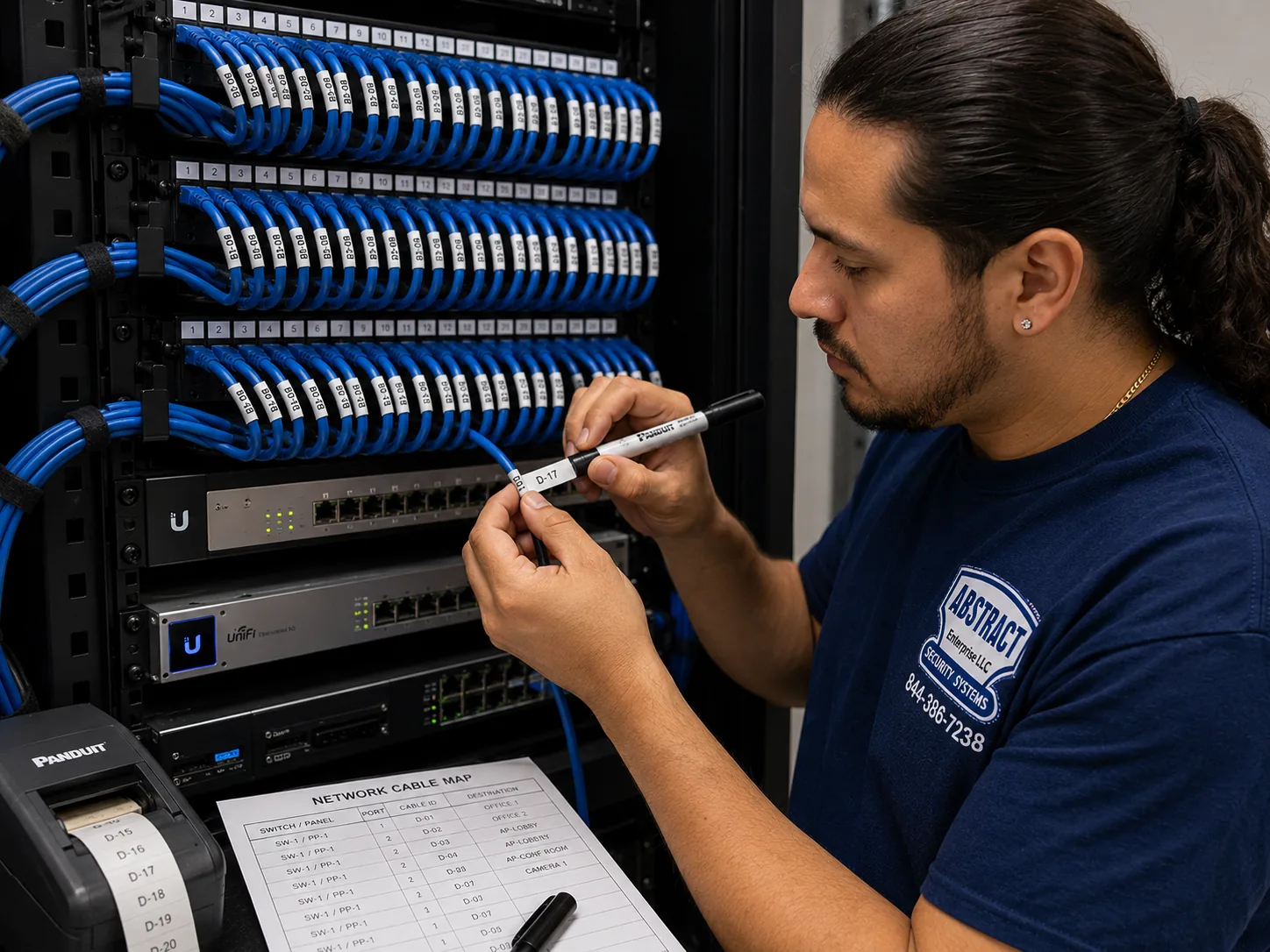
Brownsville, Brooklyn security camera repair: technician printing cable labels at a patch panel beside a printed port map
A photo from the AESS job library, not taken in Brownsville: a technician printing a label for each cable at a patch panel, with the printed port map beside it. In a Brownsville walk-up or a privately managed development, the camera cables often end in a basement room or a super's closet with nothing written on them, after two or three companies have each added cameras. A label at that end is what turns the next repair from an hour of guessing into a few minutes.
Brownsville Camera Repair Request
House, walk-up, development or store: tell us the cross streets and what the screen shows, and a technician calls back with the next step

✅
Request Sent!
Thank you. A technician will contact you about the Brownsville address shortly.
25+
Years Experience
✓
Same-Day Estimates
100%
Licensed & Insured
4.7★
201 Google Reviews

Owner-operated since 2002 · Thousands of jobs completed · Booked within 2 hours

Before a technician drives to Brownsville, one question settles more camera calls than any other: whose cameras are they? In this neighborhood the answer decides who can fix them. Cameras in a NYCHA development belong to NYCHA, and NYCHA repairs them with its own staff, so a resident who wants a dead hallway camera fixed has to report it to the housing authority, not hire a company. Cameras on a privately owned walk-up, a converted development now run by a private manager, a new affordable building, a church, a store or your own house are a different matter: the owner or the manager can book a repair, and that is the work we do. After that, a photo of the recorder screen, its label and the cross streets usually tell us whether to start at the cameras, the cable or the recorder. Send them to (347) 934-8335 or on WhatsApp, and we will tell you the most likely fault and what that kind of repair costs on our Brooklyn list.

  • Looking at your photos costs nothing. The $150 service call is paid when you book and is credited to the repair if you go ahead.
  • All work is done under New York State license #12000287431, by a licensed and insured company that has been owner-operated since 2002.
  • We repair any brand and any installer's work, and we tell you plainly when an old recorder or camera is no longer worth the money to fix.
The Neighborhood

Why Brownsville Properties Need Security Camera Repair

Brownsville is small on the map and large in the number of buildings that depend on cameras. The neighborhood covers a little over a square mile, from East New York Avenue in the north to Linden Boulevard and the Bay Ridge Branch rail line in the south, and from Ralph Avenue and East 98th Street in the west to Van Sinderen Avenue in the east, mostly in ZIP code 11212. Inside those lines sit about eighteen public housing developments with more than a hundred buildings, which together hold roughly a third of Brownsville's homes. The NYU Furman Center counted 21.3 percent of the district's rental units as public housing in 2025, and only 15.8 percent of households owning their home in 2024, against 32.7 percent across the city. Around and between the developments are blocks of two- and three-family houses, the Nehemiah rowhouses with their driveways and finished basements, private walk-ups, new affordable buildings, churches, and the stores of Pitkin, Belmont, Rockaway and Livonia Avenues. Almost every one of them has cameras now, and a good share of those cameras are old enough to be failing.

The camera story here has a clear timeline. In 2009, NY1 reported that the Tilden Houses and the Brownsville Houses, across the street from each other, were getting dozens of cameras in a $3.4 million project paid for with federal money, $2 million from Borough President Marty Markowitz and $1 million from Council Member Darlene Mealy, covering elevators, lobbies, mailbox areas and entrances. "You should not have to wonder, 'Should I run down the stairs or should I ride the elevator?'" the Tilden Houses tenant association president, Marie Boone, said at the time. Ten years later, in June 2019, NYCHA told the City Council that it had installed 16,600 cameras across more than 200 developments over two decades, that each camera lasts about ten years, and that it could not confirm all of them were working. At the same hearing, NYCHA's director of safety and security said of Brownsville's Woodson Houses: "Unfortunately, there are no cameras to this day over at Woodson." In April 2026, Rep. Hakeem Jeffries announced $250,000 in federal funding for security upgrades at the Carter G. Woodson Houses, which Assemblymember Latrice Walker said includes the installation of CCTV cameras there.

Those are NYCHA's cameras, and we do not work on them. We mention them because they show what happens to every camera system in Brownsville, public or private, after its first decade. In March 2025 the city's Department of Investigation tried to view the cameras at all 63 NYCHA senior buildings and could not see them remotely at 44, about 70 percent. The reasons it listed are the ones we find in private basements every week: "outdated or incompatible software or hardware causing login, connection, and data storage issues," camera models that were never able to stream off-site, and plain damage. Twelve of the failures were connection errors. Two systems were stand-alone boxes that nobody outside the building could reach. One development had been handed to a private management company, so NYCHA no longer had direct access to its cameras at all.

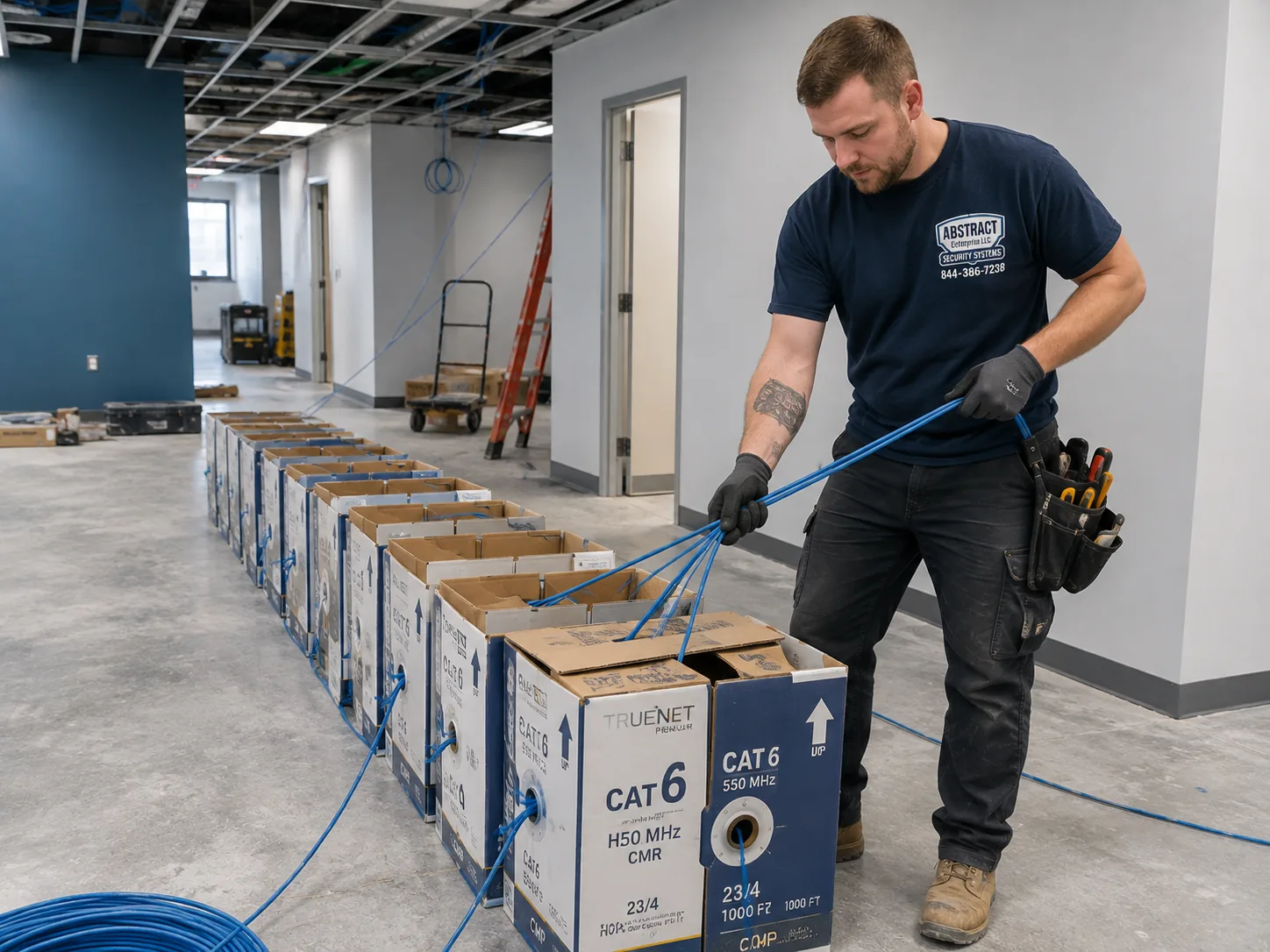
Brownsville, Brooklyn camera cable replacement: boxes of cable staged together for a multi-drop pull on a working premises
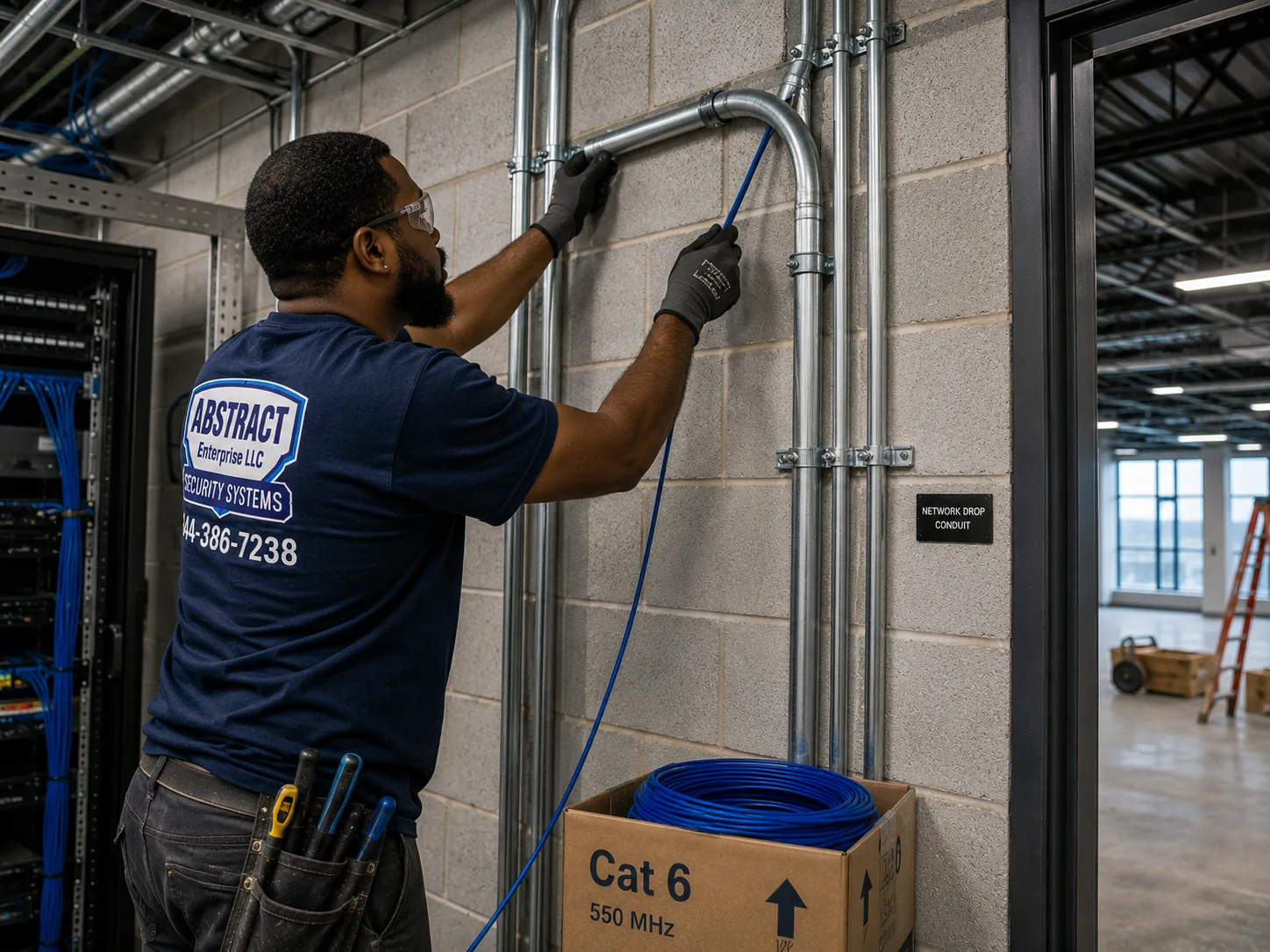
A photo from the AESS job library, not taken in Brownsville: boxes of cable staged together before a multi-drop pull on a working premises. When several cameras on a Brownsville building fail because the original runs were cheap, kinked or cut during renovation, the repair is a planned pull of new cable to each camera, done while the building stays open and the cameras that still work keep recording.

The private buildings carry their own history. Atlantic Plaza Towers, a rent-stabilized complex of nearly 720 households, became citywide news in 2019 when its landlord applied to the state housing agency to add facial-recognition entry on top of a security setup that already included key-fob doors, a guard station and dozens of cameras. Tenants, represented by Brooklyn Legal Services, filed hundreds of objections, and the landlord withdrew the application that year. For a repair the lesson is narrow: fixing an existing camera is ordinary maintenance, but turning a repair into a system that collects new data about tenants or changes how they enter their homes can bring in the Tenant Data Privacy Law and, in rent-stabilized buildings, the state's rent agency. We keep repairs to repairs.

The commercial strip has a camera history too. The Pitkin Avenue Business Improvement District, set up in 1993, covers 32 block faces with about 212 ground-floor businesses. In 2016 the Brooklyn borough president's Operation Safe Shopper gave the BID $2,500 toward security cameras watching street activity, one of five Brooklyn groups funded. Many storefronts added their own cameras in the same years, often from a box store or a friend of the owner, and those systems are now at the age when hard drives wear out, power adapters die and the phone app stops connecting after a router change. On Livonia Avenue the elevated 3 train adds vibration and shadow to every camera mounted near the structure.

Six Brownsville facts that shape a camera repair

  • Public housing is a third of the homes. About eighteen developments and more than a hundred buildings, plus several converted to private management under the PACT program. Who may repair a camera depends on which of those you live or work in.
  • The first big camera wave is past its lifespan. NYCHA told the Council in 2019 that a camera lasts about ten years. The Tilden and Brownsville Houses cameras announced in 2009, and the private systems added around them, have all passed that mark.
  • Recording is not the same as viewable. DOI could not view the cameras remotely at 44 of 63 NYCHA senior buildings in 2025. Login, connection and storage faults are the most common hidden failures we find in private systems too.
  • Most households rent. With homeownership at 15.8 percent, the person who notices a dead camera is usually not the person who can approve its repair, so we confirm the owner before we book.
  • The commercial strip is dense. The Pitkin Avenue BID alone counts about 212 ground-floor businesses on 32 block faces, many with recorders in back rooms and cellars.
  • New buildings bring new systems. The Furman Center counts 5,559 homes added from 2010 to 2025, 4,142 of them income-restricted, and each new building arrived with its own cameras, its own installer and its own management company.

Where this page applies. It covers Brownsville in ZIP codes 11212 and 11233, from East New York Avenue down to Linden Boulevard and from Ralph Avenue to Van Sinderen Avenue, including Pitkin, Belmont, Sutter, Blake, Dumont, Livonia and Riverdale Avenues, Rockaway Avenue and Mother Gaston Boulevard, and the streets between them, from Thomas S. Boyland Street to Junius Street. Ocean Hill, East New York, East Flatbush and Crown Heights border it and are covered at the same Brooklyn rate. Brownsville is patrolled by the NYPD's 73rd Precinct on East New York Avenue, which is where detectives asking for footage usually come from.

Same-Day Repair in Brownsville

Need Repair in Brownsville? A Dark Lobby, a Recorder Stuck After an Outage, or a Store Camera That Saved Nothing

Urgent camera calls from Brownsville come in three kinds. The first follows an incident: a package went missing from a vestibule, a car was damaged in a driveway, a store had a break-in or a dispute in the aisle, and the owner opens the app to find that the one camera pointed at it has been dark for weeks, or that the recorder kept only two days. The second follows the power: a storm, a heat wave or a fault on the block, and afterwards some cameras come back and others never do, or the recorder restarts every few hours. The third is quieter but just as common in this neighborhood: a new property manager, a new board of a nonprofit, or a new owner of a two-family house discovers that nobody has the password, the app was on the old manager's phone, and the system has been recording to a drive nobody can open.

If you need footage from an incident, leave the recorder alone until we arrive. Do not unplug it, do not reset it to factory settings, and do not let anyone format the drive to "get it working," because each of those can erase the hour you need. Most recorders overwrite their oldest video first, so call (347) 934-8335 as soon as you know the date and time window, and we book the visit with saving that clip as the first task, before any repair starts.

For everything else, the path is the same: the $150 service call, booked within 2 hours of your request, a two-hour arrival window, and a written price before any part changes. Most single faults, such as a failed power adapter, a dead switch port, a connector redone or a camera body swapped, are finished on the first visit when the part is on the truck. When a recorder or a specific camera has to be ordered, you get the price and the reason first, and the return visit is booked once the part is in hand. Same-day estimates are available on most days.

What We Install

Security Camera Repair Services in Brownsville

Every repair below is priced from our Brooklyn camera repair list. The service call pays for finding the fault; the repair is priced by what failed, and nothing is replaced until you have the written price.

Dark and dead cameras

A camera that shows "no signal," a black tile or a frozen frame. We find whether the camera, its power, its connector or its cable failed. A single camera replaced on a working system runs $250 to $600 on our Brooklyn list, including the camera and labor.

Recorders and hard drives

DVRs and NVRs that beep, reboot, lost their settings or stopped writing. A drive swap runs $200 to $450 by capacity; a DVR that will not work averages $300 to $700 including drive and labor, and an NVR that is not recording $400 to $900.

After-outage recovery

Systems that came back half working after the power dropped: dead switch ports, blown adapters, a recorder stuck on setup, the wrong date on every clip. Power supply repair typically runs $150 to $400.

Remote viewing and logins

Recorders that record on site but cannot be reached from a phone or the management office, apps tied to a former manager or owner, and lost admin passwords. Configuration with no parts is often covered by the service call.

Connector and cable faults

Corroded or loose connectors at the camera end, runs pinched under a door or cut during renovation, and cable chewed in a basement. A reterminate or PoE port swap runs $150 to $350.

Night pictures

Cameras that go grey, white or pink after dark, infrared that bounces off a wall or a window guard, and floodlights that wash the picture out. Night vision camera repair typically runs $250 to $650.

Vandalized and moved cameras

Spray-painted domes, cameras knocked crooked, torn off a gate or turned to face a wall. Repairing a vandalized camera averages $400 to $900 per camera plus any cable repair.

Footage export

Clips saved to USB with the original timestamp, in the recorder's own format and a common video format, for a detective from the 73rd Precinct, an insurer or a landlord, before anyone changes a setting.

Multi-building systems and maintenance

Developments and complexes with cameras in several buildings tied back to one office, and yearly clean-and-check visits. A clean and check for a blurry picture starts at $80; annual maintenance starts at $250 for a residence and $400 for a commercial system.

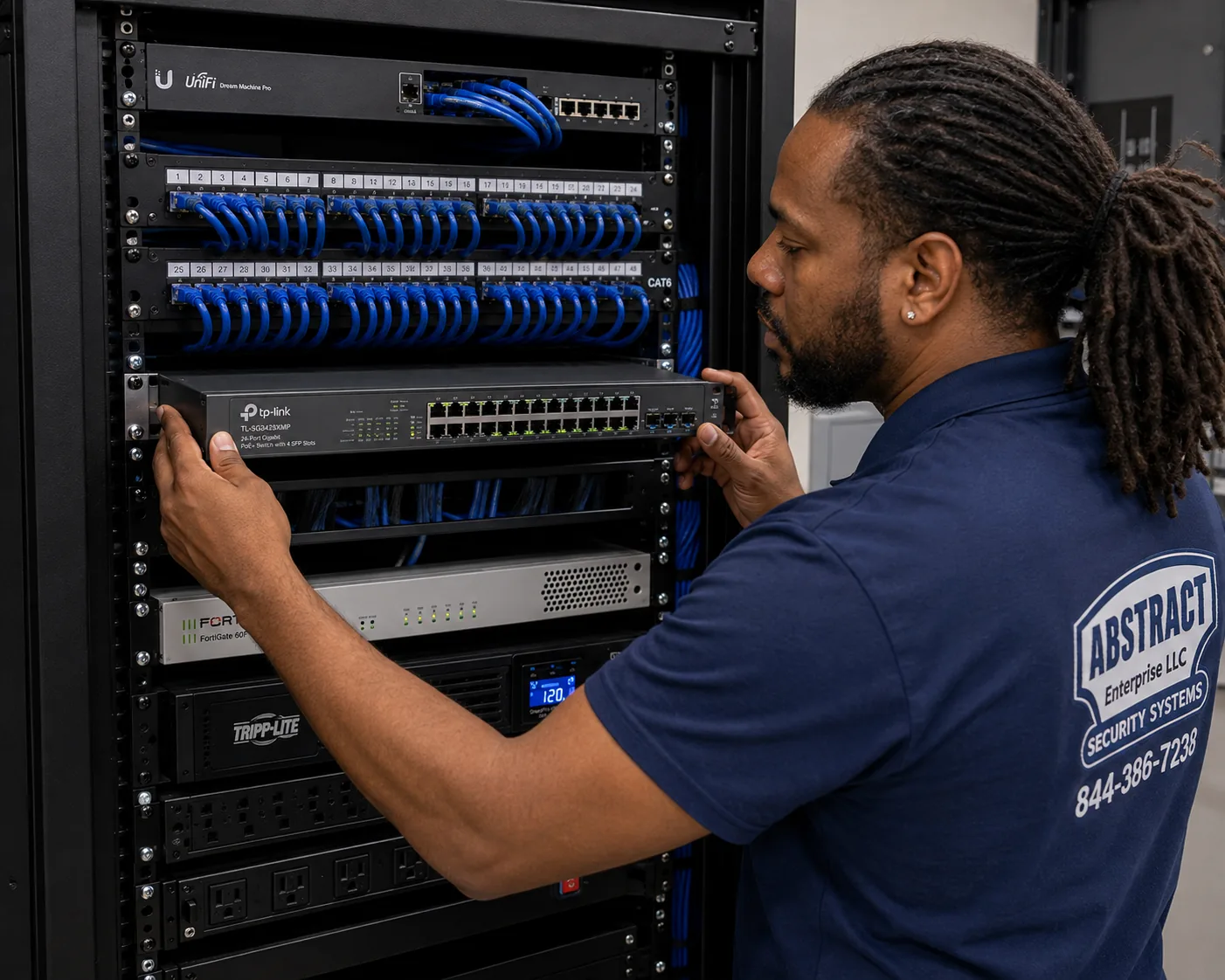
Brownsville, Brooklyn network camera repair: technician mounting a managed PoE switch below patch panels in a commercial network rack
A photo from the AESS job library, not taken in Brownsville: a technician mounting a managed PoE switch below the patch panels in a commercial rack. In a Brownsville building with network cameras, the switch is the box that powers every camera through its data cable, and after a hard power cut it is often one or two of its ports that die, not the cameras themselves. A managed switch also lets us see which port has stopped drawing power without climbing to every camera.
Building Specialists

Security Camera Repair for Brownsville's Architecture

Seven kinds of building account for nearly every camera call we take in Brownsville. They differ in three ways that change a repair: who owns the cameras and approves the work, where the recorder and power live, and how the cable reaches each camera through brick, block or frame.

The Nehemiah rowhouse

Attached owner-occupied houses from the Nehemiah program, mostly in the western half of the neighborhood, with a driveway or front yard, a finished basement and three to six cameras.

The semi-detached house with tenants

Two- and three-family houses below Pitkin Avenue, often sharing a stoop or a wall with the house next door, with one recorder serving every household in the building.

The prewar walk-up

Four- and five-story tenement buildings and the limestone and brownstone houses toward Ocean Hill, privately owned, with hallway, vestibule and yard cameras added over the years.

The converted development

Former NYCHA developments now run day to day by private managers under PACT, with camera systems they inherited, often without passwords or drawings.

The large private complex

Privately owned towers and campuses with a guard station, fob doors and dozens of cameras across lobbies, elevators, garages and grounds.

The new affordable or senior building

Mid-rises from the last fifteen years and the ones going up now, with network cameras, a management office and a system still tied to the original installer.

The store with apartments above

Mixed-use buildings on Pitkin, Belmont, Rockaway and Livonia Avenues, with shop cameras, a cellar or back-room recorder, and sometimes the building's hallway cameras on the same box.

The Nehemiah rowhouse: a finished basement, a driveway and an owner who wants it right

The Nehemiah houses were built for ownership, and their owners tend to treat a camera system the way they treat the rest of the house: they want it working, neat and explained. The typical system has a camera over the front door, one on the driveway or parking pad, one or two on the back yard and sometimes one inside the basement entrance, all feeding a recorder in the finished basement. Because the basement is finished, the cables often disappear behind drywall or a drop ceiling soon after they enter the house, and the original installer may have run them through the joists without a pull string or a map. When a camera dies, the first question is whether the fault is at the camera, which is easy, or somewhere in that hidden run, which needs testing from both ends before anyone opens a wall.

Driveway cameras on these houses fail in two ways more than any other. The first is the picture: a camera set for a wide view of the street cannot also show a face at the car door or a plate in the dark, and owners who have had a car tampered with find out the hard way. That is often a mounting and settings repair rather than a new camera. The second is water: a camera on the front of the house, under a gutter or beside a downspout, gets more water than its seals can take. On a Nehemiah house we also check that the recorder is not on the basement floor and that it has a small battery backup, since a finished basement is still the room where water and power trouble arrive first.

The semi-detached house with tenants: one recorder, several households

Below Pitkin Avenue, many houses are semi-detached multi-family buildings with an owner on one floor and tenants on the others, or with every floor rented. The camera system almost always belongs to the owner, but the recorder is often in a place the owner does not control day to day: a basement apartment, a shared cellar, or a closet on a tenant's floor. That is how recorders get unplugged for an outlet, buried under storage, or left without ventilation until the drive cooks. When we repair a system like this, part of the job is moving or protecting the recorder so it stays powered and reachable by the owner, and confirming who in the building should have app access to which cameras.

The prewar walk-up: risers, vestibules and the super's closet

Brownsville's older walk-ups and the limestone and brownstone houses toward Ocean Hill were built long before cameras, so every camera in them is an addition and the cable had to go wherever the installer could fit it: up an old dumbwaiter shaft, along a stair stringer, through the ceiling of the vestibule or down the outside of the rear wall. Cameras in vestibules, mailbox areas, stairwells and yards are the usual set, with a recorder in the cellar or in the super's closet. When three or four cameras in a building like this go dark together, the cause is usually one shared thing, a power box, a switch or a junction in the cellar, rather than three separate camera failures, and the repair is much cheaper once that shared part is found.

These buildings are usually rent-stabilized, and many changed owners in the last decade. A new owner often inherits a recorder with no password, cameras from several installers that do not all appear on the same screen, and cable labeled in nobody's handwriting. We start with an inventory: which cable feeds which camera, which cameras the recorder can actually see, and which ones were quietly abandoned. Then we fix what you called about and leave a short written note of the rest, so the owner can decide what to repair now and what to plan for. Like-for-like repairs to existing cameras are ordinary maintenance; changes to how tenants enter the building are a separate question we flag before any work.

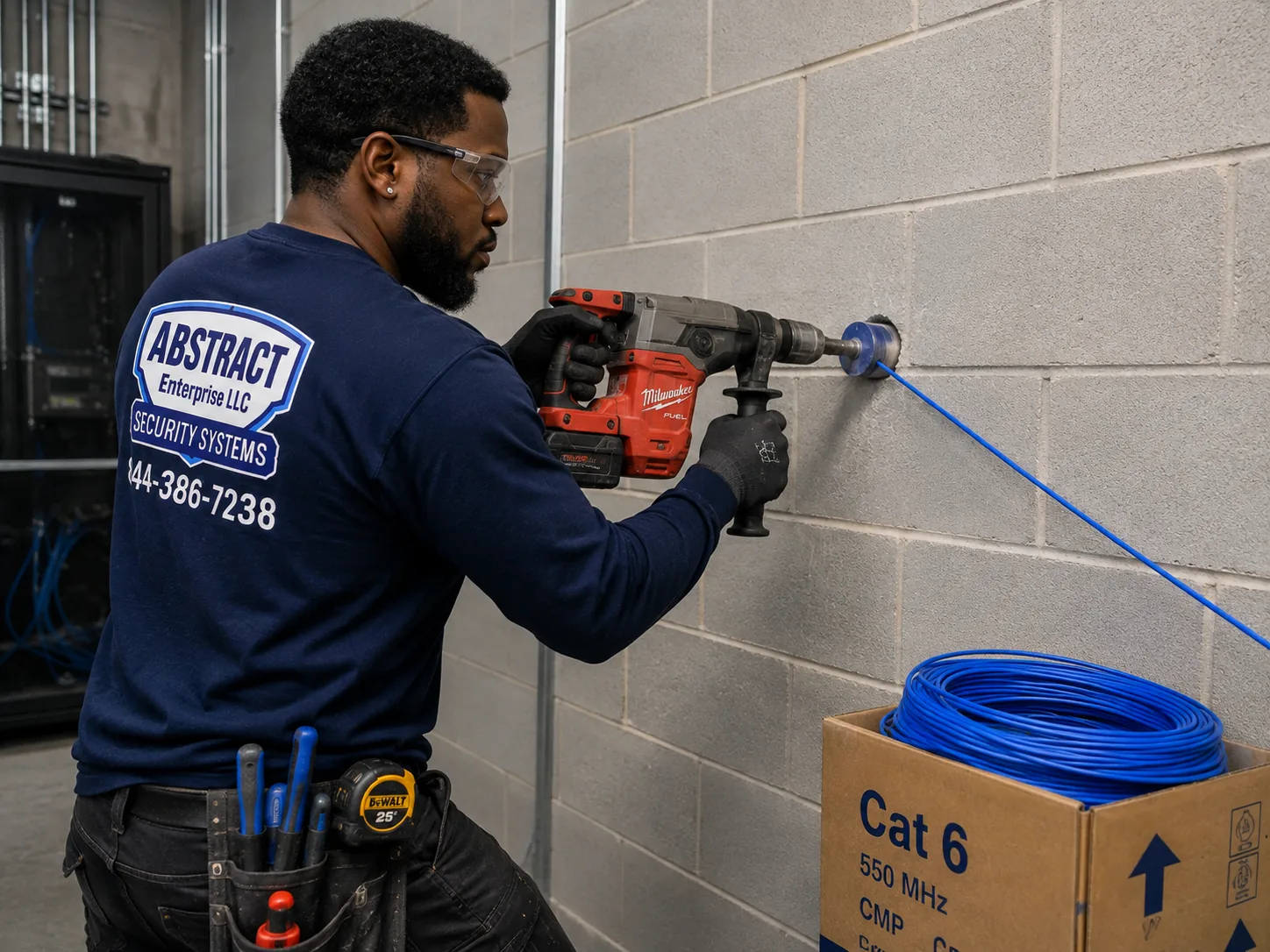
Brownsville, Brooklyn camera cable routing: technician core drilling a block wall to carry cable through to a network room
A photo from the AESS job library, not taken in Brownsville: a technician core drilling a block wall so a cable can pass through to a network room. Many Brownsville developments and newer mid-rises are built with concrete block and masonry walls, so when a camera's original cable was run the cheap way, along the outside of the building or across a hallway ceiling, the lasting repair is a clean path through the wall with a sleeve, sealed afterwards.

The converted development: inheriting a system nobody handed over

Several Brownsville developments have converted from NYCHA operation to private management under the PACT program, among them the Howard Avenue, Seth Low, Sutter Avenue-Union and Tapscott Street sites. When a private manager takes over, the camera system it inherits may include NYCHA-era cameras, recorders and fiber links that were monitored on NYCHA's own platform, plus cameras added later. DOI's 2025 report found one development where cameras were managed by a PACT/RAD private company, which meant NYCHA itself no longer had direct access to them. The practical result for the new manager is a system that may record perfectly well but that nobody on the new team can log into, back up or see from the office.

The new affordable or senior building: modern cameras, a management office and an installer warranty

Brownsville has added thousands of income-restricted homes since 2010, from the 2017 Brownsville Plan's promise of more than 2,500 new affordable homes to Van Dyke III's 180 apartments on the Van Dyke campus, the 141-unit Gail P. Duke Senior Residence opened by Catholic Charities in 2026, and the nine-story Brownsville Arts Center and Apartments at 366 Rockaway Avenue, due to finish in December 2027. These buildings arrive with network cameras, a managed switch, a recorder or cloud service, and a management office that watches the screens. Their faults are network faults more often than camera faults: a switch that lost its configuration, a camera that dropped off after a firmware update, a recorder that filled its drive because retention was never set.

Senior buildings deserve particular care: DOI's 2025 findings were about senior buildings, and its recommendation was that inspectors confirm "the security cameras are working, and the cameras' view is not obstructed and/or diminished by lighting issues." We test exactly that during a repair, and we can set up daily health alerts so the office hears about a dead camera from the system rather than from a resident.

Field Notes

Field Notes: The First Twenty Minutes on a Brownsville Camera Call

These notes describe how our technicians open a camera repair in the kinds of buildings Brownsville has. They set out standard practice, not a story about any one address.

Ownership before ladders. The technician confirms who owns the system and who approved the visit, and whether the building is privately owned, privately managed under PACT, or still operated by NYCHA. If the cameras turn out to be NYCHA's, we stop and say so, because they are not ours to open.

Read the recorder before touching it. At the screen the technician notes which channels show video, which are black, which say "no signal," the drive status, how many days of video are actually stored and whether the clock is right. If you asked for footage, it is exported now, with its original timestamp, before anything else happens.

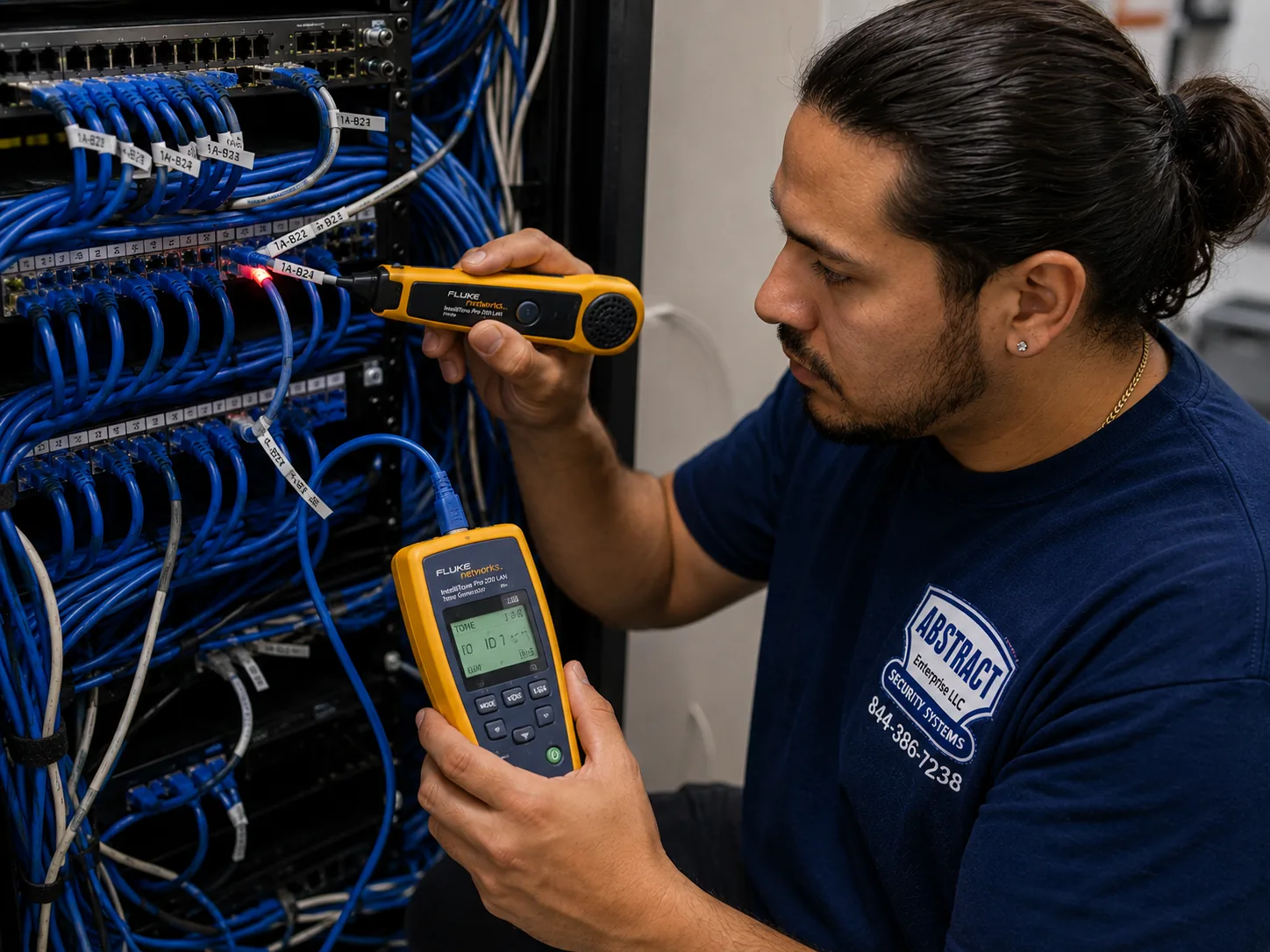
Brownsville, Brooklyn camera cable tracing: technician tracing an unidentified cable run at a patch panel with a tone generator and probe
A photo from the AESS job library, not taken in Brownsville: a technician using a tone generator and probe to find which unlabeled cable at a patch panel belongs to which run. In a Brownsville walk-up or a converted development where cameras were added by several companies and nothing was labeled, this is how we find the cable for the dead stairwell or yard camera without pulling anything out of the wall.

Look for the shared fault. If several cameras went dark at once, the technician goes first to whatever they share: the power box, the PoE switch, a junction in the cellar or a link to another building. One failed part there explains many dark tiles, and finding it first keeps the bill down.

Measure instead of swapping. Voltage at the camera end, PoE power at the switch port, and a cable test or a known-good camera on the same run settle what failed in minutes. Nobody replaces a camera on a hunch.

Price, then repair, then label. You hear the cause and get a written price before any part is replaced. When the repair is done, every cable we traced is labeled, outdoor connections we opened are sealed, and the notes go on your job record for next time.

Fault by Fault

Power, Age, Lost Access, Damage or Building Work: How Brownsville Camera Systems Fail and What Each Repair Takes

Five causes account for most of the camera failures we find in Brownsville buildings and stores. Each leaves its own signs, and telling them apart is what keeps a repair to the part that actually failed.

Power: the outage, the surge and the power box that gave up

A camera system has three places power can fail. At the wall, a plug-in adapter or a central power box feeds analog and HD-over-coax cameras; at the switch, a PoE switch powers network cameras through their data cables; and at the recorder, the power brick or internal supply keeps the drive spinning. When the lights drop and return hard, as they do when an underground feeder fails or a building's own panel trips, any of those can fail on its own. The pattern on the screen gives it away. If every camera on one power box is dark and the rest are fine, the box is the suspect. If two or three network cameras on the same switch died, those switch ports have probably burned out. If the recorder comes back asking to be set up as new, its settings were lost, and the drive needs checking before anyone presses a button.

Brownsville's recent outages have not been dramatic, but they have been regular. In late December 2025, News 12 reported hundreds of Brooklyn customers out after snowmelt and road salt seeped into underground equipment; in January 2026 the Con Edison feed to Brookdale University Hospital failed and its backup generator then failed for several hours. Every event like that produces a few camera calls in the days after. The repair is usually modest, a power box or adapter at $150 to $400 on our Brooklyn list, a PoE port moved or a switch replaced, and the clock and settings put back, but the lasting fix is a battery backup sized for the recorder and the switch, so the next drop is a non-event.

Age: the ten-year mark, worn drives and an app that stopped talking

NYCHA told the City Council in 2019 that a camera lasts about ten years, and our experience in private buildings is similar. Systems that went in during the camera push of 2009 to 2016, in walk-ups, stores and houses all around the developments, are now at or past that age. Cameras that age show it in the picture first: a softer image, infrared LEDs that have dimmed so night video turns to grain, a color sensor that tints everything pink in daylight. Recorders show it in the drive and the software: a drive that has been writing video around the clock for years, firmware the phone app no longer supports, and a box that reboots in the summer heat.

The hard drive is the part we replace most often. Drives in a recorder never rest; they write every camera, every second, until they are full and then start overwriting. Backblaze, which publishes failure data for the drives in its data centers, reported an annual failure rate of 1.36 percent for its fleet in 2025, and that is for drives kept cool in racks. A drive in a Brownsville closet or under a stairwell runs hotter and has no spare. A drive swap at $200 to $450 by capacity fixes the recording, but the existing footage on a failing drive should be copied off first if it matters, which is why we read the drive's health before we pull it.

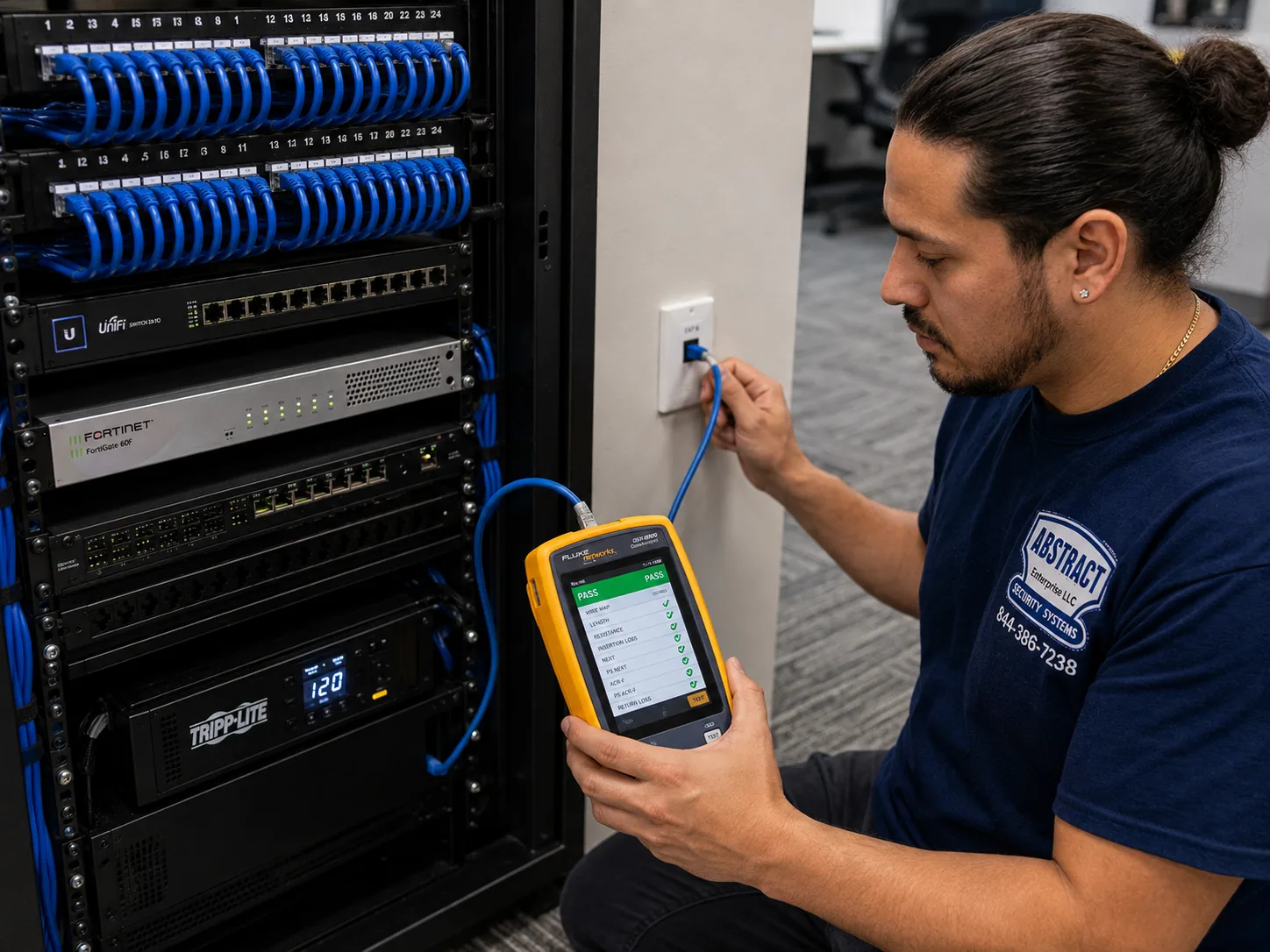
Brownsville, Brooklyn camera cable testing: technician certifying a data drop with a cable analyzer showing a PASS result
A photo from the AESS job library, not taken in Brownsville: a technician certifying a data drop with a cable analyzer that shows a PASS result. On a Brownsville building where a network camera keeps dropping off, a test like this tells us in a minute whether the cable is good and the camera is at fault, or whether the run itself was damaged and replacing the camera would have been money wasted.

Lost access: a system that records but nobody can see

This is the quietest failure and one of the most common in Brownsville, because so many buildings have changed owners, managers or boards. The recorder works. The cameras work. But the password left with the last super, the phone app was on a former manager's account, the remote viewing broke when the internet provider changed the router, and the recorder's software is too old for the app now in the app store. DOI found the same pattern in NYCHA's senior buildings in 2025, where "login, connection, and data storage issues" and cameras with no remote viewing explained most of the systems it could not see.

Recovering access is often the whole repair. Depending on the brand and model, administrator access can usually be restored through the manufacturer's reset process, by the owner proving possession of the device, and in most cases without erasing the stored video. Then we update firmware where it is safe to, set up remote viewing again, create separate logins for the owner, the manager and anyone else who needs one, and write the credentials down for the owner. Where the recorder is too old to be updated or reached safely from outside, we say so and price a replacement rather than leaving an unsecured box open to the internet.

Ownership checks matter here. We restore access only for the owner of the system or someone the owner authorizes in writing, such as a property manager or a nonprofit's director. A tenant, a former manager or a new store tenant who wants into a recorder they do not own gets pointed to the owner first.

Damage: paint, cracked domes and cameras turned to the wall

NYCHA's safety office told the Council in April 2025 that the damage it sees most often on its cameras is spray paint and cracked housings, and that its staff replace the camera heads. Private buildings and stores in Brownsville see the same: a dome sprayed over, a camera on a gate knocked loose, a camera on a low wall turned to face the brick, and cables yanked out of a junction box. A painted or scratched dome cover can often be replaced on its own, a $30 to $80 part plus labor; a camera whose lens or infrared ring is painted inside the housing, or whose housing is cracked, is usually a replacement.

The lasting repair for damage is placement, not just a new camera. Cameras that are easy to reach get vandal-rated domes and tamper-resistant screws, and where we can, they move higher or under a ledge where they are harder to hit without losing the view. Cables get covered or moved inside, and the recorder gets set to send an alert when a camera loses video, so the owner knows the same day instead of finding out after an incident. Repairing a vandalized camera averages $400 to $900 per camera plus any cable repair on our Brooklyn list.

Building work: renovations, scaffolding and new tenants

Brownsville has a lot of building work going on, from gut renovations of older walk-ups to facade repairs and new construction next door. Contractors cut camera cables when they open ceilings, paint over cameras and their connectors, unplug the recorder to free an outlet, and take cameras down for scaffolding and never put them back. A store fit-out does the same to a storefront's cameras. These failures usually show up all at once, the week the work ends, and they are among the easiest to fix if someone knows where the cables went.

Commercial Security Camera Repair

Business Security Camera Repair in Brownsville

Brownsville's businesses sit on a handful of avenues, and each one gives a camera system a different job. Most are small: a grocery, a beauty supply, a clothing store, a phone shop, a laundromat, a takeout counter, a church office or a youth program upstairs. They rarely have an IT person, so when the cameras fail the owner usually finds out at the worst moment, the day they need a clip.

Pitkin Avenue

The main shopping street and the heart of the Pitkin Avenue BID, about 212 ground-floor businesses on 32 block faces, many in older buildings with recorders in back rooms, cellars or a closet behind the counter.

Belmont Avenue

Smaller shops and food businesses near the Osborn Street Plaza, where cameras deal with roll gates, awnings and street lighting that changes the picture after dark.

Rockaway Avenue

A north-south strip of stores, services and new mixed-use buildings, where shop cameras and building cameras often share a facade and sometimes a recorder.

Livonia Avenue

Stores under the elevated 3 train, whose cameras live with vibration, deep shadow from the structure and grime falling from above.

East New York Avenue and Mother Gaston Boulevard

Corner stores, takeout, auto businesses and services on the northern and central corridors, many open late with a single camera system watching cash and doors.

Churches, nonprofits and programs

Congregations, community organizations, clinics and after-school programs, often in converted storefronts or upstairs spaces, with cameras on doors, halls and parking areas.

Brownsville, Brooklyn storefront camera repair: technician feeding cable through a ceiling in an occupied commercial space
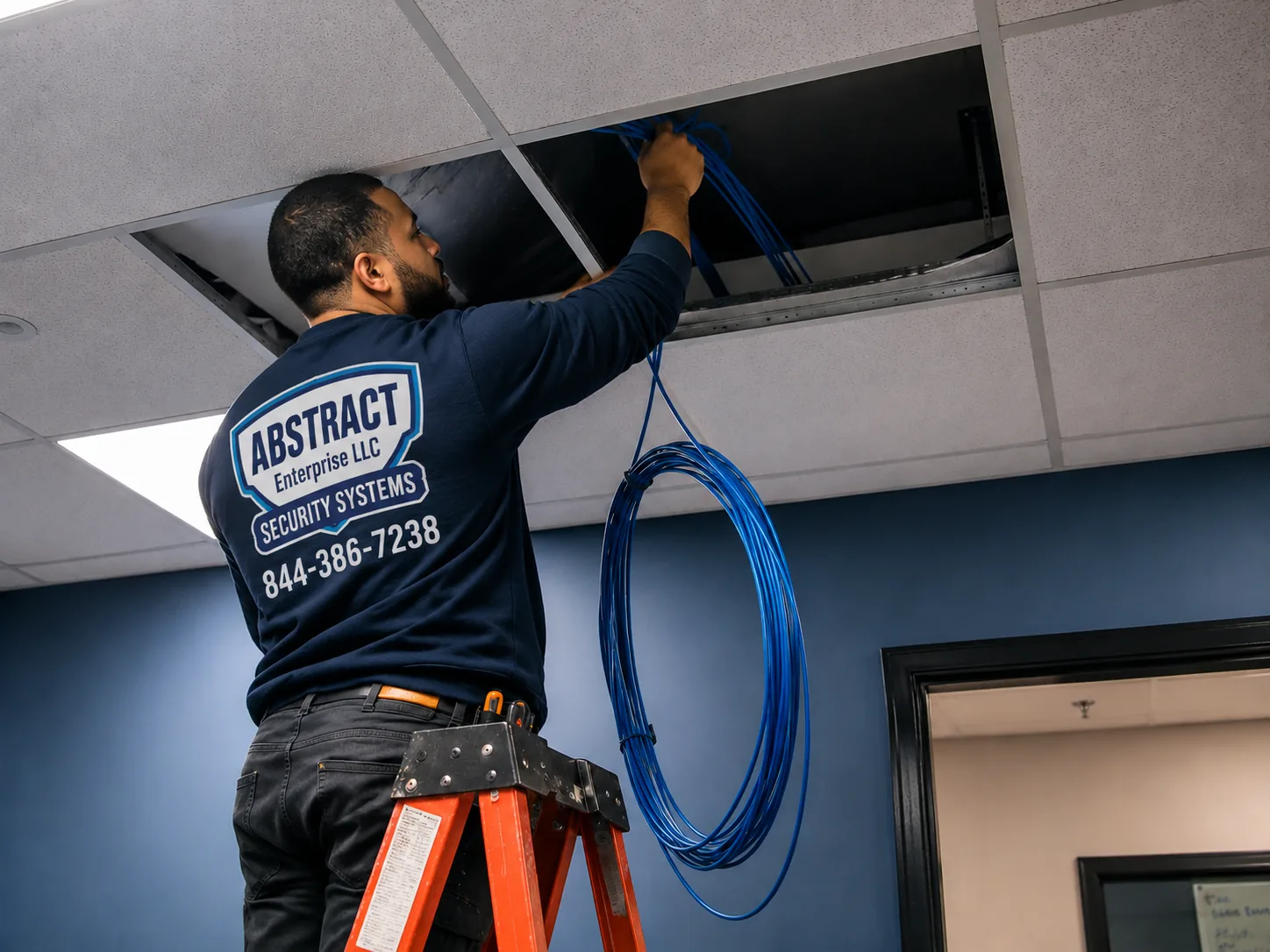
A photo from the AESS job library, not taken in Brownsville: a technician feeding cable through the ceiling of a commercial space that stays open during the work. In a Pitkin Avenue or Rockaway Avenue store, the cables to the counter and stock-room cameras usually run above a drop ceiling, so a dead camera can often be reached and re-cabled from above without closing the shop or opening a wall.

What a Brownsville store owner needs from a repair

A store owner needs three things from a camera system, and a repair should check all of them. The first is the right views: the register and the counter from an angle that shows faces rather than the tops of heads, the door at face height as people come in, the stock room and the back door, and, if the store has a roll gate, a camera inside the window that still sees the sidewalk after the gate comes down. The second is the recording itself: enough days stored to catch a theft discovered at the next inventory, a clock that is right, and video sharp enough to identify someone, which depends on the camera and on how the recorder is set to save it. The third is access: the owner can see the cameras on a phone, export a clip without help, and get an alert when a camera or the drive stops working.

Most store repairs we do on these avenues are a mix of those three. A dead counter camera is replaced; the door camera, set years ago for a wide view, is re-aimed so it shows a face; the recorder, which was saving at a low quality to stretch a small drive, is fitted with a larger drive and set to keep a useful number of days; and the owner gets the app back on a phone. A single-issue repair like that usually lands in the $150 to $700 range on our Brooklyn list. If a new recorder is needed, it is in the $700 to $1,500 range with the drive and every camera set up again.

The recorder in the back room, and keeping it there

In many Brownsville stores the recorder sits on a shelf in the back room, on the floor of a cellar reached by a sidewalk hatch, or on top of the cooler. Three things go wrong with it. Heat and dust from coolers, compressors and kitchen equipment shorten the drive's life. Water from a cellar or a leaking cooler reaches it. And in a break-in, a recorder in plain view can simply be carried out with the evidence on it. We move the recorder into a ventilated, locked cabinet or a less obvious spot where it is still reachable, put it on a battery backup, and where the owner wants it, set up a copy of key footage or alerts to the owner's phone so a stolen box is not the only record.

Under the el on Livonia Avenue there is a fourth problem: vibration. A camera mounted on a facade near the structure shakes every time a train passes, which blurs the picture and fires motion alerts all day. The fix is mounting and settings, a stiffer bracket on a solid part of the wall, a camera moved away from the steel, and motion zones that ignore the shaking area, rather than a new system.

Churches, nonprofits and community programs

Brownsville has many congregations and community organizations, and their camera systems are often donated, installed by a volunteer, or paid for through a grant years ago. They work well until the person who set them up moves on, and then nobody knows the password, where the recorder is, or who to call. These organizations also have particular needs: cameras on doors and halls where children arrive and leave, on a parking area used at night, and on an office where donations or equipment are kept, with clear rules about who can watch the video.

Brownsville, Brooklyn commercial camera cabling: J-hooks carrying dressed cable bundles across a commercial ceiling
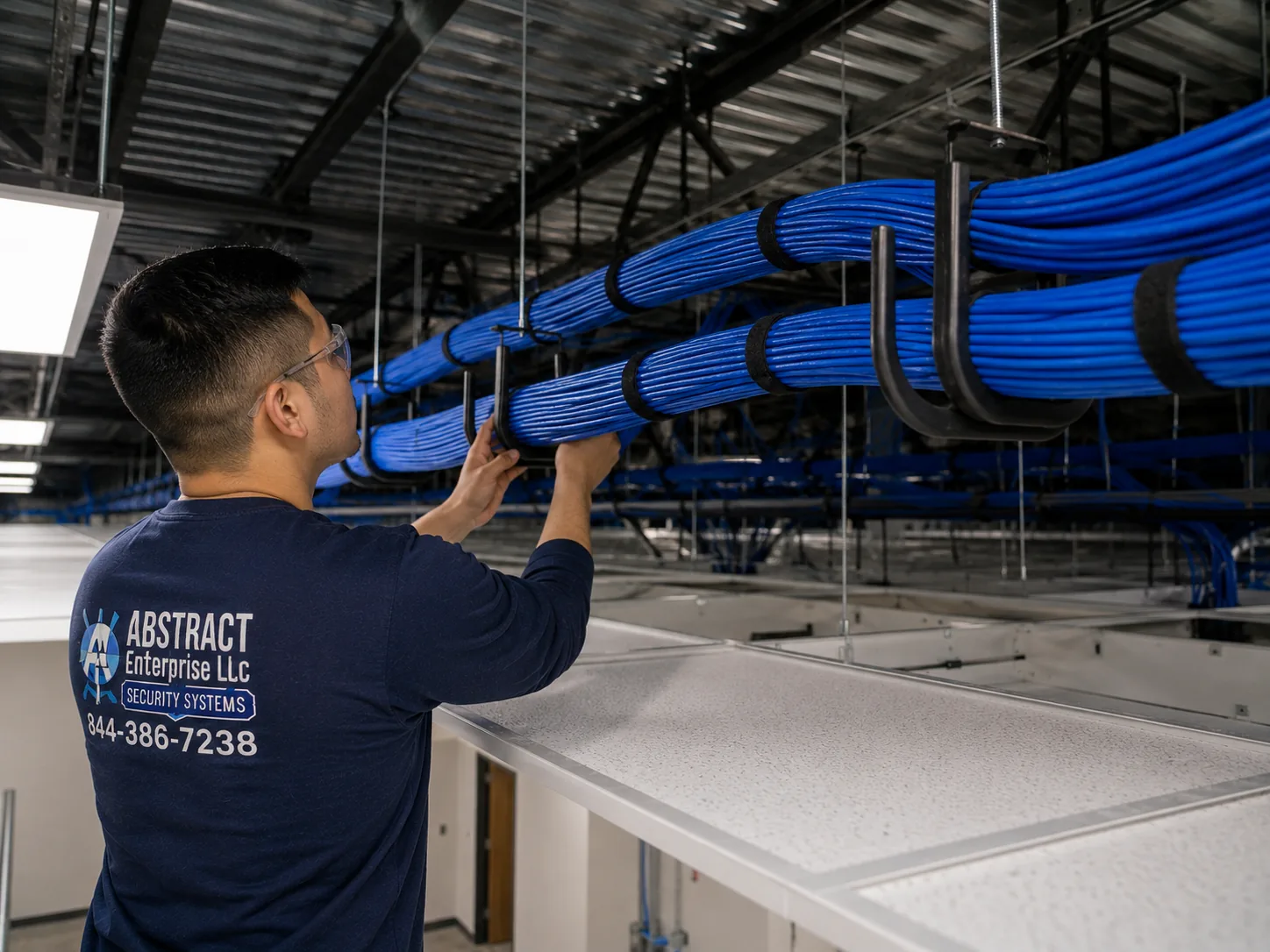
A photo from the AESS job library, not taken in Brownsville: J-hooks carrying neatly dressed cable bundles across a commercial ceiling. In a Brownsville church hall, clinic or store, cable supported like this can be traced and replaced one run at a time; cable lying loose on a ceiling grid or stapled to joists is the kind that gets cut, crushed or lost during the next renovation.

Rules that touch a commercial camera repair

A few rules apply to business camera work in Brownsville. In New York State, installing or servicing security and CCTV systems for others requires a license from the Department of State; we work under NYS license #12000287431. Employers who monitor employees by video must give notice under New York's labor law, so a repair that adds or moves a camera covering staff areas is a good time to check that the notice is posted. Ordinary repairs and like-for-like replacements of existing cameras do not need a building permit. Brownsville has no historic district, so the Landmarks Preservation Commission's camera rules for facades do not apply to ordinary storefronts here.

Your Questions Answered

Security Camera Repair in Brownsville: Questions Answered

Public housing, converted developments and who may fix a camera

I live in a NYCHA building and the camera by our mailboxes has been dead for months. Can I pay a private company to fix it?

No, and a company that agrees to is working on equipment it has no right to touch. Cameras in a NYCHA development belong to NYCHA, and NYCHA repairs them with its own staff. Report the dead camera through the MyNYCHA app or NYCHA's customer contact center, keep the ticket number, and ask your tenant association to raise it with the property manager if nothing happens. At an April 2025 Council hearing, NYCHA's safety office said its team aims to repair a reported camera within 24 to 72 hours, which gives you a reasonable point to follow up from. What you can do on your own is covered by the resident handbook: a wireless camera or video doorbell may be attached to your own apartment door, as long as it is fixed only with adhesive, no holes are made, and it is used for your personal safety.

Our development switched to private management under PACT. Who fixes the hallway cameras now?

Usually the private management company, since under PACT the new partners take over day-to-day management and repairs of the development. In practice the cameras can fall into a gap during the changeover: some were monitored on NYCHA's own platform, the passwords did not always transfer, and the new staff may not yet know where every recorder is. DOI's 2025 report found exactly that kind of site, cameras managed by a PACT/RAD private company that NYCHA could no longer reach. Put the request to the management office in writing, name the camera locations, and ask for a date. The management company can hire a licensed company like ours to recover and repair the system; residents cannot book that work themselves.

We just took over management of a converted development and cannot log into any of the recorders. What does getting control back involve?

It starts with an inventory, not a reset. We find every recorder and switch on the site, note the make, model and firmware of each, see which cameras each one actually records, and check the links between buildings. Then we restore administrator access recorder by recorder, using the manufacturer's process for the model, with the aim of keeping the stored video intact; where a recorder cannot be recovered without wiping it, you are told before that choice is made. Each recorder then gets new credentials in the management company's name, remote viewing to your office, and a written map of which camera is where. Larger recoveries usually fall in the $700 to $1,500 range on our Brooklyn list and are priced in writing after the first visit.

Rowhouses and houses with tenants

The cables on our Nehemiah house disappear into the finished basement ceiling. If one camera's cable is bad, do you have to open the drywall?

Rarely. First we prove the cable is the problem by testing the camera end and the recorder end, because most "bad cable" calls turn out to be a failed connector at the camera or a loose end at the recorder, both reachable without touching a wall. If the run itself is damaged, the next options are to pull a new cable using the old one as a guide, to fish a new run through a different joist bay from an access panel or an unfinished corner, or to bring it along a closet or utility space. Opening finished drywall is the last resort, and if it is needed you get the price and the location before anyone cuts, with patching left to you or your contractor, since we do not patch or paint walls.

The iron security gate in front of our door shows up as a bright white blur on the door camera at night. Why?

The camera's own infrared light is bouncing straight back off the bars. At night most cameras switch to infrared, which the camera sees but people do not, and anything close to the lens and reflective, like painted iron bars a foot or two away, glows white and hides everything behind it. It is common on Brownsville houses where the gate sits just in front of the door and the camera was mounted between them. The fix is placement or light, not a new system: the camera moves so the bars are not in the near field, its infrared is turned down or off in favor of the porch light, or it is replaced with a color night-vision model that uses a small visible light. Night vision camera repair typically runs $250 to $650 when a camera change is needed, and less when moving the camera is enough.

Walk-ups, complexes and newer buildings

Our walk-up's stairwell cameras show a dark, grainy picture because half the hallway bulbs are out. Is that a camera problem?

Often it is mostly a lighting problem, and replacing the camera will not fix it. A camera needs light to make a usable daytime-style picture; in a stairwell with dead bulbs it switches to infrared, and infrared on a white wall a few feet away produces glare in one spot and grain everywhere else. DOI's 2025 recommendation for NYCHA senior buildings made the same point, asking inspectors to confirm that each camera's view is not "obstructed and/or diminished by lighting issues." We check the camera, confirm the infrared is working and not aimed at a nearby wall, adjust its settings, and tell the owner which fixtures matter for which camera. If the camera itself is fine, the repair may be a settings visit within the $150 service call plus new bulbs from the building's handyman.

Our new building's management says the cameras are still under the installer's contract, but the installer never calls back. Can you step in?

Yes, once the owner or management decides to. Before we touch anything, management should check the installation contract for its warranty terms and for what happens if the installer does not respond; some contracts treat outside work as voiding coverage on what was touched, and some say nothing. Send the installer a written request with a deadline, so the record shows you tried. If they still do not answer, or management decides to move on, we take over: we document the system as we find it, recover access in management's name, repair what has failed and keep notes so that any later warranty discussion has a clear record of what we did and did not change.

After a fire in one apartment, the hallway cameras on that floor stopped working. What usually needs replacing?

It depends on whether the damage came from heat, smoke or water. Cameras close to the fire can lose their housing or lens to heat, and soot can coat the dome. Further away, the bigger damage is usually from the water used to fight the fire, running down through ceilings into junction boxes and connectors, and from cable runs that passed through the burned area. We test each camera and each run from the recorder end, replace cameras that are damaged, re-terminate or replace cable that took water, and check the power box and the switch on that floor. The building's insurer may want a written list of damaged equipment with prices, which we provide after the visit.

Stores, churches and programs

Our grocery's recorder sits on top of a cooler. Is that why the hard drive keeps failing?

Very likely. The top of a cooler or freezer is one of the warmest places in a store, because the compressor's heat rises out of it all day, and a recorder there runs its drive hot for years. Heat and vibration are hard on drives that already write video around the clock. Moving the recorder to a cooler, ventilated spot, ideally in a small locked cabinet, and replacing the drive with one rated for surveillance work, $200 to $450 by capacity on our Brooklyn list, usually ends the cycle. While we are there we check the recorder's own fan, since a clogged fan in a dusty stockroom causes the same failures on its own.

Our church's cameras were set up by a volunteer who has since moved away. How do we get the system into the church's own name?

Start by deciding who in the church will hold authority over the system, usually the pastor, the trustees or an administrator, and put that in a short letter on church letterhead. With that, we can recover administrator access to the recorder, remove the volunteer's personal account from the app, create logins for the people the church names, and write down the credentials in a sealed record for the church office. If the volunteer can still be reached, a phone call to get the original password often saves time, but it is not required. We also leave a plain one-page description of the system, which cameras exist, where the recorder is and how to save a clip, so the next handover is easy.

Footage, police and a landlord's duties

The NYPD can now watch some NYCHA camera feeds. Does that apply to the cameras in our private building?

No, not unless the owner chooses it. New York Focus reported in 2025 that the NYPD had begun connecting NYCHA's CCTV cameras to its systems through the Big Apple Connect internet program, with live viewing and playback of up to 30 days, and planned to connect cameras at many more developments. That concerns NYCHA's cameras on NYCHA property. A private building's cameras are connected to nothing outside the building unless the owner registers them or joins a program such as Connect New York, which is voluntary. A repair by us does not connect your system to any outside service; we only set that up when the owner asks in writing. Police can still ask for footage of a particular incident, and can obtain it with a warrant.

Our landlord will not fix the building's cameras. Is he required to?

Usually not by any general city rule. There is no NYC law that requires apartment buildings to have working cameras, and attorneys quoted by Brick Underground have said landlords are not obligated to keep cameras running or to show tenants footage outside a legal process. Two things can change that picture: what your lease or building rules promise, and, in rent-stabilized buildings, whether cameras were part of the services provided, which a tenant attorney or the state's rent agency can advise on. What helps in practice is a written request from the tenant association with the camera locations and dates they went dark. Many owners act once they see a clear, written repair price, which the owner, not the tenants, can request from us.
Equipment

Types of Security Cameras and Recorders We Repair

We repair whatever is on the wall, whoever installed it. These are the kinds of equipment we work on in Brownsville houses, buildings and stores, and the way each one usually fails here.

Analog and HD-over-coax cameras

Cameras with round BNC connectors, from old analog to HD-TVI, HD-CVI and AHD, still common in walk-ups and stores from the 2010s. Connectors and plug-in power adapters fail first.

Network (IP) cameras

Cameras powered and connected through one data cable, standard in newer buildings. Typical faults: a dead PoE port after an outage, a camera reset by a surge, or a firmware update that knocked it off the recorder.

DVRs, NVRs and hybrid recorders

The box that keeps the footage. Typical faults: worn drives, lost settings after a power cut, a wrong clock, and software too old for today's phone apps.

PoE switches and building links

Switches in closets and cellars, and the fiber or network links between buildings in developments and complexes, where one failure can blank a whole building.

Dome, turret and bullet housings

Sprayed or scratched domes, cracked housings, loose brackets on brick, and cameras knocked crooked on gates and low walls.

PTZ cameras

Pan-tilt-zoom cameras on larger buildings, lots and church properties, with motors and gears that wear. PTZ repair in Brooklyn typically runs $450 to $1,200.

Elevator and garage cameras

Cameras in elevator cars and at parking areas, with traveling cable and underground runs that wear or take water.

Power supplies and battery backups

Central power boxes, plug-in adapters and UPS units, tested under load and moved to circuits the owner controls.

Monitors, guard desks and phone apps

Screens at a security desk, an office or behind a counter, and app access for owners, managers and families, set up again after a router or phone change.

Brownsville, Brooklyn camera recorder and network repair: finished network rack with patch panels, switching, firewall and battery backup, dressed and identified
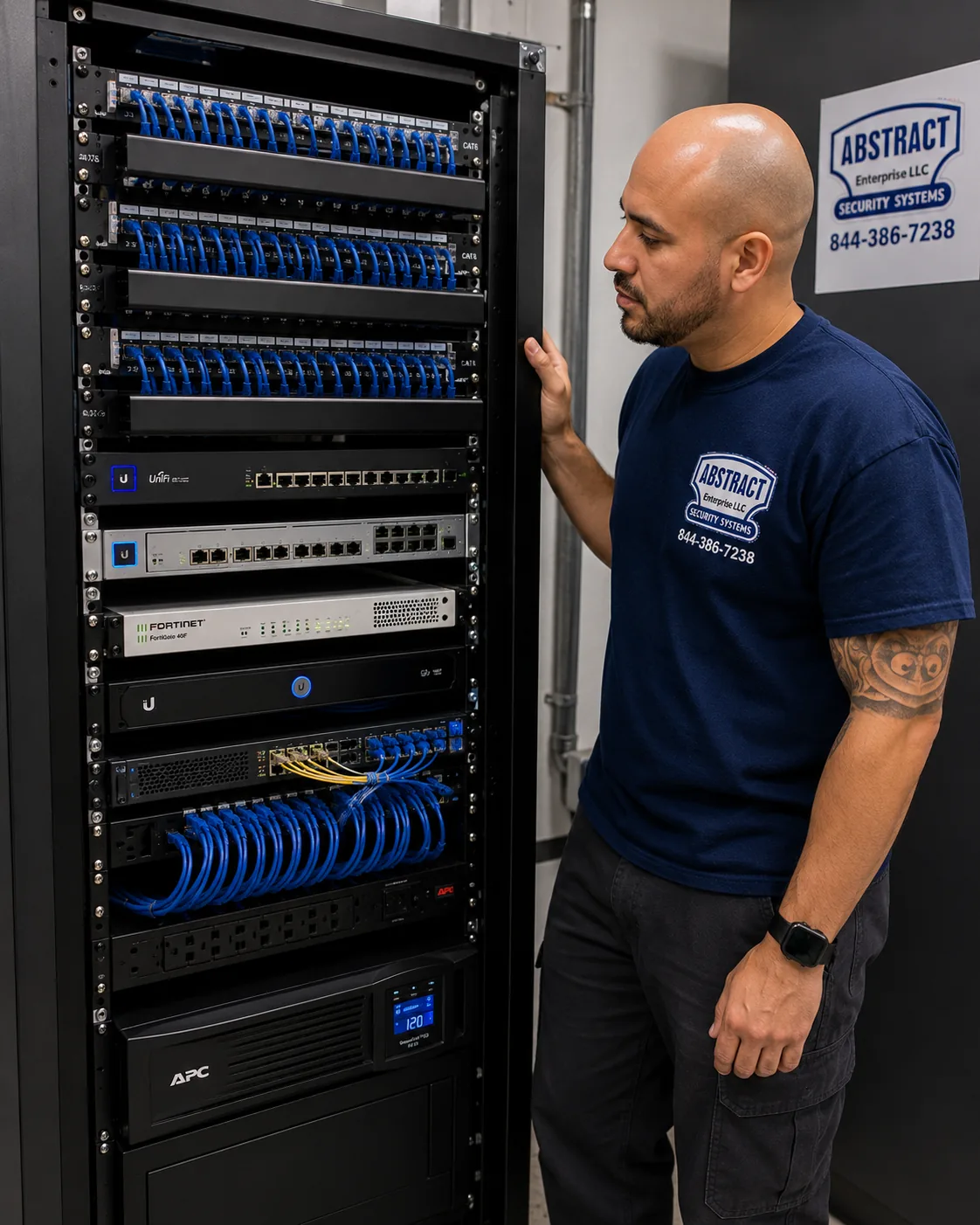
A photo from the AESS job library, not taken in Brownsville: a finished network rack with patch panels, switching, a firewall and a battery backup, every cable dressed and identified. In a Brownsville development office or a new building's telecom closet, the camera recorder and its switch belong in a rack like this, on battery backup and behind a firewall, rather than on a shelf with an open connection to the internet.

National brands versus a local licensed repair

QuestionADT or a similar alarm companyRing or SimpliSafe cameraAESS repair
Works on another company's systemUsually only its ownSupport covers its own devicesAny brand, any installer
Wired cameras, recorders and multi-building linksIts own systemsMostly battery and Wi-Fi devicesYes, from one camera to a campus
Recovering a system nobody can log intoVaries by dealerAccount recovery for its own appYes, for the owner or an authorized manager
Monthly feeOften part of the contractUsually for video historyNone for a repair
Licensed technician on siteVaries by dealerRemote supportYes, NYS license #12000287431
Price before workVariesReplacement device price$150 service call, then a written repair price
AI Overview Reality Check

What AI Gets Wrong About Security Camera Repair in Brownsville

Search assistants answer camera repair questions with national averages and general advice. Some of it holds up in Brownsville and some of it sends people the wrong way. These are the claims we hear repeated most, and what we find on the ground.

"Camera repair in Brooklyn costs about $1,400 on average"

That figure comes from HomeAdvisor's Brooklyn page, which puts the average for surveillance camera installation or repair at $1,416, with a typical range of $680 to $2,145. The trouble is the word "or." Those numbers blend new installations with repairs, so they say little about what it costs to bring one dark camera or a dead drive back.

On our Brooklyn list, most single faults cost $150 to $700: a reterminated connector or a moved PoE port at $150 to $350, a power supply at $150 to $400, a drive at $200 to $450, a replacement camera on a working system at $250 to $600. The $700 to $1,500 range is for a new recorder with every camera set up again, or several cameras rebuilt at once.

The figure that matters is the written price after the diagnosis. The $150 service call is credited to the repair, and you see the full price before any part changes.

"If you rent, ask your landlord, or hire someone to fix the building's cameras"

The first half is right and the second half is wrong for about a third of Brownsville. Residents of NYCHA developments cannot hire anyone to repair NYCHA cameras; the housing authority repairs its own equipment, and the route is a repair ticket through MyNYCHA or the customer contact center.

In developments converted under PACT, the private management company is the owner's representative, and it is the management office, not the resident, that can book outside work. In private buildings, a tenant can report a fault but the owner decides and pays.

What any resident can do is make the report specific: which camera, where, since when, and the ticket or letter date. That is what gets a camera fixed, whoever owns it.

"If the cameras are recording, the system is working"

Recording is half the job. DOI's 2025 review of NYCHA senior buildings found that at 44 of 63 buildings, the cameras could not be viewed remotely, because of login and connection faults, data storage problems, stand-alone boxes and cameras that never had remote viewing.

Private systems fail the same way. The recorder writes video that nobody can reach from outside, keeps only two or three days because the drive is small or the quality is set wrong, or stamps every clip with a clock that is hours off.

A working system is one where the owner can open playback from last night, on a phone, with the right time, and export a clip. That is the test we run before we leave.

Brownsville, Brooklyn camera cable protection: technician running cable into EMT conduit beside a telecom room in an industrial building
A photo from the AESS job library, not taken in Brownsville: a technician running cable into EMT metal conduit beside a telecom room. On a Brownsville building where a camera's cable keeps getting cut, pulled or painted over in a stairwell, cellar or loading area, a short run of conduit like this is often the repair that stops the same camera from failing again.

"Reset the recorder to factory settings to fix it"

This is the advice we most wish people would ignore. A factory reset can clear a frozen menu, but on many recorders it also wipes the camera settings, the user accounts and the remote viewing setup, and on some it prompts the owner to format the drive.

In a building where nobody has the original configuration written down, a reset can turn one fault into a full day of rebuilding. If there was an incident, it can also put the footage you need at risk.

Before any reset, the footage you need should be exported, the settings recorded and the drive checked. That takes a few minutes with the right tools and avoids most of the damage.

"Wireless cameras solve wiring problems in older buildings"

Wireless cameras skip the cable, but Brownsville's buildings are brick, block and concrete, and those walls weaken Wi-Fi sharply. A wireless camera on the back of a walk-up or at the far end of a development hallway often drops off just when it is needed.

Many wireless cameras also store video only in the cloud, so the internet connection and a monthly plan become part of the system. When the internet goes down, so does the recording.

Where cable can be run, a wired camera on a recorder remains the dependable choice here. Wireless has its place, a single hard-to-reach spot or a short-term need, and we use it there.

"Hikvision and Dahua cameras are banned, so the whole system has to go"

The FCC's November 2022 order stopped new equipment authorizations for covered Hikvision and Dahua video surveillance products. As the Security Industry Association summarized it, the action "does not affect any authorized products currently in the U.S. market."

Owning, using and repairing an existing system is still legal. Plenty of Brownsville stores and buildings run on these recorders, and the right repair is often a drive, a power supply or one compatible camera.

The order matters when you are choosing what to buy next. When a recorder is near the end of its life, we discuss replacement options with you then, not as a condition of fixing what failed today.

"Any handyman can swap a security camera"

Hanging a camera is the easy part. The work is in finding why it failed, matching a replacement to the recorder's video type and settings, powering it correctly, sealing the outdoor connection and confirming it records in playback.

New York State also requires a license to install or service security and CCTV systems for others, issued by the Department of State. We work under NYS license #12000287431.

An owner can work on their own system, and plenty do. When the repair is in a building with tenants, a store or a development, a licensed, insured company and a written price protect the owner as much as the cameras.

Not Sure Whose Cameras They Are or What Failed? Ask a Technician First

If you cannot tell whether the problem is the camera, the cable, the power or the recorder, or whether the system is even yours to repair, ask before you spend anything. Call now at (347) 934-8335, send a fast quote request, or send a photo of the recorder screen to a tech on WhatsApp. Same-day estimates are available on most days, and requests are booked within 2 hours.

Get In Touch

Request a Free Quote

Tell us the cross streets, the type of building, who owns the system, how many cameras there are, which ones are out and where the recorder sits. A technician will get back to you with the likely cause and the next step for the Brownsville address, or you can call (347) 934-8335 now.

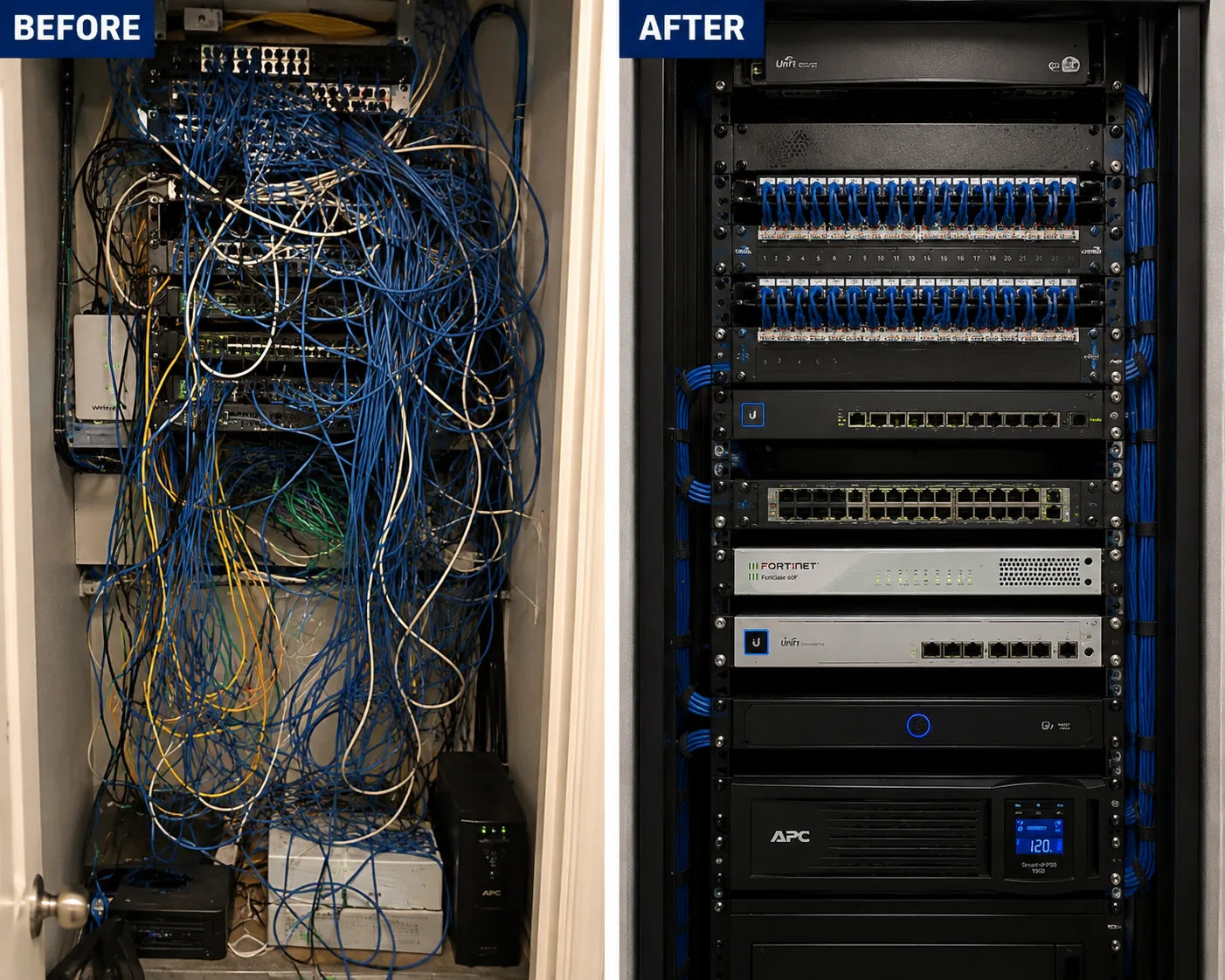
Brownsville, Brooklyn camera system cleanup: before-and-after views of a network rack, an unlabelled tangle rebuilt into a dressed and identified rack
A photo from the AESS job library, not taken in Brownsville: the same network rack before and after, an unlabeled tangle rebuilt into a dressed and identified rack. A Brownsville building that has changed managers two or three times often has a head end like the before picture, and cleaning it up during a repair is what lets the next person find the right cable without unplugging the wrong one.

✅
Request Sent!
Thank you. A technician will contact you about the Brownsville address shortly.
How It Works

Our Repair Process

1. Send the screen and the building

A photo of the recorder screen with the dark tiles, the recorder's label, your cross streets, and what changed first: an outage, a new router, a renovation or a new manager.

2. Confirm whose system it is

Homeowner, landlord, property manager, PACT management company, nonprofit or store tenant: we confirm who owns the cameras and who approves the work before we book.

3. Book the service call

The $150 Brooklyn service call puts the visit on the schedule in a two-hour arrival window, with basement, roof, office or storefront access arranged ahead.

4. Save any footage first

Any clip you need is exported to USB with its original timestamp before anything is unplugged, reset or replaced.

5. Test the chain in order

Power, cable and connectors, switch or power box, recorder and drive, then camera, measured rather than guessed, with shared faults checked first.

6. Cause and a written price

You hear what failed and get a written repair price before any part is replaced, with the service call credited against it.

7. Repair and retest

The failed part is fixed or replaced, outdoor connections are sealed, and every camera is checked live, in playback and after dark where possible.

8. Label and hand over

Traced cables are labeled, logins and phone viewing are confirmed for the people you name, and the notes stay on your job record.

Coverage Area

Security Camera Repair Near Brownsville's Landmarks

Pitkin Avenue

Brownsville's main shopping street and home of the Pitkin Avenue BID, about 212 ground-floor businesses whose cameras watch counters, doors and the sidewalk.

Livonia Avenue and the 3 train

The elevated New Lots Line runs above Livonia Avenue, and storefront cameras near the structure deal with vibration, shadow and grime.

Tilden and Brownsville Houses

The two NYCHA developments across from each other that received dozens of cameras in the 2009 project, now well past the ten-year mark NYCHA cites.

The Van Dyke campus

NYCHA's Van Dyke Houses and the newer Van Dyke III, a 12-story affordable building with 180 homes and a childcare center built on the same campus.

Brookdale University Hospital

The hospital on the neighborhood's southern edge, whose Con Edison feed and backup generator both failed in early 2026.

73rd Precinct station house

The NYPD precinct on East New York Avenue that patrols Brownsville, where requests for camera footage after an incident usually originate.

We also serve the neighborhoods around Brownsville, including Ocean Hill, East New York, East Flatbush, Crown Heights and Canarsie, at the same Brooklyn rate. For the rest of the borough, see our Brooklyn security camera repair page, and for nearby areas our Bed-Stuy security camera repair and Beverley Square camera repair pages.

Pricing

Security Camera Repair Cost in Brownsville

Brownsville is billed at our Brooklyn base rate, with no neighborhood surcharge. These are the published Brooklyn prices behind every number on this page; your exact price is written down after the diagnosis.

RepairBrooklyn price
Service call, on-site diagnosis and written repair price$150, credited to the repair
Motion, alert, app, login or clock settings with no partsUsually within the $150 service call
Clean and check for a blurry picture$80
Connector reterminate or PoE port swap$150–$350
Power supply repair$150–$400
Dome or front cover replacement$30–$80 part plus labor
Indoor camera repair$200–$450
Hard drive swap, by capacity$200–$450
Single camera replaced on a working system$250–$600
Night vision camera repair$250–$650
DVR not working, including drive and labor$300–$700
NVR not recording, by model$400–$900
Vandalized camera, per camera plus cable repair$400–$900
PTZ camera repair$450–$1,200
Hybrid recorder swap, channels reconfigured$700–$1,200
DVR/NVR replacement with drive, or several cameras rebuilt$700–$1,500
Full rewire or whole-building overhaulFrom $1,500
Annual maintenance: residence / commercial / multi-propertyFrom $250 / from $400 / $500–$800
Full terms — including 50% deposit, one-year parts-only warranty on AESS-supplied products, and the late-fee schedule — are set out in the service agreement.

What moves a Brownsville price most is not the neighborhood but the building: how many cameras share the failed part, whether the cable is reachable or buried behind finished walls, whether a recorder has to be recovered before it can be repaired, and whether a part has to be ordered. The written price covers all of that before work starts.

Shop Our Systems

Security Camera Repair Packages & Pricing

Three ways Brownsville repairs usually come together, priced from the Brooklyn list above. Each starts with the $150 service call, credited to the repair, and the written price follows what the diagnosis finds.

Single-issue repair: $150–$700

One fault, one visit: a power box or adapter replaced after an outage, a dead PoE port moved, a drive swapped, a connector redone, a painted dome replaced, a gate-glare camera moved, or one camera replaced on a working system.

Major system repair: $700–$1,500

The recorder, the access or several cameras at once: a DVR or NVR replaced with a new drive and every camera set up again, a hybrid recorder so older coax cameras can stay, a locked-out system recovered and documented, or several runs re-pulled after renovation.

Annual maintenance: $250–$800

A yearly visit: lenses cleaned, connectors and seals checked, drive health and battery backup tested, firmware reviewed, clock and retention confirmed and alerts tested, from $250 for a house, from $400 for a store or building, and $500 to $800 for managers with several properties.

Bring your own equipment. If you have already bought a replacement camera or recorder, we can fit it at labor-only rates. Tell us the exact model and we quote the labor by phone or text, and the visit is booked once it is paid. Equipment you supply is installed as supplied; the AESS terms above cover AESS-supplied products.

Complete Services

Every Security Camera Repair Service in Brownsville

Camera, cable and recorder repair

Dark cameras, failed runs, worn drives and recorders that lost their settings. Request a repair

Brooklyn-wide repair

Owners and managers with houses or buildings elsewhere in the borough. Security camera repair in Brooklyn

Brooklyn repair prices

The full list behind every number on this page. Brooklyn camera repair prices

Citywide repair

Property managers and nonprofits with sites in more than one borough. NYC security camera repair

FAQ

Brownsville Security Camera Repair FAQ

A camera cable runs through a tenant's apartment. Do we have to give the tenant notice before the technician works there?
+

Yes. Entering an occupied apartment needs the tenant's agreement or the notice your lease requires, so arrange the date with the tenant before you book. We schedule the apartment part of the work inside the two-hour arrival window you agree with them and keep it as short as possible, and we can often test from the hallway or the cellar first so the visit inside is only needed if the cable truly failed there.

Can the repair be billed to our property management company instead of to us?
+

Yes, as long as the management company approves the work in writing before the visit. We send the service call and the written repair price to whoever holds the account, and the job is booked once the service call is paid. Tenants and board members can describe the problem and give access, but the approval and the payment come from the party that owns or manages the system.

Can you give us an itemized repair price we can send to a funder or a grant program?
+

Yes. After the diagnosis we can write the price out line by line, parts and labor for each camera, recorder, drive or cable run, with a short description of the condition we found. Nonprofits, churches and tenant-run organizations often use that to ask a funder or an elected official's office for money. The price is ours; whether a program pays for it is up to the program.

Our recorder makes a clicking noise every few seconds. Is the footage at risk?
+

It may be. A steady click or tick from inside a recorder is often a hard drive struggling to read, and a failing drive can stop recording or lose what it holds without much more warning. If there is footage you need, tell us when you book so we copy it off first, then we test the drive's health and replace it if it is failing, which runs $200 to $450 by capacity on our Brooklyn list.

Can you repair the cameras at our block's community garden, where there is no indoor room for a recorder?
+

Yes. Garden and lot cameras usually fail at the power source, a weather-exposed outlet or a solar panel and battery that no longer hold a charge, or at the cellular or Wi-Fi connection they use to send video. We find which, repair or replace that part, and put any recorder in a locked weatherproof box. The group that runs the garden needs to approve the work and say who holds the login.

The store tenant and the landlord both use the same cameras. Who pays for the repair?
+

Whoever owns the system or the lease makes responsible for it, which is a question for your lease, not for us. In practice we bill whoever approves the work in writing, and if both sides agree we can price splitting the shared recorder into two systems, one for the store and one for the building, so each side controls and pays for its own cameras from then on.

Should the repair include signs saying the property is under video surveillance?
+

It is a good time to check them. Clear signs at entrances discourage some trouble on their own, and for businesses New York's labor law requires employers who watch employees by video to give notice, so a store or office should have the notice posted and acknowledged. We can point out where signs belong as we test the cameras; the wording of employee notices is a matter for the employer.

Do cameras in a laundry room or trash room fail faster because of the humidity?
+

They can. Steam from dryers and moisture in compactor and trash rooms condense inside housings and on connectors, and the picture fogs or the connection corrodes years earlier than in a dry hallway. For those rooms we use cameras rated for damp locations, seal the cable entry and keep the connector out of the wettest air, and we check them first when a building has several dark cameras.

What happens if you find the problem is the building's electrical wiring?
+

We stop at the camera system. We do not do electrical work, so if a camera's outlet is dead, a circuit keeps tripping or the building's wiring is unsafe, we show you what we found and you call a licensed electrician. We finish everything on the low-voltage side, such as moving the recorder to a working outlet or adding a battery backup, so the cameras are ready once the electrician is done.

Can our front desk watch the cameras live without being able to delete or export footage?
+

Yes, on almost every recorder. We set up separate user accounts with different permissions, so desk staff or a guard can see live video and perhaps playback, while only the manager or owner can export clips, change settings or delete anything. Each person gets their own login, which also means access can be removed when someone leaves without changing everyone else's password.

What is the difference between a repair visit and a maintenance visit?
+

A repair visit fixes a fault you already have, a dark camera or a recorder that stopped saving. A maintenance visit is scheduled when nothing is obviously wrong, to clean lenses, check connectors, seals and drive health, test the battery backup and confirm alerts, so faults are caught before you need a clip. Maintenance starts at $250 a year for a house and $400 for a store or building.

Can you test how our cameras look at night without coming back after dark?
+

Usually yes. We can force each camera into its night mode during the day, cover its light sensor or darken the area where possible, and check the infrared picture, glare and range on the spot. We also review last night's recordings on the recorder, which shows how each camera really performed in the dark. Only a few outdoor views that depend on street lighting need a check after sunset.

More Security Camera Repair near Brownsville

Security Camera Repair Brooklyn | Same-Day | Brownstone Pros · Security Camera Repair NYC | Same-Day | Abstract Enterprises · Security Camera Repair Manhattan | Same-Day | Co-op COI · Security Camera Repair Queens | Same-Day | Driveway Pros · Security Camera Repair Bronx | Same-Day | Home Base · Security Camera Repair Staten Island | Same-Day | Sandy Zone · Security Camera Repair Long Island | Nassau & Suffolk · Security Camera Repair Hudson Valley | Westchester to Ulster · Security Camera Repair Nassau County | Same-Day · Security Camera Repair Suffolk County | Hamptons + East End · Security Camera Repair Westchester County | Same-Day · Security Camera Repair Rockland County NY | Nyack, Suffern · Security Camera Repair Orange County | Newburgh, Goshen · Security Camera Repair Putnam County NY | Carmel, Mahopac · Security Camera Repair Dutchess County | Poughkeepsie · Security Camera Repair Ulster County | Kingston Woodstock

Security Camera Repair Bath Beach Brooklyn NY · Security Camera Repair Bay Ridge Brooklyn NY | AESS · Security Camera Repair Bedford-Stuyvesant Brooklyn NY · Security Camera Repair Bensonhurst Brooklyn NY | AESS · Security Camera Repair Bergen Beach Brooklyn NY · Security Camera Repair Beverley Square Brooklyn NY · Security Camera Repair Boerum Hill Brooklyn NY · Security Camera Repair Borough Park Brooklyn NY · Security Camera Repair Brighton Beach Brooklyn NY · Security Camera Repair Brooklyn Chinatown Brooklyn NY · Security Camera Repair Brooklyn Heights, Brooklyn NY · Security Camera Repair Brooklyn Navy Yard, Brooklyn NY · Security Camera Repair Bushwick Brooklyn NY | AESS · Security Camera Repair Cadman Plaza Brooklyn NY

Other services in Brownsville

Structured Cabling Installation Brownsville Brooklyn NY · Alarm Installation Brownsville Brooklyn NY · Door Buzzer Installation Brownsville Brooklyn NY · Intercom Installation Brownsville Brooklyn NY · Door Buzzer Repair Brownsville Brooklyn NY · Fire Alarm Installation Brownsville Brooklyn NY · TV Installation Brownsville Brooklyn · Security Camera Installation Brownsville Brooklyn NY · Access Control Installation Brownsville Brooklyn NY

Ready to See Every Brownsville Camera Recording Again?

Send a photo of the recorder screen, the cross streets and who owns the system, and we will tell you what most likely failed and what that kind of repair costs on our Brooklyn list. The $150 service call is credited to the repair, the price is written down before any part changes, and requests are booked within 2 hours. Abstract Enterprises Security Systems has been owner-operated since 2002, holds NYS license #12000287431, is rated 4.7★ across 201 Google Reviews, and dispatches Brooklyn crews from our Troy Avenue office.

Prefer to send photos? Message a technician on WhatsApp.