Cameras still dark since the last Con Edison outage, a recorder nobody in the building can log into, or a clip you need from last night on Knickerbocker, Myrtle or Broadway? Bushwick camera repair line, booked within 2 hours: (347) 934-8335
Six-Family Walk-Ups · Converted Factory Lofts · Frame Houses With Siding · Bushwick Avenue Mansions · Stores Under the J and M
Security Camera Repair in Bushwick
Any Brand, Any Installer · Footage Saved Before Anything Is Touched · Written Price Before Parts · Brooklyn Rate
Security camera repair in Bushwick starts with our $150 Brooklyn service call: a licensed technician comes out, finds the fault, writes down the repair price, and the $150 is credited to the repair if you go ahead. On our published Brooklyn list most single faults cost $150 to $700, and a new recorder, a partial rewire or several cameras done at once runs $700 to $1,500. We repair systems other people installed, in walk-ups off Wilson Avenue, loft buildings near Morgan Avenue, frame houses on the side streets and storefronts under the Broadway and Myrtle els. Requests are booked within 2 hours, visits come in a two-hour arrival window, and you hear what failed before anything is replaced.
Every price on this page comes from our published Brooklyn camera repair list, and your repair price is written down before work starts
Rated 4.7★ across 201 Google Reviews
Reviewed and updated November 12, 2026, against News 12 Brooklyn's report on the August 7, 2025 manhole fire at Irving Avenue and Jefferson Street; BK Reader's February 2026 report on the Con Edison outage in parts of Bushwick; News 12's July 2026 Brooklyn outage tracker and Con Edison's heat-wave voltage reduction; Brownstoner's July 2026 report on neighbor's security video from the South Bushwick Reformed Church fire at 855 Bushwick Avenue; News 12's July 2026 report on rugs taken from a Cook Street shop at 2 a.m.; News 12's May 2025 report on store video from 937 Broadway; News 12's February 2026 report on break-ins in a Myrtle Avenue building near Stockholm Street; Brooklyn Post on the 2018 break-in at 1087 Flushing Avenue; DNAinfo on the 2016 crowbar break-in at 785 Broadway; News 12 on the 2023 designation of the Linden Street Historic District; the Landmarks Preservation Commission Permit Guidebook; Brick Underground on tenants and landlord footage; Reolink's guidance on cameras that go offline; HomeAdvisor's Brooklyn cost page; and the New York Department of State on security system licensing. · Abstract Enterprises Security Systems, NYS license #12000287431 · crews dispatched from our Troy Avenue office in Brooklyn
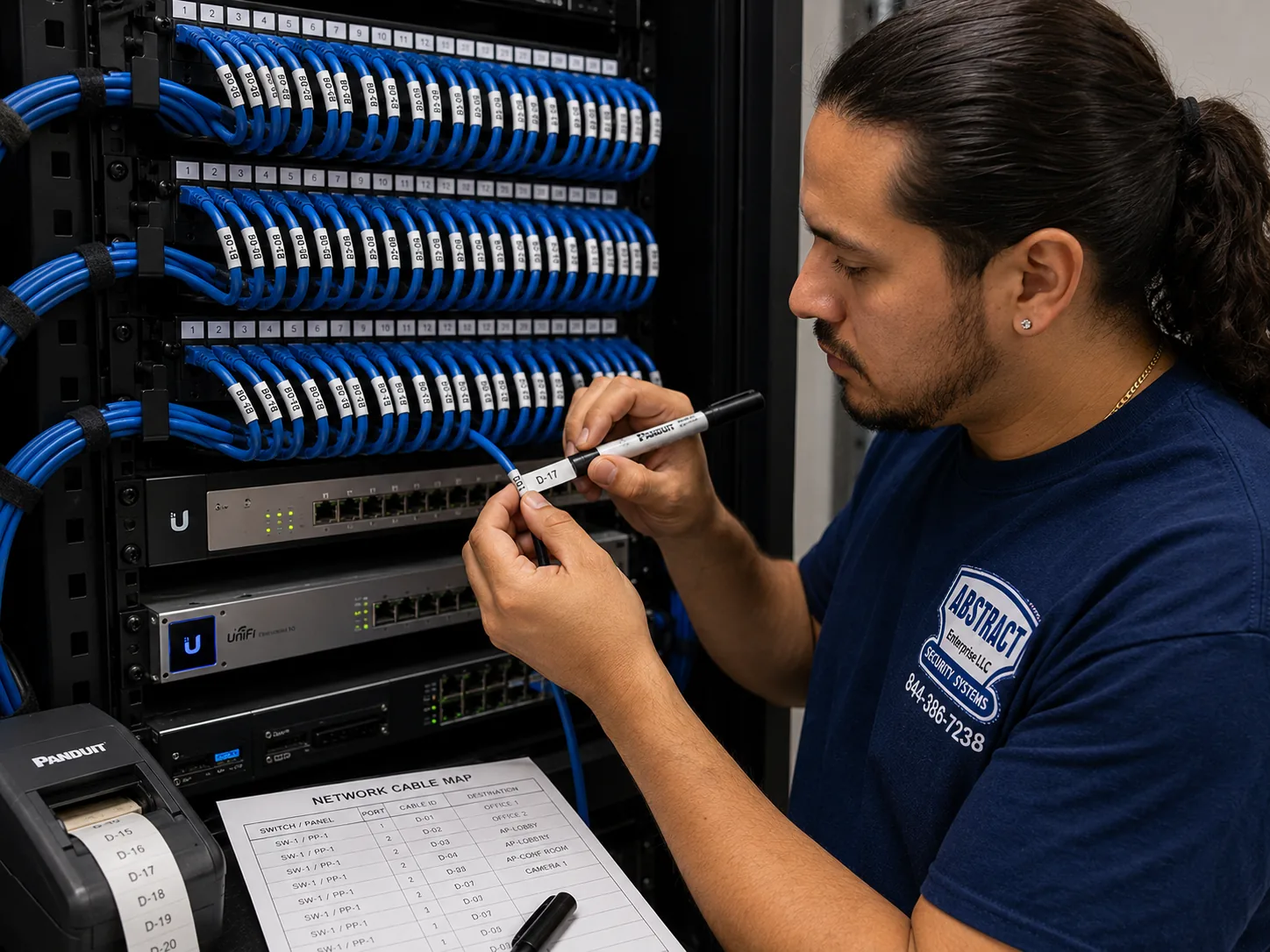
A photo from the AESS job library, not taken in Bushwick: a technician printing labels for each cable at a patch panel, with a printed port map alongside. Bushwick buildings tend to collect camera systems in layers, one from a landlord, a few cameras from a store tenant, more from loft residents, and nobody writes down which cable is which. Labeling the recorder end on the first visit is what makes every later repair quicker and cheaper.
Bushwick Camera Repair Request
Walk-up, loft, frame house or store: tell us the cross streets and what the screen shows, and a technician gets back to you with the next step
✅
Request Sent!
Thank you. A technician will contact you about the Bushwick address shortly.
25+
Years Experience
✓
Same-Day Estimates
100%
Licensed & Insured
4.7★
201 Google Reviews
Owner-operated since 2002 · Thousands of jobs completed · Booked within 2 hours
Most Bushwick camera calls come down to one question we can often answer from a photo: did the cameras fail, or did the things that feed them fail? In this neighborhood the second answer is the more common one. The power on a block drops, the recorder in the cellar or the hall closet restarts, the network switch that powers half the cameras comes back with dead ports, and the owner sees black tiles and assumes the cameras are gone. Or the building changes internet provider, the phone app loses the recorder, and the cameras look dead from the phone while they are recording perfectly well on the monitor. A photo of the recorder screen, the label on the recorder and the cross streets usually tell us which kind of call it is. Send them to (347) 934-8335 or on WhatsApp, and we will tell you what most likely failed and what that repair costs on our Brooklyn list.
Looking at your photos costs nothing. The $150 service call is paid when you book and is credited to the repair if you go ahead.
All work is done under New York State license #12000287431, and a certificate of insurance for a landlord, managing agent or loft building can be arranged before the visit.
We repair any brand and any installer's work, and we tell you plainly when a part is not worth fixing.
The Neighborhood
Why Bushwick Properties Need Security Camera Repair
Bushwick is not a neighborhood of single, tidy camera systems. It is a neighborhood of buildings that have changed hands, changed use and changed tenants many times, and the cameras on them show it. A six-family walk-up on Wilson Avenue may have a recorder the landlord bought ten years ago, a doorbell camera a tenant added, and two cameras from a store downstairs, none of them talking to each other. A converted factory near Morgan Avenue may have a building system in the lobby and a dozen private cameras put up by the people who live and work in its units. A frame house on a side street may run its cameras over Wi-Fi from a router in the second-floor apartment. When something stops working, the first job is usually working out what is there, who owns it and where it is wired back to.
The second thing that shapes repairs here is power. On the evening of August 7, 2025, a manhole fire in front of 18 Irving Avenue, at Irving and Jefferson Street, cut power to about 240 customers at its height, and News 12 Brooklyn reported that 18 Irving Avenue was still without power the next evening. "The lights started flickering then there was a very loud pop outside and everything just went dark," a witness, Harris Smith, told the station. In February 2026 it happened again on a larger scale: BK Reader reported that hundreds of Con Edison customers lost power on a Saturday night in Bushwick, after the utility found "an electric problem in some parts of Bushwick in Brooklyn" and said, "We had to shut off power temporarily to prevent more extended outages." In the July 2026 heat wave, News 12 counted more than 1,500 Brooklyn customers without power on a Sunday morning, and Con Edison said it had reduced voltage in parts of the city to protect the system. Each of those events is hard on a camera system. A recorder that loses power while writing to its drive can lose its recordings or its settings, a network switch can come back with dead ports, and a cheap power box can fail when the current returns.
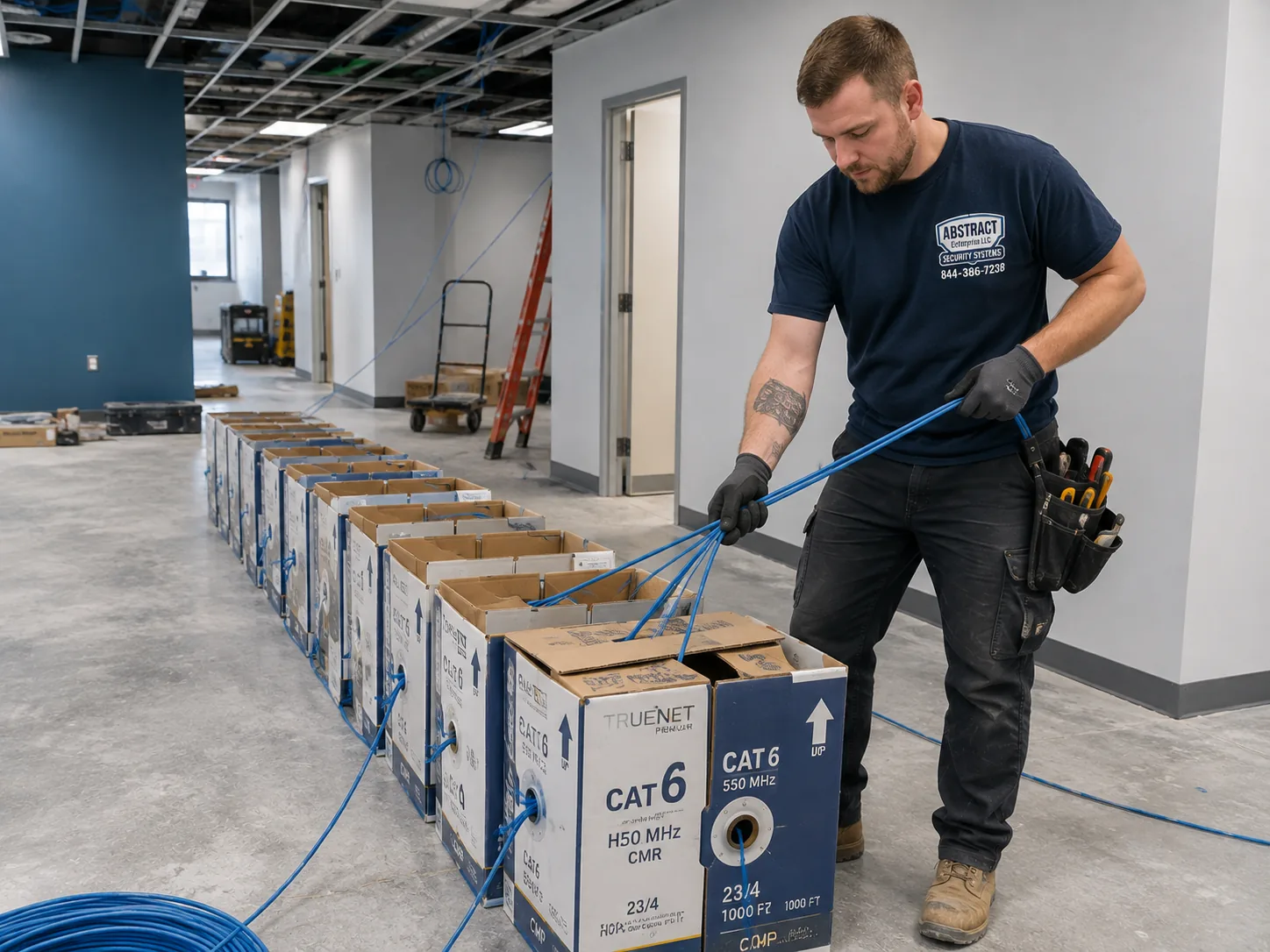
A photo from the AESS job library, not taken in Bushwick: boxes of cable staged together for a pull with several drops, in a building that stays open during the work. Most Bushwick repairs need no new cable at all. When they do, it is usually a run that a renovation cut, a run along the outside of a frame house that the weather has cracked, or a run inside a loft that a tenant's build-out boxed in, and having the right cable on hand keeps that to one visit.
The third thing is what the footage is for. In Bushwick, camera video regularly turns into the only account of what happened. In July 2026 News 12 reported that a woman took five rugs worth about $4,000 from the balcony of Chyelle, a vintage furniture store and cafe on Cook Street, and that "surveillance video shows a woman arriving at Chyelle" around 2 a.m.; a detective told the owner she came back three times and used a hand truck. In June 2026, after a fire at the South Bushwick Reformed Church at 855 Bushwick Avenue, Brownstoner reported that "security video from a property neighboring the church shows a person making repeat trips" along the Stanhope Street side, and that the longtime resident who owned that camera had shared it with city investigators. In May 2025, News 12's account of a stabbing inside a discount store at 937 Broadway was built almost entirely from the store's own video, beginning with a man buying a knife at about 10:30 a.m. And in February 2026, when armed men walked into two apartments in a building on Myrtle Avenue near Stockholm Street just after 2:15 a.m., News 12's report made no mention of any video at all. Footage helps only when the camera was recording, the clock was right and the picture was good enough to use. Repairs here are mostly about making sure all three are true on the night it matters.
The buildings themselves are the fourth factor. The community board's history of Bushwick describes a neighborhood of two- to six-family houses, large apartment houses built in the 1920s, and mansions along Bushwick Avenue built between 1880 and 1913 for brewers and doctors. Many of the early houses are wood frame, so a camera on one of them is fixed to wood or siding rather than brick. North of Flushing Avenue and around Morgan Avenue, factories have been turning into lofts and studios since the 1990s, and the McKibbin Lofts at 248 and 255 McKibbin Street alone housed about 400 people when Untapped Cities wrote about them in 2012. The J and Z run over Broadway and the M over Myrtle Avenue, and in 2023 the Landmarks Preservation Commission designated the Linden Street Historic District, one block on Linden Street and Bushwick Avenue with 32 late-19th-century brownstone houses.
Finally, Bushwick is a neighborhood of renters. Most people who live here do not own the cameras on their building, and many do not know who does. Brick Underground, answering a Brooklyn renter whose packages kept disappearing, noted that New York City does not require buildings to have security cameras and that a landlord is not obliged to show tenants footage outside a legal process, while attorney Catherine Grad said of asking a landlord to review footage during ongoing thefts, "I don't think that it's such an arduous duty to impose on the landlord." In practice, a Bushwick repair often starts with a tenant who noticed the camera was dead and a landlord who agrees to pay for it. We work with both, but the person who controls the recorder approves the work.
Six Bushwick facts that shape a camera repair
Outages hit the head end. The August 2025 manhole fire at Irving Avenue and Jefferson Street cut about 240 customers at its height, and Con Edison shut power off on purpose in parts of Bushwick in February 2026. Recorders, drives, switches and power boxes take the damage, not usually the cameras.
Video is often the only record. The 2 a.m. rug theft on Cook Street, the church fire on Bushwick Avenue and the stabbing at 937 Broadway were all reconstructed from security cameras, two of them belonging to someone other than the victim.
The building stock is mixed. Two- to six-family houses, 1920s apartment houses, Bushwick Avenue mansions, wood-frame houses and factory lofts sit within a few blocks of each other, and each wires cameras differently.
Two elevated lines run through it. The J and Z over Broadway and the M over Myrtle shade storefront doorways by day and drop grime from the steel onto cameras below.
One block is landmarked. The Linden Street Historic District, designated in May 2023, covers 32 brownstones on Linden Street and Bushwick Avenue, and Landmarks rules apply to camera mounting there.
Most residents rent. City buildings are not required to have cameras, so a dead hallway camera stays dead until someone who controls the recorder decides to fix it.
Where this page applies. It covers Bushwick in Brooklyn Community District 4, bounded by Flushing Avenue, Broadway, the Queens line and the Cemetery of the Evergreens, across ZIP codes 11206, 11207, 11221 and 11237. That includes the Knickerbocker, Wyckoff, Myrtle and Broadway shopping strips, the loft blocks near Morgan Avenue, and the side streets between them. Neighboring Bedford-Stuyvesant security camera repair has its own page, Ridgewood across the line is covered on our Queens security camera repair page, and the whole borough is on our Brooklyn security camera repair page. The price follows the fault, not the block.
Same-Day Repair in Bushwick
Need Repair in Bushwick? Dark Cameras After an Outage, a Clip You Need Tonight, or a Recorder Nobody Can Log Into
Urgent calls from Bushwick fall into three groups. The first comes the morning after an outage: the lights are back, but half the cameras are not, or the recorder is beeping, or it has started up on its setup screen as if it were new. The second comes after something happens: a package, a bike or a delivery is gone, a store window is broken, someone was let into the building at night, and the person who opens the app finds the camera that should have seen it is dark or blurred. The third comes when a building changes hands or managers, and the new owner discovers that nobody has the recorder's password, the previous super's phone still gets the alerts, and the app shows nothing.
If you need footage, protect it before anything else. Do not restart the recorder, do not unplug it to "reset" it, and do not accept a prompt to initialize or format its drive, because each of those can erase or overwrite the hours you need. Call (347) 934-8335, give us the date and the time window, and we book the visit with saving that clip as the first task. We export it to a USB drive in the recorder's own format and in a common video format, note the recorder's clock against real time, and only then start looking for the fault. If the recording never happened because the drive had stopped writing weeks earlier, we tell you straight away, and then we set the system to warn you the next time it stops.
For everything else the path is the same. The $150 service call is booked within 2 hours of your request and the visit comes in a two-hour arrival window. You hear the cause and get a written price before any part changes. Most single faults, a dead power box, a failed switch port, a connector redone, a drive swapped, a camera body replaced, are finished on the first visit when the part is on the truck. If a camera has to be ordered to match an older recorder, we tell you before you pay for it, and the repair is booked once the part is in.
What We Install
Security Camera Repair Services in Bushwick
These are the repairs we do most in Bushwick, each priced from our Brooklyn camera repair list. The service call pays for finding the fault. The repair is priced by what failed, never by the address.
Outage and surge recovery
Recorders that came back on their setup screen, switches with dead ports, power boxes that failed when the current returned, and drives that stopped writing after an outage. A drive swap runs $200 to $450 by capacity, and power supply repair $150 to $400.
Recorder access and handover
Recorders whose password left with a previous owner, super or tenant, and phones that still get alerts from a building that changed hands. Where no parts are needed, regaining access and resetting accounts is usually covered by the service call.
Connector and cable faults
Plugs at the camera end that worked loose or corroded, cables cut by a renovation, and runs along a frame house cracked by sun and frost. A reterminate or PoE port swap runs $150 to $350.
Recorders that will not record
Analog DVRs and network NVRs that beep, reboot, freeze or play back nothing. A DVR that will not work averages $300 to $700 with the drive and labor, and an NVR that is not recording $400 to $900.
Night pictures that cannot identify anyone
Cameras that turn a passer-by into a smear, wash out under a streetlight or glow back at their own infrared. Night vision camera repair runs $250 to $650 on our Brooklyn list.
Storefront cameras under the els
Door cameras on Broadway and Myrtle that see a silhouette by day, streak with grime, or point at the wrong spot after a gate or awning job. Re-aiming and settings with no part are covered within the $150 call.
Phone apps and remote viewing
Apps that lost the recorder after an internet change, roommates and family who need their own logins, and store owners who want to see a second location. Configuration with no parts is normally within the service call.
Footage search and export
Finding a few minutes in a night of video, then saving it to USB with the original timestamp, for the 83rd Precinct, an insurer, a landlord or an investigator.
Damaged and replaced cameras
Cameras with water inside, cracked domes, or bodies that simply died. Outdoor camera replacement with the weatherproofing redone runs $250 to $600, an indoor camera $200 to $450, and a vandalized camera $400 to $900 plus any cable repair.
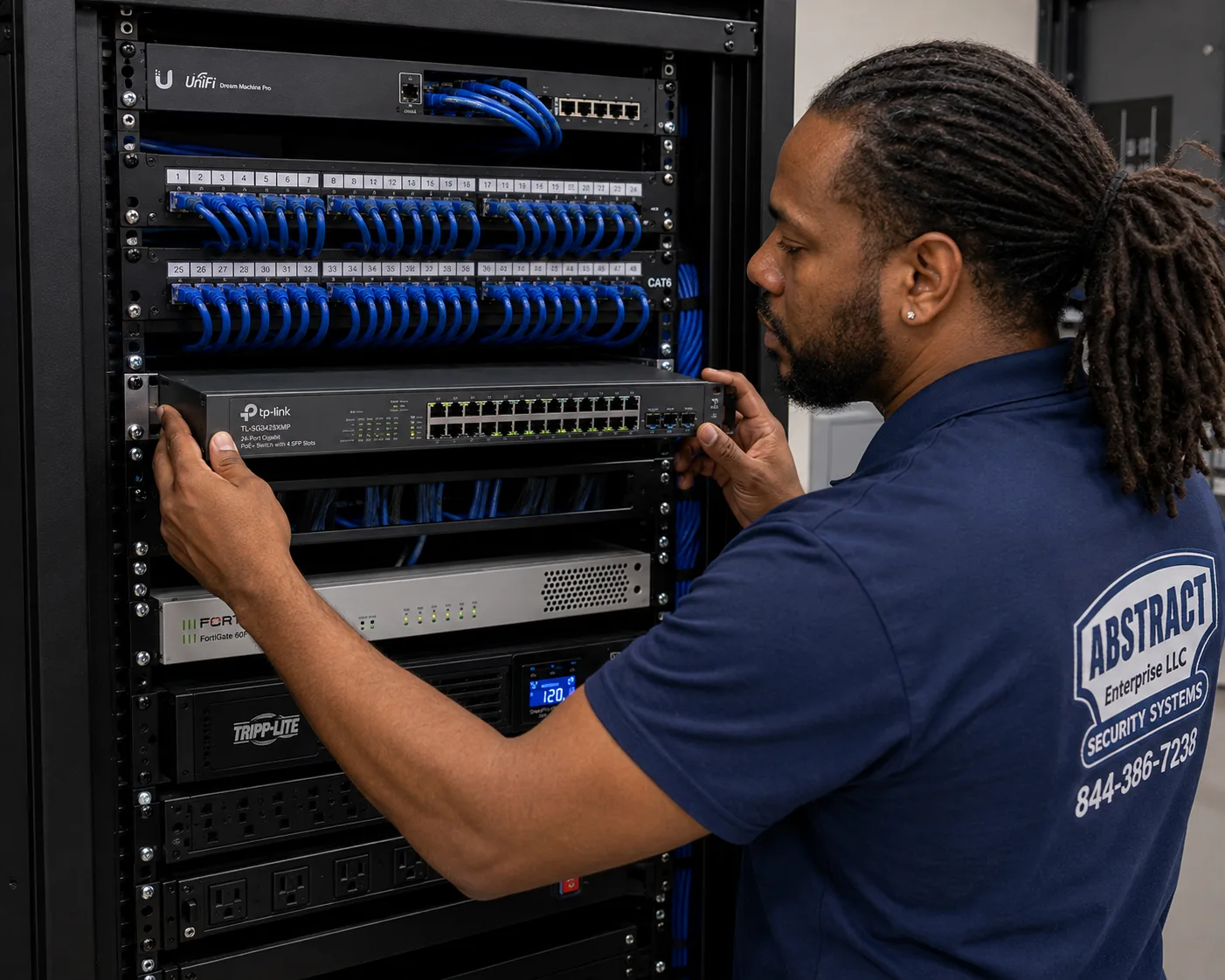
A photo from the AESS job library, not taken in Bushwick: a technician mounting a managed PoE switch below the patch panels in a commercial rack. In a Bushwick loft building or a large walk-up with network cameras, a switch like this powers every camera over its data cable. After a block outage it is the first thing we test, because a switch with a few dead ports looks exactly like a handful of dead cameras.
Building Specialists
Security Camera Repair for Bushwick's Architecture
Seven kinds of property account for nearly every camera call we take in Bushwick. What separates them for a repair is where the recorder ended up, how the cable reaches the cameras, and how many different people put equipment on the same building.
The six-family walk-up
Three- and four-story brick buildings with a vestibule, a stair hall, a cellar and a roof door, with cameras at the entrance, in the hall and at the back, wired to a recorder in the cellar or a hall closet.
The 1920s apartment house
Larger buildings from the 1920s with a lobby, long halls and courtyards, where cameras were added floor by floor and the recorder sits near the boiler room or in the super's space.
The two- and three-family house
Brick and frame houses on the side streets with one recorder serving every household, cameras on the stoop, the alley and the yard, and a router that may belong to whoever lives on the top floor.
The frame house with siding
Wood houses whose cameras are screwed through siding and trim, with cable entering the wall through drilled holes that weather opens up over the years.
The Bushwick Avenue mansion
Large brewer-era houses on Bushwick Avenue and around Irving Avenue, many cut into apartments, with tall ceilings, deep cellars and wiring that crosses several units.
The converted factory loft
Former factories and warehouses near Morgan Avenue and in the blocks north of Flushing, with concrete and steel, freight elevators, a building system in the lobby and private cameras in the units.
The mixed-use building on a shopping strip
A store at street level on Knickerbocker, Wyckoff, Myrtle or Broadway with apartments above, the shop's own cameras and the building's sharing walls, risers and sometimes a recorder.
The six-family walk-up: the recorder in the cellar and the cameras on three floors
The six-family brick walk-up is the standard Bushwick apartment building, and its camera system is usually the landlord's. The cameras sit over the outer door, inside the vestibule, in the stair hall and sometimes at the back yard or roof door, and their cables run down the stair hall to a recorder in the cellar, next to the meters, or in a locked hall closet. That location is the root of many faults. Cellars are damp, closets get hot, and both are places where the recorder shares a power strip with a boiler control, a router or whatever a tenant plugged in. When the power on the block drops, the recorder goes down with no warning, and if it was writing to the drive at that moment, the file system can be damaged.
The repair in a walk-up usually begins at that box. We check whether the recorder is actually recording, whether its clock is right, whether the drive reports any errors, and what the power strip and battery backup look like. Then we go up the stairs camera by camera. We label each cable as we go, so the next call about the same building starts with a map instead of a guess, and we tell the landlord in writing whether the recorder should move somewhere drier or cooler.
The 1920s apartment house: cameras added by different hands over the years
The bigger apartment houses that went up in Bushwick in the 1920s have lobbies, long corridors and more doors, and they have collected cameras the same way they collected wiring: one improvement at a time. A lobby camera from one installer, a mailbox camera from another, a set of hall cameras from a third, sometimes on two recorders that nobody has looked at together. When a tenant says "the cameras are down," it is common to find that one recorder is fine and the other has been dead for months. On these buildings we inventory both recorders, trace which camera goes to which, and fix what failed. If it makes sense to bring everything onto one recorder, that is a separate written price that the owner can approve on its own.
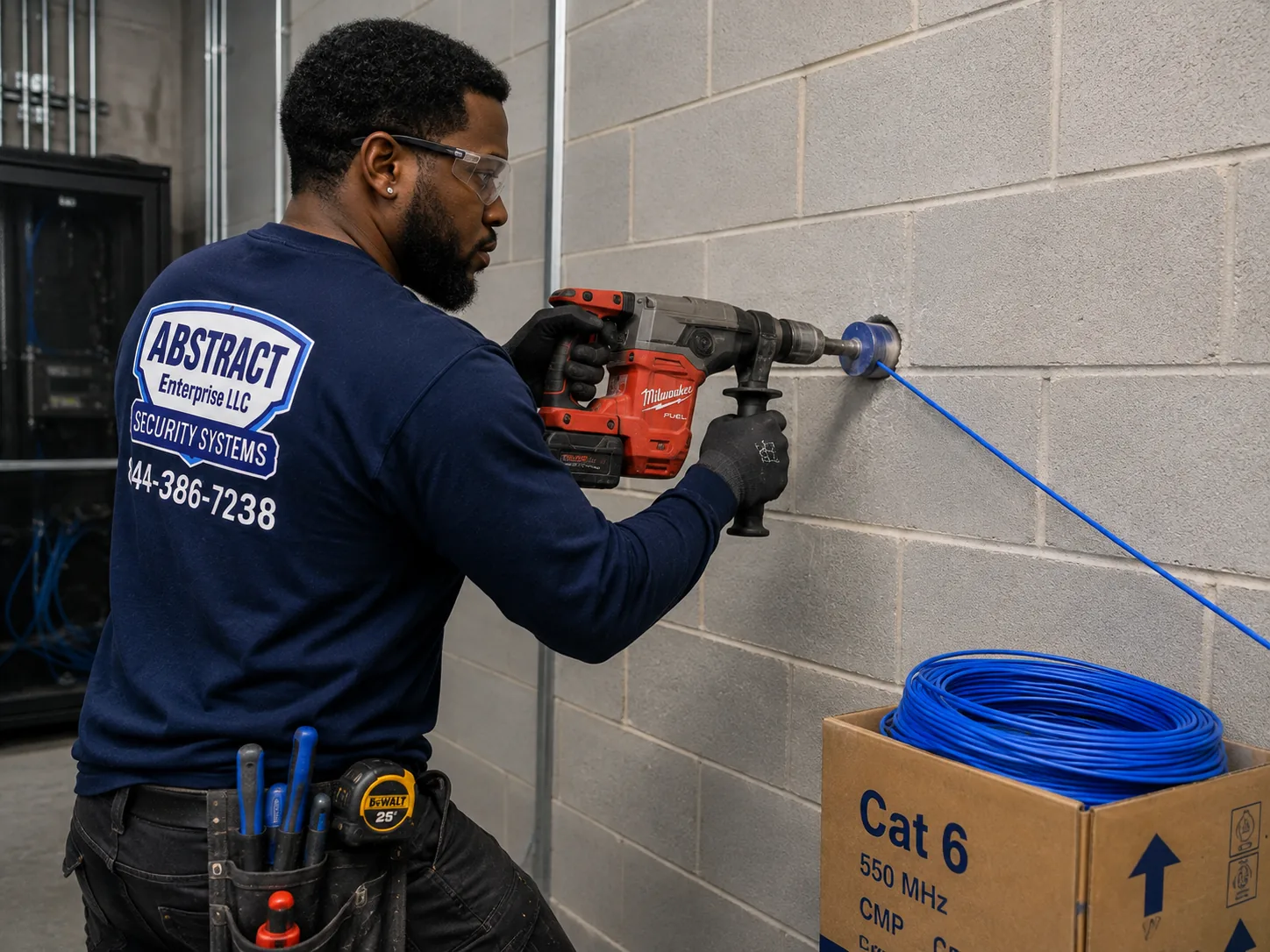
A photo from the AESS job library, not taken in Bushwick: a technician core drilling a concrete block wall to carry cable through to a network room. In a Bushwick loft or apartment house, a clean pass-through like this is how a recorder leaves a damp cellar or a tenant's unit for a locked room the owner controls, with the existing camera cables extended to follow it instead of being cut.
The two- and three-family house: one system, several households
On the side streets between the shopping strips, two- and three-family houses are the most common building, and their cameras usually belong to the owner who lives in one of the units. The recorder sits wherever that owner put it, often in the cellar or their own closet, and the cameras watch the stoop, the alley down the side and the yard. The fragile link is often the internet. Many of these systems reach the owner's phone through a router in someone else's apartment, so when a tenant moves out and cancels their service, the cameras keep recording but vanish from the owner's phone. We check that first, because it is cheaper than any camera, and we can move the recorder onto the owner's own internet connection so a tenant's move no longer takes the app with it.
The frame house with siding: water, wood and holes in the wall
Many Bushwick houses are wood frame; the New York Times described it in the mid-1960s as "a neatly maintained community of wood houses," and many of them still stand. On these houses the cameras are fastened through siding into wood, and the cable usually enters the wall through a hole drilled beside the camera. Over a few winters that hole opens up, the sealant cracks, and water runs along the cable into the wall and sometimes into the camera's own connection. The symptoms are a camera that drops out after heavy rain, a picture that flickers in wet weather, or a stain on the wall inside. The fix is not just a new camera. The camera goes back on a proper mounting block that sits flat on the siding, the screws go into solid framing, the cable enters through a sealed fitting with a drip loop below it, and old holes are filled so water cannot follow them in.
The Bushwick Avenue mansion: big rooms, deep cellars and cable through several apartments
The community board's history describes the mansions along Bushwick Avenue as built between 1880 and 1913 for brewers and doctors, and the Landmarks Preservation Commission has called the group at Bushwick Avenue and Linden Street one of the finest of its kind in the city. Many of these houses are now divided into apartments. That makes camera repair a puzzle of access: the original wiring may run up through a closet in one unit, across a ceiling in another and out to a camera on the porch roof, and the recorder may still be in the owner's former apartment. Before the visit we ask which units we will need to enter, so the owner can give notice to tenants, and we plan the trace so we open as few doors as possible. Where the house is inside the Linden Street Historic District, we keep the replacement camera in the same position and on the same mounting points wherever they are sound, so the repair stays an ordinary maintenance job.
The converted factory loft: concrete, steel and cameras from many owners
Bushwick's loft buildings are the hardest camera systems in the neighborhood to repair, and not because of the equipment. Untapped Cities described the area around Morgan Avenue in 2012 as a place where factories had been turning into lofts since the 1990s, and Brownstoner reported office conversions under way or planned on Moore Street, Cook Street, Johnson Avenue, Jefferson Street and Evergreen Avenue in 2016. These buildings have thick concrete floors and steel frames that stop Wi-Fi cold, long corridors, freight elevators and loading docks. The landlord usually has a system covering the lobby, the elevator and the dock. Then the residents and studio tenants add their own cameras on their doors and inside their units, some wired to the building's network and some on their own Wi-Fi, and over time the line between the building's system and everyone else's gets lost.
On a loft repair we start by drawing that line: which cameras belong to the building, which recorder they go to, and which are tenants' devices. Then we fix the building's system and tell tenants honestly when their own Wi-Fi camera in a concrete corridor is never going to hold a connection.
The mixed-use building on a shopping strip: shop and building sharing walls
On Knickerbocker Avenue, Wyckoff Avenue, Myrtle Avenue and Broadway, most buildings have a store at street level and apartments above. The store's cameras and the building's often share a cellar, a riser or even a recorder a previous tenant left behind, so before we change anything we confirm which camera and recorder belong to whom. The commercial section below covers the rest.
Field Notes
Field Notes: Checking a Bushwick Camera System the Morning After an Outage
These notes describe how our technicians work through a camera system in a building that has just been through a power cut, the most common reason for a Bushwick call. They set out standard practice, not a story about any one address.
Read the screen before touching the box. The technician photographs the recorder screen first: which channels show live video, which are black, what the drive status says, and what time the recorder thinks it is. If the recorder is sitting on a prompt to initialize its drive, nobody presses anything until we know whether there is footage on it you need.
Go back to the outlet. Next comes the power the system actually gets: the outlet, the power strip, the battery backup and its battery, the central power box for analog cameras, and the switch that powers network cameras. After an outage, a dead battery backup or a switch with a few failed ports explains more dark cameras than any other single part.
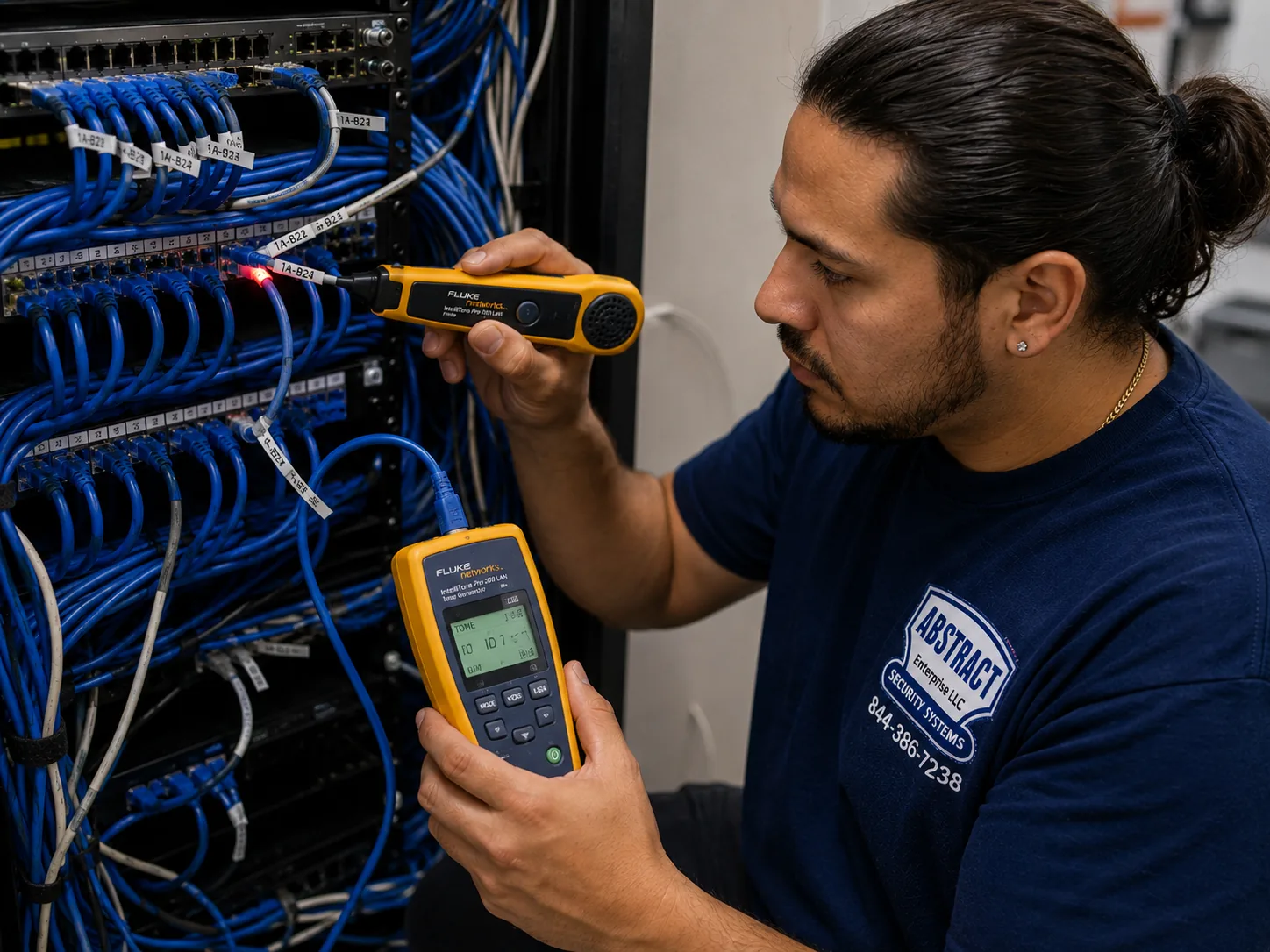
A photo from the AESS job library, not taken in Bushwick: a technician using a tone generator and probe to find which unlabeled cable at a patch panel belongs to which run. In a Bushwick walk-up or loft where cameras came from several installers, this is how we find the cable for the dead hall or dock camera without opening walls or entering every unit.
Test the dark cameras from the recorder end out. Each dark camera gets a power reading at the port or the power box, then a cable test, then a check at the camera itself. Only when power and cable are good is the camera blamed.
Fix the clock and the warnings. Before leaving, the recorder's time is set to update itself, failure alerts are switched on and tested, and the owner sees a playback from after the repair. Every cable we traced is labeled and noted on the job record.
Fault by Fault
Outages, Access, Weather or Wear: How Bushwick Camera Systems Break and What Each Repair Involves
Four causes cover most of what we find in Bushwick buildings and stores. Each leaves its own signs, and recognizing them is what keeps a repair to the part that actually failed instead of a new system you did not need.
Outages: what a block-wide power cut does to a camera system
When the power drops on a block, as it did around Irving Avenue and Jefferson Street in August 2025 and across parts of Bushwick in February 2026, every piece of the camera system goes down at once and comes back at once, and they do not all come back in the same condition. The recorder is the most vulnerable. If it was writing to its drive when the power went, the drive's file system can be damaged, and the recorder may come back saying the drive is unformatted or asking to initialize it, or it may run normally but quietly record nothing. The network switch is next. Switches that power cameras through their data cables sometimes come back with individual ports that no longer supply power, so three or four cameras stay dark while the rest return. Central power boxes for older analog cameras can fail outright when the current returns, taking every camera on them with them. And a battery backup that was meant to protect all of it may have had a worn-out battery for years.
The repair follows that order: protect any footage, test the drive, test the switch ports and power box, and only then look at cameras. A drive swap runs $200 to $450 on our Brooklyn list depending on capacity, a PoE port swap $150 to $350, and power supply repair $150 to $400. If the recorder itself is damaged, a DVR repair averages $300 to $700 and an NVR $400 to $900. In most outage calls the cameras on the wall are fine.
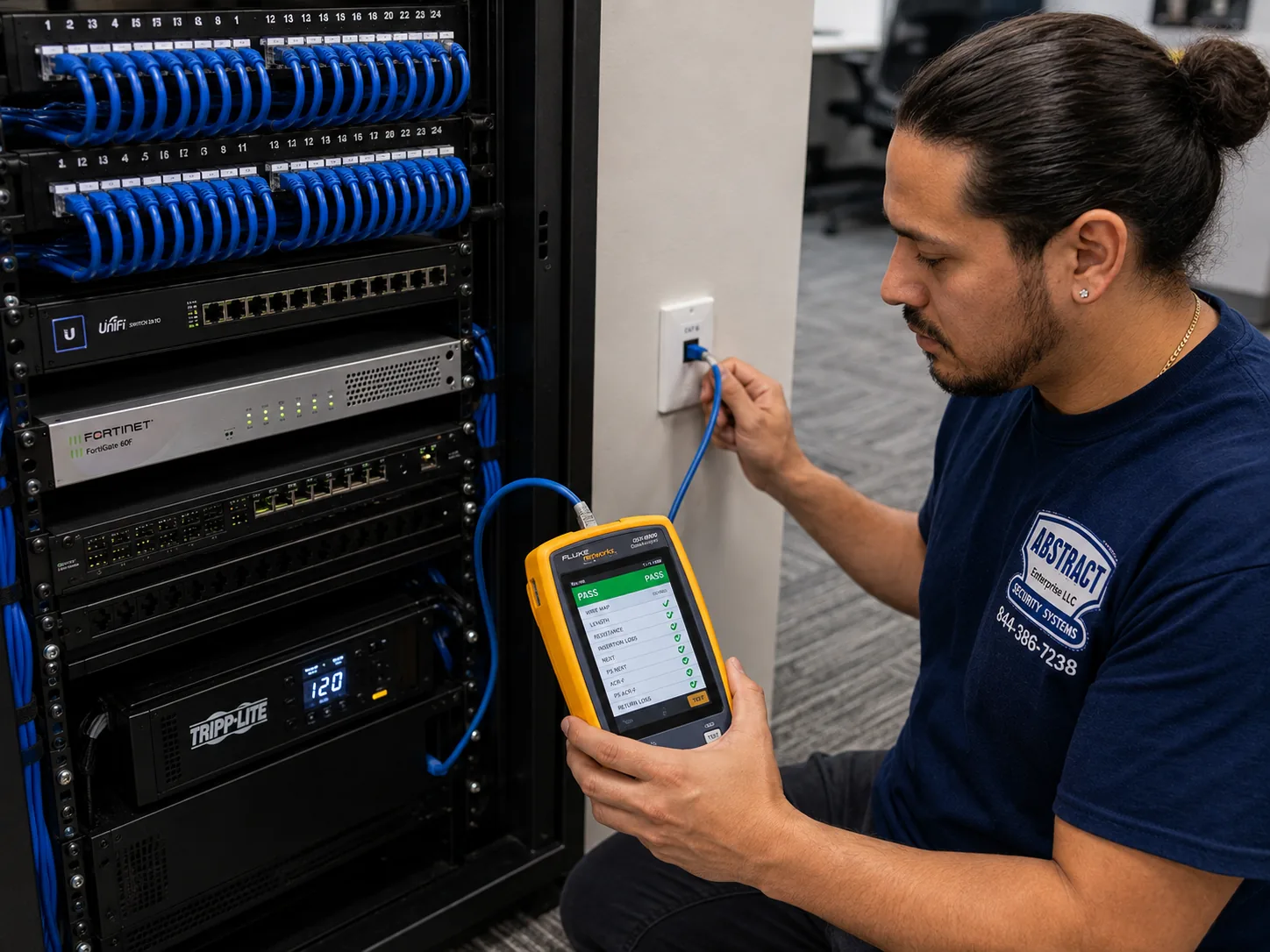
A photo from the AESS job library, not taken in Bushwick: a technician certifying a data drop with a cable analyzer that reads PASS. On a Bushwick repair the same kind of test settles in a minute whether a network camera's cable survived a renovation or a wet wall, so you pay to replace a cable only when the cable is really what failed.
Access: the recorder nobody can get into
Bushwick buildings change hands, managers and tenants often, and the camera system's passwords rarely change with them. We are regularly called to recorders that are working perfectly but cannot be used, because the admin password belonged to a previous owner, a former super, a store's last tenant or a roommate who moved out. The symptoms are a recorder that rejects every login, an app account tied to someone else's email, or a former owner who still gets the alerts. The fix depends on the brand and model. Many recorders have a manufacturer reset process that requires proof of ownership, some can be reset at the box, and a few cannot be reset without losing settings. We tell you which kind you have before we start, protect any footage first, and then set the system up with new accounts for the people who should have them, and nobody else.
Weather: frame houses, roofs and the cold vestibule
Weather does its damage slowly in Bushwick. On frame houses, the seal around the hole where the cable enters the wall cracks after a few winters, and rain follows the cable in. On the flat roofs that run along many rows of buildings, cameras on bulkhead doors and parapets take full sun, wind and ice, and their plugs work loose or corrode. In vestibules, cameras sit in the cold air that blows in every time the outer door opens, and condensation inside the housing fogs the picture on winter mornings. Reolink's own guidance on cameras that go offline lists exactly these causes, from "corroded RJ45 connectors" to outdoor damage from moisture, heat and freezing temperatures.
Most of these repairs are at the connection, not the camera. The plug is cut back to clean wire and terminated again with a sealed fitting, the cable entry is resealed with a drip loop, and loose mounts are refixed into solid material. Where water has already reached the camera's board, the camera is replaced: an outdoor camera with the weatherproofing redone runs $250 to $600 on our Brooklyn list.
Wear: drives, clocks, apps and old recorders
Some failures are simply age. Recorder drives wear out, especially in hot closets and back rooms, and they usually fail by recording less and less, or recording nothing, long before they stop completely. Recorder clocks drift if they are not set to update themselves, so that months later the time on a clip is minutes or hours off. Phone apps change, and older recorders stop working with them after an update or a change in the manufacturer's service. Reolink also points to firmware mismatches between the camera and the recorder, and to two devices sharing one network address, as common reasons cameras drop off a system, and both happen when a building adds equipment piecemeal. These are repairs of a drive, a setting or a firmware version far more often than of a camera. Where an older analog system needs to keep its cameras but gain network cameras, a hybrid recorder swap runs $700 to $1,200 installed on our Brooklyn list.
Commercial Security Camera Repair
Business Security Camera Repair in Bushwick
Bushwick's businesses run along a handful of strips and through an industrial district, and each puts a camera system to a different test. What they share is that the camera over the door is often the only witness. The crowbar break-in at Gift Shop Inc., 785 Broadway near Flushing Avenue, in August 2016, the rear-door break-in at Kave Espresso Bar, 1087 Flushing Avenue, in February 2018, and the 2 a.m. rug theft on Cook Street in July 2026 all reached the news through the shops' own video.
Knickerbocker Avenue
The main shopping street of its part of Bushwick, lined with small shops, many with recorders under the counter or in a cellar reached by a back stair.
Broadway under the J and Z
Stores and services along the elevated line on the neighborhood's western edge, where doorways sit in the el's shade and grime from the steel settles on the cameras.
Myrtle Avenue under the M
A strip of shops, restaurants and services under the elevated M, running toward the Myrtle–Wyckoff hub, with triangular lots where Myrtle cuts across the grid.
Wyckoff Avenue and Myrtle–Wyckoff
Busy blocks around the transit hub at the Queens line, with heavy foot traffic past every door.
Flushing Avenue and the industrial blocks
Cafes, studios and workshops in former factories along Flushing Avenue and in the blocks around Morgan Avenue, where loading doors and docks need cameras too.
Shops and cafes on the side streets
Small businesses tucked into converted ground floors on streets such as Cook Street, often with outdoor seating, balconies or yards that a camera has to cover after closing.
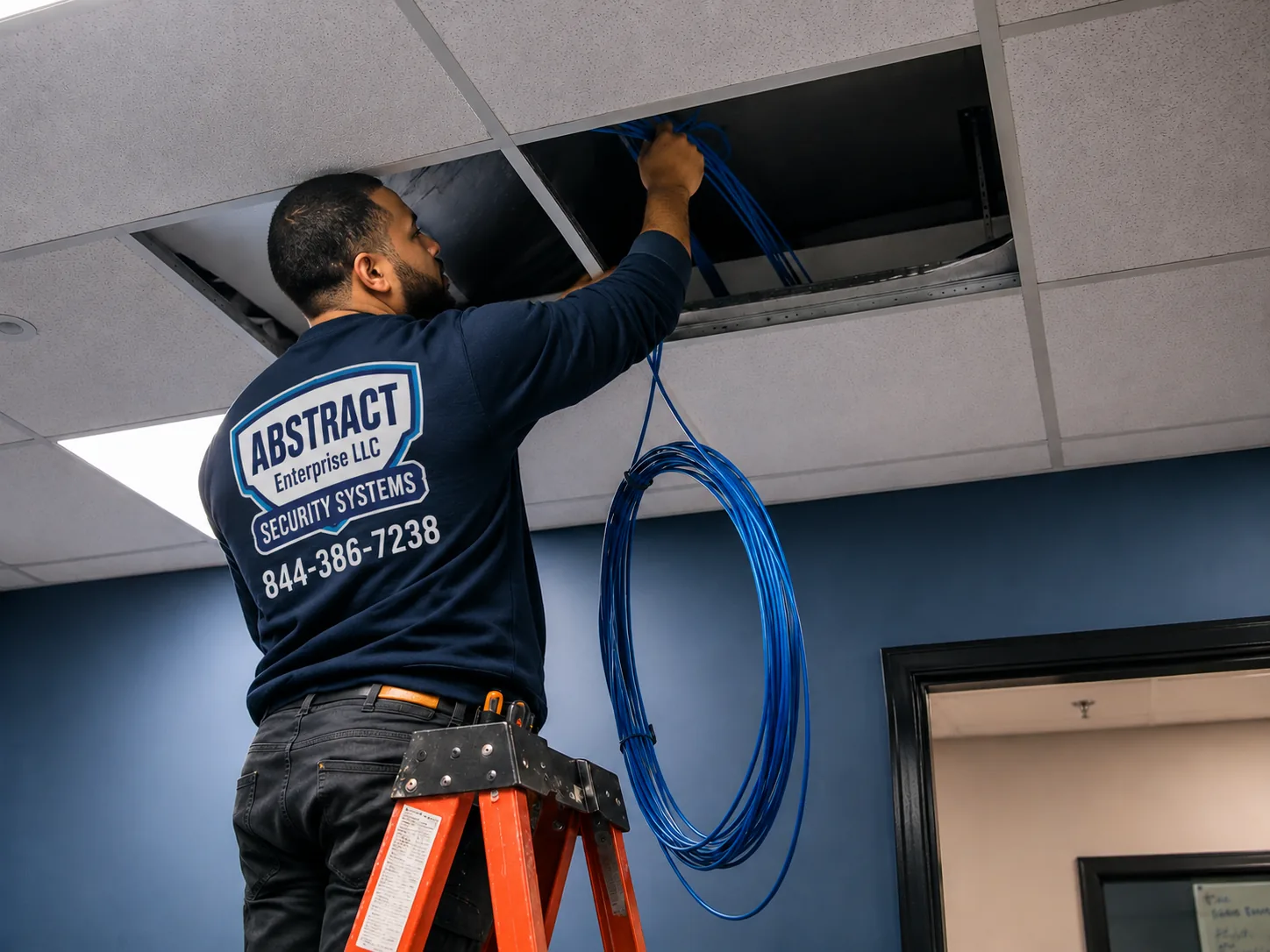
A photo from the AESS job library, not taken in Bushwick: a technician feeding cable through the ceiling of a commercial space while it stays open. Most stores on Knickerbocker and Myrtle Avenues cannot close for a camera repair, so any ladder or ceiling work is planned for quiet hours and kept to one part of the floor at a time.
What a Bushwick store owner needs from a repair
The report on the May 2025 stabbing inside the discount store at 937 Broadway shows what good store video can do: it laid out the sequence minute by minute, from the purchase of a knife to the fight at the door. That only happens when the cameras were recording, the recorder kept enough days, the clock was right and the door camera was aimed at faces rather than the tops of heads. So on a commercial call we check recording, retention and time first, save any clip you need, and then find and fix the fault.
The second thing a store needs is a door camera that identifies people. On Broadway and Myrtle Avenue the elevated structure throws the doorway into shade for most of the day while the street beyond is bright, and a camera set for the whole scene turns everyone in the doorway into a dark outline. At night the same doorway is lit by headlights, signs and the shop's own lights. Most of the time the fix is the camera's settings, its backlight or wide dynamic range modes and its exposure, together with a slightly different angle, not a new system.
Stores that never close and recorders behind the counter
Many Bushwick delis, discount stores and late-night shops are open long hours, and their recorders sit wherever there was space: under the counter, on a shelf above the cooler, beside the router in a back room. Heat from the cooler and the lack of air shorten the life of the recorder and its drive. A recorder in reach of the counter can also be unplugged by anyone, including someone who does not want to be recorded. Moving it into a locked, ventilated cabinet is usually a short extension of the existing cables, which we price separately on the visit.
Studios, workshops and loading doors in the industrial blocks
Untapped Cities counted more than 8,000 manufacturing jobs in the industrial area around Morgan Avenue in 2012, and the area still mixes workshops, warehouses and studios. Cameras there watch loading doors, docks, gates and parking areas as well as front doors, and they are often on long runs across a warehouse ceiling or the outside of a building to a recorder in a back office. They fail on those long runs, on loose mounts beside roll-up doors that shake every time they open, and on switches in small, hot network closets. We test the long runs at the camera end, refix mounts away from the door's movement, and look at the closet's heat while we are there.
Rules that touch a commercial camera repair
State licensing. The New York Department of State licenses companies that install, service or maintain security and fire alarm systems, and its rules cover closed-circuit television used to detect intrusion, theft or movement. An owner working on their own business is exempt, but a company you hire to repair the store's cameras should hold the license. Ours is NYS license #12000287431.
Cameras and staff. New York Labor Law Section 203-c requires employers who monitor employees by video to give notice. If a repair moves a camera closer to a staff area, it is a good moment to check that your notice is up to date and that no camera looks into a restroom or changing area. We are not lawyers and this is not legal advice.
Working with the police. The 83rd Precinct, at 480 Knickerbocker Avenue, covers Bushwick. The city's camera registration program lets businesses tell the NYPD where their cameras are, at no cost, so detectives know whom to ask after an incident. Registering is your choice; a repaired system with a correct clock is what makes it worth doing.
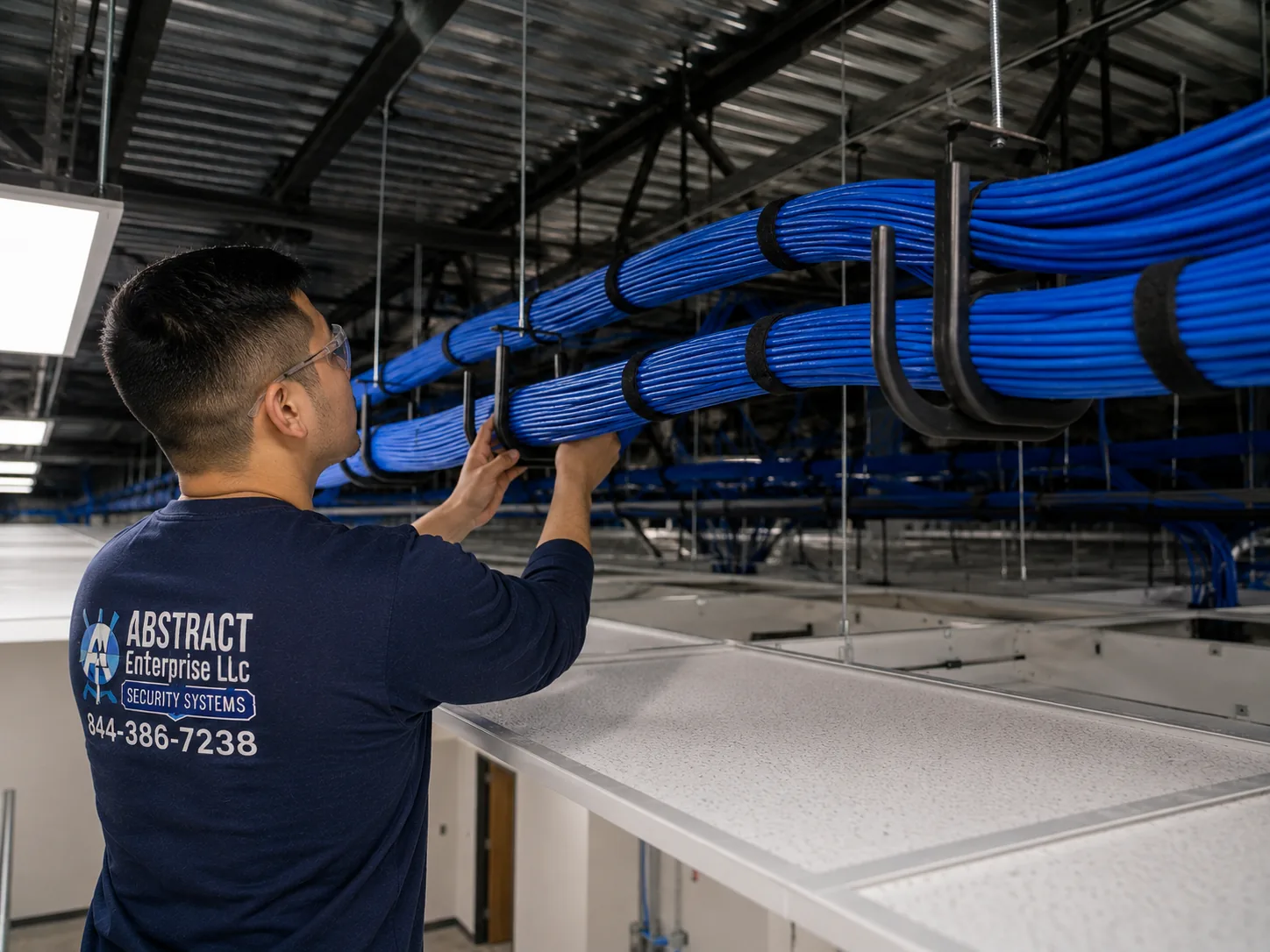
A photo from the AESS job library, not taken in Bushwick: J-hooks carrying dressed bundles of cable across a commercial ceiling. In a Bushwick warehouse or store, camera cable left lying across pipes or a drop ceiling is the cable that gets cut in the next fit-out, so any run we replace is supported properly and kept clear of the work that follows.
Your Questions Answered
Security Camera Repair in Bushwick: Questions Answered
These are the situations Bushwick landlords, tenants, loft residents, homeowners and shopkeepers describe when they call us about their cameras. Each is answered in full here and not repeated in the FAQ further down.
Planned shutoffs and block outages
Con Edison cut power to part of Bushwick on purpose in February to stop a longer outage. If that happens again, should we shut the camera system down ourselves first?
If you get warning and have a few minutes, yes, shutting the recorder down properly is better than letting it lose power while it writes. Use the recorder's own shutdown option from its menu, wait for it to finish, then switch off the power strip. When power returns, switch on the switch or power box first and the recorder last, and check playback within the hour. If you get no warning, a battery backup sized for the recorder lets it ride through short cuts and shut down cleanly in long ones. Either way, the first sign of trouble is usually the drive, so if the recorder comes back asking to initialize anything, stop and call us before you answer it.
Finding and using footage
Our camera ran all night and we need to find a person who came back several times between 2 and 4 a.m. Is there a faster way than watching all of it?
Usually, yes. Most current recorders can search a time range for motion events only, show the night as a strip of thumbnails, or play back at high speed with the motion marked on a timeline. Many also let you draw a box over one area, such as a balcony, a gate or a doorway, and list only the moments something moved inside it. Older recorders may not have these tools, and then high-speed playback is the only option. We can find the moments for you on the visit and save each one with its timestamp.
At night, anyone walking past our camera turns into a smeared ghost, though people standing still look fine. Why?
That is the camera slowing its shutter to gather more light. In the dark, many cameras keep each frame open longer so the picture looks bright, and anything moving across the frame during that time blurs. A person standing still looks sharp, a person walking looks like a smear, which is the opposite of what you need. The fix is usually in the settings: a faster shutter limit, a little more gain, and infrared or white light that reaches the spot where people actually walk. If the camera's settings cannot do it, a replacement camera that handles low light better is the answer, and night vision repair on our Brooklyn list runs $250 to $650.
Loft buildings and freight elevators
Several loft tenants put up their own cameras in our shared corridor. Can the building's system and theirs live side by side, or do theirs have to come down?
That is the landlord's decision and the lease's, not ours, but the technical answer is that they can coexist if someone decides who owns what. The building's cameras should go to the building's recorder on the building's network, under the landlord's control. A tenant's camera on their own door is their own device on their own Wi-Fi, and it should not look into another unit. Problems start when tenant cameras are plugged into the building's network or power, or point down the whole corridor. We can map which is which, move the building's cameras onto their own network so tenant devices cannot interfere, and give the landlord a list of what we found.
The camera in our loft building's freight elevator only works when the car is near the ground floor. What causes that?
That pattern almost always points to the cable that travels with the car, not the camera. As the car rises, the traveling cable flexes, and a damaged conductor or a loose connection opens and closes with the movement. A camera powered or connected over a weak run can also fail as the run gets longer. We test the camera and its connection on the car with the elevator stopped at different floors, then work back along the run. Any work in the hoistway or on top of the car is done with your elevator maintenance company, who controls safety there, so we arrange that visit through the building once we know where the fault is.
Frame houses and divided mansions
There is a water stain on the inside wall behind the camera on our frame house. Did the camera cause it, and can it be fixed without opening the wall?
It very likely came in where the camera's cable goes through the wall. When that hole was drilled, it was sealed, and after a few winters the sealant cracks and rain follows the cable inside, especially if the cable enters level or angled down into the house. Fixing it does not usually mean opening the wall. We take the camera down, reseal or replace the cable entry with a proper fitting, make the cable drop below the entry before it rises into it so water drips off, and put the camera back on a mounting block that sheds water away from the hole. The stain itself is a job for whoever repairs your drywall or paint, but the leak stops at our end.
Our Bushwick Avenue house was divided into apartments, and the old camera wiring runs through three different units. How do you reach it without going into every apartment?
We plan the trace before the visit so we enter as few units as possible. From the recorder end we can test each cable, use a tone generator to find which one leads where, and often reach a fault from the cellar, the hall or the outside of the house. Where we do need a unit, the owner gives the tenant notice, and we tell you in advance which unit, why and roughly how long. If a run through a tenant's apartment has failed, it is often simpler to replace it with a new path up the outside or through a common hall than to repair it inside the unit, and we price both options so you can choose.
Doors, buzzers and the street outside
Someone buzzed a stranger into our building at 2:30 in the morning. The lobby camera shows the door opening, but not who came in. Can the camera be changed so that does not happen again?
Often it can. Many lobby cameras are mounted high and aimed at the whole lobby, so a person walking in is a small figure with their head down. A camera aimed back at the inner door from about head height, or a second camera inside the vestibule pointed at the person standing at the intercom panel, gives you a face. We look at where the existing camera sits, whether it can be re-aimed or moved on the same cable, and whether a second camera is worth it. The camera cannot show which apartment pressed the button, but it can show clearly who was let in and when.
A building next door put up a sidewalk shed, and our cameras now see nothing but plywood. Can they be moved for the months the shed is up?
Yes. The usual answer is to move or re-aim the cameras that face the shed so they look along the sidewalk under it, or to add a temporary camera at the point where people come out from under the shed toward your door. Cable can often be extended along your own facade without touching the shed, which belongs to the neighbor's contractor. When the shed comes down, we put the cameras back in their original positions and check the aim. Each move is priced on its own, and if a camera can simply be re-aimed, that is usually covered within the service call.
Store systems under the els
Our discount store's recorder has sixteen cameras, but the screen behind the counter only shows four big pictures. Are the other twelve recording?
Possibly, possibly not. The screen layout and the recording are separate settings. Someone may have switched the monitor to a four-camera view, or set it to cycle, while all sixteen cameras keep recording in the background. Or the other twelve may have stopped and nobody noticed because they were never on the screen. The quick check is playback: pick a time from last night and open each of the twelve. We check every channel's recording schedule on the visit, set the counter screen to the view you want, and turn on alerts so a camera that stops recording tells someone.
Our door camera on Broadway sits in the shade of the el all day, and anyone in the doorway is a dark shape against the bright street. Can it be fixed?
In most cases, yes, without replacing the camera. The camera is exposing for the bright street behind the person, so the doorway goes dark. Turning on the camera's backlight compensation or wide dynamic range mode, setting its exposure for the doorway rather than the whole frame, and lowering or narrowing the view so the bright street takes up less of the picture usually brings faces back. If the camera has no such settings, a replacement camera made for strong backlight is the fix, priced as an outdoor camera replacement at $250 to $600 on our Brooklyn list.
Equipment
Types of Security Cameras and Recorders We Repair
We repair whatever is on the building, whoever installed it. These are the kinds of equipment we work on in Bushwick walk-ups, lofts, houses and stores, and the way each one tends to fail here.
Analog and HD-over-coax cameras
Cameras on round BNC connectors, from old analog to HD-TVI, HD-CVI and AHD, common in walk-ups and older stores. They fail at the twist-on connector, at the plug-in power adapter, and at the central power box after an outage.
Network (IP) cameras
Cameras that take power and data over one cable from a PoE switch, common in lofts and newer buildings. Faults: a dead switch port after a power cut, a loose RJ45 plug, an address clash with a new device, or firmware out of step with the recorder.
DVRs, NVRs and hybrid recorders
The box that holds the footage, in a cellar, a closet, a back room or under a counter. Faults: drives damaged by outages and heat, clocks that drift, and passwords nobody in the building knows.
PoE switches and network gear
Switches, routers and network closets in loft buildings and larger walk-ups, where one failed port or a hot closet can take a group of cameras down together.
Dome, turret and bullet housings
Cracked domes, fogged windows, loose brackets on siding, and housings knocked out of aim during moves, deliveries or a gate replacement.
Wi-Fi and battery cameras
Consumer cameras on doors, balconies and corridors that drop off in concrete lofts and brick walk-ups, lose their app after a router change, or stop recording when a cloud plan lapses.
Elevator and corridor cameras
Cameras in freight and passenger elevators and on long loft corridors, fed by traveling cable or long runs that test fine at one end and fail at the other.
Power supplies and battery backups
Central power boxes for analog cameras, plug-in adapters and battery backups, tested under load and replaced when they no longer carry the system through a short outage.
Monitors and phone apps
Counter screens, lobby monitors and app access for owners, managers, roommates and family, set up again after an internet change or a change of owner.
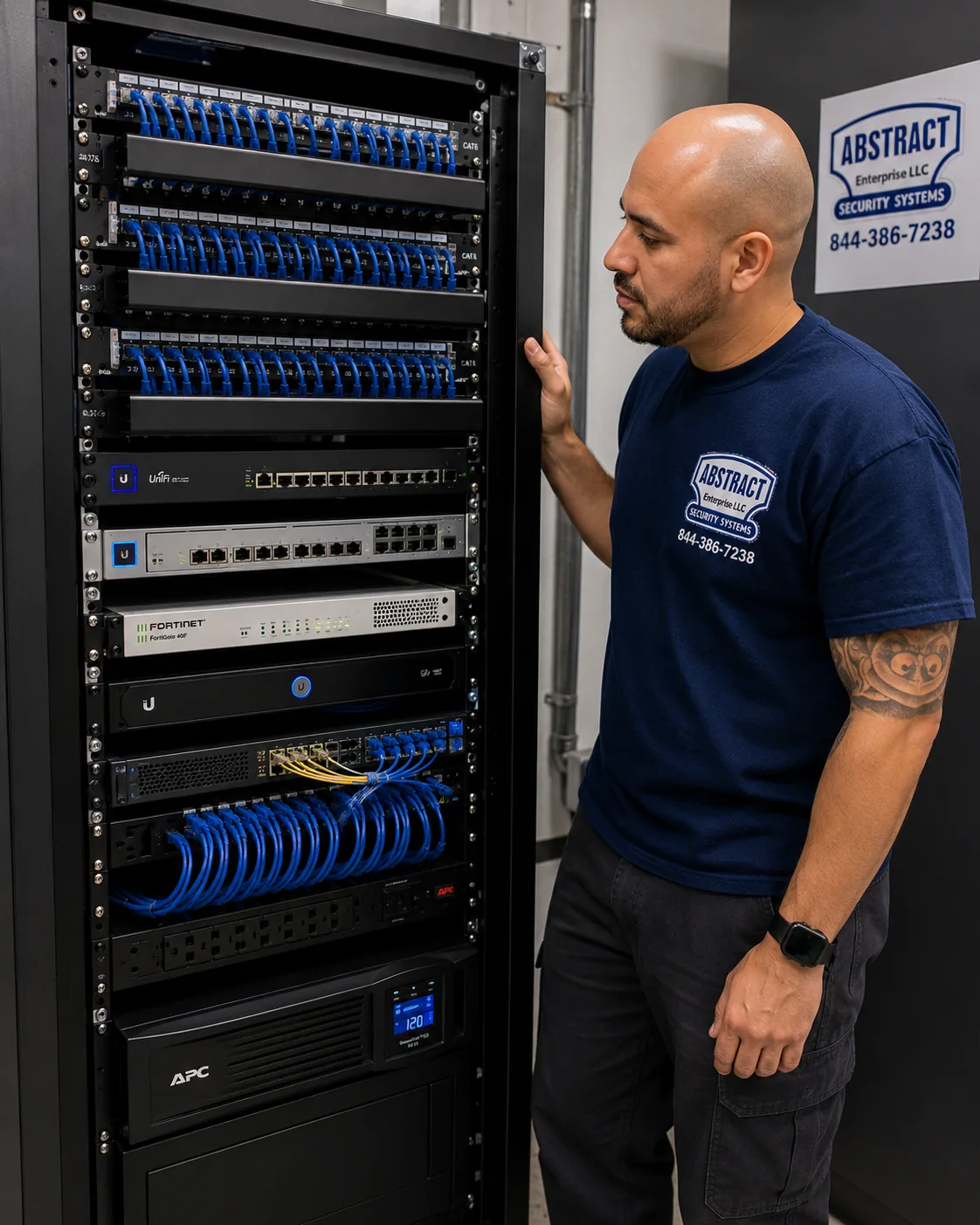
A photo from the AESS job library, not taken in Bushwick: a finished rack with patch panels, switches, a firewall and a battery backup, dressed and labeled. Few Bushwick walk-ups need a rack this size, but loft buildings with dozens of network cameras often do, and the same principle applies to a single shelf in a cellar: recorder, switch and battery backup together, labeled, cool and out of reach.
National brands versus a local licensed repair
Plenty of Bushwick households and shops have cameras from a national alarm company or a consumer brand, often bought by a previous tenant. Here is how the options compare when one of those systems stops working.
Question
ADT or similar alarm company
Ring or SimpliSafe camera
AESS local repair
Works on equipment another company installed
Usually only its own
Support covers its own devices
Any brand, any installer
Wired recorders, coax and PoE systems
Its own systems
Mostly Wi-Fi and battery devices
Coax, network, hybrid and PoE
Recovering a locked recorder after a change of owner
Its own accounts
Account recovery by email
On site, footage protected first
Licensed technician on site
Varies by dealer
Remote support
Yes, NYS license #12000287431
Monthly fee to keep recording
Depends on the contract
Often for cloud recording
None for a repair
Price before work
Varies
Replacement device price
$150 service call, then a written repair price
If the cameras came with an alarm contract, check it before anyone else works on them, because some of the equipment may belong to the alarm company. If they are Wi-Fi cameras fighting a concrete loft corridor or a brick stair hall, the honest answer is often that no repair will make them reliable there, and a wired camera on the building's recorder is the lasting fix. We will tell you which you have and what it costs to put right.
AI Overview Reality Check
What AI Gets Wrong About Security Camera Repair in Bushwick
These claims turn up in AI-generated answers and in national cost and how-to guides from sites such as Angi, HomeAdvisor and Fixr. Each is paraphrased below, then checked against what repairs actually look like in Bushwick's walk-ups, lofts and stores.
"After a power outage, just unplug everything and plug it back in"
Troubleshooting guides almost always start with a power cycle. Reolink's guide, for one, suggests unplugging a camera for about ten seconds and the router and switches for about thirty, then waiting a few minutes for everything to boot.
For a single Wi-Fi camera that is sensible. For a recorder that has just been through a block outage like the ones around Irving Avenue in 2025 and across parts of Bushwick in 2026, it can be the wrong first move. If the drive was damaged when the power dropped, every extra restart is another chance for the recorder to overwrite or lose what was on it, and a restart can bring up a prompt that, if accepted, wipes the drive.
If you need nothing from the recording, a careful restart is fine. If you might need last night's video, leave the recorder running, photograph the screen and call first. We save the footage before anything is restarted.
"If the app says a camera is offline, the camera has failed"
Generic answers often treat an "offline" message on the phone as proof that a camera is dead and needs replacing.
In Bushwick the most common reason a camera shows offline in the app is that the building's internet changed. A tenant moved out and cancelled the service the recorder was using, a landlord switched providers, or a new router replaced the old one. The cameras keep recording on the recorder, but the recorder can no longer reach the app. Reolink's list of offline causes includes the router, Wi-Fi distance, network address conflicts and cloud outages long before it gets to a broken camera.
Check the recorder's own screen first. If the cameras are live there, the fault is the network or the app account, and it is usually fixed in settings within the $150 service call, with no new camera at all.
"If the recorder asks to initialize the drive, say yes to clear the error"
Forum answers and quick guides often treat the initialize or format prompt as a routine fix for a drive error.
Initializing a recorder's drive erases it. Every recording on it is gone, including the night you might need. After an outage that prompt is common, because the recorder has found something wrong with the drive, and the drive may still hold readable footage that a technician can try to recover before it is wiped.
If you see that prompt, cancel it, leave the recorder on and call. If there is nothing on the drive you need, initializing it may be the right step, but it should be a decision, not a reflex, and a drive that has failed once is worth testing before you trust it again.
"Wireless cameras are the easy fix for any building"
AI summaries often recommend replacing a troublesome wired camera with a Wi-Fi model, on the grounds that it avoids cable work.
Bushwick's buildings are hard on Wi-Fi. Converted factories have concrete floors and steel frames, walk-ups have brick walls and long stair halls, and in a loft building dozens of tenants' networks crowd the same air. Reolink's own guidance names thick walls and distance from the router as leading reasons wireless cameras go offline. A Wi-Fi camera in a concrete loft corridor or a cellar may never hold a steady connection, however good the camera is.
Wi-Fi cameras make sense on a frame house close to its router. In most Bushwick walk-ups and lofts, repairing or replacing the wired camera on its existing cable is the cheaper and more reliable route, and the existing cable is usually fine.
"The landlord has to keep the cameras working and show tenants the footage"
Some answers suggest that New York landlords must provide working cameras and must share video with tenants who ask.
Brick Underground, putting the question to two New York attorneys, reported that city buildings are not required to have security cameras, and that a landlord does not have to show tenants footage outside a legal process such as a police request or a court order. Attorney Jennifer Rozen suggested that "a tenant's association [can] advocate for the landlord to install a better lock/intercom system or a package locker."
So in a Bushwick rental, a dead hallway camera is fixed when the person who controls the recorder decides to fix it. If you are a tenant, the useful move is a short written request to the landlord naming the camera and the problem. If you are the landlord, we can give you a written cause and price you can share with the building.
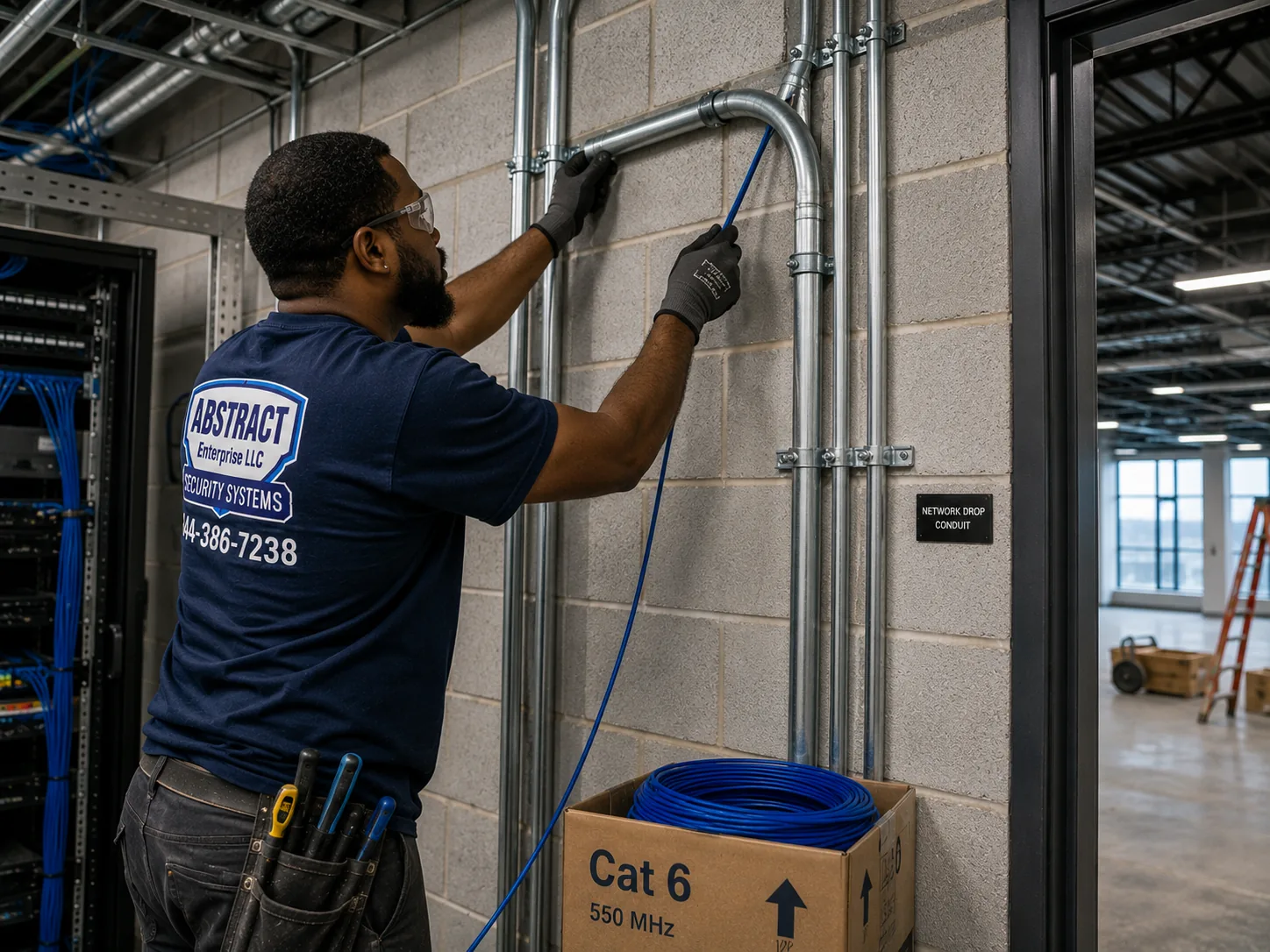
A photo from the AESS job library, not taken in Bushwick: a technician running cable into EMT conduit beside a telecom room in an industrial building. Many Bushwick loft buildings are former factories like this one, and where a camera cable crosses a loading area, a dock or a wall that tenants keep renovating, conduit is what stops the replacement run from being cut the same way as the last.
"Camera repair in Brooklyn averages about $1,400"
HomeAdvisor's Brooklyn page for surveillance camera installation or repair gives an average of $1,416, with a typical range of $680 to $2,145, and AI answers sometimes repeat that figure as the cost of a repair.
That average combines new installations with repairs. Most Bushwick repairs are a single fault after an outage or a change of tenant: a drive, a switch port, a power box, a password, one camera. On our Brooklyn list those single faults land between $150 and $700, and only a new recorder, a partial rewire or several cameras at once reach $700 to $1,500.
The realistic budget for one problem is the $150 service call plus the one failed part, and you see that price in writing before the work. A big average can scare an owner into replacing a whole system that needed one part.
"Anyone handy can fix a camera system"
Many answers present camera repair as a quick do-it-yourself job with a ladder and a screwdriver.
On your own house, you are free to try. But the New York Department of State licenses companies that install, service or maintain security systems, and the rules cover closed-circuit television used to detect intrusion or theft. A landlord, a managing agent or an insurer will usually ask whether the person who worked on the building's cameras was licensed and insured, and work on a walk-up roof or a loft facade is not a stepladder job.
If you hire someone, ask for the license number and a certificate of insurance. Ours is NYS license #12000287431, and a certificate for a landlord or managing agent can be arranged before the visit.
Ask a Technician Before You Restart, Reset or Replace Anything
Tell us the cross streets, the kind of building, how many cameras there are, which ones are out, when it started and where the recorder sits. A technician will get back to you with the likely cause and the next step for the Bushwick address, or you can call (347) 934-8335 now.
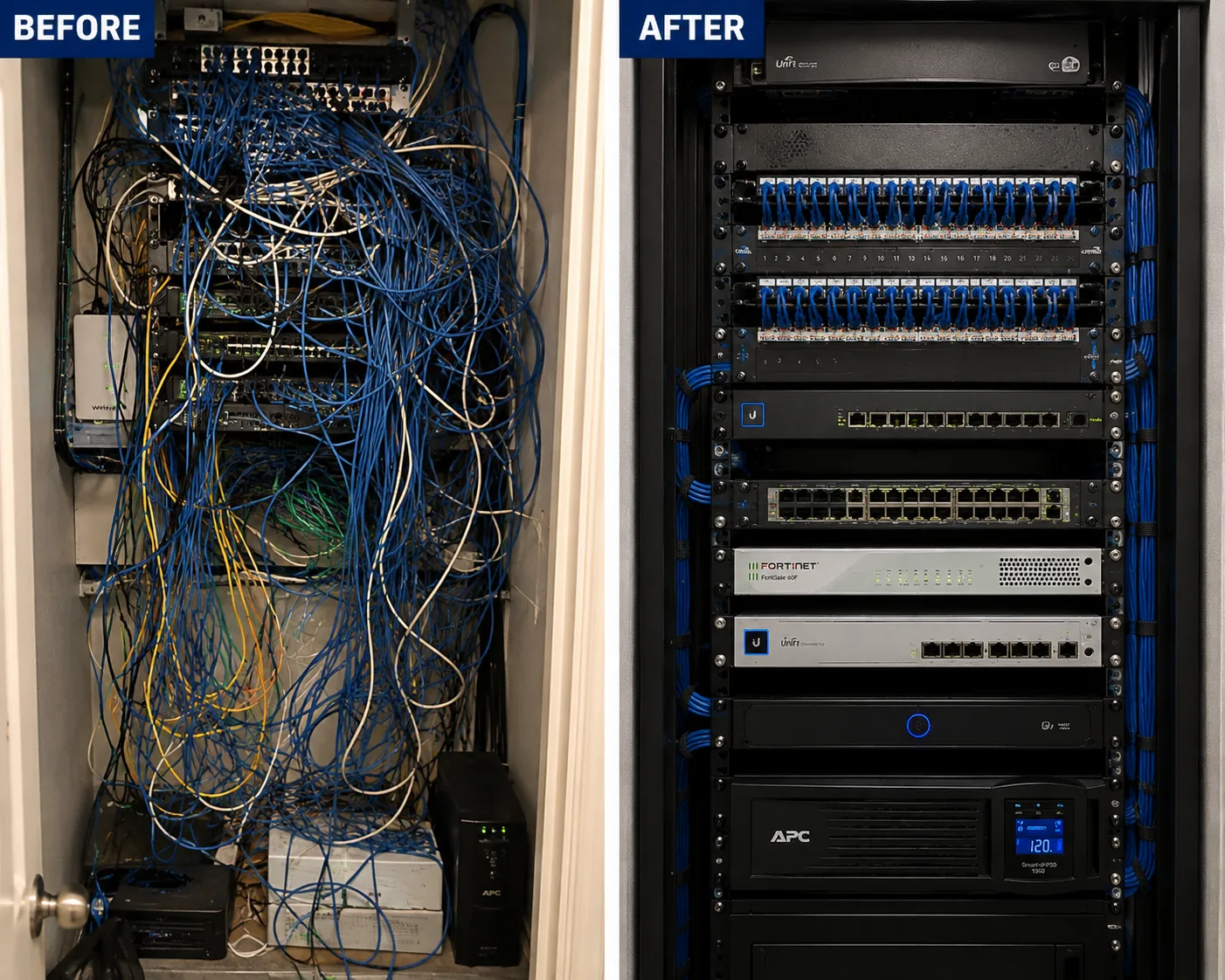
A photo from the AESS job library, not taken in Bushwick: before-and-after views of a network rack, from an unlabeled tangle to dressed, identified cabling. The "before" side is what a lot of Bushwick cellars and loft closets look like after years of cameras added by landlords, stores and tenants. If you mention on the form that nobody knows which cable is which, we allow time for tracing and labeling in the visit.
✅
Request Sent!
Thank you. A technician will contact you about the Bushwick address shortly.
How It Works
Our Repair Process
1. Send photos and what happened first
A photo of the recorder screen, the recorder's label and your cross streets, plus whatever came before the fault: an outage, a renovation, a new internet provider or an incident on the block.
2. Confirm who owns and approves
Owner, landlord, managing agent, loft tenants or store: we confirm who controls the recorder and its password and who approves the price, and arrange a certificate of insurance if the building needs one.
3. Book the service call
The $150 Brooklyn service call puts the visit on the schedule in a two-hour arrival window, with roof, cellar, freight elevator or apartment access arranged ahead.
4. Save any footage you need
Any clip you asked for is exported to USB with the recorder's original timestamp before anything is restarted, unplugged or changed.
5. Test from the outlet to the camera
Building power, battery backup, switch or power box, recorder and drive, cable and connectors, then the camera, in that order.
6. Explain the cause and write the price
You hear what failed and why, and get a written repair price before any part is replaced, with the service call credited to it.
7. Repair and retest by day and by night
Only the failed part is repaired or replaced, then every camera is checked live and in playback, and after dark when the complaint was about night pictures.
8. Label, hand over and set alerts
Traced cables are labeled, phone viewing is confirmed for each person who needs it, failure alerts are turned on, and the notes stay on your job record.
Coverage Area
Security Camera Repair Near Bushwick's Landmarks
Maria Hernandez Park
The 6.87-acre park between Knickerbocker and Irving Avenues near the Jefferson Street L stop, a common reference point for blocks in the north of the neighborhood.
Irving Square Park
A 2.78-acre park bounded by Wilson and Knickerbocker Avenues and Halsey and Weirfield Streets, the neighborhood's other main park.
Myrtle–Wyckoff Avenues station
The L and M transit hub on the Queens line, renovated in 2007, where Myrtle and Wyckoff Avenues meet.
Linden Street Historic District
Bushwick's first historic district, designated in May 2023: 32 late-19th-century brownstones on one block of Linden Street and Bushwick Avenue.
Ulmer Brewery
The former brewery at Beaver Street and Belvidere Street, designated a landmark in 2010, a reminder of the brewers who built the Bushwick Avenue mansions.
Wyckoff Heights Medical Center
Bushwick's primary hospital, a landmark most callers use to describe where their block is.
We also serve the neighborhoods around Bushwick, including Williamsburg and East Williamsburg to the northwest, Bedford-Stuyvesant to the south, and Ridgewood across the Queens line, at the same rates. Next door, our Bed-Stuy camera repair page covers the brownstone blocks south of Broadway, and the whole borough is on our security camera repair in Brooklyn page.
Pricing
Security Camera Repair Cost in Bushwick
Bushwick is billed at our Brooklyn rate. Every repair begins with the $150 service call, which covers the on-site diagnosis and the written repair price and is credited to the repair if you go ahead. The ranges below are taken from our published Brooklyn security camera repair prices; your exact price is written down on the visit, once we know what failed. A visit goes on the schedule once the service call is paid.
Repair
Brooklyn price
Service call, on-site diagnosis and written repair price
$150, credited to the repair
Settings with no parts: motion, alerts, app, clock, screen layout, access
Usually within the $150 service call
Clean and check for a blurry picture
$80
Connector reterminate or PoE port swap
$150–$350
Power supply repair
$150–$400
Dome or front cover replacement
$30–$80 part plus labor
Indoor camera repair
$200–$450
Hard drive swap, by capacity
$200–$450
Outdoor camera replacement with weatherproofing redone
$250–$600
Night vision camera repair
$250–$650
DVR not working, including drive and labor
$300–$700
NVR not recording, by model
$400–$900
Vandalized camera, per camera plus cable repair
$400–$900
PTZ camera repair
$450–$1,200
Hybrid recorder swap, channels reconfigured
$700–$1,200
DVR or NVR replacement with drive, partial rewire, or several cameras at once
Three things move a Bushwick repair within those ranges. The first is finding the system: a walk-up or loft where cameras came from several installers, with no labels and two recorders, takes longer to trace than a house with one recorder and four cameras. The second is access: a roof bulkhead, a freight elevator, a tenant's apartment or a store that cannot close all need arranging, and some need the building's permission or a certificate of insurance first. The third is what the outage left behind: a recorder whose drive has to be recovered before it can be replaced takes more time than a straight swap. If the price changes on site, you hear the new number before the work goes on. Doing the camera repair together with intercom, alarm or cabling work on the same visit saves $200 to $400 in labor on our Brooklyn list.
Full terms — including 50% deposit, one-year parts-only warranty on AESS-supplied products, and the late-fee schedule — are set out in the service agreement.
Shop Our Systems
Security Camera Repair Packages & Pricing
Three ways Bushwick repairs usually come together, priced from the Brooklyn list above. Each starts with the $150 service call, credited to the repair, and your written price follows what the diagnosis finds.
Single-issue repair: $150–$700
One fault, one visit: a drive swapped after an outage, a dead switch port or power box replaced, a locked recorder recovered and handed to its rightful owner, a leaking siding camera resealed, or a shaded doorway camera on Broadway or Myrtle reset to show faces.
Major system repair: $700–$1,500
The recorder, the wiring or several cameras: a DVR or NVR replaced with a new drive and every camera set up again, a hybrid recorder so older coax cameras can stay, two recorders in a walk-up or loft brought onto one, or the recorder moved out of a damp cellar or a tenant's unit.
Annual maintenance: $250–$800
A yearly check before winter: drive health and recording confirmed, battery backup tested under load, clocks and firmware reviewed, failure alerts tested, connectors on roofs and siding resealed where needed, from $250 for a house and $400 for a commercial system.
Bring your own equipment. If you have already bought a replacement camera or recorder, we can fit it at labor-only rates. Tell us the exact model and we quote the labor by phone or text, and the visit is booked once it is paid. We cannot vouch for parts we did not supply, and if the model you bought will not work with your recorder, or is a Wi-Fi camera headed for a concrete corridor, we tell you before the visit.
Complete Services
Every Security Camera Repair Service in Bushwick
Camera, connector and cable repair
Dark cameras, loose or corroded plugs, leaking siding entries and cut runs. Request a repair
Can the camera app be set up in Spanish for a parent, a tenant or an employee?
+
Usually, yes. Many recorder and camera apps either follow the phone's own language setting or have a language choice in their settings. On the visit we check the app your system uses, set it up on each person's phone in the language they prefer where the app allows it, and show them how to open live view and playback.
Our landlord lives outside New York. Can the repair be approved and paid for remotely?
+
Yes. We send the written cause and price by email or text, the owner approves it in writing and pays through our payment link, and the super, a tenant or a neighbor lets the technician in. We confirm who has authority over the recorder before we change any passwords or accounts.
Can a camera be mounted on our fire escape to watch the street or the back yard?
+
We avoid it. A fire escape is an exit, and anything fastened to it can get in the way of people climbing out or catch on clothing in a hurry. We mount the camera on the wall beside the fire escape window instead, aimed past it, with the cable kept clear of the landing and the ladder.
Can our cameras show color at night under the streetlights instead of black and white?
+
Sometimes, depending on the camera. Many cameras switch to black and white with infrared when the light drops, and some can be set to stay in color when there is enough streetlight. Cameras built for color night viewing do this much better. We can test the setting on your existing cameras at the visit and price a replacement where it cannot be done.
What are the signs that a recorder's hard drive is close to failing?
+
A worn drive usually shows itself before it dies: the recorder keeps fewer days than it used to, playback has gaps, the recorder beeps or shows a drive warning, or it restarts on its own. If you notice any of those, send us a photo of the drive status page, and we read the drive's health report on every visit.
Can a replacement camera go higher so nobody can reach it from the sidewalk?
+
Yes, within reason. A camera mounted out of arm's reach and angled down is much harder to turn, cover or pull off. Going too high loses faces, so we aim for a height that still shows a person's face at the door, use a vandal-resistant housing where it is needed, and extend the existing cable to the new position.
Our camera cable runs across the roof onto the building next door. Do we need the neighbor's permission to repair it?
+
For any work on their roof or wall, yes. On rows of buildings with connected roofs, cables sometimes cross a neighbor's property without anyone remembering. We repair what is on your property, and where a run crosses next door we either get the neighbor's agreement first or reroute the cable so it stays on your own building.
We stopped paying for our camera's cloud plan. Will the cameras still work?
+
It depends on the system. Wired cameras on a recorder keep recording locally whether or not there is a cloud plan. Many consumer Wi-Fi cameras keep live view but lose saved recordings or alerts when the plan ends, unless they have a memory card or a local recorder. We can tell you which you have and whether a card or a local recorder would replace the plan.
Can we watch our store's cameras from a computer at our other location, not just on a phone?
+
Usually, yes. Most recorders have desktop software or a web view as well as a phone app. We set it up on the computer you choose with its own login, check that live view and playback both work from there, and make sure the recorder's network settings keep it reachable after an internet change.
Can you check the system's health from photos I send once a year, without a visit?
+
For a quick check, yes. Send a photo of the live screen, the drive status page and a playback from the previous night, and we will tell you whether anything looks wrong. It does not replace an on-site check of power, connectors and the battery backup, but it catches a stopped drive or a dark camera early.
What happens if the problem turns out to be the building's electrical wiring?
+
We tell you, show you what we measured, and stop there on that part. We are a low-voltage company and do not do electrical work, so a dead outlet, a tripping circuit or bad building wiring needs a licensed electrician. Once the power is fixed, we finish the camera repair under the same service call where possible.
Do you repair cameras at churches and community spaces along Bushwick Avenue?
+
Yes. We schedule around services and events, work with whoever the congregation or organization has put in charge of the building, and send the written cause and price to the person who approves spending. Older church buildings often have cameras on high walls and long runs, which we plan for before the visit.
Want Your Bushwick Cameras Recording Before the Next Outage?
Send a photo of the recorder screen, the label on the recorder and your cross streets, and we will tell you what most likely failed and what that kind of repair costs on our Brooklyn list. The $150 service call is credited to the repair, the price is written down before any part changes, and requests are booked within 2 hours. Abstract Enterprises Security Systems has been owner-operated since 2002, holds NYS license #12000287431, is rated 4.7★ across 201 Google Reviews, and sends Brooklyn crews out from our Troy Avenue office.