What are you looking for?
About Us Contact Us Careers Get a Free Quote (800) 486-0943
Pick a service
✅ Got Your Own System?
🎬 Home TheatreQuote 🎶 AV SoundQuote 🔑 Access ControlQuote
Now pick your area
Pick your area
Long Island
Hudson Valley
Services available
Pricing & Tools
Pick a service for pricing
🚪 Intercom Pricing 🔔 Buzzer Repair Pricing
Calculators
📹 Camera System Calculator 🚨 Alarm Calculator ⚡ Cabling Quote Builder ✅ Got Your Own System?
Select your area
Restaurant camera coated in kitchen grease, a recorder that dies every night when the store's power is switched off, or an Eighth Avenue system nobody can log into? Brooklyn Chinatown camera repair line, booked within 2 hours: (347) 934-8335
Home › Security Camera Repair Brooklyn › Brooklyn Chinatown
Eighth Avenue Storefronts · Restaurants, Bakeries and Markets · Store-and-Apartment Buildings · Side-Street Row Houses

Security Camera
Repair in
Brooklyn Chinatown

Any Brand, Any Installer · Footage Saved Before Anything Is Touched · Cause and Written Price First · Brooklyn Rate

Security camera repair in Brooklyn Chinatown starts with our $150 Brooklyn service call, which pays for the on-site diagnosis and is credited to the repair if you go ahead. On our published Brooklyn list most single faults cost $150 to $700, and a recorder replacement or a multi-camera rebuild costs $700 to $1,500. We fix systems that other companies, relatives and previous tenants installed, from two cameras on a row house off Seventh Avenue to a restaurant, bakery or market on Eighth Avenue with a recorder in the back room. Requests are booked within 2 hours, visits come in two-hour arrival windows, and you hear the cause and get a written price before any part is replaced. Below: why cameras on Eighth Avenue fail the way they do, how kitchens, cellars, store gates and family-built systems change the repair, and what each fix costs.

Reviewed and updated November 12, 2026, against News 12 Brooklyn's June 2025 report on Con Edison's voltage reductions in Sunset Park and southwest Brooklyn; CBS New York's August 2020 report on the back-door burglary at the Lucky 8 Restaurant on Eighth Avenue; Patch's report on the 2019 gate-cutting burglary at King Mei Supermarket on Sixth Avenue; News 12 reporting on 2024 and 2026 Sunset Park burglaries; CBS New York's May 2026 profile of the Brooklyn Chinese-American Association; the Landmarks Preservation Commission's 2019 designation of four Sunset Park historic districts; NY1 and News 12 on the city's see-through storefront gate law in 2026; CBS New York on the NYPD's opt-in business camera program; Security Sales on the FCC's 2022 equipment order; the City Council's April 2025 hearing on inoperable cameras in senior buildings; HomeAdvisor's Brooklyn camera cost data; and the New York Department of State on alarm and CCTV installer licensing. · Abstract Enterprises Security Systems, NYS license #12000287431 · crews dispatched from our Troy Avenue office in Brooklyn

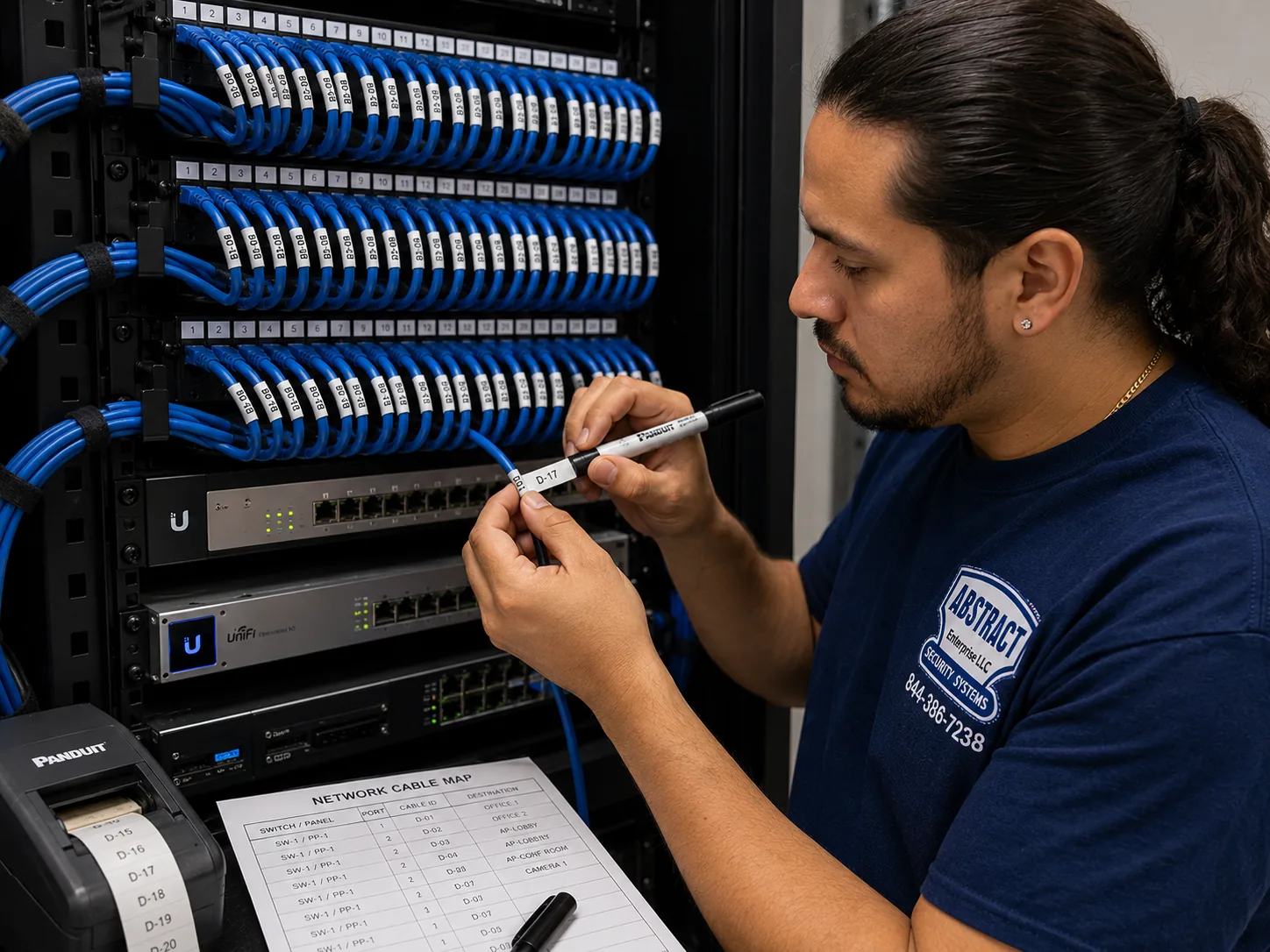
Brooklyn Chinatown, Brooklyn security camera repair: technician printing cable labels at a patch panel beside a printed port map
A photo from the AESS job library, not taken in Brooklyn Chinatown: a technician printing a label for each cable at a patch panel, with the printed port map beside it. On Eighth Avenue the camera cables in a restaurant or market usually end in a back office, a cellar or a shelf above the register, and they rarely carry a single label. Naming each cable at that end, and the camera it feeds, is what turns the next repair from an hour of guessing into a few minutes of work.
Brooklyn Chinatown Camera Repair Request
Restaurant, bakery, market, office or home: tell us the cross streets and what the screen shows, and a technician calls back with the next step

✅
Request Sent!
Thank you. A technician will contact you about the Brooklyn Chinatown address shortly.
25+
Years Experience
✓
Same-Day Estimates
100%
Licensed & Insured
4.7★
201 Google Reviews

Owner-operated since 2002 · Thousands of jobs completed · Booked within 2 hours

Before a technician comes to Eighth Avenue, two photos save most of the guesswork. One is the recorder screen showing which camera tiles are black, frozen or blurred. The other is the sticker on the recorder itself, which names the brand and model and tells us whether the system runs on coaxial cable or network cable. Send both to (347) 934-8335 or on WhatsApp, add the cross streets and roughly when the trouble started, and we will tell you the most likely fault and what that kind of repair usually costs on our Brooklyn list.

  • Looking at your photos costs nothing. The $150 service call is paid when you book the visit, and it is credited to the repair if you go ahead.
  • All work is done under New York State license #12000287431. We carry insurance and can send a certificate to a landlord or managing agent who asks for one before we start.
  • We repair any brand and any installer's work, including systems put in by a relative or a previous tenant, and we say plainly when a repair is not worth the money.
The Neighborhood

Why Brooklyn Chinatown Properties Need Security Camera Repair

Brooklyn Chinatown runs along Eighth Avenue from roughly 40th Street to 65th Street, inside Sunset Park, and it is one of the busiest shopping streets in the borough. Restaurants, bakeries, markets and other shops sit shoulder to shoulder with community organizations and social service providers in buildings that mostly went up between the 1890s and the 1920s, when the elevated railways and then the subway brought row houses and industrial buildings to the area. The City's own archive photos show that most of these buildings are the same ones that stood in the 1940s and the 1980s. What changed is what goes on inside them, and that is exactly what makes camera repair here different from a quiet residential block.

A camera system on Eighth Avenue usually lives a hard life. It may watch a register that never stops, a kitchen door that opens all day, a cellar full of stock, and a sidewalk crowded from early morning until late at night. It was often installed in stages: a few cameras when the business opened, a few more after a scare, then a new recorder bought by a family member who knew enough to plug it in. Years later, when one picture goes black or the phone app stops connecting, nobody in the store has the password, the cables carry no labels, and the person who set it up has moved on. On a block like this, the repair is often not about a single broken camera at all. It is about a working business that has lost track of its own system.

The reason owners care is easy to find in the news. In August 2020, CBS New York reported that a man got into the Lucky 8 Restaurant on Eighth Avenue through a back door at about 8:40 in the morning, opened the cash register and another locked drawer, and took $600; police released surveillance footage of him at the register. A few blocks west, Patch reported that two men cut the locks on the front gates of King Mei Supermarket at 5101 Sixth Avenue at about 4 a.m. in June 2019, pried the door and took $3,000 in cash and $200 in lottery tickets. The camera caught them removing the locks, but the description police could give was an age range and hooded sweatshirts. In June 2026, News 12 reported a man forcing his way through the front door of a home at 53rd Street and Eighth Avenue and taking about $10,000. In each case the question afterward was the same: did the camera that should have seen it actually record, and is the picture good enough to use?

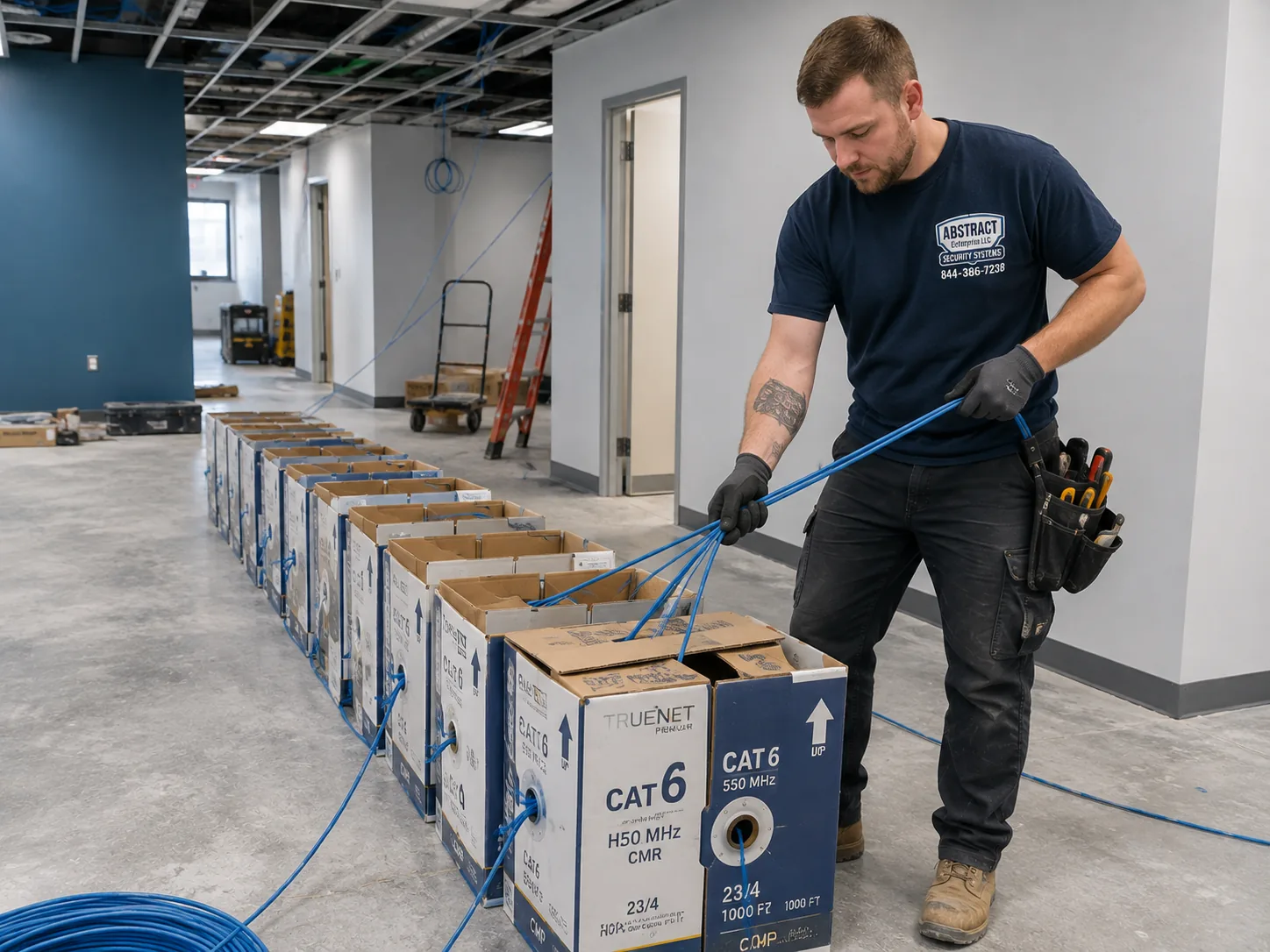
Brooklyn Chinatown, Brooklyn camera cable replacement: boxes of cable staged together for a multi-drop pull on a working premises
A photo from the AESS job library, not taken in Brooklyn Chinatown: boxes of cable staged together before several runs are pulled at once in a business that stays open. On Eighth Avenue a store rarely closes for a repair, so when several old camera runs have to be replaced, the work is planned around deliveries and the lunch rush, and the cable is staged in one corner so the aisles stay clear for customers.

Power is the other half of the story. On June 25, 2025, News 12 reported that Con Edison was deliberately lowering voltage in parts of southwest Brooklyn, with Sunset Park named among the hardest-hit neighborhoods, to protect its equipment during a heat wave. Some buildings never lost power completely; their lights simply ran dim. That kind of event is harder on a camera system than a clean outage. A recorder or a power supply that sags below its working voltage can restart over and over, corrupt the drive it writes to, or come back with cameras that stay dark. Many Eighth Avenue businesses also cut the power to the whole store every night when they close, which puts the recorder through a hard shutdown and a cold start every single day. We cover both later on this page.

Then there are the systems themselves. Two brands come up again and again in Brooklyn storefront repairs, Hikvision and Dahua, and a family-built system may have its menus set to Chinese and its account registered to a relative's phone number or e-mail. In November 2022 the FCC barred new Hikvision and Dahua equipment from being authorized for sale in the United States. That rule did not make the cameras already on your wall illegal, but it does change which replacement parts we can supply, and it is one more reason a repair here starts with finding out exactly what is installed. We repair these systems every week, and we tell you honestly when a part can be matched and when the better answer is to replace one piece of the chain.

Six Brooklyn Chinatown facts that shape a camera repair

  • The avenue is long and dense. The commercial strip runs about 25 blocks along Eighth Avenue, from about 40th to 65th Street, with side streets of row houses and two-families on both sides.
  • The buildings are old, but busy. Most date from the 1890s to the 1920s, so camera cable runs through brick walls, tin ceilings, cellars and dumbwaiter shafts that were never built for it.
  • The power can sag without going out. Con Edison's June 2025 voltage reductions hit Sunset Park, and dimmed power is a common cause of recorders that restart and drives that fail.
  • Merchants have long organized around safety. CBS New York reported in May 2026 that the Brooklyn Chinese-American Association, founded in 1988, petitioned the NYPD in 1990 for a bilingual officer to walk Eighth Avenue and hear merchants' complaints.
  • Eighth Avenue sits outside the historic districts. The four Sunset Park historic districts designated in 2019 lie between Fourth and Seventh Avenues, so storefront camera repairs on Eighth Avenue itself do not run into Landmarks review.
  • The building stock is changing at the edges. Narrow new condos, such as the six-story building that replaced a house at 5213 Eighth Avenue, now stand beside the old row houses and can block a camera that once had a clear view.

Where this page applies. It covers Brooklyn Chinatown along Eighth Avenue and the side streets around it, in ZIP codes 11220 and 11232, roughly from Seventh Avenue to Ninth Avenue and from the 40s down into the 60s. If your building is on the park blocks, near Fifth Avenue or closer to the waterfront, the same prices and the same process apply, and the wider borough is covered on our Brooklyn security camera repair page. The price follows the fault, not the neighborhood name.

Same-Day Repair in Brooklyn Chinatown

Need Repair in Brooklyn Chinatown? A Dark Register Camera, a Recorder That Lost Its Drive, or a Kitchen Camera Nobody Can See Through

Urgent calls from Eighth Avenue usually arrive in one of three shapes. The first is a break-in or a theft, where the owner opens playback and finds that the camera covering the door or the register has been dark for days, or that the recorder stopped saving weeks ago without anyone noticing. The second is a recorder that will not finish starting up after a power cut or a night of dimmed lights, beeping, showing a hard drive error, or asking to be set up as if it were new. The third is a store that changed hands or staff, where nobody left behind knows the password and the phone app shows every camera offline.

If you need footage from an incident, please leave the recorder alone until we get there. Do not unplug it, restart it repeatedly or accept a prompt to format or initialize the drive, because each of those can overwrite or wipe the very hours you need. Call (347) 934-8335, give us the date and time window, and we book the visit within 2 hours of your request. The first thing the technician does on arrival is copy that clip to a USB drive with its original timestamp, before testing anything else.

For everything else, the path is the same: the $150 service call books a two-hour arrival window, the technician finds the cause, and you get a written price before any part is changed. Most single faults on our Brooklyn list cost $150 to $700. If the visit shows the repair is not worth it, for example a ten-year-old recorder that would cost more to fix than to replace, we say so on the spot and price both options.

What We Install

Security Camera Repair Services in Brooklyn Chinatown

Every repair below is priced from our Brooklyn camera repair list, and each one starts with the same $150 service call. The cards describe the faults we are most often asked to fix in Eighth Avenue businesses and the houses on the side streets, and what the fix involves.

Kitchen and bakery cameras

Cameras near woks, fryers, ovens and exhaust hoods that have gone soft or yellow under a film of grease or flour. We clean the window and housing with the right solvent, check whether heat has warped the dome, and move the camera out of the worst of the smoke path if it keeps happening.

Register and counter cameras

The camera that matters most in a store. We bring a dead or blurred register camera back, set the angle so hands, cash drawer and the customer's face are all in frame, and keep card keypads out of view.

Recorders and hard drives

DVRs and NVRs that beep, restart, show a drive error or stopped writing, often in a hot back office or a damp cellar. We save the footage you need first, test the drive, and replace or relocate what failed.

Power supplies and battery backup

Central power boxes, plug-in adapters and PoE switches weakened by dimmed power, nightly shutdowns or a crowded power strip under the counter. We measure every output and add a battery backup sized to carry the recorder through a short cut.

Connector and cable repair

Coax and network cable chewed in a cellar, crushed behind shelving, cut during a renovation or corroded where it leaves the building. We find the bad section, re-terminate or replace it, and label both ends.

Logins, accounts and language

Recorders nobody can log into, apps tied to a relative's phone, or menus in a language the current staff cannot read. We regain control through the manufacturer's own reset process, set the language you use and hand the passwords to the person you name.

Storefront and gate cameras

Cameras behind the window that wash out when the gate comes down, cameras over the door blocked by a new awning or sign, and cameras on the facade knocked loose by deliveries.

Footage export

Clips copied to USB with the original timestamp and the player file, in the recorder's own format, for the 72nd Precinct, an insurer or a lawyer. Your original stays on the recorder.

Row house and two-family systems

Two to eight cameras on a side-street house: stoop, yard, alley and basement door, with a recorder in a closet or cellar shared by owner and tenant. We repair what is there and leave it labeled.

Brooklyn Chinatown, Brooklyn network camera repair: technician mounting a managed PoE switch below patch panels in a commercial network rack
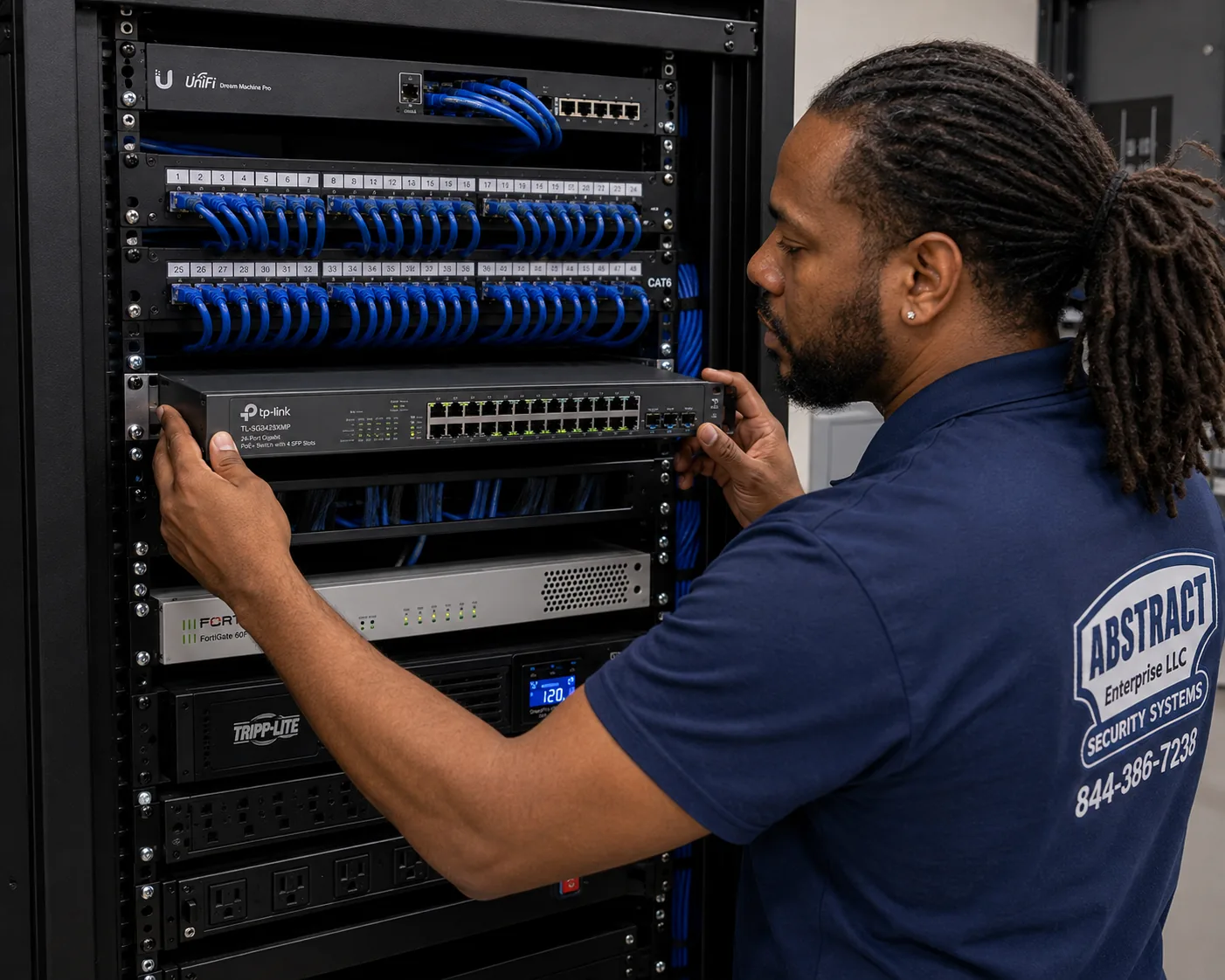
A photo from the AESS job library, not taken in Brooklyn Chinatown: a technician mounting a managed PoE switch below the patch panels in a commercial rack. Larger Eighth Avenue restaurants and markets often run network cameras from a switch like this in a back office. When one port fails or the switch overheats, several cameras drop at once, and replacing that one box brings them all back without touching the cameras.
Building Specialists

Security Camera Repair for Brooklyn Chinatown's Architecture

Six kinds of property make up most of Brooklyn Chinatown and the blocks around it. Each one hides its recorder in a different place, routes its cable a different way, and fails in its own pattern, so a good repair starts by knowing which one you are standing in.

The narrow avenue storefront

A long, deep store on Eighth Avenue with a gate in front, a back room or yard door, and a recorder on a shelf, under the counter or in the cellar.

The restaurant with a working kitchen

Dining room in front, kitchen behind, often a cellar for storage. Grease, steam and heat decide where cameras can live and how often they need attention.

The store with apartments above

A business on the ground floor and two or three floors of homes upstairs, sharing one front door, one stair and sometimes one camera system.

The side-street row house

Brick two- and three-families on the numbered streets between Seventh and Ninth Avenues, with a stoop, a small yard and a recorder in a closet or the basement.

The early co-op and walk-up

Older apartment buildings, including the 43rd Street co-ops, with cameras at the entrance, the hall and the basement, wired back to one recorder.

The warehouse and workshop

Wholesale, storage and light industrial space toward Third Avenue and the waterfront, with high ceilings, loading doors and long cable runs.

The narrow avenue storefront: one long room and a recorder wherever it fit

An Eighth Avenue store is usually narrow and very deep. The camera layout follows that shape: one camera at the door, one or two down the aisles, one over the register, and one at the back door or yard. The cables run along the ceiling, often stapled straight to an old tin or plaster surface, and end at a recorder that was put wherever there was room. We find recorders on top of refrigerators, under the counter beside the cash drawer, behind boxes of stock and down in the cellar next to the boiler. Each of those spots has its own way of killing a recorder, through heat, dust, damp or someone kicking the power cord.

The repair in this kind of store usually has two parts. The first is the fault itself: the dead camera, the failed drive, the crushed cable. The second is moving or protecting the recorder so the same failure does not come back in six months. That can be as small as lifting it off the floor onto a ventilated shelf, or as large as running new cable so it can sit in a locked cabinet in the office. We price both separately so you can choose.

The restaurant with a working kitchen: heat, steam and grease

Restaurants are where camera systems age fastest. Cameras in or near the kitchen collect a film of cooking oil that slowly turns the picture soft and yellow, and the infrared lights at night bounce off that film and make the image worse in the dark than it is by day. Steam from dish stations and rice cookers fogs domes. Heat from the line can warp cheap plastic housings. And the recorder, if it sits in a back office beside the kitchen, breathes the same greasy air through its fan.

Our work here is part repair, part housekeeping. We clean the camera windows and housings with a degreaser that does not scratch the dome, check that the dome has not clouded from heat, and look at whether a camera can be moved a few feet out of the smoke path without losing the view the owner needs. For the recorder, we clean the vents and fan, and if the room is too hot or too greasy, we price moving it. We also suggest a cleaning schedule that matches how hard the kitchen works, which is the cheapest repair there is.

The store with apartments above: two kinds of owner, one front door

Many buildings on the avenue have a business on the ground floor and two or three floors of homes above. Sometimes the store and the building owner are the same family. Sometimes the store is a tenant, and the building owner lives elsewhere. The camera system may belong to either one, and cameras at the shared front door and stair often feed the store's recorder simply because that was the easiest place to put them.

Before we repair a camera in a building like this, we confirm who owns the system and who approves the price, because the answer decides whose recorder we can open and whose footage we can export. When the store owns the cameras but the stair camera protects the families upstairs, the repair is a good moment to settle in writing who keeps the password and who can see which cameras. We set that up on the recorder so each party sees only what it should.

Brooklyn Chinatown, Brooklyn camera cable routing: technician core drilling a block wall to carry cable through to a network room
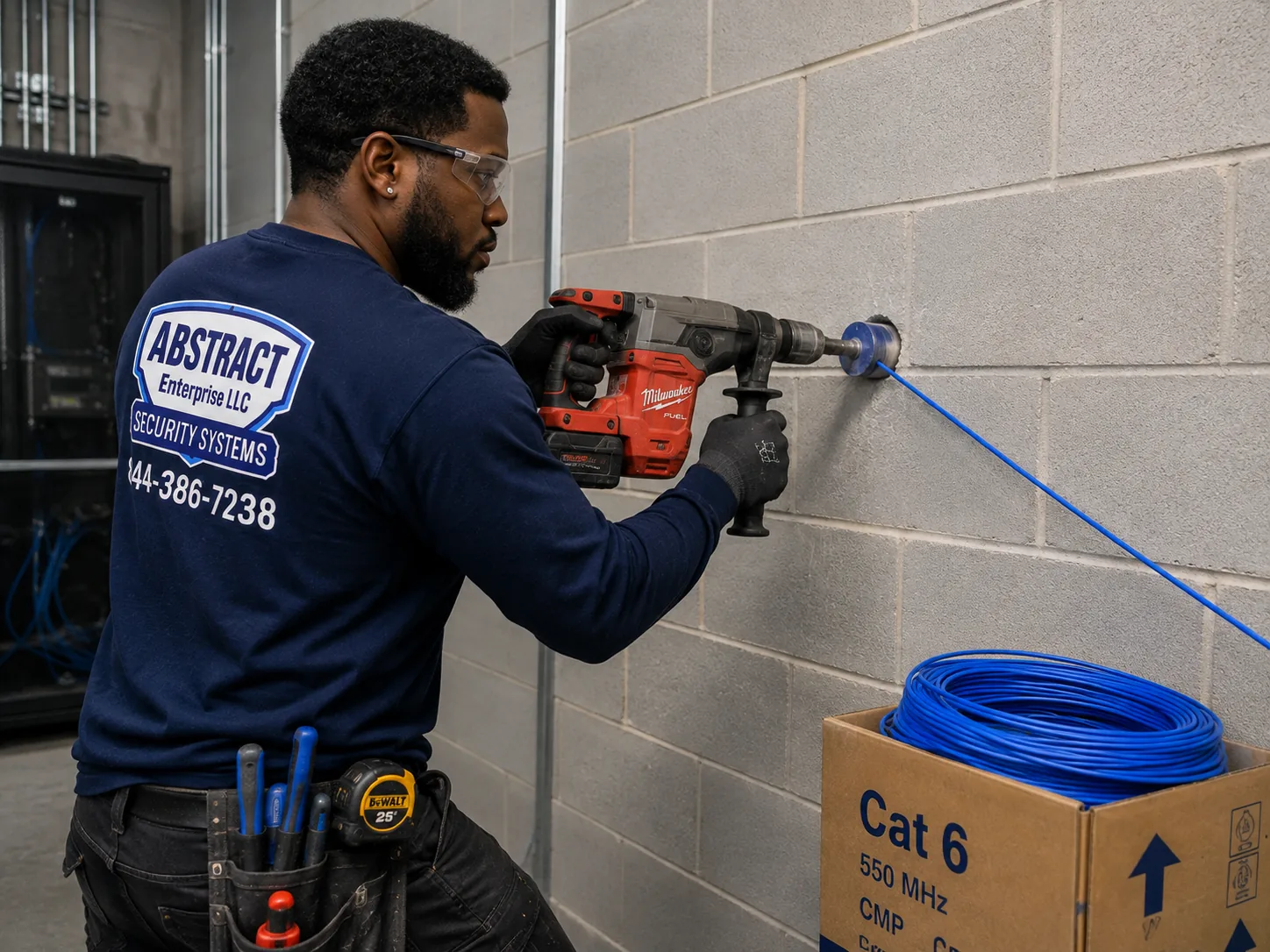
A photo from the AESS job library, not taken in Brooklyn Chinatown: a technician core drilling a block wall so cable can pass cleanly into a network room. In a Sunset Park building, a hole like this is how a recorder moves out of a greasy kitchen office or a damp cellar and into a cooler room next door. The new path is sleeved and sealed so smoke, water and pests cannot follow the cable through.

The side-street row house: stoop, yard and a shared basement

The numbered streets off Eighth Avenue are lined with brick row houses, most of them two- and three-family homes. A typical system has a camera on the stoop, one on the yard, one at the alley or side gate and sometimes one at the basement door, all wired back to a recorder in a closet or the basement. The owner may live on one floor and rent the others, and the recorder may be in a part of the house the owner no longer uses every day.

These systems are usually simple to repair, and the faults are predictable: a connector that let in water at the yard camera, a power adapter that died after a summer of heat, a drive that wore out after years of nonstop recording. What takes time is access. If the recorder is in a tenant's space, we need the owner to arrange entry, and we will not open a recorder in someone's apartment without that.

The early co-op and walk-up: one recorder, many households

Some of the oldest cooperative apartment buildings in New York stand nearby: Alku Toinen, built in 1917, and The Advance, built in 1921, on 43rd Street between Eighth and Ninth Avenues. Older walk-ups and small apartment buildings on the side streets share their problem: a camera system added long after the building was finished, wired through halls and stairwells and back to one recorder in a basement or a closet off the lobby, with a board or a managing agent deciding on repairs.

Repairs here begin with an inventory. We count the cameras the recorder thinks it has, the cameras that are actually on the walls, and the ones that are dark, and we write it down. That list is often the first time the board has seen the system in one place, and it lets them approve the urgent repairs now and plan the rest.

The warehouse and workshop: loading doors and long runs

Toward Third Avenue and the waterfront, the buildings get bigger: wholesale and food distribution space, workshops and storage, with loading docks, roll-up doors and high ceilings. Camera runs here are long, sometimes longer than a standard network cable can carry without help, and cameras sit high on walls and steel. Forklifts, pallets and trucks are the usual enemies of camera cable in these buildings.

The fixes are heavier: replacing long runs, adding a switch partway along a run that is too long, protecting cable in conduit where it crosses a loading area, and bringing a lift or a tall ladder for cameras at roof height. We schedule this work around deliveries so the dock keeps moving.

Field Notes

Field Notes: The First Twenty Minutes Behind an Eighth Avenue Counter

These notes set out how our technicians approach a camera system in a busy Brooklyn Chinatown business, where the store stays open, staff keep working around us and the owner wants to know quickly whether the problem is small or large.

Start where the owner looks. The technician begins at the monitor or the phone the owner uses every day, noting which tiles are dark, which are frozen and which look fine but are blurred. Then playback: picking an hour from yesterday on every camera shows at once whether the recorder has actually been saving, which is the question that matters most after a theft.

Find the recorder and read its surroundings. Is it on the floor, beside the fryer wall, under boxes, on a power strip shared with a fridge or a heater? Is its fan clogged with dust or flour? Is the date on the screen right, and is the language one the staff can read? Those few seconds of looking explain a lot of faults before any tool comes out.

Brooklyn Chinatown, Brooklyn camera cable tracing: technician tracing an unidentified cable run at a patch panel with a tone generator and probe
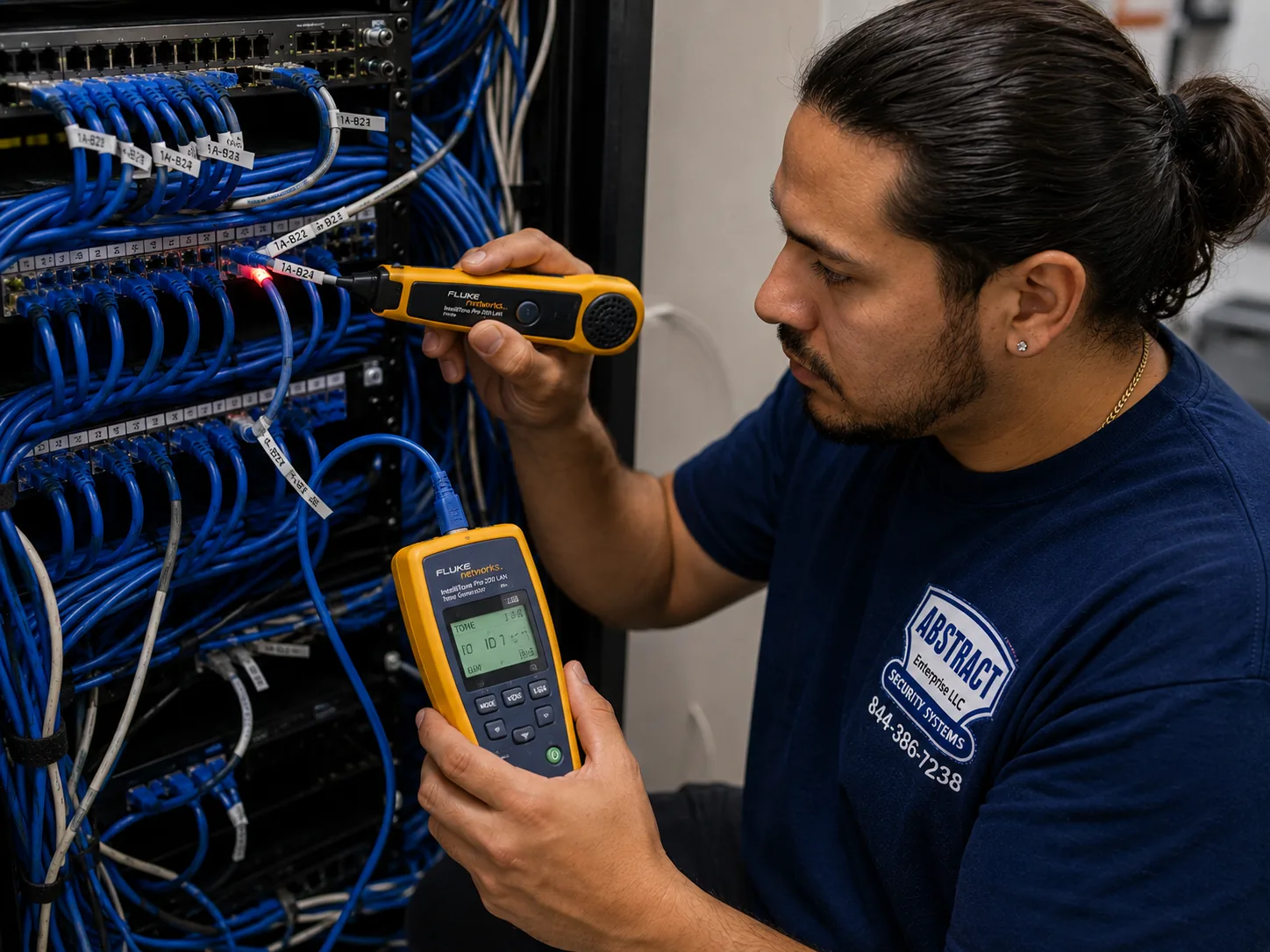
A photo from the AESS job library, not taken in Brooklyn Chinatown: a technician tracing an unlabeled cable at a patch panel with a tone generator and probe. When a store's cameras were added by different people over many years, this is how we find which cable at the recorder goes to which camera, without opening ceilings or moving stock.

Ask who set it up, and who has the password. On the avenue, the answer is often a relative, a previous tenant or a friend of the family. If nobody has the login, the technician starts the manufacturer's reset process early, because some brands take time to answer.

Measure before replacing. Voltage at the camera, power at the switch port, and a cable test from the recorder end tell us whether a dark camera is really dead. Very often it is a tired power adapter, a loose connector or a crushed cable, and the camera itself is fine.

Price before parts, then clean before leaving. You hear the cause and get a written price before anything is replaced. When the repair is done, the technician cleans the camera windows the staff cannot reach, clears the recorder vents, sets the clock, labels what was traced and shows the owner how to check playback.

Fault by Fault

Grease, Power, Pests, Passwords or Age: How Brooklyn Chinatown Camera Systems Break and What Each Repair Involves

Five causes sit behind most camera failures in older storefronts and homes like the ones on and around Eighth Avenue. Knowing which one you are dealing with tells you what the repair is likely to cost and how to stop it happening again.

Grease and dust: the slow fade

A camera near a kitchen never fails all at once. The picture gets a little softer each week as cooking oil settles on the dome, until one day the owner notices that faces at the door look like smudges. At night it is worse, because the camera's own infrared lights reflect off the film on the dome and fog the whole image. In bakeries and dry-goods stores, fine flour or dust does the same thing, and it also gets into the recorder's fan and vents, where it traps heat and shortens the life of the hard drive.

The repair is usually cleaning, not replacement: the right degreaser on the dome and housing, a check that the plastic has not clouded or cracked from heat, and clearing the recorder's vents. Our Brooklyn list prices a clean and check at $80 per visit when it is the only work. If a camera has to be moved out of the worst of the smoke, or a dome has been damaged by heat, the work becomes a single-issue repair in the $150 to $700 range.

Power: dimmed lights, nightly shutdowns and crowded power strips

Con Edison's voltage reductions in June 2025 are a good example of the kind of power trouble that hurts camera systems without anyone noticing at the time. When the voltage sags, a recorder or a camera power supply can restart again and again, and each sudden restart risks corrupting the drive. The same thing happens, on a smaller scale, in stores that switch off the main power every night at closing, and in back rooms where the recorder shares one power strip with a refrigerator, a heater or a rice cooker.

We measure the output of the camera power supply or the PoE switch, check the recorder's event log for repeated restarts, and test the drive. The fix may be a new power supply, a dedicated outlet for the recorder, or a battery backup that rides through short dips and lets the recorder shut down cleanly in a longer cut. Our Brooklyn list prices power supply repair at $150 to $400 and a hard drive swap at $200 to $450.

Brooklyn Chinatown, Brooklyn camera cable testing: technician certifying a data drop with a cable analyzer showing a PASS result
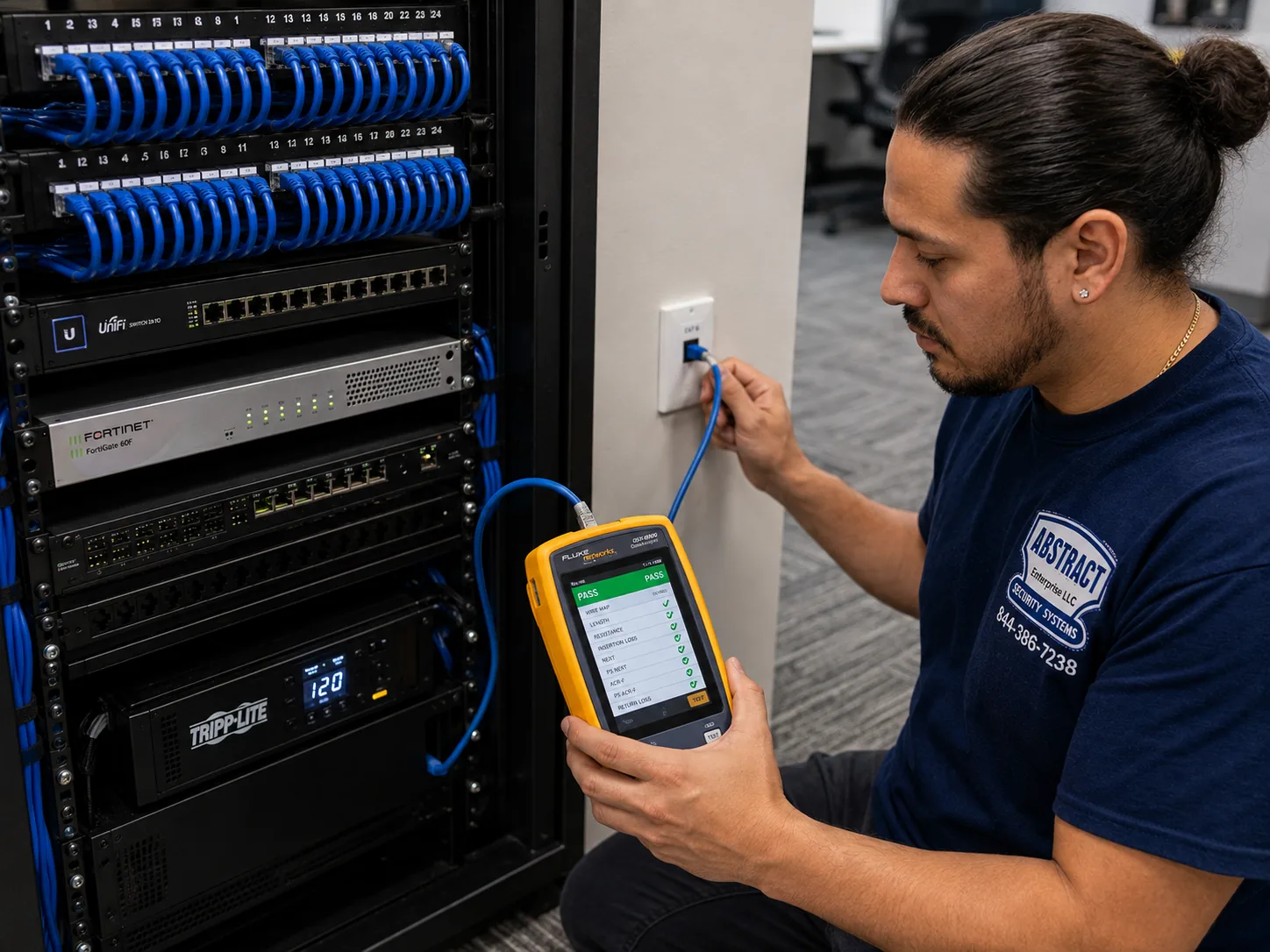
A photo from the AESS job library, not taken in Brooklyn Chinatown: a technician certifying a data drop with a cable analyzer showing PASS. On a network camera run that crosses an old cellar, a test like this tells us in a minute whether the cable is good, so we only replace a camera that has really failed.

Pests, stock and renovations: the cable takes the damage

In old buildings with cellars full of stock, camera cable is exposed to everything that lives and moves down there. Rodents chew insulation, shelving gets pushed against a cable and crushes it, and a contractor renovating the dining room ceiling cuts a run without knowing what it was. The camera at the end of that cable goes dark, and the owner assumes the camera died.

A cable test from the recorder end finds the break quickly. Where the damage is near a connector, re-terminating the end costs $150 to $350 on our Brooklyn list. Where a whole section has been chewed or cut, we replace it and, in a cellar, run the new cable high and in protective conduit where the old one was exposed.

Passwords and accounts: the system nobody can open

Some Eighth Avenue repairs are not about hardware at all. The recorder works, the cameras work, but nobody can log in. The person who set it up chose a password and left; the app is registered to a phone number that changed; the account belongs to a relative who moved back overseas or a tenant who closed the business. Meanwhile the clock may be wrong, the motion settings unknown and the drive full of overwritten video.

Every major brand has an official way to regain control of its own recorder, usually by proving you have the device in hand. We use that process, never a shortcut that leaves the recorder open to the internet, then set new passwords, give them to the person you name, set the correct time zone and language, and turn on alerts so you hear about the next failure. When this is the whole job, it usually falls inside the $150 service call or the low end of a single-issue repair.

Age and the recorder: drives, firmware and equipment rules

Hard drives in recorders that write video around the clock wear out, and recorders that have been running for many years lose support for the phone apps people use. In November 2022 the FCC also stopped new Hikvision and Dahua equipment from being authorized for sale in the United States. The FCC did not order existing systems removed, but replacement cameras and recorders from those brands are now harder to source, so a failed part on an older system can mean choosing a compatible replacement rather than an exact match.

When a recorder is the problem, we tell you whether a new drive will do, whether the recorder should be replaced, and whether your cameras will work with a replacement. Our Brooklyn list prices a DVR that is not working at $300 to $700 including the drive and labor, an NVR that is not recording at $400 to $900, and a full DVR or NVR replacement with hard drive at $700 to $1,500.

Commercial Security Camera Repair

Business Security Camera Repair in Brooklyn Chinatown

Brooklyn Chinatown's businesses are concentrated on Eighth Avenue, with more on the avenues to the west and industrial space toward the waterfront. A repair for a business has to fit around opening hours, deliveries and staff, and it has to leave the owner with a picture that would actually help if something happened. These are the kinds of business we work for most around Sunset Park.

Eighth Avenue restaurants and bakeries

Dining rooms, takeout counters and bakeries with kitchens behind them. The cameras that fail first are the ones nearest the heat and grease, and the register camera that runs nonstop.

Eighth Avenue markets and grocers

Fish, meat, produce and dry-goods stores with cold rooms, cellars and sidewalk displays. Cameras watch stock and doors as much as customers, and cellar cable takes a beating.

Upstairs offices and community groups

Associations, service providers, clinics and offices on the floors above the shops, usually with a camera at the street door and the stair, sometimes on the store's recorder.

Sixth Avenue corner stores

Supermarkets and corner groceries between Fifth and Eighth Avenues, where a camera on the gate and the front door is the overnight record of the block.

Fifth and Fourth Avenue shops

Restaurants, flower and grocery stores and services on the busier avenues toward the west, with storefronts much like Eighth Avenue's.

Warehouses and workshops toward the water

Distribution, manufacturing and storage near Second and Third Avenues, with loading doors, yards and long camera runs.

Brooklyn Chinatown, Brooklyn storefront camera repair: technician feeding cable through a ceiling in an occupied commercial space
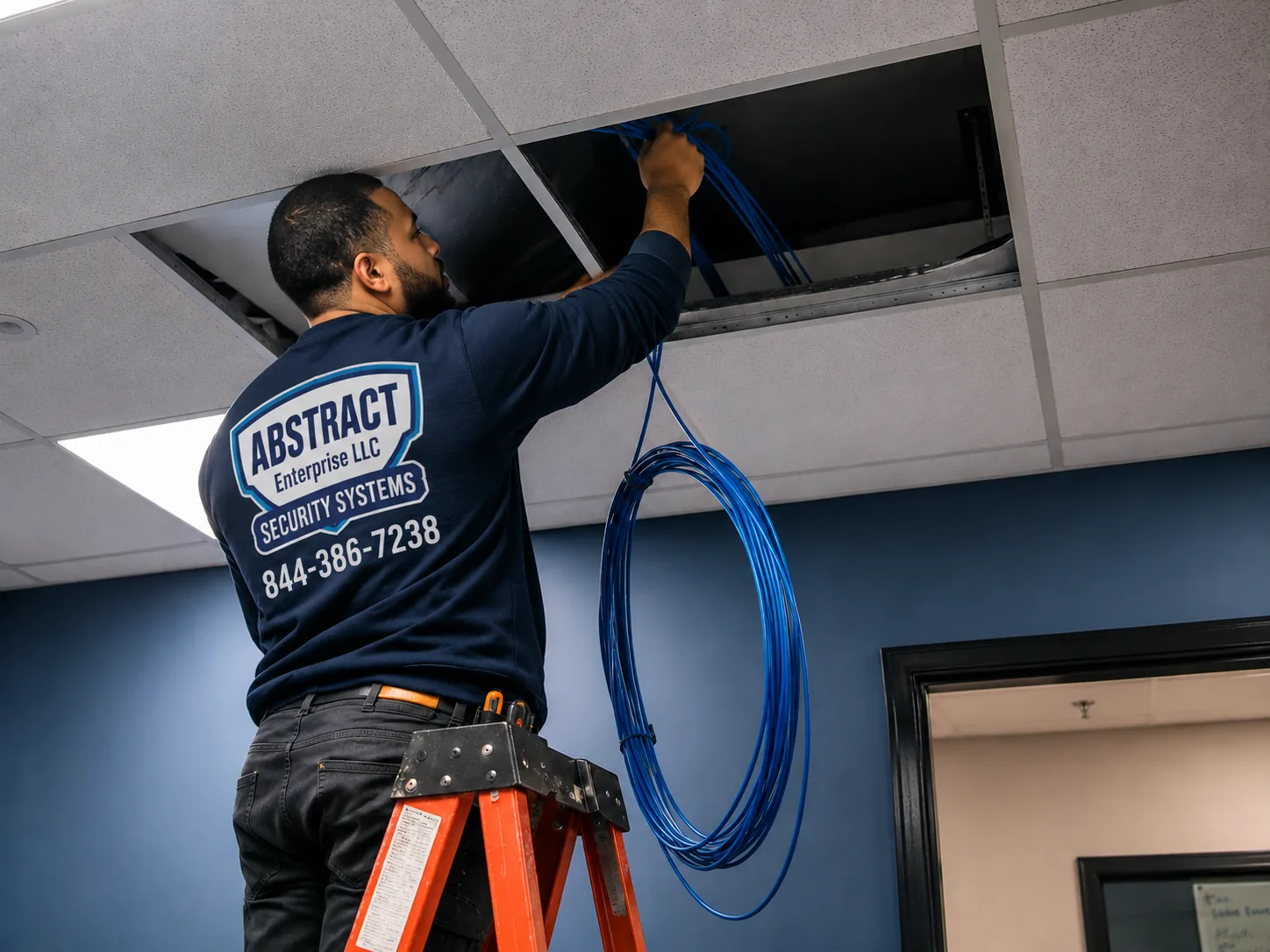
A photo from the AESS job library, not taken in Brooklyn Chinatown: a technician feeding cable through the ceiling of a commercial space that is open for business. In an Eighth Avenue restaurant or market, ceiling work like this is done in short stretches between busy periods, with drop cloths over food areas and the ladder moved out of the aisle whenever customers come through.

What an Eighth Avenue owner needs from a repair

A store owner rarely calls because a camera is broken in principle. The call comes because something happened, or almost happened, and the owner wants to know whether the system would have caught it. That means the first job is always the same: confirm that every camera is not only showing a picture but recording, that the recorder keeps enough days of video to cover the time it takes to notice a problem, and that the clock is right so a clip can be matched to a receipt or a police report.

The second thing a business needs is a picture that identifies someone. The camera over the door should catch a face at the threshold, not the top of a head from the ceiling. The register camera should show hands, cash drawer and the person standing at the counter. The back door camera should show who comes in from the yard, which matters on a street where, as CBS New York reported, a burglar got into the Lucky 8 Restaurant through the back. We check each camera against the job it is supposed to do, and if a small change in angle or a different lens would make the picture useful, we say so and price it.

Gates, awnings and the view from the window

Cameras mounted inside the front window often have a problem the owner only discovers after a night-time incident. When the roll-down gate comes down, the camera may see nothing but the inside of the gate, or the gate's slats may catch the camera's infrared light and turn the image white. New York's 2009 storefront gate law requires gates that are at least 70 percent see-through. In June 2026 the City Council voted to drop the July 1, 2026 deadline, so under that bill a business only has to install a compliant gate when it replaces its gate for other reasons. Either way, a gate change is a good moment to re-aim and re-set the cameras behind it.

Awnings and signs cause the other common view problem. A new awning or a bigger sign over the door can sit right in front of a camera that used to see the sidewalk. We move the camera below or beside the new fixture, or change its lens, so the street is back in view.

Cellars, cold rooms and back rooms

Many Eighth Avenue businesses keep stock, and often their recorder, in the cellar. Cellars bring damp, pests and the risk of a leak, and cold rooms bring condensation on any camera that sits where warm and cold air meet. When a cellar camera or recorder keeps failing, the lasting fix is usually to move the recorder upstairs to a dry, ventilated spot, to run cellar cable high and protected, and to use cameras rated for cold and damp where they have to go.

Brooklyn Chinatown, Brooklyn commercial camera cabling: J-hooks carrying dressed cable bundles across a commercial ceiling
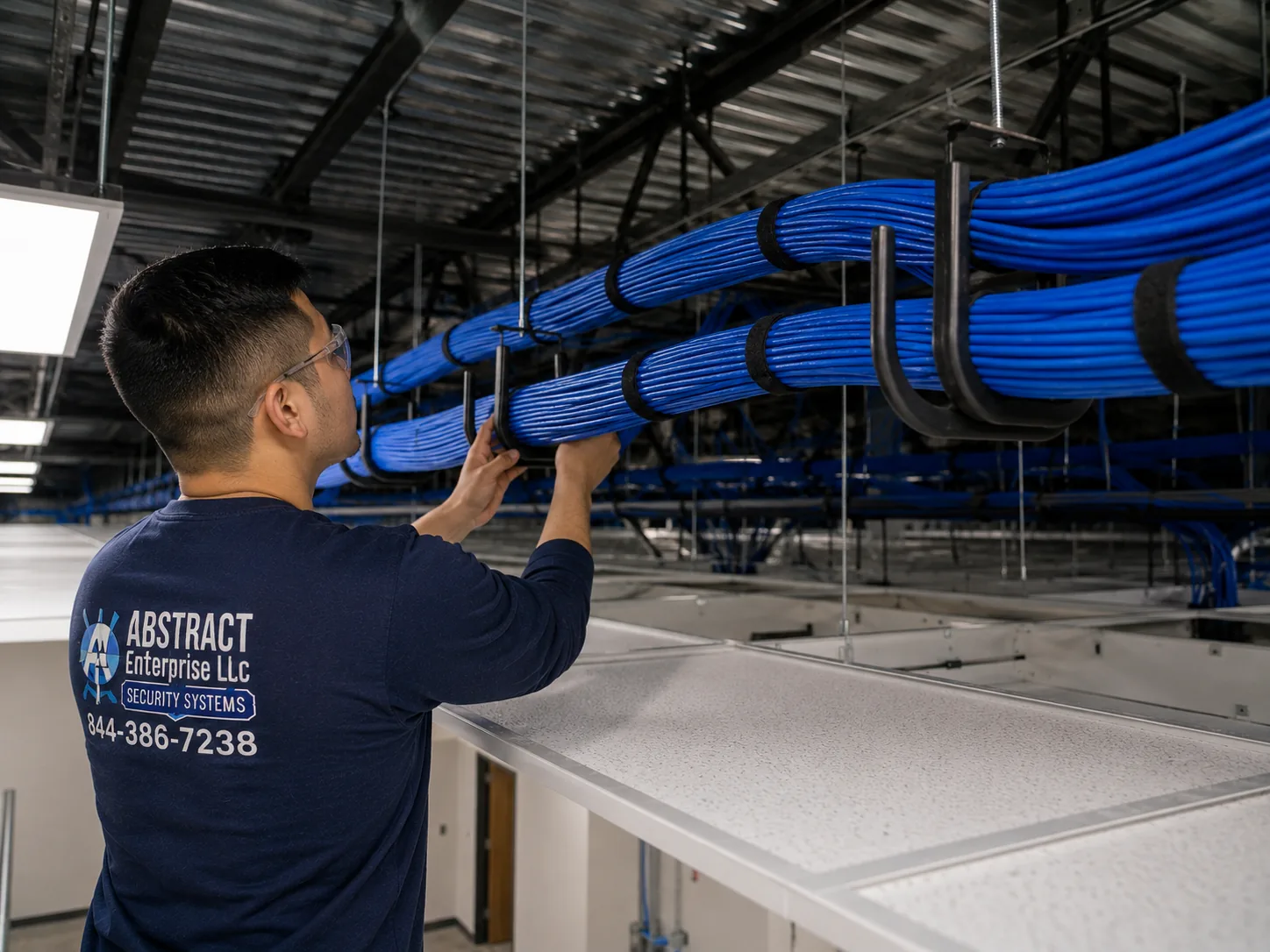
A photo from the AESS job library, not taken in Brooklyn Chinatown: J-hooks carrying neat bundles of cable across a commercial ceiling. In a Sunset Park cellar full of stock, hanging camera cable high on supports like these keeps it clear of shelving, boxes and pests, which are the usual reasons a cellar camera run fails.

Rules that touch a commercial camera repair

State licensing. The New York Department of State licenses companies that install, service or maintain security systems, and its rules treat a closed-circuit camera system used to detect intrusion or theft as covered work. An owner or an employee may work on the owner's own system, but a company you hire should be licensed. Ours is NYS license #12000287431.

Cameras and staff. New York's Labor Law bars employers from video recording in restrooms, locker rooms and changing rooms. If your cameras watch areas where employees work, such as a stock room or a kitchen, a clear sign that the area is recorded is good practice, and your accountant or lawyer can tell you what notice your business should give.

Police access is your choice. The city's retail-theft program lets businesses link their cameras to the NYPD in real time. CBS New York reported that the program is free and voluntary, that businesses have to opt in, and that the hours the NYPD can see the cameras can be customized. A repair does not sign you up for anything; if you want to take part, we make sure the recorder and network are ready for it.

Permits. Under the 2025 New York City Electrical Code, low-voltage wiring under 50 volts for signaling and communication, such as camera cable, does not need an electrical permit when it is done by a qualified person. Work that adds new line-voltage outlets for equipment is electrical work and is handled by an electrician.

Landmarks. The Landmarks Preservation Commission's four Sunset Park historic districts, designated in 2019, cover blocks between Fourth and Seventh Avenues. Eighth Avenue itself is outside them. If your building is on one of those district blocks, ordinary repair of existing safety equipment does not need an LPC permit, but adding cameras to the front of the building does need review.

Your Questions Answered

Security Camera Repair in Brooklyn Chinatown: Questions Answered

These are situations that come up in Eighth Avenue businesses and the homes around them. Each answer comes from how camera systems actually fail in buildings like these, and from what the repair involves.

After closing time on the avenue

We switch off the power to the whole store every night when we close, and turn it back on in the morning. Is that hurting the recorder?

Yes, and it also means the cameras are not recording overnight, when most break-ins happen. Cutting the main power stops the recorder mid-write, which over time corrupts the drive and can leave the recorder asking to be set up again one morning. It also means the recorder has nothing from the hours the store is empty. The fix is to keep the recorder, the camera power supply and the network switch on a circuit or outlet that stays live when the rest of the store is switched off, ideally with a small battery backup in between. We can show the electrician exactly which outlet needs to stay on, and we test the drive while we are there.

Our solid roll-down gate is due to be replaced with a see-through one. Will the cameras behind our window need to be changed afterward?

Usually they need resetting rather than replacing. A camera that has spent years looking at the inside of a solid gate at night will suddenly see the street through the new grille, but the slats can catch its infrared light and wash the picture out, and its motion settings will fire on every passer-by. After the new gate goes in, we adjust the angle, turn down or switch off the camera's own infrared if the streetlight is enough, set a motion area that ignores the sidewalk traffic, and check the picture after dark. If the camera cannot handle the glare, a model with better low-light performance is a single-camera replacement.

A new awning went up over our storefront, and the camera above the door now sees only fabric. Does it have to come down?

It has to move, but it rarely has to be replaced. The usual fix is to lower the camera below the awning frame, mount it on the side of the door opening, or put it inside the window looking out under the awning. Each needs a short extension of the existing cable, and a new mount that does not depend on the awning, since awnings get replaced. Tell us when the awning or sign company is coming next time, and we can move the camera on the same day.

Kitchens, bakeries and cold rooms

The camera over our restaurant's kitchen door goes soft and yellow within a few weeks of being cleaned. Is the camera failing?

Almost certainly not. That is a film of cooking oil on the dome, and it builds up fastest on cameras near the line or in the path of the exhaust. The picture usually looks worse at night, because the camera's infrared light bounces off the film. Cleaning it with the wrong product scratches the dome and makes it permanently cloudy, so we use a degreaser made for plastics. If the camera sits right in the smoke path, moving it a few feet or putting it behind a shield usually stretches the time between cleanings from weeks to months.

Our bakery's recorder sits in the back room where the flour is stored, and it has started shutting itself off. Is it the flour?

Quite possibly. Fine flour gets drawn into the recorder's fan and vents, packs around the hard drive and traps heat. A recorder that overheats may restart, shut down or stop recording, and the hard drive inside wears out faster. We open the recorder, clean the fan and vents, test the drive, and check the temperature inside. If the room is dusty every day, the lasting answer is to move the recorder into a closed, ventilated cabinet or into the office, away from where flour is handled.

The camera inside our walk-in cold room fogs up every time the door is opened. Do we need a different camera?

Probably, yes. When warm, damp air from the kitchen or the store rushes into a cold room, moisture condenses on any surface that is cold, including the camera's dome, and a standard indoor camera can also take on moisture inside. A camera rated for cold, damp spaces, mounted away from the door and with its cable entry sealed, stays much clearer. Sometimes the simpler fix is to watch the cold room from outside, through the door, rather than putting a camera inside it.

Who set it up, and in what language

Everything on our recorder and phone app is in Chinese because a relative set it up, but some of the staff now read only English or Spanish. Can you repair it and change the language?

Yes. Most recorders and their apps let you choose the menu language, and the choice is separate on the recorder and on each phone. We repair the fault, then set the recorder to the language the person running the store reads, and set each phone's app the way its owner wants it, so the family can keep Chinese and the staff can use English or Spanish. We also make sure the time zone and date format are right, because a recorder set up abroad can carry the wrong clock settings. We leave a short written note of what was changed.

The account for our camera app is registered to a relative who has moved back overseas, and nobody here can log in. How do we get control back?

Through the manufacturer's own recovery process, with the recorder in front of us. Most brands let the person who physically has the recorder reset its password, often by scanning a code on the screen and getting a reset key from the manufacturer. Once the recorder is back under your control, we remove the old account, register the app to the store's own phone number or e-mail, and set the new admin password for the person you choose. It is worth asking the relative to log in once and transfer the device before we start, if they can, because it saves a step.

Our recorder was bought from a seller overseas and has no warranty here. Can it still be repaired?

Often it can, as long as it is a standard recorder that works with common cameras and drives. Drives, power supplies, fans and cables are generic parts we can replace. What we cannot do is repair the recorder's main board or get firmware that the manufacturer does not publish for the United States. If the main board has failed, we price a replacement recorder that works with your existing cameras, and we tell you before buying anything whether your cameras will carry over.

When the building changes around the cameras

A new building went up next door, and our side camera now looks straight at a brick wall. Can it be saved?

The camera can be reused. What changes is where it goes. With narrow new buildings rising beside older row houses on and near Eighth Avenue, a side or rear camera that used to look down a gap may now face a wall a few feet away. We look at what the camera was meant to protect, usually a side gate, a yard door or a window, and move it to the closest spot that still sees that, extending the cable from the old location. If the new building blocks the only useful angle, we suggest a different camera position or lens and price it before doing anything.

The channel names on our recorder say Front Door and Back Door, but those tiles show the cellar and the alley. Is something wrong with the cameras?

The cameras are fine. Someone reconnected cables to different inputs at some point, often during a past repair or when the recorder was moved, and nobody renamed the channels. It matters more than it seems, because a clip exported for the police or an insurer carries the channel name, and the wrong name can cause confusion. We trace each cable to its camera, rename every channel to match what it actually shows, label both ends of each cable, and give you a printed list.

Staff, travel and remote viewing

We use a camera to watch the stock room where employees work. Do we have to tell them?

New York's Labor Law bars employers from recording video in restrooms, locker rooms and changing rooms, so no camera should ever point into those spaces. For a stock room, kitchen or sales floor, a clear sign that the area is recorded is good practice and removes any doubt, and your lawyer or accountant can tell you what written notice your business should give staff. When we repair or re-aim cameras, we make sure none of them sees into a restroom or changing area, and we can set privacy masks on any part of a view you want blocked.

We travel to visit family for several weeks at a time. Will we be able to see the store cameras on our phones while we are away?

That depends on how your recorder reaches the internet and which service its app uses, and some cloud services that work in the United States can be slow or unreliable from abroad. Before a long trip, we can confirm the recorder is online, make sure the app on each traveling phone is logged in and working, turn on alerts for camera or drive failures, and give someone staying behind their own login. The safest plan is to test the app from the phone you will carry before you leave, and to have a person nearby who can check the recorder if something stops.
Equipment

Types of Security Cameras and Recorders We Repair

We repair whatever is on the wall, whoever put it there. On Eighth Avenue that often means a mix: older coax cameras from when the store opened, newer network cameras added later, a recorder that replaced the first one, and a phone app on top. These are the categories we work on, and how each tends to fail in a Brooklyn Chinatown building.

Analog and HD-over-coax cameras

Cameras with round BNC connectors on coaxial cable, from older analog to HD models. Common faults here: corroded or loose connectors, a failing central power box, and cable crushed in a cellar.

Network (IP) cameras

Cameras powered and connected through one network cable. Common faults: a dead switch port, a bad cable end, or a camera that lost its address after a power cut.

DVRs, NVRs and hybrid recorders

The box that holds the footage. Common faults: drives worn out or corrupted by power cuts, clogged fans in dusty or greasy rooms, forgotten passwords and wrong clocks.

PoE switches and network links

Switches in back offices and cellars that power network cameras. One failed switch can take several cameras down at once.

Dome, turret and bullet housings

Domes clouded by grease or heat, cracked housings at doors where deliveries pass, and mounts loosened by gates and awnings.

Cold-room and kitchen cameras

Cameras in or near walk-ins, prep areas and lines, where condensation, steam and oil are the main enemies.

Wi-Fi and battery cameras

Stand-alone cameras and doorbells on row houses and in small shops, which drop off when brick walls or a changed router get in the way.

Power supplies and battery backups

Central power boxes, plug-in adapters and UPS units, tested under load, especially after dimmed-power events like the June 2025 voltage cuts.

Monitors and phone apps

The screen behind the counter or in the office, and the app accounts on staff and family phones, set to the right language and owner.

Brooklyn Chinatown, Brooklyn camera recorder and network repair: finished network rack with patch panels, switching, firewall and battery backup, dressed and identified
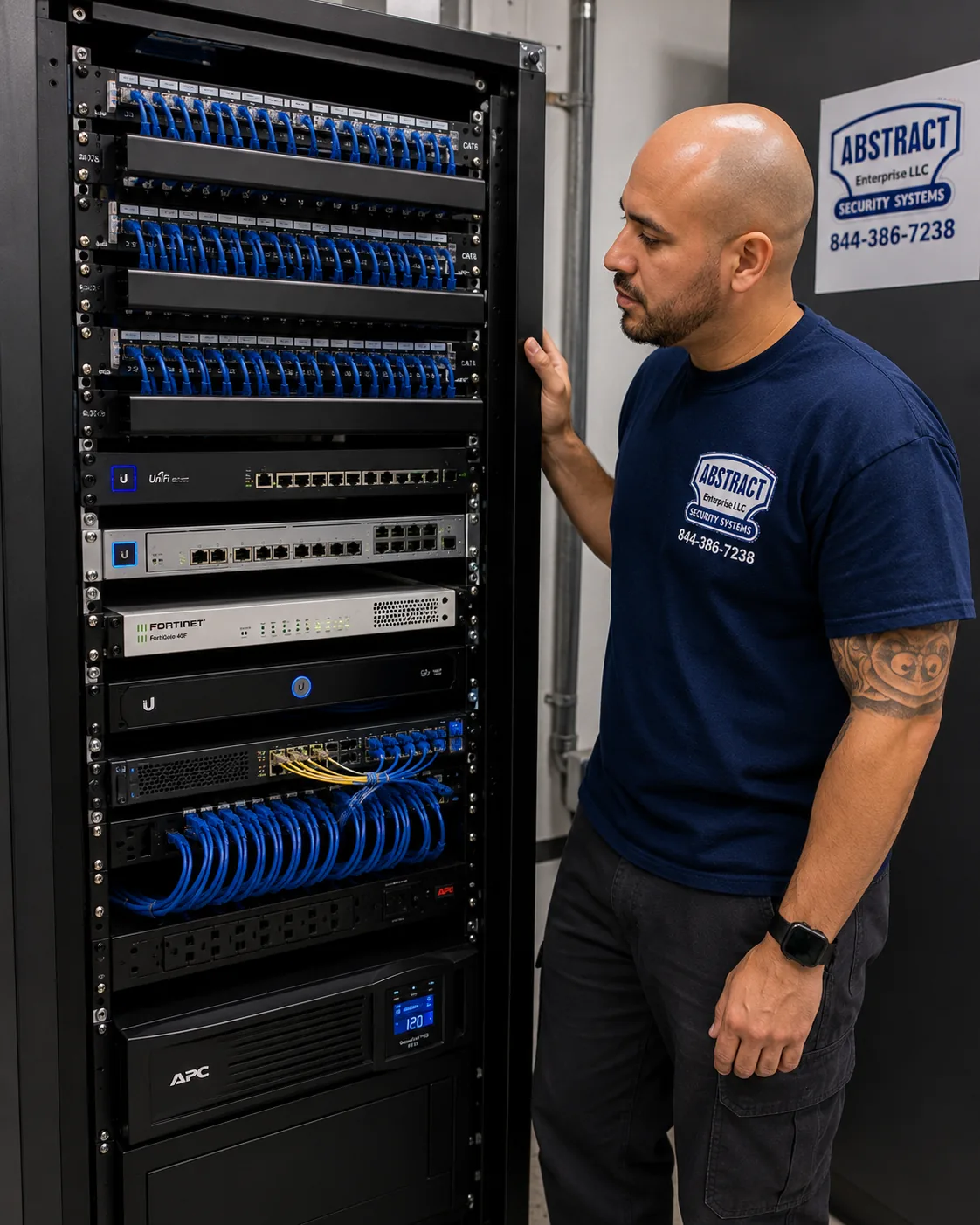
A photo from the AESS job library, not taken in Brooklyn Chinatown: a finished rack with patch panels, switching, a firewall and a battery backup, every cable dressed and identified. For a larger Eighth Avenue business, moving the recorder and switch into a small cabinet like this, out of the kitchen office or the cellar, is the repair that stops the same failures from coming back.

National brands versus a local licensed repair

Some Brooklyn Chinatown homes and shops have, or once had, a camera that came with an alarm contract or a consumer brand bought online. Those are fine products for what they are, but they are built to be supported by their own company, not to be repaired on the spot. Here is how the choices compare when something stops working.

QuestionADT or similar alarm companyRing or SimpliSafe cameraAESS local repair
Who owns the equipmentDepends on the contractYou own itYou own it, and we repair it
Systems set up by a relative or past tenantUsually only its own equipmentAccount recovery through the appAny brand, any installer, recovered on site
Wired cameras and recordersIts own systemsMostly Wi-Fi and battery devicesCoax, network, hybrid and PoE
Kitchen grease and cellar damageVaries by dealerReplace the deviceClean, reseal, relocate or replace on site
Licensed technician on siteVaries by dealerRemote supportYes, NYS license #12000287431
Price before workVariesReplacement device price$150 service call, then a written repair price

If your cameras came with a monitored alarm contract, check what it says about service before calling anyone else, because some contracts cover repairs. If not, or if the system was installed by someone who is no longer around, we can repair it as it stands and you keep full ownership. Repairing a wired camera system does not sign you up for monitoring or any monthly fee.

AI Overview Reality Check

What AI Gets Wrong About Security Camera Repair in Brooklyn Chinatown

These claims turn up in AI-generated answers, on national directory sites such as Angi and HomeAdvisor, and in general advice online. Each one sounds reasonable. Each one can cost an Eighth Avenue business money or footage if it is taken at face value.

"Hikvision and Dahua cameras are banned, so the whole system has to be ripped out"

Some answers say that because the federal government acted against these two brands, any system built on them is illegal or must be replaced. Owners on the avenue hear this from salespeople too, usually right before a quote for a whole new system.

What actually happened is narrower. In November 2022 the FCC adopted rules that bar new Hikvision and Dahua equipment from being authorized for import or sale in the United States. Security Sales reported that Dahua said the order "does not affect products that are already authorized," and the FCC only sought comment on future action about existing authorizations. A private store or home is not ordered to remove cameras it already owns.

The practical effect is on parts. Matching replacement cameras or recorders from those brands are harder to buy now, so a repair may mean choosing a compatible camera or recorder from another maker. We test whether your existing cameras will work with a replacement before anything is ordered, and we replace only the piece that failed.

"Switching off a store's power at night saves money and does no harm"

Advice about cutting electricity costs often suggests switching everything off when you close. In a store with cameras, that turns off the one system meant to protect the empty shop overnight.

A recorder that loses power every night stops in the middle of writing video. Over months that can corrupt its drive, scramble its settings or leave it asking to be set up again. And while it is off, it records nothing. Break-ins like the 4 a.m. gate-cutting at King Mei Supermarket on Sixth Avenue, reported by Patch, happen in exactly the hours a switched-off system would miss.

Keep the recorder, the camera power supply and the network switch on an outlet that stays live, with a small battery backup, and switch off everything else. The camera system uses little power compared with refrigeration and lighting.

"Restaurant cameras only need cleaning once a year"

General maintenance advice often says to clean camera lenses once or twice a year. That schedule comes from cameras on houses, not cameras beside a wok station or an exhaust hood.

In a working kitchen, a film of oil can build up on a dome in weeks, and the camera's infrared light makes the picture worse at night. A camera that looked fine at its yearly cleaning may have been close to useless for most of the months in between.

Match the cleaning to the kitchen. Staff can wipe the reachable domes with the right product, and the high ones can be done on a maintenance visit. Moving a camera out of the direct smoke path often cuts the cleaning to a few times a year.

"Wireless cameras avoid all the wiring trouble in an old building"

Many answers suggest that switching to Wi-Fi cameras solves cable problems in older buildings. On the face of it, no cable means nothing to chew, crush or cut.

Eighth Avenue's buildings are mostly brick and date from the 1890s to the 1920s. Masonry walls, cellars and long, deep stores are hard on Wi-Fi signals, and a camera still needs power, usually from an outlet or a battery that needs charging. In a busy commercial block, many networks compete for the same airwaves.

Wired cameras remain the most dependable choice for a store or a building. Wi-Fi cameras have their place on a row house stoop or as a stopgap, but a failed cable run is usually cheaper to repair than a whole wireless system is to buy and keep connected.

Brooklyn Chinatown, Brooklyn camera cable protection: technician running cable into EMT conduit beside a telecom room in an industrial building
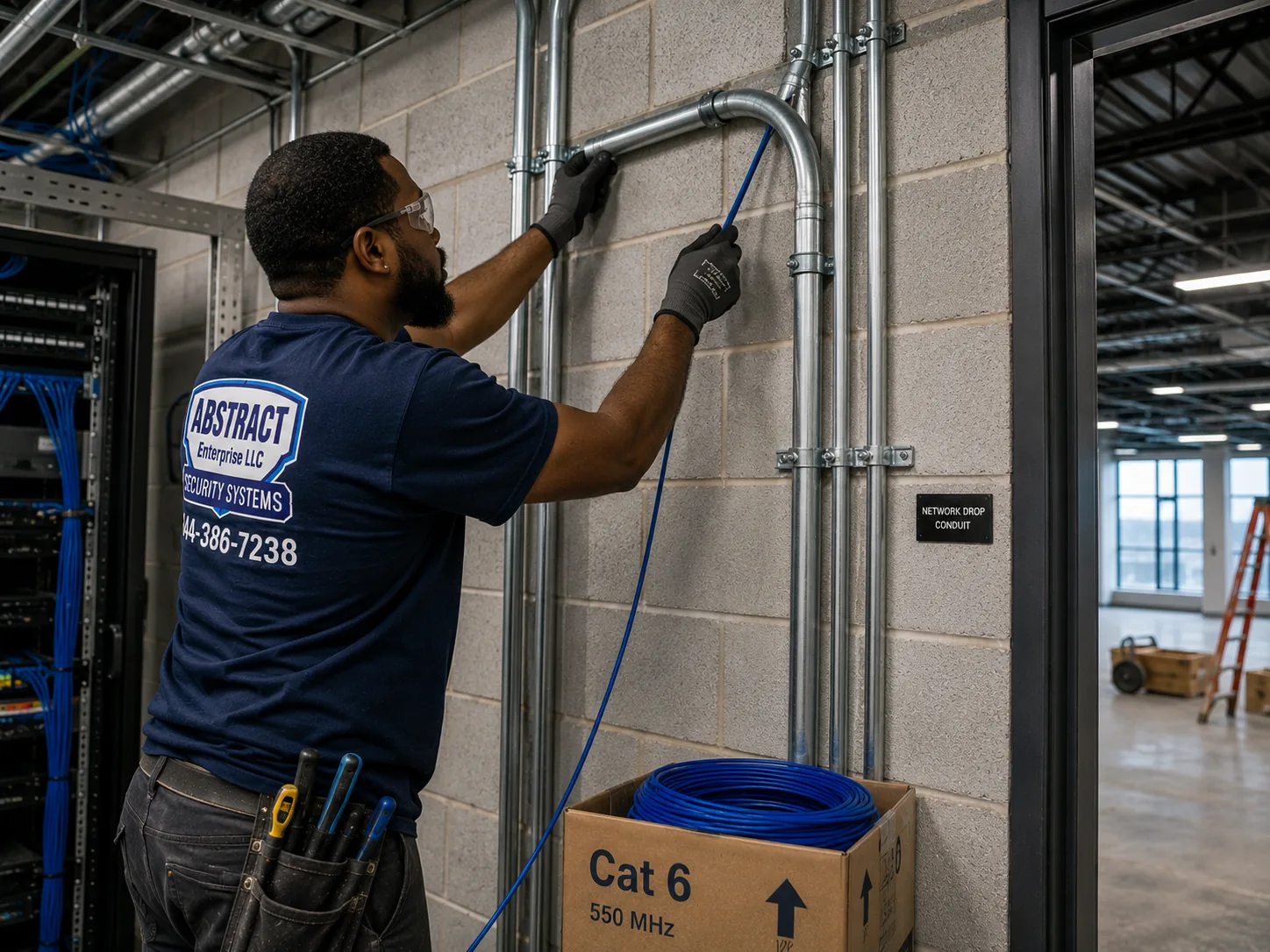
A photo from the AESS job library, not taken in Brooklyn Chinatown: a technician running cable into steel conduit beside a telecom room in an industrial building. In the warehouses and workshops toward the Sunset Park waterfront, and in cellars where stock is moved every day, conduit like this protects camera cable from forklifts, pallets and pests.

"If you can see a live picture, the camera is recording"

Many guides treat a working live view as proof the system is working. That is the most expensive misunderstanding in camera ownership.

Live view and recording are separate. A recorder can show every camera perfectly while its drive has failed, filled up and stopped, or been set to record only on motion that never triggers. Owners often find out only after a theft, when playback for the night in question is empty.

Once a month, open playback, pick a time from the day before, and check every camera. If any are blank, call us before you need the footage. We can also set the recorder to send an alert when a drive fails or a camera loses signal.

"Businesses have to give the NYPD access to their cameras"

Some online answers say that new city programs require stores to share their cameras with police. Owners worry that a repair will connect their system to the NYPD.

The city's retail-theft camera program is voluntary. CBS New York reported that it is free, that businesses must opt in, and that the hours the NYPD can see the cameras can be customized. Nothing about a repair enrolls your business.

If you do want to take part, a working, correctly timed recorder with a stable internet connection is what the program needs, and we can prepare it. If you would rather not, your system stays private, and you can still hand clips to the 72nd Precinct when you choose.

"Camera repair in Brooklyn costs about $1,400"

Ask an AI what camera repair costs and it often quotes directory averages. HomeAdvisor's Brooklyn page for surveillance camera installation or repair gives an average of $1,416, with a typical range of $680 to $2,145.

That number mixes new installations with repairs, which pulls it up. A dark camera caused by a bad connector or a tired power supply costs nowhere near that, and a password recovery or a channel relabel often fits inside the service call.

On our Brooklyn list, the service call is $150 and credited to the repair, most single faults cost $150 to $700, and recorder replacements or multi-camera rebuilds cost $700 to $1,500. You get the written price before any part is changed.

Talk to a Technician Before You Replace a Whole System

If someone has told you the whole system needs replacing because one camera is dark or the brand is no longer sold, get a second look first. Most failures on the avenue are one part of the chain, and the rest can stay. Call now at (347) 934-8335, send a fast quote request, or send a photo of the recorder screen to a technician on WhatsApp. Same-day estimates are available on most days, and requests are booked within 2 hours.

Get In Touch

Request a Free Quote

Tell us the cross streets, the type of building or business, how many cameras there are, which ones are out, where the recorder sits and who set the system up. A photo of the recorder screen and its label helps most. A technician will call you back with the likely fault and the price range, or call (347) 934-8335 now.

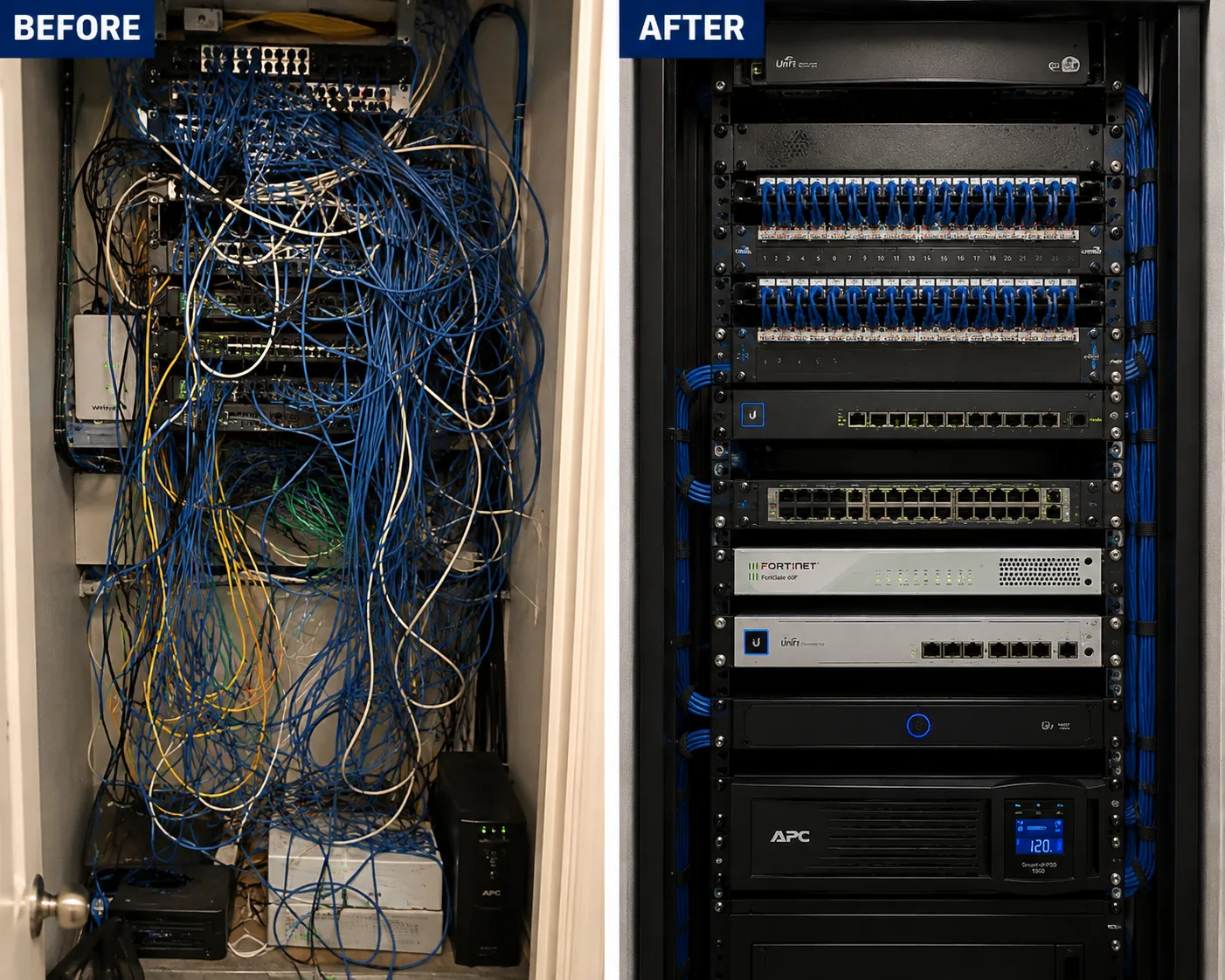
Brooklyn Chinatown, Brooklyn camera system cleanup: before-and-after views of a network rack, an unlabelled tangle rebuilt into a dressed and identified rack
A photo from the AESS job library, not taken in Brooklyn Chinatown: before-and-after views of a network rack, a tangle of unlabeled cable rebuilt into a dressed and identified rack. Systems added to over many years, by different people, often look like the before picture. Untangling and labeling them is what lets the next repair on an Eighth Avenue system start in minutes.

✅
Request Sent!
Thank you. A technician will contact you about the Brooklyn Chinatown address shortly.
How It Works

Our Repair Process

1. Send photos of the screen and the recorder

A photo of the recorder screen with the dark or blurred tiles, the label on the recorder, and your cross streets. That tells us the brand, the type of system and the likely parts before we arrive.

2. Confirm who owns and approves

Store owner, building owner, family member or board: we confirm who controls the system and the passwords and who signs off on the price, so the visit is not held up.

3. Book the visit and pay the service call

The $150 Brooklyn service call puts the visit on the schedule in a two-hour arrival window, planned around your opening hours, and it is credited to the repair.

4. Save any footage you need first

Any clip you asked for is copied to USB with its original timestamp before anything on the recorder is touched, and the original stays on the drive.

5. Test the whole chain

Power, cable and connectors, the switch or power box, the recorder, the drive and the app, in order, until the failed link is found and measured.

6. Explain the cause and write the price

You hear what failed and why, in plain words, and get a written repair price before any part is replaced. If it is not worth fixing, we say so.

7. Repair, clean and retest

The failed part is fixed or replaced, greasy domes and dusty recorder vents are cleaned, and every camera is checked on live view and on playback.

8. Label and hand over

Traced cables and channels are labeled, the clock and the language are set, passwords go to the person you name, and phone viewing and alerts are confirmed.

Coverage Area

Security Camera Repair Near Brooklyn Chinatown's Landmarks

Eighth Avenue

Brooklyn Chinatown's main street, roughly from 40th to 65th Street, lined with restaurants, bakeries, markets and offices whose cameras watch one of the busiest sidewalks in the borough.

Eighth Avenue station

The N train stop at Eighth Avenue and 62nd Street, at the southern end of the shopping strip, where foot traffic past storefront cameras is heaviest.

Sunset Park

The hilltop park the neighborhood is named for, between Fifth and Seventh Avenues, with the historic district blocks and row houses around it.

The 43rd Street co-ops

Alku Toinen (1917) and The Advance (1921), between Eighth and Ninth Avenues, among the first cooperative apartment buildings in New York City.

Brooklyn Chinese-American Association

The community group founded in 1988 that, as CBS New York reported, pushed for a bilingual officer to walk Eighth Avenue and hear merchants' concerns.

Industry City

The converted industrial complex on the Sunset Park waterfront, part of the warehouse and workshop district west of the avenues.

We also serve the neighborhoods around Brooklyn Chinatown, including the rest of Sunset Park, Borough Park, Bay Ridge, Dyker Heights and Bensonhurst. Our Borough Park security camera repair and Bay Ridge security camera repair pages cover the blocks to the east and south, Bensonhurst camera repair covers the blocks beyond them, and the whole borough is on our Brooklyn security camera repair page.

Pricing

Security Camera Repair Cost in Brooklyn Chinatown

Brooklyn Chinatown is billed at our standard Brooklyn rate. Every price below comes from our published list of Brooklyn security camera repair prices; your exact price is written down on the visit, once we know what failed.

RepairBrooklyn price
Service call, on-site diagnosis and written repair price$150, credited to the repair
Motion, alert, app, password or clock settings with no partsUsually within the $150 service call
Clean and check for a greasy or blurry picture$80
Connector reterminate or PoE port swap$150–$350
Power supply repair$150–$400
Indoor camera repair$200–$450
Hard drive swap, by capacity$200–$450
Single camera replacement on a working system$250–$600
Night vision camera repair$250–$650
DVR not working, including drive and labor$300–$700
NVR not recording, by model$400–$900
Vandalized camera, per camera plus cable repair$400–$900
PTZ camera repair$450–$1,200
Hybrid recorder swap, channels reconfigured$700–$1,200
DVR or NVR replacement with hard drive$700–$1,500
Full rewire or whole-building overhaulFrom $1,500
Annual maintenance: residence / commercial / multi-propertyFrom $250 / from $400 / $500–$800

Three things move a Brooklyn Chinatown repair within those ranges. The first is where the recorder and the cables are: a recorder on a shelf by the register is quicker to work on than one behind stock in the cellar, and a cable in an open ceiling is quicker to replace than one buried in plaster. The second is the equipment: a part that matches your brand is quick, while an older Hikvision or Dahua system may need a compatible replacement chosen and tested. The third is timing: we plan around your busy hours, and work in a kitchen or dining room may be split into short stretches so you can keep serving. None of these is a surprise charge; they are all on the written price before work begins.

Full terms — including 50% deposit, one-year parts-only warranty on AESS-supplied products, and the late-fee schedule — are set out in the service agreement.
Shop Our Systems

Security Camera Repair Packages & Pricing

Three ways Brooklyn Chinatown repairs usually come together, priced from our Brooklyn list. Each starts with the $150 service call, credited to the work.

Single-issue repair: $150–$700

One fault, one visit: a dark register camera brought back, a greasy kitchen dome cleaned and moved out of the smoke, a crushed cellar cable replaced, a recorder unlocked and set to the right language, or a worn drive swapped with the footage you need saved first.

Major system repair: $700–$1,500

The recorder, the wiring or the whole store: a DVR or NVR replaced and matched to your existing cameras, several failed cameras and runs fixed at once, or the recorder moved out of the kitchen or cellar into a ventilated, locked cabinet.

Annual maintenance: $250–$800

Domes cleaned of grease and dust, recorder vents and fan cleared, drive health and recording checked on every camera, clock and firmware checked, and a short written report, priced by the size of the system.

Bring your own equipment. If you have already bought a replacement camera or recorder, tell us the exact model and what it is replacing. We quote the labor by phone or text, and you book the visit with a deposit. Labor on customer-supplied equipment is priced separately, and the equipment itself stays under its maker's warranty rather than ours. If the part turns out to be incompatible with your system, we tell you before installing it.

Complete Services

Every Security Camera Repair Service in Brooklyn Chinatown

Camera, connector and cable repair

Dark, greasy and damaged cameras, corroded connectors and cut or chewed runs. Request a repair

Recorder and drive repair

DVRs, NVRs, hybrids and drives, including recorders moved out of kitchens and cellars. Brooklyn security camera repair

Brooklyn repair prices

The full list behind every number on this page. Security camera repair prices in Brooklyn

Citywide repair

Owners with stores or buildings in more than one borough. NYC security camera repair

FAQ

Brooklyn Chinatown Security Camera Repair FAQ

Can the coax cable already in our walls carry a higher-resolution camera?
+

In many cases, yes. HD-over-coax cameras and recorders can send a much sharper picture over the same coaxial cable that older analog cameras used, as long as the cable and connectors are in good condition. We test each run before recommending it. If a run is damaged or too long, we replace just that run rather than rewiring the whole store.

How often should the hard drive in a recorder that records around the clock be replaced?
+

There is no fixed date, because drive life depends on heat, dust, power quality and the type of drive. A recorder in a hot, greasy back office or a store that cuts power every night wears its drive faster. The useful habit is to have the drive's health checked on a maintenance visit and to replace it at the first warning, before it fails and takes footage with it.

We own two stores on Eighth Avenue. Can both camera systems be watched together in one app?
+

Usually, yes, if both recorders are from brands that work in the same app or are compatible with a common viewing app. We add each recorder to one account under the owner's control, name each store and camera clearly, and give managers access only to the store they run. If the two systems cannot share an app, we tell you what would need to change.

Can the relative who first set up our system stay on the phone during the visit?
+

Yes, and it often helps. The person who installed the system may remember passwords, where cables run, or which camera was added when. With the owner's permission we can talk them through what we see, and once the repair is done, we make sure the owner, not only the relative, holds the admin password.

Which payment methods do you accept for the service call and the repair?
+

You can pay by card through the secure payment link we send, or by Zelle. Card payments carry a 3 percent card fee, shown as its own line on the invoice. The service call is paid when you book, and the repair is billed on the written price you approve.

Is surge protection worth adding to the cable from an outdoor camera?
+

For cameras whose cable runs outside the building, on a facade, a roof or across a yard, it is often worth it. A surge on that cable can travel back and damage a recorder port or a switch. A small protector at the point where the cable enters the building costs far less than the recorder it protects. We look at which runs are exposed and suggest it only where it makes sense.

Can a camera watch our cash drawer without recording customers typing their card PIN?
+

Yes. We aim the register camera so it shows the drawer, the cashier's hands and the customer's face, and we block the card keypad from view with the camera's privacy mask, which blacks out a chosen area in both live view and the recording. That keeps the evidence you need without capturing anyone's PIN.

Can a camera be mounted on our sign or awning frame?
+

We avoid it when we can. Signs and awnings get replaced, moved or taken down, and a camera fixed to them goes with them, often with its cable cut. A camera mounted to the building itself, close to the sign but not on it, keeps working when the sign company comes back. If the frame is the only place with the right view, we use a separate bracket so the camera can stay put.

Once you have repaired our system, can you help with settings remotely instead of coming back?
+

Often, yes. For customers whose systems we have repaired, tech support is free, and many settings questions can be handled by phone with you looking at the screen, or with a photo of what it shows. Anything that needs hands on the equipment, such as a dead camera or a failed drive, still needs a visit.

Do you repair cameras that came as part of our register or point-of-sale system?
+

If the cameras and recorder are standard equipment that the register company simply supplied, yes. If the cameras are a closed part of the register vendor's own service and only work through its software, the vendor may need to be involved, and we tell you that after looking at it rather than guessing.

Should we leave a dead camera up as a deterrent until it is repaired?
+

It does no harm to leave it, but do not count on it. A camera with no lights at night or one hanging at an odd angle can tell an experienced thief it is not working. The bigger risk is that the owner forgets it is dead. Book the repair, and in the meantime make sure the cameras that do work cover the door and the register.

Can the cameras send my phone an alert if someone is inside the store after we close?
+

Yes. Most recorders can be set to send phone alerts only during the hours the store is closed, for motion in chosen areas such as the back door, the register or the cellar stairs. During the day, alerts stay off so your phone is not flooded. We set the schedule to your closing times and test it before we leave.

More Security Camera Repair near Brooklyn Chinatown

Security Camera Repair Brooklyn | Same-Day | Brownstone Pros · Security Camera Repair NYC | Same-Day | Abstract Enterprises · Security Camera Repair Manhattan | Same-Day | Co-op COI · Security Camera Repair Queens | Same-Day | Driveway Pros · Security Camera Repair Bronx | Same-Day | Home Base · Security Camera Repair Staten Island | Same-Day | Sandy Zone · Security Camera Repair Long Island | Nassau & Suffolk · Security Camera Repair Hudson Valley | Westchester to Ulster · Security Camera Repair Nassau County | Same-Day · Security Camera Repair Suffolk County | Hamptons + East End · Security Camera Repair Westchester County | Same-Day · Security Camera Repair Rockland County NY | Nyack, Suffern · Security Camera Repair Orange County | Newburgh, Goshen · Security Camera Repair Putnam County NY | Carmel, Mahopac · Security Camera Repair Dutchess County | Poughkeepsie · Security Camera Repair Ulster County | Kingston Woodstock

Security Camera Repair Bath Beach Brooklyn NY · Security Camera Repair Bay Ridge Brooklyn NY | AESS · Security Camera Repair Bedford-Stuyvesant Brooklyn NY · Security Camera Repair Bensonhurst Brooklyn NY | AESS · Security Camera Repair Bergen Beach Brooklyn NY · Security Camera Repair Beverley Square Brooklyn NY · Security Camera Repair Boerum Hill Brooklyn NY · Security Camera Repair Borough Park Brooklyn NY · Security Camera Repair Brighton Beach Brooklyn NY · Security Camera Repair Brooklyn Heights, Brooklyn NY · Security Camera Repair Brooklyn Navy Yard, Brooklyn NY

Other services in Brooklyn Chinatown

Alarm Installation Brooklyn Chinatown Brooklyn NY · Fire Alarm Installation Brooklyn Chinatown, Brooklyn NY · Structured Cabling Brooklyn Chinatown Brooklyn NY · Door Buzzer Repair Brooklyn Chinatown NY | Shop-Side Doors · TV Installation Brooklyn Chinatown Brooklyn · Intercom Installation Brooklyn Chinatown, Brooklyn NY · Security Camera Installation Brooklyn Chinatown Brooklyn NY · Access Control Installation Brooklyn Chinatown Brooklyn NY

Ready to Get Every Brooklyn Chinatown Camera Recording Again?

Send a photo of the recorder screen, a close-up of any camera that is dark or blurred, and your cross streets. A technician will tell you the most likely fault and the price range, book a two-hour arrival window around your opening hours, and give you a written price before any part is replaced. Your request is booked within 2 hours.

Prefer to send photos? Message a technician on WhatsApp.