What are you looking for?
About Us Contact Us Careers Get a Free Quote (800) 486-0943
Pick a service
✅ Got Your Own System?
🎬 Home TheatreQuote 🎶 AV SoundQuote 🔑 Access ControlQuote
Now pick your area
Pick your area
Long Island
Hudson Valley
Services available
Pricing & Tools
Pick a service for pricing
🚪 Intercom Pricing 🔔 Buzzer Repair Pricing
Calculators
📹 Camera System Calculator 🚨 Alarm Calculator ⚡ Cabling Quote Builder ✅ Got Your Own System?
Select your area
Eighth Avenue banquet hall, upstairs clinic, medical-office condominium or store building with a panel in trouble, a fit-out that has to touch the shared fire alarm, or an FDNY Notice of Defect? Call the Brooklyn line: (347) 934-8335
Home › Fire Alarm Installation Brooklyn › Brooklyn Chinatown
Eighth Avenue · 39th to 65th Streets · Seventh and Ninth Avenue Edges · 8th Avenue N Station · Sunset Park

Fire Alarm
Installation in
Brooklyn Chinatown

NFPA 72 Commercial · Banquet Halls, Upstairs Clinics, Medical-Office Condominiums, Temples, Supermarkets & Store-and-Apartment Buildings · FDNY TM-1

On Eighth Avenue a building rarely keeps one tenant, one use or one owner for long. A city survey counted 455 storefronts on the corridor between 39th and 65th Streets and found 16 percent of them empty, while the floors above turn from apartments into clinics, offices, temples and banquet rooms. Abstract Enterprises Security Systems helps owners, condominium boards, landlords, tenants opening a new space and their contractors carry a commercial fire alarm from sealed drawings through FDNY approval, installation and the witnessed acceptance test, and keeps the panel in a state the next tenant can inherit.

Updated November 2026 by Abstract Enterprises Security Systems, NYS license #12000287431 · Sources: FDNY Tips for Fire Alarm Systems; NYC Department of Small Business Services Sunset Park Commercial District Needs Assessment; NYC Department of Buildings Buildings Bulletin 2024-001; New York YIMBY; Brooklyn Eagle; News 12 Brooklyn; NYC Municipal Archives

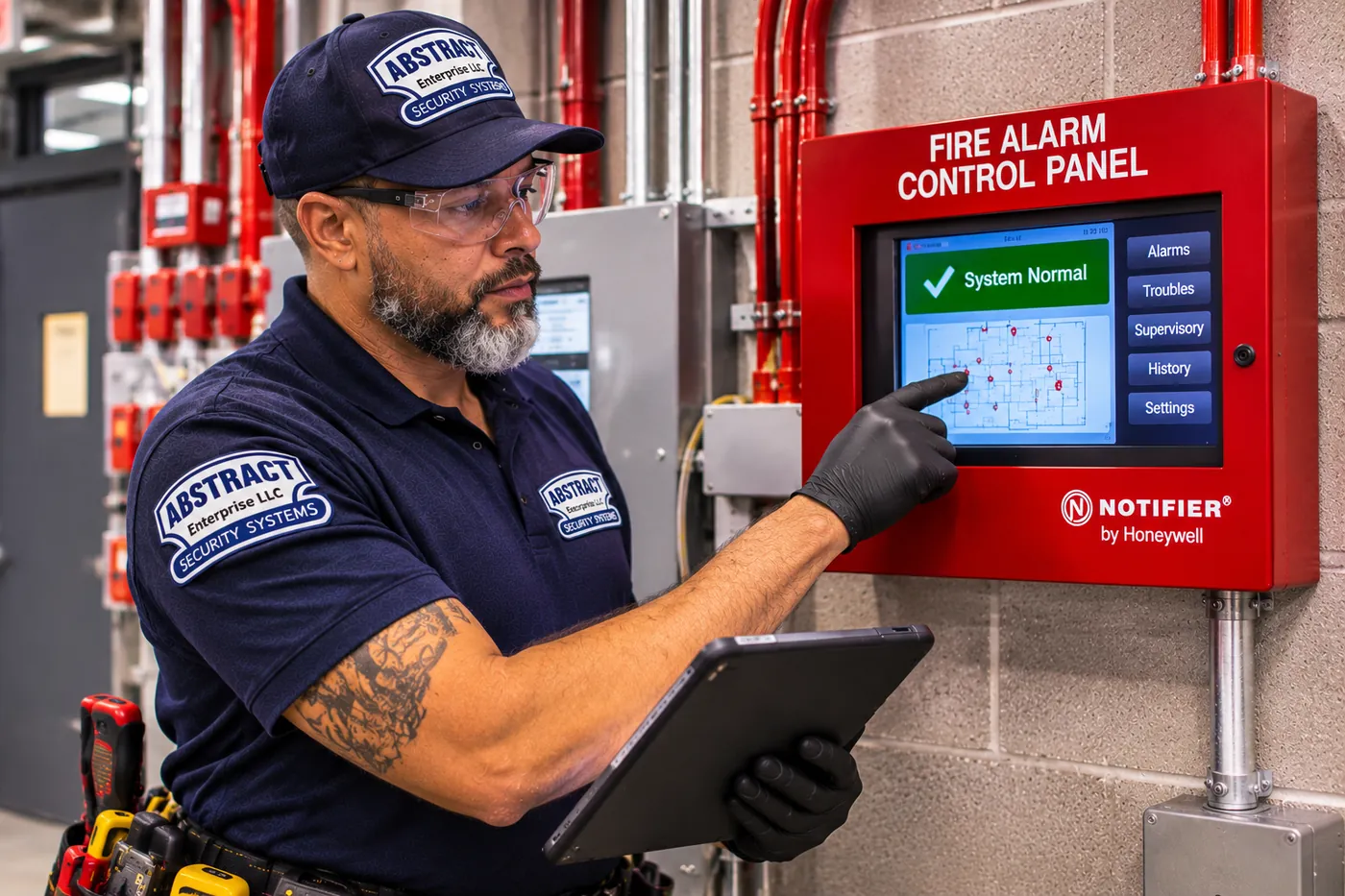
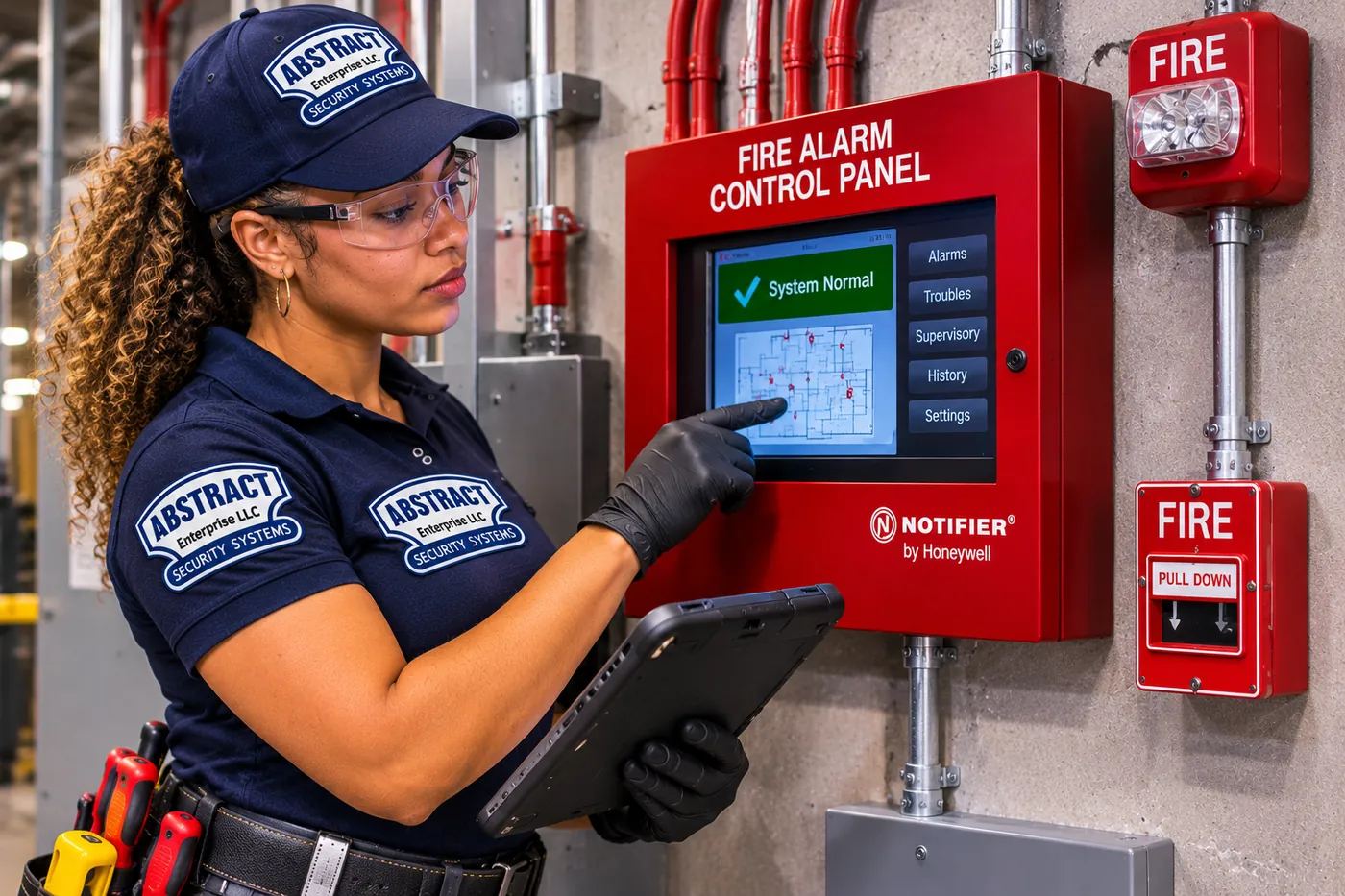
Fire alarm control panel programming in Brooklyn Chinatown: technician holding a tablet and touching the System Normal screen of a red NOTIFIER fire alarm control panel beside a horn strobe and pull station
A technician checks a red NOTIFIER control panel's touchscreen against a tablet, with a horn strobe and a pull station mounted beside it. In a Brooklyn Chinatown building shared by several tenants, the panel's programming is the record of who changed what.
Brooklyn Chinatown Fire Alarm Request
Address, who uses each floor, and who controls the panel

✅
Request Sent!
Thank you. We will call to book your Brooklyn Chinatown survey, usually within 2 hours of your request.
25+
Years Experience
✓
Multi-Tenant Fit-Out Coordination
100%
Commercial NFPA 72
4.7★
201 Google Reviews

Owner-operated since 2002 · Thousands of jobs completed · Booked within 2 hours

Fire alarm installation in Brooklyn Chinatown follows the same four steps as anywhere in New York City: a New York State Professional Engineer or Registered Architect designs and seals the drawings, the FDNY reviews them, a certified fire alarm company with a licensed electrician installs the system, and an FDNY inspector watches it pass an acceptance test. What makes Eighth Avenue different is how many hands touch one system: a landlord, a ground-floor restaurant, an upstairs clinic, a temple or a condominium board can all share the same panel. We quote each building in writing after walking it, and we write down who controls what. Call (347) 934-8335; the survey is booked within 2 hours of your request.

  • NFPA 72 commercial systems for banquet halls and dim sum restaurants, upstairs medical and professional offices, medical-office condominiums, temples and churches, supermarkets, day care and tutoring spaces, and store buildings with apartments above
  • Our work is done under NYS license #12000287431, and each proposal names in writing the FDNY-certified fire alarm company and the licensed electrician who will sign the filing
  • The FDNY estimates about 20 to 24 weeks from plan submission to final approval, so a new tenant's opening date has to be set around the filing, not the other way round
The Neighborhood

Why Brooklyn Chinatown Buildings Need Fire Alarms Planned for the Next Tenant

Brooklyn Chinatown buildings need commercial fire alarm systems designed with turnover in mind, because the avenue changes faster than the buildings that line it. The Chinese commercial district runs along Eighth Avenue in Sunset Park, roughly from 39th Street to 65th Street, with the 8th Avenue N station at 62nd Street, the B70 bus running the length of the avenue, and the side streets between Seventh and Ninth Avenues filling in with restaurants, bakeries, temples and offices. The buildings themselves are mostly old. When the NYC Municipal Archives compared the avenue in 2017 with its own tax photographs from the 1940s and the 1980s, it found largely the same buildings standing, now put to new uses.

Those new uses are the story. Through the 1950s this was still a Scandinavian shopping street. Chinese families began settling near the station in the 1970s and 1980s, drawn by the direct train to Manhattan's Chinatown; newcomers were told to "look for the blue sky," because the 8th Avenue platform sits above the open cut of the old Sea Beach line. By 1988 the Brooklyn Chinese-American Association counted about 3,000 Asian-Americans and a dozen Asian-American-run businesses in Sunset Park. Since 2000 the arrivals have come mostly from Fujian.

The city measured the result. In its Sunset Park Commercial District Needs Assessment, with fieldwork between September 2021 and June 2022, the Department of Small Business Services counted 455 storefronts on Eighth Avenue between 39th and 65th Streets, a 16 percent vacancy rate against 11.3 percent across the district, and rated 35 percent of storefronts in poor condition. The most common businesses were beauty and nail salons and barbershops (72), professional services (49), pharmacies, optical and health services (30), full-service restaurants (30) and supermarkets and grocery stores (25). The study named the avenue's concentration of Asian health and professional services as one of its strengths. For fire alarm work that list is a map of occupancies: hair dryers and chemical vapors near detectors, offices and clinics upstairs, assembly rooms in the restaurants, and large open sales floors in the markets.

So what is a commercial fire alarm system in an Eighth Avenue building? It is the control panel, the smoke and heat detectors, the manual pull stations, the horns, strobes and speakers, the modules that release doors, shut down fans and recall elevators, and the communicator that reports to an FDNY-approved central station, all designed for one building and accepted by the FDNY. How does a commercial fire alarm system work? Each initiating device reports on a supervised circuit; the panel decides whether it is seeing a fire, a fault or an off-normal sprinkler valve, sounds the notification appliances, runs its programmed outputs and sends the signal out. When does a building need a fire alarm system? That depends on its occupancy and size under section 907 of the NYC Building Code: every school and day care, offices with 500 or more occupants or 100 or more above or below the street floor, assembly rooms of 300 or more, larger stores, and apartment buildings with units three or more stories above the exit or 16 or more units, among other triggers.

Brooklyn Chinatown facts that shape fire alarm design

FactWhat it means for fire alarm workSource
455 storefronts on Eighth Avenue between 39th and 65th Streets; 16% vacant (district: 11.3%)Frequent fit-outs, each of which can add devices, move walls or change the use of a floor the shared system coversNYC SBS Sunset Park Commercial District Needs Assessment (fieldwork 2021–2022)
Top business types: salons and barbershops (72), professional services (49), health services (30), restaurants (30), supermarkets (25)Detector choice near dryers, steam and kitchens; office and clinic floors upstairs; assembly rooms; large sales floorsNYC SBS Sunset Park CDNA
Largely the same buildings as in the 1940s and 1980s tax photographs, now with new usesOld structures carrying new occupancies; cable paths through party walls, cocklofts and shafts never built for a modern systemNYC Municipal Archives, "Sunset Park: The Blue-Sky Line" (2017)
5521 Eighth Avenue: six-story building with 36 medical offices and 4 retail units, 81,569 square feetMany owners and practices sharing one fire alarm; every suite renovation touches the common systemNew York YIMBY (February 2016)
8th Avenue station: 5,346 average weekday riders (2021); 10,271 vehicles a day on the avenue (2019)A busy avenue for staging, deliveries and work hours; testing and cable pulls planned around foot trafficNYC SBS Sunset Park CDNA
November 2025: early-morning fire on the second floor of an Eighth Avenue building above the Bao House restaurant; three people hurtThe typical avenue building: a restaurant below and occupied rooms above sharing one structureNews 12 Brooklyn
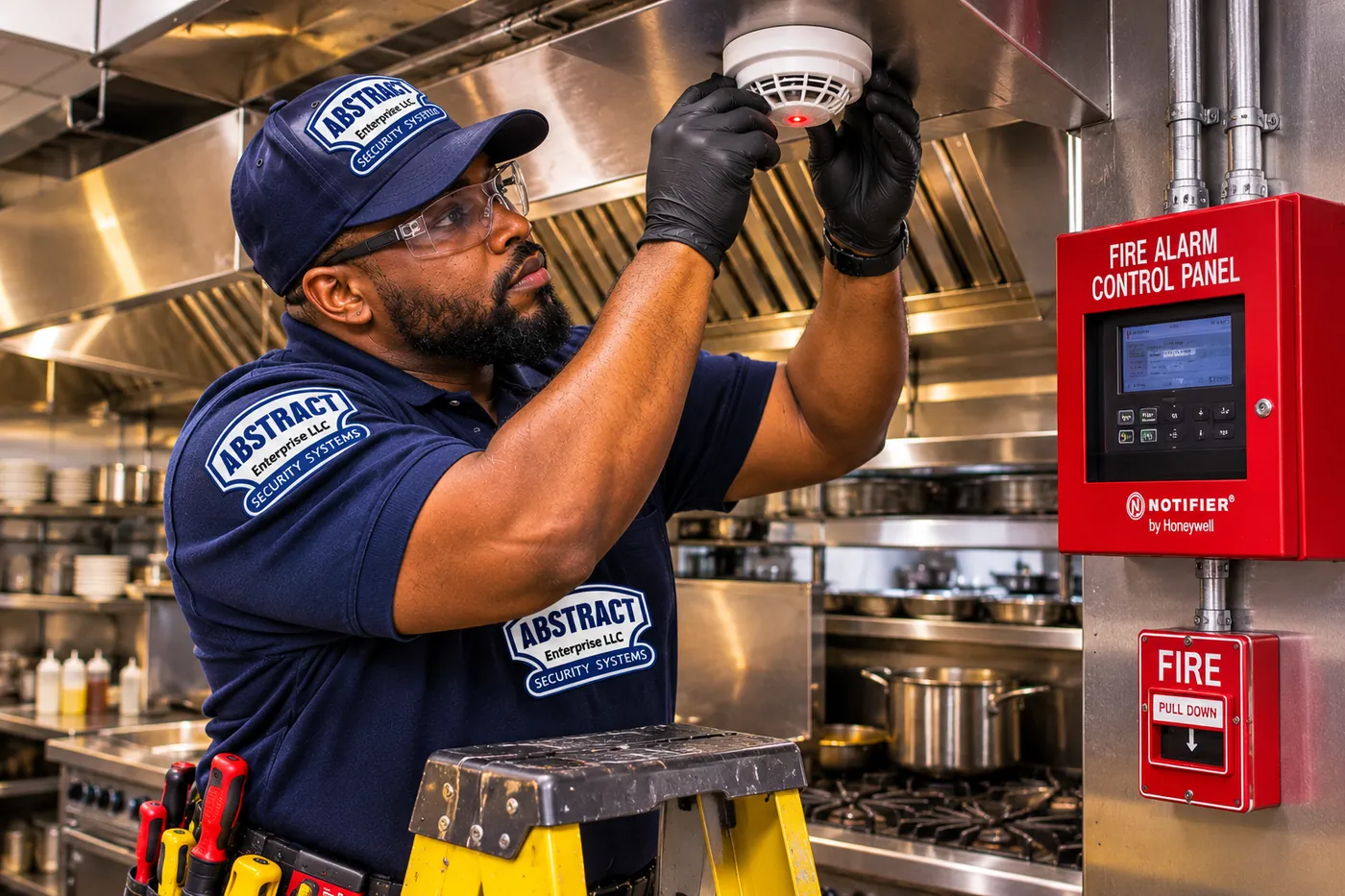
Commercial heat detector installation in a Brooklyn Chinatown restaurant kitchen: technician on a ladder fitting a heat detector under a stainless steel hood beside a red NOTIFIER fire alarm control panel and pull station
A technician on a yellow stepladder fits a white heat detector beneath a stainless steel kitchen hood, with a red NOTIFIER fire alarm control panel and a pull station on the wall beside the stoves. Restaurant kitchens are one reason Eighth Avenue designs use heat detection where smoke detection would only cause false alarms.
Repair

Need Fire Alarm Repair in Brooklyn Chinatown? Start With the Last Person Who Touched the Panel

Most fire alarm repair calls from Eighth Avenue have a recent cause: a tenant renovated, a ceiling was opened, a sign installer ran power through the wrong chase, or someone covered a detector during painting and never uncovered it. When a panel shows trouble, the fastest route to a fix is to ask what changed in the building in the last few weeks and which contractor was there. We book the visit within 2 hours of your request, and most trouble conditions are diagnosed in the first visit; where the fault is a single failed device or a loose termination, the system is often fixed in 1–2 hours.

Emergency fire alarm repair and emergency fire alarm service matter most when the system is down in a building that is open. A banquet hall with a Saturday wedding, a clinic with patients in the waiting room or a supermarket with a full sales floor cannot simply ignore a panel in trouble. Urgent fire alarm repair starts with the panel's own event history, then a walk of the circuits it names. Our emergency fire alarm technician will tell you on the first call whether the building needs a fire watch while the system is impaired; the FDNY treats an impaired system as a condition the owner must manage, not something that can wait for a convenient Monday.

Same day fire alarm repair is realistic for the common faults: fire alarm battery replacement after a battery trouble, fire alarm device fault repair on a dirty or failed detector, fire alarm open circuit repair after a ceiling contractor cut a wire, or fire alarm communication failure repair when a phone line or cellular communicator drops. Fire alarm ground fault repair and fire alarm intermittent trouble take longer, because they hide in old conduit and in junction boxes above shop ceilings. We offer 24 hour fire alarm repair coordination and after hours fire alarm service for buildings that cannot shut down during the day, and commercial fire alarm emergency repair for systems that are fully down. When the problem is a fire alarm panel failure repair, the next question is whether the panel can still be supported or whether the building is looking at a filed replacement.

Why is my fire alarm panel showing trouble? A trouble light means the panel has found a fault in itself or its wiring, not a fire: a low battery, a missing device, a broken circuit or a lost phone path. A fire alarm panel trouble light, a fire alarm system trouble condition or a fire alarm panel beeping repair call usually ends in one of a short list of fixes: fire alarm battery trouble repair, fire alarm trouble signal repair, fire alarm wiring repair, fire alarm circuit troubleshooting, fire alarm short circuit troubleshooting, or fire alarm SLC troubleshooting and fire alarm signaling line circuit repair on an addressable loop. A fire alarm supervisory trouble points at a sprinkler valve or a monitored kitchen hood rather than the wiring. What causes a fire alarm ground fault? Water in a junction box, a staple or screw through a cable, or a damaged conductor touching a grounded box, all common after renovations above Eighth Avenue shop ceilings; fire alarm ground fault troubleshooting isolates circuits one at a time until the fault moves. A fire alarm system not communicating with the central station gets fire alarm communication failure emergency repair first, because the FDNY will not be called automatically. Emergency fire alarm troubleshooting, fire alarm system down repair, fire alarm system malfunction repair, fire alarm system emergency service and fire alarm trouble emergency service all start the same way: read the panel, walk the circuit, find what changed. Commercial fire alarm repair and commercial fire alarm troubleshooting in a multi-tenant building also means asking each tenant what work was done, and fire alarm control panel repair and fire alarm control panel troubleshooting may need the manufacturer's software.

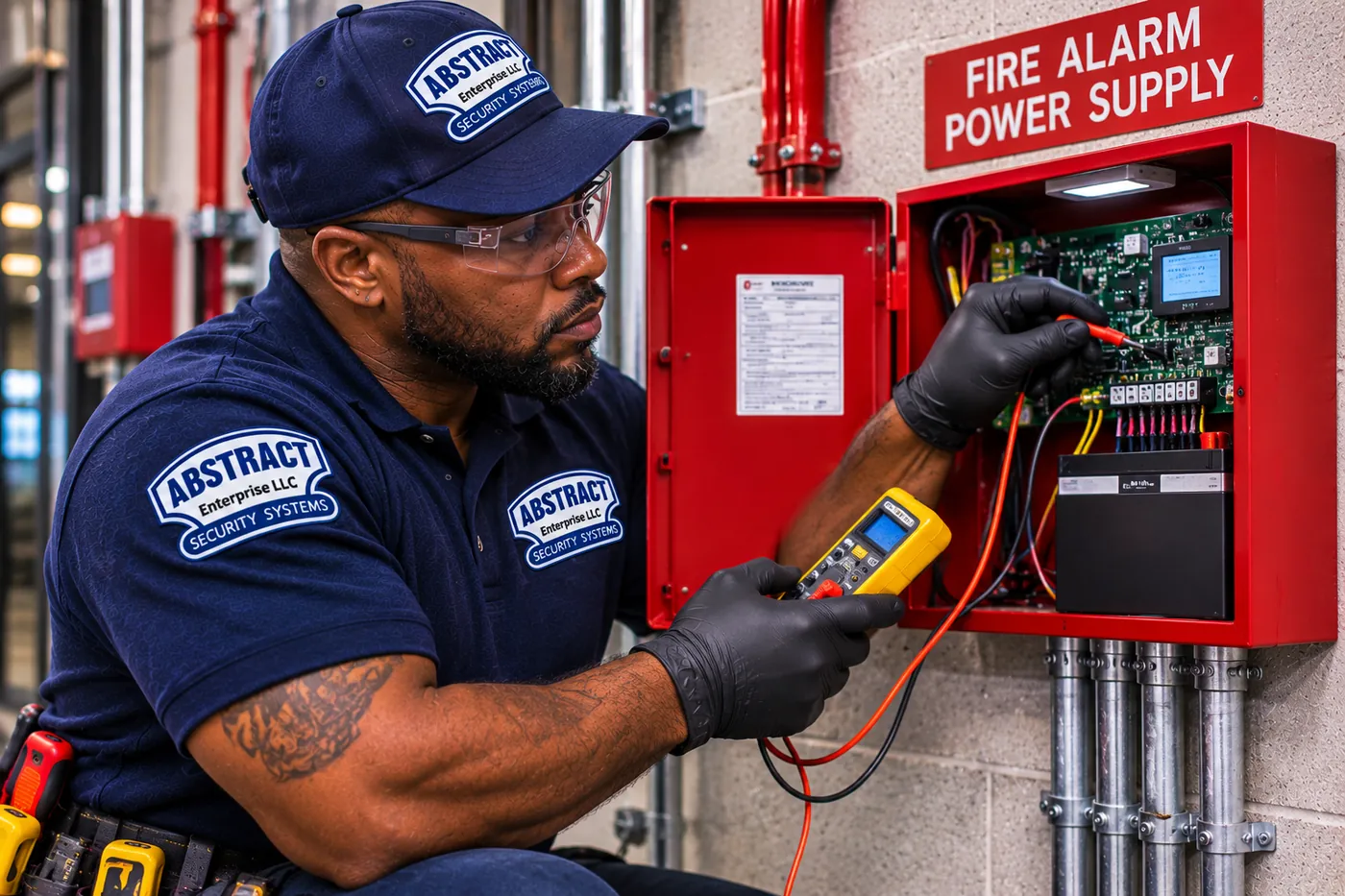
Fire alarm power supply repair in Brooklyn Chinatown: technician testing the circuit board of an open red fire alarm power supply cabinet with a multimeter
A technician tests the board of an open red fire alarm power supply cabinet with a multimeter. Battery and power supply faults are among the most common troubles we trace in Eighth Avenue buildings, and among the quickest to fix.
Services

Fire Alarm Installation Services for Brooklyn Chinatown Properties

🏮

Banquet halls and dim sum rooms

Restaurant fire alarm installation for the large dining rooms on and off Eighth Avenue, where a wedding or a holiday banquet can push a room past the assembly threshold for a building fire alarm.

🏥

Upstairs clinics and medical suites

Medical office fire alarm installation for practices on the floors above the stores, with detection, notification and door-release outputs coordinated with the building's existing system.

🏢

Medical-office condominiums

Condominium building fire alarm installation and suite-by-suite device work in buildings where dozens of owners share one panel, coordinated through the board and its managing agent.

🛒

Supermarkets and groceries

Retail store fire alarm installation and shopping center fire alarm installation for large sales floors, back-of-house storage, refrigeration rooms and the offices above them.

🙏

Temples, churches and halls

Assembly-space systems for congregations meeting above stores or in converted buildings, designed around worship schedules, incense and candles, and the people who come on holidays.

🏫

Day care, tutoring and schools

School fire alarm installation and education-space work for day care centers, after-school programs and tutoring floors, where the code asks for a fire alarm in every educational occupancy.

🏠

Store-and-apartment buildings

Mixed use building fire alarm installation, apartment building fire alarm installation and multifamily building fire alarm installation where code requires a system over the shops.

🔧

Tenant fit-outs on shared systems

Tenant improvement fire alarm installation and tenant fit out fire alarm installation that adds a new space to an existing panel without leaving the next tenant a mess.

📋

Design and filing support

Commercial fire alarm system design coordination with your engineer or architect, the TM-1 filing, objections, central station paperwork and the FDNY acceptance test.

Every one of these is a fire alarm installation service built on the same paperwork: new work (a complete fire alarm system installation, or a new fire alarm system installation replacing an obsolete one), additions to an existing system, and care. Most pair the fire alarm with the sprinkler, elevator and kitchen hood trades, so the scope is never only the panel.

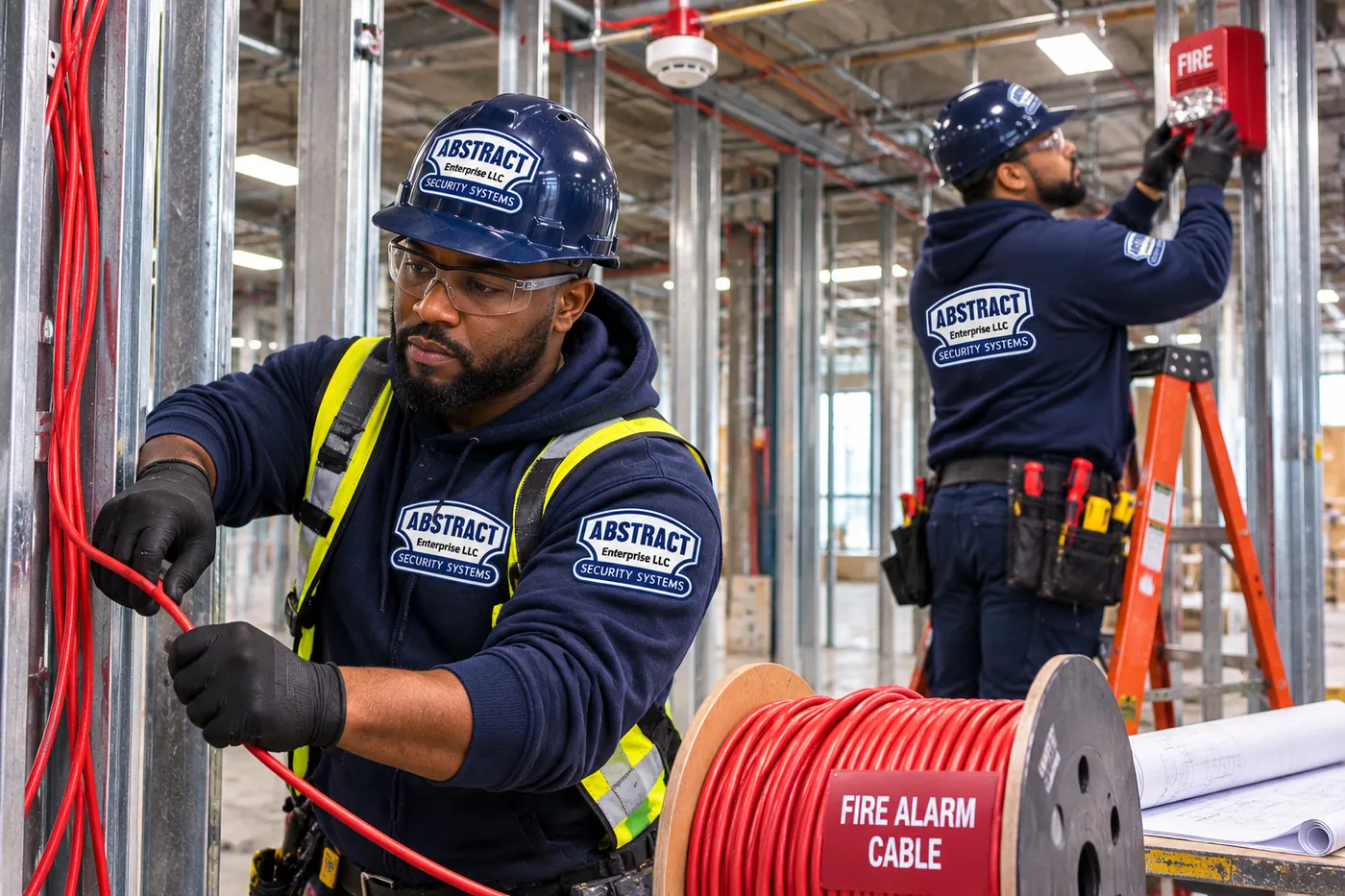
Fire alarm cable installation in Brooklyn Chinatown: technician drawing red fire alarm cable from a reel through open steel stud framing while a second technician works on a device from a ladder
One technician pulls red fire alarm cable from a reel through open steel studs while another works on a device from a ladder. A fit-out with open walls is the cheapest moment to run new fire alarm cable on Eighth Avenue, before the drywall closes.
Building Types

Commercial Fire Alarm Systems for Eighth Avenue's Building Types

Commercial fire alarm systems in Brooklyn Chinatown follow the building, and the avenue has six or seven kinds of building that come up again and again. Each brings its own code trigger, its own device choices and its own coordination problem. Most also pair the fire alarm with access control at a lobby or clinic door, so door-release outputs belong in the design from the start.

Brick store buildings with floors above

The commonest Eighth Avenue building is a three- or four-story brick structure with a store at street level and offices, rooms or apartments above, many of them the same buildings the city photographed for tax records in the 1940s. Whether such a building needs a full system depends on the occupancies stacked inside it. A store with apartments above may fall under the residential triggers; a store with a medical office or a tutoring center above may fall under business or educational ones. The fire alarm system design requirements are read floor by floor, and they change the day an upper floor changes use. The November 2025 fire on the second floor of an Eighth Avenue building above the Bao House restaurant, which sent three people to the hospital in the middle of the night, is the kind of building we mean: a business downstairs and occupied rooms upstairs sharing walls, stairs and a roof.

Newer mid-rise commercial and medical buildings

Since the 2010s the avenue has added purpose-built mid-rise buildings for medical and community use. At 5521 Eighth Avenue, near 56th Street, New York YIMBY reported a six-story building of 81,569 square feet with retail on the ground floor and mezzanine and 36 medical offices, averaging about 1,180 square feet, starting on the second floor. At 5623 Eighth Avenue, at 57th Street, the Brooklyn Eagle reported a three-story building being enlarged to six stories for commercial and community-facility use. Now in their second round of tenants, every suite renovation in them is a fire alarm event.

Banquet halls and dim sum restaurants

The big Cantonese-style rooms are assembly spaces. Park Asia at 6521 Eighth Avenue advertises large banquet halls for weddings and events plus private dining rooms; Bamboo Garden at 6409 Eighth Avenue serves dim sum in a banquet hall that also hosts weddings; New Pacific Palace on 55th Street is described by diners as a high-ceilinged hall in a repurposed building above a bank. The city's place of assembly rules call for a fire alarm with an emergency power source where the occupant load reaches 300 or more or where the room is used as a cabaret, and a full wedding can reach that number. Restaurant fire alarm installation here means high-ceiling detection and notification that carries across a noisy room.

Temples, churches and community halls

Houses of worship on and near the avenue often share buildings with businesses. NYC Tourism lists Xi Fang Temple at 5101 Eighth Avenue as a Buddhist temple with a vegetarian restaurant downstairs, and the Municipal Archives notes that the Chinese Promise Baptist Church moved to newer quarters on 41st Street. A worship hall above a restaurant puts incense and candles upstairs and a cooking line downstairs, and detection must suit both.

Supermarkets and large groceries

The survey counted 25 supermarkets and grocery stores on the corridor. Open sales floors, deep back rooms and walk-in refrigeration call for beam detection, heat detection in damp rooms, duct detection on large air handlers and notification a shopper in the far aisle can hear.

Day care, after-school and tutoring floors

Educational uses are among the strictest code triggers, and Sunset Park has many of them in buildings that were not built as schools. The NYC public schools directory lists day care programs run by the Brooklyn Chinese-American Association, and tutoring and after-school centers rent upper floors along the avenue. When an upper floor becomes a classroom, the drawings and filing must change before children arrive.

Apartment buildings on the side streets

Walk-ups and elevator apartment buildings fill the side streets between Seventh and Ninth Avenues. In January 2026 a two-alarm fire on the third floor of a four-story building at 512 48th Street displaced 57 people from 14 households, and the Department of Buildings listed 15 open violations at the property, mostly involving the boiler. Where code requires a building fire alarm in a multifamily building, the design covers the common areas, stairs and service rooms, and coordinates with the apartments' own smoke alarms rather than replacing them.

Other commercial buildings around the corridor

The avenue is mostly stores, offices, restaurants and clinics, but the work around it reaches other building types. Office building fire alarm installation covers the larger professional buildings; warehouse fire alarm installation, storage facility fire alarm installation and parking garage fire alarm installation cover the stockrooms, self-storage and garages that serve the avenue's businesses; and toward the waterfront, industrial fire alarm systems, industrial fire alarm installation, industrial building fire alarm installation, manufacturing facility fire alarm installation and industrial fire detection system installation serve the factories and garment and food plants that have long employed the neighborhood. Hotel fire alarm installation, hospital fire alarm installation, nursing home fire alarm installation, assisted living fire alarm installation and high rise fire alarm installation come with their own stricter code paths, and data center fire detection installation protects server rooms in the medical and professional buildings. Business fire detection systems and commercial fire detection systems in all of these follow the same FDNY approval path described below.

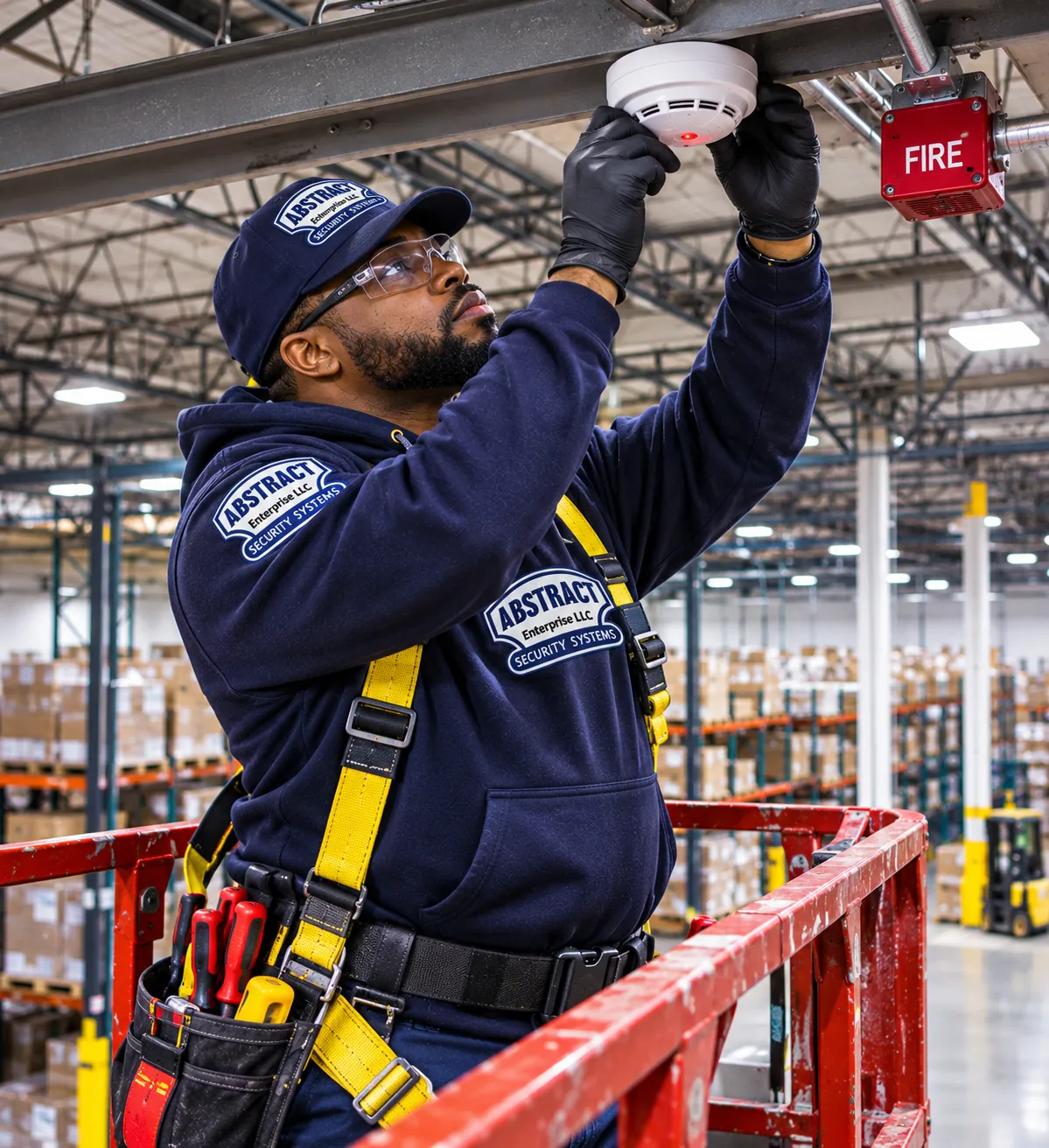
Warehouse smoke detection installation for a Brooklyn Chinatown grocery stockroom: technician in a harness on a red lift fitting a smoke detector to a steel beam above racks of cartons
A technician in a harness on a red lift fits a smoke detector to a steel beam above racks of cartons. Stockrooms behind Eighth Avenue supermarkets and wholesalers have high, cluttered ceilings, and the detector has to sit where smoke will actually reach it.
Corridors

Business Fire Alarm Installation Block by Block, 39th Street to 65th Street

Business fire alarm installation on Eighth Avenue changes character as you walk south from 39th Street to 65th Street, and the side streets have their own patterns. These are the stretches we survey most, described by what stands there rather than by any one address.

The north end, 39th to 50th Streets

The avenue's northern blocks sit closer to Sunset Park itself, the hilltop park between 41st and 44th Streets and Fifth and Seventh Avenues. Store buildings here mix older Chinese businesses with professional offices, and the side streets hold churches, schools and apartment houses. I.S. 220 John J. Pershing, a public middle school at 4812 Ninth Avenue that has operated since around 1930, sits just off the corridor. In May 2025 a fire in a building with a bodega on the ground floor at Ninth Avenue and 39th Street killed one man and injured three others; News 12 reported that the building had no fire escape.

The center, 50th to 60th Streets

This is the busiest stretch and the route of the Lunar New Year parade, which in February 2026 ran along Eighth Avenue between 50th and 61st Streets with firecrackers and lion dances before the march. Bakeries such as Xin Fa at 5617 Eighth Avenue, roast-meat shops such as The Roast at 5124, the temple at 5101, the medical building at 5521 and the hot pot and dim sum rooms on 53rd and 55th Streets all fall within a few blocks. Commercial building fire alarm installation here is mostly about stacked uses and shared systems: one structure, several businesses, one panel.

The south end and the station, 60th to 65th Streets

Near the 8th Avenue station at 62nd Street the avenue widens into banquet territory, with Bamboo Garden at 6409 and Park Asia at 6521 Eighth Avenue. The United Cultural Association hosts community events at 829 63rd Street, and NYC Tourism lists the Mid-Autumn Festival at 66th Street and Eighth Avenue. Assembly rooms dominate the fire alarm work here, along with the stores and offices that surround the station.

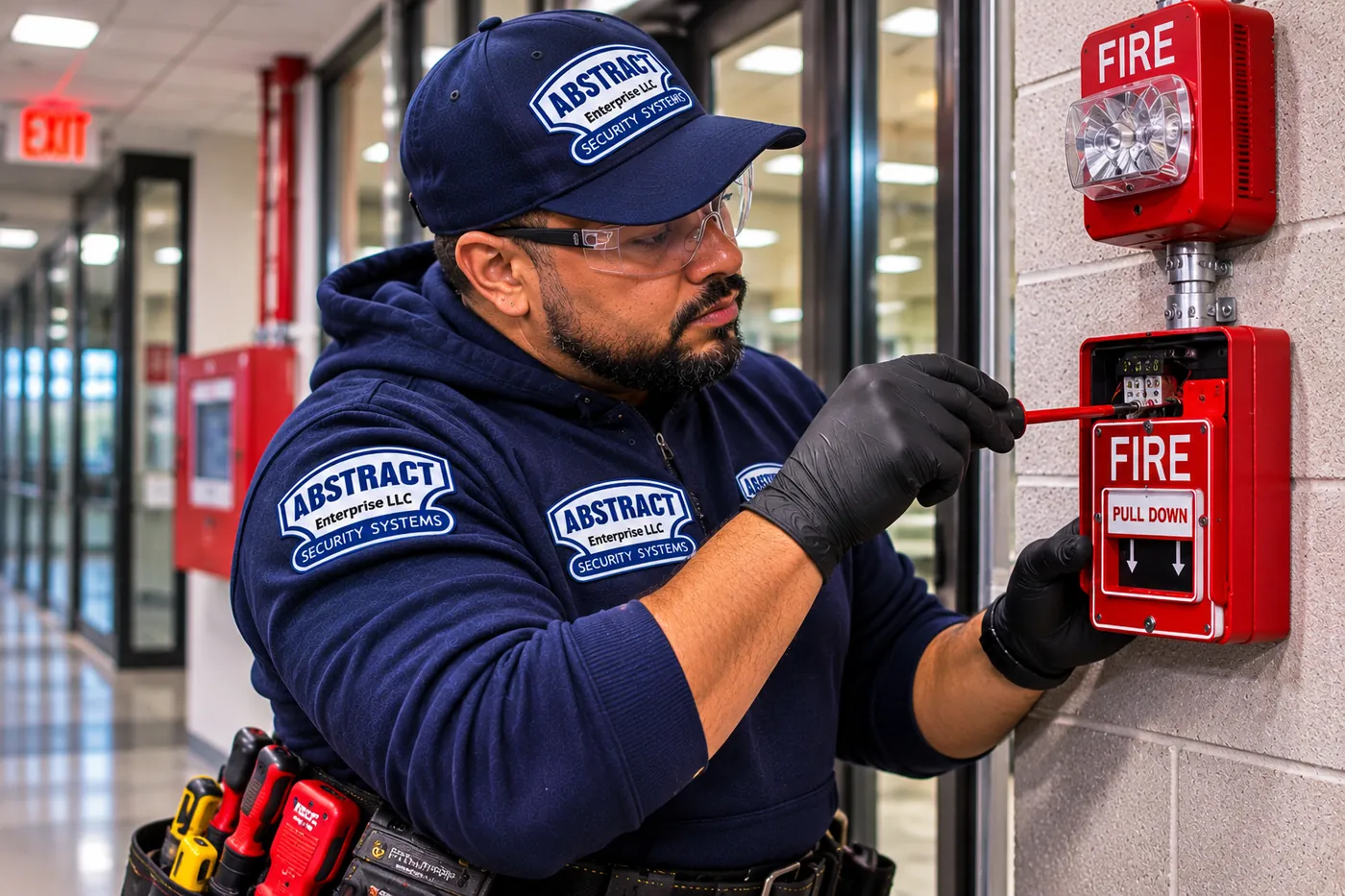
Manual fire alarm pull station installation in Brooklyn Chinatown: technician in gloves terminating wiring inside an open red pull station mounted below a horn strobe in a glass-walled corridor
A gloved technician terminates wiring inside an open red pull station mounted below a horn strobe in a glass-walled corridor. Pull stations sit at the exits, which in an upstairs Eighth Avenue office often means beside the only stair.
Field Notes

Field Notes: Four Tenants, One Panel, No Drawings

This describes a typical Eighth Avenue situation, not one particular job. An owner calls after an FDNY inspection; the stairwell panel has been in trouble for weeks. The building has a restaurant on the ground floor, a clinic on the second floor, an accounting office and a tutoring center sharing the third, and rooms above. Nobody remembers whether the tutoring center put its detectors back after a new ceiling grid went in.

The panel tells part of the story. Its event history shows a ground fault that comes and goes, two devices missing from the loop, and a supervisory signal that someone acknowledged but never cleared. Nobody has the as-built drawings, and the last Letter of Approval describes a store and offices, not a clinic and a classroom. Above the new grid we find one detector lying on a tile and another taped over from the painting job.

The fixes are not hard; the paperwork is the real work. The owner needs a design professional to look at what the building is now, not what it was when it was last approved, and to decide whether the changes amount to a filed alteration. The ground fault traces to a junction box above the restaurant's new ceiling. The lesson we take from these buildings is simple: one owner has to control the panel, every tenant's contractor has to answer to that owner, and every change has to end up on the drawings.

Your Questions Answered

Fire Alarm Installation in Brooklyn Chinatown: Questions Answered

Questions Eighth Avenue owners, boards, tenants and contractors bring to a first call, grouped by topic.

Cost and paperwork

Our second floor on Eighth Avenue is turning from apartments into a dental practice. Does the fire alarm quote cover the change of use, or is that someone else's job?

Both, in sequence. The change of use is a filing matter: a design professional decides what the new business occupancy requires, the Department of Buildings handles the change of use, and the fire alarm drawings follow. Our fire alarm installation quote covers installation, programming and testing to those drawings, written for the building as it will be used.

Why did the estimate for one suite in our medical-office condominium include work outside the suite?

Because the system is shared. Adding devices to one suite can mean new modules in the common corridor, more load on a power supply in the basement, new programming at the panel and a test that involves the whole building. A fire alarm contractor estimate that stops at the suite door leaves them for later.

Trust

The contractor renovating our Eighth Avenue restaurant says he can move the heat detectors himself. Should the landlord let him?

Not unless his company is the one allowed to work on that system. The FDNY requires any company that installs or services fire alarm components, other than only smoke detectors, to hold a Fire Alarm Company Certificate, with a principal holding an S-97 certificate of fitness. The landlord, who answers to the FDNY for the system, should see those documents first.

Several companies have worked on our panel over the years. How do we find out which one the FDNY has on record?

Start with the building's FDNY Letter of Approval and the central station contract, then the last inspection and test reports. Those name the company and the monitoring arrangement on record. If nothing can be found, a survey and a records request rebuild the history.

Who may do the work

Can a condominium owner at 5521 Eighth Avenue hire their own electrician for fire alarm devices inside their suite?

Usually not without the board. In a condominium the fire alarm is a common building system, and the board and its managing agent control who may work on it under the bylaws and alteration agreement. The board normally requires its own fire alarm company to do or approve the work.

Our tutoring center rents the third floor. Is the fire alarm our responsibility or the landlord's?

The lease decides who pays, but the FDNY looks to the building owner to keep the system working. In practice the tenant pays for changes its use requires, and the landlord's fire alarm company does the work so one company stays responsible for the whole system.

Technical

Will incense at a temple above our store keep setting off smoke detectors?

It can, which is why the design professional chooses detection for the room's real conditions. Options include heat detection in some spaces, detector placement away from the altar, or air sampling with adjustable sensitivity where early warning still matters. Covering detectors is never the answer.

Do salon dryers and nail-product vapors on the ground floor cause false alarms in the hallway above?

They can affect nearby smoke detectors, especially where a salon's exhaust runs past a stair or corridor detector. The fix is usually device type and location, chosen on the drawings, plus clean ductwork and working exhaust.

How do you make sure guests in a full banquet hall hear the alarm over a wedding band?

The notification design is calculated for the room's real sound level, and the alarm sequence can be programmed to shut off the amplified music when the alarm activates. Strobes are placed so they are visible from every table, and in large assembly rooms a voice system may be required so instructions can be given.

Landlord and tenant

A previous tenant left extra strobes and detectors behind when they moved out. Can the new tenant just remove them?

Not without a design professional's review. Devices on an approved system are part of what the FDNY accepted; removing them changes the system. Some can come out in a filed modification; some the new use still needs.

Our landlord says the building's fire alarm cannot take another tenant's devices. What are our options?

The panel may be at its circuit or power capacity, or it may be old enough that adding to it is unwise. Options include an added power supply or expansion module, a filed panel upgrade, or a modernization; a survey shows which is realistic.

The owner of our building lives overseas and the managing agent changes every year. Who should hold the fire alarm records?

The building should, physically and permanently, with copies held by whoever manages the building. Keep the Letter of Approval, approved drawings, as-builts, programming and test reports together in a labelled binder near the panel or in the management office, and send digital copies to the owner.

Complaints

The alarm in our building goes off during the lunch rush and diners have stopped leaving. What should the restaurant do?

Treat it as an urgent repair, not a nuisance. Repeated unwanted alarms teach people to ignore the real one. Fire alarm false alarm troubleshooting usually finds a detector in the wrong place for the cooking line, a dirty duct detector or an exhaust problem, and the FDNY can penalize owners for unnecessary alarms caused by a poorly maintained system.

Neighbors complain that the panel in our stairwell has been beeping for a month. Can we just silence it?

Silencing the buzzer does not clear the fault. A beeping panel means a trouble or supervisory condition: a failed battery, an open circuit, a missing device or a communication failure. Call a fire alarm service technician to find the cause; a system in trouble may not report a real fire the way it should.

Call NowFast QuoteSpeak to a Tech
Equipment

Types of Commercial Fire Alarm Systems We Install in Brooklyn Chinatown

The right system type for an Eighth Avenue building depends on its size, how many tenants share it, how often its spaces change hands and what the design professional requires. These are the families we work with most.

Addressable systems

Addressable fire alarm system installation for medical buildings, banquet halls and multi-tenant buildings, where every device reports its own location and a new suite can be added by programming rather than rewiring.

Conventional systems

Conventional fire alarm system installation and conventional fire alarm panel installation for a single small store or office building on a simple zoned layout.

Voice evacuation

Fire alarm voice evacuation installation and fire alarm emergency voice communication for large assembly rooms and taller buildings where spoken instructions are required.

Air sampling

Aspirating smoke detection installation where ceilings are high or decorated, or where incense and steam rule out ordinary detectors; an air sampling smoke detection system draws air through pipes to one detector serviced from the floor.

Beam detection

Beam smoke detector installation and projected beam smoke detector installation across banquet halls and supermarket sales floors with long, open ceilings.

Monitoring

Fire alarm monitoring system installation and fire alarm central station communicator installation, with the central station account in the building owner's name rather than a departing tenant's.

What is an addressable fire alarm system? Each detector, pull station and module has its own address on a signaling line circuit, so the panel reports exactly which device is in alarm or trouble, and a new device is added by assigning it an address and programming it. What is a conventional fire alarm system? Devices are wired in zones, and the panel reports the zone but not the device. What is the difference between addressable and conventional fire alarms in practice? On Eighth Avenue it comes down to change. A conventional system in a building that adds a tenant every few years ends up with zones that no longer match the floors, while an addressable system can be reprogrammed to match the building as it is. That is why conventional to addressable fire alarm conversion is one of the commonest upgrades we discuss with owners here.

Intelligent fire alarm installation goes a step further: an intelligent fire detection system lets each detector's sensitivity be read at the panel, adjusts for slow contamination from kitchen grease or salon vapors, and warns before a dirty detector becomes a false alarm. On existing systems the routine work is addressable fire alarm system repair when a device fails, addressable fire alarm troubleshooting when a device drops off the loop or two share an address, addressable fire alarm system programming when a tenant changes, and addressable fire alarm device installation when space is added. An addressable fire alarm system upgrade adds capacity or replaces a panel the manufacturer no longer supports, and addressable fire alarm panel installation is the heart of a new system. Older buildings still see conventional fire alarm repair and conventional fire alarm replacement, sometimes as the first step toward a full conversion.

Whatever the family, fire detection and alarm installation follows the same order: fire alarm equipment installation to the approved drawings, fire alarm control panel installation (FACP installation) in a location responders can reach, commercial fire alarm wiring and fire alarm zone wiring or loop wiring, then commercial fire alarm commissioning. Addressable fire alarm installation and conventional fire alarm installation differ in the wiring and the programming, not in the paperwork; fire detection system installation in a medical building and in a single store both end with an FDNY test. Commercial fire alarm system installation and commercial fire alarm panel installation in an existing building usually include FACP repair or removal of the old equipment as well.

Fire alarm system configuration in Brooklyn Chinatown: technician with a tablet pointing at a zone map on the touchscreen of a red NOTIFIER fire alarm control panel
A technician holding a tablet points to a zone map on the touchscreen of a red NOTIFIER fire alarm control panel. In a building where tenants change, the zone map has to be updated every time a wall moves, or the first responder reads the wrong floor.
Shared Systems

Shared Panels, Many Owners: Fire Alarms in Eighth Avenue's Multi-Tenant Buildings

In a multi-tenant Brooklyn Chinatown building, the fire alarm works best when one party controls the panel and every other party's work passes through it. That sounds obvious, but it runs against how Eighth Avenue buildings are actually used: a landlord leases floors separately, tenants hire their own contractors, condominium owners treat their suites as their own property, and nobody is assigned to keep the system coherent. The result is a panel that reflects the history of every renovation rather than the building as it stands.

Medical-office condominiums

The six-story building at 5521 Eighth Avenue, with 36 medical offices above four retail units, shows the problem at its largest. Each office can be owned separately, and each practice will renovate on its own schedule over the building's life: a new X-ray room, a merged suite, a waiting room moved to the front. The building has one fire alarm, and the condominium board is responsible for it as common property. A clear alteration policy, a single fire alarm company of record and an addressable system with spare capacity let the board say yes to suite changes without risking the whole building's approval. Condominium building fire alarm installation in this setting is as much governance as wiring.

Store buildings with separately leased floors

In a three- or four-story store building, the landlord usually owns the panel and the tenants own the work they bring. A restaurant brings heat and duct detection, a clinic brings strobes in exam rooms, and a tutoring center may bring a new code classification. Each of those is a fire alarm system modification, and some are filed changes. A landlord who writes the fire alarm rules into each lease avoids the field notes situation above.

Rules that keep a shared system healthy

  • One company of record for the fire alarm, named in every lease or alteration agreement, holding the FDNY Fire Alarm Company Certificate.
  • No device added, removed, covered or moved without that company's involvement and, where required, a design professional's drawings.
  • Every change ends with updated programming labels and updated as-built drawings kept with the building's records.
  • The central station account and the Letter of Approval kept in the owner's or board's name, never a tenant's.
  • A fire alarm system expansion contractor brought in early when a new tenant's needs push the panel toward its limits, instead of after the walls are closed.

Property management fire alarm services for an agent running several buildings on the avenue start with exactly these rules.

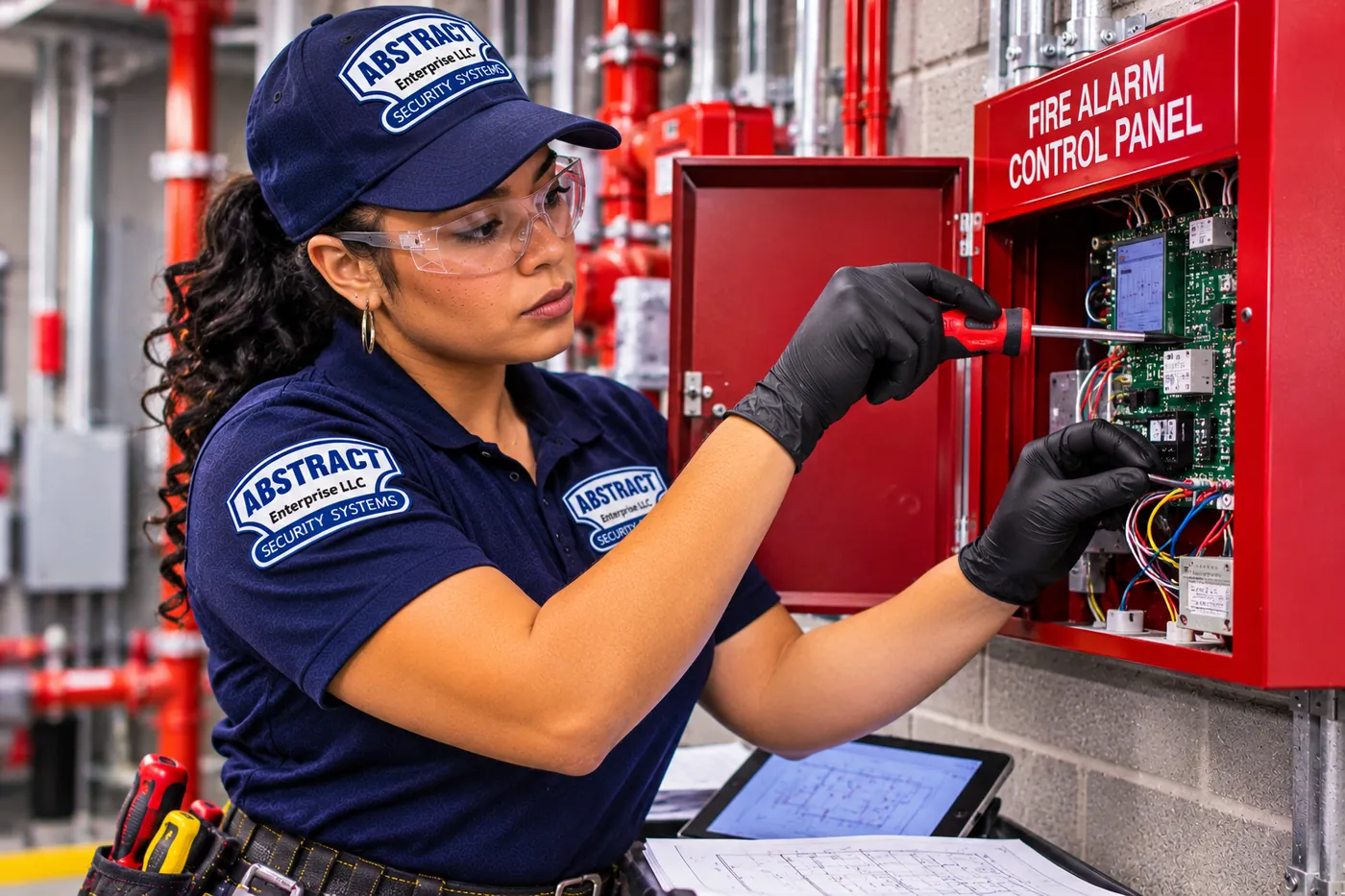
Fire alarm panel wiring in Brooklyn Chinatown: technician using a screwdriver inside an open red fire alarm control panel with a tablet of drawings on the bench
A technician works with a screwdriver inside an open red fire alarm control panel while a tablet showing drawings rests on the bench. In shared Eighth Avenue buildings, the drawings are what tie each tenant's devices back to one approved system.
Assembly Rooms

Banquet Nights and Festival Days: Assembly Rooms on Eighth Avenue

Assembly rooms on Eighth Avenue need fire alarms designed for their busiest night, not their average lunch. A dim sum hall that seats families at round tables on a Tuesday can hold a wedding banquet on Saturday, and a temple that is quiet most of the week can fill on a festival day. The design follows the room's maximum legal occupancy.

When the room crosses the threshold

The Department of Buildings' code notes on places of assembly explain that a space where 75 or more people gather indoors needs a Place of Assembly Certificate of Operation, and that a fire alarm with an emergency power source is required where the occupant load is 300 or more or where the space is used as a cabaret. A banquet hall with a dance floor and a band can meet either test. The design professional confirms the occupant load from the floor plan, and the fire alarm follows from it.

Designing for a full room

In a crowded hall the alarm has to cut through a band, a sound system and hundreds of conversations. Fire alarm audible notification installation is calculated for the room's real ambient noise; fire alarm visual notification installation places strobes so that every table can see one; and fire alarm ADA strobe installation covers restrooms and any space where a guest may be alone. The sequence can shut off amplified music on alarm. Large rooms may need a fire alarm speaker installation for voice messages rather than tones, and where several strobes are visible at once a fire alarm synchronization module installation keeps them flashing together.

Kitchens behind the hall

Every banquet hall has a commercial kitchen behind it, and commercial kitchen fire detection installation is its own discipline: heat detectors where smoke detectors would alarm every service, fire alarm kitchen hood suppression monitoring so the building knows when the hood system discharges, and shutdown of fuel and exhaust where the design calls for it.

Parade day and the work calendar

The Lunar New Year parade closes the avenue between 50th and 61st Streets, and the weeks around it are the busiest banquet season of the year. The Mid-Autumn Festival brings crowds to 66th Street. Assembly-room projects are planned so no device is out of service and no test is scheduled during those weeks.

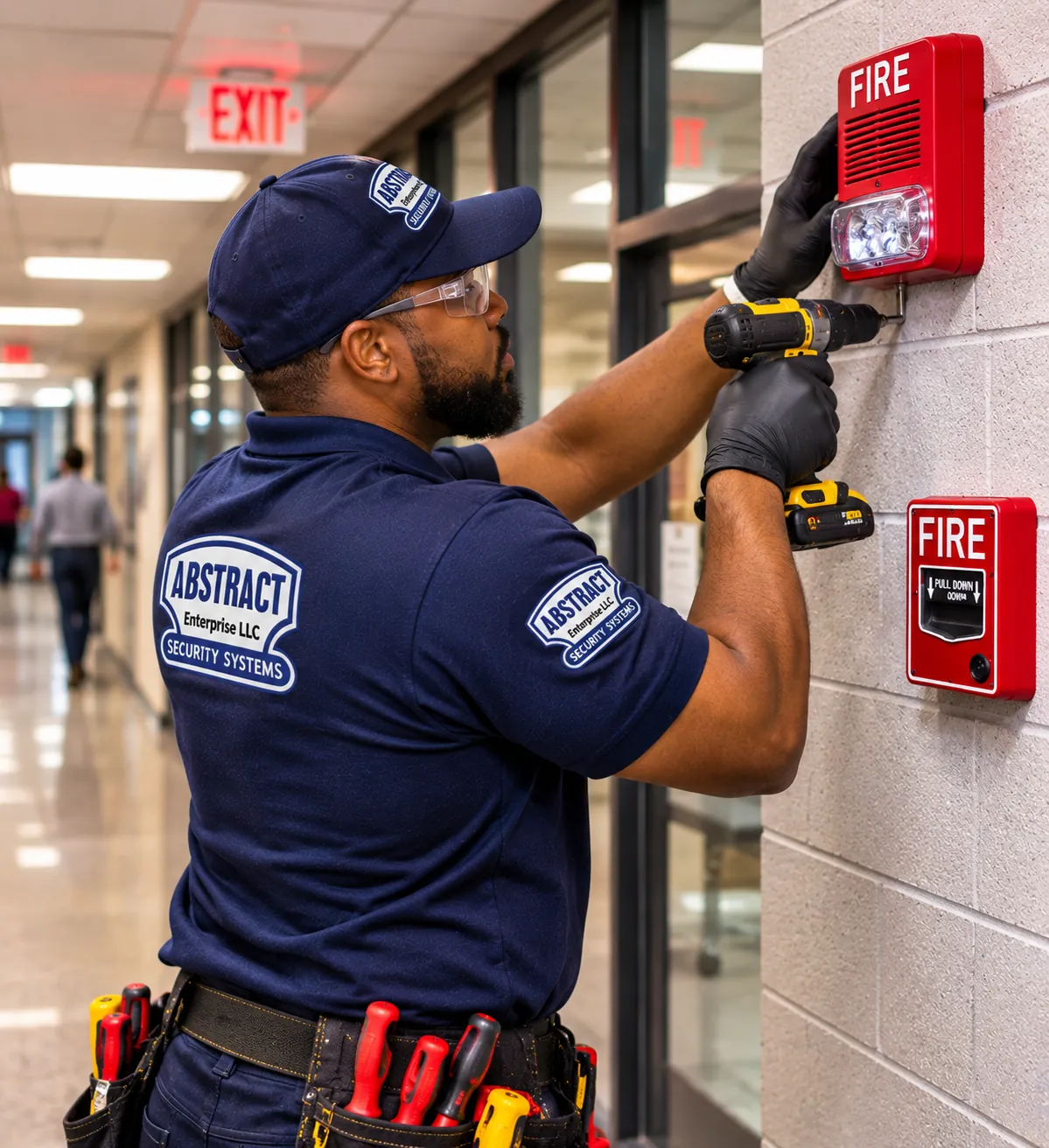
Fire alarm horn strobe installation in Brooklyn Chinatown: technician drilling a red horn strobe onto a painted block wall above a pull station in a corridor
A technician drills a red horn strobe onto a painted block wall above a pull station in a service corridor. Corridors behind Eighth Avenue banquet halls lead guests and staff to the exits, so they carry both a pull station and a visible signal.
Devices

Brooklyn Chinatown Fire Alarm Devices and Where Each One Goes

Every device on an Eighth Avenue fire alarm is chosen for the space it protects, and the avenue's mix of kitchens, salons, clinics, temples and stockrooms makes device choice more important than usual.

Detection

Commercial smoke detector installation covers corridors, offices, clinics and stairs; photoelectric smoke detector installation is the usual choice where smoldering fires are the main risk, and addressable smoke detector installation lets each head be identified and tested from the panel. Commercial heat detector installation goes where smoke detectors would false-alarm: kitchens, steamy dumpling prep rooms, some salon back rooms and dusty stockrooms. Fixed temperature heat detector installation suits spaces with steady conditions; rate of rise heat detector installation responds to a fast temperature climb and suits rooms where the ambient temperature swings. Duct smoke detector installation protects air handlers so a fire's smoke is not spread through the building's ducts. Warehouse smoke detection installation and beam smoke detector installation cover stockrooms and large open floors, and VESDA installation, the best-known aspirating system, suits high ceilings and incense-filled worship halls where early, adjustable detection matters. Every fire detection device installation and fire alarm initiating device installation ends with a test. After renovations we handle commercial smoke detector replacement and commercial smoke detector repair, duct smoke detector replacement, heat detector replacement over relocated cooking lines, VESDA service on aspirating systems, and smoke detector circuit troubleshooting where a tenant's ceiling work damaged a circuit.

Pull stations

Fire alarm pull station installation places a manual station at each required exit, which in an Eighth Avenue store building often means the ground-floor door and the top of each stair. Manual fire alarm pull station installation includes protective covers where pull stations are vandalized or bumped by carts, and fire alarm pull station replacement and fire alarm pull station repair follow when a station is broken or painted shut. Fire alarm pull station testing is part of every inspection.

Notification

Fire alarm horn installation, fire alarm strobe installation and fire alarm horn strobe installation cover most rooms; fire alarm notification appliance installation is the general term for all of them. Fire alarm horn strobe replacement and fire alarm horn strobe repair are routine after renovations knock devices off walls, and fire alarm notification appliance replacement follows when a tenant moves walls. Fire alarm speaker strobe installation is used where voice messages are needed, and fire alarm notification circuit repair restores circuits damaged by ceiling work.

Modules, power and communication

Fire alarm relay module installation lets the system stop fans, release doors and recall elevators; fire alarm monitor module installation brings in sprinkler flow and tamper switches and kitchen hood signals; and fire alarm control module installation drives notification circuits and other outputs. Fire alarm power supply installation and fire alarm NAC power supply installation add capacity when a tenant's strobes exceed what the panel can drive; fire alarm battery backup installation keeps the system running during a power outage; and fire alarm communicator installation sends signals to the central station. Fire alarm annunciator installation and remote annunciator installation put a display at the main entrance so responding firefighters can read the building without climbing to a panel in a back stair.

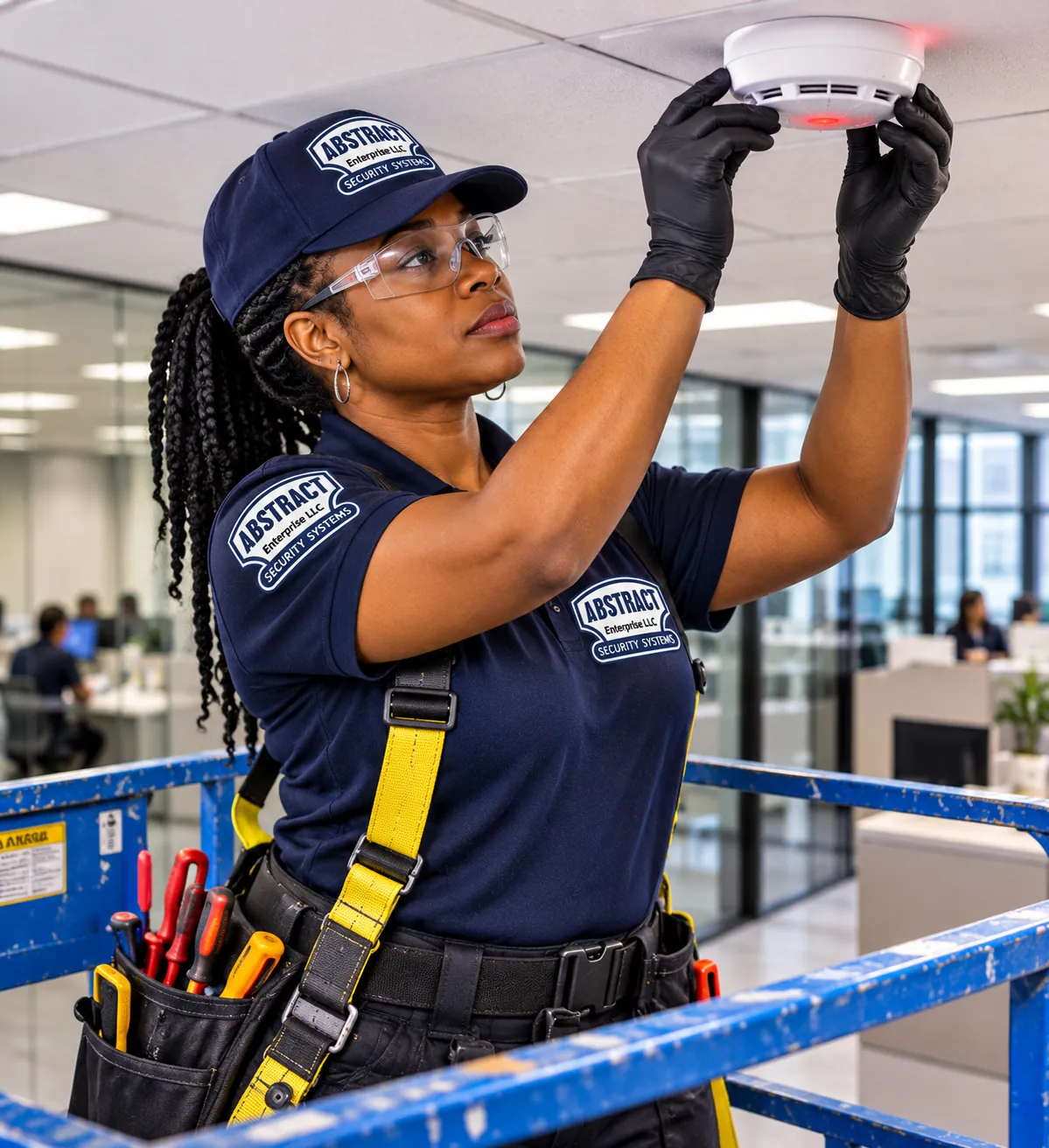
Addressable smoke detector installation in a Brooklyn Chinatown office: technician in a harness on a blue lift fitting a smoke detector to a ceiling above an office
A technician in a harness on a blue lift fits a smoke detector to the ceiling of an office. Upstairs professional offices are the most common new tenants on Eighth Avenue, and each new layout moves the detectors with it.
AI Overview Reality Check

What AI Answers Get Wrong About Fire Alarms in Brooklyn Chinatown

AI summaries and national directories such as Angi, HomeAdvisor and Fixr answer fire alarm questions for the whole country at once. For an Eighth Avenue building that shortcut produces some confident but wrong answers. These are the ones we hear most often on first calls.

"Each tenant can install the fire alarm devices it needs."

It sounds reasonable where every floor is leased separately, and it is how many Eighth Avenue buildings ended up with panels nobody understands.

In New York City the fire alarm is one building system, approved by the FDNY as a whole. The FDNY's company certificate rules require any company that installs or services fire alarm components, other than only smoke detectors, to be certified, and the building owner remains responsible for the system's condition.

A tenant's devices therefore belong on the building's drawings and the building's panel, installed by the company responsible for the system. The tenant can pay for the work; it cannot own a separate piece of the alarm.

"Fire alarm installation is priced per device."

Directory sites often show a price per detector or per square foot, the way small residential jobs are priced.

A commercial system in New York City starts with sealed design drawings, goes through the FDNY plan examination, and ends with an acceptance test. Those stages exist whether the building has twenty devices or two hundred, and on Eighth Avenue the coordination among tenants can outweigh the device count.

That is why we do not publish prices and instead quote each building in writing after a survey. The honest answer to a cost question is a description of the stages and what in your building affects each one.

"A change of tenant does not affect the fire alarm."

Generic answers assume that a building's code obligations are fixed when it is built. On an avenue where 16 percent of storefronts stood empty in the city's survey, and upper floors change from apartments to clinics to classrooms, that assumption fails constantly.

The Department of Buildings' 2024 bulletin on fire alarm work lists a change of occupancy among the changes that require new plans, along with relocating or replacing the control panel and changes in technology. A new use can bring a new code trigger for the whole building.

A lease signing is therefore the moment to ask the fire alarm question, before the tenant's architect finishes the layout and before anyone promises an opening date.

"Any licensed electrician can install a commercial fire alarm."

Many national guides say any electrician can install a fire alarm, and an Eighth Avenue tenant's general contractor will often say the same.

The FDNY's guidance describes the installer as a NYC licensed electrician or a fire alarm vendor holding an FDNY Fire Alarm Company Certificate, and the company certificate requires a principal holding an S-97 certificate of fitness, which in turn requires NICET Level II or higher or a NYC master or special electrician license. An S-97 or S-98 holder must be present for the acceptance test.

Ask for those names and documents in writing before work starts. A contractor who cannot produce them cannot carry your building through the FDNY.

"Fire alarm installation takes a few days."

The hands-on installation in a small office can take a few days, and new tenants plan openings around that number.

The FDNY estimates about 20 to 24 weeks from plan submission to final approval, with the initial plan review alone taking up to eight weeks, and design time comes before submission. The central station connection must be active before the acceptance inspection can be scheduled.

An Eighth Avenue opening that depends on a new fire alarm needs months, not days, and the filing should start as soon as the lease is signed.

"Apartment smoke alarms are enough for a store building."

Some answers treat the battery or hard-wired smoke alarms in apartments as the building's fire protection, and owners of store buildings with rooms above sometimes believe that covers them.

Apartment smoke alarms warn the people inside one unit. A building fire alarm, where code requires one, detects fire in the stores, stairs, cellars and common areas, warns the whole building and calls for help through a central station. Where the code applies, one does not replace the other.

The fires reported on and near the avenue in 2025 and 2026, in buildings with businesses below and people above, show why whole-building warning matters where it is required.

"Fire alarm work is the same in every Brooklyn neighborhood."

The FDNY rules are the same across the borough, so AI answers treat Brooklyn as one market. The buildings are not the same.

Eighth Avenue combines old store buildings with new uses, medical-office condominiums, banquet halls above other businesses, worship spaces above restaurants and a steady stream of tenant fit-outs. Those facts change the panel's capacity planning, device choices, lease language and the order in which a project happens.

An answer that ignores them is a national answer, not a Brooklyn Chinatown one.
Call NowFast QuoteSpeak to a Tech

Signing a Lease or Planning a Fit-Out on Eighth Avenue? Talk to a Tech First

Send the address, what each floor is used for now and next, and who controls the panel. We book a survey within 2 hours of your request and tell you what the design professional, the FDNY and the installer will each need before you set an opening date.

Get In Touch

Request a Free Quote for Your Brooklyn Chinatown Fire Alarm Project

Send the Eighth Avenue address or nearest cross street, what each floor is used for now and what it will be used for next, who owns or controls the panel (landlord, condominium board or tenant), the panel brand if you know it, and any FDNY Letter of Approval or recent inspection report. For a trouble condition, a clear photo of the display helps most. Prefer to talk? Call (347) 934-8335.

✅
Request Sent!
Thank you. We will be in touch to book your Brooklyn Chinatown fire alarm survey, usually within 2 hours of your request.
How It Works

Our Fire Alarm Installation Process for Brooklyn Chinatown Buildings

Every Brooklyn Chinatown fire alarm installation consultation follows the same order, whether it starts with a new clinic on a second floor or a banquet hall replacing a panel it inherited.

  1. First call. Address, what each floor is used for now and next, who controls the panel, the brand if known, any FDNY Letter of Approval, and your opening date or deadline. The survey is booked within 2 hours.
  2. Survey of the whole building. We walk every floor, not only the space being renovated: cellar, stores, stairs, offices, kitchens, roof and equipment rooms. We photograph the panel and its labels, read its event history, note which tenant's work added which devices, and map the cable paths and spare capacity.
  3. Design professional and sealed drawings. A New York State Professional Engineer or Registered Architect designs and seals the fire alarm construction drawings, device layout, battery and voltage-drop calculations and sequence of operations, reflecting the building's current and planned uses. If you already have one, we work with them and share our survey.
  4. Written proposal. A fire alarm system installation proposal that separates design coordination, filing support, installation, programming and acceptance testing, and says who in the building pays for what, so it can be read line by line against any other fire alarm installation bid.
  5. FDNY plan examination. The design professional files the TM-1 with the plans and the building's Certificate of Occupancy or Schedule A; we help answer objections quickly so the review keeps moving.
  6. Installation. Fire alarm rough in, fire alarm conduit installation, fire alarm cable pulling, fire alarm cable installation, fire alarm wiring installation, fire alarm low voltage wiring, fire alarm device termination and fire alarm circuit installation, all to the approved drawings, by the certified company and licensed electrician named on the filing, scheduled around the tenants who stay open.
  7. Programming and commissioning. Fire alarm device programming, fire alarm device addressing, fire alarm system configuration with labels a stranger can read, fire alarm system startup and fire alarm system commissioning, then a full pre-test of every device and output with the central station connection live.
  8. Acceptance and handover. The FDNY-witnessed acceptance test, the Letter of Approval, and fire alarm as built drawings, programming records and test reports handed to the owner or board, with a copy for the building's records and a plain-language summary for the tenants.

How long does fire alarm installation take on Eighth Avenue? The hands-on work runs from days in a small office to weeks in a banquet hall or medical building. The whole project runs on the FDNY's own estimate of about 20 to 24 weeks from submission to approval, plus design time before it. What happens during fire alarm acceptance testing? An FDNY inspector watches the system demonstrate every function on the approved drawings, from each device in alarm to the signal arriving at the central station. An S-97 or S-98 holder must be on site, and the building has to be ready, with the system 100 percent complete and free of trouble signals, before the inspection is requested. Fire alarm system testing and commissioning done properly beforehand makes the inspection a formality.

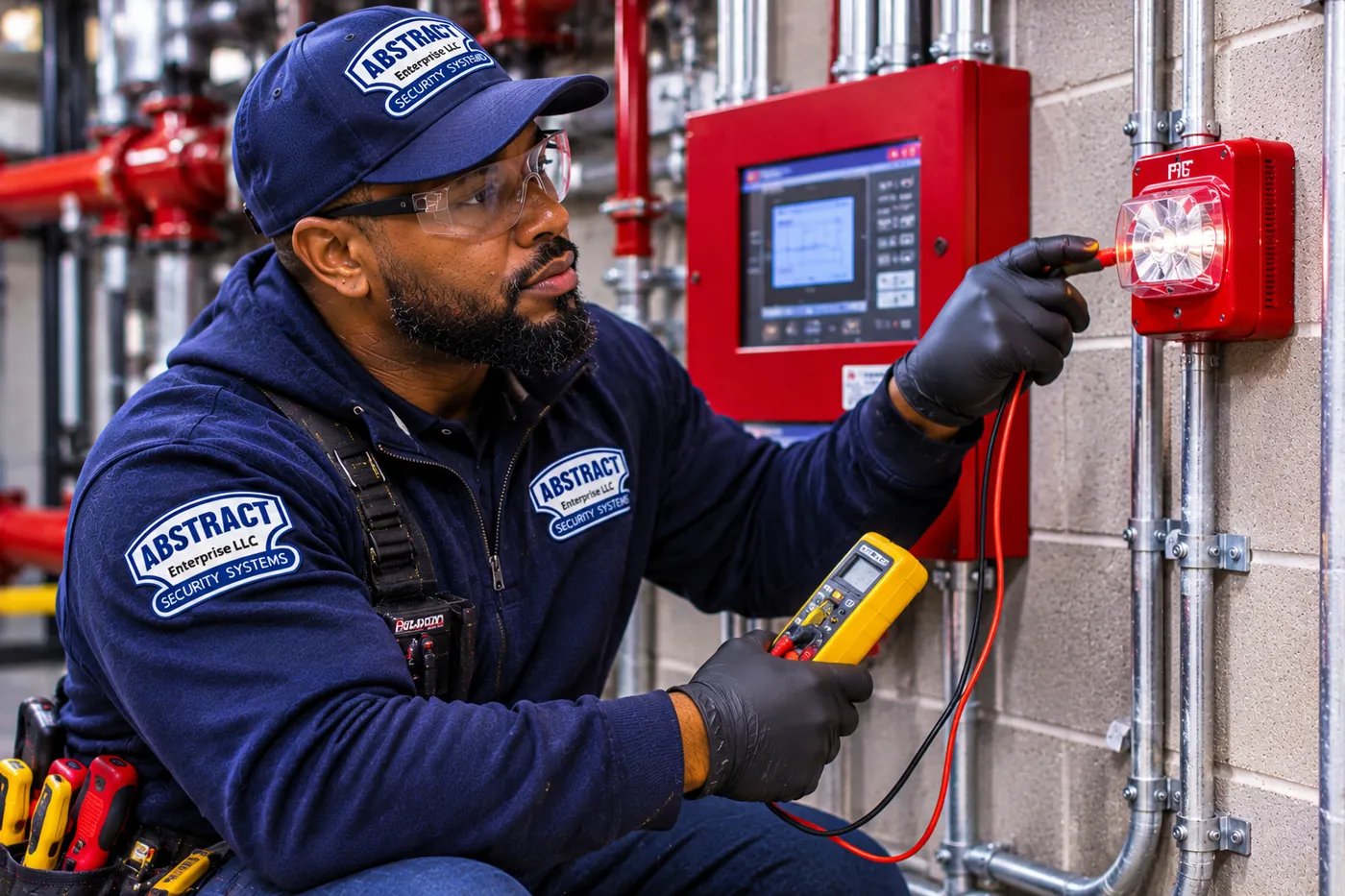
Fire alarm acceptance testing preparation in Brooklyn Chinatown: technician holding multimeter leads to a red strobe beside a fire alarm control panel in a mechanical room with red sprinkler piping
A technician holds multimeter leads to a lit red strobe beside a fire alarm control panel in a mechanical room with red sprinkler piping. Pre-testing every appliance before the FDNY arrives is how an Eighth Avenue acceptance test is passed the first time.
Existing Systems

Upgrades, Inspections and Maintenance for Brooklyn Chinatown Fire Alarms

Most of our Brooklyn Chinatown work is on existing systems: keeping them working, testing them, correcting inspection findings and replacing them at the end of their life.

Upgrades, replacement and modernization

A fire alarm system upgrade on Eighth Avenue is usually driven by a tenant change that the old panel cannot absorb, a panel the manufacturer no longer supports, or an inspection that found the system no longer matches the building. Can an existing fire alarm system be upgraded? Often, yes: a fire alarm panel upgrade or fire alarm control panel upgrade can keep good field wiring, and an existing fire alarm system expansion can add a floor. When the panel is beyond help, fire alarm panel replacement, fire alarm control panel replacement, FACP replacement and obsolete fire alarm panel replacement follow, and outdated fire alarm system replacement or a full fire alarm system replacement may make more sense than another patch. Legacy fire alarm system upgrade, fire alarm system modernization and commercial fire alarm modernization turn a decades-old zoned system into an addressable one; fire alarm system retrofit and commercial fire alarm system retrofit do the same inside occupied buildings. A fire alarm system code upgrade or fire alarm code compliance upgrades bring a building in line after a change of use. A fire alarm system renovation, fire alarm system reconfiguration, fire alarm system conversion or fire alarm device replacement after a tenant leaves are smaller cousins of the same work, and fire alarm system lifecycle replacement is the long-range plan that ties them together. Commercial fire alarm upgrades and commercial fire alarm replacement are filed with the FDNY whenever the Department of Buildings' 2024 bulletin says new plans are needed, which includes replacing the panel with a different technology, relocating it, or a change of occupancy.

Inspection and testing

How often should fire alarms be inspected and tested? NFPA 72 as adopted in New York City sets the frequencies by device type: some items monthly or quarterly, most devices at least annually, detector sensitivity on a longer cycle. A fire alarm annual inspection, fire alarm periodic inspection and fire alarm system inspection follow those schedules, and NFPA 72 fire alarm inspection and NFPA 72 fire alarm testing are documented on reports the FDNY can ask to see. How often should commercial fire alarms be tested in a building with many tenants? On the same schedule, but with more notice: every tenant needs to know when the horns will sound. Fire alarm testing, fire alarm system testing, fire alarm functional testing, fire alarm device testing, fire alarm sensitivity testing, fire alarm battery load testing, commercial smoke detector testing and duct smoke detector testing are the routine pieces. Commercial fire alarm inspection and commercial fire alarm testing here include a walk of every tenant space, where devices go missing. Fire alarm inspection documentation is kept with the building's records, and fire alarm inspection preparation before an FDNY visit means fixing what you already know about.

Deficiencies and violations

Who can correct fire alarm inspection deficiencies? A certified fire alarm company, working to the approved drawings, with a design professional involved where the fix changes the system. Fire alarm inspection deficiencies on this avenue are usually missing, covered or relocated devices left by renovations, battery and power faults, and programming that no longer matches the building. Fire alarm deficiency correction, fire alarm inspection repair, fire alarm system violation correction and fire alarm code violation repair close them out. When the FDNY issues a Notice of Defect, the owner answers it with an FA-27 submission, which the FDNY's instructions list with a $105 fee; once accepted, a Letter of Approval follows. A fire alarm compliance contractor documents each fix.

Maintenance and service contracts

Fire alarm maintenance and fire alarm preventative maintenance keep the system ready between inspections: batteries replaced on schedule, detectors cleaned where kitchen grease and salon vapors build up, devices checked after every tenant's work. A fire alarm service contract with a fire alarm maintenance company sets the inspection calendar and response to troubles; a fire alarm testing company, fire alarm inspection company, fire alarm inspection contractor or fire alarm testing contractor must be allowed to work on that system. Commercial fire alarm maintenance and commercial fire alarm service under one contract suit shared buildings best, because one company sees every tenant's changes.

Brands we see on Eighth Avenue

Panels on the avenue come from most of the major manufacturers. We handle Honeywell fire alarm installation and Honeywell fire alarm service, NOTIFIER fire alarm installation and NOTIFIER fire alarm repair, Fire Lite fire alarm installation and Fire Lite fire alarm repair, and Silent Knight fire alarm installation and Silent Knight fire alarm service on smaller buildings. Larger buildings carry Edwards fire alarm installation and Edwards fire alarm repair, EST fire alarm service, Siemens fire alarm installation and Siemens fire alarm service, Simplex fire alarm service, Bosch fire alarm installation, Potter fire alarm installation and Potter fire alarm service, and Kidde commercial fire alarm installation. Some panels can only be programmed with the manufacturer's tools or by its authorized dealers, so commercial fire alarm manufacturer service is sometimes part of the plan; we tell you at the survey if that applies to your panel.

Landmarks

Fire Alarm Installation Near Brooklyn Chinatown Landmarks

Places Eighth Avenue owners use to describe where their building is; naming them does not mean we have worked in them.

8th Avenue station

The N train stop at 62nd Street, above the open cut of the old Sea Beach line, the "blue sky" station that led early Chinese residents to the avenue.

Lunar New Year parade route

Eighth Avenue between 50th and 61st Streets, where the February 2026 parade opened with firecrackers and lion dances.

Xi Fang Temple

5101 Eighth Avenue, a Buddhist temple with a vegetarian restaurant downstairs, two uses in one building.

Medical building at 5521 Eighth Avenue

Six stories near 56th Street, with 36 medical offices above four retail units.

Banquet halls by the station

Bamboo Garden at 6409 and Park Asia at 6521 Eighth Avenue, dim sum by day and wedding banquets on weekends.

Sunset Park

The hilltop park between 41st and 44th Streets and Fifth and Seventh Avenues, at the north end of the corridor.

I.S. 220 John J. Pershing

4812 Ninth Avenue, a public middle school on the corridor's edge since around 1930.

Mid-Autumn Festival site

66th Street and Eighth Avenue, listed by NYC Tourism as the setting of the annual festival.

Pricing

How Fire Alarm Installation Is Priced in Brooklyn Chinatown

Fire alarm installation in Brooklyn Chinatown is priced per building, in writing, after an on-site survey, because the total is the sum of four stages that each depend on that building and on how many parties share it. We do not publish fire alarm installation pricing, ranges or packages. How much does commercial fire alarm installation cost? The honest answer is that the fire alarm installation cost, the fire alarm system installation cost and the commercial fire alarm installation cost are each built from these stages:

  1. Design and sealed drawings. The design professional's survey, code analysis for every occupancy in the building, calculations and sealed fire alarm construction drawings. This comes first and is a meaningful share of the total on its own.
  2. FDNY filing and approval. The TM-1 plan examination, any objections and resubmissions, and the coordination that keeps the filing moving. Government fees are set by the FDNY.
  3. Installation to the approved plans. Labor and materials for cable, conduit, devices, panel, power supplies and communicator, which depend on the building's construction, ceiling access, how many occupied tenant spaces the work passes through, and the hours each business allows.
  4. Testing and acceptance. Programming, pre-testing, coordination with the sprinkler, elevator and kitchen hood trades, and the FDNY-witnessed acceptance test.

That is why a fire alarm installation quote, fire alarm installation estimate, fire alarm system installation estimate or commercial fire alarm quote for one upstairs office and one for a banquet hall look nothing alike. The same is true of fire alarm system replacement cost, fire alarm panel replacement cost, fire alarm panel installation cost and fire alarm system upgrade cost. How much does fire alarm panel replacement cost? It depends mostly on whether the replacement is in kind or a different technology, which decides whether new drawings and a new FDNY approval are needed. For existing systems, fire alarm inspection cost, fire alarm testing cost, fire alarm repair cost, fire alarm service call cost and fire alarm maintenance contract cost depend on the number of devices, how many tenant spaces must be opened and how often the building wants service; we quote those in writing as well. A fire alarm installation consultation at the survey is how every estimate starts.

In a shared building the proposal also says who pays for what. A tenant's fit-out pays for the devices and programming its space requires; the owner or condominium board pays for building-wide changes such as a new panel; and where one tenant's work forces a building-wide change, the lease or alteration agreement decides. Our proposal puts that split in writing.

Full terms — including 50% deposit, one-year parts-only warranty on Abstract Enterprises Security Systems-supplied products, and the late-fee schedule — are set out in the service agreement.

Choosing a Contractor

Choosing Fire Alarm Installers for an Eighth Avenue Building

The right fire alarm installers for an Eighth Avenue building are the ones whose names can legally go on the FDNY paperwork, who are comfortable working in buildings shared by several businesses, and who will still answer when the next tenant moves in. Searching fire alarm installation near me, fire alarm installers near me, fire alarm contractors near me or fire alarm companies near me returns dozens of names; ask each the same questions.

Who installs commercial fire alarm systems in New York City? A fire alarm contractor working through an FDNY-certified fire alarm company, with a licensed electrician where required, to drawings sealed by a design professional. How do I find a licensed fire alarm contractor? Ask for the FDNY Fire Alarm Company Certificate and the S-97 holder's name, confirm the electrician's license, and ask who will be present at the acceptance test. Fire alarm contractor licensing in the city is layered, and a licensed fire alarm installer or certified fire alarm technician should be able to show where they fit in it. Abstract Enterprises Security Systems works under NYS license #12000287431, and every proposal names in writing the certified company and licensed electrician who will sign the filing.

Who repairs fire alarm control panels? The certified company servicing the system, using the manufacturer's tools where the panel requires them. A fire alarm repair company or fire alarm repair contractor that cannot program your panel will end up calling someone who can, so ask first. A fire alarm service company, fire alarm company or commercial fire alarm contractor taking over a shared building should start with a survey and a records search, not a sales pitch.

The best commercial fire alarm installer for this avenue is rarely defined by the panel brand. It is the experienced fire alarm contractor who asks who else uses the building, writes a scope that tenants and owners can both read, keeps the filing moving and arrives ready for the acceptance test. Commercial fire alarm installers, a commercial fire alarm installation company, a fire alarm installation company, a fire alarm installation contractor, a fire alarm system contractor or a local fire alarm installation company offering professional fire alarm installation should all welcome these questions.

An industrial fire alarm contractor for a warehouse near the waterfront, a commercial construction fire alarm contractor working for a general contractor on a new building, and fire alarm installation contractors for commercial buildings that serve existing tenants need different strengths. Searching fire alarm installation Brooklyn shows companies from across the borough; on Eighth Avenue what separates them is how they handle a building with several owners and tenants.

Integration

How a Brooklyn Chinatown Fire Alarm Works With Sprinklers, Elevators, Fans and Doors

A fire alarm in an Eighth Avenue building watches the sprinklers, recalls elevators, stops fans, releases doors and reports to the central station. Each fire alarm system integration must be on the approved drawings and demonstrated at the acceptance test.

Sprinklers. Fire alarm sprinkler monitoring installation connects the sprinkler system to the panel: sprinkler waterflow switch monitoring reports water moving in the pipes, and sprinkler tamper switch monitoring reports a closed or partly closed valve.

Elevators. Fire alarm elevator recall integration and the elevator fire alarm interface send cars to the designated floor when a lobby, machine room or shaft detector activates, and the FDNY tip sheet lists recall on waterflow and on elevator smoke or heat detectors among the items inspectors check. Medical buildings and banquet halls above the street floor depend on it.

Fans and ducts. Fire alarm HVAC shutdown integration stops air handlers so smoke is not pushed through the building; the FDNY tip sheet calls for fans over 2,000 cubic feet per minute to shut down on automatic alarm, and for smoke detectors to sit at least 36 inches from supply diffusers and returns. Fire alarm duct detector integration ties duct smoke detectors to that shutdown, and fire alarm smoke control interface applies where a building has a smoke control system.

Doors. Fire alarm door release integration and fire alarm magnetic door holder release let corridor and stair doors that are held open close on alarm. Fire alarm access control interface releases locked doors at clinics and offices so people can get out and firefighters can get in.

Kitchens and suppression. Fire alarm suppression system interface and fire alarm kitchen hood suppression monitoring report a discharge of the hood system to the panel, which in a dim sum kitchen with a long cooking line is one of the most important signals in the building.

Voice and monitoring. Fire alarm emergency voice communication and fire alarm mass notification integration apply in larger buildings and assembly rooms, and every system ends at a central station communicator so the FDNY is called when the panel goes into alarm. The FDNY requires the central station connection to be active before the acceptance inspection, and its bulletin on central station connections says changing the central station requires reinspection, so a departing tenant should never hold that account.

Construction and Fit-Outs

New Buildings, Enlargements and Fit-Outs in Brooklyn Chinatown

New construction fire alarm installation on Eighth Avenue usually means a mid-rise medical, commercial or community building, or an older building enlarged upward, like the three-story building at 5623 Eighth Avenue that the Brooklyn Eagle reported being extended to six stories. Fire alarm construction drawings come from the design professional; fire alarm shop drawings from the installer show exactly how the approved design will be built; and fire alarm as built drawings record what was actually installed.

Tenant fit-outs are more common than new buildings here, and each must answer three questions before framing: does the new use change what the building needs, can the panel take the new devices, and who on the building side approves the work?

During construction, the building's existing alarm has to keep protecting the people still in it. Guidance on NYC fire code practice during renovation allows smoke detectors in the work area to be covered or temporarily removed while keeping pull stations and sprinkler flow alarms working, with a designated impairment coordinator. Covers come off at the end of every day.

Permits and approvals in Brooklyn Chinatown

Does my building need a fire alarm permit? Any new system, and any change the Department of Buildings' bulletin treats as needing new plans, goes through the FDNY. Fire alarm permit requirements and the fire alarm installation permit process in New York City start with a NYS Professional Engineer or Registered Architect designing and sealing the drawings, then bringing in the certified fire alarm company and licensed electrician, then filing. Since June 2019, under Local Law 195, new fire alarm applications go to the FDNY without a separate Department of Buildings filing step. The design professional files the TM-1 on FDNY Business with the plans and the building's Certificate of Occupancy or Schedule A; the FDNY's initial plan review can take up to eight weeks, and an objection should be answered within six months to avoid a new filing fee. After plan approval comes installation, the central station connection, the inspection request, and the FDNY Fire Alarm Inspection Unit's witnessed test; the unit is based at 9 MetroTech Center in Downtown Brooklyn. Fire alarm system approval arrives as a Letter of Approval. Fire alarm acceptance inspection, fire alarm system certification and fire alarm system documentation close the project, and fire alarm code compliance, NFPA 72 fire alarm installation and fire alarm system inspection requirements continue for the life of the building. The FDNY's own estimate is about 20 to 24 weeks from submission to approval. Abstract Enterprises Security Systems does not hold the FDNY Fire Alarm Company Certificate itself; the certified company and electrician who sign each filing are named in the proposal.

Some Sunset Park blocks are inside historic districts the Landmarks Preservation Commission designated in 2019, and work on a landmarked facade needs the Commission's review. Most Eighth Avenue store buildings are not in those districts, but the address should be checked before any conduit is planned on a front wall.

All Fire Alarm Services

Every Fire Alarm Service for Brooklyn Chinatown and Nearby Brooklyn

Brooklyn borough page

Fire alarm installation across Brooklyn, with the borough's FDNY path and building types.

Citywide FDNY path

Commercial fire alarm installation in New York City, from sealed drawings to the Letter of Approval.

Existing buildings

Fire alarm upgrades and modernization for buildings with an older system.

New construction

Fire alarm for new construction and major renovations.

North and east

Fire alarm work in Sunset Park, Kensington and Greenwood Heights.

South and east

Fire alarm work in Borough Park, Bay Ridge and Dyker Heights.

Emergency and repair

Need repair in Brooklyn Chinatown? Fire alarm troubleshooting, fire alarm fault diagnosis and fire alarm system diagnostics booked within 2 hours; many faults fixed in 1–2 hours. Call (347) 934-8335.

Written proposal

Request a Brooklyn Chinatown survey, booked within 2 hours of your request.

FAQ

Brooklyn Chinatown Fire Alarm Installation FAQ

Does Abstract Enterprises Security Systems have an office in Brooklyn Chinatown?
+

No. Our Brooklyn office is at 1282 Troy Ave, Brooklyn, NY 11203. Technicians travel to Eighth Avenue and the surrounding blocks, and visits are booked within 2 hours of your request.

Who should control the fire alarm in an Eighth Avenue building with several tenants?
+

The building owner, or the condominium board in a condominium. The FDNY looks to the owner to keep the system working, so tenants' fire alarm work should pass through the owner's fire alarm company of record, and the central station account and Letter of Approval should stay in the owner's name.

Does turning an upstairs apartment into a clinic or tutoring center change the building's fire alarm requirements?
+

It can. The Department of Buildings' 2024 fire alarm bulletin lists a change of occupancy among the changes that need new plans, and business and educational uses have their own fire alarm triggers in the NYC Building Code. A design professional reviews the new use before the layout is final.

When does a Brooklyn Chinatown banquet hall need a building fire alarm?
+

The city's place of assembly rules call for a fire alarm with an emergency power source where the occupant load is 300 or more or where the room is used as a cabaret. A hall that hosts weddings with a dance floor and a band can meet either test.

Can a medical-office condominium owner renovate a suite without involving the fire alarm company?
+

Not where the work touches the fire alarm. The system is common property under the board's control, and adding, moving or covering devices changes an FDNY-approved system. The board's alteration agreement normally requires its fire alarm company to do or approve that work.

How far ahead should a new Eighth Avenue tenant start fire alarm work before opening?
+

As soon as the lease is signed. The FDNY estimates about 20 to 24 weeks from plan submission to final approval, design comes before submission, and the central station connection must be live before the acceptance inspection can be scheduled.

What should a landlord on Eighth Avenue put in a lease about the fire alarm?
+

Name the building's fire alarm company of record, say that no device may be added, moved, removed or covered without it, say who pays for changes a tenant's use requires, and require updated programming and as-built drawings at the end of every fit-out.

Can fire alarm testing in a banquet hall be scheduled around weddings and the Lunar New Year season?
+

Yes, and it should be. Testing, ceiling work and device outages are planned for quiet days, away from booked events and the weeks around the Lunar New Year parade, and every tenant in the building is told in advance when horns will sound.

Do kitchens in Eighth Avenue restaurants use smoke detectors?
+

Usually not over the cooking line. The design professional generally places heat detectors in kitchens, where steam and cooking smoke would make smoke detectors false-alarm, and connects the kitchen hood suppression system to the fire alarm so a discharge is reported.

What records should a multi-tenant building in Brooklyn Chinatown keep for its fire alarm?
+

The FDNY Letter of Approval, approved and as-built drawings, programming records, inspection and test reports, the central station contract and any FA-27 submissions, kept in the building or management office rather than with a departing tenant or agent.

Is Abstract Enterprises Security Systems FDNY-certified to install fire alarms?
+

We do not hold the FDNY Fire Alarm Company Certificate ourselves. Our work is done under NYS license #12000287431, and each proposal names in writing the FDNY-certified fire alarm company and licensed electrician who will sign the filing and attend the acceptance test.

How soon can someone look at a fire alarm in a Brooklyn Chinatown building?
+

We book the survey or service visit within 2 hours of your request. Repairs to common faults are often finished on the first visit; new installation follows sealed drawings and FDNY approval, so we do not promise it same-day.

Sources

Sources for This Brooklyn Chinatown Page

Every local fact and figure on this page comes from these sources; code references reflect guidance in effect in November 2026.

All Areas Served

Fire Alarm Installation Across Brooklyn Neighborhoods

Brooklyn Chinatown is one of the Brooklyn neighborhoods we serve from our office at 1282 Troy Ave, which is not on Eighth Avenue. Every page below is written around its own neighborhood's buildings, streets and history. Start with the Brooklyn fire alarm installation page or the NYC fire alarm installation hub.

Greenpoint · Williamsburg · South Williamsburg · East Williamsburg · Bushwick · Wyckoff Heights · Ridgewood · Downtown Brooklyn · Brooklyn Heights · Cadman Plaza · DUMBO · Vinegar Hill · Fulton Ferry · Brooklyn Navy Yard · Columbia Street Waterfront · Boerum Hill · Cobble Hill · Carroll Gardens · Gowanus · Fort Greene · Clinton Hill · Prospect Heights · Park Slope · South Slope · Greenwood Heights · Windsor Terrace · Prospect Park South · Prospect Lefferts Gardens · Crown Heights · Bedford-Stuyvesant · Stuyvesant Heights · Ocean Hill · Weeksville · Brownsville · Flatbush · Ditmas Park · Fiske Terrace · Beverley Square · Kensington · Midwood · East Flatbush · Wingate · Remsen Village · Sunset Park · Brighton Beach · Bath Beach · Fort Hamilton · Dyker Heights · Bensonhurst · New Utrecht · Mapleton · Borough Park · Ocean Parkway · Gravesend · Homecrest · Madison · Sheepshead Bay · Manhattan Beach · Bay Ridge · Coney Island · Sea Gate · Gerritsen Beach · Marine Park · Mill Basin · Bergen Beach · Flatlands · Canarsie · East New York · Cypress Hills · City Line · New Lots · Spring Creek · Starrett City · Highland Park

Outside Brooklyn we also cover Manhattan · Queens · the Bronx · Staten Island · Long Island · Nassau · Suffolk · Hudson Valley · Westchester · Rockland · Orange · Putnam · Dutchess · Ulster.

Book a Brooklyn Chinatown Fire Alarm Survey

From a new clinic on a second floor to a banquet hall inheriting a panel nobody documented, the first step on Eighth Avenue is a survey of the whole building and a written proposal. Owner-operated since 2002, NYS license #12000287431, booked within 2 hours.