What are you looking for?
About Us Contact Us Careers Get a Free Quote (800) 486-0943
Pick a service
✅ Got Your Own System?
🎬 Home TheatreQuote 🎶 AV SoundQuote 🔑 Access ControlQuote
Now pick your area
Pick your area
Long Island
Hudson Valley
Services available
Pricing & Tools
Pick a service for pricing
🚪 Intercom Pricing 🔔 Buzzer Repair Pricing
Calculators
📹 Camera System Calculator 🚨 Alarm Calculator ⚡ Cabling Quote Builder ✅ Got Your Own System?
Select your area
Residence hall panel in trouble before move-in, a studio building changing hands, a Myrtle Avenue storefront opening under apartments, or an FDNY Notice of Defect on a campus building? Call the Brooklyn line: (347) 934-8335
Home › Fire Alarm Installation Brooklyn › Clinton Hill
Myrtle · DeKalb · Lafayette · Clinton · Washington · Grand · Fulton · Classon

Fire Alarm
Installation in
Clinton Hill

NFPA 72 Commercial · Residence Halls, Studio & Classroom Buildings, 1940s Co-op Towers, Churches & Myrtle and Fulton Mixed-Use · FDNY TM-1

Clinton Hill is a college neighborhood as much as a brownstone one: two campuses, residence halls on Willoughby, Grand and Emerson, studio and classroom buildings that run late into the night, and new apartment buildings rising over the stores on Myrtle Avenue and Fulton Street. Abstract Enterprises Security Systems helps colleges, boards, owners, congregations and corridor businesses carry a commercial fire alarm from sealed drawings through FDNY approval, an installation that works around the academic calendar and the witnessed acceptance test.

Updated November 2026 by Abstract Enterprises Security Systems, NYS license #12000287431 · Sources: FDNY Tips for Fire Alarm Systems; FDNY Fire Alarm Company Certificate guidance; Pratt Institute 2023 Annual Security and Fire Safety Report; News 12 Brooklyn; NBC New York; Firehouse; Brownstoner; DNAinfo; 6sqft; Historic Districts Council

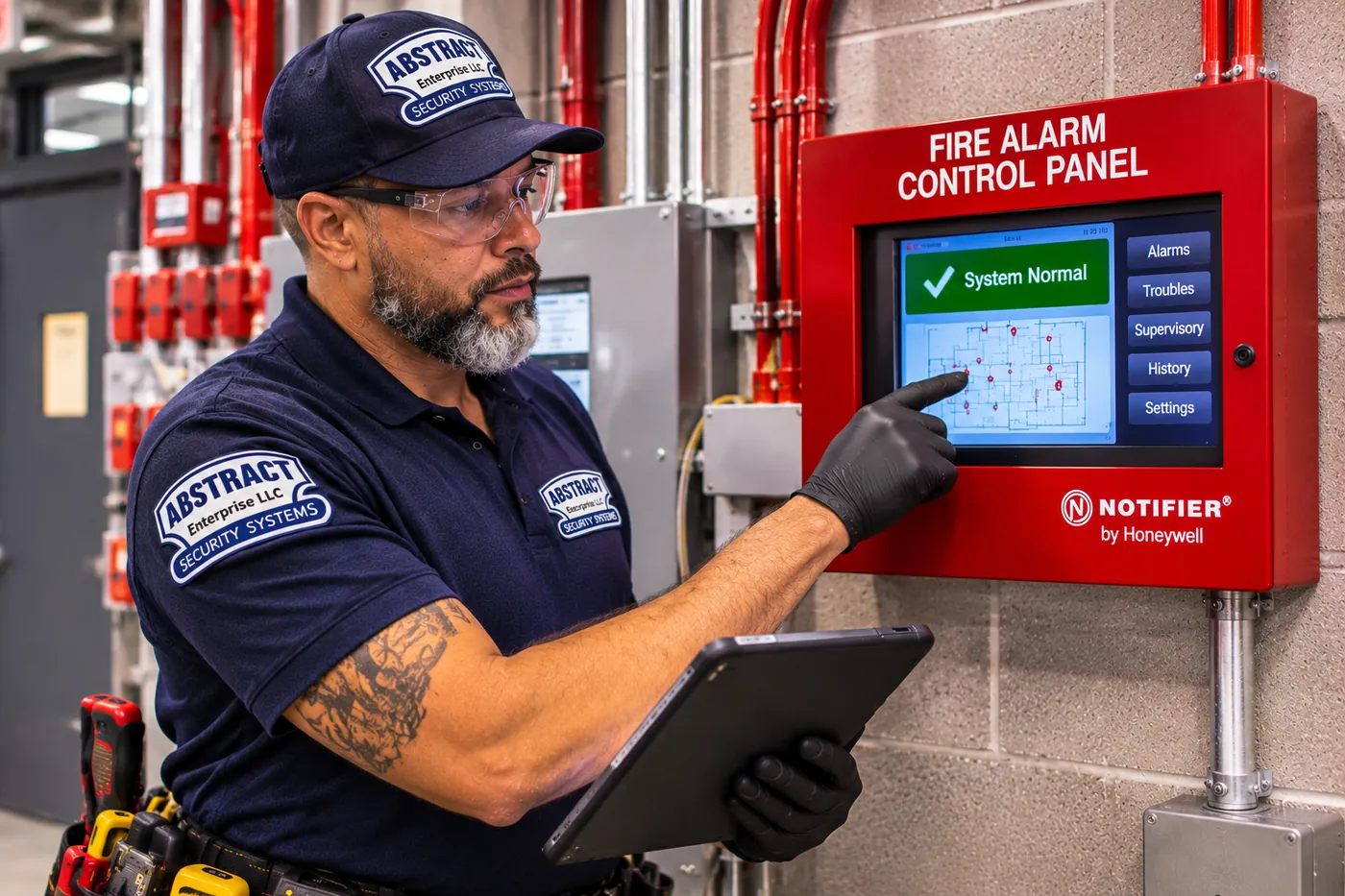
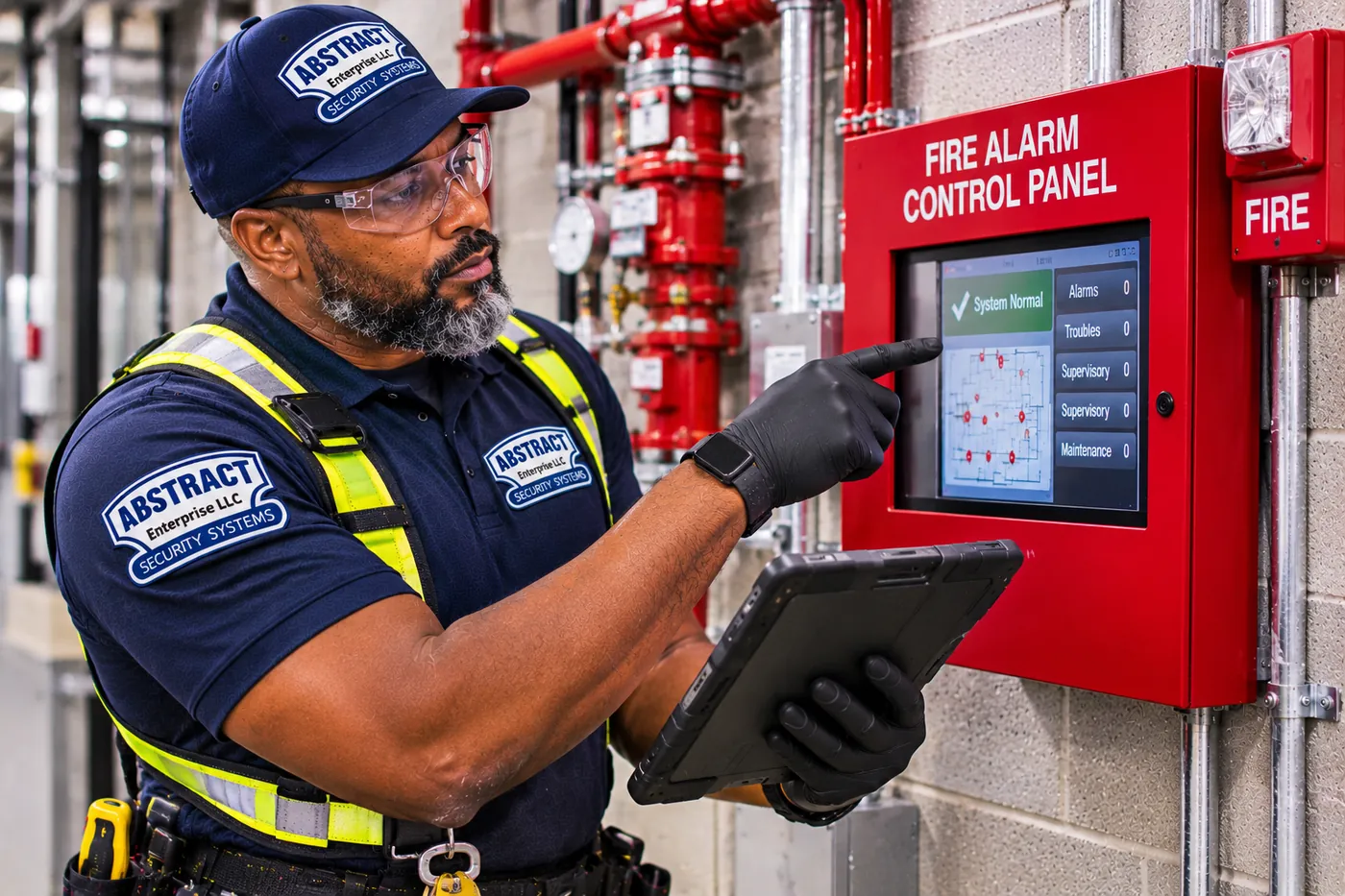
Fire alarm system installation in Clinton Hill, Brooklyn: technician in a hi-vis harness pointing at the System Normal screen of a red fire alarm control panel beside a sprinkler riser, holding a rugged tablet
A technician in a high-visibility harness points at the System Normal screen of a red fire alarm control panel while holding a rugged tablet, with a red sprinkler riser and gauges on the block wall behind him. Zero alarms, zero troubles and zero supervisory signals is the screen a Clinton Hill residence hall wants to show on the first day of move-in.
Clinton Hill Fire Alarm Request
Address, building type and the dates you have to work around

✅
Request Sent!
Thank you. We will call to book your Clinton Hill survey, usually within 2 hours of your request.
25+
Years Experience
✓
Semester-Aware Scheduling
100%
Commercial NFPA 72
4.7★
201 Google Reviews

Owner-operated since 2002 · Thousands of jobs completed · Booked within 2 hours

Fire alarm installation in Clinton Hill follows the New York City order of work: a New York State Professional Engineer or Registered Architect designs and seals the drawings, the FDNY examines them, an FDNY-certified fire alarm company and licensed electrician install the approved system, and an FDNY inspector watches it pass the acceptance test. What changes here is the calendar. Residence halls fill in late August and empty in May, studio buildings work through the night, and the corridors along Myrtle Avenue and Fulton Street keep adding apartments above stores, so the noisy work, the device testing and the cutover all have to land in the right weeks. We price each building in writing after walking it. Call (347) 934-8335; the survey is booked within 2 hours of your request.

  • NFPA 72 commercial systems for residence halls and student apartments, classroom and studio buildings, 1940s co-op towers, churches, schools, and Myrtle Avenue and Fulton Street mixed-use buildings
  • We work under NYS license #12000287431; each proposal names in writing the FDNY-certified fire alarm company and licensed electrician who will sign the filing
  • The FDNY estimates about 20 to 24 weeks from plan submission to final approval, so a summer installation window has to be planned starting in the fall before
The Neighborhood

Why Clinton Hill Buildings Need Fire Alarms That Keep Up With a Campus Calendar

Clinton Hill buildings need commercial fire alarm systems planned around the people who move through them, because a large share of the neighborhood's larger buildings house or teach students who arrive in waves and leave in waves. The neighborhood runs from Flushing Avenue and the Brooklyn Navy Yard on the north down to Atlantic Avenue on the south, with Vanderbilt Avenue and Fort Greene on the west and Classon Avenue and Bedford-Stuyvesant on the east. It sits in Brooklyn Community District 2, is policed by the 88th Precinct and is covered by ZIP codes 11205 and 11238.

Two institutions shape it. Pratt Institute, founded by Charles Pratt in 1887, keeps its Brooklyn campus between DeKalb and Willoughby Avenues and has spread residence halls and townhouses into the surrounding blocks. St. Joseph's University occupies a run of buildings on Clinton Avenue, including former Pratt family mansions; Charles Pratt built his own house at 232 Clinton Avenue in 1874 and gave mansions on the same avenue to three of his sons as wedding presents. Around those campuses sit the rowhouses and mansions of the Clinton Hill Historic District, the 1940s co-op towers on Clinton and Waverly Avenues, two landmark churches from the 1880s and 1890s, and the commercial corridors on Myrtle Avenue, DeKalb Avenue, Washington Avenue and Fulton Street.

That mix produces fire alarm problems most Brooklyn neighborhoods see only one at a time. Student kitchens start the majority of residence hall fires; Pratt's own federal fire safety report lists a cooking fire at 100 Grand Avenue in 2020 and a stove fire at Willoughby Hall in 2022 that injured one person. Classroom and studio buildings sit empty at night with materials that burn; Pratt's Main Building caught fire shortly after 2 a.m. on February 15, 2013, a four-alarm blaze with no students inside. And mixed-use corridor buildings stack apartments over kitchens and markets: on June 22, 2026 a second-alarm fire started in a ground-floor deli at 504 Classon Avenue near Putnam Avenue and spread to the floor above, seriously injuring a firefighter, and on July 14, 2026 about 120 fire and EMS personnel answered a fire at 490 Myrtle Avenue, a supermarket with apartments above, between Ryerson and Hall Streets.

So what is a commercial fire alarm system in a Clinton Hill building? It is the control panel and its power supplies, the smoke and heat detectors, the manual pull stations at the exits, the horns, strobes and speakers, the modules that recall elevators, release held-open doors and shut down fans, and the communicator that reports to an FDNY-approved central station, all laid out on sealed drawings that the FDNY has examined and accepted. How does a commercial fire alarm system work? Each circuit is supervised, so the panel can tell a real fire signal from a cut wire, a missing detector or a closed sprinkler valve; on an alarm it sounds the building, runs its outputs and calls for help without waiting for anyone to dial 911. When does a building need a fire alarm system? Section 907 of the NYC Building Code answers by occupancy and size: every school in the educational group, hotels, assembly spaces of 300 or more, apartment-type residential buildings (the group where dormitories are generally placed) with 16 or more units or with units three or more stories above the exit, offices and college classroom buildings above set occupant loads, and stores above set floor areas, among other triggers. The engineer reads the code for the specific building.

Clinton Hill facts that shape fire alarm work

FactWhat it means for fire alarm workSource
Pratt Institute reports wet sprinkler systems in all of its residence halls and fire alarm systems with "a combination of addressable and non-addressable points with hardwired smoke detectors in hallways," reporting to a central stationCampus buildings often carry several generations of equipment at once; any change starts with knowing which points are whichPratt Institute 2023 Annual Security and Fire Safety Report
The same report lists panels from Edwards (EST-2 and EST-3), NOTIFIER (NFS2-640) and older makes across eleven residence facilities, several with carbon monoxide detection on the fire alarmMixed brands across one owner's buildings; programming, parts and training differ from building to buildingPratt Institute 2023 report
Fire drills at every campus building and residence hall once in the fall and once in the spring semesterDrills, NFPA 72 testing and any installation work all compete for the same few weeksPratt Institute 2023 report
Clinton Hill Historic District designated November 10, 1981; rowhouses, mansions, carriage houses, apartment buildings and institutional buildings built from the 1840s into the 1920sOld structure, plaster and wood framing in many of the buildings that now hold classrooms, offices and student roomsHistoric Districts Council
Clinton Hill Co-ops: wartime rental housing begun in 1942 for Navy Yard and defense workers, designed by Harrison, Fouilhoux and Abramovitz, built by Starrett Brothers and EkenMid-rise towers from one design era, many with original risers and later elevator workBrownstoner
1024 Fulton Street, a vacant c. 1912 gas company showroom between Grand and Classon Avenues, chosen in 2026 for a 16-story building with 125 affordable apartments, a community center and a health clinicNew mixed-use construction on Fulton Street brings new FDNY filings, new panels and a long approval runwayBrownstoner; 6sqft
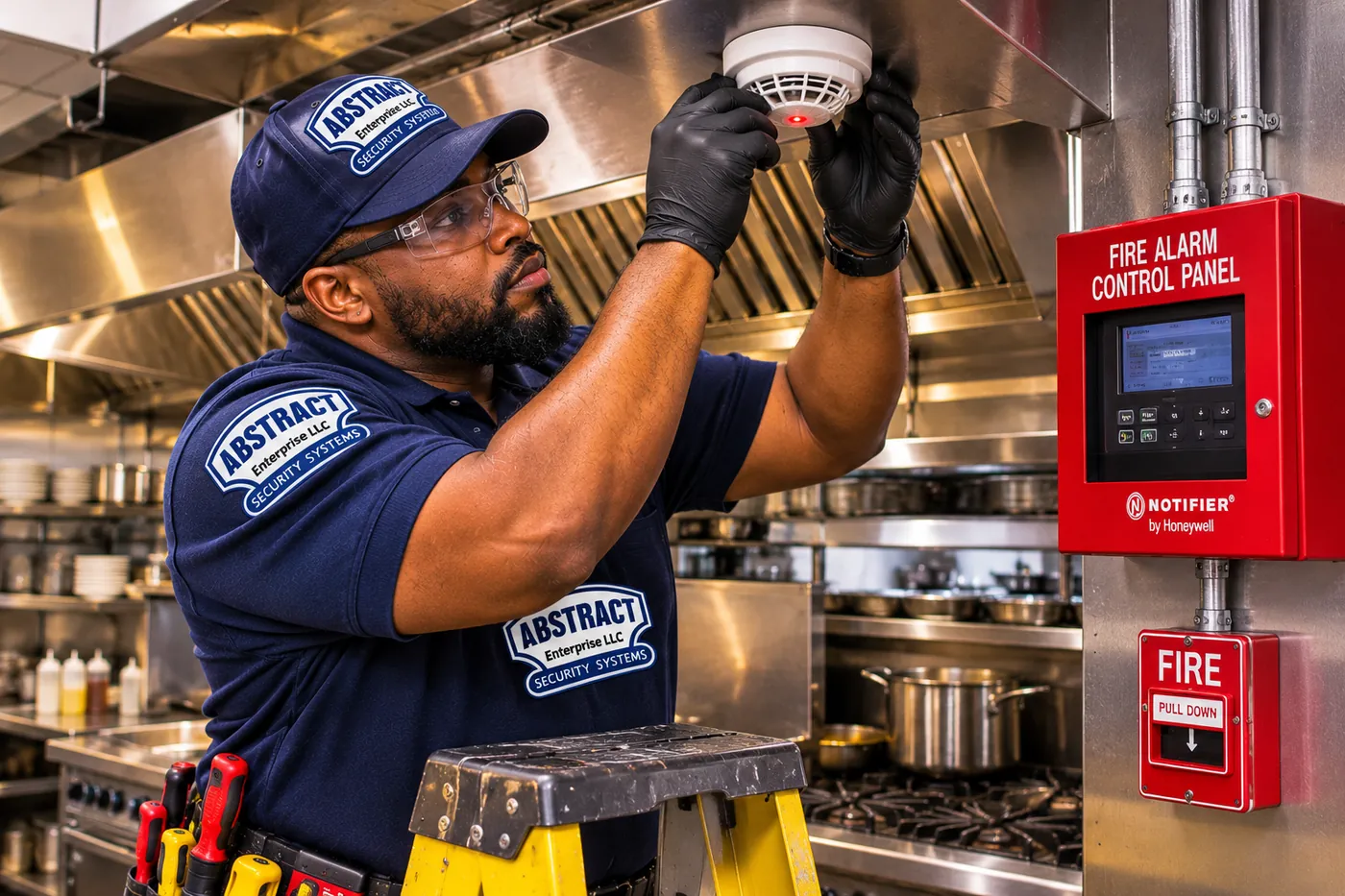
Commercial kitchen fire detection installation in Clinton Hill, Brooklyn: technician on a step ladder fitting a heat detector under a stainless steel hood next to a NOTIFIER fire alarm control panel and a pull station
A technician on a yellow step ladder fits a white heat detector beneath a stainless steel kitchen hood, beside a red NOTIFIER control panel and a pull station on the same wall. In Clinton Hill, kitchens are where residence hall fires usually begin and where restaurants under apartments on Myrtle Avenue need the most careful detector choice.
Repair

Need Fire Alarm Repair in Clinton Hill? Campus and Corridor Buildings Fail on a Schedule

Fire alarm repair in Clinton Hill tends to arrive at predictable times of year. The panel that sat quiet all summer in an empty residence hall shows a battery trouble the week students return. A studio building's detectors start to drift after a semester of dust, fumes and spray finishes. A corridor store renovates over winter break, and the building panel above it reports an open circuit on the floor where the contractor worked. Knowing the calendar helps us find the fault faster.

Why is my fire alarm panel showing trouble? A trouble means the panel has found something wrong with itself or its wiring: a battery that will not hold a charge, a ground fault, an open or shorted circuit, a device that stopped answering, a communicator that cannot reach the central station, or a supervisory point such as a closed sprinkler valve. What causes a fire alarm ground fault? Usually a conductor touching the building's ground somewhere it should not: water in a box on a roof or in a damp cellar, a nail or screw from a renovation driven through a cable, insulation crushed behind a pulled-down ceiling grid, or a corroded device in a wet stair. In old Clinton Hill buildings, steam pipe chases and areaway walls are common places to look.

Our fire alarm service technician starts with the panel history, then works outward. Fire alarm troubleshooting, fire alarm fault diagnosis and fire alarm system diagnostics on an addressable system narrow the problem to a device or loop; on a conventional zone they mean meter work circuit by circuit. Fire alarm trouble signal repair, fire alarm ground fault repair, fire alarm ground fault troubleshooting, fire alarm open circuit repair, fire alarm short circuit troubleshooting and fire alarm circuit troubleshooting follow from what the meter shows. Fire alarm SLC troubleshooting and fire alarm signaling line circuit repair are the addressable versions of the same hunt, and smoke detector circuit troubleshooting on older two-wire zones can take longer because a single zone may run across several floors.

Other calls are about behavior rather than wiring. A fire alarm panel trouble light that comes and goes, a fire alarm system trouble condition that clears itself overnight, a fire alarm supervisory trouble from a sprinkler valve, a fire alarm intermittent trouble that only appears on humid days, a fire alarm battery trouble repair before move-in, fire alarm communication failure repair after a phone line change, a fire alarm system not communicating with the central station, or fire alarm panel beeping repair in a lobby where residents are complaining. Fire alarm false alarm troubleshooting in a student building usually ends at a kitchen, a shower room door left open beside a corridor detector, or a device that has reached the end of its sensitivity range.

When the fault is serious, the call is urgent. Emergency fire alarm repair, emergency fire alarm service, an emergency fire alarm technician on site and emergency fire alarm troubleshooting all begin with the same steps: make the building safe, tell the central station and the FDNY what is out of service where required, and set up a fire watch if the owner's plan or the FDNY calls for one. People search for 24 hour fire alarm repair, after hours fire alarm service and same day fire alarm repair; what we commit to is booking within 2 hours of your call, and urgent fire alarm repair for a fire alarm system down repair, a fire alarm panel failure repair, a fire alarm system emergency service call, commercial fire alarm emergency repair, a fire alarm trouble emergency service visit or fire alarm communication failure emergency repair is scheduled ahead of planned work. Commercial fire alarm repair of this kind, including fire alarm device fault repair, fire alarm wiring repair, fire alarm system malfunction repair, fire alarm power supply repair and fire alarm notification circuit repair are usually completed on the visit when the parts are standard.

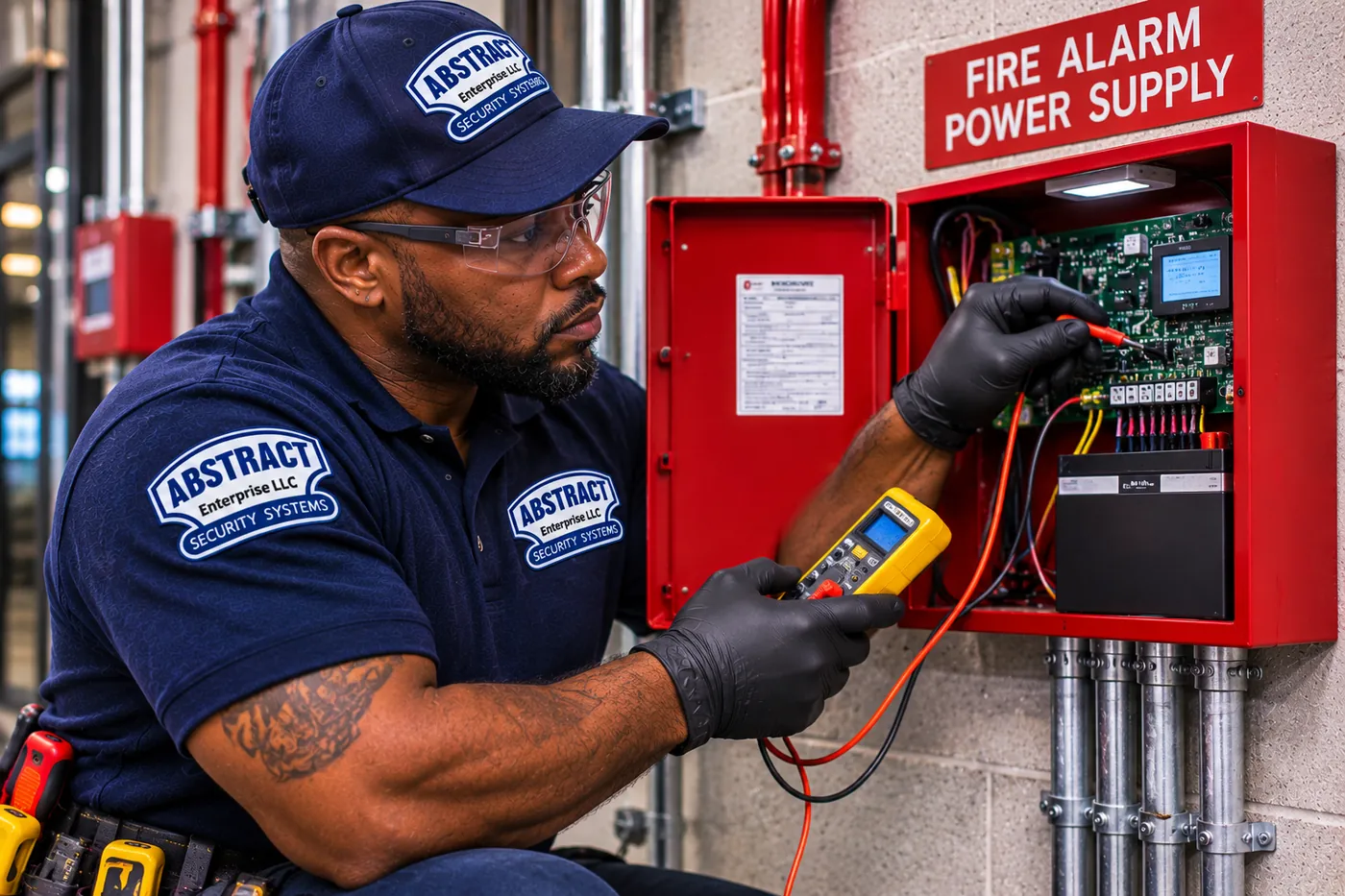
Fire alarm battery replacement check in Clinton Hill, Brooklyn: technician reading a yellow multimeter with leads on the board of an open red fire alarm power supply cabinet holding a standby battery
A technician reads a yellow multimeter with its leads on the circuit board of an open red fire alarm power supply cabinet, a standby battery sitting in the bottom of the enclosure and conduit running down the block wall. In a Clinton Hill residence hall that has been nearly empty all summer, the batteries are among the first things checked before students return.
Services

Fire Alarm Installation Services for Clinton Hill Buildings

Residence halls and student apartments

Apartment building fire alarm installation and multifamily building fire alarm installation for residence halls, student townhouses and buildings rented by the room, with corridor smoke detection, horns and strobes that reach every floor, and detector choices near shared kitchens that cut false alarms without losing coverage.

Classroom, studio and lab buildings

School fire alarm installation for college classroom buildings and studios, with heat detection where dust, fumes or kiln heat would keep smoke detectors in alarm, and work packaged into breaks so classes and critiques are not interrupted.

College offices in former mansions

Office building fire alarm installation inside Clinton Avenue mansions and converted rowhouses, where devices must be placed with care in rooms that still carry their period woodwork and plaster.

1940s co-op towers

Condominium building fire alarm installation and co-op work for mid-rise towers with original risers, including elevator recall, roof bulkhead and compactor room detection, and records a board can keep.

New mixed-use buildings

Mixed use building fire alarm installation and new construction fire alarm installation for the apartment buildings over stores on Myrtle Avenue and Fulton Street, from the first set of drawings through the FDNY acceptance test.

Stores, markets and restaurants

Retail store fire alarm installation, restaurant fire alarm installation and commercial kitchen fire detection installation for corridor tenants, including hood suppression monitoring and tenant fit out fire alarm installation inside a landlord's existing system.

Churches and parish halls

Building fire alarm installation for the neighborhood's 1880s and 1890s sanctuaries and their halls and schools, with detection suited to tall interiors and wiring kept off decorative surfaces.

Medical, clinic and care spaces

Medical office fire alarm installation for clinics and practices on Fulton Street and Myrtle Avenue, and assisted living fire alarm installation or nursing home fire alarm installation planning when a building's use changes to care.

Design and filing support

Commercial fire alarm system design coordinated with the New York State engineer or architect who seals the drawings, and the paperwork the FDNY needs at each step, so the owner is never guessing what comes next.

Whatever the building, the work is the same professional fire alarm installation in four parts: survey, sealed design, installation to the approved plans, and acceptance. A new fire alarm system installation in an empty building and a complete fire alarm system installation that replaces an old one in an occupied residence hall both follow that order. Commercial building fire alarm installation here covers fire detection and alarm installation from the cellar to the roof bulkhead: fire alarm equipment installation, commercial fire alarm panel installation, commercial fire alarm wiring through existing chases, and commercial fire alarm system installation tested floor by floor. As a fire alarm installation company and fire alarm installation contractor, we provide fire alarm installation services to colleges, boards, owners, congregations and businesses in Clinton Hill, and each proposal says in writing who holds which license. Many campus clients also ask about elevator and door integration; that is covered under integration below, and it is part of the same fire alarm system, not an add-on.

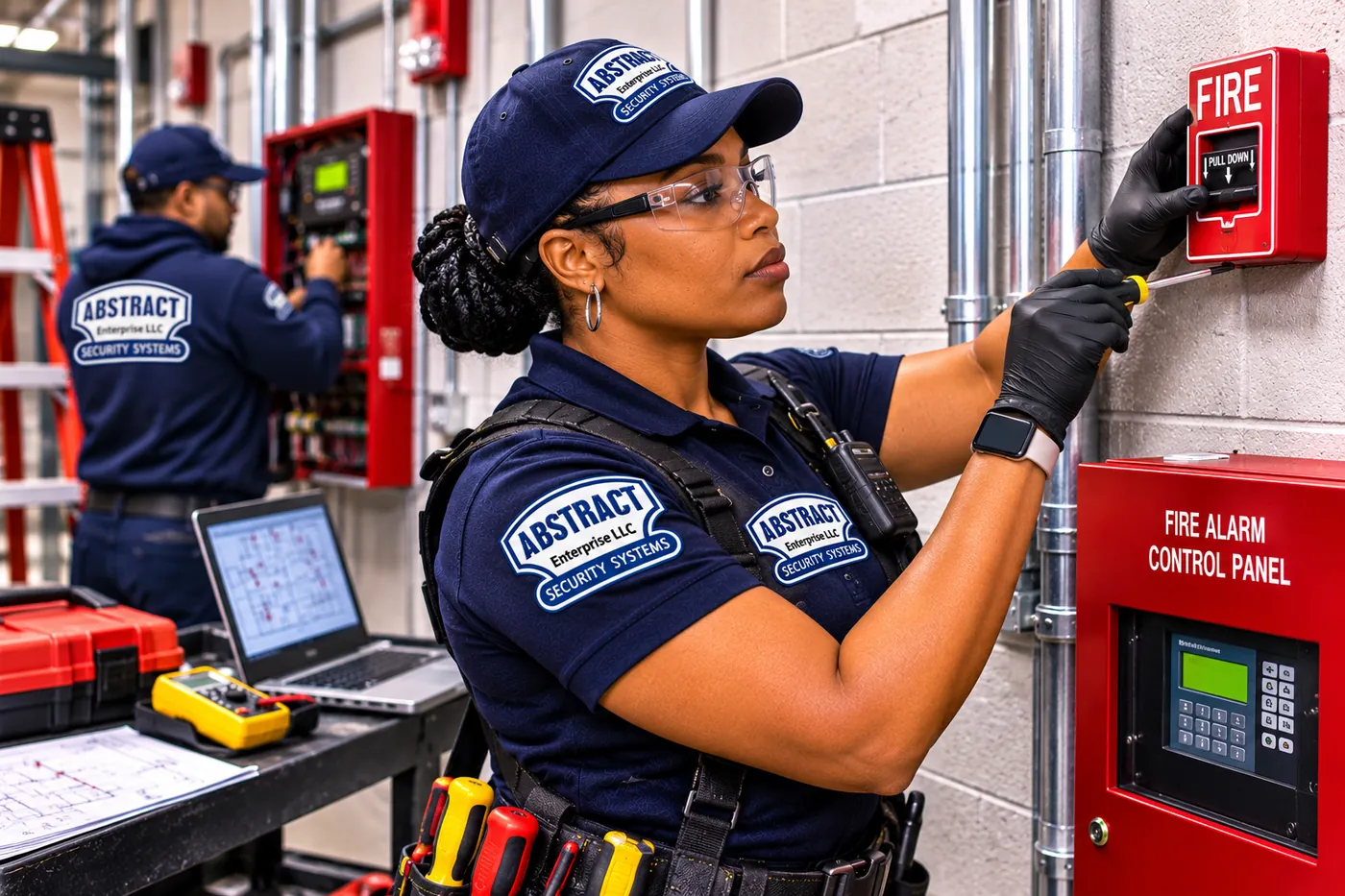
Manual fire alarm pull station installation in Clinton Hill, Brooklyn: technician with a screwdriver mounting a red pull station on a block wall above a control panel while a second technician works at an open panel behind her
A technician in safety glasses tightens a red pull station on a block wall above a fire alarm control panel, while a second technician works at an open panel in the background beside a laptop showing a floor plan, a meter and a set of drawings. Studio and classroom buildings in Clinton Hill are often worked this way, one person at the device and one at the panel, so testing moves quickly through a building that has to reopen.
Building Types

Commercial Fire Alarm Systems for Clinton Hill's Building Types

Clinton Hill's fire alarm work is shaped less by size than by who is inside and when. A six-story residence hall and a six-story co-op can carry the same number of devices and need very different plans.

Residence halls and student townhouses

Pratt's published list of residence facilities gives a sense of the range: purpose-built halls on Willoughby Avenue, Grand Avenue and Emerson Place, a block of student apartments at Cannoneer Court on Classon Avenue, and rows of townhouses on Emerson Place, Steuben Street and Willoughby Avenue, several of them with carbon monoxide detection reporting to the fire alarm. For a fire alarm contractor, the hall and the townhouse row are different jobs. The hall has long corridors, a fire pump or gravity tank feeding the sprinklers, elevator recall and a central panel; the townhouse row is a set of narrow buildings joined into one system, where cable crosses party walls and every stair is its own exit. Both share one fact: occupants change every year, so the system has to be simple to read for people who did not live there last spring.

Classroom, studio and laboratory buildings

Art and design schools put loads on a fire alarm that ordinary offices do not: wood dust, spray booths, solder and plastic fumes, kilns that hold heat for hours, and model shops where students work past midnight. In these rooms, the device on the ceiling is often a heat detector or an air sampling port rather than a spot smoke detector, and the notification has to cut through machinery noise. Pratt's own report notes fire alarm improvements under way in its Chemistry, Machinery and Engineering buildings, a reminder that the oldest buildings on a campus are often the ones carrying the most demanding uses.

College offices in former mansions

St. Joseph's University lists Founders Hall at 232 Clinton Avenue, Burns and Tuohy Halls at 245, St. Joseph's Hall at 256, Lorenzo Hall and the Molloy Theatre at 265, McEntegart Hall Library at 222 and St. Angela Hall at 263 Waverly Avenue, among others. Several of the Clinton Avenue buildings began as Pratt family houses. A mansion that becomes offices or classrooms changes occupancy, and the fire alarm that follows has to work inside rooms with carved fireplaces, plaster cornices and wood paneling that the owner wants left as they are.

The 1940s co-op towers

The Clinton Hill Co-ops began as wartime rental housing. Construction started in 1942 and the first buildings were ready in March 1943, built "as rentals for members of the armed forces or war-plant workers and their families," as Brownstoner's history puts it, on land where several Clinton Avenue mansions had stood. After the war the complex became owner-occupied co-ops. Towers of one design era tend to age together: their risers, their elevator machinery and their original wiring paths reach replacement within a few years of one another, and a board that plans the fire alarm with the elevator and electrical work avoids opening the same shafts twice.

Churches, parish halls and church schools

Emmanuel Baptist Church on Lafayette Avenue at St. James Place, designed by Francis H. Kimball and opened on April 17, 1887 with funding from Charles Pratt, and the Church of St. Luke and St. Matthew on Clinton Avenue, completed in 1891 to designs by John Welch, are the best known of the neighborhood's congregations. Their sanctuaries are tall and ornate, and their halls and schools carry the everyday fire risk: kitchens, meeting rooms, storage and child care. A church fire alarm here usually focuses its devices on those support spaces, with sanctuary detection designed to reach a high ceiling without hanging hardware on decorative surfaces.

Myrtle Avenue and Fulton Street mixed-use buildings

The corridors combine two building generations. Older three- and four-story buildings put a deli, market or restaurant under a few apartments; newer buildings put dozens or hundreds of apartments over a row of storefronts. In the older stock, the commercial tenant's fit-out is often what triggers a fire alarm requirement for the whole building. In the newer stock, the fire alarm is designed from the start, and the work is keeping it current as each storefront is leased and rebuilt.

Converted institutional homes

The Graham Home for Old Ladies at 320 Washington Avenue, built in 1851 as a refuge for older women of limited means, later ran as a motor inn, sat empty and was converted to condominiums by the mid-2000s. Buildings like it have been rebuilt more than once, and each rebuild leaves behind its own wiring and its own idea of where the fire alarm should be. Survey work in these buildings starts with what is actually on the walls, not what the last set of drawings says.

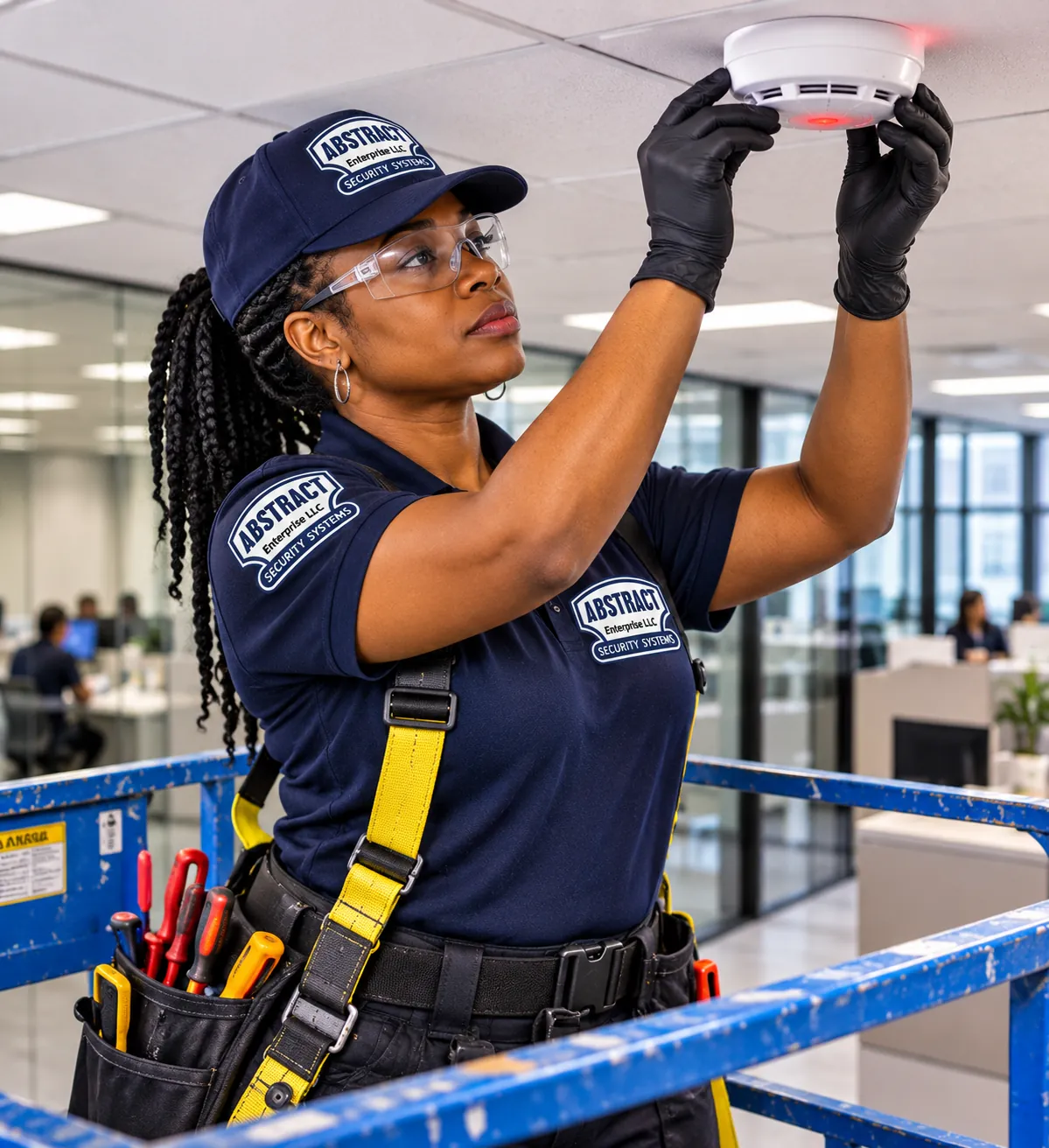
Commercial smoke detector installation in Clinton Hill, Brooklyn: technician in a harness on a blue lift fitting a white smoke detector to a ceiling tile grid above an open-plan office
A technician in a safety harness stands in a blue lift basket and fits a white smoke detector to a drop ceiling above an open-plan office with glass partitions and desks. College administrative floors and the newer commercial spaces along Fulton Street in Clinton Hill often look like this above the ceiling line, whatever the building looks like outside.
Corridors

Business Fire Alarm Installation From Myrtle Avenue to Fulton Street

Business fire alarm installation in Clinton Hill happens mostly along four streets, each with its own building type and its own set of tenants.

Myrtle Avenue, Vanderbilt to Classon

The Myrtle Avenue Brooklyn Partnership, the business improvement district for Fort Greene, Clinton Hill and Wallabout, describes its mission as restoring the area's "Main Street." The street has been rebuilt quickly: in 2016 DNAinfo mapped about 1,125 new apartments and 26 storefronts in projects on and near Myrtle, including 504 Myrtle Avenue, eight stories and 141 apartments on the site of the former Pratt Station Post Office, and smaller buildings at 491, 501, 525 and 531 Myrtle. Each new storefront is a future tenant fit out fire alarm installation, and each older building beside them is a candidate for a fire alarm system code upgrade when its own store changes hands. The fire at 490 Myrtle Avenue in July 2026, in a supermarket with apartments above, is the corridor's typical risk in one building.

DeKalb and Willoughby Avenues, the campus edge

DeKalb and Willoughby frame the Pratt campus and carry its residence halls, cafes and student services. Here the commercial fire alarm installation question is often about mixed occupancy: a ground-floor cafe or print shop under student rooms, where cooking and printing equipment sit directly below sleeping floors.

Washington Avenue and Clinton Avenue

The two avenues carry the mansion blocks, the co-op towers, St. Joseph's University and the churches. Commercial work is less frequent but more delicate: college offices, a library, a theater, a child study center and church halls, mostly inside older buildings where every device location needs a reason.

Fulton Street, Vanderbilt to Classon

Fulton Street forms the southern edge, with the A and C trains at Clinton-Washington Avenues and the G at Classon Avenue. It mixes older commercial buildings, churches and new residential towers. The planned 16-story building at 1024 Fulton Street, between Grand and Classon Avenues, will combine 125 affordable apartments with a community center and a health clinic, which means residential, assembly and medical uses under one fire alarm design. Its state-owned site still requires public review before final approval, according to 6sqft.

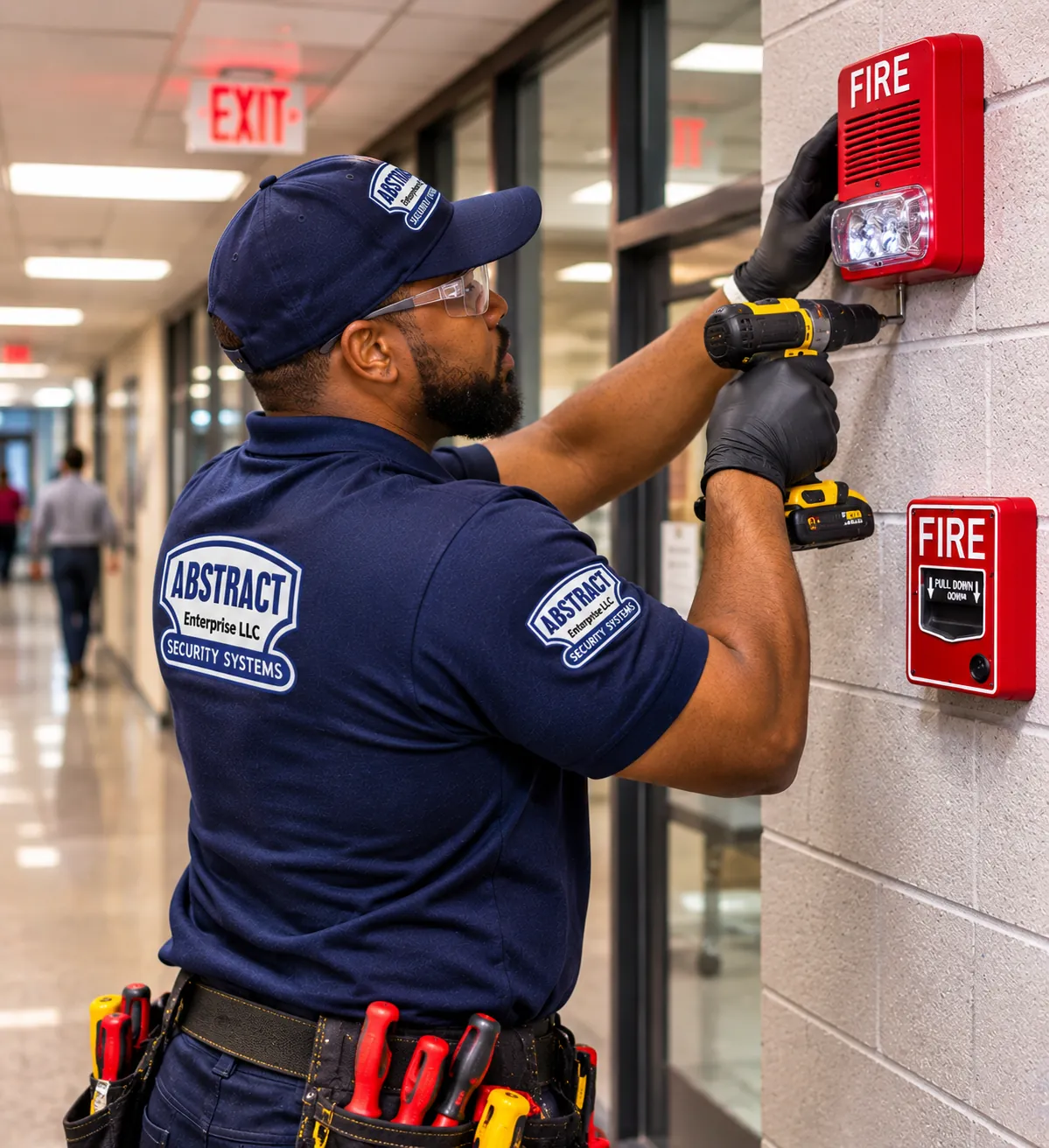
Fire alarm horn strobe installation in Clinton Hill, Brooklyn: technician drilling to mount a red horn strobe on a block wall above a pull station in a lit corridor with an exit sign
A technician drills to mount a red horn strobe on a painted block wall above a pull station, in a long corridor lit by ceiling panels with an exit sign overhead and a person walking in the distance. Corridors like this, in residence halls and the commercial floors of newer Myrtle Avenue buildings, are where most of a Clinton Hill system's notification appliances go.
Campus Calendar

Planning Fire Alarm Work Around a Clinton Hill Academic Year

Fire alarm work in a Clinton Hill campus building is planned backward from the academic calendar, because the weeks when a building can be noisy, dusty or partly out of service are few and fixed.

Why the FDNY timeline starts the clock

The FDNY's own guidance estimates about 20 to 24 weeks on average from plan submission to final inspection and approval, with the initial plan review alone taking up to eight weeks. A residence hall that wants its new panel in place before move-in at the end of August needs drawings sealed and filed by the winter before. A college that misses that window does not lose the project; it moves the noisy work to winter break or to the next summer, and keeps the old system maintained in the meantime.

What happens in each window

Summer is for the disruptive work: opening ceilings, pulling cable through occupied floors, replacing the panel and cutting over. Winter break suits a smaller scope, such as replacing a floor of detectors or adding a module. Spring break is good for device testing in classroom buildings. The first two weeks of each semester are the worst time for any planned outage, because new occupants do not yet know the building, its exits or its alarm sound.

Drills, tests and acceptance are three different events

A fire drill teaches people to leave. NFPA 72 fire alarm testing proves each device and circuit works and is documented by the fire alarm company. The FDNY acceptance test, witnessed by the FDNY's Fire Alarm Inspection Unit, approves a new or altered system. Campus buildings run all three, and Pratt's report describes drills once in the fall and once in the spring semester. Coordinating them saves occupants from evacuating three times in a month, but none of them replaces the others.

Occupants who change every year

In a student building, almost nobody who hears the alarm in September heard it the previous May. Cooking habits, door propping, tampering and false alarms all reset with each class. Pratt's report states that "tampering with or removing the detection devices, extinguisher, sprinkler and fire safety apparatus are grounds for disciplinary action and/or appropriate criminal actions." The fire alarm design cannot fix behavior, but it can make the system easy to understand: clear zone labels, a lobby annunciator that names the floor, and detectors chosen so the alarm does not become background noise. A 2004 fire at Panther Hall, a Pratt dormitory at DeKalb Avenue and Hall Street, shows the risk: one student told Firehouse, "I thought it was a false alarm, I didn't evacuate my room until I heard the firefighters breaking glass."

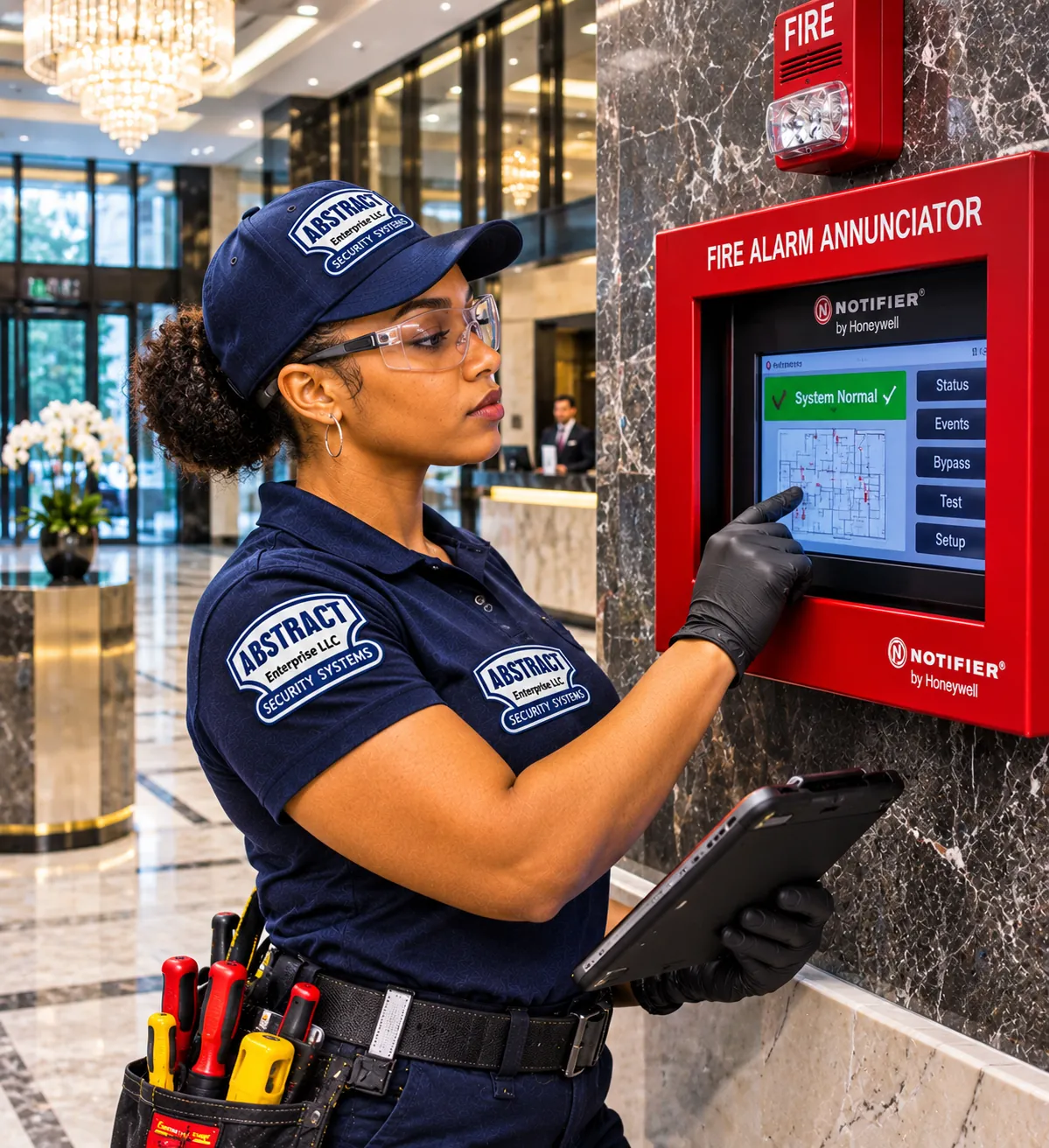
Fire alarm annunciator installation in a Clinton Hill, Brooklyn lobby: gloved technician with a tablet pointing at the floor map on a red NOTIFIER annunciator mounted on a marble wall below a horn strobe
A gloved technician holding a tablet points at the floor map on a red NOTIFIER annunciator set into a marble lobby wall, with a horn strobe above it. In a Clinton Hill residence hall, a clear annunciator at the entrance tells responding firefighters and campus staff exactly which floor sent the signal, whatever the residents believe about the alarm.
Field Notes

Field Notes: The Townhouse Row That Shared One Panel

This describes a common Clinton Hill situation rather than one particular job. An owner calls in July because a row of four connected rowhouses, rented by the room to students, shows a trouble on its single fire alarm panel that nobody can explain, and move-in is five weeks away.

The survey finds that the panel's zone labels still describe the four buildings as they were laid out when the system went in, before two of them were renovated and their room numbers changed. The trouble itself traces to a detector base in the third house, where a summer painting crew taped over a device and then pulled the tape, loosening the head. The fourth house has a newer kitchen than the drawings show, with a smoke detector now sitting a few feet from the range.

The loose head is fixed on the visit. The kitchen detector is a design question: swapping a device type or moving it changes an approved system, so it goes to the engineer before anyone touches it. The labels matter most of all for the incoming class. A September alarm in a building where the panel names rooms that no longer exist slows everyone down, from the resident advisor to the first engine company. In buildings that turn over every year, an accurate panel is part of the fire protection.

Your Questions Answered

Fire Alarm Installation in Clinton Hill: Questions Answered

Questions from first calls, grouped by topic.

Cost and budgeting

Our college wants one fire alarm proposal covering four buildings on the same block. Is that cheaper than four separate projects?

Often it saves on design and mobilization, because one engineer can survey, draw and file the buildings together and one crew can stage materials once. Each building still gets its own drawings and FDNY review unless the systems are designed to work as one network, so the savings come from coordination, not from skipping steps. Ask for the proposal to show each building separately so the board can compare.

Does a summer-only installation window raise the cost of fire alarm work in a building full of students?

It can. Compressing the disruptive work into a few summer weeks may mean larger crews or longer days, and any slip past move-in pushes the rest to a break. Starting the design and filing early is the cheapest way to protect the window, because the FDNY review, not the installation, usually sets the pace.

Trust and paperwork

Our building's last fire alarm test report has no certificate number or company name on it. Should we be worried?

It is worth checking. Any company that inspects, tests or services a commercial fire alarm in New York City must hold an FDNY Fire Alarm Company Certificate, and its work is supervised by an S-97 certificate of fitness holder. A report with no company or certificate identified gives you nothing to show an inspector; ask the company for those details or have the system tested again.

The fire alarm approval for our Clinton Avenue building still names the college by its old name. Do we need anything new from the FDNY?

A name change alone does not alter the installed system, but the owner name on central station accounts, inspection records and future filings should match the current legal owner. The design professional or your fire alarm company can confirm whether the FDNY needs updated paperwork the next time the system is filed or reinspected.

Who may do the work

Can student workers help during fire alarm testing in campus buildings, for example by standing at doors or clearing floors?

They can help with occupant tasks such as posting notices, staffing doors and confirming floors are clear, under the building's own procedures. The testing itself, operating devices, resetting the panel and recording results, belongs to the fire alarm company's qualified technicians.

Our university is buying a neighboring rowhouse for faculty offices. Can its fire alarm be tied into the campus system?

Sometimes. A networked panel can report to a central campus location, but the rowhouse still needs its own design for its new use, its own FDNY filing and a connection the FDNY accepts. The engineer decides whether a separate panel or a network node makes more sense for the building.

Technical

Our panel's paperwork says the system mixes addressable and non-addressable points. Is that a problem, and can it stay?

Many campus systems do exactly that, using addressable loops for most devices and conventional zones for older or special devices. It is not a defect in itself. The question is whether the parts are still supported and whether a future change can be made without redesigning the whole system.

Studio tenants in our building wedge the corridor doors open to move large artwork. What does the fire alarm have to do with that?

If those doors are fire doors, a wedge defeats them. The usual fix is magnetic door holders tied to the fire alarm, which keep the doors open for daily use and release them automatically on an alarm. Adding them is a change to the system and goes through the engineer and the FDNY.

Our 1940s co-op tower on Clinton Avenue is modernizing its elevators. Who reconnects the fire alarm's elevator recall afterward?

The elevator contractor and the fire alarm company share it. The fire alarm provides the recall and shutdown signals; the elevator controller has to accept them. Plan a joint test before the elevator returns to service, because recall failures are among the defects the FDNY most often cites.

Owners and occupants

Our building turns over almost every apartment each August. What should the owner do with the fire alarm before move-in week?

Have the panel cleared of troubles, batteries checked, any covered or painted devices restored, and the zone and room labels confirmed against current room numbers. Post the building's fire safety information where new occupants will see it, and avoid planned outages during the first weeks of the term.

We are a nonprofit leasing a floor in a church-owned building on Lafayette Avenue. If the FDNY writes a defect, is it ours or the church's?

The building fire alarm is normally the owner's responsibility, but leases often shift costs or duties to tenants. Read the lease, and send any notice to the owner immediately so the certified fire alarm company can answer it. Correcting a defect usually needs the owner's account and records anyway.

Complaints

We were billed for a fire alarm inspection that took twenty minutes in a six-story building. Was that a real inspection?

Probably not a complete one. A full NFPA 72 inspection and test means operating or checking devices across the building, testing notification on every floor and reviewing the panel and batteries, which takes far longer than twenty minutes. Ask for the itemized report listing every device tested.

The fire alarm test in our building was announced only by a note taped in the elevator. What notice should occupants get?

Enough that nobody mistakes a test for a fire or a fire for a test. Good practice is advance notice by email or posted in every lobby and floor, with the date, the hours and what occupants will hear. The central station must also be told so it does not dispatch, and told again when the test ends.

Call NowFast QuoteSpeak to a Tech
Equipment

Types of Commercial Fire Alarm Systems We Install in Clinton Hill

The right system for a Clinton Hill building depends on how many separate buildings it spans, what goes on in each room, and how often the people in it change.

Addressable systems

Addressable fire alarm installation and addressable fire alarm system installation for residence halls, classroom buildings and new towers, where every device reports its own location. Addressable fire alarm panel installation, addressable fire alarm device installation and addressable smoke detector installation let a hall's annunciator name the room, not just the floor. This is intelligent fire alarm installation in practice: an intelligent fire detection system that tracks each detector's condition over time.

Conventional systems

Conventional fire alarm installation, conventional fire alarm system installation and conventional fire alarm panel installation still suit a small corridor store building or a church hall with a handful of zones. Conventional fire alarm repair and conventional fire alarm replacement keep older zone panels serviceable until a planned change.

Voice evacuation

Fire alarm voice evacuation installation and fire alarm emergency voice communication for larger new buildings and assembly spaces, where a recorded or live message tells occupants what to do rather than only sounding a horn.

Air sampling

Aspirating smoke detection installation, an air sampling smoke detection system or a VESDA installation for studio spaces, archives and rooms where ceiling devices would be damaged or ugly, with VESDA service to keep the pipe network clean and calibrated.

Beam detection

Beam smoke detector installation and projected beam smoke detector installation for church sanctuaries, gymnasiums and tall studio halls, where one transmitter and receiver cover a ceiling too high for spot detectors.

Monitoring

Fire alarm monitoring system installation and fire alarm central station communicator installation so alarm, supervisory and trouble signals reach an FDNY-approved central station, with the switchover handled through the FDNY's process.

What is an addressable fire alarm system? One where each detector, pull station and module has its own address on a signaling line circuit, so the panel knows exactly which device has acted. What is a conventional fire alarm system? One where devices are grouped on zone circuits and the panel only knows which zone is in alarm. What is the difference between addressable and conventional fire alarms? Location detail, wiring layout and how easily the system grows. In a residence hall where a false alarm in one room should not send campus staff searching an entire floor, the difference is felt every week.

Addressable fire alarm system programming in Clinton Hill, Brooklyn: technician with a tablet pointing at a floor map on a NOTIFIER touchscreen control panel showing System Normal, red conduit runs on the wall beside it
A technician holding a tablet points at the floor map on a red NOTIFIER touchscreen control panel that shows System Normal, with red conduit and modules on the block wall beside it. On an addressable system in a Clinton Hill residence hall, that map is how staff go straight to one room instead of searching a whole floor.
Devices

Clinton Hill Fire Alarm Devices and Where Each One Goes

Detection

Fire detection device installation and fire alarm initiating device installation cover everything that starts an alarm. Commercial smoke detector installation and photoelectric smoke detector installation suit corridors, stairs and common rooms; commercial smoke detector replacement, commercial smoke detector testing and commercial smoke detector repair keep them reliable as they age. Commercial heat detector installation, fixed temperature heat detector installation and rate of rise heat detector installation suit kitchens, shops and kiln rooms, and heat detector replacement follows when a device has been painted, damaged or outgrown its rating. Duct smoke detector installation, duct smoke detector testing and duct smoke detector replacement protect air handlers in classroom buildings and new towers. Warehouse smoke detection installation and industrial fire detection system installation are rare inside Clinton Hill itself, but storage floors at the Navy Yard edge and large studio shops sometimes call for the same equipment. Commercial fire detection systems and business fire detection systems are built from these devices; fire detection system installation is choosing the right one for each room.

Pull stations

Fire alarm pull station installation and manual fire alarm pull station installation put a station at exits where the code requires one. Fire alarm pull station replacement, fire alarm pull station repair and fire alarm pull station testing follow when a station is broken, painted shut or pulled as a prank, which in student buildings happens more than anyone would like.

Notification

Fire alarm notification appliance installation includes fire alarm horn installation, fire alarm strobe installation and fire alarm horn strobe installation, with fire alarm horn strobe replacement and fire alarm horn strobe repair when devices fail. Fire alarm speaker installation and fire alarm speaker strobe installation serve voice systems. Fire alarm audible notification installation and fire alarm visual notification installation are designed together, with fire alarm ADA strobe installation and fire alarm synchronization module installation so strobes in view of one another flash in step. Fire alarm notification appliance replacement in older buildings is often the first visible part of a larger upgrade.

Modules, power and communication

Fire alarm relay module installation, fire alarm monitor module installation and fire alarm control module installation connect the fire alarm to sprinkler switches, doors, fans and elevators. Fire alarm power supply installation and fire alarm NAC power supply installation add capacity for strobes; fire alarm battery backup installation and fire alarm battery replacement keep the system running through a power failure. Fire alarm communicator installation and fire alarm annunciator installation complete the system, with remote annunciator installation at the entrance firefighters use. Fire alarm control panel installation, FACP installation and fire alarm panel wiring tie it all together.

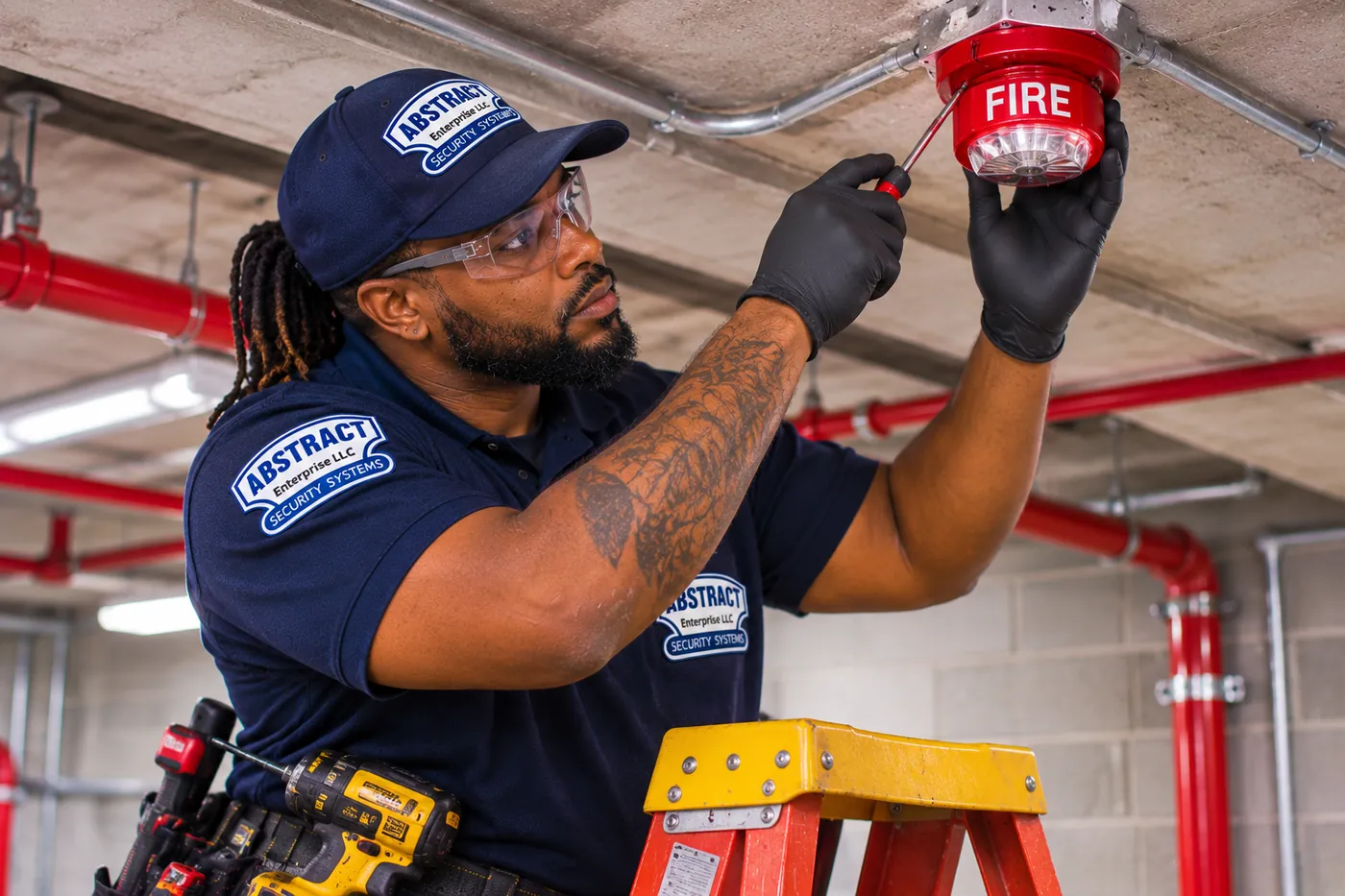
Fire alarm notification appliance installation in Clinton Hill, Brooklyn: technician on an orange ladder tightening a red ceiling-mounted horn strobe on a concrete ceiling with conduit and red sprinkler pipes
A technician on an orange step ladder tightens a red ceiling-mounted horn strobe on a concrete ceiling, with exposed conduit overhead and red sprinkler pipes along the block walls. Cellars and mechanical floors under Clinton Hill co-op towers and residence halls usually get ceiling-mounted appliances like this where wall space is taken by pipes.
AI Overview Reality Check

What AI Answers Get Wrong About Fire Alarms in Clinton Hill

Search for fire alarm installation near me or fire alarm installers near me and the first answers come from AI summaries and lead sites such as Angi, HomeAdvisor and Fixr. They are written for houses everywhere, not for a residence hall on Willoughby Avenue. Here is where they go wrong.

"A fire alarm is a box of smoke detectors you can add room by room."

That describes battery smoke alarms in a house. A commercial fire alarm in a Clinton Hill residence hall or classroom building is one engineered system: every device sits on a supervised circuit, every location is on sealed drawings, and every change goes back through the design professional and, in most cases, the FDNY.

Adding a detector to a new student kitchen, moving one away from a renovated shower room or swapping a smoke detector for a heat detector all change an approved design. Done informally, they leave the building with a system that no longer matches its approval, which is exactly what an inspector looks for.

The fix is simple: before any renovation, ask the engineer what the change does to the fire alarm. It costs a phone call, and it avoids a Notice of Defect in the middle of a semester.

"Fire alarm installation cost is a price per device."

Lead sites often quote per-device or per-square-foot figures. In New York City the total is the sum of four stages, each different per building: sealed design, FDNY filing and review, installation to the approved plans, and the acceptance test. Per-device prices hide three of those four.

In Clinton Hill the hidden stages vary even more than usual. A townhouse row joined into one system needs cable across party walls; a classroom building needs work at night or during breaks; a new Myrtle Avenue building needs coordination with a developer's schedule. None of that is a device.

That is why we do not publish fire alarm installation pricing. A written proposal after a survey is the only number worth comparing.

"Any licensed electrician can install a commercial fire alarm."

Not in New York City. The installer must be a city-licensed electrician or a fire alarm company holding an FDNY Fire Alarm Company Certificate, and any company that installs, inspects, tests or services fire alarm components other than smoke detectors alone must be certified, with at least one principal holding an S-97 certificate of fitness backed by NICET Level II or higher or a NYC master or special electrician license.

The drawings must be prepared and sealed by a New York State Professional Engineer or Registered Architect. The electrician's license alone is not enough, and neither is a general contractor's.

Ask every bidder to put the certified company, the S-97 holder and the licensed electrician on the proposal by name. A contractor who cannot name them is not ready to file.

"You can install it in a weekend."

The hands-on work in a small store might be days. The project is not. The FDNY estimates about 20 to 24 weeks from plan submission to approval on average, and the initial review alone can run up to eight weeks.

For a residence hall, that means the calendar runs the project. Drawings sealed in winter, approval in spring, installation in summer and acceptance before move-in is a tight but realistic plan. Drawings started in June are not.

How long does fire alarm installation take? Plan in months, and put the installation into the weeks the building can spare.

"Wireless detectors mean no cable and no disruption."

Listed wireless fire alarm devices exist, but they still need a listed panel, an approved design and FDNY acceptance, and their batteries become a maintenance task of their own. In buildings with thick masonry and steel, signal paths need careful design.

In Clinton Hill, wireless can help in a period room of a former mansion where cable would mean opening plaster. It rarely makes sense across a residence hall where the corridors are already open for other work.

The engineer chooses, room by room. Treat wireless as a tool for specific spaces, not a way around the approval process.

"Students' smoke alarms are the building's fire protection."

Single-station smoke alarms inside rooms and apartments warn the people in that room. They do not sound the building, call the central station, recall elevators or release doors. In a residence hall, those jobs belong to the building fire alarm.

The two systems are designed together but are not interchangeable. A hall that relies on in-room alarms alone is missing the part that gets everyone else out and the fire department in.

When an AI summary blends the two, it is usually because most of its sources are about houses. Clinton Hill's larger buildings are not houses.

"Annual testing is optional if nothing has gone wrong."

NFPA 72 testing and inspection frequencies are part of the code the FDNY enforces, and the owner is responsible for having them done and keeping the records. A quiet panel is not a tested panel.

How often should fire alarms be inspected, and how often should commercial fire alarms be tested? The schedule depends on the device type; many components are inspected and tested at least annually, some more often, and records should be kept for the FDNY. In a campus building, those tests fit best in a break, never during move-in.

An untested system in a building whose occupants change every year is a system nobody really knows. Testing is how the owner finds out before a fire does.
Summer Window, New Lease or Board Vote Coming Up? Talk to a Tech First

Send the address, who owns and who occupies the building, the panel brand if you know it and the date you have to work around. We book a survey within 2 hours of your request and tell you what the design professional, the FDNY and the installer will each need before you commit to a schedule.

Get In Touch

Request a Free Quote for Your Clinton Hill Fire Alarm Project

Send the street address or nearest corner, whether the building is a residence hall, classroom or studio building, co-op, church, store or new mixed-use building, how many floors it has, the panel brand if you know it, and any FDNY Letter of Approval or recent inspection report. Tell us about any semester, lease or move-in date. For a trouble condition, a clear photo of the display helps most. Prefer to talk? Call (347) 934-8335.

✅
Request Sent!
Thank you. We will call to book your Clinton Hill survey, usually within 2 hours of your request.
How It Works

Our Fire Alarm Installation Process for Clinton Hill Buildings

Every Clinton Hill fire alarm installation consultation follows the same order, with dates set backward from the window the building can offer.

  1. First call. Address, building type, owner and occupants, the panel brand if known, any FDNY Letter of Approval, and the semester, lease or opening date that sets the deadline. The survey is booked within 2 hours.
  2. Survey and records search. We walk every floor, read the panel history and labels, compare them with the last approved drawings, and note kitchens, studios, shafts and party walls.
  3. Design professional and sealed drawings. A New York State Professional Engineer or Registered Architect prepares the fire alarm construction drawings and fire alarm shop drawings, device layout, battery and voltage-drop calculations and sequence of operations, meeting the fire alarm system design requirements of the NYC Building Code and NFPA 72.
  4. Written proposal. A fire alarm system installation proposal that separates design coordination, filing support, installation, finish repair, programming and testing, so it can be compared line by line with any other fire alarm installation bid or fire alarm contractor estimate.
  5. Approvals. The design professional files the TM-1 with the FDNY. The FDNY's initial plan review can take up to eight weeks; objections are answered and the plans approved before work starts.
  6. Installation. Fire alarm rough in, fire alarm conduit installation, fire alarm cable pulling, fire alarm cable installation, fire alarm wiring installation, fire alarm low voltage wiring, fire alarm zone wiring where zones remain, fire alarm device termination and fire alarm circuit installation to the approved drawings, by the certified company and licensed electrician on the filing, with the old system kept live until cutover.
  7. Programming and commissioning. Fire alarm device programming, fire alarm device addressing, fire alarm control panel programming and fire alarm system configuration with labels that match current room numbers, then fire alarm system startup, fire alarm system commissioning and commercial fire alarm commissioning with the central station connection live. This is fire alarm system testing and commissioning before anyone from the FDNY arrives.
  8. Acceptance and handover. The FDNY-witnessed fire alarm acceptance inspection, the Letter of Approval, and fire alarm as built drawings, programming records and test reports handed to the owner, with a short briefing for building staff and residence life.

What happens during fire alarm acceptance testing? The FDNY's Fire Alarm Inspection Unit, based at 9 MetroTech Center in Brooklyn, expects the installation to be 100 percent complete with the panel clear of alarms, troubles and supervisory signals, permanent primary and secondary power, and elevator recall and fan shutdowns working. On the day, an S-97 or S-98 holder operates the system while the inspector watches devices, notification, sprinkler waterflow and every programmed output respond. Fire alarm functional testing and fire alarm acceptance testing are the same work seen from the owner's side and the inspector's side.

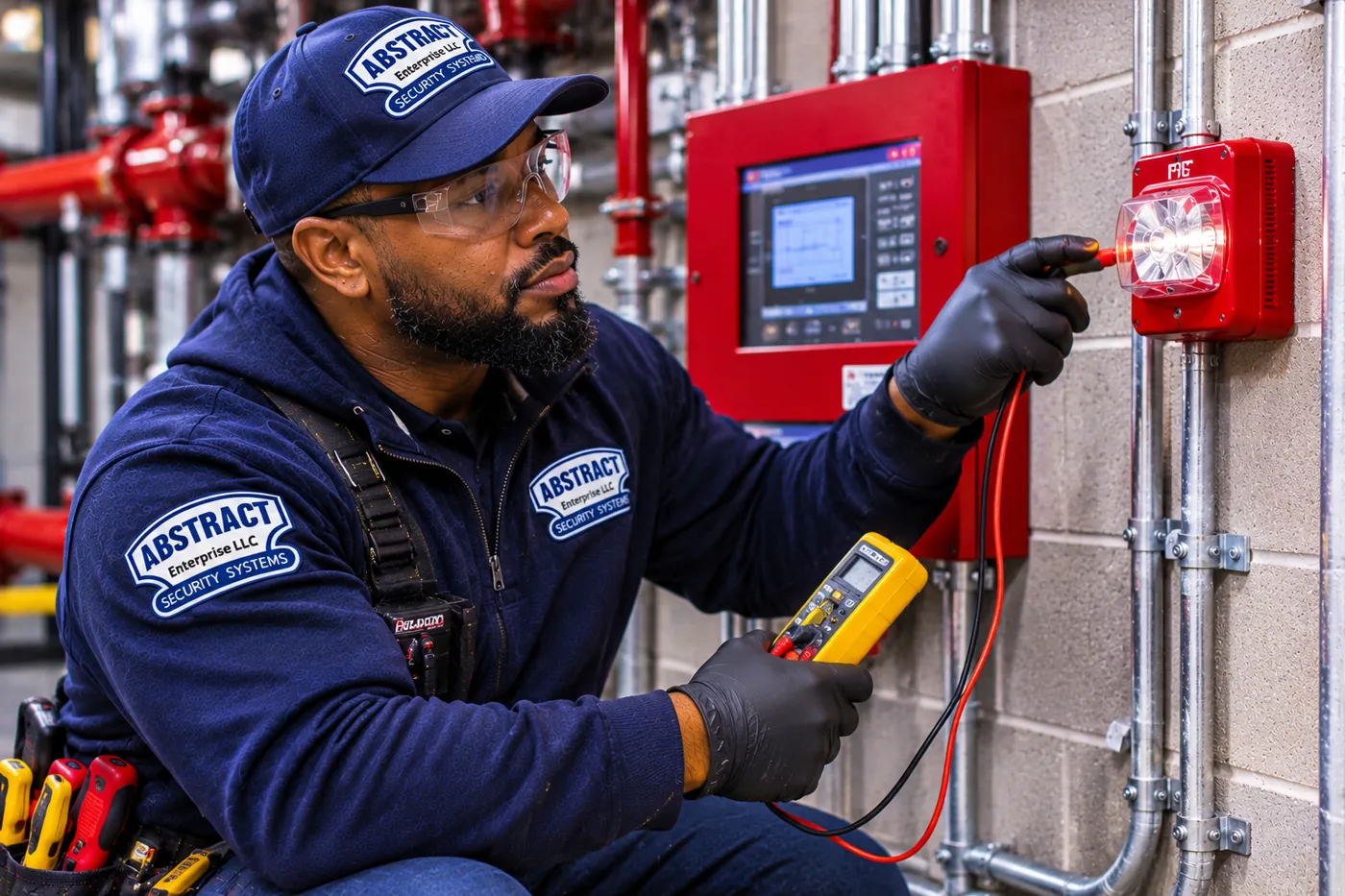
Fire alarm acceptance testing preparation in Clinton Hill, Brooklyn: technician holding meter leads to a flashing red strobe beside a touchscreen control panel in a mechanical room with red sprinkler pipes
A technician kneels with a yellow multimeter, its leads touching a flashing red strobe on a block wall beside a touchscreen fire alarm control panel, with red sprinkler piping behind him. In Clinton Hill, this kind of pre-test is done before the FDNY inspector arrives, so the witnessed test is not where problems are discovered.
Existing Systems

Upgrades, Inspections and Maintenance for Clinton Hill Fire Alarms

Most Clinton Hill fire alarm work is on systems that already exist: keeping them running through the year, testing them, correcting inspection findings and planning when to replace them.

Upgrades, replacement and modernization

Can an existing fire alarm system be upgraded? Usually, and in phases if the panel can support it. A fire alarm system upgrade may be as small as a fire alarm panel upgrade or fire alarm control panel upgrade within the same product family, or as large as a full fire alarm system replacement. Commercial fire alarm upgrades, commercial fire alarm replacement, commercial fire alarm modernization and fire alarm system modernization become necessary when parts are discontinued: outdated fire alarm system replacement, obsolete fire alarm panel replacement and legacy fire alarm system upgrade work are common in campus buildings whose first systems went in decades ago. Fire alarm panel replacement, fire alarm control panel replacement and FACP replacement, a commercial fire alarm system retrofit or fire alarm system retrofit, a fire alarm system conversion or a conventional to addressable fire alarm conversion all go through sealed drawings and the FDNY. So does an existing fire alarm system expansion when a building adds floors or rooms, a fire alarm system modification or fire alarm system reconfiguration after a renovation, fire alarm device replacement on a large scale, a fire alarm system renovation, and fire alarm system lifecycle replacement planned over several budget years. A fire alarm system expansion contractor working on a campus should be able to show how each phase leaves the building with an approved, working system.

Fire alarm control panel repair, fire alarm control panel troubleshooting, FACP repair, conventional fire alarm repair, addressable fire alarm system repair, addressable fire alarm troubleshooting, addressable fire alarm system programming and an addressable fire alarm system upgrade are everyday service tasks. Who repairs fire alarm control panels? A certified fire alarm company with technicians trained on that manufacturer's equipment, because programming tools and parts differ by brand.

Inspection and testing

Fire alarm inspection, fire alarm system inspection and commercial fire alarm inspection, together with fire alarm testing, fire alarm system testing and commercial fire alarm testing, follow NFPA 72 as adopted in New York City. NFPA 72 fire alarm testing, NFPA 72 fire alarm inspection, fire alarm annual inspection and fire alarm periodic inspection include fire alarm device testing, fire alarm sensitivity testing for smoke detectors, fire alarm battery load testing and checks of every notification circuit. The result is fire alarm inspection documentation: a dated report listing each device, its result and any fire alarm inspection deficiencies. As a fire alarm testing company, fire alarm inspection company, fire alarm inspection contractor and fire alarm testing contractor working through certified partners, we schedule this work in Clinton Hill campus buildings for breaks and quiet weeks.

Deficiencies and violations

Who can correct fire alarm inspection deficiencies? The building's certified fire alarm company, with the design professional when the fix changes the approved design. Fire alarm deficiency correction, fire alarm inspection repair, fire alarm system violation correction and fire alarm code violation repair begin with the notice itself. The FDNY's Notice of Defect is answered through an FA-27 submission, which carries a $105 fee according to the FDNY's FA-27 instructions; once approved, the FDNY issues a Letter of Approval. Fire alarm inspection preparation before any FDNY visit, with the records ready on site, avoids most repeat findings.

Maintenance and service contracts

Fire alarm maintenance, fire alarm preventative maintenance and commercial fire alarm maintenance, under a fire alarm service contract with a fire alarm maintenance company, cover scheduled testing, battery replacement, cleaning, and responses to troubles. Commercial fire alarm service and commercial fire alarm troubleshooting calls are faster when the same company has the building's records. For colleges and property managers with several buildings, property management fire alarm services means one schedule, one set of reports and one contact for every address.

Brands we see in Clinton Hill

Pratt's published report alone lists Edwards EST-2 and EST-3 panels and a NOTIFIER NFS2-640 in its residence halls, and the neighborhood's other buildings add the usual New York mix. We work through partners on Honeywell fire alarm installation and Honeywell fire alarm service, NOTIFIER fire alarm installation and NOTIFIER fire alarm repair, Fire Lite fire alarm installation and Fire Lite fire alarm repair, Silent Knight fire alarm installation and Silent Knight fire alarm service, Edwards fire alarm installation and Edwards fire alarm repair, EST fire alarm service, Siemens fire alarm installation and Siemens fire alarm service, Simplex fire alarm service, Bosch fire alarm installation, Potter fire alarm installation and Potter fire alarm service, and Kidde commercial fire alarm installation. Commercial fire alarm manufacturer service sometimes requires a factory-authorized dealer for programming software; we tell owners up front when that is the case.

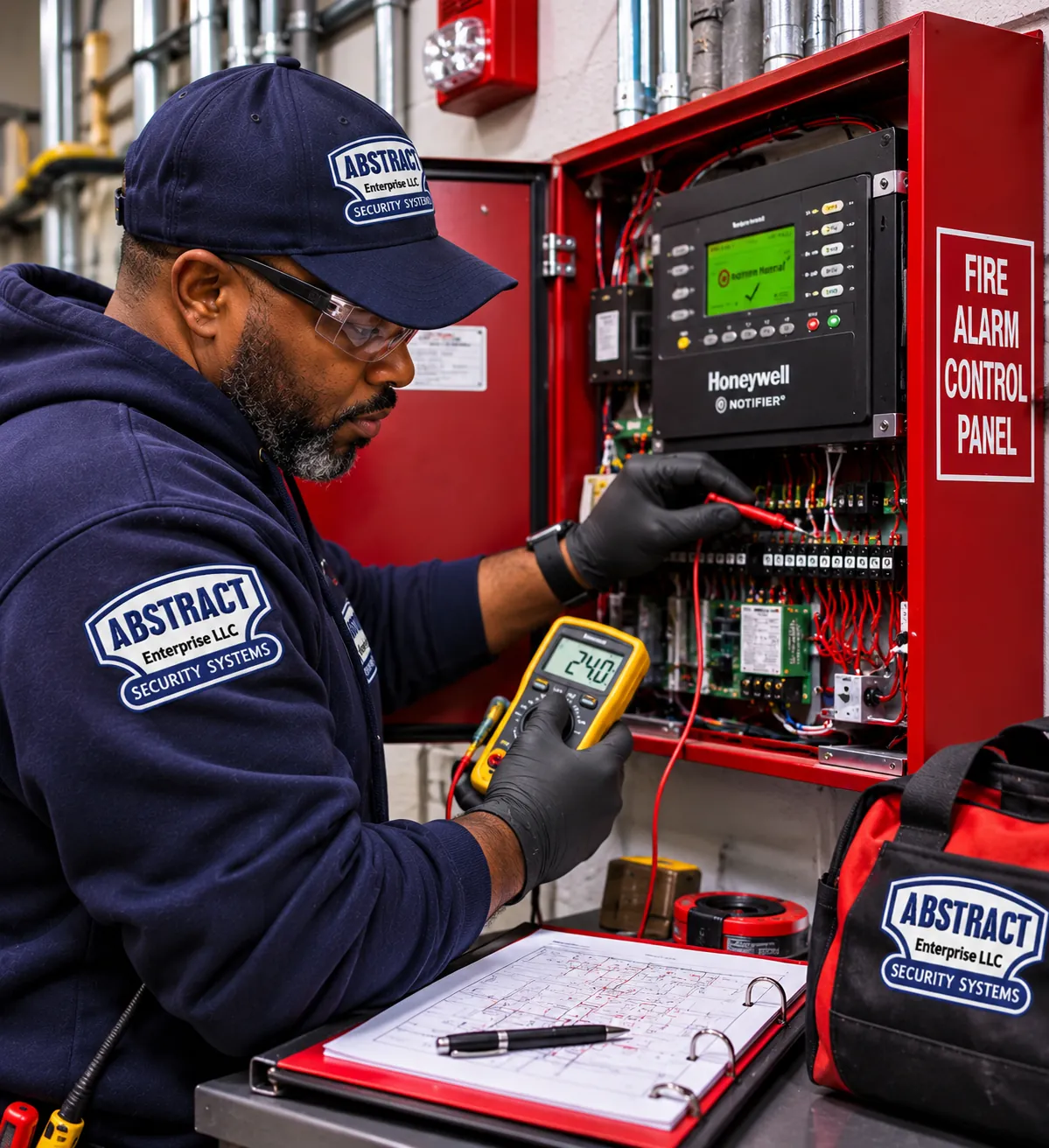
Fire alarm control panel troubleshooting in Clinton Hill, Brooklyn: technician holding a multimeter reading 24.0 with probes on the terminals of an open Honeywell NOTIFIER panel, a binder of drawings on the bench
A technician in a hooded jacket holds a multimeter reading 24.0 while probing terminals inside an open red Honeywell NOTIFIER fire alarm control panel, with a binder of floor-plan drawings and a tool bag on the bench in front of him. On a mixed campus system in Clinton Hill, readings at the panel are compared with the drawings before anyone opens a ceiling.
Landmarks

Fire Alarm Installation Near Clinton Hill Landmarks

Places owners use to describe where their building is; naming them does not mean we have worked in them.

Pratt Institute campus

Between DeKalb and Willoughby Avenues, founded by Charles Pratt in 1887, with residence halls on surrounding blocks.

Pratt power plant

In operation since January 4, 1888; an ASME landmark history calls it the oldest generating plant of its kind in the Northeast.

St. Joseph's University

Clinton Avenue buildings from 222 to 265, several in former Pratt family mansions, plus St. Angela Hall on Waverly Avenue.

Emmanuel Baptist Church

Lafayette Avenue at St. James Place, Francis H. Kimball's Gothic Revival church, opened in 1887.

Church of St. Luke and St. Matthew

Clinton Avenue, completed in 1891 to designs by John Welch.

Clinton Hill Co-ops

The 1940s towers along Clinton and Waverly Avenues, first built as wartime housing.

Graham Home

320 Washington Avenue, built in 1851 and now condominiums.

Clinton-Washington Avenues station

The A and C on Fulton Street, with the G stopping here and at Classon Avenue, the neighborhood's transit anchors.

We also work in the neighborhoods that border Clinton Hill: Fort Greene across Vanderbilt Avenue, Bedford-Stuyvesant across Classon Avenue, Prospect Heights across Atlantic Avenue, and the Brooklyn Navy Yard across Flushing Avenue.

Pricing

How Fire Alarm Installation Is Priced in Clinton Hill

Fire alarm installation in Clinton Hill is priced building by building, in writing, after an on-site survey, because the total is the sum of four stages that each depend on the building. We do not publish prices, ranges or packages. How much does commercial fire alarm installation cost, and how much does fire alarm panel replacement cost? The fire alarm installation cost, fire alarm system installation cost, commercial fire alarm installation cost, fire alarm panel installation cost, fire alarm system replacement cost, fire alarm panel replacement cost and fire alarm system upgrade cost all come from these stages:

  1. Design and sealed drawings. The design professional's survey, code analysis, calculations and sealed drawings. This comes first and is a meaningful part of the total.
  2. Filing with the FDNY. The TM-1 plan examination, any objections and resubmissions. Government fees are set by the agencies; the FDNY advises resubmitting within six months of an objection to avoid a new filing fee.
  3. Installation to the approved plans. Labor and materials for cable, conduit, devices, panel, power supplies and communicator, which in Clinton Hill depend on how many buildings are joined, how much work must happen at night or in breaks, and how much finish work old interiors need.
  4. Acceptance test. Pre-testing, the FDNY-witnessed acceptance test with the trades it requires on site, and the handover documents.

A fire alarm installation estimate, fire alarm installation quote, fire alarm system installation estimate or commercial fire alarm quote from us is a written document after the survey, not a phone figure. Fire alarm inspection cost, fire alarm testing cost, fire alarm repair cost, fire alarm service call cost and fire alarm maintenance contract cost are quoted the same way, against the building's device count and records. A fire alarm contractor estimate that skips the design or the filing is not comparable with one that includes them.

Choosing a Contractor

Choosing Fire Alarm Installers for a Clinton Hill Building

Who installs commercial fire alarm systems in New York City? A licensed electrician or a fire alarm company holding an FDNY Fire Alarm Company Certificate, working from drawings sealed by a New York State engineer or architect. Fire alarm installers, commercial fire alarm installers, a commercial fire alarm installation company or a fire alarm company that services the system later must be certified for that work, with an S-97 holder as a principal. The FDNY sets the company certificate application fee at $105; company certification is valid for one year and S-97 and S-98 certificates for three.

How do I find a licensed fire alarm contractor? Ask each bidder for the certified company's name, the S-97 holder's name, the licensed electrician's license number and the design professional who will seal the drawings, and check them. Fire alarm contractor licensing is the first filter, before price, whether you are hiring a commercial fire alarm contractor for a new building, a fire alarm system contractor for a campus upgrade or a fire alarm service company for annual testing. A licensed fire alarm installer and a certified fire alarm technician should be named in the proposal, not promised later.

Abstract Enterprises Security Systems works under NYS license #12000287431 and coordinates the design professional, the certified fire alarm company and the licensed electrician on each project; each proposal states who holds which credential. Fire alarm contractors near me and fire alarm companies near me searches return directories full of residential installers; fire alarm installation contractors for commercial buildings are a smaller group. For a residence hall or classroom building, a local fire alarm installation company that can reach Clinton Hill quickly helps, but look first for an experienced fire alarm contractor with commercial references you can verify through Google reviews. The best commercial fire alarm installer for a campus building is the one whose schedule fits your academic year and whose paperwork is complete.

The terms are plain. Full terms — including 50% deposit, one-year parts-only warranty on Abstract Enterprises Security Systems-supplied products, and the late-fee schedule — are set out in the service agreement.

Integration

How a Clinton Hill Fire Alarm Works With Sprinklers, Elevators, Fans and Doors

A Clinton Hill residence hall or co-op tower's fire alarm is the controller for several other systems. Fire alarm system integration is the design and testing of those links.

Sprinklers. Fire alarm sprinkler monitoring installation covers sprinkler waterflow switch monitoring, which sounds the alarm when water flows, and sprinkler tamper switch monitoring, which reports a closed valve as a supervisory signal. Pratt reports wet sprinklers in all its halls and valve tamper switches on many; chained valves and tamper switches together are what a campus facilities team should expect.

Elevators. Fire alarm elevator recall integration and the elevator fire alarm interface send cars to the recall floor on a lobby, shaft or machine room detector, and to an alternate floor when the alarm starts at the lobby itself.

Air handling. Fire alarm HVAC shutdown integration and fire alarm duct detector integration stop air handlers so they do not spread smoke; the FDNY's guidance lists shutdown of fans over 2,000 cubic feet per minute on automatic alarm as a frequent inspection point. Fire alarm smoke control interface work applies in larger new towers with engineered smoke control.

Doors and access. Fire alarm door release integration and fire alarm magnetic door holder release close corridor and stair doors on alarm; a fire alarm access control interface unlocks electrically locked doors on the egress path as the code requires.

Suppression and kitchens. Fire alarm suppression system interface and fire alarm kitchen hood suppression monitoring report a discharge in a restaurant or dining hall kitchen to the building panel.

Voice and mass notification. Fire alarm emergency voice communication and fire alarm mass notification integration let a campus or large building use the speaker system for non-fire messages, with fire signals keeping priority.

Construction and Conversions

New Construction, Conversions and Renovations in Clinton Hill

New construction fire alarm installation on Myrtle Avenue and Fulton Street starts with the building's design team. A commercial construction fire alarm contractor joins early, because fire alarm rough in has to be coordinated with framing, ceilings and other trades. Tenant improvement fire alarm installation follows each time a storefront is leased. High rise fire alarm installation applies only to the tallest new buildings, where fire command centers and voice systems become part of the design.

Conversions are Clinton Hill's other constant: mansions into college offices, rowhouses into student rooms, a gas company showroom into apartments and a clinic. Each change of use means a fresh code review and usually a new or amended FDNY filing, even when the building looks the same from the street. Hotel fire alarm installation, hospital fire alarm installation, shopping center fire alarm installation, parking garage fire alarm installation, storage facility fire alarm installation, data center fire detection installation, warehouse fire alarm installation, industrial building fire alarm installation, industrial fire alarm installation, industrial fire alarm systems, an industrial fire alarm contractor and manufacturing facility fire alarm installation are not everyday Clinton Hill requests, but the same design-first process applies if a building here takes on one of those uses.

Permits and approvals in Clinton Hill

Does my building need a fire alarm permit? If the work is a new system or a change to an approved one, yes. Fire alarm permit requirements in New York City mean a fire alarm installation permit filed through the FDNY's TM-1 plan examination with the sealed plans and the building's Certificate of Occupancy or equivalent documentation; installation starts only after approval. Fire alarm system approval ends with the witnessed acceptance test and the FDNY's Letter of Approval. Fire alarm system certification and fire alarm system documentation, kept on site, prove compliance at the next inspection. Fire alarm code compliance and fire alarm code compliance upgrades follow the code in force; fire alarm system inspection requirements set what must be tested and how often. A fire alarm compliance contractor coordinates all of it. NFPA 72 fire alarm installation is the standard the system is built and tested to, as modified by the NYC Building Code. Inside the Clinton Hill Historic District, exterior devices and conduit may also need Landmarks Preservation Commission review; the design professional checks that alongside the FDNY filing.

All Fire Alarm Services

Every Fire Alarm Service for Clinton Hill and Neighboring Brooklyn

Brooklyn borough page

Fire alarm installation Brooklyn owners rely on, with the borough's building types and the FDNY path.

Citywide FDNY path

Commercial fire alarm installation in New York City, from sealed drawings to the Letter of Approval.

Older systems

Fire alarm upgrades and modernization for buildings with an aging panel.

New construction

New building fire alarm systems from rough-in through acceptance.

Fort Greene

Fire alarm work in Fort Greene, across Vanderbilt Avenue.

Bedford-Stuyvesant

Fire alarm work in Bed-Stuy, across Classon Avenue.

Prospect Heights

Fire alarm work in Prospect Heights, across Atlantic Avenue.

Brooklyn Navy Yard

Fire alarm work at the Navy Yard, across Flushing Avenue.

Repair and service

Fire alarm repair, fire alarm system repair and testing for Clinton Hill buildings, from a fire alarm repair company and fire alarm repair contractor that books within 2 hours. Call (347) 934-8335.

FAQ

Clinton Hill Fire Alarm Installation FAQ

Is a Clinton Hill building rented to students treated as a dormitory or as apartments for fire alarm purposes?
+

It depends on how the building is arranged and occupied, and the design professional makes the call. Under the NYC Building Code, dormitories are generally placed in the same residential group as apartment buildings, so the familiar triggers apply: a building fire alarm is required when there are 16 or more units, or units three or more stories above the exit, among other conditions. A rowhouse rented by the room can end up classified differently from the same rowhouse rented as one apartment, which is why a change in how a building is rented to students should go past the engineer before the first lease is signed.

Do Clinton Hill residence halls built as townhouses need the same fire alarm design as the larger halls?
+

They follow the same code but rarely the same layout. A purpose-built hall has long corridors, a central panel and one main entrance for firefighters. A row of connected townhouses has a separate stair in each house, cable that crosses party walls and often a panel in only one of them. Pratt's own report lists townhouse rows on Emerson Place, Steuben Street and Willoughby Avenue with their own panels and carbon monoxide detection. The design has to make the alarm clear in every house and tell responders which house sent it.

Why do some Clinton Hill student townhouses have carbon monoxide detection reporting to the fire alarm panel?
+

Because fuel-burning equipment such as boilers and water heaters can produce carbon monoxide, and the FDNY lists carbon monoxide detection at CO-producing equipment among the items its inspectors check on commercial fire alarm systems. Tying CO detectors to the building panel means a CO alarm is supervised like any other device and reaches the central station, instead of beeping unheard in an empty cellar during a semester break.

Is it better to run a Clinton Hill college building's annual fire alarm test during the semester or during a break?
+

Usually during a break or a quiet week, for the device testing itself, because testing every horn and strobe in an occupied classroom or residence hall disrupts everyone and teaches occupants to ignore the sound. The evacuation drill is different: it is meant to happen with people in the building, and Pratt runs one in each fall and spring semester. Plan the two together so occupants are not evacuated for a drill and then exposed to hours of test signals in the same week.

Do the semester fire drills at a Clinton Hill college count as testing the fire alarm?
+

No. A drill tests the people: whether they hear the alarm, know the exits and leave. NFPA 72 testing tests the equipment: every detector, pull station, notification appliance, module and battery, with a written record of each result. A drill that sets off the alarm proves only that the devices used that day worked. The college still needs the documented inspection and testing from its certified fire alarm company.

Can the stores on the ground floor of a new Myrtle Avenue building open before the residential floors' fire alarm is accepted?
+

Sometimes a building is approved and occupied in stages, but each stage needs a fire alarm that has been accepted for the areas being used, and the base building system usually has to be working before tenants open. A store that plans its opening around the developer's schedule should ask for the status of the building's FDNY fire alarm approval in writing before it books an opening date.

Why do the 1940s Clinton Hill co-op towers need a different fire alarm approach from the mansions on the same avenue?
+

The towers were built in one campaign during World War II as elevator apartment buildings with repeated floor plans, concrete construction and central risers, so a fire alarm can follow a consistent path floor after floor. The mansions are older, individual, wood-framed and finished in plaster and woodwork, and many now hold offices or classrooms. One is a riser and corridor job; the other is a room-by-room design that protects the interiors.

Can a former Clinton Avenue mansion used as college offices keep its period interiors through a fire alarm upgrade?
+

In most cases, yes, with planning. Cable can often follow old service routes such as back stairs, closets and cellar ceilings; devices can be placed on plain surfaces rather than carved plaster; and in a few rooms listed wireless devices may avoid opening finishes at all. The design professional decides device locations by code, and the installer's job is to reach them with the least visible work.

A night-time fire in an empty classroom building, like Pratt's in 2013, has no one to pull a station. What detects it?
+

Automatic detection. The fire in Pratt's Main Building started shortly after 2 a.m. on February 15, 2013, when no students were inside. In an unoccupied building, smoke and heat detectors and sprinkler waterflow switches are the only things that can raise the alarm, and the central station connection is what turns that alarm into a fire department response. That is why detector coverage in studios and classrooms, and a working communicator, matter most in the hours when nobody is there.

Does a Clinton Hill building that hosts student exhibitions or performances need to plan its fire alarm for crowds?
+

Yes, if the event space can hold enough people to count as an assembly occupancy; the NYC Building Code requires a manual fire alarm for assembly spaces with an occupant load of 300 or more, and voice notification may also come into play. A gallery or theater that normally holds a small audience but hosts large openings should have its occupant load and fire alarm reviewed by the design professional, not set by the size of a typical day.

Sources

Sources for This Clinton Hill Page

Every local fact and figure on this page comes from these sources; code references reflect guidance in effect in November 2026. Naming an institution or building does not mean we have worked there.

  • FDNY, Tips for Fire Alarm Systems (plan review, installer requirements, 20 to 24 weeks, inspection checklist): nyc.gov/fdny
  • FDNY, Fire Alarm Company Certificate FAQ (company certificate, S-97, S-98, $105 fee): nyc.gov/fdny
  • FDNY, FA-27 Notice of Defect instructions ($105 fee, Letter of Approval): nyc.gov/fdny
  • FDNY, bulletin on central office connections: nyc.gov/fdny
  • NY Engineers, fire alarm requirements by occupancy (summary of NYC Building Code 907): ny-engineers.com
  • Pratt Institute, 2023 Annual Security and Fire Safety Compliance Report: pratt.edu
  • NBC New York, four-alarm fire at Pratt Institute's Main Building, February 15, 2013: nbcnewyork.com
  • Pratt Institute, fire recovery update, 2013: pratt.edu
  • Firehouse, Pratt Institute students flee dorm fire (Panther Hall, 2004): firehouse.com
  • Wikipedia, Clinton Hill, Brooklyn (boundaries, institutions, transit, district data): wikipedia.org
  • Historic Districts Council, Clinton Hill Historic District: hdc.org
  • St. Joseph's University, Brooklyn campus map: sjny.edu
  • Brownstoner, the Clinton Hill Co-ops story: brownstoner.com
  • Wikipedia, Emmanuel Baptist Church (Brooklyn): wikipedia.org
  • Forgotten New York, the Graham Home at 320 Washington Avenue: forgotten-ny.com
  • Engineering and Technology History Wiki, Pratt Institute Power Plant: ethw.org
  • Myrtle Avenue Brooklyn Partnership, about: myrtleavenue.org
  • DNAinfo, 1,125 apartments and 26 storefronts coming to Myrtle Avenue (2016): dnainfo.com
  • Brownstoner, 1024 Fulton Street affordable housing plan (2026): brownstoner.com
  • 6sqft, 125 affordable apartments to replace long-vacant Clinton Hill building (2026): 6sqft.com
  • News 12 Brooklyn, fire tears through Clinton Hill deli at 504 Classon Avenue (June 22, 2026): news12.com
  • News 12 Brooklyn, fire at 490 Myrtle Avenue (July 14, 2026): news12.com
All Areas Served

Fire Alarm Installation Across Brooklyn Neighborhoods

Clinton Hill is one of the Brooklyn neighborhoods we serve from our office at 1282 Troy Ave; the office is not in Clinton Hill, and technicians travel to each survey. Every page below is written around its own neighborhood's buildings, streets and history. Start with the Brooklyn fire alarm installation page or the NYC fire alarm installation hub.

Greenpoint · Williamsburg · South Williamsburg · East Williamsburg · Bushwick · Wyckoff Heights · Ridgewood · Downtown Brooklyn · Brooklyn Chinatown · Cadman Plaza · DUMBO · Vinegar Hill · Fulton Ferry · Brooklyn Navy Yard · Columbia Street Waterfront · Boerum Hill · Cobble Hill · Carroll Gardens · Gowanus · Fort Greene · Brooklyn Heights · Prospect Heights · Park Slope · South Slope · Greenwood Heights · Windsor Terrace · Prospect Park South · Prospect Lefferts Gardens · Crown Heights · Bedford-Stuyvesant · Stuyvesant Heights · Ocean Hill · Weeksville · Brownsville · Flatbush · Ditmas Park · Fiske Terrace · Beverley Square · Kensington · Midwood · East Flatbush · Wingate · Remsen Village · Sunset Park · Brighton Beach · Bath Beach · Fort Hamilton · Dyker Heights · Bensonhurst · New Utrecht · Mapleton · Borough Park · Ocean Parkway · Gravesend · Homecrest · Madison · Sheepshead Bay · Manhattan Beach · Bay Ridge · Coney Island · Sea Gate · Gerritsen Beach · Marine Park · Mill Basin · Bergen Beach · Flatlands · Canarsie · East New York · Cypress Hills · City Line · New Lots · Spring Creek · Starrett City · Highland Park

Outside Brooklyn we also cover Manhattan · Queens · the Bronx · Staten Island · Long Island · Nassau · Suffolk · Hudson Valley · Westchester · Rockland · Orange · Putnam · Dutchess · Ulster.

Book a Clinton Hill Fire Alarm Survey

From a residence hall panel that has to be clear before move-in to a new building on Myrtle Avenue waiting on its acceptance test, the first step in Clinton Hill is a survey, a look at the building's records and a written proposal built around your calendar. Owner-operated since 2002, NYS license #12000287431, booked within 2 hours.