What are you looking for?
About Us Contact Us Careers Get a Free Quote (800) 486-0943
Pick a service
✅ Got Your Own System?
🎬 Home TheatreQuote 🎶 AV SoundQuote 🔑 Access ControlQuote
Now pick your area
Pick your area
Long Island
Hudson Valley
Services available
Pricing & Tools
Pick a service for pricing
🚪 Intercom Pricing 🔔 Buzzer Repair Pricing
Calculators
📹 Camera System Calculator 🚨 Alarm Calculator ⚡ Cabling Quote Builder ✅ Got Your Own System?
Select your area
City Line masjid, Liberty Avenue storefront, Pitkin Avenue community office or Atlantic Avenue garage with a fire alarm in trouble, an FDNY Notice of Defect or a new system to file? Call the Brooklyn line: (347) 934-8335
Home › Fire Alarm Installation Brooklyn › City Line
Liberty Avenue · Pitkin Avenue · Atlantic Avenue · Fulton Street · Grant Avenue · Eldert Lane

Fire Alarm
Installation in
City Line

NFPA 72 Commercial · Masjids & Prayer Halls, Storefronts With Apartments Above, Community Offices, New Elevator Buildings & Auto Strips · FDNY TM-1

City Line is the last stretch of Brooklyn before the borough line, a dense pocket of brick row buildings where the Liberty Avenue and Pitkin Avenue shops sit under apartments, where prayer halls fill on Friday afternoons, and where new six-story elevator buildings with stores have gone up on old lots. Abstract Enterprises Security Systems helps City Line owners, mosque and church committees, merchants, nonprofit directors, managing agents and builders take a commercial fire alarm from sealed drawings through FDNY approval, installation and the witnessed acceptance test.

Updated November 2026 by Abstract Enterprises Security Systems, NYS license #12000287431 · Sources: FDNY Tips for Fire Alarm Systems; FDNY Fire Alarm Company Certificate FAQ; NYC DOB place of assembly code notes; City Limits; Gotham Gazette; NYC Parks; Forgotten New York; Brooklyn CB5

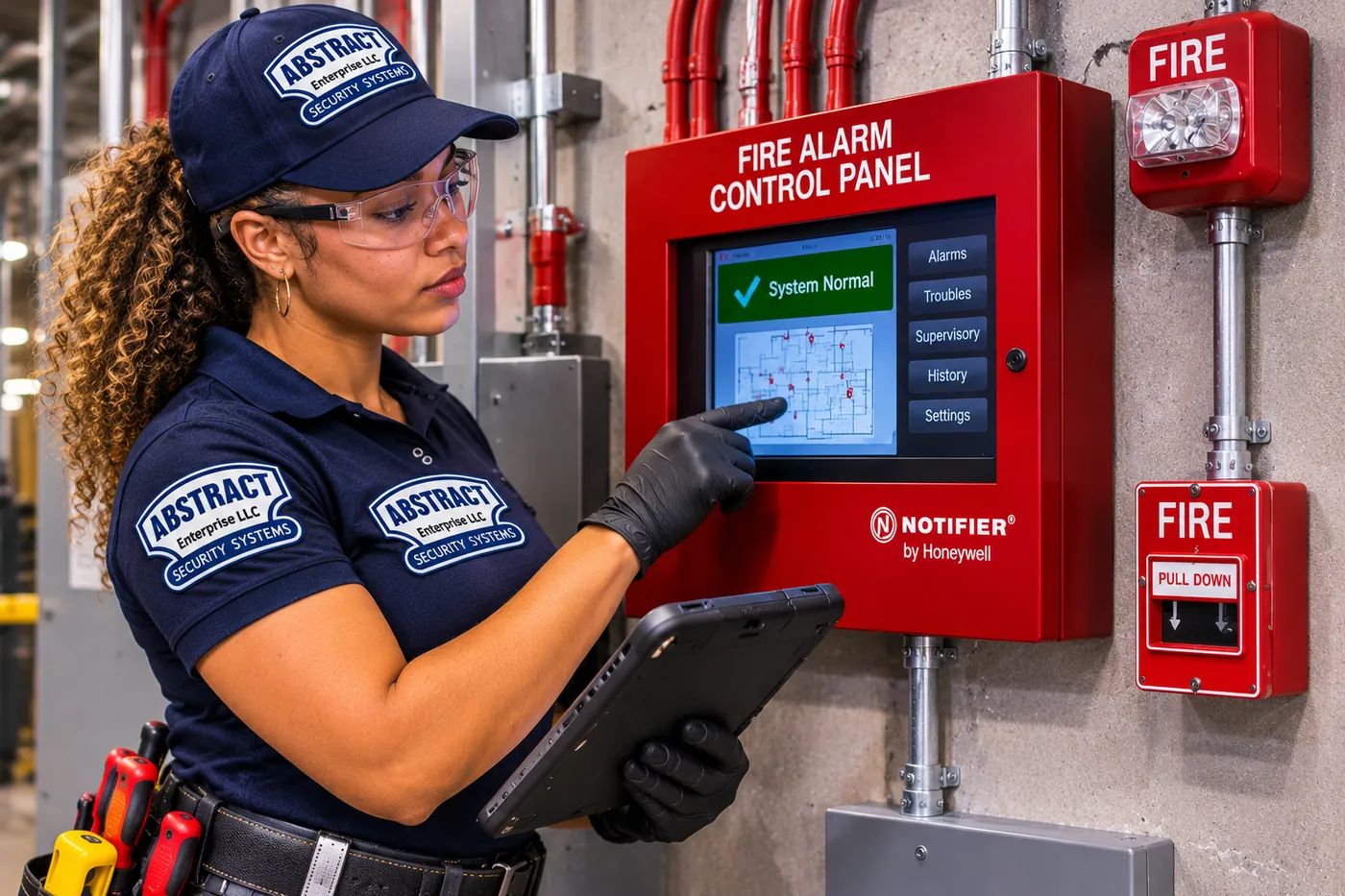
Fire alarm control panel programming in City Line, Brooklyn: technician touching a NOTIFIER fire alarm control panel screen showing System Normal while holding a tablet, with a horn strobe and pull station beside it
A technician holds a tablet and touches the screen of a red NOTIFIER control panel reading System Normal, with a horn strobe and a pull station on the wall beside it. In a City Line prayer hall or storefront building, the first visit begins at the panel, reading its status and history before anything is touched.
City Line Fire Alarm Request
Tell us the block, how each floor is used, and what the panel shows

✅
Request Sent!
Thank you. We will call to book your City Line fire alarm survey, usually within 2 hours of your request.
25+
Years Experience
✓
FDNY Path Explained
100%
Commercial NFPA 72
4.7★
201 Google Reviews

Owner-operated since 2002 · Thousands of jobs completed · Booked within 2 hours

Fire alarm installation in City Line starts with a sealed set of drawings, not with a box of detectors: a New York State Professional Engineer or Registered Architect designs the system for the building, the FDNY examines the plans, an FDNY-certified fire alarm company and a licensed electrician install exactly what was approved, and an FDNY inspector watches the finished system pass its acceptance test. What is particular to City Line is the building stock: houses and stores turned into prayer halls, groceries and sweet shops under rented apartments, small nonprofit offices on Liberty and Pitkin Avenues, recent elevator buildings with stores, and garages along Atlantic Avenue. Every job is quoted in writing after a walk-through. Call (347) 934-8335 and the survey is booked within 2 hours.

  • NFPA 72 commercial fire alarm for masjids, churches and prayer halls, storefront buildings with apartments above, restaurants and food shops, community and social service offices, elevator apartment buildings, schools and auto-related buildings
  • We work under NYS license #12000287431, and each proposal names in writing the FDNY-certified fire alarm company and the licensed electrician who will be on the filing
  • The FDNY's own guide estimates about 20 to 24 weeks from plan submission to final approval, so a Ramadan opening date or a lease start has to be planned with that window in mind
The Neighborhood

Why City Line Buildings Need Fire Alarms Planned for Converted Spaces and Crowded Hours

City Line needs carefully planned commercial fire alarm work because so many of its buildings now do a job they were never built for. The neighborhood began as farmland and truck gardens at the old edge of the City of Brooklyn, filled in with wooden cottages and then brick row buildings, and took its name from the boundary with Queens County that existed before the 1898 consolidation. Its streets were laid out for one- and two-family homes and corner stores. Today many of those buildings are prayer halls, after-school programs, social service offices and groceries with families living upstairs. A converted building can carry far more people at certain hours than it ever did as a house, and the fire alarm question follows the people, not the facade.

The congregations are the clearest example. When City Limits profiled the neighborhood in August 2013, it counted one main mosque on Forbell Street, built in adjacent houses that Bangladeshi families had bought, and six smaller mosques drawing new immigrants, seven in all. Forbell Street above Liberty Avenue was co-named Mizanur Rahman Way. The same report described about 3,000 men praying together in a parking lot on Eid, and quoted resident Burhan Uddin on how the gathering felt: "Like my country. Really, like my motherland." For fire alarm design, that is the important detail: worship in City Line is a crowded, scheduled, recurring event, often in buildings with narrow stairs and residential framing. Whether a given hall needs a building fire alarm depends on its legal use and occupant load, and that is decided by a design professional reading the NYC Building Code and Fire Code against the actual floor plan.

The commercial streets add a second layer. Liberty Avenue is the neighborhood's main shopping spine, with South Asian, Caribbean and Latino businesses side by side, and Pitkin Avenue, Fulton Street and Atlantic Avenue carry more stores, offices and auto-related uses. Brooklyn Community Board 5's own list of community organizations places the Bangladeshi American Community Development and Youth Services office at 1101-B Liberty Avenue, MUNA Social Services at 464 Crescent Street, NAHAR Relief at 2668 Pitkin Avenue, Eihab Human Services at 3021 Atlantic Avenue and Catholic Charities at 3060 Fulton Street. Offices like these are business occupancies, often on a ground floor under apartments, and they host classes, clinics and food distributions that bring in more people than a typical store.

So what is a commercial fire alarm system in a City Line building? It is a listed fire alarm control panel; the smoke detectors, heat detectors and manual pull stations that start an alarm; the horns, strobes and speakers that warn everyone inside; the relays and modules that shut down fans, release held-open doors and recall elevators; and the communicator that sends signals to an FDNY-approved central station, all designed for that one building and approved by the FDNY. How does a commercial fire alarm system work when there is a real fire? A detector or pull station signals the panel over a supervised circuit, the panel decides whether it is an alarm, a supervisory condition or a fault, and then it sounds the building, runs its programmed outputs and reports the event. When does a building need a fire alarm system? The NYC codes answer by occupancy group, occupant load, height and fire area, which is why a two-story house used for daily prayers, a grocery with apartments above and a new six-story building with stores can land on very different sides of the line.

City Line facts that shape fire alarm design

FactWhat it means for a City Line buildingSource
Seven mosques in the neighborhood in 2013, the largest built in adjoining houses on Forbell StreetPrayer halls in residential buildings, where occupant load and exits decide the fire alarm requirementCity Limits, “Bangladeshi Enclave Grows in City Line” (Aug 22, 2013)
Roughly 3,000 men gathered for Eid prayer in a neighborhood parking lotPeak attendance far above an ordinary week; halls must be designed for the crowd they actually holdCity Limits (2013)
49.3% of residents foreign-born; average household size reported at 5.8Crowded apartments above stores, and handover instructions that may need to be explained in more than one languageCity-Data profile of City Line (ZIP 11208 area)
3,842 housing units built in 1939 or earlier, and 1,584 built between 2010 and 2019Old brick and frame stock beside a wave of new elevator buildings with modern fire alarm systemsCity-Data profile
A 2019 six-story building at 975 Liberty Avenue is classed "D7 Elevator Apartments, Semi-Fireproof with Stores"New mixed-use buildings combine apartments, stores and an elevator, each with its own fire alarm interfacesStreetEasy building record
Places of assembly with 75 or more people need a Place of Assembly certificate; a fire alarm with emergency power is required at an occupant load of 300 or morePrayer halls, banquet rooms and event spaces cross these thresholds sooner than owners expectNYC DOB code notes, Place of Assembly (BC 907.2.1)
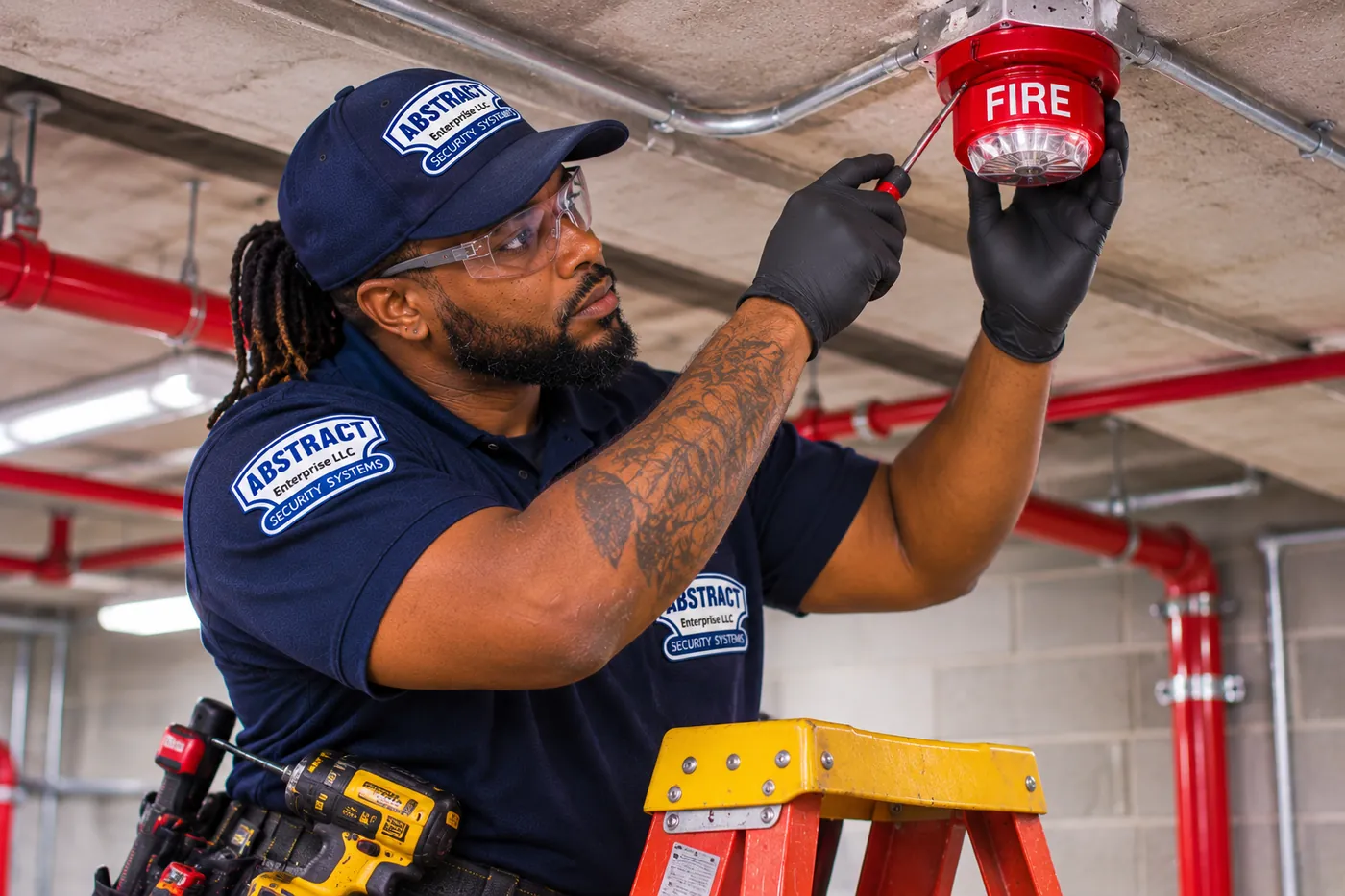
Fire alarm horn strobe installation in City Line, Brooklyn: technician on a ladder wiring a red ceiling-mounted horn strobe in a basement with red sprinkler piping overhead
A technician on a yellow stepladder wires a red horn strobe to the ceiling of a basement crossed by red sprinkler pipe. Cellars used as overflow prayer space or storage in City Line need notification that reaches everyone on that level.
Repair

Need Fire Alarm Repair in City Line? Read the Panel Before Anyone Presses Reset

When a fire alarm panel in a City Line prayer hall, grocery or office building starts a trouble tone, photograph the display, note the time, and call (347) 934-8335; we book the visit within 2 hours. The panel's message and its history log are the best evidence a fire alarm service technician has, and a reset clears them. In New York City, fire alarm repair, fire alarm system repair and all commercial fire alarm repair or commercial fire alarm service is performed by an FDNY-certified fire alarm company working with a licensed electrician, so the next question is whose service account the building is on. In converted buildings that answer is often lost when ownership or the board changes.

Owners regularly ask why is my fire alarm panel showing trouble if there is no smoke anywhere. Trouble is the panel reporting a problem with itself: an open or shorted circuit, a ground, a device that has gone missing, a weak battery, lost AC power, or a dropped connection to the central station. A fire alarm panel trouble light means a fire alarm system trouble condition is active, and proper fire alarm trouble signal repair fixes the cause rather than silencing the buzzer. A fire alarm supervisory trouble is a separate category: something the panel watches, such as a sprinkler control valve or a duct detector, is not in its normal position, and the building may be less protected than it looks.

City Line's buildings produce their own patterns. In prayer halls created by joining two houses, devices are sometimes left in the old party wall or above a dropped ceiling that was added later, and the panel shows a missing address or a fire alarm intermittent trouble whenever the heating cycles. In cellars on the low blocks south of Liberty Avenue, dampness is the first thing we check when owners ask what causes a fire alarm ground fault; fire alarm ground fault repair and fire alarm ground fault troubleshooting mean breaking the circuit into sections and measuring each one until the leak to ground shows itself. In halls that are packed on Fridays and quiet the rest of the week, the beeping that starts on a Tuesday is usually a fire alarm battery trouble repair waiting to happen, and a fire alarm panel beeping repair often ends with new batteries and a proper load test.

People search for 24 hour fire alarm repair, same day fire alarm repair and after hours fire alarm service because an alarm during Jumu'ah or a wedding dinner feels like a crisis. We do not promise round-the-clock dispatch or a guaranteed same-day fix. We do promise a clear, honest reading of where the building stands: whether the system can still detect a fire and send the signal out, what to do while you wait, and when the repair will be finished. If the problem is a fire alarm system down repair that leaves the building without protection, the owner has to notify the FDNY and keep a fire watch where it is required until protection is back. Every call for emergency fire alarm repair, emergency fire alarm service, an emergency fire alarm technician, urgent fire alarm repair, commercial fire alarm emergency repair, fire alarm trouble emergency service or fire alarm system emergency service starts with that photo of the display, and emergency fire alarm troubleshooting can begin over the phone while the technician travels.

The repair itself is systematic, and commercial fire alarm troubleshooting in a City Line building follows the same order every time. A fire alarm fault diagnosis starts in the history log and then isolates the circuit involved. Fire alarm system diagnostics on an addressable panel usually point to a specific device, while a conventional zoned panel has to be walked zone by zone. Fire alarm circuit troubleshooting, smoke detector circuit troubleshooting, fire alarm short circuit troubleshooting and fire alarm open circuit repair are complete only when a meter proves the fault is cleared. The same standard applies to fire alarm SLC troubleshooting and fire alarm signaling line circuit repair on addressable systems, fire alarm notification circuit repair on horn and strobe circuits, fire alarm device fault repair, fire alarm wiring repair and fire alarm power supply repair. When the panel is the failing part, fire alarm control panel repair, fire alarm control panel troubleshooting and fire alarm panel failure repair may end in a replacement that has to be filed. A fire alarm communication failure repair, or a fire alarm communication failure emergency repair when the central station link is gone completely, is handled first, because a fire alarm system not communicating cannot call for help. Fire alarm false alarm troubleshooting in City Line usually leads to cooking in a hall kitchen, incense or steam near a detector, dust from work next door, or a detector in a room whose use has changed. The fire alarm system malfunction repair is then a device change, a relocation or a filed modification, never simply bypassing the point.

Who repairs fire alarm control panels in City Line buildings is answered by law: an FDNY-certified company, with a licensed electrician for any wiring, working under the building's existing approval or a new filing. A fire alarm repair company or fire alarm repair contractor that cannot show its certificate is not the right call, however quickly it can arrive.

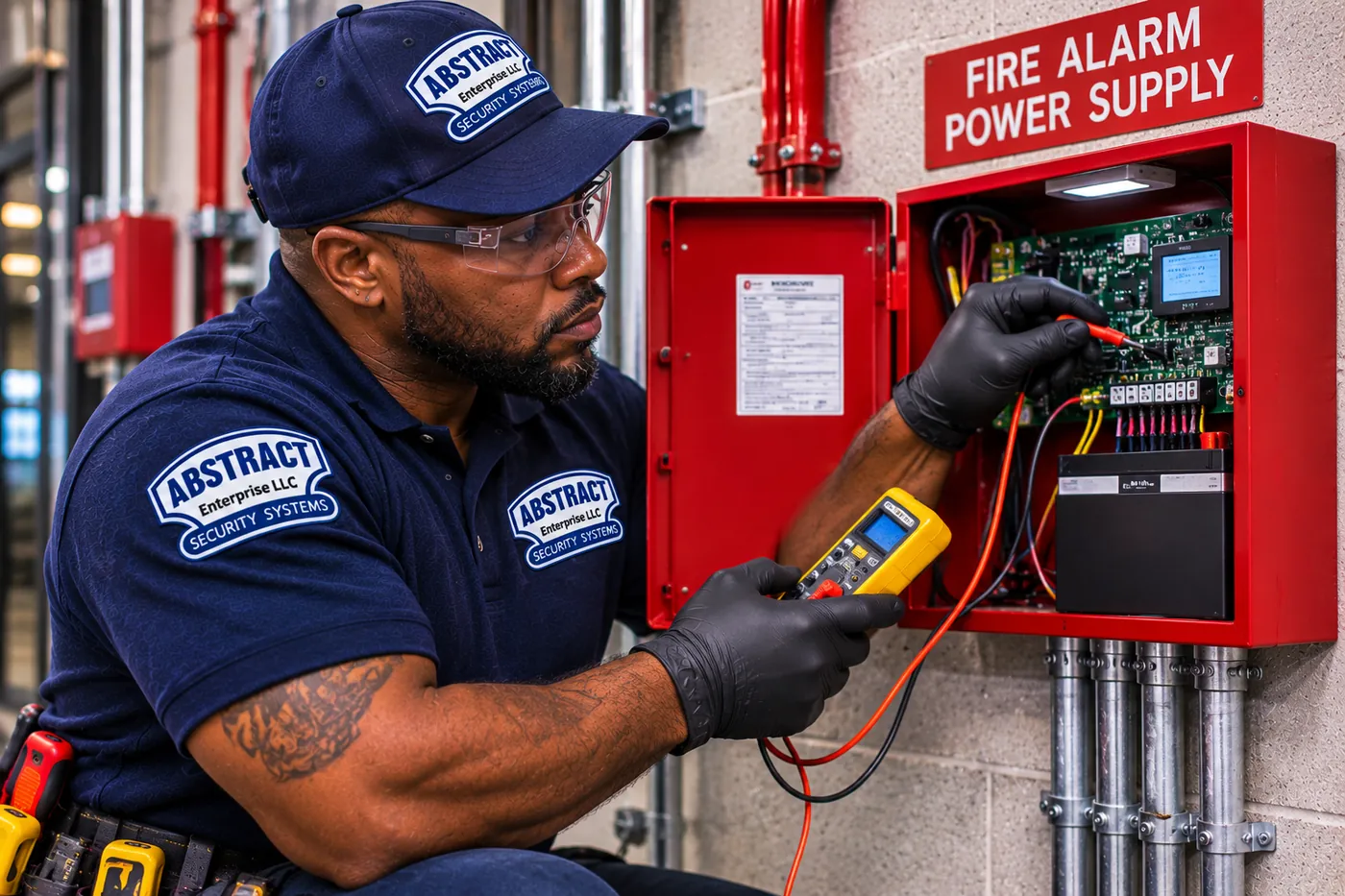
Fire alarm power supply repair in City Line, Brooklyn: technician testing the circuit board inside an open red fire alarm power supply cabinet with a multimeter
A technician holds multimeter leads to the board inside an open red cabinet labeled fire alarm power supply. Power and battery checks resolve many City Line trouble calls before any device is replaced.
What We Install

Fire Alarm Installation Services for City Line Properties

Our fire alarm installation services in City Line cover the full life of a commercial system: design coordination with the engineer or architect, new fire alarm system installation and commercial fire alarm system installation in buildings that have never had one, changes to systems already approved, repair, testing support and the paperwork the FDNY expects to find on site. As a fire alarm installation company we do not sell boxed kits. Professional fire alarm installation in New York City is a filed, inspected job, and the cards below describe how each kind of City Line building is usually handled.

Masjids and prayer halls

Complete fire alarm system installation for halls created in former houses and stores, designed around the occupant load on the busiest prayer and the exits the building really has. Manual pull stations at exits, smoke detection in the right rooms, and notification that is heard over a full hall.

Churches and parish buildings

Upgrades and replacements in older church buildings and parish halls near Grant Avenue and McKinley Avenue, where an aging panel, a former school wing or a basement hall needs a new design rather than a patch.

Storefronts with apartments above

Building fire alarm installation in mixed-use row buildings on Liberty Avenue, Pitkin Avenue and Fulton Street, separating what the store needs from what the apartments' HPD alarms already do, and coordinating the landlord and each tenant.

Restaurants, sweet shops and groceries

Commercial kitchen fire detection installation with heat detection at cooking lines, kitchen hood suppression monitoring where a hood system exists, and CO detection tied to the fire alarm where fuel-burning equipment requires it.

Community and social service offices

Business fire alarm installation for nonprofit offices, tutoring centers and clinics that run classes and distributions, where a ground-floor office may hold far more people than the store it replaced.

New elevator buildings

Fire alarm for six- to eight-story buildings with stores: elevator recall, door releases, smoke detection in common areas, and the interfaces new construction requires, coordinated from rough-in to acceptance.

Schools and youth programs

School fire alarm installation and after-school program fit-outs in rented floors, where the program's hours and the building's other tenants both shape the design.

Auto shops and garages on Atlantic Avenue

Detection chosen for exhaust, fumes and dust, heat detection where smoke detectors would false alarm, and sprinkler waterflow and tamper monitoring in garages and storage buildings.

Design and filing support

Coordination with the design professional on fire alarm construction drawings and fire alarm shop drawings, plus the records the FDNY wants on site after approval.

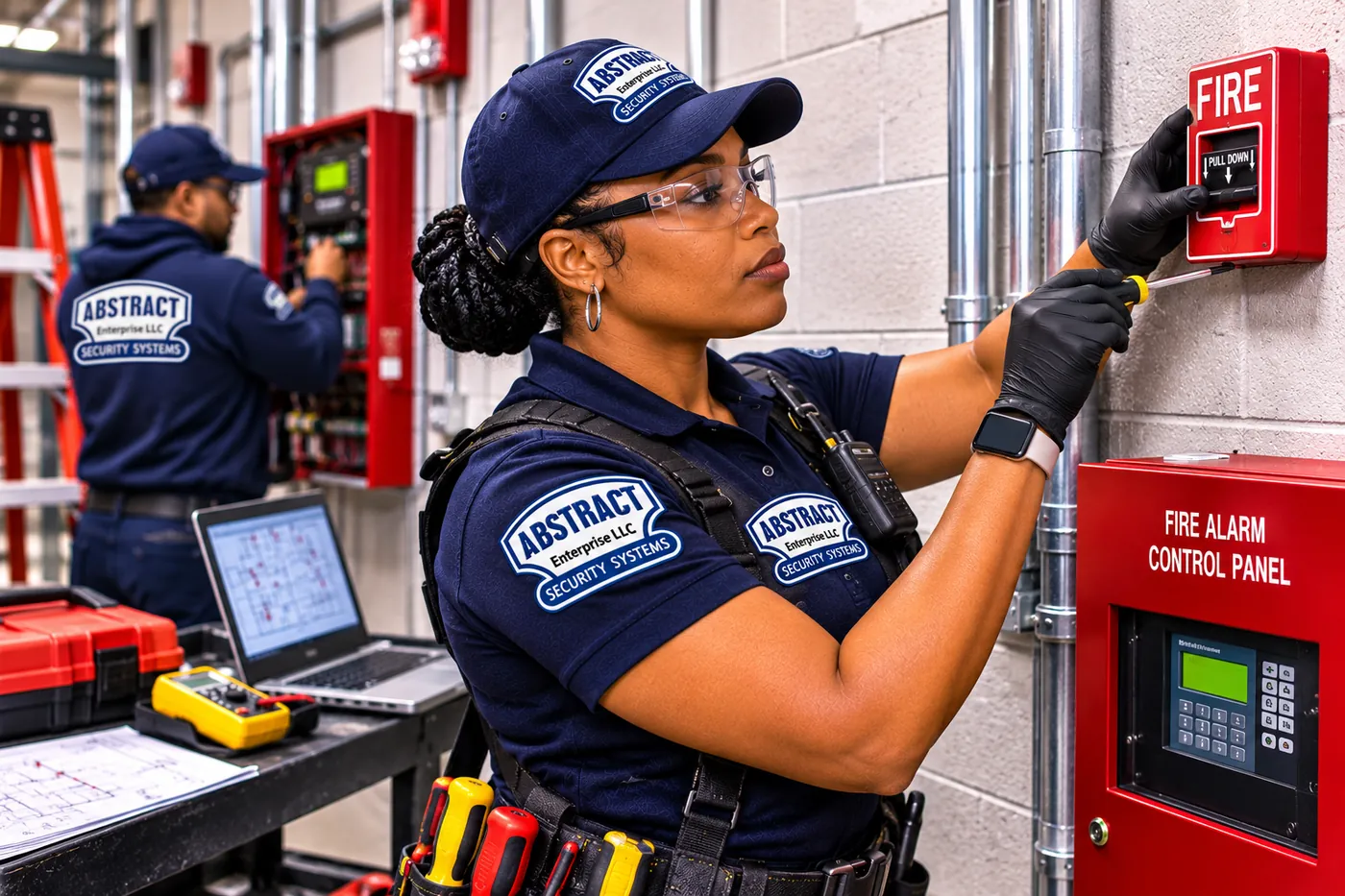
Fire alarm installation in City Line, Brooklyn: technician fitting a red pull station to a wall beside a fire alarm control panel while a second technician works at a laptop and panel in the background
One technician fits a red manual pull station to a block wall next to a fire alarm control panel while a second technician works at a laptop and another panel behind her. Installation and programming run side by side on larger City Line jobs.
Building Specialists

Commercial Fire Alarm Systems for City Line's Building Types

Commercial fire alarm systems in City Line have to fit buildings that were mostly built as homes and shops between the 1900s and 1930s, plus a newer generation of elevator buildings. Each group below brings its own design questions, and each is answered on the sealed drawings before any device goes up.

Masjids, churches and prayer halls

A prayer hall in City Line is usually a place of assembly in the eyes of the code. The NYC Department of Buildings' code notes explain that an indoor space where 75 or more people gather needs a Place of Assembly Certificate of Operation, and that a fire alarm system with emergency power is required where the occupant load reaches 300 or more. A hall made by joining two houses on a side street can cross the first line easily and approach the second on a holiday. The design professional calculates the occupant load from the floor area and layout, not from an ordinary weekday, so the commercial fire alarm system design starts with how the space is used at its fullest: the main prayer floor, a women's section on another level, a basement used for overflow or meals, and any classroom where children study. Manual fire alarm pull station installation goes at the exits, smoke detection in the rooms where the design calls for it, and notification appliances are laid out so that a hall full of people, sometimes with a microphone and speakers running, hears and sees the alarm. Where a public address system is used, a relay from the panel can mute it so the alarm signal is clear.

Church buildings in City Line have their own history. St. Sylvester's Roman Catholic Church at 416 Grant Avenue fills the north side of McKinley Avenue between Eldert Lane and Grant Avenue, and its former parish school at 396 Grant Avenue was merged into Salve Regina Catholic Academy. Since 2013 the parish has been administered by the pastor of St. Fortunata. Older parish buildings like these tend to carry decades-old panels and wiring in plaster, and when a former school wing or basement hall is put to a new use, fire alarm system modification or a full fire alarm system renovation is often the result.

Storefront buildings with apartments above

Mixed-use row buildings are the backbone of Liberty Avenue and Pitkin Avenue. The apartments above are covered by HPD's smoke and carbon monoxide alarm rules for each dwelling unit, which are not the same thing as a building fire alarm system. Whether the building or the store needs a system, and what kind, is a design professional's decision based on the occupancy, the number of stories, the fire area and the work being filed. Where one is required, a mixed use building fire alarm installation has to handle a store open late, a cellar used for storage, and a residential stair the store's customers never see. Multifamily building fire alarm installation and apartment building fire alarm installation in larger buildings follow the NYC rules for residential occupancies, where the code allows some systems to sound only at the panel and in specific locations, so the design professional's reading of that section matters as much as any device choice.

Restaurants, sweet shops and groceries

Restaurant fire alarm installation in City Line usually means a small kitchen, sometimes with a hood and suppression system, inside a building with homes above. Heat detectors near cooking equipment, smoke detectors in the dining or sales area, fire alarm kitchen hood suppression monitoring where a hood system is installed, and CO detection where gas-fired ovens, fryers or water heaters exist in a fire-alarm-protected building are the usual elements. Sweet shops and bakeries that run fryers and boilers before dawn are a good example: their detector placement has to match the real heat and steam in the room, or the building will hear false alarms every morning. Retail store fire alarm installation in a grocery adds stock rooms and walk-in coolers, where device placement has to account for shelving and cold air.

Community offices, clinics and youth programs

Office building fire alarm installation in City Line is rarely a tower; it is a ground-floor or second-floor office in a row building that runs English classes, benefit enrollment, tutoring or a food pantry. Medical office fire alarm installation follows the same pattern when a clinic or doctor's office takes a storefront. These spaces are often busiest when they hold events, and the fire alarm design has to reflect the room's real use, its exit doors and any kitchen. School fire alarm installation applies where a charter school, a religious school or an after-school program occupies part of a building.

Newer elevator buildings

City-Data counts 1,584 housing units in the area built between 2010 and 2019, a sharp change for a neighborhood of row houses. Buildings like the six-story, 2019 building at 975 Liberty Avenue, which public records class as elevator apartments with stores, combine residential floors, ground-floor retail, an elevator machine room and a sprinkler system. Their fire alarm systems include fire alarm elevator recall integration, sprinkler monitoring, door releases and, in some cases, smoke control interfaces. Condominium building fire alarm installation and new construction fire alarm installation in these buildings are coordinated with the general contractor from the first rough-in, so the FDNY test is not the first time the elevator and the fire alarm meet.

Auto shops, garages and storage along Atlantic Avenue

Atlantic Avenue and the blocks near Conduit Boulevard carry repair shops, tire businesses, parking and storage. Parking garage fire alarm installation, storage facility fire alarm installation and warehouse fire alarm installation in these buildings need detection that tolerates exhaust and dust, often heat detection instead of smoke, and supervision of the sprinkler system where one exists. Industrial building fire alarm installation in an older garage often starts with deciding what can be kept from a previous system and what has to be replaced. Industrial fire alarm systems in these buildings are usually small, but industrial fire detection system installation still follows the engineer's layout for the bays, the parts room and any paint or tire storage, and commercial fire alarm wiring is run in conduit where vehicles and lifts could damage it.

Care settings and larger institutions

City Line is mostly small buildings, but the same principles apply to nursing home fire alarm installation, assisted living fire alarm installation, hotel fire alarm installation, hospital fire alarm installation, shopping center fire alarm installation, high rise fire alarm installation and data center fire detection installation when an owner with property here also runs larger sites. Those occupancies carry heavier code requirements, staff-driven evacuation plans and, for high-rise and health care buildings, voice systems; they are designed by the professional of record and approved by the FDNY like everything else on this page. Manufacturing facility fire alarm installation in a light industrial building and industrial fire alarm installation in a larger shop are handled the same way.

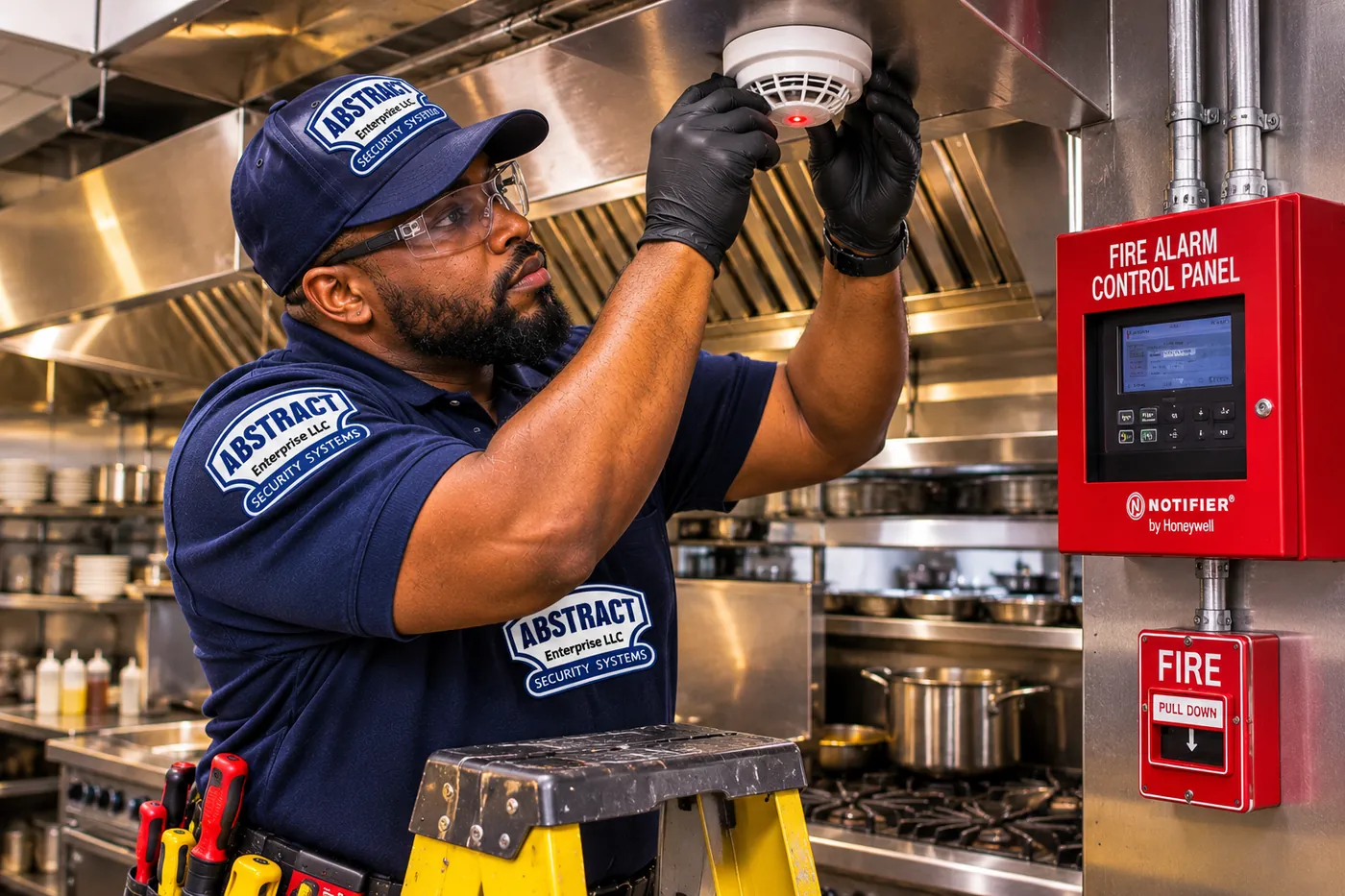
Commercial kitchen fire detection installation in City Line, Brooklyn: technician on a stepladder mounting a detector on a kitchen ceiling near a stainless hood, with a fire alarm control panel and pull station on the wall
A technician on a stepladder mounts a round detector to a kitchen ceiling beside a stainless hood, with a red control panel and pull station on the wall. Sweet shops, restaurants and hall kitchens on City Line's avenues are designed around heat detection near the cooking line.
Commercial Fire Alarm

Business Fire Alarm Installation on City Line's Streets

Business fire alarm installation in City Line follows its streets, and each one has a different mix of buildings and owners. The descriptions below are about the kinds of buildings on each street, not about any particular address.

Liberty Avenue

Liberty Avenue is the main commercial spine, a run of row buildings with groceries, clothing and sari shops, sweet shops, restaurants, travel agents, money transfer offices and community offices, most with apartments above. The Bangladeshi community's civic life has centered here for years: BACDYS, the community organization founded in 2011 by Misba Abdin, keeps its office on Liberty Avenue, and in October 2013 it partnered with the Department of Transportation on the Liberty Avenue plaza at the borough line. Gotham Gazette quoted resident Khairul Islam on the plaza: "This is like a village to us." For fire alarm work, Liberty Avenue means constant small changes inside occupied buildings: a store becoming a prayer room, a back room becoming a kitchen, a second floor becoming a classroom. Each change can require a filed modification to the building's system.

Pitkin Avenue

Pitkin Avenue runs east to the Grant Avenue subway station, the last stop on the A line before the borough line, and mixes storefronts, houses of worship, relief organizations and newer buildings. Commercial building fire alarm installation along Pitkin often involves a building where the store, the upstairs apartments and a basement hall were each altered at different times, so the survey has to reconcile three sets of changes before the engineer can design a coherent system.

Atlantic Avenue

Atlantic Avenue at the north edge of City Line is wide and heavily trafficked, with auto shops, garages, storage, offices and service providers. Here commercial fire alarm installation is often about sprinkler supervision, heat detection in work bays and fire alarm sprinkler monitoring installation in buildings where the sprinkler system is the main protection.

Fulton Street, Grant Avenue and Eldert Lane

Fulton Street, Brooklyn's longest shopping street, reaches its last blocks here; Forgotten New York notes that its final building, number 3480, is the old W.M. Evans Dairy. Grant Avenue carries the church campus, and Eldert Lane is where the borough line itself runs down the middle of the street, with Brooklyn houses on the west side. A building's borough decides which Department of Buildings office keeps its records, so on the blocks near the line we confirm the block and lot before anything is filed.

What the code and the FDNY expect on every street

On every one of these streets the same rules apply. Fire alarm code compliance in New York City means the NYC Building Code and Fire Code, with NFPA 72 as the referenced installation and testing standard. NFPA 72 fire alarm installation, NFPA 72 fire alarm inspection and NFPA 72 fire alarm testing describe how equipment is installed and maintained; the city codes say when a system is required and what it must do. Fire alarm code compliance upgrades, fire alarm system code upgrade work and fire alarm system violation correction all go through the FDNY, and the FDNY holds the building owner responsible for keeping the system working.

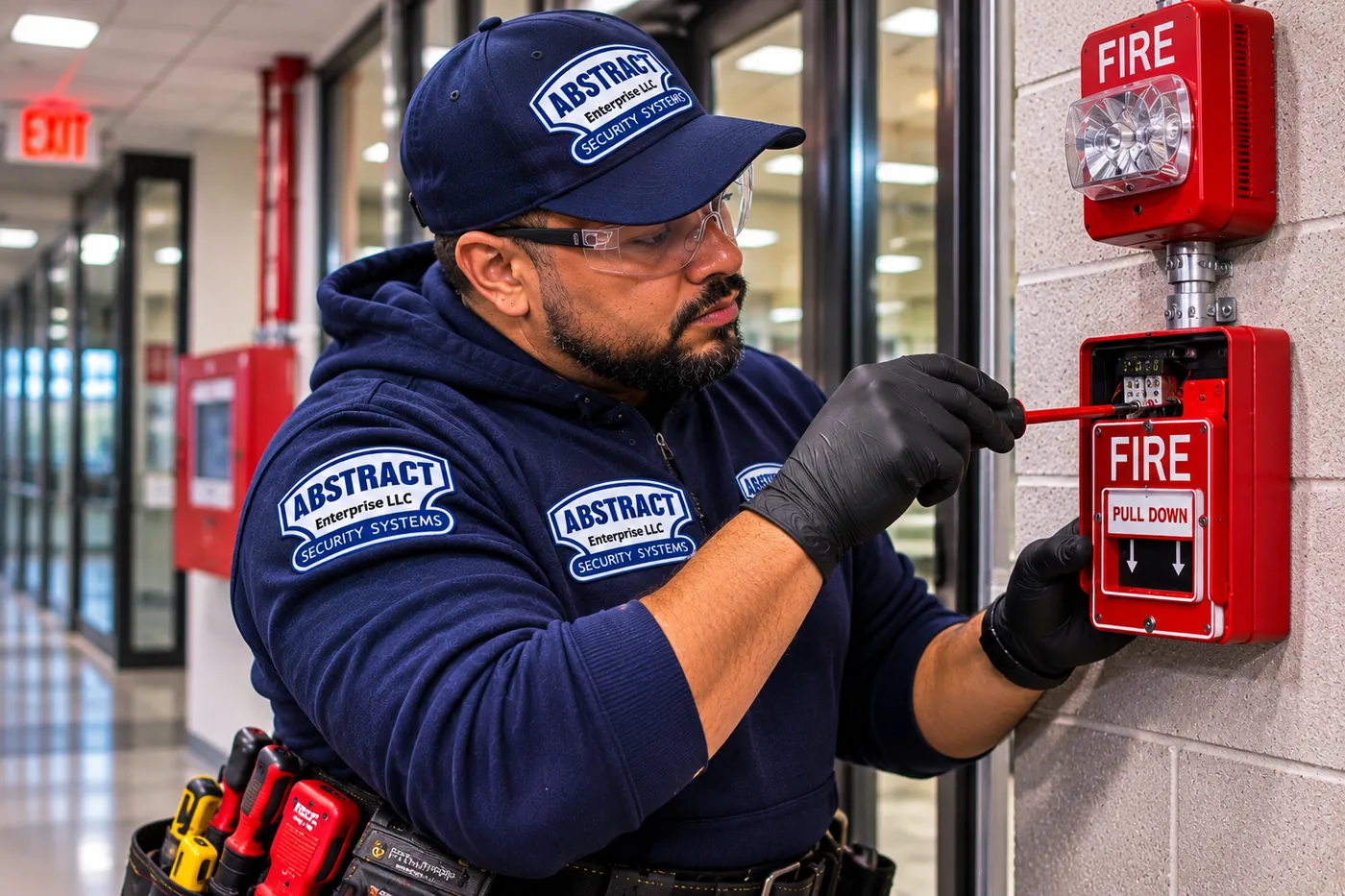
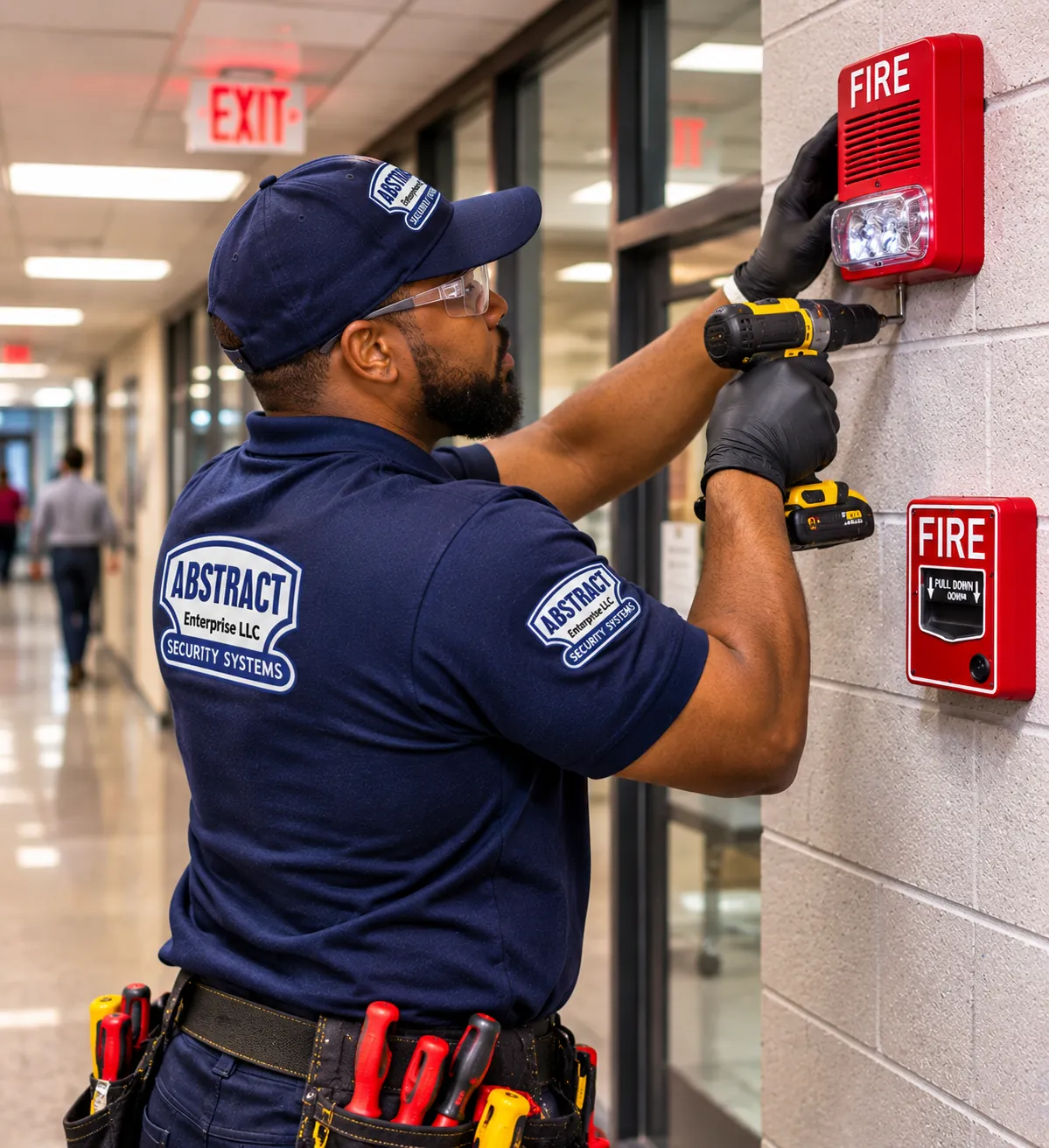
Fire alarm pull station installation in City Line, Brooklyn: technician in gloves wiring a red pull station mounted below a horn strobe beside a glass corridor
A gloved technician works a screwdriver into a red pull station mounted under a horn strobe, with a glass corridor and exit sign behind. Each termination is checked again during the FDNY acceptance test.
Field Notes

Field Notes: Two Houses, One Hall, and a Stair Nobody Counted

This is a typical scenario, not a specific job. A mosque committee in City Line calls because their congregation has outgrown its space. Years ago they bought two attached houses, opened the party wall on the ground floor and the cellar, and built one long prayer hall with a smaller room upstairs for women and a classroom in the back. Now they want to finish the cellar as an overflow hall for Fridays and Eid, and a member who works in construction has suggested "putting in some smoke detectors" before Ramadan.

On the walk-through we count the floor area of each level, look at how many people actually stand shoulder to shoulder at the busiest prayer, and follow the routes out: the front door, a side passage, and an interior stair from the cellar that comes up into one of the old house halls. We find battery smoke alarms on two levels, an old heat detector in the cellar wired to nothing, and a sprinkler line in only one of the two cellars. Nobody can remember whether the building ever had a fire alarm filing.

The honest answer is not a box of detectors. Turning residential floors into an assembly space is a change of use, and with the cellar counted the hall may need a Place of Assembly certificate and could approach the occupant load where a fire alarm system becomes mandatory. That is the engineer's or architect's call, so the first step is getting a design professional to measure and calculate before the cellar work starts. Meanwhile the committee should collect what it has: the deed, any old filings, the sprinkler history and the dates the cellar was changed. If a system is required, the drawings will set pull stations at the exits, detection where it belongs, horns and strobes that reach every level including the women's room, and a link to a central station, and the work will be filed with the FDNY before installation begins.

What usually surprises a committee is that the schedule is set by the approval, not the installation. The FDNY's own guide puts plan submission to approval at about 20 to 24 weeks. A congregation that starts the design in autumn has a realistic chance of an approved system before the next Ramadan; one that starts a few weeks before does not. We say that on the first visit, because it is better to change the plan than to open a hall the code does not yet allow.

Your Questions Answered

Fire Alarm Installation in City Line: Questions Answered

These are the questions City Line owners, congregations, merchants and program directors actually bring to us, grouped the way the conversations usually go. Each answer is short and specific; the FAQ further down covers different ground.

Cost and paperwork

Our masjid committee wants a figure for the board meeting before we hire an engineer. What can you tell us?

We can tell you what the figure will be made of, but not the figure itself, because nobody can price a fire alarm honestly before the building is designed. The total will include the design professional's fee for sealed drawings, the FDNY filing, equipment, installation labor, programming and the acceptance test, and in a converted house the design alone can change the scope a great deal. For the board, ask us for a survey: you get a written description of the building's situation and the steps ahead, and the written proposal follows once the drawings exist.

We bought a building on Pitkin Avenue that may have had a fire alarm filing years ago. How do we find out what was approved?

Start with the paperwork the seller left: a Letter of Approval from the FDNY, approved drawings, inspection reports and a central station contract. If none exist, the design professional can research records with the city, and the survey will show what equipment is physically there. Until you know what was approved, treat any existing panel as unverified, because modifying an unapproved system only adds to the problem.

Is there a city fee we should set aside before our City Line hall's fire alarm is filed?

Government fees are separate from the contractor's price and are set by the city, so the design professional lists the ones that apply to your filing. One example with a published figure is the FDNY's $105 fee for an FA-27 submission when a building answers a Notice of Defect. Ask the engineer or architect for the filing fees at the same time you ask for the design proposal.

Quality and trust

A relative offered to install our hall's fire alarm cheaply. What should we check before saying yes?

Ask for two things in writing: the FDNY Fire Alarm Company Certificate the company works under, and the name of the licensed electrician who will be on the filing. Then ask who the design professional is and when the FDNY plan exam will be filed. If any of those answers is vague, the price does not matter, because an installation that cannot pass the FDNY acceptance test has to be done again.

How do we judge whether a fire alarm proposal for our Liberty Avenue building is complete?

A complete proposal names the certified company and electrician, refers to the sealed drawings by date, separates design coordination, filing support, installation, programming and testing, and says who arranges central station monitoring and who attends the FDNY test. A proposal that lists only devices and labor is a parts list, not a fire alarm job.

Who can do the work

Can the electrician who rewired our grocery also connect the building's fire alarm?

Only if the work is done under an FDNY-certified fire alarm company and filed where required. In New York City the electrical license and the fire alarm company certification are separate requirements, and a principal of the certified company must hold the FDNY S-97 Certificate of Fitness. A good electrician can be part of the job, but the fire alarm work has to sit under the certificate and the approved drawings.

Our nonprofit leases a floor on Crescent Street. Are we allowed to hire our own company for fire alarm changes in our space?

Usually the landlord controls that, because the building's fire alarm and its FDNY approval belong to the owner. Your lease and the landlord's service company decide who works on the system. Raise it before you change walls or rooms, so the modification is planned with the owner instead of discovered at the next inspection.

Technical

Incense and the heating in our prayer hall seem to trip the smoke detectors. What is the right fix?

The fix is a design review, not a removal. Depending on what the engineer finds, a detector may be relocated away from incense burners and heating discharge, replaced with a type better suited to the room, or the room's use may be adjusted. Any change to an approved system is a modification that goes through the certified company, and smoke detection required by the drawings cannot simply be taken out.

How do strobes and horns reach the women's section on a different floor of our hall?

The design places notification appliances in every area people occupy, including separate prayer rooms, classrooms and washrooms used during services. Strobes are laid out so they can be seen from anywhere in the room, and audible devices are sized for the room's noise level. If the space uses a microphone and speakers, the panel can be programmed to mute them when the alarm sounds.

Our new building on Liberty Avenue has an elevator. What does the fire alarm have to do with it?

Smoke detection in the elevator lobbies, the machine room and the top of the shaft, where the design calls for it, tells the fire alarm to send the car to a safe floor and keep it there for firefighters. That recall sequence is shown on the drawings, built during construction, and demonstrated to the FDNY inspector with the elevator contractor present.

Landlord and tenant

The store under our apartments became a banquet room. Shouldn't the building's alarm have been changed?

Possibly. A store turned into a banquet or event room is a change of use, and if the room's occupant load puts it in the assembly group, it may need a fire alarm system or a Place of Assembly certificate. Tenants can raise the concern with the owner, and if it is not addressed, report it through 311 so the city can inspect.

Our landlord says the store's monitoring contract is our expense. Is that legal?

A lease can assign costs, but responsibility for the system stays with the owner in the FDNY's eyes. The safest arrangement is a central station contract in the owner's name with the cost passed through under the lease, so the account does not lapse when a tenant leaves.

Complaints

The fire alarm in our building sounded during Friday prayer and the FDNY arrived. Will we be fined?

An alarm caused by a working system is not automatically a violation, but repeated unnecessary alarms can lead to FDNY enforcement against the owner for failing to maintain the system. Find the cause, document the repair, and keep the records. If the cause was cooking, incense or a device in the wrong place, have it corrected through the certified company.

Our building's alarm panel has shown trouble for months and the owner ignores it. Who do tenants call?

Tell the owner in writing first. If nothing happens, report it to 311, which routes fire safety complaints to the FDNY. A panel left in trouble may not be able to detect a fire or call for help, and the owner is the one responsible for repairing it.
Equipment

Types of Commercial Fire Alarm Systems We Install in City Line

Two families of control panels cover almost every City Line building, plus a few specialized technologies for particular rooms. The design professional chooses among them; our job is to install and program them exactly as drawn.

Addressable systems

What is an addressable fire alarm system? Every detector, pull station and module has its own address on a signaling line circuit, so the panel reports exactly which device is in alarm or in trouble. Addressable fire alarm installation, addressable fire alarm system installation and addressable fire alarm panel installation suit prayer halls with several rooms, new elevator buildings and any building where finding a fault quickly matters. Addressable fire alarm device installation includes addressable smoke detector installation, fire alarm monitor module installation, fire alarm control module installation and fire alarm relay module installation. Fire alarm device addressing and addressable fire alarm system programming give each point a clear description, such as "cellar overflow hall, east side", so a responder understands the panel at a glance. Addressable fire alarm system repair, addressable fire alarm troubleshooting and addressable fire alarm system upgrade work follow the same logic. Intelligent fire alarm installation and an intelligent fire detection system add detectors that compensate for slow drift from dust and report when they need cleaning.

Conventional systems

What is a conventional fire alarm system? Devices are wired in zones, and the panel reports which zone is in alarm, not which device. Conventional fire alarm installation, conventional fire alarm system installation and conventional fire alarm panel installation still fit small single-use spaces such as one store or a small office. What is the difference between addressable and conventional fire alarms? Precision: an addressable panel names the device, a conventional panel names the zone. Conventional fire alarm repair, conventional fire alarm replacement and fire alarm zone wiring are common in City Line's older storefront buildings. When a building grows or changes use, conventional to addressable fire alarm conversion is often the better path, and it is designed and filed like any other upgrade.

Voice and emergency communication

Fire alarm voice evacuation installation and fire alarm emergency voice communication are used where the code calls for spoken instructions, typically larger assembly spaces, high-rise buildings and certain institutional uses. Fire alarm speaker installation and fire alarm speaker strobe installation replace horns in those systems. Fire alarm mass notification integration, which uses the same speakers for other emergencies, is a design decision for larger campuses.

Air sampling

Aspirating smoke detection installation draws air through small pipes to a sensitive detector. An air sampling smoke detection system such as VESDA suits rooms where ceiling detectors are hard to reach or protect, such as a high-ceilinged hall or an equipment room. VESDA installation and VESDA service follow the manufacturer's procedures and are included in the system's testing.

Beam detection

Beam smoke detector installation and projected beam smoke detector installation protect wide open spaces with a light beam across the room. Warehouse smoke detection installation in a storage building near Atlantic Avenue, or a tall open hall, may use beams where spot detectors would be impractical.

Monitoring

Fire alarm monitoring system installation and fire alarm central station communicator installation connect the panel to an FDNY-approved central station. Fire alarm communicator installation uses cellular or IP paths, and the central station has to be live before the FDNY schedules the acceptance test.

Devices

City Line Fire Alarm Devices and Where Each One Goes

Detection

Fire detection device installation and fire alarm initiating device installation cover every device that starts an alarm. Commercial smoke detector installation and photoelectric smoke detector installation are the default in prayer halls, offices and corridors, laid out to the engineer's spacing. Commercial heat detector installation, fixed temperature heat detector installation and rate of rise heat detector installation go where smoke detectors would false alarm, such as kitchens, boiler rooms and auto bays. Duct smoke detector installation shuts down air handlers so smoke does not travel through the ductwork, and duct smoke detector testing and duct smoke detector replacement are part of the system's life. Commercial smoke detector testing, commercial smoke detector repair, commercial smoke detector replacement and heat detector replacement keep detection working. Fire detection system installation and fire detection and alarm installation in a converted house often require new ceilings or surface raceways, decided with the owner up front. Commercial fire detection systems and business fire detection systems in City Line are mostly small, but each is designed with the same care.

Pull stations

Fire alarm pull station installation places a manual station at each required exit so anyone can start the alarm. Fire alarm pull station replacement, fire alarm pull station repair and fire alarm pull station testing are frequent in halls where stations near doors get bumped by crowds. In buildings where pull stations have been pulled as pranks, protective covers are a design option.

Notification

Fire alarm horn installation, fire alarm strobe installation and fire alarm horn strobe installation are the most visible fire alarm notification appliance installation. Fire alarm audible notification installation is sized for the room's noise, and fire alarm visual notification installation and fire alarm ADA strobe installation make sure people who cannot hear the alarm see it. Fire alarm synchronization module installation keeps strobes flashing together. Fire alarm horn strobe replacement, fire alarm horn strobe repair and fire alarm notification appliance replacement keep the system's warning working after years of use.

Modules, power and communication

Fire alarm NAC power supply installation adds power for notification circuits in larger buildings. Fire alarm power supply installation, fire alarm battery backup installation and fire alarm battery replacement keep the system running through power outages. Fire alarm annunciator installation and remote annunciator installation place a display at the main entrance so firefighters can read conditions without walking to a cellar panel. Fire alarm control panel installation and FACP installation finish the head end, while FACP repair and FACP replacement come later in the system's life.

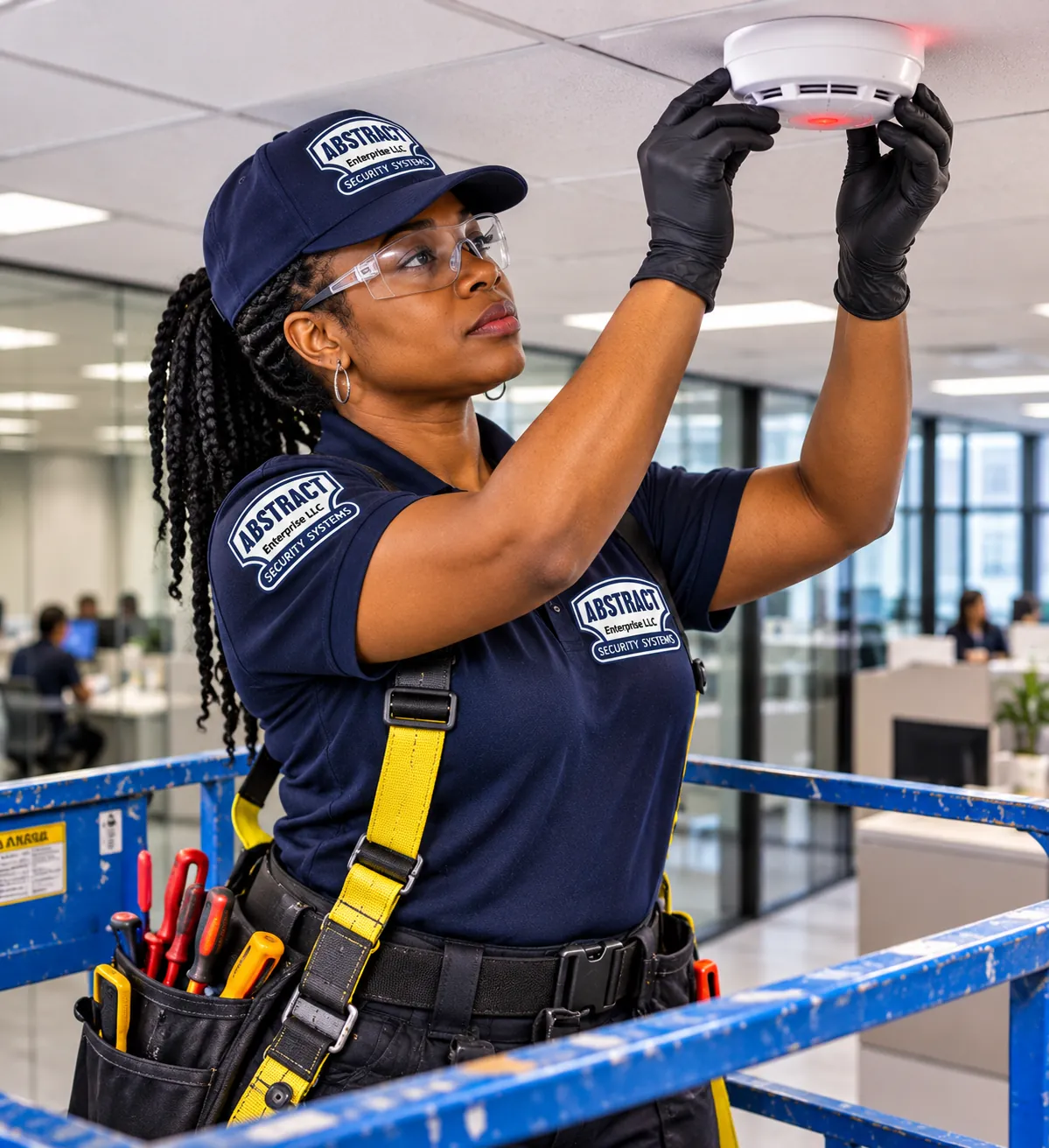
Commercial smoke detector installation in City Line, Brooklyn: technician in a safety harness on a lift fitting a ceiling smoke detector above an open office
A technician in a yellow safety harness stands on a blue lift and fits a smoke detector to an office ceiling. Higher ceilings in halls, offices and new buildings mean lifts rather than stepladders for detector work.
AI Overview Reality Check

What AI Answers Get Wrong About Fire Alarms in City Line

AI tools and cost-guide sites like Angi, HomeAdvisor and Fixr answer fire alarm questions with general information written for houses. Here are the claims we hear most often from City Line callers, and what applies to the buildings here.

“A small mosque only needs battery smoke alarms.”

Battery alarms are a residential device. A prayer hall is judged by its occupancy and its occupant load, not by the size of the building, and a converted two-house hall may be a place of assembly under the NYC code.

The DOB's place of assembly code notes set 75 people as the point where a Place of Assembly certificate is needed, and 300 as the occupant load where a fire alarm with emergency power is required. A busy Friday or Eid can approach those numbers in a surprisingly modest building.

The answer comes from a design professional's calculation, not from a guess about how many people usually attend. Battery alarms may still be required in upstairs apartments, but they do not replace a code-required system.

“Any electrician can install a fire alarm.”

In many places that is close to true. In New York City, the FDNY requires a fire alarm company certificate for any company that installs, inspects, tests or services a fire alarm system beyond simple smoke detectors.

At least one principal of the certified company must hold an S-97 Certificate of Fitness, which requires NICET Level II or higher in fire alarm systems or a NYC master or special electrician license. The wiring itself is done by a licensed electrician.

An electrician working without the company certificate and the approved drawings may install equipment that works, but the building will not get an FDNY Letter of Approval for it.

“Installing a fire alarm takes a day or two.”

The hands-on work in a small City Line building might take days. The project does not, because the plans must be designed, sealed, filed and approved first.

The FDNY's Tips for Fire Alarm Systems estimates about 20 to 24 weeks from plan submission to final approval, with the initial plan review alone taking up to eight weeks. Design time comes before that.

For a congregation planning around Ramadan or a merchant planning a grand opening, that window is the real schedule, and it should be built into the plan from the first conversation.

“Fire alarm cost is a fixed price per square foot.”

National cost guides publish per-device or per-square-foot figures based on homes and simple offices. They leave out the parts that drive a City Line job: sealed engineering drawings, the FDNY filing, the building's walls and ceilings, and the acceptance test.

Two halls with the same floor area can be very different jobs if one has open framing and the other has plaster and tin ceilings, or if one has a cellar that must be included and the other does not.

That is why we quote each building in writing after a survey and after the design exists, and why a single number from a website is not a useful budget.

“The apartments' smoke alarms make the whole building compliant.”

HPD requires smoke and carbon monoxide alarms inside each apartment of a multiple dwelling. Those protect the families living there; they are not a building fire alarm system.

The store, the hall or the office below has its own code requirements based on its use. A building can have every apartment alarm in place and still need a fire alarm system for the ground floor or cellar.

Owners of mixed-use buildings on Liberty and Pitkin Avenues should treat the two as separate questions and ask the design professional about the commercial floors directly.

“Near the borough line, either borough's rules apply.”

The FDNY's fire alarm rules are the same in every borough of New York City, so the approval path for a City Line building does not change with the street. What does matter is getting the property records right.

On Eldert Lane the line runs down the middle of the street, and a building's borough determines which Department of Buildings records apply to it and what block and lot appear on the filing. A mistake there delays the application.

We confirm the address, borough, block and lot from city records before the design professional files, which takes minutes and saves weeks.

“An old panel just needs a reset.”

Resetting a panel in trouble clears the message, not the cause. If the trouble comes back, something in the circuit, the power supply or the communicator is failing.

Many older City Line panels are no longer supported, and parts may be unavailable. At some point obsolete fire alarm panel replacement or outdated fire alarm system replacement is the only path, and it is filed with the FDNY.

Before deciding, a technician reads the panel's history, measures the circuits and tests the batteries. The decision to repair or replace should come from that evidence, not from repeated resets.

Converting a House or a Store Into a Prayer Hall, Office or Classroom in City Line? Call Before the Work Starts

Send the address and what the space will become. We book a survey within 2 hours of your request and explain what the design professional, the owner, the FDNY and the installer will each need before you set an opening date.

Get In Touch

Request a Free Quote for Your City Line Fire Alarm Project

Send the City Line address and nearest cross street, how each floor is used today and how it will be used, the panel brand if there is one, and any FDNY Letter of Approval or inspection report. For a panel in trouble, a clear photo of the display is the most useful thing you can send. Prefer to talk? Call (347) 934-8335.

✅
Request Sent!
Thank you. We will be in touch to book your City Line fire alarm survey, usually within 2 hours of your request.
How It Works

Our Fire Alarm Installation Process for City Line Buildings

Every City Line fire alarm installation consultation follows the same eight steps, whether the project is a masjid's new overflow hall, a grocery fit-out or a new elevator building on Liberty Avenue. What varies is how many people have to agree inside each step: owners, committees, tenants and contractors.

  1. First call. The address and cross street, how each floor is used, who owns the building, any existing panel and FDNY Letter of Approval, and the date you are aiming for. The survey is booked within 2 hours.
  2. Survey of the whole building. We walk every space the fire alarm will touch, from cellar and boiler room to stairs, kitchens, prayer rooms and roof equipment, and photograph the existing panel, its history and its central station details. In converted houses we look closely at party walls, added ceilings and interior stairs.
  3. Design professional and sealed drawings. A New York State Professional Engineer or Registered Architect designs and seals the fire alarm construction drawings, the device layout, battery and voltage calculations and the sequence of operations. Where an owner already has a design professional, we work with that person and share our survey notes.
  4. Written proposal. A fire alarm system installation proposal that separates design coordination, filing support, installation, programming and testing, so it can be compared line by line with any other fire alarm installation bid.
  5. FDNY plan examination. The design professional files the TM-1 with the plans. We help answer objections quickly so the application keeps moving.
  6. Installation. Fire alarm rough in, fire alarm conduit installation, fire alarm cable pulling, fire alarm cable installation, fire alarm wiring installation and fire alarm low voltage wiring, then fire alarm device termination and fire alarm circuit installation, all to the approved drawings by the certified company and the licensed electrician on the filing. Fire alarm panel wiring and commercial fire alarm panel installation complete the work at the head end, and fire alarm equipment installation is checked device by device.
  7. Programming and commissioning. Fire alarm device programming, fire alarm control panel programming, fire alarm system configuration, fire alarm system startup and fire alarm system commissioning, followed by a full pre-test of every device and output with the central station live. Commercial fire alarm commissioning is where problems are supposed to surface, before the FDNY visit.
  8. Acceptance and handover. The FDNY-witnessed acceptance test, the Letter of Approval, and fire alarm as built drawings, programming records and test reports handed to the owner or committee.

How long does fire alarm installation take in City Line? The physical work runs from days to a few weeks depending on the building. The whole project is paced by the FDNY's estimate of about 20 to 24 weeks from plan submission to approval, plus design time before that. What happens during fire alarm acceptance testing? An FDNY inspector watches the system prove everything on the approved drawings: every detector and pull station in alarm, every output such as fan shutdown or elevator recall, trouble conditions, and the signal arriving at the central station. In City Line halls, tests stall when a carpet, a partition or a shelf was added after the pre-test and blocks a device. Fire alarm system testing and commissioning done carefully beforehand turns the FDNY visit into a formality instead of a second appointment.

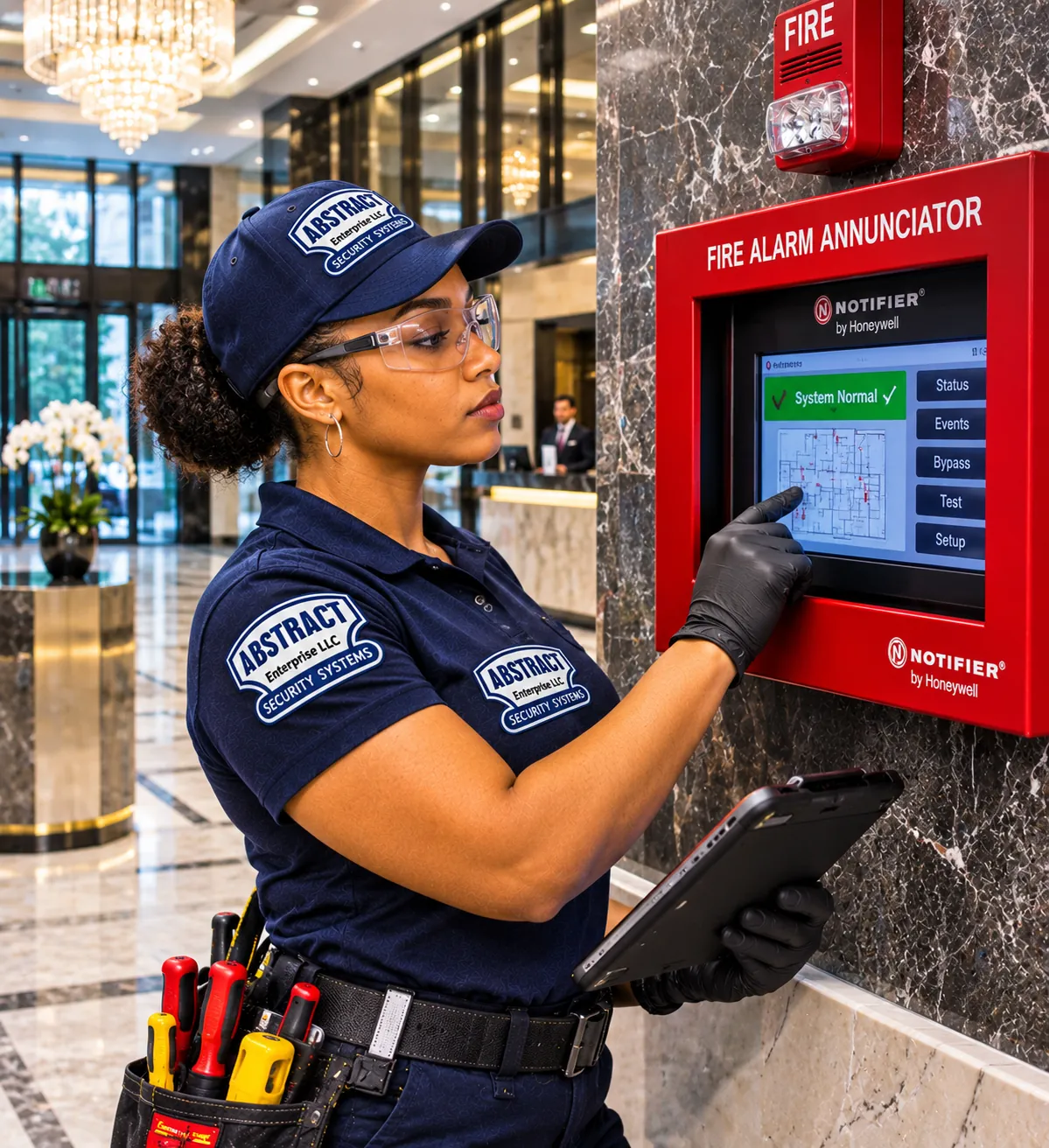
Fire alarm annunciator installation in City Line, Brooklyn: technician checking a NOTIFIER fire alarm annunciator touchscreen in a marble lobby while holding a tablet
A technician holding a tablet touches the screen of a red fire alarm annunciator mounted on a marble lobby wall. In newer City Line elevator buildings, a lobby annunciator lets firefighters read the system without going to the cellar panel.
Existing Systems

Upgrades, Inspections and Maintenance for City Line Fire Alarms

Upgrades, replacement and modernization

Can an existing fire alarm system be upgraded? Often yes, if the panel is still supported and the existing wiring tests clean. A fire alarm system upgrade, fire alarm panel upgrade or fire alarm control panel upgrade keeps what can be kept and replaces what cannot. When the panel is past support, fire alarm system replacement, fire alarm panel replacement and fire alarm control panel replacement are the realistic choices, and legacy fire alarm system upgrade work on a 1990s panel in a City Line church or office usually becomes a commercial fire alarm replacement with new devices. Fire alarm system modernization and commercial fire alarm modernization add addressable devices, better diagnostics and modern communicators. Commercial fire alarm upgrades and a commercial fire alarm system retrofit are filed modifications, and fire alarm system retrofit work in a converted house is planned around plaster walls and occupied apartments. Existing fire alarm system expansion, fire alarm system expansion contractor work, fire alarm system reconfiguration and fire alarm system conversion come up when a hall adds a floor, a cellar or a classroom. Fire alarm device replacement and fire alarm system lifecycle replacement plans spread the work over several years when a congregation's budget requires it.

Inspection and testing

How often should fire alarms be inspected, and how often should commercial fire alarms be tested? The NYC Fire Code and NFPA 72 set the schedules, which differ by device and by test; many devices are tested annually, some more often, and the certified company keeps the records the FDNY inspector will ask for. Fire alarm inspection, fire alarm system inspection, commercial fire alarm inspection, fire alarm annual inspection and fire alarm periodic inspection check that the system still matches its approval. Fire alarm testing, fire alarm system testing, commercial fire alarm testing, fire alarm functional testing, fire alarm device testing, fire alarm sensitivity testing and fire alarm battery load testing prove that each part works. NFPA 72 fire alarm testing defines the methods, and fire alarm inspection documentation keeps the evidence on site. Fire alarm maintenance, fire alarm preventative maintenance and commercial fire alarm maintenance under a fire alarm service contract keep small problems from becoming outages. A fire alarm inspection company, fire alarm testing company, fire alarm maintenance company, fire alarm inspection contractor or fire alarm testing contractor working in City Line must hold the FDNY company certificate like any installer.

Deficiencies and violations

Who can correct fire alarm inspection deficiencies? The certified company, under the existing approval or a new filing. Fire alarm inspection deficiencies, fire alarm deficiency correction, fire alarm inspection repair and fire alarm code violation repair answer what the FDNY or a test report found. When the FDNY issues a Notice of Defect, the FA-27 submission process includes a $105 fee according to the FDNY's instructions. Fire alarm inspection preparation, gathering records and pre-testing devices, keeps the next inspection short. Fire alarm system certification and fire alarm system documentation, including the Letter of Approval and as-built drawings, are what a buyer, insurer or inspector will ask to see.

Brands we see in City Line

City Line's panels range from older conventional units to new addressable systems in recent buildings. We work on Honeywell fire alarm installation and Honeywell fire alarm service, NOTIFIER fire alarm installation and NOTIFIER fire alarm repair, Fire Lite fire alarm installation and Fire Lite fire alarm repair, Silent Knight fire alarm installation and Silent Knight fire alarm service, Edwards fire alarm installation, Edwards fire alarm repair and EST fire alarm service, Siemens fire alarm installation and Siemens fire alarm service, Simplex fire alarm service, Bosch fire alarm installation, Potter fire alarm installation and Potter fire alarm service, and Kidde commercial fire alarm installation. Some systems require factory-trained technicians or proprietary software; commercial fire alarm manufacturer service is arranged where that applies, and we say so in the proposal.

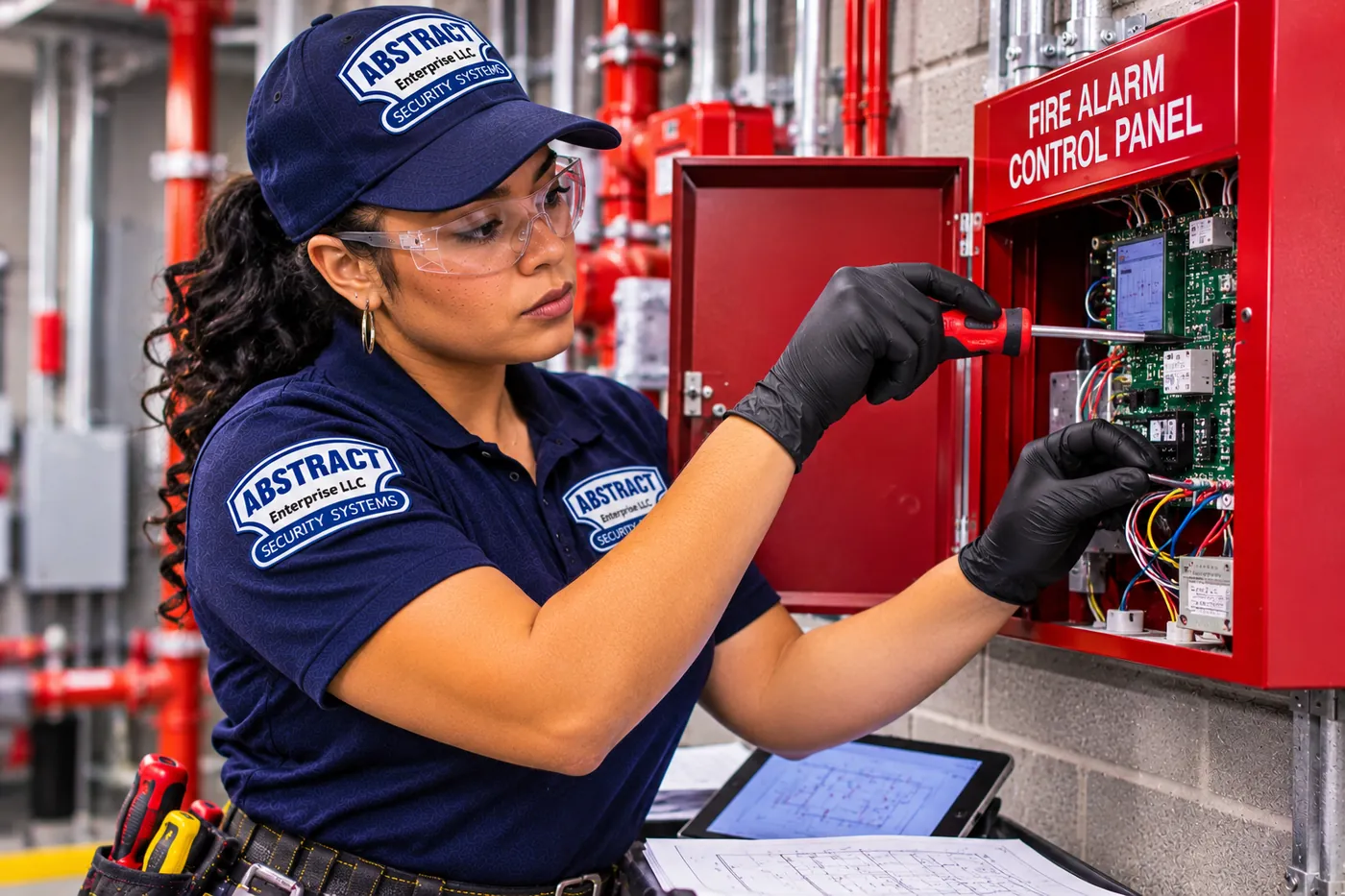
Fire alarm control panel wiring in City Line, Brooklyn: technician working inside an open red fire alarm control panel with a tablet showing drawings on the bench
A technician reaches into an open red fire alarm control panel with a screwdriver while a tablet showing drawings lies on the bench. Upgrades to older City Line panels start with the existing wiring and the approved drawings side by side.
Coverage Area

Fire Alarm Installation Near City Line Landmarks

These are the places City Line residents use to give directions. Our technicians travel to City Line from our office at 1282 Troy Ave, Brooklyn.

Grant Avenue station

The A line's easternmost Brooklyn stop, at Grant and Pitkin Avenues, opened April 29, 1956; east of it the line climbs onto the old Fulton Street elevated. About 1.14 million riders used it in 2025.

St. Sylvester's Church

The parish church at 416 Grant Avenue, its grounds running along McKinley Avenue from Eldert Lane to Grant, with the former parish school building at 396 Grant Avenue.

Engine 236

The Romanesque Revival firehouse at 998 Liberty Avenue, built in 1895 for Brooklyn's Engine 36 and renumbered Engine 236 in 1913.

City Line Park and Transit Tech

A park assembled between 1937 and 1949 on the site of the old Ridgewood Pumping Station, beside Transit Tech High School at 1 Wells Street, which enrolls about 1,542 students.

Forbell Street

Co-named Mizanur Rahman Way above Liberty Avenue, home to the neighborhood's best-known mosque, built in adjoining houses.

Eldert Lane

One of the streets where the Brooklyn–Queens border runs down the middle; Brooklyn houses line its west side.

We also serve the neighboring Brooklyn areas of Cypress Hills, East New York, Highland Park and Brownsville.

Pricing

How Fire Alarm Installation Is Priced in City Line

How much does commercial fire alarm installation cost in City Line? There is no honest single number, because every system starts with engineer-designed, sealed drawings, and the drawings alone are a significant professional fee before any equipment is bought. Fire alarm installation cost, fire alarm system installation cost, commercial fire alarm installation cost and fire alarm installation pricing are set by four stages: the design professional's drawings and calculations; the FDNY filing and plan examination; installation to the approved plans, which depends on the building's walls, ceilings, cellar and occupied floors; and the acceptance test and handover. A converted house with plaster walls and a hall full of people every Friday is a very different job from an open storefront.

So a fire alarm installation estimate, fire alarm installation quote, fire alarm system installation estimate, fire alarm contractor estimate or commercial fire alarm quote from us is written after a survey and once the design scope is clear. The same applies to fire alarm system replacement cost, fire alarm panel replacement cost, fire alarm panel installation cost, how much does fire alarm panel replacement cost, fire alarm system upgrade cost, fire alarm repair cost and fire alarm service call cost: each depends on what the panel and wiring show. Fire alarm inspection cost, fire alarm testing cost and fire alarm maintenance contract cost depend on the number of devices and the inspection schedule. The only fixed figures on this page are government fees with their source, such as the FDNY's $105 FA-27 fee for answering a Notice of Defect. Call (347) 934-8335 to book a survey; we are booked within 2 hours, and the proposal is in writing.

Full terms — including 50% deposit, one-year parts-only warranty on Abstract Enterprises Security Systems-supplied products, and the late-fee schedule — are set out in the service agreement.

Choosing a Contractor

Choosing Fire Alarm Installers for a City Line Building

Who installs commercial fire alarm systems in New York City? An FDNY-certified fire alarm company, with a licensed electrician performing the wiring, working from drawings sealed by a New York State Professional Engineer or Registered Architect. How do I find a licensed fire alarm contractor? Ask any company you are considering for its FDNY Fire Alarm Company Certificate, the name of its principal who holds the S-97 Certificate of Fitness, the licensed electrician who will be on your filing, and recent FDNY-accepted jobs in buildings like yours. Fire alarm contractor licensing in New York City is checkable, and a qualified company expects to be asked.

The words people search for, such as fire alarm installers, fire alarm installers near me, fire alarm installation near me, fire alarm contractors near me, fire alarm companies near me or local fire alarm installation company, all lead back to the same test. A fire alarm contractor, fire alarm company, fire alarm service company, fire alarm system contractor, commercial fire alarm contractor or commercial fire alarm installation company is only right for a City Line hall or storefront if it works under the FDNY certificate, coordinates with your design professional, and can explain the filing. Being close by helps with service calls; it does not replace the certificate.

For fire alarm installation contractors for commercial buildings, look for experience with the building type in front of you. A licensed fire alarm installer who has handled prayer halls in converted houses knows to ask about the women's section, the overflow cellar and the holiday crowd. A certified fire alarm technician who services elevator buildings knows how recall, door releases and the sprinkler riser tie together. An experienced fire alarm contractor will raise the schedule problem, the 20-to-24-week FDNY window, before the committee or the owner sets a date. The best commercial fire alarm installer for a City Line building is not the one with the lowest number on the first call; it is the one whose proposal names the people responsible and whose systems pass the acceptance test the first time. Commercial fire alarm installers, a fire alarm installation contractor and a commercial construction fire alarm contractor all deserve the same questions, and so does an industrial fire alarm contractor working in a garage on Atlantic Avenue.

We are a fire alarm installation service working under NYS license #12000287431, owner-operated since 2002, with thousands of jobs completed across our services and a 4.7-star rating from 201 Google reviews. On every fire alarm project, our written proposal names the FDNY-certified fire alarm company and the licensed electrician who will appear on the filing, so the owner knows exactly who is accountable. Fire alarm compliance contractor work, correcting violations and deficiencies, follows the same rule.

Integration

How a City Line Fire Alarm Works With Sprinklers, Elevators, Fans, Doors and Sound Systems

A fire alarm in a City Line building rarely works alone. Fire alarm system integration ties the panel to the other systems that change what happens in a fire, and every connection is shown on the approved drawings and demonstrated at the FDNY test.

Sprinklers. Fire alarm sprinkler monitoring installation connects the sprinkler system to the panel. Sprinkler waterflow switch monitoring reports water moving in the pipes, which means a head has opened, and sprinkler tamper switch monitoring reports a control valve that has been closed. In older City Line buildings where only part of a cellar is sprinklered, the drawings show exactly which valves are supervised.

Elevators. In the newer elevator buildings on Liberty Avenue and elsewhere, fire alarm elevator recall integration and the elevator fire alarm interface send the car to the designated floor when lobby or machine-room detectors activate, and keep it there for firefighters.

Fans and ducts. Fire alarm HVAC shutdown integration stops air handlers so smoke is not pushed through the building, and fire alarm duct detector integration lets the duct detectors themselves trigger the shutdown. A hall with rooftop units that serve the prayer floor and the cellar needs both.

Doors. Fire alarm door release integration and fire alarm magnetic door holder release let doors held open for crowds close automatically when the alarm sounds, keeping smoke out of stairs. Fire alarm access control interface unlocks doors on the exit path where the code requires it, so a locked door never traps people inside.

Suppression, smoke control and kitchens. Fire alarm suppression system interface and fire alarm kitchen hood suppression monitoring report when a kitchen hood system discharges or is impaired. Fire alarm smoke control interface applies in larger buildings with engineered smoke control.

Sound systems. In prayer halls and banquet rooms with microphones and amplifiers, a relay from the panel mutes the sound system so the alarm can be heard. This is a small part of the design that matters a great deal on a crowded Friday.

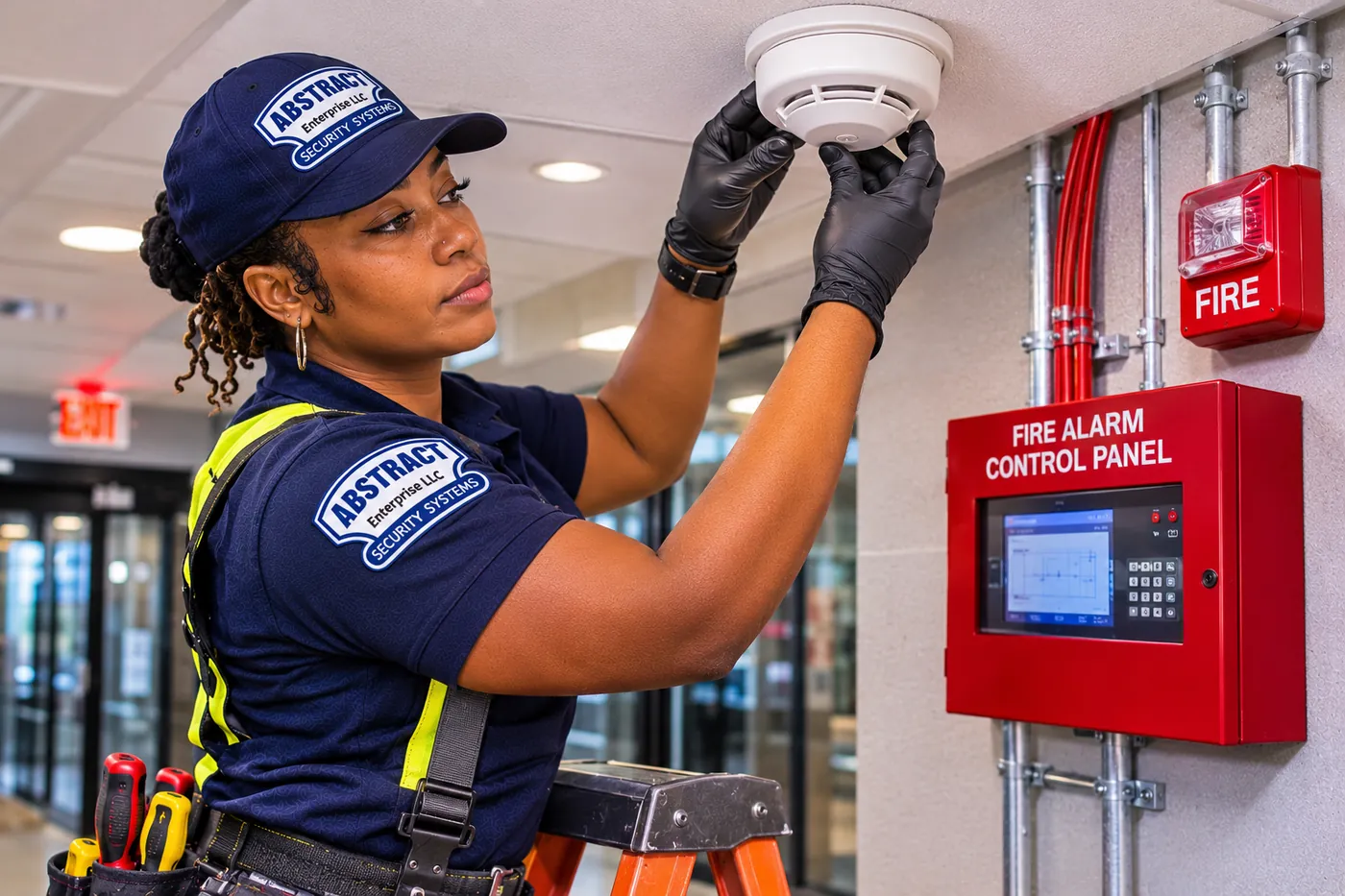
Commercial smoke detector installation in City Line, Brooklyn: technician on a stepladder fitting a ceiling smoke detector near a wall-mounted fire alarm control panel and strobe
A technician in a safety vest reaches up to fit a smoke detector to a ceiling, with a red fire alarm control panel and strobe on the wall behind her. Storefronts and offices on Liberty and Pitkin Avenues get detection laid out to the engineer's drawings.
Construction

New Construction, Changes of Use and Fit-Outs in City Line

New construction fire alarm installation in City Line usually means a six- to eight-story building with stores below, built on a lot that once held a frame house or a garage. Coordination starts before the walls close: the design professional's drawings, then fire alarm shop drawings prepared for the equipment actually being installed, then rough-in alongside the electricians and sprinkler fitters. At the end, fire alarm as built drawings record what was really installed so the next technician does not have to guess.

Tenant improvement fire alarm installation and tenant fit out fire alarm installation are the everyday version of the same work. A grocery taking a new storefront, a nonprofit adding a classroom or a sweet shop putting in a kitchen all change the space the building's fire alarm protects. Where the building already has an approved system, the tenant's work becomes a modification of the owner's system, filed and tested under the building's approval.

Changes of use deserve the most attention in City Line. A house becoming a prayer hall, a store becoming a banquet room, or a cellar becoming a classroom can move a building into a different occupancy group with different fire alarm requirements. The design professional decides whether a system is required and how it must be designed, and the change often involves the Department of Buildings as well as the FDNY.

Permits and approvals in City Line

Does my building need a fire alarm permit? If a fire alarm system is being installed, altered or replaced in New York City, it goes through FDNY plan review and acceptance; fire alarm permit requirements and the fire alarm installation permit process begin with the design professional's filing, not with the installer. The fire alarm system approval is the FDNY's Letter of Approval, issued after the fire alarm acceptance inspection confirms the system matches the approved plans. Fire alarm system design requirements come from the NYC Building Code, the Fire Code and NFPA 72; fire alarm system inspection requirements set what must be tested after approval and how often. The FDNY Fire Alarm Inspection Unit performs the witnessed tests, and the central station connection must be active before the test is scheduled.

Fire alarm notification appliance installation in City Line, Brooklyn: technician drilling a red horn strobe onto a corridor block wall above a pull station
A technician drills a red horn strobe into a painted block wall above a pull station, with an exit sign down the corridor. Corridors in new City Line buildings get notification placed to the engineer's layout before finishes go on.
Complete Services

Every Fire Alarm Service for City Line and Nearby Brooklyn

City Line owners, committees and managing agents often have buildings elsewhere in Brooklyn. Each page below covers commercial fire alarm installation, repair, upgrades and inspection support written for that area's own buildings.

Brooklyn borough page

Fire alarm installation Brooklyn: the borough overview and the FDNY path for every neighborhood.

Citywide FDNY path

Commercial fire alarm across New York City: sealed drawings through the Letter of Approval.

Existing buildings

Fire alarm work in existing buildings: troubles, ground faults, Notices of Defect and replacements.

New construction

Fire alarm for new buildings and fit-outs: TM-1 drawings through FDNY acceptance.

North of Atlantic Avenue

Fire alarm work in Cypress Hills and Highland Park.

West and south

Fire alarm work in East New York and Brownsville.

Property managers

Property management fire alarm services for agents with several City Line mixed-use buildings: one inspection calendar, one set of records, one contact.

Written proposal

Request a City Line survey, booked within 2 hours, with a written proposal after the walk-through.

FAQ

City Line Fire Alarm Installation FAQ

Is Abstract Enterprises Security Systems' office in City Line?
+

No. Our technicians travel to City Line from our office at 1282 Troy Ave, Brooklyn. Call (347) 934-8335 and the survey is booked within 2 hours of your request.

Our masjid is planning an Eid gathering in the cellar hall. Does the fire alarm have to cover the cellar?
+

If the cellar is used for assembly, it has to be part of the design. The design professional counts the cellar's floor area and exits when calculating the building's occupant load, and a cellar used for prayer or meals needs detection and notification shown on the approved drawings.

Can a prayer hall's fire alarm announcements be in Bengali as well as English?
+

Where a voice system is required or chosen, recorded messages can be prepared in more than one language, subject to the design professional and the FDNY approval. Most small halls use horns and strobes rather than voice, so the more common step is training the committee and posting instructions in the languages the congregation reads.

Does a madrasa or weekend class held in our building change the fire alarm design?
+

It can. Regular classes for children are an educational use, and adding one to a building can change its occupancy and fire alarm requirements. Tell the design professional about every regular use of the building, not only the main one.

Who keeps the fire alarm records when our mosque committee changes every few years?
+

Keep the FDNY Letter of Approval, approved and as-built drawings, test reports, the service company's details and the central station contract in a binder near the panel, with a copy held by the board. New officers inherit the system along with the building.

Our grocery on Liberty Avenue added a walk-in cooler. Do the fire alarm devices need to move?
+

Possibly. A new cooler can block detectors, notification appliances or a pull station's access. Any relocation on an approved system is a modification handled by the certified company, so call before the cooler is installed rather than after.

We are building on a lot on Pitkin Avenue. When should the fire alarm contractor be involved?
+

Before the walls close. The design professional's drawings are filed early, then shop drawings, then rough-in alongside the electrical and sprinkler work. Bringing the fire alarm contractor in at the end is the most common cause of delays at the acceptance test.

Does the building's borough matter for a fire alarm filing near Eldert Lane?
+

The FDNY rules are the same across the city, but the filing must carry the correct borough, block and lot. On streets where the borough line runs down the middle, we confirm the property record before anything is filed.

Can a congregation volunteer help with fire alarm work to save money?
+

Volunteers can help with preparation such as moving furniture or clearing access. The fire alarm work itself must be done by the FDNY-certified company and licensed electrician on the filing.

Our auto shop on Atlantic Avenue has a sprinkler system but no fire alarm panel. Is that allowed?
+

It depends on the building's occupancy and size and on how the sprinkler system was approved. Some sprinkler systems must be supervised by a fire alarm panel or monitored by a central station. A design professional can tell you what applies to your building.

What should a City Line owner do before the FDNY acceptance test?
+

Make sure every space is accessible, every device is uncovered, the central station account is active and the approved drawings are on site. Tell tenants and congregants when the alarm will sound so nobody evacuates or calls 911.

How far ahead should a mosque or church book a fire alarm survey before Ramadan or a major holiday?
+

Months ahead. With design time plus the FDNY's estimate of about 20 to 24 weeks from plan submission to approval, a new system for a holiday opening should be started the previous autumn or earlier.

Sources

Sources for This City Line Page

Every local fact, figure and quote on this page comes from the sources below. Code references reflect FDNY and DOB guidance in effect in November 2026; the design professional on your project confirms how it applies to your building.

All Areas Served

Fire Alarm Installation Across Brooklyn Neighborhoods

City Line is one of the Brooklyn neighborhoods we cover from our office at 1282 Troy Ave. Each page below is written for that neighborhood's own buildings and streets. Start with the Brooklyn fire alarm installation page or the NYC fire alarm installation hub.

Greenpoint · Williamsburg · South Williamsburg · East Williamsburg · Bushwick · Wyckoff Heights · Ridgewood · Downtown Brooklyn · Brooklyn Heights · Cadman Plaza · DUMBO · Vinegar Hill · Fulton Ferry · Brooklyn Navy Yard · Columbia Street Waterfront · Boerum Hill · Cobble Hill · Carroll Gardens · Gowanus · Fort Greene · Clinton Hill · Prospect Heights · Park Slope · South Slope · Greenwood Heights · Windsor Terrace · Prospect Park South · Prospect Lefferts Gardens · Crown Heights · Bedford-Stuyvesant · Stuyvesant Heights · Ocean Hill · Weeksville · Brownsville · Flatbush · Ditmas Park · Fiske Terrace · Beverley Square · Kensington · Midwood · East Flatbush · Wingate · Remsen Village · Sunset Park · Brooklyn Chinatown · Bath Beach · Fort Hamilton · Dyker Heights · Bensonhurst · New Utrecht · Mapleton · Borough Park · Ocean Parkway · Gravesend · Homecrest · Madison · Sheepshead Bay · Manhattan Beach · Brighton Beach · Coney Island · Sea Gate · Gerritsen Beach · Marine Park · Mill Basin · Bergen Beach · Flatlands · Canarsie · East New York · Cypress Hills · Bay Ridge · New Lots · Spring Creek · Starrett City · Highland Park

Outside Brooklyn we also cover Manhattan · Queens · the Bronx · Staten Island · Long Island · Nassau · Suffolk · Hudson Valley · Westchester · Rockland · Orange · Putnam · Dutchess · Ulster.

Book a City Line Fire Alarm Survey

From a sweet shop fit-out on Liberty Avenue to an overflow prayer hall in a Forbell Street cellar, the first step is a survey of the whole building and a written proposal. Owner-operated since 2002, NYS license #12000287431, booked within 2 hours.