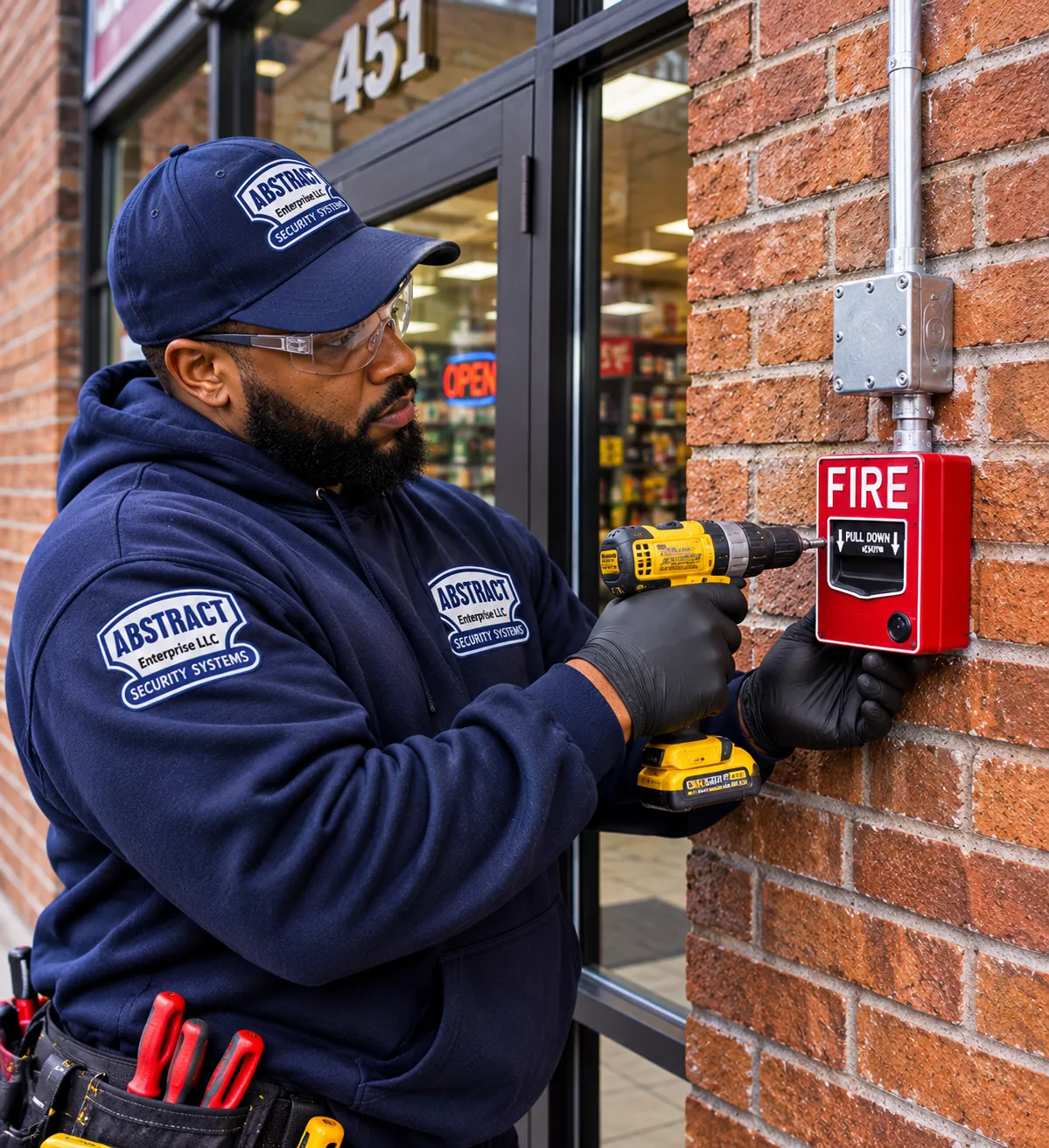
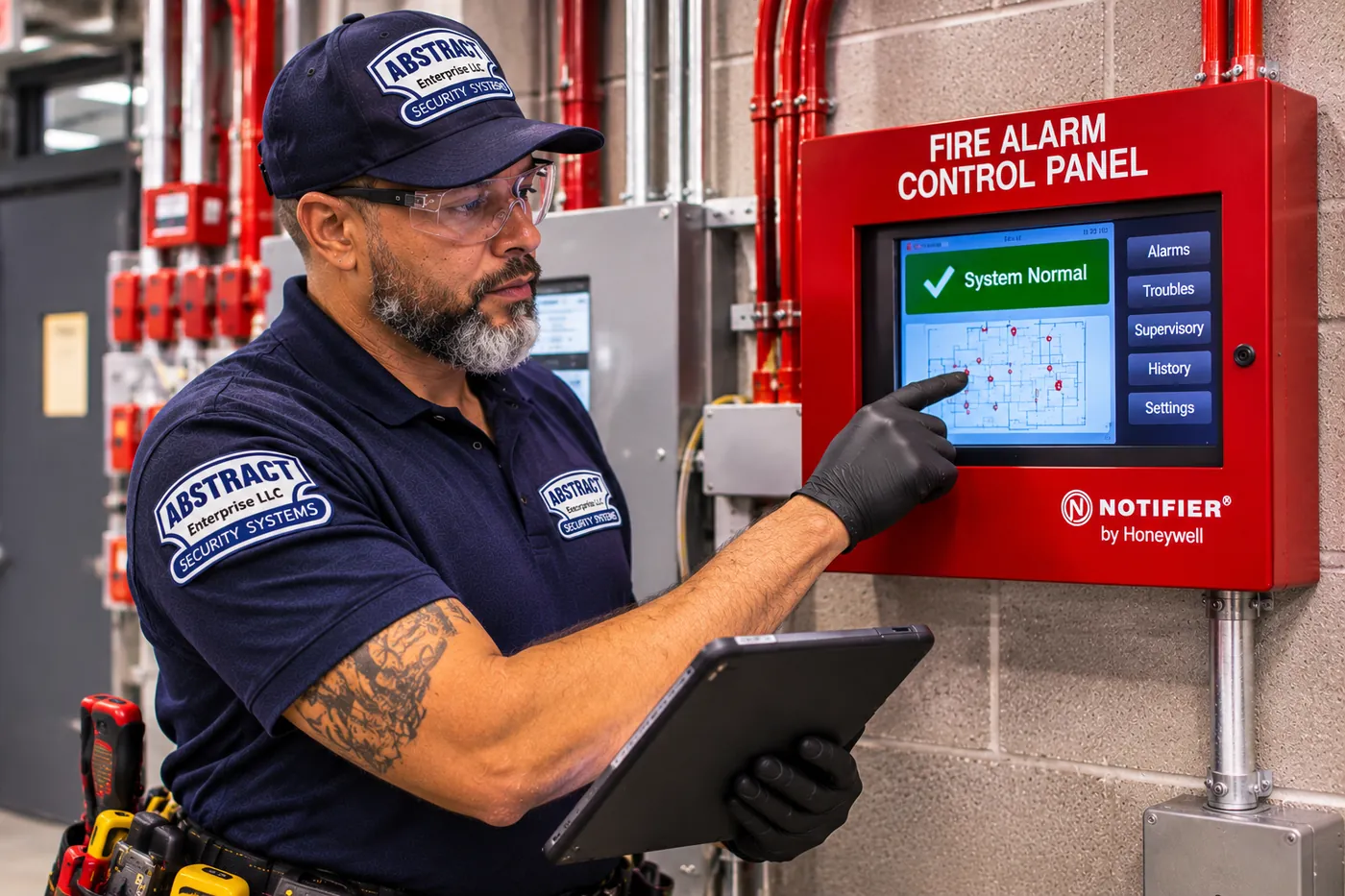
NFPA 72 Commercial · Industrial Lofts Changing Use, Music Venues & Taprooms, Film Studios, Warehouses, New Affordable Campuses, NYCHA & Schools · FDNY TM-1
Fire alarm installation in East Williamsburg usually begins with a change of use: a steel shop that becomes a concert hall, a warehouse that becomes a brewery and tasting room, a factory floor that becomes offices, a film studio or a mixed-use building. Abstract Enterprises Security Systems helps owners, tenants and builders inside the North Brooklyn Industrial Business Zone get a code-required commercial fire alarm from engineer-sealed drawings through FDNY plan approval, installation and the witnessed acceptance test.
Updated November 2026 by Abstract Enterprises Security Systems, NYS license #12000287431 · Sources: FDNY Tips for Fire Alarm Systems; FDNY Fire Alarm Company Certificate FAQ; NYC Department of Buildings; NYC Department of City Planning; NYCEDC; amNY; News 12 Brooklyn; ABC7; Bushwick Daily; 6sqft; The Greenline

Owner-operated since 2002 · Thousands of jobs completed · Booked within 2 hours
Fire alarm installation in East Williamsburg follows the same order for every code-required building: a New York State licensed Professional Engineer or Registered Architect designs and seals the drawings for the new or changed use, the FDNY examines them through a TM-1 filing and issues a Project Authorization, an FDNY-certified fire alarm company and a licensed electrician install what was approved, and the FDNY Fire Alarm Inspection Unit watches the system work before it accepts it. What makes this neighborhood different is that the building almost never stays what it was. A space approved for storage or manufacturing that starts hosting a crowd, serving drinks or sleeping people is a different occupancy, and the fire alarm has to follow the new legal use, not the old one.
East Williamsburg buildings need commercial fire alarm installation at the moment they change use, because the neighborhood's industrial stock keeps being turned into places where many more people gather than the buildings were designed for. A fire alarm sized for a few workers in a storage building is not the system the code requires once two hundred people are standing in the same room after dark, and most of the trouble we are called about starts when that gap is noticed late.
The reason is what East Williamsburg is. Most of the neighborhood sits inside the North Brooklyn Industrial Business Zone, which the Department of City Planning studied as a single 1,066-acre area running along Newtown Creek through Greenpoint, East Williamsburg and Bushwick, on the Queens border. The city's draft North Brooklyn Industry and Innovation Plan counted about 19,500 jobs in that study area in 2016, 77 percent of them industrial: food wholesalers supplying restaurants and supermarkets, fuel depots, recycling and waste processing, construction suppliers, sign makers and artisan manufacturers, film production, and alongside them restaurants, entertainment venues, art studios and galleries, and tech and media offices. DCP called it "the most in-depth industrial area study that DCP has conducted in decades."
The numbers inside that study explain our phone calls. Between 2010 and 2016 the number of industrial businesses in the study area grew by 85, about 12 percent, while non-industrial businesses grew by 219, about 61 percent. The fastest-growing tenants were the venues, bars, studios and offices moving into factory and warehouse buildings, each a potential change of occupancy under the NYC Building Code; the plan even proposed limiting entertainment uses in the core industrial area.
The argument continues. When the city released its draft NYC Industrial Plan in September 2025, Council Member Jennifer Gutiérrez said "The City's new plan for our manufacturing zones puts good jobs and local businesses at risk," and Evergreen, the North Brooklyn business exchange founded in 1982, called mixed-use zoning in unprotected industrial areas "a blueprint for gentrification." The Greenline put North Brooklyn's industrial jobs at about 28,600 and the IBZ third largest in the city. Whatever the zoning becomes, every change of use sends a design professional back to the fire alarm question.
The clearest examples are a few blocks apart. Brooklyn Steel at 319 Frost Street opened in April 2017 in a former steel fabrication plant as an 1,800-person general admission hall, which amNY reported could shrink to 1,200 with a movable stage; Bowery Presents partner John Moore said, "It's a steel fabrication plant and we wanted to embrace that and use as much of the original aesthetic as we could." Interboro Spirits and Ales opened in 2016 at 942 Grand Street between Waterbury Street and Morgan Avenue as a brewery, distillery and taproom under one roof. And on Seigel Street, Bungalow Projects filed plans in 2024 for a 307,443-square-foot studio with five soundstages, which NYCEDC described in October 2025 as Echelon Studios: a six-floor building with six column-free soundstages and 40 feet clear to the grid. Commercial Observer places that site in East Williamsburg and NYCEDC calls it Bushwick, which is fair: it sits on the line.
| Fact | What it means for a fire alarm | Source |
|---|---|---|
| North Brooklyn IBZ study area: 1,066 acres along Newtown Creek; ~19,500 jobs in 2016, 77% industrial; non-industrial businesses up 61% from 2010 to 2016 | A steady stream of venues, bars, studios and offices moving into buildings built for industry; each change of use reopens the fire alarm design | NYC Department of City Planning, North Brooklyn Industry and Innovation Plan |
| Brooklyn Steel, 319 Frost St: former steel fabrication plant, 1,800 capacity, opened April 2017 | Assembly occupancy inside an industrial shell: voice evacuation, high-ceiling detection, show-control shutdowns | amNY, April 5 2017 |
| Seigel Street studio: 307,443 sq ft and five soundstages filed 2024; Echelon Studios six floors, six soundstages, 40 ft clear to grid, below-grade parking (2025) | Very large open volumes, a parking level and offices on one system: beam or air sampling detection, garage interfaces, phased acceptance | Commercial Observer; NYCEDC, Oct 8 2025 |
| Kingsland Commons, former Greenpoint Hospital campus on Maspeth Ave: nearly 500 family and 110 senior affordable homes, a 200-bed shelter; 18-story phase two lottery opened October 2026 | Sleeping occupancies, a 24-hour front desk and several buildings brought online in phases | 6sqft, Oct 30 2026; New York Housing Conference |
So we start every East Williamsburg job by asking what the space was approved for, what it will be used for, and how many people will be in it at once.

Fire alarm repair in East Williamsburg usually starts with one question: what changed in the space since the system last worked? In converted buildings a new trouble is very often a tenant's build-out, a rigging change or a forklift that met a conduit, not a worn-out device.
When the call comes in, our emergency fire alarm technician first asks the caller to read the panel display word for word and send a photo, then books a visit. When a technician is free the same day we offer same day fire alarm repair; when the building cannot detect a fire or warn people, we treat it as urgent fire alarm repair and move it ahead of routine work; and for venues, taprooms and residences that are open at night we provide after hours fire alarm service. We do not sell 24 hour fire alarm repair as a slogan; we say honestly when the next technician can be there, and if the system is out of service the FDNY expects the owner to keep a fire watch until it is restored. That is emergency fire alarm repair, emergency fire alarm service and emergency fire alarm troubleshooting in practice.
The faults follow the buildings. In old warehouses near Newtown Creek and along Morgan Avenue, fire alarm ground fault repair and fire alarm ground fault troubleshooting come up again and again, because old conduit in unheated space sweats and lets water into boxes. In venues, fire alarm false alarm troubleshooting often ends at a haze or fog machine, a detector that was never relocated after the rigging grid changed, or dust from a load-in. In breweries and kitchens it ends at steam or heat in the wrong place. In mixed-use rows on Grand Street, fire alarm communication failure repair is common after a phone line is cut over or a building's internet provider changes. Fire alarm battery trouble repair shows up whenever a tenant's electrician has switched off the wrong breaker and drained the standby batteries.
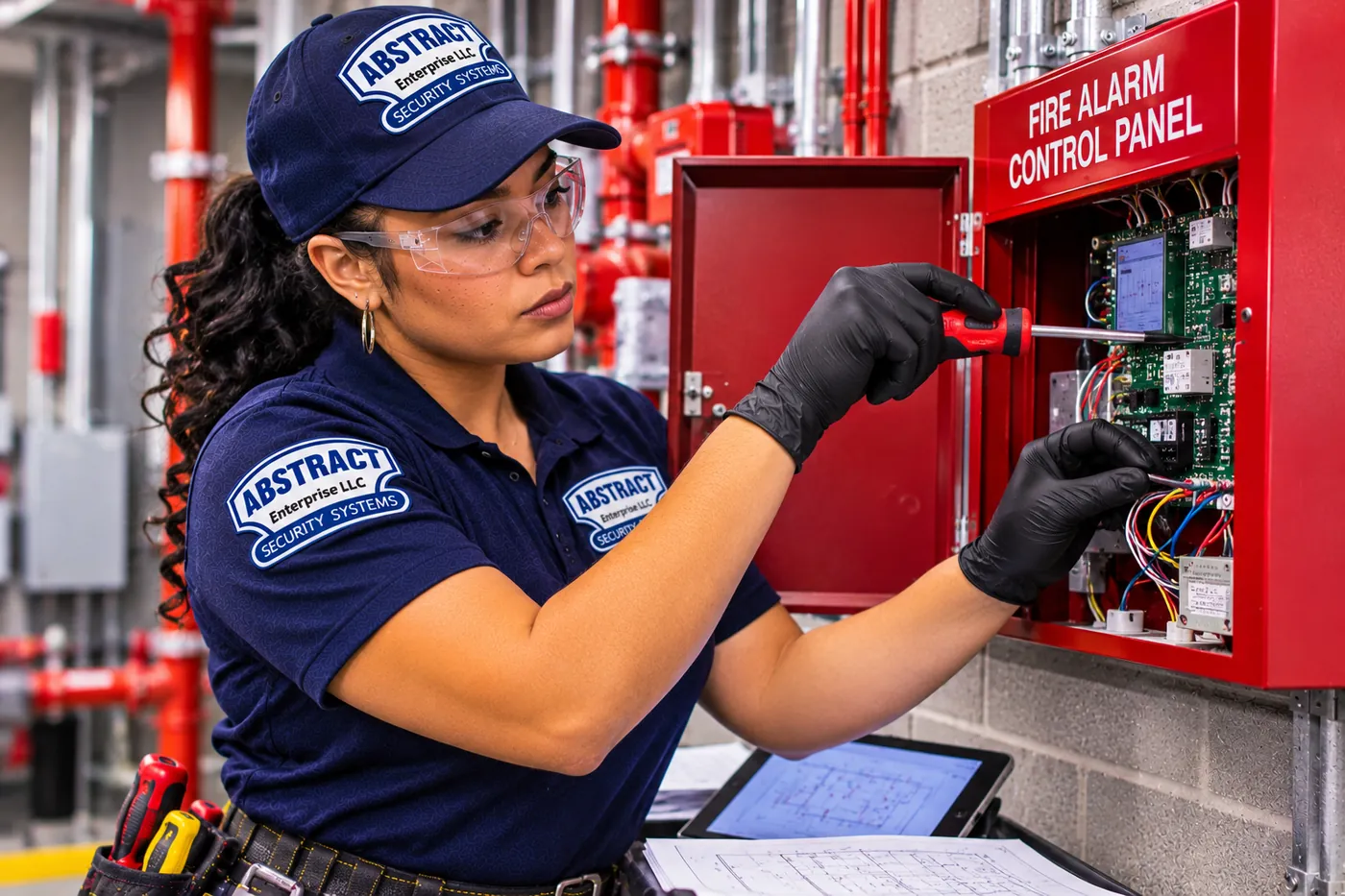
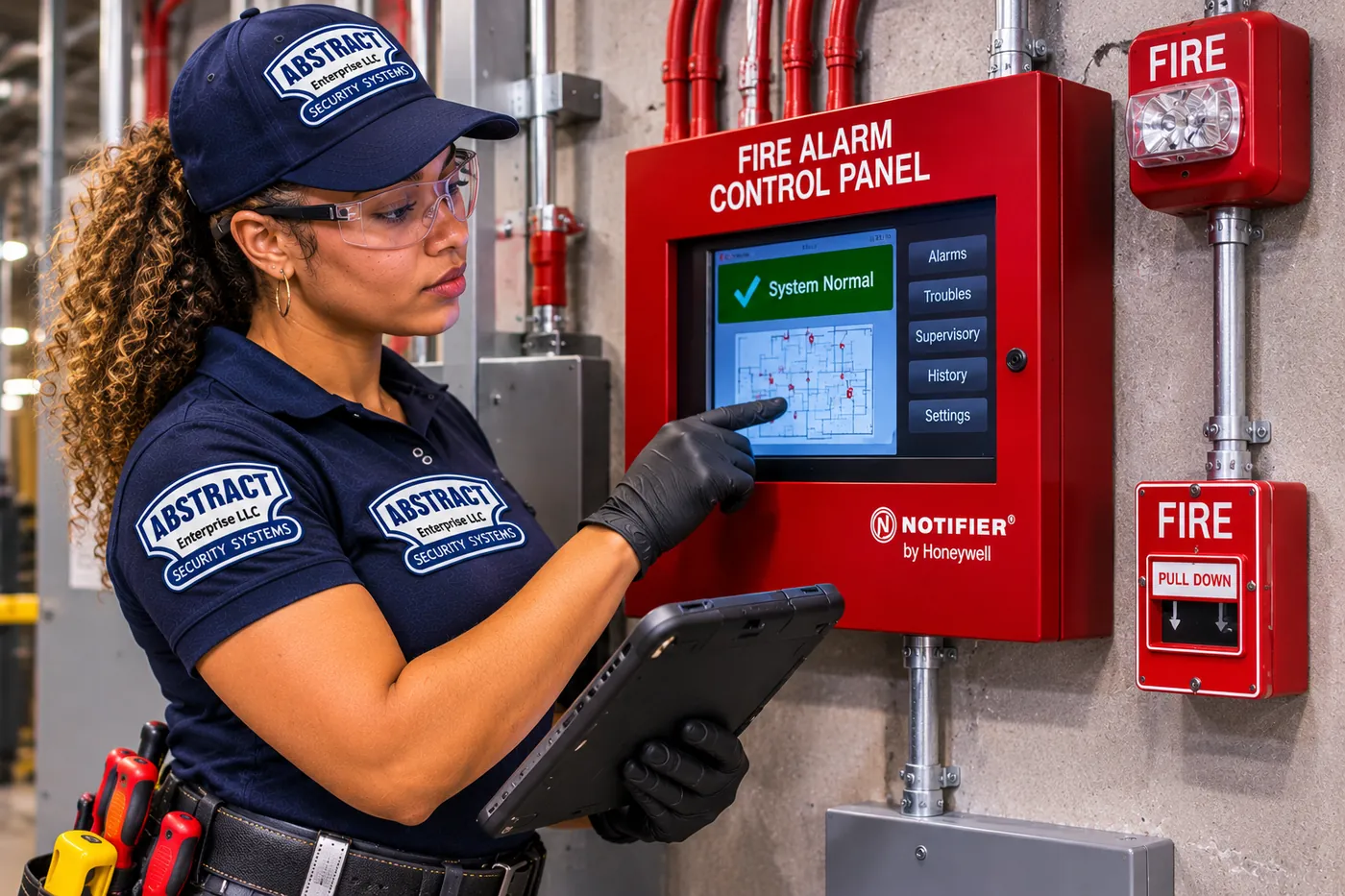
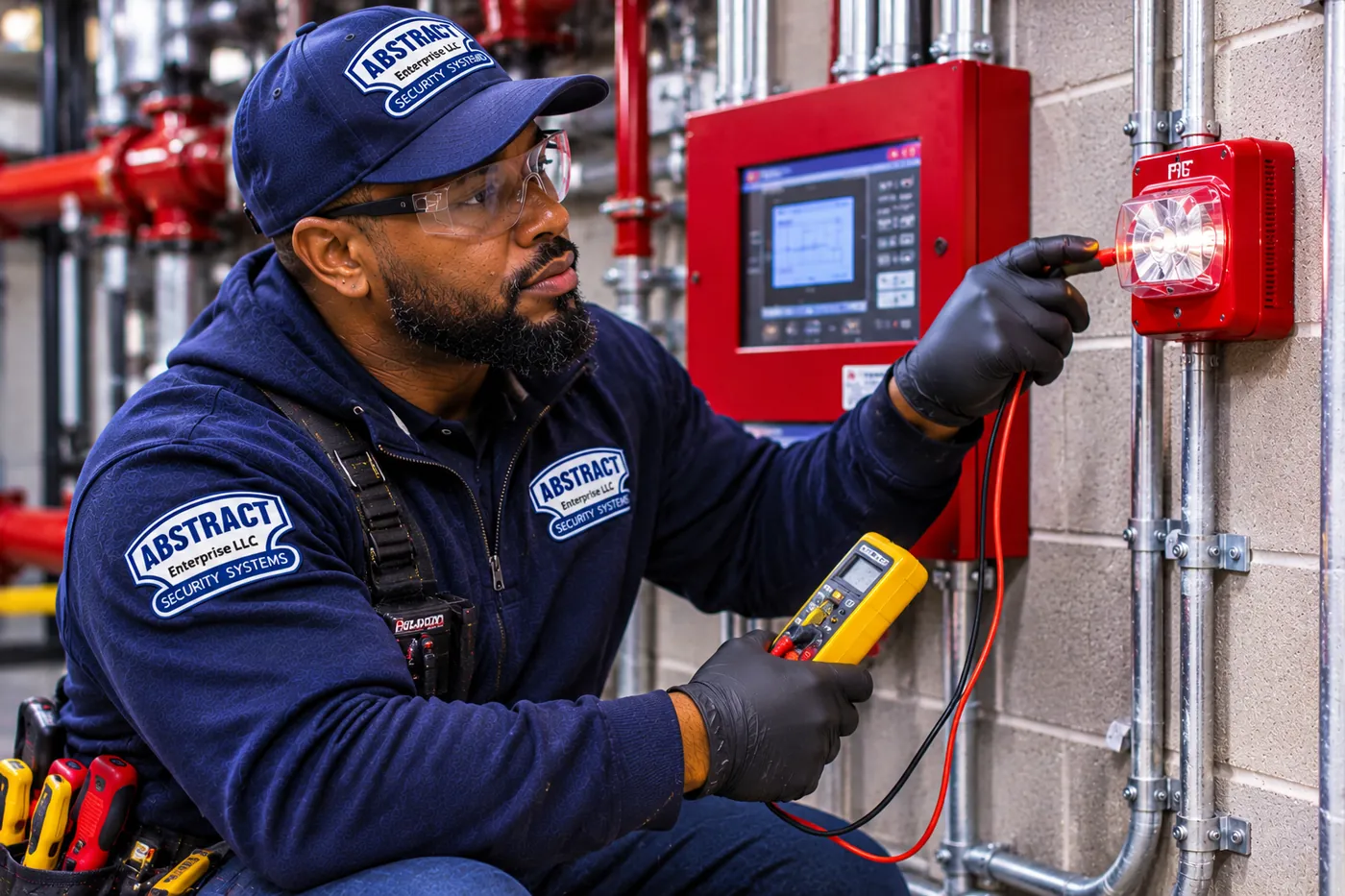
Two questions come up on nearly every first call. Why is my fire alarm panel showing trouble? Because the panel supervises its wiring, power and devices, and a trouble means one of them is not where the panel expects, from a detector behind a new wall to a cut wire: not a fire, but a gap in protection. What causes a fire alarm ground fault? A conductor touching ground, usually through water in a box, a jacket nicked on a sharp stud, or a staple through a cable. A fire alarm system trouble condition that will not clear is a job for commercial fire alarm troubleshooting by a fire alarm service technician with the drawings in hand. On an addressable panel, addressable fire alarm troubleshooting starts from the device address the panel reports; fire alarm control panel troubleshooting and fire alarm control panel repair start from its event log. Either way it ends in fire alarm system repair that is retested and written down.
Fire alarm panel beeping repair is the most common call: silencing the buzzer stops the sound, not the problem. Fire alarm intermittent trouble usually traces to a loose splice, an aging device or a cable that moves when a freight elevator runs. Fire alarm trouble signal repair, fire alarm trouble emergency service for a lost floor and fire alarm communication failure emergency repair get the same treatment: find it, fix it, prove it, write it down. Fire alarm panel failure repair or fire alarm system malfunction repair is quick if parts exist; for an out-of-production panel it starts the replacement conversation. Commercial fire alarm emergency repair on a supervisory signal, fire alarm supervisory trouble from a sprinkler valve someone closed during a fit-out, is the one we most want to hear about immediately, because a closed valve leaves sprinklers without water.

Commercial fire alarm installation in East Williamsburg covers every building type the industrial zone has collected, and the work differs more by use than by size. These are the jobs we are asked to price and plan most often, from a first fire alarm installation consultation to the acceptance test.
Assembly systems for halls and event rooms in old industrial buildings: voice, high-ceiling detection, show-sound shutdown.
Heat detection in brewhouses and still rooms, smoke detection in the public room, monitoring of suppression and gas detection.
Large-volume detection for soundstages, coverage for set shops and dressing rooms, and outputs a crew cannot switch off.
Warehouse fire alarm installation: high-rack detection, sprinkler supervision and dock pull stations that survive forklifts.
Industrial fire alarm installation for metal, wood and sign shops where dust, fumes and heat decide the detector.
Office building fire alarm installation for loft-floor tenants, tied into a base building system or new.
Mixed use building fire alarm installation for Grand Street and Bushwick Avenue stores below apartments, where code requires it.
Apartment building fire alarm installation and multifamily building fire alarm installation for the high-rise phases on Maspeth Avenue.
Repair, inspection, testing, panel replacement and code upgrades for systems already in place, including inherited panels.
We are a fire alarm installation company and fire alarm installation contractor that works only where the code calls for a real system: commercial, industrial, institutional, mixed-use and multifamily buildings. Our fire alarm installation service and fire alarm installation services run from the survey through new fire alarm system installation, complete fire alarm system installation and building fire alarm installation in occupied spaces; professional fire alarm installation here means protecting a tenant's stock and schedule too.
Fire detection and alarm installation in buildings with unusual hazards, such as battery storage or spray finishing, starts with the design professional's layout; fire detection system installation and fire alarm equipment installation follow those drawings, never device locations invented on site. Business fire alarm installation for a small tenant may be a modest addition to the base building system, while industrial building fire alarm installation on an empty warehouse may be a whole new commercial fire alarm system installation. Both are commercial building fire alarm installation, both are filed with the FDNY, and both end with commercial fire detection systems and business fire detection systems that match the approved drawings.
Commercial fire alarm systems in East Williamsburg have to be designed for how each building is actually used, often several ways at once.
The defining East Williamsburg job is a factory or warehouse floor that will hold a crowd. Under the NYC Building Code's section 907.2, an assembly occupancy needs a fire alarm system at an occupant load of 300 or more, and the Department of Buildings separately requires a Place of Assembly Certificate of Operation wherever 75 or more members of the public gather indoors. Those two thresholds are different, and owners confuse them constantly: a 150-person tasting room may need a Place of Assembly certificate and a sprinkler review without the full system a 1,800-person hall needs, while a building that already has a fire alarm will need it extended into the new room either way. The design professional decides, from the occupant load on the drawings, not from the number on the liquor license application.
When a system is required, a loft becoming a venue usually needs voice evacuation, detection that works under a steel truss roof, a relay that cuts amplified sound and raises house lights on alarm, and pull stations at exits that bars and merch tables do not block. DOB issues the Place of Assembly certificate and the FDNY then issues and renews an annual Place of Assembly permit after its own inspection.
A brewery or distillery with a taproom is a factory and a bar in one building. Steam from kettles and heat from stills will trip ordinary smoke detectors, so production rooms are normally covered with heat detection chosen by the design professional, while the public room, corridors and electrical rooms get smoke detection. Fixed temperature heat detector installation suits rooms where a sudden rise in temperature is normal, and rate of rise heat detector installation suits storage rooms where it is not. Where the design includes gas detection or a suppression system, the fire alarm monitors it. A commercial kitchen fire detection installation for the taproom's kitchen comes with fire alarm kitchen hood suppression monitoring, so a hood discharge is reported to the panel and the central station.
Soundstages are huge, tall and full of hot lighting, and set shops make sawdust and paint fumes. Spot detectors on a 40-foot grid are hard to reach, so studio designs often use beam smoke detector installation or projected beam smoke detector installation across the stage, or aspirating smoke detection installation. Dressing rooms, offices and below-grade parking each get their own treatment. Productions want quiet, but the fire alarm cannot be something a set crew switches off; the approved sequence of operations decides what happens when a stage detector trips during a take.
Food wholesalers and logistics tenants run tall racks, forklifts and trucks at the dock all day. Warehouse smoke detection installation has to work above high-piled storage and below a roof that may be 25 feet up, which is why beam detectors and air sampling show up here too. Sprinkler waterflow switch monitoring and sprinkler tamper switch monitoring matter more than in almost any other building type, because a closed valve in a warehouse is a disaster waiting for a spark. Storage facility fire alarm installation also covers battery and e-bike storage, which the FDNY treats very seriously; a 2024 warehouse fire on Morgan Avenue near Meserole Street brought out the FDNY hazmat team because of lithium-ion batteries inside.
Many loft buildings are now carved into dozens of offices, art studios, photo rentals and workshops, and every new wall changes where smoke goes. A base building fire alarm can usually be extended into each fit-out, as long as someone checks that no room was left without a detector or strobe. Tenant improvement fire alarm installation and tenant fit out fire alarm installation done this way keep the building's single approval intact instead of stacking undocumented changes on top of it.
Three- and four-story buildings with a store below and apartments above line Grand Street and Bushwick Avenue. Whether a particular building legally needs a fire alarm system depends on its height, number of apartments and the commercial use below, and the design professional answers that. When the store becomes a restaurant, bar or late-night business, the answer can change, and the residents upstairs are the ones exposed. On May 3, 2026, a fire in a three-story building on Grand Street between Catherine Street and Morgan Avenue, a deli below apartments, spread into the building next door and drew more than 200 responders; residents told News 12 the fire alarms did not sound, which officials had not confirmed. We take no position on that building. We do take the lesson: in a mixed-use row the system that matters is the one that reaches the bedrooms.
The Greenpoint Hospital campus on Maspeth Avenue was built in 1915 to treat accident victims from nearby factories. It is being rebuilt as Kingsland Commons by The Hudson Companies and St. Nicks Alliance with HPD: nearly 500 affordable family homes, 110 affordable senior homes, a 200-bed shelter, a health clinic, a café, a senior center and workforce training space on more than four and a half acres. The 18-story second phase opened its lottery in October 2026 with 217 apartments and a 24-hour front desk. High rise fire alarm installation there means a fire command location, voice communication, elevator recall and a desk staff that understands the panel, with an acceptance test per phase.
Cooper Park Houses, eleven seven-story NYCHA buildings opened in 1953 between Kingsland and Morgan Avenues, Frost Street and Maspeth Avenue, had 1,448 residents as of 2025; NYCHA contracts its own fire alarm work. Condominium building fire alarm installation and co-op work in larger private buildings nearby follow the same commercial rules, and property management fire alarm services there are mostly records, tests and a current central station account. The Grand Street Campus at 850 Grand Street, a four-story building opened in 1981 that houses three high schools, is an educational occupancy, which needs a fire alarm regardless of size; school fire alarm installation and testing run on the school calendar.
Retail store fire alarm installation, restaurant fire alarm installation, medical office fire alarm installation for the campus clinic, hotel fire alarm installation, parking garage fire alarm installation, data center fire detection installation for tech tenants' server rooms, manufacturing facility fire alarm installation and shopping center fire alarm installation for a food hall or market. Assisted living fire alarm installation, nursing home fire alarm installation and hospital fire alarm installation we take only with the facility's own engineer and life safety consultant leading.

Business fire alarm installation in East Williamsburg changes block by block, because the streets sort themselves by use. Here is how the main corridors break down and what each tends to need.
Grand Street carries the mixed-use rows, the Grand Street Campus, small manufacturers, the Interboro taproom near Morgan Avenue and, at its east end, the Grand Street Bridge over Newtown Creek into Maspeth, which the city's North Brooklyn plan proposed to replace. West of Morgan the buildings are mostly stores with apartments; east of it they turn industrial.
Around the Morgan Avenue L stop and up toward Cooper Park, the streets mix venues, studios, warehouses and small factories. Brooklyn Steel is on Frost Street. Evergreen and NYCEDC opened the Wesley H. Watson Industrial Center at 500 Stagg Street in March 2022, about 10,000 square feet for three industrial small businesses at below-market rents. Evergreen's executive director Leah Archibald said its mission is "to help small businesses grow so we can keep high-quality working-class jobs in our community." Buildings like that are why industrial fire alarm systems, industrial fire alarm installation and industrial fire detection system installation stay a core part of our work here, and why owners want an industrial fire alarm contractor rather than a venue specialist.
South of Grand toward Flushing Avenue, the cross streets hold warehouses, production studios, wholesalers and new construction, the Seigel Street studio largest among them. On September 29, 2025, a construction site fire at 254 Boerum Street, between Bushwick Place and White Street, went to a second alarm with 25 units and more than 100 firefighters and EMS personnel and spread to 252 Boerum Street. An occupied building next to an open site should keep its own system tested and its central station account current.
Toward the creek the buildings get bigger and the uses heavier: distribution, recycling, fuel and construction materials, alongside the new housing on the hospital campus and the Cooper Park Houses. That is where heat detection, sprinkler supervision and supervising detectors in dirty, cold or wet spaces matter most.
Whatever the corridor, the steps do not change. Every commercial fire alarm contractor working here follows the same NFPA 72 fire alarm installation rules as amended by the NYC Building Code, the same FDNY filing, and the same witnessed test. The FDNY's tips for fire alarm systems put the time from plan submission to final approval at about 20 to 24 weeks, with the first plan review alone taking up to 8 weeks, so a venue or tenant who wants to open in a particular month needs to count backward from it. Fire alarm code compliance in East Williamsburg is not a different standard, only a more frequent one, because the uses change so often.
This is a pattern in converted industrial buildings, not one specific job. A tenant leases a warehouse floor for a bar, show room or event space and asks us to "connect to the building's fire alarm." The lobby panel is real, its FDNY approval hangs beside it, and it works. But that approval describes a storage building: heat detectors, a waterflow and tamper switch on the riser, pull stations at exits and horns in the stairs. It says nothing about a few hundred people in the dark with music at full volume.
So the first job is not wiring. It is putting the existing Letter of Approval and drawings, the Certificate of Occupancy, the planned occupant load and the landlord's limits in front of the design professional, who decides whether the panel can be expanded with voice, detection and show-control relays or must be replaced; panel age and capacity usually decide it. The change is filed with the FDNY, a Project Authorization is issued, and only then do we pull cable.
What most often delays an opening is a sequence nobody wrote down. Who stops the sound system? Which doors release? Does the freight elevator recall? If the answers are on the approved drawings, the acceptance test is a checklist; if not, it becomes a negotiation with the inspector. We write the input and output matrix with the tenant's production staff in the room and test it with them first. Afterward, fire alarm device addressing that matches the zone chart is what lets the next tenant's changes be made in an afternoon.

These are questions East Williamsburg tenants, landlords, venue operators and builders bring to a first call. The answers are general guidance; your design professional confirms how the code applies to your building.
Make the fire alarm a lease term, not a line in your own budget. Before signing, get the landlord's existing Letter of Approval and approved fire alarm drawings, and have a design professional look at them against your planned occupant load. That tells you whether you are extending a system or paying for a new one, and lets you negotiate who pays. A fire alarm contractor estimate before that point is a guess. Ask for a fire alarm system installation estimate only after a survey, and get it broken into design, filing, installation and testing.
Because they are usually not bids for the same work. One assumes the existing panel can take new devices, another a new panel; one includes design and filing coordination, another leaves them to you; one covers brewhouse heat detection, another never walked the production floor. Put both proposals side by side by scope line: drawings, filing, devices by type and count, programming, pre-test, acceptance test and training. A fire alarm system installation proposal that will not break itself down is not one you can compare.
Not for the building's fire alarm system. The FDNY requires the installer to be a New York City licensed electrician or a fire alarm vendor holding an FDNY Fire Alarm Company Certificate, working from approved drawings, and the company must have a principal holding an S-97 certificate of fitness. A production company can provide show power and lighting, and the design can include a relay that tells their system to stop when the alarm goes off, but the fire alarm itself is installed and certified by the licensed and certified team named on the filing.
Ask about the last converted-building tests they ran: who wrote the sequence of operations, and how they handled a freight elevator or a base building panel owned by someone else. Ask which FDNY-certified company and which S-97 holder will be on site for the test. An experienced fire alarm contractor will answer with specifics and with paperwork. Look at Google reviews from commercial customers rather than asking for references.
No. Moving a detector changes the approved layout, and a detector moved by eye can leave the space below the code's spacing. The change goes to the design professional, is drawn and filed if required, and is made by the certified company, which then tests the devices and updates the as-built drawings. Tell us early; a detector relocation planned before the wall goes up is easy, while one discovered by an inspector after the wall is finished is not.
Acknowledging a trouble and calling it in is fine, and every building should have someone who knows how. Replacing batteries in a fire alarm panel, or touching anything inside it, belongs with the certified service company, because battery size is set by the approved calculations and the panel has to be tested afterward. Fire alarm battery replacement is routine work for us and usually quick; the point is that it gets done with the right batteries and recorded.
Haze will trip ordinary smoke detectors, so the design professional plans for it: detection types and locations that suit the room, and a written procedure if any device is to be bypassed during a show, which in New York City brings FDNY rules on fire guards and notification. What does not work is quietly disabling the room's detectors before doors open. Tell your design professional exactly what effects you use, where and for how long, before the drawings are filed.
Normally the amplified sound stops and the house lights come up, so the voice message and strobes can be heard and seen and people can find the exits. That is done with a fire alarm relay module tied to the sound and lighting system, and it is part of the approved sequence of operations. It is also one of the first things the FDNY inspector checks at the acceptance test, so we test it at the pre-test with the venue's own production staff running the board.
That is exactly why designers of very tall spaces lean toward beam detectors, which mount on the walls and can be tested from below with the right equipment, or air sampling systems, where the detection unit sits at floor level and the sampling holes are in pipe near the roof. Both are tested from the floor. Settle the testing method while the design is on paper.
To the FDNY, the building owner is responsible for keeping the fire alarm system in service, whoever caused the damage. Between you and the tenant, the lease decides who pays. The practical fix is a building rule: no tenant electrician touches the fire alarm, and every fit-out goes through your fire alarm company before walls close.
Usually not as a separate code system inside a building that already has one. The normal arrangement is that your space is added to the base building system, with your devices reporting to the landlord's panel and central station. Some tenants add a remote annunciator in their own space so their staff can read the alarm and trouble messages without going to the lobby; that can be designed in. Ask the landlord in writing who services the system, who holds the central station contract and how your staff will be notified of troubles.
The filing is made by the design professional for the building, so the landlord as owner has to sign off whoever pays. Your lease and the sublease should say who hires the design professional, who pays for the work and who keeps the system records. Do not let weekend events start before the change is approved and tested.
Most likely nobody is getting the call. A monitored system should report to an FDNY-approved central station that calls the building's contacts, and the contact list is often years out of date in buildings that changed hands. Update the call list, find out why the alarm is going off, and fix it. The FDNY treats two or more unwarranted alarms from a monitored system in three months as unlawful, so repeated nuisance alarms cost more than an annoyed neighbor.
Read the violation line by line and list exactly what was cited. Some items are repairs, some are documentation, and some mean the system does not match what was approved, which needs the design professional. Fix and test what can be fixed, put the paperwork in order, and answer within the deadline on the notice. If the FDNY issued a Notice of Defect, its FA-27 instructions list a $105 fee for the document submission. Do not run events on a system you know is not working.
A change of use in East Williamsburg starts with the documents the building already has and the crowd you plan to hold. Call before you sign the lease or file with the Department of Buildings, and we will tell you what to ask for.
Which system type fits depends on size, use and who will run it. Within a few blocks of the Morgan Avenue station there are new addressable systems, conventional panels in small factories, and hybrids that have been added to for decades.
Conventional fire alarm installation, conventional fire alarm system installation and conventional fire alarm panel installation for small buildings where a few zones are enough. We also handle conventional fire alarm repair and conventional fire alarm replacement on older panels.
Addressable fire alarm installation, addressable fire alarm system installation, addressable fire alarm panel installation and addressable fire alarm device installation for venues, studios and larger lofts, plus addressable fire alarm system repair and addressable fire alarm system upgrade work.
Intelligent fire alarm installation uses detectors that weigh smoke, heat and sometimes other signals together. An intelligent fire detection system helps in dusty shops and near kitchens where plain smoke detectors false.
Fire alarm voice evacuation installation and fire alarm speaker installation for assembly spaces, tall buildings and schools, with recorded and live messages that tell a crowd what to do.
Beam detection for halls and soundstages; an air sampling smoke detection system, including VESDA installation and VESDA service, where spot detectors cannot be reached or would see too much dust.
Fire alarm communicator installation, fire alarm central station communicator installation and fire alarm monitoring system installation to an FDNY-approved central station.
What is a commercial fire alarm system, compared with the smoke alarms in an apartment? A panel, the devices that detect and report, the devices that warn people, and the connections that summon help and control the building, designed together, filed with the FDNY and tested as one. How does a commercial fire alarm system work? A detector, switch or pull station signals the fire alarm control panel, which sounds and flashes the notification appliances, reports to the central station, and runs the approved sequence: recalling elevators, releasing doors, stopping fans and show sound.
What is an addressable fire alarm system? One where every device has its own address on a signaling line circuit, so the panel reports "stage left beam detector, second floor" rather than "zone 3." What is a conventional fire alarm system? One where devices are wired in zones and the panel only knows which zone went into alarm. What is the difference between addressable and conventional fire alarms in practice? Location, supervision and flexibility: addressable systems find problems faster and adapt to new tenant walls more easily, while conventional systems are simpler and can still suit a small building. Conventional to addressable fire alarm conversion is common when a loft's tenants multiply and a zone covering a whole floor no longer tells anyone anything useful.

Every device on an East Williamsburg fire alarm is there because the approved design puts it there. Here is what each kind does in this neighborhood's buildings.
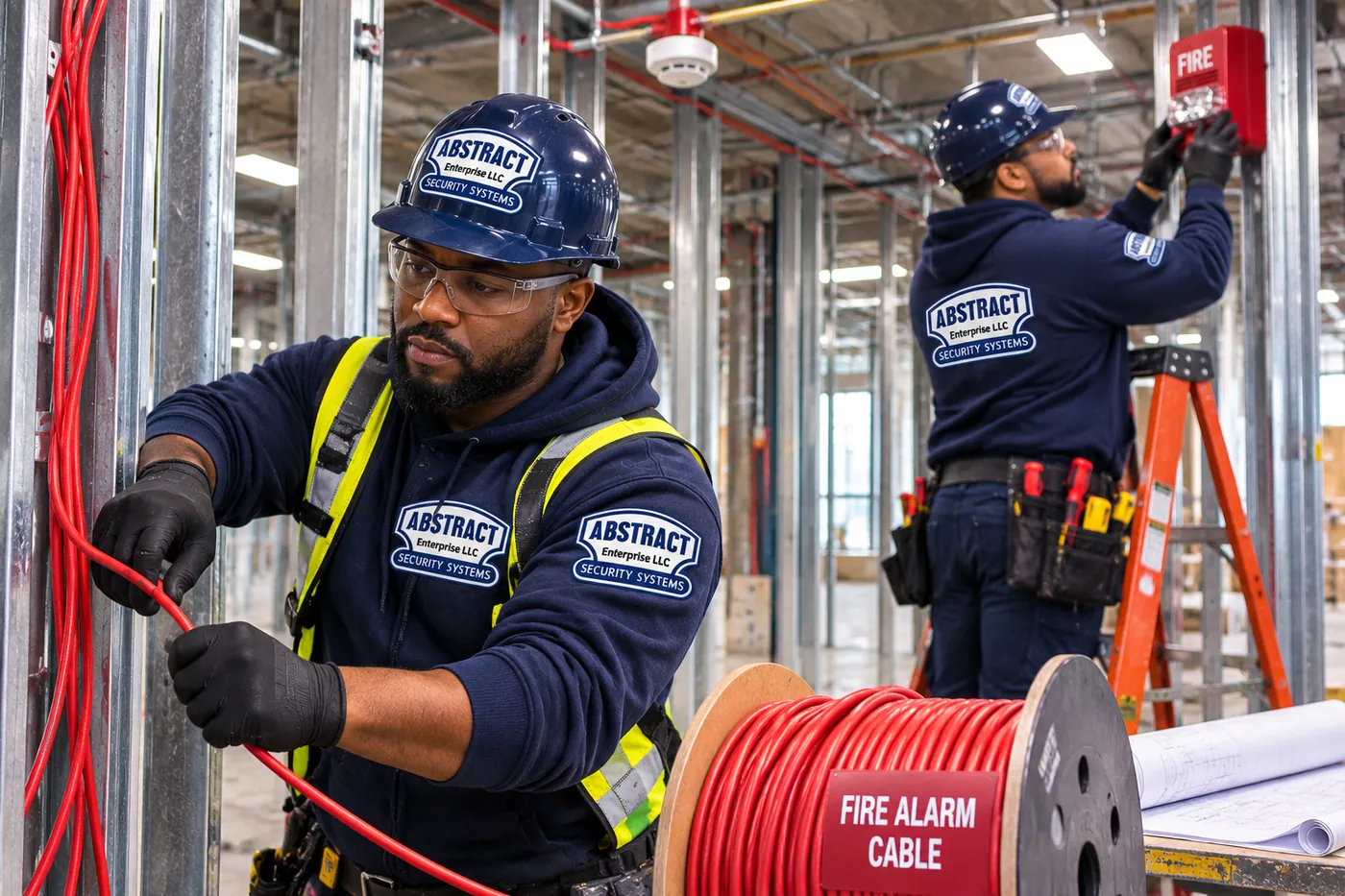
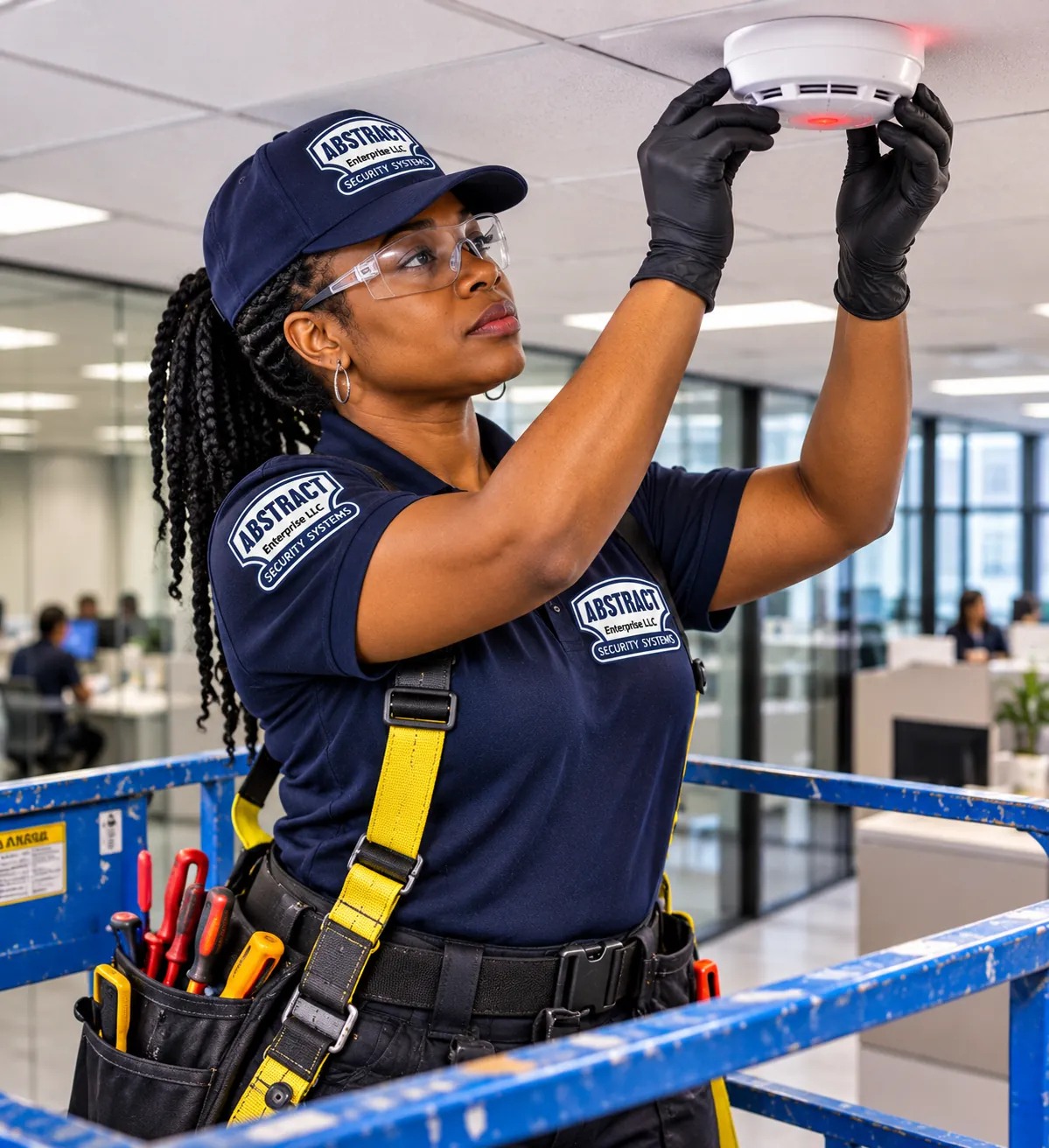
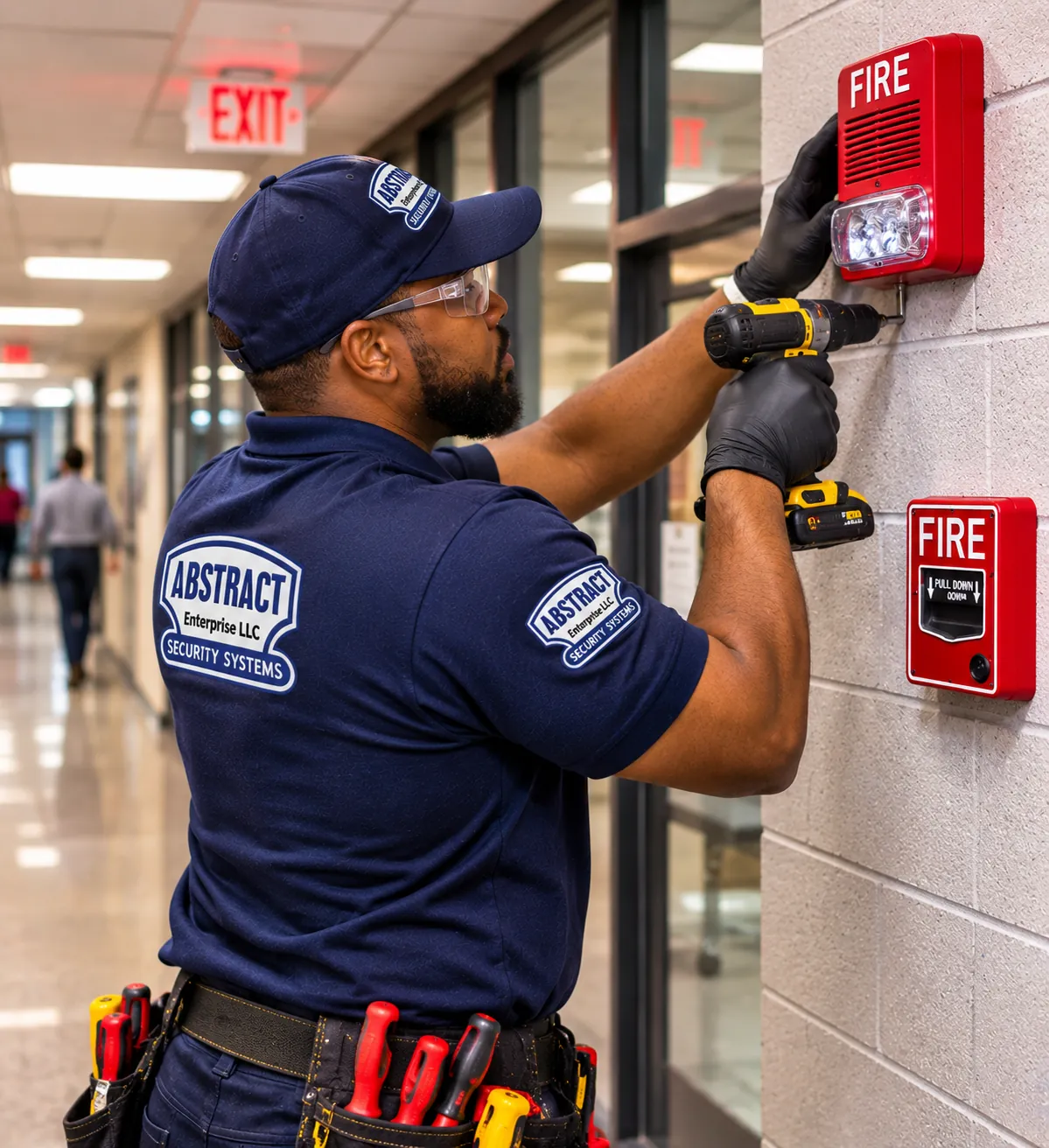
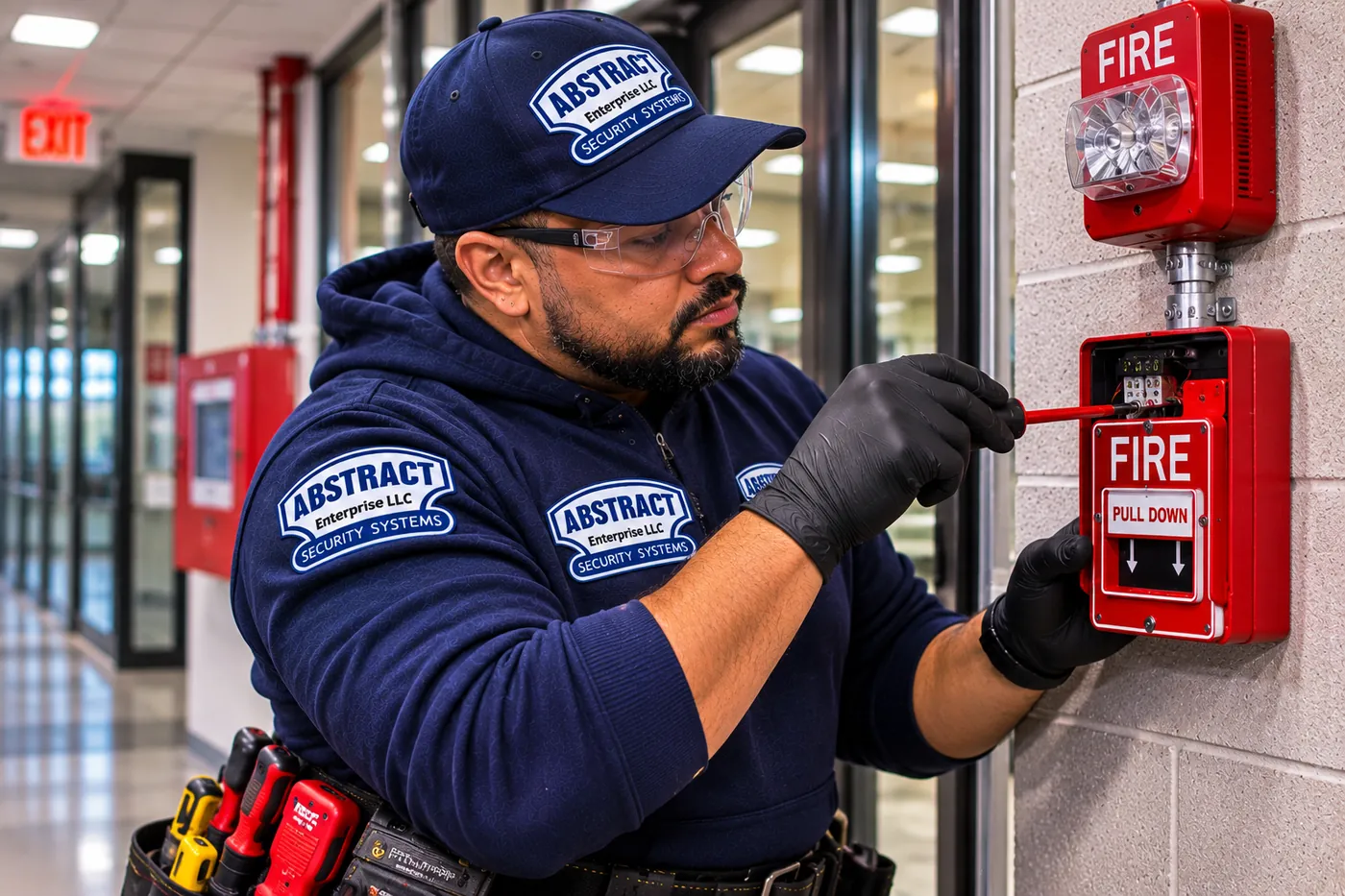
Fire alarm initiating device installation and fire detection device installation cover everything that starts a signal. Commercial smoke detector installation and addressable smoke detector installation protect offices, corridors, electrical rooms and elevator lobbies; photoelectric smoke detector installation is the usual choice for those areas. Commercial heat detector installation protects brewhouses, kitchens, dusty shops and unheated loading areas. Duct smoke detector installation on air handlers shuts them down so they do not spread smoke, and duct smoke detector testing and duct smoke detector replacement are regular service items on roof units that have seen too many winters. Fire alarm pull station installation and manual fire alarm pull station installation go at exits, where in a venue they must stay visible and reachable even with the room full.
Commercial smoke detector replacement, commercial smoke detector testing and commercial smoke detector repair keep detectors working; fire alarm pull station replacement, fire alarm pull station repair and fire alarm pull station testing do the same for stations knocked by hand trucks. Heat detector replacement follows kitchen renovations, and fire alarm device replacement must use devices listed as compatible with the panel.
Fire alarm notification appliance installation includes fire alarm horn installation, fire alarm strobe installation, fire alarm horn strobe installation and fire alarm speaker strobe installation. Fire alarm audible notification installation is sized so the alarm is heard over machinery or a show; fire alarm visual notification installation and fire alarm ADA strobe installation make sure people who cannot hear it still get the message. In a large hall several strobes in view must flash together, which is the job of fire alarm synchronization module installation. Fire alarm notification appliance replacement, fire alarm horn strobe replacement and fire alarm horn strobe repair keep older circuits working, and fire alarm notification circuit repair finds the open or short when a whole floor of strobes goes dark.
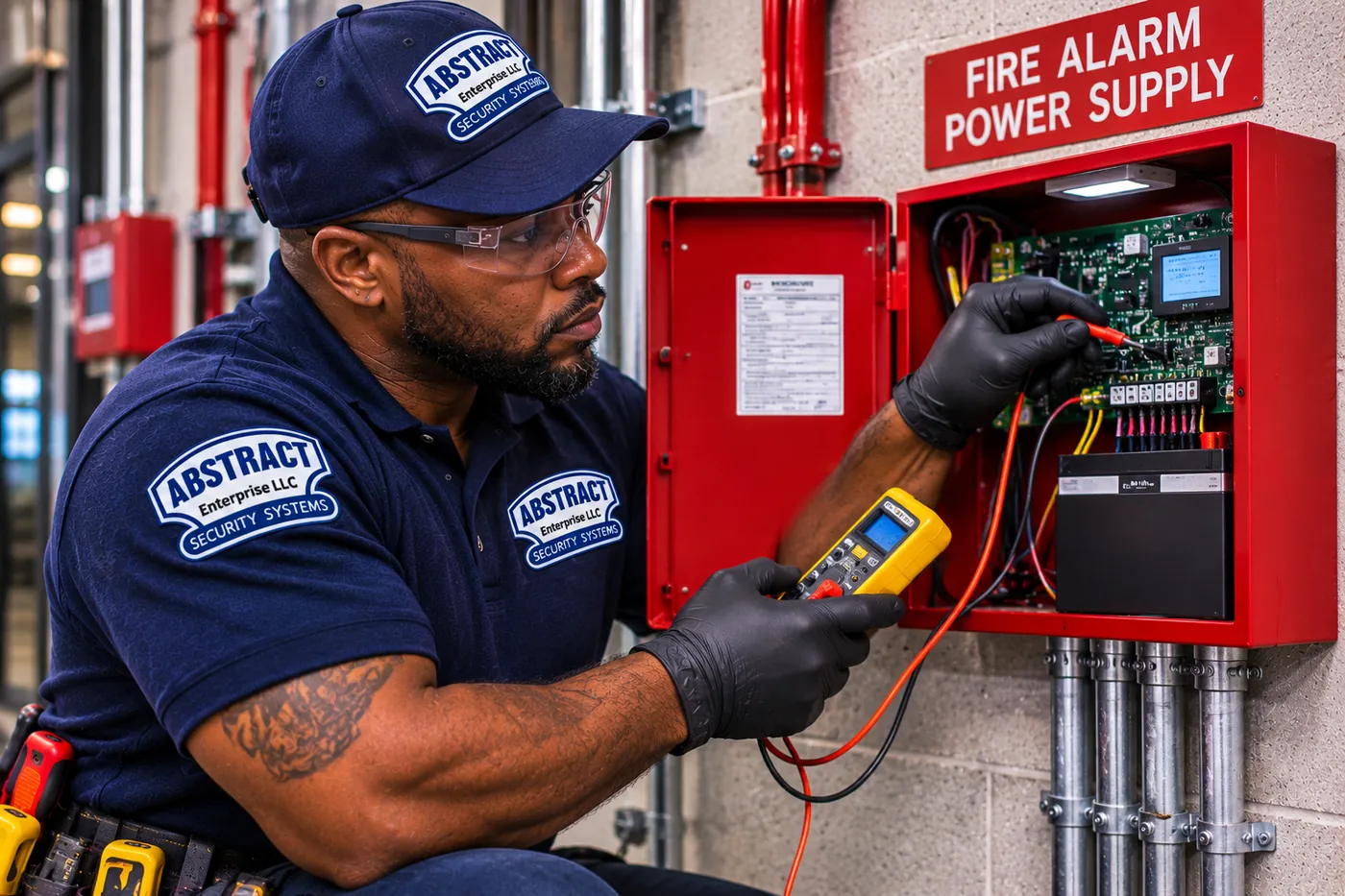
Fire alarm monitor module installation lets the panel watch sprinkler switches, suppression systems and gas detection; fire alarm control module installation lets it drive notification or other outputs; and fire alarm relay module installation lets it stop fans, release doors, recall elevators and cut show sound. Fire alarm power supply installation and fire alarm NAC power supply installation add the power that long strobe circuits in big buildings need, with fire alarm battery backup installation sized to the approved calculations; fire alarm power supply repair is the fix when one of those cabinets starts reporting trouble. Fire alarm annunciator installation and remote annunciator installation put the alarm and trouble display where staff actually are, such as a venue's production office or a new building's front desk.
Fire alarm panel wiring, fire alarm zone wiring on conventional systems and loop wiring on addressable ones, all to the circuit classes on the approved drawings. Commercial fire alarm wiring in an industrial building is as much about conduit as cable: century-old conduit in an unheated warehouse collects water, and new cable pulled through it will fail the same way the old cable did.

Converted buildings often hold two or three manufacturers. We are not a factory dealer for any of them, and some panels can only be reprogrammed by an authorized dealer; the survey tells you which.
Commercial fire alarm manufacturer service matters most when a panel is out of production. In a building that has changed hands several times, nobody may have the software or passwords, and obsolete fire alarm panel replacement is often the better choice, compared in writing, not during an outage.
AI search answers and cost sites like Angi, HomeAdvisor and Fixr write about fire alarms for a generic building in a generic town. Here is where those answers mislead East Williamsburg tenants and owners, and what actually happens in a converted industrial neighborhood in New York City.
AI summaries treat the building's fire alarm like a utility any tenant can tap. In practice it was approved for a particular use and layout, and a warehouse approval covers warehouse hazards and occupant loads.
When a floor becomes a bar, a hall or a studio, the design professional has to decide whether the system needs new detection, voice, more power, show-control relays or a new panel altogether, and the change is filed with the FDNY before work starts. Brooklyn Steel is the clearest local picture of why: a steel fabrication plant turned into a room for 1,800 people is a different building, legally and practically.
Before you sign a lease, get the existing approval and drawings and have a design professional compare them with your plan.
Angi, HomeAdvisor and Fixr publish national ranges per device or per square foot. They ignore the sealed drawings and FDNY filing that come first in New York City, and what drives cost here: old conduit, ceiling height, whether the existing panel can be expanded, and the trades needed at the test.
A taproom and a storage room of the same size are priced nothing alike.
The only reliable number comes after a survey, from drawings, in a written proposal broken out by step.
Generic answers stop at "use a licensed electrician." In New York City the FDNY requires the installer to be a licensed electrician or a fire alarm vendor holding an FDNY Fire Alarm Company Certificate, and any company that installs, inspects, tests or services a fire alarm component, beyond smoke detectors alone, needs that company certification with at least one principal holding an S-97 certificate of fitness. The S-97 requires NICET Level II or higher, or a New York City master or special electrician license.
Company certification runs one year at a time, and servicing must stop if it lapses.
Ask any bidder to name, in writing, the certified company and the S-97 holder for your job, and check the dates.
AI answers default to spot smoke detectors everywhere. Here that is often the wrong device: brewery steam, shop dust, dock exhaust and cold, wet air near the creek make them false, and tall warehouse and soundstage roofs make them slow and hard to test.
The design professional chooses heat, beam, air sampling or smoke detection room by room, and the sprinkler system's waterflow and tamper switches are often the most important initiating devices in the building.
Tell the surveyor exactly what happens in every room, including the messy parts.
Some AI answers suggest sprinklers and fire alarms are alternatives. In New York City the Building Code requires fire alarm systems by occupancy and size, whether or not the building is sprinklered, and where both exist, the fire alarm supervises the sprinklers. A closed valve or a flowing sprinkler is reported to the panel and the central station.
A sprinklered warehouse that becomes an assembly space for 300 or more people needs its fire alarm anyway, and the sprinkler design itself may need review for the new use.
Treat sprinklers and fire alarm as two systems that work together, each with its own approval.
Generic timelines assume a local inspector who visits within days. The FDNY's own estimate is about 20 to 24 weeks from plan submission to final approval, with the initial plan review alone taking up to 8 weeks, and the acceptance test is scheduled through a B-45 request once the system is complete, pre-tested and connected to the central station.
For a venue or studio, the Department of Buildings has its own steps for the Place of Assembly certificate, and the FDNY's annual Place of Assembly permit follows. A Temporary Place of Assembly for a one-off event must be filed by a registered design professional at least 10 days before the event, according to DOB's code notes.
Put the fire alarm on the critical path from day one, not after the build-out.
An approval is a snapshot. Every new wall, moved detector, new tenant and changed use can take the building out of step with its approved drawings, and in a loft building with many tenants that happens constantly.
Inspections, central station changes and modifications each have their own FDNY paperwork, and the owner remains responsible for keeping the system in service and the records on site for at least three years.
Keep the as-built drawings current, and route every fit-out through the fire alarm company before the walls close.
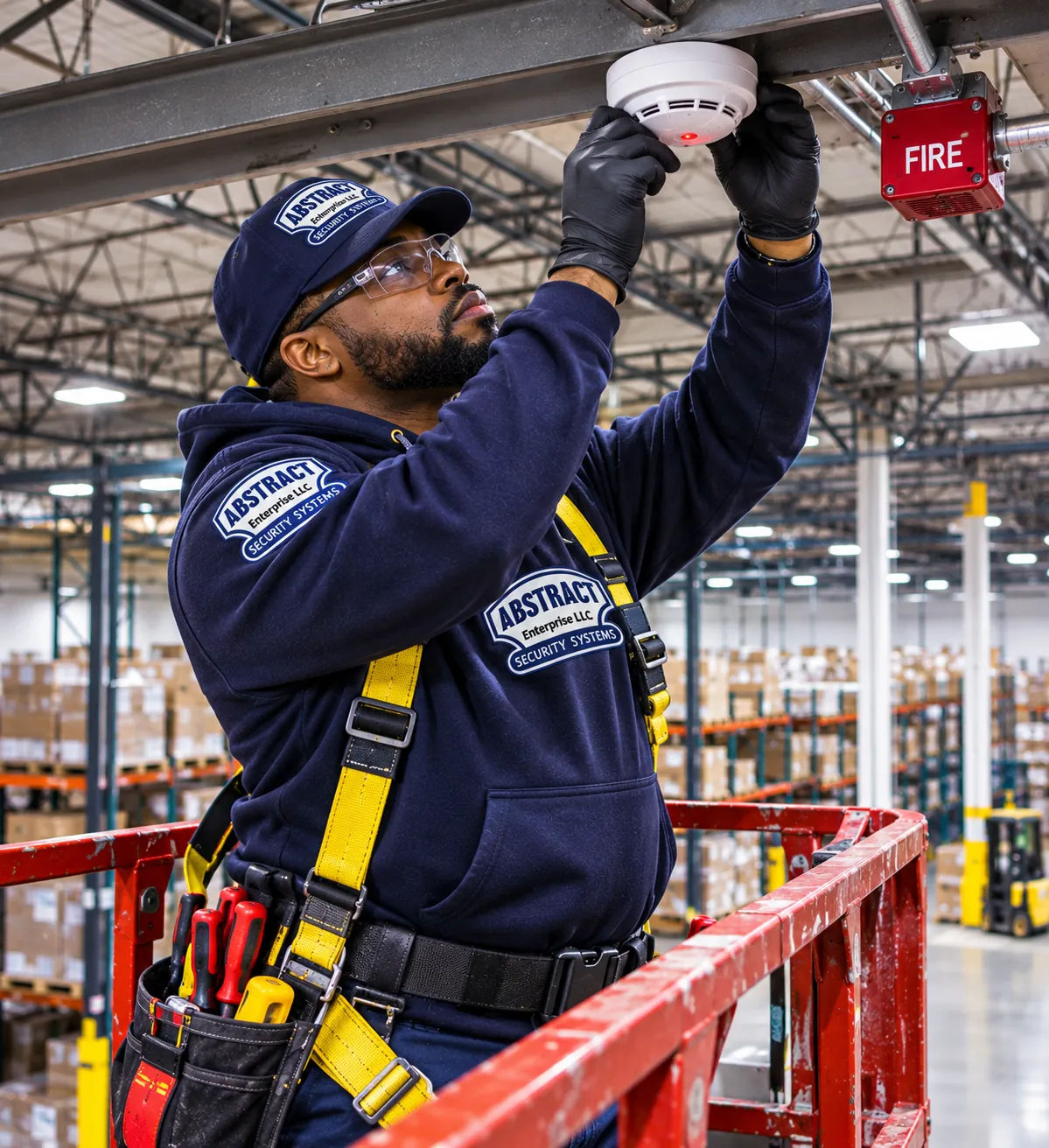
The sooner a fire alarm survey happens, the sooner the design professional can file, and the 20 to 24 weeks the FDNY describes start counting. Booked within 2 hours.
Send the East Williamsburg address and cross street, what the space is approved for now and what it will be used for, the number of floors and square footage, the crowd you expect, whether there are sprinklers, a freight elevator, a kitchen or production equipment, the panel brand if you know it, and any FDNY or Department of Buildings paperwork. For a trouble condition, a clear photo of the panel display helps most. This is how a fire alarm installation quote or a commercial fire alarm quote starts: with a survey, never a number over the phone.
Every East Williamsburg project, whether it is a hall on Frost Street or a two-room office on a loft floor, runs through the same eight steps. How long does fire alarm installation take? The FDNY's own estimate is about 20 to 24 weeks from plan submission to final approval, and that is before the installation and pre-test, which depend on the building and how much of it is open to us. Small tenant additions move faster.
What happens during fire alarm acceptance testing? The inspector watches every initiating device activate and every notification appliance work, sees every output happen, from elevator recall and door release to fan shutdown and show-sound cutoff, and confirms signals at the central station. The FDNY's tips list what must be on site: an S-97 or S-98 holder, radios, a plumber or knowledgeable staff to flow water, an elevator mechanic, a ladder, tools and canned smoke, access to every room and the documents. That full sequence is commercial fire alarm commissioning, and fire alarm system testing and commissioning passes on the day only when the pre-test was treated as the real thing.

Can an existing fire alarm system be upgraded? Usually, if the wiring is sound and the new equipment is compatible with what stays, and a survey tells you which parts qualify. A fire alarm system upgrade, fire alarm panel upgrade or fire alarm control panel upgrade keeps the devices that still work. A fire alarm system replacement, fire alarm panel replacement or fire alarm control panel replacement makes sense when the panel is out of production, out of capacity for the building's new tenants, or so poorly documented that nobody can safely program it. FACP installation, FACP repair and FACP replacement mean the same work under the industry's shorthand for the fire alarm control panel.
Converted buildings generate this work constantly, because each tenant adds to the system. Existing fire alarm system expansion, fire alarm system modification and fire alarm system reconfiguration for a new tenant, fire alarm system renovation when a floor is rebuilt, and fire alarm system conversion from zones to addressable loops are filed and tested like new work. Fire alarm system modernization and commercial fire alarm modernization in a large loft usually go floor by floor, old and new systems running together until the last cutover. Outdated fire alarm system replacement or a legacy fire alarm system upgrade planned on the building's schedule beats an emergency replacement; we treat it as fire alarm system lifecycle replacement with a written plan. A fire alarm system retrofit or commercial fire alarm system retrofit applies the same idea to a building that never had a full system, and a fire alarm system code upgrade or fire alarm code compliance upgrades bring an older system up to its current use. Fire alarm system expansion contractor work for landlords, commercial fire alarm upgrades and commercial fire alarm replacement for owners who inherited a patchwork fill much of our East Williamsburg calendar.
How often should fire alarms be inspected, and how often should commercial fire alarms be tested? NFPA 72, as adopted in New York City, sets frequencies by device type, from visual checks to annual functional tests. A fire alarm annual inspection and fire alarm periodic inspection cover the system; fire alarm functional testing proves each device works; fire alarm sensitivity testing checks smoke detectors are in range; fire alarm battery load testing proves the batteries; and fire alarm device testing covers every device on the schedule. Commercial fire alarm inspection, commercial fire alarm testing, fire alarm inspection, fire alarm system inspection, fire alarm testing and fire alarm system testing all mean that scheduled work, done to NFPA 72 fire alarm testing and NFPA 72 fire alarm inspection requirements. Fire alarm inspection documentation and fire alarm system documentation are what the FDNY and your insurer ask to see, kept on site for at least three years. A fire alarm testing company, fire alarm inspection company, fire alarm inspection contractor or fire alarm testing contractor should leave a written report, not just a sticker.
Commercial fire alarm maintenance, fire alarm maintenance and fire alarm preventative maintenance under a written fire alarm service contract with a fire alarm maintenance company keep the schedule, the records and the trouble calls in one place. Commercial fire alarm service for a multi-tenant loft should include a fit-out rule, a current central station call list and a named contact; commercial fire alarm repair under that contract is faster because the technician knows the building.
Who can correct fire alarm inspection deficiencies? The certified fire alarm company, with a design professional where the fix changes the approved design. Fire alarm deficiency correction, fire alarm inspection repair, fire alarm system violation correction and fire alarm code violation repair start with reading exactly what was cited and what the approved drawings say. Fire alarm inspection deficiencies in converted buildings are very often missing documentation or devices hidden behind tenant walls rather than failed equipment. Fire alarm inspection preparation, a full pre-inspection a few weeks before the FDNY visit, catches most of them. Fire alarm system certification in New York City means the FDNY's Letter of Approval for the system as installed; keep it with the drawings and test records.

The 1,800-capacity hall at 319 Frost Street, opened in 2017 inside a former steel fabrication plant.
Brewery, distillery and taproom at 942 Grand Street, between Waterbury Street and Morgan Avenue, since 2016.
Evergreen and NYCEDC's 10,000-square-foot space for three industrial small businesses at 500 Stagg Street, opened 2022.
The six-soundstage Echelon Studios project at 242 Seigel Street, on the East Williamsburg and Bushwick line.
The former Greenpoint Hospital campus on Maspeth Avenue, rebuilt as affordable family and senior housing with a shelter and clinic.
Eleven seven-story NYCHA buildings opened in 1953 between Kingsland and Morgan Avenues, Frost Street and Maspeth Avenue.
The four-story school building at 850 Grand Street, opened in 1981, home to three high schools.
The Newtown Creek crossing at the east end of Grand Street into Maspeth, named for replacement in the city's North Brooklyn plan.
Within East Williamsburg we also work on Humboldt, McKibbin, Boerum, Meserole and Scholes Streets, along Bushwick Avenue and Morgan Avenue, and on the industrial blocks toward Newtown Creek. Nearby, see our pages for Williamsburg, Greenpoint and Bushwick, or the borough-wide fire alarm installation Brooklyn page. As a local fire alarm installation company we cover East Williamsburg from our office at 1282 Troy Ave in Brooklyn.
People searching fire alarm installation near me, fire alarm installers near me, fire alarm contractors near me or fire alarm companies near me from an East Williamsburg loft want someone who answers, arrives soon and knows the FDNY steps. We book surveys within 2 hours of a request.

We do not publish fire alarm installation pricing, because a code-required system in New York City cannot be priced honestly from a web page, and in East Williamsburg the same square footage can be a storage room or a concert hall. How much does commercial fire alarm installation cost in East Williamsburg? It is the sum of four steps that happen in order, and each depends on the building.
After an on-site survey we give a written quote per building, broken out by those steps. The fire alarm installation cost, commercial fire alarm installation cost and fire alarm system installation cost for an East Williamsburg project depend on that survey, and so do the fire alarm panel installation cost, the fire alarm panel replacement cost, the fire alarm system replacement cost and the fire alarm system upgrade cost on an existing system. How much does fire alarm panel replacement cost? It depends on whether the existing devices are compatible with a new panel, whether the change has to be filed, and how many tenant spaces the panel serves, which is why we answer it in writing after the survey. Fire alarm inspection cost and fire alarm testing cost follow device counts and interfaces; fire alarm repair cost and the fire alarm service call cost follow what we find; a fire alarm maintenance contract cost follows your testing schedule. A fire alarm installation estimate or fire alarm installation bid that skips the survey is guessing.
Choosing among fire alarm installers in East Williamsburg comes down to who will actually sign and stand behind the work. Who installs commercial fire alarm systems? In New York City, a licensed electrician or fire alarm vendor holding an FDNY Fire Alarm Company Certificate, from drawings sealed by a registered design professional. Who repairs fire alarm control panels? The same certified companies, and for some panels only the manufacturer's authorized dealer. How do I find a licensed fire alarm contractor? Ask every bidder to name the FDNY-certified company and its S-97 holder in writing and check the dates, and confirm the electrician's license with the city.
A licensed fire alarm installer and a certified fire alarm technician are not the same thing as a fire alarm company that can sign an FDNY test. Fire alarm contractor licensing in New York City runs through the FDNY company certificate and certificates of fitness, along with the electrician's license from the Department of Buildings. Abstract Enterprises Security Systems is a licensed low-voltage contractor, NYS license #12000287431; on every fire alarm job, the proposal names the FDNY-certified fire alarm company and the licensed electrician of record who sign the filing and the test. A fire alarm contractor, commercial fire alarm contractor, fire alarm system contractor, fire alarm company or fire alarm service company that will not put those names on paper is a reason to keep looking.
The best commercial fire alarm installer for a converted building reads the existing approval before quoting, asks how many people the space will hold, and tells you what the FDNY schedule really looks like. Whether a bidder calls itself a commercial fire alarm installation company, one of the commercial fire alarm installers, a commercial construction fire alarm contractor, a fire alarm compliance contractor, a fire alarm repair company or a fire alarm repair contractor, ask which parts of the work it does itself and which it subcontracts. That is the real test of fire alarm installation contractors for commercial buildings.
A commercial fire alarm here supervises and controls other systems, and those interfaces are where acceptance tests stumble. Fire alarm system integration is drawn by the design professional and tested before the FDNY.

New construction fire alarm installation in East Williamsburg is concentrated in two places: the phased housing on the former Greenpoint Hospital campus and large commercial buildings like the Seigel Street studio. Both are long projects with several buildings or levels, and both need the fire alarm planned from the start so each phase can be filed, installed and accepted without holding up the next.
When does a building need a fire alarm system? The NYC Building Code's section 907.2 sets it by occupancy. As summarized from the code, assembly spaces need one at an occupant load of 300 or more; business occupancies at 500 or more occupants or 100 or more above or below the exit level; factory occupancies at two or more stories with 100 or more occupants, or 25 or more above or below the exit level; educational occupancies always; and R-2 residential buildings with units three or more stories above the exit level or sixteen or more units. Mercantile, high-rise and other special cases have their own triggers. Does my building need a fire alarm permit? If a system is required, or if you are adding to or changing one, the work is filed with the FDNY and a Project Authorization is issued before installation. Fire alarm permit requirements and fire alarm system design requirements both come from the code and the FDNY's filing rules, and fire alarm system inspection requirements follow from NFPA 72 once the system is in service.
For conversions the chain is usually: Certificate of Occupancy, any DOB filing for the change of use, the fire alarm design, FDNY filing and Project Authorization, installation and acceptance, then for an assembly space the Place of Assembly certificate and the FDNY's annual permit. Fire alarm construction drawings, fire alarm shop drawings and fire alarm as built drawings are three different documents; you need all three.
East Williamsburg landlords and operators often run spaces elsewhere in North Brooklyn. Each page below covers commercial fire alarm work for its own area.
Commercial fire alarm work across Brooklyn: the borough's building types and the FDNY path.
Commercial fire alarm installation in NYC: TM-1, certification and acceptance testing.
Existing building fire alarms: troubles, central station problems and Notices of Defect.
New construction and fit-outs: from TM-1 drawings to acceptance.
Assembly-use design coordination and acceptance planning.
Fit-out rules, expansions and service contracts.
Heat, beam and air sampling detection for warehouses and shops.
Call (347) 934-8335 and the survey is booked within 2 hours.
Not automatically. The Building Code requires a fire alarm in an assembly space at an occupant load of 300 or more, while the Department of Buildings requires a Place of Assembly Certificate of Operation once 75 or more members of the public gather indoors. If the building already has a fire alarm, your space is normally added to it. The design professional decides from the occupant load on the drawings.
A one-off event for 75 or more people indoors in a space without a permanent assembly use needs a Temporary Place of Assembly, filed by a registered design professional at least 10 days before the event, and the FDNY must be consulted on fire safety. Whether the fire alarm needs changes, fire guards or other measures for that event is part of that review.
A building fire alarm is designed to detect fire. Carbon monoxide detection is required by code in specific places, typically near fuel-burning equipment and in dwelling units, and where it is part of the fire alarm it appears on the approved drawings. After the February 2026 transformer vault fire outside 101 Humboldt Street, resident Ruben Burgos told ABC7 that not one CO alarm went off. If that happens in your building, have the design professional review where CO detection is required and where it actually is.
Yes, if it is a legal residential or sleeping use, and it is a problem to solve before anything else if it is not. Sleeping occupancies change what the code requires, from detection in and outside units to how the alarm is heard in bedrooms. A 2015 fire at McKibbin Lofts on McKibbin Street started when an electrical item ignited a mattress; DNAinfo reported the building had also drawn Department of Buildings stop-work orders for illegal hotel use. The fire alarm has to match the building's legal use.
Usually, with planning. Work in public areas can be scheduled before opening hours, the existing system stays active wherever it is not being worked on, and any period when a part of the system is out of service is covered by a fire watch under FDNY rules. Tell us your hours and busiest days before we schedule.
Have your system inspected and tested if it has not been recently, confirm the central station has a current call list, and make sure nothing from the site, such as dust, vibration or a cut utility line, is causing troubles. In September 2025 a construction site fire at 254 Boerum Street spread to the building next door. Your system cannot stop a fire next door, but it should tell you about smoke in your building at once.
Tell the design professional exactly what is stored and where, because battery storage is a hazard the FDNY takes very seriously and it affects detection choice, sprinkler design and storage arrangement. In August 2024 a warehouse fire on Morgan Avenue near Meserole Street brought out the FDNY hazmat team because of lithium-ion batteries inside.
That depends on the occupancy and size the design professional determines for the building, and large studios with offices, audiences or several floors often end up with voice. Even where horns are allowed, a stage full of crew, lighting and generators needs notification that is heard and seen everywhere, including behind sets.
Usually in phases, each with its own approved drawings, Project Authorization and acceptance test, so occupied floors are protected while others are still under construction. The later tests also have to show that the floors already accepted still work with the new connections. That plan needs to be agreed before the first filing.
If the building's fire alarm design calls for elevator recall, which the FDNY's guidance ties to waterflow and to detection in elevator lobbies, hoistways or machine rooms, the freight elevator may need to be included. The design professional and the elevator contractor decide what applies to your car, and it is tested with an elevator mechanic present at acceptance.
No, if it is phased. We work floor by floor or tenant by tenant, keep the old system running until each area is cut over to the new one, and give each tenant a schedule in advance. Short fire watches cover any area that is truly unprotected during cutover.
As soon as the installation is complete, pre-tested, free of troubles and connected to the central station, because the B-45 request cannot be made earlier and the inspection has to be scheduled around the FDNY's calendar. Plan the whole design, filing and approval path, which the FDNY puts at about 20 to 24 weeks, before you announce an opening date.
Local facts, figures and quotes on this page come from these sources; code references reflect FDNY and DOB guidance as of November 2026.
Abstract Enterprises Security Systems, 1282 Troy Ave, Brooklyn, NY 11203 · (347) 934-8335 · NYS license #12000287431 · 4.7★ from 201 Google reviews. Full terms — including 50% deposit, one-year parts-only warranty on Abstract Enterprises Security Systems-supplied products, and the late-fee schedule — are set out in the service agreement.
East Williamsburg is one of the Brooklyn neighborhoods we cover from our office at 1282 Troy Ave. Every page below is written for its own neighborhood's buildings and streets. Start with the Brooklyn borough fire alarm page or the NYC fire alarm installation hub.
Greenpoint · Williamsburg · South Williamsburg · East Williamsburg · Bushwick · Wyckoff Heights · Ridgewood · Downtown Brooklyn · Brooklyn Heights · Cadman Plaza · DUMBO · Vinegar Hill · Fulton Ferry · Brooklyn Navy Yard · Columbia Street Waterfront · Boerum Hill · Carroll Gardens · Bay Ridge · Gowanus · Fort Greene · Clinton Hill · Prospect Heights · Park Slope · South Slope · Greenwood Heights · Windsor Terrace · Prospect Park South · Prospect Lefferts Gardens · Crown Heights · Bedford-Stuyvesant · Stuyvesant Heights · Ocean Hill · Weeksville · Brownsville · Flatbush · Ditmas Park · Fiske Terrace · Beverley Square · Kensington · Midwood · East Flatbush · Wingate · Remsen Village · Sunset Park · Brooklyn Chinatown · Bath Beach · Fort Hamilton · Dyker Heights · Bensonhurst · New Utrecht · Mapleton · Borough Park · Ocean Parkway · Gravesend · Homecrest · Madison · Sheepshead Bay · Manhattan Beach · Brighton Beach · Coney Island · Sea Gate · Gerritsen Beach · Marine Park · Mill Basin · Bergen Beach · Flatlands · Canarsie · East New York · Cobble Hill · City Line · New Lots · Spring Creek · Starrett City · Highland Park
Outside Brooklyn we also cover Manhattan · Queens · the Bronx · Staten Island · Long Island · Nassau · Suffolk · Hudson Valley · Westchester · Rockland · Orange · Putnam · Dutchess · Ulster.
From a change of use in a Frost Street warehouse to a panel replacement in a Grand Street mixed-use building, the first step is a survey of the space and a written proposal. Owner-operated since 2002, NYS license #12000287431, booked within 2 hours.