School campus, housing development, church or store building in Ocean Hill with a panel in trouble, a failed inspection or a new tenant moving in? Call the Brooklyn line: (347) 934-8335
Broadway · Fulton St · Atlantic Ave · Rockaway Ave · Saratoga Ave · Ralph Ave
Fire Alarm Installation in Ocean Hill
NFPA 72 Commercial · Shared School Buildings, Public Housing Campuses, Mixed-Use Blocks & Broadway Junction Towers · FDNY TM-1
Fire alarm installation in Ocean Hill is mostly work on buildings that more than one organization calls home. Three schools share the old Junior High School 271 on Herkimer Street, a CUNY-run community center sits inside a public housing building on Saratoga Avenue, and new affordable buildings put stores, a grocery or social service offices under the apartments. Abstract Enterprises Security Systems helps the owner and every occupant agree on one panel, one set of sealed drawings, one FDNY filing and one acceptance test.
Updated November 2026 by Abstract Enterprises Security Systems, NYS license #12000287431 · Sources: Wikipedia; Chalkbeat; InsideSchools; NYC Public Schools; NYCHA; NYCHA Journal; News 12 Brooklyn; Brooklyn Paper; Brownstoner; New York YIMBY; NYC HDC; 6sqft; BK Reader; NYC SBS; Brooklyn Community Board 16; FDNY; NYC Business
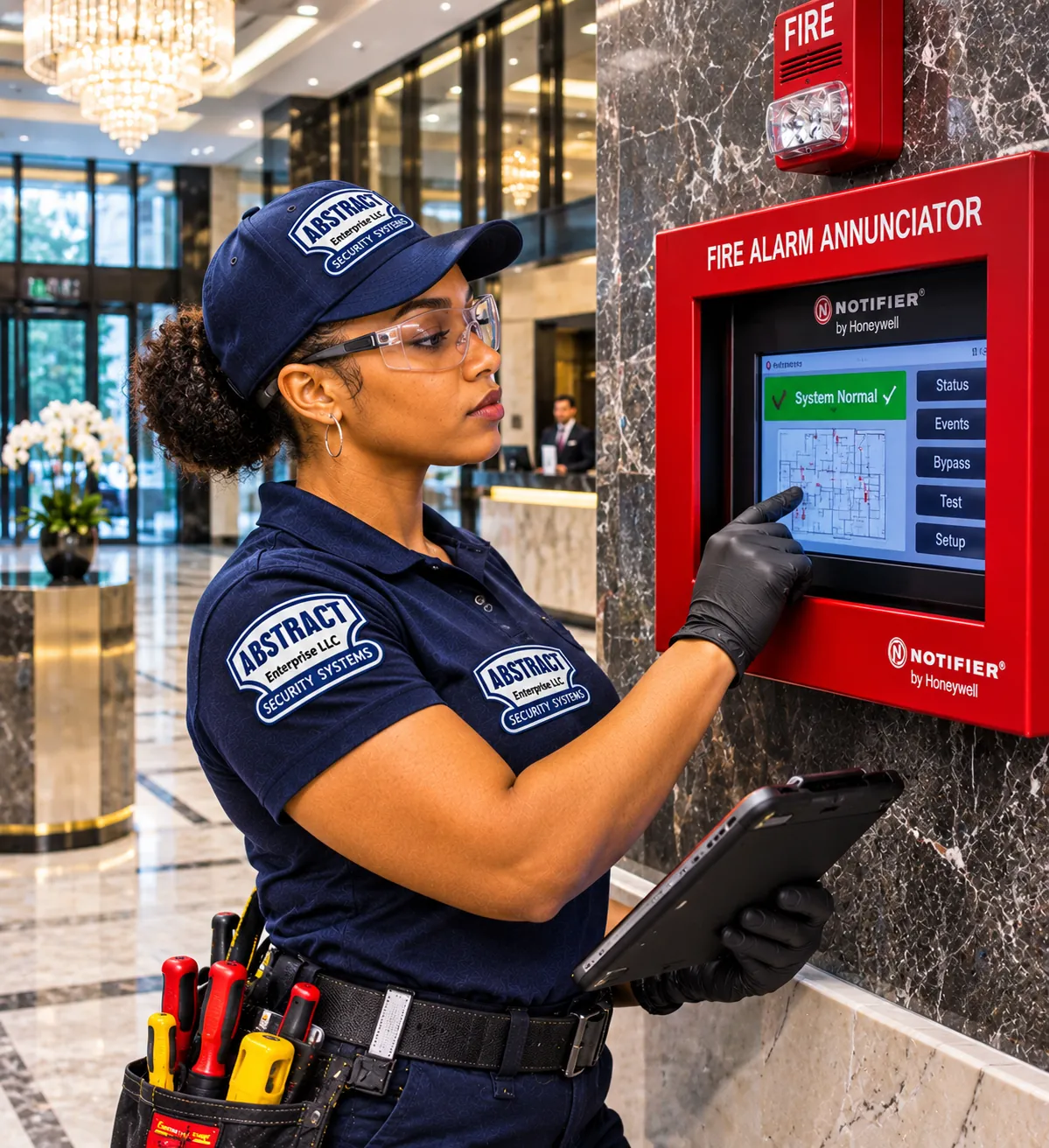
A technician with a tool belt touches the floor plan on a red-framed NOTIFIER annunciator showing System Normal, tablet in hand, with a horn strobe above it and a chandeliered lobby behind her. In a building shared by several schools or tenants, the lobby display is the one screen every occupant's staff and the FDNY read the same way.
Ocean Hill Fire Alarm Request
Address, stories and everyone who uses the building
✅
Request Sent!
Thank you. We will call to set up your Ocean Hill fire alarm walk-through, usually within 2 hours of your request.
25+
Years Experience
✓
FDNY Steps in Writing
100%
Commercial NFPA 72
4.7★
201 Google Reviews
Owner-operated since 2002 · Thousands of jobs completed · Booked within 2 hours
Quick answer: fire alarm installation in Ocean Hill runs on the citywide FDNY track. A New York State licensed Professional Engineer or Registered Architect designs and seals the drawings, the FDNY reviews them on a TM-1 filing, a company holding the FDNY Fire Alarm Company Certificate installs them with a licensed electrician, and the FDNY Fire Alarm Inspection Unit watches an acceptance test before it issues a Letter of Approval. What sets Ocean Hill apart is how often one building holds several occupants with separate bosses: co-located schools, a college-run center inside public housing, a grocery and garage under affordable apartments, or supportive-housing services above storefronts. We walk the building, sort out who answers for which part of the system, and send a written proposal. Call (347) 934-8335; your visit is booked within 2 hours of the request.
Scope is NFPA 72 commercial and code-required work only: school buildings, housing developments, mixed-use and supportive-housing buildings, churches and halls, stores, restaurants and the new buildings rising near Broadway Junction
We hold NYS low-voltage license #12000287431; every proposal names the FDNY-certified fire alarm company and the electrician who sign the filings
For shared buildings we list, floor by floor, which occupant's staff must be told before devices are tested or bypassed
Why Ocean Hill Fire Alarm Work Means Sharing One Panel Among Many Occupants
Ocean Hill fire alarm work comes down to one fact: the neighborhood's large buildings are rarely used by a single organization. Ocean Hill is a small slice of north-central Brooklyn. Wikipedia's article on it draws the lines at Broadway on the north, where Bushwick begins, Ralph Avenue on the west, East New York Avenue on the south and Van Sinderen Avenue on the east, places it in Brooklyn Community Board 16 and the 11233 ZIP code, and notes it was carved out of Stuyvesant Heights; City Neighborhoods NYC draws a tighter map from Fulton Street and Ralph Avenue, so the edges depend on whom you ask. The census counted 37,952 residents in 2020, up 18.8 percent from 2010.
The blocks inside those lines are mostly brownstone and brick rowhouses, which City Neighborhoods dates to the 1870s through the 1890s in Italianate and Neo-Grec styles. Family rowhouses are outside this page. The buildings that need a code-required fire alarm share one habit, several users under one roof: the 1960s school buildings, the public housing developments, the affordable buildings that replaced the old Prospect Plaza towers, the supportive housing on Broadway and Rockaway Avenue, and the churches and halls on the side streets. Next come the towers planned at Broadway Junction, which Brownstoner places "in Ocean Hill close to the borders of Bushwick, Brownsville, Crown Heights, and East New York."
Schools come first, because Ocean Hill's name is tied to them. In May 1968 the community school board of the Ocean Hill-Brownsville demonstration district sent termination letters to 19 educators, 13 teachers and six administrators, most of them from Junior High School 271, Chalkbeat reported on the 50th anniversary; historian Nick Juravich told the outlet, "I think it's fair to say this is the spark" for the citywide teacher strikes that followed. JHS 271 closed in 2008. Its building at 1137 Herkimer Street now houses three schools, Eagle Academy for Young Men II, Mott Hall IV and the Uncommon charter school Ocean Hill Collegiate, according to Chalkbeat and InsideSchools. The 1965 brick Brutalist school at 2021 Bergen Street, which Brownstoner called "a fortress with very few windows," houses Brooklyn Collegiate High School.
Three schools means three principals and three bell schedules sharing one fire alarm. New York City's public school system says more than half of its schools share campuses, and a Building Council of all the principals, district and charter alike, must meet 12 times a year on shared matters including facilities and safety, with every school sending one member to the Building Response Team. That changes how a fire alarm job is scheduled and explained, not what NFPA 72 requires.
Public housing works the same way. On September 25, 2025, NYCHA closed a PACT financing that converted five developments in this part of Brooklyn, among them Ocean Hill Apartments and Saratoga Village, to private management under the federal Rental Assistance Demonstration: 14 buildings and 927 apartments to be fully renovated over about three years, by a partner team of Kalel Companies and Dantes Partners, with Wavecrest Management running the buildings and the Bedford Stuyvesant Restoration Corporation coordinating social services. NYCHA's community plan gives Ocean Hill Apartments four buildings and 236 apartments around Mother Gaston Boulevard and MacDougal Street, and Saratoga Village one building of 125 apartments at 33 Saratoga Avenue, which also holds the Medgar Evers College/CUNY Cornerstone community center at 940 Hancock Street. So an owner, a manager, a social service partner and a college program all share one address.
So what is a commercial fire alarm system, put in Ocean Hill terms? It is a control panel with power supplies and standby batteries; smoke and heat detectors, duct detectors and pull stations that sense or report a fire; horns, strobes or speakers that warn people; modules that recall elevators, shut fans and release doors; and a communicator that sends signals to an FDNY-approved central station. How does a commercial fire alarm system work? The panel watches its own circuits all the time, shows a fault as trouble and a detector or station as an alarm, and then runs the sequence the engineer wrote. When does a building need a fire alarm system? The Building Code decides by occupancy and size: in NY Engineers' summary of section 907, every school and every institutional building needs one, as do assembly spaces holding 300 or more people and apartment buildings with 16 or more units or apartments three or more stories above the lowest exit. In Ocean Hill that covers every school, most housing developments and the larger mixed-use buildings, and it is the starting point for NFPA 72 fire alarm installation in all of them.
Ocean Hill facts that shape fire alarm design
Fact
What it means for a fire alarm
Source
Former JHS 271, 1137 Herkimer St, now houses Eagle Academy for Young Men II, Mott Hall IV and Ocean Hill Collegiate
One system, three schools: drills, tests and trouble calls need all three on the same page
Chalkbeat; InsideSchools
2021 Bergen St: 1965 brick school, few windows, home to Brooklyn Collegiate High School
Interior rooms rely on the alarm, not on daylight or windows, to tell people to leave
Brownstoner
Ocean Hill Apartments (4 buildings, 236 apts) and Saratoga Village (1 building, 125 apts) converted to PACT Sept 25, 2025; elevators to be fully modernized; new video intercoms; about three years of work
Elevator recall and door interfaces change while residents stay home
NYCHA Journal; NYCHA community plan
Prospect Plaza rebuild: 364 units in more than five buildings on 4.5 acres; 1845 Sterling Pl has 123 apartments over a grocery, retail and a garage
Several occupancies stacked in one building and on one panel
Brownstoner
Henry Apartments, 1676 Broadway and 8 Rockaway Ave: two six-story buildings, 134 units, 78 for formerly homeless households, on-site services, ground-floor commercial space
Staffed program space, apartments and stores on one system
Above 75 feet the city's high-rise rules for the fire alarm apply
New York YIMBY
Herkimer-Williams at Broadway Junction: four towers of 21 to 29 stories planned; rezoning approved by the City Council in December 2025
Voice communication, fire command centers and phased acceptance tests over a decade
Brownstoner; 6sqft; BK Reader
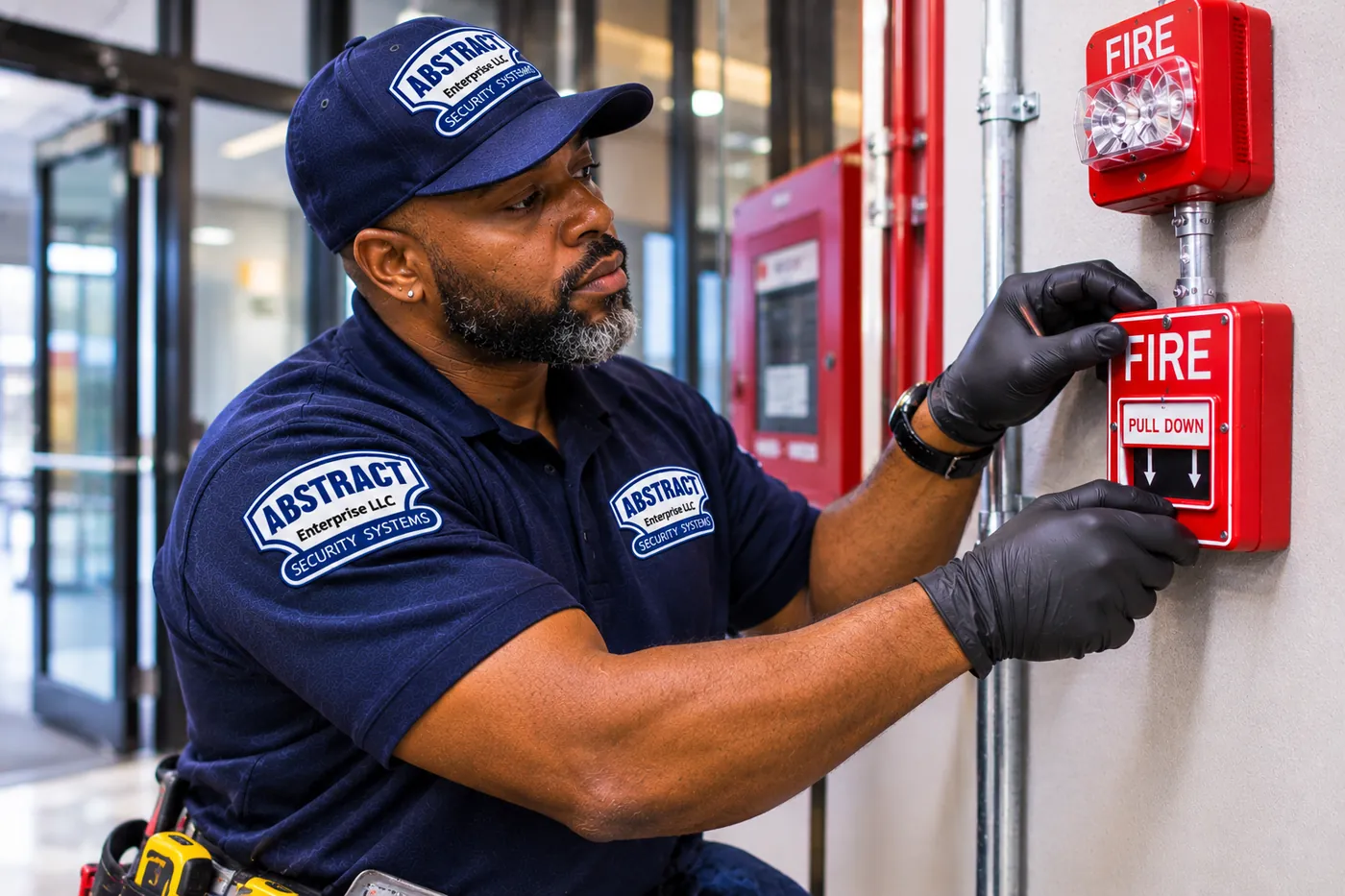
A gray-bearded technician in black gloves works on a red pull station mounted on conduit beneath a horn strobe, with a red cabinet and a glass entrance behind him.
Repair
Fire Alarm Repair in Ocean Hill When Several Occupants Hear the Same Trouble Beep
Fire alarm repair in Ocean Hill usually starts with a phone call from whoever heard the beep first, and in a shared building that person often does not control the panel. A school aide, a program director, a store manager or a resident reports it, and the building owner or custodian has to act. On a fire alarm trouble emergency service visit we read the panel's history, tell everyone in the building in plain words what is and is not being watched, say whether a fire watch may be needed, and repair the cause instead of silencing the sound.
Why is my fire alarm panel showing trouble? Because the panel has found something wrong with its own wiring, power or devices, which is different from a fire but can still leave a corridor, a classroom wing or a stair unwatched. In Ocean Hill buildings the usual causes follow the occupants: a teacher's room where a detector was knocked loose, a renovated storefront where a contractor unplugged a head, a community center where a ceiling tile was lifted for new lights. Whether it reaches us as a fire alarm panel beeping repair, a fire alarm panel trouble light, a fire alarm trouble signal repair or a fire alarm system trouble condition, the event history names the circuit, and the circuit tells us whose space to check first.
What causes a fire alarm ground fault? Current leaking from a fire alarm circuit into conduit, a metal box or a wet surface. Roof replacements and facade over-cladding, both on the PACT scope for Ocean Hill developments, open roofs and walls to weather for weeks, and water finds top-floor junction boxes. Fire alarm ground fault troubleshooting isolates the leak by splitting the circuit and watching the panel after each split; fire alarm ground fault repair then fixes the length of cable or the box where it lands. The same patient method handles fire alarm SLC troubleshooting, fire alarm signaling line circuit repair, fire alarm short circuit troubleshooting and fire alarm open circuit repair.
Fire damage reaches alarm systems too. On February 15, 2026, a two-alarm fire burned the upper floors of 670 and 672 Decatur Street between Saratoga Avenue and Thomas S. Boyland Street, sent one person to Interfaith with moderate injuries and left two households with the Red Cross, News 12 Brooklyn reported; Brooklyn Paper added that 672 had been under a vacate order since a 2013 fire after being found illegally converted to 28-bed transitional housing, and that the fire reached the cockloft. After a fire in any building with a system, fire alarm device fault repair, fire alarm wiring repair and fire alarm notification circuit repair are followed by a full test, because water travels past the burned rooms.
A lost signal path is the most serious trouble. If the panel cannot reach the central station, an alarm may reach nobody outside the building, so fire alarm communication failure repair starts with what the central station last received, then checks the communicator, its antenna and its network or radio path. In a building whose management just changed, as at the PACT developments, we also confirm that the monitoring account and call list moved to the new manager. Anything that leaves floors unwatched, whether written up as a fire alarm system not communicating, a fire alarm communication failure emergency repair, a fire alarm system down repair, a fire alarm panel failure repair or a fire alarm system malfunction repair, goes to the front of our list.
Fire alarm intermittent trouble in a school building often lines up with the bell schedule: a loose termination behind a door that slams at every class change, or a booster supply that sags when every strobe in the building flashes during a drill. A fire alarm fault diagnosis lays the history beside the school day before parts get swapped. Battery calls are simpler: fire alarm battery trouble repair means fire alarm battery replacement followed by fire alarm battery load testing to prove the new set will carry the system. A fire alarm supervisory trouble in a sprinklered building usually points to a valve left partly closed after plumbing work, and fire alarm system diagnostics confirm which valve before anyone climbs a ladder.
Unwanted alarms hit every occupant at once. The Mayor's Management Report for fiscal 2025 counted 21,966 malicious false alarms citywide, and in a building with three schools one prank pull empties every classroom. Fire alarm false alarm troubleshooting looks at the device, its location and the time of day; smoke detector circuit troubleshooting and fire alarm circuit troubleshooting confirm the wiring before anyone changes a detector type or sensitivity.
Who repairs fire alarm control panels? In New York City, a company holding the FDNY Fire Alarm Company Certificate, with at least one principal holding the S-97 Certificate of Fitness. The FDNY requires the certificate for any company that installs, inspects, tests or services fire alarm components beyond standalone smoke detectors. Fire alarm control panel repair, fire alarm control panel troubleshooting and FACP repair all happen under that certificate, with a licensed electrician on filed electrical work. Our fire alarm service technician works with the certified company and leaves a written note of what failed and what changed for every occupant who needs it; a fire alarm repair company or fire alarm repair contractor that leaves nothing in writing slows the next visit.
A custodian searches for 24 hour fire alarm repair after the last bell, a property manager asks for after hours fire alarm service on a Sunday, a store owner wants same day fire alarm repair before opening, and an owner asks for urgent fire alarm repair, emergency fire alarm repair or an emergency fire alarm technician. Emergency fire alarm troubleshooting, emergency fire alarm service, fire alarm system emergency service and commercial fire alarm emergency repair all ask one thing: is everyone protected tonight? Phone (347) 934-8335 or text a photo of the panel screen; your visit is booked within 2 hours of the request, and what the panel shows decides how fast it has to be.
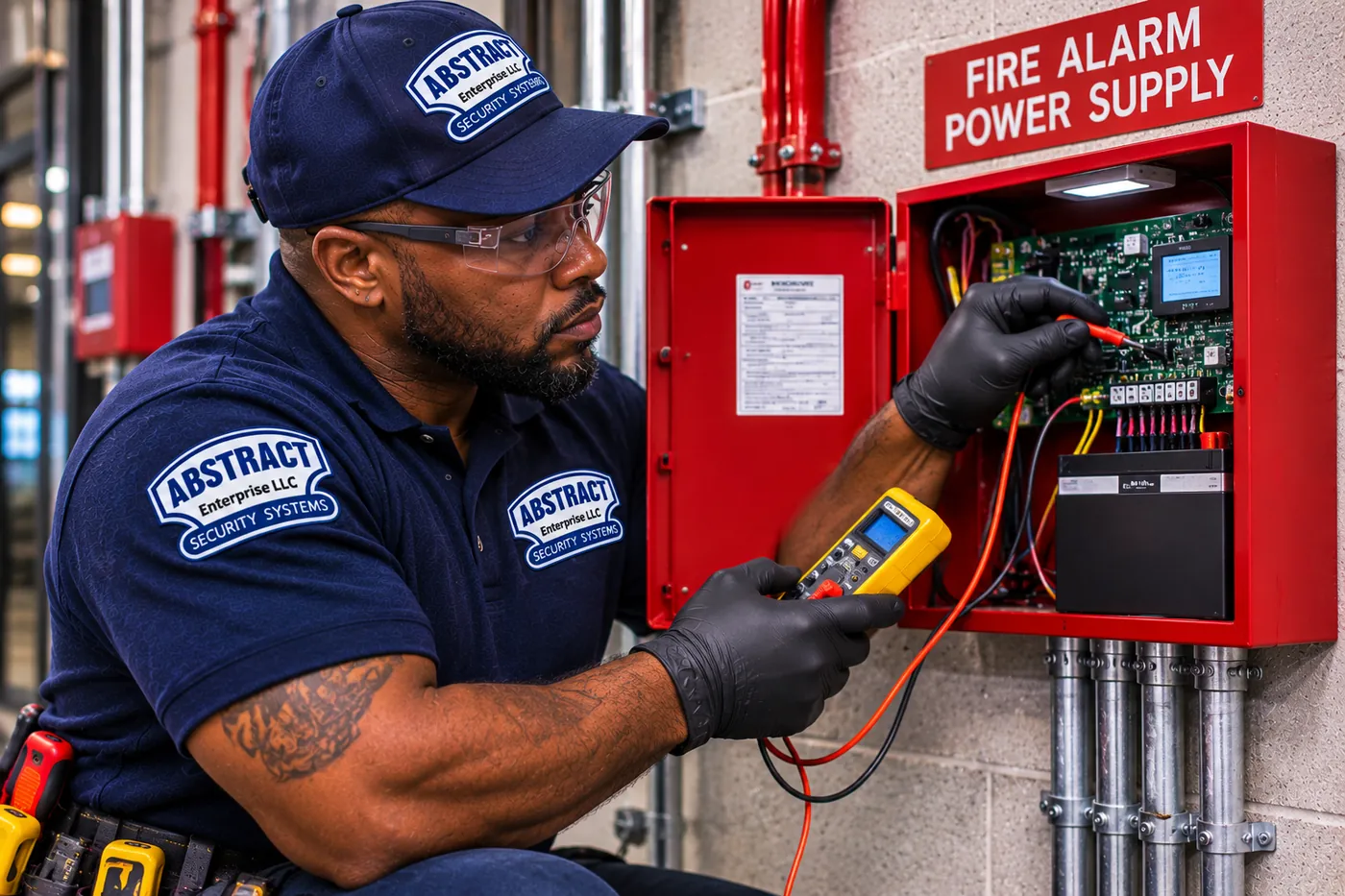
A technician reads a yellow multimeter with its leads on the board of an open red cabinet under a sign reading Fire Alarm Power Supply, conduit dropping down the block wall below.
What We Do
Commercial Fire Alarm Installation Services in Ocean Hill
Commercial fire alarm installation in Ocean Hill covers the whole life of a system, from the drawings for a new tower near Broadway Junction to a records check when a school or program moves into an existing building. As a fire alarm installation company and fire alarm contractor licensed by New York State (#12000287431), we keep the design professional, the certified company, the electrician and every occupant on one schedule, so the building owner deals with one office.
🏫
Shared school buildings
School fire alarm installation, panel upgrades and testing for buildings that hold two or three schools, scheduled through the Building Council so every principal knows the plan.
🏢
Housing developments
Apartment building fire alarm installation and multifamily building fire alarm installation in occupied buildings, phased around elevator, roof and facade work.
🛍
Stores and programs below apartments
Tenant fit out fire alarm installation and tenant improvement fire alarm installation for groceries, clinics, offices and storefronts tied into a building panel.
⛪
Churches and halls
Design coordination and installation for sanctuaries, fellowship halls and community rooms, where Sunday crowds and weekday programs can change what the code asks for.
🏗
New buildings near the Junction
New construction fire alarm installation for mid-rise and high-rise buildings, from rough-in through commissioning and phased FDNY tests.
🔧
Repair, inspection, testing
Commercial fire alarm repair, commercial fire alarm troubleshooting, commercial fire alarm inspection, commercial fire alarm testing, commercial fire alarm upgrades and commercial fire alarm replacement.
Each card is a sequence of tasks, and professional fire alarm installation is mostly about doing them in the right order. Commercial fire alarm system installation begins where the approved drawings place the panel: fire alarm control panel installation (listed as FACP installation on trade drawings and commercial fire alarm panel installation on others), then fire alarm panel wiring and commercial fire alarm wiring out to each riser and floor. On a new building, a complete fire alarm system installation adds fire alarm cable installation and fire alarm wiring installation during rough-in, fire alarm conduit installation where the construction type or the design calls for it, fire alarm cable pulling up the risers, fire alarm device termination at every box and fire alarm circuit installation, with fire alarm low voltage wiring for signaling and notification circuits. Fire alarm device programming, fire alarm system startup and fire alarm system commissioning close it out. A new fire alarm system installation in a building that never had one, say a church hall that now hosts a weekday program, is closer to new construction than repair, because every cable path has to be found through finished rooms.
Once the FDNY's Letter of Approval arrives, fire detection and alarm installation turns into upkeep. Commercial fire alarm maintenance under a fire alarm service contract with stated response times, together with fire alarm periodic inspection, NFPA 72 fire alarm inspection and NFPA 72 fire alarm testing, keeps an Ocean Hill system the way the FDNY approved it. Commercial fire alarm service covers each year's changes, and building fire alarm installation in an occupied building moves one floor, wing or tenant space at a time.
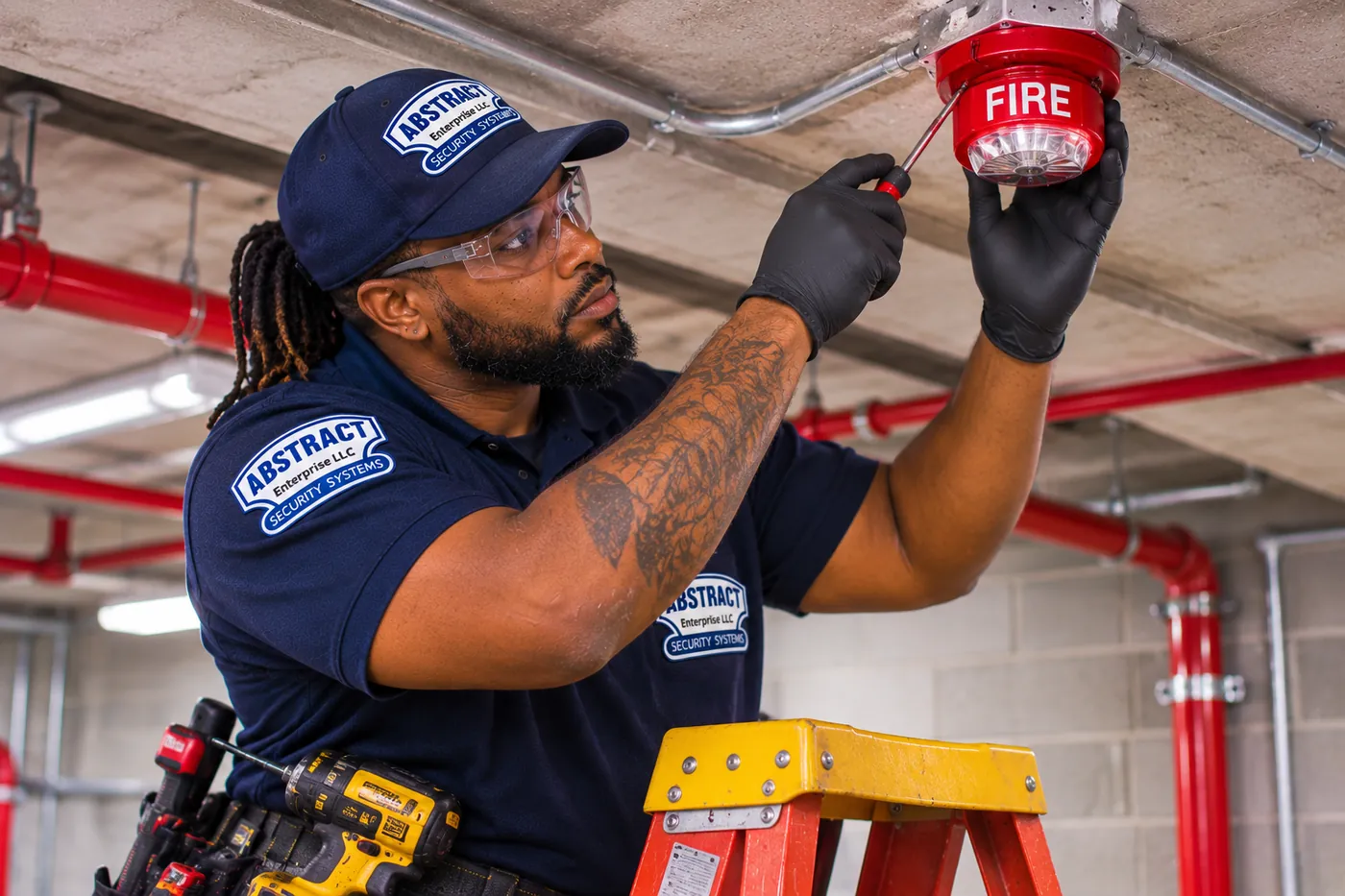
A technician with locs and a tattooed forearm stands on a yellow stepladder and tightens a red ceiling horn strobe marked FIRE into a concrete ceiling, red sprinkler pipe and gray conduit running past behind him. Cellars under shared buildings often hold the boiler, the meters and the fire alarm panel in one room.
Building Types
Commercial Fire Alarm Systems for Ocean Hill Schools, Housing, Mixed-Use Blocks and Towers
Commercial fire alarm systems in Ocean Hill fall into five families of buildings. Together they make up the commercial fire detection systems the neighborhood depends on, each shared in its own way.
School buildings with more than one school inside
The old JHS 271 on Herkimer Street and the 1965 building at 2021 Bergen Street are the clearest cases. Every educational occupancy needs a fire alarm under the city code, and a shared building still has one system, one panel and one Letter of Approval. What differs is everything around it: which school's staff evacuate which wing, who pulls the drill, who answers when the panel beeps at 7 a.m., and whose custodian lets us in. In the windowless rooms of the Bergen Street building, horns and strobes are the only warning, so audibility testing deserves extra care. School fire alarm installation here is planned with the Building Council calendar in hand.
Public housing developments under new management
Ocean Hill Apartments and Saratoga Village moved to PACT management in September 2025, with elevators to be fully modernized, roofs replaced, facades cleaned or over-clad and a new video intercom at every entrance, according to NYCHA's community plan. The plan also promises new hardwired carbon monoxide and smoke detectors in every apartment; those in-unit alarms are separate from the building fire alarm that watches the halls, stairs, elevator machinery and community rooms. Saratoga Village adds a CUNY-run community center under the same roof, so a program director, a property manager and a tenant association all have a stake in the panel. High rise fire alarm installation and multifamily work here means keeping an existing system alive while the building around it is rebuilt.
Rebuilt sites with stacked uses
The old Prospect Plaza towers were emptied in 2000 and later torn down, Brownstoner and New York YIMBY reported. Their replacement, built in phases by NYCHA and HPD with private partners to designs by Dattner Architects, holds 364 apartments on Park Place, Prospect Place and Sterling Place between Saratoga and Howard Avenues, with 80 set aside for public housing. The final building, 1845 Sterling Place, stacks 123 apartments over a grocery, retail and a garage. Mixed use building fire alarm installation in a building like that has to decide early which devices belong to the base building and which to each tenant, so a new grocery operator or a new program is a modification, not a redesign.
Supportive housing over storefronts on Broadway
The Henry Apartments, two six-story buildings facing each other at 1676 Broadway and 8 Rockaway Avenue, opened with 134 units, 78 of them for formerly homeless households, on-site services from Services for the UnderServed, and ground-floor commercial space of 2,500 and 4,500 square feet, according to the city's Housing Development Corporation. A building like this has staff offices, apartments and stores under one panel, and residents who may need more time or help to leave. Apartment building fire alarm installation in supportive housing pays close attention to strobe coverage, clear messages and staff training on what the annunciator says.
Towers coming at Broadway Junction
The biggest change is still on paper. The Herkimer-Williams plan by Totem covers a triangle bounded by Van Sinderen Avenue, East New York Avenue, Atlantic Avenue and Fulton Street, with elevated tracks running through it; Brownstoner described four towers of 21 to 29 stories, including a 29-story building of 384 apartments and two commercial towers on a three-story retail podium, with space possibly set aside for a church. The City Council approved the rezoning in December 2025; BK Reader expects construction to start in 2028 at the earliest. Office building fire alarm installation, shopping center fire alarm installation in the retail podium and parking garage fire alarm installation below grade will all happen inside one development, phase by phase.
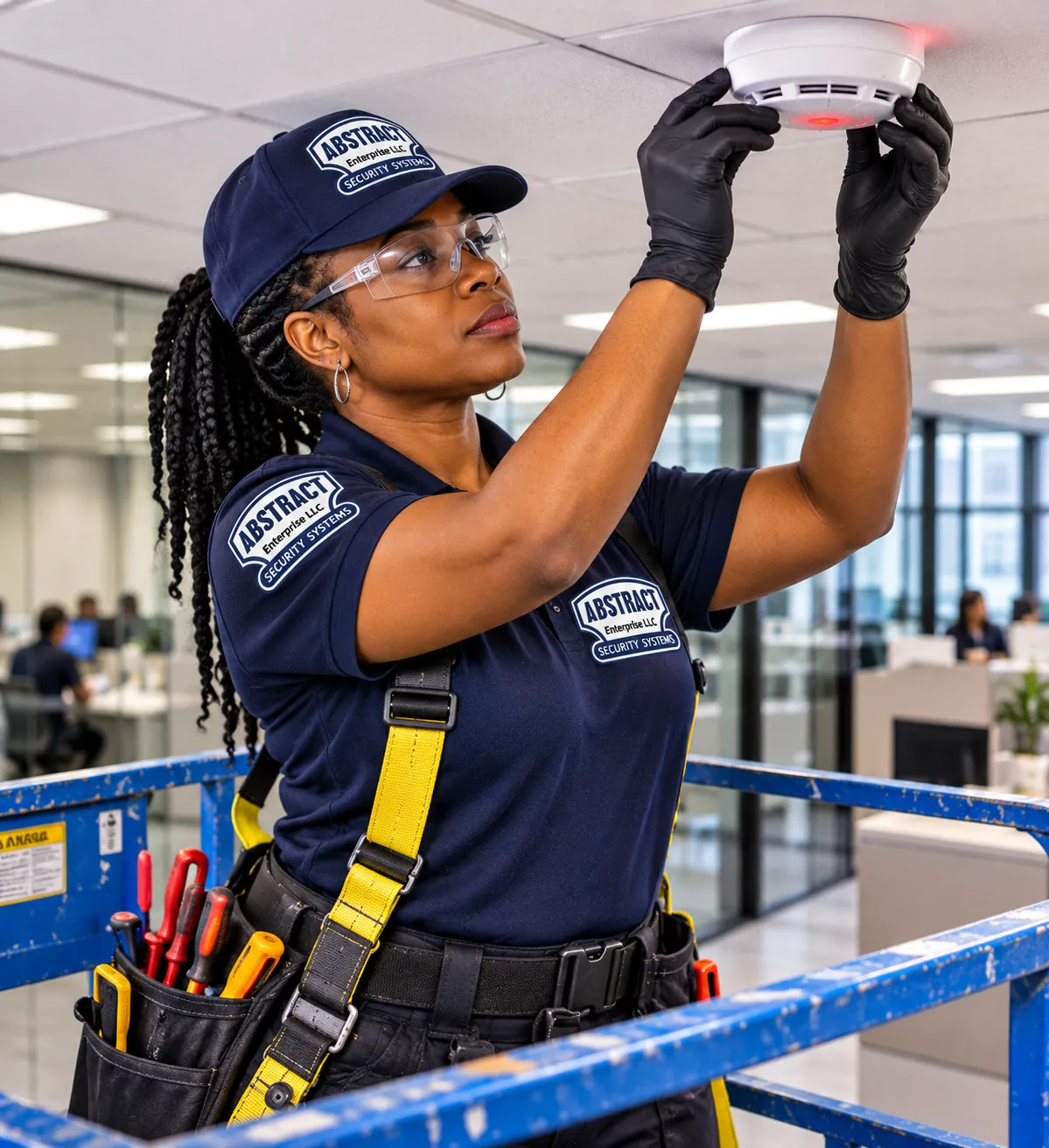
A technician with long braids, safety glasses and a yellow harness stands on a blue scissor lift and seats a white smoke detector into its ceiling base, desks and glass offices below.
Street by Street
Business Fire Alarm Installation Along Broadway, Fulton, Rockaway and Ralph
Business fire alarm installation in Ocean Hill follows four commercial streets the city studied closely. The Department of Small Business Services' Ocean Hill-Weeksville Commercial District Needs Assessment, led by Bridge Street Development Corporation with fieldwork from September 2023 to June 2024, counted 560 storefronts on Broadway (Lexington Avenue to Conway Street), Fulton Street (Utica Avenue to Mother Gaston Boulevard), Ralph Avenue and Rockaway Avenue (each from Broadway to East New York Avenue), with 11.3 percent vacant and 83 percent of surveyed merchants renting their space. One merchant told surveyors, "It is a space for Black and Brown businesses." Renters move, spaces turn over, and each new tenant can change the fire alarm picture.
Broadway. The northern edge, under the elevated J and Z trains. The SBS study flagged poor lighting under the el. Most Broadway buildings put stores below apartments or offices, and the supportive housing at 1676 Broadway shows how the newer ones look. Business fire detection systems here are usually a store's share of a building panel rather than a system of its own.
Fulton Street. City Neighborhoods calls Fulton the main commercial strip, historically lined with synagogues, bakeries and groceries. The SBS team found the poorest storefront conditions between Howard and Rockaway Avenues. When a vacant Fulton storefront reopens as a restaurant, a clinic or a church, the occupancy can change, and with it what the fire alarm must do; restaurant fire alarm installation adds heat detection and hood suppression monitoring near the cooking line.
Atlantic Avenue. The truck and car route across the middle of the neighborhood, with the Broadway Junction site at its eastern end. News 12 reported a fire outside a building on Atlantic Avenue in Ocean Hill on October 10, 2024, where officials found a lithium-ion battery at the scene. Storage facility fire alarm installation and warehouse fire alarm installation along the industrial lots near Van Sinderen Avenue follow that risk.
Rockaway Avenue. The CB16 public safety list puts Engine 233 and Ladder 176 at 25 Rockaway Avenue and an EMS station at 266 Rockaway Avenue, and 8 Rockaway Avenue is the larger half of the Henry Apartments. Stores and churches fill the rest.
Ralph Avenue and Saratoga Avenue. Ralph is the western edge, shared with Bedford-Stuyvesant; Saratoga runs through the middle past Saratoga Village and Saratoga Park. Retail store fire alarm installation in a small one-story shop may not be required at all, while a shop under apartments almost always ties into the building panel.
Compliance callouts for Ocean Hill owners and occupants
Sealed drawings first. FDNY guidance says a New York State registered design professional, a PE or RA, prepares and certifies the fire alarm plans and files the TM-1 through FDNY Business.
Wait for authorization. Work starts after plan approval and Project Authorization; NYC Business lists the application fee as 420 dollars for a new filing, plus 525 dollars when a complex technical analysis applies.
Check two credentials. The company needs the FDNY Fire Alarm Company Certificate, and one principal must hold the S-97, which requires NICET Level II or higher or a New York City master or special electrician license.
One owner signs, every occupant is told. The building owner answers to the FDNY, but schools, programs and tenants need written notice of tests, bypasses and fire watches in their spaces.
Plan in months. The FDNY puts the average from plan submission to approval at about 20 to 24 weeks, and the central station link must be live before the inspection can be booked.
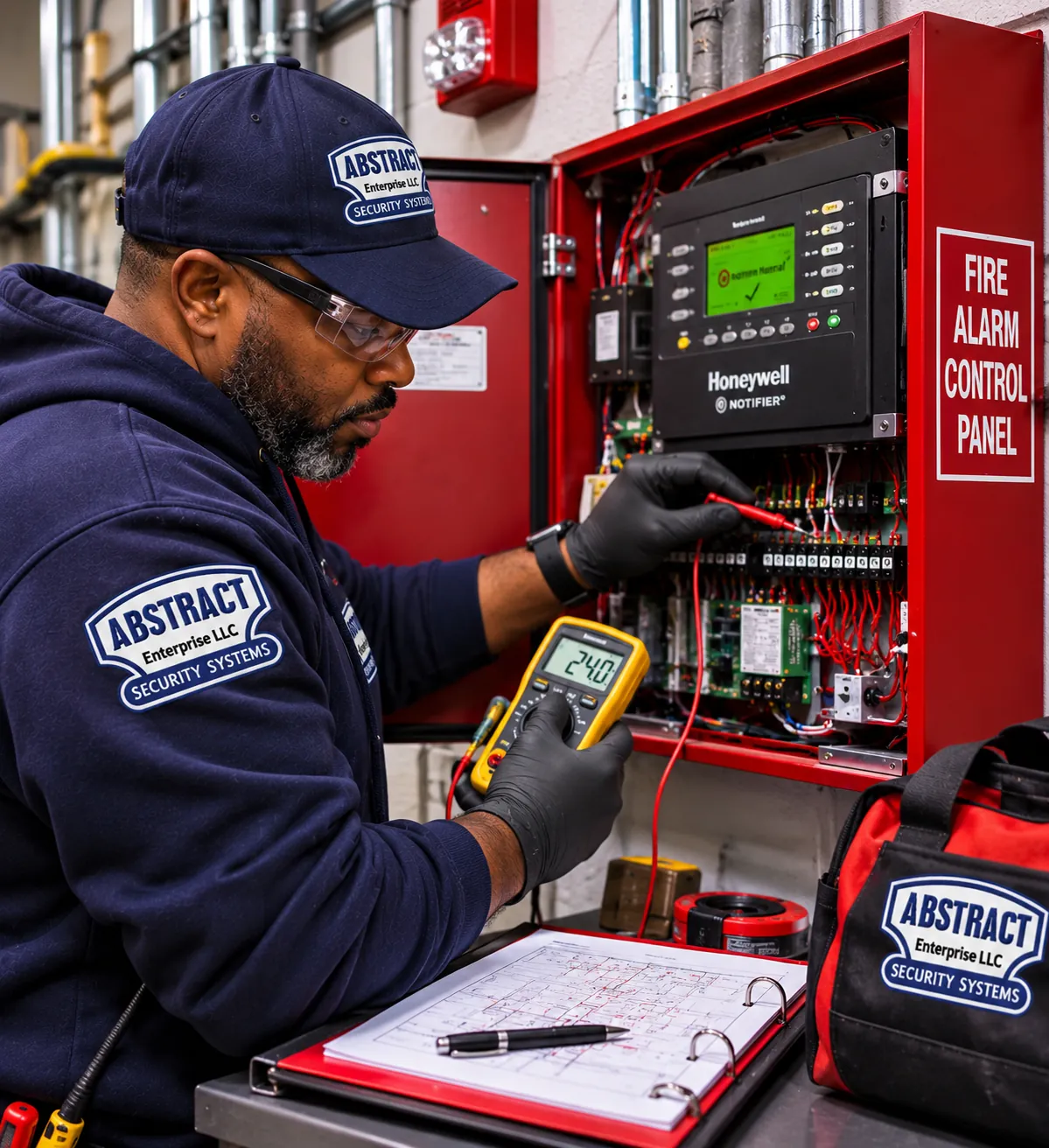
A technician in a hoodie holds a multimeter reading 24.0 with one lead on the terminals inside an open Honeywell NOTIFIER panel labeled Fire Alarm Control Panel, a binder of floor plans and a tool bag on the bench below. When a panel serves several occupants, the binder of approved drawings is what keeps every repair consistent.
From the Field
Field Notes: Three Principals, One Panel
These notes are written in our company voice and describe the kind of coordination we do in a shared building, not a particular job at a particular address. Picture a four-story school building in Ocean Hill that holds a district middle school, a grades 6 to 12 school and a charter school. The panel in the basement serves all three. Its event log shows a trouble that comes and goes on the third floor, and a smoke detector in a corridor that two of the schools use.
The first stop is not the panel; it is the calendar. Before anyone tests a device, the custodian engineer, each principal's designee and the Building Response Team need to know the day, the hours and what will sound. A test that sets off horns during one school's state exam is a failed visit even when every device passes. We ask the Building Council for a window, put it in writing, and tell the central station when the building goes on and off test.
The second stop is the drawings. In a building that changed from one school to three, classrooms often became offices, a library became a computer lab, and a cafeteria serves more lunch periods than before. We walk every room against the approved plans and note each device that a wall, a cabinet or a schedule change has made hard to see or hear. Fixing that is a filed modification, not a quick swap. Get the calendar right, then the drawings, then the parts.
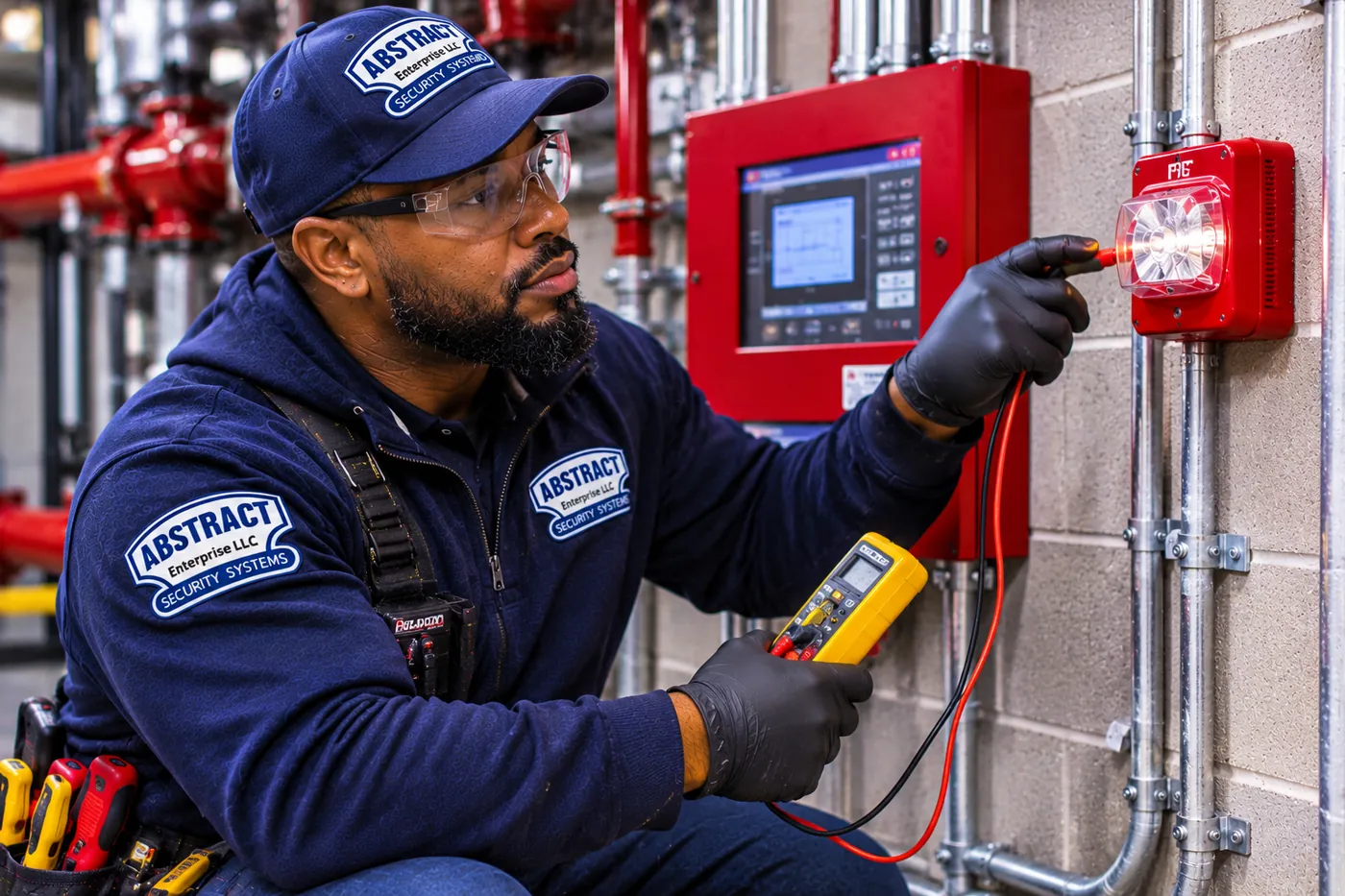
A bearded technician in a hoodie crouches with a yellow meter and touches a red lead to a lit strobe mounted on conduit, a red touchscreen panel beside it and red sprinkler piping behind.
Your Questions Answered
Fire Alarm Questions From Ocean Hill Principals, Managers, Program Directors and Store Owners, Answered
Questions we hear about Ocean Hill buildings. The answers are general guidance; your design professional applies the code to your address.
Three schools share our building on Herkimer Street. Which principal is responsible when the fire alarm panel shows a trouble signal?
None of them alone. The building's owner and custodial staff are responsible for the system, and the principals share the safety decisions through the Building Council. In practice, agree in writing who calls the custodian and the fire alarm company, who tells the other two schools, and where the trouble report is kept, so a beep at 7 a.m. never waits for a meeting.
Can a charter school sharing a district building add its own horns or strobes in its wing?
Not as a separate system tacked onto the wall. Any added device becomes part of the building's approved fire alarm, so it goes through the design professional, a filed modification and a test. Raise it with the Building Council first, since the work, the noise of testing and the change to the drawings affect every school in the building.
Our school building from the 1960s has very few windows. Does that change what the fire alarm has to do?
The code requirements are set by use, not by the number of windows, but the design should account for rooms where nobody can see smoke or flames outside. Interior classrooms and offices depend on notification reaching them clearly, so strobe placement, horn or speaker levels and any voice messages deserve careful measurement at acceptance and every inspection.
Saratoga Village is getting new roofs and facade over-cladding. What happens to the fire alarm equipment on the roof and outside walls while that work goes on?
It has to be planned before the roofers arrive. Duct detectors on rooftop units, devices in the roof bulkhead and any communicator antenna may need covers, temporary supports or a short relocation, and every one of those changes is logged, with the central station told when anything goes off line. When the roof and cladding are finished, each device is put back, tested and checked against the approved drawings.
Our PACT renovation is modernizing every elevator in the building. When does the fire alarm get retested?
Each time a car's controller changes, the elevator recall from the fire alarm should be proved again before the car returns to service, with the elevator mechanic and the fire alarm technician working together. Plan those tests into the elevator schedule, car by car.
Prospect Plaza mixes public housing apartments and income-restricted apartments in the same buildings. Do the public housing units get a different fire alarm?
No. The fire alarm follows the building's use, height and size, not who pays the rent. Every apartment, corridor and stair in a building is covered by the same approved system and the same tests, whichever program a household belongs to.
The grocery under the new Sterling Place building is changing operators. Does the fire alarm need to be reviewed?
Usually a review, not a redesign. If the new operator keeps the layout and use, the existing devices stay as approved. New coolers, a new kitchen, a different floor plan or a garage change can move or add devices, which means a filed modification and a test.
We run supportive housing over stores on Broadway. Do our case managers need training on the fire alarm?
It is a good idea, and the building's fire safety plan should spell out who does what. Staff who know how to read the annunciator, where the panel is and what a trouble signal means can direct residents and firefighters faster. Training does not mean staff reset the panel.
An 11-story building is going up on Sackman Street. Does it need more than the walk-ups around it?
Yes, if its top occupied floor sits more than 75 feet above the lowest level fire trucks can reach, which is how the city defines a high-rise building. High-rises carry extra fire alarm features under Building Code section 403, including emergency voice and alarm communication and a fire command center, alongside the smoke detection required for the building's use.
If Calvary Free Will Baptist Church is kept inside the Herkimer-Williams project, does it join the towers' fire alarm?
That is a design decision. Brownstoner reported that Totem showed one scenario keeping the church and one demolishing it. A church that stays as a separate building would normally keep its own system and approval; church space rebuilt inside a tower's podium would become part of that tower's system, with its own devices, notification and sequence.
The city's study flagged poor lighting under the Broadway el. Does that affect where firefighters find our building's fire alarm panel at night?
The lighting does not change the fire alarm rules, but it is a reason to get the basics right. The panel or annunciator belongs where the approved drawings put it, at the entrance responders will use, and the address, entrance and any panel-room door should be clearly marked. Ask your design professional which entrance the FDNY will come to.
An owner wants to turn a rowhouse near Saratoga Avenue into rooms for transitional housing. Does that call for a fire alarm system?
A legal conversion to a group or transient residential use generally brings fire alarm and sprinkler requirements that a family rowhouse never had, and it must be filed with the Department of Buildings and the FDNY. Brooklyn Paper reported that a vacant house on that block had been found illegally converted to 28-bed transitional housing before it burned. Do it legally, with sealed drawings, or do not do it.
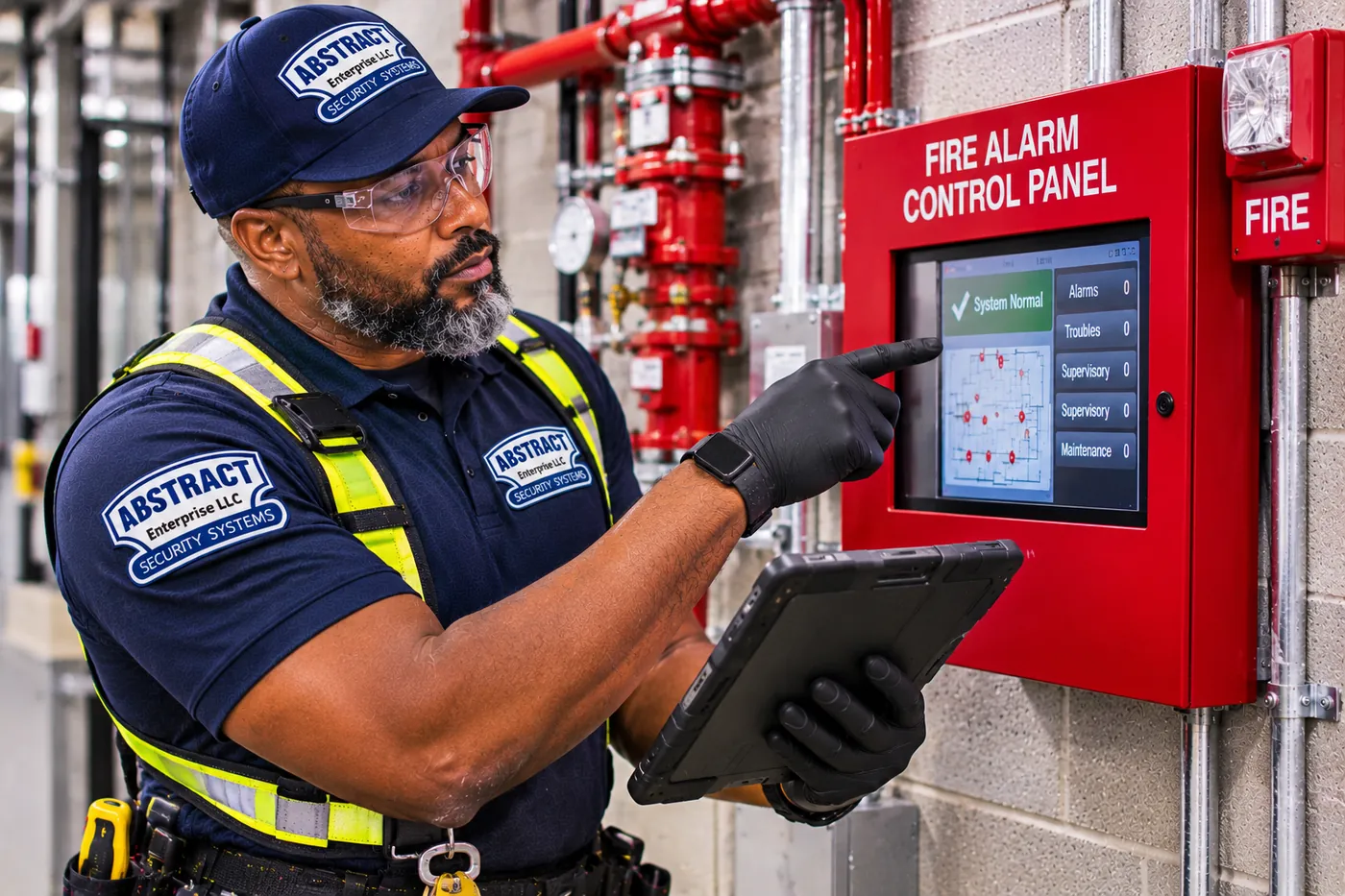
A technician in a hi-vis vest points at a red panel touchscreen showing System Normal with zero alarms, troubles and supervisories, tablet in his other hand and a red sprinkler riser with valves and gauges behind him. That clean screen is what a building should show before any acceptance test or annual inspection is booked.
Equipment
Types of Commercial Fire Alarm Systems We Install in Ocean Hill
Ocean Hill systems differ in how the panel identifies devices, warns people and calls for help. The design professional chooses; we install and test what the FDNY approves.
🎯
Addressable
Addressable fire alarm installation gives every device its own address, so the panel can name the school, floor and room. It suits shared school buildings, housing developments and new towers.
📐
Conventional
Conventional fire alarm installation groups devices into zones. It can still suit a small church hall or a single storefront building, as long as each zone is short and plainly labeled.
📣
Voice evacuation
Fire alarm voice evacuation installation and fire alarm emergency voice communication for high-rises and large assembly rooms, where spoken instructions work better than horns alone.
📶
Central station link
Fire alarm communicator installation and fire alarm monitoring system installation send every alarm, trouble and supervisory signal out. In a campus, each building gets its own fire alarm central station communicator installation and account.
🌡
Heat-led detection
Heat sensing for school cafeterias, boiler rooms, laundry rooms, compactor rooms and restaurant kitchens, where cooking, steam or dust would fool a smoke detector.
💨
Air sampling and beam
Aspirating smoke detection installation, an air sampling smoke detection system or beam detection for school gyms, auditoriums, sanctuaries and high lobbies where spot detectors are hard to reach.
Addressable or conventional for an Ocean Hill building
What is an addressable fire alarm system? Each device carries its own address on a signaling line circuit, so the panel can report "smoke detector, third floor, room 314, east wing" instead of "zone 3." What is a conventional fire alarm system? Devices share zone circuits and the panel only learns which zone tripped. What is the difference between addressable and conventional fire alarms in a shared building? With addressable, one school's wing can be put on test while the others stay live, a fault can be traced to a single device, and a new tenant space adds addresses rather than new zones, all set through fire alarm control panel programming. Intelligent fire alarm installation, using an intelligent fire detection system whose detectors adjust for dust, also helps in buildings under renovation.
Question
Addressable
Conventional
What the panel tells a custodian
The exact device and room
A zone, which may cover several rooms
Testing one school's wing in a shared building
Devices in that wing can be disabled one by one
The whole zone may need bypassing
A new store, program room or lab
New addresses on an existing loop, filed as a modification
Often new zones or circuits, filed as a modification
Typical Ocean Hill fit
Shared schools, housing developments, mixed-use and new towers
Small halls and single storefront buildings
On new work, addressable fire alarm system installation begins on paper, where fire alarm device addressing is laid out so every label on the panel matches a room name used by the occupants. Conventional fire alarm system installation and conventional fire alarm panel installation still have a place in small buildings, and conventional fire alarm repair or conventional fire alarm replacement can keep an older system going until a planned upgrade. In older Ocean Hill school and housing buildings, the common project is a conventional to addressable fire alarm conversion: conduit and boxes that test sound are kept, the panel and devices are replaced, and loops are rewired only where the existing cable will not carry the new signaling. Old fire alarm zone wiring with faded labels is traced first. Addressable fire alarm panel installation, addressable fire alarm device installation, addressable fire alarm system programming and fire alarm system configuration to the engineer's sequence follow; later, addressable fire alarm system repair, addressable fire alarm troubleshooting or an addressable fire alarm system upgrade keeps each loop healthy.
Brands we install and service
For Honeywell's NOTIFIER line we do NOTIFIER fire alarm installation and NOTIFIER fire alarm repair, along with Honeywell fire alarm installation and Honeywell fire alarm service on the company's other panels. Smaller buildings often run Fire Lite or Silent Knight, so Fire Lite fire alarm installation, Fire Lite fire alarm repair, Silent Knight fire alarm installation and Silent Knight fire alarm service are routine. Large buildings may run Edwards or EST (Edwards fire alarm installation, Edwards fire alarm repair, EST fire alarm service), Siemens (Siemens fire alarm installation, Siemens fire alarm service) or Simplex, where we provide Simplex fire alarm service. Bosch fire alarm installation, Potter fire alarm installation, Potter fire alarm service and Kidde commercial fire alarm installation complete the list. Commercial fire alarm manufacturer service matters with proprietary panels: if only an authorized dealer can program one, ask how many dealers serve Brooklyn before buying it.
Devices
Ocean Hill Fire Alarm Devices, From Classroom Corridors to Rooftop Units
Each Ocean Hill device is chosen for its room. Fire detection device installation, fire detection system installation and fire alarm equipment installation all follow the approved drawings, and fire alarm initiating device installation is the part occupants notice least and depend on most.
Smoke detectors. The design decides where commercial smoke detector installation goes: corridors, stair landings, lobbies, elevator lobbies and machine rooms, electrical rooms, offices and more. Shared schools and renovated housing use addressable smoke detector installation, and photoelectric smoke detector installation suits the slow, smoky fires typical of storage rooms, trash rooms and apartments. Commercial smoke detector testing proves each head responds, commercial smoke detector replacement follows the maker's service life, and commercial smoke detector repair usually means a base cracked by a ladder or a head painted over during a classroom refresh.
Duct detectors. Where the code requires them, duct smoke detector installation goes on air handlers serving corridors, gyms, auditoriums and community rooms, and on the new rooftop units many renovations bring. Duct smoke detector testing has two parts, proving the detector sees smoke and proving the fan really stops, and duct smoke detector replacement follows when roof work damages a housing or sampling tube.
Heat detectors. Where smoke detectors would cause false alarms, commercial heat detector installation takes over: school kitchens and cafeterias, restaurant kitchens on Fulton Street, laundry, compactor and boiler rooms. The choice between fixed temperature heat detector installation and rate of rise heat detector installation follows how each room heats up during a normal day, and heat detector replacement usually comes after a kitchen fire or a long leak. Tall open rooms are where warehouse smoke detection installation, beam smoke detector installation and projected beam smoke detector installation belong; in Ocean Hill those rooms are school gyms, auditoriums and sanctuaries more often than warehouses.
Air sampling. VESDA installation and VESDA service apply where air sampling is specified, such as a tall auditorium, and data center fire detection installation in a school server room follows the same logic.
Pull stations. Fire alarm pull station installation follows the drawings, usually near exits, and manual fire alarm pull station installation in busy school halls often calls for listed protective covers to cut down on prank pulls. Fire alarm pull station testing is part of every inspection, and a cracked cover or broken handle calls for fire alarm pull station repair or fire alarm pull station replacement.
Notification. Corridors, classrooms, stores and halls in most Ocean Hill buildings get fire alarm horn strobe installation, or fire alarm horn installation or fire alarm strobe installation alone where only one is needed. High-rises and voice-designed buildings use fire alarm speaker installation and fire alarm speaker strobe installation. At acceptance, fire alarm audible notification installation and fire alarm visual notification installation are measured for sound and light levels; fire alarm ADA strobe installation covers public spaces, restrooms and accessible apartments; and fire alarm synchronization module installation keeps every strobe flashing together. The same family includes fire alarm notification appliance installation, fire alarm notification appliance replacement, fire alarm horn strobe replacement and fire alarm horn strobe repair.
Modules, power and annunciators. Modules connect the panel to the rest of the building. With fire alarm monitor module installation it watches sprinkler switches and kitchen hood systems; with fire alarm relay module installation it releases doors, stops fans and recalls elevators; with fire alarm control module installation it drives speaker and notification circuits. Fire alarm power supply installation and fire alarm NAC power supply installation feed the horns and strobes on upper floors, fire alarm battery backup installation carries them through a power outage, and fire alarm power supply repair follows when a charger fails. Fire alarm annunciator installation and remote annunciator installation give firefighters, and the staff of each school or program, a screen they can read at the entrance.
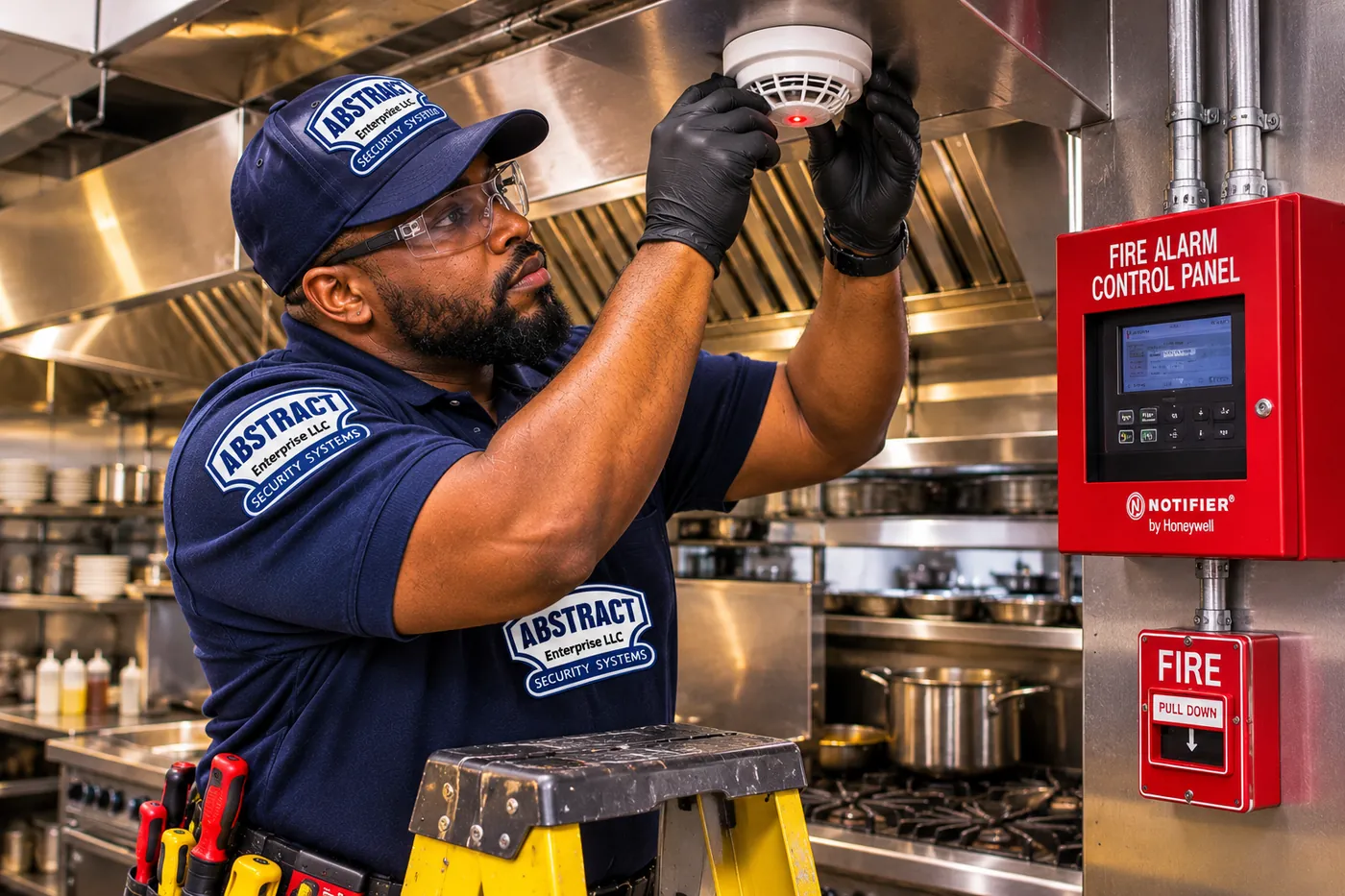
A bearded technician on a yellow stepladder presses a white detector into the ceiling of a stainless steel kitchen, the exhaust hood behind him and a red panel and pull station on the wall at right.
AI Overview Reality Check
What AI Gets Wrong About Fire Alarms in Ocean Hill
AI assistants and the cost guides on Angi, HomeAdvisor and Fixr usually picture one owner, one tenant and a few household smoke alarms. Here are seven common claims, checked against Ocean Hill's shared buildings.
"Each tenant or school handles its own fire alarm."
In a shared building there is usually one fire alarm system, approved by the FDNY as a whole, and the building owner answers for it. A school, a program or a store does not get to run a separate system in its corner, and a device added by one occupant becomes part of everyone's system.
The city's own schools show the scale. NYC Public Schools says more than half of its schools share a campus with other schools or programs, and it requires a Building Council of all the principals, with district and charter leaders as equal partners, to meet 12 times a year on shared matters including safety.
So the useful question is not "whose alarm is it?" but "who is told, who decides and who signs?" Settle that in writing before the first test is booked.
"Any electrician can install and service a commercial fire alarm."
Not in New York City. The FDNY requires a Fire Alarm Company Certificate for any company that installs, inspects, tests or services fire alarm components beyond standalone smoke detectors, and at least one principal must hold the S-97 Certificate of Fitness, which requires NICET Level II or higher or a city master or special electrician license.
A licensed electrician is still part of the team for filed electrical work. On a large job with its own general contractor, ask for the fire alarm company's certificate number and the name of its S-97 holder before signing anything.
Our part: Abstract Enterprises Security Systems is a licensed low-voltage contractor that coordinates the job, and every proposal names the certified company and the electrician who sign.
"A fire alarm goes in over a long weekend."
The devices for a small store might. The approvals behind them take months. FDNY guidance puts the average from plan submission to final approval at about 20 to 24 weeks, with the first review alone taking up to eight weeks once the package is complete.
The acceptance test then needs its own paperwork and lead time: an inspection request, the approved plans, a central station contract and a live connection. In a shared school building the test also has to fit around exam calendars, and in a housing development around elevator outages and resident notices.
For a phased project like the Broadway Junction towers, every phase that opens needs its own place on that calendar, years apart.
"Fire alarm cost is a simple number per device."
National cost guides average consumer prices. A commercial system filed with the FDNY is priced from its design: the sealed drawings, the filing, cable routes through occupied classrooms or apartments, links to sprinklers, elevators, fans and doors, testing, and the coordination a shared building demands.
Government fees are the one public number. NYC Business lists 420 dollars for a new FDNY fire alarm application, plus 525 dollars when a complex technical analysis is required, and the FDNY lists 105 dollars to submit corrections to a Notice of Defect on form FA-27.
Everything else is quoted building by building, after a walk-through or a design review.
"Apartment smoke alarms and the building fire alarm are the same thing."
They are not. NYCHA's community plan for Ocean Hill Apartments and Saratoga Village promises new hardwired carbon monoxide and smoke detectors in every apartment, which is good news for residents; those alarms sound inside the apartment to wake the people there.
The building fire alarm is a separate system that watches the common areas, controls elevators, fans and doors, and reports to a central station. When an apartment alarm sounds, the whole building does not necessarily hear it, and when the building system goes into trouble, the apartment alarms keep working on their own.
Renovations that touch one rarely touch the other, so check both when work is planned, and keep their records apart.
"Taller buildings just need more of the same devices."
Height changes the system, not just the device count. The city's Building Code treats a building as a high-rise when its highest occupied floor is more than 75 feet above the lowest level fire trucks can reach, and section 403 then adds features such as emergency voice and alarm communication and a fire command center.
Ocean Hill is about to cross that line. New York YIMBY reported an 11-story, 115-foot building with 123 apartments filed at 50 Sackman Street, and the Broadway Junction plan calls for towers of 21 to 29 stories. As Totem's Tucker Reed told Brownstoner about the early proposal, "It's a conversation and the tradeoff between density and height versus desired uses."
A tower mixing offices, apartments and retail needs a sequence that tells each floor what to do.
"Once the FDNY test passes, nothing else is needed."
The acceptance test is the start. NFPA 72, as the city applies it, sets recurring visual checks, functional tests, battery tests and detector sensitivity checks, and NYC Business says owners keep inspection and test records for at least three years.
Monitoring needs care too. The FDNY's January 2012 bulletin requires a lost central station connection to be restored, and switching central stations or dialers brings a reinspection. A new manager who quietly changes monitoring companies can undo an approval.
In a shared building, put the Letter of Approval, the drawings and every report where each occupant's safety lead can find them.
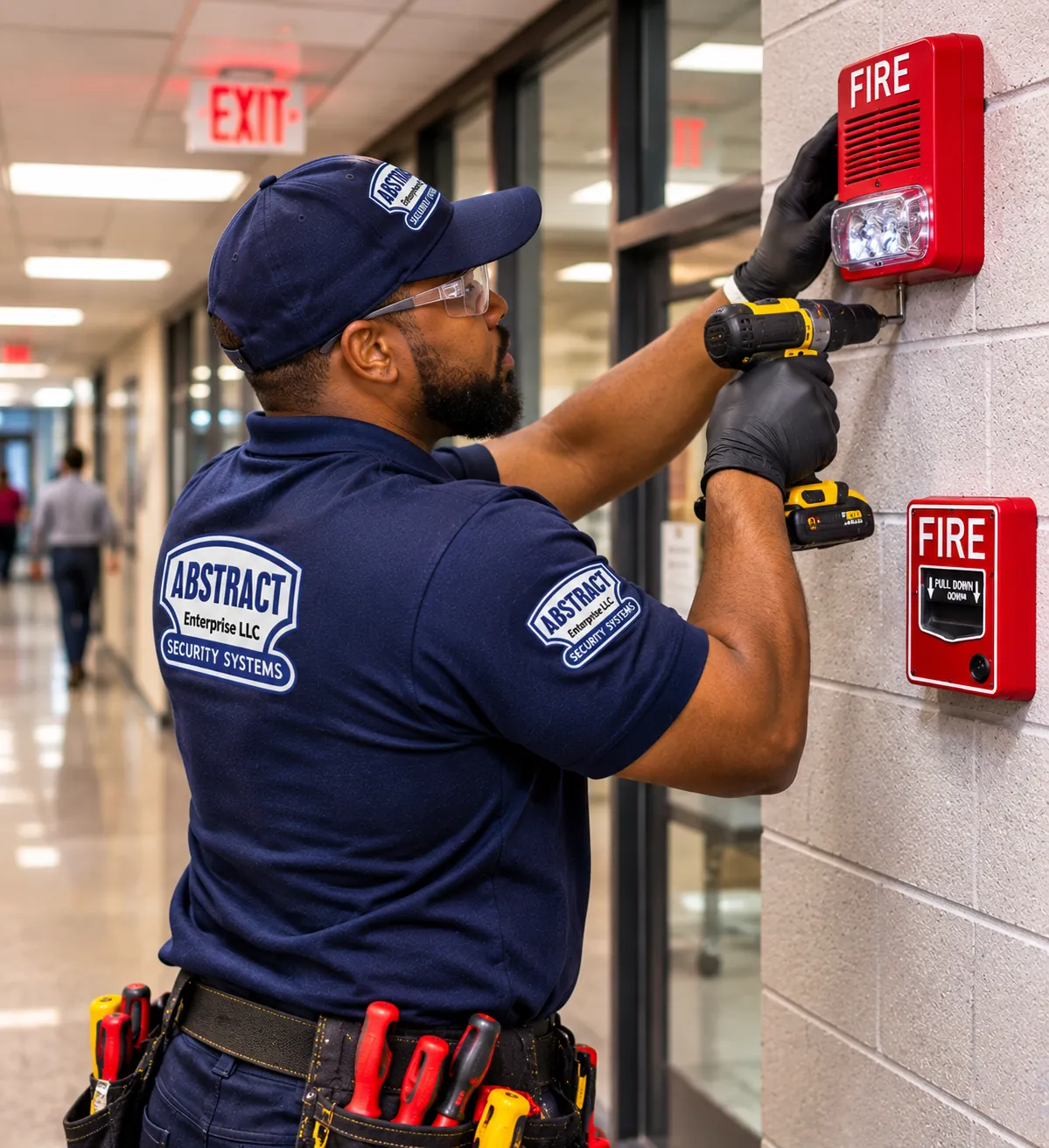
A technician in a navy cap drives a yellow cordless drill into a red horn strobe on a painted block wall, a red pull station mounted below and an exit sign glowing down the corridor behind him.
Sharing a Building, Opening a Program or Planning a Tower? Talk to a Tech First
Tell us the address, the stories, the owner and who uses each floor. We book a walk-through within 2 hours of your request and spell out who needs to do what.
Request a Free Quote for Your Ocean Hill Fire Alarm Project
Give us the address, stories, owner, who occupies each floor, the biggest crowd any room holds, and any sprinklers, elevators, garage or kitchen. That is how a fire alarm installation consultation with us begins.
✅
Request Sent!
Thank you. We will be in touch to set up your Ocean Hill fire alarm walk-through, usually within 2 hours of your request.
How It Works
Our Fire Alarm Installation Process for Ocean Hill Buildings
We run Ocean Hill fire alarm jobs in the order the FDNY sets, with one extra step at the front for shared buildings: an occupant map. Step one of the approval path is always a New York State licensed PE or Registered Architect designing and sealing the drawings; step two is the vendor team, meaning the FDNY-certified fire alarm company, the licensed electrician and our office. The FDNY plan exam, the installation and the witnessed acceptance test follow.
1. First call
Address and cross street, stories, owner, every occupant and their hours, the largest crowd, sprinklers, elevators, kitchens, the panel brand and the deadline.
2. Occupant map
A floor-by-floor list of who uses each space, who must be told before a test or bypass, and who sits on the call list, agreed with the owner.
3. Records and walk-through
Letters of Approval, approved and as-built drawings, central station contract, inspection reports and any open defects, then every room checked against them.
4. Design professional and sealed drawings
The engineer or architect produces the commercial fire alarm system design and seals it: drawings, battery and voltage-drop calculations and the sequence of operations.
5. Written proposal and team
One document separating design coordination, filing support, installation, programming and testing, naming the certified company and the electrician of record.
6. FDNY plan review
The design professional files the TM-1, answers examiner comments and receives approval and Project Authorization; fire alarm shop drawings follow from the approved set.
7. Build, program, pre-test
Cable, devices and panel go in to the approved drawings in phases around school days, residents and tenants, then everything is programmed and tested with the elevator, sprinkler, door and HVAC trades.
8. FDNY test and handover
The FDNY Fire Alarm Inspection Unit witnesses the acceptance test; the Letter of Approval, as-built drawings, test reports and staff training go to the owner and each occupant's safety lead.
Does my building need a fire alarm permit? In New York City, approval works through the FDNY plan exam and Project Authorization rather than a single permit card, while the electrician's filing with the Department of Buildings covers the wiring. Fire alarm permit requirements and the fire alarm installation permit therefore come down to a TM-1 filed by the design professional, plans the FDNY approves and authorization to start. Fire alarm system approval arrives after the test, as the Letter of Approval, and fire alarm system design requirements such as occupancy, occupant load and building height are written into the sealed drawings the plan examiner reviews.
What happens during fire alarm acceptance testing? The building must be ready first: the work done, the panel on permanent power with no alarm, supervisory or trouble showing, and the central station connected. Then technicians activate devices floor by floor while the inspector confirms each signal at the panel and at the central station, watches elevators recall, fans stop and doors release, and checks that horns, strobes and voice messages reach every space. The fire alarm acceptance inspection ends with approval or with a correction list and a retest. Thorough fire alarm functional testing, fire alarm device testing and fire alarm system testing and commissioning records from the pre-test make the day shorter, and in a shared building, a notice to every occupant the week before keeps it calm.
How long does fire alarm installation take? On site, from a few days for a storefront to several weeks for a multi-school panel replacement done during breaks; the approvals, which the FDNY averages at 20 to 24 weeks, set the real calendar.
Existing Systems
Upgrades, Inspections and Maintenance for Ocean Hill Fire Alarms
Most Ocean Hill work is on existing systems. Can an existing fire alarm system be upgraded? Almost always; the real question is how it gets filed. A fire alarm system upgrade, fire alarm panel upgrade, fire alarm control panel upgrade or legacy fire alarm system upgrade that changes what the system does goes through design and filing, while replacing a device with the identical model is maintenance. Parts that are no longer made usually force the choice, and outdated fire alarm system replacement or obsolete fire alarm panel replacement then becomes a fire alarm system lifecycle replacement plan, ideally timed to a school break or a renovation phase.
Changing occupants drive smaller changes. Existing fire alarm system expansion adds devices for a new program room, lab or store. A fire alarm system modification alters the sequence or adds an interface, for example new elevator controllers or new door hardware. Fire alarm device replacement swaps worn heads and bases, and fire alarm system reconfiguration or fire alarm system conversion follows when walls move between classrooms or offices. In an occupied building a fire alarm system renovation goes wing by wing; the larger versions of the same work are called fire alarm system modernization, commercial fire alarm modernization, fire alarm system retrofit or commercial fire alarm system retrofit. Fire alarm control panel replacement, fire alarm panel replacement, fire alarm system replacement and FACP replacement share one rule in every Ocean Hill basement: the old system stays in service until the new one passes its test. When an alteration or an FDNY order brings newer rules into play, the job becomes a fire alarm system code upgrade, designed and filed like any other change.
How often should fire alarms be inspected? NFPA 72, as New York City applies it, gives each part of a system its own schedule, from frequent visual checks to yearly functional tests and periodic detector sensitivity checks. How often should commercial fire alarms be tested? Most devices and functions at least once a year, some more often. The fire alarm annual inspection, fire alarm inspection, fire alarm system inspection, fire alarm testing, fire alarm sensitivity testing and NFPA 72 fire alarm testing visits produce the records owners must keep, and fire alarm inspection documentation and fire alarm system documentation are what an inspector asks for first.
Who can correct fire alarm inspection deficiencies? The certified fire alarm company, with a licensed electrician wherever wiring changes, working through the report line by line. Fire alarm inspection deficiencies, fire alarm deficiency correction, fire alarm inspection repair, fire alarm system violation correction and fire alarm code violation repair all start with reading exactly what was cited. The FDNY's Notice of Defect is answered on form FA-27 with a 105-dollar fee, and an accepted correction brings a Letter of Approval by mail. Then come fire alarm code compliance and fire alarm code compliance upgrades, fire alarm inspection preparation for the next visit, and fire alarm system certification in the form of current approvals and reports kept where the next principal or manager will find them.
Whether you hire a fire alarm maintenance company, a fire alarm testing company or a fire alarm inspection company, it must hold the FDNY certificate, visit on schedule and keep the paperwork in one place. In an Ocean Hill school building, fire alarm preventative maintenance means a walk of every wing after summer projects; in a housing development, a look at roof devices after storms. A fire alarm inspection contractor or fire alarm testing contractor who knows the building finds trouble before the FDNY does, and the maintenance agreement should list fire alarm system inspection requirements device by device.
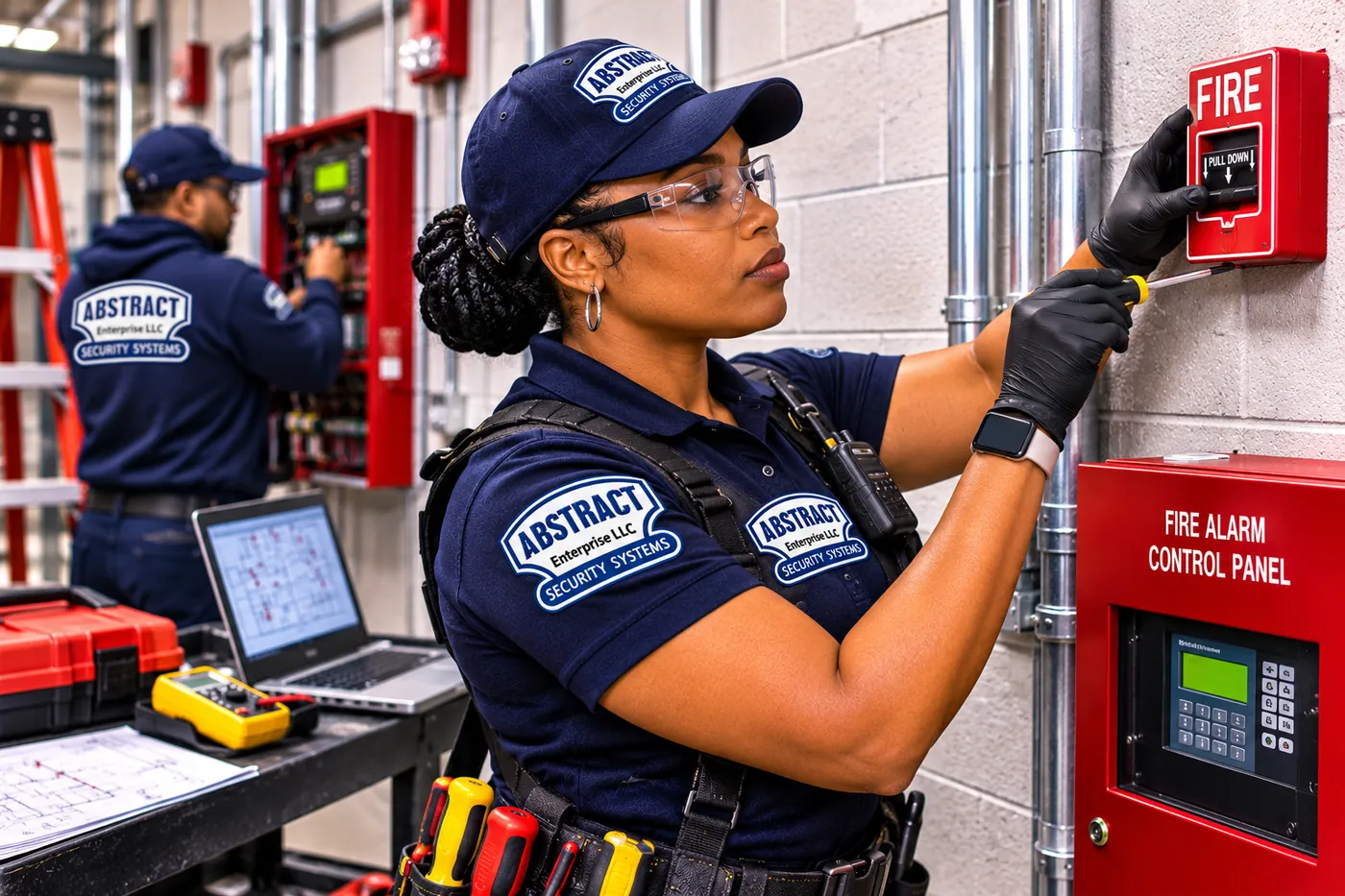
A technician with a radio on her harness tightens a red pull station above a red panel with a green display, while a second technician works inside an open cabinet behind her and a laptop, meter and drawings sit on the bench. Commissioning pairs one person at the devices with one at the panel, talking by radio.
Landmarks
Fire Alarm Installation Near Ocean Hill Landmarks
Fire alarm installation near Ocean Hill landmarks is mostly a matter of timing and access. These places shape when our crews test, where they park and whom they call first.
Saratoga Park
A 3.21-acre park bounded by Halsey Street, Saratoga Avenue, Macon Street and Howard Avenue, bought by the City of Brooklyn in 1896, with a World War I memorial to 104 local men first dedicated in 1921 and rededicated in 2014.
Former JHS 271
1137 Herkimer Street: the school at the center of the 1968 dispute, closed in 2008, now shared by Eagle Academy for Young Men II, Mott Hall IV and Ocean Hill Collegiate.
2021 Bergen Street school
A brick Brutalist building from 1965 with few windows, now Brooklyn Collegiate High School, near the EMS station on Rockaway Avenue.
Engine 233 and Ladder 176
25 Rockaway Avenue, the firehouse Brooklyn Community Board 16 lists for the area, with EMS at 266 Rockaway Avenue and the 73rd Precinct at 1470 East New York Avenue.
Broadway Junction
Where the A, C, J, Z and L lines meet at the neighborhood's eastern edge, and the site of the Herkimer-Williams towers approved in December 2025.
Prospect Plaza and Saratoga Village
The rebuilt Prospect Plaza blocks between Saratoga and Howard Avenues, and the Saratoga Village building at 33 Saratoga Avenue with its CUNY community center.
School days, programs, Sunday services and elevator outages are all bad moments for a test that sounds every horn. Wikipedia files Saratoga Park under Bedford-Stuyvesant; lines here depend on the source.
How Fire Alarm Installation Is Priced in Ocean Hill
Fire alarm installation in Ocean Hill is priced in writing only after we have walked the building or read its drawings, so this page lists no prices, ranges or packages. How much does commercial fire alarm installation cost? Fire alarm installation cost, commercial fire alarm installation cost and fire alarm system installation cost come out of the design, built from four stages of work: drawings sealed by the design professional, the FDNY filing, installation to the approved set, and pre-testing followed by the acceptance test.
How much does fire alarm panel replacement cost? It depends on how much of the existing cable, devices and power supplies can stay, whether the new panel works with them, and whether the FDNY treats the job as a modification or a new system. In a shared school building, fire alarm panel replacement cost, fire alarm panel installation cost, fire alarm system replacement cost and fire alarm system upgrade cost also turn on how much work can happen during breaks and how many separate test windows the schools need. In a housing development under renovation, they turn on phasing around residents and elevator work; in a new tower, on how many phases are tested separately.
Instead of a price list, here is what our proposal shows. A fire alarm installation estimate or fire alarm system installation estimate breaks the job into lines: coordination with the engineer or architect, the occupant map and records review, filing support, material, labor, programming, pre-testing and the acceptance test, with the certified company and electrician named. When a fire alarm installation quote, commercial fire alarm quote, fire alarm contractor estimate, fire alarm system installation proposal or fire alarm installation bid lumps everything into one line, it cannot be compared with another. Service work is written the same way: fire alarm repair cost, fire alarm service call cost, fire alarm inspection cost, fire alarm testing cost and fire alarm maintenance contract cost are agreed in writing before work starts, which is what fire alarm installation pricing should mean for any Ocean Hill owner.
Public fees are the exception, each from a published source. NYC Business lists 420 dollars for a new FDNY fire alarm application, with 525 dollars more when the FDNY must run a complex technical analysis, and the FDNY's FA-27 instructions list 105 dollars to submit corrections to a Notice of Defect.
Choosing a Contractor
Choosing Fire Alarm Installers for an Ocean Hill Building
Choosing fire alarm installers for an Ocean Hill building starts with four names you should get before signing. How do I find a licensed fire alarm contractor? Ask for the FDNY Fire Alarm Company Certificate number, the person who holds the S-97, the licensed electrician who will file the electrical work, and whoever will walk the inspector through the test. In New York City, fire alarm contractor licensing means those credentials together, and a licensed fire alarm installer or certified fire alarm technician on site works under them. Who installs commercial fire alarm systems? A team, never one person: a design professional, a certified fire alarm company, an electrician and often a low-voltage contractor like us keeping the schedule and the occupants informed.
Then weigh experience: fire alarm installation contractors for commercial buildings who have worked in occupied schools or housing phase work so nobody is unprotected overnight. Whether the firm calls itself a commercial fire alarm contractor, a commercial construction fire alarm contractor or a fire alarm system expansion contractor, it should read and produce fire alarm shop drawings, fire alarm construction drawings and fire alarm as built drawings, and leave the as-built set with you. Property management fire alarm services add one question: who keeps the records?
Most people start with a phone search for fire alarm installation near me, fire alarm installers near me, fire alarm contractors near me or fire alarm companies near me, and the top results are often national lead sites. A local fire alarm installation company that already knows the school buildings on Herkimer and Bergen Streets and the storefronts on Fulton and Broadway can tell you on the first call how the FDNY steps apply to your building. Hold every bidder to the same tests, whether they call themselves fire alarm installers, a fire alarm installation contractor, a fire alarm system contractor, a commercial fire alarm installation company, commercial fire alarm installers, a fire alarm company or a fire alarm service company: the certificate, the written proposal and the reviews. The best commercial fire alarm installer for an Ocean Hill building is the experienced fire alarm contractor who explains each step and names each signer; a good fire alarm compliance contractor answers your questions before you sign, and our Google reviews, 4.7 stars from 201 reviews, are public.
Interfaces
How an Ocean Hill Fire Alarm Works With Elevators, Doors, Sprinklers, Fans and Kitchens
Interfaces are how an Ocean Hill fire alarm controls the rest of a building, and in a shared building each one may belong to a different occupant's daily routine. Fire alarm system integration means every link is shown on the approved plans, wired through a module, programmed to the sequence and proved in front of the inspector.
Elevators. NYCHA's plan for Ocean Hill Apartments and Saratoga Village calls for fully modernized elevators with new cabs, machinery and cables. Fire alarm elevator recall integration sends cars to the recall floor when smoke is detected in an elevator lobby, hoistway or machine room, and every elevator fire alarm interface must be proved again with the elevator mechanic after a controller is replaced.
Doors. The same plan adds key fobs on lobby, laundry and package room doors. Fire alarm door release integration and fire alarm magnetic door holder release let held-open corridor and stair doors close on alarm, and a fire alarm access control interface releases locked doors where the code requires it.
Sprinklers. Sprinkler waterflow switch monitoring turns flowing water into an alarm, and sprinkler tamper switch monitoring turns a closed valve into a supervisory signal; together they are the core of fire alarm sprinkler monitoring installation. During renovations, clear each supervisory signal rather than letting the building get used to it.
Fans and dampers. Air handlers serving corridors, gyms, auditoriums and community rooms are stopped on alarm through fire alarm HVAC shutdown integration, and duct detectors join that sequence through fire alarm duct detector integration. In a high-rise with stair pressurization or smoke exhaust, a fire alarm smoke control interface starts and stops those fans.
Kitchens and suppression. When a school or restaurant hood system discharges, fire alarm kitchen hood suppression monitoring reports it to the panel, and the engineer's sequence decides what follows. Other suppression systems, such as clean agent in a server room, connect through a fire alarm suppression system interface. Commercial kitchen fire detection installation pairs heat detectors with that monitoring.
Voice and mass notification. Fire alarm emergency voice communication carries spoken instructions in high-rises and large assembly rooms. Fire alarm mass notification integration, using the same speakers for other announcements, suits a shared school campus and must never override a fire signal.
New Work
New Construction in Ocean Hill: From Six-Story Infill to Broadway Junction Towers
New buildings in Ocean Hill come in three sizes: six-story affordable and supportive buildings on former vacant lots, mid-rise buildings that cross the 75-foot high-rise line, and the planned towers at Broadway Junction. Commercial building fire alarm installation follows the same arc in all three. Early plans set the panel room, risers and fire command location; the design professional draws the fire alarm; the FDNY reviews it while construction continues; and fire alarm rough in happens after framing and before walls close.
The 6sqft report on the December 2025 Council vote describes up to 1,000 affordable apartments, about 440,000 square feet of office, 100,000 square feet of light industrial space, 114,000 square feet of retail and up to 85,000 square feet of community facility space, possibly for a college. Council Member Sandy Nurse told BK Reader, "There is space dedicated to a higher educational facility that we are working towards." That mix is why industrial fire alarm systems, industrial fire alarm installation, industrial building fire alarm installation and industrial fire detection system installation by an industrial fire alarm contractor may finally have a place at Ocean Hill's eastern edge, along with manufacturing facility fire alarm installation for the light industrial floors.
The smaller projects are more numerous. New York YIMBY reported 50 Sackman Street between Herkimer and Fulton Streets at 11 stories, 115 feet and 123 apartments over 46 enclosed parking spaces, replacing a one-story industrial building, and a six-story supportive housing filing at 2414A Atlantic Avenue near East New York Avenue. Parking garage fire alarm installation in a building like Sackman Street depends on heat detection and its own ventilation interfaces. Hotel fire alarm installation is rare in Ocean Hill today; condominium building fire alarm installation follows any new building sold as condos; hospital fire alarm installation, nursing home fire alarm installation and assisted living fire alarm installation belong to institutional projects with defend-in-place designs, and medical office fire alarm installation follows clinics into new ground floors. Commercial fire alarm commissioning closes out each of these jobs before the FDNY test.
Complete Services
Every Fire Alarm Service for Ocean Hill and Nearby Brooklyn
A walk-through or drawing review for any Ocean Hill building, booked within 2 hours, ending in a written proposal.
FAQ
Ocean Hill Fire Alarm Installation FAQ
Did the Ocean Hill-Brownsville school fight of 1968 leave local school buildings with their own rules for fire safety?
+
No. Fire alarm requirements in Ocean Hill school buildings are the same citywide Building Code, Fire Code and FDNY approvals that apply everywhere. What did change over the decades is how schools share buildings: today a Building Council of all the principals in a shared building handles shared matters, including safety, under the Chancellor's regulation.
After a fire, what should Ocean Hill tenants expect to be done to the building fire alarm before they move back in?
+
Damaged devices and cable replaced, the panel cleared of troubles, every affected circuit tested and the central station connection confirmed. If the repairs changed the approved system, they are filed. Ask the landlord or manager for a short written note from the fire alarm company that the system was tested after the repairs.
Which company signs the FDNY fire alarm paperwork on an Ocean Hill job that Abstract Enterprises Security Systems coordinates?
+
The FDNY-certified fire alarm company named in our written proposal, whose principal holds the S-97, signs for the fire alarm work, the licensed electrician signs for the electrical work, and the design professional files the drawings. Our role, as a New York State licensed low-voltage contractor, is to coordinate the team and the schedule.
Does the CUNY community center inside Saratoga Village need its own fire alarm panel?
+
Usually not. A community space built into a residential building is commonly covered by the building's panel with devices on its circuits. What it needs is clear device labels naming the center, staff who know where the annunciator is, and a place on the central station call list.
What should a Fulton Street landlord check before a vacant storefront reopens as a church or clinic?
+
Whether the new use changes the occupancy and the number of people, whether the building already has a fire alarm the space must join, and whether the change needs filed drawings. A small store becoming a place of worship or a medical office can bring new requirements, so get a design professional's review before signing the lease.
Can routine fire alarm testing in a shared Ocean Hill school building be done when classes are out?
+
Often, yes. Device testing that sounds horns is easiest to schedule during breaks or after hours, as long as the custodial staff can open the building and every school knows the plan. FDNY-witnessed acceptance tests are scheduled through the FDNY, so leave room for whatever date the inspector offers.
Will the Herkimer-Williams towers change anything for older buildings next door?
+
Not their fire alarm requirements; each building is judged on its own use and height. Neighbors may see construction-related trouble signals from dust, vibration or utility work, so keep detectors near shared walls and lot lines clean and report recurring trouble during the construction years.
Can a PACT partner reuse the old NYCHA fire alarm panel in an Ocean Hill development?
+
It can if the panel is supported, in good condition and able to handle the renovated building's needs, and if the design professional agrees. Many renovations keep sound wiring and replace the panel or devices instead. Either way, any change to what the system does is filed with the FDNY and tested.
Ocean Hill Apartments will be under PACT construction for about three years. Should the fire alarm be inspected more often than the code minimum during that time?
+
The code schedule does not change, but more frequent checks are sensible while crews are working. A short walk of the work floors at the end of each week, confirming covers are off, devices are back and the panel is clear, catches most construction damage long before the annual inspection does.
Does a supportive housing building on Broadway need more fire alarm features than ordinary apartments?
+
The base requirements follow the building's legal occupancy and size, and a staffed residential program can fall under different rules than ordinary apartments. Beyond the code minimum, good practice includes strong strobe coverage, a clearly labeled annunciator and staff trained to guide residents and meet firefighters.
Sources
Sources for This Ocean Hill Page
Local facts, figures and quotes on this page come from these sources. Filing details can change; code references reflect FDNY guidance as of November 2026.
NYC Business, Fire Alarm Application (fees and Project Authorization): nyc-business.nyc.gov
NYC Business, Information about fire alarms (record keeping): nyc-business.nyc.gov
NYC Mayor's Management Report FY2025, Fire Department: nyc.gov (MMR PDF)
Abstract Enterprises Security Systems, 1282 Troy Ave, Brooklyn, NY 11203 · (347) 934-8335 · NYS license #12000287431 · 4.7★ from 201 Google reviews. Full terms — including 50% deposit, one-year parts-only warranty on Abstract Enterprises Security Systems-supplied products, and the late-fee schedule — are set out in the service agreement.
All Areas Served
Fire Alarm Installation Across Brooklyn Neighborhoods
Ocean Hill is served from our Brooklyn office at 1282 Troy Ave, as is every neighborhood listed here, and each has a page written for its own streets and buildings. For the bigger picture, read the Brooklyn borough fire alarm page or the NYC fire alarm installation hub.
From a school building on Herkimer Street shared by three schools to a housing development on Saratoga Avenue under renovation, a grocery under apartments on Sterling Place or a tower planned at Broadway Junction, the first step is a look at the whole building, a list of everyone who uses it and a written proposal that names everyone who signs. Owner-operated since 2002, NYS license #12000287431, booked within 2 hours.