Tenant floor in a Midtown tower, a SoHo loft conversion, or a Harlem apartment building with a panel in trouble? Book a Manhattan commercial fire alarm survey: (929) 560-0737
NFPA 72 Commercial · Base Building Tie-Ins · Voice Evacuation · FDNY Approval
Fire alarm installation in Manhattan rarely starts with an empty building. It starts with a tenant floor that has to join a landlord's voice system, a hotel that cannot go dark for a night, a cast-iron loft where the conduit route has to respect a landmark, or an uptown apartment building whose panel keeps reporting trouble. Abstract Enterprises Security Systems works through the Bronx office at 460 E Fordham Rd and coordinates the whole path for owners, managing agents, tenants and general contractors from the Battery to Inwood.
Updated November 2026 by Abstract Enterprises Security Systems, NYS license #12000287431 · Sources: FDNY Tips for Fire Alarm Systems; FDNY Fire Alarm Company Certificate FAQ; FDNY F-89 Fire and Life Safety Director page; FDNY Bureau of Fire Investigation 2024 Annual Report; NYC Landmarks Preservation Commission expedited reviews
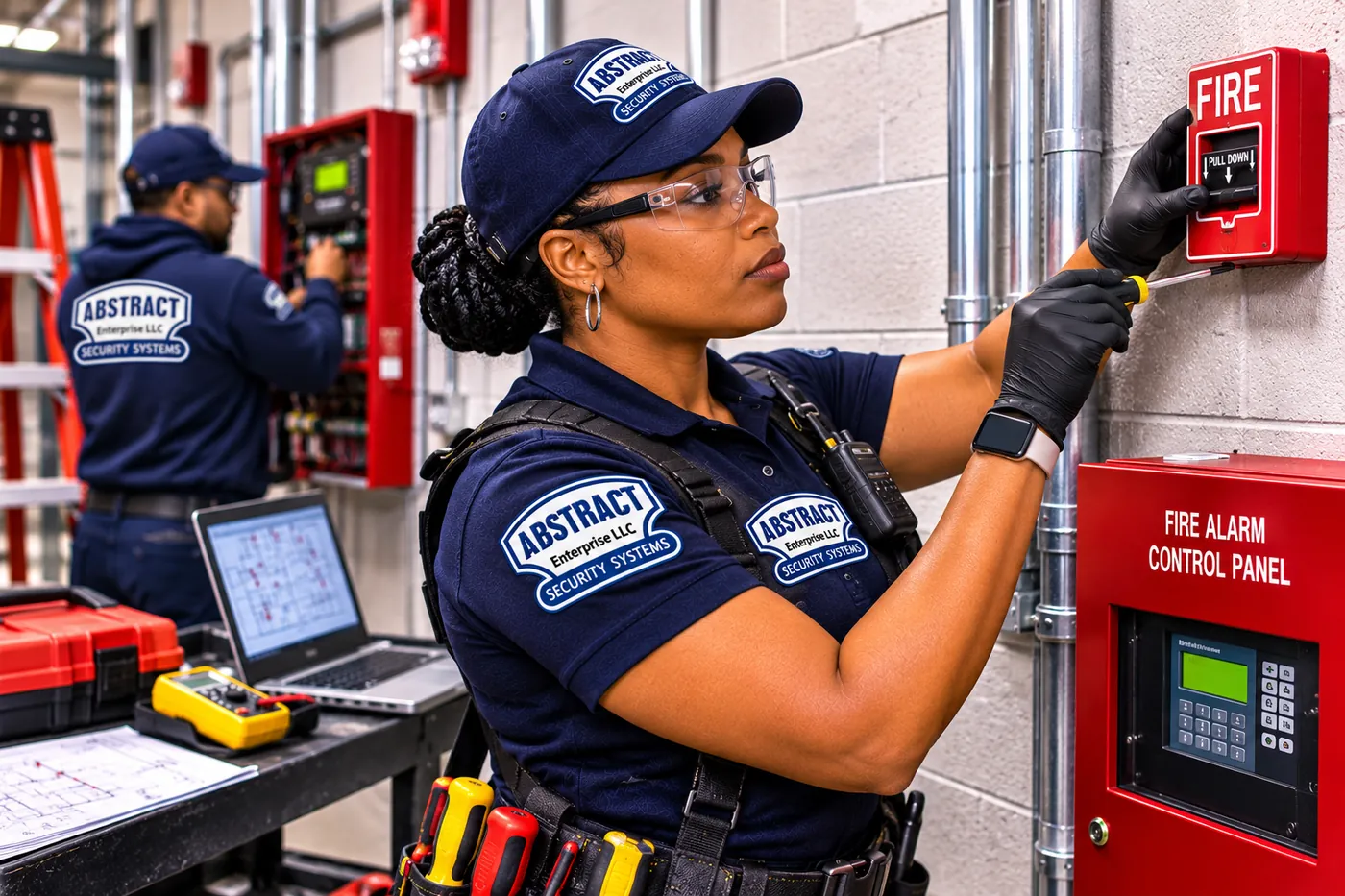
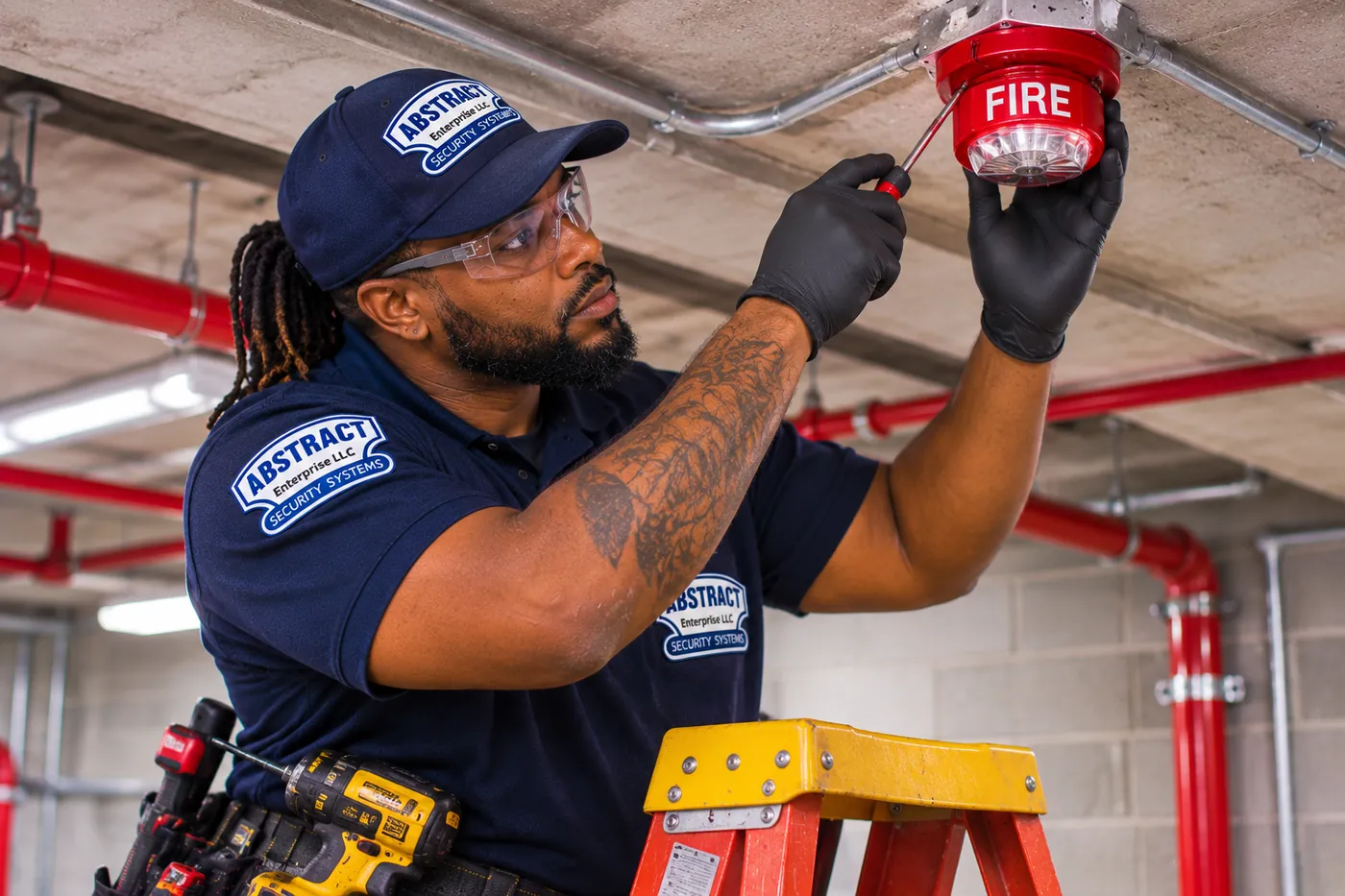
Two technicians work on a manual pull station and a fire alarm control panel in the same equipment room. On a filed job the field wiring and the panel termination are checked against the same sealed drawings.
Manhattan Fire Alarm Request
Building, floor, base building vendor and what the panel shows
✅
Request Sent!
Thank you. We will be in touch to book your Manhattan fire alarm survey, usually within 2 hours of your request.
25+
Years Experience
2 Hr
Survey Booking
NFPA 72
Commercial Only
4.7★
201 Google Reviews
Owner-operated since 2002 · Thousands of jobs completed · Booked within 2 hours
Quick answer: fire alarm installation in Manhattan is usually a filing against a system that already exists. On an office floor, a hotel renovation or a store in a tower base, the new devices join the building's base system, so the engineer's sealed drawings, the FDNY TM-1 plan examination and the acceptance test all reference that system's existing Letter of Approval. A New York State Professional Engineer or Registered Architect designs and seals the drawings, the FDNY reviews them, a licensed installer builds exactly what was approved, and the FDNY Fire Alarm Inspection Unit witnesses the test. Each Manhattan building is quoted in writing after a site survey.
NFPA 72 commercial work only: offices, hotels, theaters, stores, restaurants, hospitals, schools, lofts, condominium and multifamily buildings that the code requires to have a system
Low-voltage contractor under NYS license #12000287431; we name the FDNY-certified fire alarm company and the electrician of record on your job so you can verify both
Survey booked within 2 hours of your request, south of Chambers Street or north of 155th
Why Manhattan Buildings Need Commercial Fire Alarm Systems Built Around Vertical Evacuation
Manhattan buildings need commercial fire alarm systems because most people in the borough work, sleep or watch a show many floors above the street, and a fire alarm is what tells them whether to leave, where to go, and tells the FDNY where to climb. What is a commercial fire alarm system, and how does a commercial fire alarm system work in a tower? Detectors, pull stations and sprinkler switches report to a control panel, which sounds the alarm, signals the central station and runs elevators and fans. In a six-story building the alarm can simply sound everywhere. In a 43-story tower it cannot, because sending every occupant into the stairs at once would block the firefighters coming up. So commercial building fire alarm installation in Manhattan is designed around a fire command station, floor-by-floor voice messages and a trained Fire and Life Safety Director, not just horns and strobes.
Recent fires show why. On July 17, 2026, a fire that started in the kitchen of Papillon, a bistro on East 54th Street, ran up the restaurant's ductwork and pushed smoke into 520 Madison Avenue, a 43-story office tower next door. According to 1st Responder News and NBC New York, the incident went to a third alarm with more than 220 FDNY members, crews had to check all 43 floors, and about 200 occupants were evacuated. That is the Manhattan fire alarm problem in one morning.
Lithium-ion batteries are the other pressure. On December 3, 2024, an e-bike rental and storage shop at 109 West 38th Street burned, and after firefighters knocked the fire down, damaged batteries in the basement started a second fire. FDNY Commissioner Robert S. Tucker said afterward that "uncertified or malfunctioning lithium-ion batteries being stored in buildings can be ticking time bombs." Basements and ground-floor shops under Midtown offices are where fire detection system installation and fast central station reporting matter most.
The numbers back that up. The FDNY Bureau of Fire Investigation's 2024 annual report lists 435 structural fires it investigated in Manhattan that year, 329 of them accidental and 106 incendiary, and 24 civilian fire deaths in the borough. Citywide, the same report counts 279 fires caused by lithium-ion batteries. The occupancy and the NYC Building Code, not those numbers, decide whether a building needs a system; the numbers explain why inspectors look closely at panels and records.
The borough's office market keeps that work moving. Lee & Associates reported 42 million square feet of Manhattan office leasing in 2025, up 7 percent from the year before. Almost every one of those leases ends in a tenant fit out fire alarm installation of some size, filed with the FDNY and programmed into a base building panel.
Six Manhattan facts that shape a fire alarm project here
Fact
What it means for a Manhattan building
Source
High-rise office buildings and hotels must have an F-89 Fire and Life Safety Director on premises during regular business hours
The fire command station is staffed. Device testing, disablements and voice messages are coordinated with that person, not just the super.
FDNY, F-89 Fire and Life Safety Director
The same F-89 rule covers buildings that voluntarily installed a fire alarm with two-way voice communication
Adding a voice system to an older building changes its staffing obligations, so it is an owner decision, not only a design one.
FDNY, F-89 Fire and Life Safety Director
435 structural fires investigated in Manhattan in 2024; 24 civilian fire deaths
Fires happen in occupied buildings every week; early detection and reliable notification still save lives.
FDNY Bureau of Fire Investigation, 2024 Annual Report
About 20 to 24 weeks from FDNY plan submission to final inspection and approval
A lease signed today with a move-in date six months out has no slack in the fire alarm schedule.
FDNY, Tips for Fire Alarm Systems
The SoHo-Cast Iron Historic District holds the largest concentration of full and partial cast-iron facades in the world
Device and conduit locations in landmarked lofts are planned around protected fabric, and LPC sign-off may be part of the filing set.
Historic Districts Council
42 million square feet of Manhattan office leasing in 2025
Tenant fit-outs keep base building fire alarm vendors busy; scheduling their programming early protects the opening date.
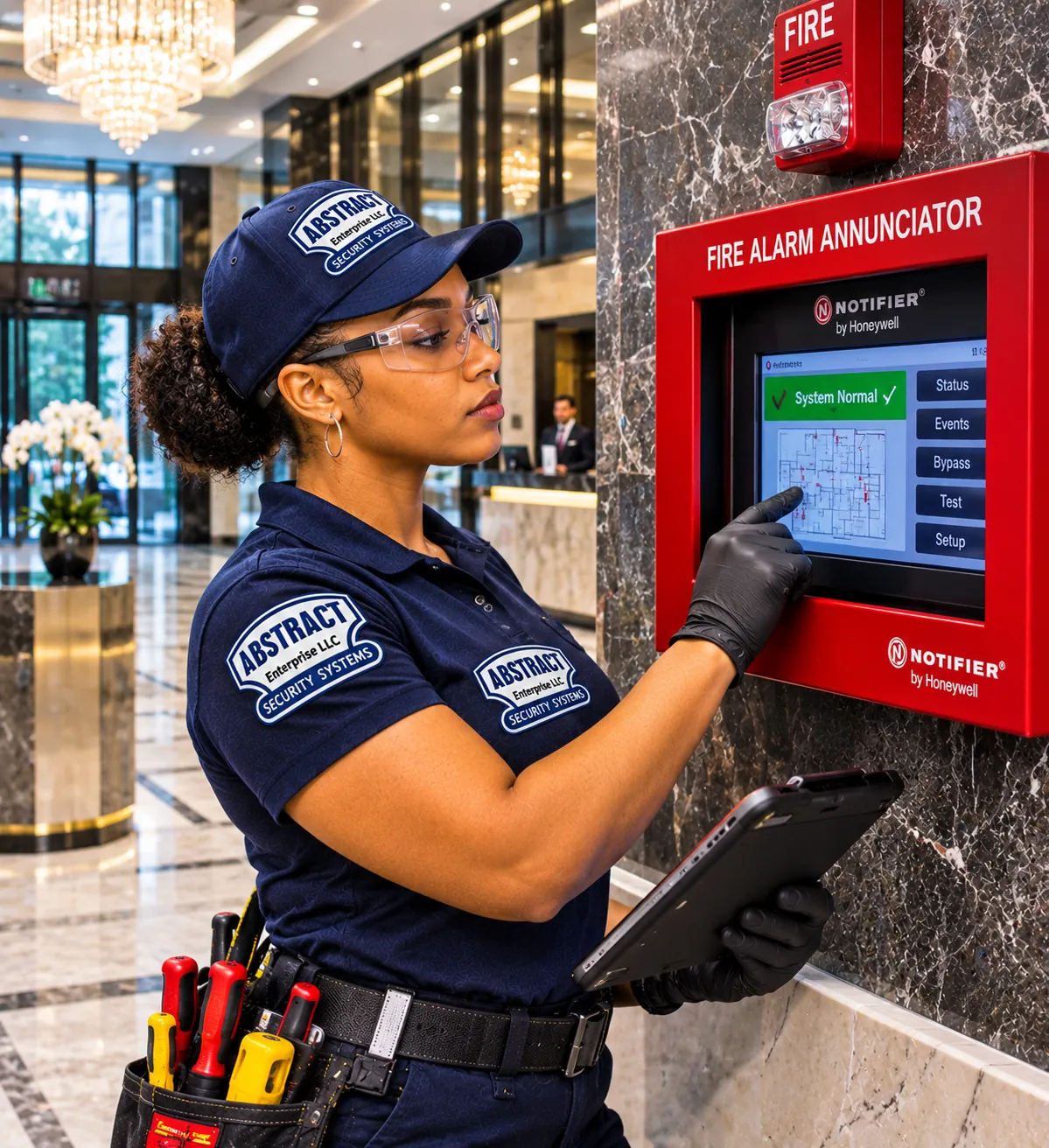
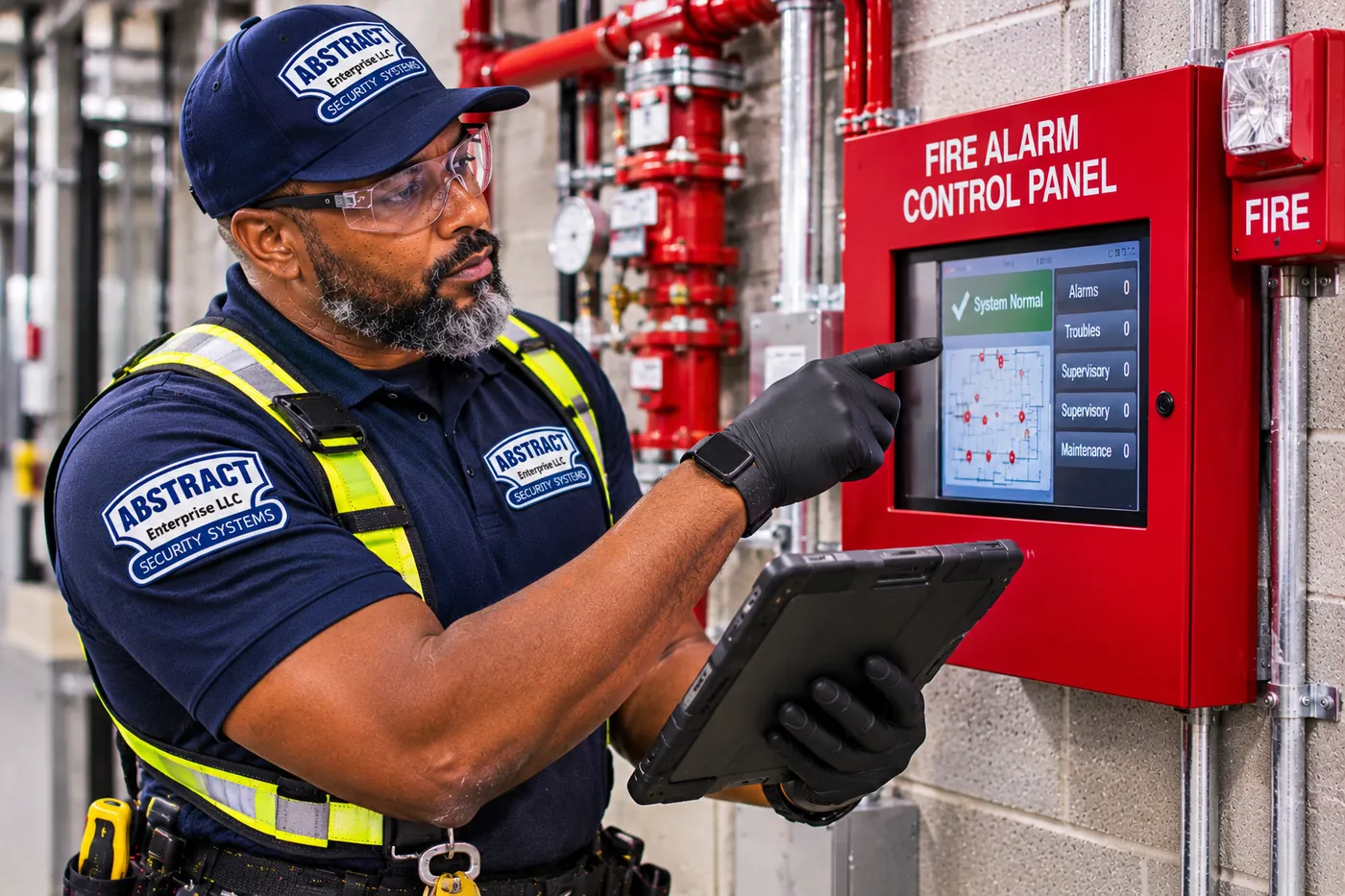
A technician checks the fire alarm annunciator touchscreen in a building lobby. In Manhattan towers the lobby or fire command station display is where responding firefighters and the Fire and Life Safety Director read the system.
Repair
Need Fire Alarm Repair in Manhattan? Tell Us Who Owns the Panel First
If a Manhattan fire alarm panel is beeping, showing a trouble light or reporting a supervisory signal, the first useful step is to find out who owns and services that panel, because in this borough it is often not the person who noticed the problem. A Lexington Avenue store may hear beeping from the landlord's lobby annunciator; a Riverside Drive co-op may have a building system but nobody who knows the company of record. Before anyone touches the panel, we ask for that name.
People search for emergency fire alarm service, emergency fire alarm repair, urgent fire alarm repair, same day fire alarm repair, 24 hour fire alarm repair and after hours fire alarm service when this happens at night. We do not promise any of those on every call, because what can be done tonight depends on the panel brand, whether its programming is locked to another vendor, and whether the building's own procedures call for a fire watch while the system cannot report. What we do promise is a booked response within 2 hours of your call and an honest answer about who can legally work on that system.
The commercial fire alarm emergency repair calls we hear about most in Manhattan: a fire alarm system down repair after a riser flood in a pre-war building, a fire alarm panel failure repair after a power interruption in a converted loft, a fire alarm trouble emergency service call when a contractor on one floor cut a circuit that serves the whole building, and fire alarm communication failure repair when the old phone lines feeding a communicator were removed during a telecom upgrade. Each of those is a fire alarm system emergency service call where the panel's own event log tells most of the story. Call (929) 560-0737 with a photo of the display and we will tell you what we can and cannot do before anyone travels.
What We Install
Fire Alarm Installation Services in Manhattan
Fire alarm installation services in Manhattan cover the full life of a commercial system, from the first device on a tenant floor to the replacement of a 1990s high-rise panel. Abstract Enterprises Security Systems is a fire alarm installation company and licensed low-voltage contractor; on every filed job we work alongside the design professional and name the FDNY-certified company and the electrician of record so the owner can check them.
🏢
Tenant floors in base building systems
Tenant improvement fire alarm installation that ties new detectors, speaker strobes and modules into the landlord's existing panel, coordinated with the vendor of record and the Fire and Life Safety Director.
🔥
New and complete systems
Commercial fire alarm system installation, new fire alarm system installation and complete fire alarm system installation for loft conversions, gut renovations and buildings that have outgrown a local system, from sealed design to acceptance.
🔊
Voice evacuation
Fire alarm voice evacuation installation, fire alarm speaker installation and fire alarm speaker strobe installation for high rises, hotels, theaters and large assembly spaces.
💻
Panels and annunciators
Commercial fire alarm panel installation and fire alarm control panel installation, fire alarm annunciator installation at the fire command station or lobby, and fire alarm control panel programming against the engineer's matrix.
👁
Detection
Fire detection and alarm installation: commercial smoke detector installation, photoelectric smoke detector installation, commercial heat detector installation and duct smoke detector installation. Commercial fire detection systems and business fire detection systems are matched to each room.
🔔
Notification
Fire alarm horn strobe installation and fire alarm ADA strobe installation in stores, back-of-house areas and corridors where a voice system is not required.
🔧
Repair and troubleshooting
Commercial fire alarm repair for trouble lights, ground faults, communicator failures and devices that drop off the loop, starting from the panel's event history.
📈
Upgrades and replacement
Obsolete fire alarm panel replacement and legacy fire alarm system upgrade work in Class E towers and pre-war buildings, filed as modifications and phased so the building stays protected.
📋
Inspection and testing
Fire alarm system inspection, fire alarm system testing and deficiency correction, with written reports kept on the premises for the next FDNY visit.
💧
Sprinkler supervision
Waterflow and tamper monitoring for the sprinkler systems that Manhattan office towers had to complete under Local Law 26, plus standpipe and fire pump signals.
🚪
Building interfaces
Elevator recall, fan shutdown, smoke control, door holders and access control releases, each proven at the acceptance test with the other trades present.
📡
Monitoring connections
Fire alarm communicator installation and changeovers to an FDNY-approved central station, planned before old phone lines or contracts go away.
Building Specialists
Commercial Fire Alarm Systems for Manhattan's Towers, Lofts, Hotels and Uptown Buildings
Manhattan's building stock decides how a fire alarm is designed more than any other factor: a glass office tower, a cast-iron loft, a Broadway theater and a six-story walk-up on St. Nicholas Avenue each need a different system, a different filing and a different installation method. The occupancy classification in Section 907 of the NYC Building Code answers when does a building need a fire alarm system at all; the age and structure of the building tell everyone how hard it will be to build. Here is how the work changes across the borough.
Base building office towers
Office building fire alarm installation in Midtown, the Financial District and Hudson Yards is mostly floor work: the tenant's devices join a landlord system with a fire command station and a voice system already approved.
Hotels
Hotel fire alarm installation around Times Square, Midtown East and Lower Manhattan covers guest floors, ballrooms and kitchens, with an F-89 director on site and rooms that stay rented during the work.
Theaters and assembly spaces
Broadway houses, Off-Broadway stages and event halls combine voice messages, stage and fly loft detection, and the old electrical rooms and concealed spaces that older theaters hide.
Landmarked cast-iron and loft buildings
SoHo, Tribeca, NoHo and the Flatiron district: tall ceilings, exposed columns and protected facades where every surface conduit run is a design decision.
Hospitals and medical offices
Hospital fire alarm installation and medical office fire alarm installation on the Upper East Side, in East Harlem and Washington Heights, phased so patient areas are never unprotected.
Universities and schools
School fire alarm installation and campus work in Morningside Heights and Greenwich Village, scheduled around semesters and residence hall move-ins.
Uptown multifamily and mixed use
Apartment building fire alarm installation and mixed use building fire alarm installation in Harlem, Hamilton Heights, Washington Heights and Inwood, where large pre-war elevator buildings sit over storefronts.
Condominium and rental high rises
High rise fire alarm installation and condominium building fire alarm installation on the Upper West Side, Battery Park City and along the East River, with voice systems in common areas.
Restaurants and food halls
Restaurant fire alarm installation that links hood suppression to the building panel and keeps cooking smoke from emptying the tower above.
Retail in tower bases
Retail store fire alarm installation on Fifth Avenue, 34th Street and Broadway, often a separate tenant system that reports to the base building panel.
Garages, storage and workshops
Parking garage fire alarm installation, storage facility fire alarm installation and warehouse fire alarm installation in cellars, self-storage buildings and the Garment District's remaining manufacturing lofts.
Data rooms and trading floors
Data center fire detection installation for server rooms on office floors and carrier spaces in Lower Manhattan, often with air sampling and a clean agent interface.
Tenant, landlord and base building vendor: who does what on a Manhattan office floor
On a Manhattan office floor the tenant pays for the work, the landlord owns the system, and the base building fire alarm vendor usually controls the programming, so a floor job only moves as fast as the slowest of the three. A typical Midtown or Financial District lease includes building rules that name the vendor of record and require that vendor to make every change to the base panel, or at least to supervise it. The tenant's engineer designs the floor; the filing goes to the FDNY with the base building's Letter of Approval attached; the tenant's installer roughs in and mounts devices; and the vendor of record adds the new points to the panel program and the voice zoning.
The friction points are predictable: base panels near device capacity, voice systems without spare amplifier capacity, and buildings that allow testing only after hours. We ask the managing agent for the building's fire alarm rules, the vendor's contact and the allowed test windows in the first week, because those answers set the schedule. Commercial fire alarm system design for a tenant floor is as much about those answers as it is about detector spacing.
High-rise towers: fire command stations, voice messages and the Fire and Life Safety Director
Every high rise in Manhattan built or substantially altered under modern codes has a fire command station, usually in the lobby, where the fire alarm panel or its annunciator, the voice microphone, the firefighter phone system and elevator status meet. When a smoke detector trips on the 31st floor, the system typically sounds the alert tone and plays the evacuation message on the fire floor and the floors immediately above and below, which is how NFPA describes high-rise voice communication working. Everyone else hears nothing or a standby message, and the Fire and Life Safety Director talks to them over the speakers.
The FDNY's F-89 page says a Fire and Life Safety Director must be on premises during regular business hours in any building classified as a high-rise office building or hotel, and in buildings that have voluntarily installed a fire alarm system with two-way voice communication. For a fire alarm contractor, that person is the gatekeeper: they authorize disablements, put devices on test, announce the work to occupants and watch the panel while we work. Older towers built under the 1968 code often carry what was called a Class E system, with voice and fire warden phones but limited addressable detection. Many of those are now candidates for a commercial fire alarm system retrofit, which is one of the larger filings we help Manhattan owners plan.
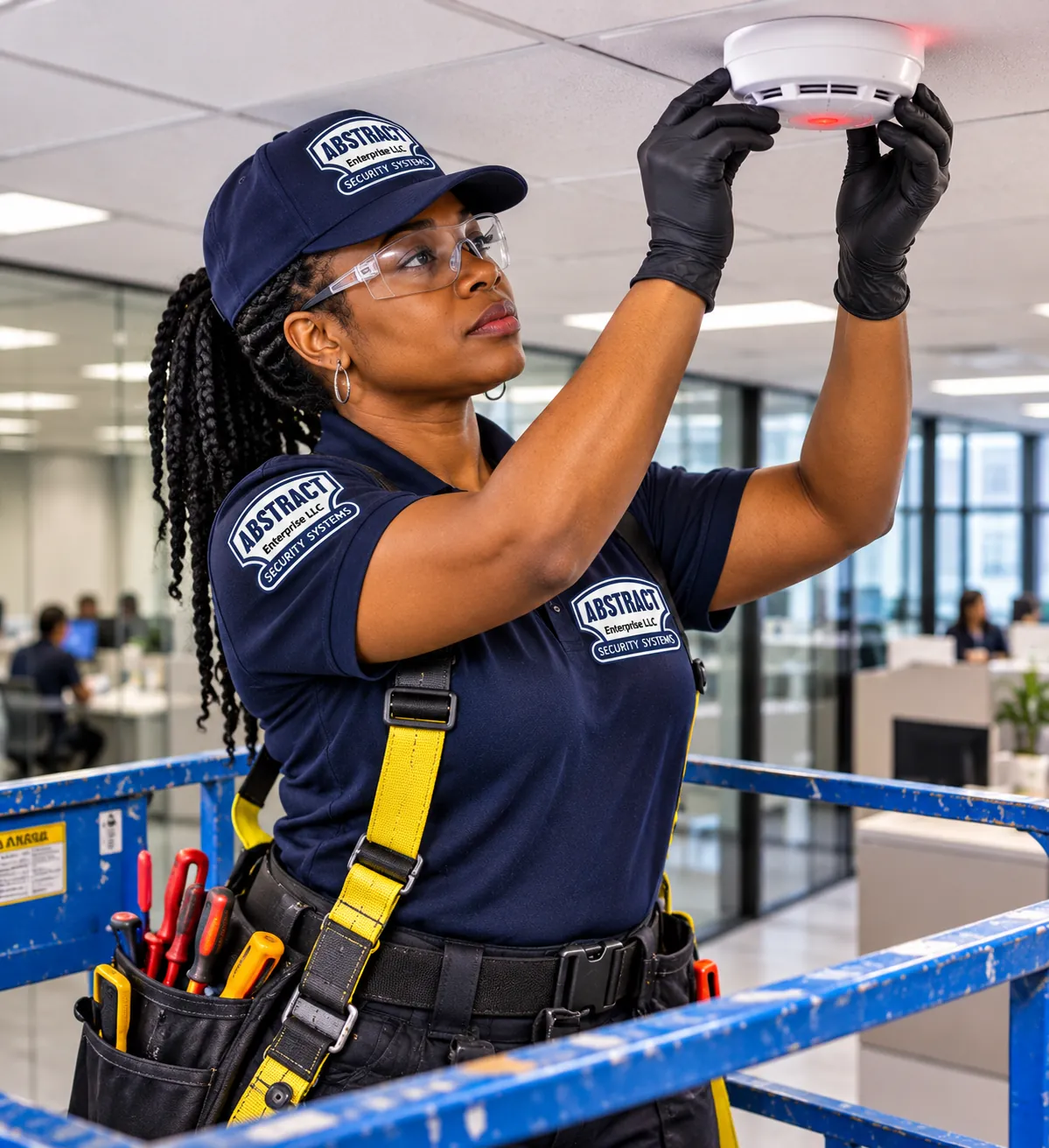
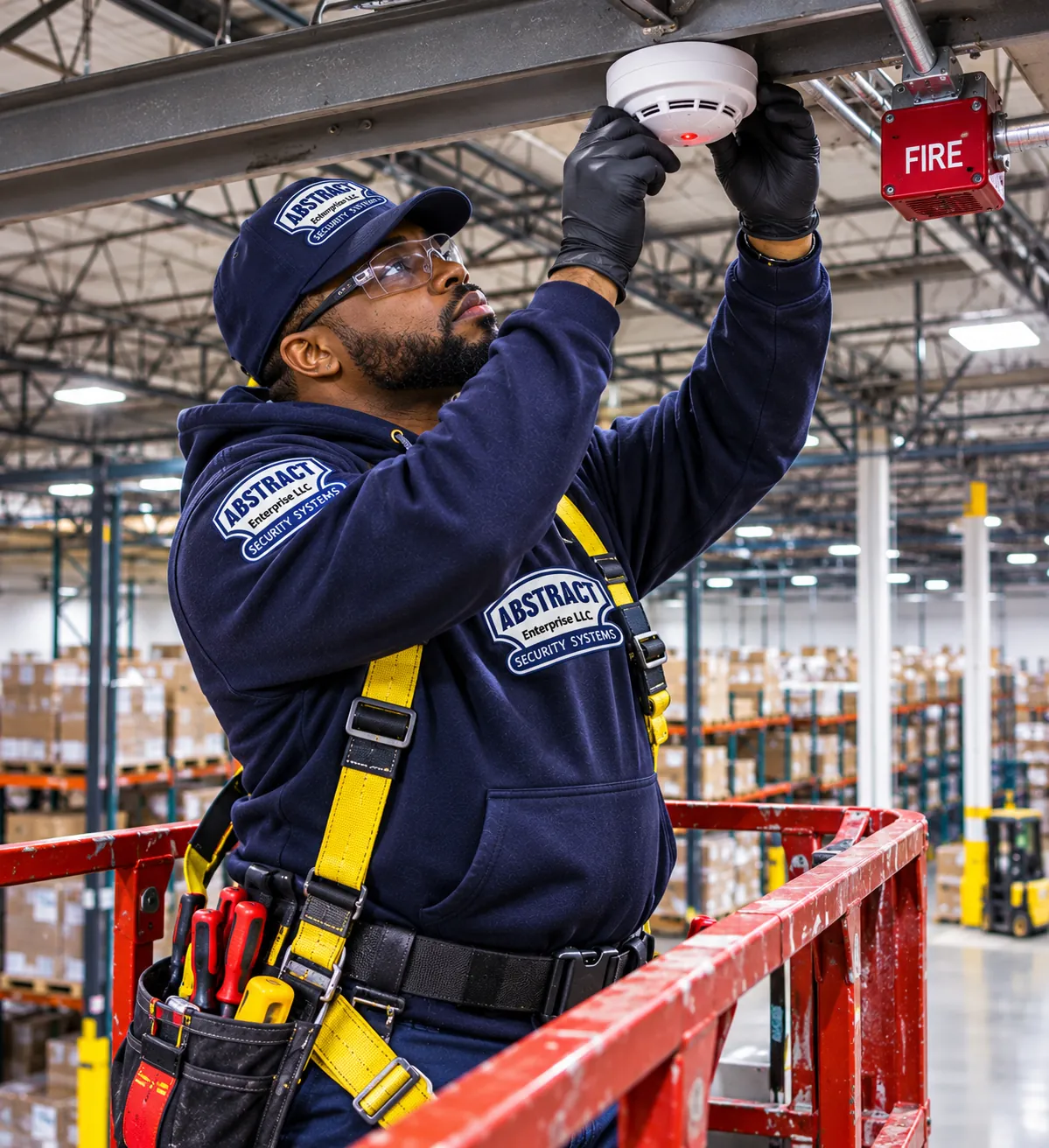
A technician on a lift installs a ceiling smoke detector in an open office. Tenant floors in Manhattan towers add detectors like this to the landlord's base building loop.
Hotels and theaters around Times Square
Hotel and theater work in Manhattan has one shared rule: the building keeps operating. A Midtown hotel renovating guest floors still has guests above and below, so we sequence floor by floor and keep the existing system live until each floor's new devices are tested. Guest rooms need audible coverage that wakes sleeping occupants and visible notification in the accessible rooms the drawings designate.
Theaters add concealed space. On May 4, 2026, a three-alarm fire started in an electrical room between the fourth and fifth floors of the Eugene O'Neill Theatre on West 49th Street, and firefighters then found more fire in a concealed space between the fifth floor and the roof, according to the West Side Spirit; the hotel next door was evacuated as a precaution. FDNY Assistant Chief David Simms described it as "a deep-seated fire involving a lot of electrical equipment." Where an engineer adds detection in old theaters' electrical rooms, fly spaces and voids, the work has to respect historic plaster and performance schedules.
Cast-iron lofts and landmark buildings in SoHo, Tribeca and the Flatiron district
Landmarked loft buildings are where a Manhattan fire alarm installation gets physically difficult. The SoHo-Cast Iron Historic District, designated in 1973 and extended in 2010, holds what the Historic Districts Council calls the largest concentration of full and partial cast-iron facades in the world, most of them from the 1870s. Inside, those buildings have tall ceilings, exposed iron columns, timber or brick-arch floors and little space for new cable. Each conversion, from manufacturing to living-work lofts to condominiums and retail, left a layer of old wiring.
Fire alarm conduit installation in these buildings is planned with the architect: painted EMT run tight to beams, existing chases reused, risers kept inside closets, and devices placed so they read as intentional rather than added. The FDNY tip sheet lists landmark certification among the documents required where it applies. The Landmarks Preservation Commission's expedited routes help: its website describes FasTrack approvals within 10 days for work such as interior alterations when the application is complete and the building has no outstanding LPC violations, and an Expedited Certificate of No Effect for specific interior work, issued within three days. Whether your job fits either route is the architect's call; we make sure the device and conduit layout is drawn clearly enough to support the application.
Hospitals, universities and uptown institutions
Manhattan's institutions run some of the largest fire alarm networks in the city: the medical centers along First Avenue and Fifth Avenue on the East Side, NewYork-Presbyterian's campus in Washington Heights, and the university campuses in Morningside Heights and around Washington Square. In healthcare buildings device replacements happen in small zones, with old devices live until the new ones are proven. Nursing home fire alarm installation and assisted living fire alarm installation follow the same rule for residents who may not be able to evacuate on their own.
University residence halls bring a different problem: unwanted alarms. In 2018, Campus Security Today reported that Columbia University stationed public safety officers in its East Campus residence hall around the clock as temporary fire guards after a string of false alarms, which the university believed were caused partly by condensation in the building's wiring. That is a textbook fire alarm intermittent trouble pattern, and it shows why moisture, old cable and detector choice matter as much as the panel.
Harlem, Washington Heights and Inwood: large pre-war multifamily and mixed-use buildings
Upper Manhattan has a deep stock of large pre-war elevator apartment buildings, many with stores on the ground floor, along Broadway, St. Nicholas Avenue, Amsterdam Avenue, Frederick Douglass Boulevard and the side streets between them. Multifamily building fire alarm installation in these buildings usually covers the public corridors, stairs, cellar, boiler and compactor rooms and any commercial space, while the smoke and carbon monoxide alarms inside apartments are a separate requirement. When a building is gut renovated or converted, the engineer reads the code for the new use, and that is often when a full building system becomes mandatory.
Common uptown jobs: corroded cellar conduit causing ground faults, an unsupported old panel, a storefront restaurant whose hood was never tied to the building panel. Property management fire alarm services for these portfolios are mostly about records: knowing which buildings have a Letter of Approval, which have a central station connection, and which panels are approaching the end of their supported life.
Restaurants, kitchens and the floors above them
A restaurant under a Manhattan office or apartment tower is a fire alarm problem in two directions. The kitchen needs commercial kitchen fire detection installation that will not trip every time the line fires up, which means heat detection rather than smoke detection near cooking, and fire alarm kitchen hood suppression monitoring so a discharge of the hood system reports to the panel. The tower above needs protection from the restaurant, which is why duct smoke detection, fan shutdown and the exhaust path are part of the design. The July 2026 fire at 520 Madison Avenue began in exactly that arrangement.
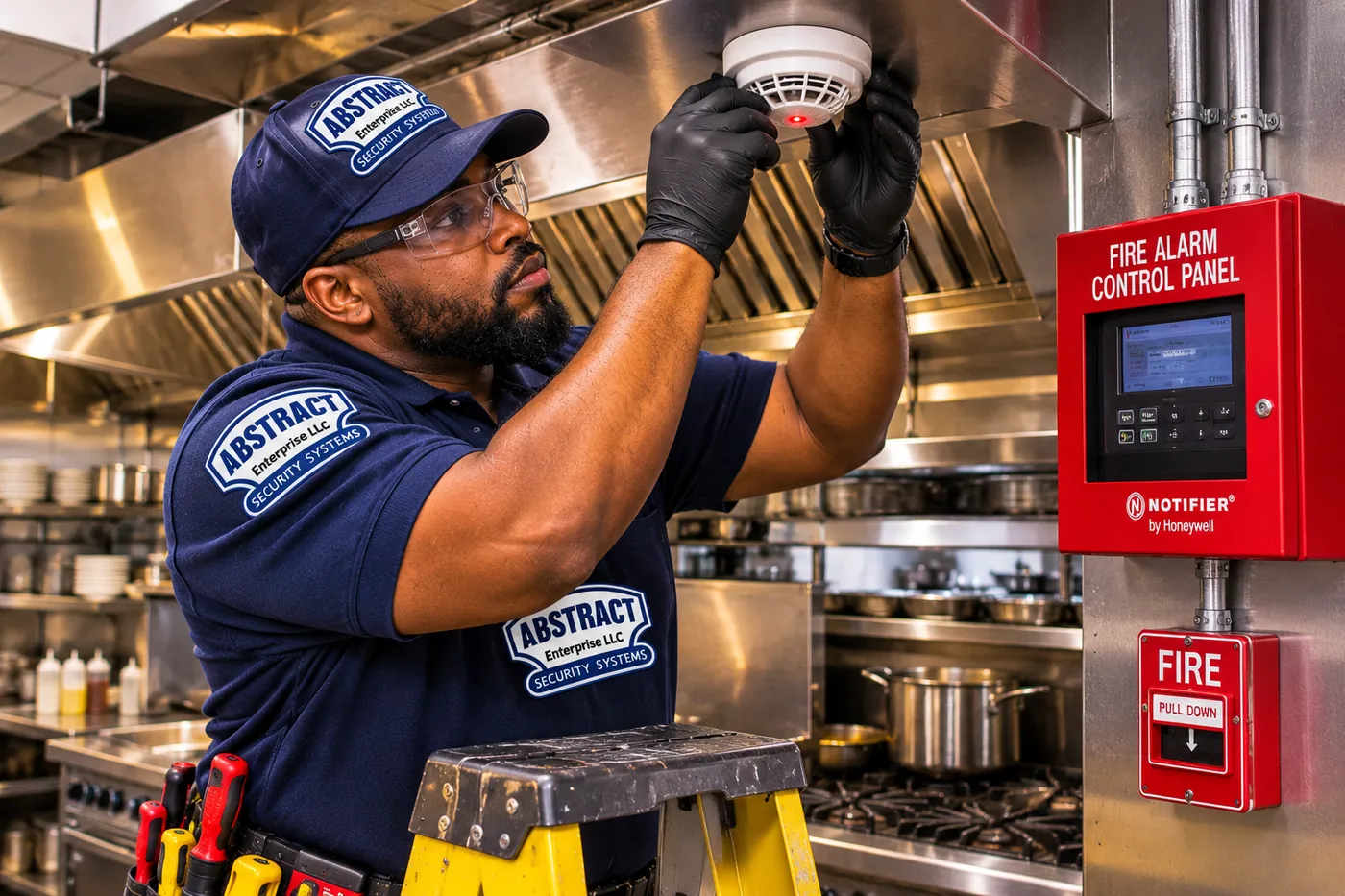
A technician installs a heat detector in a commercial kitchen, with the fire alarm panel and a pull station beside him. Heat detection, not smoke detection, is the usual choice near a cooking line.
Commercial Fire Alarm
Business Fire Alarm Installation Along Manhattan's Commercial Corridors
Business fire alarm installation in Manhattan follows the borough's corridors, and each corridor has its own kind of job. The FDNY rules are identical from the Battery to Inwood, but the building stock, the landlord's rules and the hours you can work change block by block.
Park, Madison, Lexington and Sixth Avenues in Midtown
The Midtown office spine is base building country: towers with fire command stations, voice systems and vendor-of-record rules. The work is tenant floors, amenity floors, data rooms and restaurant or retail spaces in the base. Most landlords allow device testing only outside business hours. A commercial fire alarm installation company working here has to be comfortable with certificates of insurance, building work permits and loading dock schedules before it ever reaches the ceiling.
Water Street, Broad Street and the Financial District
Lower Manhattan mixes 20th-century office towers, some converted to apartments, with newer towers around the World Trade Center site, plus trading floors and telecom spaces where very early detection matters.
Hudson Yards, Hell's Kitchen and the Far West Side
The newest towers have modern addressable systems with spare capacity, but smoke control, elevator programming and voice zoning must be updated together on every fit-out. A few blocks east, Hell's Kitchen's tenements along Ninth and Tenth Avenues are the opposite: small panels, old wiring and restaurants on nearly every corner.
Broadway and the cast-iron blocks of SoHo and NoHo
Retail flagships and showrooms in landmarked lofts, often with a separate store system reporting to the building and conduit the LPC is comfortable with.
125th Street, Frederick Douglass Boulevard and Upper Broadway
Harlem's main commercial streets and the Broadway corridor through Washington Heights to Dyckman Street combine new mixed-use developments, medical offices, banks, supermarkets and restaurants with large older apartment buildings. A shopping center fire alarm installation along 125th Street, with several tenants on one system, sits a block from a walk-up with no system at all, and each needs its own answer.
Storage, workshops and the Garment District
Manhattan has little heavy industry left, but industrial fire alarm systems still turn up: the Garment District's surviving manufacturing lofts, set shops and printers on the West Side, self-storage buildings and back-of-house warehouses under big stores. Industrial building fire alarm installation and manufacturing facility fire alarm installation in those spaces means high ceilings, dust and lint, so industrial fire detection system installation often uses beam or air sampling detection. An industrial fire alarm contractor working here still follows the same FDNY filing as an office floor, and industrial fire alarm installation in a loft shares the building's panel more often than not.
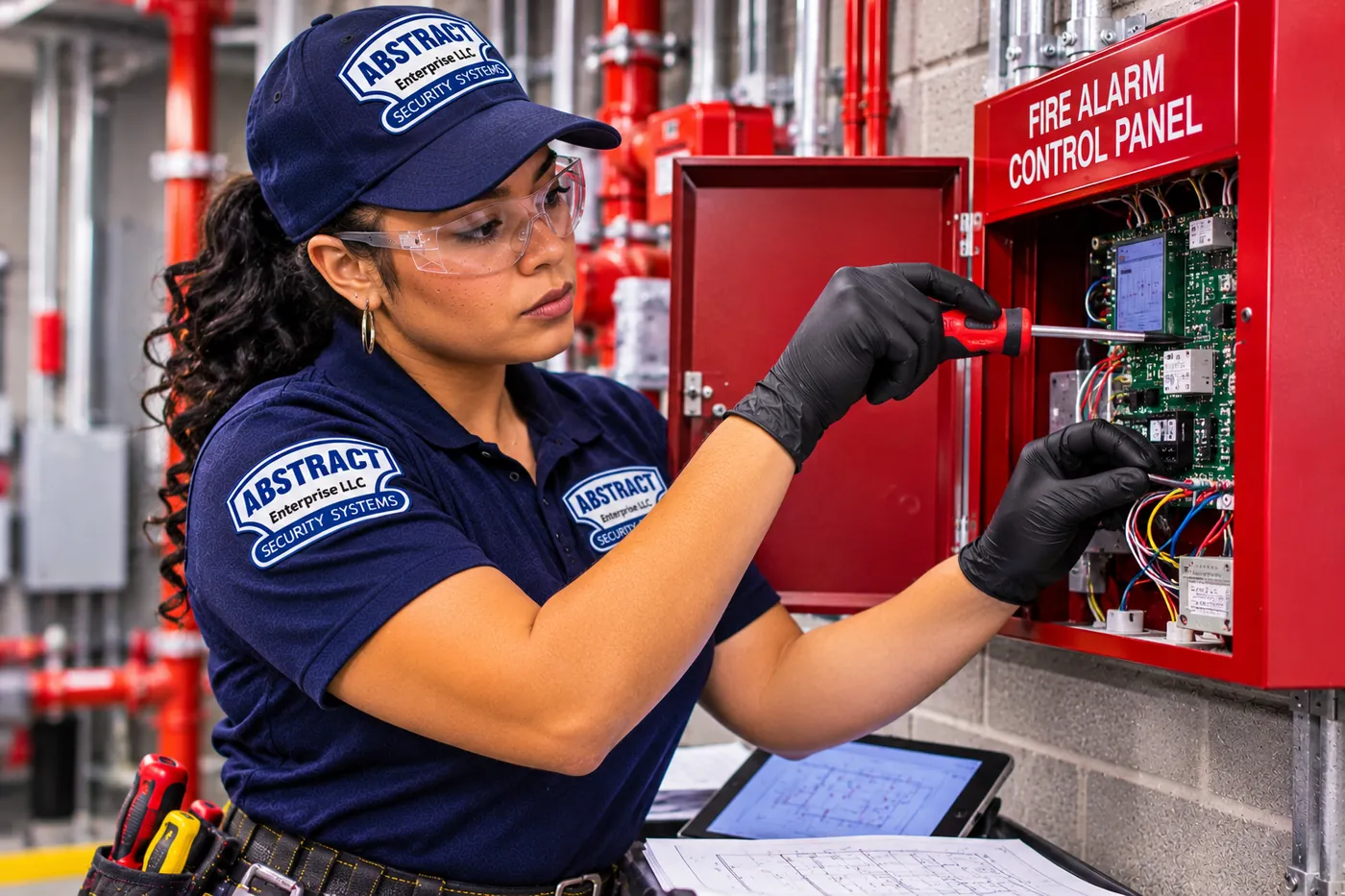
A technician terminates wiring inside an open fire alarm control panel with the drawings beside her. Every circuit on the panel has to match the plans the FDNY approved.
The FDNY path for a Manhattan fire alarm, step by step
The approval path is the same as everywhere in the five boroughs, but in Manhattan almost every step has an extra party, so it helps to see it laid out with those parties named.
Confirm the requirement and hire the design professional. The FDNY's guidance tells owners to confirm with the Department of Buildings whether a fire alarm is required and to have a New York State Professional Engineer or Registered Architect determine the system type and design it. That design professional prepares and seals the fire alarm construction drawings and files them. On a tenant floor the tenant usually hires the engineer; the landlord's engineer often reviews the drawings before they are filed.
Bring in the installer and the vendor of record. The installer must be a New York City licensed electrician or a fire alarm vendor holding an FDNY Fire Alarm Company Certificate. The FDNY's certificate FAQ says any company that installs, inspects, tests or services fire alarm components beyond smoke detectors alone needs company certification, and at least one principal must hold the S-97 Certificate of Fitness, which requires NICET Level II or higher or a New York City master or special electrician license. In a base building, the vendor of record is usually the certified company that will program the panel.
File the TM-1 plan examination. The design professional files the TM-1 with the certified plans through FDNY Business, with the Certificate of Occupancy or an approved Schedule A, or a Letter of No Objection where neither exists. Does my building need a fire alarm permit for small additions? If devices are added, moved or replaced, yes: the fire alarm permit requirements in practice are the FDNY plan approval plus the electrical work authorization through the Department of Buildings, which together act as the fire alarm installation permit. For additions to an existing system, the filing includes the Letter of Approval for the existing system and for the base building system the new work connects to. Landmark certification goes in where it applies.
Get Project Authorization, then install only what was approved. Once the plans are approved, the installation follows them exactly. The FDNY tip sheet is clear that installation comes after plan approval, and every device on the wall has to be on the approved drawings.
Connect monitoring and pre-test. The central station connection must be active, the panel must be free of alarm, supervisory and trouble conditions, and every input and output on the matrix must work before the FDNY will come out. In a tower, that includes the voice messages to the right floors and elevator recall.
Witnessed acceptance test by the FDNY Fire Alarm Inspection Unit. The unit is based at 9 MetroTech Center in Brooklyn, and inspectors witness the test at your building with the S-97 or S-98 holder, the electrician, a plumber to flow water and an elevator mechanic present as needed.
Letter of Approval. When the system passes, the building receives its Letter of Approval. The FDNY's figure for the whole path is about 20 to 24 weeks from submission to approval, with initial plan review taking up to 8 weeks.
Abstract Enterprises Security Systems does not hold an FDNY Fire Alarm Company Certificate, an S-97 or NICET certification. Nothing on this page should be read as saying so. We work under our NYS low-voltage license #12000287431, coordinate the path, and name the certified company and licensed electrician on your filing. To verify the certificate holder of record, ask for the company's FDNY approval letter and the S-97 principal's name and certificate number, and check them against the FDNY's published list of certified fire alarm companies before you sign.
Compliance notes specific to Manhattan buildings
Voice systems carry staffing duties. Per the FDNY F-89 page, a building that voluntarily adds two-way voice communication takes on the requirement for a Fire and Life Safety Director during business hours. Owners should decide that knowingly.
Sprinkler supervision in office towers. Office buildings 100 feet and taller had to be fully sprinklered under Local Law 26 of 2004 by July 1, 2019, so nearly every Manhattan office tower now has waterflow and tamper switches that the fire alarm supervises.
Testing standard. Testing follows NFPA 72 as modified by the NYC Building Code Appendix Q, which is what NFPA 72 fire alarm inspection and NFPA 72 fire alarm testing mean in this borough.
Air movement. The FDNY lists smoke detectors closer than 36 inches to supply diffusers or returns as one of its most common defects, and open-plan Manhattan offices with dense diffuser layouts make it easy to get wrong.
Fans and dampers. Fans over 2,000 cfm must shut down on automatic alarm per the FDNY tip sheet, which affects nearly every new supplemental air unit installed on an office floor.
Landmarks. Landmark certification is part of the filing where it applies, and in historic districts the conduit and device layout should be agreed with the architect before the drawings are sealed.
Field Notes
Field Notes: The Building Engineer Holds the Keys to the Ceiling
On Manhattan tower jobs our technicians have learned that the most important person on the first visit is not the tenant or the general contractor. It is the building engineer or the Fire and Life Safety Director, because they decide when a device can be put on test, which riser closets can be opened and whether the voice system can be touched today. A typical first walk on a tenant floor starts at the fire command station: we read the panel's event log with the director, confirm the floor's existing devices on the annunciator, and ask which loop and which amplifier serve the floor before we look at a single ceiling tile.
The second habit is photographing every existing device label and the panel's point list before demolition. Half the delays we see on Manhattan fit-outs come from devices that were removed during demolition without being taken out of the program, leaving the base panel in trouble for the whole building. A labeled photo set and a note to the vendor of record before demolition keeps the lobby display clean, and a clean display is what lets the final FDNY test go ahead on the day it was booked.
Your Questions Answered
Fire Alarm Installation in Manhattan: Questions Answered
Office towers and landlords
Our landlord's lease exhibit says only the building's vendor may touch the base panel. Can our own installer still do the floor?
Usually yes, for the field work. Your installer can rough in, pull cable and mount devices to the approved drawings, while the vendor of record adds the points to the panel program and voice zones. Get that split written into the scope before the first proposal, so nobody prices the same programming twice.
The Fire and Life Safety Director will not let us test devices before 6 pm. Is that normal in a Midtown tower?
Very common. Testing a device sends signals to the fire command station and sometimes to the central station, so many towers restrict it to after hours or weekends. Build those nights into the schedule from day one and confirm whether the building charges for the engineer or director who has to stay late.
Our tower's base panel is reported to be full. What happens to a new tenant floor?
The engineer and the vendor of record look at adding a loop card, a node or a transponder to give the floor its own capacity, and that change becomes part of the filing. It is a landlord system change, so the landlord has to approve it and often decides who pays for it under the lease.
Do open-plan offices with supplemental air units on the floor need extra fire alarm work?
Often. Units above the FDNY's 2,000 cfm threshold must shut down on automatic alarm, which means duct detection or a control relay and a line on the engineer's matrix. Dense diffuser layouts also push smoke detectors around, because each must sit at least 36 inches from supply and return openings.
Landmarks, lofts and older buildings
Can fire alarm conduit run exposed on the ceiling of a landmarked SoHo loft?
It can, if the architect and the Landmarks Preservation Commission are comfortable with it, and in many cast-iron interiors exposed painted conduit is the honest choice because there is no plenum to hide cable in. The layout should be drawn before the engineer seals the plans so the LPC application and the FDNY filing show the same routes.
Our 1970s office building still has a Class E system with warden phones. Is replacing it one project or several?
Usually one design and several phases. The engineer designs the replacement as a whole, the FDNY reviews it as a modification, and the installation moves floor by floor so the old system stays live until each section of the new one is tested. Fire command station equipment is normally the last piece to switch over.
A loft condominium in Tribeca wants to add a building fire alarm voluntarily. What should the board know first?
That a voluntary system is still filed, approved and maintained like a required one, and that a voluntary system with two-way voice communication brings the FDNY's Fire and Life Safety Director requirement with it. Many boards choose a system without two-way voice for that reason; the engineer can explain the options.
Hotels, theaters and institutions
How do you replace fire alarm devices on guest floors of a hotel that stays fully booked?
One block of rooms or one floor at a time, with the existing devices left in service until their replacements are tested, and work hours agreed with the hotel's operations team. The Fire and Life Safety Director signs off on each disablement, and any period when a floor cannot report is covered by the fire watch the building's procedures require.
Why do older Broadway theaters need detection in places the audience never sees?
Because fires in old theaters often start in electrical rooms, fly spaces and concealed voids, where nobody is watching. The May 2026 Eugene O'Neill Theatre fire began in an electrical room and reached a concealed space below the roof. Where the engineer calls for detection in those areas, access and historic finishes drive the installation method.
Our hospital wing on the Upper East Side needs new detectors. Can patients stay in the rooms during the work?
In most phased healthcare projects, yes. The work is planned with infection control and facilities so that only a few rooms are affected at once, the old devices stay live until the new ones are proven, and smoke door release and staff notification are tested before each area goes back into normal use.
Why does a residence hall near Columbia get so many alarms that nobody evacuates anymore?
Usually a mix of cooking, steam and aging wiring. Columbia's medical center fire safety bulletin names unattended cooking as the leading cause of alarms in its housing, and the university once linked a run of East Campus false alarms partly to condensation in the wiring. Detector type, location and cable condition all have to be checked together.
Uptown buildings and day-to-day questions
A tenant in our six-story Washington Heights building says our hallway system is not legal. How do we find out?
Pull the building's records first: the Certificate of Occupancy, any FDNY Letter of Approval for the existing system and the last inspection report. An engineer reading those against Building Code Section 907 can tell you whether a system is required for your occupancy and whether the existing one matches its approval. Residents on Reddit's r/AskNYC have called the city's fire safety documents "byzantine," which is why the engineer's written answer is worth having.
Our Harlem corner building is getting a new restaurant tenant. Does the building fire alarm change?
It often does. The restaurant's hood suppression usually has to report to a fire alarm panel, the kitchen may need heat detection, and the exhaust path may need duct detection to protect the apartments above. The engineer decides whether the restaurant reports to the building's panel or to its own, and that decision goes on the drawings before construction starts.
Equipment
Types of Commercial Fire Alarm Systems We Install in Manhattan
Fire alarm equipment installation in Manhattan follows the engineer's equipment list, and the list for a Manhattan building usually leans toward voice, addressable detection and interfaces with elevators and air handlers. These are the equipment families that show up on most of the drawings we work from.
Addressable systems
Addressable fire alarm system installation is the norm for towers and renovations, because every detector and module reports its own location on the signaling line circuit, which matters when the fire floor is 30 stories up.
Conventional systems
Conventional fire alarm panel installation still fits some small walk-up and storefront buildings uptown, and many existing conventional systems are extended rather than replaced.
Emergency voice communication
Fire alarm emergency voice communication with recorded and live messages, firefighter phones and selective floor paging for high rises, hotels and theaters.
Intelligent detection
An intelligent fire detection system with detectors that report drift and dirt, useful in older buildings where dust and steam cause unwanted alarms.
Air sampling and beam detection
Aspirating smoke detection installation for data rooms, atriums and historic interiors where spot detectors would be visible or hard to reach; projected beam detection for tall open lofts.
Modules and interfaces
Fire alarm monitor module installation for waterflow and tamper switches, fire alarm control module installation for door holders and dampers, and fire alarm relay module installation for elevator and fan control.
Power supplies
Fire alarm power supply installation and fire alarm NAC power supply installation to carry strobes and speakers on long floors, each with its own standby batteries.
Annunciators
Remote annunciator installation at side entrances, loading docks and secondary lobbies so firefighters entering from Sixth Avenue or a side street can read the system.
Monitoring
Fire alarm central station communicator installation to an FDNY-approved central station, active before the acceptance test is scheduled.
Addressable versus conventional in Manhattan buildings
What is an addressable fire alarm system, and what is a conventional fire alarm system? Addressable devices each report their own identity; conventional devices report only the zone they are wired to. What is the difference between addressable and conventional fire alarms in practice? Time. For a tower or a large pre-war building, addressable is almost always the engineer's choice. In a conventional system, a trouble on a zone that covers three floors of a Hamilton Heights apartment building means a technician walking those floors device by device. In an addressable system the panel names the device and its programmed location. The table below sets out the practical differences we see in Manhattan buildings.
Question
Addressable
Conventional
Typical Manhattan building
Office towers, hotels, hospitals, condominium high rises, converted lofts
Small walk-ups, single storefronts, older systems being extended
Voice evacuation by floor
Integrated with selective paging and floor-by-floor messages
Limited; voice usually needs a separate panel
Finding a fault
The panel names the device with the open, short or ground
Technician isolates the zone, then tests device by device
Tenant changes
New devices are programmed into existing loops if capacity allows
New zones often mean new circuits back to the panel
Interfaces with elevators, fans, doors
Programmed in the matrix through modules
Relays wired per zone, harder to change
Conventional to addressable fire alarm conversion is one of the most common upgrade filings in older Manhattan buildings. Addressable fire alarm system programming then becomes a building record: fire alarm device addressing and fire alarm system configuration printed point by point for the next contractor.
Device by device in Manhattan buildings
Panels. FACP installation, FACP repair and addressable fire alarm panel installation are the core of tower and loft jobs, and intelligent fire alarm installation is the default for renovations. Addressable fire alarm installation dominates; conventional fire alarm installation, conventional fire alarm system installation, conventional fire alarm repair and conventional fire alarm replacement still apply to small uptown buildings with fire alarm zone wiring. Addressable fire alarm system repair and addressable fire alarm troubleshooting use the panel's device reports to find faults fast.
Detection. Addressable smoke detector installation, addressable fire alarm device installation, fire detection device installation and fire alarm initiating device installation add points to a loop. Commercial smoke detector testing, commercial smoke detector repair and commercial smoke detector replacement keep them reliable. Heat detection uses fixed temperature heat detector installation or rate of rise heat detector installation by room, with heat detector replacement after damage. Beam smoke detector installation and projected beam smoke detector installation suit tall loft and atrium spaces; an air sampling smoke detection system, such as VESDA installation and VESDA service, suits data rooms and ornamental ceilings where spot detectors would show.
Manual stations and notification. Manual fire alarm pull station installation, fire alarm pull station replacement, fire alarm pull station repair and fire alarm pull station testing at exits; fire alarm horn installation and fire alarm strobe installation in buildings without voice; fire alarm horn strobe replacement and fire alarm notification appliance replacement when units fail or candela ratings change.
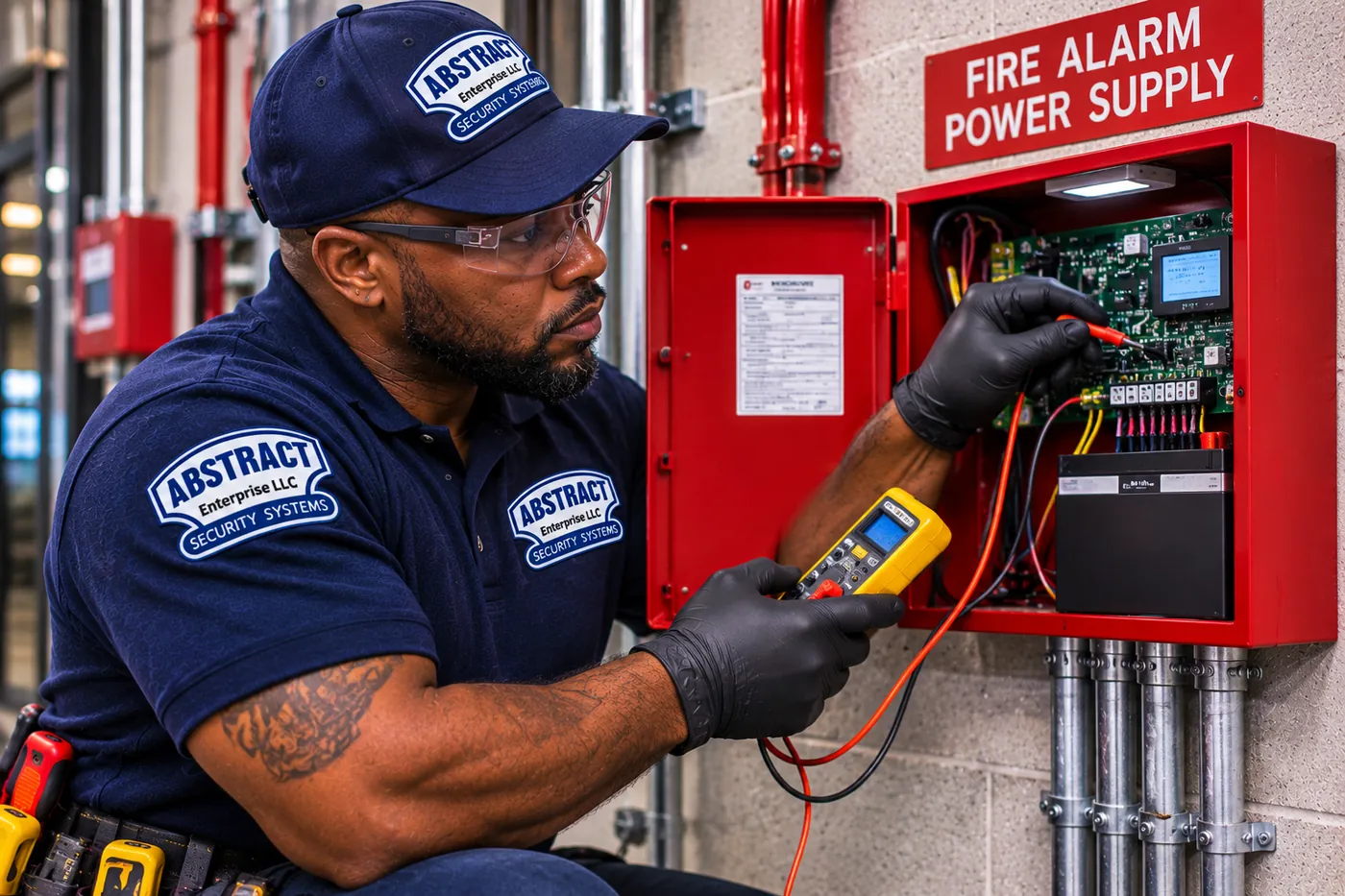
A technician meters a fire alarm power supply with its standby batteries in the cabinet. Remote power supplies carry speakers and strobes on long office floors and need their own battery checks.
Manufacturer service, national alarm brands and a local licensed installer
In Manhattan the panel brand often decides who can service the system, so it is worth knowing what is behind the door of your fire command station. Honeywell fire alarm installation and Honeywell fire alarm service cover Honeywell's commercial families, including NOTIFIER fire alarm installation and NOTIFIER fire alarm repair in many towers, Fire Lite fire alarm installation and Fire Lite fire alarm repair in smaller buildings, and Silent Knight fire alarm installation and Silent Knight fire alarm service in some mid-size properties. Edwards fire alarm installation, Edwards fire alarm repair and EST fire alarm service cover the Edwards line that appears in many high rises. Siemens fire alarm installation and Siemens fire alarm service, Simplex fire alarm service, Bosch fire alarm installation, Potter fire alarm installation, Potter fire alarm service and Kidde commercial fire alarm installation round out what we see on Manhattan surveys. Some of these manufacturers sell through authorized dealers or restrict programming software, so commercial fire alarm manufacturer service sometimes has to come through a specific distributor or the original installer. We tell you at the survey which situation your panel is in, and whether a local licensed installer can work on it or the job belongs with the manufacturer's network.
AI Overview Reality Check
What AI Gets Wrong About Fire Alarm Installation in Manhattan
AI summaries answer fire alarm questions as if every building were a two-story office park. Manhattan buildings are not, and several of the answers we see repeated fall apart in a tower, a landmark or a pre-war apartment building. Here are seven of them.
"When the fire alarm sounds, everyone should leave the building"
That is good advice for a small building and the wrong design assumption for a Manhattan high rise. NFPA's own high-rise guidance describes the occupants of the fire floor and the floors immediately above and below moving down the stairs first, while the rest of the building waits for instructions over the voice system.
The fire alarm system is designed to make that possible. Selective paging, recorded messages for the affected floors and a live microphone at the fire command station let the Fire and Life Safety Director manage the evacuation instead of sending thousands of people into stairwells at once, where they would meet firefighters climbing up.
For a tenant floor, the voice zoning has to match the building's evacuation plan; "just add horns" would leave the floor out of step with the tower.
"A tenant can hire any fire alarm company for its own space"
In a Manhattan office tower the lease usually decides that question before the tenant does. Building rules commonly name the base building vendor of record and require that vendor to program, or at least supervise, every change to the landlord's panel.
The tenant can still choose its engineer and often its installer for field work, but the filing references the base building's Letter of Approval, and the panel belongs to the building. Ignoring that leads to a floor that is wired but cannot be programmed or tested.
Read the lease exhibit on building systems before asking for proposals, so the vendor's programming is never a surprise.
"Landmarked buildings are exempt from modern fire alarm rules"
They are not. Landmark designation protects the building's significant features; it does not exempt the building from the Building Code or the Fire Code. A SoHo loft converted to offices needs the fire alarm its occupancy requires, just like a new tower.
What changes is the method. The FDNY lists landmark certification among the documents required where it applies, and the Landmarks Preservation Commission reviews work that could affect protected features. Its expedited routes exist for interior work that does not.
The practical answer is to plan conduit and devices with the architect early and keep the LPC and FDNY submissions consistent. Slower than a new building, but no exemption.
"Fire alarm installation takes a week or two"
The labor on a single Manhattan office floor might take a week or two. The project does not. The FDNY's figure is about 20 to 24 weeks from plan submission to final inspection and approval, and the initial plan review alone can take up to 8 weeks.
In a tower, add the base building steps: the landlord's review of the engineer's drawings, the vendor of record's programming schedule, and the after-hours test windows. On a hotel or hospital renovation, add the phasing.
So how long does fire alarm installation take? The right planning question is when the engineer can start. For a lease signed this month, the answer is this month.
"Smoke detectors in the kitchen protect a restaurant"
Smoke detectors near a commercial cooking line will go off every service, and a building tower above a restaurant cannot live with that. Kitchens get heat detection where the engineer calls for it, and the hood's fire suppression system reports to the fire alarm panel.
The bigger risk is often the exhaust path. The July 2026 fire that began in a restaurant kitchen on East 54th Street spread through ductwork into 520 Madison Avenue, an adjoining 43-story office tower, according to 1st Responder News. Duct smoke detection, fan shutdown and the condition of the exhaust system all sit on the line between a restaurant and the floors above it.
A restaurant fire alarm in Manhattan is therefore a building question, not a kitchen question, and it belongs on the building's drawings.
"Adding a voice evacuation system is always an upgrade"
Technically it often is. Administratively it can change how the building has to be run. The FDNY's F-89 page says buildings with voluntarily installed fire alarm systems that include two-way voice communication must have a Fire and Life Safety Director on premises during regular business hours.
For a large office tower that already has a director, that is no change. For a mid-size loft office building or a residential condominium, it can mean a new staffing obligation that the owner did not plan for.
An engineer can design voice notification without two-way communication where the code allows it. The point is that the owner should make that choice with the staffing rules in view, not discover them afterward.
"If the panel shows normal, the fire alarm is fine"
A normal display means the panel sees no current alarm, supervisory or trouble condition. It does not mean the detectors are clean, the batteries will carry the load, the strobes are synchronized or the central station receives signals. In older Manhattan buildings, wiring that fails only when it is damp can look normal on a dry day.
That is why NFPA 72, as modified for New York City, sets testing frequencies by device and function rather than trusting the display, and why sensitivity testing and battery load testing exist.
The panel's history log is more honest than its current display. Troubles that come and go are the early warning; reading that log is the first thing a competent technician does on any visit.
Planning Work in a Manhattan Tower, Loft or Hotel? Speak to a Tech First
Send the address, the floor and the name of the base building vendor if you know it. We book a survey within 2 hours of your request and tell you what the engineer, the landlord, the FDNY and the installer will each need from you.
Request a Free Quote for Your Manhattan Fire Alarm Project
Tell us the building address, the floor or suite, the use of the space and the panel brand if you can see it. If you have the FDNY Letter of Approval, the landlord's building rules or the last inspection report, mention them; a photo of the lobby panel or annunciator display helps us understand a trouble condition before we visit. Prefer to talk? Call (929) 560-0737.
✅
Request Sent!
Thank you. We will be in touch to book your Manhattan fire alarm survey, usually within 2 hours of your request.
How It Works
Our Fire Alarm Installation Process in Manhattan
Our process starts with a fire alarm installation consultation and ends with an approved system and a complete set of records. In Manhattan the order is fixed by the FDNY and the pace is set by the building.
First call. Address, floor, occupancy, landlord and managing agent, base building vendor, and whatever approval documents you have. A photo of the fire command station display helps.
Survey with the building. We walk the space with the building engineer or Fire and Life Safety Director, read the panel's point list for the floor, check the riser closets, ceilings and above-ceiling space, and note air handlers, elevators, door holders and the sprinkler zone valves the system supervises.
Engineer and sealed drawings. A New York State PE or Registered Architect designs and seals the drawings. If the tenant or owner already has an engineer, we work from their design; if not, we coordinate with one. On landmark buildings the architect agrees device and conduit routes before sealing.
Written proposal. A fire alarm system installation proposal that separates design coordination, filing support, installation, base building programming and acceptance testing, so each party sees its share.
Landlord review and FDNY plan examination. The landlord's engineer reviews the drawings where the lease requires it, then the design professional files the TM-1. We help answer FDNY objections quickly.
Installation to the approved plans. Fire alarm wiring installation, fire alarm circuit installation and fire alarm low voltage wiring during the hours the building allows, with the building's certificate of insurance requirements, freight elevator bookings and engineer escorts in place.
Programming and pre-test. Fire alarm system startup and commercial fire alarm commissioning: the vendor of record programs the new points and voice zones; together we pre-test every device, every message and every output with the central station connection active.
FDNY acceptance and handover. What happens during fire alarm acceptance testing? At the fire alarm acceptance inspection the FDNY Fire Alarm Inspection Unit activates devices and checks every output against the plans. The owner and tenant receive the Letter of Approval, as-built drawings, programming record and test reports.
Fire alarm system testing and commissioning in a tower is a team effort, and fire alarm acceptance testing goes smoothly when the pre-test was run with the same team.
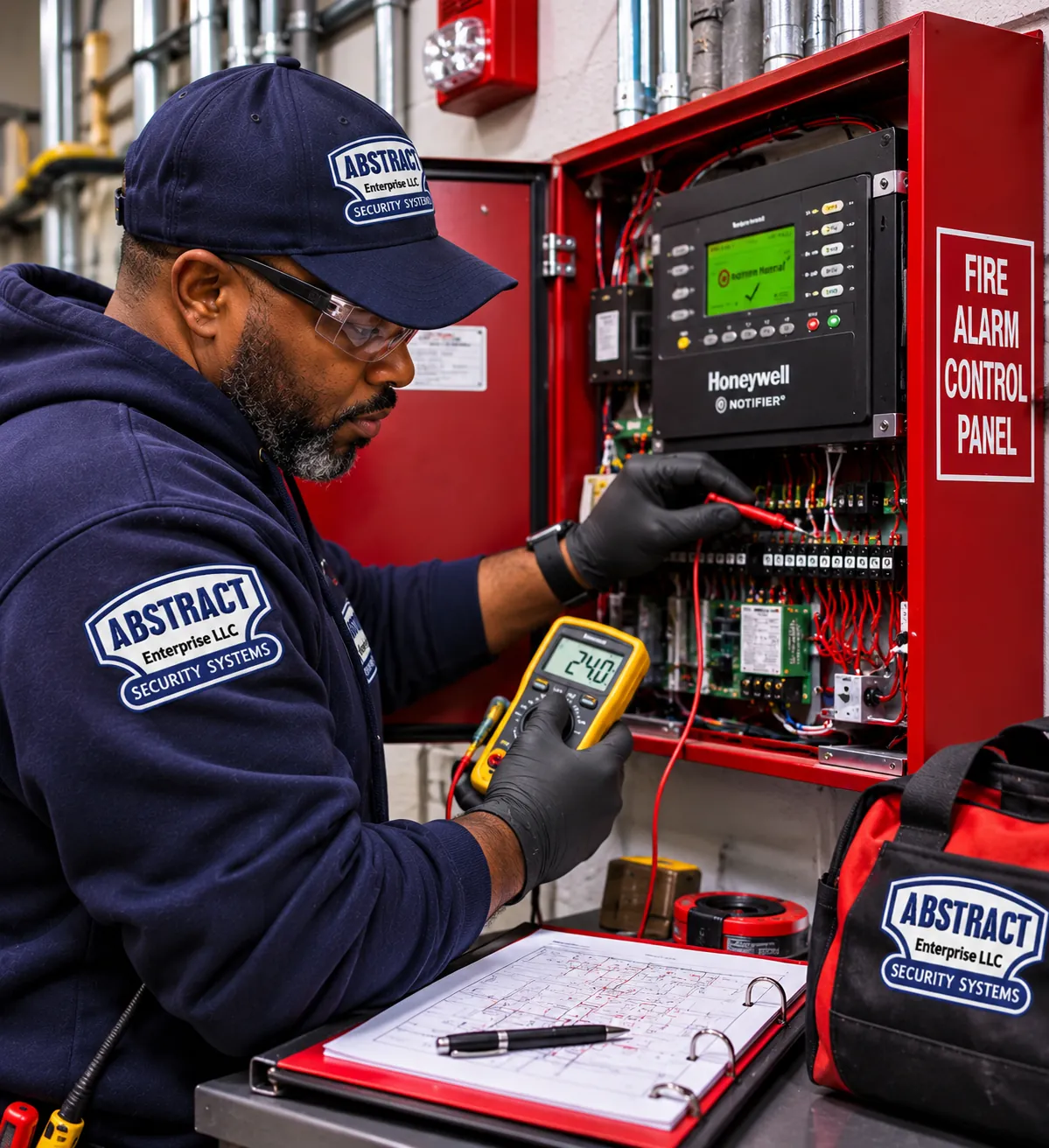
A technician tests a fire alarm control panel with a multimeter while the drawings lie open beside him. Commissioning proves each circuit before the FDNY acceptance test is booked.
Repair, Upgrade and Inspection
Fire Alarm Repair, Upgrades and Inspections in Manhattan Buildings
Most Manhattan fire alarm work is on systems that already exist: a panel in trouble, a failed inspection, a building whose panel is no longer supported. Our NYC Existing Buildings covers existing-building rules citywide; this section covers what those problems look like in this borough.
Trouble conditions in towers and pre-war buildings
Why is my fire alarm panel showing trouble? In a Manhattan building the most common answers are a device removed during a renovation without being taken out of the program, a cut circuit on a floor under construction, moisture in an old cellar or roof conduit, a failing standby battery, or a communicator that lost its phone lines. A fire alarm panel trouble light means the panel has found a fault that could stop it from reporting a fire, and in a building with a base system, one tenant's fault shows up at the lobby for everyone. A fire alarm system trouble condition is never the same thing as an alarm, but it should never be left for weeks either.
Fire alarm troubleshooting and commercial fire alarm troubleshooting start with the event log and the device the panel names. Commercial fire alarm wiring in towers runs long distances, so on an addressable loop, fire alarm SLC troubleshooting and fire alarm signaling line circuit repair mean finding the device or splice that dropped off. On a conventional zone, smoke detector circuit troubleshooting means isolating the zone and working through it. Fire alarm circuit troubleshooting on speaker and strobe circuits, fire alarm notification circuit repair and fire alarm short circuit troubleshooting follow the same discipline: meter, isolate, prove, then repair. Fire alarm fault diagnosis and fire alarm system diagnostics on a large tower panel also involve the vendor of record, because some faults live in the network between panels rather than on a floor.
Ground faults, communication failures and unwanted alarms
What causes a fire alarm ground fault in Manhattan? Water, mostly: a leaking cooling tower line above a riser, a basement that floods in a storm, a corroded box in an exterior wall of a pre-war building. Insulation damaged by other trades during a renovation is the second cause. Fire alarm ground fault repair and fire alarm ground fault troubleshooting use careful isolation, because a ground can sit anywhere on a circuit that runs 20 floors.
A fire alarm system not communicating is a different emergency, usually after telecom upgrades remove copper lines. Fire alarm communication failure emergency repair usually means a new cellular or IP communicator and an FDNY-approved central station changeover, which has its own paperwork. Fire alarm false alarm troubleshooting looks at detectors near kitchens, shower steam, construction dust and air from new diffusers. Repeated unwanted alarms bring FDNY attention; an ECB decision summarized by The Habitat Group upheld a penalty against an owner after two unnecessary alarms, one caused by construction.
Other calls on our Manhattan list: fire alarm supervisory trouble from a sprinkler valve left closed after a tenant's sprinkler work, fire alarm device fault repair on a detector that stopped answering, fire alarm wiring repair where demolition cut a riser, fire alarm panel beeping repair when a trouble was silenced and forgotten, fire alarm trouble signal repair after a Con Edison outage, fire alarm battery trouble repair, fire alarm open circuit repair and fire alarm system malfunction repair on panels near the end of their life. Fire alarm power supply repair and fire alarm battery replacement are routine. Who repairs fire alarm control panels in Manhattan? An FDNY-certified company with access to the parts and software for that brand. Fire alarm control panel repair and fire alarm control panel troubleshooting on a tower panel often require the vendor of record; a fire alarm repair company, fire alarm repair contractor and fire alarm service technician you hire should be able to say plainly whether they can work on your brand.
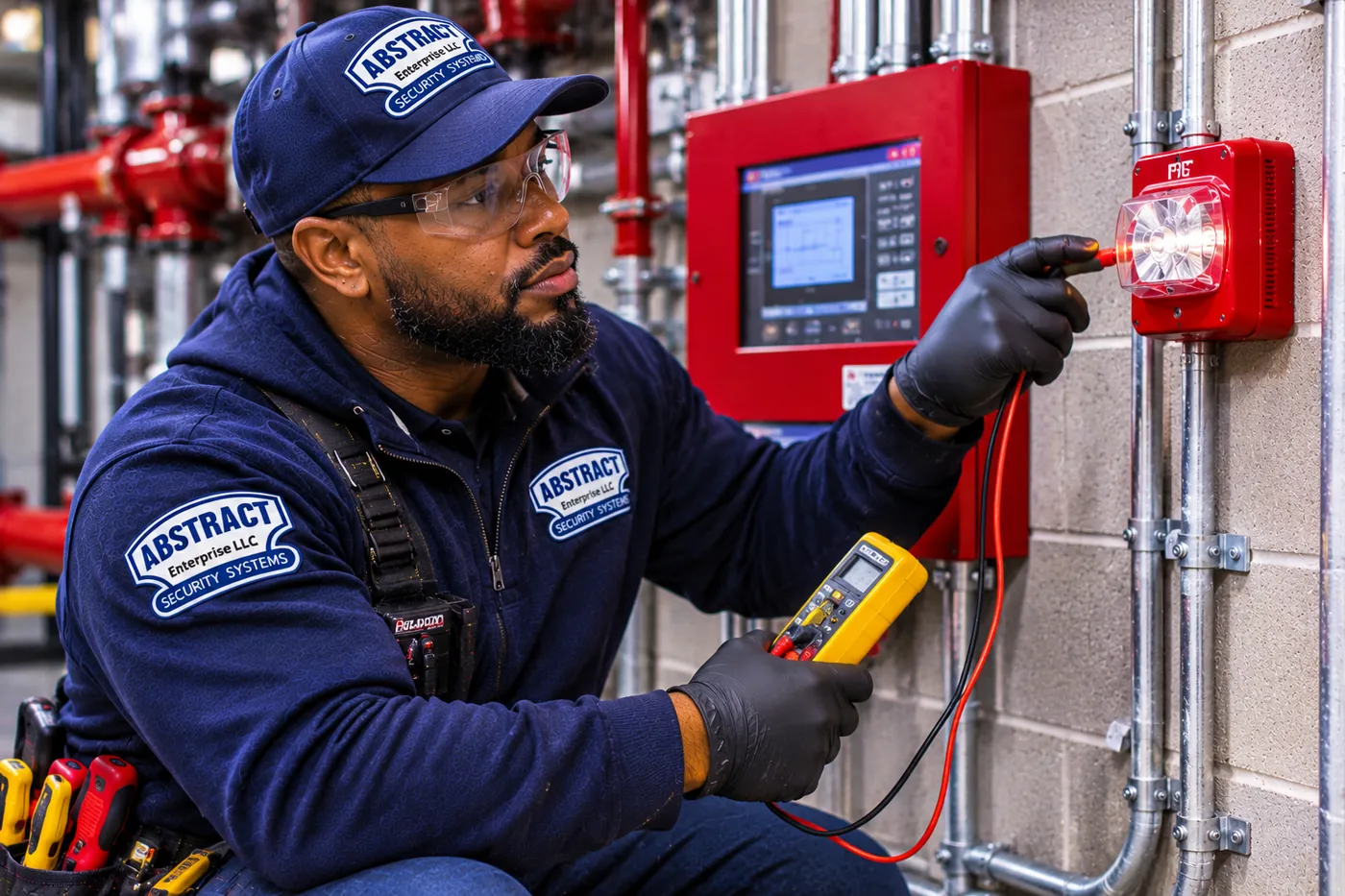
A technician tests a horn strobe with a multimeter in a mechanical room. Notification circuit faults are traced device by device until the open or short is found.
Upgrades, replacement and modernization
Can an existing fire alarm system be upgraded? In Manhattan the usual answer is yes, filed with the FDNY as a modification and phased so the building stays protected. Fire alarm control panel upgrade and fire alarm control panel replacement jobs in towers often keep the field wiring and devices where the engineer allows, replacing the network panels and the voice equipment at the fire command station. Commercial fire alarm upgrades and commercial fire alarm replacement follow the same rules; fire alarm panel upgrade, fire alarm panel replacement and FACP replacement in smaller buildings are simpler but still filed. Outdated fire alarm system replacement and fire alarm system lifecycle replacement become urgent when a manufacturer stops supporting a panel family that hundreds of Manhattan buildings installed in the 1990s.
Owners and engineers use many names for the same idea. Fire alarm system modernization, fire alarm system retrofit, fire alarm system renovation, fire alarm system reconfiguration, fire alarm system conversion and commercial fire alarm modernization all describe bringing an aging system up to current equipment and code. Addressable fire alarm system upgrade covers newer addressable panels being expanded. Existing fire alarm system expansion and fire alarm system modification cover new floors or tenant spaces added to a system that stays in place, while fire alarm device replacement covers like-for-like swaps. A fire alarm system code upgrade or fire alarm code compliance upgrades may be triggered by a renovation or a change of use, such as an office conversion to apartments in the Financial District; the engineer determines the scope. A fire alarm system expansion contractor in a tower has to coordinate with the base building vendor as closely as on any tenant floor.
Inspection, testing and maintenance
How often should fire alarms be inspected, and how often should commercial fire alarms be tested, in a Manhattan building? The frequencies come from NFPA 72 as modified by the NYC Building Code Appendix Q, and they differ by device and function, so a building should have a written schedule rather than one annual date. Fire alarm annual inspection, fire alarm periodic inspection, fire alarm functional testing, fire alarm device testing, fire alarm sensitivity testing and fire alarm battery load testing all appear on that schedule. Towers add voice message, firefighter phone and elevator recall tests.
Commercial fire alarm inspection and commercial fire alarm testing are only half the job; fire alarm maintenance and commercial fire alarm maintenance between visits are what keep an FDNY inspection uneventful. Fire alarm preventative maintenance on detectors in dusty or steamy spaces, a written fire alarm service contract with a fire alarm maintenance company that knows the building, and records kept on site are the basics. Fire alarm inspection deficiencies get a written list; fire alarm deficiency correction and fire alarm inspection repair close each item. Who can correct fire alarm inspection deficiencies in Manhattan? An FDNY-certified fire alarm company, working with the electrician where wiring is involved. Fire alarm system violation correction and fire alarm code violation repair should end with documents the building can show the next inspector, and fire alarm inspection documentation that matches what is on the walls.
Coverage Area
Fire Alarm Installation Near Manhattan's Landmarks
We work throughout Manhattan. These six landmarks and districts show the range of buildings and fire alarm problems the borough holds.
Rockefeller Center and Midtown
Art Deco towers, plazas and below-grade concourses between Fifth and Sixth Avenues, surrounded by office towers where tenant floors join base building voice systems.
One World Trade Center and the Financial District
The tallest tower in the Western Hemisphere stands among older Water Street and Broad Street office buildings, several now converted to apartments.
Hudson Yards
New office, retail and residential towers on the Far West Side with modern addressable systems and large smoke control sequences.
SoHo-Cast Iron Historic District
Cast-iron loft buildings along Broadway, Greene and Mercer Streets, designated in 1973, where conduit routes and device placement are planned around protected interiors.
Times Square and the Theater District
Broadway theaters, hotels and restaurants between West 42nd and West 50th Streets, including the Eugene O'Neill Theatre on West 49th Street.
Columbia University and 125th Street
The Morningside Heights campus at Broadway and 116th Street and Harlem's 125th Street corridor near the Apollo Theater, mixing institutions, retail and large apartment buildings.
We also serve the Flatiron district and Union Square, Chelsea, the Lower East Side and Chinatown, Murray Hill and Kips Bay, the Upper East Side and Upper West Side, East Harlem, Hamilton Heights, Washington Heights and Inwood.
A technician mounts a ceiling horn strobe under exposed pipes in a basement. Cellars and sub-cellars in older Manhattan buildings need notification that can be seen and heard around mechanical equipment.
Pricing
How Fire Alarm Installation Is Priced in Manhattan
Fire alarm installation in Manhattan is priced per building, in writing, after a site survey, because the cost is set by four stages that depend entirely on that building and its landlord's rules. How much does commercial fire alarm installation cost in Manhattan, then? Nobody can say honestly before the survey and the drawings, which is why we publish no prices for fire alarm work. The fire alarm installation cost is built from these four stages, in this order.
1. Design and sealed drawings
Every commercial fire alarm starts with drawings designed and sealed by a New York State PE or Registered Architect. Engineer-sealed drawings come first and alone can run into the thousands. On a tenant floor, the landlord's engineer may also review them under the lease, and in a landmark the architect's coordination with the LPC adds design time. Complete fire alarm construction drawings on the first submission are the best investment on the project.
2. Filing with the FDNY and the building
The TM-1 filing carries fees set by the FDNY, the electrical work runs through the Department of Buildings, and some landlords charge their own review or administration fees under the lease. Our proposal lists which filings and building approvals your project needs, so the owner and tenant can each see their share.
3. Installation to the approved plans
The installation follows the approved device list, and in Manhattan access drives labor more than anything else: after-hours work rules in towers, freight elevator bookings, union labor requirements in some buildings, high loft ceilings, landmark finishes and occupied hotel or hospital floors. Base building programming by the vendor of record is often priced separately by that vendor. A fire alarm system installation cost, fire alarm panel installation cost or fire alarm system replacement cost only means something once those conditions are known.
4. Commissioning and acceptance testing
The last stage covers the pre-test, the FDNY acceptance inspection and any retest, plus the people the FDNY expects on site, from the elevator mechanic to the plumber who flows water. In a tower, after-hours test nights with the Fire and Life Safety Director are part of this stage.
The same logic answers every other cost question. Fire alarm system upgrade cost, fire alarm panel replacement cost, and how much does fire alarm panel replacement cost depend on whether field wiring stays, what the modification filing requires and whether the vendor of record must do the programming. Fire alarm inspection cost and fire alarm testing cost depend on device count, voice zones, interfaces and the building's testing schedule. Fire alarm repair cost and fire alarm service call cost depend on what the panel reports and what parts the brand needs. Fire alarm maintenance contract cost depends on the schedule and the size of the building. In every case you receive a written fire alarm installation estimate, fire alarm system installation estimate or fire alarm contractor estimate after we have seen the building, a fire alarm installation quote that separates the four stages, and for larger private or public work we can respond to a fire alarm installation bid. Fire alarm installation pricing is per building, and so is every commercial fire alarm quote we send from the Bronx office for Manhattan work.
Full terms — including 50% deposit, one-year parts-only warranty on Abstract Enterprises Security Systems-supplied products, and the late-fee schedule — are set out in the service agreement.
Choosing a Contractor
Choosing Fire Alarm Installers in Manhattan
How do I find a licensed fire alarm contractor in Manhattan, and who installs commercial fire alarm systems here? The right one is the contractor whose credentials, brand access and building experience match your system, and those can be checked before you sign. People searching fire alarm installation near me, fire alarm installers near me, fire alarm contractors near me or fire alarm companies near me from a Manhattan office get national brands, electricians, expediters and directories in one list. Sort it with these questions.
Is the company FDNY certified? Ask for the FDNY approval letter and check the company against the FDNY's list. Any fire alarm company, fire alarm service company, fire alarm testing company, fire alarm inspection company, fire alarm inspection contractor or fire alarm testing contractor that will touch your system needs it, and so do commercial fire alarm installers and every fire alarm system contractor on a filed job.
Who holds the S-97? Get the principal's name and certificate number, and ask whether field technicians hold the S-98.
Who is the electrician of record? New work needs a New York City licensed electrician on the work authorization.
Can they work on your brand? Ask directly whether they have programming access to the panel in your fire command station, or whether the vendor of record must be involved.
Have they worked under a Fire and Life Safety Director? A local fire alarm installation company that knows tower test windows and disablement rules saves nights.
What do their records look like? Ask for sample inspection reports and as-built drawings. Fire alarm system documentation and fire alarm system certification records are what the building shows the FDNY.
Fire alarm contractor licensing in Manhattan has layers. Abstract Enterprises Security Systems holds a New York State low-voltage license, NYS license #12000287431. The installing electrician holds a New York City electrical license. The FDNY-certified fire alarm company holds its company certificate through an S-97 principal. A professional fire alarm installation, a licensed fire alarm installer, a certified fire alarm technician and a commercial fire alarm installation company should each be able to tell you which of those layers they hold and who on the job holds the rest. That openness is the mark of an experienced fire alarm contractor, and the best commercial fire alarm installer for a Manhattan building is the one who explains the landlord, FDNY and vendor steps before the contract rather than after the first objection. Among fire alarm installation contractors for commercial buildings, also ask who will be the emergency fire alarm technician on your account, because emergency fire alarm troubleshooting is only as fast as that person's knowledge of your panel.
Interfaces
Fire Alarm System Integration in Manhattan High Rises: Elevators, Smoke Control, Doors and Sprinklers
NFPA 72 fire alarm installation in a tower is mostly interface work. Fire alarm system integration in a Manhattan high rise means the fire alarm tells elevators, fans, dampers, doors and suppression systems what to do, and every one of those instructions has to appear on the engineer's matrix and be proven at the FDNY test. In a tower the interfaces are usually where the schedule is won or lost, because each one needs another trade on site at the same time.
Elevators
Fire alarm elevator recall integration sends the cars to the designated level when a lobby, hoistway or machine room detector activates, and the elevator fire alarm interface also drives the alternate floor and the firefighter's hat light. Towers with several elevator banks make this a long section of the matrix.
Air handlers, ducts and smoke control
Fire alarm HVAC shutdown integration stops fans that would push smoke through the building. Duct smoke detector testing, duct smoke detector replacement and fire alarm duct detector integration keep those shutdowns working on the large central air handlers of older towers and the supplemental units tenants add. Fire alarm smoke control interface work tells the smoke control system which zone is in alarm so it can pressurize stairs, exhaust a floor or an atrium, and is one of the most demanding parts of a Hudson Yards or Midtown fit-out.
Doors and access
Fire alarm magnetic door holder release lets corridor and stair doors close on alarm; fire alarm door release integration unlocks doors on the egress path where the code requires. Fire alarm access control interface work in Manhattan offices is common because tenant suites and stair doors are often card-controlled; the drawings must show which doors release and when.
Sprinklers, standpipes and suppression
Fire alarm monitoring system installation carries these signals to the central station. Fire alarm sprinkler monitoring installation covers sprinkler waterflow switch monitoring for alarms and sprinkler tamper switch monitoring for closed valves, floor by floor in a tower. Fire alarm suppression system interface work covers clean agent systems in data rooms and trading floor equipment rooms, while restaurant hoods report through the kitchen suppression monitoring described above. Fire alarm mass notification integration appears on some campuses and institutional buildings where the owner wants non-fire messages on the same speakers.
Synchronization
Where several strobes are visible at once, as in long open offices or hotel corridors, they must flash together. Fire alarm synchronization module installation provides that, and fire alarm visual notification installation and fire alarm audible notification installation follow the candela and sound level values on the drawings.
A technician confirms System Normal on a fire alarm panel next to the sprinkler riser. Waterflow and tamper switches on the riser report to the panel as alarm and supervisory signals.
New Construction
New Construction, Conversions and Tenant Fit-Outs in Manhattan
New construction fire alarm installation in Manhattan follows the same FDNY path, compressed into a construction schedule on a tight lot with no laydown space. The commercial construction fire alarm contractor joins when the engineer's design is under way, turns the sealed design into fire alarm shop drawings, and coordinates fire alarm rough in with the electrician, sprinkler fitter, mechanical contractor and elevator company floor by floor as the structure rises. Fire alarm cable installation, fire alarm cable pulling and fire alarm conduit work happen before ceilings close; fire alarm device termination and fire alarm device programming come after finishes. Our NYC New Construction walks through that sequence in detail.
Office-to-residential conversions are the large Manhattan new-system jobs of the moment, especially in the Financial District and Midtown South. The old office system rarely suits the new occupancy, so the engineer designs for the residential code path, often with a new panel, new corridor detection and notification, and a revised voice strategy. Fire alarm system design requirements for a conversion are set by the new use, and fire alarm system approval for the converted building is a new filing, not an amendment to the old office approval.
Tenant fit-outs are smaller and more numerous. Tenant fit out fire alarm installation in a tower uses the base building's capacity and voice zoning, and fire alarm inspection preparation for the floor starts with the whole building's panel clear on test day. Fire alarm system inspection requirements and fire alarm code compliance in Manhattan come down to one principle: what is on the ceiling must match what the FDNY approved, and the documents must prove it. A fire alarm compliance contractor earns its place by keeping the two in step, including fire alarm as built drawings that show the floor as it was actually built.
A technician on a lift installs a smoke detector under a high ceiling in a storage space. Tall loft and storage ceilings need detection chosen and spaced for the height.
Complete Services
Every Fire Alarm Service in Manhattan
Tenant floors
Tenant improvement work inside base building systems, described in the quote section.
Does Abstract Enterprises Security Systems hold the FDNY company certificate for Manhattan fire alarm jobs?
+
No. We are a New York State licensed low-voltage contractor, NYS license #12000287431. On every Manhattan filing the FDNY-certified fire alarm company and the licensed electrician of record are named, and we tell you who they are before work starts so you can check the FDNY approval letter and the certificate holder yourself.
Which office handles fire alarm requests for Manhattan buildings?
+
Our Bronx office at 460 E Fordham Rd handles Manhattan surveys, quotes and scheduling. Call (929) 560-0737, the direct Manhattan line, and the survey is booked within 2 hours of your request.
Who pays for base building programming when a tenant adds devices on a Midtown floor?
+
The lease decides. Many Manhattan leases make the tenant pay for all work its floor needs, including the vendor of record's programming of the landlord's panel, while some landlords cover capacity upgrades. Read the building systems exhibit and ask the managing agent before the proposals come in.
Can a Manhattan office tenant keep its floor open during fire alarm work?
+
Usually. Ceiling work happens after hours or in sections, devices are tested in the windows the Fire and Life Safety Director allows, and the existing base building devices stay live until the new ones on the floor are accepted.
Is a Fire and Life Safety Director required in every Manhattan building with a fire alarm?
+
No. The FDNY requires an F-89 Fire and Life Safety Director in high-rise office buildings, hotels and buildings with a voluntarily installed fire alarm that includes two-way voice communication, among others. Many smaller buildings with fire alarms do not need one.
Do Upper Manhattan apartment buildings need a building fire alarm system?
+
It depends on the building's occupancy, height and number of units under NYC Building Code Section 907, and on when the building was built or last altered. Many large pre-war buildings have systems in public areas; an engineer reading the Certificate of Occupancy and the code gives the definite answer.
What changes when a Financial District office building is converted to apartments?
+
The occupancy changes, so the fire alarm is designed for the new residential use and filed as a new system. Corridor detection and notification, the voice strategy and the panel are usually redesigned rather than carried over from the office approval.
Can wireless fire alarm devices help in a landmarked Manhattan interior?
+
Sometimes. Listed wireless devices can reduce cable runs where ornamental ceilings or plaster walls should not be opened, but the engineer must specify them, they still appear on the FDNY drawings, and the panel, power and many interfaces remain wired.
How do e-bike battery rules affect fire alarm work in Manhattan basements?
+
Rooms where e-bikes or scooters are stored or charged can change what the engineer designs for detection and notification in a cellar. The FDNY has repeatedly warned about stored lithium-ion batteries in Manhattan buildings, so tell the engineer how basement space is actually used.
How should a Manhattan hotel prepare for its FDNY fire alarm acceptance test?
+
Clear every trouble at the panel first, confirm the central station connection, schedule the elevator mechanic and a plumber, plan how guests will be told about sounding devices, and have the Fire and Life Safety Director, the approved plans and the test paperwork ready at the command station.
Does a retail store in a Fifth Avenue tower base need its own fire alarm panel?
+
Not always. Some stores have their own panel reporting to the building, others are devices on the base building system. The engineer and the landlord decide based on the occupancy, the store's size and the existing approval, and the choice is shown on the filed drawings.
All Areas Served
Fire Alarm Installation Across Manhattan: Downtown to Inwood
Fire alarm installation Manhattan owners ask about runs from Financial District office towers and SoHo cast-iron lofts through Midtown hotels and theaters to the hospital campuses and walk-up multifamily blocks of Harlem, Washington Heights and Inwood. Every one of those buildings follows the same FDNY sequence: sealed drawings from a New York State licensed engineer or architect, a TM-1 plan exam, installation to the approved set, and a witnessed acceptance test before the Letter of Approval. As a commercial fire alarm contractor we coordinate those steps with the design professional and the FDNY-certified company of record, and the same commercial fire alarm service continues after approval with inspections, testing and repairs. The neighborhood pages below add the local corridor and building-stock detail, and the direct Manhattan line for surveys and service calls is (929) 560-0737.