Eastchester yard, body shop, warehouse, Dyre Avenue storefront, Boston Road plaza tenant or high-rise manager with a fire alarm in trouble, a flooded panel or an FDNY Notice of Defect? Call the Bronx line: (646) 490-0629
Eastchester is the Bronx at its northeast edge: an Industrial Business Zone of salvage yards, concrete plants, body shops and storage buildings on low ground beside the Hutchinson River, a shopping strip at the last stop of the 5 train on Dyre Avenue, a 1970s plaza on Boston Road, and public housing towers that are being rebuilt under new management. Abstract Enterprises Security Systems helps the owners, tenants and managers of those buildings move a commercial fire alarm from sealed drawings through FDNY approval, installation and the witnessed acceptance test.
Updated November 2026 by Abstract Enterprises Security Systems, NYS license #12000287431 · Sources: FDNY Tips for Fire Alarm Systems; FDNY Fire Alarm Company Certificate FAQ; FDNY fire protection systems guide; NYC Planning, Open Industrial Uses: Eastchester; NYCEDC Industrial Business Zones; Bronx Community Board 12; ABC7 and News 12 Bronx (January and February 2026); NYCHA Journal (October 2024)
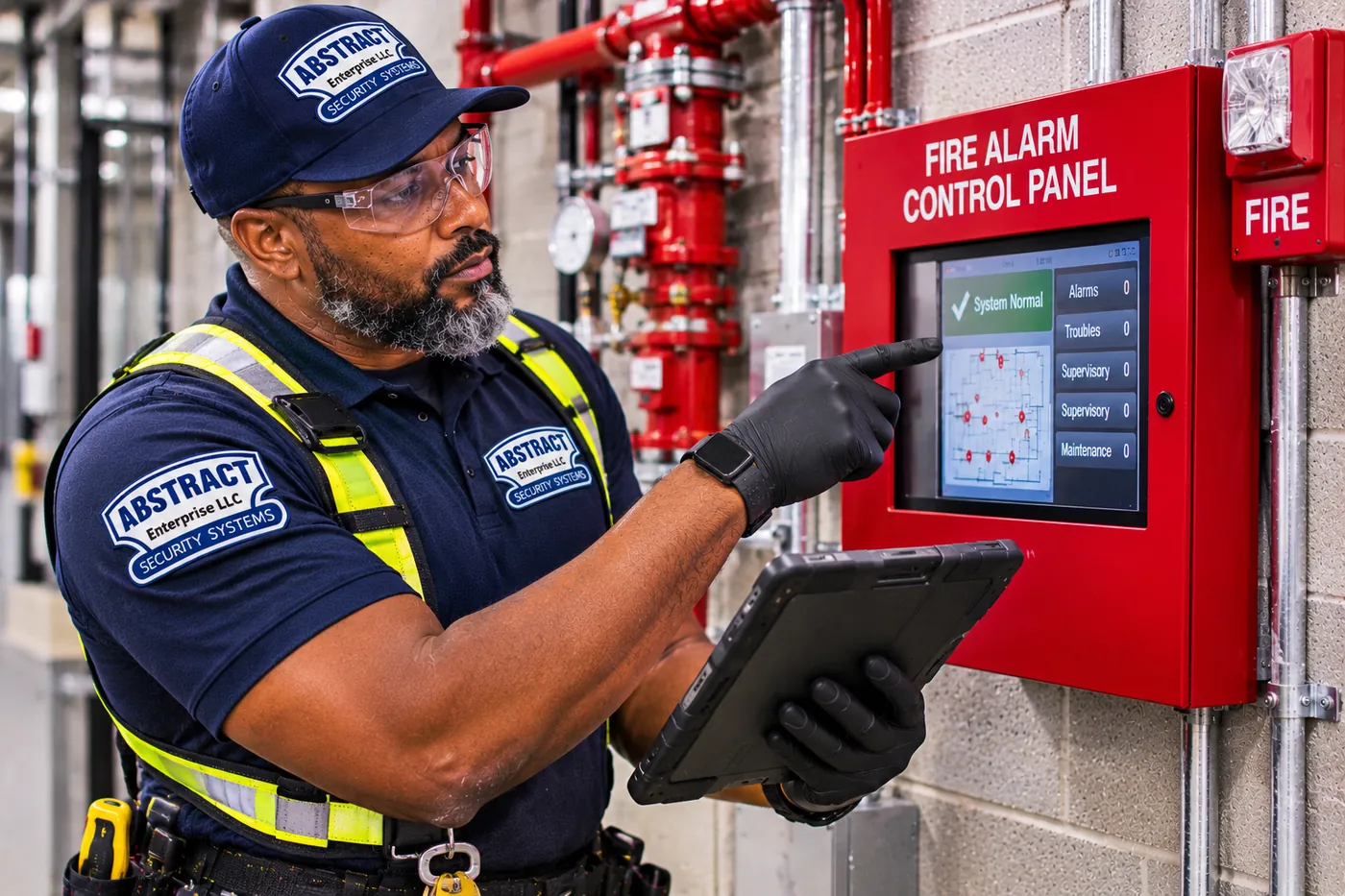
A technician with a tablet in one hand touches the screen of a red fire alarm annunciator on a dark stone wall, a red strobe mounted above it. In a 13- to 18-story tower like the Boston Secor buildings, the lobby annunciator is the first thing an arriving FDNY officer reads to learn which floor is in alarm.
Eastchester Fire Alarm Request
Address, type of business or building, and what the panel says
✅
Request Sent!
Thank you. We will call to book your Eastchester fire alarm survey, usually within 2 hours of your request.
25+
Years Experience
✓
FDNY Path Explained
100%
Commercial NFPA 72
4.7★
201 Google Reviews
Owner-operated since 2002 · Thousands of jobs completed · Booked within 2 hours
Fire alarm installation in Eastchester is commercial work done one building at a time: a system designed to NFPA 72 and the NYC codes for a yard office, a shop, a warehouse, a storefront with apartments above, a plaza unit or a residential tower, approved by the FDNY and priced in writing only after we have walked the property. A New York State licensed Professional Engineer or Registered Architect designs the system and seals the drawings first. The installing team comes second. The drawings go to the FDNY for a TM-1 plan examination, and once they are approved and a Project Authorization is issued, an FDNY-certified fire alarm company working with a NYC licensed electrician installs exactly what was approved. The FDNY Fire Alarm Inspection Unit then watches the acceptance test. To book a survey, call (646) 490-0629; we book it within 2 hours.
Only systems a code requires or an owner files with the FDNY: yards, shops, warehouses, stores, plazas, schools and child care, and the building-wide systems of multifamily buildings
We work under NYS license #12000287431 and name, in writing, the FDNY-certified company and the electrician of record who will appear on your filing
The FDNY puts submission to final approval at about 20 to 24 weeks, so a lease start, a lender's deadline or an insurer's date should be counted backward from there
Why Eastchester's Yards, Shops and Towers Need Fire Alarms Built for Low, Wet and Busy Ground
The short answer is that Eastchester packs three very different fire risks into about half a square mile, and none of them looks like a typical Bronx apartment block. On the east side, along the Hutchinson River and the New England Thruway, is one of the Bronx's five Industrial Business Zones, full of yards, garages and storage buildings. In the middle, Dyre Avenue and Boston Road carry the shops and the plaza. And on Bivona Street stand the Boston Secor Houses, public housing towers of 13 to 18 stories.
Start with the industrial side. The city created Industrial Business Zones in 2006 to protect land zoned for manufacturing, and there are 21 of them; in the Bronx they are Bathgate, Eastchester, Hunts Point, Port Morris and Zerega (NYCEDC). When the Department of City Planning surveyed open industrial uses in and around the Eastchester zone, it counted 56 sites on about 46 acres: 11 auto dismantling and salvage yards covering roughly 15.5 acres, 27 sites storing working vehicles and materials, 15 storing inoperable vehicles, two concrete and cement plants, a scrap metal yard and a fill transfer site (NYC Planning, Open Industrial Uses: Eastchester). The same map shades much of the area inside the FEMA 100-year floodplain. Open yards rarely carry a fire alarm; the offices, parts buildings and repair bays on them often do, and those rooms are cold, dusty and sometimes wet.
Then there is the high-rise side, and the reason it is on everyone's mind. Just after midnight on January 24, 2026, crews answering a report of a strong gas odor at a Boston Secor building on Bivona Street, between Reeds Mill Lane and Boston Road, were on scene when an explosion tore through the 15th floor. The fire went to four alarms and spread to the 15th, 16th and 17th floors; one resident died, 15 people including a firefighter were hurt, and more than 150 residents stood outside in near single-digit cold while water froze on the building (ABC7; News 12 Bronx). A resident told ABC7 she walked down 12 flights. Three weeks later the Department of Buildings had lifted the vacate order for floors 1 through 14, and a 17th-floor tenant asked News 12, "How do you expect anybody to go back to the exact same place that they could have lost their life?" Police charged a man with causing the explosion; the case is in court and nothing on this page speaks to its cause.
In a tall building, the fire alarm is how people upstairs learn of a problem, how elevators get out of the way and how the FDNY learns which floor to climb to, and it has to keep working while contractors, vacancies and new management come and go. Apartment smoke and carbon monoxide alarms follow a separate rule; this page covers building-wide and commercial systems.
Eastchester, Bronx at a glance
Where it is: the Bronx's northeast corner, bounded by the city line to the north, the New England Thruway to the east and Baychester Avenue to the south and west, about half a square mile (Wikipedia; Bronx Community Board 12).
Main streets: Boston Road is the main thoroughfare and Dyre Avenue is the main shopping strip; the Boston Road bridge over the Hutchinson River, the Eastchester Bridge, leaves a few blocks such as Huguenot, McOwen and Ropes Avenues on the river's east side (Bronx CB12; Forgotten New York).
Industry: one of five Bronx Industrial Business Zones, with 56 open industrial sites counted by City Planning, from salvage yards to concrete plants (NYCEDC; NYC Planning).
Housing: mostly small houses, which this page does not cover, plus the four Boston Secor towers of 13 to 18 stories (Wikipedia).
Civic anchors: Community Board 12, the 47th Precinct at 4111 Laconia Avenue, and FDNY Engine 38 and Ladder 51 at 3446 Eastchester Road (Wikipedia).
Transit: the 5 train ends at the Eastchester–Dyre Avenue station; ZIP codes 10466 and 10475 (Wikipedia).
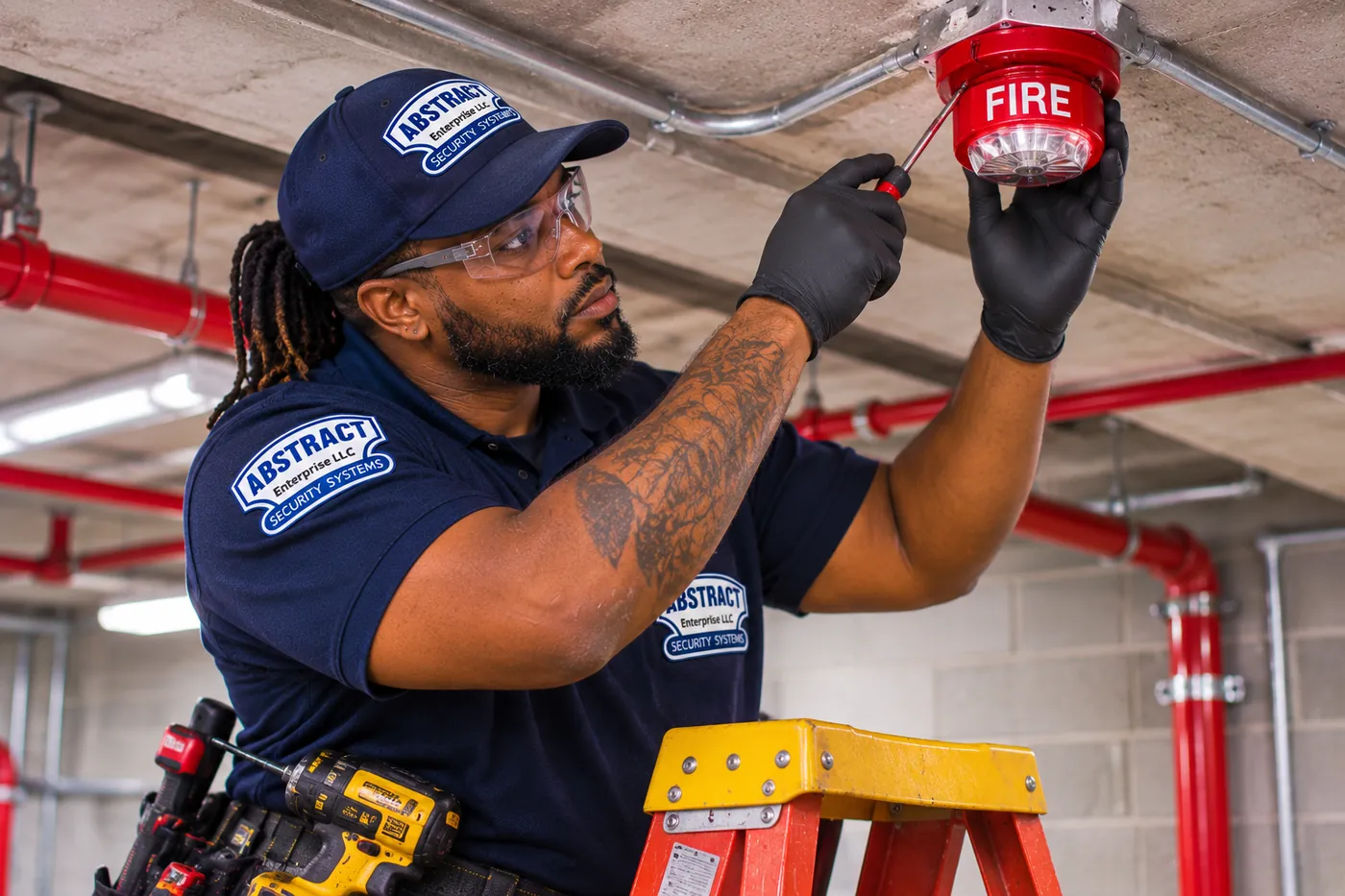
A technician on a yellow step ladder fastens a red horn strobe to a basement ceiling crossed by red sprinkler piping, with painted block walls around him. Below-grade rooms near the Hutchinson River are where we look hardest at moisture, cable routing and where the panel should not go.
Repair
Need Fire Alarm Repair in Eastchester? First Steps While You Wait
If a panel in an Eastchester shop, warehouse, store or apartment building is beeping, showing trouble or supervisory, or has gone dark after a storm, call (646) 490-0629 and we book the visit within 2 hours. Before the technician arrives, photograph the display, note the time it started, and let your central station know service is on the way. If water reached the panel or a junction box, keep people away from it and do not try to dry or reset it yourself.
Do not pull the batteries or switch off the panel's circuit to stop the noise. The FDNY's guidance for building owners is direct: when a fire protection system is out of service, a fire watch starts right away, and the impairment has to be reported to the certificate holder who supervises the system, the central station, the insurance carrier and, where required, the FDNY; occupants must be told if the outage will last more than 30 minutes (FDNY, Fire Protection Systems). Trained staff may watch an area of up to 50,000 square feet for the first four hours, after which an F-01 fire guard takes over. A quiet panel that cannot report a fire is the most expensive kind of quiet.
Urgent fire alarm repair calls in Eastchester tend to come from three directions. After heavy rain on the low streets near the river, it is same day fire alarm repair for a grounded circuit or a soaked device. On cold mornings in unheated parts rooms, it is fire alarm system down repair or a string of nuisance alarms. And in older storefront buildings, it is a fire alarm communication failure emergency repair when a copper phone line is cut or retired and the dialer stops reaching the central station. People search 24 hour fire alarm repair or after hours fire alarm service at night; what they need is a booked time. We book within 2 hours of the call, give a straight arrival estimate, move a building that cannot report a fire to the front, and say plainly when a part has to be ordered.
An emergency fire alarm technician reads the panel before touching anything. Emergency fire alarm troubleshooting starts with the event log and follows it to the circuit, the device or the communicator it names. A fire alarm system emergency service visit to a building that has stopped reporting is about the communication path; a fire alarm trouble emergency service call to a body shop whose panel chirps every afternoon is about whatever is causing the chirp. Commercial fire alarm emergency repair, emergency fire alarm repair, emergency fire alarm service and fire alarm system malfunction repair all finish the same way: the cause is written on the ticket and the owner is told what will keep it from coming back.
Fire Alarm Installation Services for Eastchester Properties
Our fire alarm installation services in Eastchester follow the property types the neighborhood actually has. Every job rests on drawings sealed by a licensed design professional and filed with the FDNY.
🏭
Yard offices and shop buildings
Industrial building fire alarm installation for the offices, parts rooms, repair bays and lofts that stand on salvage, towing and storage lots in the Industrial Business Zone, with devices chosen for cold, dust and exhaust.
🚚
Warehouses and storage
Warehouse fire alarm installation and storage facility fire alarm installation for buildings holding parts, tires, building materials or goods, including high-bay detection and sprinkler supervision.
🔧
Body shops and repair garages
Fire alarm work for collision and mechanical shops where spray booths, compressors and welding sit near offices, and where a booth's suppression system has to talk to the building alarm.
🏪
Dyre Avenue storefronts
Retail store fire alarm installation and restaurant fire alarm installation for the pizzerias, diners, juice bars, salons and shops near the 5 train terminal, many in buildings with apartments upstairs.
🛒
Boston Road plaza units
Shopping center fire alarm installation support for single-story plaza tenants, including the supermarket, its coolers and back rooms, and the smaller units that change hands.
🏢
Residential towers
High rise fire alarm installation and apartment building fire alarm installation for corridors, stairs, elevator lobbies, compactor rooms and building-wide voice and visual notification in 13- to 18-story buildings.
🏫
Schools and child care
School fire alarm installation support for child care centers, early learning programs and private schools, including programs housed in landmark buildings.
🔧
Repair and trouble calls
Commercial fire alarm repair, commercial fire alarm troubleshooting and commercial fire alarm service for ground faults after rain, dead batteries, failed dialers and false alarms from dust or exhaust.
📋
Inspection and correction
Commercial fire alarm inspection, commercial fire alarm testing, ongoing commercial fire alarm maintenance and fire alarm deficiency correction for every line on a Notice of Defect or a test report.
🔄
Upgrades and replacement
Commercial fire alarm upgrades and commercial fire alarm replacement for panels that are out of parts or that sit too low on flood-prone ground, planned so the building stays covered.
We act as fire alarm installers for whole systems, not parts of systems. A commercial fire alarm installation company owes the owner the panel, the cable, the devices, the programming, the monitoring connection, the paperwork and a passed acceptance test, and that is how an Eastchester job is scoped from the first page of the proposal. Yard operators and plaza landlords usually want one commercial fire alarm contractor Bronx-wide who answers for the whole result, so fire detection and alarm installation, commercial fire alarm system installation, commercial fire alarm wiring and commercial fire alarm commissioning sit under one responsible party. A fire alarm system contractor that installs and then disappears before the test leaves the owner holding an unfinished filing. This is professional fire alarm installation for commercial and building-wide systems only; alarms inside apartments and Eastchester's many small houses follow residential rules this page does not cover.
Building Specialists
Commercial Fire Alarm Systems for Eastchester's Building Types
Commercial fire alarm systems in Eastchester fall into six groups of buildings. Each has its own owner, its own typical hazard and its own most common reason for calling us.
Yard buildings in the Industrial Business Zone
The salvage, towing and storage lots on streets such as Hollers Avenue, Conner Street and the blocks off Boston Road east of Dyre Avenue usually carry one or two permanent structures: an office, a parts building, a repair bay or a small warehouse. City Planning's survey of the zone counted 11 auto dismantling yards, 27 vehicle and material storage sites and 15 sites holding inoperable vehicles (NYC Planning). Many of these buildings went up in stages, an office here and a shed there, so the first question is whether the code treats them as one building or several. Industrial fire alarm systems for these sites are usually small, but they have to work in rooms that are unheated, dusty, full of oil and fuel vapors, and sometimes partly below the flood line. That shapes every device choice, from heat detection in place of smoke detection to sealed boxes and cable routed above the water line.
Concrete and material plants
The two concrete and cement operations in the survey cover more than eight acres (NYC Planning). Industrial fire alarm installation there means dust-tolerant devices in offices, labs and shops, and panels kept in clean rooms.
Body shops, repair garages and fleet buildings
Collision and mechanical shops bring spray booths with their own suppression, compressors, welding, parts storage and an office full of paper. Where code requires a fire alarm or the owner files one, the booth's suppression system is supervised by the alarm, heat detection usually covers the bays, and smoke detection is kept to the office and electrical room. Exhaust from idling trucks at a roll-up door is a frequent cause of false alarms when the wrong detector sits near it.
Storefront buildings on Dyre Avenue
The Dyre Avenue Business District runs up to the last stop of the 5 train, and it is a strip of small businesses: NY1's 2020 visit found Mario's Pizza, open since the early 1970s, the Dyre Avenue Diner and a juice bar among them (NY1). Many have stores below and apartments or offices above, so mixed use building fire alarm installation is the everyday question, and a new kitchen or a change of use upstairs can change what the building needs.
The Boston Road plaza
Shopwell Plaza at 4000-4026 Boston Road is a one-story shopping center built in 1973 and renovated in 1997, with about 76,000 square feet, 16 stores and 125 parking spaces (LoopNet listing); a CTown supermarket at 4008 Boston Road has anchored it since 2000 (Market Report). Each unit's fire alarm needs depend on its size, use and whether it shares walls, roof space or a system with its neighbors, and supermarket coolers, compressors and loading areas get detection chosen for cold and air movement.
Residential towers and the PACT conversion
The four Boston Secor buildings, 13 to 18 stories (Wikipedia), are part of a PACT project with Boston Road Plaza and Middletown Plaza that covers 951 apartments for about 1,600 residents, nearly 600 of them seniors. Financing closed in September 2024, Wavecrest Management runs the buildings day to day, and the announced work includes new roofs, modernized elevators and electrical, heating, cooling, plumbing and ventilation upgrades over about two and a half years (NYCHA Journal). The announcement does not list fire alarm work, and we make no claim about it; any such renovation still means elevator recall retesting, roof work around duct devices and a fire watch for every impairment.
Landmark and institutional buildings
Former Public School 15 at 4010 Dyre Avenue is an 1877 Victorian Gothic school by Edward Cordial and Simon Williams, a city landmark since 1978 and on the National Register since 1981; it stopped serving as a school in the late 1970s and now houses a child care center (Wikipedia, Public School 15). Child care in a landmark is a good example of why the design professional reads the building before the code book: a red-brick H-plan with a bell tower is not a place to run surface conduit at random.
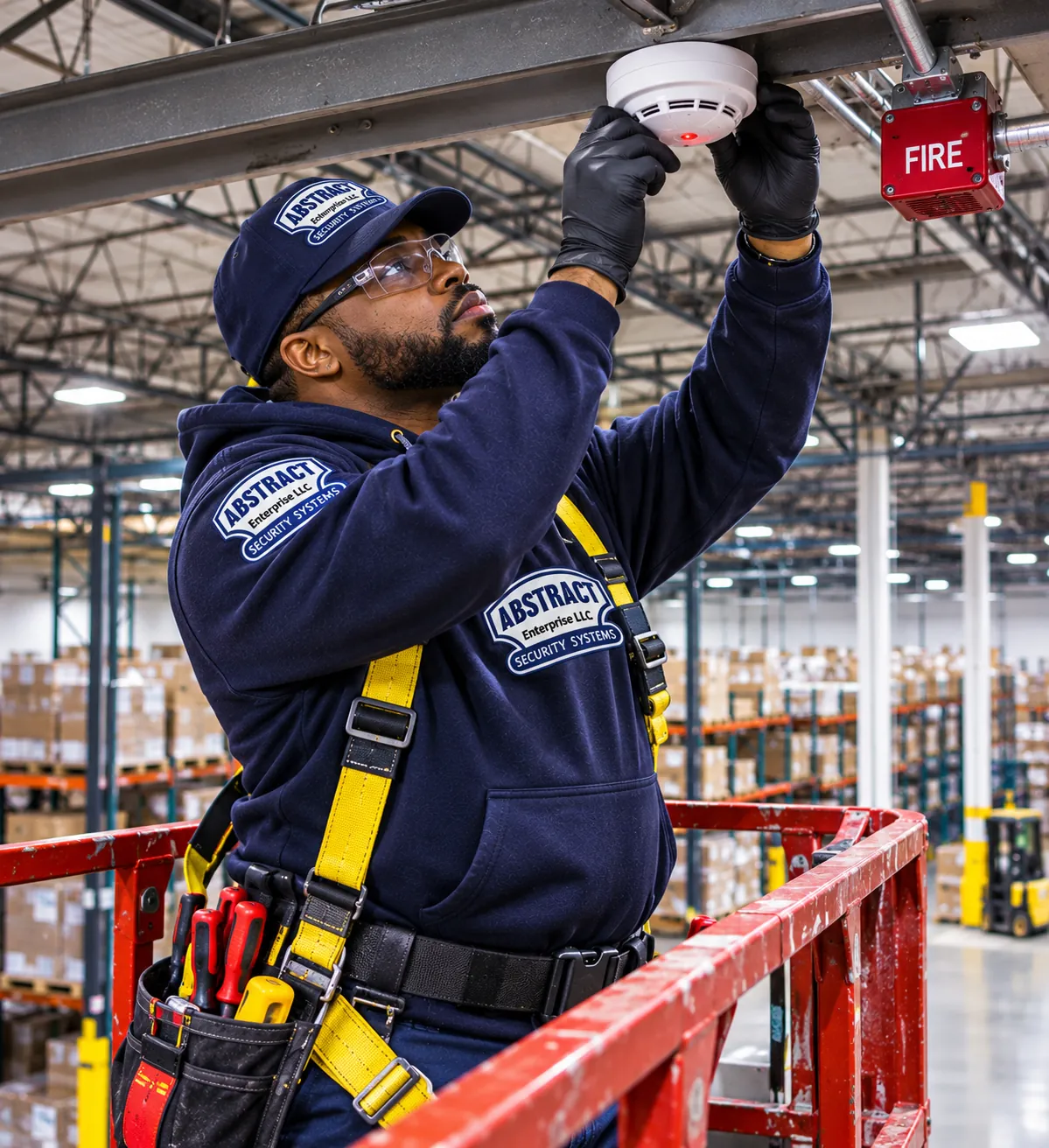
A technician in a yellow fall-arrest harness stands in a red lift and attaches a white smoke detector to a high steel deck, with a red device on the beam beside him and loaded racks below. Parts warehouses and storage buildings in the Industrial Business Zone need detectors and access equipment chosen for the ceiling height.
Commercial Fire Alarm
Business Fire Alarm Installation on Boston Road, Dyre Avenue and the Industrial Streets
Business fire alarm installation in Eastchester happens on three kinds of street, and each brings its own scheduling, access and design issues. Business fire detection systems here protect workers, customers and, on the mixed-use blocks, the families who live upstairs.
Boston Road
Boston Road, the main thoroughfare (Bronx CB12), carries the plaza, auto businesses and small commercial buildings before crossing the Eastchester Bridge; work here is planned around open parking lots and loading areas.
Dyre Avenue
Dyre Avenue, the main commercial strip, ends at the 5 train's terminal (Bronx CB12); its small storefronts mean fit-out and repair work done after closing.
Hollers Avenue, Conner Street and the zone's side streets
The industrial streets mapped in City Planning's Eastchester survey, including Hollers, Tillotson, Givan and Secor Avenues, Light Street and Conner Street (NYC Planning), carry the yards and shop buildings. Work here means keeping traffic moving through a working lot, protecting devices from forklifts and tow trucks, and planning around the floodplain. NYCEDC offers firms that relocate into an Industrial Business Zone a per-employee tax credit, so new tenants keep fitting out older buildings (NYCEDC).
Compliance points that come up in Eastchester
Floodplain: the NYC Building Code's flood-resistant construction rules apply to work in mapped flood zones, and panels, power supplies and communicators belong above the design flood elevation the design professional sets.
Change of use: a garage that becomes a showroom, a warehouse that becomes a gym, a store that becomes a classroom or church, each changes the occupancy and with it what the code asks of the fire alarm.
Spray booths and suppression: booth and kitchen hood suppression systems must be supervised by the building fire alarm where one exists, and their filings must agree with the alarm filing.
Central station: commercial and multi-tenant buildings with required systems must be monitored by an FDNY-approved central station (FDNY, Fire Protection Systems).
Code compliance: NFPA 72 fire alarm installation is applied in New York City through the NYC Fire and Building Codes, and an alteration can bring fire alarm code compliance upgrades the owner did not plan. A fire alarm compliance contractor should hand over the fire alarm system inspection requirements in writing at the end of the job, because fire alarm code compliance is kept up year by year, not won on one day.
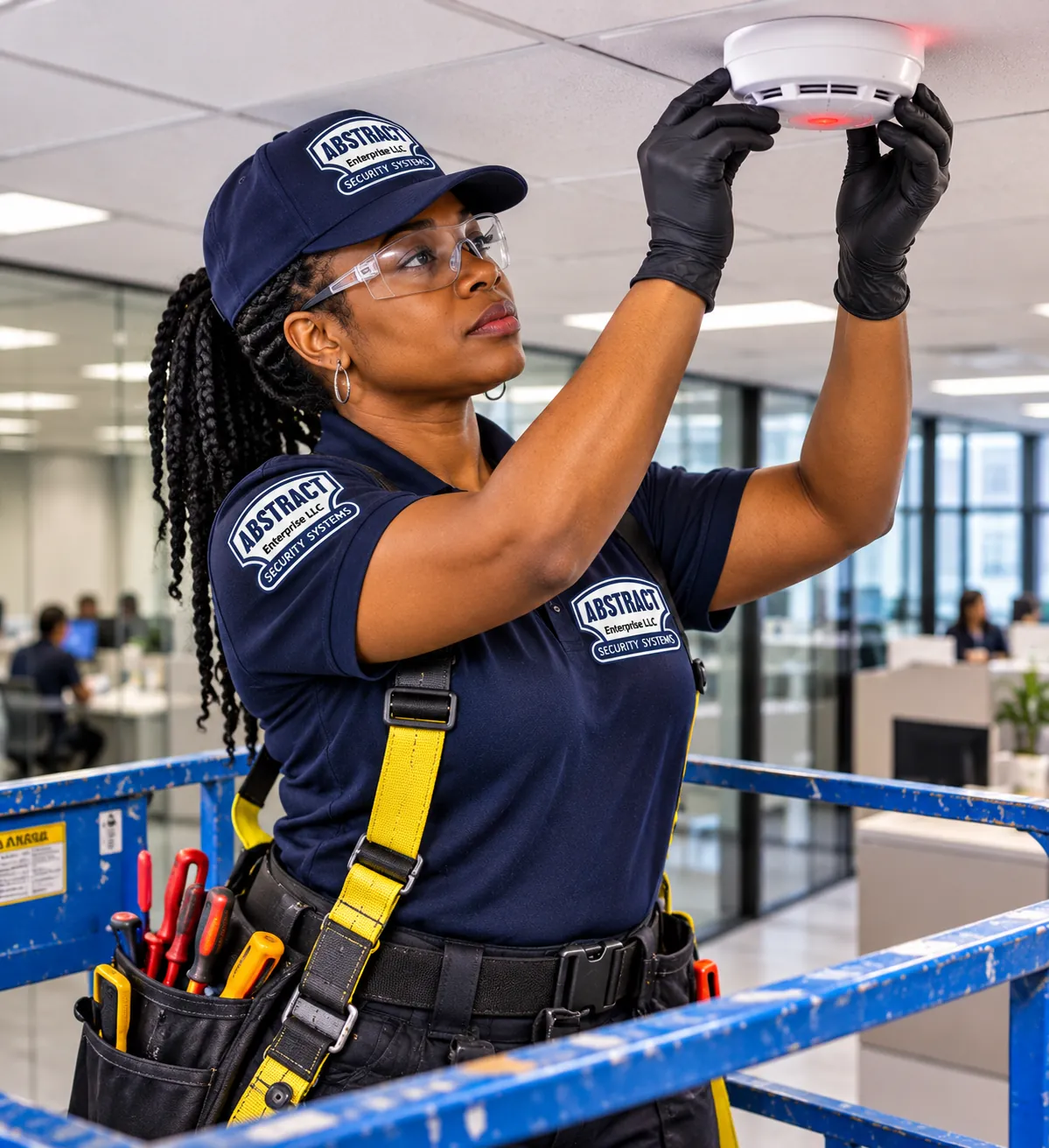
A technician in a blue lift reaches up to attach a white smoke detector to the ceiling of an open-plan office with desks and windows below. The dispatch office or showroom in front of a shop building is usually the one room on an industrial lot where ordinary smoke detection belongs.
Field Notes
Field Notes: The Shop Building That Grew One Room at a Time
This is a typical scenario rather than one specific job. The owner of a towing and repair business in the Eastchester zone calls because his insurer wants a filed fire alarm in the main building before renewal. The building began as a garage, gained a block office on one side in the 1990s, then a mezzanine for parts and a second bay. There is an old conventional panel in the office with two zones, a horn on the outside wall and nothing in the bays.
The walk-through tells most of the story. The panel is mounted low in a corner that took water during a heavy storm, and its battery cabinet shows rust. The smoke detector nearest the roll-up door has gone into alarm on cold mornings for years, so someone pulled its head. The mezzanine is reached by an open stair and has no detection. And there is no record that the FDNY ever approved anything on the wall.
The fix starts on paper. The design professional decides how the code classifies the building as it is used today, sets the flood elevation for the panel and power supply, and lays out heat detection for the bays, smoke detection for the office and electrical room, manual stations at the exits and notification that can be heard over compressors. Fire alarm construction drawings and our fire alarm shop drawings follow the sealed design, the filing goes in, and the old panel keeps working, head reinstalled and fire watch arranged for any gap, until the new system is approved, installed and tested. The owner ends with a panel above the water line and, for the first time, fire alarm as built drawings.
Your Questions Answered
Eastchester Fire Alarm Questions From Yard Owners, Shopkeepers and Building Managers
These are the questions we expect from yard and shop owners, Dyre Avenue and Boston Road landlords and tenants, plaza managers, child care operators and tower managers in Eastchester.
Cost and budgeting
Our IBZ yard has a two-story office trailer and a parts building. Can we get one number for the fire alarm before anyone walks the lot?
No, and a number given that way would not survive the survey. The first questions are which structures the code counts as buildings, whether a trailer is temporary or permanent, how each is used, and whether either sits in the floodplain. Those answers decide whether you need one system, two or none in one of them. After a walk-through we can tell you which path applies and write the scope; sealed engineering drawings come first on any new system and are a real part of the budget by themselves.
Our Dyre Avenue landlord wants the store tenant to pay for a building-wide fire alarm upgrade. Is that normal?
It is a lease question more than a fire alarm question, and leases differ. What the code decides is which parts of the work are needed and why: if the tenant's new use triggers the upgrade, landlords often ask the tenant to carry it; if the building was already short of what it needs, the owner usually carries it. Ask for the design professional's written explanation of what triggered the work, and have the fire alarm system installation proposal split the tenant's space from the common systems so each party sees its own share. A fire alarm installation bid with one total cannot be divided fairly afterward.
Quality and trust
After the January 2026 Boston Secor explosion, our board asked how we would know our own panel works. What proof should a manager keep?
Keep the evidence an inspector would ask for: the FDNY Letter of Approval, the approved drawings, the most recent fire alarm inspection documentation and test reports signed by the company that did them, the central station contract with the account number and the last signal it received, and a log of every trouble and how it was cleared. If those documents exist and agree with what is on the wall, the board has its answer. If they do not, the gap is the first thing to fix.
A company offered to "certify" our Hollers Avenue warehouse alarm in one visit. Is that a real thing?
Not in the way it sounds. In New York City, approval of a fire alarm system comes from the FDNY after plan review and a witnessed acceptance test, and it is documented by the FDNY's Letter of Approval. A contractor can inspect, test and write a report, which is valuable, but a contractor's certificate does not replace the FDNY's approval. Any company doing that inspection work must itself hold an FDNY Fire Alarm Company Certificate with an S-97 holder among its principals (FDNY Fire Alarm Company Certificate FAQ).
Who does what
Our insurer and the FDNY seem to want different things. Which one does the fire alarm design follow?
The code and the FDNY come first, because the FDNY approves the system and the building cannot pass without meeting the code. An insurer may ask for more, such as monitoring of a building the code would not require to have an alarm, or detection in a storage room. The design professional can fold those extras into the same filing so there is one approved system, not a filed one and an unfiled add-on.
A Shopwell Plaza tenant wants to add a kitchen. Who decides whether the plaza's fire alarm changes?
The design professional on the tenant's alteration decides what the code requires, and the landlord decides whether the plaza's system can be modified. If the unit's devices are tied to a plaza-wide panel, the filing will name the building and the landlord has to sign off. If the unit has its own system, the tenant usually carries it. Either way, a kitchen hood brings suppression that the fire alarm will supervise, so the hood contractor and the alarm contractor need the same drawings.
Technical
Floodwater reached our cellar panel a few blocks from the Hutchinson River. Can it be dried out and put back in service?
Rarely, and never by guesswork. Water and silt corrode boards, terminals and battery cabinets in ways that show up weeks later, so a soaked panel, power supply or communicator is normally replaced, and until the building can report a fire again it needs a fire watch. Much of the Eastchester industrial area is inside the FEMA 100-year floodplain on City Planning's map (NYC Planning). When the replacement is filed, the design professional decides where the new head end goes relative to the design flood elevation, and moving it upstairs is usually part of the answer.
Why do the smoke detectors in our unheated parts room keep going into alarm every winter morning?
Cold rooms produce condensation when the doors open and warm, wet air rolls in, and many smoke detectors are not rated for the temperatures in an unheated building at all. Exhaust and dust add to it. The usual answer is to change the device type for the room, typically to heat detection, keep smoke detectors in the heated spaces, and make the change on the drawings so the system stays approved. Fire alarm false alarm troubleshooting confirms which device and which condition before anything is swapped.
Owners, tenants and landlords
Can a 150-year-old landmark building like the one at 4010 Dyre Avenue get a modern fire alarm without spoiling it?
Yes, with planning. Old schools usually have attics, chases and closets where cable can run unseen, and today's devices are small. Exterior work on a designated landmark generally needs a Landmarks Preservation Commission permit, and the design professional decides how interior work is routed and whether the commission has to review it. The design should start with a careful survey of the building, not with a device catalog.
Our ground lease on the yard ends in two years. What happens to the shop building's fire alarm then?
That depends on what the lease says about the building, and it is worth reading before you spend money on the system. If the building and its systems stay with the land, the landowner inherits the alarm, its approval and its maintenance duty; if the building comes down, the system is removed and the central station account closed in writing. Either way, hand over the approved drawings, the programming file and the latest reports, because the next occupant will need them.
Complaints and problems
Our tenants in a Boston Road building want to know why the hallway horn is so quiet. Do we have to fix it?
If it is part of a required system, yes. Notification must be loud enough and visible enough where the design says it must be, and a weak horn can mean a failing appliance, a voltage problem on a long circuit or an appliance that was painted over. A technician can measure the circuit under load and test the appliance; the fix is then a repair or a filed modification, depending on what is wrong.
Our tow yard has a dispatcher on duty all night in a booth by the gate. Can the fire alarm show up there too?
Yes, if the design includes it. A remote annunciator or a supervised display in the dispatch booth lets the person on duty see which building and which device is in alarm while the central station calls the FDNY. It does not replace monitoring; it adds a set of eyes on site. The location, wiring between buildings and what the display shows all go on the drawings.
Our panel shows "AC loss" after every storm on Conner Street. Is that dangerous?
It means the panel has lost its normal power and is running on batteries, which are sized to carry it only for a limited time. If the message clears when power returns, the batteries did their job; if it stays, or if the batteries are old, the system may go dark during a long outage. Have the batteries load-tested and schedule fire alarm battery replacement if they fail, check the dedicated circuit and its breaker lock, and let us look at why each storm cuts the circuit.
Concrete trucks shake our building all day. Can vibration cause fire alarm troubles?
It can loosen what was never tightened properly: a terminal screw, a device on a flimsy mount, a box fastened to a vibrating panel. The result is usually an intermittent open circuit that comes and goes with the traffic. A technician tracks the troubles against the panel's timestamps, then re-terminates and re-mounts the devices on that circuit to solid structure.
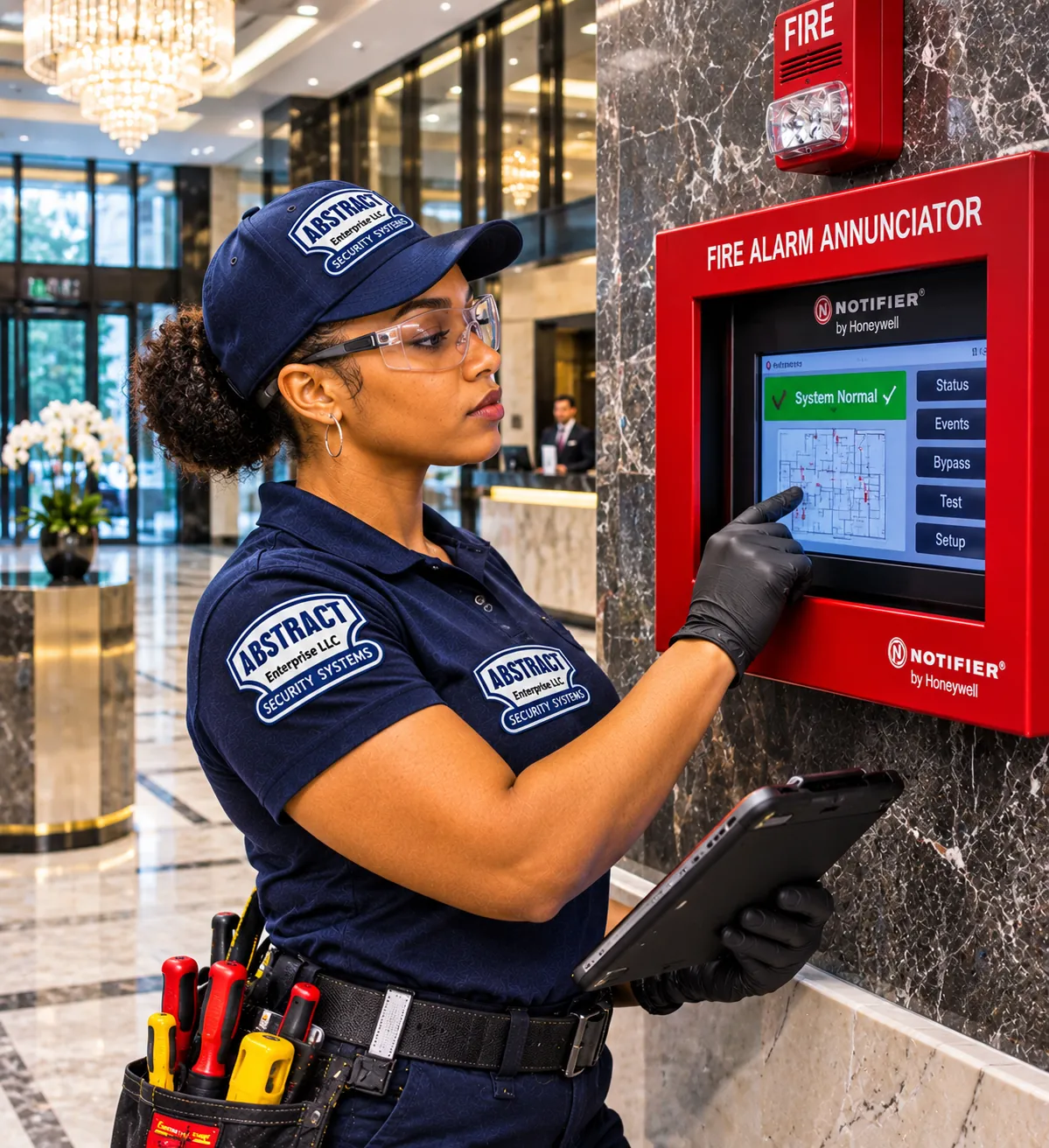
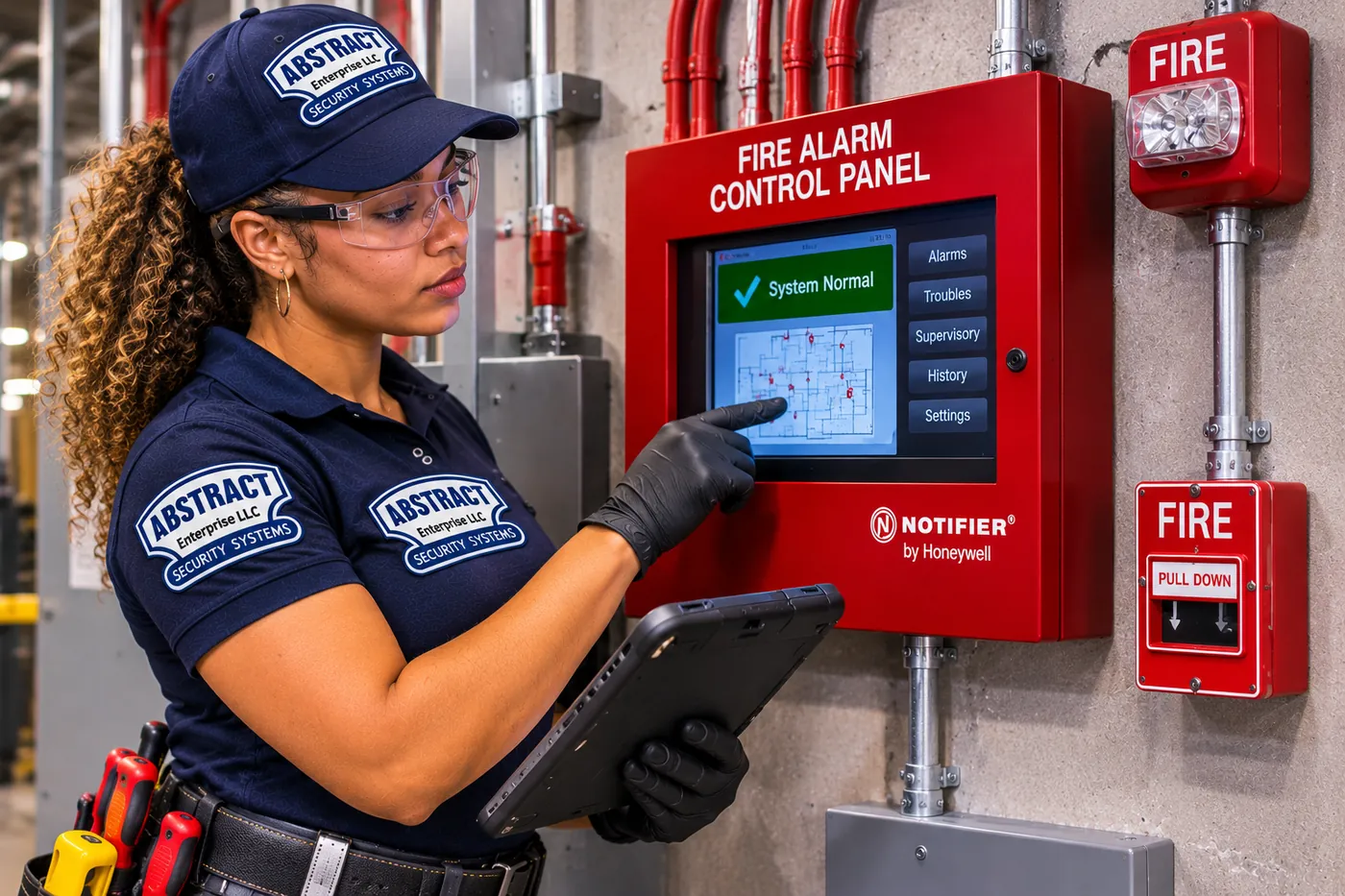
A technician in safety glasses and gloves taps the touchscreen of a red NOTIFIER by Honeywell fire alarm control panel showing "System Normal," a tablet in her other hand and a red pull station and strobe on the wall beside her. Reading the panel's history is how a detector fouled by dust or exhaust is found before it causes the next false alarm.
Equipment
Types of Commercial Fire Alarm Systems We Install in Eastchester
💻
Addressable systems
Addressable fire alarm installation gives each device its own address on the panel. An intelligent fire alarm installation goes further and tracks each smoke detector's condition, which is what makes it an intelligent fire detection system: in a dusty yard office, the panel warns that a head is dirty long before it trips.
🔌
Conventional systems
Conventional fire alarm installation wires devices in zones. Conventional fire alarm system installation still suits a single Dyre Avenue store or a small shop building, though finding a fault takes longer as the building grows.
📢
Voice evacuation
Fire alarm voice evacuation installation and fire alarm emergency voice communication for tall residential buildings and larger assembly spaces where the design calls for spoken instructions by floor.
📡
Monitoring
Fire alarm monitoring system installation and fire alarm central station communicator installation over cellular or IP paths, replacing copper dialers that fail when phone lines are retired along Boston Road.
💦
Sprinkler supervision
Fire alarm sprinkler monitoring installation in warehouses and towers: sprinkler waterflow switch monitoring reports water moving, and sprinkler tamper switch monitoring reports a valve someone has closed.
🌫
Air sampling
Aspirating smoke detection installation for rooms where spot detectors struggle: VESDA installation and VESDA service, or another air sampling smoke detection system, for a dusty control room or a tall storage bay.
Addressable or conventional on an Eastchester lot
What is an addressable fire alarm system? One where every detector, manual station and module has its own identity, so the panel reports "heat detector, bay 2, north wall" instead of "zone 1." What is a conventional fire alarm system? One where several devices share a circuit that the panel knows only as a zone. What is the difference between addressable and conventional fire alarms on a working lot? The time it takes to find a soaked junction box after a storm, the ability to see which head is drifting in dust, and how easily a new bay or mezzanine can be added. A single storefront can live with conventional. A shop building that keeps growing, or a tower, is better served by addressable.
The panel choice becomes equipment through fire alarm control panel installation, also known as FACP installation: addressable fire alarm panel installation for a tower or a growing industrial building, conventional fire alarm panel installation for a small store, and commercial fire alarm panel installation to the approved drawings in every case. A conventional to addressable fire alarm conversion can be done in steps, area by area, so the building is never left uncovered. Addressable fire alarm system installation, addressable fire alarm device installation, addressable fire alarm system programming and fire alarm device addressing, captured in the fire alarm system configuration file, then give the owner a device list that matches the rooms, which is exactly what an insurer or a buyer will ask for.
Devices
Eastchester Fire Alarm Devices and the Rooms Each One Suits
Fire alarm equipment installation is done one device at a time, and in Eastchester the room decides the device more often than the drawing template does. Fire detection device installation in bays, yard offices, coolers, cellars and tower corridors has to match temperature, dust, moisture and air movement.
Smoke detectors
Commercial smoke detector installation belongs in offices, corridors, electrical rooms and storage areas that stay clean and heated. Photoelectric smoke detector installation is the common choice, and addressable smoke detector installation names each head on the panel. Service work brings commercial smoke detector testing on schedule, commercial smoke detector repair when a base or head is damaged, and commercial smoke detector replacement once a detector ages out, and many trouble calls end in smoke detector circuit troubleshooting on a single loop. In this neighborhood, detectors near roll-up doors, booths and loading docks are the first suspects in any false alarm.
Heat detectors
Commercial heat detector installation is the workhorse for repair bays, unheated parts rooms, compressor rooms and kitchens, where smoke detectors would react to exhaust, dust or steam. Fixed temperature heat detector installation suits rooms with steady conditions; rate of rise heat detector installation responds to a fast climb in temperature. Heat detector replacement follows damage, age or a change in how a room is used, such as a storage room turned into a paint area.
Duct, beam and air sampling detection
Air handlers in towers, plaza units and offices bring duct smoke detector installation, periodic duct smoke detector testing and, eventually, duct smoke detector replacement, along with fire alarm duct detector integration and fire alarm HVAC shutdown integration so fans stop spreading smoke. Beam smoke detector installation and projected beam smoke detector installation cover high open bays, and warehouse smoke detection installation covers racked storage where a ceiling detector would be far from the fire.
Manual stations
Fire alarm pull station installation and manual fire alarm pull station installation go at exits, with fire alarm pull station replacement, fire alarm pull station repair and fire alarm pull station testing when a station is struck by a hand truck, painted over or broken. In a shop where a worker will see a fire before any detector does, a manual station by the door matters. Each pull station, detector and flow switch is part of fire alarm initiating device installation and is operated at the acceptance test.
Horns, strobes and speakers
In a bay with compressors running, notification has to cut through noise. That means fire alarm horn installation, fire alarm strobe installation and combined fire alarm horn strobe installation placed for real working conditions, plus fire alarm horn strobe repair and fire alarm horn strobe replacement when units are hit or worn out. Fire alarm speaker installation and fire alarm speaker strobe installation apply where voice messages are required, as in tall residential buildings. Fire alarm visual notification installation matters as much as fire alarm audible notification installation where workers wear hearing protection; fire alarm ADA strobe installation puts flashes in public areas and accessible rooms, and fire alarm synchronization module installation keeps strobes flashing together. Fire alarm notification appliance installation and fire alarm notification appliance replacement follow the coverage plan, and fire alarm notification circuit repair finds the open, short or overload when a whole run goes silent.
Modules, power supplies and communicators
Fire alarm monitor module installation lets the panel watch a booth suppression system or a sprinkler switch. Fire alarm relay module installation and fire alarm control module installation let it shut down a fan, release a door or recall an elevator. Long notification runs in towers and big bays need fire alarm NAC power supply installation and fire alarm power supply installation with fire alarm battery backup installation, and fire alarm power supply repair when a booster fails or floods. Fire alarm communicator installation replaces aging phone-line dialers, and fire alarm annunciator installation and remote annunciator installation give arriving firefighters a readable display at the entrance they use.
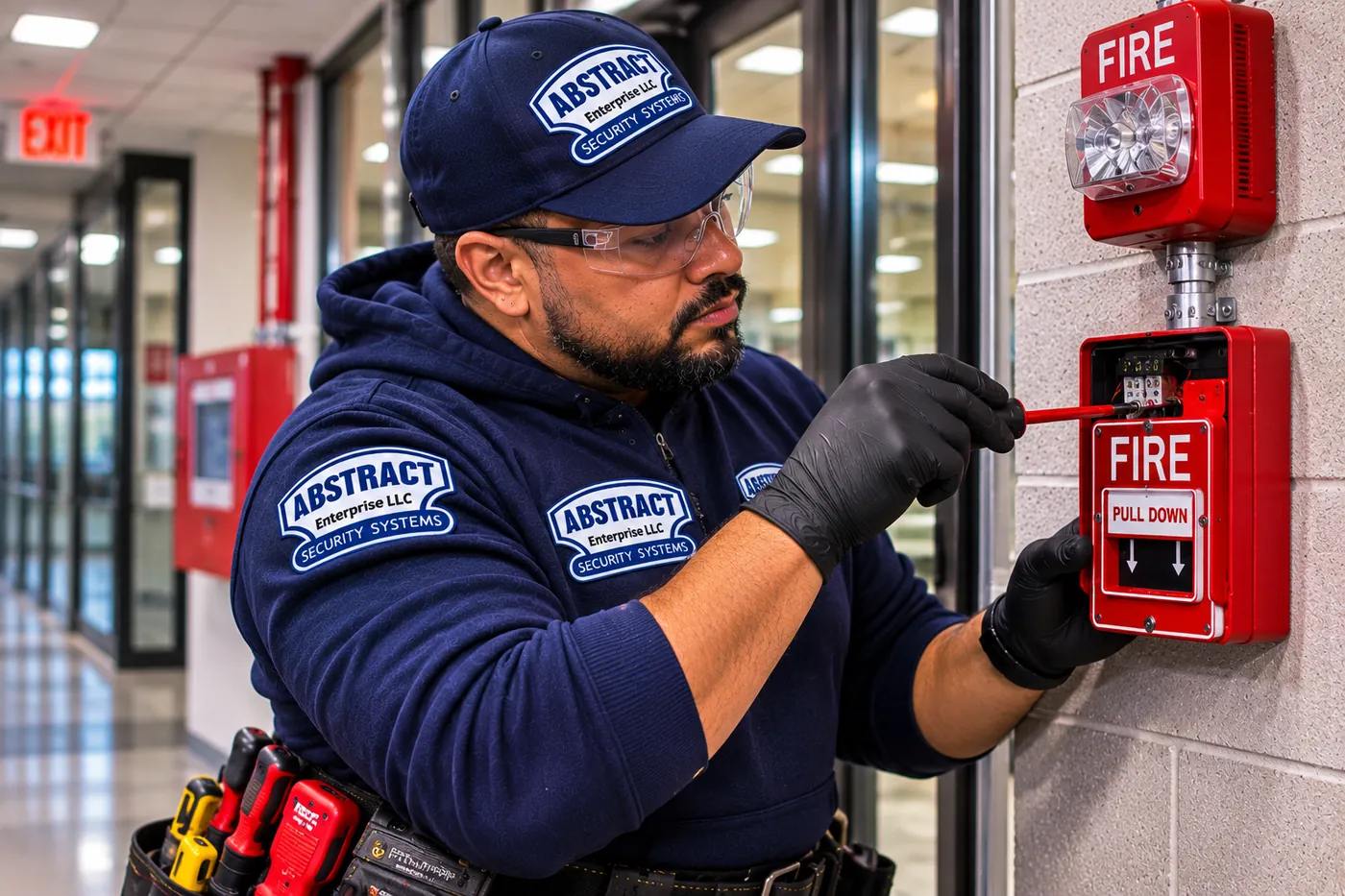
A bearded technician works a screwdriver into a red manual pull station mounted under a red horn strobe on a light gray wall, glass doors and an exit sign behind him. At an exit door that forklifts and tow trucks pass, the station's mounting and wiring are checked as carefully as its address.
AI Overview Reality Check
What AI Answers Get Wrong About Fire Alarms in Eastchester
Search summaries and chat assistants answer fire alarm questions with national averages and generic advice. Here are seven claims we see repeated, checked against how the work goes in Eastchester's yards, shops and towers.
"Eastchester answers apply to every place with that name"
This one comes from the name. Another Eastchester lies just outside the city, and AI answers often blend the two, handing a Bronx owner advice written for a different government. The Bronx neighborhood was annexed by New York City in the late nineteenth century, and its boundaries roughly follow an old village of the same name (Wikipedia).
For a building in Eastchester, Bronx, the fire alarm approval path is the city's and only the city's: a New York State design professional seals the drawings, the FDNY examines them, a certified company and licensed electrician install them, and the FDNY Fire Alarm Inspection Unit witnesses the test.
Say "Eastchester, Bronx" with ZIP code 10466 or 10475 whenever you ask for quotes.
"Industrial yards don't need fire alarms"
An open lot full of cars does not get a fire alarm. The buildings on it may. AI answers tend to look at the business type, call it outdoor storage, and stop there.
The code looks at each structure: its use, area, number of stories, occupant load and whether it holds hazardous materials. A yard's parts building, repair bay or two-story office can each cross a threshold, and an insurer, a lender or a landlord can require a filed system even where the code alone might not.
With 56 open industrial sites in the Eastchester survey (NYC Planning), the honest answer is "it depends on what is built on the lot."
"Sprinklers make a fire alarm unnecessary"
Sprinklers fight the fire; the alarm tells people and the FDNY about it. Even where a building has no required alarm system, a sprinkler system is usually supervised so that water flow and closed valves are reported to a central station.
In a warehouse or tower with both, the fire alarm watches every sprinkler valve and flow switch, so someone closing a valve for a repair and forgetting to reopen it shows up on the panel instead of during the next fire.
"Any electrician can install a fire alarm"
Generic answers say "hire a licensed electrician." In New York City that is half the answer. The FDNY requires the company that installs, tests or services a fire alarm system to hold a Fire Alarm Company Certificate, with at least one principal holding the S-97 certificate of fitness, which requires NICET Level II or higher or a NYC master or special electrician license (FDNY Fire Alarm Company Certificate FAQ).
The electrical work itself is done by a NYC licensed electrician, and the design is sealed by a New York State Professional Engineer or Registered Architect. Three roles, each with its own credential.
We work under NYS license #12000287431 and put the names of the certified company and the electrician of record on your proposal before work begins; we do not claim the FDNY company certificate or the S-97 for ourselves.
"Approval takes a couple of weeks"
The FDNY's own tip sheet puts the average from plan submission to final approval at roughly 20 to 24 weeks, with the first plan review alone taking up to eight weeks (FDNY Tips for Fire Alarm Systems).
For a tenant with a lease start or a yard owner with an insurance renewal, that number belongs at the top of the schedule.
Objections are normal; answer them quickly.
"A battery backup keeps a panel safe in any outage"
Standby batteries are sized for a defined period, then the panel has to be able to sound an alarm. They are not designed to ride through a multi-day outage after a coastal storm, and a battery cabinet sitting in water fails no matter how new the batteries are.
In low-lying Eastchester buildings the better questions are where the panel and power supplies sit relative to the flood elevation, whether the dedicated circuit is protected, and what the fire watch plan is if power is out longer than the batteries last.
Annual fire alarm battery load testing shows how much time you really have.
"A panel showing System Normal means the building is protected"
A green screen means no faults on what the panel supervises. It cannot see a pulled detector head, a painted strobe or a device never connected.
The January 2026 Boston Secor fire, which spread across three upper floors of an occupied tower (News 12 Bronx), is a reminder that buildings change around their systems: contractors come and go, rooms change use and floors empty out.
Only scheduled inspection and testing, done device by device and recorded, shows whether the system on the wall still matches the system the FDNY approved.
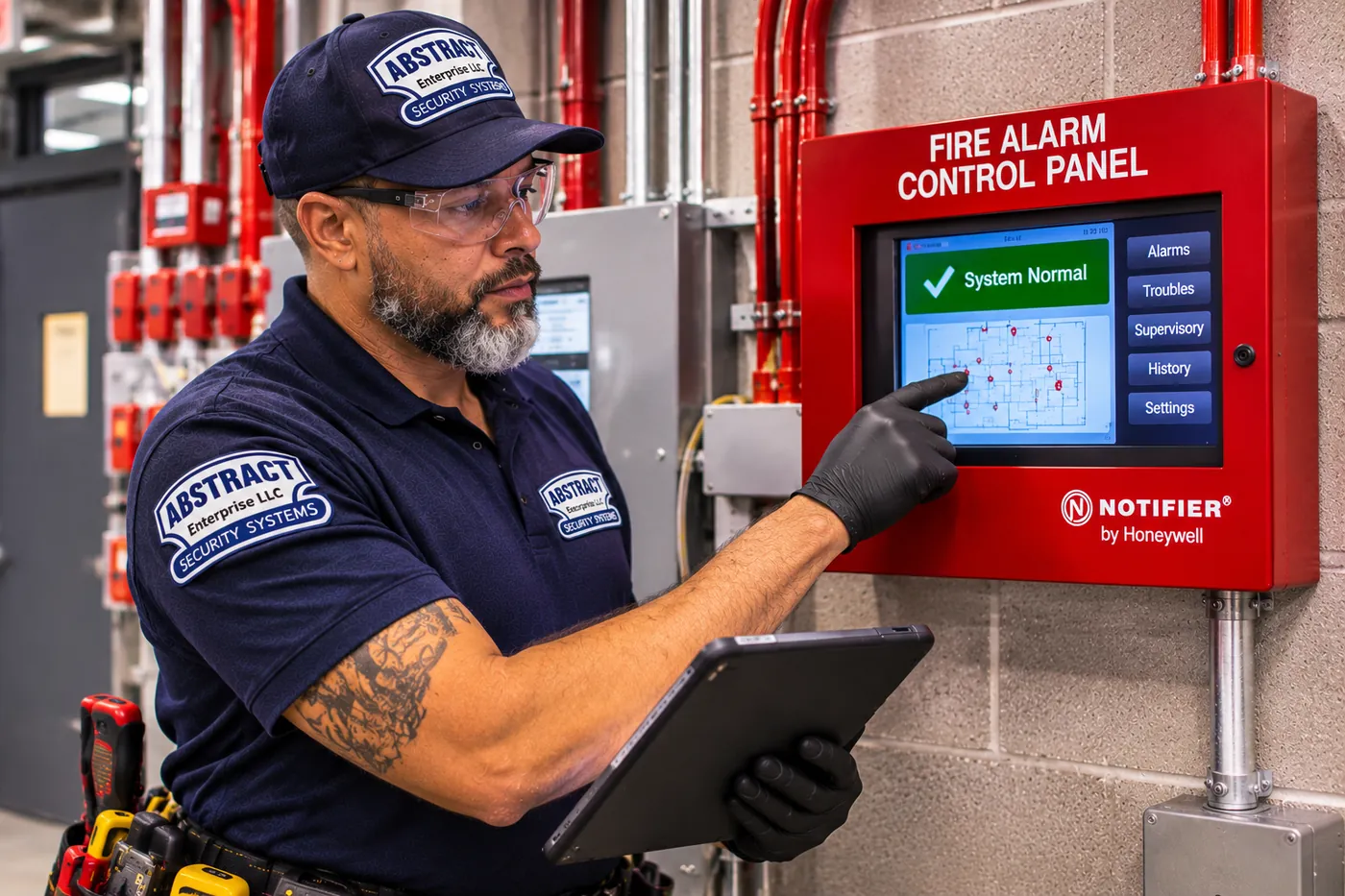
A technician with a tattooed forearm points at the floor-plan map on a red NOTIFIER fire alarm control panel reading "System Normal," holding a tablet in his other hand beside red sprinkler piping and gray conduit. A normal screen is the start of an inspection, not the end of one.
Running a Yard, Opening a Store or Managing a Tower in Eastchester? Talk to a Technician First
Give us the address, the building's use, what the panel shows and your deadline. We book a survey within 2 hours and explain the path in plain language.
Request a Free Quote for Your Eastchester Fire Alarm Project
Tell us about the property and what you need. A fire alarm installation consultation costs nothing; the written proposal comes after a survey, because the existing equipment, the building's use and the drawings set the scope. Prefer to talk? Call (646) 490-0629.
✅
Request Sent!
Thank you. We will call to book your Eastchester fire alarm survey, usually within 2 hours of your request.
How It Works
Our Fire Alarm Installation Process for Eastchester Buildings
A licensed design professional comes first and the installing team second; in Eastchester, how each structure is classified and where the flood line sits come before both.
First call. Street and cross street, what each building on the property is used for, what the panel shows, who owns it and who leases it, which records exist, and the date that drives the job: an insurer, a lease, a lender, a Notice of Defect or a renovation.
Property survey. We walk every structure, including bays, mezzanines, cellars, roofs and tower stairs, locate panels and power supplies, read the event history, test batteries and the communicator, and note anything at risk from water.
Design professional and sealed drawings. A Professional Engineer or Registered Architect licensed in New York State designs the system, sets equipment heights against the flood elevation where it applies, and seals the drawings; our fire alarm shop drawings and the fire alarm construction drawings for the trades follow that design.
Written proposal. Design coordination, filing support, installation, programming, pre-testing, the acceptance test and records listed separately, with the FDNY-certified company and the electrician of record named, ready for the owner, landlord or lender to approve.
FDNY TM-1 plan examination. The design professional files the TM-1 and plans with the FDNY; the department estimates about 20 to 24 weeks from submission to final approval (FDNY Tips for Fire Alarm Systems). Installation starts only after approval and Project Authorization.
Installation to the approved plans. The certified company and licensed electrician complete the fire alarm rough in, fire alarm conduit installation and fire alarm cable pulling, then fire alarm device termination at every location, working around yard traffic, store hours and occupied floors.
Commissioning and pre-test. We check fire alarm panel wiring point by point against the drawings, run fire alarm system startup and fire alarm device programming, and operate every device and interface ourselves, with the sprinkler, elevator and mechanical trades present where they are needed.
FDNY acceptance test and handover. An inspector from the FDNY Fire Alarm Inspection Unit witnesses the test. The owner then receives as-built drawings, the programming file, signed test reports, central station details and a written maintenance calendar.
What happens during fire alarm acceptance testing? The inspector watches devices operate, checks that the panel identifies each one correctly, confirms that every interface on the drawings works, from sprinkler flow and booth suppression to fan shutdown, elevator recall and door release, and verifies that signals reach the central station. Fire alarm system testing and commissioning done thoroughly beforehand is what makes that day short. How long does fire alarm installation take in Eastchester? Field work for a store or a small shop building can take days to a few weeks; the whole path through design and FDNY review takes months, so plan from your deadline backward.
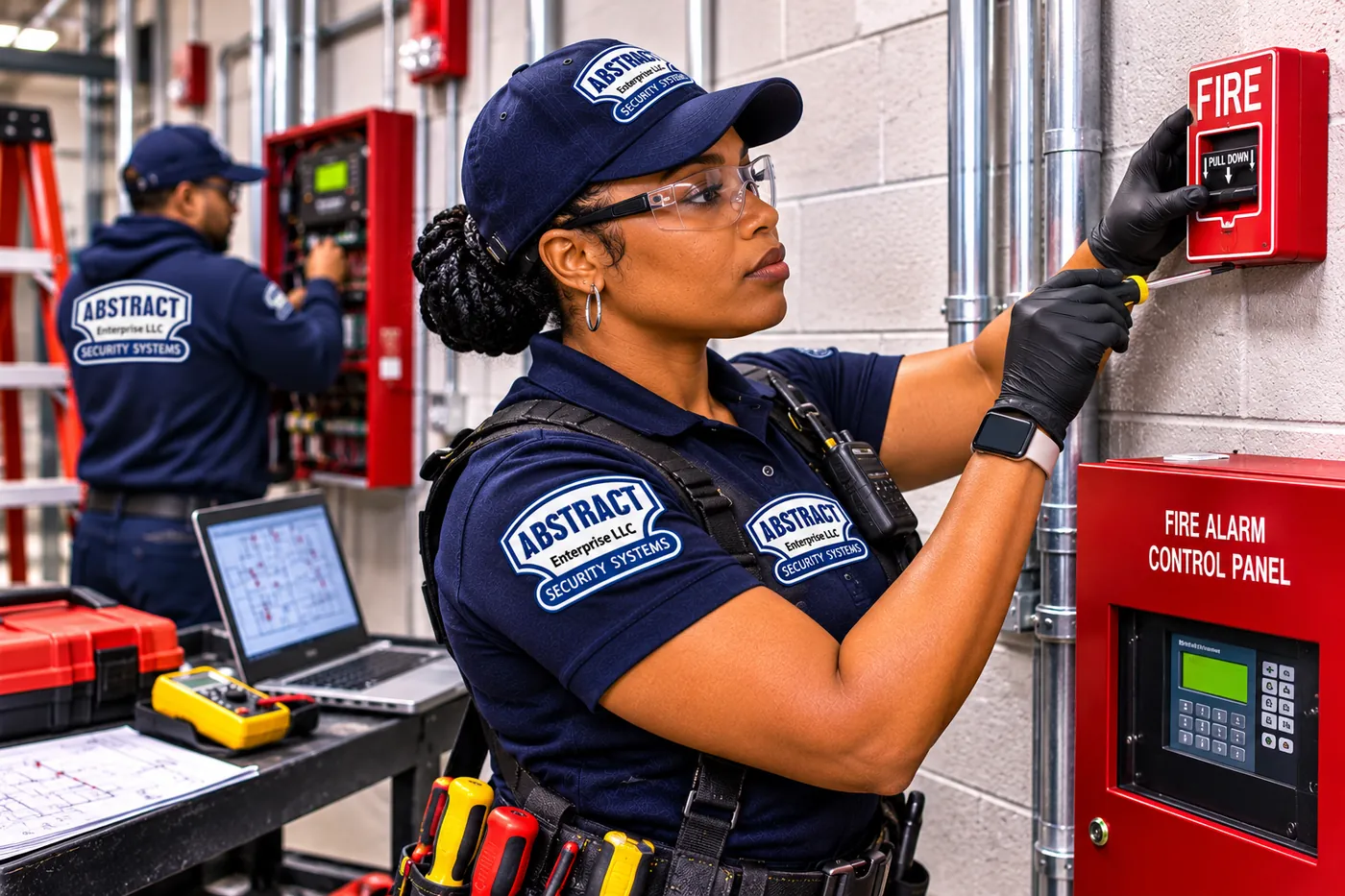
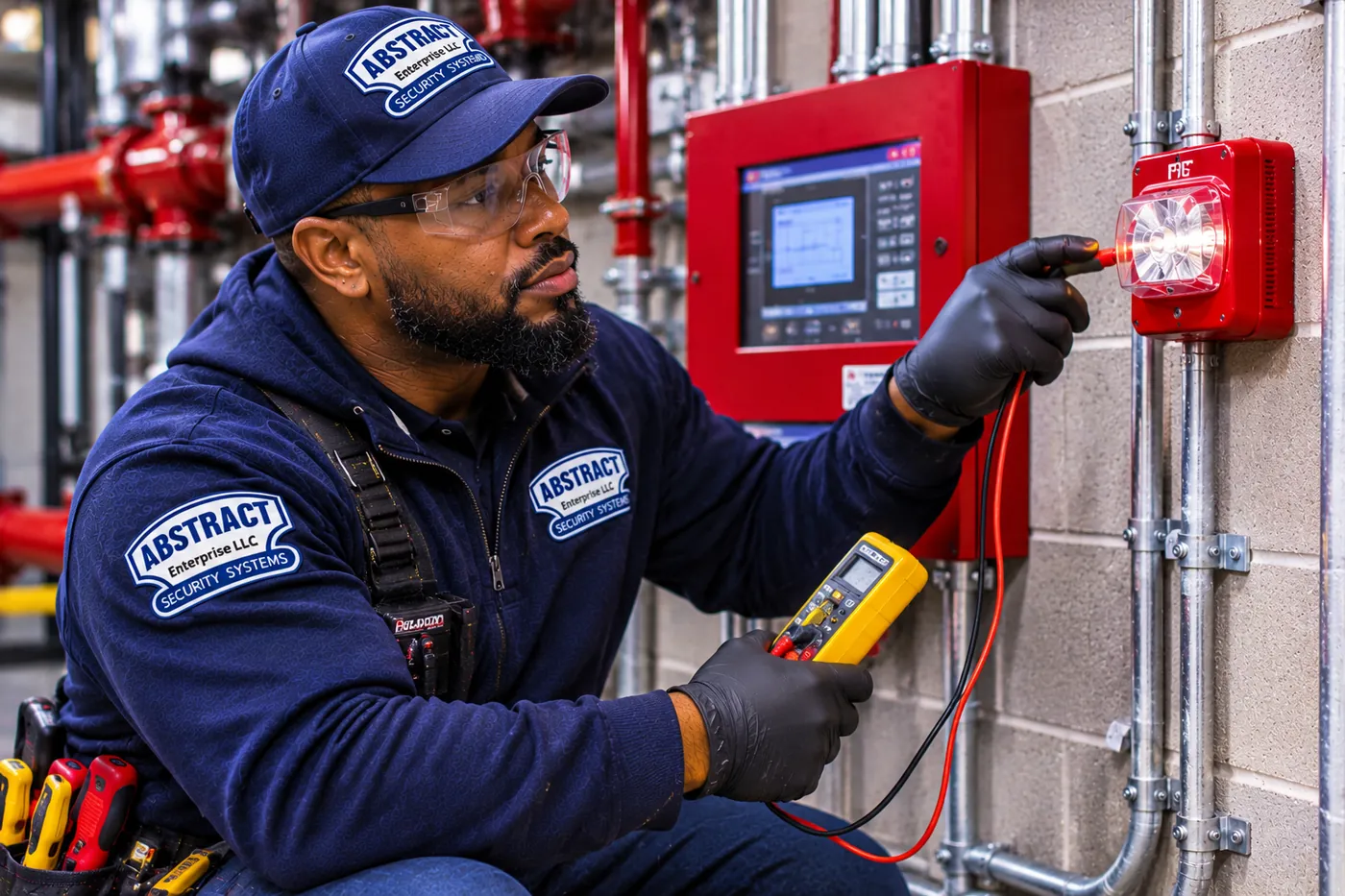
A technician in safety glasses holds meter leads to a red pull station beside a red fire alarm control panel, while a second technician works at another red panel in the background next to a laptop and test gear. A full pre-test before the FDNY arrives is what keeps the acceptance inspection to one visit.
Existing Systems
Repairing, Upgrading and Inspecting Eastchester's Existing Fire Alarms
Many Eastchester fire alarms were installed when a building was first altered for its current use and have been patched since by whoever was nearby. Keeping them approved and dependable takes four kinds of work: repairs that find the actual cause, upgrades that come before parts run out or water comes in, inspections that are done and recorded, and corrections that close out FDNY paperwork. A fire alarm service company working here has to handle a two-zone panel in a yard office and a networked addressable system in a tower in the same week.
Tracing a trouble signal
A good service call begins at the panel, not on a ladder. Fire alarm troubleshooting means recording the event log, noting when each condition started and whether it lines up with rain, cold or a power cut, and only then walking to the circuit or device it names. Fire alarm fault diagnosis and fire alarm system diagnostics sort out the usual suspects: primary power, batteries, the communication path, an open circuit, a short, a ground fault or a failed device. Fire alarm trouble signal repair is not finished until the ticket names which it was. On addressable systems that means fire alarm SLC troubleshooting and fire alarm signaling line circuit repair; on zoned panels it means fire alarm circuit troubleshooting and checks of fire alarm zone wiring. Fire alarm wiring repair, fire alarm device fault repair and tracking a fire alarm intermittent trouble that shows up only after a downpour use the same skills on different symptoms.
Some conditions are so common here that they have their own routine. Fire alarm ground fault repair and fire alarm ground fault troubleshooting after water reaches a box or a cable in a low room; what causes a fire alarm ground fault in Eastchester is usually exactly that. Fire alarm open circuit repair when a bay is reconfigured or a wall comes down. Fire alarm short circuit troubleshooting where cable runs along a floor or a rack and gets crushed. Fire alarm battery trouble repair on cabinets that sat in damp corners. A fire alarm supervisory trouble usually points to a sprinkler valve, a tamper switch or a suppression system out of its normal position. A fire alarm communication failure repair follows a retired copper line or a lapsed cellular plan, and a fire alarm system not communicating is a building that cannot call for help on its own. Fire alarm panel beeping repair is how most of these first show up, because a beeping panel is announcing a fire alarm system trouble condition, and the fire alarm panel trouble light is the panel's way of asking for this visit. Why is my fire alarm panel showing trouble? The display usually says, and reading it before resetting it is the most useful thing an owner can do.
When the panel itself is the problem
Fire alarm control panel troubleshooting sometimes ends inside the cabinet: a power board damaged by a surge, a corrupted program, a dead display or a model the maker no longer supports. Fire alarm control panel repair is practical while boards are still sold, and fire alarm control panel programming problems can be fixed when the file and the software exist. FACP repair on an orphaned or water-damaged unit is a short-term measure; fire alarm panel failure repair there is best treated as a bridge to a filed replacement placed above the flood line.
Who repairs fire alarm control panels in Eastchester? An FDNY-certified fire alarm company, with a licensed electrician where wiring changes. Silencing the panel every morning is not a repair.
Upgrading or replacing an older system
Can an existing fire alarm system be upgraded? Often, when the manufacturer still supports the panel and the cable tests clean. A fire alarm system upgrade, fire alarm panel upgrade or fire alarm control panel upgrade can add a cellular communicator, more circuits or new devices without starting from scratch. The common Eastchester versions are existing fire alarm system expansion when a new bay or mezzanine goes up, fire alarm system modification when a store changes tenants, fire alarm system reconfiguration when a warehouse is re-racked, and fire alarm system renovation when a tower's floors are rebuilt. A fire alarm system expansion contractor has to put each of those changes on file with the FDNY, not just on the wall.
Other systems are past saving, and outdated fire alarm system replacement, obsolete fire alarm panel replacement and legacy fire alarm system upgrade take over. Any fire alarm system replacement, fire alarm panel replacement, fire alarm control panel replacement or FACP replacement begins with an inventory of what can stay. Reusing sound cable while replacing the head end and devices, which is a fire alarm system retrofit or commercial fire alarm system retrofit, or a fire alarm system conversion from one technology to another, cuts disruption in a working shop. Work that crosses a code threshold can also bring a fire alarm system code upgrade. An owner with several buildings on the same lot or street should plan fire alarm system lifecycle replacement for all of them together. Commercial fire alarm modernization and fire alarm system modernization done that way, with scheduled fire alarm device replacement, keeps every detector within its rated life. Addressable fire alarm system upgrade, addressable fire alarm system repair and addressable fire alarm troubleshooting follow the same logic, while conventional fire alarm repair and conventional fire alarm replacement keep a small store running until a bigger project justifies conversion.
Inspection, testing and maintenance
Inspection and testing are different jobs. Fire alarm inspection and fire alarm system inspection mean looking: panels, devices, labels, batteries and records. Fire alarm testing and fire alarm system testing mean doing: making devices operate and confirming that the panel and the central station both register them. NFPA 72 fire alarm testing intervals govern fire alarm functional testing, fire alarm device testing and fire alarm sensitivity testing of smoke detectors, and NFPA 72 fire alarm inspection reports record each result. Fire alarm battery load testing shows whether batteries can carry the system through an outage. Fire alarm annual inspection items and fire alarm periodic inspection items fall at different times of year. How often should fire alarms be inspected, and how often should commercial fire alarms be tested? The schedule in NFPA 72 and the NYC Fire Code applies device by device, so a written calendar beats memory. As a fire alarm inspection company and fire alarm testing company, we write reports that an owner, an insurer's inspector and the FDNY can each read.
Between those visits, fire alarm maintenance and fire alarm preventative maintenance keep systems healthy: batteries changed before they fail, dusty heads cleaned or replaced, communicators checked, records kept current. A fire alarm service contract with a fire alarm maintenance company should list each panel, each test and each visit for the year. For a yard with several structures, the fire alarm inspection contractor or fire alarm testing contractor should keep one schedule for all of them. Fire alarm inspection preparation, gathering records and clearing open troubles before the FDNY arrives, saves a second appointment.
Correcting deficiencies and violations
A list of fire alarm inspection deficiencies can come from the FDNY or from our own report, and fire alarm deficiency correction is the work of closing every line with a repair and a record. Depending on the item, fire alarm inspection repair, fire alarm system violation correction or fire alarm code violation repair may need its own filing. The FDNY's Notice of Defect is answered with an FA-27 submission, which carries a $105 fee (FDNY FA-27 instructions). Who can correct fire alarm inspection deficiencies in Eastchester? The same team that installs systems, a certified fire alarm company and a licensed electrician, working on the owner's written authorization. While any part of the system is impaired, the owner or the designated impairment coordinator arranges the fire watch; as one New York fire safety consultant put it, "Impairing existing systems is a trigger for providing fire watch coverage while the impaired system is down" (Peter Simon, New York Real Estate Journal, November 2020).
A technician holds the leads of a yellow meter to a red wall strobe next to a red fire alarm control panel, with sprinkler piping and conduit on the block wall behind him. Measuring a notification circuit under load shows whether the last strobe on a long run will still flash.
Coverage Area
Fire Alarm Installation Near Eastchester's Landmarks
We work throughout Eastchester, from Baychester Avenue to the city line and from the Dyre Avenue tracks to the New England Thruway, including the blocks across the Hutchinson River. These landmarks help us find you quickly; none of them is a client reference.
Eastchester–Dyre Avenue station
The northern end of the 5 train, opened in 1912 and rebuilt in 1963-64 with a 525-foot island platform (Wikipedia, IRT Dyre Avenue Line).
Former Public School 15
The 1877 Victorian Gothic schoolhouse at 4010 Dyre Avenue, a city landmark since 1978 and now home to a child care center (Wikipedia).
Shopwell Plaza
The 1973 shopping center at 4000-4026 Boston Road, with 16 stores and a supermarket at its center (LoopNet; Market Report).
Boston Secor Houses
Four NYCHA towers of 13 to 18 stories on Bivona Street near Reeds Mill Lane and Boston Road, now under PACT management (Wikipedia; NYCHA Journal).
Engine 38 and Ladder 51
The FDNY firehouse at 3446 Eastchester Road whose companies answer alarms in the neighborhood (Wikipedia).
Eastchester Bridge and the Hutchinson River
Where Boston Road crosses the river, with the Industrial Business Zone's yards and shops on the low ground nearby (Forgotten New York; NYC Planning).
How Fire Alarm Installation Is Priced in Eastchester
How much does commercial fire alarm installation cost in Eastchester? It is worked out for one property after a survey, from four parts in a fixed order, and we publish no price, range or package because the sealed design comes first and everything else depends on it. A fire alarm installation estimate or fire alarm system installation estimate made without seeing the building is guessing at one of the four parts. The same applies to fire alarm installation cost, fire alarm system installation cost, fire alarm system replacement cost, fire alarm panel replacement cost, fire alarm panel installation cost and fire alarm system upgrade cost: each is the sum of design, filing, installation and testing for that address, and fire alarm installation pricing that leaves one out comes back as a change order.
1. Design and sealed drawings
Design is the first bill on any job. A New York State licensed Professional Engineer or Registered Architect lays out the system and seals the drawings, and on most commercial work that step alone runs into the thousands before any equipment is ordered. Commercial fire alarm system design produces the device layout, battery and voltage-drop calculations, the sequence of operations and the riser diagram. Fire alarm system design requirements come from NFPA 72 and the NYC Fire and Building Codes; in Eastchester the designer also has to settle flood elevations and how each structure on a lot is classified.
2. Filing with the FDNY
Filing comes second. The TM-1 and plans go to the FDNY under the design professional's name, and the fire alarm permit requirements and the fire alarm installation permit in New York City run through that review, with the Department of Buildings involved where construction is part of the work. Does my building need a fire alarm permit? If the work adds, changes or replaces a required system, it needs an FDNY-approved filing. Agency fees are set by the agencies; one published example is the $105 FDNY fee for an FA-27 submission answering a Notice of Defect (FDNY FA-27 instructions). Fire alarm system approval arrives as the FDNY Letter of Approval after the acceptance test is passed.
3. Installation to the approved plans
The third part is the physical work: cable, devices, panel, power supplies, modules and communicators installed where the approved drawings place them, by the certified company and the licensed electrician. On Eastchester properties the method can cost as much as the material: lifts for high bays, protection from yard traffic, work timed around store hours, raised mounting for flood-prone rooms, and phased floors in occupied towers. A fire alarm installation quote or commercial fire alarm quote that shows these separately lets the owner see where the hours go.
4. Acceptance testing and handover
The fourth part is proof. After our full pre-test, the FDNY Fire Alarm Inspection Unit witnesses the fire alarm acceptance inspection, and the owner receives as-built drawings, programming files, test reports, central station details and the rest of the fire alarm system documentation. In New York City, fire alarm system certification means the FDNY Letter of Approval; a contractor's certificate is not a substitute.
Recurring work is priced separately once the system is running. Fire alarm inspection cost, fire alarm testing cost, fire alarm maintenance contract cost, fire alarm service call cost and fire alarm repair cost depend on the size, age and condition of the system and on how many structures it covers. A fire alarm contractor estimate for service should state which systems are included, how many visits a year and what is excluded. How much does fire alarm panel replacement cost on an Eastchester lot? It turns mostly on whether existing cable can be reused and whether the new panel must move above the flood line, and only a survey answers both.
Full terms — including 50% deposit, one-year parts-only warranty on Abstract Enterprises Security Systems-supplied products, and the late-fee schedule — are set out in the service agreement.
Choosing a Contractor
Choosing Fire Alarm Contractors for Eastchester Properties
Most owners start by searching fire alarm contractors near me, but distance matters less than credentials in Eastchester. Whoever you hire must be able to put an FDNY-certified fire alarm company and a NYC licensed electrician on your filing, work with your design professional, and understand how a lot with several structures, a plaza with many tenants or a tower under new management divides responsibility. Results for fire alarm installation near me, fire alarm installers near me and fire alarm companies near me mix in home smoke alarm sellers and firms that quote the wrong town's process, so ask each one plainly whether it does commercial NFPA 72 work in New York City.
An experienced fire alarm contractor shows itself in its first questions: what the FDNY has on file for the address, what the panel has logged, how the building is used today and where the water reached in the last big storm. A local fire alarm installation company that works the northeast Bronx knows the FDNY timeline, and for an industrial owner the best commercial fire alarm installer chooses devices for the room, not the catalog. A licensed fire alarm installer, a certified fire alarm technician and a fire alarm service technician each have distinct roles, and the proposal should say who fills each. Who installs commercial fire alarm systems in New York City? A certified fire alarm company and a licensed electrician, to sealed drawings. How do I find a licensed fire alarm contractor? Ask for the FDNY company certificate and the name of the S-97 holder, check the electrician's city license, and confirm the design professional's New York State registration.
To compare bids fairly, give all the fire alarm installation contractors for commercial buildings you invite the same checklist: design professional, certified company, licensed electrician, equipment line, flood-related work, exclusions, filing responsibility, who schedules the acceptance test and which records you receive. A fire alarm repair company or fire alarm repair contractor should also say how service calls are booked. Proposals from commercial fire alarm installers that leave lines blank cannot be compared with complete ones, and an unverifiable claim about fire alarm contractor licensing counts as missing.
Brands we work with in Eastchester
The design professional chooses equipment for each building, and our crews install and service the major listed lines. That covers Honeywell fire alarm installation and Honeywell fire alarm service, NOTIFIER fire alarm installation and NOTIFIER fire alarm repair, and Fire Lite fire alarm installation and Fire Lite fire alarm repair, which are common in small shop buildings. It also covers Silent Knight fire alarm installation and Silent Knight fire alarm service; Edwards fire alarm installation, Edwards fire alarm repair and EST fire alarm service; Siemens fire alarm installation and Siemens fire alarm service; Simplex fire alarm service; Bosch fire alarm installation; Potter fire alarm installation and Potter fire alarm service; and Kidde commercial fire alarm installation. Some proprietary panels can only be programmed by the maker's authorized dealer, so where commercial fire alarm manufacturer service applies to your building, the proposal says so.
Integration
How an Eastchester Fire Alarm Works With Sprinklers, Elevators, Booths and Hoods
What is a commercial fire alarm system? It is four parts acting together: a listed control panel; initiating devices such as detectors, manual stations and sprinkler switches; notification appliances such as horns, strobes and speakers; and a communicator that reports to a central station, plus whatever interfaces the building needs. How does a commercial fire alarm system work? A device changes state, the panel confirms it, the building is warned, programmed outputs act, and the central station is told so it can notify the FDNY. Every circuit in commercial fire detection systems is supervised, which is why the panel reports a trouble when nothing is burning.
Fire alarm system integration is where acceptance tests are won or lost. In a tower, fire alarm elevator recall integration and the elevator fire alarm interface send cars to the right floor and take them out of service when smoke is detected in a lobby, hoistway or machine room, and an elevator mechanic attends the test; any elevator modernization has to be re-proven with the alarm. Fire alarm door release integration and fire alarm magnetic door holder release close corridor and stair doors on alarm. Fire alarm access control interface work makes sure controlled doors unlock as the code requires, in tower lobbies and in yard offices with locked gates alike. Fire alarm smoke control interface work applies where a building has engineered smoke control.
Fire alarm suppression system interface and fire alarm kitchen hood suppression monitoring tie a restaurant hood or a body shop's spray booth suppression to the building alarm, so a discharge is reported and, where the design calls for it, fuel and fans shut down. Fire alarm mass notification integration is rare here and is the design professional's call.
A technician in a cap, safety glasses and a yellow high-visibility vest points at the screen of a red fire alarm control panel while holding a tablet, with a red sprinkler riser and valves on the block wall behind him. Flow and tamper switches on a riser like this report to the panel every time water moves or a valve is turned.
New Construction
New Buildings, Renovations and Fit-Outs in Eastchester
Eastchester's building activity is mostly renovation and reuse: the PACT work at Boston Secor, new industrial tenants in older buildings, and plaza units and storefronts being refitted. When new construction fire alarm installation does come up, the building sits on the same low, flood-mapped ground as its neighbors.
On larger projects, building fire alarm installation and commercial building fire alarm installation start at the architect's desk and the general contractor's schedule, and a commercial construction fire alarm contractor belongs on the team early enough to sequence rough-in with the electrician, the sprinkler fitter and, in a tower, the elevator contractor. Complete fire alarm system installation in a new or gutted building runs through fire alarm cable installation, fire alarm wiring installation, fire alarm low voltage wiring and fire alarm circuit installation to startup. Warehouse fire alarm installation, manufacturing facility fire alarm installation, industrial fire alarm contractor work and industrial fire detection system installation are the common new-build types in the zone, where high bays, loading docks and forklift traffic shape every device location. The neighborhood's few new office spaces get office building fire alarm installation sized for how each room is used.
Smaller jobs follow the same logic. Tenant improvement fire alarm installation and tenant fit out fire alarm installation cover a new store, office, clinic or child care room inside an existing building, and the fit-out designer decides whether the space ties into the building's system or gets its own. When does a building need a fire alarm system? When its occupancy, area, height or occupant load crosses a threshold in the NYC Building Code, or when an alteration is large enough to bring in current requirements. Medical office fire alarm installation, nursing home fire alarm installation and assisted living fire alarm installation follow the stricter rules for health care and care residences; hospital fire alarm installation, hotel fire alarm installation, data center fire detection installation and parking garage fire alarm installation apply where a project includes those uses. Commercial kitchen fire detection installation goes in wherever a restaurant or plaza food tenant cooks, and condominium building fire alarm installation and multifamily building fire alarm installation follow the residential sections of the code.
For any of these, new fire alarm system installation follows the eight steps above, fire alarm system commissioning and fire alarm system startup happen before the FDNY is invited, and fire alarm acceptance testing closes the project with a Letter of Approval. Property management fire alarm services then keep the system on its inspection calendar.
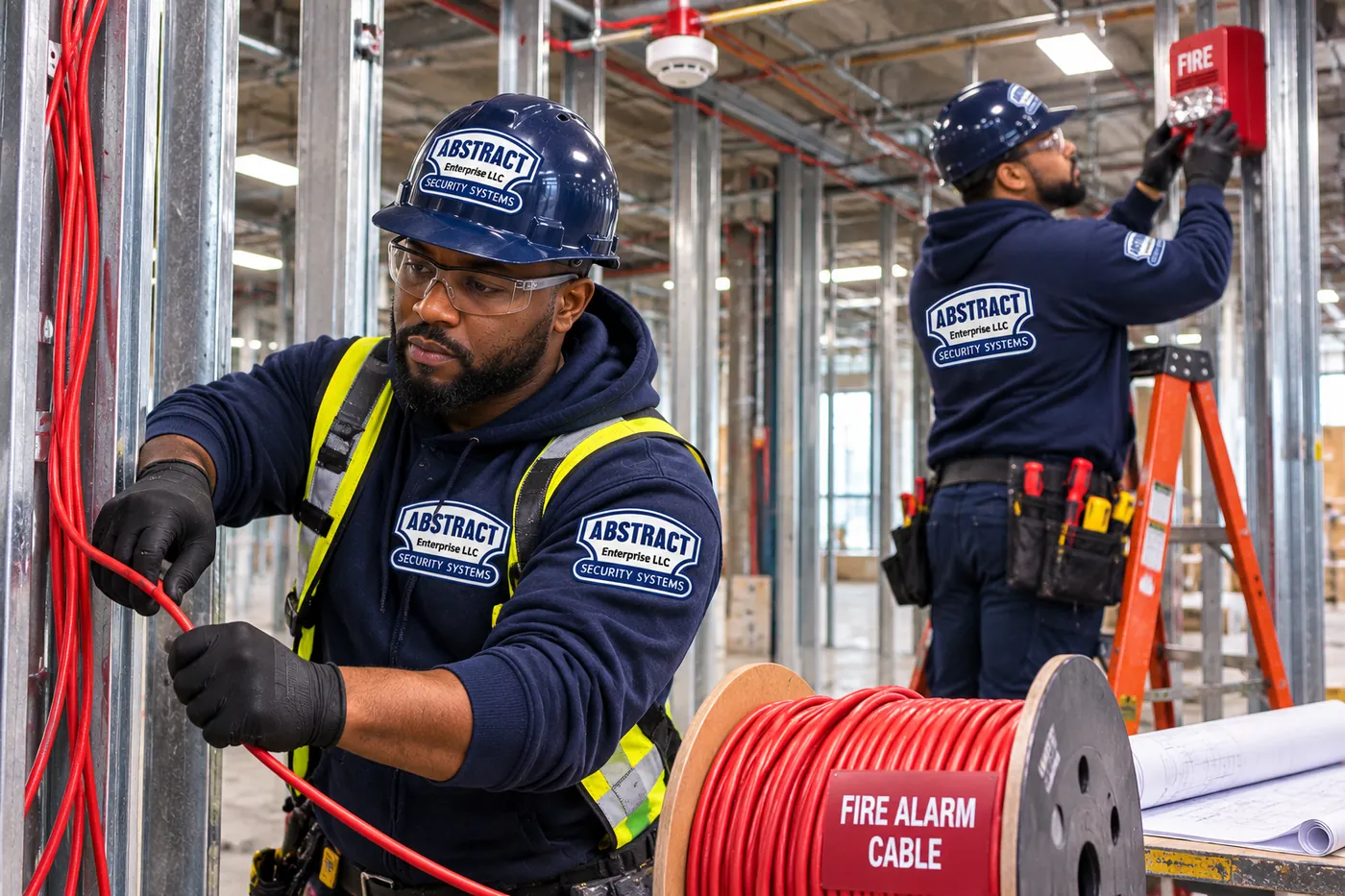
A technician in a blue hard hat and high-visibility vest feeds red cable from a spool marked "Fire Alarm Cable" through open steel studs, while a coworker on an orange ladder fixes a red device near the ceiling of the unfinished space. Rough-in like this happens only after the FDNY has approved the drawings.
Some vendors confuse Eastchester, Bronx with the other Eastchester outside the city. Who approves our fire alarm?
+
If your building is in the Bronx, in ZIP code 10466 or 10475, the City of New York is your authority. A New York State design professional seals the drawings, the FDNY reviews them through a TM-1 plan examination, and the FDNY Fire Alarm Inspection Unit witnesses the acceptance test. Give every vendor your Bronx address and ZIP code up front.
Is NYCHA's Eastchester Gardens in this neighborhood?
+
No. Despite its name, Eastchester Gardens is on Burke Avenue in the Allerton area, where a fire at 1166 Burke Avenue killed one person in December 2025 (News 12 Bronx). The NYCHA towers inside Eastchester are the Boston Secor Houses on Bivona Street. NYCHA and its PACT partners arrange fire alarm work in their own buildings.
Does a body shop with spray booths need its booth suppression tied to the fire alarm?
+
Where the building has a fire alarm system, the booth's suppression system is normally supervised by it, so a discharge or a fault is reported, and the design may also shut down booth fans and fuel. The design professional shows the connection on the drawings, and both systems are tested together.
What happens to our fire alarm approval if we sell the business but keep the building?
+
The approval belongs to the system in the building, not to the business, so it stays as long as the system and the use stay the same. What changes is paperwork: the central station contract, the service contract and the name on any FDNY correspondence. If the new operator changes how the space is used, the design professional checks whether the system must change too.
How do we keep a fire alarm working while a facade or roof contractor is on the building?
+
Plan it before the scaffold goes up. Identify devices the work will cover or disconnect, have a certified company disable only what must be disabled and restore it each day, and arrange the fire watch the FDNY requires for any impaired area. Put the arrangement in the contractor's scope so nobody improvises.
What should a child care operator ask before leasing space in an older Eastchester building?
+
Whether the building has an FDNY-approved fire alarm and a Letter of Approval, whether child care changes the occupancy and what the code then requires, who pays for any new devices, and who holds the monitoring and inspection contracts. Get the answers in writing before signing, because the work has to be filed and tested before children arrive.
Our shop is on Ropes Avenue across the Hutchinson River. Does anything change for us?
+
Not in who approves the work: those blocks between the river and the New England Thruway are still in the Bronx, so the FDNY process on this page applies. Practically, a shop there is one bridge from the rest of the neighborhood, so give the cross street when you call and we will plan access around Boston Road traffic.
We bought a building near the Eastchester–Dyre Avenue station and the fire alarm panel is locked with no code. What now?
+
Ask the seller and the previous service company for the programming access and the panel file first. If neither turns up, a certified technician can identify the panel and work with the manufacturer or its dealer on access. Do not hire anyone to bypass it. Meanwhile, find the central station account so alarms still reach the FDNY.
How fast can a technician reach a shop on Hollers Avenue?
+
We book every request within 2 hours of your call to (646) 490-0629 and give you a real arrival time when we book. A building that cannot report a fire is moved to the front of the schedule. Our Bronx office is at 460 E Fordham Rd; we are not located in Eastchester itself.
Who in our company should be the impairment coordinator for the fire alarm?
+
Someone who is on site most days and can make decisions: an operations manager, a property manager or a building superintendent. If nobody is named, the owner holds the role. That person arranges fire watches, makes the required notifications when the system is out of service and makes sure it is restored.
Does a vehicle storage lot with no building need a fire alarm at all?
+
An open lot by itself does not get a building fire alarm system. What triggers one is a structure on the lot, such as an office, a parts room or a repair bay, that crosses a threshold in the code or that an insurer or landlord wants protected. Fire safety for the lot itself is handled under other parts of the Fire Code.
Sources
Sources for This Eastchester Page
FDNY, Tips for Fire Alarm Systems (design professional, TM-1 filing, installer, approximately 20 to 24 weeks): https://www.nyc.gov/assets/fdny/downloads/pdf/business/tips-fire-alarm-systems.pdf
FDNY, Fire Alarm Company Certificate FAQ (company certificate, S-97 certificate of fitness): https://www.nyc.gov/assets/fdny/downloads/pdf/business/fire-alarm-company-cert-faq.pdf
FDNY, FA-27 instructions (Notice of Defect, $105 fee): https://www.nyc.gov/assets/fdny/downloads/pdf/business/fa27-instructions.pdf
FDNY, Fire Protection Systems guide for owners (fire watch, notifications, central station monitoring): https://www.nyc.gov/assets/fdny/downloads/pdf/business/Support/fire-protection-systems.pdf
NYC Department of City Planning, Open Industrial Uses: Eastchester Survey Results (sites, uses, floodplain): https://www.nyc.gov/assets/planning/download/pdf/plans-studies/open-industrial-uses/eastchester_flood.pdf
NYCEDC, NYC Industrial Business Zones: https://edc.nyc/industry/industrial/nyc-industrial-business-zones
Bronx Community Board 12, About: https://www.nyc.gov/site/bronxcb12/about/about-bxcb12.page
ABC7 New York, 1 dead, 15 others injured in Eastchester high-rise fire and explosion, January 24, 2026: https://abc7ny.com/post/1-dead-15-others-injured-eastchester-bronx-high-rise-fire-explosion/18462493/
News 12 Bronx, gas leak sparks Eastchester fire, January 24-25, 2026: https://bronx.news12.com/2026/01/25/at-least-1-killed-several-injured-after-gas-leak-sparks-eastchester-fire/3BvuWareOF2Qryix8IryUC
News 12, Eastchester tenants and the deadline to return after the fatal fire, February 15, 2026: https://longisland.news12.com/i-dont-want-to-come-back-here-eastchester-tenants-demand-management-reconsider-deadline-to-return-after-fatal-fire
NYCHA Journal, PACT project for Boston Secor, Boston Road Plaza and Middletown Plaza, October 2, 2024: https://nychajournal.nyc/420m-pact-project-will-modernize-boston-secor-boston-road-plaza-and-middletown-plaza/
LoopNet, Shopwell Plaza, 4000-4026 Boston Road: https://www.loopnet.com/Listing/4000-4026-Boston-Rd-Bronx-NY/37473330
Market Report, CTown Supermarkets Eastchester (4008 Boston Road), August 2020: https://www.marketreportblog.com/2020/08/tour-ctown-supermarkets-eastchester.html
NY1, End of the line: how has Dyre Avenue changed, May 22, 2020: https://ny1.com/nyc/all-boroughs/human-interest/2020/05/22/end-of-the-line--how-has-dyre-avenue-changed-during-the-pandemic-
Forgotten New York, Eastchester and the Eastchester Bridge, August 2023: https://forgotten-ny.com/2023/08/the-good-place-eastchester/amp
New York Real Estate Journal, Peter Simon, alterations and existing fire protection systems, November 3, 2020: https://nyrej.com/alterations-and-existing-fire-protection-systems-in-new-york-city-five-essential-considerations-by-peter-simon
Wikipedia, Eastchester, Bronx (boundaries, streets, Boston Secor, schools, 47th Precinct, Engine 38 and Ladder 51, ZIP codes); Public School 15; IRT Dyre Avenue Line
All Areas Served
Fire Alarm Installation in Eastchester and Across the Bronx
Eastchester yard owners, landlords and managers often hold property elsewhere in the borough, and the approval path on this page is the same at every Bronx address: drawings sealed by a licensed design professional, an FDNY plan examination, installation by a certified company with a licensed electrician, and an acceptance test witnessed by the FDNY. Start with the Bronx fire alarm installation page or the NYC fire alarm hub, or choose a neighborhood below.
For a shop building, a flooded panel, a storefront changing tenants or a tower heading into renovation, the first step is a survey and a written scope. Abstract Enterprises Security Systems, NYS license #12000287431, rated 4.7 from 201 Google Reviews. We book within 2 hours.