East Tremont Avenue clinic, restaurant, salon or storefront fit-out, a mixed-use walk-up with a panel in trouble, or a new building near Third Avenue heading for its FDNY test? Call the Bronx line: (646) 490-0629
East Tremont Avenue is a working commercial street: a city survey counted 529 storefronts on it, on East 180th Street and on Webster Avenue, most in buildings put up before 1950, with medical offices, quick-service restaurants and beauty businesses turning over underneath apartments. In September 2026 the street also became the Bronx's first busway. Abstract Enterprises Security Systems takes commercial fire alarm work on this corridor, and in the walk-ups and new mid-rise buildings around it, from sealed drawings through FDNY approval, installation and the witnessed acceptance test.
Updated November 2026 by Abstract Enterprises Security Systems, NYS license #12000287431 · Sources: FDNY Tips for Fire Alarm Systems; FDNY Fire Alarm Company Certificate FAQ; FDNY Restaurant Fire Safety Guide; NYC SBS East Tremont Commercial District Needs Assessment; NYC Mayor's Office (September 2026); Bronx Borough President ULURP report, 521 East Tremont Avenue; News 12 Bronx (July 2026)
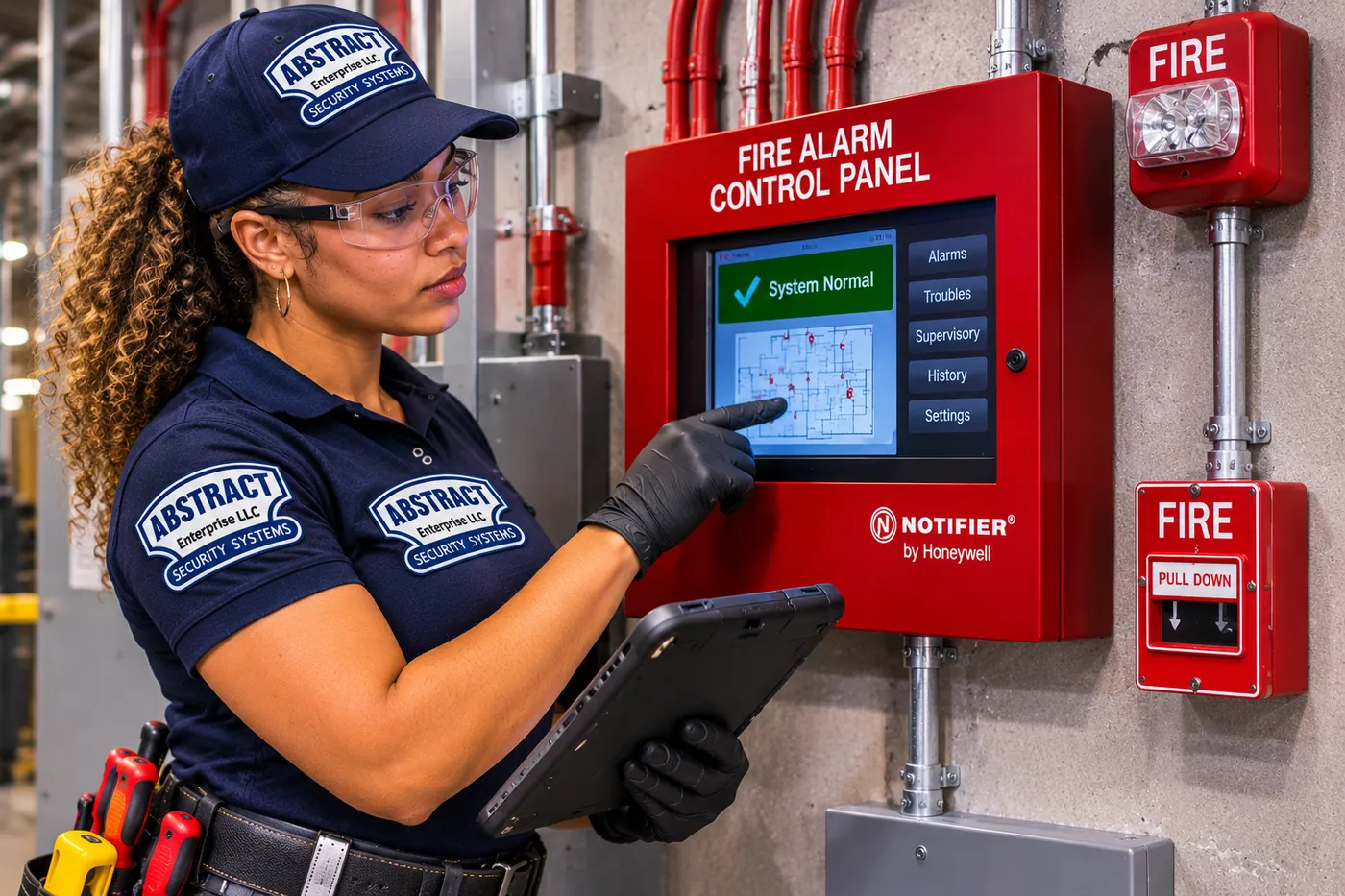
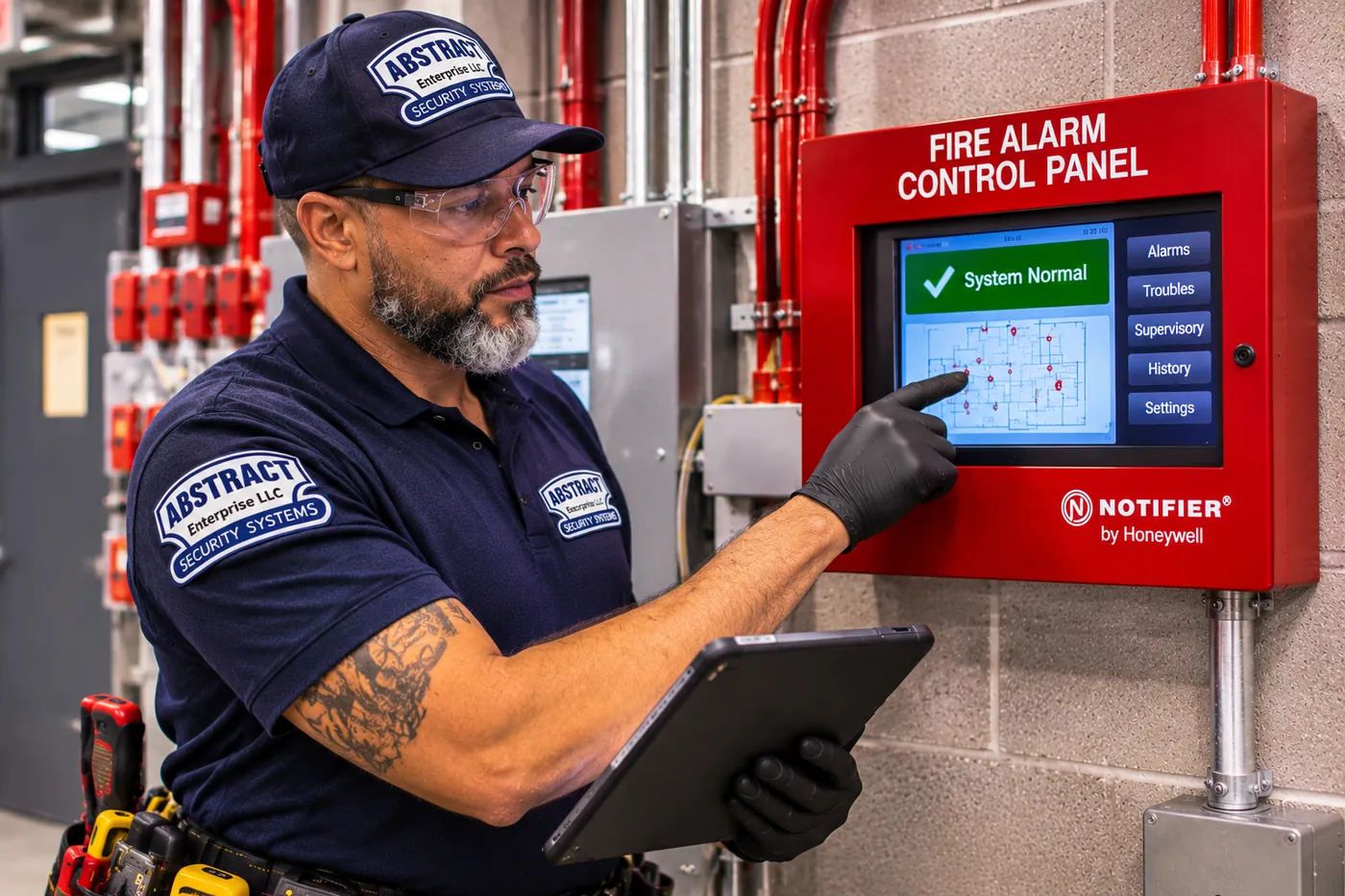
A technician holds a tablet in one hand and touches the "System Normal" screen of a red NOTIFIER by Honeywell control panel with the other, with a strobe and a pull station mounted on the block wall beside it. On a storefront corridor the panel is where the next tenant's work begins: every new device a fit-out adds has to show up on that screen under its own name.
East Tremont Fire Alarm Request
The address, what the space is used for, and what the panel shows
✅
Request Sent!
Thank you. We will call to book your East Tremont fire alarm survey, usually within 2 hours of your request.
25+
Years Experience
✓
FDNY Path Explained
100%
Commercial NFPA 72
4.7★
201 Google Reviews
Owner-operated since 2002 · Thousands of jobs completed · Booked within 2 hours
Fire alarm installation in East Tremont is commercial work done one space at a time: a clinic moving into an old store on East Tremont Avenue, a restaurant opening on East 180th Street, a mixed-use walk-up on Crotona Avenue whose panel has aged out, or a new 14-story building near Third Avenue that needs its system filed and tested before people move in. First, a New York State licensed Professional Engineer or Registered Architect designs the system and seals the drawings. Second, the installing team is chosen. The FDNY then examines the plans through a TM-1 filing, the work is installed to the approved plans by a NYC licensed electrician or a company holding an FDNY Fire Alarm Company Certificate, and the job closes when the FDNY Fire Alarm Inspection Unit watches the acceptance test. Every job is quoted in writing after a survey. Call (646) 490-0629; we book within 2 hours.
NFPA 72 fire alarm installation for commercial spaces only: storefronts, offices, clinics, restaurants, schools, houses of worship and the building-wide systems of multifamily and mixed-use buildings
We work under NYS license #12000287431 and name in writing the FDNY-certified company and the electrician of record who appear on your filing
The FDNY puts plan submission to final approval at roughly 20 to 24 weeks, so a lease start or a store opening on the corridor is planned backward from that window
Why East Tremont's Storefront Corridor Keeps Generating Fire Alarm Work
Most fire alarm calls from East Tremont start with a change downstairs. A shoe store becomes a dental office, a bakery becomes a takeout counter with a hood, two storefronts are combined into one urgent care, or a vacant space is gutted for a salon. With shops below apartments, a change to one tenant's space can reach the whole building's system.
The numbers explain why. Between September 2024 and June 2025, NYC Small Business Services and the Neighborhood Initiatives Development Corporation (NIDC) surveyed East Tremont's shopping streets for a Commercial District Needs Assessment. They counted 529 storefronts along East Tremont Avenue and East 180th Street between Webster and Vyse Avenues and on Webster Avenue from East 175th to East 180th Street, with 67 of them vacant, a 12.7 percent vacancy rate against a citywide average of 12.1 percent at the time. The assessment describes East Tremont Avenue as mostly one- and two-story buildings, much of the stock built before 1950, with professional and medical offices, limited-service restaurants and beauty businesses as the most common uses, and East 180th Street as a similar but looser mix where delis and bodegas lead (NYC SBS, East Tremont CDNA). Each of the 67 empty storefronts is a future fit-out, and each brings a fire alarm decision.
The merchants are organizing. In July 2026, News 12 Bronx reported that NIDC had brought together about 30 East Tremont Avenue businesses in a merchants alliance; Freddy Carrera, owner of Bobby's TV and Radio Service, named the top concern in two words: "Basically, safety. A lot of safety." (News 12 Bronx, July 23, 2026). On a corridor of old buildings, safety includes the panel in a back room and the dialer that reports a fire after the gate comes down.
The street itself changed in 2026. On September 23, 2026, the Mayor's Office announced the completion of the Tremont Avenue busway, open to buses, trucks with six or more wheels, emergency vehicles and Access-a-Ride seven days a week from 6 a.m. to 8 p.m., with taxis and for-hire vehicles allowed in only for local access and required to turn off at the next right; the Bx36 that runs the street carries about 39,000 riders a day (NYC Mayor's Office, September 2026). Streetsblog had reported the plan as a two-way busway on East Tremont Avenue between Third Avenue and Southern Boulevard, which is the spine of this neighborhood (Streetsblog NYC, November 2024). For fire alarm work, that means deliveries, ladders and test days on that stretch are planned around the busway hours and the cross streets, not around a parking spot out front.
Above and around the stores is the housing that gives East Tremont its density: five- and six-story tenement buildings, older multi-unit houses, vacant lots and newly built apartment buildings, in a neighborhood where much of the original housing was damaged by arson and razed (Wikipedia, East Tremont). New mid-rise buildings are now going up on the lots and low commercial sites. On April 23, 2026, Community Access, Mega Group and Community Healthcare Network broke ground at 521 East Tremont Avenue on 213 affordable and supportive apartments, with ground-floor retail and a health center that will triple in size (Supportive Housing Network of New York; Mann Report). Private houses have their own smoke alarm rules and are outside this page; what follows is about the commercial spaces and building-wide systems that the FDNY reviews and tests.
East Tremont at a glance
Boundaries: East 180th Street to the north, Southern Boulevard to the east, the Cross Bronx Expressway to the south and Third Avenue to the west, with East Tremont Avenue as the main street (Wikipedia). The city's commercial survey stretches the shopping corridor west to Webster Avenue.
People and land: 43,423 residents in the 2010 census, up 10.5 percent from 39,280 in 2000, on about 445 acres (Wikipedia).
Civic anchors: Bronx Community Board 6; ZIP codes 10457 west of Prospect Avenue and 10460 east of it; the 48th Precinct; FDNY Engine 45, Ladder 58 and Battalion 18 at 925 East Tremont Avenue (Wikipedia).
Transit: no subway stations inside the neighborhood; buses Bx9, Bx15, Bx17, Bx19, Bx36, Bx40, Bx41 and Bx42, and Metro-North's Harlem Line at Tremont station (Wikipedia).
Public housing: Twin Roads East, one 14-story building, and East 180th Street-Monterey Avenue, one 10-story building (Wikipedia). NYCHA and its contractors maintain those systems.
Storefront condition: 22 percent poor, 61 percent average, 17 percent good (NYC SBS, East Tremont CDNA).
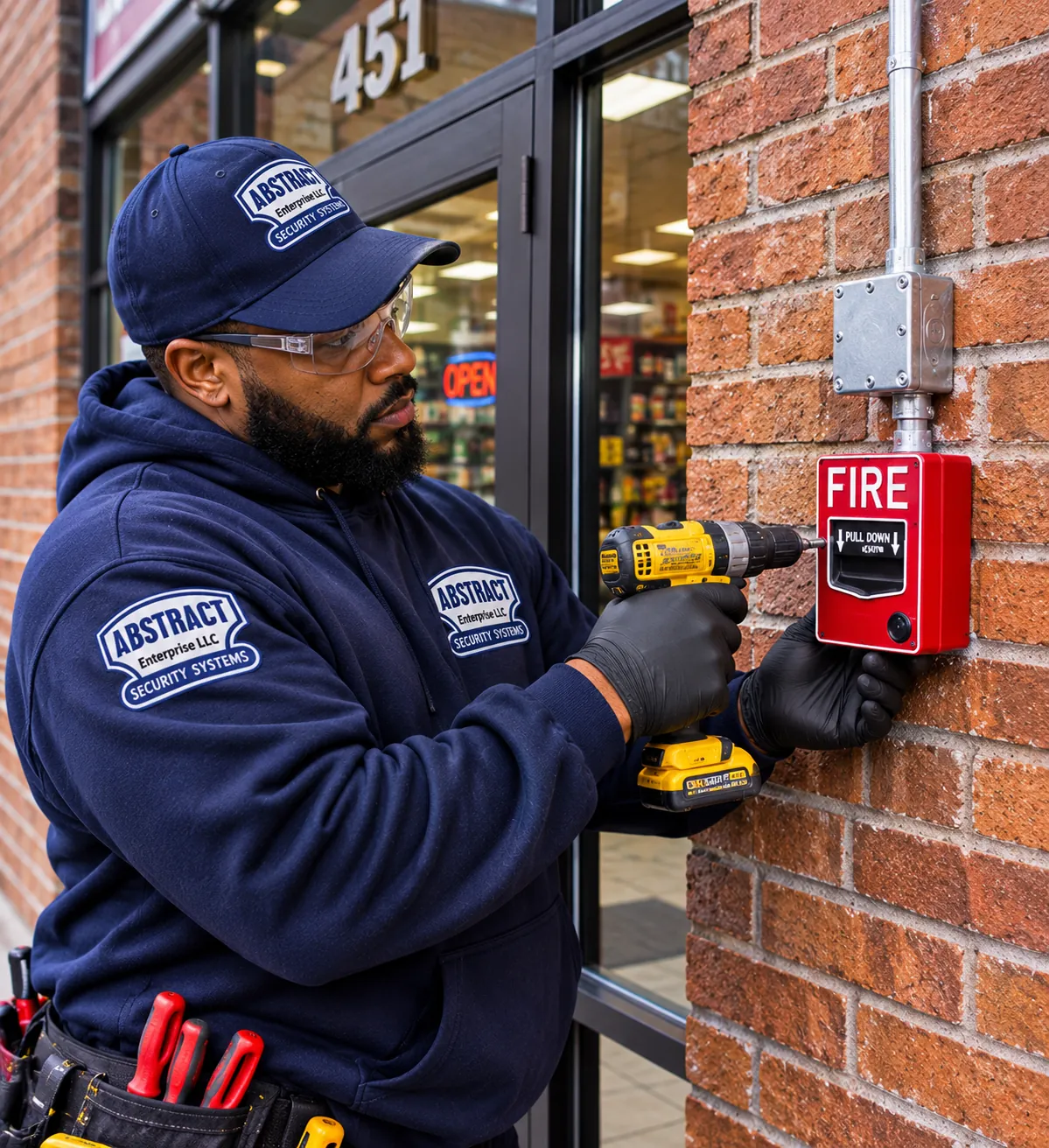
A technician with a cordless drill fastens a red manual pull station to a brick wall next to a glass storefront door, with a short run of conduit rising to a junction box above it. At a store's exit door is where a manual station usually belongs.
Repair
Need Fire Alarm Repair in East Tremont? What to Do in the First Hour
If a panel in an East Tremont store, clinic or apartment building is beeping, showing a trouble or supervisory light, or sounding with no fire, call (646) 490-0629; we book the visit within 2 hours. Before the technician arrives, photograph the panel display, note when the condition started, tell the central station that service is coming, and make sure nobody resets the panel again, because a reset wipes the clues.
Do not unplug the panel, pull its batteries or bag a detector that keeps going off. A required system that cannot report a fire leaves the people upstairs unprotected, and in New York City a system that is out of service means notifying the FDNY and keeping the fire watch it requires until the system is restored. The point of an urgent fire alarm repair is a system that reports properly, not a quiet one.
On this corridor we expect three kinds of urgent calls most. The first is a store whose monitoring path dropped when the phone service changed, which makes it a fire alarm communication failure emergency repair. The second is a cellar or back-room circuit that faulted after a leak or a renovation, which is usually same day fire alarm repair. The third is a fire alarm system down repair where an older panel in a mixed-use building has stopped working altogether. Owners searching for 24 hour fire alarm repair or after hours fire alarm service want a straight answer: we book within 2 hours, give an honest arrival time and put any building that cannot report a fire at the top of the list.
Every emergency fire alarm technician we send starts with emergency fire alarm troubleshooting at the panel's event log, then goes to the device or circuit it names. When a dialer has stopped reporting, the fire alarm system emergency service visit concentrates on the communication path. When a salon's panel chirps all afternoon, the fire alarm trouble emergency service call is commercial fire alarm emergency repair on whatever is causing the chirp. Emergency fire alarm service, emergency fire alarm repair and fire alarm system malfunction repair all close the same way: the cause written on the ticket, and the owner told what will keep it from coming back.
Fire Alarm Installation Services for East Tremont Businesses and Buildings
Our fire alarm installation services in East Tremont follow what the corridor actually holds: storefront tenants that change every few years, clinics and medical offices, restaurants and takeout counters, salons and barbershops, mixed-use walk-ups with shops downstairs, a few auto and storage spaces, schools and houses of worship, and the new mid-rise buildings near Third Avenue.
🏪
Storefront fit-outs
Retail store fire alarm installation and tenant improvement fire alarm installation for East Tremont Avenue and East 180th Street spaces, from a single new device tied into a landlord's panel to a separate system for a combined double storefront.
🏥
Clinics and medical offices
Medical office fire alarm installation for the professional and medical offices that the city's survey found are the corridor's most common business, including tenant fit out fire alarm installation when two storefronts are joined into one practice.
🍜
Restaurants and takeout
Restaurant fire alarm installation, commercial kitchen fire detection installation and fire alarm kitchen hood suppression monitoring for quick-service counters and sit-down rooms, sized to the occupant load on the Certificate of Occupancy.
💇
Salons and personal care
Business fire alarm installation for salons, barbershops and nail studios, where aerosols, dryers and steam call for careful detector choice so a busy Saturday does not turn into a false alarm.
🏠
Mixed-use walk-ups
Mixed use building fire alarm installation and apartment building fire alarm installation for the five- and six-story buildings with stores below, where a ground-floor change can reach the building-wide system.
🏗
New mid-rise buildings
New construction fire alarm installation for the 14- and 15-story projects near Third Avenue, coordinated with the electrician, sprinkler fitter and elevator installer from rough-in to sign-off.
🚗
Auto and storage spaces
Heat detection, sprinkler supervision and monitoring for repair bays, parts rooms and storage spaces along the corridor and the Cross Bronx service road edge, where smoke detectors are the wrong tool.
🔧
Repair and trouble calls
Commercial fire alarm repair, commercial fire alarm troubleshooting and commercial fire alarm service for ground faults, open circuits, failed batteries, dialer outages and nuisance alarms, with the cause written up.
📋
Inspection and corrections
Commercial fire alarm inspection, commercial fire alarm testing and ongoing commercial fire alarm maintenance, plus fire alarm deficiency correction for each item an FDNY Notice of Defect or test report lists.
🔄
Upgrades and replacement
Commercial fire alarm upgrades and commercial fire alarm replacement for panels that are out of parts, planned so that the stores stay open and the apartments above stay covered.
We work as fire alarm installers for complete systems, and commercial fire alarm system installation here covers both commercial fire detection systems for whole buildings and business fire detection systems for a single tenant. A commercial fire alarm installation company has to hand over the panel, the wiring, the devices, the programming, the monitoring connection, the records and a passed acceptance test, and that is how every East Tremont job is scoped. Landlords with several storefront buildings want one commercial fire alarm contractor Bronx-wide who owns the outcome, so we treat fire detection and alarm installation as one job: detection, notification, monitoring and every interface the drawings show. A building fire alarm installation that leaves out the dialer is not finished.
Most calls start with a lease, a trouble light nobody can clear, an FDNY Notice of Defect or a new building's deadline, and the survey sorts out which path applies. Commercial building fire alarm installation, fire alarm equipment installation and complete fire alarm system installation all start with that walk-through.
Building Specialists
Commercial Fire Alarm Systems for East Tremont's Building Types
Commercial fire alarm systems in East Tremont fall into six building families. Each has its own owner and its own weak spot.
One- and two-story commercial buildings on East Tremont Avenue
The city's survey describes East Tremont Avenue as mostly low commercial buildings built before 1950 (NYC SBS, East Tremont CDNA). A low building like this can hold several storefronts under one roof, often over a shared cellar. Some have no building-wide alarm at all, because their original uses did not require one; some have a small conventional panel installed for one tenant decades ago and never updated. When a tenant's use changes, the question becomes whether the new use, by itself or added to the others, now needs detection, manual stations, notification or monitoring. That is a design professional's call, best made before the lease is signed.
Mixed-use walk-ups with stores below
The neighborhood's five- and six-story tenement buildings often carry a store or two on the ground floor (Wikipedia, East Tremont; NYC SBS, East Tremont CDNA). In these buildings the fire alarm, where one exists, usually covers the common corridors, the stairs and the cellar, and the store may or may not be connected to it. A ground-floor tenant that adds a kitchen hood, a back-room storage area or a crowd of customers can change the building's obligations. The cellar is the place to look first: boilers, meters, store stock and trash share space below apartments, and detection there protects everyone above.
New 14- and 15-story buildings near Third Avenue
Two projects show where the neighborhood's skyline is going. At 521 East Tremont Avenue, on the block between Bathgate and Third Avenues, a 14-story mixed-use building with 213 apartments, about 12,500 square feet of commercial space and a health center was approved through a rezoning that Community Board 6 supported 16 to 0 with 4 abstentions in November 2022, and it broke ground in April 2026 (Bronx Borough President ULURP report; Marketproof; Mann Report). At 4137 Third Avenue, between East 175th and East 176th Streets, permits were filed in October 2025 for a 15-story, 145-foot building with 99 apartments (New York YIMBY, via 100% Bronx). Buildings this tall are high-rise buildings under the NYC code, which brings a fire command center and voice communication into the design.
Health centers, clinics and medical offices
Just west of the corridor, Community Healthcare Network runs its Tremont Health Center at 1880 Bathgate Avenue, offering primary care, pediatrics, prenatal care and behavioral health, and plans to move into a larger space in the 521 East Tremont Avenue building (Community Healthcare Network; Bronx Borough President ULURP report). Smaller practices fill storefronts along the corridor. Medical spaces need clear notification for patients who are hard of hearing and phased work so appointments continue.
Schools and houses of worship
Public schools in and around the neighborhood include PS/MS 3 Raul Julia, PS 44 David Farragut, PS 58 Tremont Park, PS/MS 211 The Bilingual School and MS 118 William J. Niles, among others (Wikipedia, East Tremont). School Construction Authority and DOE contractors handle the public buildings; our school fire alarm installation work is for private day care, early childhood and after-school programs that lease commercial space and for congregations whose halls fill up on weekends.
Public housing
Twin Roads East and East 180th Street-Monterey Avenue are NYCHA buildings (Wikipedia, East Tremont), and their systems are maintained by NYCHA and its contractors.
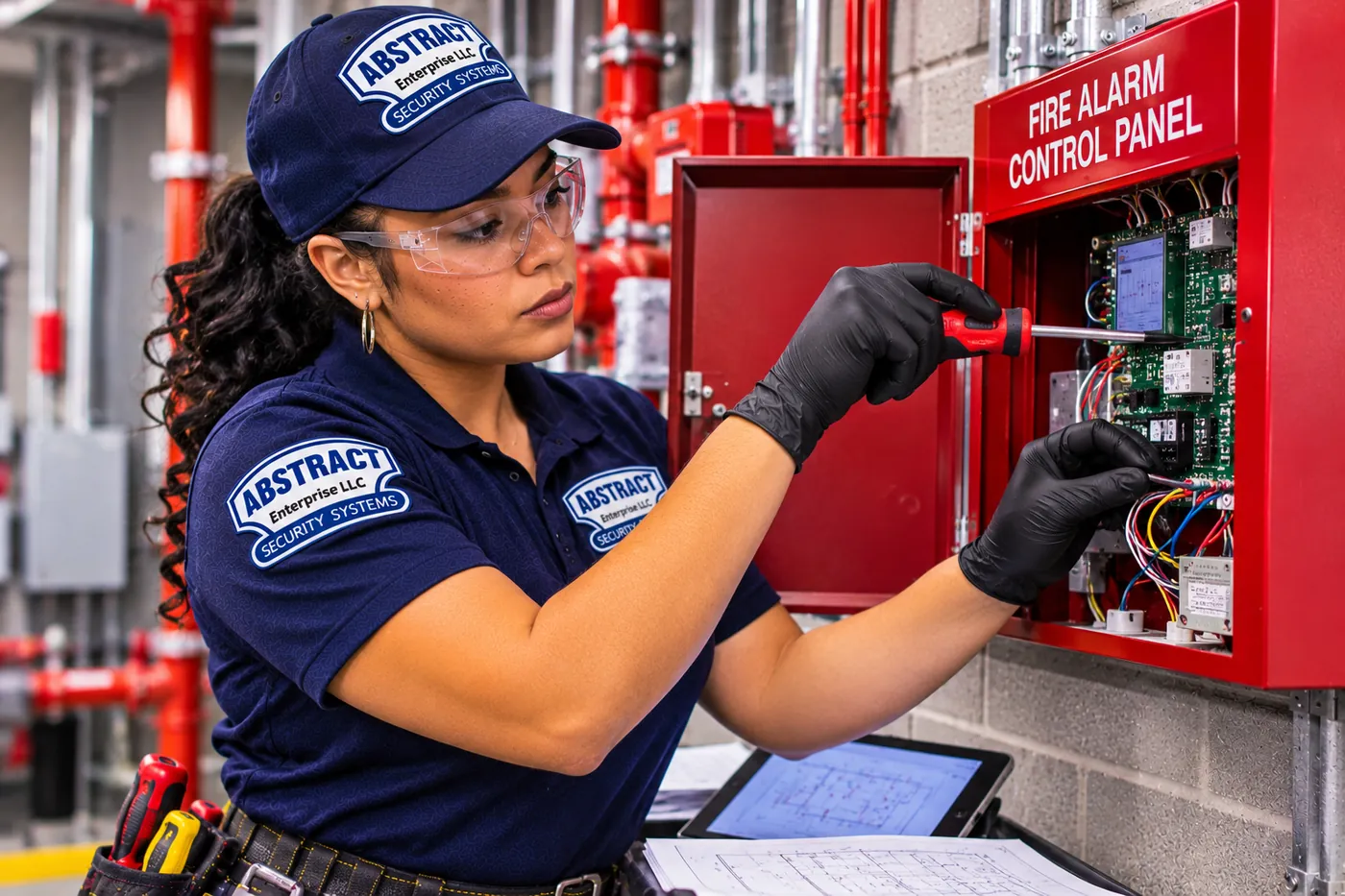
A technician reaches into an open red fire alarm control panel with a screwdriver while a tablet on the table in front of her shows a floor drawing. Wiring a panel to the approved drawings, terminal by terminal, is what lets a new storefront device or a new floor appear on the panel exactly where the plans say it is.
Commercial Fire Alarm
Business Fire Alarm Installation on East Tremont Avenue, East 180th Street and Webster Avenue
Business fire alarm installation on East Tremont's three shopping streets is shaped by who rents the storefronts. The city's assessment lists professional and medical offices, limited-service restaurants and beauty businesses as the leading uses on East Tremont Avenue, delis and bodegas on East 180th Street, and auto-related businesses that take up curb space (NYC SBS, East Tremont CDNA). Each group asks a different fire alarm question.
East Tremont Avenue, Webster to Southern Boulevard
The busiest stretch runs under the new busway between Third Avenue and Southern Boulevard and continues west past the Metro-North station toward Webster Avenue. Its small medical and professional offices raise business occupancy questions; its takeout counters raise kitchen and hood questions; its salons raise detector-choice questions. In buildings this old, fire alarm cable pulling has to find its way through plaster and brick, so the survey looks for usable chases first.
East 180th Street, Webster to Vyse Avenues
The northern edge of the neighborhood is a looser strip of delis, bodegas, small offices and service businesses, according to the city's assessment. Many sit below apartments, so the questions are about storage, cellars and a deli's cooking equipment.
Webster Avenue, East 175th to East 180th Street
The western edge, also in the city's survey area, runs near the Metro-North tracks, and the assessment notes that auto-related businesses along the corridor take up curb space that shoppers and workers would otherwise use. Repair bays, parts rooms and warehouse-style spaces call for heat detection rather than smoke detection, and sprinkler supervision where the building is sprinklered. Industrial fire alarm systems in the strict sense are rare here, but the same thinking applies at a smaller scale.
Compliance callouts for the corridor
Restaurants: the FDNY's Restaurant Fire Safety Guide says a fire alarm system is required for restaurants with 300 or more occupants and for cabarets with 75 or more, that a Place of Assembly Certificate of Operation from the Department of Buildings is needed where 75 or more people may gather indoors, and that the FDNY issues an annual Place of Assembly permit after inspection (FDNY Restaurant Fire Safety Guide).
Who may test: the same guide says only an S-97 or S-98 certificate holder employed by an FDNY-approved fire alarm company may test and maintain a fire alarm system, and that fire alarm log books are kept for three years from the last entry (FDNY Restaurant Fire Safety Guide).
Kitchen hoods: the hood suppression system is inspected and serviced at least every six months by a licensed master fire suppression piping contractor; where the building has a fire alarm, the design professional decides how the hood reports to it (FDNY Restaurant Fire Safety Guide).
Carbon monoxide in commercial spaces: Local Law 191 of 2018 required carbon monoxide detection in Group A, B and M occupancies with fire alarm systems by July 1, 2021, using devices with sounder bases that report to a central station; detection was not required in the kitchens themselves (SiteCompli summary of Local Law 191).
Fees: FDNY re-inspections for Place of Assembly permits are billed at $210 per hour, and answering an FDNY Notice of Defect with an FA-27 submission carries a $105 fee (FDNY Restaurant Fire Safety Guide; FDNY FA-27 instructions).
Retail and food uses under 300 occupants are not automatically free of fire alarm work, because the building around them may need a system. Shopping center fire alarm installation in the large-format sense does not exist in East Tremont, but a row of joined storefronts under one roof raises similar questions.
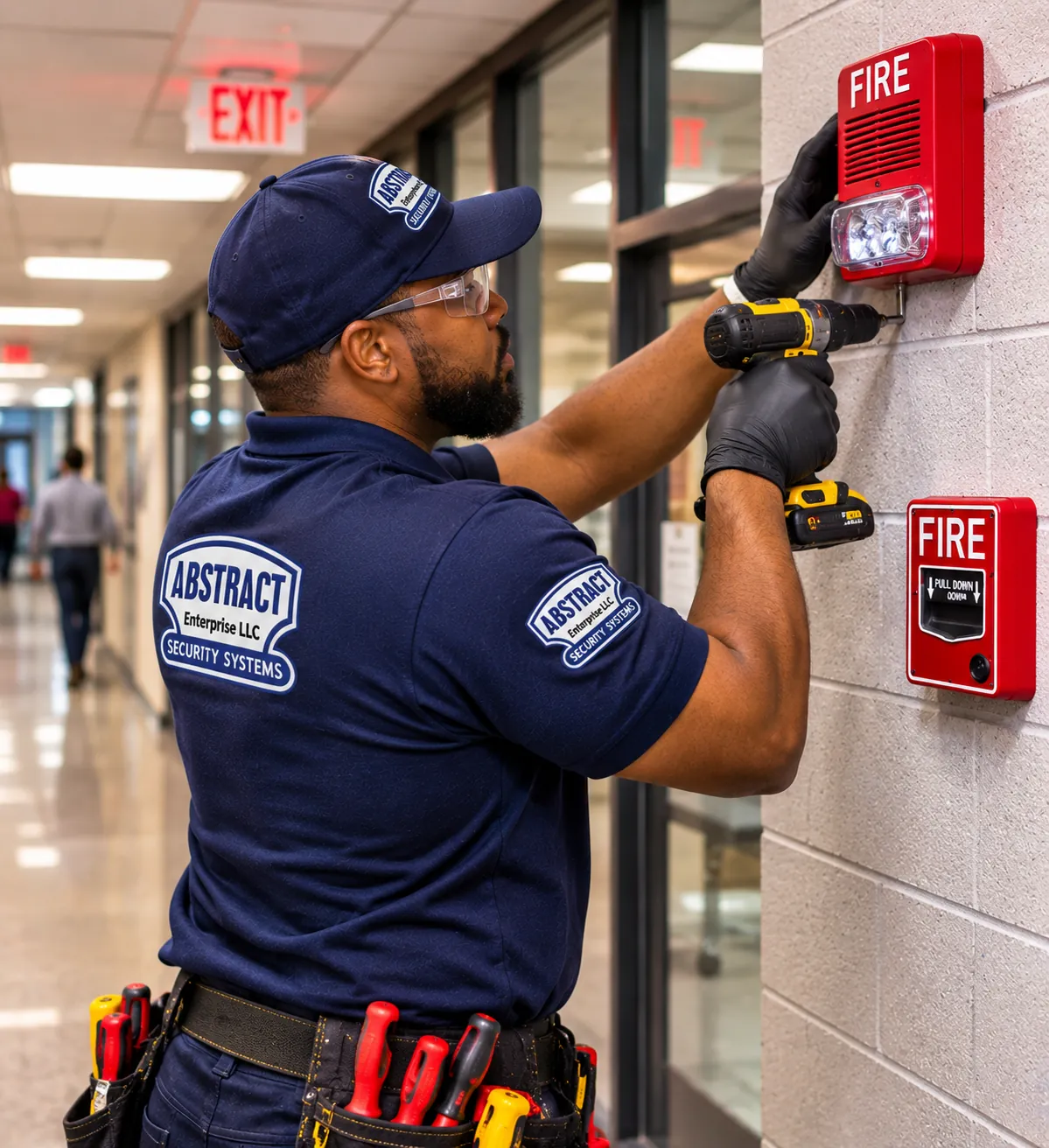
A technician drills to fasten a red horn strobe on a light block wall, with a red pull station already mounted below it and an exit sign lit at the far end of the corridor. In a medical office or a back corridor behind a row of stores, that pairing of a manual station and a visible signal near the exit is one of the most common layouts on the drawings.
Field Notes
Field Notes: The Busway Changes Test Day
A fire alarm test is a crowd of people arriving at once: our technicians, sometimes the electrician of record, the owner's representative, and on acceptance day the FDNY inspector. Before 2026 we would have told everyone to find parking on the avenue. Now, between 6 a.m. and 8 p.m., a passenger car or a small van cannot drive the length of the block between Third Avenue and Southern Boulevard, so we plan arrivals from the cross streets, carry ladders and test gear in from the corner, and tell the inspector which side street works best.
The same thinking applies to deliveries. A replacement panel, a box of detectors or a reel of cable comes on the side street or after 8 p.m. A store that needs its system down gets the work before it opens, and clinic test rooms are booked around patients a week ahead.
Your Questions Answered
East Tremont Fire Alarm Questions From Tenants, Landlords and Store Owners
Questions we expect from storefront landlords, clinic and restaurant tenants, salon owners, walk-up managers and developers near Third Avenue.
Cost and budgeting
A clinic is taking over a former shoe store on East Tremont Avenue. What drives the fire alarm part of the fit-out budget?
Four things drive it: whether the building already has a panel that can accept new devices, how the design professional classifies the clinic and its occupant load, how hard it is to run cable through the old walls and ceilings, and what the FDNY review and test will involve. That is why the answer comes from a survey of the actual space; how much does commercial fire alarm installation cost is a fair question, and the honest reply is a written number once the drawings exist.
We were quoted for a few new devices, and then the design professional said the landlord's old panel cannot take them. Who pays for the new panel?
The lease decides, and many East Tremont storefront leases were written before anyone thought about the fire alarm. If the lease is silent, landlord and tenant negotiate: the tenant's use created the need, but the panel serves the whole building and outlives the lease. What we can do is separate the scope so each side sees its part, the devices for the tenant's space on one line and the panel replacement, programming and retesting of the existing devices on another. A fire alarm contractor estimate written that way makes the conversation about facts rather than guesses.
Quality and trust
The company that quoted our salon's alarm says it is "FDNY approved." What paperwork backs that up?
Ask for three things in writing: the company's current FDNY Fire Alarm Company Certificate, the name of the principal who holds the S-97 certificate of fitness, and the name and license of the electrician who will appear on the filing. The FDNY requires any company that installs, inspects, tests or services fire alarm components to hold company certification, with at least one principal holding an S-97, which in turn requires NICET Level II or higher or a NYC master or special electrician license (FDNY Fire Alarm Company Certificate FAQ). Fire alarm contractor licensing in New York City is about those credentials, and a reputable company will show them before you ask twice.
Our panel says NOTIFIER on the front. Are we tied to one service company for good?
Not necessarily. Some manufacturers limit programming tools to authorized dealers, but testing, many repairs and device replacement are open to any certified company with the right training. NOTIFIER fire alarm repair, Fire Lite fire alarm repair, Silent Knight fire alarm service, Edwards fire alarm repair and EST fire alarm service each come with their own rules about software access, so the first step is reading the panel model and asking who holds the programming. Commercial fire alarm manufacturer service is one option; a qualified independent company is another.
DIY or professional
Can our general contractor's crew patch and paint the ceiling around the new detectors, or must the fire alarm company do it?
Other trades can patch and paint, as long as they leave the devices alone. Detectors must not be painted, covered or moved, and any dust covers put on during construction come off before the system is tested; a painted detector is a failed detector. The device locations stay exactly where the approved drawings put them. We walk the space with the general contractor before the ceiling closes so everyone knows which boxes are ours.
When the alarm sounds in our store, what is an employee allowed to press on the panel?
Only what the posted instructions and your training allow, and never more. In most stores that means calling 911 for a real fire, getting people out, and letting the central station know what is happening; silencing or resetting the panel is left to the person the owner has authorized, after the cause is known. The FDNY's restaurant guide says testing and maintenance are for S-97 or S-98 certificate holders with an FDNY-approved company, while some visual inspections can be done by staff holding other certificates of fitness such as the S-95 (FDNY Restaurant Fire Safety Guide). Pressing reset to stop the noise erases the information a technician needs.
Technical
Our store hangs a drop ceiling below the original tin ceiling. Does the space between them need detectors?
It might. Whether a concealed space above a suspended ceiling needs detection depends on what is in it, how it is built and what the code and NFPA 72 say for that occupancy, and in old East Tremont buildings that space can hold old wiring, abandoned ducts and combustible wood. The design professional decides from the survey, which is why we lift ceiling tiles during the walk-through. If detection is needed up there, the devices must be reachable for testing, with access panels where the drawings show them.
Does a 15-story building near Third Avenue need voice evacuation and a fire command center when the walk-ups around it do not?
Very likely yes. A building whose top occupied floor is more than 75 feet above fire department access is a high-rise under the NYC Building Code, and high-rise residential and mixed-use buildings carry requirements that walk-ups do not, including a fire command center and emergency voice communication. Fire alarm emergency voice communication lets the FDNY talk to specific floors; the fire alarm speaker installation and fire alarm speaker strobe installation that go with it are part of the original design, not an add-on. The permit drawings decide the details.
Landlords and tenants
A tenant's contractor added devices in our storefront without telling us, the landlord. What do we do before the FDNY finds out?
Find out exactly what was added and where. Devices tied into the building's panel without a filed change are an unapproved modification, and they can also cause troubles or false alarms if they were wired or programmed wrong. A survey compares what is on the wall with the approved drawings; if the change is needed, the design professional files it, and the work is corrected and tested. Fire alarm code violation repair is easier before an inspector writes it up than after.
A tenant upstairs says the corridor strobe flashes under her apartment door all night during troubles. Can it be moved?
A strobe should not be flashing during a trouble condition at all; strobes operate in alarm. If one is flashing, something is wrong with the panel or the circuit and needs a technician. If the complaint is about placement during real alarms, a strobe's location follows the code and the drawings, and moving it is a filed change.
Complaints
Merchants on the avenue say alarm tests scare off customers. How are tests scheduled around store hours?
Tests are booked when the space is least busy, with a sign on the door in advance and devices tested in a planned order so the sound is short. For acceptance tests with the FDNY, the date is set by the department's schedule, so we warn the owner as soon as it is booked.
Since the busway opened, how does a technician reach a building on Tremont Avenue between Third Avenue and Southern Boulevard in an emergency?
From the cross streets. The busway limits through traffic for ordinary vehicles from 6 a.m. to 8 p.m. (NYC Mayor's Office, September 2026), so our technicians plan their approach from the nearest side street and walk the last stretch with their tools. Tell us your nearest corner when you call, and if your building has a rear or side entrance, tell us that too.
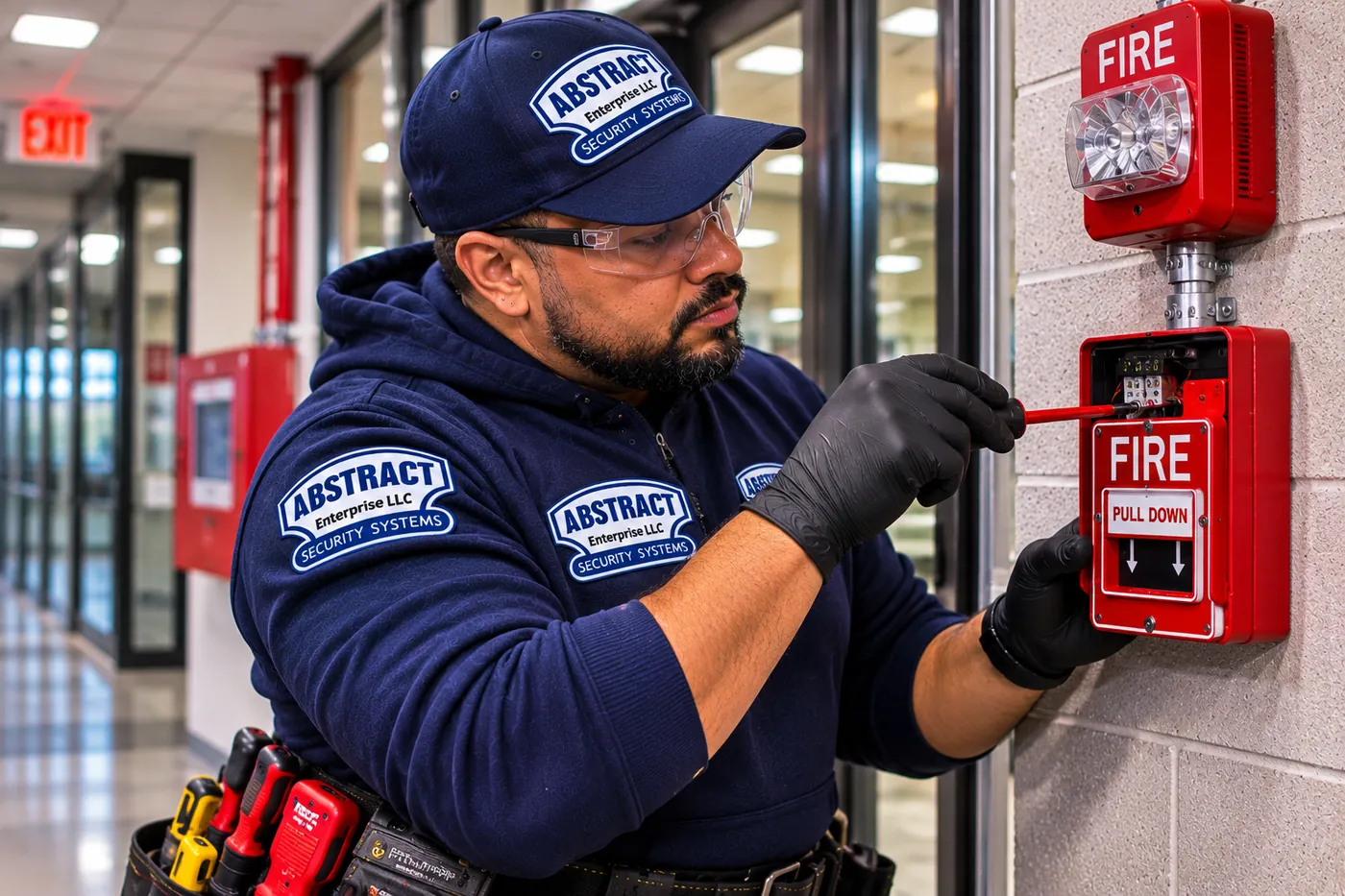
A technician works a screwdriver into a red pull station mounted beneath a red horn strobe on a wall beside a glass office corridor, with an exit sign down the hall. A manual station that has been moved, painted over or blocked by a display rack is one of the things an annual test turns up on a busy commercial street.
Equipment
Types of Commercial Fire Alarm Systems We Install in East Tremont
💻
Addressable systems
Addressable fire alarm installation gives each detector and station its own address and name on the panel. An intelligent fire alarm installation also tracks every detector's sensitivity, which is what makes it an intelligent fire detection system, so a dusty detector in a stockroom is flagged before it causes a false alarm.
🔌
Conventional systems
Conventional fire alarm installation groups devices into zones. Conventional fire alarm system installation still suits one small storefront, but as more tenants and devices are added, finding a fault on a zone gets slower.
📢
Voice evacuation
Fire alarm voice evacuation installation for high-rise buildings and larger assembly spaces where the design calls for spoken instructions instead of tones alone.
📡
Monitoring
Fire alarm monitoring system installation and fire alarm central station communicator installation using cellular or IP paths to an FDNY-approved central station.
💦
Sprinkler supervision
Fire alarm sprinkler monitoring installation with sprinkler waterflow switch monitoring and sprinkler tamper switch monitoring, so a flowing pipe or a closed valve is reported at once.
🌫
Air sampling
Aspirating smoke detection installation, VESDA installation and VESDA service for the occasional server or records room, where an air sampling smoke detection system finds smoke before a ceiling detector can.
Addressable or conventional on a corridor of changing tenants
What is a commercial fire alarm system? It is the connected set of detectors, manual stations, notification appliances, a control panel and a monitoring connection that a code-required building uses to find a fire and warn people. How does a commercial fire alarm system work? Initiating devices send a signal to the panel, the panel sounds and flashes the notification appliances, operates whatever the drawings tie to it, and reports the alarm to a central station that calls the FDNY.
What is an addressable fire alarm system? One where each device has a unique address, so the panel reads "heat detector, rear stockroom, store 2" instead of "zone 3." What is a conventional fire alarm system? Several devices on one circuit that the panel knows only as a zone. What is the difference between addressable and conventional fire alarms? Precision. A landlord with several tenants on one panel benefits most from addressable devices, because every new tenant adds devices and every trouble call starts by finding one of them. Conventional to addressable fire alarm conversion is common when a building outgrows an old zone panel, and it is usually phased so the stores stay covered.
Fire alarm control panel installation, also called FACP installation, is where that decision becomes equipment: an addressable fire alarm panel installation for a mixed-use building or a new mid-rise, a conventional fire alarm panel installation for a single small store, and commercial fire alarm panel installation to the approved drawings either way. Addressable fire alarm system installation in an occupied building includes fire alarm device addressing for every new and existing device, addressable fire alarm system programming of each address and its message, fire alarm control panel programming of the sequence of operations, and fire alarm system configuration of what each input does. Addressable fire alarm device installation is the physical step; programming is what makes the panel's screen tell the truth.
A technician points at a floor map on the touchscreen of a red NOTIFIER by Honeywell control panel, a tablet in his other hand. On an addressable panel that map and the device names behind it are how a store owner or a super reads exactly where a signal is coming from.
Devices
East Tremont Fire Alarm Devices and Where Each One Belongs
Fire detection device installation follows the drawings, and the drawings follow the space.
Smoke detectors
Commercial smoke detector installation covers corridors, stairs, offices, exam rooms and storage. Photoelectric smoke detector installation is the usual choice for the smoldering fires typical of paper, fabric and furniture; addressable smoke detector installation lets each one report by name. Commercial smoke detector replacement is due when a detector reaches the end of its service life or fails a sensitivity check, commercial smoke detector testing follows the schedule NFPA 72 sets, and commercial smoke detector repair usually means a base, a wiring connection or a contaminated head rather than the detector's electronics.
Heat detectors
Commercial heat detector installation belongs where smoke detectors would false alarm: kitchens, repair bays, boiler rooms, dusty storage and some salons. Fixed temperature heat detector installation suits rooms where steam and aerosols are normal, such as a salon's back room, and rate of rise heat detector installation suits rooms where a fire's heat climbs fast but daily heat stays steady. Heat detector replacement is part of any upgrade where old devices are obsolete or painted over.
Duct detectors
Duct smoke detector installation goes in air handling systems that the code says must shut down when smoke enters them, so smoke is not blown across a clinic or an office floor. Duct smoke detector testing is part of every annual inspection, and duct smoke detector replacement is common in older rooftop units. Fire alarm duct detector integration and fire alarm HVAC shutdown integration make the fan stop when the detector trips.
Beam and high-ceiling detection
Beam smoke detector installation, or projected beam smoke detector installation, protects tall, open rooms where a ceiling detector would be too high to reach smoke in time, such as a converted warehouse storage room or a large hall. Warehouse smoke detection installation in storage spaces along the corridor's edges sometimes uses spot detectors on lifts and sometimes beams; storage facility fire alarm installation choices come from the ceiling height and what is stored.
Manual stations
Fire alarm pull station installation, also called manual fire alarm pull station installation, puts a station at each required exit so anyone can start an alarm. On a storefront that usually means one by the front door and one by the rear exit, as the drawings show. Fire alarm pull station replacement and fire alarm pull station repair come up when a station is damaged, painted or moved without approval, and the fix always puts it back where the drawings say.
Notification appliances
Fire alarm notification appliance installation covers what people hear and see. Fire alarm horn installation and fire alarm strobe installation, or a combined fire alarm horn strobe installation, give fire alarm audible notification installation and fire alarm visual notification installation in one device. Fire alarm ADA strobe installation matters in clinics and offices where people who are deaf or hard of hearing need a visible signal, and fire alarm synchronization module installation keeps strobes in a room flashing together. Fire alarm horn strobe replacement and fire alarm notification appliance replacement follow rebuilt ceilings; fire alarm horn strobe repair and fire alarm notification circuit repair follow circuit faults. Fire alarm NAC power supply installation adds power where a long run of strobes needs more than the panel provides.
Modules and power
Fire alarm monitor module installation lets the panel watch things like sprinkler switches and hood systems; fire alarm control module installation and fire alarm relay module installation let the panel act on equipment such as fans, door holders and elevators. Fire alarm communicator installation connects the panel to the central station. Fire alarm power supply installation and fire alarm battery backup installation keep the system alive when utility power fails, and fire alarm power supply repair is often the fix when a long notification circuit drops out. Fire alarm annunciator installation, including remote annunciator installation at a lobby or a front desk, puts the panel's information where the first responder walks in. Fire alarm initiating device installation is the umbrella for every input: detectors, stations, switches and modules.
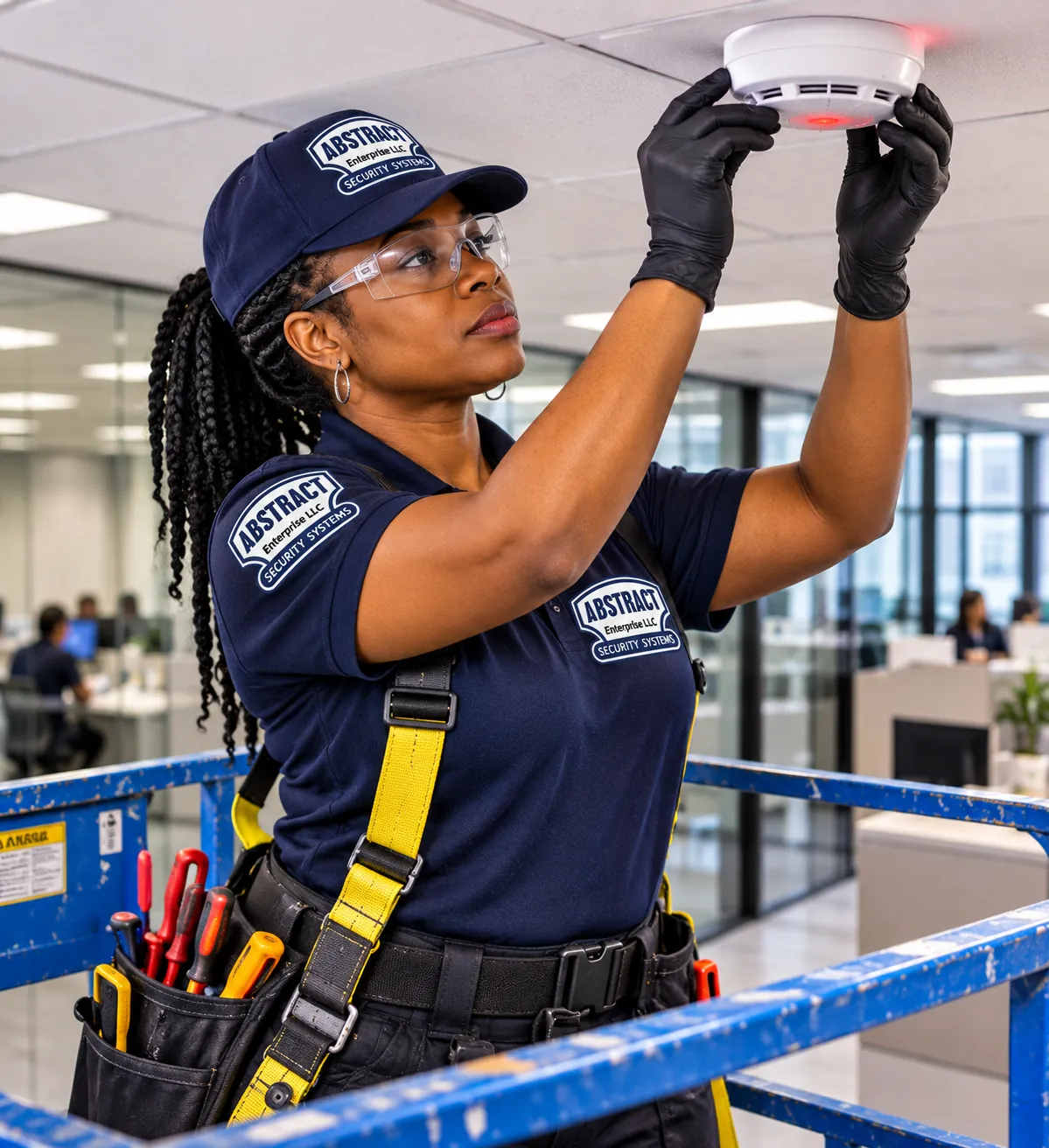
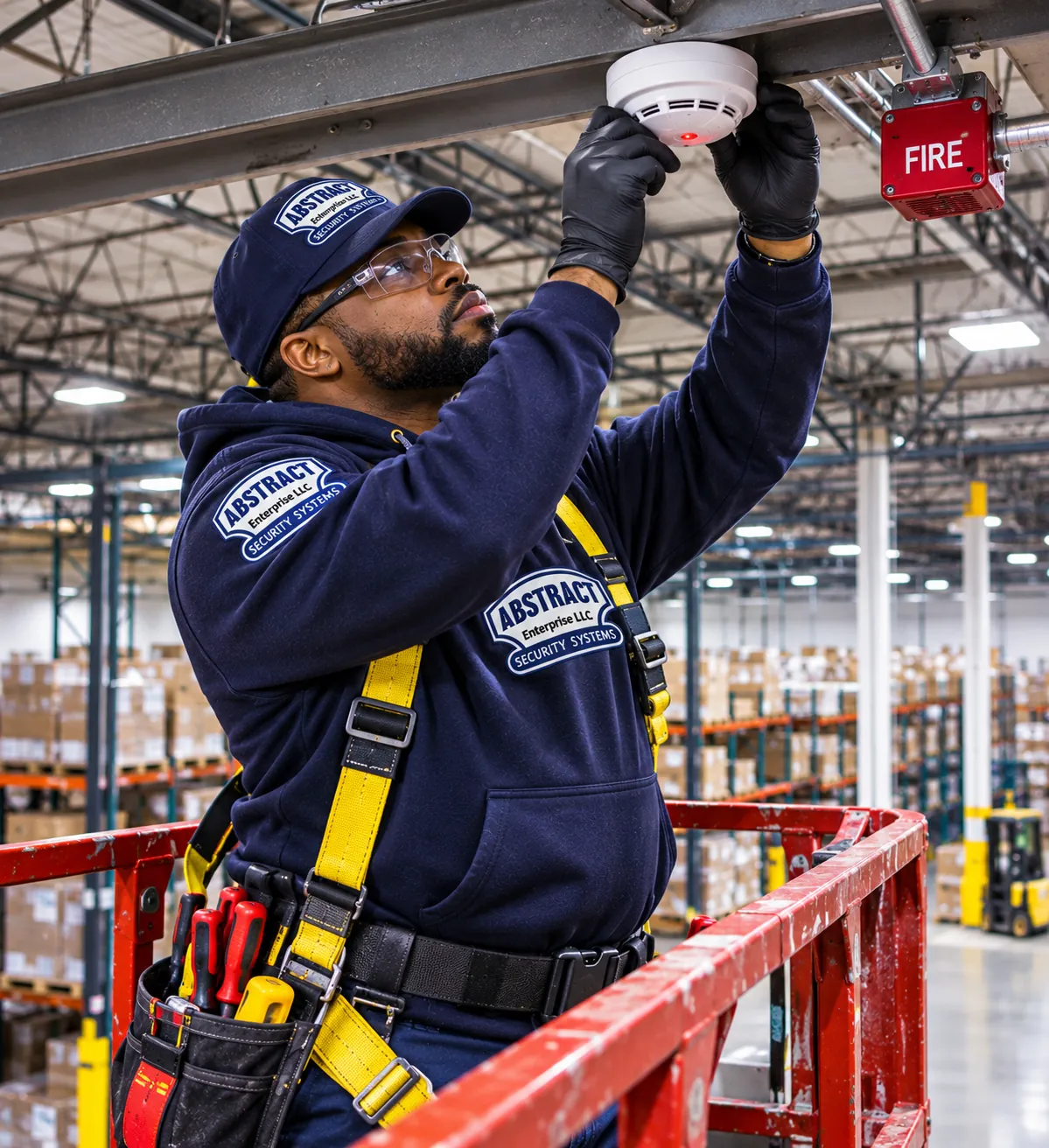
A technician wearing a harness stands on a blue lift and fits a white smoke detector to an office ceiling with both hands, desks and windows behind her. A second-floor medical or professional office above a storefront needs the same careful detector placement as a larger office floor.
AI Overview Reality Check
What AI Answers Get Wrong About Fire Alarms on East Tremont's Storefront Blocks
AI assistants and cost-guide sites such as Angi, HomeAdvisor and Fixr answer fire alarm questions with national averages and advice written for houses. Here are seven claims we expect a store owner or landlord to run into, and how the work actually goes on East Tremont Avenue.
"A fire alarm costs about the same everywhere, so check a cost guide"
National cost guides from Angi, HomeAdvisor and Fixr mostly describe smoke alarms in houses or generic office systems, priced by the device. A commercial system in New York City is not priced by the device. It is priced by the sealed design, the FDNY filing, the installation to approved plans and the acceptance test, and in a pre-1950 storefront the cable route through brick and plaster can matter more than the number of detectors.
No cost guide budgets for a TM-1 plan examination, an FDNY Fire Alarm Inspection Unit test or the weeks between them. The FDNY's own guidance puts plan submission to final approval at about 20 to 24 weeks (FDNY Tips for Fire Alarm Systems), and that schedule has a cost of its own for a tenant paying rent on a space that cannot open.
The useful number is the one written for your space after a survey. Fire alarm installation pricing that skips the drawings will be revised later.
"A small store does not need a fire alarm"
Sometimes that is true, and sometimes it is not. Whether a space needs a system depends on its occupancy group, its occupant load, its floor area and what is above and below it. When does a building need a fire alarm system? When the Building Code says so for its use and size.
The FDNY's restaurant guide shows how specific the thresholds are: a fire alarm system is required for restaurants with 300 or more occupants and for cabarets with 75 or more (FDNY Restaurant Fire Safety Guide). A takeout counter and a dining room on the same block can land on different sides of those lines.
On East Tremont Avenue the bigger trap is the building: a small shop below apartments may use a cellar that the building's fire alarm covers, and a renovation there touches the building's system.
"Any licensed electrician can install and test a commercial fire alarm"
Who installs commercial fire alarm systems in New York City? Installation is done by a NYC licensed electrician or a company holding an FDNY Fire Alarm Company Certificate, after the plans are approved (FDNY Tips for Fire Alarm Systems). Testing and maintenance are narrower still: the FDNY's restaurant guide says only an S-97 or S-98 certificate holder employed by an FDNY-approved fire alarm company may test and maintain a system (FDNY Restaurant Fire Safety Guide).
That matters on a corridor where a general contractor often handles a whole storefront build-out. The contractor can bring in the electrician, but the fire alarm portion has to be done by people who meet the FDNY's rules, or the inspector will not accept it.
How do I find a licensed fire alarm contractor? Ask for the company certificate, the S-97 holder's name and the electrician's license, and check that the names match what will appear on the filing.
"Wireless devices mean no drawings and no permit"
Wireless detectors reduce how much cable has to be pulled through old walls, but they do not change the approval path. A code-required system in New York City is still designed by a licensed professional, filed with the FDNY, installed to the approved plans and tested.
Wireless equipment brings its own battery and signal maintenance.
The right question is which devices make sense in these walls, and that is answered after a survey.
"Once it passes inspection, nothing else is needed"
An FDNY acceptance test covers the system as approved on that day. After that come periodic inspection and testing under NFPA 72, log books kept for three years under the FDNY's rules (FDNY Restaurant Fire Safety Guide), central station monitoring, and every change a tenant makes later.
On a corridor where 67 of 529 storefronts were vacant during the city's survey (NYC SBS, East Tremont CDNA), tenants come and go. Each turnover is a chance for devices to be removed, covered or left unprogrammed.
The practical habit is a short check at every tenant change: is every device on the drawings still there, still working and still reporting to the panel under the right name?
"Fire alarm and carbon monoxide detection are separate jobs"
In commercial spaces with fire alarm systems they are often connected. Local Law 191 of 2018 required carbon monoxide detection in Group A, B and M occupancies with fire alarm systems, using devices with sounder bases that report to a central station, by July 1, 2021 (SiteCompli summary of Local Law 191).
That covers many of the corridor's medical offices, restaurants and stores where a fire alarm already exists. The CO devices become part of the fire alarm design and part of its tests.
A fit-out that adds a gas appliance or a boiler should ask the design professional about carbon monoxide at the same time as fire detection, not later.
"Approval takes a couple of weeks"
The FDNY's guidance says the average from plan submission to final inspection and approval is roughly 20 to 24 weeks (FDNY Tips for Fire Alarm Systems). Objections, resubmissions and test scheduling all happen inside that window.
For a store or clinic, that window belongs inside the lease negotiation. A rent-free period that ends before the system can be approved is a common and expensive surprise.
How long does fire alarm installation take? The physical work in a storefront can take days; the approval around it takes months. Plan for both.
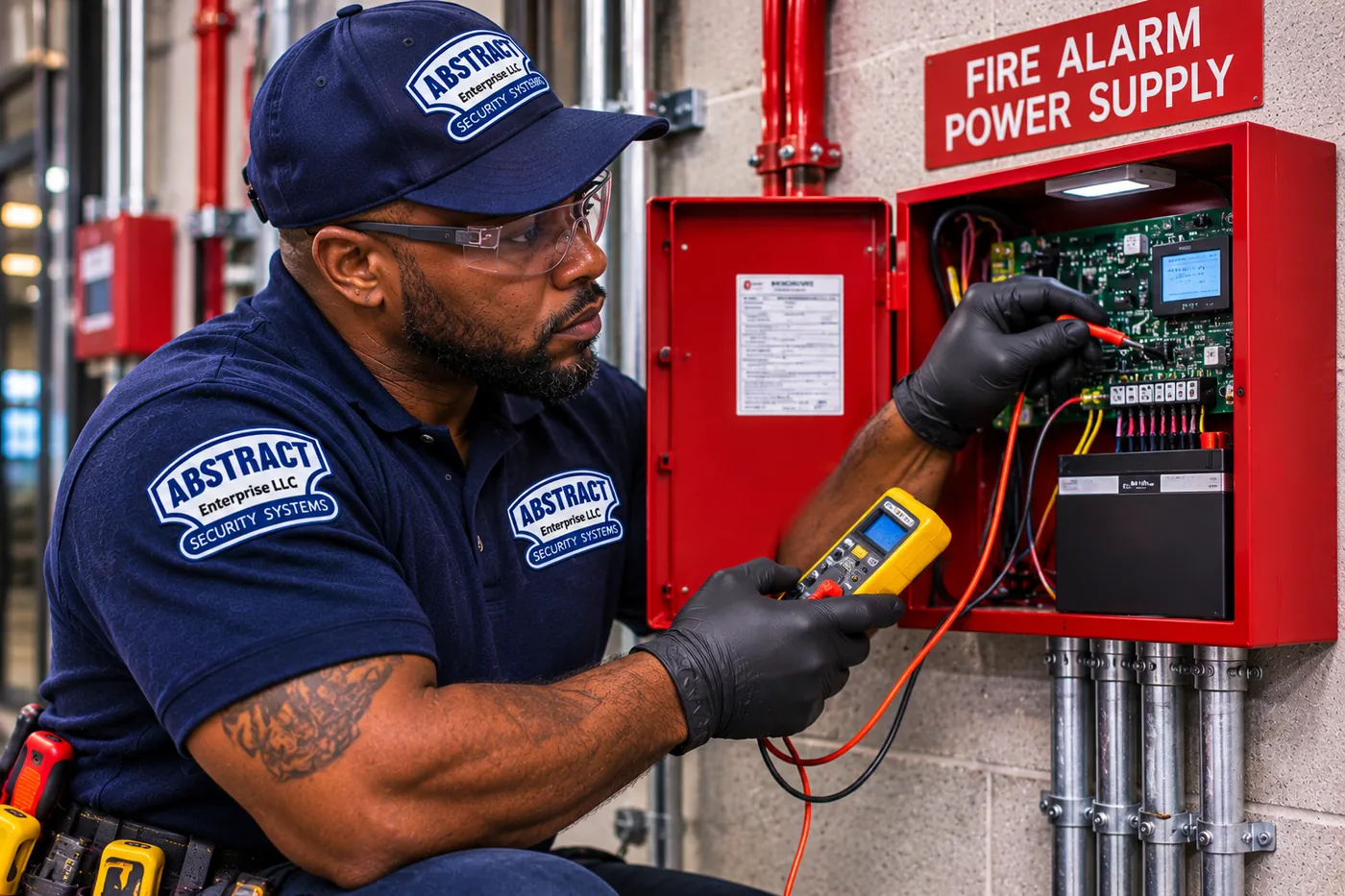
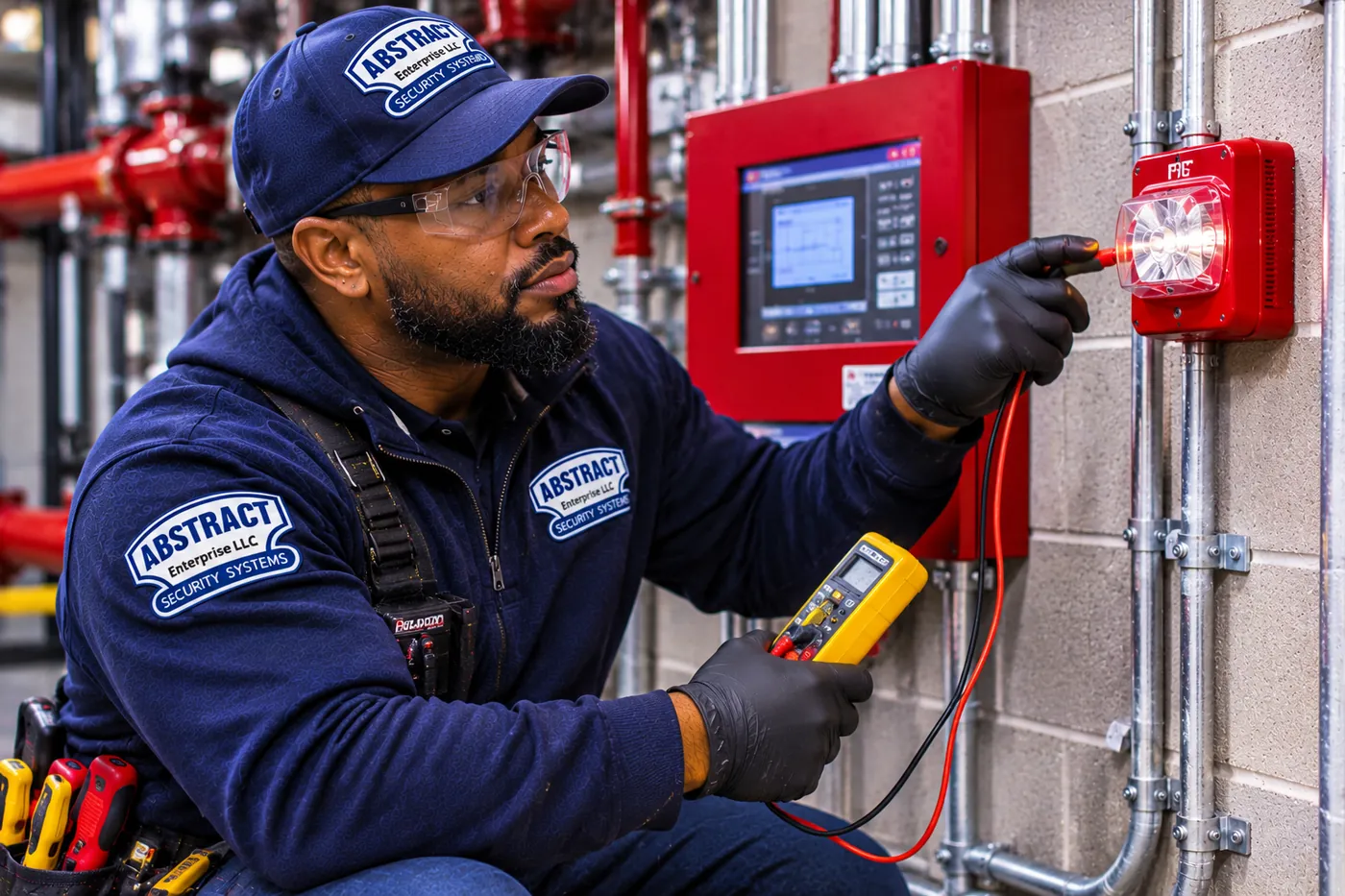
A technician holds the probes of a yellow multimeter against the board inside an open red cabinet labeled "Fire Alarm Power Supply," with conduit running down the block wall below it. Batteries and power supplies are where an AI answer's "nothing else is needed" usually breaks down first.
Signing a Lease, Opening a Clinic or Fixing a Panel in East Tremont? Talk to a Technician First
Tell us the address, what the space will be used for, what the panel shows and any lease or opening date. We book a survey within 2 hours and explain the FDNY path before anyone commits to a schedule.
Request a Free Quote for Your East Tremont Fire Alarm Project
Tell us about the space and what you need. A fire alarm installation consultation costs nothing; the written proposal follows a survey, because the existing system and the drawings decide the scope. Rather talk? Call (646) 490-0629.
✅
Request Sent!
Thank you. We will call to book your East Tremont fire alarm survey, usually within 2 hours of your request.
How It Works
Our Fire Alarm Installation Process for East Tremont Spaces
Design by a licensed professional always comes first, and choosing the installing team comes second. On a corridor of leases and fit-outs there is one more step in front of both: reading the lease and the building's records, so the tenant and the landlord know whose system the work touches. This is how an East Tremont job moves from the first call to an FDNY Letter of Approval.
First call. Address and nearest corner, what the space is or will be used for, who owns the building and who holds the lease, what the panel shows, and any lease, opening or inspection date.
Survey and records. We walk the space, the cellar and the building's panel, read the event history, check batteries and the communicator, and compare what is on the wall with any approved drawings, test reports and FDNY letters that exist.
Design professional and sealed drawings. A Professional Engineer or Registered Architect licensed by New York State designs the system and seals the drawings; our fire alarm shop drawings and the fire alarm construction drawings for the trades are built on that design.
Written proposal. A fire alarm system installation proposal that separates design coordination, filing support, installation, commissioning and testing, written for the tenant, the landlord or both, with a clear line for who pays for what.
FDNY TM-1 plan examination. The plans go to the FDNY with a TM-1 under the design professional's name; the FDNY's guidance puts submission to final approval at roughly 20 to 24 weeks (FDNY Tips for Fire Alarm Systems).
Installation to the approved plans. The certified company and licensed electrician do the fire alarm rough in, fire alarm conduit installation, fire alarm cable installation and fire alarm device termination, scheduled around store hours, clinic appointments and the busway's 6 a.m. to 8 p.m. limits.
Commissioning and pre-test. We check fire alarm panel wiring and the rest of the commercial fire alarm wiring point by point against the drawings, as part of commercial fire alarm commissioning, run fire alarm system startup and fire alarm device programming, and operate every device and interface ourselves before anyone from the FDNY arrives.
FDNY acceptance test and handover. An inspector from the FDNY Fire Alarm Inspection Unit witnesses the test; the owner receives as-built drawings, the programming file, signed test reports, central station details and a maintenance calendar.
What happens during fire alarm acceptance testing? The inspector watches devices operate, confirms that the panel names each one correctly, checks that every interface on the drawings works, from sprinkler flow to fan shutdown and hood monitoring, and verifies that the central station receives the signals. Fire alarm acceptance testing is the last step of fire alarm system testing and commissioning, and fire alarm functional testing of every device before that day, the heart of fire alarm system commissioning, keeps the inspector's visit short.
Fire alarm system approval in New York City ends with the FDNY Letter of Approval. Keep it with the approved drawings and test reports.
A technician holds a meter probe to a flashing red strobe mounted beside a red fire alarm panel, with red sprinkler pipes and conduit filling the mechanical room behind him. Testing each notification appliance before the FDNY arrives is part of the pre-test that comes before every acceptance inspection.
Existing Systems
Repairing, Upgrading and Inspecting East Tremont's Existing Fire Alarms
Fire alarm repair, fire alarm system repair and fire alarm troubleshooting on this corridor deal with buildings that have been renovated many times, panels that have outlived their manufacturers' support, and devices that tenants have painted, covered or removed.
Troubleshooting and repair
Why is my fire alarm panel showing trouble? A trouble signal means the panel has found a problem with itself or with something it watches: a broken wire, a missing device, a low battery, a lost phone or cellular path, or a ground fault. The fire alarm panel trouble light is the panel asking for service, and a fire alarm system trouble condition left alone becomes a system that cannot report a fire. Fire alarm fault diagnosis and fire alarm system diagnostics start at the event log.
What causes a fire alarm ground fault? Usually water or damage: a leak in a cellar, a wire pinched by a new ceiling grid, a junction box flooded during a storm, or a device whose insulation has broken down. Fire alarm ground fault troubleshooting isolates the circuit and then the section of the circuit, and fire alarm ground fault repair fixes the cause, not just the reading. Fire alarm open circuit repair, fire alarm short circuit troubleshooting, smoke detector circuit troubleshooting and fire alarm wiring repair follow the same method. Fire alarm trouble signal repair is finished only when the cause is gone and the panel returns to normal on its own. Fire alarm circuit troubleshooting on an addressable loop includes fire alarm SLC troubleshooting and fire alarm signaling line circuit repair, where a single bad splice can make dozens of devices disappear. Addressable fire alarm troubleshooting and addressable fire alarm system repair use the panel's device list to find the missing address; conventional fire alarm repair works zone by zone, and conventional fire alarm replacement is often the better answer when an old zone panel keeps failing.
Some calls are about the panel itself. Fire alarm control panel troubleshooting, fire alarm control panel repair and FACP repair cover failed boards, displays and power supplies; fire alarm panel beeping repair often turns out to be a battery or a communicator problem. Fire alarm battery trouble repair and fire alarm battery replacement are the most common fixes of all, and fire alarm battery load testing tells you whether a battery that looks fine can actually carry the system. A fire alarm system not communicating calls for fire alarm communication failure repair at the communicator or the line. A fire alarm supervisory trouble usually points to a sprinkler valve or other supervised equipment, and a fire alarm intermittent trouble is the hardest kind, found by patient logging rather than guesswork. Fire alarm false alarm troubleshooting looks for dust, steam, insects, wrong detector types and bad wiring. Fire alarm device fault repair and fire alarm panel failure repair close the list. Who repairs fire alarm control panels? A certified company whose technicians know that brand's panel and have access to its parts.
Upgrades and replacements
Can an existing fire alarm system be upgraded? Usually, yes, in stages. A fire alarm system upgrade may be as small as new devices for one tenant or as large as a full fire alarm system replacement. Fire alarm panel upgrade, fire alarm panel replacement and fire alarm control panel replacement, also called FACP replacement, are common when a manufacturer stops supporting a panel; obsolete fire alarm panel replacement and outdated fire alarm system replacement come up when parts are gone. Fire alarm control panel upgrade work, addressable fire alarm system upgrade work and legacy fire alarm system upgrade work are designed so that the stores keep working and the apartments stay covered. Fire alarm system modernization, fire alarm system retrofit, commercial fire alarm system retrofit and commercial fire alarm modernization are different names for the same goal: a system that meets today's needs without starting from zero.
Existing fire alarm system expansion is the corridor's everyday job: a new tenant adds devices, and fire alarm system modification, fire alarm system reconfiguration and fire alarm device replacement bring the system in line with the new layout. Fire alarm system renovation and fire alarm system conversion handle larger changes, and a fire alarm system code upgrade happens when an alteration brings parts of the building under current code. Fire alarm system lifecycle replacement plans these steps over several years so a landlord is not surprised by a dead panel. As a fire alarm system expansion contractor we file these changes with the FDNY where required, and fire alarm code compliance upgrades are documented on the drawings so the next inspector can see what changed.
Inspection, testing and maintenance
How often should fire alarms be inspected? NFPA 72 sets the frequencies by device: some items are checked visually more often, and most devices are tested at least once a year, with the FDNY enforcing the schedule in New York City. How often should commercial fire alarms be tested? At least annually for most devices, more often for some components such as batteries and supervised equipment, as the standard lists. Fire alarm annual inspection, fire alarm periodic inspection, fire alarm inspection and fire alarm system inspection all refer to that program, and fire alarm system inspection requirements for a given building are listed on its own reports. NFPA 72 fire alarm inspection and NFPA 72 fire alarm testing follow the same tables in the standard.
Fire alarm testing, fire alarm system testing and fire alarm device testing check that each detector, station and appliance works. Fire alarm sensitivity testing checks that smoke detectors are neither too sensitive nor too dull. Fire alarm maintenance and fire alarm preventative maintenance keep the system clean and the batteries fresh between tests. A fire alarm service contract with a fire alarm maintenance company, fire alarm testing company or fire alarm inspection company puts all of that on a calendar; as a fire alarm inspection contractor and fire alarm testing contractor we write it for the building, not from a template.
When an inspection finds problems, the report lists fire alarm inspection deficiencies. Who can correct fire alarm inspection deficiencies? A certified fire alarm company, working with a licensed electrician where wiring is involved. Fire alarm inspection repair and fire alarm deficiency correction fix each item, and fire alarm system violation correction answers any FDNY Notice of Defect, often through an FA-27 submission with its $105 fee (FDNY FA-27 instructions). Fire alarm inspection documentation and fire alarm system documentation, including the log books the FDNY expects to be kept for three years, are part of every visit. Fire alarm inspection preparation before an FDNY visit means a pre-test and a records check.
A technician in a yellow harness stands on a red lift and presses a white smoke detector onto a high ceiling, with storage racks and steel beams behind him and a red device on the beam. Storage and stock rooms behind the corridor's larger stores are where high ceilings and stacked goods change which detector fits.
Coverage Area
Fire Alarm Installation Near East Tremont's Landmarks
We work throughout East Tremont, from East 180th Street down to the Cross Bronx Expressway and from Third Avenue to Southern Boulevard, and along the shopping corridor west to Webster Avenue. None of these landmarks is a client reference.
East Tremont Avenue busway
The Bronx's first busway, completed in September 2026 and in force 6 a.m. to 8 p.m. daily, on the stretch Streetsblog described as Third Avenue to Southern Boulevard; the Bx36 carries about 39,000 riders a day (NYC Mayor's Office; Streetsblog NYC).
Engine 45, Ladder 58, Battalion 18
The firehouse at 925 East Tremont Avenue, the companies that answer so many of the corridor's alarms (Wikipedia, East Tremont).
Tremont station, Metro-North
The Harlem Line stop that is the neighborhood's only rail station, since East Tremont has no subway stop of its own (Wikipedia, East Tremont).
Bronx Park South
The name sometimes given to the part of the neighborhood southwest of the Bronx Zoo, along the zoo's southern edge (Wikipedia, East Tremont).
The Cross Bronx "One Mile"
The stretch of expressway through East Tremont that Robert Caro wrote about in two chapters of The Power Broker; about 5,000 residents were displaced during the five years of construction that ended in 1960 (Wikipedia, East Tremont).
East 180th Street and Webster Avenue
The northern and western shopping streets in the city's survey, where delis, bodegas, offices and auto-related businesses line the blocks (NYC SBS, East Tremont CDNA).
How Fire Alarm Installation Is Priced in East Tremont
Commercial fire alarm installation cost in East Tremont is built from a survey of the specific space and four parts of work. We publish no price, range or package, because the sealed design comes first and everything else depends on it. A fire alarm installation estimate or fire alarm system installation estimate written without seeing the panel, the cellar and the walls is a guess, and a guess is the wrong thing to put in a lease or a loan file. Fire alarm installation cost and fire alarm system installation cost questions, like any commercial fire alarm quote, get a written answer after the walk-through.
1. Design and sealed drawings
A Professional Engineer or Registered Architect licensed by New York State designs the system and seals the drawings. Commercial fire alarm system design produces the device layout, the riser diagram, the battery and voltage-drop calculations, the sequence of operations and the specifications. Fire alarm system design requirements in New York City come from the Building Code, the Fire Code, the Electrical Code and NFPA 72 as the city adopts it.
2. Filing with the FDNY
Under the design professional's name, the TM-1 and plan set go to the FDNY for examination. Fire alarm permit requirements and the fire alarm installation permit in New York City run through that review, with the Department of Buildings involved where construction is part of the job. Does my building need a fire alarm permit? If the work adds, moves or changes devices in a required system, or creates a new one, assume yes until the design professional says otherwise.
3. Installation to the approved plans
The third part is the physical work: cable, devices, panel, power supplies, modules and communicators placed exactly as the approved drawings show, by the certified company and the licensed electrician. In East Tremont's older buildings, brick and plaster slow every penetration, store hours limit noisy work, and the busway shapes deliveries.
4. Acceptance testing and handover
The fourth part is proof. After our own complete pre-test, the FDNY Fire Alarm Inspection Unit witnesses the fire alarm acceptance inspection. The owner then receives the as-built drawings, programming files, test reports, central station details and the rest of the record set. In New York City, fire alarm system certification means the FDNY Letter of Approval.
Fire alarm panel installation cost, fire alarm panel replacement cost and fire alarm system replacement cost follow the same four steps: a new panel still needs drawings, filing where required, installation and a test. Fire alarm system upgrade cost depends on how much of the old system can stay. After opening, recurring work is quoted separately: fire alarm inspection cost, fire alarm testing cost, fire alarm maintenance contract cost, fire alarm service call cost and fire alarm repair cost all depend on how large, how old and how healthy the system is. How much does fire alarm panel replacement cost? Enough that it deserves a survey of the existing devices first, because whether they can stay changes the answer more than the panel does. A fire alarm installation bid or fire alarm installation quote should list each part separately.
Full terms — including 50% deposit, one-year parts-only warranty on Abstract Enterprises Security Systems-supplied products, and the late-fee schedule — are set out in the service agreement.
Choosing a Contractor
Choosing Fire Alarm Contractors for East Tremont Storefronts and Buildings
People search for fire alarm installation near me, fire alarm installers near me, fire alarm contractors near me and fire alarm companies near me when a lease is signed or a panel starts beeping. A local fire alarm installation company helps, but credentials matter more than distance. Here is how to judge the fire alarm contractors and fire alarm installation contractors for commercial buildings that answer.
Credentials on paper. A fire alarm company or fire alarm service company working in New York City should show its FDNY Fire Alarm Company Certificate and the S-97 holder's name; a licensed fire alarm installer working on the job should be employed by that company or work as the licensed electrician on the filing; a certified fire alarm technician on test day should hold the S-98 or S-97 certificate of fitness the FDNY requires (FDNY Fire Alarm Company Certificate FAQ).
Experience with your kind of space. An experienced fire alarm contractor in a corridor like this has worked in occupied mixed-use buildings and knows how to phase work around stores and apartments. The best commercial fire alarm installer for a clinic is one who has scheduled around patients before.
A clear split of roles. A fire alarm installation contractor, a fire alarm system contractor and a fire alarm contractor may be the same company or three; the proposal should say who designs, who files, who installs and who tests.
Service after the test. A fire alarm repair company or fire alarm repair contractor that also holds your inspection contract knows your building when something fails. Ask who the fire alarm service technician will be after opening.
Commercial scope. Commercial fire alarm installers and a commercial fire alarm installation company should describe NFPA 72 work, FDNY filings and acceptance tests, not house smoke alarms.
Construction experience. For a new building, a commercial construction fire alarm contractor coordinates with the general contractor, the electrician, the sprinkler fitter and the elevator installer. A fire alarm compliance contractor role matters when the main goal is clearing violations.
Brand familiarity. Ask which panels the company services. On this corridor that may mean Honeywell fire alarm service, Simplex fire alarm service, Siemens fire alarm service or Potter fire alarm service on existing systems, and Honeywell fire alarm installation, NOTIFIER fire alarm installation, Fire Lite fire alarm installation, Silent Knight fire alarm installation, Edwards fire alarm installation, Siemens fire alarm installation, Bosch fire alarm installation, Potter fire alarm installation or Kidde commercial fire alarm installation on new ones, chosen by the design and the building rather than by habit.
Abstract Enterprises Security Systems works under NYS license #12000287431, is rated 4.7 from 201 Google Reviews, and names in writing the FDNY-certified fire alarm company and the electrician of record who will appear on each filing. Professional fire alarm installation is a team job in New York City. Fire alarm installation services that hide those names, including a fire alarm installation service sold online, are a warning sign.
Integration
How an East Tremont Fire Alarm Works With Sprinklers, Elevators, Doors and Kitchen Hoods
Fire alarm system integration ties the alarm to the other systems the drawings name, and every tie is tested on acceptance day.
Sprinklers. Where a building is sprinklered, the fire alarm watches the water: sprinkler waterflow switch monitoring reports water moving in the pipes, and sprinkler tamper switch monitoring reports a closed valve as a supervisory signal.
Elevators. In the new mid-rise buildings, fire alarm elevator recall integration sends the cars to the right floor when a lobby, machine room or hoistway detector trips, through an elevator fire alarm interface coordinated with the elevator installer.
Air handling. Fire alarm HVAC shutdown integration stops fans when duct detectors or the panel call for it, so a clinic's air system does not spread smoke between rooms. In taller buildings, a fire alarm smoke control interface may also run dampers and fans to keep stairs clear.
Doors. Fire alarm door release integration and fire alarm magnetic door holder release let corridor and stair doors that are held open close on alarm. A fire alarm access control interface releases locked doors on the egress path when the code requires it. These ties are tested door by door.
Kitchens. Where a restaurant has a hood suppression system and the building has a fire alarm, fire alarm kitchen hood suppression monitoring reports the hood's discharge to the panel, and a fire alarm suppression system interface covers other special systems. The hood itself is serviced every six months by a licensed contractor (FDNY Restaurant Fire Safety Guide); the alarm side is tested with the fire alarm.
Voice and mass notification. In high-rise buildings, fire alarm emergency voice communication and the fire command center are required features. Fire alarm mass notification integration is less common here, but it may appear in a school or a large community facility whose operator wants to broadcast other emergencies through the same speakers.
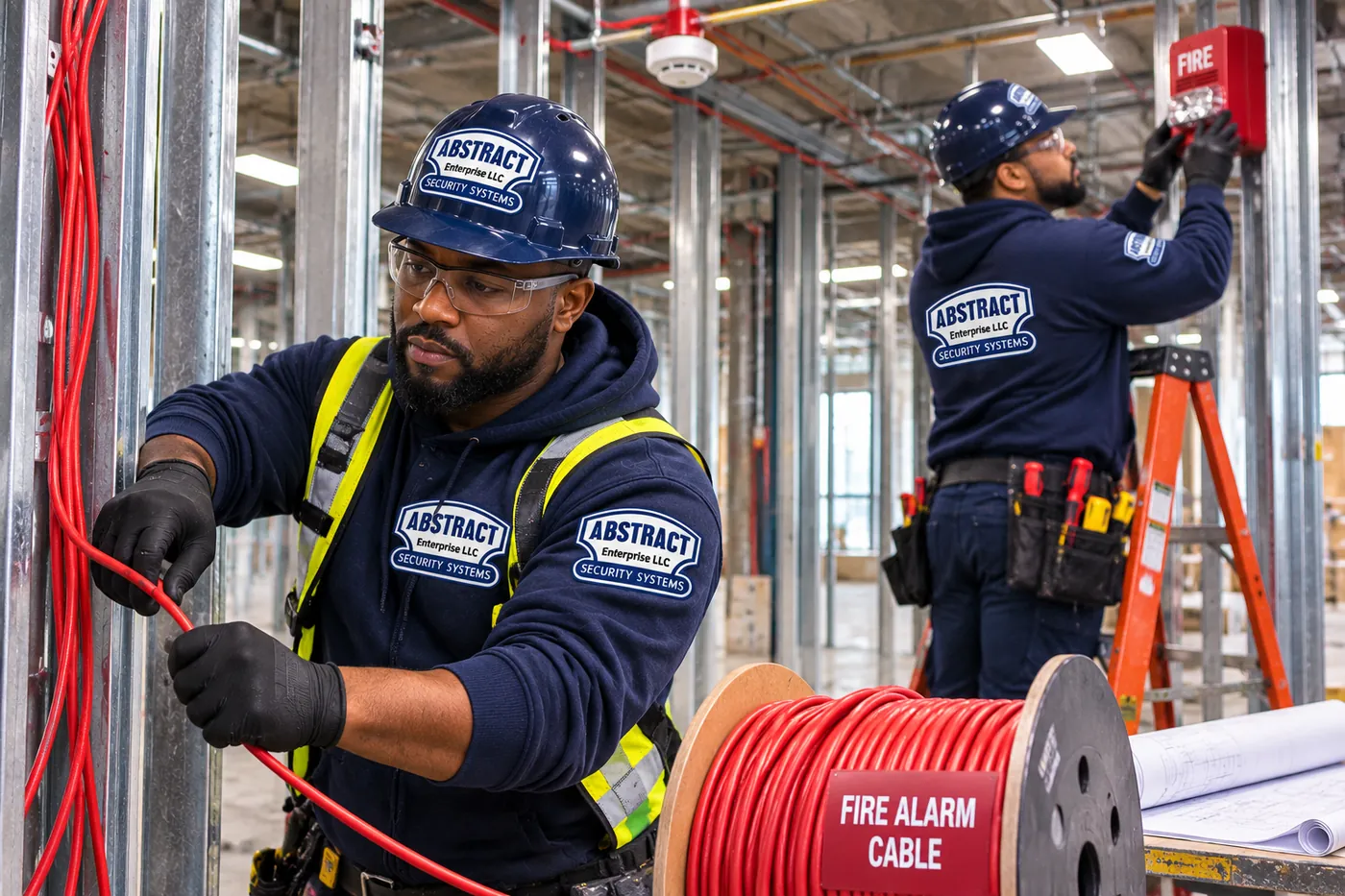
A technician in a hard hat and high-visibility vest pulls red fire alarm cable off a spool through open steel stud framing, while a second technician on an orange ladder works at the ceiling behind him. Open framing in a new building or a gutted storefront is the best moment to run every circuit the drawings show.
New Construction
New Buildings, Health Centers and Storefront Fit-Outs in East Tremont
New construction fire alarm work is the second half of East Tremont's story. The 521 East Tremont Avenue building is the clearest example: a 14-story mixed-use building with 213 homes, 63 of them supportive apartments for people with mental health concerns, a health center for Community Healthcare Network and ground-floor retail, which broke ground on April 23, 2026 (Supportive Housing Network of New York; Marketproof). At its groundbreaking HPD Deputy Commissioner Patrick Love said, "Stable housing is the foundation of health" (Mann Report).
High rise fire alarm installation for a project like that, or for the 15-story building planned at 4137 Third Avenue (New York YIMBY, via 100% Bronx), runs on the construction schedule. Fire alarm construction drawings come from the design professional; our fire alarm shop drawings add device details, wiring and programming. During construction, fire alarm wiring installation, fire alarm low voltage wiring, fire alarm circuit installation and fire alarm zone wiring follow the drawings floor by floor. When the walls close, fire alarm as built drawings record what was actually installed.
Condominium building fire alarm installation and multifamily building fire alarm installation in new buildings like these include the apartment-floor corridors, the stairs, the cellar, the roof and the ground-floor commercial spaces. The retail spaces often open later than the apartments, which means a tenant improvement filing after the building's own system is approved. That is where tenant improvement fire alarm installation and tenant fit out fire alarm installation come in: each store or office adds devices to the approved base system, and each change is filed and tested.
Smaller fit-outs follow the same pattern on a smaller scale. A dental or medical office, a takeout restaurant or a salon on East Tremont Avenue may need only a few devices added to a landlord's panel, or a small system of its own. Either way it begins with drawings and ends with a test. Other building types appear here only occasionally: hotel fire alarm installation, hospital fire alarm installation, nursing home fire alarm installation, assisted living fire alarm installation, office building fire alarm installation on a larger scale, parking garage fire alarm installation, data center fire detection installation, warehouse fire alarm installation, industrial building fire alarm installation, manufacturing facility fire alarm installation, industrial fire alarm installation and industrial fire detection system installation. When they do, an industrial fire alarm contractor's approach still starts with the same drawings and the same FDNY review. Property management fire alarm services tie it all together for landlords with several buildings: one inventory, one test calendar and one record set.
How long does fire alarm installation take in a new building? The installation follows the building's own schedule over many months; the approval runs about 20 to 24 weeks from plan submission (FDNY Tips for Fire Alarm Systems). The FDNY also lists the documents needed before an acceptance test can be booked. New fire alarm system installation is about timing as much as wiring.
No. Tremont is the neighboring area to the west; East Tremont is usually described as running from Third Avenue east to Southern Boulevard, between East 180th Street and the Cross Bronx Expressway, in Community Board 6. East Tremont Avenue runs through both, which is why addresses are easy to mix up. Tell us the cross streets when you call and we will confirm which side of Third Avenue the building is on.
Does the Tremont Avenue busway limit when a new fire alarm panel can be delivered to a store on the avenue?
+
It shapes the delivery more than it stops it. From 6 a.m. to 8 p.m. the busway is open the full length only to buses, larger trucks, emergency vehicles and Access-a-Ride, so a van delivering a panel or a box of devices comes in from the cross street, or after 8 p.m. We plan heavy deliveries and long work on the avenue around those hours.
Our restaurant on East Tremont Avenue seats about 60. Does it need its own fire alarm system?
+
The FDNY's restaurant guide sets the fire alarm requirement for restaurants at 300 or more occupants, and a Place of Assembly Certificate of Operation at 75 or more, so a 60-seat room usually does not trigger a system on its own count. The building around it may still have a system that covers the restaurant's cellar or kitchen, and a hood system may have to report to it. The design professional confirms the answer from the Certificate of Occupancy.
Does our medical office need carbon monoxide detection tied into the fire alarm?
+
If the office is in a business occupancy with a fire alarm system, very likely. Local Law 191 of 2018 required carbon monoxide detection in Group A, B and M occupancies that have fire alarm systems, using devices with sounder bases that report to a central station. Ask the design professional to include carbon monoxide on the same drawings as smoke and heat detection.
Can a health center keep seeing patients while its fire alarm is upgraded?
+
Yes, with planning. Work is phased room by room or floor by floor, devices are swapped so that each area is covered at the end of every day, and any area left unprotected gets the fire watch the FDNY requires. Noisy testing is booked outside clinic hours, and staff are told which signals to expect.
An auto repair shop near Webster Avenue wants a fire alarm. What detection works around exhaust and fumes?
+
Heat detection, not smoke detection, is the usual answer in repair bays, because exhaust, welding and solvent vapors would keep smoke detectors in alarm. The office or waiting room next to the bay may still use smoke detectors. Where the shop is sprinklered, the flow and valve switches report to the panel too. The design professional chooses the device types for each room.
Does dust from the Cross Bronx Expressway shorten the life of detectors in buildings along it?
+
Road dust and soot do build up in smoke detectors over time, especially near windows and doors that open toward heavy traffic. Addressable detectors report when they are getting dirty, and regular sensitivity testing and cleaning catch the rest. Buildings along the expressway should expect to clean or replace detectors more often than buildings on quiet side streets.
How early should a new building near Third Avenue request its FDNY acceptance test?
+
Well before the temporary certificate of occupancy is due. The FDNY's document requirements list a recommended lead time of 40 to 70 business days for a fire alarm test request, along with the forms, approved plans and central station contract that must be in hand. We start assembling that package while the last floors are still being finished.
Will the FDNY look at our fire alarm during the annual Place of Assembly permit inspection?
+
Expect it to. The FDNY issues the annual Place of Assembly permit after an inspection, and an inspector who sees a panel in trouble, a blocked pull station or missing log books can write it up. Keep the panel normal, the devices clear and three years of logs on hand before the inspection date.
Can we keep the store's fire alarm panel behind the counter where only staff can reach it?
+
Not without the design professional and the FDNY agreeing. The panel's location is shown on the approved drawings, and firefighters must be able to reach it or a remote annunciator quickly when they walk in. A panel hidden behind stock, a locked counter or a display rack slows them down. If staff access is the worry, ask about a lockable cover or an annunciator near the entrance, and keep the path clear.
Sources
Sources for This East Tremont Page
FDNY, Tips for Fire Alarm Systems (design professional, TM-1 filing, installer, approximately 20 to 24 weeks): https://www.nyc.gov/assets/fdny/downloads/pdf/business/tips-fire-alarm-systems.pdf
FDNY, Fire Alarm Company Certificate FAQ (company certificate, S-97 and S-98 certificates of fitness): https://www.nyc.gov/assets/fdny/downloads/pdf/business/fire-alarm-company-cert-faq.pdf
FDNY, document requirements by application type (test request documents and lead time): https://www.nyc.gov/assets/fdny/downloads/pdf/business/doc-app-requirements-by-type.pdf
FDNY, FA-27 instructions (Notice of Defect, $105 fee): https://www.nyc.gov/assets/fdny/downloads/pdf/business/fa27-instructions.pdf
FDNY, Restaurant Fire Safety Guide (fire alarm thresholds, Place of Assembly, certificates of fitness, log books, hood servicing, re-inspection fee): https://www.nyc.gov/assets/fdny/downloads/pdf/business/restaurant-fire-safety-guide.pdf
SiteCompli, Local Law 191 of 2018, carbon monoxide detectors in commercial spaces: https://support.sitecompli.com/hc/en-us/articles/1500000956121-Local-Law-191-of-2018-Installation-of-Carbon-Monoxide-Detectors-in-Commercial-Spaces
NYC Small Business Services and NIDC, East Tremont Commercial District Needs Assessment (corridors, 529 storefronts, vacancy, business mix, building stock): https://www.nyc.gov/assets/sbs/downloads/pdf/neighborhoods/avenyc-cdna-easttremont.pdf
News 12 Bronx, East Tremont merchants unite to strengthen business corridor through merchants alliance, July 23, 2026: https://bronx.news12.com/2026/07/23/east-tremont-merchants-unite-to-strengthen-business-corridor-through-merchants-alliance/5AAeeE1lv4KHHgy1aoLvHh
NYC Mayor's Office, Mayor Mamdani completes the Bronx's first busway, September 23, 2026: https://www.nyc.gov/mayors-office/news/2026/09/fast-buses--mayor-mamdani-completes-the-bronx-s-first-busway-on-
Streetsblog NYC, DOT Tremont Ave busway to be installed in spring, November 11, 2024: https://nyc.streetsblog.org/2024/11/11/dot-tremont-ave-busway-to-be-installed-in-spring
Bronx Borough President, ULURP recommendation, 521 East Tremont Avenue rezoning (site, building program, Community Board 6 vote): https://bronxboropres.nyc.gov/wp-content/uploads/2022/11/bxbp-ulurp-521-East-Tremont-Avenue-Rezoning.pdf
Supportive Housing Network of New York, Community Access breaks ground on East Tremont: https://shnny.org/blog/entry/community-access-breaks-ground-on-east-tremont
Mann Report, groundbreaking of 213-unit affordable and supportive housing development in the Bronx, April 23, 2026: https://www.mannpublications.com/mannreport/2026/04/23/community-access-mega-group-and-public-officials-celebrate-groundbreaking-of-213-unit-affordable-and-supportive-housing-development-in-the-bronx/
Marketproof, new building permit filed for 521 East Tremont Avenue (14 stories, residential and commercial floor area): https://blog.marketproof.com/new-building-permit-filed-for-521-east-tremont-avenue-in-tremont-bronx/
100% Bronx (reposting New York YIMBY), permits filed for 4137 Third Avenue in East Tremont, October 2025: https://100percentbronx.blogspot.com/2025/10/permits-filed-for-4137-third-avenue-in.html
Community Healthcare Network, Tremont Health Center (1880 Bathgate Avenue, services): https://www.chnnyc.org/tremont-health-center/
Wikipedia, East Tremont, Bronx (boundaries, community board, ZIP codes, precinct, firehouses, population, NYCHA buildings, schools, transit, Cross Bronx Expressway history, building stock): https://en.wikipedia.org/wiki/East_Tremont,_Bronx
All Areas Served
Fire Alarm Installation in East Tremont and Across the Bronx
East Tremont landlords and store owners often hold buildings or leases in several Bronx neighborhoods, and the filing and testing path described here is the same in each of them: sealed drawings, a TM-1 plan examination, installation by an FDNY-certified company with a licensed electrician, and a witnessed acceptance test. Start with the Bronx fire alarm installation page or the NYC fire alarm hub, or pick a neighborhood below.
Whether it is a clinic signing a lease on East Tremont Avenue, a restaurant opening on East 180th Street, a walk-up panel that will not clear its trouble light or a new building near Third Avenue heading for its acceptance test, the first step is a survey and a written scope. Abstract Enterprises Security Systems, NYS license #12000287431, rated 4.7 from 201 Google Reviews. We book within 2 hours.