Twenty-Two Blocks · Three Kinds of Building · Cellars Near the Water
Door buzzer repair in Columbia Street Waterfront means fixing entry systems in buildings that were put up decades apart and for completely different reasons. On the same few blocks between Atlantic Avenue and Hamilton Avenue you find 1910 and 1930s walk-ups on Columbia Street, rowhouses on Union Street with restaurants on the ground floor, Summit Street houses behind black iron porticoes, factory buildings on Tiffany Place turned into apartments, the low condo townhouses on Carroll Street that went up in the mid-1980s after the city cleared the blocks damaged by the 1975 sewer collapse, and six-story condos and rentals from 2002 onward. Many of their cellars sit close to, or inside, the area that floods in big storms. That is why a buzzer here so often fails at a splice or a supply below street level rather than at the button. We test the door, the ringing, the talking and the release for every household that shares the entrance, repair the system that is already there wherever it can be repaired, and give you the price in writing before a part goes in.
Reviewed and updated November 12, 2026 by Abstract Enterprises Security Systems, NYS license #12000287431 · Sources: Brooklyn Eagle (2018) on Columbia Street Waterfront District sights and its history of the district's renewal; Wikiwand's Columbia Street Waterfront District article; StreetEasy's area guide and its five-years-after-Sandy report; Century 21 Award neighborhood guide; Milton Coste's ZIP 11231 market report (PLUTO data); Carroll Gardens Association on Columbia Mews; Bluestreak Biker on the evacuation area; International Business Times (2012) on Superstorm Sandy; City Limits (2024) on Red Hook Houses; Brooklyn Community Board 6 minutes (June 2012); Nest Seekers, CityRealty, Corcoran and Current Real Estate Advisors listings for Columbia Terrace, 250, 222, 181, 129, 219 and 279 Columbia Street; Brownstoner (2007 and 2014); Openigloo profiles of 1 Tiffany Place and 414 Hicks Street; New York YIMBY (2026); CityRealty and GACE on Columbia Commons; Habitat (2024); ButterflyMX on NYC intercom repair; Swiftlane on intercom faults; TechCrunch (2022) on Ring Intercom; the NY Attorney General's Tenants' Rights Guide; HPD on self-closing doors; LPC Permit Guidebook chapter 11; NYC 311; labs.llc 311 type counts; Weverit's HPD violation record; Streetsblog (2026); DNAinfo (2014); Red Hook Star-Revue (2022) · Dispatched from 1282 Troy Ave, Brooklyn

Owner-operated since 2002 · Thousands of jobs completed · Booked within 2 hours
Door buzzer repair in Columbia Street Waterfront begins with a diagnostic visit that is quoted for your building before we arrive, and every repair after it is priced in writing for that job before parts work starts. In the 1980s condo townhouses on Carroll Street the faults we look for first are an aging audio system's supply, a release that has lost strength as owners added devices, and splices in a cellar that has been damp for years. In the Tiffany Place lofts and the six-story buildings it is more often one riser, a panel's programming, a relay, or a supply that was moved upstairs after 2012. In the rowhouses with a shop or restaurant downstairs it is usually the door, the strike or wiring that crosses the store's space. We book within 2 hours of your request into a 2-hour arrival window. We don't promise same-day repairs, and if a part has to be ordered we leave the street door closing and locking before we go.
The Columbia Street Waterfront is small, but its entry systems are unusually varied, and very few of them were installed at the same time or by the same hand. The Brooklyn Eagle's 2018 tour of the district describes 22 blocks holding a mix of classic brick rowhouses, low-rise factories, some converted to residential use, and newer mid-rise apartment houses. StreetEasy's area guide adds three-to-five-story rowhouses and brownstones. A Century 21 guide names boutique condo projects such as Columbia Commons and 183 Columbia Street, with elevators, alongside low and mid-rise walk-ups and elevator buildings that offer rentals and co-ops. Listing sites can't even agree on the name: the same blocks show up under Carroll Gardens, Cobble Hill or Red Hook depending on the website. For a buzzer technician the practical result is that no two neighboring doors on Columbia Street are likely to share a system, a supply location or a wiring route, so every repair starts with finding out what is actually there.
History explains a good part of that variety. Wikiwand's account of the district says a 1975 sewer accident led to the demolition of 33 buildings, and that by 1984 an urban renewal project had been completed, along with a brand-new street whose houses sold out quickly. The Brooklyn Eagle's history adds that in the early 1980s the city began tearing down unusable buildings while designing a plan for new ones no higher than three stories. Those are the condo townhouses known as Columbia Terrace: Nest Seekers lists 42 Carroll Street as a three-floor townhouse condo built in 1986 with a voice intercom, CityRealty describes First Columbia Terrace at 250 Columbia Street as a 27-unit post-war walk-up condominium finished in 1986 with six alternate addresses on President Street, and other Columbia Terrace addresses appear at 38 and 44 Carroll Street and a Third Columbia Terrace at 57 Carroll Street. A do-it-yourself guide puts the average life of an intercom at around 20 years before it needs replacing or retrofitting. These systems are about twice that age, which is exactly why a careful repair, rather than a reflexive replacement, matters to the owners who pay for them.
The water is the third factor. A local blogger wrote that everything north, west and south of the west side of Columbia Street is designated part of the mandatory hurricane evacuation area, and in the same post said "our little stretch of Columbia Street was spared. No flooding," which tells you how much the risk changes from one block to the next. Others were not spared. A bartender at Alma in the district told the International Business Times after Superstorm Sandy that at his nearby home, "I've got water up to my chest in the basement." StreetEasy reported that since Sandy, developers must place a building's utilities on higher floors rather than in basements, and City Limits described storm water rushing into the basements of the Red Hook Houses, just south along Columbia Street, where the boiler and electrical systems sat. A bell transformer, an intercom amplifier or a junction box in a cellar that once took water can keep working for years and then fail at a corroded joint long after everyone has forgotten the storm.
The last factor is size. Milton Coste's market report, drawing on the city's PLUTO data for ZIP 11231, a ZIP code much larger than this neighborhood, counts about 1,000 three-unit lots and 600 four-unit lots, plus condo lots holding about 2,300 units. Many of those small buildings fall below the eight-apartment line in the state's intercom requirement, so a dead buzzer there is fixed because an owner or a board chooses to fix it, not because an inspector ordered it. Buildings such as 414 Hicks Street, which Openigloo lists with 95 units on six floors from 2009, Columbia Commons at 110 Warren Street, a 48-unit six-story condo from 2010, and 1 Tiffany Place, a 70-unit, five-floor building from 1921, sit on the other side of that line. Owners who are already opening the cellar sometimes ask us to look at the entrance cameras on the same visit; we keep that on its own line and its own wiring. Our Brooklyn door buzzer repair page covers the borough-wide rules that apply to the larger buildings.

We put a street door that no longer locks at the front of the queue, then a door nobody inside can release, then a unit or a line of units that has stopped ringing. Call (347) 934-8335 and tell us four things: which units fail and which still work, what the visitor and the person inside each hear when the button is pressed, whether the cellar or the utility room has ever taken water, and what happened just before the trouble started, such as a storm, a restaurant renovation downstairs, a new front door or an owner's new video doorbell. We book within 2 hours of your request into a 2-hour arrival window, early in the day where we can. We don't offer same-day or emergency door buzzer repair, because a condo townhouse needs someone to open the cellar and the failing units, and a loft or six-story building needs its super or managing agent and access to the failing line. A clear description means the technician brings the likely parts, and anything beyond the diagnostic visit is priced in writing before work begins.
Most of Brooklyn's small buildings got their buzzers long after they were built. A bell went in, then a strike, then an intercom, each one threaded through walls that were never meant to hold it. The condo townhouses on the renewal blocks are different. They were designed in the early 1980s, under a plan that kept new buildings to three stories, and finished around 1986 with their entry systems already part of the drawings. When we open one up, the cable usually runs inside the walls rather than across the outside of the building, the station positions were chosen by an architect rather than by whichever owner got there first, and the supply sits in a spot that someone planned. That is good news for a repair, because the paths are more regular than in a 1910 walk-up. It is also a trap, because a well-planned system that has been repaired piecemeal for forty years by different contractors can look orderly on the surface and be anything but behind the plates.
The systems themselves are almost always audio. The listing for 42 Carroll Street names a voice intercom, and that is what we expect to find in a Columbia Terrace building: a door station with a button for each unit, a speaker and microphone behind a grille, a talk-listen-door station in each home, and a transformer or power supply feeding the whole thing. In a design like that, three things wear out first. The supply, which has been running continuously since the mid-1980s and may now be carrying devices nobody planned for. The release circuit, because the strike in the street door is the part that does real mechanical work every day. And the connections, especially any joint that sits in a cellar or a utility space that has stayed damp. The station electronics themselves often last longer than people expect. Before we write down that a station has failed, we prove it on the bench of the wall: we test a known good station on the same pair, and if the good one works, the station is the fault; if it doesn't, the fault is upstream.
The cost question in these buildings is usually not repair versus nothing, it is repair versus replacement. A board that has heard "these systems last about twenty years" may assume a forty-year-old intercom has to go. ButterflyMX's own NYC repair guide puts it plainly: "The aim isn't to replace a system simply because it's old." Habitat's 2024 report on intercom law quotes attorney Nancy Kourland of the Lasser Law Group about a co-op in that position: "As a result, the co-op has a legal obligation to repair or replace the intercom." For a condo under the eight-unit line the obligation may come from the bylaws and the owners rather than the state, but the logic is the same: the building has to end up with a working entrance, and the board needs to know which route costs less. Our record lays out what failed, what tested sound, and what each option involves, so the board can decide at one meeting.
The most useful thing a Columbia Terrace board or owner can do is tell us, in plain words, what each failing unit does. Does it ring? Can the owner hear the visitor, and can the visitor hear the owner? Does pressing the door button do anything at all, a click, a buzz at the door, nothing? Then tell us where the cellar or utility space is, who holds the key, and whether that space has ever had water in it. If the building shares a wall, a cellar or a door with another Columbia Terrace address, say so, because the wiring may not stop where the property line does. With that, the technician arrives knowing whether to start at the supply, at the street door or at one unit's station, and the visit is spent repairing rather than searching.
In a building with a single riser or a single bundle feeding every unit, one bad station can drag down the others. A station that has failed with a short across the talk pair can leave the units around it faint, humming or dead, and the owner whose station looks fine is often the one whose unit is causing the trouble. A Brownstoner forum thread from 2009, about a Park Slope brownstone rather than one here, describes a building where eleven of twelve intercoms were replaced and the twelfth tenant refused access, and the whole line stayed down. We ask for access to every unit on a failing line for exactly that reason, and if one unit can't be opened, our record says so, apartment by apartment.
On many Columbia Street Waterfront jobs, the most important part of the buzzer is the part nobody sees: the transformer or power supply, the main amplifier if there is one, and the joints where the street-door cable meets the building's riser. In older buildings those almost always sit in the cellar, and in this neighborhood the cellar is where the water goes. The blogger who described the west side of Columbia Street as inside the mandatory hurricane evacuation area also wrote that their own stretch stayed dry, and the bartender who spoke to the International Business Times had water up to his chest in his basement nearby. That patchwork is the reason we ask every caller the same question early on: has this cellar ever taken water, and if so, how high did it come?
Water damages a low-voltage system in two ways. The obvious one is immediate: a transformer, an amplifier or a power supply that goes under, trips, smokes or simply stops. That is usually replaced right after the storm, along with anything visibly ruined. The slow one is what we see years later. Copper joints that were twisted and taped, or crimped in a connector that was never meant to be wet, carry on working after the water drains. Then the corrosion that started inside them grows, the joint's resistance rises, and the system fails in ways that look random: a strike that releases on dry days and not on humid ones, a unit that rings faintly, a hum that comes and goes. Swiftlane's guidance that a building-side transformer or main amplifier is the likeliest cause when several units lose service at once applies doubly here, because those are exactly the parts that sit lowest in the building.
The newer buildings have their own version of the problem. StreetEasy reported that after Sandy, developers must put a building's utilities on higher floors instead of in basements, so a six-story building put up since then may have its intercom supply in an upper-floor utility room. That protects the supply, but the street door is still at grade, and so is the strike, the station and the cable that drops from the panel to the floor slab. A long run from an upper-floor closet down to the street door also means more cable, more joints and more places where a contractor working on another floor can disturb the line. When the panel in a building like that goes dead, we start at the supply on the upper floor, then work our way down the run to the door, and we write down where every joint is, so the next repair doesn't begin with a search.
Every joint we remake in a damp or once-flooded space goes into a sealed, gel-filled connector rather than tape or an ordinary twist connector. Any supply or transformer we replace is mounted as high as the space allows, away from the floor, the boiler, the washer and the sump, and its cable is kept off the floor and away from the walls where water runs. We label the supply, the riser terminations and both ends of every pair we touch. And the dated, photographed record we leave lists where each joint is, so if water does come in again, the owner or the board can tell the next technician exactly which connections sat below the waterline.
Not every cellar fault in this district goes back to a flood, and we don't assume it does. Plenty of buzzers fail because a plumber or a boiler crew disturbed a joint, because a renovation added devices to a supply sized for fewer, or because the street door has simply moved in its frame. We look at the evidence: green or white crust on copper and screw terminals, a tide line on the wall at the height of the joints, rust on a junction box's lower edge, a supply that has been replaced while the cable around it hasn't. If the evidence points to water, we say so and price the sealing of the run. If it doesn't, we say that too, and the repair is just the part that failed.

The Brooklyn Eagle describes Tiffany Place as a short street running between Kane and Degraw Streets, parallel to Hicks Street, where numerous industrial buildings have been converted to residential use. The largest example on our list is 1 Tiffany Place, which Openigloo lists as built in 1921 with 70 units on five floors. A converted factory is a very different place to repair a buzzer from a rowhouse. The floors are often heavy masonry or concrete, so cable rarely goes through them easily; the conversion contractor usually ran the intercom in surface conduit along ceilings and corridor walls, or up a single chase, and then each unit owner or tenant has built, painted or boxed in their own space around it over the years.
That means the first job on a loft repair is often mapping, not replacing. We start at the street door and the supply, find out whether the building runs a single multi-pair riser or several, and then trace the failing line from the riser toward the units. Where the cable runs in conduit, the conduit tells us the path, and a tone tracer tells us where along it the signal stops. Where a corridor ceiling or a unit's soffit has closed over the conduit, we look for the access points the conversion should have left, pull boxes, junction boxes, condulets, before we suggest opening anything. Our quote lists which spaces we need and why, because in a loft one owner's renovation often sits right on top of a line that serves the whole floor.
Because these buildings are large and the residents are many, the faults spread in recognizable ways. When every unit on one floor loses its intercom together, the shared run on that floor, or the point where it leaves the riser, is the first suspect. When one unit hums and its neighbors fade, a single station or a single splice is loading the pair. When the whole building can still ring but nobody can open the street door, the release relay or the strike has failed. And when calls work for months and then fail every few weeks, a corroded joint in the cellar or a supply running at the edge of its rating is usually behind it. Openigloo's profile for 1 Tiffany Place showed one open class B violation when it was read; nothing in that listing says it concerns the intercom, and the city's own records are the place to check what any open item actually is.
The intercom requirement in Multiple Dwelling Law section 50-a, as summarized by several NYC sources, covers buildings with eight or more units that were built or converted after January 1, 1968. ButterflyMX's summary of the NYC intercom law uses the same "built or converted" phrasing. For a loft building, the conversion date can matter as much as the date on the cornerstone. A 1921 factory that became apartments much later may count as converted, and therefore inside the rule, even though the structure itself is a century old. We don't give legal advice and every building's paperwork is its own, but a loft board shouldn't assume that "built in 1921" means "exempt from the intercom requirement."
An Openigloo tenant review of 1 Tiffany Place lists "24h noise from the BQE" as a drawback, which tells you something about the street side of these buildings. For an intercom, constant background noise at the street door makes it harder to judge a weak microphone or a faint speaker by ear. We test the voice path with the door station, a station in the failing unit and a meter, not just by listening, so an expressway's roar doesn't get mistaken for a dead microphone, and a genuinely failing microphone doesn't get blamed on the traffic.

The question a Columbia Street Waterfront owner usually asks second, after "what's broken?", is "do I have to fix it?" The honest answer depends on the building. The NY Attorney General's Tenants' Rights Guide says multiple dwellings built after January 1, 1968 must have self-closing, self-locking doors at all entrances, and that those with eight or more apartments must also have a two-way voice intercom that lets tenants buzz visitors in. Buildings put up before 1968 must provide self-locking doors and a two-way intercom if a majority of all the apartments request it. One locksmith blog describes the threshold as "more than eight" units rather than eight or more, which is a reminder to read the statute's own text rather than a summary. For the many three- and four-unit buildings in ZIP 11231 that PLUTO counts, the intercom duty usually doesn't reach them at all.
Where the rule does apply, the penalties are real. A source summarizing NYC intercom requirements reports that courts have treated a working intercom as an essential service and found that failing to maintain one breaches the warranty of habitability under Real Property Law section 235-b. HPD writes the violation under section 27-2005 of the Housing Maintenance Code, with wording like the record Weverit shows for a Brooklyn building: "PROPERLY REPAIR OR REPLACE THE BROKEN OR DEFECTIVE INTERCOM SYSTEM AT BUILDING FRONT." That same record shows the wording issued as both class A and class B, so it's not true that every intercom order is the same class. ButterflyMX lists HPD's general correction periods as 90 days for class A and 30 days for class B. On the tenant side, NYC 311 treats broken or missing doorbells, buzzers and intercoms as an apartment maintenance complaint, and the 311 record labels the path "General – Bell/Buzzer/Intercom | Non Emergency."
The door itself carries the stricter clock. HPD's page on self-closing doors treats a defective self-closing door in a multiple dwelling as a class C immediately hazardous violation, to be corrected within 14 days of the notice, with HPD reinspecting within 20 days of the correction date, and it notes that Local Law 71 of 2022 has the agency proactively inspecting 300 class A multiple dwellings a year for self-closing doors. In a walk-up on Columbia Street or a six-story building near Atlantic Avenue, the buzzer and the door are one system as far as a resident is concerned. If the strike holds the latch, the closer stops short or a welded relay leaves the door unlocked, the entrance fails both tests. We check the closer, the latch and the strike on every entrance visit and, where the door itself is the problem, we say so in writing and name the carpenter's or locksmith's share separately.
A repair isn't finished, from HPD's point of view, until the owner can show what was fixed, where and when. Every visit we make on a building with an open intercom order ends with a dated, photographed record that names the units the order lists, what each one did before the repair and what it does after, tested from the street door: ringing, talking and releasing. How the owner certifies the correction is between the owner and HPD, and we don't give legal advice on it, but the record is written so that it can be attached to whatever the owner files.
The Landmarks Preservation Commission's published designations we checked don't place the Columbia Street Waterfront inside a historic district; Cobble Hill, across the expressway, is one, and an LPC permit for 20 Verandah Place there cites the rules for light fixtures and intercom panels. LPC's Permit Guidebook chapter on health and safety work lets staff approve intercom panels within or next to a door opening, limits them to one panel per opening, keeps them off cast iron and decorative surfaces, and treats ordinary maintenance and repair as needing no permit. If your building is individually designated or you aren't sure, LPC's own map is the place to check before a panel moves.
These are the repairs Columbia Street Waterfront condo boards, loft associations, landlords of small walk-ups, rowhouse owners and Columbia Street businesses call us for. Nearly all of them are repairs to a system already in the building. Where the right fix changes the system, for example moving a supply out of a wet cellar, giving a strike its own power, or replacing a cable run that tests bad from end to end, the written quote says so before anyone approves it.
Mid-1980s audio systems in the Carroll Street and President Street condos: dead stations, weak releases, supplies running at their limit, and lines that one failing unit has dragged down.
Corroded joints, rusted junction boxes and supplies in cellars that took water, remade in sealed connectors and mounted above the floor.
Failing lines in converted factory buildings, traced along surface conduit and chases from the street door to the floor where the signal stops.
Strikes that buzz and hold, open only when pushed, or have weakened as owners added devices, checked against the door, the latch and the closer first.
Transformers and supplies that hum, run hot, quit after a storm or outage, or now carry chimes, cameras and strikes they weren't sized for.
Dead handsets, intercom speaker and microphone faults, one-way audio and static, matched to the system so a replacement works beside the stations already there.
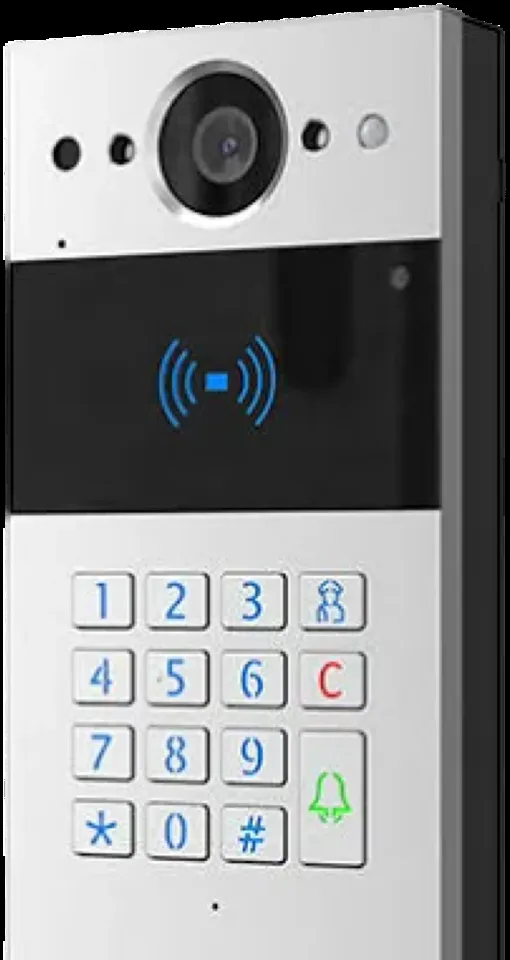
Audio, video, keypad and directory panels in the six-story condos and rentals from 2002 onward, including programming and administrator access recovery.
Residents' doors beside shops and restaurants on Columbia and Union Streets, where wiring crosses the store's ceiling or cellar and the door takes heavy traffic.
Street and vestibule doors that stop short, slam past the strike or bind in the frame, set so they close and lock by themselves.
Welded relays that leave the door unlocked, blown fuses, and panels that restarted with the wrong settings after the power came back.
A buzzer technician sorts the district's buildings by three things: how many households share the street door, where the supply sits relative to the water, and who has the authority to approve the work. On these blocks, that produces six common types.
The Columbia Terrace buildings on Carroll Street and at 250 Columbia Street: three floors, a voice intercom built in from the start, and a board or owners' group that approves every repair.
1910s to 1930s buildings such as 129 and 181 Columbia Street: three or four homes over three or four floors, a door station at the street and a supply in the cellar.
Union Street and Columbia Street rowhouses with a business on the ground floor and the residents' door beside it, often sharing a cellar with the store.
Summit Street houses whose front entrances sit under black metal filigree porticoes, which narrows the places a button plate or station can go.
Tiffany Place and nearby industrial buildings with dozens of units, masonry floors, surface conduit and long corridor runs.
Buildings from 2002 onward, including 222 and 255 Columbia Street, Columbia Commons and 414 Hicks Street, with video or networked panels, elevators and, in some, basement-level parking.
The condo townhouse is an organized system that has aged. Faults are the supply, the release, a damp cellar joint, or one station loading the line. We need the cellar or utility space open, access to the failing homes for a few minutes each, and a board member or owner who can approve the price. We test every unit from the street door before we decide anything, because in a building this size one bad station can look like three.
The prewar walk-up is usually a short riser with a few homes on it. Its cellar is the one most likely to have taken water, its strike is in a frame that has been painted and rehung many times, and its station plate has been through decades of weather. We start at the door and the cellar supply, and we read any HPD order on site, because its wording tells us which apartments and which path the inspector tested.
The rowhouse with a shop or restaurant is two clients in one building. The store's ceilings, ductwork and circuits often carry or cross the residents' wiring, and the residents' door gets the store's delivery traffic. We find out whose space and whose circuit the wiring crosses before we change anything, and we keep the store's own door and the residents' door on separate controls.
The portico rowhouse asks where a plate can sit. Filigree ironwork has little flat surface and shouldn't be drilled for every repair. We work with the plate's existing location and fasteners wherever we can, and if it truly can't be fixed securely where it is, we suggest the nearest sound masonry or door frame and put the change in writing first.
The converted factory loft is a mapping job. We trace the riser and the floor runs along their conduit, ask for the spaces where junctions are likely to be, and keep the repair to the section that failed.
The six-story condo or rental adds programming, networks and staff. Panels may call phones, run over the building network or tie into a remote attendant service, and the supply may sit on an upper floor. We check the physical door and release separately from the software, so the door never depends on an app alone.

Most of the district's businesses, according to a Yelp reviewer, sit on Columbia Street between Degraw Street and Hamilton Avenue, and the Brooklyn Eagle describes the Union Street rowhouses with shops and restaurants on the ground floor. Almost every one of them shares a building, and often a cellar, with homes upstairs. These are the commercial clients we see most here.
Ground-floor kitchens and dining rooms whose staff, deliveries and equipment share a cellar or rear wall with the apartments' intercom wiring.
Stores in old rowhouses with the residents' door beside the shop front and the residents' supply sometimes fed from the store's side of the building.
Workspaces in the former industrial buildings that buzz clients through a street door shared with residents or other tenants.
Commercial spaces in the six-story buildings, with their own entrance hardware next to a residential lobby panel on the same facade.
Owners with a walk-up here and a building in Carroll Gardens or Cobble Hill who want each entrance tested the same way and recorded in the same format.
Agents for the condo townhouses and the newer condos who need one written quote, itemized so a board can approve each line separately.

We don't publish stories about particular Columbia Street Waterfront addresses, because we only print what we can document. What we can describe is the order a technician follows on the call this district produces most often: "the buzzer rings, we can talk, but pressing the button upstairs doesn't open the street door, and it's been getting worse."
Before the visit we ask who will open the cellar or utility room, and whether the space has ever taken water. At the building we start at the street door. We photograph the station, the door, the frame and the strike, then have someone inside hold the release while we work the door by hand: closed, pushed, pulled. If the strike lets go only when the door is pushed, the latch is pressing into the keeper, and the fix is the keeper, a shim or the closer. If it stays shut whatever the door does, we go to the supply, read its label and measure it at rest and with the release held. Then we follow the run toward the door and open the lowest joint first, because on these blocks the lowest joint is the one water reaches. Green crust on the copper, a tide line on the wall, a twist-and-tape splice where a sealed connector should be: each tells us something. We remake every joint we touch in a sealed connector, lift anything sitting near the floor, label both ends, test every unit on the line from the street door and write the record before we leave.
Condo townhouses on the renewal blocks
Usually yes on the first part, and partly on the second. The renewal-era buildings were designed with their entry systems in the drawings, so the cable generally runs inside the walls on a planned route, and the stations sit where an architect put them rather than where a later owner found room. That regularity helps us trace a line quickly. What makes these buildings harder is forty years of piecemeal repairs: different contractors, replacement stations from different makers, devices added to a supply sized for the original system, and splices made wherever was convenient. We test a known good station on the failing pair before we blame the station, measure the supply under load, and look at every joint we can reach. The repair is then aimed at the part that actually failed, and the record maps what we found so the next technician starts from a plan rather than a guess.
Most often the release is now passing through more than one device before it reaches the strike. An add-on that sits between a station and the release, or a second relay wired in to let an app open the door, can introduce its own small delay, and several of them in a chain add up. A supply that is now feeding extra devices can also sag when the release is pressed, so the strike takes longer to pull in. We disconnect the add-ons one at a time with the owners' agreement, measure the supply at the strike while the release is held, and time the release with each device in and out. Then we either give the strike a supply of its own, wire the add-ons so they sit beside the release instead of in series with it, or recommend removing one. Whatever we change is written down and approved first, because in a condo one owner's device affects every home on the line.
By taking the attendant out of the test for a moment. CityRealty lists Columbia Commons at 110 Warren Street with an intercom and a virtual doorman system rather than a doorman, and setups like that put a service between the panel and the homes. We first ring a failing home directly from the panel, if the panel allows it, or have the service place a test transfer while we watch the home's station. If the station rings on a direct call but not on a transfer, the fault is in the service's routing or the panel's settings for that home, and the service has to correct its side. If the station doesn't ring on a direct call either, the fault is the station, its wiring or the panel's output, and that is ours to repair. We write down which test failed so the board doesn't pay twice for the same complaint.
Six-story and airtight buildings
It can contribute. Brownstoner described 255 Columbia Street as a six-story, 13-unit Passive House building with triple-paned windows and mechanical ventilation with heat recovery, and a very tight building can develop a small pressure difference across its entrance, especially when the ventilation is unbalanced or a window upstairs is open in wind. That pressure presses the door against its stops and the latch into the strike's keeper, and a strike that releases easily with no load can fail to let go under that pressure. We check by testing the release with the inner door open, then closed, and with someone holding the door against the stop, and we compare the strike's pull-in with the supply measured at the strike. The fix is usually a keeper adjustment, a strike with more holding release force, or a closer set for the door's weight. If the ventilation balance is the real cause, we say so and leave that to the building's mechanical contractor.
They are one of the first places we look. Moving a supply upstairs protects the supply, but if the run to the street door still passes through the old cellar and joins the new cable there, the joints that matter most are still at the low point of the building. A splice made in a hurry during a post-storm rebuild, twisted and taped or crimped in a connector not meant for damp spaces, can work for years before corrosion raises its resistance. The symptoms are a release that weakens on humid days, a faint ring in one home, or calls that cut out. We open the old joints, check the copper, and remake them in sealed connectors, or, if the cellar section of the run tests bad, we price replacing just that section and routing it as high as the space allows. Our record marks where every remaining joint is, so a future flood can be checked quickly.
Lofts and factory conversions
We start by finding out where the line stops, before anyone opens a soffit. A tone tracer placed on the pair at the riser lets us follow the signal along the conduit, and the conduit usually has pull boxes or junction boxes at turns and at each floor's branch. If the signal stops before the soffit, the fault is in the corridor and the soffit stays closed. If it stops inside the boxed section, we look for an access panel, a removable trim piece or a box the renovation should have left accessible. Only if none exists do we suggest opening a small, specific section, and we tell the owner where and how big before we ask. Our quote lists the spaces we need and why, because in a loft, one owner's finished ceiling may sit on the only route for a whole floor's intercom, and the board, the owner and we should agree on access before the visit.
Rowhouses, porticoes and storefronts
Not necessarily, but we start by trying to keep it there. The Brooklyn Eagle notes the porticoes of black metal filigree on Summit Street, and filigree offers very little flat, solid surface for a plate. Repeated screwing into thin iron enlarges the holes, and once the plate rocks, the wire behind it flexes until a conductor breaks. Where we can, we re-fasten the plate to the solid parts of the iron with the existing holes, using a backing plate or through-bolts so the load isn't on the thin sections, and we relieve the strain on the wire. If the plate can't be made secure there, we suggest the nearest sound masonry or the door frame and put the move in writing first. LPC's guidebook keeps intercom panels off cast iron and decorative surfaces on designated buildings, so if your house is individually designated, the move needs the Commission's view before we do it.
It can, along with the work it took to install the duct. A kitchen exhaust duct can run hot, and intercom cable insulation isn't made to sit against it for long periods. More often, though, the damage happened during the installation itself: the cable was pulled aside, stapled tighter, or nicked where the duct passed. We trace the top-floor line, check its continuity and insulation along the stretch beside the duct, and look at how the cable is now fastened. If the cable is damaged, we replace that section and re-route it so it keeps a clear distance from the duct, and we note the separation in the record. Our dated photographs of what we found give the building owner something concrete to show the restaurant's contractor, but who pays is between the owner and the restaurant under their lease.
Usually, yes. A run that drops below street level at the front of the building, near a sidewalk hatch or a vault, sits in exactly the place rainwater collects, and a splice or a damaged jacket there will fail every time it gets wet. We first confirm that the wet section is the fault by testing the pair while dry and checking the joints and the jacket at that point. Then we look for a route that rises inside the building instead, up the cellar wall to the joists and across to the stoop or the vestibule, so nothing sits where water pools. If the only route crosses the store's cellar, we ask the owner and the store for access before we price it. The quote describes the new route, and the old section is cut back and capped so nobody reconnects it by mistake later.


These are the parts we repair and replace in Columbia Street Waterfront cellars, utility rooms, vestibules, lobbies and homes. When a repair needs a new part, we match it to the system and to the door that is actually there. We repair and troubleshoot most brands found in Brooklyn buildings, including Aiphone, Akuvox, DoorBird, Comelit, Siedle, TekTone, Lee Dan and ButterflyMX, as an independent company rather than a certified dealer for those makers.
Bell transformers and intercom supplies sized for every station, chime, camera and strike now on the line, mounted high and dry where the next technician can find them.
Fail-secure and fail-safe strikes for old wood frames, steel loft doors and the heavy doors of the newer buildings, with keepers and shims that suit the latch already there.
Gel-filled connectors, sealed terminal blocks and drip loops for runs in damp or once-flooded cellars and sidewalk-level drops.
Talk-listen-door handsets, video indoor stations and chimes, chosen so a replacement works on the same line as the stations already in the building.
Audio, video, keypad and touchscreen panels for walk-ups, lofts and six-story condos, with directory programming and administrator handover.
Door release relays and interface modules that let a station, a panel, an attendant service or an app open the strike, replaced when contacts stick or weld shut.
Replacement pairs for loft risers and condo runs, pulled through existing conduit where it is sound, with labeled terminal blocks at each end.
Card readers, keypads and the recorders a video panel feeds, checked so access and recording keep working after an intercom repair.


Owners sometimes ask whether the company behind their doorbell camera or alarm, Ring, ADT or SimpliSafe, can fix the building's buzzer. Usually not. Those companies support their own devices, apps and, where it applies, monitoring. They don't measure a supply in a cellar that once took water, reset a strike in a century-old frame, or trace a loft riser through conduit. The Red Hook Star-Revue reported in 2022 that officers at a 76th Precinct meeting suggested Ring cameras for package theft, and a camera can be a sensible extra at a door. But it doesn't give a second household its own ring, voice and release, and it doesn't make a door close and lock. Our job is the building's own entry system, whatever brand it is, repaired first where it can be, with any camera or alarm work quoted on its own line.
Columbia Street Waterfront fits several generations of entry hardware into a small area. There are classic brick rowhouses, low-rise factories (some now residential), renewal-era condos from the mid-1980s, and newer mid-rise apartment houses, all within about 22 blocks. Before a technician can say whether to fix a buzzer or plan for a new one, they need a rough idea of how old the system is and how much of it is still original. The building's construction date is a useful first clue, but it doesn't settle the question.
A common rule of thumb is that intercom systems last about 20 years before they need replacement or a retrofit. Here is how that lines up with the local housing stock. The Columbia Terrace townhouse condos on Carroll Street and First Columbia Terrace at 250 Columbia Street were finished in 1986, during the renewal period. If a lobby panel or in-unit station in one of those buildings dates from construction, it is well past that average. Video intercom buildings such as 222 Columbia Street (2002) are now around that mark. Projects from the late 2000s and early 2010s are getting close to it, including 414 Hicks Street (2009), Columbia Commons at 110 Warren Street (2010, which uses an intercom and a virtual doorman system), and the Passive House building at 255 Columbia Street. Buildings that went up very recently, like the six-story building at Columbia and Degraw completed in 2026, should not have age-related failures. A fault in one of those is more likely a defect, a wiring error, or damage.
Age is only a starting point, though. An older system that still has parts available and a sound riser can be repaired for years. A newer system can fail across the building because of one bad component. Our first diagnostic question is how many units are affected. When several apartments lose service together, a building-side transformer or main amplifier is a more likely cause than the wiring to any one unit. That one finding changes the estimate a lot. In a three-unit rowhouse or a four-unit walk-up, replacing a failed transformer is usually a small job. If the same symptom shows up in a 70-unit converted factory, we have to trace the whole system, because that kind of outage can also come from a compromised riser.
This is also why we don't give a single price before we've seen the building. For reference, one NYC vendor quotes single-fault repairs at a flat $150 to $250. The same vendor lists several jobs outside that flat rate: building-wide wiring faults, riser repairs, lobby panel rebuilds, and electric strike or magnetic lock replacement. Treat that as one company's published pricing, not a neighborhood average. There is no independent cost survey for this work, so any figure you find online, ours included, depends on the specific fault and the specific building.
The physical structure affects the work too. Columbia Street Waterfront has many three-to-five-story rowhouses and brownstones. In buildings this size, the cable path from the street door to the top-floor apartment is short, but it often runs through old masonry and through spaces that have been renovated several times. In converted factory buildings like those along Tiffany Place between Kane and Degraw, the original structure wasn't designed for apartment wiring, so the routes were added during conversion. Before we suggest pulling new cable or abandoning a run, we find out how the previous installer routed it. Usually the cheapest repair is the one that reuses a good path that already exists.
Location of equipment depends on when the building went up. After Sandy, developers were required to put building utilities on higher floors instead of in basements. In a post-2013 building, the intercom power supply or head-end may be upstairs, so a technician who looks only in the cellar may miss it. In older rowhouses and renewal-era condos, we still start in the basement, and on the flood-exposed blocks we check there for corrosion first.
Not every request calls for a full replacement. Some residents only want to answer the door from a phone. Ring Intercom, for example, is designed as an add-on to an existing apartment intercom system, and it depends on that system working. If the handset in the hallway is dead because of a wiring fault, an add-on won't fix it. We repair the underlying system first, and then the resident or owner can decide whether to add anything.
Finally, the trade involved. Most intercom troubleshooting and repair is low-voltage Class 2 wiring, which is usually handled by a low-voltage systems technician or security integrator rather than a general electrician. When an outage is caused by a building electrical problem upstream of the intercom transformer, we tell you so and recommend the right trade, rather than replacing intercom parts that aren't at fault.
How quickly a broken buzzer gets fixed in this neighborhood often depends on who has the authority to approve the work. Columbia Street Waterfront has several kinds of ownership. There are boutique condo projects like Columbia Commons and 183 Columbia Street, renewal-era condos like the Columbia Terraces, low and mid-rise walk-ups and elevator buildings offering rentals and co-ops, and small owner-held rowhouses with only a few apartments. Each has its own approval process, and we plan our visits around that.
In a condo, the lobby panel, door strike, riser, and power supply are usually common elements managed by the board or its managing agent. The in-unit station may be the owner's responsibility, depending on the building's documents. The practical issue is that a resident may call us about a dead handset, but if the fault is in the shared equipment, the board has to approve the repair. After we diagnose the problem, we write the findings so the boundary between unit and common equipment is obvious: what failed, where it sits in the system, and which apartments it affects. That gives the board or agent what it needs to make a decision without having to send someone to re-inspect.
Affordable homeownership is also a local factor. Carroll Gardens Association says it developed a substantial portion of the Columbia Street Waterfront District. Its Columbia Mews project sponsored, marketed, and sold 60 units of affordable housing in collaboration with The NYC Housing Partnership, NYS DHCR, and NYC HPD. Owners in buildings like that are often careful with shared money. For them we separate what must be fixed now to get the front door working and unlocking safely from what can be scheduled later, such as upgrading an aging panel.
In co-ops and larger rental buildings, the legal background is important, and we try to describe it accurately. Under Multiple Dwelling Law §50-a, as vendor and legal summaries describe it, buildings built or converted after 1968 above a certain unit count must maintain a working intercom or buzzer system. Sources disagree on whether the threshold is eight or more units or more than eight units, so check the statute before relying on either number. Buildings put up before 1968 fall under the same requirement once tenants occupying a majority of the apartments request it in writing. Courts have treated a working intercom as an essential service and have found that failing to maintain one breaches the warranty of habitability under Real Property Law §235-b.
Full terms — including 50% deposit, one-year parts-only warranty on Abstract Enterprises Security Systems-supplied products, and the late-fee schedule — are set out in the service agreement.
Many local buildings are small. PLUTO data for ZIP 11231, which covers an area larger than this neighborhood, shows about 1,000 three-unit lots and about 600 four-unit lots. Listing examples on Columbia Street include a 1931 townhouse with three apartments, a 1910 rowhouse with four units, and a 1930 mixed-use building with two. Many of these may fall below the §50-a threshold. That doesn't make a dead buzzer any less of a problem for the people living there. It means the owner usually decides on the repair directly, without a board vote or a city deadline involved, and in our experience that often makes small-building jobs the quickest to schedule.
Tenants in rental buildings sometimes ask what to do if the owner doesn't respond. We are not a city agency and can't speak for HPD. What we can share is public information. The 311 complaint path is labeled General – Bell/Buzzer/Intercom | Non Emergency. Citywide, that HPD category logged 11,315 requests between September 2025 and August 2026. HPD violation wording for a broken front-door intercom cites § 27-2005 of the Housing Maintenance Code and directs the owner to properly repair or replace the broken or defective intercom system at the building front. Brooklyn buildings have been issued both Class A and Class B versions of that violation, so claims that a dead intercom is always one specific class aren't supported. For owners who receive one of these notices, we document the repair clearly so it can be used when certifying the correction.
Mixed-use buildings need one more decision. On Union Street and along Columbia between Degraw and Hamilton, where most of the district's businesses are, ground-floor shops and restaurants sit below apartments. These buildings may have a shared street entrance or a separate residential door next to the storefront. If the commercial tenant and the residential owner are different parties, someone has to confirm who owns the door hardware before we replace a strike or relocate a panel. We ask that question at the start so the work isn't held up by a dispute after it's finished.
Whatever kind of building you're in, we try to make approval simple. We give a clear diagnosis, list the affected units, explain which party is likely responsible, and describe the repair options separately from any optional upgrades. Brooklyn customers have described the service they value in plain terms, for example: "They went the next day to repair my intercom system." We aim for that kind of response, and the clear paperwork helps the person who needs to approve the job do it promptly.
Many owners and tenants here start with an AI answer, a national cost site such as Angi, HomeAdvisor or Fixr, or a vendor's blog. Those sources tend to picture either a single doorbell on a detached house or a big lobby system in a new tower. The Columbia Street Waterfront is mostly something else: renewal-era condo townhouses, small prewar walk-ups, storefront rowhouses, factory lofts and a few six-story buildings, many of them a few blocks from the water. Here are seven claims we hear repeated, and how each holds up on these blocks.
This is the short version of the rule that most summaries give, and for a lot of Brooklyn's apartment buildings it points in the right direction.
The fuller version has dates in it. The Attorney General's Tenants' Rights Guide puts the intercom duty on multiple dwellings of eight or more apartments built after January 1, 1968, and ButterflyMX's summary of the law says "built or converted." Older buildings must provide one if a majority of the apartments ask. One locksmith blog says the line is "more than eight," not eight or more, which is why the statute's own text is worth reading. In this district that matters in both directions: a 1986 condo of 27 units is squarely inside, while a factory from 1921 may be inside because of when it was converted to homes.
We don't give legal advice. But an owner should find out which side of the line the building actually sits on before deciding how urgent a repair is, not after a tenant calls 311.
Some vendor pages, including older pages on this site, have described intercom violations as always class B, with daily penalties attached. It's an easy rule of thumb to repeat.
The records don't support "always." Weverit's copy of an HPD violation at a Brooklyn building shows the same section 27-2005 wording, "PROPERLY REPAIR OR REPLACE THE BROKEN OR DEFECTIVE INTERCOM SYSTEM AT BUILDING FRONT," issued in both class A and class B versions. ButterflyMX lists HPD's general correction periods as 90 days for class A and 30 days for class B. The short clock belongs to the self-closing door: HPD treats a defective one as class C, to be corrected within 14 days.
So read the order itself. A dead station in one home and a street door that can't lock are different hazards, and the class on the order tells you how much time a proper repair has.
A do-it-yourself guide does put the average life of an intercom at around 20 years before it needs replacing or retrofitting, and AI answers repeat that as if it were an expiry date.
The Columbia Terrace condos were finished in 1986, and many of their systems still ring and talk. ButterflyMX's NYC repair guide states the principle plainly: "The aim isn't to replace a system simply because it's old." What wears out first is usually the supply, the release and the connections, and those can be repaired without throwing away stations and cable that still test sound.
Age is a reason to test the whole system carefully, not a reason to skip the test. We price the repair first and write up replacement only when the system really can't carry the building.
People reasonably assume that wiring is wiring, and an electrician is often the first trade an owner already knows.
Swiftlane notes that most intercom troubleshooting and repair involves low-voltage Class 2 wiring, typically handled by a low-voltage systems technician or a security integrator rather than a general electrician. The two trades do meet: the Department of Buildings requires a licensed electrician and a permit for the line-voltage side, such as a new circuit for a supply. The intercom itself, the stations, the panel, the relay, the strike and the low-voltage runs, is a different job.
On a Columbia Street Waterfront repair, we do the low-voltage work under NYS license #12000287431, and when a supply needs a new circuit we name the electrician's part as theirs.
The panel is the most visible part of the system, so it gets blamed first, and replacing it is what many vendors are set up to sell.
Swiftlane's guidance runs the other way: when multiple units lose service at once, a building-side transformer or main amplifier is a more likely cause than any single unit's wiring. In this district those parts very often sit in a cellar near the water, the lowest and dampest place in the building, or in an upper-floor utility room on a long run down to the door.
So the right order is supply first, then the shared run and its joints, then the panel. We measure before we replace, and the quote says which part failed and how we know.
Add-on devices are heavily advertised, and they promise to bring an old building's buzzer onto a phone.
TechCrunch reported in 2022 that Ring Intercom is designed as an add-on to existing apartment intercom systems. That is the key word: existing. An add-on rides on the building's own station and release. If the supply is failing, the strike won't release or the riser has a break, the add-on has nothing to work with, and in a building where several owners have added devices, another one can slow or weaken the release for everybody.
Fix the building's system first. If an owner then wants an add-on, it should be connected so it sits beside the release rather than in its way.
After a storm, the urgent work is pumping, drying and getting heat and power back. If the buzzer works again once the water is gone, it is easy to cross it off the list.
Water's damage to low-voltage wiring is often delayed. Joints that went under keep working until corrosion inside them raises their resistance, and then the faults appear: a weak release on humid days, a faint ring, a hum. City Limits described storm water rushing into the basements of the Red Hook Houses along Columbia Street, where the boiler and electrical systems sat, and StreetEasy reported that since Sandy, developers must place a building's utilities on higher floors rather than in basements.
If a cellar on these blocks has ever taken water, the buzzer's joints, supply and terminals deserve a look even if everything works today. We open the lowest joints first, remake any that show corrosion in sealed connectors, and record where each one sits so the next storm can be checked quickly.
No. We book within 2 hours of your request into a 2-hour arrival window, and we put a street door that no longer locks at the front of the queue. If a part has to be ordered, we leave the street door closing and locking before we go.
The diagnostic visit is quoted for your building before we arrive, and every repair after it is priced in writing for that job before parts work starts.
It can. Joints that went under often keep working until corrosion raises their resistance, and then the release weakens on humid days or a unit rings faintly. We open the lowest joints first and remake damaged ones in sealed connectors.
We repair the system already in the building wherever it can be repaired. Age is a reason to test the whole system carefully, and we write up replacement only when the system really can't carry the building.
We repair and troubleshoot most brands found in Brooklyn buildings, including Aiphone, Akuvox, DoorBird, Comelit, Siedle, TekTone, Lee Dan and ButterflyMX, as an independent company rather than a certified dealer for those makers.

Describe the building and the fault, or call (347) 934-8335.
Door Buzzer Repair Brooklyn NY · Door Buzzer Repair NYC · Door Buzzer Repair Manhattan NY · Door Buzzer Repair Queens NY · Door Buzzer Repair Bronx NY · Door Buzzer Repair Staten Island NY · Door Buzzer Repair Long Island NY · Door Buzzer Repair Hudson Valley NY · Door Buzzer Repair Nassau County NY · Door Buzzer Repair Suffolk County NY · Door Buzzer Repair Westchester County | 6 Cities Same-Day · Door Buzzer Repair Rockland County NY · Door Buzzer Repair Orange County NY · Door Buzzer Repair Putnam County NY · Door Buzzer Repair Dutchess County NY · Door Buzzer Repair Ulster County NY
Door Buzzer Repair Bath Beach Brooklyn NY | Doors to Towers · Door Buzzer Repair Bay Ridge Brooklyn NY | Lobby & Strike · Door Buzzer Repair Bedford Stuyvesant Brooklyn NY · Door Buzzer Repair in Bensonhurst, Brooklyn NY · Door Buzzer Repair Bergen Beach Brooklyn NY | Doorbells · Door Buzzer Repair Beverley Square Brooklyn NY | Porches · Door Buzzer Repair Boerum Hill Brooklyn NY | Rowhouses · Door Buzzer Repair Borough Park, Brooklyn NY | Walk-Ups · Door Buzzer Repair Brighton Beach Brooklyn NY · Door Buzzer Repair Brooklyn Chinatown NY | Shop-Side Doors · Door Buzzer Repair Brooklyn Heights NY | Co-ops & Rows · Door Buzzer Repair Brooklyn Navy Yard NY | Suite Doors · Door Buzzer Repair Brownsville Brooklyn NY · Door Buzzer Repair Bushwick Brooklyn NY · Door Buzzer Repair Cadman Plaza Brooklyn NY | Co-op Towers · Door Buzzer Repair Canarsie Brooklyn NY | Apartment Doors · Door Buzzer Repair Carroll Gardens Brooklyn NY · Door Buzzer Repair City Line Brooklyn NY | Abstract Enterprises Security Systems · Door Buzzer Repair Clinton Hill Brooklyn NY | Stoop Doors · Door Buzzer Repair Cobble Hill Brooklyn NY | Rowhouse Doors · Door Buzzer Repair Coney Island Brooklyn NY · Door Buzzer Repair Crown Heights Brooklyn NY · Door Buzzer Repair Cypress Hills Brooklyn NY | Lobbies · Door Buzzer Repair Ditmas Park Brooklyn NY | Porch & Lobby
Structured Cabling Columbia St Brooklyn NY · Alarm Installation Columbia St Waterfront Brooklyn NY · Door Buzzer Installation Columbia Street Waterfront Brooklyn · Fire Alarm Installation Columbia St Waterfront Brooklyn NY · Security Camera Columbia Street Brooklyn NY · TV Installation Columbia Street Waterfront Brooklyn NY · Intercom Installation Columbia Street Waterfront Brooklyn NY · Access Control Columbia Street Brooklyn NY