A screen pulling away from the brick in a Summit Street rowhouse, a new TV still boxed in a Tiffany Place loft, or a bar on Columbia Street that wants screens up before the weekend? Columbia Street Waterfront TV mounting line, same-day estimates: (347) 934-8335
19th-Century Brick Rowhouses · 1980s Renewal Houses · Converted Factory Lofts · New Mid-Rises · West of the BQE Trench
TV Installation in Columbia Street Waterfront
Masonry Confirmed Before the Big Bit Goes In · Brick, Plaster and Drywall Priced in the Open · Cables Hidden Within Code · Brooklyn Rate
TV installation in Columbia Street Waterfront starts at $179.99 on our Brooklyn list for a screen up to 55 inches on a drywall wall over wood studs, with a plaster wall adding $45, a brick or stone wall adding $65, and an in-wall power and cable kit at $169. Most homes here are not simple drywall. The district is a strip of about twenty-two blocks squeezed between the Brooklyn-Queens Expressway trench and the harbor, from Atlantic Avenue south toward Red Hook, and it holds three very different generations of building: brick rowhouses from the 1800s on streets like Summit, Warren and Kane; rowhouses rebuilt in the 1980s after a sewer project undermined the old ones; and factories turned into lofts, such as the five-story brick warehouse at 1 Tiffany Place, alongside new mid-rises like the six-story building finished in 2026 at Columbia and Degraw Streets. Each one puts a different wall behind your screen. This page explains how we tell them apart, which anchor each one takes, where cables can and cannot be hidden, how a staffed condo or a landlord fits into the plan, and what every line of the job costs.
Every line comes from our published Brooklyn TV price list, and you see the total in writing before booking
4.6★ from customers across 390+ Google reviews
Reviewed and updated November 5, 2026, against the Brooklyn Eagle's 2018 tour of Columbia Street Waterfront District sights, its history of the district, its July 2025 piece on how the neighborhood got its name, its report on the Brooklyn Marine Terminal task-force vote and its Columbia Waterfront news page; cityneighborhoods.nyc; Wikipedia's articles on the Columbia Street Waterfront District and Cobble Hill; Corcoran's neighborhood guide; Forgotten New York's 2011 walk of the Columbia waterfront; 6sqft on the neighborhood's revival; New York YIMBY's July 2026 report on 185 Columbia Street; StreetEasy, The Roebling Team, Halstead and Compass records for 1 Tiffany Place; Openigloo's building list; DecodeNYC's neighborhood figures; Terra CRG's neighborhood page; Streetsblog's September 2025 coverage of the marine terminal plan; Your Brooklyn Guide; Yelp's Brooklyn TV mounting search; a City-Data forum thread on mounting TVs in housing-lottery apartments; and published NYC TV mounting price and rental guides.· Abstract Enterprises Security Systems, NYS license #12000287431 · crews dispatched from our Troy Avenue office in Brooklyn
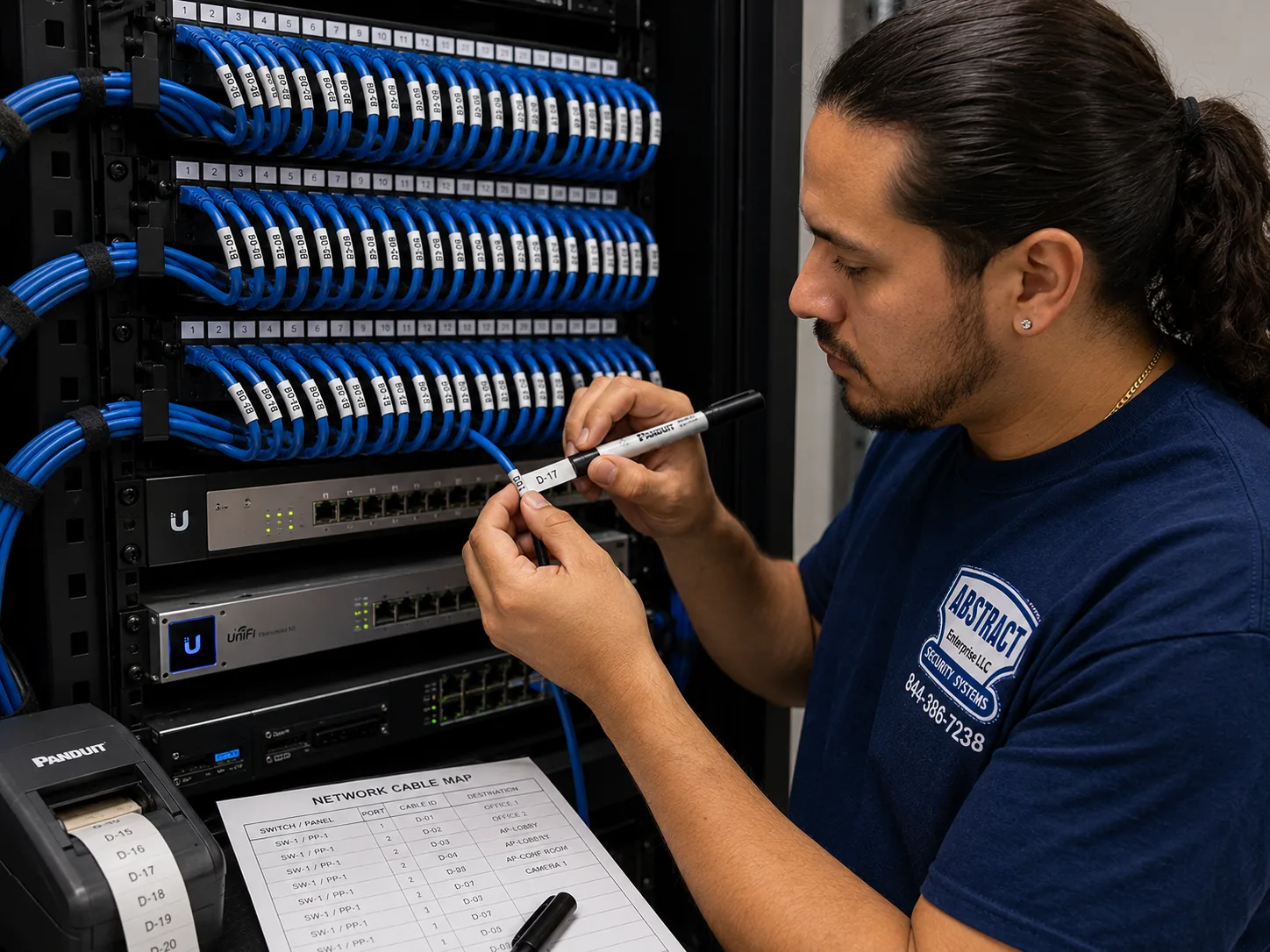
A photo from our job library, not taken in Columbia Street Waterfront: one of our technicians printing cable labels at a patch panel, with the printed port map taped beside him. It comes from our network work, and it shows a habit we carry into every TV job. In a converted factory loft on Tiffany Place or a rowhouse parlor on Kane Street, the HDMI, power and network cables behind a screen get labeled at the device end before we leave, so whoever touches the setup next knows which cable feeds what.
Columbia Street Waterfront TV Request
Rowhouse, loft, new mid-rise or Columbia Street business: tell us the block, the building and the TV size, and a technician calls back with the total
✅
Request Sent!
Thank you. A technician will call you about the Columbia Street Waterfront address on the same working day.
25+
Years Experience
✓
Same-Day Estimates
100%
Licensed & Insured
4.6★
390+ Google Reviews
Owner-operated since 2002 · Thousands of jobs completed · Booked within 2 hours
The short version for anyone west of the trench. A TV of 55 inches or less on drywall over wood studs is $179.99 in labor on our Brooklyn list. If the wall is plaster, which is common inside the older rowhouses, add $45. If it is brick or stone, which describes the exposed walls of the converted factories and the street and party walls of most rowhouses, add $65. Hiding power and cables inside a hollow wall with a code-compliant in-wall kit is $169; a paintable cord cover on the surface is $59. A soundbar set on the console is $79, and one fixed under the screen is $129. Taking down an old TV first is $85, and putting a TV on its own stand with no drilling at all is $119.99. A screen going above a fireplace adds $130. Larger screens, and wall materials that are not on this short list, are priced from the same full Brooklyn list and shown in your written quote before you book. Send a straight-on photo of the wall, the sticker on the back of the TV and your cross streets, and you will usually have the total on the same working day.
Photos and questions cost nothing. If the wall turns out to be a different material from the one we expected, the technician shows you why and tells you the difference before drilling any further.
All work is done under New York State license #12000287431, and we send the certificate of insurance a staffed condo, a managing agent or a building owner asks for before the visit.
Brackets are not included in the labor prices. We install your own bracket if it is rated for the TV's weight and size, or quote one with the job.
The Neighborhood
Why Columbia Street Waterfront Properties Need TV Installation
Columbia Street Waterfront became its own place by accident. Columbia Street itself was laid out in the 1830s, when South Brooklyn was pushing its street grid toward the harbor, and from the early 1800s to the 1880s, according to one neighborhood history, nearly everyone who lived here was Irish and worked on the piers. For more than a century these blocks were simply the western end of the same streets that ran up through what we now call Carroll Gardens and Cobble Hill. Then, in 1957, the newly built Brooklyn-Queens Expressway was cut through in a deep trench, and the strip of blocks between the highway and the water was left on its own. Wikipedia dates the neighborhood's separate identity to that moment. The Brooklyn Eagle's 2025 piece on the district's name recalls that some real estate agents tried calling it Cobble Hill West, and that others simply said "West of the Trench." Columbia Street Waterfront District is the name that stuck, and it is the one we use here.
What happened next shaped the walls you will be drilling into. In the 1970s, the Brooklyn Eagle's history of the district reports, a sewer project dug up Columbia Street and some buildings collapsed after their foundations were undermined. In the early 1980s the city declared the area a renewal district, tore down buildings that could not be saved and drew up a plan for new construction no higher than three stories. Cityneighborhoods.nyc credits the Columbia Street Regeneration Committee, formed by local families and the South Brooklyn Local Development Corporation, with winning the city and state money to rebuild block by block, and notes that new brick rowhouses went up on the footprints of the lost ones, designed to echo nineteenth-century proportions and materials. By 1984, Wikipedia says, the urban renewal project was finished, including a brand-new street whose houses sold out quickly. The same year brought the Waterfront Garden, and in 1998 the Columbia Street Esplanade opened above the piers. So a brick front on this side of the BQE might be 150 years old, or it might be about 40, and from the sidewalk the two can look almost the same.
The third layer is industrial. The Brooklyn Eagle's tour of the district describes a mix of classic brick rowhouses, low-rise factories, some of them converted to homes, and newer mid-rise apartment houses, and it notes that numerous industrial buildings on cobblestoned Tiffany Place have been turned into residences. The best known is 1 Tiffany Place, a five-story brick factory with a cellar that StreetEasy describes as a former Louis Comfort Tiffany warehouse, converted into 70 apartments with large factory windows, ceilings that listing records put at roughly nine to ten and a half feet, and heavy masonry walls. And the building has not stopped: New York YIMBY reported in July 2026 that construction was complete at 185 Columbia Street, a six-story, ten-unit building at the corner of Degraw Street. That puts mid-rise drywall construction a few doors from 1800s brick and a converted warehouse, all within a few minutes' walk.
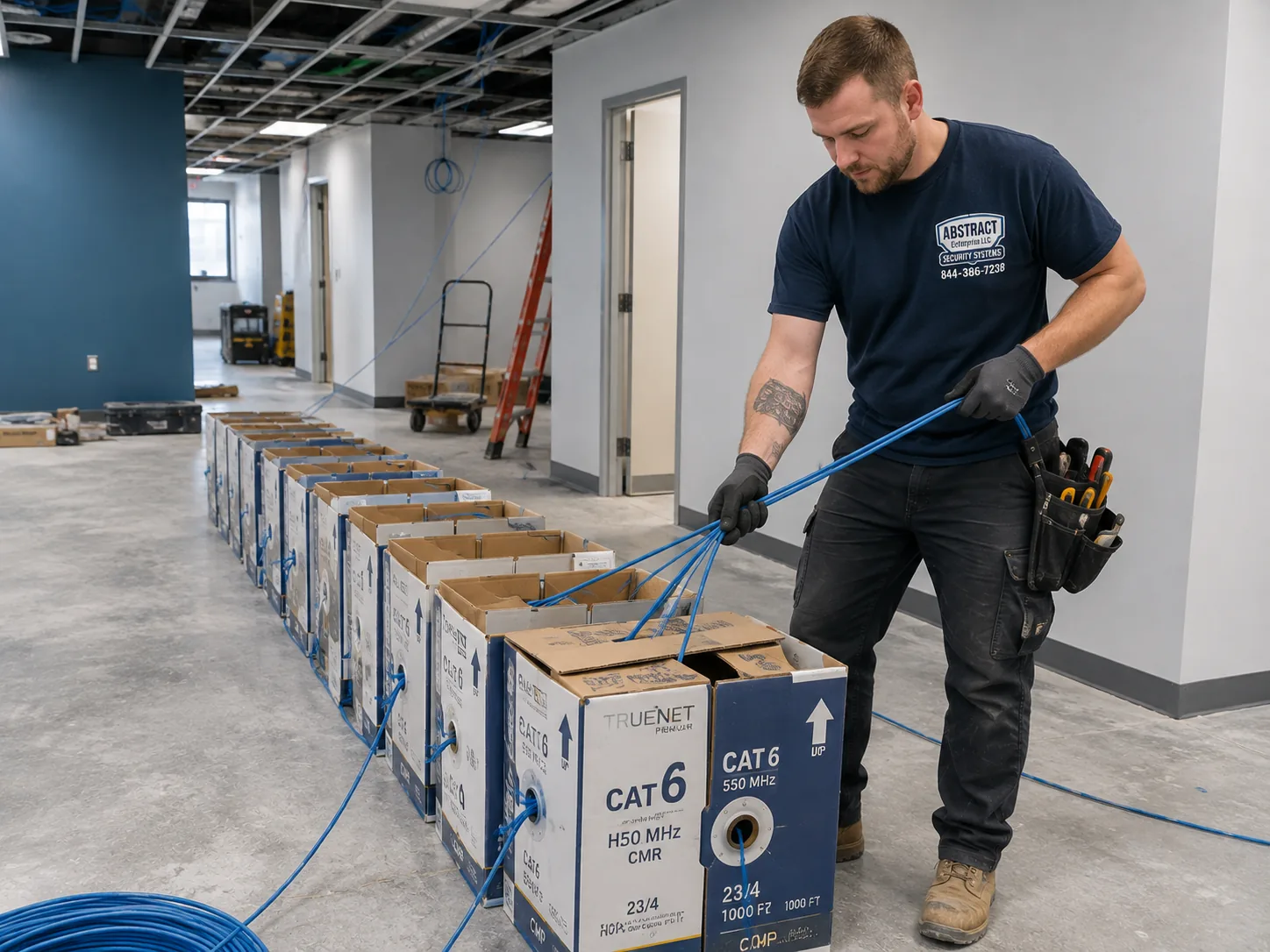
A photo from our job library, not taken in Columbia Street Waterfront: boxes of cable staged and marked for a multi-drop pull inside a business that stayed open while we worked. Staging matters here for a plain reason. The district has no subway station of its own, so our technicians drive in and carry everything from the van in one trip where they can, whether the job is a single screen in a three-story rowhouse on Warren Street or several displays in a restaurant on Columbia Street.
For a TV installer, those three layers mean three different kinds of wall, and the wrong assumption about which one you have is how screens end up crooked or loose. In an older rowhouse, interior partitions are typically plaster, often on wood lath, while the front, rear and party walls are usually masonry. In a renewal-era rowhouse from the 1980s, we expect the interior walls to be more modern, though we never assume it, because owners in forty years have renovated, re-plastered and added layers. In a converted factory, the long walls are frequently solid brick, sometimes exposed and sometimes hidden behind a newer finish, and they hold a TV extremely well once the anchor is in the brick and not in the mortar. In a new mid-rise, we expect drywall, and the question becomes whether it sits on wood or steel framing and whether the building lets you open it. Our job is to find out which wall you actually have before anything gets drilled, and to price that wall honestly.
The people who live here shape the work too. DecodeNYC counts 4,409 residents in the district, with a median age of 40 and an average individual income of $104,616. Openigloo lists more than 191 buildings. That is a small neighborhood, and a mixed one: owners in rowhouses who have lived here for decades, renters in the multi-family townhouses Corcoran describes along President and Carroll Streets, condo owners in the lofts, and new arrivals in the newest buildings. Each group brings a different question to a TV job. Owners want to know whether the cables can disappear for good. Renters want to know what they will have to patch when they move. Condo owners want to know what the front desk and the board will ask for. Businesses on Columbia Street want to know how fast they can be up and running before a busy night.
There is also the matter of getting here. Terra CRG and New York YIMBY both note that the district has no subway stations; YIMBY puts the nearest stop for 185 Columbia at the F and G trains at Bergen Street. The BQE runs along the eastern edge in its trench, with only a few streets crossing it, and Columbia Street is the main route north to Atlantic Avenue and south toward Red Hook. Looking ahead, the Brooklyn Eagle reported that a task force voted 17 to 8 to approve a $3.5 billion plan for the Brooklyn Marine Terminal, with 6,000 new housing units and 28 acres of open space, and Streetsblog reported that the city's Economic Development Corporation hoped for approval in late 2026, with construction rolling out in phases until 2038 and bus-only paths floated for bottlenecks such as Columbia Street. None of that changes how a TV is mounted. It does change how we plan parking, when we book the visit and how much we carry from the van, and it will matter more each year as the project moves forward.
Six Columbia Street Waterfront facts we check before choosing a bracket
Two centuries of brick share the same blocks. Rowhouses from the 1800s sit next to brick rowhouses rebuilt on the same footprints in the early 1980s. Same look outside, often different walls inside, so we confirm every wall on site.
Converted factories mean masonry. 1 Tiffany Place is a five-story brick factory with 70 apartments and heavy masonry walls. Brick and stone walls are a +$65 add-on on our list, and they usually rule out cables inside the wall.
Some buildings have staff. Listings describe 1 Tiffany Place as having a 24-hour doorman, a live-in superintendent and a full-time porter. In a staffed building we schedule with the desk and send insurance paperwork ahead of time.
New construction is still arriving. 185 Columbia Street, six stories and ten units at Degraw Street, was reported complete in July 2026. Newer drywall is where an in-wall power and cable kit, $169, is most often possible.
No subway inside the district. The nearest trains are the F and G at Bergen Street. Our crews drive, so parking on Columbia Street and the side streets decides how the TV gets from the van to your door.
Part of the district sits in a hurricane evacuation zone. StreetEasy lists 1 Tiffany Place in Hurricane Evacuation Zone 4. For cellar media rooms we keep power strips and devices off the floor rather than on it.
Where this page applies. It covers the blocks between the BQE and the harbor from Atlantic Avenue south to where Columbia Street meets Red Hook: Pacific, Amity, Congress, Warren, Baltic, Kane, Degraw, Sackett, Union, President, Carroll, Summit and the short stretch of Van Brunt Street that falls inside the district, along with Tiffany Place and the streets that run down to the piers. East of the trench, our Cobble Hill TV installation and Carroll Gardens TV installation pages cover the same streets after they cross the highway, our Brooklyn Heights page picks up north of Atlantic Avenue, and our Brooklyn TV installation page covers the whole borough. The rate is the same Brooklyn list on every side of those lines.
Same-Day Repair in Columbia Street Waterfront
Need Repair in Columbia Street Waterfront? Sagging Mounts, Anchors Loose in Old Mortar, and Cable Left Hanging by the Last Occupant
Urgent calls from buildings like these tend to look alike. The most common is a TV that has dropped on one side or started to tilt away from the wall at the top. On a brick wall, that usually means the bracket was fixed into the mortar joints rather than into the brick. Mortar is softer, especially in walls that are a century or more old, and a sleeve anchor set into it can slowly crush the material around it, especially when a full-motion arm is pulled out and pushed back every evening. On plaster, the usual culprit is an anchor made for drywall, which grips only the outer skin of plaster and nothing behind it. The second kind of call is a mount that was never level in the first place because whoever hung it trusted an old floor or ceiling line that has settled over the decades. The third is a wall full of leftovers: a bracket from a previous tenant, a hole with a cable poking out of it, a power strip stuck behind where the old screen hung.
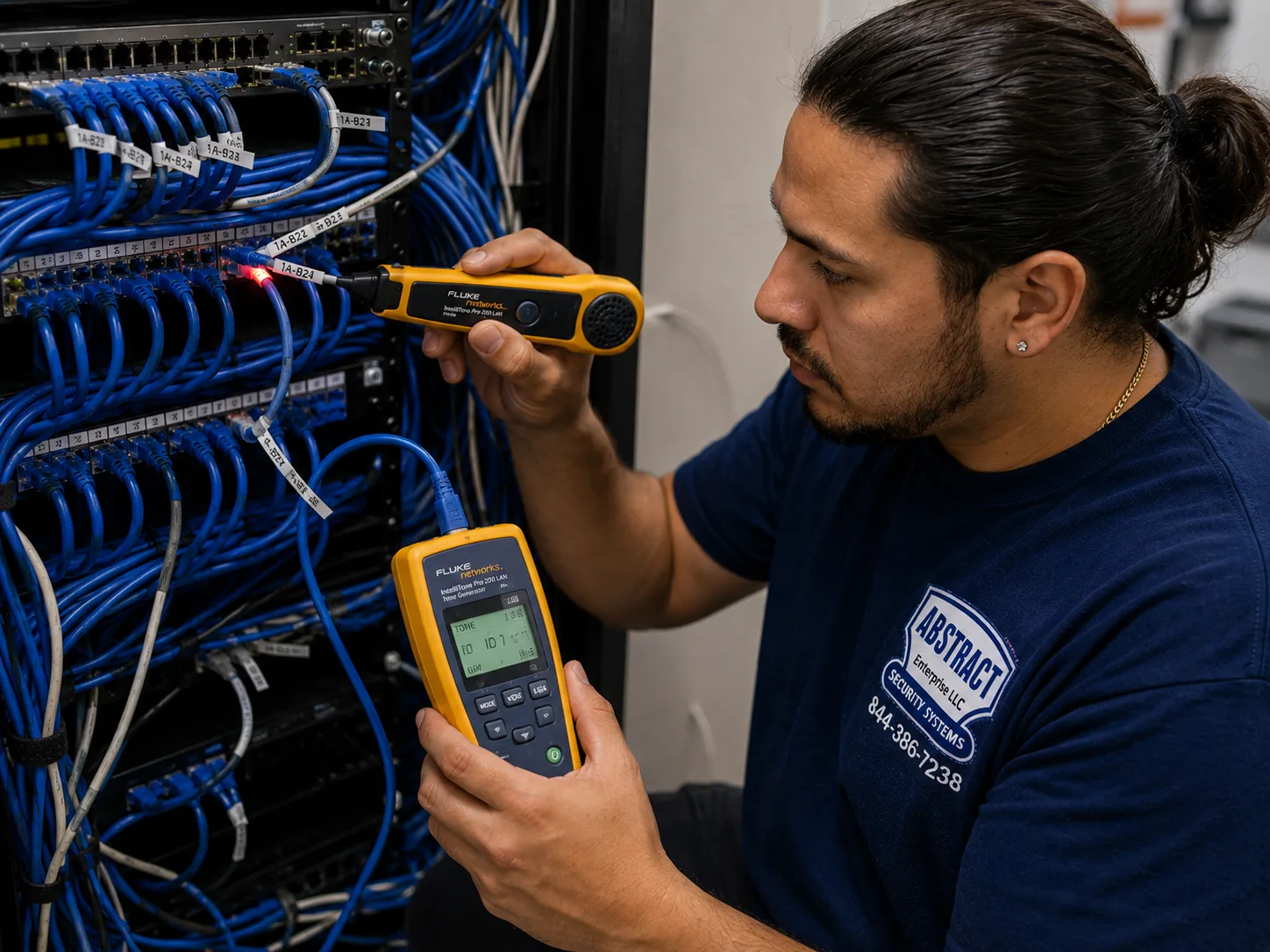
A photo from our job library, not taken in Columbia Street Waterfront: a technician tracing an unidentified cable at a patch panel with a tone generator and probe. When we take over a TV wall someone else wired, in a rowhouse that has had several owners or a loft that has had several tenants, we use the same kind of tracing to find out where a mystery cable coming out of the wall actually goes before we cut, reuse or remove it.
If a screen is tilting, do not push it back into place and hope. If two people can lift it safely, take the TV off the bracket, unplug it and set it face-up on a blanket, then call (347) 934-8335. Taking down an old TV is $85 on our Brooklyn list. When the same TV goes back up in the same visit, the new mount is priced by the wall it goes on: $179.99 base, plus $45 for plaster or $65 for brick or stone. On brick, we move the fixings into sound brick away from the old holes; on plaster, we reach the framing behind it or use anchors rated for the load. If we find that the problem is the wall itself, such as plaster that has separated from its lath or brick that has gone soft and crumbly, we say so plainly, and the owner or a mason can decide what to do about it before any screen goes back on it.
Leftover cables get the same honest treatment. If what comes out of the wall is a TV's own power cord pushed through the cavity, it is coming out, because the National Electrical Code does not allow flexible cords to be concealed inside walls. On a hollow wall, an in-wall power and cable kit at $169 replaces it properly. On a brick wall, a paintable cord cover at $59 runs the cables neatly on the surface instead. Either way, you end up with a wall that is safe to leave alone.
What We Install
TV Installation Services in Columbia Street Waterfront
These are the jobs we are asked for most on this side of the BQE. The wall material sets one add-on, the screen size sets another, and the way you want the cables handled decides the rest. Every price is from the Brooklyn list.
Mounting on exposed brick
Brackets fixed into the solid brick of converted factory lofts and rowhouse party walls, with the anchors placed in the brick faces and never in the mortar. Brick or stone adds $65 to the $179.99 base.
Mounting on old plaster
Fixings that pass through the plaster of 1800s rowhouse partitions to reach the framing behind, or anchors rated for hollow plaster where a stud is out of reach. Plaster adds $45.
Mounting in new mid-rises
Screens on drywall in buildings like the new six-story building at Columbia and Degraw, with fasteners matched to the framing and an in-wall kit where the building allows the wall to be opened.
Cables hidden the legal way
An in-wall power and cable kit ($169) on hollow walls, a paintable cord cover ($59) on brick, or a clean drop into the console directly below the screen.
Soundbars and setup
Soundbars placed on the console ($79) or fixed under the screen ($129), plus a setup-only visit at $195 for the first hour and then 30-minute blocks for streaming devices, apps and inputs.
Swaps, stands and business screens
Old TVs taken down ($85) before the new one goes up, TVs placed on their stands ($119.99) with no drilling, and screens for the restaurants, bars and offices along Columbia Street.
Building Specialists
TV Installation for Columbia Street Waterfront's Architecture
Nearly every call from the district comes from one of six kinds of building. They differ in three ways that matter more than the brand of TV: what the walls are made of, how the screen gets from the street into the room, and who else gets a say in what is drilled.
The 1800s brick rowhouse
Attached brick houses on Summit, Warren and Kane Streets, some with the lacy black iron porticoes the Brooklyn Eagle describes on Summit. Plaster inside, masonry outside.
The multi-family townhouse
The side-street houses along President and Carroll Streets that Corcoran calls multi-family townhouses, often an owner on one floor and renters above or below.
The renewal-era rowhouse
Brick houses built in the early 1980s on the footprints of buildings lost to collapse, designed to look older than they are, with newer interiors behind traditional fronts.
The converted factory loft
Industrial buildings on and around Tiffany Place, led by 1 Tiffany Place: big windows, high ceilings, heavy brick walls and, in that building, a staffed front desk.
The new mid-rise
Recent buildings like the six-story, ten-unit 185 Columbia Street at Degraw, finished in 2026, where drywall partitions make hidden cables more likely to be possible.
The mixed-use building on Columbia Street
Restaurants, bars and shops at street level with rooms or apartments above, where a landlord, a business owner and sometimes tenants all care about the same wall.
The 1800s brick rowhouse: plaster on the inside walls, masonry on the outside ones
The oldest houses in the district are the attached brick rowhouses you see along Warren Street between Hicks and Columbia, which Forgotten New York describes as the same kind of brick attached buildings found east of the BQE, and on Summit and Kane Streets. Kane Street, Forgotten New York notes, was called Harrison Street until 1928, so some of these houses have been on the block under two street names. Inside, the typical layout puts the living room at the front or on the parlor floor, with the stair along one side wall. That gives you three likely TV walls, and each one is different. The party wall, shared with the next house, is usually solid masonry under its plaster. The stair-side partition is usually framed, with plaster on wood lath. And the front wall, facing the street, is masonry broken up by tall windows.
Plaster on lath is strong when you push on it and weak when you pull on it, which is exactly what a TV bracket does. A plastic plug in the plaster alone, or a screw into the lath alone, can feel solid on the day and then loosen over months. The fixings that last pass through the plaster and lath into the wood framing behind it, with the pilot hole drilled slowly so the plaster does not crack out around it. Framing in houses this old is rarely on modern spacing, so we locate each member rather than measuring from the corner. That wall is +$45 on our list. On the party wall, the plaster is a skin over brick, so the fixing goes through the plaster and into the brick, and the wall is priced at the brick rate of +$65. The pilot hole, hidden where the bracket plate will cover it, tells us which one you have: white plaster dust followed by wood means lath and framing; white dust followed by red or orange grit means brick.
Rowhouses here bring two other considerations. Many still have decorative mantels on the parlor floor. A TV above a fireplace adds $130 on our list, because the chimney breast is masonry, the screen ends up higher than ideal, and the work around the mantel is slower. And these houses have usually been rewired at least once, which means surface conduit, newer outlets in odd places and old runs abandoned in the walls. We scan for metal and look at where every outlet and switch sits before choosing a fixing point, and we never drill directly above or below an outlet box.
The multi-family townhouse: one wall, several households
Corcoran describes the side streets such as President and Carroll as feeling like continuations of the same streets on the other side of the highway, lined with multi-family townhouses. These are the houses where the TV question involves more than one person. An upstairs renter may want the TV on the wall that backs onto the owner's stair. A downstairs owner may want to know exactly how many holes the tenant's installer is about to drill. And in a house with apartments on each floor, a TV fixed to a floor-to-floor wall may share structure with a bedroom below or above.
The practical answers are simple. Before the visit, tell the owner or the tenant which wall, how large the TV is and whether the cables will go inside the wall or in a cover on the surface. A typical bracket leaves four to six pencil-width holes, all hidden while the TV is up. A cord cover adds a few small screw holes. An in-wall kit adds two neat openings, one behind the screen and one near the floor. If the owner wants a certificate of insurance naming them, we send it before the visit. If you own the house and want each apartment to have a TV wall that tenants use instead of drilling their own, mounting one bracket per unit on a wall you chose, with the cables handled properly, saves years of patching later.
The renewal-era rowhouse: a newer house wearing an older face
The houses rebuilt in the early 1980s are easy to mistake for originals. Cityneighborhoods.nyc says they were designed to echo nineteenth-century proportions and materials, and the city plan of the time, as the Brooklyn Eagle reports, kept new buildings to three stories so they would sit comfortably beside the survivors. Inside, though, they were built with the methods of their own time. We expect interior partitions in these houses to be more modern than lath and plaster, often drywall on framing, while the front and party walls are still masonry. That expectation is not a promise, because forty years of renovation can change any wall, so we confirm it the same way as everywhere else, with a scan and a hidden pilot hole.
When a renewal-era interior wall does turn out to be drywall on wood studs, you are looking at our base price of $179.99 for a screen up to 55 inches, and an in-wall power and cable kit at $169 is usually possible, because the cavity between the studs is open from top to bottom. That makes these houses one of the easier places in the district to get the clean, wire-free look many people want. The one thing to watch is insulation and fire-blocking inside exterior-facing cavities, which can stop a cable from dropping straight down; if we hit one, we tell you and either move the kit to the next bay or switch to a cord cover on that section.
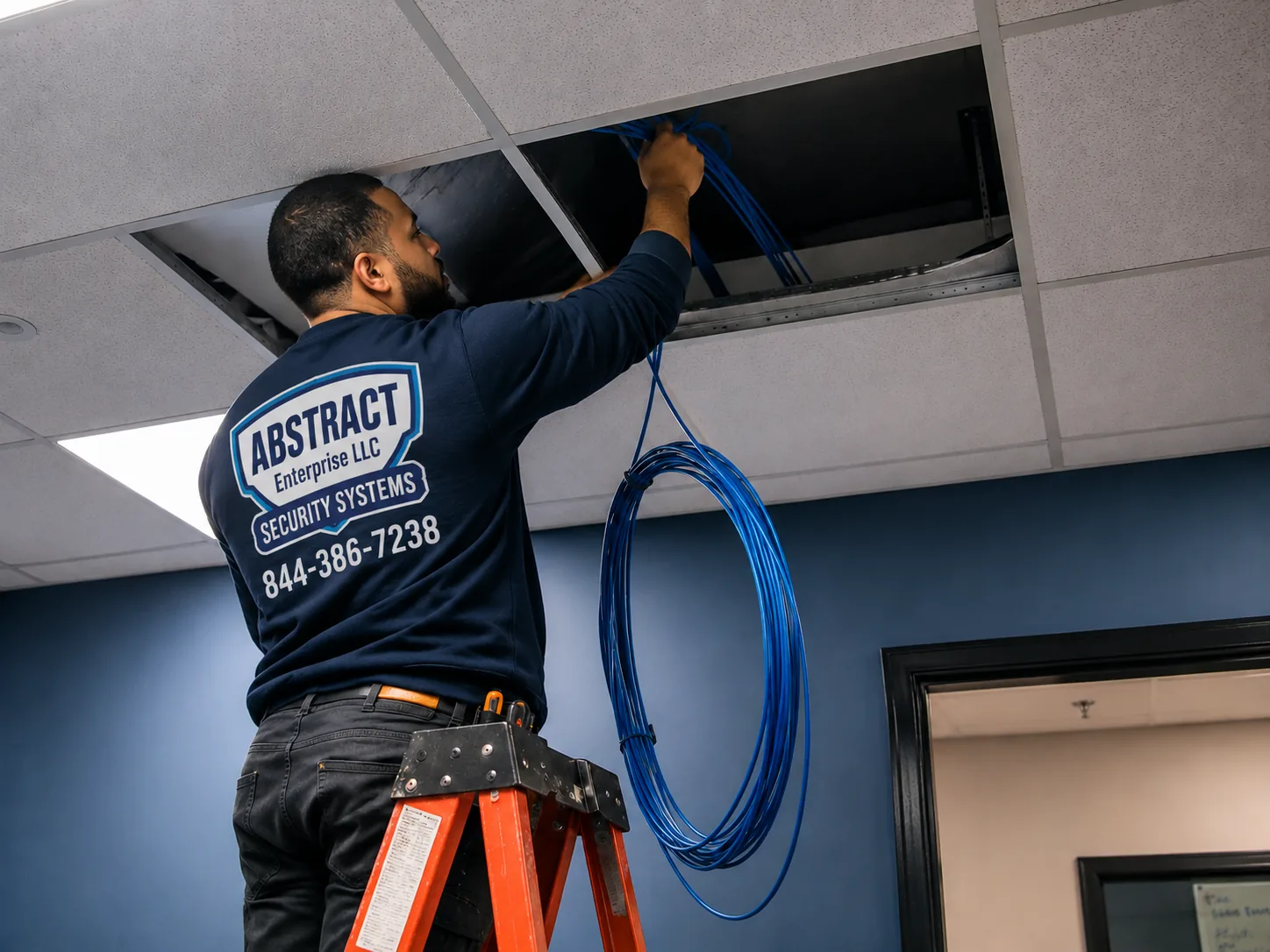
A photo from our job library, not taken in Columbia Street Waterfront: a technician on a ladder feeding cable through a ceiling opening in a commercial space that stayed open around him. Ceiling routes come up in the district's converted factories, where the brick walls cannot be opened and the only way to get a cable from one side of a loft to the other without crossing the floor is to go up and across.
The converted factory loft: brick that holds anything, and nothing hidden inside it
The factory conversions are the most distinctive homes in the district. The Roebling Team describes 1 Tiffany Place as a five-story brick factory with a cellar, converted into 70 apartments on floors one through five, keeping the industrial shell: big factory windows, loft ceilings and heavy masonry walls. Compass listings mention units with enormous windows, sky and water views, soaring ceilings and decorative fireplaces. The Brooklyn Eagle notes that numerous industrial buildings on Tiffany Place have been converted to homes. For a TV, all of that adds up to a wall that is superb for holding weight and impossible to run cables through.
Old factory brick is usually several bricks thick and very solid, and a bracket fixed with properly sized anchors placed in the brick faces will carry a large screen for decades. The work is in the placement. Many converted walls have recessed or crumbly mortar, cleaned or sandblasted brick faces, and bricks that are not all the same hardness, so we look for sound bricks across the full width of the bracket plate and spread the load across every fixing point. Brick is +$65 on our list. Because nothing can be fished through solid masonry, the cable plan is decided before the bracket goes up: either the TV sits directly above a console so the cables drop straight behind the furniture, or a paintable cord cover at $59 runs from the screen down to the outlet. On exposed brick, a cover painted the color of the mortar, or a dark cover tucked against a window frame or column, disappears far better than most people expect.
Lofts also bring light and height into the conversation. Those big windows put the water and the sky in the room, and they also put reflections on a glossy screen for part of the day. Ceilings around ten feet invite people to mount high, which is fine above a decorative fireplace with a tilting bracket and uncomfortable over a sofa. We tape the outline of the screen on the brick, check it from where you sit at the time of day you usually watch, and adjust before any hole goes in. If your unit has a decorative fireplace and you want the TV over it, the above-fireplace add-on is $130, and the brick add-on applies to the chimney breast as well, with both lines shown in your quote.
The new mid-rise: drywall, a developer and a building with rules
New York YIMBY's report on 185 Columbia Street, six stories and ten units at the corner of Degraw, is a good picture of what newer construction in the district looks like. In buildings of this age, interior partitions are drywall, and the main questions are what kind of framing sits behind it and what the building will let you do to it. Drywall on wood studs is our $179.99 base. Light-gauge steel studs, which look the same from the room side, need different fasteners because a wood screw strips out of thin steel; that wall type is priced from the full Brooklyn list, and we confirm it with the scanner and the pilot hole before quoting it as final.
The appeal of a new building is that an in-wall power and cable kit is usually possible. The kit puts a recessed power inlet near the floor that plugs into your existing outlet, carries power inside the wall in the kit's own rated cable, and gives you a recessed outlet behind the screen with a pass-through for HDMI and other low-voltage cables. On our list it is $169 including the kit. The catch is permission. A condo board or management company may want to know which wall is being opened, whether it is a fire-rated wall shared with a corridor or a neighbor, and who is doing the work. We tell you which wall the kit will go into, send our certificate of insurance, and if the building says no to openings, a paintable cord cover at $59 does the job without cutting anything.
The mixed-use building on Columbia Street: business below, homes above
Columbia Street is the district's spine, and many of its buildings put a restaurant, bar or shop at street level with rooms or apartments over it. Your Brooklyn Guide describes Alma at 187 Columbia Street as three floors of restaurant, bar, sidewalk cantina and rooftop, which shows how a single business can spread across a building vertically. In buildings like these, a TV wall in the dining room may back onto a stair, a kitchen exhaust run or the tenant entrance, and the ceiling above may be someone's floor. We look at what is on the other side of every wall we drill, keep hammer drilling to hours the people above have agreed to, and plan the cable route so it never crosses a walkway or a kitchen path.
A business owner here is also usually a tenant, which means the landlord decides what gets fixed to the walls. Before a commercial job we confirm in writing who approved the work, when the room can be used without customers in it, and who should be named on the certificate of insurance. Commercial screens are priced on the same list as homes, by the wall, the screen and the extras, and the next section covers how we plan them.
Field Notes
Field Notes: What Our Technicians Look For on a Brick Wall West of the BQE
These notes describe our standard practice on masonry and old plaster, the two materials that dominate this district. They are how we work, not a story about any one address.
Read the mortar before the brick. On exposed brick, the technician runs a thumbnail or a screwdriver tip along a few joints at screen height. Mortar that powders easily tells us to place every anchor in the brick faces and to use the full set of fixing points on the bracket, not just the top pair. Hard, flush mortar is a good sign but changes nothing about where the anchors go.
Tap the bricks. A firm tap with the handle of a tool along the row tells good brick from bad. A clear, solid sound means a sound brick; a dull, papery one can mean a brick that has gone soft or cracked inside. We avoid those for fixing points even if it moves the bracket an inch.
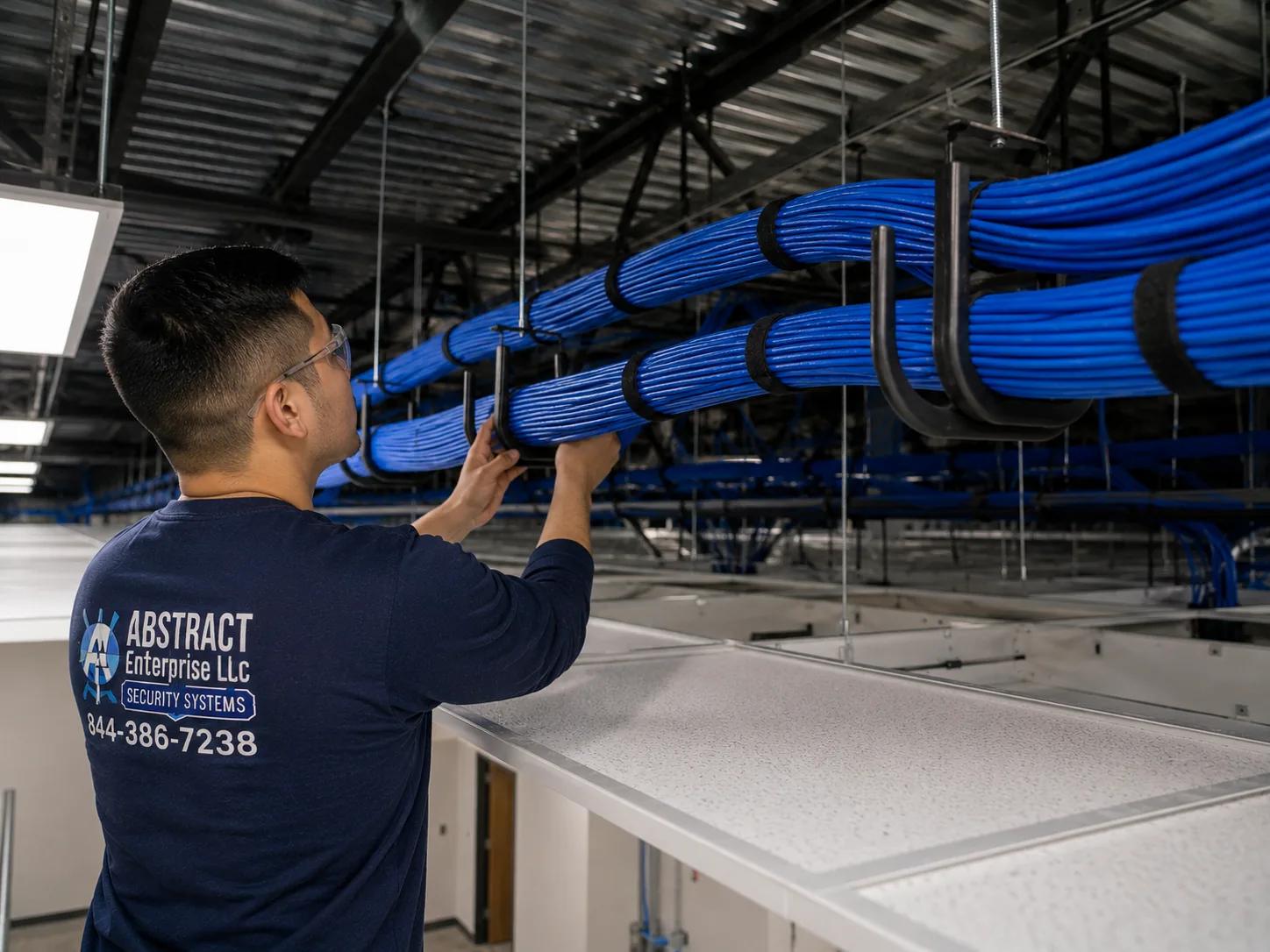
A photo from our job library, not taken in Columbia Street Waterfront: J-hooks carrying neatly dressed bundles of cable across a commercial ceiling. In a business on Columbia Street with an open or exposed ceiling, this is the kind of tidy, supported pathway we use when screens on different walls need to reach one cabinet, instead of cable laid loose across beams.
Check the wall is flat where the plate goes. Old brick is rarely flat. A level held against the wall shows whether the bracket plate will rock. If it will, we choose fixing points that pull the plate tight without bending it, and we level the TV itself rather than the bracket.
One hidden pilot hole on plaster. On a plastered wall, one small hole where the plate will cover it tells us whether we are in lath and framing, a void or masonry. If the answer changes the add-on from the quote, you hear it before anything else is drilled.
Look out the window, then at the screen. In a loft with tall windows, the technician checks the taped outline for reflections from where you sit, because glare from a harbor-facing window can matter as much as height.
Clean as the dust falls. Brick dust is fine and red and travels far. A vacuum held under the bit and a blanket below the wall keep it off the floor and the furniture.
Wall by Wall
Brick, Plaster, Stone or Drywall: How Each Columbia Street Waterfront Wall Holds a TV and What It Adds
Our base price of $179.99 is for a TV up to 55 inches on a flat or tilting bracket on drywall over wood studs, labor only. That wall exists in the district, mostly in new buildings and renovated interiors, but much of what we drill here is masonry or old plaster. Each add-on below exists because the wall takes different tools, different anchors and more time.
Exposed or hidden brick (+$65). This is the wall of the factory lofts and the street, rear and party walls of the rowhouses. We drill with a hammer drill and masonry bits, and fix the bracket with anchors sized for the load and set into the brick, never into the mortar joints. Each hole stays a safe distance from the edge of its brick so the face does not split. On very old or soft brick we use more fixing points at a lower load each. If the brick is plastered over, the plaster is drilled through first with a slower bit to avoid blowing it out around the hole, and the wall is still priced as brick because that is what holds the TV.
Stone (+$65). Stone appears in a few places, such as the facing of a fireplace surround or a feature wall. It takes the same add-on as brick on our list. Stone is less predictable than brick, with voids behind veneer and harder pieces that resist the bit, so we check the backing behind any stone facing before trusting it with a screen.
Plaster on lath (+$45). The interior partitions of the older rowhouses are commonly plaster on wood lath, sometimes close to an inch thick. The fixing that lasts goes through the plaster and the lath into the framing. Where the bracket cannot reach framing at the spacing it needs, we use anchors rated for hollow plaster, never small drywall plugs.
Drywall on wood studs (base price). Common in the newest buildings and in renovated rooms. Lag bolts into the centers of two studs, with an in-wall kit possible in the cavity beside them.
Other walls. Drywall over steel studs, poured concrete, concrete block and tile each take their own fasteners and tools. They are priced from our full Brooklyn list, which is longer than the short list on this page, and the price appears in your written quote before you book. Concrete is most likely in buildings just outside the district, such as the reinforced concrete loft at 160 Imlay Street on the Red Hook side, which listings describe with exposed concrete ceilings; inside the district, brick is the masonry we meet most.
Above a fireplace (+$130). Decorative mantels in rowhouse parlors and in some loft units sit on chimney breasts of brick or stone. The fireplace add-on covers the extra care around the mantel and the higher placement, and the masonry add-on covers the drilling itself.
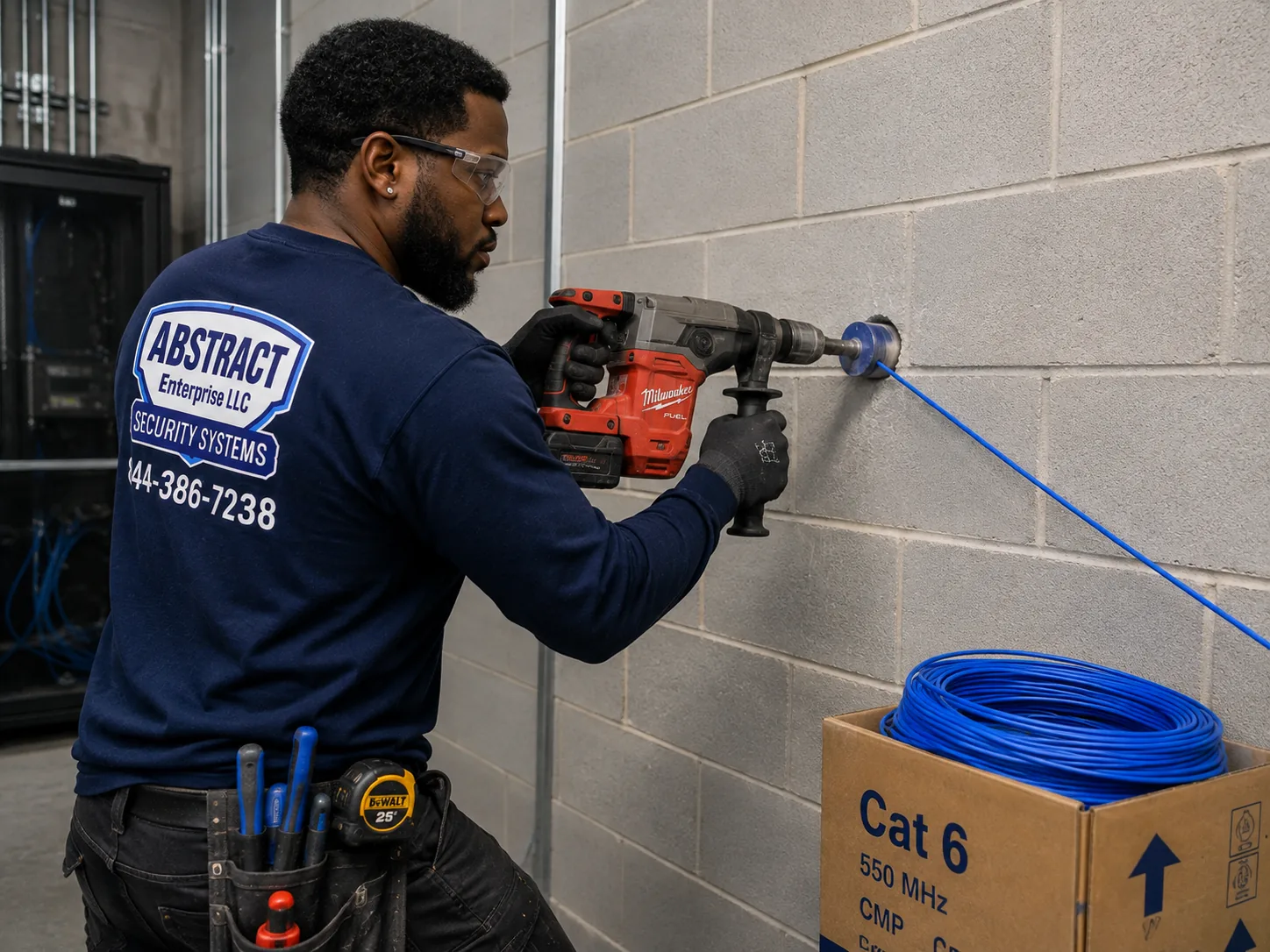
A photo from our job library, not taken in Columbia Street Waterfront: a technician core drilling through a block wall to carry cable into a network room. It is a bigger hole than any TV bracket needs, but the same rule applies to the brick walls of a Tiffany Place loft or a Warren Street rowhouse: the right bit, a steady drill, dust control, and knowing what is behind the wall before the bit goes through.
Where cables can hide, and where they cannot
Almost everyone who calls asks for the wires to disappear. Whether they can disappear inside the wall depends entirely on the wall. The rule we work to is simple: the National Electrical Code does not allow flexible cords, including the power cord that comes with your TV, to be concealed inside walls, floors or ceilings. A cord pushed into one hole and pulled out of another is easy to do, and it is the wrong way to do it, because the cord is not rated for that use, can be crushed or overheated inside the cavity, and cannot be inspected.
On a hollow wall, meaning drywall or plaster on framing, the right answer is an in-wall power and cable kit, $169 on our list including the kit. It carries power inside the wall in its own rated cable between a recessed inlet near the floor and a recessed outlet behind the screen, and it gives HDMI and network cables their own path. Because it needs an open cavity between the two openings, it suits renewal-era and new interiors and the framed partitions of older rowhouses, and it does not suit brick, stone or concrete.
On brick and stone, which covers most loft walls and the outer walls of rowhouses, nothing can be fished inside. The honest options are a paintable cord cover at $59, which runs on the surface from the screen to the outlet and can be painted to match plaster or mortar, or positioning the TV directly over a console or cabinet so the cables drop out of sight behind it. Where the outlet is right below the screen, the cover may be only a foot or two long. Where it is across the room, we talk about moving the TV closer to the outlet before we talk about a long cover.
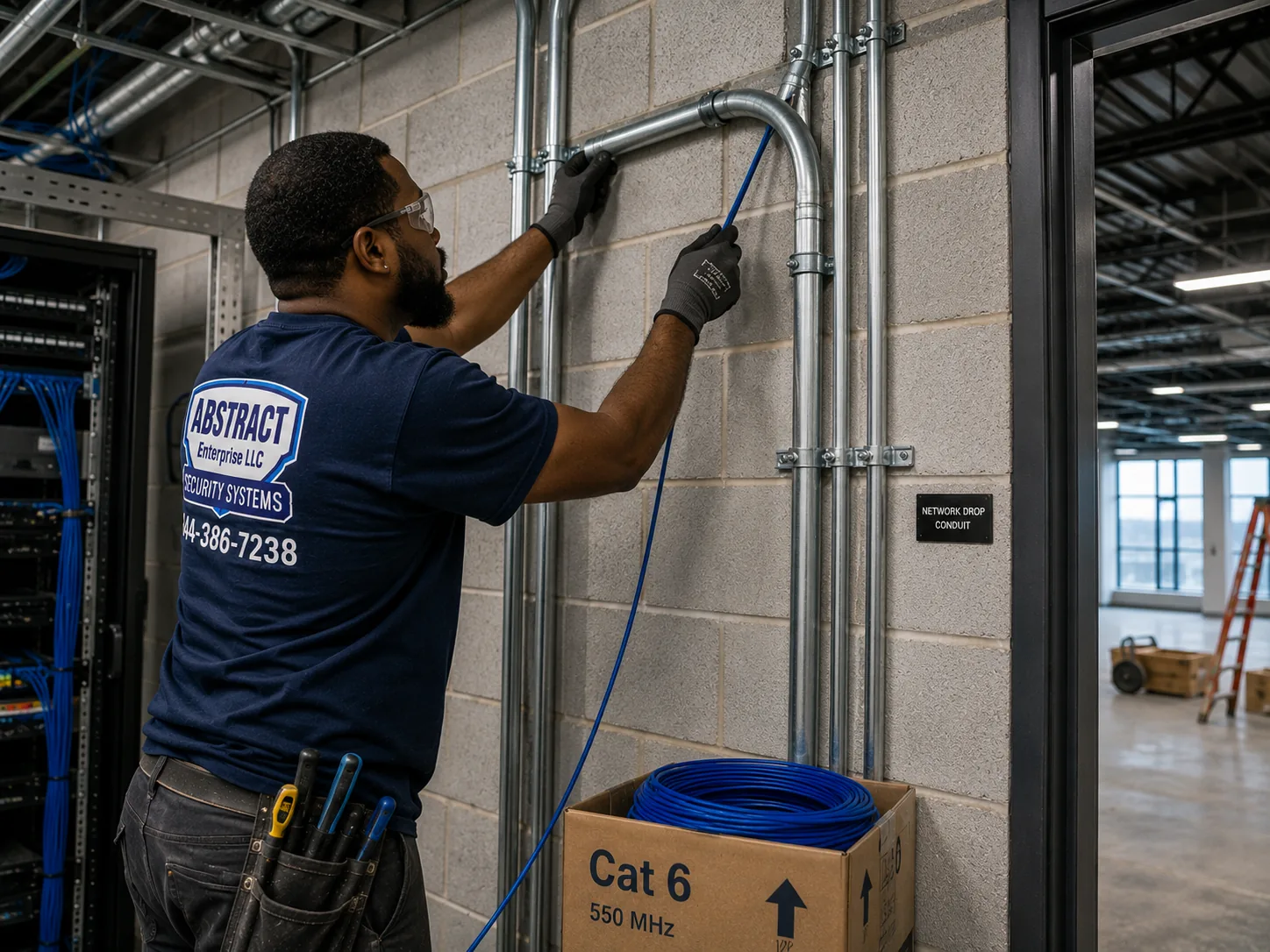
A photo from our job library, not taken in Columbia Street Waterfront: a technician feeding cable into EMT conduit beside a telecom room in an industrial building. Converted factories like the ones on Tiffany Place often carry their building wiring in surface conduit on the brick, which is exactly what we look for before choosing a fixing point for a TV bracket; we never drill into or right beside a conduit run.
One more thing to know about masonry walls in converted buildings: they often carry building services on their surface, in conduit, pipe or raceway, and sometimes behind a furred-out wall that looks like plaster. We trace what we can see, scan for what we cannot, and keep every fixing well clear of anything that looks like it carries power, water or gas.
Owners, Renters and Boards
Whose Wall Is It? TV Mounting When a Landlord, Board or Front Desk Is Involved
In a neighborhood that mixes owner-occupied rowhouses, rented apartments in multi-family townhouses, condo lofts and new rental buildings, the question of permission comes up on a large share of jobs. We are installers, not lawyers, and nothing here is legal advice. These are the practical points that make a TV job go smoothly when someone else has an interest in the wall.
Renters: ask in writing first. One NYC mounting company's rental guide puts it plainly: the safest approach is written permission from your landlord before mounting. A short message saying which wall, how big the TV is, how many holes the bracket needs and whether the cables will be in a surface cover or an in-wall kit is usually enough, and having the answer in writing protects your deposit when you move out. Tell the landlord the installer is licensed and insured, and offer to have the certificate of insurance made out in their name.
Renters: plan for the move-out. A bracket leaves a handful of pencil-width holes, a cord cover leaves a few small screw holes and an in-wall kit leaves two openings that need patching. On plaster and drywall, all of it can be filled, sanded and painted. On exposed brick, holes are harder to hide, so if you rent a loft and expect to leave within a year or two, consider whether a TV on its own stand ($119.99) with a soundbar placed on the console ($79) gets you most of what you want without any marks at all.
Condo owners in staffed buildings. Listings describe 1 Tiffany Place as having a 24-hour doorman, a live-in superintendent and a full-time porter. Buildings with staff usually want to know who is coming, when, and with what insurance, and they may want the elevator reserved or padded for deliveries. We send the certificate of insurance ahead, tell the desk the name of the technician and the time window, and ask you about any contractor rules your board has set. If the board's rules treat opening walls differently from hanging a bracket, we plan the cables around that.
Owners of multi-family houses. If you own a house on President or Carroll Street and rent out one or more units, you have the most control of anyone. One bracket per apartment, on a wall you choose, with the cables in a cover or kit, means each new tenant uses the existing mount instead of drilling their own. A line in the lease saying so saves arguments later.
Buyers of new apartments. In a brand-new building, the developer may still be finishing work, and the condo's rules may not be fully in force yet. Ask the sales or management office what is allowed before opening any wall, and keep the reply. If in doubt, a cord cover is the reversible choice.
Commercial TV Installation
Business TV Installation in Columbia Street Waterfront
The district's businesses cluster along a few lines. Columbia Street carries most of them, from Atlantic Avenue at the northern edge down toward Red Hook. Your Brooklyn Guide lists the Jalopy Theatre at 315 Columbia Street and Alma at 187 Columbia Street, and Apartments.com's local guide mentions Ferdinando's Focacceria Restaurant, which it calls a 100-year-old favorite. 6sqft dates the neighborhood's arrival as a food destination to the 2012 opening of Pok Pok at 127 Columbia Street. The short stretch of Van Brunt Street inside the district and the converted industrial buildings of Tiffany Place add workshops, offices and studios, and the piers and the Brooklyn Marine Terminal sit along the water. We name these places to describe the area, not as customers; the cards below are the kinds of space where a business needs a screen.
Restaurants and bars
Sports screens in a dining room, a menu screen near the counter, and screens spread over more than one floor, usually on brick and installed before opening or after closing.
Performance and event rooms
A screen that the back of a small room can read for slides, lyrics or a live feed, set high enough to clear heads and kept out of the path performers and staff use.
Studios and workshops
Displays in converted industrial space for design review, video calls or production work, often on masonry walls with cables run in surface covers.
Offices and meeting rooms
A meeting-room screen with a soundbar under it and a cable path to the table, in the commercial floors of mixed-use and converted buildings.
Lobbies of staffed buildings
A notice or welcome screen in a condo lobby, where the board controls the wall, the desk controls the schedule and the finish has to be tidy.
Community and nonprofit spaces
Screens in meeting rooms and program spaces used for presentations and screenings, secured against bumps and positioned for a seated group.
Two things set business jobs here apart. The first is the walls: many of the street-level spaces on Columbia Street are in older brick buildings, so the brick add-on of $65 applies to most commercial screens, and cables usually run in paintable cord covers ($59) or straight down into a cabinet, because brick cannot hide them. The second is time. A restaurant or bar wants the work done when the room is empty, and the people living upstairs want the hammer drill quiet when they are asleep. Those two schedules overlap less than you might think, so we agree the hours in advance with the owner and the landlord, and we do all the hammer drilling in one short window.
Multi-screen jobs need a plan before anyone climbs a ladder. Where should each screen face so it can be seen from the bar, the tables and the door? Where does the source equipment live, and how do the cables reach each screen without crossing a walkway or running through a kitchen? Is there an existing closet or cabinet that can hold the devices, with ventilation and power? We walk the room with you, mark each screen with tape, and price each mount on the list by its wall. Signal distribution between screens, and cable runs across ceilings or between floors, are quoted after a look at the space, because they depend on the building.
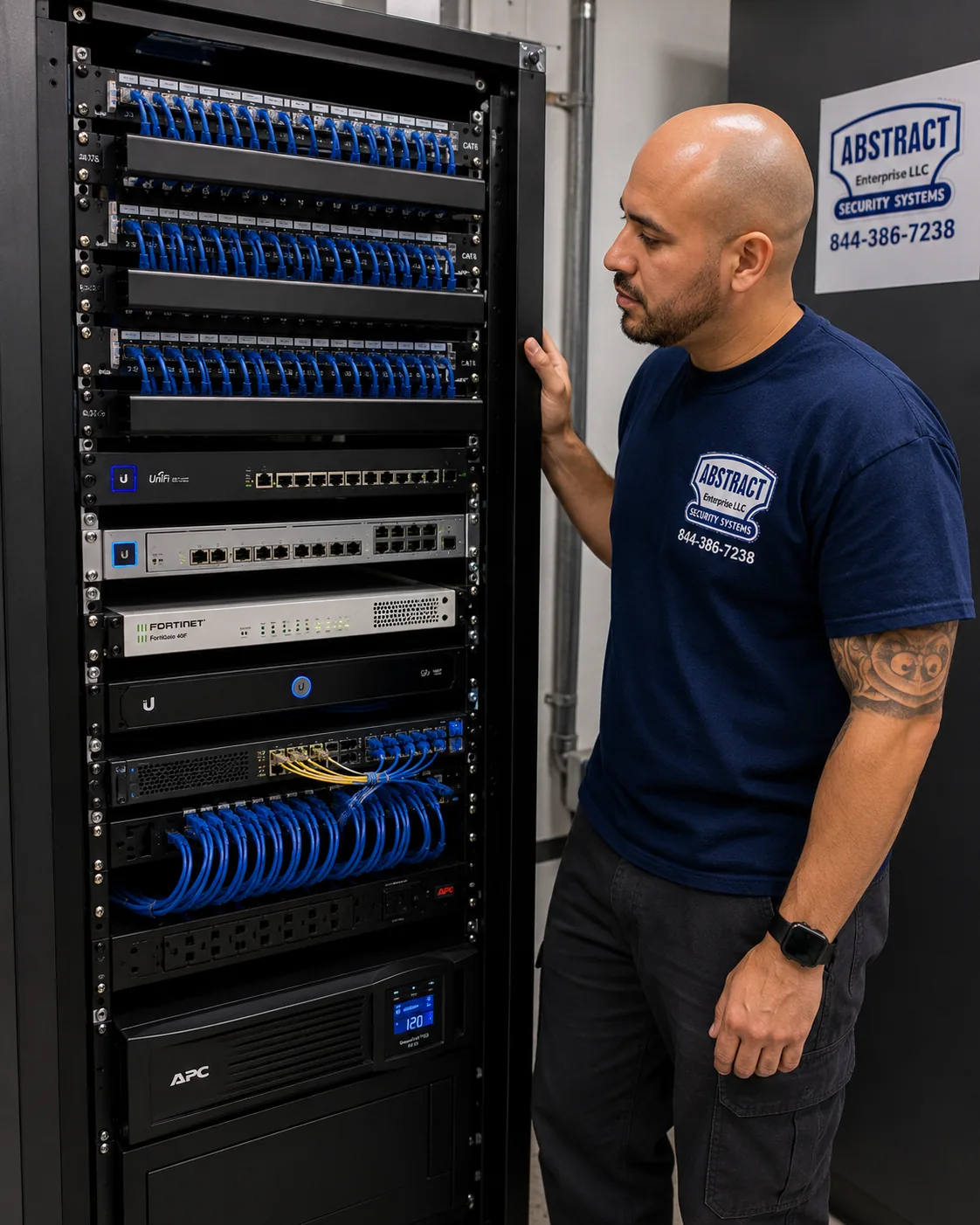
A photo from our job library, not taken in Columbia Street Waterfront: a finished network rack with patch panels, switching, a firewall and a battery backup, every cable dressed and labeled. A bar or restaurant on Columbia Street running several screens needs its own version of this, even if it is only a cabinet: one place where the sources, power and cables live, labeled so the next person can find the right one.
Compliance notes for Columbia Street Waterfront businesses and buildings
Keep screens out of walking paths. The 2010 ADA Standards for Accessible Design limit wall-mounted objects whose leading edge sits between 27 and 80 inches above the floor to a 4-inch projection into a circulation path. In corridors, entrances and waiting areas we use slim brackets or mount above 80 inches, and we avoid full-motion arms that stick out when pulled.
No cords inside walls. Under the National Electrical Code, flexible cords may not be concealed in walls, ceilings or floors. Hidden power behind a business screen uses an in-wall power kit with its own rated cable, or the cables run in a surface cover.
Exits and life-safety devices stay clear. We do not place screens or cable covers where they would block an exit sign, a sprinkler head, a fire alarm device, a door swing or a path of travel.
Landlord approval in writing. Most businesses here rent. We ask for the landlord's approval of the wall work and send a certificate of insurance naming the owner or managing agent before the visit.
Rated hardware with margin. Every bracket we fit is rated above the screen's weight, and on brick we use anchors rated for the load. Screens in busy rooms get bumped and leaned on, so that margin matters more in a bar than in a living room.
Your Questions Answered
TV Installation in Columbia Street Waterfront: Questions Answered
The questions below are the situations that come with this district's buildings: narrow brick piers between tall windows, rowhouses rebuilt to look older than they are, uneven factory brick, harbor light, staffed front desks, a major waterfront project on the horizon, and businesses that spread across several floors. Each is answered in full here and not repeated in the FAQ further down.
Rowhouse walls, old and rebuilt
Our President Street living room has two tall front windows with a narrow strip of brick between them. Is that strip wide enough to carry a 65-inch TV?
Often it is, as long as the bracket plate fits on the brick and not on the window frames. A 65-inch screen is far wider than most bracket plates, so what matters is the plate, not the screen: many fixed and tilting plates for that size need roughly two feet of solid wall, and the anchors must sit in sound brick at least a few inches from the edge of the opening, where the masonry is often patched or carries the window head. We measure the pier, check the brick and mortar across it, and choose a plate that fits. The screen can then overhang the window trim on both sides without touching it. The catch is light: a TV between two windows faces into the room with daylight behind it, which is comfortable at night and harder in the afternoon. If that bothers you, the side wall is usually the better choice, and we show you both with tape. Brick adds $65 to the $179.99 base on our list, and a 65-inch screen carries a size add-on from the full list, shown in the quote.
Our rowhouse on Carroll Street was rebuilt in the early 1980s. Does that mean the walls inside are easier than in an 1800s house next door?
Usually, but we check rather than assume. Cityneighborhoods.nyc says the renewal-era houses were built on the footprints of lost buildings and designed to echo older proportions and materials, so the brick front can look just like its neighbor's. Inside, houses of that era were more likely to get drywall on framing than plaster on lath, which means the base wall price of $179.99 and the option of an in-wall power and cable kit at $169. But forty years is long enough for a renovation or two, and the party and front walls are still masonry. Our technician scans the wall you choose and drills one small pilot hole where the bracket will cover it. If it is drywall on wood studs, the base price stands; if it is plaster, it is $45 more; if it is brick, $65 more. You hear which before the real drilling starts.
The exposed brick wall in our loft bows in and out by about half an inch over the width of the TV. Will a flat bracket sit properly on it?
It will, with some care. Old factory brick is rarely flat, and a bracket plate pulled hard against a bowed wall can twist, which leaves the screen slightly out of plane even when it reads level. We hold a straightedge across the planned position to find the high and low spots, then choose fixing points so the plate bears on the high spots and is not bent into the low ones. Where a gap remains behind part of the plate, a shim of the right thickness keeps the plate straight without stressing the anchor. The TV itself is then leveled to true, not to the brick courses, which in an old building may not be level either. If the wall is uneven enough that a low-profile fixed bracket would make the screen look tilted, a tilting bracket gives a little room to correct it. The wall is priced at the brick rate, +$65.
Lofts, light and staffed buildings
Our loft windows look out over the water and the light moves across the room all afternoon. Will a tilting bracket cut the reflections, or does the TV need to go somewhere else?
A tilt helps with some reflections and not others. Tilting the top of the screen down a few degrees sends reflections of a high source, such as a skylight or the upper part of a tall window, toward the floor instead of your eyes. It does little for light coming from a window level with the screen or directly behind your seat, which is where a lot of harbor-side glare comes from. The most reliable fix is position: a wall at right angles to the windows usually picks up far less reflection than the wall facing them. Before we drill, we tape the screen outline on the candidate walls and ask you to sit where you watch at the time of day you watch most. If the best wall still catches light for an hour or two, curtains or blinds solve what a bracket cannot. If a tilt is the right answer, a tilting bracket on brick is priced as a brick mount, $179.99 plus $65, with the bracket itself extra unless you supply one.
The brick walls of our loft can't be opened. Can the TV cables go up into the ceiling and across instead?
Sometimes, and it depends on what the ceiling is. If the loft has an exposed ceiling with beams or joists, a cable can run up the wall in a slim paintable cover, along the ceiling beside a beam and down to the cabinet on the other side, supported properly and kept well away from sprinkler pipes and lighting. That is a longer, more visible route than a cover straight down the wall, and in most lofts the cleaner answer is to put the TV over the console so the cables drop a foot or two. If the ceiling is a newer dropped or framed ceiling, a low-voltage cable such as HDMI or network can sometimes travel through it, but power cannot travel as a cord inside a ceiling any more than inside a wall. In a condo, the board may also have a view on ceiling work. We look at the ceiling first, tell you which route is possible and what it involves, and price it in the quote; a simple cover down the wall is $59 on our list.
Our building has a doorman, a live-in super and a porter. How does the visit work with the front desk?
Staffed buildings make the visit easier once the paperwork is in place. Listings describe 1 Tiffany Place as having a 24-hour doorman, a live-in superintendent and a full-time porter, and buildings run that way usually ask for three things: the contractor's certificate of insurance, the name of the technician and the time window, and in some cases a booking for the freight or passenger elevator if a large box is coming up. Tell us when you book which of these your building wants, and the name and email the certificate should go to. We send it ahead of the visit, and on the day the technician signs in at the desk like any other contractor. If the super wants to see the wall or know whether anything is being opened, we explain the plan to them directly. The labor prices are the same as anywhere in Brooklyn.
New buildings and lottery apartments
We just moved into a brand-new building and the developer is still working through the punch list. Will opening a wall for an in-wall kit cause trouble with them or with the condo?
It can, so ask before anything is cut. In a new building, the developer may still be fixing defects under its own obligations, and the condo or management office may have rules about alterations that are not yet widely known. An in-wall power and cable kit means two neat openings in the drywall, which some offices treat as minor work and others want to approve. A paintable cord cover needs only a few small screws and is easy to remove later. Our advice is to email the sales or management office with the wall you have in mind and the kind of kit, and keep the reply. If they approve, the kit is $169 on our list, installed between the studs and carrying power in its own rated cable. If they say not yet, start with a cover at $59, and the wall can be opened later once the punch list is done. Either way, we send the certificate of insurance before the visit.
I got my apartment through a housing lottery. Am I allowed to put a large TV on the wall?
That question comes up on New York forums, including a City-Data thread about mounting TVs in housing-lottery apartments, and the answer comes from your lease and your building's house rules rather than from the lottery itself. Read the lease's section on alterations and wall fixtures, then ask management in writing, saying how large the TV is, which wall, and how the cables will be handled. Many newer buildings have drywall walls, some on steel studs, and a properly anchored bracket holds a large screen on either; steel studs take different fasteners and are priced from our full list. If management says no to drilling, a TV on its own stand is $119.99 on our list and leaves no marks. If they say yes but no openings, a cord cover at $59 keeps the cables tidy without cutting anything.
The street, the water and the cellar
Will the Brooklyn Marine Terminal redevelopment affect when you can come and how you get a TV to our door?
Not yet in any way we can see, but we watch it. The Brooklyn Eagle reported that a task force voted 17 to 8 to approve the $3.5 billion plan, and Streetsblog reported that the Economic Development Corporation hoped for approval in late 2026, with construction phased until 2038 and bus-only paths floated for bottlenecks such as Columbia Street. The Eagle also reported that on April 1, 2026, the city extended the comment period on the project's draft scope. Construction schedules, street changes and truck routes will become clearer as approvals move forward. For now, the bigger everyday factor is that the district has no subway and limited parking, so our technicians drive in. When we book, we ask where the van can stop, whether there is a loading zone or driveway nearby, and how far the carry is. As street conditions change with the project, we will plan around them the same way.
Our TV room is in the cellar of our rowhouse, and we know parts of the waterfront are in a hurricane evacuation zone. Anything we should do differently?
A few simple things. StreetEasy lists 1 Tiffany Place in Hurricane Evacuation Zone 4, and buildings close to the water have a reason to think about what sits on a cellar floor. A wall-mounted TV is already off the floor, which is one advantage over a TV on a low stand. What usually ends up on the floor is everything else: the power strip, the cable box, the console, the subwoofer. We suggest mounting the screen at a comfortable seated height, placing devices on a shelf or a console rather than on the slab, and fixing the power strip to the back of the furniture instead of leaving it on the ground. Cellar walls are often masonry, so the brick add-on of $65 usually applies, and cables run in a cover rather than inside the wall. None of this makes equipment flood-proof; it just keeps the parts most likely to be damaged by a little water out of its way.
Renters' shortcuts and business floors
I've read that New York renters often mount TVs without asking and the landlord never says a word. Is that a safe bet?
It is a bet, and the downside lands on you. One NYC installer's blog says renters on Reddit report mounting anyway and rarely hearing about it, which is secondhand and tells you nothing about your landlord. What decides the outcome is the lease and the condition of the wall when you leave. If your lease restricts alterations, holes in a wall can be treated as damage, and on exposed brick they are hard to disguise. Asking first costs a two-line message and usually gets a yes, especially when you mention a licensed, insured installer and a cord cover instead of opening the wall. If you would rather not ask, choose the option with nothing to explain: the TV on its stand for $119.99, with a soundbar placed on the console for $79. If you do mount, patch and photograph the wall before you return the keys.
Our restaurant on Columbia Street has a dining room, a bar upstairs and outdoor space. Can screens on different floors be fed from one place?
Yes, in many buildings, but it is a project to plan rather than a line on a list. Your Brooklyn Guide describes at least one Columbia Street spot spread over three floors with a rooftop, and that kind of layout is common in mixed-use buildings here. Feeding screens on several floors from one cabinet means a cable path between floors, through an existing chase, a riser, a closet stack or a ceiling, along with a way to send the signal to each screen. In older brick buildings, finding that path is the main work, and the landlord has to approve it. We walk the building, find the route that avoids drilling through anyone's apartment, and quote it with the screens. Each mount is then priced on our list by its wall, with brick at +$65 on most dining-room walls. If some screens need to stay independent, each one gets its own streaming device instead, which is often simpler.
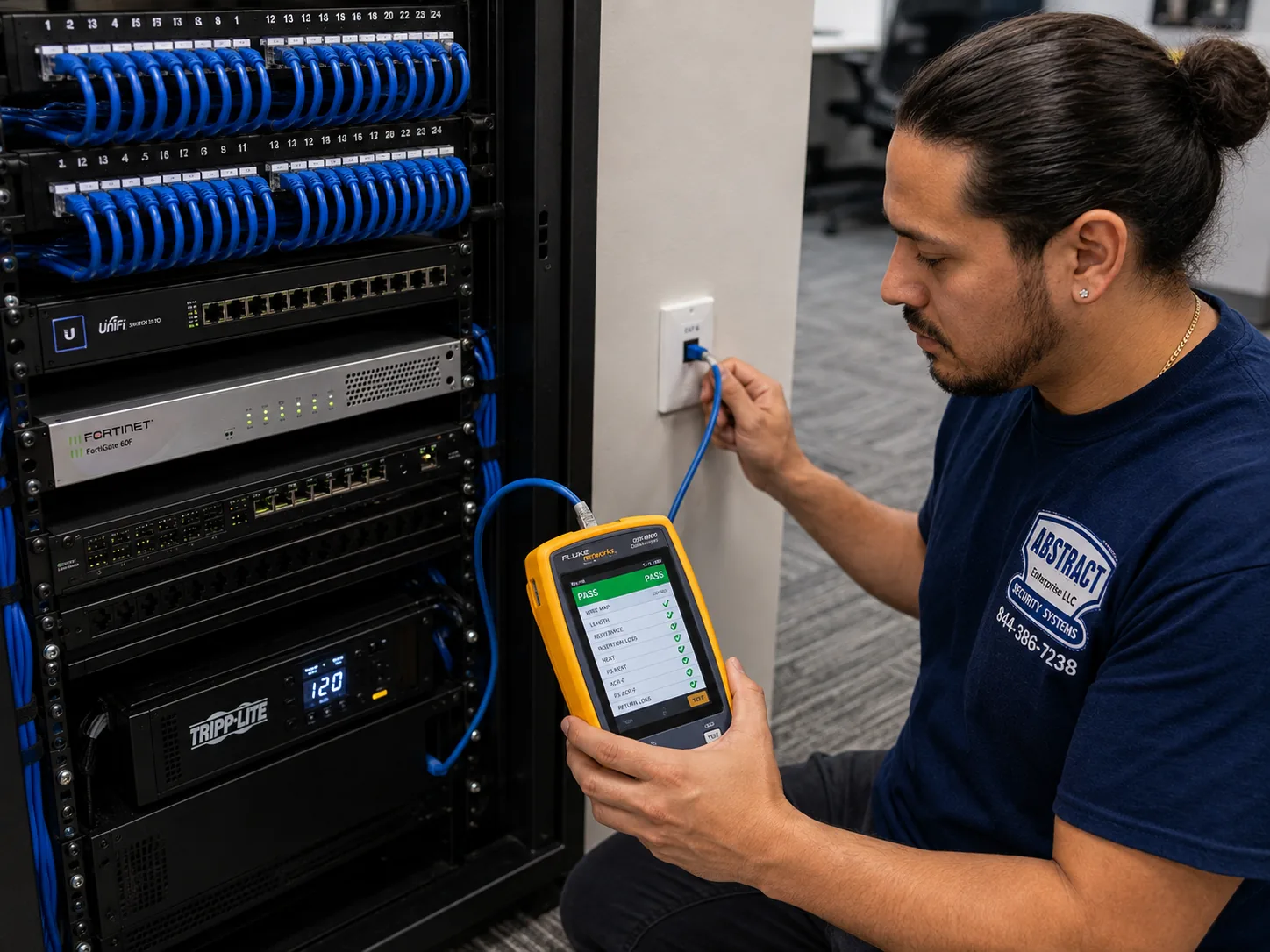
A photo from our job library, not taken in Columbia Street Waterfront: a technician certifying a data drop with a cable analyzer that shows a PASS result. When a business on Columbia Street wants its screens on wired connections rather than Wi-Fi, or a loft owner wants a wired line to the TV, this is how a run is proven to work before anything is hidden behind a cover or a cabinet.
Equipment
Types of TV Mounts and Hardware We Install
We supply brackets with the job or hang one you already own if it is rated for your TV. These are the hardware types that suit the district's walls, with the reasons each one fits a particular kind of room.
Fixed low-profile brackets
The screen sits close to the wall. Best on a flat stretch of rowhouse plaster facing the sofa, and the least to disguise later on a wall a renter will hand back.
Tilting brackets
A few degrees of downward angle for a screen above a decorative mantel or set a little high in a loft with tall ceilings, and for reflections from high windows or skylights.
Full-motion arms
For long rooms where the kitchen or dining table also wants a view. On brick, arms use every fixing point on the plate, because a pulled-out arm levers its weight on the top anchors.
Masonry anchors
Sleeve and wedge anchors sized for the bracket and set into brick or stone faces, plus anchors made for hollow masonry where a wall turns out to have voids.
Cable kits and covers
In-wall power and cable kits for hollow walls ($169) and paintable surface covers for brick ($59), painted to match plaster or mortar so the run disappears.
Soundbars and devices
Soundbars placed ($79) or wall-mounted ($129), streaming devices, game consoles and inputs set up during the visit, or on a setup-only visit at $195 for the first hour.
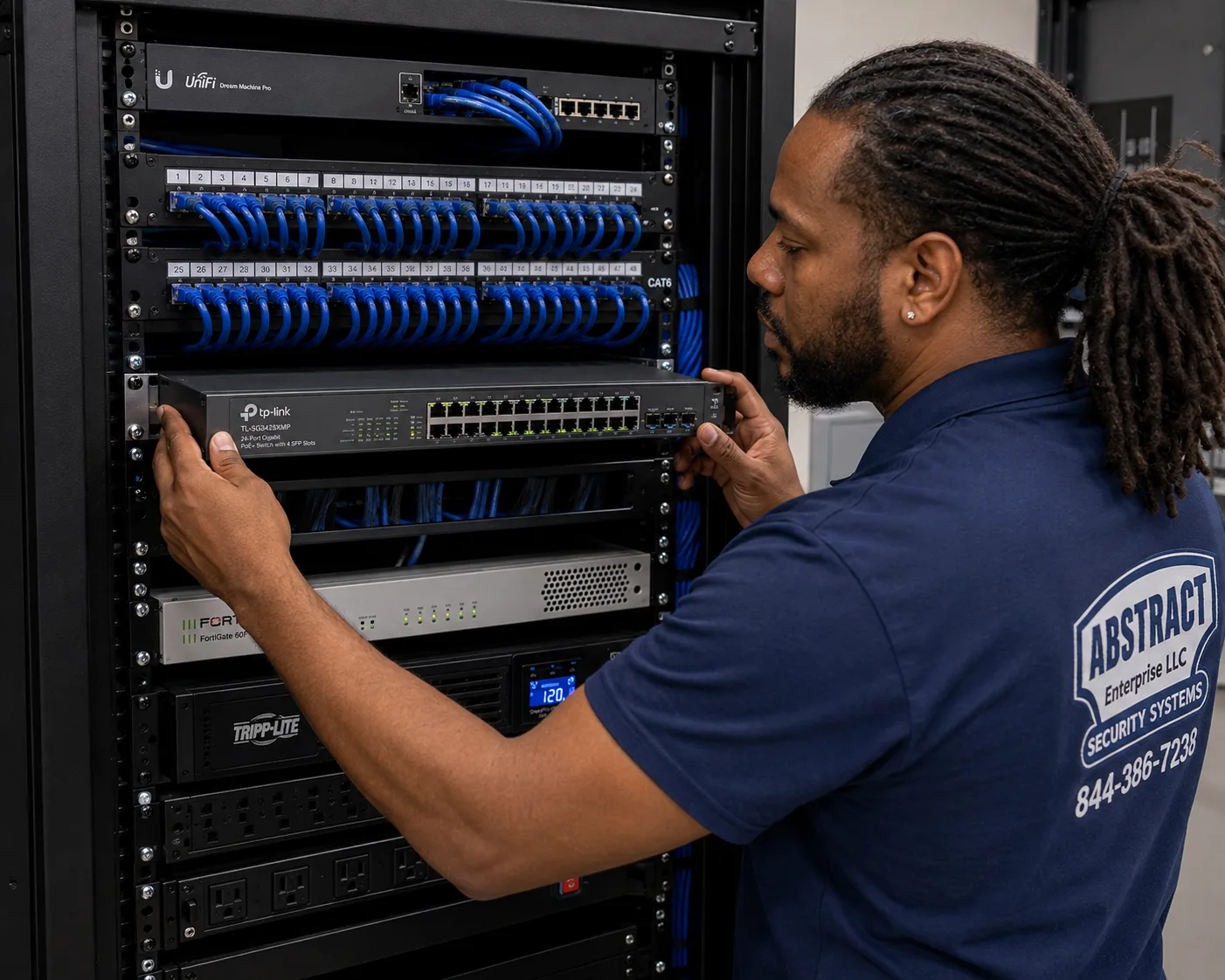
A photo from our job library, not taken in Columbia Street Waterfront: a technician fixing a managed PoE switch into a rack below its patch panels. It is network hardware, not a TV bracket, but it shows the standard we hold to with any equipment: fixed square and level, cables dressed before they are connected. A multi-screen bar or a home theater cabinet in a Tiffany Place loft gets the same care.
Which fixing and cable plan suits which Columbia Street Waterfront wall
This table summarizes the walls we meet most often in the district, how each one holds a bracket, what can happen to the cables and what it adds on our Brooklyn list. It is a guide for planning; the technician confirms the actual wall on site.
Wall and where you find it
How the bracket is fixed
Cable options
On the list
Exposed factory brick (Tiffany Place lofts)
Masonry anchors in sound brick faces, never mortar
Cord cover or drop into console
+$65
Plastered party or front wall (1800s rowhouses)
Through the plaster into the brick behind
Cord cover or console
+$65
Plaster on lath partition (1800s rowhouses)
Into the framing, or rated hollow-plaster anchors
In-wall kit often possible, or cover
+$45
Drywall on wood studs (renewal-era or new interiors)
Lag bolts into two studs
In-wall kit, $169
Base $179.99
Chimney breast above a decorative mantel
Masonry anchors, tilting or higher placement
Cover beside the mantel
+$130 plus masonry
No drilling allowed or wanted
TV on its own stand
Tidied behind the console
$119.99
Walls not shown here, such as steel studs, concrete, block and tile, are priced from our full Brooklyn list and stated in the written quote.
AI Overview Reality Check
What AI Gets Wrong About TV Installation in Columbia Street Waterfront
These are claims that appear again and again in generic online answers and in national cost guides such as Angi, HomeAdvisor and Fixr, paraphrased, each followed by what the buildings between the BQE and the harbor actually show.
"Find two studs and screw the mount into them"
The standard advice for mounting a TV starts with a stud finder: locate two studs, mark them and drive lag bolts into their centers. For an apartment built in the last few decades with drywall on wood framing, that is sound advice.
In a converted factory on Tiffany Place there may be no studs at all on the wall you want, only solid brick. In an 1800s rowhouse the party and front walls are masonry under plaster, and the framed partitions are plaster on lath, which confuses electronic finders. A stud finder that beeps everywhere or nowhere is common on this side of the highway.
We use the scanner as one clue among several and confirm the wall with a small pilot hole hidden behind the bracket plate. The anchor is then chosen for what is actually there, brick, plaster or framing, and the price follows the wall.
"Hide the cords by feeding them through the wall"
Many online answers suggest cutting a hole behind the TV and another near the floor, then feeding the power cord and HDMI cable between them for a clean look.
The National Electrical Code does not allow flexible cords to be concealed inside walls. Hidden power needs an in-wall kit with its own rated cable and a recessed outlet behind the screen. And the method assumes a hollow wall in the first place. Brick loft walls and the masonry walls of rowhouses have no cavity to feed anything through.
On hollow walls we install the in-wall kit, $169 on our list. On brick, the honest choices are a paintable cord cover at $59 or a screen placed over a console so the cables drop out of sight. That is the reality of many walls here, and no amount of clever drilling changes it.
"Expect to pay about the national average"
Cost guides publish averages drawn from many cities and many wall types, usually built around drywall, and some answers repeat those figures as if they apply everywhere.
An average does not know that your TV wall is factory brick, that the screen is going over a mantel, or that the building requires insurance paperwork. Even within New York, published price pages vary widely; one NYC provider lists brick or concrete add-ons as a range from $85 to $165 and in-wall cord concealment from $175 to $300. Ranges like that make it hard to know your total until someone shows up.
Our Brooklyn list is fixed by line: $179.99 base, +$45 for plaster, +$65 for brick or stone, +$130 above a fireplace, $169 for an in-wall kit, $59 for a cover. You can add up the likely total yourself before we arrive, and the quote shows each line.
"Exposed brick is too fragile for a heavy TV"
Some answers warn that brick, especially old brick, will crumble under the load of a TV and should be avoided, while others treat any brick as indestructible.
Both are wrong in the same way: they ignore where the anchor goes. Solid factory and rowhouse brick holds a TV very well when the anchors sit in sound brick faces. The weak spot is the mortar between the bricks, which in older walls can be soft, recessed or crumbly. A mount fixed into mortar can fail; the same mount fixed into the bricks beside it will not.
We test the mortar and tap the bricks before choosing fixing points, keep holes away from brick edges, and spread the load across every point on the plate. That is why we treat brick as one of the best walls in the district, not one of the worst.
"A brighter TV fixes window glare"
Advice for rooms with big windows often comes down to buying a brighter screen or one with an anti-glare finish.
Brightness helps a picture compete with daylight, but it does not remove a reflection. In a loft with tall factory windows and water views, a screen facing the windows mirrors them for part of every sunny day, whatever its brightness. Ceilings around ten feet also tempt people to mount too high, which adds neck strain to the glare.
Position does most of the work. We tape the outline on the walls you are considering, check it from your seat at the hours you watch, and suggest a wall at an angle to the windows, a slight tilt for high light sources, or blinds for the hour a reflection is unavoidable.
"Book whenever; the installer just shows up"
Booking tools present any open slot as equivalent, as though every address is equally easy to reach and every building lets a contractor walk in.
This district has no subway station, limited parking on its streets, and a major waterfront redevelopment working through approvals, with construction planned in phases until 2038 and changes floated for Columbia Street. Some buildings have a front desk that wants insurance and a time window first; some rowhouses have an owner downstairs who wants notice.
We ask about parking, the carry, the building's rules and the people at home when we book, send paperwork ahead, and pick a time that actually works. That is what makes a visit go in one trip.
"It is basically Carroll Gardens or Cobble Hill, so the same advice applies"
Some answers fold Columbia Street Waterfront into the neighborhoods east of the BQE, since the streets share names and the area was once part of the same South Brooklyn.
The highway trench, built in 1957, separated these blocks, and their history since has been different. The 1970s collapses and 1980s rebuilding left renewal-era houses beside the survivors, and the waterfront kept its factories, several now lofts. Wikipedia notes that the Cobble Hill Historic District lies to the east, bounded on its west by Hicks Street, so the landmark rules that shape that district do not describe these blocks.
So we plan for the buildings that are actually here: old rowhouses, rebuilt rowhouses, factory lofts and new mid-rises, each with its own wall. If you live east of the trench, our neighboring pages describe those buildings instead.
Not Sure Whether Your Wall Is Brick, Plaster or Drywall? Ask Before You Buy a Bracket
Tell us the cross streets, the kind of building, the floor, whether there is a front desk or a super, the TV size and what you know about the wall. A technician will call back with the total for your Columbia Street Waterfront address, or you can call (347) 934-8335 right now.
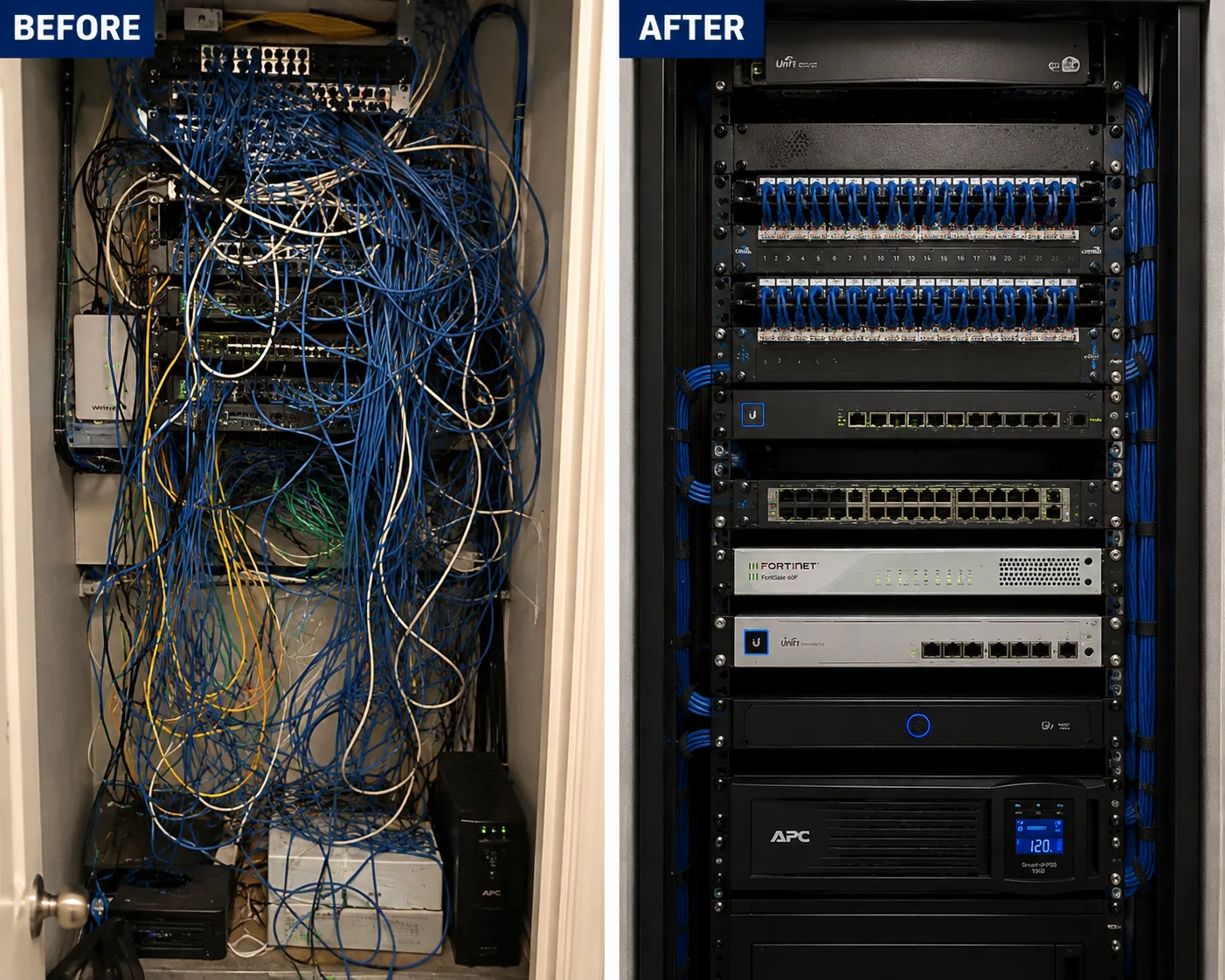
A photo from our job library, not taken in Columbia Street Waterfront: the same rack before and after we rebuilt it, from a tangle of unlabeled cable into a dressed, labeled setup. The cabinet under a TV in a rowhouse parlor or a loft living room often looks like the before picture. If you mention it on the form, we plan time to tidy and label it while the new screen goes up.
✅
Request Sent!
Thank you. A technician will call you about the Columbia Street Waterfront address on the same working day.
How It Works
Our Installation Process
1. Send photos and cross streets
A straight-on photo of the wall, the TV's model sticker, where the devices will sit and your cross streets, by phone, text, WhatsApp or the form.
2. Get the written total and book
We tell you the wall we expect, every add-on from the Brooklyn list that applies and the total, and you book a time that suits the household.
3. Settle building and street logistics
Front desk, super or owner informed, certificate of insurance sent if asked, and parking and the carry planned around conditions west of the BQE.
4. Confirm the wall
Scanner, knock and tap tests, and one small pilot hole hidden behind the bracket plate to confirm plaster, brick, stone or drywall.
5. Agree the layout
Painter's tape marks the screen; you check height and glare from your seat; the cable route and power plan are agreed before drilling.
6. Mount, hang and route cables
Anchors matched to the material, the TV hung and leveled to true, cables into an in-wall kit, a paintable cover or the console below.
7. Test, label and hand over
Inputs, soundbar and remote tested with you, cables labeled at the device end, dust cleaned up and the bracket details left with you.
Coverage Area
TV Installation Near Columbia Street Waterfront's Landmarks
Columbia Waterfront Park
On Columbia Street between Degraw and Kane Streets, part of the Brooklyn Greenway Initiative, surrounded by rowhouse blocks and newer buildings.
Columbia Street Esplanade
Opened in 1998 as a green corridor overlooking the piers, fourteen years after the Waterfront Garden of 1984.
Mary A. Whalen at Pier 9
A decommissioned 1938 oil tanker moored at Pier 9, serving as the headquarters of PortSide NewYork.
Tiffany Place
A cobblestoned street of converted industrial buildings, including 1 Tiffany Place, the former Tiffany warehouse turned into 70 loft condos.
The Sculpture House
A private residence at 82 DeGraw Street whose front has become a sculpture garden, one of the district's best-known sights.
Brooklyn Marine Terminal
The waterfront piers at the center of a $3.5 billion redevelopment plan approved by a task force, with phases planned until 2038.
TV Installation Cost in Columbia Street Waterfront
Columbia Street Waterfront is billed at our Brooklyn rate. The base covers a TV up to 55 inches on a flat or tilting bracket on drywall over wood studs, labor only, with the bracket sold separately. The lines below are the ones that come up most often in the district; screen-size add-ons and wall types not shown here are priced from the full Brooklyn list and appear in your written quote before booking. Booking terms are on our TV installation policies page.
Item
Brooklyn price
TV wall mounting, up to 55", drywall on wood studs
$179.99
Plaster wall add
+$45
Brick or stone wall add
+$65
Above-fireplace mounting add
+$130
In-wall concealment with code-compliant power and cable kit
Two worked examples. A 55-inch TV on a plastered party wall in an 1800s rowhouse, where the plaster sits on brick, is $179.99 plus $65, or $244.99, with a cord cover adding $59. A 55-inch TV on a plaster-and-lath partition in the same house is $179.99 plus $45, or $224.99, and an in-wall kit may be possible there at $169.
Full terms — including 50% deposit, the 30-day warranty and optional paid extended warranty, and the late-fee schedule — are set out in the service agreement.
Shop Our Systems
TV Installation Packages & Pricing
Three common Columbia Street Waterfront jobs, added up line by line from the list above. Each assumes a screen of 55 inches or less; larger screens add the size line from the full list. Brackets are extra unless you supply a rated one.
Rowhouse partition starter: $224.99
A TV on a plaster-and-lath interior wall in an older rowhouse ($179.99 + $45 plaster), with the cables dropped into the console below.
Loft brick standard: $432.99
A TV on exposed factory brick ($179.99 + $65), a paintable cord cover to the outlet ($59) and a soundbar fixed under the screen ($129).
Swap and conceal premium: $562.99
The old TV taken down ($85), the new one hung on drywall in a renewal-era or new interior ($179.99), an in-wall power and cable kit ($169) and a wall-mounted soundbar ($129).
Bring your own equipment. If you already have a bracket, soundbar bracket or cord cover, we install it at the labor prices above, as long as the bracket is rated for your TV's weight and size and suits the wall it is going on. On brick, we supply masonry anchors sized for the load rather than the plastic plugs that often come in the box.
Complete Services
Every TV Installation Service in Columbia Street Waterfront
Wall mounting
Brick, stone, plaster and drywall, rowhouse to loft. Request a quote
Cable concealment
In-wall kits on hollow walls, paintable covers on brick. Ask about your wall
What should my quote request include so the price does not change on the day?
+
Send a straight-on photo of the wall with the outlet in frame, the model sticker from the back of the TV, a photo of where the devices will sit, your cross streets and floor, and whether the building has a front desk or super. With those, we can name the wall we expect and every add-on from the Brooklyn list, and the total only changes if the pilot hole shows a different material, which we tell you before continuing.
Which way of hiding cables leaves the least to patch when we move out or sell?
+
Dropping the cables straight into a console under the screen leaves nothing beyond the bracket holes. A paintable cord cover at $59 adds only a few small screw holes. An in-wall kit at $169 looks cleanest while you live there but leaves two openings in the wall that need patching later.
Is taking down our old TV priced separately from hanging the new one?
+
Yes. Taking down an old TV is $85 on our Brooklyn list. The new TV is then priced as its own mount, starting at $179.99, plus the add-on for the wall it goes on, such as $45 for plaster or $65 for brick or stone.
Why does a soundbar cost less sitting on the console than fixed to the wall?
+
A placed soundbar, $79, only needs connecting and setting up. A wall-mounted one, $129, also needs its own bracket fixed and leveled under the screen and its cable routed neatly, which takes more time, especially on brick.
How is a setup-only visit billed once the first hour is up?
+
The first hour is $195. If the work runs past that, the rest is billed in 30-minute blocks, and the technician tells you before starting another block so you can decide what is worth finishing that day.
If two TVs go on brick walls in our loft, is the brick add-on charged once or for each TV?
+
The brick or stone add-on of $65 applies to each mount on a brick or stone wall, because each bracket needs its own masonry drilling and anchors. A second TV on a drywall wall would carry only the base price for that mount.
Does a TV over a brick chimney breast carry both the fireplace add-on and the brick add-on?
+
Usually yes. The above-fireplace add-on of $130 covers the extra care and placement around the mantel, and the $65 brick or stone add-on covers drilling the masonry itself. Your quote lists both lines separately so you can see each one.
Where do I find the TV model number you ask for, and why does it matter?
+
It is on a sticker on the back of the TV, and often on the box and in the settings menu. The model tells us the screen's weight, size and bolt pattern, which decide which brackets fit and which anchors the wall needs.
The TV is being delivered to our front desk several days before the install. How should it be kept until then?
+
Leave it sealed in its original box, standing upright the way the box is marked, away from radiators and foot traffic. The packing protects the screen on the way up to your apartment, and the hardware bag and stand inside are easier to find unopened.
Should the wall be painted before or after the TV goes up?
+
Before, if you can. Once the bracket is fixed, painting behind it means taking the TV down. A paintable cord cover can be painted afterward to match, and fresh paint should be fully dry before the bracket and tape go on.
Does someone need to be home for the whole visit?
+
An adult needs to be there to confirm the position before drilling, to enter streaming passwords and to check the finished setup. Between those points you are free to get on with your day, but most people like to be around for the testing at the end.
The floors in our old rowhouse slope. Will the TV look crooked once it is up?
+
We level the screen to true with a level, not to the floor, ceiling or brick courses, then check it by eye from your seat. In a room where the floor slopes noticeably, we show you the result before tightening and adjust if it looks wrong against the room.
More TV Installation near Columbia Street Waterfront
Send a photo of the wall, the TV's model sticker and your cross streets, and we will tell you whether we expect brick, plaster or drywall and what the job comes to on the Brooklyn list. Call or text (347) 934-8335, message us on WhatsApp, or use the request form. Work done under NYS license #12000287431, rated 4.6★ across 390+ Google Reviews, with same-day estimates on most weekdays. For the rest of the borough, see our Brooklyn TV installation page.