New screen still boxed in a tower apartment off Cadman Plaza West, a bracket working loose in a townhouse at the foot of the towers, or a conference-room display near Borough Hall that has to be up before a Monday hearing? Cadman Plaza TV line, same-day estimates: (347) 934-8335
Poured-Concrete Co-op Towers · Duplex Townhouses · One Clinton Condos · Court Street Offices · Pineapple Walk Shops
TV Installation in Cadman Plaza
Concrete Read Before It Is Drilled · Dust Caught at the Hole · Board Paperwork Handled · Brooklyn Rate
TV installation in Cadman Plaza starts at $179.99 on our Brooklyn list for a screen up to 55 inches on drywall over wood studs, with the bracket sold separately, and the real question here is almost never the TV. It is the wall. The apartments that ring the west side of the park went up between 1967 and 1973 as Mitchell-Lama co-ops on the old trolley terminal site, and the tallest of them were cast in poured concrete. Their duplex townhouses sit on the same base, and One Clinton, the 36-story condo over the new library, is a different kind of building again. Across the plaza, the Court Street and Adams Street towers hold offices that want conference displays, and the shops along Pineapple Walk want screens over a counter. This page explains what each of those walls takes, how the cables can be hidden on a wall that has no hollow inside it, what a co-op board or managing agent usually asks before anyone drills, and what the job costs, line by line, from our published Brooklyn TV list.
Prices come from our Brooklyn TV list; the total is agreed before anyone comes
4.7★ across 201 Google Reviews
Reviewed and updated November 13, 2026, against the Center for Brooklyn History finding aid for the Cadman Plaza complex; NYC Urbanism's history of Cadman Towers; CityRealty building records for 140 Cadman Plaza West, 75 Henry Street and One Clinton at 280 Cadman Plaza West; Brownstoner's 2012 Building of the Day on the Whitman Close townhouses; THE CITY and Habitat magazine on the 2024 HDFC conversion of Cadman Towers; Brooklyn Paper on Pineapple Walk and on the Brooklyn Heights library; the Brooklyn Eagle on One Clinton and on the Tillary Street redesign; CBS New York on the library's 2022 opening; NYC Parks and The Cultural Landscape Foundation on Cadman Plaza Park; Wikipedia's articles on the Federal Building and Post Office, the Theodore Roosevelt United States Courthouse, Brooklyn Borough Hall, the Montague–Court Building and High Street station; SlashGear on mounting a TV on concrete; Brick Underground, Habitat and Hauseit on co-op alteration agreements; and the National Electrical Code and 2010 ADA Standards on cords in walls and wall-mounted objects.· Abstract Enterprises Security Systems, NYS license #12000287431 · crews dispatched from our Troy Avenue office in Brooklyn
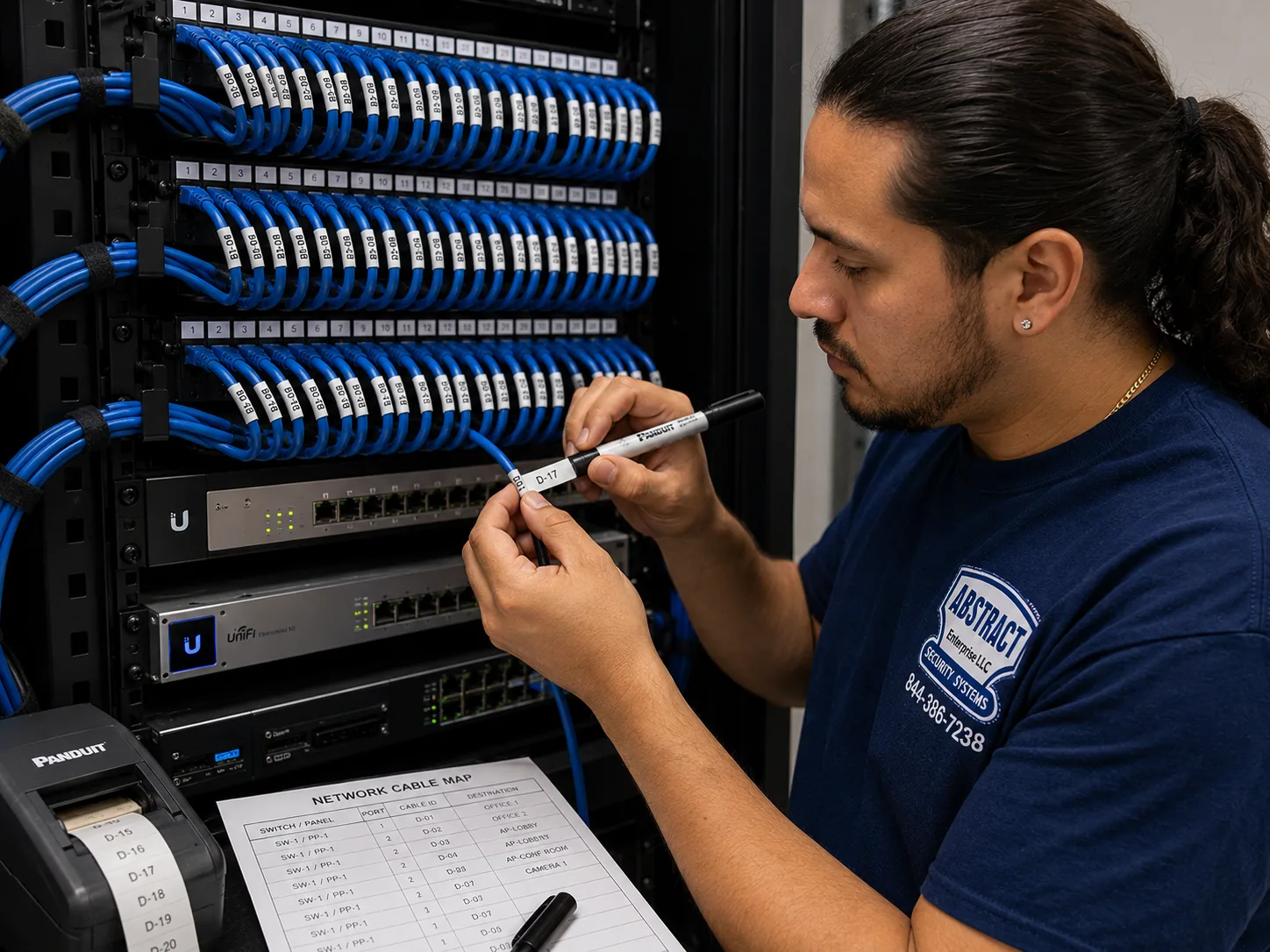
A photo from our job library, not taken in Cadman Plaza: a technician printing labels for a patch panel with the printed port map beside him. Conference-room displays in the office towers along Court Street and Adams Street often end at a closet like this one, and a screen is only as reliable as the labeled jack it plugs into, so we find out which port feeds the room before the display goes on the wall.
Cadman Plaza TV Mounting Request
Co-op tower, townhouse, condo, office or shop: tell us the building, the floor and the TV size, and a technician calls back with the total
✅
Request Sent!
Thank you. A technician will call you about the Cadman Plaza address, usually within two hours of your request.
25+
Years Experience
✓
Same-Day Estimates
100%
Licensed & Insured
4.7★
201 Google Reviews
Owner-operated since 2002 · Thousands of jobs completed · Booked within 2 hours
Quick answer for a Cadman Plaza TV. A screen up to 55 inches on drywall over wood studs is $179.99 in labor on our Brooklyn list, a plaster wall adds $45, a brick or stone wall adds $65, a paintable cord cover is $59, an in-wall power and cable kit is $169, and a soundbar fixed under the screen is $129. Poured concrete, which is what the tallest towers west of the park were built from, is not its own line on that list, so we confirm its price from your photos before you book rather than guessing. Send a straight-on photo of the wall, the sticker on the back of the TV and the spot where the cable box will sit to (347) 934-8335 or on WhatsApp; requests are normally booked within two hours, and every visit comes in a two-hour arrival window.
Looking at photos and answering questions costs nothing. If the wall turns out to be a different material from the one we priced, the technician says so before drilling, not after.
All work is done under New York State license #12000287431, and we send the certificate of insurance your co-op, condo board or managing agent asks for before the visit.
If you are a shareholder, the one document worth reading first is your building's alteration agreement or house rules. Most of them treat a TV bracket as minor work, but some treat opening a wall very differently.
The Neighborhood
Why Cadman Plaza Properties Need TV Installation
Cadman Plaza is a park before it is a neighborhood. The Wikipedia entry and NYC Parks describe the long green between Cadman Plaza East and Cadman Plaza West, running from the Brooklyn Bridge approach down toward Borough Hall, on land the city condemned in 1935 and named in 1939 for the Reverend Samuel Parkes Cadman, the radio preacher who led Central Congregational Church for 36 years. The Cultural Landscape Foundation puts the park at about 10.4 acres. What gives the name to an address, though, is the ring of buildings around that green, and for anyone hanging a television those buildings fall into a few very different families. On the west side are the co-op towers and townhouses of the Cadman Plaza urban renewal project. On the east and south are federal and state courts, Borough Hall and a cluster of office towers. At the north end of Cadman Plaza West is One Clinton, the condo that rose over the rebuilt Brooklyn Heights library.
The residential side is where most of our calls come from, and its history explains its walls. The Center for Brooklyn History's finding aid for the Cadman Plaza complex lists the buildings between Cadman Plaza West and Henry Street: Cadman Plaza North at 140 Cadman Plaza West, Whitman Close at 75 Henry Street, and Cadman Towers at 101 Clark Street and 10 Clinton Street, all built in the late 1960s on the site of the old Brooklyn Bridge trolley terminal under the Mitchell-Lama middle-income program. CityRealty records 140 Cadman Plaza West as a 27-floor, 250-unit co-op completed in 1967. NYC Urbanism's history of Cadman Towers says it was begun in 1969 and finished in 1971 to designs by Glass & Glass with Whittlesey & Conklin, with a 32-story and a 13-story tower, about 420 co-op apartments and 50 duplex townhouses placed along the streets to keep a human scale, all of it in saw-toothed poured concrete. Those are not walls a stud finder understands.
That one fact changes most of the job. In a brownstone a few blocks south, a TV usually goes on plaster over lath or plaster over brick, and the cables can often be fished inside a framed partition. In a tower of cast concrete, the walls between rooms and between apartments may be solid concrete, concrete block or a later drywall partition, and the only way to know which is to look, knock and drill one small test hole where the bracket plate will cover it. Concrete holds a television superbly once the anchor is right, but SlashGear's guide to mounting on concrete puts the catch plainly: "you may run into rebar, a steel bar that strengthens concrete." When a bit meets steel in a tower wall, the right move is almost always to shift the bracket a little rather than cut through reinforcement in a building you do not own, and that is a decision the technician makes with you standing there.
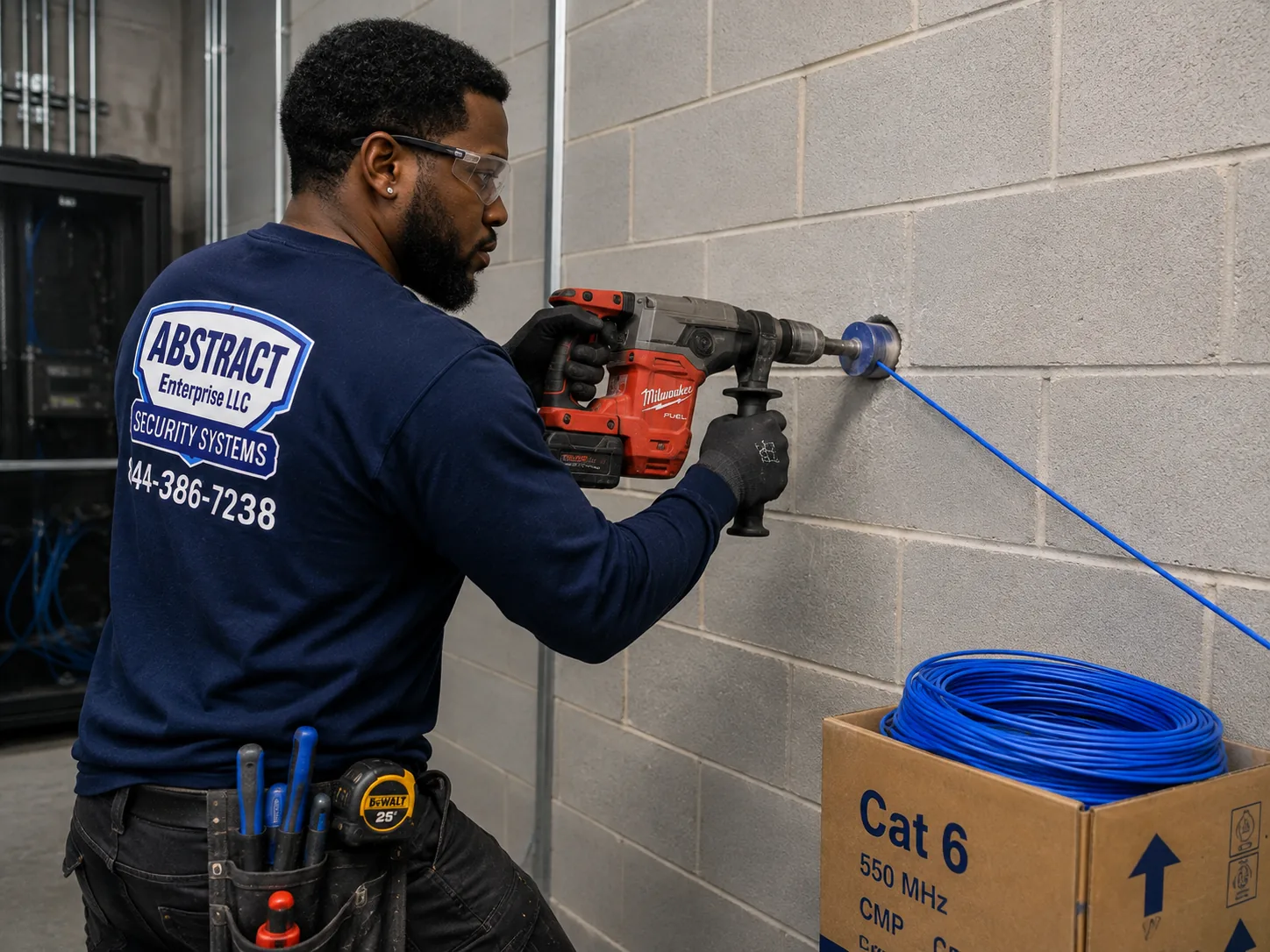
A photo from our job library, not taken in Cadman Plaza: a technician core drilling through a block wall so a cable can pass into a network room. A TV bracket needs far smaller holes than this, but the lesson carries straight into the concrete towers on Cadman Plaza West: masonry is drilled slowly, with the dust caught at the bit, and only after we know what is inside the wall.
The buildings are also changing hands. THE CITY reported in April 2024 that Cadman Towers, carrying about $62 million in debt, became the first Mitchell-Lama co-op approved by the City Council to convert to a Housing Development Fund Corporation, with more than three-quarters of shareholders in favor; Habitat magazine put the vote at 77 percent. Under the new rules, resales are capped at prices affordable to households at 80 percent of area median income, sellers give half of their profit to the building, the old waitlist was replaced by a Housing Connect lottery, and buyers must earn no more than 125 percent of area median income. For us that means new shareholders moving in, unpacking new televisions and deciding for the first time where a screen goes in an apartment whose walls they have never drilled. It also means co-op boards that pay close attention to what contractors do inside units, because a cracked wall or a mess in a hallway is the building's problem as much as the shareholder's.
Just north of Clark Street, the Whitman Close townhouses at 75 Henry Street add a different shape of home. Brownstoner's 2012 Building of the Day described about sixteen two-story units designed by William Conklin and built between 1967 and 1973, meant to echo the brownstones of the Heights beside a 33-story tower of about 370 apartments. CityRealty's later review of 75 Henry Street counts 32 stories and 352 apartments, lists a full-time doorman and a garage, and the sources disagree on the exact figures, so we quote both. A duplex townhouse means a private stair, a living room on one level and bedrooms on the other, and for a TV that means two floors of wiring questions inside one household rather than one.
Then there is the newest building in the ring. The Brooklyn Eagle reported in May 2022 that One Clinton at 280 Cadman Plaza West was nearing completion as a 36-story tower of 134 condos by the Hudson Companies and Marvel Architects, with a new library and a Department of Education STEM center at its base; CityRealty counts 133 apartments, describes "ceiling heights of at least 9 feet," white oak floors, a washer and dryer in every unit and a multi-zone heating and cooling system. CBS New York reported that the library below opened on June 8, 2022. A building of that generation is where we expect smooth drywall partitions, an outer wall of glass and masonry, heating and cooling equipment that has to stay clear, and a condo office that wants paperwork before a contractor walks in.
The east side of the park is a different city. The Federal Building and Post Office at 271–301 Cadman Plaza East, a Romanesque landmark from 1885–91 that now houses the bankruptcy court, faces the 15-story Theodore Roosevelt United States Courthouse at 225 Cadman Plaza East, finished in 2006 to a design by César Pelli. South of them stand Borough Hall, completed in 1848, the Supreme Court building at 360 Adams Street and the office towers of Court Street, including the 35-story Montague–Court Building at 16 Court Street from 1927. We do not work inside the courthouses, but the law offices, title companies, nonprofits and professional suites in the blocks around them buy conference screens and waiting-room displays, and those jobs follow office-building rules rather than co-op ones.
Six Cadman Plaza facts that shape a TV job before a bracket is chosen
The tallest residential walls are cast concrete. NYC Urbanism describes Cadman Towers as saw-toothed poured concrete with large windowless concrete walls. A hammer drill, concrete bits and anchors set to depth replace the screws and toggles of a drywall job, and nothing can be fished inside the wall.
The co-op towers are half a century old. 140 Cadman Plaza West dates from 1967 and Cadman Towers from 1971. Apartments that age have often had partitions moved, closets opened and drywall added, so one living room can hold two kinds of wall.
About 50 duplex townhouses sit at the tower bases. That is NYC Urbanism's count for Cadman Towers, plus roughly sixteen Whitman Close units on Henry Street by Brownstoner's. A duplex puts the cable entry, the router and the TV on different floors of the same home.
Apartments are being resold under new rules. The 2024 HDFC conversion replaced the waitlist with a Housing Connect lottery, according to THE CITY, so more first-time owners are setting up living rooms in units built in the early 1970s.
The newest tower sets ceilings at nine feet or more. CityRealty's description of One Clinton gives at least nine feet, which leaves room for a larger screen than most 1960s apartments can take without the viewers looking up.
Half the address is offices and courts. The Roosevelt courthouse, the Federal Building, the Supreme Court at 360 Adams Street and the Court Street towers make conference displays and waiting-room screens a real share of the work here, mostly scheduled outside business hours.
Where this page applies. It covers the buildings that face or back onto Cadman Plaza: the co-op towers, townhouses and Pineapple Walk shops between Cadman Plaza West and Henry Street from Clark Street up to Middagh Street, One Clinton and the library block at Clinton Street, and the office and court blocks along Cadman Plaza East, Adams Street, Court Street and Tillary Street. The brownstone streets to the south and west are covered on our Brooklyn Heights TV installation page, the towers east of Adams Street on our Downtown Brooklyn page, the lofts under the bridges on our DUMBO page, and the whole borough on our Brooklyn TV installation page. The Brooklyn rate is the same on every side of those lines.
Same-Day Repair in Cadman Plaza
Need Repair in Cadman Plaza? A Screen Sagging Off a Concrete Wall, Anchors Spinning in an Old Partition, or a Bracket Left Behind by the Last Shareholder
The urgent calls we get from towers like the ones on Cadman Plaza West tend to come in three kinds. The first is a TV that has dropped at one corner or started to lean forward. On a concrete wall that usually means the anchors were too short or the holes were drilled oversize, so the fixing is gripping only the outer skin of the concrete, which is often harder and more brittle than the core. On a drywall partition added during a renovation, it usually means the bracket was screwed into drywall alone with plastic plugs, or into a thin metal stud with a wood screw that has slowly stripped. The second kind is the apartment someone has just bought: the previous owner's bracket is still on the wall, there are four or six old holes beside it, and there may be a cord pushed into a hole that should never have been there. The third is the office near the courts where a display was hung on a full-motion arm in a corridor or waiting room, and the arm is now pulling the wall plate away.
If a screen is tipping, do not try to push it back up. If two people can lift it safely, take the weight off the bracket, set the TV face-up on a blanket, unplug it and call (347) 934-8335. Taking down an old TV is $85 on our Brooklyn list. When the same TV is going back on the wall properly, the visit is priced as a new mount on that wall, with the take-down added, and we tell you before starting whether the old holes can be reused, filled or avoided. If what we find is a problem with the wall itself, a crack running out from the old anchors, a spalled patch of concrete or a partition that was never fixed at the top, we say so plainly so you can bring in the super or the managing agent before anything heavy goes back up.
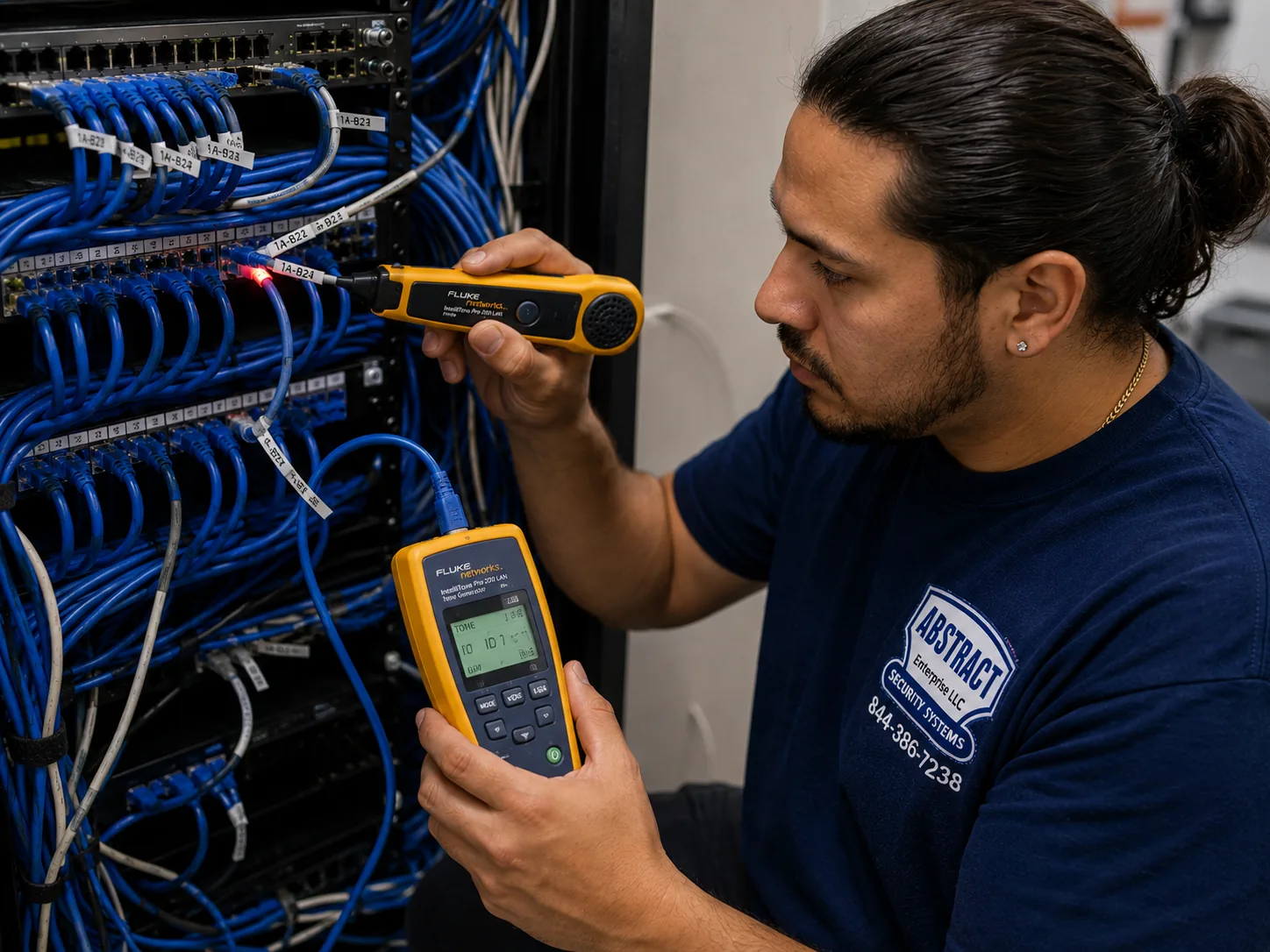
A photo from our job library, not taken in Cadman Plaza: a technician tracing an unidentified cable at a patch panel with a tone generator and probe. Apartments in the early-1970s towers here often have more than one old coaxial or phone outlet left from earlier owners and providers, and finding which one is live, before the TV is placed beside it, saves a wall from a bracket in the wrong spot.
What We Install
TV Installation Services in Cadman Plaza
Every service below is priced from the same Brooklyn TV list. The wall decides one line, the cable plan decides another, and the rest depends on what you want the room to look like when the technician leaves.
Mounting on poured concrete
Brackets fixed into the cast-concrete walls of the co-op towers on Cadman Plaza West and Clark Street, with a hammer drill, bits sized to the anchor, dust caught at the hole and the bracket moved, not forced, if the test hole meets steel.
Mounting on renovated partitions
TVs on the drywall walls that owners have added inside 1960s and 1970s apartments, fixed into wood or metal framing or with anchors rated for the load where the framing falls in the wrong place.
Condo walls at One Clinton
Brackets on new drywall partitions in a building with nine-foot ceilings, white oak floors to protect and heating and cooling equipment that must stay clear, with paperwork sent to the condo office first.
Duplex townhouse setups
A living-room TV on one level and a bedroom TV on the other, planned around where the provider's line and the router actually are in the Cadman Towers and Whitman Close duplexes.
Cables hidden or covered
An in-wall power and cable kit ($169) where the wall is framed and the board allows it, a paintable cord cover ($59) on concrete, or a straight drop into the console below so nothing shows.
Soundbars and setup
Soundbars fixed under the screen ($129) or placed on the console ($79), streaming apps signed in, the cable box connected and the remote set up, with a setup-only visit at $195 for the first hour.
Take-downs and do-overs
An old TV taken off the wall ($85), a bracket left by the previous owner checked or replaced, and a screen moved from a wall that should never have carried it.
TVs on their stands
No drilling at all: the TV set on its own stand on your console, cables tidied and devices connected, for $119.99. Common for subtenants and anyone waiting for a board's answer.
Office and shop displays
Conference screens in the Court Street and Adams Street towers, waiting-room displays for professional suites, and counter screens for the shops on Pineapple Walk, booked around business hours.
Building Specialists
TV Installation for Cadman Plaza's Architecture
Six kinds of building account for almost every TV call that carries a Cadman Plaza address. They differ in three ways that matter more than the brand of the television: what the walls are made of, how the TV gets from the street to the room, and who besides you has a say over the drill.
The cast-concrete co-op tower
Cadman Towers at 101 Clark and 10 Clinton Streets, finished in 1971, with towers of 32 and 13 stories and saw-toothed concrete walls, by NYC Urbanism's account.
The 1967 slab on Cadman Plaza West
Cadman Plaza North at 140 Cadman Plaza West, 27 floors and 250 co-op apartments by CityRealty's records, the oldest of the complex's towers.
The duplex townhouse
Two-story homes at the base of the towers: about 50 at Cadman Towers and about 16 in Whitman Close on Henry Street, built to give the blocks a brownstone scale.
The doorman tower on Henry Street
75 Henry Street, 32 or 33 stories depending on the source, with a full-time doorman and a garage, owner of the Pineapple Walk retail strip.
The new condo over the library
One Clinton at 280 Cadman Plaza West, 36 stories and 133 or 134 units, with ceilings of at least nine feet and the library at its base since 2022.
The office suite near the courts
Law and professional offices in the Court Street and Adams Street towers, including the 35-story Montague–Court Building of 1927, where landlords set the rules.
The cast-concrete co-op tower: a wall that holds anything, once you know where the steel is
The towers of Cadman Towers are the clearest case on this page. NYC Urbanism describes poured concrete inside and out, laid out in a saw-tooth so the apartments get angled windows and corners rather than one flat facade. Inside an apartment, that shows up as walls that ring dull and hard when you knock them, outlets set in boxes cast or cut into the concrete, and corners that are not always ninety degrees. A TV on a concrete wall is very secure if the anchor is right: we drill to the depth the anchor needs, clean the hole, set the anchor and torque it to the maker's figure, and we keep the holes clear of edges and of the corners where the wall meets the floor slab. What we will not do is fight the wall. If the test hole meets reinforcing steel, the bracket moves a little sideways or the anchor pattern changes; cutting rebar in a co-op tower is not a TV installer's call and almost never needs to happen.
Concrete also decides the cable plan. There is no hollow inside a cast wall for an in-wall kit, so the choice is between a paintable cord cover from the screen down to the outlet, a screen placed directly above a console so the cables drop straight behind it, or a different wall altogether. Many 1970s apartments have at least one drywall partition, often around a closet or a room that was divided later, and if that partition faces the sofa it may be the better TV wall because the cables can go inside it. We show you both options on the day, with the price of each, before the drill comes out. And because sound carries through a concrete frame, we keep the drilling short and in one burst; the neighbors two floors down may hear a hammer drill for a few minutes, not an afternoon.
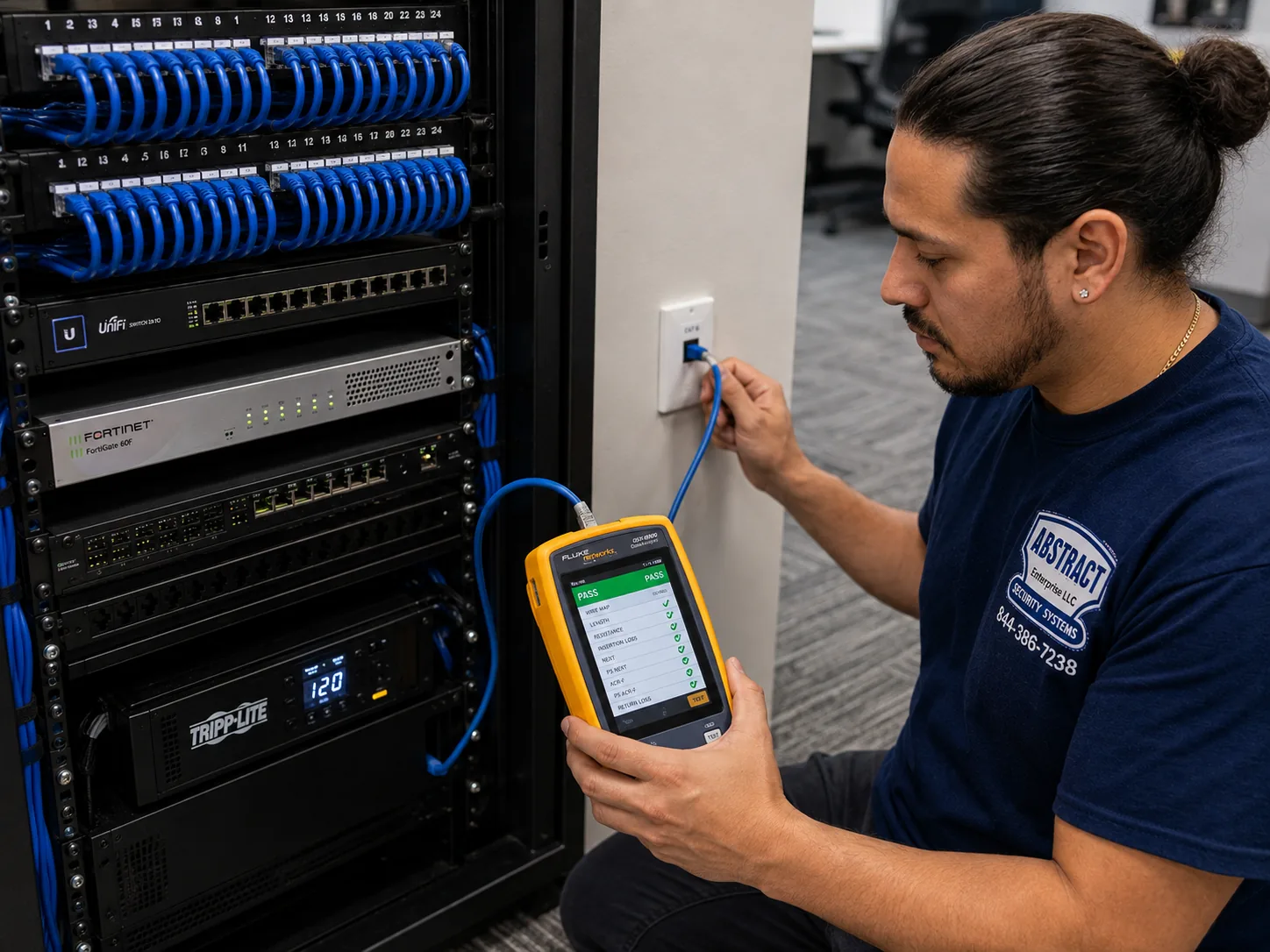
A photo from our job library, not taken in Cadman Plaza: a technician certifying a data drop with a handheld analyzer that reads PASS. Wi-Fi struggles through cast-concrete walls, so in the Cadman Plaza towers we check whether a wired network jack near the TV actually works before counting on it for a streaming box, and if there is none, we tell you plainly where the signal will be weak.
The 1967 slab on Cadman Plaza West: older apartments, more renovations, more surprises
Cadman Plaza North at 140 Cadman Plaza West is the oldest tower in the complex, completed in 1967 with 27 floors and 250 apartments by CityRealty's count, and CityRealty lists no doorman. Half a century of shareholders means half a century of changes inside the units. In apartments of this age we routinely find a mix on one living-room wall line: the original masonry or concrete along the outside and around the shafts, an original partition between rooms, and a newer drywall wall where someone enlarged a kitchen or closed in a dining alcove. Each takes a different fixing, and the scanner is only the start. The test hole hidden behind the bracket plate is what tells us whether the wall in front of the sofa is solid masonry, a hollow partition or drywall fixed to something behind it.
The other thing about a building without a doorman is delivery. A 65-inch screen that sits in the lobby for an afternoon is a risk, so we suggest having the TV delivered to the apartment itself on a day someone is home, or booking the installation for the day after it arrives and keeping it in its carton until the technician comes. The carton is the safest way to carry a large screen through a lobby, an elevator and a corridor, and keeping it lets us check the screen for shipping damage before anything is fixed to the wall.
The duplex townhouse: two levels, one household and a cable that comes in at the wrong end
The duplexes at the base of Cadman Towers and in Whitman Close were placed along the streets so the complex would feel like part of the Heights; Brownstoner described the Whitman Close units as two-story homes meant to echo the brownstones around them. Inside, they live like small houses. The provider's line usually arrives at one point, often on the lower level, and the router sits wherever the installer left it. A TV on the upper level then depends on a wireless signal that has to climb through a concrete floor, and a TV on the lower level may sit on a party wall shared with the next duplex. We look at where the line comes in and where the router is before choosing a wall, because a screen in the perfect spot that buffers every evening is not a finished job.
The walls inside these townhouses are not brownstone walls, whatever they look like from the walkway. They belong to the same late-1960s and early-1970s construction as the towers beside them, so we expect concrete or block on the outer and party walls and framed partitions inside. A framed partition can take the $169 in-wall power and cable kit if the co-op allows a wall to be opened; a masonry wall cannot, and the cables either go behind a paintable cord cover or drop into the console. Stair walls are a special case. The wall beside a private stair may look like the obvious place for a bedroom-level TV, but it often carries the stair stringer or a handrail fixing, so we scan it carefully and keep the screen clear of anyone climbing past it.
The doorman tower on Henry Street: a desk that signs you in and a board that owns the shops
75 Henry Street is the tall tower of Whitman Close, completed in 1973 to designs by Glass & Glass with Whittlesey & Conklin, by CityRealty's description, with a full-time doorman and a garage. Brooklyn Paper reported in 2016 that the co-op owns the Pineapple Walk strip between Cadman Plaza West and Henry Street, with the Park Plaza Restaurant and other stores, and that its shareholders voted 191 to 112 against a proposed tower deal on that land. A building with a desk makes a TV visit easier in one way and stricter in another. The doorman can receive the carton and let the technician in, but the building will also expect the technician's name ahead of time, the certificate of insurance on file and the work done inside its contractor hours.
Inside the apartments, we expect the same family of walls as the other towers of the complex: concrete or masonry where the structure is, partitions between rooms, and renovated drywall where owners have opened or closed rooms. Larger apartments in a tower like this often have a long living-room wall on the window side and a shorter one opposite. The window-side wall puts the screen against the light, so in most layouts we suggest the wall facing the windows, with a tilting bracket if the screen has to sit a little high. We mark the outline with painter's tape and ask you to sit where you watch before anything is drilled.
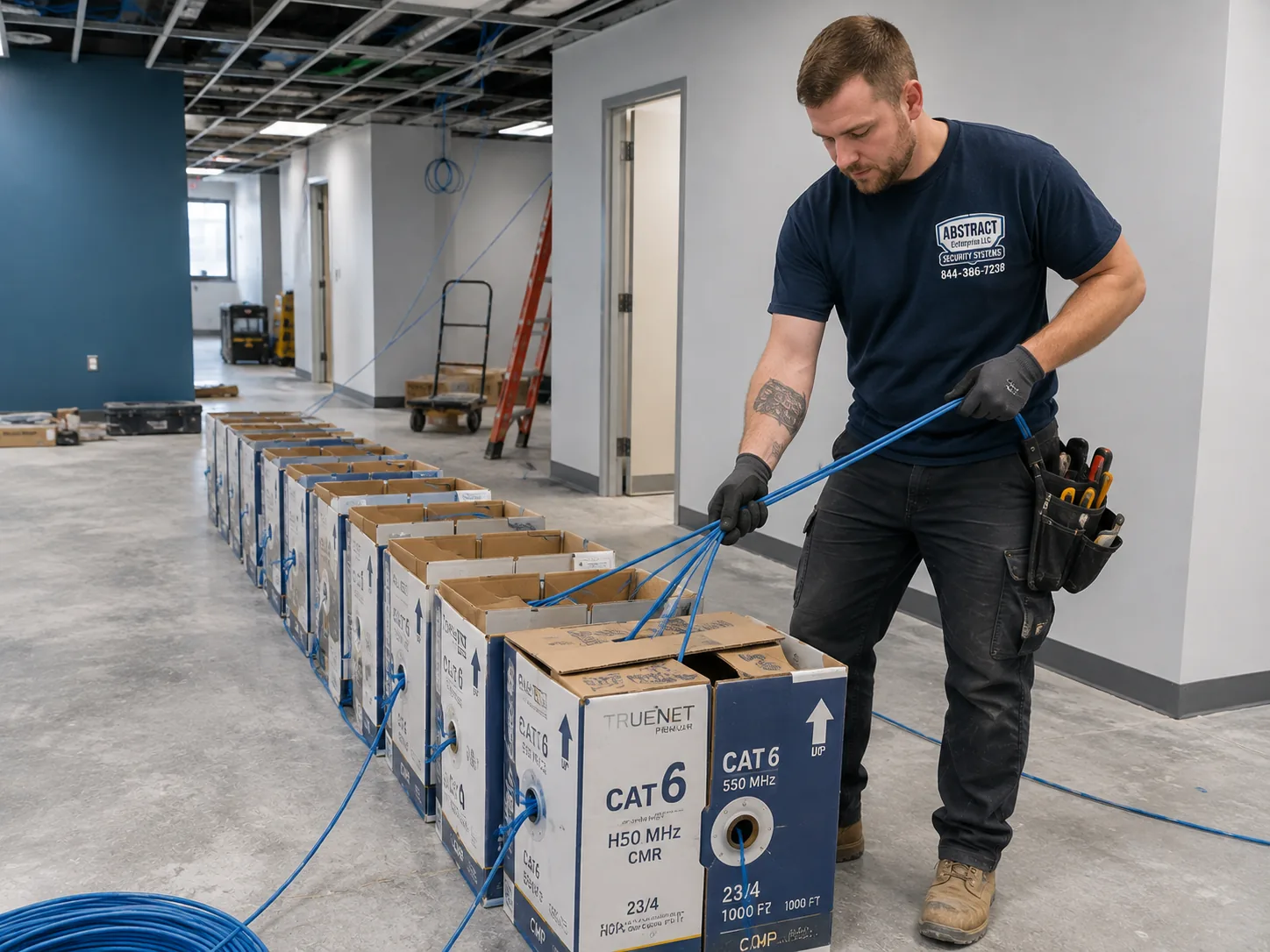
A photo from our job library, not taken in Cadman Plaza: boxes of cable staged on the floor of a working commercial space before a multi-drop pull. In a doorman tower like 75 Henry Street the same idea applies on a smaller scale: everything the technician needs is brought up in one trip and kept in the apartment, so nothing waits in the lobby or blocks a corridor the building's other residents use.
The new condo over the library: smooth walls, a glass side and a condo office that reads the paperwork
One Clinton is a different generation. The Brooklyn Eagle described a 36-story tower of 134 condos by Marvel Architects, and CityRealty lists ceilings of at least nine feet, seven-inch-wide white oak floors and a multi-zone heating and cooling system in each apartment. Buildings of this age usually have drywall interior partitions, sometimes on light-gauge steel studs, and an outer wall that is largely glass. That combination leaves fewer places for a screen than the floor plan suggests, and the one solid wall facing the sofa may be a partition that hides ducts, a heating and cooling unit or a riser. We scan for all of it, and if the best-looking wall is hiding equipment, we show you why another position is safer.
Two details are specific to a new condo. First, the floors: wide white oak scratches easily, so drop cloths and blankets go down before a ladder or a carton touches the floor, and drill dust is caught at the hole rather than swept afterwards. Second, the condo office: most will want the certificate of insurance, the date and the name of the technician, and some will ask whether any wall is being opened. An in-wall power and cable kit at $169 puts a recessed outlet behind the screen and a power inlet near the floor, using the kit's own rated cable rather than the TV's cord, and it is usually accepted when installed that way. If the office says no to any opening, the paintable cord cover at $59 needs only a few small screws.
The office suite near the courts: the landlord's wall, the firm's screen and the hours in between
The office towers south of the park, from the Montague–Court Building at 16 Court Street, which Wikipedia lists as 35 stories and 462 feet, to the buildings along Adams and Joralemon Streets around the Supreme Court at 360 Adams Street, are leased space. A law firm, a title company or a nonprofit may want a conference-room screen for video calls and documents, a reception display or a training room TV, but the wall belongs to the landlord, the ceiling is usually a dropped grid owned by the building, and the network closet may be shared. Before an office job we confirm in writing who has approved the wall work, when the room can be used without clients in it, and who needs the certificate of insurance.
Office walls are usually drywall on metal studs with a dropped ceiling above, which makes cable routing easier than in the residential towers: cables can often travel above the ceiling tiles to a wall plate behind the screen, as long as they are rated for that space and the landlord allows it. The bracket still has to be fixed properly, because a thin steel stud will strip a wood screw, and in a corridor or a waiting room the screen has to stay out of the walking path. Our list prices an office TV the same way as a home one, by the wall and the extras: the $179.99 starting price is written for drywall on wood studs, a soundbar fixed under the screen is $129, and because steel studs are not a separate line on this list, we confirm the price for a steel-framed office wall from your photos before booking rather than adding a figure on the day.
Field Notes
Field Notes: The First Fifteen Minutes in a Cadman Plaza Tower Apartment
These notes describe how our technicians work in concrete towers like the ones on Cadman Plaza West. They are our standing practice, not a story about any one apartment or shareholder.
Sign in, then look. At a desk building the technician signs in, confirms the apartment and the elevator, and checks that the building has our certificate of insurance on file. Inside, before any tool comes out, he walks the room: which walls are on the window side, which wall is shared with the corridor, where the outlets and the cable or fiber jack are, and whether a heating and cooling unit, a thermostat or a riser cover sits near the wall you chose.
Knock, then scan. On a cast wall a knock sounds flat and dead; on a partition it sounds hollow or slightly drummy. A scanner on deep mode picks up framing, metal studs and sometimes the conduit that feeds an outlet, but on concrete it will not show rebar reliably, so the technician treats a clean scan on concrete as a hint, not a promise.
One test hole, where the bracket will hide it. A small bit goes in first, inside the outline of the bracket plate. Concrete gives fine grey powder and steady resistance; block gives grey grit and then a sudden give into a hollow core; drywall gives white dust and then air or a stud. If the bit stops dead on metal, the technician stops too and talks to you about moving the bracket an inch or two.
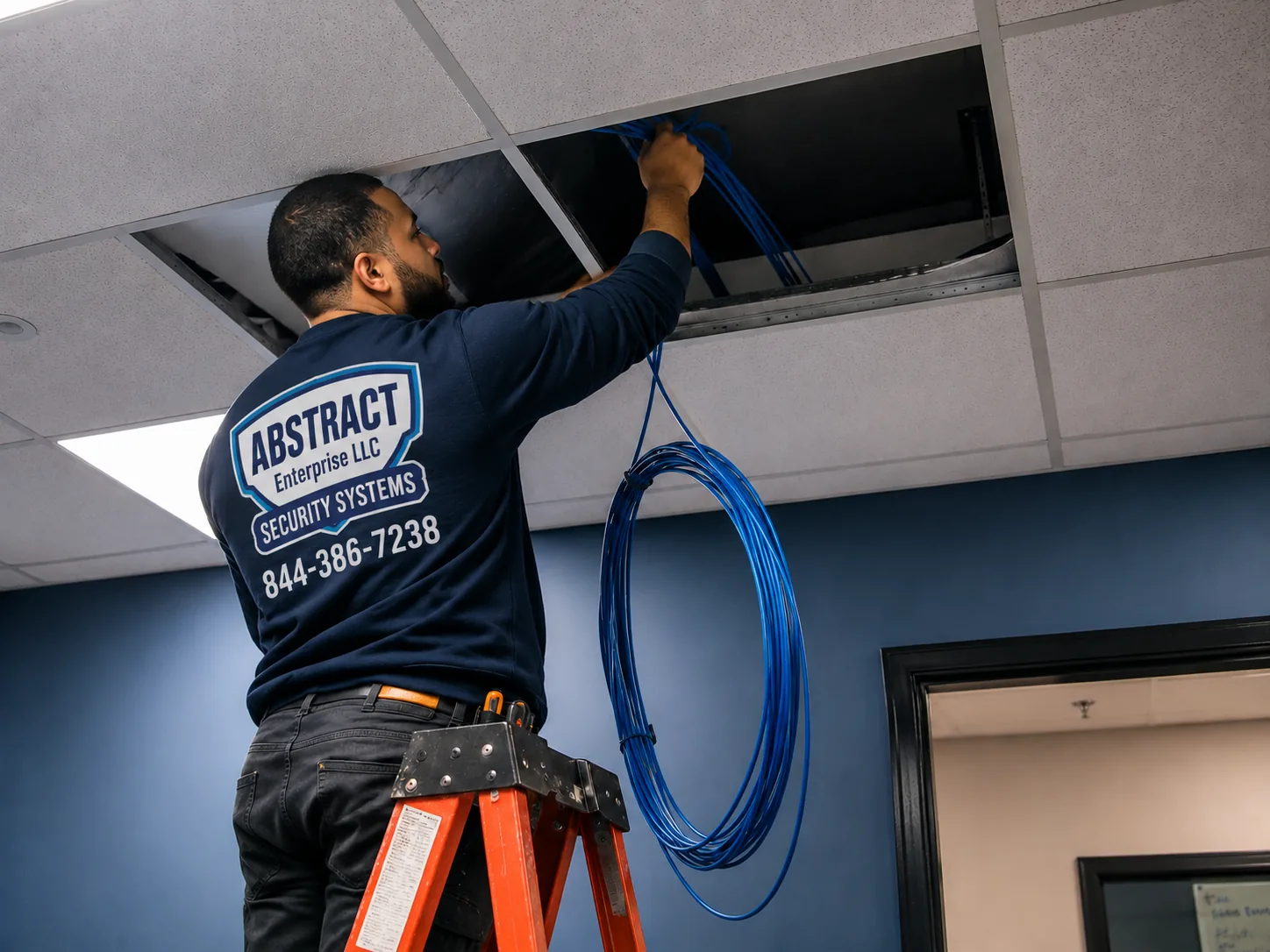
A photo from our job library, not taken in Cadman Plaza: a technician feeding cable through the ceiling of a commercial space while it is occupied. In the office towers along Court Street and Adams Street the cables for a conference display often travel this way, above the ceiling tiles to a plate behind the screen, which is only done with the landlord's agreement and cable rated for that space.
Tape, then sit. Painter's tape marks the outline of the screen at the height you want. You sit where you watch, and the technician checks the angle from the sofa and from the doorway, and looks at where the afternoon light from the windows lands. Moving tape costs nothing.
Drill once, catch the dust. The drilling for the bracket is done in one short burst, with a vacuum nozzle held at the bit so concrete dust does not settle on the floor or drift into the corridor. Then the noisy part of the visit is over, and the rest, hanging, leveling, cables and setup, is quiet.
Wall by Wall
Concrete, Block, Partition or Brick: What Holds a TV in a Cadman Plaza Wall and What Changes the Price
The starting price on our Brooklyn list, $179.99, covers a TV up to 55 inches on drywall over wood studs, labor only, with the bracket sold separately. That is a common wall in a renovated room, but it is not the only wall here, and it is rarely the wall in an unrenovated tower apartment. Each line below exists because that material needs different tools, different fixings and more time.
Poured concrete (priced from your photos). The walls of the cast towers are dense, heavy and very strong in every direction, which is good news for a large screen. The work is in the drilling: a hammer drill, a bit matched to the anchor, a hole cleaned of dust before the anchor goes in, and enough distance from any edge that the concrete cannot break out under load. The risk is reinforcing steel. If the test hole meets it, the bracket or the anchor pattern shifts rather than the steel being cut. Our list has no separate line for poured concrete, so we confirm the price for a concrete wall from your photos before you book, and that price does not change on the day unless the wall turns out to be something else.
Concrete block (priced from your photos). Some walls in buildings of this period are block rather than cast concrete, especially around corridors and shafts. Block has thin solid faces with hollow cores behind them, and an anchor that lands in a core holds very little. We place fixings in the solid webs between the cores, or use anchors made for hollow block, and on a full-motion arm we use every fixing point the wall plate offers, because an arm pulled out from the wall levers its weight onto the top anchors.
Brick or stone (+$65). The older brick walk-ups and row buildings on Henry, Clark and Middagh Streets beside the complex have brick party and front walls under their plaster, and stone appears on fireplace surrounds. Brick is priced as a $65 add-on. The anchor goes into the brick itself, not the softer mortar joint, and we keep holes back from the edges of each brick.
Plaster (+$45). Plaster turns up in the older buildings around the complex and sometimes over masonry in the towers themselves. On our list it is a $45 add-on, because it needs slower drilling, different anchors and more care around cracks. When the test hole shows plaster sitting directly on brick, the wall is priced by what is behind the plaster, which we confirm with you before continuing.
Drywall on wood studs (the base price). Found in renovated rooms, closets that were moved and some newer partitions. The bracket goes into two studs where they fall in the right place, and the wall can take the in-wall power and cable kit. In buildings of this age the studs are not always on modern spacing, so we find them one at a time.
Drywall on steel studs (priced from your photos). Likely in a building of One Clinton's generation and in the office towers. A thin steel stud strips a wood screw, so the fixing is a toggle or anchor made for steel and rated for the load, spread across two studs. Steel studs are not a separate line on our Brooklyn list, so we price the wall from your photos.
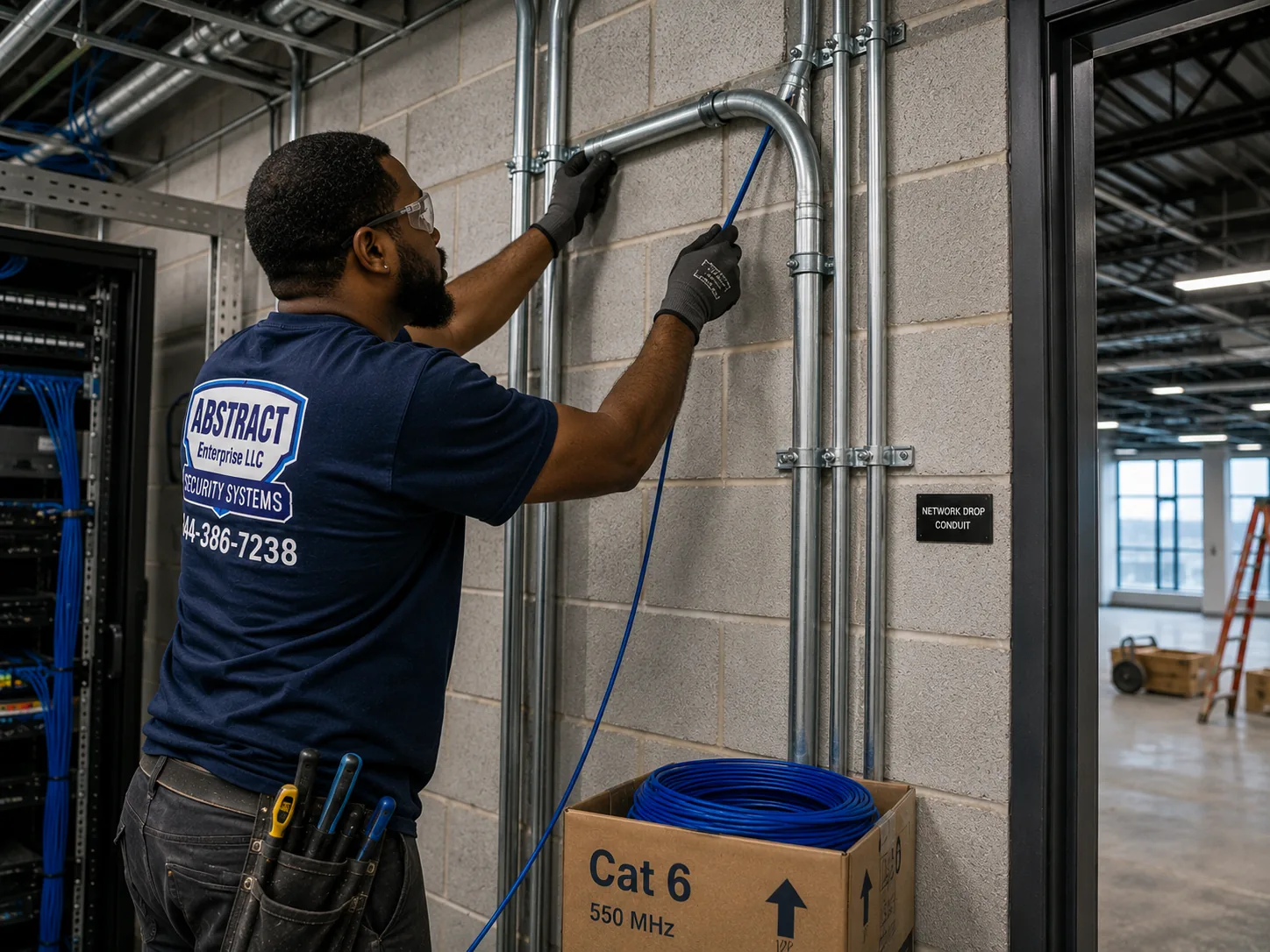
A photo from our job library, not taken in Cadman Plaza: a technician running cable into steel EMT conduit beside a telecom room. Conduit like this is how low-voltage cable crosses walls that cannot be opened, and it is a reminder of the one rule we never bend on a Cadman Plaza job: a TV's own power cord never travels inside a wall.
Hiding the wires when the wall is solid
The request that follows "mount it" is nearly always "and make the wires disappear," and in a concrete tower the honest answer is that the wall will not hide them. The National Electrical Code does not allow flexible cords, including a TV's power cord, to be run concealed inside walls, floors or ceilings. On a framed wall the proper way to hide power is an in-wall power and cable kit: a recessed inlet low on the wall plugs into the existing outlet, the kit's own rated cable carries power inside the wall, and a recessed outlet sits behind the TV with a separate pass-through for HDMI. On our list that is $169. It needs a hollow framed cavity between the two openings, so it suits drywall and framed partitions and does not suit cast concrete, block or solid brick.
On a solid wall there are three good answers. The first is a paintable cord cover, $59 on our list, which runs from the screen down to the outlet on the surface and can be painted to match the wall. The second is placement: a TV fixed directly above a console, with the outlet behind the console, lets the cables drop straight down behind the furniture so the cover is short or not needed at all. The third is choosing a different wall, a framed partition across the room, where the in-wall kit is possible. We price each one for your room before the visit, so you can decide which matters more, the position or the clean wall.
Boards and Buildings
Co-op Boards, Condo Offices and Managing Agents: Who Has a Say Before a TV Goes on a Cadman Plaza Wall
Almost every residential building on this page is owned collectively. Cadman Towers and Cadman Plaza North are co-ops, Whitman Close is a co-op that also owns the Pineapple Walk shops, and One Clinton is a condominium. That means house rules, a managing agent and, for larger work, an alteration agreement. We are installers, not lawyers, and nothing here is legal advice, but we have learned what these buildings tend to ask about a TV, and it is easier to get the answer before the visit than at the door.
Start with the alteration agreement or house rules. New York co-ops and condos use an alteration agreement to govern work inside apartments; Brick Underground, Habitat and Hauseit have all published guides to reading one. Most buildings treat hanging a picture or a TV bracket as minor work that needs no formal application, but many treat opening a wall, touching electrical wiring or working near a riser as an alteration that needs approval. An in-wall power and cable kit falls in between: it opens two small holes in a partition and uses its own cord rather than the building's wiring. Ask the managing agent which category it falls into in your building, and we will send whatever they need.
Expect contractor hours and a certificate of insurance. Buildings like these commonly allow contractor work only on weekday daytime hours and want a certificate of insurance naming the corporation and the managing agent before anyone starts. Tell us the exact names the office wants on the certificate, and we send it before the visit. If the building wants the elevator padded or reserved, we need to know a day ahead.
Think about the next owner. With Cadman Towers now reselling apartments through a lottery under its HDFC rules, and shareholders in the other towers selling on the open market, the TV you mount today may become someone else's wall. Four or six neat anchor holes in concrete, filled and painted, are easy for the next owner to live with. A cord pushed through a wall, a bracket held by plastic plugs or a cut into a riser cover are not. We leave a short note of what bracket and anchors were used and what the wall is, so whoever comes next does not have to guess.
Subtenants and renters. If you are subletting an apartment with the board's approval, the owner of the apartment and the building both have a say over wall work, and the simplest route is to get the owner's agreement in writing and let the owner check with the managing agent. If the answer is slow, a TV on its own stand is $119.99 on our list, with a soundbar placed on the console for $79, and it leaves no holes to argue about at the end of the sublet.
The outside of the building is not yours. Satellite dishes and antennas on the outside of a co-op tower, its roof, its facade or a shared terrace are a matter for the board and federal rules on reception devices, not for a TV installer. Inside your own apartment, an indoor antenna near a window is your choice, and we can place and connect one during setup. The Cadman Plaza complex was left out of the Brooklyn Heights Historic District when it was designated in 1965, according to NYC Urbanism, so the Landmarks Preservation Commission is not the usual question here, but buildings on the Heights side of Henry Street may fall inside the district, and their owners should check with the Commission before anything goes on a facade.
Commercial TV Installation
Business TV Installation in Cadman Plaza
The commercial side of Cadman Plaza is small in floor area but busy: the shops and restaurant along Pineapple Walk under the co-op towers, the professional offices in the Court Street and Adams Street towers facing Borough Hall, the blocks of Cadman Plaza East beside the federal courts, and the Tillary Street edge where traffic from the bridges comes in. The cards below describe kinds of space where a business needs a screen. We do not name any business as a customer.
Pineapple Walk
The retail strip between Cadman Plaza West and Henry Street that Brooklyn Paper reported is owned by the 75 Henry Street co-op, with the Park Plaza Restaurant and other stores. Counter screens and dining-room TVs here sit under apartments and answer to a co-op landlord.
Court Street towers
Office buildings around Borough Hall, including the 35-story Montague–Court Building at 16 Court Street, which Wikipedia notes CIM bought in 2017 and which faced foreclosure risk by 2025 because of low occupancy. Conference and reception screens for law and professional suites.
Adams Street and Joralemon Street
The blocks around the Supreme Court building at 360 Adams Street, where the County Clerk keeps weekday hours. Suites here want displays for video calls, documents and client waiting areas.
Cadman Plaza East
The federal side, with the Roosevelt courthouse at 225 and the Federal Building and Post Office at 271–301. We do not work inside those buildings, but nearby offices serving people who use them buy screens for meeting rooms.
Tillary Street
The southern edge of the park and the gateway from the bridges, which the Brooklyn Eagle reported in 2019 the city was redesigning after a study found an average of 39 crashes a year at Tillary and Adams. Deliveries and vans here need planning.
The library block
The Brooklyn Heights library at the foot of One Clinton opened in 2022, and the tower above it has ground-floor retail spaces. New shops and services in a new building usually want screens fixed to new partitions, with the condo's rules in mind.
Almost no business on this page owns its walls. A shop on Pineapple Walk has a co-op corporation as its landlord and apartments over its ceiling. A suite at 16 Court Street or on Adams Street has a building owner, a managing agent and usually a set of contractor rules covering hours, insurance and noise. So before any business job we confirm three things in writing: who has approved the work on the wall, when the room can be used without customers or clients in it, and who receives the certificate of insurance. For a restaurant that usually means before opening or after the last table; for an office it usually means early morning, an evening or a day the suite is closed.
Office screens also bring a question homes rarely ask: how people will connect to them. A conference room used by several attorneys or staff, each with their own laptop, needs a reliable way to put a document on the screen without a search for adapters every meeting. That can be an HDMI cable run in a cord cover to a plate at the table, a wireless presentation device, or a small computer that stays connected to the screen, and the right choice depends on the firm's IT rules more than on the wall. We set up what the firm chooses and test it with the people who will use it. A setup-only visit for configuring devices is $195 for the first hour on our list, then billed in 30-minute blocks.
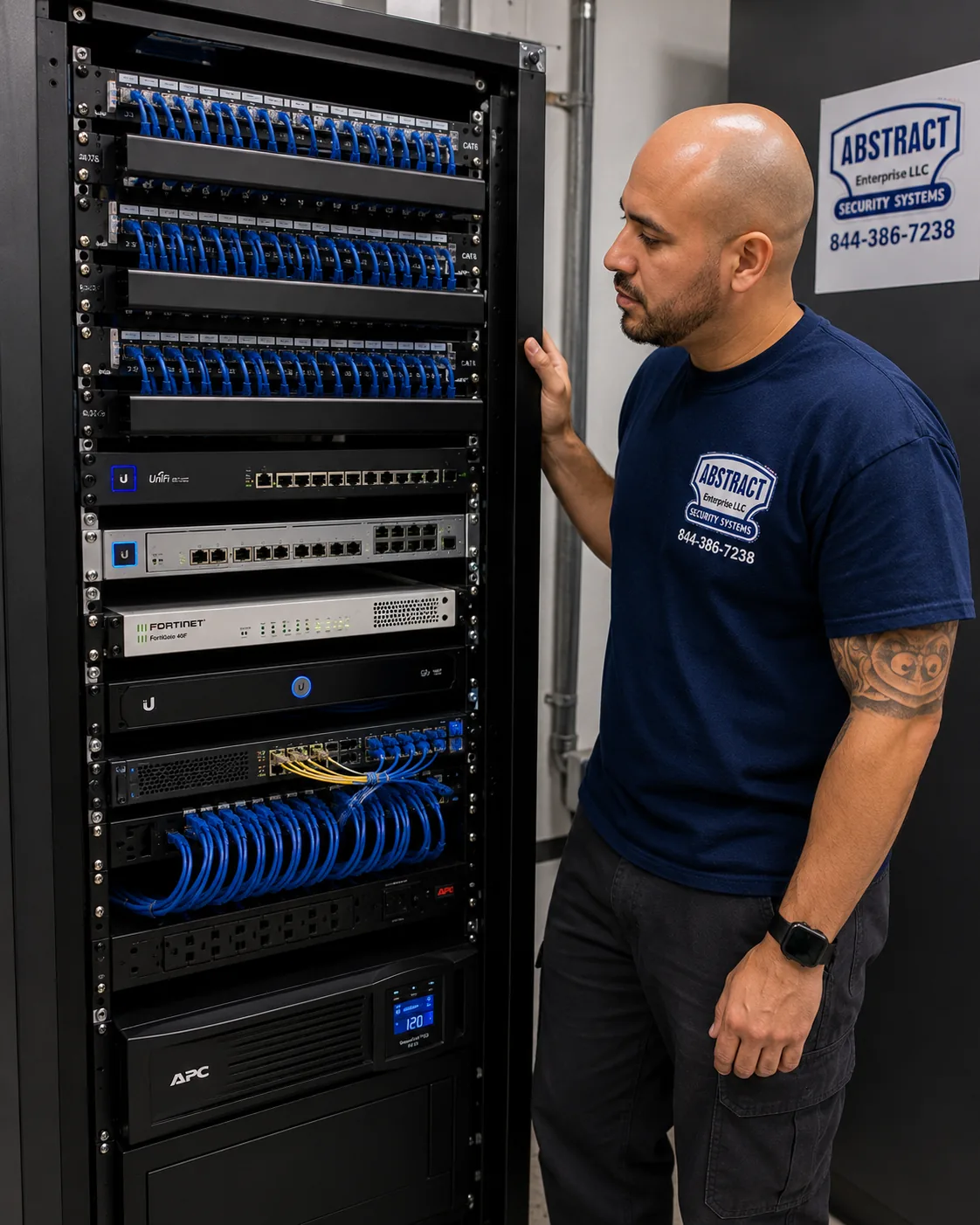
A photo from our job library, not taken in Cadman Plaza: a network rack with patch panels, switching, a firewall and battery backup, every cable dressed and labeled. A law or professional suite near Borough Hall that wants a conference display on its network usually has a closet like this, and the firm's IT contact decides which port the screen may use before we connect it.
Compliance notes for Cadman Plaza offices and shops
Keep screens out of the walking path. The 2010 ADA Standards for Accessible Design say wall-mounted objects with a leading edge between 27 and 80 inches above the floor may not protrude more than 4 inches into a circulation path. A full-motion arm in a corridor or waiting room can break that rule once it is pulled out, so in public areas we use low-profile brackets or mount above 80 inches.
No power cords inside walls or above ceilings. The National Electrical Code does not allow flexible cords to be concealed in walls, floors or ceilings, and that includes running a TV's cord above ceiling tiles. Hidden power behind a business screen goes through a rated in-wall kit or stays on the surface in a cover.
Leave life-safety devices alone. Screens are not mounted where they would block an exit sign, a sprinkler head, a fire alarm device or a door swing, and cables stay off the floor in any route people use to leave the space.
Paperwork before tools. Office landlords and co-op landlords usually require a certificate of insurance naming the owner and the managing agent before work starts, and many set contractor hours. We send the certificate ahead of the visit.
Rated hardware for screens people touch. A screen in a reception area or a shop gets bumped, leaned on and pulled. Every bracket we fit is rated above the TV's weight, and on masonry we use anchors rated for the load, with margin.
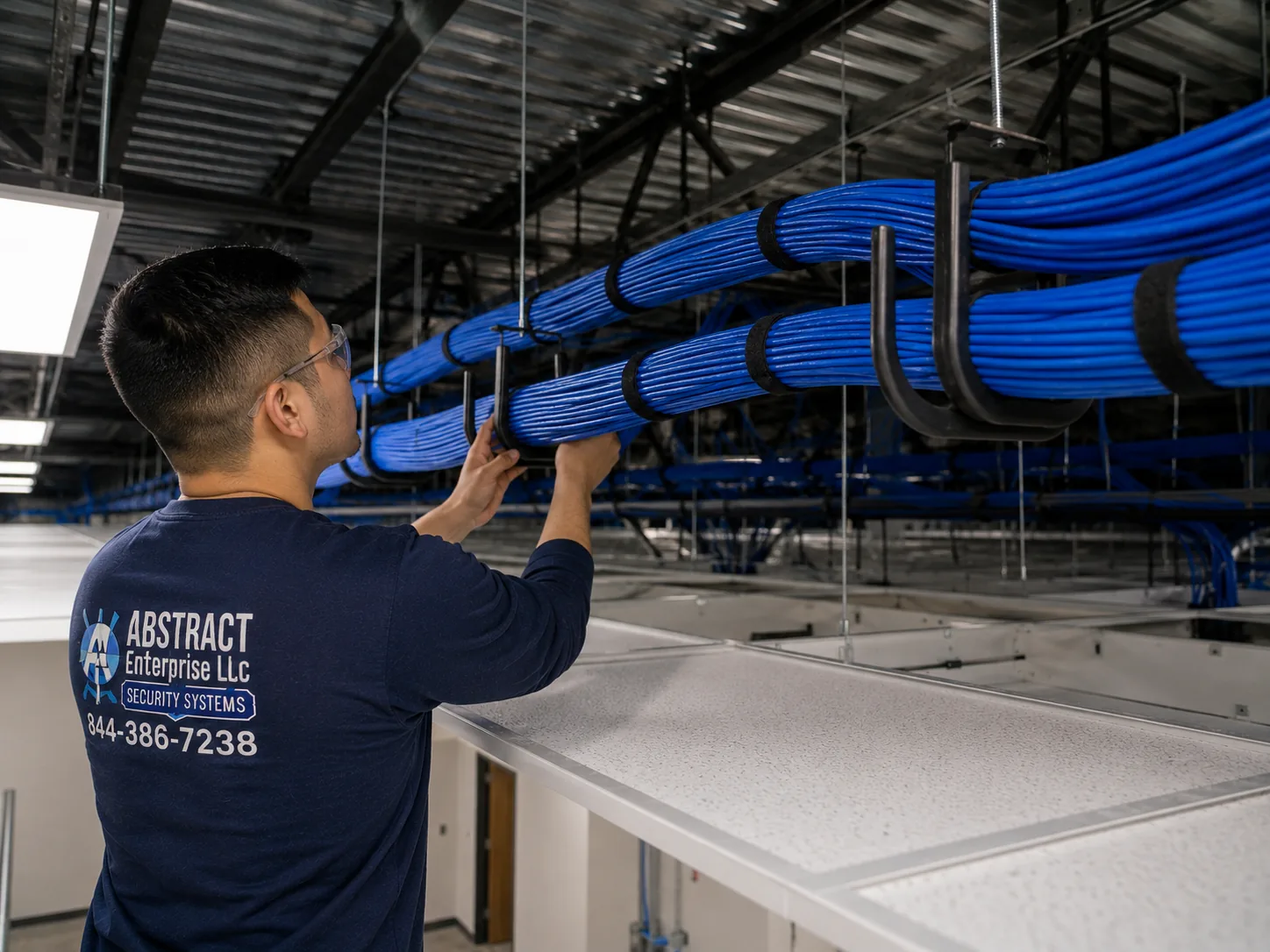
A photo from our job library, not taken in Cadman Plaza: J-hooks carrying neat bundles of cable across a commercial ceiling. Low-voltage cable for a display in one of the office towers near the courts follows paths like this above the tiles, supported every few feet rather than laid on the ceiling grid, and only with the landlord's agreement.
Your Questions Answered
TV Installation in Cadman Plaza: Questions Answered
These are the situations shareholders, condo owners and office managers around the park describe when they call: walls shaped by the towers' saw-tooth design, finishes left by owners in the 1970s and 1980s, signal in a concrete building, and buildings where someone else holds the lease or the keys. Each one is answered here in full and not repeated in the FAQ further down.
Walls shaped by the towers
Our living room in Cadman Towers has an outer wall that zigzags with the building's saw-toothed shape. Can a TV hang on one of the angled sections?
Often yes, if the angled section is wide enough and faces the seating. The saw-tooth that NYC Urbanism describes gives these apartments short wall faces set at an angle to each other, usually with a window in one face and solid concrete in the next. A solid face that is wider than the TV can carry a fixed or tilting bracket like any concrete wall. The question is the view: a screen on an angled face points diagonally across the room, which works well when the sofa sits in the corner opposite and badly when it sits square to the main wall. If the face is narrower than the screen, or the sofa does not line up, a full-motion arm on the solid face can turn the screen square to the room, but an arm levers more load onto its anchors, so we use every fixing point on its wall plate. We tape the screen's outline on each candidate face and you sit and look before we choose.
The long wall in our tower living room is covered floor to ceiling in old mirror tiles. Can a TV go on that wall?
It can, but not by drilling through mirror, and the first decision is whether the mirror stays. Mirror tiles from that era are usually glued straight onto the wall, sometimes with small clips, and drilling through glass risks cracking a tile and leaving a sharp edge behind the screen. If you are happy to lose the tiles where the TV will go, the safe route is to take down only the tiles behind the bracket area, fix the bracket into the concrete or partition underneath, and hang the TV over the gap so the remaining mirror frames it. If the whole wall is coming down later anyway, it is easier to remove it before the visit. If the mirror must stay intact, the TV belongs on a different wall or on its stand. Removing tiles is not a line on our list, so we confirm it from photos before booking, and a mirror on the wall opposite the windows can also throw glare onto the screen, which we check on the day.
A concrete beam drops below the ceiling right above the wall we want. Does it limit how big or how high the TV can be?
It limits the top of the screen, not the bracket. Cast-concrete towers often have a beam or a lowered strip of ceiling running along a wall, and the bottom of that beam becomes the real ceiling for anything on the wall below it. We measure from the underside of the beam, leave room for the TV to be lifted onto its bracket, which on most brackets means a few inches of clearance above the screen, and then check that the center of the screen still lands at a comfortable height from your sofa. For a large screen that sometimes means the TV sits lower than you pictured, which is usually better for viewing anyway. We never fix into the beam itself; it is part of the building's structure and belongs to the co-op, and the wall below it is almost always a better fixing.
The previous shareholder left a built-in wall unit where the old TV stood. Can the new TV be mounted onto the unit itself?
Usually not onto the unit, but often through it. A built-in wall unit is cabinetry, and its back panel is typically thin sheet material that cannot carry a modern TV on a bracket. If the unit has an open bay where the old set lived, there are two good answers. If the bay is deep enough and the new screen fits it, the TV can stand inside the bay on its own feet, with the cables tidied through the cabinet. If you want the TV on the wall at that spot, the bracket has to reach the wall behind the unit, which means opening or removing the unit's back panel at that point and fixing into the concrete or partition behind it, then hanging the TV in front. We look at how the unit is built from your photos and tell you which is possible. Removing or altering cabinetry is not a line on our list, so if it is needed we confirm that price before booking.
Signal, access and the people who hold the keys
Our apartment is high in one of the towers but faces away from Manhattan. Will an indoor antenna still pull in the broadcast channels?
Sometimes, and it is worth trying before paying for a service you may not need. Broadcast reception in New York depends on the direction and the path to the transmitting towers in Manhattan, and a concrete apartment facing the other way puts the whole building between the antenna and the signal. An antenna placed in a window on the side of the apartment closest to Manhattan, if you have one, does far better than one behind the TV on a back wall. During a setup visit we place the antenna, run the TV's channel scan in each position and show you what comes in. If very little does, a streaming service or the provider's box is the realistic answer, and we connect whichever you choose. An antenna outside the window, on the facade or on a shared terrace is a question for the board, not for us.
Our co-op asks every contractor to protect the elevator and the hallway. What does that look like for one large TV?
It is simpler than a renovation, but it is real. For a TV visit the technician brings everything up in as few trips as possible, carries the screen in its carton, keeps the cart and the carton off the corridor walls, and does not leave tools or packaging in the hallway at any point. If your building pads the elevator for contractors, we need to know a day ahead so the super or the desk can hang the pads, and if the building reserves the service elevator, we book the arrival window around that reservation. Inside the apartment, blankets and drop cloths go down from the door to the TV wall before anything is set on the floor. When we leave, the packaging goes with us or to wherever your building tells us to take it, never left by the chute.
Our firm sublets one room inside another firm's suite on Court Street. Who has to agree before a screen goes on our wall?
Normally two parties besides you: the firm that holds the lease on the suite, and through them the building's owner or managing agent. Your sublease will usually say whether you may fix anything to the walls, and the main tenant's lease will say what the landlord must approve. The easiest path is to ask the main tenant to forward the request to the building with a short description: which wall, the size of the screen, the type of bracket and whether any cable goes above the ceiling. We send the certificate of insurance to whoever the building names and work inside its contractor hours. If approval is slow, a screen on a stand or a mobile cart in your room needs no one's permission and can move with you if you change offices.
Equipment
Types of TV Mounts and Hardware We Install
Brackets are sold separately from the labor, or we hang your own bracket if it is rated for your TV's weight and fits its bolt pattern. These are the kinds of hardware we fit in Cadman Plaza homes and offices, and what each one suits in buildings like these.
Fixed low-profile brackets
The screen sits close to the wall. The natural choice on a flat concrete wall facing the sofa, and the easiest to remove cleanly when an apartment is sold.
Tilting brackets
A few degrees of downward tilt for a screen that has to sit a little high, under a ceiling beam or opposite a wall of windows.
Full-motion arms
For an angled saw-tooth wall face, a corner, or a room where the dining table also wants a view. On masonry they need every fixing point on the wall plate.
Masonry and concrete anchors
Anchors chosen for cast concrete, hollow block or solid brick, set to depth and rated for the load, never plastic plugs in a masonry wall.
In-wall kits and cord covers
The $169 in-wall power and cable kit for framed walls and the $59 paintable cord cover for walls that cannot be opened.
Soundbars and streaming devices
Soundbars wall-mounted ($129) or placed ($79), streaming sticks and boxes, cable boxes and antennas connected and tested during setup.
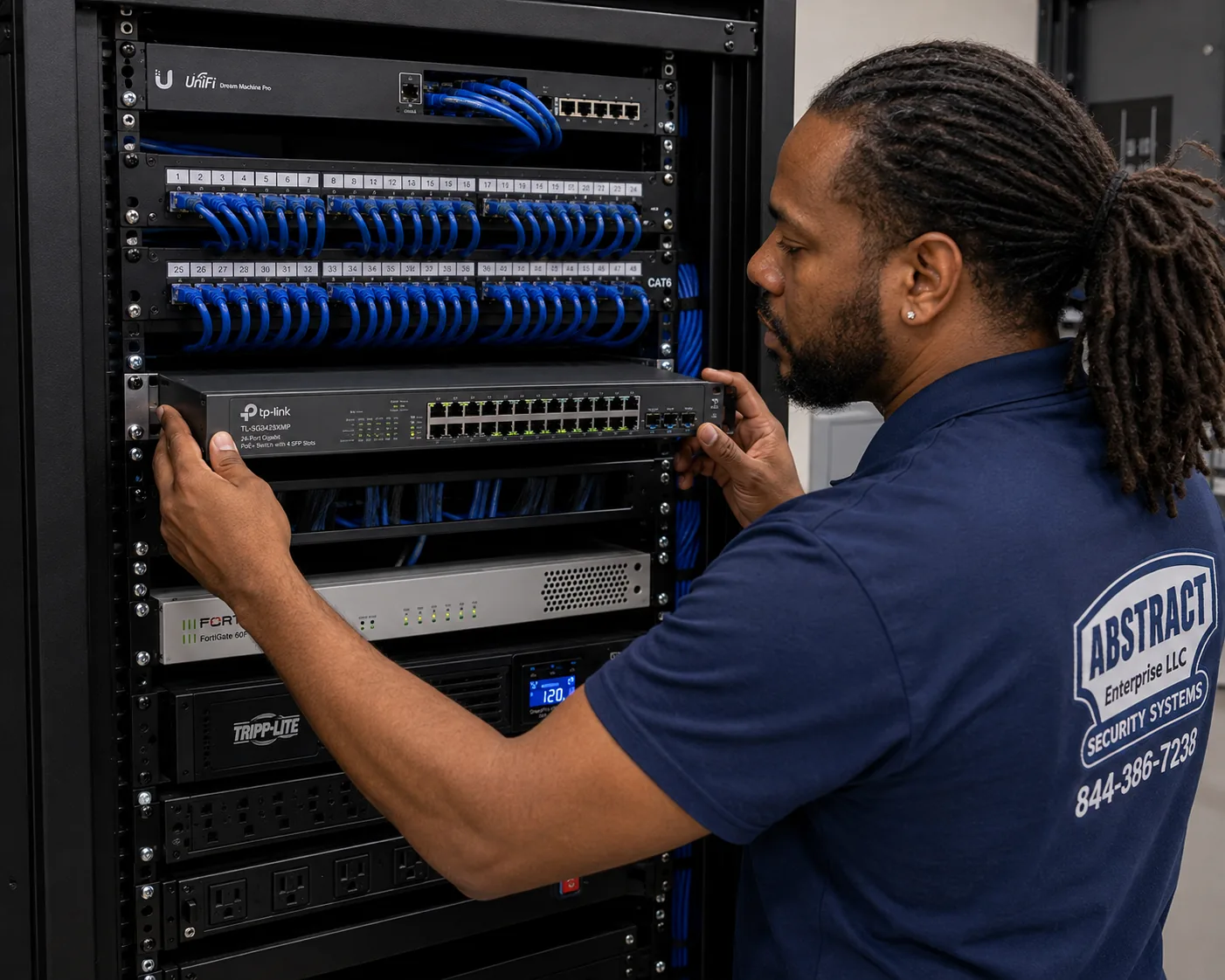
A photo from our job library, not taken in Cadman Plaza: a technician mounting a managed PoE switch below the patch panels in a commercial rack. A conference display or streaming device in an office near Borough Hall usually connects through a switch like this, and the firm's network rules decide whether the screen gets a wired port or stays on guest Wi-Fi.
Big-box installation, an app-booked handyman or a local installer for a Cadman Plaza wall
Electronics stores and handyman apps both book TV mounting, and for drywall on wood studs either can be a reasonable choice. The table below is about the walls and buildings Cadman Plaza actually has, not about the quality of any company.
What the job needs
Store or app booking
Abstract Enterprises Security Systems at Cadman Plaza
Knowing the wall before the visit
Often assumed to be drywall
Read from your photos, confirmed with one hidden test hole
Cast concrete and block
Depends on who is sent and what they carry
Hammer drill, concrete bits and masonry anchors; price confirmed from photos
Hidden power
Varies
In-wall kit on framed walls ($169), cord cover on solid walls ($59), never a cord inside a wall
Co-op and condo paperwork
Varies
Certificate of insurance sent to the managing agent before the visit
Arrival time
Varies
A two-hour arrival window, booked around building contractor hours
National alarm and smart-home companies such as ADT, Ring and SimpliSafe sell cameras and doorbells rather than TV mounting, so they are not really the comparison here. The comparison that matters is between a visit planned around your wall and your building, and a visit that discovers both on arrival.
AI Overview Reality Check
What AI Gets Wrong About TV Installation in Cadman Plaza
These are claims that turn up in generic online answers and in national cost guides such as Angi, HomeAdvisor and Fixr, paraphrased rather than quoted, each followed by what the buildings around Cadman Plaza actually show. We have not quoted any single AI Overview; the claims below are the common ones.
"Find two studs and screw the bracket into them"
The most common instruction online is to run a stud finder along the wall, mark two studs at the usual spacing and drive lag bolts into them. It assumes a framed wall, because most American houses have one.
The co-op towers west of the park were cast in concrete between 1967 and 1973. A concrete wall has no studs at all, and a stud finder on it either reads nothing or reads the steel inside. Even where a later partition was added, its framing may be steel rather than wood.
We confirm the wall with one test hole hidden behind the bracket plate and choose the anchor for what is actually there, whether that is concrete, block, a wood stud or a steel one.
"Concrete is the hardest wall to mount on"
Many answers warn people off concrete as if it were the worst case, difficult to drill and likely to fail.
Concrete is harder to drill, but it is one of the best walls to hang a heavy screen on once the anchor is set to the right depth. The real risk SlashGear names is meeting rebar, and in a co-op tower the answer to rebar is to move the bracket, not to cut the steel.
The difficulty in these apartments is rarely holding the TV. It is hiding the cables on a wall that has no hollow inside it, which is why the cable plan is settled before the bracket position.
"Hide the cords by running them through the wall"
A popular tip is to cut a hole behind the TV and another near the floor and push the TV's own power cord through the wall between them.
The National Electrical Code does not allow flexible cords to be concealed inside walls. On a framed partition the right method is an in-wall power and cable kit with its own rated cable and a recessed outlet behind the screen. On cast concrete nothing can be fished inside at all.
In a concrete tower apartment the honest options are a paintable cord cover, a screen placed directly above the console, or a framed wall elsewhere in the room.
"A TV bracket never needs anyone's permission"
Some answers treat a TV mount as too small for any building to care about, and others treat any drilling in an apartment as forbidden.
In the co-ops and the condo around Cadman Plaza, the house rules and the alteration agreement decide. Hanging a bracket is usually minor work, but opening a wall for an in-wall kit or working near a riser may need approval, and most buildings want a certificate of insurance and contractor hours respected.
Ask the managing agent which category your job falls into, send us their requirements, and we send the paperwork before the visit.
"Wall mounting costs about the national average"
Cost guides publish national averages drawn from many cities, nearly all of them for drywall in a house with a driveway.
An average cannot know that your wall is cast concrete, that the screen has to pass a doorman's desk and a reserved elevator, or that the cables need a surface cover because the wall cannot be opened. Those are the things that change a Cadman Plaza total.
Our Brooklyn list starts at $179.99 and shows each add-on, from $45 for plaster to $169 for an in-wall kit, and anything not on the list, such as a concrete wall, is priced from your photos before booking.
"Mount the screen at the same height in every room"
Generic advice gives one height for the center of a TV, as if every room were the same.
Rooms here range from 1960s living rooms with a beam running along the wall to One Clinton apartments with ceilings of nine feet or more, and from angled saw-tooth wall faces to duplex bedrooms where the viewer is lying down.
We mark the outline with painter's tape and check it from where you actually sit or lie, and the beam, the windows and the furniture decide the height.
"Wi-Fi reaches every room in an apartment"
Streaming advice tends to assume that if the router works in one room, a smart TV will stream anywhere in the home.
Cast-concrete walls and floors absorb wireless signal far more than drywall does, and in a duplex townhouse the router may be a full concrete floor away from the bedroom TV.
We check the signal at the TV's position during setup, test any wired jack before relying on it, and tell you plainly if a screen in that spot will struggle, before it goes on the wall.
Not Sure Whether Your Wall Is Concrete? Ask Before You Buy a Bracket
Tell us the building, the floor, the TV size and model, and what you know about the wall and your building's rules. A technician will call back with the total for the Cadman Plaza address, or you can call (347) 934-8335 right now.
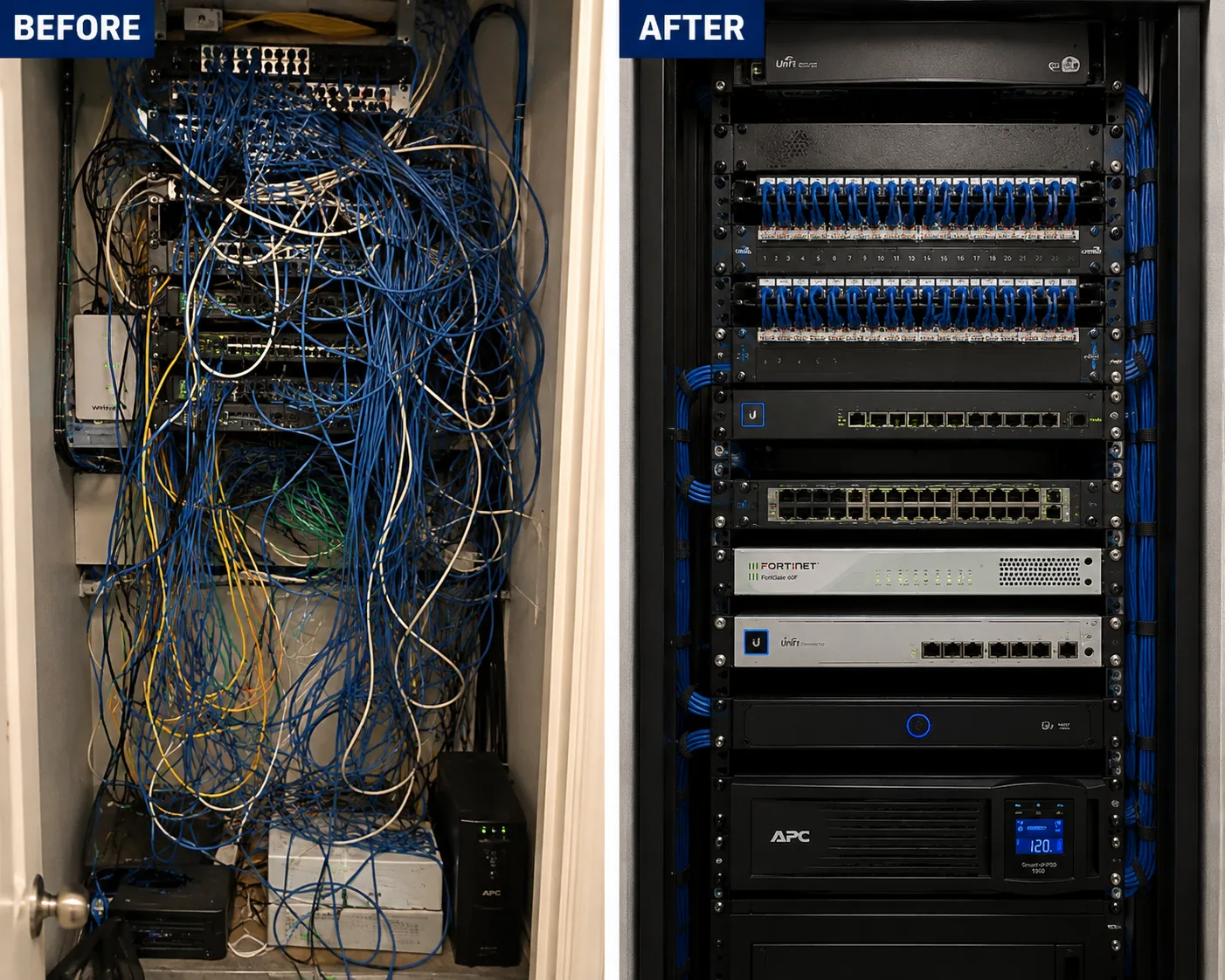
A photo from our job library, not taken in Cadman Plaza: the same network rack before and after, a tangle of unlabeled cable on one side and dressed, identified cable on the other. The behind-the-TV version of this in a Cadman Plaza apartment is a console where every cable is strapped and labeled, and if you tell us on the form that your devices live in a cabinet below the screen, we plan that drop before the visit.
✅
Request Sent!
Thank you. A technician will call you about the Cadman Plaza address, usually within two hours of your request.
How It Works
Our Installation Process
1. Send photos and the model number
A straight-on photo of the wall, the sticker on the back of the TV and the spot where the cable box or streaming device will sit, with your building and floor.
2. Get the price and book
We reply with the wall we expect, the lines from the Brooklyn list that apply and the total. The job goes on the schedule once it is paid, in a two-hour arrival window.
3. Clear the building side
Contractor hours, the elevator, the certificate of insurance and any alteration paperwork are settled with the managing agent or super before the visit.
4. Read the wall
Scan, knock and one small test hole hidden behind the bracket plate to confirm concrete, block, brick, plaster or drywall.
5. Mark the screen
Painter's tape outlines the TV; you check the height and the glare from where you actually sit.
6. Fix the bracket
Anchors chosen for the wall, dust caught at the hole, and all the drilling done in one short burst.
7. Hang the TV and route the cables
The TV is hung and leveled; cables go into an in-wall kit on a framed wall, a paintable cord cover, or straight down into the console.
8. Test and hand over
Every input, the soundbar and the remote tested with you, the room cleaned, and a note left of the bracket, anchors and wall type.
Coverage Area
TV Installation Near Cadman Plaza's Landmarks
Cadman Plaza Park
About 10.4 acres between Cadman Plaza East and West, laid out by Clarke & Rapuano and named in 1939, home of summer Movies Under the Stars screenings.
Brooklyn War Memorial
The memorial wall at the park's north end, completed in 1951 by NYC Parks' account and dedicated in 1952 by The Cultural Landscape Foundation's.
Theodore Roosevelt U.S. Courthouse
The 15-story federal courthouse at 225 Cadman Plaza East, designed by César Pelli and finished in 2006.
Federal Building and Post Office
The Romanesque landmark at 271–301 Cadman Plaza East, built 1885–91 and home to the bankruptcy court.
Brooklyn Borough Hall
The Greek Revival hall at 209 Joralemon Street, completed in 1848 and a city landmark since 1966.
Brooklyn Heights Library
The library at the base of One Clinton on Cadman Plaza West, more than 26,000 square feet, opened June 8, 2022.
We also serve Brooklyn Heights, Downtown Brooklyn, DUMBO and Boerum Hill, along with Vinegar Hill and Fulton Ferry beyond the bridge approach. The High Street–Brooklyn Bridge station on the A and C, open since June 24, 1933, has entrances on Cadman Plaza East and Cadman Plaza West.
Pricing
TV Installation Cost in Cadman Plaza
Cadman Plaza is billed at our Brooklyn rate. The starting price covers a TV up to 55 inches on drywall over wood studs, labor only, with the bracket sold separately; everything else is a listed add-on. Items that are not on this list, including poured concrete, block, steel studs and screens larger than 55 inches, are priced from your photos and the TV's model number before you book, and the total is agreed before the visit. TV jobs go on the schedule once they are paid.
Item
Brooklyn price
TV wall mounting, drywall on wood studs, up to 55" (starting price; bracket sold separately)
In-wall concealment with code-compliant in-wall power and cable kit
$169
Paintable cord cover
$59
Soundbar wall-mounted / soundbar placed
$129 / $79
Take down old TV
$85
Poured concrete, concrete block, steel studs, screens over 55"
Priced from your photos before booking
Two things make a Cadman Plaza total easy to predict. The first is a clear photo of the wall and the TV's model sticker, because those decide the wall line and whether the screen is over 55 inches. The second is knowing your building's rules before the visit, because a board that does not allow walls to be opened turns a $169 in-wall kit into a $59 cord cover, and a technician who knows that in advance arrives with the right parts.
Full terms — including 50% deposit, one-year parts-only warranty on Abstract Enterprises Security Systems-supplied products, and the late-fee schedule — are set out in the service agreement.
Shop Our Systems
TV Installation Packages & Pricing
Three typical Cadman Plaza jobs, added up from the list above. Brackets are extra at list price unless you supply a rated one, and a concrete wall in one of the towers is priced from photos on top of these.
Sublet or waiting on the board: $198.99
The TV set on its own stand on your console ($119.99), devices connected and cables tidied, with the soundbar placed in front ($79). No holes at all.
Condo partition, wires inside: $477.99
A TV up to 55 inches on a drywall partition on wood studs ($179.99), an in-wall power and cable kit ($169) and a soundbar fixed under the screen ($129).
Brick building do-over: $517.99
The old TV taken down ($85), the new one up to 55 inches on a brick wall in one of the older buildings on Henry or Clark Street ($179.99 + $65), a paintable cord cover ($59) and a wall-mounted soundbar ($129).
Bring your own equipment. If you already own a bracket, we install it at the labor prices above as long as it is rated for your TV's weight and fits its bolt pattern. The same applies to your own soundbar bracket or cord cover. If a bracket you bought online turns out to be wrong for a concrete wall, for example because its wall plate leaves too little room for proper anchors, we tell you before drilling.
Complete Services
Every TV Installation Service in Cadman Plaza
Wall mounting
Concrete, block, brick, plaster and drywall. Request a quote
Your Brooklyn list has a brick line but no concrete line. How is a poured-concrete tower wall priced?
+
Poured concrete is priced from your photos before you book. We look at the wall, the TV's model number and the cable plan, give you one total, and that total holds on the day unless the test hole shows the wall is a different material, in which case the technician tells you before drilling any further.
Do I need to buy anything for a concrete wall besides the bracket?
+
No. The technician brings the hammer drill, the concrete bits, the dust extraction and the masonry anchors rated for the load. You supply the TV and either your own rated bracket or one bought at list price, plus any streaming device you want connected.
Can the dust from drilling concrete set off the smoke detector in our apartment?
+
It can if dust drifts toward a detector close to the TV wall, which is why the technician catches the dust at the bit with a vacuum nozzle and keeps the drilling short. If a detector sits right above the wall, we tell you before starting; never remove or disable one yourself, and if your building's detectors are wired to a central system, let the super know the date of the visit.
Does the $119.99 stand setup include fitting the legs or pedestal that came with the TV?
+
Yes. Placing a TV on its stand means attaching the feet or pedestal that came in the box, setting the TV on your console, connecting the devices and tidying the cables. If you also want the soundbar set in front of it, that is $79 on our list.
Can the technician adjust the picture so a new TV does not look harsh in our living room?
+
Yes, within reason. During setup we switch off the showroom picture mode, choose a mode that suits a lived-in room and check it in the light you watch in. Professional calibration with test equipment is not on our list, but most people find the change from the factory mode is the one that matters.
If we put the TV on its stand now, can it be wall-mounted later once the board answers?
+
Yes. The stand setup and a later wall mount are separate lines on our list, priced as two visits. Many shareholders start on the stand while an alteration question is with the managing agent, then book the mount when the answer arrives, keeping the TV's carton until then in case it has to travel.
Does living on a high floor of one of the towers add anything to the price?
+
No. Our Brooklyn TV list has no charge for the floor in an elevator building. What can add time is the building's own process, such as reserving the service elevator or signing in at a desk, which is why we settle those details before the visit.
Will you need to get into the apartment above or below ours?
+
No. A TV bracket, a cord cover and a soundbar are all fixed from inside your own apartment, and an in-wall kit stays inside one wall of one room. We only ask about a neighbor's layout when a wall is shared, so we know what is on the other side before drilling.
If the co-op replaces our windows in a few years, will a TV on the window wall have to come down?
+
It might, if the screen sits close to a window opening the contractor needs to reach. That is one more reason we usually suggest the wall facing the windows rather than the window wall itself. If a TV does have to come off for building work, taking it down is $85 on our list and it is rehung as a new mount on that wall.
Is the setup-only visit charged on top of a wall mount?
+
No. When we mount a TV, connecting it, testing the inputs and checking the remote are part of the visit. The $195 setup-only line is for visits where nothing is being mounted, such as a TV someone else hung that needs its apps, Wi-Fi, cable box and devices sorted out.
Can the bracket go up before the new TV is delivered?
+
We usually advise against it. The bracket position depends on the exact screen size, its weight and where its mounting holes sit on the back, and a delivery that arrives as a different model can leave a bracket in the wrong place on a concrete wall that is hard to patch. It is better to book the visit for after the TV arrives and keep it in its carton.
Ready to Get the TV Onto a Cadman Plaza Wall That Will Hold It?
Send a photo of the wall and the TV's model sticker with your building and floor, and we will tell you what the wall is likely to be and what the job costs on the Brooklyn list, including any line we have to confirm from photos. Call or text (347) 934-8335, message us on WhatsApp, or use the request form. Licensed under NYS license #12000287431, rated 4.7★ across 201 Google Reviews, with same-day estimates on most weekdays and crews dispatched from our office at 1282 Troy Avenue in Brooklyn.