Light Measured at the Property Line · Three Power Companies · Long Throws to Gates and Barns
In Orange County the dark spot is rarely the back door. It is the far end of a driveway in Blooming Grove, the barn on a Warwick farm, the trailer gate of a yard off Route 17K, or the side of a new house in Chester where the builder left one coach light. Several towns here also write down how much of that light may cross onto the next lot. We plan where the power comes from, how far the light has to reach, and how to keep it inside the town's rules, then set the camera so it records a face rather than glare.
Reviewed and updated October 18, 2026 · lighting-code figures and Orange County prices checked by Abstract Enterprises Security Systems, who holds NYS low-voltage license #12000287431
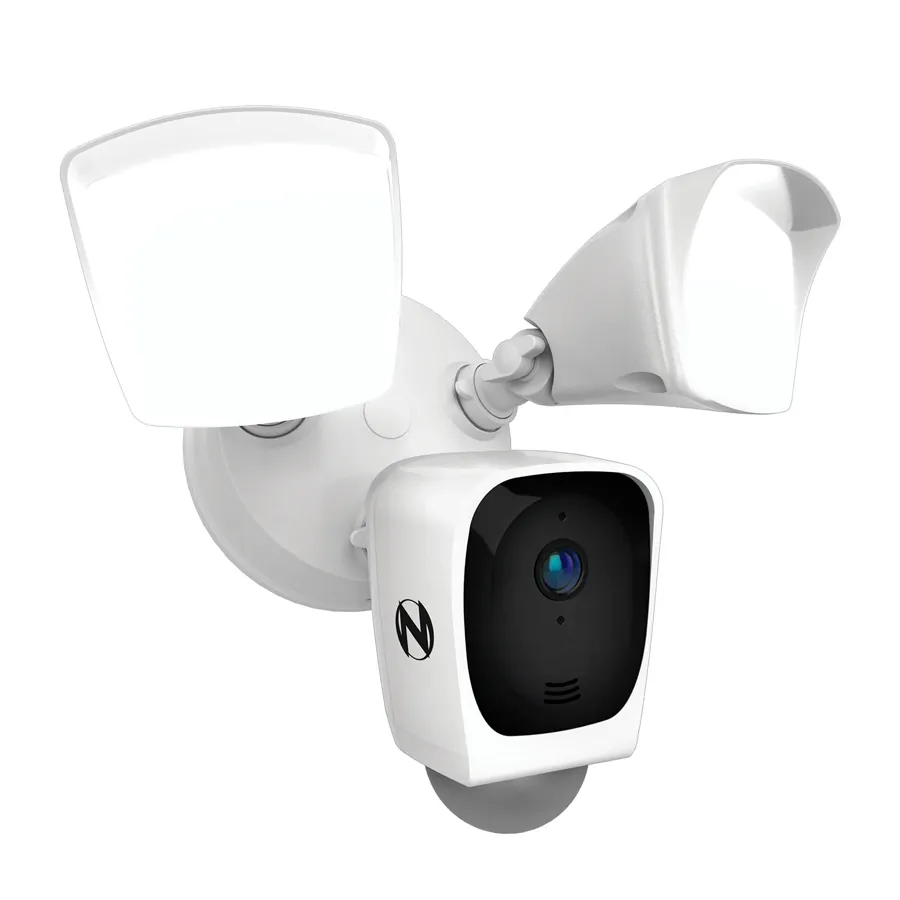
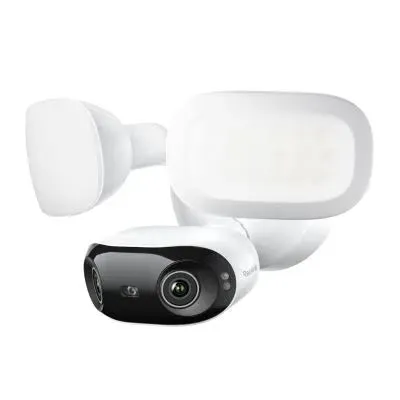
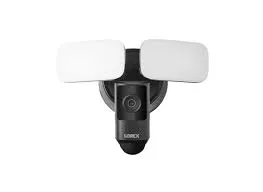
Manufacturer product photo (not an installed unit): two square lamp heads on their own swivel arms above a box camera. Separate arms let one lamp point down the driveway and the other at the door, which is how most Orange County houses actually get used after dark.
Orange County Floodlight Quote
Tell us the town, what the light must reach and how far it is from power — a written price follows the same business day
✅
Request Sent!
An installer will call back about the Orange County floodlight the same business day.
25+
Years Experience
✓
Same-Day Estimates
100%
Licensed & Insured
4.7★
390+ Google Reviews
Three facts settle most Orange County floodlight prices. How far the light has to reach from the nearest wall, what is on that wall today (a box, an outlet or nothing), and which town or village the property is in, because a handful of them measure light at the lot line. Text a photo taken from where the light should point back toward the building to (845) 640-3835, add the town, and we will tell you which power route and fixture size fit before anyone drives out.
Swapping a builder or porch light for a floodlight camera: $420–$805 in Orange County; a far spot with no power yet: $805–$2,100
No subscription needed when clips save to a memory card or to a recorder in the house
Any day of the week, appointments until 8 PM; low-voltage work under NYS license #12000287431
Why Orange County Properties Need Floodlight Camera Installation
Orange County is mostly houses that stand on their own lots. Census Reporter's summary of the 2024 American Community Survey counts 152,422 housing units in the county, 69 percent of them single-unit buildings and 66 percent owner-occupied. That sounds like easy floodlight country, and in one sense it is: there is wall to mount on and nobody living twenty feet behind you. The difficulty is that the thing worth lighting is often not on the house. It is the bottom of a driveway that runs back from a county road, the door of a pole barn, a boat or equipment trailer parked beside the garage, or a gate at the edge of a yard full of trailers. A floodlight bolted next to the kitchen door lights the kitchen door. Most of the planning on an Orange County job goes into deciding what the light has to reach and where it has to hang to reach it.
The county also changed fast. The Times Herald-Record reported in 2021 that Kiryas Joel grew 63 percent in the decade to 32,954 people, roughly half of the county's growth, with families also moving into Blooming Grove, Woodbury and Monroe. Along I-84, Route 17K and Route 300, the paper and the regional realtors' association have tracked a run of warehouse projects, among them an Amazon building of just over a million square feet at Route 17K and Route 747 in the Town of Montgomery. So the floodlight calls we get range from a farmhouse on the Black Dirt flats near Pine Island, to a two-year-old colonial in a Chester subdivision with vinyl siding and a builder-grade coach light, to a brick house in Newburgh's East End, to a distribution tenant who wants the trailer gate lit and recorded. Each needs a different fixture, a different mount and a different power plan.
Police here do ask residents to light and record. In January 2025 the New Windsor Police Department warned of several residential burglaries believed to be tied to international organized theft groups, and its advice to homeowners included considering surveillance cameras or an alarm system. Theft from yards and lots shows up too: State Police reported a dump truck taken from a hospital maintenance garage on East Main Street in the Town of Wallkill in September 2025, and in November 2025 investigators recovered more than $20,000 in mowers and tools taken from farm-supply stores in New Windsor and Crawford. A light that switches on as someone walks up a driveway or into a yard changes the moment, and gives the camera enough light to record colour and detail instead of a grey outline.
What makes Orange County different from the city is that a floodlight here is also something the town may measure. The Town of Chester's outdoor lighting law, adopted in 2021, caps light at half a footcandle at a residential property line, limits how high a bright flood may be mounted relative to the distance to the nearest boundary, and fines violations from $50 to $1,000 a day once a thirty-day notice runs out. The Town of Goshen's zoning sets the same half-footcandle limit and says security lighting must be directed away from streets and neighbors. The Village of Greenwood Lake goes further at 0.20 footcandle and discourages floodlighting outright. So we aim and size every light for the rule that applies at your address, and when a project also needs cameras on the house itself, the same visit is a good time to plan home cameras for an Orange County house around the light.
Orange County facts that shape a floodlight install
152,422 housing units, 69 percent single-unit and 66 percent owner-occupied (Census Reporter, ACS 2024 one-year) — detached lots, where reach and aim matter more than wall space.
Three electric utilities share the county: the New York State Department of Public Service lists Orange & Rockland, Central Hudson and NYSEG as Orange County electric providers, so outage maps, restoration times and who to call differ from one road to the next.
Chester's lighting law sets 0.5 footcandle at a residential line, requires full cut-off fixtures wherever floodlighting is used, and limits floods over 900 lumens to a mounting height of 3 + (D/3) feet, never above 25 feet (Town of Chester Chapter 69, L.L. 2-2021).
613 farms and 65,706 acres in farms appear in the USDA's 2022 Census of Agriculture profile for the county, from the Black Dirt onion and sod fields around Pine Island to orchards on the Warwick hills.
Orange recorded 275,059 lightning pulses in 2020, the most of any New York county in Earth Networks' state lightning report — relevant to long outdoor cable runs and to any light on a pole or barn.
Warehouses keep arriving along I-84 and Route 17K: the Times Herald-Record counted about 40 warehouse projects in the works in January 2022, most in the village of Goshen and the towns of Wawayanda, Montgomery and Wallkill.
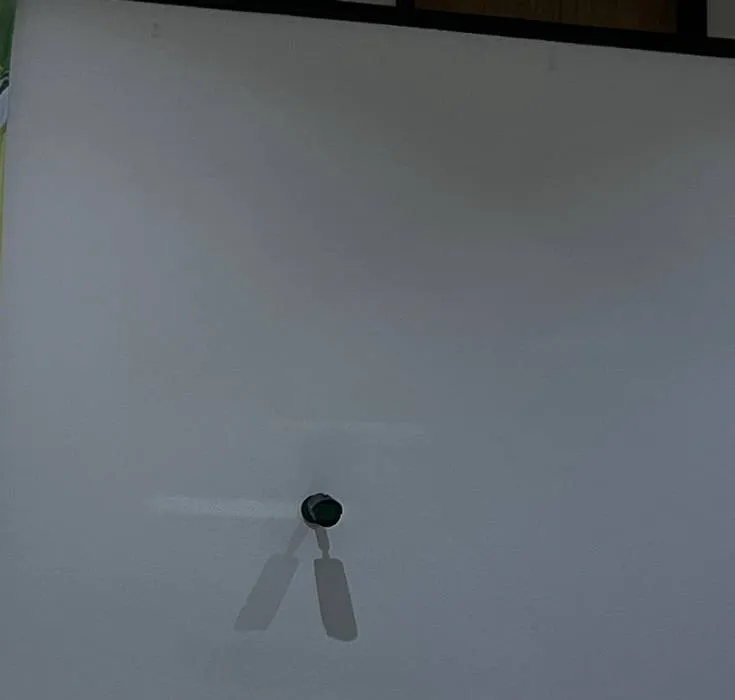
Example photo from another AESS job (not an Orange County property), cropped to the wall: a small black camera on a short angled arm, mounted well above head height. In towns that tie a bright flood's height to the distance from the lot line, the camera and the lamp may end up at different heights for exactly this reason.
Light Out at the Barn, the Gate or the Garage?
Storm knocked out O&R or Central Hudson service and the barn lamp stayed dark when everything else returned? Driveway camera showing offline, or a lamp blinking on and off until dawn? Call (845) 640-3835. We book the next open window, and most Orange County floodlights are lighting and recording again within one to two hours of arrival, even when the lasting fix (a new feed, a wireless bridge, a better mount) is scheduled for a second visit. If the whole camera system is down, not only the light, start with camera repair in Orange County.
Four checks worth doing before you call
Check the GFCI outlets in the garage and the barn. After a storm, a tripped GFCI upstream of an outdoor circuit is the most common reason a light stays dark while the house has power. Press reset and note whether it trips again.
Look at the router and any outdoor bridge. If the camera is out at a barn or a gate, the radio or extender carrying its signal may have lost power or its settings. A light that works but a camera that shows offline points there.
Open the app's light schedule. Some units fall back to factory settings after a long outage; “always on at dusk” or a lost time zone explains a light that now burns all night.
Note the utility and the date. Whether you are on Orange & Rockland, Central Hudson or NYSEG, and when the outage happened, helps us tell a surge-damaged power supply from a settings problem.
Put those four answers in your message. Between them they normally separate a five-minute reset from a failed power supply, a dropped radio link or a light that needs moving.
What We Install
Floodlight Camera Installation Services in Orange County
Eight kinds of work cover almost every Orange County floodlight request. Larger properties usually need three or four of them together.
🏠
Builder Light Replacement
The coach light beside a garage or the single fixture over a side door on a newer house, swapped for a floodlight camera on the same box, with a proper siding mount so the plate sits flat and the box stays dry.
🛣
Driveway and Gate Lighting
A light placed where it can actually see the bottom of the drive or the gate, not just the house end of it, often on a post or the garage, with the camera aimed at the line a car or person must cross.
🌾
Barns, Sheds and Equipment Yards
Floodlight cameras on outbuildings with their own power, connected back to the house by a wireless bridge or buried cable, lighting doors and the yard where tractors, wagons and trailers park.
🌐
Network-Powered Spotlight Cameras
Cameras with built-in lights on one low-voltage cable from a PoE switch, for spots where a modest light is enough and a new 120-volt feed would mean trenching or a permit.
📏
Lighting-Code Aiming
Fixture size, mounting height and tilt chosen for the town's rule — full cut-off, no light above horizontal, and a meter reading at the property line when the town counts footcandles.
🚛
Trailer Gates and Dock Aprons
For warehouse and trucking tenants along I-84, Route 17K and Route 300: lights and cameras at the gate, the guard window and the dock, set so headlights and pole lights do not wash out the picture.
📹
Floodlights Added to a Recorder
Choosing a floodlight that will record to the Lorex, Hikvision, Dahua or Uniview recorder you already own, so the yard view sits with the rest of the property's cameras.
🔧
Re-Aims, Notices and Repairs
Lights a neighbor or a code officer has complained about, cameras that drop offline after storms, housings that filled with water: re-aimed, reset, resealed or replaced.
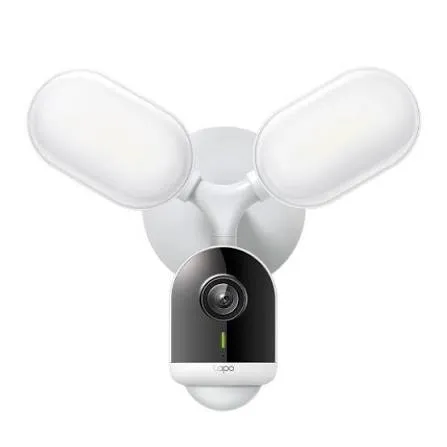
Manufacturer product photo (not an installed unit): two oval lamp heads on a Y-shaped arm above a rounded camera. Units like this replace a single builder coach light on the same box; the question in a town with a lighting law is whether its lamps can be tilted below horizontal.
Building Specialists
Floodlight Cameras for Orange County's Architecture
Six kinds of property make up most of what we light in Orange County. What the walls are made of matters, but the distance between the wall and the thing that needs lighting matters more.
New Subdivision Houses
Chester, Monroe, Blooming Grove, Woodbury, Wallkill and the Town of Newburgh. Vinyl or fiber-cement siding, a two-car garage with coach lights, a short driveway, and neighbors on three sides at a known distance.
Older Village and City Houses
Newburgh's East End, Middletown, Port Jervis, Goshen, Warwick and Walden. Brick and clapboard on narrower lots, older outdoor boxes, and sometimes a historic-district review before anything changes on the front.
Farms and Farmhouses
The Black Dirt flats around Pine Island, the Warwick orchard hills, dairy and horse farms toward Montgomery and Crawford. Several buildings, open ground, long sightlines and outbuildings on their own power.
Houses on Long Drives
Hamptonburgh, Blooming Grove, Cornwall, Tuxedo and Greenville back roads. The house sits well back, the driveway runs past trees, and deliveries and visitors arrive long before they reach the door.
Warehouses and Trailer Yards
Montgomery, Wallkill, Wawayanda, New Windsor and the Town of Newburgh near Stewart. Tall walls, dock doors, guard booths and gates, with pole lighting already on site.
Retail and Restaurant Strips
Route 17M through Monroe, Route 211 in Middletown and Wallkill, Route 94 through Washingtonville and Chester. Rear doors, service lanes and lots that empty after closing.
Subdivision houses: the builder's box and the siding
Most houses built in the last twenty years came with one or two outdoor fixtures beside the garage doors and one by the front door, fed from the same switched circuit. That box is usually sound and in the right place for a floodlight camera that covers the driveway apron. The two things we fix on almost every one are the mount and the switch. Vinyl siding needs a mounting block so the plate sits flat and water runs off rather than behind it; screwing a heavy fixture straight through the siding cracks it in the first cold snap. And a coach-light circuit is often on a wall switch inside the garage or the mudroom, which someone will turn off, so we either guard the switch or have the box made permanently live.
Village and city houses: older boxes and closer neighbors
In Newburgh, Middletown or Port Jervis the lot is narrower and the next house can be close across a side yard, so this is where Orange County work looks most like city work. The outdoor box on an older house may be shallow, loose in the masonry or missing a ground, and we check all three before anything heavier goes up. On the East End's brick, plates go into mortar joints rather than the face of the brick. Where the property sits inside a city historic district, the front facade is a different conversation from the rear yard, and we keep the floodlight to the side or back of the house unless the front is the only place it can work.
Farms: light the doors, not the field
A floodlight cannot light a forty-acre field, and trying to only produces glare. On a farm we light the places where people and vehicles have to be: barn and shop doors, the fuel tank, the equipment yard, the farm stand and the end of the lane. Each outbuilding with its own power can carry its own floodlight camera, joined to the house network by a wireless bridge or a buried cable in conduit. Lights on barn walls go high under the eave and tilt down, so a door is lit without a beam running across open ground toward a neighbor or a road.
Manufacturer product photo (not an installed unit): two rectangular panels above a small camera body, mounted on a round wall plate. A round plate like this needs a flat surface to seal against, which on vinyl siding means a mounting block rather than the siding itself.
Commercial Floodlight Cameras
Business Floodlight Camera Installation in Orange County
Commercial floodlight work in Orange County follows the highways. These are the corridors where most of our business calls come from, and what the light has to do in each.
Route 17K and Stewart
Distribution buildings and business parks in the towns of Newburgh, New Windsor and Montgomery near New York Stewart International Airport, including the Matrix I-84 Distribution Center planned across from the airport with 116 loading docks.
Route 300 and I-84
Large warehouse sites near the Route 300 interchange, where the Times Herald-Record reported Matrix buildings of 927,041 and 215,200 square feet on 90 acres. Gates, guard booths and long rows of dock doors.
Town of Montgomery
The Amazon building at Route 17K and Route 747 and the Medline distribution center, both reported by the Hudson Gateway Association of Realtors as starting construction in 2020, plus the smaller shops and yards around them.
Middletown and Wallkill
Route 211 retail around the Galleria at Crystal Run, medical offices on Crystal Run Road, and the yards and garages that serve them, where after-hours lots are wide and lightly used.
Central Valley and Monroe
Route 17M and Route 32 businesses near Woodbury Common Premium Outlets, with service lanes behind long retail rows and restaurant back doors onto shared lots.
Goshen and Chester
Shops and offices around the county seat and along Route 17M and Route 94, inside towns whose lighting rules apply to commercial and industrial buildings as well as houses.
Commercial floodlights here differ from residential ones in three ways. Many run dusk to dawn at a reduced level, then brighten on motion, because a lit lot is part of the deterrent. They are mounted higher and fed from the building's own electrical panel, with the camera on a network cable to a recorder inside, so cutting a wire or pulling a camera does not erase the evidence. And on a site plan that a town planning board approved, the lighting may already be specified, so new fixtures have to fit that plan. For whole sites the floodlights are one part of a warehouse camera system in Orange County or a parking-lot camera layout, and we design them together.
Rules and credits that apply to Orange County floodlight work
A county-licensed electrician for new 120-volt work. Orange County's electrician application states that under Local Law No. 8 of 2007, anyone wishing to work as an electrician in the county must hold a county-issued license, and the City of Middletown runs its own Electrical Licensing Board. Our NYS low-voltage license covers the camera, network and recorder side, not new line-voltage boxes or circuits.
Town lighting laws. Chester (Chapter 69), Goshen (§ 97-50) and the Village of Greenwood Lake (Chapter 119) all limit light at the property line; Chester and Greenwood Lake also govern shielding and mounting. Other towns handle lighting through site-plan approval. We check the code for your address before choosing a fixture.
Written contracts for home improvement work. The Orange County Department of Consumer Affairs' consumer law manual says home improvement contracts over $500 must be in writing, in plain English, signed, and must describe the work and the materials, including makes and models.
Keep the next lot out of the picture. Under § 52-a of the state Civil Rights Law, an owner or tenant whose backyard is recorded without written consent by a camera on adjoining property can bring a civil action, so every view we set ends at your boundary or is masked there.
Tax help for small stores. Surveillance cameras count toward New York's Commercial Security Tax Credit, which allows a retail business of no more than 50 employees up to $3,000 for each location. Applications close on October 31; ask your accountant before relying on it.
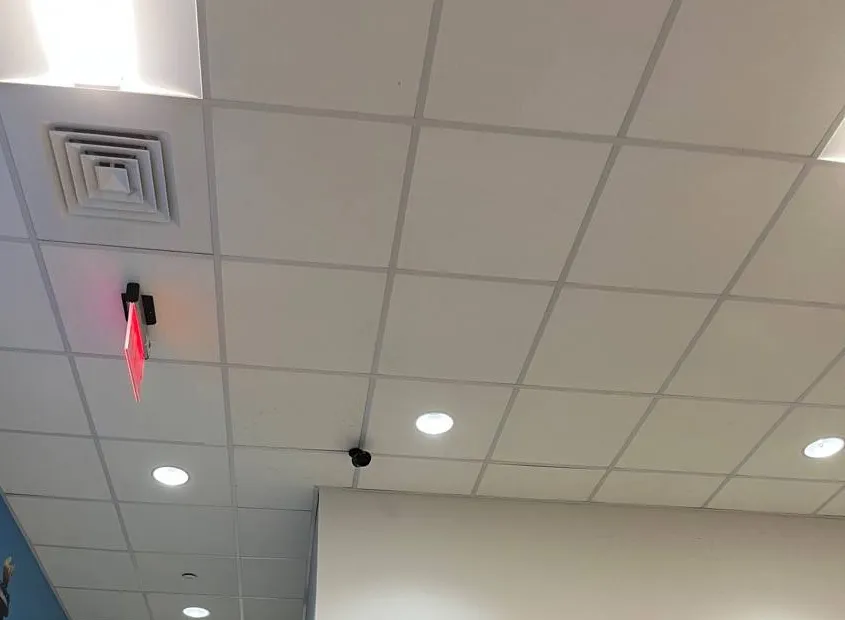
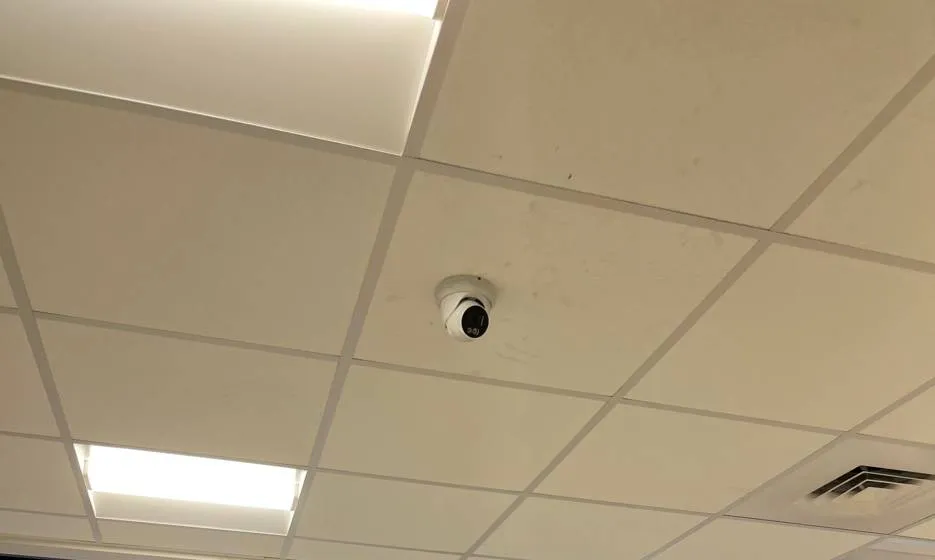
Example photo from another AESS job (not an Orange County property), cropped to the ceiling: a small black dome camera at the edge of a soffit and a black device fixed beside a red-lit exit sign. On a commercial site the floodlights outside and the cameras inside usually report to the same recorder, which is why we plan them as one system.
Your Questions Answered
Floodlight Camera Installation in Orange County: Questions Answered
These are the questions Orange County homeowners, farmers and business tenants put to us about floodlight cameras, grouped by the problem underneath: town lighting laws, distance, farm buildings, the power companies, paperwork, commercial yards, and the two very different kinds of house the county is made of.
Town Lighting Laws and the Property Line
Which Orange County towns and villages actually put a number on outdoor light?
Three that we work under regularly, and each sets its number in a different way. The Town of Chester's Chapter 69, adopted by Local Law 2 of 2021, covers all public and private outdoor lighting: half a footcandle at a residential property line, one footcandle at a nonresidential line, no direct light above the horizontal from floods rated over 900 lumens, and a height cap for those floods tied to the distance from the nearest boundary. The Town of Goshen's environmental performance standards, in § 97-50 of its zoning, hold glare beyond the property to half a footcandle and require all exterior lighting, security lighting included, to be directed away from adjoining streets and properties. The Village of Greenwood Lake's Chapter 119, adopted in 2010, sets 0.20 footcandle at the line and discourages floodlighting unless it is shielded. Many other towns deal with lighting through site-plan approval for businesses and general nuisance rules for houses rather than a fixed figure. Before we choose a fixture we look up the code for the address, because a light that is fine in one town can be too bright two miles away in the next.
How do you prove a floodlight stays under half a footcandle at the neighbor's line?
By measuring it after dark with a light meter, which is how a code officer would check it too. A footcandle is one lumen falling on one square foot, so half a footcandle is dim: enough to see your way across a lawn, nowhere near enough to read by. We wait until full dark, switch the floodlight on at the brightness it will actually run at, and hold the meter at the property line facing the light, at a few points along the line nearest the fixture. If the reading is too high, the usual fixes are tilting the heads down, turning the brightness down in the app, moving the light a few feet along the wall, or fitting a lower-output model. We note the readings and the settings in your paperwork, so if anyone ever asks, you can show the light was checked at the line on a particular date and with a particular setting. On lots with trees or a fence on the line, the reading is often far lower than the numbers suggest, because the screening absorbs the spill.
We got a notice from the town code enforcement officer about our floodlight — what is the deadline, and what will satisfy the inspector?
Read the notice first, because the deadline is set by your town's law. In the Town of Chester, the code enforcement officer must give written notice by hand delivery or certified mail and allow 30 days to abate the violation; after that, each further day counts as a separate offense, with civil penalties of $50 to $1,000 for an individual. Chester also grandfathers fixtures that were in place before the law, but even those must be aimed down and shielded within 60 days of notification. What satisfies an inspector is a fixture whose lamp cannot be seen from the neighboring property at ground level and a meter reading at the line under the limit. Re-aiming, a lower setting and a shield usually get there. If the fixture cannot be tilted below horizontal, we replace it with a full cut-off model and keep the camera. We put the work, the readings and photos in writing so you can send them back to the code office before the deadline.
Distance: Lighting What Is Not Next to the House
Can a light on the house actually show a face at a gate or barn door 200 feet away?
Not usefully. Light falls off with the square of the distance, so a floodlight that lights a doorway at 15 feet puts only a small fraction of that light on a gate at 200 feet, and the camera beside it sees the gate as a small part of a wide picture. Most floodlight cameras have wide lenses chosen for a yard or a driveway apron; at long range a person becomes a handful of pixels, lit or not. If you want to recognise someone at a gate or a barn door, the light and the camera need to be near it: on the barn wall, on a post at the gate, or on the garage that sits closer to the road. The house light then does its own job, lighting the area around the house, and the far light records the far entrance. Where the far point has no power, a network-powered camera with a built-in light on a buried or fence-line cable often does better than trying to throw light from the house.
The barn has its own electric meter — can the floodlight camera out there still reach our house Wi-Fi and recorder?
Usually, and the separate meter is one reason we connect it wirelessly rather than with copper. A barn on its own service has its own ground, and running a network cable between two buildings on separate services invites trouble from ground differences and lightning, which Orange County sees more of than anywhere else in the state. The cleaner routes are a pair of outdoor wireless bridge radios, one on the house and one on the barn, in clear line of sight, or a fiber link in conduit, which carries no electricity at all. House Wi-Fi alone rarely reaches through a barn's metal siding at a few hundred feet. The floodlight camera in the barn takes power from the barn's own circuit, and its picture travels back over the bridge to the house router or recorder. We confirm the two antennas can see each other before quoting.
Before you trench a cable out to our gate post, who has to mark what is already buried?
The one-call system does, and calling it is the excavator's job. In New York, anyone digging must contact the one-call centre through 811 first; Central Hudson's dig-safely page says the request goes in at least two, and no more than ten, working days before digging, that the service is free and required by state law, and that the utilities and municipalities who belong to the system come out and mark their lines. What the markers do not show are lines you own yourself: the feed to a barn, a cable to a lamp post, an irrigation line or an old dog fence. So before any trench we also ask what you know about private runs, look for clues like posts and boxes, and keep the route where it crosses the fewest of them. Network cable for a gate light goes in conduit, deep enough to stay clear of a garden spade and the frost, with pull string left in for a later change. On long runs to a far gate, a wireless link often avoids the trench altogether.
Farms, Barns and Open Ground
Does a working farm get any leeway under the local lighting rules?
Sometimes, and it depends on the town or village. The Village of Greenwood Lake's lighting chapter exempts lighting associated with agricultural pursuits, including harvest activities, unless the lighting is permanent or creates a safety hazard. The Town of Chester's chapter, by contrast, applies to all public and private outdoor lighting in the town and does not carve out farms in the provisions we reviewed. A permanent floodlight camera on a barn is, by definition, permanent, so on the Greenwood Lake wording it would not fall under the harvest-lighting exemption anyway. Our approach on farms is to light the buildings and the yard where people and machinery have to be, with full cut-off fixtures aimed down, and to leave the fields dark. That keeps the light inside any limit and avoids lighting up a neighbor's house across open ground, which is where farm lights cause the most friction. If your farm is inside a town with its own lighting law, we read that section before choosing a fixture.
Our tractors and wagons sit outside overnight in an equipment yard — where does the light go so the camera sees a person, not glare off the machinery?
Behind or beside the camera, never across from it. Painted metal, glass cabs, mirrors and reflective tape throw a floodlight straight back at a camera facing the same way as the light, and the picture fills with bright patches with dark shadows between them. The fix is geometry: the light and the camera sit on the same wall or post, looking the same direction, high enough that the beam lands on the ground between the machines rather than on their sides. On a big yard, two moderate lights from different corners leave fewer black shadows behind wheels than one bright one. We also put the camera's field of view on the ways in and out of the yard, the gap in the fence or the lane, because a person has to walk through that gap and the camera sees them there without any machinery behind them. Infrared night vision helps between motion events, so the camera still records when the light is off.
Power: Three Utilities, Storms and Short Dips
Our only outdoor circuit also feeds the garage freezer and the door opener — is it a problem to add the floodlight to it?
The extra load is rarely the issue; a modern LED floodlight camera draws little power compared with a freezer or a door opener. The issues are what happens when that circuit trips, and what trips it. If the circuit is GFCI-protected, which outdoor and garage outlets generally are, a fault anywhere on it, from a wet outdoor plug to an ageing freezer motor, cuts the floodlight and the camera too, and the freezer and the light both stay off until someone finds and resets it. On many houses in the county that is the most common reason a floodlight seems to fail after a storm. We map what else is on the circuit during the survey. Where the light matters, the better answer is a feed of its own from a licensed electrician, or a network-powered camera whose power comes from a switch indoors on a separate circuit. Either way, a label in the panel saying which breaker serves the floodlight saves a late-night search.
Our house sees short brownouts — can low voltage damage a floodlight camera or make it reboot all the time?
It can make it reboot, and repeated dips are hard on cheap power supplies. A Washingtonville resident on r/hudsonvalley wrote in February 2026 that the house had seen a brownout roughly every month since the second half of 2025; replies pointed to ice-laden branches and cars hitting poles. A floodlight camera has a small power supply inside that turns line voltage into the low voltage the camera and LEDs need. A deep dip can drop it out, and the camera then reboots, losing the few minutes of recording that matter most if the dip came from a storm. A line-voltage floodlight cannot easily be put on a battery backup, but a network-powered camera can: its PoE switch indoors goes on a small uninterruptible power supply, which rides through dips and keeps the camera recording through short outages. On properties with frequent dips, that is often the reason we recommend a PoE spotlight camera over a line-voltage floodlight at the most important spot.
Who do we call when the outdoor box itself has no power — the utility, an electrician or you?
Work from the outside in. If the whole house or the whole road is out, it is the utility, and in Orange County that may be Orange & Rockland, Central Hudson or NYSEG, depending on where you live; the outage map for your provider shows whether they already know. If the house has power but one outdoor circuit is dead, check the GFCI outlets in the garage, basement and outbuildings, and the breaker panel. If a reset does not hold, or a breaker trips again, that is a wiring fault and it needs a licensed electrician. If the box has power, checked with a simple tester or by plugging in a lamp at a nearby outlet on the same circuit, but the floodlight is dead or the camera is offline, call us: the problem is in the fixture, its power supply, its settings or its network connection. When you are not sure, call us first; we will tell you which of the three to call.
Paperwork: Licences, Contracts and Bills
Does work inside the City of Middletown need a different electrician licence from the rest of Orange County?
It can, so ask before the electrician is booked. Orange County issues its own electrician licences under Local Law No. 8 of 2007, which the county's application says applies to anyone who wants to work as an electrician in the county, and it revised its electrical licensing law in 2024. The City of Middletown, though, runs its own Electrical Licensing Board, so a job inside the city line may need that board's licence as well as, or instead of, the county's. The county's Department of Consumer Affairs in Goshen and the city's board are the places to confirm what applies and whether a licence is current. For a floodlight, all of this concerns only the line-voltage part: a new outdoor box, a new circuit or making a switched box permanently live. Mounting the camera, running network cable, and setting up the recorder and the app fall under our New York State low-voltage licence, and our written quote names who does which part.
What should a written contract for floodlight work in Orange County include?
The county's consumer protection rules give a good checklist. The Orange County Department of Consumer Affairs' home improvement manual says contracts over $500 must be in writing, in plain English and signed, and must list the contractor's name, address, phone number and any licence number; describe the work and the materials, including makes and models; and show any progress payments. For a floodlight job we add four things: the exact mounting points, marked on a photo; which part is line-voltage work and which licensed person does it; how the light will be aimed and set (brightness, timer, motion zones) with any meter reading taken at the line; and what is and is not covered after completion. Our service agreement also sets out the deposit, the parts warranty and the late-fee schedule, so all of that is in one place before anyone starts.
Trailer Yards, Lots and Commercial Hours
Our trailer yard off Route 17K is already lit by tall pole lights — does a floodlight camera add anything?
Usually not as a light, often as a camera with a light where the pole lights do not reach. Site lighting approved with a warehouse is designed to light pavement evenly so trucks can move; it is rarely aimed at a person's face at a gate window or at a man-door in the shadow of a building. Pole lights also put cameras in a difficult spot, because a camera looking toward a pole sees a bright point and a dark field. What we add are small, aimed fixtures and cameras at the points where identification happens: the gate, the guard booth, the driver entrance, the man-doors and the end of the dock where trailers are dropped. The cameras look away from the poles, the small lights fill the faces, and everything records to the recorder inside. A consumer floodlight camera with a phone app is the wrong tool for a yard like this; we use cameras built for continuous recording and fixtures built for commercial mounting heights.
Does a brighter floodlight make it easier or harder to read a truck's number at the gate after dark?
Often harder. Truck and trailer numbers, plates and placards are usually reflective, and a bright floodlight beside the camera bounces back off them so hard that the camera records a white rectangle. Headlights add to the problem when a truck faces the camera. Reading numbers at night is a camera job first: a lens chosen for the distance to the lane, a narrow field of view on the spot where the vehicle stops, a short shutter time so movement does not blur, and settings that hold back bright reflections. The light is set at an angle to the lane rather than straight down the camera's line of sight, and often dimmer than you would expect. We set this up with a test vehicle at the gate after dark and adjust until the number reads on the recording, not just on the live view. For wide yards we use one camera for the overview and a separate one for numbers at the stopping point.
Can our town make us turn the parking-lot floodlights off after closing?
Some can. The Village of Greenwood Lake's lighting chapter requires nonessential lighting — display, aesthetic, parking and sign lighting — to be turned off after business hours, leaving only the lighting needed for site security at the minimum level, and it recommends motion-sensor security lighting. The Town of Goshen's zoning lets its planning board require limits on lighting hours, screening or shields to reduce the impact of exterior lighting on neighboring homes. If your lot was approved through a site plan, the lighting conditions may be written into that approval. The practical answer is to separate the two kinds of light: area lights on a timer that shuts off after closing, and security lights at the doors and the camera positions on motion. Cameras with good low-light performance and infrared keep recording the dark lot between motion events, and the security lights switch on only when someone is actually there.
Newer Subdivisions and Older Houses
Our builder used vinyl siding everywhere — how is a floodlight camera mounted without cracking it or letting water in?
On a mounting block, not on the siding. A siding mounting block is a plastic base that fits around the box, sits flat against the house sheathing and gives the floodlight's plate a flat, sealed surface, while the siding slides in behind its edges and can still expand and contract with temperature. Screwing a fixture plate directly through vinyl pins the siding so it cannot move; in the first cold snap it cracks or buckles, and water then runs behind it into the box. On a newer house the existing coach-light box is often already in a small block that is sized for a lantern rather than a floodlight plate, so we change it to one that suits the new fixture. We seal the top and sides of the plate and leave the bottom open so any water that gets in can drain. On fiber-cement siding the same principle applies: a flat block or a flashed mount, not a plate pressed against the ridged face of the boards.
Newburgh is ending its city plate-reader contract — does that change what our own camera should record of the street?
It does not change the law for private cameras, but it is a good reason to think about aim. Mid Hudson News reported in September 2026 that the Newburgh City Council was expected to end its contract for Flock license plate readers when it expires at year end, with a resolution saying the technology was no longer consistent with the city's priorities on privacy, civil liberties and community trust. That decision is about city equipment. A homeowner's camera recording their own property, including the part of the street in front of it, is a different matter, but neighbors notice where cameras point. Our practice is to aim floodlight cameras at your own entrances and driveway, keep the street to the edge of the frame, and mask any neighbor's windows, doors or backyard that fall in view; New York's Civil Rights Law § 52-a specifically covers cameras recording a neighbor's backyard without consent. That records what you need and keeps the camera from becoming a dispute on the block.
The outdoor box on our older house has no ground wire — can a floodlight camera still go there?
Not until the grounding is sorted out. Older houses in Port Jervis, Middletown, Walden and the East End were often wired before grounded outdoor circuits were standard, and the original porch-light box may have only two conductors. A floodlight camera's metal parts and surge protection expect a ground, and the maker's instructions call for one. A licensed electrician can usually bring a ground to the box, or replace the run, and that work falls under the county's electrician licensing rather than ours. Until then, the alternatives are a network-powered camera with a built-in light, which takes its power over the network cable from a switch indoors and needs no line-voltage connection at the wall, or a plug-in model on a properly grounded and GFCI-protected outdoor outlet elsewhere. When we find an ungrounded box we show you, explain the choices and price each one; we do not hang a floodlight on it and hope.
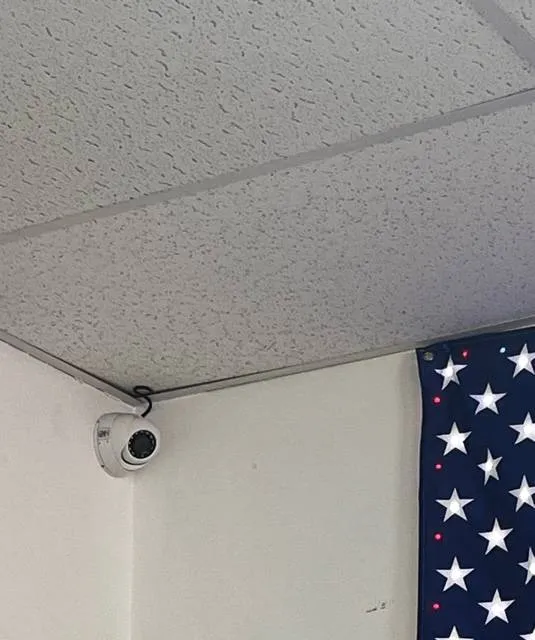
Example photo from another AESS job (not an Orange County property), cropped to the corner: a white dome camera on a black bracket where two walls meet the ceiling, its black cable looped at the bracket and run along the ceiling edge. Outside, the same idea — mount in the corner, look along the wall — keeps a floodlight camera's view on your own building and away from the house next door.
Equipment
Types of Floodlight Cameras We Install
Five families of hardware cover the Orange County jobs we see. The right one depends on the power at the spot, the distance to the network and how much light the town allows.
💡
Hardwired Floodlight Cameras
Two or three LED lamp heads and a camera on one plate, wired to a 120-volt box. The standard swap for a builder coach light or a garage-corner fixture; Wi-Fi or, on some models, a recorder connection.
🌐
PoE Spotlight and Floodlight Cameras
Cameras with built-in lights powered by one network cable. Modest light, excellent picture, battery backup through the switch indoors. Our first choice where power dips are common or the box is ungrounded.
🔌
Plug-In Floodlight Cameras
Units that plug into a grounded, GFCI-protected outdoor outlet. Useful on a garage or a shed with an existing outlet, though the cord needs protecting from mowers, animals and weather.
🏭
Commercial Floods with Separate Cameras
Full cut-off LED floods from the building's panel and professional cameras on network cable, mounted out of reach. For warehouses, trailer yards and retail lots.
📡
Wireless Bridges for Outbuildings
Pairs of outdoor radios that carry the camera's video from a barn, gate or shop back to the house, so separately metered buildings never share a copper network cable.
National brands or an Orange County installer
Question
Ring, ADT or SimpliSafe on your own
AESS in Orange County
Who decides where the light goes?
You, from the box and the app, usually at the existing outdoor fixture
We survey from the thing that needs lighting back to the building, and measure the distance to the lot line
Town lighting limits
Not addressed by the product instructions
Fixture size, height and tilt chosen for the local code; meter reading at the line on request
Barns, gates and outbuildings
Depends on Wi-Fi reaching them
Wireless bridges or fiber between buildings on separate services; PoE where the run allows
Storage and fees
Cloud plans common for video history
Clips saved to a card or an AESS-installed recorder in the building, with no subscription required
Line-voltage work
Left to you or your electrician
Arranged with a licensed electrician and itemised on the written quote
There is nothing wrong with the national brands; we install their floodlight cameras often. Ring's own instructions, for example, say to mount the floodlight about nine feet up where possible, with the power turned off at the breaker before it is connected to your junction box. What they cannot do from a box on a shelf is look at your lot, the town's rules and the distance to your barn. If you already own one, our labor-only option below covers it. For whole-property systems with recorders, see recorder installation in Orange County and Lorex installation in Orange County.
Manufacturer product photo (not an installed unit): a wide light panel and a smaller lamp head above a wide, black-faced camera with two lenses. A very wide view suits an open farmyard or equipment yard; at a gate, where only one lane matters, a narrower lens records more detail.
AI Overview Reality Check
What AI Gets Wrong About Floodlight Camera Installation in Orange County
Angi, HomeAdvisor and Fixr floodlight-camera pages did not come up in our searches, so they are not quoted.
1. “Installation runs about $150 to $350 per light”
Inch Calculator's floodlight cost guide gives that range for installation, a national average of about $450 per project, and electrician rates of $50 to $200 an hour. Those figures assume a light going onto a box that already exists, on a house wall, within reach of a ladder. That is a real job in Orange County too, mostly on newer subdivision houses where a builder left coach lights by the garage.
The figures say nothing about distance, and distance is what drives an Orange County price. A light that must reach a gate, a barn or the bottom of a long drive needs either a new feed, a buried cable, a wireless link or a second fixture, and each of those costs more than the light itself.
Our Orange County prices are in the pricing section below: $420 to $805 to swap an existing outdoor light for a floodlight camera, and $805 to $2,100 where the spot has no power yet. The written quote after a survey is the number we hold to.
2. “A single camera line costs about $100; a whole system $1,000 to $2,200”
Thumbtack's Newburgh installer listing says security camera installation can cost anywhere from $100 for a single-camera line installation to $1,000 to $2,200 for an entire system. As a marketplace headline it is a reasonable description of simple camera jobs on a small house.
A floodlight camera is not a single-camera line. It is a light fixture as well as a camera, usually on line voltage, often with a box to check or replace, and in some towns with a lighting law to satisfy. A whole-property floodlight plan on a farm or a warehouse yard is a different scale again.
The useful takeaway is that marketplace figures describe a category, not your property. Ask any installer, us included, for a written quote that lists the fixture, the mounting point, the power route and the setup, so you can compare like with like.
3. “Mount it about nine feet above the ground”
Ring's installation article recommends mounting its Floodlight Cam about nine feet above ground level where possible, with the motion sensor parallel to the ground. As a starting point for a camera on a house wall, that is sensible advice.
In the Town of Chester a flood over 900 lumens may be mounted no higher than 3 + (D/3) feet, where D is the distance to the nearest property boundary. Nine feet needs at least 18 feet to the line; on a tight subdivision lot with the house 12 feet from the side line, the limit is 7 feet. On a farm or a warehouse, by contrast, nine feet is often too low: it is within reach and lights too small an area.
Mounting height in Orange County is a calculation, not a rule of thumb. We measure to the line, check the code, and where the light must be low and the camera high, we separate them.
4. “Brighter is better — look for 2,000 lumens or more”
Product listings compete on lumens; Lorex lists one Wi-Fi floodlight camera with two 2,000-lumen light arrays. Shoppers reasonably take bigger numbers as better security.
Chester's lighting law treats any flood or spot over 900 lumens as a fixture that must not light above the horizontal and must respect the height formula, and caps light at half a footcandle at a residential line. Goshen's zoning has the same half-footcandle limit. The Village of Greenwood Lake sets 0.20 footcandle at the line and discourages floodlighting. A 4,000-lumen unit aimed level on a small lot can break all three.
Brightness should be chosen for the distance to the thing being lit and the rule at the line. Most floodlight cameras let you turn the output down in the app; we set it, measure it, and write it down.
5. “Choose a spot with an existing junction box and strong Wi-Fi”
Arlo's installation guide advises choosing a location with an existing junction box and a strong Wi-Fi signal, and finding a licensed electrician if you are not comfortable with electrical work. For a light next to a back door, that is good advice.
On an Orange County property, the spot with the box and the Wi-Fi is often the wrong spot. The barn, the gate and the equipment yard are where the light is needed, and they have neither. Choosing the convenient spot lights the house and records nothing useful at the entrance that matters.
Start from what needs lighting, then solve the power and the network: a feed from the outbuilding's own panel, a wireless bridge back to the house, or a network-powered camera on a buried cable.
6. “No electrical work required — just plug it in”
A HomeCamCafe article on skipping the junction box tells readers that, apart from checking for a working outdoor outlet within reach, a plug-in mount involves no electrical work; it adds that the outlet has to be an outdoor-rated GFCI and that the supplied cord resists weather but carries no armor.
That last point matters on a farm or a large lot. An unarmored cord along a barn wall or across a yard meets mowers, string trimmers, livestock and rodents. A GFCI on a long outdoor run in a thunderstorm county also trips more than people expect, and the light goes dark until someone resets it.
Plug-in models are a good answer on a garage with an outlet right beside the spot. Elsewhere we protect the cord in conduit or choose a hardwired or network-powered unit instead.
7. “Low-voltage work does not need a permit”
A structured-wiring firm based in New Windsor writes that low-voltage cabling under 50 volts typically does not require an electrical permit in Hudson Valley municipalities, and Inch Calculator says floodlight permits of $20 to $100 may or may not be required.
Both statements can be true and still mislead. The camera's network cable is low-voltage; a floodlight's 120-volt box and feed are not. Orange County requires a county-issued electrician licence for electrical work under Local Law No. 8 of 2007, the City of Middletown has its own licensing board, and whether a permit or inspection is needed depends on the town and the work.
We keep the two parts separate on paper: our low-voltage work under our New York State licence, and line-voltage work by a licensed electrician, with any permit their part needs named on the quote.
Light the Gate, Not the Neighbor's Bedroom
Send a photo from the spot that needs lighting back toward the nearest building, and tell us the town. We will tell you which power route fits, whether the local lighting law affects the fixture, and the Orange County price before anyone loads a ladder.
To price an Orange County floodlight we ask for the municipality first, since a few have lighting laws, then the property type, the spot to be lit, its distance from power, and whether the camera is already bought. Photos often save a trip. A written total comes back the same business day; to talk it through, call (845) 640-3835.
✅
We Got Your Request!
Received. Before calling you back today, an installer reads your town's lighting code and works out how far the light has to reach. Something urgent? Ring (845) 640-3835.
How It Works
Our Installation Process
Seven steps, whether the light goes over a garage in Chester, a barn door in Pine Island or a trailer gate off Route 17K. The first two settle most of the price, and the second one is where Orange County jobs differ from city ones.
1. Start at the entrance, not the wall
From photos taken where someone would come onto the property — the driveway end, the barn door, the yard gate — looking back at the buildings, we work out what has to be lit and which wall or post could reach it.
2. Measure power, network and the lot line
On site we measure from the spot to the nearest power, the nearest network point and the nearest property line, note which buildings are on their own meters, and check the town or village lighting code for the address.
3. Choose the power and the link
An existing box, a new box by a county-licensed electrician, a network-powered spotlight camera on one cable, or a protected outlet; plus a wireless bridge or fiber to any separately metered building.
4. Write the plan and the Orange County price
The quote names the fixture and its lumen rating, the height it will hang at and why, how power and video reach it, any electrician work, and the total at Orange County rates.
5. Mount, seal and connect
Plates go onto siding blocks, mortar joints or solid framing; boxes and cable entries are sealed against the weather; the camera joins the Wi-Fi, the bridge, the PoE switch or the recorder.
6. Aim, dim and measure
Lamps are tilted below horizontal, brightness and timer set for the distance, motion zones drawn to your own ground and away from the road, and where the town counts footcandles, a meter reading is taken at the line.
7. Restart test and hand over after dark
We switch the breaker off and on to confirm the light and camera come back cleanly, check the view from the road and the neighbor's line after dark, and set up the app and users on your phones.
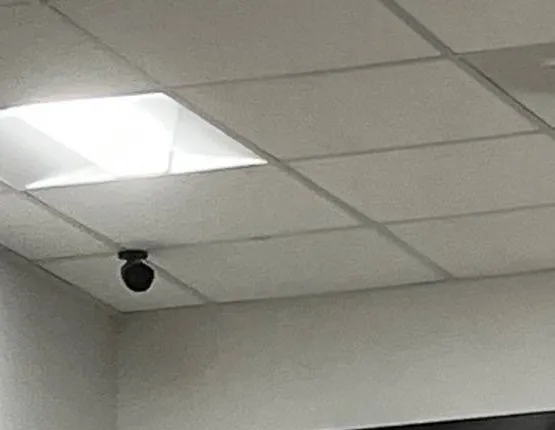
Example photo from another AESS job (not an Orange County property), cropped to the ceiling corner: a black dome camera at the edge of the ceiling, a short distance from a bright light panel. Step six exists because a light that close to a lens can wash out the picture, so the final aim is checked on the recording, not only by eye.
Coverage Area
Floodlight Cameras Near Orange County's Landmarks
We install across all of Orange County, from the Hudson riverfront to the Delaware. These six places help describe the range of properties we light.
Washington's Headquarters, Newburgh
The Hasbrouck House site in the East End opened in 1850 as the nation's first publicly owned historic site. The brick houses around it are where our Orange County work looks most like city work.
Storm King Art Center
A 500-acre outdoor museum near Cornwall and New Windsor, open since 1960. The roads around it are the long-drive, wooded-lot side of the county.
Historic Track, Goshen
A half-mile harness track established in 1838 and a National Historic Landmark, a few blocks from the county government campus in the village of Goshen.
Woodbury Common Premium Outlets
Opened in 1985 in Central Valley with about 220 stores. The retail lots, service lanes and hotels around Route 32 and Route 17 are typical of our commercial lighting calls.
The Black Dirt Region
Flat, dark farmland in the western Town of Warwick around Pine Island, cut by drainage ditches and farm roads, where barns and packing sheds sit far apart on open ground.
Tri-States Monument, Port Jervis
The 1882 marker where New York, New Jersey and Pennsylvania meet, under the I-84 viaduct. Orange is the only New York county that borders both of those states.
We also serve the City of Newburgh, Middletown and Port Jervis; the towns of Newburgh, New Windsor, Cornwall, Highlands, Woodbury, Monroe, Blooming Grove, Chester, Goshen, Hamptonburgh, Montgomery, Crawford, Wallkill, Wawayanda, Minisink, Greenville, Deerpark, Mount Hope, Warwick and Tuxedo; and villages including Walden, Maybrook, Washingtonville, Florida, Greenwood Lake, Harriman, Kiryas Joel, Highland Falls and Otisville. Neighboring counties have their own pages: Rockland, Putnam, Dutchess and Ulster.
Pricing
Floodlight Camera Installation Cost in Orange County
Every figure below is our floodlight base price multiplied by the Orange County area factor, which reflects the travel and the longer runs typical here. The camera hardware is priced separately unless a package includes it.
Job
Orange County price
What moves it
Swap a builder, garage or porch light for one floodlight camera on a box that passes inspection
$420–$805
Mounting height and access, the box and its fixing, a siding mounting block, a switched circuit to guard or make live, app and Wi-Fi setup
New power where there is none (one floodlight camera)
$805–$2,100
Route chosen — new box and feed by a licensed electrician, PoE cable, or an outlet — and how far the spot is from power or the network
Two to four floodlight cameras (house corners, driveway, garage, barn door)
$1,820–$5,320
How many need new power, whether a barn needs a radio link, and whether all of them feed one recorder
Farms, trailer yards and commercial sites
Quoted after a walk-through
Several buildings or a whole site with commercial floods, recorders, switches and links between buildings
Return visit once the job is signed off
$195 an hour, 3-hour minimum ($585)
Later changes: a new aim after a hedge grows or a neighbor builds, relocating a light, extra devices
What pushes an Orange County price up. Distance: a barn, gate or road end well away from any power. A building on its own electric service that needs a wireless bridge or fiber rather than a copper cable. A lot line close enough that the town's height formula forces the light and the camera onto separate mounts. An older box with no ground. A warehouse wall where everything must go high and out of reach.
What keeps it down. A builder's coach-light box already in the right corner. An outlet or a panel already in the outbuilding. A clear line of sight from the house to the barn. Choosing a PoE spotlight camera for a modest light near the network. Grouping the floodlights with other planned work so one visit covers it all.
If you are budgeting a larger system, our camera cost calculator totals cameras and recorders, and the Orange County camera pricing page sets brands side by side. Neither replaces the site visit: the figure in the written quote is the one we stand behind.
Manufacturer product photo (not an installed unit): a Lorex floodlight with two white panels over a black camera body. A dark camera on a garage corner is less conspicuous against brown or grey siding, which matters to some subdivision owners.
Shop Our Systems
Floodlight Camera Packages & Pricing
Most Orange County requests fall into one of these three, priced at county rates; the survey decides the final figure.
Garage-Corner Swap
$420–$805
One floodlight camera on an existing box. Builder or porch light removed, box checked, siding block fitted where needed, switch guarded or box made live, lamps tilted for the lot line, motion zones drawn, app and alerts set up. Suits subdivision houses and village homes.
Far-Point Light
$805–$2,100
A gate post, shed or detached garage with nothing to plug into. We pick whichever gets power there most sensibly: a PoE camera with its own light on a buried or fence-line cable, a plug-in unit on an outlet in conduit, or a fresh box wired by a county-licensed electrician.
House-and-Barn Set
$1,820–$5,320
Two to four floodlight cameras. House corners, driveway and an outbuilding planned together, with a wireless bridge where a building is on its own service and an option to record everything to one recorder. Suits farms and larger lots.
Already bought the floodlight camera? Labor-only installation
Plenty of Orange County owners pick up the fixture themselves, at a big-box store on Route 211 or from an online order, and only then wonder how it gets onto the barn. We will fit it labor-only at the county rates above. First we read its spec sheet: does it want a junction box or a plug, will the lamp heads tip below level for a town that counts footcandles, how many lumens it puts out, and can it record to the recorder you have. A boxed light bought for the wrong wall is the most common surprise we find. Hardware you supplied stays under its maker's warranty, not ours; the bring-your-own-equipment page sets out how labor-only pricing works.
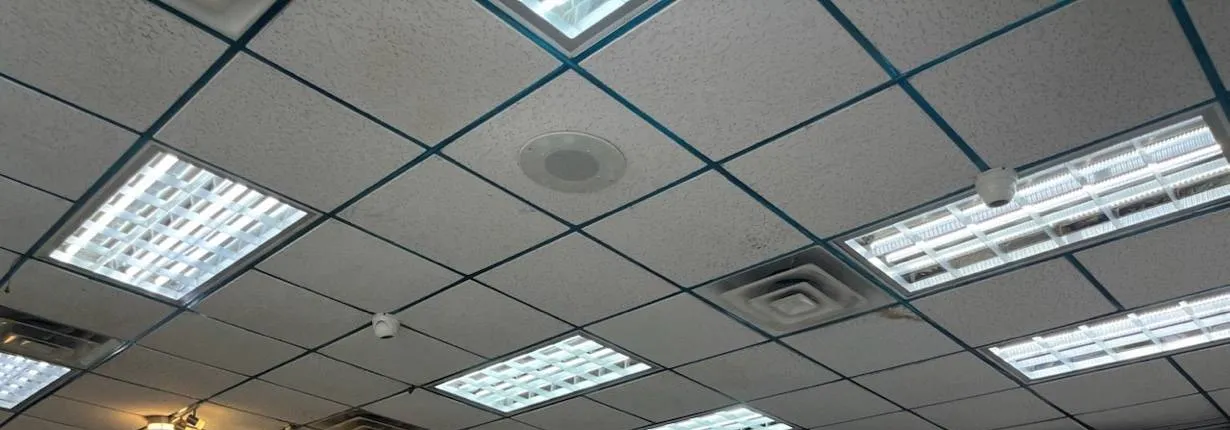
Example photo from another AESS job (not an Orange County property), cropped to the ceiling: small white dome cameras spaced across a drop ceiling between light panels and a vent. A house-and-barn floodlight set is planned the same way, as a layout where each camera has its own job, rather than as single lights added one at a time.
Get the Orange County Floodlight Price in Writing
Start with the name of your town and one picture of the spot. On a short call we match it to a package, say how the power can get there and flag any electrician work, all before a visit is booked.
Network cable and fiber between the house, the garage and the barn.
Field Notes
Field Notes: Start Where the Trouble Would Start
On an Orange County floodlight survey I do not begin at the wall the owner points to. I walk to the place where someone would actually come onto the property — the end of the driveway, the gap in the fence by the barn, the gate on the trailer yard — and look back. From there I can see what is lit already, what is dark, where the shadows fall behind vehicles and buildings, and which wall or post could carry a light that reaches that spot. Then I find the nearest power and the nearest network, and pace or measure the distance to both.
The second thing I check is the lot line and the town. If the property is in a town that counts footcandles or ties mounting height to the distance from the line, I measure that distance before talking about fixtures, because it decides how bright and how high the light can be. On a farm I also ask which buildings are on their own meters, because that decides how the camera gets its picture back to the house.
Before I leave, ideally once it is dark, I walk out to the road or to the edge of the neighbor's lawn and turn around. A bright lamp face staring back at me means another few degrees of tilt. — Owner, NYS low-voltage license #12000287431
Example photo from another AESS job (not an Orange County property), cropped to the ceiling: a small white dome camera on a tile, with a light panel and a vent close by. Where a camera sits relative to the light source decides whether it records detail or glare, inside or out.
Across Orange County
How Floodlight Work Differs Across the County
Orange County covers roughly 840 square miles, and the floodlight job changes as you cross it. These notes describe what we plan for in each part of the county. They are about property types and rules, not promises about any particular street.
Newburgh, New Windsor and the river towns
The City of Newburgh's East End Historic District covers about 445 acres and more than 2,200 buildings, many of them two- and three-storey Italianate brick townhouses, and the city requires a certificate of appropriateness from its Architectural Review Commission for exterior alterations to designated properties and buildings in its historic districts. That is why we keep floodlights to the side and rear of houses there whenever we can, and fix plates into mortar joints rather than brick faces. A short drive away, the towns of Newburgh and New Windsor are a mix of postwar and newer houses, commercial strips on Route 9W and Route 32, and the distribution and business parks around Stewart. Central Hudson serves much of this end of the county; county emergency updates have listed its outages in the towns of Newburgh and Montgomery.
Middletown, Wallkill and Goshen
Middletown's older neighborhoods have the same close side yards and older outdoor boxes as Newburgh, and the city has its own electrical licensing board, so line-voltage work inside the city line is arranged with that in mind. Around it, the Town of Wallkill mixes subdivisions, Route 211 retail near the Galleria at Crystal Run and medical buildings on Crystal Run Road. Goshen, the county seat, has both a village of older houses near the Historic Track and a town zoning code that holds exterior glare to half a footcandle at the property line and requires security lighting to be directed away from streets and neighbors. LEGOLAND New York, opened in Goshen in 2021, brought new hotel and road work to that stretch of Route 17.
Monroe, Kiryas Joel, Chester, Woodbury and Blooming Grove
This is the county's fastest-growing corner. The Times Herald-Record reported Kiryas Joel's 2020 population at 32,954 after 63 percent growth, with families also settling in Blooming Grove, Woodbury and Monroe. Much of the housing is newer: subdivisions, townhouse rows and larger multi-family buildings, with vinyl or fiber-cement siding, builder-installed fixtures and neighbors at known, often short distances. The Town of Chester's 2021 lighting law, with its half-footcandle limit and height formula, is the most detailed we work under in the county, and it applies to houses as well as commercial buildings. On these lots the right floodlight is often a modest one, tilted hard down, with the camera set higher on its own.
Warwick, Pine Island, Florida and Greenwood Lake
The southwest of the county is farm and hill country. The Black Dirt region around Pine Island is flat, dark and open, with barns and packing sheds far apart; the Warwick hills carry orchards and older farmhouses. Orange & Rockland serves this area, and its July 2026 storm restoration still listed outages in the Town of Warwick days later, so we plan for lights and cameras that restart cleanly. The Village of Greenwood Lake has one of the strictest lighting chapters in the county, with 0.20 footcandle at the line, and recommends motion-sensor security lighting. Farms here usually need light at doors, yards and lanes, with wireless links between buildings.
FAQ
Orange County Floodlight Camera Installation FAQ
Our house has solar panels and a home battery — will the floodlight keep working when the grid goes down?
+
Only if its circuit is one the battery backs up. Most home battery systems power a set of chosen circuits through a backup panel, not the whole house. If the outdoor box feeding the floodlight is on a backed-up circuit, the light and camera keep running in an outage; if it is not, they go dark with everything else. The router and any recorder or PoE switch must be on backed-up power too, or the camera keeps lighting but stops recording to the network. During the survey we trace which circuit the box is on and tell you whether moving it to the backup panel is a small job for your solar installer or electrician.
How long does footage stay on the camera's memory card before it records over itself?
+
It depends on the card size, the camera's resolution and how often motion triggers it. A camera recording only motion clips may hold weeks on a modest card; one recording continuously in high resolution may hold a few days. When the card fills, the oldest recordings are overwritten. If you need longer history, or if you need footage to survive someone taking the camera, the answer is a recorder indoors or a cloud plan from the maker. During setup we tell you roughly how many days your settings will hold, and we show you how to save a clip to your phone the moment something happens, before it can be overwritten.
Can a floodlight camera go on the fieldstone or block wall of an old farmhouse or barn?
+
Yes, with the right fixing and a little extra time. Fieldstone is uneven, so the plate cannot sit flat on the face of a stone; we either fix into a mortar joint with sleeve anchors and pack the gap, or mount a small treated or composite backing board to the wall first and fix the light to that. Concrete block takes anchors well as long as they go into the solid web rather than the hollow core. Any cable entry through stone or block is drilled, sleeved and sealed so water does not follow it inside. On a barn, the timber framing above the stone is often the better place for the light anyway.
Can we stop the floodlight sending alerts while the farm crew is working in the yard?
+
Yes. Most floodlight camera apps let you set a schedule or a mode, so motion alerts to your phone pause during working hours while the camera keeps recording, and the light stays off in daylight anyway. Some also let you set different rules for people and vehicles, or for different zones, so a tractor in the yard at noon is ignored while a person at the shop door at midnight is not. If several family members get alerts, each phone can have its own settings. We set the schedule with you at the handover, based on the hours the yard is actually busy, and show you how to change it at harvest or in winter.
Will a floodlight bother horses or livestock in the barn at night?
+
It can if it shines into the stalls, so we keep it outside them. A light mounted on the barn wall and aimed down at the doors and the yard lights the outside without throwing a beam through windows or open doors into the stalls. Motion-only operation means it switches on when someone is there rather than all night, and a short timer keeps each switch-on brief. Where animals in an open run would set it off repeatedly, we draw the motion zone around the doors and the lane instead of the paddock. If you notice the light disturbing animals after installation, tell us and we will change the aim or the settings.
What do we need to have ready before the installer arrives?
+
Clear access to the wall or post where the light goes, and room to set up a ladder. Know where the breaker panel is and, if you can, which breaker feeds the outdoor box. Have your Wi-Fi network name and password, and the login for any recorder you already own. Install the maker's app on your phone and create the account if the camera needs one. If an outbuilding is involved, make sure it is unlocked and any animals are secured. And if the town has sent you a lighting notice, have it handy, because it tells us exactly what the inspector wants to see.
What is due when we book, and when is the balance paid?
+
Our service agreement asks for a 50 percent deposit to schedule the work and order any equipment, with the balance due on completion, and it sets out the parts warranty and the late-fee schedule. If a licensed electrician is part of the job and arranged through us, their portion is itemised on the same quote; if you hire your own electrician, you pay them directly. Equipment you supply carries the maker's warranty rather than ours. We send the agreement with the written quote so you can read the terms before you pay anything.
Can a floodlight camera light the spot where our children wait for the school bus in the dark?
+
Yes, and a schedule does it better than motion. On winter mornings children often wait at the end of the driveway before sunrise. A light at the house end rarely reaches that far, so this is usually a light near the bus stop end of the drive, set on a schedule for the waiting time on school days and on motion the rest of the night. The camera lets you see from the kitchen that they are there and that the bus has come. Keep the light aimed down at the waiting spot and away from the road so it does not dazzle the bus driver.
All Areas Served
Floodlight Cameras Across the Hudson Valley, New York City and Long Island
For a side-by-side look at Westchester, Rockland, Orange, Putnam, Dutchess and Ulster, go up one level to the Hudson Valley floodlight camera installation hub. The boroughs and Long Island counties are listed here too.
A farm that needs cameras on every building, or a warehouse that needs a recorder room, goes beyond a floodlight; the full list of services is on the Abstract Enterprises Security Systems home page, with licence and insurance details on the about page.
Sources
Where the Orange County Facts Come From
Each code section, statistic, outage figure and news report quoted above is listed here with its publisher. Where we could only read a search-result snippet, the entry says “excerpt”. AESS prices come from our own floodlight base figures and county factor, not from any of these sources.
Dark barn door, a gate camera that went offline in the last storm, or a letter from the code office about your light: ring (845) 640-3835. The next free slot is yours, and in most cases the light and the recording are back within one to two hours of the technician arriving.
Orange County Floodlight Cameras From a Licensed, Insured Crew
Orange County customers reach Abstract Enterprises Security Systems on (845) 640-3835; written messages can go by WhatsApp (718) 679-0359, and our listed office is at 460 E Fordham Rd, Bronx, NY 10458.
Rated 4.7★ from 390+ Google reviews · NYS low-voltage license #12000287431 · liability insurance carried from Port Jervis to Newburgh · same-day written estimates
Fixtures, cameras and recorders we fit in Orange County also keep whatever warranty their makers give. Full terms — including 50% deposit, the 30-day warranty and optional paid extended warranty, and the late-fee schedule — are set out in the service agreement. We attach that agreement to every written quote, so the deposit, the parts cover and the payment dates can be read at the kitchen table before anything is scheduled; the warranty page explains what a parts claim looks like in practice.
Page reviewed and updated October 18, 2026. Changelog: Orange County floodlight camera page rebuilt from new research on town lighting laws in Chester, Goshen and Greenwood Lake, the county's three electric utilities and storm outages, county electrician licensing and consumer contract rules, farm and outbuilding lighting, warehouse and trailer-yard gates, and subdivision and older-house mounting, on Orange County prices derived from the published floodlight base figures.