Brick Rear Walls · Twenty-Foot Yards · Landmarked Door Lights · Light That Stays on Your Side
A floodlight camera in Brooklyn is a lighting job before it is a camera job. The back of a Bed-Stuy or Crown Heights rowhouse usually has no outdoor box, a garden door under a parlor-floor window, and the house behind it twenty-odd feet away across two yards. We work out where the power comes from, aim the light so it ends at your fence instead of your neighbor's bedroom, keep the front of a landmarked house within the Commission's rules, and set the camera so it records faces at the door rather than glare. One visit to look, one written price, and a picture you can actually use at 3 a.m.
Reviewed and updated October 18, 2026 by Abstract Enterprises Security Systems (NYS license #12000287431) · Brooklyn visits are scheduled from our office on Troy Avenue in East Flatbush
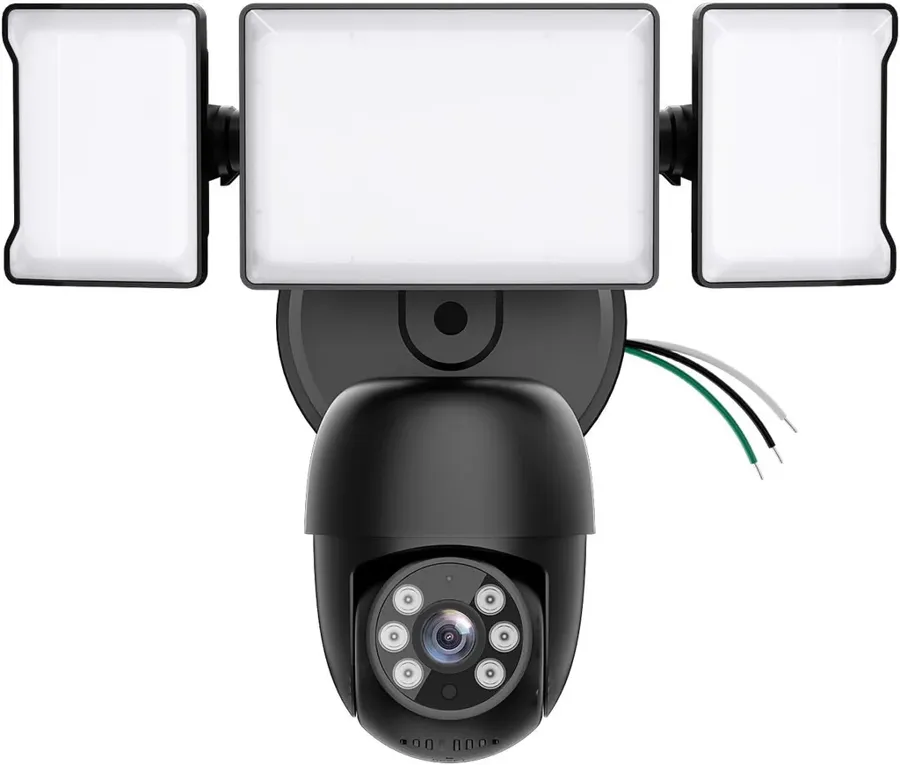
Manufacturer product photo (not an installed unit): a black pan-tilt camera under three LED panels, with the three wire leads — black, white and green — that have to meet a proper box in the wall. On a Brooklyn rear wall, where those three wires connect is the whole question.
Brooklyn Floodlight Camera Quote
Tell us where the light should go and whether there is an outdoor box there now — a written price follows the same business day
✅
Request Sent!
An installer will call back about the Brooklyn floodlight the same business day.
25+
Years Experience
✓
Same-Day Estimates
100%
Licensed & Insured
4.7★
390+ Google Reviews
Two photos usually settle a Brooklyn floodlight price. One of the wall where you want the light, taken from the far end of the yard or driveway, and one close-up of whatever is there now — an old porch light, an outlet, or bare brick. Text them to the Brooklyn line at (347) 934-8335 or attach them to the form, and we will tell you which of the three ways to power it applies before anyone comes out.
Brooklyn installation starts at $300–$575 to replace an existing outdoor light with a floodlight camera; $575–$1,500 where the spot has no power yet
Footage on a card or a recorder you own — no plan required on local-storage models
Two-hour arrival windows, seven days a week up to 8 PM, under NYS low-voltage license #12000287431
Why Brooklyn Properties Need Floodlight Camera Installation
Most of Brooklyn is attached. The Census Bureau's 2023 five-year estimates put 93,812 Kings County homes in one-unit attached buildings against 52,359 detached ones, and another 346,000 or so in buildings of two to four units — the brownstones, limestones and frame rowhouses of Bedford-Stuyvesant, Crown Heights, Park Slope, Flatbush and Bushwick, and the two-family brick houses that run on through Bensonhurst and Canarsie. The median home in the county was built in 1943. That housing gives a floodlight camera an unusual job. The front of the house faces a lit street and a stoop; the back faces a narrow yard boxed in by fences, sheds, extensions and the rear windows of the next block. Nearly all the darkness worth lighting is at the back, and nearly all the neighbors who will notice the light are there too.
The back is also where Brooklyn break-ins tend to start. In 2018 the Brooklyn Eagle reported police hunting a man linked to at least a dozen burglaries in Bensonhurst and Gravesend since the previous August, and in every known case he had forced open a window at the rear of the house. A year later CBS New York reported two people burglarizing a Bushwick home near Central Avenue while the resident was out in the backyard — caught, as so many of these are, on surveillance video after the fact. A camera alone records that. A light that comes on as someone drops over a fence changes the moment itself, and gives the camera enough light to show a face in colour rather than a grey shape.
The catch is that a floodlight is the one security device your neighbors experience every night. Brownstoner readers have argued about it for years: in a 2007 post titled “In the City of Blinding Lights,” a reader complained that floodlights put up on a four-storey building on 15th Street lit his bedroom so brightly he could read with the blinds closed, and asked whether any law covered it. Ten years later NY1 reported Nostrand Avenue tenants losing sleep to a deli's flashing sign until the Department of Buildings found the sign unpermitted and issued violations. Nobody wants that call about their yard light. So we aim and shield every Brooklyn floodlight at your own ground, set the motion zones to your side of the fence, and pick a brightness that suits a twenty-foot yard rather than a parking lot.
Then there is the power. A Brownstoner forum member put the Brooklyn floodlight problem in two sentences: they wanted a Ring floodlight cam on the second floor of their brownstone after worrying incidents, and wanted to know how hard it would be, and what it would cost, to run a new wire. Brick rear walls rarely have an outdoor box where the light should go, and in New York City adding one is electrical work that the Department of Buildings says needs a licensed master electrician and a permit. Sometimes that is the right answer. Often a camera with its own built-in light on a single low-voltage network cable, or a plug-in model on an existing outdoor outlet, does the same job with far less disruption. Most owners who light the yard next ask about the front door, and a floodlight visit is a good moment to plan a doorbell camera for the stoop at the same time.
Brooklyn facts that shape a floodlight install
Attached houses outnumber detached ones almost two to one — 93,812 one-unit attached homes against 52,359 detached in Kings County (Census ACS 2023 five-year), which is why the rear yard, not the driveway, is the typical Brooklyn floodlight location.
Median year built: 1943, with 513,629 of the county's 1,090,187 homes in buildings from 1939 or earlier (same survey) — masonry walls, old porch-light boxes and very few modern exterior outlets.
Any electrical installation or modification needs a permit and a licensed master electrician, the NYC Department of Buildings says, and that includes “replacing fixtures in existing outlets,” which DOB lists as minor electrical work (no more than five fixtures, no increase in wattage).
On a landmarked house, door lights go within or beside the door opening, with no more than two light fixtures and one intercom panel per opening, under the Landmarks Preservation Commission's staff-level permit criteria.
Brooklyn's streets are already lit by LEDs: in October 2013 the city announced all 250,000 of its streetlights would be converted to LED by 2017, light the DOT commissioner called “clearer, whiter” — which changes how much a front-of-house floodlight actually adds.
About 90,000 packages a day are stolen in New York City, News 12 Brooklyn reported in December 2025, citing the Department of Transportation — and the stoop is where most Brooklyn deliveries wait.
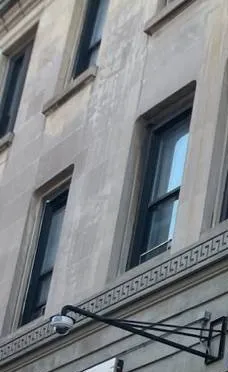
Example photo from another AESS job (not a Brooklyn property), cropped to the facade: a dome camera on a long black arm anchored into a pale stone wall below sash windows. On Brooklyn masonry the fixing goes into mortar joints or plain stone, never into carved trim, and the same rule decides where a floodlight's mounting plate can sit.
Floodlight Dead, Stuck On or Flashing All Night?
A yard light that stays on until dawn, a camera that drops offline every evening, a fixture that flickers when the siren sounds — call (347) 934-8335. We book the next two-hour window, and most Brooklyn floodlights are lighting and recording again within one to two hours of arrival, even when the lasting fix is a different power source scheduled for later. If the problem is a whole camera system rather than one light, start with camera repair in Brooklyn.
Four things to check before you call
Find the inside switch. Many Brooklyn rear lights are on a wall switch by the kitchen or garden door. If someone switched it off, the camera lost power too. Leave it on and tape over it if you have to.
Look at the breaker or fuse. A floodlight that dies whenever it rains can be tripping a GFCI outlet or a breaker. Note which one and whether it resets.
Stand where the camera is and check the Wi-Fi. Hold your phone at the garden door: if it shows one bar or none, the camera's dropouts are a signal problem, not a faulty light.
Read the app's light settings. “Always on after dusk,” a schedule set by a previous owner, or motion sensitivity at maximum explain most lights that never switch off.
Send what you find with your request. Those answers often tell us whether the fix is a setting, a power supply or a new location for the light.
What We Install
Floodlight Camera Installation Services in Brooklyn
Nine kinds of floodlight work make up nearly every Brooklyn call. Most jobs combine two or three of them.
💡
Porch-Light Replacement
An existing outdoor fixture over a garden door or a side entrance swapped for a floodlight camera on the same box, with the box checked, sealed and properly fixed to the brick first.
🔌
New Power to the Rear Wall
For a back wall with nothing on it: a new outdoor box and feed where the light should be, filed and connected by a licensed master electrician, with the camera, Wi-Fi and app on our side.
🌐
Network-Powered Spotlight Cameras
Cameras with built-in lights that run on one low-voltage network cable from a PoE switch inside, so a brick wall gets a single small hole instead of a new 120-volt circuit.
🌿
Yard Lighting Aimed at Your Side
Panels angled down and inward, motion zones drawn to your fence line, brightness and timer set for a twenty- or thirty-foot yard so the light ends where your property does.
🚗
Driveways and Side Alleys
For detached and semi-detached houses in Marine Park, Mill Basin, Dyker Heights and Midwood: a light at the garage end and one at the street end of a long driveway.
🏛
Landmark-Compliant Door Lights
On designated fronts, a discreet light-and-camera fixture within or beside the door opening, attached at mortar joints or plain masonry, with the cut sheet ready for the Commission's staff.
📦
Loading Doors and Lots
Sunset Park, Red Hook and East Williamsburg roll-up doors and yards: commercial-grade lights and cameras that survive weather, forklifts and a ladder-height thief.
📹
Floodlights on an Existing Recorder
Adding a floodlight camera to a recorder you already own, or picking one that will record to it, so the yard view sits with the rest of the building's cameras.
🔧
Re-Aiming and Repairs
Lights that blind the neighbors, cameras that trigger on every cat, housings that filled with water: re-aimed, re-zoned, resealed or replaced.
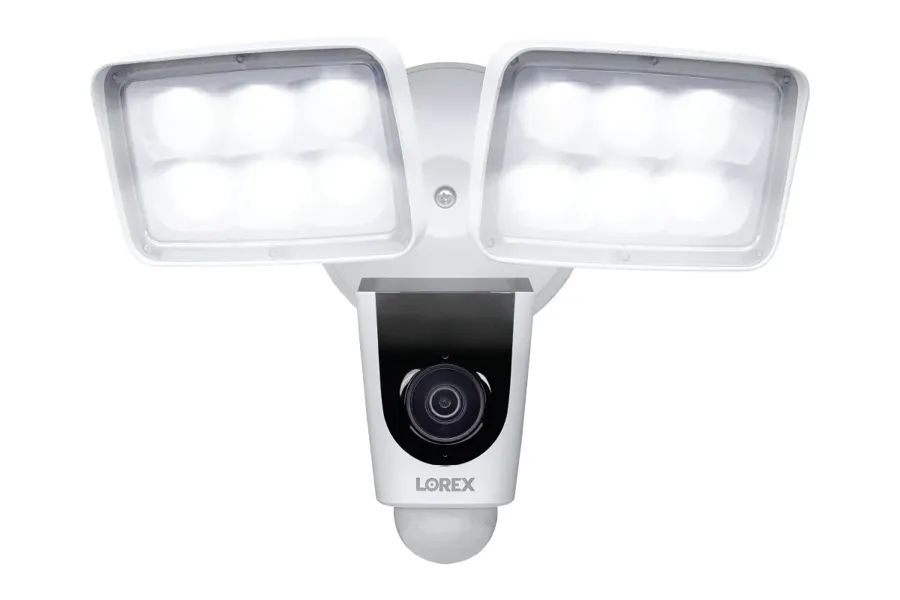
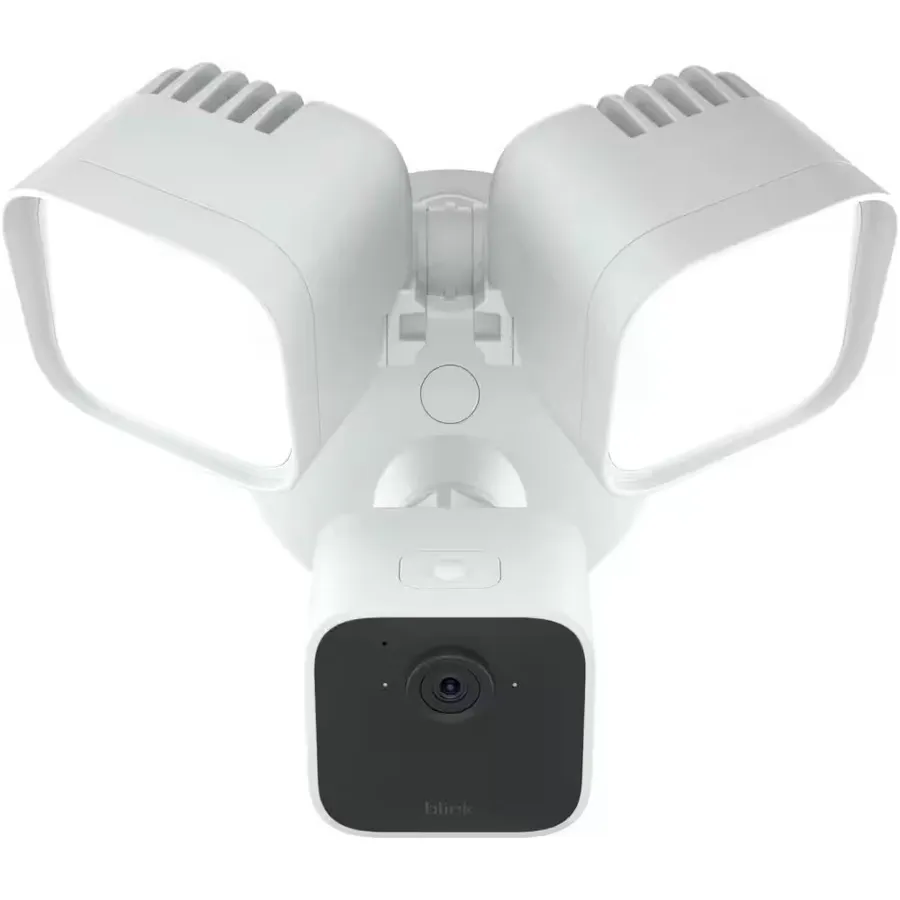
Manufacturer product photo (not an installed unit): a white Lorex floodlight camera with two square LED panels over the camera and a motion sensor at the base. Twin adjustable panels are what let us point the light down into a narrow Brooklyn yard instead of out across it.
Building Specialists
Floodlight Cameras for Brooklyn's Architecture
Six kinds of Brooklyn building cover most of what we light. The wall material, what is already on it and how close the neighbors are decide the method far more than the brand of camera.
Brownstone and Limestone Rowhouses
Park Slope, Fort Greene, Bed-Stuy, Crown Heights. Ornamental fronts with stoops and areaways; plainer brick at the back, often with a parlor-floor deck or a later extension.
Frame and Brick Two-Families
Flatbush, East Flatbush, Canarsie, Bensonhurst. A side alley or a shared driveway beside the house, a rear porch, and an owner downstairs who wants the yard light without upsetting the tenants upstairs.
Detached and Semi-Detached Houses
Marine Park, Mill Basin, Dyker Heights, Midwood, Manhattan Beach. Real driveways, garages and side yards, and in Mill Basin water at the back.
Walk-Ups and Mixed-Use Corners
Bushwick, Sunset Park, Bay Ridge avenues. A store below, apartments above, and a rear yard or a side gate that belongs to everyone and no one.
Warehouses and Industrial Lofts
Sunset Park, Red Hook, East Williamsburg, Gowanus. Loading doors, roll-up gates, open lots and walls high enough that a light at ladder height is a light someone can unscrew.
Landmarked Houses and Districts
Brooklyn Heights, Park Slope, Clinton Hill, Prospect Heights and dozens more districts, where anything on the front facade is checked against the Landmarks Preservation Commission's rules.
Brownstones: plain brick at the back, nothing on the front
The rear wall of a brownstone is usually common brick, and that is the easy part: a mounting plate goes into the mortar with sleeve anchors, and a box or a cable entry can be drilled through without touching anything decorative. What makes it slower is height and what is in the way. The garden-floor door is often under a parlor-floor window or a cantilevered deck, so the natural place for a light is about at that window's sill, where it will shine into the room above if it is not angled hard down. We look at the room behind the wall before we pick the height, and on houses where the back has an extension we usually mount on the extension wall so the light falls straight onto the yard.
Two-families: one light, two households
In a Flatbush or Canarsie two-family the yard is often shared and the alley runs past someone's bedroom window. The owner usually wants the light on motion, the upstairs tenant does not want it switching on every time the downstairs tenant takes out the trash. We settle that before mounting: who controls the app, whether the light runs on motion only after midnight, and which window the panels must avoid. In houses with vinyl or aluminum siding we mount on a siding block or a proper flush mount so the plate sits flat and the box behind it stays dry.
Detached houses: distance is the issue, not the wall
A detached house in Marine Park or Mill Basin has the opposite problem from a rowhouse: plenty of wall, but the garage and the end of the driveway can be well away from any power. For a long driveway we usually split the job, one light at the house corner covering the side door and the near half, and a second toward the garage, rather than one very bright light trying to reach both ends and glaring at the street. Where the garage has its own power, the second light can feed from there; where it does not, a network-powered camera on a buried or fence-line cable is often simpler than a new circuit.
Warehouses: height and hardening
On a loading wall in Sunset Park or Red Hook, a consumer floodlight at eight feet is both too weak and too easy to reach. We mount higher, out of reach from the ground and from the top of a parked truck, use fixtures and cameras built for the job, and feed them from the building's own panel or a network switch inside, so there is no exposed cable a thief can cut. Lights over a roll-up door are set so that the door itself does not block the camera when it is open.
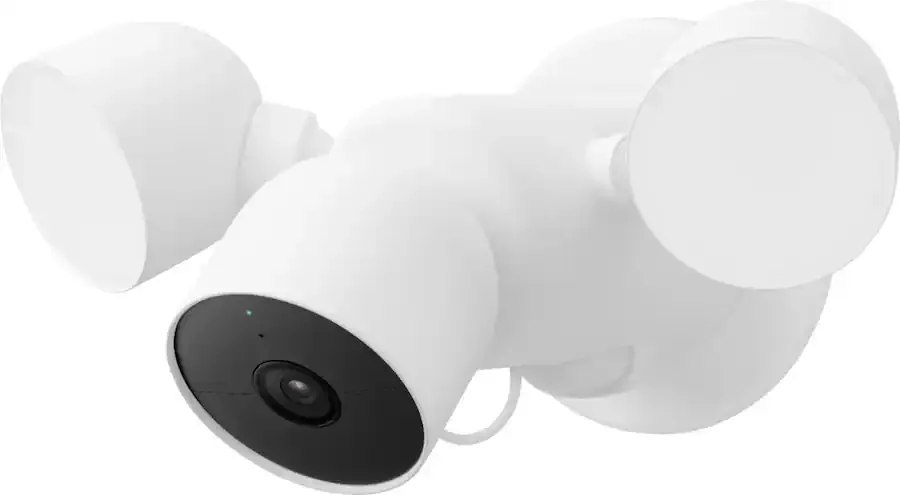
Manufacturer product photo (not an installed unit): two round white lamp heads on short arms beside a rounded white camera with a black face. A compact body like this sits on a brownstone's rear brick without overhanging the garden door frame below.
Commercial Floodlight Cameras
Business Floodlight Camera Installation in Brooklyn
Brooklyn businesses light the back of the building for the same reason homeowners do — the front is lit by the street and watched by passers-by, the back is not. These are the corridors and districts where most of our commercial floodlight calls come from.
Sunset Park waterfront and Industry City
Industry City describes itself as a six-million-square-foot campus; around it are smaller warehouses, food producers and wholesalers with yards and loading bays facing side streets that empty at night.
Brooklyn Navy Yard
More than 300 acres and over 550 businesses, by the Yard's own FY25 impact report. Tenants with exterior doors and yards light them to their lease terms and the Yard's rules.
East Williamsburg industrial blocks
Converted factories split into small units. A Brooklyn Paper report on four burglary reports in one Meadow Street building quoted the local precinct commander calling its security “very weak.”
Red Hook and Gowanus
Warehouses, workshops and studios on wide, dark streets near the water and the canal, where a yard gate or a roll-up door is often the only way in.
Bay Ridge, Fifth Avenue
The Bay Ridge 5th Avenue BID covers the avenue from 65th to 85th Street. Restaurants and shops with rear doors onto yards and alleys behind the avenue.
Downtown Brooklyn and Fulton Mall
Fulton Mall runs along Fulton Street between Flatbush Avenue and Adams Street. Rear service doors and delivery entrances light up at night for staff, not for show.
Commercial floodlights differ from home ones in three ways. They run longer — often dusk to dawn rather than motion-only, because a lit yard is the deterrent. They are mounted higher and fed from the building's own electrical panel or a network switch rather than an old porch-light box. And they usually record to a recorder inside rather than to a phone app, so that footage survives if someone pulls the camera off the wall. For larger sites the floodlights are part of a commercial camera system for Brooklyn businesses, not a standalone gadget.
Rules and credits that apply to Brooklyn floodlight work
Electrical work needs a licensed master electrician and a permit. DOB states that “no installation and modification to any electrical systems can be performed without a permit and a Licensed Master Electrician,” and lists fixture replacement in existing outlets as minor electrical work that still needs both. Our low-voltage license covers the camera, network and recorder side, not new 120-volt wiring.
Landmarked fronts follow the Commission's criteria. Equipment should avoid the primary facade unless there is no other option, be attached at mortar joints or plain masonry rather than cast iron or decorative surfaces, and keep any visible conduit to roughly ten inches, painted to match.
Do not record a neighbor's backyard. New York Civil Rights Law § 52-a gives a residential owner or tenant a right to sue someone who puts a video device on adjoining property to record their backyard without written consent; we mask and aim to your own ground.
No cameras where people undress. New York's unlawful surveillance law turns on places where a person would expect to be able to undress in privacy, so a floodlight camera never looks into a bathroom or bedroom window.
Small businesses may claim back part of the cost. New York's Commercial Security Tax Credit covers surveillance cameras for businesses with no more than 50 employees, up to $3,000 per retail location, with applications due by October 31 each year; check eligibility with your accountant.
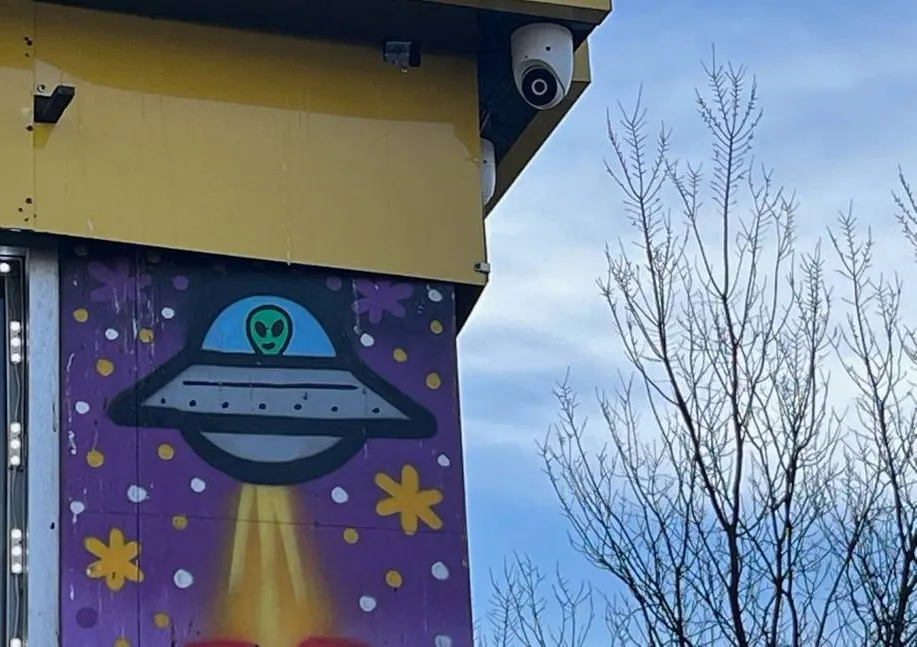
Example photo from another AESS job (not a Brooklyn property), cropped below the sign: a white dome camera under the corner of a yellow fascia, with a strip of small white LED bulbs on the window frame at the left and a painted mural below. Lighting and camera are planned together on a storefront, because the bulbs that make a window bright at night are also what a camera has to see past.
Your Questions Answered
Floodlight Camera Installation in Brooklyn: Questions Answered
These are the questions Brooklyn owners, landlords and business tenants actually put to us about floodlight cameras, grouped by the problem underneath: power at the back of a brick house, light that crosses the fence, landmarked fronts, who is allowed to do the wiring, driveways in southern Brooklyn, loading doors, and getting a usable picture under city light.
Power at the Back of a Brick Rowhouse
Our rowhouse has no outdoor fixture at the rear — what are the options besides cutting a new 120-volt circuit through the brick?
There are three, and we price all of them before you choose. The first is a camera with its own built-in light that runs on one network cable. Power over Ethernet carries both power and data down a single low-voltage cable from a PoE switch or injector indoors; one manufacturer's floodlight model, for example, lists an 1,800-lumen light and 802.3at power on that one cable. On a brick rowhouse that means one small sleeved hole through a mortar joint near the garden door and a cable run inside to wherever the network lives — no new circuit, no breaker work. The second is a plug-in floodlight camera on an existing outdoor GFCI outlet, if there is one within reach; the cord is weatherproof but not armored, so it has to be clipped tight to the wall away from feet and hands. The third is the full answer: a new outdoor box and feed, which in New York City is work for a licensed master electrician under a DOB permit. That gives the brightest light and the cleanest look, and it is worth it when the light needs to be bright or the yard is deep.
The only exterior box at the back is on a switch inside the kitchen — will the camera keep recording when someone flips it off?
No. A floodlight camera on a switched box loses power, and stops recording, the moment the switch goes off, and in a house where the rear light has always been switched by the garden door, someone will switch it off. There are three fixes. The simplest is a switch guard or a blank plate so the switch stays on; the floodlight's own motion sensor and the app then control the light. The tidier one is to have the box made permanently live, which is a small piece of electrical work for a licensed electrician. Some floodlight cameras also let a quick off-and-on of the wall switch force the light on manually, which keeps the switch useful; we check whether your model supports that and show everyone in the house how it behaves. In a two-family, we also label the switch, because the tenant on the garden floor is usually the one who turns it off.
Is the old porch-light box over our garden door strong enough to carry a heavier floodlight camera?
Sometimes not, and it is worth checking before anything is mounted. The light over a Brooklyn garden door was often put up decades ago on a small, shallow box fixed to the brick with a couple of plastic plugs, or set into a hole that has crumbled around it. A floodlight camera with two or three lamp heads weighs more than a single porch light and catches wind, and its plate needs to be fixed solidly to the wall, not hanging off a loose box. We take the old fixture down, look at the box, its fixing and the cable inside, and either reuse it with new anchors into sound mortar, or recommend replacing it. Where the cable inside is old cloth-covered wiring or the box is rusted, the replacement is electrical work for a licensed electrician; we will say so before anything is connected, not after.
Neighbors, Windows and Light That Crosses the Fence
How bright, and how warm a colour, should the light be for a twenty-foot Brooklyn yard?
Far less than the box suggests, and on the warm side. Floodlight cameras are rated for suburban lots: Lorex lists two 2,000-lumen arrays on one model, and the 3,000-lumen line is the one a 2024 City Council bill picked out for residential districts. A typical Brooklyn rear yard is roughly twenty feet wide and not much deeper, closed in by brick and fences that bounce light back, so a fraction of that output lights it fully. We start most rowhouse yards at a low brightness setting in the app and raise it only until a face at the back fence records clearly. Colour matters too: a cooler, bluish white looks harsher through the windows behind you, while a warmer white looks more like an ordinary porch light; several floodlight cameras let you choose. Motion-only operation does the rest, because a modest light that comes on for thirty seconds when someone climbs the fence is both enough for the camera and easy for the street to live with.
A neighbor has complained about our existing floodlight — what can be changed short of taking it down?
Usually enough to end the complaint. Most complaints we see come from three things: the lamp heads are tilted level instead of down, the light is set to stay on all night rather than on motion, or the motion zone reaches into the neighbor's yard so their own movements keep switching it on. Each is fixable in a short visit: re-aim the heads, change the light to motion-only with a short timer, redraw the motion and detection zones to your side of the fence, and lower the brightness. If the fixture cannot be aimed low enough from where it is, moving it a few feet, or swapping it for a model with a shielded or narrower light, does the rest. Brownstoner readers who have dealt with this on both sides tend to give the same first advice — ask politely — and in our experience a light that is visibly re-aimed is the most persuasive reply.
Our fence is low — will the camera end up recording the yard next door?
It will unless it is set not to, and in New York that matters. Civil Rights Law § 52-a gives the owner or tenant of a residential property the right to sue someone who installs a video device on adjoining property to record their backyard without written consent. A floodlight camera aimed down your yard with a low fence will usually catch a strip of the neighbor's ground at the edge of the frame. We deal with it in two ways. First the aim: most of the frame on your yard, your door and your gate. Then privacy masking, where the camera or recorder blacks out a drawn area of the picture permanently, so the neighbor's yard is never recorded at all. Motion zones are set to match, so the neighbor's movements do not trigger the light either. If you share a yard or a fence with relatives next door and both want coverage, put it in writing.
Landmarked Fronts and the Door Light
How many lights may go beside the front door of a landmarked Park Slope house, and can one of them carry a camera?
Two fixtures and one intercom panel per door opening, under the Landmarks Preservation Commission's staff-level criteria, and yes, a light can include a camera if it still reads as a neutral, discreet fixture. Park Slope was designated a historic district in 1973, with a South Slope extension in 2012, so on most of its blocks anything on the front facade is the Commission's business. Its staff can approve light fixtures that sit within or next to the door opening and are compatible in design, size and finish with the building. A wide twin-head floodlight on the face of a brownstone does not meet that. A compact wall light with a camera built in usually can, as can an ordinary approved lantern beside the door with a small camera tucked under the stoop. We bring the manufacturer's cut sheet, which the Commission asks for with the application, and plan the cable to enter through plain masonry behind the fixture so nothing runs across the facade.
Does a floodlight on the rear wall of a landmarked house need anything from the Commission?
Check before you assume it does not. The Commission's rules are written around what is visible: its guidebook steers equipment away from the primary facade, and architects who work with the LPC note that rear additions that cannot be seen from a public street have an easier path. A yard light on the back of a Brooklyn Heights rowhouse that nobody can see from the street is treated very differently from one on the front. But a corner house, a rear wall that shows from a side street, or a house facing a park can make the back visible too. When a house is designated, we look at the rear from the nearest public places before we fix anything, and if the light or camera would show, we recommend the owner confirm with the Commission's staff first. We do not file landmarks applications on the owner's behalf unless asked; we give you the details the application needs.
Our brownstone's areaway and under-stoop entrance are pitch dark — what fits there without breaking the facade rules?
Small and low, which happens to be exactly what the Commission favours. Its general criteria name the space underneath a stoop and behind an areaway wall or fence as discreet places for equipment that has to be on the front. The garden-level entrance under the stoop is also where Brooklyn packages wait and where somebody can stand unseen from the sidewalk. A compact camera with a built-in spotlight fixed into the mortar of the stoop's underside, or a small light and a separate mini camera on the plain masonry beside the under-stoop door, light the space without changing the look of the house. The cable usually goes straight back through the wall into the garden floor, so nothing is visible. We avoid the iron gate and railings entirely, both because the rules say so and because a camera on a gate gets knocked out of aim.
Who Does the Wiring: Electrician, Low-Voltage or Both
What does the DOB's “minor electrical work” category mean for a floodlight swap on a Brooklyn house?
It means a swap is still electrical work in the city's eyes, just a lighter-touch kind. The Department of Buildings lists replacing fixtures in existing outlets, up to five fixtures and with no increase in wattage, as minor electrical work. That category needs a licensed master electrician and a permit, but no design professional and no DOB inspection. So the ten-minute job of taking down a porch light and wiring up a floodlight camera on the same box is not, legally, a homeowner's job in New York City, whatever a box from a big-box store implies. Adding a new outdoor box or a new circuit goes further, into general electrical work, which DOB inspects. On our written quote we spell out which parts of your job fall into which category and who does them, so you are not surprised by an electrician's permit later.
Which part of a floodlight job is low-voltage work, and why does that matter for a brick house?
Everything after the power: the network cable to a PoE camera, the Wi-Fi access point that reaches the yard, the recorder, the switch, the app and the settings. That is what our New York State low-voltage license covers, and on a brick rowhouse it is often the larger share of the work. It matters because the low-voltage route can avoid the 120-volt question altogether. A camera with a built-in light, powered and connected by one network cable, needs no electrical box outdoors, only a weatherproof cable entry. Inside, the cable can follow the cellar ceiling or an existing chase to the network closet. For a garden-door or yard light where a few hundred lumens and a good camera are enough, that route is usually faster, quieter and cheaper. Where the yard is deep or the client wants a bright floodlight, line voltage wins.
Can the floodlight camera run off the same network cable as our other cameras?
Not the same cable, but the same switch and the same recorder, which is usually what people mean. Each network-powered camera needs its own cable back to a PoE switch or a recorder with PoE ports, but if your building already has a recorder with a spare port, or a switch with power to spare, the floodlight camera simply becomes another channel. We check two things first: whether the recorder accepts that camera's stream, and whether the switch can supply the extra power, because a camera with a built-in light draws more than a plain camera, especially when the light and siren are on together. If your current system uses coax rather than network cable, a floodlight camera can still join it through a network recorder or a hybrid recorder; our Brooklyn DVR upgrade page explains that route.
Driveways, Alleys and Detached Houses in Southern Brooklyn
Where should the floodlight sit on a Marine Park house whose driveway runs back to a rear garage?
At the back corner of the house, about where the driveway meets the side door, looking toward the garage. That spot lights the side door, the gap between house and garage and anyone coming up the driveway from the street, which is the route somebody takes to reach the back. It is also usually the closest point to existing power and to the network inside the house. A light on the garage itself, looking back toward the street, sees cars and faces against the streetlight, which is useful, but on its own it leaves the side door in shadow. What we avoid is a bright light at the street end aimed down the driveway: it lights the sidewalk, catches every passer-by and shines into the camera at the other end. Detached houses in Marine Park and Mill Basin usually have the wall space to put the light exactly where it works, rather than wherever the old porch light happened to be.
Do detached houses in Mill Basin or Dyker Heights need different hardware from rowhouses?
Mostly different placement, sometimes different hardware. Detached and semi-detached houses have side yards, garages and in Mill Basin often water at the back, so the distances are longer and the walls are more exposed to wind. That pushes toward floodlight cameras with a wider field of view or a pan-tilt head for a side yard, toward wired power or network cable rather than battery, and toward a recorder rather than cloud-only storage, since a house with four or five floodlights produces a lot of video. Near the water we prefer stainless or well-sealed fixings and keep cable entries pointing down. A rowhouse, by contrast, usually needs one light at the back and a compact fixture at the front, and the question there is the neighbor's window, not the distance.
Dyker Heights draws holiday crowds onto our block — should the camera record the sidewalk at all in December?
It can, but a camera that records the whole sidewalk for a month mostly records strangers. The holiday displays that News 12 described as spanning 11th to 13th avenues and 83rd to 86th streets bring visitors past the houses every evening of the season. A floodlight camera on the front of a house there will trigger constantly and fill its storage with visitors' faces. We usually set the front camera's motion zone tight to the stoop, door and driveway, mask the public sidewalk from recording if the owner prefers, and switch the floodlight itself off at the front for the season, since the displays light the street anyway. The yard and driveway lights carry on as normal. When January comes, we can put the settings back, or the owner can, from the app.
Warehouses, Lots and Loading Doors
Will a consumer floodlight camera hold up on a Sunset Park or Red Hook loading door?
Usually not for long. Consumer floodlight cameras are built for a garden door: modest brightness, a Wi-Fi connection, a plastic housing, and a mounting height someone can reach from a step ladder. On a loading wall they get bumped by trucks, pulled down by anyone who stands on a pallet, lose Wi-Fi through a steel door, and cannot light a yard the size of a warehouse apron. For that wall we fit a commercial LED flood fixture high up, fed from the building's panel by an electrician, and a separate wired camera with good low-light performance, recording to a recorder locked inside. The light and the camera are mounted apart so the camera is not staring into its own light, and both are out of reach. It costs more than a box from the hardware store, but it is still working a year later.
Our East Williamsburg unit shares a building with other tenants — who should own and control the yard light?
Settle it with the landlord before anything goes on the wall. In a converted factory split into small units, the yard, the loading door and the outside walls usually belong to the landlord, and the lease usually says what tenants may fix to them. A light that one tenant puts up and controls from one phone tends to be switched off by the next tenant who finds it annoying. The arrangement that lasts is a light on the building's common power, on a schedule or dusk-to-dawn, with the camera feeding either the landlord's recorder or each tenant's own with permission. If the landlord will not take it on, a tenant can still light and watch their own door with the landlord's written OK, mounted so it comes down cleanly at the end of the lease.
Can the lot light stay on a schedule during business hours but switch to motion after closing?
Yes, and for most Brooklyn businesses that is the right pattern. During opening hours a lit yard helps staff and deliveries; after closing, a light that switches on only when someone walks in is both a warning and a cue for the camera to record in full colour. Many floodlight cameras and most commercial lighting controls support a schedule plus a motion mode. Where the floodlight is a separate commercial fixture rather than a camera with a light, a motion sensor or a timer on the fixture's circuit does the same, and the camera's recorder can be set to send an alert only after hours. We also set the camera to keep recording on motion even when the light is on schedule, so nothing is lost while the lights are on.
Getting a Usable Picture Under Brooklyn Light
Our block's LED streetlight already lights the sidewalk — does a floodlight still add anything at the front?
Often less than people expect, and that is worth knowing before paying for one. New York City swapped its streetlights to LED after a 2013 announcement covering all 250,000 of them, and on many Brooklyn blocks the sidewalk and the stoop are already lit well enough for a decent camera to record in colour. What the streetlight does not do is light the area under the stoop, the vestibule recess or the face of someone standing with their back to it. So at the front we usually recommend a good camera with a small, low-glare light aimed at the door, rather than a big floodlight aimed at the street. The darkness that needs a floodlight is behind the house.
At the back of a rowhouse, should the light and the camera be one unit or two separate devices?
One unit is simpler; two devices often give a better picture. A floodlight camera puts the light and the lens a few inches apart, so the camera sees exactly what the light hits, including the glare off pale paint and brick right in front of it, and anyone at the garden door is lit from straight above. That is fine for a yard where you mainly want to see someone coming over the fence. Where the garden door itself is what you need to identify, a separate camera placed a little further away, on an extension wall or looking back from the fence, records the face from the side while the light does its job from above. It also means a thief who pulls down the light has not taken the camera with it. The two-device route costs a little more and needs two mounting points, so we only recommend it where the door or the gate is the main thing to see.
Is it worth running a network cable to the back of a brownstone rather than relying on Wi-Fi?
Usually, yes, if a reasonable route exists. A router in a front parlor has to get through several interior walls, a staircase and the rear brick wall before it reaches a camera in the yard, and floodlight cameras send a lot of video, so one bar of signal at the garden door tends to mean a camera that drops off in the evening, just when it matters. Adding a mesh node or an outdoor access point at the back fixes the signal but still leaves the camera on wireless. A network cable fixes it for good and, with a PoE model, carries the power as well, so the same small hole through the brick does both jobs. In many brownstones the cellar ceiling gives an easy run from front to back. We test the signal at the exact mounting spot with the house's own network before choosing, and if the yard light is the start of a larger system, plan the network for the whole building at once with our Brooklyn structured cabling team.
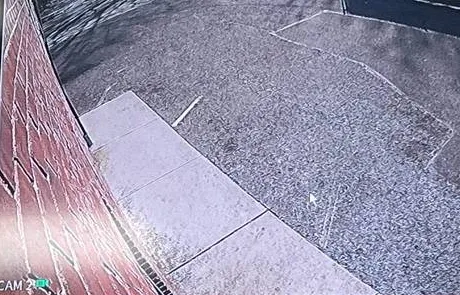
Example photo from another AESS job's recorder screen (not a Brooklyn property), cropped to one camera tile: a wide-angle view runs along a red brick wall to a concrete walkway and a paved lot. In daylight a view like this is easy; the floodlight's job is to keep the same detail on the wall and the walkway at night.
Equipment
Types of Floodlight Cameras We Install
We are not tied to one brand. These are the kinds of hardware we fit in Brooklyn, and where each one earns its place.
💡
Hardwired Twin-Head Floodlight Cameras
Two adjustable LED heads over a camera, wired to a 120-volt box. The standard choice for a deep yard or a driveway corner where there is already a box or the owner wants a new one.
🔦
Three-Panel Floodlight Cameras
A wider spread of light for side yards and lots. In narrow rowhouse yards the outer panels are turned in or dimmed so they do not light the neighbors.
🌐
PoE Spotlight and Floodlight Cameras
Built-in light, camera and sometimes siren on one network cable. The low-voltage answer for brick walls with no outdoor box, and the most reliable signal at the back of a big house.
🔄
Pan-Tilt Floodlight Cameras
A camera head that turns to follow motion under the lights. Useful on a detached house's side yard or a lot; overkill in a twenty-foot rowhouse yard.
🔌
Plug-In Floodlight Cameras
Models with a weatherproof cord for an outdoor GFCI outlet. A tidy option where the outlet is already in the right place and the cord can be fixed tight to the wall.
🏛
Compact Light-and-Camera Fixtures
Small wall lights with a camera inside, for landmarked fronts, vestibules and under-stoop doors where a twin-head floodlight would never pass.
🏭
Commercial LED Floods with Separate Cameras
For loading walls and lots: a commercial fixture high on the wall and a wired camera mounted apart from it, recording to a locked recorder.
💾
Recorders, Switches and Access Points
A network recorder for houses with several floodlights, a PoE switch sized for lights and sirens, and an access point that actually reaches the yard.
Ring, ADT or SimpliSafe — or a Brooklyn installer?
National brands sell good floodlight cameras, and Ring's own support pages walk a homeowner through mounting one on a junction box and connecting the black, white and ground wires. Alarm companies such as ADT and SimpliSafe sell camera hardware alongside monitoring plans. None of that is the hard part in Brooklyn. The boxed instructions assume there is a box on the wall, the Wi-Fi reaches the yard and the neighbors are a long way off. On a brownstone none of that is true, and in New York City the wiring itself is licensed work.
What a local installer adds is the bit before the box is opened: whether the rear wall can take the light at all, which of the three power routes fits, where the panels must point to stay off the house behind, whether the front of the house is landmarked, and whether the camera will join a recorder or live on a phone. If you already own a Ring, Nest, eufy, Lorex, Wyze or similar floodlight camera, we install it labor-only. If you want monitoring from an alarm company, the floodlight can sit alongside it; we will not sell you a monthly plan you do not need.
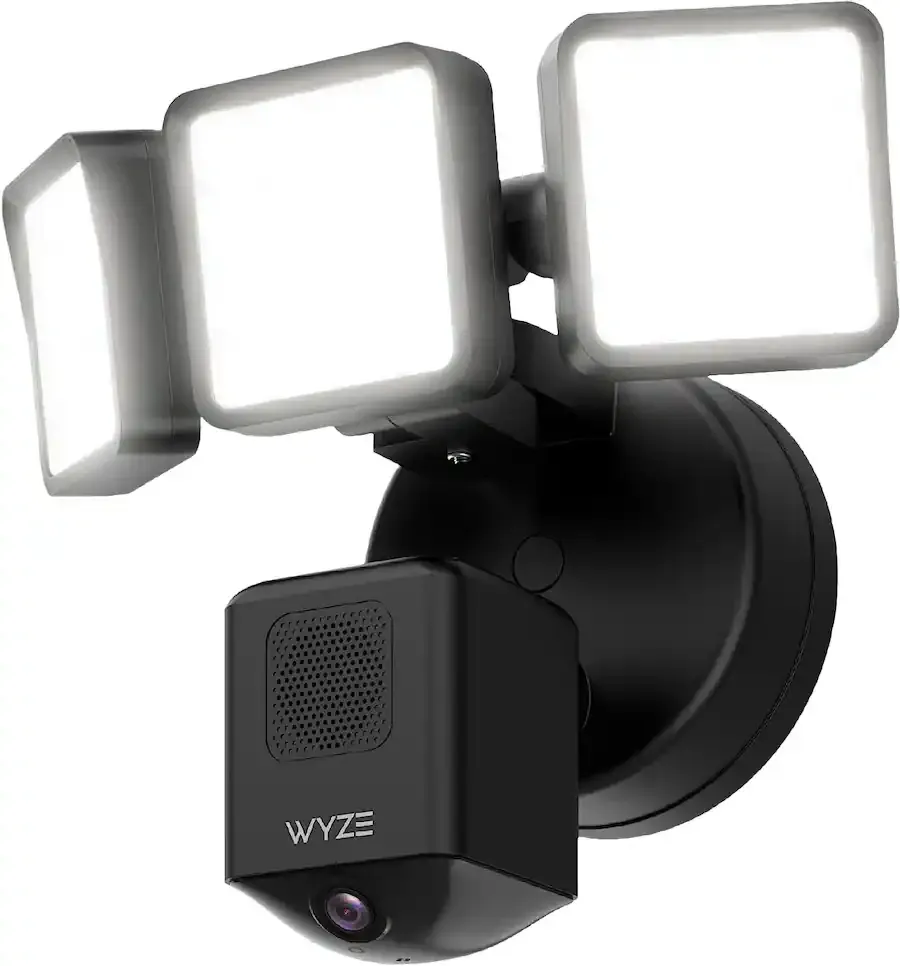
Manufacturer product photo (not an installed unit): a black Wyze floodlight camera with three square LED panels on arms above a square camera body. A black finish disappears against dark Brooklyn brick far better than a white housing.
AI Overview Reality Check
What AI Gets Wrong About Floodlight Camera Installation in Brooklyn
Each is fair as a national average. Each needs correcting for a Brooklyn rowhouse.
1. “Floodlight installation averages about $450”
Inch Calculator's floodlight cost guide, last updated in 2023, puts the national average at about $450, with most projects between $250 and $800 and installation around $150 to $350 per light. Another installation blog puts hiring an electrician for a floodlight camera at around $650 on average. Those figures assume a house where the box is already there, or a short run of new cable through a wood-frame wall.
Brooklyn splits that average in two. Where a sound outdoor box already sits where the light should go, our installation runs $300 to $575 plus the camera, which is in line with the guides. Where the rear wall is bare brick, the job becomes a choice between a new box and feed by a licensed electrician, a network cable to a PoE camera, or a plug-in model on an existing outlet, and the price moves to $575 to $1,500 depending on the route and the distance.
So the useful question is not what floodlight installation costs on average. It is whether there is power where your light should be. A photo of the wall answers that before anyone visits.
2. “No junction box? Use a plug-in kit — no electrical work required”
Installation guides recommend plug-in conversion kits for walls without a box: a weatherproof cord from the floodlight to an outdoor GFCI outlet, “no electrical work required beyond confirming you have a working outdoor outlet nearby.” The same guides note that the outlet must be outdoor-rated and GFCI-protected and that the cable is weatherproof but not armored.
In Brooklyn the catch is the outlet. Most rowhouse rear walls have none, or have one at the garden-floor door that a cord would have to climb three metres of brick to reach a sensible height. A loose cord across a yard used by children, tenants and the recycling bins does not last, and on a landmarked front a visible cord is exactly what the Commission's criteria are written to avoid.
Plug-in models are a good answer where the outlet is close and the cord can be clipped tight into the mortar along a protected route. Where it cannot, the PoE route gives the same no-new-circuit advantage with a cable that can go inside the wall.
3. “Mount it about nine feet up”
Ring's installation guide recommends mounting its floodlight camera about nine feet above the ground where possible, with the motion sensor parallel to the ground. That is sound advice for detecting people walking across a yard, and it is the figure most AI answers repeat.
On the back of a Brooklyn rowhouse, nine feet above the yard often lands right at the sill of the parlor-floor window, or under a deck that blocks half the light. On a house with a rear extension, nine feet up the main wall may put the light behind the extension's roof. And if the yard is lower than the street, as many are, the “ground” is not where you think it is.
We use nine feet as a starting point, then move up or down by what the wall allows: above the window head rather than at the sill, on the extension wall rather than behind it, or on a fence post at the back of the yard looking toward the house. The test is whether the motion sensor still sees someone coming over the back fence.
4. “More lumens means more security”
Floodlight cameras are sold on brightness. Lorex lists one of its Wi-Fi floodlight cameras with two 2,000-lumen light arrays; Reolink lists an 1,800-lumen floodlight on its PoE model. In a suburban driveway that brightness reaches the end of the lot and lights a face at the curb.
In a twenty-foot Brooklyn yard, four thousand lumens is a parking-lot light pointed at the house behind. It glares on brick and pale paint, washes out faces at the door, and becomes the light your neighbors complain about — the Brownstoner reader who could read in bed with the blinds closed was describing exactly this. In 2024 Council Members Robert Holden and Kristy Marmorato introduced Int. 753, which would bar private outdoor lights brighter than 3,000 lumens in residential districts unless they are fully shielded, with a $50 civil penalty. It is a proposal in committee, not law, but a twin-array light at 4,000 lumens is exactly what it describes.
More useful than raw lumens is control: lamp heads that tilt, brightness that can be turned down in the app, motion-only operation with a short timer, and a camera that records colour in moderate light. We size the light to the yard, not to the box.
5. “It's a weekend DIY job — or any electrician can do it”
Manufacturers present floodlight cameras as something a confident homeowner can fit: turn off the breaker, connect three wires, mount the plate. Arlo's own guide says that anyone not comfortable with electrical work should look for a licensed electrician, which is about as far as national advice goes.
New York City is stricter than that. The Department of Buildings says no electrical installation or modification can be performed without a permit and a licensed master electrician, and lists replacing fixtures in existing outlets as minor electrical work that still needs both. A Brooklyn homeowner swapping a porch light for a floodlight camera is doing licensed work, whatever the box says.
The low-voltage side — network cable, PoE, the recorder and the app — is different work, and it is what our New York State low-voltage license covers. Our quote separates the two, so you can see which parts need an electrician and which do not.
6. “Wi-Fi floodlights are wireless, so they go anywhere”
“Wireless” floodlight cameras still need power, and they need a Wi-Fi signal strong enough to carry high-resolution video. Arlo's guide recommends choosing a location with a strong Wi-Fi signal; most AI answers skip that step.
Brownstone and brick walls, plaster on lath and the depth of a rowhouse all eat Wi-Fi. A router in the front parlor often gives one bar or none at the garden door, and the camera drops offline in the evening when the household is streaming. That shows up as a light that comes on with no clip to show for it.
The fix is either a better network at the back — a mesh node or outdoor access point — or a wired camera. A PoE floodlight uses one network cable for power and data, which on a brick house solves both the power and the signal problem in one hole.
7. “Aim it to cover the whole property line”
Generic advice says to cover every approach to the house, including the boundaries. On a large lot that means looking along the fence; on a rowhouse it means looking into three other yards.
New York's Civil Rights Law § 52-a lets a residential owner or tenant sue someone who puts a video device on adjoining property to record their backyard without written consent. A camera fixed to your own wall but pointed over a low fence still puts the neighbor's yard on your recorder, and the light that comes with it lands in their windows.
We cover your own approaches — the back fence, the gate, the garden door, the alley — and mask out the rest. If both neighbors want coverage of a shared space, they agree it in writing. That keeps the footage usable and the neighbors on your side.
Light the Yard, Not the House Behind It
Send a photo of the wall and tell us what is on it now — nothing, an old porch light, or an outlet. We will tell you which power route fits, roughly where the light should go, and the Brooklyn price before anyone brings a ladder.
A Brooklyn floodlight quote needs four things: the neighborhood and type of house or building, which wall the light goes on, what is on that wall now, and whether you already own the camera. A photo of the wall saves a visit. A written total comes back the same business day; to talk it through, call (347) 934-8335.
✅
We Got Your Request!
Thanks — it is in. An installer will look over the wall, the power and the neighbors' windows, then call you back today. Urgent? Use (347) 934-8335.
How It Works
Our Installation Process
Seven steps, whether the light goes over a Bed-Stuy garden door or a Sunset Park loading bay. The first two decide most of the price.
1. Read the wall from photos
From two photos — the wall from the far end of the yard or driveway and a close-up of what is on it now — we work out whether there is usable power, what the wall is made of and which of the three power routes is likely before anyone travels.
2. Walk the yard and the neighbors' sightlines
On site we stand at the back fence, note every window that overlooks the yard, check the room behind the wall and confirm whether the front is landmarked, then mark where the light and the camera should go.
3. Choose the power route
A sound existing box, a network-powered spotlight camera on one low-voltage cable, a plug-in model on an existing outdoor outlet, or a new box and feed by a licensed master electrician under a DOB permit.
4. Write the plan and the price
You get a written list of the fixture, the mounting point, the route for power and data, which parts need an electrician's permit and the price on the Brooklyn base figures.
5. Mount, seal and connect
The plate is anchored into sound mortar or plain masonry, the box or cable entry is sealed against the weather, and the camera joins the Wi-Fi, the network switch or the recorder.
6. Aim the light and draw the zones
Lamp heads are angled down into your own ground, brightness and timer are set for the yard, motion zones stop at your fence and privacy masks cover any neighbor's yard in frame.
7. Test after dark and hand over
We check the light from the far fence and the neighbor's line of sight, record a test clip at the door, and set up the app and users on your phones.
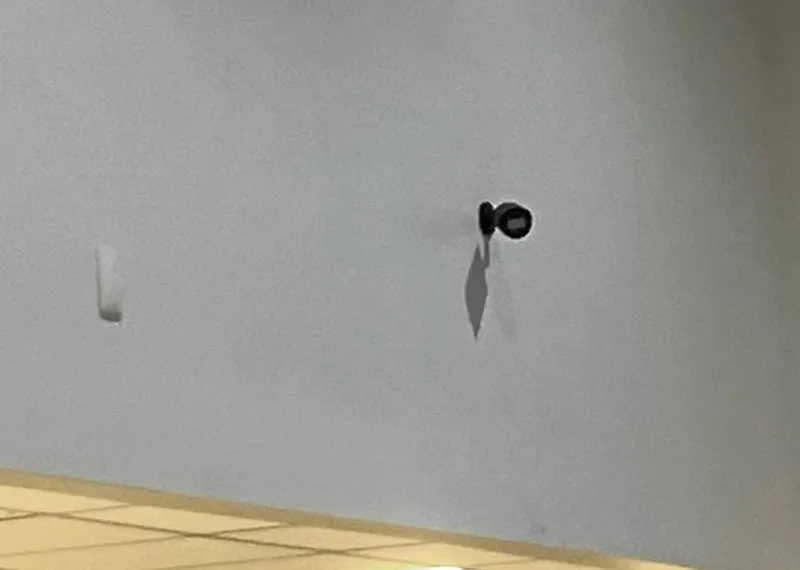
Example photo from another AESS job (not a Brooklyn property), cropped to the wall: a small black camera on a short arm, high on a plain wall, throws a long shadow down from the light above it. Height and the direction of the light decide what a camera sees, which is why the mounting test comes before the final fixing.
Coverage Area
Floodlight Cameras Near Brooklyn's Landmarks
Six places that mark the kinds of Brooklyn property we light, from historic districts to industrial waterfront.
Park Slope Historic District
Designated in 1973, with a South Slope extension in 2012. Two- and three-storey rowhouses with deep front yards, where front-door lights follow the Commission's door-opening rule and the real floodlight work is at the back.
Brooklyn Heights Historic District
New York City's first historic district, designated on November 23, 1965. Narrow rear gardens behind landmarked fronts, where light has to stay low and inside the garden wall.
Dyker Heights holiday lights
The displays News 12 locates between 11th and 13th avenues and 83rd and 86th streets. Detached and semi-detached houses with driveways, and a month of crowds on the sidewalk each winter.
Marine Park and Mill Basin
Southeastern Brooklyn near Jamaica Bay, where housing is largely detached and semi-detached and many homes have driveways, private outdoor space or water at the back.
Industry City, Sunset Park
A six-million-square-foot campus on the old Bush Terminal waterfront, ringed by warehouses and loading docks that need lighting built for trucks, not gardens.
Brooklyn Navy Yard
More than 300 acres and over 550 businesses on the East River, where exterior lighting is planned around tenant yards, gates and loading areas.
We also install floodlight cameras across Bedford-Stuyvesant, Crown Heights, Prospect Heights, Clinton Hill, Fort Greene, Flatbush, East Flatbush, Midwood, Canarsie, Bushwick, Williamsburg, Greenpoint, Bay Ridge, Bensonhurst, Gravesend, Sheepshead Bay, Gerritsen Beach, Red Hook, Carroll Gardens, Gowanus, Windsor Terrace and Kensington.
Pricing
Floodlight Camera Installation Cost in Brooklyn
Brooklyn is the base market for our pricing, so these figures are the base figures for the floodlight silo. They are installation prices; the floodlight camera itself is extra unless it is part of a package, and local-storage models carry no monthly fee.
Job
Brooklyn price
What moves it
Replace an existing outdoor light (one floodlight camera on a sound box)
$300–$575
Height and access, the state of the old box and its fixing, app and Wi-Fi setup, whether a licensed electrician's permit is needed for the swap
New power where there is none (one floodlight camera)
$575–$1,500
Route chosen — new box and feed, PoE cable or outlet — distance to power or the network, and how many walls the cable crosses
Two to four floodlight cameras (yard, alley, driveway, rear doors)
$1,300–$3,800
The mix of swaps and new power, whether they record to a recorder, and how far apart they are
Floodlights within a full camera system
Quoted after a walk-through
Larger houses, buildings and commercial sites with recorders, switches and other cameras
Service visit after installation
$195 an hour, 3-hour minimum ($585)
Re-aiming lights or cameras after completion, moving a fixture, adding devices later
What pushes a Brooklyn price up. A bare brick rear wall with no box and no outlet. A mounting point above a parlor-floor window that needs a taller ladder or a second person. A landmarked front where the fixture has to be smaller and the cable concealed. A long driveway or a garage at the far end of a lot. A loading wall where everything has to go high and out of reach.
What keeps it down. An existing outdoor box in a sensible spot. A spare network cable or a recorder port already in place. Choosing a PoE spotlight camera instead of a new 120-volt circuit where a modest light is enough. Grouping the floodlight with other work you have planned for the house, so one visit covers both.
For a rough idea before calling, the camera cost calculator works through camera counts, and Brooklyn camera pricing compares brands for full systems. The written quote after we have seen the wall is the price we hold to.
Manufacturer product photo (not an installed unit): two large vented lamp heads on a white stem above a square camera with a black front. A unit of this size needs a box that is properly fixed to the wall, which is the first thing checked on a Brooklyn porch-light swap.
Shop Our Systems
Floodlight Camera Packages & Pricing
Three starting points on the Brooklyn base figures. Each is adjusted once we have seen the wall.
Garden-Door Swap
$300–$575
One floodlight camera on an existing box. Old fixture removed, box and fixing checked, plate anchored into sound mortar and sealed, lamp heads aimed down into the yard, motion zones drawn to your fence, app and alerts set up. Suits a rowhouse or two-family with a rear light already in place.
Bare-Wall Yard Light
$575–$1,500
One floodlight where there is no power. The route that fits — PoE spotlight camera on a network cable, a plug-in model on an existing outlet, or a new box and feed by a licensed electrician — with the cable concealed and the light aimed. Suits brick rear walls and garages.
Yard-and-Driveway Set
$1,300–$3,800
Two to four floodlight cameras. Rear yard, side alley, driveway and garage covered as one plan, with lights that do not shine into each other's cameras and an option to record to a recorder. Suits detached houses, two-families and small commercial yards.
Already bought the floodlight camera? Labor-only installation
If you bought a floodlight camera online or a relative brought one home, we install it labor-only on the same base figures. We check the model first — its weight, its mounting plate, whether it needs a box or a plug, and whether it will join your recorder — because the most common problem with a boxed floodlight is that it does not suit the wall it was bought for. Equipment you supply carries its maker's warranty rather than ours. Our bring-your-own-equipment page explains how labor-only jobs are priced.
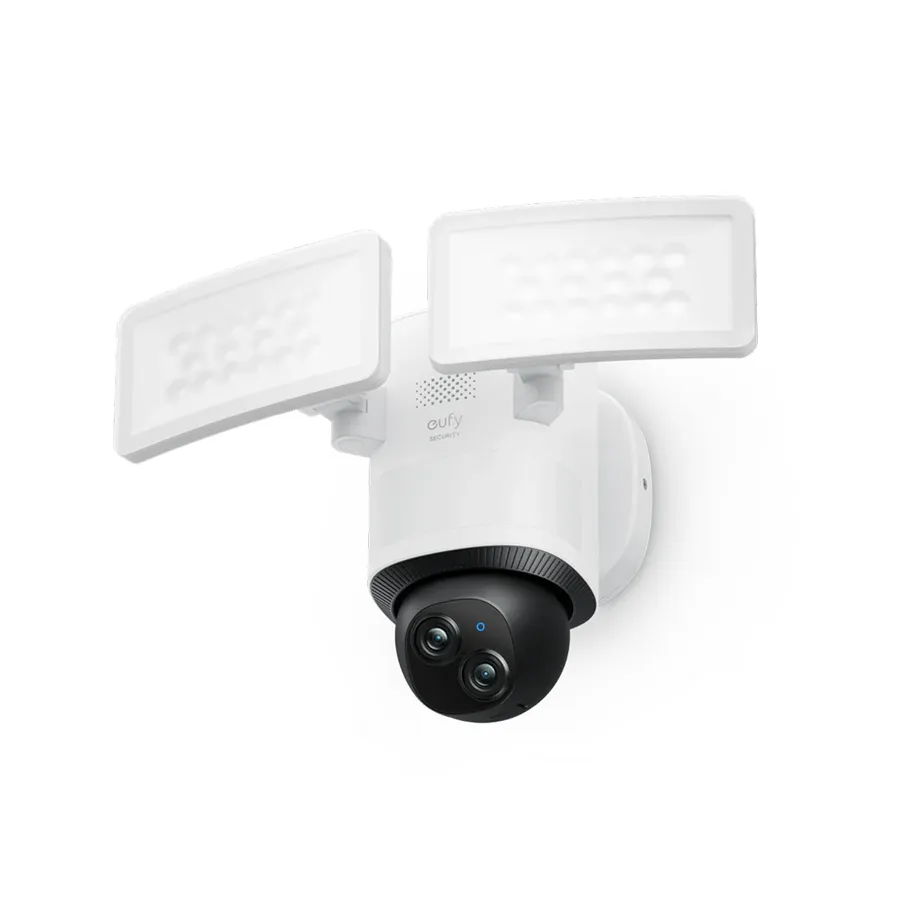
Manufacturer product photo (not an installed unit): two flat white LED panels above a rounded pan-tilt camera head with two lenses. A turning, two-lens head suits the side yard of a detached Brooklyn house; in a narrow rowhouse yard a fixed camera usually does the job.
Get the Brooklyn Floodlight Price in Writing
A photo and a short call are enough to start. We will tell you which package fits, which power route the wall allows and whether any part needs an electrician's permit, before we book the visit.
Network cable from the cellar to the back of the house.
Field Notes
Field Notes: Walk to the Back Fence First
On a Brooklyn floodlight visit I do not start at the wall where the owner wants the light. I start at the back fence, facing the house. From there I can see which windows overlook the yard — ours, the neighbors' on each side and the row behind — where the parlor-floor window sits, whether there is an extension or a deck in the way, and how high the light has to be to get past all of it. Then I look at the old porch light, if there is one, and how it is fixed to the brick.
The second thing I do is find out where the network is. If the router is at the front of the house and the cellar has a clear run to the back, a network-powered camera is often the cleaner job. If the yard is deep and the owner wants it properly lit, it is a licensed electrician's box and a real floodlight.
The last thing, after dark if I can, is to stand in the neighbor's line of sight and look back. If I can see the lamp itself, it is not aimed low enough yet. — Owner, NYS low-voltage license #12000287431
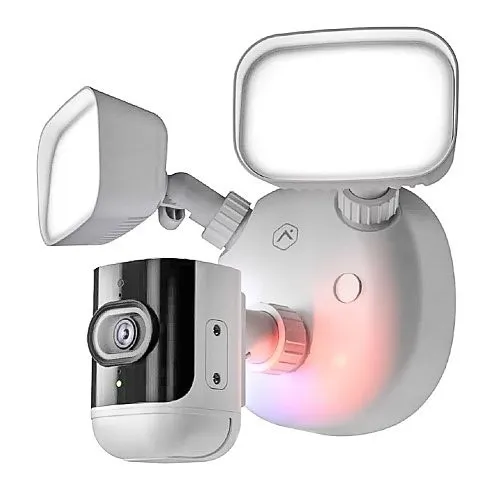
Manufacturer product photo (not an installed unit): a white floodlight camera with two lamp heads on arms, a black-fronted camera module and a red-and-blue glow at the joint. Coloured warning lights and sirens are useful on a lot; in a Brooklyn yard backing onto bedrooms we usually leave them off.
FAQ
Brooklyn Floodlight Camera Installation FAQ
How far ahead do we need to book a Brooklyn floodlight visit, and can it be on a weekend?
+
Usually within a few days, and yes, weekends are fine. We book two-hour arrival windows seven days a week up to 8 PM. A straight swap onto an existing box can often go in on the first visit if we know the camera model in advance. Where the job needs a new box and feed, the licensed electrician's permit sets the pace, so we survey first and come back for the install. Sending photos of the wall with the request is the fastest way to get a firm date.
Will a floodlight camera keep working during a Con Edison outage?
+
Not on its own. A floodlight camera wired to the house's power goes dark with everything else, light and camera both, and a Wi-Fi model also loses the router. If footage during an outage matters, the answer is a network-powered camera on a PoE switch, with the switch, the recorder and the modem on a battery backup indoors; that keeps the camera recording for as long as the battery lasts, though the built-in light draws more and shortens it. Battery-powered cameras keep running too, but they are not floodlights in the usual sense. We size any battery backup to the equipment and tell you roughly how long it should last.
Can the floodlight go on a wood fence or a post at the back of the yard instead of on the house?
+
Yes, and in a narrow Brooklyn yard it is sometimes the better spot. A light at the back fence looking toward the house lights the garden door and the people approaching it, and keeps the glare away from the windows behind you. The catch is power and data: the cable has to reach the post safely, usually in conduit along the fence or buried where the yard allows, or the camera has to be a model that suits a plug or a network cable. The post itself must be solid, because a light on a wobbly fence makes a shaky picture. A shared fence needs the neighbor's agreement before anything is fixed to it.
What happens to the old outdoor light we take down?
+
It stays with you unless you ask us to take it away. Many owners keep the old fixture, especially on older houses where it matches the period of the building, in case they sell or want to put it back. If the old light was the only fixture on a landmarked front, keep it, because an in-kind replacement is the simplest kind of work for the Commission to approve. Where the old box behind it is rusted or loose, we show you before anything new goes up, and the box is replaced as part of the job rather than hidden behind the new plate.
Do we need to be home for the whole visit?
+
Only at the start and the end. At the start we agree on the exact position of the light and the camera view with you, because that is the decision that matters most and the hardest to change later. In between we need access to the wall, the yard, the breaker or fuse box and wherever the network equipment lives. At the end we go through the app on your phone, show you the motion zones and the light settings, and, if it is dark enough, test the light from the far end of the yard together. If you cannot be there, a family member or a neighbor with a key can stand in for the middle part.
Can the downstairs and upstairs households in our two-family both see the yard camera?
+
Yes. Most floodlight camera apps and all the recorders we fit let the owner share access with other users, and some let you limit what each user sees or whether they can change settings. In a two-family that usually means the owner keeps full control, and the tenants get live view and alerts for the yard but not the front door camera or the settings. We set it up during the visit with each household's phone, and we show the owner how to remove a user when a tenant moves out, which is the step most people forget.
Can the floodlight switch on when our burglar alarm goes off?
+
Sometimes, and it depends on whether the light and the alarm speak the same language. When the floodlight camera and the alarm come from the same platform, the app can usually link them, so an alarm trigger turns the yard light on and starts the camera recording. Across different brands it normally needs a smart-home hub or an automation service that both support, and some combinations simply cannot be linked. A wired commercial flood can be switched by a relay output on many alarm panels, which is the sturdier route for a business. Tell us the alarm make and model when you ask for a quote and we will say which of these applies before you buy the light.
Our bedroom is right above the garden door — will the floodlight light up our own room?
+
It can if it is mounted just below your window and aimed level, so we avoid both. The light goes either above the window head or well to the side of it, with the lamp heads pointed down and away from the house, so the light falls on the yard and not back up the wall. Brightness can be turned down in the app, and motion-only operation with a short timer means the light is off most of the night. If the only possible spot is right under the window, a camera with a small built-in spotlight rather than a full floodlight is usually the better choice there.
Can the floodlight housing be painted to match our dark brick?
+
We do not recommend painting the camera or the lamp heads, because paint can block vents, sensors and lenses, and it can affect the maker's warranty. The better route on dark brick is to choose a model sold in black or bronze, which several makers offer. The mounting plate and any short run of conduit or cable cover can be painted to match the wall, and on a landmarked front the Commission's criteria expect exactly that for visible conduit. We bring finish options to the visit so you can hold them up against the wall.
We plan to sell the house next year — does the floodlight camera stay with it?
+
Usually, because a light fixed to the wall and wired in is generally treated as part of the house, but check with your broker and say so in the listing or contract if you want to take it. Before you hand over the keys, remove the camera from your account and reset it to factory settings, so the new owner can set it up on their own account and your old footage is not left on it. If the floodlight records to a recorder you are taking with you, tell the buyer the light will still work but will no longer record until they set it up. We can do the hand-over setup for the new owner as a service visit.
All Areas Served
Floodlight Cameras Across New York City, Long Island and the Hudson Valley
If the job is bigger than a light — cameras for the whole house, an intercom for the door, an alarm for the store — every service is listed on the Abstract Enterprises Security Systems site, and the company page covers our license and insurance.
Sources
Where the Brooklyn Facts Come From
The housing figures, rules, laws, product specifications and news items on this page trace back to the publications below. Entries marked “excerpt” were read only as a search snippet. Dollar figures for AESS work are the floodlight installation prices already published for Brooklyn, plus our standard hourly service rate.
A floodlight that stopped switching on, a camera that drops off every evening, a light the neighbors have asked you to fix — phone (347) 934-8335. We book the next open two-hour window, and most floodlights are lighting and recording again within one to two hours of arrival.
Brooklyn Floodlight Cameras From a Licensed, Insured Crew
Brooklyn line (347) 934-8335 · Abstract Enterprises Security Systems, 1282 Troy Ave, Brooklyn, NY 11203 · messages by WhatsApp (718) 679-0359
Working under NYS low-voltage license #12000287431, insured on every Brooklyn job, with written estimates the same day · 4.7★ average across 390+ Google reviews
Floodlight cameras, lights and recorders carry their manufacturer's warranty. Full terms — including 50% deposit, the 30-day warranty and optional paid extended warranty, and the late-fee schedule — are set out in the service agreement. See our warranty page.
Page reviewed and updated October 18, 2026. Changelog: Brooklyn floodlight camera page rebuilt from new research on rowhouse rear walls and yard distances, light trespass and neighbor complaints, Landmarks Preservation Commission door-light and camera criteria, NYC Department of Buildings electrical permits, network-powered spotlight cameras, southern Brooklyn driveways and industrial loading walls, on the Brooklyn prices already published.