Home › Floodlight Camera Installation, Hudson Valley
Six Counties · Suburban Lots to Mountain Roads · Four Utilities · NYS Licensed Low-Voltage
Floodlight Cameras Installed Across the Hudson Valley
Westchester · Rockland · Orange · Putnam · Dutchess · Ulster · Shielded Light · Power at a Distance
Drive north from the Bronx line and a floodlight camera changes its job every half hour. On a Yonkers or Nanuet lot it is a neighbour-sensitive light thirty feet from the next house, wired by a county-licensed electrician. Past Newburgh, Fishkill and Kingston it becomes a light at the end of a long drive, fed by a cable or a panel of its own, watching for people while bears and deer walk through the same frame — and, in a growing number of villages, held to dark-sky shielding rules. This page sets out how the work differs across the six counties, which rules and utilities apply where, and what the job costs in each, with a full page for every county below.
Reviewed and updated October 18, 2026 by Abstract Enterprises Security Systems (NYS license #12000287431) · Hudson Valley visits are booked through our Bronx office at 460 E Fordham Rd
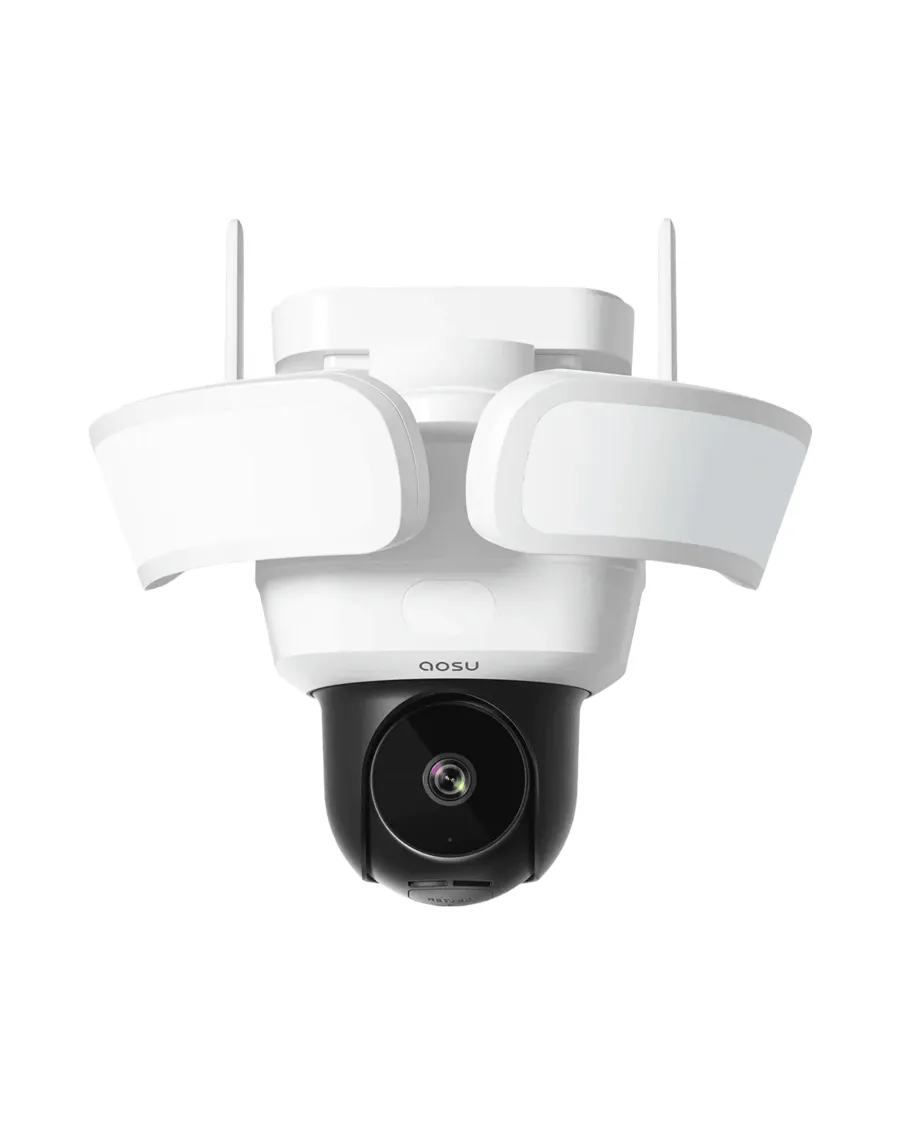
Manufacturer product photo (not an installed unit): a white floodlight with two angled panels over a black-faced pan-tilt dome, and two antennas on top. External antennas like these are what a light at the far end of a Hudson Valley yard often needs, because the router is a long way back inside the house.
Hudson Valley Floodlight Quote
Name the county and town, and how far the light is from the house — a written price follows the same business day
✅
Request Sent!
An installer will call back about your Hudson Valley floodlight the same business day.
25+
Years Experience
✓
Same-Day Estimates
100%
Licensed & Insured
4.7★
390+ Google Reviews
Three facts price a Hudson Valley floodlight before anyone visits: the county, the distance in feet between the light and the nearest live box or network switch, and whether the town has an outdoor lighting rule. Call (800) 486-0943 with those three and a phone photo of the spot taken from where a visitor would arrive, and we can usually tell you during the call which power route fits and which county figure applies.
Installation from $375 (Westchester) to $459 (Dutchess and Ulster) where a sound outdoor box is already in place, on our published county multipliers
Shielded, downward-aimed light set up to the stricter village rules even where your town has none
Visits any day of the week until 8 PM, booked in two-hour slots; all camera and network work carried out under NYS low-voltage license #12000287431
Why Hudson Valley Properties Need Floodlight Camera Installation
The Hudson Valley is one region on a map and six different floodlight markets on the ground. In southern Westchester and most of Rockland the typical property is a post-war or older suburban house on a lot measured in feet, not acres, with a detached garage at the back, a driveway down one side and a neighbour's bedroom window within easy reach of a badly aimed lamp. Go north into Orange, Putnam, Dutchess and Ulster and the same request — “light the driveway and record whoever comes up it” — can mean a run of several hundred feet to a gate, a barn with its own small panel, a shed with no power at all, and a wooded road where the only other light for a mile is the moon. A floodlight that works perfectly on a quarter-acre in New Rochelle can be useless at the end of a Gardiner driveway, and the reverse is just as true: a light sized for a dark rural road will glare straight into the house next door in Pearl River.
The rules change county by county too, and they change in ways that matter for a light fixture specifically. Westchester County requires every electrician who works in the county to hold a county trade licence, and invites homeowners to check the card or search the county's list before hiring. Rockland licenses electrical contractors under Chapter 250 of its code; Orange County says anyone who wants to work as an electrician there must hold a county-issued licence, a rule from 2007 revised in 2024; Putnam licenses low-voltage technicians and names video surveillance cabling in their scope; and Ulster has its own electrical licensing law. Dutchess, as far as we could find in its published code and consumer pages, leaves licensing to the state and to each town. Then, below the county, many towns send the inspection of new outdoor wiring to a private third-party agency rather than a town inspector; the Town of Fishkill, for example, says that all electrical work must be inspected by an approved independent agency and that connecting it without that inspection is a violation subject to fines.
Light itself is regulated more here than most people expect. The Village of New Paltz publishes outdoor lighting standards that call for fully shielded fixtures and say floodlighting is discouraged and, where used, must be shielded so it does not create glare or cross the property line. The Village of Cold Spring requires full-cutoff fixtures for every use including single-family houses, wants motion-sensing lights adjusted to switch off when motion stops, and keeps fixtures on a building below the eave. The Town of Chester in Orange County sets a mounting-height formula for brighter floodlights based on the distance to the property line. Not every attempt survives: in 2023 the Town of Ulster dropped a proposed lighting law after its supervisor said it could let half the town file complaints against the other half. At state level, the Dark Skies Protection Act (Assembly bill A4615 in the 2025–2026 session) would require outdoor fixtures to be shielded from 2028, with an allowance for motion-activated lights on a short timer. It is a bill, not a law, but it points the same way the villages already have.
And then there is what walks past the camera. The state Department of Environmental Conservation describes a Southern Black Bear Range that runs through the Catskills to southern Orange and Rockland at the New Jersey line, with the Taconic Highlands range reaching south into Putnam. Teatown, the nature preserve in northern Westchester, counted reported bear sightings in the county rising from two in 2019 to sixteen in 2021. Add deer, foxes, wind in the trees and four different electric utilities with four different outage patterns — Con Edison, Orange & Rockland, Central Hudson and NYSEG — and a Hudson Valley floodlight has to be planned around its power supply, its neighbours and its wildlife, not just bolted to the nearest wall. A Hudson Valley doorbell camera often goes in on the same visit.
Hudson Valley facts that shape a floodlight install
Westchester: electricians need a county licence. “Plumbers and Electricians must obtain a trade license from Westchester County in order to work in the county,” says the county's Department of Consumer Protection, which lets consumers search licence holders online.
Four electric utilities split the region. Orange & Rockland serves Orange, Rockland and Sullivan counties in New York (about 300,000 electric customers including northern New Jersey); Central Hudson serves about 315,000 electric customers from the northern suburbs of New York City to the Capital District; Con Edison serves most of Westchester; NYSEG serves much of Putnam and northern Westchester towns such as Bedford, Lewisboro, North Salem, Pound Ridge and Somers.
Village lighting codes already ask for shielding. New Paltz (fully shielded fixtures, no more than 0.25 footcandles of light trespass at the property line), Cold Spring (full cutoff for single-family houses too) and the Town of Chester (mounting height tied to distance from the line for floodlights over 900 lumens).
A statewide shielding bill is pending. A4615 would require shielded outdoor fixtures after January 1, 2028, but would allow non-shielded lights that are switched off from 11 p.m. to sunrise or are motion-activated for less than fifteen minutes with automatic shutoff.
Bears are part of the night picture. DEC's range maps put breeding bears in the Catskills, southern Orange and Rockland and the Taconic Highlands into Putnam; DEC names bird seed and feeders as the most common attractant that brings bears close to homes.
Storm outages are measured in tens of thousands. On the morning after Tropical Storm Isaias in August 2020, NYSEG had 34,150 of its 38,693 Putnam County customers without power, Daily Voice reported; a June 2024 line of thunderstorms knocked out a combined 60,000 Orange & Rockland and Central Hudson customers, according to the Times Union.
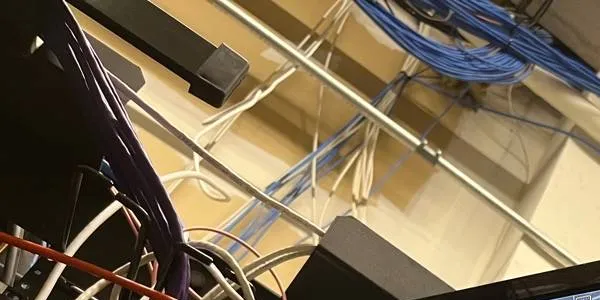
From an AESS job outside the region, shown only as an example and cropped to the ceiling: bundles of blue and white network cable run over a black equipment rack, with a purple bundle and a red cable dropping to the left. Every network-powered floodlight at the far end of a Hudson Valley yard ends up as one more cable in a bundle like this, back at a switch indoors.
Floodlight Dark Since the Last Valley Storm?
Most Hudson Valley floodlight repair calls follow weather. The grid comes back and the porch lights work, but the garage floodlight stays black; the app on your phone in the city reports the camera unreachable; a housing that took a soaking in the last nor'easter now fogs up or trips its breaker. Phone (800) 486-0943 and we will book the next two-hour window in your county. Most of these lights are working again within one to two hours of our arrival, even where the permanent cure — a battery backup, a sealed cable entry, a better link — follows on a second visit. When several cameras are out at once, our Hudson Valley camera repair team takes the whole system.
Four checks after an outage, before you call
Reset the router first. After a long outage many floodlight cameras power up before the router does and give up trying to join the network. Restart the router, wait five minutes, then power-cycle the light at its breaker.
Look for a tripped GFCI or breaker. Outdoor circuits feeding garages and barns are often GFCI-protected, and a power surge as the grid comes back can trip them. Note which one and whether it holds when reset.
Ask what the generator powered. A standby unit that carried the house through the outage may have skipped the garage or outdoor circuit entirely; the transfer panel label usually says.
Read the light's schedule in the app. A camera that lost its clock during the outage can come back on the wrong time zone, so a dusk-to-dawn light runs in daylight and sits dark at night.
What We Install
Floodlight Camera Installation Services in the Hudson Valley
Nine kinds of work cover nearly every floodlight call we take between the city line and the Catskills. Southern jobs lean toward the first three; northern jobs toward the last four.
💡
Swap an Existing Outdoor Light
A garage, side-door or back-deck fixture replaced by a floodlight camera on the same box, with the box checked for fixing and weather sealing first. The quickest job in every county.
🏠
Detached Garage Lights
The garage at the end of a suburban driveway, fed from its own sub-panel where one exists or from a network switch in the house, aimed down the drive rather than at the neighbours.
🏘
Village-Compliant Fixtures
Fully shielded or full-cutoff light-and-camera fixtures for New Paltz, Cold Spring, Irvington and other places with lighting codes, mounted below the eave and aimed at your own ground.
🌐
Network-Powered Lights at a Distance
PoE spotlight and floodlight cameras on a single outdoor-rated cable from the house, within Ethernet's 100-metre limit, so a gate or barn door gets light and video without a new 120-volt circuit.
🌾
Barns, Sheds and Outbuildings
Lights on outbuildings that have power but no network, linked back to the house by buried cable, fibre or a point-to-point wireless bridge.
☀️
Solar and Battery Floodlights
For a mailbox, gate or trailhead with no power anywhere near: solar or battery floodlight cameras, chosen and placed for the winter sun the spot really gets.
🐻
Wildlife-Aware Motion Setup
Person detection, motion zones and light triggers set so a bear at the trash or a deer on the lawn records quietly without the light flashing all night.
🔋
Outage-Proofing
Battery backup for the switch, recorder and router; settings that bring the camera back on its own after the power returns; checks on which circuits the generator actually covers.
🔧
Re-Aim, Re-Shield and Repair
Lights that glare at the road or the neighbours, cameras that drop off every storm, older unshielded floods replaced with fixtures that meet the stricter village standards.
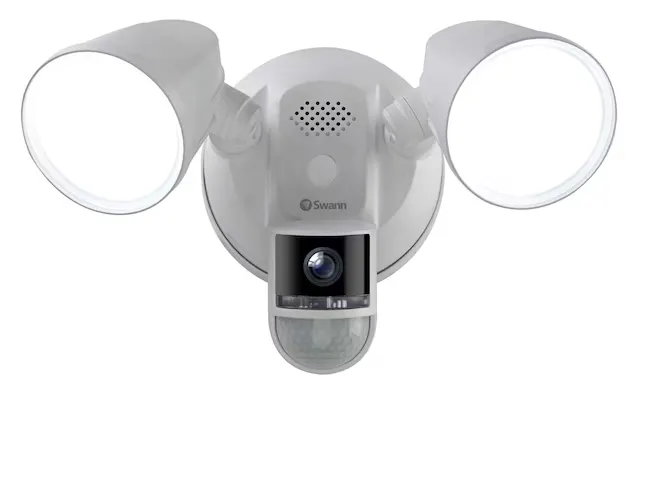
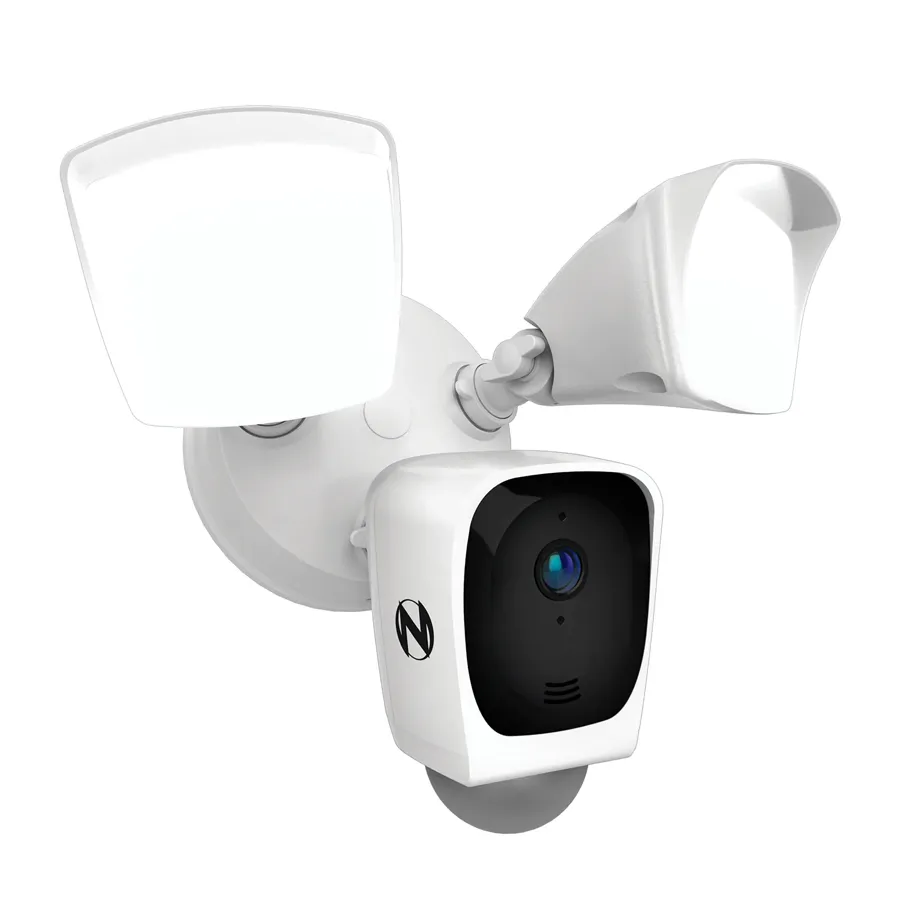
Maker's catalogue image, not a unit we installed: a Swann-badged white floodlight with a pair of round lamps on short arms, a speaker grille, a camera window and a dome motion sensor underneath. Because each lamp tilts on its own, a garage light in a Rockland or Westchester driveway can face the concrete instead of the fence.
Six Counties
How the Floodlight Job Changes From County to County
Each county has its own page with the local detail. This is the overview: what kind of property we usually light there, who supplies the power, which county licence can touch the electrical side, what we found on lighting rules, and the price factor from our published multipliers.
The densest market: city and village lots in Yonkers, Mount Vernon and New Rochelle, larger wooded lots in the northern towns. Con Edison in most of the county, NYSEG in several northern towns. Every electrician needs a county trade licence. Irvington applies dark-sky standards through site plan review. Price factor 1.25.
Tight suburban lots along the Route 59 corridor, older village houses in Nyack and Haverstraw, wooded edges toward Harriman. Orange & Rockland power. Electrical contractors are county-licensed under Chapter 250. Bears enter from New Jersey along the I-87 forest corridor. Price factor 1.30.
From Newburgh's historic streets to farms, warehouses and long rural driveways further west. Orange & Rockland in most of the county, Central Hudson around Montgomery, Maybrook, Cornwall and Highland Falls. Electricians need an Orange County licence (Local Law No. 8 of 2007, revised by Local Law No. 1 of 2024), and the City of Middletown runs its own electrical licensing board; the Town of Chester has a detailed outdoor lighting chapter. Price factor 1.40.
Lake houses, wooded lots and second homes, many on long private drives. NYSEG across most of the county, Central Hudson in Cold Spring and Nelsonville. The county licenses low-voltage technicians and names video surveillance cabling; Cold Spring requires full-cutoff fixtures. Price factor 1.45.
Poughkeepsie and Beacon neighbourhoods, Route 9 commercial strips, estates and farms toward the Harlem Valley. Central Hudson in most of the county. No county-level contractor licence found; towns such as Fishkill send electrical inspection to approved private agencies. Price factor 1.53.
Kingston's historic districts, New Paltz village and campus streets, and mountain and second-home properties toward the Catskills. Central Hudson power. Electrical work is licensed under Ulster's Chapter 185; New Paltz village has fully shielded lighting standards. Price factor 1.53.
County
Usual floodlight setting
Electric utility
County licence that can reach the wiring
Lighting rule we found
Factor
Westchester
Suburban and city lots, wooded northern estates
Con Edison; NYSEG in northern towns
County trade licence for electricians
Irvington site-plan dark-sky standard
1.25
Rockland
Tight suburban lots, village houses
Orange & Rockland
Electrical contractor licence (Ch. 250)
None found at county level
1.30
Orange
City streets, farms, rural drives, warehouses
Orange & Rockland; Central Hudson in parts
County electrician licence (L.L. 8-2007, revised L.L. 1-2024)
Town of Chester, Chapter 69
1.40
Putnam
Lake houses, wooded lots, second homes
NYSEG; Central Hudson in Cold Spring and Nelsonville
Low-voltage technician licence names video surveillance
Historic city blocks, campus streets, mountain homes
Central Hudson
Electrical licence (Ch. 185)
Village of New Paltz standards
1.53
How to read the table. “None found” means we searched the county's published code and consumer pages and found no county licence or county-wide lighting rule; it does not mean no rule exists in your town or village, and many lighting rules sit inside town zoning codes or site plan standards rather than in a stand-alone law. Over all six counties sits New York State: AESS installs under NYS low-voltage license #12000287431, which covers the camera, network and recording side, while new 120-volt wiring is electrical work for an electrician licensed wherever the county or town requires it.
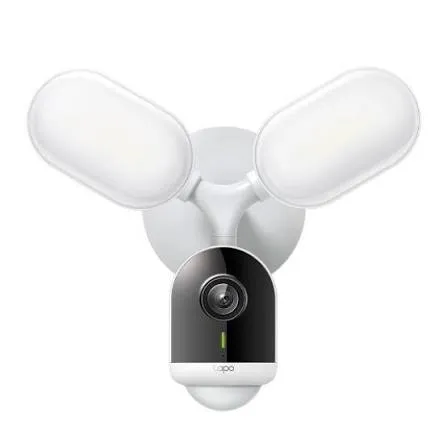
Manufacturer product photo (not an installed unit): two wide oval light panels spread above a rounded camera with a black face. Wide panels like these suit an open rural driveway; on a tight Rockland or southern Westchester lot the same spread is what lands in the neighbour's yard, which is why we choose the fixture after the county and the lot, not before.
Building Specialists
Floodlight Cameras for the Hudson Valley's Architecture
Six kinds of property make up most Hudson Valley floodlight work. What the wall is made of matters less here than in the city; what matters is how far the light is from power and network, and how far it is from the next window.
River-City Houses and Rowhouses
Yonkers, Newburgh, Beacon, Poughkeepsie, Kingston. Brick and frame houses close together, alleys and small yards, and in Newburgh's East End and Kingston's historic districts, exterior work that the street can see reviewed by local commissions.
Post-War Suburban Lots
Rockland's Route 59 towns, southern and central Westchester, the suburbs around Middletown and Fishkill. A driveway down the side, a detached or attached garage, neighbours thirty to sixty feet away.
Wooded Lots and Estates
Northern Westchester, Putnam, eastern Dutchess. Long drives under trees, stone walls, gates, and houses set far back from the road where the router reaches the porch but not the garage.
Farms and Barns
Orange and Dutchess farmland, horse properties, barns with their own small panels and no network. Lights here guard equipment and animals, not just doors.
Lake, River and Mountain Homes
Lakefront houses in Putnam, river properties along both banks, and mountain and second homes toward the Catskills, often empty for days and checked from a phone in the city.
Village Houses Under Lighting Codes
New Paltz, Cold Spring, Irvington and other villages where the code expects shielded, downward light, and where a big twin-head floodlight on the front of the house invites a complaint.
River-city houses: close neighbours, visible fronts
The older housing of the river cities behaves more like the Bronx than like the countryside around it. Houses sit close, yards are small and the back of one house faces the back of another. Newburgh's East End Historic District, which the city describes as the second largest designated historic site in New York State, and Kingston's five local historic districts both review exterior work that the street can see; in Kingston the Historic Landmarks Preservation Commission looks at it before a building permit is issued. So on these streets we keep the visible front modest — a compact light with a camera, or an existing lantern left in place and a small camera tucked beside it — and put the real floodlight at the back, aimed down into the owner's own yard.
Suburban lots: the garage is the centre of the plan
On a typical Rockland or central Westchester lot, the floodlight that matters most is the one on the garage, lighting the driveway, the side door and the gap between garage and house. The garage often has power already, either from the house panel or its own sub-panel, so the question is less about power than about aim: the driveway usually runs along the property line, and a light pointed straight down it lights the neighbour's side windows too. We mount high enough to look down the drive, turn the heads inward and set the motion zone to stop at your side of the line. Where the garage is connected to the house network by nothing at all, a single PoE cable from the house is usually more reliable than stretching Wi-Fi across the yard.
Wooded lots and long drives: distance, not walls
North of the Tappan Zee and the Bear Mountain Bridge, the properties that call us most often are the ones where the light needs to be a long way from the house: at a gate, a turn in the drive, a parking area or a detached garage several hundred feet back. Network cable can carry power and video only so far — Ethernet's standard channel is 100 metres, about 328 feet — so beyond that we look at the outbuilding's own power with a wireless or fibre link back to the house, or at a solar or battery camera where nothing else reaches. Trees shape the plan as much as distance: leaves block Wi-Fi in summer, branches trigger motion in wind, and a lamp aimed down a wooded drive lights a tunnel the camera can see but a neighbour on the hill above can also see.
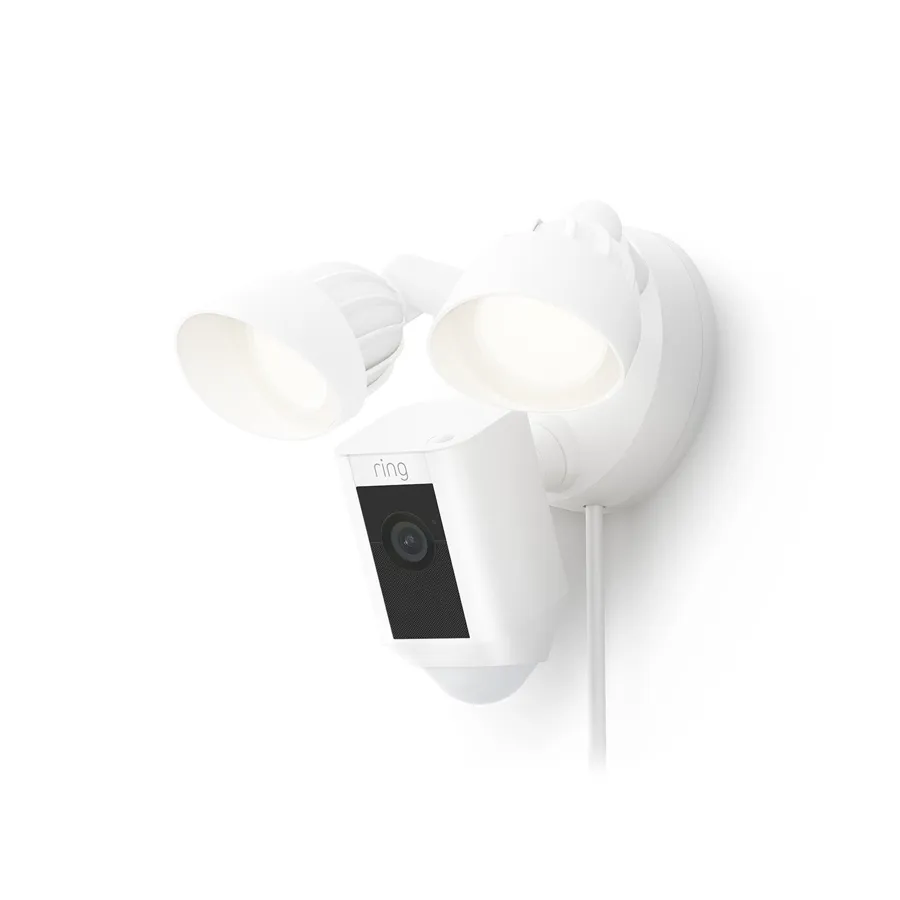
Manufacturer product photo (not an installed unit): a white Ring floodlight camera with two round lamp heads, a rectangular camera and a power cord hanging from its base. A plug-in model like this is a fair answer inside or beside a detached garage that already has an outdoor-rated outlet, as long as the cord is fixed tight and kept out of reach.
Commercial Floodlight Cameras
Business Floodlight Camera Installation in the Hudson Valley
Hudson Valley businesses light their lots for a different reason than city shops light their back doors. The lot is big, the road outside is dark, and after closing there may be nobody within sight of the building at all. These are the kinds of commercial property where most of our floodlight calls in the region come from.
Route 59 retail and offices, Rockland
Strip centres, offices and car lots along the corridor through Nanuet, Spring Valley and West Nyack, where rear service lanes sit right behind houses and the light has to stop at the buffer.
Newburgh, Route 300 and the I-84 interchange
Warehouses, contractors' yards and distribution buildings near the interstate, where a yard light runs dusk to dawn and the cameras need to read a truck at the gate.
Route 9 through Fishkill, Wappingers and Poughkeepsie
Plazas, service businesses and small industrial buildings along the main north–south road on the east bank, inspected by each town's chosen electrical agency.
Kingston and Route 9W, Ulster
Small shops, garages and workshops in and around Kingston, some inside historic districts where anything the street can see goes to the city's landmarks commission.
Westchester office parks and city cores
White Plains, Yonkers and the office campuses along the main parkways and I-287, where landlords set the lighting standard and tenants add cameras to it.
Farms, stables and farm stands
Orange and Dutchess agricultural properties with barns, equipment yards and roadside stands that sit unattended at night and draw both people and wildlife.
Commercial floodlights in the region differ from home ones in three practical ways. They are usually separate devices: a commercial LED flood fixture on the building's own circuit, mounted high, and a wired camera beside it rather than a consumer combination unit. They often stay on all night, which is exactly what the stricter village codes and the pending state bill target, so we choose shielded fixtures from the start. And they record to a recorder locked inside, so footage survives a storm, a stolen camera or a dead router. For a larger site, floodlights belong inside a Hudson Valley commercial camera system rather than added one at a time.
Rules and credits that apply to Hudson Valley floodlight work
The licence for the wiring depends on the county. Westchester requires a county trade licence for electricians; Rockland licenses electrical contractors under Chapter 250, which covers wiring for light, heat, power or signalling at 50 volts or more; Ulster's Chapter 185 electrical licensing law counts signalling, communication, alarm and data transmission as electrical work. Orange County requires a county-issued electrician licence under Local Law No. 8 of 2007, revised by Local Law No. 1 of 2024, and the City of Middletown has its own Electrical Licensing Board; in Dutchess we found no county contractor licence.
Putnam names video surveillance in its low-voltage licence. Chapter 145 of the Putnam County code defines a low-voltage/limited-data communications technician as someone who installs cabling for networking, intercom, audio/video, fibre and video surveillance systems at 90 volts or less, starting from an outlet installed by a licensed electrician.
Inspection is often private. Many towns assign electrical inspection to approved third-party agencies; Fishkill lists more than a dozen and says connecting new work without inspection is a violation. The City of Newburgh lets the owner-occupant of a one- or two-family house apply for their own electrical permit, provided the work passes an approved agency's inspection.
Lighting codes reach commercial sites first. Irvington's 2020 local law made dark-sky compliant, full-cutoff lighting a standard for site plan approval, with no more than 0.1 footcandle at a line next to a residential parcel; Chester caps light at 0.5 footcandle at a residential property line.
Keep the camera off the next yard. Under New York Civil Rights Law § 52-a, the owner or tenant of a home can bring a damages claim against anyone who fixes a video device on adjoining property to film their backyard without written consent. The Town of Ulster's 2023 lighting debate began with exactly that kind of complaint about a motion-activated camera.
A state credit can offset some of a small shop's outlay. Retail and similar businesses with 50 or fewer employees can claim up to $3,000 per location under the New York Commercial Security Tax Credit, which counts surveillance cameras; the yearly deadline is October 31, and an accountant should confirm eligibility.
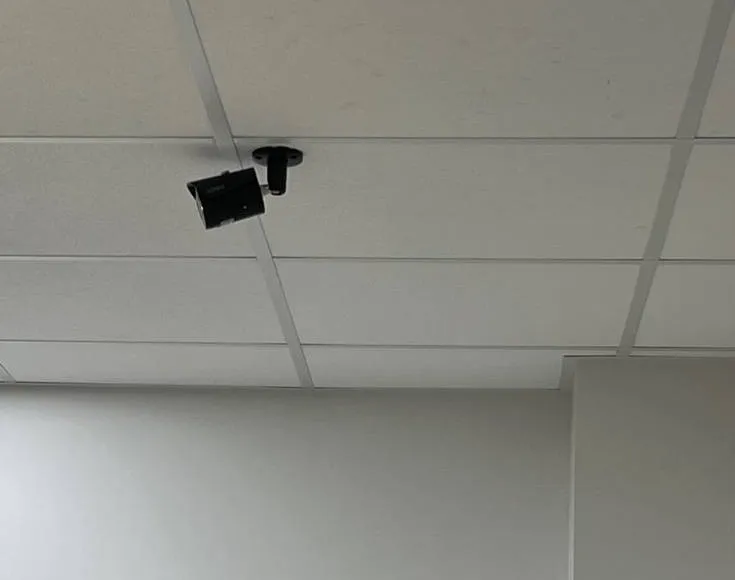
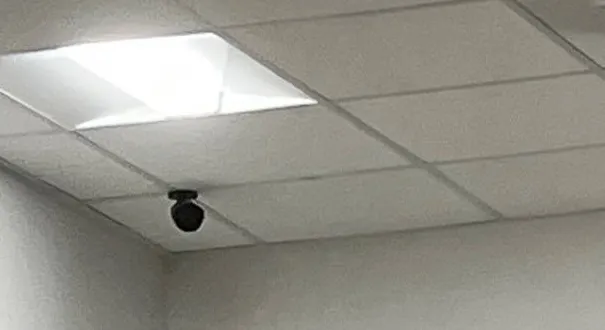
Taken on an AESS commercial job elsewhere (not in the Hudson Valley) and cropped to the ceiling grid: a black bullet camera on a short bracket under a drop-ceiling grid, angled down into the room. On a commercial site the cameras that matter most are often inside or under cover like this, with the floodlight outside doing the lighting and the recorder indoors keeping the footage.
Your Questions Answered
Floodlight Camera Installation in the Hudson Valley: Questions Answered
These are the questions Hudson Valley owners put to us when the property, the rules or the power supply do not match what the box assumed. They are grouped by the problem underneath: choosing between county pages, getting power to a far-off spot, shielding rules and neighbours, wildlife, storms and outages, who may do which wiring, and getting a signal out to the edge of the property.
Choosing Between the Six County Pages
Our house sits right on the Westchester–Putnam line — which county's rules and price apply to the floodlight?
The county your property is assessed in, which is the one on your tax bill, not the one on your mailing address. Hudson Valley postal towns cross county lines often, and a Mahopac or Brewster mailing address can sit in a neighbouring town for tax purposes. The county decides which electrical licence applies to any new wiring and which price factor we use; the town or village decides the building permit, the inspection agency and any lighting rule. So for a property near the line, send us the tax-bill municipality along with the address. The utility is a third, separate question: NYSEG and Con Edison territories both run through northern Westchester, and the supplier can change from one side of a road to the other.
Why does the same floodlight cost more to install in Kingston than in White Plains?
Because our county prices are set by a published multiplier rather than quoted case by case, and the multiplier rises with travel time and with the kind of work each county usually needs. Westchester carries a factor of 1.25 on our Brooklyn base, Rockland 1.30, Orange 1.40, Putnam 1.45, and Dutchess and Ulster 1.53. So a straight swap onto an existing box starts at $375 in Westchester and $459 in Ulster. The difference is not only the drive. Northern jobs more often involve a long cable run, an outbuilding, a solar unit or a battery backup, and those are built into the higher factor rather than added as surprises. The multiplier also means a quote for a Kingston house and a White Plains house can be compared line by line, because the work items are the same.
We own a house in Rockland and a cabin in Ulster — can both floodlights live in one app and be installed by one crew?
Yes, and it is worth deciding before either is bought. If both properties use the same brand of floodlight camera, or both record to recorders from the same maker, one app shows both places and one set of alerts can be tuned per property. We install both under the same plan, priced at each county's own factor, and usually on separate visits because the travel between them is long. The two sites will not need the same hardware, though: the Rockland light is likely a hardwired unit on the garage, aimed tight to stay off the neighbour's yard, while the cabin may need a network-powered light at the end of a drive, a battery backup and settings that cope with days of nobody home. Same app, different equipment.
Power When the Light Is Far From the Panel
Is a solar floodlight camera bright enough to be worth it on a shaded Hudson Valley slope in December?
Sometimes, and the spot decides it, not the brand. A solar floodlight camera depends on how many hours of direct winter sun its panel sees, and in December the sun is low, the days are short and a slope facing north or a stand of evergreens can leave the panel in shade nearly all day. In that case the battery drains, the camera drops to fewer clips and the light is the first thing the camera rations. Before recommending one we look at the panel position in winter terms: what will shade it when the sun is low in the south, and whether the panel can sit apart from the camera on a longer lead where the sun is. Where the answer is poor, a battery camera swapped and charged on a schedule, or a network cable, is more honest advice than a solar unit that works in June and fails in January.
How far from the house can a network-powered floodlight go before the cable stops working?
About 100 metres, or 328 feet, of cable from the switch to the camera, which is the standard limit for an Ethernet run carrying power and data together. That covers most suburban garages and many gates, but not the far end of a long rural drive. Beyond that distance there are three good options. One is a PoE extender part-way along, which needs a weatherproof box and sometimes its own power. Another is to bring the network to an outbuilding that already has power — by fibre, which has no practical distance problem on a property, or by a point-to-point wireless bridge — and power the camera from a small switch there. The third, where nothing else reaches, is a solar or battery camera. Whatever the route, the outdoor cable must be rated for burial or sunlight as the run requires; ordinary indoor cable breaks down outside.
Can the floodlight run off the lantern post at the end of our front walk?
Often, if the post is wired the way it looks. Many Hudson Valley houses have a lantern post at the walk or the drive with an underground feed from the house, and swapping the lantern for a post-mounted floodlight camera reuses that power. Three things decide it. The feed is usually on a switch or a photocell, so the camera dies whenever the lantern would have turned off; that has to be changed to a permanent supply, which is electrical work. The post has to be stiff enough to hold a camera still in wind. And the camera needs a network: a post forty feet from the house is usually within Wi-Fi range, a post at the road often is not. Where the old buried feed is old enough to worry about, an electrician tests it before anything is connected.
Shielding Rules, Glare and the Neighbours
Our village asks for fully shielded fixtures — do any floodlight cameras actually qualify?
Some do, but most twin-head floodlight cameras as sold do not, because their lamp heads can be aimed above the horizontal. New Paltz village defines a fully shielded fixture as one that lets no light shine above a horizontal plane through the lowest part of the fixture; Cold Spring asks for full-cutoff fixtures with the light source fully shielded and directed downward, including at single-family houses. A floodlight camera can meet the intent if its heads are fixed pointing down and the fixture is mounted so no lamp face is visible from next door, but whether it meets the letter depends on how the village reads its own code. The cleaner answer in these villages is often two devices: a shielded, full-cutoff light fixture that plainly complies, and a separate camera beside or below it. We bring the cut sheets so the building department can see what is proposed before it goes up.
If Albany passes the Dark Skies Protection Act, will the floodlight we install this year have to come down in 2028?
Not necessarily, and not on the bill as written. Assembly bill A4615 in the 2025–2026 session would require outdoor lighting fixtures to be shielded after January 1, 2028, but it would allow fixtures that do not comply if they are switched off from 11 p.m. to sunrise, or if they are motion-activated lights with a duration of less than fifteen minutes and an automatic shutoff. Most floodlight cameras already run that way: dark until motion, then on for a set number of seconds or minutes. The bill would also not apply in a municipality that has its own equal or stricter lighting law. It is a proposal, not law, and the final text may differ, so we install now in a way that would comply either way: heads aimed down, motion-only with a short timer, and no all-night operation at a home.
The Town of Chester ties floodlight height to the property line — how does that work out on an ordinary lot?
Chester's outdoor lighting chapter says that a flood or spot fixture rated at more than 900 lumens may be mounted no higher than three feet plus one third of the distance in feet to the nearest property boundary, and never above 25 feet; it must also emit no direct light above the horizontal. On a lot where the garage wall is thirty feet from the side line, that works out at thirteen feet, which is about where a garage floodlight goes anyway. Twelve feet from the line, it is seven feet, low enough to change the plan. Floods of 900 lumens or less are not limited by that formula, but must still be redirected if they shine at neighbouring houses or glare at drivers. In practice we size the light to the space first, often below 900 lumens for a driveway, which keeps both the formula and the neighbours out of it.
Our light sits on a rise above a curving road — what keeps it from glaring at drivers on the bend below?
Aim, cut-off and a light that only comes on when it should. A floodlight on high ground facing a road shines straight into the windscreens of drivers coming up the hill, and on a dark rural bend that is a safety problem, not only an annoyance; Chester's code, for one, says a flood that glares at drivers on public ways must be redirected or dimmed. We point the heads down at the drive and the parking area rather than out at the view, use a fixture with a sharp cut-off on the road side, and draw the motion zone so that traffic on the road itself does not switch the light on. If the camera needs to see the road for licence plates, it can do that with its own night vision while the light stays off.
Bears, Deer and Everything Else That Walks Past
Bears have started visiting our trash in Westchester — will a floodlight help, or should the money go elsewhere first?
Fix the trash first; the floodlight comes second. Teatown, the Westchester nature preserve, calls securing garbage “the single most important step” and suggests taking bird feeders down from April through November, while DEC names bird seed and feeders as the most common attractant behind conflicts between people and bears. A floodlight does not keep a hungry bear away from food it has already found, though a sudden light may move it on for the night. What a floodlight camera does well is show you what came, when, and from which direction, which tells you where the attractant is and whether the bins, the shed or the deck is the problem. We set the camera to record animals but keep the light for people, so a bear at the bin is filmed rather than spotlit every night.
Is it better to let the light come on for animals so the camera always gets a colour picture, or keep it dark and rely on infrared?
For most rural Hudson Valley properties, keep it dark for animals. A light that switches on for every deer, fox and raccoon spends the night flashing, which the neighbours across the valley notice, which the dark-sky villages discourage, and which teaches the wildlife that the light means nothing. The camera's infrared or low-light mode will still record the animal in black and white or muted colour. Where the camera can tell a person from an animal, we tie the light to people only, so a person approaching the house gets full colour and a sudden light. Where it cannot, we narrow the light's trigger zone to the door, the deck and the drive near the house and let the camera watch the wider ground on its own.
Storms, Outages and Four Different Utilities
After a long Central Hudson or NYSEG outage, why do some floodlight cameras come back on their own while others sit dark?
Usually because of what happened to the network, not to the light. When power returns, the floodlight boots in seconds, but the router and modem may take several minutes, and some cameras give up looking for the network and wait until someone power-cycles them. Others come back but lose their time setting and follow the wrong schedule. Network-powered cameras are at the mercy of the switch: if the switch is on a circuit that tripped, every camera on it stays down. We test this on every rural install by switching the house off at the main breaker and watching what recovers. The fixes are settings that make the camera retry, a battery backup that keeps the router and switch alive through short outages, and a switch on a circuit the generator covers.
Is a whole-house standby generator enough to keep the yard light and camera running through a storm?
Only if the circuits behind them are on the generator panel, and only after the generator has started. Many Hudson Valley houses with standby generators have them wired to a selected set of circuits — heat, well pump, fridge, a few lights — and the garage or the outdoor lighting circuit was left off. There is also a gap of several seconds to a minute between the grid failing and the generator taking the load, which is long enough for routers and some cameras to reboot. So we check which panel each floodlight, switch and router is fed from, and put a small battery backup on the network equipment to ride through the transfer.
Who Does Which Wiring, County by County
Westchester requires electricians to hold a county trade licence — does that cover the person who connects our floodlight?
It covers whoever does the electrical part. Westchester's Department of Consumer Protection says plumbers and electricians must obtain a trade licence from the county to work there, and it tells consumers to ask for the licence card or search the county's online list. Taking down an outdoor light and connecting a floodlight camera to its 120-volt wires is electrical work, and so is adding a new box or circuit, so in Westchester that is done by a county-licensed electrician. Mounting the camera, running network cable, setting up a PoE switch, the recorder and the app is low-voltage work, which is what our New York State licence covers. Our written quote separates the two, names who does each, and lists any town permit or inspection the electrical part needs.
Five of the six counties license electricians themselves — which part of a floodlight job does that reach, and what is different in Putnam and Dutchess?
The line-voltage side, almost everywhere. Westchester issues its own trade licence, Rockland licenses electrical contractors under Chapter 250, Orange requires a county-issued electrician licence under Local Law No. 8 of 2007 as revised by Local Law No. 1 of 2024, Ulster licenses electrical work under Chapter 185, and Putnam’s Consumer Affairs office runs an electrical board that licenses electricians. So in those five counties a new box, a new circuit or connecting a line-voltage floodlight is done by an electrician holding that county’s licence, and a few cities keep boards of their own on top. Putnam goes further, because it also licenses low-voltage and limited-data technicians and names video surveillance cabling, so the network cable to a PoE floodlight falls under a county licence too, starting from an outlet a licensed electrician installed. Dutchess is the exception: we found no county contractor licence, so licensing comes from the state and from what each town requires, and the town’s inspection agency checks the electrical work.
Newburgh lets owner-occupants pull their own electrical permit — can we do the line-voltage part ourselves and have you do the rest?
In the City of Newburgh, an owner who lives in a one- or two-family house can apply for an electrical permit for their own work, provided it passes inspection by one of the city's approved agencies before the permit is closed. If you do that part, we can do everything else: mount and aim the light, run the network cable, set up the switch, recorder and app. Other towns have their own rules, and in Westchester the county licence applies, so check with your building department before assuming the Newburgh arrangement holds where you live.
Getting a Signal Out to the Edge of the Property
Will a wireless bridge between the house and the garage carry floodlight video reliably through the trees?
If it has a clear line of sight, yes; through leaves, not dependably. A point-to-point wireless bridge is a pair of small directional radios, one at the house and one at the outbuilding, that link the two networks over a few hundred feet or more. They work very well when each radio can see the other. Through a stand of trees they may work in March and fade in June when the leaves come out, and wet leaves after rain are worse. So we look for a mounting point on each building that clears the canopy, even if that means a short mast, and we plan the link in leafless and full-leaf terms. Where no clear path exists, a buried cable or fibre is the reliable answer, and a camera that records locally covers any gaps in the meantime.
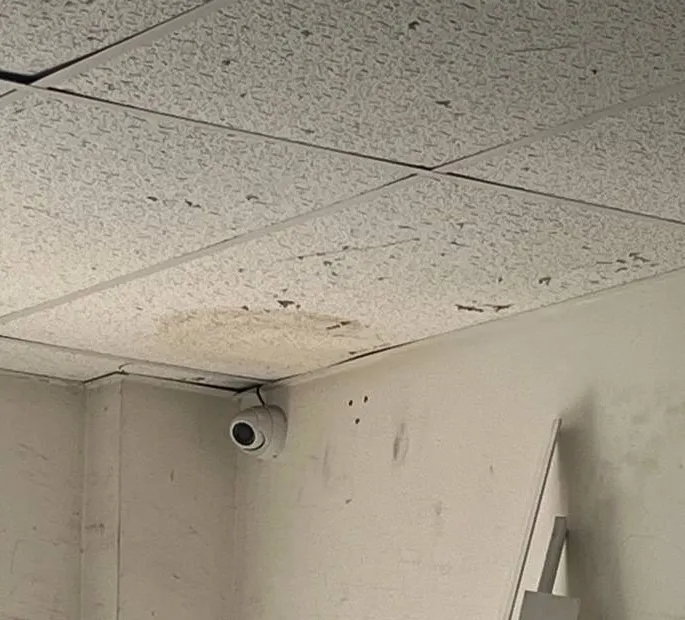
An AESS installation photo from another site, not a Hudson Valley one, trimmed to the top corner: a white turret camera sits high where a stained drop ceiling meets a scuffed wall, with timber boards leaning below. Inside a barn, garage or workshop the camera goes high in a corner like this, out of reach of ladders and equipment, while the floodlight outside covers the door.
Equipment
Types of Floodlight Cameras We Install
We are not tied to one maker. These are the kinds of hardware we fit across the six counties, roughly in order from the tight southern lots to the far northern drives.
💡
Hardwired Twin-Head Floodlight Cameras
Line-voltage units with a pair of tilting lamps above the lens. On a suburban garage or side wall they are the usual pick, set with both lamps tipped down and inward.
🛡️
Full-Cutoff Fixture Plus Separate Camera
A shielded light that plainly meets village codes, with a compact camera mounted beside or below it. Our usual answer in New Paltz, Cold Spring and similar places.
🌐
PoE Floodlight and Spotlight Cameras
Light, camera and often a siren on one network cable, up to about 328 feet from the switch. The steady choice for garages and gates within cable reach.
📡
Floodlights With External Antennas
Wi-Fi models with stand-up antennas for a stronger link from the edge of the yard, used where a cable is impractical but the house signal reaches.
☀️
Solar and Battery Floodlight Cameras
For gates, mailboxes and trailheads with no power. Chosen for the panel's winter sun, not its summer output, and set to ration light sensibly.
🔄
Pan-Tilt Floodlight Cameras
A turning camera head under the lights, for wide yards, paddocks and parking areas where one fixed view misses the side the visitor comes from.
🏭
Commercial LED Floods With Wired Cameras
Shielded commercial fixtures high on the building and separate wired cameras, recording to a locked recorder, for lots, yards and loading areas.
🔌
Plug-In Floodlight Cameras
Corded models for a garage or shed with an outdoor-rated outlet already in place, with the cord fixed tight to the wall and out of reach.
💾
Links, Recorders and Backup
Point-to-point wireless bridges, fibre or buried cable to outbuildings, network recorders for several floodlights, and battery backup for the network gear.
Ring, ADT and SimpliSafe Against a Local Installer
The national brands make capable floodlight cameras and will sell you one with a monitoring plan. Ring's own installation guide tells a homeowner to mount the light about nine feet up on a junction box and connect black to black, white to white and the ground wire; ADT and SimpliSafe bundle cameras with alarm monitoring. All of that assumes a box already on the wall, Wi-Fi that reaches it, and a town that has nothing to say about the light. Across much of the Hudson Valley at least one of those assumptions fails: the box is three hundred feet away, the Wi-Fi stops at the porch, or the village code wants full cut-off.
Where a local installer earns the fee is earlier, at the choice of hardware: can the spot be fed by a box, a cable, an outbuilding or a solar panel; which county licenses the wiring; will the village accept the fixture; how will the camera treat bears and deer; and what will it do when Central Hudson, NYSEG, Orange & Rockland or Con Edison cuts out. Already own a Ring, Nest, Arlo, eufy, Lorex, Reolink, Wyze or similar? We install it labor-only. Want an alarm company's monitoring? The floodlight works alongside it, and we do not push monthly plans nobody needs.
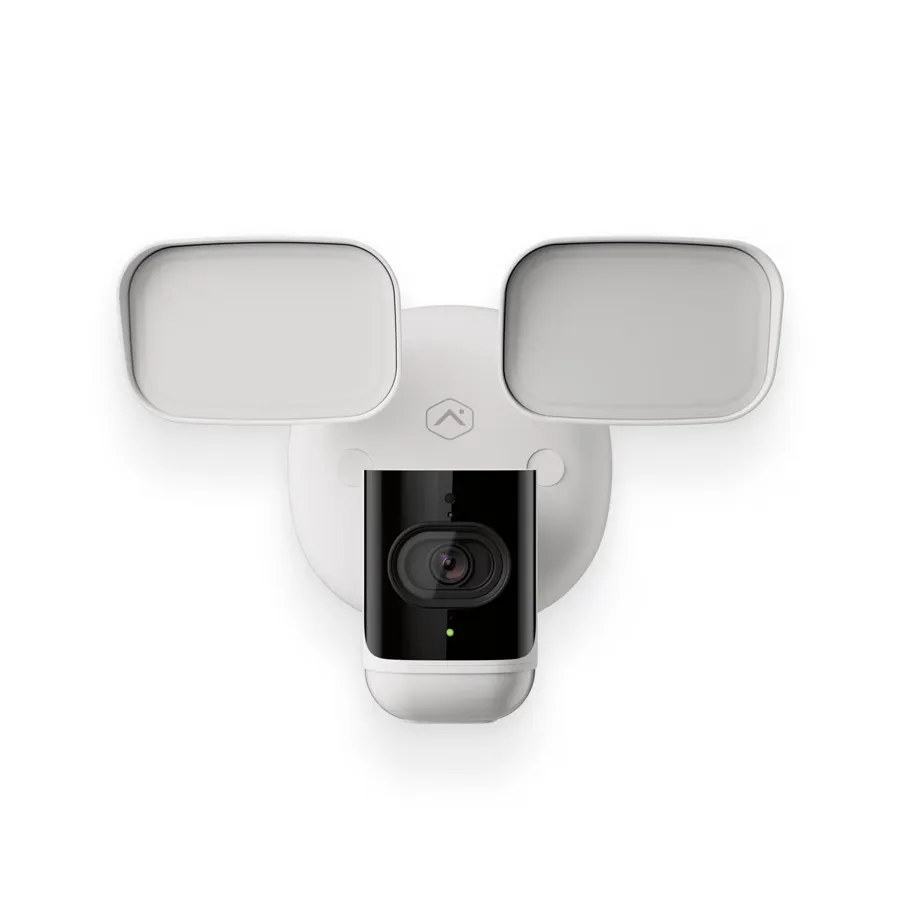
Manufacturer product photo (not an installed unit): a white box camera with a black lens face under two square light panels angled outward from a round wall plate. On a Hudson Valley barn or garage the panels are turned down toward the door and the drive; left angled outward as shown, they light the trees and the next field.
AI Overview Reality Check
What AI Gets Wrong About Floodlight Camera Installation in the Hudson Valley
We could not load Google's AI Overview from the environment this page was built in. What follows instead are the claims that national cost guides, camera makers and how-to blogs publish, since those are what AI summaries repeat. None is wrong everywhere; every one breaks somewhere between the Bronx line and the Catskills.
1. “Floodlight installation costs about $450 on average”
National figures cluster around a few hundred dollars. Inch Calculator's guide quotes roughly $450 as typical, a $250–$800 spread for most projects and $150–$350 a light for the labour; HomeCamCafe puts an electrician-fitted floodlight camera near $650. All of that assumes a box on the wall, or a few feet of new cable to one.
In the Hudson Valley the figure depends first on the county and then on distance. Our swap onto an existing box starts at $375 in Westchester and rises with the published county factor to $459 in Dutchess and Ulster. Where the spot has no power, the range in Westchester is $719 to $1,875 and in Ulster $880 to $2,295, because a light at a gate or barn may need a long cable, a bridge, an outbuilding switch or a solar unit.
An average blends a quarter-acre in Nanuet with a ten-acre lot near Pine Plains, which is why it describes neither. Tell us the county and the distance from the house, and the range narrows to something you can plan around.
2. “Mount the floodlight on the wall near the door”
Standard advice puts the floodlight on the house, over the door or the garage, because that is where a junction box usually is. Manufacturers' guides start from the same assumption: find the existing box, connect three wires, and you are done.
On many northern properties the door is the least useful place to light. A visitor reaches the house by a drive that may be several hundred feet long, passes a gate, a turn and a parking area, and is only near the door at the very end. A light on the house shows who rang the bell; it does not show the car that came up the drive at 2 a.m. and turned around before reaching it.
So on rural Hudson Valley properties we often split the job: a modest light at the house for the door, and a camera — lit or not — where the drive meets the road or the parking area, powered by cable, an outbuilding or the sun.
3. “Brighter is better for security”
The spec sheets lead with brightness: a Reolink PoE model is listed at 1,800 lumens, and a Lorex Wi-Fi unit carries two arrays of 2,000 lumens each. AI summaries pick that up and conclude that the brightest light is the safest choice and gives the best picture.
In much of the Hudson Valley more light is exactly what the local code asks you not to use. New Paltz village keeps light trespass to 0.25 footcandle at the property line and discourages floodlighting outright; Chester limits the height of floods above 900 lumens by distance to the line; Cold Spring wants full cut-off at every house. On a dark rural road, a 4,000-lumen light can be seen from across the valley and ruins the camera's own picture with glare off wet leaves and snow.
The better measure is control: lamp heads that point down, a fixture that cuts off at the horizontal, a brightness setting turned down to what the space needs, and a camera that records well in modest light. We size the light to the area, then the area to the code.
4. “No outlet nearby? Choose a wireless model”
Guides often answer “no power at the spot” with a wireless, battery or solar floodlight camera, as if that settles both power and connection. The word “wireless” usually means only that the camera sends video over Wi-Fi; it still needs power from somewhere and a network it can reach.
At the edge of a Hudson Valley property, both are the problem. The house Wi-Fi may reach the porch and fade at the garage, leaves block it in summer, and a battery camera that has to send video a long way drains faster in cold weather. Solar depends on the panel's winter sun, which a north slope or a stand of hemlocks can take away for months.
Wireless is a real option when the signal is tested at the exact mounting spot and the panel's winter shade is checked. Where either test fails, a network cable within its 328-foot reach, or a link to a powered outbuilding, is the dependable answer.
5. “Any licensed electrician can install it”
National advice, including Arlo's installation guide, tells anyone uncomfortable with electrical work to hire a licensed electrician. That is sound, but it skips the question of who licenses electricians where you live.
In the Hudson Valley the answer changes at the county line. Westchester requires its own county trade licence to work in the county. Rockland and Ulster license electrical work at county level, and Putnam extends licensing to the low-voltage technicians who run video surveillance cable. Orange requires a county-issued electrician licence as well. Dutchess has no county licence we could find, and many towns send electrical inspections to approved private agencies; the City of Newburgh even lets owner-occupants of one- and two-family houses take out their own electrical permit, subject to inspection.
So the right electrician is one licensed for that county and familiar with that town's inspection route. Our quote names who does the line-voltage part, who does the low-voltage part and which permit or inspection applies at your address.
6. “Motion detection sends an alert when someone approaches”
Product pages and AI summaries describe motion alerts as if motion means a person. Basic motion sensing reacts to warm moving bodies and changing pixels, which on a city lot is mostly people, cars and the occasional cat.
In the Hudson Valley the moving bodies are often deer, bears, foxes and branches. DEC's range maps put breeding bears through the Catskills and southern Orange and Rockland and reaching into Putnam; Westchester's reported sightings rose from two in 2019 to sixteen in 2021, according to Teatown. A floodlight that alerts on all of it either floods your phone or gets switched off, and a light that flashes on for every deer bothers everyone who can see it.
Person detection, motion zones drawn around the paths people use, and a light triggered only by people fix most of it. We spend part of every rural install watching what actually sets the camera off before signing it off.
7. “A floodlight keeps working as long as the house has power”
Most guides treat power as a given. In the northern counties it is the main variable. The morning after Isaias in 2020, NYSEG had 34,150 of its 38,693 Putnam customers out; Central Hudson reported crews restoring power to more than 19,000 homes and businesses after a slow-moving nor'easter in September 2026.
A hardwired floodlight camera goes dark the moment the grid does, and so does a Wi-Fi model's router. When power returns, some cameras rejoin on their own and some wait for someone to reset them — which, at a weekend house, may be days later. A standby generator helps only if it covers the right circuits.
So on Hudson Valley installs we test recovery by switching the house off at the main breaker, set cameras to retry the network, put the router and switch on a battery backup and check which panel feeds each light. The aim is a light that comes back by itself.
Light the Path In, Not the Hillside
Tell us the county, the town and how far the light needs to be from the house. We will say which power route fits, whether a village lighting rule applies, which county's figures set the price and who does each part of the wiring — before anyone drives up.
To price it we need the county and town, the distance between the light and the house or nearest building with power, whether your Wi-Fi reaches that spot, and whether the camera is already bought. One picture taken from where visitors arrive often replaces a site visit. The written total comes back the same business day, or call (800) 486-0943 to go through it.
✅
We Got Your Request!
Received. Someone who knows your county will check the distance, the power options and any lighting rule, then ring you back today. If it cannot wait, call (800) 486-0943.
How It Works
Our Installation Process
The same seven stages apply to a Yonkers garage and to a gate post outside Saugerties; the walk and the distance check at the start fix most of the cost.
1. Walk the route a visitor takes
Starting at the road or gate, we follow the path a car or a person would take to the house, note where they would stop and where it is darkest, and mark the spots that actually need light.
2. Pace the distance to power and network
We measure how far each spot is from a live box, a powered outbuilding and the network switch, and test Wi-Fi at the exact mounting points, in full-leaf terms where trees are in the way.
3. Check the county, the town and the code
We confirm which county licence applies to any new wiring, which agency inspects it in your town, whether a village or town lighting rule applies, and which utility feeds the property.
4. Choose the power route and the fixture
An existing box, a PoE cable within its 328-foot reach, an outbuilding with a wireless or fibre link, a plug-in at an outlet, a solar or battery unit, or a new box by a county-licensed electrician.
5. Write the plan and the county price
The written plan names each fixture and where it mounts, how its cable or link runs, who handles the electrical and the low-voltage parts, the permit or inspection involved, and the total at your county's factor.
6. Mount, shield, connect and test recovery
Lights go up with heads aimed down and shielding to the local code; cameras join the network; then we switch the house off at the main breaker to confirm everything comes back on its own.
7. Tune for wildlife and test after dark
Person detection and motion zones are set to the paths people use, the light is tied to people rather than animals, and we check the lamp from the neighbour's line and the road below before handing over the app.
Our photo from a job outside the Hudson Valley, trimmed to one corner of the room: a small black eyeball camera sits where two walls meet a drop ceiling, just below a square light panel. Where a camera sits relative to its light decides whether it sees faces or glare, which is why the after-dark test in step seven comes before we leave.
Coverage Area
Floodlight Cameras Near the Hudson Valley's Landmarks
From river-city historic districts to dark-sky villages and a bear-watching nature preserve: six places that show how varied the region's floodlight work is.
Newburgh East End Historic District
Described by the City of Newburgh as the second largest designated historic site in New York State, with Italianate rowhouses and Washington's Headquarters. Close-set houses where the light goes at the back.
Kingston Stockade District
One of Kingston's five historic districts, locally designated in 1974; exterior work visible from the street is reviewed by the city's landmarks commission before a permit is issued.
Village of New Paltz
Home to published outdoor lighting standards: fully shielded fixtures, floodlighting discouraged, light trespass kept to 0.25 footcandle at the property line, motion-sensor security lighting recommended.
Village of Cold Spring
Chapter 81 of the village code requires full-cutoff fixtures at every house, motion lights that switch off when motion stops, and fixtures below the eave.
Teatown Lake Reservation
The northern Westchester preserve whose naturalists tracked reported bear sightings in the county rising from two in 2019 to sixteen in 2021 — a reminder of what else crosses a rural camera's view.
Beacon station area
Where the state and the MTA chose a developer for 265 mixed-income homes on the lot beside the Metro-North station — part of the newer, denser housing appearing in the river towns.
We also install floodlight cameras in Yonkers, Mount Vernon, New Rochelle, White Plains, Tarrytown, Ossining, Peekskill and Bedford; Nyack, Nanuet, Spring Valley, New City, Pearl River and Haverstraw; Middletown, Goshen, Warwick, Monroe, Montgomery and Port Jervis; Carmel, Mahopac, Brewster, Patterson and Putnam Valley; Poughkeepsie, Fishkill, Wappingers Falls, Hyde Park, Rhinebeck, Millbrook and Pine Plains; and Kingston, New Paltz, Saugerties, Woodstock, Ellenville and Gardiner.
Pricing
Floodlight Camera Installation Cost in the Hudson Valley
County prices here are calculated, not negotiated: the Brooklyn base floodlight figures times the factor we publish for each county, rounded to whole dollars. They cover installation only — the camera is extra outside a package — and locally recording models need no monthly plan.
County (factor)
Swap onto an existing outdoor box
One light where there is no power yet
Two to four floodlight cameras
Westchester (1.25)
$375–$719
$719–$1,875
$1,625–$4,750
Rockland (1.30)
$390–$748
$748–$1,950
$1,690–$4,940
Orange (1.40)
$420–$805
$805–$2,100
$1,820–$5,320
Putnam (1.45)
$435–$834
$834–$2,175
$1,885–$5,510
Dutchess (1.53)
$459–$880
$880–$2,295
$1,989–$5,814
Ulster (1.53)
$459–$880
$880–$2,295
$1,989–$5,814
Not in the table. Floodlights that are part of a full camera system, a solar or cellular build at a remote gate, a fibre or wireless link to an outbuilding, and large commercial lots are quoted after a walk-through, because the distances and the hardware vary too much for a range to mean anything. Service visits after installation are $195 an hour with a three-hour minimum ($585), in every county.
What moves a Hudson Valley price up. Distance first: a light more than 328 feet of cable from the nearest switch, or at a building with power but no network. Then a new box and circuit by a licensed electrician, a village that needs a separate shielded fixture and camera rather than one unit, a mounting height that needs a lift or a second person, and a battery backup or generator change to keep the light alive in outages.
What keeps it down. An existing outdoor box in a sensible place. A garage or barn that already has both power and a network. A camera that records to a card or a recorder you own rather than a subscription. And grouping the floodlight with other work planned for the property, so one trip north covers both.
To compare full camera systems by county before calling, see Hudson Valley camera pricing or run the numbers in the camera cost calculator. The written quote after we have seen the spot is the price we hold to.
Manufacturer product photo (not an installed unit): two flat square light panels on short arms above a round wall plate and a rectangular camera with a black front. A unit like this is the typical “swap onto an existing box” job in the first column of the table, in any of the six counties.
Shop Our Systems
Floodlight Camera Packages & Pricing
Each package below is shown from its Westchester figure to its Dutchess and Ulster figure. Your exact number depends on the county and on what we find at the spot.
Existing-Box Swap
$375–$880
One floodlight camera on a box already in place. Old fixture off, box and fixing checked, light mounted and sealed, heads aimed down to stay inside the lot, person detection and motion zones set, app and alerts on your phone. Lower end Westchester, upper end Dutchess and Ulster.
Garage or Gate Light
$719–$2,295
One floodlight where there is no power yet. Whatever the spot allows — network cable inside its reach, a link from a powered outbuilding, an existing outlet, or a new box by an electrician licensed for your county — with shielding to local rules and a check that it recovers after a power cut.
House, Drive and Outbuilding Set
$1,625–$5,814
Two to four floodlight cameras. Entrance, garage, drive and one outbuilding drawn as a single layout so no light shines into another camera, with triggers tuned for wildlife and a recorder on battery backup if you want one.
Already bought the floodlight camera? Labor-only installation
Owners often arrive with the camera already in the garage, still boxed. We fit it labor-only at your county's figures, after checking on paper that it suits the spot: box or plug, range from the router, how far down the heads tilt for a village code, and whether it talks to your recorder. In this region the usual trouble is not a bad camera but a good one bought for a wall with no power or a corner the Wi-Fi never reaches. Supplied equipment keeps its maker's warranty instead of ours. Pricing for labor-only work is set out on our bring-your-own-equipment page.
Manufacturer product photo (not an installed unit): a white floodlight with one wide rectangular panel and a smaller angled panel above a black wide-lens camera. A wide lens like this covers a long stretch of drive from one corner of a garage, which can save a second light in the larger package.
Get Your County's Floodlight Price in Writing
Send the town name, a picture and a rough distance in feet. Before anyone books a visit you will know the package, the county figure and whether part of the work belongs to an electrician licensed where you live.
On a Hudson Valley floodlight visit I do not begin at the wall the owner points to. I begin where a visitor begins: at the road, the gate or the bottom of the drive. From there I walk the route a car or a person would take, and note where the house first comes into view, where someone would stop, and where the dark stretches are. On a suburban lot that walk takes a minute and ends at the garage. On a rural property it can take ten, and it usually shows that the light the owner wanted on the porch would be better at a turn in the drive.
The second thing I do is find the network and the power, and pace the distance to the spot. If it is inside cable reach of a switch, the job is straightforward. If it is not, the question becomes which building nearer the spot already has power, and whether it can see the house for a wireless link. Then I look up: at the trees between the two, and at the sky the panel would face if it came to solar.
Before I hand over the app I go back out once it is dark. Standing on the boundary with the next house, and then down on the road, I look for the lamp face itself; seeing glow on the ground is fine, seeing the bulb means the heads need another turn downward or a shield. — Owner, NYS low-voltage license #12000287431
FAQ
Hudson Valley Floodlight Camera Installation FAQ
Can one visit cover properties in two different Hudson Valley counties on the same day?
+
Sometimes, when the two are close and the work at each is small. A swap onto an existing box in Rockland and another in southern Orange can share a day; a garage light in Westchester and a gate light outside Kingston usually cannot, because each needs most of a day once travel is counted. Each property is priced at its own county's figures either way, and where a second property needs a survey first, we often do that on the same trip as the first property's install. Tell us both addresses when you ask, and we will say whether a shared day is realistic.
Is a photo or video call enough for a first estimate on a property two hours north?
+
Usually, for a firm range. A photo of the spot from where a visitor arrives, a close-up of whatever is on the wall now, and a rough distance to the house or the nearest powered building let us say which power route fits and which part of the county price range applies. A short video call where you walk from the router to the spot is even better, because we can watch the Wi-Fi bars drop as you go. Jobs with a long cable run, a wireless link or a solar unit still get a site visit before the final price, but the first estimate means nobody drives north for a job that turns out not to suit.
What happens to the floodlight's motion settings when the trees leaf out in spring?
+
They often need a small adjustment. Motion zones drawn in winter can end up covering branches that move all summer, and a camera that was quiet in February starts alerting every windy afternoon in June. Leaves can also hide part of the view the light was meant to cover. We set zones with the coming season in mind, keeping them on the drive, the paths and the doors rather than the tree line, and we show you how to redraw them from the app. If you would rather not, a seasonal service visit covers re-aiming and re-zoning at the standard service rate.
Snow piles up on the light in a nor'easter — does that block the camera?
+
It can, depending on the shape of the fixture and where it is mounted. Snow settles on top of lamp heads and housings and can slide down over the lens, and wet snow driven sideways sticks to whatever faces the wind. We mount floodlights under an eave or overhang wherever the code and the view allow, which keeps most snow off, and avoid spots where snow sliding from a roof lands on the fixture. The heat from the lamps clears some snow when the light runs, but not reliably. On an unattended property, a second camera on another wall is the insurance against one view being blinded for a night.
Can the floodlight be tied to a driveway sensor down at the road?
+
Often, yes. A wireless driveway alert sensor at the road can warn you before a car reaches the house, and with a compatible system it can also switch the floodlight on and start the camera recording, so the arrival is already lit. Whether the two can be linked depends on the brands: some floodlight cameras accept triggers from sensors on the same platform or a smart-home hub, others cannot be linked at all. The sensor at the road also needs its own power or batteries and a clear radio path to the receiver. Tell us the sensor model if you already have one, and we will say whether it can be connected.
Will the floodlight camera work on a Starlink or cellular-router connection?
+
Generally yes, with two things to check. The camera only needs a working local network, so any router that gives it Wi-Fi or a network port will do; the question is the internet behind it. Satellite and cellular links can have data caps or variable speeds, and a camera uploading clips to the cloud all day can use a meaningful share, so we set recording to a local card or recorder and send only alerts and short clips over the internet. Some satellite and cellular setups also make remote viewing apps work differently; we test viewing from your phone on mobile data before leaving.
Can you take down an old unshielded floodlight and leave the box ready for a compliant fixture?
+
Yes. Where a village or town has asked for shielded lighting, or a neighbour has, we can remove the old fixture, check and seal the box, and either fit a shielded fixture and a separate camera straight away or leave a weatherproof cover until the new fixture arrives. Taking down a line-voltage fixture and capping the box is electrical work, so in counties with electrician licensing it is done by a licensed electrician on the same visit. The old fixture stays with you unless you ask us to dispose of it.
We rent the house out on weekends — what should guests be told about the floodlight camera?
+
Tell them, in the listing and at the property, that outdoor cameras are in use and where they are. Many rental platforms require exterior cameras to be disclosed, and none of our cameras is ever pointed into a window or anywhere a guest could expect privacy indoors. Set the camera to cover the drive, the doors and the parking area, and consider turning off audio recording if guests will be talking outside. We can set up a separate guest-free user for a cleaner or manager, and show you how to pause notifications during a stay without stopping recording.
How long does a typical Hudson Valley floodlight installation take on site?
+
A swap onto a sound existing box usually takes one to two hours, including aiming and setting up the app. A light that needs a new cable run to a garage or a gate can take most of a day, depending on the distance and whether the cable is buried, run along a fence or carried by a wireless link. Where a licensed electrician adds a new box or circuit, that part may be on a separate day to fit the permit and inspection. We give you the expected time on site with the written quote, and the after-dark test at the end may mean finishing in the early evening.
Can the yard light follow sunset automatically as the days shorten?
+
Yes. Most floodlight cameras and smart lighting controls can follow sunset and sunrise times for your location instead of a fixed clock time, so the light's dusk-to-dawn or motion-only mode shifts with the season without anyone touching it. We set the location in the app correctly, which matters because a camera that thinks it is somewhere else will switch at the wrong time. If your village or the pending state bill asks for lights off late at night, the schedule can also turn a lit area back to motion-only after a set hour.
All Areas Served
Floodlight Cameras Across the Hudson Valley, New York City and Long Island
This is the regional hub. Each Hudson Valley county has its own floodlight page with the local detail — its towns, its housing, its rules and its prices — and the city and Long Island pages cover the rest of our service area.
Floodlights are one service among many. For whole-property camera systems, a gate intercom or a barn alarm, start from the Abstract Enterprises Security Systems home page; our licence and insurance details are on the company page.
Sources
Where the Hudson Valley Facts Come From
Every licence rule, lighting code, outage figure, wildlife fact and product number quoted above can be checked at the links in this list. AESS prices are our own: the Brooklyn base floodlight figures times each county's published factor, plus the standard hourly service rate.
Whether the garage lamp quit after a blackout, the app has said “unreachable” since Tuesday, or the building inspector wants your old flood shielded, phone (800) 486-0943. A technician comes in the next open slot for your county, and in most cases the light is back on and the camera recording within an hour or two of arrival.
Hudson Valley Floodlight Cameras From a Licensed, Insured Crew
For all six counties, call (800) 486-0943 or send photos by WhatsApp (718) 679-0359. Bookings run from Abstract Enterprises Security Systems at 460 E Fordham Rd, Bronx, NY 10458
Six counties, one licence and one insurer: NYS low-voltage license #12000287431 covers our crews from the Westchester line to the Ulster mountains, and every quote is written and sent the day you ask · rated 4.7★ by 201 Google reviewers
Warranty and paperwork: every floodlight, shielded fixture, switch and recorder we fit comes with its maker's warranty, and wiring done by a county-licensed electrician is covered by that electrician's own written terms and the town inspection certificate. Full terms — including 50% deposit, the 30-day warranty and optional paid extended warranty, and the late-fee schedule — are set out in the service agreement. Ask for a copy of the agreement with your quote if you would like to read it before the visit, and see our warranty page for how claims are handled.
Page reviewed and updated October 18, 2026. Changelog: Hudson Valley floodlight camera hub rebuilt from new research on county electrical and low-voltage licensing, third-party electrical inspection and owner-occupant permits, village and town outdoor lighting codes, the pending state Dark Skies Protection Act, utility territories and storm outages, and black bear range; prices now follow the published county multipliers on the Brooklyn base figures.