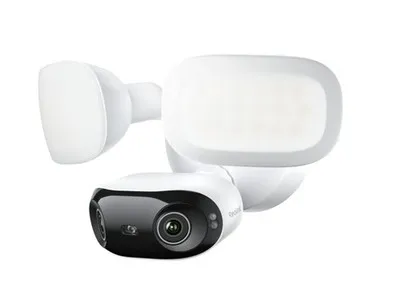
Vinyl Siding · Stair Landings · Cars in the Driveway · Blocks Where the Streetlight Is Out
On Staten Island a floodlight camera usually watches a whole house rather than a back yard: a driveway with two cars in it, a side door, a garage built in under the bedrooms, and on the East and South Shore a front door that now sits at the top of a stair because the house was lifted after Sandy. We find the power on a sided or frame wall, keep the switch and recorder above the water line, aim the light at your lot instead of the house next door, and set the camera so a car pulling in at 3 a.m. is recorded clearly enough to be useful. One look, one written price, and a light that suits the house you actually have.
Page checked October 18, 2026 · Abstract Enterprises Security Systems, owner, NYS low-voltage license #12000287431 · Crews cross the Verrazzano from Troy Avenue for every Staten Island job
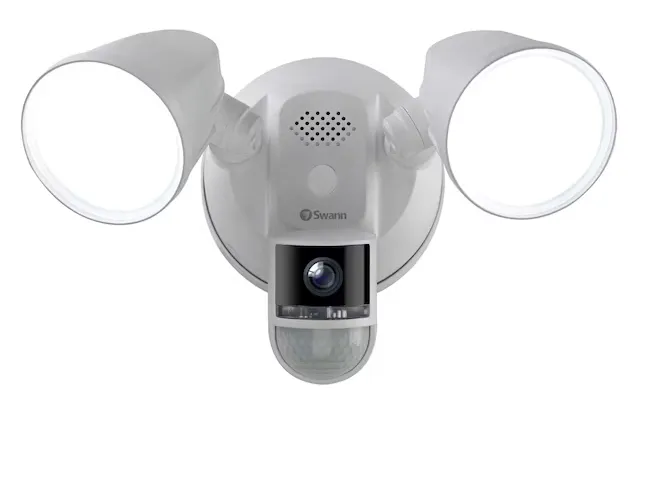
Manufacturer product photo (not an installed unit): a white Swann floodlight camera with two round lamp heads, a speaker grille, a square camera window and a motion sensor at the bottom. The round base is meant to sit on an outdoor box; on a vinyl-sided Staten Island house it needs a flat mounting block under it first.
Staten Island Floodlight Quote
Tell us which side of the house and what is on that wall now — a written price comes back the same business day
✅
Request Sent!
An installer will call back about the Staten Island floodlight the same business day.
25+
Years Experience
✓
Same-Day Estimates
100%
Licensed & Insured
4.7★
390+ Google Reviews
Staten Island floodlight prices start from a photo of the house. Stand at the end of the driveway or across the street and take one picture of the side you want lit, then one close-up of what is on the wall today — a porch light, an outlet, a bare stretch of siding. Text both to (347) 934-8335 or add them to the form, and you will hear which power route fits before anyone drives over the bridge.
Swapping a porch or garage light for a floodlight camera: $330–$633 on Staten Island; a wall with nothing on it yet: $633–$1,650
Video kept on the camera's card or on your own recorder, so a subscription is optional
Every day of the week, 8 AM to 8 PM, in a two-hour arrival slot — license #12000287431
Why Staten Island Properties Need Floodlight Camera Installation
Staten Island is the borough of houses. The Citizens Housing and Planning Council's housing-stock study counts 83 percent of the island's homes in one- or two-family buildings, and most of them sit on their own lot with a driveway down one side, a lawn at the front and a yard at the back. That changes what a floodlight camera is for. In a row of attached houses the dark spot is a narrow rear yard; on a Great Kills or Westerleigh street the dark spots are the driveway, the side door, the gap between house and garage, the back steps and, on a corner lot, a whole flank of the house that faces a side street. One light rarely covers all of that, and the light that covers the driveway is also the one that faces the street and the house across it.
The island's own news shows where the trouble starts. In February 2026 Hoodline reported police looking for three young men behind a night of break-ins and attempts across New Dorp, Dongan Hills and Todt Hill: around 2:30 in the morning a crowbar was used on a window frame near Benedict Road, a car key fob was taken from one house, and less than an hour later the same group approached a back door near Cromwell Circle with a crowbar before leaving. Three years earlier ABC7 showed a thief taking an unlocked car from a Staten Island driveway in under fifteen seconds, and the borough's commanding officer, Capt. Glorisel Lee, said 90 percent of the stolen vehicles had their doors unlocked. Driveways, back doors and side windows in the small hours are the pattern, and those are exactly the places a floodlight camera is meant to light and record.
Then there is the darkness that has nothing to do with the house. In October 2026 the Staten Island Advance reported residents waiting weeks and sometimes months for broken streetlights to be fixed; a 311 analysis by the paper counted 210 streetlight complaints on the island in a single seven-day period, and the Borough President's office blamed delayed contracts between the city's Department of Transportation and its private repair crews. A resident of Sunnyside said an outage near Cheshire Place and Melrose Avenue had lasted for months. A floodlight camera is not a streetlight, and it should not try to be one, but on a block where the pole outside has gone dark it is often the only light that shows who walked up the driveway.
The East and South Shore add one more thing no other borough has in the same numbers: houses that were lifted, rebuilt or replaced after Hurricane Sandy. The city's Build It Back program served 1,982 Staten Island homeowners, and across the city 838 homes were repaired and raised above the base flood elevation and 492 were rebuilt outright. On those houses the front door is often a full storey above the lawn, the old porch light is gone, the space underneath is parking and storage built to let water through, and the electrical rules for anything below the flood line are stricter than they are uphill. A floodlight on a raised house in Midland Beach or New Dorp Beach is a different installation from the same light on a Todt Hill colonial, and we plan it that way. Owners who light the driveway usually want to see the front step too, and the same visit is a good time to add a doorbell camera on the Staten Island front door.
Staten Island facts that shape a floodlight install
83 percent of homes are in one- or two-family buildings (Citizens Housing and Planning Council, 2024) — so most floodlight jobs here are on a free-standing or semi-attached house with a driveway, not on a rowhouse yard.
Sandy's surge hit the East and South Shore hardest: the city's post-storm rebuilding plan counted 23 storm-related deaths on Staten Island, all but one on those shores, and more than 11,700 buildings in the flooded area, nine in ten of them one- and two-family homes.
1,982 Staten Island homeowners went through Build It Back, the city's recovery program, which raised 838 homes above base flood elevation citywide — houses where the door, the stair and the power are all higher than they used to be.
Deer are part of the night scene: NYC Parks estimated about 2,053 deer on the island in January 2017 and about 1,616 in January 2021, a 21 percent drop, with reported deer-vehicle collisions down 44 percent.
Streetlight repairs can lag: DOT says every reported outage is assessed within 10 days, its average time to close a repair request this year was 15 days, and residents told the Advance of outages lasting more than a month (October 2026).
Any new outdoor electrical work needs a licensed master electrician and a permit in New York City, and the Department of Buildings counts even replacing a fixture on an existing box as minor electrical work.
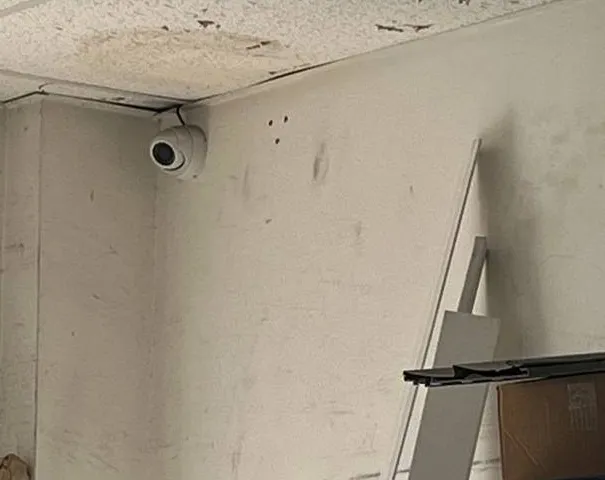
Real AESS install from another site (not Staten Island), cropped to one corner: a white turret camera under ceiling tiles with brown water stains, and trim leaning on the wall below. Stains like these are the reminder that switches, power supplies and recorders belong above the wet line, not in the lowest room of the house.
Need Floodlight Repair on Staten Island Today
Lamp heads full of rainwater after a nor'easter, a driveway that stays lit until sunrise, an app that shows the camera offline every evening: phone (347) 934-8335. Once a technician is on site, the usual Staten Island floodlight is back to lighting and recording inside one to two hours, and if the real cure is moving it to a better power source, that is booked as a second visit. If the problem is the whole camera system rather than one light, our Staten Island camera repair team takes it from there.
Before you call, look at these four things
Ground-fault outlets and breakers. Rain getting into a connection usually shows up as a GFCI outlet that has popped in the garage, the basement or under a raised house. Press its reset button and write down whether it holds.
The wall switch. Floodlights that replaced an old porch or garage light are usually still on that light's switch. Someone flipping it off takes the camera with it.
The signal at the light. Stand under the floodlight with your phone on the home Wi-Fi. If you get one bar at the side of the house, the router in the front room is the problem, not the camera.
The schedule in the app. “On from dusk to dawn” set by a previous owner, or a motion setting turned to maximum, explains most lights that never go off.
Mention all four on the phone. Between them they usually point to the cure: an app setting, a failing power supply, a broken seal, or a light that simply sits in the wrong place.
What We Install
Floodlight Camera Installation Services in Staten Island
These are the floodlight jobs Staten Island owners and businesses call about most. A typical house uses two or three of them at once.
🚗
Driveway and Car Coverage
A light at the house corner aimed down the driveway, set so that a person reaching for a car door handle is lit from the front and recorded in colour, not as a silhouette against the street.
🏠
Siding-Mounted Floodlights
Vinyl, aluminum and cedar-shingle walls get a proper mounting block screwed into the framing, so the plate sits flat, the siding can still expand, and water runs off instead of in.
🌊
Raised and Rebuilt Houses
Lights at the stair landing, the elevated front door and the parking space underneath, with the switch, power supply and recorder kept above the flood line inside the house.
🌐
Network-Powered Floodlight Cameras
One low-voltage cable from a PoE switch in the house brings power and video to the light, which avoids a new 120-volt circuit on walls where there is no box.
💡
Porch and Garage Light Swaps
An existing porch, garage or side-door light replaced by a floodlight camera on the same box, after the box, its fixing and its switch have been checked.
🌳
Back Yards on the Tree Line
For houses that back onto the Greenbelt, a park or a wooded lot: light aimed at the lawn and the back steps, motion zones that stop short of the trees.
🏪
Store Lots and Business Yards
Hylan Boulevard, Richmond Avenue and Forest Avenue lots, and West Shore yards: commercial lights high up, cameras recording to a recorder inside.
📹
Adding a Floodlight to an Existing System
A floodlight camera that records to the recorder you already have, or a new recorder sized for the floodlights and the cameras already on the house.
🔧
Resealing, Re-Aiming and Replacing
Lamp heads knocked out of line by a storm, housings fogged by salt air, lights that blind the neighbors: re-aimed, resealed or swapped.
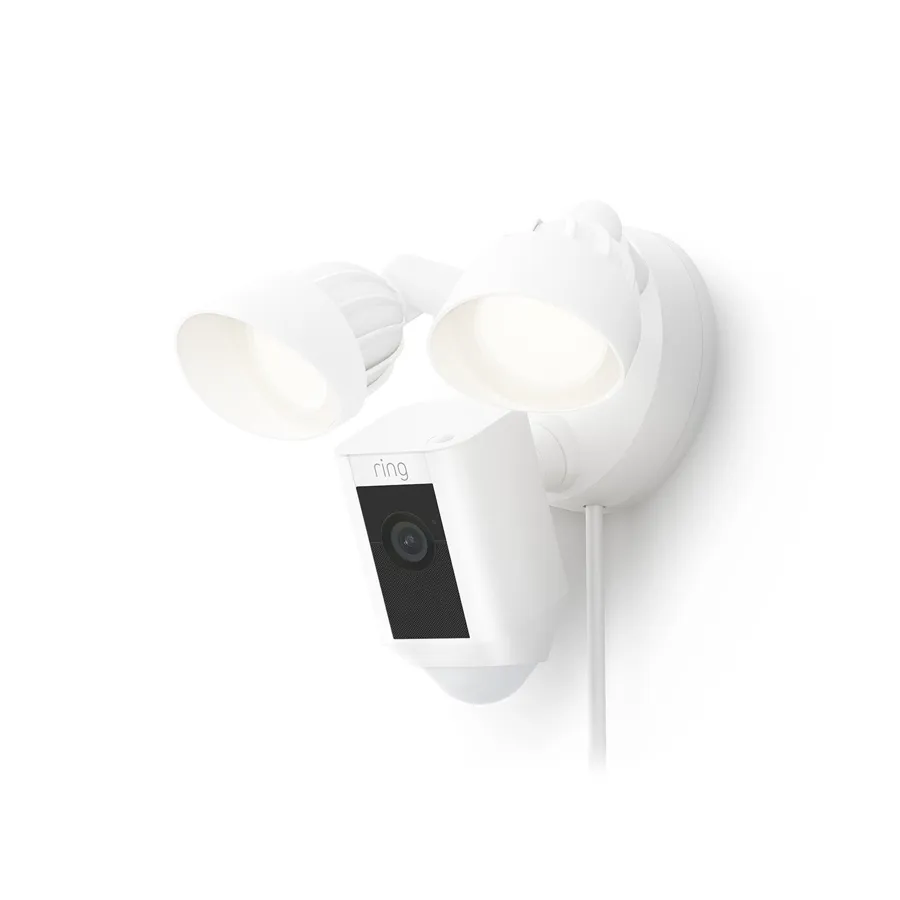
Manufacturer product photo (not an installed unit): a white Ring floodlight camera with two lamp heads and a white power cord running down from the mount. A corded model is only as good as the outdoor outlet it reaches and the route the cord takes down the siding.
Building Specialists
Floodlight Cameras for Staten Island's Architecture
Almost everything we light on the island falls into one of the six types below. Siding or masonry, and how far the front door sits above the lawn, matter far more to the method than which camera brand you like.
Detached Frame Houses
Westerleigh, Great Kills, Eltingville, Annadale, Bay Terrace. Siding over wood framing, a driveway along one side, often a detached or built-in garage and a deep back yard.
Semi-Attached Houses
New Dorp, Dongan Hills, Charleston, Rossville. Two houses sharing a party wall, each with its own driveway, or two driveways side by side between the pairs.
Raised and Rebuilt Houses
Midland Beach, Ocean Breeze, New Dorp Beach, Oakwood. Living space a storey up, a long stair to the front door, and open or breakaway-walled space underneath for parking and storage.
Two-Family High-Ranches
South Shore and Mid-Island. One family upstairs and one down, a garage built into the front under the bedrooms, and a driveway that both households use.
North Shore Victorians and Older Houses
St. George, New Brighton, Stapleton Heights, West Brighton. Wood porches, shingle and clapboard walls, steep streets, and in places a historic district.
Townhouse Complexes and Strip Lots
Annadale, Huguenot and Eltingville townhouse communities, and the strip centers along Hylan Boulevard and Richmond Avenue, where an association or a landlord owns the outside walls.
Siding: the mounting block is the job
Most Staten Island floodlights go onto vinyl siding, and vinyl is not something you can screw a light through. It moves with the temperature, it cracks under a tight screw in January, and water runs down behind it all year. The right fixing is a mounting block: a molded base that fits around the siding profile, is screwed through into the sheathing and framing behind, and gives the floodlight a flat, sealed surface to sit on. Where a box is needed, it goes inside the block. Where a network cable comes out of the wall instead, it leaves through the block with a drip loop below. Aluminum and older cedar-shingle walls get the same treatment with a block or a shaped spacer. The block costs little and saves the siding; skipping it is the commonest reason we are called to fix someone else's install.
Semi-attached houses: two driveways, one view
A semi-attached pair in New Dorp or Charleston often has its two driveways side by side, separated only by a low fence or a strip of lawn. A floodlight on one house aimed down its own driveway will see the neighbor's car as well, and its light will land on their side door. The answer is the outside wall rather than the shared side, the lamp heads tilted inward toward your own driveway, and a privacy mask over the neighbor's car and door. Where both owners want coverage, one well-placed light can serve both driveways with each household seeing the camera in its own app, but only with both owners' written agreement.
Raised houses: the door moved up, the light should too
A house lifted after Sandy usually lost its old porch light when the stair was rebuilt, and the new front door may be ten feet or more above the lawn. The light that matters is at the landing, lighting the top of the stair and the door, with a second light lower down covering the driveway and the space under the house. Power for both is planned from inside the living floor, not from the ground level, and any cable that has to run below the flood line is the kind permitted there and leaves the switch, the power supply and the recorder upstairs. The stair and landing are usually new, solid framing, which makes the fixing itself easy.
High-ranches and built-in garages: two households, one driveway
On a two-family high-ranch the garage is built into the front of the house under the upstairs bedrooms, and both households park in the same driveway. A floodlight over the garage door sits right under a bedroom window, so we mount it to the side of the door rather than over it, keep the heads pointing down the driveway, and set it to motion-only. Each household can see the driveway camera in its own app, and the owner decides who can change the settings.
North Shore older houses: porches, shingle and slopes
On an older St. George or Stapleton Heights house the porch is usually the natural place for a light, and the wall behind it is shingle, clapboard or stucco over old framing. We fix into the framing, not the cladding, run any cable through the porch ceiling or the cellar rather than across the facade, and choose a compact fixture that suits the porch. Where the house is inside a designated historic district, anything visible from the street goes past the Landmarks Preservation Commission's rules first.
Shore by shore: what the floodlight work looks like
North Shore. St. George, Tompkinsville, Stapleton, West Brighton and Port Richmond are the oldest and most urban parts of the island: older frame houses, Victorians on the hills above the ferry, two-families converted from single houses, and streets steep enough that a driveway is a luxury. Floodlight work here is mostly porches, side doors and the strip of yard behind the house, with the light kept compact and the cable hidden in the porch ceiling or the cellar.
Mid-Island. Todt Hill, Emerson Hill, Grymes Hill, Dongan Hills, New Springville and Willowbrook mix large houses on wooded hills with streets of detached and semi-attached homes. The jobs are long driveways, garages at the back of deep lots, gates at the bottom of a slope and back yards that meet the Greenbelt, so lighting is about distance and about keeping the woods dark.
East Shore. South Beach, Midland Beach, Ocean Breeze, New Dorp Beach and Oakwood Beach took the worst of Sandy, and the streets are a patchwork of houses that were raised, rebuilt, replaced with modular homes or bought out and cleared. Here the questions are the stair, the landing, the parking space under the house and where the switch and recorder go inside, with the flood rules applied to anything near the ground.
South Shore. Great Kills, Eltingville, Annadale, Huguenot, Prince's Bay, Rossville and Tottenville grew fast from the 1960s onward: detached houses, high-ranch two-families with garages built in at the front, and townhouse complexes where an association owns the walls. Driveways with two or three cars are the main concern, and the light over the garage is usually the first one to move to the side of the house.
West Shore. Bloomfield and the industrial land along the West Shore near Freshkills Park are more warehouse than house: logistics buildings, truck yards and contractors' lots where floodlight cameras cover doors and corners and commercial floods on poles light the open ground.
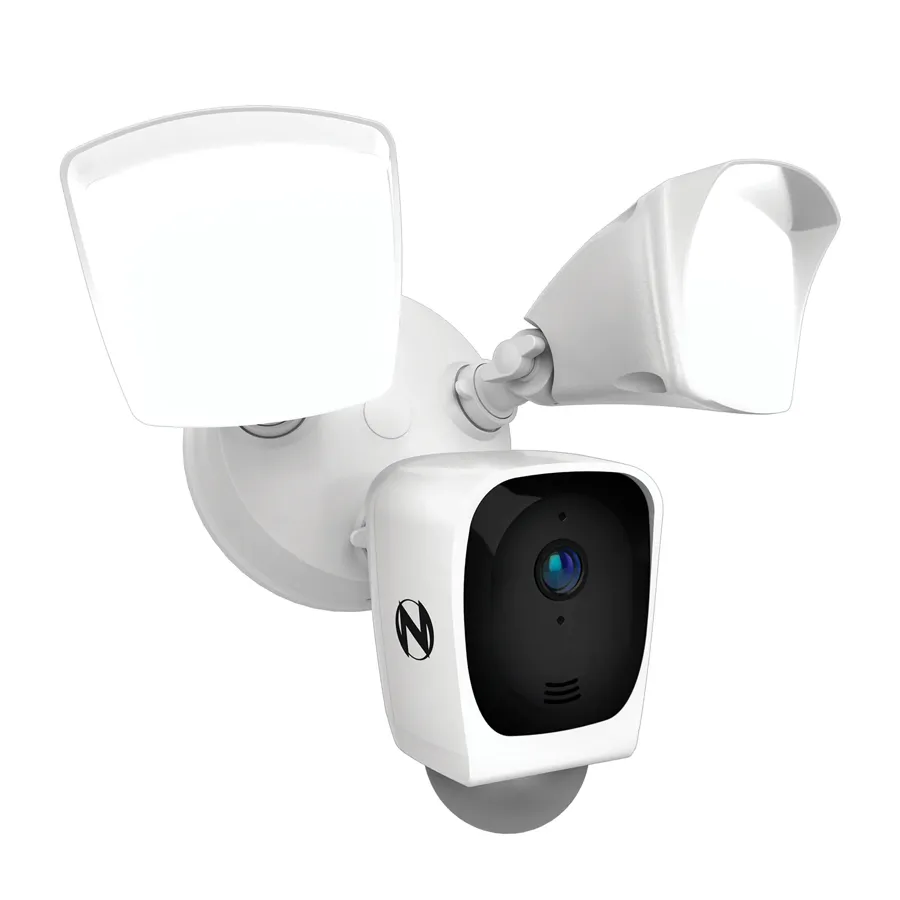
Manufacturer product photo (not an installed unit): one flat square lamp and one hooded lamp on adjustable knuckles above a square camera with a black face. A hood over the lamp is what keeps light from spilling sideways toward the house next door on a narrow Staten Island lot.
Commercial Floodlight Cameras
Business Floodlight Camera Installation in Staten Island
Staten Island businesses mostly sit along a few long roads, with a parking lot in front or behind and houses close by. These are the corridors and districts where our commercial floodlight work comes from.
Hylan Boulevard
The longest street in New York City, lined from the Mid-Island to the South Shore with medical offices, urgent-care centers, restaurants and strip plazas whose back lots face residential side streets.
Richmond Avenue and New Springville
The Staten Island Mall opened on Richmond Avenue at Richmond Hill Road on August 9, 1973; the avenue around it is big-box stores, plazas and car dealers with large open lots.
St. George and Bay Street
The ferry district: Empire Outlets' 350,000-square-foot retail complex by the terminal, and the Bay Street corridor through Tompkinsville and Stapleton that the City Council rezoned in 2019.
Bloomfield and the West Shore
Warehouses and logistics, including the 200-acre Matrix Global Logistics Park on a former oil-tank site, where Building 1 alone covers 975,000 square feet.
Seaview Avenue
Staten Island University Hospital's campus at 475 Seaview Avenue and the medical offices and parking that grew up around it.
Forest Avenue and Victory Boulevard
North Shore and Mid-Island shopping streets: delis, pizzerias, auto shops and contractors with small lots and yards behind the storefronts.
A business lot needs a different kind of floodlight from a house. It is usually lit from dusk to dawn rather than on motion, because a lit lot is the deterrent and customers and staff need to see. The fixtures are commercial LED floods mounted high on the building or on poles, fed from the building's electrical panel by an electrician, and the cameras are separate from the lights and record to a recorder locked inside. Where a lot backs onto houses, as so many Hylan Boulevard and Forest Avenue lots do, the lights are fully shielded and aimed down, because the people complaining at night are the neighbors behind the fence. Larger sites are usually part of a Staten Island commercial camera system, and work vans and trucks parked overnight get the attention described in the questions below.
Two kinds of Staten Island property need a conversation before the ladder comes out. In the townhouse communities of Annadale, Huguenot and Eltingville a single condominium declaration usually covers the whole complex, and the association often owns the outside walls, the roads and the parking, so a light on "your" wall can need the board's approval and a light over the shared lot is the board's decision. In the strip plazas along Hylan Boulevard and Richmond Avenue the landlord normally controls the facade, the roof and the lot lighting, and tenants light only their own rear door with written permission. In both cases we can prepare a short description of the fixture, its position and how it is wired, so the board or the landlord can say yes quickly.
Rules and credits for Staten Island floodlight work
A licensed master electrician does the line-voltage part. City rules put every new outdoor box, circuit and even a like-for-like fixture swap (minor electrical work, up to five fixtures) under a DOB permit pulled by a licensed master electrician. Cameras, network cable and recorders fall under our state low-voltage license instead.
Below the flood line, equipment has to be built or placed for water. The city building code's flood appendix requires utilities and their equipment to sit at or above the design flood elevation or be built to keep water out, and allows only flood-damage-resistant materials below it; in coastal high-hazard areas the space under a raised house is limited to parking, access, storage or crawl space.
Parking-lot light that spills onto homes goes to the Department of Buildings. NYC311 says light from a parking lot shining into a neighboring building can be reported to DOB for investigation, which is why lot lights near houses are shielded and aimed from the start.
The house next door's yard stays out of the recording. Under Civil Rights Law § 52-a, a neighbor whose back yard is filmed without written consent by a device on the adjoining property can take the owner to court, so masks and aim keep the camera on your own lot.
A state tax credit can offset a store's cameras. Firms with up to 50 employees can apply by October 31 for New York's Commercial Security Tax Credit, worth as much as $3,000 per retail location; your accountant can confirm eligibility.
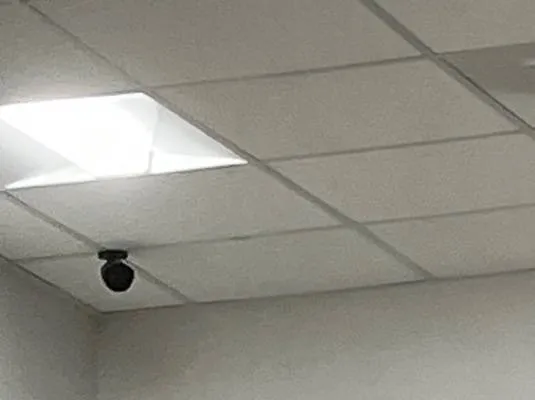
Earlier AESS installation, not on Staten Island, cropped to the ceiling: a black ball camera hangs at the edge of the ceiling a short distance from a bright light panel. The camera sits beside the light, not in front of it, which is the same spacing rule we use when a separate camera goes near a commercial flood on a Staten Island lot.
Your Questions Answered
Floodlight Camera Installation in Staten Island: Questions Answered
These are the questions Staten Island homeowners, landlords and business owners bring to us about floodlight cameras, grouped by what is really behind them: raised and rebuilt houses, siding and built-in garages, streets that go dark, cars in the driveway, hills and woods, older North Shore porches, business lots, and the lighting rules being debated in Albany and at City Hall.
Raised, Rebuilt and Flood-Zone Houses on the East and South Shore
Our house was raised after Sandy and the front door now sits at the top of a long stair — where does the floodlight belong?
At the top, beside the door, and usually with a second light lower down. The old instinct is to put the floodlight where the porch light used to be, but on a lifted house that spot may now be the underside of the living floor. Someone coming to the door climbs the stair, so the first light belongs on the wall beside the door at the landing, with the heads tilted down the stair. It lights the steps for you as well as for the camera, and a camera at that height looks down on a face instead of up a nose. The driveway and the space under the house are a separate view, and from the landing a single light can rarely cover both without glaring across the street. So a typical raised house gets a compact light-and-camera at the landing and a floodlight at the corner of the house, lower down, covering the driveway and the parking space beneath. Power for both is planned from the living floor, which is where the house's circuits and the network now live.
Can a light go under the raised floor where we now park the car?
Yes, with care about what goes there and how it is fixed. On many raised houses the open space underneath is the driveway, and it is the darkest place on the lot. In coastal high-hazard areas the city's building code limits that space to parking, building access, storage or crawl space, and below the design flood elevation only flood-resistant materials are allowed, so we keep it simple: a small camera with its own light, or a sealed ceiling light and a separate low-profile camera, fixed to the framing above, with the cable rising straight up into the house. No recorder, switch, power supply or outlet strip goes down there. If the light needs a new box and circuit, the electrician runs it to the flood-zone rules under a permit. The goal is a space that is lit when someone walks in, and equipment that does not need replacing after the next storm tide.
Where should the camera's switch and recorder live in a house whose ground floor is built to take water?
Upstairs, on the living floor, and preferably somewhere central such as a closet or a utility space. The floodlight itself is built for weather, but the network switch that powers it, the recorder that stores its video, the router and any battery backup are indoor electronics, and on a house designed to let water through the ground level they belong above the design flood elevation. The city's flood appendix says utilities and their equipment must sit at or above that line or be built to keep water out. Putting the gear upstairs also helps day to day: it is closer to the router, cooler than a garage, and easy to reach when you want to pull footage. The only thing that runs down the outside wall is the cable to the light, sealed where it leaves the house.
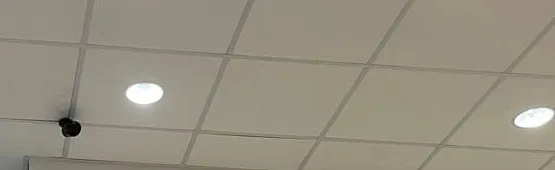
From a past AESS job elsewhere, cropped so only the ceiling shows: a small black camera on a white ceiling grid, with round recessed downlights in the tiles beside it. Under a raised Staten Island house the same idea applies on a smaller scale: a low-profile camera and a separate light, not a big floodlight hanging into the parking space.
Siding, Frame Walls and Built-In Garages
Our house is vinyl-sided — how is a floodlight fixed without cracking the siding or letting water in behind it?
With a mounting block, screwed into the framing, and sealed on the top and sides but not the bottom. Vinyl siding expands and contracts across the seasons and hangs loosely on purpose, so a light screwed straight through it either cracks the panel or pulls it out of line. A mounting block is a molded plastic base made to fit the siding's profile; it is fixed through the sheathing into the studs, the siding is trimmed neatly around it, and the floodlight's plate goes onto the block's flat face. If there is an outdoor box, it sits inside the block; if there is a network cable instead, it comes out through the block and loops down before it goes in, so water drips off the loop rather than following the cable into the wall. Blocks come in colors that match common siding. On aluminum siding and on older cedar shingles the same principle applies with a block or spacer suited to that surface.
The garage is built into the front of the house — will headlights pulling in blind a camera over the garage door?
They can, for a few seconds every time, which is why the camera usually should not sit directly over the garage door. A car pulling into a built-in garage drives straight at that wall with its headlights on, and a camera looking down the driveway from above the door stares into them; the picture washes out exactly when the car and its driver are closest. Moving the light and camera to the side of the house, at the corner, lets the camera look across the driveway at an angle, so the headlights pass across the frame instead of into it, and it sees the driver's door and the person getting out. On a high-ranch the side position also keeps the light away from the bedroom window above the garage. If a light over the garage door is wanted for convenience, it can be a plain motion light, with the camera elsewhere.
On a semi-attached house, should the floodlight go on the shared-driveway side or the open side?
Usually the open side, looking back along your own driveway, unless your driveway is the shared one. The wall beside a shared driveway is close to the neighbor's car, their side door and often their kitchen window, so a floodlight there lights and records their life as much as yours. A light on your outer wall, or at the back corner looking toward the street, covers your own driveway and side door with the neighbor's side at the edge of the frame, where it can be masked. If the two houses genuinely share one driveway, the best result is usually one agreed light in a neutral spot, with both families seeing the camera in their own apps and the arrangement written down.
When the Streetlight Is Out
The streetlight on our block has been out for weeks — should our floodlight stay on all night until the city fixes it?
Usually not, though it can make sense for a short while at the driveway. A floodlight on all night lights the front of your house and the street, which is welcome when the pole outside is dark, but it also lights the bedrooms across the road, and once the streetlight is back, it is the kind of light neighbors complain about. A better compromise is a lower brightness all night only on the driveway light, with the brighter motion setting still in place for the rest of the house, and a reminder to switch back once the pole is fixed. Many floodlight apps allow a schedule plus a motion boost, so the light sits at a gentle level and jumps to full brightness when someone steps onto the drive. The camera benefits either way: a little steady light means it records in colour instead of switching to infrared.
How do we get the dark streetlight repaired, and can our camera help prove how long it has been out?
Report it to 311 with the pole number if you can read it, and keep the complaint number. The Department of Transportation told the Staten Island Advance in October 2026 that every reported outage is assessed within 10 days and that its average time to close a repair request this year was 15 days, while residents described waits of a month or more, and the Borough President's office blamed delayed contracts with private repair crews. If your camera sees the street, its night recordings show the dark pole and the date and time on every clip, which is a simple, factual record to attach when you follow up with 311 or your Council Member. It also shows whether your own floodlight is the only light on the block, which is worth knowing before you decide how bright to set it.
Cars in the Driveway After Midnight
Can a floodlight camera capture the license plate of a car that pulls into our driveway at night?
Sometimes, but do not count on a floodlight camera alone for plates. Plates are small, reflective and usually moving, and a floodlight camera is set wide to see the whole driveway, so at night a plate tends to come out as a bright smear. What a well-placed floodlight camera does capture is the car itself, its colour and shape, and the people getting out of it, which is what a detective will ask for first. If plates genuinely matter, for a long driveway or a business lot, the answer is a second, narrow-view camera aimed at the point where every car must slow down, such as the end of the drive or a gate, with settings tuned for plates. We can add one to the same recorder as the floodlight camera.
What does the precinct actually need from our driveway footage, and how do we hand it over?
A clear clip of the right few minutes, with the correct date and time on it, in a file that plays on an ordinary computer. Before anything happens, check that the camera's clock is right and that clips are kept long enough to be found a few days later; a camera that only keeps a day of motion clips in the cloud can lose the evidence before anyone asks for it. After an incident, note the time, download or export the clips from the app or recorder to a USB stick or your phone, and keep the originals unchanged. Give the officer the times and the file rather than the camera login. Each precinct has its own way of collecting video, so ask the officer how they want it. If your recorder is hard to export from, we can do it for you on a service visit.
We park work vans in the yard overnight — how do we light underneath them for catalytic converter thieves?
You cannot light underneath a van, but you can light the ground around it and make sure nobody can lie beside it unseen. Catalytic converter thieves work low, between vehicles and against walls, usually in a few minutes. CBS New York reported in July 2022 that more than 250 catalytic converters had been stolen on Staten Island that year by mid-July, when police held an etching event in Graniteville. For a yard of vans, the floodlights go high and wide, lighting the gaps between vehicles and the ground along the fence rather than the roofs; vans are parked with space between them, not nose to tail against a wall; and the cameras are mounted so at least one sees each side of each vehicle at ground level. Motion alerts are set for the hours the yard is empty, so a person crouching between two vans triggers a notification while they are still there.
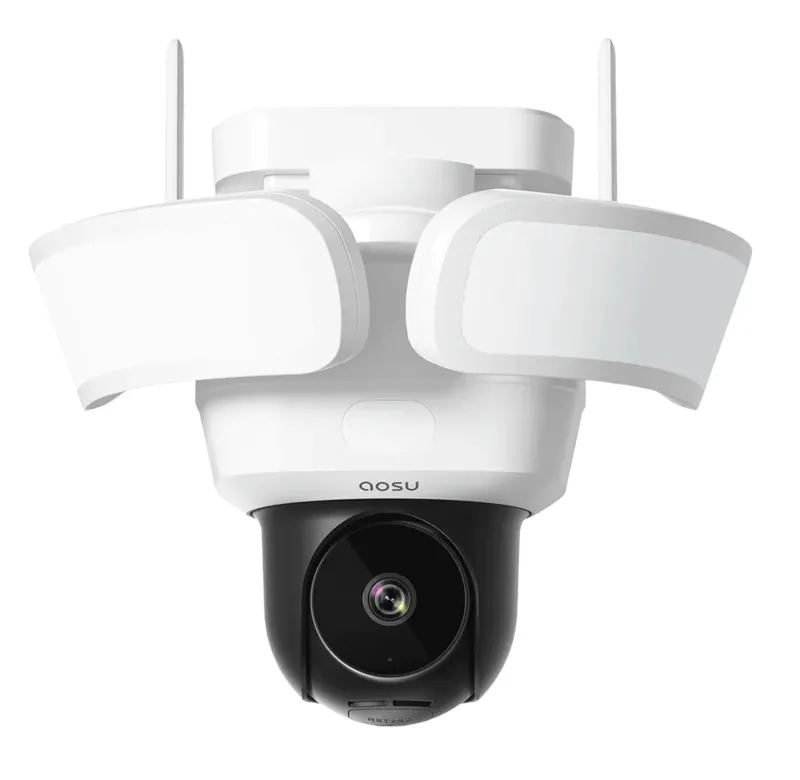
Manufacturer product photo (not an installed unit): a white aosu floodlight with two curved light panels, two upright Wi-Fi antennas and a black pan-tilt camera dome below. A turning head earns its place on the corner of a detached Staten Island house where one wall looks at both the driveway and the side yard.
Hills, Woods and the Greenbelt Edge
Our back yard ends at the Greenbelt woods — how far toward the trees should the light reach?
To the edge of your lawn, and not into the woods. The Greenbelt is about 2,800 acres of parkland, wetland and forest running through the middle of the island, and many houses in Todt Hill, Emerson Hill, Willowbrook and Bulls Head back right onto it. A floodlight aimed into the trees lights trunks and leaves that move all night, so the camera's motion detection goes wild, and the light carries a long way into an otherwise dark park. What you actually need to see is the back of the house, the steps, the patio and anyone crossing the lawn from the tree line. So the heads point down at the yard, the motion zone ends a few feet short of the trees, and the brightness is set for the lawn. The woods stay dark and the footage stays useful.
Our house sits well above the street — can a light at the top still show who is at the bottom of the steps or the gate?
It can light them, but a camera looking steeply down a long slope sees the tops of heads. On the hills of Grymes Hill, Todt Hill and parts of the North Shore, houses often sit well above the road with long stairs or a winding drive between. A floodlight at the house corner lights the top of the drive and the front door well; the gate or the bottom of the stair may be too far below to identify anyone. The usual answer is two levels: the main light at the house, and a smaller light-and-camera lower down near the gate or the bottom step, looking up or across at faces. Power for the lower one is often the tricky part, and a network cable run along the stair or the drive can carry both power and video in one line.
Victorian Porches on the North Shore
Our Victorian has a deep wraparound porch — can the light hang from the porch ceiling instead of the wall?
Often that is the best place for it. A porch ceiling is level, sheltered from rain, close to the front door and usually already has a fixture box for a ceiling light, so a compact light-and-camera there lights the door and the steps evenly without anything on the facade. Floodlight cameras made for walls do not all work upside down, so we pick a model that can be ceiling-mounted or use a separate porch light and a small camera tucked into the corner of the porch ceiling. On a house in the St. George/New Brighton Historic District, which the Landmarks Preservation Commission designated in 1994, or another designated district, anything visible from the street is checked against the Commission's rules before it goes up; a modest fixture under the porch roof is generally far easier than a twin-head floodlight on the front wall.
Lots and Yards Along Hylan, Richmond Avenue and the West Shore
The lot behind our Hylan Boulevard store backs onto houses — who handles a complaint about our lights?
The Department of Buildings, if it gets that far, so it is worth getting the lights right from the start. NYC311 directs complaints about light from a parking lot shining into a neighboring building to DOB, which investigates. Lot lights that cause trouble are almost always floods tilted up to cover more ground, or unshielded fixtures whose lamp can be seen from a bedroom window behind the lot. Fully shielded fixtures aimed straight down, on poles or high on the building, light the lot evenly without throwing light over the fence, and motion-boosted lighting after closing keeps the lot dim until someone walks in. If a neighbor has already complained, re-aiming and shielding is usually enough, and we can show the neighbor the change after dark.
Does a floodlight camera make sense on a large West Shore truck yard, or does that need pole lighting?
A large yard needs both, doing different jobs. A floodlight camera on the building lights and watches the area near the wall well, but its light and its view fade long before the far side of a yard that trucks turn around in. For the open yard, pole-mounted or high building-mounted commercial floods provide the light, fed from the electrical panel, and separate cameras with good low-light performance watch the gate, the fence line and the parking rows, recording to a recorder inside. Floodlight cameras still earn their place over doors, at the gate house and at the corners of the building. We plan the lights and the cameras together so no camera looks straight into a flood.
Lighting Rules Being Debated in Albany and at City Hall
Would the proposed state Dark Skies bill make us switch the floodlight off at 11 p.m.?
Not today, because it is a bill, not a law. The Staten Island Advance reported in March 2026 that the Dark Skies Protection Act, sponsored by State Sen. Brad Hoylman-Sigal, would require outdoor lighting to be off between 11 p.m. and 5 a.m., and that the bill was sitting in the Senate's Environmental Conservation Committee. The exemptions the Advance listed include lighting needed for worker safety, emergency lighting, certain streetlights, and incandescent fixtures of 150 watts or less and other sources under 70 watts. Floodlight-camera LEDs are generally low-wattage — Reolink lists 15 watts for its PoE floodlight — but nobody can say how a bill will read if it passes. A floodlight set to motion-only, aimed down and dimmed, is the arrangement most likely to suit any future rule, and it is the one we set by default anyway.
Does the City Council's 3,000-lumen bill affect a floodlight on a detached Staten Island house?
It would if it passed and the light were bright enough and unshielded. Int. 753, introduced in 2024 by Council Members Robert Holden and Kristy Marmorato, would bar non-government outdoor lights over 3,000 lumens in residential districts unless they are fully shielded, with a $50 civil penalty, and it was referred to the Council's environmental protection committee. The bill is written for residential districts across the city, not for one borough. Some twin-head floodlight cameras are rated above 3,000 lumens at full output. Since nearly every Staten Island house sits in a residential district, we size the light to the lot and use the app's brightness control, which keeps the light useful and well under the line the bill draws.
Equipment
Types of Floodlight Cameras We Install
Brand loyalty is not part of the quote. Below is the hardware that earns its keep on island houses and lots, matched to the spot each one suits.
💡
Twin-Head Wired Floodlight Cameras
The classic driveway-corner unit: a pair of tilting lamps above the lens, wired into line voltage. Right for a detached house that already has an outdoor box, or gets one from the electrician.
🔌
Corded Floodlight Cameras
Plug into an existing outdoor receptacle. Only neat when that receptacle is close by on the same wall, above any flood line, so the cord is short and clipped out of reach.
🌐
PoE Floodlight and Spotlight Cameras
Light, camera and often a siren on one network cable from a PoE switch indoors. The answer for walls with no box and for houses where the switch must stay upstairs.
🔄
Pan-Tilt Floodlight Cameras
A turning camera head under the lights, for a house corner that looks at both the driveway and the side yard of a large lot.
👁
Wide Dual-Lens Floodlight Cameras
Two lenses side by side for a very wide view from one point, suited to a front lawn and driveway on a corner lot.
🏡
Compact Light-and-Camera Fixtures
Lantern-sized units with the lens inside the light. They belong on a stair landing, a Victorian porch ceiling or the beams under a raised house, where a twin-head unit would dazzle.
🏭
Commercial Floods with Separate Cameras
Shielded LED floods high on a building or pole and wired cameras mounted apart, for lots and yards along the commercial corridors and the West Shore.
💾
Recorders, PoE Switches and Backup Power
The indoor half of the job: a recorder once there are three or more lights, a switch with enough power budget for lamps and sirens, and a UPS on the living floor of a raised home.
Ring, ADT and SimpliSafe Compared With a Local Installer
The national names make capable floodlight cameras. Ring publishes step-by-step instructions for mounting its floodlight on a junction box and connecting the black, white and ground wires, and alarm companies such as ADT and SimpliSafe sell outdoor cameras alongside their monitoring plans. If your house has a sound box in the right place, a strong Wi-Fi signal at that wall and no flood-zone rules to think about, the box from the store is most of the way there, apart from the fact that in New York City the wiring itself is licensed work.
On Staten Island the hard parts are elsewhere: a vinyl wall that needs a mounting block, a raised house where the door, the stair and the switch have all moved, a driveway shared with the house next door, a router at the far end of a long ranch, and a block where the streetlight has been dark for a month. A local installer settles those before the box is opened. If you already own a Ring, Nest, eufy, Lorex, Swann, Wyze or other floodlight camera, we install it labor-only. If you want professional monitoring, the floodlight works alongside it, and we will not sign you up for a monthly plan you do not need.
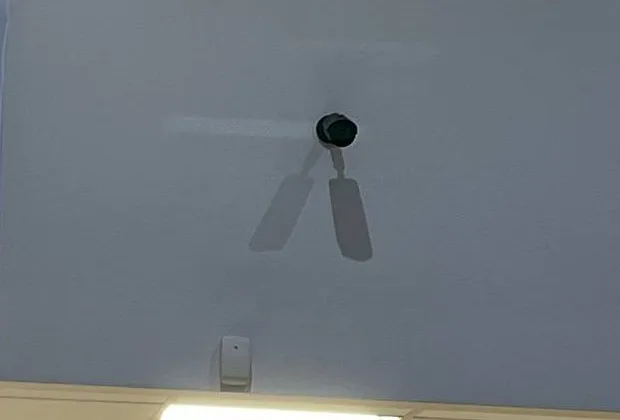
Taken on an earlier AESS installation off the island and cropped to show only the wall: one small black camera, two lights shining on it, two distinct shadows below. Two lights from two directions is exactly what a floodlight camera's twin heads do to everything in the frame, which is why the heads are aimed before the camera view is set.
AI Overview Reality Check
What AI Gets Wrong About Floodlight Camera Installation in Staten Island
Our research tools had no way to load Google's AI Overview for this search, so instead we tested seven statements that cost guides, camera makers and how-to sites print, since those are what AI summaries are built from. All seven are reasonable somewhere. On a Staten Island house each one needs adjusting.
1. “Most floodlight projects cost between $250 and $800”
A national cost guide from Inch Calculator (2023 update) quotes $250 to $800 for most jobs, about $450 on average, labor of $150 to $350 a light and new cable at $2 to $4 a foot; a camera-install blog reckons an electrician charges around $650. The assumption buried in both is an easy wall, with a box already there or a short run to reach it.
On Staten Island the spread comes from the house, not the light. A floodlight onto a sound existing box on a detached house is $330 to $633 with us, in line with the guides once the city's bridge-and-travel multiplier is applied. A wall with no power, a raised house where the circuit has to come from the living floor, or a long driveway with the garage at the far end moves the job to $633 to $1,650.
The figure worth knowing before you budget is whether power already reaches the spot where the light should be, and whether the house is above or below the flood line. A photo answers the first; the elevation certificate, if you have one, answers the second.
2. “Permits may or may not be required”
National guides list permits at $20 to $100 and say they may or may not be needed, depending on where you live. That is true across the country, and it is why so many owners assume a floodlight swap needs nothing at all.
Inside the five boroughs there is no maybe about it. DOB requires a permit and a licensed master electrician for any electrical installation or change; swapping up to five fixtures on existing outlets is the lighter minor-work category, permit and electrician still required, inspection not. Adding an outdoor box or circuit is full electrical work that DOB inspects.
So on a Staten Island house the question is which kind of permit, not whether. Our written quote marks which parts of the job fall to a licensed electrician and which are low-voltage work under our license, so the permit is not a surprise later.
3. “Mount it about nine feet above the ground”
Nine feet is Ring's suggested height for its floodlight camera, with the motion sensor level, and AI summaries repeat it almost word for word. On a flat suburban lot that is a fair default.
On a house raised after Sandy, nine feet above the ground may be the underside of the living floor or the middle of the stair. On a high-ranch, nine feet over the driveway is right under the upstairs bedroom window. On a hillside lot, the ground in front of the light may be ten feet lower than the ground beside the house.
We start from what the camera has to see — the door at the top of the stair, the driver's side of a parked car, the back steps — and pick the height that does that, then check that the motion sensor still sees someone walking up the drive.
4. “If there is no junction box, plug it into an outdoor outlet”
Where a wall has no box, how-to sites suggest a plug-in kit: run a weatherproof cord from the light to a ground-fault-protected outdoor receptacle and you are done, no electrician involved. The same sites admit the cord resists rain but not a cut or a yank.
On many Staten Island houses the only outdoor outlet is low on the wall by the back door, or on a raised house under the living floor in the space meant to flood. A cord climbing a storey of siding to reach the light, or dangling into the parking space, is neither tidy nor durable, and an outlet below the flood line is not where a permanent device should depend for power.
Corded models are a good answer where the outlet is on the same wall, above the flood line, close to the light. Otherwise a network-powered camera running from a switch upstairs gives the same no-new-circuit advantage with a cable that can go inside the wall.
5. “Choose a spot with a strong Wi-Fi signal”
Arlo's installation guide advises picking a location with a strong Wi-Fi signal, which is good advice that most AI summaries leave out. A floodlight camera sends a lot of video, and a weak signal means late alerts and missing clips.
The trouble on Staten Island is distance rather than brick. A long ranch or a high-ranch puts the router at one end and the driveway light at the other, a raised house puts the router a storey above the light, and a detached garage at the back of a deep lot can be well out of range. The phone in your hand at the front door tells you little about the signal at the side of the house.
We test the signal at the exact mounting point with the house's own network. If it is weak, the choice is an outdoor access point or a mesh node near that wall, or a network cable that removes the question entirely.
6. “A single network cable powers the light and the camera”
Makers of network-powered floodlight cameras describe them as using one cable for power and data; Reolink, for example, lists its PoE floodlight model with an 1,800-lumen light running on that single cable. That is accurate, and it is one of the most useful things a floodlight can do.
What the spec sheet leaves out is the route. On a frame house the cable has to get from the switch indoors to the outside wall through framing, insulation and siding, and on a raised house it has to do that without sending the switch down to the flood-prone ground floor. A cable that simply hangs down the siding to a hole drilled at the bottom invites water in.
Done properly, the cable goes from a switch on the living floor through a sleeved, sealed hole in the rim joist or wall, out through the mounting block, with a drip loop under the light. It is one cable, but the route is the job.
7. “The brighter the floodlight, the better it deters”
Floodlight cameras are sold on lumens, and a common claim is that the brightest light is the best deterrent. Lorex lists one Wi-Fi floodlight with two 2,000-lumen light arrays; many twin-head models are in the same range.
On a Staten Island street of detached houses thirty or forty feet apart, a light that bright on all night lights the bedrooms across the road. It is also the target of two bills: a City Council proposal, Int. 753, to bar unshielded residential lights over 3,000 lumens, and a state Dark Skies bill that would switch most outdoor lighting off between 11 p.m. and 5 a.m. Neither has passed, but both point the same way.
What actually deters is a light that switches on the moment someone steps onto the driveway, at a brightness that lets the camera record a face in colour, and that then goes off again. We set lights to motion with a modest brightness, and turn them up only as far as the camera needs.
Light the Driveway, Not the House Across the Street
A picture of that side of the house plus a close-up of the wall is enough for a first answer: which way the power comes, which corner suits your type of house, and what it costs on the island, all before a van is booked.
Five details turn into a price: your neighborhood and house type, the side you want lit, what hangs on that wall now, whether the house was lifted after Sandy, and whether the camera is already in a box in your garage. Attach a picture if you can. Expect a written figure by the end of the business day, or ring (347) 934-8335.
✅
Request Received
It reached us. A technician will study your photos and the layout of the lot and phone you back today. For anything urgent, dial (347) 934-8335.
How It Works
Our Installation Process
Seven steps on every Staten Island floodlight, from a single light over a Westerleigh garage to a set of lights on a raised house in Ocean Breeze. The first three decide most of the price.
1. Photos of the house, not just the wall
Two photos tell us most of what we need: the side of the house from the street or the end of the driveway, and a close-up of whatever is on the wall now. From those we judge the siding or masonry, whether there is a box, and whether the house is raised.
2. Walk the lot with the owner
On site we walk the driveway, the side yard and the back to the fence or the tree line, note the neighbors' windows and the street light, and agree on what the light must show and what it must not.
3. Pick the power route
Four ways to get electricity to the light: reuse a box that passes inspection, bring a PoE cable out from a switch inside, plug a corded unit into a receptacle on that wall, or have a licensed master electrician add a box and circuit under a DOB permit.
4. Price it in writing
Before a date is set you receive the plan on paper: which light, mounted where, how power and video reach it, whether an electrician files a permit, and the island price.
5. Mount on a proper base
On siding the light goes on a mounting block fixed to the framing; on masonry into sound brick or block; under a raised house onto the framing, with every entry sealed and dripping away from the hole.
6. Aim, zone and connect
Lamp heads are turned down onto the owner's ground, brightness and timer are set, motion zones end at the lot line, and the camera joins Wi-Fi, a switch or a recorder.
7. Check it after dark
Somebody walks up the driveway while the camera records, the glare is judged from the sidewalk and the neighbor's side, and every adult in the house gets the app and alerts on their own phone.
Manufacturer product photo (not an installed unit): a rounded lamp and a flat rectangular lamp on arms above a wide camera body with two lenses. Two lenses side by side give a wider view from one mounting point, which suits a front lawn and driveway seen from the corner of a house.
Coverage Area
Floodlight Cameras Near Staten Island's Landmarks
Woods, shoreline, a historic hilltop, a mall, a landfill turned park and a logistics yard: the island's range of property in six places.
Staten Island Greenbelt
About 2,800 acres of connected parkland, forest and wetland in the middle of the island, bordered by Todt Hill, Emerson Hill and Willowbrook houses whose back yards meet the trees.
East Shore seawall line
The roughly five-mile seawall planned from the edge of Fort Wadsworth, just south of the Verrazzano-Narrows Bridge, to Oakwood Beach — the stretch of raised and rebuilt houses behind Father Capodanno Boulevard.
St. George/New Brighton Historic District
Designated by the Landmarks Preservation Commission in 1994; large Victorian houses with porches on the hills above the ferry, where fixtures visible from the street follow the Commission's rules.
Staten Island Mall, New Springville
Opened in August 1973 on Richmond Avenue at Richmond Hill Road, at the center of the island's biggest stretch of retail lots.
Freshkills Park
The former Fresh Kills landfill, now a 2,200-acre park in the making on the West Shore, where 360 acres of wetland are being restored.
Matrix Global Logistics Park, Bloomfield
A 200-acre logistics park on a former oil-tank site, one of the West Shore yards where lighting is planned around trucks, gates and fence lines.
We also install floodlight cameras in Tompkinsville, Stapleton, West Brighton, Port Richmond, Mariners Harbor, Elm Park, Sunnyside, Grymes Hill, Westerleigh, Castleton Corners, Dongan Hills, South Beach, New Dorp, Bay Terrace, Great Kills, Eltingville, Annadale, Huguenot, Prince's Bay, Tottenville, Rossville, Charleston and Graniteville.
Pricing
Floodlight Camera Installation Cost in Staten Island
Staten Island prices are our Brooklyn base figures multiplied by 1.10, the area multiplier that covers the bridge and the travel across it, rounded to the nearest dollar. They are installation prices; the floodlight camera is extra unless it is part of a package, and local-storage cameras have no monthly fee.
Job
Staten Island price
What moves it
Swap a porch or garage light for one floodlight camera on its existing box
$330–$633
A siding block cut in or not, how tall the ladder must be, a tired box or switch, the electrician's minor-work permit, and the phone setup
New power where there is none (one floodlight camera)
$633–$1,650
The route — network cable, outlet or new box and feed — how far the switch or panel is from the wall, and on raised houses the run from the living floor
Two to four floodlight cameras (driveway, side door, back steps, garage)
$1,430–$4,180
How many need new power, whether a recorder is added, and the distance between the lights
Floodlights within a full camera system
Quoted after a walk-through
Big lots, two-families, stores and yards where floodlights join other cameras on one recorder
Service visit after installation
$195 an hour, 3-hour minimum ($585)
Later changes: moving or re-pointing a light once the job is signed off, or adding devices
The multiplier is the same one we use for every service on the island, and it is already in the figures above — there is no separate toll line or travel charge added to the invoice. It reflects the time a crew spends crossing the Verrazzano and the distances between jobs on an island of detached houses, where a morning can mean a raised house in Midland Beach and an afternoon at a hillside driveway in Grymes Hill.
What raises a Staten Island price. A raised house where the power and the network have to come down from the living floor. Vinyl or aluminum siding that needs a mounting block cut in. A light at the top of a long stair or high on a hillside wall. A garage at the back of a deep lot, or a gate at the bottom of a slope. A business lot that needs shielded commercial floods on the building.
What keeps it down. An existing outdoor box in the right spot with a switch you can leave on. An outdoor outlet on the same wall, above the flood line. A switch or recorder with a spare port already in the house. Choosing a network-powered camera where a modest light is enough, and doing two or three lights in one visit instead of one at a time.
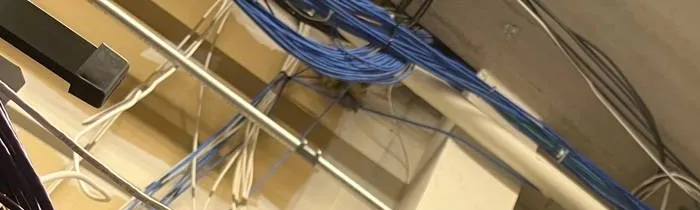
Photographed on another AESS project, not on the island, and cropped to the ceiling: bundles of blue and white network cable running along a metal rod and a white pipe. A single cable of the same kind can carry both power and video to a network-powered floodlight camera on the outside of a Staten Island house.
Shop Our Systems
Floodlight Camera Packages & Pricing
Most island jobs land in one of these three bands. The survey decides where in the band yours sits.
Driveway Swap
$330–$633
A floodlight camera where a light already is. The garage or side-door light comes down, the switch and box are tested, a siding block goes in if needed, and the new unit is sealed, pointed down the drive and zoned to your lot line, with alerts on your phone. For detached and semi-attached houses.
New-Power House Light
$633–$1,650
A floodlight camera on a bare wall. Power arrives by whichever route the house allows — PoE from an indoor switch, a cord to a nearby receptacle, or an electrician's new box — and every hole is sleeved and sealed. Typical on stair landings of raised homes and on blank siding.
Whole-Lot Set
$1,430–$4,180
Between two and four lights, planned together. The drive, the side entrance, the rear steps and the garage, placed so no lamp shines into another unit's lens, optionally all saved to one recorder on the living floor. For two-families, bigger lots and small businesses.
Bought the floodlight already? Labor-only installation
Already carried one home from a Richmond Avenue store or had it delivered? Labor-only fitting uses the same island price bands. Send the model number first, so we can confirm the plate suits your siding, what kind of power it expects and whether your recorder can take its video; plenty of boxed floodlights turn out to suit a different house. Anything you buy yourself is covered by its manufacturer, not by us. The bring-your-own-equipment page explains how labor-only work is priced.
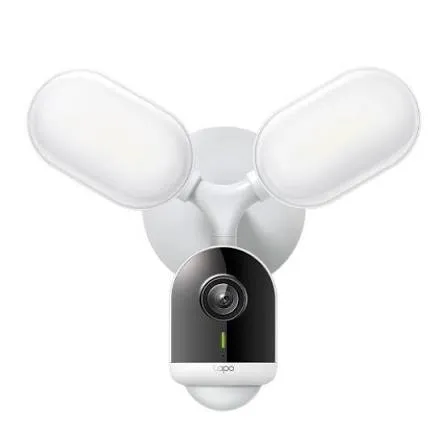
Manufacturer product photo (not an installed unit): a white Tapo floodlight camera with two oval lamps on a forked arm above a camera with a black face. Compact units like this fit the narrow wall beside a porch or a stair landing on a raised house.
Get the Staten Island Floodlight Price in Writing
Start with a picture and five minutes on the phone. Before any appointment you will know the band your job falls in, how power can reach the wall, whether an electrician's permit is involved, and what a lifted house changes.
Network cable from the living floor to the outside walls.
Field Notes
Field Notes: Start at the Curb, Then Climb the Stair
On a Staten Island floodlight visit I start at the curb, not at the wall. From the sidewalk I can see what a stranger sees: which side of the house is dark, where the cars sit, whether the streetlight outside actually works, and which windows across the street a bright light would hit. Then I walk the driveway to the back, to the fence or the tree line, and look back at the house.
On a raised house the second stop is the stair. I climb to the landing and look down at the driveway and the space underneath, because that is where the main light usually ends up, and I find out where the power and the network now live on the living floor. On a sided house the second stop is the wall itself, to see whether there is a block, a box or nothing, and how the siding is hung.
The third stop is inside. On a two-family or a high-ranch I ask who will use the app, who should be able to change the light, and which bedroom sits closest to the driveway, because the person who sleeps above the garage is the one who will notice a light that switches on every time a car goes by. Those answers decide the motion zone and the timer before the light is even mounted.
Before I leave, ideally once it is dark, I cross the road and stand on the opposite sidewalk. Seeing the glowing lamp from there means the heads still need tilting. — Owner, NYS low-voltage license #12000287431
FAQ
Staten Island Floodlight Camera Installation FAQ
We are about to raise or renovate the house — should the floodlight go up now or wait?
+
Usually wait for the part of the job that changes the wall, and light the gap in the meantime. If the house is going to be lifted, re-sided or have its stair rebuilt, anything fixed to the outside now has to come down again, and the outdoor box it sits on may move. What we often do instead is a temporary arrangement: a plug-in or network-powered camera with its own light on a bracket that can be unscrewed in minutes, so the property is watched while it sits empty or half-built. When the contractor has finished the wall, the permanent light goes where the new stair, door and driveway actually ended up. Tell us the contractor's schedule and we plan around it.
Will our homeowner's insurance company give us anything for a floodlight camera?
+
Possibly, but only your insurer can say, and many treat cameras differently from a monitored alarm. Some insurers offer a small discount for security devices, some only for a monitored burglar or fire alarm, and some offer nothing for cameras alone. Call your agent before you buy, ask what they need to see, and keep the invoice that lists the equipment and the installation date. What a floodlight camera does give you with any insurer is clear footage and a time stamp if you ever have to make a claim, which can make the claim itself easier.
What does a floodlight camera need each year to keep working well?
+
Very little, but not nothing. Once or twice a year the lens and the lamp covers need a gentle wipe, because road grime, pollen and on the shore a film of salt dull the picture long before anything breaks. Spiders love the warmth of the lamp heads, and a web across the lens is the most common cause of a camera that suddenly records all night. Firmware updates should be left on automatic or checked in the app every few months. It is also worth checking after a big storm that the heads are still pointing where they were set and that the seal around the box is intact. Our maintenance visits cover all of this for owners who would rather not climb a ladder.
Can a floodlight be fixed to the gutter or the roof eave instead of the wall?
+
Not to the gutter itself, which is not built to carry the weight or keep a camera steady, but often to the eave or soffit above it. On many Staten Island houses the soffit is the highest solid surface near a driveway, and a light there looks down at a good angle. The fixing has to go into the framing behind the soffit, not just the vinyl or aluminum panel, and the box or cable entry has to be sealed so that water running off the roof cannot follow the cable inside. Some floodlight cameras are designed for eave mounting and some only for walls, so we check the model before choosing the spot.
A neighbor's floodlight shines into our bedroom — what can we actually do about it?
+
Start with a polite conversation, ideally with a suggestion attached, because most bright lights are simply aimed level or set to stay on all night by someone who never stood on the other side. Offer the easy fixes: tilt the heads down, switch the light to motion-only with a short timer, lower the brightness in the app. If it is a business parking lot rather than a house, the city's 311 service says light from a parking lot shining into a neighboring building can be reported to the Department of Buildings. For one house lighting another there is no simple city rule to point to today, so a friendly fix is usually faster than a complaint.
How long does a floodlight installation take on a typical Staten Island house?
+
A straight swap onto a sound existing box usually takes a couple of hours, including the app setup and aiming. A network-powered light with a new cable run from the basement or the garage takes most of a morning, depending on how the cable gets out of the house. A new outdoor box and feed involves a licensed electrician and a permit, so it is split into a survey visit and an installation visit rather than done in one go. Two to four lights on one house is usually a full day. We give you the expected time with the written quote.
If we replace our siding later, will you take the floodlight down and put it back?
+
Yes, and it is worth arranging before the siding crew arrives rather than after. A siding contractor will often unscrew a light and leave it hanging, or cut around it, and either way the seal behind the plate is lost. We take the floodlight down, cap and protect the box or cable, and come back when the new siding is on to fit a proper mounting block and reinstall the light, re-aimed for the new surface. If the siding job is the moment to move the light to a better spot, it is also the cheapest moment to run a new cable, because the wall is open.
What happens to our floodlight camera if the company behind its app shuts down or changes its plans?
+
It depends on where the video lives. A camera that records only to the maker's cloud is at the mercy of that company's plans and prices, and if the service ends, the camera may stop recording or lose features. A camera that records to its own memory card or to a recorder in your house keeps working as a camera and a light even if the app changes, though remote viewing can still be affected. That is one reason we lean toward models with local storage or a recorder, and toward network cameras that follow open standards a different recorder can read. The light itself keeps working either way.
The previous owner left a floodlight we do not want — can you take it down and make the wall good?
+
Yes. We take the old unit down, check whether the box behind it is still in use and safe, and either fit a blank weatherproof cover or a plain outdoor light in its place. If the old floodlight was wired in, disconnecting it permanently and blanking the box is electrical work for a licensed electrician in New York City, and we arrange that. On vinyl siding the mounting block usually stays, because removing it leaves a hole, and it can carry a plain light or a cover. Before anything comes down, we reset the old camera so the previous owner's account no longer has access to it.
Will a floodlight camera slow down our home internet?
+
It can, mostly when it uploads. A camera that sends high-resolution clips or a continuous stream to the cloud uses your upload speed, which on many home plans is far lower than the download speed you pay attention to. One or two cameras sending motion clips rarely matter. Four or five cameras streaming all night to the cloud can make video calls stutter. Recording locally to a card or a recorder, and only sending alerts and short clips out, keeps the load small. We check your plan's upload speed during the visit and set the recording to suit it.
All Areas Served
Floodlight Cameras Across New York City, Long Island and the Hudson Valley
Staten Island is one of five borough pages under the NYC floodlight camera hub; Long Island and the Hudson Valley counties have pages of their own.
Each figure, rule, bill, product statement and news item above is linked here to where we read it. AESS prices are the Brooklyn floodlight base times the 1.10 Staten Island multiplier, plus the standard hourly service rate.
Whether the driveway stays black when you pull in, the camera vanishes from your phone at night, or the family across the road wants the glare gone, (347) 934-8335 gets you the earliest open slot. Most island repairs are finished one to two hours after the van arrives.
Staten Island Floodlight Cameras From a Licensed, Insured Crew
Abstract Enterprises Security Systems · 1282 Troy Ave, Brooklyn, NY 11203 · call or text the island number, (347) 934-8335 · or send photos on WhatsApp (718) 679-0359
Our customers rate us 4.7★ over 390+ Google reviews. Every Staten Island crew is insured, works under New York State low-voltage license #12000287431, and leaves a written estimate the day of the survey.
Each floodlight, camera and recorder also keeps the warranty its maker gives. Full terms — including 50% deposit, the 30-day warranty and optional paid extended warranty, and the late-fee schedule — are set out in the service agreement. See our warranty page.
Page reviewed and updated October 18, 2026. Changelog: Staten Island floodlight camera page rebuilt from new research on detached, semi-attached and raised houses, Build It Back elevations and the city's flood-zone building rules, siding mounting, driveway car theft and South Shore break-ins, streetlight outages, the Greenbelt edge, North Shore historic districts, commercial lots on Hylan Boulevard and Richmond Avenue, and the state and city outdoor-lighting bills, with prices set by the Staten Island area multiplier.