Farms · Warehouse Yards · Village Main Streets · Homes · NYS Licensed
Security Camera Maintenance in Orange County
After the Storm · Before the Snow · Between the Long Drives
Out here a camera system is rarely worn down by the street in front of it. It is worn down from above and through its wires: a summer thunderstorm that kills the barn camera but spares the house, a nor'easter that drops the power for a night and leaves the recorder confused, a January storm that buries the driveway camera under a white blanket for two days. Our Orange County maintenance plans are timed around those seasons — a spring check before the storms, a sweep after the bad ones, a fall check before the snow — with health alerts that keep watch in the long weeks when no technician is on your property.
Reviewed and updated October 18, 2026 · Abstract Enterprises Security Systems, owner, NYS license #12000287431 · Hudson Valley direct line (845) 640-3835 · Office: 460 E Fordham Rd, Bronx, NY 10458
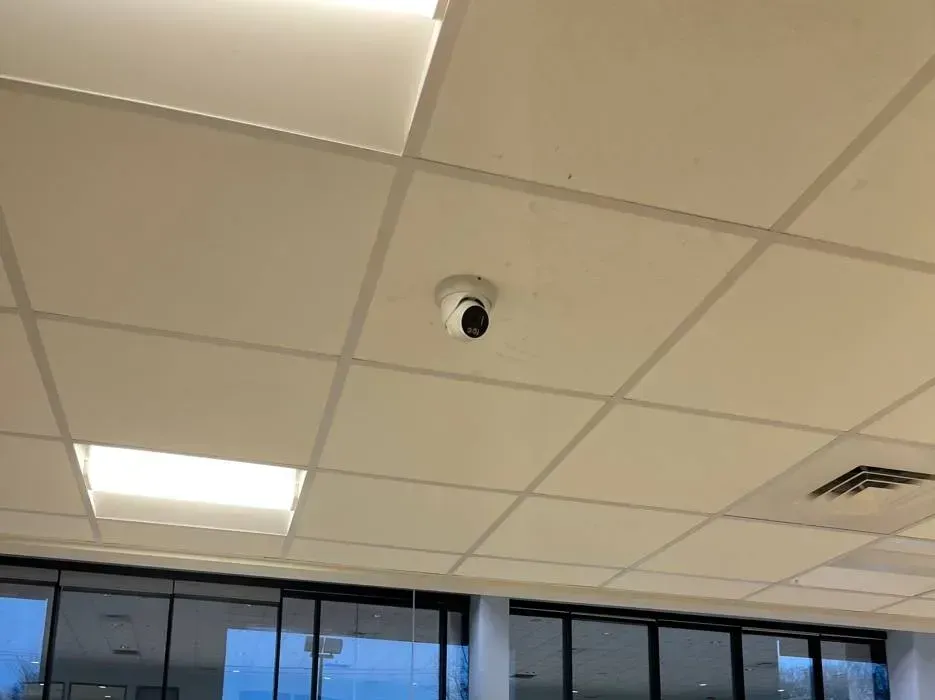
Example photo from another AESS job (not an Orange County property): a ceiling camera watching a row of glass doors. Cameras like this are cleaned and aimed on every visit; on a storm-season plan the recorder and switch they depend on get the closer look.
Orange County Camera Maintenance Quote
Cameras, outbuildings, power company — a written number comes back today
✅
Request Sent!
Keep your phone close — we call back about your Orange County cameras before the business day is over.
25+
Years Experience
✓
Same-Day Estimates
100%
Licensed & Insured
4.6★
390+ Google Reviews
Tell us how far your furthest camera is from the recorder. In Orange County that one number predicts more trouble than any other: a camera on a barn, a gate post or a yard pole hangs off a long outdoor cable, and long outdoor cables are where storm surges get in. Text the camera count, a photo of the furthest view and the name of your power company to (845) 640-3835 and we will tell you which parts of the system need a pre-storm check.
Orange County tune-ups run $210–$490 for a home or small system; scheduled plans start at $280 a year
Every visit ends with a dated log of surge, power, picture and recording checks
Same-day written estimates, under NYS license #12000287431
Why Orange County Properties Need Security Camera Maintenance
Ask an Orange County owner when their cameras last failed and the answer is usually tied to a date on the weather calendar rather than to anything that happened on the property. "The night of that thunderstorm." "After the snow in January." "When the power went out over the long weekend." That pattern is not a coincidence. When Earth Networks counted lightning across New York State for its 2020 report, Orange County topped the table with 275,059 lightning pulses and 41 thunder days — ahead of Delaware County and Suffolk County, the next two on the list. A camera system is a web of copper running from cameras at the edges of a property back to one recorder, and copper on the outside of buildings is exactly what lightning-induced surges travel along.
Power is the second half of the story. Depending on the town, an Orange County property is fed by Orange & Rockland, Central Hudson or NYSEG — all three utilities serve parts of the county, according to the state Department of Public Service's list of utilities by county. O&R reported that more than 47,000 of its customers were affected between July 1 and July 6, 2026 by heat, thunderstorms and heavy rain, and on the afternoon of July 6 it still listed outages in the Town of Warwick and the Town of Goshen. Two and a half months later a slow-moving nor'easter cut power to well over 20,000 Central Hudson customers, and on September 27 the company said the greatest remaining impacts were west of the Hudson, in Ulster and Orange counties. In Washingtonville, a resident posted on r/hudsonvalley in February 2026 that since the second half of 2025 "it feels like my house has a brown out every month." Every one of those events is a test of the battery behind the recorder, the power supplies behind the cameras and the clock inside the recorder.
Then comes winter. In late January 2026, News 12 reported that Monroe saw about 18 inches of snow — the most in Orange County — and county officials said some areas reached 24 inches; days later, private crews in Cornwall were still clearing piled-up parking lots. Snow does not just sit on cameras. It is followed by plows and road salt (the state DOT reported a statewide average of 172 pounds of granular salt per lane-mile in the 2024–25 season), by melt that runs down cable into junction boxes, and by freezing nights that put the most strain on cameras with built-in heaters. The Wallkill River, which drains 382 square miles — nearly half the county, according to the Warwick Valley Dispatch — floods low-lying fields in the Black Dirt region when the ground is saturated, and in July 2023 roughly nine inches of rain fell on Highland Falls in a storm the governor called a "1,000-year event".
Finally, distance. A farm outside Pine Island, a distribution building off Route 17K, a house up a long driveway in Tuxedo or Deerpark: these places are a long drive from any technician, including us. A camera system that quietly fails in March and is found in June has been useless for a season. That is why maintenance here is built around three things — protection against surges, proof that the system survives an outage, and alerts that report a dead camera on the day it dies — with the cleaning and aim checks fitted around them. Owners who keep their cameras on a schedule often have the same visit look over their alarm system or the door access system that shares the same battery backup.
Orange County facts that shape a camera maintenance schedule
Top lightning county in New York in 2020. Earth Networks' state report recorded 275,059 lightning pulses and 41 thunder days in Orange County, the highest pulse count of any New York county that year.
Three electric utilities. Orange & Rockland, Central Hudson and NYSEG all serve parts of the county. On July 7, 2026, News 12 counted 1,330 Orange County customers still without power after the holiday-weekend storms — 1,102 on O&R and 228 on Central Hudson.
Heavy snow. About 18 inches fell on Monroe in the January 2026 storm, with up to 24 inches reported in parts of the county.
A river that drains half the county. The Wallkill drains 382 square miles through 69 tributaries, and its floods reach the Black Dirt farm fields around Pine Island, roughly 26,000 acres by Edible Hudson Valley's count.
Farms and long lots. The 2022 Census of Agriculture counted 613 farms covering 65,706 acres in Orange County, and two-thirds of the county's homes are owner-occupied, most of them single-unit houses.
A warehouse belt that keeps growing. Amazon's 1,015,740-square-foot building at Routes 17K and 747 in Montgomery was followed by more distribution projects, and in July 2026 Walmart's plans for a 1.5-million-square-foot distribution centre on about 200 acres near Route 17K and I-84 were under review in the Town of Wallkill.
How Orange County's lightning compares
County (Earth Networks, 2020)
Lightning pulses
Thunder days
Orange
275,059
41
Delaware
261,518
45
Suffolk
250,630
59
Cattaraugus
216,148
51
Sullivan
194,514
42
Ulster
182,760
49
Orange had fewer thunder days than several of these counties but the highest pulse count, which means its storms, when they came, were busy ones. For a camera system the number of strikes near the property matters more than the number of rainy afternoons.
Orange County storm and outage record, 2026 so far
When
What happened
What it tests on a camera system
Late January
About 18 inches of snow in Monroe, the most in the county per News 12, with county officials reporting up to 24 inches in places and cleanup still under way in Cornwall days later.
Sight lines past drifts and plough piles, heater power on the coldest nights, ice on housings.
July 1–6
Heat, thunderstorms and heavy rain; O&R reported more than 47,000 customers affected, with outages still listed in the Towns of Warwick and Goshen on July 6.
Surge protection on outdoor runs, battery ride-through, recorder restart after power returns.
July 7
News 12 counted 1,330 Orange County customers still out: 1,102 on O&R and 228 on Central Hudson.
Alerts that report a camera or recorder still dark the morning after.
September 26–27
A slow-moving nor'easter; Central Hudson said the greatest remaining impacts were in Ulster and Orange counties and targeted 95% restoration in Orange by 10 p.m. on the 27th.
Overnight runtime, modem and router power for cloud cameras, wind on pole and arm mounts.
The table is not a forecast; it is a record of one year. But it shows why we build Orange County plans around seasons. Every row is a different kind of stress, and each one lands on a different part of the system.
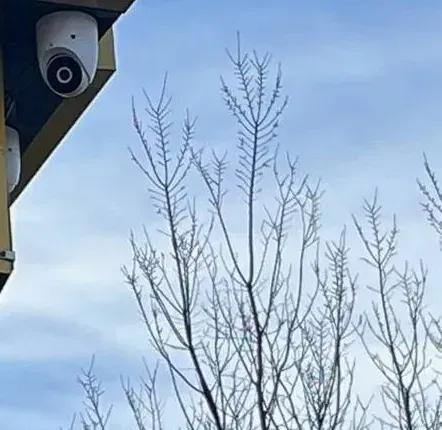
Example photo from another AESS job (not an Orange County property): an outdoor dome tucked under an eave with bare winter branches behind it. Eave cameras catch meltwater and icicles, so their seals and cable entries are checked before the snow.
Cameras Dark After a Storm in Orange County
If part of the grid went black overnight, or the recorder will not start after the power came back, that is a repair first. Call (845) 640-3835; we book the earliest same-day slot we can and most faults are fixed within one to two hours of arrival. Do not keep switching the recorder off and on, and do not unplug and re-plug every cable to "see what happens" — a surge-damaged port can take a good camera with it.
Four things to note while you wait
Which cameras died and which survived. A pattern — everything on the barn, everything on one switch, only the cameras on the long runs — tells the technician where the surge came in.
The exact time the picture stopped. Scroll the playback bar to the last good frame on each dark camera and compare it with when the storm or outage hit.
Any burn smell, scorch mark or dead lights on the switch, the power supply or a surge protector. Photograph them and leave them unplugged.
Whether you need footage from before the storm. If the drive matters for an insurance claim or a police report, say so first; we copy before we repair.
Security Camera Maintenance Services in Orange County
An Orange County maintenance plan buys a mix of the jobs below. A house in Washingtonville needs a different mix from a horse farm in Montgomery or a truck yard near Stewart Airport, and the plan is written around the jobs your system actually needs.
Surge Protector Inspection
Every in-line protector on an outdoor camera run is checked for its status light, its ground connection and signs of heat. Protectors sacrifice themselves to stop a surge; one that has already done its job may be passing the next one straight through.
Grounding and Bonding Check
We follow the ground wire from each protector, pole and rack back to where it ends. Loose clamps, painted-over lugs and ground wires cut by a mower or a plough are found and listed.
Outage Ride-Through Test
We pull wall power from the recorder and switch on purpose and time how long the system keeps recording, then confirm everything comes back on its own when power returns — the way it will at three in the morning in July.
Remote Health Alerts
Camera-offline, drive-error and recorder-offline alerts are set up and tested so the owner's phone hears about a dead camera on the day it happens, not on the next visit.
Winter Readiness
Heater-equipped cameras are checked against the power the switch can actually deliver on a cold night, housings are re-sealed, and cameras that look over a driveway or lot are aimed so plowed snow piles do not block them.
Long-Run Cable Testing
Runs out to barns, gates, pole tops and outbuildings are tested end to end. A run that has been struck, crushed by equipment or soaked in a flooded box often still links up but drops packets or power under load.
Junction Box and Connector Care
Outdoor boxes are opened, dried, re-sealed and checked for corrosion from melt and road salt. Connectors that have started to green are replaced before they fail.
Picture, Focus and Aim
Lenses and domes are cleaned, the night picture is checked, and every view is compared with a reference snapshot taken on the first visit, so a camera knocked by ice, wind or a ladder is caught.
Dated Storm-Season Log
Each visit ends with a written record: protectors checked, ground readings, ride-through time, alerts tested, oldest recording on the drive. After a storm, it is the paperwork an insurer asks for.
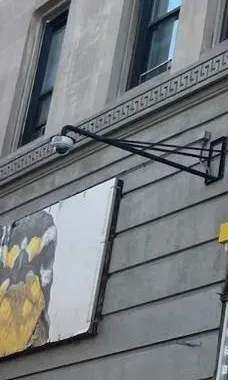
Example photo from another AESS job (not an Orange County property): a dome camera held out from a masonry facade on a long arm. Wind and ice put leverage on an arm like this, so its anchors and joints are tested by hand on each visit.
Building Specialists
Camera Maintenance for Orange County's Architecture
What wears out first depends on how far the cameras sit from the recorder and from the ground rod. Orange County mixes 19th-century brick main streets, post-war ranches, new townhouse developments, farm complexes and giant distribution buildings, and each one ages its camera system differently.
Farmhouses with Barns and Outbuildings
The house has the recorder; the barn, the equipment shed and the gate have the cameras that matter most. Those cameras sit at the far end of the longest outdoor runs on the property, often on a building with its own electrical service, which is the arrangement most exposed to lightning-induced surges. Maintenance starts with the barn, not the porch.
Houses on Long Driveways
Two-thirds of the county's homes are owner-occupied and most are single-unit houses, many set well back from the road in towns like Blooming Grove, Tuxedo and Greenville. The driveway-end camera is the one plowed in, the one on a post, and the one on Wi-Fi at the edge of range.
Village Main-Street Buildings
Brick storefronts with apartments above in Goshen, Warwick, Montgomery, Walden and Port Jervis. The cameras face the street and the rear lot; the recorder lives in a basement or a back office. Older wiring and shared basements mean a power blip in one unit can show up on the camera system in another.
New Townhouse and Condo Developments
Built in the county's last growth decade, with cameras on garages, mailbox kiosks and entrances, often handed over to an HOA with nobody named to look after them. The usual failures are batteries never replaced, alerts going to a developer's old email, and drives that filled up years ago.
Distribution and Logistics Buildings
Very large roofs, very long walls and yard cameras on poles hundreds of feet from the building. Height, distance and constant truck movement turn each maintenance visit into a planned operation with a lift and a yard schedule.
Riverside and Low-Lying Properties
Along the Wallkill, the Delaware at Port Jervis and the brooks that fill during cloudbursts. Junction boxes and recorders below a flood line are the weak points; a maintenance visit moves what can be moved and checks what was under water.
How the work changes from one property to the next
Detached buildings on their own service: we check how the camera cable crosses between buildings, whether it is protected at both ends and whether both buildings' grounds are bonded the way an electrician intended.
Wood-frame houses: eave and soffit cameras move with the seasons; mounts are re-tightened and the cable entry re-sealed so meltwater does not follow the wire indoors.
Masonry storefronts: anchors in old brick loosen; we re-set them in sound brick and check the basement recorder sits above any water line.
Steel warehouse walls and poles: brackets, pole bases, hand-hole covers and conduit seals are inspected, and the pole's ground connection is traced.
HOA common areas: the plan names who receives alerts and reports, so the next board or manager inherits a working system.
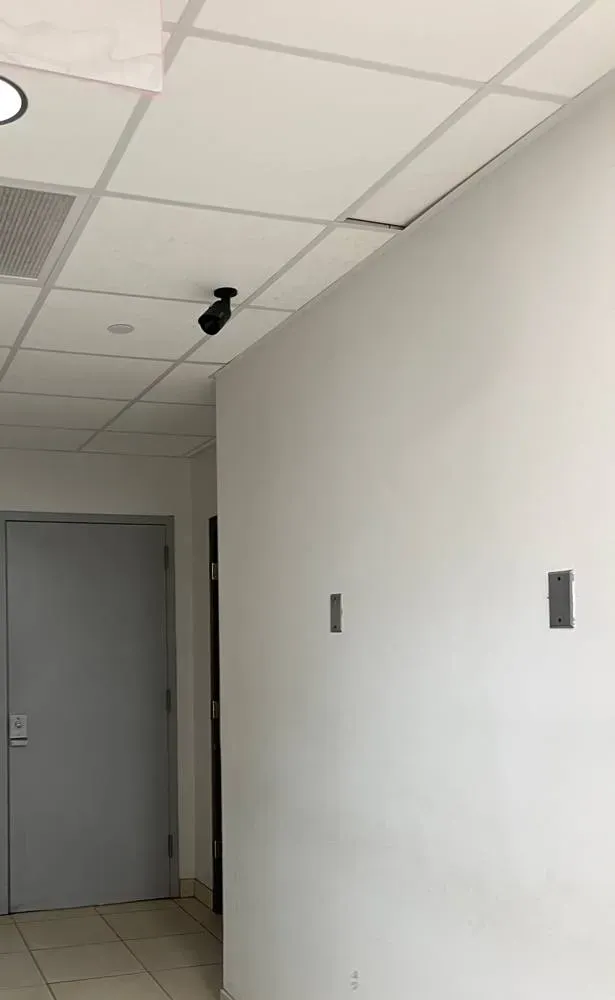
Example photo from another AESS job (not an Orange County property): a bullet camera on a short ceiling mount covering a corridor door, with a stained tile nearby. A stain over a camera is noted in the log so the leak can be traced.
Commercial Security Camera Maintenance
Business Camera Maintenance in Orange County
For a business, the question after a storm is not whether the cameras are pretty but whether they recorded the night everything went dark. These are the Orange County settings where we maintain the most commercial systems, and what each one is hard on.
Route 17K and I-84 Warehouse Corridor
Amazon's building in Montgomery, the Matrix distribution centre across from Stewart Airport with 116 loading docks, the Stewart Logistics Center on Hawkins Drive and the Walmart project under review in Wallkill. Yards lit all night, pole cameras, and recorders that never stop writing.
Woodbury Common, Central Valley
The outlet centre that opened in Central Valley in 1985 and has grown to around 220 stores, plus the hotels, restaurants and gas stations that serve it. Parking-lot cameras on poles, high visitor counts and very little tolerance for a dark camera on a busy weekend.
Middletown and the Route 211 Corridor
Retail plazas around the Galleria at Crystal Run and the medical office campuses along Crystal Run Road in the Town of Wallkill. Big lots, long cable runs to light poles and a mix of camera brands from different eras on the same recorder.
Newburgh's Broadway and Liberty Street
Shops, restaurants and offices on the commercial streets of a city whose East End Historic District alone covers more than 2,200 buildings. Rear-lot and alley cameras in old masonry, and recorders in basements that take on water.
Farm Stands, Orchards and Agritourism
Farm markets and pick-your-own orchards around Warwick and the Black Dirt region, busy in autumn and quiet in winter. Cameras on barns and farm-stand roofs, cable run across fields, and a season where everything must work.
Licensed Cannabis Stores
The Poughkeepsie Journal reported in April 2025 that adult-use dispensaries were opening in Orange County, including stores in Newburgh. Their cameras answer to a state rule with fixed testing and backup-power duties, which makes storm resilience a compliance matter as well as a practical one.
Rules and programs that make upkeep more than housekeeping
Cannabis licensees: under 9 NYCRR §125.3 a dispensary's video must survive an outage of eight hours or more, alert a named representative within five minutes when it fails, hold 60 days of footage and be inspected at least every 30 days with the paperwork kept for five years. Here, where summer storms and nor'easters take down feeders for hours, the eight-hour ride-through is the clause we test hardest.
The District Attorney's camera program: the Orange County District Attorney runs a Video Camera Community Partnership Program in which residents and businesses register their cameras so investigators know where footage may exist. Registration is only as useful as the camera behind it — a registered camera that died in last month's storm is a dead end for a detective.
Electrical work: Orange County Local Law No. 8 of 2007 requires a county-issued licence for anyone working as an electrician in the county, and the City of Middletown runs its own electrical licensing board. New 120-volt circuits, panel-level surge devices and generator connections are electricians' work; we coordinate with yours rather than doing it ourselves. Our camera work is done under NYS license #12000287431.
Written contracts: the county's consumer-law guide to home improvements says contracts over $500 must be in writing, in plain English and signed, and should list the work and the materials. Our maintenance plans are written that way, with each visit's scope spelled out.
Microphones: some cameras ship with audio on, and firmware updates can turn it back on. Capturing a conversation that no participant agreed to is a crime under Article 250 of the Penal Law, so after every update we confirm audio is still off unless the owner has a lawful reason for it.
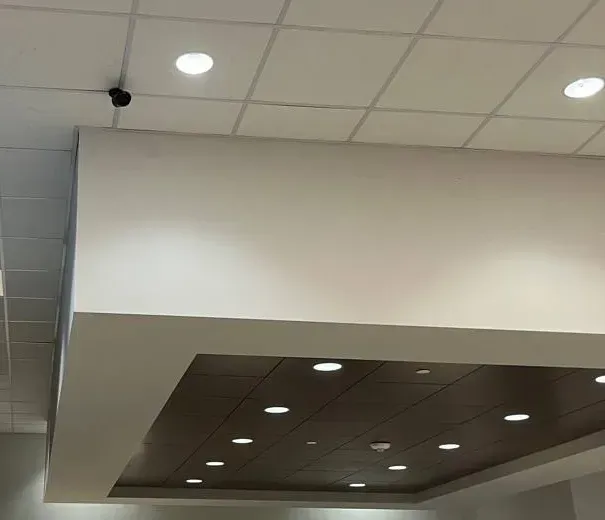
Example photo from another AESS job (not an Orange County property): a small black camera high on a ceiling edge in a commercial space. Cameras this high need a tall ladder or lift, which is why access is planned before a commercial visit.
Maintenance Calendar
An Orange County Camera Maintenance Year
Most maintenance advice is written as a flat list of weekly, monthly and yearly chores. In Orange County the calendar does more of the deciding. The table below is the schedule we build plans around; a licensed business with a monthly testing duty adds its own visits on top, and a property that came through a bad storm gets an extra look whenever it happens.
Season
What the weather does
What the visit checks
Spring (March–May)
Salt season ends, melt runs into boxes and conduit, and thunderstorm season is weeks away.
Surge protectors and grounds on every outdoor run, connectors cleaned of salt, junction boxes dried and re-sealed, battery backup run-time timed, health alerts triggered.
Summer (June–August)
Thunderstorms, heat and the longest outages of the year — O&R's first week of July 2026 is the pattern.
Post-storm sweeps on request: dead ports, latent reboots, recordings across the storm dates, insurance photos of anything damaged.
Fall (September–November)
Nor'easters like the late-September 2026 storm, leaves in gutters and the last chance before the ground freezes.
Heater power against each switch's budget, seals and desiccant, snow-slide and plough-pile sight lines, driveway and pole camera aim, long runs tested before frost.
Winter (December–February)
Heavy snow — about 18 inches in Monroe in January 2026 — ice, wind and salt spray from ploughed roads.
Mostly remote: alerts, drive health and recording checked from our office where you allow it, with site visits for buried, iced or dropped cameras.
The spring and fall visits are the core of a home or farm plan, because they land before the two seasons that do the damage. Commercial plans keep the same two seasonal visits and add monthly or quarterly checks in between, which is where most of the remote review happens. On larger sites, the summer sweep is often booked in advance for the morning after any severe-thunderstorm warning in the county, so the yard and dock cameras are confirmed while the drives still hold the night's footage.
Two things on that list deserve a word. Winter visits are kept short on purpose: climbing ladders on ice is how people get hurt, and a camera that is merely snow-covered usually clears itself within a day or two. And the spring visit is the one owners most often want to skip, because nothing looks wrong after a quiet winter. It is also the visit that catches the protector with a cut ground wire and the battery that will no longer hold the recorder for more than a few minutes — the two faults that turn the first July thunderstorm into a repair bill.
For owners who want to do part of the work themselves, the simplest habit is a monthly glance at the app's camera list, the recording timeline and the date on the screen. If any camera is missing, any day has a gap, or the clock is wrong, that is the moment to call — not the morning after the next storm, when everyone else in the county is calling too.
Your Questions Answered
Security Camera Maintenance in Orange County: Questions Answered
Below are the problems that reach our Hudson Valley line from Orange County after storms, outages and snow — sorted by the force doing the damage rather than by the type of camera. Costs are covered under Pricing; quick booking and logistics questions sit in the FAQ further down.
Lightning and Surges
Orange County gets more lightning than anywhere else in New York — how can we tell which of our cameras are most exposed before the summer storms start?
Rank them by the copper behind them rather than by where they point. In Earth Networks' 2020 count, Orange County recorded 275,059 lightning pulses and 41 thunder days — more pulses than any other county in the state, ahead of Delaware and Suffolk. What decides whether a given camera suffers from that is mostly its cable: how long the run is, how much of it is outdoors or buried, and whether it crosses between two buildings with separate electrical services.
A rough order of risk we use on Orange County properties: cameras on detached buildings with their own service (barns, garages, pump houses) first; cameras on metal poles or masts in open yards second; cameras at the far end of long runs along fences or under eaves third; and cameras on short runs inside a single building last. The lightning guide we cite recommends protection at or near the camera on exposed outdoor runs, especially beyond about fifty feet, and at the switch end as well.
The pre-season check follows that order. We start with the highest-risk runs, confirm there is a protector at each end, trace its ground, and note which ones have no protection at all. The output is a short list — usually three or four runs on a farm, more on a yard — showing exactly where the money for surge protection or a fibre link would do the most good before July.
The surge protectors on our outdoor camera cables were fitted when the system went in years ago — do they ever need replacing?
Yes. A surge protector works by diverting surge energy to ground through components that are designed to sacrifice themselves. After one large event, or many small ones, those components can be degraded or gone, and some protectors fail in a way that leaves the data connection working while the protection is no longer there. One integrator's lightning guide puts it bluntly: protectors are "consumables, not lifetime accessories", to be replaced after major strikes or when an indicator shows failure.
A protector is also only as good as its ground. The most common fault we find is not a worn-out protector but a perfectly good one with its ground wire unscrewed, cut by a string trimmer, clamped to a painted pipe, or never connected at all. In that state it is doing nothing. Indoor-rated protectors fitted outdoors are another regular find: they corrode in a season or two and can fail open.
On a maintenance visit we check each protector's status light where it has one, trace and test its ground connection, look for heat marks and corrosion, and note its age in the log. Protectors that have taken a hit, sit on an ungrounded run or are the wrong type for the location are quoted for replacement before the next storm season.
Some cameras came back after the storm but now reboot every few hours — can storm damage show up weeks later?
It can, and it is one of the more frustrating ways a camera system fails. A surge that does not kill a component outright can still weaken it: a power supply that now sags under load, a PoE port that delivers slightly less than the camera needs, a camera board with a damaged chip that crashes when it warms up in the afternoon. The same lightning guide warns about exactly this "latent damage" — a switch port that fails weeks later, intermittent reboots, or recorder storage that turns out to be corrupted only when someone searches for footage.
The giveaway is a pattern in the recorder's logs: one camera, or every camera on one switch, dropping and returning at irregular times, often worse in heat or cold. We pull those logs, move the suspect camera to a different port and power source to see whether the fault follows the camera or stays with the port, and measure the power actually reaching the camera at the end of its run.
It also pays to check the recording itself. After a significant storm, a maintenance visit should confirm the drive shows no new errors and that playback works across the days before and after the event. A recorder that looks fine on the live screen but cannot play back last Tuesday is a problem you want to find before anyone needs last Tuesday.
Would a fibre link between the house and the barn end the storm losses for good?
It removes the biggest single path a surge can take, which is why it is the standard answer for long runs between buildings. Glass carries light, not current, so a strike near the barn cannot travel down a fibre into the switch at the house, and the two buildings' electrical grounds are no longer tied together through a copper cable. The lightning guide we cite describes fibre isolation as the way to avoid mixing building grounds through copper between structures.
It does not make the barn end invulnerable. The barn still needs a media converter or switch to turn the light back into a network signal and power for the cameras, and that equipment sits on the barn's own electrical service. A strike can still damage what is in the barn; what fibre stops is that damage spreading to the recorder and every other camera at the house. Protection and a battery unit at the barn end still matter.
On a maintenance visit we look at how often the barn run has failed, how long it is and what it would take to replace it, and we price the copper fixes (protectors at both ends, properly bonded) against a fibre link so you can compare. For many farms that have lost cameras two summers running, the fibre pays for itself. Our Orange County fiber installation team quotes the link itself.
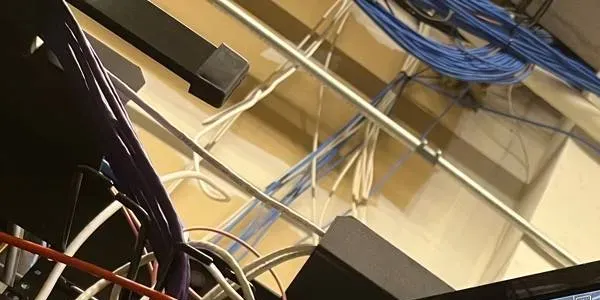
Example photo from another AESS job (not an Orange County property): bundles of network cable dropping into the top of an equipment rack. Each outdoor camera run that enters a rack like this is a path a surge can follow back to the switch.
Outages and the Eight-Hour Rule
Our dispensary has to keep its cameras running through an eight-hour outage — how do we prove the backup can really do that?
By testing it under the real load rather than reading the label. The state's cannabis security rule, 9 NYCRR §125.3, requires a licensee's video system to keep operating for at least eight hours during a power outage, along with its 60-day retention and 30-day testing duties. The Poughkeepsie Journal reported in April 2025 that adult-use dispensaries were opening in Orange County, including in Newburgh — and this is a county where July 2026 storms affected more than 47,000 O&R customers in a week and a September nor'easter left thousands of Central Hudson customers out overnight.
Eight hours is a long time for a battery unit. A recorder, a PoE switch feeding a dozen cameras with infrared on at night, a modem and a router can draw enough that a typical closet UPS lasts well under an hour. Meeting the rule usually means a larger battery system, extra battery packs, a generator with an automatic transfer and a battery to bridge the switchover, or a combination; which one is your electrician's and your compliance adviser's decision, not ours.
What we do is measure. We record the actual draw of everything the video system needs, calculate expected runtime, then run a timed test with wall power removed and log the result alongside the failure-notification test the rule also expects. If the numbers fall short, the log says so plainly, with the gap in hours, so the store can fix it before an inspector or a storm finds it. This is general information about the rule, not legal advice.
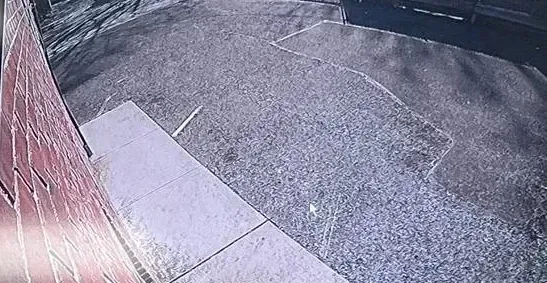
Example photo from another AESS job (not an Orange County property): a frame from a recorder playback along a brick wall to a paved lot. Checking that playback works across recent storm dates is part of every visit.
Our property is on Central Hudson but our store in town is on Orange & Rockland — does it matter to the camera plan which utility feeds each site?
It matters more than most owners expect, because the two sites will not lose power on the same nights. Orange County is split between three electric utilities — Orange & Rockland, Central Hudson and NYSEG, according to the state Department of Public Service — and each runs its own restoration, its own outage map and its own customer alerts. In the July 2026 storms the outages in Orange were mostly O&R's; in the September nor'easter it was Central Hudson that reported its greatest remaining impacts in Ulster and Orange counties. A business with two sites can see one dark and the other fine.
Utility
What its own publications say
Recent Orange County events
Orange & Rockland
Outage map lists about 317,000 customers served; PowerOutage.us tracks about 110,700 of them in Orange County.
More than 47,000 customers affected July 1–6, 2026; 1,102 Orange customers still out on July 7.
Central Hudson
About 315,000 electric customers across eight Mid-Hudson counties and a 2,600-square-mile territory.
September 26–27, 2026 nor'easter, greatest remaining impacts in Ulster and Orange; 228 Orange customers out on July 7.
NYSEG
Listed by the Department of Public Service as one of Orange County's electric utilities.
No Orange customers out in the July 7 News 12 count.
For the camera plan, two practical things follow. First, each site's battery runtime should be sized for its own utility's track record rather than one company-wide guess. Second, the person who receives the camera system's offline alerts should also be signed up for that utility's outage texts, so a dark recorder can be matched to a known outage in seconds instead of triggering a service call.
On the first visit we note the utility for every building that holds a recorder, switch or camera power supply — on farms and multi-building sites it is not always the same one — and write it into the log next to the measured battery runtime. When the next storm comes, that page tells you which buildings to worry about first.
Snow, Ice, Salt and Water
Every storm the plough leaves a wall of snow at the end of our driveway — where should the camera go so it still sees the road?
Above the pile and to one side of it. Plough piles form in the same places every winter: at the end of the drive where the town truck passes, along the edges of a parking lot where the contractor pushes snow, and under any roof edge that sheds a slab. A camera mounted low on a post at the driveway mouth is often looking straight into the place the bank will be. In late January 2026, News 12 reported about 18 inches of snow in Monroe and up to 24 inches in parts of the county; banks from a storm like that can stand for weeks.
The usual fix is height and angle. Raising the camera a few feet, or moving it back up the drive so it looks down at the road over the pile, keeps the view clear. For parking lots, cameras on light poles or building walls that look across the lot rather than along its edges stay useful while the banks are up. A camera that must stay low can be turned so the pile is at the bottom of the frame rather than in the middle.
We do this on the fall visit, before the first storm, by walking the property with the owner or the snow contractor and asking where the snow goes. It costs a little time with a ladder in October and saves weeks of a useless camera in February.
Does a camera with a built-in heater need more from the network switch in winter than it does in summer?
Yes, and it catches people out because the system was tested in warm weather. A camera's heater switches on as temperatures drop, and the camera draws noticeably more power while it runs. One industry guide on winter camera problems lists the common results: the PoE switch cannot supply the wattage, too many high-demand cameras share the same switch, an undersized injector is used, voltage is lost along a long cable run, or the backup battery cannot carry the extra winter load. It also notes that manufacturers warn against sizing the power source to a camera's low-power mode.
In practice, the camera at the end of the longest run on the most heavily loaded switch is the one that starts dropping on the coldest nights. Because it works perfectly in the afternoon, the fault is often blamed on the network or the camera itself.
On a fall visit we add up the worst-case power draw of every camera on each switch, compare it with what the switch and its power supply can actually deliver, and measure the voltage at the far end of the longest runs. If a switch is close to its limit, we move cameras between ports or switches, or quote a larger PoE switch, before January rather than after.
A flood warning is out for the Wallkill and our lower field cameras sit near the river — what should we do with the system before the water arrives?
First, save what you might need. If anything on the recorder matters — a recent theft, damage you may claim for — export it to a USB stick or your phone before the storm. Then, if any recorder, switch or power supply sits on a floor or low shelf that has flooded before, move it up or out, and switch off the power feeding junction boxes that are likely to go under. Water on live low-voltage equipment does more damage than water on equipment that is switched off.
The Wallkill drains 382 square miles, nearly half of Orange County, through 69 tributaries, the Warwick Valley Dispatch reported in January 2024, and when the ground is saturated it spreads across the low Black Dirt fields. The same article noted that the Hudson Valley counties had taken 29 to 33 inches of rain in the 120 days to the end of September 2023. Cameras up on poles usually survive a flood; the boxes, splices and power supplies at their base often do not.
After the water drops, nothing that was submerged should be switched back on until it has been opened, dried, cleaned and tested — we do that on a post-flood visit and photograph it for your insurer. On the next regular visit we look at moving what keeps going under: boxes raised above the high-water line, cable entries that rise before they enter a building, and a recorder kept well above the floor.
Yards, Long Runs and Records
Our distribution yard has cameras on tall poles — what does a maintenance visit on those involve that a camera on the building does not?
Mostly, everything below the camera. A pole camera depends on a foundation, a hand-hole at the base, a run of conduit underground back to the building, a ground connection at the base and often a separate power feed. Each of those can fail without any visible sign at the top. Hand-hole covers get driven over and cracked, conduit fills with water, ground wires corrode or are pulled loose by a mower or snow plough, and frost can shift a base just enough to change the camera's view across a wide yard.
The camera end needs its own attention: high winds and ice load work brackets loose, and a lens that is only cleaned when someone happens to bring a lift is usually filthy. Because the height usually calls for a lift and the yard is full of moving trucks, we plan these visits with the site — which lanes to cone off, which hours are quietest, who is the contact on site — rather than turning up unannounced.
On the log, each pole gets its own line: base, hand-hole and conduit condition, ground continuity, surge protection at the pole, power reading at the camera, bracket and aim, and a fresh reference snapshot. Large warehouse operators along Route 17K and I-84 tend to want those lines for their insurers and their own facility teams, and we write them so either can use them.
Scale is what makes this a planned job in Orange County. Amazon's building at Routes 17K and 747 in Montgomery covers 1,015,740 square feet; the Matrix distribution centre across from Stewart Airport was proposed with 116 loading docks and 167 trailer spaces; even a mid-sized project like the Stewart Logistics Center on Hawkins Drive puts an 81,200-square-foot building on a 7.4-acre site; and the Walmart application under review in the Town of Wallkill describes about 1.5 million square feet on roughly 200 acres. Yards that size can carry dozens of pole cameras, each hundreds of feet of conduit away from the nearest switch, and each one a separate small job for the lift. We group them by lane and by switch so the yard loses as little working time as possible, and so each switch's cameras are tested together with the switch itself.
A truck clipped one of our yard poles — once it has been straightened, what needs checking besides where the camera points?
Everything that bent with it. A pole that takes a hit transfers the force down to its base and the conduit entering it, and up to the bracket and the camera. Even if the camera still shows a picture and the aim is corrected, the cable may have been stretched or kinked where it leaves the conduit, the hand-hole may be cracked, the ground connection at the base may have been pulled loose, and the bracket may now be bent just enough to drift in the next strong wind.
Along the Route 17K and I-84 warehouse belt — Amazon's building in Montgomery, the Matrix centre across from Stewart Airport with its 116 loading docks, and the Walmart project under review in Wallkill — yard poles share space with tractor-trailers turning all day, so the occasional strike is part of the job. The danger is treating it as a cosmetic problem and finding out months later that the pole's ground is gone just before a thunderstorm.
After a vehicle hit we test the cable run end to end, inspect the conduit and hand-hole, check the ground connection at the base, re-torque or replace the bracket, re-aim against the reference snapshot and photograph the damage for the operator's incident file. If the pole itself is out of plumb or its foundation has moved, we say so and leave that to the pole contractor.
Our barn camera runs on several hundred feet of cable from the house — is that run something a maintenance visit should test, or only the camera?
The run, every time. On a farm, the cable between buildings lives a hard life: buried along a fence line, stapled under a barn eave, strung across a lane on a messenger wire, chewed by rodents, nicked by equipment and soaked by every storm. A run that has been damaged often keeps working at a reduced level — the camera stays online but loses frames, drops in the cold or reboots when the heater kicks in.
Length matters too. Standard network cable is designed for runs of about 100 metres (328 feet) including patch cords; beyond that, extenders, media converters or fibre are needed. We sometimes find barn cameras running well past that limit on the strength of a test that passed on a warm day, and they become the unreliable camera everyone blames on the weather.
A maintenance test checks the run's length, continuity, the power arriving at the camera and how the link performs under load. Runs that are failing or out of spec are written up with a recommendation: re-terminate, replace a section, add an extender, or replace the link with fibre. If the run needs replacing, our Orange County Cat6 repair crew handles it.
We registered our cameras with the District Attorney's camera program — does anyone check they are still working?
As far as we know, no. The Orange County District Attorney's Video Camera Community Partnership Program asks residents and businesses to register their cameras so investigators know where footage may exist after a crime. That is a map of where cameras are, not a monitoring service, and keeping each registered camera working and recording is up to the owner. The program is not new: the Times Herald-Record was already describing the District Attorney's Video Camera Community Partnership Program to readers in a March 2019 crime report, which means some registrations date from systems installed years ago and never looked at since. A camera registered in 2019 on an old analog recorder may well have outlived its drive, its clock battery and its last firmware update.
That makes upkeep part of the deal. When investigators come asking, they will want footage from a specific time, with a correct time stamp, from a camera pointed where it was registered as pointing. A camera that was knocked askew by an ice storm, a recorder that lost its clock in an outage, or a drive that only holds a week will all disappoint the person who came to ask — and possibly you, if it was your property that was broken into.
On a maintenance visit for a registered system we confirm each camera's view still matches what the program would expect, check the recorder's clock against network time, record how many days of footage the drive actually holds, and leave written instructions for exporting a clip, so the next request is answered quickly and correctly.
Equipment
Types of Security Cameras We Maintain
Each part of a system ages differently in Orange County's weather. This is what we look at on each type during a visit, from a single Wi-Fi camera on a farmhouse porch to a rack of recorders in a distribution centre.
Turret and Eyeball Cameras
The workhorse on houses and storefronts. No bubble in front of the lens means less night glare, but the ball joint and the gasket at the base need checking after a hard winter, and the infrared ring around the lens collects insects and dust.
Bullet and Spotlight Cameras
Long views down driveways, lanes and yards. Their sunshields hold snow and ice, and their mounts carry more leverage in wind. Built-in spotlights and sirens are tested so they still fire when motion is detected.
Dome Cameras
Lobbies, shops and entrances. The bubble scratches if scraped, fogs inside if its seal fails, and needs gentle cleaning. Outdoor domes under eaves catch drips that freeze into icicles across the view.
PTZ and Pan-Tilt Cameras
Yards, lots and farm complexes. Motors and gears slow in the cold, presets drift, and patrol tours stop returning home. We run every preset and listen for a struggling motor.
Wi-Fi and Battery Cameras
Common on porches, sheds and gates. Batteries lose capacity in the cold, signal drops at the edge of the router's range, and cloud subscriptions lapse. We check charge, signal strength and that the account is still in the owner's name.
Recorders and Drives
NVRs and DVRs in basements, closets and offices: power history, drive health, playback across recent storm dates, clock accuracy, firmware and vents. Recorders that have rebooted repeatedly get their power traced.
PoE Switches and Injectors
Port status, power budget against winter heater load, signs of surge damage, and protection on every port that serves an outdoor camera.
Surge Protectors and Grounds
In-line protectors at both ends of long runs, their ground wires and the bonding between buildings — the parts that decide whether the next storm costs one camera or ten.
Battery Backup Units
Self-test, measured runtime under the real load, event history and battery age. In a county with frequent summer and nor'easter outages, these carry the system through the hours that matter.
Manufacturer product photo: a Lorex 4K network video recorder. The front USB port is how clips are exported for an insurer or investigator, and it is tested on maintenance visits.
National brands versus a local storm-season plan
A big-name kit or monitored package is often the first system on an Orange County farm or house, and the hardware is usually decent. What those services are organised around is the brand's own app and devices — not a copper run to a barn three hundred feet away. This comparison is based on how such services typically work rather than any company's exact current terms.
Question
ADT, Ring or SimpliSafe-style service
AESS Orange County maintenance
After a thunderstorm
Replace devices that stop working, usually on the owner's report.
Post-storm sweep of surge protectors, ports, grounds and recordings, with findings in a dated log.
Power outages
Cloud cameras stop uploading when the router loses power unless the owner has added backup.
Battery backup tested under real load; recorder and switch ride-through timed on each visit.
Outbuildings and long runs
Wi-Fi range and battery cameras chosen by the owner.
Cable runs to barns, gates and poles tested end to end, protected at both ends.
Mixed and older equipment
Typically only the company's own devices.
Hikvision, Dahua, Lorex, Uniview, Axis, Reolink and others on the same visit.
Winter
Owner clears snow and charges batteries.
Pre-winter check of heater power, seals, snow-slide and plough-pile sight lines.
Manufacturer product photo: a Wi-Fi pan-tilt camera with two antennas. Cameras like this depend on router power and signal range, which is why outages and outbuildings matter.
AI Overview Reality Check
What AI Gets Wrong About Security Camera Maintenance in Orange County
Instead we took seven statements that installers, camera makers and forum regulars publish about lightning, backup power and winter — the raw material automated answers draw on — and held each one up against an Orange County storm season.
Claim 1: "Once a surge protector is installed, the cameras are protected"
A surge protector is a part that wears out by doing its job. The lightning guide we cite in our sources calls protectors consumables and recommends replacing surge modules after major strikes or when an indicator shows they have failed. Many of the protectors we inspect have no indicator at all, and their owners have no idea whether they still work.
Protectors also depend completely on a good ground path. A protector with a loose, cut or missing ground wire gives a false sense of safety, and an indoor-rated unit fitted outdoors may corrode and fail open in a couple of seasons.
In a county that led New York in lightning pulses in Earth Networks' 2020 count, protectors on long outdoor runs belong on the maintenance checklist every spring, with their ground connections traced and their age written down.
Claim 2: "A UPS keeps the cameras safe from storms"
A battery backup unit keeps the recorder running through short outages, which is valuable, but it is not lightning protection. The same guide notes that a UPS without a surge rating "is not a lightning solution," and in any case it only protects what is plugged into it — not the cameras on the far end of the PoE cables, which are the usual path a surge takes.
The other half of the claim fails over time. Batteries inside these units lose capacity with age and heat, and a unit that held the system for an hour when new may manage minutes a few years later. The green light on the front says nothing about runtime.
That is why we test runtime under the actual load on each visit and treat surge protection on the camera runs as a separate job. During the July 2026 storms O&R reported more than 47,000 customers affected over six days; that is the scenario the test is for.
Claim 3: "Shielded cable protects outdoor cameras from lightning"
Shielded cable has its uses, mostly against electrical noise in industrial settings. But shielding alone is not lightning protection, and a shield that is not properly grounded can even give surge current an easier path into the building. The installer guidance we have read is consistent on this point.
Owners in Orange County often hear this advice from forums and then buy shielded cable for a barn run without the grounding hardware that makes it work. The result looks professional and protects nothing.
For long runs between buildings, the more reliable choices are proper protectors at both ends, each bonded to its building's ground, or a fibre link that carries no current at all. A maintenance visit checks which of those you actually have.
Claim 4: "Weatherproof cameras need no special care in winter"
A weatherproof rating describes how well a housing keeps out dust and water. It says nothing about power. Cameras with heaters draw more power as temperatures fall, and a winter-focused industry guide lists the consequences: switches that cannot supply the wattage, voltage lost on long runs, and backup units that cannot carry the added winter load.
Seals also age. A gasket that kept water out for three winters may let moist air in on the fourth, and the first sign is fog on the inside of the lens on cold mornings.
After a storm like January 2026, with about 18 inches in Monroe, the cameras that struggle are the ones that were never checked for heater power, seals and snow-pile sight lines in the fall. A pre-winter visit is cheaper than a camera that goes blind every cold night until April.
Claim 5: "Anything below 14°F is too cold for most cameras"
One camera-app maker's winter guide says that anything below −10°C (14°F) is "too cold for most cameras to function". That may be true of cheap indoor-grade cameras pressed into outdoor use, but it is not a rule. Cameras built for cold climates are rated far lower; one retailer's guide to cold-weather models lists an operating range down to −40°F with a built-in lens heater. What matters is the rating of the camera you actually own.
The cold does still find weak points. Batteries in wireless cameras lose charge faster, motors in pan-tilt cameras slow down, and plastic housings turn brittle enough to crack when a slab of ice falls on them. And the cold arrives with snow, ice and salt, which do their own damage regardless of the rating.
On the first visit we check every camera's rated operating range against where it hangs — an unheated barn wall facing north is not the same as a porch on the south side of a house — and flag the consumer cameras that are likely to struggle through an Orange County winter.
Claim 6: "Low-voltage camera work never needs a licensed electrician"
A New Windsor technology firm writes that low-voltage cabling under 50 volts typically does not require an electrical permit in Hudson Valley municipalities. That is broadly how camera cabling is treated, but it is easy to stretch too far. Surge protection at the electrical panel, new outlets for battery backups, generator transfer arrangements and grounding changes are electrical work.
Orange County Local Law No. 8 of 2007 requires anyone working as an electrician in the county to hold a county-issued licence, and the City of Middletown has its own electrical licensing board. Permit rules can differ between towns and villages, and we do not claim to know every one.
Our maintenance stays on the low-voltage side of that line under our NYS licence. When a fix needs line-voltage work, the log says so plainly and we coordinate with your licensed electrician rather than improvising.
Claim 7: "Cloud cameras keep recording when the power goes out"
A battery-powered camera may keep running in an outage, but it records to the cloud through your router and modem, and those almost always go down with the power. Unless they are on a battery or generator circuit too, the camera has nowhere to send its video. Some models store clips locally on a memory card during the gap; many do not.
Outages here are not rare events. On September 27, 2026, Central Hudson reported about 6,000 customers still without power after a nor'easter, with the greatest impacts in Ulster and Orange counties, and a 95 percent restoration target for Orange County of 10 p.m. that night.
A maintenance visit maps the whole chain — camera, router, modem, recorder — and tells you which links stay up in an outage. Often one small battery unit for the modem and router fixes the gap that the camera maker's marketing glossed over.
Storm Season Coming? Get the Pre-Season Check Booked
Send us the camera count, which cameras sit on outbuildings or poles, and who supplies your power. We will tell you what a spring or fall check covers and what it costs at our Orange County rates.
Sketch the property for us in a few lines — barns, poles, garages, the room the recorder lives in — and mention what died in the last storm or blackout. A licensed technician rings back that business day with a written figure for a single check or a spring-and-fall plan, or asks to walk the site first. You decide before anything goes on the calendar.
Thanks — We Have It
Your request is in. A technician will phone about the Orange County system today; if a storm has just hit, call (845) 640-3835 directly.
How It Works
Our Maintenance Process
The same seven stages apply to a farmhouse with two cameras and a logistics site with a hundred. Expect the opening visit to run longest: it produces the cable map and the baseline snapshots that every seasonal check afterwards is measured against.
1. Photos, power company and a call
You send a photo of each outdoor view, tell us which cameras sit on outbuildings or poles and which utility feeds the property. We ask what failed after past storms.
2. Map from the far end back
The baseline visit begins at the camera furthest from the recorder and works inward, logging each run, protector, switch, recorder and battery unit and saving a reference image of every view.
3. Sort by exposure and season
Long outdoor runs, pole and barn cameras go on the pre-storm list; heater cameras and driveway views on the pre-winter list; licensed stores on the 30-day cycle their rule requires.
4. Seasonal calendar in writing
Before any date is fixed you hold a written Orange County figure per visit, the list of checks each one includes and the service-agreement terms.
5. Inspect, test and correct
Protectors and grounds traced, runs tested, power measured at the camera, cameras cleaned and aimed, battery ride-through timed, alerts triggered, clocks checked.
6. Repair small, quote the rest
Loose grounds, wet boxes and drifted aim are put right that day. Spent protectors, tired batteries, green connectors and anything the storm cooked are photographed and priced as parts first.
7. Log, ride-through time, next season
The visit closes with a signed log: protector and ground results, measured battery minutes, the earliest footage still on the drive, and the date of the next spring or fall check.
Coverage Area
Security Camera Maintenance Near Orange County's Landmarks
From the Shawangunk side to the Hudson, every town is in range. These six spots earn a card because of what surrounds them — river flats, truck yards, holiday crowds, deep snow — not because any of them is our customer.
Black Dirt Region, Pine Island
Roughly 26,000 acres of flat, dark farmland in western Warwick, crossed by ditches and farm roads and flooded by the Wallkill after long wet spells. Barn and field cameras here sit at the end of long runs in open country.
Stewart Airport and the I-84 / Route 17K Belt
Distribution buildings across from the airport and along Route 17K in Montgomery, Newburgh and Wallkill, including the 116-dock Matrix centre and the Stewart Logistics Center on Hawkins Drive. Pole cameras, wide yards and round-the-clock recording.
Woodbury Common, Central Valley
Around 220 outlet stores since 1985, with parking fields, hotels and restaurants nearby. Lot cameras on poles and the busiest weekends of the year in the worst of the winter weather.
Highland Falls and West Point
The village outside the US Military Academy, where about nine inches of rain fell in the July 2023 storm, flooding roads and buildings. A reminder that cameras and recorders below grade need checking after a cloudburst.
Port Jervis and the Delaware
Front Street, the old Erie Railroad city and the Tri-States Monument where New York, New Jersey and Pennsylvania meet. The Delaware crested at 21.47 feet here in June 2006, and at high water it can back storm drains up into the streets between Railroad Avenue and Water Street — bad news for basement recorders.
Monroe and the Route 17 Snow Belt
Where News 12 reported the county's highest total — about 18 inches — in the January 2026 storm. Driveway, plaza and townhouse cameras that need a pre-winter look at drifts and plough piles.
Town-by-town: what the record shows
Warwick and Goshen: both towns were still on Orange & Rockland's outage list days into the July 2026 storms, and the Black Dirt fields west of Warwick flood when the Wallkill rises. Battery ride-through and low-lying junction boxes come first here.
Montgomery and the Town of Newburgh: served in part by Central Hudson, and named by the county's emergency office among the primary areas in a past outage update, and home to the Route 17K and I-84 warehouse belt. Yard poles, long runs and surge protection lead the list.
Monroe, Woodbury and Chester: the January 2026 storm's heaviest snow fell around Monroe, and Route 17 runs through all three. Plough-pile sight lines, salt corrosion and heater power are the fall priorities.
Washingtonville and Blooming Grove: residents have described repeated brownouts on r/hudsonvalley. Restart history and a line-interactive battery unit are worth checking on every visit.
Highland Falls and Cornwall: the July 2023 cloudburst flooded roads and buildings below the Academy; recorders and boxes below grade get a post-storm look.
Port Jervis and Deerpark: the Delaware's crest history and the longest drive from anywhere in the county make remote alerts the backbone of a plan here.
Scheduled visits also run to Newburgh, New Windsor, Cornwall, Cornwall-on-Hudson, Highland Mills, Woodbury, Harriman, Tuxedo, Greenwood Lake, Warwick, Florida, Chester, Goshen, Hamptonburgh, Blooming Grove, Washingtonville, Salisbury Mills, Montgomery, Walden, Maybrook, Crawford, Pine Bush, Wallkill, Middletown, Wawayanda, Minisink, Greenville, Deerpark, Otisville and Mount Hope. Orange County is part of our Hudson Valley security camera maintenance coverage, which lists the neighbouring counties.
Pricing
Security Camera Maintenance Cost in Orange County
Orange County carries a 1.40 area factor in our pricing, which covers the drive time and the longer outdoor runs typical of properties here. Each figure below is our New York City base rate multiplied by 1.40 and rounded. Parts — surge protectors, batteries, drives, seals, replacement cameras — are priced separately on your written quote.
Orange County maintenance work
Price
What it covers
One-time tune-up, home or small system
$210–$490
A single trip: protectors and ground wires traced, battery minutes timed with the recorder unplugged, lenses wiped and views re-aimed, after-dark picture reviewed, drive errors and earliest footage read, every alert fired once, signed log handed over
Scheduled plan, home, farm or small building
$280–$700 per year
A spring pre-storm visit and a fall pre-winter visit as standard, with priority booking after a storm; in practice about $70–$210 a camera a year, set by camera count, outbuildings and mounting height
Commercial plan, monthly or quarterly
$1,400–$7,000+ per year
Truck yards, plazas, farm complexes and dispensaries; the figure is set once we have walked the site, with 30-day test visits added for licence holders
Same-day repair visit
$266–$1,260
Cameras dark or recorder down after a storm or outage — same-day diagnosis and fix, quoted per job
Service after an AESS installation
$195/hr, 3-hr minimum ($585)
Applies to return trips for changes or additions on systems AESS put in; new installation work is quoted separately, never by the hour
What moves an Orange County price is mostly the shape of the property rather than the camera count. Ten cameras on one house are quicker than six spread across a house, a barn, a gate and a pole. Cameras that need a lift, runs that need testing over hundreds of feet, and sites where we coordinate with a yard schedule all add time. Grouping a visit with a neighbour's or doing the spring and fall checks on a fixed calendar keeps the drive cost down.
Two worked examples on the published prices
A farmhouse near Pine Island with a barn and a gate camera. Five cameras on the house, two on the barn and one at the gate, all on cable. The owner wants a spring check before the storms and a fall check before the snow. That sits in the scheduled plan range of $280–$700 a year; the exact figure depends on the length of the barn and gate runs and whether their protectors need replacing on the first visit, which would be quoted as parts.
A distribution building near Route 17K with yard poles. Forty cameras on the building and eight on yard poles, two recorders, monthly remote health review and quarterly site visits with a lift for the poles. That is a commercial plan in the $1,400–$7,000+ range, priced after a walkthrough because the lift days and yard coordination decide the hours.
Deposit, warranty and late-fee terms are written into each plan. Full terms — including 50% deposit, the 30-day warranty and optional paid extended warranty, and the late-fee schedule — are set out in the service agreement.
Manufacturer product photo: a white bullet camera with a built-in spotlight. Its light and siren are tested on a visit, and its sunshield is cleared of webs and ice.
Shop Our Systems
Security Camera Maintenance Packages & Pricing
Three starting points cover most farms, homes and businesses in the county. The written quote then moves within each range for the number of cameras, the outbuildings and poles, and the climbing involved. Footage kept on your own recorder carries no subscription.
Orange County Tune-Up
$210–$490
One visit for a house or small business: cameras cleaned and aimed, surge protection and grounds inspected, battery run-time tested, recording and alerts checked, and a written log you keep.
Storm-Season Plan
$280–$700 / year
Spring pre-storm and fall pre-winter visits for homes, farms and small buildings, priority booking after a storm, tested health alerts and a report after each visit.
Commercial and Yard Plan
$1,400–$7,000+ / year
Monthly or quarterly service for warehouses, retail sites, multi-building properties and licensed businesses: pole and yard inspections, outage tests, dated records for insurers and regulators.
Bought your own cameras? They can go on the same plan
A kit from an online order, a system that came with the farm, or one a long-gone installer left behind — all of it can go on a seasonal plan. The baseline visit catalogues each device with its model and firmware and gives you a straight answer on what will survive another lightning season and what will not. If you later want equipment added or replaced and prefer to supply it yourself, our bring-your-own-equipment calculator shows the labour-only line items.
Manufacturer product photo: a black turret camera. With no bubble in front of the lens it suffers less night glare, but its base gasket and ball joint are checked after a hard winter.
Speak to an Orange County Camera Technician
Barn runs, yard poles, a generator that never kicks in on time — describe it on the phone and the technician you speak to is the one who schedules the work.
Every Security Camera Maintenance Service in Orange County
Seasonal checks regularly uncover jobs beyond upkeep: a recorder lost to a surge, a run that has to be pulled again, a lot that needs more coverage. These Orange County pages pick up from there.
When I walk an Orange County property for the first time, I start where most people finish: at the camera furthest from the recorder. On a farm that is usually the barn or the gate; on a warehouse it is the pole at the back of the yard; on a house up a long drive it is the camera by the road. Those are the cameras on the longest copper, the ones a storm finds first, and the ones nobody has looked at since the day they went up.
At that far end I look for three things. Is there a surge protector, and does its ground wire actually go somewhere? What is the power reading at the camera, and would it still be enough on a January night with the heater on? And when did this camera last record something — not show a live picture, but record? Then I walk back towards the recorder and do the same at every step.
The last thing I do is pull the plug on the recorder, on purpose, with the owner watching, and time how long the system keeps going. Owners usually guess an hour. The answer decides what goes on the list for the next visit.
— Owner, NYS license #12000287431
FAQ
Orange County Security Camera Maintenance FAQ
Short answers on travel, timing, access and paperwork that the sections above do not cover.
Do you add a travel charge for properties at the far western end of the county, around Port Jervis or Deerpark?
+
The Orange County prices on this page already carry the county area factor, which reflects the longer drives to every corner of the county, from Newburgh to Port Jervis. What can move a quote further is the property itself — several buildings, long runs or a lift — and your written quote lists every charge before you agree to anything.
Can visits be timed around harvest, the holiday shipping rush or the busy autumn weekends?
+
Yes. Most seasonal businesses prefer a spring visit before storm season and a quiet-period visit before winter, keeping the busiest weeks free. Tell us your peak dates when you sign up and we schedule around them for the whole year rather than one visit at a time.
If lightning damages cameras between scheduled visits, is the repair part of the plan?
+
Storm damage is billed as a repair, separate from the plan, because it is not wear and tear. Plan customers get priority booking after a storm, and parts are quoted before they are fitted. Full terms — including 50% deposit, the 30-day warranty and optional paid extended warranty, and the late-fee schedule — are set out in the service agreement. Many homeowner and business policies cover surge damage, so ask your insurer as well.
Can you work alongside our electrician when a fix needs line-voltage work?
+
Yes. Panel-level surge devices, new outlets for battery units, generator connections and grounding changes are licensed electrical work in Orange County, so we write up exactly what is needed with photos and coordinate a time with your electrician. We handle the low-voltage side on the same day where we can.
Our floodlights and pole lights went dark in the same storm as the cameras — can they be looked at on the same visit?
+
Camera-floodlight combinations and cameras with built-in lights, yes. Pole lights and building lighting on their own circuits are an electrician's job, but we note which lights failed alongside which cameras, because a shared pattern often points to the circuit or the surge path that took them both out.
Will you mark each surge protector with the date it was fitted?
+
Yes. Every protector we fit or inspect gets a dated label on or beside it and a line in the log with its location and condition. Protectors wear out by doing their job, so knowing which ones went through last summer's storms is what lets the next visit decide which to replace first.
When a storm kills one camera, will the replacement match the brand already on the recorder?
+
Where we can, yes. A matching brand usually keeps every feature working on the existing recorder — motion settings, smart alerts, phone app. If the original model is discontinued or the brand is hard to source, we offer a compatible alternative and explain any feature it will not support before you choose.
All Areas Served
Security Camera Maintenance Across the Hudson Valley, New York City and Long Island
Need a burglar alarm, a gate reader or new cabling to go with the cameras? The Abstract Enterprises Security Systems home page lists every trade we cover, and the about us page carries our state licence and insurance particulars.
Sources
Where the Orange County Camera Maintenance Facts Come From
Lightning counts, outage numbers, snow totals, flood figures, warehouse projects and rules cited above trace to the documents listed here. The Reddit thread was read directly; the dispensary and DA-program pages only partly rendered. The seasonal routine itself is AESS practice, not a requirement of any source, and every price is the silo base rate times 1.40.
Nothing here is legal or electrical advice. Licence conditions belong with your attorney; grounding, panel surge devices and generator hookups belong with a county-licensed electrician.
Storm Knocked Out the Cameras? Call the Orange County Line
Barn cameras dead since last night's thunderstorm, recorder stuck on its startup screen after the outage, an adjuster asking for the clip from before the tree came down — ring (845) 640-3835. Recordings are copied off before anything is changed, and most systems are recording again within one to two hours of the technician arriving.
Orange County Camera Upkeep From a Licensed, Insured Crew
Orange County line (845) 640-3835 · Abstract Enterprises Security Systems, 460 E Fordham Rd, Bronx, NY 10458 · messages by WhatsApp (718) 679-0359
Licensed in New York State (#12000287431) · fully insured · same-day estimates · rated 4.6★ from 390+ Google reviews
Surge modules, UPS batteries, drives and cameras we supply also come with the maker's own coverage. Full terms — including 50% deposit, the 30-day warranty and optional paid extended warranty, and the late-fee schedule — are set out in the service agreement. See our warranty page.
Page reviewed and updated October 18, 2026. Changelog: Orange County camera maintenance page rebuilt from new research on the county's lightning record, its three electric utilities and the July and September 2026 outages, the January 2026 snowstorm, road salt, Wallkill and Delaware flooding, the Route 17K / I-84 warehouse belt and the District Attorney's camera registration program, on the silo base prices at the Orange County area factor of 1.40.