Lake Houses · Hillside Homes · Village Shops · Route 6 & I-84 Offices · NYS Licensed
Security Camera Maintenance in Putnam County
Settings That Keep the Whole Event · Views Cleared After Leaf-Out · Health Checks Between Long Drives
When something happened outside the Historic Putnam County Courthouse on July 4, 2026, the Sheriff later said the cameras had captured only portions of it — the system recorded on motion. That is the Putnam camera problem in one sentence: the cameras were there, the green lights were on, and the footage still came up short. Up here the system also has to get through a county that is two-thirds forest, a run of snowstorms and summer outages, oak-killing caterpillar years and houses that sit empty from Sunday night to Friday. We maintain camera systems on the county's calendar — a spring visit after the leaves come out, a fall visit before the snow — and keep watch on their health from a distance in between, so nobody discovers the gap on the day the clip is needed.
Last reviewed and updated October 18, 2026 · written and checked by the owner, NYS license #12000287431 · book on (845) 640-3835
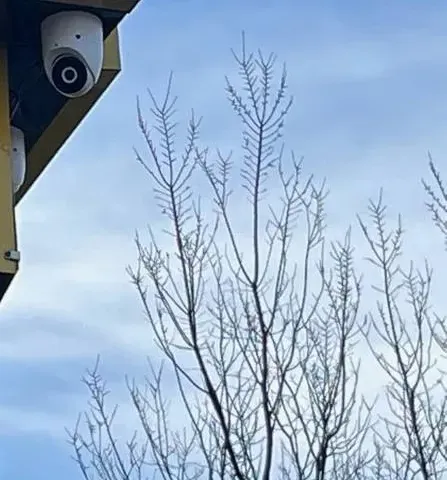
Example photo from another AESS job (not a Putnam County property): a dome camera under a fascia with bare branches just beyond it. In winter the view is open; once those branches leaf out, a camera like this can lose part of its picture — the reason a Putnam plan includes a visit after leaf-out.
Putnam Camera Upkeep Quote
Tell us the town, how many cameras and how often anyone is at the property — a written number comes back the same business day
✅
Request Sent!
Keep your phone close — a technician calls about your Putnam cameras before the business day is out.
25+
Years Experience
✓
Same-Day Estimates
100%
Licensed & Insured
4.6★
390+ Google Reviews
Start with one question: when did anyone last play something back? Not the live view on the phone — an actual clip from last week, all the way through. If the answer is "never", the recorder may be keeping far less than you think. Text a screenshot of your camera grid and the town you are in to (845) 640-3835 and we will tell you what to look at first.
A single Putnam tune-up is $218–$508 for a house or small system, and a two-season plan begins at $290 per year
Every visit includes a real playback test and ends with a dated, written log
Quotes in writing within the business day · NYS licence #12000287431
Why Putnam County Properties Need Security Camera Maintenance
The clearest local lesson came from the county itself. During Putnam's America 250 celebration, a life-sized replica of the Declaration of Independence was set out in front of the Historic Putnam County Courthouse in Carmel Hamlet, and on July 4, 2026 political slogans were written across it. Mahopac News reported later that month that Sheriff Brian Hess said surveillance cameras captured portions of the incident, but that the footage was incomplete because the system relies on motion sensors. "Improvements could have helped," he said. A county legislator, Jake D'Angelo, then asked the County Executive for a countywide assessment of security cameras at county buildings. Around the same time, the newly restored Sybil Ludington statue was spray-painted. Nobody was short of cameras. What was missing was a recording setting that matched the job.
That is the kind of failure maintenance exists to catch, and it is the kind most owners never test for. A camera with a lit status light, a clear live view on the phone and a recorder that boots normally can still be set to record only when its motion detector fires — and a motion detector tuned to ignore swaying branches and passing headlights will also ignore a person who moves slowly, stands still at a door or stays at the edge of the frame. The only way to know what a system really keeps is to pick a known stretch of time, play it back end to end and compare it with what actually happened. We do that on every visit. It takes minutes, and it is the single most useful check we make in this county.
Then there are the woods. Putnam's own hazard-mitigation profile puts forest cover at about two-thirds of the county and roughly three-quarters of its land inside the New York City watershed. Cameras here look across lawns, driveways and lake frontage edged with trees, and the trees change the picture every season. A view that is wide open in March can be a wall of leaves by June. The spongy moth outbreak defoliated 618,765 acres of the Hudson Valley at its 2024 peak, according to figures the New York Almanack published from the state Department of Environmental Conservation, and more than 10,000 acres of oak died in the region in 2025 — dead trees that drop limbs on cable runs and poles. The County Executive wrote to the state in August 2025 that the spotted lanternfly has "taken root in Putnam County", with its favourite host, tree of heaven, lining many county roads.
Weather and power do the rest. The county counted fourteen major storms after Superstorm Sandy in 2012 — the last on its list being Hurricane Ida in 2021 — including a tornado across Patterson and Kent in May 2018. When Tropical Storm Isaias hit in August 2020, NYSEG still had 34,150 of its 38,693 Putnam customers without power the next morning. In 2026 alone, Mahopac measured 14.8 inches of snow in the January 25–26 storm, the County Executive declared a state of emergency ahead of another 12-to-18-inch storm on February 22, NYSEG reported thousands of Putnam customers in the dark after the July 4 storms, and on August 3 about 740 Central Hudson customers around Cold Spring and Garrison lost power while Route 9D flooded. Add 1,757 homes the census counts as seasonal or occasional-use, and a lot of Putnam cameras spend long stretches with nobody nearby to notice what the weather did to them. Many owners combine the visit with a look at driveway floodlight cameras or the gate and door entry, since those share the same poles, power and network.
Putnam facts that set the maintenance calendar
The courthouse footage gap. Mahopac News, July 23, 2026: the Sheriff said surveillance cameras captured only portions of the July 4 Declaration incident because the system relies on motion sensors.
A county of trees and reservoirs. Forest covers about 66.9% of Putnam and roughly three-quarters of the county drains to New York City reservoirs, including the West Branch Reservoir in Kent and Carmel, which holds 8 billion gallons in two basins split by Route 301.
Insects that change the canopy. Spongy moth defoliation in the Hudson Valley went from 62,458 new acres in 2022 to 618,765 in 2024, then fell to 66,928 in 2025 with over 10,000 acres of oak mortality; the DEC expected little defoliation in surveyed areas in 2026.
Snow that arrives in big pieces. Mahopac 14.8 inches and Putnam Valley 14 inches on January 25–26, 2026; a county state of emergency and travel ban for the February 22, 2026 storm.
Summer outages and lightning. Earth Networks counted 75,093 lightning pulses over Putnam in 2020; storms on July 4, 2026 and an outage on August 3, 2026 cut power in the county again.
Empty houses. The Census Bureau's survey counts 1,757 Putnam homes held for seasonal, recreational or occasional use — houses where a dark camera can go unnoticed for weeks.
A Putnam maintenance calendar built from the county's own record
Time of year
What the record shows
What we do
January–February
14.8 inches in Mahopac on January 25–26, 2026; a county state of emergency and travel ban for the February 22, 2026 storm
Storm follow-ups only where alerts show a camera or the recorder down; no routine visits on unplowed roads
Late May–June
Leaves fully out; spongy moth caterpillars easiest to spot in late May and early June, per the DEC outlook
The spring visit: views compared with winter references, motion zones redrawn, solar panels checked for new shade
July
July 4, 2026 storms cut NYSEG power to thousands of Putnam customers; Putnam Valley flash-flood emergency on July 29, 2026
Post-storm checks on request: clocks, recording resumed, junction boxes and low cameras
August–September
Central Hudson outage in Cold Spring and Garrison on August 3, 2026; the County Executive's late-August 2025 letter on spotted lanternflies noted their egg-laying season was approaching
Lens and housing cleaning on the worst-affected walls; battery backup self-test before fall storms
October–November
Leaves down, views open again; the fourteen major storms the county counted after Sandy include hurricanes, tropical storms, winter storms and a tornado in months from January through October
The fall visit: seals, sunshields, heaters, cold-garage recorders, drives and backups readied for winter
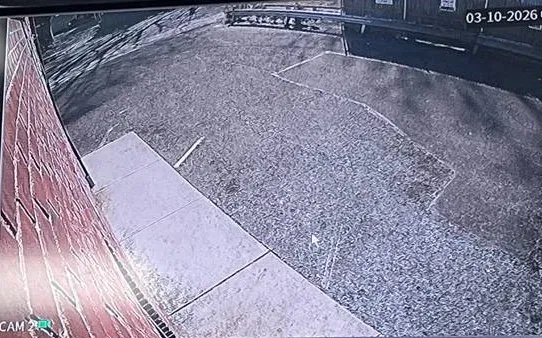
Example photo from another AESS job (not a Putnam County property): a recorded view played back from a camera, with its date stamp in the corner. Playing back a known stretch of time like this is the first check on every visit — it shows what the recorder actually kept.
Need Camera Repair in Putnam County Today
Black tiles on the grid, a recorder that will not finish starting, an app that says every camera is offline — that is a repair first and a maintenance job second. Call (845) 640-3835; we book the earliest same-day slot we can reach, and most faults are fixed within one to two hours of arrival. Before we get there, please do not reset or reformat anything.
Four things to find out from wherever you are
Is the power on at the property? NYSEG and Central Hudson both publish outage information by town; Central Hudson customers can also text OUT or STAT to 236483. If the town shows an outage, the cameras are probably fine and simply waiting for power.
Is it every camera or just one? Every camera dark at once points to the recorder, the network or the power. One camera dark points to that camera, its cable or its port.
When was the last good picture? Scroll the playback bar back until video returns. The time it stopped usually matches a storm, a power blink or someone's visit.
Do you need a clip from before it failed? Tell us before we start; we copy the footage off before any repair work.
Security Camera Maintenance Services in Putnam County
A Putnam plan is built from the jobs below. Not every property needs all nine; a village shop on Main Street in Cold Spring and a hillside house off Route 301 in Kent need very different visits.
Playback and Recording-Mode Audit
We pick a known stretch of time and play it back in full, then read the recording schedule on every channel — continuous, motion, or a mix — and change it where the job calls for it. This is the check the courthouse cameras needed.
Spring Leaf-Out Re-Aim
Once the trees have filled in, each outdoor view is compared with its winter reference picture. Cameras that now look into foliage are re-aimed, zoomed or flagged for a trim, and motion zones are redrawn around moving branches.
Fall Pre-Winter Check
Before the first storm: housings and seals inspected, sunshields cleared of leaves and nests, heaters and fans on outdoor housings tested where fitted, battery backup load-tested and drive health read while the roads are still easy.
Remote Health Watch
Between visits, the recorder is set to report a lost camera, a drive error or a failed recording to your phone, and where you agree, to ours. A truck rolls when something actually needs hands.
Lens and Housing Cleaning
Pollen, road dust, insect residue and water spots come off with lens-safe cloths and cleaners. Coated domes are never wiped with paper towels or household sprays, which scratch and cloud them.
After-Dark Picture Test
Every outdoor camera is checked in infrared, because the night view is where leaves near the lens, webs, snow on a sunshield and reflective siding show up as glare.
Storm Follow-Up Visit
After a big storm or a long outage: every camera back on the grid, clocks correct, drive healthy, nothing knocked out of aim by wind or a falling limb, and cable runs checked where trees came down.
Power and Surge Check
Battery backup tested under the real load, surge protection on long outdoor runs inspected, and the recorder's circuit confirmed on the generator-backed panel where the house has one.
Dated Visit Log
Every visit closes with a written record of each camera's condition, the recording settings found and left, the oldest recording on the drive and any parts quoted — useful for an insurer, a board or your own memory.
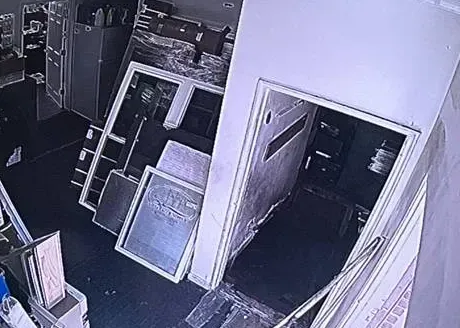
Example photo from another AESS job (not a Putnam County property): an overhead camera recording in low light, with a storeroom and an open doorway. Low-light views are where dirty lenses and poor settings show first, so we check each camera after dark.
Building Specialists
Camera Maintenance for Putnam County's Architecture
Putnam is six towns and three villages spread over more than 240 square miles, and almost every property type here wears a camera system out in its own way. These are the ones we see most, described in general terms — none of them is presented as a customer.
Lake-Colony Cottages
Lake Carmel, Lake Peekskill and Putnam Lake began as summer colonies in 1928; at Putnam Lake alone 11,000 lots were mapped at 20 by 100 feet. Many cottages are now year-round, but the lots are still tight and the trees close. Cameras sit low under eaves, close to shrubs and neighbours, and need their views checked every season.
Lakefront Houses
Around Lake Mahopac — about 587 acres with three islands — and the county's smaller lakes, cameras face docks, water and morning fog. Glare off the water, moisture on the glass and insects drawn to infrared light all show up first on these views.
Hillside Homes on Rock
More than nine-tenths of the county sits on Hudson Highlands bedrock. Houses on ridges and steep drives often run long cables to a gate or a lower driveway camera, and those runs are exposed to falling limbs, frost and lightning.
Village Buildings
Cold Spring's 691-acre historic district, Nelsonville and Brewster have attached and closely spaced buildings with older wiring. In Cold Spring, exterior changes visible from the street have needed review-board approval since 1976, so replacing a housing is planned differently from replacing it out of sight.
Weekend and Seasonal Homes
Of the county's 1,757 seasonal or occasional-use homes, many are visited every week or two. They depend on alerts more than eyes: if the recorder stops writing on a Monday, nobody may notice until the next Friday unless the system says so.
Farms, Barns and Outbuildings
Barns, riding stables, garages and sheds with cameras on detached buildings, fed by buried or overhead runs. Dust, hay, wasps and wide temperature swings are hard on housings, and the distance from the house makes surge and power checks matter.
Where each property type needs extra attention
Under deep eaves: cameras sheltered from rain collect webs, wasp nests and dust instead; their sunshields and the soffit around them are cleared every visit.
On trees and poles: cameras strapped to trees drift as the tree moves and grows. We check aim against the reference picture and re-strap or move them to a post where the drift keeps coming back.
On long driveway runs: junction boxes at the far end are opened and checked for water, insects and corrosion, and the surge device at the house end is inspected.
Near water: cameras facing a lake or a pond are checked for glare at sunrise and sunset and for moisture inside the housing.
In historic villages: like-for-like swaps are photographed before and after, so any review-board question has a clear answer.
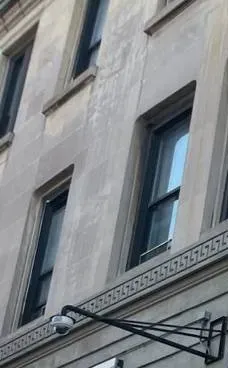
Example photo from another AESS job (not a Putnam County property): a dome camera on a long steel arm fixed to an old stone facade. Long arms on older buildings are checked for movement and corrosion at the anchors on each visit.
Commercial Security Camera Maintenance
Business Camera Maintenance in Putnam County
The county's own hazard profile places most of Putnam's commerce along Routes 6, 9, 22 and 52 and around I-84. Businesses there face a different problem from homeowners: their cameras are seen by customers every day, but the recording behind them is rarely checked. In September 2026 the Sheriff told the county legislature that its plate readers had flagged 22 vehicles linked to organized retail-theft rings that travel to Putnam specifically to steal from local stores, as Mid-Hudson News reported. A store whose recorder keeps a clean, complete clip is the one that can help.
Route 6 Through Mahopac and Carmel
Shopping centres, restaurants and services along Route 6 between Mahopac and Carmel. Parking-lot cameras face headlights, snow-plow piles and salt spray; their night views and motion settings need the most attention.
Brewster and Route 22
Village storefronts and Route 22 businesses toward Patterson. Older buildings, mixed tenants and shared basements mean recorders often sit in rooms someone else controls.
I-84 and Route 312, Southeast
Offices, warehouses and service businesses near the interchange. Larger systems, more channels and more drives make retention and drive-health checks the core of each visit.
Route 52 and Carmel Hamlet
Offices and shops near the county seat on Gleneida Avenue and along Route 52 toward Kent. Many have small systems installed years ago that have never been played back end to end.
Cold Spring's Main Street
Shops, galleries and restaurants in the historic district, busy on weekends and quiet midweek. Cameras on facades are few and carefully placed, so each one has to be clean and correctly aimed.
Garrison and Route 9
Businesses, institutions and estates along Route 9 and Route 9D in Philipstown, on Central Hudson's lines. Long drives, wooded lots and the August 2026 flooding along 9D make storm follow-ups part of the plan.
Rules that touch camera upkeep in Putnam
County licence (Chapter 145). Under the county's Electrical Licensing Law, the low-voltage technician trade takes in video surveillance systems of 90 volts or less and five amperes or less that start from an outlet a licensed electrician put in, and nobody may practise it in Putnam without a licence or registration. Consumer Affairs publishes the list of licensed low-voltage technicians — use it to check any contractor, us included.
State licence. Video surveillance work falls under the security and fire alarm installer licence issued by New York's Department of State; ours is #12000287431.
Neighbours' back yards. New York Civil Rights Law §52-a lets a homeowner sue a neighbour who sets up a camera to record their back yard without written consent. A re-aim after leaf-out should never swing a view over the fence.
Sound. Recording a conversation without at least one participant's consent is eavesdropping under New York Penal Law Article 250. If a firmware update turns microphones on, a maintenance visit turns them back off.
Cold Spring review board. If the work can be seen from the street, it needs the Historic District Review Board; if it is hidden from the street, the board does not look at it.
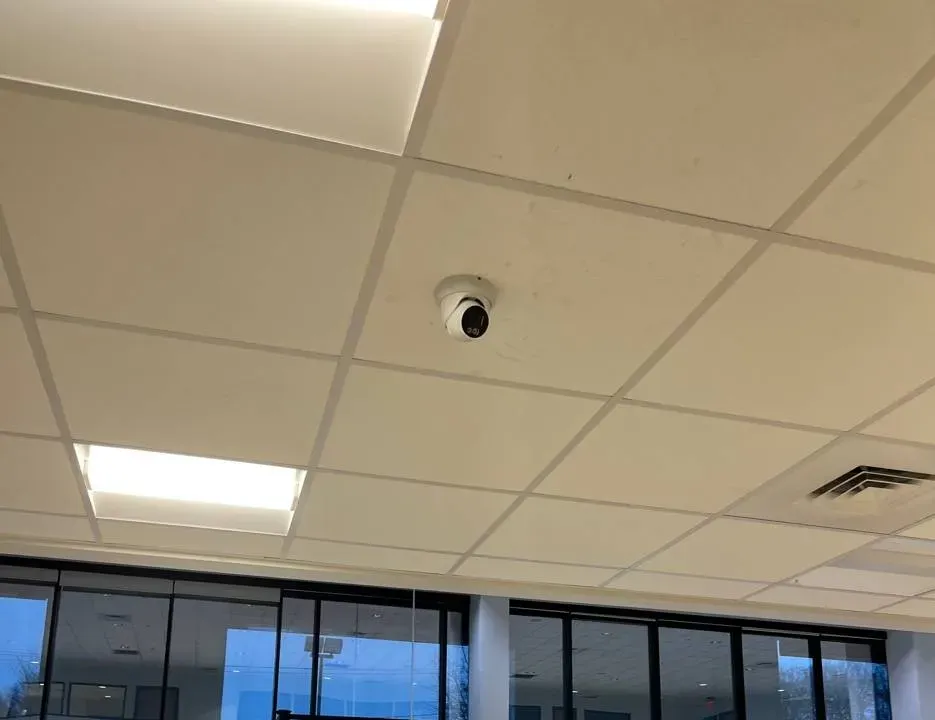
Example photo from another AESS job (not a Putnam County property): a turret camera on a ceiling facing a glass entrance, with trees and fading daylight outside. Cameras looking toward bright glass have to be checked at the times of day the light changes.
Your Questions Answered
Security Camera Maintenance in Putnam County: Questions Answered
Below are the problems people bring us from Putnam systems already in service — at lake houses, year-round homes, cottages and shops — sorted by the force wearing each system down. Prices sit further down the page, and short scheduling questions are in the FAQ near the end.
What the Recorder Is Really Keeping
The courthouse cameras caught only part of the July 4 incident because they record on motion — how do we find out whether our own system has the same gap?
By testing it the way an investigator would use it. Pick a time when you know something happened — a delivery, a car coming up the drive, you walking to the mailbox — and play that stretch back on the recorder, not just the motion "events" list in the app. Watch for the moment the clip starts. If it begins with the car already halfway up the drive, or the person already at the door, the system is recording on motion and missing the approach. If there are gaps of several minutes between clips while something was clearly happening, the motion detector is being too selective.
Then open the recording schedule for each camera. Many recorders ship set to motion-only on every channel, because it saves disk space and looks tidy in the app. Some installers leave it that way; some firmware updates and factory resets put it back. The Sheriff's comment about the county's own courthouse system in July 2026 — footage incomplete because the system relies on motion sensors — describes the result exactly. Nobody switched the cameras off; the settings simply decided the important moments were not worth keeping.
On a maintenance visit we do both checks and write down what we found. The usual fix is not to record everything at full quality forever, but to record continuously on the few views that matter most — the front door, the driveway entrance, the register — and keep motion recording, with a few seconds of pre-recording, on the rest. We then size retention so the drive still holds the number of days you want, and we test again to prove the gap is gone.
Can a firmware update or a power cut quietly change what our recorder records?
Yes, and in Putnam both happen often enough to matter. Some recorders restore default settings after a failed update or after certain kinds of power interruption, and the defaults are rarely what an installer set up. Recording schedules, motion zones, the time zone and the network time server are the settings we most often find changed. The cameras keep showing live video, so the change goes unnoticed until someone needs a recording that was never made.
Putnam's power record makes this a real risk rather than a theoretical one. The morning after Isaias in 2020, NYSEG still had 34,150 of its 38,693 Putnam customers without power; in 2026 the January and February snowstorms, the July 4 storms and the August 3 outage around Cold Spring and Garrison all cut power to parts of the county. Each outage, and each brief flicker as the lines are switched back, is a chance for a recorder to restart into a different state, especially if it has no battery backup to ride through the blinks.
We guard against it in three ways. First, we export a copy of the recorder's configuration after each visit, so a reset can be undone in minutes. Second, we set up an alert for a recorder restart where the model supports it, so you know when it happened. Third, every visit starts by reading the settings against that saved copy before anything else is touched, and the log notes any difference we found.
We only get up to the house every other weekend — how many days of recording does a part-time Putnam property really need on the drive?
There is no general New York rule setting a retention period for a private house or an ordinary shop, so the number is yours to choose. What matters is choosing it on purpose. For a weekend house visited every other week, anything shorter than three weeks means a problem found on a Friday may already have been recorded over. For a business, the useful number is the longest gap between an incident and someone asking for the footage — an insurer, a claims adjuster or an investigator — plus a margin.
The real number is easy to find and is often lower than people expect. On the recorder, open playback and go back day by day until the timeline is empty; the first day with video is the oldest recording on the drive. That number shrinks when cameras are added, when resolution or frame rate is raised, when continuous recording replaces motion recording, or when a drive starts failing and the recorder quietly drops it from storage.
We write the oldest-recording date into the log on every visit, and if it is below your target we look at the cheapest fix first: a lower bitrate on views that do not need full detail, a more efficient compression setting where the cameras support it, or a larger or additional surveillance-rated drive. A seasonal home on a two-visit plan can also be set to alert you when a drive fills unusually fast, which is often the first sign something has changed.
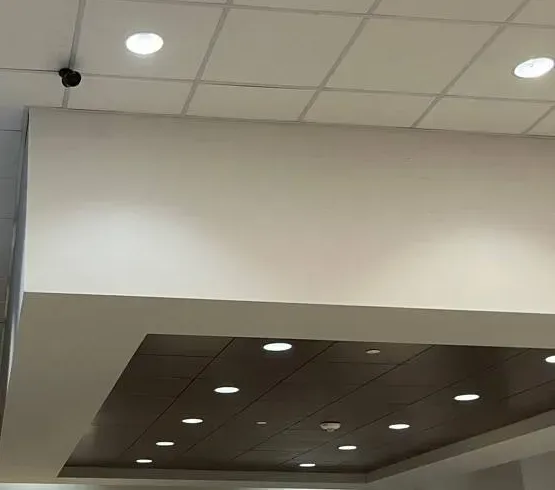
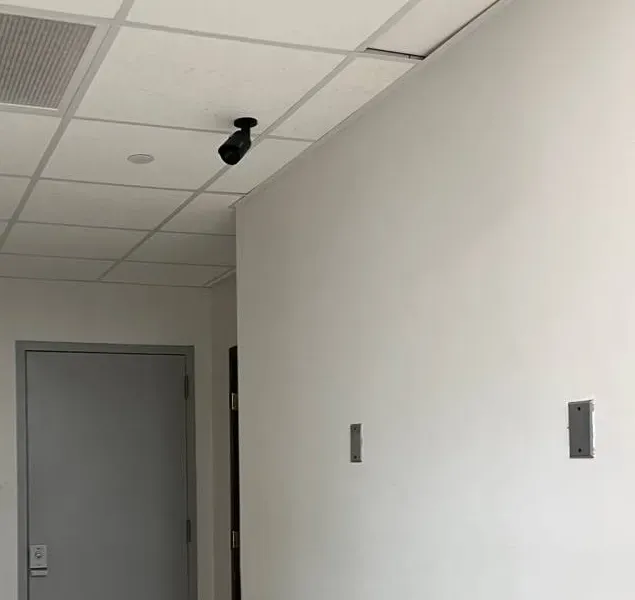
Example photo from another AESS job (not a Putnam County property): a small camera tucked at the edge of a ceiling bulkhead. A camera like this can look perfect in the live view while its channel is set to record only on motion — something only a playback test reveals.
Leaves, Insects and the Woods
Our solar-powered gate camera charged fine in April but runs flat by July — is the summer canopy shading the panel?
Very often, yes. A small solar panel is sized for the sun it gets when it is installed, and in Putnam many are installed in early spring when the trees are bare. About two-thirds of the county is forest, according to its own hazard-mitigation profile, and a gate post or a shed roof that sits in full sun in April can spend most of a July day in the shade of a full oak or maple canopy. The camera does not fail on a particular day; it simply takes in a little less than it uses, every day, until the battery runs out — often in the middle of the night.
The signs are easy to read once you know them: the battery percentage in the app drifts down week by week through early summer, the camera starts skipping motion clips or dropping to a lower frame rate to save power, and finally it goes offline in the evening and reconnects some time the next day. Pollen and dust on the panel make it worse, and so does a busy driveway, because every motion clip costs power.
On the spring visit we look at each panel at midday and in the late afternoon, check the charge history in the app, clean the panel and re-angle it where that helps. If the panel simply cannot see enough sky in summer, the options are a longer panel lead to a sunnier spot, a second panel, fewer recorded clips through tighter motion zones, or — for an important view such as a gate — running a cable after all, which we would price separately.
Spotted lanternflies cover the side of the house every late summer — do they cause trouble for outdoor cameras?
They can make a mess of the picture. The County Executive wrote to the state Agriculture Commissioner in August 2025 that the spotted lanternfly has taken root in Putnam County and that its numbers appear to have grown since it reached New York in 2020, with tree of heaven — its favourite host — along many county roads. When large numbers of any insect gather on a wall, some of them land on or crawl across camera housings, and what they leave behind ends up on the glass.
The practical effects are a smeared or spotted lens, a sunshield crusted with residue, false motion alerts from insects walking across the dome, and, after dark, bright specks and streaks in infrared as they move close to the lens. None of this damages a camera on its own, but a lens that stays dirty for a whole season produces a soft picture at exactly the time of year when doors and windows are open most.
We cannot keep insects off a house, and pest control is not our trade. What we do is clean the housings with lens-safe materials, check the night picture after cleaning, and lower motion sensitivity or narrow motion zones on the worst-affected cameras during the weeks the insects are out. Late in the season we also look at the wall around each mount, because the egg-laying period runs into the fall and cameras on the most affected walls may need a second wipe before winter.
After the spongy moth years there are dead oaks near our camera cable run — is that our problem or the tree's?
Both, and it is worth dealing with before a storm does it for you. According to state figures reported by the New York Almanack, spongy moth caterpillars defoliated 618,765 acres of the Hudson Valley in 2024, and although new defoliation fell sharply in 2025, more than 10,000 acres of oak died in the region that year. Trees stripped for several years running, especially on rocky ridges, are the ones most likely to die — and a lot of Putnam is rocky ridge.
Year
New spongy moth defoliation (DEC, as reported by the New York Almanack)
2021
682,652 acres statewide
2022
62,458 acres, middle to lower Hudson Valley
2023
188,313 acres, Hudson Valley
2024
618,765 acres, Hudson Valley (peak)
2025
66,928 acres, Hudson Valley, with more than 10,000 acres of oak mortality
2026
Egg-mass surveys found minimal new egg masses; no noticeable defoliation expected in surveyed areas
A dead oak drops limbs long before it falls. A limb landing on an overhead cable to a barn or a gate camera can stretch it, pull it out of its connector or tear it off the building. A cable stapled along a tree, or a camera mounted on one, goes down with it. The failures are usually sudden — a camera dark after a windy night — but the cause was visible for months.
On a visit we walk the outdoor runs and note any camera, cable or junction box within reach of a dead or dying tree. Tree work is for an arborist, and we say so. Our part is to suggest a safer path for the cable — a buried run in conduit, a post instead of a tree, a different corner of the building — and to price it separately so you can decide whether to move the camera now or after the tree comes down.
Cold, Power and the Storm Record
Our recorder sits on a shelf in an unheated garage — will a January cold snap hurt it?
It can, and the risk is greater than most people expect because a recorder is usually installed in summer and judged by how it behaves then. Western Digital's data sheet for its Purple surveillance drives gives an operating range starting at 0°C (32°F), and a recorder is only as tolerant as the drive inside it. An unheated Putnam garage or barn in January — after storms like the ones that left 14.8 inches in Mahopac on January 25–26, 2026 and brought a county state of emergency on February 22 — can sit below freezing for days.
A recorder that runs all the time makes some of its own heat, which helps, but the trouble comes when it stops. A power cut lets the box cool to the garage's temperature, and when power returns the drive has to spin up cold. Condensation is the other problem: warm, damp air reaching a cold metal case on a thaw day can leave moisture inside. The symptoms are a recorder that will not finish starting after an outage, a drive that the recorder suddenly reports as missing, and recording gaps that line up with the coldest nights.
On the fall visit we check the recorder's own temperature reading where it shows one, the drive's health data and the drive model's rated range, and we look at where the box sits — on a cold outside wall, near the overhead door, on a concrete floor. The cheapest fixes are moving it to an inside wall or a heated room through a longer cable, putting it in a small insulated cabinet with ventilation, or keeping it on a battery backup so it rides through short outages without cooling down.
Putnam's outage record, town by town
Most of Putnam is NYSEG territory; Cold Spring and Nelsonville are on Central Hudson, which also serves parts of Philipstown. The morning after Tropical Storm Isaias in August 2020, Daily Voice reported NYSEG still had 34,150 of its 38,693 Putnam customers out and Central Hudson 3,621 of its 5,160. The town-by-town counts below show how widely that storm was felt. More recent events were smaller but closer together: NYSEG reported thousands of Putnam customers out after the July 4, 2026 storms, and about 740 Central Hudson customers around Cold Spring and Garrison lost power on August 3, 2026.
Town or village (Isaias, Aug 5, 2020, ~10:15 a.m.)
Customers still without power
Utility
Carmel
12,717
NYSEG
Kent
5,815
NYSEG
Southeast
5,220
NYSEG
Putnam Valley
5,088
NYSEG
Patterson
4,422
NYSEG
Philipstown
2,475
Central Hudson
Cold Spring
992
Central Hudson
Brewster
818
NYSEG
Nelsonville
154
Central Hudson
A battery backup is not meant to carry a recorder through a multi-day outage like that; for that you need a generator or you accept a gap. What it does well is ride through the short blinks and the first hour or so of an outage, so the recorder never restarts, keeps writing and, if the router is on the same battery, keeps sending alerts. We size the battery to the recorder, the PoE switch and the router together, run its self-test on every visit and log its age. Knowing which utility serves you also helps from a distance: both publish outage information, and Central Hudson customers can text OUT or STAT to 236483 to check before assuming the cameras have failed.
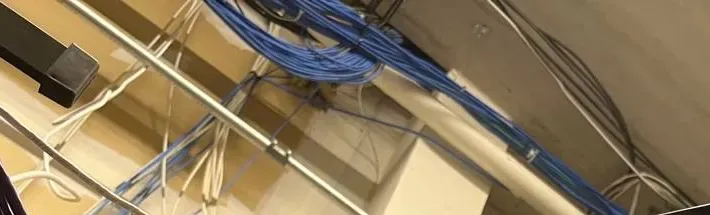
Example photo from another AESS job (not a Putnam County property): bundles of blue network cable run along a pipe in an open ceiling. Every camera’s power and video travel on runs like these; on long runs to outbuildings we also look at surge protection.
Properties Nobody Visits Midweek
Who should receive the camera health alerts at a weekend lake house — us in the city, a neighbour, or whoever opens the house?
Three things should always send an alert: a camera that stops sending video, a hard drive error or a drive the recorder can no longer write to, and the recorder itself going offline. Those three cover most of the ways a system fails quietly. Motion alerts for people and vehicles are useful too, but they are a security feature rather than a health one, and on a lakefront lot they need careful tuning or they will fire for every boat, deer and gust.
The recorder going offline is the hardest to catch, because a device that has lost power or internet cannot send anything. The answer is a check from the outside: an app or a monitoring service that notices when the recorder stops checking in and tells you. In parts of Putnam where internet and power are less reliable, a second path — a cellular backup on the router, for example — makes that check far more dependable.
As for who gets the alert: the owner, always, and ideally a second person who can actually go and look — a neighbour, a caretaker or the person who opens the house. With your agreement we can also receive the health alerts, so a dead drive is quoted before the weekend rather than discovered during it. We test every alert on each visit by unplugging a camera and watching the notification arrive.
We rent the cottage out for the summer — how do we check after each changeover that guests did not unplug, cover or turn a camera?
Start by keeping it simple for the guests: outdoor cameras only, no cameras inside the rental, and a clear note in the listing and at the door about where the outdoor cameras are. Check your rental platform's own rules on cameras as well; the safest system is one that nobody has a reason to tamper with. The recorder itself should be in a locked cupboard or closet, not on a shelf next to the router where it can be unplugged to charge a phone.
Then make checking quick. After each changeover, open the app and look at three things: is every camera tile showing a picture, does each view look the way it did before, and does the playback timeline run without gaps through the stay. A tile that is black, a view pointing at the sky or a gap in the middle of the week tells you to go and look. Saved reference snapshots make the second check much easier; we take them on every visit.
On the system side, we set alerts for a camera disconnecting or its view being covered or moved, where the cameras support tamper detection, and lock adjustable mounts with set screws so they cannot be turned by hand. If a camera does get moved, we restore it to its reference view on the next visit, or sooner if you ask.
Shops and the Crews the Sheriff Described
The Sheriff says retail-theft crews travel to Putnam to target local stores — which of our shop's cameras deserve the most frequent cleaning and checks?
The ones that would make a clip useful to an investigator: the camera that sees faces at the door, the one over the register or the high-value shelf, and the one that sees vehicles in the lot or at the curb. In September 2026 the Sheriff told the county legislature that plate readers had flagged 22 vehicles linked to organized retail-theft rings that travel to Putnam specifically to steal from local stores, as Mid-Hudson News reported. Those cases are built from vehicles and faces, so the cameras that capture them matter more than the ones watching the stockroom.
Those three views are also the ones most likely to degrade. Door cameras face daylight through glass and swing between bright and dark all day; lot cameras sit outside in pollen, salt spray from plowed lots and insects at night; register cameras sit under lights and get bumped during re-merchandising. A door camera with a smeared lens or the wrong exposure setting produces a silhouette instead of a face, which looks fine on the monitor until someone needs to identify a person.
On a business plan we put those cameras on the shortest cycle — cleaned and checked every visit — and test them with a real playback: a person walking in at the busiest light of the day, a car pulling into the lot. We also confirm they record continuously during opening hours rather than on motion only, that their clocks are right, and that the staff member who opens up knows how to export a clip. The quieter cameras go on the longer cycle.
Equipment
Types of Security Cameras We Maintain
Each kind of camera and recorder on a Putnam property has its own weak point. This is what a maintenance visit looks at on each.
Dome Cameras
The clear bubble collects pollen, water spots and insect residue, and it reflects infrared light from anything close by. We clean it with lens-safe materials, check its seal and replace bubbles that have gone cloudy or scratched.
Turret Cameras
Common under eaves and over garage doors. Without a bubble they glare less at night, yet a hand or a strong gust can shift the ball mount, so the lock screw, the infrared LEDs and the aim against the reference picture are all checked.
Bullet Cameras
Long views down drives, across lawns and toward docks. Their sunshields hold snow, leaves, webs and nests; the bracket is checked for rust and movement, especially on posts and trees.
Floodlight Cameras
Lights and camera in one housing over a driveway or a back door. We test the light, the motion trigger and the sensitivity, and clean the lamp lenses so the light reaches where the camera is looking.
PTZ Cameras
Pan-tilt-zoom cameras on large lots and lake frontage. Presets and tours are run end to end, the home position checked, and motors listened to for strain after a cold spell.
Battery and Solar Cameras
Common on outbuildings and gates far from power. We check charge history, solar panel angle and cleanliness, signal strength and that leaf-out has not put the panel in shade.
Recorders and Drives
Per-channel recording schedules, days of retention, drive health and error logs, firmware level, clock source and a saved configuration; dusty fans cleaned and weak drives swapped for surveillance-rated ones.
PoE Switches and Long Runs
Port status, power draw, connectors at the far end of long cables, junction boxes and surge protectors on runs that leave the house for a barn, a gate or a dock.
Battery Backup and Generator Circuits
The UPS is self-tested and load-tested, its battery date logged, and where the house has a standby generator we confirm the recorder and switch are on the circuits it carries.
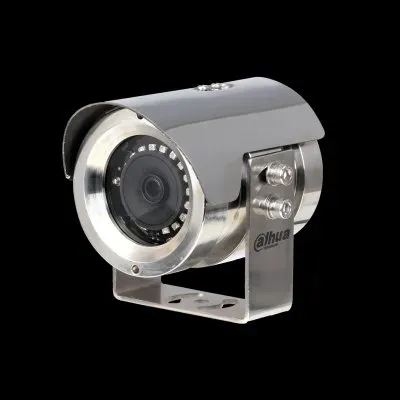
Manufacturer product photo: a stainless steel bullet camera with a ring of infrared illuminators around the lens. Housings like this resist corrosion, but their seals, cable glands and illuminators still need checking.
National brands versus a local maintenance plan
Plenty of Putnam households began with a national-brand kit or a monitored package, and those have their place. Their support revolves around the company's own hardware and app. The table sets out the usual differences from a local upkeep plan for a wired system; it describes common service models in general, not the current terms of any one company.
Question
ADT, Ring or SimpliSafe-style service
AESS Putnam maintenance
Who checks the recording settings?
Usually set by the device and the app plan; the owner adjusts them.
A technician plays recordings back and sets each camera's schedule to its job.
Views blocked by leaves or snow
Left to the owner to notice and move the device.
Compared with seasonal reference pictures and corrected on a spring and a fall visit.
Mixed brands and older wired cameras
Mostly limited to the brand's own cameras and hubs.
Hikvision, Dahua, Lorex, Uniview, Axis and other wired systems maintained as they are.
Long cable runs to barns and gates
Wireless devices; no cable runs to inspect.
Junction boxes, connectors and surge protection inspected on every visit.
Written record
App history and account records.
A dated log of each camera, the settings and the oldest recording on the drive.
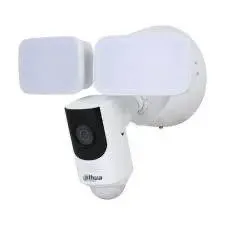
Manufacturer product photo: a floodlight camera with two lamp panels above the camera. On a visit we test the lights and their motion trigger and clean the lamp lenses as well as the camera.
AI Overview Reality Check
What AI Gets Wrong About Security Camera Maintenance in Putnam County
Google's AI Overview for this subject could not be captured from the environment we research in, so this section does not quote it. What follows are seven statements that keep appearing in the guides, product pages and forum replies those summaries draw on, each tested against Putnam conditions.
Claim 1: "Motion detection only skips the boring parts"
Motion recording does save storage, and on many cameras it is the sensible choice. The second half of the claim is the problem. Motion detection decides what is worth keeping, and it can be wrong — tuned too low it misses a slow walk to a door; tuned too high it drowns in branches and headlights, and owners then turn it down further.
Putnam has a public example. The Sheriff said in July 2026 that the county's cameras captured only portions of the July 4 incident at the courthouse because the system relies on motion sensors. That was a professionally installed system on a county building, not a cheap doorbell.
The fix is not to abandon motion recording but to decide camera by camera. The handful of views that matter most get continuous recording; the rest record on motion with pre-recording turned on, so each clip starts a few seconds before the trigger. Then the setup is tested by playing back a real event.
Claim 2: "Clean and inspect your cameras on a fixed schedule — once or twice a year"
Maintenance guides disagree about frequency. Reolink's article recommends checking for faults once a year. Axis splits the work into weekly, monthly and quarterly tasks. One integrator's checklist says most integrators recommend a full inspection every six months with quick monthly checks; another says commercial systems should be checked weekly and maintained monthly.
The flaw is the calendar itself. In Putnam the timing matters more than the count. A visit in April misses the summer leaves; a visit in December comes after the first snowstorm has already shown which housings leak. Two visits a year placed at the wrong moments do less than two placed at the right ones.
We time Putnam visits to the county's seasons: one in early summer after leaf-out, one in the fall after leaf-drop and before the snow, plus a follow-up after any storm that takes out power or brings down trees on the property. Remote health alerts cover the time in between.
Claim 3: "Outdoor-rated cameras are weatherproof, so they can be left alone"
An outdoor rating describes how a new camera resists dust and water when it leaves the factory, sealed and correctly installed. It says nothing about the junction box behind it, the cable joint inside that box, or a gasket that has dried out after several winters of freeze and thaw.
In Putnam the water arrives fast and from below as well as above — runoff down steep drives, flash floods like the one Putnam Valley declared an emergency for on July 29, 2026, snow piled against low cameras. Most of the "weatherproof" cameras we find failing have water in the connection, not in the camera.
So the visit looks at the whole path: the camera's seals, the cable entry, the junction box, the connectors and the cable where it enters the building. Fixing a joint costs far less than replacing a camera that the joint killed.
Claim 4: "If you can see the live view on your phone, the system is working"
Live view proves the camera is sending video right now. It does not prove that video is being saved, that the drive is healthy, how many days the drive holds, or that the clock on the recordings is right. All of those can fail while live view looks perfect.
This matters most for the kind of owner Putnam has a lot of: someone who checks the cameras from New York City or from work, sees the lake or the driveway, and is reassured. The census counts 1,757 seasonal or occasional-use homes in the county — owners who see their property mostly through an app.
The test that proves a system works is playback: pick a time, play it back end to end, and check the oldest day on the drive. We do it on every visit and show owners how to do a two-minute version themselves.
Claim 5: "Camera maintenance is mostly wiping the lenses"
Cleaning matters, and many guides lead with it — Axis notes that a blurry image is often just a dirty lens. But a clean lens on a camera that is recording on motion only, writing to a failing drive or stamping the wrong date produces a sharp picture of nothing useful.
On Putnam systems the findings that change outcomes are rarely about the glass. They are a recording schedule nobody chose, a drive the recorder quietly dropped, a battery backup that lasts two minutes, an alert that goes to an old phone number, a camera that drifted a few degrees after a storm. None of those shows up on a quick wipe-and-go visit.
So cleaning is one line on our checklist, not the visit. The time goes into playback, settings, drives, power and alerts, and the log records each of them, so you can see what was checked as well as what was cleaned.
Claim 6: "Quiet rural areas need less camera upkeep than cities"
Fewer people pass a Putnam camera than a city one, but the camera itself works harder against weather, trees, insects and power cuts, and there is often nobody nearby to notice when it stops. A dead camera on a busy storefront gets reported by the next customer; a dead camera at the end of a long drive gets found when it is needed.
And quiet does not mean untroubled. In September 2026 the Sheriff told the legislature that county plate readers had identified 27 known burglary-crew vehicles tied to residential burglaries across the region and 22 vehicles linked to organized retail-theft rings, as Mid-Hudson News reported. In August 2026, Carmel police asked Mahopac residents with cameras to review footage after seven cars were entered before dawn.
Those are exactly the moments when the cameras have to have been working all along. Upkeep in a quiet place is less about frequency and more about making sure you hear about a failure the day it happens.
Claim 7: "You can find a fair maintenance price online"
National cost guides mostly price security system repair, not ongoing upkeep; HomeAdvisor's guide is an example. We could not find a published Angi, HomeAdvisor or Fixr figure for a camera maintenance plan to compare against, so we are not going to quote one.
What decides a Putnam price is mostly distance, access and exposure: how far into the county the property is, whether the cameras are reachable from a step ladder or need an extension ladder on a slope, how many face trees and water, and how many visits a year the plan needs.
Our published Putnam ranges are in the pricing section below, and every quote is written and itemised before anything is booked.
Want to Know What Your Recorder Actually Kept Last Week?
Call (845) 640-3835 and we will walk you through a two-minute playback test over the phone. If it shows a gap, we will tell you what it takes to close it.
Tell us where the property is, how many cameras it has, how often someone is there and what has gone wrong, if anything. A licensed technician calls back the same business day with a written Putnam price for a tune-up or a seasonal plan, or a time to come and look first. Nothing is booked until you say so.
Got It — We'll Be in Touch
Your request is in. Look for a call from our Hudson Valley line later today, or ring (845) 640-3835 if it cannot wait.
How It Works
Our Maintenance Process
The same sequence applies to a three-camera cottage at Putnam Lake and to a forty-camera office near the interstate. The first visit is the long one, because it creates the baseline the rest are measured against.
1. Playback first
Before anything is cleaned or moved, we play back a known stretch of time on every important camera and read each channel’s recording schedule, so we know what the system was really keeping.
2. Inventory and reference pictures
Every camera, recorder, switch, battery backup and long cable run is listed with models and firmware, and each view is photographed by day and after dark as the reference for later visits.
3. Walk the property
Barn, gate, dock and driveway runs are walked: junction boxes opened, surge protection checked, trees and water near cameras and cables noted.
4. Season-timed plan and written price
You receive a written Putnam price and a calendar — usually a visit after leaf-out and one before winter — with the terms in the service agreement, before anything is booked.
5. Clean, correct and test
Lenses and housings cleaned with lens-safe materials, views re-aimed against the reference, motion zones redrawn, drives and battery backup tested, clocks synced and settings backed up.
6. Alerts between visits
Camera-loss, drive-error and recorder-offline alerts are set up and tested by unplugging a camera and watching the notice arrive on the right phones.
7. Dated log and next date
Each visit closes with a written, dated record — settings as left, how far back the drive reaches, parts we priced — and the next seasonal date is fixed before we leave.
Coverage Area
Security Camera Maintenance Near Putnam County's Landmarks
We cover every town and village in the county. The places below are listed for what surrounds them — water, woods, historic streets, open farmland — not as customers.
Historic Putnam County Courthouse
On Gleneida Avenue by Lake Gleneida in Carmel Hamlet, built in 1814 and one of the oldest courthouses still in use in New York — and the site of the July 2026 incident that showed what motion-only recording misses.
Lake Mahopac
About 587 acres with three islands, ringed by houses and docks. Cameras facing the water deal with glare, fog and the insects that gather at lit shorelines.
West Branch Reservoir
In Kent and Carmel, about 35 miles from New York City, holding 8 billion gallons in two basins separated by Route 301 — the kind of wooded watershed land that surrounds many Putnam homes.
Cold Spring Historic District
A National Register district since 1982, its 691 acres hold more than 200 buildings, many older than the Civil War. Any camera work that shows from the street goes before the review board.
Tilly Foster Farm
About 199 acres in the Town of Southeast, bought by the county in 2002 — open fields and barns typical of the eastern towns' farmland, where cameras sit on outbuildings at the end of long runs.
The Great Swamp, Patterson
The hardwood-heavy wetland where the County Executive asked the state in 2025 about reducing spotted lanternfly egg masses — and a reminder of how much forest edge Putnam's eastern properties face.
Town by town: what we watch for
Carmel and Mahopac. The county seat, Route 6 and Lake Mahopac. Carmel had the most customers still dark the morning after Isaias — 12,717 — and Mahopac measured 14.8 inches of snow in January 2026. In August 2026 Carmel police asked Mahopac residents with cameras to review footage after seven unlocked cars were entered between about 3:37 and 5:05 a.m. on four streets. Pre-dawn night views and continuous recording on driveways matter most here.
Kent. Lake Carmel, Ludingtonville, Farmers Mills and the West Branch Reservoir shoreline along Route 301. Kent had 5,815 NYSEG customers out after Isaias. The town has said it does not issue electrical permits and refers questions to Putnam County Consumer Affairs, so county licensing is the rule that applies to camera wiring work here.
Southeast and Brewster. The I-84 and Route 312 interchange, the village of Brewster and Tilly Foster Farm. Businesses and warehouses near the interstate run the county's larger systems, which makes drive health and retention the core of each visit; Brewster's older village buildings bring shared basements and mixed tenants.
Patterson. Putnam Lake, the Route 22 corridor and the edge of the Great Swamp. The county's storm list includes a tornado across Patterson and Kent on May 15, 2018, and the lake-colony lots at Putnam Lake put cameras close to trees, neighbours and water. When the colony was laid out from 1928, 11,000 lots of 20 by 100 feet were mapped there; many cottages on those narrow lots are now lived in all year, and a camera on one often looks straight into the next lot, so every re-aim is checked against the property line.
Putnam Valley. Lake Peekskill, Tompkins Corners and wooded roads such as Cimarron, Horton Hollow and Canopus Hollow, all named in the town's July 29, 2026 flash-flood emergency. The town measured 14 inches of snow in January 2026. Low cameras, junction boxes and long drives get the closest look after storms.
Philipstown, Cold Spring and Nelsonville. Central Hudson territory: 740 customers around Cold Spring and Garrison lost power on August 3, 2026 while Route 9D flooded. Cold Spring's historic district sends visible exterior changes to its review board, so in-place cleaning and resealing are favoured over swapping housings on street facades.
Visits also run to Mahopac, Mahopac Falls and Carmel Hamlet in Carmel; Lake Carmel, Ludingtonville and Farmers Mills in Kent; Putnam Valley, Lake Peekskill and Tompkins Corners; Patterson and Putnam Lake; Brewster, Peach Lake and the rest of Southeast; and Garrison, Continental Village, Nelsonville and Cold Spring in Philipstown. The rest of the region is covered from our Hudson Valley security camera maintenance hub.
Pricing
Security Camera Maintenance Cost in Putnam County
Our Putnam prices are the New York City base rates times 1.45, rounded to the dollar — an area factor that reflects the distances involved. Parts such as replacement drives, batteries, dome bubbles, surge devices and cameras are priced separately on your written quote.
Putnam maintenance work
Price
What it covers
Single tune-up visit (house or small property)
$218–$508
Playback and schedule audit, lens and housing cleaning, day and night views and aim, drive health and reach-back, UPS test and a dated log, all in one trip
Seasonal plan, house or small property
$290–$725 per year
A spring visit after leaf-out and a fall visit before winter, health alerts set and tested, faster booking if something fails between visits; in practice $73–$218 a camera a year, set by camera count, access and exposure
Commercial plan, quarterly or monthly
$1,450–$7,250+ per year
Shops, offices, warehouses, associations and larger estates; priced after a walkthrough
Same-day repair visit
$276–$1,305
Recorder down, cameras offline or nothing being saved — diagnosed and fixed the same day, priced for the job
Service after an AESS installation
$195/hr, 3-hr minimum ($585)
Hourly rate for return trips to alter or extend a system AESS installed; installs themselves are never billed by the hour
What moves a Putnam price inside those ranges is mostly travel and terrain. A cluster of cameras on a house near Route 6 in Mahopac is quick to reach and service. A property at the end of a private road in Kent or Philipstown, with cameras on a barn, a gate and a dock, takes longer to reach and to work on, and steep or wet ground can mean an extension ladder where a step ladder would do elsewhere. Plans with more visits cost more per year; plans backed by reliable health alerts usually need fewer.
Two worked examples on the published prices
A weekend house on a lake in Putnam Valley. Six cameras: driveway, front door, back deck, dock and two on the garage, recorder in a basement closet. The owner wants one visit after the leaves are out and one before winter, with alerts to their phone and a caretaker's. That sits in the seasonal plan range of $290–$725 a year, with the figure set once we have seen the dock and garage access. A failing drive found on the first visit would be quoted as a part before it is replaced.
A 20-camera office and warehouse near I-84 in Southeast. Parking lot, loading area, entrances and interior. Management wants quarterly visits and a written report each time. That is a commercial plan in the $1,450–$7,250+ range, priced after a walkthrough because lot camera heights and the number of channels decide the hours. A single deep clean and playback audit first is quoted as a one-off at the same rates.
Payment terms appear on each written quote, next to the visit dates and what each visit covers, so a two-season plan is billed in two predictable steps rather than as one surprise. Full terms — including 50% deposit, the 30-day warranty and optional paid extended warranty, and the late-fee schedule — are set out in the service agreement. If any line on the quote is unclear, ask and we will go through it with you before you sign anything.
Manufacturer product photo: a slim rack-mount recorder with four drive bays. Each drive’s health and the oldest recording on the system are read and logged on every visit.
Shop Our Systems
Security Camera Maintenance Packages & Pricing
Three starting points cover most Putnam properties. The final figure depends on camera count, how high and how steep the mounting spots are and how deep into the county you are; local recording has no monthly fee.
Putnam Tune-Up
$218–$508
A single trip: recordings played back and schedules fixed, each camera cleaned and checked in daylight and in infrared, drifted views straightened, drives and reach-back read, backup battery tested, configuration saved, written log left.
Two-Season Plan
$290–$725 / year
A leaf-out visit and a pre-winter visit, health alerts to you and a second contact, a storm follow-up when you ask for one, and a report after each visit with before-and-after views.
Business and Estate Plan
$1,450–$7,250+ / year
Quarterly or monthly service for shops, offices, warehouses, associations and large properties: retention and drive checks, playback audits, surge and backup tests, and dated records for insurers or boards.
Equipment you bought on your own is maintained at these Putnam rates
It does not matter who put the system in — a previous homeowner, another contractor, or you with a kit from a store or a website. The first visit lists each camera and recorder with model and firmware, and says honestly which deserve upkeep and which are close to retirement. For added or replacement equipment later, our bring-your-own-equipment calculator lists the labor-only line items.
Example photo from another AESS job (not a Putnam County property): a bullet camera on a ceiling mount aimed at a grey door. We save a reference picture of each view like this and compare against it on later visits to catch drift.
Talk to a Putnam Camera Technician
Ask about a two-season plan for a lake house, alerts for a weekend property, or one playback audit for a shop — the person who answers plans the visit.
Every Security Camera Maintenance Service in Putnam County
Some problems found on a visit belong to a different trade within AESS: a recorder beyond repair, a buried run that has failed, a gate intercom near the end of its life. These Putnam pages cover each of them.
Field Notes: Play It Back Before You Wipe Anything
The first thing I do on a Putnam visit is not cleaning. I sit down at the recorder, pick a time when I know something happened — the owner's car leaving that morning, a delivery the day before — and play it back from a minute before to a minute after. Then I open the recording schedule on every channel and write down what it says.
The reason is simple: cleaning and re-aiming change the evidence of what was wrong. If a clip starts late, I want to know whether it was the motion setting, a branch in the motion zone, a dirty dome that confused the detector, or a camera that had quietly been knocked a few degrees. Once I have wiped and moved things, I cannot tell any more.
After that comes the walk. Up here it is a longer walk than in the city — out to the barn, down to the dock, along the drive to the gate — and on that walk I am looking at trees as much as cameras. The cameras tell me what failed. The trees, the slope and the water tell me what is going to fail next.
— Owner, NYS license #12000287431
FAQ
Putnam County Security Camera Maintenance FAQ
Quick answers about getting in, timing and records that the longer sections leave out.
Does the after-dark picture test mean a second trip, or can it happen on the same day?
+
Usually the same day. We plan the visit so the outdoor work is done in daylight and finish at dusk, or we darken the camera’s view where that is possible. On short winter days it fits easily; in June, when it stays light late, some owners prefer a later start so the night check comes at the end of the visit.
Can you set up the camera app on every family member’s phone while you are there?
+
Yes. We install or update the app on each phone you hand us, sign it in with its own user where the system supports separate users, and show each person how to find live view, playback and a clip export. Separate users mean one person’s phone can be removed later without changing everyone’s password.
Can you add a camera we bought ourselves to the recorder during a maintenance visit?
+
Usually, if the camera is compatible with the recorder and a cable or wireless link can reach it. Tell us the model when you book so we can check compatibility first. Connecting it to an existing run is done during the visit; running a new cable is quoted separately before any work starts.
Are video doorbells and plug-in indoor cameras included in a maintenance visit?
+
They can be. Doorbells and plug-in cameras are checked for picture, night view, charge or power, firmware and that the account is still in your name. They are counted in the camera total on your quote, so tell us about them when you book, even if they use a different app from the main system.
If you find a dead camera on a maintenance visit, do you replace it on the spot or quote it first?
+
We quote it first. You get the cause, a photo and the price of the part and labor before anything is replaced. Small fixes that need no parts, such as reseating a connector or re-aiming a camera, are done on the spot as part of the visit.
Can you leave a short guide for the house-sitter on what to do when a camera goes offline?
+
Yes. We leave a one-page sheet near the recorder and send a copy to you: how to tell whether the power is out, how to restart the recorder safely, what not to touch, and who to call. Keeping it to one page means it actually gets used.
Will you take down old cameras and brackets left behind by a previous system?
+
Yes. Dead cameras, empty brackets and loose cable from an earlier system are removed on request and the holes sealed so water cannot get into the wall. We note what was removed in the log, and anything still connected to power is made safe first.
If our recorder fails, can the settings you saved be loaded onto a replacement?
+
Often, if the replacement is the same brand and a compatible model, which is one reason we export the configuration after each visit. A different brand has to be set up again by hand, but the saved file and our log still tell us every camera, schedule and alert that needs recreating.
Does the house alarm need to be off for the whole visit?
+
Usually only in the rooms and doors we need to use. If your alarm company can set a partial arming mode, the rest of the house can stay armed. Otherwise we ask you or your caretaker to disarm it for the visit and confirm by phone or text when we leave so it can be set again.
All Areas Served
Security Camera Maintenance Across the Hudson Valley, New York City and Long Island
Where the Putnam Camera Maintenance Facts Come From
Each statistic, event and rule mentioned on this page comes from one of the links below; forum threads were read only as search excerpts. The routines we describe — playback first, a visit after leaf-out and one before winter, reference pictures, alert tests — are our own way of working rather than something these sources prescribe, and the prices are our city base rates with the Putnam factor of 1.45 applied.
Nothing here is legal advice. Questions about county licensing, a neighbour’s privacy, audio recording or a historic-district review belong with the office concerned or a lawyer.
Recorder Silent Since the Last Outage — Ring the Putnam Number
Recorder stuck on its start screen since the power came back, half the cameras missing from the app, a clip someone needs by Monday — ring (845) 640-3835. We copy off any footage that matters before touching the system, and in most cases it is recording again within one to two hours of the technician arriving.
Putnam Camera Upkeep From a Licensed, Insured Crew
Abstract Enterprises Security Systems · call (845) 640-3835 for Putnam visits · office at 460 E Fordham Rd, Bronx, NY 10458 · send WhatsApp (718) 679-0359
Fully insured · NYS license #12000287431 · estimates the same day · 4.6★ across 390+ Google reviews
Parts we fit for you — drives, UPS batteries, surge devices, dome bubbles, whole cameras — come with their makers' own cover, and the labour to fit them is listed separately on the quote. Full terms — including 50% deposit, the 30-day warranty and optional paid extended warranty, and the late-fee schedule — are set out in the service agreement. A question about a part already fitted goes to the same Putnam line, and the log from the visit when it went in tells us exactly what it was. See our warranty page.
Page reviewed and updated October 18, 2026. Changelog: Putnam County camera maintenance page rebuilt from new research on the July 2026 courthouse footage gap, the county's forest cover and watershed, the spongy moth and spotted lanternfly years, the 2026 snowstorms and summer outages, lightning and flash flooding, seasonal homes, Chapter 145 licensing and Cold Spring's review board, on the maintenance base prices at the Putnam area factor of 1.45.