Gate Call Boxes · Lake-House Door Stations · Condo & Senior Entries · Main Street Doors · Licensed Low-Voltage
Intercom Repair Service in Putnam County
Find the Fault · Fix the Door Release · Survive the Winter · Keep the Gate Calling
A Putnam intercom is rarely a brass panel in a big lobby. It is a call box on a post at the end of a private road, a door station on a lake house that has sat unheated since October, a keypad at the front of a condo building in Carmel, or the buzzer on a Main Street door shared by a shop and the apartment over it. When one of them goes quiet, the cause is usually distance, cold, a power cut, lightning or a phone line that is no longer what it was — and the fix is a repair, not a whole new system. We trace the fault, mend what is broken and leave it working in the conditions it has to live in.
Reviewed and updated October 18, 2026 by Anwar Timothy (NYS low-voltage licence #12000287431) · Putnam calls are scheduled from our Bronx office at 460 E Fordham Rd
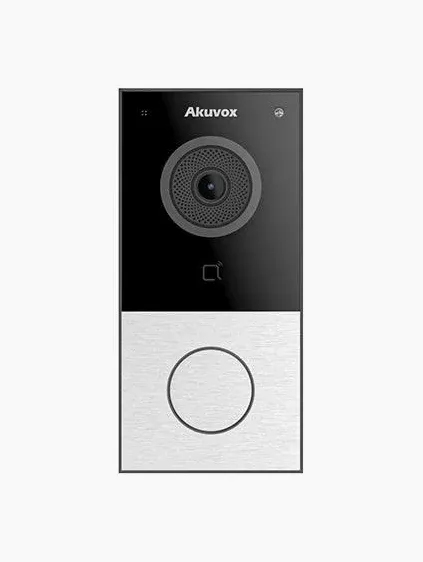
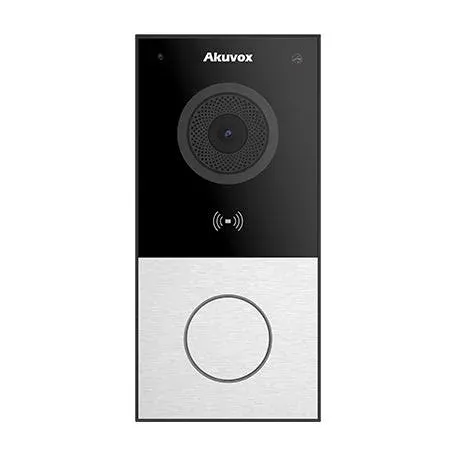
Manufacturer product photo (not an installed unit): a narrow door station with a black glass upper half around a round camera lens and a brushed silver lower half carrying one large round call button. One-button stations like this one sit on the front doors of many Putnam houses, and most of the repairs we make to them happen behind the plate, in the wiring and the power supply, not in the face you can see.
Putnam Intercom Repair Request
Name the town or hamlet, the brand on the door station if you can read it, and what has stopped working — sound, picture, door release, gate or app
✅
Request Sent!
A technician will phone you about the Putnam intercom the same business day.
25+
Years Experience
✓
Same-Day Estimates
100%
Licensed & Insured
4.7★
201 Google Reviews
Four details shorten a Putnam intercom repair more than anything else. The name printed on the door station or the indoor unit; what happens when the button is pressed (silence, a hum, a ring with no voice, a voice with no door release); how far the outdoor unit is from the house or the building’s equipment closet; and whether the trouble began after a storm, a power cut, a phone or internet change, or a renovation. A photo of the door station and one of whatever box sits behind the indoor monitor will usually tell us which parts to bring. Send them, or call (845) 640-3835.
Putnam diagnostic visits are priced at $218–$435, and the fee is credited if you go ahead with the repair
We repair what is there before we suggest anything new; nothing on the bill is monthly unless you ask for a cloud service
Visits seven days a week in two-hour arrival windows, the last starting at 8 PM, under New York State low-voltage licence #12000287431
Ask most people what an intercom is and they picture a row of buttons in a city lobby. Putnam has a few of those, but they are the exception. The county’s own hazard-mitigation profile describes a little over 240 square miles shared by six towns — Carmel, Kent, Patterson, Philipstown, Putnam Valley and Southeast — and three villages, Brewster, Cold Spring and Nelsonville, with more than nine-tenths of the land on Hudson Highlands rock and about two-thirds of it wooded. In country like that, the visitor is usually a long way from the person who has to let them in. The intercoms we repair here are the devices that close that gap: a call box at the bottom of a drive, a door station on a house set back in the trees, a panel at the front of a condo building whose residents are three floors up, a buzzer on a street door that leads to a flat over a shop.
The Census Bureau counts about 38,700 homes in the county, 83.8 percent of them owner-occupied, and most are single-family houses on their own lots. That changes who calls us. In a city building the tenant reports the fault and the landlord pays; in Putnam the person on the phone is usually the owner, the treasurer of a road association, a condo board member or the manager of a senior building, and they need to know what failed and what it will cost before anyone signs anything. The American Community Survey also counts roughly 1,750 Putnam homes kept for seasonal or occasional use — many of them in the old summer colonies at Lake Carmel, Putnam Lake and Lake Peekskill — and those houses produce a particular kind of call: the door station worked in September and was silent when the family came back in spring.
Weather is the other half of the story. Cold, moisture and temperature swings are hard on outdoor electronics; ButterflyMX, an intercom maker, lists contracting metal throwing off the fit of a latch and strike, moisture getting into exterior panels, cable paths and lock hardware, and aging transformers and loose connections as the parts most at risk when temperatures drop. Putnam supplies all of those conditions every winter. It also supplies power cuts on a scale few counties see: the morning after Tropical Storm Isaias in August 2020, Daily Voice reported 34,150 of NYSEG’s 38,693 Putnam customers without power, and on Christmas Day that year NYSEG’s Brewster division counted more than 27,000 customers affected after gusts of 71 miles an hour. Each of those events ends, for some intercoms, with a blown transformer, a door strike stuck in the wrong state or a monitor that never comes back on.
And then there is the phone line. Many gate call boxes in the county, and a fair number of older apartment entry panels, dial out over an ordinary telephone line. When the line is moved to a different service, or the box’s programmed numbers no longer reach anyone, the panel can look perfectly healthy and still never ring a single house. That is a repair problem, not a reason to tear the system out, and it is one we diagnose on almost every gate visit. If the gate also needs a code reader or a fob, our Putnam access control installers can wire it to the same post, and the other five counties are covered from our Hudson Valley intercom repair hub.
Putnam facts that shape an intercom repair
Six towns and three villages over a little more than 240 square miles, more than nine-tenths Hudson Highlands bedrock and about two-thirds forest — long cable runs, rock where a trench would go (Putnam County hazard-mitigation plan, county profile).
38,713 housing units, 83.8 percent owner-occupied (U.S. Census Bureau QuickFacts) — repairs are usually ordered and paid for by owners, boards and associations, not landlords.
About 1,757 homes held for seasonal, recreational or occasional use (American Community Survey 2019–2023) — door stations that sit through winter in empty, sometimes unheated houses.
120 units of senior housing built by the non-profit Putnam County Housing Corporation since 1982, including 24-unit buildings at Gleneida Court in Carmel and on Route 6 in Mahopac — entry intercoms that residents with limited hearing or mobility depend on.
34,150 of 38,693 NYSEG customers without power after Tropical Storm Isaias on August 5, 2020 (Daily Voice).
75,093 lightning pulses and 35 thunder days over Putnam in 2020 (Earth Networks state lightning report) — surges travel down long intercom cables.
After a repair: what a Putnam owner should notice
Two-way speech at normal volume, checked from the door station and from every handset or monitor, not just the nearest one.
A door or gate that releases on the first press and locks again behind the visitor, in cold weather as well as warm.
A power supply that lives somewhere dry, labelled at the breaker, with surge protection where the cable leaves and enters a building.
A call box that rings the right numbers, tested by an actual call to each programmed phone before we leave.
A written note of what was found and fixed, left with the owner, the board or the manager for the next time.
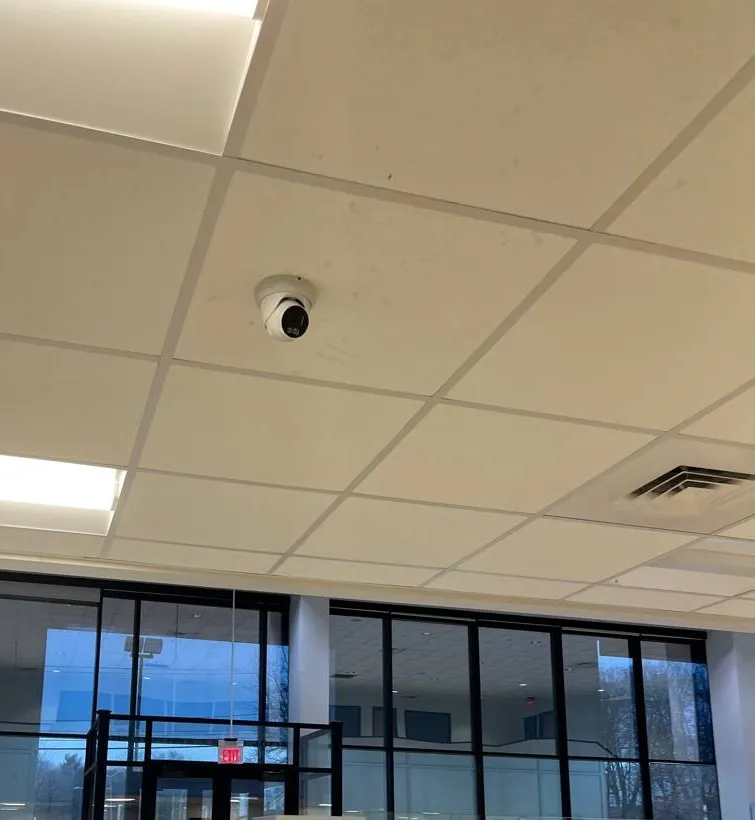
Example photo from another AESS job (not a Putnam property), cropped to the ceiling and the entrance: a white turret camera on square ceiling tiles, with a glass vestibule and a red exit sign below. An entry that is watched by a camera and answered by an intercom is the usual arrangement in the offices and practices we visit along Route 6 and Route 22.
Putnam Gate or Door Station Dead After the Storm?
A gate that will not open for the oil delivery, a building door that buzzes but stays locked, a monitor that went black when the lights flickered — call (845) 640-3835. We book the next open two-hour window, and most Putnam entry systems are working again within one to two hours of arrival. If the door has to stay secure in the meantime, tell us when you call so we can talk you through a safe temporary arrangement. When cameras on the same property are down too, our Putnam security camera repair crew can come on the same trip.
Find the plug-in transformer or power supply and check that it is warm and that its outlet or breaker is live; a dead supply looks exactly like a dead intercom.
Do not keep pressing the release if the strike buzzes without opening; a strike held on for long periods can overheat.
Note what still works — picture but no sound, sound but no door, one handset but not another. It tells us where the fault is before we arrive.
What We Install
Intercom Repair Services in Putnam County
Most Putnam intercom calls fall into one of the jobs below. Each is priced on its own, so a single house with one dead door station is not paying for what a forty-unit condo entry needs.
🔊
Sound and Picture Faults
No voice, voice one way only, hum, crackle, a picture that rolls or goes dark. We test the door station, the cable and each indoor unit in turn and replace only the part that fails.
🔑
Door Release and Strike Repair
Strikes that buzz but do not let go, latches that bind in January, releases that work from one apartment and not another. Voltage, current and alignment checked at the door, not guessed from the panel.
🚧
Gate Call Box Repair
Call boxes at driveway and private-road gates: dead keypads, programmed numbers that no longer ring, relays that stick, posts knocked crooked by plows. Line, cellular or network connection tested end to end.
⚡
Power Supply and Surge Repair
Burnt transformers and DC supplies replaced with the right rating, moved somewhere dry and protected against the next lightning season and the next NYSEG or Central Hudson restoration.
📞
Handset and Monitor Replacement
Matching handsets and video monitors for existing systems, or compatible replacements when the original model is gone, so one failed unit does not mean a new system for the whole building.
🧵
Long-Run Cable Faults
Breaks and shorts in buried or overhead runs to gates, garages and outbuildings, found with a fault locator and repaired at the spot rather than by trenching the whole length again.
📶
Network, Cloud and App Repair
IP door stations and cloud panels that show offline, apps that stopped ringing, and SIP calls that fail after an internet change. Router, network switch and account checked along with the panel.
🏢
Condo and Senior Building Entries
Lobby panels, directories, resident handsets and door hardware in condo complexes, townhouse communities and senior apartments, scheduled with the board or the manager so the door is never left unsecured.
🔄
Partial Upgrades That Keep the Wiring
When a part is truly unavailable, a new door station or converter on the existing cable, so walls and ceilings stay closed and only the units that need it are changed.
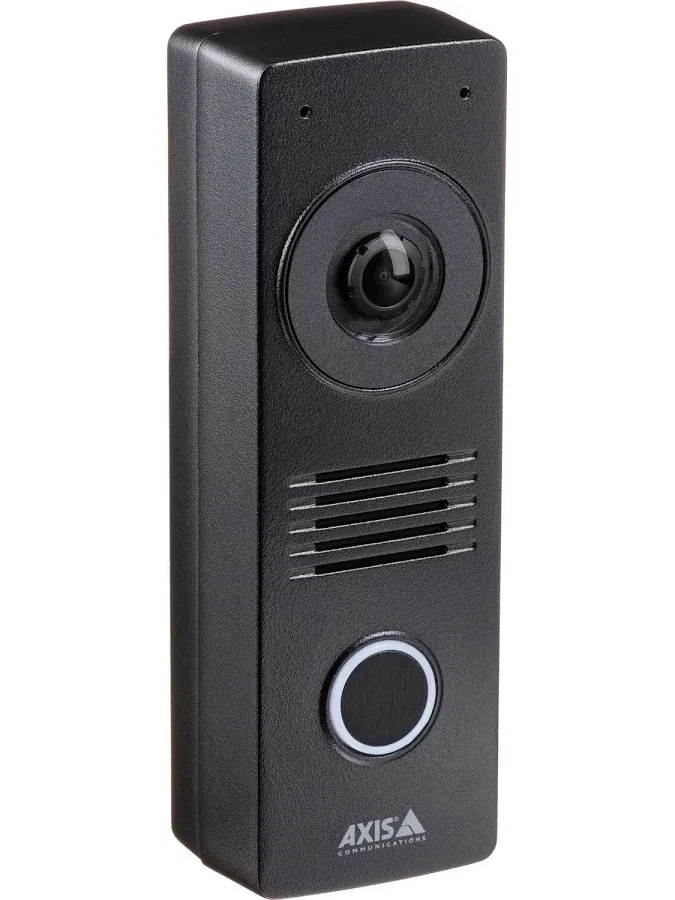
Manufacturer product photo (not an installed unit): a dark grey rectangular door station with a round camera at the top, a slotted speaker grille below it and a call button with a lit ring near the base. On a lake house or a barn door the speaker slots are the first thing to fill with grit, water and insects, which is why we open the station before blaming the wiring.
Building Specialists
Intercom Repair for Putnam County’s Architecture
The buildings decide where intercom faults hide. These are the six kinds of Putnam property we see most, and what goes wrong in each.
Houses Set Back From the Road
Colonials, raised ranches and newer houses on wooded lots in Carmel, Southeast and Patterson, often with a door station at the front, a second at the garage and sometimes a gate at the road. Long runs, several indoor units, and power supplies hidden in basements or garages.
Lake Cottages and Former Bungalows
The 1920s summer colonies at Lake Carmel, Putnam Lake and Lake Peekskill, now mostly winterized and extended in stages, and the shoreline houses on Lake Mahopac and Lake Oscawana. Door stations exposed to damp, cable through crawlspaces, and houses that stand empty for weeks.
Private Roads and Gated Drives
Drives and shared roads where the visitor meets a call box on a post hundreds of feet from any building. Cable buried along the drive or strung on poles, a phone line or cellular module in the box, and a gate operator that must agree with the intercom about when to open.
Condo, Townhouse and 55+ Communities
Garden-style condo buildings and newer communities such as Overlook, Toll Brothers’ 55-and-over development in Carmel, where an association maintains the exteriors and common areas. Lobby panels, resident monitors and decisions that pass through a board.
Senior Apartment Buildings
Two-storey garden complexes like the 24-unit buildings at Gleneida Court in Carmel and at Mahopac Hills on Route 6. Entry systems that must be loud, clear and simple, used by residents whose hearing, sight or reach may be limited.
Main Street Buildings With Flats Upstairs
Two- and three-storey buildings with shops at street level and apartments above, along Main Street in Brewster and Cold Spring and at crossroads like Oregon Corners in Putnam Valley. One street door, two kinds of user, and often a buzzer added decades after the building went up.
How the repair differs by building
Houses and lake cottages. The power supply is the first stop. In older houses it is often a small transformer screwed to a joist in the basement or wired into a junction box in the garage, and in lake houses it may be in a crawlspace that floods every spring. We confirm the output voltage under load, look at the terminals for corrosion and, if the supply is in a damp place, move it to a dry, accessible one with its circuit labelled. Door stations on lake-facing porches get opened up: speaker grilles collect grit and insect nests, and the gasket that keeps water off the circuit board hardens after a few winters. Where a station has corroded beyond cleaning, we replace it with the same model or a compatible one so the indoor units can stay.
Private roads and gated drives. The call box is a small computer in a metal box on a post, fed by a long cable and talking to the outside world over a phone line, a cellular module or a network link. We work from both ends: what the box says about its own power and connection, and what arrives at the house or the gate operator. Long buried runs are tested for continuity and insulation, and if there is a fault we locate it to within a few feet before anyone picks up a shovel. Poles, posts and boxes are checked for the damage plows and frost leave behind.
Condos and senior buildings. These systems usually have a lobby panel, a controller or distributor in an equipment closet, and one indoor unit per apartment. Before we change anything we record the existing directory and programming, because a reset that loses the resident list is the most avoidable outage there is. Work is scheduled with the board or the manager, the entry door stays secure while we work, and the fix is tested from several apartments on different floors, not just from the closest one.
Main Street buildings. A street door shared by a shop and the flats above often has two systems layered on top of each other: a buzzer for the apartments and an electric strike the business uses during opening hours. We separate what each user controls, check that the strike is the right type for the door and the hours, and confirm that anyone upstairs can still get out freely. In Cold Spring’s historic district we keep exterior changes to what the existing plate already covers, because anything visible from the street can need the village’s Historic District Review Board.
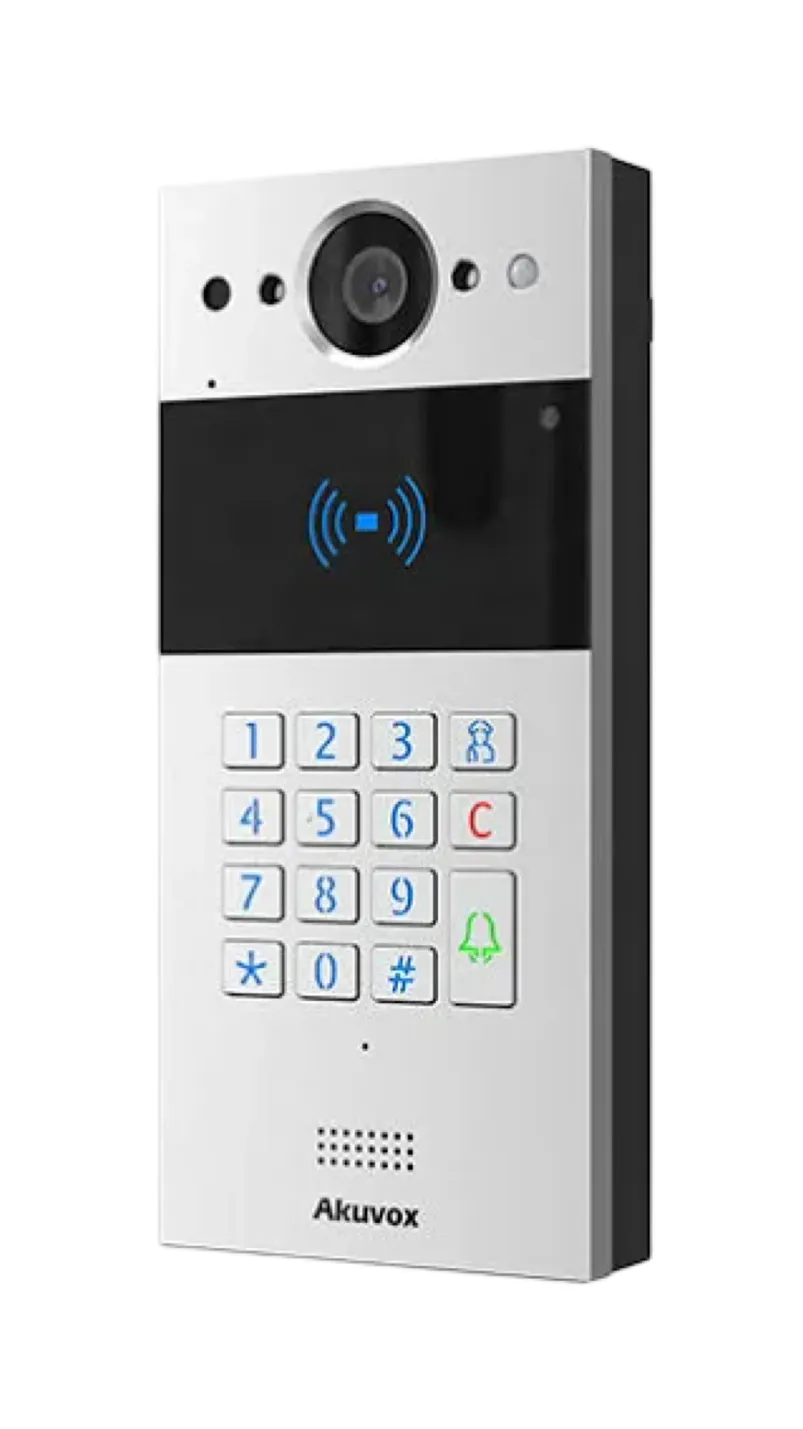
Manufacturer product photo (not an installed unit): a tall brushed steel door station with a small camera and two lights at the top, a black band with a card-reader symbol, and a twelve-key keypad with a green bell key and a red clear key. Keypad stations like this guard condo lobbies, private-road gates and back doors of offices in Putnam, and their keypads wear out long before their cameras.
Commercial Intercom Repair
Business Intercom Repair in Putnam County
The county profile places most of Putnam’s commerce along Routes 6, 9, 22 and 52 and near the I-84 interchanges. These are the six places our commercial intercom calls come from, and what the businesses there need from a door.
Route 6, Mahopac and Carmel
Plazas, banks, medical and dental offices, and service businesses along the busiest road in the county. Typical calls: a rear staff door whose keypad has failed, a front-desk monitor that stopped ringing, a delivery buzzer that no one can hear.
Gleneida Avenue and Route 52, Carmel
The county seat around the 1814 courthouse on Lake Gleneida, with offices, practices and older buildings converted to professional use. Entry panels that need a directory and controlled after-hours access.
Main Street, Village of Brewster
A mixed-use Main Street with the Metro-North station at its end, as the county’s Main Street study describes it, plus newer apartment proposals reported in 2021. Shared street doors, upstairs apartments and storefronts that open and close on different schedules.
Route 22 and Route 312, Southeast
Shopping plazas, offices and medical space near the I-84 interchanges. Entry panels on network systems, doors tied to alarms, and managers who want to see who buzzed in and when.
Main Street, Cold Spring
Shops, restaurants and galleries in the historic district, many with an apartment door beside the shop door. Repairs that keep the street face unchanged unless the review board approves otherwise.
Oregon Corners, Putnam Valley
The crossroads of Oscawana Lake Road and Peekskill Hollow Road, with a deli, restaurants, a salon, a hardware store, a post office and a medical office, and second-floor apartments reached by stairs from the street. Small systems, outdoor exposure, and doors used by both tenants and customers.
Rules that touch a Putnam intercom repair
The state intercom requirement most people have heard of is a New York City rule. Multiple Dwelling Law §50-a requires an intercom with a door release in class A multiple dwellings of eight or more apartments built or converted after 1968, but MDL §3 applies the law to cities of 325,000 or more; other cities, towns and villages are covered only if they adopt it by local law. No Putnam municipality is a city, so check with your town or village before assuming it applies.
Tenants still have the statewide warranty of habitability. Real Property Law §235-b covers the premises and the areas shared with other tenants, so a broken entry door in a rented building is the owner’s problem whatever the intercom law says. The Attorney General’s tenants’ guide notes that condo owners cannot raise the warranty, though tenants renting in a condo can.
Home-improvement contractors register with Putnam County Consumer Affairs. The county’s 2025 application asks for a $300 two-year fee, a liability certificate naming the county, workers’ compensation coverage or an exemption, and a $25,000 bond. Ask any installer for their registration, including us.
Low-voltage and electrical work has its own county licences. The county Electrical Board licenses limited data-communication technicians and electricians; where a repair needs a new line-voltage circuit for a power supply, a licensed electrician does that part, and electrical permits in Carmel, Patterson and Putnam Valley are filed with those towns.
Cold Spring’s historic district reviews visible changes. Since 1976, exterior alterations visible from the street need the Historic District Review Board’s approval; work behind an existing plate or inside the building is not reviewed.
Trenching near wetlands needs care. The Town of Carmel regulates wetlands of an eighth of an acre or more and a 100-foot buffer around them, which matters when a new cable has to reach a gate across a wet field.
Exits stay free. Whatever the intercom does, the building’s exit doors must let people leave without a key or a code; we never wire a release in a way that traps anyone inside.
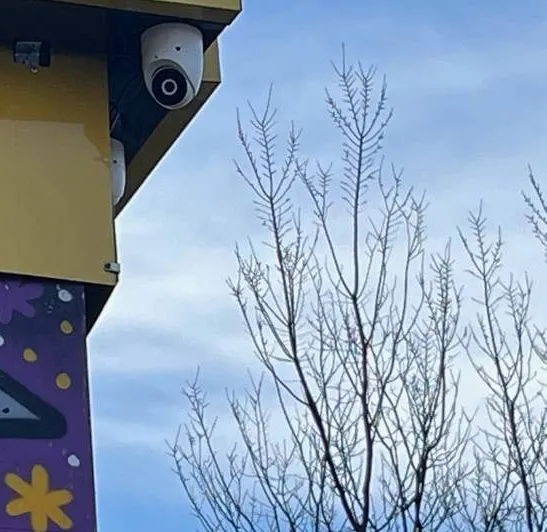
Example photo from another AESS job (not a Putnam property), cropped to the corner of the canopy: a white dome camera mounted under a yellow shopfront canopy beside bare winter branches. Street doors on Main Street in Brewster or Cold Spring often share a canopy like this between the shop and the apartment door beside it, and both need their own way to answer a caller.
Your Questions Answered
Intercom Repair in Putnam County: Questions Answered
These are the questions Putnam owners, boards and managers put to us about gate call boxes, lake houses that close for the winter, storms and generators, condo and senior building entries, shared Main Street doors, cold-weather door releases and network panels. They are grouped by the problem behind them, and each answer is what we would say on the phone.
Gates, Call Boxes and Long Cable Runs
Our road association has one call box at the gate for nine houses, and it now rings every house except one. Where is the fault likely to be?
Almost never in the box itself. A call box that reaches eight of nine numbers has working power, a working line and a working speaker, so the fault sits with that one entry. The usual causes are a phone number in the directory that changed when the household switched carriers or dropped its landline, a number stored with a missing or extra digit, or a phone at the house that now screens calls from unknown numbers and sends the gate straight to voicemail. On boxes that ring a handset inside each house over a cable rather than a phone line, the suspect becomes that house’s branch of the cable or its indoor unit. We read the stored directory first, place a test call to each entry, and correct the programming before touching any hardware. It is also worth agreeing who in the association holds the programming code, because a box that only a long-gone installer could change is a box nobody can fix in a hurry.
A plow keeps clipping the post our gate call box stands on. What mounting holds up to a Putnam winter?
The answer is mostly about where the post stands rather than how strong it is. Call boxes are usually set close to the drive so a driver can reach the keypad from the window, which also puts them where the plow blade and the snow it throws land. We set the post back from the plowed edge on a gooseneck arm that brings the box to the window, sink it in concrete below the frost line so it does not heave and lean each spring, and add a reflective marker or a short bollard on the road side. The cable should enter through the base in conduit with a sweep, not a sharp bend, so a knock does not snap it at ground level. If the box has already been hit, we check the cable entry and the hinge of the housing as well as the post, because a box that was jarred can let water in long after it looks straight again.
The cable from the house to the gate runs about 600 feet underground. Can a break be found without digging up the whole driveway?
Usually, yes. A cable that has stopped carrying sound or power over that distance has either broken, shorted, or let in water at a joint, and each of those leaves a measurable signature. We disconnect both ends and test each pair for continuity, resistance and insulation, which tells us whether we are hunting a break or a short. A time-domain or tone-based fault locator then estimates the distance to the fault, and a tracer lets us follow the cable’s path on the surface so the estimate turns into a spot on the ground. Most faults on long Putnam runs are at a buried splice, where a root has crushed the cable, or where it passes under a culvert or a stone wall. Once located, we dig one small hole, make a sealed repair, and retest. If the cable turns out to be damaged in many places, we price a new run or a wireless link instead, so you can compare before deciding.
The gate opens when someone enters a code at the keypad, but pressing the call button on the same box does nothing. Why would one half work and not the other?
Because they use different paths. The keypad only needs the box’s power and the relay that tells the gate operator to open, both of which stay on the property. The call button needs an outgoing connection: a telephone line, a cellular module, or a network link to an app or a server. When codes still work and calls do not, the box is healthy and the connection is not. On a phone-line box we test the line at the box and at the point where it enters the property, because a line moved to a new service can stop carrying the box’s calls without anyone noticing. On a cellular box we check the signal at the post, the module’s registration and the account. On a network box we check the link back to the house. The fix may be as small as reprogramming or as large as moving the box to a different kind of connection, and we explain the choice with the test results in hand.
Lake Houses and Weekend Homes
Every spring when we open the lake house, the door station has stopped working. What does a winter in an empty house do to it?
Three things, mostly. First, moisture: an outdoor station that goes through months of freezing and thawing with no heat in the house behind it can draw in condensation, and that water sits on the circuit board and its contacts until they corrode. Second, power: if the house is shut down at the panel, the supply is cold-started in spring, and a transformer or power supply that was already tired often fails on that first start. Third, visitors of the six-legged kind: wasps, ants and spiders find a quiet speaker grille in an empty house. When we come out, we open the station, look at the board and the gasket, measure the supply, and clean or replace what has failed. To prevent a repeat, we can fit a station rated for the cold, seal the cable entry from the inside, and put the supply on a circuit you can leave running, so the electronics stay slightly warm and dry through the winter.
Should the intercom’s power be switched off when we close the house for the season?
In most cases we would leave it on. An intercom draws very little power when it is idle, and a powered station stays a few degrees warmer and drier than a dead one, which helps it survive the winter. Switching it off also means the system goes through a cold start in spring, which is when tired supplies fail. The exceptions are a supply that is already overheating or sits in a spot that floods, and a house where the whole electrical service is shut down for safety; in those cases fix the supply or its location first. If you do switch it off, label the breaker so the caretaker can turn it back on a few days before you arrive and call us if it does not come back. Either way, it is worth asking us to check the door station in autumn while the weather is still dry, because a small leak found in October is a much cheaper repair than a corroded board found in April.
Water runs down the face of our porch door station after every heavy rain. Is it already damaged inside?
Not necessarily, but it will be if nothing changes. Most door stations are designed to shed rain falling from above, not water that sheets down a wall or blows in sideways off a lake. Look first at what is above the station: a missing gutter, a drip edge that ends just short of it, or a porch roof that channels water onto that spot. Then look at how the station is mounted. A surface box with a gap between it and the siding, or a cable that enters from the top without a drip loop, lets water run straight inside. When we open it we check the board and connectors for green or white corrosion and the speaker for rust. Light corrosion can often be cleaned and the station resealed; heavy corrosion means replacing the station with the same or a compatible model. We then fit a rain hood or a weather surround, reseal the cable entry and, where possible, move the cable so it enters from below.
Ants and wasps keep moving into the door station on our deck. What stops them?
Insects move into door stations because they offer a sheltered, slightly warm cavity with small openings, and a lake house that is quiet for weeks at a time makes an ideal home. Once inside, a nest can block the speaker, muffle the microphone and, in some stations, bridge the contacts of the call button so it rings by itself or not at all. Sprays aimed at the grille drive the liquid onto the electronics, so we avoid them. Instead we remove the nest with the station open and the power off, clean the speaker and microphone ports, and seal every opening that is not meant to be there: the gap around the cable entry, the space behind the back box and any unused screw holes. Fine stainless mesh behind the speaker grille keeps insects out without muffling the sound. If the station is mounted on a hollow column or a void in the siding, we close that void too, because insects often enter through the wall rather than the front plate.
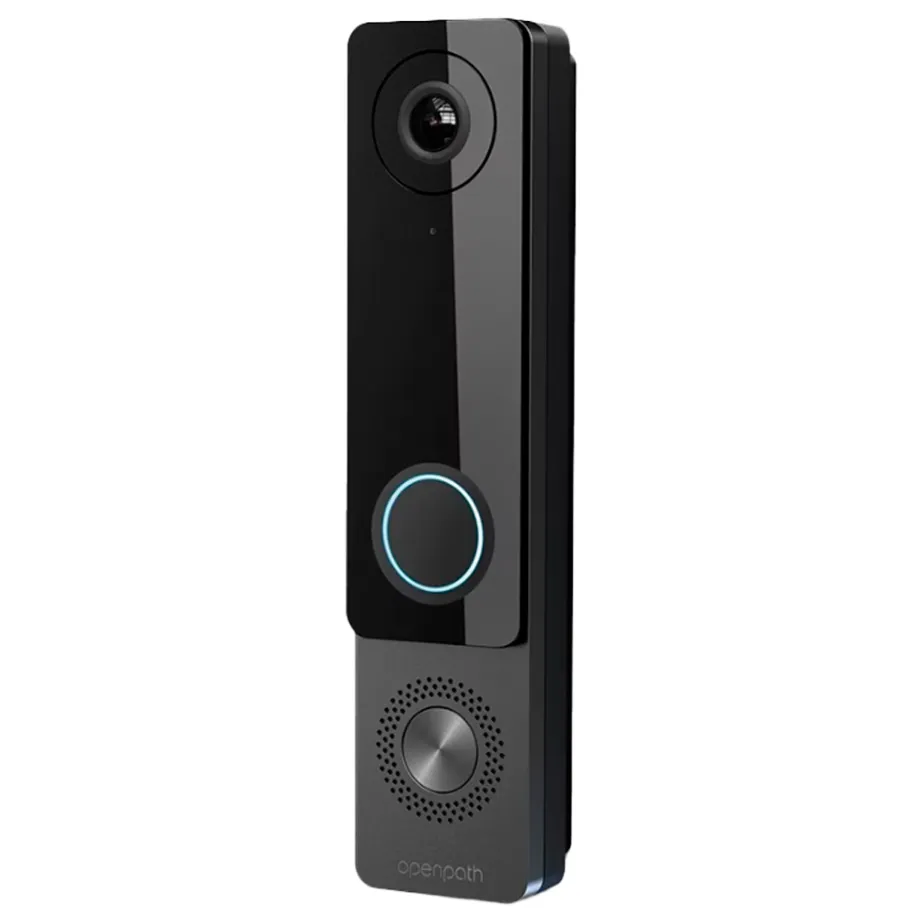
Manufacturer product photo (not an installed unit): a tall, slim black video doorbell with a camera lens at the top, a round button circled by a blue light, and a round speaker grille below. Single-family Putnam houses often have a unit like this standing in for a full intercom, and it fails in the same places: power at the door and the signal back to the house.
Storms, Power Cuts and Lightning
Since the power came back after the storm, the indoor monitors light up but the front door will not release. How can one part survive and not the other?
Because they are often powered and switched separately. In many systems the monitors and the door station run on one supply, while the electric strike or magnetic lock has its own transformer or is switched through a relay on the intercom’s controller. A surge or brown-out during restoration can burn out that strike transformer or weld the relay contacts open while the electronics on the other supply come through fine. We start at the door: is the strike getting voltage when the release button is pressed, and is it the right voltage? If not, we trace back to the transformer and the relay. If the strike gets voltage but does not move, the strike itself has failed. Manufacturer guidance on supplies matters here too: Aiphone, for example, notes that too many monitors on one 18-volt supply, or a supply placed too far away, leaves the monitors underpowered. After the repair we put the strike and the electronics on surge protection so the next restoration is less eventful.
Our standby generator takes a few seconds to start, and the intercom comes back confused every time. Can it ride through the switchover?
Yes. The problem is the gap: when the grid fails the house goes dark for the few seconds the generator needs to start and the transfer switch needs to move, and it happens again when the grid returns and the switch transfers back. Some intercom controllers and IP panels do not like two short power cuts in a row; they reboot halfway, lose their network connection or come back with the door relay in the wrong state. A small battery backup on the intercom’s supply and on the network equipment it depends on bridges both gaps, so the system never sees the outage at all. We size it for the supply’s actual draw and the door strike’s, decide with you whether the strike should stay powered or be allowed to drop during a long outage, and test the arrangement by switching the circuit off and on while someone stands at the door. If the generator’s transfer switch is being serviced anyway, mention the intercom to the electrician so its circuit is on the generator side.
The garage is a separate building and its door station died in a thunderstorm. What protection actually helps on a run between buildings?
A cable between two buildings is an antenna for a nearby strike and a path for current between two different earth grounds, and Putnam gets plenty of both: Earth Networks counted 75,093 lightning pulses over the county in 2020. Protection that helps has three parts. First, surge protectors on the intercom cable where it leaves one building and where it enters the other, each bonded to that building’s ground with a short, straight wire; a protector with a long, coiled ground lead does very little. Second, a protector on the power supply’s own outlet. Third, if the garage has its own electrical service, keeping the two grounds from being tied together through the intercom, which may mean an isolating interface or, for network stations, a short fiber link. None of this stops a direct hit, but it does stop most of the induced surges that kill stations, monitors and supplies. We also replace the burnt station and test every unit on the run, because a surge that killed one often weakened the others.
Condos, Senior Buildings and Shared Street Doors
In our condo complex, does the association or the unit owner pay when one resident’s monitor fails?
That is set by your declaration and bylaws, not by the intercom, so start with those documents. In most condominiums the lobby panel, the cabling in the walls and the equipment closet are common elements maintained by the association, while the indoor monitor inside a unit is treated as part of that unit, so the owner pays for it. Some associations take the opposite view and maintain every component so the system stays uniform. Either way, our report separates the two: what failed in the common equipment and what failed inside the apartment, with a price for each. One point of law worth knowing: the New York Attorney General’s tenants’ guide notes that condo owners cannot raise the warranty of habitability against their own association, though a tenant renting a condo unit can raise it against the unit’s owner. If your community is preparing a reserve plan, we can also tell you which parts of the system are near the end of their life and which can carry on.
Several residents in our senior building say the caller at the lobby is too faint to understand. What can be adjusted before anything is replaced?
Quite a lot. Most entry systems have separate volume settings for the door speaker, the door microphone and each indoor unit, and many have them set low because the installer adjusted them in a quiet lobby. We check those first, then look at the door station itself: a speaker clogged with dust or a microphone port blocked by grime or a layer of paint is common on panels that are twenty years old. The lobby matters too. Hard walls and a busy road behind the door make speech harder to follow, so we sometimes move the microphone to the side away from the traffic or fit a small hood that cuts wind noise. On the resident side, a handset with an amplified earpiece or a hands-free video monitor with a larger speaker can help people whose hearing has changed. Only if those steps do not help do we recommend replacing the lobby panel, and then with a model chosen for clear speech, large buttons and simple use.
Can a resident who is hard of hearing get a light or a screen alert when the lobby calls?
Yes, and it is one of the most useful changes in a senior building. Many current video monitors show the caller on screen and flash a visual indicator when the lobby calls, and some offer a text or call-display mode alongside the speaker. On older audio systems we can add a flashing-light signaller wired to the apartment’s call output, or a vibrating pager for someone who is often in another room. For residents with low vision, a monitor with large, high-contrast buttons and a door-release key that can be found by touch matters more than video. The aim is that each resident has a way to know someone is there, see or hear who it is, and let them in without hurrying across the room. We test the arrangement with the resident present, and leave short written instructions in large print beside the unit.
Our apartment sits over a shop on Main Street and we share the street door. Can the shop’s daytime door release be kept separate from our buzzer?
Usually, yes, and it should be. Many Main Street buildings in Brewster, Cold Spring and crossroads like Oregon Corners in Putnam Valley share a single street door between the business and the flats above; the county’s own Main Streets study describes a second-floor apartment at Oregon Corners whose stairs open straight onto the road. Trouble starts when the shop’s staff leave the strike unlocked during opening hours with a switch that also defeats the apartment’s buzzer, or when tenants are given the shop’s code. We give each user their own control: the apartment’s station releases the door when the tenant answers, the shop has a time-controlled or key-switched unlock for its hours, and the two do not interfere. We also make sure the strike is the right type for the door, that the door closes and latches by itself behind each visitor, and that people upstairs can always leave without a key, which matters more than anything else on a door that is also an exit.
Does the New York City intercom rule for apartment buildings apply to a rental building in Brewster or Carmel?
Not automatically. The rule people usually mean is Multiple Dwelling Law §50-a, which requires an intercom and a door release in class A multiple dwellings of eight or more apartments built or converted after 1968. But §3 of the same law says it applies to cities with a population of 325,000 or more, and that any other city, town or village may adopt it by local law. Putnam has no cities, so unless your town or village has adopted the Multiple Dwelling Law, §50-a is not the rule that governs your building. That does not mean an owner can let the entry door fail. Real Property Law §235-b, the statewide warranty of habitability, covers the apartment and the areas shared with other tenants, and local property maintenance and fire codes still apply to the doors themselves. Ask your town or village building department which code it enforces; this is general information, not legal advice. What we provide is the repair and a written record of what was wrong and what was fixed.
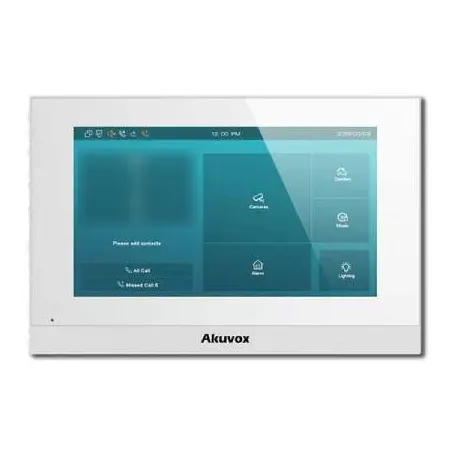
Manufacturer product photo (not an installed unit): a white wall monitor with a wide teal touchscreen divided into tiles for calls, cameras, alarm and lighting; the contact list on the left of the screen has been blurred. This is the inside half of a video intercom, and in Putnam condos and 55-and-over communities it is usually the half residents call about.
Doors, Strikes and Cold Weather
When the door will not buzz open, how do you tell whether the intercom or the door strike is to blame?
By measuring, in a fixed order. First we press the release at an indoor unit and listen and feel at the door: a strike that clicks or hums is receiving power and the fault is mechanical, while a silent strike is not getting power or has burnt out. Next we measure the voltage at the strike’s terminals while someone presses release. No voltage points back to the intercom’s relay, the transformer or the cable; the correct voltage with no movement points to the strike itself. Strike makers stress that the rating has to match the supply, 12 or 24 volts and AC or DC, and that a strike without enough current at its rated voltage often gives a weak or erratic buzz on AC power. We also check whether the strike is fail-secure, staying locked when unpowered, or fail-safe, unlocking when unpowered, because a strike of the wrong type for the door can look like a fault. Each finding narrows the repair to one part.
In January our building door only opens if someone shoves it while the buzzer sounds. Is that the strike or the door?
Usually the door, and the strike takes the blame. Cold makes metal parts contract, wood and composite frames move with the humidity, and a door that latched easily in October can press its latch hard against the strike’s keeper in January. A strike can only release a latch that is not under load; if the door is pulled tight by its closer, weatherstripping or a frame that has shifted, the keeper cannot swing and the visitor has to push. We check the gap between the latch and the keeper, the door’s alignment and the closer’s tension, and adjust or move the strike plate so the latch sits centred with a little clearance. Where a door moves too much with the seasons, a strike designed to release under preload is the better answer. ButterflyMX’s winter advice says the same in plain terms: review strike alignment and look for doors that need extra pressure to latch or release, and test during temperature swings, when intermittent faults are easier to spot.
Network and Cloud-Connected Panels
Our cloud-connected entry panel shows offline in the manager’s portal although its screen is lit. What usually causes that out here?
A lit screen means the panel has power; offline means it cannot reach the maker’s servers. The usual reasons are on the network side. In condo and office buildings the panel often sits on a small switch in a closet, and a switch that lost power in an outage, or a router that was replaced by the internet provider and given new settings, cuts the panel off without affecting anything else. Panels that connect by cellular module depend on the signal at the door, and Putnam has a long record of coverage problems: in 2015 Senator Schumer said there were more cell phone dead zones in northern Westchester and Putnam than post-winter potholes on the West Side Highway. We check the panel’s network settings and connection, the switch and router, the firewall rules the maker requires, and the subscription or account status in the portal. Most offline panels are back the same visit; when the problem is the building’s connection, we document it so the board can take it up with the provider.
The intercom app shows the door camera, but the picture freezes whenever two of us open it at once. Is the panel failing?
Probably not. Each person who opens the live view draws a separate video stream from the panel or from the maker’s relay server, and a building or house on a slow upload connection can run out of bandwidth with two or three streams at once. Rural internet in Putnam ranges from fiber to fixed wireless and satellite, so the upload speed at the property matters more than the panel. We measure the upload, look at the panel’s video settings and, where the panel allows it, set a lower-resolution stream for phones while keeping the full picture for the indoor monitor. If the panel is on Wi-Fi rather than cable, we check the signal at the door, since a weak link causes the same freezing. If none of that explains it, we look at the panel’s firmware and the app version, and only then at the panel itself.
Equipment
Types of Intercom Repair Equipment We Install
A repair uses as few new parts as possible, but when something has to be replaced, these are the categories we draw on for Putnam properties. Brands we work on include Aiphone, Comelit, ButterflyMX, Akuvox, 2N, DoorBird and DoorKing.
Replacement Door Stations
Audio and video stations matched to the existing system’s wiring and signalling, with cold-rated models and rain hoods for lake-facing porches and exposed gates.
Handsets and Video Monitors
Like-for-like indoor units where the model is still made, compatible units where it is not, and hands-free or amplified versions for residents who find a handset hard to use.
Power Supplies and Transformers
Supplies with the voltage, current and AC or DC type the system and the strike call for — Aiphone’s PS-1820UL, for example, is an 18-volt DC, 2-amp supply — mounted somewhere dry and labelled at the breaker.
Electric Strikes and Releases
Fail-secure or fail-safe strikes rated for the door’s latch and the supply’s voltage, including preload-tolerant models for doors that move with the seasons.
Gate Call Boxes and Keypads
Repair parts and replacement boxes for driveway and road gates, with keypads, programmable directories and outputs to the gate operator.
Cellular and Network Modules
Connections that let a call box or door station reach phones without a copper line, chosen only after we have measured the signal or network at the post.
Two-Wire-to-IP Converters
Interfaces that let new network stations or apps work over an existing two-wire cable, so a building can modernise in stages without opening walls.
Surge Protection and Isolation
Protectors on intercom cables at each building entry and on supply outlets, and isolating interfaces where two buildings sit on separate electrical services.
Battery Backup
Small backup units for intercom supplies and the network gear they rely on, covering the seconds before a generator starts and short utility blips.
Cable, Conduit and Enclosures
Direct-burial cable, conduit sweeps at posts, sealed splice kits and weatherproof boxes for repairs on long runs to gates, garages and outbuildings.
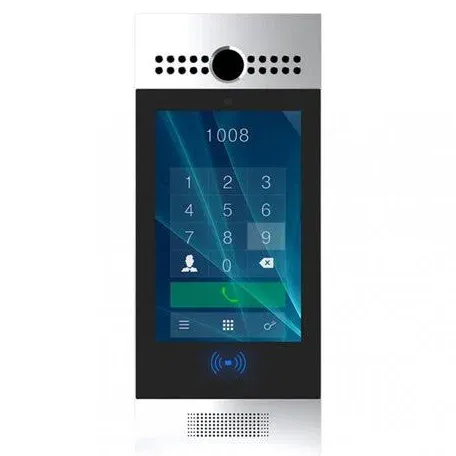
Manufacturer product photo (not an installed unit): a tall entry panel with a camera between two rows of speaker holes, a blue touchscreen keypad showing an apartment number being dialled, and a card-reader symbol beneath. Touchscreen panels are network devices, so when one stops calling out, the fault is as likely to be the internet connection as the panel.
National alarm and doorbell brands compared with a local intercom repair
Question
ADT / Ring / SimpliSafe
AESS intercom repair in Putnam
What do they fix?
Their own monitored alarms, doorbells and cameras
The intercom already on your door or gate, whatever its brand
Multi-unit entry panels
Not their product line for small buildings
Lobby panels, directories and resident units in condos and senior buildings
Gate call boxes on long runs
Not covered
Call box, cable, connection and gate operator interface
Door strikes and releases
Not covered
Tested and repaired at the door
Monthly fees
Plans tied to monitoring or cloud storage
None unless you choose a cloud intercom service
Who comes out
Varies by provider and plan
A licensed low-voltage technician booked from our Bronx office
A video doorbell can be a sensible answer for a single-family house with one door. Where a gate, several doors or several households are involved, an intercom remains the tool for the job, and keeping the one you already have working is usually the cheapest route.
AI Overview Reality Check
What AI Gets Wrong About Intercom Repair in Putnam County
Our build environment could not display a live Google AI Overview for Putnam intercom searches, so we took seven claims from the cost guides, manufacturer blogs and vendor material that such answers draw on, and checked each one against what Putnam properties show us.
“An intercom system costs about $2,500”
HomeAdvisor gives a national average of $2,500 for an intercom system, materials and labour included. The same page lists a normal range of $1,200 to $8,500 in one place and $1,500 to $15,000 in another, without reconciling the two, and it does not give a figure for repairs at all. A number like that is easy for a summary to repeat and hard for an owner to use.
The figure answers a different question. It describes buying and installing a system, while most Putnam calls are about one failed part in a system that already works: a transformer, a strike, a door station or a programmed number. Our Putnam diagnostic visit is $218–$435, and the published repair lines below run from $435 for a power supply to a few thousand dollars for an entry panel retrofit.
The figures that do push a Putnam bill up are local ones: a cable fault somewhere under a long drive, a gate that has to be reached on a private road, a building whose directory has to be rebuilt. Those are priced after testing, not from a national average.
“Turn it off and on again and most problems clear”
General troubleshooting guides, including ButterflyMX’s, suggest power-cycling an unresponsive panel or holding its reset button. For a frozen network panel, that advice is fine, and we would try it first too.
It does not fix what storms do. When Isaias left 34,150 of NYSEG’s 38,693 Putnam customers without power in August 2020, the systems that failed did so because restoration surges burnt out transformers, strike supplies and relays. In a county that recorded 75,093 lightning pulses in 2020, induced surges on long cables do the same. Cycling the power on a burnt supply changes nothing, and resetting a controller can wipe the directory a building depends on.
So by all means try a restart once, but if the system does not come back, stop there and note what still works. Repeated resets are the main reason we arrive to find an entry panel with no stored residents.
“Copper phone lines reached the end of their life in 2020”
A 2015 trade announcement for DoorKing’s cellular telephone-entry module said the end of life for copper phone lines was 2020, and the idea that the landline is already gone still circulates in answers about gate intercoms. In fact it is still being decided. In September 2026 NEWS10 reported that Verizon was seeking federal approval to retire copper landlines, saying fewer than three percent of its customers still use them and that copper stays in place where Verizon cannot offer a viable replacement.
On September 28, 2026 the FCC paused automatic approval of Verizon’s filings after a wave of public comments, according to Alarm Grid’s tracking of the case; the Town of Saugerties had told residents the proposed discontinuance in parts of New York would begin on or after November 30, 2026. We found no published list naming Putnam exchanges, so we do not claim any Putnam line is affected.
What matters for a gate call box is simpler: does the line it uses still carry its calls today? We test that at the box. If the line is changing or already has, the box can be reprogrammed, given a cellular module where there is signal, or moved to the network — a decision made with measurements, not headlines.
“If the parts are discontinued, replace the whole intercom”
Vendor guides often say that when old parts are unavailable, the answer is to replace the entire intercom unit. Sometimes that is true. One of Aiphone’s own specialists puts it plainly: if the product is discontinued, you may have to start fresh with wire and product.
Others at the same company describe the alternative: a lot of times the cable can be reused, saving much of the cost, and buildings can upgrade the back-end equipment first using two-wire converters or new cable, keeping the field equipment that still works. That matches what we see in Putnam condo and senior buildings, where the expensive part to replace is the cable inside finished walls.
So the real question is which part is discontinued. A dead handset in one apartment rarely justifies a new system; a failed controller with no replacement may justify a phased change. We price both routes before anyone decides.
“A wireless or IP intercom can go anywhere”
Wireless intercoms are sold as the way to avoid wiring altogether, and an Aiphone specialist notes that an IP intercom can be installed anywhere, because it needs only a network connection with power rather than a long dedicated cable. In a suburban office with a good network, that is close to true.
At the end of a Putnam drive, the network is the hard part. Cellular coverage has a long and public history of gaps here: in 2015 Senator Schumer called for an investigation of carrier maps that showed quality reception in northern Westchester and Putnam where residents found dead zones, and in 2016 the Highlands Current reported a county plan for new towers to fix emergency radio coverage that might also help phone users. Wi-Fi from a house rarely reaches a gate several hundred feet away through trees.
So “anywhere” means anywhere with a reliable connection. We measure the signal or network at the exact spot first, and where it is not there, a buried cable or a dedicated point-to-point link does the job a wireless promise cannot.
“New York law requires every apartment building to have a working intercom”
Online answers often state this as a statewide rule, and some local service pages repeat it. The law usually meant is Multiple Dwelling Law §50-a, which requires an intercom with a door release in class A multiple dwellings of eight or more apartments built or converted after January 1, 1968.
Section 3 of that law limits it to cities of 325,000 or more people, unless another city, town or village adopts it by local law. Putnam has towns and villages but no cities, so for a building in Brewster, Carmel or Cold Spring the starting point is the statewide warranty of habitability in Real Property Law §235-b and whatever local codes the town or village enforces.
The practical outcome is often the same — an owner who lets a rented building’s entry fail is exposed either way — but owners and boards should know which rule they are under. This is general information, not legal advice.
“New York has no contractor licensing for this kind of work”
Contractor-licensing summaries online note, correctly, that New York has no statewide general contractor licence, and AI answers sometimes stretch that into “anyone can do it.”
Putnam regulates at county level. Its Consumer Affairs office registers home-improvement contractors under Chapter 135; the 2025 application asks for a $300 two-year fee, a liability certificate naming the county, workers’ compensation coverage and a $25,000 bond. The county’s Electrical Board separately licenses limited data-communication technicians and electricians, and electrical permits in several towns are filed locally.
Before anyone opens your entry panel, ask for their registration and licence numbers, and check them against the county’s lists — ours included. Ours is New York State low-voltage licence #12000287431.
Fix the Part That Failed, Keep the Rest
Send a photo of the door station and tell us what happens when someone presses the button. You get a straight answer about the likely fault, the parts involved and the price range before anyone drives up from the Bronx.
For a Putnam intercom quote we need the town or hamlet, the type of property, the brand if it is printed on the station, the number of doors, gates or units, and what happens when the button is pressed. A written range comes back the same business day; to talk it through, call (845) 640-3835.
✅
Request Received
A Hudson Valley technician will read what you sent about the intercom and call you before the end of the business day. If the door or gate cannot wait, dial (845) 640-3835.
How It Works
Our Installation Process
A single door station on a Lake Peekskill cottage and a forty-unit condo entry in Carmel follow the same seven steps; the difference is how many units, doors and cable runs each step covers.
1. Describe it on the phone
You tell us what happens when the button is pressed and send a photo of the door station and of anything behind the indoor unit. From that we usually know which parts and test gear to bring.
2. Check the power first
At the property we find the transformer or power supply, measure its output under load and look for heat damage and corrosion. A failed supply explains more dead intercoms than any other part.
3. Open the door station
The outdoor unit is opened and inspected for water, corrosion, insects and loose terminals; the speaker, microphone, button and camera are tested on their own.
4. Test the cable end to end
Each pair is checked for continuity, shorts and insulation. Long runs to gates and outbuildings get a fault locator so any repair is made at one spot.
5. Check indoor units and door hardware
Every handset or monitor is tested, and the strike or lock is measured for voltage and checked for alignment, so the fix covers the whole path from caller to open door.
6. Prove the connection
Call boxes and network panels make real test calls to each programmed phone or app, and the directory is backed up before any setting is changed.
7. Protect it and hand over
We seal and hood exposed stations, add surge protection on runs between buildings, label the supply, and leave a short written record of what was found, fixed and tested.
Manufacturer product photo (not an installed unit): a door station with a black upper face around a round camera and a card-reader symbol, and a silver lower plate with a single round call button. A station with a card reader built in can replace a separate keypad at a side door, which removes one more piece of hardware from the weather.
Coverage Area
Intercom Repair Near Putnam County’s Landmarks
Six places that most Putnam callers know, each standing for a different kind of intercom job.
Lake Mahopac, Town of Carmel
A lake of about 587 acres with three private islands, once a nineteenth-century summer resort and now a year-round community. Shoreline houses bring door stations exposed to lake weather and docks reached by long paths.
Putnam County Courthouse, Gleneida Avenue
Built in 1814 beside Lake Gleneida and one of the oldest courthouses still in use in the state. Around it, the county seat’s offices and practices, and senior apartments at Gleneida Court that rely on clear entry calls.
West Branch Reservoir, Kent and Carmel
An eight-billion-gallon City reservoir in service since 1895, its two basins divided by Route 301. Houses along its edges have long drives, wet ground and gate cables that cross it.
Cold Spring Historic District
Some 691 acres and more than 200 buildings, listed on the National Register in 1982. Main Street doors shared by shops and upstairs flats, repaired without changing the street face.
Tilly Foster Farm, Southeast
About 199 county-owned acres near Brewster, once a dairy and later a horse farm, bought by the county in 2002. The farm country around it is where driveway gates and call boxes on posts are common.
Fahnestock State Park, Route 301
A state park of roughly 15,000 acres reaching from Putnam into Dutchess. Houses on its edges in Kent, Carmel and Putnam Valley deal with weak cellular signal, long outages and wildlife at every door.
Town by town
Town or village
What an intercom repair usually involves there
Carmel and Mahopac
The county’s largest town: commuter houses, lakefront homes on Lake Mahopac and Lake Gleneida, newer condo and 55-and-over communities, senior apartments at Gleneida Court and on Route 6, and offices along Route 6 and Route 52.
Kent
Lake Carmel’s converted 1920s bungalows, houses around the West Branch and Boyds Corner reservoirs, and private roads in the woods. Door stations on damp porches and power supplies in crawlspaces.
Patterson
Putnam Lake’s small-lot cottages on one side, farms and acreage with gates on the other. Gate call boxes, long buried runs and electrical permits filed with the town where a new circuit is needed.
Southeast and Brewster
The village’s mixed-use Main Street by the Metro-North station, apartments over shops, plazas on Route 22 and offices off Route 312. Shared street doors and network entry panels.
Putnam Valley
Lake Oscawana’s shoreline, Lake Peekskill’s bungalows, Oregon Corners’ shops with flats above, and hilly private roads. The town declared a flash-flood state of emergency on July 29, 2026 — water in outdoor boxes is a regular call.
Philipstown, Cold Spring and Nelsonville
Historic village doors on Main Street, estates in Garrison with long drives, and Central Hudson rather than NYSEG territory. Repairs that keep the street face unchanged.
We also repair intercoms in Mahopac Falls, Lake Carmel, Putnam Lake, Lake Peekskill, Peach Lake, Kent Cliffs, Ludingtonville, Holmes, Towners, Tompkins Corners, Garrison, Continental Village, Crafts and Croton Falls.
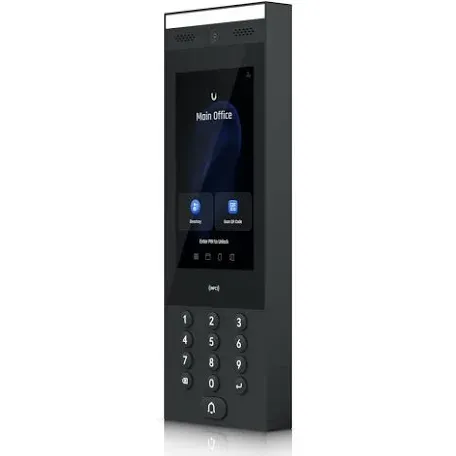
Manufacturer product photo (not an installed unit): a slim dark entry panel with a portrait touchscreen showing a Main Office screen and two icons, and a twelve-button keypad below. Panels of this kind suit a practice or office that needs a directory at the door and a code for staff after hours.
Pricing
Intercom Repair Cost in Putnam County
These are our published intercom repair ranges with the Putnam area adjustment applied. They are for planning; once the fault is found, the written quote replaces them.
Job
Putnam range
What it covers
Diagnostic visit
$218–$435
On-site testing and a written quote; credited if the repair goes ahead
Power supply or transformer
$435–$1,160
Diagnosis, the part, installation in a dry spot, testing
Door release or strike
$508–$1,305
Strike replacement, voltage and alignment checks, timing
Single handset
$363–$870
Like-for-like or compatible indoor handset
Video monitor or house door station swap
$435–$1,088
One video unit on a house or townhouse system
Entry panel component repair
$580–$1,740
Speaker, microphone, keypad or one circuit board
Entry panel retrofit
$2,175–$5,075
New panel in the existing opening on the existing wiring
Cable fault repair (limited)
$1,450–$4,350
Locating the fault, splicing or replacing a section, retesting
Small building system
$6,525–$17,400
Entry panel, resident units, power and door release
Mid-size network system
$17,400–$40,600
IP entry systems for larger condo and apartment buildings
Maintenance plan
$870–$3,480 a year
Scheduled checks for buildings and associations
Return visit after completion
$195 an hour, 3-hour minimum ($585)
Callbacks once a job is signed off
Gates. Gate-specific work — a stuck relay, a new cellular module, a replacement call box or a long cable run — is priced after we test the gate. For reference, our Hudson Valley hub publishes $350–$900 for a gate button or relay repair and $1,800–$3,500 for converting a landline call box to cellular.
What raises a Putnam price. A cable fault under a long drive or a wet field; a call box on a private road we need a key or code to reach; a directory that has to be rebuilt because it was lost in a reset; a power supply that needs a new line-voltage circuit from an electrician; and storm damage that has hit several units at once.
What lowers it. A photo of the station and a clear description before the visit, someone at the property who can open each door and each apartment we need, and grouping several faults — a dead handset, a weak strike, a gate that rings the wrong number — into one trip.
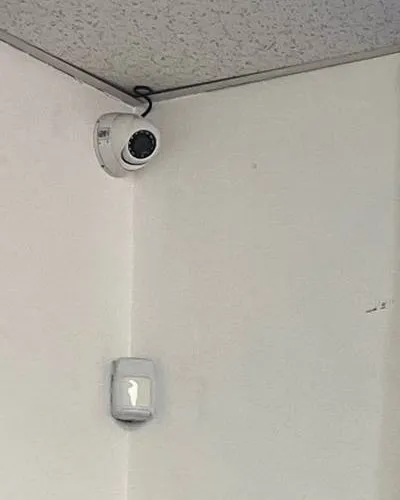
Example photo from another AESS job (not a Putnam property), cropped to the corner: a small white dome camera tucked under a textured ceiling with a white motion sensor on the wall below it. When an office entry intercom is repaired we often find the camera and alarm wiring sharing the same closet and the same power, which is worth knowing before anything is unplugged.
Shop Our Systems
Intercom Repair Packages & Pricing
Three common starting points, each taken from a line in the table above. Testing on the day sets the final figure.
Power & Release Repair
$435–$1,160
For a house or small building where the system is dead or the door will not open. Supply or transformer replaced and moved somewhere dry, strike voltage checked, surge protection on the supply outlet, test calls from every indoor unit.
Entry Panel Retrofit
$2,175–$5,075
For a condo, senior or Main Street building whose lobby panel has failed. New panel in the existing opening, directory transferred or rebuilt, every apartment tested, written record for the board or manager.
Small Building System
$6,525–$17,400
For a building where repair is no longer sensible. Entry panel, resident units, power and door release, reusing the existing cable wherever it tests good.
Bought the parts yourself? Labour-only repair
If you have already bought a replacement station, monitor or strike, send us the model first so we can confirm it works with the rest of your system. We then fit and test it as part of the visit. Parts you supply carry their maker’s warranty rather than ours, and return visits are charged at $195 an hour with a three-hour minimum.
Get the Putnam Repair Price in Writing
A short call and a photo of the station usually narrow the job to one line of the table. The written quote lists each part and each hour separately.
Field Notes: Start at the Power, Finish at the Door
On a Putnam intercom call I go to the power supply before I touch the panel. Out here it is rarely where you expect: screwed to a joist in a basement, behind a water heater, in a garage on a different circuit from the house, or in a crawlspace under a lake cottage. I want to see whether it is warm, whether its terminals are green, and what voltage it gives with the system calling, not sitting idle. A good share of “dead” intercoms are alive and starving.
Then I go to the door, not the closet, because the visitor’s side is the side that lives in the weather. I open the station, look at the gasket and the board, and listen to it on its own before I blame the cable. On a gate I try the keypad and the call button separately; if one works and the other does not, I know which half of the box to chase.
The last thing I do is make the system prove itself the way it will actually be used: a real call to each programmed phone, a real visitor pressing the button in the cold, and the door releasing and latching again behind them. If it will not do that, the job is not finished. — Anwar Timothy, NYS licence #12000287431
FAQ
Putnam County Intercom Repair FAQ
What should we gather before calling so the visit is shorter?
+
Three things help most. First, a clear photo of the outdoor station and of any box or transformer you can find behind the indoor unit or in the basement, because the brand and model tell us which parts to bring. Second, a short description of what happens when someone presses the button and when it started, especially if a storm, a power cut, a renovation or a change of phone or internet provider came first. Third, access: who can open each door, gate and apartment we may need, and any gate codes or keys. With that, most Putnam repairs are finished in one trip.
Can the entry stay secure while you work on a building’s intercom?
+
Yes. Before we disconnect anything, we agree with the board or the manager how the door will be controlled during the work, whether that is someone stationed at the entrance for a short period, the door left locked with residents using keys, or the work done in stages so only one part of the system is down at a time. We never leave an entry propped open or unlocked and unattended. For condo and senior buildings we can give residents a short notice to post in the lobby with the date and the expected time the system will be off.
Do we need an electrician as well as an intercom technician?
+
Only if the repair needs new line-voltage wiring. Most intercom supplies plug into an existing outlet or connect to an existing circuit, and replacing them is low-voltage work. If the supply has to move to a place with no outlet, if a new circuit is needed for a gate operator, or if the existing wiring to the supply is unsafe, that part is done by a licensed electrician. We tell you in the quote whether an electrician is needed and can coordinate with yours.
Will you leave a record of the wiring for whoever works on it next?
+
Yes. After a repair we leave a short written note of what we found, what we replaced and how the system is laid out: where the power supply is and which breaker feeds it, where the controller or distributor sits, which cable goes to which door or gate, and where any splices are. For buildings we also record the directory and the programming settings. That note saves the next technician, ours or anyone else’s, an hour of searching, and it helps boards plan future spending.
Can you add temporary entry codes for a contractor or dog walker and remove them later?
+
On most keypad stations and call boxes, yes. We can set up individual codes for regular visitors, contractors or cleaners so that each person has their own code, and show you or the manager how to delete a code when the job ends. Some systems can also limit a code to certain days or hours. Shared codes that never change are a common weakness on Putnam gates and condo doors, and giving each user their own is one of the simplest security improvements you can make during a repair.
We have spare handsets in a box from the original installation. Are they worth keeping?
+
Usually, yes. If your system’s handsets or monitors are no longer made, spares from the same model are the cheapest way to keep a building on its existing system for years. Bring them out when we visit and we will test each one, label the ones that work, and note them in the record we leave. Store them somewhere dry and warm. If some apartments have already had a different model fitted as a replacement, we will also note which ones, so the spares go where they match.
Can the intercom also open a garage door or a side gate?
+
Often. Many intercoms have a second relay output, or can trigger an additional relay, which can be wired to a garage door opener, a pedestrian gate or a second door. The visitor presses one button, and the person answering can choose which door to open. We check that the opener or gate operator has a suitable input, that the wiring between them is protected, and that the second door still closes and locks by itself afterwards.
Can the system show us who was let in and when?
+
Many current IP and cloud-connected panels keep a log of calls, door releases and code entries, often with a snapshot of the caller, which managers can review in an app or a portal. Older audio and analogue systems do not keep records, but a camera covering the entrance and recording to a recorder gives a similar result. If a log matters to your board or your business, tell us before the repair, because it may change which replacement part or panel we suggest.
What happens to the door if the intercom loses power?
+
That depends on the type of lock. A fail-secure electric strike stays locked when it loses power, so the door still opens from the inside and with a key from outside, but the intercom cannot release it. A fail-safe strike or a magnetic lock unlocks when power is lost. Most front doors on houses and small buildings in Putnam use fail-secure strikes, while some doors use fail-safe hardware because of how they are used as exits. We check which type you have, whether it suits the door, and whether a battery backup should carry the lock through short outages.
Can you look at the intercom at a property we are about to buy?
+
Yes. A pre-purchase check covers the outdoor stations, every indoor unit, the power supply, the door release and, for gates, the call box and its connection. We test each part, note its age and condition, and tell you which parts are still made and which are not. The written result gives you a sense of what the system will need in the next few years and can be useful when discussing repairs or price with the seller.
All Areas Served
Intercom Repair Across the Hudson Valley, NYC and Long Island
Putnam sits inside our Hudson Valley intercom repair service area. Every intercom repair page below is written for its own area’s buildings and problems.
Every Putnam statistic, date, place and rule on this page comes from a publication listed here; “excerpt” marks items seen only in a search result. Prices are our published intercom repair figures with the Putnam adjustment, and our standard hourly rate.
A call box that stopped ringing, a building door that buzzes and stays shut, or a lake-house station that did not survive the winter: ring (845) 640-3835 for the next two-hour window. Once we are on site, most entry systems are working again within one to two hours.
Putnam Intercom Repair From a Licensed, Insured Crew
Abstract Enterprises Security Systems · Putnam and Hudson Valley line (845) 640-3835 (calls and texts) · WhatsApp (718) 679-0359 · office 460 E Fordham Rd, Bronx, NY 10458
Intercom repair in Putnam under New York State low-voltage licence #12000287431, fully insured · same-day written estimates · 4.7★ from 201 Google reviews
Manufacturers’ warranties on stations, monitors, supplies and strikes apply in addition.
Full terms — including 50% deposit, one-year parts-only warranty on AESS-supplied products, and the late-fee schedule — are set out in the service agreement. See our warranty page.
Page reviewed and updated October 18, 2026. Changelog: Putnam intercom repair page rebuilt from new research on gate call boxes and long buried runs, phone-line changes, lake houses closed for winter, storm and lightning damage, generators, condo, 55-and-over and senior building entries, shared Main Street doors, cold-weather door releases, network panels, the scope of the Multiple Dwelling Law, county contractor registration and Cold Spring’s historic district.